One-Pot LAMP-Coupled CRISPR/Cas12b Assay Enables Sensitive Detection of Helicobacter pylori



Simple Summary
Abstract
1. Introduction
- ①
- High Sensitivity and Specificity: The high specificity of the CRISPR/Cas12b system, combined with the efficient amplification capability of LAMP technology, significantly enhances detection accuracy, overcoming the limitations of individual techniques and demonstrating superiority over traditional PCR and culture methods.
- ②
- Fast and simple: The assay can be completed within one hour, significantly reducing the time required for conventional testing. It can be paired with a portable instrument, enabling users with minimal training to perform the test. This is particularly suitable for resource-limited settings, offering low equipment requirements and rapid diagnosis for point-of-care testing.
- ③
- Non-invasive sampling: Patient stool samples can be utilized, eliminating the need for invasive specimen collection. This enhances patient comfort and compliance, making it particularly suitable for pediatric and elderly populations.
2. Materials and Methods
2.1. Reagents and Materials
2.2. Strain Cultivation and DNA Extraction
2.3. Design and Screening of LAMP Primers
2.4. Optimization of the LAMP Detection System
2.5. Sensitivity and Specificity Analysis of the LAMP Detection Method
2.6. Screening of sgRNAs
2.7. Establishment and Optimization of the Two-Step LAMP-CRISPR/Cas12b Detection Method
2.8. Establishment and Optimization of the One-Step LAMP-CRISPR/Cas12b Detection Method
2.9. Sensitivity Analysis of LAMP-CRISPR/Cas12b
2.10. Specificity Analysis of LAMP-CRISPR/Cas12b
2.11. Detection and Application of Clinical Samples
3. Results
3.1. Establishment of a LAMP Method for the Detection of H. pylori
3.1.1. LAMP Primer Screening
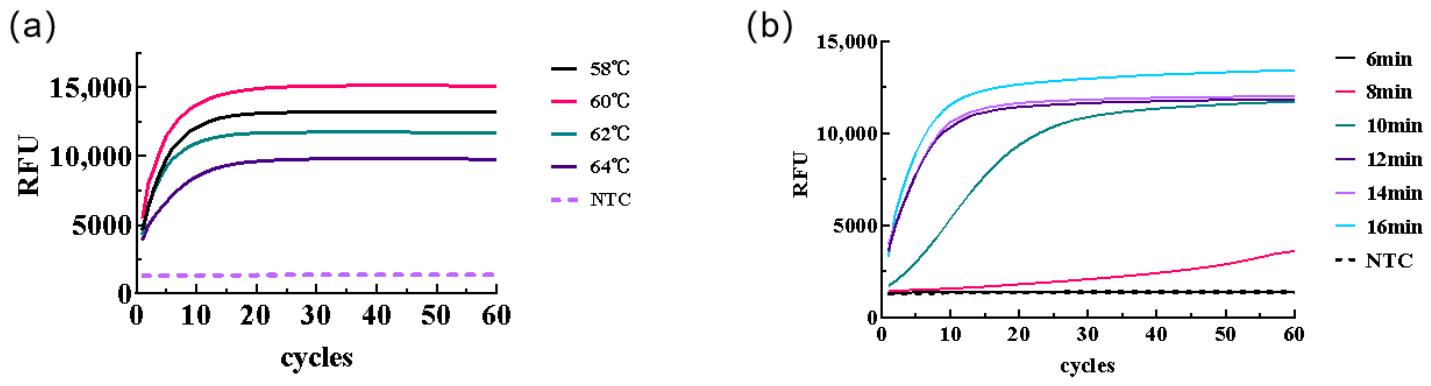
3.1.2. Optimization of LAMP Reaction Conditions
3.2. Establishment of a LAMP-CRISPR/Cas12b Method for Detection of H. pylori
3.2.1. sgRNA Screening
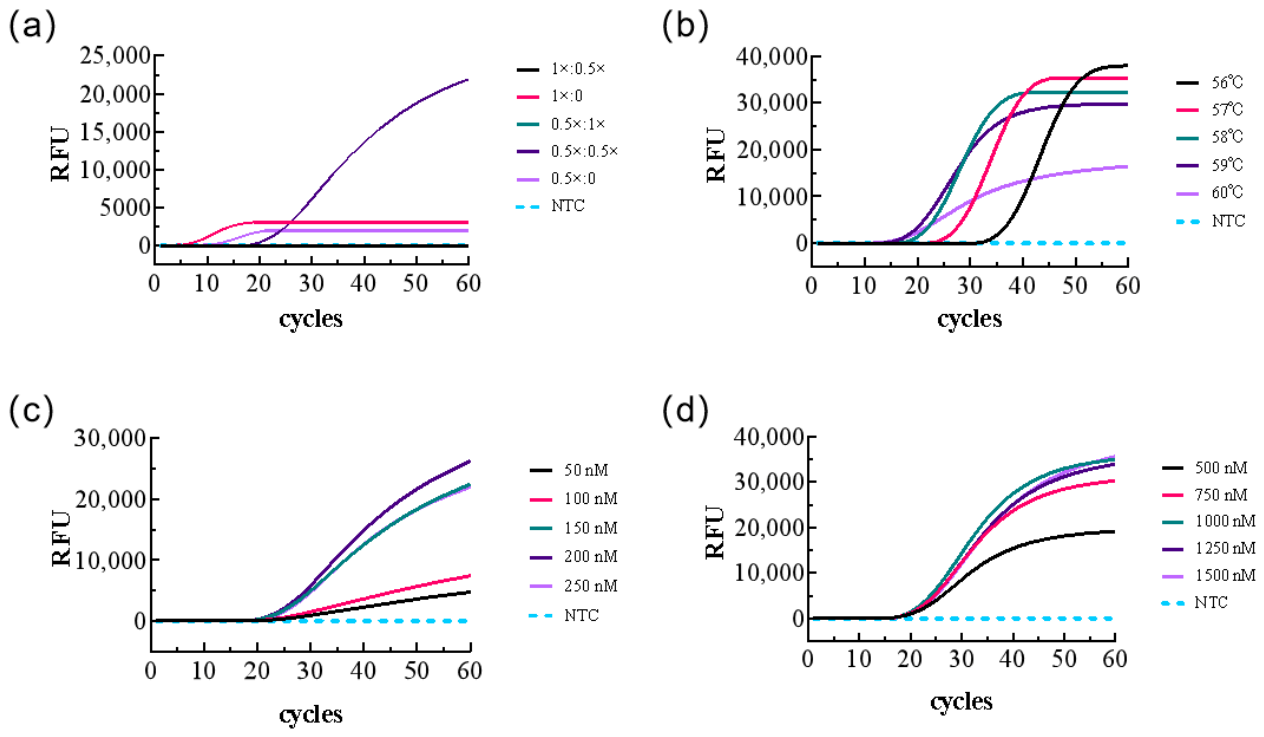
3.2.2. Optimization of the LAMP-CRISPR/Cas12b Two-Step Detection Method
3.2.3. Optimization of the LAMP-CRISPR/Cas12b One-Step Detection Method
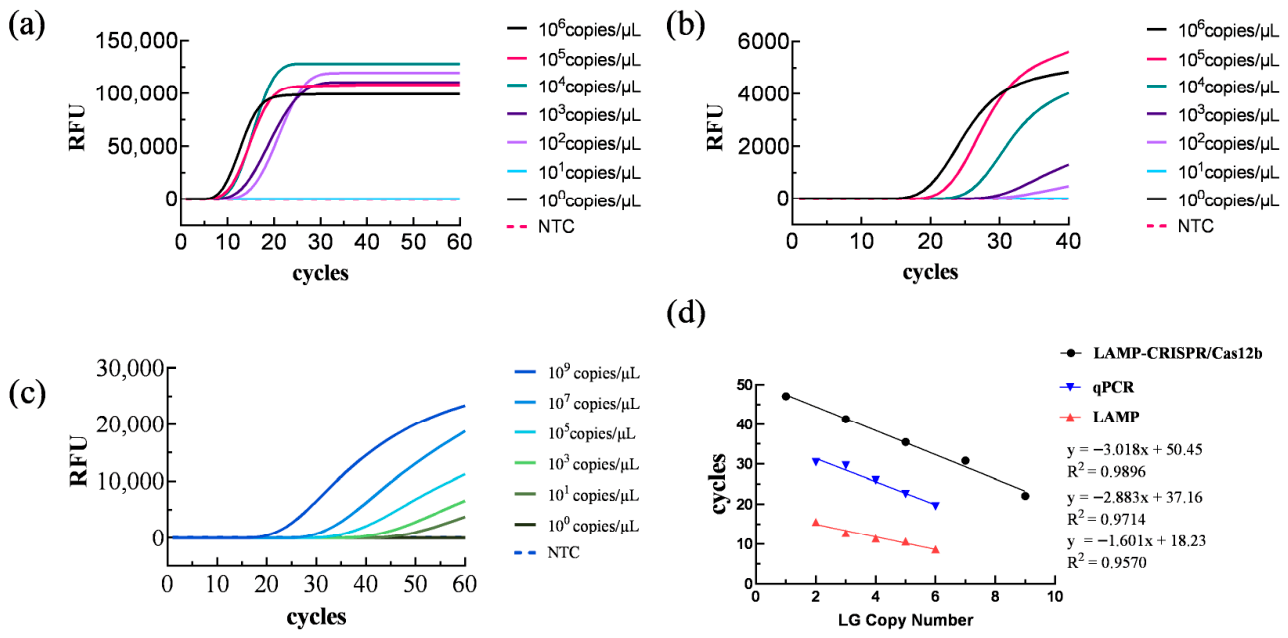
3.3. Sensitivity Analysis of LAMP-CRISPR/Cas12b Detection
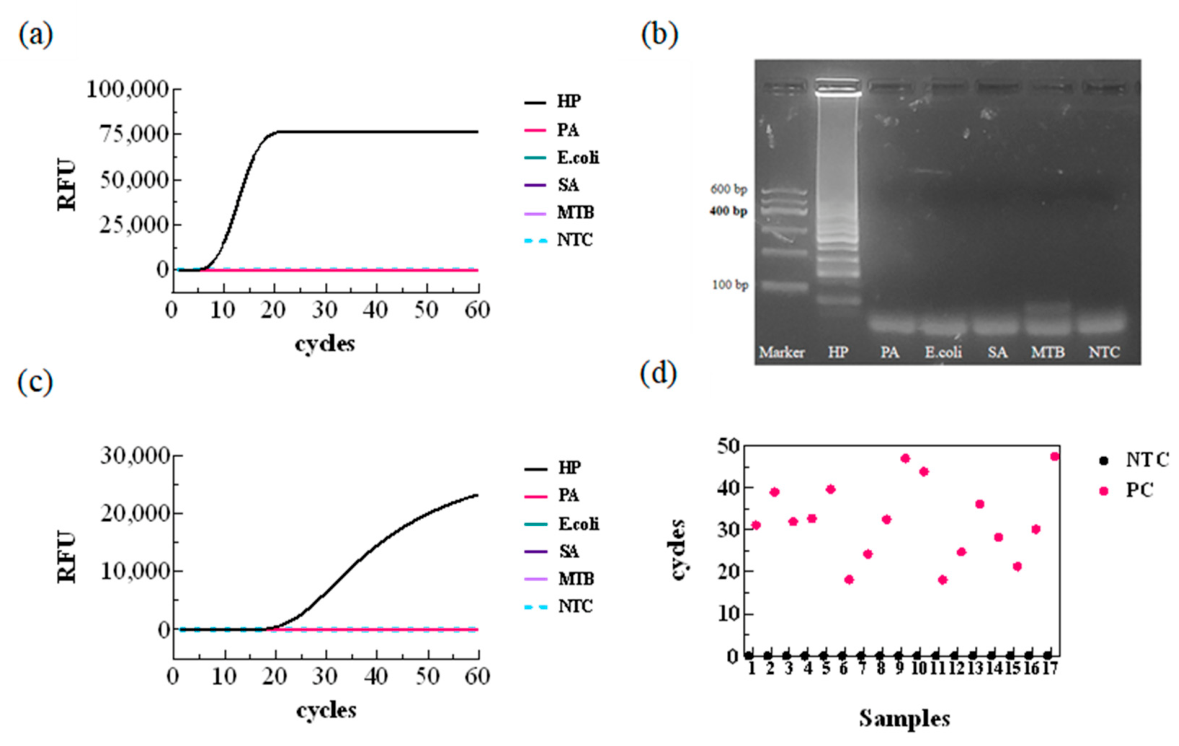
3.4. Specificity Analysis of LAMP-CRISPR/Cas12b Detection
3.5. Clinical Sample Detection and Applications
4. Discussion
5. Conclusions
Author Contributions
Funding
Institutional Review Board Statement
Informed Consent Statement
Data Availability Statement
Acknowledgments
Conflicts of Interest
Abbreviations
| HP | Helicobacter Pylori |
| LAMP | Loop-Mediated Isothermal Amplification |
| CRISPR | Clustered Regularly Interspaced Short Palindromic Repeats |
| Cas12b | CRISPR-Associated Protein 12b |
| CagA | Cytotoxin-Associated Gene A |
| PCR | Polymerase Chain Reaction |
| MALT | Mucosa-Associated Lymphoid Tissue |
| qPCR | Quantitative Polymerase Chain Reaction |
| Bst | Bacillus Stearothermophilus |
| dNTPs | Deoxyribonucleotide Triphosphates |
| ddH2O | Double-Distilled Water |
| FIP | Forward Inner Primer |
| BIP | Backward Inner Primer |
| F3 | Forward Outer Primer |
| B3 | Backward Outer Primer |
| LF | Loop Forward Primer |
| sgRNA | Single Guide RNA |
| ssDNA | Single-Stranded DNA |
| RPA | Recombinase Polymerase Amplification |
| RUT | Rapid Urease Test |
| ELISA | Enzyme-Linked Immunosorbent Assay |
| PA | Pseudomonas aeruginosa |
| E.coli | Escherichia coli |
| SA | Staphylococcus aureus |
| MTB | Mycobacterium tuberculosis |
| NTC | No Template Control |
| PC | Postive Control |
References
- Hooi, J.K.Y.; Lai, W.Y.; Ng, W.K. Global Prevalence of Helicobacter pylori Infection: Systematic Review and Meta-Analysis. Gastroenterology 2017, 153, 420–429. [Google Scholar] [CrossRef]
- Hatakeyama, M. Malignant Helicobacter pylori-Associated Diseases: Gastric Cancer and MALT Lymphoma. Adv. Exp. Med. Biol. 2019, 1149, 135–149. [Google Scholar] [PubMed]
- Qiu, E.; Li, Z.; Han, S. Methods for detection of Helicobacter pylori from stool sample: Current options and developments. Braz. J. Microbiol. 2021, 52, 2057–2062. [Google Scholar] [CrossRef]
- Sabbagh, P.; Javanian, M.; Koppolu, V.; Vasigala, V.R.; Ebrahimpour, S. Helicobacter pylori infection in children: An overview of diagnostic methods. Eur. J. Clin. Microbiol. Infect. Dis. 2019, 38, 1035–1045. [Google Scholar] [CrossRef]
- Taylor, S.C.; Nadeau, K.; Abbasi, M.; Lachance, C.; Nguyen, M.; Fenrich, J. The Ultimate qPCR Experiment: Producing Publication Quality, Reproducible Data the First Time. Trends Biotechnol. 2019, 37, 761–774. [Google Scholar] [CrossRef] [PubMed]
- Ma, H.; Bell, K.N.; Loker, R.N. qPCR and qRT-PCR analysis: Regulatory points to consider when conducting biodistribution and vector shedding studies. Mol. Ther. Methods Clin. Dev. 2021, 20, 152–168. [Google Scholar] [CrossRef]
- Tang, Y.W.; Procop, G.W.; Persing, D.H. Molecular diagnostics of infectious diseases. Clin. Chem. 1997, 43, 2021–2038. [Google Scholar] [CrossRef]
- Zeng, M.; Wang, X.; Tan, Z.; Guo, W.; Deng, Y.; Li, S.; Nie, L.; He, N.; Chen, Z. A Novel Rapid Detection Method for Mycobacterium tuberculosis Based on Scattering-Light Turbidity Using Loop-Mediated Isothermal Amplification. Biosensors 2025, 15, 162. [Google Scholar] [CrossRef]
- Saifuddin, S.A.; Rashid, R.; Nor Azmi, N.J.; Mohamad, S. Colorimetric strategies applicable for loop-mediated isothermal amplification. J. Microbiol. Methods 2024, 223, 106981. [Google Scholar] [CrossRef]
- Notomi, T.; Okayama, H.; Masubuchi, H.; Yonekawa, T.; Watanabe, K.; Amino, N.; Hase, T. Loop-mediated isothermal amplification of DNA. Nucleic Acids Res. 2000, 28, e63. [Google Scholar] [CrossRef] [PubMed]
- Soroka, M.; Wasowicz, B.; Rymaszewska, A. Loop-Mediated Isothermal Amplification (LAMP): The Better Sibling of PCR? Cells 2021, 10, 1931. [Google Scholar] [CrossRef]
- Xu, D.; Zeng, H.; Wu, W.; Liu, H.; Wang, J. Isothermal Amplification and CRISPR/Cas12a-System-Based Assay for Rapid, Sensitive and Visual Detection of Staphylococcus aureus. Foods 2023, 12, 4432. [Google Scholar] [CrossRef]
- Nguyen, L.T.; Rananaware, S.R.; Yang, L.G.; Macaluso, N.C.; Ocana-Ortiz, J.E.; Meister, K.S.; Pizzano, B.L.; Sandoval, L.S.W.; Hautamaki, R.C.; Fang, Z.R.; et al. Engineering highly thermostable Cas12b via de novo structural analyses for one-pot detection of nucleic acids. Cell Rep. Med. 2023, 4, 101037. [Google Scholar] [CrossRef]
- Nguyen, L.T.; Macaluso, N.C.; Pizzano, B.L.M.; Cash, M.N.; Spacek, J.; Karasek, J.; Miller, M.R.; Lednicky, J.A.; Dinglasan, R.R.; Salemi, M.; et al. A thermostable Cas12b from Brevibacillus leverages one-pot discrimination of SARS-CoV-2 variants of concern. EBioMedicine 2022, 77, 103926. [Google Scholar] [CrossRef]
- Strecker, J.; Jones, S.; Koopal, B.; Schmid-Burgk, J.; Zetsche, B.; Gao, L.; Makarova, K.S.; Koonin, E.V.; Zhang, F. Engineering of CRISPR-Cas12b for human genome editing. Nat. Commun. 2019, 10, 212. [Google Scholar] [CrossRef]
- Bhatia, S.; Pooja; Yadav, S.K. CRISPR-Cas for genome editing: Classification, mechanism, designing and applications. Int. J. Biol. Macromol. 2023, 238, 124054. [Google Scholar] [CrossRef]
- Brogan, D.J.; Akbari, O.S. CRISPR Diagnostics: Advances toward the Point of Care. Biochemistry 2023, 62, 3488–3492. [Google Scholar] [CrossRef] [PubMed]
- Abudayyeh, O.O.; Gootenberg, J.S. CRISPR diagnostics. Science 2021, 372, 914–915. [Google Scholar] [CrossRef] [PubMed]
- Qian, X.; Xu, Q.; Lyon, C.J.; Hu, T.Y. CRISPR for companion diagnostics in low-resource settings. Lab Chip 2024, 24, 4717–4740. [Google Scholar] [CrossRef]
- Jalalypour, F.; Farajnia, S.; Somi, M.H.; Hojabri, Z.; Yousefzadeh, R.; Saeedi, N. Comparative Evaluation of RUT, PCR and ELISA Tests for Detection of Infection with Cytotoxigenic H. pylori. Adv. Pharm. Bull. 2016, 6, 261. [Google Scholar] [CrossRef] [PubMed]
- Bakhtiari, S.; Hasanvand, B.; Pajavand, H.; Alvandi, A.; Abiri, R. Rapid and accurate detection of Helicobacter pylori from biopsy specimens using loop-mediated isothermal amplification. APMIS 2019, 127, 510–514. [Google Scholar] [CrossRef] [PubMed]
- Yong, Q.; Ou, X.; Zhao, Y.; Kang, X.; Gao, H.; Liu, H. CRISPR/Cas and isothermal amplification in Pathogen Detection: Applications and future perspectives. Talanta 2026, 305, 129662. [Google Scholar] [CrossRef]
- Broughton, J.P.; Deng, X.; Yu, G.; Fasching, C.L.; Servellita, V.; Singh, J.; Miao, X.; Streithorst, J.A.; Granados, A.; Sotomayor-Gonzalez, A.; et al. CRISPR-Cas12-based detection of SARS-CoV-2. Nat. Biotechnol. 2020, 38, 870–874. [Google Scholar] [CrossRef] [PubMed]
- Ma, E.; Chen, K.; Shi, H.; Stahl, E.C.; Adler, B.; Trinidad, M.; Liu, J.; Zhou, K.; Ye, J.; Doudna, J.A. Improved genome editing by an engineered CRISPR-Cas12a. Nucleic Acids Res. 2022, 50, 12689–12701. [Google Scholar] [CrossRef]
- Shi, Y.; Fu, X.; Yin, Y.; Peng, F.; Yin, X.; Ke, G.; Zhang, X. CRISPR-Cas12a System for Biosensing and Gene Regulation. Chem. Asian J. 2021, 16, 857–867. [Google Scholar] [CrossRef]
- Obande, G.A.; Banga Singh, K.K. Current and future perspectives on isothermal nucleic acid amplification technologies for diagnosing infections. Infect. Drug Resist. 2020, 13, 455–483. [Google Scholar] [CrossRef] [PubMed]
- Feng, J.; Wu, Z.; Zhu, W.; Jin, F.; Zhao, M.; Zhong, W. A novel thermo-activated one-pot RPA-CRISPR-Cas12b assay for Mycoplasma pneumoniae POCT. Biosens. Bioelectron. 2025, 288, 117839. [Google Scholar] [CrossRef]
- Qian, S.; Chen, Y.; Xu, X.; Peng, C.; Wang, X.; Wu, H. Advances in amplification-free detection of nucleic acid: CRISPR/Cas system as a powerful tool. Anal. Biochem. 2022, 643, 114593. [Google Scholar] [CrossRef]
- Guo, J.; Shan, Y.; Hu, G.; Zhu, X.; Zhao, K.; Wu, T. Rapid visual detection of Monkeypox virus by one-step LAMP-CRISPR/Cas12b assay. Virol. J. 2025, 22, 151. [Google Scholar] [CrossRef]
- Chen, Z.; Zhao, K.; He, Z.; Luo, X.; Qin, Z.; Tan, Y.; Zheng, X.; Wu, Z.; Deng, Y.; Chen, H.; et al. Development and evaluation of a thermostatic nucleic acid testing device based on magnesium pyrophosphate precipitation for detecting Enterocytozoon hepatopenaei. Chin. Chem. Lett. 2022, 33, 4053–4056. [Google Scholar] [CrossRef]
- Wang, Z.; Chen, H.; Hu, A.; Cui, X.; Shi, C.; Lu, Z.; Meng, F.; Lv, F.; Zhao, H.; Bie, X. Establishment of LAMP-CRISPR/Cas12a for rapid detection of Escherichia coli O157:H7 and one-pot detection. Food Microbiol. 2024, 124, 104622. [Google Scholar] [CrossRef]
- Atçeken, N.; Yigci, D.; Ozdalgic, B.; Tasoglu, S. CRISPR-Cas-Integrated LAMP. Biosensors 2022, 12, 1035. [Google Scholar] [CrossRef]



| Primer Set | Primer | Sequence (5′→3′) |
|---|---|---|
| Primer Set 1 | F3-1 | CATACAACCCCCTATCCTT |
| B3-1 | CCAATCCCCACCAGTAG | |
| FIP-1 | CCGTTCGGATTTGATTCCCTATGATGATAAAGAGAAAGCGGA | |
| BIP-1 | GTTCATGGGCGTGTTTGATGGCTCTCCATTTTTTTCTGC | |
| LF-1 | CCTGCAAAAGATTGTTTGGCAGA | |
| Primer Set 2 | F3-2 | ACAACCCCCTATCCTTG |
| B3-2 | CCAATCCCCACCAGTAG | |
| FIP-2 | CCGTTCGGATTTGATTCCCTATATGATAAAGAGAAAGCGGAG | |
| BIP-2 | GTTCATGGGCGTGTTTGATGGCTCTCCATTTTTTTCTGC | |
| LF-2 | CCTGCAAAAGATTGTTTGGCAGA | |
| Primer Set 3 | F3-3 | ACAACCCCCTATCCTTG |
| B3-3 | CCAATCCCCACCAGTAG | |
| FIP-3 | CCGTTCGGATTTGATTCCCTATTGATAAAGAGAAAGCGGAGT | |
| BIP-3 | GTTCATGGGCGTGTTTGATGGCTCTCCATTTTTTTCTGC | |
| LF-3 | CCTGCAAAAGATTGTTTGGCAGA | |
| Primer Set 4 | F3-4 | ACAACCCCCTATCCTTG |
| B3-4 | CCAATCCCCACCAGTAG | |
| FIP-4 | CCGTTCGGATTTGATTCCCTATGATAAAGAGAAAGCGGAGTT | |
| BIP-4 | GTTCATGGGCGTGTTTGATGGCTCTCCATTTTTTTCTGC | |
| LF-4 | CCTGCAAAAGATTGTTTGGCAGA | |
| Primer Set 5 | F3-5 | TCTCTAAGGAAACGAGAGC |
| B3-5 | CAATTCCCTTTTGATGCCTT | |
| FIP-5 | TGTTAGCTTGAGCTTTTGCTTCCAAGAAGTAGAGAAAAAATTGGAGAG | |
| BIP-5 | GCCAAAAAGATGAGATTTTTGCGTCTGAGCGTAAGCGATTGC | |
| LB-5 | ATAAAGAGGCTAATAGAGACGCAAG | |
| Primer Set 6 | F3-6 | TCTCTAAGGAAACGAGAGC |
| B3-6 | GTCTTTCAAATTCTTGTTGACAT | |
| FIP-6 | CTGTTAGCTTGAGCTTTTGCTTCAGAAGTAGAGAAAAAATTGGAGA | |
| BIP-6 | AAGAGGCTAATAGAGACGCAAGAACAATTCCCTTTTGATGCC | |
| LB-6 | GCAATCGCTTACGCTCAGAA | |
| Primer Set 7 | F3-7 | AGAGAAAAAATTGGAGAGCAA |
| B3-7 | GTCTTTCAAATTCTTGTTGACAT | |
| FIP-7 | CGCAAAAATCTCATCTTTTTGGCTCGGCAACAAAAATAAAATGGAAG | |
| BIP-7 | AAGAGGCTAATAGAGACGCAAGAAGACAATTCCCTTTTGATGC | |
| LB-7 | GCAATCGCTTACGCTCAGAA |
| Group | Sequence Name | Sequence (5′→3′) |
|---|---|---|
| sgRNA | sgRNA-1 | TAATACGACTCACTATAGGGGTCTAGAGGACAGAATTTTTCAACGGGTGTGCCAATGGCCACTTTCCAGGTGGCAAAGCCCGTTGAGCTTCTCAAATCTGAGAAGTGGCACTCAGACAATTCCCTTTTGATGCC |
| sgRNA-2 | TAATACGACTCACTATAGGGGTCTAGAGGACAGAATTTTTCAACGGGTGTGCCAATGGCCACTTTCCAGGTGGCAAAGCCCGTTGAGCTTCTCAAATCTGAGAAGTGGCACGAGAGCAAAAGCGGCAACAAAAA | |
| sgRNA-3 | TAATACGACTCACTATAGGGGTCTAGAGGACAGAATTTTTCAACGGGTGTGCCAATGGCCACTTTCCAGGTGGCAAAGCCCGTTGAGCTTCTCAAATCTGAGAAGTGGCACAAGTTTATCAGACAATTCCCTTT | |
| sgRNA-4 | TAATACGACTCACTATAGGGGTCTAGAGGACAGAATTTTTCAACGGGTGTGCCAATGGCCACTTTCCAGGTGGCAAAGCCCGTTGAGCTTCTCAAATCTGAGAAGTGGCACAAATTCTTGTTGACATTTTCAA | |
| Probe | FAM-TTTTTTTTTTTT-BHQ1 |
Disclaimer/Publisher’s Note: The statements, opinions and data contained in all publications are solely those of the individual author(s) and contributor(s) and not of MDPI and/or the editor(s). MDPI and/or the editor(s) disclaim responsibility for any injury to people or property resulting from any ideas, methods, instructions or products referred to in the content. |
© 2026 by the authors. Licensee MDPI, Basel, Switzerland. This article is an open access article distributed under the terms and conditions of the Creative Commons Attribution (CC BY) license.
Share and Cite
Tang, Z.; Bai, W.; Yan, S.; Luo, G.; Zheng, Y.; Bai, Z.; Chen, Z. One-Pot LAMP-Coupled CRISPR/Cas12b Assay Enables Sensitive Detection of Helicobacter pylori. Biology 2026, 15, 797. https://doi.org/10.3390/biology15100797
Tang Z, Bai W, Yan S, Luo G, Zheng Y, Bai Z, Chen Z. One-Pot LAMP-Coupled CRISPR/Cas12b Assay Enables Sensitive Detection of Helicobacter pylori. Biology. 2026; 15(10):797. https://doi.org/10.3390/biology15100797
Chicago/Turabian StyleTang, Ziyan, Wentao Bai, Shuting Yan, Gaoming Luo, Yanheng Zheng, Zhuojun Bai, and Zhu Chen. 2026. "One-Pot LAMP-Coupled CRISPR/Cas12b Assay Enables Sensitive Detection of Helicobacter pylori" Biology 15, no. 10: 797. https://doi.org/10.3390/biology15100797
APA StyleTang, Z., Bai, W., Yan, S., Luo, G., Zheng, Y., Bai, Z., & Chen, Z. (2026). One-Pot LAMP-Coupled CRISPR/Cas12b Assay Enables Sensitive Detection of Helicobacter pylori. Biology, 15(10), 797. https://doi.org/10.3390/biology15100797