
Potential Role of Captive Environments in Reshaping the Compositions of Pathogenic Gut Bacteria in Equus Species

Simple Summary
Abstract
1. Introduction
2. Materials and Methods
2.1. Sample Collection
2.2. Data Analysis
3. Results
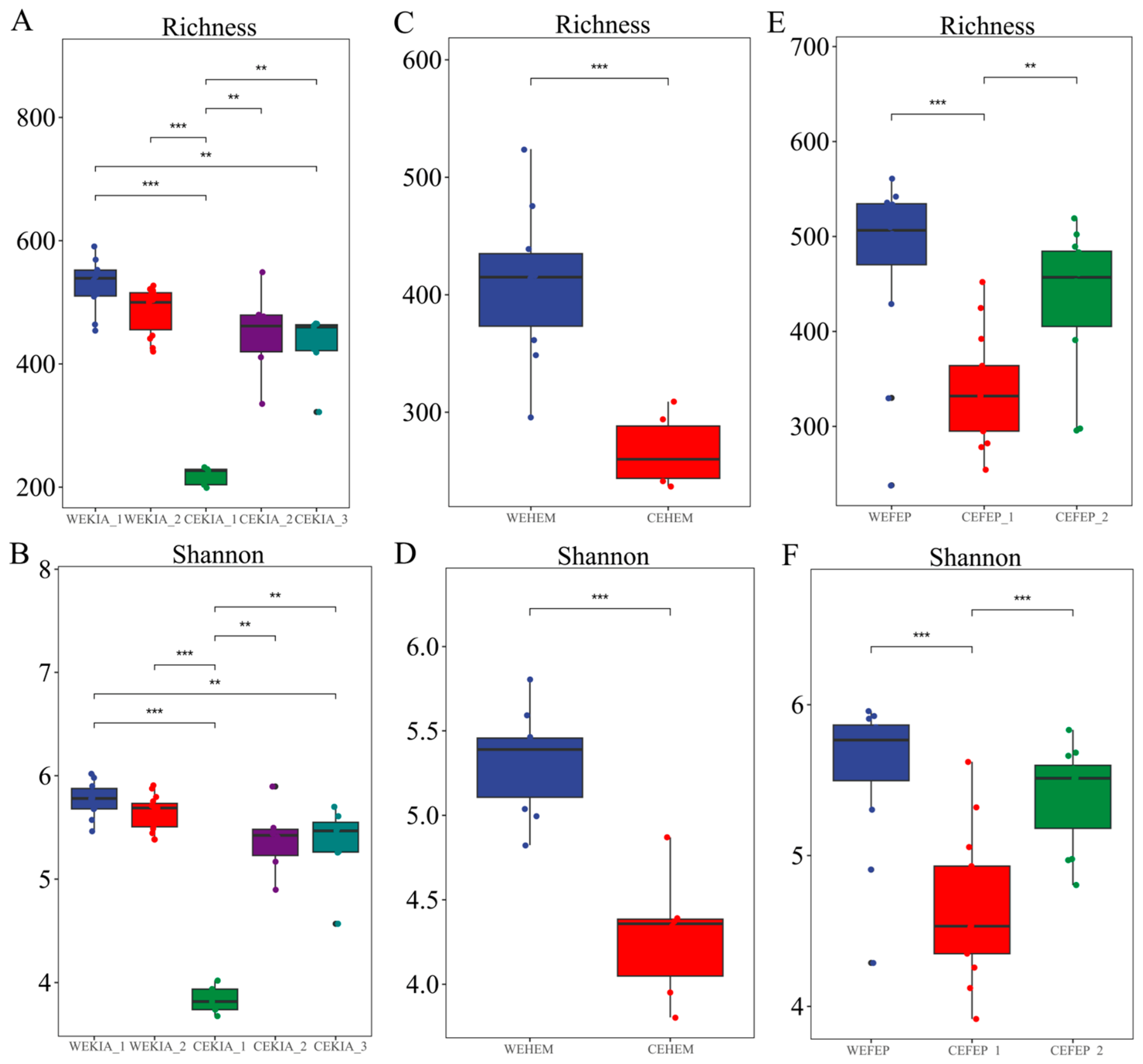
3.1. Overview of the Data and Diversity Analysis
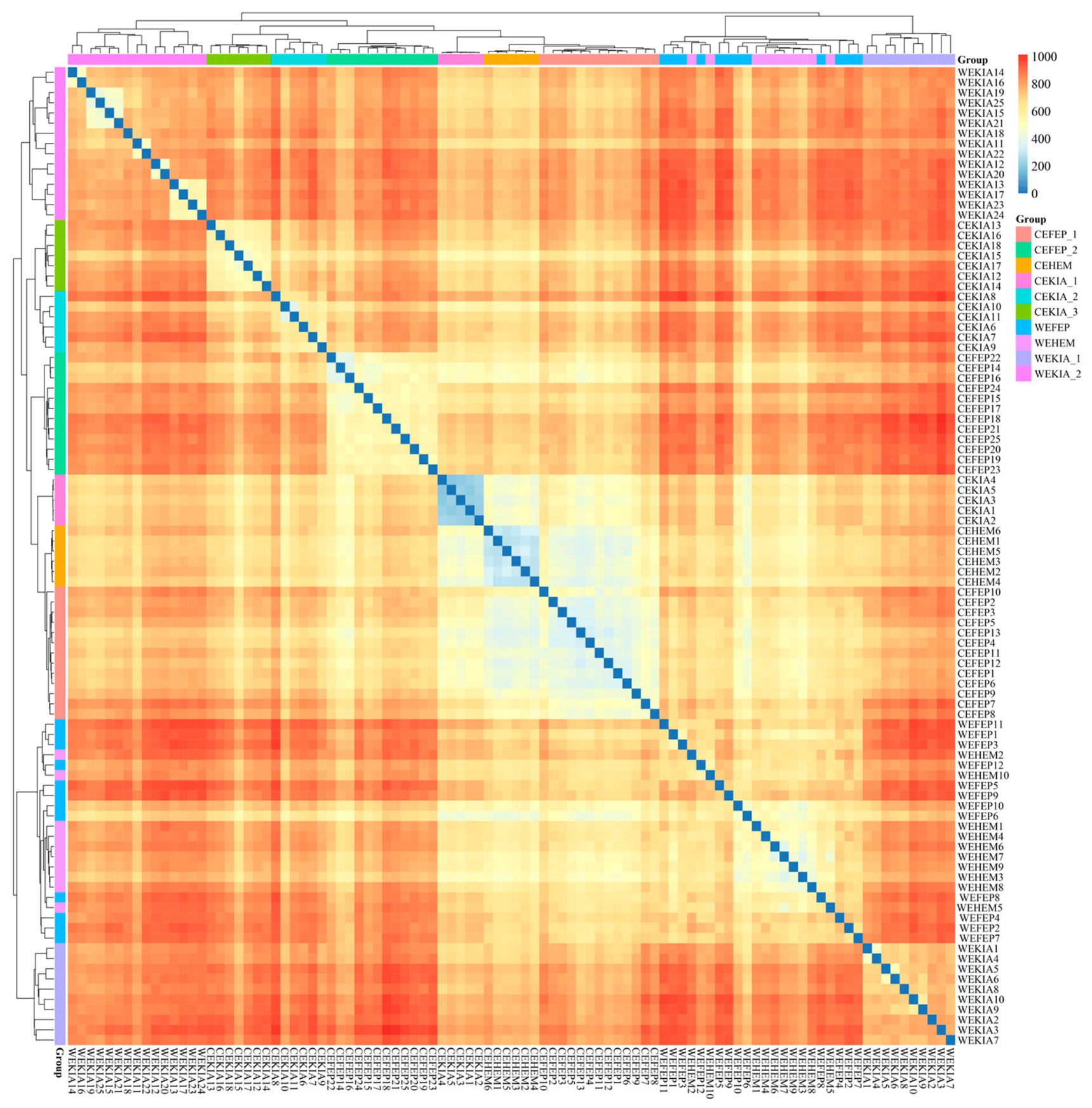
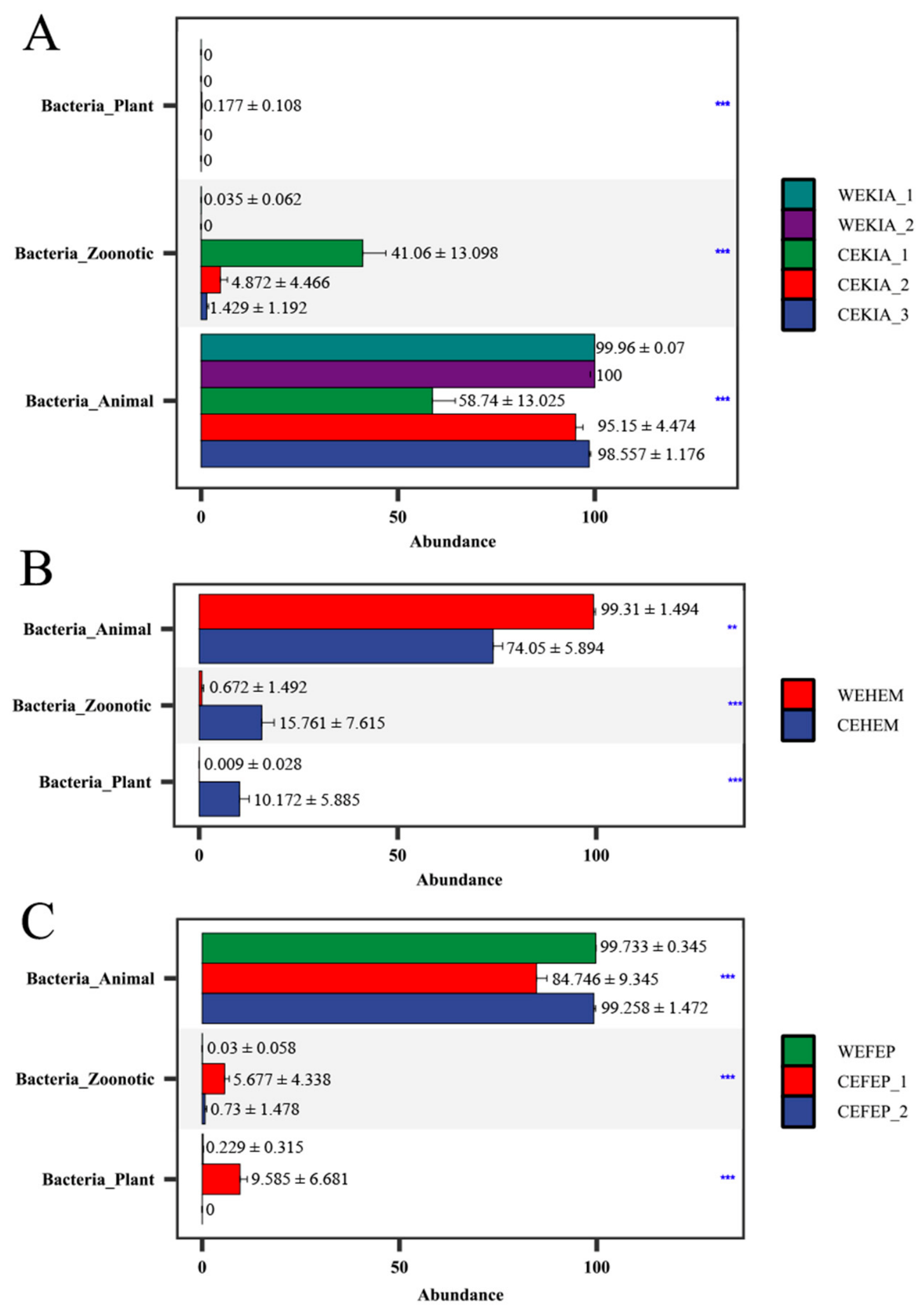
3.2. Cluster and Pathogenic Bacteria Type Analyses
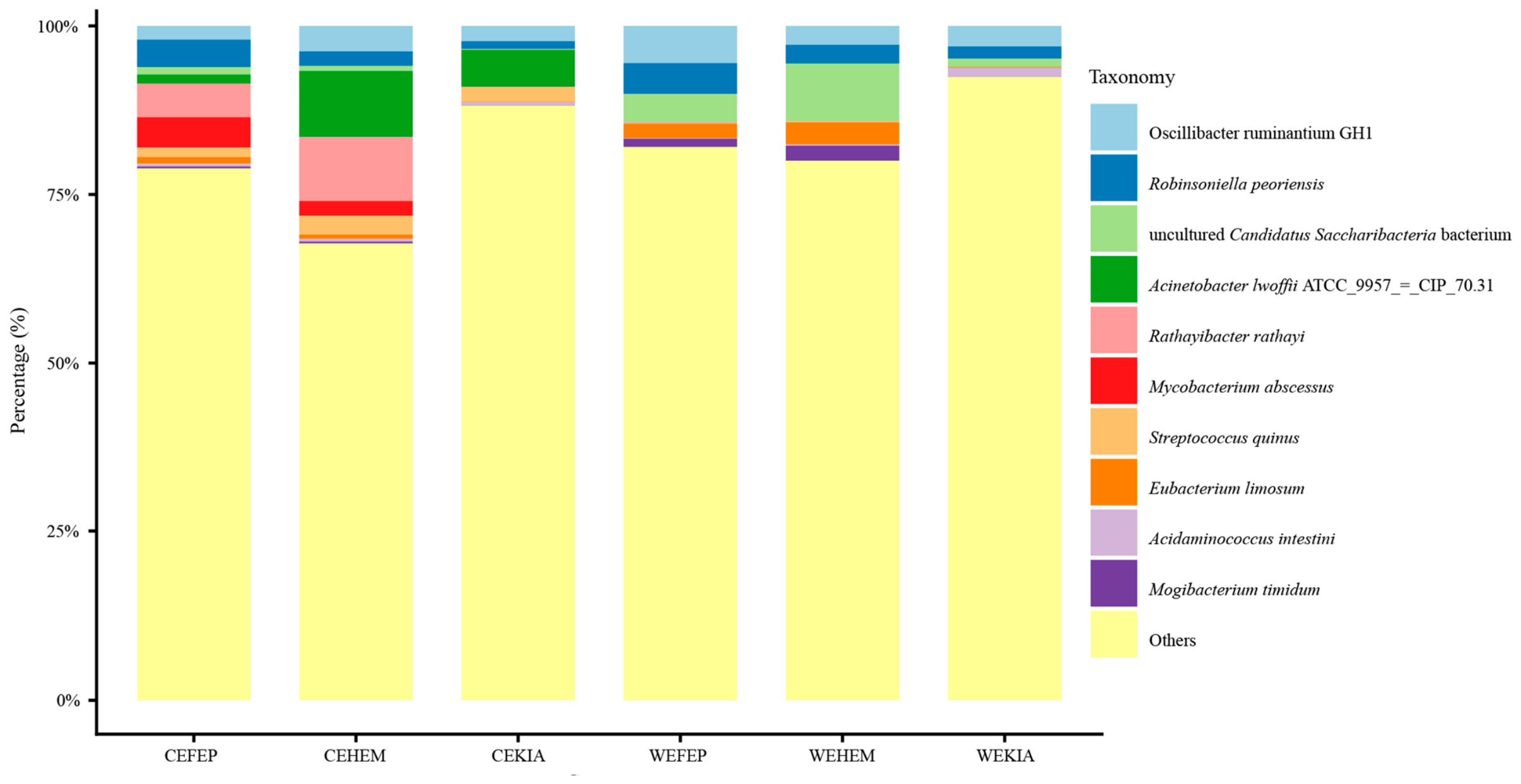
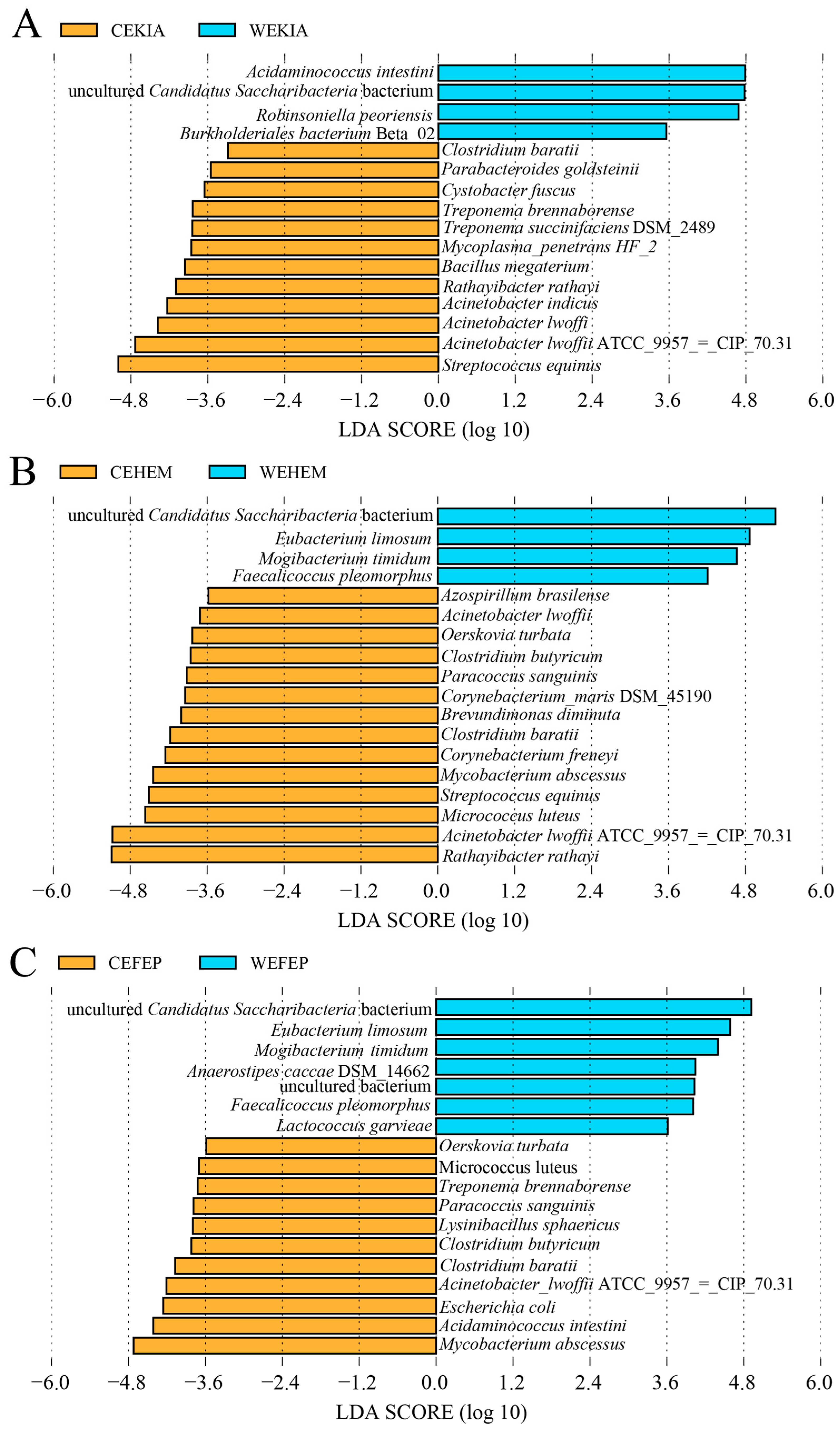
3.3. Pathogenic Gut Bacteria Compositions
4. Discussion
5. Conclusions
Supplementary Materials
Author Contributions
Funding
Institutional Review Board Statement
Informed Consent Statement
Data Availability Statement
Acknowledgments
Conflicts of Interest
References
- Wang, X.; Gao, X.; Chen, Y.; Wu, X.; Shang, Y.; Zhang, Z.; Zhou, S.; Zhang, H. Comparative analysis of the gut microbiome of ungulate species from Qinghai-Xizang plateau. Ecol. Evol. 2024, 14, e70251. [Google Scholar] [CrossRef]
- Xiao, Y.; Zhao, Q.; Ni, D.; Zhang, X.; Hao, W.; Yuan, Q.; Xu, W.; Mu, W.; Wu, D.; Wu, X.; et al. Polymerization of dietary fructans differentially affects interactions among intestinal microbiota of colitis mice. ISME J. 2025, 19, wrae262. [Google Scholar] [CrossRef]
- Wang, X.; Shang, Y.; Xing, Y.; Chen, Y.; Wu, X.; Zhang, H. Captive environments reshape the compositions of carbohydrate active enzymes and virulence factors in wolf gut microbiome. BMC Microbiol. 2025, 25, 142. [Google Scholar] [CrossRef] [PubMed]
- Deng, T.; Xue, X. Phylogenetic relationships of the Chinese fossil species of the genus Equus (Perissodactyla, Equidae). Sci. China Ser. D Earth Sci. 1999, 42, 449–455. [Google Scholar] [CrossRef]
- King, S.; Boyd, L.; Zimmermann, W.; Kendall, B. Equus ferus. In The IUCN Red List of Threatened Species; International Union for Conservation of Nature: Gland, Switzerland, 2015; p. T41763A97204950. [Google Scholar]
- Gao, H.; Chi, X.; Qin, W.; Wang, L.; Song, P.; Cai, Z.; Zhang, J.; Zhang, T. Comparison of the gut microbiota composition between the wild and captive Tibetan wild ass (Equus kiang). J. Appl. Microbiol. 2019, 126, 1869–1878. [Google Scholar] [CrossRef]
- Zhang, H.; Chen, Y.; Wu, X.; Shang, S.; Chen, J.; Yan, J.; Wei, Q.; Wang, X.; Lu, Y.; Zhang, H. Comparison of the Gut Microbiota in the Tibetan Wild Ass (Equus kiang) Collected from High and Low Altitude. Pak. J. Zool. 2020, 52, 2281–2291. [Google Scholar] [CrossRef]
- Li, B.; Gao, H.; Song, P.; Liang, C.; Jiang, F.; Xu, B.; Liu, D.; Zhang, T. Captivity shifts gut microbiota communities in white-lipped deer (Cervus albirostris). Animals 2022, 12, 431. [Google Scholar] [CrossRef]
- Huang, G.; Qu, Q.; Wang, M.; Huang, M.; Zhou, W.; Wei, F. Global landscape of gut microbiome diversity and antibiotic resistomes across vertebrates. Sci. Total Environ. 2022, 838, 156178. [Google Scholar] [CrossRef]
- Lan, L.Y.; Hong, Q.X.; Gao, S.M.; Li, Q.; You, Y.Y.; Chen, W.; Fan, P.F. Gut microbiota of skywalker hoolock gibbons (Hoolock tianxing) from different habitats and in captivity: Implications for gibbon health. Am. J. Primatol. 2023, 85, e23468. [Google Scholar] [CrossRef] [PubMed]
- Gibson, K.M.; Nguyen, B.N.; Neumann, L.M.; Miller, M.; Buss, P.; Daniels, S.; Ahn, M.J.; Crandall, K.A.; Pukazhenthi, B. Gut microbiome differences between wild and captive black rhinoceros—Implications for rhino health. Sci. Rep. 2019, 9, 7570. [Google Scholar] [CrossRef] [PubMed]
- Gilroy, R.; Leng, J.; Ravi, A.; Adriaenssens, E.M.; Oren, A.; Baker, D.; La Ragione, R.M.; Proudman, C.; Pallen, M.J. Metagenomic investigation of the equine faecal microbiome reveals extensive taxonomic diversity. PeerJ 2022, 10, e13084. [Google Scholar] [CrossRef] [PubMed]
- Li, C.; Li, X.; Guo, R.; Ni, W.; Liu, K.; Liu, Z.; Dai, J.; Xu, Y.; Abduriyim, S.; Wu, Z.; et al. Expanded catalogue of metagenome-assembled genomes reveals resistome characteristics and athletic performance-associated microbes in horse. Microbiome 2023, 11, 7. [Google Scholar] [CrossRef] [PubMed]
- Li, Y.; Zhang, K.; Liu, Y.; Li, K.; Hu, D.; Wronski, T. Community composition and diversity of intestinal microbiota in captive and reintroduced Przewalski’s horse (Equus ferus przewalskii). Front. Microbiol. 2019, 10, 1821. [Google Scholar] [CrossRef] [PubMed]
- Lindenberg, F.; Krych, L.; Kot, W.; Fielderil, J.; Frokiaer, H.; van Galen, G.; Nielsen, S.; Hansen, K. Development of the equine gut microbiota. Sci. Rep. 2019, 9, 14427. [Google Scholar] [CrossRef]
- Liu, H.; Han, X.; Zhao, N.; Hu, L.; Wang, X.; Luo, C.; Chen, Y.; Zhao, X.; Xu, S. The gut microbiota determines the high-altitude adaptability of tibetan wild asses (Equus kiang) in Qinghai-Tibet Plateau. Front. Microbiol. 2022, 13, 949002. [Google Scholar] [CrossRef]
- Sun, G.; Xia, T.; Wei, Q.; Dong, Y.; Zhao, C.; Yang, X.; Zhang, L.; Wang, X.; Sha, W.; Zhang, H. Analysis of gut microbiota in three species belonging to different genera (Hemitragus, Pseudois, and Ovis) from the subfamily Caprinae in the absence of environmental variance. Ecol. Evol. 2021, 11, 12129–12140. [Google Scholar] [CrossRef]
- Ang, L.; Vinderola, G.; Endo, A.; Kantanen, J.; Chen, J.; Binetti, A.; Burns, P.; Shi, Q.; Ding, S.; Yu, Z.; et al. Gut microbiome characteristics in feral and domesticated horses from different geographic locations. Commun. Biol. 2022, 5, 172. [Google Scholar] [CrossRef]
- Guan, Y.; Yang, T.; Han, Y.; Feng, M.; Wang, M.; Ge, P. Comparison of the gut microbiota composition between wild and captive sika deer (Cervus nippon hortulorum) from feces by high-throughput sequencing. AMB Express 2017, 7, 212. [Google Scholar] [CrossRef]
- Guan, Y.; Zhang, H.; Gao, X.; Shang, S.; Wu, X.; Chen, J.; Zhang, W.; Zhang, W.; Jiang, M.; Zhang, B.; et al. Comparison of the bacterial communities in feces from wild versus housed sables (Martes zibellina) by high-throughput sequence analysis of the bacterial 16S rRNA gene. AMB. Express 2016, 6, 98. [Google Scholar] [CrossRef]
- Zhou, Z.; Tang, L.; Yan, L.; Jia, H.; Xiong, Y.; Shang, J.; Shao, C.; Zhang, Q.; Wang, H.; He, L.; et al. Wild and captive environments drive the convergence of gut microbiota and impact health in threatened equids. Front. Microbiol. 2022, 13, 832410. [Google Scholar] [CrossRef]
- Gao, H.; Chi, X.; Li, G.; Qin, W.; Song, P.; Jiang, F.; Liu, D.; Zhang, J.; Zhou, X.; Li, S.; et al. Gut microbial diversity and stabilizing functions enhance the plateau adaptability of Tibetan wild ass (Equus kiang). MicrobiologyOpen 2020, 9, e1025. [Google Scholar] [CrossRef]
- Gao, H.; Jiang, F.; Zhang, J.; Chi, X.; Song, P.; Li, B.; Cai, Z.; Zhang, T. Effects of ex situ conservation on diversity and function of the gut microbiota of the Tibetan wild ass (Equus kiang). Integr. Zool. 2023, 18, 1089–1104. [Google Scholar] [CrossRef] [PubMed]
- Wang, X.; Wu, X.; Shang, Y.; Gao, Y.; Li, Y.; Wei, Q.; Dong, Y.; Mei, X.; Zhou, S.; Sun, G.; et al. High-altitude drives the convergent evolution of alpha diversity and indicator microbiota in the gut microbiomes of ungulates. Front. Microbiol. 2022, 13, 953234. [Google Scholar] [CrossRef]
- Tang, L.; Li, Y.; Srivathsan, A.; Gao, Y.; Li, K.; Hu, D.; Zhang, D. Gut microbiomes of endangered Przewalski’s horse populations in short- and long-term captivity: Implication for species reintroduction based on the soft-release strategy. Front. Microbiol. 2020, 11, 363. [Google Scholar] [CrossRef]
- Liu, H.; Zhao, X.; Xu, S.; Zhao, L.; Han, X.; Hu, L.; Xu, T.; Zhao, N.; Zhang, X.; Li, Q.; et al. Tibetan wild asses (Equus kiang) were superior to domestic donkeys (Equus asinus) in terms of the composition and function of gut microbial community. Res. Sq. 2019; in press. [CrossRef]
- Liu, Y.; Chen, L.; Ma, T.; Li, X.; Zheng, M.; Zhou, X.; Chen, L.; Qian, X.; Xi, J.; Lu, H.; et al. EasyAmplicon: An easy-to-use, open-source, reproducible, and community-based pipeline for amplicon data analysis in microbiome research. iMeta 2023, 2, e83. [Google Scholar] [CrossRef]
- Yang, X.; Jiang, G.; Zhang, Y.; Wang, N.; Zhang, Y.; Wang, X.; Zhao, F.-J.; Xu, Y.; Shen, Q.; Wei, Z. MBPD: A multiple bacterial pathogen detection pipeline for One Health practices. iMeta 2023, 2, e82. [Google Scholar] [CrossRef]
- Wasimuddin; Menke, S.; Melzheimer, J.; Thalwitzer, S.; Heinrich, S.; Wachter, B.; Sommer, S. Gut microbiomes of free-ranging and captive Namibian cheetahs: Diversity, putative functions and occurrence of potential pathogens. Mol. Ecol. 2017, 26, 5515–5527. [Google Scholar] [CrossRef]
- Schwab, C.; Cristescu, B.; Northrup, J.M.; Stenhouse, G.B.; Gänzle, M. Diet and environment shape fecal bacterial microbiota composition and enteric pathogen load of grizzly bears. PLoS ONE 2011, 6, e27905. [Google Scholar] [CrossRef]
- Diaz, J.; Redford, H.; Reese, T. Captive and urban environments are associated with distinct gut microbiota in deer mice (Peromyscus maniculatus). Biol. Lett. 2023, 13, 1293–1305. [Google Scholar] [CrossRef] [PubMed]
- Liang, J.; Zhou, K.; Li, Q.; Dong, X.; Zhang, P.; Liu, H.; Lin, H.; Zhang, X.; Lu, J.; Lin, X.; et al. Identification and characterization of a novel aminoglycoside 3″-Nucleotidyltransferase, ANT(3″)-IId, from Acinetobacter lwoffii. Front. Microbiol. 2021, 12, 728216. [Google Scholar] [CrossRef] [PubMed]
- Maboni, G.; Seguel, M.; Lorton, A.; Sanchez, S. Antimicrobial resistance patterns of Acinetobacter spp. of animal origin reveal high rate of multidrug resistance. Vet. Microbiol. 2020, 245, 108702. [Google Scholar] [CrossRef] [PubMed]
- Sun, Y.; Ji, X.; Liu, Y.; Liu, Q.; Guo, X.; Liu, J.; Xu, L.; Zhu, L.; Zhou, W.; Feng, S. New Delhi metallo-β-lactamase-1-producing Acinetobacter lwoffii of companion animal origin in China. Indian J. Med. Microbiol. 2015, 33, 615–617. [Google Scholar] [CrossRef]
- Gootz, T.D.; Marra, A. Acinetobacter balumannii: An emerging multidrug-resistant threat. Expert Rev. Anti-Infect. Ther. 2008, 6, 309–325. [Google Scholar] [CrossRef]
- Almasaudi, S.B. Acinetobacter spp. as nosocomial pathogens: Epidemiology and resistance features. Saudi J. Biol. Sci. 2018, 25, 586–596. [Google Scholar] [CrossRef] [PubMed]
- Bergogne-Berezin, E.; Towner, K.J. Acinetobacter spp. as nosocomial pathogens: Microbiological, clinical, and epidemiological features. Clin. Microbiol. Rev. 1996, 9, 148–165. [Google Scholar] [CrossRef]
- Wade, G. The genus Eubacterium and related genera. In The Prokaryotes: Volume 4: Bacteria: Firmicutes, Cyanobacteria; Dworkin, M., Falkow, S., Rosenberg, E., Schleifer, K.-H., Stackebrandt, E., Eds.; Springer: New York, NY, USA, 2006; pp. 823–835. [Google Scholar]
- Peng, Y.; Chiu, G.; Li, Y.; Zhang, X.; Yeung, L.; Chan, S.; Tun, M. The role of the gut-microbiome-brain axis in metabolic remodeling amongst children with cerebral palsy and epilepsy. Front. Neurol. 2023, 14, 1109469. [Google Scholar] [CrossRef] [PubMed]


Disclaimer/Publisher’s Note: The statements, opinions and data contained in all publications are solely those of the individual author(s) and contributor(s) and not of MDPI and/or the editor(s). MDPI and/or the editor(s) disclaim responsibility for any injury to people or property resulting from any ideas, methods, instructions or products referred to in the content. |
© 2026 by the authors. Licensee MDPI, Basel, Switzerland. This article is an open access article distributed under the terms and conditions of the Creative Commons Attribution (CC BY) license.
Share and Cite
Li, H.; Hou, X.; Han, S.; Xie, S.; Li, Y.; Wang, X. Potential Role of Captive Environments in Reshaping the Compositions of Pathogenic Gut Bacteria in Equus Species. Biology 2026, 15, 796. https://doi.org/10.3390/biology15100796
Li H, Hou X, Han S, Xie S, Li Y, Wang X. Potential Role of Captive Environments in Reshaping the Compositions of Pathogenic Gut Bacteria in Equus Species. Biology. 2026; 15(10):796. https://doi.org/10.3390/biology15100796
Chicago/Turabian StyleLi, Haotian, Xinyuan Hou, Shile Han, Songtao Xie, Yuchun Li, and Xibao Wang. 2026. "Potential Role of Captive Environments in Reshaping the Compositions of Pathogenic Gut Bacteria in Equus Species" Biology 15, no. 10: 796. https://doi.org/10.3390/biology15100796
APA StyleLi, H., Hou, X., Han, S., Xie, S., Li, Y., & Wang, X. (2026). Potential Role of Captive Environments in Reshaping the Compositions of Pathogenic Gut Bacteria in Equus Species. Biology, 15(10), 796. https://doi.org/10.3390/biology15100796