
C2 Resilient Photosynthesis: A Practical Option for Long-Term Stable Carbon Sinks?

Simple Summary
Abstract
1. Introduction
2. Diversity, Distribution, and Evolutionary Status of C2 Plants
- The Evolutionary “Bridge” Hypothesis: This hypothesis posits that C2 plants function as an evolutionary intermediate, mediating the evolutionary transition from C3 to C4 photosynthesis, thus laying the groundwork for the eventual evolution of C4 plants. Two supporting subtheories are proposed: the Nitrogen Hypothesis, which suggests that reduced photorespiration in C3 plants (through glycine shuttling, which releases ammonium into the bundle sheath cells (BSCs)) perturbs foliar nitrogen metabolism. To restore this balance, C2 photosynthesis would evolve into C4 photosynthesis, which is more nitrogen-use efficient [49,50]. The Environmental Hypothesis argues that C2 photosynthesis enhances carbon assimilation efficiency under high-temperature conditions, thereby enabling plant lineages to colonize warmer habitats than those occupied by their C3 relatives. These environments amplify photorespiratory losses, thereby imposing selective pressure on C2 plants and accelerating their evolutionary transition to C4 photosynthesis [26,51].
- The Stable Photosynthetic Type Hypothesis: According to this hypothesis, C2 photosynthesis represents a stable photosynthetic strategy that is evolutionarily parallel to C3 and C4 pathways, and does not necessarily evolve into C4 photosynthesis. Supporting evidence includes: (1) anatomical constraints on metabolite exchange and cooler climates that inhibit the further evolution of C2 photosynthesis into C4, (2) the physiological adequacy of C2 photosynthesis for plant survival in certain environments, and (3) the persistence of C2 photosynthesis within specific lineages (e.g., Portulaca species) for millions of years without transitioning to C4 photosynthesis [52]. Furthermore, in Chenopodiaceae, C2-type species exhibit distinct upregulation of transcription factors, further suggesting that C2 represents an evolutionarily stable state within these taxa [15].
- The Hybrid Origin Hypothesis: This theory proposes that C2 photosynthesis originates from interspecific hybridization events between C3 and C4 lineages. For example, the C2-type Salsola divaricata complex (Amaranthaceae) results from hybridization between C3 and C4 ancestors, enabling the species to adapt to a wider range of climatic conditions [23]. Similar hybrid-origin phenomena have also been observed in species such as Diplotaxis and Homolepis isocalycia [53,54,55].
3. Brief Overview of the Mechanisms of C2 Photosynthesis
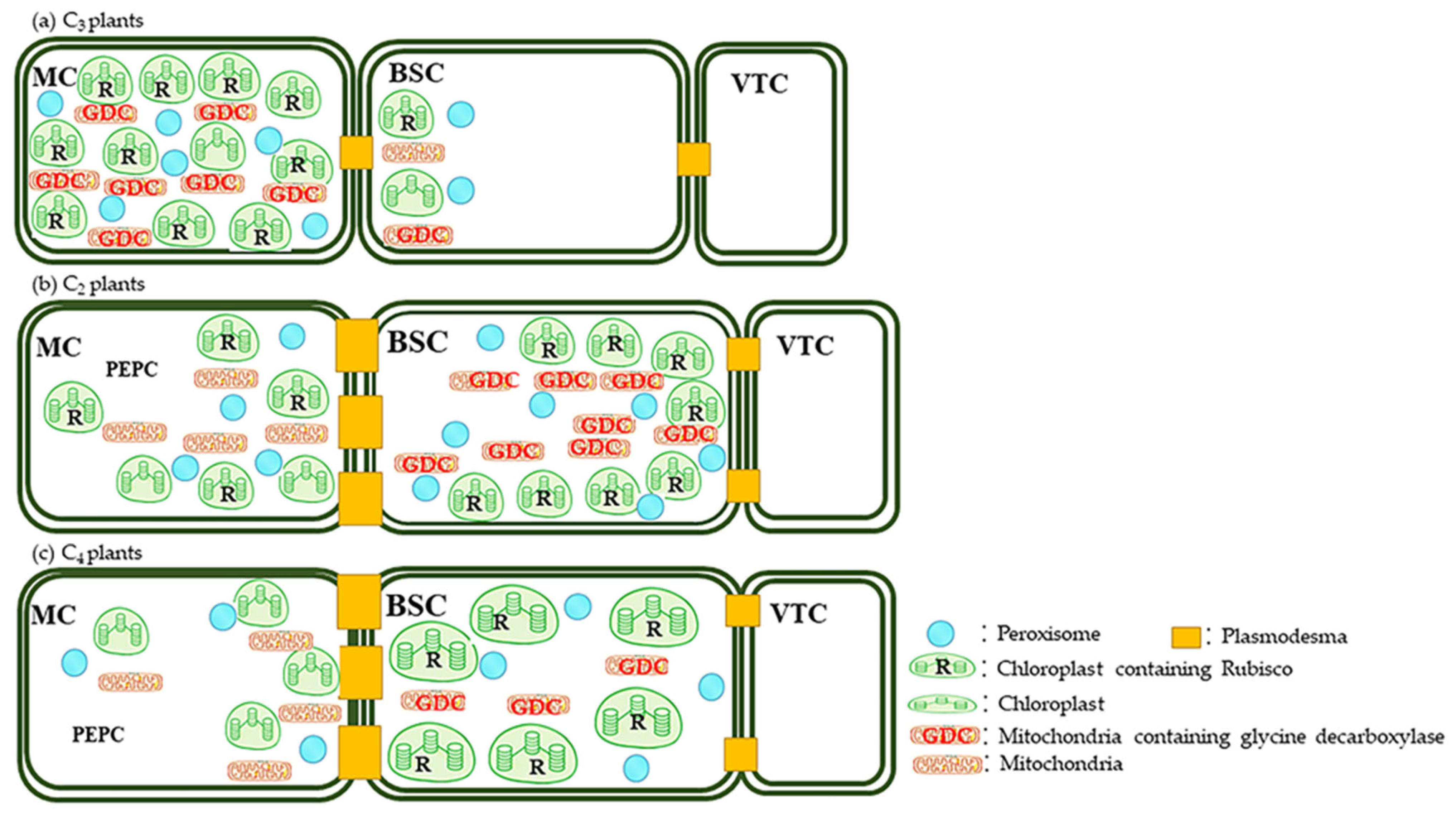
3.1. Leaf Structural Adaptations in C2 Photosynthesis
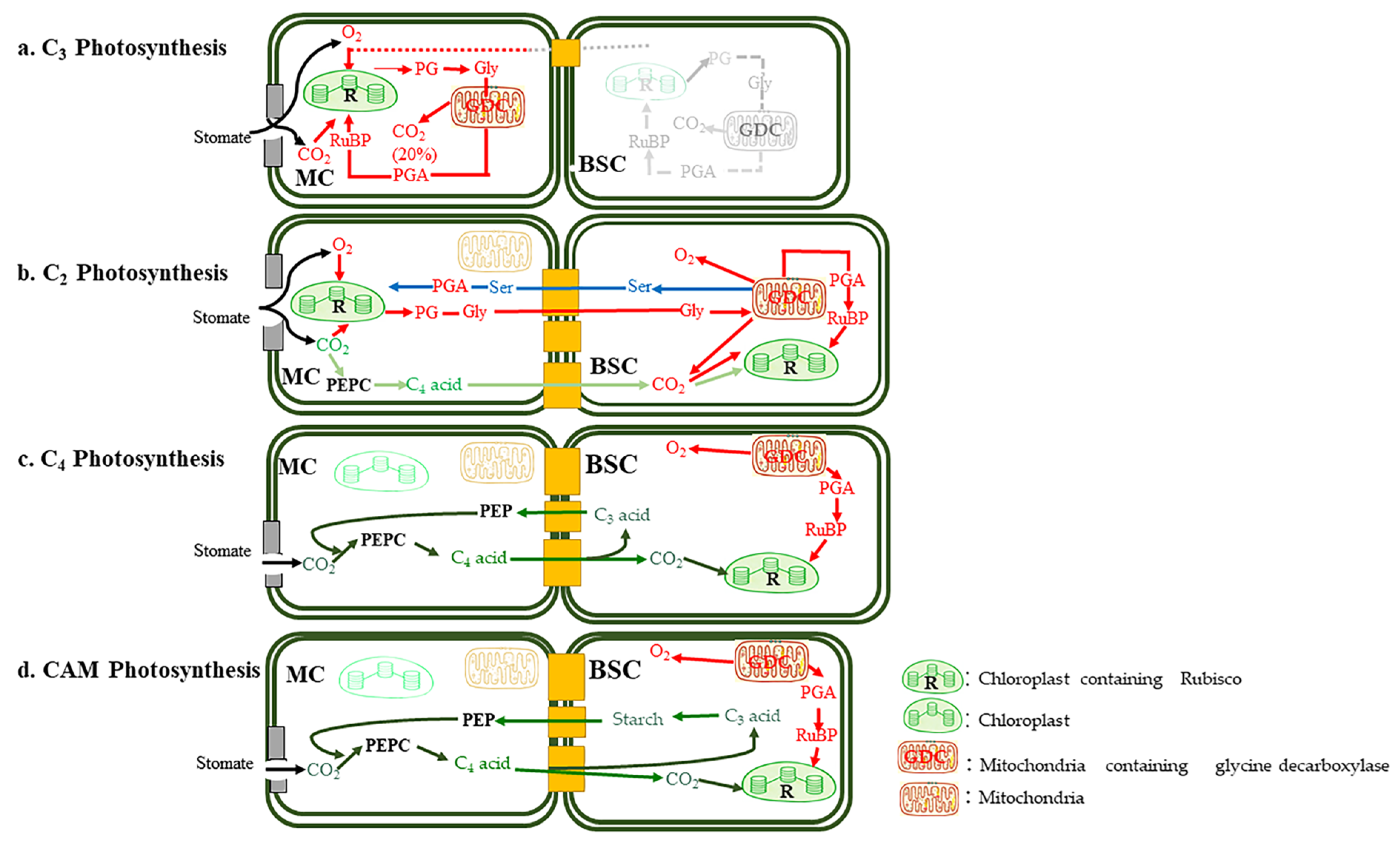
3.2. Core Physiological and Biochemical Mechanisms of C2 Photosynthesis
3.3. Key Molecular Mechanisms of C2 Photosynthesis
4. Physiological Ecology Perspectives on the Resilience of C2 Photosynthesis
4.1. Intrinsic Resilience: High-Efficiency Carbon Capture and Energy Conservation
4.2. Strong Plasticity in Fluctuating Environments
4.3. Advantage Analysis of C2 Photosynthesis Compared to C4 Photosynthetic Engineering Modifications
4.4. Ecological Perspectives on the Resilient Carbon Sink of C2 Photosynthesis
5. Conclusions
Supplementary Materials
Author Contributions
Funding
Institutional Review Board Statement
Data Availability Statement
Conflicts of Interest
References
- IPCC. Climate Change 2023: Synthesis Report. Contribution of Working Groups I, II and III to the Sixth Assessment Report of the Intergovernmental Panel on Climate Change; Core Writing Team, Lee, H., Romero, J., Eds.; IPCC: Geneva, Switzerland, 2023. [Google Scholar]
- Sage, R.F. The evolution of C4 photosynthesis. New Phytol. 2004, 161, 341–370. [Google Scholar] [CrossRef] [PubMed]
- Jaggard, K.W.; Qi, A.; Ober, E.S. Possible changes to arable crop yields by 2050. Philos. Trans. R. Soc. B 2010, 365, 2835–2851. [Google Scholar] [CrossRef] [PubMed]
- Ainsworth, E.A.; Long, S.P. 30 years of free-air carbon dioxide enrichment (FACE): What have we learned about future crop productivity and its potential for adaptation? Glob. Change Biol. 2021, 27, 27–49. [Google Scholar] [CrossRef]
- Sage, R.F.; Robert, W.P. The physiological ecology of C4 photosynthesis. In Photosynthesis: Physiology and Metabolism; Leegood, R.C., Sharkey, T.D., von Caemmerer, S., Eds.; Kluwer Academic Publishers: Dordrecht, The Netherlands, 2000; pp. 497–532. [Google Scholar]
- Gilman, I.S.; Smith, J.A.; Holtum, J.A.; Renwick, A.J.; Gallagher, K.A.; Osmond, C.B.; Sage, R.F.; Ludwig, M.; Sage, T.L. The CAM lineages of planet Earth. Ann. Bot. 2023, 132, 627–654. [Google Scholar] [CrossRef] [PubMed]
- Kennedy, R.; Laetsch, W. Plant species intermediate for C3, C4 photosynthesis. Science 1974, 184, 1087–1089. [Google Scholar] [CrossRef]
- Sage, R.F.; Sage, T.L.; Kocacinar, F. Photorespiration and the evolution of C4 photosynthesis. Annu. Rev. Plant Biol. 2012, 63, 19–47. [Google Scholar] [CrossRef]
- Bellasio, C. A generalized stoichiometric model of C3, C2, C2+ C4, and C4 photosynthetic metabolism. J. Exp. Bot. 2017, 68, 269–282. [Google Scholar] [CrossRef]
- Kennedy, R.A.; Eastburn, J.L.; Jensen, K.G. C3–C4 photosynthesis in the genus Mollugo: Structure, physiology and evolution of intermediate characteristics. Am. J. Bot. 1980, 67, 1207–1217. [Google Scholar] [CrossRef]
- Lundgren, M.R.; Christin, P.A.; Escobar, E.G.; Ripley, B.S.; Besnard, G.; Long, C.M.; Hattersley, P.W.; Ellis, R.P.; Leegood, R.C.; Osborne, C.P. Evolutionary implications of C3–C4 intermediates in the grass Alloteropsis semialata. Plant Cell Environ. 2016, 39, 1874–1885. [Google Scholar] [CrossRef]
- Monson, R.K. The relative contributions of reduced photorespiration, and improved water- and nitrogen-use efficiencies, to the advantages of C3–C4 intermediate photosynthesis in Flaveria. Oecologia 1989, 80, 215–221. [Google Scholar] [CrossRef]
- Timm, S.; Sun, H.; Hagemann, M.; Huang, W.; Fernie, A.R. An old dog with new tricks–the value of photorespiration as a cen tral metabolic hub with implications for environmental acclimation. Plant Physiol. 2025, 198, kiaf258. [Google Scholar] [CrossRef]
- Sage, R.F.; Khoshravesh, R. Passive CO2 concentration in higher plants. Curr. Opin. Plant Biol. 2016, 31, 58–65. [Google Scholar] [CrossRef] [PubMed]
- Khoshravesh, R.; Stinson, C.R.; Stata, M.; Florian, A.; Busch, F.A.; Sage, R.F.; Ludwig, M.; Sage, T.L. C3–C4 intermediacy in grasses: Organelle enrichment and distribution, glycine decarboxylase expression, and the rise of C2 photosynthesis. J. Exp. Bot. 2016, 12, 3065–3078. [Google Scholar] [CrossRef] [PubMed]
- Lundgren, M.R. C2 photosynthesis: A promising route towards crop improvement? New Phytol. 2020, 228, 1734–1740. [Google Scholar] [CrossRef] [PubMed]
- Voznesenskaya, E.; Koteyeva, N.K.; Edwards, G.E.; Ocampo, G. Unique photosynthetic phenotypes in Portulaca (Portulaca ceae): C3-C4 intermediates and NAD-ME C4 species with Pilosoid-type Kranz anatomy. J. Exp. Bot. 2017, 68, 225–239. [Google Scholar] [CrossRef]
- Christin, P.A.; Wallace, M.J.; Clayton, H.; Edwards, E.J.; Furbank, R.T.; Hattersley, P.W.; Sage, R.F.; MacFarlane, T.D.; Ludwig, M. Multiple photosynthetic transitions, polyploidy and lateral gene transfer in the grass subtribe Neurachninae. J. Exp. Bot. 2012, 63, 6297–6308. [Google Scholar] [CrossRef]
- Hattersley, P.W.; Wong, S.C.; Perry, S.; Roksandic, Z. Comparative ultrastructure and gas-exchange characteristics of the C3–C4 intermediate Neurachne minor S. T. Blake (Poaceae). Plant Cell Environ. 1986, 9, 217–233. [Google Scholar]
- Rajendrudu, G.; Prasad, J.S.R.; Das, V.S.R. C3-C4 intermediate species in Alternanthera (Amaranthaceae)—Leaf anatomy, CO2 compensation point, net CO2 exchange and activities of photosynthetic enzymes. Plant Physiol. 1986, 80, 409–414. [Google Scholar] [CrossRef]
- Voznesenskaya, E.V.; Koteyeva, N.K.; Akhani, H.; Roalson, E.H.; Edwards, G.E. Structural and physiological analyses in Salsoleae (Chenopodiaceae) indicate multiple transitions among C3, intermediate and C4 photosynthesis. J. Exp. Bot. 2013, 64, 3583–3604. [Google Scholar] [CrossRef]
- Voznesenskaya, E.V.; Artyusheva, E.G.; Franceschi, V.R.; Pyankov, V.I.; Kiirats, O.; Ku, M.S.B.; Edwards, G.E. Salsola arbuscu liformis, a C3–C4 Intermediate in Salsoleae (Chenopodiaceae). Ann. Bot. 2001, 88, 337–348. [Google Scholar] [CrossRef]
- Tefarikis, D.T.; Morales-Briones, D.F.; Yang, Y.; Edwards, G.E.; Kadereit, G. On the hybrid origin of the C2 Salsola divaricata agg. (Amaranthaceae) from C3 and C4 parental lineages. New Phytol. 2022, 234, 1876–1890. [Google Scholar] [CrossRef]
- Rakhmankulova, Z.F.; Shuyskaya, E.V.; Voronina, P.Y.; Velivetskaya, T.A.; Ignatiev, A.V.; Usmanov, I.Y. Role of Photorespira tion and Cyclic Electron Transport in C4 Photosynthesis Evolution in the C3-C4 Intermediate Species Sedobassia sedoides. Russ. J. Plant Physiol. 2018, 65, 455–463. [Google Scholar] [CrossRef]
- Siadjeu, C.; Lauterbach, M.; Kadereit, G. Insights into Regulation of C2 and C4 Photosynthesis in Amaranthaceae/Chenopodi aceae Using RNA-Seq. Int. J. Mol. Sci. 2021, 22, 12120. [Google Scholar] [CrossRef]
- Edwards, G.E.; Ku, M.S.B. Biochemistry of C3–C4 intermediates. In The Biochemistry of Plants; Stumpf, P.K., Conn, E.E., Eds.; Academic Press: San Diego, CA, USA, 1987; Volume 10, pp. 275–325. [Google Scholar]
- Ku, M.S.B.; Wu, J.; Dai, Z.; Scott, R.A.; Chu, C.; Edwards, G.E. Photosynthetic and photorespiratory characteristics of Flaveria species. Plant Physiol. 1991, 96, 518–528. [Google Scholar] [CrossRef] [PubMed]
- McKown, A.D.; Moncalvo, J.M.; Dengler, N.G. Phylogeny of Flaveria (Asteraceae) and inference of C4 photosynthesis evolution. Am. J. Bot. 2005, 92, 1911–1928. [Google Scholar] [CrossRef] [PubMed]
- Vogan, P.J.; Sage, R.F. Water-use efficiency and nitrogen-use efficiency of C3–C4 intermediate species of Flaveria Juss. (Aster aceae). Plant Cell Environ. 2011, 34, 1415–1430. [Google Scholar] [CrossRef] [PubMed]
- Sage, R.F.; Sage, T.L.; Busch, F.A.; Friesen, P.C.; Stinson, C.R.; Stata, M.; Sultmanis, S.; Rahman, B.A.; Rawsthorne, S. Initial events during the evolution of C4 photosynthesis in C3 species of Flaveria. Plant Physiol. 2013, 163, 1266–1276. [Google Scholar] [CrossRef]
- Moore, B.D.; Franceschi, V.R.; Cheng, S.H.; Wu, J.R.; Ku, M.S.B. Photosynthetic characteristics of the C3–C4 intermediate Par thenium hysterophorus. Plant Physiol. 1987, 85, 978–983. [Google Scholar] [CrossRef]
- Frohlich, M.W. Systematics of Heliotropium Section Orthostachys in Mexico. Ph.D. Thesis, Harvard University, Cambridge, MA, USA, 1978. [Google Scholar]
- Vogan, P.J.; Frohlich, M.W.; Sage, R.F. The functional significance of C3–C4 intermediate traits in Heliotropium L. (Boragina ceae): Gas exchange perspective. Plant Cell Environ. 2007, 30, 1337–1345. [Google Scholar] [CrossRef]
- Muhaidat, R.; Sage, T.L.; Frohlich, M.W.; Dengler, N.G.; Sage, R.F. Characterization of C3–C4 intermediate species in the genus Heliotropium L. (Boraginaceae): Anatomy, ultrastructure and enzyme activity. Plant Cell Environ. 2011, 34, 1723–1736. [Google Scholar] [CrossRef]
- Apel, P.; Horstmann, C.; Pfeffer, M. The Moricandia syndrome in species of the Brassicaceae—Evolutionary aspects. Photosythetica 1997, 33, 205–215. [Google Scholar] [CrossRef]
- Holaday, A.S.; Chollet, R. Photosynthetic/photorespiratory characteristics of C3–C4 intermediate species. Photosynth. Res. 1984, 5, 307–323. [Google Scholar] [CrossRef] [PubMed]
- Voznesenskaya, E.V.; Koteyeva, N.K.; Chuong, S.D.X.; Ivanova, A.N.; Barroca, J.; Craven, L.A.; Edwards, G.E. Physiological, anatomical and biochemical characterisation of photosynthetic types in genus Cleome (Cleomaceae). Funct. Plant Biol. 2007, 34, 247–267. [Google Scholar] [CrossRef] [PubMed]
- Feodorova, T.A.; Voznesenskaya, E.V.; Edwards, G.E.; Roalson, E.H. Biogeographic patterns of diversification and the origins of C4 in Cleome (Cleomaceae). Syst. Bot. 2010, 35, 811–826. [Google Scholar] [CrossRef]
- Sage, T.L.; Sage, R.F.; Vogan, P.J.; Rahman, B.; Johnson, D.C.; Oakley, J.C.; Heckel, M.A. The occurrence of C2 photosynthesis in Euphorbia subgenus Chamaesyce (Euphorbiaceae). J. Exp. Bot. 2011, 62, 3183–3195. [Google Scholar] [CrossRef]
- Yang, Y.; Berry, P.E. Phylogenetics of the Chamaesyce clade (Euphorbia, Euphorbiaceae): Reticulate evolution and long-dis tance dispersal in a prominent C4 lineage. Am. J. Bot. 2011, 98, 1486–1503. [Google Scholar] [CrossRef]
- Christin, P.-A.; Sage, T.L.; Edwards, E.J.; Ogburn, R.M.; Khoshravesh, R.; Sage, R.F. Complex evolutionary transitions and the significance of C3–C4 intermediate forms of photosynthesis in Molluginaceae. Evolution 2011, 65, 643–660. [Google Scholar] [CrossRef]
- Sabale, A.B.; Bhosale, L.J. C3–C4 photosynthesis in Bougainvillea cv. Mary Palmer. Photosynthetica 1984, 18, 84–89. [Google Scholar]
- Voznesenskaya, E.V.; Koteyeva, N.K.; Edwards, G.E.; Ocampo, G. Revealing diversity in structural and biochemical forms of C4 photosynthesis and a C3-C4 intermediate in genus Portulaca L. (Portulacaceae). J. Exp. Bot. 2010, 61, 3647–3662. [Google Scholar] [CrossRef]
- Ocampo, G.; Koteyeva, N.K.; Voznesenskaya, E.V.; Edwards, G.E.; Sage, T.L.; Sage, R.F.; Columbus, J.T. Evolution of leaf anat omy and photosynthetic pathways in Portulacaceae. Am. J. Bot. 2013, 100, 2388–2402. [Google Scholar] [CrossRef]
- Khoshravesh, R.; Akhani, H.; Sage, T.L.; Nordenstam, B.; Sage, R.F. Phylogeny and photosynthetic pathway distribution in Anticharis Endl. (Scrophulariaceae). J. Exp. Bot. 2012, 63, 5645–5658. [Google Scholar] [CrossRef] [PubMed]
- Leung, A.; Patel, R.; Chirachon, V.; Stata, M.; Macfarlane, T.D.; Ludwig, M.; Busch, F.A.; Sage, T.L.; Sage, R.F. Tribulus (Zygo phyllaceae) as a case study for the evolution of C2 and C4 photosynthesis. Plant Cell Environ. 2024, 47, 3541–3560. [Google Scholar] [CrossRef] [PubMed]
- Roalson, E.H.; Hinchliff, C.E.; Trevisan, R.; da Silva, C.R.M. Phylogenetic relationships in Eleocharis (Cyperaceae): C4 photosynthesis origins and patterns of diversification in the spikerushes. Syst. Bot. 2010, 35, 257–271. [Google Scholar] [CrossRef]
- Walsh, C.A.; Bräutigam, A.; Roberts, M.R.; Lundgren, M.R. Evolutionary implications of C2 photosynthesis: How complex biochemical trade-offs may limit C4 evolution. J. Exp. Bot. 2023, 74, 707–722. [Google Scholar] [CrossRef]
- Edwards, E.J. The inevitability of C4 photosynthesis. eLife 2014, 3, e03702. [Google Scholar] [CrossRef]
- Mallmann, J.; Heckmann, D.; Bräutigam, A.; Lercher, M.J.; Weber, A.P.M.; Westhoff, P.; Gowik, U. The role of photorespiration during the evolution of C4 photosynthesis in the genus Flaveria. eLife 2014, 3, e02478. [Google Scholar] [CrossRef]
- Bräutigam, A.; Gowik, U. Photorespiration connects C3 and C4 photosynthesis. J. Exp. Bot. 2016, 67, 2953–2962. [Google Scholar] [CrossRef]
- Sage, R.F.; Khoshravesh, R.; Sage, T.L. From proto-Kranz to C4 Kranz: Building the bridge to C4 photosynthesis. J. Exp. Bot. 2014, 65, 3341–3356. [Google Scholar] [CrossRef]
- Huber, W.E.; Brown, R.H.; Bouton, J.H.; Sternberg, L.O.R. CO2 exchange, cytogenetics, and leaf anatomy of hybrids between photosynthetically distinct Flaveria species. Plant Physiol. 1989, 89, 839–844. [Google Scholar] [CrossRef]
- Ueno, O.; Wada, Y.; Wakai, M.; Bang, S.W. Evidence from photosynthetic characteristics for the hybrid origin of Diplotaxis muralis from a C3–C4 intermediate and a C3 species. Plant Biol. 2006, 8, 253–259. [Google Scholar] [CrossRef]
- Alvarenga, J.P.; Stata, M.; Sage, R.F.; Patel, R.; das Chagas Mendonca, A.M.; Della Torre, F.; Liu, H.; Cheng, S.; Weake, S.; Watanabe, E.J.; et al. Evolutionary diversification of C2 photosynthesis in the grass genus Homolepis (Arthropogoninae). Ann. Bot. 2025, 135, 769–788. [Google Scholar] [CrossRef] [PubMed]
- Mercado, M.A.; Studer, A.J. Meeting in the middle: Lessons and opportunities from studying C3-C4 intermediates. Annu. Rev. Plant Biol. 2022, 73, 43–65. [Google Scholar] [CrossRef] [PubMed]
- Khoshravesh, R.; Stata, M.; Busch, F.A.; Saladié, M.; Castelli, J.M.; Dakin, N.; Hattersley, P.W.; Macfarlane, T.D.; Sage, R.F.; Ludwig, M.; et al. The evolutionary origin of C4 photosynthesis in the grass subtribe Neurachninae. Plant Physiol. 2020, 182, 566–583. [Google Scholar] [CrossRef] [PubMed]
- Heckmann, D. C4 photosynthesis evolution: The conditional Mt. Fuji. Curr. Opin. Plant Biol. 2016, 31, 149–154. [Google Scholar] [CrossRef]
- Schulze, S.; Westhoff, P.; Gowik, U. Glycine decarboxylase in C3, C4 and C3–C4 intermediate species. Curr. Opin. Plant Biol. 2016, 31, 29–35. [Google Scholar] [CrossRef]
- Keerberg, O.; Pärnik, T.; Ivanova, H.; Bassüner, B.; Bauwe, H. C2 photosynthesis generates about 3-fold elevated leaf CO2 levels in the C3–C4 intermediate species Flaveria pubescens. J. Exp. Bot. 2014, 65, 3649–3656. [Google Scholar] [CrossRef]
- Adwy, W.; Schlüter, U.; Papenbrock, J.; Peterhansel, C.; Offermann, S. Loss of the M-box from the glycine decarboxylase P-subunit promoter in C2 Moricandia species. Plant Gene 2019, 18, 100176. [Google Scholar] [CrossRef]
- Triesch, S.; Denton, A.K.; Bouvier, J.W.; Buchmann, J.P.; Reichel-Deland, V.; Guerreiro, R.N.F.M.; Busch, N.; Schlüter, U.; Stich, B.; Kelly, S.; et al. Transposable elements contribute to the establishment of the glycine shuttle in Brassicaceae species. Plant Biol. 2024, 26, 270–281. [Google Scholar] [CrossRef]
- Borghi, G.L.; Arrivault, S.; Günther, M.; Barbosa, M.D.; Dell’Aversana, E.; Fusco, G.M.; Carillo, P.; Ludwig, M.; Fernie, A.R.; Lunn, J.E.; et al. Metabolic profiles in C3, C3–C4 intermediate, C4-like, and C4 species in the genus Flaveria. J. Exp. Bot. 2022, 73, 1581–1601. [Google Scholar] [CrossRef]
- Tang, Q.; Huang, Y.; Ni, X.; Lyu, M.J.A.; Chen, G.; Sage, R.; Zhu, X.G. Increased α-ketoglutarate links the C3–C4 intermediate state to C4 photosynthesis in the genus Flaveria. Plant Physiol. 2024, 195, 291–305. [Google Scholar] [CrossRef]
- Friesen, P.C.; Peixoto, M.M.; Busch, F.A.; Johnson, D.C.; Sage, R.F. Chilling and frost tolerance in Miscanthus and Saccharum genotypes bred for cool temperate climates. J. Exp. Bot. 2014, 65, 3749–3758. [Google Scholar] [CrossRef] [PubMed]
- Walker, B.J.; VanLoocke, A.; Bernacchi, C.J.; Ort, D.R. The costs of photorespiration to food production now and in the future. Annu. Rev. Plant Biol. 2016, 67, 107–129. [Google Scholar] [CrossRef] [PubMed]
- Sage, R.F. Tracking the evolutionary rise of C4 metabolism. J. Exp. Bot. 2016, 67, 2919–2922. [Google Scholar] [CrossRef] [PubMed]
- Bellasio, C.; Farquhar, G.D. A leaf-level biochemical model simulating the introduction of C2 and C4 photosynthesis in C3 rice: Gains, losses and metabolite fluxes. New Phytol. 2019, 223, 150–166. [Google Scholar] [CrossRef]
- Munekage, Y.N.; Taniguchi, Y.Y. A scheme for C4 evolution derived from a comparative analysis of the closely related C3, C3- C4 intermediate, C4-like, and C4 species in the genus Flaveria. Plant Mol. Biol. 2022, 110, 445–454. [Google Scholar] [CrossRef]
- Zhao, Y.Y.; Zhang, Y.X.; Yu, X.Q.; Zhu, X.G. The process that the evolution from C3 towards C4 photosynthesis is driven. bioRxiv 2024, 26, e591276. [Google Scholar]
- Dias, M.C.; Brüggemann, W. Differential inhibition of photosynthesis under drought stress in Flaveria species with different degrees of development of the C4 syndrome. Photosynthetica 2007, 45, 75–84. [Google Scholar] [CrossRef]
- Pinheiro, C.; Emiliani, G.; Marino, G.; Fortunato, A.S.; Haworth, M.; De Carlo, A.; Chaves, M.M.; Loreto, F.; Centritto, M. Metabolic background, not photosynthetic physiology, determines drought and drought recovery responses in C3 and C2 Moricandias. Int. J. Mol. Sci. 2023, 24, 4094. [Google Scholar] [CrossRef]
- Rakhmankulova, Z.F.; Shuyskaya, E.V.; Prokofieva, M.Y. Intraspecific photosynthetic diversity and differences in stress-induced plasticity in C3–C4 Sedobassia sedoides under drought stress. Russ. J. Plant Physiol. 2023, 70, 81. [Google Scholar] [CrossRef]
- Wingler, A.; Sandel, B. Relationships of the competitor, stress tolerator, ruderal functional strategies of grass species with lifespan, photosynthetic type, naturalization and climate. AoB Plants 2023, 15, plad021. [Google Scholar] [CrossRef]
- Hovenden, M. Changes in species composition determine the impacts of global changes on ecosystem services. IOP Conf. Ser. Earth Environ. Sci. 2009, 6, 302019. [Google Scholar] [CrossRef]
- Ermakova, M.; Danila, F.R.; Furbank, R.T.; Von Caemmerer, S. On the road to C4 rice: Advances and perspectives. Plant J. 2020, 101, 940–950. [Google Scholar] [CrossRef] [PubMed]
- Yadav, S.; Mishra, A. Ectopic expression of C4 photosynthetic pathway genes improves carbon assimilation and alleviate stress tolerance for future climate change. Physiol. Mol. Biol. Plants 2020, 26, 195–209. [Google Scholar] [CrossRef] [PubMed]
- Lundgren, M.R.; Dunning, L.T.; Olofsson, J.K.; Moreno-Villena, J.J.; Bouvier, J.W.; Sage, T.L.; Khoshravesh, R.; Sultmanis, S.; Stata, M.; Ripley, B.S.; et al. C4 anatomy can evolve via a single developmental change. Ecol. Lett. 2019, 22, 302–312. [Google Scholar] [CrossRef]
- Lin, H.; Karki, S.; Coe, R.A.; Bagha, S.; Khoshravesh, R.; Balahadia, C.P.; Ver Sagun, J.; Tapia, R.; Israel, W.K.; Montecillo, F.; et al. Targeted knockdown of GDCH in rice leads to a photorespiratory-deficient phenotype useful as a building block for C4 rice. Plant Cell Physiol. 2016, 57, 919–932. [Google Scholar] [CrossRef]
- Adwy, W.; Laxa, M.; Peterhansel, C. A simple mechanism for the establishment of C2-specific gene expression in Brassicaceae. Plant J. 2015, 84, 1231–1238. [Google Scholar] [CrossRef]
- Sage, R.F.; Monson, R.K.; Ehleringer, J.R.; Adachi, S.; Pearcy, R.W. Some like it hot: The physiological ecology of C4 plant evolution. Oecologia 2018, 187, 941–966. [Google Scholar] [CrossRef]
- Derner, J.D.; Johnson, H.B.; Kimball, B.A.; Pinter, P.J., Jr.; Polley, H.W.; Tischler, C.R.; Boutton, T.W.; Lamorte, R.L.; Wall, G.W.; Adam, N.R.; et al. Above-and below-ground responses of C3–C4 species mixtures to elevated CO2 and soil water availability. Glob. Change Biol. 2003, 9, 452–460. [Google Scholar] [CrossRef]
- Shen, W.; Jenerette, G.D.; Hui, D.; Phillips, R.P.; Ren, H. Effects of changing precipitation regimes on dryland soil respiration and C pool dynamics at rainfall event, seasonal and interannual scales. J. Geophys. Res. Biogeosci. 2008, 113, G03024. [Google Scholar] [CrossRef]
- Lauterbach, M.; Schmidt, H.; Billakurthi, K.; Hankeln, T.; Westhoff, P.; Gowik, U.; Kadereit, G. De novo transcriptome assem-bly and comparison of C3, C3–C4, and C4 species of tribe Salsoleae (Chenopodiaceae). Front. Plant Sci. 2017, 8, 1939. [Google Scholar] [CrossRef]
- Ueno, O.; Bang, S.W.; Wada, Y.; Kondo, A.; Ishihara, K.; Kaneko, Y.; Matsuzawa, Y. Structural and biochemical dissection of photorespiration in hybrids differing in genome constitution between Diplotaxis tenuifolia (C3–C4) and radish (C3). Plant Physiol. 2003, 132, 1550–1559. [Google Scholar] [CrossRef]
- Frohlich, M.W.; Sage, R.F.; Craven, L.A.; Schuster, S.; Gigot, G.; Hilger, H.H.; Akhani, H.; Mahdavi, P.; Luebert, F.; Weigend, M. Molecular phylogenetics of Euploca (Boraginaceae): Homoplasy in many characters, including the C4 photosynthetic pathway. Bot. J. Linn. Soc. 2022, 199, 497–537. [Google Scholar] [CrossRef]
- Christin, P.A.; Osborne, C.P.; Sage, R.F.; Arakaki, M.; Edwards, E.J. C4 eudicots are not younger than C4 monocots. J. Exp. Bot. 2011, 62, 3171–3181. [Google Scholar] [CrossRef]
- Clayton, H.; Saladié, M.; Rolland, V.; Sharwood, R.; Macfarlane, T.; Ludwig, M. Loss of the chloroplast transit peptide from an ancestral C3 carbonic anhydrase is associated with C4 evolution in the grass genus Neurachne. Plant Physiol. 2017, 173, 1648–1658. [Google Scholar] [CrossRef] [PubMed]
- Lauterbach, M.; Bräutigam, A.; Clayton, H.; Saladié, M.; Rolland, V.; Macfarlane, T.D.; Weber, A.P.; Ludwig, M. Leaf transcriptomes from C3, C3–C4 intermediate, and C4 Neurachne species give insights into C4 photosynthesis evolution. Plant Physiol. 2025, 197, kiae424. [Google Scholar] [CrossRef] [PubMed]
- Way, D.A.; Katul, G.G.; Manzoni, S.; Vico, G. Increasing water use efficiency along the C3 to C4 evolutionary pathway: A stomatal optimization perspective. J. Exp. Bot. 2014, 65, 3683–3693. [Google Scholar] [CrossRef] [PubMed]
- Oakley, J.C.; Sultmanis, S.; Stinson, C.R.; Sage, T.L.; Sage, R.F. Comparative studies of C3 and C4 Atriplex hybrids in the gnomics era: Physiological assessments. J. Exp. Bot. 2014, 65, 3637–3647. [Google Scholar] [CrossRef]
- Oono, J.; Hatakeyama, Y.; Yabiku, T.; Ueno, O. Effects of growth temperature and nitrogen nutrition on expression of C3–C4 intermediate traits in Chenopodium album. J. Plant Res. 2022, 135, 15–27. [Google Scholar] [CrossRef]
- Schlüter, U.; Bräutigam, A.; Gowik, U.; Melzer, M.; Christin, P.A.; Kurz, S.; Mettler-Altmann, T.; Weber, A.P. Photosynthesis in C3–C4 intermediate Moricandia species. J. Exp. Bot. 2017, 68, 191–206. [Google Scholar] [CrossRef]
- Rakhmankulova, Z.F.; Shuyskaya, E.V.; Prokofieva, M.Y.; Borovkov, A.; Voronin, P.Y. Comparative contribution of CO2/H2O exchange components to the process of adaptation to drought in Xero-Halophytes from the family Chenopodiaceae with different types of photosynthesis. Russ. J. Plant Physiol. 2020, 67, 494–506. [Google Scholar] [CrossRef]



| Family | Lineage | C2 Species | References |
|---|---|---|---|
| Monocots | |||
| Poaceae | Alloteropsis | Alloteropsis semialata | [16] |
| Homolepis | Homolepis aturensis, H. isocalycia, H. longispicula | [16,17] | |
| Neurachne | Neurachne minor | [16,18,19] | |
| Steinchisma | Steinchisma cuprea, S. decipiens, S. hians, S. spathellosa, S. exiguiflora, S. spathellosum, S. stenophylla | [16,17,20,21] | |
| Eudicots | |||
| Acanthaceae | Blepharis | Blepharis acuminate, B. diversispina, B. espinosa, B. gigantea, B. natalensis, B. nolimetangere, B. sinuate, B. pruinose, B. subvolubilis | [16] |
| Amaranthaceae | Alternanthera | Alternanthera cruci, A. ficoidea, A. tenella | [16,20] |
| Salsola | Salsola arbusculiformis, S. divaricate, S. deschaseauxiana, S. gymnomaschala, S. verticillate, S. laricifolia | [21,22,23,24] | |
| Sedobassia | Sedobassia sedoides | [16,25] | |
| Asteraceae | Flaveria | Flaveria angustifolia, F. anomala, F. chloraefolia, F. floridana, F. linearis, F. oppositifolia, F. pubescens, F. ramosissima, F. sonorensis | [16,20,26,27,28,29,30] |
| Parthenium | Parthenium hysterophorus | [16,31] | |
| Boraginaceae | Heliotropium | Heliotropium convolvulaceum, H. greggii, H. racemosum, H. lagoense | [16,32,33,34] |
| Brassicaceae | Brassica | Brassica gravinae | [16] |
| Diplotaxis | Diplotaxis erucoides, D. tenuifolia, D. muralis | [16,35] | |
| Moricandia | Moricandia arvensis, M. nitens, M. suffruticosa, M. sinaica, M. spinosa | [16,35,36] | |
| Cleomaceae | Cleome | Cleome paradoxa | [16,37,38] |
| Euphorbiaceae | Euphorbia | Euphobia acuta, E. johnstonii, E.racemosa | [39,40,41] |
| Hypertelis | Hypertelis spergulacea | [16] | |
| Molluginaceae | Paramollugo | Paramollugo nudicaulis | [41] |
| Mollugo | Mollugo verticillata | [16,26,41] | |
| Nyctaginaceae | Bougainvillea | Bouganvillea cv. Mary Palmer | [42] |
| Portulacaceae | Portulaca | Portulaca cryptopetala, P. hirsutissima, P. mucronate, P. amillis, P. biloba, P. elatior, P. smallis | [16,43,44] |
| Scrophulariaceae | Anticharis | Anticharis ebracteate, A. juncea | [16,45] |
| Zygophyllaceae | Tribulus | Tribulus cristatus, T. astrocarpus | [46] |
Disclaimer/Publisher’s Note: The statements, opinions and data contained in all publications are solely those of the individual author(s) and contributor(s) and not of MDPI and/or the editor(s). MDPI and/or the editor(s) disclaim responsibility for any injury to people or property resulting from any ideas, methods, instructions or products referred to in the content. |
© 2025 by the authors. Licensee MDPI, Basel, Switzerland. This article is an open access article distributed under the terms and conditions of the Creative Commons Attribution (CC BY) license.
Share and Cite
Zhu, J.; Chen, F. C2 Resilient Photosynthesis: A Practical Option for Long-Term Stable Carbon Sinks? Biology 2026, 15, 5. https://doi.org/10.3390/biology15010005
Zhu J, Chen F. C2 Resilient Photosynthesis: A Practical Option for Long-Term Stable Carbon Sinks? Biology. 2026; 15(1):5. https://doi.org/10.3390/biology15010005
Chicago/Turabian StyleZhu, Junjie, and Fengyue Chen. 2026. "C2 Resilient Photosynthesis: A Practical Option for Long-Term Stable Carbon Sinks?" Biology 15, no. 1: 5. https://doi.org/10.3390/biology15010005
APA StyleZhu, J., & Chen, F. (2026). C2 Resilient Photosynthesis: A Practical Option for Long-Term Stable Carbon Sinks? Biology, 15(1), 5. https://doi.org/10.3390/biology15010005