Simple Summary
This article presents the results of the first large-scale survey of microbial diversity in freshwater alkaline hot springs in the Baikal Rift Zone, revealing through 16S rRNA gene metabarcoding and statistical methods that temperature is the primary factor influencing the microbial community structure. The phyla were distributed between the two groups. The first small group included Armatimonadota, Deinococcota, Aquificota and DRYD01, which were integral components of the microbial communities of the hot springs with the highest temperatures (58–74 °C), i.e., these were extremely thermophilic and thermophilic microbial communities with low biodiversity. The second-largest group comprised the phyla Pseudomonadota, Nitrospirota, Desulfobacterota, Actinomycetota, Verrucomicrobiota, Spirochaetota, Bacillota, Bipolaricaulota (Acetothermia), Bdellovibrionota, Thermoproteota, Hadarchaeota, and others, which were part of more diverse, moderately thermophilic and mixed microbial communities of thermal springs with lower temperatures from 32 to 59 °C. Classical microbiological methods were used to culture and identify a physiological group of prokaryotes previously debated to exist—alkalithermophilic dissimilatory iron-reducing microorganisms. The obtained enrichment cultures were dominated by novel lineages of Bacillota and Actinomycetota, including the genus Parvivirga. Our findings expand the knowledge about microbial life in polyextreme environments and the understanding of its role in biogeochemical cycling in the studied ecosystems of the Baikal Rift Zone.
Abstract
Polyextremophilic microbial communities of Baikal Rift Zone hot springs have been studied fragmentarily, and these studies have typically focused on either phototrophic microbial mats or on the whole microbial community from one or a few sites. In our work, we conducted the first large-scale screening of microbial communities from seven hot spring groups in the Baikal Rift Zone, using metabarcoding of the V3-V4 regions of the 16S rRNA gene. Analysis of alpha and beta diversity, as well as co-occurrence network analysis, revealed that the microbial diversity of the studied springs is highly dependent on temperature values. This approach allowed classifying microbial communities into four distinct groups, characterized by significantly different taxa representing the key functional roles of primary producers, heterotrophic consumers, and terminal destructors of organic matter. Sulfate-reducing bacteria constituted a major metabolic group driving the final stage of organic matter mineralization. Moreover, the presence of alkalithermophilic dissimilatory iron reducers, whose existence was debatable, was proved in the studied samples by cultural methods. The phylotypes that gained an advantage on selective media with synthesized ferrihydrite and hydrogen or acetate added as an electron donor belonged to the genus Parvivirga of the order Anaerosomatales and several unknown representatives of the phylum Bacillota.
1. Introduction
The Baikal Rift Zone (BRZ) is a large Cenozoic continental rift located in Asia that frames the Siberian Craton to the south and southeast. It extends for approximately 2500 km from northwest Mongolia, through the East Siberian Mountains, to the Alban Shield. The central segment of the BRZ, located immediately along the craton margin, is represented by the Lake Baikal Basin. This basin is both the largest and the oldest part of the system, making up approximately one-third of the entire rift zone and extending for about 680 km.
Due to the combination of complex geological features, such as modern tectonic activity and high seismic activity, as well as the presence of deep faults that crack Proterozoic granites, gneisses, and gneissoid granites, making them permeable to meteoric waters, the BRZ is characterized by a large number of springs with various physical, chemical, and gas properties []. Low mineralization (usually up to 1 g/L) and a neutral or alkaline pH are typical of springs in the BRZ region, as well as a wide range of temperatures [] and nitrogen saturation [,]. Most researchers agree that hot springs of the BRZ region form through the infiltration of cold meteoric water along fractures, where it interacts with the surrounding rocks, leading to changes in its cationic, anionic, and gaseous compositions []. All hydrotherms of the BRZ are divided into five groups according to the chemical composition: sodium hydrocarbonate (HCO3–Na), sodium fluoride–hydrocarbonate (HCO3–F–Na), sodium sulfate–hydrocarbonate spring (HCO3–SO4–N), sodium hydrocarbonate–sulfate spring (SO4–HCO3–Na), and sodium sulfate (SO4–Na) types [].
The Barguzin Valley (BV) is one of the largest depressions in BRZ, located in the Republic of Buryatia (Russia), and extends for about 200 km. All hot springs in this area are alkaline (Supplementary Materials S1 and Table S1 of the Supplementary Materials S2) [], which contributes to the development of polyextremophilic alkalithermophilic microorganisms. Temperature and pH are not the only environmental factors that shape the microbial diversity of hot springs. Redox potential, trace element levels, organic matter composition, geochemistry of hydrothermal fluids, solar radiation budgets, and trophic relationships also play a crucial role [].
Thermal fields in the Baikal region are located not only in BV, but also along the shore of Lake Baikal as a part of active balneological resorts in Goryachinsk and Zmeinaya Bay. Balneological resorts include thermal baths with alkaline water at a temperature of around 47 °C. In previous years, microbial communities of the BRZ hot springs have been actively studied using microbiological and molecular techniques [,,,,,]. However, the most comprehensive studies were made with samples of cyanobacterial communities and anoxygenic phototrophic bacteria, which are diverse and represent the primary producers in hot springs of the BRZ [,,,,,,,,,,]. Research on chemotrophic anaerobic microorganisms, which are responsible for both the primary production of organic matter and its mineralization, has been conducted only on a fragmentary basis [,]. In particular, nothing was known about alkalithermophilic dissimilatory iron reducers, whose existence had not been proven but was thermodynamically justified by Nixon et al. []. Our study of the Goryachinsk thermal field (pH 9.0, 50–55 °C) conducted in 2024 revealed the presence of alkalithermophilic iron reducers in all the samples collected. Additionally, the first enrichment cultures with chemolithotrophic representatives of this group were obtained. Furthermore, two distinct ecological niches were identified for these microorganisms in the Goryachinsk thermal field: (i) a surface niche rich in organic matter, and (ii) a subsurface one poor in it [].
Based on these findings, we conducted a more extensive and targeted search for this ecophysiological group in the sediments of Barguzin Valley’s hot springs. During the 2024 expedition, we collected samples of sediments and water from seven thermal fields and springs, including Goryachinsk and Zmeinaya Bay. We characterized the composition of microbial communities using molecular methods and performed correlation analysis to identify a link between the microbial community structure and key physicochemical parameters of water (pH, Eh, and temperature). To isolate pure cultures of dissimilatory alkalithermophilic iron reducers, we carried out enrichments using molecular hydrogen or sodium acetate as electron donors and synthesized ferrihydrite as the electron acceptor. The results are presented in this paper.
2. Materials and Methods
2.1. Sample Collection
The samples of microbial mats, sediments beneath the mats, and biofilms mixed with thermal water were collected with clean spatulas into 50 mL glass vials (Figure 1C), which were filled with the sample with no headspace left and closed with rubber stoppers, crimped with aluminum caps and stored at +4 °C in fridge until transported to the laboratory (Supplementary Materials S1). During transportation, the samples were also maintained at +4 °C. The pH and temperature were measured in situ using SG2 SevenGo™ pH meter (Mettler-Toledo, Greifensee, Switzerland) with InLab® Expert Go sensor (Mettler-Toledo, Greifensee, Switzerland), while the Eh values were measured using 301Pt-C ORP combination electrode (Apera Instruments, Shanghai, China).
Figure 1.
Location of the sampling sites in BRZ (A). Photographs of the thermal groups and springs: Umkhei (B), Kuchiger (C), Garga (D), Uro (E), Gusikha (F), Zmeiny (G), and Goryachinsk (H).
2.2. Enrichment Cultures
To obtain enrichment cultures of alkalithermophilic iron reducers, we focused on profiling data reflecting the taxonomic diversity in the sample, the visual presence of organic sediment that interferes with the isolation of chemoautotrophic microorganisms, as well as the description of the sample, where iron reducers could potentially be, temperature and pH, which are best suited for the isolation of this group of microorganisms (Table 1 and Supplementary Materials S1). The selected samples were as follows: #4710 (Garga thermal field), #4722 (Uro thermal field), #4725, #4730 (Gusikha thermal field), and 4731-4733 (Goryachinsk thermal field). Enrichment cultures were initiated by inoculating anoxic sterile liquid medium with 10% (v/v) sample. The medium was prepared under 100% N2 gas atmosphere and had the following composition (g/L): KH2PO4, 0.2; MgCl2·2H2O, 0.1; NH4Cl, 0.5; KCl, 0.2 and Na2CO3, 0.5. Solutions of vitamins [] and trace elements [] were added (1 mL/L each) after sterilization. Sodium acetate (10 mM) or molecular hydrogen (10% v/v) was used as the substrate. Synthesized ferrihydrite prepared as described previously [] was used as an electron acceptor at a final concentration of Fe(III) −25 mM. The pH of the medium was adjusted with 10% NaOH to the pH value of the thermal springs at the time of sampling (Table 1 and Supplementary Materials S1). No reducing agents were added to the medium. The medium (10 mL) was dispensed into 17 mL Hungate tubes under the flow of N2. Incubation of the enrichment cultures was carried out at the temperatures detected on the sample sites (Table 1 and Supplementary Materials S1). Growth of the enrichment cultures was monitored using a fluorescence microscope, Axio Lab.A1 (Zeiss, Oberkochen, Germany), from which subsamples were pre-stained with acridine orange dye for DNA.
Table 1.
General characteristics of the BRZ hot springs and alpha diversity metrics of microbial communities there.
2.3. DNA Extraction and 16S rRNA Gene Sequencing
For DNA isolation, environmental samples were taken aseptically in 2 mL Eppendorf tubes with screw caps and then fixed with a stabilizing buffer (100 mM EDTA, 100 mM Tris-HCl, 150 mM NaCl). During transportation and storage, the fixed samples were maintained at 4 °C and then stored at −20 °C until DNA was extracted.
For DNA extraction from the enrichments, we collected enrichment cultures that showed ferrihydrite reduction. For this purpose, the Hungate tubes were shaken, and the suspension (5 mL) was collected with a syringe and centrifuged for 20 min at 14000 g and 4 °C. The supernatant was discarded, and the pellet was used to extract total DNA.
DNA from the environmental samples and enrichment cultures was extracted using the FastDNA™ SPIN Kit for Soil (MP Biomedicals, Santa Ana, CA, USA) according to the manufacturer’s instructions.
Amplicon libraries of the V3-V4 hypervariable region of the 16S rRNA gene were prepared according to Gohl et al. [] with the following primers: 341F (5′-CCTAYGGGDBGCWSCAG-3′) and 806R (5′-GAC TAC NVG GGT MTC TAA TCC-3′) [,], including Illumina technical sequences []. The libraries were prepared and sequenced in two replicates for each sample. High-throughput sequencing of the libraries was performed with MiSeq Reagent Kit v2 (500-cycles) (Illumina, San Diego, CA, USA) on a MiSeq sequencer (Illumina, San Diego, CA, USA) according to the manufacturer’s instructions.
2.4. Data Analysis
Primary raw reads were processed as described earlier []. Reads obtained after adapters and primers trimming were filtered (with the following parameters: truncLen = 380, maxN = 0, maxEE = 2, and truncQ = 2) and were divided into amplicon sequence variants (ASVs) using the dada2 package v.1.14.1 []. Taxonomy was assigned to ASVs using the dada2 package with a 16S rRNA gene sequence database decorated with a nomenclature of GTDB r220 (https://zenodo.org/records/13984843 (accessed on 27 October 2025)). Alpha diversity metrics were calculated using the phyloseq package v.1.30.0 []. The prokaryotic phyla co-occurrence network was constructed using the phylosmith package v.1.0.7 with a rho threshold of 0.4 and a p-value threshold of 0.05 (https://joss.theoj.org/papers/10.21105/joss.01442 (accessed on 27 October 2025)), and was visualized using the ggrpah package v.2.2.1 (https://ggraph.data-imaginist.com (accessed on 27 October 2025)). Pairwise Spearman’s rank correlations between the relative abundance of different prokaryotic classes and environmental variables were calculated in the “microbiome” package v.1.8.0 (https://bioconductor.org/packages/release/bioc/html/microbiome.html (accessed on 27 October 2025)). To estimate beta diversity, a non-metric multidimensional scaling (NMDS) ordination with Bray–Curtis dissimilarity matrix was performed using the vegan v.2.6-4 package (https://CRAN.R-project.org/package=vegan (accessed on 27 October 2025)).
3. Results
3.1. Characteristics of the Sampling Sites
During the expedition to the BRZ in August 2024, twenty-eight samples of water, sediments, microbial mats, and biofilms were collected from hot springs of seven thermal fields (Umkhei, Kuchiger, Garga, Uro, Gusikha, Goryachinsk, Zmeiny) located in active or abandoned balneological resorts and natural environment (Figure 1, Table 1, and Supplementary Materials S1).
On the Umkhei thermal field, sediment samples were collected from two hot springs—4703 (T 32 °C, pH 7.6) and 4704 (T 42 °C, pH 9.5). Such differences in temperature and pH most likely indicated varying degrees of mixing between deep thermal and surface meteoric waters. The thermal waters of both springs were characterized by negative Eh values (Table 1 and Supplementary Materials S1).
On the Kuchiger thermal field, bottom sediments (#4705) were sampled from a site of natural deep thermal water discharge at a depth of 1.5 m. The temperature of the water at the surface of the thermal spring was 41 °C, pH was 6.9. Unfortunately, we were unable to measure the temperature and pH in the bottom sediments, but according to the literature data, the temperature can vary in the range from 40 °C to 57 °C, and the pH in the range from 9.0 to 10.2 [,,,,].
The Garga hot spring is located in the abandoned balneological resort in the valley of the Garga River, right bank. Samples #4707-4711 were close for their parameters (72–74 °C, pH 7.8–7.9, Eh −160 mV and −190 mV), while sample #4715 was distinct (59 °C, pH 8.2, Eh +5 mV) (Table 1 and Supplementary Materials S1).
On the Uro thermal field located within the Uro River basin, all samples (#4718-4725) were characterized by temperature range 42–59 °C and close pH values 8.8–9.0 (Table 1 and Supplementary Materials S1), but they differed in their redox potential, which gradually decreased from positive values (Eh +20 mV in the sample #4719) to negative (Eh −200 mV in the sample #4725).
Samples #4728 (53 °C, pH 8.3, Eh +55 mV) and #4730 (51 °C, pH 9.1, Eh −115 mV) were collected in Gusikha hot springs located at the foot of the Ikatsky Range on the right bank of the Malaya Gusikha River (Table 1 and Supplementary Materials S1).
The Goryachinsk thermal field (samples #4731-4735) is located in Goryachinsk Village. The temperature range in the sampling sites was 45–52 °C, pH range was 7.2–9.1 (Table 1 and Supplementary Materials S1). The sample #4732 was characterized by a positive redox potential value (Eh +10 mV), while other samples were of the negative Eh range from −115 mV to −300 mV (Table 1 and Supplementary Materials S1).
The sample #4736 was collected from sediments of the Zmeiny hot spring (Svyatoy Nos Peninsula, Zmeinaya Bay) and was characterized by a temperature of 41 °C, pH 9.3, and Eh −350 mV.
Water types and physicochemical parameters for all springs are provided in Supplementary Materials S2.
3.2. Alpha and Beta Diversity of Microbial Communities of the BRZ Hot Springs
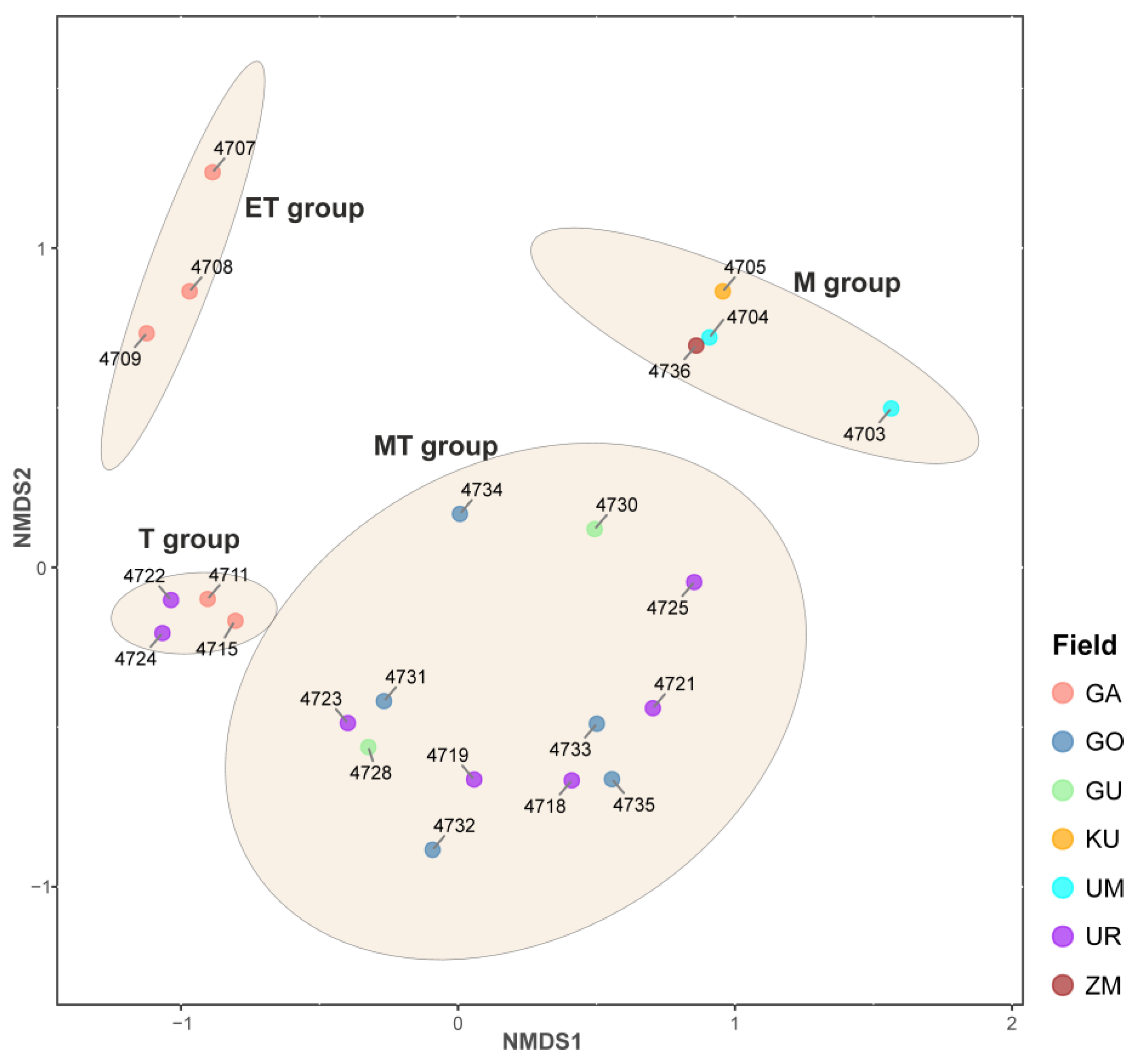
Microbial communities of the BRZ hot springs were analyzed by high-throughput sequencing of 16S rRNA gene fragments. Following the application of all quality filters, the 23 samples analyzed in this study yielded between ~10,000 and ~35,000 sequences per sample. Alpha diversity analysis revealed a huge variety of Shannon (1.58–5.19), inverse Simpson indices (2.33–76.78), and Chao1 richness estimator (23–515) (Table 1). NMDS analysis of the microbial abundance profiles revealed weak clustering of microbial communities of the BRZ hot springs that was dependent on temperature rather than on the spring’s affiliation with any thermal field (Figure 2). All communities were allocated to four groups linked with the temperature range of sampling sites (Figure 2): the Extreme Thermophilic group (ET group), the Thermophilic group (T group), the Moderate Thermophilic group (MT group), and the Mixed group (M group). Since the pH range of the collected samples showed little variation, it was likely not a driving factor behind this clustering.
Figure 2.
Analysis of beta diversity of microbial communities (ASVs which make up ≥0.2% of microbial community of at least one sample) via NMDS ordination based on Bray–Curtis distances (k = 3; stress value = 0.098). Thermal fields: GA—Garga, GO—Goryachinsk, GU—Gusikha, KU—Kuchiger, UM—Umkhei, UR—Uro, ZM—Zmeiny. Microbial community groups: ET—Extreme Thermophilic, T—Thermophilic, MT—Moderate Thermophilic, and M—Mixed.
3.2.1. Extreme Thermophilic Group
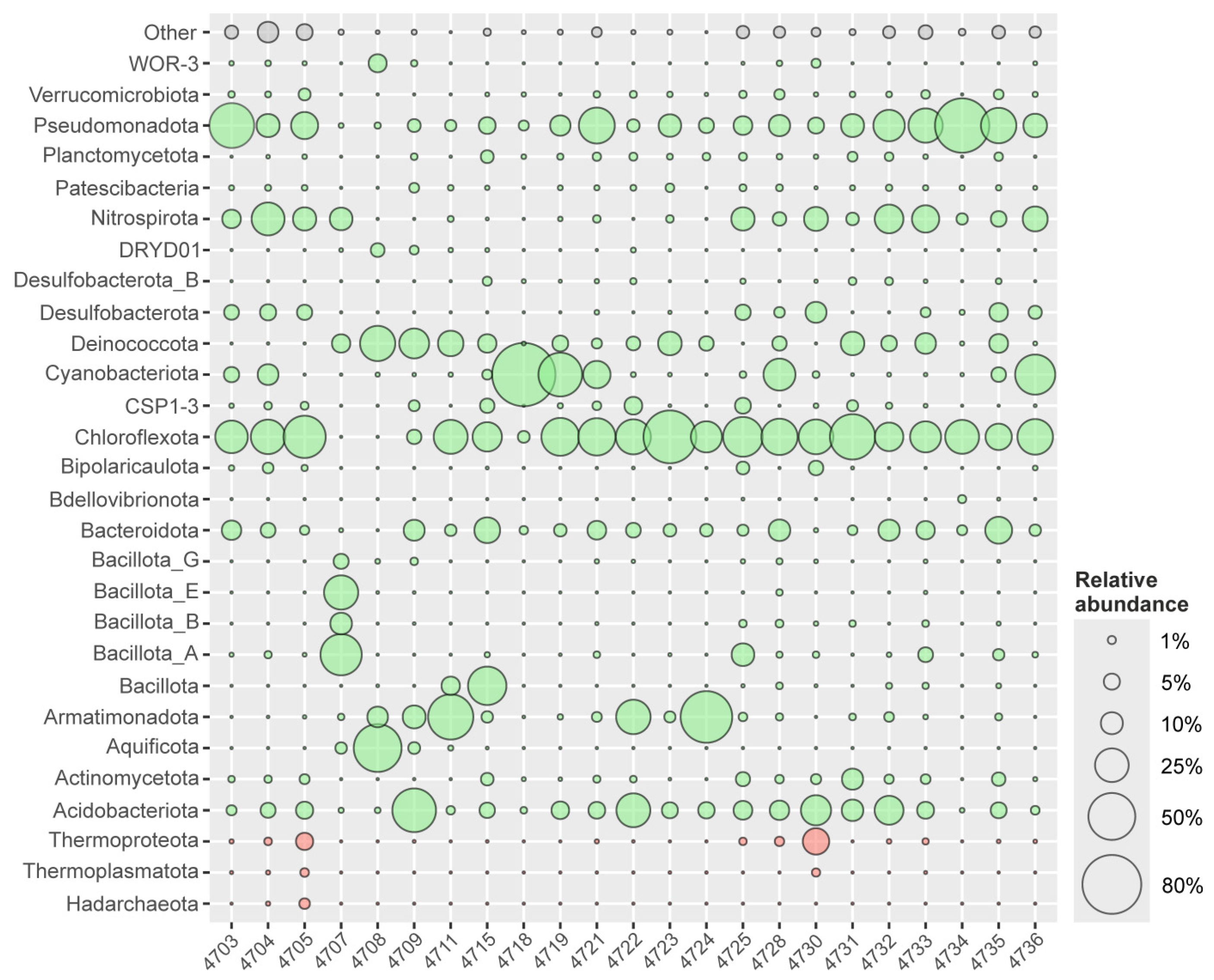
The ET group included three microbial communities (#4707, #4708, #4709) of the Garga hot spring that were collected in the area of the thermal water outlet with a temperature of 74 °C. These microbial communities differed significantly from all other studied communities of the BRZ and were characterized by extremely low alpha diversity (Table 1, Figure 2 and Figure 3). ASVs affiliated with genus Thermus (Deinococcota), uncultivated representatives of the family Aquificaceae named UBA11096 (Aquificota), unclassified genus HR10 within the class Blastocatellia (Acidobacteriota), uncultured bacteria of the order Fimbriimonadales named LDYB01 (Armatimonadota), as well as uncultivated phyla DRYD01 and WOR-3 were detected in all three microbial communities. However, these three communities also differed significantly from each other.
Figure 3.
Taxonomic composition of microbiomes inhabiting the studied Baikal Rift Zone hot springs at the phyla level (only phyla, whose abundance was higher than 1% at least in one sample, are shown). Red and green bubbles indicate phyla of Archaea and Bacteria domains, respectively, while the gray bubble indicates sequences assigned to phyla comprising less than 1% of the community in all samples or sequences not assigned to any phyla.
In microbial communities of the sample #4707, the most abundant phylum was Bacillota_A (38.4% of all prokaryotes), represented by genera Thermovenabulum (23.8%), Caloramator (12.6%), and Caldicellulosiruptor (2.0%). The second dominant component was uncultured bacteria of the class-level phylogenetic lineage JACIYH01 (25.9%) belonging to the phylum Bacillota_E. Relatively abundant groups were representatives of the families Desulfovirgulaceae (4.9%) and Moorellaceae (4.6%) of the phylum Bacillota_B (9.7%), as well as of the order Limnochordales (4.4%) belonged to the phylum Bacillota_G. Representatives of the genera Thermodesulfovibrio (Nitrospirota) and Thermus (Deinococcota) accounted for 10.7% and 6.8% of all prokaryotes in the studied microbial community, respectively. The share of unclassified bacteria UBA11096, belonging to the family Aquificaceae (Aquificota), amounted to 2.4%.
The microbial community of Garga hot spring #4708 included only five dominant components. The most abundant groups were genera UBA11096 (Aquificota) and Thermus (Deinococcota) that comprised 52.1% and 27.6% of all prokaryotes, respectively. The subdominant bacteria in the studied community were uncultivated representatives of the phyla Armatimonadota (8.8%), WOR-3 (6.5%), and DRYD01 (3.6%). The dominant group of microbial community of dark gray deposits on wood (sample #4709) was the uncultivated genus HR10 of the class Blastocatellia (Acidobacteriota) that comprised 43.2% of all prokaryotes. The next most abundant prokaryotes belonged to the phyla Deinococcota (19.5%) represented by the single genus Thermus, Armatimonadota (11.0%) represented by unclassified genus LDYB01 of the order Fimbriimonadales (10.8%), as well as Bacteroidota (9.1%) represented by genus Rhodothermus (2.8%) and uncultured order-level phylogenetic lineage JANXDC01 (5.9%). Other significant phyla were Chloroflexota (4.0%), Pseudomonadota (3.1%), Aquificota (2.5%), CSP1-3 (2.1%), Patescibacteria (1.6), and DRYD01 (1.3%).
3.2.2. Thermophilic Group
Two microbial communities of the Garga thermal field (#4711, #4715) and two microbial communities of the Uro thermal field (#4722, #4724) collected in hot springs with temperatures from 58 to 72 °C had low taxonomic diversity (Table 1) and fell into T group, which was characterized by the presence of ASVs affiliated with uncultivated genera GBS-DC (0.4–54.9%) and LDYB01 (1.7–20.5%) of the order Fimbriimonadales within the phylum Armatimonadota (2.4–61.0%), as well as genera Chloroflexus (3.4–11.5%), Kallotenue (2.5–15.7%) and Caldilinea (0.7–4.8%) of the phylum Chloroflexota (18.7–27.2%). In addition, the simultaneous presence of two genera of the phylum Deinococcota, Thermus (1.1–9.3%) and Meiothermus (1.0–5.3%), was shown for all microbial communities of this group.
The microbial community of the Garga thermal field (sample #4711) was characterized by the dominance of the genera GBS-DC (44.0%) and LDYB01 (1.8%) of the phylum Armatimonadota (46.4%), genera Chloroflexus (10.0%), Roseiflexus (4.6%), Kallotenue (8.6%), and Thermanaerothrix (1.4%) of the phylum Chloroflexota (25.6%), as well as genera Thermus (9.3%) and Meiothermus (4.5%) of the phylum Deinococcota (13.8%) was shown.
The microbial community of the Garga thermal field (sample #4715) included the same taxonomic groups, but in different proportions. The dominant components were the phylum Bacillota (33.1%), among which genera Sutcliffiella_A (27.8%) and Alkalihalophilus (2.3%) prevailed, as well as the phylum Chloroflexota (18.7%) represented by genera Chloroflexus (7.4%), Kallotenue (2.5%), Caldilinea (4.8%), and uncultivated bacteria of the class Dehalococcoidia (3.5%). Among Bacteroidota (14.1%), the most abundant group belonged to the genus Rhodothermus (8.4%), while among Deinococcota (6.9%), the genera Meiothermus (5.3%) and Thermus (1.6%) dominated. The phylum Pseudomonadota (5.6%) was represented mainly by unclassified bacteria of the family Geminicoccaceae (4.2%). Other significant phyla were Acidobacteriota (4.6%), CSP1-3 (4.0%), Planctomycetota (3.0%), Actinomycetota (2.9%), Armatimonadota (2.4%), Cyanobacteriota (1.7%), and Desulfobacterota_B (1.4%).
Microbial community of the Uro thermal field (sample #4722) was represented by the phyla Chloroflexota (27.2%), Armatimonadota (26.3%), Acidobacteriota (25.4%), CSP1-3 (6.3%), Bacteroidota (4.2%), Deinococcota (3.6%), and Pseudomonadota (2.1%). Among Chloroflexota, the most abundant groups belonged to the genera Chloroflexus (11.5%), Kallotenue (9.2%), and Caldilinea (4.8%), while the phylum Armatimonadota was represented by uncultured genera LDYB01 (20.5%) and GBS-DC (5.7%). The main taxa of the phylum Acidobacteriota were the unclassified representatives of the families HR10 (13.2%) and Pyrinomonadaceae (11.8%). The main components of the microbial community of sample #4724 were the phylum Armatimonadota (61.0%), represented by unclassified genera GBS-DC (54.9%) and LDYB01 (5.9%), and the phylum Chloroflexota, represented by the genera Chloroflexus (15.7%), Kallotenue (3.4%), and Caldilinea (2.1%). A subdominant part of the community was represented by the phyla Acidobacteriota (5.3%), Pseudomonadota (4.4%), Deinococcota (4.0%), and Bacteroidota (3.0%).
3.2.3. Moderate Thermophilic Group
The MT group consisted of 12 microbial communities (#4718, #4719, #4721, #4723, #4725, #4728, #4730–4735) of hot springs with moderately high temperatures of 42–59 °C from Uro, Gusikha, and Goryachinsk thermal fields. The microbial communities of this group differed significantly from each other in alpha diversity (Table 1, Figure 2 and Figure 3), which was usually associated with the specific sampling point in the multi-layered biogeocenosis. Phototrophic microbial mats characterized by low taxonomic diversity developed on the surface, whereas the heterotrophic microbial community of sediments located beneath the mats was characterized by higher alpha diversity.
The Uro thermal field is covered with structured, multi-layered, and multi-colors microbial mats overlying gray sediments. Microbial community of the most represented yellow-orange mats (sample #4719) predominantly consisted of the representatives of the phylum Cyanobacteriota (43.3%)—the genera Thermoleptolyngbya (20.3%), Thermostichus (17.9%), and Gloeomargarita (2.2%), as well as the genus Roseiflexus (23.4%) of the phylum Chloroflexota (32.0%). In addition, the genera Thermaurantiacus (1.7%), Roseococcus (1.3%), unclassified representatives of the families Rhodobacteraceae (1.6%) and Xanthobacteraceae (1.5%) of the phylum Pseudomonadota (8.5%) were identified. Deinococcota were represented only by the genus Meiothermus (4.9%). Relatively abundant groups were uncultured bacteria of the family Bryobacteraceae (6.0%) of the phylum Acidobacteriota (6.2%) and unclassified representatives of the order Cytophagales (1.5%) of the phylum Bacteroidota (2.9%). The community of dark green mats (sample #4718) was represented predominantly by uncultured Cyanobacteriales (78.4%) and the genus Oscillatoria (12.9%) of the phylum Cyanobacteriota (93.0%). The dominant components of pink mats (sample #4723) were Roseiflexus (Chloroflexota) and Meiothermus (Deinococcota) comprised 60.5% and 11.7% of all prokaryotes, respectively. Among Pseudomonadota (10.6%), the most abundant groups belonged to uncultured taxa of the orders Xanthomonadales (6.3%) and Geminicoccales (2.0%). An intermediate slimy white layer transitioning into grayish sediments (sample #4721) was located under the phototrophic mats. A significant decrease in phototrophic bacteria was observed in the microbial community of this intermediate layer; in particular, the share of the genera Thermoleptolyngbya and Thermostichus reduced up to 5.0% and 2.4%, respectively. Overall, the proportion of Cyanobacteriota was 16.1% of all prokaryotes. The most abundant phylum was Chloroflexota (31.1%), primarily due to uncultured chemotrophic representatives of the class Anaerolineae (21.0%), rather than the phototrophic genus Roseiflexus (8.8%). The second dominant component was the phylum Pseudomonadota (28.7%) represented by diverse bacteria of the orders Sphingomonadales (8.8%), Acetobacterales (3.5%), Geminicoccales (3.0%), Burkholderiales (3.8%), and some others. In addition, uncultivated representatives of the order Bryobacterales (5.2%) of the phylum Acidobacteriota (5.5%) and the orders Cytophagales (3.1%) and Kapaibacteriales (2.0%) of the phylum Bacteroidota (7.1%) were quite abundant. A subdominant part of the community was represented by the phyla Deinococcota (1.8%), Armatimonadota (1.7%), CSP1-3 (1.2%), and Planctomycetota (1.1%). The microbial community of the underlying gray sediments (sample #4725) was characterized by the dominance of diverse uncultured representatives of the classes Anaerolineae (33.4%) and Dehalococcoidia (2.0%) of the phylum Chloroflexota. A distinctive feature of this microbial community was the relatively high content of uncultured bacteria of the families Dissulfurispiraceae (4.8%) and SM23-35 (6.5%) belonging to the phylum Nitrospirota (11.4%). The next most abundant groups were the phylum Bacillota_A (10.7%), mainly represented by the genus Caloramator (8.4%), the phylum Acidobacteriota (7.1%) represented by unclassified bacteria of the orders Bryobacterales (4.0%) and Aminicenantales (2.7%), as well as the phylum Pseudomonadota (7.1%) represented by diverse bacteria of the orders Burkholderiales (4.0%), Rhizobiales (1.6%), and others. Minor components of microbial community from the gray sediments were representatives of the phyla CSP1-3 (4.9%), Desulfobacterota (4.6%), Actinomycetota (3.8%), Bipolaricaulota (3.1%), Bacteroidota (2.2%), and Armatimonadota (1.2%).
The microbial community from a hot puddle (sample #4728) of the Gusikha thermal field was represented by phototrophic bacteria belonging to the genus Fischerella (21.3%) of the phylum Cyanobacteriota (22.5%), as well as to the genera Chloroflexus (6.5%) and Roseiflexus (1.1%) of the phylum Chloroflexota (29.4%) (Figure 3). Among Chloroflexota, the genera Anaerolinea (8.0%), Bellilinea (1.6%), Kallotenue (1.9%), and unclassified bacteria of the families UBA4823 (3.0%) and UBA3254 (2.0%) were also detected. The next most abundant phylum was Bacteroidota (9.6%), which was represented mainly by the uncultured class named UBA10030 (7.3%) and also class Bacteroidia (1.6%). The phylum Pseudomonadota (9.4%) mainly included the unclassified representatives of the orders Burkholderiales (4.4%), Geminicoccales (2.4%), and Xanthomonadales (1.0%), while the phylum Acidobacteriota (7.7%) was represented by the genus Saccharicenans (3.4%) and uncultured bacteria of the family Bryobacteraceae (3.9%). Meiothermus (3.9%) was the only identified genus in the phylum Deinococcota, whereas representatives of the order Thermodesulfovibrionales (3.2%) were the main group of the phylum Nitrospirota (3.4%). Moreover, diverse bacteria of the phyla Desulfobacterota (2.0%), Verrucomicrobiota (1.8%), and Actinomycetota (1.2%) were identified. The 16S rRNA gene profiling showed the predominance of the phyla Chloroflexota (26.8% of all prokaryotes) and Acidobacteriota (19.9%) in the microbial community of hot spring #4730. Among Chloroflexota, the most abundant groups belonged to diverse, mainly uncultured taxa of the classes Anaerolineae (13.2%) and Dehalococcoidia (6.5%), while the phylum Acidobacteriota (19.9%) was represented by the unclassified genus named JARYMI01 (18.1%) of the class Aminicenantales. The phylum Nitrospirota (12.1%) mainly included the genus Dissulfurispira (7.7%) and an uncultured family named SM23-35 (3.2%) of the order Thermodesulfovibrionales (11.8%). The main group of the phylum Desulfobacterota (9.1%) was the unclassified class BSN033 (7.5%).
The microbial community of dark green mat (sample #4734) of the Goryachinsk thermal field was represented by unclassified bacteria the family Thiobacillaceae (65.7%) of the phylum Pseudomonadota (67.9%) and the genera Chloroflexus (20.2%) of the phylum Chloroflexota (25.4%) (Figure 3). The microbial community in the sandy and stony sediments underlying the dark green mats (sample #4731) was dominated by the following phyla—Chloroflexota (46.6%), Deinococcota (11.6%), Pseudomonadota (11.1%), Acidobacteriota (9.6%), and Actinomycetota (9.2%) (Figure 3). Among Chloroflexota, the most abundant group belonged to the class Anaerolineae (41.0%) represented by diverse mostly uncultivated bacteria of the orders Anaerolineales (29.6%), Aggregatilineales (5.5%), J102 (4.0%), and Caldilineales (1.8%). In addition, the genus Chloroflexus (5.2%) was detected, apparently originating from the overlying dark green mat. The phylum Deinococcota was represented by the only genus Meiothermus (11.6%). The genus Tepidimonas (3.4%) was the most abundant group of the phylum Pseudomonadota that also included diverse bacteria of the orders Burkholderiales (6.4%), Geminicoccales (4.0%), and others. The phylum Acidobacteriota was represented by uncultivated bacteria of the classes Blastocatellia (4.9%) and Terriglobia (4.7%), while Actinomycetota consisted of an uncultured class named UBA4738 (8.1%).
The most abundant group of the microbial community of the orange-brown sandy sediments (samples #4732 and #4733) was the phylum Pseudomonadota (21.4 and 26.0%), represented by diverse bacteria of the families Thiobacillaceae (8.0 and 16.3%), Burkholderiaceae (1.8 and 2.2%), Methylococcaceae (1.3% only in #4732), Geminicoccaceae (4.6% only in #4732), Xanthobacteraceae (1.3 and 0.8%), and others. The second-most abundant group in #4732 was the phylum Acidobacteriota (18.1%), mainly included unclassified representatives of the orders Bryobacterales (8.5%), Acidoferrales (5.6%), and HR10 (2.8%), while in #4733, Acidobacteriota was only 5.7%. The phylum Nitrospirota (17.9% and 16.1%) was represented by unclassified bacteria of the family Nitrospiraceae in #4732 and by the genus Dissulfurispira (5.9%) in #4732, while the phylum Chloroflexota (17.7% and 21.1%) included diverse mostly uncultivated bacteria of the order Anaerolineales (10.7% and 9.8%). Unclassified bacteria of the families Cytophagaceae (6.5%) and Saprospiraceae (1.7%) belonged to the phylum Bacteroidota (9.4%) and were detected in #4732. The genus Meiothermus (Deinococcota) was also quite abundant and comprised 4.8% and 8.9% of all prokaryotes in microbial communities of #4732 and #4733, respectively. The minor components of #4732 community were the phyla Armatimonadota (1.6%), Actinomycetota (1.4%), Planctomycetota (1.2%), and some others. While the subdominant phyla in the microbial community of sample #4733 were Bacteroidota (6.9%), Acidobacteriota (5.7%), Bacillota_A (4.2%), Desulfobacterota (1.7%), Actinomycetota (1.6%), Verrucomicrobiota (1.2%), and some others.
The microbial community of black silt (sample #4735) was the most diverse of all studied communities. The most abundant group was the phylum Pseudomonadota (27.9%), which was represented by the families Thiobacillaceae (9.8%), Burkholderiaceae (2.6%), Rhodocyclaceae (2.1%), Xanthobacteraceae (1.4%), Rhodobacteraceae (1.4%), Sphingomonadaceae (1.3%), Hyphomonadaceae (1.1%), and others. The phylum Bacteroidota (15.6%) mainly included representatives of the families Cyclobacteriaceae (4.8%), Saprospiraceae (2.0%), F082 (1.5%), PHOS-HE28 (1.4%), Ignavibacteriaceae (1.2%), Melioribacteraceae (1.2%), while the phylum Chloroflexota (14.9%) was represented by the families Villigracilaceae (4.9%), Anaerolineaceae (1.8%), Brachytrichaceae (1.9%), Phototrophicaceae (1.8%), Caldilineaceae (1.0%), and some others. As in most other microbial communities of the BRZ hot springs, a high proportion of the genus Meiothermus (Deinococcota) was detected and comprised 7.2% of all prokaryotes. Quite an abundant group consisted of bacteria from the orders Syntrophobacterales (3.5%) and Desulfobacterales (2.7%) of the phylum Desulfobacterota (7.0%). In addition, significant numbers of the phyla Acidobacteriota (4.9%), Nitrospirota (4.8%), Cyanobacteriota (4.1%), Actinomycetota (3.4%), Bacillota_A (2.3%), Verrucomicrobiota (1.6%), and Planctomycetota (1.2%) were identified.
3.2.4. Mixed Group
The M group comprised microbial communities from Umkhei (#4703 and #4704), Kuchiger (#4705), and Zmeinaya Bay (#4736) thermal springs, with the lowest temperature ranging from 32 to 42 °C and a significant anthropogenic effect. These microbial communities were characterized by quite high taxonomic diversity and the presence of ASVs affiliated with both thermophilic taxa described above for the MT group and with taxa represented by mesophilic organisms, including those introduced by humans.
Despite differences in temperature and pH values, microbial communities from both samples of Umkhei hot springs were similar to each other. The 16S rRNA gene profiling showed predominance of the phyla Chloroflexota (23.4% and 26.3% of all prokaryotes), Pseudomonadota (45.6% and 11.2%), and Nitrospirota (7.0% and 23.9%) in the microbial community of hot springs #4703 and #4704 (Figure 3). Among Chloroflexota, the most abundant groups belonged to diverse uncultured taxa of the classes Anaerolineae (20.8% and 14.3% of all prokaryotes), Chloroflexia (1.9% and 9.5%), and Dehalococcoidia (0.4% and 2.4%), while the phylum Nitrospirota was represented by uncultured bacteria of the order Thermodesulfovibrionales, mainly of the families Dissulfurispiraceae (4.4% and 17.3%) and SM23-35 (2.5% and 6.4%). The most significant difference in the microbial communities of #4703 and #4704 was a higher share of Pseudomonadota and a lower share of Nitrospirota in #4703. Among Pseudomonadota, the most abundant group belonged to the class Gammaproteobacteria (43.7% and 10.4%) represented mainly by the genus Aeromonas (10.0% and 2.5%) and uncultivated representatives of the family Rhodocyclaceae (7.7% and 2.5%) as well as the microbiome of the #4703 was characterized by the presence of sulfur-oxidizing bacteria of the genera Thiocapsa (8.2%), Lamprobacter (3.0%), Thermochromatium (1.6%), Thiobacillus (1.2%), Thioflexithrix (1.9%), and Thiothrix (1.6%). The subdominant phyla in the studied community were Cyanobacteriota (4.5% and 8.9%), Desulfobacterota (4.2% and 5.1%), Acidobacteriota (1.7% and 4.3%), Bacteroidota (7.7% and 4.2%), and Bipolaricaulota (2.0%—only in #4704, former “Candidatus Acetothermia” and OP1 division). The phylum Cyanobacteriota was represented by the genera Pseudanabaena, Caldora, Phormidium, Koinonema, Leptodesmis, and Kamptonema in #4703 and only the phototrophic genera Koinonema and Leptodesmis in #4704. The main taxon of the phylum Desulfobacterota was the uncultured class BSN033 (1.2% and 3.8%). Archaea were a minor component of the microbial community #4704, comprising only 1.7% of all prokaryotes.
Similar to the microbial communities of the Umkhei thermal field, the dominant component of the microbial community of hot spring #4705 (Kuchiger thermal field) was the phylum Chloroflexota (40.3%), among which uncultured taxa of the classes Anaerolineae (18.7%) and Dehalococcoidia (21.3%) prevailed (Figure 3). Interestingly, 18.1% of the all sequences were related to the order-level group GIF9 of the class Dehalococcoidia. Moreover, the community of #4705 spring was also characterized by the dominance of the phylum Nitrospirota (11.3%), including uncultured bacteria of the families Dissulfurispiraceae (4.8%) and SM23-35 (6.5%), as well as the phylum Desulfobacterota (4.5%), including the uncultured class BSN033 (4.0%). Simultaneously, the microbial community of #4705 spring exhibited several distinct differences. First, the phylum Pseudomonadota (15.8%) was represented mainly by the family Enterobacteriaceae (15.4%), primarily by representatives of the genera Enterobacter (6.5%) and Serratia (6.1%), which indicates a significant anthropogenic effect on the Kuchiger thermal field. Second, phototrophic taxa were absent, presumably because of the sampling depth. Third, the phylum Acidobacteriota (5.9%) was represented by uncultivated bacteria of the classes Aminicenantia (2.4%) and UBA6911 (2.8%), while the phylum Bacteroidota (1.4%) included uncultured bacteria of the class UBA10030 (1.1%). Fourth, a significant number of the phyla Verrucomicrobiota and Actinomycetota representatives were identified, the share of which comprised 2.6% and 1.7% of all prokaryotes, respectively. Fifth, archaea constituted 9.5% of all prokaryotes and were represented mainly by uncultured representatives of the phyla Thermoproteota (5.9%), Hadarchaeota (2.0%), and Thermoplasmatota (1.2%).
The microbial community of sample #4736 was represented by phototrophic bacteria belonging to the genus Leptodesmis (35.8%) of the phylum Cyanobacteriota (36.1%) and the family Chloroflexaceae (21.5%) of the phylum Chloroflexota (28.1%) (Figure 3). Among Chloroflexota, diverse heterotrophic bacteria of the class Anaerolineae (6.3%) were also detected. The phylum Nitrospirota (13.2%) was mainly represented by uncultivated bacteria of the family Dissulfurispiraceae (11.3%), while the phylum Pseudomonadota (11.7%) included the families Rhodocyclaceae (5.1%), Chromatiaceae (4.9%), and others. The subdominant phyla in the microbial community of sample #4736 were Desulfobacterota (3.2%) and Bacteroidota (2.4%), as well as some others with a share of less than 1%.
3.3. Co-Occurrence Network Analysis
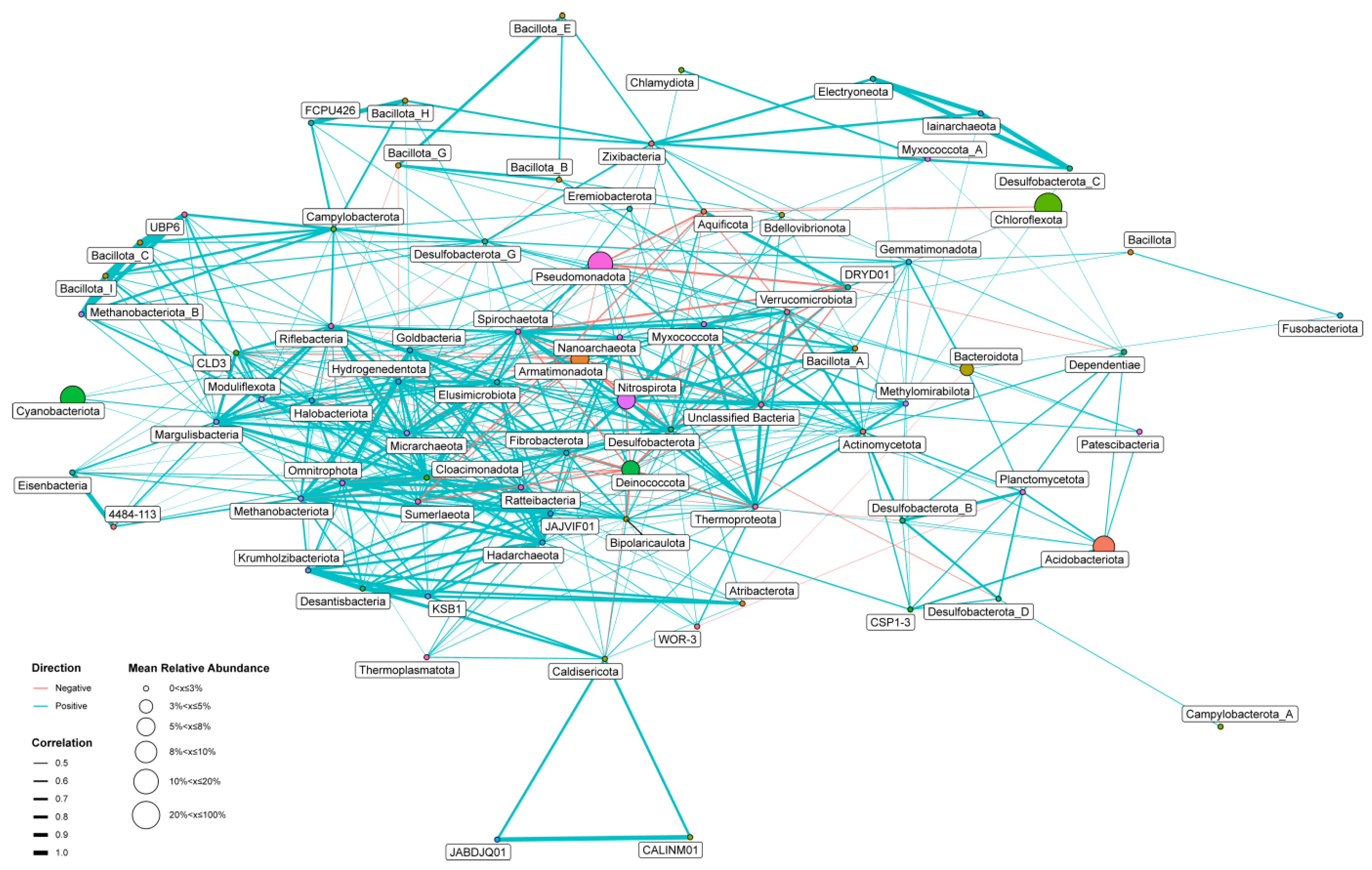
The co-occurrence network analysis (Figure 4) revealed 77 phyla, the presence of which was moderately or strongly correlated (≥0.4 or ≤−0.4) with the presence of other phyla. Among them, 42 phyla with ≥10 edges were observed. The phyla were distributed between the two groups. The first small group included Armatimonadota, Deinococcota, Aquificota, and DRYD01, which were integral components of the microbial communities of the hot springs with the highest temperatures (58–74 °C), i.e., these were extremely thermophilic and thermophilic microbial communities with low biodiversity (see above). The second large group comprised the absolute majority of the remaining phyla, including Pseudomonadota, Nitrospirota, Desulfobacterota, Actinomycetota, Verrucomicrobiota, Spirochaetota, Bacillota_A, Bipolaricaulota (Acetothermia), Bdellovibrionota, Thermoproteota, Hadarchaeota, and others. Representatives of these taxa were part of more diverse moderately thermophilic and mixed microbial communities of thermal springs with lower temperatures from 32 to 59 °C. The hub-taxa within each group had positive correlations with each other, while the hub-taxa from different groups had negative correlations. Therefore, negative correlations in the main were observed for the phyla from the first small group, because the number of phyla in the first group was significantly lower than in the second group. In particular, the most numerous negative interactions were found for Armatimonadota and Deinococcota, with 17 edges for each, while the number of positive interactions for these phyla was four and three edges, respectively. On the contrary, the phyla from the second large group had predominantly positive interactions with other hub-taxa. The most frequent positive interactions were observed within the Desulfobacterota (25 edges), followed by the Nitrospirota (21 edges), Pseudomonadota (17 edges), Actinomycetota (19 edges), Verrucomicrobiota (16 edges), Bacillota_A (14 edges), and Bdellovibrionota (10 edges). Furthermore, certain uncultivated deep-branching bacterial lineages displayed significant co-occurrence, including Bipolaricaulota (Acetothermia) (24 edges). Among the Archaea, the Thermoproteota (22 edges) and Hadarchaeota (22 edges) demonstrated the most abundant positive interactions. Additionally, for representatives of the first small group, a positive correlation between abundances at the class level and temperature was found, while for representatives of the second large group, this correlation was negative (Figure S1 of the Supplementary Materials S2). Thus, the co-occurrence of hub-taxa is determined primarily by the influence of temperature, and negative links reflected the very different temperatures of the hot springs that prokaryotes inhabit. Interestingly, the phyla Chloroflexota and Cyanobacteriota were among the most abundant taxa in the studied microbial communities but had one of the lowest numbers of interactions. Probably low number of connections for Chloroflexota (two positive and three negative) with other hub-taxa could be explained by diversity of identified metabolic groups of representatives of this phylum (phototroph/chemotroph, lithotroph/organotroph, autotroph/heterotroph), which were detected in all type thermal springs, while low number of edges for Cyanobacteriota (four positive) indicates that presence of these primary producers might be relatively independent of other taxa.
Figure 4.
Co-occurrence network of microbial communities of the Baikal Rift Zone hot springs at the phyla level.
3.4. Taxonomic Diversity of Microbial Communities of the Enrichment Cultures
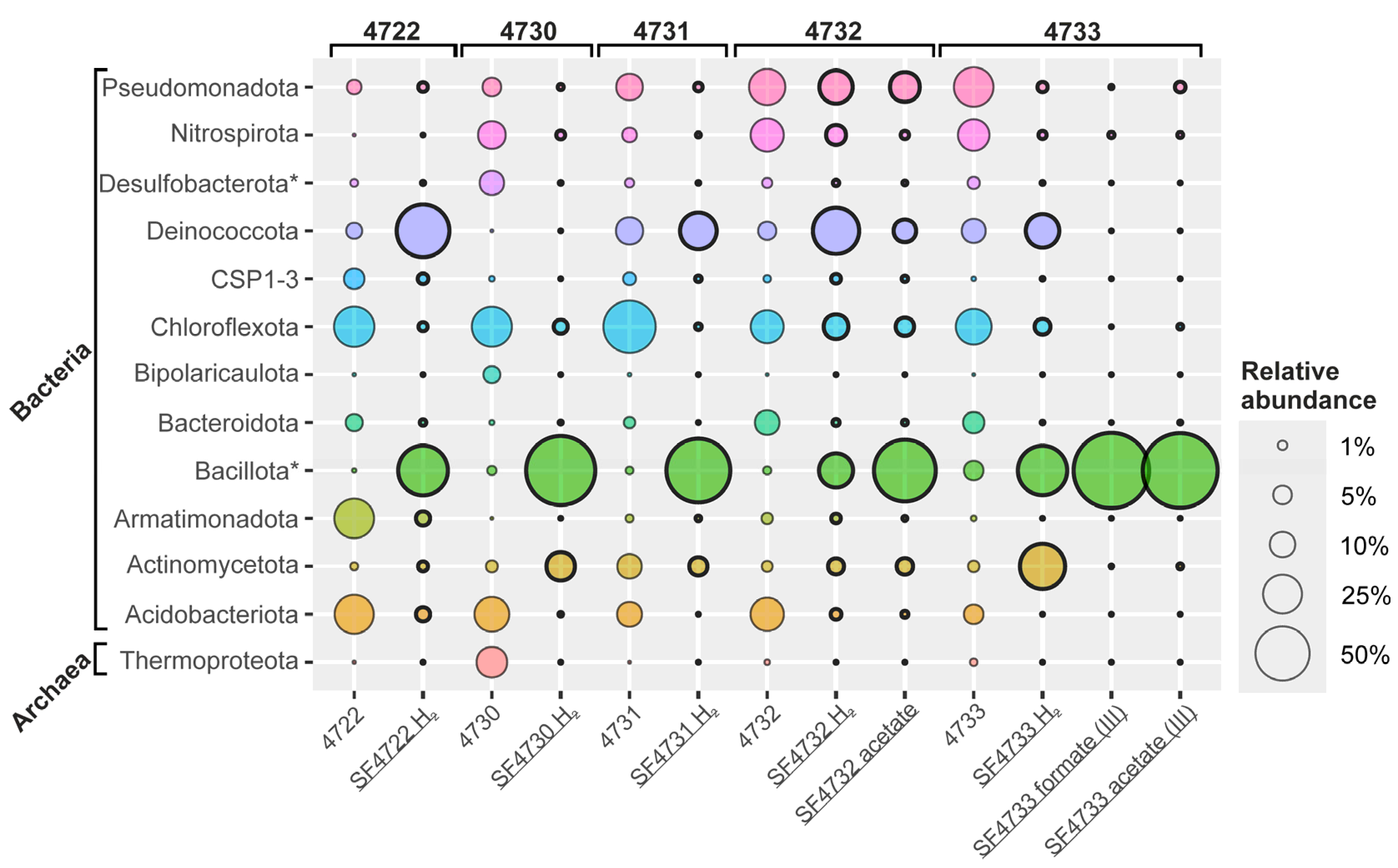
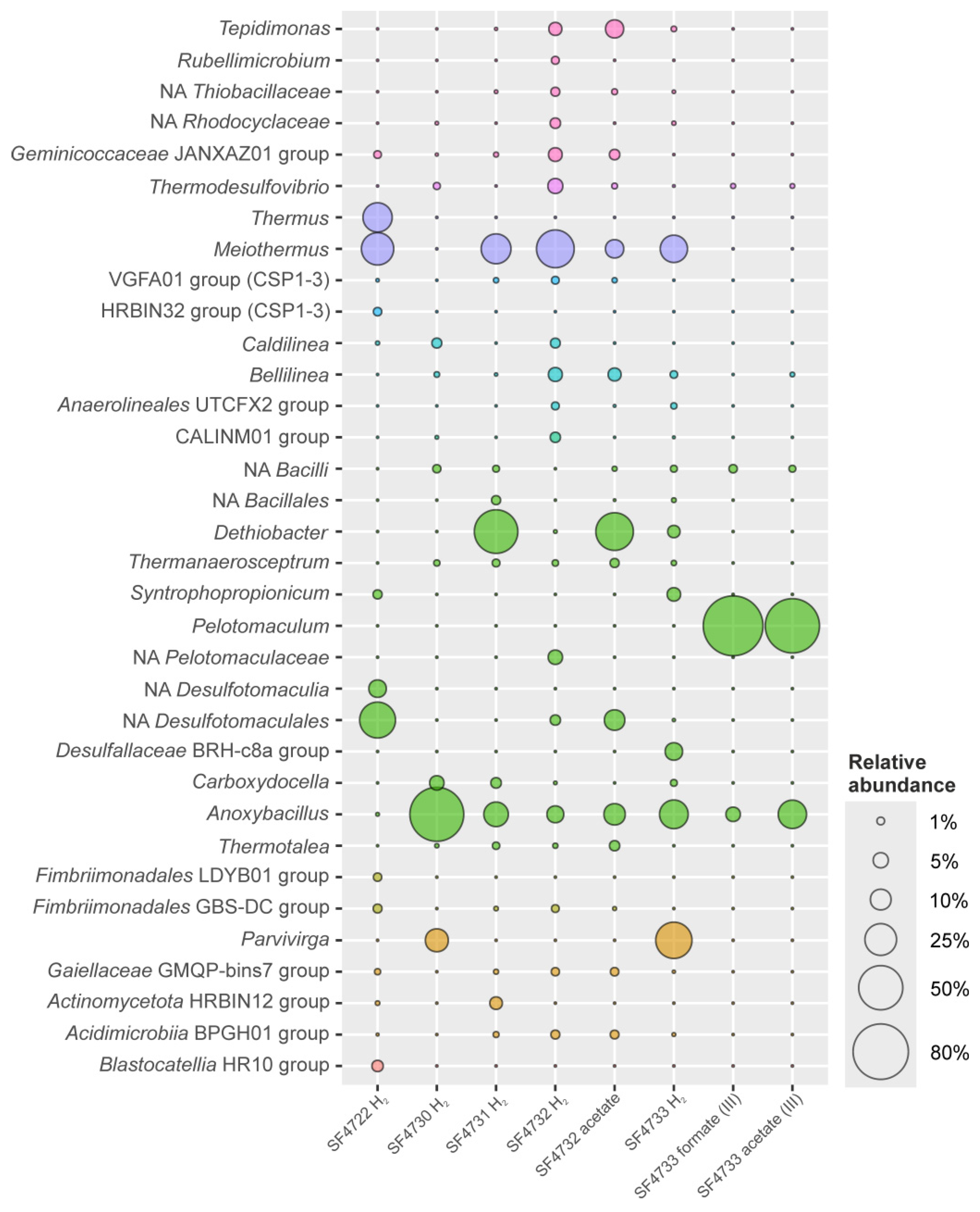
After three weeks of incubation of the samples on selective media, a reduction in ferrihydrite accompanied by the blackening of the sediment was observed in samples #4722 (Uro thermal field), #4730 (Gusikha thermal field) with hydrogen, and in all samples from the Goryachinsk thermal field—#4731 with hydrogen, #4732 with hydrogen or acetate, #4733 with hydrogen. The cultures were dominated by morphologically diverse rods (various lengths and thicknesses), most of which were attached to mineral particles. A small number of cocci have also been observed in the enrichment culture originating from sample #4733. Further, this culture was transferred for two times with formate (10 mM) or acetate (10 mM) as the electron donor and ferrihydrite as the electron acceptor. The 16S rRNA gene profiling revealed depletion of initial phyla diversity, with domination of phylotypes belonging to Bacillota, Deinococcota, or Acidobacteriota (Figure 5). On the family-genus level, the total diversity of the enrichment cultures was slightly decreased (Figure 6). At the same time, a few phylotypes that exhibited a marked increase in relative abundance gained a significant advantage compared to the natural samples (Figure 6).
Figure 5.
Comparison of the taxonomic composition of the initial environmental microbiomes and the enrichment cultures obtained on the media with synthesized ferrihydrite and non-fermentable electron donors at the phyla level. Only phyla with an abundance higher 1% in at least in one enrichment are shown. Different bubble colors indicate assignment to certain phyla. Enrichment cultures are underlined. * - in this figure, Bacillota row includes Bacillota, Bacillota_A, _B, _D, _E, _G, _H.
Figure 6.
Taxonomic composition of the enrichment cultures microbiomes obtained on the media with synthesized ferrihydrite and non-fermentable electron donors at the genera level (only genera with an abundance higher than 1% in at least one enrichment are shown). Bubble color denotes the belonging of different generas to certain phyla (in this figure, Bacillota row includes Bacillota, Bacillota_A, _B, _D).
3.4.1. Microbial Community Structure of the Enrichment from Sample #4722 (Uro Thermal Field)
In general, the taxonomic diversity in the enrichment culture with molecular hydrogen and ferrihydrite was comparable to that of the natural sample. However, at the phylum level, enrichment culture showed the pronounced redistribution in relative abundance compared to the native sample (here and further, the first number refers to natural samples, the second number after the slash refers to the enrichments). Most of the community was composed of phyla Deinococcota (3.6/47.3%) and Bacillota (0.09/40.9%). The remaining phyla comprised only a small part of the community: Chloroflexota (27.2/0.09%), Armatimonadota (26.3/2.7%), Acidobacteriota (25.4/2.7%), CSP1-3 (6.3/1.3%), and Pseudomonadota (2.1/1.0%). At the genus level, a significant shift in the relative abundance of phylotypes was observed. Selective conditions provided the growth of specific bacterial lineages; the abundance of most phylotypes decreased compared to the natural sample. The most abundant phylotypes belonged to the genera Meiothermus (2.5/26.2%) and Thermus (1.0/21.2%). Two deep-branching uncultured representatives of the Bacillota phylum made up one-third of the community (relative abundance 32.5% and 6.9%). Notably, these two phylotypes were not detected (ND) in the native sample. Decreasing relative abundance was detected for Chloroflexus (11.5/<0.01%), Kallotenue (9.2/0.05%), Caldilinea (4.8/<0.01%), HR10 (13.2/2.5%), Pyrinomonadaceae (11.8/<0.01%), HRBIN32 (6.0/1.2%).
3.4.2. Microbial Community Structure of the Enrichment from Sample #4730 (Gusikha Thermal Field)
In general, the taxonomic diversity of the enrichment culture with molecular hydrogen and ferrihydrite was decreased compared to that of a natural sample. Archaea were completely eliminated (16.1/0.01%), as well as bacterial phylum Acidobacteriota (19.9/<0.01%). The 16S rRNA gene profiling showed the predominance of the phyla Bacillota (0.7/82.3%) and Actinomycetota (1.8/12.8%), while phylotypes belonging to the phylum Chloroflexota depleted—2.6% compared to 26.8% in the native sample. Among Bacillota, the most abundant were two genera Anoxybacillus (<0.01/75.7%) and Carboxydocella (4.5%). This phylotype was not found in the native sample, as was the Parvivirga representative of the Actinomycetota phylum, which accounted for 12.5% of the enrichment.
3.4.3. Microbial Community Structure of the Enrichment from Sample #4731 (Goryachinsk Thermal Field)
The taxonomic diversity of the enrichment culture with molecular hydrogen and ferrihydrite was decreased compared to the natural sample. At the phylum level, enrichment culture with molecular hydrogen and ferrihydrite was predominantly composed of Bacillota (0.52/70.3%) and Deinococcota (11.6/22.1%). Representation of the other phyla detected in the native sample decreased—Chloroflexota (46.6/0.4%), Pseudomonadota (11.1/0.75%), Acidobacteriota (9.6/ND), and Actinomycetota (9.2/4.8%). At the family-genus level, three phylotypes accounted for 84% of the total community. The genus Dethiobacter was the most abundant (48.7%). This phylotype was not found in the native sample, as was the Anoxybacillus, the second representative of the Bacillota phylum, which accounted for 14.6% of the enrichment. The relative abundance of the following phylotypes has noticeably changed in comparison to that of the native sample: Meiothermus (11.6/22%), uncultured class of Actinomycetota named UBA4738 (3.3/8.1%), Carboxydocella (ND/2.1%), Chloroflexus (5.2/ND), uncultivated bacteria of the orders Anaerolineales (29.6/ND), Aggregatilineales (5.5/ND), and J102 (4.0/ND).
3.4.4. Microbial Community Structure of the Enrichment from Sample #4732 with Molecular Hydrogen and Ferrihydrite
This enrichment culture was characterized by a high diversity, both at the phylum and family-genus level, but with a pronounced shift in the dominant taxa compared to that of the native sample. Representatives of the Deinococcota (4.8/36.1%), Bacillota (0.69/18.8%), Chloroflexota (17.7/9.4%), along with Pseudomonadota (21.7/18.0%) and Nitrospirota (17.9/5.8%) comprised 67% of all phylotypes. Meiothermus (4.8/36.1%) and Anoxybacillus (0.3/6.4%) were the most abundant genera. The following phylotypes were not detected in the sample #4732 but appeared in the enrichment culture: Thermodesulfovibrio (ND/4.9%), Bellilinea (ND/4.2%), Tepidimonas (ND/4.2%), uncultured Pelotomaculaceae (ND/4.2%), uncultured Rhodocyclaceae (ND/2.1%), and uncultured Desulfotomaculales (ND/2.0%). It is also worth noting that 2% of this enrichment consisted of the new phylum CALINM01.
3.4.5. Microbial Community Structure of the Enrichment from Sample #4732 with Acetate and Ferrihydrite
The microbial community of this enrichment culture exhibited a taxonomic composition similar to that of the enrichment with hydrogen. However, some phylotypes were selectively enriched, while the relative abundance of others decreased compared to their abundance in the native sample or the enrichment culture with hydrogen (first and second numbers after slash): Dethiobacter (ND/0.1/35.9%), uncultured Desulfomaculales (ND/2.0/9.8%); Anoxybacillus (0.3/6.4/10.8%), Tepidimonas (ND/4.2/7.5%); Meiothermus (4.8/36.1/7.7%). The taxonomic composition of the uncultured bacteria was similar to that of the enrichment with hydrogen added as a substrate.
3.4.6. Microbial Community Structure of the Enrichment from Sample #4733 with Molecular Hydrogen and Ferrihydrite
The taxonomic diversity of this enrichment culture comprised Bacillota (5.52/41.2%) represented by the most abundant Anoxybacillus (<0.01/20.3%), uncultured Desulfomaculales BRH-c8a (ND/7.0%), Syntrophopropionicum (ND/3.9%), and Dethiobacter (ND/3.2%); Deinococcota (8.9/18.3%), represented by Meiothermus; Actinomycetota (1.6/34.3%), with the most abundant being Parvivirga (33.3%). Pseudomonadota (1.2%), Chloroflexota (3.5%), and Nitrospirota (0.7%), which were the most diverse and abundant phyla in the native sample, collectively comprised less than 5% of the enrichment culture.
3.4.7. Microbial Community Structure of the Enrichment from Sample #4733, with Formate and Ferrihydrite (The Third Transfer)
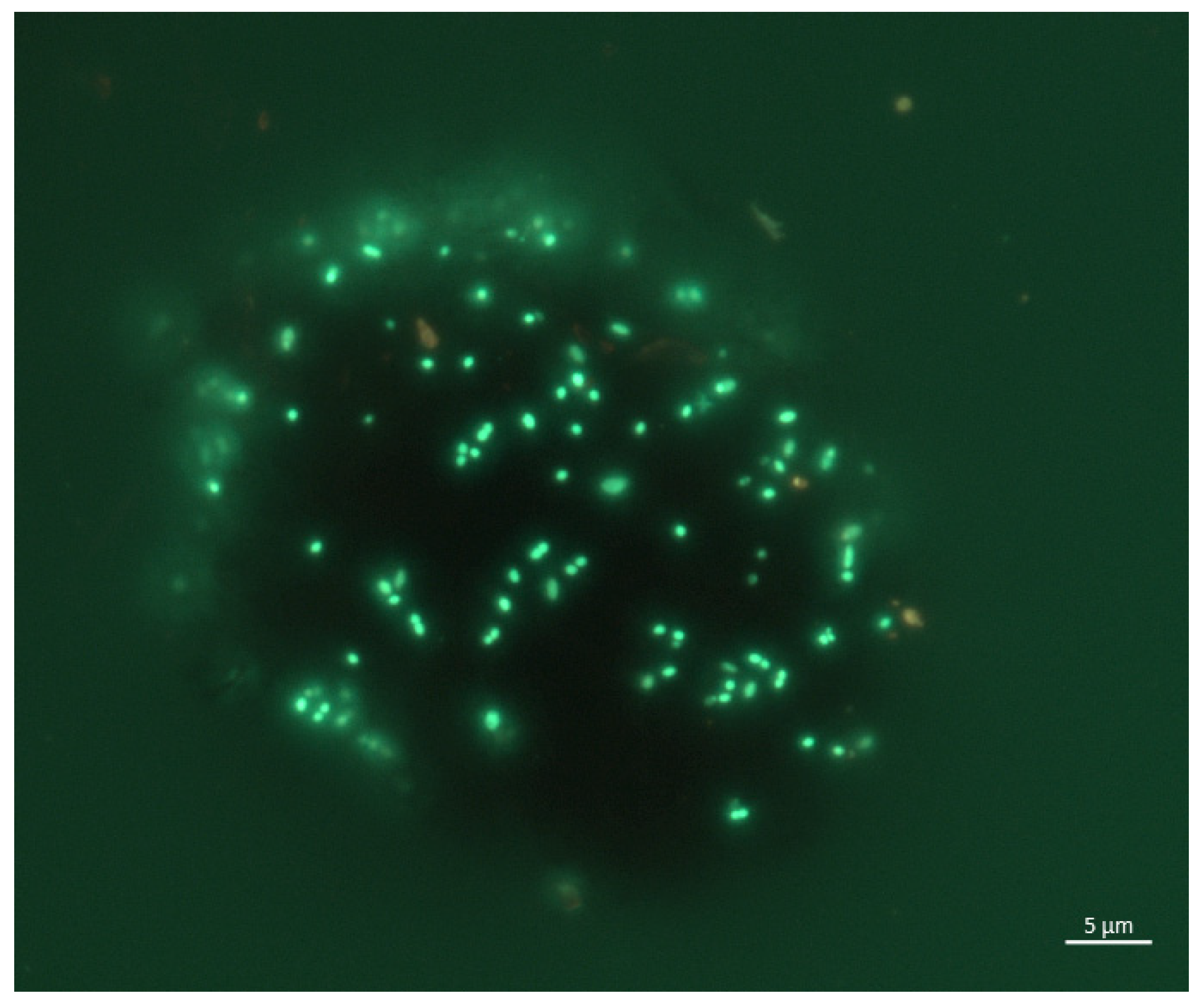
The taxonomic diversity of this enrichment was represented only by four phylotypes—three representatives of the phylum Bacillota—Pelotomaculum (93.8%), Anoxybacillus (4.5%), NA Bacilli (1.2%), and Thermodesulfovibrio (0.3%) of Nitrospirota. The high dominance of Pelotomaculum in this enrichment culture (Figure 6) allowed us to identify its cell morphology. It is most probable that they were cocci located singly, in pairs, or in chains or clusters, closely associated with ferrihydrite particles (bright spots in Figure 7). This stable enrichment will be used in the future for further replanting and attempts to isolate a pure crop. BLAST analysis (ver. BLAST + 2.17.0) revealed low 16S rRNA gene identity of this bacterium with representatives of the genera Thermoflavimicrobium (91.9%), Pelotomaculum (91.6%), and Neomoorella (90.66%), as well as Thermincola (90.3%). All of these genera belong to different families, and such low sequence identity suggests that this bacterium may represent a novel taxon at a deep level within the phylum Bacillota.
Figure 7.
Cellular morphology of the dominant bacterium in the enrichment culture (third transfer) with ferrihydrite and formate from sample #4733. Cells stained by acridine orange.
3.4.8. Microbial Community Structure of the Enrichment from Sample #4733, with Acetate and Ferrihydrite (Third Transfer)
The microbial community of this enrichment culture exhibited a taxonomic composition similar to that of formate, an uncultured representative of the Bacillota phylum (76.9%) and representative of the genus Anoxybacillus (19.8%) composed 96.7% of the four phylotypes.
4. Discussion
4.1. Microbial Communities of the BRZ
Microbial communities of the BRZ hot springs have been extensively studied previously, but these studies have typically focused on either phototrophic microbial mats or on the whole microbial community from one or a few sites [,,,,,,,,,,,]. In our work, we conducted the first large-scale screening of microbial communities from hot springs of the BRZ, located in Umkhei, Kuchiger, Garga, Uro, Gusikha, Goryachinsk, and Zmeiny thermal fields, using metabarcoding of the V3-V4 regions of 16S rRNA. The studied hot springs of the BRZ are polyextreme ecosystems characterized by a wide range of temperature (from 32 to 74 °C), predominantly alkaline pH values (up to 9.5), low salinity (up to 1 g/l), and various chemical compositions of water enriched with N2. Comparing the data from the beta diversity analysis and the temperature values in each sample, we noticed a strong dependence of the composition of the microbial community on temperature, what allowed us to classify microbial communities into four groups: Extreme Thermophilic (ET), Thermophilic (T), Moderate Thermophilic (MT), and Mixed (M). The ET group had the highest temperature at 74 °C, while the T group ranged from 58 to 72 °C. The MT group ranged between 42 and 59 °C, and the M group had low temperatures between 32 and 42 °C.
The ET group comprised three communities with low alpha diversity from the Garga hot spring. Despite differences, they shared key taxa, including Thermus (Deinococcota), the uncultivated genus UBA11096 (Aquificaceae, Aquificota), and some others. UBA11096, the dominant component of white fouling in spring #4708, likely functions as a primary producer of autochthonous organic matter. Previous culture-based studies of Aquificota suggested that these chemolithoautotrophic organisms typically oxidize hydrogen sulfide or hydrogen to generate energy, with oxygen serving as the terminal electron acceptor [,,,,,]. The generated organic matter is presumably consumed by aerobic heterotrophs like Thermus and potentially by the uncultured genus LDYB01 (Fimbriimonadales, Armatimonadota), consistent with the aerobic metabolism of cultivated Armatimonadota. Since cultivated representatives of Thermus and all cultivated representatives of the phylum Armatimonadota utilize a number of carbohydrates and proteinaceous substrates during aerobic respiration [,,,,,].
Two other microbial communities (#4707 and #4709) developed primarily on wood that fell into the Garga hot spring when a nearby wooden bathhouse collapsed. The presence of wood leads to the development of microbial communities that carry out the mineralization of organic matter. For example, the dominant groups of the sample #4709 were aerobic and facultative anaerobic heterotrophic bacteria of the uncultivated genus HR10 of the class Blastocatellia (Acidobacteriota), the genus Thermus (Deinococcota), unclassified genus LDYB01 (Armatimonadota), as well as Bacteroidota represented by genus Rhodothermus and uncultured order-level phylogenetic lineage JANXDC01.
The microbial community of the brown-pink microbial mat (#4707) was represented by obligate and facultative anaerobic heterotrophic bacteria (Thermovenabulum [], Caloramator [], Caldicellulosiruptor [], and Thermus []) that can utilize a number of carbohydrates and proteinaceous substrates and potential sulfate-reducing bacteria (SRB) such as Thermodesulfovibrio [,,], Desulfofundulus [], and probably by unclassified representatives of the family Desulfovirgulaceae and the class-level phylogenetic lineage JACIYH01 []. SRB accounted for up to 42% of all prokaryotes, which is shown for the first time for microbial communities of the BRZ hot springs, and it is strikingly different from previously published data for the Garga hot spring [,,]. The significant SRB abundance likely explains the low Eh values (−190 mV), which is a novel finding for the Garga spring.
The T group, comprising microbial communities with low alpha diversity from the Garga and Uro thermal fields, is distinguished from the ET group by a reduced abundance of Aquificota, DRYD01, and WOR-3, and an increased prevalence of Armatimonadota and Deinococcota. The phylum Armatimonadota included the genera LDYB01 and GBS-DC, the latter comprising probable aerobic heterotrophs [,,,,]. The phylum Deinococcota was represented by Thermus and Meiothermus. Unlike Thermus, Meiothermus has a lower temperature optimum, enabling it to successfully compete with bacteria of the genus Thermus at decreased temperatures [,]. Both genera aerobically respire carbohydrates, amino acids, organic acids, and polyols, with some species capable of nitrate reduction [,]. The T group was further distinguished from the ET group by the presence of Chloroflexota representatives (genera Chloroflexus, Kallotenue, Caldilinea). Chloroflexus species exhibit metabolic versatility, capable of photoheterotrophic and chemoheterotrophic growth [,,]. In contrast, Kallotenue papyrolyticum is an aerobic heterotroph [], while Caldilinea species grow chemoorganoheterotrophically under both aerobic and anaerobic conditions [,]. A subdominant part of the microbial communities of the T group was represented by heterotrophic bacteria of the phyla Acidobacteriota, Bacteroidota, Pseudomonadota, Bacillota, and others. Thus, the T group includes microbial communities that carry out mineralization of organic matter under aerobic and microaerobic conditions.
The MT group originated from both phototrophic mats and underlying sediments at different depths. Thus, the alpha diversity of the MT group microbial communities varied substantially, reflecting their specific locations within the stratified biogeocenosis. Phototrophic microbial mats characterized by low taxonomic diversity consisted of both aerobic phototrophs of the phylum Cyanobacteriota and bacteria of the phylum Chloroflexota carrying out anoxygenic photosynthesis or growing photoheterotrophically. Cyanobacteria likely function as primary producers of autochthonous organic matter in hot springs. Among phototrophic Chloroflexota, the most abundant groups belonged to the genera Roseiflexus and Chloroflexus. Roseiflexus can grow photoheterotrophically and chemoheterotrophically under anaerobic light and aerobic dark conditions, respectively, but neither photoautotrophic nor fermentative growth is observed []. Representatives of the genus Chloroflexus are capable of photoautotrophic growth, photoheterotrophic growth in the absence of oxygen, and chemoheterotrophic growth in aerobic conditions [,,].
A green microbial mat from the Goryachinsk field was dominated by uncultured Thiobacillaceae (65.7%), likely oxidizing sulfur compounds chemolithoautotrophically, and Chloroflexus (20.2%). The underlying sediment microbial community exhibited high alpha diversity, and probably these microorganisms are responsible for the destruction of organic matter under anaerobic conditions. Significant microbial taxa of the MT group included Dissulfurispiraceae, uncultured Nitrospirota (SM23-35), and Desulfobacterota (BSN033), suggesting their role in the terminal degradation of organic matter and reducing the sulfate or other sulfur compounds to form sulfide.
M-group included four microbial communities from the Umkhei, Kuchiger and Zmeinaya Bay thermal springs with the lowest temperature ranging from 32 to 42 °C and significant anthropogenic effect. Both thermophilic taxa described above for the MT group and mesophilic bacteria were observed in these communities, resulting in quite a high taxonomic diversity. For example, the presence of the mesophilic sulfur-oxidizing bacteria of the genera Thiocapsa, Lamprobacter, Thermochromatium, Thiobacillus, Thioflexithrix, and Thiothrix has been shown for the Umkhey thermal springs. In addition, representatives of the genus Aeromonas and uncultivated representatives of the family Rhodocyclaceae were identified. For Umkhei and Kuchiger thermal springs, the presence of Enterobacteriaceae bacteria, primarily of Enterobacter and Serratia representatives, has been established, indicating a significant anthropogenic impact on these springs.
A significant share of archaea was detected only in sediments of the Kuchiger (#4705) and Gusikha (#4730) hot springs. Archaea were represented by uncultivated class Bathyarchaeia (Thermoproteota), the family Hadarchaeaceae (Hadarchaeota), as well as unclassified representatives of the phylum Thermoplasmatota. Most probably, archaea of the class Bathyarchaeia and the phylum Thermoproteota participate in organic matter decomposition [,,,]. For representatives of the phylum Hadarchaeota it was shown the ability to oxidize carbon monoxide coupled with nitrite reduction to ammonia [], or methanogenic degradation of hydrocarbons mediated by syntrophic cooperation between archaeal partners [].
4.2. Comparative Analysis of the Microbial Communities Studied with Those from Alkaline Hot Springs Worldwide
Thermal alkaline hot springs, which are widely distributed globally, are presented by two main groups: volcanic and non-volcanic. Volcanic hot springs are a characteristic of volcanically active regions, such as Yellowstone (USA), Iceland, Italy, or rift arcs associated with subduction along tectonic plate boundaries, such as the countries in the Pacific Ring of Fire (Japan, New Zealand, Chile, Costa Rica, etc.). These regions are characterized by a bimodal distribution of pH values ranging from acidic to alkaline. The bimodal pH distribution is a geological phenomenon that occurs due to subsurface boiling and vapor–liquid separation in geothermal systems when water is heated underground. The vapor phase is enriched with volcanic gases, such as hydrogen sulfide (H2S), which oxidizes in the presence of oxygen to form sulfuric acid (H2SO4), creating acidic, sulfate-rich springs. The liquid phase, which has lost volatile components, is neutral or alkaline and typically rich in sodium, chloride, and sulfate. The waters of this type of spring are heated by direct contact with magma chambers or bodies close to the surface [,,,,]. Non-volcanic alkaline hot springs are found primarily in areas with deep crustal fractures, high radiogenic heat production, granitic rock masses, or along major fault lines, continental rift zones African (Kenya), Baikal (Russia), parts of the continental shield (India and China), or fault zones (for example, Spain, Romania, and Croatia). Their distribution is controlled by deep circulation of groundwater along major faults and permeable fracture networks that heat the water through contact with hot rocks. They are typically rich in potassium, sodium, and bicarbonates and have lower temperatures than volcanic springs because of a slower and more diffuse heating process [,,,,,].
An analysis of the literature on the diversity of microbial communities in alkaline springs has shown that, despite differences in the formation of volcanic and non-volcanic alkaline thermal springs, the main taxonomic composition of microbial communities within the four highlighted groups (ET, T, MT, and M-groups) is similar worldwide, regardless of the geology or cation and anion composition of the water. Similar microbial communities have been found in alkaline hot springs in the USA [,,,,,], Iceland [], Italy [], Japan [], New Zealand [], Indonesia []; Thailand and Philippines [], Costa Rica []; Kenya [], China [,,,,,], India [,,,,,,,,,], Romania [], and Croatia []. In addition, a hyperthermophilic (HT) group of microbial communities can also be distinguished that are present in hot springs with temperatures above 80 °C and are characterized by a high share of bacteria of the phylum Aquificota and hyperthermophilic archaea of the phylum Thermoproteota [,,,,,]. It is also worth mentioning the unusual microbial communities, which are characterized by the dominance of various mesophilic taxa, regardless of the physicochemical factors in the alkaline hot springs [,,]. We suggest that these unusual communities are an artifact.
4.3. Diversity of the Alkalithermophilic Dissimilatory Iron Reducers in BRZ
Analysis of primary enrichment cultures with ferrihydrite obtained previously from water and sediment samples of the Goryachinsk thermal field revealed an increase in the relative abundance of phylotypes belonging to phyla Nitrospirota, Pseudomonadota, and Bacillota, as well as less abundant phyla Actinomycetota, SVA0045, Bacteroidota, Desulfobacterota, Deinococcota, and Thermotogota []. Following several transfers under a molecular hydrogen atmosphere, the enrichment culture of alkalithermophilic iron reducers dominated by the phylotype closely related to Parvivirga hydrogeniphila, which comprised 52.3% of the community, was obtained []. P. hydrogeniphila is a thermophilic anaerobe and obligate autotrophic iron reducer that uses only H2 or formate as an electron donor, isolated from the aquifer of the Yessnetukskoye mineral water basin [,]. Interestingly, the type strain of this species cannot grow at pH values above 8.5 []. Based on these findings, the search for dissimilatory alkalithermophilic iron reducers was expanded in other hot springs of BRZ. To exclude fermentation processes, only non-fermentable substrates were used — molecular hydrogen or sodium acetate. The target microorganisms were detected in five samples out of seven tested, except for samples #4710 (Garga thermal field) and #4725 (Gusikha thermal field). The preferred donor for dissimilatory alkalithermophilic iron reducers was molecular hydrogen. Under selective conditions, the taxonomic composition of the communities shifted significantly from the microbial profiles observed in natural samples. 16S rRNA gene-based profiling revealed that the relative abundance of representatives from Bacillota, Deinococcota, and Actinomycetota phyla strongly increased in selective media designed to isolate alkalithermophilic dissimilatory iron reducers (Figure 5). This microbial profile was significantly different from the pattern of the natural samples, where Bacillota representatives constituted only a minor part of the communities (Figure 2). It is important to note that among these three phyla, the Bacillota was represented by the most diverse phylotypes. In contrast, the other two phyla were dominated almost exclusively by phylotypes belonging to only three genera: Thermus, Meiothermus (phylum Deinococcota), and Parvivirga (phylum Actinomycetota).
Representatives of the genus Meiothermus, as previously reported for the enrichment cultures from the Goryachinsk thermal field []. In addition, sequences related to the genus Meiothermus have been detected in the subsurface of hyperalkaline and suboxic environments, oftentimes in high relative abundance [,,]. The representation of the reads related to this genus increased in all enrichment cultures compared to natural samples (Figure 6), except in sample #4730 and the enrichment culture from this spring (Gusikha thermal field). In both cases, phylotypes belonging to Meiothermus were not detected. It is also worth noting that in the third transfer of enrichment culture #4733, both with formate and acetate, this bacterium completely disappeared (Figure 6). Therefore, it can be assumed that representatives of this genus likely act as organotrophs in enrichments, decomposing organic matter obtained from natural samples rather than participating in the decomposition of mort mass. As for the phylotypes belonging to the genus Thermus in the enrichment culture SF4722.H2 (Uro thermal field), their functional role remains open to interpretation. Perhaps representatives of this genus may be involved in iron reduction, as this metabolic capability has been previously demonstrated for members of this genus [,].
The discovery and significant accumulation of a phylotype belonging to the Parvivirga genus (Actinomycetota) in enrichment cultures SF4730.H2 and SF4733.H2 support several important conclusions. First, this study confirms the previously detected presence of this bacterium in the water and sediments of the Goryachinsk thermal field [], indicating that it is likely a permanent member of this microbial community. Second, its detection in the enrichment cultures SF4730.H2 from sediments of Gusikha thermal spring indicates a wider distribution of this genus in the BRZ. Third, its significant accumulation in a medium with ferrihydrite and molecular hydrogen confirms the previously identified narrow ecological specialization of this microorganism [,]. As described in our previous work, the phylotypes of this genus were not detected in any of the natural samples studied []. This also indirectly suggests that the surface conditions are not optimal for this microorganism, which is sensitive to redox potential and obligately dependent on hydrogen and ferric iron compounds. Finally, its accumulation in samples with alkaline pH values expands the known limits of its ecological niche. Thus, the findings of current research suggest that representatives of the genus Parvivirga, most likely a new species, are polyextremophilic dissimilatory iron reducers that transform ferrihydrite by oxidation of molecular hydrogen at pH ≥ 8.5 and T ≥ 50 °C.
The most diverse phylotypes whose abundance significantly increased in the presence of ferrihydrite with hydrogen or acetate belonged to the phylum Bacillota. In the native samples, their relative abundance ranged from 0.9 (sample #4722) to 5.48% (sample #4733), while in the enrichments it ranged from 18.7 (sample SF4732.H2) to 82.25% (sample SF4730.H2) (Figure 6). At the same time, a significant part of the detected phylotypes belonged to unknown bacteria of various taxon levels—from the genus to the class, for which no reliable data about physiology exist. In the enrichment cultures SF4722.H2 (Uro thermal field), SF4732.acetate, and SF4733.H2 (Goryachinsk thermal field), a significant accumulation of phylotypes belonging to the order Desulfotomaculales according to GTDB_r220_v2 was detected. However, BLAST analysis revealed a low similarity to all known genera within this order, suggesting they represent a taxon of a higher level. The V3-V4 hypervariable region of the 16S rRNA gene used in high-throughput sequencing provides insufficient phylogenetic resolution to classify this group further. The significant accumulation of these bacteria in the third transfer from native sample #4733 allowed us to suggest that their cells have a coccoidal morphology (Figure 7), which is unusual for representatives of the order Desulfotomaculales. Their high accumulation in the enrichment cultures from different thermal fields (Uro and Goryachinsk) indicates that they were not accidentally detected in the microbial communities of the BV hot springs despite being undetectable in the native samples by molecular methods. This phenomenon also suggests that these organisms thrive in the selective conditions, and, therefore, most likely, they are chemoorganotrophic or chemolithotrophic iron reducers that prefer thermal environments with a high pH value.
In addition to unidentified Bacillota phylotypes, representatives of known taxa were also enriched. The most common phylotype belonged to the genus Anoxybacillus, a significant accumulation of which was recorded in all enrichments except for the sample SF4722.H2 from the Uro thermal field, and turned out to be quite unexpected. Moreover, this phylotype accounted for up to 20% in the enrichment culture SF4733.acetate(III), which was obtained after two successive transfers of the primary enrichment SF4733.H2. The only described representative of this genus is a facultatively anaerobic alkalophilic fermenting bacterium [,]. However, it has been demonstrated that some representatives of this genus are able to reduce Fe(II)EDTA-NO and Fe(III)EDTA simultaneously []. Perhaps the presence of ferrihydrite in the medium somehow stimulated the growth of this bacterium, for example, by dumping of extra electrons during the fermentation of complex organic compounds. In addition to Anoxybacillus, other phylotypes belonging to the genera Carboxydocella and Dethiobacter were also observed, for which the ability to reduce iron has been previously demonstrated [,,,]. According to BLAST analyses phylotype related to the genus Carboxydocella had 99.07% identity with Carboxydocella manganica, a thermophilic, anaerobic, dissimilatory Fe(III) and Mn(IV)-reducing bacterium isolated from a terrestrial hot spring on the Kamchatka peninsula. This is a neutrophilic bacterium with a pH range from 5.5 to 8.0, with an optimum at pH 6.5 []. Phylotype related to alkaliphilic iron- or thiosulfate-reducing bacteria of the mesophilic genus Dethiobacter [] demonstrated a low (93%) level of similarity according to BLAST analysis. It should be noted that Dethiobacter-related phylotypes have been previously detected exclusively in alkaline environments (pH ≥ 7.5) of two different types: the sediments of soda or meromictic lakes, and subsurface ecosystems affected by serpentinization processes [].
5. Conclusions
For the first time, a comprehensive analysis of polyextremophilic microbial communities in thermal springs in the Baikal Rift Zone was conducted using co-occurrence network and NMDS approaches, which allowed a reveal of patterns that determine their taxonomic composition. The alkaline pH values ranging from 7.8 to 9.5 showed low correlation with the structure of the studied microbial communities. In contrast, temperature turned out to be a critical factor determining the uniqueness of microbiomes in the thermal springs of the BRZ, directly impacting the alpha and beta diversity. Trophic structure of the studied communities included primary producers—aerobic and anaerobic phototrophs, sulfur-oxidizing autotrophs; aerobic and anaerobic organoheterotrophs—destructors of complex (polysaccharides, protein compounds, amino acids) and simple (carbohydrates, organic acids) organic compounds. The final stage of organic matter decomposition is most likely carried out by sulfate-reducing bacteria. The discovery of numerous uncultivated bacteria from deep phylogenetic lineages raises significant questions about their functional roles. In particular, these organisms can use alternative terminal acceptors besides sulfate for organic matter mineralization. Metagenomic analysis, as well as cultivation on selective media, will help clarify this issue. The latter method was successfully applied here to identify microorganisms that could transform iron minerals.
Our findings confirmed that iron-reducing microorganisms can transform iron minerals at high pH and temperature, as hypothesized by Nixon et al. []. Compared to our first work [], we significantly expanded our knowledge of the phylogenetic diversity of this physiological group. Alkalithermophilic iron reducers are rare or not even detectable by molecular methods in the BRZ thermal freshwater microbial communities; however, our results revealed their ability to outcompete phototrophs and organotrophs rapidly and displace them effectively in selective media. As hydrogen has turned out to be a preferable substrate for this group, they may be more prevalent among subsurface microbial communities. This ecosystem is even more attractive to the alkalithermophilic iron reducers because it is depleted in organic matter but not limited in Fe(III) from Proterozoic igneous rocks and the overlying Quaternary sediments. The dominance of Bacillota representatives in the enrichment cultures suggests that chemolitho- and chemoorganotrophic members of this phylum are most likely responsible for the reduction of Fe(III) in alkaline freshwater thermal springs of BRZ.
Supplementary Materials
The following supporting information can be downloaded at: https://www.mdpi.com/article/10.3390/biology14121716/s1, Supplementary Material S1, Supplementary Material S2: Description of the sampling sites.
Author Contributions
Obtained the samples from BRZ, A.I.M., A.G.E. and E.N.F.; isolated DNA from the sampling sites and performed high-throughput 16S rRNA genes amplicon sequencing, writing—review and editing, A.A.K.; bioinformatics analysis, visualization, writing—review and editing, A.G.E.; writing—original draft preparation, writing—review and editing, A.I.M.; writing—review and editing, A.V.G., E.V.L., T.G.B., V.B.D. and D.D.B.; formal analysis, A.V.G.; methodology, D.D.B.; cultivation, visualization, writing—review and editing, D.G.Z.; supervision, project administration, methodology, investigation, funding acquisition, conceptualization, E.N.F. All authors have read and agreed to the published version of the manuscript.
Funding
This work was supported by the grant of the Russian Science Foundation #24-14-00177 (expedition, sample collection, DNA extraction and 16S rRNA gene sequencing), in part the grant of the Russian Science Foundation #24-64-00023 (obtaining enrichment cultures of iron reducers), and in part by the Ministry of Science and Higher Education of the Russian Federation (data analysis). The work of E.V.L., T.G.B., V.B.D., and D.D.B. was supported by the Ministry of Science and Higher Education of Russian Federation (Agreement No. 121030100229-1).
Institutional Review Board Statement
Not applicable.
Informed Consent Statement
Not applicable.
Data Availability Statement
All sequencing data were deposited into the NCBI SRA database under BioProject number PRJNA1335199.
Conflicts of Interest
The authors declare no conflicts of interest.
Abbreviations
The following abbreviations are used in this manuscript:
| ASVs | Amplicon sequence variations |
| BLAST | Basic Local Alignment Search Tool |
| BRZ | The Baikal Rift Zone |
| BV | The Barguzin Valley |
| ET group | The Extreme Thermophilic group |
| GTDB | The Genome Taxonomy Database |
| M group | The Mixed group |
| MT | The Moderate Thermophilic group |
| ND | Not detected |
| NMDS | Non-metric multidimensional scaling |
| T group | Thermophilic group |
References
- Zippa, E.V.; Ukraintsev, A.V.; Chernyavskii, M.K.; Fedorov, I.A.; Poturay, V.A.; Domrocheva, E.V.; Mukhortina, N.A. Thermal waters in the central part of Baikal Rift Zone: Hydrogeochemistry and geothermometry (Republic of Buryatia, Russia). Geothermics 2025, 130, 103317. [Google Scholar] [CrossRef]
- Lavrentyeva, E.V.; Radnagurueva, A.A.; Banzaraktsaeva, T.G.; Bazarov, S.M.; Barkhutova, D.D.; Ulzetueva, I.D.; Chernyavsky, M.K.; Kabilov, M.R.; Khakhinov, V.V. Phylogenetic analysis of the microbial mat in the hot spring Garga (Baikal rift zone) and the diversity of natural peptidases. Vavilov J. Genet. Breed. 2017, 21, 959–963. [Google Scholar] [CrossRef]
- Namsaraev, B.B.; Khakhinov, V.V.; Garmaev, E.Z.H.; Barkhutova, D.D.; Namsaraev, Z.B.; Plyusnin, A.M. Vodnye Sistemy Barguzinskoi Kotloviny (Aquatic Systems of Barguzin Depression); Buryat State University: Ulan-Ude, Russia, 2007. [Google Scholar]
- Rozanov, A.S.; Bryanskaya, A.V.; Ivanisenko, T.V.; Malup, T.K.; Peltek, S.E. Biodiversity of the microbial mat of the Garga hot spring. BMC Evol. Biol. 2017, 17, 254. [Google Scholar] [CrossRef]
- Plyusnin, A.M.; Zamana, L.V.; Shvartsev, S.L.; Tokarenko, O.G.; Chernyavskii, M.K. Hydrogeochemical peculiarities of the composition of nitric thermal waters in the Baikal rift zone. Russ. Geol. Geophys. 2013, 54, 647–664. [Google Scholar] [CrossRef]
- Meyer-Dombard, D.R.; Shock, E.L.; Amend, J.P. Archaeal and bacterial communities in geochemically diverse hot springs of Yellowstone National Park, USA. Geobiology 2005, 3, 211–227. [Google Scholar] [CrossRef]
- Radnagurueva, A.A.; Lavrentieva, E.V.; Budagaeva, V.G.; Barkhutova, D.D.; Dunaevsky, Y.E.; Namsaraev, B.B. Organotrophic bacteria of the Baikal Rift Zone hot springs. Microbiology 2016, 85, 367–378. [Google Scholar] [CrossRef]
- Lavrentyeva, E.V.; Banzaraktsaeva, T.; Radnagurueva, A.A.; Buryukhaev, S.P.; Dambaev, V.; Baturina, O.A.; Kozyreva, L.; Barkhutova, D.D. Microbial Community of Umkhei Thermal Lake (Baikal Rift Zone) in the Groundwater Discharge Zone. Contemp. Probl. Ecol. 2019, 12, 584–593. [Google Scholar] [CrossRef]
- Lavrentyeva, E.V.; Banzaraktsaeva, T.G.; Dambaev, V.B.; Radnagurueva, A.A.; Kozyreva, L.P. Taxonomic composition and proteolytic potential in the microbial mat of the Uro hot spring (the Baikal rift zone). In IV All-Russian Conference with International Participation “Diversity of Soils and Biota of Northern and Central Asia”; Buryat State University: Ulan-Ude, Russia, 2021. [Google Scholar]
- Barkhutova, D.D.; Buryukhaev, S.P.; Dambaev, V.B.; Tsyrenova, D.D.; Lavrentyeva, E.V. Taxonomical and functional diversity of microbial communities in two hot springs of the Baikal rift zone. IOP Sci. 2021, 908, 012001. [Google Scholar] [CrossRef]
- Kompantseva, E.I.; Gorlenko, V.M. Phototrophic communities in some Lake Baikal thermal springs. Mikrobiologiya 1988, 57, 841–846. [Google Scholar]
- Bryanskaya, A.V.; Namsaraev, Z.B.; Kalashnikova, O.M.; Barkhutova, D.D.; Namsaraev, B.B.; Gorlenko, V.M. Biogeochemical processes in the algal-bacterial mats of the Urinskii alkaline hot spring. Microbiology 2006, 75, 611–620. [Google Scholar] [CrossRef]
- Lazareva, E.V.; Bryanskaya, A.V.; Zhmodik, S.M.; Kolmogorov, Y.P.; Pestunova, O.P.; Barkhutova, D.D.; Zolotarev, K.V.; Shaporenko, A.D. Elements redistribution between organic and mineral parts of microbial mats: SR-XRF research (Baikal Rift Zone). Nucl. Instrum. Methods Phys. Res. Sect. A Accel. Spectrometers Detect. Assoc. Equip. 2009, 603, 137–140. [Google Scholar] [CrossRef]
- Namsaraev, B.B.; Barkhutova, D.D.; Khakhinov, V.V. Geokhimicheskaya Deyatel’nost’ Mikroorganizmov Gidroterm BRZ (Geochemical Activity of Microorganisms in the BRZ Hydrotherms); Geo: Novosibirsk, Russia, 2011. [Google Scholar]
- Kalashnikov, A.M.; Gaĭsin, V.A.; Sukhacheva, M.V.; Namsaraeva, B.B.; Panteleeva, A.N.; Nuianzina-Boldareva, E.N.; Kuznetsov, B.B.; Gorlenko, V.M. Anoxygenic phototrophic bacteria from microbial communities of Goryachinsk Thermal Spring (Baikal Area, Russia). Microbiology 2014, 83, 484–499. [Google Scholar] [CrossRef]
- Lavrentyeva, E.V.; Radnagurueva, A.A.; Baturina, O.A.; Khakhinov, V.V. Taxonomic Diversity of the Microbial Community in the Kuchiger Thermal Spring (Baikal Rift Zone). Contemp. Probl. Ecol. 2024, 17, 24–31. [Google Scholar] [CrossRef]
- Namsaraev, B.B.; Barkhutova, D.D.; Danilova, E.V.; Dagurova, O.P.; Namsaraev, Z.B.; Balzhiin, T.; Ayush, O. Structure and Functioning of Microbial Community of Mineral Springs in Central Asia. Mong. J. Biol. Sci. 2003, 1, 37–42. [Google Scholar] [CrossRef]
- Rusanov, I.I.; Kadnikov, V.V.; Lukina, A.P.; Danilova, E.V.; Sokolyanskaya, L.O.; Ravin, N.V.; Karnachuk, O.V. Low-Abundance Sulfidogenic Bacteria Carry out Intensive Sulfate Reduction in Terrestrial Hydrotherms of the Barguzin Valley. Microbiology 2023, 92 (Suppl. S1), 29–32. [Google Scholar] [CrossRef]
- Nixon, S.L.; Bonsall, E.; Cockell, C.S. Limitations of microbial iron reduction under extreme conditions. FEMS Microbiol. Rev. 2022, 46, fuac033. [Google Scholar] [CrossRef]
- Wolin, E.A.; Wolin, M.J.; Wolfe, R.S. Formation of methane by bacterial extracts. J. Biol. Chem. 1963, 238, 2882–2888. [Google Scholar] [CrossRef]
- Kevbrin, V.V.; Zavarzin, G.A. The influence of sulfur compounds on the growth of halophilic homoacetic bacterium Acetohalobium arabaticum. Microbiology 1992, 61, 563–571. [Google Scholar]
- Zavarzina, D.G.; Klyukina, A.A.; Merkel, A.Y.; Maslova, T.A.; Maslov, A.A. Alkalo-thermophilic iron-reducing bacteria of the Goryachinskoe thermal water deposit. Microbiology 2024, 93, 818–831. [Google Scholar] [CrossRef]
- Gohl, D.M.; Vangay, P.; Garbe, J.; MacLean, A.; Hauge, A.; Becker, A.; Gould, T.J.; Clayton, J.B.; Johnson, T.J.; Hunter, R.; et al. Systematic improvement of amplicon marker gene methods for increased accuracy in microbiome studies. Nat. Biotechnol. 2016, 34, 942–949. [Google Scholar] [CrossRef]
- Frey, B.; Rime, T.; Phillips, M.; Stierli, B.; Hajdas, I.; Widmer, F.; Hartmann, M. Microbial diversity in European alpine permafrost and active layers. FEMS Microbiol. Ecol. 2016, 92, fiw018. [Google Scholar] [CrossRef]
- Merkel, A.Y.; Tarnovetskii, I.Y.; Podosokorskaya, O.A.; Toshchakov, S.V. Analysis of 16S rRNA primer systems for profiling of thermophilic microbial communities. Microbiology 2019, 88, 671–680. [Google Scholar] [CrossRef]
- Fadrosh, D.W.; Ma, B.; Gajer, P.; Sengamalay, N.; Ott, S.; Brotman, R.M.; Ravel, J. An improved dual-indexing approach for multiplexed 16S rRNA gene sequencing on the Illumina MiSeq platform. Microbiome 2014, 2, 6. [Google Scholar] [CrossRef]
- Callahan, B.J.; McMurdie, P.J.; Rosen, M.J.; Han, A.W.; Johnson, A.J.; Holmes, S.P. DADA2: High-resolution sample inference from Illumina amplicon data. Nat. Methods 2016, 13, 581–583. [Google Scholar] [CrossRef]
- McMurdie, P.J.; Holmes, S. Phyloseq: An R package for reproducible interactive analysis and graphics of microbiome census data. PLoS ONE 2013, 8, e61217. [Google Scholar] [CrossRef]
- Zippa, E.V.; Plyusnin, A.M.; Shvartsev, S.L. The chemical and isotopic compositions of thermal waters and gases in the Republic of Buryatia. In Proceedings of the 16th International Symposium on Water-Rock Interaction (WRI-16) and 13th International Symposium on Applied Isotope Geochemistry (1st IAGC International Conference), Tomsk, Russia, 21–26 July 2019. [Google Scholar]
- Shima, S.; Suzuki, K.I. Hydrogenobacter acidophilus sp. nov., a thermoacidophilic, aerobic, hydrogen-oxidizing bacterium requiring elemental sulfur for growth. Int. J. Syst. Bacteriol. 1993, 43, 703–708. [Google Scholar] [CrossRef]
- Skimisdottir, S.; Hreggvidsson, G.O.; Holst, O.; Kristjansson, J.K. A new ecological adaptation to high sulfide by a Hydrogenobacter sp. growing on sulfur compounds but not on hydrogen. Microbiol. Res. 2001, 156, 41–47. [Google Scholar] [CrossRef] [PubMed]
- Zeytun, A.; Sikorski, J.; Nolan, M.; Lapidus, A.; Lucas, S.; Han, J.; Tice, H.; Cheng, J.-F.; Tapia, R.; Goodwin, L.; et al. Complete genome sequence of Hydrogenobacter thermophilus type strain (TK-6). Stand. Genomic Sci. 2011, 4, 131–143. [Google Scholar] [CrossRef] [PubMed]
- Flores, G.E.; Liu, Y.; Ferrera, I.; Beveridge, T.J.; Reysenbach, A.L. Sulfurihydrogenibium kristjanssonii sp. nov., a hydrogen- and sulfur-oxidizing thermophile isolated from a terrestrial Icelandic hot spring. Int. J. Syst. Evol. Microbiol. 2008, 58, 1153–1158. [Google Scholar] [CrossRef]
- Dodsworth, J.A.; Ong, J.C.; Williams, A.J.; Dohnalkova, A.C.; Hedlund, B.P. Thermocrinis jamiesonii sp. nov., a thiosulfate-oxidizing, autotropic thermophile isolated from a geothermal spring. Int. J. Syst. Evol. Microbiol. 2015, 65, 4769–4775. [Google Scholar] [CrossRef]
- Tan, J.H.; Liew, K.J.; Sani, R.K.; Samanta, D.; Pointing, S.B.; Chan, K.G.; Goh, K.M. Microbial diversity and metabolic predictions of high-temperature streamer biofilms using metagenome-assembled genomes. Sci. Rep. 2025, 15, 27297. [Google Scholar] [CrossRef]
- Albuquerque, L.; Rainey, F.A.; da Costa, M.S. Thermus. In Bergey’s Manual of Systematics of Archaea and Bacteria (Online); John Wiley & Sons, Ltd.: Chichester, UK, 2018; pp. 1–39. [Google Scholar]
- Tamaki, H.; Tanaka, Y.; Matsuzawa, H.; Muramatsu, M.; Meng, X.Y.; Hanada, S.; Mori, K.; Kamagata, Y. Armatimonas rosea gen. nov., sp. nov., of a novel bacterial phylum, Armatimonadetes phyl. nov., formally called the candidate phylum OP10. Int. J. Syst. Evol. Microbiol. 2011, 61 Pt 6, 1442–1447. [Google Scholar] [CrossRef]
- Lee, K.C.; Dunfield, P.F.; Morgan, X.C.; Crowe, M.A.; Houghton, K.M.; Vyssotski, M.; Ryan, J.L.J.; Lagutin, K.; McDonald, I.R.; Stott, M.B. Chthonomonas calidirosea gen. nov., sp. nov., an aerobic, pigmented, thermophilic micro-organism of a novel bacterial class, Chthonomonadetes classis nov., of the newly described phylum Armatimonadetes originally designated candidate division OP10. Int. J. Syst. Evol. Microbiol. 2011, 61 Pt 10, 2482–2490. [Google Scholar] [CrossRef]
- Im, W.T.; Hu, Z.Y.; Kim, K.H.; Rhee, S.K.; Meng, H.; Lee, S.T.; Quan, Z.X. Description of Fimbriimonas ginsengisoli gen. nov., sp. nov. within the Fimbriimonadia class nov., of the phylum Armatimonadetes. Antonie Van. Leeuwenhoek 2012, 102, 307–317. [Google Scholar] [CrossRef]
- Tahon, G.; Tytgat, B.; Lebbe, L.; Carlier, A.; Willems, A. Abditibacterium utsteinense sp. nov., the first cultivated member of candidate phylum FBP, isolated from ice-free Antarctic soil samples. Syst. Appl. Microbiol. 2018, 41, 279–290. [Google Scholar] [CrossRef] [PubMed]
- Li, J.; Kudo, C.; Tonouchi, A. Capsulimonas corticalis gen. nov., sp. nov., an aerobic capsulated bacterium, of a novel bacterial order, Capsulimonadales ord. nov., of the class Armatimonadia of the phylum Armatimonadetes. Int. J. Syst. Evol. Microbiol. 2019, 69, 220–226. [Google Scholar] [CrossRef] [PubMed]
- Zavarzina, D.G.; Tourova, T.P.; Kuznetsov, B.B.; Bonch-Osmolovskaya, E.A.; Slobodkin, A.I. Thermovenabulum ferriorganovorum gen. nov., sp. nov., a novel thermophilic, anaerobic, endospore-forming bacterium. Int. J. Syst. Evol. Microbiol. 2002, 52 Pt 5, 1737–1743. [Google Scholar] [CrossRef] [PubMed]
- Baena, S.; Patel, B.K.C. Caloramator. In Bergey’s Manual of Systematics of Archaea and Bacteria (Online); John Wiley & Sons, Ltd.: Chichester, UK, 2015; pp. 1–10. [Google Scholar]
- Rainey, F.A. Caldicellulosiruptor. In Bergey’s Manual of Systematics of Archaea and Bacteria (Online); John Wiley & Sons, Ltd.: Chichester, UK, 2015; pp. 1–7. [Google Scholar]
- Henry, E.A.; Devereux, R.; Maki, J.S.; Gilmour, C.C.; Woese, C.R.; Mandelco, L.; Schauder, R.; Remsen, C.C.; Mitchell, R. Characterization of a new thermophilic sulfate-reducing bacterium Thermodesulfovibrio yellowstonii, gen. nov. and sp. nov.: Its phylogenetic relationship to Thermodesulfobacterium commune and their origins deep within the bacterial domain. Arch. Microbiol. 1994, 161, 62–69. [Google Scholar] [CrossRef]
- Frank, Y.A.; Kadnikov, V.V.; Lukina, A.P.; Banks, D.; Beletsky, A.V.; Mardanov, A.V.; Sen’kina, E.I.; Avakyan, M.R.; Karnachuk, O.V.; Ravin, N.V. Characterization and Genome Analysis of the First Facultatively Alkaliphilic Thermodesulfovibrio Isolated from the Deep Terrestrial Subsurface. Front. Microbiol. 2016, 7, 2000. [Google Scholar] [CrossRef]
- Maltseva, A.I.; Elcheninov, A.G.; Klyukina, A.A.; Pimenov, N.V.; Novikov, A.A.; Lebedinsky, A.V.; Frolov, E.N. Thermodesulfovibrio autotrophicus sp. nov., the first autotrophic representative of the widespread sulfate-reducing genus Thermodesulfovibrio, and Thermodesulfovibrio obliviosus sp. nov. that has lost this ability. Syst. Appl. Microbiol. 2024, 47, 126561. [Google Scholar] [CrossRef]
- Watanabe, M.; Fukui, M.; Kuever, J. Desulfofundulus. In Bergey’s Manual of Systematics of Archaea and Bacteria (Online); John Wiley & Sons, Ltd.: Chichester, UK, 2020; pp. 1–39. [Google Scholar]
- Xu, J.; An, L.; Nie, Y.; Wu, X.L. Diversity and Ecological Relevance of Fumarate-Adding Enzymes in Oil Reservoir Microbial Communities. Environ. Microbiol. 2025, 27, e70068. [Google Scholar] [CrossRef]
- Albuquerque, L.; Rainey, F.A.; da Costa, M.S. Meiothermus. In Bergey’s Manual of Systematics of Archaea and Bacteria (Online); John Wiley & Sons, Ltd.: Chichester, UK, 2018; pp. 1–28. [Google Scholar]
- Pierson, B.K.; Castenholz, R.W. A phototrophic gliding filamentous bacterium of hot springs, Chloroflexus aurantiacus, gen. and sp. nov. Arch. Microbiol. 1974, 100, 5–24. [Google Scholar] [CrossRef]
- Hanada, S.; Hiraishi, A.; Shimada, K.; Matsuura, K. Chloroflexus aggregans sp. nov., a filamentous phototrophic bacterium which forms dense cell aggregates by active gliding movement. Int. J. Syst. Bacteriol. 1995, 45, 676–681. [Google Scholar] [CrossRef]
- Gaisin, V.A.; Kalashnikov, A.M.; Grouzdev, D.S.; Sukhacheva, M.V.; Kuznetsov, B.B.; Gorlenko, V.M. Chloroflexus islandicus sp. nov., a thermophilic filamentous anoxygenic phototrophic bacterium from a geyser. Int. J. Syst. Evol. Microbiol. 2017, 67, 1381–1386. [Google Scholar] [CrossRef]
- Cole, J.K.; Gieler, B.A.; Heisler, D.L.; Palisoc, M.M.; Williams, A.J.; Dohnalkova, A.C.; Ming, H.; Yu, T.T.; Dodsworth, J.A.; Li, W.J.; et al. Kallotenue papyrolyticum gen. nov., sp. nov., a cellulolytic and filamentous thermophile that represents a novel lineage (Kallotenuales ord. nov., Kallotenuaceae fam. nov.) within the class Chloroflexia. Int. J. Syst. Evol. Microbiol. 2013, 63 Pt 12, 4675–4682. [Google Scholar] [CrossRef] [PubMed]
- Sekiguchi, Y.; Yamada, T.; Hanada, S.; Ohashi, A.; Harada, H.; Kamagata, Y. Anaerolinea thermophila gen. nov., sp. nov. and Caldilinea aerophila gen. nov., sp. nov., novel filamentous thermophiles that represent a previously uncultured lineage of the domain Bacteria at the subphylum level. Int. J. Syst. Evol. Microbiol. 2003, 53 Pt 6, 1843–1851. [Google Scholar] [CrossRef] [PubMed]
- Grégoire, P.; Bohli, M.; Cayol, J.L.; Joseph, M.; Guasco, S.; Dubourg, K.; Cambar, J.; Michotey, V.; Bonin, P.; Fardeau, M.L.; et al. Caldilinea tarbellica sp. nov., a filamentous, thermophilic, anaerobic bacterium isolated from a deep hot aquifer in the Aquitaine Basin. Int. J. Syst. Evol. Microbiol. 2011, 61 Pt 6, 1436–1441. [Google Scholar] [CrossRef] [PubMed]
- Hanada, S.; Takaichi, S.; Matsuura, K.; Nakamura, K. Roseiflexus castenholzii gen. nov., sp. nov., a thermophilic, filamentous, photosynthetic bacterium that lacks chlorosomes. Int. J. Syst. Evol. Microbiol. 2002, 52 Pt 1, 187–193. [Google Scholar] [CrossRef]
- Segerer, A.; Langworthy, T.A.; Stetter, K.O. Thermoplasma acidophilum and Thermoplasma volcanium sp. nov. from Solfatara Fields. Syst. Appl. Microbiol. 1988, 10, 161–171. [Google Scholar] [CrossRef]
- Gupta, A.; Saha, A.; Sar, P. Thermoplasmata and Nitrososphaeria as dominant archaeal members in acid mine drainage sediment of Malanjkhand Copper Project, India. Arch. Microbiol. 2021, 203, 1833–1841. [Google Scholar] [CrossRef]
- Maltseva, A.I.; Klyukina, A.A.; Elcheninov, A.G.; Pimenov, N.V.; Rusanov, I.I.; Kublanov, I.V.; Kochetkova, T.V.; Frolov, E.N. Water and sediments of an acidic hot spring—Distinct differentiation with regard to the Microbial Community Composition and functions. Water 2023, 15, 3415. [Google Scholar] [CrossRef]
- Khomyakova, M.A.; Merkel, A.Y.; Mamiy, D.D.; Klyukina, A.A.; Slobodkin, A.I. Phenotypic and genomic characterization of Bathyarchaeum tardum gen. nov., sp. nov., a cultivated representative of the archaeal class Bathyarchaeia. Front. Microbiol. 2023, 14, 1214631. [Google Scholar] [CrossRef]
- Baker, B.J.; Saw, J.H.; Lind, A.E.; Lazar, C.S.; Hinrichs, K.U.; Teske, A.P.; Ettema, T.J. Genomic inference of the metabolism of cosmopolitan subsurface Archaea, Hadesarchaea. Nat. Microbiol. 2016, 1, 16002. [Google Scholar] [CrossRef]
- Yu, T.; Fu, L.; Wang, Y.; Dong, Y.; Chen, Y.; Wegener, G.; Cheng, L.; Wang, F. Thermophilic Hadarchaeota grow on long-chain alkanes in syntrophy with methanogens. Nat. Commun. 2024, 15, 6560, Erratum in: Nat. Commun. 2025, 16, 412. [Google Scholar] [CrossRef] [PubMed]
- Power, J.F.; Carere, C.R.; Lee, C.K.; Wakerley, G.L.J.; Evans, D.W.; Button, M.; White, D.; Climo, M.D.; Hinze, A.M.; Morgan, X.C.; et al. Microbial biogeography of 925 geothermal springs in New Zealand. Nat. Commun. 2018, 9, 2876. [Google Scholar] [CrossRef] [PubMed]
- Podar, P.T.; Yang, Z.; Björnsdóttir, S.H.; Podar, M. Comparative Analysis of Microbial Diversity Across Temperature Gradients in Hot Springs From Yellowstone and Iceland. Front. Microbiol. 2020, 11, 1625. [Google Scholar] [CrossRef] [PubMed]
- Fernandes-Martins, M.C.; Keller, L.M.; Munro-Ehrlich, M.; Zimlich, K.R.; Mettler, M.K.; England, A.M.; Clare, R.; Surya, K.; Shock, E.L.; Colman, D.R.; et al. Ecological Dichotomies Arise in Microbial Communities Due to Mixing of Deep Hydrothermal Waters and Atmospheric Gas in a Circumneutral Hot Spring. Appl. Environ. Microbiol. 2021, 87, e0159821. [Google Scholar] [CrossRef]
- Della Porta, G.; Hoppert, M.; Hallmann, C.; Schneider, D.; Reitner, J. The influence of microbial mats on travertine precipitation in active hydrothermal systems (Central Italy). Depos. Rec. 2022, 8, 165–209. [Google Scholar] [CrossRef]
- Colman, D.R.; Keller, L.M.; Arteaga-Pozo, E.; Andrade-Barahona, E.; St Clair, B.; Shoemaker, A.; Cox, A.; Boyd, E.S. Covariation of hot spring geochemistry with microbial genomic diversity, function, and evolution. Nat. Commun. 2024, 15, 7506. [Google Scholar] [CrossRef]
- Kambura, A.K.; Mwirichia, R.K.; Kasili, R.W.; Karanja, E.N.; Makonde, H.M.; Boga, H.I. Bacteria and Archaea diversity within the hot springs of Lake Magadi and Little Magadi in Kenya. BMC Microbiol. 2016, 16, 136. [Google Scholar] [CrossRef]
- Chiriac, C.M.; Szekeres, E.; Rudi, K.; Baricz, A.; Hegedus, A.; Dragoş, N.; Coman, C. Differences in Temperature and Water Chemistry Shape Distinct Diversity Patterns in Thermophilic Microbial Communities. Appl. Environ. Microbiol. 2017, 83, e01363-17. [Google Scholar] [CrossRef]
- Poddar, A.; Das, S.K. Microbiological studies of hot springs in India: A review. Arch. Microbiol. 2018, 200, 1–18. [Google Scholar] [CrossRef]
- Escuder-Rodríguez, J.J.; DeCastro, M.E.; Saavedra-Bouza, A.; Becerra, M.; González-Siso, M.I. Insights on Microbial Communities Inhabiting Non-Volcanic Hot Springs. Int. J. Mol. Sci. 2022, 23, 12241. [Google Scholar] [CrossRef]
- Kostešić, E.; Mitrović, M.; Kajan, K.; Marković, T.; Hausmann, B.; Orlić, S.; Pjevac, P. Microbial Diversity and Activity of Biofilms from Geothermal Springs in Croatia. Microb. Ecol. 2023, 86, 2305–2319. [Google Scholar] [CrossRef]
- He, P.; Zhang, H.; Li, S.; Zhou, X.; Zhou, X.; He, M.; Tian, J.; Zhang, Y.; Wu, Z.; Chen, T.; et al. Geological and hydrochemical controls on water chemistry and stable isotopes of hot springs in the Three Parallel Rivers Region, southeast Tibetan Plateau: The genesis of geothermal waters. Sci. Total Environ. 2024, 906, 167648. [Google Scholar] [CrossRef] [PubMed]
- Cole, J.K.; Peacock, J.P.; Dodsworth, J.A.; Williams, A.J.; Thompson, D.B.; Dong, H.; Wu, G.; Hedlund, B.P. Sediment microbial communities in Great Boiling Spring are controlled by temperature and distinct from water communities. ISME J. 2013, 7, 718–729. [Google Scholar] [CrossRef] [PubMed]
- Bowen De León, K.; Gerlach, R.; Peyton, B.M.; Fields, M.W. Archaeal and bacterial communities in three alkaline hot springs in Heart Lake Geyser Basin, Yellowstone National Park. Front. Microbiol. 2013, 4, 330. [Google Scholar] [CrossRef]
- Bennett, A.C.; Murugapiran, S.K.; Hamilton, T.L. Temperature impacts community structure and function of phototrophic Chloroflexi and Cyanobacteria in two alkaline hot springs in Yellowstone National Park. Environ. Microbiol. Rep. 2020, 12, 503–513. [Google Scholar] [CrossRef]
- Inskeep, W.P.; Jay, Z.J.; Tringe, S.G.; Herrgard, M.J.; Rusch, D.B. YNP Metagenome Project Steering Committee and Working Group Members. The YNP Metagenome Project: Environmental Parameters Responsible for Microbial Distribution in the Yellowstone Geothermal Ecosystem. Front. Microbiol. 2013, 4, 67. [Google Scholar] [CrossRef] [PubMed]
- Rowe, L.; Dowd, S.E.; Davidson, K.; Kovarik, C.; VanAken, M.; Jarabek, A.; Taylor, C. Comparing microbial populations from diverse hydrothermal features in Yellowstone National Park: Hot springs and mud volcanoes. Front. Microbiol. 2024, 15, 1409664. [Google Scholar] [CrossRef]
- Martinez, J.N.; Nishihara, A.; Lichtenberg, M.; Trampe, E.; Kawai, S.; Tank, M.; Kühl, M.; Hanada, S.; Thiel, V. Vertical Distribution and Diversity of Phototrophic Bacteria within a Hot Spring Microbial Mat (Nakabusa Hot Springs, Japan). Microbes Environ. 2019, 34, 374–387. [Google Scholar] [CrossRef]
- Heni, Y.; Muharni, J. Isolation and Phylogenetic Analysis of Thermophile Community Within Tanjung Sakti Hot Spring, South Sumatera, Indonesia. HAYATI J. Biosci. 2015, 22, 143–148. [Google Scholar]
- Hongmei, J.; Aitchison, J.C.; Lacap, D.C.; Peerapornpisal, Y.; Sompong, U.; Pointing, S.B. Community phylogenetic analysis of moderately thermophilic cyanobacterial mats from China, the Philippines and Thailand. Extremophiles 2005, 9, 325–332. [Google Scholar] [CrossRef] [PubMed]
- Uribe-Lorío, L.; Brenes-Guillén, L.; Hernández-Ascencio, W.; Mora-Amador, R.; González, G.; Ramírez-Umaña, C.J.; Díez, B.; Pedrós-Alió, C. The influence of temperature and pH on bacterial community composition of microbial mats in hot springs from Costa Rica. Microbiologyopen 2019, 8, e893. [Google Scholar] [CrossRef]
- Zhang, Y.; Wu, G.; Jiang, H.; Yang, J.; She, W.; Khan, I.; Li, W. Abundant and Rare Microbial Biospheres Respond Differently to Environmental and Spatial Factors in Tibetan Hot Springs. Front. Microbiol. 2018, 9, 2096. [Google Scholar] [CrossRef]
- Wang, S.; Hou, W.; Dong, H.; Jiang, H.; Huang, L.; Wu, G.; Zhang, C.; Song, Z.; Zhang, Y.; Ren, H.; et al. Control of temperature on microbial community structure in hot springs of the Tibetan Plateau. PLoS ONE 2013, 8, e62901. [Google Scholar] [CrossRef] [PubMed]
- Huang, Q.; Dong, C.Z.; Dong, R.M.; Jiang, H.; Wang, S.; Wang, G.; Fang, B.; Ding, X.; Niu, L.; Li, X.; et al. Archaeal and bacterial diversity in hot springs on the Tibetan Plateau, China. Extremophiles 2011, 15, 549–563. [Google Scholar] [CrossRef] [PubMed]
- Jiang, Z.; Li, P.; Van Nostrand, J.D.; Zhang, P.; Zhou, J.; Wang, Y.; Dai, X.; Zhang, R.; Jiang, D.; Wang, Y. Microbial communities and arsenic biogeochemistry at the outflow of an alkaline sulfide-rich hot spring. Sci. Rep. 2016, 6, 25262. [Google Scholar] [CrossRef]
- Zhang, H.S.; Feng, Q.D.; Zhang, D.Y.; Zhu, G.L.; Yang, L. Bacterial community structure in geothermal springs on the northern edge of Qinghai-Tibet plateau. Front. Microbiol. 2023, 13, 994179. [Google Scholar] [CrossRef]
- Qing, C.; Nicol, A.; Li, P.; Planer-Friedrich, B.; Yuan, C.; Kou, Z. Different sulfide to arsenic ratios driving arsenic speciation and microbial community interactions in two alkaline hot springs. Environ. Res. 2023, 218, 115033. [Google Scholar] [CrossRef]
- Jain, P.; Reza, H.M.; Pal, S. Molecular phylogenetic analysis of bacterial community and characterization of Cr(VI) reducers from the sediments of Tantloi hot spring, India. Aquat. Biosyst. 2014, 10, 7. [Google Scholar] [CrossRef]
- Singh, A.; Subudhi, E.; Sahoo, R.K.; Gaur, M. Investigation of the microbial community in the Odisha hot spring cluster based on the cultivation independent approach. Genom. Data 2016, 7, 222–225. [Google Scholar] [CrossRef] [PubMed]
- Zimik, H.V.; Farooq, S.H.; Prusty, P. Geochemical evaluation of thermal springs in Odisha, India. Environ. Earth Sci. 2017, 76, 593. [Google Scholar] [CrossRef]
- Sahoo, R.K.; Subudhi, E.; Kumar, M. Investigation of bacterial diversity of hot springs of Odisha, India. Genom. Data 2015, 6, 188–190. [Google Scholar] [CrossRef]
- Badhai, J.; Ghosh, T.S.; Das, S.K. Taxonomic and functional characteristics of microbial communities and their correlation with physicochemical properties of four geothermal springs in Odisha, India. Front. Microbiol. 2015, 6, 1166. [Google Scholar] [CrossRef]
- Panda, A.K.; Bisht, S.S.; Kumar, N.S.; De Mandal, S. Investigations on microbial diversity of Jakrem hot spring, Meghalaya, India using cultivation-independent approach. Genom. Data 2015, 4, 156–157. [Google Scholar] [CrossRef]
- Panda, A.K.; Bisht, S.S.; De Mandal, S.; Kumar, N.S. Bacterial and archeal community composition in hot springs from Indo-Burma region, North-east India. AMB Express 2016, 6, 111. [Google Scholar] [CrossRef] [PubMed]
- Singh, A.; Subudhi, E. Profiling of microbial community of Odisha hot spring based on metagenomic sequencing. Genom. Data 2016, 7, 187–188. [Google Scholar] [CrossRef]
- Saxena, R.; Dhakan, D.B.; Mittal, P.; Waiker, P.; Chowdhury, A.; Ghatak, A.; Sharma, V.K. Metagenomic Analysis of Hot Springs in Central India Reveals Hydrocarbon Degrading Thermophiles and Pathways Essential for Survival in Extreme Environments. Front. Microbiol. 2017, 7, 2123. [Google Scholar] [CrossRef]
- Tripathy, S.; Padhi, S.K.; Mohanty, S.; Samanta, M.; Maiti, N.K. Analysis of the metatranscriptome of microbial communities of an alkaline hot sulfur spring revealed different gene encoding pathway enzymes associated with energy metabolism. Extremophiles 2016, 20, 525–536. [Google Scholar] [CrossRef]
- Hou, W.; Wang, S.; Dong, H.; Jiang, H.; Briggs, B.R.; Peacock, J.P.; Huang, Q.; Huang, L.; Wu, G.; Zhi, X.; et al. A comprehensive census of microbial diversity in hot springs of Tengchong, Yunnan Province China using 16S rRNA gene pyrosequencing. PLoS ONE 2013, 8, e53350. [Google Scholar] [CrossRef] [PubMed]
- Wang, S.; Dong, H.; Hou, W.; Jiang, H.; Huang, Q.; Briggs, B.R.; Huang, L. Greater temporal changes of sediment microbial community than its waterborne counterpart in Tengchong hot springs, Yunnan Province, China. Sci. Rep. 2014, 4, 7479. [Google Scholar] [CrossRef] [PubMed]
- Das, S.; Najar, I.N.; Sherpa, M.T.; Kumari, A.; Thakur, N. Post-monsoon seasonal variation of prokaryotic diversity in solfataric soil from the North Sikkim hot spring. Int. Microbiol. 2023, 26, 281–294. [Google Scholar] [CrossRef] [PubMed]
- Kumar, S.; Das, S.; Jiya, N.; Sharma, A.; Saha, C.; Sharma, P.; Tamang, S.; Thakur, N. Bacterial diversity along the geothermal gradients: Insights from the high-altitude Himalayan hot spring habitats of Sikkim. Curr. Res. Microb. Sci. 2024, 7, 100310. [Google Scholar] [CrossRef]
- Sharma, N.; Kumar, J.; Abedin, M.M.; Sahoo, D.; Pandey, A.; Rai, A.K.; Singh, S.P. Metagenomics revealing molecular profiling of community structure and metabolic pathways in natural hot springs of the Sikkim Himalaya. BMC Microbiol. 2020, 20, 246. [Google Scholar] [CrossRef]
- Khomyakova, M.A.; Zavarzina, D.G.; Merkel, A.Y.; Klyukina, A.A.; Pikhtereva, V.A.; Gavrilov, S.N.; Slobodkin, A.I. The first cultivated representatives of the actinobacterial lineage OPB41 isolated from subsurface environments constitute a novel order Anaerosomatales. Front. Microbiol. 2022, 13, 1047580. [Google Scholar] [CrossRef]
- Zavarzina, D.G.; Maslov, A.A.; Merkel, A.Y.; Kharitonova, N.A.; Klyukina, A.A.; Baranovskaya, E.I.; Baydariko, E.A.; Potapov, E.G.; Zayulina, K.S.; Bychkov, A.Y.; et al. Analogs of Precambrian microbial communities formed de novo in Caucasian mineral water aquifers. mBio 2025, 16, e0283124. [Google Scholar] [CrossRef]
- Chung, A.; Rainey, F.; Nobre, M.; Burghardt, J.; Da Costa, M. Meiothermus cerbereus sp. nov., a new slightly thermophilic species with high levels of 3-hydroxy fatty acids. Int. J. Syst. Evol. Microbiol. 1997, 47, 1225–1230. [Google Scholar] [CrossRef]
- López-López, O.; Knapik, K.; Cerdán, M.E.; González-Siso, M.I. Metagenomics of an alkaline hot spring in Galicia (Spain): Microbial diversity analysis and screening for novel lipolytic enzymes. Front. Microbiol. 2015, 6, 1291. [Google Scholar] [CrossRef]
- Woycheese, K.M.; Meyer-Dombard, D.A.R.; Cardace, D.; Argayosa, A.M.; Arcilla, C.A. Out of the dark: Tansitional subsurface-to-surface microbial diversity in a terrestrial serpentinizing seep (Manleluag, Pangasinan, the Philippines). Front. Microbiol. 2015, 6, 44. [Google Scholar] [CrossRef]
- Kieft, T.L.; Fredrickson, J.K.; Onstott, T.C.; Gorby, Y.A.; Kostandarithes, H.M.; Bailey, T.J.; Kennedy, D.W.; Li, S.W.; Plymale, A.E.; Spadoni, C.M.; et al. Dissimilatory Reduction of Fe(III) and Other Electron Acceptors by a Thermus Isolate. Appl. Environ. Microbiol. 1999, 65, 1214–1221. [Google Scholar] [CrossRef] [PubMed]
- Balkwill, D.L.; Kieft, T.L.; Tsukuda, T.; Kostandarithes, H.M.; Onstott, T.C.; Macnaughton, S.; Bownas, J.; Fredrickson, J.K. Identification of iron-reducing Thermus strains as Thermus scotoductus. Extremophiles 2004, 8, 37–44. [Google Scholar] [CrossRef] [PubMed]
- Pikuta, E.; Cleland, D.; Tang, J. Aerobic growth of Anoxybacillus pushchinoensis K1T: Emended descriptions of A. pushchinoensis and the genus Anoxybacillus. Int. J. Syst. Evol. Microbiol. 2003, 53, 1561–1562. [Google Scholar] [CrossRef] [PubMed]
- Pikuta, E.; Lysenko, A.; Chuvilskaya, N.; Mendrock, U.; Hippe, H.; Suzina, N.; Nikitin, D.; Osipov, G.; Laurinavichius, K. Anoxybacillus pushchinensis gen. nov., sp. nov., a novel anaerobic, alkaliphilic, moderately thermophilic bacterium from manure, and description of Anoxybacillus flavitherms comb. nov. Int. J. Syst. Evol. Microbiol. 2000, 50, 2109–2117. [Google Scholar] [CrossRef]
- Chen, J.; Li, Y.; Hao, H.H.; Zheng, J.; Chen, J.M. Fe(II)EDTA-NO reduction by a newly isolated thermophilic Anoxybacillus sp. HA from a rotating drum biofilter for NOx removal. J. Microbiol. Methods 2015, 109, 129–133. [Google Scholar] [CrossRef]
- Slobodkina, G.B.; Panteleeva, A.N.; Sokolova, T.G.; Bonch-Osmolovskaya, E.A.; Slobodkin, A.I. Carboxydocella manganica sp. nov., a thermophilic, dissimilatory Mn(IV)- and Fe(III)-reducing bacterium from a Kamchatka hot spring. Int. J. Syst. Evol. Microbiol. 2012, 62, 890–894. [Google Scholar] [CrossRef]
- Sorokin, D.Y.; Tourova, T.P.; Mussmann, M.; Muyzer, G. Dethiobacter alkaliphilus gen. nov. sp. nov., and Desulfurivibrio alkaliphilus gen. nov. sp. nov.: Two novel representatives of reductive sulfur cycle from soda lakes. Extremophiles 2008, 12, 431–439. [Google Scholar] [CrossRef]
- Zavarzina, D.G.; Merkel, A.Y.; Klyukina, A.A.; Elizarov, I.M.; Pikhtereva, V.A.; Rusakov, V.S.; Chistyakova, N.I.; Ziganshin, R.H.; Maslov, A.A.; Gavrilov, S.N. Iron or sulfur respiration-an adaptive choice determining the fitness of a natronophilic bacterium Dethiobacter alkaliphilus in geochemically contrasting environments. Front. Microbiol. 2023, 14, 1108245. [Google Scholar] [CrossRef]
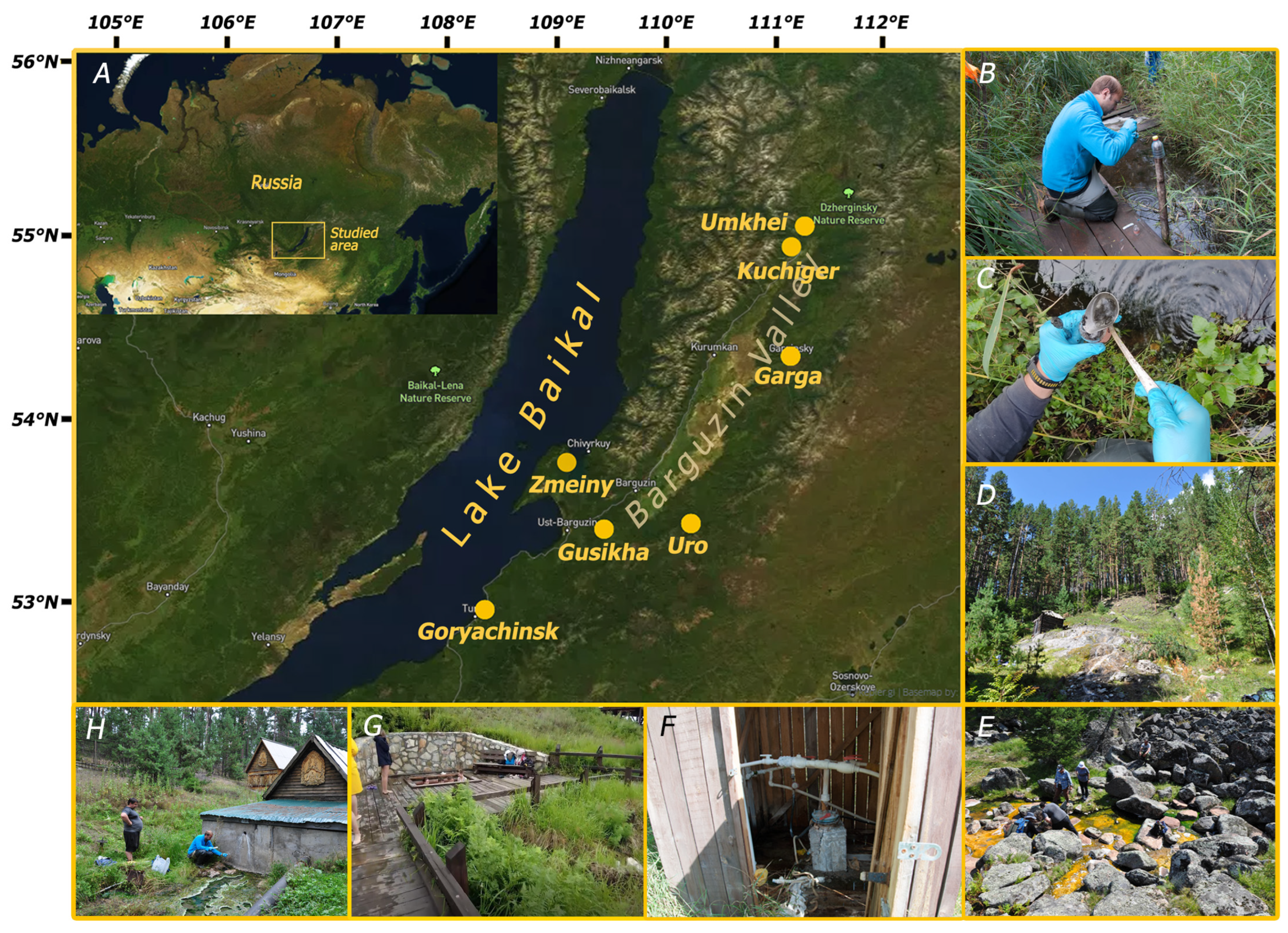
Disclaimer/Publisher’s Note: The statements, opinions and data contained in all publications are solely those of the individual author(s) and contributor(s) and not of MDPI and/or the editor(s). MDPI and/or the editor(s) disclaim responsibility for any injury to people or property resulting from any ideas, methods, instructions or products referred to in the content. |
© 2025 by the authors. Licensee MDPI, Basel, Switzerland. This article is an open access article distributed under the terms and conditions of the Creative Commons Attribution (CC BY) license (https://creativecommons.org/licenses/by/4.0/).