4. Discussion
Although many studies on the sole use of anaerobic digestates as soil amendments or the sole use of mycoremediation for soil pollutant removal have been published, the simultaneous use of both technologies has not been widely researched. Such approaches show promise as a relevant strategy for promoting the circular bio-economy, sustainable agriculture, and environmental biotechnology.
The use of digestate generally increases microbial richness and enzymatic activity, leading to improved soil stabilization and fertility. The decomposition of organic matter derived from digestate requires a broader spectrum of microbial taxa, which promotes bacterial proliferation and improves mycorrhizal colonization. However, low digestate concentrations were associated with lower AMF diversity, while higher concentrations favored the dominance of genera such as
Glomus and
Paraglomus. These results suggest that digestate concentration is an important determinant of microbial community composition.
Table 11 lists the effect of digestate concentration on fungal diversity and colonization.
According to Yu et al. [
47], the lower concentration of anaerobic digestate resulted in a decrease in AMF diversity, while a higher digestate concentration led to significant increases in the abundance of the dominant genera
Glomus and
Paraglomus. Furthermore, soil fertility and the presence of soil microorganisms increased with the application of digestate, due to the fact that organic fertilizers provide a higher amount of organic matter to be decomposed. Cai et al. [
29] observed a higher organic matter removal when applying the highest digestate concentration, with a simultaneous increase in soil nutrient content. It can be assumed that, in this scenario, microorganisms have sufficient nutrient sources to maintain a higher reproduction rate, leading to higher organic matter decomposition.
It has been demonstrated that the application of organic amendments enriches microbial communities in soils, whereas plant-associated microorganisms may reduce the uptake of TEs by plants. This could be a reason why reported significant decreases in extractable Cd and Zn, while Pb and Cd were accumulated in coriander shoots. Furthermore, rhizosphere microorganisms have the capacity to regulate plant nutrient uptake and TE bioavailability through mechanisms such as oxidation, reduction, complexation, immobilization, adsorption, or dissolution [
28]. The reviewed results suggest that anaerobic digestates have greater impacts on the diversity of fungal communities in rhizospheric soil, compared to bacterial communities.
AMFs play a crucial role in modulating nutrient availability by supplying P and other nutrients to plants in exchange for carbohydrates, while also altering bacterial community structure. AMF hyphae have been shown to capture bacterial strains that would otherwise limit nutrient uptake, while secreting enzymes that break down organic matter into simpler compounds. Moreover, AMFs contribute to TE immobilization via glomalin production, adsorption onto hyphae, and sequestration in fungal structures such as vacuoles.
Fungal strains differ in their degradative ability and nutrient accumulation when grown in digestate.
Pleurotus ostreatus, Lentinula edodes, and
Pleurotus eryngii exhibited high growth rates and efficient degradation, while
Agaricus bisporus and
Agaricus subrufescens showed contrasting abilities in pollutant absorption and growth performance. For instance,
A. subrufescens demonstrated reduced uptake of PFAS compared to
A. bisporus, but achieved greater growth, suggesting a trade-off between pollutant absorption and fungal biomass production.
Table 12 summarizes the results of the selected articles regarding fungal strains and their tolerance to anaerobic digestate.
Jasinska et al. [
36] reported a higher degradative ability and growth rate in anaerobic digestate for
Pleurotus ostreatus,
Lentinula edodes, and
Pleurotus eryngii. This difference depends on both the fungal species and substrate characteristics, such as its C/N ratio, pH, and contaminants. These authors reported that the concentrations of trace elements in the anaerobic digestate directly affect the concentrations of trace elements in fungi.
Although anaerobic digestates represent adequate nutrient sources, nutrient availability depends greatly on the fungal species.
Agaricus bisporus provides significant amounts of K and Na, while
Agaricus subrufescens is an important source of Cu and Zn, indicating the specific capacity of fungi to bioaccumulate certain elements. Jasinska et al. [
36] suggested that Si content could augment microbial interactions, whereas plant colonization by pathogens could be hindered.
From the selected articles, it was observed that
A. subrufescens showed lower growth when higher decreases in pollutants such as Ca, Fe, Na, Ni, Cr, Si, Mg, and Zn were detected.
A. subrufescens showed a lower PFAS uptake (by half) than
A. bisporus, whereas
A. subrufescens grew 50% more than
A. bisporus. These results suggest that higher pollutant absorption may hinder fungal growth. In contrast, Nesse et al. [
49] compared the antibiotic and anticonvulsant removal abilities of both fungi.
A. subrufescens showed a higher efficiency in contaminant removal than
A. bisporus, whereas the contaminant concentrations in this fungus were lower at the end of the experiments. However, no fungal growth values were reported.
The removal of pharmaceuticals also varied among fungal species.
A. subrufescens exhibited a greater removal efficiency of antibiotics and anticonvulsants than
A. bisporus, although showed a lower intracellular accumulation, indicating extracellular degradation or strong sorption mechanisms. Antibiotics, especially fluoroquinolones, were more easily degraded due to photolysis and sorption, while carbamazepine showed low removal due to its strong sorption properties and recalcitrance [
49]. Furthermore, non-extractable residues could have formed, contributing to the observed decline in the antibiotic concentration. It has been reported that fluoroquinolones have a strong affinity to sorb to solids, being electrostatically bound to the substrate. Sulfonamides, such as the other antibiotic tested, possess an amine electron-donating group, making them more susceptible to degradation. Carbamazepine showed stronger sorption than the antibiotics.
Table 13 shows the contaminants and fungal mechanisms of removal/immobilization found in the selected articles.
Fontaine et al. [
48] reported that the application of anaerobic digestate in coriander cultivation under AMF inoculation plays a crucial role in restoring soil functionality. Soil processes, such as the formation and decomposition of organic matter, as well as respiration and nutrition cycles, are impacted by microbial communities. Furthermore, the composition and structure of soil can be regulated by AMFs.
AMFs provide P and other nutrients to plants and receive carbohydrates in exchange, while protecting them from drought and pathogens [
47]. AMFs have been reported to change the bacterial community composition; furthermore, AMF hyphae have been shown to capture different bacterial strains which otherwise would affect plant nutrient uptake and growth. Jasinska et al. [
36] reported that, during colonization, the fungal mycelium decomposes the growing substrate by secreting enzymes that have the capacity to break down organic matter into simpler compounds. Furthermore, fungi can accumulate trace elements or even dissolve metals through root exudates.
The interaction between aromatic plants (e.g., coriander), AMF and digestate makes the complexity of TE dynamics even clearer. Plant exudates containing organic acids alter soil chemistry and form organometallic complexes that reduce the bioavailable fractions of Cd, Zn, and Pb. Digestate and AMF together enhance TE mobilization, while the bioavailability of Pb increase in soils without digestate. These results emphasize the importance of soil pH buffering, organic matter input and microbial interactions in shaping TE dynamics. Several studies have shown that digestates increase the immobilization of metals and metalloids, as a result of different processes; for example, adsorption onto mineral surfaces, formation of stable compounds and organic ligands, surface precipitation, or even ion exchange. These processes have only been suggested, and not deeply researched, in previous studies. Palansooriya et al. [
56] suggested that applying composted anaerobic digestate could minimize the mobility of TEs and thus toxicity, as a result of the increased dissolved organic matter. The study of Fontaine et al. [
48] reported increased total and organic C, P, and Mg contents when applying composted anaerobic digestate, improving soil TE immobilization and plant nutrition, ultimately resulting in enhanced coriander shoot growth. However, the same authors reported no significant effect on shoot growth when inoculating with AMF. Mechanisms related to TE immobilization through AMF inoculation include the production of glomalin-related soil proteins in the mycorrhizosphere, TE accumulation in fungal structures (e.g., vacuoles or fungal vesicles in mycorrhizal roots), and adsorption of TEs by extraradical hyphae [
57]. Due to the high P and N contents in anaerobic digestates, increased available P in soil has been reported [
47].
Nutrient availability is a key factor for efficient plant and microbial community growth. The use of anaerobic digestates could guarantee the availability of essential micronutrients such as N, P, S, the C/N ratio, or even certain heavy metals (i.e., Cd, Cr, Cu, Fe, P, or Zn). Authors have confirmed that inoculation with AMF resulted in increases in essential nutrients, such as TN or available P [
29,
47,
53]. Decreases in the phosphate, sulfate, and nitrate contents were observed in the experiments of [
53], with associated increases in the abundance of nematodes, bacterial strains, mycorrhizal colonization, and enzymatic activity. It can be speculated that the absorbed dietary phosphorous (in the form of phosphate) was used for mycorrhizal colonization and the growth of bacterial strains or nematodes, instead of remaining as dissolved ionic phosphate in the soil.
In Fontaine et al. [
48], it was reported that Pb bioavailability increased in coriander under the no-digestate treatment, whereas Pb bioavailability decreased with AMF and digestate. Pb bioavailability increases when its dissolved ionic form increases, or when its transport across membranes is facilitated. These scenarios can take place at a low soil pH, or in the presence of specific bacteria. Meanwhile, low Pb bioavailability occurs at increased pH levels or in the presence of organic matter. Materials such as compost or digestates immobilize lead through binding to their organic and mineral components, thus making it less bioavailable [
58].
Fungi show advantages over plant production due to the fact that they can be grown in processed substrates, such as composted, pasteurized, or even sterilized media. In the process of fungal growth, some toxic compounds in the substrate could be decomposed. Jasinska et al. [
36] reported that fungal mycelium grows within the substrate, decomposing the material, whereas colonization takes place through secreted enzymes breaking down complex organic matter into simpler components. Senila et al. [
59] demonstrated that fungi root exudates can dissolve metals from the substrate in the mycelial zone, influencing mineral adsorption.
Furthermore, the biomass source utilized during the process of anaerobic digestion is a key factor affecting nutrient availability. It has been confirmed, by several authors that the sole use of manure in anaerobic digestion resulted in higher plant yield and fungal colonization associated with the derived digestate. In O’Brien et al. [
51], it was reported that when co-digesting manure with food waste, fungal colonization was hindered and, thus, plant yields were inhibited. This could have occurred for several reasons. The composition of organic wastes may vary significantly depending on their source, reflecting specific physical and chemical characteristics [
60]. A high conductivity could have been generated due to the presence of organic wastes, affecting fungal growth. In Arifan et al. [
61], inhibition was reported when co-digesting manure with organic wastes: the greater the amount of cabbage waste, the lower the efficacy of the anaerobic digestate. This reflects the idea that organic wastes could include toxic substances or inhibitors, which are not perceived at a glance but ultimately inhibit plant growth or even soil stabilization. Another aspect to consider is osmotic stress, which affects the C/N ratio in plants. Throughout their entire life cycle, microorganisms are continuously exposed to abiotic stress factors such as temperature fluctuations, salinity, oxidation, or osmotic stress [
62], the latter of which is caused by changes in solute concentrations inside cells as a result of drought or salinity stress [
63]. The C/N is affected when the plant accumulates osmotic solutions to balance water loss, thus altering photosynthesis and nitrogen metabolism in the plant [
64].
It has been reported that the application of highly concentrated anaerobic digestate resulted in significant enhancement of the species richness and Shannon diversity of AMFs in the rhizosphere of a poplar plantation. Increased microbial diversity can occur when soil properties change, such as increased P availability and decreased C/N ratio [
47]. This results in better N availability, promoting plant growth. Furthermore, the C/N ratio is more important than the C concentration [
65]. In fact, Ikoyi et al. [
53] observed N limitation when the C/N ratio was higher than 20, leading to decreased plant growth: a high C/N ratio is associated with a low N content. As N is an important component of chlorophyll, high amounts of N are required for plant growth. Thus, studies reporting significant plant growth also reported that the N level remained the same or even increased. Furthermore, according to Gao et al. [
65], N has a higher impact than C on the growth of species of the fungal genus
Entomophthorales. It has also been reported that higher C:N ratios reduced sporulation, whereas C/N ratios in the range of 10:1 to 40:1 were reported to result in higher yields, compared to those from 80:1 to 160:1. In the analysis of O’Brien et al. [
51], C/N ratios of 44:1 to 55:1 resulted in the most effective growth yield, while the optimal N/P ratios were in the range of 4:1 to 12:1.
Fungal C/N/P stoichiometric requirements have not been widely researched, although they play a very important role in biogeochemical cycling. Some fungi—e.g., mycorrhizae—use organic forms of nitrogen and phosphorus which otherwise would not be available to plant roots. Variations are associated with different functional guilds within fungal groups. C/N has been reported to be lower and N/P higher in EcM fungi, compared to saprotrophic fungi, which can be attributed to EcM fungi having evolved over a longer time, in comparison to saprotrophic fungi [
66,
67].
The C/N and C/P ratio of digestate, which is largely influenced by the type of source material (slurry or co-fermented organic waste), has a strong impact on microbial colonization and plant growth. Digestates derived from slurry, which are characterized by a lower C/N ratio, consistently promoted greater fungal colonization and higher plant yield compared to digestates from mixed organic waste. High C/N ratios led to nitrogen limitation, reduced fungal spore formation and reduced plant performance. The conductivity and salt content of the digestate, which depend on the composition of the feedstock, also led to osmotic stress, which inhibited microbial colonization.
Table 14 outline soil and environmental factors affecting fungal efficiency, according to the papers selected.
In O’Brien et al. [
51], it was reported that digestate derived from manure and organic wastes showed a lower colonization rate than digestate from only manure. When the manure content increased, the C/N and C/P ratios decreased from 29/1 to 22/1 and from 186/1 to 127/1, correspondingly, while the N/P ratio remained same. Manure is rich in N and shows a low C/N ratio, between 7/1 and 25/1. Food waste typically has a higher C/N, of 20/1 up to 98/1 [
68]. A very high C/N leads to a lack of nitrogen for microbial growth, as was the case in O’Brien et al. [
51]. Organic wastes include agricultural wastes, market wastes, kitchen wastes, or even urban wastes. As such, the composition of organic wastes may vary significantly, and may provide beneficial amounts of nutrients (e.g., K, N, or P) for the growth of fungi and plants; however, these wastes may also have high loads of heavy metals, pharmaceutical products, or other toxic compounds [
69]. In O’Brien et al. [
51], it was reported that conductivity—and, thus, salinity—is an important issue leading to lower colonization rates. This may have also been the reason for the low plant yields reported in O’Brien et al. [
51] when co-digesting with manure.
Regarding pH and temperature, it has been suggested that, for optimal plant and/or fungi growth, a balanced C/N ratio and a suitable pH must be guaranteed. In Nesse et al. [
50],
A. subrufescens cultivated at 20 °C and neutral pH showed higher contaminant removal than
A. bisporus grown at 18 °C and tolerating slightly alkaline conditions. Digestate and fungal activity together buffered the pH value of the soil in the neutral range, promoting the decomposition of organic matter and improving the availability of nutrients. These synergistic effects are of central importance for soil fertility, TE immobilization, and sustainable remediation processes.
The authors of Nesse et al. [
50] reported that, when inoculating with fungi, organic acids in soil were formed through organic matter degradation, leading to a decrease in pH and an increase in dissolved organic carbon. Thus, organic acids resulted in higher organic matter degradation. In comparison to tests with digestate, the control test with no fungal cultivation showed lower organic matter degradation and increased pH. The content of organic matter in soil has a direct impact on soil functions and the global carbon cycle. After decomposition, it determines the nutrient cycle and can take up C from the atmosphere through photosynthesis, enabling its long-term sequestration in soils. Moreover, organic matter enhances the soil’s fertility, water-holding capacity, and nutrient cycling, supporting sustainable agriculture and ecosystem health [
70]. Soil management practices affect the organic matter stock, and an appropriate soil management approach can even enhance nutrient availability and C sequestration. Physical and chemical fractionation methods should be applied to differentiate the functional soil organic carbon fractions, thus optimizing carbon sequestration potential, guaranteeing the preservation of soil organic matter, and ultimately improving soil fertility in the long-term [
71].
In the experiments reported in Fontaine et al. [
48], the pH value did not change significantly when applying digestate to soil, maintaining pH in the neutral range. Nevertheless, the available C, Mg, and P contents increased, resulting not only in increased trace element immobilization but also an improved nutritional state in plants. Therefore, pH was buffered and efficient plant growth was achieved.
Finally, how digestates modulate fungal colonization and diversity must be discussed. The application of organic amendments has been demonstrated to enrich microbial communities, as a higher amount of organic matter must be decomposed. It has been confirmed by several authors that a low digestate concentration leads to diminished AMF diversity [
47,
48]. Furthermore, digestates increase the immobilization of metals and metalloids, as a result of processes such as adsorption onto mineral surfaces, the formation of stable compounds and organic ligands, surface precipitation, or even ion exchange [
48]. The application of digestates guarantees the availability of essential micronutrients such as N, P, S, or C, which enable the reproduction of microorganisms, such as AMFs, which are capable of decomposing organic matter or even removing toxic compounds [
47]. The diversity of AMFs and the microbial community plays a crucial role in restoring soil functionality, providing nutrients such as P and N while receiving carbohydrates in exchange. Soil nutrient availability is facilitated by healthy soil microbiota (i.e., archaea, bacteria, and fungi), which mineralize, solubilize, and facilitate the uptake of nutrients. The carbon content in digestates has significant influences on soil heterotrophic microbial dynamics and nutrient availability. If the C content in a digestate is low, it will be reflected in the microbial community, favoring fast-growing bacteria; meanwhile, if the C content of the digestate is increased, soil microbial abundance and diversity also increase, thus favoring slower-growing fungi and Gram-positive bacteria [
72].
5. Conclusions
Recent studies emphasize the complementary role of anaerobic digestates and AMF in restoring soil functionality, improving nutrient cycling and reducing the bioavailability of TE. While the use of digestate or AMFs alone has been widely documented, their combined application is still under-researched despite their potential to promote sustainable agriculture and circular bio economy strategies.
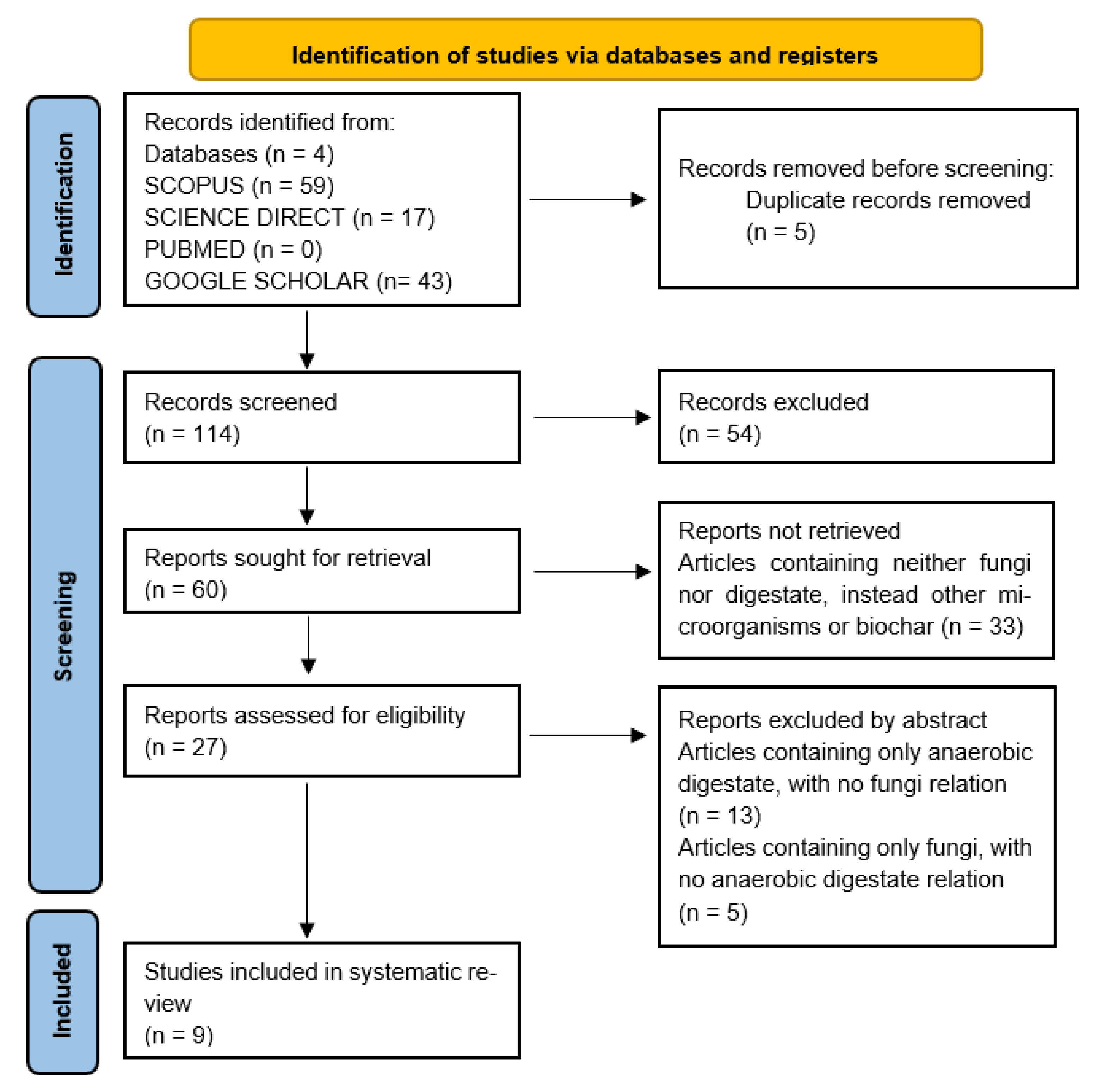
For this systematic review, the effects of anaerobic digestates as organic soil amendments inoculated with fungi were analyzed. To obtain results with better reliability and transparency, this systematic review was performed according to the PRISMA guidelines, with the systematic selection process resulting in the final retrieval of nine scientific articles published within the last ten years. The selected articles described scientific research regarding the use of anaerobic digestates inoculated with fungi, considering their effects on plant growth and/or pollutant removal. Knowledge regarding this topic remains scarce. The aim of this work was to determine the effects of digestate application on soils, including the effect of the biomass source from which the digestate was obtained, the fungal strains, and plant growth, as well as the microbial communities formed and fungal colonization.
The findings on the use of anaerobic digestates as soil amendments inoculated with fungi underline their long-term ecological potential for the remediation of polluted soils. This strategy is proving to be a promising and cost-effective tool for improving soil functionality and stability, rather than directly promoting plant growth.
Through the application of digestates as soil amendments, the microbial population is enriched, thus increasing metal uptake through mechanisms of soil remediation including oxidation, reduction, complexion, immobilization, adsorption, or dissolution. The change in the microbial population is reflected in the availability of P and the C/N ratio. If the nitrogen content is limited, thus leading to a high C/N ratio, plant growth will be affected as N is an important component of chlorophyll—a green pigment which is essential for plant growth.
The origin of the biomass used for anaerobic digestion plays a crucial role in determining the quality of the digestate. If the digestate is derived exclusively from cattle manure, its application to fungi-inoculated soils will result in increased organic matter decomposition and mycelial colonization, as well as lower salinity and electrical conductivity. In contrast, the addition of mixed organic waste can increase the concentrations of TEs and HMs, which can impair the development of the microbial community and limit the efficiency of remediation mechanisms. Overall, the use of anaerobic digestates, especially those derived from cattle manure, promotes microbial diversity and improves the processes associated with soil remediation and stabilization. The benefits observed in terms of plant growth are less consistent and appear to be secondary to the effects on soil health.
While the fungal strain selected for inoculation is a key factor, it must be evaluated in conjunction with other variables such as digestate composition, application concentration, pH, temperature, and contaminant type. The specific fungal strain may affect soil stabilization, pollutant removal, and plant growth.
Some authors have specified that pH and temperature in particular affect the degradation of organic matter and removal of contaminants. The presence of organic acids results in higher organic matter degradation and decreased pH. AMFs stimulate organic acid production, thus breaking down organic matter into simpler compounds. Digested manure is a good source of organic acids—another reason why solely using manure as a source for digestate resulted in better plant growth and contaminant degradation, as reported by several authors. It was also reported that temperature conditions around 20 °C resulted in more efficient performance, when compared to colder temperatures (around 17 °C).
The combined application of fungi and digestate contributed to a reduction in Pb content and increased bioavailability, while improving soil pH and nutrient availability. Aromatic plants such as coriander promote metal complexation and immobilization through their root exudates and the release of organic acids, especially when applied together with anaerobic digestates. The interaction of digestate addition influenced AMF diversity and nutrient availability, thus directly affecting soil fertility and plant growth.
Interestingly, to improve the bioavailability of certain heavy metals such as Cd, Zn, and Cu, the absence of vegetation during certain phases of remediation may be necessary—an aspect that warrants further investigation.
The limitations of this review include that the results and efficacy vary according to the fungal strain, plant grown, pollutant to be removed, and specific environmental conditions. A further limitation of the selected articles is the lack of results oriented to real field conditions, as no research was found in this regard. Future research should focus on a goal-oriented pollutant-specific remediation strategy using digestates derived solely from manure, ideally in combination with tropical fungal strains to maximize their efficacy under specific environmental conditions.
In summary, soil remediation is important to safeguard public health and the environment. New cost-efficient practices can be proposed for sustainable soil management, and future research should focus on the interactions with pollutants in soil amended with digestates and fungi, validating these novel methods under natural conditions.




 ,
,