A Comprehensive Assessment of the Nutritional Value, Antioxidant Potential, and Genetic Diversity of Fenneropenaeus merguiensis from Three Different Regions in China
by
 , , , , and
Yundong Li
1,2,3,4,† ,
,
Juan Chen
1,2,†,
Siyao Cao
1,2,
Ziyi Jiang
5,
Song Jiang
1,
Qibin Yang
1,3,
Lishi Yang
1,
Jianhua Huang
1,4,
Jianzhi Shi
1,
Zhenhua Ma
1,3 and
and
Falin Zhou
1,2,3,4,* 1
South China Sea Fisheries Research Institute, Chinese Academy of Fishery Sciences, Key Laboratory of South China Sea Fishery Resources Exploitation and Utilization, Ministry of Agriculture and Rural Affairs, Guangzhou 510300, China
2
College of Fisheries and Life Sciences, Dalian Ocean University, Dalian 116023, China
3
Key Laboratory of Efficient Utilization and Processing of Marine Fishery Resources of Hainan Province, Sanya Tropical Fisheries Research Institute, Sanya 572018, China
4
Shenzhen Base of South China Sea Fisheries Research Institute, Chinese Academy of Fishery Sciences, Shenzhen 518108, China
5
Keck School of Medicine, University of Southern California, 1975 Zonal Ave., Los Angeles, CA 90033, USA
*
Author to whom correspondence should be addressed.
†
These authors contributed equally to this work.
Biology 2024, 13(12), 1002; https://doi.org/10.3390/biology13121002
Submission received: 30 October 2024
/
Revised: 24 November 2024
/
Accepted: 28 November 2024
/
Published: 2 December 2024
(This article belongs to the Special Issue Advances in Biological Research into Shrimps, Crabs and Lobsters)
Simple Summary
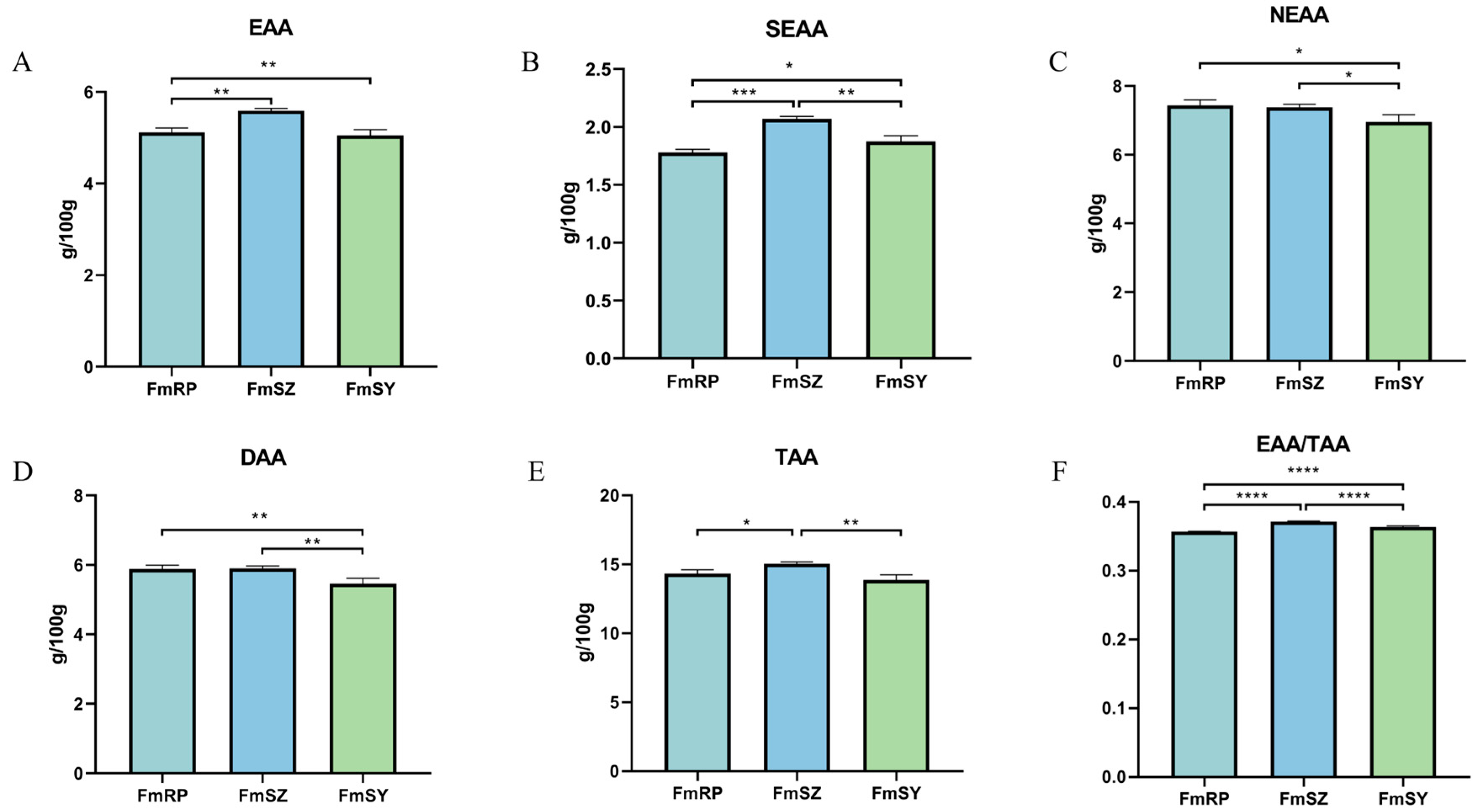
Fenneropenaeus merguiensis, one of the largest penaeid shrimp species, has a wide germplasm distribution along the southeastern coast of China, although its germplasm characteristics remain inadequately explored. This study conducted comprehensive analyses of basic nutritional components, amino acids, fatty acids, antioxidant indices, and genetic diversity across three F. merguiensis populations (FmRP, FmSZ, FmSY). The findings revealed that FmSZ had significantly higher ash, crude protein, and essential amino acid levels, indicating superior nutritional quality. FmSY showed a potential nutritional advantage due to its fatty acid profile. All populations demonstrated high levels of polyunsaturated fatty acids (DHA, EPA), along with strong antioxidant capacities. Genetic analysis showed FmSZ had the lowest inbreeding coefficient and relatively higher genetic diversity. Overall, FmSZ stands out as a high-quality candidate for aquaculture and genetic breeding, highlighting the value of F. merguiensis as an aquatic product with considerable potential for wider promotion and development.
Abstract
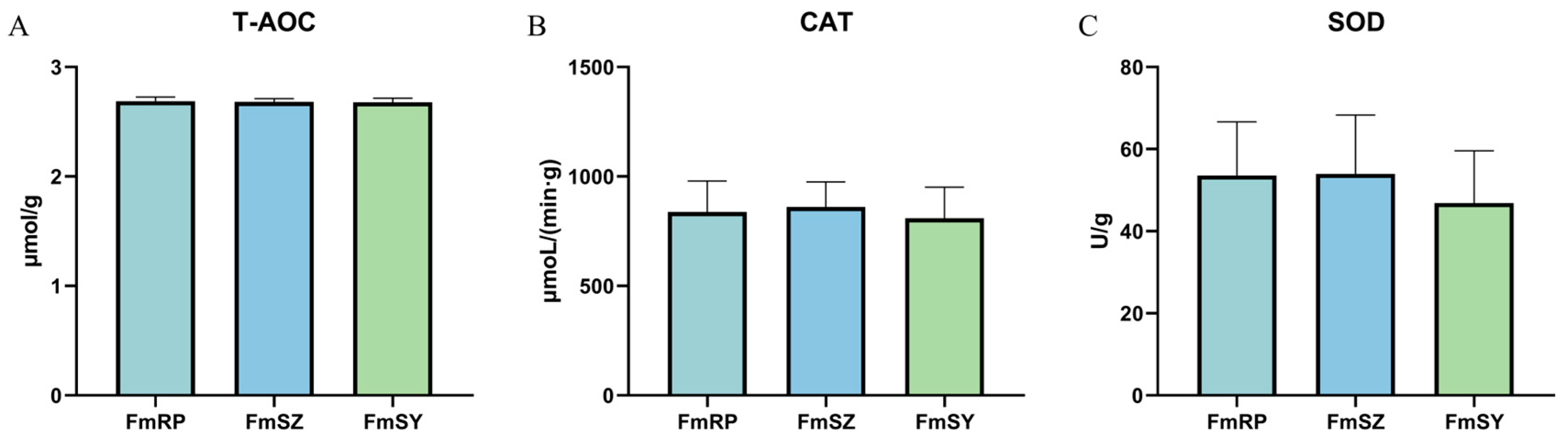
Fenneropenaeus merguiensis is one of the largest species of penaeid shrimp. It has a wide distribution of germplasm resources in the South China Sea and the southeastern coastal regions of China, yet its germplasm characteristics remain insufficiently understood. Therefore, we conducted analyses of basic nutritional components, amino acids, fatty acids, antioxidant indices, and genetic diversity in three F. merguiensis populations (FmRP, FmSZ, FmSY). The results showed a significant difference in ash content, with FmSZ having the highest ash content (1.77 g/100 g) (p < 0.05). A total of 17 amino acids were detected, and FmSZ exhibited higher concentrations of most amino acids, especially essential amino acids (p < 0.05). The analysis of fatty acid composition revealed significant differences between the populations, with FmSY potentially having a nutritional advantage overall (p < 0.05). In terms of antioxidant capacity and genetic diversity, there were no significant differences in total antioxidant capacity (T-AOC), catalase (CAT), or superoxide dismutase (SOD) among the populations (p > 0.05). However, genetic analysis indicated that FmSZ had the lowest inbreeding coefficient and relatively higher genetic diversity. In conclusion, among the three F. merguiensis populations, FmSZ has relatively higher nutritional quality and genetic diversity, and F. merguiensis is a high-quality aquatic product worth promoting. The analysis and characterization of various aspects of F. merguiensis from the three locations provide important information and data support for germplasm resources and genetic breeding efforts.