
Geological Contributions to the History of the Artist’s Iron-Based Natural Earth Pigments and the Case Study of Terra d’Ombra (Umber)

Abstract
1. Introduction
2. Geo-Mineralogical Background and Nomenclature
3. Facts, Information, and Skills in the Pre-Scientific Era
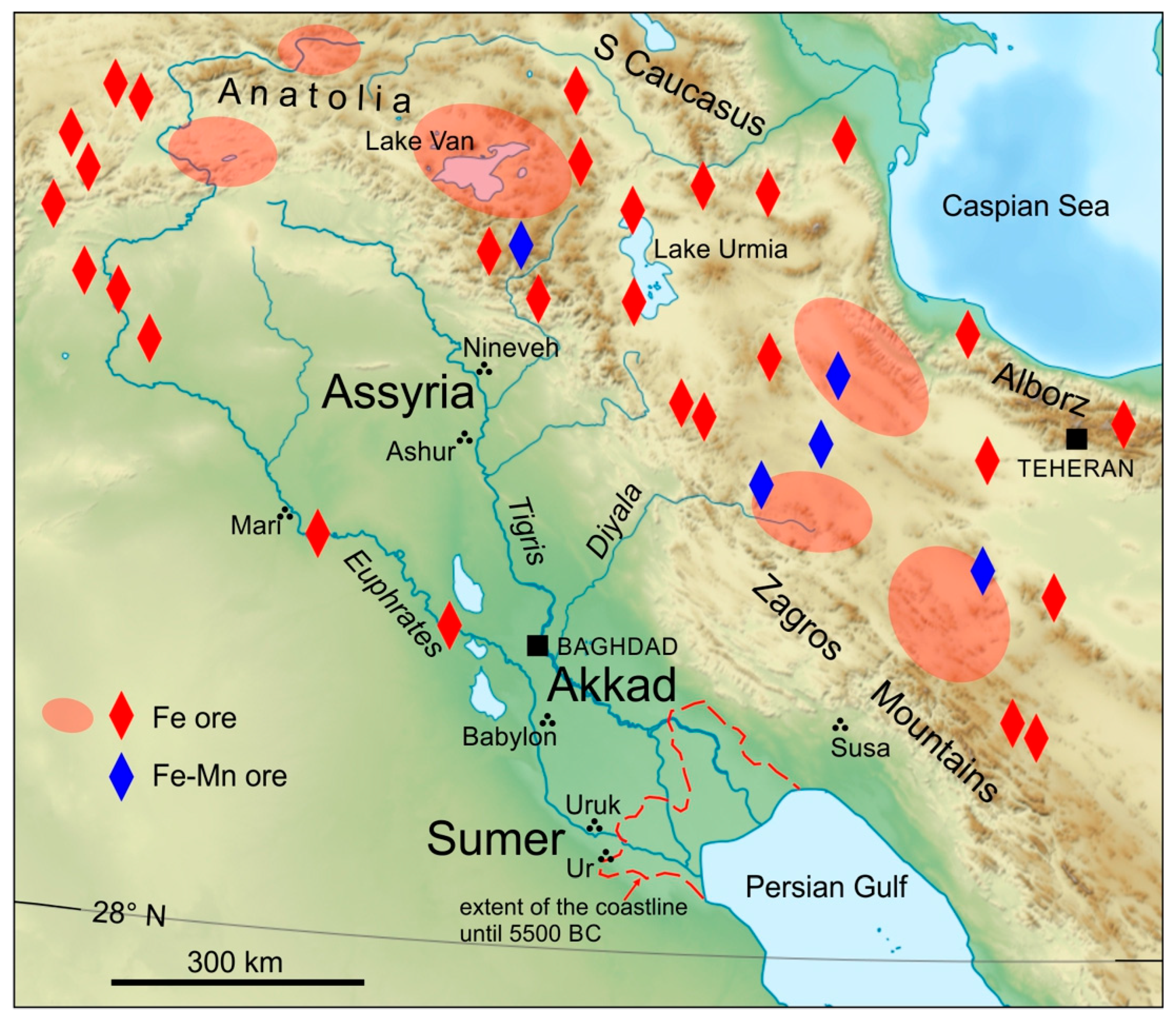
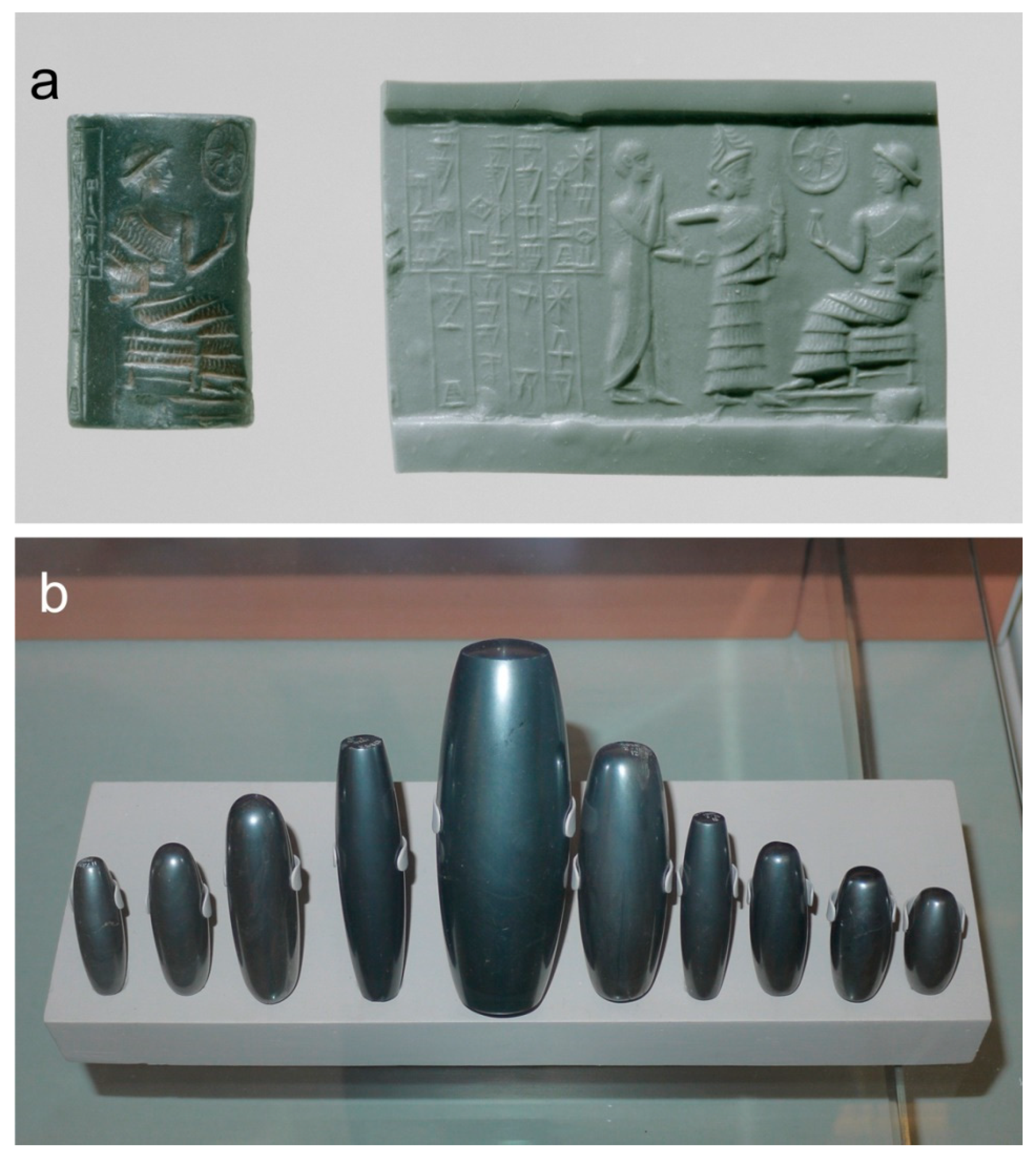
3.1. Textual Documents on Sumerian Knowledge on Iron-Based Earths and Minerals
3.2. Textual Introduction and Meaning of the Term ὠχρός (Ocher)
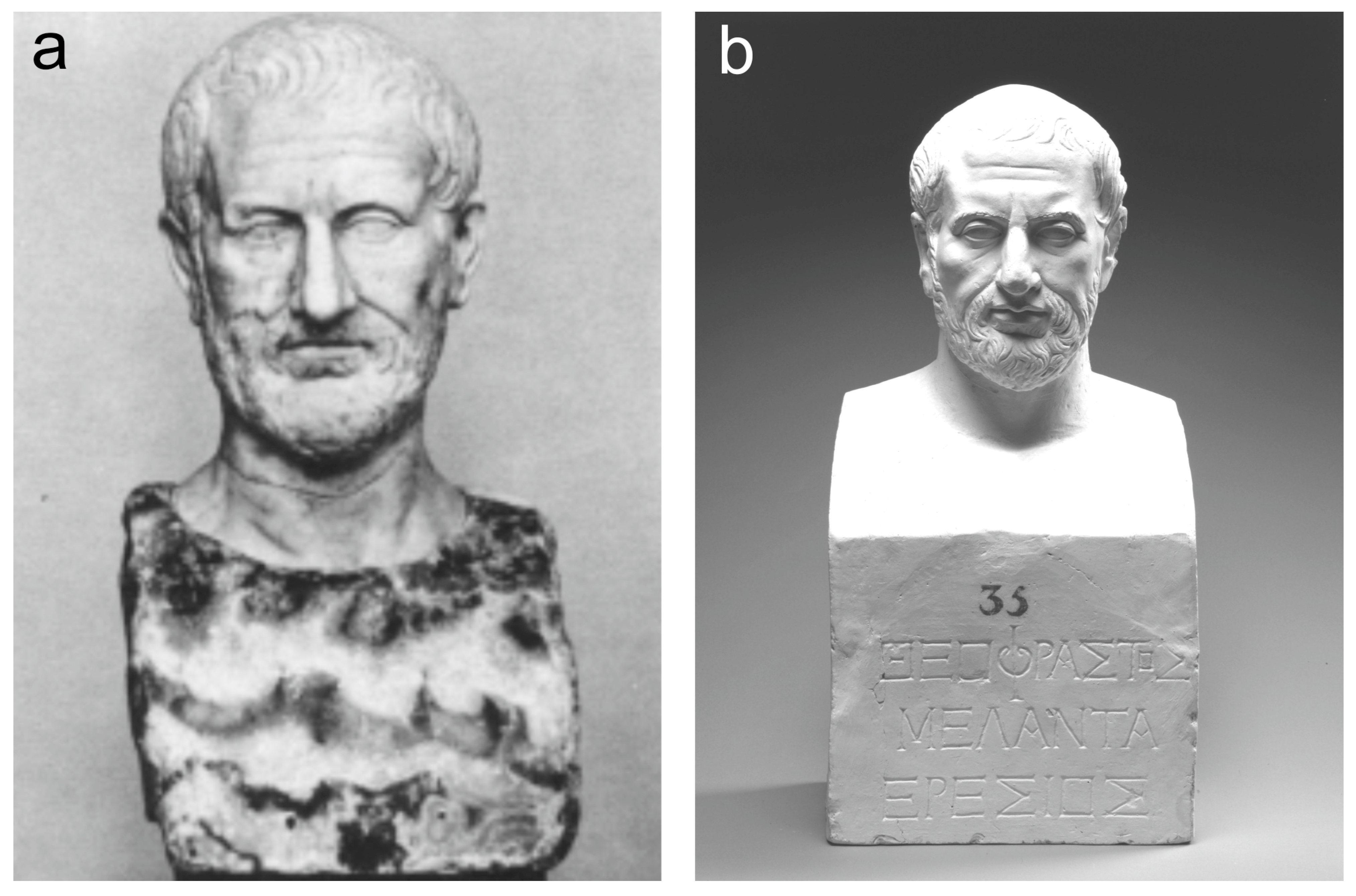
3.3. Ancient Greek and Roman Heritage
4. The “Terra d’Ombra” Natural Earth Pigment
4.1. Geochemical and Mineralogical Composition
4.2. History and Use
“La terra detta di ombra è di color affumato, di sostanza leggiera, sottilissima, ben ligata, and adherente gagliardamente alla lingua, mentre con essa si tocca. Si rompe in schieggie, e si alliscia nel modo de boli: onde alcuni l’han stimata bolo armeno. S’indura al fuoco, come il bolo, e l’argille. Simile al suo colore si vede la terra nelle vene putri dell’oro. Serve per adombratura de carni, e de gialli.”[85] (4.44, p. 122)
“The earth called umber is of a smoky color, of light substance, very fine grain size, well coherent, and adherent vigorously to the tongue, while it is touched with it. It breaks into splinters and smooths in the manner of the boles: hence, some have considered it as an Armenian bole. It hardens in the fire, like the bole and clay. Similarly to its color is the earth in the veins of gold. It is used for shading of flesh, and of yellows”.
5. Pending Issues on the Identification, Source, and Genesis of the Natural Earth Pigment Terra d’Ombra
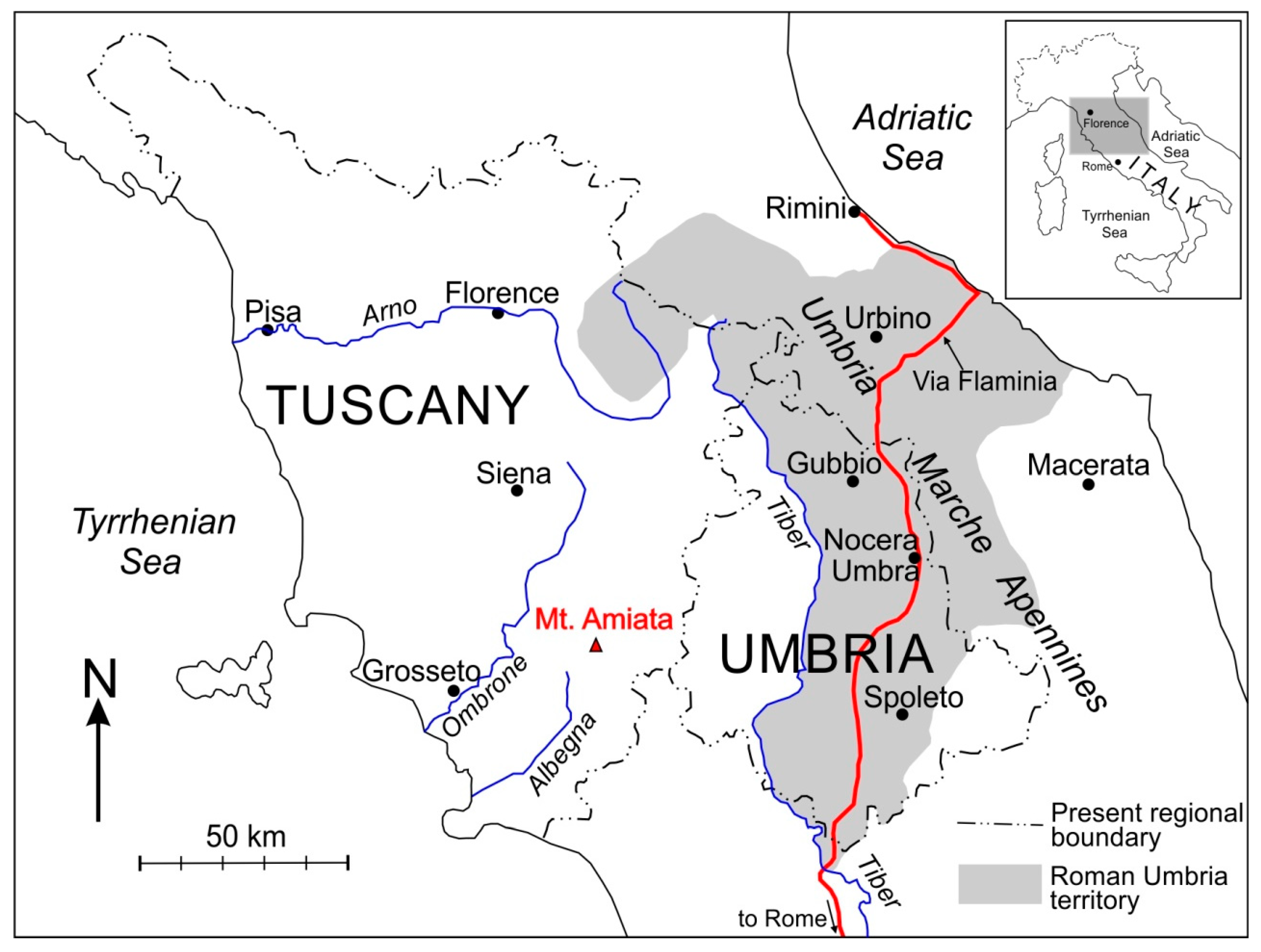
5.1. The Umbria Region (Italy) in History
5.2. Earthy Mineral Materials Historically Originating from Umbria
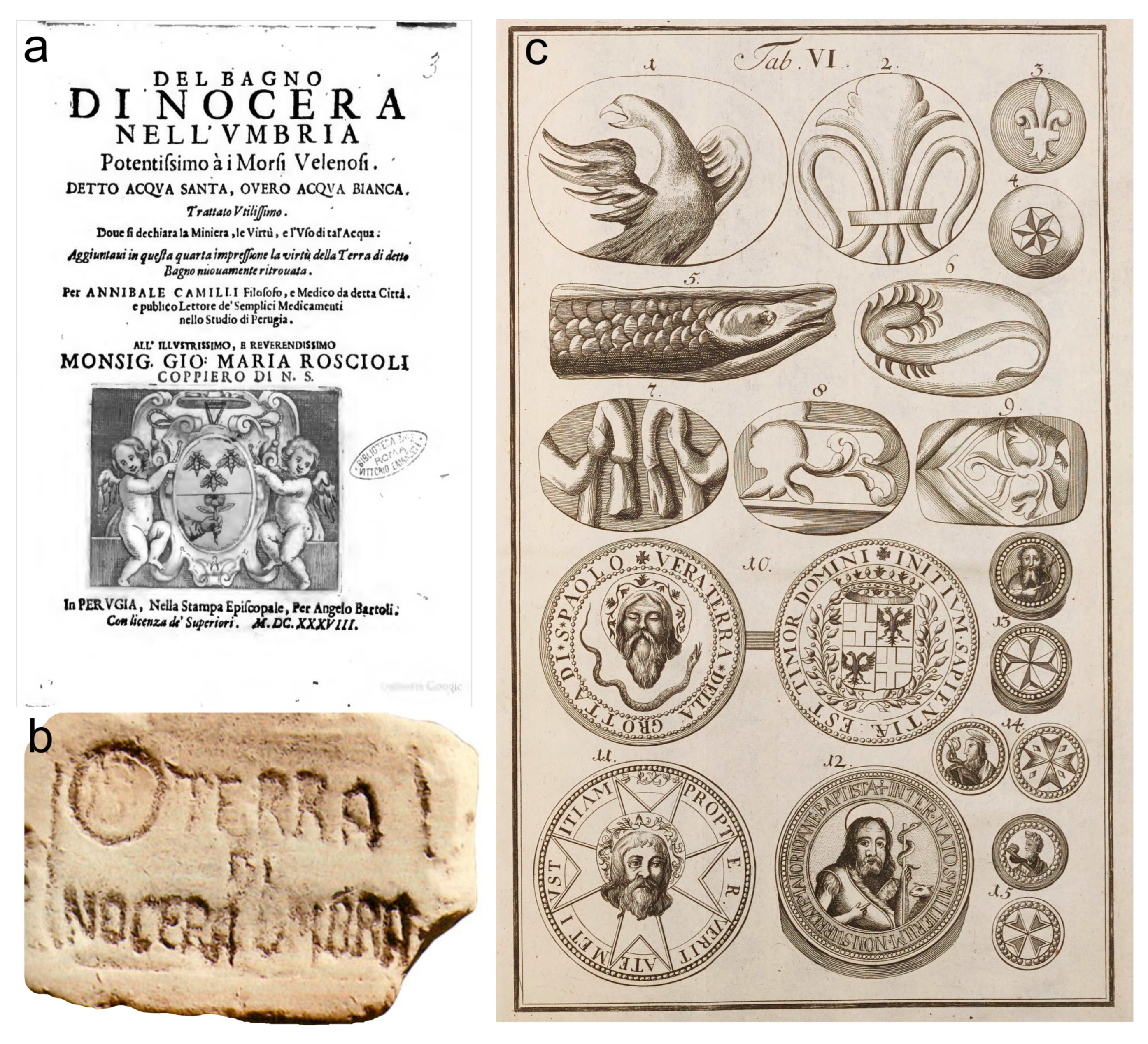
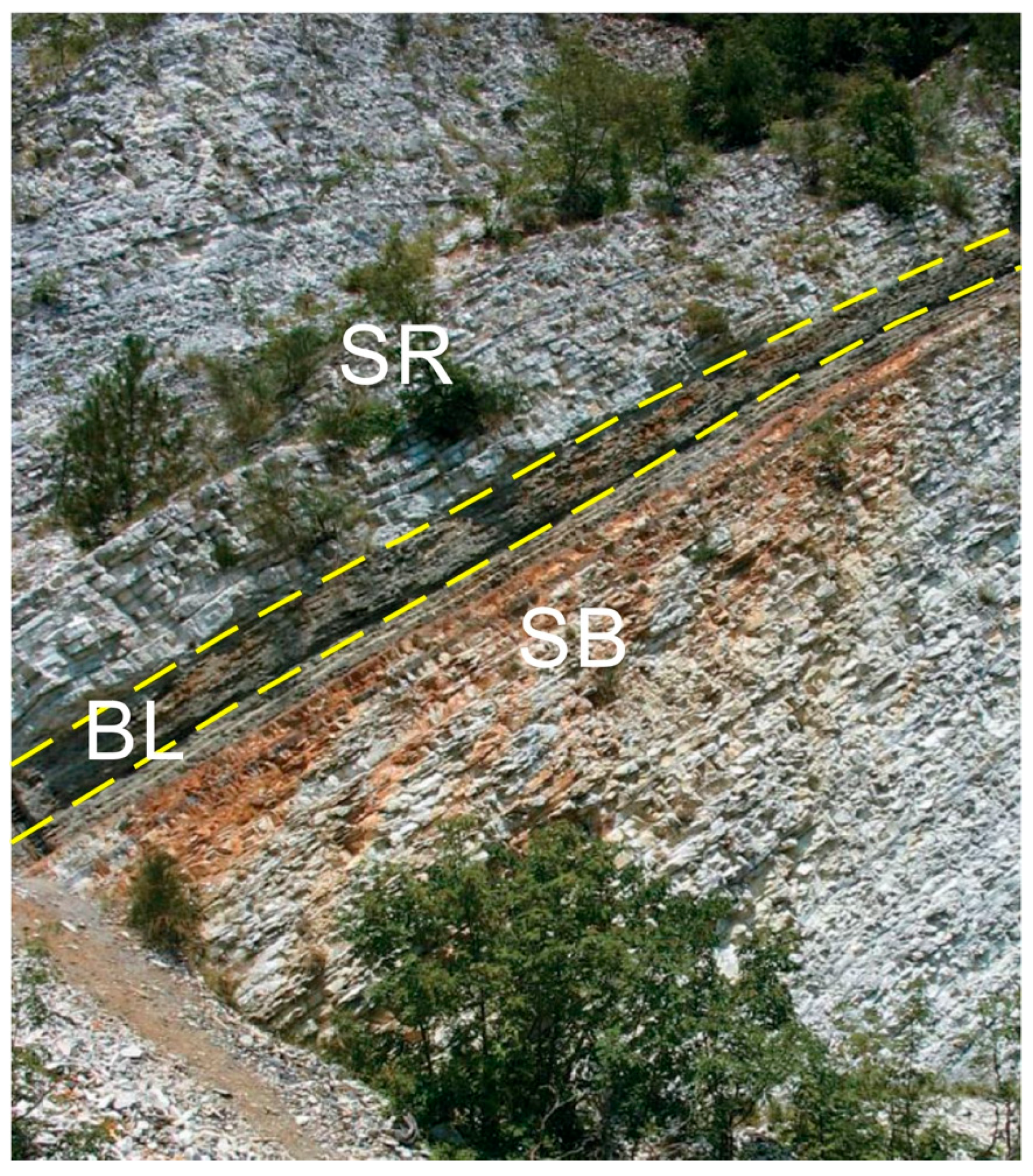
5.2.1. Creta Umbrica—Terra di Nocera
“…Est et alius Cimoliae usus in vestibus. nam Sarda quae adfertur e Sardinia, candidis tantum adsumitur, inutilis versicoloribus, et est vilissima omnium Cimoliae generum; pretiosior Umbrica et quam vocant saxum. proprietas saxi quod crescit in macerando; itaque pondere emitur, illa mensura. Umbrica non nisi poliendis vestibus adsumitur. …”(Naturalis Historia, XXXV.LVII.196–197)
“… Cimoliae creta has another use, too, the whitening of clothes. The kind which comes from Sardinia, and is called Sarda, being employed only for white garments and useless for colored ones, is the least valuable of all kinds in Cimoliae. The Umbrica sort and the one they call Saxum are more highly prized. Saxum has the property of increasing in bulk when soaked in water and is purchased by weight, whereas Umbrica is sold measure. The only use of Umbrica is for imparting luster to garments…” [28].
“Descrittione di molte virtù della terra medicinale del Bagno di Nocera—si deve notare, che essendo ella di più spetie, e colori, quella deve essere più stimata, e lodata, che è di color bianco, molle, leggiera, succosa, friabile, untuosa, e che tocca con la lingua s’aderisca, and attacchi, come colla, e finalmente posta nell’acqua mandi fuori ampolle con bollimento à modo di calce”[122] (pp. 46–47)
“Description of many virtues of the medicinal earth of the Bath of Nocera—it should be noted that since it is of several kinds and colors, the one that is to be most valued and praised is white, soft, light, juicy, crumbly, greasy, and adhering and stick to the tongue, like glue, and finally placed in the water, it let out bubbles with boiling like lime.”

“Terra NOCERIANA, earth of Nocera, in the materia medica, a species of bole, remarkably heavy, of a grayish-white color, of an insipid taste, and generally with some particles in it which grit between the teeth. It is much esteemed by the Italians, as a remedy for venomous bites, and in fevers; but, except its astringent quality, little dependence is to be had on the other virtues ascribed to it.”[126] (volume 3, p. 402)
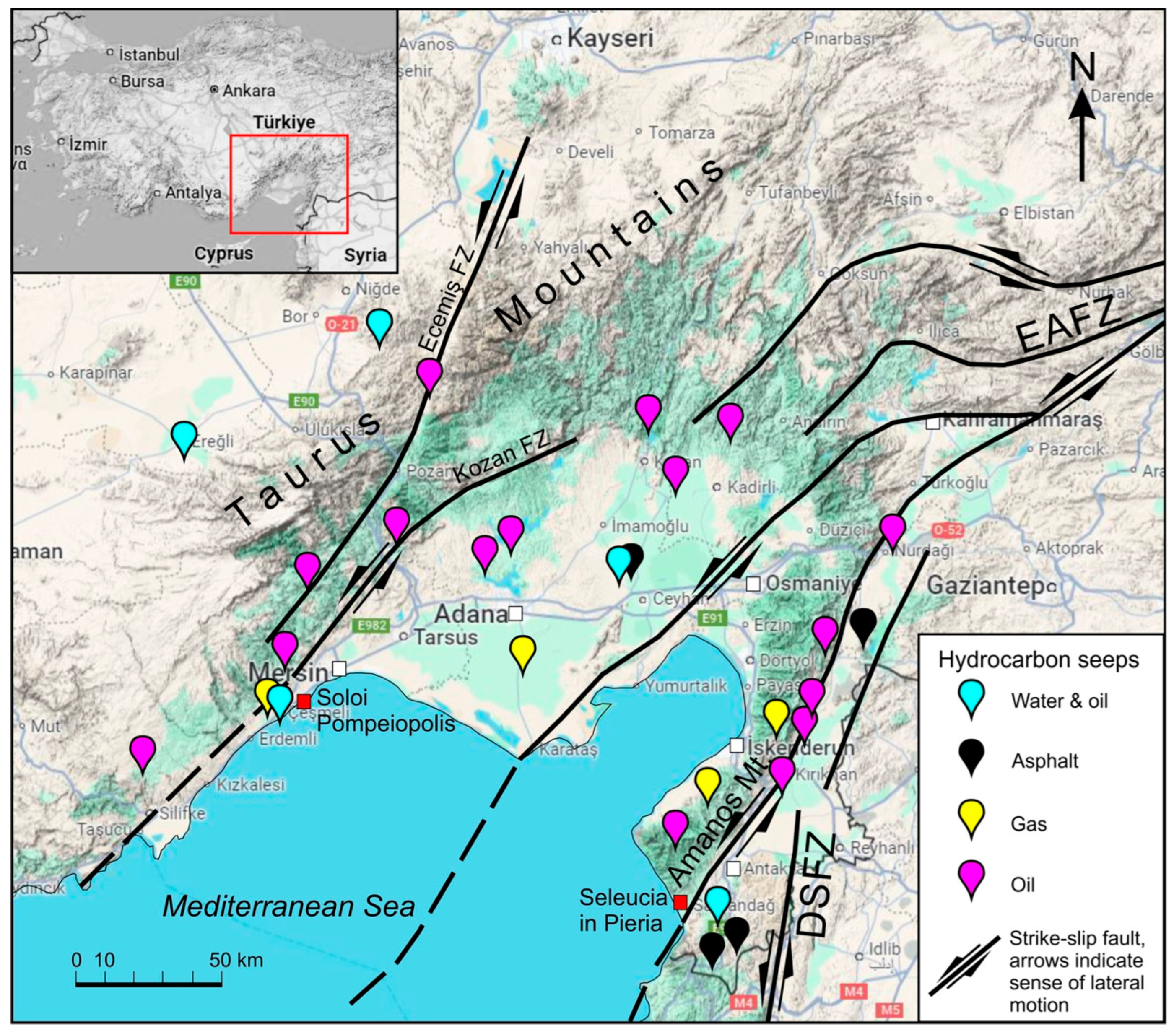
5.2.2. Terra Ampelite

5.3. The Main Sources and Geological Genesis of the Earth Pigment Terra d’Ombra
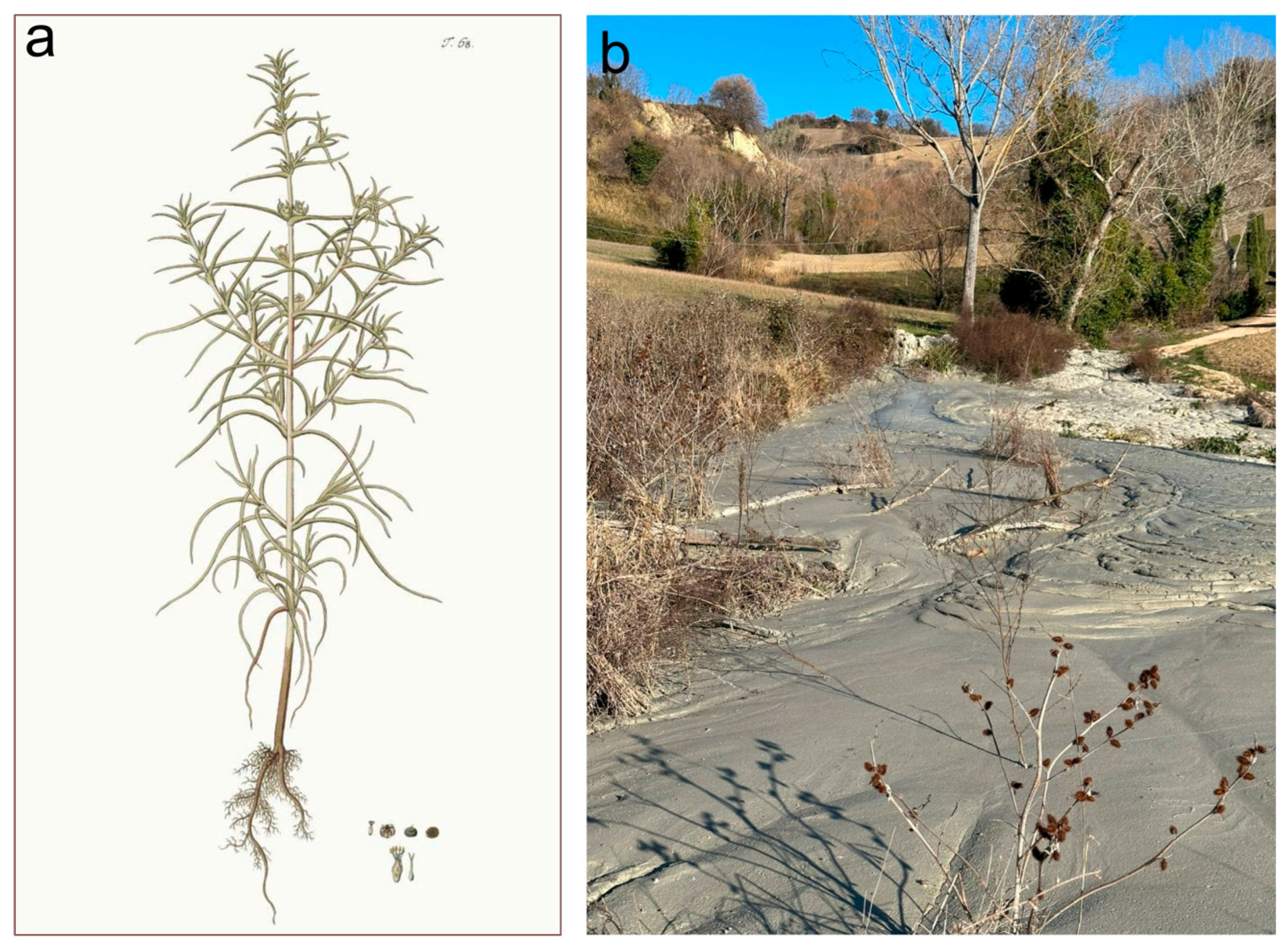
5.4. Other Material Confusion
“The ancient mineralogists cite under the name of umber an earthy dust of a brown color, which ordinarily has only the color of this substance, but which does not approach it in any way in its properties. This earthy dust is usually a very recognizable fossil wood, in that it burns in the fire, and leaves a little ash; this is also why Cronstedt named it mumia vegetabilis, and Wallerino, humus umbra. True umber is incombustible.”
“Umber earth is a kind of clay mixed with a little oxide of iron, which renders it dry, and is rather a bituminous earth slightly ferruginous than a brown ochre. It is brought from Nocera in Umbria, a district of Italy, whence it derives its name. Sometimes it is called brown ochre. Umber earth is very much employed in painting for browns. … The bishopric of Cologne produces a kind of umber earth which is heavier, as well as browner.”[164] (p. 367)
6. The Terra d’Ombra from Monte Amiata Volcano
7. Discussion and Concluding Remarks
7.1. Bias on the Nomenclature of Natural Earth Pigments
7.2. New Light on Old Knowledge About the Terra d’Ombra (Umber) Pigment
Funding
Institutional Review Board Statement
Informed Consent Statement
Data Availability Statement
Acknowledgments
Conflicts of Interest
References
- Skelton, H. A colour chemist’s history of Western art. Rev. Prog. Color. Relat. Top. 1999, 29, 43–64. [Google Scholar] [CrossRef]
- John, H. A History of the Materia Medica; Longman, Hitsch, Hawes: London, UK, 1748; Volume 2. [Google Scholar]
- Duffin, C.J. Lithotherapeutical research sources from antiquity to the mid-eighteenth century. Geol. Soc. Lond. Spec. Publ. 2013, 375, 7–43. [Google Scholar] [CrossRef]
- Retsas, S. Geotherapeutics: The medicinal use of earths, minerals and metals from antiquity to the twenty-first century. Geol. Soc. Lond. Spec. Publ. 2017, 452, 133–139. [Google Scholar] [CrossRef]
- Merwin, H.E. Optical properties and theory of color of pigments and paints. Proc. Am. Soc. Test. Mater. 1917, 17, 494–530. [Google Scholar]
- Dossie, R. The Handmaid to the Arts. The Second Edition, with Considerable Additions and Improvements; J. Nourse.: London, UK, 1764. [Google Scholar]
- Weber, F.W. Artists’ Pigments; Their Chemical and Physical Properties; D. Van Nostrand Co.: New York, NY, USA, 1923. [Google Scholar]
- Daniel, V.T., Jr. The Practice of Tempera Painting; Yale University Press: New Haven, CT, USA, 1936. [Google Scholar]
- Mayer, R. The Artist’s Handbook of Materials and Techniques, 1st ed.; Viking: New York, NY, USA, 1940. [Google Scholar]
- Principe, C.; Lavorini, G.; Vezzoli, L. (Eds.) Il Vulcano di Monte Amiata; Edizioni Scientifiche e Artistiche: Nola, Italy, 2017. [Google Scholar]
- Principe, C.; Vezzoli, L.; La Felice, S. Geology of the Pleistocene volcano of Monte Amiata (Southern Tuscany, Italy). J. Maps 2024, 20, 2360749. [Google Scholar] [CrossRef]
- Vezzoli, L.; Principe, C. Artist’s iron-based natural earth pigments of Tuscany (Monte Amiata volcano, Italy). Earth Sci. Hist. 2022, 41, 16–36. [Google Scholar] [CrossRef]
- Vezzoli, L.; Principe, C. Building a silicic effusive volcano: Geology, structure, and tectonics of Monte Amiata (Middle Pleistocene, Italy). J. Volcanol. Geotherm. Res. 2023, 434, 107743. [Google Scholar] [CrossRef]
- Vezzoli, L.; Principe, C.; Sorbini, C. The paleo-lacustrine diatomaceous deposits of Monte Amiata volcano (Tuscany, Italy) and the Ezio Tongiorgi paleontological collection in the Museum of Natural History of the University of Pisa. Ann. Geophys. 2021, 64, VO553. [Google Scholar] [CrossRef]
- Vezzoli, L.; Principe, C.; Giordano, D.; La Felice, S.; Landi, P. Physical volcanology and facies analysis of silicic lavas: Monte Amiata volcano (Italy). In Updates in Volcanology; Nemeth, K., Ed.; Intechopen: London, UK, 2022; p. 44. [Google Scholar] [CrossRef]
- Posnjak, E.; Merwin, H.E. The hydrated ferric oxides. Am. J. Sci. 1919, 4, 311–348. [Google Scholar] [CrossRef]
- Cornell, R.M.; Schwertmann, U. The Iron Oxides: Structure, Properties, Reactions, Occurrences and Uses, 2nd ed.; Wiley: Weinheim, Germany, 2003. [Google Scholar]
- Walter, D.; Buxbaum, G.; Laqua, W. The mechanism of the thermal transformation from goethite to hematite. J. Therm. Anal. Calorim. 2001, 63, 733–748. [Google Scholar] [CrossRef]
- Manasse, A.; Mellini, M. Iron (hydr)oxide nanocrystals in raw and burnt sienna pigments. Eur. J. Mineral. 2006, 18, 845–853. [Google Scholar] [CrossRef]
- Gialanella, S.; Girardi, F.; Ischia, G.; Lonardelli, I.; Mattarelli, M.; Montagna, M. On the goethite to hematite phase transformation. J. Therm. Anal. Calorim. 2010, 102, 867–873. [Google Scholar] [CrossRef]
- Genestar, C.; Pons, C. Earth pigments in painting: Characterisation and differentiation by means of FTIR spectroscopy and SEM-EDS microanalysis. Anal. Bioanal. Chem. 2005, 382, 269–274. [Google Scholar] [CrossRef]
- Cloutis, E.; MacKay, A.; Norman, L.; Goltz, D. Identification of historic artists’ pigments using spectral reflectance and X-ray diffraction properties I. Iron oxide and oxy-hydroxide-rich pigments. J. Near Infrared Spectrosc. 2016, 24, 27–45. [Google Scholar] [CrossRef]
- Lee, L.; Quirke, S. Painting materials. In Ancient Egyptian Materials and Technology; Nicholson, P.T., Shaw, I., Eds.; Cambridge University Press: Cambridge, UK, 2000; pp. 104–120. [Google Scholar]
- Handlong, R.B. Dictionary of Artists’ Oil Pigments: Their Chemical and Physical Properties; Illinois Wesleyan University: Bloomington, IL, USA, 1969. [Google Scholar]
- Clarke, M. The Concise Oxford Dictionary of Art Terms, 2nd ed.; Oxford University Press: Oxford, UK, 2010; ISBN -13 9780199569922. [Google Scholar]
- Haldar, S.K. Economic Mineral Deposits and Host Rocks. In Mineral Exploration, Principles and Applications; Elsevier: Amsterdam, The Netherlands, 2013; pp. 23–39. [Google Scholar]
- Barnett, J.R.; Miller, S.; Pearce, E. Colour and art: A brief history of pigments. Opt. Laser Technol. 2006, 38, 445–453. [Google Scholar] [CrossRef]
- Bostock, J.; Riley, H.T. (Eds.) The Natural History of Pliny; Henry G. Bohn: London, UK, 1857; Volume 6, pp. 32–37. [Google Scholar]
- Osbaldeston, T.A. Dioscorides. In De Materia Medica. Five Books; IBIDIS Press: Johannesburg, South Africa, 2000. [Google Scholar]
- Cennini, A. Trattato Della Pittura: Messo in Luce per la Prima Volta con Annotazioni dal Cavaliere Giuseppe Tambroni; Co’ Torchi di Paolo Salviucci: Roma, Italy, 1821. [Google Scholar]
- Borghini, R. Il Riposo di Raffaello Borghini, in cui Della Pittura, e Della Scultura si Favella, de’ più Illustri Pittori, e Scultori, e Delle più Famose Opere Loro si fa Mentione; e le Cose Principali Appartenenti à Dette Arti S’insegnano; Appresso Giorgio Marescotti: Firenze, Italy; Dai Torchi Pazzini Carli: Siena, Italy, 1584. [Google Scholar]
- Baldinucci, F. Vocabolario Toscano Dell’arte del Disegno; Per Santi Franchi al segno della Passione: Firenze, Italy, 1681. [Google Scholar]
- MacGregor, A. Medicinal Terra Sigillata: A historical, geographical and typological review. Geol. Soc. Lond. Spec. Publ. 2013, 375, 113–136. [Google Scholar] [CrossRef]
- Hradil, D.; Hradilová, J.; Bezdička, P.; Serendan, C. Late Gothic/early Renaissance gilding technology and the traditional poliment material “Armenian bole”: Truly red clay, or rather bauxite? Appl. Clay Sci. 2017, 135, 271–281. [Google Scholar] [CrossRef]
- Thompson, R.C. A Dictionary of Assyrian Chemistry and Geology; Clarendon Press: Oxford, UK, 1936. [Google Scholar]
- Mustafà, M.M. Mineral resources and industrial deposits in the Mesopotamia Plain. Iraqi Bull. Geol. Min. Spec. Issue Geol. Mesop. Plain 2011, 4, 105–118. [Google Scholar]
- Sissakian, V.K.; Al-Ansari, N.; Adamo, N.; Abdullah, M.; Laue, J. Stratigraphy of the Mesopotamian Plain: A Critical Review. J. Earth Sci. Geotech. Eng. 2020, 10, 27–56. [Google Scholar]
- De Vries-Melein, M.M.; Visser, D.; Mulder, J.J.; Megens, L.; Imberti, S.; Kockelmann, W.; Kars, H. Mesopotamian “haematite” seal in a new light. In Proceedings of the 6th International Congress on the Archaeology of the Ancient Near East, Rome, Italy, 5–10 May 2008; Harrassowitz Verlag: Wiesbaden, Germany, 2010; pp. 219–231. [Google Scholar]
- Nabatian, G.; Rastad, E.; Neubauer, F.; Honarmand, M.; Ghaderi, M. Iron and Fe–Mn mineralisation in Iran: Implications for Tethyan metallogeny. Aust. J. Earth Sci. 2015, 62, 211–241. [Google Scholar] [CrossRef]
- Moorey, P.R.S. Ancient Mesopotamian Materials and Industries: The Archaeological Evidence; Oxford University Press: Oxford, UK, 1994. [Google Scholar]
- Nunn, A. Die Wandmalerei und der Glasierte Wandschmuck im Alten Orient; E.J. Brill: Leiden, The Netherlands, 1988. [Google Scholar]
- Aruz, J.; Wallenfels, R. (Eds.) Art of the First Cities: The Third Millennium B.C. from the Mediterranean to the Indus; Yale University Press: New Haven, CT, USA; London, UK, 2003. [Google Scholar]
- Öztürk, H.; Kasapçı, C.; Cansu, Z.; Hanilçi, N. Geochemical characteristics of iron ore deposits in central eastern Turkey: An approach to their genesis. Int. Geol. Rev. 2016, 58, 1673–1690. [Google Scholar] [CrossRef]
- Erb-Satullo, N.L. The Innovation and Adoption of Iron in the Ancient Near East. J. Archaeol. Res. 2019, 27, 557–607. [Google Scholar] [CrossRef]
- Nezafati, N.; Momenzadeh, M.; Pernicka, E. New Insights into the Ancient Mining and Metallurgical Researches in Iran. In Proceedings of the International Conference AMITEM 2008 Ancient Mining in Turkey and the Eastern Mediterranean, Ankara, Turkey, 15–22 June 2008; pp. 307–328. [Google Scholar]
- Lucas, A. Ancient Egyptian Materials and Industries, 3rd ed.; Edward Arnold: London, UK, 1948. [Google Scholar]
- Murray, A.T., Translator; Homer: The Iliad. T. Loeb Classical Library; 2 Volumes; William Heinemann: London, UK; G.P. Putnam’s Sons: New York, NY, USA, 1924. [Google Scholar]
- Palmer, G.H., Translator; The Odyssey of Homer; Houghton, Mifflin and Company: Boston, MA, USA, 1894. [Google Scholar]
- Vidal-Naquet, P. Le monde d’Homère; Librairie Académique Perrin: Paris, France, 2000. [Google Scholar]
- Hickie, W.J. (Ed.) Aristophanes Clouds. In The Comedies of Aristophanes; Henry G. Bohn: London, UK, 1853; Volume 1. [Google Scholar]
- Sandys, J.E. The Bacchae of Euripides; The University Press: Cambridge, UK; C.J. Clay and Sons: London, UK, 1892. [Google Scholar]
- Edghill, E.M. Categoriae and De interpretatione. In The Works of Aristotle; Ross, W.D., Smith, J.A., Eds.; Clarendon Press: Oxford, UK, 1928; Volume 1. [Google Scholar]
- Lamb, W.R.M. (Ed.) Plato in Twelve Volumes; Harvard University Press: Cambridge, MA, USA; William Heinemann Ltd.: London, UK, 1925; Volume 9. [Google Scholar]
- Gottschalk, H.B. The de Coloribus and its Author. Hermes 1964, 92, 59–85. [Google Scholar]
- Lee, H.D.P. (Ed.) Aristotle Meteorologica; Harvard University Press: Cambridge, MA, USA; William Heinemann Ltd.: London, UK, 1952. [Google Scholar]
- Eichholz, D.E. Aristotle’s Theory of the Formation of Metals and Minerals. Class. Q. 1949, 43, 141–146. [Google Scholar] [CrossRef]
- Caley, E.R.; Richards, J.F.C. (Eds.) Theophrastus On Stones; The Ohio State University: Columbus, OH, USA, 1956. [Google Scholar]
- Picozzi, M.G. Ha il cardinale Alessandro Albani comperato… venti teste de’ filosofi dalli Verospi a scudi 40 l’una. Bull. Della Comm. Archeol. Comunale Di Roma 1989, 93, 447–468. [Google Scholar]
- Morgan, M.H. (Ed.) Vitruvius the Ten Books on Architecture; Harvard University Press: Cambridge, MA, USA, 1914. [Google Scholar]
- Lindsay, W.M. (Ed.) Isidori Hispalensis episcopi Etymologiarum sive Originum. Libri XX; Typographeo Claredoniano: Oxford, UK; Apud Henricum Frowde: London, UK; New York, NY, USA, 1911. [Google Scholar]
- Klaproth, M.H. Chemische Untersuchung des Umbra. Beiträge Zur Chemischen Kenntniss Der Mineralkörper; Decker und Company: Posen, Poland; Rottmann: Berlin, Germany, 1802; Volume 3, pp. 135–140. [Google Scholar]
- Hurst, G.H. Notes on Ochres, Siennas, and Umbers. Chem. News J. Phys. Sci. 1889, 59, 172–174. [Google Scholar]
- Church, A.H. The Chemistry of Paints and Painting, 1st ed.; Seeley, Service & Co.: London, UK, 1890. [Google Scholar]
- Ravizza, G.; Sherrell, R.M.; Field, M.P.; Pickett, E.A. Geochemistry of the Margi umbers, Cyprus, and the Os isotope composition of Cretaceous seawater. Geology 1999, 27, 971–974. [Google Scholar] [CrossRef]
- Ravizza, G.; Blusztajn, J.; Prichard, H.M. Re–Os systematics and platinum-group element distribution in metalliferous sediments from the Troodos ophiolite. Earth Planet. Sci. Lett. 2001, 188, 369–381. [Google Scholar] [CrossRef]
- Shoval, S.; Gilboa, A. PXRF analysis of pigments in decorations on ceramics in the East Mediterranean: A test-case on Cypro-Geometric and Cypro-Archaic Bichrome ceramics at Tel Dor, Israel. J. Archaeol. Sci. Rep. 2016, 7, 472–479. [Google Scholar] [CrossRef]
- Shalvi, G.; Shoval, S.; Bar, S.; Gilboa, A. Pigments on Late Bronze Age painted Canaanite pottery at Tel Esur: New insights into Canaanite–Cypriot technological interaction. J. Archaeol. Sci. Rep. 2020, 30, 102212. [Google Scholar] [CrossRef]
- Robertson, A.H.F.; Fleet, A.J. Geochemistry and palaeo-oceanography of metalliferous and pelagic sediments from the Late Cretaceous Oman ophiolite. Mar. Pet. Geol. 1986, 3, 315–337. [Google Scholar] [CrossRef]
- Armenini, G.B. De’ veri Precetti Della Pittura; Appresso Francesco Tebaldini: Ravenna, Italy, 1587. [Google Scholar]
- Chambers, E. Cyclopaedia: Or, an Universal Dictionary of Arts and Sciences, 1st ed.; 2 Volumes; James & John Knapton, John Darby, and others: London, UK, 1728. [Google Scholar]
- Bardwell, T. Practical Treatise on Painting in Oil-Colours; B. and J. White: London, UK, 1795. [Google Scholar]
- Aloupi, Ε.; Karydas, A.G.; Paradellis, T. Pigment analysis of wall paintings and ceramics from Greece and Cyprus. The optimum use of X-ray spectrometry on speciic archaeological issues. X-Ray Spectrom. 2000, 29, 18–24. [Google Scholar] [CrossRef]
- Aloupi-Siotis, E.; Lekka, A. “Black” A tale of two pigments in Cyprus. The chemistry of decoration and the Late Cypriot III—Cypro-Geometric pottery production. In ΤΕΡΨΙΣ Studies in Mediterranean Archaeology in Honour of Nota Korou; Vlachou, V., Gadolou, A., Eds.; Centre de Recherches en Archéologie et Patrimoine: Bruxelles, Belgium, 2017; pp. 121–144. [Google Scholar]
- Grave, P.; Kealhofer, L.; Marsh, B.; Schoop, U.-D.; Seeher, J.; Bennett, J.W.; Stopic, A. Ceramics, trade, provenience and geology: Cyprus in the Late Bronze Age. Antiquity 2014, 88, 1180–1200. [Google Scholar] [CrossRef]
- Angeli, L.; Legnaioli, S.; Fabbri, C.; Grifoni, E.; Lorenzetti, G.; Guilaine, J.; Palleschi, V.; Radi, G. Analysis of Serra d’Alto figuline pottery (Matera, Italy): Characterization of the dark decorations using XRF. Microchem. J. 2018, 137, 174–180. [Google Scholar] [CrossRef]
- Theophilus. On Divers Arts: The Foremost Medieval Treatise on Painting, Glassmaking, and Metalwork; Hawthorne, J.G., Smith, C.S., Eds.; Dover: New York, NY, USA, 1963. [Google Scholar]
- Merrifield, M.P. A Treatise on Painting by Cennini Cennino; E. Lumley: London, UK, 1844. [Google Scholar]
- Gargano, M.; Galli, A.; Bonizzoni, L.; Alberti, R.; Aresi, N.; Caccia, M.; Castiglioni, I.; Interlenghi, M.; Salvatore, C.; Ludwig, N.; et al. The Giotto’s workshop in the XXI century: Looking inside the “God the Father with Angels” gable. J. Cult. Herit. 2019, 36, 255–263. [Google Scholar] [CrossRef]
- Elias, M.; Cotte, P. Multispectral camera and radiative transfer equation used to depict Leonardo’s sfumato in Mona Lisa. Appl. Opt. 2008, 47, 2146–2154. [Google Scholar] [CrossRef]
- Roy, A.; Spring, M.; Plazzotta, C. Raphael’s Early Work in the National Gallery: Paintings before Rome. Natl. Gallery Tech. Bull. 2004, 25, 4–35. [Google Scholar]
- Hoogstede, L.; Spronk, R.; Ilsink, M.; Erdmann, R.G.; Koldeweij, J.; Gotink, R.K. Hieronymus Bosch, Painter and Draughtsman; Bosch Research and Conservation Project 463 pp Technical Studies; Yale University Press: New Haven, CT, USA, 2016; pp. 264–275. [Google Scholar]
- Vasari, G. Le Vite de piu Eccellenti Architetti, Pittori, et Scultori italiani: Da Cimabue in Sino à Tempi Nostri; Lorenzo Torrentino: Firenze, Italy, 1550. [Google Scholar]
- Vasari, G. Le Vite de’ più Eccellenti Pittori, Scultori e Architettori; Appresso i Giunti: Firenze, Italy, 1568. [Google Scholar]
- Lomazzo, G.P. Trattato Dell’arte Della Pittura, Scoltura, et Architettura di Gio. Paolo Lomazzo Milanese Pittore: Diviso in Sette Libri; Per Paolo Gottardo Pontio: Milano, Italy, 1584. [Google Scholar]
- Imperato, F. Dell’Historia Naturale di Ferrante Imperato Napolitano. Libri XXVIII. Nella Quale Ordinatemente si Tratta Della Diversa Conditione di Miniere, e Pietre. Con Alcune Historie di Piante, et Animali, fin’hora non Date in Luce; Stamparia a Porta Reale; Per Costantino Vitale: Napoli, Italy, 1599. [Google Scholar]
- Ball, P. Bright Earth: The Invention of Colour; Penguin: London, UK, 2001. [Google Scholar]
- Dunkerton, J.; Spring, M. Titian after 1540: Technique and Style in his Later Works. Natl. Gallery Tech. Bull. 2017, 36, 6–39. [Google Scholar]
- Keit, L.; Moore Ede, M.; Plazzotta, C. Polidoro da Caravaggio’s Way to Calvary: Technique, style and function. Natl. Gallery Tech. Bull. 2004, 25, 36–47. [Google Scholar]
- Plesters, J. “Samson and Delilah”: Rubens and the Art and Craft of Painting on Panel. Natl. Gallery Tech. Bull. 1983, 7, 30–49. [Google Scholar]
- McKim-Smith, G.; Andersen-Bergdoll, G.; Newman, R. Examining Velazquez; Yale University Press: New Haven, CT, USA, 1988; pp. 118–120. [Google Scholar]
- Bomford, D.; Kirby, J.; Roy, A.; Ruger, A.; White, R. Art in the Making: Rembrandt; New edition; Yale University Press: New Haven, CT, USA, 2006; pp. 166–171. [Google Scholar]
- Kuhn, H. A study of the pigments and the grounds used by Jan Vermeer. Report and studies in the history of art. Natl. Gallery Art 1968, 2, 155–175. [Google Scholar]
- Hilliard, N. A Treatise Concerning ‘The Arte of Limning’; Norman, P., Ed.; Walpole Society: London, UK, 1912; Volume 1, pp. 1–54. [Google Scholar]
- Haydocke, R. A Tracte Containing the Artes of Curious Paintinge, Carvinge & Buildinge. Written first in Italian by Jo. Paul Lomatius painter of Milan; J. Barnes: Oxford, UK, 1598. [Google Scholar]
- Hardie, M. (Ed.) Miniatura; or, The Art of Limning by Edward Norgate; Clarendon Press: Oxford, UK, 1919. [Google Scholar]
- Muller, J.M.; Murrell, J. (Eds.) Miniatura or the Art of Limning by Edward Norgate. Studies in British Art, 12; Yale University Press: New Haven, CT, USA; London, UK, 1997. [Google Scholar]
- Perrot, C. Traité de la Miniature: Dedié à Madame la Princesse de Guimenée; Imprimerie de S. A. S.: Paris, France, 1625. [Google Scholar]
- Merrifield, M.P. Original Treatises Dating from the XIIth to the XVIIIth Centuries on the Arts of Painting in Oil, Miniature, Mosaic, on Glass; 2 Volumes; Murray: London, UK, 1849. [Google Scholar]
- Boutet, C. Traité de Mignature, pour Apprendre Aisément à Peindre sans Maître, Et le Secret de Faire les Plus Belles Couleurs, l’or Bruny, & l’or en Coquille, 1st ed.; Chez Christophe Ballard: Paris, France, 1672. [Google Scholar]
- Pozzo, A. Prospettiva de Pittori e Architetti, 2nd Volume; Stamperia di Gio. Giacomo Komark Boëmo: Roma, Italy, 1700. [Google Scholar]
- Browne, A. Ars Pictoria; J. Redmayne: London, UK, 1669. [Google Scholar]
- Smith, J. The Art of Painting, 1st ed.; Samuel Crouch: London, UK, 1676. [Google Scholar]
- Müntz, J.-H. Encaustic, or, Count Caylus’s Method of Painting in the Manner of the Ancients: To Which is Added a Sure and Easy Method for Fixing of Crayons; A. Webley: London, UK, 1760. [Google Scholar]
- Hanson, N.W. Some Painting Materials of J. M. W. Turner. Stud. Conserv. 1954, 1, 162–173. [Google Scholar] [CrossRef]
- Townsend, J.H. The Materials of J. M. W. Turner: Pigments. Stud. Conserv. 1993, 38, 231–254. [Google Scholar]
- Worm, O. Museum Wormianum, seu Historia Rerum Rariorum, Tam Naturalium, quam Artificialium, tam Domesticarum, quam Exoticarum, quae Hafniae Danorum in Aedibus Authoris Servantur. Variis & Accuratis Iconibus Illustrate; Apud Ludovicum & Danielem Elzevirios: Amsterdam, The Netherlands, 1655. [Google Scholar]
- Rackham, H. Pliny Natural History. Volume II Libri III–VII. Volume IX Libri XXXIII–XXXV; William Heinemann Ltd.: London, UK; Harvard University Press: Cambridge, MA, USA, 1942 and 1959. [Google Scholar]
- Selli, R. Il Bacino del Metauro; Cassa di Risparmio di Fano: Fano, Italy, 1954. [Google Scholar]
- Martinelli, G.; Cremonini, S.; Samonati, E. Geological and geochemical setting of natural hydrocarbon emissions in Italy. In Advances in Natural Gas Technology; Al-Megren, H.A., Ed.; Intechopen: London, UK, 2012; pp. 79–120. [Google Scholar] [CrossRef]
- von Jacquin, N.J. Hortus Botanicus Vindobonensis; Typis Leopoldi Joannis Kaliwoda: Vindobonae, Austria, 1770; Volume 1, pp. 1–44. [Google Scholar]
- Cary, E. Dionisius of Halicarnassus—The Roman Antiquities; Harvard University Press: Cambridge, MA, USA, 1937; Volume 1. [Google Scholar]
- Robertson, R.H.S. The Fuller’s Earths of the Elder Pliny. Class. Rev. 1949, 63, 51–52. [Google Scholar] [CrossRef]
- Soriga, E. A Diachronic View on Fulling Technology in the Mediterranean and the Ancient Near East: Tools, Raw Materials and Natural Resources for the Finishing of Textiles. In Textile Terminologies from the Orient to the Mediterranean and Europe, 1000 BC to 1000 AD; Gaspa, S., Michel, C., Nosch, M.-L., Eds.; Zea Books: Lincoln, NE, USA, 2017; Volume 4, pp. 24–26. [Google Scholar]
- Bandy, M.C.; Bandy, J.A., Translators; Agricola Georgius, De Natura Fossilium; The Geological Society of America: Boulder, CO, USA, 1955; Special Paper 63. [Google Scholar]
- Gesner, K. De Rerum Fossilium, Lapidum et Gemmarum; Tiguri: Zurich, Switzerland, 1565. [Google Scholar]
- Aldrovandi, U. Ulissis Aldrovandi patricii Bononiensis Musaeum Metallicum in Libros IIII Distributum Bartholomaeus Ambrosinus Inpatrio Bonon; G.B. Ferroni: Bologna, Italy, 1648. [Google Scholar]
- Charleton, W. Onomasticon Zoicon, Plerorumque Animalium Differentias & Nomina Propria PLURIBUS Linguis Exponens: Cui Accedunt Mantissa Anatomica; et Quaedam De Variis Fossilium Generibus; Jacobum Allestry: London, UK, 1668. [Google Scholar]
- Rodrigues, J. Amati Lusitani Curationum Medicinalium; Lorenzo Torrentino: Firenze, Italy, 1551. [Google Scholar]
- Ruscelli, G. Alexii Pedemontani De Secretis Libri, Mira Quadam Rerum Varietate Utilitatequae; Referti, Longe Castigatiores & Ampliores Quam Priore Editione; Apud P. Pernam: Basilea, Switzerland, 1560. [Google Scholar]
- Falloppio, G. Libelli Duo. Alter de ulceribus: Alter de Tumoribus Praeter Naturam; Donatum Bertellum: Venetiis, Italy, 1563. [Google Scholar]
- Bacci, A. De Thermis. Libri septem. … In quo Agitur de Universa Aquarum natura, deque Differentiis Omnibus, ac Mistionibus cum Terris, cum Ignibus, cum Metallis de Lacubus Fontibus, Fluminibus. De Balneis Totius Orbis, et de Methodo Medendi per balneas. Deque Lavationum, Simul Atque Exercitationum Institutis in Admirandis Thermis Romanorum; Apud Vincentium Valgrisium: Venise, Italy, 1571. [Google Scholar]
- Camilli, A. Del Bagno di Nocera nell’Umbria Potentissimo a’ Morsi Velenosi Detta Acqua Santa Ovvero Acqua Bianca. Trattato Utilissimo. Dove Si Dechiara la Miniera, le Virtù, e l’Uso di Tal’Acqua. Aggiuntavi in Questa Quarta Impressione la Virtù della Terra di Detto Bagno Nuovamente Ritrovata; Angelo Bartoli: Perugia, Italy, 1638. [Google Scholar]
- Boccone, P. Museo di Fisica e di Esperienze. Variato e Decorato di Osservazioni Naturali, Note Medicinali, e Ragionamenti Secondo i Principi de’ Moderni. Gio; Battista Zuccaro: Vindobonae, Austria, 1697. [Google Scholar]
- Ludwig, C.G. Terrae Musei Regii Dresdensis; Ioann. Frider. Gleditschii: Lipsiae, Germany, 1749. [Google Scholar]
- Mendes da Costa, E. A Natural History of Fossils; L. Davis & C. Reymers: London, UK, 1757; Volume 1, (Part 1). [Google Scholar]
- Society of Gentlemen in Scotland. Encyclopaedia Britannica; or, a Dictionary of Arts and Sciences, 1st ed.; A. Belle and C. MacFarquhar: Edinburgh, Scotland, 1771; Volume 3, p. 402. [Google Scholar]
- Ortalli, I.; Vera, A.; Antonini, A.; Bonomi Ponzi, L. Mössbauer studies of the Umbria archeological clays. Hyperfine Interact. 1986, 29, 1133–1136. [Google Scholar] [CrossRef]
- Moretti, A.; Perno, U. Note illustrative della Carta Geologica d’Italia alla scala 1:100.000, Foglio 123—Assisi; Servizio Geologico d’Italia: Roma, Italy, 1968. [Google Scholar]
- Moscardo, L. Note, Overo, Memorie del Museo di Lodovico Moscardo. In tre Libri Distinte; Paolo Frambotto: Padova, Italy, 1656. [Google Scholar]
- Hamilton, H.C.; Falconer, W. The Geography of Strabo. Literally Translated, with Notes; Henry G. Bohn: London, UK, 1856; Volume I. [Google Scholar]
- Gwilt, J., Translator; The Architecture of Marcus Vitruvius Pollio in Ten Books; Priestley and Weale: London, UK, 1826. [Google Scholar]
- Kühn, K.G. (Ed.) Claudii Galeni Opera Omnia. In Medicorum Graecorum Opera quae Exstant; Officina Libraria Car; Cnoblochii: Lipsiae, Germany, 1826. [Google Scholar]
- Montano, G.B. Aetii Amideni quem alii Antiochenum vocant Libri 16; In Officina Frobeniana: Basilea, Switzerland, 1535. [Google Scholar]
- Adams, F. The Seven Books of Paulus Aegineta: Translated from the Greek; 3 volumes; Sydenham Society: London, UK, 1844–1847. [Google Scholar]
- Mattioli, P.A., Translator; Di Pedacio Dioscoride Anazarbeo Libri Cinque Della Historia, et Materia Medicinale; Nicolò de Bascarini: Venezia, Italy, 1544. [Google Scholar]
- Mercati, M. Metallotheca Vaticana. Michaelis Mercati opus Posthumum. Opera Autem, & Studio Joannis Mariae Lancisii; J.M. Salvioni Typographum Vaticanum: Roma, Italy, 1719. [Google Scholar]
- Cesi, B. Mineralogia, sive Naturalis Philosophiae Thesauri. Sumptib; Iacobi & Petri Prost: Lugduni, France, 1636. [Google Scholar]
- Valentini, M.B. Museum Museorum, Oder Vollständige SchauBühne Aller Materialien und Specereyen; Zunners Erben/Jungen: Frankfurt, Germany, 1704; Volume 1. [Google Scholar]
- Hebenstreit, J.E. Museum Richterianum; Casparus Fritsch: Lipsiae, Germany, 1743. [Google Scholar]
- Emre, Ö.; Duman, T.Y.; Özalp, S.; Elmacı, H.; Olgun, Ş.; Şaroğlu, F. Active Fault Map of Turkey with an Explanatory Text. 1:1,250,000 Scale; General Directorate of Mineral Research and Exploration: Ankara, Turkey, 2013. [Google Scholar]
- Whitney, D.L.; Delph, J.R.; Thomson, S.N.; Beck, S.L.; Brocard, G.Y.; Cosca, M.A.; Darin, M.H.; Kaymakci, N.; Meijers, M.J.M.; Okay, A.I.; et al. Breaking plates: Creation of the East Anatolian fault, the Anatolian plate, and a tectonic escape system. Geology 2023, 51, 673–677. [Google Scholar] [CrossRef]
- AFAD. The Seismic Hazard Map of Turkey. Republic of Turkey, Prime Ministry Disaster and Emergency Management Presidency. 2018. Available online: https://tdth.afad.gov.tr/TDTH (accessed on 3 August 2025).
- Özdemir, A.; Şahinoğlu, A. Prospective Areas for Petroleum Exploration and Oil & Gas Potential of the Onshore Hatay (Southern Turkey). In Proceedings of the 18th International Multidisciplinary Scientific Geo Conference SGEM 2018, Albena, Bulgaria, 2–8 July 2018; pp. 719–726. [Google Scholar]
- Palabiyik, Y.; Özdemir, A. Oil and Gas Seeps in Turkey: A Review. In Proceedings of the 7th International Symposium on Academic Studies in Science, Engineering and Architecture Sciences, Ankara, Turkey, 15–17 November, 2019; pp. 726–740. [Google Scholar]
- Göktürk, M.D.; Ahmet, S.K.; Öznur, S.; Yücel, D.E. The Petroleum System of the Çukurova Field—The Shallowest Oil Discovery of Türkiye. In Proceedings of the 2nd Symposium on Geology of the Taurus Belt, Ankara, Turkey, 28–30 November 2022. [Google Scholar]
- Gambacorta, G.; Bersezio, R.; Weissert, H.; Erba, E. Onset and demise of Cretaceous oceanic anoxic events: The coupling of surface and bottom oceanic processes in two pelagic basins of the western Tethys. Paleoceanogr. Paleoclimatol. 2016, 31, 732–757. [Google Scholar] [CrossRef]
- Spallanzani, L. Viaggi alle Due Sicilie e in Alcune Parti Dell’Appennino, Dell’Abbate Lazzaro Spallanzani; Stamperia di Baldassare Comini: Pavia, Italy, 1795; Volume 5, 371p. [Google Scholar]
- Stoppani, A. Corso di Geologia: Volume 1 Dinamica Terrestre; G. Bernardoni e G. Brigola: Milano, Italy, 1871. [Google Scholar]
- Erba, E.; Coccioni, R.; Premoli Silva, I. The “Scisti a Fucoidi” in the Umbria-Marche area: The Apecchiese road sections. Mem. Descr. Carta Geol. d’It. 1989, 39, 146–164. [Google Scholar]
- Tsikos, H.; Jenkyns, H.C.; Walsworth-Bell, B.; Petrizzo, M.R.; Foster, A.; Erba, E.; Premoli Silva, I.; Baas, M.; Sinninghe-Damste, J.S. Carbon-isotope stratigraphy of the Cenomanian-Turonian Oceanic Anoxic Event (OAE): Correlation and implications. J. Geol. Soc. 2004, 161, 711–719. [Google Scholar] [CrossRef]
- Dale, S. Pharmacologiae seu Manuductionis ad Materiam Medicam; Sam. Smith & Benj. Walford: London, UK, 1693. [Google Scholar]
- Pott, J.H. Continuation de la Lithogéognosie Pyrotechnique, où l’on Traite Plus Particulièrement de la Connoissance des Terres & des Pierres, & de la Manière d’en Faire L’examen; de Montamy, A., Translator; Jean-Thomas Herissant: Paris, France, 1753; Volume 2. [Google Scholar]
- Mérimée, J.-F.-L. De la Peinture à L’huile ou des Procédés Matériels Employés dans ce Genre de Peinture, Depuis Hubert et Jean Van-Eyck jusqu’à nos Jour; Chez Mme. Huzard: Paris, France, 1830. [Google Scholar]
- Field, G. Chromatography or Treatise on Colours and Pigments as Used by Artists; Charles Tilt: London, UK, 1835. [Google Scholar]
- Hradil, D.; Grygar, T.; Hradilova, J.; Bezdicka, P. Clay and iron oxide pigments in the history of painting. Appl. Clay Sci. 2003, 22, 223–236. [Google Scholar] [CrossRef]
- Grovier, K. Umber: The Colour of Debauchery. British Broadcasting Corporation, Culture, Art History. 2018. Available online: https://www.bbc.com/culture/article/20180919-umber-the-colour-of-debauchery (accessed on 4 February 2021).
- Constant de Massoul, P. A Treatise on the Art of Painting, and the Composition of Colours; T. Baylis: London, UK, 1797. [Google Scholar]
- Robertson, A.H.F.; Fleet, A.J. The origins of rare earths in metalliferous sediments of the Troodos Massif, Cyprus. Earth Planet. Sci. Lett. 1976, 28, 385–394. [Google Scholar] [CrossRef]
- Robertson, A.H.F. Cyprus umbers: Basalt-sediment relationships on a Mesozoic ocean ridge. J. Geol. Soc. 1975, 131, 511–531. [Google Scholar] [CrossRef]
- Edwards, K.J.; Glazer, B.T.; Rouxel, O.J.; Bach, W.; Emerson, D.; Davis, R.E.; Toner, B.M.; Chan, C.S.; Tebo, B.M.; Staudigel, H.; et al. Ultra-diffuse hydrothermal venting supports Fe-oxidizing bacteria and massive umber deposition at 5000 m off Hawaii. ISME J. 2011, 5, 1748–1758. [Google Scholar] [CrossRef] [PubMed]
- Roy, S. Genetic diversity of manganese deposition in the terrestrial geological record. Geol. Soc. Spec. Publ. 1997, 119, 5–27. [Google Scholar] [CrossRef]
- Robertson, A.H.F.; Hudson, J.D. Cyprus umbers: Chemical precipitates on a Tethyan ocean ridge. Earth Planet. Sci. Lett. 1973, 18, 93–101. [Google Scholar] [CrossRef]
- Varnavas, S.P.; Panagos, A.G. Mesozoic metalliferous sediments from the ophiolites of Ermioni, Greece; analogue to Recent mid-ocean ridge ferromanganese deposits. Chem. Geol. 1984, 42, 227–242. [Google Scholar] [CrossRef]
- Tingry, P.F. The Painter and Varnisher’s Guide, or, A Treatise, Both in Theory and Practice, on the Art of Making and Applying Varnishes, on the Different Kinds of Painting; and on The Method of Preparing Colours Both Simple and Compound; G. Kearsley and J. Taylor: London, UK, 1804. [Google Scholar]
- Baldassarri, G. Osservazioni Sopra il Sale Della Creta, con un Saggio di Produzioni Naturali Dello Stato Sanese; Stamperia del Pubblico: Siena, Italy, 1750. [Google Scholar]
- Santi, G. Viaggio al Montamiata; Stamperia Ranieri Prosperi: Pisa, Italy, 1795. [Google Scholar]
- Nicholson, K. Stratiform manganese mineralization near Inverness, Scotland: A Devonian sublacustrine hot-spring deposit? Miner. Depos. 1990, 25, 126–131. [Google Scholar] [CrossRef]
- Marroni, M.; Pandeli, E.; Pandolfi, L.; Catanzariti, R. Updated picture of the Ligurian and sub-Ligurian units in the Monte Amiata area (Tuscany, Italy): Elements for their correlation in the framework of the Northern Apennines. Ital. J. Geosci. 2015, 134, 200–218. [Google Scholar] [CrossRef]
- Manasse, E. Sulla composizione chimica delle terre gialle e bolari del Monte Amiata. Atti Soc. Toscana Di Sci. Nat. Pisa Mem. 1915, 30, 101–119. [Google Scholar]
- Micheli, P.A. Relazione del viaggio fatto l’Anno 1733, dal dì 23. Maggio, fino a’ 21. Giugno, per diversi luoghi dello Stato Senese, dal celebre Bottanico Pier’Antonio Micheli e dal Signor Dottore Gio. Battista Mannaioni. In Relazioni di Alcuni Viaggi Fatti in Diverse Parti della Toscana per Osservare le Produzioni Naturali e gli Antichi Monumenti di Essa, 1st ed.; Tozzetti, G.T., Ed.; Gaetano Cambiagi Stampatore Granducale: Firenze, Italy, 1754; Volume 6, pp. 173–250. [Google Scholar]
- Vezzoli, L.; Principe, C. Monte Amiata volcano (Tuscany, Italy) in the history of Volcanology: 1—Its role in the debates on extinct volcanoes, source of magma, and eruptive mechanisms (AD 1733–1935). Earth Sci. Hist. 2020, 39, 28–63. [Google Scholar] [CrossRef]
- Targioni Tozzetti, G. Catalogo Della Collezione Mineralogica. Manuscript. 1750. Available online: http://www.museogalileo.it/istituto/biblioteca-digitale-tematica/targionitozzetti/catalogo.html (accessed on 30 October 2023).
- Fei, A. Le preziose “terre” di Arcidosso e Castel del Piano (Grosseto). Atti Mus. Di Stor. Nat. Di Grosseto 1997, 16, 141–162. [Google Scholar]
- Campani, G. Collezione Geognostica e Orittognostica del Monte Amiata e sue Vicinanze; Museo di Storia Naturale dell’Accademia dei Fisiocritici (MUSNAF): Siena, Italy, 1860. [Google Scholar]
- Pantanelli, A. Collezione Delle Terre Bolari Naturali e Manufatte del Monte Amiata; Museo di Storia Naturale dell’Accademia dei Fisiocritici (MUSNAF): Siena, Italy, 1867. [Google Scholar]
- Tommi, C. I Minerali Delle Province di Siena e Grosseto; Tipografia Nava: Siena, Italy, 1890. [Google Scholar]
- Siddall, R. Mineral Pigments in Archaeology: Their Analysis and the Range of Available Materials. Minerals 2018, 8, 201. [Google Scholar] [CrossRef]
- Available online: https://en.wikipedia.org/wiki/Ochre (accessed on 30 August 2025).
- Clark, R.J.H. Pigment identification by spectroscopic means: An arts/science interface. Comptes Rendus Chem. 2002, 5, 7–20. [Google Scholar] [CrossRef]



| Use | Color/Coloring Agent Percent * | Lithology | Composition | Geological Genesis | Geographical Area of Origin |
|---|---|---|---|---|---|
| Natural Fe and Fe-Mn-based earth pigments | |||||
| Ochre | |||||
| Artistic, ritual, magic, and medical | Yellow gold–pale red/ <10–25% | Mixture of host phases (carbonate, siliceous sand, and aluminum silicate) and accessory minerals (quartz, feldspars, carbonate minerals, gypsum, barite, micas, and organic matter) | Limonite–goethite; subordinate hematite in reddish samples; the darker ochres contain <5 wt% of various phases of Mn oxides | Oxidation/reduction processes in Fe-ores and weathering of Fe-rich sediments | Ubiquitous; in each geographical area, it has different geological, mineralogical, and geochemical properties |
| Red ochre | |||||
| Artistic, ritual, magic, medical | Red/100% | Reddish earthy masses or dark-gray crystals | Hematite | Fe ores | Ubiquitous |
| Terra di Siena/Sienna | |||||
| Artistic | Pale yellow–pale brown/65–85% | Mudstone with extremely fine grain size | Limonite-goethite, and <5 wt% Mn oxide; in a colloidal state | Authigenic in situ chemical precipitate in fresh waters | Monte Amiata volcano (Italy) |
| Terra d’ombra/Umber | |||||
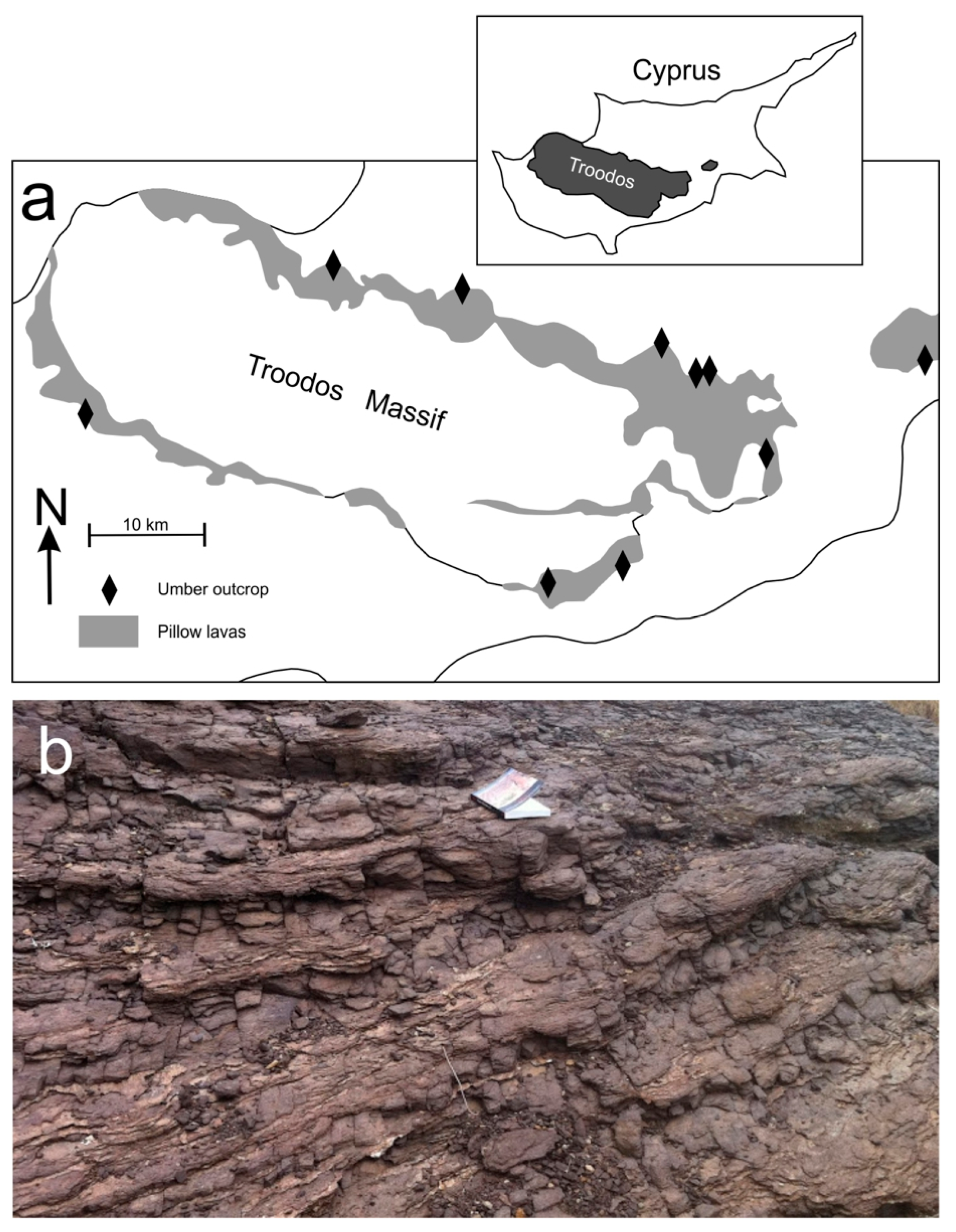
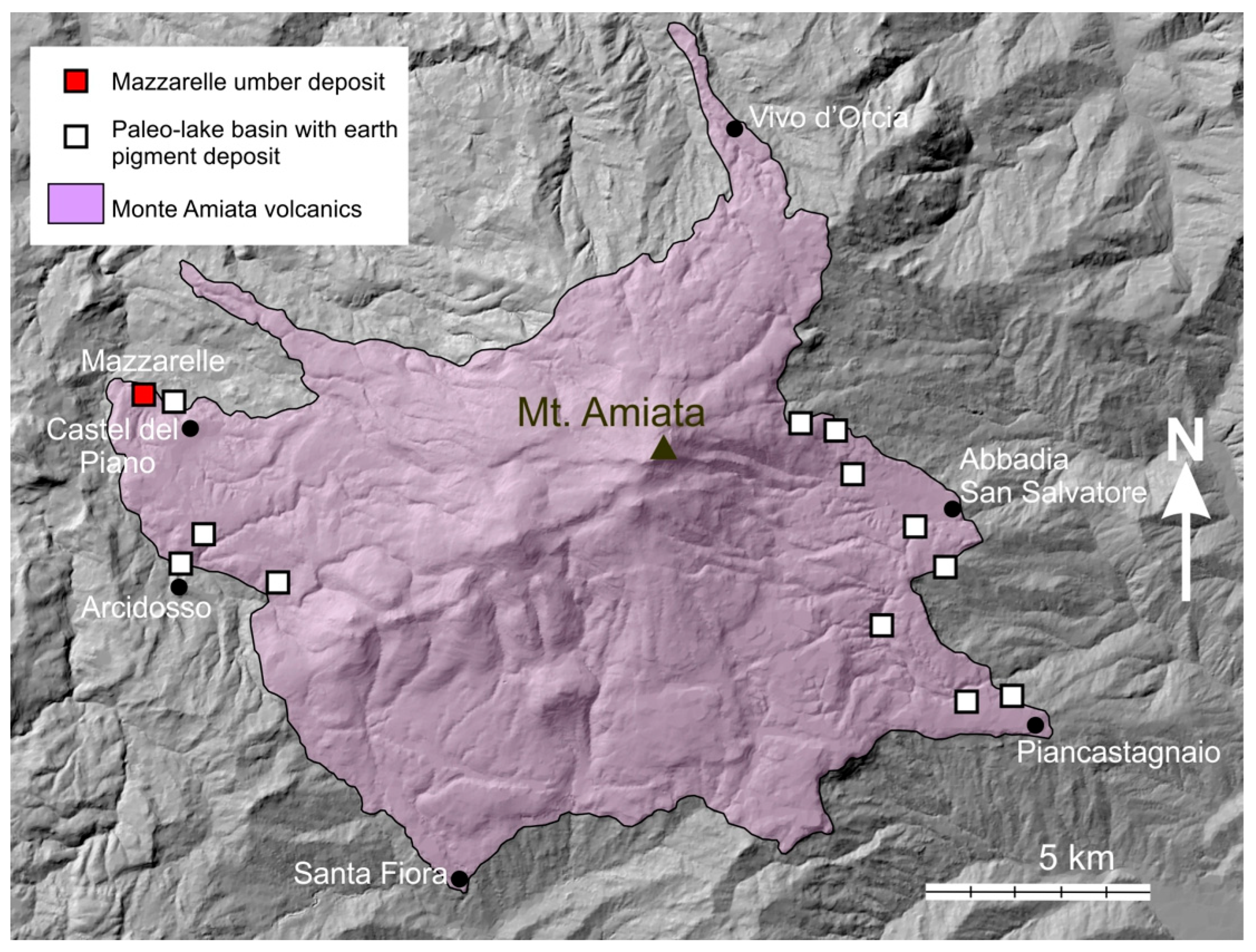
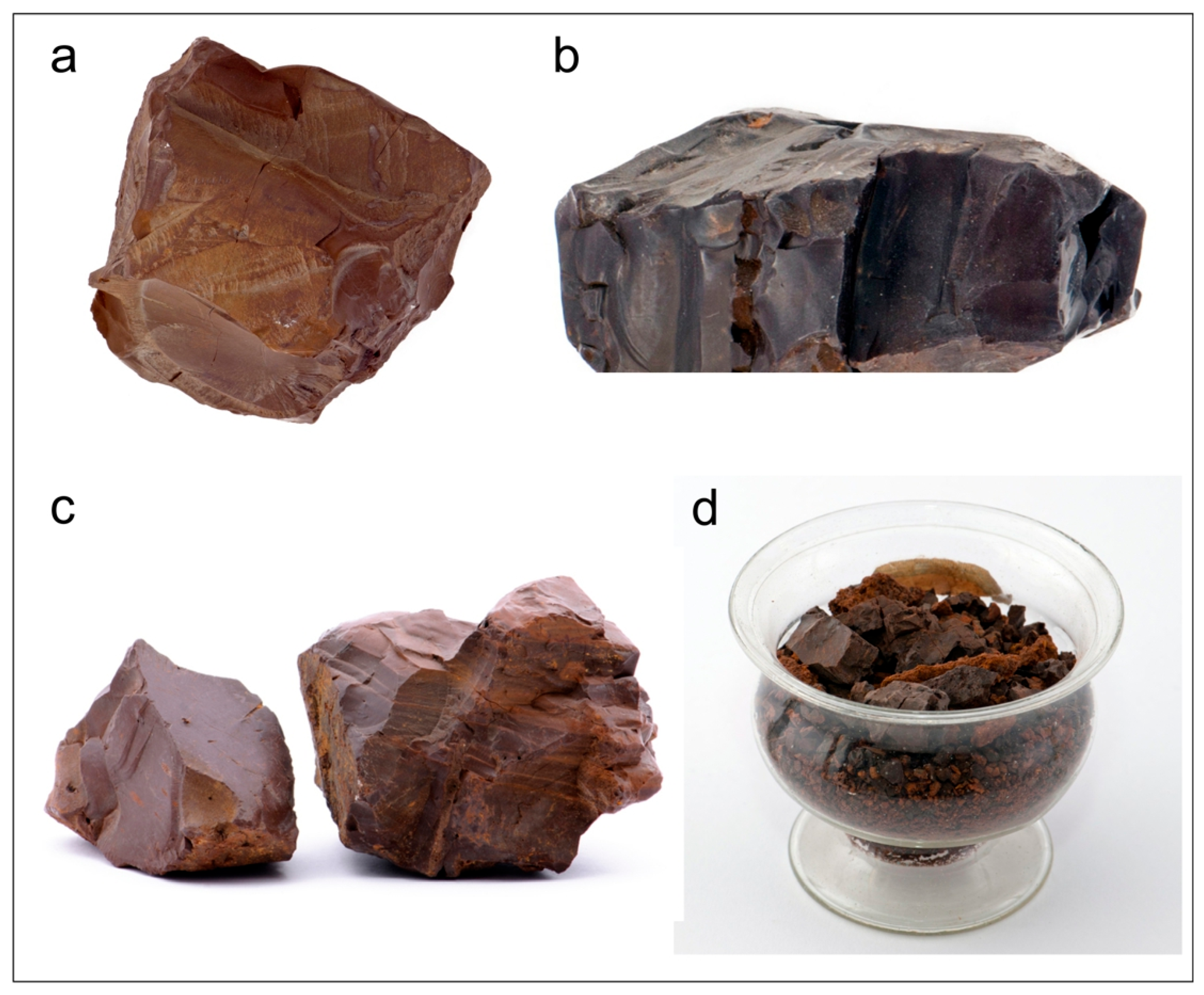
| Artistic | Greenish brown–dark-brown/35–90% | Mudstone with extremely fine grain size | Hematite-goethite 30–70 wt%, Mn oxides 5–20 wt% | Authigenic in situ chemical precipitate of metal oxides of hydrothermal origin in an aqueous medium | Cyprus Island, Eastern Mediterranean region (Greece and Turkey), and Monte Amiata volcano (Italy) |
| Bole | |||||
| Artistic | Red, yellow, and brown | Mudstone with extremely fine grain size | Kaolin clay with metal oxides | Authigenic in situ chemical precipitate in fresh waters | Ubiquitous; Monte Amiata volcano (Italy) |
| Other earthy mineral materials | |||||
| Creta Umbrica/Terra di Nocera | |||||
| Fuller earth, medical, and cosmetic | Whitish | Fissile calcareous marlstone and clay marlstone | Carbonate and clay | Marine sedimentary rock | Umbria (Italy) |
| Terra ampelite | |||||
| Medical and agricultural | Black–brown | Bituminous sedimentary mudstone and shale | Rich in organic matter, sulfur, and Fe oxides are also present | Natural surface hydrocarbon manifestations; black shales sedimentation on ocean floor. | Cilicia (Turkey) and Umbria (Italy) |
| Cologne earth (Cassel earth, earth of Cullen, Van Dyke brown) | |||||
| Artistic | Black–brown | Earthy lignite | Rich in organic and bituminous matter | Decomposition of vegetables (organic peat bogs) | Central Europe |
Disclaimer/Publisher’s Note: The statements, opinions and data contained in all publications are solely those of the individual author(s) and contributor(s) and not of MDPI and/or the editor(s). MDPI and/or the editor(s) disclaim responsibility for any injury to people or property resulting from any ideas, methods, instructions or products referred to in the content. |
© 2026 by the author. Licensee MDPI, Basel, Switzerland. This article is an open access article distributed under the terms and conditions of the Creative Commons Attribution (CC BY) license.
Share and Cite
Vezzoli, L. Geological Contributions to the History of the Artist’s Iron-Based Natural Earth Pigments and the Case Study of Terra d’Ombra (Umber). Colorants 2026, 5, 2. https://doi.org/10.3390/colorants5010002
Vezzoli L. Geological Contributions to the History of the Artist’s Iron-Based Natural Earth Pigments and the Case Study of Terra d’Ombra (Umber). Colorants. 2026; 5(1):2. https://doi.org/10.3390/colorants5010002
Chicago/Turabian StyleVezzoli, Luigina. 2026. "Geological Contributions to the History of the Artist’s Iron-Based Natural Earth Pigments and the Case Study of Terra d’Ombra (Umber)" Colorants 5, no. 1: 2. https://doi.org/10.3390/colorants5010002
APA StyleVezzoli, L. (2026). Geological Contributions to the History of the Artist’s Iron-Based Natural Earth Pigments and the Case Study of Terra d’Ombra (Umber). Colorants, 5(1), 2. https://doi.org/10.3390/colorants5010002