This is an early access version, the complete PDF, HTML, and XML versions will be available soon.
Article

Effect of Ni/Co Molar Ratio on the CO Oxidation Activity of NixCo3−xO4 Catalysts

1
School of Mechanical and Aeronautical Manufacturing Engineering, Anyang Institute of Technology, Anyang 455000, China
2
Malaga School of Engineering, Pingdingshan University, Pingdingshan 467000, China
3
School of Materials Science and Engineering, Anyang Institute of Technology, Anyang 455000, China
4
School of Electronic, Electrical and Unmanned Aerial Vehicle Engineering, Anyang Institute of Technology, Anyang 455000, China
*
Author to whom correspondence should be addressed.
Coatings 2026, 16(9), 1048; https://doi.org/10.3390/coatings16091048

Submission received: 4 August 2026 / Revised: 27 August 2026 / Accepted: 1 September 2026 / Published: 3 September 2026

Abstract

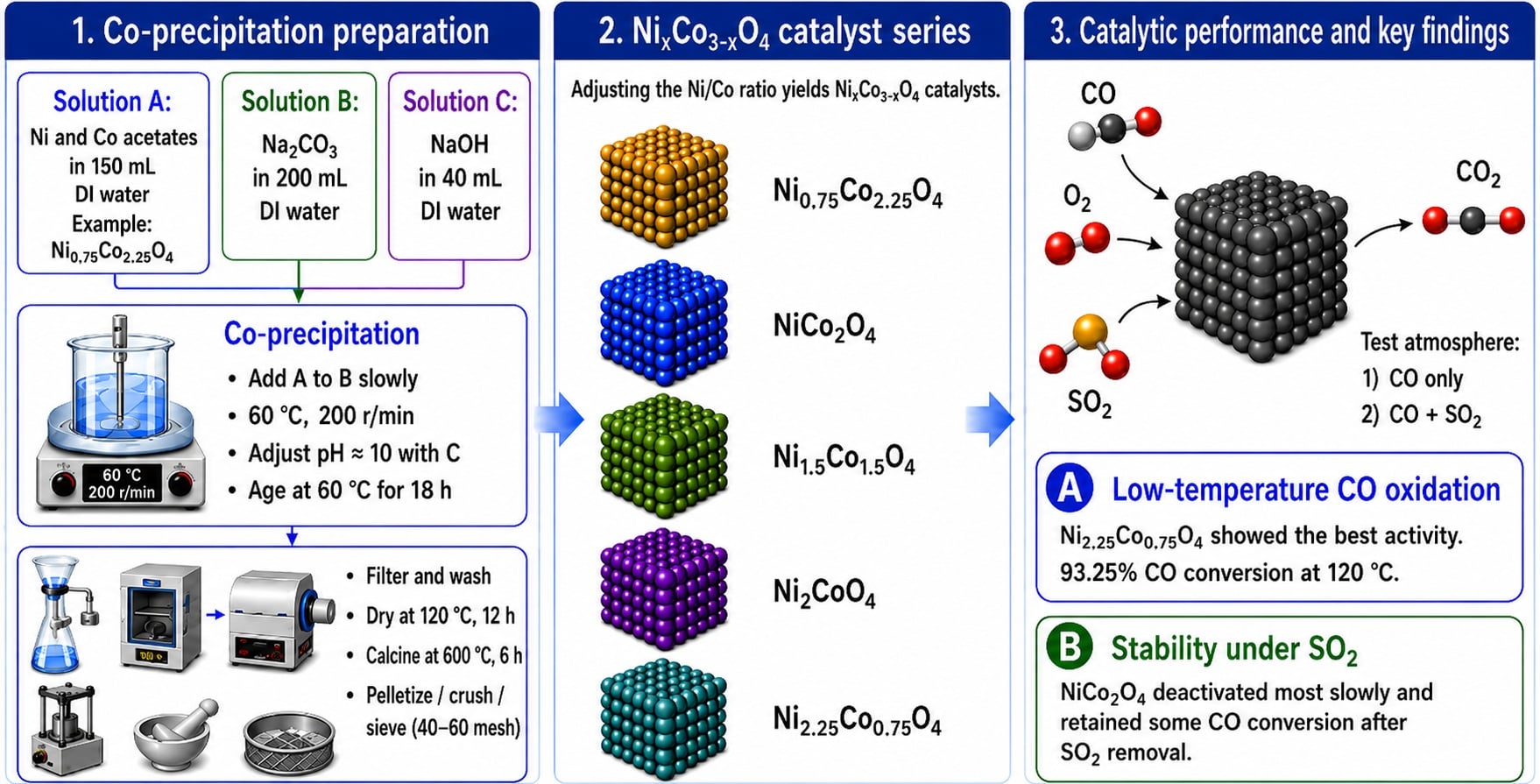
A series of NixCo3−xO₄ (x = 0.75, 1, 1.5, 2, 2.25) catalysts with different Ni/Co molar ratios was fabricated via the co-precipitation method. The catalytic performance for CO oxidation and SO₂ resistance of the prepared catalysts was systematically investigated, and their physicochemical properties were characterized by XRD, SEM, BET, H₂-TPR, CO-TPD and in situ DRIFTS. The experimental results reveal that the Ni₂.₂₅Co₀.₇₅O₄ catalyst exhibits the optimal CO oxidation activity, achieving a CO conversion of 93.25% at 120 °C. The superior catalytic performance can be attributed to its large specific surface area, low reduction temperature, and easily activated lattice oxygen species. When exposed to SO₂ at a concentration 10 times the industrial emission limit, all catalysts exhibited varying degrees of activity loss. Among them, NiCo₂O₄ exhibited the slowest deactivation rate and showed the greatest recovery in CO conversion after SO₂ was cut off, suggesting relatively better sulfur tolerance and recoverability among the investigated catalysts. In conclusion, tuning the Ni/Co molar ratio can effectively optimize the low-temperature CO oxidation activity and sulfur resistance of Ni-Co composite oxides. This work provides a useful reference for the structural composition design and practical application of such catalysts in flue gas purification.
Keywords: CO catalytic oxidation; sulfur resistance; different molar ratios; Ni-Co-based catalysts CO catalytic oxidation; sulfur resistance; different molar ratios; Ni-Co-based catalysts
Graphical Abstract