Article

Fabrication, Microstructural and Micro-Mechanical Characterization of Ti-Nb-HA Composite Under Micro-Pillar Compression


1
Advanced Materials Technology Institute, King Abdulaziz City for Science and Technology, P.O. Box 6086, Riyadh 11442, Saudi Arabia
2
The Center of Excellence for Advanced Materials and Manufacturing, King Abdulaziz City for Science and Technology, P.O. Box 6086, Riyadh 11442, Saudi Arabia
3
Department of Pharmacy, Thadiq General Hospital, Third Health Cluster, Ministry of Health, Thadiq 15242, Saudi Arabia
4
Material Science and Engineering Department, University of Utah, 135 S 1460 E, WBB 112, Salt Lake City, UT 84112, USA
5
TiCoNi for Research and Development Co., Safat 10002, Kuwait
6
Adelaide Microscopy, Adelaide University, Adelaide, SA 5005, Australia
*
Authors to whom correspondence should be addressed.
Coatings 2026, 16(6), 733; https://doi.org/10.3390/coatings16060733
Submission received: 26 May 2026 / Revised: 6 June 2026 / Accepted: 11 June 2026 / Published: 19 June 2026
(This article belongs to the Section Metal Surface Process)

Highlights

  • Ti-Nb-HA composites include reaction products, e.g., Ca3(PO4)2, CaO, and TixPy.
  • The microstructure contains minute martensite as fine needles.
  • The addition of HA into the Ti-Nb composite lowers the Vickers hardness.
  • The yield and compressive strength of Ti-30Nb-20HA were lower than those of Ti-Nb.
  • The prevailing deformation mechanism was a mixture of ductile and quasi-brittle.

Abstract
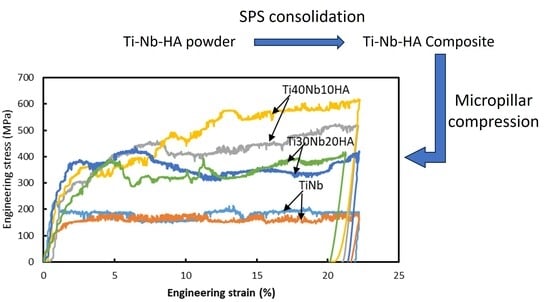
The present work reports on the microstructural and micro-mechanical characterization of Ti-Nb-HA-based composites. The composites were prepared via a spark plasma sintering (SPS) consolidation process. The effect of two distinct levels of hydroxyapatite (HA) content (e.g., 10 and 20 wt.%) on the microstructural and micro-mechanical properties were investigated via in situ micro-pillar compression, and the results were compared against a sole Ti-Nb composite. The microstructure of the composites was composed of parent Ti and Nb grains, together with the reaction products; due to the decomposition of HA, there was a rise in different biocompatible phases. The Vickers hardness of the composite was sensitive to applied loads due to the presence of pores and voids, which was foreseen to be beneficial when the composite was used as an implant, according to the literature. The addition of 20 wt.% HA causes a decrease in hardness to 990 HV, compared to 1109 HV for 10 wt.% HA and 1275 HV for sole Ti-Nb. The addition of HA into Ti-Nb also lowers the compressive strength from 553 MPa for Ti-Nb to 189 MPa for Ti-30Nb-20HA. This was accompanied by a reduction in the elastic modulus, from 130 GPa for Ti-Nb to 29 GPa for Ti-30Nb-20HA. The deformation mechanism was ductile-dominated in all cases, with the presence of a quasi-brittle nature for HA-containing composites.

Graphical Abstract

1. Introduction

The need to develop biomaterials for orthopedic applications is becoming essential in order to address issues like osteogenesis and the integration of implants with the human body. The most common metallic biomaterials are “stainless steels (SS316L), cobalt–chromium (Co-Cr) alloys and titanium alloys (e.g., Ti-6Al-4V)” [1]. In spite of their “superior biocompatibility and mechanical properties” [2], the main drawbacks include their high elastic modulus (about 110 GPa for Ti-6Al-4V [3]) “compared to human bones (10–45 GPa)” [4], which causes a “stress-shielding” effect. As a result, premature implantation failure occurs [5]. In addition to that, the release of Al and V ions (in the case of a Ti-6Al-4V alloy) and Cr ions (in the case of a stainless steel and Co-Cr alloy) introduces cytotoxicity. Thus, Al-, V- and Cr-free biomaterials are highly sought after. To address this, Kurdi et al. [6,7] reported the fabrication and micro-/nano-scale deformation characteristics of a thermal-sprayed HA-TiO2 coating and assessed their suitability for orthopedic applications. In addition to this, “spark plasma-sintered Mg–Zn–Mn–(Si–HA) composites” were also reported, together with their detailed structural and micro-mechanical characterization [8]. Besides HA-TiO2 and Mg–Zn–Mn–(Si–HA)-based composites, Ti-Nb-HA (titanium–niobium–hydroxyapatite) composites [9,10] have also emerged as advanced biomaterials for orthopedic and dental implants.
The mechanical performance of these composites is sensitive to HA content, Nb concentration, powder particle size, and SPS parameters (temperature, pressure and dwell time). An addition of HA into this alloy reduces the modulus by introducing compliant ceramic phases and increasing porosity, whereas Nb stabilizes the low-modulus β-Ti phase. Without any HA content, the Ti-Nb alloy shows 1000–1200 MPa of compressive strength, with mainly ductile modes of fracture [11]. However, with an increase in HA content, the compressive strength was reduced to 160–250 MPa with an HA content of 30 wt.% and the failure mode became characterized by intergranular fractures, brittle fractures with microcracks and severe brittleness, and porous structures [12]. As reported in the literature, the optimized HA content was 5–30 wt.% to enhance bioactivity with mechanical integrity. This resulted in an elastic modulus of 16–18 GPa, compressive strength of 900–1050 MPa, and microhardness of 220–260 HV, which led to 2–3 times higher bone-implant contact compared to bare Ti-Nb [13].
Spark plasma sintering (SPS) has emerged as the preferred fabrication route for Ti-Nb-HA composites, due to its ability to achieve near-full densification at relatively low temperatures (800–1000 °C) [14] and short dwell times (5–10 min). This minimized the HA decomposition, which was a critical challenge in conventional sintering [15,16]. In addition, SPS provided fine microstructures due to rapid heating (50–100 °C/min), suppressed grain growth, and maintained β-Ti grain sizes <10 µm for enhanced strength (Hall–Petch effect) [17]. SPS is also capable of producing complex geometries in near-net shapes with minimal machining, reducing waste and cost for patient-specific implants [18]. “The synthesized composites also exhibited excellent wear resistance properties” [19]. The development of Ti-Nb-HA composites via SPS represents a significant advancement in biomaterial engineering, successfully balancing mechanical compatibility, bioactivity, and manufacturability. By simultaneously solving stress-shielding (via low modulus) and osseointegration failure (via HA bioactivity), these materials represent a paradigm shift in implant design. Most of the reports on such composites involve macro-scale mechanical property investigations, such as hardness and tensile tests. However, the main benefit of using micro-pillar compression was to uncover the fundamental deformation aspects of the material at the micro-scale, which were not attainable at the macro-scale [20,21]. Having said that, macro-scale experimental data provide the overall performance of the material in life-size samples. Thus, micro-pillar compression data is complementary to that of macro-scale data. It is worth noting that the biological aspects of the presently investigated composites were not covered in this manuscript, as they were outside of the scope of the present manuscript, and moreover, they are readily available in the literature on similar material systems [9,22].
Most of the reported works in this field addressed the optimization of alloy composition [11], SPS parameters [9,23] and macro-scale mechanical properties [24,25]. To date, no research study has been reported on the micro-scale mechanical properties of these composites, along with respective failure modes. This knowledge gap was addressed in this manuscript by implementing “in situ micro-pillar compression” [26]. This was complemented by a comprehensive and critical investigation of the microstructure, morphology, phase composition, and mechanical properties, like micro-hardness. This fundamental approach helped us to understand the behaviors of such composites under mechanical loading at the micro-scale.

2. Materials and Methodology

2.1. Composite Design

The composite was designed by combining a powder metallurgical method for mechanical alloying of the powders and spark plasma sintering as a consolidation technique. The starting materials were high-purity Ti (99.9% purity with particle size of 25 μm), Nb (99.9% purity with particle size of 25 μm), and HA (99.9% purity with particle size of 0.5 μm), which were procured commercially and used as alloying materials. The powder mixture was weighed and transferred in a planetary ball mill (Fritsch, Pulverisette 7, Singapore) with tungsten carbide balls (Fritsch, Pulverisette 7, Singapore) to give a ball to powder a weight ratio of 10:1. The milling continued for 8 hrs at 300 rpm. This ensured a homogeneous dispersion and refined particle sizes, improving sintering abilities to achieve a high density [10,15]. Three different composites were prepared, namely, (i) Ti-Nb (50 wt.% Ti and 50 wt.% Nb); (ii) Ti-40Nb-10HA (50 wt.% Ti, 40 wt.% Nb and 10 wt.% HA); and (iii) Ti-30Nb-20HA (50 wt.% Ti, 30 wt.% Nb and 20 wt.% HA). The base Ti-Nb composite was used as a reference material to compare the effect of HA content on the mechanic properties of the Ti-Nb-HA composites. Details of the powder characterization can be found in the previously published literature [10].

2.2. Powder Consolidation Through Spark Plasma Sintering (SPS)

After the ball milling, “the alloyed mixture of powders was pre-heated at 500 °C for 2 h in an argon atmosphere (1 L/min)” to remove any residual moisture. The consolidated powder was developed using a Sinter SPS-625 (SPS, Fuji Electronic Industrial Co. Ltd., Saitama, Japan) at 1000 °C with a 100 °C/min heating rate in a graphite die. Notably, 50 MPa uniaxial pressure [10,15] was maintained for 10 min (holding time) under vacuum conditions [27]. The final samples were in the form of a circular disk with a 20 mm diameter and 5 mm thickness. During the SPS process, a number of phenomena took place simultaneously, such as (i) localized joule heating, (ii) surface cleaning and micro-discharge, (iii) enhanced atomic diffusion, and (iv) electroplastic deformation [28]. These caused rapid consolidations of the particles in the powder and formed the bulk solid structure.

2.3. Specimen Preparation for Microscopy and Mechanical Property Investigation

The disk-shaped specimens were cut into small pieces by a slow-cutting diamond saw in the middle. Then, the pieces were embedded on a hot mounting resin (Cito press-10, Struers, Ballerup, Denmark) and subjected to standard metallographic grinding and polishing using a Struers Tegrapol (Struers, Denmark) automatic metallographic polisher. Final polishing was conducted in a colloidal silica medium [8].

2.4. Microstructural, Elemental and Phase Characterization

The polished samples were used for microstructural characterization and micro-pillar fabrication (as detailed in Section 3.2). For that, a field emission scanning electron microscope (SEM), equipped with a focused ion beam (FIB) (Helios Nanolab 600 FIB-SEM, Thermo Fisher Scientific, Waltham, MA, USA), was used. The elemental analysis was conducted by energy-dispersive spectroscopy (EDS) using an Oxford Instruments EDS system (Oxford Instruments, Abingdon, UK) attached to an FIB-SEM. An X-ray diffraction (XRD) investigation was conducted using monochromatic CuKα radiation XRD equipment (New D8 Advance, Bruker, Karlsruhe, Germany) [8].

2.5. Microhardness and In Situ Micro-Pillar Compression

The microhardness measurements (Vickers hardness) were conducted by using Clark microhardness (CM-100AT, Michigan, USA) equipment at 100, 300, and 500 g loads, and with a holding time of 5 s at peak load. For a given load, seven individual indentations were conducted, and the average values with standard deviation were reported for data analysis. The compression tests were conducted inside the FIB-SEM chamber. For that, the Hyistron PI-88 (Hyistron, Eden Prairie, MN, USA) indentation system was mounted during the SEM stage. The compression test was conducted in “displacement control mode”, and the (indenter) loading rate was 3 nm/s, which corresponds to a 10−3 s−1 strain rate. The morphology of the compressed micro-pillars was also examined via SEM. The output of the micro-pillar compression were the load–displacement graphs. During the compression tests, the applied normal force (F) and corresponding changes in pillar length (Δl) were recorded during compression by a computer-controlled program, and were subsequently used to calculate the engineering stress and strain, according to Equations (1) and (2), respectively:
σ = F A 0
where σ is the engineering stress, F is the normal force, and A0 is the cross-sectional area of the pillar at 25% of its height from the top. As the pillars were slightly tapered (<2°), the deformation most likely happened closer to the top surface [29].
ε E = l l 0
where ε E is the engineering strain, Δl is the change in pillar length, and l0 is the initial pillar length [26,30]. A minimum of 6 individual micro-pillars were compressed in each case, and the average values were reported, together with standard deviation, for statistical analysis [8].

3. Results and Discussion

3.1. Microstructural and Elemental Analysis of Sintered Composites

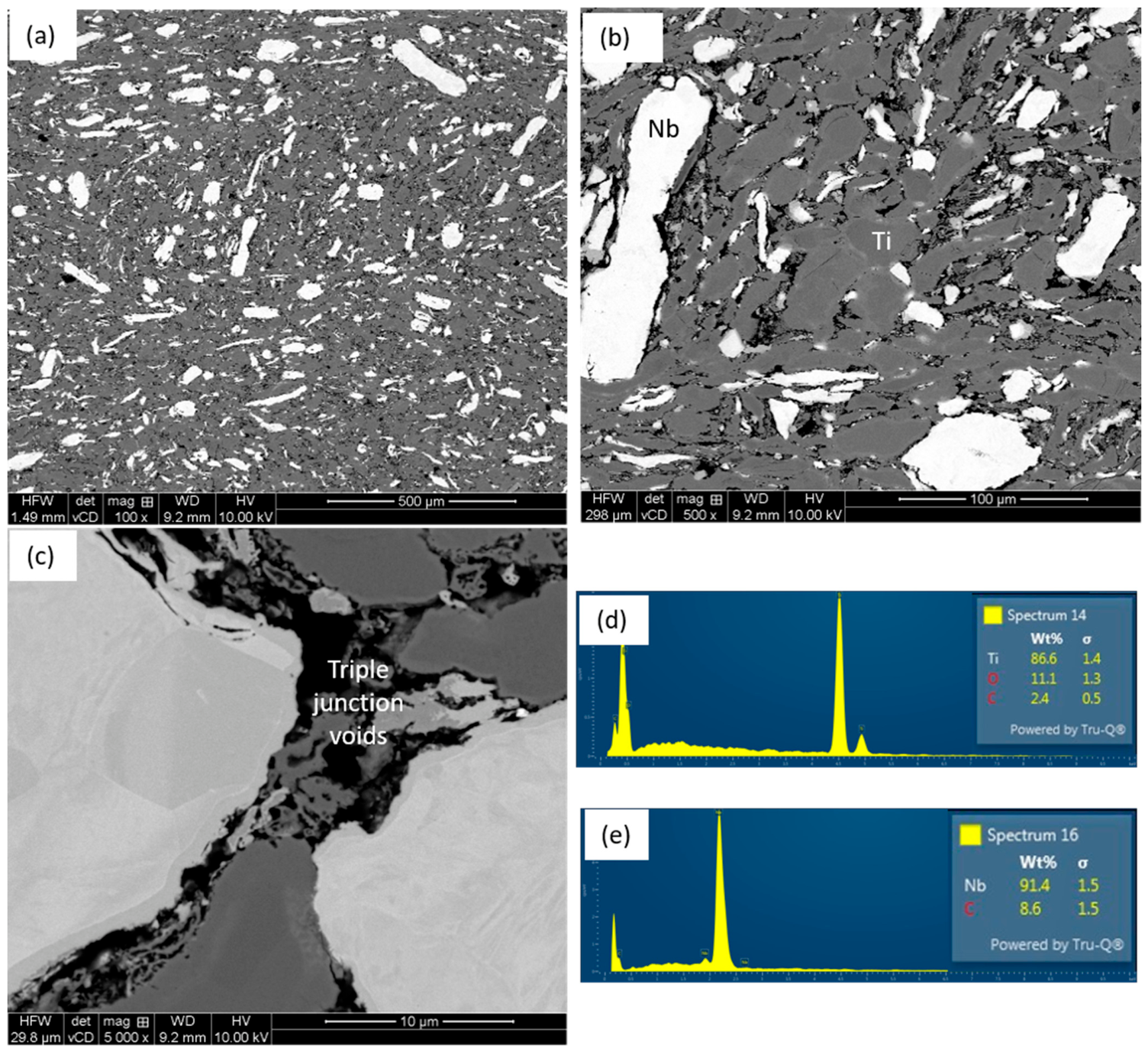
Representative back-scattered electron (BSE) micrographs of the Ti-Nb composite were depicted in Figure 1, together with EDX analysis.
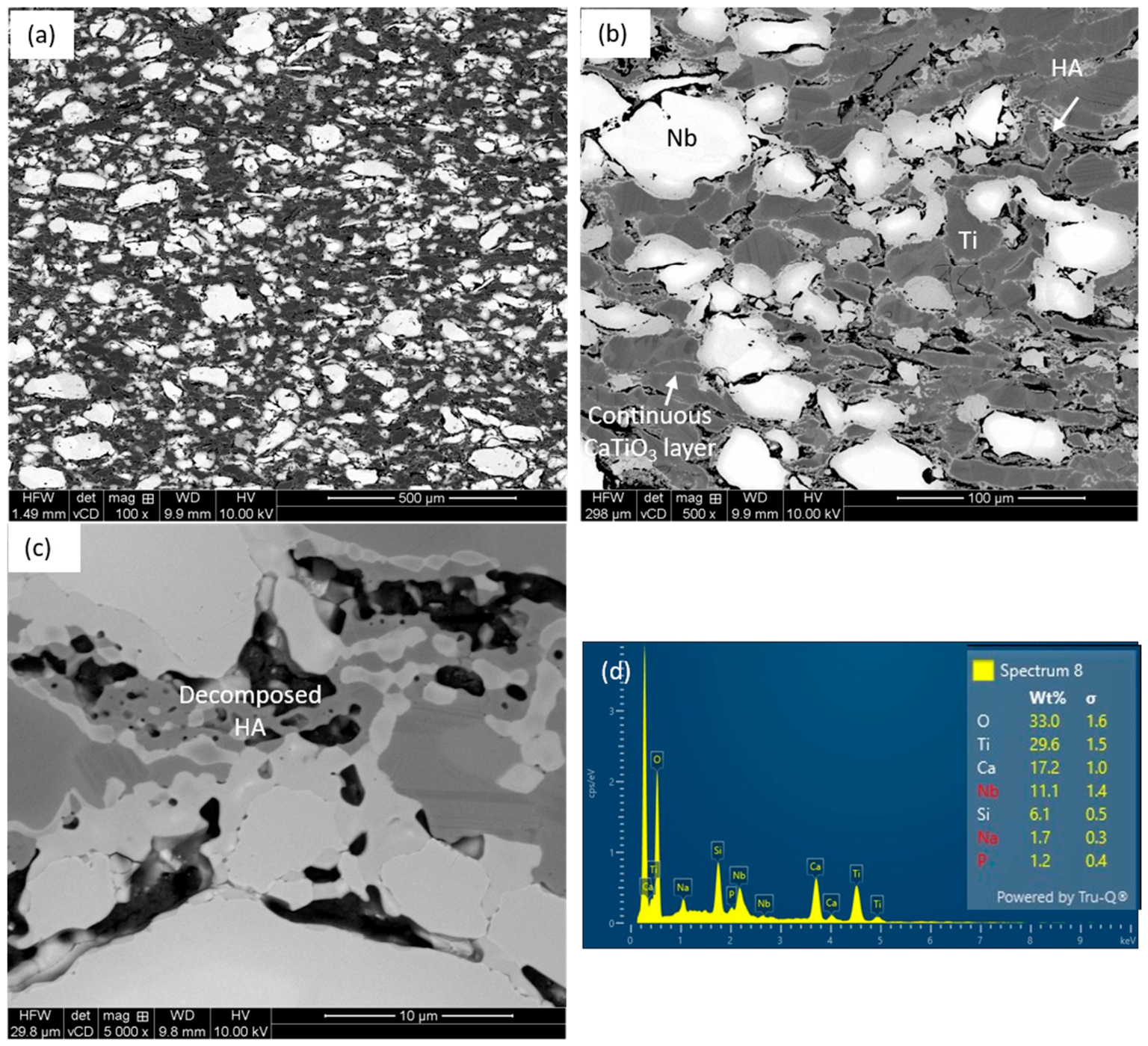
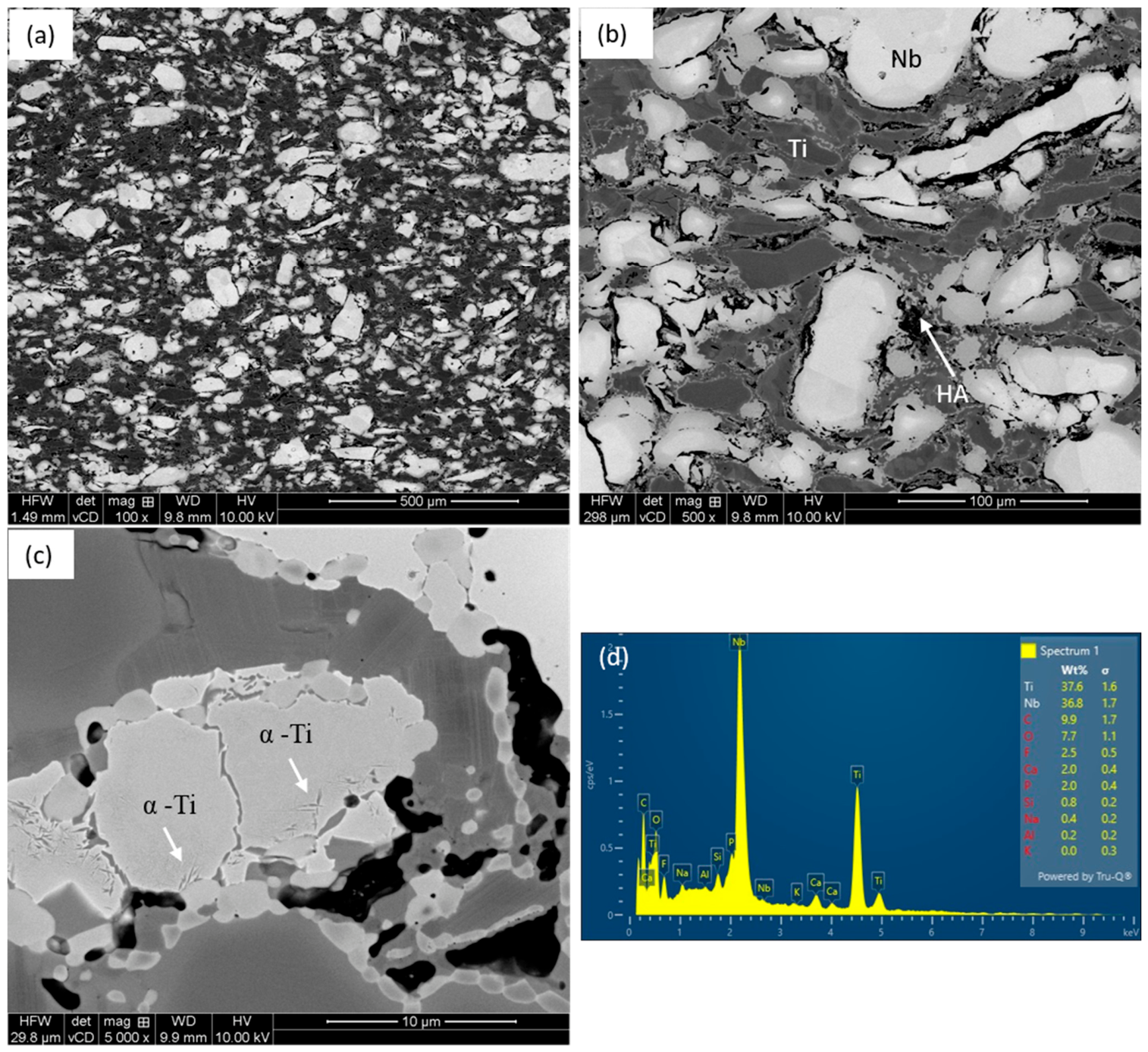
As shown in Figure 1a,b, Ti and Nb particles were consolidated to give rise to the composite structure. High-magnification micrographs (Figure 1c) revealed the presence of “triple junction voids”, a characteristic of SPS-processed specimens. The microstructure of the Ti-40Nb-10HA and Ti-30Nb-20HA composites, together with EDX analysis, are shown in Figure 2 and Figure 3, respectively.
The microstructure examination clearly identified the primary grain boundaries with a distinct gray and white appearance. The gray area denotes Ti-element-enriched areas, whereas white denotes Nb-enriched areas. Thus, the sintered composite typically consisted of β-Ti (stabilized by Nb) [15,27], residual HA (partially decomposed), and reaction products, such as TiO, CaTiO3, CaO, and TiPx [10,27]. The presence of reaction products were further verified through XRD, as reported in a later section. Minute α-Ti or α’-martensite with a needle-like appearance was also observed, as annotated in Figure 2c. The Ti and Nb particles held their respective original sizes (about 25 µm) as SPS’s rapid heating and short dwell time suppressed excessive grain growth, compared to conventional sintering (about 50–100 µm grains) [31]. α-Ti precipitates as fine acicular or lath-shaped (0.5–2 µm) (as annotated in Figure 2c) at β-Ti grain boundaries, due to oxygen diffusion from decomposing HA. HA exists as angular or irregular particles (1–10 µm) dispersed within the β-Ti matrix, along Ti/Nb particle boundaries. Apart from that, some residues (possible oxides) were also identified on the surface, together with voids and triple junctions. The reaction products were unavoidable, namely CaTiO3 (calcium titanate) in a continuous interfacial layer (0.5–2 µm) (as annotated in Figure 3c) that strengthened the interface but reduced the bioactivity [16]; TixPy (titanium phosphides, e.g., TiP, Ti5P4) as discrete particles (1–5 µm) at grain boundaries, which are brittle in nature, but act as crack initiators [32]; TCP (β-tricalcium phosphate; Ca3(PO4)2) as fine grains (<1 µm) dispersed in the matrix with moderate bioactivity [33]; and CaO (calcium oxide) due to HA decomposition [34]. In general, only 70–85% of the original HA survived SPS; the remainder decomposed into TCP, CaTiO3, and TixPy [34,35].
SPS’s rapid kinetics preserved finer microstructures, higher HA retention, and superior densification compared to conventional methods. The microstructure of SPS-fabricated Ti-Nb-HA composites showed a delicate balance between (i) beneficial phases (β-Ti matrix, residual HA, fine α-Ti precipitates) which provided strength, low modulus, and bioactivity; (ii) detrimental phases (TixPy, excessive CaTiO3, porosity) that embrittled the composite and reduced long-term stability; and (iii) reaction layers (e.g., CaTiO3) that formed at Ti/HA interfaces due to oxygen diffusion from HA into the Ti lattice. While these can strengthen the interface, excessive reaction degrades HA. In general, β-Ti (caused by the Nb-stabilized Ti matrix) functioned as load-bearing backbones (low-modulus), whereas α-Ti (caused by oxygen diffusion from HA) offered minor strengthening phases, and residual HA (unreacted starting powder) enabled osteoconductive and bioactivity. The other features observed were processing defects, such as incomplete densification, which left inter-particle voids and porosities. These defects, in fact, enhanced implant attachments with bone growth, and were not deemed detrimental for these specific applications.
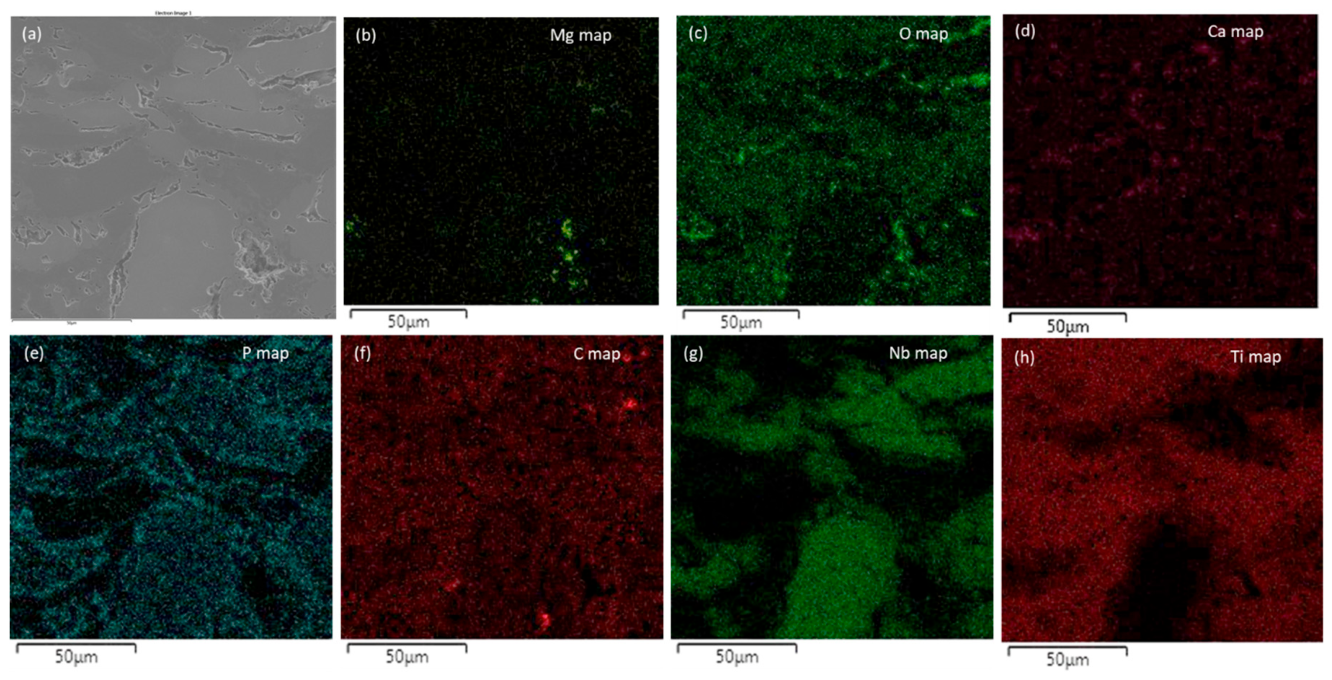
A representative EDX elemental mapping of the Ti-30Nb-20HA composite is shown in Figure 4. The homogenous distribution of the elements was confirmed with the presence of continuous layers, enriched with Ca and P. These results indicated that the composites were successfully fabricated with desired microstructures to afford bioactivity.

3.2. XRD Pattern of the Sintered Composites

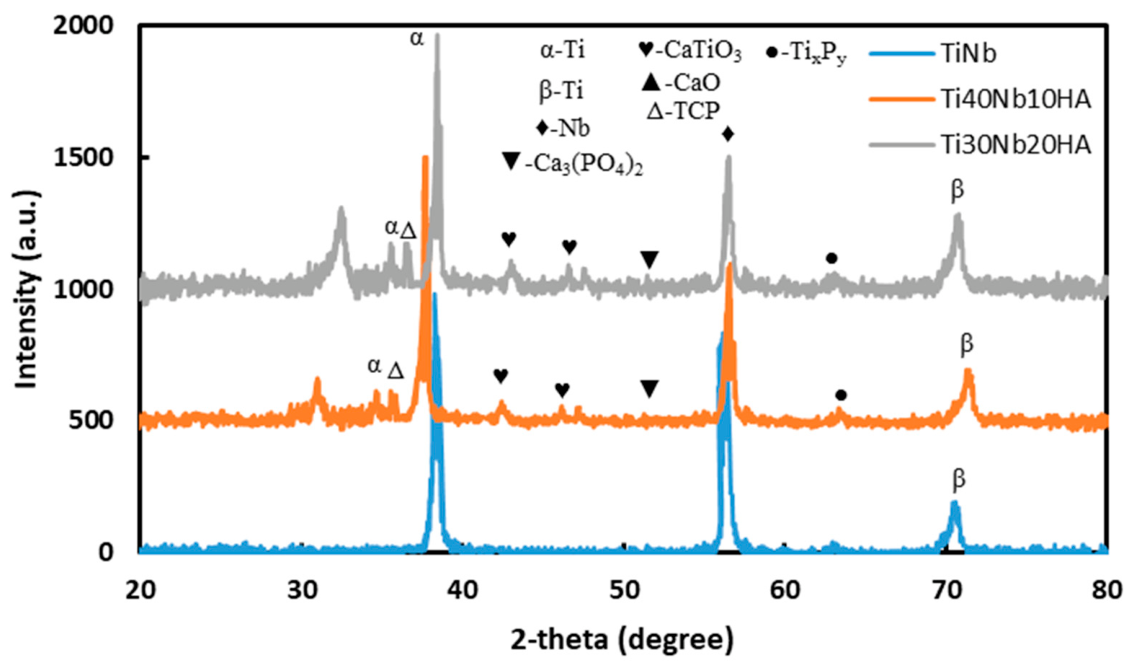
Figure 5 shows the XRD patterns of sintered Ti-Nb-HA composites at different HA contents. The observation made in Section 3.1 regarding the presence of distinct phases was further confirmed by the outcomes of the XRD investigations, which were as follows. The Nb functioned as a β-phase stabilizer, which helped in the transformation of phases at high temperatures. The presence of α-peaks revealed the presence of martensite, as observed in SEM micrographs, with fine needle-like appearances (Figure 2c).
Together with this, there were also other reaction products, such as Ca3(PO4)2, CaTiO3, CaO, and TixPy. This was due to the disintegration of HA (Ca10(PO4)6(OH)2), which was unstable at higher temperatures. In addition, reactions with Ti and Nb led to the formation of new biocompatible phases during the sintering phase. The formation of these phases was beneficial, according to the literature, “to form apatite, which improved the bioactivity of the alloy for osseointegration between (the) implant and natural bone tissues” [36].

3.3. Mechanical Properties of Sintered Composites

3.3.1. Micro-Hardness

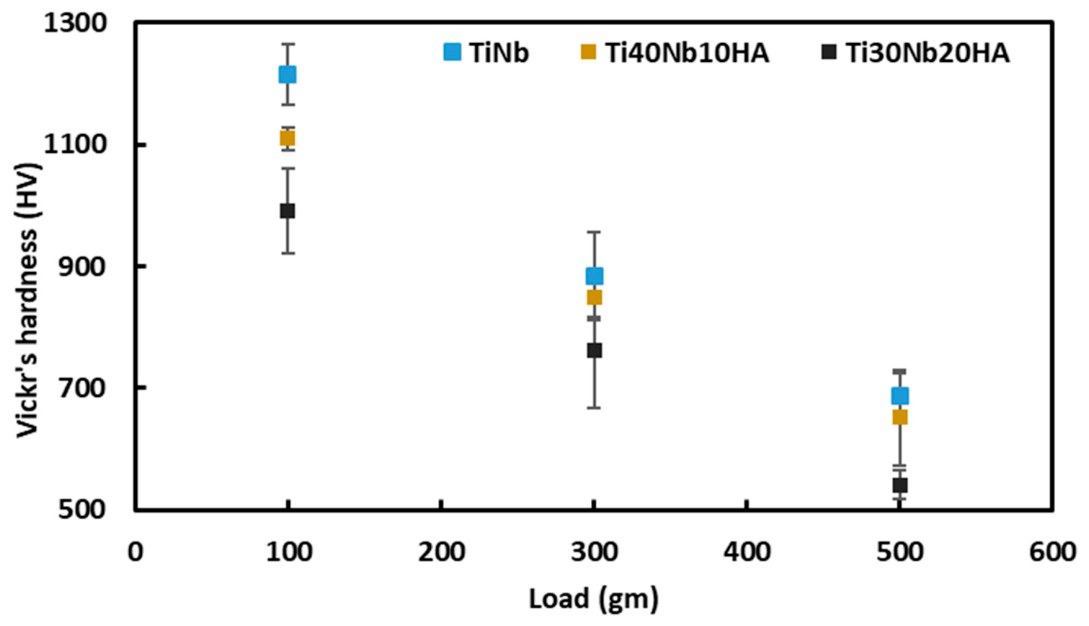
The Vickers micro-hardness of the composites under different loads (e.g., 100, 300, and 500 g) is depicted in Figure 6. The reason for choosing different indentation loads were to investigate the sensitivity of the hardness as a function of the indentation load. As can be seen, the hardness values decrease with the increase in the indentation loads. This was a characteristic behavior of such composites, which possessed porosity and voids, the cause of such hardness evolutions [37]. The hardness of these composites varied considerably with those reported in the literature [12,13,38] due to several factors, such as the exact composition; the SPS parameters (temperature, heating rate, applied pressure); the microstructure; the extent of HA decomposition, porosity; and voids. Thus, it was not possible to conduct one-to-one comparisons. Having said that, the evolution of hardness with respect to indentation loads was consistent with the literature; that is, hardness decreased with an increase in indentation load for all composites.
Irrespective of the indention loads, the addition of HA caused a decrease in the hardness of the Ti-Nb composite. The addition of 20 wt.% HA caused a decrease in hardness to 990 HV, compared to 1109 HV for 10 wt.% HA, and 1275 HV for sole Ti-Nb, at a 100 g indentation load. Thus, care should be taken with regard to the HA content in such composites to safeguard against a substantial decrease in hardness values. As stated in the literature, at a 1000 °C sintering temperature, mostly β-phases will prevail with a minor α-phase, and in our study, this resulted in the significant hardness of the composites.
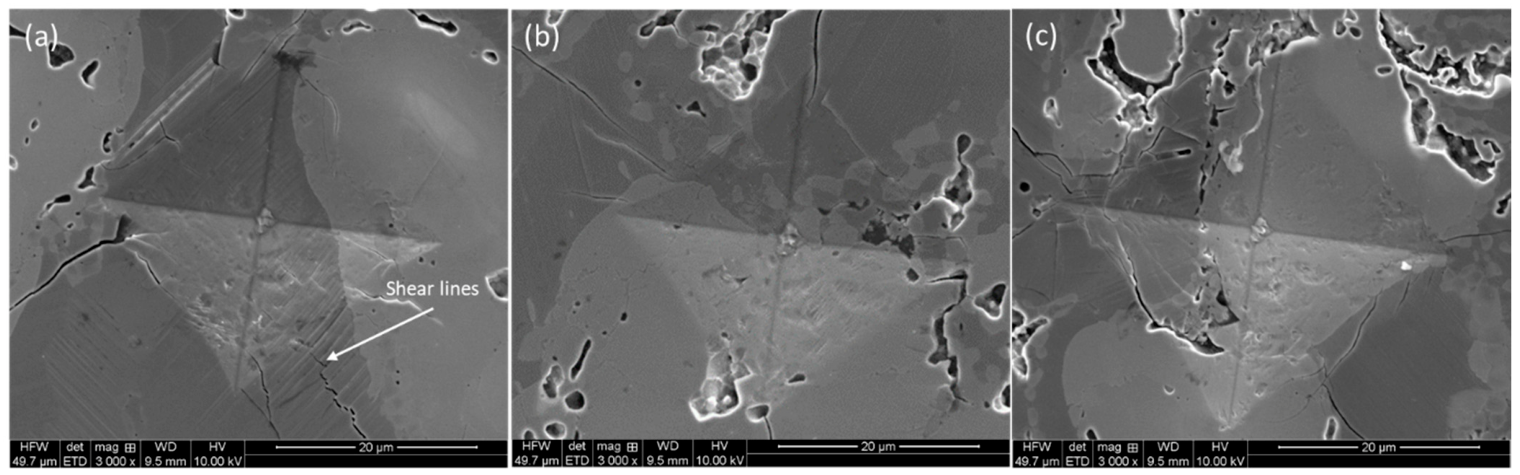
The SEM micrographs of residual indentation marks are shown in Figure 7. It was obvious that indentation cracks along the corners were absent in any case, and severe plastic deformation was evident in the form of shear lines, as annotated in Figure 7a. Thus, Ti-Nb composites mostly showed ductile (plastic) modes of deformation. This also holds true for HA-containing composites; however, such dominating ductile deformations were not evident.

3.3.2. Fabrication of Micro-Pillars on Sintered Composites

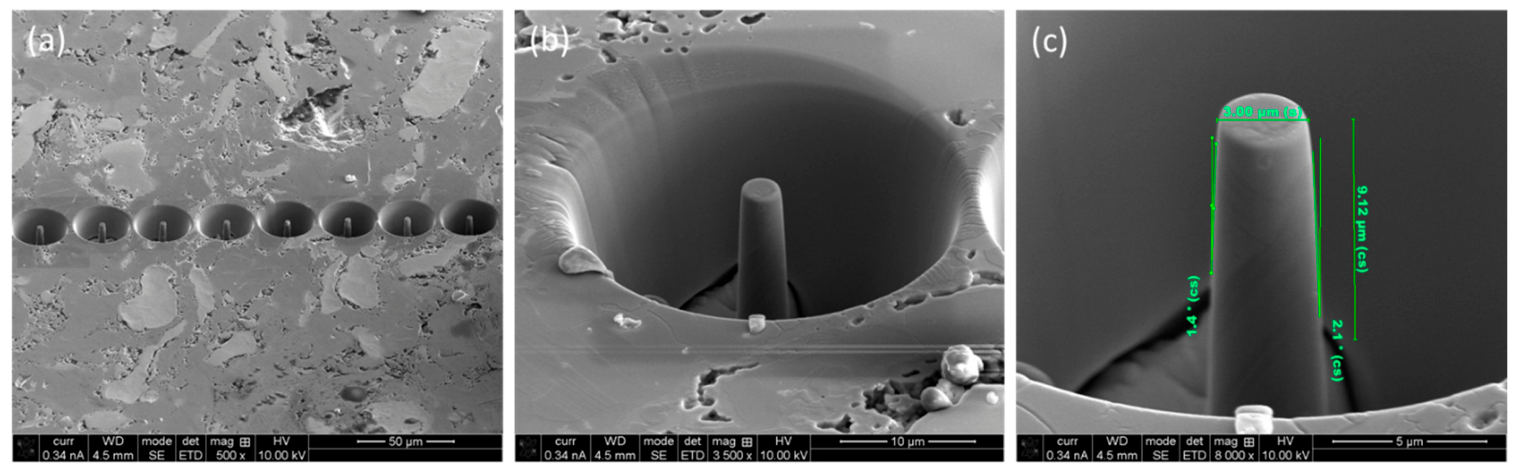
The micro-pillars were fabricated on the surface of the specimens via ion-beam milling. For this purpose, an FIB-SEM was employed. The pillar diameter was 3 μm and the height was 9 μm, leading to a 1:3 aspect ratio. A progressively lower current was used in final polishing, namely 93 pA at 30 kV, to achieve a smooth pillar surface with a minimal “curtaining” effect. Details on pillar fabrication can be found in the literature [39]. SEM micrographs of a series of micro-pillars made on Ti-40Nb-10HA are shown in Figure 8a, together with higher-magnification images in Figure 8b,c. As confirmed in Figure 8c, the pillars were marginally tapered (<2°) [40].

3.3.3. Compression of Micro-Pillars

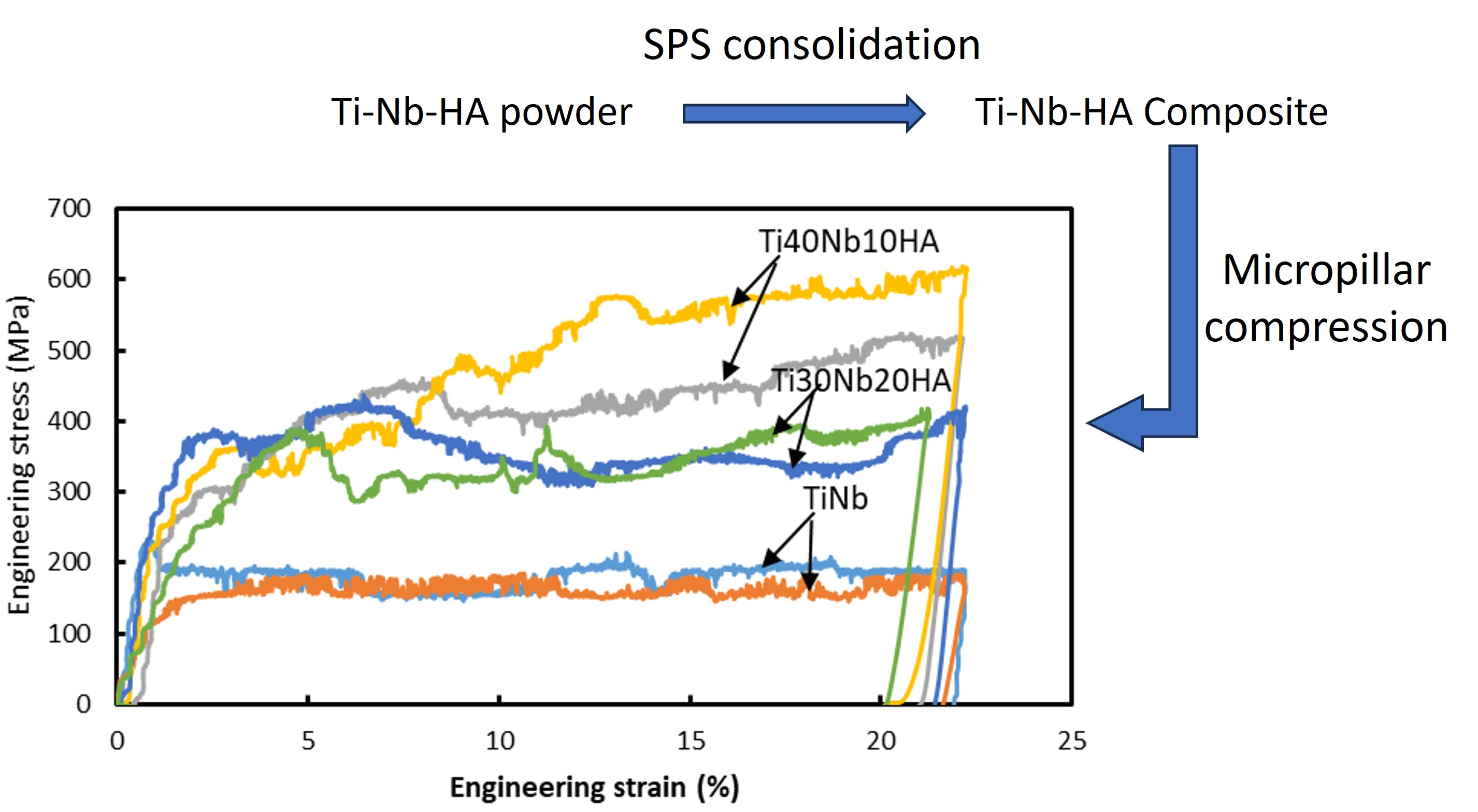
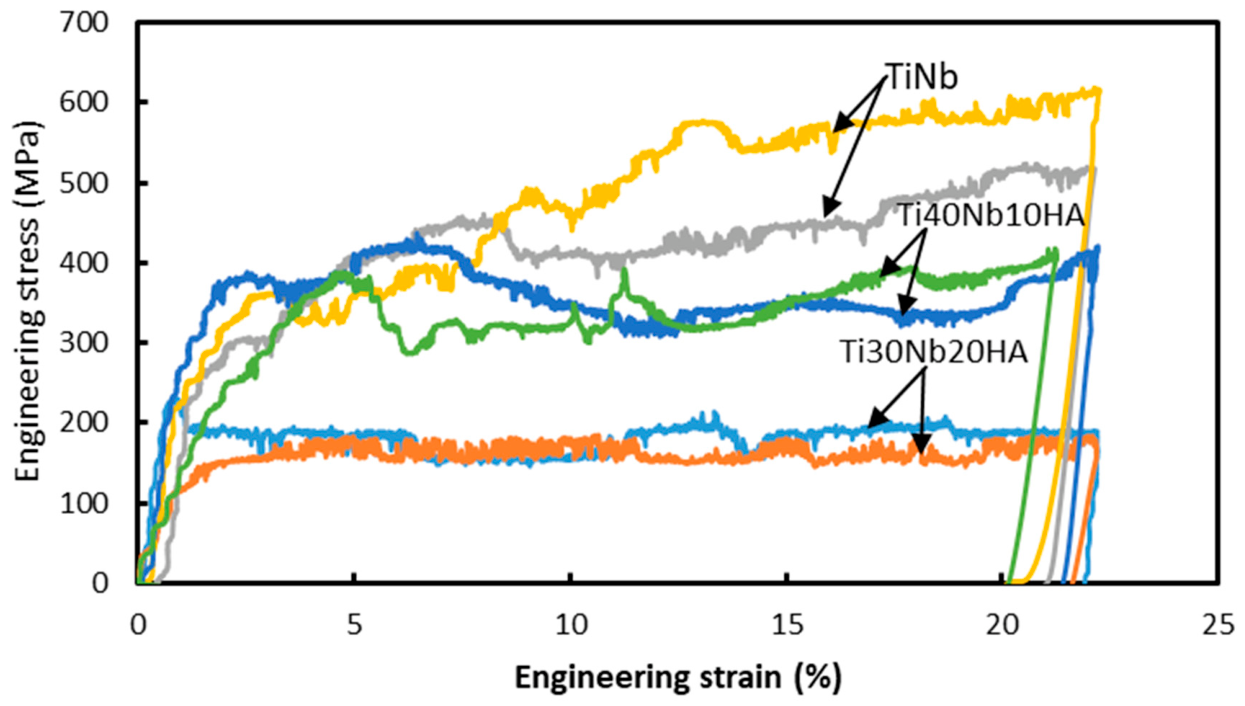
As detailed in the experimental section, the “load–displacement curves obtained during micro-pillar compressions were translated into the stress–strain curves”, which are depicted in Figure 9. At first, there was a striking difference between the graphs. For the sole Ti-Nb composite, the stress level was quite high, in a range of about 600 MPa. However, the addition of HA decreased stress levels considerably, i.e., in the range of 300 MPa for 10 wt.% containing HA and below 200 MPa for 20 wt.% containing HA. The reported strength of HA was under 400 MPa [27]. Thus, HA addition into the Ti-Nb composite was able to lower the stress level of the composite, which was one of the primary objectives of such composite designs, and this was achieved successfully. This trend was in line with that of evolution of hardness, as presented in Section 3.3.1. The addition of HA into Ti-Nb decreased the strength of the composite, and the higher the HA content, the higher the decrease in strength. It was worth noting that, irrespective of the stress level, all the composites exhibited sufficient strain, and the strain levels were not impacted by HA incorporation in the Ti-Nb composite.
The key mechanical properties of the investigated composites were found from the stress–strain curves, and are tabulated in Table 1. The yield stress of the Ti–Nb was 370 ± 127 MPa, whereas for the Ti-40Nb-10HA and Ti-30Nb-20HA composites, it was 257 ± 89 MPa and 235 ± 102 MPa, respectively. This equates to a decrease of about 5.8 times in the yield strength. The main region of such a high spread (standard deviation) was due to the local microstructural heterogeneity and the presence of pores/voids.

3.3.4. Characteristics of the Micro-Pillars After In Situ Compression Test

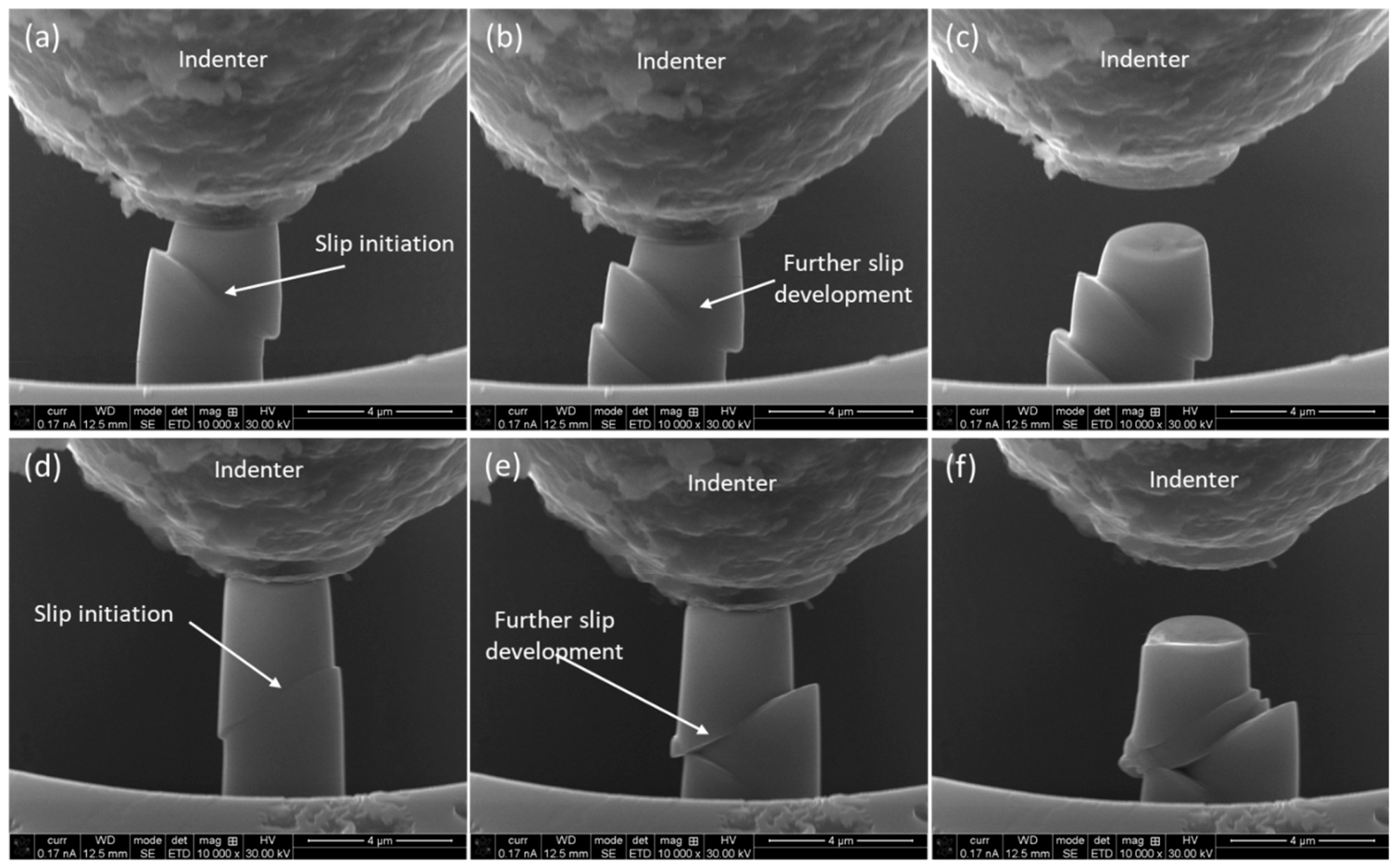
Since the whole compression process was video-recorded, it was possible to correlate the physical state of the micro-pillars at various strain levels. Such comparisons are presented in Figure 10 for Ti-40Nb-10HA and Ti-30Nb-20HA composites, at different strain levels. Just after crossing the yield point (at about <2% stain), the deformation began in the form of slip planes (Figure 10a,d). These slip planes usually form at 45° angles [41], in the form of disk characteristics of such micro-pillar compressions under uniaxial loading. With the continuation of the loading, the slip planes continued to multiply in different directions (Figure 10b,e). Even after the completion of the compression, the deformed micro-pillars held the slipped disk of the material, confirming the prevailing ductile mode of deformation.
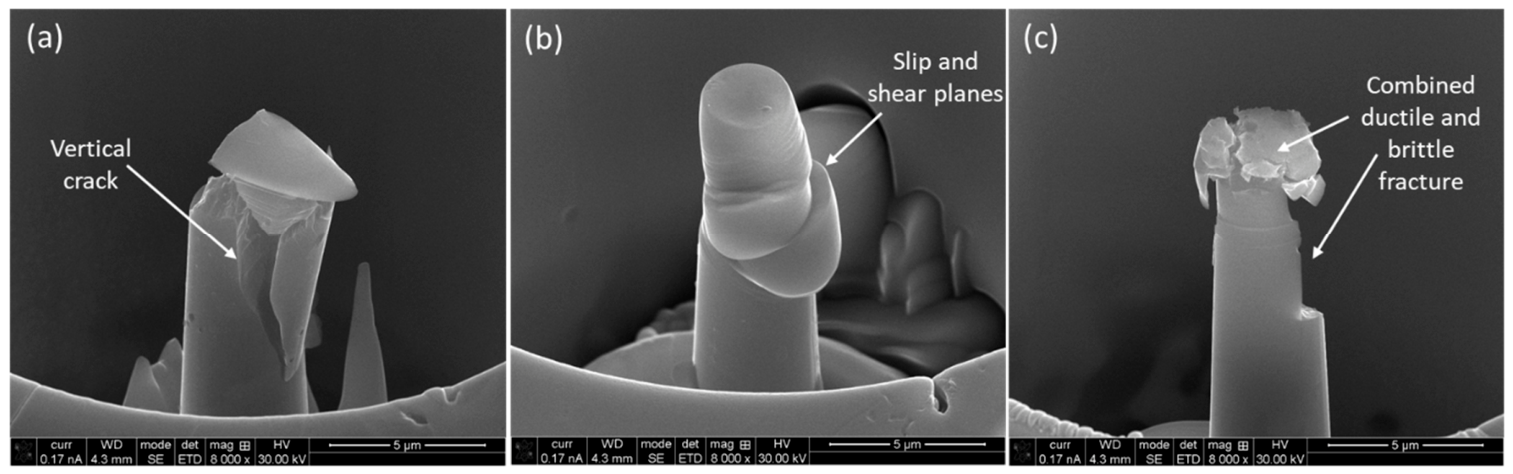
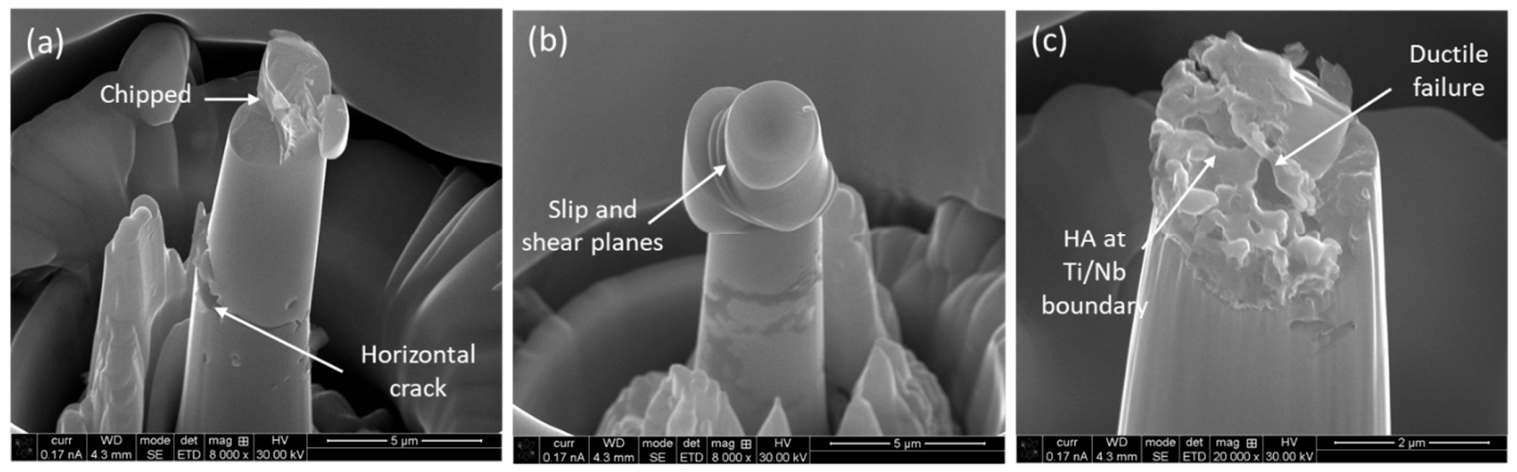
After the completion of the compression tests, the individual deformed micro-pillars were examined further, as reported in Figure 11 for the Ti-Nb composite. As can be confirmed from Figure 11, a combination of deformation modes existed, including vertical fractures of the micro-pillar (Figure 11a), the formation of several disks due to slip and shear plane movements (Figure 11b), and chipped-away sections of micro-pillars, together with ductile deformation (Figure 11c).
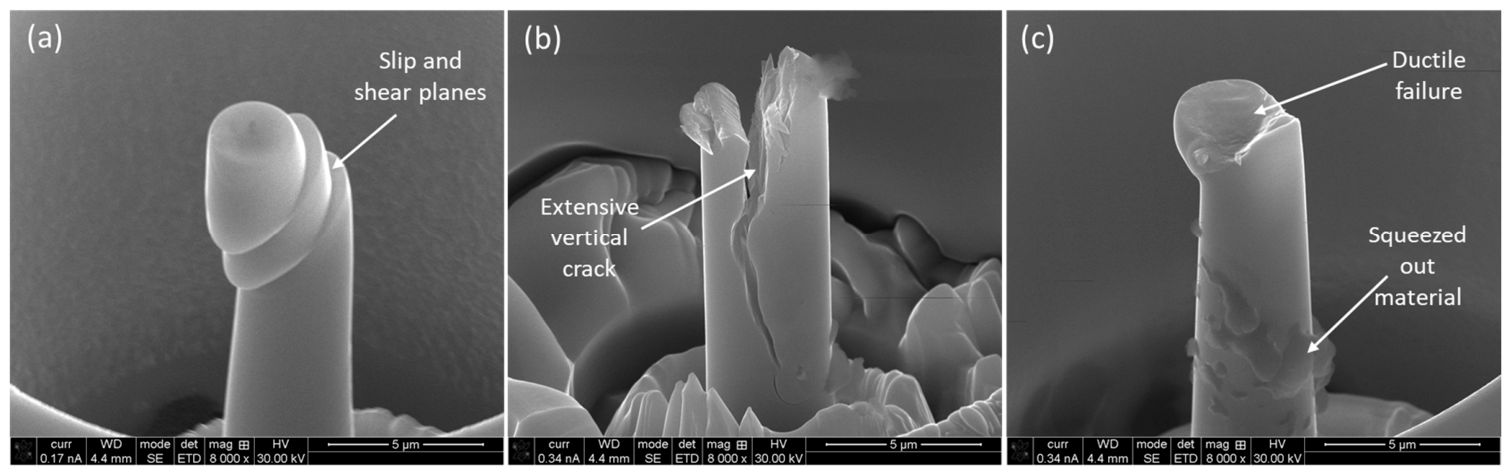
Post-compression investigations on the deformed micro-pillars of Ti-40Nb-10HA and Ti-30Nb-20HA composites are depicted in Figure 12 and Figure 13, respectively. As evident from Figure 12, quasi-brittle chipping (Figure 12a) and ductile failure (Figure 12b,c) co-exist.
Similarly, for the instance of the Ti-30Nb-20HA composite, a combination of ductile deformation (Figure 13a), together with extensive quasi-brittle cracking (Figure 13a), was observed. In addition, it seemed that the relatively soft HA was squeezed out from the Ti/Nb interfaces under intense compressive force, as shown in Figure 13c.
It was not possible to make any direct comparisons of the micro-mechanical properties of the presently investigated Ti-Nb-(HA) composites with those in the literature, as this is the first report on the topic. Having said that, the general trend for the macro-scale mechanical properties of Ti-Nb-(HA) and similar composites were compared with those of presently obtained results, as follows. Prakash et al. [22] reported the effect of HA addition in Ti-Nb composites fabricated via microwave sintering technologies. They reported that a 10 wt.% addition of HA into a Ti-Nb composite lowers the ultimate compressive strength to about 350 MPa from 450 MPa. A further addition of HA, up to 20 wt.%, reduced the strength to about 275 MPa. A similar trend was also noticed in the present investigation, where HA incorporations reduced the strength of the micro-pillars, with optimum results at 10 wt.% HA addition. In the case of HA-TiO2 composites, Singh et al. [41] reported that TiO2 loading increased the hardness up to 2.95 GPa, compared to 1.65 GPa for the HA-only coating, at 30 wt.% TiO2 loading. Prakash et al. [42] also reported that 30 wt.% TiO2 loading exhibited optimum hardness as 848 HV, significantly higher (285 HV) than that of the substrate (β-Ti alloy). In addition to the hardness, the reinforcement also increased the adhesion strength up to 32.5 MPa, in comparison to 18.5 MPa for the HA-only coating [43]. The elastic modulus of as-sprayed HA and HA–30 wt.% TiO2 coatings were measured at 15.7 GPa, and 41.75 GPa, respectively [43]. Kurdi et al. [8] reported that the addition of Si/Si-HA into Mg–Zn–Mn-based composites resulted in about 4.8–5.8 times higher yield and compressive strength than that of Mg–Zn–Mn composites, thanks to the load-bearing capabilities of Si as an alloying element. Despite that, the modulus of elasticity of Mg–Zn–Mn–Si–HA was reasonably lower (about 24 MPa) to avoid stress-shielding issues in applications.
Thus, the newly designed Ti-Nb-(HA) composites exhibited a promising microstructure, micro-mechanical properties, and deformation properties as a potential biomaterial. Future work may consider the development of controlled pore sizes, and the distribution and fabrication of complex customized architectures for real-life applications. In addition, to address the complex nature of the forces/stresses in true prosthetic devices, multi-axis analyses of stress should be conducted.

4. Conclusions

Ti-Nb-based composites were fabricated by spark plasma sintering in this study, and the role of HA addition on the composite was investigated. The investigation included detailed microstructural analysis and phase analysis, together with micro-scale mechanical properties via in situ micro-pillar compression. Based on the experimental outcomes, the following conclusions can be drawn:
  • Ti-Nb-HA composites were successfully fabricated via an SPS process, which demonstrated the presence of various phases, including reaction products, such as Ca3(PO4)2, CaO, and TixPy.
  • The microstructure consisted of Ti and Nb particles, together with minute martensite, which appeared as fine needles and other reaction products, together with HA at particle boundaries and triple junctions.
  • The addition of HA into the Ti-Nb composite lowed the Vickers hardness from 1275 HV for Ti-Nb to 990 HV for Ti-30Nb-20HA. The hardness was also sensitive to loads, due to the presence of pores and voids in the microstructure, which were intended to facilitate cell growth in applications.
  • The yield and compressive strength of Ti-30Nb-20HA (about 235 MPa and 189 MPa, respectively) was lower than that of the Ti-Nb composites alone (about 370 MPa and 553 MPa, respectively). Thus, an addition of HA effectively reduced stress-shielding.
  • The deformation mechanism of the HA-bearing composite was a mixture of ductile and quasi-brittle, compared to ductile-dominated deformation for Ti-Nb composites.

Author Contributions

A.K.: conceptualization, writing, experiments, supervision; D.A. and H.A.: formal analysis, validation, resources, writing—review and editing; A.D.: formal analysis, data curation, experiments, writing—review and editing; A.K.B.: supervision, writing—review and editing formal analysis, validation. All authors have read and agreed to the published version of the manuscript.

Funding

This research received no external funding.

Institutional Review Board Statement

Not applicable.

Informed Consent Statement

Not applicable.

Data Availability Statement

The raw/processed data used to produce the results will be made available by the corresponding author upon reasonable request.

Acknowledgments

Animesh Kumar Basak thanks Chander Prakash (Geeta University, India) for proving the composite samples and for valuable informal discussions.

Conflicts of Interest

Author Husain Alnaser was employed by the company TiCoNi for Research and Development Co., Safat 10002, Kuwait. The remaining authors declare that the research was conducted in the absence of any commercial or financial relationships that could be construed as potential conflicts of interest.

References

  1. Niinomi, M.; Nakai, M.; Hieda, J. Development of new metallic alloys for biomedical applications. Acta Biomater. 2012, 8, 3888–3903. [Google Scholar] [CrossRef] [Scilit] [PubMed]
  2. Niinomi, M. Metallic biomaterials. J. Artif. Organs 2008, 11, 105–110. [Google Scholar] [CrossRef] [Scilit] [PubMed]
  3. He, Z.; He, H.; Lou, J.; Li, Y.; Li, D.; Chen, Y.; Liu, S. Fabrication, structure and mechanical and ultrasonic properties of medical Ti6Al4V alloys Part I: Microstructure and mechanical properties of Ti6Al4V alloys suitable for ultrasonic scalpel. Materials 2020, 13, 478. [Google Scholar] [CrossRef] [Scilit] [PubMed]
  4. Verma, S.; Singh, G.; Choudhary, A.; Hussain, S.; Chanda, A. Mechanical properties of whole-body human bones: A review. Mater. Res. Express 2026, 13, 042002. [Google Scholar] [CrossRef] [Scilit]
  5. Zhu, S.; Wang, X.; Yoshimura, M.; Inoue, A. Synthesis of Ti-based glassy alloy/hydroxyapatite composite by spark plasma sintering. Mater. Trans. 2008, 49, 502–505. [Google Scholar] [CrossRef] [Scilit]
  6. Kurdi, A.; Almalki, D.; Degnah, A.; Basak, A.K. Microstructure and Micro-Mechanical Properties of Thermally Sprayed HA-TiO2 Coating on Beta-Titanium Substrate. Materials 2025, 18, 540. [Google Scholar] [CrossRef] [Scilit] [PubMed]
  7. Kurdi, A.; Degnah, A.; Basak, A. Nano-scale deformation behaviour of atmospheric plasma sprayed HA-TiO2 coating under mechanical loading. Surf. Interfaces 2026, 89, 109132. [Google Scholar] [CrossRef] [Scilit]
  8. Kurdi, A.; Almalki, D.; Sarkar, S.; Aldurihem, A.; Degnah, A.; Basak, A.K. Effect of Si and HA on the Mechanical Characteristics of Spark-Plasma-Sintered Mg–Zn–Mn–(Si–HA) Composites. Coatings 2025, 15, 655. [Google Scholar] [CrossRef] [Scilit]
  9. Prakash, C.; Singh, S.; Basak, A.; Królczyk, G.; Pramanik, A.; Lamberti, L.; Pruncu, C.I. Processing of Ti50Nb50− xHAx composites by rapid microwave sintering technique for biomedical applications. J. Mater. Res. Technol. 2020, 9, 242–252. [Google Scholar] [CrossRef] [Scilit]
  10. Singh, R.; Pal Singh, B.; Gupta, A.; Prakash, C. Fabrication and characterization of Ti-Nb-HA alloy by mechanical alloying and spark plasma sintering for hard tissue replacements. In Proceedings of the IOP Conference Series: Materials Science and Engineering; IOP Publishing: Bristol, UK, 2017; p. 012051. [Google Scholar]
  11. Farrahnoor, A.; Zuhailawati, H. Effects of hydroxyapatite addition on the bioactivity of Ti-Nb alloy matrix composite fabricated via powder metallurgy process. Mater. Today Commun. 2021, 27, 102209. [Google Scholar] [CrossRef] [Scilit]
  12. Guo, A.X.; Cao, B.; Wang, Z.; Ma, X.; Cao, S.C. Fabricated High-strength, low-elastic modulus biomedical Ti-24Nb-4Zr-8Sn alloy via powder metallurgy. Materials 2023, 16, 3845. [Google Scholar] [CrossRef] [Scilit] [PubMed]
  13. Li, Y.; Yang, C.; Zhao, H.; Qu, S.; Li, X.; Li, Y. New developments of Ti-based alloys for biomedical applications. Materials 2014, 7, 1709–1800. [Google Scholar] [CrossRef] [Scilit] [PubMed]
  14. Izui, H.; Kikuchi, G. Sintering performance and mechanical properties of titanium compacts prepared by spark plasma sintering. Mater. Sci. Forum 2012, 706–709, 217–221. [Google Scholar] [CrossRef] [Scilit]
  15. Woo, K.-D.; Kim, S.-H.; Kang, D.-S.; Kim, D.-G. Microstructure and biocompatibility of Ti-Nb-Si-HA composites fabricated by rapid sintering using HEMM powders. Korean J. Mater. Res. 2013, 23, 353–358. [Google Scholar] [CrossRef] [Scilit]
  16. Jia, Q.; Liang, S.; Wang, Q. Effect of HA content on microstructure and properties of Ti-27Nb-17Ta-8Zr/HA composite. Materials 2023, 16, 5095. [Google Scholar] [CrossRef] [Scilit] [PubMed]
  17. Ertorer, O.; Topping, T.D.; Li, Y.; Moss, W.; Lavernia, E.J. Nanostructured Ti consolidated via spark plasma sintering. Metall. Mater. Trans. A 2011, 42, 964–973. [Google Scholar]
  18. Rahmani, R.; Lopes, S.I.; Prashanth, K.G. Selective laser melting and spark plasma sintering: A perspective on functional biomaterials. J. Funct. Biomater. 2023, 14, 521. [Google Scholar] [CrossRef] [Scilit] [PubMed]
  19. Han, Q.-G.; Chen, M.-L.; Zhang, Q.; Sun, L.-S.; Lin, J.; Wang, L.-M. Properties of Ti40. 83Zr40. 83Ni18. 34 quasicrystalline alloys sintered by Spark Plasma Sintering. J. Alloys Compd. 2015, 650, 154–158. [Google Scholar] [CrossRef] [Scilit]
  20. Basak, A.; Pramanik, A.; Prakash, C.; Shankar, S.; Debnath, S. Understanding the micro-mechanical behaviour of recast layer formed during WEDM of titanium alloy. Metals 2022, 12, 188. [Google Scholar] [CrossRef] [Scilit]
  21. Basak, A.K.; Kurdi, A.; Radhika, N.; Arputharaj, J.; Prakash, C.; Pramanik, A.; Shankar, S. Compressive mechanical properties of thermal sprayed AlCoCrFeNi high entropy alloy coating. J. Alloys Compd. 2024, 1003, 175721. [Google Scholar] [CrossRef] [Scilit]
  22. Prakash, C.; Singh, S.; Ramakrishna, S.; Królczyk, G.; Le, C.H. Microwave sintering of porous Ti–Nb-HA composite with high strength and enhanced bioactivity for implant applications. J. Alloys Compd. 2020, 824, 153774. [Google Scholar] [CrossRef] [Scilit]
  23. Ibrahim, M.K.; Hamzah, E.; Nazim, E.; Bahador, A. Parameter optimization of microwave sintering porous Ti-23% Nb shape memory alloys for biomedical applications. Trans. Nonferrous Met. Soc. China 2018, 28, 700–710. [Google Scholar] [CrossRef] [Scilit]
  24. Yang, D.; Guo, Z.; Shao, H.; Liu, X.; Ji, Y. Mechanical properties of porous Ti-Mo and Ti-Nb alloys for biomedical application by gelcasting. Procedia Eng. 2012, 36, 160–167. [Google Scholar] [CrossRef] [Scilit]
  25. Hao, D.; Lei, Z.; Yuqin, Z.; Zongyu, Z.; Fei, H. The microstructure, mechanical properties and in-vitro biological compatibility of porous Ti-40Nb alloy fabricated by spark plasma sintering. Mater. Res. Express 2019, 6, 1065f1063. [Google Scholar] [CrossRef] [Scilit]
  26. Basak, A.; Pramanik, A.; Prakash, C. Deformation and strengthening of SiC reinforced Al-MMCs during in-situ micro-pillar compression. Mater. Sci. Eng. A 2019, 763, 138141. [Google Scholar] [CrossRef] [Scilit]
  27. He, Z.; Yi, C.; Shan, W.; Zhang, L.; Tan, J.; Jiang, Y. Characterization on Ti35Nb7Zr Based Hydroxyapatite Composites Prepared via Rapid Sintering for Biomedical Applications. Mater. Trans. 2021, 62, 396–402. [Google Scholar] [CrossRef] [Scilit]
  28. Cavaliere, P.; Sadeghi, B.; Shabani, A. Spark plasma sintering: Process fundamentals. In Spark Plasma Sintering of Materials: Advances in Processing and Applications; Springer: Berlin/Heidelberg, Germany, 2019; pp. 3–20. [Google Scholar]
  29. Osuchukwu, O.A.; Salihi, A.; Abdullahi, I.; Abdulkareem, B.; Nwannenna, C.S. Synthesis techniques, characterization and mechanical properties of natural derived hydroxyapatite scaffolds for bone implants: A review. SN Appl. Sci. 2021, 3, 822. [Google Scholar] [CrossRef] [Scilit]
  30. Misra, A.; Hirth, J.; Hoagland, R. Length-scale-dependent deformation mechanisms in incoherent metallic multilayered composites. Acta Mater. 2005, 53, 4817–4824. [Google Scholar] [CrossRef] [Scilit]
  31. Ratzker, B.; Sokol, M. Exploring the capabilities of high-pressure spark plasma sintering (HPSPS): A review of materials processing and properties. Mater. Des. 2023, 233, 112238. [Google Scholar] [CrossRef] [Scilit]
  32. Rege, J.S.; Hua, M.; Garcia, C.I.; Deardo, A.J. The segregation behavior of phosphorus in Ti and Ti+ Nb stabilized interstitial-free steels. ISIJ Int. 2000, 40, 191–199. [Google Scholar] [CrossRef] [Scilit]
  33. Hiremath, P.; Melin, S.; Olsson, P.A. Phosphorus driven embrittlement and atomistic crack behavior in tungsten grain boundaries. Comput. Mater. Sci. 2024, 244, 113194. [Google Scholar] [CrossRef] [Scilit]
  34. Liao, C.-J.; Lin, F.-H.; Chen, K.-S.; Sun, J.-S. Thermal decomposition and reconstitution of hydroxyapatite in air atmosphere. Biomaterials 1999, 20, 1807–1813. [Google Scholar] [CrossRef] [Scilit] [PubMed]
  35. Gu, Y.; Loh, N.; Khor, K.; Tor, S.; Cheang, P. Spark plasma sintering of hydroxyapatite powders. Biomaterials 2002, 23, 37–43. [Google Scholar] [CrossRef] [Scilit] [PubMed]
  36. Arifin, A.; Sulong, A.B.; Muhamad, N.; Syarif, J.; Ramli, M.I. Material processing of hydroxyapatite and titanium alloy (HA/Ti) composite as implant materials using powder metallurgy: A review. Mater. Des. 2014, 55, 165–175. [Google Scholar] [CrossRef] [Scilit]
  37. Ahmad, F.N.B. Mechanical Properties and Bioactivity of Ti-Nb-Ha Composite Fabricated by Mechanical Alloying. Doctoral Dissertation, Universiti Sains Malaysia, George Town, Malaysia, 2020. [Google Scholar]
  38. Li, F.; Jiang, X.; Shao, Z.; Zhu, D.; Luo, Z. Microstructure and mechanical properties of nano-carbon reinforced titanium matrix/hydroxyapatite biocomposites prepared by spark plasma sintering. Nanomaterials 2018, 8, 729. [Google Scholar] [CrossRef] [Scilit] [PubMed]
  39. Martin, R.; Brown, P. Mechanical properties of hydroxyapatite formed at physiological temperature. J. Mater. Sci. Mater. Med. 1995, 6, 138–143. [Google Scholar] [CrossRef] [Scilit]
  40. Kurdi, A.; Degnah, A.; Tabbakh, T.; Alnaser, H.; Basak, A.K. Micro-scale deformation aspects of additively fabricated stainless steel 316L under compression. Materials 2024, 17, 439. [Google Scholar] [CrossRef] [Scilit] [PubMed]
  41. Singh, A.; Singh, G.; Chawla, V. Characterization of vacuum plasma sprayed reinforced hydroxyapatite coatings on Ti–6Al–4V alloy. Trans. Indian Inst. Met. 2017, 70, 2609–2628. [Google Scholar] [CrossRef] [Scilit]
  42. Prakash, C.; Wandra, R.; Singh, S.; Pramanik, A.; Basak, A.; Aggarwal, A.; Yadaiah, N. Synthesis of functionalized TiO2-loaded HAp-coating by ball-burnishing assisted electric discharge cladding process. Mater. Lett. 2021, 301, 130282. [Google Scholar] [CrossRef] [Scilit]
  43. Singh, S.; Prakash, C.; Singh, H. Deposition of HA-TiO2 by plasma spray on β-phase Ti-35Nb-7Ta-5Zr alloy for hip stem: Characterization, mechanical properties, corrosion, and in-vitro bioactivity. Surf. Coat. Technol. 2020, 398, 126072. [Google Scholar] [CrossRef] [Scilit]
Figure 1. BSE micrographs of polished Ti-Nb composite at different magnifications (ac), together with EDX analysis of Ti (d) and Nb (e) phases, as shown in (b).
Coatings 16 00733 g001
Figure 2. BSE micrographs of polished Ti-40Nb-10HA composite at different magnifications (ac), together with EDX analysis (d) of the area shown in (a).
Coatings 16 00733 g002
Figure 3. BSE micrographs of polished Ti-30Nb-20HA composite at different magnifications (ac), together with EDX analysis (d) of the area shown in (a).
Coatings 16 00733 g003
Figure 4. EDX elemental mapping on Ti-30Nb-20HA composite: (a) electron image of the mapped area and individual map of the respective elements (bh) as annotated in the map.
Coatings 16 00733 g004
Figure 5. XRD spectra of the composites. JCPDF card references were as follows: 00-044-1294 and 00-005-0682 (for α-Ti); 00-005-0682 (for β-Ti); 00-034-0370 (for Nb); 00-009-0169 and 00-070-0364 (for Ca3(PO4)2); 00-042-0423 (for CaTiO3); 00-004-077 (for CaO); 00-009-0169 and 00-009-0348 (for TCP); and 00-006-0683 (for TixPy).
Coatings 16 00733 g005
Figure 6. Vickers hardness of the sintered composites.
Coatings 16 00733 g006
Figure 7. SEM micrographs of residual indentation marks after Vickers indentation: (a) TiNb, (b) Ti-40Nb-10HA and (c) Ti-30Nb-20HA.
Coatings 16 00733 g007
Figure 8. FIB-prepared micro-pillars of the Ti-40Nb-10HA composite: (a) a series of micro-pillars, each in the middle of a crater with a close-up view (bc).
Coatings 16 00733 g008
Figure 9. Characteristic stress–strain graphs obtained for Ti-Nb-(HA) composites upon in situ micro-pillar compression.
Coatings 16 00733 g009
Figure 10. Deformation evolution during in situ micro-pillar compression of (ac) Ti-40Nb-10HA and (df) Ti-30Nb-20HA composites as different strain levels: (a,d) <5%, (b,e) about 10%, and (c,f) >20% (after completion of compression).
Coatings 16 00733 g010
Figure 11. Deformation characteristics of the Ti-Nb composite subjected to micro-pillar compression: (a) vertical fracture path, (b) slip and shear plane, and (c) combined ductile and quasi-brittle fracture with chipped-away portion.
Coatings 16 00733 g011
Figure 12. Post-compression characteristics of the micro-pillars of the Ti-40Nb-10HA composite: (a) chipping, (b) slip and shear and (c) ductile failure morphology.
Coatings 16 00733 g012
Figure 13. Post-compression characteristics of the micro-pillars of the Ti-30Nb-20HA composite: (a) slip failure, (b) vertical fracture and (c) ductile fracture.
Coatings 16 00733 g013
Table 1. Mechanical characteristics of the currently investigated Ti-Nb-(HA) composites calculated from stress–strain curves.
Investigated CompositeYield Strength (σy), MPaUltimate Compressive Strength (σUCS), MPaElastic Modulus (E), GPa
Ti-Nb370 ± 127553 ± 153130 ± 48
Ti-40Nb-10HA257 ± 89234 ± 5837 ± 8
Ti-30Nb-20HA235 ± 102189 ± 8629 ± 9
Disclaimer/Publisher’s Note: The statements, opinions and data contained in all publications are solely those of the individual author(s) and contributor(s) and not of MDPI and/or the editor(s). MDPI and/or the editor(s) disclaim responsibility for any injury to people or property resulting from any ideas, methods, instructions or products referred to in the content.