


Abstract
Due to the limited application of sensors in the low-refractive-index range, accurate detection of certain low-refractive-index objects remains challenging. To address this limitation, this study proposes a novel D-shaped photonic crystal fiber (PCF) operating on the surface plasmon resonance (SPR) principle. Distinct from conventional D-type PCF designs, the proposed structure employs an open-loop channel coated with a gold film to enable efficient excitation. Finite element analysis shows that the sensor’s detection range of refractive index is between 1.23 and 1.32. With increasing analyte refractive index, the loss peak exhibits progressive broadening and eventual stabilization. A maximum spectral sensitivity of 18,500 nm/RIU and a resolution of 5.41 × 10⁻⁶ RIU are attained at a refractive index of 1.32. The sensor features a straightforward design and exhibits excellent performance characteristics. Its exceptional sensing capabilities make it highly competitive for use in applications with a low refractive index. At the same time, to optimize the sensing performance, this study investigates how structural parameters affect the resonant spectrum.
1. Introduction
Sensors based on surface plasmon resonance (SPR) technology have garnered significant attention due to their simple optical input, controllable propagation, broad sensing range, and high precision and sensitivity [1,2,3]. It has undergone rapid development in areas such as biomolecular analysis, antigen–antibody interaction, medical diagnosis, and related biological detection fields [4,5,6]. Krechman researched a method using prism and SPR technology to detect the refractive index change in nearby media. This method involves depositing a thin metal film onto a glass prism. During this process, when light passes through the glass prism, it undergoes total internal reflection at the metal layer, and an evanescent wave penetrates the metal layer. Under specific incident angles or wavelengths where the wavevector of this evanescent field matches that of the surface plasmon polariton (SPP) mode at the metal–dielectric interface, resonant energy transfer occurs. This resonant condition is manifested as a sharp dip in the reflected light intensity, known as the surface plasmon resonance (SPR) effect [7]. The refractive index of analytes near the surface of metals can be detected by surface plasmon even when minute changes occur, owing to the latter’s exceptional sensitivity to such subtle alterations. These small refractive index shifts cause adjustments to the reflected light’s amplitude or phase, thereby facilitating easy detection via surface plasmon resonance [8]. These excellent characteristics make SPR-based sensors the first choice in many sensing fields such as biosensing [9], chemical analysis [10], gas detection [11], temperature monitoring [12] and food safety assessment [13].
Although the surface plasmon sensor based on a prism has many advantages, the application disadvantages of this kind of sensor are also obvious. First of all, the measurement volume of the sensor is huge, and there are some difficulties in actual production. Secondly, such sensors usually require additional optomechanical components for additional conversion during use, resulting in the high cost of such sensors during use [14]. To address the shortcomings of prism sensors, researchers began shifting their approach by experimenting with different types of surface plasmon resonance sensors. Given that optical fibers offer benefits like small dimensions, quick response speed, strong sensitivity, and high accuracy, they have become the main focus of research [15,16,17], especially since they can be used in long-distance sensing [18]. In 1993, Jorgenson put forward the first fiber-optic SPR sensor and achieved its successful implementation [19]. This event served as the starting point for research into SPR-PCF. From that point onward, investigations in this domain have steadily emerged as a prominent research focus [20,21].
Typically, the PCF under our investigation is characterized by air holes structured within silica according to defined patterns [22,23], with varying pore configurations imparting unique optical characteristics to the sensor [24,25]. Modifying the parameters of individual pores can enhance or diminish the performance related to the intrinsic optical properties of PCF sensors. Additionally, the pores arranged in a periodic pattern open up more opportunities for integrating other optical materials, such as gold [26] and silver [27]. Although silver exhibits minimal optical attenuation and sharper resonance peaks, its surface readily forms an oxide layer during use, which may give rise to a sequence of problems in real-world applications [28]. A substantial optical damping ratio is exhibited by gold; nonetheless, its advantages in terms of stability, biocompatibility, and long-term safety justify its continued use as the coating material of choice for Photonic Crystal Fibers [29].
Studies on SPR-PCF have currently advanced to a mature stage. Papia Dal developed a reflective surface plasmon resonance (SPR) sensor—the highest sensitivity obtained was 4774 nm/RIU—for refractive indices between 1.33 and 1.38 [30]. A D-shaped SPR-PCF with a gold-plated surface was investigated by An et al.; the highest sensitivity obtained was 10,493 nm/RIU at a refractive index of 1.38 within the detection range of 1.33–1.38 [31]. M.A. Rahman put forward a grooved biosensor featuring a highest sensitivity of 11,000 nm/RIU, which is applicable for discerning substances whose refractive index lies within the range of 1.30 to 1.44 [32]. A D-shaped PCF-SPR refractive index sensor was studied by YuWei Qu and colleagues; the highest sensitivity obtained was 11,500 nm/RIU, achieved in the 1.32–1.38 RIU (refractive index unit) range [33]. Although the current research on optical fiber sensors has gradually diversified, Most SPR-PCF sensors are applied in scenarios with medium-to-high refractive indices. Therefore, research on sensors for low-refractive-index detection holds considerable value and offers broad potential for application.
In summary, a new D-shaped SPR-PCF sensor is proposed in the article. In contrast to conventional structures, on the polished face of the D-shaped fiber, a U-shaped channel is first created, which is subsequently coated with a continuous layer of gold. We observe from the simulations that the detection range of the sensor lies between 1.23 and 1.32. When the analyte has a refractive index (RI) of 1.32, the maximum sensitivity achievable amounts to 18,500 nm/RIU, and the resolution of 5.41 × 10⁻⁶ RIU is achieved. Simultaneously, parameters including air-hole size, inter-hole spacing, coating thickness, and polishing plane inclination were optimized using the finite element method. It was through the optimization of the open-loop channel’s structural parameters that the best sensing performance was achieved.
2. Structure and Theory
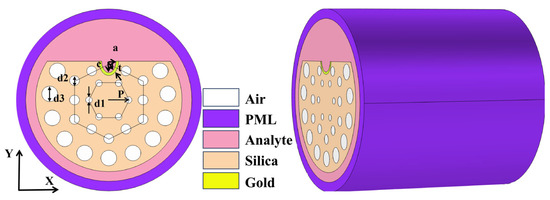
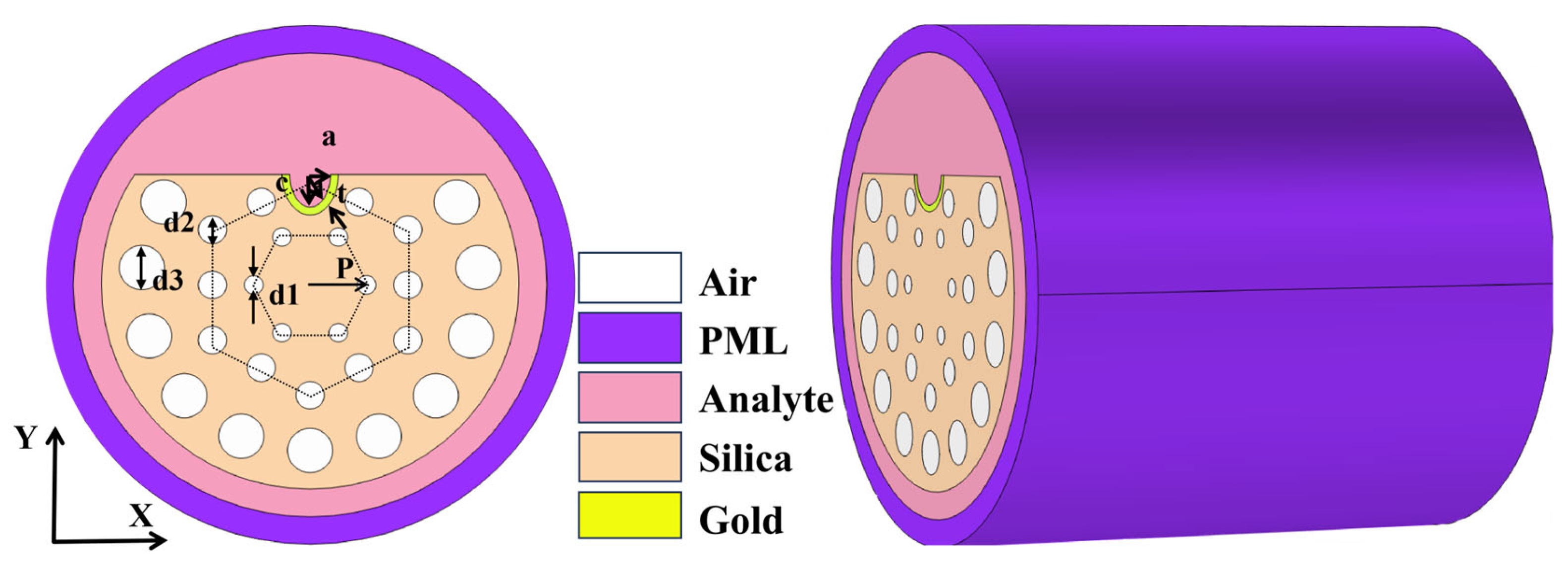
This study introduces a D-shaped sensor, whose geometry is detailed in Figure 1 through both 2D cross-sectional and 3D views. As illustrated, this sensor comprises three distinct pore sizes. In its design, these three pore sizes are uniformly distributed across three layers. The smallest aperture is 1.0 μm. The first layer forms a hexagon, and the second layer is a hexagonal air ring composed of pores with a diameter of 1.5 μm. The first layer is at a distance P from the center, while the center of the second layer lies on a circle of radius P. The vents, measuring 2.0 μm in diameter, are distributed across the outermost layer, forming a dense covering over the sensor core. The open-loop channel’s major axis and minor axis measure 2.0 μm and 1.5 μm, respectively. A 50-nanometer-thick gold film was deposited on the open-loop channel. The analyte can flow through the open-loop channel, with some impurities being filtered out through the larger pore size. This paper proposes a structure that can enhance the energy escape of the fiber core, thereby strengthening the pairing between light modes together with the plasma mode.
Figure 1.
Schematic of the proposed D-type SPR-PCF sensor. (left) 2D cross-sectional view: Three layers of air holes (d1 = 1.0 μm, d2 = 1.5 μm, d3 = 2.0 μm) arranged with pitch P = 3.0 μm. The U-shaped channel (major axis = 2.2 μm, minor axis = 1.5 μm) is coated with a 50 nm gold film (yellow). The Y-polarization (E-field along the Y-axis, shown by the arrow) is used for excitation. (right) 3D view showing the D-shaped polished surface and the open channel. The middle is the material represented by the color block area.
This study uses the COMSOL Multiphysics 6.1 version of the wave optics module for simulation, and a five-layer boundary layer grid is added at the gold–dielectric interface (stretching ratio is 1.2) to analyze the surface plasmon field [34,35]. The minimum unit size of the gold film is 1 nm. The boundary condition is a perfect matching layer with a thickness of two times the wavelength, a scaling factor of 1.5, and a curvature parameter of 2. The perfect matching layer adopts an ultra-fine mapping grid. The solver performs eigenmode solution for the fundamental mode of each wavelength, and performs parametric scanning in the wavelength direction [36,37].
The proposed PCF structure can be fabricated using the standard stack-and-draw technique, where silica capillaries and rods are stacked into a preform according to the desired air-hole arrangement (three layers with diameters d1, d2, d3 and pitch P). The D-shaped profile and the U-shaped open-loop channel are then obtained by side-polishing the fiber, followed by gold film deposition via chemical vapor deposition (CVD) or sputtering. This approach has been widely demonstrated for D-shaped PCFs [38]. In this structure, the filling materials are molten silicon dioxide, whose indices of refraction can be determined using the Sellmeier formula [39].
The wavelength λ is the wavelength of light in vacuum, and the permittivity of gold can be determined through the Drude model [40].
where is the dielectric constant of gold at high frequency, rad/s is the plasma frequency, = represents the scattering frequency of electrons, and is the angular frequency. The imaginary part of the effective mode index, directly linked to confinement loss through Equation (3), serves as the key metric for loss calculation [41].
In the formula, is the wavelength is in microns, and is the imaginary part of the effective refractive index. The value is obtained from the simulation. Using the extreme loss calculation formula, the loss value of this PCF-SPR is determined at a particular wavelength. By plotting the successive losses measured at various wavelengths, a loss curve can be generated. In an optical waveguide, the effective mode index is defined as neff = β/k0, where β is the propagation constant of the guided mode, and k0 = 2π/λ is the free-space wavenumber. The real part Re (neff) determines the phase velocity of the mode, while the imaginary part Im (neff) is directly related to the propagation loss. For this work, Equation (3) is used to calculate the confinement loss from Im (neff). Usually, a distinct peak exists within the dissipation curve, termed the resonant peak, the pulse width of which corresponds to the resonant condition. Finally, in an attempt to enhance the precision of the computational results, a peripheral layer of perfect-match material was incorporated to absorb excess radiant energy [42,43].
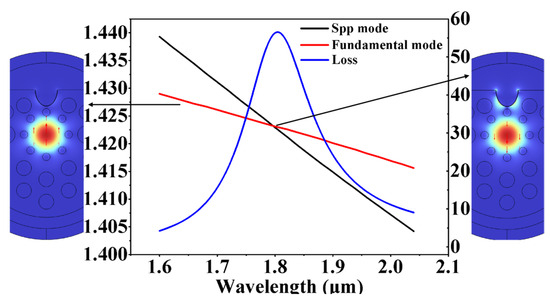
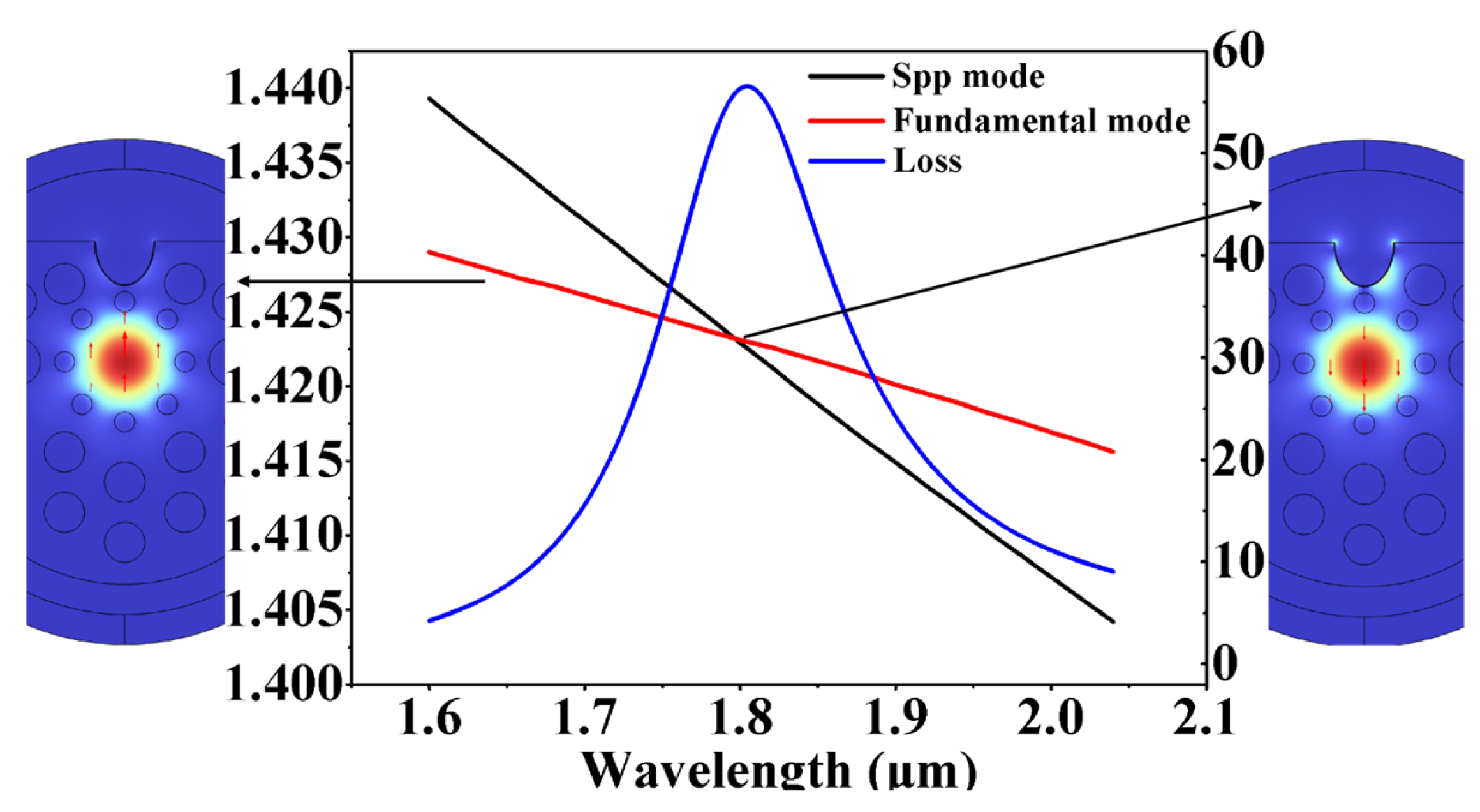
Through the analysis of the sensor mode, in this work, the Y-polarization (electric field parallel to the Y-axis) is mainly investigated because the gold film is located along the Y-direction from the core, enabling stronger evanescent field penetration and SPR excitation [44,45], and the nucleus energies are more readily transmitted to the plasma material surface. As shown in Figure 2, the real parts of both modes overlap at the 1.86-micrometer wavelength, with corresponding loss peaks also appearing in the loss spectrum. This occurs due to the presence of a strong surface plasmon resonance effect at this wavelength [46,47]. In the meantime, maximum energy is transferred from the fundamental mode to the surface plasmon polariton mode. For the X-polarized fundamental mode (electric field parallel to the polished surface), the overlap between the core mode and the gold film is significantly weaker. Consequently, the loss peak amplitude is reduced by approximately 60%, and the resonance wavelength shifts by <20 nm compared to the Y-polarization. The maximum sensitivity for X-polarization is only 3200 nm/RIU. Therefore, the Y-polarization is the preferred operating state for high-sensitivity sensing.
Figure 2.
Evolution of the real effective index and confinement loss for the core and surface plasmon polariton modes across a wavelength spectrum, under a fixed analyte refractive index of 1.26.
3. Results and Discussion
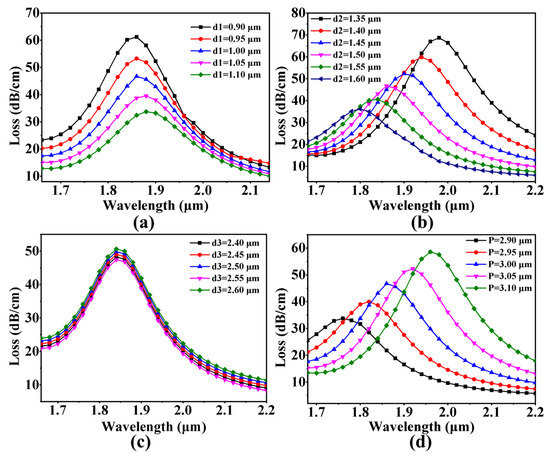
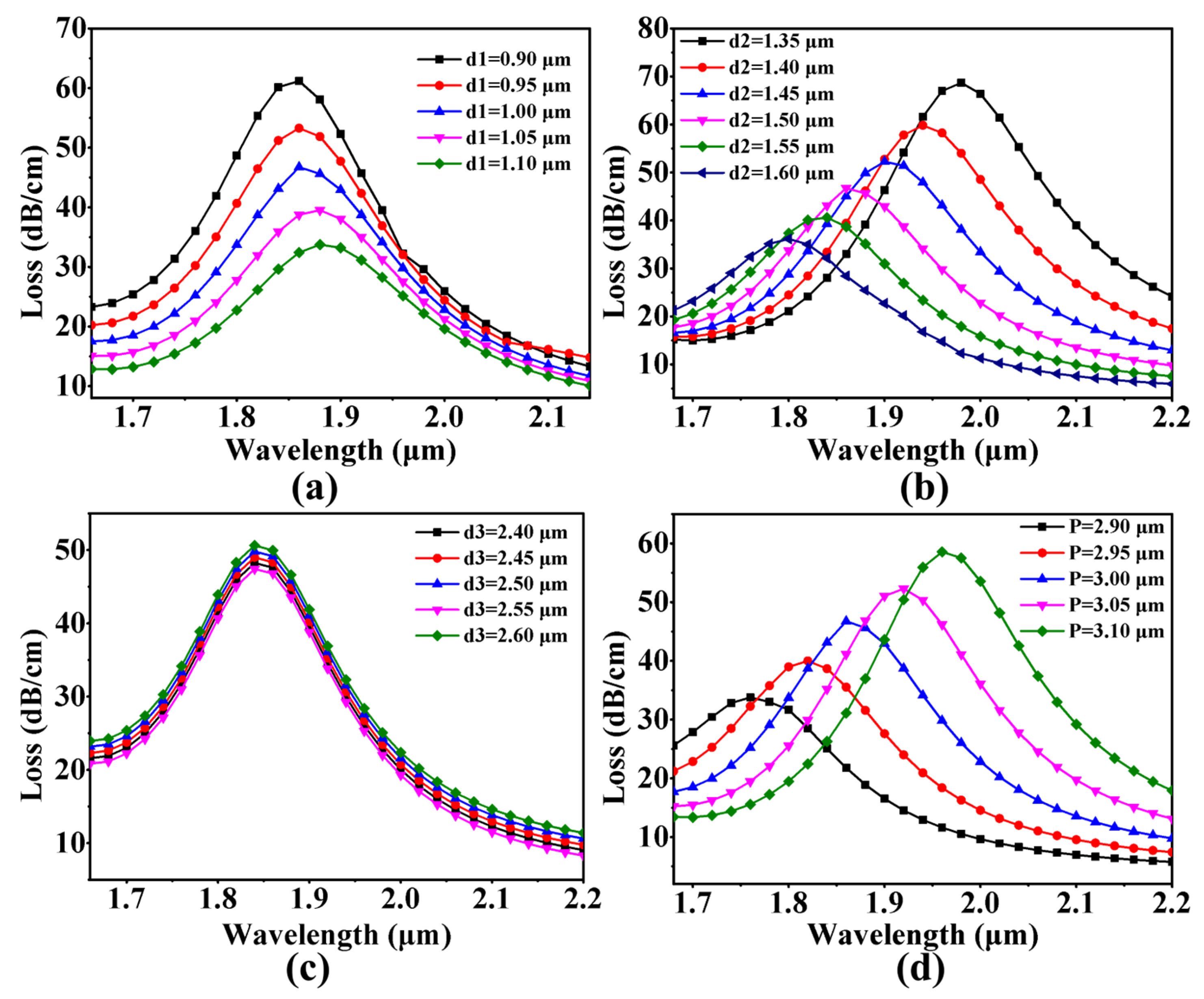
The selection of structural parameters critically determines the proposed sensor’s performance. Its design requires an iterative optimization process to screen the structural parameters. By keeping the variable unique, a certain structural parameter of the sensor is constantly adjusted and analyzed, so as to obtain the optimal solution of this parameter [48,49]. Figure 3 shows the influence of three different sizes of vents and their spacing on sensor performance. It is readily apparent that these parameters have a remarkable influence upon the behavior of the transducer.
Figure 3.
(a–c) Loss as a function of wavelength for various inner hole diameters (d1, d2, d3) and hole spacing (P) (d).
The determination of all structural parameters (d1, d2, d3, P, gold film thickness t, U-shaped channel size) follows the following criteria: Under the condition of fixing other parameters, the main optimization objectives are to maximize the wavelength sensitivity and ensure the depth and sharpness of the resonance peak [50,51]. We use the control variable method to scan each parameter within a reasonable range and evaluate its impact on the loss spectrum. The final selected parameter value is the optimal combination of the comprehensive performance of the sensor in the refractive index range of 1.23–1.32.
As shown in Figure 3a, an increase in dimension d1 from 0.9 μm to 1.1 μm leads to a slight redshift of this sensor’s loss peak, accompanied by a gradual reduction in its magnitude. The primary reason is that, as the difference in reflectivity grows between the two different modes, the coupling between them weakens, which leads to the decreased sensitivity of the refraction indices [52,53]. We find that when d1 = 1.0 μm, the shape of the resonance peak is the most symmetrical, and the linearity of the sensitivity with the refractive index is at its best. Therefore, d1 = 1.0 μm was selected as the optimal value. Figure 3b illustrates the change in the loss curve of this sensor with the variation in the size of the second-layer pores d2. As shown in the figure above, when the d1 dimension increases from 1.35 micrometers to 1.6 micrometers, the sensor’s resonant wavelength undergoes a redshift, and the peak dissipation also exhibits a decreasing trend. The main reason may be that the gradually enlarging pore structure on either side of the central core restricts energy transfer to the plasma surface, resulting in a significant weakening of the surface plasmon resonance effect [54,55], and the evanescent wave penetrating into the fiber lessens, which affects the performance of the sensor. At d2 = 1.5 μm, the sensitivity and loss intensity reached the best balance, so it was selected as the optimal value. Figure 3c illustrates the effect of varying the diameter d3 of the outermost air hole on sensor performance. As observed, the loss curve is largely unaffected by alterations to d3, exhibiting only minor variations in peak loss, since it is not involved in the energy transfer process within the sensor; it has no influence on the energy transfer process between the core and the plasmonic surface [56,57]. Although the d3 holes do not directly participate in SPR, they are retained to provide additional cladding confinement and structural integrity during fabrication. Removing them entirely would increase background loss and reduce mechanical robustness [58]. Therefore, to choose the best curve linearity and sharpest resonance peak, d3 = 3.0 μm was selected as the best diameter; the precision requirements for its diameter are extremely tight, thereby preventing larger accuracy errors from occurring during the actual manufacturing process. Figure 3d illustrates the effect of changing fiber hole pitch P, varying from 2.9 μm to 3.1 μm in increments of 0.05 μm. With the continuous increase in the air-hole spacing, the resonance peak gradually moves towards the long wavelength direction. This is caused by a weakened optical confinement, which promotes energy leakage away from its center towards the metal face [59,60,61] and leads to an enhancement of the SPR at phase matching and a consequent increase in sensor sensitivity [62]. Therefore, a pore spacing (P) of 3.0 μm was determined to be the sensor’s optimum.
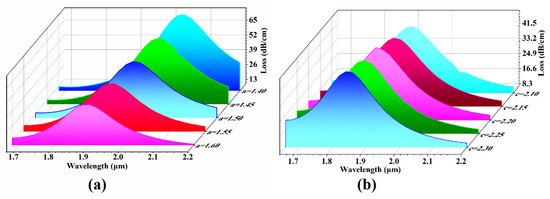
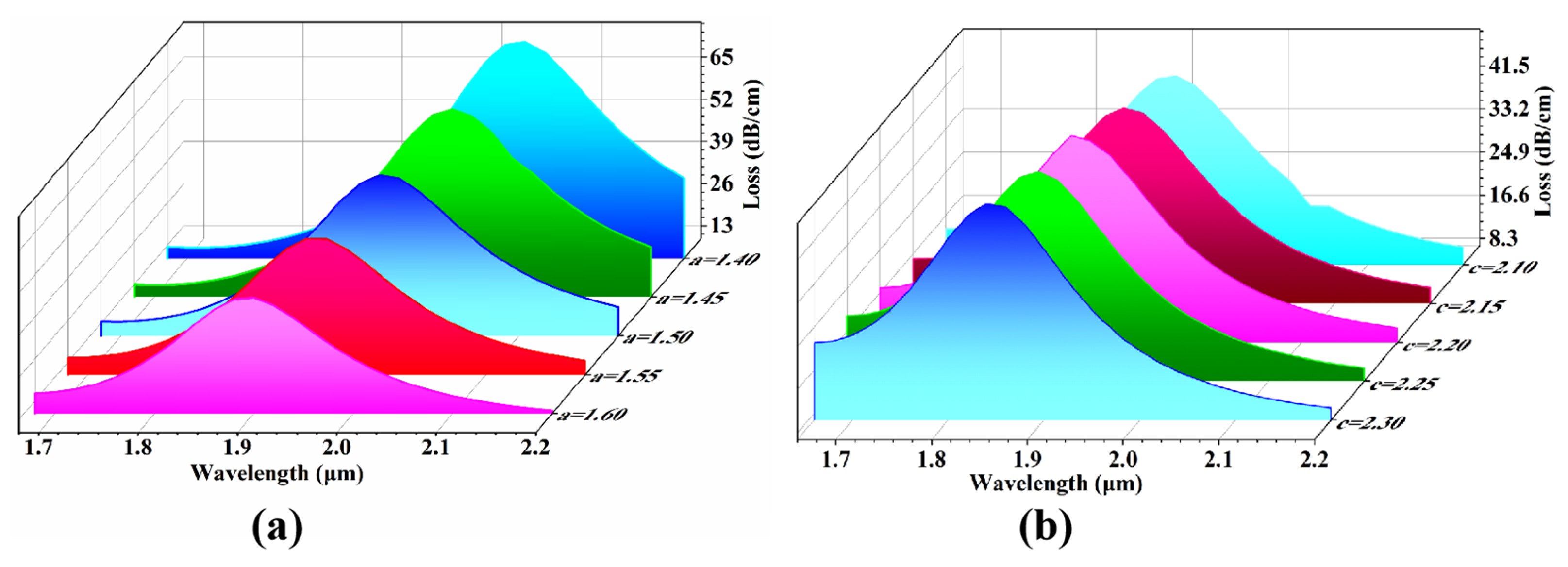
The open-loop channel dimensions of the sensor also significantly impact sensor performance. Figure 4 illustrates the effect of U-shaped opening dimensions on the loss curve of this proposed sensor at the polished plane. As shown in Figure 4a, the loss spectrum exhibits a blueshift phenomenon at the resonance peak as the short axis of the sensor increases. The primary reason is that increased dimensions will increase the coverage area of the gold film, thereby enhancing the surface plasmon effect [63,64]. This will result in an increase in the real part of the effective refractive index of the surface plasmon mode, wherein, as shown in Figure 4b, an increase in the major axis shortens the separation of the surface plasmonic materials from the core layer, thereby facilitating energy coupling [65]. Therefore, it is very important to select the appropriate open-loop channel parameters for sensor performance. Following these analyses, the short-axis radius of 1.50 μm and the long-axis radius of 2.20 μm were selected as the optimized parameters.
Figure 4.
(a) Effect on the loss spectrum of a test object with a refractive index of 1.26 when using a U-shaped cavity short half-shaft. (b) Effect of the long semi-axis on the loss spectrum.
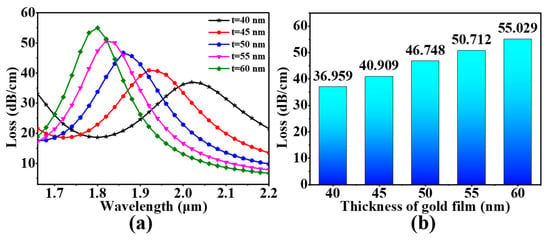
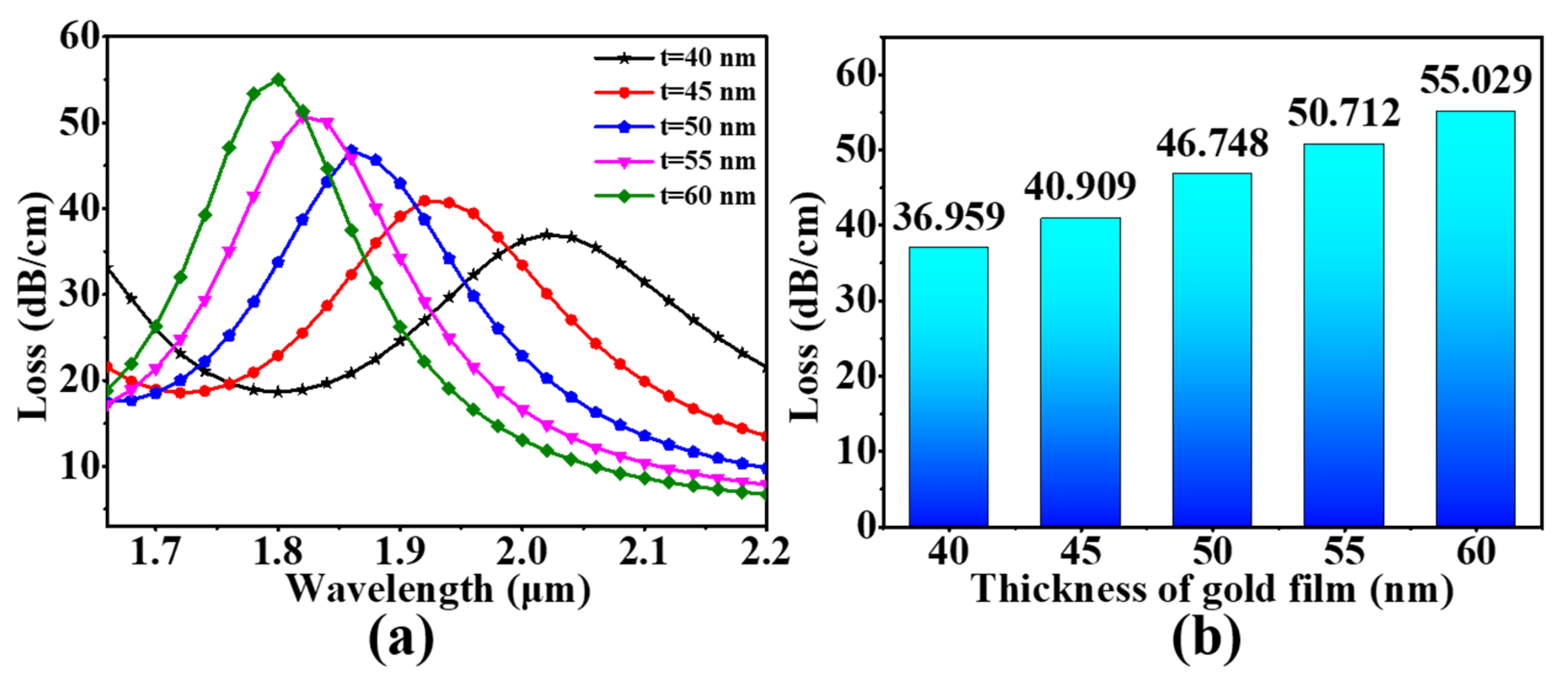
As a plasma excitation material, deposition of the gold film is performed on the sensor’s open-loop channel. Figure 5a shows the effect of varied gold film thickness (t) from 40 nm to 70 nm on the loss spectrum. Two main trends can be observed: First, the resonance peak undergoes a systematic blueshift (from about 1.93 μm to 1.87 μm). This is because, as the gold film thickens, the real part of the effective refractive index of the surface plasmon polariton mode decreases, resulting in a phase matching point, with the core fundamental mode moving to a shorter wavelength [66,67]. Secondly, the peak loss initially increases significantly and then tends to be saturated. When t increases from 40 nm to 50 nm, the peak loss increases sharply, because the thicker gold film can support more localized and stronger SPP modes, thereby enhancing energy coupling [68]. However, when t exceeds 50 nm, the peak loss increases slowly, which is due to the additional ohmic loss introduced by the excessively thick metal layer, partially hindering the effective interaction between the evanescent field and the analyte [69]. Therefore, t = 50 nm is the best balance between high coupling efficiency and acceptable propagation loss.
Figure 5.
(a) Loss spectrum under the gold film thicknesses and (b) their corresponding maximum loss values.
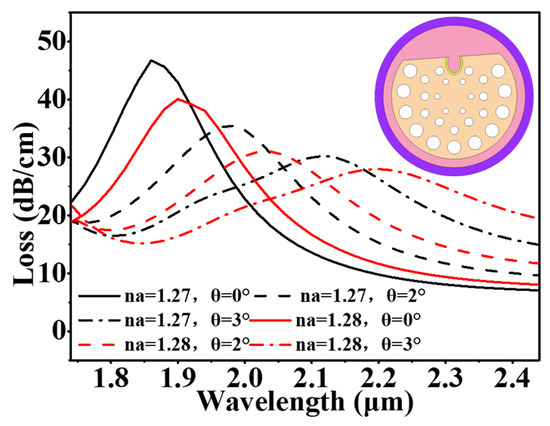
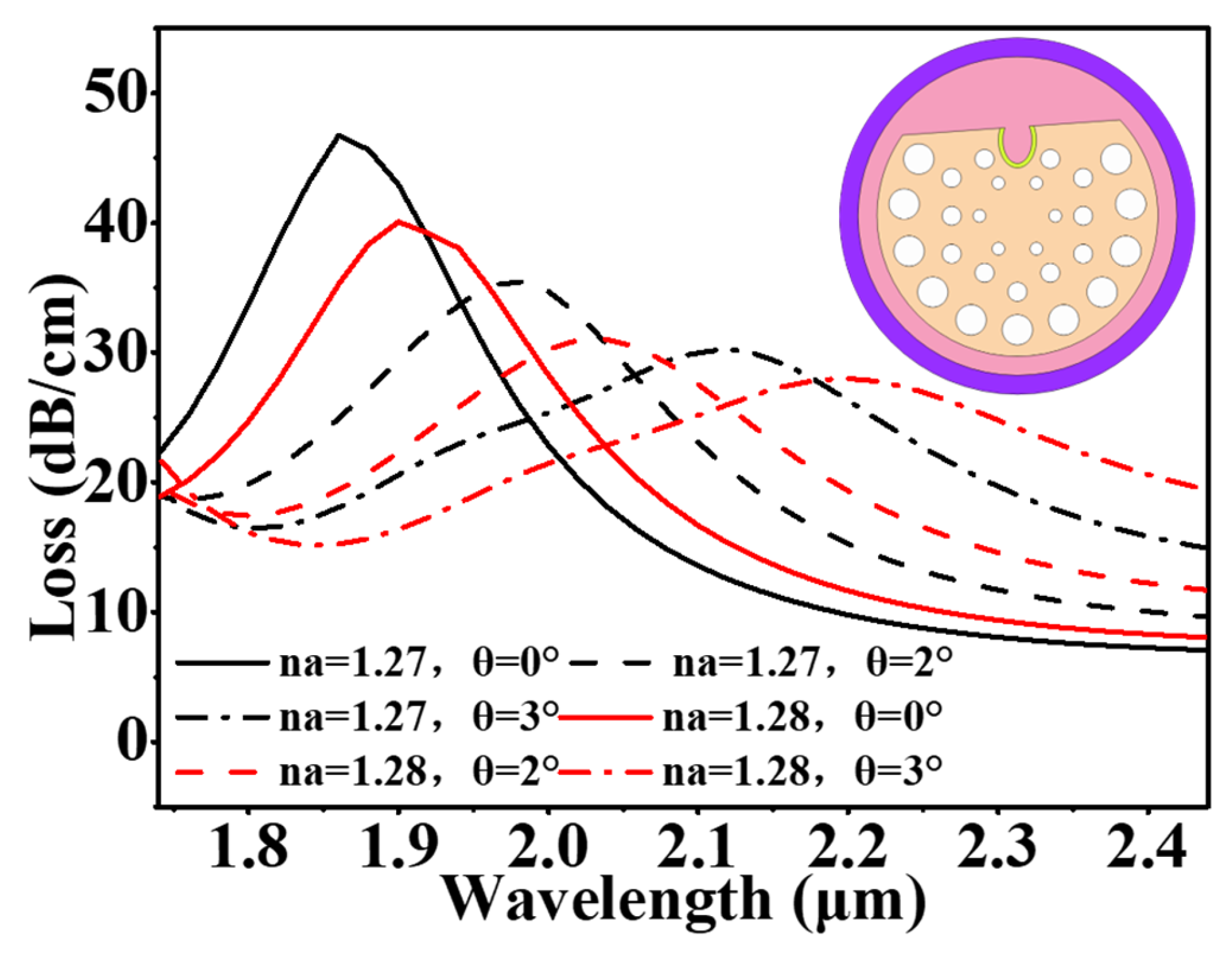
In the fabrication process, the polished surface of the D-PCF sensor is an important part of the processing, and its sensitivity to the change in the inclination angle will directly affect the actual production of the sensor. Therefore, we studied the impact of the polishing plane of the sensor at different angles on the performance of the sensor [70]. As illustrated from Figure 6, when the analyte RI is equal to 1.27 and 1.28, the polishing plane is set to 0°, 2° and 3°, respectively. The inset depicts the sensor’s two-dimensional cross-section at a 3° inclination angle of the D-type platform. The figure indicates that the resonant wavelength experiences a redshift as the inclination angle of the polishing plane increases. However, for inclination angles of 2° and 3°, the sensor exhibits negligible deviation from its non-offset state; that is, the sensitivity remains approximately unchanged [71]. The tilt angle of the polishing plane has a significant effect on the performance of the sensor. When the inclination angle increases from 0° to 3°, the resonance peak has a significant redshift, and the full width at half maximum also increases significantly. This shows that the precise control of the polishing angle is very important in the sensor preparation process [72]. In order to obtain stable and predictable performance, the tilt angle should be as close as possible to 0°. We recommend that the actual machining tolerance be controlled within ±0.5° [73].
Figure 6.
Performance of the sensor in multiple polishing plane angles, accompanied by an inset diagram showing the fiber’s cross-sectional geometry during tilt polishing.
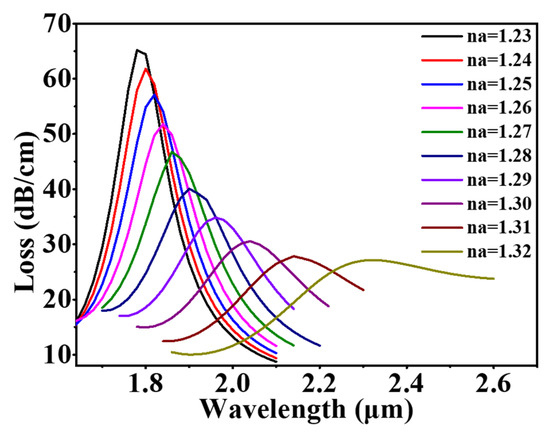
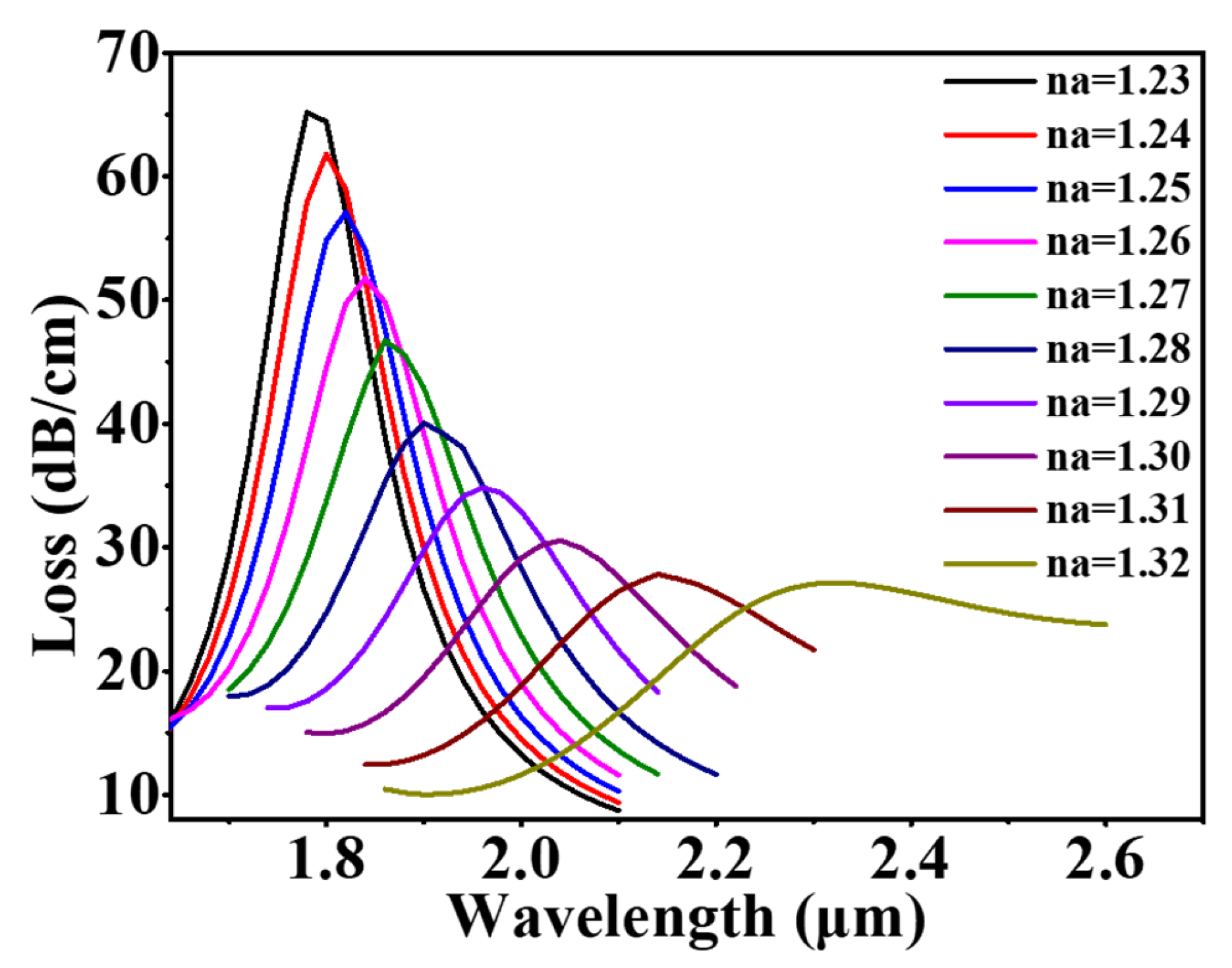
Figure 7 presents the Y-polarized fundamental mode’s confinement loss of the D-type PCF-SPR sensor across a sample refractive index range of 1.23 to 1.32. The simulation results (Figure 7) show that the resonance wavelength of this sensor exhibits a significant redshift as the refractive index of the analyte increases. This trend is observed under the optimized structural parameters determined from previous analyses (i.e., d1 = 1.0 µm, d2 = 1.5 µm, d2 = 3.0 µm, P = 3.0 µm, gold film thickness = 50 nm, and a polishing angle of 0°). This phenomenon arises because variations in the analyte’s refractive index directly alter the effective refractive index (Re [neff]) of the surface plasmon polariton mode [74,75]. This, in turn, alters its phase-matching conditions with the Y-polarized fundamental mode, leading to a redshift of the resonant peak observed in the spectra [76]. Specifically, the resonance wavelength observed in this article continuously changes from 1.86 μm to 2.32 μm, and the wavelength sensitivity of the sensor gradually increases during this process.
Figure 7.
Loss curves of surface plasmon resonance fiber optic sensors at various refractive indices.
It should be pointed out that in the performance evaluation of PCF-SPR sensors, wavelength sensitivity is a crucial technical parameter, and its mathematical expression is [77,78,79]:
In the formula, Δλpeak demonstrates the influence of the object’s refractive index on the resonance wavelength. is the variation in the refractive index of the analyte. It can be observed from Figure 7 that, during the period where the refractive index of the sensor loss increases from 1.23 to 1.32, the average offset of the resonance wavelength that corresponds with the peak sensor loss is 0.05 μm. The obtained results reveal a non-linear enhancement in sensor sensitivity with increasing refractive index, achieving a peak response within the reference range of 1.32–1.33. The sensor achieves a maximum wavelength sensitivity of 18,500 nm/RIU, which can enable accurate detection of the detected material.
Assuming a spectrometer wavelength resolution of Δλmin = 0.1 nm, the corresponding refractive index resolution of this sensor can be determined through calculation as [80,81,82]:
The ∆λpeak in the formula analyzes the change in the resonance wavelength corresponding to the change in the refractive index of the object; ∆na is the change in the refractive index of the analyte. The peak refractive index resolution reached by the sensor is 5.41 × 10⁻⁶ RIU, as derived from the experimental fitting results.
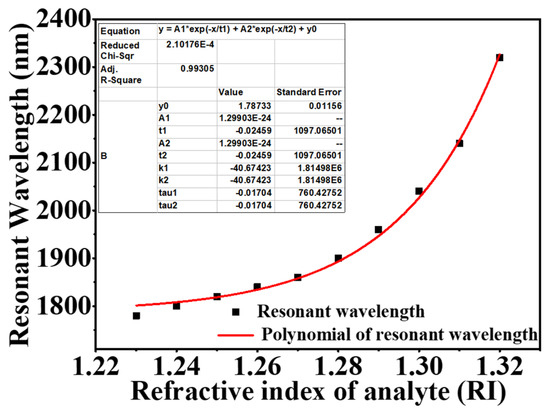
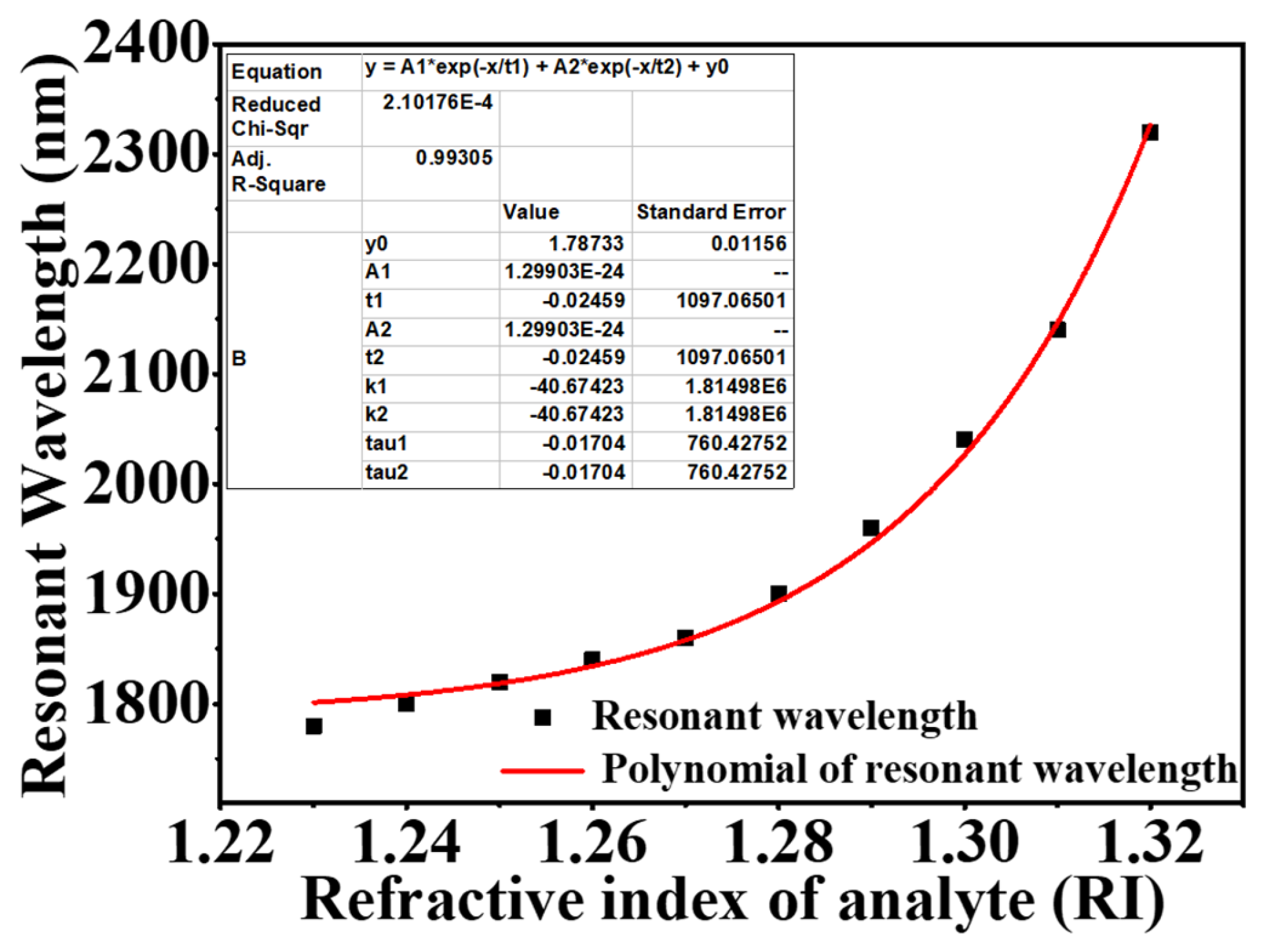
Figure 8 clearly illustrates the correlation between analyte resistivity and resonant wavelength. It can be observed that the response of the resonant wavenumber to variations in the analyte’s refractive index is not simply a straight-line relationship but exhibits distinct non-linear characteristics [83]. After fitting, the coefficient of determination r2 was adjusted to 0.99, demonstrating excellent model fit. This nonlinear response indicates that the sensor’s sensitivity varies with the refractive index of the analysis, providing vital guidance for optimizing the sensor’s behavior.
Figure 8.
Across the refractive index range of 1.23 to 1.32, the resonant wavelength shifts in response to changes in the analyte’s refractive index, with the interpolation table derived from polynomial fitting.
Table 1 presents a performance comparison of several commonly proposed photonic crystal fibers [84,85,86,87,88,89]. From this comparison, it can be clearly observed that the sensing range of our proposed sensor lies between 1.23 and 1.32. Although this range is narrower than that of some other sensors, it is relatively broad, enabling application in various environments where the analyte content is low. Under such low-refractive-index conditions, many sensors fail to achieve the required sensitivity, which gives our sensor a strong competitive advantage. Moreover, when compared with the structural designs of other sensors, it is evident that the configuration introduced in this paper is simpler. This simplicity not only streamlines the fiber fabrication process but also facilitates broader practical application. Notably, when the analyte refractive index (RI) is 1.32, the proposed sensor achieves a maximum sensitivity of 18,500 nm/RIU, surpassing that of most existing sensors. For fibers that exhibit even higher sensitivity than ours, their sensing ranges tend to be limited, making them suitable only for high-refractive-index scenarios.
Table 1.
Performance comparison between the proposed sensor and several representative photonic crystal fiber architectures.
4. Conclusions
Based on the aforementioned research, a novel D-shaped cross-section, U-shaped open-loop channel PCF transducer utilizing surface plasmon polarization effects has been proposed. Computational modeling of the transducer’s structure was performed, with the results subjected to numerical analysis. In contrast to conventional methods of depositing gold films onto polished surfaces, the model employed herein involves depositing gold films onto opening channels to stimulate surface plasmon resonance effects. Through this coating method, the resonance effect can be enhanced with improved spectral sensitive performance of the transducer. In this way, the proposed sensor design enables a reduction in gold film coverage, which streamlines fabrication and improves cost-effectiveness. Utilizing the finite element method, this sensor demonstrates effective low-refractive-index detection within the 1.23–1.32 range, with the maximum spectral sensitivity of 18,500 nm/RIU and the resolution of 5.41 × 10⁻⁶ RIU. Excellent sensing performance enables its use in scenarios with high accuracy requirements, such as biochemical sensing and virus detection.
Author Contributions
Conceptualization, Y.Z., J.G., X.Y. and Z.Y.; data curation, R.C., J.G., X.Y. and Z.Y.; formal analysis, X.Y. and Z.Y.; methodology, Y.Z., J.L., X.Y. and Z.Y.; resources, Y.Z., J.L., H.L. and R.C.; software, Y.Z., X.Y. and Z.Y.; data curation, Y.Z., X.Y. and Z.Y.; writing—original draft preparation, J.G., X.Y. and Z.Y.; writing—review and editing, Y.Z. and X.Y. All authors have read and agreed to the published version of the manuscript.
Funding
The authors are grateful to the support provided by the National Natural Science Foundation of China (Nos. 51606158); the Youth Project of Shanxi Basic Research Program (202303021222282; 202403021222347); and the Shanxi Province Higher Education Science and Technology Innovation Plan Project (2023L418).
Institutional Review Board Statement
Not applicable.
Informed Consent Statement
Not applicable.
Data Availability Statement
Data is contained within the article.
Conflicts of Interest
The authors declare no conflicts of interest.
References
- Sharma, A.K.; Kumar, A.; Kaur, B. Optical Fiber Technology A Review of advancements (2007–2017) in plasmonics-based optical fi ber sensors. Opt. Fiber Technol. 2018, 43, 20–34. [Google Scholar]
- Yan, D.X.; Xu, L.L.; Sun, S.; Wang, Y.; Li, J.; Li, X.J.; Zhang, L.; Li, J.N. A Novel Paradigm for Fabricating Terahertz Hollow-Core Negative Curvature Fibers. IEEE Trans. Terahertz Sci. Technol. 2026, 16, 318–330. [Google Scholar]
- Li, Y.R.; Liu, W.H.; Liu, R.C.; Gao, J.J.; Feng, J.W.; Xu, S.C.; Li, Z.; Jiang, S.Z.; Du, X.J. 3D hybrid arrayed Ag/MOF multi-plasmon resonant cavity system for high-performance SPR sensing. Opt. Laser Technol. 2023, 167, 109825. [Google Scholar]
- Liu, G.F.; Wang, Z.X.; Sun, W.; Lin, X.H.; Wang, R.; Li, C.H.; Zong, L.; Fu, Z.L.; Liu, H.P.; Xu, S.C. Robust emission in near-infrared II of lanthanide nanoprobes conjugated with Au (LNPs-Au) for temperature sensing and controlled photothermal therapy. Chem. Eng. J. 2023, 452, 139504. [Google Scholar] [CrossRef] [Scilit]
- Yang, F.; She, S.C.; Li, J.T.; Yue, Z.; Zhang, Q.Y.; Zhang, Y.T.; Ding, X.; Yao, J.Q. Terahertz biosensor supported by quasi-bound states in the continuum for lung cancer cell sensing. Chin. Opt. Lett. 2025, 23, 023604. [Google Scholar] [CrossRef] [Scilit]
- Li, L.Y.; Chen, F. Tunable four-band metamaterial absorber and sensor based on a stacking double-ring Dirac semimetal structure design. Phys. Lett. A 2025, 544, 130489. [Google Scholar] [CrossRef] [Scilit]
- Zeng, N.; Chen, Z.Q.; Yi, Z.; Cheng, S.B.; Ahmad, S.; Tang, C.J.; Gao, F.; Li, B.X. Terahertz Multi-band Tunable Refractive Index Sensing Graphene Absorber Based on Surface Plasmon Resonance. Phys. B Condens. Matter 2026, 734, 418608. [Google Scholar] [CrossRef] [Scilit]
- Wang, H.Y.; Ma, R.; Liu, G.D.; Wang, L.L.; Lin, Q. Optical force conversion and conveyor belt effect with coupled graphene plasmon waveguide modes. Opt. Express 2023, 31, 32422. [Google Scholar] [CrossRef] [Scilit] [PubMed]
- Gao, W.K.; Chen, F.; Yang, W.X. Modulator and sensor based on in-plane mode weak coupling in borophene metamaterial. Photonics Nanostruct.—Fundam. Appl. 2025, 63, 101366. [Google Scholar] [CrossRef] [Scilit]
- Singh, Y.; Paswan, M.K.; Raghuwanshi, S.K. Sensitivity Enhancement of SPR Sensor with the Black Phosphorus and Graphene with Bi-layer of Gold for Chemical Sensing. Plasmonics 2021, 16, 1781–1790. [Google Scholar] [CrossRef] [Scilit]
- Tang, X.Y.; Li, Y.C.; Chen, F.; Yang, W.X. Gas concentration and refractive index sensor based on plasmonic induced absorption in metal-insulator-metal waveguide coupled with arc resonators structure. Phys. Scr. 2024, 99, 065561. [Google Scholar]
- Ibrahim, J.; Al Masri, M.; Verrier, I.; Kampfe, T.; Veillas, C.; Celle, F.; Cioulachtjian, S.; Lefèvre, F.; Jourlin, Y. Surface Plasmon Resonance Based Temperature Sensors in Liquid Environment. Sensors 2019, 19, 3354. [Google Scholar] [CrossRef] [Scilit] [PubMed]
- Xu, Z.X.; Xu, C.; Li, J.; Li, X.Y.; Lu, Z.Y. Preparation and Properties of air-quenched high-titanium slag. J. Southwest Univ. Sci. Technol. 2024, 39, 16–22. [Google Scholar]
- Zhang, H.Y.; Chen, Z.Q.; Yi, Z.; Cheng, S.B.; Ahmad, S.; Tang, C.J.; Deng, J. Three band THz perfect absorption device based on graphene metasurface structure. Phys. E Low-Dimens. Syst. Nanostruct. 2026, 181, 116542. [Google Scholar] [CrossRef] [Scilit]
- Zhang, L.; Zhen, Y.Q.; Tong, L.M. Optical micro/nanofiber enabled tactile sensors and soft actuators: A review. Opto-Electron. Sci. 2024, 3, 240005. [Google Scholar] [CrossRef] [Scilit]
- Wu, J.H.; Xu, Z.L.; Shi, Y.; Liang, Y.; Sun, Q. Phase matching sampling algorithm for sampling rate reduction in time division multiplexing optical fiber sensor system. Opto-Electron. Technol. 2025, 1, 250006. [Google Scholar] [CrossRef] [Scilit]
- Chen, G.; Wang, A.Q.; Zhang, Y.; Zhang, F.; Xu, D.; Liu, Y.; Zhang, Z.; Yan, Z.; Li, Z.; Li, H.; et al. Operando monitoring of state of health for lithium battery via fiber optic ultrasound imaging system. Opto-Electron. Sci. 2025, 4, 240036. [Google Scholar] [CrossRef] [Scilit]
- Wei, X.R.; Liang, Y.Z.; Zhang, X.H.; Li, R.; Wei, H.; He, Y.; Shen, L.; Fang, Y.; Xu, T.; Peng, W. Multi-resonance enhanced photothermal synergistic fiber-optic Tamm plasmon polariton tip for high-sensitivity and rapid hydrogen detection. Opto-Electron. Sci. 2025, 4, 240029. [Google Scholar]
- Jorgenson, R.C.; Yee, S.S. A fiber-optic chemical sensor based on surface plasmon resonance. Sens. Actuators B 1993, 12, 213–220. [Google Scholar] [CrossRef] [Scilit]
- Sherburne, M.; Harjes, C.; Klitsner, B.; Gigax, J.; Ivanov, S.; Schamiloglu, E.; Lehr, J. Rapid Prototyping for Nanoparticle-Based Photonic Crystal Fiber Sensors. Sensors 2024, 24, 3707. [Google Scholar] [CrossRef] [Scilit] [PubMed]
- Feng, H.G.; Chen, X.; Zhu, R.Z.; Xiong, Y.; Chen, Y.; Lu, Y.; Xu, F. Seeing at a distance with multicore fibers. Opto-Electron. Adv. 2024, 7, 230202. [Google Scholar] [CrossRef] [Scilit]
- Zhao, L.; Yang, H.; Yi, Z.; Tang, C.J.; Deng, J.; Wang, J.Q.; Li, B.X.; Cheng, S.B. D-type single- and dual-core fiber-optic magnetic field sensor based on surface plasmon resonance. Int. J. Mod. Phys. B 2026, 40, 2650115. [Google Scholar] [CrossRef] [Scilit]
- Maidi, A.M.; Yakasai, I.; Abas, P.E.; Nauman, M.M.; Apong, R.A.; Kaijage, S.; Begum, F. Design and Simulation of Photonic Crystal Fiber for Liquid Sensing. Photonics 2021, 8, 16. [Google Scholar] [CrossRef] [Scilit]
- Zhang, S.X.; Li, H.; Fan, C.Z.; Zeng, Z.; Xiong, C.; Wu, J.; Yan, Z.; Liu, D.; Sun, Q. Adaptive decentralized AI scheme for signal recognition of distributed sensor systems. Opto-Electron. Adv. 2024, 7, 240119. [Google Scholar] [CrossRef] [Scilit]
- Montoya Cardona, J.A.; Gomez Cardona, N.D.; Gonzalez Valencia, E.; Torres Trujillo, P.; Reyes Vera, E. Tunable Mode Converter Device Based on Photonic Crystal Fiber with a Thermo-Responsive Liquid Crystal Core. Photonics 2020, 7, 3. [Google Scholar]
- Wang, Q.; Wang, X.Z.; Song, H.; Zhao, W.M.; Jing, J.Y. A dual channel self-compensation optical fiber biosensor based on coupling of surface plasmon polariton. Opt. Laser Technol. 2020, 124, 106002. [Google Scholar] [CrossRef] [Scilit]
- Zhang, H.; Chen, Y.; Feng, X.; Xiong, X.; Hu, S.; Jiang, Z.; Dong, J.; Zhu, W.; Qiu, W.; Guan, H. Long-range surface plasmon resonance sensor based on side-polished fiber for biosensing applications. IEEE J. Sel. Top. Quantum Electron. 2018, 25, 1–9. [Google Scholar]
- Naik, G.V.; Shalaev, V.M.; Boltasseva, A. Alternative plasmonic materials: Beyond gold and silver. Adv. Mater. 2013, 25, 3264–3294. [Google Scholar] [CrossRef] [Scilit] [PubMed]
- Hu, J.; Lin, W.H.; Shao, L.Y.; Xue, C.; Zhao, F.; Xiao, D.; Ran, Y.; Meng, Y.; He, P.; Yu, Z.; et al. High-resolution tumor marker detection based on microwave photonics demodulated dual wavelength fiber laser sensor. Opto-Electron. Adv. 2024, 7, 240105. [Google Scholar] [CrossRef] [Scilit]
- Dhara, P.; Singh, V.K.; Kumar, A.; Olivero, M.; Perrone, G. Reflection based silicon incorporated silver coated fiber optic SPR sensor for refractive index and temperature measurement. Microsyst. Technol. 2024, 30, 913–922. [Google Scholar] [CrossRef] [Scilit]
- An, G.; Hao, X.; Li, S.; Yan, X.; Zhang, X. D-shaped photonic crystal fiber refractive index sensor based on surfaceplasmon resonance. Appl. Opt. 2017, 56, 6988–6992. [Google Scholar] [PubMed]
- Rahman, M.A.; Ahmed, T.; Haque, M.I.; Anower, M.S. A Photonic Crystal Fiber Based Asymmetric Slotted Structured Highly Sensitive Refractive Index Plasmonic Biosensor. J. Sens. Technol. 2022, 12, 1–17. [Google Scholar] [CrossRef]
- Qu, Y.W.; Zhang, C.L.; Li, D.; Liu, X.L.; Yuan, J.H.; Yan, B.B.; Wang, K.R.; Sang, X.Z.; Yu, C.X. A Trench D-Shaped Photonic Crystal Fiber Refractive Index Sensor Based on Surface Plasmon Resonance. Plasmonics 2026, 21, 1027–1041. [Google Scholar]
- Yan, D.X.; Wang, Z.W.; Li, X.J.; Zhang, L.; Li, J.N. 3D-Printed Linear-Polarization Multiplexed Metasurface for Independent Terahertz Focusing and Orbital Angular Momentum Beam Generation. IEEE J. Sel. Top. Quantum Electron. 2026, 32, 4700811. [Google Scholar] [CrossRef] [Scilit]
- Yang, J.Y.; Wang, J.Q.; Xue, M.S.; He, J.N.; Xiang, Y.H.; Zhao, C. Design of a broadband achromatic metalens for near-diffraction-limited focusing of long-wavelength infrared waves. Photonics Nanostruct.—Fundam. Appl. 2026, 71, 101554. [Google Scholar] [CrossRef] [Scilit]
- Cui, C.S.; Gao, X.; Chen, Z.Q.; Yi, Z.; Cheng, S.B.; Ahmad, S.; Tang, C.J.; Deng, J. Transient Simulation and Optimization of Planar Heat Source System Based on Finite Element Method. Mod. Phys. Lett. B 2026, 40, 2650081. [Google Scholar] [CrossRef] [Scilit]
- Wang, Q.H.; Ju, X.W.; Yang, C.; Zhang, Y.; Hu, J.Y. An ultra-narrow multi-band perfect absorber based on single dielectric nano-cylinder array with surface lattice resonance. Phys. Scr. 2025, 100, 035538. [Google Scholar] [CrossRef] [Scilit]
- Chen, X.M.; Yan, D.X.; Wang, Y.; Zhang, L.; Sun, S.; Li, J.N. Two Novel Mechanisms for Suppressing Higher-Order Radial Modes in Dual-Ring Core Hollow-Core Fibers for OAM Transmission. J. Light. Technol. 2025, 43, 9382–9395. [Google Scholar] [CrossRef] [Scilit]
- Wu, G.X.; Zhu, R.Z.; Lu, Y.Q.; Hong, M.; Xu, F. Optical scanning endoscope via a single multimode optical fiber. Opto-Electron. Sci. 2024, 3, 230041. [Google Scholar] [CrossRef] [Scilit]
- Cheng, Y.X.; Xu, H.; Yu, H.F.; Wang, X.; Zhang, X.; Dong, Y.; He, L.; Hou, H.; Chen, Z. 2-bit encoding, sensing and slow light based on triple plasmonic induced transparency effect. Sci. Sin.—Phys. Mech. Astron. 2026, 56, 224211. [Google Scholar]
- Yuan, T.T.; Zhang, X.T.; Yang, S.T.; Wang, D.; Yuan, L. Three-dimensional integrated optical fiber devices: Emergence and applications. Opto-Electron. Technol. 2025, 1, 250007. [Google Scholar] [CrossRef] [Scilit]
- Zhang, H.; Wang, Q.Q.; Yang, J.Y.; Mei, Y.W.; Wang, J.Q. Anapole and q-BIC coexcitation in dumbbell-shaped dielectric metasurfaces. Opt. Commun. 2025, 596, 132581. [Google Scholar] [CrossRef] [Scilit]
- Fu, P.R.; Chen, Z.Q.; Yi, Z.; Cheng, S.B.; Ahmad, S.; Li, B.X. Graphene-Based Terahertz Perfect Absorber with Broadband, Wide-Angle, and Dynamically Tunable Performance. Phys. Status Solidi Rapid Res. Lett. 2026, 20, e70163. [Google Scholar] [CrossRef] [Scilit]
- Fu, S.M.; Yang, X.Y. A terahertz four-band high-sensitivity perfect absorber based on Dirac semimetal. Phys. Lett. A 2026, 587, 131760. [Google Scholar] [CrossRef] [Scilit]
- Yang, X.Y.; Guo, Y.; Cheng, S.S. Ultrabroadband Absorber Based on Titanium Nitride Concentric Dual-Ring Array for High-Efficiency Solar Energy Harvesting. Phys. B Condens. Matter 2026, 733, 418581. [Google Scholar] [CrossRef] [Scilit]
- Huang, X.; Lin, Q.; Xia, S.X.; Zhai, X.; Liu, G.D. Dynamic polarization control of strongly coupled quasi-guided modes enables high-efficiency THG. Opt. Express 2025, 33, 48707–48716. [Google Scholar] [CrossRef] [Scilit] [PubMed]
- Zhao, H.M.; Wang, X.Y.; Lin, Q.; Zhai, X.; Liu, G.D. High-efficiency control of cross-polarization conversion at communication wavelengths using a tunable borophene-plasmonic metasurface. J. Phys. D Appl. Phys. 2026, 59, 025105. [Google Scholar]
- Cao, Y.J.; Wu, C.J.; Li, X.J.; Zhang, L.; Li, J.N.; Yan, D.X. A deep learning-surrogate optimization strategy for the design of two-dimensional terahertz metamaterial absorbers. Infrared Phys. Technol. 2026, 153, 106350. [Google Scholar] [CrossRef] [Scilit]
- Wang, Y.; He, Z.N.; Li, X.; Chen, X.M.; Wu, S.B.; Hu, Y.L.; Shen, X.B. Design of a broad-spectrum efficient metamaterial absorber in the far-infrared band. Opto-Electron. Eng. 2025, 52, 250110. [Google Scholar]
- Mei, Y.W.; Wang, J.Q.; Wang, Q.Q.; Xue, M.S.; He, J.N.; Yang, J.Y. Anapole-enhanced local fields for low-power optical trapping in all-dielectric metasurfaces. Opt. Commun. 2026, 607, 132938. [Google Scholar] [CrossRef] [Scilit]
- Tian, M.; Wei, J.S.; Lv, E.G.; Li, C.H.; Liu, G.F.; Sun, Y.; Yang, W.; Wang, Q.Z.; Shen, C.C.; Zhang, C.; et al. Drug evaluation platform based on non-destructive and real-time in situ organoid fate state monitoring by graphene field-effect transistor. Chem. Eng. J. 2024, 498, 155355. [Google Scholar]
- Zhao, C.C.; Yan, D.X.; Li, X.J.; Wang, Y.; Zhang, L.; Li, J.N. A single dual-frequency reflective metasurface for simultaneous multi-mode orbital angular momentum multiplexing. Opt. Commun. 2025, 575, 131313. [Google Scholar] [CrossRef] [Scilit]
- Mao, X.R.; Li, H.Y.; Gao, W.; Liu, M.S.; Li, B.X. Terahertz absorber with high sensitivity in triple bands based on AlCuFe. Photonics Nanostruct.—Fundam. Appl. 2026, 71, 101566. [Google Scholar] [CrossRef] [Scilit]
- Guo, Z.P.; Zhang, Z.; Liu, G.R.; Yang, H.; Sun, J.H. Enhanced oxidation resistance of graphene through strain-electric coupling. Comput. Mater. Sci. 2026, 262, 114406. [Google Scholar]
- Wang, L.; Lin, Q.; Wang, L.L.; Liu, G.D. Tunable high-Q perfect absorber by employing doubly degenerate quasi-bound states in the continuum. J. Appl. Phys. 2025, 137, 234303. [Google Scholar] [CrossRef] [Scilit]
- Zhang, F.Y.; Liu, G.R.; Sun, X.F.; Dai, Y.Y.; Ma, J.Y.; Xian, T.; Yang, H. Dual built-in electric fields in NiCo-LDH/Co9S8/Ag hollow nanocages synergistically boost solar-driven CO2 photoreduction. Sep. Purif. Technol. 2025, 379, 134913. [Google Scholar] [CrossRef] [Scilit]
- Wang, H.G.; Zhu, J.; Yi, Z.; Cheng, S.B.; Zhang, J.G.; Li, B.X. A graphene-based tunable terahertz (THz) band metasurface broadband absorber under plasmon resonance effect. Solid State Commun. 2026, 412, 116409. [Google Scholar] [CrossRef] [Scilit]
- Hu, D.; Chen, Z.Q.; Huang, W.W.; Yang, J.T.; Yang, W.Z.; Chen, J.; He, L.H.; Xu, H.; Hou, H.L.; Yang, H. Geometric Phase Wavefront Manipulation for Arbitrary Polarization States Based on Metasurfaces. Sci. Sin.—Phys. Mech. Astron. 2026, 56, 104211. [Google Scholar] [CrossRef] [Scilit]
- Luo, M.X.; Yi, Z.; Li, Y.Q.; Yang, A.Q.; Wang, S.F.; Sun, X.F.; Liu, G.R.; Yang, H. Charge transfer mechanism and boosted photocatalytic H2O2 synthesis over Cu2−xS@Au schottky junctions. Adv. Sustain. Syst. 2026, 10, e01515. [Google Scholar] [CrossRef] [Scilit]
- Xu, S.C.; Tian, M.; Li, C.H.; Liu, G.F.; Wang, J.H.; Yan, T.T.; Li, Z. Using a crumpled graphene field-effect transistor for ultrasensitive SARS-CoV-2 detection via its papain-like protease. Chem. Eng. J. 2025, 505, 159386. [Google Scholar] [CrossRef] [Scilit]
- Dai, Y.Y.; Liu, G.R.; Sun, X.F.; Ma, J.Y.; Xian, T.; Yang, H. Mn doping and ZnS nanoparticles modification on Bi2MoO6 to achieve an highly-efficient photocatalyst for TC degradation. Appl. Surf. Sci. 2025, 681, 161611. [Google Scholar] [CrossRef] [Scilit]
- Hou, A.Q.; Wang, H.G.; Chen, J.; Yi, Z.; Zhou, Z.G.; Cheng, S.B.; Ahmad, S.; Tang, C.J.; Deng, J.; Li, B. Simulation investigation on a Dirac semimetal composite microstructure-based terahertz eight-band perfect absorber. Phys. B Condens. Matter 2026, 739, 418885. [Google Scholar]
- Zeng, K.; Ke, Y.G.; Hong, Z.M.; Zeng, L.Z.; Zhou, X.X. In-situ and ex-situ twisted bilayer liquid crystal computing platform for reconfigurable image processing. Opto-Electron. Adv. 2025, 8, 250226. [Google Scholar] [CrossRef] [Scilit]
- Luo, J.; Guo, J.; Zhao, G.; Shao, Y.; Yin, Z.; Li, G. Design of an Intelligent Inspection System for Power Equipment Based on Multi-Technology Integration. Electronics 2026, 15, 827. [Google Scholar] [CrossRef] [Scilit]
- Wang, C.; Liu, G.R.; Sun, X.F.; Ma, J.Y.; Xian, T.; Yang, H. NaBH4 induces strong ferromagnetism of Bi2Fe4O9 at room temperature. Chin. Phys. B 2025, 34, 127503. [Google Scholar]
- Wang, Q.H.; Ju, X.W.; Lin, Q.; Hu, J.Y. An ultra-broadband near-perfect solar absorber based on monolayer MoS2 with titanium ring-pillar arrays. Opt. Commun. 2025, 577, 131448. [Google Scholar] [CrossRef] [Scilit]
- Liu, X.Y.; Wang, Q.H.; Zhang, J.Y.; Hu, J.Y. An ultra-broadband solar absorber based on the biomimetic moth-eye-shaped Titanium nitride nanostructures. Phys. B Condens. Matter 2025, 716, 417757. [Google Scholar] [CrossRef] [Scilit]
- Sun, X.F.; Xian, T.; Zhang, J.Q.; Ma, J.Y.; Wang, S.F.; Yi, Z.; Liu, G.R.; Kakavandi, B.; Yang, H. Sulfur vacancy-regulated interface charge transfer for boosting photocatalytic hydrogen evolution over Bi2S3−x@Cd0.7Zn0.3S hollow hexagonal nanocages. Nano Res. 2026, 19, 94908308. [Google Scholar] [CrossRef] [Scilit]
- Pan, Y.Z.; Chen, F.; Li, Y.C.; Li, C.; Gao, Y.Y.; Yang, W.X. Four-state Fano resonance electro-optical modulator and sensor based on double borophene-dielectric grating structure. Phys. Scr. 2024, 99, 085560. [Google Scholar] [CrossRef] [Scilit]
- Wang, Y.T.; Cheng, S.B.; Li, B.X.; Tang, C.J.; Gao, F.; Yi, Y.G. Mid-Infrared High-Sensitivity Four-Peak Graphene Absorber Based on Circular Ring-Nested Ellipses: Polarization-Independent Characteristics and Dynamic Tunability. Phys. E Low-Dimens. Syst. Nanostruct. 2026, 181, 116523. [Google Scholar] [CrossRef] [Scilit]
- Ghemes, C.; Dragos-Pinzaru, O.-G.; Tibu, M.; Lostun, M.; Lupu, N.; Chiriac, H. Tunnel Magnetoresistance-Based Sensor for Biomedical Application: Proof-of-Concept. Coatings 2023, 13, 227. [Google Scholar] [CrossRef] [Scilit]
- Jiang, J.X.; Yi, Y.T.; Sun, T.Y.; Song, Q.J.; Yi, Z.; Tang, C.J.; Zeng, Q.D.; Liu, Z.M.; Wu, P.H. Analysis of solar harvesting and refractive index sensing of multifunctional metamaterial perfect absorbers based on Ag discs and B 4 C–VC cube films. J. Mater. Chem. C 2025, 13, 3872–3885. [Google Scholar] [CrossRef] [Scilit]
- Lv, J.; Wang, F.; Hu, C.; Yang, L.; Fu, H.; Zeng, Y.; Chu, P.K.; Liu, C. Numerical Analysis of Multifunctional Biosensor with Dual-Channel Photonic Crystal Fibers Based on Localized Surface Plasmon Resonance. Coatings 2022, 12, 742. [Google Scholar] [CrossRef] [Scilit]
- Zeng, Y.X.; Li, B.X.; Zeng, L.L.; Zhong, G.X.; Shao, Z.Z.; Xu, H.Q.; Liu, M.L.; Chen, Z.G.; Dai, C.J. High sensitivity and ultra-narrowband perfect metamaterial absorber based on graphene metasurface. Eur. Phys. J. Plus 2025, 140, 416. [Google Scholar] [CrossRef] [Scilit]
- Garia, L.; Kumar, R.; Yoon, C.-W.; Sain, M. Photonic Crystal Fiber–Based Surface Plasmon Resonance Sensor for Precise Biochemical Refractive Index Sensing. Photonics 2026, 13, 259. [Google Scholar] [CrossRef] [Scilit]
- Shakya, A.K.; Singh, S. Design of Novel Penta Core PCF SPR RI Sensor Based on Fusion of IMD and EMD Techniques for Analysis of Water and Transformer Oil. Measurement 2022, 188, 110513. [Google Scholar] [CrossRef] [Scilit]
- Divya, J.; Selvendran, S.; Itapu, S.; Borra, V. A Novel Dual-Channel SPR-Based PCF Biosensor for Simultaneous Tuberculosis and Urinary Tract Infection Diagnosis Toward SDG3. IEEE Access 2024, 12, 85484–85498. [Google Scholar] [CrossRef] [Scilit]
- Zhang, J.Q.; Sun, X.F.; Yi, Z.; Xian, T.; Wang, S.F.; Wang, Y.M.; Liu, G.R.; Pu, Z.S.; Yang, H. Enhancing photocatalytic H2O2 production over Ag co-catalyst through charge transfer modulation. Adv. Sustain. Syst. 2026, 10, e70387. [Google Scholar]
- Singh, S.; Prajapati, Y.K. Highly Sensitive Refractive Index Sensor Based on D-Shaped PCF with Gold-Graphene Layers on the Polished Surface. Appl. Phys. A 2019, 125, 437. [Google Scholar]
- Liu, Z.Y.; Huang, Y. Preparation and Properties of Self-healing P(BA-co-NIAM)/ILs-rGO Composites. J. Southwest Univ. Sci. Technol. 2024, 39, 1–9. [Google Scholar] [CrossRef] [Scilit]
- Wang, Y.M.; Zhang, J.Q.; Sun, X.F.; Yi, Z.; Wang, S.F.; Liu, G.R.; Pu, Z.S.; Yang, H. Constructing Ag/In2S3/BiOBr double-heterojunction photocatalysts for boosting photocatalytic degradation of pollutants and H2O2 synthesis. Mater. Res. Bull. 2026, 197, 113965. [Google Scholar] [CrossRef] [Scilit]
- Dogan, Y.; Katirci, R.; Erdogan, I. Machine Learning-Based Optimization for D-Shaped PCF SPR Refractive Index Sensor. Opt. Commun. 2025, 575, 131304. [Google Scholar] [CrossRef] [Scilit]
- Zhang, Z.Z.; Zhang, X.W. The influence of geometric structure on the anomalous Nernst effect of Fe films. J. Southwest Univ. Sci. Technol. 2024, 39, 38–43. [Google Scholar]
- Sakib, M.N.; Hossain, M.B.; Al-tabatabaie, K.; Mehedi, I.; Hasan, M.; Hossain, M.; Amiri, I. High performance dual core D-shape PCF-SPR sensor modeling employing gold coat. Results Phys. 2019, 15, 102788. [Google Scholar] [CrossRef] [Scilit]
- Kamrunnahar, Q.M.; Mou, J.R.; Momtaj, M. Dual-core gold coated photonic crystal fiber plasmonic sensor: Design and analysis. Results Phys. 2020, 18, 103319. [Google Scholar] [CrossRef] [Scilit]
- Zeng, W.; Wang, Q.; Xu, L. Plasmonic refractive index sensor based on D-shaped photonic crystal fiberfor wider range of refractive index detection. Optik 2020, 223, 165463. [Google Scholar] [CrossRef] [Scilit]
- Huang, H.; Zhang, Z.; Yu, Y.; Zhou, L.; Tao, Y.; Li, G.; Yang, J. A Highly Magnetic Field Sensitive Photonic Crystal Fiber Based on Surface Plasmon Resonance. Sensors 2020, 20, 5193. [Google Scholar] [CrossRef] [Scilit] [PubMed]
- Zha, F.N.; Li, J.S.; Sun, P.J.; Ma, H.J. Highly sensitive selectively coated D-shape photonic crystal fibers for surface plasmon resonance sensing. Phys. Lett. 2019, 383, 1825–1830. [Google Scholar] [CrossRef] [Scilit]
- Yang, X.Z.; Yi, Y.T.; Lu, W.Q.; Ma, C.; Yi, Z.; Li, G.F.; Zeng, L.C.; Zeng, Q.D.; Sun, T.Y.; Ahmad, S. D-shaped photonic crystal fiber based on surface plasmon resonance for low refractive index applications. Opt. Mater. 2024, 153, 115612. [Google Scholar] [CrossRef] [Scilit]

Disclaimer/Publisher’s Note: The statements, opinions and data contained in all publications are solely those of the individual author(s) and contributor(s) and not of MDPI and/or the editor(s). MDPI and/or the editor(s) disclaim responsibility for any injury to people or property resulting from any ideas, methods, instructions or products referred to in the content. |
© 2026 by the authors. Licensee MDPI, Basel, Switzerland. This article is an open access article distributed under the terms and conditions of the Creative Commons Attribution (CC BY) license.