Article

Effect of Laser Power on Microstructure and Mechanical Properties of GH4141 + 0.2 wt.% Y2O3 Alloy Fabricated by Laser Powder Bed Fusion

AECC Beijing Institute of Aeronautical Materials, Beijing 100095, China
*
Author to whom correspondence should be addressed.
Coatings 2026, 16(6), 712; https://doi.org/10.3390/coatings16060712 (registering DOI)
Submission received: 13 April 2026 / Revised: 18 May 2026 / Accepted: 9 June 2026 / Published: 15 June 2026
(This article belongs to the Special Issue Advances in Surface Welding Techniques for Metallic Materials)

Abstract

GH4141 + 0.2 wt.% Y2O3 superalloy was fabricated using laser powder bed fusion (LPBF) technology and subjected to solution and ageing heat treatments. The effects of laser power (1100, 1300, 1500 W) on the microstructure and mechanical properties of the ODS nickel-based superalloy were investigated. The results indicate that as the laser power increased from 1100 W to 1300 W, defects such as cracks and pores in the specimens decreased, the grains were refined, and the microstructure became more uniform; when the laser power was further increased to 1500 W, the grain size coarsened significantly, precipitation phases at the grain boundaries became coarser or locally aggregated, and crack sensitivity increased. EDS analysis revealed enrichment of C, Cr, Mo and Ti in the dark phases at the grain boundaries, which may be associated with MC-type and M23C6-type carbides; no significant agglomeration of Y2O3 particles was observed in the matrix. Room-temperature tensile properties exhibited a pattern of initially increasing and then decreasing with increasing laser power. The tensile strength and elongation after fracture of the specimens were relatively similar under 1100 W and 1500 W conditions, whilst the specimen tested at 1300 W achieved the optimal balance of strength and toughness, with a tensile strength of 1460 MPa and an elongation after fracture of 14.3%, representing increases of approximately 9.8% and 54% compared to the 1100 W and 1500 W conditions, respectively. At 760 °C, the 1300 W specimens still maintained excellent high-temperature strength.

1. Introduction

Due to their excellent high-temperature strength, oxidation resistance and thermal corrosion resistance, nickel-based superalloys are widely used in high-temperature hot-end components such as aeroengines and gas turbines [1,2,3,4]. As equipment continues to evolve towards higher thrust-to-weight ratios, higher operating temperatures and more complex geometries, greater demands are being placed on the high-temperature strength, ductility and microstructural stability of nickel-based superalloys. Consequently, the development of fabrication technologies for nickel-based superalloys that combine excellent angshin-service performance with the ability to form complex components holds significant engineering value.
GH4141 alloy is a typical γ′ precipitation-hardened nickel-based high-temperature alloy, characterised by good high-temperature strength, oxidation resistance and processability, and holds promising prospects for application in high-temperature load-bearing components in the aerospace industry. Regarding GH4141 alloy, numerous studies have been conducted by researchers focusing on aspects such as deformation behavior and heat treatment control. Liu et al. [5] investigated the work-hardening behavior of GH4141 alloy during cold deformation, noting that its mechanical response is closely related to microstructural evolution. Wu et al. [6] analysed the dynamic recrystallisation behavior of GH4141 alloy during hot deformation, concluding that deformation conditions have a significant influence on grain refinement and microstructural homogenisation. Zhang et al. [7,8] found that the solution treatment temperature can significantly affect the morphology of the γ′ phase and the high-temperature mechanical properties of GH4141 alloy, whilst subsequent ageing treatment further alters the size and volume fraction of the γ′ phase, as well as the alloy′s overall performance. Atabay et al. [9] demonstrated that LPBF can achieve dense forming of Rene 41 alloy, but the as-printed microstructure typically exhibits fine columnar dendrites and distinct orientation features, making subsequent microstructural control crucial. Overall, GH4141 alloy possesses good strengthening potential; however, under more severe service conditions, there remains scope for further improvement in its high-temperature microstructural stability, grain boundary strengthening effects, and the synergy between strength and toughness.
The oxide dispersion strengthening (ODS) technique involves introducing stable oxide particles at the nano- or submicron scale into the alloy matrix, where they act as pinning sites to restrict dislocation motion and grain boundary migration [10], thereby enhancing the material’s high-temperature strength, creep resistance [11] and microstructural stability [12]. In the case of nickel-based high-temperature alloys, dispersedly distributed Y2O3 particles can exert particle strengthening and microstructural stabilisation effects. Existing research indicates that the introduction of Y2O3 can effectively improve the microstructure and properties of nickel-based high-temperature alloys. Song et al. [13] employed selective laser melting to prepare a Y2O3-strengthened IN718 alloy; the results demonstrated that Y2O3 could be distributed relatively uniformly within the matrix, thereby enhancing the material’s hardness and strength. Li et al. [14] conducted a comparative study of the microstructure and mechanical properties of IN625 and Y2O3-reinforced IN625 alloys, finding that the introduction of Y2O3 promotes microstructural refinement and enhances room-temperature properties. Rakhmonov et al. [15] investigated the role of Y2O3 dispersion particles in LPBF-formed Hastelloy X, noting their positive influence on high-temperature creep behavior and microstructural stability. The above studies demonstrate that introducing Y2O3 into nickel-based high-temperature alloy systems is an effective means of enhancing their high-temperature properties; however, research on the introduction of Y2O3 into the GH4141 alloy system remains limited, and the patterns of microstructural evolution and strengthening mechanisms are not yet fully understood.
Laser powder bed fusion (LPBF) technology offers advantages such as high manufacturing precision, high material utilisation, and suitability for near-net-shape manufacturing of complex components [16,17], and has attracted widespread attention in the field of nickel-based high-temperature alloy component fabrication [18]. However, the LPBF forming process involves complex molten pool flow and rapid solidification behavior, and process parameters have a significant impact on the quality of the fabricated parts and their microstructural properties [19,20], with laser power being one of the key parameters. If the laser power is too low, it can lead to insufficient powder melting, resulting in unfused areas and porosity defects; conversely, if the laser power is too high, it may cause overheating of the molten pool, grain coarsening and increased crack sensitivity [21,22]. Research by Chen et al. [23] on the LPBF fabrication of the GH3536 nickel-based high-temperature alloy demonstrated that optimised process parameters can yield near-dense specimens, with microstructural evolution and mechanical properties being highly sensitive to energy input. Wang et al. [24] investigated the effect of laser power on the microstructure and properties of Hastelloy X produced via LPBF, noting that variations in laser power significantly alter the characteristics of the melt pool, microstructural morphology and strength levels. Research by Hou et al. [25] on a class of nickel-based superalloys intended for service at 750 °C also indicated that low porosity and good comprehensive mechanical properties can only be achieved under appropriate power conditions. It is evident, therefore, that laser power exerts a significant influence on the densification behavior, microstructural evolution and mechanical properties of nickel-based superalloys produced by LPBF.
This study focuses on GH4141 + 0.2 wt.% Y2O3 composite powder prepared by acoustic resonance mixing. Using LPBF technology, ODS nickel-based superalloys were prepared and subjected to subsequent solution and ageing heat treatments. The study systematically investigated the microstructural characteristics, elemental distribution behavior and variations in tensile properties of the alloys under different laser power conditions, with a focus on analysing the mechanisms by which laser power influences microstructural evolution and mechanical properties. This research provides a reference for the process optimisation of LPBF-produced high-performance ODS nickel-based superalloys.

2. Test Materials and Methods

2.1. Material Preparation and Process

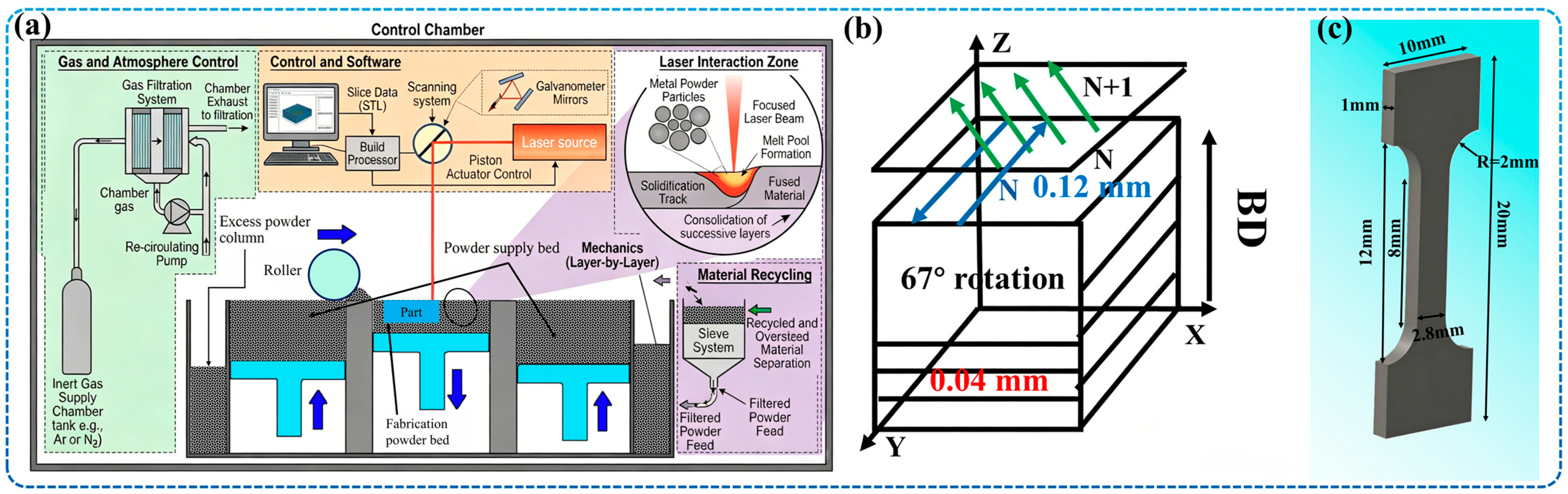
This study utilised commercially available atomised GH4141 alloy powder as the matrix material, the chemical composition of which is shown in Table 1. For comparison, the microstructure of the GH4141 alloy without Y2O3 addition in this study is provided in the Supplementary Materials as Figure S1. Subsequently, 0.2 wt.% Y2O3 powder was doped into the alloy powder and thoroughly mixed using acoustic resonance mixing technology to produce the ODS nickel-based high-temperature alloy used in this study. The alloy was fabricated using a laser powder bed fusion system, the principle of which is illustrated in Figure 1. The substrate selected for the experiments was 316 L stainless steel measuring 200 mm × 100 mm × 10 mm. Prior to printing, the substrate surface was ground flat using a grinding wheel and wiped with anhydrous ethanol. Subsequently, the ODS alloy powder was placed in a vacuum oven (model DFZ-6020BZ, Shaoxing Zhongjia Scientific Instrument Co., Ltd., Shaoxing, China) and dried at 180 °C for 2 h to ensure the powder was dry and possessed good flowability.
The following process parameters were employed during the LPBF forming process: laser powers of 1100 W, 1300 W and 1500 W; a scanning speed of 260 mm/s; a scanning of 0.1 mm; and a layer thickness of 0.05 mm. High-purity argon was used as the shielding gas throughout the process. To further enhance the mechanical properties of the alloy, all samples underwent heat treatment. The heat treatment process comprised solution treatment at 1200 °C, followed by air cooling after holding for 4 h, and subsequently ageing treatment at 760 °C for 16 h, followed by final cooling to room temperature, thereby precipitating the γ′ strengthening phase.

2.2. Microstructural and Performance Characterisation

Specimens of appropriate dimensions were obtained by wire cutting. After grinding with multiple grades of sandpaper (400, 800, 1500 and 2000 grit), the specimens were polished sequentially using 3.5, 2.5 and 1.5 μm diamond polishing slurries. The sample surfaces were etched using Kalling’s reagent solution (100 mL HCl + 100 mL anhydrous ethanol + 5 g CuCl2; all chemicals were sourced from Shanghai Hushi Laboratorial Equipment Co., Ltd., Shanghai, China) for approximately 30 s. Microstructural observations were carried out using a ZEISS Axiolab 5 optical microscope.
The microstructural morphology of the sample surfaces and the tensile fracture surface morphology were examined using a ZEISS Merlin Compact field-emission scanning electron microscope. The chemical composition of different specimens was analysed and characterised using the EDS spectrometer fitted to this instrument.
Tensile property tests were conducted using a Shenzhen Sansi universal testing machine. Tensile specimens with a gauge length of 8 mm, a width of 2.8 mm and a thickness of 1 mm were prepared from the heat-treated alloy using wire-cutting technology. Tests were performed at room temperature and at 760 °C, with the tensile rate set to 0.5 mm/min. For each condition, three specimens were tested, and the average values were reported.

3. Results and Analysis

3.1. Microstructure

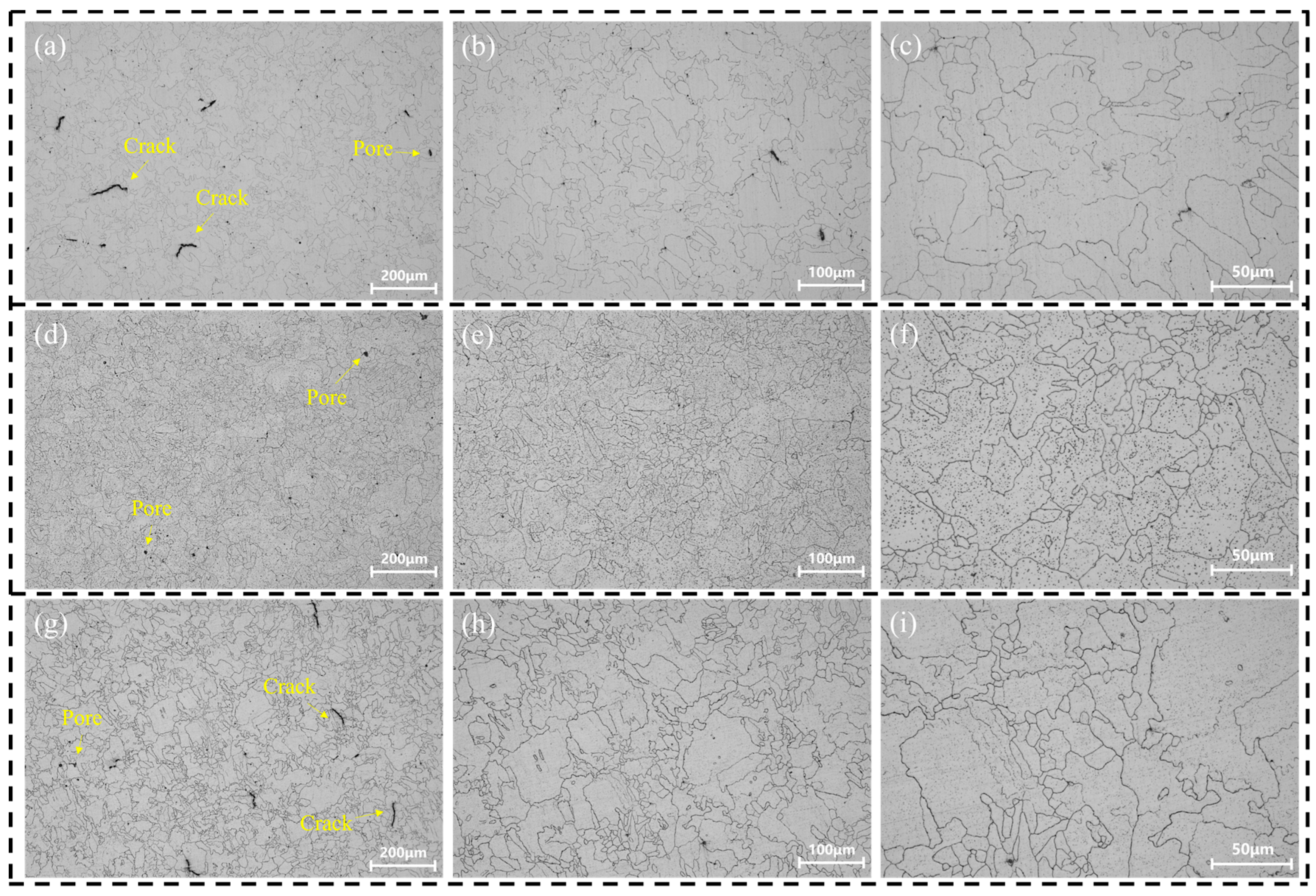
Figure 2 presents the metallographic microstructures of the heat-treated GH4141 + 0.2 wt.% Y2O3 alloy fabricated by LPBF under different laser powers. Under all laser power conditions, the specimens are dominated by equiaxed grains accompanied by a certain number of porosity and crack defects, while significant differences are observed in grain size, microstructural homogeneity, and defect distribution. Based on a visual estimation of the representative metallographic images, the amount of porosity tends to decrease with increasing laser power, mainly due to more sufficient powder melting at higher energy input; however, excessive laser power at 1500 W promotes grain coarsening and crack formation, so the overall microstructural quality is still inferior to that obtained at 1300 W.
As shown in Figure 2a–c, obvious cracks and a small amount of porosity are visible at 1100 W. The cracks are mostly slender and irregular, distributed locally along or near grain boundaries. The measured average grain size of the 1100 W specimen is approximately 36.97 μm. This indicates that although rapid cooling at a relatively low laser power suppresses grain growth to a certain extent, insufficient energy input results in inadequate powder melting and molten pool overlapping, which easily leads to the formation of local defects and heterogeneous microstructures.
Figure 2d–f show that the specimen at 1300 W exhibits the most uniform microstructure, with a significant reduction in the number of cracks and porosity. The microstructure is dominated by equiaxed grains, with an average grain size of approximately 39.75 μm. This suggests that the energy input at this power is moderate, which not only ensures sufficient powder melting and stable solidification of the molten pool but also helps maintain a relatively uniform grain-size distribution, thereby achieving a homogeneous microstructure with few defects.
Figure 2g–i reveal that the grains of the specimen at 1500 W are significantly coarsened with a large variation in grain size, and the number of cracks increases again under low magnification. The average grain size increases to approximately 57.40 μm, indicating that a small number of coarse grains broaden the grain-size distribution. This demonstrates that although a high energy input ensures complete powder melting, it also raises the molten pool temperature, prolongs the high-temperature residence time, and intensifies thermal stress accumulation, thus promoting grain growth and increasing the tendency of crack formation.
In summary, excessively low or excessively high laser power is unfavorable for obtaining a dense and uniform microstructure. Although the 1100 W specimen shows a relatively small average grain size, its microstructure contains more defects due to insufficient melting. The 1500 W specimen exhibits obvious grain coarsening and a wider grain-size distribution. In contrast, the 1300 W specimen shows fewer defects and a relatively homogeneous grain structure, and therefore exhibits the optimal microstructural state under the present experimental conditions. Grain size distributions of the heat-treated GH4141 + 0.2 wt.% Y2O3 alloy fabricated by LPBF under different laser powers is presented in Figure S2 in the Supplementary Materials.
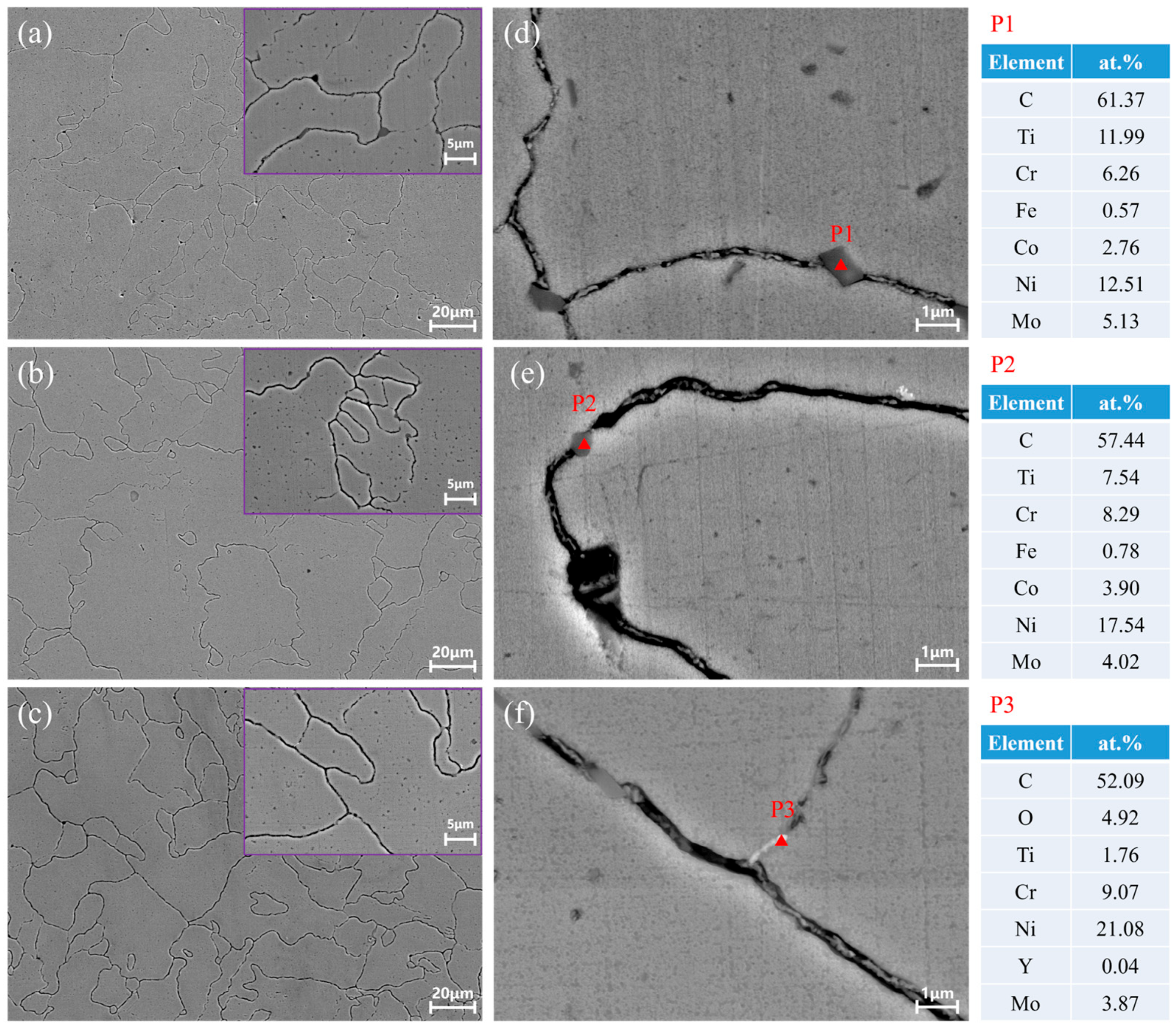
Figure 3 shows the SEM morphologies and EDS point scan results of the heat-treated GH4141 + 0.2 wt.% Y2O3 alloy fabricated by LPBF under different laser powers. As can be seen from Figure 3a–c, all specimens exhibit an equiaxed grain structure, which is consistent with the metallographic observations shown in Figure 2. Fine dark intergranular precipitates are observed under all laser power conditions, mainly distributed along or near grain boundaries. No continuous precipitate network is observed, although the morphology and distribution of these precipitates show certain local differences among the specimens. Therefore, EDS point analysis was performed on representative grain-boundary precipitates to further identify their chemical characteristics.
EDS analysis reveals that the carbon content is significantly elevated in these intergranular precipitates, accompanied by the enrichment of Ti, Cr, Mo and other carbide-forming elements, indicating that they are carbon-rich grain boundary precipitates. In particular, the irregular blocky precipitates located at grain boundaries, such as those marked by P1 and P2, are enriched in C together with Ti and Mo and can be reasonably identified as Ti/Mo-rich MC-type carbides, namely (Ti,Mo)C. In addition, the flocculent silvery-white phases distributed along grain boundaries are more likely associated with Cr-rich M23C6 carbides. This is consistent with the strong carbide-forming tendency of Ti, Cr and Mo in nickel-based superalloys. Among them, Ti has a strong affinity for carbon and tends to form MC-type carbides, while Cr-rich carbides such as M23C6 are prone to precipitate along grain boundaries during heat treatment. Therefore, the observed grain-boundary precipitates can be mainly attributed to MC-type carbides and Cr-rich M23C6 carbides, whose formation is related to the enrichment of carbon and carbide-forming elements at grain boundaries.
On the other hand, the signal of yttrium is relatively weak overall, and no obvious large-scale yttrium-rich agglomerated regions are observed within the SEM field of view, suggesting that severe macroscopic aggregation of Y-containing phases is not evident under the present observation conditions. Combined with the acoustic resonance powder mixing process, it can be inferred that the Y2O3 addition may be relatively dispersed in the matrix and may contribute to microstructural modification, such as grain refinement, but further high-resolution characterization is still needed to clarify its detailed distribution and role.

3.2. Tensile Properties

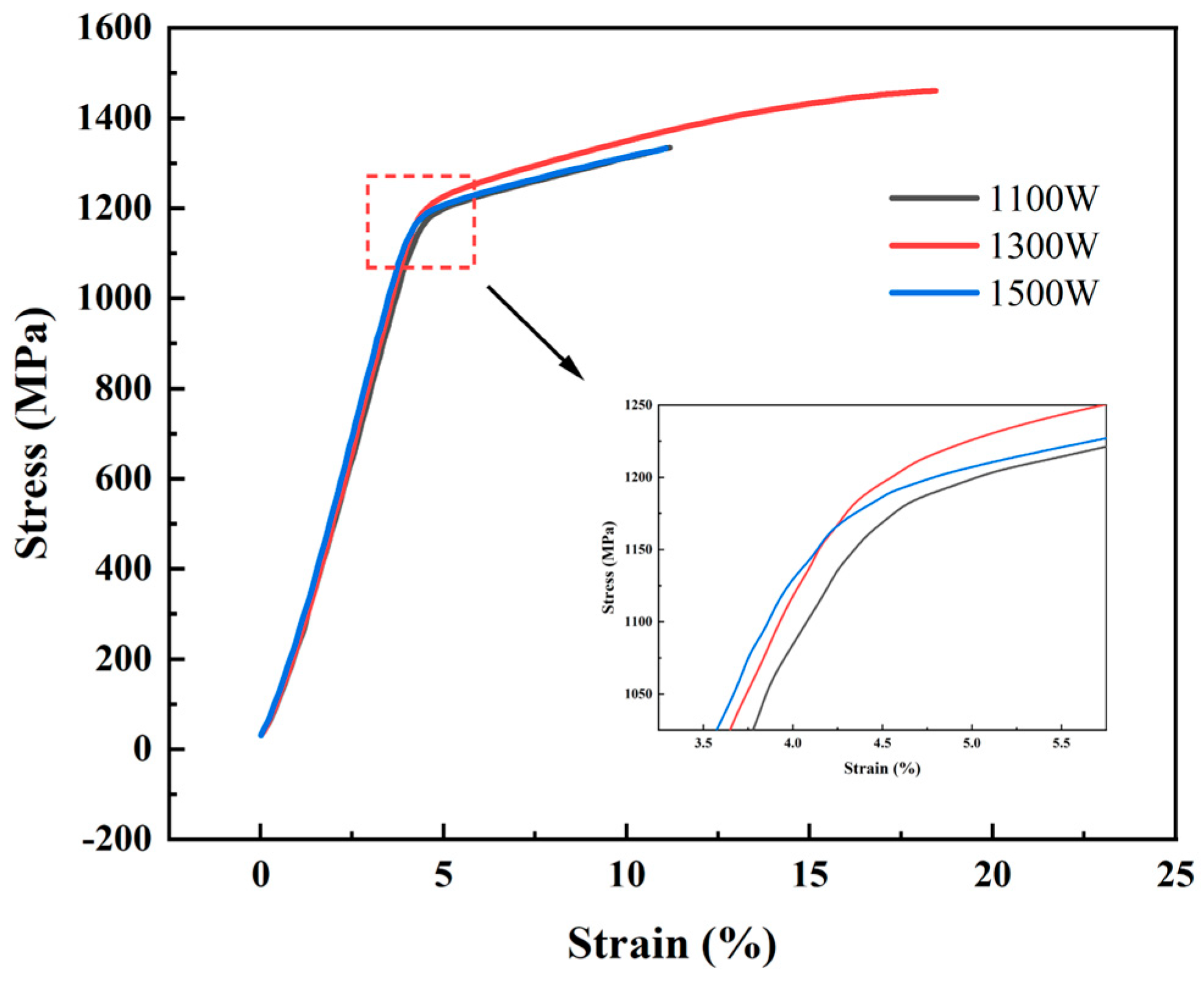
Figure 4 shows the room-temperature tensile stress–strain curves of the heat-treated GH4141 + 0.2 wt.% Y2O3 alloy fabricated by LPBF under different laser powers. Specimens fabricated at all three laser powers exhibit obvious work-hardening behavior, yet significant differences exist in their strength and ductility. Among them, the specimen at 1300 W achieves the best comprehensive mechanical properties, with a tensile strength of 1460 MPa and an elongation to fracture of approximately 14.3%. The specimen at 1100 W has a tensile strength of 1334 MPa and an elongation to fracture of about 6.5%, while the specimen at 1500 W shows a tensile strength of 1329 MPa and an elongation to fracture of roughly 6.7%. It should be noted that the improvement in ductility is particularly significant: the elongation of the 1300 W specimen is about 2.2 times that of the 1100 W specimen and about 2.1 times that of the 1500 W specimen. This indicates that the 1300 W specimen possesses a much better plastic deformation capacity.
The locally magnified view shows that, during the early strain-hardening stage after yielding, the stress level of the 1300 W specimen is only slightly higher than those of the 1100 W and 1500 W specimens. The difference is approximately 50 MPa, corresponding to less than 5% of the stress level in this region. Therefore, this small difference should not be overemphasized as a decisive factor. Instead, the much larger fracture elongation of the 1300 W specimen more clearly demonstrates its improved ductility and more stable plastic deformation behavior. The main reason for these differences lies in the distinct regulatory effects of laser power on the as-built microstructure and defect conditions. At 1100 W, insufficient energy input leads to inadequate powder melting, which readily induces defects such as porosity, lack of fusion, and local microstructural inhomogeneity, thereby degrading the strength and ductility of the material.
At 1500 W, excessive energy input elevates the molten pool temperature and prolongs the high-temperature residence time, promoting grain coarsening, aggravated elemental segregation, and thermal stress concentration, which in turn reduce the overall mechanical properties. In contrast, a moderate energy input at 1300 W helps improve the forming density, achieve a more uniform microstructure, and obtain a more reasonable distribution of carbide precipitates, mainly including Ti/Mo-rich MC-type carbides and Cr-rich M23C6 carbides. Consequently, the specimen exhibits an optimal combination of strength and ductility at room temperature, as reflected in its significantly enhanced elongation to fracture.
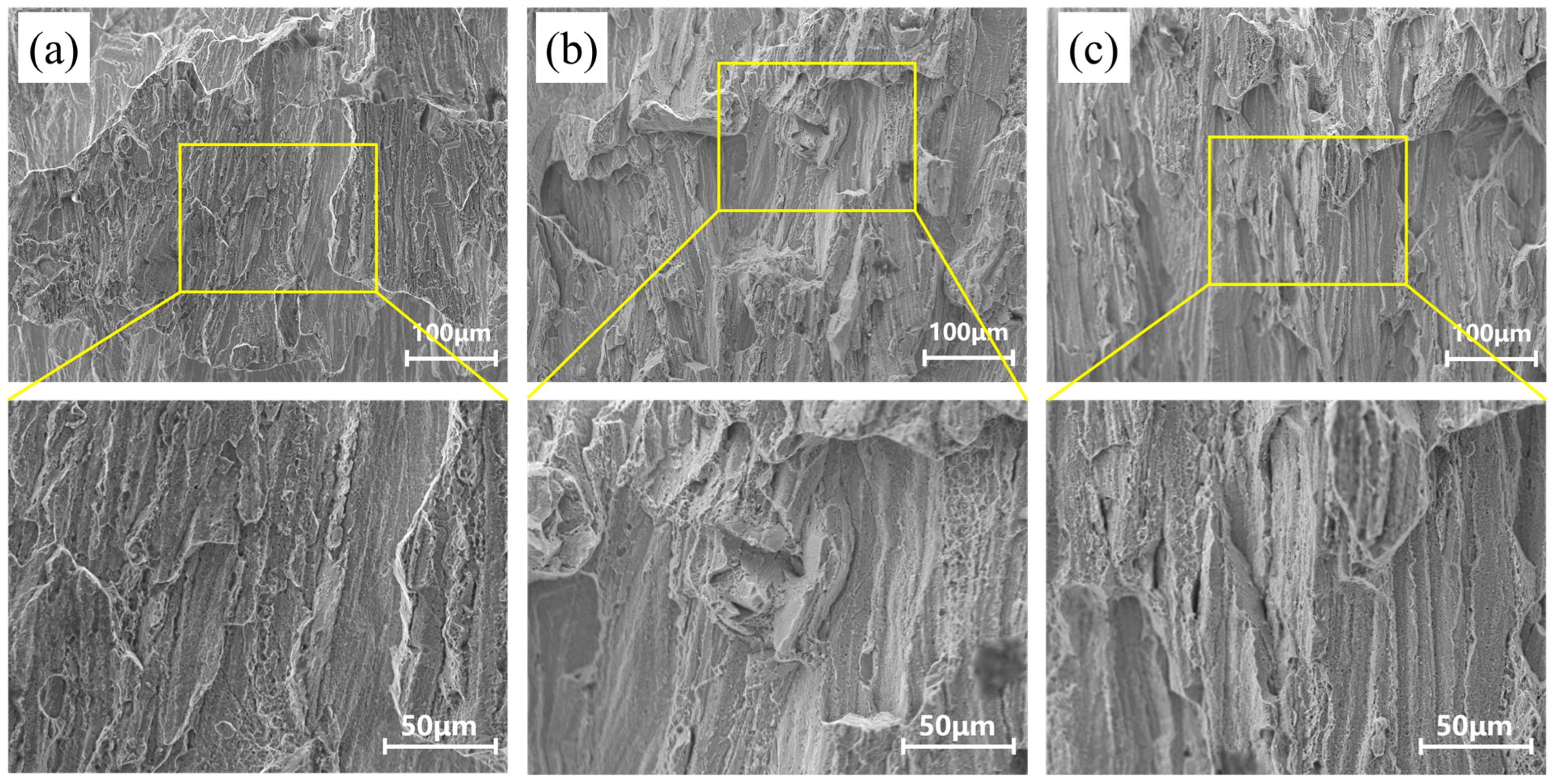
Figure 5 shows the room-temperature tensile fracture morphologies of the heat-treated GH4141 + 0.2 wt.% Y2O3 alloy fabricated by LPBF under different laser powers. As shown in Figure 5a, the fracture surface of the specimen at 1100 W is relatively flat with small undulations. Many flat cleavage steps and a small number of tear ridges can be observed on the fracture surface, and fine cracks propagating along grain boundaries are also visible in local regions, indicating that the fracture mode is a ductile–brittle mixed fracture with relatively more quasi-cleavage and local intergranular cracking features.
This suggests that under a relatively low laser power, insufficient energy input tends to cause local defects and microstructural inhomogeneities, such as lack-of-fusion defects, pores, grain-size variation, and localized carbide precipitates inside the specimen. These local inhomogeneities may act as preferential sites for crack initiation during tension, but no continuous carbide network or brittle grain-boundary film is observed.
Figure 5b shows that the fracture surface roughness of the specimen at 1300 W increases significantly with a more complex morphology. A large number of dimples are distributed in local regions, accompanied by obvious tear ridges and plastic tearing traces, exhibiting a ductile-dominated mixed fracture characteristic.
The large number and relatively uniform distribution of dimples indicate that the material undergoes more sufficient plastic deformation before fracture. Combined with the room-temperature tensile curves, the specimen at 1300 W achieves the highest tensile strength and elongation to fracture. This result is consistent with the improved forming quality and more homogeneous microstructure observed in the 1300 W specimen, as well as the reduced number of local defects. Although localized carbide precipitates are present at grain boundaries, they are not continuous and do not form an obvious brittle film. Therefore, the fracture behavior of the 1300 W specimen is mainly characterized by ductile deformation, which contributes to its optimal strength–ductility combination under the present experimental conditions.
As can be seen from Figure 5c, the fracture surface of the specimen at 1500 W contains a certain number of dimples and tearing traces. However, cleavage steps, flat fracture regions and elongated cracking features become more evident overall, and the fracture mode can be described as a ductile–brittle mixed fracture with enhanced quasi-cleavage characteristics. Compared with the specimen at 1300 W, the number of dimples decreases and their depth becomes shallower, indicating a decline in plastic deformation capability. This is mainly attributed to the excessively high laser power, which elevates the molten pool temperature and prolongs the high-temperature residence time, easily inducing grain coarsening, aggravated elemental segregation and thermal stress concentration, thereby weakening the comprehensive mechanical properties of the material.
Based on Figure 5a–c, it can be seen that as the laser power increases from 1100 W to 1300 W, the fracture morphology gradually changes from a ductile–brittle mixed fracture with more brittle features to a more ductile fracture characteristic. When the laser power is further increased to 1500 W, the brittle characteristics of the fracture surface intensify again. Overall, the fracture surfaces of the three specimens show mixed ductile–brittle characteristics, while the 1300 W specimen exhibits the most obvious ductile fracture features. This result is consistent with the variation trend of room-temperature tensile properties, further confirming that 1300 W is the optimal laser power parameter under the experimental conditions of this study.
Since the alloy exhibits the best comprehensive mechanical properties under room-temperature tension after heat treatment at a laser power of 1300 W, the 1300 W specimen was selected for high-temperature tensile testing at 760 °C to further evaluate its high-temperature mechanical properties.
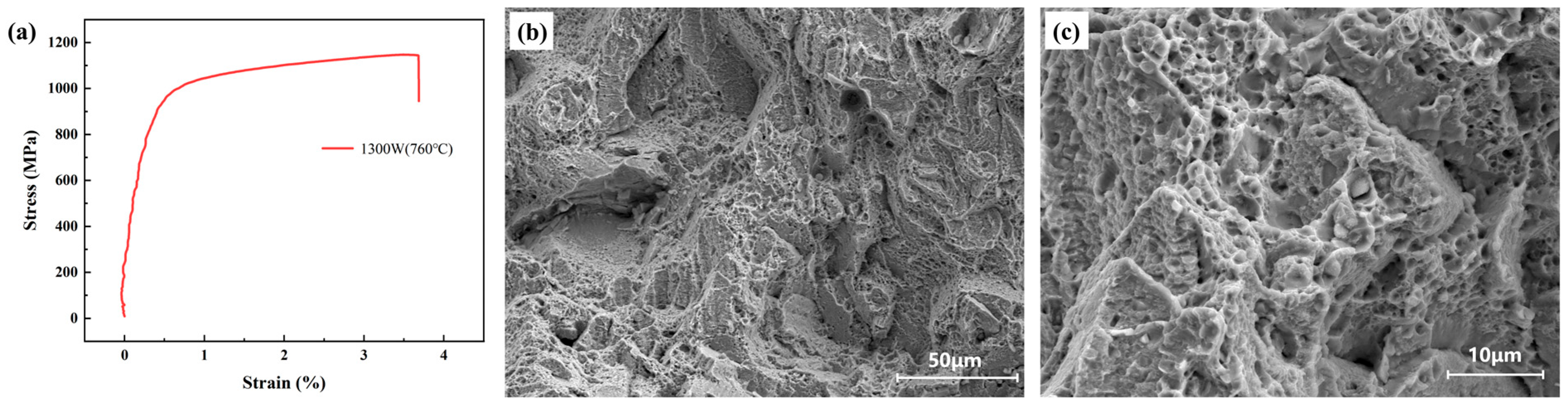
Figure 6 shows the tensile stress–strain curves at 760 °C of the heat-treated 1300 W specimen of the GH4141 + 0.2 wt.% Y2O3 alloy fabricated by LPBF. As shown in Figure 6a, the tensile strength of this specimen at 760 °C is approximately 1150 MPa. According to relevant studies on GH4141 alloy under similar test conditions [26], its high-temperature tensile strength is about 1070 MPa, representing an improvement of approximately 7.5% in the present work. This indicates that the introduction of Y2O3 may contribute to improving the high-temperature load-bearing capacity of GH4141 alloy to a certain extent. This improvement may be associated with Y2O3-assisted microstructural modification, such as grain refinement and improved microstructural uniformity, which helps enhance the deformation resistance of the material at elevated temperature.
Figure 6b,c show the tensile fracture morphologies at 760 °C of the heat-treated 1300 W specimen of the LPBF-fabricated GH4141 + 0.2 wt.% Y2O3 alloy. Figure 6b reveals that the fracture surface is relatively rough with obvious undulations, and is covered with numerous fine dimples, accompanied by tear ridges and local step-like features. This indicates that the fracture process involves both microvoid coalescence and certain quasi-cleavage characteristics.
At higher magnification, the dimples are small in size and densely distributed, with torn edges and local pits or microvoids observed in some regions, suggesting that crack initiation and propagation during high-temperature tension are closely associated with local microstructural inhomogeneities.
Comparison between Figure 6b and the room-temperature fracture morphology of the 1300 W specimen shown in Figure 5b reveals that the dimples at 760 °C are finer and denser, and local brittle characteristics are more pronounced. This suggests that although the material still retains a certain plastic deformation capability at high temperature, local damage accumulation and crack propagation become more evident during fracture. The finer and denser dimples indicate that microvoid nucleation, growth, and coalescence are more pronounced during high-temperature deformation. Meanwhile, the local step-like and quasi-cleavage features suggest that cracks may propagate more readily in locally weakened or microstructurally heterogeneous regions. Consequently, the fracture surface exhibits a mixed characteristic of ductile and brittle fracture.

4. Conclusions

This study investigated the microstructure and mechanical properties of heat-treated GH4141 + 0.2 wt.% Y2O3 alloy fabricated by LPBF under different laser powers. The results are as follows:
  • Laser power has a significant effect on the morphological characteristics and defect distribution of the heat-treated alloy. As the laser power increases from 1100 W to 1300 W, defects such as cracks and porosity are significantly reduced, and the microstructure becomes more uniform. When the laser power is further increased to 1500 W, obvious grain coarsening occurs, grain boundary precipitates tend to coarsen or locally agglomerate, and cracking susceptibility increases.
  • EDS analysis shows that the dark intergranular phases are enriched in C, Cr, Mo and Ti, which may be related to MC-type, M23C6-type or composite carbides. No obvious large-scale Y-rich agglomerated regions are observed within the SEM field of view, indicating that Y2O3 is well dispersed in the matrix after acoustic resonance powder mixing.
  • The room-temperature tensile properties first increase and then decrease with increasing laser power. The mechanical properties of specimens at 1100 W and 1500 W are relatively similar, while the optimal strength–toughness combination is achieved at 1300 W, with a room-temperature tensile strength of approximately 1460 MPa and an elongation to fracture of about 18.5%. At 760 °C, the 1300 W specimen still maintains a high strength level, with a tensile strength of approximately 1150 MPa.

Supplementary Materials

The following supporting information can be downloaded at: https://www.mdpi.com/article/10.3390/coatings16060712/s1, Figure S1: (a) SEM micrograph of GH4141 powder; (b) particle size statistics; Figure S2: Grain-size distributions of the heat-treated GH4141 + 0.2 wt.% Y2O3 alloy fabricated by LPBF under different laser powers: (a) 1100 W, (b) 1300 W, and (c) 1500 W.

Author Contributions

Conceptualization, H.S.; Methodology, Y.P.; Software, B.C.; Validation, Y.W.; Formal analysis, Y.W. and Y.P.; Investigation, H.S. and Y.P.; Resources, B.C.; Data curation, Z.Z.; Writing—original draft, H.S.; Writing—review & editing, H.S., Y.W., Z.Z. and Y.P.; Visualization, Y.W. and Z.Z.; Supervision, Z.Z.; Project administration, B.C.; Funding acquisition, B.C. All authors have read and agreed to the published version of the manuscript.

Funding

This research was funded by [Advanced Materials-National Science and Technology Major project] grant number [2025ZD0609800].

Institutional Review Board Statement

Not applicable.

Informed Consent Statement

Not applicable.

Data Availability Statement

The original contributions presented in this study are included in the article/Supplementary Materials. Further inquiries can be directed to the corresponding author.

Conflicts of Interest

The authors declare no conflict of interest.

References

  1. Lv, Y.; Ouyang, X.; Tian, Y.; Yu, H.; Wei, G. Insight into the Hot Corrosion Behavior of GH4251 High-Temperature Superalloy Fabricated by Selective Laser Melting. J. Alloys Compd. 2024, 1002, 175166. [Google Scholar] [CrossRef]
  2. Badea, T.-A.; Dombrovschi, M. The Influence of Alloying Elements on the Hot Corrosion Behavior of Nickel-Based Superalloys. Materials 2025, 18, 1996. [Google Scholar] [CrossRef] [PubMed]
  3. Gudivada, G.; Pandey, A.K. Recent Developments in Nickel-Based Superalloys for Gas Turbine Applications: Review. J. Alloys Compd. 2023, 963, 171128. [Google Scholar] [CrossRef]
  4. Moverare, J.; Lancaster, R.J.; Jones, J.; Stekovic, S.; Whittaker, M.T. A Review of Recent Advances in the Understanding of Thermomechanical Fatigue Durability and Failure Mechanisms in Nickel-Based Superalloys. Metall. Mater. Trans. A 2025, 56, 1115–1134. [Google Scholar] [CrossRef]
  5. Liu, H.; Zhang, M.; Xu, M.; Meng, Y.; Xu, G.; Ta, N.; Zheng, L. Microstructure Evolution Dependence of Work-Hardening Characteristic in Cold Deformation of a Difficult-to-Deform Nickel-Based Superalloy. Mater. Sci. Eng. A 2021, 800, 140280. [Google Scholar] [CrossRef]
  6. Wu, Y.; Yao, Z.; Zhang, L.; Yao, K.; Wang, H.; Dong, J. Microstructural Characteristics and Mechanism of Recrystallization during Hot Deformation for GH4141 Ni-Based Superalloy. Mater. Charact. 2025, 220, 114659. [Google Scholar] [CrossRef]
  7. Zhang, X.; Han, H.; Zhou, Y.; Chen, J.; Feng, S.; Tang, P.; Xiao, D.; Fu, J.; Zhang, J. Effect of Solution Treatment on the Microstructure and Elevated Temperature Tensile Properties of Forged Rene 41 Superalloy. Materials 2024, 17, 6150. [Google Scholar] [CrossRef] [PubMed]
  8. Zhang, X.; Han, H.; Tang, P.; Zhou, Y.; Xiao, D.; Fu, J.; Chen, J.; Feng, S.; Zhang, J. Effects of Aging Treatment on the Microstructure and Mechanical Properties of Rene 41 Alloy and the Strengthening Mechanisms. Materials 2025, 18, 1579. [Google Scholar] [CrossRef]
  9. Atabay, S.E.; Sanchez-Mata, O.; Muñiz-Lerma, J.A.; Gauvin, R.; Brochu, M. Microstructure and Mechanical Properties of Rene 41 Alloy Manufactured by Laser Powder Bed Fusion. Mater. Sci. Eng. A 2020, 773, 138849. [Google Scholar] [CrossRef]
  10. He, W.; Liu, F.; Tan, L.; Tian, Z.; Qin, Z.; Huang, L.; Xiao, X.; Wang, G.; Chen, P.; Liu, B. Optimizing the Thermomechanical Process of Nickel-Based ODS Superalloys by an Efficient Method. Materials 2022, 15, 4087. [Google Scholar] [CrossRef]
  11. Kenel, C.; De Luca, A.; Leinenbach, C.; Dunand, D.C. High-Temperature Creep Properties of an Additively Manufactured Y2O3 Oxide Dispersion-Strengthened Ni–Cr–al–Ti γ/γ’ Superalloy. Adv. Eng. Mater. 2022, 24, 2200753. [Google Scholar] [CrossRef]
  12. Estrin, Y.; Heilmaier, M.; Drew, G. Creep Properties of an Oxide Dispersion Strengthened Nickel-Base Alloy: The Effect of Grain Orientation and Grain Aspect Ratio. Mater. Sci. Eng. A 1999, 272, 163–173. [Google Scholar] [CrossRef]
  13. Song, Q.; Zhang, Y.; Wei, Y.; Zhou, X.; Shen, Y.; Zhou, Y.; Feng, X. Microstructure and Mechanical Performance of ODS Superalloys Manufactured by Selective Laser Melting. Opt. Laser Technol. 2021, 144, 107423. [Google Scholar] [CrossRef]
  14. Li, M.; Wang, L.; Yang, H.; Zhang, S.; Lin, X.; Huang, W. Microstructure and Mechanical Properties of Y2O3 Strengthened Inconel 625 Alloy Fabricated by Selective Laser Melting. Mater. Sci. Eng. A 2022, 854, 143813. [Google Scholar] [CrossRef]
  15. Rakhmonov, J.U.; Kenel, C.; De Luca, A.; Leinenbach, C.; Dunand, D.C. Effect of Y2O3 Dispersoids on Microstructure and Creep Properties of Hastelloy X Processed by Laser Powder-Bed Fusion. Addit. Manuf. Lett. 2022, 3, 100069. [Google Scholar] [CrossRef]
  16. Tian, Z.; Zhang, C.; Wang, D.; Liu, W.; Fang, X.; Wellmann, D.; Zhao, Y.; Tian, Y. A Review on Laser Powder Bed Fusion of Inconel 625 Nickel-Based Alloy. Appl. Sci. 2020, 10, 81. [Google Scholar] [CrossRef]
  17. Huang, T.-X.; Liu, Z.; Jiang, D.; Ye, S.; Liu, T.; Zhou, R.; Zhang, Y. Laser Beam Powder Bed Fusion Nickel-Based Superalloys: Microstructure, Alloy Tailoring and Mechanical Properties. Virtual Phys. Prototyp. 2026, 21, e2619387. [Google Scholar] [CrossRef]
  18. Enrique, P.D.; Minasyan, T.; Toyserkani, E. Laser Powder Bed Fusion of Difficult-to-Print Γ′ Ni-Based Superalloys: A Review of Processing Approaches, Properties, and Remaining Challenges. Addit. Manuf. 2025, 106, 104811. [Google Scholar] [CrossRef]
  19. Zhao, D.; Pei, J.; Ma, C.; Li, R. Mitigating Solidification Cracking in LPBF-Processed K418 Superalloy via Substrate Preheating and Layer Thickness Optimization. Materials 2026, 19, 501. [Google Scholar] [CrossRef] [PubMed]
  20. Adegoke, O.; Andersson, J.; Brodin, H.; Pederson, R.; Harlin, P. Influence of Laser Powder Bed Fusion Process Parameters on the Microstructure and Cracking Susceptibility of Nickel-Based Superalloy Alloy 247LC. Results Mater. 2022, 13, 100256. [Google Scholar] [CrossRef]
  21. Liu, W.-T.; Zhou, J.-C.; Ruan, J.-J.; Zhang, H.; Zhou, X.; Jiang, L.; Zhu, L.-L. Effects of Process Parameters on Defect Formation in Laser Additive Manufacturing of a Novel Ni-Based Superalloy. Materials 2025, 18, 3102. [Google Scholar] [CrossRef] [PubMed]
  22. Chen, J.; Jin, M.; Wei, K.; Zhou, R.; Yue, X.; Liu, Y.; Li, G.; Liang, J.; Sun, X.; Zeng, X. Laser-Based Powder Bed Fusion of Nickel-Based Superalloy Designed Specifically for Turbine Blades Using High-Power Flat-Top Laser: Towards High-Speed Manufacturing and Directional Solidification. J. Alloys Compd. 2025, 1022, 179902. [Google Scholar] [CrossRef]
  23. Chen, N.; Zheng, D.; Niu, P.; Li, R.; Yuan, T. Laser Powder Bed Fusion of GH3536 Nickel-Based Superalloys: Processing Parameters, Microstructure and Mechanical Properties. Mater. Charact. 2023, 202, 113018. [Google Scholar] [CrossRef]
  24. Wang, Y.; Li, S.; Ma, R.; Du, H.; Yao, J.; Shi, Y.; Yin, Z.; Dong, X.; Liu, X. The Effect of Laser Power on the Microstructure and Mechanical Properties of LPBF Hastelloy X in As-Built and Heat-Treated States. Mater. Charact. 2025, 227, 115320. [Google Scholar] [CrossRef]
  25. Hou, K.; Zang, Y.; Xie, J.; Liu, X.; Ma, G.; Ma, Y. As-Solidified Microstructure, Tensile Properties, and Deformation Mechanisms of a Novel Nickel-Based Superalloy Fabricated by Laser Powder Bed Fusion. J. Mater. Res. Technol. 2025, 36, 1202–1214. [Google Scholar] [CrossRef]
  26. Atabay, S.E.; Sanchez-Mata, O.; Muñiz-Lerma, J.A.; Brochu, M. Effect of Heat Treatment on the Microstructure and Elevated Temperature Tensile Properties of Rene 41 Alloy Produced by Laser Powder Bed Fusion. J. Alloys Compd. 2021, 858, 157645. [Google Scholar] [CrossRef]
Figure 1. (a) Schematic illustration of the laser powder bed fusion (LPBF) process; (b) LPBF scanning strategy, the blue and green arrows indicate the printing directions between two adjacent layers, BD stands for Build Direction; (c) tensile sample size.
Coatings 16 00712 g001
Figure 2. Metallographic microstructures of heat-treated GH4141 + 0.2 wt.% Y2O3 alloy fabricated by LPBF under different laser powers: (ac) 1100 W; (df) 1300 W; (gi) 1500 W.
Coatings 16 00712 g002
Figure 3. SEM morphologies and EDS point scan analysis of heat-treated GH4141 + 0.2 wt.% Y2O3 alloy fabricated by LPBF under different laser powers: (a,d) 1100 W; (b,e) 1300 W; (c,f) 1500 W.
Coatings 16 00712 g003
Figure 4. Room-temperature tensile stress–strain curves of heat-treated GH4141 + 0.2 wt.% Y2O3 alloy fabricated by LPBF under different laser powers.
Coatings 16 00712 g004
Figure 5. Room-temperature tensile fracture morphologies of heat-treated GH4141 + 0.2 wt.% Y2O3 alloy fabricated by LPBF under different laser powers (a) 1100 W; (b) 1300 W; (c) 1500 W.
Coatings 16 00712 g005
Figure 6. (a) Tensile stress–strain curves; (b,c) fracture morphologies of the 1300 W specimen at 760 °C.
Coatings 16 00712 g006
Table 1. Chemical composition of GH4141 powder (wt.%).
AlCrCoTiFeMoCNi
1.619.011.03.252.969.750.0952.35
Disclaimer/Publisher’s Note: The statements, opinions and data contained in all publications are solely those of the individual author(s) and contributor(s) and not of MDPI and/or the editor(s). MDPI and/or the editor(s) disclaim responsibility for any injury to people or property resulting from any ideas, methods, instructions or products referred to in the content.