This is an early access version, the complete PDF, HTML, and XML versions will be available soon.
Article

Predictive Model for the Maximum Spreading Diameter Coefficient of Droplets Impacting Surfaces with Different Wettability

1
School of Mechanical & Electrical Engineering, Xuzhou University of Technology, Xuzhou 221018, China
2
College of Materials Science and Engineering, Taiyuan University of Technology, Taiyuan 030024, China
3
School of Materials Science and Physics, China University of Mining and Technology, Xuzhou 221116, China
*
Authors to whom correspondence should be addressed.
Coatings 2026, 16(6), 676; https://doi.org/10.3390/coatings16060676

Submission received: 17 April 2026 / Revised: 27 May 2026 / Accepted: 28 May 2026 / Published: 3 June 2026
(This article belongs to the Section Surface Characterization, Deposition and Modification)

Abstract

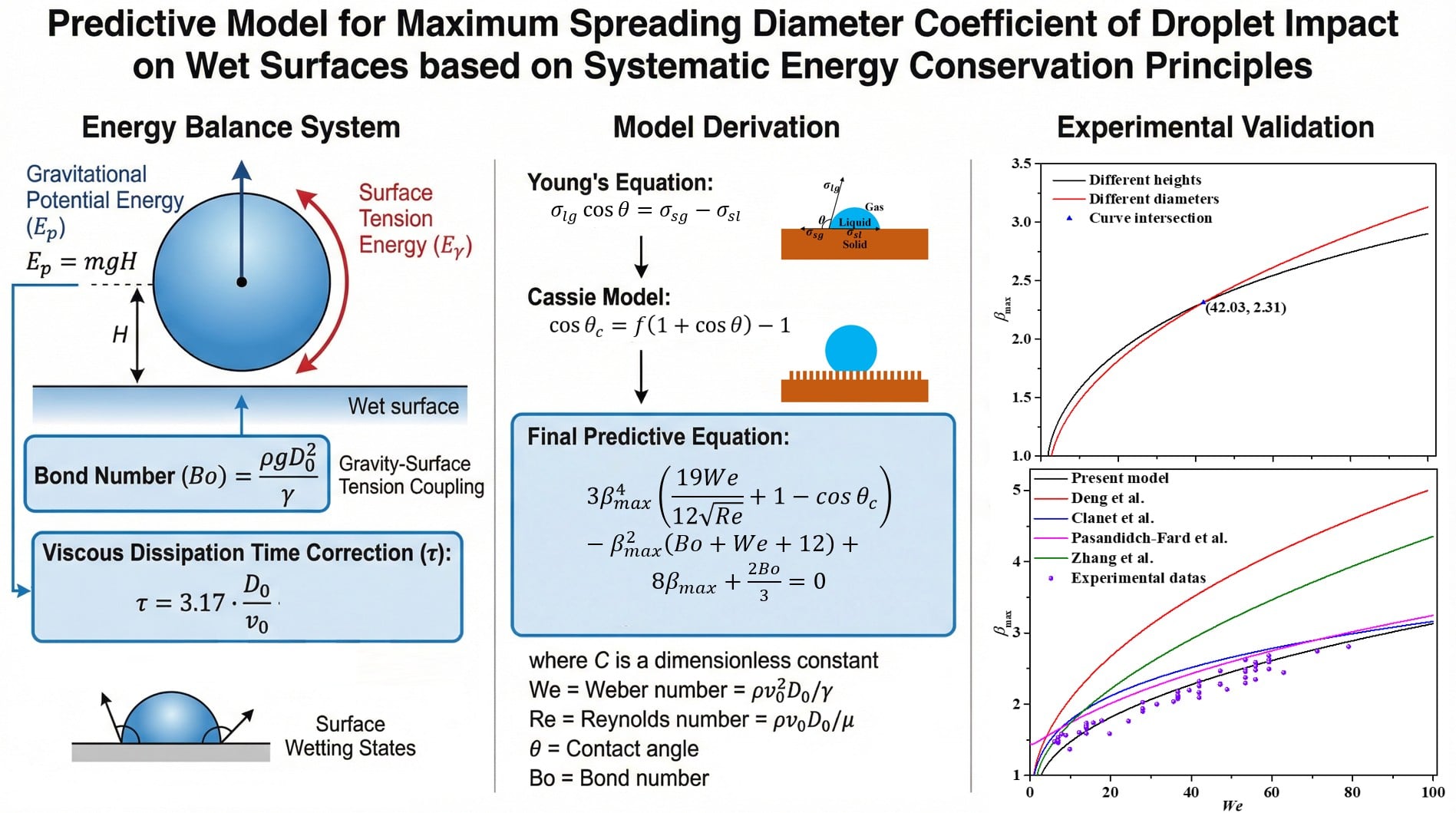
The dynamic spreading behavior of droplets impacting surfaces with different wettability is a critical hydrodynamic issue in industrial applications such as inkjet printing, spray cooling, and pesticide spraying. The maximum spreading diameter coefficient (βmax) is the key parameter characterizing this process. Existing theoretical models often overlook the gravitational potential energy of droplets, resulting in significant discrepancies between the calculated viscous dissipation times and experimental results, which compromises the prediction accuracy. In this study, we incorporated gravitational potential energy into the energy balance system based on the principle of system energy conservation. We introduced the Bond number (Bo) to characterize the coupling effect of gravity and surface tension. By fitting experimental data, we corrected the viscous dissipation time, obtaining tc = 3.17 d0/v0, which improves the reliability of dissipated energy calculation. Using Young’s equation and the Cassie model, we derived a fourth-order βmax prediction model that includes the Weber number (We), Reynolds number (Re), contact angle (θc), and Bo number. The results show that regulating the impact height and droplet diameter will affect the trend of the maximum spreading coefficient model curve: the crossover Weber numbers are 41.519 and 41.530 for different liquid viscosities under the specific experimental and modeling conditions of this study. Below these thresholds, the maximum spreading diameter coefficients are more sensitive to impact height (inertial and kinetic-energy) than to droplet diameter (volume, mass, surface energy, gravitational potential energy, Bond number). Above the critical value, the influence of droplet diameter on the maximum spreading diameter coefficient becomes more pronounced. These intersections reflect the balance between size-dependent effects and impact-inertia-related effects under specific conditions, rather than universal physical thresholds. Compared with selected classical models, the proposed model shows better consistency with experimental data and provides improved prediction for the maximum spreading coefficient of water droplets on surfaces with different wettability. This study supplements the perspective of energy analysis for the modeling of droplet impact dynamics, and can provide a basis for the theoretical optimization of spray systems and interfacial fluid control.
Keywords: predictive model; droplet impact; maximum spreading diameter coefficient; surfaces with different wettability predictive model; droplet impact; maximum spreading diameter coefficient; surfaces with different wettability
Graphical Abstract