Influence of Layer Configuration on the Morphology and Corrosion Resistance of CrAlN/TiSiN Multilayer Coatings Prepared via Cathodic Arc Deposition


Abstract
1. Introduction
2. Experimental Section
3. Results and Discussion
3.1. Analysis of Coating Morphology
3.2. Analysis of Layer Structure and Water Contact Angle
3.3. Corrosion Resistance of the Coatings
4. Conclusions
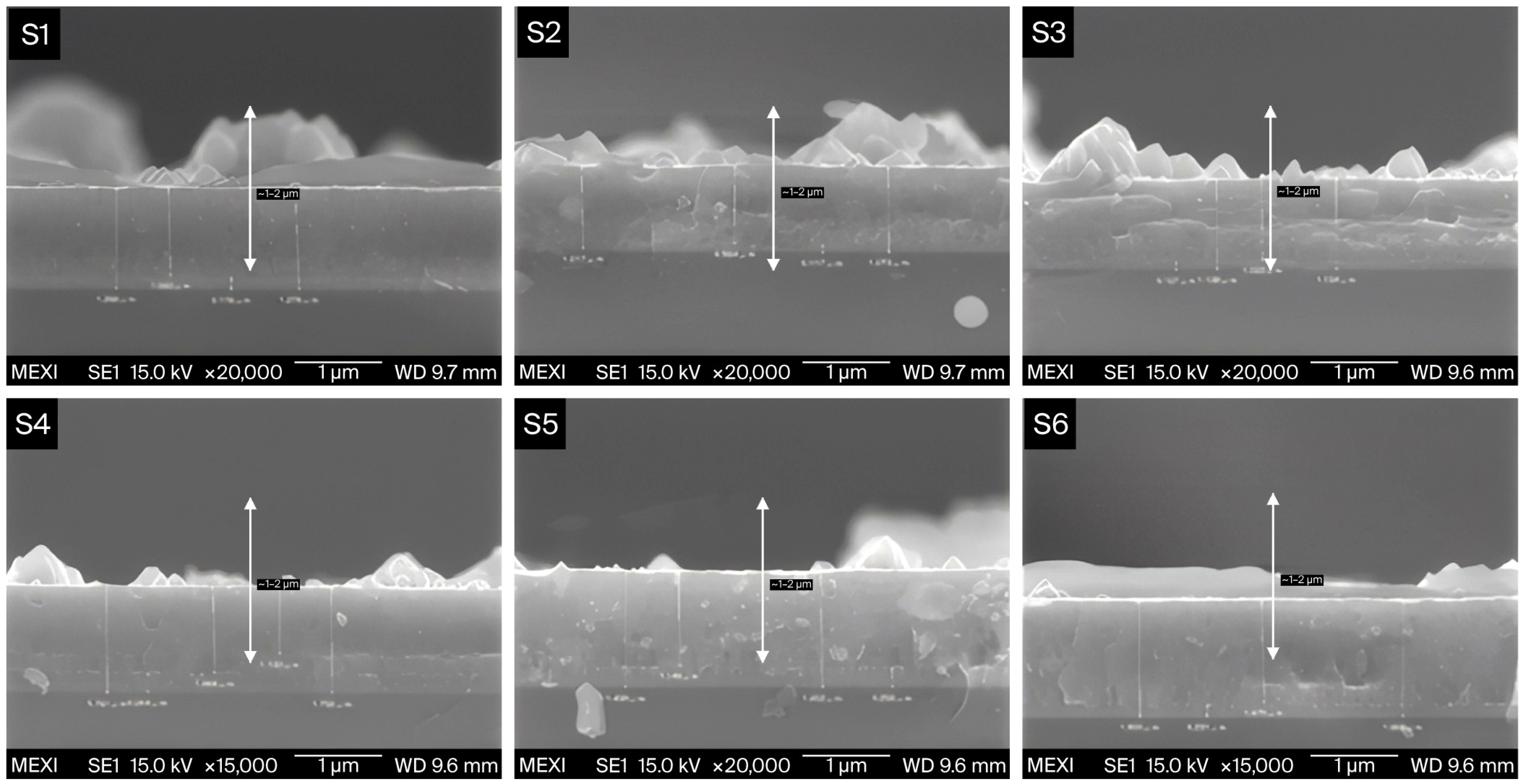
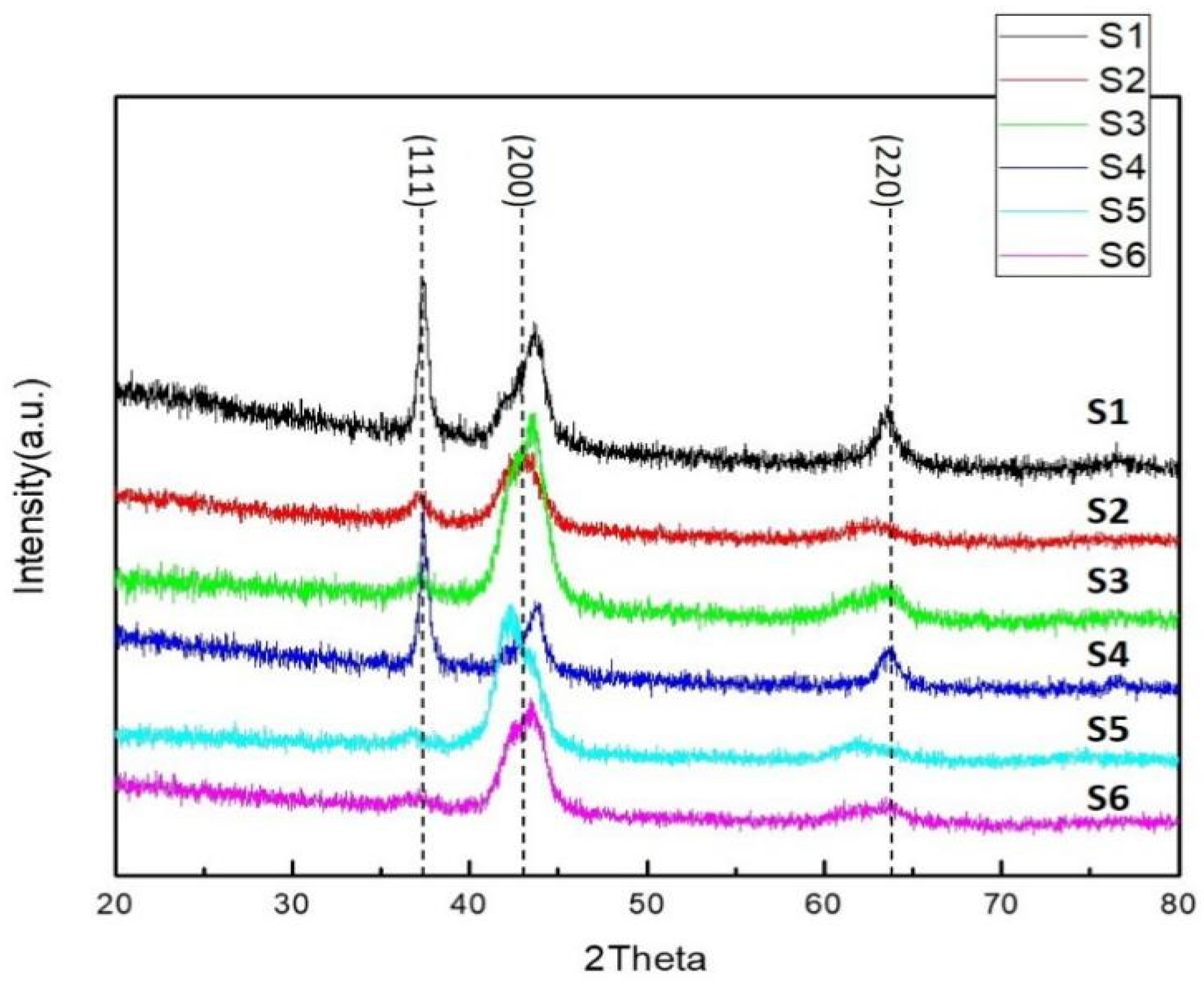
- In this study, dense nanolayered structures with thicknesses of approximately 1.073–1.900 μm were successfully deposited, exhibiting a typical FCC β1-NaCl crystalline phase. The use of CrN and TiN as interlayers effectively improved interfacial adhesion and stability between the silicon substrate and the CrAlN/TiSiN coatings. We found that the preferred crystallographic orientation significantly influences the distribution and relaxation behavior of residual stress, governs the formation of grain boundary diffusion pathways, and affects thermal stability, as well as the structural integrity and long-term reliability of the interface. A dominant (111) orientation is typically associated with strain–energy–controlled growth mechanisms, whereas a (200) orientation is generally related to surface energy minimization. These strengthening effects are proposed to be plausible mechanisms based on structural observations and previous studies. Therefore, these measurements are required in future work.
- The nanolayered interfaces effectively suppress the growth of columnar grains. XRD analysis revealed a competitive growth behavior between the (111) and (200) preferred orientations, confirming that the crystallographic evolution is governed by the interplay between surface energy and strain energy, which in turn influences the distribution of residual stress and structural stability.
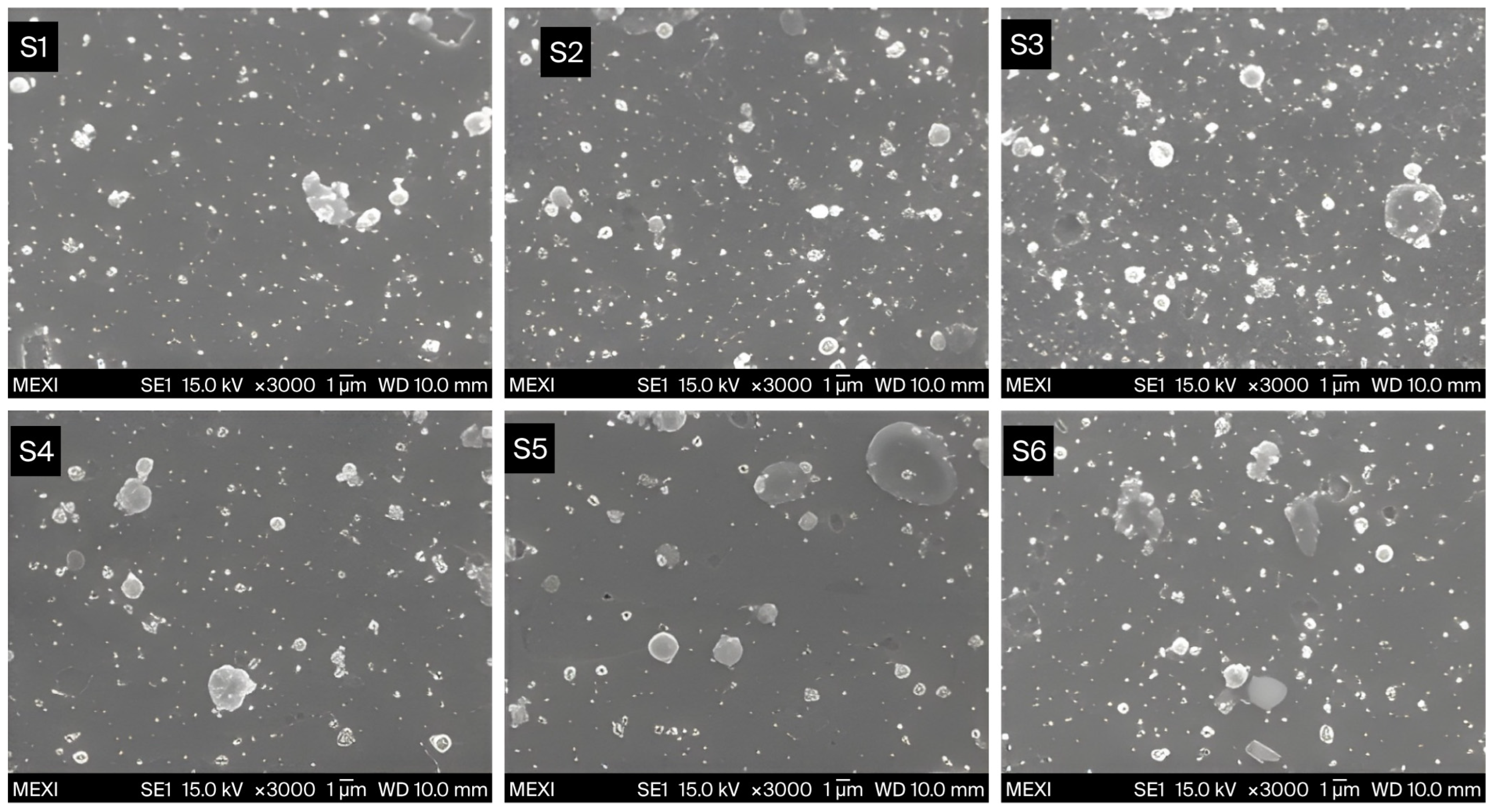
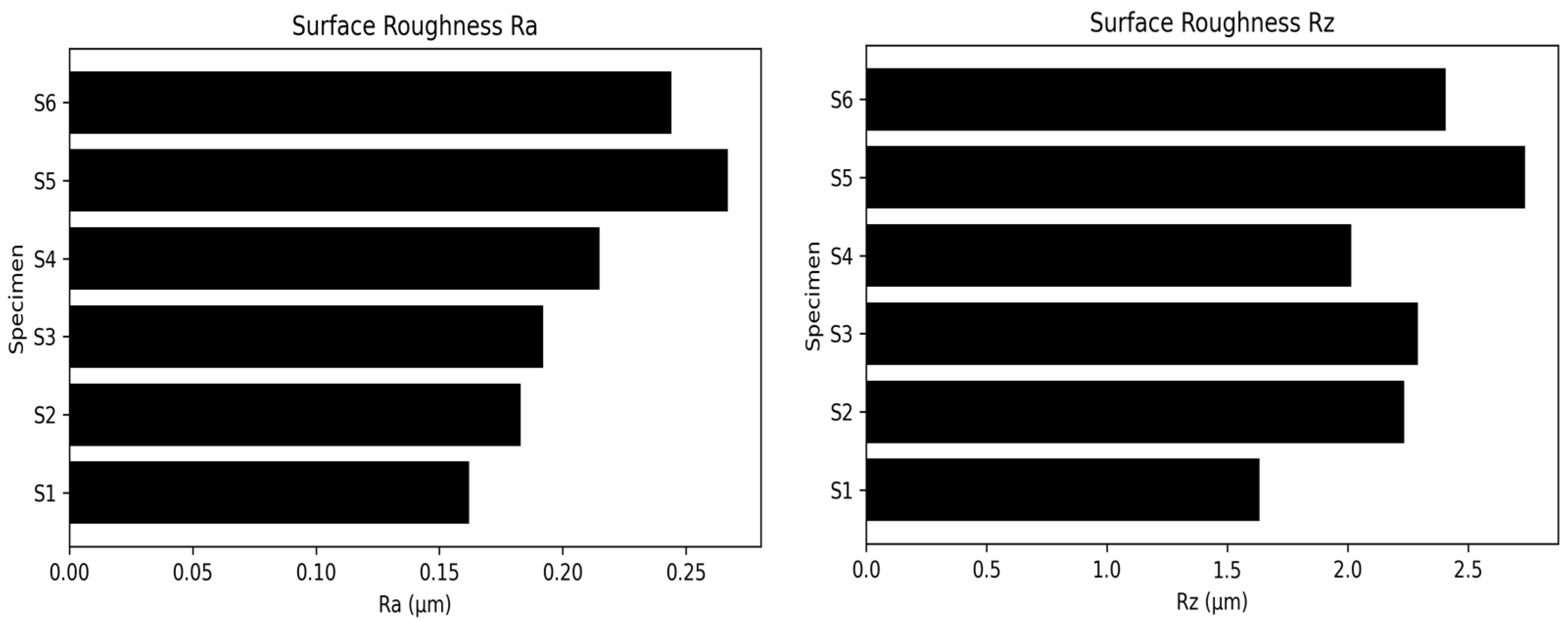
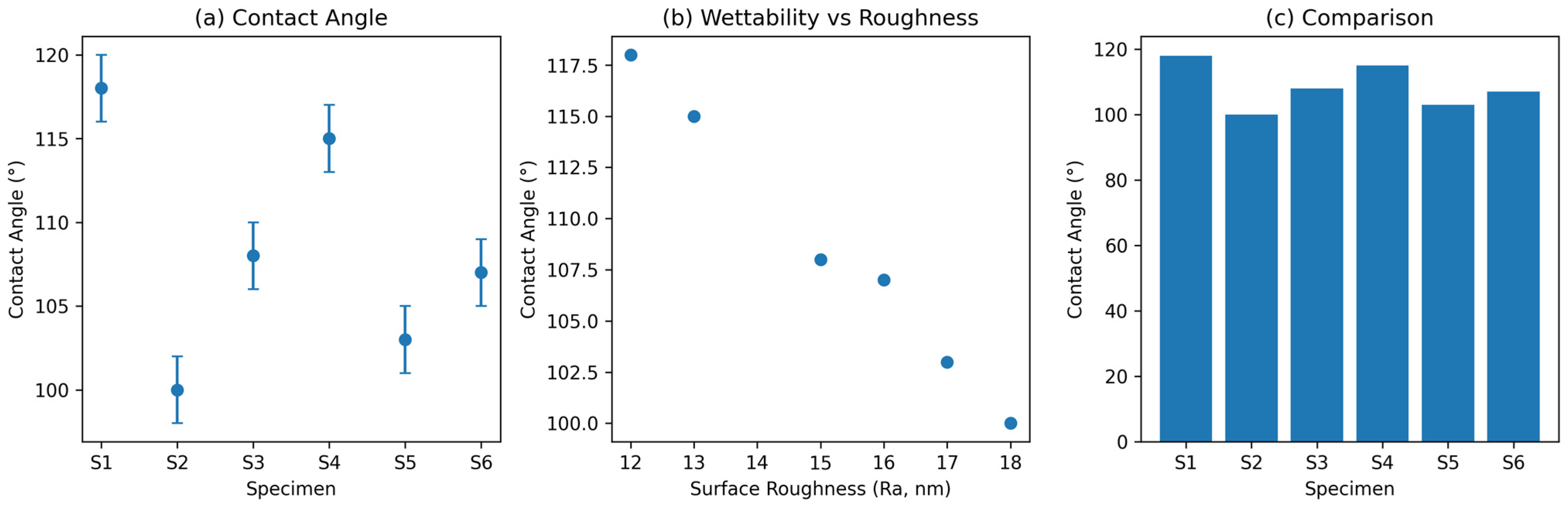
- Surface morphology analysis indicated that the multilayer structure refines droplet size and reduces the Ra value. Among the interlayers, the CrN interlayer exhibits a more pronounced effect on improving surface smoothness relative to the TiN interlayer.
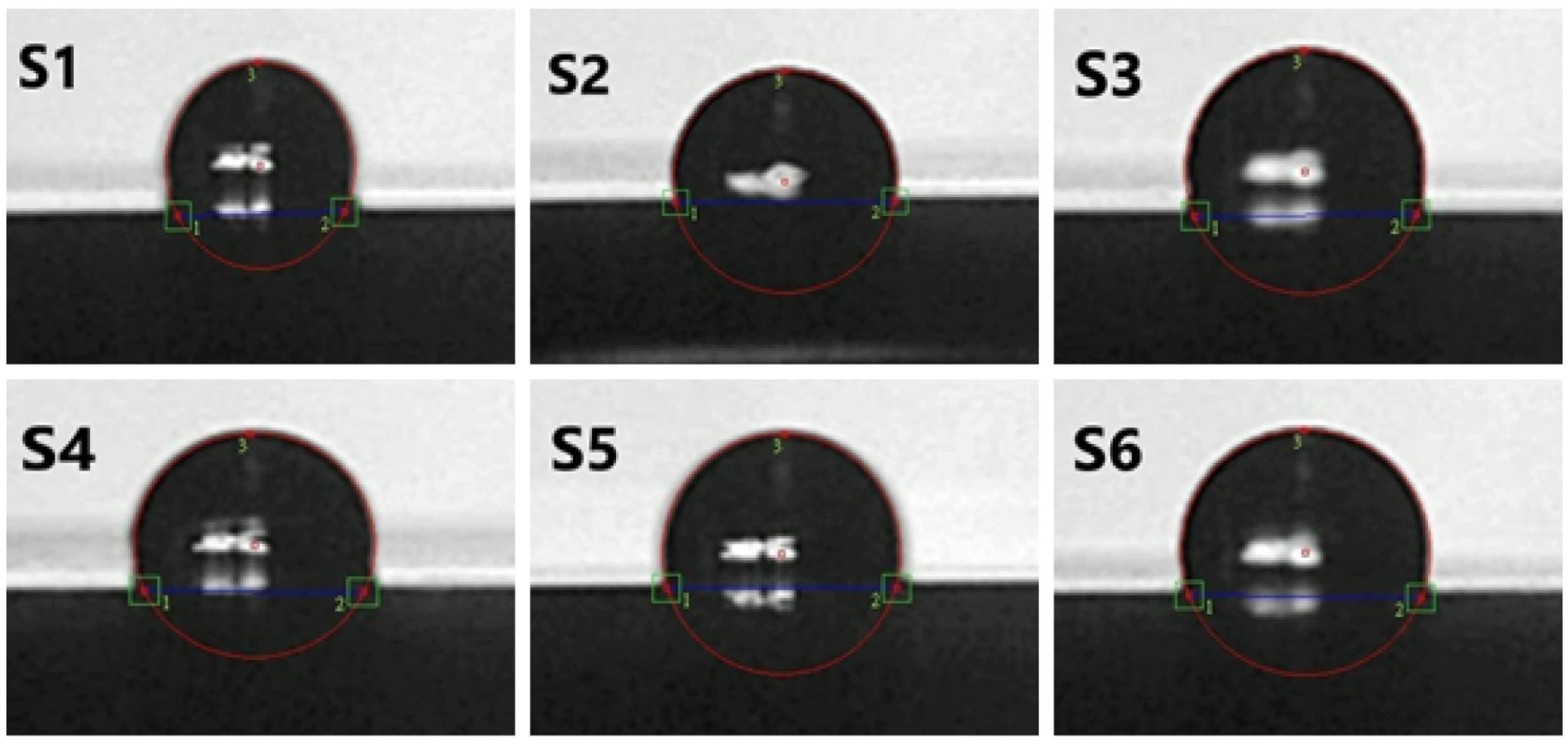
- The water contact angles of all six coatings exceed 90°, indicating that the films exhibit hydrophobic characteristics. Among them, the structures with CrAlN as the outermost surface layer show lower surface free energy, a characteristic that has a positive effect on enhancing anti-contamination performance.
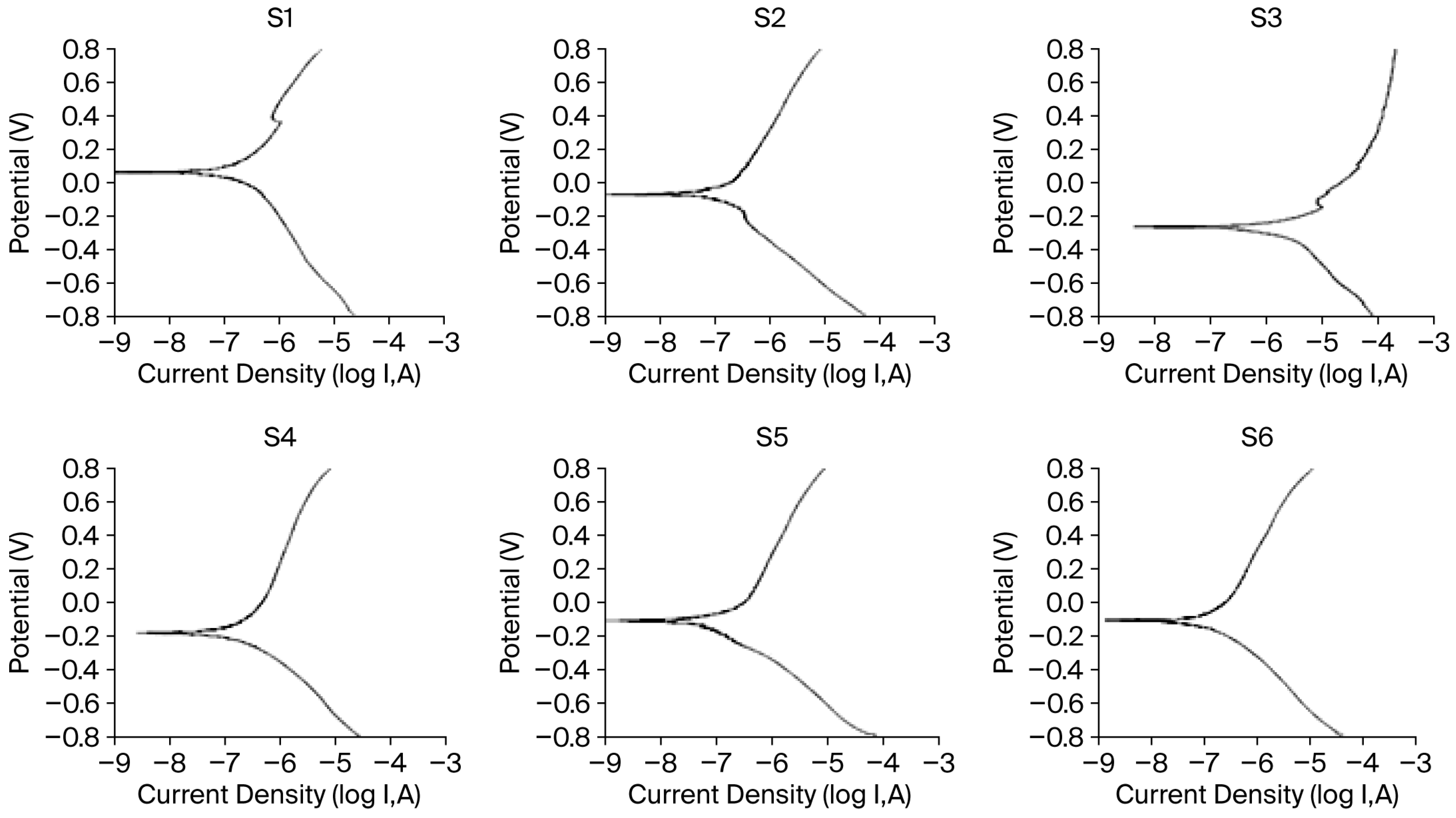
- Electrochemical polarization analysis showed that the corrosion current densities of the coatings were maintained at the level of 10−7 A/cm2, while polarization resistance reached 106–107 Ω·cm2. These results indicate that the multilayer interfaces effectively block the continuous diffusion pathways along columnar grain boundaries, creating a tortuous corrosion path. In addition, the formation of dense protective oxide layers via Cr, Al, and Ti significantly enhances corrosion resistance.
Author Contributions
Funding
Institutional Review Board Statement
Informed Consent Statement
Data Availability Statement
Conflicts of Interest
References
- Liu, Y.; Yu, S.; Shi, Q.; Ge, X.; Wang, W. Multilayer Coatings for Tribology: A Mini Review. Nanomaterials 2022, 12, 1388. [Google Scholar] [CrossRef] [Scilit]
- Leonov, A.A.; Denisova, Y.A.; Denisov, V.V.; Syrtanov, M.S.; Shmakov, A.N.; Savostikov, V.M.; Teresov, A.D. Structure and Properties of CrN/TiN Multi-Layer Coatings Obtained by Vacuum-Arc Plasma-Assisted Deposition Method. Coatings 2023, 13, 351. [Google Scholar] [CrossRef] [Scilit]
- Mayrhofer, P.; Mitterer, C.; Clemens, H. Self-organized Nanostructures in Hard Ceramic Coatings. Adv. Eng. Mater. 2005, 7, 1071–1082. [Google Scholar] [CrossRef] [Scilit]
- Xiong, L. The Development of Advanced Coating Technologies for Cutting Tools for Difficult-to-machine Materials. Int. J. Mech. Electr. Eng. 2026, 8, 90–97. [Google Scholar] [CrossRef] [Scilit]
- Cheng, W.; Wang, J.; Ma, X.; Liu, P.; Liaw, P.K.; Li, W. A Review On Microstructures and Mechanical Properties of Protective Nano-Multilayered Films. J. Mater. Res. Technol. 2023, 27, 2413–2442. [Google Scholar] [CrossRef] [Scilit]
- Luo, Y.; Dong, Y.; Xiao, C.; Wang, X.; Peng, H. Impact Abrasive Wear Property of CrAlN/TiSiN Multilayer Coating at Elevated Temperatures. Materials 2022, 15, 2214. [Google Scholar] [CrossRef] [Scilit] [PubMed]
- Miletić, A.; Panjan, P.; Čekada, M.; Kovačević, L.; Terek, P.; Kovač, J.; Dražič, G.; Škorić, B. Nanolayer CrAlN/TiSiN coating designed for tribological applications. Ceram. Int. 2021, 47, 2022–2033. [Google Scholar] [CrossRef] [Scilit]
- Li, C.; Wang, L.; Shang, L.; Cao, X.; Zhang, G.; Yu, Y.; Li, W.; Zhang, S.; Hu, H. Mechanical and High-Temperature Tribological Properties of CrAlN/TiSiN Multilayer Coating deposited by PVD. Ceram. Int. 2021, 47, 29285–29294. [Google Scholar] [CrossRef] [Scilit]
- Soranansri, P.; Dubois, A.; Moreau, P.; Funazuka, T.; Dohda, K.; Dubar, L. Tribological Performance of AlCrN and TiAlN Coatings in Aluminum Forming Process at High Temperature. Solid State Phenom. 2025, 370, 89–97. [Google Scholar] [CrossRef] [Scilit]
- Yan, H.; Wang, H.; Li, X.; Dou, Z.; Liu, F. Effect of Modulation Period on the Microstructure and Tribological Properties of AlCrTiVNbN/TiSiN Nano Multilayer Films. Coatings 2025, 15, 839. [Google Scholar] [CrossRef] [Scilit]
- Petkov, N.; Bakalova, T.; Bahchedzhiev, H.; Krafka, M.; Lemberk, L. Modulation Period Effect on CrN/TiN Coating Properties. J. Nano Res. 2023, 79, 37–48. [Google Scholar] [CrossRef] [Scilit]
- Li, Q.; Liu, F.; Yang, M.; Gao, T.; Ji, B.; Zhang, S.; Tu, R.; Zhang, L. Nanomultilayer Gradation Strategy to Improve Mechanical Properties of Hard Coatings. J. Vac. Sci. Technol. A 2024, 42, 053202. [Google Scholar] [CrossRef] [Scilit]
- Chang, C.L.; Huang, C.H.; Lin, C.Y.; Yang, F.C.; Tang, J.F. Mechanical properties of amorphous and crystalline CrN/CrAlSiN multilayer coating fabricated using HPPMS. Surf. Interfaces 2022, 31, 102064. [Google Scholar] [CrossRef] [Scilit]
- Tytko, D.; Choi, P.P.; Raabe, D. Oxidation behavior of AlN/CrN multilayered hard coatings. Nano Converg. 2017, 4, 15. [Google Scholar] [CrossRef] [Scilit] [PubMed]
- Liu, J.; Mei, H.; Hua, J.; Wang, J.; Wang, Y.; Yi, G.; Deng, X. High-Temperature Oxidation and Wear Resistance of TiAlSiN/AlCrN Multilayer Coatings Prepared by Multi-Arc Ion Plating. Nanomaterials 2025, 15, 503. [Google Scholar] [CrossRef] [Scilit]
- Chang, Y.Y.; Tsai, T.H.; Chang, C.E.; Feng, H.Q.; Yang, M.X.; Stüber, M.; Ulrich, S. Mechanical properties and thermal stabilities of multilayered AlCrBN/AlTiSiN hard coatings. Surf. Coat. Technol. 2025, 498, 131876. [Google Scholar] [CrossRef] [Scilit]
- Qiu, L.; Du, Y.; Wang, S.; Li, K.; Yin, L.; Wu, L.; Zhong, Z.; Albir, L. Mechanical properties and oxidation resistance of chemically vapor deposited TiSiN nanocomposite coating with thermodynamically designed compositions. Int. J. Refract. Met. Hard Mater. 2019, 80, 30. [Google Scholar] [CrossRef] [Scilit]
- Hu, C.; Chen, L.; Lou, Y.; Zhao, N.; Yue, J. Influence of Si content on the microstructure, thermal stability and oxidation resistance of TiAlSiN/CrAlN multilayers. J. Alloys Compd. 2021, 855, 157441. [Google Scholar] [CrossRef] [Scilit]
- Tang, J.-F.; Lin, C.-Y.; Yang, F.-C.; Chang, C.-L. Influence of Nitrogen Content and Bias Voltage on Residual Stress and the Tribological and Mechanical Properties of CrAlN Films. Coatings 2020, 10, 546. [Google Scholar] [CrossRef] [Scilit]
- Krülle, T.; Kuczyk, M.; Leonhardt, M.; Zimmer, O.; Leyens, C. The Influence of Nitrogen Partial Pressure on the Microstructure and Mechanical Properties of HfNbTaTiVZr High-Entropy Nitride Coating Deposited via Direct Current Cathodic Vacuum Arc Deposition. Coatings 2024, 14, 398. [Google Scholar] [CrossRef] [Scilit]
- Smyrnova, K.; Sahul, M.; Haršáni, M.; Beresnev, V.; Truchlý, M.; Čaplovič, L.; Čaplovičová, M.; Kusý, M.; Kozak, A.; Flock, D.; et al. Composite Materials with Nanoscale Multilayer Architecture Based on Cathodic-Arc Evaporated WN/NbN Coatings. ACS Omega 2024, 9, 17247–17265. [Google Scholar] [CrossRef] [Scilit]
- Zhang, Y.; Lin, T.; Han, Y.; Yang, Z.; Ma, K.; Qin, K.; Yu, H.; Qiang, D.; Jiang, Q.; Wang, J. Influence of bias voltage on the structural, mechanical, and corrosion properties of (TiSiAlCrV)N films deposited by three-target high-power impulse magnetron co-sputtering. Surf. Coat. Technol. 2025, 503, 131987. [Google Scholar] [CrossRef] [Scilit]



| Specimen | Layer Configuration (Deposition Time) |
|---|---|
| S1 | CrN (10 min)/CrAlN-TiSiN (30 min)/CrAlN (20 min) |
| S2 | CrN (10 min)/CrAlN-TiSiN (30 min)/TiSiN (20 min) |
| S3 | CrN (10 min)/CrAlN-TiSiN (50 min) |
| S4 | TiN (10 min)/CrAlN-TiSiN (30 min)/CrAlN (20 min) |
| S5 | TiN (10 min)/CrAlN-TiSiN (30 min)/TiSiN (20 min) |
| S6 | TiN (10 min)/CrAlN-TiSiN (50 min) |
| Specimen | Cr | Al | Ti | Si | N |
|---|---|---|---|---|---|
| S1 | 22.47 | 16.34 | 10.67 | 2.13 | 48.39 |
| S2 | 16.11 | 10.68 | 19.40 | 6.01 | 47.80 |
| S3 | 18.58 | 12.11 | 15.04 | 4.16 | 50.11 |
| S4 | 20.94 | 16.44 | 12.87 | 2.67 | 47.08 |
| S5 | 9.82 | 7.51 | 23.63 | 5.33 | 53.71 |
| S6 | 16.03 | 12.11 | 17.79 | 3.43 | 50.64 |
| Specimen | Total Layered Thickness (μm) |
|---|---|
| S1 | 1.276 |
| S2 | 1.073 |
| S3 | 1.139 |
| S4 | 1.781 |
| S5 | 1.439 |
| S6 | 1.900 |
| Specimen | S1 | S2 | S3 | S4 | S5 | S6 |
|---|---|---|---|---|---|---|
| Ra (μm) | 0.162 | 0.183 | 0.192 | 0.215 | 0.267 | 0.244 |
| Rz (μm) | 1.633 | 2.234 | 2.291 | 2.014 | 2.737 | 2.407 |
| Specimen | Icorr (A) | Ecorr (V) | Rp |
|---|---|---|---|
| S1 | 1.293 × 10⁻⁷ | 0.0604 | 8.9 × 10⁶ |
| S2 | 1.431 × 10⁻⁷ | −0.0723 | 6.8 × 10⁶ |
| S3 | 1.072 × 10⁻⁶ | −0.269 | 1.11 × 10⁶ |
| S4 | 1.248 × 10⁻⁷ | −0.1813 | 9.27 × 10⁶ |
| S5 | 1.545 × 10⁻⁷ | −0.1197 | 7.5 × 10⁶ |
| S6 | 1.344 × 10⁻⁷ | −0.1054 | 7.5 × 10⁶ |
Disclaimer/Publisher’s Note: The statements, opinions and data contained in all publications are solely those of the individual author(s) and contributor(s) and not of MDPI and/or the editor(s). MDPI and/or the editor(s) disclaim responsibility for any injury to people or property resulting from any ideas, methods, instructions or products referred to in the content. |
© 2026 by the authors. Licensee MDPI, Basel, Switzerland. This article is an open access article distributed under the terms and conditions of the Creative Commons Attribution (CC BY) license.
Share and Cite
Huang, W.-C.; Chu, H.-W. Influence of Layer Configuration on the Morphology and Corrosion Resistance of CrAlN/TiSiN Multilayer Coatings Prepared via Cathodic Arc Deposition. Coatings 2026, 16, 658. https://doi.org/10.3390/coatings16060658
Huang W-C, Chu H-W. Influence of Layer Configuration on the Morphology and Corrosion Resistance of CrAlN/TiSiN Multilayer Coatings Prepared via Cathodic Arc Deposition. Coatings. 2026; 16(6):658. https://doi.org/10.3390/coatings16060658
Chicago/Turabian StyleHuang, Wei-Che, and Hao-Wei Chu. 2026. "Influence of Layer Configuration on the Morphology and Corrosion Resistance of CrAlN/TiSiN Multilayer Coatings Prepared via Cathodic Arc Deposition" Coatings 16, no. 6: 658. https://doi.org/10.3390/coatings16060658
APA StyleHuang, W.-C., & Chu, H.-W. (2026). Influence of Layer Configuration on the Morphology and Corrosion Resistance of CrAlN/TiSiN Multilayer Coatings Prepared via Cathodic Arc Deposition. Coatings, 16(6), 658. https://doi.org/10.3390/coatings16060658