Article

Magnetic Field Induced Spin State Optimization in Fe-Co Dual-Active Centers for Superior Trifunctional Water Splitting

1
School of Science, Hubei University of Technology, No. 28, Nanli Road, Hong-shan District, Wuhan 430068, China
2
Hubei Provincial Key Laboratory of Artificial Quantum Two-Dimensional Materials, Hubei University of Technology, Wuhan 430068, China
*
Author to whom correspondence should be addressed.
Coatings 2026, 16(6), 659; https://doi.org/10.3390/coatings16060659 (registering DOI)

Submission received: 22 April 2026 / Revised: 20 May 2026 / Accepted: 27 May 2026 / Published: 30 May 2026

Abstract

Faced with a global energy crisis and ecological degradation, overall water splitting (OWS) is a pivotal approach for renewable energy conversion and storage. However, its industrial application is hindered by the high energy barriers/sluggish kinetics of the anodic oxygen evolution reaction (OER), as well as the scarcity of precious metal catalysts limiting large-scale deployment. Herein, a cobalt-based layered double hydroxide (Co-LDH) was used as the precursor, and a multi-strategy synergistic modification (hydrothermal synthesis, Fe doping, sulfurization, and external magnetic field magnetization) was applied to fabricate the Fe-Co3S4-MS-20 min electrocatalyst. This strategy establishes Fe-Co bimetallic synergistic active centers, and magnetic treatment modulates the electron configuration of Fe 3d orbitals without changing the material’s lattice spacing or morphology. Structural characterizations and electrochemical measurements were used to investigate the effects of combined modifications on the catalyst’s phase structure, morphology, electronic structure, and trifunctional catalytic performance toward the hydrogen evolution reaction (HER), OER, and urea oxidation reaction (UOR). The Fe-Co3S4-MS-20 min catalyst exhibits a larger electrochemical active surface area, lower charge transfer resistance, and smaller Tafel slope in 1 M KOH, it achieves overpotentials of 165 mV for HER (10 mA·cm−2) and 310 mV for OER (100 mA·cm−2), along with superior UOR performance and long-term stability. In situ impedance and Raman spectroscopy confirm that magnetization accelerates charge transfer and promotes in situ reconstruction. Synergistic multi-strategy regulation optimizes the electronic structure of active centers, reducing electrocatalytic energy barriers. This work provides new insights into designing high-performance non-precious metal electrocatalysts and offers experimental support for external magnetic field regulation in electrocatalyst modification.

1. Introduction

In the face of the dual challenges of global energy crises and ecological deterioration, the development of clean renewable energy systems has been recognized as critically important [1,2]. Hydrogen, as an ideal energy carrier with high calorific value and zero carbon emissions, has seen its efficient production technologies become a core research focus in the energy field. Electrocatalytic water splitting technology enables the conversion and storage of renewable energy sources, such as solar and wind power, into hydrogen, serving as a key pathway for establishing sustainable energy cycles [3,4,5]. This technology consists of two half-reactions: the anodic oxygen evolution reaction (OER) and the cathodic hydrogen evolution reaction (HER). However, due to the O-H bond breaking and O-O bond coupling processes involved, OER suffers from high reaction energy barriers and sluggish kinetics, which have become the primary bottleneck limiting the efficiency of overall water splitting [6,7,8]. Besides OER and HER, the UOR, an anodic reaction that oxidizes urea (CO(NH2)2) into non-toxic products such as N2, CO2, and H2O under electrocatalytic conditions, has attracted increasing attention as it can lower the anodic reaction potential compared to OER and simultaneously realize urea-containing wastewater treatment. The search for and development of low-cost, highly active electrocatalysts with excellent bifunctional OER/HER/UOR performance can effectively reduce the reaction overpotential and enhance catalytic stability [9]. This represents a crucial breakthrough in advancing electrocatalytic water splitting technology from laboratory research to industrial application.
Currently, although Pt, IrO2, and RuO2 based noble metal catalysts demonstrate optimal catalytic performance in OER/HER/UOR, their scarcity, high cost, and uneven resource distribution significantly limit large-scale commercial applications [10,11,12]. Therefore, many studies focus on non-noble metal catalysts. Research has demonstrated that cobalt-based layered double hydroxides (Co-LDHs), with their unique layered structure, are ideal candidate materials for electrocatalytic water splitting [13,14,15]. To further enhance the intrinsic catalytic activity of Co-LDHs, heterometallic atom doping has been proven effective. Metal doping can regulate the electronic structure of the host material, construct bimetallic synergistic active centers, and optimize the energy barriers for the adsorption and desorption of reaction intermediates [16,17,18]. Meanwhile, sulfurization can reconfigure the surface electronic states of the material and enhance electron delocalization by introducing sulfur, thereby further reducing the energy barriers to electrocatalytic reactions. Both strategies have been verified as effective approaches to improve the electrocatalytic performance of LDHs-based catalysts [19,20,21]. The hydrothermal method, known for its operational simplicity, controllable process, and suitability for the controlled synthesis of materials, has become a classic approach for synthesizing LDHs-based materials and their modified derivatives at the laboratory stage [22,23].
Although research on doped and sulfurized modifications of Co-LDH has achieved certain progress, existing studies still face numerous unresolved issues and research gaps. Pristine Co-LDHs have inherent limitations, such as a limited number of active sites and a simple electronic structure, and their multi-functional (ep: UOR/OER/HER) catalytic performance is insufficient to meet the requirements of practical applications [24,25,26,27,28]. Some studies have employed only a single modification strategy to optimize material properties, failing to achieve synergistic regulation across multiple approaches and thereby constraining the potential for further enhancement of catalytic performance. Building upon the work of Santosh’s team, which elucidated the advantages of microstructural studies on superconductivity in iron-based superconductors under external magnetic fields [29], and inspired by Adnan’s team, which explored the advantages of investigating thermal efficiency in hybrid (Al2O3-CuO/H2O) and ternary hybrid nanofluids (Al2O3-CuO-Cu/H2O) under applied magnetic fields and convective thermal conditions [30], this study proposes utilizing external magnetic field magnetization as a means to modify LDH-based sulfides. However, current research reveals that the evolution of crystal structures, the mechanisms of electronic structure regulation under magnetic fields, and the corresponding changes in electrocatalytic performance have not yet been systematically and thoroughly investigated. Furthermore, existing modification studies predominantly focus on combinations of basic methods such as doping and sulfurization, lacking further exploration into subsequent external-field regulation, which hinders the full exploitation of the catalytic potential of non-noble metal catalysts.
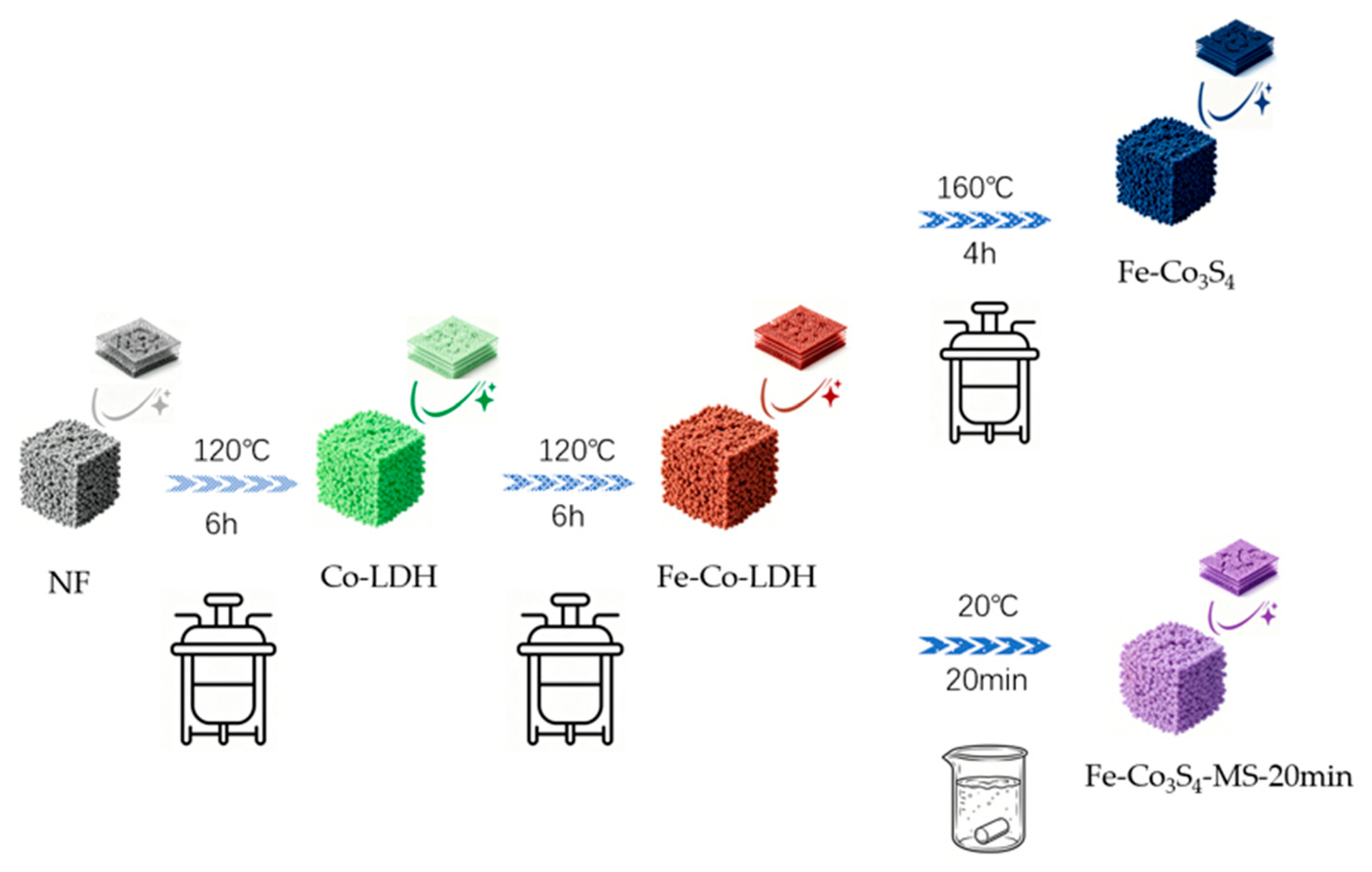
Inspired by existing research, we develop a facile sequential modification strategy (hydrothermal synthesis at 120 °C for 6 h, Fe doping, sulfurization at 160 °C for 4 h and external magnetic field magnetization for 20 min) to fabricate the Fe-Co3S4-MS-20 min trifunctional electrocatalyst from Co-LDH precursor. Structural characterizations (XRD, XPS, SEM) [31,32,33,34,35,36] confirm magnetic modification only modulates Fe 3d orbital electron arrangement without changing the lattice spacing (3.71 nm) or morphology, while constructing Fe-Co bimetallic active centers and optimizing the material’s electronic structure. Electrochemical measurements (LSV, EIS, CV) [37,38,39,40,41] are employed to systematically investigate the synergistic effects of multi-modification on the catalyst’s structure and its trifunctional (HER/OER/UOR) performance-UOR, a key reaction for integrated energy conversion, is notably optimized with reduced overpotential for the catalyst. In-depth analysis of the performance enhancement mechanism is also conducted, and this work provides novel insights for designing high-performance non-noble metal trifunctional electrocatalysts, as well as experimental and theoretical support for applying external magnetic field regulation in electrocatalyst modification for efficient overall water splitting and UOR.

2. Experimental Section

2.1. Materials and Reagents

NF (nickel foam) (purity 95%~98%, thickness 1 mm, porous structure, produced by Tianjin, China, Aivision Co., Ltd.), urea (CO(NH2)2) and thiourea (purchased from Aladdin Reagent (Shanghai) Co., Ltd., Shanghai, China), iron (III) nitrate nonahydrate (Fe(NO3)3·9H2O) and cobalt (II) nitrate hexahydrate (Co(NO3)2·6H2O) (provided by Tianjin Kermel Chemical Reagent Co., Ltd., Tianjin, China). Organic solvents including ethanol, acetone, and methanol (AR, ≥99.5%) were supplied by (Nanjing Century Technology Co., Ltd., Nanjing, Jiangsu, China) Potassium hydroxide (KOH, AR, ≥98%) was used directly without further purification.

2.2. Synthesis of Co-LDH

To ensure the purity of the synthesized materials, all substances were cleaned prior to the experiments. Specifically, the NF was immersed in a beaker containing ethanol, which was then placed in ultrapure water while ensuring no water entered the beaker. The setup was subjected to ultrasonication at 20 °C for 20 min. After cleaning, the NF, 0.66 mmol of cobalt (II) nitrate hexahydrate, 0.6 mmol of urea, and 30 mL of deionized water were placed in a 50 mL reaction kettle and reacted at 120 °C for 6 h. Upon completion, the sample was repeatedly rinsed with deionized water and finally dried in a vacuum drying oven at 50 °C for 12 h to obtain Co-LDH.

2.3. Synthesis of Fe-Co-LDH

0.02 mmol of iron (III) nitrate nonahydrate was dissolved in ultrapure water. The obtained Co-LDH was then added to the solution, and the mixture was transferred into a reaction kettle. The hydrothermal reaction was carried out at 120 °C for 6 h. After the reactor cooled to room temperature, the sample was taken out, repeatedly washed with deionized water, and dried in a vacuum drying oven at 50 °C to obtain the Fe-Co-LDH sample.

2.4. Synthesis of Fe-Co3S4

0.8 mmol of thiourea was dissolved in ultrapure water. The obtained Fe-Co-LDH was then added to the solution, and the mixture was transferred into a reaction kettle. The hydrothermal reaction continued at 160 °C for 4 h. After cooling to room temperature, the sample was collected, thoroughly rinsed with deionized water, and dried in a vacuum drying oven at 50 °C to yield the Fe-Co3S4 sample.

2.5. Synthesis of Fe-Co3S4-MS-20 min

The dried Fe-Co3S4 sample was removed and placed back in a beaker containing ultrapure water. At room temperature, the beaker was positioned above an external magnetic field for magnetization lasting 20 min. After magnetization, the sample was retrieved, rinsed repeatedly with deionized water, and dried in a vacuum drying oven at 50 °C to obtain the Fe-Co3S4-MS-20 min sample.

2.6. Physicochemical Characterization

In this experiment, the physicochemical properties of the synthesized catalyst samples were conducted. The specific testing methods and instrument parameters are as follows: Bruker D8 Advance X-ray diffraction (XRD) (Bruker AXS, Madison, WI, USA) was employed to analyze the phase composition and purity of the samples, with a scanning range of 10° to 80° and a scanning speed of 5°/min. Field-emission scanning electron microscopy (FE-SEM, FEI Quant200F) and energy-dispersive X-ray spectroscopy (EDS) (FEI Company (Thermo Fisher Scientific), Hillsboro, OR, USA) were used to systematically observe the surface morphology and elemental distribution of the samples. High-resolution transmission electron microscopy (HR-TEM) images were obtained on a transmission electron microscope (FEI Tecnai G2 F20) (FEI Company (Thermo Fisher Scientific), Waltham, MA, USA) operating at an accelerating voltage of 200 kV to analyze the microstructure and lattice information. X-ray photoelectron spectroscopy (XPS) was performed to determine the surface chemical states and elemental composition, using Al Kα radiation (hv = 1486.6 eV, power 300 W) with a step size of 1.0 eV on PHI 5300 ESCA (Physical Electronics (PHI), Perkin-Elmer/ULVAC-PHI, Chanhassen, MN, USA) and Thermo Fisher ESCALAB 250Xi systems. Raman spectroscopy (wavelength 532 nm, Horiba JY HR-800) (HORIBA Jobin Yvon, Kyoto, Japan) was applied to characterize molecular vibrations and structural defects of the materials.

2.7. Electrochemical Measurements

Electrochemical tests in this study were conducted in a standard three-electrode system (CHI760E electrochemical workstation) (Shanghai Chenhua Instrument Co., Ltd., Shanghai, China) using a 1 M KOH electrolyte. A saturated Ag/AgCl electrode served as the reference electrode, a graphite rod as the counter electrode, and the as-prepared sample (1 × 1 cm2) as the working electrode. Linear sweep voltammetry (LSV) measurements were performed within a potential range of −1 to 1 V (vs. RHE) at a scan rate of 2 mV·s−1. Electrochemical impedance spectroscopy (EIS) was carried out in the frequency range of 0.1–100 kHz with an AC amplitude of 5 mV, and the corresponding impedance spectra were recorded at overpotentials of 100 mV (for HER) and 300 mV (for OER), respectively. The reaction kinetic parameters were derived from the Tafel equation (η = b log j + a), where b is the Tafel slope and j is the current density. The electrochemical active surface area was determined via cyclic voltammetry at scan rates ranging from 20 to 120 mV·s−1 and estimated based on the double-layer capacitance (Cdl). All electrochemical measurements were performed at room temperature with 80% iR-compensation, and the potentials were converted to the reversible hydrogen electrode (RHE) scale using the equation: ERHE = EAg/AgCl + 0.197 V + 0.059 × pH. Furthermore, in situ Raman spectroscopy was performed under potentiostatic conditions by applying potentials of 1.0, 1.2, 1.4, 1.6, and 1.8 V (vs. RHE) sequentially. At each potential, the current was stabilized for 30–60 s to reach a steady state on the electrode surface before collecting the corresponding Raman spectrum.

3. Results and Discussion

3.1. Structures and Morphologies Characterization

Owing to its three-dimensional porous structure, high specific surface area, excellent electrical conductivity, thermal resistance, and good chemical stability, nickel foam (NF) was selected as the substrate in this study. The target catalysts were prepared via hydrothermal, sulfurization, and magnetization methods. As illustrated in Scheme 1, cobalt nitrate hexahydrate was first used to grow Co ions on the surface of NF through a hydrothermal process in an autoclave, resulting in Co-LDH material. Subsequently, iron (III) nitrate nonahydrate was introduced to carry out Fe doping, constructing Fe-Co bimetallic synergistic active centers and yielding Fe-Co-LDH material. Thiourea was then added to perform sulfurization modification, producing Fe-Co3S4 material and further optimizing the surface properties and electronic structure of the material. Finally, magnetic field magnetization was applied to achieve magnetization modification, which further adjusts the electronic structure to enhance catalytic activity, leading to the Fe-Co3S4-MS-20 min material.
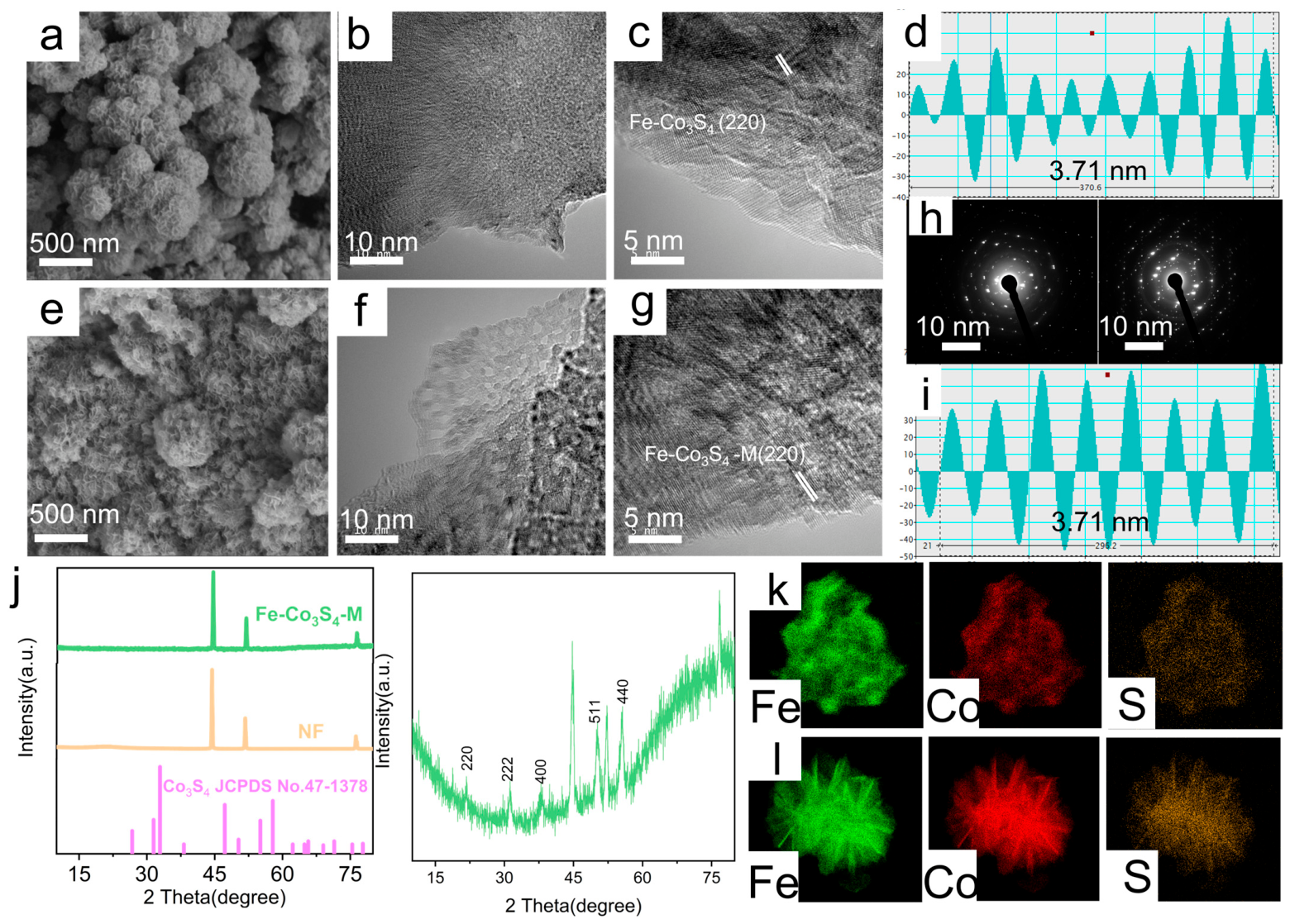
The microscopic morphologies of synthetic samples were characterized by scanning electron microscopy (SEM). As shown in Figure 1a,e, both Fe-Co3S4 and Fe-Co3S4-MS-20 min exhibit spherical or quasi-spherical particle structures with rough surfaces, distinct fibrous protrusions, and pores, indicating a high specific surface area and hierarchical porous structure. As shown in Figures S1–S3 (Supporting Information), also displays SEM images of Co-Fe-LDH, Fe-Co3S4 and Fe-Co3S4-MS-20 min nanosheets. TEM is used to further analyze the internal morphology of the material. Figure 1b,f present the TEM images of Fe-Co3S4 and Fe-Co3S4-MS-20 min, respectively, while Figure 1h shows the lattice fringe diffraction pattern of the material. Figure 1k,l display the morphological images of unmagnetized Fe, Co, S and magnetized Fe, Co, S, respectively. The negligible differences among these images collectively demonstrate that the morphology of the material remains largely unchanged, confirming that magnetization does not alter the morphology of Fe-Co3S4. Notably, Figure 1c,d,g,i present the lattice fringe images and corresponding lattice spacing diagrams of Fe-Co3S4 and Fe-Co3S4-MS-20 min, respectively. The measured lattice spacing for both materials is 3.71 nm, indicating no change in lattice spacing before and after magnetization. This suggests that the material itself is not altered by magnetization; rather, magnetization only modifies the electron arrangement within the Fe 3d orbitals. The crystalline phase and structural purity of the as-prepared Fe-Co3S4-MS-20 min electrode was characterized by X-ray diffraction (XRD), as presented in Figure 1j, alongside the standard pattern of bare NF and the JCPDS reference card (No. 47-1378) for cubic spinel Co3S4. The diffraction profile of Fe-Co3S4-MS-20 min shows well-resolved peaks at ~31°, 36°, 46°, 50°, 52°, 55°, and 76°, which can be unambiguously indexed to the (220), (311), (400), (422), (511), (440), and (533) crystal planes of Co3S4 (consistent with the magnified view in the right panel). The absence of impurity peaks (e.g., iron oxides or sulfides) and the close alignment with the standard Co3S4 pattern confirm the successful formation of phase-pure Fe-doped Co3S4 on the NF substrate. Additionally, the characteristic diffraction peaks of NF are also observed in the pattern, corresponding to the underlying nickel foam support. No significant peak shift or broadening is detected after magnetization, which is consistent with the unchanged lattice spacing observed in high-resolution TEM, further verifying that the magnetic treatment does not alter the crystal structure or lattice parameters of Fe-Co3S4-MS-20 min.
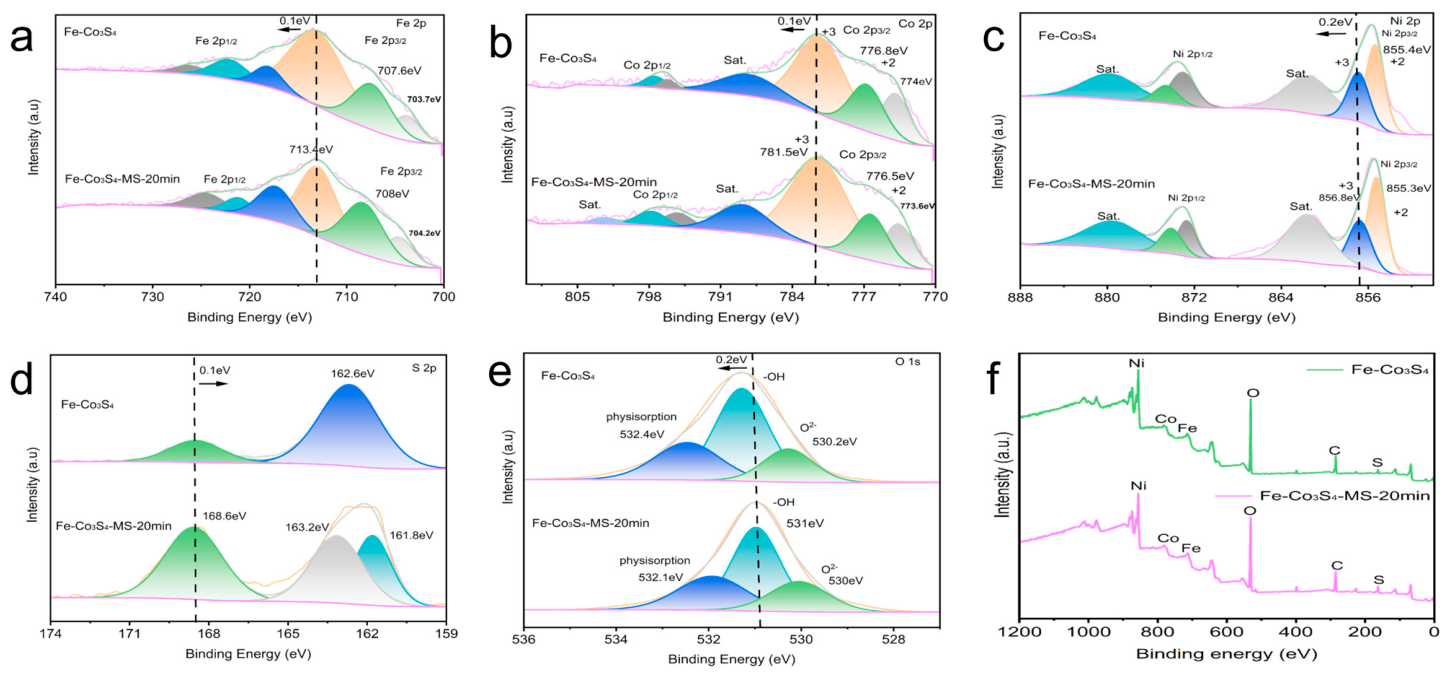
X-ray photoelectron spectroscopy (XPS) was employed to determine the valence states of all elements in the Fe-Co3S4 and Fe-Co3S4-MS-20 min samples. The full survey spectra (Figure 2f) confirm the coexistence of Fe, Co, Ni, S, and O elements in both samples, consistent with the composition of the Fe-Co3S4 material supported on NF. High-resolution Fe 2p spectra (Figure 2a) show two main peaks corresponding to Fe 2p3/2 (~708 eV) and Fe 2p1/2 (~721 eV). Notably, the Fe 2p3/2 peak of Fe-Co3S4-MS-20 min exhibits a slight negative shift of ~0.1 eV relative to Fe-Co3S4, indicating altered electronic states around Fe after magnetization. For Co 2p (Figure 2b), both samples display characteristic doublets for Co2+ (2p3/2 at ~776.8eV, 2p1/2 at ~776.5 eV) and Co3+ (2p3/2 at ~781.5 eV, 2p1/2 at ~781.6 eV), alongside satellite peaks [42,43]. The Co3+ 2p3/2 peak of Fe-Co3S4-MS-20 min shifts to a higher binding energy (~781.5 eV) compared to Fe-Co3S4 (~781.6 eV), reflecting a subtle electronic redistribution between Co2+ and Co3+. This mixed-valence behavior suggests enhanced electron delocalization and metallic character, consistent with magnetization-induced optimization of the electronic structure at active Co sites. In the Ni 2p spectra (Figure 2c), the two main peaks at ~855–856 eV and ~873–874 eV correspond to Ni 2p3/2 and Ni 2p1/2, respectively, with contributions from both Ni2+ (~855.3 eV) and Ni3+ (~856.4 eV). After magnetization, the Ni 2p3/2 peak shifts positively by ~0.2 eV, indicating an increase in the Ni3+/Ni2+ ratio. This enhanced Ni2+→Ni3+ conversion points to optimized d-orbital electron arrangement, which can promote electrocatalytic activity [44]. The S 2p spectra (Figure 2d) reveal two core peaks at ~162.6 eV (S 2p3/2) in Fe-Co3S4, corresponding to metal-sulfur bonds. For Fe-Co3S4-MS-20 min, these peaks shift positively to ~161.8 eV and ~163.2 eV, accompanied by a new peak at ~168.6 eV (sulfate species). The observed positive shift suggests increased electron density around sulfur, consistent with charge redistribution induced by magnetization [45]. High-resolution O 1s spectra (Figure 2e) are deconvoluted into three components: adsorbed water (~532.1–532.4 eV), surface hydroxyl groups (-OH, ~531.0–531.5 eV), and lattice oxygen (O2−, ~530.0–530.2 eV). The dominant -OH peak confirms the presence of surface hydroxides, which are favorable for electrocatalytic reactions. No significant phase change is observed after magnetization, only minor shifts in peak positions, further verifying that magnetization primarily affects electronic structure rather than chemical composition.

3.2. Electrocatalytic Performance of Fe-Co3S4-MS-20 min

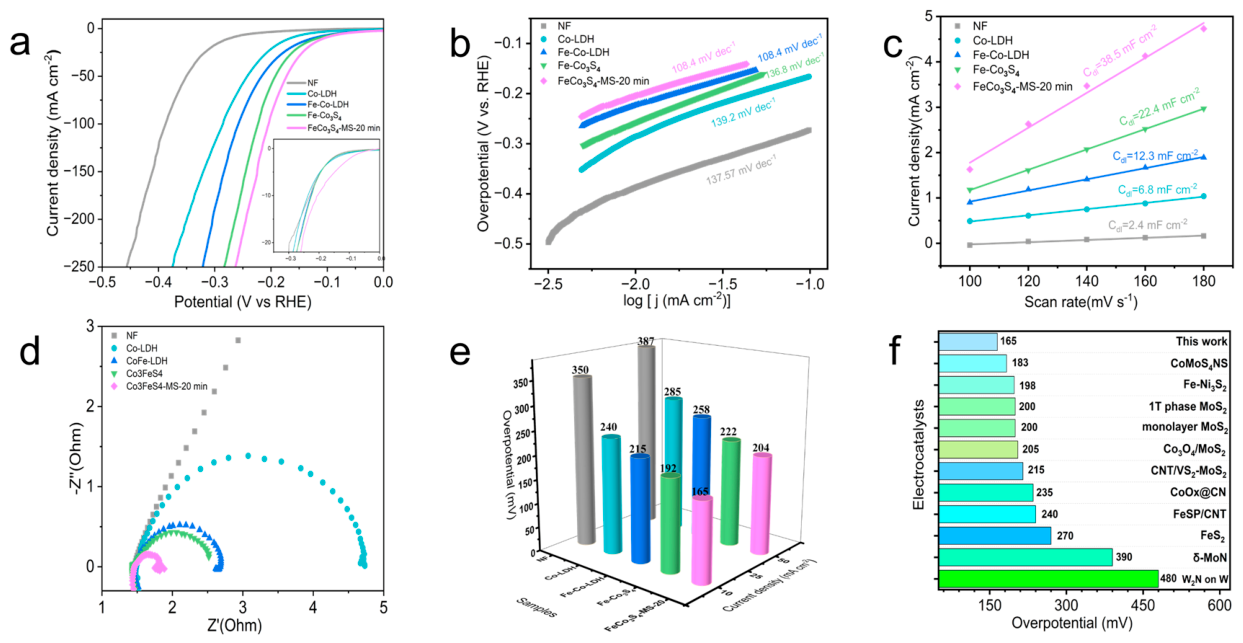
Electrochemical tests were conducted in a standard three-electrode system (1 M KOH). For HER, the sample with 400–600 CV cycles showed optimal activity, and Figure 3a presents the LSV performance order: NF, Co-LDH, Fe-Co-LDH, Fe-Co3S4, Fe-Co3S4-MS-20 min. As core indexes for trifunctional catalysis, OER and UOR were tested under the same system, where Fe-Co3S4-MS-20 min also exhibited the best performance, verifying the multi-strategy modification’s synergistic optimization of trifunctional (HER/OER/UOR) activity. Among them, the Fe-Co3S4-MS-20 min sample showed the highest activity, achieving an overpotential of 165 mV at a current density of 10 mA·cm−2, which outperforms many recently reported Co-LDH-based catalysts. In Figure 3b, the corresponding Tafel slopes are presented, further exploring the potential and kinetics of these catalysts. The Tafel slope of Fe-Co3S4-MS-20 min is 108.4 mV·dec−1, significantly lower than those of NF (137.57 mV·dec−1), Co-LDH (139.2 mV·dec−1), and Fe-Co3S4 (136.8 mV·dec−1). The primary reasons for the smaller Tafel slope of Fe-Co3S4-MS-20 min are: 1. The doping of Co and Fe alloys alters the electron density around the active centers, affecting the kinetic mechanisms of the material [46]; 2. Sulfurization and magnetization modifications change the electron arrangement in the Fe 3d orbitals, shifting electrons from high-spin to intermediate- or low-spin states [47]. To comprehensively evaluate the internal catalytic mechanism of the materials, the specific surface area was determined via ECSA measurements. As shown in Figure 3c, the specific surface area of Fe-Co3S4-MS-20 min (38.5 mF·cm−2) is larger than those of NF (2.4 mF·cm−2), Co-LDH (6.8 mF·cm−2), Fe-Co-LDH (12.3 mF·cm−2), and Fe-Co3S4 (22.4 mF·cm−2). To further investigate the HER process, the impedance of the samples was measured at an overpotential of 100 mV (Figure 3d). Fe-Co3S4-MS-20 min exhibited the smallest semicircle radius, indicating lower charge transfer resistance and thus rapid HER kinetics, consistent with the Tafel slope results [48]. Figures S5 and S6 (Supporting Information) shows the HER polarization curves of Pt in 1 M KOH and Cyclic voltammograms of NF, Co-LDH, Fe-Co-LDH and Fe-Co3S4 for HER at scan rates of 20–100 mV/s versus Ag/AgCl. Figure 3e shows the HER overpotentials of these five samples at different current densities, further confirming that Fe-Co3S4-MS-20 min exhibits the best electrochemical performance. Figure 3f shows the HER performance surpasses that of many recently reported electrocatalysts [49,50,51,52,53,54,55].
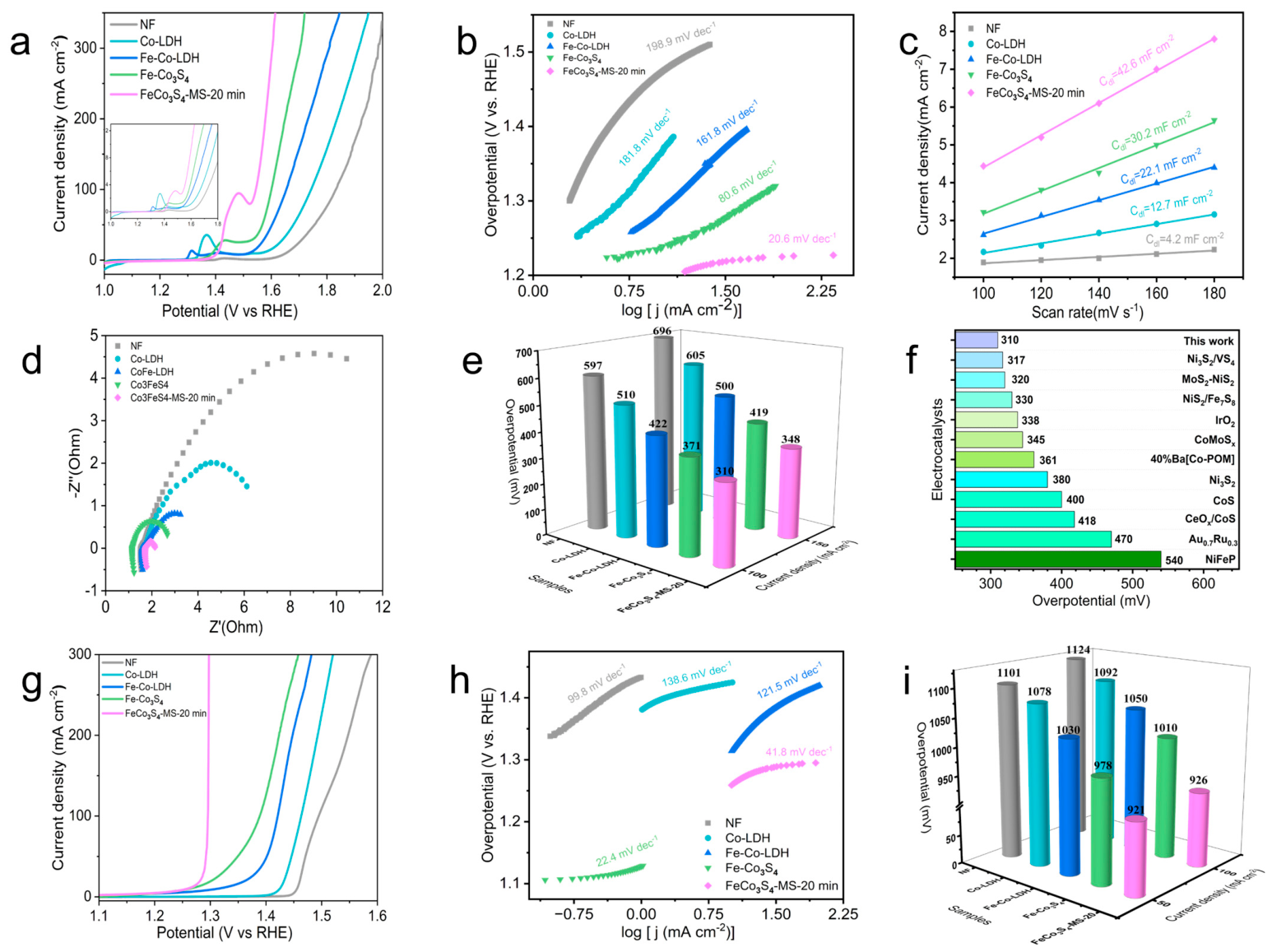
Similarly, the same three-electrode system also yielded performance comparable to that of HER in 1 M KOH solution. Studies indicate that the optimal OER performance aligns with that of HER [56]. It should be noted that Fe-Co3S4-MS-20 min exhibits a lower overpotential compared to other catalysts. As shown in Figure 4e, at a current density of 100 mA·cm−2, the overpotential for Fe-Co3S4-MS-20 min is 310 mV. At the same current density, this value is 287 mV, 200 mV, 112 mV, and 61 mV lower than those of the NF, Co-LDH, Fe-Co-LDH, and Fe-Co3S4 samples, respectively. The figure also illustrates the OER overpotentials of each sample at different current densities, further confirming that Fe-Co3S4-MS-20 min delivers the best electrochemical performance under any current density. Likewise, the OER performance surpasses that of many recently reported electrocatalysts (Figure 4f) [49,55,57,58,59,60,61]. Figures S7 and S8 (Supporting Information), OER polarization curves of RuO2 in 1 M KOH; cyclic voltammograms of NF, Co-LDH, Fe-Co-LDH and Fe-Co3S4 for OER at scan rates of 20–100 mV/s versus Ag/AgCl. In terms of electrochemical kinetics, as shown in Figure 4a–d, Fe-Co3S4-MS-20 min demonstrates the most favorable LSV curve (Figure 4a), an extremely low Tafel slope (20.6 mV·dec−1) (Figure 4b), the largest active specific surface area (Figure 4c), and the smallest charge transfer resistance (Figure 4d). We systematically investigated the UOR performance of the as-prepared catalysts in 1 M KOH containing 0.5 M urea, as shown in Figure 4g–i. The LSV curves (Figure 4g) reveal that Fe-Co3S4-MS-20 min exhibits the most favorable UOR activity, achieving the highest current density at a given potential among all samples. Specifically, at a current density of 50 mA·cm−2, Fe-Co3S4-MS-20 min requires the lowest overpotential of only 921 mV, which is significantly lower than those of NF (1101 mV), Co-LDH (1078 mV), Fe-Co-LDH (1030 mV), and Fe-Co3S4 (978 mV), confirming its superior intrinsic UOR catalytic activity (Figure 4i). To further probe the reaction kinetics, Tafel plots derived from the UOR polarization curves are presented in Figure 4h. Fe-Co3S4-MS-20 min delivers the smallest Tafel slope of 22.4 mV·dec−1, far outperforming NF (99.8 mV·dec−1), Co-LDH (138.6 mV·dec−1), Fe-Co-LDH (121.5 mV·dec−1), and Fe-Co3S4 (41.8 mV·dec−1), indicating the fastest UOR kinetics and favorable electron transfer efficiency at the catalyst-electrolyte interface. These results collectively demonstrate that magnetization treatment effectively enhances the UOR catalytic performance of Fe-Co3S4, making Fe-Co3S4-MS-20 min a promising electrocatalyst for urea-assisted energy conversion applications. This activity has far exceeded that of the FeNi-based UOR catalysts recently reported [62,63,64].

3.3. Specific Performance of Three-Functional Catalysts

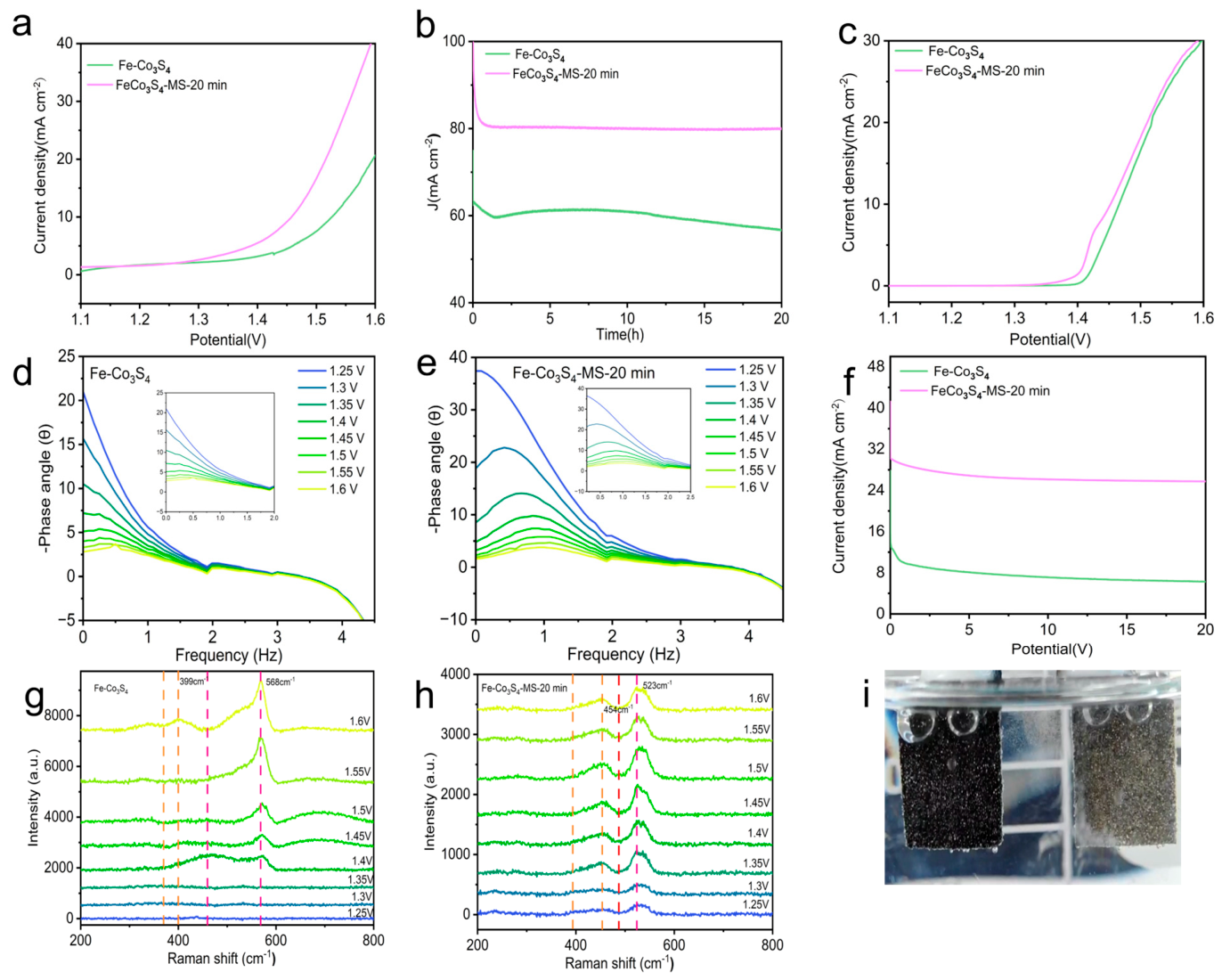
Given that Fe-Co3S4-MS-20 min exhibits excellent tri-functional activity, we conducted OWS/Urea water splitting (UWS) and corresponding stability tests (the control sample was Fe-Co3S4). The electrocatalytic performance of the prepared Fe-Co3S4 and Fe-Co3S4-MS-20 molecular catalysts was systematically evaluated in terms of OWS and UWS. As shown in Figure 5a, the OWS activity of the Fe-Co3S4-MS-20 molecular electrode was significantly enhanced, with a current density of 40 mA cm−2 at 1.6 V, while the current density of Fe-Co3S4 was approximately 20 mA cm−2. The time-counting amperometric stability test (Figure 5b) further demonstrated that the Fe-Co3S4-MS-20 molecular electrode maintained a stable current density of approximately 80 mA cm−2 within 20 h, while the current density of Fe-Co3S4 gradually decreased, confirming its better operational durability. For UWS, Figure 5c shows that the current density of Fe-Co3S4-MS-20 molecular electrode at 1.6 V is 30 mA cm−2, with an initial potential lower than Fe-Co3S4, indicating that the UWS kinetics are accelerated. The corresponding stability measurement (Figure 5f) shows that the Fe-Co3S4-MS-20 molecular electrode maintains a high and stable current density of approximately 28 mA cm−2 within 20 h, while Fe-Co3S4 shows a severe current decay in the initial stage and subsequently. To elucidate the reaction kinetics during the OER, in situ electrochemical impedance spectroscopy (EIS) tests were conducted at different potentials (Figure 5d,e). Compared to Fe-Co3S4, Fe-Co3S4-MS-20 exhibited a significantly reduced phase angle at all measured potentials, confirming a significantly accelerated charge transfer rate and a significantly reduced interface resistance. In situ Raman spectroscopy (Figure 5g,h) was used to investigate the dynamic surface evolution during the OER process. At low potentials, Fe-Co3S4 showed typical Co3S4 peaks at approximately 389 and 568 cm−1, which gradually weakened with increasing potential, while signals related to oxygen hydroxides appeared. In contrast, Fe-Co3S4-MS-20 exhibited clear peaks at approximately 454 and 523 cm−1 at higher potentials, which were attributed to the formation of highly active Ni/Co hydroxide species, their earlier appearance and higher intensity confirming that the surface modification promoted the formation of the catalytically active phase at lower overpotentials [65,66,67,68]. Finally, optical photographs (Figure 5i) visually demonstrated the dramatic changes in bubble formation during the reaction process, further confirming that the Fe-Co3S4-MS-20 sample enhanced electrocatalytic activity.

4. Conclusions

In summary, this work adopted a facile hydrothermal-sulfurization-magnetic magnetization strategy to modify Co-LDH, yielding the Fe-Co3S4-MS-20 min catalyst with abundant defects, low-spin 3d orbital electron configuration, large specific surface area, remarkable stability, low overpotential, high current density and long-term durability. As a high-performance trifunctional electrode, it exhibits excellent HER, OER and UOR activity with a notably lowered UOR overpotential and delivers low overpotentials of 310 mV at 100 mA·cm−2 for OER, 921 mV at 50 mA·cm−2 for UOR and 165 mV at 10 mA·cm−2 for HER in 1 M KOH. This study not only provides a novel modification strategy for Co-LDH, but also theoretically investigates the effects of vacancy structures and Co-Fe alloy introduction on the electronic structure of Fe-Co-LDH, laying a foundation for developing high-efficiency and stable trifunctional electrocatalytic materials and showing great potential for further commercial exploration.

Supplementary Materials

The following supporting information can be downloaded at: https://www.mdpi.com/article/10.3390/coatings16060659/s1, Figure S1. SEM image of CoFe-LDH nanosheets; Figure S2. SEM image of Fe-Co3S4 nanosheets; Figure S3. SEM image of Fe-Co3S4-MS-20 min nanosheets; Figure S4. XRD patterns of NF; Figure S5. HER polarization curves of Pt in 1 M KOH; Figure S6. Cyclic voltammograms of Co-LDH, Fe-Co-LDH, Fe-Co3S4 and Fe-Co3S4 -MS-20 min. versus Ag/AgCl at 20–100 mV/s scan rates for HER; Figure S7. OER polarization curves of RuO2 in 1 M KOH; Figure S8. Cyclic voltammograms of Co-LDH, Fe-Co-LDH, Fe-Co3S4 and Fe-Co3S4 -MS-20min. versus Ag/AgCl at 20–100 mV/s scan rates for OER; Figure S9. OER data with error bars (±5 mV) of NF, Co-LDH, Fe-Co-LDH, Fe-Co3S4 and FeCo3S4 -MS-20 min at 100 mA·cm−2 and 150 mA·cm−2; Figure S10. XRD patterns of the catalyst after cycling test.

Author Contributions

Conceptualization, Y.Z.; Software, Z.S.; Formal analysis, Z.S.; Investigation, Y.Z.; Resources, X.L.; Data curation, X.L.; Writing—original draft, Y.Z.; Writing—review & editing, H.S.; Supervision, S.L.; Project administration, S.L.; Funding acquisition, H.S. All authors have read and agreed to the published version of the manuscript.

Funding

This research was funded by the National Natural Science Foundation of China (51472081), Natural Science Foundation of Hubei Province: JCZRQNB202600234, Doctoral Research Start-up Fund: XJ2024006502, the Opening Project of State Key Laboratory of Advanced Technology for Float Glass (2022KF05), the Opening Project of Key Laboratory of Inorganic Functional Materials and Devices (KLIFMD202302), Hubei Province Technology Innovation Program Project (No. 2024BCB073).

Institutional Review Board Statement

Not applicable.

Informed Consent Statement

Not applicable.

Data Availability Statement

The data that has been used is confidential.

Conflicts of Interest

The authors declare that they have no known competing financial interests or personal relationships that could have appeared to influence the work reported in this paper.

References

  1. Majeed, A.; Li, X.; Hou, P.-X.; Tabassum, H.; Zhang, L.; Liu, C.; Cheng, H.-M. Monolayer carbon-encapsulated Mo-doped Ni nanoparticles anchored on single-wall carbon nanotube film for total water splitting. Appl. Catal. B Environ. 2020, 269, 118823. [Google Scholar] [CrossRef]
  2. Su, H.; Song, S.; Li, S.; Gao, Y.; Ge, L.; Song, W.; Ma, T.; Liu, J. High-valent bimetal Ni3S2/Co3S4 induced by Cu doping for bifunctional electrocatalytic water splitting. Appl. Catal. B Environ. 2021, 293, 120225. [Google Scholar] [CrossRef]
  3. Du, X.; Han, W.; Zhang, X. Application of in situ Raman and other technique in electrocatalytic water splitting. Int. J. Hydrog. Energy 2025, 200, 152918. [Google Scholar] [CrossRef]
  4. Deng, S.; Yao, K.; Kodama, M.; Li, O.L.; Takeuchi, N. Green Technique for Producing Carbon-Based Catalysts for Cellulose Hydrolysis. Materials 2025, 18, 5031. [Google Scholar] [CrossRef]
  5. Liu, H.; Shi, Q.; Yang, Y.; Yu, Y.N.; Zhang, Y.; Zhang, M.; Lei, W.; Lu, Y. CoO-Co2P composite nanosheets as highly active catalysts for sodium borohydride hydrolysis to generate hydrogen. Funct. Mater. Lett. 2020, 13, 2051025. [Google Scholar] [CrossRef]
  6. Zhai, Y.; Ren, X.; Sun, Y.; Li, D.; Wang, B.; Liu, S. Synergistic effect of multiple vacancies to induce lattice oxygen redox in NiFe-layered double hydroxide OER catalysts. Appl. Catal. B Environ. 2022, 323, 122091. [Google Scholar] [CrossRef]
  7. Song, C.W.; Suh, H.; Bak, J.; Bin Bae, H.; Chung, S.-Y. Dissolution-Induced Surface Roughening and Oxygen Evolution Electrocatalysis of Alkaline-Earth Iridates in Acid. Chem 2019, 5, 3243–3259. [Google Scholar] [CrossRef]
  8. Ankinapalli, O.R.; Ayyaluri, R.R.; Yu, J.S. Enhanced electrocatalytic properties of copper cobalt vanadium oxide nanostructures integrated with reduced graphene oxide for oxygen evolution and hydrogen evolution reactions in efficient water splitting applications. Surf. Interfaces 2026, 82, 108428. [Google Scholar] [CrossRef]
  9. Jiang, K.; Liu, B.; Luo, M.; Ning, S.; Peng, M.; Zhao, Y.; Lu, Y.-R.; Chan, T.-S.; de Groot, F.M.F.; Tan, Y. Single platinum atoms embedded in nanoporous cobalt selenide as electrocatalyst for accelerating hydrogen evolution reaction. Nat. Commun. 2019, 10, 1–9. [Google Scholar] [CrossRef]
  10. Peng, S.; Gong, F.; Li, L.; Yu, D.; Ji, D.; Zhang, T.; Hu, Z.; Zhang, Z.; Chou, S.; Du, Y.; et al. Necklace-like multi-shelled hollow spinel oxides with oxygen vacancies for efficient water electrolysis. J. Am. Chem. Soc. 2018, 140, 13644–13653. [Google Scholar] [CrossRef]
  11. Xu, X.; Luo, X.; Zhan, X.; Ding, F.; Sun, S.; Shao, Z. Performance of nonprecious metal-filled Pt-based coating of Ti bipolar plates for proton exchange membrane water electrolyzer. Chem. Eng. J. 2024, 502, 158119. [Google Scholar] [CrossRef]
  12. Zhang, S.; Liu, S.; Cao, W.; Luo, J.; Gu, Y.; Liu, X.; Tan, P.; Wang, Z.; Pan, J. Microwave heating-assisted synthesis of ultrathin platinum-based trimetallic nanosheets as highly stable catalysts towards oxygen reduction reaction in acidic medium. J. Colloid Interface Sci. 2024, 675, 1108–1118. [Google Scholar] [CrossRef] [PubMed]
  13. Li, Q.; Tan, L.; Zhou, J.; Li, J.; Wang, X.; Li, D.; Wang, S.; Ao, Z. The d-band center from transition metals on platinum-based catalysts for enhanced toluene oxidation. Environ. Surf. Interfaces 2025, 3, 224–236. [Google Scholar] [CrossRef]
  14. Zhang, Z.; Li, P.; Zhang, X.; Hu, C.; Li, Y.; Yu, B.; Zeng, N.; Lv, C.; Song, J.; Li, M. Recent Advances in Layered-Double-Hydroxides Based Noble Metal Nanoparticles Efficient Electrocatalysts. Nanomaterials 2021, 11, 2644. [Google Scholar] [CrossRef]
  15. Wang, Z.; Hu, Y.; Liu, W.; Xu, L.; Guan, M.; Zhao, Y.; Bao, J.; Li, H. Manganese-Modulated Cobalt-Based Layered Double Hydroxide Grown on NF with 1D-2D-3D Heterostructure for Highly Efficient Oxygen Evolution Reaction and Urea Oxidation Reaction. Chemistry 2020, 26, 9382–9388. [Google Scholar] [CrossRef]
  16. Li, S.; Lv, X.; Liang, J.; Zhang, L.; Yang, Y.; Jiang, Y. Nitrogen doping regulated electron structure of CoTe1.8/FeNiTe2 heterojunction improved the electrocatalytic water splitting performance with excellent stability. Int. J. Hydrog. Energy 2025, 193, 152382. [Google Scholar] [CrossRef]
  17. Rabbani, M.S.; Wei, S.; Anwar, M.I.; Zafar, Z.; Liu, Z.-Y.; Wang, Y.; Yue, X.-Z. Al3+ Doping-induced electronic structure regulation in NiFeOx for accelerated oxygen evolution kinetics and superior stability. J. Alloy. Compd. 2025, 1039, 182831. [Google Scholar] [CrossRef]
  18. Liu, Z.; Gan, C.; He, T.; Jiang, Q.; Wu, X.; Huang, H.; Mao, S.; Tang, J. Optimization sulfur doping of electronic structure with metal active center for defect-rich FeCo bimetallic hydroxyl oxide catalysts. Int. J. Hydrog. Energy 2023, 48, 28758–28768. [Google Scholar] [CrossRef]
  19. Li, H.; Song, Z.; Mao, Y.; Zhang, X.; Huang, Z.; Liu, W.; Gao, H.; Dong, D. Degradation mechanism of toluene over Ce-M (Cu, Co and Fe) catalysts: Effect of oxygen vacancies on reaction intermediates. Appl. Surf. Sci. 2024, 652, 159272. [Google Scholar] [CrossRef]
  20. Zhang, J.; Du, Z.; Yan, T.; Zeng, F.; Xu, Z.; Xu, J.; Meng, Z.; Hu, X.; Zhao, J.; Tian, H. Enhancing redox kinetics by electron orbital modulation for high-performance aqueous energy storage. Energy Storage Mater. 2023, 60, 102831. [Google Scholar] [CrossRef]
  21. Li, C.; Yu, J.; Yang, D.; Li, H.; Cheng, Y.; Ren, Y.; Bi, X.; Ma, J.; Zhao, R.; Zhou, Y.; et al. Balancing Electronic Spin State via Atomically-Dispersed Heteronuclear Fe–Co Pairs for High-Performance Sodium–Sulfur Batteries. J. Am. Chem. Soc. 2025, 147, 8250–8259. [Google Scholar] [CrossRef]
  22. Hammood, A.S.; Asadi, A.S.A.; Mudhaffer, A.F.M. Synthesis and properties of flexible supercapacitor based on zinc-aluminum layered doubled hydroxide. J. Alloys Compd. 2024, 1009, 176925. [Google Scholar] [CrossRef]
  23. Stricher, M.; Sarde, C.-O.; Guénin, E.; Egles, C.; Delbecq, F. Cellulosic/Polyvinyl Alcohol Composite Hydrogel: Synthesis, Characterization and Applications in Tissue Engineering. Polymers 2021, 13, 3598. [Google Scholar] [CrossRef]
  24. Wu, J.; Wei, F.; Sui, Y.; Qi, J.; Zhang, X. Interconnected NiS-nanosheets@porous carbon derived from Zeolitic-imidazolate frameworks (ZIFs) as electrode materials for high-performance hybrid supercapacitors. Int. J. Hydrog. Energy 2020, 45, 19237–19245. [Google Scholar] [CrossRef]
  25. Zhao, B.; Irfan, R.M.; Liu, C.; Talib, S.H.; Mahmood, A.; Niu, L. Water oxidation promoted synergistically by CeO2-shell on CoNiO2-core. J. Rare Earths 2025, 44, 642–649. [Google Scholar] [CrossRef]
  26. Yu, S.; Jia, P.; Lin, S.; Hu, Y.; Xing, K.; Yao, L.; Jiao, Y.; He, X.; Cheng, Y.; Xu, Z. Dual FeCo single-atom nanozymes with specific oxidase-like activity for sensitive detection of aflatoxin B1. Talanta 2025, 294, 128256. [Google Scholar] [CrossRef]
  27. Nagaraju, M.; Shankar, E.G.; Kiran, A.S.; Yu, J.S. Direct growth of CoMnO3/CoMnP4 composite and Bi2S3 nanostructured materials for long-lasting and high-performance asymmetric supercapacitors. J. Energy Storage 2026, 152, 120753. [Google Scholar] [CrossRef]
  28. Ghosh, S.; Nandi, S.; De, S.; Pal, T.; Ghosh, S. Solution-processed CdS1-xSex nanorods with composition-tuned bandgap and microstructural evolution for visible-light photocatalytic response. J. Phys. Chem. Solids 2026, 212, 113565. [Google Scholar] [CrossRef]
  29. Barik, S.K.; Sahoo, B.K.; Panda, B. Microscopic Study of Superconductivity in Presence of External Magnetic Field in Iron Pnictide Superconductors. J. Low Temp. Phys. 2026, 222, 35. [Google Scholar] [CrossRef]
  30. Adnan; Ashraf, W. Thermal efficiency in hybrid (Al2O3-CuO/H2O) and ternary hybrid nanofluids (Al2O3-CuO-Cu/H2O) by considering the novel effects of imposed magnetic field and convective heat condition. Waves Random Complex Media 2022, 35, 8029–8044. [Google Scholar] [CrossRef]
  31. Eliovich, I.; Petrov, I.; Akkuratov, V.; Chernov, D.; Marchenkov, A.; Bykov, A.; Machikhin, A.; Sharikova, M.; Pisarevsky, Y. New approach for studying structural changes in crystals under external influences using a complex method based on X-ray diffraction, video spectrometry, and acoustic emission. Measurement 2026, 267, 120555. [Google Scholar] [CrossRef]
  32. Alam, A.; Ahmed, S.; Sarkar, D.; Bishwas, R.K.; Jahan, S.A. Preferred crystallographic design of monoclinic tenorite (CuO) nanocrystals by powder X-ray line diffraction. Chem. Inorg. Mater. 2025, 7, 100119. [Google Scholar] [CrossRef]
  33. Murdoch, B.J. Quantitative Analysis Using Dual Anode X-Ray Photoelectron Spectroscopy. Surf. Interface Anal. 2025, 58, 125–137. [Google Scholar] [CrossRef]
  34. Liu, Y.-P.; Lamers, N.; Zhang, Z.; Zaiats, N.; Mikkelsen, A.; Wallentin, J.; Dittmann, R.; Timm, R. Ion Migration and Redox Reactions in Axial Heterojunction Perovskite CsPb(Br1–xClx)3 Nanowire Devices Revealed by Operando Nanofocused X-ray Photoelectron Spectroscopy. ACS Nano 2024, 18, 34763–34775. [Google Scholar] [CrossRef] [PubMed]
  35. Anwaruzzaman; Wornyo, E.; Pan, S. Rapid Search for Electrochemical Reduction Conditions of Direct Liquid Injection Chemical Vapor Deposition Hematite Photoanode with Scanning Electrochemical Cell Microscopy for Enhanced PEC Water Splitting. J. Phys. Chem. Lett. 2025, 16, 12957–12965. [Google Scholar] [CrossRef]
  36. Martínez, B.S.J.; Escribano, E.M. In Situ Elucidation of Reaction Mechanisms in Electrocatalysis Using Scanning Electrochemical Microscopy. ChemCatChem 2025, 17, e00352. [Google Scholar] [CrossRef]
  37. David, I.G.; Buleandră, M.; Popa, D.E.; Bercea, A.M.; Ciucu, A.A. Simple Electrochemical Chloramphenicol Assay at a Disposable Pencil Graphite Electrode by Square Wave Voltammetry and Linear Sweep Voltammetry. Anal. Lett. 2022, 55, 1531–1548. [Google Scholar] [CrossRef]
  38. Ding, Z.J.; Liu, Y.; Weerasooriya, R.; Chen, X. Electrochemical Determination of Chromium (VI) with Au/UiO-66 Modified Glassy Carbon and Screen-Printed Electrodes by Linear Sweep Voltammetry (LSV). Anal. Lett. 2024, 57, 753–771. [Google Scholar] [CrossRef]
  39. d’Intignano, M.X.; Devos, O.; El May, M.; Mercier, S.; Saintier, N.; Tribollet, B. Characterisation of the growth of the oxide layer on wrought and LPBF 316L stainless steels by electrochemical impedance spectroscopy measurements. Electrochim. Acta 2026, 549, 147991. [Google Scholar] [CrossRef]
  40. Meng, S.; Liu, K.; Zhang, Y.; Tang, Z.; Liu, J.; Zhou, P.; Zhang, T.; Zhang, Y.; Maj, Ł.; Wang, F. A new look into the electrochemical impedance spectra of plasma electrolytic oxidation coatings on Mg-Zn-Ca alloy in simulated body fluid electrolyte. J. Mater. Sci. 2025, 60, 17232–17253. [Google Scholar] [CrossRef]
  41. Alex, S.B.; Vazhayal, L.; Haram, S.K. Rapid Scan Cyclic Voltammetry (RSCV) investigation of oxygen reduction reaction (ORR) on gold ultramicroelectrode (UME): A novel methodology to study kinetics of formation of transient intermediates. Discov. Electrochem. 2025, 2, 18. [Google Scholar] [CrossRef]
  42. Piñeiro-García, A.; Wu, X.; Rafei, M.; Mörk, P.J.; Gracia-Espino, E. A Quaternary mixed oxide protective scaffold for ruthenium during oxygen evolution reaction in acidic media. Commun. Eng. 2023, 2, 28. [Google Scholar] [CrossRef]
  43. Zhou, Y.; Jin, R.; Zhang, H.; Wei, Z.; Xue, W.; Cui, X. Pyrolysis-free cobalt-based conjugated coordination polymer/graphene oxide hybrid for efficient oxygen reduction. Mater. Lett. 2026, 409, 140221. [Google Scholar] [CrossRef]
  44. Xie, Z.; Yang, Y.; Chen, B.; Zhao, Z.; Qin, H.; Sun, H.; Lei, N.; Zhao, J.; Wei, D. Giant Spin–Orbit Torque in Antiferromagnetic-Coupled Pt/[Co/Gd]N Multilayers with Suppressed Spin Dephasing and Robust Thermal Stability. ACS Appl. Mater. Interfaces 2024, 16, 27944–27951. [Google Scholar] [CrossRef] [PubMed]
  45. Qin, Q.; Zhu, C.; Mo, D.; Chen, Z.; Dong, L.; Li, B.; Zhou, L. In situ doping derivative construction of MnOx/Mn-ZrO2-C for efficient degradation of NOx. Mol. Catal. 2025, 583, 115243. [Google Scholar] [CrossRef]
  46. Xu, G.-R.; Zhou, X.; Miao, Y.; Jiang, B.; Sun, Q.; Wu, Z.; Li, B.; Wang, L. Electron Synergism in Boron Interstitial Doping Ordered Pt3Co Nanoparticles Enhances the Protonation Process: Application to Efficient Oxygen Reduction in Zinc-Air Batteries. Adv. Energy Mater. 2025, 15, e03590. [Google Scholar] [CrossRef]
  47. Chen, Z.Q.; Cai, W.J.; Zhang, H.J.; Xiao, K.; Huang, B.; Liu, Z.Q. Spin polarization induced rapid reconstruction of transition metal oxide for efficient water electrolysis. Chem. Sci. 2025, 16, 14750–14759. [Google Scholar] [CrossRef]
  48. Khan, S.; Alqorashi, A.K.; Fatima, R.; Iqbal, M.W.; Arslan, M.; A, N.; Ashraf, M.; Kumar, A.; El-Sabban, H.A.; Diab, M. Enhancing energy storage in next-generation supercapacitors with SnO/Mo2TiC2Tx(PANI) hybrid materials: A synergistic approach for HER. J. Phys. Chem. Solids 2025, 209, 113266. [Google Scholar] [CrossRef]
  49. Su, H.; Ye, F.; Zhang, S.; Han, C.; Dong, J.; Dai, Z.; Ma, X.; Ge, L. Fe-Co dual-sites p-d orbital hybridization: Electronic restructuring for accelerated oxygen evolution kinetics. J. Colloid Interface Sci. 2025, 699, 138278. [Google Scholar] [CrossRef]
  50. Muthurasu, A.; Maruthapandian, V.; Kim, H.Y. Metal-organic framework derived Co3O4/MoS2 heterostructure for efficient bifunctional electrocatalysts for oxygen evolution reaction and hydrogen evolution reaction. Appl. Catal. B Environ. 2019, 248, 202–210. [Google Scholar] [CrossRef]
  51. Voiry, D.; Salehi, M.; Silva, R.; Fujita, T.; Chen, M.; Asefa, T.; Shenoy, V.B.; Eda, G.; Chhowalla, M. Conducting MoS2 nanosheets as catalysts for hydrogen evolution reaction. Nano Lett. 2013, 13, 6222–6227. [Google Scholar] [CrossRef] [PubMed]
  52. Shan, X.; Liu, J.; Mu, H.; Xiao, Y.; Mei, B.; Liu, W.; Lin, G.; Jiang, Z.; Wen, L.; Jiang, L. An engineered superhydrophilic/superaerophobic electrocatalyst composed of the supported CoMoSx chalcogel for overall water splitting. Angew. Chem. Int. Ed. Engl. 2019, 59, 1659–1665. [Google Scholar] [CrossRef]
  53. Wang, T.; Guo, X.; Zhang, J.; Xiao, W.; Xi, P.; Peng, S.; Gao, D. Electronic structure modulation of NiS2 by transition metal doping for accelerating the hydrogen evolution reaction. J. Mater. Chem. A 2019, 7, 4971–4976. [Google Scholar] [CrossRef]
  54. Ren, X.; Wei, Q.; Wu, F.; Wang, Y.; Zhao, L. CNT/VS2-MoS2 with multi-interface structure for improved hydrogen evolution reaction. Chem. Commun. 2021, 57, 2531–2534. [Google Scholar] [CrossRef] [PubMed]
  55. Lonkar, S.P.; Pillai, V.V.; Alhassan, S.M. Scalable solid-state synthesis of MoS2–NiS2/graphene nanohybrids as bifunctional electrocatalysts for enhanced overall water splitting. Mater. Adv. 2020, 1, 794–803. [Google Scholar] [CrossRef]
  56. Rabe, A.; Attallah, A.G.; Eggert, B.; Hirschmann, E.; Salamon, S.; Landers, J.; Kämmerer, L.; Cosanne, N.; Koul, A.; Budiyanto, E.; et al. Catalytic Activity of Cobalt Ferrites in Water Oxidation Reactions and Its Defect Dependency. ChemCatChem 2025, 18, e01270. [Google Scholar] [CrossRef]
  57. Su, H.; Song, S.; Gao, Y.; Li, N.; Fu, Y.; Ge, L.; Song, W.; Liu, J.; Ma, T. In situ electronic redistribution tuning of NiCo2S4 nanosheets for enhanced electrocatalysis. Adv. Funct. Mater. 2021, 32, 2109731. [Google Scholar] [CrossRef]
  58. Su, H.; Jiang, J.; Li, N.; Gao, Y.; Ge, L. NiCu alloys anchored defect-rich NiFe layered double-hydroxides as efficient electrocatalysts for overall water splitting. Chem. Eng. J. 2022, 446, 137226. [Google Scholar] [CrossRef]
  59. Rong, J.; Xu, J.; Qiu, F.; Fang, Y.; Zhang, T.; Zhu, Y. 2D metal-organic frameworks-derived preparation of layered CuS@C as an efficient and stable electrocatalyst for hydrogen evolution reaction. Electrochimica Acta 2019, 323, 134856. [Google Scholar] [CrossRef]
  60. Xu, H.-J.; Cao, J.; Shan, C.-F.; Wang, B.-K.; Xi, P.-X.; Liu, W.-S.; Tang, Y. MOF-derived hollow CoS decorated with CeOx nanoparticles for boosting oxygen evolution reaction electrocatalysis. Angew. Chem. 2018, 130, 8790–8794. [Google Scholar] [CrossRef]
  61. Yang, D.; Cao, L.; Feng, L.; Huang, J.; Kajiyoshi, K.; Feng, Y.; Liu, Q.; Li, W.; Feng, L.; Hai, G. Formation of hierarchical Ni3S2 nanohorn arrays driven by in-situ generation of VS4 nanocrystals for boosting alkaline water splitting. Appl. Catal. B Environ. 2019, 257, 117911. [Google Scholar] [CrossRef]
  62. Hu, Y.; Wang, W.; Han, F.; Wang, Z.; Guo, Q.; Chen, T.; Yi, F.-Y. A Unified Platform Based on Nanoalloyed FeCoNi Sulfide as Electrocatalyst for OER, UOR, and MOR. ACS Appl. Nano Mater. 2026, 9, 8370–8381. [Google Scholar] [CrossRef]
  63. Meng, X.-Y.; Wang, M.; Zhang, Y.; Li, Z.; Ding, X.; Zhang, W.; Li, C.; Li, Z. Superimposed OER and UOR performances by the interaction of each component in an Fe–Mn electrocatalyst. Dalton Trans. 2022, 51, 16605–16611. [Google Scholar] [CrossRef] [PubMed]
  64. Pei, C.; Qian, Y.; Chen, S.; Hu, J.; Wu, S.; Zhou, M.; Sun, B.; Feng, T. Coupling regulation for achieving high-efficient UOR performance of amorphous Ni-P catalyst by pulse electrodeposition. Sci. China Mater. 2025, 68, 820–829. [Google Scholar] [CrossRef]
  65. Chen, X.; Lou, H.; Zeng, Z.; Cheng, B.; Zhang, X.; Liu, Y.; Xu, D.; Yang, K.; Zeng, Q. Structural transitions of 4:1 methanol–ethanol mixture and silicone oil under high pressure. Matter Radiat. Extrem. 2021, 6, 038402. [Google Scholar] [CrossRef]
  66. Huang, L.; Gao, R.; Qiu, Y.; Zheng, J.; Zhang, W.; Zheng, L.; Bai, Y.; Hu, Z.; Zhang, T.; Liu, X. In Situ Reconfigured Heterostructure Active Sites on Transition Metal Sulfides Heterojunction for Accelerated Water Oxidation. Inorg. Chem. 2025, 64, 9703–9714. [Google Scholar] [CrossRef] [PubMed]
  67. Zhang, Z.; Ren, X.; Dai, W.; Zhang, H.; Sun, Z.; Ye, Z.; Hou, Y.; Liu, P.; Xu, B.; Qian, L.; et al. In Situ Reconstructing NiFe Oxalate Toward Overall Water Splitting. Adv. Sci. 2024, 11, e2408754. [Google Scholar] [CrossRef]
  68. Guemou, S.; Zhai, B.; Cheng, C.; Zhu, M.; Haq, F.E.; Mao, L.; Peng, H.; Chen, K.; Liu, M.; Li, X.; et al. Engineering Electronic Properties of g-C3N4 via Cyano-Defects and (S, Na, B) Co-Doping for Enhanced Photocatalytic CO2 Reduction. Adv. Sustain. Syst. 2026, 10, e01661. [Google Scholar] [CrossRef]
Scheme 1. Schematic illustration of the preparation process for the Fe-Co3S4-MS-20 min sample.
Coatings 16 00659 sch001
Figure 1. Microstructural evaluation and synthesis optimization of Fe-Co3S4 and Fe-Co3S4-MS-20 min. (a,e) SEM image, (b,c,f,g) TEM image, (d,i) corresponding lattice spacing ((220) crystal plane), (h) lattice fringe diffraction pattern, (k,l) EDS-mapping of Fe-Co3S4 and Fe-Co3S4-MS-20 min respectively. (j) The XRD pattern of e-Co3S4-MS-20 min.
Coatings 16 00659 g001
Figure 2. Basic characterization of the synthesized samples. (ae) XPS spectra of Fe 2p, Co 2p, Ni 2p, S 2p, and O 1s. (f) Full-range XPS survey spectrum.
Coatings 16 00659 g002
Figure 3. Electrochemical testing of the synthesized samples. (a) HER polarization curves and normalized curves of NF, Co-LDH, Fe-Co-LDH, Fe-Co3S4, and Fe-Co3S4-MS-20 min. (b) HER Tafel slopes of NF, Co-LDH, Fe-Co-LDH, Fe-Co3S4, and Fe-Co3S4-MS-20 min. (c,d) Double-layer capacitance and electrochemical impedance of the prepared catalysts. (e) Corresponding overpotentials of the samples at 10 and 50 mA·cm−2. (f) Comparison of the overpotential at 10 mA·cm−2 for Fe-Co3S4-MS-20 min with recently reported Co-based catalysts.
Coatings 16 00659 g003
Figure 4. Electrochemical testing of the synthesized samples. (a) OER polarization curves and normalized curves of NF, Co-LDH, Fe-Co-LDH, Fe-Co3S4, and Fe-Co3S4-MS-20 min. (b) OER Tafel slopes of NF, Co-LDH, Fe-Co-LDH, Fe-Co3S4, and Fe-Co3S4-MS-20 min. (c,d) Double-layer capacitance and electrochemical impedance of the prepared catalysts. (e) Corresponding overpotentials of the samples at 100 and 150 mA·cm−2. (f) Comparison of the overpotential at 100 mA·cm−2 for Fe-Co3S4-MS-20 min with recently reported Co-based catalysts. (g) UOR polarization curves and normalized curves of NF, Co-LDH, Fe-Co-LDH, Fe-Co3S4, and Fe-Co3S4-MS-20 min. (h) UOR Tafel slopes of NF, Co-LDH, Fe-Co-LDH, Fe-Co3S4, and Fe-Co3S4-MS-20 min. (i) Corresponding overpotentials of the samples at 50 and 100 mA·cm−2.
Coatings 16 00659 g004
Figure 5. OWS, UWS and stability tests. (a,b) Polarization curves and stability tests of Fe-Co3S4 and Fe-Co3S4-MS-20 min. (d,e) In situ impedance spectra of Fe-Co3S4 and Fe-Co3S4-MS-20 min recorded at various potentials during OER. (c,f) Complete urea hydrolysis and stability test of FeCo3S4 and Fe-Co3S4-MS-20 min. (g,h) In situ Raman spectra collected on Fe-Co3S4 and Fe-Co3S4-MS-20 min at different potentials during OER operation. (i) The demonstration of a solar cell-powered water electrolyzer.
Coatings 16 00659 g005
Disclaimer/Publisher’s Note: The statements, opinions and data contained in all publications are solely those of the individual author(s) and contributor(s) and not of MDPI and/or the editor(s). MDPI and/or the editor(s) disclaim responsibility for any injury to people or property resulting from any ideas, methods, instructions or products referred to in the content.