Article

Siloxane Additive-Mediated Reconstruction of Solid Electrolyte Interphase for Fast-Charging Sodium-Ion Batteries

1
State Key Laboratory of Intelligent Construction and Healthy Operation and Maintenance of Deep Underground Engineering, School of Mechanical Engineering, Sichuan University, Chengdu 610065, China
2
Chengdu Normal University, Chengdu 611130, China
3
Tsinghua Shenzhen International Graduate School, Tsinghua University, Shenzhen 518055, China
4
College of New Materials and New Energies, Shenzhen Technology University, Shenzhen 518118, China
5
Med+X Center for Manufacturing, West China Hospital, Sichuan University, Chengdu 610041, China
*
Authors to whom correspondence should be addressed.
Coatings 2026, 16(6), 651; https://doi.org/10.3390/coatings16060651
Submission received: 13 April 2026 / Revised: 9 May 2026 / Accepted: 14 May 2026 / Published: 27 May 2026

Highlights

What are the main findings?
The silane-modified electrolyte (EDH) forms an organic-rich solid electrolyte in-terphase (SEI) on hard carbon anodes.
The SEI formed by the EDH electrolyte lowers interfacial impedance and accelerates Na+ transport.
The rate capability and cycling stability of Na||HC cells are markedly improved by the EDH electrolyte.
What are the implications of the main findings?
Functional silanes offer a practical route to engineering robust SEI chemistry.
Regulating interfacial reactions can mitigate the fast-charging limitations of sodi-um-ion batteries (SIBs).
This strategy may advance the development of high-power, long-life SIBs.

Abstract

Ester-based electrolytes in sodium-ion batteries (SIBs) offer high oxidative stability but often suffer from poor stability of the solid electrolyte interphase (SEI) on hard carbon anodes, severely limiting fast-charging capabilities and cycling lifespan. To address this interfacial instability, this work introduces trimethoxysilane (HTOS) as an electrolyte additive into 1 M NaPF6 in EC:DMC electrolyte (denoted as ED). Compared with the rough and inorganic-rich interphase formed in the ED electrolyte, the HTOS additive induces the formation of a smoother, more uniform, and organic-rich SEI. This optimized interfacial structure effectively suppresses continuous interfacial degradation during cycling and significantly reduces the apparent activation energy for Na+ migration. Consequently, the HTOS-modified electrolyte demonstrates markedly superior electrochemical performance, delivering a reversible capacity of 198.76 mAh g−1 at 1C and maintaining 85% of the initial capacity after 200 cycles at 0.5 C. This study demonstrates that utilizing silicon-containing functional additives for SEI regulation is a highly effective strategy to enhance the fast-charging and long-term cycling stability of hard carbon anodes in SIBs.

1. Introduction

Sodium-ion batteries (SIBs) have been regarded as highly promising candidates for large-scale energy-storage devices owing to the abundant resources and low cost of sodium [1,2]. Ester-based electrolytes, benefiting from their high oxidative stability, mature application, and high compatibility with cathode materials, remain the most widely used electrolytes in sodium-ion energy-storage devices [3,4]. However, when paired with hard carbon (HC) anodes, they often form interfacial films with poor structural stability on the electrode surface [5], leading to the persistent accumulation of interfacial byproducts and a continuous increase in impedance. This severely hinders Na+ transport across the solid electrolyte interphase (SEI), ultimately compromising the fast-charging capability and cycling lifetime of HC anodes [6]. Compared with lithium-ion batteries (LIBs), SIBs generally exhibit different interfacial characteristics. The SEI formed in SIBs is often reported to be less compact and less stable than that in LIBs and is more susceptible to continuous dissolution/regeneration during cycling, especially in ester-based electrolytes on hard carbon anodes. Such interfacial instability can lead to persistent side reactions, impedance growth, and sluggish Na+ transport, thereby limiting the fast-charging capability and cycling stability of hard carbon anodes [7,8]. Therefore, optimizing the composition and structure of the SEI formed on HC with ester-based electrolytes is a key scientific issue for enhancing electrochemical performance.
SEI engineering is widely considered an effective strategy for regulating interfacial reactions and stabilizing the electrode/electrolyte interface. In this context, both artificially constructed SEIs and additive-induced interphase regulation have enabled the design of high-performance SIBs [9,10,11,12]. For example, Sun et al. [13] proposed a universal polymer-induced SEI strategy, in which an ultrathin poly(ethylene sulfonyl fluoride) (PESF) molecular layer was in situ constructed on the HC surface to induce interfacial anion enrichment and synergistically form a polymer/NaF hybrid SEI. This interphase, with a polymer framework stabilizing the inorganic components, significantly improved the interfacial stability of HC anodes under fast-charging conditions and enabled excellent fast-charging performance and a long cycling life in sodium-ion pouch cells. In addition, Liao et al. [14] introduced a weak fluorine-bond electrolyte additive, methyl 2,2-difluoro-2-(fluorosulfonyl)acetate (MDFA), which provided a new strategy for regulating SEI formation on HC anodes in SIBs. Benefiting from the strong electron-withdrawing effect of the sulfonyl group (O=S=O), the stability of the S−F bond in MDFA was weakened, enabling its preferential decomposition prior to Na+ adsorption and the formation of an inorganic-rich SEI. Such a unique interfacial structure combines high ionic conductivity with excellent mechanical stability, allowing the modified HC to simultaneously exhibit outstanding rate capability and long-term cycling stability. Recent studies have further shown that silicon-containing functional molecules have attracted increasing attention because they can participate in interphase formation and are expected to introduce more flexible and stable organic/inorganic hybrid components into the SEI [15,16].
On this basis, in this work, trimethoxysilane (HTOS) was introduced as an electrolyte additive into a baseline 1 M NaPF6 in EC:DMC electrolyte to regulate the interfacial chemistry of HC anodes. The results demonstrate that, compared with the rough and relatively inorganic-rich interphase formed in the baseline electrolyte, the introduction of HTOS induces the formation of a smoother, more uniform, and more organic-rich SEI. This interface not only effectively suppresses impedance growth during cycling but also significantly lowers the apparent activation energy for Na+ migration across the SEI. The HTOS-containing electrolyte delivers excellent electrochemical performance, affording a reversible capacity of 198.76 mAh g−1 at 1 C and a capacity retention of 85% after 200 cycles at 0.5 C, both of which are markedly superior to those of the baseline electrolyte. This work demonstrates that interfacial regulation via a trimethoxysilane additive is an effective strategy for improving the fast-charging capability and cycling stability of HC anodes in EC-based SIBs.

2. Materials and Methods

2.1. Preparation of Electrolyte

Trimethoxysilane (HTOS, HSi(OCH3)3, C3H10O3Si) was purchased from Shanghai Aladdin Biochemical Technology Co., Ltd. (Shanghai, China). A commercial electrolyte of 1 M NaPF6 in EC:DMC (1:1 by volume, denoted as ED) was used. HTOS (10 vol.%) was added to the ED electrolyte and stirred for 12 h in an Ar-filled glovebox (Mikrouna, Shanghai, China) to obtain the corresponding electrolyte, denoted as EDH. All electrolyte preparation procedures were carried out in an Ar-filled glovebox with O2 and H2O ≤ 0.01 ppm.

2.2. Preparation of HC Anode

HC was purchased from Suzhou Duoduo Chemical Technology Co., Ltd. (Suzhou, China). For HC anodes, a homogeneous slurry was prepared by mixing HC, acetylene black (Shenzhen Kejing Star Technology Co., Ltd., Shenzhen, China), and poly(vinylidene fluoride) (PVDF) (Shanghai Huayi 3F New Materials Co., Ltd., Shanghai, China) in a mass ratio of 8:1:1 in N-methyl-2-pyrrolidone (NMP) (Chengdu Kelong Chemical Co., Ltd., Chengdu, China), followed by stirring for 12 h in a sealed container. The slurry was then coated onto carbon-coated aluminum foil using a doctor blade. The coated anodes were first dried at 80 °C for 2 h in a forced-air oven and then further dried at 100 °C for 12 h in a vacuum oven. The loading of active material was approximately 1.4 mg cm−2.

2.3. Assembly of Na||HC Half-Cells

CR2032 coin-type (Shenzhen Kejing Star Technology Co., Ltd., Shenzhen, China) Na||HC half-cells were assembled using HC as the working electrode and sodium metal foil as both the counter and reference electrode, with a Whatman GF/D glass-fiber membrane (Shenzhen Kejing Star Technology Co., Ltd., Shenzhen, China) as the separator. The electrolyte amount in each cell was 140 μL.

2.4. Structure and Composition Characterizations

The morphologies of the cycled anodes were characterized by scanning electron microscopy (SEM, GeminiSEM 300, ZEISS, Germany). The surface chemical compositions of the anodes were analyzed by X-ray photoelectron spectroscopy (XPS, K-Alpha, Thermo Scientific, USA). The microstructures and interfacial features were examined by transmission electron microscopy (TEM, JEM-F200, JEOL Ltd., Japan). Before all characterizations, the cycled anodes were thoroughly rinsed with dimethyl carbonate (DMC) inside an Ar-filled glovebox to remove residual electrolyte.

2.5. Electrochemical Measurements

For Na||HC half-cells, the charge/discharge voltage range is 0.01–3.0 V unless otherwise specified. The current rate is defined as 1 C = 300 mA g−1. Scan-rate-dependent cyclic voltammetry (CV) measurements were performed for Na||HC half-cells in the voltage range of 0.01–3.0 V (vs. Na+/Na) at scan rates of 0.3, 0.6, 0.9, 1.2, and 1.5 mV s−1. Electrochemical impedance spectroscopy (EIS) at different temperatures was conducted on a CHI760E electrochemical workstation (Chenhua Instruments, Shanghai, China) with a perturbation amplitude of 5 mV over the frequency range from 0.01 Hz to 100 kHz. In addition, operando EIS data used for DRT analysis were collected every 10 min during the initial discharge cycle of the Na||HC half-cells. GITT measurements were performed within 0.01–3.0 V using a current pulse of 0.1C for 5 min, followed by a relaxation period of 30 min after each pulse. The Na+ diffusion coefficient was calculated from the transient potential response based on Fick’s second law.

3. Results

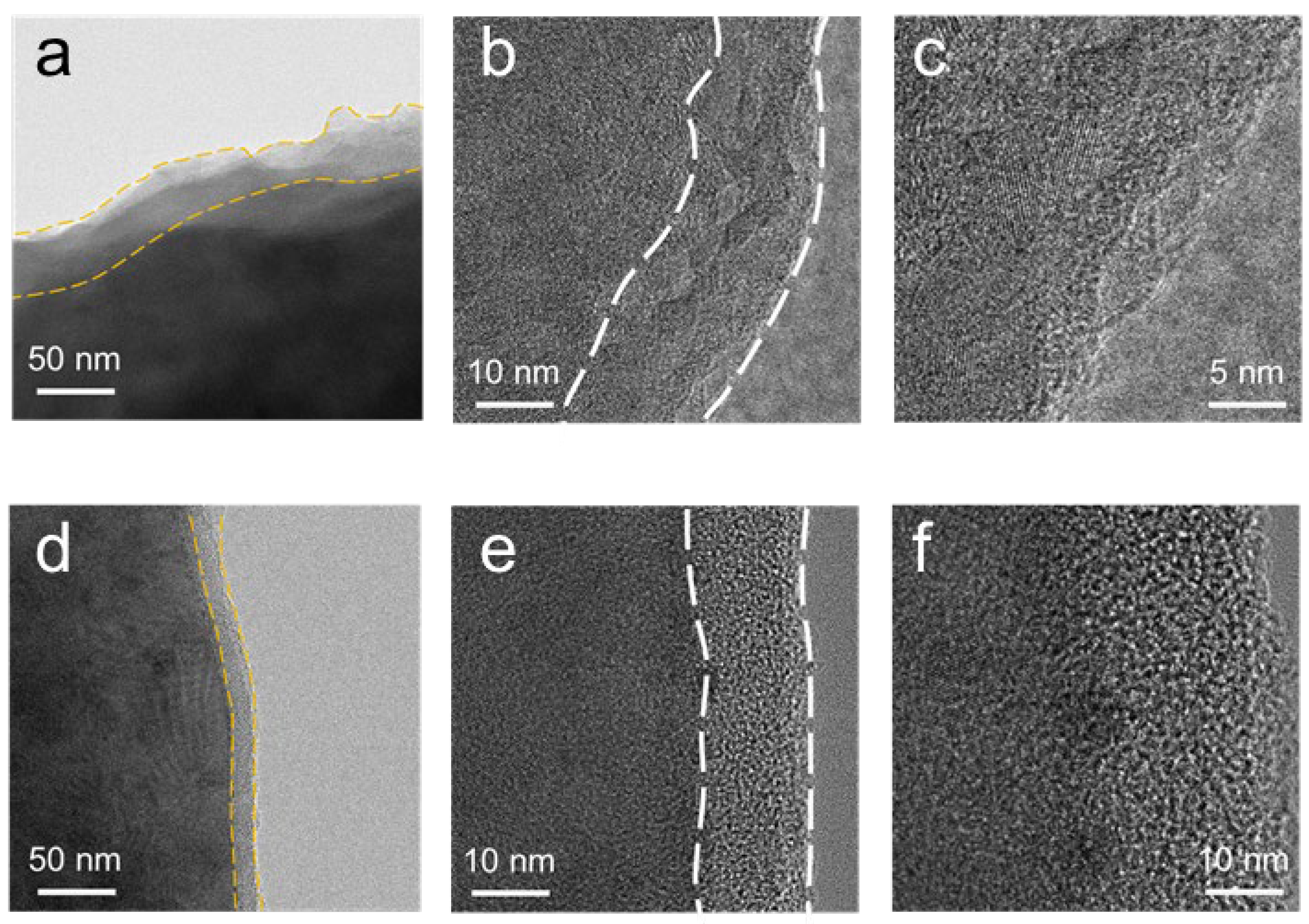
Na||HC half-cells were assembled with different electrolytes and cycled for five cycles, followed by TEM characterization of the cycled HC anodes. In the ED electrolyte, the HC surface is covered by an uneven interphase with irregular protrusions (Figure 1a). At higher magnification, the SEI formed by ED exhibits abundant lattice fringes, suggestive of a higher inorganic content (Figure 1b,c). By contrast, the SEI formed in EDH is noticeably smoother and more uniform (Figure 1d). High-resolution images further show substantially fewer lattice fringes, consistent with a reduced inorganic fraction and enhanced organic character (Figure 1e,f). Collectively, these observations indicate that HTOS alters the interphase chemistry on HC, giving rise to a smoother and more organic-dominated SEI.
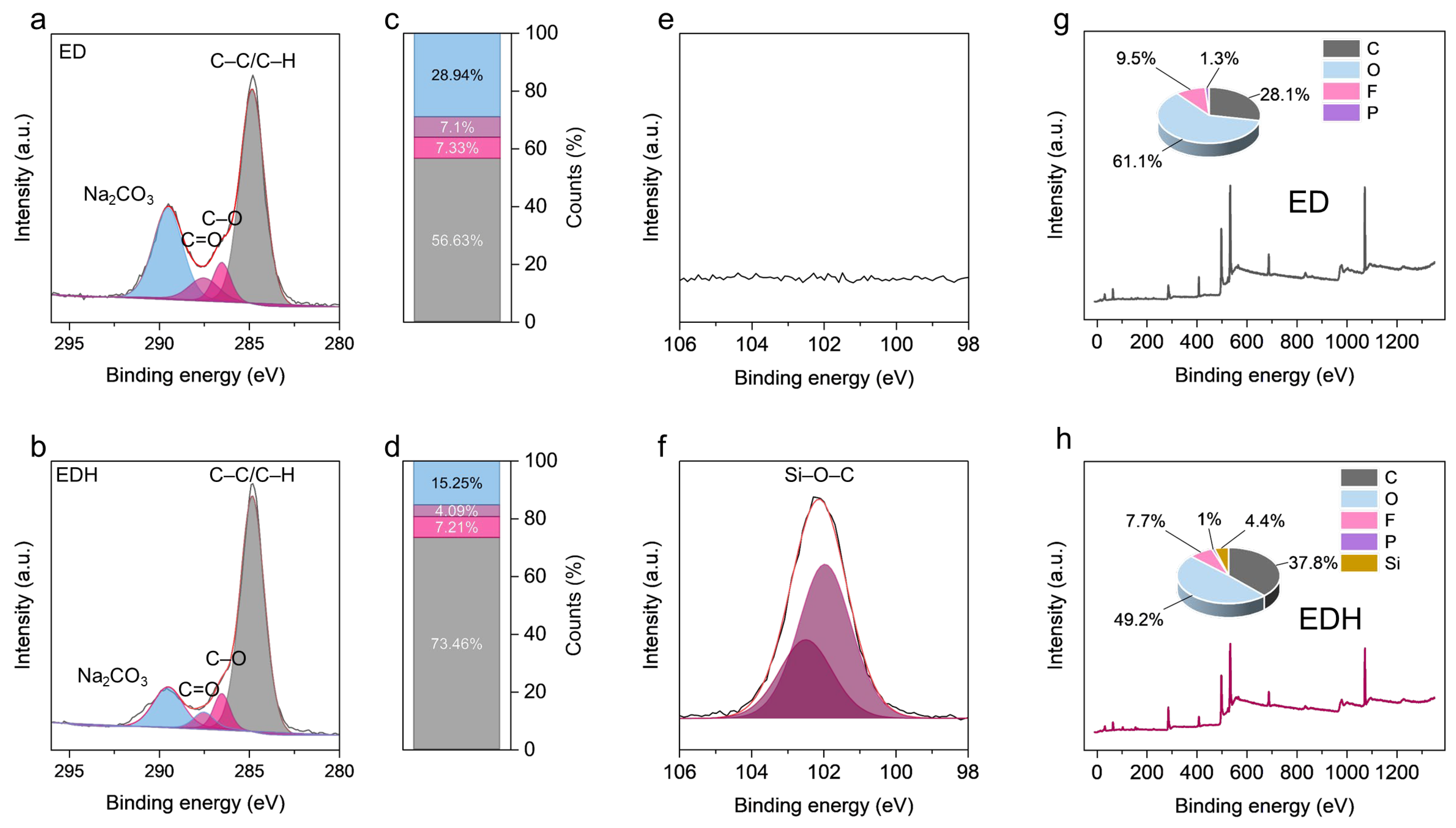
To further elucidate the interphase chemistry, XPS measurements were carried out on the cycled HC anodes. The C 1s spectra of the SEI formed by the ED and EDH electrolytes are shown in Figure 2a,b, respectively. The deconvoluted peaks at 284.8, 286.5, 287.5, and 289.5 eV are assigned to C–C/C–H, C–O, C=O, and Na2CO3, respectively [17]. The relative contents of these components were quantified by integrating the corresponding peak areas, and the calculated percentages are summarized in Figure 2c,d for the SEI formed by ED and EDH, respectively. Notably, the SEI formed by EDH exhibits a higher proportion of C–C/C–H species and a lower fraction of Na2CO3 than the SEI formed by ED, indicating a more organic-rich interphase with suppressed inorganic carbonate formation [18]. This result is consistent with the TEM observations, which revealed fewer crystalline domains and more amorphous regions in the SEI formed by EDH. Therefore, the introduction of HTOS substantially alters the interphase chemistry and promotes the formation of a more organic-dominated SEI. In addition, the Si 2p spectra of the SEI formed by ED and EDH are presented in Figure 2e,f, respectively. In contrast to the SEI formed by ED, which shows a negligible Si 2p signal, a distinct Si 2p peak is observed for the SEI formed by EDH, confirming the successful incorporation of silicon-containing species into the interphase [19]. The absence of Si 2p signals in the low-binding-energy region of elemental Si/Na–Si alloy and the lack of a dominant Si–O–Si component suggest that the detected Si species mainly originate from HTOS-derived interfacial products rather than Na–Si alloy formation or bulk siloxane polymerization [20,21]. To provide a more complete elemental analysis, XPS survey spectra and the corresponding elemental atomic percentages were collected for the SEI formed in ED and EDH electrolytes, as shown in Figure 2g,h. Compared with ED, the EDH-derived SEI exhibits lower F and P contents, with the F content decreasing from 9.5% to 7.7%. This suggests that HTOS suppresses excessive NaPF6 decomposition during SEI formation. Together with the C 1s and Si 2p results, these data further support the formation of a more organic-rich and Si-containing SEI in EDH.
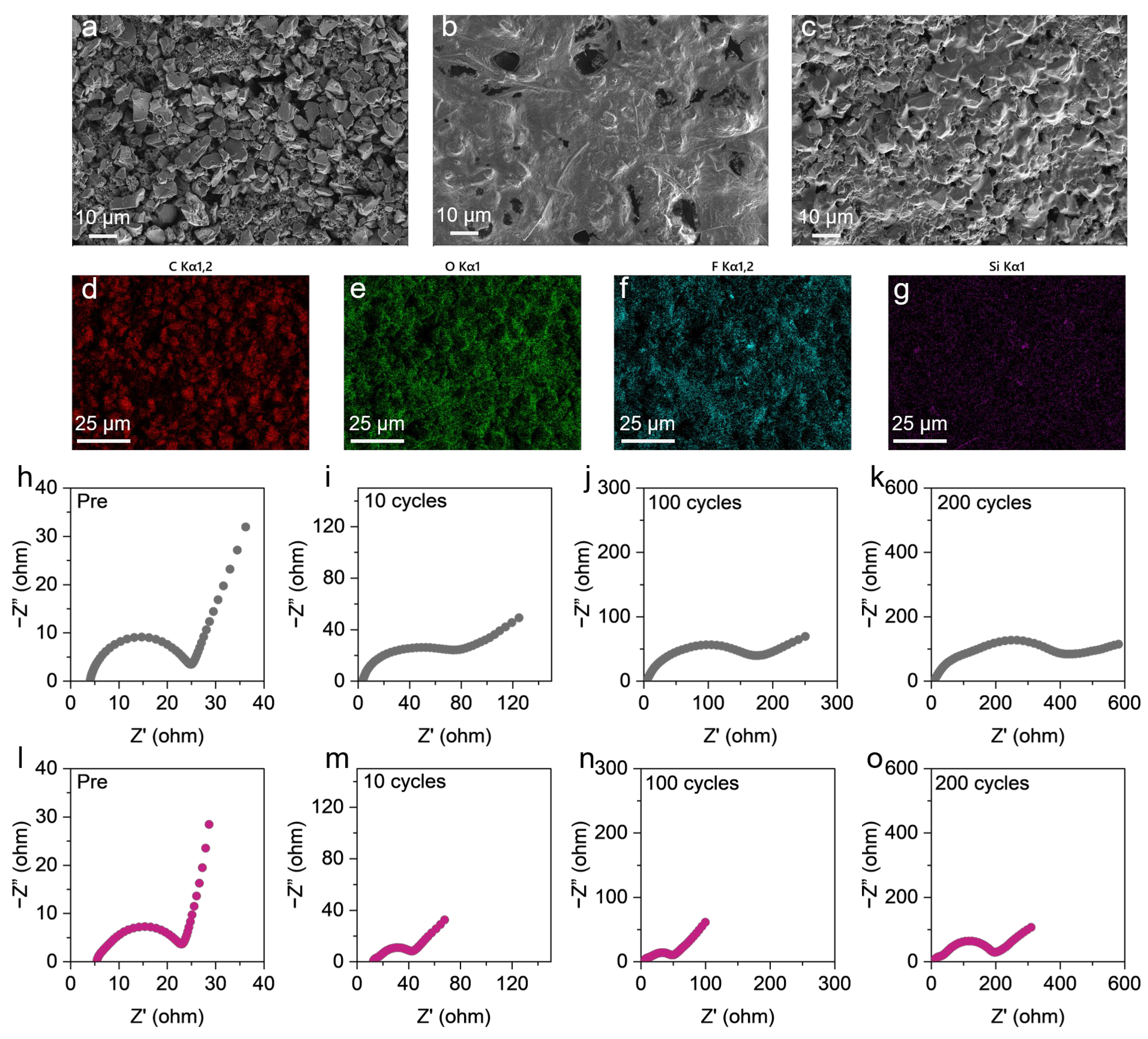
SEM was employed to examine the surface morphology of the HC anodes after 200 cycles. Figure 3a shows the SEM image of the pristine HC anode before cycling. After 200 cycles in the ED electrolyte, the HC surface develops irregular voids and pits, indicative of severe interfacial degradation (Figure 3b). In contrast, the HC anode cycled in the EDH electrolyte retains a more intact surface morphology (Figure 3c), much closer to that of the pristine electrode than the counterpart cycled in the baseline electrolyte. Figure 3d–g present the elemental mappings of the HC surface after cycling in EDH, showing a homogeneous distribution of the interphase-related elements together with a clear Si signal, which indicates the successful incorporation of HTOS-derived silicon-containing species into the SEI.
The interfacial stability was further evaluated by EIS. Figure 3h–k show the impedance spectra of Na||HC half-cells using the ED electrolyte at different cycle numbers. With prolonged cycling, the cell impedance increases sharply, suggesting continuous interfacial deterioration and sluggish charge-transfer/ion-transport processes [22]. By comparison, the Na||HC half-cells assembled with the EDH electrolyte exhibit an initial impedance comparable with that of the baseline ED cell, while a much smaller impedance is maintained upon cycling, as shown in Figure 3l–o. These results indicate that the EDH electrolyte enables the formation of a more robust and stable SEI, thereby facilitating interfacial Na-ion transport and suppressing impedance growth during cycling [23].
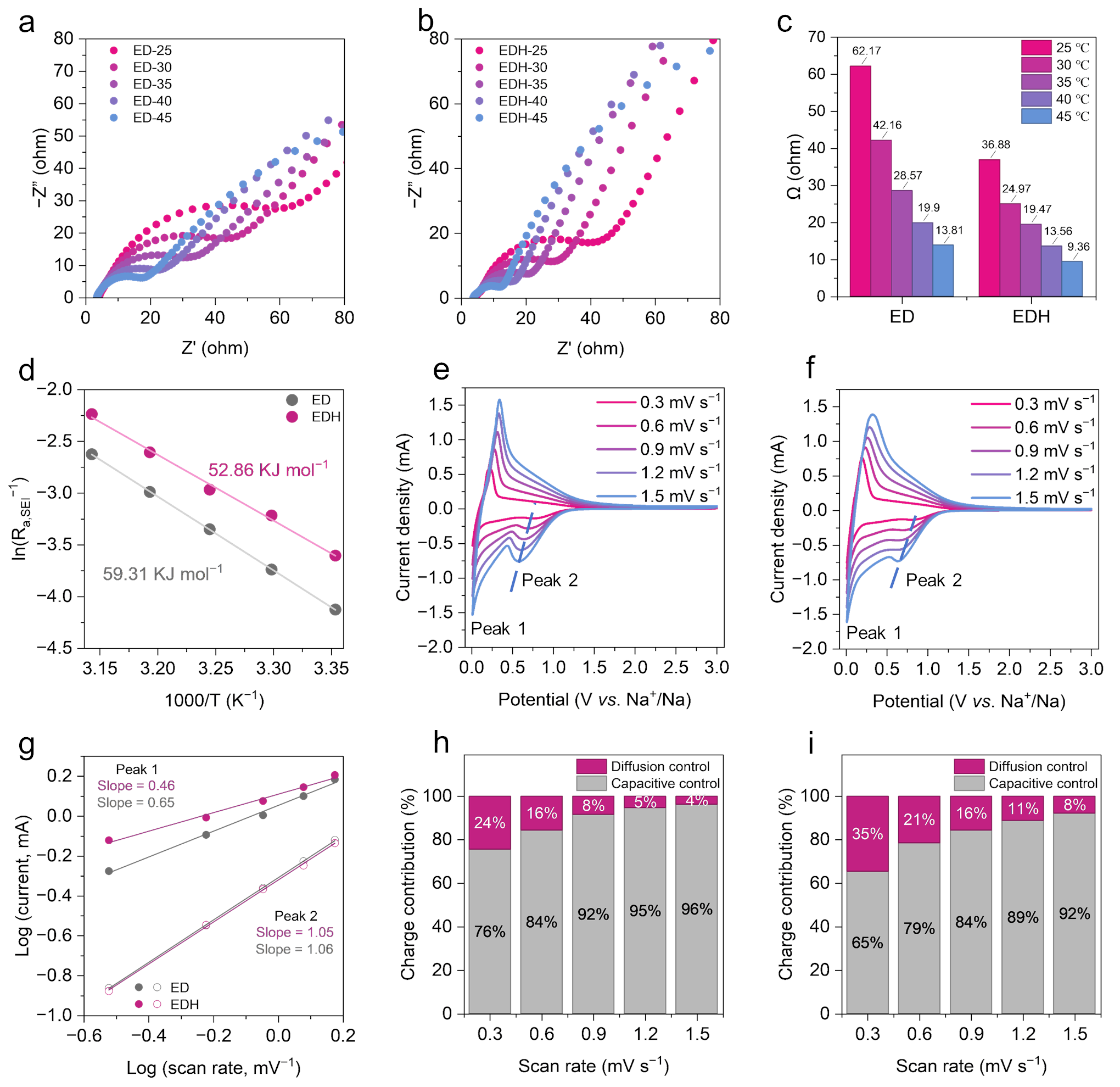
To further evaluate the energy barrier for Na+ transport across the SEI, the apparent activation energy was estimated based on Arrhenius fitting of the temperature-dependent impedance data [24,25]. Figure 4a,b show the in situ variable-temperature EIS spectra of the ED and EDH half-cells, respectively. The fitted RSEI values are summarized in Figure 4c. At all measured temperatures, the SEI formed in EDH exhibits a lower interfacial resistance than that formed in ED. As shown in Figure 4d, Arrhenius analysis yields an apparent Ea,SEI of 59.31 kJ mol−1 for the SEI formed by ED, whereas this value decreases markedly to 52.86 kJ mol−1 for the SEI formed by EDH, indicating faster Na+ migration through the EDH-formed interphase [26].
The scan-rate-dependent CV curves of the ED and EDH half-cells are shown in Figure 4e,f, respectively. In these profiles, peak 1 corresponds to the plateau-region sodium-storage process, while peak 2 is associated with the slope-region storage process [27]. The diffusion control process and surface control process can be reflected by a power-law formula, i.e., i = avb, where a and b are constants related to reaction behavior [28]. The fitted b values in Figure 4g show that, at peak 2, the b values of ED and EDH are 1.06 and 1.05, respectively, indicating that the slope-region storage is dominated by a capacitive-controlled process. In contrast, at peak 1, the b values decrease to 0.65 for ED and 0.46 for EDH, suggesting a much stronger diffusion-controlled characteristic for EDH in the plateau region [29,30]. Moreover, the quantitative analysis of capacitive behavior contribution can use the equation i = k1v + k2v1/2, where k1v and k2v1/2 refer to the current responses arising from the capacitive-controlled and diffusion-controlled processes, respectively [31]. Figure 4h,i illustrate the capacitive contribution ratios of the ED half-cell and EDH half-cell at various scan rates.
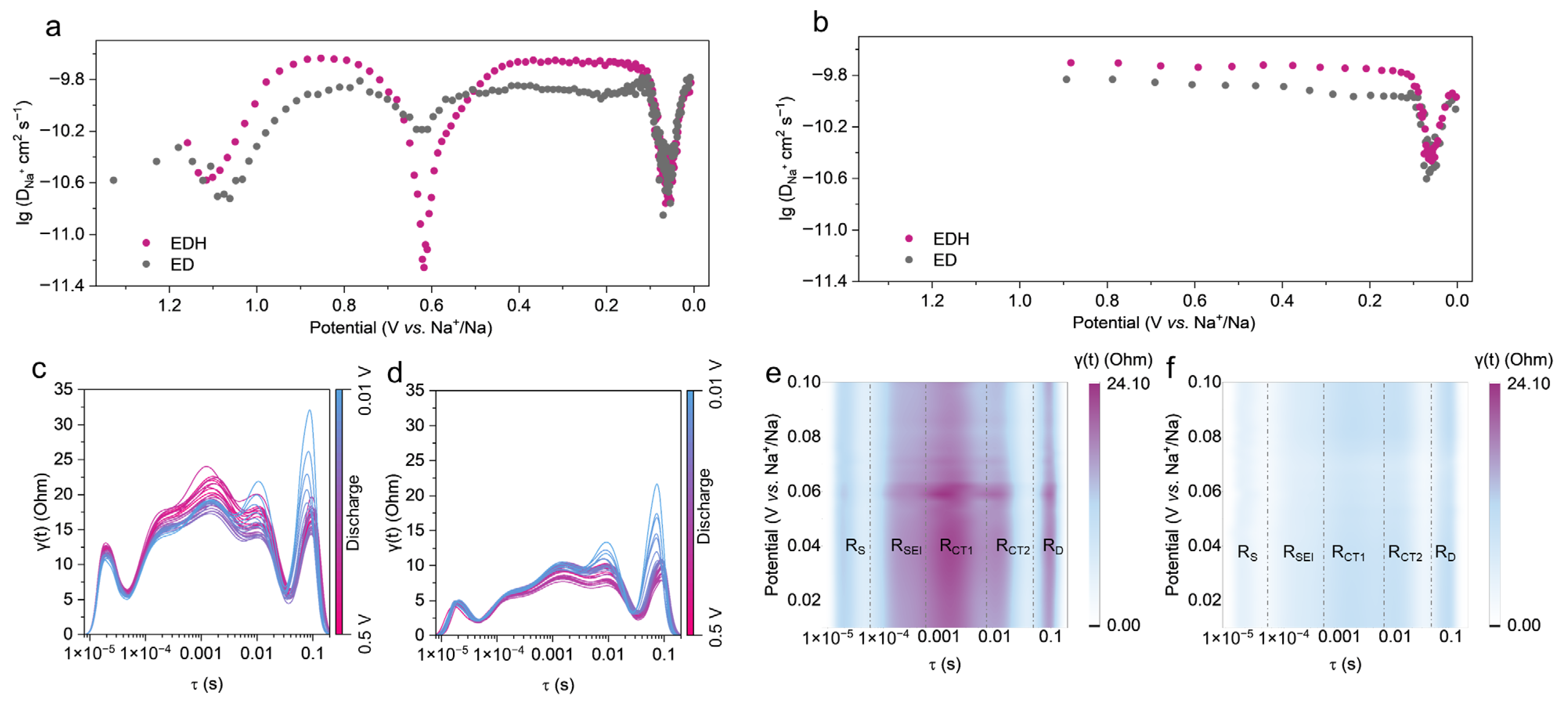
The diffusion coefficient of Na+ (DNa+) can be calculated based on a simplified equation of Fick’s second law [32]:
D   =   4 π τ ( m B V M M B S ) 2 ( E s E τ ) 2
where τ (s) is the pulse duration, mB (g) is the active mass of the HC anode, VM (cm3 mol−1) is the molar volume of the HC, MB (g mol−1) is the molar mass of the HC, and S (m2) is the surface area of the active material. In addition, ∆Es represents the change in potential due to pulses, and ∆Eτ represents the change in current due to pulsed current, both of which are obtained from GITT curves.
Figure 5a shows the Na+ diffusion coefficients derived from GITT during the initial discharge process. The EDH cell generally exhibits higher DNa+ values than the ED cell, indicating faster Na+ transport kinetics [33,34]. The sharp decrease near 0.6 V is attributed to electrolyte/additive decomposition and the accompanying Na+ consumption during the initial SEI-formation process, which leads to a decrease in the calculated Na+ diffusion coefficient [35]. After SEI formation, this decrease is markedly weakened (Figure 5b), confirming that it mainly originates from initial interphase formation. The higher DNa+ values of EDH after SEI stabilization further support the improved Na+ transport enabled by the HTOS-regulated SEI.
To further probe the interfacial kinetics, the operando EIS spectra collected during the first discharge of cells assembled with different electrolytes were analyzed by the distribution of relaxation time (DRT) method [36,37]. Figure 5c,d show the DRT profiles of the ED and EDH half-cells, respectively, in the voltage range of 0.5–0.01 V vs. Na+/Na. In the plateau region, the EDH half-cell exhibits lower impedance and smaller fluctuations than the ED counterpart, indicating more stable interfacial behavior and faster Na+ transport kinetics [20].
To more clearly visualize the impedance evolution in the plateau region, the DRT results from 0.1 to 0.01 V vs. Na+/Na were further presented as contour maps. As shown in Figure 5e, the impedance response of the ED half-cell can be deconvoluted into the solution resistance (Rs), SEI resistance (RSEI), charge-transfer resistances (RCT1 and RCT2), and diffusion resistance (RD) [38,39]. In contrast, the EDH half-cell exhibits markedly lower intensities for these impedance components (Figure 5f), especially in the interfacial and diffusion-related processes. These results collectively demonstrate that the SEI formed in EDH possesses a lower overall resistance and enables more favorable Na+ transport than that formed in the baseline electrolyte.
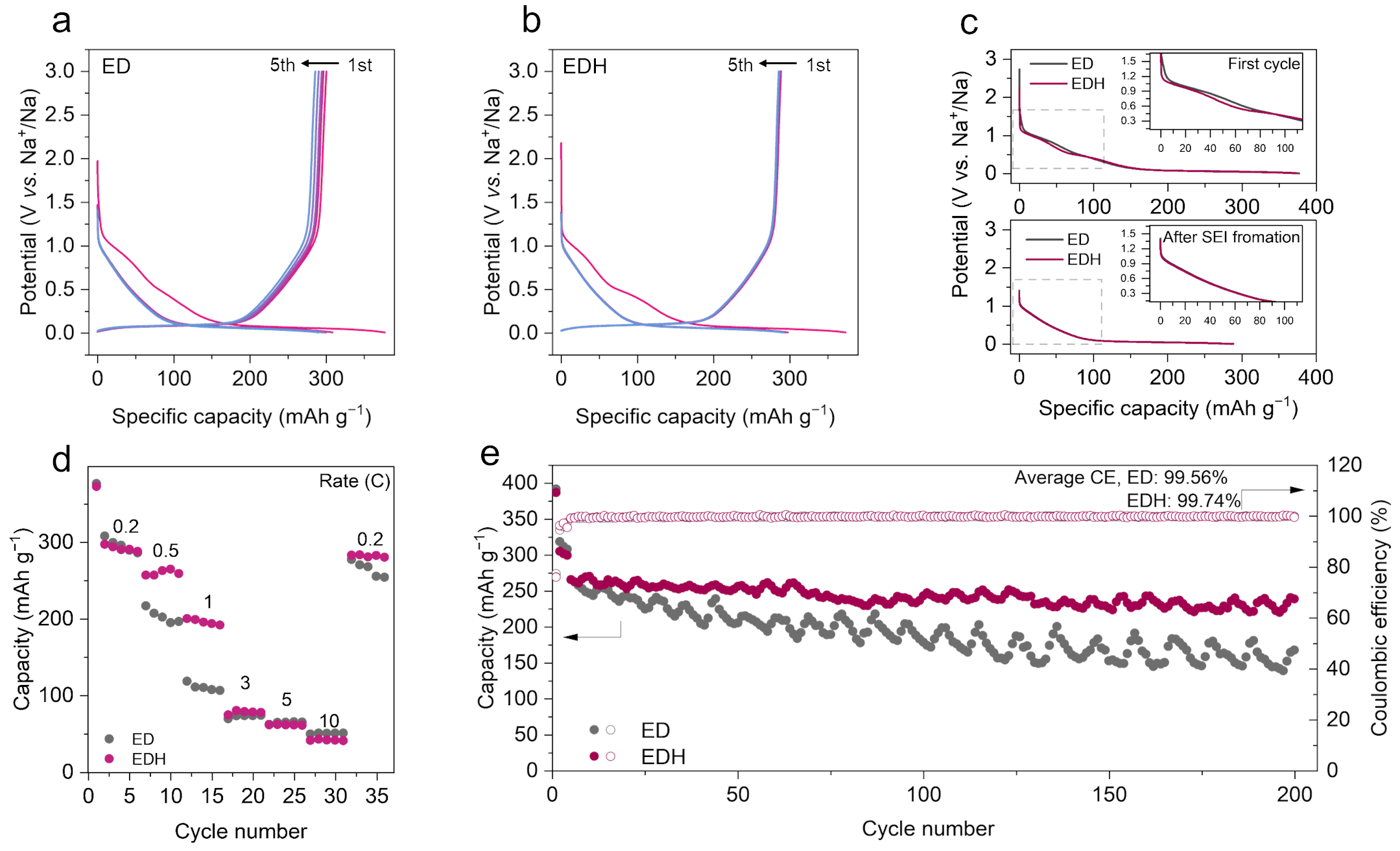
The superior Na+ transport kinetics of the SEI formed in EDH, as evidenced by the DRT, GITT, activation energy, and scan-rate-dependent CV analyses, prompted us to further evaluate the electrochemical performance of the corresponding half-cells by rate and cycling tests. Figure 6a,b show the GCD profiles of the ED and EDH cells during the first five cycles, respectively. The ED cell exhibits obvious capacity decay during the initial cycling process, whereas the EDH cell shows highly overlapping charge–discharge profiles, indicating better electrochemical reversibility and interfacial stability. As further shown in Figure 6c, the initial discharge curves of the ED and EDH half-cells exhibit a pronounced difference in the voltage range of 1.2–0.4 V vs. Na+/Na. In contrast, after SEI formation, the discharge curves of ED and EDH become nearly identical. This suggests that ED and EDH undergo distinct interphase-formation processes, which is consistent with the foregoing discussion.
The rate performance of half-cells assembled with different electrolytes is presented in Figure 6d. At 1 C, the EDH half-cell delivers a high reversible capacity of 198.76 mAh g−1, whereas the ED half-cell exhibits only 114.5 mAh g−1. Moreover, when the current density is switched back to a low rate after high-rate cycling, the EDH half-cell shows a higher capacity recovery, indicating better structural/interfacial reversibility. The cycling stability at 0.5 C is shown in Figure 6e. The EDH half-cell exhibits markedly improved durability, retaining 85% of its initial capacity after 200 cycles, whereas the ED half-cell retains only 67%. Moreover, the average Coulombic efficiency increases from 99.56% for ED to 99.74% for EDH, suggesting improved Na+ storage reversibility and reduced interfacial side reactions. These results confirm that the EDH-derived SEI contributes to enhanced rate capability and cycling stability of the HC anode.

4. Conclusions

In summary, the introduction of HTOS into the baseline ED electrolyte effectively regulates the interphase chemistry of HC anodes. Compared with the ED electrolyte, the EDH electrolyte enables the formation of a smoother, more uniform, and more organic-rich SEI. Such an interphase exhibits lower impedance and a lower activation energy for Na+ migration across the SEI, indicating substantially improved interfacial ion-transport kinetics. As a result, the Na||HC half-cells using the EDH electrolyte deliver enhanced electrochemical performance, including a high reversible capacity of 198.76 mAh g−1 at 1 C and a capacity retention of 85% after 200 cycles at 0.5 C, both of which are superior to those of the baseline electrolyte. This work demonstrates that interphase regulation via trimethoxysilane additive engineering is an effective strategy to improve the fast-charging capability and cycling stability of HC anodes in EC-based SIBs.

Author Contributions

Conceptualization, Y.X.; methodology, Z.M.; validation, Y.X., W.W., X.L., G.Z. and L.H.; formal analysis, W.W. and Z.H.; investigation, J.Z.; resources, Y.Q. and Z.M.; data curation, X.H.; H.L., writing—original draft preparation, Y.X. and Z.M.; writing—review and editing, Y.X., Y.Q., Z.M., G.Z. and L.H.; visualization, Y.X. and Y.Q.; supervision, G.Z. and L.H.; project administration, G.Z. and L.H.; funding acquisition, G.Z. and L.H. All authors have read and agreed to the published version of the manuscript.

Funding

This work was supported by the Shenzhen Science and Technology Program (KJZD20230923114107014, ZDCY2025091110659001), the National Natural Science Foundation of China (52373249), the Science and Technology Project of Yibin Sanjiang New Area (2023SJXQSXZJ003), and the Fundamental Research Funds for the Central Universities (20822041F4045).

Institutional Review Board Statement

Not applicable.

Informed Consent Statement

Not applicable.

Data Availability Statement

The original contributions presented in this study are included in the article. Further inquiries can be directed to the corresponding authors.

Conflicts of Interest

The authors declare no conflicts of interest.

References

  1. Song, B.; Cheng, Y.; Zhao, G.; Jia, K.; Shi, Q.; Li, X.; Wang, Z.; Zhou, Y.; Zou, G.; Ji, X. Sodium Ion Batteries: From Basic Research to Industrialization. Adv. Funct. Mater. 2025, 35, e10872. [Google Scholar] [CrossRef]
  2. Wu, Y.; Shuang, W.; Wang, Y.; Chen, F.; Tang, S.; Wu, X.-L.; Bai, Z.; Yang, L.; Zhang, J. Recent Progress in Sodium-Ion Batteries: Advanced Materials, Reaction Mechanisms and Energy Applications. Electrochem. Energy Rev. 2024, 7, 17. [Google Scholar] [CrossRef]
  3. Zhang, X.; Xu, P.; Duan, J.; Lin, X.; Sun, J.; Shi, W.; Xu, H.; Dou, W.; Zheng, Q.; Yuan, R.; et al. A Dicarbonate Solvent Electrolyte for High Performance 5 V-Class Lithium-Based Batteries. Nat. Commun. 2024, 15, 536. [Google Scholar] [CrossRef]
  4. Gao, Y.; Wang, Y.; Lan, H.; Wang, L.; Chang, Q.; Dong, S.; Zhou, J.; Chen, J.; Wang, H. Dielectric Confinement Chemistry Realizes Ester-Electrolyte-Compatible Sodium Metal Batteries over a 100 °C Range. Adv. Funct. Mater. 2026, 36, e26995. [Google Scholar] [CrossRef]
  5. Liu, M.; Wu, F.; Gong, Y.; Li, Y.; Li, Y.; Feng, X.; Li, Q.; Wu, C.; Bai, Y. Interfacial-Catalysis-Enabled Layered and Inorganic-Rich SEI on Hard Carbon Anodes in Ester Electrolytes for Sodium-Ion Batteries. Adv. Mater. 2023, 35, 2300002. [Google Scholar] [CrossRef]
  6. Qiu, R.; Ma, D.; Zheng, H.; Liu, M.; Cai, J.; Yan, W.; Zhang, J. Performance Degradation Mechanisms and Mitigation Strategies of Hard Carbon Anode and Solid Electrolyte Interface for Sodium-Ion Battery. Nano Energy 2024, 128, 109920. [Google Scholar] [CrossRef]
  7. Rapp, P.; Gasteiger, H.A. Comparing the Gassing of Hard Carbon during Lithiation and Sodiation via a Novel Two-Compartment Online Electrochemical Mass Spectrometry Cell for Sodium-Ion Batteries. J. Electrochem. Soc. 2026, 173, 090502. [Google Scholar] [CrossRef]
  8. Singla, A.; Naik, K.G.; Vishnugopi, B.S.; Mukherjee, P.P. Heterogeneous Solid Electrolyte Interphase Interactions Dictate Interface Instability in Sodium Metal Electrodes. Adv. Sci. 2024, 11, 2404887. [Google Scholar] [CrossRef]
  9. Huang, G.; Hu, J.; Wang, Z.; Gao, F.; Zhou, Y.; Fu, S.; Wang, Y.; Shang, Z.; Gao, C.; Luo, L.; et al. Synergistic Dual-Engineering of Hard Carbons via Graphene Oxide Nanosheets: Enabling Ultrahigh ICE Sodium-Ion Batteries through Edge Passivation and Catalytic SEI Design. Adv. Funct. Mater. 2026, 36, e13551. [Google Scholar] [CrossRef]
  10. Zhang, Y.; Tie, D.; Xiong, Z.; Lin, X.; Liu, S.; Tan, Q.; Vlad, A.; Xu, M.; Hu, Y.-S.; Qi, Y. Fast-Charging Hard Carbons: A Fully Organic SEI Enables Low-Coordination Interfacial Environments and Fast Na+ Desolvation. Angew. Chem. 2025, 64, e202516068. [Google Scholar] [CrossRef]
  11. Yang, B.; Song, K.; An, W.; Liang, Q.; Yu, J.; Li, W.; Liu, F.; Xu, B.; Wei, A.; Chen, Z.; et al. Architecting Robust Solid Electrolyte Interface for Enhanced Na+ Storage via Single-Atom ZnN4 Sites Decorating Hard Carbon. Acta Mater. 2025, 288, 120849. [Google Scholar] [CrossRef]
  12. Sun, Y.; Zuo, D.; Xu, C.; Peng, B.; Li, J.-C.; Yang, J.; Xu, S.; Sun, X.; Zhou, H.; Guo, S. A “Grafting Technique” to Tailor the Interfacial Behavior of Hard Carbon Anodes for Stable Sodium-Ion Batteries. Energy Environ. Sci. 2025, 18, 1911–1919. [Google Scholar] [CrossRef]
  13. Sun, Y.; Du, J.; Shi, T.; Zuo, D.; Tian, J.; Xu, C.; Peng, B.; Yang, J.; Xu, S.; Liu, Y.; et al. Polymer-Induced Solid–Electrolyte Interphase on Hard Carbon Enabling 5C Fast-Charging Practical Sodium-Ion Pouch Cell. Natl. Sci. Rev. 2026, 13, nwag025. [Google Scholar] [CrossRef]
  14. Liao, Y.; Liu, H.; Zhang, Y.; Yang, J.; Ji, H.; Wang, D.; Yuan, L.; Huang, Y.; Ren, Y. A Weak-Fluorine-Bond Molecule Stabilizes Hard Carbon Anodes for Practical Sodium-Ion Batteries. ACS Nano 2025, 19, 30466–30475. [Google Scholar] [CrossRef]
  15. Wang, Y.-N.; Liu, Y.; Zhang, X.-Q.; Sun, S.-Y.; Li, Y.; Li, J.-L.; Zhang, Q.-K.; Zheng, Z.; Feng, W.-J.; Li, B.-Q.; et al. In Situ Polymerized Polysiloxane Enables Cohesive Solid-Electrolyte Interphase for Practical Lithium-Metal Batteries. Adv. Mater. 2026, 38, e19565. [Google Scholar] [CrossRef]
  16. Chen, Y.-P.; Niu, Y.-L.; Zheng, Z.; Chen, X.; Gao, Y.-C.; Yao, N.; Zhang, R.; Zhang, Q. Origin of Anion-Rich Solvation Structures in Siloxane Electrolytes. Angew. Chem. Int. Ed. 2025, 64, e202508152. [Google Scholar] [CrossRef]
  17. Liu, M.; Jiang, Z.; Wu, X.; Liu, F.; Li, W.; Meng, D.; Wei, A.; Nie, P.; Zhang, W.; Zheng, W. Reinventing the High-Rate Energy Storage of Hard Carbon: The Order-Degree Governs the Trade-off of Desolvation-Solid Electrolyte Interphase at Interfaces. Angew. Chem. Int. Ed. 2025, 64, e202425507. [Google Scholar] [CrossRef]
  18. Li, Y.; Fan, Z.; Li, S.; Zhao, Y.; Li, Z.; Xu, C.; Dou, H.; Zhang, X. A Successive Intercalation-Deposition Mechanism Induced by Hard Carbon for Hybrid Lithium-Ion/Lithium Metal Batteries. J. Energy Chem. 2025, 106, 20–30. [Google Scholar] [CrossRef]
  19. Hu, H.; Cai, T.; Tong, Y.; Wang, J.; Zhou, L.; Cao, J.; Liu, P.; Li, X.; Li, A.; Yan, Z.; et al. Stepwise Construction of Si–O–C and Si–C Collaborative Interfaces for Highly Stable Silicon Anodes. Energy Storage Mater. 2026, 84, 104818. [Google Scholar] [CrossRef]
  20. Zhang, G.; Fu, C.; Gao, S.; Zhao, H.; Ma, C.; Liu, Z.; Li, S.; Ju, Z.; Huo, H.; Zuo, P.; et al. Regulating Interphase Chemistry by Targeted Functionalization of Hard Carbon Anode in Ester-Based Electrolytes for High-Performance Sodium-Ion Batteries. Angew. Chem. Int. Ed. 2025, 64, e202424028. [Google Scholar] [CrossRef]
  21. Liu, M.; Jia, Y.; Liu, J.; Chen, K.; Zhong, H.; Jiang, L.; Liu, H.; Ouyang, L.; Zhu, M. Activating Silicon for High Hydrogen Conversion and Sustainable Anode Recovery. Nat. Commun. 2025, 16, 7772. [Google Scholar] [CrossRef]
  22. Xu, L.-Z.; Chen, J.-X.; Liu, D.-G.; Zhao, K.; Liu, T.-T.; Huang, L.; Hu, S.-Y.; Yin, T.-Q.; Zhang, T.; Song, J.; et al. Covalent Quantum Bridging Enables Bicontinuous Electron–Ion Highways in Hard Carbon for Ultrafast Sodium Storage. J. Am. Chem. Soc. 2026, 148, 12849–12860. [Google Scholar] [CrossRef] [PubMed]
  23. Cai, D.; Wang, E.; Jiang, S.; Zhu, Y.; Lei, M.; Yan, D.; Zhao, Q. Gradient SEI and Interfacial Polarization Orchestrate Na+ Kinetics in Heteroatom-Engineered Hard Carbon. Chem. Eng. J. 2026, 529, 173065. [Google Scholar] [CrossRef]
  24. Chen, Y.; Qian, X.; Lyu, Y.; Qiu, Y.; Kwan, Y.T.; Zhou, S.; Lan, X.; Lu, S.; Shao, M. Helical Counter-Directional Migration-Induced Solvation Sheaths for Constructing Reinforced Electrode–Electrolyte Interphases for Ultra-Stable Anode-Free Lithium Metal Batteries. Energy Environ. Sci. 2026, 19, 870–883. [Google Scholar] [CrossRef]
  25. Xiao, Z.; Liu, X.; Hai, F.; Li, Y.; Han, D.; Gao, X.; Huang, Z.; Liu, Y.; Li, Z.; Tang, W.; et al. Wide Temperature 500 Wh Kg-1 Lithium Metal Pouch Cells. Angew. Chem. Int. Ed. 2025, 64, e202503693. [Google Scholar] [CrossRef]
  26. Xu, W.; Zhou, L.; Lu, S.; He, J.; Xu, Y.; Tian, L. Fluorine-Free Gel Polymer Electrolyte for Lithium Oxide-Rich Solid Electrolyte Interphase and Stable Li Metal Batteries. Nat. Commun. 2025, 16, 9308. [Google Scholar] [CrossRef] [PubMed]
  27. Song, M.; Yi, Z.; Xu, R.; Chen, J.; Cheng, J.; Wang, Z.; Liu, Q.; Guo, Q.; Xie, L.; Chen, C. Towards Enhanced Sodium Storage of Hard Carbon Anodes: Regulating the Oxygen Content in Precursor by Low-Temperature Hydrogen Reduction. Energy Storage Mater. 2022, 51, 620–629. [Google Scholar] [CrossRef]
  28. Ren, Q.; Wang, J.; Yan, L.; Lv, W.; Zhang, F.; Zhang, L.; Liu, B.; Shi, Z. Manipulating Free-Standing, Flexible and Scalable Microfiber Carbon Papers Unlocking Ultra-High Initial Coulombic Efficiency and Storage Sodium Behavior. Chem. Eng. J. 2021, 425, 131656. [Google Scholar] [CrossRef]
  29. Ge, Y.; Qiu, Y.; Han, J.; Mirza, S.; Liu, H.; Zhong, G.; Zheng, Q.; Peng, Z.; Li, X. Insights into the Dynamical Sodium Occupancy Evolution and Rate-Limiting Steps in Hard Carbon. J. Am. Chem. Soc. 2025, 147, 39537–39546. [Google Scholar] [CrossRef]
  30. Lei, Z.-Q.; Xiao, S.-H.; Ran, Z.; Liu, S.-P.; Su, X.-C.; Guo, Y.-J.; Li, W.-X.; Li, Q.; Xu, S.; Yin, Y.-X.; et al. Circumventing Self-Diffusion Enables High-Rate Hard Carbon Anodes. Adv. Mater. 2026, 38, e13193. [Google Scholar] [CrossRef]
  31. Qiu, C.; Kumar, A.; Tabish, M.; Mai, X.; Guo, L.; Zhao, Y.; Zhu, Y.; Li, A.; Yasin, G.; Chen, X.; et al. Sulfur-Bonded Hard Carbon with Enhanced Interfacial and Bulk Kinetics for Potassium-Ion Hybrid Capacitors. Chem. Eng. J. 2025, 517, 164446. [Google Scholar] [CrossRef]
  32. Lin, J.; Zhou, Q.; Liao, Z.; Chen, Y.; Liu, Y.; Liu, Q.; Xiong, X. Steric Hindrance Engineering to Modulate the Closed Pores Formation of Polymer-Derived Hard Carbon for High-Performance Sodium-Ion Batteries. Angew. Chem. 2024, 136, e202409906. [Google Scholar] [CrossRef]
  33. Wen, Z.; Zhao, R.; Tian, T.; Zhang, T.; Wang, X.; Yang, X.; Song, W.; Chen, Y.; Ding, J.; Hu, W. Molecular Stitching in Polysaccharide Precursor for Fabricating Hard Carbon with Ultra-High Plateau Capacity of Sodium Storage. Adv. Mater. 2025, 37, 2420251. [Google Scholar] [CrossRef] [PubMed]
  34. Cao, H.; Zhao, Y.; Huang, Z.; Ji, X.; Wang, S.; Duan, W.; Xi, Y.; Sun, Y.; Kong, F.; Liu, Y.; et al. In Situ TEM Reveals the Hard Carbon Sodium Storage Mechanism and Discovers the Sodium Carbide. Adv. Energy Mater. 2026, 16, e05191. [Google Scholar] [CrossRef]
  35. Feng, G.; Yang, X.; Liu, X.; Wang, Y.; Xie, Y.; Dong, P.; Jiao, X.; Xu, C.; Zhao, J.; Hu, Y.-S.; et al. Microbially Glycolysis-Regulated Hard Carbons for Sodium-Ion Batteries. Nano Energy 2025, 136, 110728. [Google Scholar] [CrossRef]
  36. Subasinghe, L.U.; Satyanarayana Reddy, G.; Rudola, A.; Balaya, P. Analysis of Heat Generation and Impedance Characteristics of Prussian Blue Analogue Cathode-Based 18650-Type Sodium-Ion Cells. J. Electrochem. Soc. 2020, 167, 110504. [Google Scholar] [CrossRef]
  37. Wan, T.H.; Saccoccio, M.; Chen, C.; Ciucci, F. Influence of the Discretization Methods on the Distribution of Relaxation Times Deconvolution: Implementing Radial Basis Functions with DRTtools. Electrochim. Acta 2015, 184, 483–499. [Google Scholar] [CrossRef]
  38. Ma, Z.; Wang, W.; Zhang, G.; Xiong, Y.; Fan, Z.; Wu, L.; Liao, X.; Hu, Z.; Liang, H.; Shao, Q.; et al. A Scalable and Low-Temperature Route to Abundant Heteroatoms-Doped Freestanding Carbon Anodes for Fast Sodium-Ion Storage Kinetics. Adv. Funct. Mater. 2025, 36, e29054. [Google Scholar] [CrossRef]
  39. Chen, J.; Qian, Y.; Yin, Y.; Hu, Y.; Chen, H.; Xu, Y.; Zhang, X.; Feng, Y.; Tian, J.; Li, Y.; et al. Tri-Functional Molecular Motif-Engineered Polymer Electrolytes for High-Voltage Lithium Metal Batteries. Energy Storage Mater. 2026, 84, 104835. [Google Scholar] [CrossRef]
Figure 1. Schematic illustrations of (a) SEI formation in ED, (b) SEI formation in EDH, and (c) the molecular structure of HTOS. TEM characterization results of the interfacial layer formed after cycling in different electrolytes. TEM images of the carbon anode cycled in (ac) the ED electrolyte and (df) the EDH electrolyte at different magnifications.
Coatings 16 00651 g001
Figure 2. XPS characterization results of the SEI formed after cycling in different electrolytes. High-resolution C 1s spectra of the SEI formed by (a) ED and (b) EDH; relative proportions of different chemical components obtained from peak deconvolution of the C 1s spectra in panels (c) a and (d) panels b, respectively; high-resolution Si 2p spectra of the SEI formed by (e) ED and (f) EDH; (g) XPS survey spectrum and elemental atomic percentages of the SEI formed in ED; (h) XPS survey spectrum and elemental atomic percentages of the SEI formed in EDH.
Coatings 16 00651 g002
Figure 3. SEM characterization results and electrochemical impedance evolution of HC anodes cycled in different electrolytes. SEM images of HC anodes in (a) the pristine state and after 200 cycles in (b) ED and (c) EDH electrolytes; (dg) elemental mappings of the HC anode cycled in EDH for C, O, F, and Si elements, respectively; Nyquist plots of (hk) ED cells and (lo) EDH cells in the pristine state and after 10, 100, and 200 cycles, respectively.
Coatings 16 00651 g003
Figure 4. Analysis of SEI-mediated Na+ transport and sodium-storage kinetics in Na||HC half-cells. Variable-temperature EIS spectra of (a) ED and (b) EDH cells; (c) fitted RSEI values at different temperatures; (d) Arrhenius plots of Na+ migration across the SEI; CV curves at different scan rates for (e) ED and (f) EDH; (g) corresponding b-value analysis for peak 1 and peak 2; capacitive- and diffusion-controlled contributions at different scan rates for (h) ED and (i) EDH, respectively.
Coatings 16 00651 g004
Figure 5. GITT- and DRT-based analysis of Na+ transport in Na||HC half-cells. (a) Na+ diffusion coefficients during the initial discharge process. (b) Na+ diffusion coefficients after SEI formation. DRT profiles for (c) ED and (d) EDH. Corresponding DRT contour maps of (e) ED and (f) EDH in the plateau region.
Coatings 16 00651 g005
Figure 6. Electrochemical performance of Na||HC half-cells with different electrolytes. Galvanostatic charge–discharge profiles of Na||HC half-cells with (a) ED and (b) EDH electrolytes during the 1st to 5th cycles. (c) Initial and 5th discharge profiles. (d) Rate performance. (e) Cycling performance at 0.5 C.
Coatings 16 00651 g006
Disclaimer/Publisher’s Note: The statements, opinions and data contained in all publications are solely those of the individual author(s) and contributor(s) and not of MDPI and/or the editor(s). MDPI and/or the editor(s) disclaim responsibility for any injury to people or property resulting from any ideas, methods, instructions or products referred to in the content.