Article

Study of the Effect of Various Heat Treatments and C Addition on the Microstructure and Hardness of CoCrFeNiAl0.3Hf0.02 High-Entropy Alloys


1
School of Materials Science and Engineering, Jiangsu University of Science and Technology, Zhenjiang 212000, China
2
Institute Metal Research, Chinese Academy of Sciences, 72 Wenhua Road, Shenyang 110016, China
*
Authors to whom correspondence should be addressed.
Coatings 2026, 16(5), 611; https://doi.org/10.3390/coatings16050611 (registering DOI)
Submission received: 31 March 2026 / Revised: 30 April 2026 / Accepted: 3 May 2026 / Published: 18 May 2026

Abstract

In this study, two bulk high-entropy alloys, CoCrFeNiAl0.3 doped with Hf and CoCrFeNiAl0.3 doped with Hf and C, were prepared using the vacuum arc melting method. Both HEAs contain Co2Hf phases in the as-cast alloy. The heat treatment did not modify the main matrix phase, and the FCC structure was unchanged. After 10 h of solution treatment at 1210 °C and after 24 h of aging treatment at 800 °C, intergranular carbide Cr23C6 was found to precipitate in the alloys doped with Hf and C. This carbide has a very remarkable strengthening effect on the high-entropy alloy, reaching up to 224.64 HV under a load of 200 g.

1. Introduction

At the beginning of the 21st century, Ye and others proposed a novel design concept of high-component and high-entropy alloys, which was inspired by previous research on amorphous alloys [1]. A high-entropy alloy refers to a type of alloy composed of at least five principal elements with close atomic ratios [2,3,4,5]. Its notable features derive from a relatively high mixed entropy value. This type of alloy tends to form a solid solution structure [2], and the content of each main component is generally between 5% and 35% of the atomic fraction, providing a relatively wide design range. It exhibits a significant high-entropy effect and a distinct hysteresis diffusion. It also presents a unique lattice distortion effect on the structure character. In terms of performance, it shows a “cocktail” effect of multi-component synergy [6]. Solid solution strengthening caused by lattice distortion can enhance the alloy’s strength and improve its thermodynamic stability [7,8]. This type of alloy has some promising properties compared with conventional metallic alloys, including a combination of high strength/hardness and toughness, excellent wear resistance, high strength at elevated temperatures, exceptional phase stability, good oxidation and corrosion resistance [9]. It can be used in applications to broaden the temperature range. For instance, it is a desirable choice of material for the stirrers used in friction stir welding (FSW).
At present, common preparation methods for high-entropy alloys include mechanical alloying, magnetron sputtering, vacuum melting and additive manufacturing [10,11,12,13,14]. The mechanical alloying method is often used to prepare high-entropy alloy powders, and its process includes ball milling, alloying and subsequent treatment. Commonly used subsequent processing techniques include spark plasma sintering (SPS), hot press sintering (HP), and hot isostatic pressing (HIP). Magnetron sputtering can prepare uniform high-entropy alloy films by adjusting the sputtering parameters and optimizing the composition and structure of the target material. Vacuum melting is the most used technique for preparing HEAs, comprising both vacuum arc melting and vacuum induction melting. Vacuum arc melting technology is typically used for high-melting-point and easily oxidized metals, while vacuum induction melting technology is more suitable for active metals. Additive manufacturing technology includes power bed melting (PBF), which consists of selective laser melting (SLM) and selective electron beam melting (SEBM) [11].
There are numerous high-entropy alloy systems with almost unlimited component combinations [15]. The emergence of high-entropy alloys was expected to solve the challenge of achieving both strength and toughness in traditional alloys [16]. Refractory HEAs are composed primarily of refractory elements, such as Nb, Ta, Mo, V, W, and Zr, whose dominant phase is BCC, where the strength is extremely high and the ambient temperature plasticity is poor [17]. Adding Hf to NbTaTiZr HEAs leads to the transition of the deformation mechanism through synergistic effects from two doping effects. Enhanced dislocation slide resistance is induced by severe lattice distortion (solid solution) for the large atomic radius of Hf. Simultaneously, the stacking fault energy is increased from 607 mJ/m2 to 700 mJ/m2, promoting the dominance of cross slip and depress twin formation. The two combined effects lead to enhanced strain hardening and delay fracture initiation [17]. The CoCrFeNiAl high-entropy alloy system has become one of the most popular systems in high-entropy alloy production due to its high comprehensive mechanical properties [18]. For instance, Eduardo et al. prepared a CoCrFeNiAl1.8Cu0.5 high-entropy alloy using element powder blending and gas atomization [19]. When the sintering temperature was 1300 °C, the B2 interphase in the alloy prepared using the powder blending method transformed into the sigma phase, leading to the embrittlement of the alloy. The gas atomization method tends to form carbides due to the addition of lubricants. Rui Xi et al. investigated the influence of the Si content on the microstructure, wear resistance and corrosion resistance of a CoCrFeNiAl0.7Cu0.3Six high-entropy alloy. It was found that the hardness and wear resistance of the alloy increased with the increase in Si content. When x was 0.2, the corrosion resistance of the alloy was the strongest [20]. Ji et al. prepared the CoCrFeNiAl0.8Cu0.5Si0.5 alloy through vacuum induction melting and laser deposition processes. The microstructure of the cast ingot was dendritic, and brittle Cr3Si particles were detected, with higher hardness and wear resistance. However, no intermetallics were found in the laser-deposited alloy, and its corrosion resistance was better [21]. Recently, He summarized the existing research on the mechanical properties of eutectic high-entropy alloys and concluded that they possess a synergistic improvement in strength and ductility due to their distinctive dual-phase lamellar structure [22]. CoCrFeNiAl HEAs have attracted much interest due to their high hardness at both ambient and elevated temperatures, good oxidation resistance, and excellent mutual solubility [23,24,25].
Under normal circumstances, the performance of alloys is often improved by solid solution strengthening, precipitation strengthening, fine grain strengthening, and transformation-induced plasticity (TRIP) and twinning-induced plasticity (TWIP) produced by different heat treatment processes [26,27,28,29,30]. For instance, a high-entropy alloy made of Fe35Cr35V20Hf5Ti5 was prepared by Ortega et al., and after heat treatment at 960 °C, the primary Laves phase decomposed into mini iron- and titanium-rich particles, which precipitated within the dendrites. After water quenching at 1000 °C, a new cubic structure (FeHf2) precipitated in the alloy. Moreover, mass titanium-rich precipitates and hafnium carbide particles presented inside the branches [31]. Chen et al. studied the influence of heat treatment temperature on the microstructure and properties of a NbC-reinforced CoCrFeNi high-entropy alloy [32,33]. It was found that when the solution temperature was between 1100 and 1200 °C, coarse NbC particles remained in the alloy, resulting in poor ductility. When the solution temperature rose to 1300 °C, nanoscale particles were dispersed in the alloys, and both strength and ductility were maximized. When the annealing temperature was 950 °C, coarse and complex carbides precipitated, and the corrosion resistance of the alloy was poor. When the alloy was aged at 1000 °C, only sparsely distributed fine NbC particles were observed, leading to the best resistance to pitting corrosion.
In addition, to further enhance the performance of the alloy, carbon is added to the high-entropy alloy. The carbides formed within the alloy lead to lattice distortion, which in turn affects the phase stability and fault energy of the high-entropy alloy [34,35]. As reported by Wang et al., adding 10% vanadium carbide to the Ni1.5CoFeCu0.8Al0.2V0.5 high-entropy alloy can result in double strength [36]. When the amount of carbide added is as high as 15%, the agglomeration of carbides results in grain coarsening, thereby decreasing the mechanical properties of the alloy. Liang et al. carried out 50% hot rolling and 700 °C annealing treatment on the CoCrFeNi(TiC)0.2 high-entropy alloy, which greatly enhanced the hardness and tensile strength of the alloy [37].
Among the abovementioned HEAs, CoCrFeNiAl HEAs have attracted much interest for their high hardness, good oxidation resistance, excellent corrosion resistance, high tensile strength and excellent mutual solubility [38,39]. According to previous studies, appropriate heat treatment will modify the microstructure, and the mechanical properties of high-entropy alloys will improve [40,41]. For instance, the precipitate of a coherent L12 phase increases the properties of the CoCrFeNiAl0.5 HEA [42]. The formation of carbides inside the alloy will also have an impact on the microstructure and properties of high-entropy alloys. Therefore, in this study, the CoCrFeNiAl0.3Hf0.02 high-entropy alloy was used as the base material to investigate the doping effect of Hf and C on the microstructure and mechanical properties of the alloy under varied heat treatment processes. The formation of carbides and the influence of heat treatment processes on the microstructure and phase composition of the alloy were investigated.

2. Material and Methods

In this study, high-purity iron, cobalt, nickel, chromium, aluminum, hafnium (99.9%) and graphite were used as raw materials to prepare two bulk high-entropy alloys, CoCrFeNiAl0.3Hf0.02 and CoCrFeNiAl0.3Hf0.02C0.06, which were arc-melted by DHL400 (Sky Technology Development, Shenyang, China) in a water-cooled Cu crucible with maximum current of 300–350 A. The chamber of the melting furnace was evacuated to 0.1 Pa and then filled with high-purity argon, in which the alloys were repeatedly melted 6 times, flipping each time to obtain a homogenous polycrystalline ingot. Before melting, the evaluation and Ar filling was repeated twice to clean the atmosphere. The final ingot was about 30 mm in diameter and 12~15 mm in height. The ingot was cooled from liquidus to solidus in seconds (cool rate 300~500 °C/s). The chamber was backfilled with Ar after melting, with the ingot staying in the water-cooled crucible (cooling rate ~80–120 °C/s from solidus to 200 °C). Homogeneity was verified by multiple Energy-Dispersive Spectroscopy (EDS) point analysis across the ingot (components variation < ±1.0 at%). The designed compositions of the target alloys are shown in Table 1.
Subsequently, the as-cast alloys were subjected to solution treatment at 1210 °C for 10 h and then air-cooled to room temperature, followed by a 24 h aging treatment at 800 °C, then cooled in-furnace to room temperature. Preliminary experiments have revealed that at this temperature, L12 precipitated phases can precipitate inside the alloy, and the possibility of precipitating several types of carbides is high. Using a wire cutter, samples were taken from high-entropy alloys in three different conditions: as-cast, solution-treated, and aged. These samples were then set aside for later testing. The abbreviations of the sample names used in each state are shown in Table 2.
The crystal structure was created using an XRD-6000 X-ray Diffraction analyzer (XRD) (Shimadzu Corporation: Kyoto, Japan), with a scanning speed of 4°/min and a scanning angle range of 20–90°. XRD analysis Cu target Kα rays were selected as the radiation source, and the scanning speed was set at 4°/min, with a scanning angle range of 20–90°. The microstructure was observed using a ZEISS Merlin Compact field emission Scanning Electron Microscope (SEM) (Zeiss: Oberkochen, Germany) and EDS. The signal used for the SEM observation was back-scattered electron, and the microstructure and phase structure of the alloy were further analyzed using a JEM-2100F Transmission Electron Microscope (TEM) (JEOL Ltd.: Tokyo, Japan). The film sample was ground step by step to 50–70 μm using metallographic grinder paper and then subjected to an electrolytic twinjet at about −30 °C and 25 V in a solution containing 6% HClO4 and methanol. The macroscopic hardness of the alloy was tested by using the HR-150A Rockwell hardness tester at a 60 kg load (Jinan Jinli Testing Instrument Co., Ltd.: Jinan, China). Four points were marked on each sample, and the average value was taken. The microhardness of the alloy was tested using the HXS-1000TAC type micro-Vickers hardness tester at a 200 g load (Laizhou Huayin Testing Instrument Co., Ltd.: Yantai, China). Nine points were marked on each sample and the average value was taken.

3. Results and Discussion

3.1. Microstructure Analysis

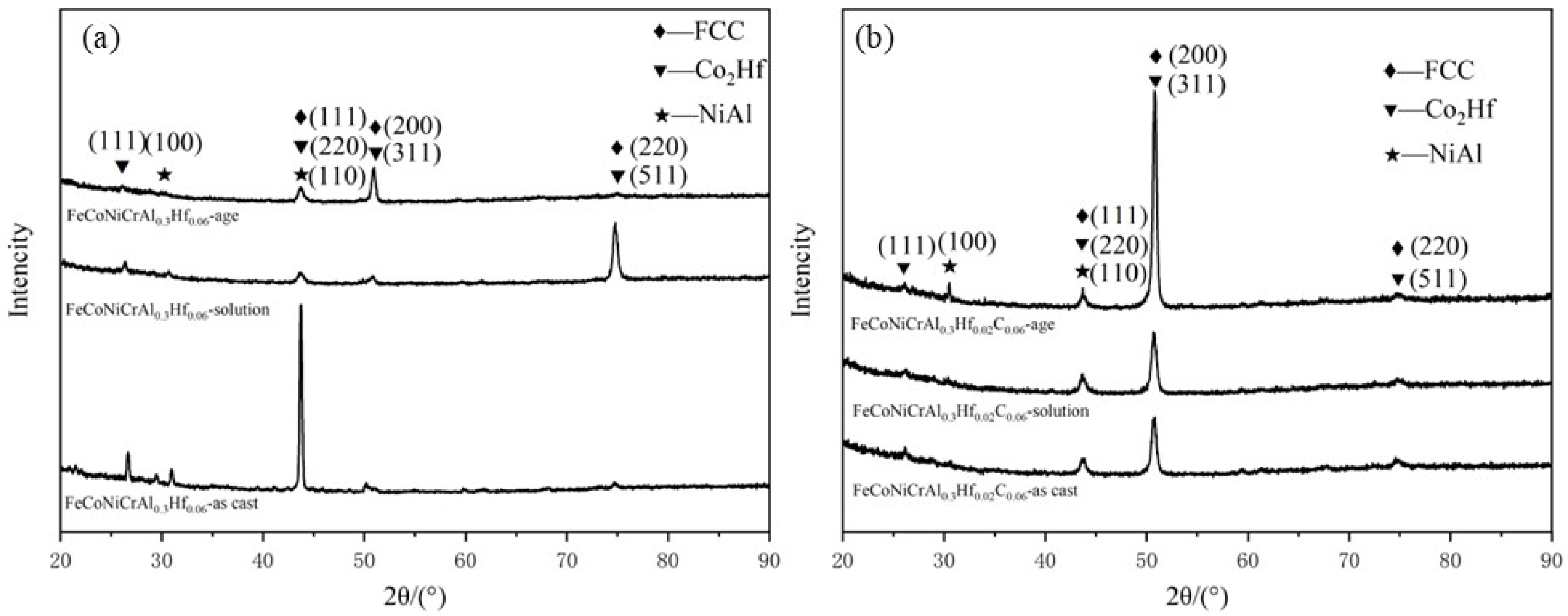
Figure 1 shows the XRD diffraction patterns of two alloys undergoing different heat treatment processes. Compared with Figure 1a,b, it can be inferred from the patterns that the addition of C did not change the phase structure of the original as-cast alloy after 10 h of solution treatment at 1210 °C and after 24 h of aging treatment at 800 °C. They remain a single face-centered cubic structure in the matrix phase. It can be noted that some weak peaks corresponding to the Co2Hf and NiAl phases can be identified.
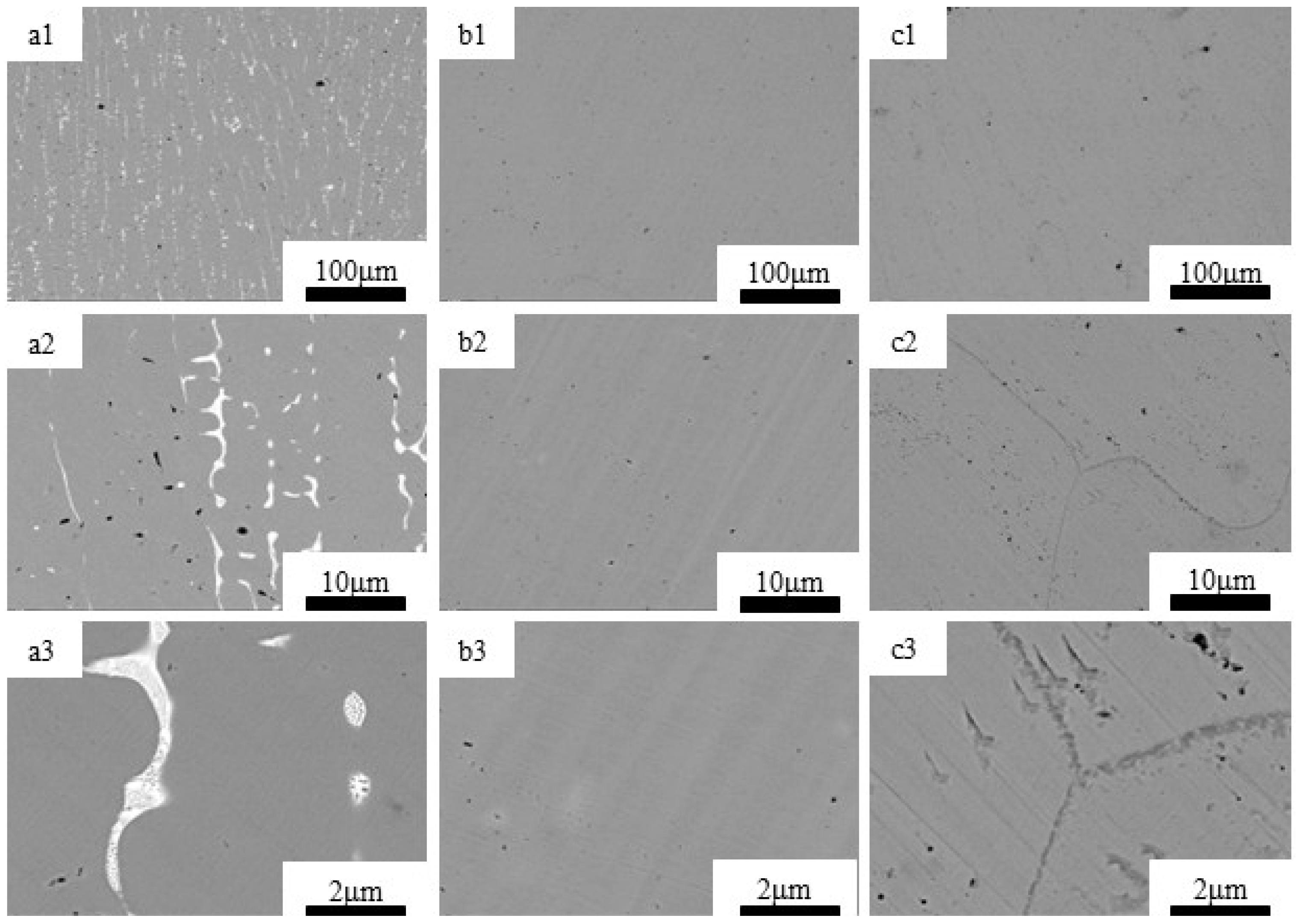
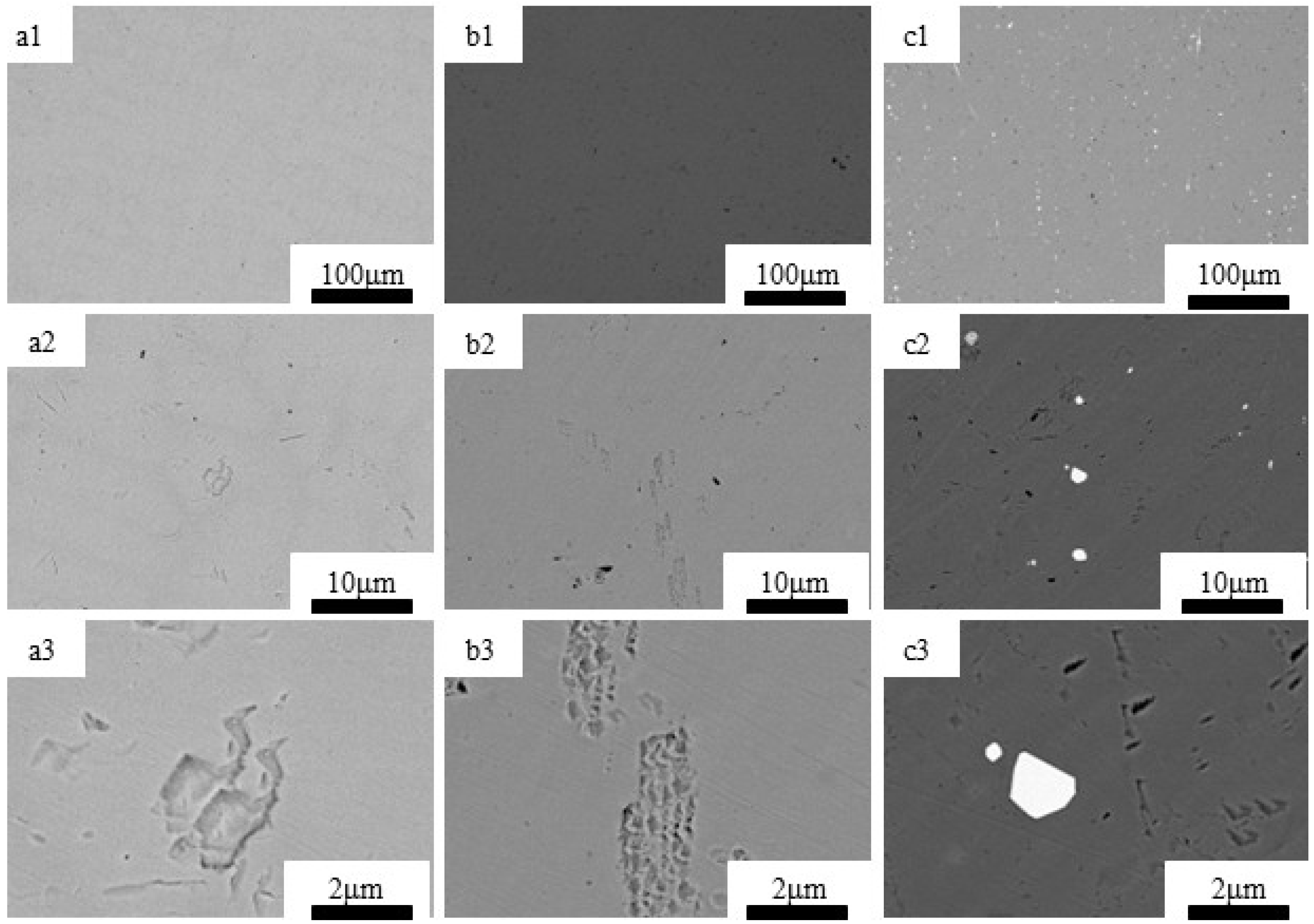
Figure 2 shows the backscattered micrographs of the CoCrFeNiAl0.3Hf0.02 HEA undergoing varied heat treatment processes. In Figure 2(a1–a3), it can be clearly observed that many block phases are distributed in the as-cast alloy. It can be known through the analysis of Image J software (version 1.46) that the volume fraction of this white phase is approximately 2.224%. After the solution treatment, as exhibited in Figure 2(b1–b3), no bright block phase was observed, indicating that the white phase had been fully dissolved in this treatment. A few long and dark gray phases gradually precipitated from the matrix treatment after age treatment. This gray phase is primary distributed in the grain boundary or nearby, as shown in Figure 2(c1–c3). Figure 2(a3) provides a detailed view of the bright phase. It can be seen through the analysis using Image J software that the volume fraction of this gray phase is approximately 0.794%. The skeleton-like manner may indicate that there are eutectic reactions in the final stage of solidification.
Figure 3 shows the backscattered micrographs of the CoCrFeNiAl0.3Hf0.02C0.06 HEA as it undergoes varied heat treatment processes. It can be observed from Figure 3 that in the as-cast state, only some blocky dark gray phases exist in the high-entropy alloy. After solution treatment, the dark gray phase was further precipitated, with an increase in quantity. The blocky white phase only exists in the alloy after aging treatment. It can be seen through the analysis using Image J software that the volume fraction of the dark gray phase in the as-cast alloy is approximately 0.673%. The volume fraction of the dark gray phase in the solution alloy is approximately 0.835%. The volume fraction of the black phase in the aged alloy is approximately 0.153%, that of the white phase is about 0.449%, and that of the dark gray phase is approximately 1.583%.
EDS analysis indicates that the bright blocky phase was rich in Hf, Ni and Co; therefore, it can be inferred that the white phase in Figure 2(a3) and Figure 3(c3) is the Hf-rich phase, and the dark gray phase in Figure 2(c3) and Figure 3(a3,b3) is the Cr-rich phase or NiAl. To determine the phase composition and the structure of the phases, TEM analysis was conducted.

3.2. Phase Composition Analysis

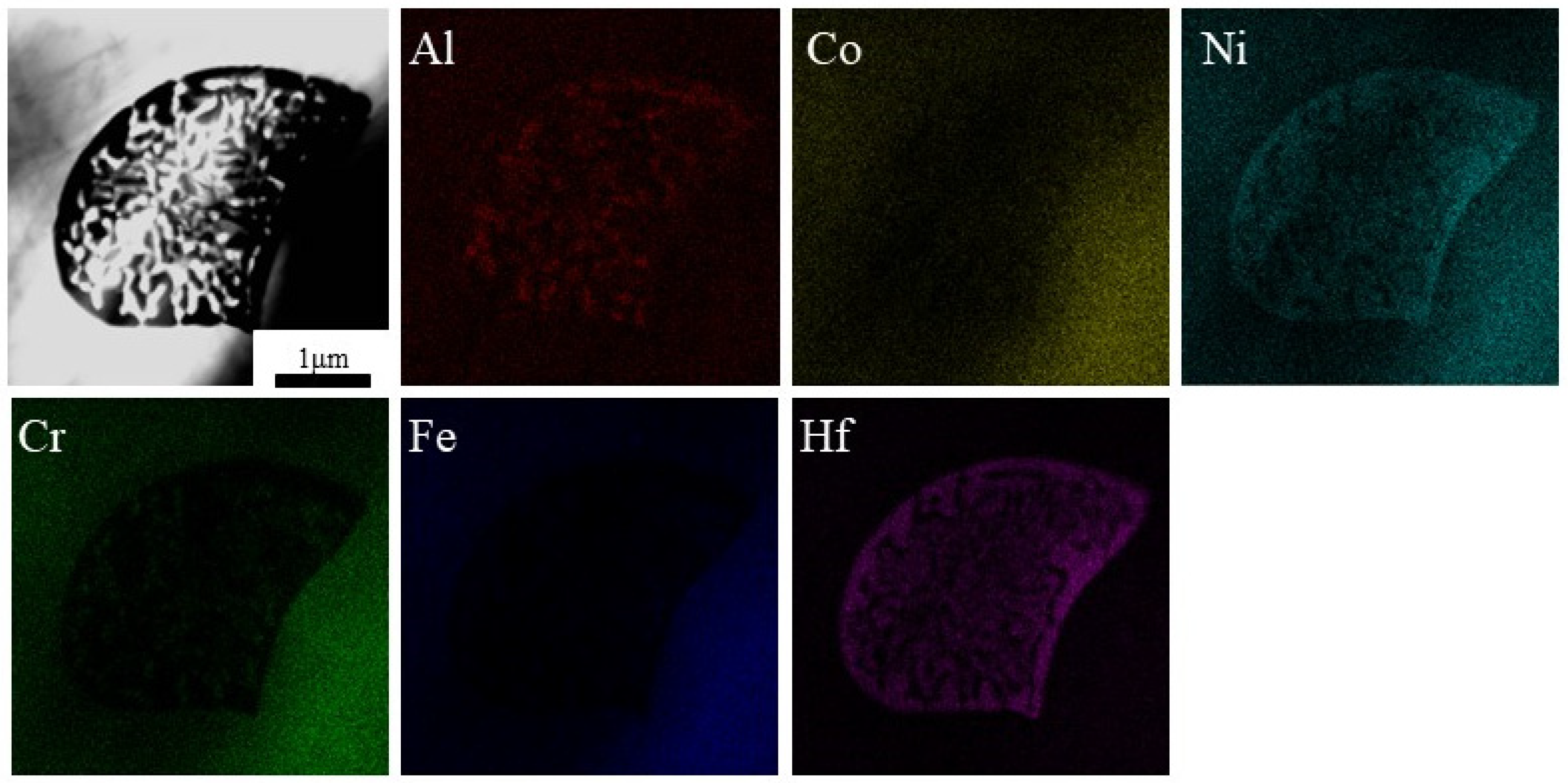
Figure 4 shows the STEM images and corresponding elemental mapping of the as-cast CoCrFeNiAl0.3Hf0.02 HEA, where the Hf-rich phase is usually distributed in the intergranular region. It can be seen from the EDS energy spectrum scanning image that Cr and Al elements are enriched corresponding to the zone of the white phases in the figure, while Hf elements are biased and distributed along with the black substances in the figure.
The analyzed compositions of each phase are given in Table 3. Based on the results of the EDs, it can be inferred that the white phase in the figure is the CoNiAl phase and the black phase is the CoNiHf phase.
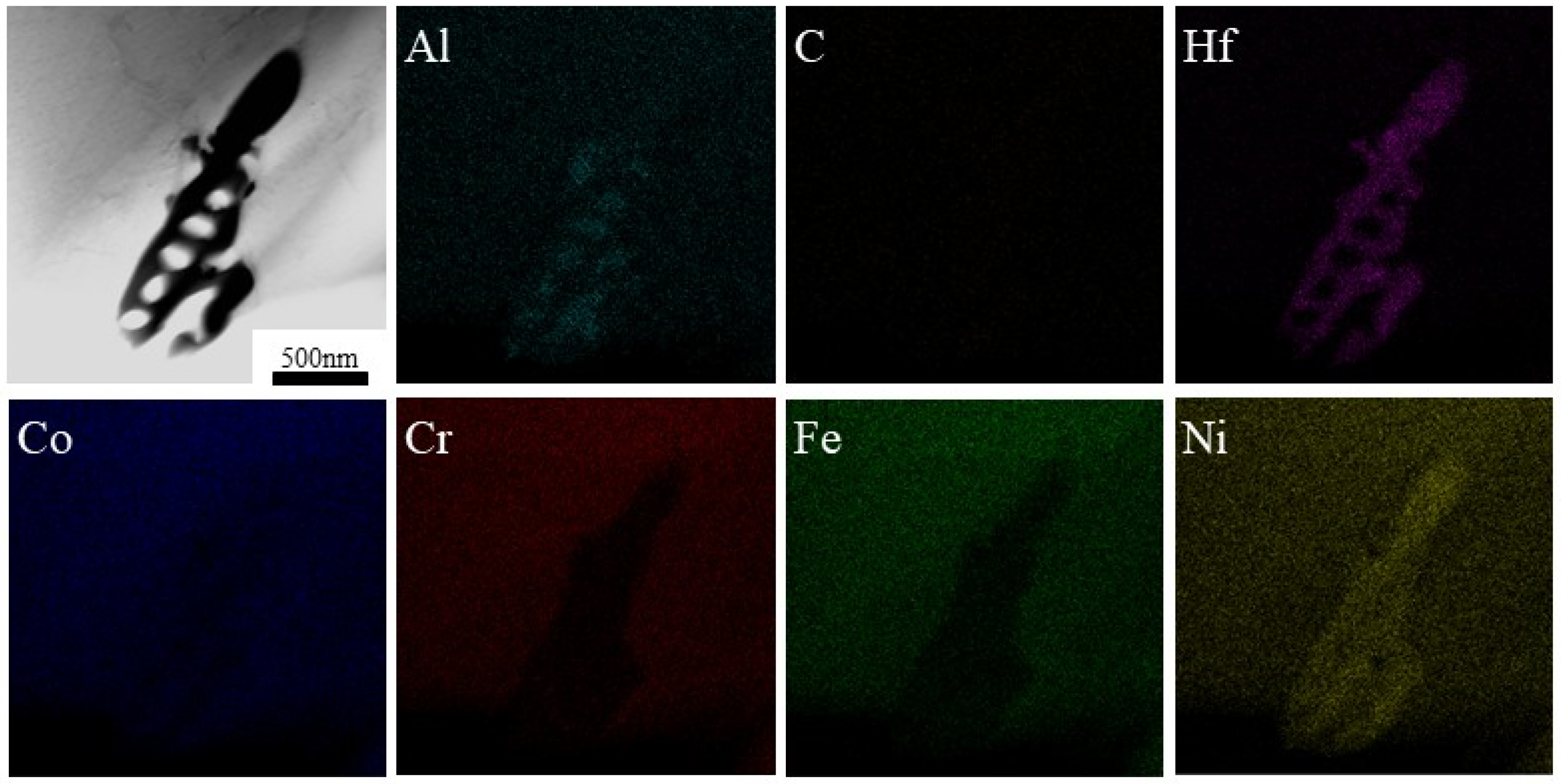
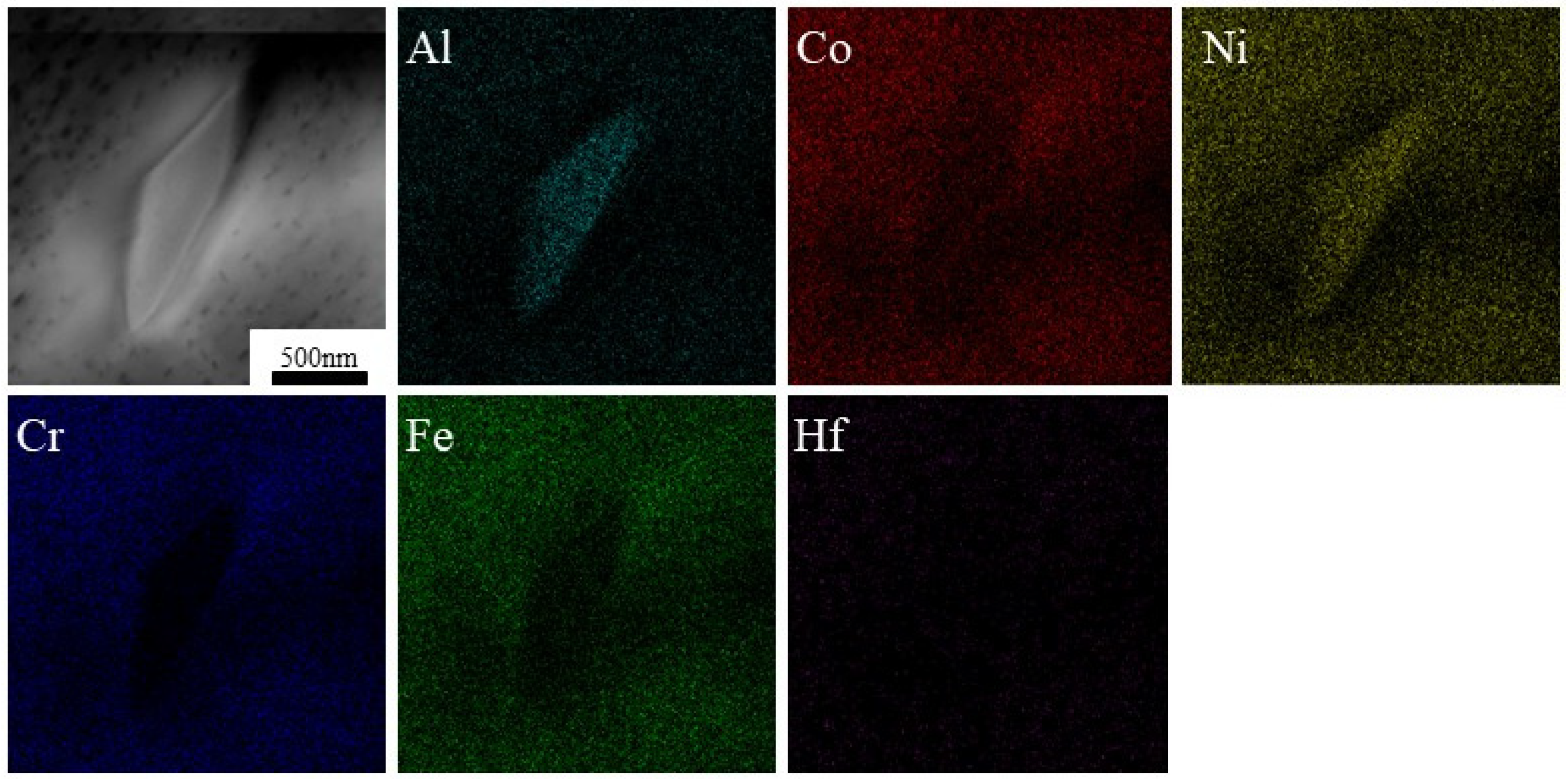
The elemental mapping of the CoCrFeNiAl0.3Hf0.02 HEA after aging treatment is shown in Figure 5, where it is in the vicinity of the grain boundary. The Al and Ni elements are still concentrated at the slender rhombic phase positions in the figure. However, at this point, after the heat treatments, the Hf has been dissolved within the alloy, with no obvious segregation phenomenon. After comparing the atomic ratios among the elements in Table 4 and combining them with the backscattered images, we conclude that the CoNiHf phase inside the CoCrFeNiAl0.3Hf0.02 HEA has been completely dissolved after the aging treatment, leaving only the NiAl phase and the γ phase.
The scanning transmission electron microscope images and corresponding elemental mapping of the as-cast CoCrFeNiAl0.3Hf0.02C0.06 HEA are shown in Figure 6. It can be observed from the EDS results that a large amount of Hf elements are concentrated in the black substances in the figure, while more Al elements are concentrated in the white substances. It can be inferred that the black phase part in the figure is still the CoNiHf phase, while the white phase part is the NiAl phase. The atomic ratios of the elements are shown in Table 5.
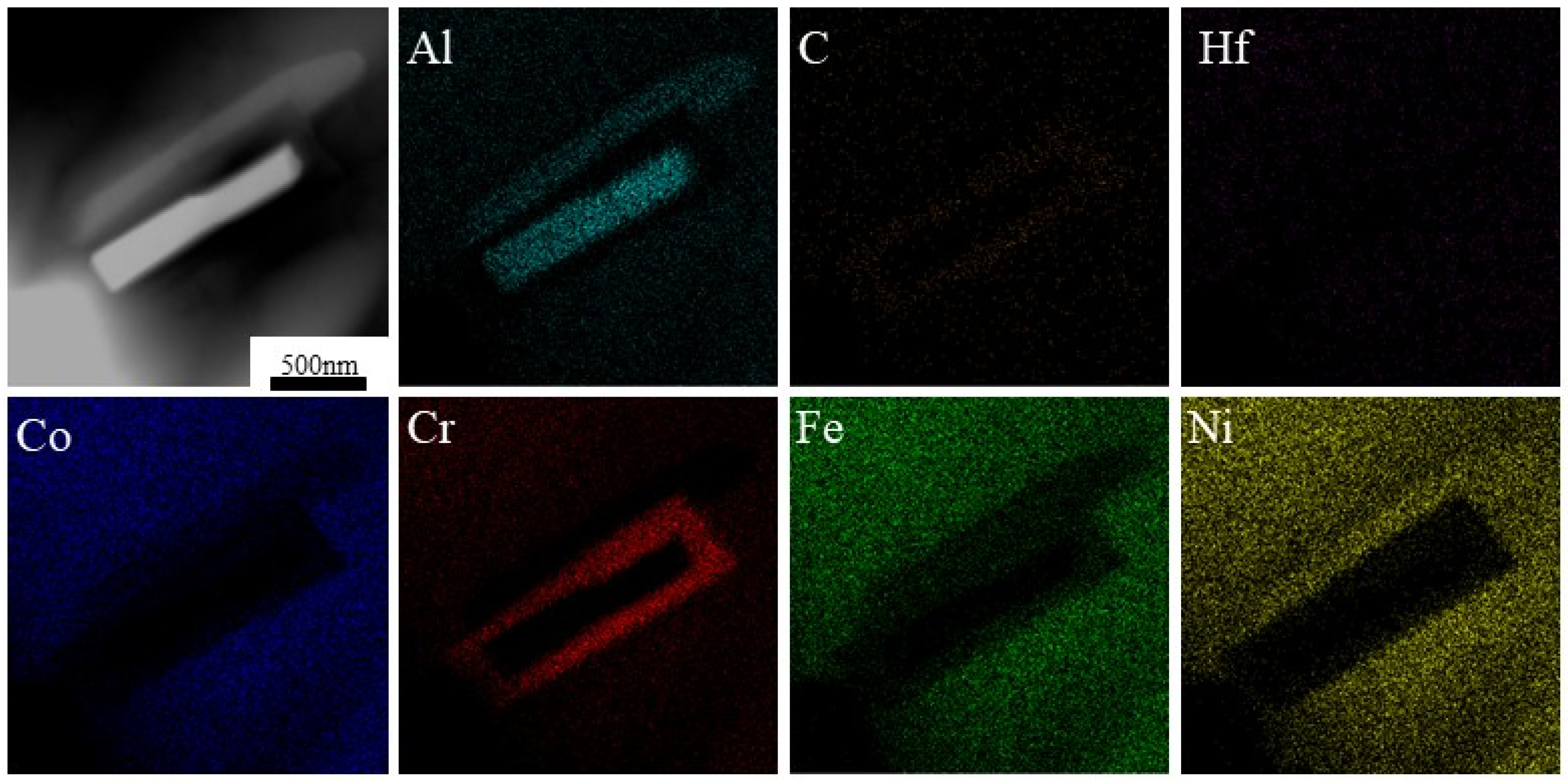
The mapping of elements of the aged CoCrFeNiAl0.3Hf0.02C0.06 HEA is shown in Figure 7. It can be seen that Cr and C are concentrated in the black area, while Al and Ni still tend to be concentrated in the white area. Hf exhibited no obvious agglomeration, indicating that the NiHf phase has completely dissolved. The atomic ratios of the elements are shown in Table 6. Unlike the CoCrFeNiAl0.3Hf0.02 HEA analyzed in the previous text, the addition of C provides a necessary condition for the formation of MxCy-type carbides in the alloy.
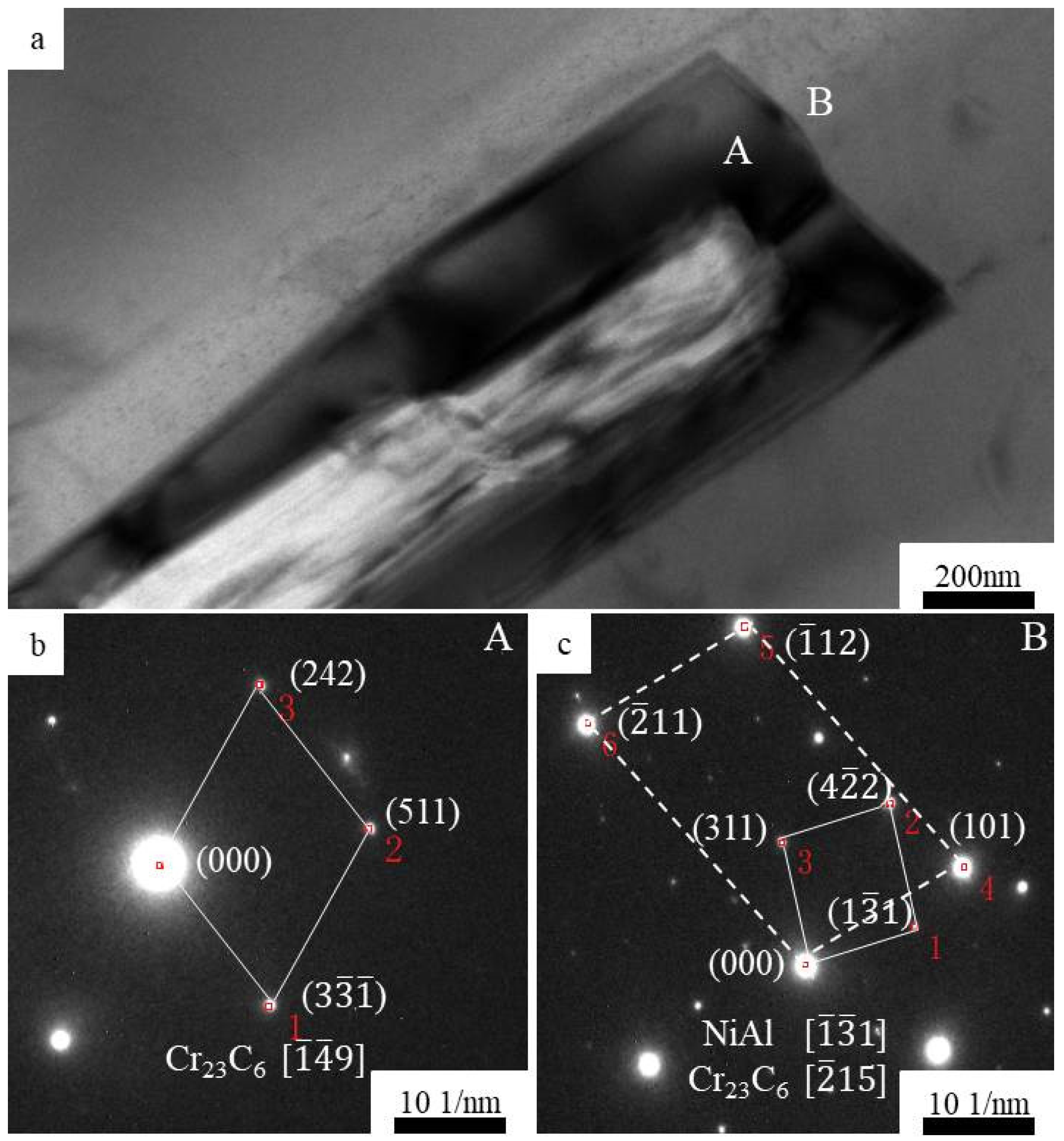
The selected area diffraction pattern conducted using TEM are shown in Figure 8. From the analysis of the calibration results, it can be seen that the phase marked A in Figure 8 is Cr23C6, and the phase marked B is NiAl. Following a 24 h aging treatment at 800 °C, the solubility limit of interstitial carbon in the FCC matrix decreases with cooling. The supersaturated C in the as-cast CoCrFeNiAl0.3Hf0.02C0.06 HEA continuously diffuses towards the grain boundaries and reacts with the Cr in the matrix, precipitating Cr23C6 carbides at the grain boundaries, which is generally regarded as a stable carbide in high-Ni-bearing alloys.

3.3. Mechanical Properties Analysis

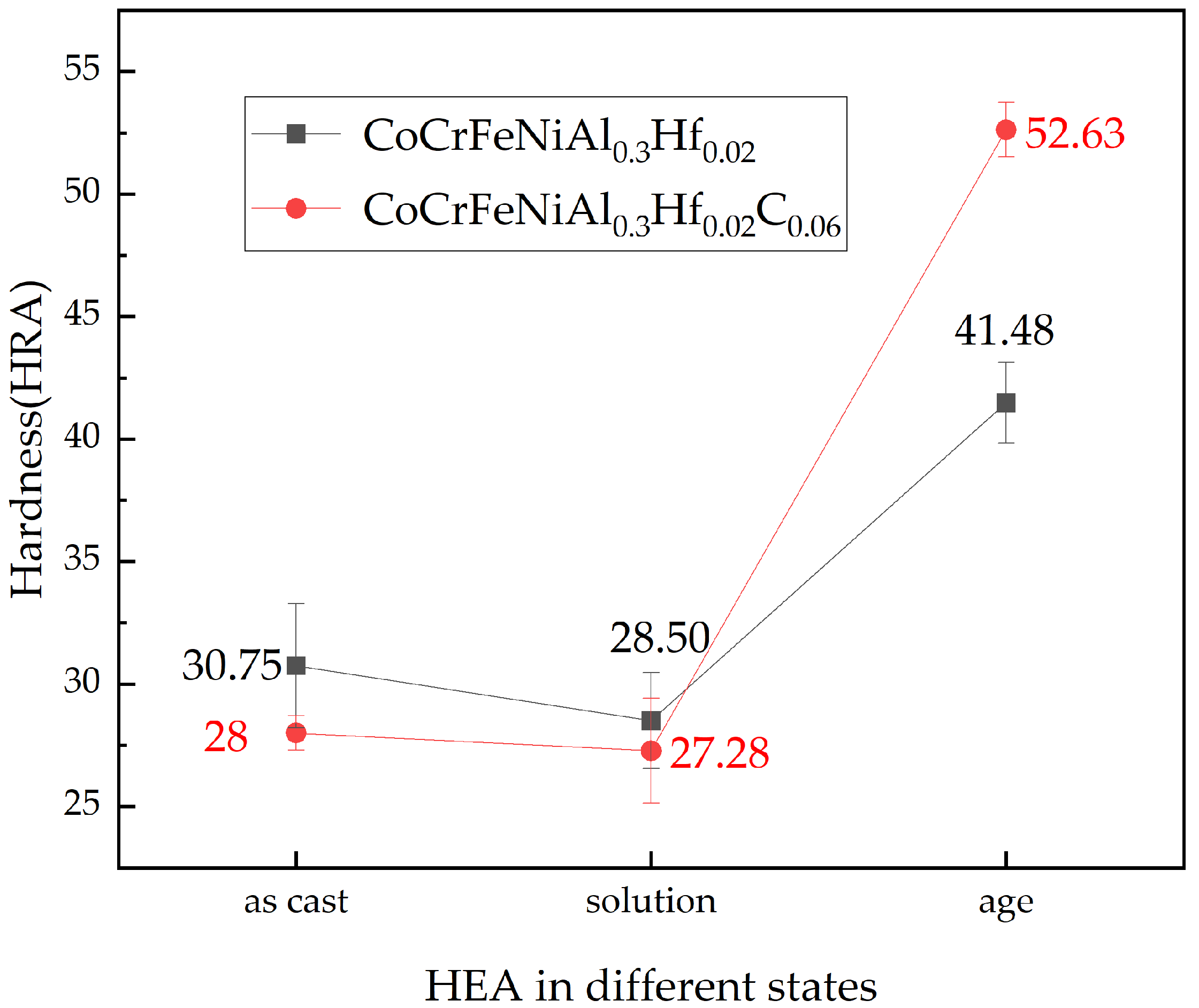
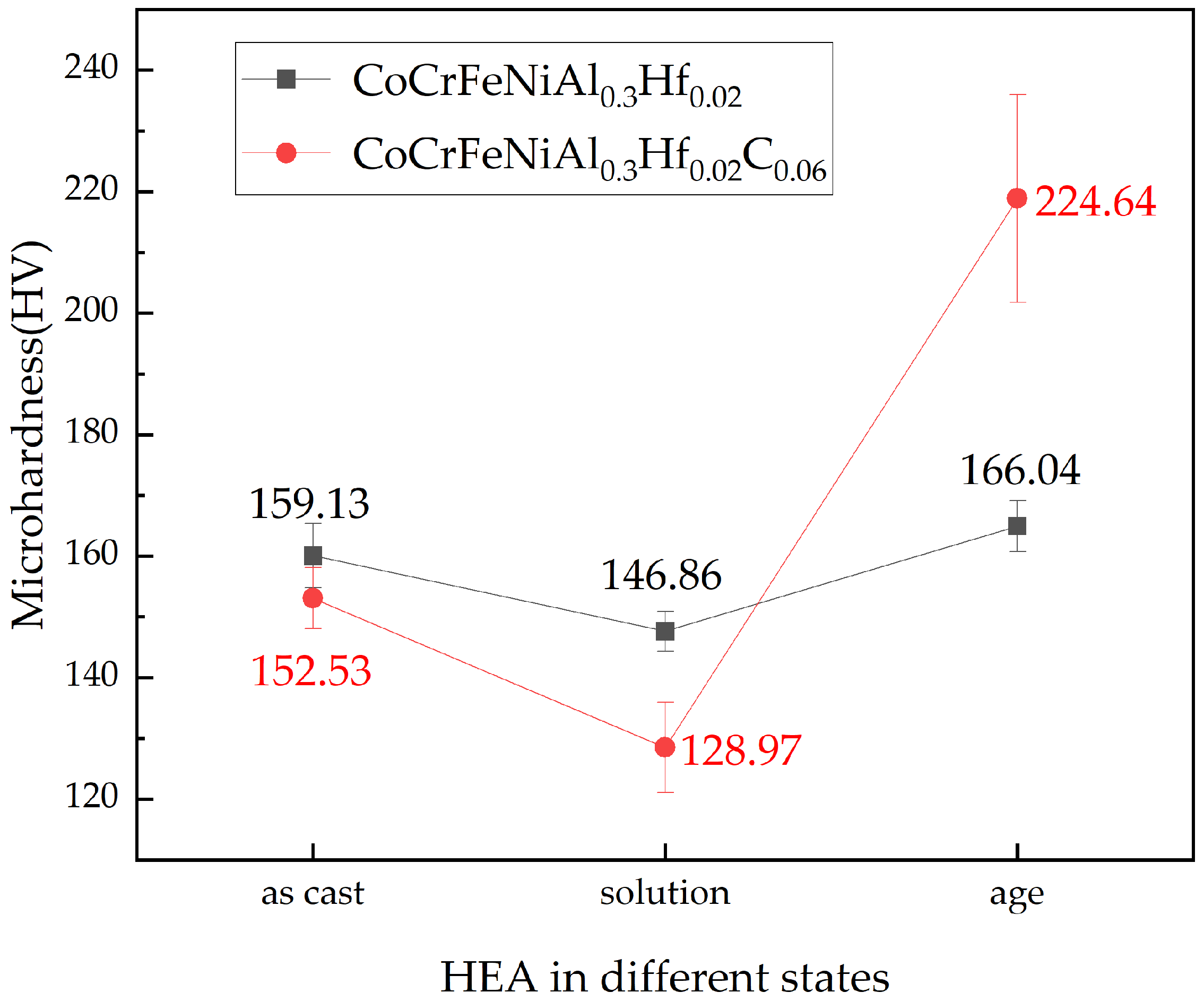
To preliminarily determine the influence of heat treatment processes and carbide formation on the hardness of high-entropy alloys, macroscopic Rockwell hardness tests were conducted on each alloy under different states. The results are shown in Figure 9. Given the relatively high experimental scatter typical of Rockwell hardness results, micro-Vickers hardness testing was conducted to improve the accuracy of the subsequent analysis. The results are shown in Figure 10. The hardness of both compositions of the alloys first decreases after solution treatment and then increases with the process of aging, which is also consistent with the conclusions of previous studies [43,44,45,46].
With a load of 200 g, the hardness of the two as-cast alloys was similar, and the hardness of Hf-c was slightly higher than that of HfC-c. However, after solution treatment at 1210 °C, the hardness drop of HfC-c was much greater than that of Hf-c. This is because when the heat treatment temperature is relatively high, decarburization begins to occur in the HEA matrix, the room-temperature solubility of C decreases, and the solid solution strengthening effect of C declines, resulting in a decrease in the hardness of the HEA. After aging treatment at 800 °C, the hardness of HfC-a was significantly enhanced. From the previous TEM analysis, it can be seen that this results from carbides Cr23C6 formation inside the HEA, which significantly increases the hardness of the high-entropy alloy.

4. Conclusions

This study analyzed the effects of doping of Hf and C on the microstructure and mechanical properties of a CoCrFeNiAl0.3 HEA. The alloys were subjected to solution and aging treatments, and the microstructure and hardness with varied heat treatments were investigated. The main conclusions are as follows:
1. The 10 h solution treatment at 1210 °C and the 24 h aging treatment at 800 °C did not modify the phase structure of the main matrix of CoCrFeNiAl0.3Hf0.02 and CoCrFeNiAl0.3Hf0.02C0.06 HEAs, which still maintained an FCC structure.
2. The as-cast CoCrFeNiAl0.3Hf0.02 HEA contains a CoNi-Hf phase and a CoNi-Al phase. After the solution treatment and the aging treatment, the Ni-Hf phase is completely dissolved, leaving only the Ni-Al phase and the matrix phase γ. The as-cast CoCrFeNiAl0.3Hf0.02C0.06 HEA is similar, also containing a CoNi-Hf phase and a CoNi-Al phase. The Ni-Hf phase is completely dissolved after the solution treatment and the aging treatment. However, due to the addition of C, some Cr23C6 carbides precipitate in the HEAs.
3.The precipitation of Cr23C6 carbide has a significant effect on the hardness of the HEA. After aging treatment, the micro-Vickers hardness of high-entropy alloys strengthened by carbide can rise to 224.64 HV, which is much higher than that of C-free HEAs.

Author Contributions

Data curation, Q.-S.L. and E.-Z.L.; writing—original draft, P.-J.Z.; writing—review and editing, E.-Z.L. All authors have read and agreed to the published version of the manuscript.

Funding

This research was financially sponsored by the National Key R&D Program of China [2021YFC2202402] and the National Natural Science Foundation of China (52275339 and 51471079).

Data Availability Statement

Data are contained within the article.

Conflicts of Interest

The authors declare that the research was conducted in the absence of any commercial or financial relationships that could be construed as a potential conflict of interest.

References

  1. Chen, T.; Shun, T.; Yeh, J.; Wong, M. Nanostructured nitride films of multi-element high-entropy alloys by reactive DC sputtering. Surf. Coat. Technol. 2004, 188, 193–200. [Google Scholar] [CrossRef]
  2. Stepanov, N.; Zherebtsov, S. Design of high-entropy alloys. Metals 2022, 12, 1003. [Google Scholar] [CrossRef]
  3. Gao, M.C.; Qiao, J. High-entropy alloys (HEAs). Metals 2018, 8, 108. [Google Scholar] [CrossRef]
  4. George, E.P.; Raabe, D.; Ritchie, R.O. High-entropy alloys. Nat. Rev. Mater. 2019, 4, 515–534. [Google Scholar] [CrossRef]
  5. Ye, Y.; Wang, Q.; Lu, J.; Liu, C.; Yang, Y. High-entropy alloy: Challenges and prospects. Mater. Today 2016, 19, 349–362. [Google Scholar] [CrossRef]
  6. Hsu, W.-L.; Tsai, C.-W.; Yeh, A.-C.; Yeh, J.-W. Clarifying the four core effects of high-entropy materials. Nat. Rev. Chem. 2024, 8, 471–485. [Google Scholar] [CrossRef] [PubMed]
  7. He, Q.; Yang, Y. On lattice distortion in high entropy alloys. Front. Mater. 2018, 5, 42. [Google Scholar] [CrossRef]
  8. Wang, H.; He, Q.; Gao, X.; Shang, Y.; Zhu, W.; Zhao, W.; Chen, Z.; Gong, H.; Yang, Y. Multifunctional high entropy alloys enabled by severe lattice distortion. Adv. Mater. 2024, 36, 2305453. [Google Scholar] [CrossRef]
  9. Tsai, M.-H.; Yeh, J.-W. High-entropy alloys: A critical review. Mater. Res. Lett. 2014, 2, 107–123. [Google Scholar] [CrossRef]
  10. Zhang, B.; Gao, Q.; Jia, D.; Fu, Y.; Wu, X. Review on the preparation and properties of high-entropy alloys coating. Mater. Sci. Eng. A 2025, 945, 149009. [Google Scholar] [CrossRef]
  11. Yang, Y.-F.; Hu, F.; Xia, T.; Li, R.-H.; Bai, J.-Y.; Zhu, J.-Q.; Xu, J.-Y.; Zhang, G.-F. High entropy alloys: A review of preparation techniques, properties and industry applications. J. Alloys Compd. 2025, 1010, 177691. [Google Scholar] [CrossRef]
  12. Babu, P.D.; Dongre, P.; Moganraj, A.; Manivasagam, G.; Schwandt, C.; Sure, J. Wear behavior of CoCrFeNi high-entropy alloy prepared by mechanical alloying. J. Alloys Compd. 2025, 1010, 177115. [Google Scholar] [CrossRef]
  13. Adabavazeh, Z.; Hosseini, S.; Karimzadeh, F.; Abbasi, M. Fabrication and performance assessment of CuFeNiMnTi high entropy alloy through mechanical alloying and spark plasma sintering. Mater. Today Commun. 2025, 42, 111124. [Google Scholar] [CrossRef]
  14. Song, X.; Zhang, Y. Progress of high-entropy alloys prepared using selective laser melting. Sci. China Mater. 2023, 66, 4165–4181. [Google Scholar] [CrossRef]
  15. Li, L.; Liu, Z.; An, X.; Sun, W. Design methods of high-entropy alloys: Current status and prospects. J. Alloys Compd. 2025, 1029, 180638. [Google Scholar] [CrossRef]
  16. Li, D.; Liaw, P.K.; Xie, L.; Zhang, Y.; Wang, W. Advanced high-entropy alloys breaking the property limits of current materials. J. Mater. Sci. Technol. 2024, 186, 219–230. [Google Scholar] [CrossRef]
  17. Zhang, W.; Lai, S.; Jiao, B.; Li, Z.; Liang, J.; Yu, L.; Li, S.; Sun, S.; Wang, B.; Xin, T. Hf-induced transition in deformation mechanism enhances dynamic performance of NbTaTiZr refractory high-entropy alloy. Mater. Des. 2026, 262, 115498. [Google Scholar] [CrossRef]
  18. Liang, X.; Wang, C.; Zhang, C.; Cheung, C.F. Physical-metallurgical properties and micro-milling machinability evaluation of high entropy alloy FeCoNiCrAlx. J. Mater. Res. Technol. 2022, 21, 3285–3300. [Google Scholar] [CrossRef]
  19. Reverte, E.; Calvo-Dahlborg, M.; Dahlborg, U.; Campos, M.; Alvaredo, P.; Martin-Rodriguez, P.; Gordo, E.; Cornide, J. Design and Production of a New FeCoNiCrAlCu High-Entropy Alloy: Influence of Powder Production Method on Sintering. Materials 2021, 14, 4342. [Google Scholar] [CrossRef]
  20. Xi, R.; Li, Y. Influence of Si content on the microstructure, wear resistance, and corrosion resistance of FeCoNiCrAl0.7Cu0.3Six high entropy alloy. Coatings 2024, 14, 1309. [Google Scholar] [CrossRef]
  21. Ji, X.; Zhou, L.; Li, H. Microstructure, Hardness, Wear Resistance, and Corrosion Resistance of As-Cast and Laser-Deposited FeCoNiCrAl0.8Cu0.5Si0.5 High Entropy Alloy. Coatings 2024, 14, 663. [Google Scholar] [CrossRef]
  22. Luan, B.; Gao, J.; Jiang, F.; Wang, P.; Cheng, J.; He, Y.; He, M. Research progress on the mechanical properties of eutectic high-entropy alloys. J. Alloys Compd. 2025, 1050, 185642. [Google Scholar] [CrossRef]
  23. Deng, Y.; Li, K.; Lu, J.; Hu, J.; Deng, Q. Microstructures, high-temperature tribological and electrochemical mechanisms of FeCoNiCrAl high-entropy alloy coating prepared by laser cladding on a copper alloy: Combined TEM and DFT calculation. Mater. Today Commun. 2024, 40, 110195. [Google Scholar] [CrossRef]
  24. Jiao, Z.; Ma, S.; Chu, M.; Yang, H.; Wang, Z.; Zhang, Y.; Qiao, J. Superior mechanical properties of AlCoCrFeNiTix high-entropy alloys upon dynamic loading. J. Mater. Eng. Perform. 2016, 25, 451–456. [Google Scholar] [CrossRef]
  25. Gangireddy, S.; Gwalani, B.; Banerjee, R.; Mishra, R. High strain rate response of Al0.7CoCrFeNi high entropy alloy: Dynamic strength over 2 GPa from thermomechanical processing and hierarchical microstructure. J. Dyn. Behav. Mater. 2019, 5, 1–7. [Google Scholar] [CrossRef]
  26. Ali, N.; Zhang, L.; Liu, D.; Zhou, H.; Sanaullah, K.; Zhang, C.; Chu, J.; Nian, Y.; Cheng, J. Strengthening mechanisms in high entropy alloys: A review. Mater. Today Commun. 2022, 33, 104686. [Google Scholar] [CrossRef]
  27. Chen, J.; Jiang, X.; Sun, H.; Shao, Z.; Fang, Y.; Shu, R. Phase transformation and strengthening mechanisms of nanostructured high-entropy alloys. Nanotechnol. Rev. 2021, 10, 1116–1139. [Google Scholar] [CrossRef]
  28. Basu, I.; De Hosson, J.T.M. Strengthening mechanisms in high entropy alloys: Fundamental issues. Scr. Mater. 2020, 187, 148–156. [Google Scholar] [CrossRef]
  29. Varvenne, C.; Luque, A.; Curtin, W.A. Theory of strengthening in fcc high entropy alloys. Acta Mater. 2016, 118, 164–176. [Google Scholar] [CrossRef]
  30. Zang, C.; Rivera-Díaz-del-Castillo, P.E. High entropy alloy strengthening modelling. Model. Simul. Mater. Sci. Eng. 2022, 30, 063001. [Google Scholar] [CrossRef]
  31. Ortega, Y.; Monge, M.; Savoini, B. Influence of the coexistence of Hf and Ti on phases stability in Fe35Cr35V20Hf5Ti5 high entropy alloy. J. Alloys Compd. 2025, 1050, 185539. [Google Scholar] [CrossRef]
  32. Chen, H.; Huang, Y.; Lu, L.; Li, X. Unraveling the effect of annealing temperature on the pitting corrosion behavior of NbC-reinforced CoCrFeNi high entropy alloy. Corros. Sci. 2025, 258, 113375. [Google Scholar] [CrossRef]
  33. Chen, H.; Li, C.; Huang, Y.; Luo, H.; Li, X. Effect of solution annealing temperature on microstructural evolution and mechanical properties of NbC-reinforced CoCrFeNi based high entropy alloys. Mater. Sci. Eng. A 2023, 876, 145177. [Google Scholar] [CrossRef]
  34. Ma, Y.; Liu, X.; Dong, W.; Li, R.; Zhang, Y.; Lu, Y.; Yu, P.; Li, G. Interstitial carbide synergistically strengthening high-entropy alloy CoCrFeNiV0.5Cx. Mater. Sci. Eng. A 2020, 792, 139802. [Google Scholar] [CrossRef]
  35. Klepaczko, J. Physical-state variables—The key to constitutive modeling in dynamic plasticity. Nucl. Eng. Des. 1991, 127, 103–115. [Google Scholar] [CrossRef]
  36. Wang, P.; Ren, P.; Cheng, X.; Xu, Z.; Wu, X. Processing, microstructure and mechanical properties of Ni1.5CoFeCu0.8Al0.2V0.5 high entropy alloy matrix composites reinforced by in-situ synthesized vanadium carbides. Mater. Chem. Phys. 2021, 271, 124934. [Google Scholar] [CrossRef]
  37. Liang, S.; Tu, B.; Li, P.; Chen, X.; Li, J.; Li, J.; Wei, Q.; Shen, Q. Enhanced CoCrFeNi(TiC)0.2 high-entropy alloy by thermodynamic treatment. Mater. Today Commun. 2025, 47, 113036. [Google Scholar] [CrossRef]
  38. Chen, M.; Shen, H.; Wen, C.; Wang, N.; Tian, Y.; Zhong, W.; Huang, H. Phase, Microstructure and Corrosion Behaviour of Al0.3FeCoNiCrx High-Entropy Alloys via Cr Addition. Materials 2024, 17, 5259. [Google Scholar] [CrossRef] [PubMed]
  39. Wang, F.; Ding, C.; Yang, Z.; Zhang, H.; Ding, Z.; Li, H.; Xu, J.; Shan, D.; Guo, B. Microstructure evolution and mechanical properties of AlCoCrFeNi2. 1 eutectic High-Entropy alloys processed by High-Pressure torsion. Materials 2024, 17, 2954. [Google Scholar] [CrossRef]
  40. Liu, C.; Kong, D.; Tan, Q.; He, J.; Wang, R.; Zhu, G.; Sun, B.; Zou, Y. Simplifying the microstructure and improving the corrosion resistance of the FeCoCrNiNbx high-entropy alloys via homogenizing annealing heat treatment. J. Alloys Compd. 2025, 1013, 178565. [Google Scholar] [CrossRef]
  41. Feng, L.; Qin, G.; Yang, X.; Ren, H.; Chen, R. Influence of aging heat treatment on the microstructure and mechanical properties of Co29Cr31Cu4Mn15Ni21 high-entropy alloys strengthened by nano-precipitates. Mater. Sci. Eng. A 2025, 920, 147508. [Google Scholar] [CrossRef]
  42. Liu, Z.; Liu, J.; Li, Z.; Cui, Y.; Zhao, Y.; Ma, S.; Zhang, Y. Improvement of mechanical properties of CoCrFeNiAl0.5 high-entropy alloys treated by double heat-treatment process. J. Mater. Res. Technol. 2026, 42, 2209–2223. [Google Scholar] [CrossRef]
  43. Yang, H.-X.; Li, J.-S.; Guo, T.; Wang, W.-Y.; Kou, H.-C.; Wang, J. Evolution of microstructure and hardness in a dual-phase Al0.5CoCrFeNi high-entropy alloy with different grain sizes. Rare Met. 2020, 39, 156–161. [Google Scholar] [CrossRef]
  44. Ruiz-Esparza-Rodriguez, M.; Garay-Reyes, C.; Mendoza-Duarte, J.; Estrada-Guel, I.; Martinez-Sanchez, R. Densification, Microhardness and Microestructural Evolution by Fast Low-Temperature Consolidation of AlxCoCrFeMnNi High Entropy Alloy. Microsc. Microanal. 2019, 25, 2644–2645. [Google Scholar] [CrossRef]
  45. Liu, M.; Zhang, S.; Li, F.; Wang, L.; Wang, Z.; Wang, Z.; Sha, Y.; Shen, Q. Effect of annealing treatment on the microstructure and hardness of AlxCoCrFeNi (x = 0.75, 1.25) high entropy alloys. J. Mater. Eng. Perform. 2022, 31, 1444–1455. [Google Scholar] [CrossRef]
  46. Li, A.; Kang, K.; Zhang, B.; Zhang, J.; Huang, D.; Xu, M.; Liu, S.; Jiang, Y.; Li, G. Development and characterization of CoCrFeNi high entropy alloy composites reinforced by B4C ceramic particles. Intermetallics 2025, 181, 108740. [Google Scholar] [CrossRef]
Figure 1. (a) XRD diffraction patterns of CoCrFeNiAl0.3Hf0.02 alloy with varied heat treatment processes; (b) XRD diffraction patterns of CoCrFeNiAl0.3Hf0.02C0.06 alloy with varied heat treatment processes.
Coatings 16 00611 g001
Figure 2. Microstructure of CoCrFeNiAl0.3Hf0.02 HEA: (a1a3) BSE image of as-cast HEA; (b1b3) BSE image of HEA after solution treatment; (c1c3) BSE image of HEA after aging.
Coatings 16 00611 g002
Figure 3. Microstructure of CoCrFeNiAl0.3Hf0.02C0.06 HEA: (a1a3) BSE image of the as-cast HEA; (b1b3) BSE image of the HEA after solution treatment; (c1c3) BSE image of the HEA after aging.
Coatings 16 00611 g003
Figure 4. Transmission electron microscope images and corresponding energy spectrum images of as-cast CoCrFeNiAl0.3Hf0.02 HEA.
Coatings 16 00611 g004
Figure 5. Scanning transmission electron microscope images and corresponding elemental mapping of aged CoCrFeNiAl0.3Hf0.02 HEA.
Coatings 16 00611 g005
Figure 6. Scanning transmission electron microscope images and corresponding elemental mapping of as-cast CoCrFeNiAl0.3Hf0.02C0.06 HEA.
Coatings 16 00611 g006
Figure 7. Scanning transmission electron microscope images and elemental mapping of aged CoCrFeNiAl0.3Hf0.02C0.06 HEA.
Coatings 16 00611 g007
Figure 8. Transmission electron microscope images of the aged CoCrFeNiAl0.3Hf0.02C0.06 HEA and the corresponding SADP analysis: (a) TEM images of the aged alloy; (b) SAED pattern taken from area A; (c) SAED pattern taken from area B.
Coatings 16 00611 g008
Figure 9. The hardness of the HEA after varied heat treatments.
Coatings 16 00611 g009
Figure 10. The microhardness of the HEA after varied heat treatments.
Coatings 16 00611 g010
Table 1. The elemental compositions of high-entropy alloys used in the study, measured by EDS (at. %).
HeatFeCoNiCrAlHfC
CoCrFeNi
Al0.3Hf0.02
23.323.12323.270.40
CoCrFeNi
Al0.3Hf0.02C0.06
2322.822.822.870.401.2
Table 2. Sample IDs of HEAs after various heat treatment processes.
AlloyProcessing StageSample ID
CoCrFeNiAl0.3Hf0.02as-castHf-c
solutionHf-s
agedHf-a
CoCrFeNiAl0.3Hf0.02C0.06as-castHfC-c
solutionHfC-s
agedHfC-a
Table 3. The elemental composition of each phase in the as-cast CoCrFeNiAl0.3Hf0.02 (at. %) HEA.
ElementCoNiHfCoNiAl
Al3.5825.20
Co19.9316.48
Cr8.477.88
Fe8.9011.20
Ni39.3539.24
Hf19.76-
Table 4. The elemental composition of the aged CoCrFeNiAl0.3Hf0.02 (at. %) HEA.
ElementNiAlγ
Al35.705.36
Co15.5624.01
Cr4.6226.86
Fe9.1525.00
Ni34.9618.77
Table 5. The elemental composition of the phases in the as-cast CoCrFeNiAl0.3Hf0.02C0.06 HEA (at. %).
Alloy PhaseNiAlNiHf
C16.4812.91
Al25.66-
Co12.4417.15
Cr5.416.57
Fe8.527.59
Ni30.9736.72
Hf0.5119.05
Table 6. The elemental composition of the phases in the aged CoCrFeNiAl0.3Hf0.02C0.06 HEA (at. %).
ElementNiAlCr23C6
C1.962.96
Al29.569.80
Co16.5120.47
Cr4.4227.14
Fe10.4519.91
Ni37.1019.72
Disclaimer/Publisher’s Note: The statements, opinions and data contained in all publications are solely those of the individual author(s) and contributor(s) and not of MDPI and/or the editor(s). MDPI and/or the editor(s) disclaim responsibility for any injury to people or property resulting from any ideas, methods, instructions or products referred to in the content.