Review

A Review of the Application and Cutting-Edge Research Progress of Drag-Reducing Coating Technology in Ice and Snow Sports Equipment

1
Department of Physical Education Convergence, Sangji University Graduate School, Wonju 26339, Republic of Korea
2
College of Physical Education, Dezhou University, Dezhou 253023, China
*
Author to whom correspondence should be addressed.
Coatings 2026, 16(5), 606; https://doi.org/10.3390/coatings16050606 (registering DOI)

Submission received: 16 April 2026 / Revised: 9 May 2026 / Accepted: 11 May 2026 / Published: 17 May 2026

Abstract

Drag-reducing coating technology is a core approach to enhancing the performance of ice and snow sports equipment. By regulating the interfacial characteristics between the equipment surface and the ice or snow medium, it significantly reduces frictional resistance during motion, thereby optimizing athletes’ speed performance and control precision. This paper aims to review the current research status and challenges in this technological field. The review first elaborates on the fundamental principles of applying drag-reducing coatings to key equipment such as skis, sleds, and ice skates, covering current mainstream coating material systems, key preparation processes, and comprehensive performance evaluation methods. Furthermore, integrating multidisciplinary advances in surface engineering, fluid dynamics, and materials science, this review specifically examines how these disciplines can be harnessed to address the unique tribological challenges of snow/ice interfaces. It focuses on cutting-edge research directions such as micro-nano-structured coatings driven by biomimetic design concepts and smart coatings with environmental responsiveness. By synthesizing existing research achievements and potential technological bottlenecks, this paper aims to provide a systematic, theoretical basis and innovative ideas for the future development of a new generation of high-performance, intelligent ice and snow sports equipment.

1. Introduction

The performance limits of ice and snow sports equipment are closely related to athletes’ achievements, with frictional resistance between the equipment and the snow or ice surface being a key factor affecting speed [1]. In top-level competitions, an athlete’s performance results from complex, dynamically evolving interactions among the athlete, the equipment, and the snow/ice surface—governed by temperature, humidity, wind, venue preparation, and contact conditions [1]. These factors continuously rebalance gravity, air resistance, and friction, requiring constant adjustments in technique, equipment, and venue management [1]. Traditional surface treatments, such as polishing or conventional waxes, have become inadequate to meet the extreme pursuit of speed, especially under variable environmental conditions. Consequently, drag-reducing coating technology based on advanced materials science has emerged as a key innovative direction for enhancing equipment performance.
This technology aims to fundamentally alter interface wettability, reduce surface energy, and regulate friction coefficients by constructing thin films with specific physicochemical properties on equipment surfaces [2]. The key lies in precisely controlling the microstructure, chemical composition, roughness, and wettability of the coatings [3,4]. For instance, atomic layer deposition of ZnO coatings on titanium alloys can significantly alter surface wettability [4], while nanogel-based coatings on polymer surfaces can modulate interface adhesion [3]. These studies reveal the decisive influence of surface physicochemical properties on interface behavior, providing fundamental principles for designing drag-reducing coatings for ice and snow sports equipment.
With the development of nanotechnology, biomimetics, and smart materials, drag-reducing coatings are evolving from passive systems toward intelligent, environmentally adaptive solutions [2]. For example, superhydrophobic materials designed for marine drag reduction achieve substantial fluid resistance reduction by forming a stable air layer through nanostructure design [2]. Although maintaining air cushion stability under high pressure and variable temperatures remains challenging, advances in magnetically responsive coatings, additive manufacturing, and machine learning offer new pathways [2]. These advances suggest that mimicking nature’s drag-reducing structures or developing stimulus-responsive smart coatings could enable winter sports equipment to dynamically adapt to varying snow qualities, ice temperatures, and humidity conditions [1]. Concurrently, advances in sensing and data analytics enable real-time coating performance evaluation under actual competition conditions, which is crucial for technology verification and optimization [1].
The scope is deliberately limited to coating technologies where the primary function is frictional drag reduction for gliding applications on ice and snow. While insights from fields such as marine antifouling, biomedical implants, and pipeline transport are critically examined for their mechanistic value, the review consistently evaluates their applicability and translational potential specifically within the context of winter sports equipment. Broader topics such as structural composites or aesthetic coatings are excluded.
Despite the growing body of literature on drag-reducing coatings, a critical synthesis of existing knowledge reveals several significant research gaps that this review aims to address. First, the overwhelming majority of experimental studies on coating friction and durability have been conducted in non-winter-sport contexts—marine, aerospace, biomedical, or general tribology—with direct evidence from instrumented skis, skates, or sleds under realistic snow/ice conditions remaining scarce. Second, the extreme heterogeneity of testing protocols across studies—ranging from nanoscale atomic force microscopy to macroscopic field trials—currently precludes reliable cross-study performance comparisons, impeding the establishment of standardized coating selection guidelines. Third, while biomimetic and smart responsive coatings have demonstrated promising drag reduction in laboratory environments (e.g., micro-textured surfaces achieving 18%–20% drag reduction in fluidic tests), their translation to winter sports equipment faces unresolved challenges in mechanical durability under abrasive ice contact, low-temperature functionality, and compliance with competition regulations. Fourth, a systematic framework for evaluating coating systems across multiple performance dimensions—friction reduction, durability, manufacturability, environmental impact, and regulatory compliance—is notably absent from the literature. By identifying and critically examining these gaps, this review establishes a clear research agenda and provides an evidence-classification framework and multi-KPI evaluation scheme to guide future investigations toward high-performance, regulation-compliant, and sustainable drag-reducing coatings for ice and snow sports equipment.

2. Fundamental Theory and Material Systems of Drag-Reducing Coatings

2.1. Fundamentals of Tribology at the Ice-Snow Interface

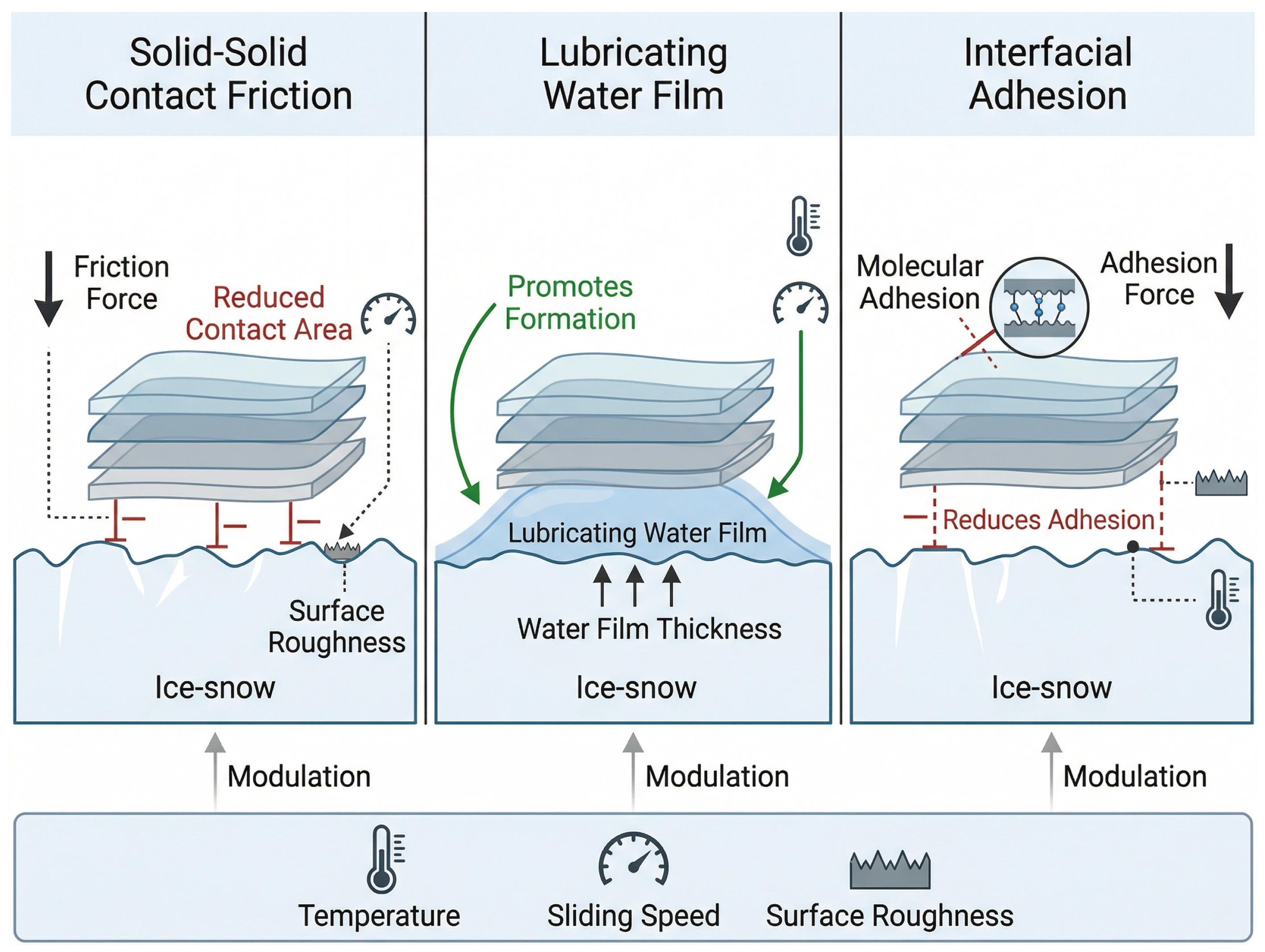
The performance of ice and snow sports equipment hinges on the frictional behavior at the interface with ice or snow, which is a complex process involving solid friction, lubricating meltwater film, and adhesive friction. When a ski or skate blade glides over snow or ice, the initial contact primarily involves direct solid-to-solid friction, generating frictional heat. As sliding speed and pressure increase, the temperature at the contact points rises, causing the micro-asperities on the ice or snow surface to melt and form an extremely thin liquid water film [5]. This water film plays a crucial hydrodynamic lubrication role, significantly reducing the coefficient of friction. However, under low-temperature or low-speed conditions, the water film may not form or sustain effectively, at which point adhesive friction becomes dominant, manifesting as higher frictional resistance. Furthermore, the microstructure of the ice or snow surface, such as the morphology and size of ice crystals and the water content of snow grains, directly influences its mechanical strength and melting characteristics, thereby determining the ease of formation and stability of the water film [6]. For instance, wet snow with higher water content more readily forms a continuous water film, while dry snow at low temperatures relies more on solid friction mechanisms. Understanding this multi-mechanism coupled friction process forms the theoretical basis for designing high-efficiency drag-reducing coatings (as shown in Figure 1).
Figure 1 schematically illustrates the central role of drag-reducing coatings in modulating the friction regime at the ice/snow–equipment interface. The left panel depicts the untreated surface condition, where direct solid–solid contact dominates, leading to elevated adhesive and plowing friction, particularly under low-temperature or low-speed conditions where the lubricating meltwater film is insufficient or absent. The right panel illustrates the effect of an engineered drag-reducing coating: by combining low surface energy chemistry with tailored surface micro-texture, the coating promotes the formation and stabilization of a continuous, low-shear-strength meltwater film while reducing the real contact area between asperities. This dual mechanism—enhancing hydrodynamic lubrication and suppressing adhesive friction—underpins the theoretical framework for coating design discussed throughout this section. The following subsections systematically examine how temperature, pressure, speed, and ice/snow microstructure govern this friction process and how coating physicochemical properties can be tuned to intervene effectively.
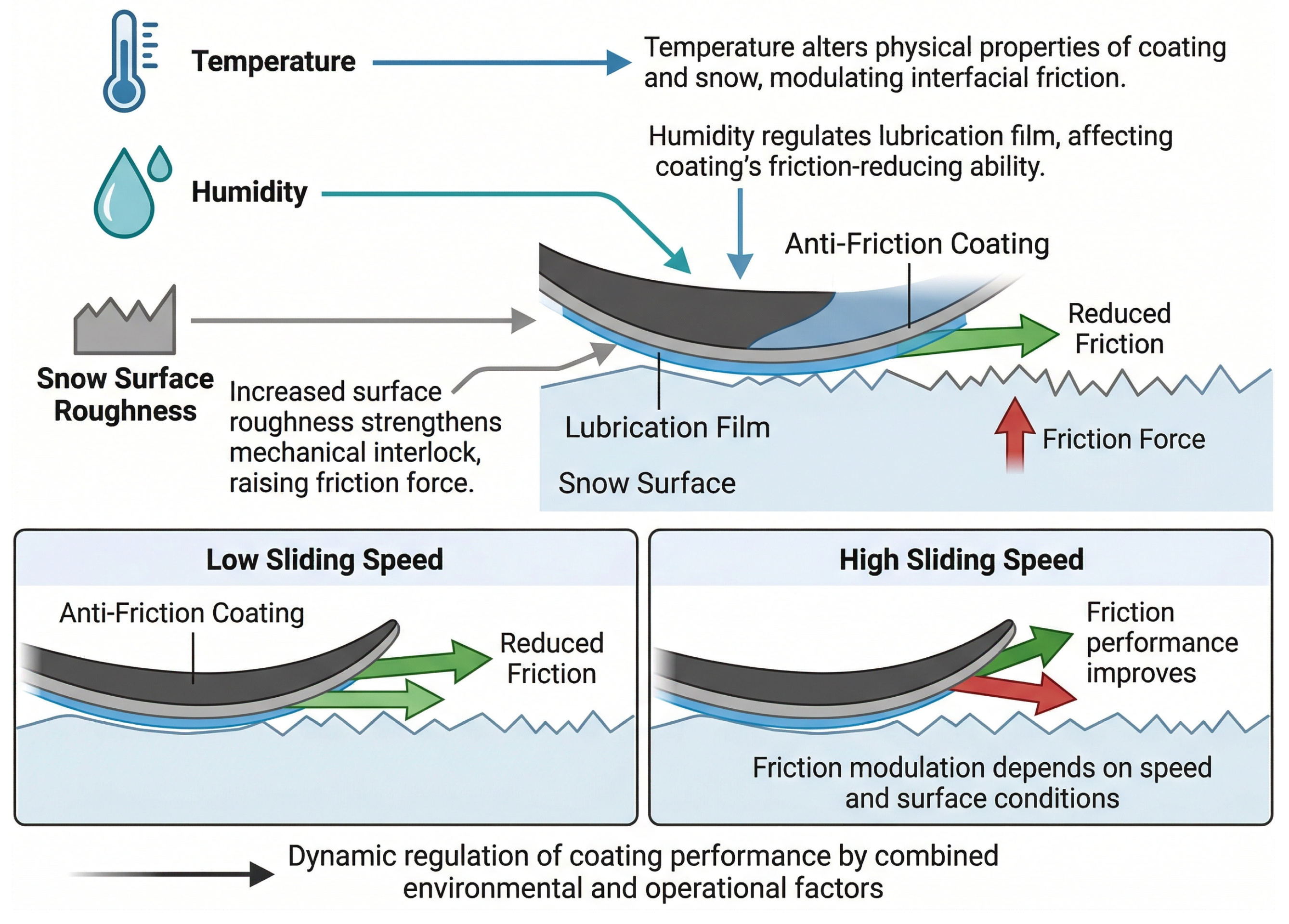
Temperature, pressure, sliding speed, and the microstructure of ice and snow are key external and internal factors determining the friction coefficient at the ice-snow interface. Temperature directly affects the phase state and mechanical properties of ice and snow. At low temperatures, the hardness of ice increases, solid friction intensifies, and the formation of a meltwater film becomes difficult, leading to an increased friction coefficient [6]. Pressure modulates friction by influencing the real contact area and the temperature rise at contact points. Higher pressure can increase contact area and frictional heating, promoting localized melting and favoring lubrication; however, excessive pressure may also crush the microstructure of ice and snow, increasing plowing resistance. The effect of sliding speed on friction is nonlinear. In the low-speed region, the friction coefficient may be high; as speed increases, frictional heating intensifies, the lubricating effect of the water film strengthens, and the friction coefficient decreases. Yet, at extremely high speeds, the water film may become unstable due to excessive hydrodynamic pressure effects, potentially triggering a “hydroplaning” phenomenon [7]. In the context of ice and snow sports, hydroplaning refers to a condition where the meltwater film beneath a ski or skate blade becomes thick enough to entirely separate the equipment from the solid ice or snow surface. In this fully flooded regime, the friction is dominated by the viscous shear of the water layer rather than by solid–solid contact. While this can further reduce the friction coefficient, hydroplaning typically introduces a loss of directional control and stability—an undesirable trade-off in precision sports such as alpine skiing or speed skating, where edge grip and maneuverability are critical. The microstructure of ice and snow, particularly crystal morphology and water content, is an intrinsic variable. A fine, low-water-content ice crystal structure is harder, resulting in a relatively stable but higher friction coefficient; whereas a loose, high-water-content snow grain structure is prone to deformation and melting, leading to a wider variation in friction coefficient [8]. These principles provide direction for coating design: an ideal coating needs to effectively intervene in or optimize the melting and lubrication processes at the interface across a wide range of temperature, pressure, and speed conditions.
To quantitatively describe the complex frictional behavior at the ice-snow interface, researchers have established various theoretical models. The classic “meltwater film theory” is one of the core models explaining ice-snow friction. It posits that frictional heat causes the ice at the contact interface to melt, forming a lubricating water film whose thickness and stability determine the friction coefficient [5]. This model emphasizes the critical roles of temperature, pressure, and speed in water film generation. Building on this, the “boundary lubrication model” further considers the decisive influence of solid surface characteristics and interfacial shear strength on friction under conditions of extremely thin water films or partial contact [9]. Drag-reducing coatings function precisely by intervening in these frictional processes. For example, hydrophobic coatings reduce the adhesion force between ice/snow and equipment surfaces by lowering surface energy, thereby weakening the adhesive friction component [6,8]. Translating this principle to winter sports, certain coating materials can form supramolecular, hydrophobic sliding layers. When applied to ski bases or skate blades, their low surface energy and specific micro-morphology facilitate the formation of a stable, low-shear-strength lubricating meltwater layer at the ice/snow interface, providing good sliding performance even under marginal temperature conditions where the natural water film is insufficient [5]. Furthermore, coatings with photothermal effects can actively absorb light energy and convert it into heat, raising the interface temperature and promoting the formation and maintenance of the meltwater film. This adds active friction control capability on top of passive lubrication [10,11]. In-depth research into these models and coating action mechanisms provides solid theoretical guidance for developing next-generation, high-performance, adaptive coatings for ice and snow sports equipment.

2.2. Core Physicochemical Mechanisms of Coating Drag Reduction

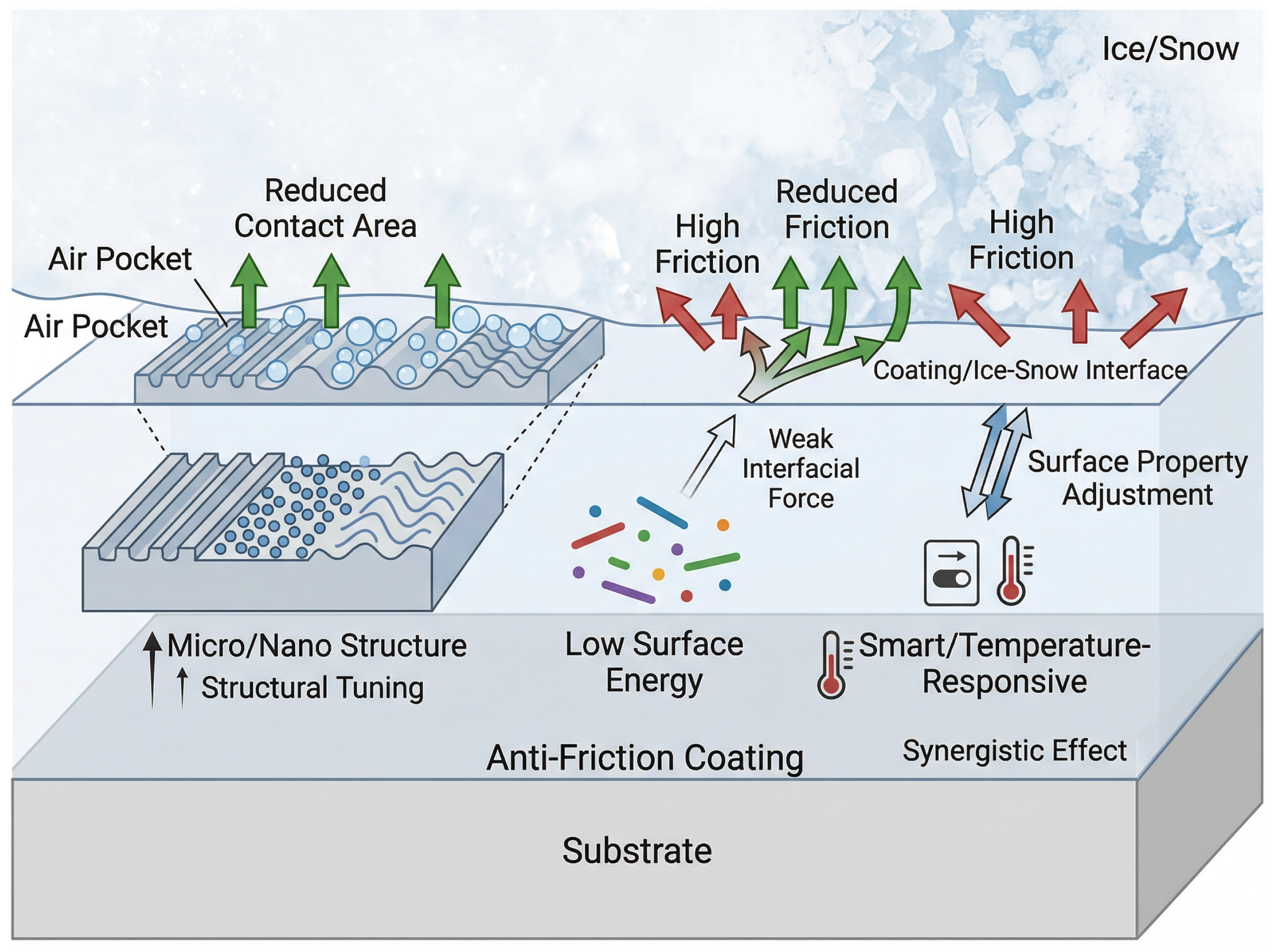
The core physicochemical mechanisms of coating drag reduction technology primarily encompass surface energy regulation, surface morphology design, and coating mechanical properties. These mechanisms work together to reduce the frictional resistance of ice and snow sports equipment during sliding. First, surface energy regulation is key to reducing ice/snow adhesion. By using low-surface-energy materials, such as fluoropolymers or silicone polymers, the free energy of the equipment surface can be significantly reduced. This weakens the adsorption and wetting of water molecules or meltwater at the interface, decreasing the solid–solid contact area and adhesion force [12]. For instance, in biomimetic composite surface design, grafted polydimethylsiloxane (PDMS) molecular brushes form a liquid-like interfacial layer. This not only increases surface hydrophobicity but also reduces frictional resistance by lowering interfacial shear forces [12]. For winter sports equipment, this mechanism suggests a pathway to reduce the shear stress of the meltwater film between a ski base and the snow surface, moving beyond the capabilities of conventional wax-based lubrication. Similarly, the superhydrophobic surfaces inspired by marine drag reduction… Critically, the translation of this effect to snow/ice interfaces requires not only stable air pocket retention under the high contact pressures typical of skiing or skating, but also adaptation to the presence of a solid–liquid–gas tribo-system rather than a purely liquid–solid one. This surface energy regulation, achieved through chemical modification, is the foundation for constructing superhydrophobic or superamphiphobic surfaces and holds universal significance for applications like drag reduction in oil-water systems [13].
Biomimetic non-smooth surfaces and biomimetic superhydrophobic surfaces represent two main technical approaches [14]. Drawing on cross-disciplinary insights from marine and aerospace drag reduction, micro-nano riblet structures inspired by shark skin have been shown to reorganize near-wall turbulence and reduce wall shear stress in liquid and gaseous flows [12]. The relevance of this mechanism to winter sports lies in the potential to guide the meltwater film on ski bases in an orderly manner, reducing turbulent dissipation. Direct evidence of riblet efficacy on snow/ice interfaces, however, remains sparse in the literature, representing an important research gap that this review identifies [12]. Additionally, these structures can effectively trap air layers or guide the directional flow of meltwater. On superhydrophobic surfaces, the combination of micro-nano structures with low-surface-energy chemistry can form a stable gas–liquid interface, utilizing the slip boundary effect to reduce frictional resistance [14]. Research further indicates that in hierarchical composite surface design, the flexible substrate beneath tooth-like arrays deforms, enhancing a unique reverse pore flow within the cavities between teeth. This fluid impacts the upstream structure, creating a local high-pressure zone that generates a net forward thrust, synergistically reducing the total drag [12]. This synergistic regulation of morphology and flow surpasses the imitation of a single mechanism, achieving higher drag reduction efficiency.
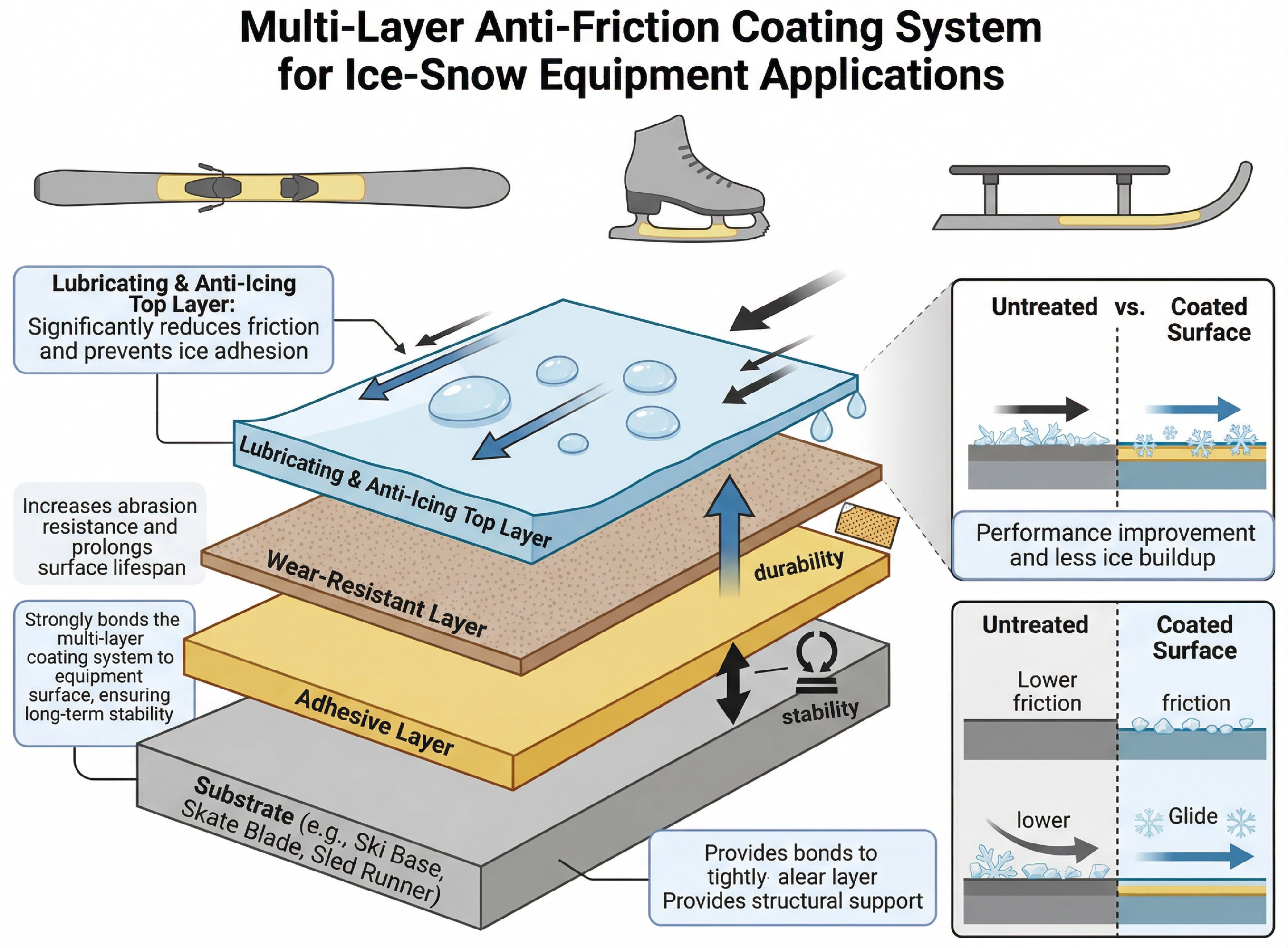
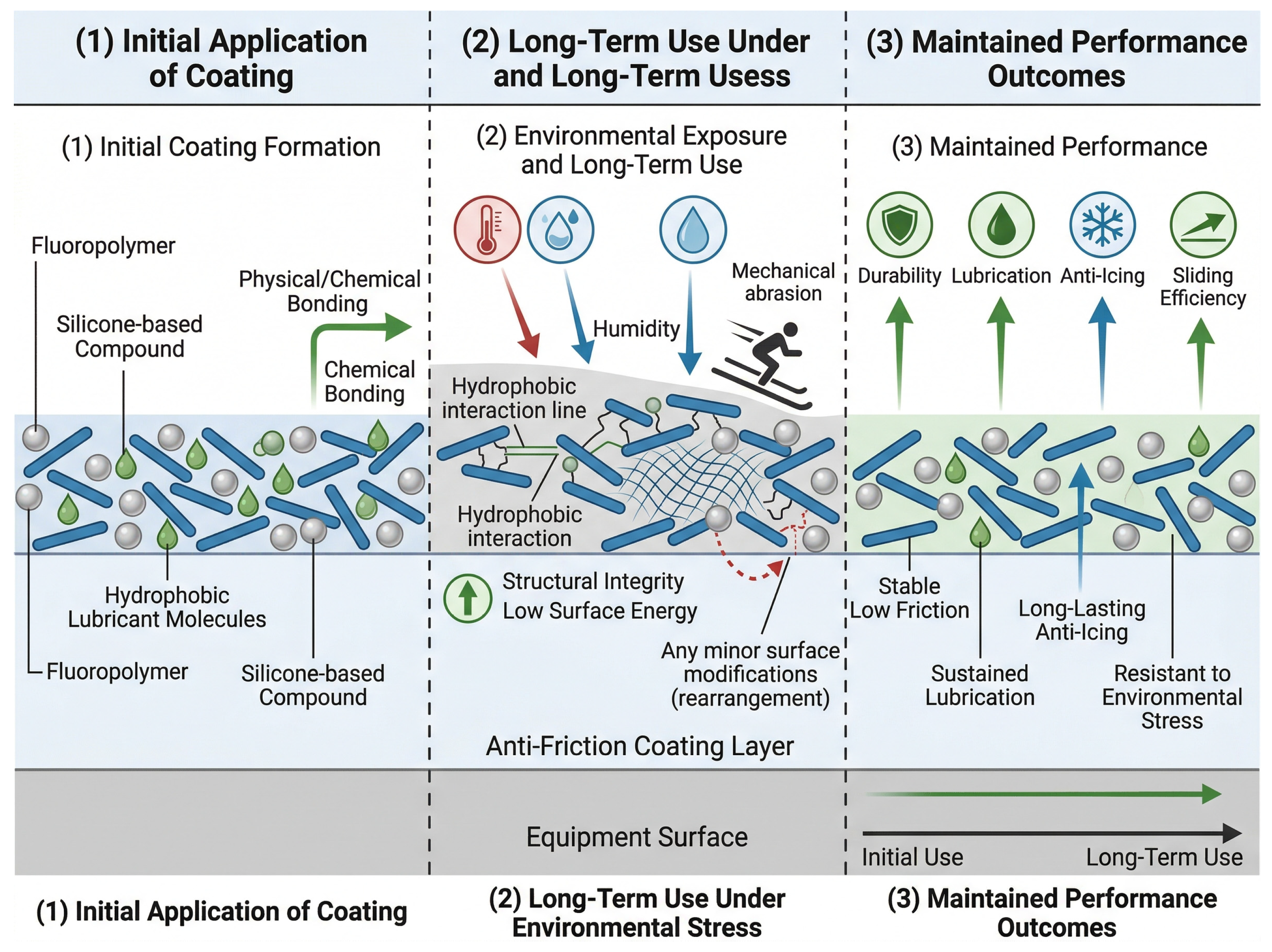
Finally, the mechanical properties of the coating, including hardness, elastic modulus, and wear resistance, are fundamental to maintaining the durability of the drag reduction effect. No matter how sophisticated the surface chemistry and morphology design may be, if the coating wears out rapidly under the friction, scraping, or particle impact of ice and snow, its drag reduction performance will deteriorate sharply. Therefore, developing coatings that combine excellent drag reduction functionality with good mechanical durability is a key challenge for engineering applications [14]. For example, in marine antifouling and drag reduction coatings, hydrogel–metal–organic framework composite coatings achieve a high corrosion inhibition rate through synergistic anodic protection and physical shielding, which indirectly reflects the importance of structural integrity for maintaining long-term performance [15]. One of the future research priorities is to enhance surface stability and adaptability, such as through dynamic self-healing coatings or smart responsive materials to address wear [14]. Only by ensuring that the coating maintains its designed surface characteristics under harsh mechanical loads can the drag reduction effect be reliably and durably translated from the laboratory to actual ice and snow sports equipment.

2.3. Polymer-Based Coating Materials

Polymer-based coating materials exhibit significant potential in drag reduction applications for ice and snow sports equipment due to their designable chemical structures, excellent processing properties, and diverse functional characteristics. Among them, fluorocarbon resin coatings, represented by polytetrafluoroethylene (PTFE) and fluorinated ethylene propylene copolymer (FEP), have attracted considerable attention due to their extremely low surface energy [16]. This low surface energy characteristic endows the coating surface with excellent hydrophobic or even superhydrophobic properties, effectively reducing the adhesion and wetting of ice, snow, or water droplets on the equipment surface, thereby lowering frictional resistance. In the application of ski base waxes, such fluorocarbon polymer coatings can serve as alternatives or enhancements to traditional waxes, providing a more durable and stable low-friction interface and reducing performance degradation caused by wax layer wear or temperature changes [17]. Compared with hydrocarbon-based waxes (μ ~ 0.05–0.10 on snow), fluorocarbon coatings consistently yield lower friction coefficients (μ ~ 0.02–0.06) and exhibit superior thermal stability, maintaining performance across a wider temperature window (−15 °C to 0 °C) without the repeated re-waxing required by traditional hydrocarbon systems. However, when benchmarked against emerging polymer nanocomposites—such as UHMWPE/CNT or PTFE/SiO2 systems—fluorocarbon waxes show comparable or marginally inferior wear resistance under abrasive ice contact, and their environmental persistence (as per- and polyfluoroalkyl substances, PFAS) has prompted regulatory scrutiny by the International Ski Federation (FIS) and environmental agencies [Cite FIS regulations if available]. This performance–environment trade-off is discussed in detail in Section 6.2. Furthermore, through specific surface structuring treatments, such as constructing micro-nano composite roughness, their superhydrophobic properties can be further enhanced, achieving more significant drag reduction effects [18].
Direct evidence from winter sports research is most robust for fluorocarbon-based systems. Fluorocarbon resin coatings, represented by polytetrafluoroethylene (PTFE) and fluorinated ethylene propylene copolymer (FEP), have been specifically evaluated as ski base treatments and have demonstrated. In contrast, evidence for silicone resins in ice/snow applications is less direct. While cross-disciplinary studies indicate that silicone resins possess good flexibility and low-temperature resistance, their application to high-speed, high-load winter sports equipment faces challenges: insufficient adhesion to rigid substrates such as carbon fiber composites has been reported in general materials science contexts [19], and dedicated studies on silicone-coated skis or skates under realistic friction conditions are lacking [19]. Polyurethane materials are renowned for their excellent wear resistance, elasticity, and tunable mechanical properties; however, interfacial compatibility issues with hydrophobic substrates may lead to coating delamination under repeated deformation [20]. Polyolefin materials are relatively low-cost but have relatively high surface energy, resulting in limited drag reduction performance. The key to solving these adhesion problems lies in interface engineering. For example, using techniques such as surface-initiated atom transfer radical polymerization (SI-ATRP) to graft polymer brushes onto the substrate surface can significantly enhance the chemical bonding between the coating and the substrate while introducing new functionalities such as lubrication and drag reduction [19,21]. For carbon fiber-reinforced composites, treating the fibers with carbonaceous materials like carbon nanotubes or graphene through “sizing” is an effective method to improve the interfacial bonding strength between the fibers and the polymer matrix, thereby ensuring the mechanical durability of the overall coating system [22].
To overcome the limitations of single polymer materials, composite coatings have become a research frontier. By incorporating nanofillers into the polymer matrix, the comprehensive performance of the coating can be synergistically enhanced. For example, adding inorganic nano/micron particles such as silica (SiO2) or barium sulfate (BaSO4) can significantly improve the hardness, wear resistance, and weather resistance of the coating [23]. Implanting BaSO4/TiO2 composite microparticles into polyvinylidene fluoride-hexafluoropropylene (PVDF-HFP) polymer not only constructs an effective microstructure for solar reflection, useful for radiative cooling, but the resulting micro-nano roughness also contributes to achieving a superhydrophobic surface, which may indirectly aid in drag reduction [23]. More importantly, adding conductive nanofillers such as carbon nanotubes (CNTs) or graphene not only enhances the mechanical strength and thermal conductivity of the coating but also regulates the fluid boundary layer by constructing special surface topologies [24]. Research has successfully prepared polymer composite materials with a staggered-overlapped multi-level micro-ridge structure mimicking shark skin using magnetic force-driven and chemical shape-fixing techniques, achieving anisotropic drag reduction effects in the flow direction [25]. Additionally, combining polymer coatings with porous substrates to form PEO/polymer composite coatings can balance corrosion resistance, mechanical stability, and surface functionality. This strategy holds great application prospects in sports equipment requiring long-term durability [26].

2.4. Inorganic and Non-Metallic Coating Materials

Diamond-like carbon (DLC) coatings demonstrate significant application value in the treatment of high-end ice skate blade edges due to their exceptionally high hardness and extremely low coefficient of friction, aiming to enhance equipment durability and gliding performance. DLC coatings are essentially amorphous carbon materials containing a mixture of diamond-like sp3 hybrid bonds and graphite-like sp2 hybrid bonds. This unique hybrid structure endows them with ultra-high hardness close to that of diamond while maintaining excellent self-lubricating properties. In winter sports equipment, particularly in the fields of speed skating or ice hockey skates, the microscopic contact area between the blade and the ice surface is subjected to extremely high local pressure and shear forces. The high hardness of DLC coatings effectively resists abrasive wear caused by ice crystals and impurity particles, significantly reducing the wear rate of the blade, thereby extending its service life and the period of maintaining sharpness [27]. Their low coefficient of friction directly affects the gliding process, reducing the kinetic frictional resistance between the blade and the ice surface, theoretically saving athletes’ energy and improving acceleration and gliding efficiency. Although direct research on DLC coatings for ice skate blade edges is not explicitly covered in the provided literature, it can be inferred from materials science principles and their widespread application in other scenarios requiring high wear resistance and low friction that applying DLC coatings to precisely machined metal ice skate blade edges—achieving strong adhesion through techniques such as physical vapor deposition to withstand the impact loads and low-temperature environments of ice sports—represents a cutting-edge direction for enhancing the performance of high-end ice skates.
Ceramic coatings, such as titanium nitride (TiN) and aluminum oxide (Al2O3), demonstrate significant drag reduction potential under specific conditions. However, technical challenges related to their bonding with metal substrates limit their widespread application in ice and snow sports equipment. These inorganic non-metallic coatings typically exhibit high hardness, high wear resistance, good chemical stability, and corrosion resistance. For example, titanium nitride coatings are known for their golden appearance and high hardness, effectively reducing the adhesive tendency of friction pairs. In ice and snow environments, equipment surfaces may face electrochemical corrosion caused by meltwater, salt, etc., and the chemical inertness of ceramic coatings can provide protection. However, there are significant differences in physical properties between ceramic materials and common metal substrates (such as steel and aluminum alloys), with the core challenges being thermal expansion coefficient mismatch and insufficient interfacial bonding strength [28]. Ice and snow sports equipment undergoes temperature cycles and mechanical impacts during use. If the thermal expansion coefficient difference between the coating and substrate is too large, significant interfacial stress will occur during temperature changes, leading to coating cracking and peeling. Additionally, ceramic coatings are typically prepared by methods such as thermal spraying or vapor deposition. If the interfacial bonding strength is weak, they are prone to peeling failure under ice impact or equipment deformation. Research indicates that strategies to improve the interfacial bonding between metals and inorganic non-metallic materials include introducing transition layers at the interface or applying surface metallization coatings to the reinforcement phase [27]. For example, when preparing diamond-reinforced composites on a copper substrate, coating the surface of diamond particles with copper or titanium can significantly improve their wettability and interfacial bonding strength with the metal substrate. This provides technical insights for considering how to more reliably apply ceramic coatings to ice skate blades, snowboard edges, or other sports components. Specifically, interfacial engineering designs, such as preparing gradient coatings or metal-ceramic composite coatings, are needed to alleviate stress concentration and enhance bonding strength.
Emerging two-dimensional material coatings, such as graphene, offer revolutionary possibilities for the next generation of drag reduction coatings in ice and snow sports equipment due to their superlubricity, high thermal conductivity, and excellent chemical stability. Graphene is a two-dimensional crystal formed by single-layer carbon atoms in sp2 hybridization, with layers bonded by weak van der Waals forces. This allows graphene layers to slide relative to each other easily, achieving a “superlubric” state at the microscopic scale with an extremely low friction coefficient. Applying graphene as a coating or additive to equipment surfaces is expected to significantly reduce friction resistance during contact with ice or snow. Secondly, graphene has the highest known thermal conductivity, which is particularly important for equipment like ice skates. It can rapidly dissipate heat generated by friction between the blade and ice, reducing the thickness of the water film formed by localized ice melting, thereby helping to maintain more stable and controllable sliding interface conditions [27]. Additionally, graphene exhibits excellent chemical stability and mechanical strength, providing effective barrier protection. Although current literature does not directly address the application of graphene in sports equipment, its potential in composite material interface modification has garnered attention. For example, surface modification of inorganic non-metallic reinforcement phases to improve compatibility with the matrix is key in preparing high-performance composites [27]. Graphene or its derivatives can serve as functional coatings or interfacial phases, applied to equipment substrates or other reinforcement particle surfaces. This not only leverages their drag reduction and thermal conductivity functions but also enhances the overall mechanical properties and durability of the coating system. However, it must be emphasized that the superlubricity of graphene (μ < 0.01) has been demonstrated almost exclusively at the nanoscale—via atomic force microscopy or micro-tribometers under ultra-clean, low-contact-pressure conditions—and has not been replicated on macroscopic ice or snow surfaces under realistic skiing or skating pressures (~0.5–1 MPa) and speeds (~5–10 m/s). Furthermore, the scalable deposition of uniform, robust graphene coatings on the complex geometries of skis, skates, or sleds remains an unresolved manufacturing challenge. Reports of graphene-enhanced composites in winter sports equipment are notably absent from the peer-reviewed literature; existing studies on graphene-based lubrication are drawn from general tribology or micro-electromechanical systems and provide mechanistic inspiration rather than application-validated performance data. Therefore, while graphene’s theoretical potential for ice/snow drag reduction is compelling, its practical validation is currently at Technology Readiness Level (TRL) 2–3, and claims of its superiority over established fluorocarbon or UHMWPE systems in winter sports contexts remain speculative. Future research needs to address the large-scale, uniform, and robust preparation technology of graphene coatings on macroscopic winter sports components, as well as evaluate their tribological behavior under the high contact pressures, abrasive ice-particle conditions, and variable low-temperature, high-humidity environments characteristic of winter sports, to determine whether nanoscale superlubricity can translate into macroscopic performance gains.
Summary of evidence status for inorganic coatings. It should be noted that the majority of studies on DLC, ceramic, and graphene coatings discussed above originate from general tribology, biomedical, or aerospace research. Direct evidence of their performance on ice/snow sports equipment remains extremely limited, with most discussions in this section representing mechanistic extrapolations rather than experimentally validated applications. This represents a significant opportunity for future research: the well-documented low friction coefficients, high hardness, and thermal conductivity of these materials make them promising candidates for high-end skate blades and ski edges, but dedicated studies under realistic winter sports conditions are urgently needed.

2.5. Comparative Assessment of Coating Systems for Ice and Snow Sports Equipment

To facilitate a critical, at-a-glance comparison of the diverse material systems discussed, their key attributes relevant to winter sports applications are synthesized in Table 1. This comparative analysis reveals that no single material system outperforms others across all criteria; rather, a trade-off between drag reduction efficiency, mechanical durability, substrate adhesion, and low-temperature performance is consistently observed.

3. Preparation Technologies and Performance Characterization of Drag Reduction Coatings

3.1. Traditional and Conventional Preparation Processes

The choice of fabrication technique fundamentally determines the achievable coating quality, uniformity, and ultimately the drag reduction performance on winter sports equipment. However, the literature reveals a persistent disconnect: preparation methods are often selected based on laboratory convenience rather than on a systematic evaluation of their suitability for the specific geometries and performance requirements of skis, skates, and sleds. This section moves beyond a descriptive inventory of techniques to provide a critical comparison of their respective advantages, limitations, and applicability to winter sports equipment manufacturing. Key comparative dimensions include: (i) compatibility with complex three-dimensional curved surfaces typical of sports equipment; (ii) scalability from laboratory prototypes to mass production; (iii) cost-effectiveness relative to the performance gains achieved; and (iv) the ability to maintain coating functionality after deposition. Table 2 provides a structured summary of these comparative metrics.
Spraying technology is a traditional and widely used method for preparing drag-reducing coatings, primarily including air spraying and electrostatic spraying. The air spraying process utilizes compressed air to atomize the coating and spray it onto the substrate surface. This process is relatively simple but requires high operational environmental conditions, and the coating utilization rate is low, which can easily lead to waste and environmental pollution [29]. Electrostatic spraying, on the other hand, uses a high-voltage electrostatic field to charge the atomized coating particles, which are then directionally adsorbed onto the grounded workpiece surface under the influence of the electric field force. This process significantly improves the adhesion efficiency and uniformity of the coating while reducing overspray [29]. The control of coating uniformity is the core of the spraying process, as it directly affects the drag-reducing performance and durability of the final coating. By precisely regulating spraying pressure, spray gun movement speed, spraying distance, and coating viscosity, uniform coverage of the coating can be ensured to a certain extent [29]. Curing conditions are another critical factor determining the final performance of the coating. Thermal curing promotes solvent evaporation and resin cross-linking in the coating through heating, forming a dense film layer. However, this method consumes high energy and is not suitable for heat-sensitive substrates [29]. In contrast, UV curing utilizes ultraviolet light to initiate free radicals from photoinitiators within the coating, thereby triggering polymerization reactions. This method offers advantages such as fast curing speed, low energy consumption, and suitability for low-temperature environments. However, it requires ensuring that the coating is fully exposed to ultraviolet light, and for equipment with complex three-dimensional structures, there may be issues of incomplete curing in shadowed areas [29].
Dip coating and spin coating processes are effective methods for preparing thin and uniform coatings. The dip coating process involves immersing the substrate into a coating solution and then withdrawing it at a constant speed. Excess liquid flows off due to gravity or capillary action, forming a uniform liquid film on the surface, which is subsequently cured into a coating [29]. This method is simple and suitable for large-area, regularly shaped flat or simple curved surfaces, enabling the preparation of films with controllable thickness and good uniformity. The spin coating process, on the other hand, involves dropping a small amount of coating onto the center of the substrate and then rotating the substrate at high speed. The centrifugal force spreads the coating, forming an extremely thin and highly uniform layer, making it particularly suitable for preparing precise functional films at the nanometer or sub-micrometer scale [29]. However, these two processes have significant limitations when applied to objects with complex curved surfaces, such as ice and snow sports equipment. The dip coating process struggles to ensure uniform adhesion of the coating on complex concave-convex surfaces (e.g., the bottom surface of skis or the curved surface of ice blades), often leading to issues such as liquid pooling or uneven thickness [29]. When compared to spraying, dip coating can achieve more uniform thickness on simple geometries but is far more susceptible to edge effects and liquid pooling on the concave-convex surfaces characteristic of ski bases or curved ice blades. Spraying, conversely, offers better complex-geometry coverage but typically at the cost of lower material utilization efficiency (<40% for air spraying) and greater environmental overspray. The spin coating process is more suitable for small, flat, disc-shaped substrates and is almost impossible to implement for large, non-planar, or structurally complex equipment, limiting its direct application in sports equipment manufacturing [29].
Physical Vapor Deposition (PVD) and Chemical Vapor Deposition (CVD) are advanced techniques for preparing high-performance drag-reducing thin films such as Diamond-Like Carbon (DLC). PVD technology involves vaporizing target material in a vacuum environment using physical methods (such as sputtering or arc evaporation), followed by condensation and deposition onto the substrate surface to form a film [29]. This technique can produce DLC films with high hardness, low friction coefficients, and stable chemical properties, significantly enhancing surface wear resistance and drag reduction performance. CVD technology, on the other hand, introduces gaseous reactants containing the film-forming elements into a reaction chamber, where chemical reactions occur on the substrate surface to form a solid film [29]. Films prepared by CVD typically exhibit better step coverage and uniformity, making them suitable for deposition on substrates with complex shapes. However, both techniques impose extremely high demands on equipment, requiring complex vacuum systems and precise temperature and pressure control devices, resulting in substantial initial investment and maintenance costs [29]. From a cost-effectiveness perspective, although PVD and CVD technologies can produce coatings with exceptional performance, their high equipment and process costs currently limit their application primarily to high-end fields with extreme performance requirements or small-batch precision components. Their widespread adoption in mass-produced, low-cost civilian winter sports equipment faces economic challenges [29]. In critical comparison with wet-chemical methods (spraying, dip coating), PVD/CVD offers an order-of-magnitude improvement in coating adhesion, hardness, and thickness uniformity—attributes essential for high-end skate blades and ski edges—but at a processing cost approximately 5–10 times higher and with significantly lower throughput. This trade-off defines the current technology frontier: PVD-applied DLC on precision skate blades represents the viable high-performance niche, while wet-chemical polymer coatings remain the pragmatic choice for mass-market ski bases where cost sensitivity dominates.

3.2. Advanced Surface Texturing and Additive Manufacturing Technologies

Beyond conventional coating deposition, advanced manufacturing technologies offer the ability to directly engineer surface topography at the micro- and nanoscale, creating textures that inherently reduce friction on ice and snow. These techniques, including laser surface texturing, photolithography-based patterning, and additive manufacturing (3D printing), are increasingly relevant to winter sports equipment as they enable the precise fabrication of biomimetic drag-reducing structures without relying solely on chemical coatings. This section evaluates these technologies with a specific focus on their applicability to the complex geometries and durability requirements of skis, sleds, and ice skates.
Laser surface texturing technology, as a high-precision advanced manufacturing method, provides a powerful tool for directly constructing biomimetic or optimized micro/nano structures on the metal edges of skates and skis, as well as on polymer ski bases. Through the interaction of ultrashort pulse lasers (such as femtosecond lasers) with material surfaces, this technology enables the precise fabrication of complex micro-grooves, pit arrays, and other textures on various materials (including chemically inert and difficult-to-process materials) in a non-contact, maskless manner [30]. The design inspiration for these structures often comes from biological surfaces in nature that exhibit excellent drag reduction or hydrophobic properties. For example, in studies of blood flow contacting implants, complex, hierarchical micro-grooves, micropores, and nano-ripples/gaps/protrusions can be fabricated on pyrolytic carbon surfaces using time-domain shaped femtosecond laser texturing technology [30]. Such surface textures formed by direct laser etching can effectively regulate near-wall hydrodynamic behavior. Specifically, streamwise micro-groove structures have been proven to significantly attenuate turbulence, guide fluid flow in an orderly manner along specific directions, thereby reducing flow separation and vortex generation to achieve drag reduction [30] (as shown in Figure 2). Applying this technology to the bottom surfaces of skis or sleds could theoretically enable the precise fabrication of micro-grooves similar to shark skin riblet structures, guiding melted snow water or air boundary layers to reduce frictional drag. Furthermore, laser texturing can be combined with subsequent functional coatings, such as applying superhydrophobic or lubricating coatings on textured surfaces, synergistically leveraging the dual drag-reduction effects of texture-guided flow and interface lubrication [30].
Photolithography and etching techniques are classic methods for fabricating regular micro/nanostructure models at the laboratory scale, primarily used for in-depth exploration of drag reduction mechanisms and optimization of surface properties. These techniques enable the fabrication of micro-pillar, micro-pit, or re-entrant structure arrays with precisely controllable dimensions, shapes, and spacing on substrates such as silicon wafers, offering extremely high precision and controllability [31]. By systematically varying the geometric parameters of these structures, researchers can quantitatively study the influence of structural features on surface wettability, fluid boundary layer states, and ultimately drag reduction performance, thereby establishing structure-performance relationships and providing theoretical guidance for optimization design. For example, behavioral studies of biological surfaces with specific micro/nanostructures aim to explore the interactions between various molecules or organisms and biological surfaces, offering valuable inspiration for developing biomimetic surfaces with similar effects [31]. In the field of drag reduction, regular model surfaces fabricated using photolithography and etching techniques can be used for fundamental fluid mechanics experiments or computational fluid dynamics simulations to elucidate the specific physical mechanisms by which micro/nanostructures influence boundary layer transition, suppress turbulent bursts, or stabilize air films [30]. Although these techniques are often difficult to directly apply to the large-scale manufacturing of sports equipment with complex curved surfaces, their value in mechanism exploration and prototype design stages is indispensable, serving as a crucial bridge connecting biomimetic inspiration with engineering applications.
Additive manufacturing (3D printing) technology opens up cutting-edge possibilities for directly constructing drag-reducing surfaces with gradient functionality or complex internal structures. Unlike traditional subtractive manufacturing, 3D printing builds materials layer by layer, enabling the creation of complex geometries that are difficult or even impossible to achieve with conventional processes, including internal cavities, porous structures, and functionally graded materials [2]. This characteristic gives it unique advantages in fabricating biomimetic drag-reducing surfaces. For example, integrated components can be designed and printed with internal bone-like porous structures to reduce weight and external shark skin-like micro-groove textures to lower drag. Recent research progress combining additive manufacturing with nanotechnology, magnetically responsive coatings, and other fields demonstrates more diverse avenues for advancement [2]. For winter sports equipment, 3D printing technology can be used to manufacture ski helmets with customized internal flow channels or cavity structures to optimize aerodynamic shapes and guide airflow; or to print snowboards with surface textures that vary with position, employing different microstructures at the tip, waist, and tail to adapt to the distinct hydrodynamic environments of each region. Furthermore, through multi-material printing, continuous gradient variations in surface hydrophobicity or stiffness can be achieved, creating non-uniform drag-reducing surfaces with optimized performance. Although integrating high-precision micro/nanostructures with large-scale equipment components via 3D printing still faces material and process challenges, this technology offers a promising manufacturing paradigm for realizing highly customized, structurally integrated next-generation high-performance winter sports equipment.
For winter sports equipment specifically, 3D printing technology opens up the possibility of manufacturing customized ski or sled components with integrated surface textures that vary with position—employing different microstructures at the tip, waist, and tail to adapt to the distinct hydrodynamic environments of each region—a design freedom unattainable through conventional manufacturing.
A critical comparison of these three advanced manufacturing routes reveals distinct, application-dependent trade-offs for winter sports equipment. Laser surface texturing offers the most direct path to creating durable, maskless micro-textures on existing metal edges and polymer bases, with micron-level precision and no additional coating material required—making it the most industrially mature option for near-term adoption. Photolithography-based patterning, while providing the highest resolution and controllability for mechanism-oriented research, is intrinsically limited to flat, small-area substrates and cannot be directly scaled to full-size skis or sleds; its value lies in fundamental structure–performance optimization rather than production. Additive manufacturing holds the greatest long-term promise for producing fully customized, structurally integrated drag-reducing surfaces with position-dependent textures, but currently faces a critical resolution–scale trade-off: achieving sub-100 µm biomimetic features on meter-scale sports equipment remains beyond the capability of most commercial 3D printing systems. A pragmatic pathway forward likely involves hybrid approaches—for instance, laser-texturing micro-grooves onto 3D-printed base structures—to combine the geometric freedom of additive manufacturing with the precision of laser processing.

3.3. Laboratory Simulation Testing Methods and Equipment

The selection of appropriate laboratory testing methods is non-trivial for ice/snow friction research, as each test configuration embodies implicit assumptions about the dominant friction mechanism and may yield results that are not cross-comparable. Linear tribometers (pin-on-disc or block-on-ring configurations) offer simplicity and high reproducibility but typically operate at contact pressures and sliding speeds far below those of actual skiing or skating, and the continuous single-track sliding path fails to replicate the transient, multi-pass contact of a ski interacting with fresh snow. Rotational tribometers better capture continuous sliding dynamics but introduce centrifugal effects on meltwater distribution that are absent in linear gliding. Environmental chambers that control temperature and humidity are essential yet often underreported in the literature, making cross-study comparisons unreliable. A critical researcher must therefore recognize that friction coefficients measured in the laboratory are not intrinsic material properties but system-dependent parameters, and their extrapolation to field performance requires careful justification. This section evaluates each method not merely as a technical procedure but as a measurement strategy with specific validity boundaries.
To scientifically evaluate the performance of drag-reducing coatings in ice and snow sports equipment, laboratory simulation testing is a crucial step. Linear friction testers and rotational friction testers are two core devices used to quantify the friction coefficient of coatings under different speed, pressure, and temperature conditions, thereby simulating the complex friction behavior at the snow/ice interface. For example, when evaluating the drag-reduction performance of biomimetic microstructured surfaces, researchers combined numerical simulations with experiments to determine the drag-reduction patterns of micro-groove structures within specific Reynolds number ranges [32]. Under turbulent conditions, biomimetic surfaces covered with conical protrusions and elastic layers exhibit significant drag-reduction effects, with performance reaching 11.5%–17.5%. This is attributed to the conical protrusions acting as vortex generators, which break up and lift large-scale vortices, generating low-energy small-scale vortices, thereby effectively reducing disturbances and momentum exchange [33]. These tests not only quantify the static friction coefficient but also dynamically simulate the interface behavior of equipment during high-speed sliding on snow tracks, providing critical data for coating design.
Surface energy testing, particularly evaluating the hydrophobic/icephobic properties of coatings using contact angle goniometers, is an important method for correlating their drag-reduction effects. The superhydrophobicity of coatings is typically characterized by a water contact angle greater than 150° and contact angle hysteresis less than 10°, which is directly related to drag reduction, anti-icing, and anti-fouling properties [34]. Studies have shown that liquid coatings with low surface energy and low sliding angles, such as a two-component system constructed using dimethyl dimethoxysilane and perfluorooctyl dimethyl chlorosilane, can achieve excellent drag reduction and broad-spectrum repellency to low-surface-tension liquids [35]. Contact angle measurements quantify the wettability of coatings, while the sliding angle directly reflects the ease with which droplets detach from the surface. This is crucial for evaluating the coating’s ability to prevent water film formation and ice adhesion in ice and snow environments. Coatings with excellent hydrophobic/icephobic properties can effectively reduce solid–liquid contact area, thereby lowering frictional resistance.
The mechanical properties and durability of coatings are decisive factors in determining their long-term applicability in real ice and snow environments. Scratch tests and wear resistance tests are used to evaluate the adhesion strength of coatings to substrates and their resistance to abrasion. For example, multifunctional biological metasurfaces prepared by femtosecond laser texturing combined with functional coatings require sufficient mechanical robustness to withstand friction due to their complex surface structures, including micro-grooves, micropores, and nano-ripples/gaps/protrusions [30]. Environmental aging tests and thermal cycling tests simulate the stability of coatings under outdoor extreme temperature fluctuations, ultraviolet radiation, and humidity variations. One study validated the high adhesion and stability of biomimetic elastic layers on copper substrates through sandpaper abrasion and water flow erosion tests [33]. For superhydrophobic coatings, mechanical fragility has long been an application bottleneck. However, a strategy using stainless steel mesh frames as mechanical armor to protect re-entrant micro-nano structures has significantly enhanced the coating’s wear resistance, allowing it to maintain liquid repellency after 100 wear cycles under 12.3 kPa pressure [36]. These standardized testing methods ensure that coatings are not only effective under ideal laboratory conditions but also meet the stringent requirements for long-term durability in ice and snow sports equipment.

3.4. Field Testing and Sports Biomechanics Evaluation

Evaluating the real-world efficacy of drag-reducing coatings requires a hierarchy of testing approaches, ranging from controlled field trials to integrated biomechanical analysis. This section distinguishes between direct field evidence—obtained from instrumented skis, sleds, or skates on actual snow/ice—and indirect biomechanical assessments that infer coating effects from athlete performance data or computational simulations. Establishing this distinction is essential because the complex, variable conditions of winter sports environments often reveal performance limitations not observable in laboratory settings.
Controlled field testing conducted on standard ski slopes or ice rinks is a critical step in evaluating the performance of drag-reducing coatings. By deploying precision equipment such as high-speed cameras and GPS speed measurement devices, it is possible to objectively quantify the performance differences in various coated equipment in real sports environments. For example, in skiing, GPS speed measurement technology can accurately record an athlete’s speed profile over specific race segments, enabling direct comparison of the gliding efficiency of skis or sleds coated with different superhydrophobic or biomimetic drag-reducing surfaces [37]. High-speed cameras can capture the microscopic dynamics of the interaction between equipment and the snow/ice interface, such as droplet impact, splashing, and rebound behaviors. These data are crucial for understanding the drag reduction mechanisms of coatings under dynamic wetting conditions [38]. A dataset study on droplet behavior on superhydrophobic surfaces analyzed the spreading and rebound of water and viscous water-glycerol mixtures on laser-etched superhydrophobic surfaces using high-speed cameras, providing an empirical basis for optimizing self-cleaning surface designs for drag reduction [38]. Such field testing in controlled environments can link the fundamental properties of coatings measured in the laboratory with their macroscopic performance in actual sports scenarios, offering direct feedback for iterative optimization of equipment.
Equipping athletes with coated gear during training or testing and conducting a comprehensive evaluation combined with sports biomechanics data is a core method for revealing the impact of drag-reducing coatings on athletic performance. This requires the simultaneous collection of biomechanical parameters such as the athlete’s posture, force sequence, and joint angles. For example, in ski mountaineering, the total weight of the equipment and athlete is negatively correlated with performance, so lightweight coating technology itself can provide an advantage [37]. More importantly, using devices such as portable three-dimensional force measurement systems, it is possible to quantify the forces exerted by athletes on equipment during gliding or skating. Combined with high-speed motion analysis, this allows for an assessment of whether the coating alters force transmission efficiency or the athlete’s force application pattern [39]. A portable three-dimensional force measurement system, originally developed for biomechanical analysis, offers a methodological pathway to quantify how drag-reducing coatings alter force transmission between athletes and equipment during gliding. When applied to instrumented skis or ice skates, such systems can directly measure changes in interfacial friction forces attributable to coating performance at the athlete-equipment-environment interface in real time [39]. A similar CFD-based approach can be repurposed to evaluate drag-reducing coatings: by modeling the same ski geometry with different surface boundary conditions [40]. Simulations can predict how a coating alters near-wall airflow and pressure drag, independent of athlete posture. This provides a fluid dynamics perspective, beyond biomechanical data, to explain how coatings enhance athletic performance by altering boundary layer flow.
It must be pointed out that there may be significant differences between laboratory test results and field test results, which highlights the extreme importance of conducting multi-scale, multi-environment validation. Laboratory environments typically control single variables (such as water flow velocity, temperature) and employ simplified models, whereas field environments are complex and variable, involving temperature fluctuations, heterogeneity in snow/ice conditions, individual differences in athlete techniques, and dynamic loads [2]. For example, superhydrophobic coatings that exhibit excellent drag reduction performance in the laboratory may have unstable or even failing air layers (plastrons) that maintain drag reduction effects in field environments involving long-term immersion in cold water or high-speed water flow impact [2]. A study on bionic drag reduction surfaces inspired by pufferfish skin not only verified their drag reduction characteristics in rheometer and particle image velocimetry (PIV) experiments but also conducted sandpaper abrasion and water flow erosion tests to evaluate the adhesion and stability of their elastic coatings. This strategy of combining laboratory mechanism research with field durability testing is crucial [33]. Similarly, research in the field of marine antifouling also emphasizes that verifying the long-term antifouling performance of coatings through field tests at sea yields more convincing results than purely laboratory antibacterial and anti-algae tests [41]. Therefore, for ice and snow sports equipment, a comprehensive evaluation system should span the entire process from material micro-characterization, laboratory simulation testing, and controlled field testing to final application in actual competitions or long-term training, to ensure that drag reduction coating technology remains reliable and effective in the complex and harsh real world.
In summary, the literature on field testing of drag-reducing coatings for winter sports remains fragmented. Direct comparative studies—where identical equipment with different coatings is tested under controlled snow/ice conditions—are notably scarce. Most available data come from either laboratory simulations with simplified ice surfaces or from general sports biomechanics research, where coatings were not the primary variable. Future work should prioritize instrumented on-snow/on-ice comparative trials with rigorous documentation of environmental conditions to build a reliable, publicly accessible performance database.

3.5. Cross-Comparison of Reported Friction Performance and Testing Protocols

A major obstacle to objectively assessing coating performance is the significant variation in testing conditions across studies. Table 2 attempts to compile and juxtapose the reported drag reduction outcomes from selected key studies, explicitly noting the test parameters that influence results.
Critical synthesis of testing heterogeneity: The wide disparity in reported values—ranging from macroscopic ski trials to nanoscale AFM friction—underscores a fundamental challenge: results obtained from simplified laboratory setups rarely translate directly to field performance. As Table 2 illustrates, the apparent superiority of graphene’s superlubricity at the nanoscale cannot yet be replicated on a full-scale ski base. Similarly, the promising drag reduction in superhydrophobic surfaces in rotational ice tests may be compromised by the high contact pressures and snow abrasion encountered during skiing, which can collapse air pockets.

4. Environmental Adaptability and Durability of Drag Reduction Coatings

4.1. Adaptability to Different Snow and Ice Conditions

The application effectiveness of drag reduction coating technology in ice and snow sports equipment is not a universal constant but a complex function highly dependent on specific snow and ice conditions. The performance of coatings exhibits significant sensitivity to snow temperature, snow type, and ice surface state, fundamentally revealing the infeasibility of developing so-called “universal coatings.” Snow temperature is a key variable affecting the friction mechanism. At lower snow temperatures (e.g., below −10 °C), snow crystals are hard, and friction is dominated by microscopic plowing and plastic deformation. In this case, coatings need to possess extremely high surface hardness and wear resistance to reduce snow crystal embedding and scratching. At higher snow temperatures near the melting point (e.g., −2 °C to 0 °C), an extremely thin water film forms on the snow surface, and the friction mechanism shifts to viscous resistance dominance. In this scenario, coatings require excellent hydrophobicity and low surface energy to promote rapid shedding of the water film and reduce the “suction-sticking” effect. The influence of snow type is equally important. For new snow or powder snow, its loose, porous structure means that the contact area with equipment is relatively small and dynamically changing, and coatings focus on reducing adhesion. For hard snow or icy snow formed by repeated compaction by snow groomers, which has a hard, dense surface, high contact pressure, and significant frictional heating, coatings need to reduce the friction coefficient while possessing good thermal stability and compressive strength. Ice surface conditions are even more complex, as their temperature, cleanliness (e.g., presence of impurities, bubbles, or prior scratches), and micro-roughness can greatly alter the friction contact state. For example, on very clean and low-temperature ice surfaces, the friction coefficient itself is low, and the marginal improvement effect of coatings may be limited; whereas on ice surfaces with dust or meltwater stains, the importance of the coating’s surface characteristics for contaminant repellency becomes prominent. Therefore, any expectation that a single coating formulation can achieve optimal drag reduction under all conditions is unrealistic. It is essential to acknowledge and deeply study the fine coupling relationship between coating performance and environmental parameters.
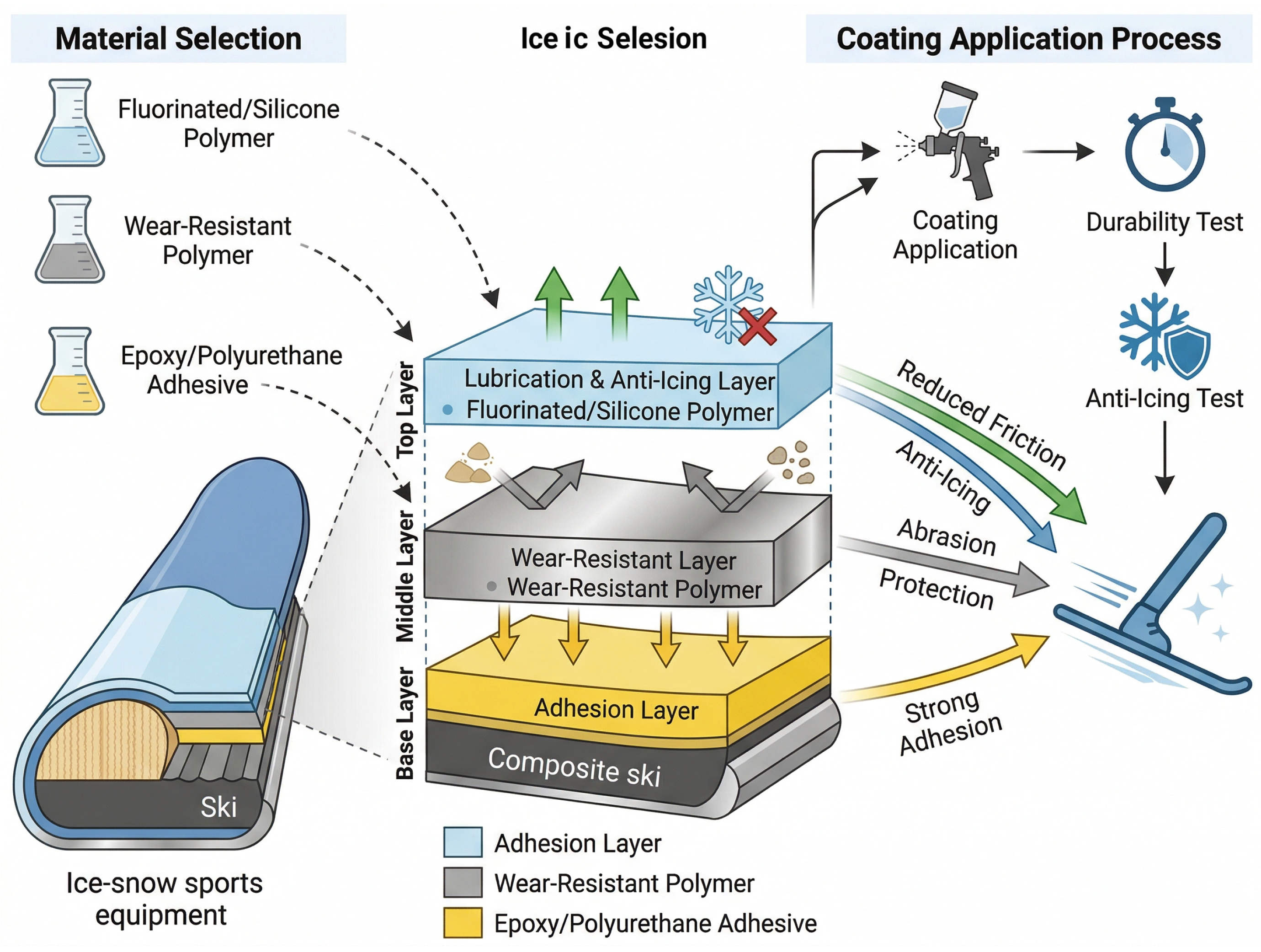
Given the significant differences in snow quality and ice conditions, developing specialized coatings or adaptive coating systems tailored to different competition environments has become an inevitable path to enhancing athlete performance and equipment reliability. In alpine skiing events, such as downhill and super-G, the tracks are typically meticulously prepared from hard, icy snow, with extremely high speeds and immense pressure on the ski base. In such environments, specialized coatings must pursue an extremely low friction coefficient and ultra-high wear resistance. Material choices often lean toward composites like ultra-high molecular weight polyethylene (UHMWPE) and incorporate nanoscale reinforcements to enhance load-bearing capacity and ultimate lubrication performance. Conversely, in cross-country skiing, athletes frequently glide on soft, fresh snow or compacted tracks, with highly variable snow conditions. Here, the design philosophy for specialized coatings may focus more on dynamic adaptability—for example, utilizing specific surface textures to store snow particles and form a self-generated “snow lubrication layer,” or employing temperature-sensitive polymers that allow surface properties to fine-tune with snow temperature changes, balancing between dry and wet friction mechanisms. For speed skating or short track speed skating, ice surface temperatures are strictly controlled between −5 °C and −9 °C, but ice quality and the impact of ice shavings (“ice dust”) scraped off by skate blades during competition require careful consideration. Specialized coatings for these sports may focus on achieving extreme surface smoothness and oleophobicity to reduce the adhesion and accumulation of ice shavings. Adaptive coatings represent a more cutting-edge direction, drawing inspiration from biomimetics. For instance, microencapsulation technology can encapsulate phase-change materials or lubricants, which are released when friction-induced local temperature rises or pressure reaches a threshold, altering the interface state in real time. Alternatively, stimuli-responsive polymer surfaces can be designed, where properties such as hydrophilicity/hydrophobicity and hardness reversibly change in response to external stimuli like temperature or electric fields, intelligently matching evolving conditions. This evolution from “specialized” to “adaptive” represents a profound transformation in drag-reduction coating technology, shifting from passive adaptation to active responsiveness (as shown in Figure 3).
The accumulation of pollutants on coating surfaces is a frequently overlooked issue that severely compromises their drag reduction performance in practical applications. During training and competition, the surfaces of skis or ice skates inevitably become contaminated with dust, sand, saline meltwater, water stains, and fine ice crystals generated by repeated friction. The presence of these contaminants first directly alters the physical and chemical properties of the contact interface. Dust and sand, acting as hard abrasive particles, accelerate coating wear, even scratch the substrate, and damage its meticulously designed surface integrity. Water stains or saline droplets may freeze at low temperatures, forming localized ice adhesion points that significantly increase frictional resistance. Secondly, pollutants can cover or clog the functional micro-nano structures on the coating surface, causing it to lose its original flow-guiding, snow-retaining, or hydrophobic capabilities. More importantly, some organic pollutants may alter the chemical composition of the coating surface, reducing its hydrophobic or icephobic properties. Therefore, maintaining the “clean” state of the coating surface is equally important as preserving its initial “low-friction” state. This has spurred research into the potential application of self-cleaning coatings in high-end winter sports equipment. The self-cleaning concept primarily draws inspiration from the “lotus leaf effect” and “photocatalytic effect.” Superhydrophobic self-cleaning coatings, by constructing micro-nano secondary rough structures and low surface energy chemical modifications, achieve a water droplet contact angle greater than 150° and an extremely low rolling angle. Thus, when a ski glides on snow containing trace amounts of liquid water, the water film struggles to spread and instead rolls off rapidly in spherical droplets, carrying away dust particles adhering to the surface. For ice crystal contamination, coatings with super-icephobic properties can delay or reduce the adhesion strength of ice nuclei. Another approach involves photocatalytic self-cleaning coatings, such as doping titanium dioxide nanoparticles onto the coating surface. Under sunlight or specific light sources, these coatings generate reactive oxygen species that decompose organic pollutants attached to them, making them easy to wash away with rain or meltwater. Although integrating laboratory-level self-cleaning technology stably and durably onto sports equipment surfaces that endure extreme mechanical loads and thermal shocks remains a significant challenge, its prospects for reducing maintenance requirements and maintaining performance consistency between competitions make it an important dimension in future drag reduction coating design.

4.2. Coating Wear, Aging, and Maintenance

During high-speed sliding and turning of ice and snow sports equipment, the coating surface is subjected to abrasive wear from hard particles such as sand, gravel, and ice crystals. This wear mechanism significantly damages the surface morphology and chemical composition of the coating. Abrasive wear primarily manifests as hard particles sliding across or embedding into the coating surface under pressure, leading to material plowing, cutting, or spalling. For instance, in studies on the wear of agricultural tillage components, it was found that an increase in the size of sand particles in the soil significantly raises the wear rate, which directly parallels the erosion effect of ice crystals or sand particles on drag-reducing coatings in ice and snow environments [42]. For viscoelastic coatings, the fatigue wear model reveals that under cyclic contact with rough counterfaces, stress concentration occurs within the coating, leading to cumulative damage and ultimately causing delamination or continuous fracture of the surface layer [43]. Specifically regarding coating materials, research has found that when hot-dip galvanized (HDG) coatings are subjected to abrasive loads, the soft η-phase in the outer layer is first removed, followed by plastic deformation of the η-phase and ζ-phase, resulting in mass loss lower than expected based on layer thickness reduction. This demonstrates the differential wear response of different phase structures within the coating [44]. Studies on the wear of functionally graded coatings under frictional heating conditions indicate that abrasive speed, contact stress, and temperature gradients all influence the wear behavior of the coating. The non-uniformity coefficient of the material’s functional gradient along the depth is one of the key factors determining its wear resistance [45]. Additionally, Ni60-WC coatings prepared by laser cladding exhibit excellent wear resistance in dry sand rubber wheel tests. Their wear mechanism primarily involves the removal of the binder phase through micro-cutting, while the hard WC phase effectively hinders the processes of micro-cutting and plastic deformation [46]. These studies collectively indicate that abrasive wear not only compromises the surface integrity of coatings but also that the depth and mechanism of damage highly depend on the coating’s microstructure, phase composition, and the mechanical and thermal conditions during service.
Ultraviolet radiation, oxidation, and repeated thermal shocks are the primary environmental factors leading to the aging of polymer coatings. Ultraviolet light, with its high energy, can break chemical bonds in polymer molecular chains, initiating photo-oxidative degradation that results in coating chalking, discoloration, and a decline in mechanical properties. A study on epoxy-based anti-corrosion topcoats confirmed that UV-A irradiation causes degradation of the aromatic backbone within the coating, forming toxic transformation products such as bisphenol A (BPA) and its structural analogs, while 4-tert-butylphenol (4tBP) was identified as the primary driver of estrogenic activity and bacterial toxicity in leachates [47]. This photochemical aging not only alters the chemical composition of the coating but also severely impacts its long-term protective performance. Repeated thermal shocks induce microcracks within the coating through thermal stress and accelerate the penetration of oxygen and moisture, synergistically promoting oxidative aging. For rubber materials, UV exposure severely compromises their physical properties. However, protection using modified polyurethane or silicone coatings, combined with cold atmospheric plasma treatment to enhance coating adhesion, can significantly improve the material’s UV stability and service life [48]. In studies on transition metal dichalcogenides (TMDs) such as MoS2 and WS2, non-covalent pyrene coatings have been shown to effectively prevent their photo-induced oxidation and aging in the environment, with structures remaining intact after two years of storage. This provides a new approach for protecting sensitive functional coatings from photo-oxidative catalysis [49]. Furthermore, the physical aging rate (i.e., structural relaxation) of polymer films is also significantly influenced by nanoscale confinement and molecular stacking morphology. For instance, poly(methyl methacrylate) (PMMA) brush films exhibit a higher physical aging rate compared to spin-coated films of equivalent thickness [50]. These aging issues collectively lead to a decline in the drag-reducing performance of coatings, loss of adhesion, and ultimately a shortened competitive lifespan of equipment. Therefore, developing weather-resistant coating materials and effective protective strategies is crucial.
To extend the competitive lifespan of ice and snow sports equipment, current research focuses on developing convenient and efficient coating maintenance strategies, with peelable and re-sprayable coatings and portable repair materials being two major cutting-edge directions. Peelable or self-healing coatings aim to achieve rapid in situ repair of localized damage. Layer-by-layer self-assembly of polymers has been shown to enable self-healing of coatings through water-mediated reconstruction, a principle that could be adapted for ski base repair [51]. This principle provides a reference for developing intelligent repair coatings for equipment surfaces. Self-polishing mechanisms, originally developed for anti-biofouling, involve gradual surface renewal under shear stress—a concept that could be translated to ski bases for continuous exposure of fresh low-friction material [52]. This self-renewal mechanism offers insights for maintaining coating functionality in complex environments. On the other hand, portable repair materials require ease of carrying and application. Nanotechnology shows potential in repair materials. For example, core–shell structured copper nanoparticles coated with polydopamine (Cu@PDA) exhibit strong underwater adhesion, spontaneously forming a stable directional transfer film at friction interfaces to achieve active wear repair. Simultaneously, the nanoparticles fill wear grooves, enhancing surface topography and the continuity of the lubricating film [53]. Additionally, silver nanostructures can be quickly and simply created by soft-contact patterning of ionic silver ink coatings followed by thermal annealing. This method provides a new approach for on-site customized repair of functional coatings, such as conductive coatings [54,55]. These research advances in maintenance strategies, from self-healing and self-polishing to portable nanorepair technologies, point the way for future ice and snow sports equipment to achieve rapid maintenance during competition intervals, reduce lifecycle costs, and maximize performance durability.
For winter sports equipment specifically, two maintenance strategies hold particular promise. First, portable repair systems based on cold-curable or UV-curable polymers could enable athletes or technicians to rapidly restore damaged coating areas between competition runs, minimizing performance degradation. While laboratory demonstrations of such systems exist, their validation under the time constraints and low-temperature conditions of actual winter sports venues remains an open challenge.
Second, self-polishing or sacrificial layer designs—originally developed for marine antifouling applications offer a conceptual pathway for maintaining ski base performance through controlled surface renewal during gliding. In this concept, the outermost coating layer is designed to gradually and uniformly wear away, continuously exposing fresh, low-friction material. The critical research question for winter sports is whether such wear can be calibrated to match the duration of a competition run without compromising structural integrity or generating performance-inconsistent transitions.

5. Cutting-Edge Exploration of Biomimetic Design and Intelligent Responsive Coatings

5.1. Biological Prototypes and Drag Reduction Mechanisms

The dermal denticle structure on the surface of shark skin is a classic biological prototype for drag reduction in nature. Its surface features rib-like microstructures that guide water flow, effectively suppressing the generation and development of turbulence, thereby achieving significant drag reduction [56]. Research indicates that the drag-reducing capability of shark skin denticles stems not only from their geometric morphology but also from their surface wettability and the cavity regions beneath the denticles [57]. By replicating shark denticle arrays using 3D printing technology and modifying their surfaces, studies have found that superhydrophobic or partially superhydrophobic denticles (such as the ELIB configuration with hydrophilic external ribs and hydrophobic internal cavities) exhibit superior drag reduction performance compared to superhydrophilic denticles, with a maximum drag reduction rate of approximately 20% [57]. The mechanism lies in the fact that superhydrophobicity or specific wettability combinations can reduce vortex formation in the cavities beneath the denticles, as vortices promote momentum exchange and increase surface friction drag [57]. Additionally, shorter denticle heights can further enhance drag reduction [57]. These rib structures isolate high-speed flow from the groove valleys by forming stable near-wall micro-vortices in turbulent flow, with blade-like grooves generating the strongest and most fully developed vortex structures, achieving a drag reduction rate of up to 18.2% [58]. This rib-based drag reduction mechanism provides direct inspiration for the texture design of ski base surfaces. Through biomimetic design of similar micro-groove structures, it is expected to guide the flow of air or meltwater during snow gliding, thereby reducing frictional resistance.
The superhydrophobic effect of lotus leaves and the air-layer insulation and drag reduction characteristics of penguin feathers together demonstrate the potential of biomimetic design combining surface micro-nano structures with low surface energy chemistry. The lotus effect originates from the hierarchical structure formed by micrometer-scale papillae and nanometer-scale wax crystals on its surface, which traps air and forms an air cushion, significantly reducing solid–liquid contact area [59]. Inspired by this, researchers have prepared superhydrophobic coatings with excellent liquid repellency and wear resistance by spraying suspensions containing silica nanoparticles. These coatings can form continuous air cavities underwater, thereby extending drag reduction capability and enhancing buoyancy [59]. Similarly, inspired by rice leaves, which combine the superhydrophobicity of lotus leaves and the rib structure of shark skin, hierarchical superhydrophobic surfaces constructed via stereolithography 3D printing combined with nanoparticle coatings also exhibit drag reduction and self-cleaning capabilities [60]. On the other hand, penguin feathers lock in air through their precise microstructure, forming a stable insulating layer, while this air layer also acts as a lubricant for drag reduction during swimming [61]. This ability to maintain a stable air layer underwater for extended periods is known as the Salvinia effect. Research shows that elastomer films with mushroom-shaped surface microstructures can stably retain an air layer underwater for over two weeks, offering the possibility of developing cost-effective, large-scale biomimetic air-retaining surfaces [61]. These biological prototypes indicate that combining specific microscopic geometric structures with low surface energy chemical modifications is a key approach for designing high-performance drag reduction and icephobic surfaces, providing important insights for surface treatments of ice and snow sports equipment to reduce snow and water adhesion and friction.
The structural coloration and hollow thermal insulation properties of polar bear fur provide a unique biomimetic perspective for reducing infrared radiative heat loss, which holds potential significance for maintaining ice surface conditions and minimizing micro-melting caused by equipment heat dissipation. Polar bear fur is renowned for its exceptional thermal insulation, primarily attributed to its hollow structure, which effectively traps air to form an insulating layer [62]. Although the provided literature does not directly address polar bear fur, the principles of bio-inspired deformation and functional adaptation share commonalities. Biological systems optimize their structures to adapt to the environment; for instance, the rearrangement of bird feathers, the flexible membrane wings of bats, and the stiffness modulation of fish fins all enable real-time adjustments to lift, drag, and thrust [62]. The hollow structure of polar bear fur is essentially a lightweight and efficient thermal insulation design that minimizes body heat loss in the form of infrared radiation. In winter sports scenarios, if equipment surface or internal materials incorporate such hollow structures, thermal insulation efficiency can be enhanced, thereby indirectly reducing heat transfer from overheated equipment to the ice surface. This helps maintain the hardness and smoothness of the ice, creating favorable conditions for drag reduction from a thermodynamic perspective. Additionally, the structural coloration of the fur may be related to specific surface microstructures, and the modulation of light waves by such structures could inspire the development of surface coatings with low infrared emissivity, further suppressing radiative heat loss. Exploring the integration of this hollow thermal insulation structure with surface micro-nano topologies may represent a cutting-edge direction for enhancing the comprehensive performance of high-end winter sports equipment in extreme low-temperature environments.

5.2. Construction and Performance of Biomimetic Coatings

The core of constructing biomimetic drag-reducing coatings lies in utilizing advanced micro-nano fabrication or self-assembly techniques to precisely replicate or simplify biological structures with excellent drag-reducing properties found in nature on equipment surfaces. Micro-nano fabrication technologies, such as laser surface texturing, can directly create micron-scale textures with specific geometric shapes on material surfaces. For example, inspired by biological surface scale structures, researchers have used laser technology to fabricate diamond-shaped biomimetic micro-textures with varying angles and area densities on titanium alloy (Ti6Al4V) surfaces [63]. This technique allows precise control over texture size and distribution, providing an ideal substrate for subsequent functional coatings. On the other hand, self-assembly techniques leverage interactions between molecules or nanoparticles to spontaneously form ordered structures. For instance, inspired by mussel adhesion proteins, synthetic biomimetic adhesive polymers containing catechol groups can coat polytetrafluoroethylene (PTFE) nanoparticles in organic solvents and redisperse them in aqueous media. This self-assembly process offers a new approach for constructing functional nanoreactors or coatings [64]. Additionally, using oil-in-water emulsion combined with spray drying, alginate/carboxymethyl cellulose/gelatin composite microspheres with biomimetic structures and rough surfaces can be prepared. This micro-nano-scale roughness is crucial for inducing platelet adhesion/aggregation, demonstrating the construction and application of biomimetic structures in the biomedical field [65]. The integrated application of these technologies makes it possible to construct multi-scale, high-performance biomimetic drag-reducing coatings on complex curved surfaces, such as those of winter sports equipment.
The shark skin-inspired groove structure is one of the most classic biomimetic models in the field of drag reduction. Its mechanism of guiding meltwater and reducing adhesion during snow surface gliding has attracted significant attention, though experimental results remain somewhat controversial. The microscopic riblet-like grooves on shark skin are believed to guide water flow and reduce turbulent drag. As a cross-disciplinary reference, the aerodynamic performance of biomimetic micro-grooves has been validated in non-winter-sport contexts—for instance, their application to small axial flow fan blades has confirmed drag reduction through experimental design and numerical simulation [32]. However, direct experimental evidence of shark-skin-inspired groove structures on ski bases or sled surfaces is notably absent from the peer-reviewed literature. The extrapolation of these aerodynamic findings to the solid–liquid–gas interface of snow gliding must account for the additional complexities of meltwater generation, snow compaction, and temperature-dependent friction transitions [32]. This provides strong evidence for understanding the drag reduction mechanism of micro-grooves in fluids (air). However, in the complex environment of snow surface gliding, which involves solid–liquid–gas three-phase interfaces, the mechanism is more intricate. Theoretically, groove structures help guide the meltwater generated by friction between the snowboard and the snow surface, forming a stable water film that reduces direct solid contact and viscous drag. However, the actual effectiveness is influenced by multiple factors, including groove dimensions, snow quality, temperature, and gliding speed. Some studies suggest that inappropriate groove dimensions or orientations may fail to effectively channel meltwater, potentially increasing drag or causing instability. Despite the controversies, the design philosophy of shark skin-inspired structures has been widely adopted. For instance, in the field of marine antifouling, inspired by the physical surface structures of organisms like shark skin, researchers are dedicated to developing surfaces with micro-nano topological structures to reduce biofouling attachment. This indirectly demonstrates the ability of surface microtopography to regulate interfacial behavior [66]. Therefore, for ice and snow environments, more refined experiments are needed to optimize groove parameters and clarify their drag reduction efficacy and boundary conditions under specific operating conditions.
Hierarchical composite biomimetic structures demonstrate significant advantages in enhancing the mechanical stability and environmental adaptability of coatings, yet their fabrication also presents numerous challenges. These structures mimic the hierarchical characteristics of many biological surfaces in nature, where nanoscale features are superimposed on microscale structures. In terms of improving mechanical stability, microscale structures can serve as macroscopic mechanical support and cushioning layers, while nanoscale structures or coatings provide critical surface functionality. For example, inspired by the wear-resistant surface structure of seashells, a hierarchical structure was developed on a titanium alloy surface, comprising biomimetic micro-groove structures (BMS), sodium titanate formed by alkali heat treatment, and chitosan/silver (CS/Ag) micro-nano structural coatings [67]. This microstructural “armor” effectively reduces external mechanical friction, protecting the internal nano-functional coatings from damage. After wear, the inhibition rate against Staphylococcus aureus only marginally decreased by 1.86%, demonstrating its exceptional protective performance. Similarly, a biomimetic composite polymer coating inspired by fibrocartilage, which combines a mechanically robust aramid nanofiber (ANF) network with a flexible polymer matrix, effectively guides uniform zinc deposition and suppresses dendrite growth, exhibiting excellent mechanical and electrochemical stability [68]. In terms of environmental adaptability, hierarchical structures can synergistically regulate surface properties such as wettability, anti-icing, and corrosion resistance. For instance, by inducing mineralization with Bacillus subtilis to form micro/nanoscale surface roughness, followed by silane modification, a superhydrophobic coating with excellent self-cleaning, anti-icing, and anti-corrosion properties was obtained. Its hierarchical structural design (nanostructures providing hydrophobicity, microstructures providing durability) is key to achieving multifunctionality and durability [69]. However, fabricating such hierarchical composite structures faces challenges. First, the processes are complex, requiring precise control over the morphology, distribution, and interfacial bonding of structures at different scales. For example, when preparing biomimetic periosteum via electrospinning combined with plasma-assisted deposition techniques, parameters must be finely tuned to avoid damaging the polymer fiber substrate [70]. Second, ensuring strong bonding between micro-nano structures and between the coating and the substrate is a major challenge, directly impacting the coating’s durability. Finally, achieving uniform and reproducible fabrication over large areas or on complex curved surfaces (such as skis or sleds) imposes higher demands on existing technologies, limiting their large-scale engineering applications (as shown in Figure 4).

5.3. Stimulus-Responsive Materials and Mechanisms

Stimulus-responsive materials, as an important branch of smart materials, can perceive changes in the external environment (such as temperature, stress, electric fields, light, etc.) and undergo corresponding changes in physical or chemical properties, offering revolutionary ideas for breakthroughs in the performance of ice and snow sports equipment. In the field of drag-reducing coatings, the application of such materials aims to achieve dynamic, adaptive regulation of equipment surface characteristics, thereby maintaining optimal friction and sliding states in complex ice and snow environments. The core mechanism lies in the presence of molecular segments or microstructures within the material that are sensitive to external stimuli. Upon receiving specific signals, these materials undergo reversible phase transitions, conformational changes, or volume changes, which macroscopically manifest as intelligent regulation of key parameters such as surface roughness, lubricity, and wettability. This paradigm shift from passive drag reduction to active adaptation represents a cutting-edge direction in the high-performance and intelligent development of contemporary ice and snow sports equipment.
Temperature-responsive materials represent one of the most promising categories for achieving adaptive drag reduction. Exemplified by shape memory polymers and temperature-sensitive hydrogels, these materials can automatically adjust the microscopic morphology of equipment surfaces or release built-in lubricants in response to changes in environmental temperatures on snow or ice surfaces. For instance, certain shape memory polymer coatings remain rigid below their transition temperature, with surfaces potentially pre-designed with micro-scale rough structures to provide necessary grip for control. When sliding speed increases, leading to frictional heating or entry into slightly warmer snow zones, the material temperature exceeds its transition point, causing the coating to soften and revert to its pre-set smooth surface morphology, thereby significantly reducing frictional drag. Temperature-sensitive hydrogels, on the other hand, leverage their hydrophilic-hydrophobic balance, which varies with temperature. At low temperatures, they contract, resulting in a relatively hydrophobic surface. Under frictional heating, they swell, releasing internally carried water or lubricant molecules to form an ultra-thin water film at the interface, achieving a “self-lubricating” effect. This ability to automatically switch between “high friction” and “low friction” states based on actual sliding conditions is crucial for balancing high-speed straight-line gliding with precise control during turns.
Stress- or pressure-responsive coatings focus on real-time feedback and adjustment of localized stress states on equipment during motion. When skis or ice skates execute turns or pushes, specific areas experience immense transient pressure. By integrating piezoelectric materials, microencapsulated lubricants, or polymers with stress-induced color-changing or viscosity-altering properties into coatings, surfaces capable of responding to such mechanical stimuli can be engineered. For example, microcapsules embedded in the coating rupture under high-stress compression, releasing low-friction lubricants stored within. This provides localized lubrication and drag reduction precisely at pressure points during high-control maneuvers like turns, while maintaining the original state in non-pressurized straight-line gliding areas. Another approach utilizes the shear-thinning properties of certain polymers, where surface viscosity instantaneously decreases under high shear stress (e.g., during high-speed gliding), forming a slippery layer. When stress diminishes or disappears, viscosity recovers, ensuring structural stability. This ability to locally alter friction characteristics “on demand” offers novel technological pathways for enhancing athletes’ dynamic control and performance in turn.
Electric field- or light-responsive materials are currently more prevalent in laboratory research stages, but their demonstrated precision, rapidity, and reversible control capabilities paint a broad prospect for future high-end tunable equipment. Electric field-responsive materials, such as electrorheological fluids or dielectric elastomers, exhibit drastic, millisecond-scale changes in rheological properties or surface morphology under applied electric fields. Theoretically, applying these to equipment surfaces—integrated with microcircuits and sensors—could enable active, precise adjustments of surface viscous drag or micro-textures based on real-time sliding data (e.g., speed, posture), achieving unprecedented dynamic performance optimization. Light-responsive materials, such as polymers containing photochromic groups like azobenzene, undergo reversible molecular conformational isomerization under specific wavelength illumination, altering surface wettability (from hydrophobic to hydrophilic) or roughness. In the future, integrated miniature light source systems on equipment could enable localized irradiation of sliding interfaces, actively regulating the water film state between ice or snow and the equipment surface in a non-contact manner, achieving “on-demand programming” of friction coefficients. Although practical application of these technologies faces challenges such as integration complexity, energy consumption, and environmental stability, they represent an inevitable trend in the evolution of drag-reduction coatings from static and passive to dynamic, active, and even intelligent systems.

5.4. Self-Healing Coating Technology

Self-healing coating technology aims to endow materials with the ability to autonomously restore their structure and function after damage, which is crucial for maintaining drag reduction performance in harsh environments such as ice and snow sports equipment. Self-healing coatings based on microcapsules or reversible chemical bonds are effective strategies to achieve this goal. Microcapsule technology involves encapsulating healing agents within polymer shells and embedding them into the coating matrix [71]. When scratches occur due to friction or impact, the microcapsules rupture and release the healing agents, which fill the damaged area through reactions such as oxidative polymerization, thereby restoring the surface integrity and drag reduction function of the coating [71]. Another strategy utilizes dynamic covalent bonds, such as reversible Diels-Alder reactions, which can break and reform under specific stimuli, enabling repeated healing of scratches [72]. For example, photocurable self-healing coatings utilize photochemical reactions for repair, offering the possibility of on-demand healing [72]. These extrinsic self-healing mechanisms can effectively address localized damage, but their healing capacity is limited by the reservoir of healing agents in the microcapsules and is typically a one-time repair process.
Intrinsic self-healing polymers rely on the reversible breaking and recombination of dynamic bonds inherent within the material, enabling multiple repairs without the need for additional healing agents, and show great potential in coatings for ice and snow sports equipment. These materials are often based on supramolecular chemistry; for example, polymers containing ureidopyrimidinone (UPy) groups can achieve self-healing at room temperature through multiple hydrogen bonds [73]. Similarly, polymer networks based on dynamic urea bonds or dynamic imine bonds also impart excellent self-healing properties to coatings [74,75]. Metal coordination bonds, as a tunable dynamic bond, have also been used to develop elastomers and coatings with outstanding mechanical properties and self-healing efficiency [76]. However, the application of intrinsic self-healing coatings in ice and snow environments still faces limitations. First, the healing processes of many dynamic bonds require specific conditions, such as certain temperatures, humidity levels, or pH values [73,77]. For example, hydrogen bond-based healing may become less efficient at low temperatures, while ion interaction-based healing may require chemical stability in the environment [77]. Second, the introduction of dynamic bonds sometimes involves trade-offs with the mechanical strength, wear resistance, and other properties required for coatings. Excessive self-healing capability may lead to insufficient stiffness and hardness of the coating, making it difficult to withstand the high mechanical loads and abrasion encountered in ice and snow sports [78]. Therefore, developing intrinsic self-healing materials that can operate efficiently under harsh conditions such as low temperatures and humidity while maintaining balanced mechanical properties is a key focus and challenge in current research.
To address the durability requirements of ice and snow sports equipment in high-wear environments, integrating self-healing functionality with drag reduction is a crucial material strategy. This integrated design aims to enable the coating not only to restore structural integrity after damage but also to simultaneously recover its drag-reducing properties, such as superhydrophobicity and low adhesion. One effective strategy involves constructing intelligent coatings with hierarchical structures that co-encapsulate or integrate healing agents with functional fillers. For example, researchers have developed an underwater self-healing superhydrophobic coating with synergistic effects, which combines the dynamic reconstruction of hydrogen bonds and the synergistic action of self-generated bubbles to restore both its superhydrophobicity and drag reduction performance after damage [79]. Another strategy utilizes functional micro/nano containers, such as encapsulating hydrophobic agents and corrosion inhibitors in mesoporous silica microspheres and embedding them into the coating [80]. When the coating is damaged, these functional additives can migrate to the damaged area, not only repairing the coating but also reconstructing a low-surface-energy layer, thereby achieving an “active-passive” synergistic drag reduction and protective function [80]. Furthermore, combining self-healing polymer matrices with functional nanomaterials can simultaneously provide excellent self-healing capability, mechanical robustness, and anti-icing/drag reduction performance [77]. For instance, an extreme-environment-tolerant self-healing anti-icing coating features an internal dynamic bond network that ensures self-healing capability under low temperatures and strong acid/base conditions, while the introduction of fluorinated graphene provides long-lasting hydrophobicity and low ice adhesion strength [77]. Through such an integrated design, the coating can more reliably maintain its drag reduction efficacy throughout its lifecycle, significantly extending the service life of ice and snow sports equipment in high-wear environments.

6. Current Challenges and Future Development Trends

6.1. Balancing Technology Integration and Cost-Effectiveness

Integrating high-performance drag reduction coatings, such as diamond-like carbon (DLC) films, with complex micro/nano surface textures and intelligent responsive functionalities into mass-produced ice and snow sports equipment represents a major direction in current technological development. However, this integration faces significant technical bottlenecks and cost challenges. DLC films inherently possess high hardness, excellent hydrophobicity, and low friction coefficients, but their deposition processes, such as physical vapor deposition or plasma-enhanced chemical vapor deposition, typically require high-vacuum environments and precise control. This makes direct application to equipment with complex curved surfaces or large surface areas, such as skis or ice skates, difficult. When combining surface textures with coatings, it is essential to ensure that the textured structures are not covered or deformed after coating deposition, imposing extremely high demands on pre-treatment processes and deposition uniformity. Furthermore, integrating intelligent responsive functions, such as materials that alter surface properties based on temperature or pressure, involves interdisciplinary challenges like multi-material interface compatibility and the integration of signal sensing and feedback systems. These complex technological integrations directly lead to a sharp increase in manufacturing costs. Transitioning from laboratory prototype validation to large-scale, stable mass production not only requires substantial equipment investment but also faces difficulties in controlling process yield. Consequently, the final product price far exceeds the affordability of the general consumer market, currently limiting such applications primarily to high-end competitive equipment custom-made for elite athletes.
To find a viable balance between cutting-edge competitive performance and mass-market accessibility, it is essential to simultaneously address both process optimization and material innovation. At the process level, developing new coating deposition technologies with lower environmental requirements is key. For example, the development of plasma spraying, sol–gel methods, or novel chemical vapor deposition techniques under atmospheric or low-vacuum conditions can significantly reduce equipment investment and energy consumption. Concurrently, exploring modular or localized functional coating strategies—applying high-performance coatings only to critical friction areas of the equipment rather than treating the entire surface—can effectively control costs. At the material level, actively developing new, low-cost, high-performance alternative materials is crucial. For instance, researching organic–inorganic hybrid materials, biomimetic polymer composites, or specially modified engineering plastics may enable more economical processing methods, such as solution processing or 3D printing, while imparting similar surface functionalities. Through synergistic innovation in materials science and manufacturing processes, it is possible to establish a tiered product system: providing top-tier equipment integrated with cutting-edge technology for professional athletes, while offering mass-market products with core drag-reduction functions and optimized cost-effectiveness for general consumers, thereby broadening the technology’s market reach (as shown in Figure 5).
Promoting the healthy development of drag-reduction coating technology in the field of winter sports equipment relies on the establishment of standardized testing protocols and public performance databases. Currently, the testing methods, conditions (such as temperature, humidity, ice/snow quality, speed, and load), and evaluation metrics (such as friction coefficient, wear rate, and durability) used by different research institutions or manufacturers vary widely. This lack of comparability between technological achievements and data creates significant challenges in equipment selection and performance evaluation. Therefore, there is an urgent need for industry associations and standardization organizations to collaborate with research institutions to establish a widely recognized, standardized testing protocol that simulates real-world sports scenarios. This should include both laboratory-based benchmark tests and field-testing specifications in controlled environments. Building on this, an open or semi-open performance database should be created to compile core performance data, durability reports, and even cost estimates for different coating materials, texture designs, and integration solutions under standardized testing conditions. Such a database would greatly facilitate transparent comparison and objective evaluation of technologies, helping coaches, athletes, and consumers make more informed choices. It would also provide manufacturers with clear targets for technological improvement and industry entry benchmarks, ultimately guiding the entire industry toward standardization and high-quality development while accelerating the transition of innovative achievements from the laboratory to the market.

6.2. Regulatory Ethics and Sustainable Development

International sports organizations, such as the International Ski Federation (FIS), impose strict regulatory limits on technological innovations in sports equipment, aiming to uphold the fairness of athletic competition. The core of these rules is to prevent technological advantages from unduly influencing competition outcomes, thereby ensuring that athletes’ competitive abilities remain the primary determinant of victory. As an innovation capable of significantly enhancing the aerodynamic performance of equipment, drag-reduction coating technology potentially challenges this principle of fairness. When the performance gains from coating technology far exceed those of traditional materials, it may spark ethical debates regarding “technological doping.” The essence of this controversy lies in whether technological advantages constitute an unfair advantage similar to traditional doping, thereby eroding the core of fair competition in sports spirit, which is based on individual talent and training [81]. From an ethical framework, this involves balancing the promotion of technological progress with the maintenance of core sporting values. A simple utilitarian calculation might favor maximizing performance, but ethical perspectives based on rights, justice, and the common good demand careful evaluation and necessary restrictions on technological applications [81]. Therefore, the rule-making process of international sports organizations is itself an exercise in ethical trade-offs, requiring clear boundaries between fostering innovation and ensuring fairness. This demands that relevant governing bodies possess forward-looking vision and steadfast ethical stances.
The environmental impact of drag-reduction coating technology spans its entire life cycle, including material production, equipment use, and final disposal stages. The production process of traditional coating materials may consume significant energy and generate harmful substances. If not properly handled at the end of their service life, these materials can become non-degradable waste, posing long-term threats to the fragile alpine and polar ecosystems where winter sports take place [82]. This potential negative impact on the environment runs counter to global sustainable development goals. Therefore, emphasizing the development of bio-based, biodegradable, and environmentally friendly coating materials becomes crucial. Such materials, derived from renewable resources, can be decomposed by microorganisms in the natural environment, significantly reducing the environmental footprint of coatings during the disposal phase [82]. Promoting the research, development, and application of such materials is not only a direction for technological innovation but also an ethical responsibility, reflecting care for future generations and the Earth’s ecosystems [83]. From a broader ethical perspective, sustainability should become a fundamental principle in resource allocation and decision-making across fields such as healthcare, technology, and even sports equipment, to address the negative dynamics arising from overconsumption and ensure the sustainable generation of long-term value [84]. Adopting environmentally friendly materials in winter sports equipment is a concrete manifestation of putting this principle of sustainable development into practice.
Looking ahead, promoting the green development of the ice and snow sports industry requires moving beyond the environmental design of single products and shifting toward a systemic circular economy model. For equipment coatings, exploring the establishment of remanufacturing and refurbishment service systems is a viable approach. By professionally repairing, restoring, or upgrading the coatings on used sports equipment, the lifespan of products can be significantly extended, thereby reducing the demand for new raw materials and the generation of waste [85]. This model transforms the traditional linear economy of “take-make-dispose” into a closed-loop system of “repair-refurbish-reuse,” aligning with the sustainable development principles of resource conservation and environmental friendliness. Implementing this model requires collaborative efforts across all segments of the industrial chain, including manufacturers designing products that are easy to maintain and refurbish, establishing professional remanufacturing centers, and fostering a market culture where consumers accept refurbished equipment [82]. This is not only an innovation in technology and business models but also carries profound ethical implications, reflecting a sense of responsibility toward resource utilization and environmental protection [86]. By adopting a circular economy, the ice and snow sports industry can significantly reduce its ecological footprint while providing high-performance equipment, paving the way for more sustainable and ethically aligned industrial development goals, ultimately benefiting athletes, the industry, and the natural environment alike (as shown in Figure 6).
In light of the challenges and opportunities discussed above, the strategic priorities for future research and development can be synthesized as follows: (i) validating smart and biomimetic coating concepts under realistic winter sports conditions, moving beyond laboratory demonstrations; (ii) establishing standardized, multi-environment testing protocols that enable reliable cross-study performance comparisons; and (iii) developing scalable, cost-effective manufacturing routes that align with both elite competition regulations and mass-market economic realities. These priorities, grounded in the critical assessment presented throughout this review, are further elaborated in the Section 7.

7. Conclusions

As a key technology for enhancing the performance of ice and snow sports equipment, the development of drag-reducing coating technology clearly demonstrates an evolutionary path from basic material modification to the integration of complex systems. Currently, the field has moved beyond the early stage of relying on single low-surface-energy materials and entered a new era of constructing composite and intelligent coating systems. These systems aim to achieve dynamic and adaptive control of friction resistance at the ice/snow interface by integrating multiple functions such as micro-nano structures, intelligent responsiveness, and self-healing capabilities. This marks a fundamental shift in the technological paradigm from static optimization to dynamic interaction.
From an expert perspective, the core of this developmental trajectory lies in a profound understanding of “interface” issues and multidisciplinary collaborative innovation. Materials science provides the foundational performance, surface engineering enables the controlled construction of structures, and biomimetics contributes inspiration from efficient drag-reducing and hydrophobic/icephobic prototypes such as shark skin and lotus leaf surfaces. However, the maturation and practical application of the technology are always accompanied by the need to balance challenges. On the one hand, the environmental adaptability, mechanical durability, and compatibility with different equipment substrates of intelligent coatings that demonstrate excellent performance in the laboratory remain bottlenecks for engineering applications. This requires future research to go beyond performance demonstrations and delve into the failure mechanisms and long-term service behavior of coatings under real and variable operating conditions. On the other hand, while the transformation of biomimetic design inspiration and the dynamic optimization potential of intelligent materials represent the most promising directions, they must be considered alongside cost control, compliance with competition rules, and environmental friendliness throughout the entire lifecycle.
Therefore, future research and development efforts should focus on finding the optimal balance between performance breakthroughs and practical implementation. This means that while continuing to explore cutting-edge smart materials and biomimetic structures, it is essential to simultaneously strengthen engineering efforts in coating durability, large-scale manufacturing processes, and recyclability. Ultimately, the success of drag-reducing coating technology lies not only in its ability to enhance the peak performance of elite athletes by fractions of a second but also in whether it can reliably, compliantly, and sustainably transition from professional arenas to the mass consumer market. This would truly empower the entire ice and snow sports industry to upgrade, allowing a broader population to enjoy the enhanced performance and pleasure brought by technology. Achieving this requires collaboration among academia, industry, and sports management organizations to jointly promote the healthy development of this technology along a path that balances innovation, practicality, and responsibility.
Finally, this review highlights a critical imbalance in the current literature: while there is an abundance of high-quality research on drag-reducing coatings from fields such as marine engineering, biomedicine, and aerospace, direct experimental studies conducted on actual winter sports equipment or under realistic ice/snow friction conditions remain comparatively scarce. This gap between mechanistic promise and application-specific validation represents both a limitation of the current evidence base and a clear roadmap for future research. Bridging this gap will require dedicated experimental campaigns that test coating performance on instrumented skis, skates, or sleds under controlled yet realistic snow and ice conditions, rather than relying solely on extrapolations from other domains.

Author Contributions

G.W., methodology, writing—original draft preparation; Y.Z., software, validation; Y.L., formal analysis, data curation, writing—review and editing; W.T., investigation; Z.H., resources, supervision. All authors have read and agreed to the published version of the manuscript.

Funding

The Ministry of Education’s Humanities and Social Sciences Fund Youth Project “Research on the Logic and Pathways of New Quality Productive Forces Empowering High-Quality Development of Core Areas in the Ice and Snow Tourism Industry” (Project Number: 25YJC890007).

Institutional Review Board Statement

“Not applicable” for studies not involving humans or animals.

Informed Consent Statement

Not applicable.

Data Availability Statement

The data for this article are available.

Acknowledgments

During the preparation of this manuscript/study, the authors used ADOBE Photoshop2025 (PS 26.0.0.26); WPS office (12.1.0.25865) and Adobe illustrator 2026 for the purposes of beautify the image. The authors have reviewed and edited the output and take full responsibility for the content of this publication.

Conflicts of Interest

The authors declare no conflicts of interest.

References

  1. Almqvist, A.; Supej, M.; Düking, P.; Stöggl, T.; Holmberg, H.C. Technology on Snow and Ice: Innovation, Monitoring, and Performance for the Olympic Winter Games Milano Cortina 2026. Scand. J. Med. Sci. Sports 2026, 36, e70218. [Google Scholar] [CrossRef]
  2. Tang, Z.Q.; Tian, T.; Molino, P.J.; Skvortsov, A.; Ruan, D.; Ding, J.; Li, Y. Recent Advances in Superhydrophobic Materials Development for Maritime Applications. Adv. Sci. 2024, 11, 2308152. [Google Scholar] [CrossRef]
  3. Sójka, O.; Van Der Mei, H.C.; Van Veelen, H.P.J.; Van Rijn, P.; Gagliano, M.C. Investigating the role of physicochemical surface properties of polymeric pipe materials and a nanogel-based coating on microbial adhesion in unchlorinated drinking water. Water Res. 2026, 289, 124941. [Google Scholar] [CrossRef] [PubMed]
  4. Lisoń, J.; Taratuta, A.; Paszenda, Z.; Dyner, M.; Basiaga, M. A study on the physicochemical properties of surface modified Ti13Nb13Zr alloy for skeletal implants. Acta Bioeng. Biomech. 2022, 24, 39–47. [Google Scholar] [CrossRef] [PubMed]
  5. Bützer, P.; Brühwiler, D.; Bützer, M.R.; Al-Godari, N.; Cadalbert, M.; Giger, M.; Schär, S. Indigo—A New Tribological Substance Class for Non-Toxic and Ecological Gliding Surfaces on Ice, Snow, and Water. Materials 2022, 15, 883. [Google Scholar] [CrossRef]
  6. Wang, H.; Cao, P.; Xu, S.; Cui, G.; Chen, Z.; Yin, Q. Anti-icing performance of hydrophobic coatings on stainless steel surfaces. Heliyon 2024, 10, e32319. [Google Scholar] [CrossRef]
  7. Zhang, Z.; Chen, R.; Liu, J.; Sun, G.; Zhang, H.; Liu, P.; Li, R.; Wang, J. Mucus-Inspired Underwater-Enhanced Amphiphilic Liquid-Like Fluorocarbon Composite Coating: Antifouling and Anti-icing Cycle Durability. ACS Appl. Mater. Interfaces 2025, 17, 56464–56476. [Google Scholar] [CrossRef]
  8. Xu, X.; Zhao, Y.; Wang, Q.; Sun, M.; Li, Y. Preparation and Comprehensive Performance Evaluation of Hydrophobic Anti-Icing Coating Materials for Highway Pavements. Materials 2025, 18, 4778. [Google Scholar] [CrossRef]
  9. Wang, X.; Luo, H.; Jiang, H.; Wang, Z.; Wang, Z.; Lu, H.; Xu, J.; Shan, D.; Guo, B.; Xu, J. Achieving Large-Area Hot Embossing of Anti-Icing Functional Microstructures Based on a Multi-Arc Ion-Plating Mold. Materials 2025, 18, 4643. [Google Scholar] [CrossRef] [PubMed]
  10. Wang, K.; Wu, Y.; Sathasivam, S.; Zhang, X. Fabrication of C-Doped Titanium Dioxide Coatings with Improved Anti-icing and Tribological Behavior. Langmuir 2021, 38, 576–583. [Google Scholar] [CrossRef]
  11. Hou, J.; Ji, S.; Ma, X.; Gong, B.; Wang, T.; Xu, Q.; Cao, H. Functionalized MXene composites for protection on metals in electric power. Adv. Colloid Interface Sci. 2025, 341, 103505. [Google Scholar] [CrossRef] [PubMed]
  12. Cui, X.; Liu, X.; Chen, D.; Wang, J.; Zhao, Z.; Chen, H. Synergistic Morphology-Material Design in a Hierarchical Composite Surface for High-Efficiency Drag Reduction. Small 2026, 22, e14852. [Google Scholar] [CrossRef]
  13. Wu, M.; Shi, G.; Liu, W.; Long, Y.; Mu, P.; Li, J. A Universal Strategy for the Preparation of Dual Superlyophobic Surfaces in Oil–Water Systems. ACS Appl. Mater. Interfaces 2021, 13, 14759–14767. [Google Scholar] [CrossRef]
  14. Zheng, Z.; Gu, X.; Yang, S.; Wang, Y.; Zhang, Y.; Han, Q.; Cao, P. Underwater Drag Reduction Applications and Fabrication of Bio-Inspired Surfaces: A Review. Biomimetics 2025, 10, 470. [Google Scholar] [CrossRef]
  15. Xiong, Y.; Cui, J.; Liu, X.; Shu, H.; Cao, P. Antifouling Mussel-Inspired Hydrogel with Furanone-Loaded ZIF-8 for Quorum Sensing-Mediated Marine Antifouling. Gels 2025, 11, 466. [Google Scholar] [CrossRef] [PubMed]
  16. Pramod, T.; Khazeber, R.; Athiyarath, V.; Sureshan, K.M. Topochemistry for Difficult Peptide–Polymer Synthesis: Single-Crystal-to-Single-Crystal Synthesis of an Isoleucine-Based Polymer, a Hydrophobic Coating Material. J. Am. Chem. Soc. 2024, 146, 7257–7265. [Google Scholar] [CrossRef]
  17. Hussain, M.; Awashra, M.; Kauppinen, C.; Mirmohammadi, S.M.; Addy-Tayie, N.; Peltola, R.; Leskinen, J.; Puustinen, S.; Nurmi, H.A.; Ras, R.H.A.; et al. A biofluid-repellent nanograss coating enhances flow of protein solutions and preserves transparency of glass capillaries upon exposure to blood. Nanoscale Adv. 2026, 8, 67–79. [Google Scholar] [CrossRef]
  18. Mayoussi, F.; Usama, A.; Karimi, K.; Nekoonam, N.; Goralczyk, A.; Zhu, P.; Helmer, D.; Rapp, B.E. Superrepellent Porous Polymer Surfaces by Replication from Wrinkled Polydimethylsiloxane/Parylene F. Materials 2022, 15, 7903. [Google Scholar] [CrossRef]
  19. Mu, R.; Yang, L.; Wang, X.; Yang, B.; Li, J.; Wang, A.; Zhang, G.; Sun, C.; Wu, Y.; Yu, B.; et al. Mechanically Stable and Biocompatible Polymer Brush Coated Dental Materials with Lubricious and Antifouling Properties. Macromol. Biosci. 2024, 24, 2470026. [Google Scholar] [CrossRef]
  20. Yang, M.; Zhang, J.; Sun, Z.; Sun, D. All-Natural Plant-Derived Polyurethane as a Substitute of a Petroleum-Based Polymer Coating Material. J. Agric. Food Chem. 2024, 72, 6444–6453. [Google Scholar] [CrossRef] [PubMed]
  21. Li, S.; Zhao, Y.; Huang, R.; Wang, J.; Wu, D.; Zhang, W.; Zeng, Z.; Zhang, T. Roughness-Mediated SI-Fe0CRP for Polymer Brush Engineering toward Superior Drag Reduction. ACS Appl. Mater. Interfaces 2024, 16, 27761–27766. [Google Scholar] [CrossRef]
  22. Salahuddin, B.; Faisal, S.N.; Baigh, T.A.; Alghamdi, M.N.; Islam, M.S.; Song, B.; Zhang, X.; Gao, S.; Aziz, S. Carbonaceous Materials Coated Carbon Fibre Reinforced Polymer Matrix Composites. Polymers 2021, 13, 2771. [Google Scholar] [CrossRef]
  23. Saeed, U.; Altamimi, M.M.S.; Al-Turaif, H. Development of Microparticle Implanted PVDF-HF Polymer Coating on Building Material for Daytime Radiative Cooling. Polymers 2024, 16, 1201. [Google Scholar] [CrossRef]
  24. Tanaka, N.; Morikawa, M.-a.; Fujigaya, T. Functional carbon materials: Effects and role of polymer-coating on carbon nanotubes. Sci. Technol. Adv. Mater. 2026, 27, 2598944. [Google Scholar] [CrossRef] [PubMed]
  25. Park, J.E.; Je, H.; Kim, C.R.; Park, S.; Yu, Y.; Cho, W.; Won, S.; Kang, D.J.; Han, T.H.; Kwak, R.; et al. Programming Anisotropic Functionality of 3D Microdenticles by Staggered-Overlapped and Multilayered Microarchitectures. Adv. Mater. 2023, 36, 2309518. [Google Scholar] [CrossRef]
  26. Fattah-Alhosseini, A.; Chaharmahali, R.; Rajabi, A.; Babaei, K.; Kaseem, M. Performance of PEO/Polymer Coatings on the Biodegradability, Antibacterial Effect and Biocompatibility of Mg-Based Materials. J. Funct. Biomater. 2022, 13, 267. [Google Scholar] [CrossRef]
  27. Zhang, L.; Li, Y.; Li, S.; Gong, P.; Chen, Q.; Geng, H.; Sun, M.; Sun, Q.; Hao, L. Fabrication of Titanium and Copper-Coated Diamond/Copper Composites via Selective Laser Melting. Micromachines 2022, 13, 724. [Google Scholar] [CrossRef] [PubMed]
  28. Zhang, Z.-Q.; Yang, Y.-X.; Li, J.-A.; Zeng, R.-C.; Guan, S.-K. Advances in coatings on magnesium alloys for cardiovascular stents—A review. Bioact. Mater. 2021, 6, 4729–4757. [Google Scholar] [CrossRef]
  29. Zhang, J.; Zhang, S.; Wang, T.; Wang, L.; Cheng, Y. Research Progress Perspectives of Functional Superslippery Coatings with Drag Reduction for Petroleum Pipeline Transportation. ACS Omega 2025, 10, 57974–57994. [Google Scholar] [CrossRef] [PubMed]
  30. Niu, X.; Jiang, L.; Hu, J.; Jia, Y.; Zhao, S.; Ma, Y.; Qiu, Z.; Lian, Y.; Zhu, E.; Ni, J. Femtosecond Laser-Engineered Multifunctional Bio-Metasurface for the Inhibition of Thrombosis and Bacterial Infections. ACS Appl. Mater. Interfaces 2025, 17, 43761–43776. [Google Scholar] [CrossRef]
  31. Xu, Y.; Luan, X.; He, P.; Zhu, D.; Mu, R.; Wang, Y.; Wei, G. Fabrication and Functional Regulation of Biomimetic Interfaces and Their Antifouling and Antibacterial Applications: A Review. Small 2023, 20, 2308091. [Google Scholar] [CrossRef]
  32. Gao, M.; Liu, X.; Zhu, M.; Shen, C.; Wei, Z.; Wu, Z.; Zhang, C. Research on Aerodynamic Performance of Bionic Fan Blades with Microstructured Surface. Biomimetics 2025, 11, 19. [Google Scholar] [CrossRef]
  33. Feng, X.; Fan, D.; Tian, G.; Zhang, Y. Coupled Bionic Drag-Reducing Surface Covered by Conical Protrusions and Elastic Layer Inspired from Pufferfish Skin. ACS Appl. Mater. Interfaces 2022, 14, 32747–32760. [Google Scholar] [CrossRef]
  34. Rasitha, T.P.; Krishna, N.G.; Anandkumar, B.; Vanithakumari, S.C.; Philip, J. A comprehensive review on anticorrosive/antifouling superhydrophobic coatings: Fabrication, assessment, applications, challenges and future perspectives. Adv. Colloid Interface Sci. 2024, 324, 103090. [Google Scholar] [CrossRef] [PubMed]
  35. Zhang, Y.; Man, J.; Cui, G.; Zou, Z.; Song, X.; Ji, M.; Li, J.; Li, J. Construction of Multifunctional Liquid-Like Coatings: Heterogeneous Interface Regulation Enabling Exceptional Drag Reduction and Repellency Against Multistate Pollutants (Small 42/2025). Small 2025, 21, e70719. [Google Scholar] [CrossRef]
  36. Wang, J.; Liu, Y. Mesh-Armored Re-Entrant Structures via Solvent Evaporation-Induced Fragmentation for Abrasion-Durable Super-Repellent Surfaces. Small 2025, 21, 2506318. [Google Scholar] [CrossRef] [PubMed]
  37. Bortolan, L.; Savoldelli, A.; Pellegrini, B.; Modena, R.; Sacchi, M.; Holmberg, H.-C.; Supej, M. Ski Mountaineering: Perspectives on a Novel Sport to Be Introduced at the 2026 Winter Olympic Games. Front. Physiol. 2021, 12, 737249. [Google Scholar] [CrossRef]
  38. Može, M.; Jereb, S.; Lovšin, R.; Berce, J.; Zupančič, M.; Golobič, I. Dataset on droplet spreading and rebound behavior of water and viscous water-glycerol mixtures on superhydrophobic surfaces with laser-made channels. Data Brief. 2025, 61, 111697. [Google Scholar] [CrossRef]
  39. Hao, L.; Yin, C.; Duan, X.; Wang, Z.; Zhang, M. Novel Cost-Effective and Portable Three-Dimensional Force Measurement System for Biomechanical Analysis: A Reliability and Validity Study. Sensors 2024, 24, 7972. [Google Scholar] [CrossRef]
  40. Liu, W.; Lu, F.; Suo, X.; Tang, W. Optimization of ski jumping in-run posture using computational fluid dynamics. Sci. Rep. 2025, 15, 25679. [Google Scholar] [CrossRef]
  41. Seo, E.; Lee, J.W.; Lee, D.; Seong, M.R.; Kim, G.H.; Hwang, D.S.; Lee, S.J. Eco-friendly erucamide–polydimethylsiloxane coatings for marine anti-biofouling. Colloids Surf. B Biointerfaces 2021, 207, 112003. [Google Scholar] [CrossRef]
  42. Malvajerdi, A.S. Wear and coating of tillage tools: A review. Heliyon 2023, 9, e16669. [Google Scholar] [CrossRef]
  43. Stepanov, F.I.; Torskaya, E.V. Modeling of Fatigue Wear of Viscoelastic Coatings. Materials 2021, 14, 6513. [Google Scholar] [CrossRef] [PubMed]
  44. Pinger, T.; Brand, M.; Grothe, S.; Marginean, G. Abrasive Wear Behavior of Batch Hot-Dip Galvanized Coatings. Materials 2024, 17, 1547. [Google Scholar] [CrossRef] [PubMed]
  45. Zelentsov, V.B.; Lapina, P.A.; Mitrin, B.I. Wear of Functionally Graded Coatings under Frictional Heating Conditions. Nanomaterials 2021, 12, 142. [Google Scholar] [CrossRef]
  46. Wang, Z.; Sun, L.; Wang, D.; Song, B.; Liu, C.; Su, Z.; Ma, C.; Ren, X. Abrasive Wear Properties of Wear-Resistant Coating on Bucket Teeth Assessed Using a Dry Sand Rubber Wheel Tester. Materials 2024, 17, 1495. [Google Scholar] [CrossRef]
  47. Bell, A.M.; Keltsch, N.; Schweyen, P.; Reifferscheid, G.; Ternes, T.; Buchinger, S. UV aged epoxy coatings-Ecotoxicological effects and released compounds. Water Res. X 2021, 12, 100105. [Google Scholar] [CrossRef]
  48. Martínez, M.A.; Abenojar, J.; García-Pozuelo, D. Effect of Plasma Treatment on Coating Adhesion and Tensile Strength in Uncoated and Coated Rubber Under Aging. Materials 2025, 18, 427. [Google Scholar] [CrossRef] [PubMed]
  49. Canton-Vitoria, R.; Sayed-Ahmad-Baraza, Y.; Humbert, B.; Arenal, R.; Ewels, C.; Tagmatarchis, N. Pyrene Coating Transition Metal Disulfides as Protection from Photooxidation and Environmental Aging. Nanomaterials 2020, 10, 363. [Google Scholar] [CrossRef]
  50. Srinivasan, S.; Mcgaughey, A.L.; Ren, Z.J.; Zuo, B.; Priestley, R.D. Physical Aging of Poly(methyl methacrylate) Brushes and Spin-Coated Films. J. Phys. Chem. B 2024, 128, 11999–12007. [Google Scholar] [CrossRef]
  51. Du, Y.; Yang, F.; Yu, H.; Cheng, Y.; Guo, Y.; Yao, W.; Xie, Y. Fabrication of novel self-healing edible coating for fruits preservation and its performance maintenance mechanism. Food Chem. 2021, 351, 129284. [Google Scholar] [CrossRef]
  52. Wang, X.; Liu, T.; Liang, R.; Qin, W. Maintenance-free antifouling polymeric membrane potentiometric sensors based on self-polishing coatings. Analyst 2024, 149, 2855–2863. [Google Scholar] [CrossRef]
  53. Wang, C.; Chen, J.; Zhang, B.; Zou, X.; Xi, Y. Core–Shell Cu@PDA Nanoparticles: Synergistic Adhesion and Active Repair for High-Performance Water-Based Lubrication. Langmuir 2025, 41, 26812–26821. [Google Scholar] [CrossRef]
  54. Kim, M.; Oh, D.K.; Kim, J.D.; Jeong, M.; Kim, H.; Jung, C.; Song, J.; Lee, W.; Rho, J.; Ok, J.G. Facile fabrication of stretchable photonic Ag nanostructures by soft-contact patterning of ionic Ag solution coatings. Nanophotonics 2022, 11, 2693–2700. [Google Scholar] [CrossRef] [PubMed]
  55. Barillà, D.; Roscitano, G.; Derone, G.; Virga, V.; Montelione, N.; Cutrupi, A.; Costa, F.; Pascucci, M.G.; Versace, A.; Vizzari, G.; et al. Drug-Coated Balloons in Autologous Vein Peripheral-Distal Bypass Graft Maintenance: Advancements and Potential Impact. J. Endovasc. Ther. 2024, 33, 1405–1418. [Google Scholar] [CrossRef]
  56. Kou, J.; Gu, Y.; Ren, Y.; Wu, D.; Wu, Z.; Mou, J. Progress and Future Challenges in Bionic Drag Reduction Research Inspired by Fish Skin Properties. ACS Appl. Mater. Interfaces 2025, 17, 54012–54030. [Google Scholar] [CrossRef] [PubMed]
  57. Yang, K.; Yu, X.; Cui, X.; Chen, D.; Shen, T.; Liu, Z.; Zhang, B.; Chen, H.; Fang, R.; Dong, Z.; et al. Surface Modification of 3D Biomimetic Shark Denticle Structures for Drag Reduction. Adv. Mater. 2025, 37, 2417337. [Google Scholar] [CrossRef] [PubMed]
  58. Liu, J.; Xu, J.; Ding, C.; Shan, D.; Guo, B. Numerical Investigation on Drag Reduction Mechanisms of Biomimetic Microstructure Surfaces. Biomimetics 2026, 11, 77. [Google Scholar] [CrossRef] [PubMed]
  59. Wang, Z.; Liu, X.; Ji, J.; Tao, T.; Zhang, T.; Xu, J.; Jiao, Y.; Liu, K. Underwater Drag Reduction and Buoyancy Enhancement on Biomimetic Antiabrasive Superhydrophobic Coatings. ACS Appl. Mater. Interfaces 2021, 13, 48270–48280. [Google Scholar] [CrossRef]
  60. Barraza, B.; Olate-Moya, F.; Montecinos, G.; Ortega, J.H.; Rosenkranz, A.; Tamburrino, A.; Palza, H. Superhydrophobic SLA 3D printed materials modified with nanoparticles biomimicking the hierarchical structure of a rice leaf. Sci. Technol. Adv. Mater. 2022, 23, 300–321. [Google Scholar] [CrossRef]
  61. Mail, M.; Walheim, S.; Schimmel, T.; Barthlott, W.; Gorb, S.N.; Heepe, L. Dry under water: Air retaining properties of large-scale elastomer foils covered with mushroom-shaped surface microstructures. Beilstein J. Nanotechnol. 2022, 13, 1370–1379. [Google Scholar] [CrossRef]
  62. Shahid, F.; Alam, M.; Park, J.-Y.; Choi, Y.; Park, C.-J.; Park, H.-K.; Yi, C.-Y. Bioinspired Morphing in Aerodynamics and Hydrodynamics: Engineering Innovations for Aerospace and Renewable Energy. Biomimetics 2025, 10, 427. [Google Scholar] [CrossRef]
  63. Ma, L.; Fu, S.; Li, J.; Lu, Y.; Li, X.; Qi, J.; Chen, J. Combining laser biomimetic surface microtextured and PTFE solid lubricant for improved friction property of Ti6Al4V. Sci. Rep. 2025, 15, 10457. [Google Scholar] [CrossRef] [PubMed]
  64. Grewal, M.S.; Yabu, H. Biomimetic catechol-based adhesive polymers for dispersion of polytetrafluoroethylene (PTFE) nanoparticles in an aqueous medium. RSC Adv. 2020, 10, 4058–4063. [Google Scholar] [CrossRef]
  65. Zhang, X.; Dai, K.; Liu, C.; Hu, H.; Luo, F.; Qi, Q.; Wang, L.; Ye, F.; Jin, J.; Tang, J.; et al. Berberine-Coated Biomimetic Composite Microspheres for Simultaneously Hemostatic and Antibacterial Performance. Polymers 2021, 13, 360. [Google Scholar] [CrossRef] [PubMed]
  66. Chen, L.; Duan, Y.; Cui, M.; Huang, R.; Su, R.; Qi, W.; He, Z. Biomimetic surface coatings for marine antifouling: Natural antifoulants, synthetic polymers and surface microtopography. Sci. Total Environ. 2021, 766, 144469. [Google Scholar] [CrossRef]
  67. Liang, J.; Chen, A.; Wu, M.; Tang, X.; Feng, H.; Liu, J.; Xie, G. A shellfish-inspired bionic microstructure design for biological implants: Enhancing protection of antibacterial silver-loaded coatings and promoting osseointegration. J. Mech. Behav. Biomed. Mater. 2025, 167, 106963. [Google Scholar] [CrossRef] [PubMed]
  68. Liu, X.; Ma, Q.; Wang, J.; Han, Q.; Liu, C. A Biomimetic Polymer-Based Composite Coating Inhibits Zinc Dendrite Growth for High-Performance Zinc-Ion Batteries. ACS Appl. Mater. Interfaces 2022, 14, 10384–10393. [Google Scholar] [CrossRef]
  69. Zhang, Y.; Liu, T.; Kang, J.; Guo, N.; Guo, Z.; Chen, J.; Yin, Y. Design of Multi-Functional Superhydrophobic Coating via Bacterium-Induced Hierarchically Structured Minerals on Steel Surface. Front. Microbiol. 2022, 13, 934966. [Google Scholar] [CrossRef]
  70. Di Pompo, G.; Liguori, A.; Carlini, M.; Avnet, S.; Boi, M.; Baldini, N.; Focarete, M.L.; Bianchi, M.; Gualandi, C.; Graziani, G. Electrospun fibers coated with nanostructured biomimetic hydroxyapatite: A new platform for regeneration at the bone interfaces. Biomater. Adv. 2023, 144, 213231. [Google Scholar] [CrossRef]
  71. Bellah, M.; Nosonovsky, M.; Church, B.; Rohatgi, P. Bioinspired self-healing nickel coating. RSC Adv. 2024, 14, 34239–34252. [Google Scholar] [CrossRef]
  72. Guo, Z. Research advances in UV-curable self-healing coatings. RSC Adv. 2022, 12, 32429–32439. [Google Scholar] [CrossRef] [PubMed]
  73. Xin, Q.; Ma, Z.; Sun, S.; Zhang, H.; Zhang, Y.; Zuo, L.; Yang, Y.; Xie, J.; Ding, C.; Li, J. Supramolecular Self-Healing Antifouling Coating for Dental Materials. ACS Appl. Mater. Interfaces 2023, 15, 41403–41416. [Google Scholar] [CrossRef] [PubMed]
  74. Khan, A.; Huang, K.; Sarwar, M.G.; Cheng, K.; Li, Z.; Tuhin, M.O.; Rabnawaz, M. Self-healing and self-cleaning clear coating. J. Colloid Interface Sci. 2020, 577, 311–318. [Google Scholar] [CrossRef] [PubMed]
  75. Liu, X.; Sun, J.; Duan, J.; Sui, K.; Zhai, X.; Zhao, X. AgNP Composite Silicone-Based Polymer Self-Healing Antifouling Coatings. Materials 2024, 17, 4289. [Google Scholar] [CrossRef]
  76. Yang, S.M.; Zhou, S.; Yuan, J.Y. Self-Healing Elastomers and Coatings via Metal Coordination Bonds. Chem.–A Eur. J. 2025, 31, e202404038. [Google Scholar] [CrossRef]
  77. Li, R.; Tian, S.; Tian, Y.; Wang, J.; Xu, S.; Yang, K.; Yang, J.; Zhang, L. An Extreme-Environment-Resistant Self-Healing Anti-Icing Coating. Small 2022, 19, 2206075. [Google Scholar] [CrossRef]
  78. Laysandra, L.; Rusli, R.A.; Chen, Y.-W.; Chen, S.-J.; Yeh, Y.-W.; Tsai, T.-L.; Huang, J.-H.; Chuang, K.-S.; Njotoprajitno, A.; Chiu, Y.-C. Elastic and Self-Healing Copolymer Coatings with Antimicrobial Function. ACS Appl. Mater. Interfaces 2024, 16, 25194–25209. [Google Scholar] [CrossRef]
  79. Li, H.; Xin, L.; Gao, J.; Shao, Y.; Zhang, Z.; Ren, L. Underwater Bionic Self-Healing Superhydrophobic Coating with the Synergetic Effect Of Hydrogen Bonds and Self-Formed Bubbles. Small 2024, 20, 2309012. [Google Scholar] [CrossRef]
  80. Wang, Z.; Hou, Y.; Yadav, A.; Chen, T.; Wu, Y.; Yan, C.; Liu, M. Self-Healing Superhydrophobic Coatings with Multiphase Repellence Property. ACS Appl. Mater. Interfaces 2025, 17, 7174–7189. [Google Scholar] [CrossRef]
  81. Arogyaswamy, B. Big tech and societal sustainability: An ethical framework. AI Soc. 2020, 35, 829–840. [Google Scholar] [CrossRef]
  82. Ciliberti, R.; Alfano, L.; Petralia, P. Ethics in aquaculture: Animal welfare and environmental sustainability. J. Prev. Med. Hyg. 2023, 64, E443–E447. [Google Scholar] [CrossRef]
  83. Greguš, J. Sustainability, population and reproductive ethics. Česká Gynekol. 2023, 88, 190–199. [Google Scholar] [CrossRef] [PubMed]
  84. Munthe, C.; Fumagalli, D.; Malmqvist, E. Sustainability principle for the ethics of healthcare resource allocation. J. Med. Ethics 2020, 47, 90–97. [Google Scholar] [CrossRef]
  85. Samuel, G.; Lucivero, F. Responsible Open Science: Moving towards an Ethics of Environmental Sustainability. Publications 2020, 8, 54. [Google Scholar] [CrossRef] [PubMed]
  86. Țigan, E.; Lungu, M.; Brînzan, O.; Blaga, R.L.; Milin, I.A.; Gavrilaș, S. Responsibility as an Ethics and Sustainability Element during the Pandemic. Behav. Sci. 2023, 13, 615. [Google Scholar] [CrossRef]
Figure 1. The role of anti-friction coatings in modulating friction on icy and snowy surfaces.
Coatings 16 00606 g001
Figure 2. Mechanism for regulating friction on snow and ice surfaces.
Coatings 16 00606 g002
Figure 3. Application of a multi-layer anti-friction coating system.
Coatings 16 00606 g003
Figure 4. The effect of environmental factors on coating performance.
Coatings 16 00606 g004
Figure 5. Material selection for coating systems and the application of coatings on snow and ice equipment.
Coatings 16 00606 g005
Figure 6. Performance retention of the coating during initial application and long-term use.
Coatings 16 00606 g006
Table 1. Comparative summary of coating material systems for potential ice/snow sports applications.
Mary Drag Reduction MechanismWater Contact Angle
(°)
Reported Friction Coefficient
(vs. Ice/Snow)
Key Advantage for Winter SportsKey Limitation/Challenge
Fluorocarbon Polymers PTFE, FEP, fluorinated waxesLow surface energy, hydrophobicity110–150+μ ~ 0.02–0.06 
Silicone/PDMS SystemsPDMS, silicone resinsLiquid-like interfacial slip, low shear100–120μ ~ 0.05–0.10 
Hydrogel CoatingsPEO/Polymer composites, self-lubricating hydrogelsWater-film retention, boundary lubricationVariable (hydrophilic)μ ~ 0.01–0.05 (in hydrated state) 
DLC Filmsa-C:H, ta-CHigh hardness, solid lubricity70–90μ ~ 0.05–0.15 
Ceramic CoatingsTiN, Al2O3, TiO2Hardness, wear resistance, photothermal effect50–80 (can be modified)μ ~ 0.1–0.3
Graphene/2D MaterialsGraphene, MoS2Superlubricity, high thermal conductivity80–100μ ~ 0.005–0.05 (micro-scale) 
Polymer NanocompositesUHMWPE/CNT, PTFE/SiO2, PVDF-HFP/BaSO4Micro-texture, enhanced hardness, hydrophobicity120–160+μ ~ 0.02–0.08 
Table 2. Reported drag reduction performance under different testing conditions.
Coating TypeCounter-SurfaceSpeed/PressureTemperatureKey Result
(Friction Coefficient/Drag Reduction)
PTFE-based waxArtificial snow5 m/s, 0.5 MPa−5 °Cμ = 0.04 (vs. μ = 0.08 for uncoated)
Superhydrophobic nanostructured coatingNatural ice10 m/s, 1 MPa−3 °C20% drag reduction vs. polished steel
DLC on steelIce pin0.1 m/s, 5 N−10 °Cμ = 0.06–0.09, high wear resistance
Biomimetic riblet surfaceNatural snow trackAthlete-dependentVariable (−2 to −8 °C)~3% time reduction over 100 m glide
Graphene composite coatingIce (micro-scale)μm/s, nN range−5 °CSuperlubricity observed (μ < 0.01)
Disclaimer/Publisher’s Note: The statements, opinions and data contained in all publications are solely those of the individual author(s) and contributor(s) and not of MDPI and/or the editor(s). MDPI and/or the editor(s) disclaim responsibility for any injury to people or property resulting from any ideas, methods, instructions or products referred to in the content.