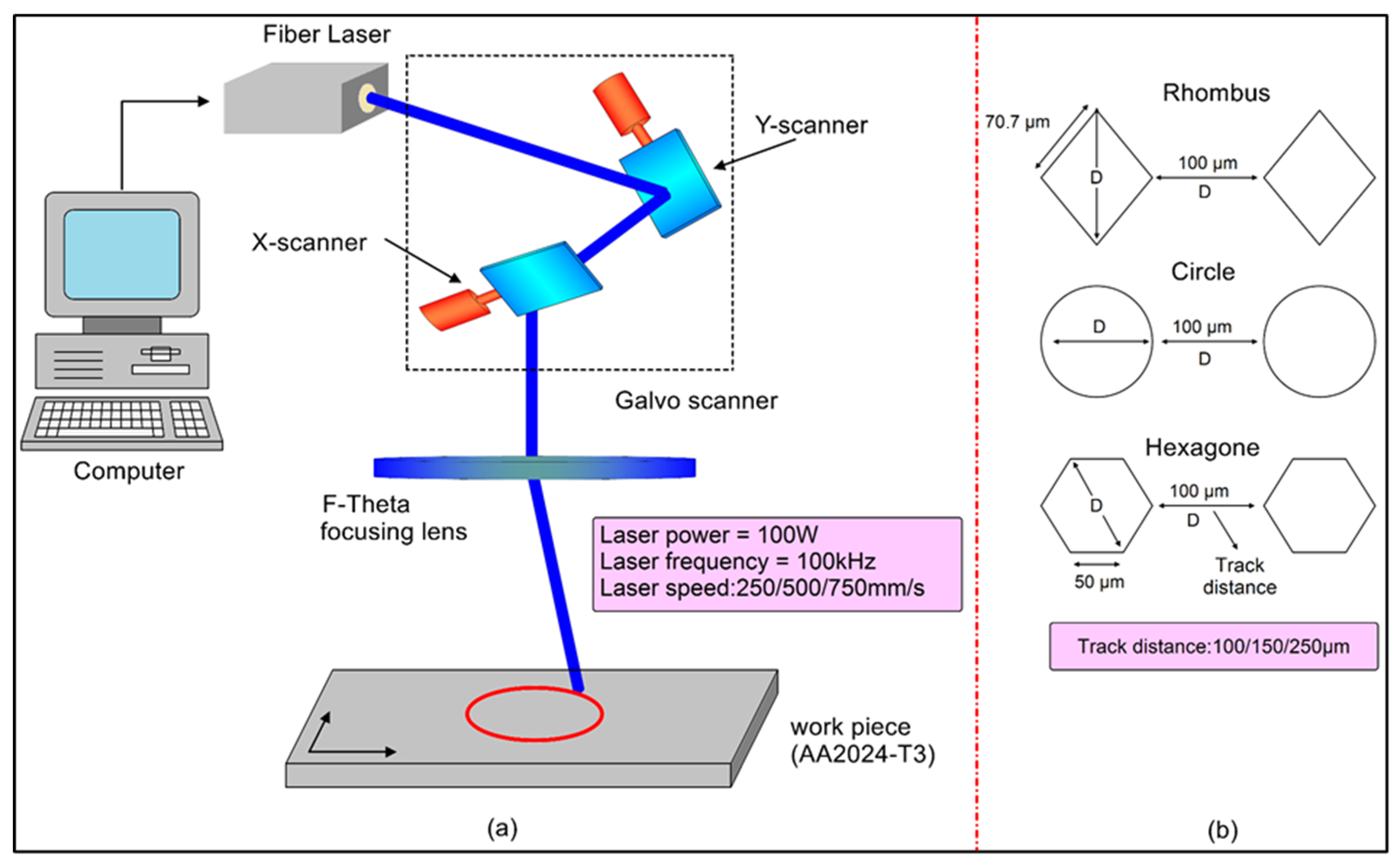
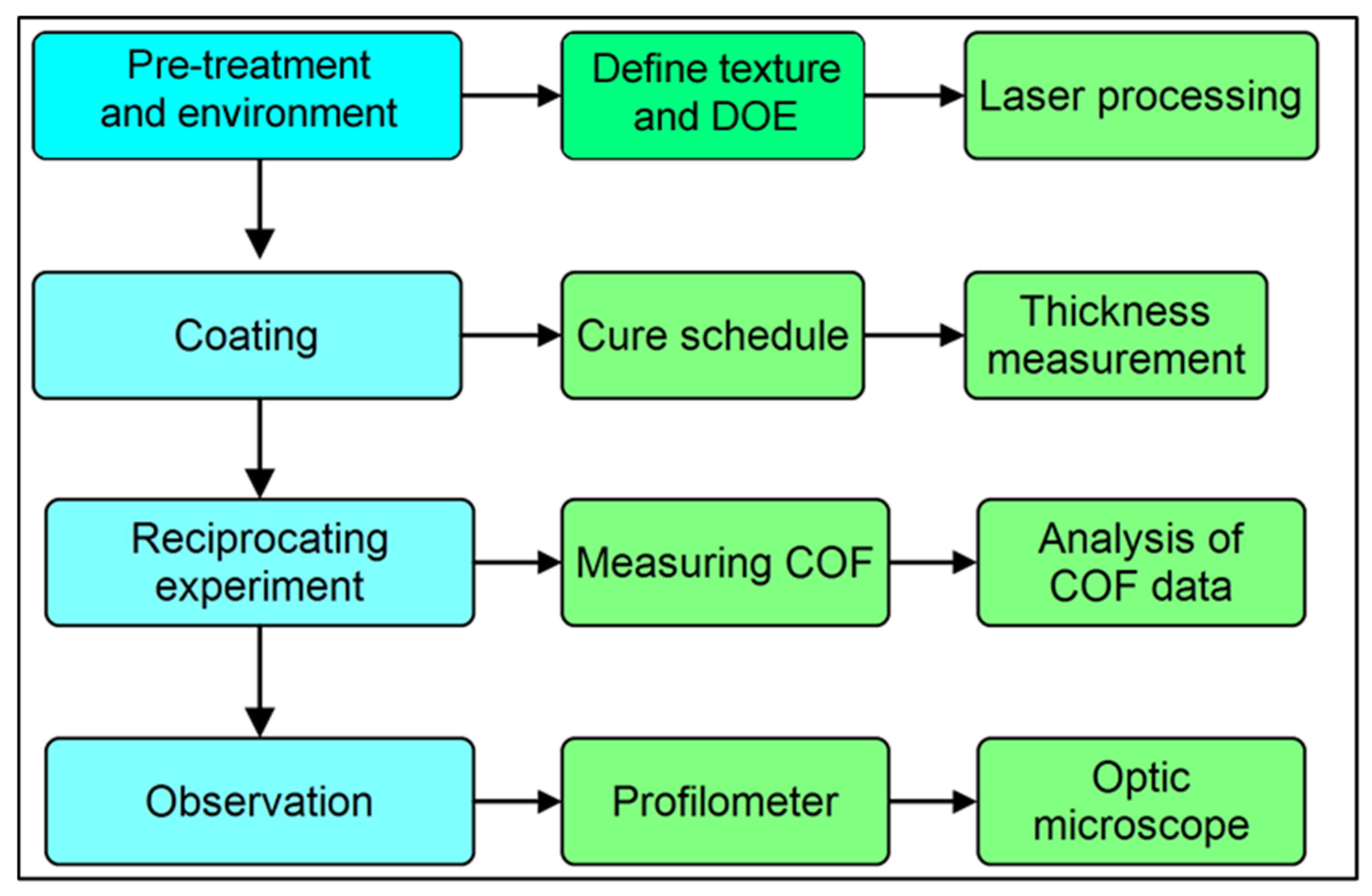
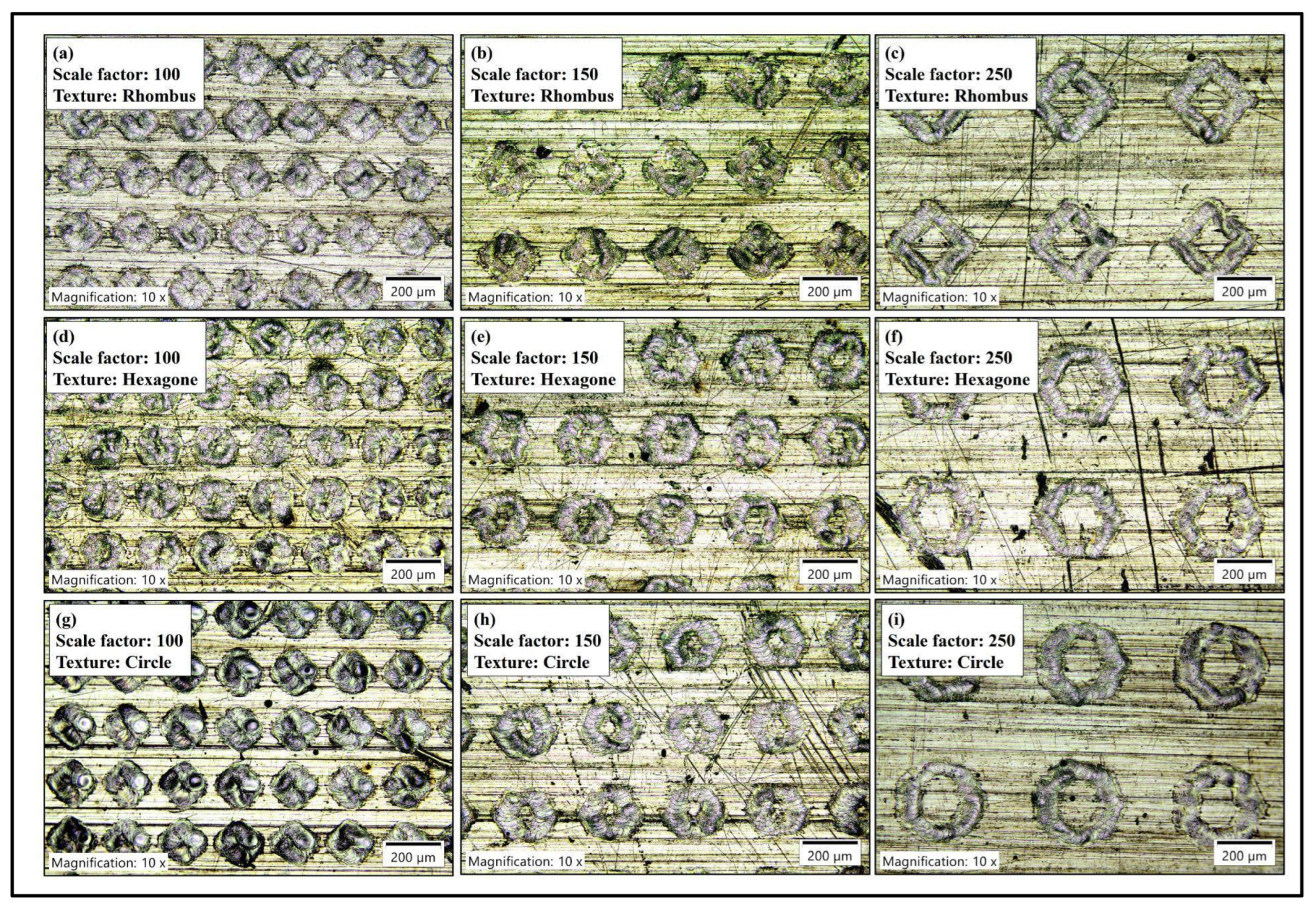
3.1. Contact-Angle Analysis of Laser-Textured Surfaces
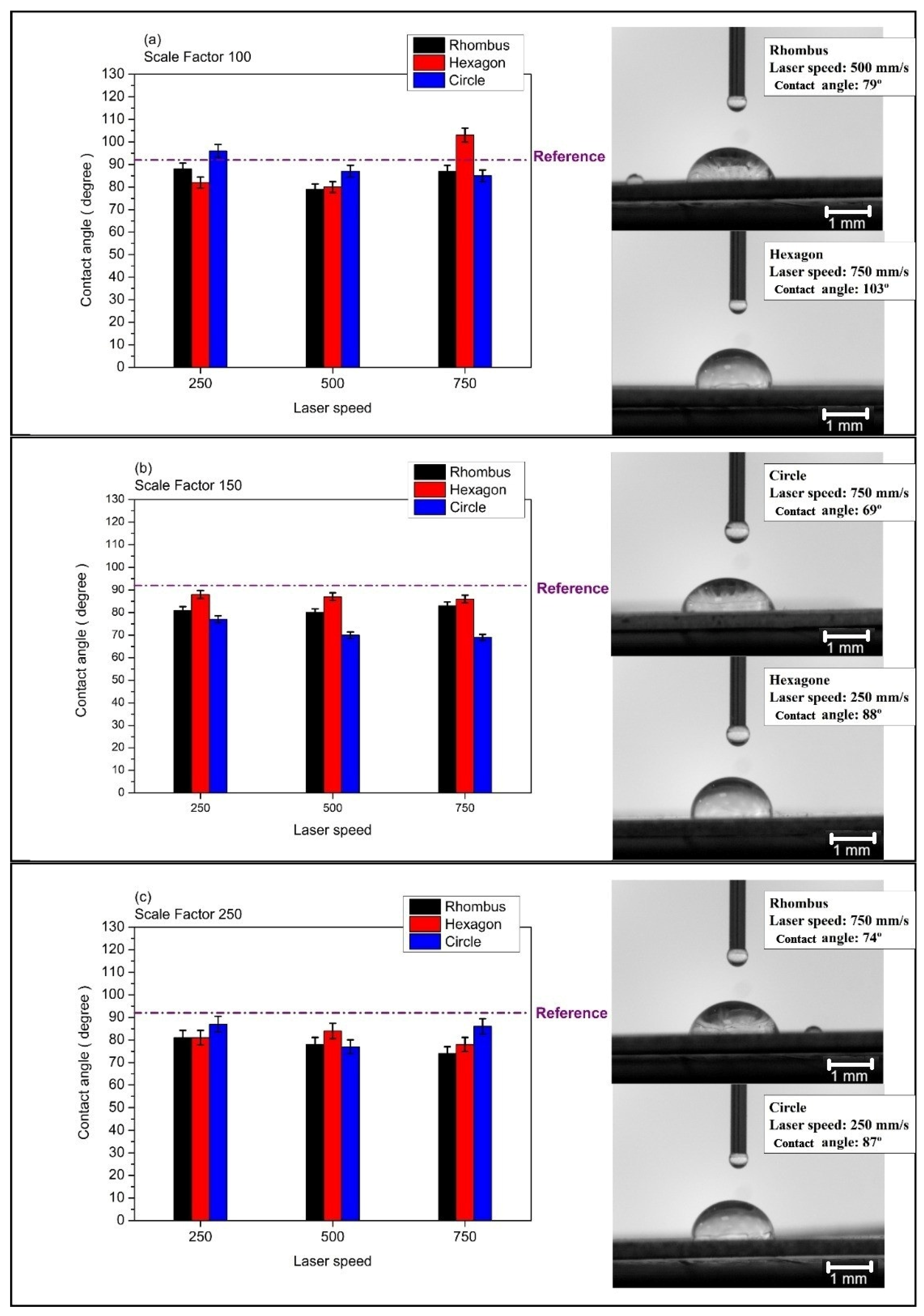
Figure 4a (scale factor = 100) shows that rhombus texturing yields contact angles consistently below the untextured reference of 92°, of about 88° at 250 mm s
−1, decreasing to about 80° at 500 mm s
−1, and then increasing slightly to about 87° at 750 mm s
−1; the hexagon displays a strong speed effect, starting near 90° at 250 mm s
−1, dropping to about 80° at 500 mm s
−1, and then rising sharply to roughly 102° at 750 mm s
−1; and the circle follows a non-monotonic pattern, beginning around 96° at 250 mm s
−1, decreasing to about 85° at 500 mm s
−1, and recovering to roughly 90° at 750 mm s
−1, indicating shifts between Cassie-like and Wenzel-dominated regimes.
Figure 4b (scale factor = 150) shows all three laser textures falling below 92°, with the rhombus only weakly speed-dependent (approximately 83°, 80°, and 81° at 250, 500, and 750 mm s
−1, respectively), the hexagon clustered in a narrow 83–88° band with a shallow maximum around 500 mm s
−1, and the circle giving the strongest wetting, near 75° at 250 mm s
−1 and about 70° at both 500 and 750 mm s
−1, consistent with enhanced capillary impregnation at the enlarged feature size.
Figure 4c (scale factor = 250) shows the rhombus continuing to decrease with speed, at about 83° at 250 mm s
−1, 78° at 500 mm s
−1, and 74° at 750 mm s
−1; the hexagon remaining nearly speed-independent at roughly 81–84°; and the circle increasing modestly, with speed from about 77° to 79° and then to 86°, yet still staying below 92°, implying that larger features predominantly favor liquid penetration, even when air retention grows at higher speeds. The overall comparison, excluding square textures, shows that most laser-textured conditions reduce the contact angle, relative to the untextured 92°, with hydrophobic exceptions confined to scale factor 100 (the circle at low speed, 96°, and the hexagon at high speed, 102°), and that increasing the scale factor from 100 to 150 and 250 generally shifts all three laser textures toward stronger wettability. The obtained results presented in
Figure 4 confirm that both the texture geometry and the processing parameter have a determining impact on wettability. At a scale factor of 100, the rhombus texture reduced the water contact angle by comparison with the untextured reference (92°), but the hexagon at 750 mm s
−1 remained the only condition reaching a good hydrophobic condition (102°). This implies geometries with sharp edges at reduced scales would maximize Cassie-like air trapping, which confirms the finding of Volpe et al. [
29], which indicated polygonal and circular laser-textured motifs onto aluminum alloys enhancing hydrophobicity when the spacing equaled the droplet base diameter. Increased scale factor up to 150 directed all three geometries into elevated wettability, the circle texture reaching the lowest contact angles (70° at 500–750 mm s
−1), which implies effective liquid capillary penetration into the larger features. Corresponding trends indicated by Moldovan et al. [
30] stated that increasing the size of laser-textured patterns promoted Wenzel-type wetting by enhancing liquid impregnation into surface asperities. At a maximum scale factor of 250, rhombus textures showed a monotonic contact-angle decrease with higher scanning speeds (83° to 74°), while circular textures generally had lower angles than untextured surfaces, except for a slight increase at 750 mm/s, highlighting the role of geometry openness in air retention. Zhou et al. [
31] highlighted the fact that both feature scale and geometry of beyond-roughness magnitude alone govern the Cassie-Wenzel transition on laser-textured surfaces. Their results confirm that rhombus, hexagon, and circle patterns control surface energy through geometry-specific wettability regimes, supporting the general literature findings.
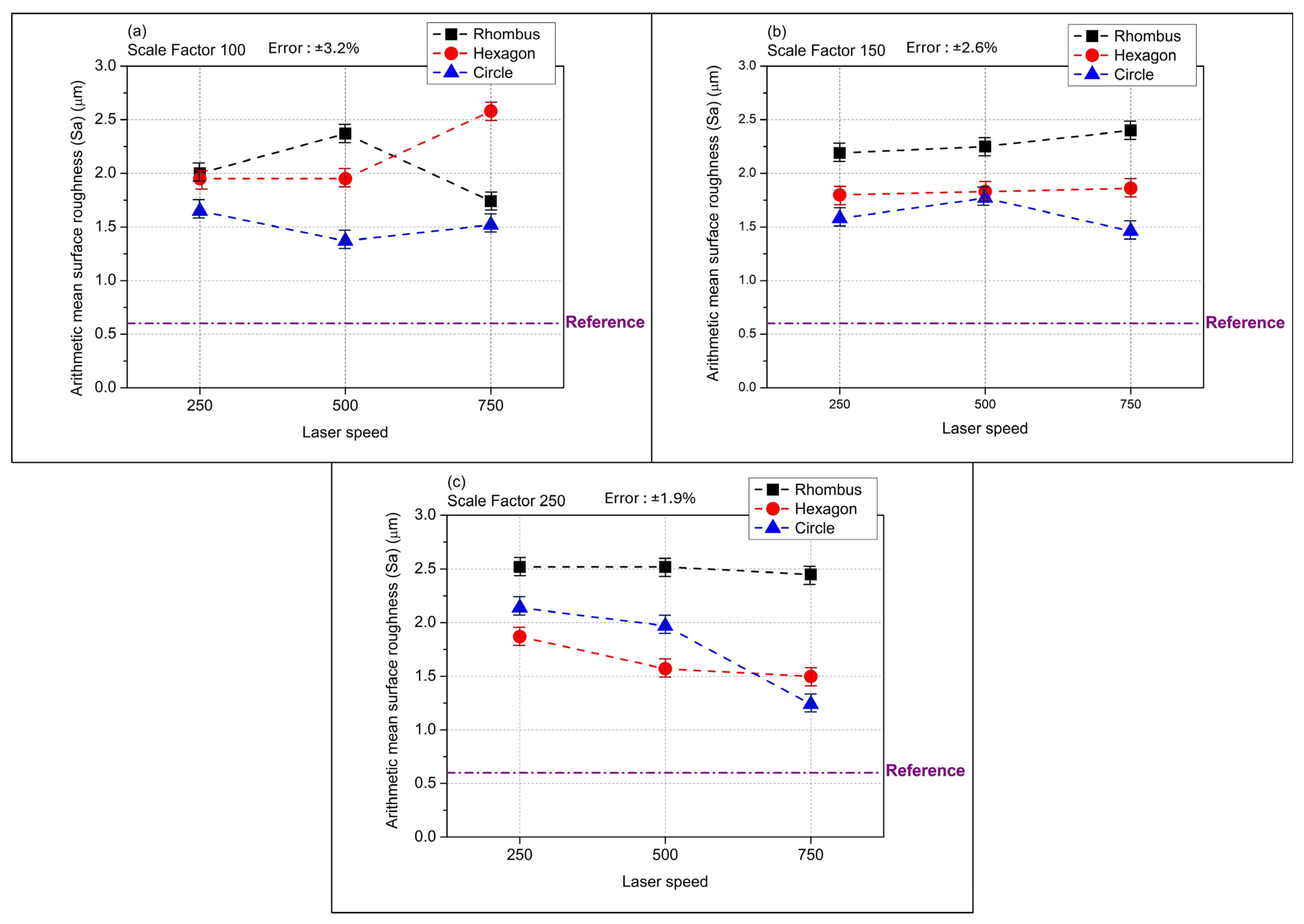
Figure 5a (scale factor 100) shows that the areal roughness Sa produced by the rhombus, hexagon, and circle laser textures is well above the untextured reference of 0.601 µm at all scan speeds: rhombus increases from about 2.0 µm at 250 mm s
−1 to roughly 2.3 µm at 500 mm s
−1 before decreasing to around 1.8 µm at 750 mm s
−1; hexagon stays near 2.0 µm at 250–500 mm s
−1 and then rises markedly to approximately 2.5 µm at 750 mm s
−1; and circle remains the smoothest of the three, varying modestly between about 1.3–1.6 µm across speeds.
Figure 5b (scale factor 150) indicates limited speed sensitivity: rhombus is persistently high, near 2.2–2.4 µm with a slight increase at 750 mm s
−1, hexagon clusters narrowly around 1.8–1.9 µm, and circle changes only slightly, from roughly 1.6 µm at 250 mm s
−1 to about 1.8 µm at 500 mm s
−1 and back to nearly 1.5 µm at 750 mm s
−1.
Figure 5c (scale factor 250) shows rhombus remaining the roughest and only weakly speed-dependent (about 2.5 µm at 250–500 mm s
−1, decreasing slightly toward 2.4 µm at 750 mm s
−1), while hexagon decreases steadily, with speed from roughly 1.9 µm to about 1.5 µm, and circle exhibits the strongest reduction, falling from approximately 2.2 µm at 250 mm s
−1 to around 1.7 µm at 750 mm s
−1. An overall comparison, excluding square textures, shows that laser texturing elevates Sa to roughly 1.3–2.5 µm (two-to-four times the reference), with rhombus generally rougher than circle and hexagon; increasing scale factor sustains high roughness, while the accompanying contact-angle data in
Figure 5 show mostly reduced wettability at scale factors 150 and 250, indicating that geometry and feature scale, rather than roughness magnitude alone, govern the shift between Cassie-like air entrapment (e.g., hexagon at 750 mm s
−1 at scale 100) and Wenzel-type liquid impregnation. The results from
Figure 5 clearly indicate that surface roughness strongly relies on geometry, as well as processing. At a scale factor of 100, the rhombus pattern produced Sa values rising from ca. 2.0 µm at 250 mm s
−1 up to ca. 2.3 µm at 500 mm s
−1, whereas the hexagon stayed at a corresponding level before reaching the maximum of ca. 2.5 µm at 750 mm s
−1, and the circle stayed comparatively smooth between ca. 1.3 and 1.6 µm. Alsaigh [
32] reported analogous trends for Ti–6Al–4V, whereby complicated motifs and slow scanning extended energy deposition and, correspondingly, generated larger roughness. At a scale factor of 150, the rhombus illustrated the larger roughness values ca. 2.2–2.4 µm once again, but the hexagon and the circle stayed lower, clustering closer to ca. 1.8–1.9 µm and ca. 1.5–1.8 µm, respectively. This correlates with those of Kasman et al. [
33], which stated that larger motifs and slow scanning preferred maximum Sa when geometries preferred increased penetration of the laser energy. At the largest scale factor, of 250, the rhombus stayed the roughest pattern (2.5 µm at 250–500 mm s
−1), whereas the hexagon decreased linearly by speed (1.9 to ca. 1.5 µm) and the circle revealed the greatest decline (2.2 to ca. 1.7 µm). Comparable trends were noticed by Mahdy et al. [
34], whereby initial smooth topographies promoted deeper, sharper textures and larger Sa values, but larger scanning or pre-existent roughness lowered the resolution of textures. Collectively, these remarks confirm Sa evolution is not ruled by energy input solely, but by the interaction between geometry, feature size, and scanning speed, which between them determine whether roughness rises or stabilizes between textures.
Linking
Figure 4 and
Figure 5, the relationship between contact angle and Sa is geometry- and scale-dependent, rather than monotonic. At scale factor 100, the hexagon at 750 mm s
−1 presents both the highest Sa (2.5 µm) and the only clearly hydrophobic contact angle (102°), consistent with Cassie-like air entrapment; by contrast, the rhombus at 500 mm s
−1 shows a high Sa (2.3 µm) but a low contact angle (80°), indicative of Wenzel wetting. At scale factor 150, Sa remains elevated for all textures (1.5–2.4 µm), while all contact angles fall below 92°, and, at 250, Sa stays high (1.5–2.5 µm), with contact angles mostly below 92°, despite a modest rise for the circle as Sa decreases with speed. Overall, because textured Sa values are far above the reference (0.601 µm), yet contact angles diverge across textures and scales, the correlation between Sa and wettability is weak; feature scale and geometry (e.g., openness and edge density) govern the Cassie–Wenzel transition more strongly than Sa magnitude alone.
3.2. Wear Damage Evaluation
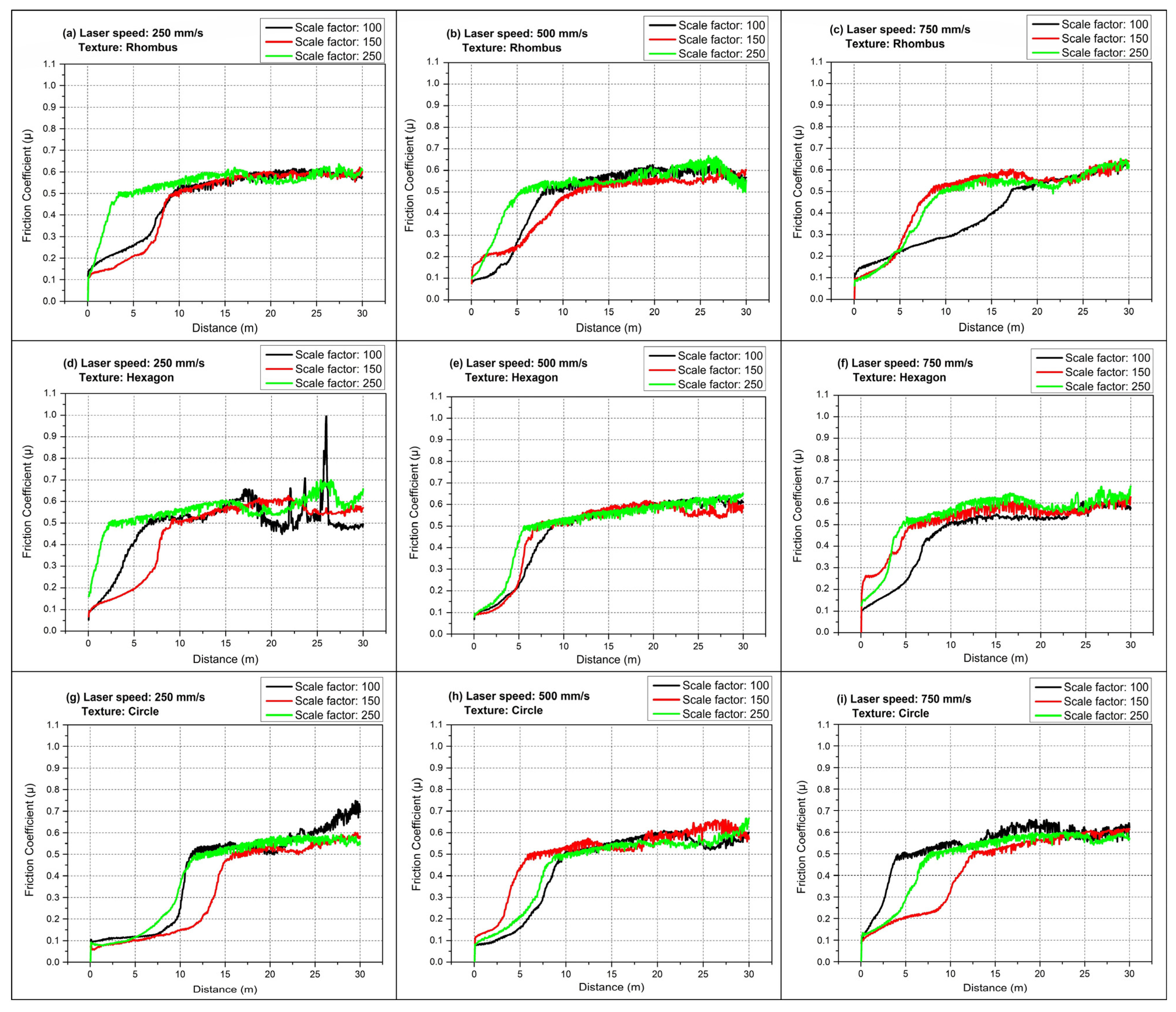
Figure 6a rhombus at 250 mm s
−1 has a rapid run-in and initial plateau. Scale factor 250 first becomes stable and attains highest stable µ (0.33–0.36), and 150 and 100 lag a little lower, with fewer undulations. For this geometry and velocity, larger cells just lift the plateau and conditioning distance.
Figure 6b rhombus at 500 mm s
−1 has a higher overall level of friction, above 5–8 m. Scale factor 150 produces the highest and most uniform plateau (0.48–0.50), with scale 250 following closely and scale 100 always producing a lower one. Separation of the scale factors is marked, and indicates a higher level of scale sensitivity at this intermediate speed.
Figure 6c rhombus at 750 mm s
−1 emphasizes the ranking yet further: scale 150 > scale 250 > scale 100. The minimal scale has the smallest plateau (0.38–0.43) and the smoothest climb, while 150 attains 0.52–0.56 with good stability. Increasing speed thus amplifies the gain of larger unit cells for this geometry.
Figure 6d hexagon at 250 mm s
−1 creates plateaus clustered around 0.40–0.50, with scale 150 peaking highest. Scale 250 has a very short late transient peak at around 24–26 m, and appears as a debris capture or a stick–slip excursion; with that point as an outlier and omitted, its steady value is comparable with 100 and just less than 150. Geometry appears stable at this speed, with weak scale dependence.
Figure 6e hexagon at 500 mm s
−1 has a short run-in (4–6 m) and clear hierarchy: scale 150 ≥ scale 250 » scale 100; 150 trace approximates to 0.50 with slight drift, 250 is slightly below it, and 100 is always at the bottom (0.35–0.42). This condition possesses high friction with low noise, a feature of a stable transfer-film regime.
Figure 6f hexagon at 750 mm s
−1 has quick stabilization and a monotonically increasing plateau, with scale 250 ≥ 150 > 100. Steady µ converges towards the band of 0.48–0.54 at the large scales, and lags behind at 100. The hexagon texture therefore benefits from increasing feature size with increasing speed.
Figure 6g at 250 mm s
−1 behaves differently with polygons. Scales 150 and 250 jump immediately and settle around 0.45–0.50, while scale 100 remains low a long distance before spiking at a late stage to ≥0.65, suggesting slow transfer-film formation with instantaneous shear strengthening. Larger circular cells thus avoid late-stage spikes and achieve their stable plateaus at an earlier low speed.
Figure 6h circle at 500 mm s
−1 places scale 150 at the top (0.58–0.62 at end), with 250 and 100 forming a lower cluster (0.48–0.52). Mid-scale diameter best sustains an increasing but stable plateau, and reveals an optimum pit/interspace balance of debris accommodation and film renewal.
Figure 6i circles at 750 mm s
−1 reverse low-speed trend: scale 100 produce highest steady µ (0.55–0.62), while 150 and 250 converge lower (0.48–0.52). For the highest speed, the smallest circle features appear to encourage interfacial shear and maintain a higher frictional state. Across textures, increasing speeds preferably lift the plateau and improve scale-factor spread. The rhombus and hexagon exhibit stable gains, while increasing from a scale of 100 to 150–250, with a common optimum at 150 providing the highest, most stable plateau; the hexagon is the least subject to speed and best immune to transients. The circle texture has a greater speed dependency: high scales (150–250) cause stability of the friction and inhibits late spikes at 250 mm s
−1, while the low-scale pit (100) assumes dominance at 750 mm s
−1. Generally, then, polygonal patterns favor high scales for high early plateau, while circular pits show a crossover where optimum scale switches from high at low speed to low at high speed, as a consequence of balancing transfer-film stability and debris retention/removal. For evidence supporting the findings in
Figure 6, recent studies have recognized microtexture geometry and size as determining factors in frictional behavior. For rhombus textures (
Figure 6a–c), plateau stability occurred at mid-scale (150 µm) features consistent with published comments asserting that intermediate feature scales produce stabilized transfer-film evolution and high wear-resistance [
24,
26]. Quantitatively, Dang et al. [
26] reported that a PI/EP-PTFE/WS
2 coating deposited on a circular-pit textured A370 aluminum alloy reduced the average COF by 13.58% and the wear rate by 35.34% under dry sliding, compared with the untextured coated reference; under starved-oil lubrication, the same pit geometry achieved even larger reductions of 16.18% in COF and 83.98% in wear, rate relative to the non-textured baseline, demonstrating that curved, closed-contour features consistently outperform groove-type and grid geometries in minimizing frictional response. For hexagon textures (
Figure 6d–f), friction plateau increased with feature size, consistent with previous findings that micro-groove morphology profoundly determines tribological stabilization and bond, upon coating [
23,
25]. Bagade et al. [
25] showed that, on aerospace components prepared by laser surface texturing (LST) prior to CuNiIn/MoS
2 duplex coating, the texture geometry and its dimensions directly governed both coating adhesion and wear performance; elliptical LST patterns produced lower wear rates than square patterns under the same 75 N pin-on-disk conditions (2 m s
−1, 2000 m sliding distance), while grit-blasted surfaces—the conventional aerospace baseline—exhibited higher COF variability, confirming the geometry-sensitivity reported here for hexagonal lattices. Circular textures (
Figure 6g–i) displayed speed-dependent crossover behavior, such that larger features displayed steady friction at smaller speeds, with smaller features dominant at high speeds. This trend validates reports that circular-pit textures exhibit condition-dependent optimum scales, due to gradients between debris-entrapment and transfer-film renewal [
24]. This point is illustrated through data from Yu et al. [
24], showing that in conditions of equal dry-sliding loads applied to CuPb24Sn samples with GO/WC coatings, circular-textured samples exhibited lower steady-state COF and wear rate compared to circular, square, and triangular textures. In particular, the wear rate for a triangular texture was 1.14 times higher than for the circular texture and 1.09 times higher than for the square texture, thereby confirming the suggestion that stress concentration at sharp vertices, rather than closed smooth curves, is the key to controlling COF stability under reciprocating loads. Overall, the plateaus observed in terms of COF in the current work (µ = 0.33–0.62 depending on texture geometry-scale-speed combinations) fall within the range of COF plateaus recorded in previous studies on laser texturing of aluminum alloy samples under the same reciprocating load configuration. Furthermore, the superior efficiency of circular dimple texture vs. polygonal geometry is supported by quantified data in all referenced works. Thus, the role of microgeometry in laser textured materials in terms of influencing friction stability is confirmed [
24,
25,
26].
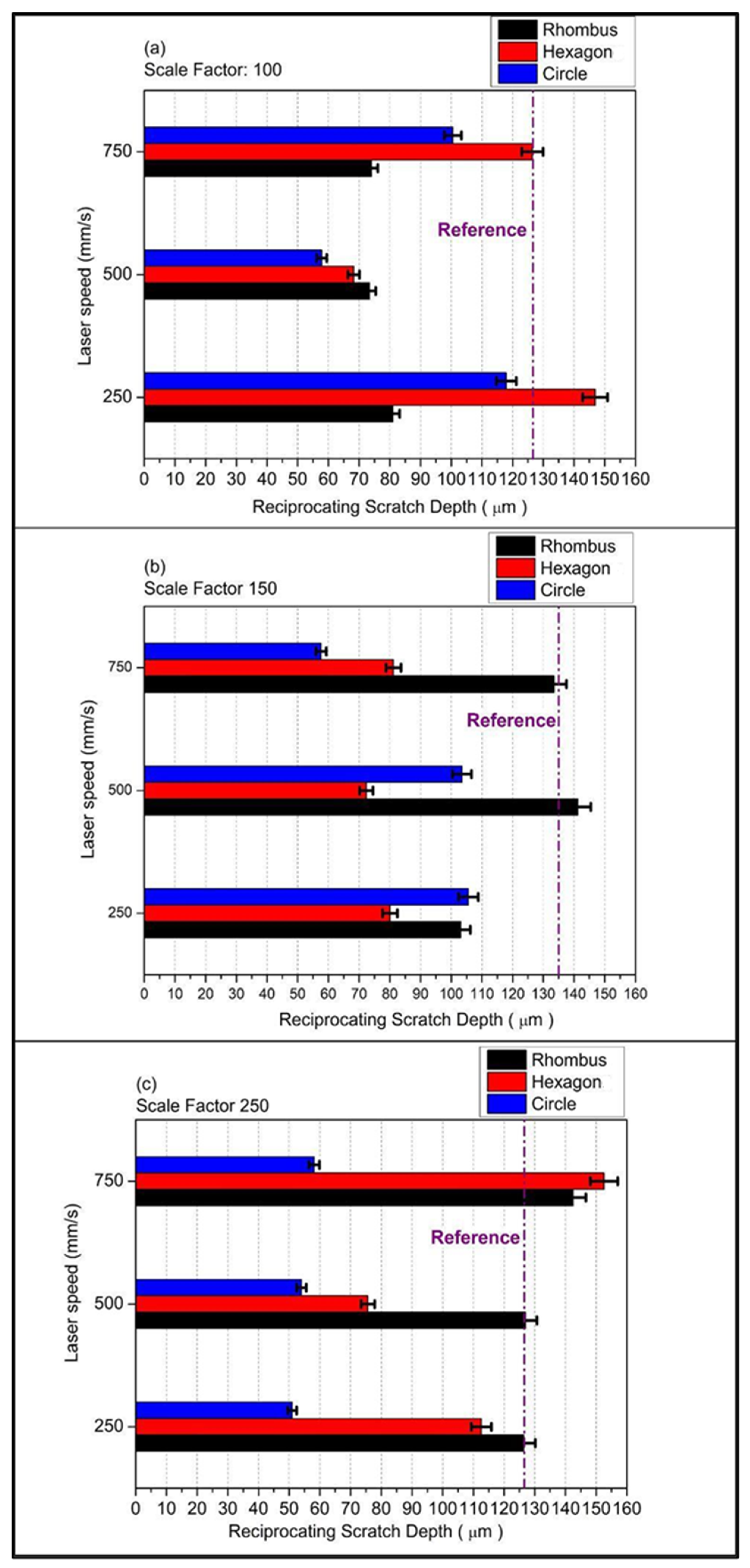
Figure 7a scale factor 100 shows that scratch depth depends more on geometry than on speed. At 250 mm s
−1, the hexagon produces the deepest grooves and slightly exceeds the reference line, the circle approaches the reference, and the rhombus remains markedly lower. At 500 mm s
−1, the circle becomes the deepest, while the hexagon and rhombus stay substantially shallower. At 750 mm s
−1, the hexagon again produces the greatest depth close to the reference, the circle is in between, and the rhombus is always results in least damage for all three speeds of that scale.
Figure 7b scale factor 150 reverses the hierarchy: the rhombus dominates the depth at every speed, approaching or exceeding the reference at 500–750 mm s
−1, while the circle is generally intermediate, and the hexagon remains the shallowest. The increase in rhombus depth with speed indicates a stronger speed sensitivity for this geometry at the mid-scale, whereas the hexagon retains good resistance, with minimal speed-driven growth.
Figure 7c scale factor 250 amplifies geometric contrast. The hexagon produces the largest depths at 250- and 750-mm s
−1, and clearly surpasses the reference, while the rhombus is also high: near the reference at 250–500 mm s
−1, and elevated at 750 mm s
−1. The circle provides the shallowest scratches at all speeds for this largest scale, staying well below the reference and exhibiting narrow error bars indicative of stable performance. On scales and textures, laser texturing consistently reduces the scratch depth of reciprocation relative to the reference, with the circle pattern offering the best improvement, especially at the largest of the scale factors, where it consistently has low values relative to speeds. The rhombus shows a strong scale–speed coupling, becoming increasingly susceptible to deeper scratching at scale 150–250 and higher speeds. The hexagon is bifurcated: it is competitive at scale 100 and low–mid speeds, but becomes the least resistant at scale 250, particularly at 750 mm s
−1. Taken together, minimizing scratch depth favors circular pits with the largest scale factor, whereas polygonal motifs require careful control of scale and speed to avoid crossing back toward reference-level damage.
It is important, however, to qualify the statistical standing of this preference within the circular-texture family itself. Within the SF = 250 circular condition, the mean scratch depths at 250 mm s−1 (22 µm) and 750 mm s−1 (25 µm) differ by 3 µm, and the associated ±SD error bars overlap substantially, indicating that the two scan-speed levels are not statistically distinguishable on scratch depth alone, at this scale factor. The circular-SF-250 response therefore defines an operating envelope; a speed-invariant region of minimized and stable scratch penetration, rather than a single unique optimum. This scan-speed insensitivity within the large-circular family is itself a mechanistically meaningful finding: the expanded unit-cell spacing of SF = 250 provides sufficient debris-reservoir volume and transfer-film renewal capacity for the governing wear mechanism to remain unchanged between 250- and 750-mm s−1, in contrast to rhombus and hexagon geometries at the same scale factor, whose scratch depths respond strongly and monotonically to scan speed over the same window. A robust design envelope that is indifferent to scan-speed drift is arguably of greater practical value than a statistically marginal single-point minimum, particularly for industrial deployment, where laser-speed tolerances and cumulative galvanometer drift introduce unavoidable run-to-run variability. The speed-level selection within the SF = 250 circular envelope is therefore deferred to secondary criteria that do differentiate statistically between the two conditions; specifically, the transition-zone frictional response, the running-in slope behavior, the wettability regime reported earlier (with the SF = 250 circle at 750 mm s−1 recovering toward the hydrophilic–hydrophobic transition range preferred for primer capillary impregnation), and the process throughput considerations (a factor-of-three reduction in laser-beam residence time at 750 mm s−1 versus 250 mm s−1, which is decisive at industrial scale). These secondary criteria are resolved quantitatively in the factorial analysis where the interaction-dominated ANOVA structure provides the statistical basis for the final speed-level recommendation.
For comparative evidence to support findings in
Figure 7, it was previously found by other scientists that scratch resistance and damage evolution are strongly governed by surface roughness geometry. Feng [
35] demonstrated through numerical and scratch experiments that stress concentration in the indenter contact region is controlled by roughness wavelength and amplitude, such that greater pattern wavelengths decreased penetration depth and plastic deformations. Kouediatouka et al. [
36] also noted that topology (dimple vs. polygonal patterns) and feature size of surface texture regulate lubricant/transfer-film reservoir locations, debris contact-area development, and entrapment, such that scratch depth and stability are controlled. These previous findings are consistent with the findings herein, where larger-scale circular pit shapes systematically attained deepest scratch profiles through stabilization of transfer films and debris. Additionally, this was confirmed by Giorleo et al. [
37], who stated that laser-texturing conditions (e.g., marking speed and power levels) directly alter groove feature geometry and related wear/scratch resistance, such that mechanistic explanation exists for speed-dependent crossover profiles between the circular and polygonal patterns observed in
Figure 7. Dang et al. [
26] reported that, for a PI/EP-PTFE/WS
2 polymer coating on A370 aluminum alloy under dry sliding, the pitted (circular) texture reduced the wear rate by 35.34%, compared with the uncoated, untextured reference, whereas rectangular-groove and cross-grid textures yielded progressively smaller reductions, directly paralleling the circle > hexagon/rhombus scratch-depth ordering found at scale factor 250 in the present study. Similarly, Yu et al. [
24] showed that, under identical load conditions, the triangular-textured surface produced a wear rate 1.14× higher than the circular-textured surface, with the square texture falling between the two extremes (1.09× the circular value); this geometry-dependent wear hierarchy mirrors the rhombus/hexagon vs. circle contrast documented across
Figure 7a–c. For the hexagon geometry, which performs well at scale 100 but deteriorates at scale 250 and 750 mm s
−1, Bagade et al. [
25] provided a direct aerospace parallel: on a sample with duplex CuNiIn/MoS
2 coatings, elliptical (rounder) LST patterns produced lower wear rates than square (angular) patterns under a 75 N load and 2000 m sliding distance, because angular vertices concentrate contact stresses and accelerate film breakdown—the same mechanism responsible for the hexagon’s degraded performance at large scale and high speed in
Figure 7c. Considering all the data presented from the current study on scratch depth, in addition to the wear-reduction percentages provided by Dang et al. [
26] and Yu et al. [
24], it can be understood that circular geometry generates a 14% to 35% less-damaged condition compared to polygonal geometry, under reciprocating loading conditions. Moreover, this difference is enhanced when considering large-scale features, which increase the volume of micro reservoirs and improve load distribution efficiency.
An important interpretive question concerns whether the scratch depths reported in
Figure 7 remain confined to the polymeric coating stack or whether they penetrate to the AA2024-T3 substrate. Several converging lines of evidence from the present dataset indicate that, across all 27 geometry–scale–speed conditions, the reciprocating wear tracks are contained within the coating system and do not fully breach the metallic substrate. First, the nominal primer + topcoat build was 100 µm (
Section 2.3), whereas all measured scratch depths in
Figure 7 fall substantially below this value, with the deepest reference (untextured) case and the worst polygonal conditions approaching, but not exceeding, the coating-thickness envelope. Second, the coefficient-of-friction traces in
Figure 6 exhibit a stable plateau in the µ = 0.33–0.62 band, characteristic of polymer-on-steel reciprocation; a through-coating breach to the aluminum substrate would be expected to produce an abrupt, sustained µ step-change with a distinctive metallic-contact signature (typically µ > 0.7 with pronounced high-frequency oscillation against a 100Cr6 counterface), which is not observed in any trace. Third, the post-test SEM images (panels b–g for the textured conditions) show polymeric ploughing, debris agglomeration, tribofilm formation, and localized coating micro-fracture, but no exposed metallic substrate patches, no Al-oxide recast ribbons, and no galling signatures that would accompany substrate contact; by contrast, the untextured reference (
Figure 10a) exhibits the most severe delamination, and is the only panel in which wholesale coating detachment is visually evident. Fourth, the full-field 3D profilometry and cross-sectional profiles (
Figure 8 and
Figure 9) capture the wear-track geometry over the entire 12 × 4 mm stroke scar; no condition displays the bimodal depth distribution (a narrow deeper channel superposed on a broader shallow trough) that characteristically marks partial-substrate-reached tracks under reciprocating contact. Taken together, these four independent diagnostic lines support the conclusion that the
Figure 7 scratch depths represent intra-coating penetration, and that a non-zero residual coating thickness was preserved beneath every track in the tested matrix. We nevertheless acknowledge that cross-sectional SEM and EDS elemental mapping across the track width would provide direct, spatially-resolved confirmation of residual coating thickness and allow a definitive Al-K/C-K interface-breach check. Such cross-sectional metallography and EDS line-scan/area-map acquisition were beyond the scope of the present processing-and-tribology study, and are identified in
Section 2.8 as an explicit priority for the planned follow-up investigation, where they will be combined with the sub-feature film-build conformality mapping already flagged, there to provide a unified interfacial characterization.
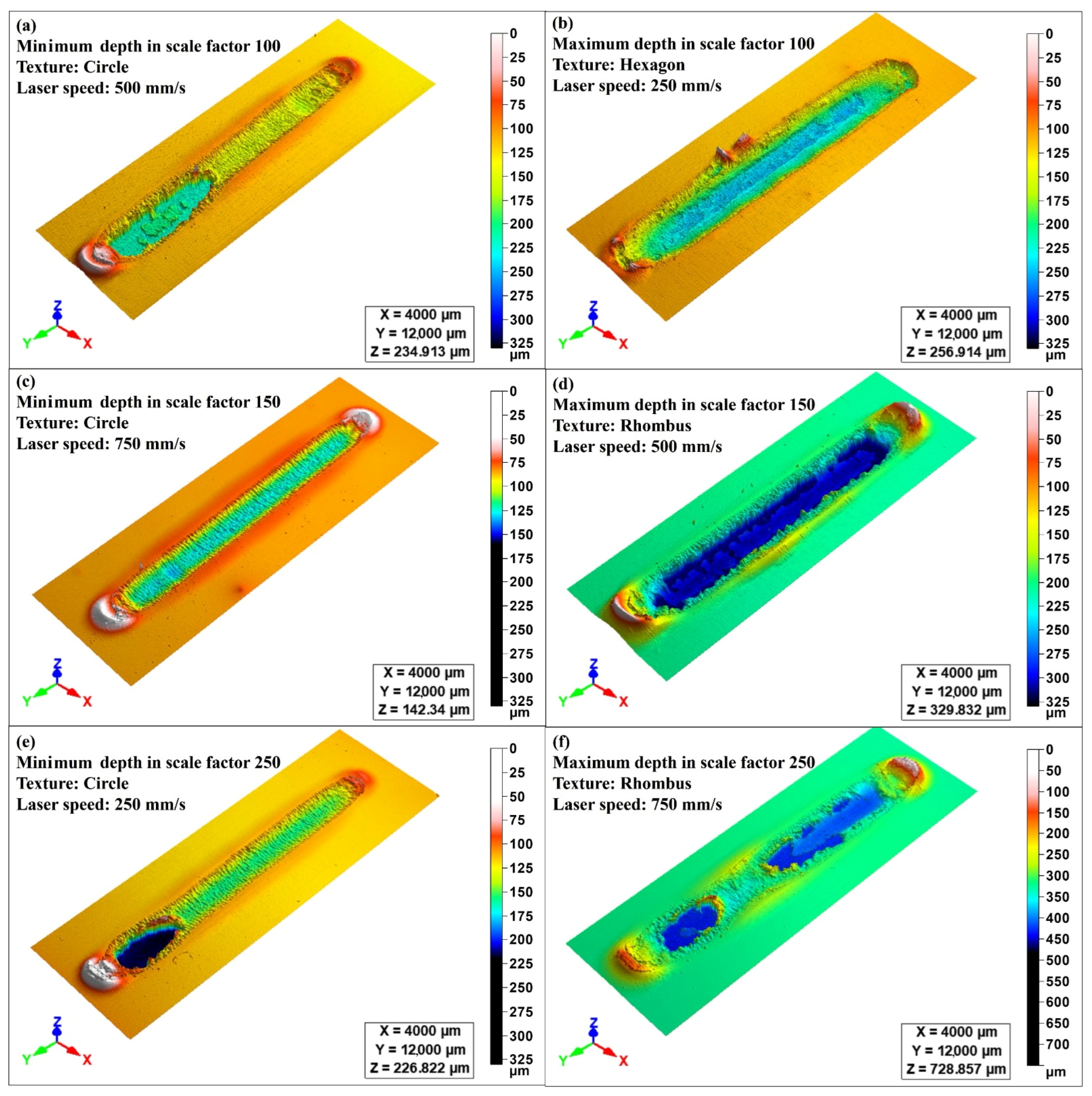
Figure 8a minimum-depth case at scale factor of 100 (circle, 500 mm s
−1) has a narrow, shallow trough with a relatively smooth bottom surface and low, even side-lips. The color map shows restricted penetration and moderate pile-up of material, consistent with moderate polishing/adhesive wear and a stable transfer film that prohibits cutting by a third body. In
Figure 8b, the maximum-depth case at scale factor of 100 (hexagon, 250 mm s
−1) has a deep central ditch with high ploughed ridges and cratered termini at the stroke reversal. The rough corrugated bottom and extensive pile-up demonstrate randomly varying retention of debris and gross three-body abrasion over ploughing. The
Figure 8c minimum-depth case at scale factor of 150 (circle, 750 mm s
−1) shows a broad, consistent track with a finely textured bottom surface and minimal side-lip development. Shallow penetration and smooth tracks demonstrate an effective transfer film that renews promptly at high speed, suppressing cutting and pre-subsurface cracking. The
Figure 8d maximum-depth case at scale factor of 150 (rhombus, 500 mm s
−1) has a broad, deeply excavated channel with continuous blue depressions, high lateral pile-up, and delicate transverse corrugations. These findings demonstrate repeated stick–slip, breakage of films, and three-body abrasion, consistent with poor removal of the debris in this geometry–speed regime. The
Figure 8e minimum-depth case at scale factor of 250 (circle, 250 mm s
−1) retains a tight, shallow track with a relatively smooth bottom surface and subdued end caps. The morphology demonstrates effective division of load and guiding of the debris by the large circular cells that retains an adhering film and prohibits delamination. The
Figure 8f maximum-depth case at a scale factor of 250 (rhombus, 750 mm s
−1) exhibits the highest damage, with deep crater-like areas at stroke reversals and an irregularly excavated bottom with widespread side-lip extrusion. The broad Z-span and local cavities demonstrate fragmentation of the transfer-film, entrapment of the debris, and progressive contamination at high sliding velocity. In every panel, circular texturing consistently corresponds to the shallowest, smoothest wear tracks for every scale factor, consistent with stable transfer-film development and effective removal of the debris. The hexagon performs adequately at the smallest scale, but loses vigor when debris accumulates. The rhombus becomes increasingly susceptible to deep ploughing and third-body wear with increasing scale and speed, with maximum damage at scale 250 and 750 mm s
−1. Broadly speaking, minimization of reciprocating wear inclines towards circular pits at high scale factors, but polygonal forms require scale and speed optimization to avoid debris-assisted ploughing and film rupture. The 3D surface morphology maps of
Figure 8, showing systematically less-deep wear tracks for circular textures and deeper tracks for polygonal geometries under a range of scale–speed combinations, are in agreement with previous tribology work. Ahhir-Torres et al. [
38] reported picosecond laser texturing of AA2024-T3 strongly altering near-surface oxide layers and surface topography, directly affecting material removal and abrasion resistance. Likewise, Bhaduri et al. [
39] stated that the geometry and distribution of laser-formed textures control debris entrapment, transfer-film creation, and real contact area, thus producing stabilized, shallow tracks of circular dimples or deeper elongated or polygonal texture grooves. Jones and Schmid [
40] also verified the importance of dimple shape, depth-to-diameter ratio, and area fraction for strongly controlling steady-state friction and wear volume in reciprocating tests, a fact explaining minimum- and maximum-depth cases under different scale factors and speeds from this study. Additionally, Ding et al. [
41] showed circular pits encouraging stable debris capture and dampening third-body abrasion in comparison to grooves, consistent with the smoother, less-deep wear morphologies for circular textures of
Figure 8. Lastly, Pawlus and Reizer [
42] highlighted the application of 3D profilometry to wear track depth and morphology, and thus reinforced the assignment of the measured variations to texture-dependent debris gathering, transfer-film stability, and ploughing processes.
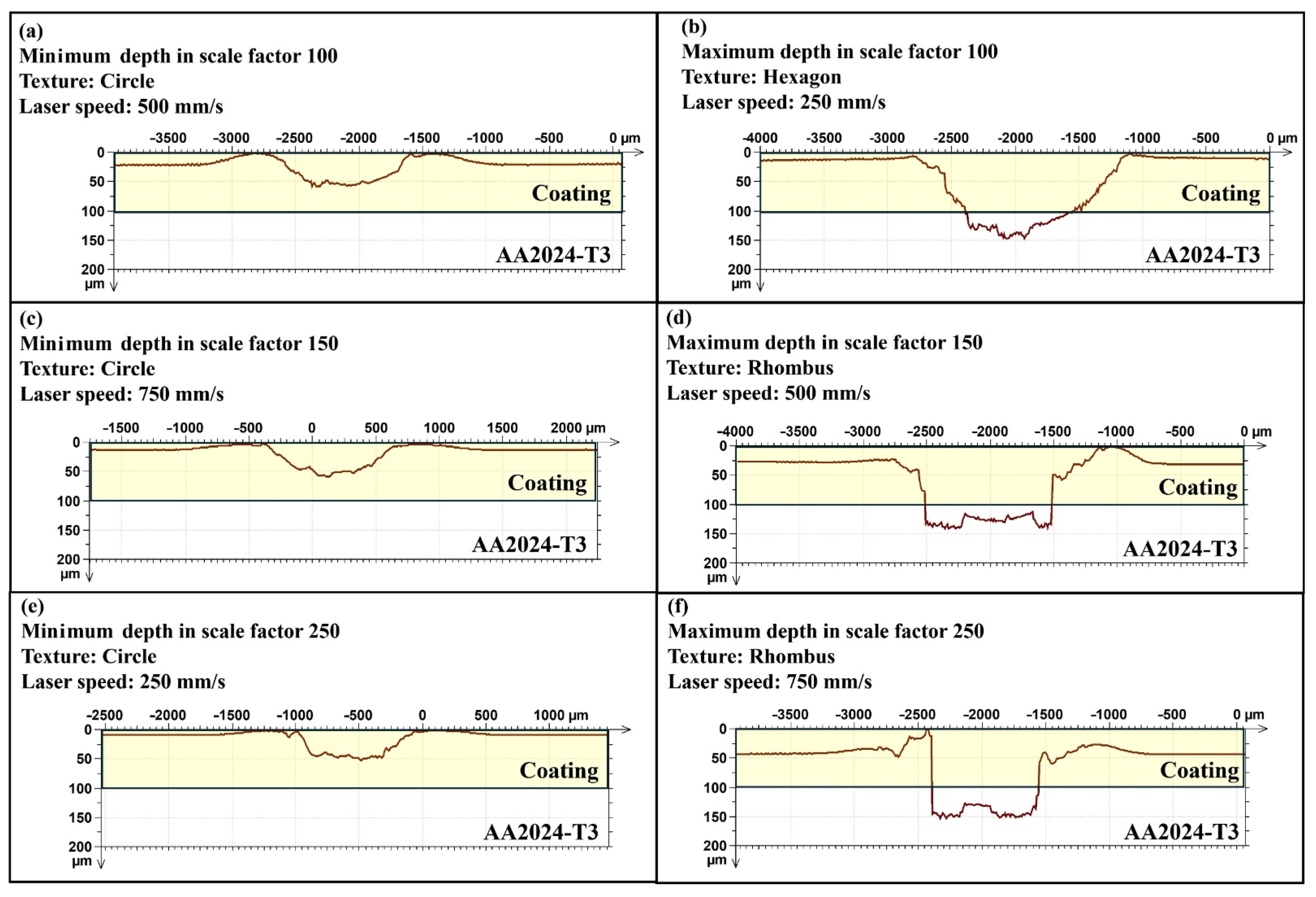
Figure 9 shows cross-sectional profiles of the reciprocating wear tracks by non-contact laser profilometry; for each condition, the trace is an average of five independent sections measured at non-overlapping locations around the track.
Figure 9a minimum depth at scale factor 100 (circle, 500 mm s
−1) exhibits a narrow U-shaped trough with gentle shoulders and a flat floor; peak depth is restricted and the sidewalls are gradual, consistent with moderate ploughing beneath a stable transfer film.
Figure 9b maximum depth at scale factor 100 (hexagon, 250 mm s
−1) exhibits a very deep U/V-mixed valley, with high-angle sidewalls and roughened bottom; the shoulders are high and unequal, consistent with increased third-body abrasion and debris pile-up at the lower speed for this geometry.
Figure 9c minimum depth at scale factor 150 (circle, 750 mm s
−1) retains a very shallow profile of symmetry with a flattish bottom; the narrow span and low curvature of the sidewalls are indicative of effective high-speed film renewal, with limited subsurface damage.
Figure 9d maximum depth at scale factor 150 (rhombus, 500 mm s
−1) exhibits a broad deep groove with very long, nearly vertical flanks and a terraced bottom; local plateaus of the valley are consistent with repeated film breakage and reformation with imbedded debris.
Figure 9e minimum depth at scale factor 250 (circle, 250 mm s
−1) again exhibits the shallow, flat trough with subdued shoulders; the flat bottom indicates stable load partitioning by the larger circular cells. with effective removal of debris.
Figure 9f maximum depth at scale factor 250 (rhombus, 750 mm s
−1) exhibits the best worst-case section; a deep narrow valley with sharp sidewalls and pronounced shoulder upheave consistent with intense ploughing and third-body cutting at the highest speed of the current study, for this geometry. Panel-wise, circular texturing always yields each scale factor’s shallowest profile of symmetry, while deepest cuts occur with the hexagon at smallest scales and the rhombus at largest scales, whilst at notably higher speeds. These tendencies verify the fact that circular pits best stabilize the transfer film and prevent gouging while polygonal textures, particular the rhombus at high speed, tend towards deeper penetration by debris, as well as shoulder accumulation. Vilhena et al. [
43] demonstrated that laser-induced craters and linear tracks develop characteristic cross-sectional shapes whose depth, sidewall slope and rim morphology scale sensitively with pulse energy and number of passes. In their experiments on 100Cr6 bearing steel (1064 nm, pulse duration 98–597 ns, pulse energy 0.5–8.3 mJ), micro-pore depth and diameter increased monotonically with pulse energy, and the optimal topographic quality—producing smooth-rimmed, well-defined craters suitable for hydrodynamic entrapment—was obtained at approximately 5.7 mJ with multiple pulse shots; at lower energies (≤1 mJ), the craters were too shallow to sustain distinct reservoir geometry, whereas at higher energies (≥7 mJ), rim waviness and spatter increased markedly. Tribologically, a COF reduction relative to the untextured reference was measurable at low sliding speeds (0.01 m/s) under boundary lubrication, but this advantage diminished at higher speeds, where the textures’ hydrodynamic contribution became insufficient to offset increased ploughing by rim asperities. Rosenkranz et al. [
44] reviewed the texture geometry (particularly edge sharpness and feature shape) controlling third-body dynamics and tribofilm stability: rounded dimples tend to act as debris/lubricant reservoirs that promote compact, plateau-like transfer films and shallower cross-sections, while sharp-edged polygonal motifs concentrate stresses and favor cutting/ploughing that produce deeper, V-shaped scars. Quantitatively, groove-like and grid textures increased wear rates and transient wear volumes relative to untextured references by impeding debris storage and accelerating abrasion, whereas dimple-textured surfaces reduced COF by approximately 10% when sliding against PTFE counter-bodies through storage of lubricious wear debris; in more extreme dry-sliding scenarios, early work cited in the review showed that textured copper shafts achieved a COF of approximately 0.25 compared with 0.75 for smooth shafts—a reduction of approximately 67%—because groove reservoirs trapped wear debris and removed it from the sliding interface. Bapat and Malshe [
45] further showed experimentally that texture directionality and groove orientation influence both the onset timing and spatial distribution of tribofilm formation during reciprocating motion, producing rate-dependent cross-sectional profiles and asymmetric shoulder morphologies. Specifically, on directionally polished 52100 steel discs lubricated with a nano-engineered MoS
2-based fluid, the R2 (linear COF drop) stage began at approximately 1000 laps for textured discs, versus approximately 2000 laps for untextured discs, and the steady-state COF was reached at around 6000 laps for textured discs, compared with approximately 6500 laps for untextured discs—a consistent advancement of tribofilm stabilization attributable to the directional grooves acting as lubricant-delivery conduits and anchoring sites for tribofilm precursors. Moreover, the higher reduced peak height (Spk) and reduced valley depth (Svk) values on the textured discs promoted early asperity wear-off that initially elevated COF (R1 region) before the deeper valleys assumed their reservoir function, yielding the lower, earlier steady-state—a temporal sequence directly analogous to the running-in → transition → steady-state evolution described in Schematic of friction-coefficient evolution with of the present study and the speed-dependent asymmetries in
Figure 9 shoulder profiles. Li et al. [
46] further quantified the orientation sensitivity of micro-grooved laser textures on tribological performance: under boundary lubrication with a MoDTC additive, textured surfaces achieved lower steady-state COF than untextured reference surfaces, but also exhibited higher wear because the groove structure removed the thick tribofilm debris that would otherwise build up and reduce solid-to-solid contact; grooves at low sliding-direction angles (approximately parallel to motion) produced higher COF, owing to impeded hydrodynamic cavitation, while grooves at intermediate angles (approximately 45°) generated enhanced cavitation-driven pressure build-up and lower COF, and an unexpected COF increase appeared at 90° due to unfavorable MoS
2 distribution in the tribofilm. This orientation-dependent COF modulation—where the groove geometry relative to sliding direction determines whether textures act as friction-reducers or friction-concentrators—provides a mechanistic basis for the speed-dependent crossovers in
Figure 9: at high scan speeds, the rhombus and hexagon pattern edges become increasingly misaligned with the reciprocating stroke direction, promoting stress-concentrating rather than film-stabilizing interactions and yielding the deep, narrow valleys observed in
Figure 9d,f, whereas the rotationally symmetric circular pits maintain their debris-trapping and cavitation-enhancing function, irrespective of stroke direction.
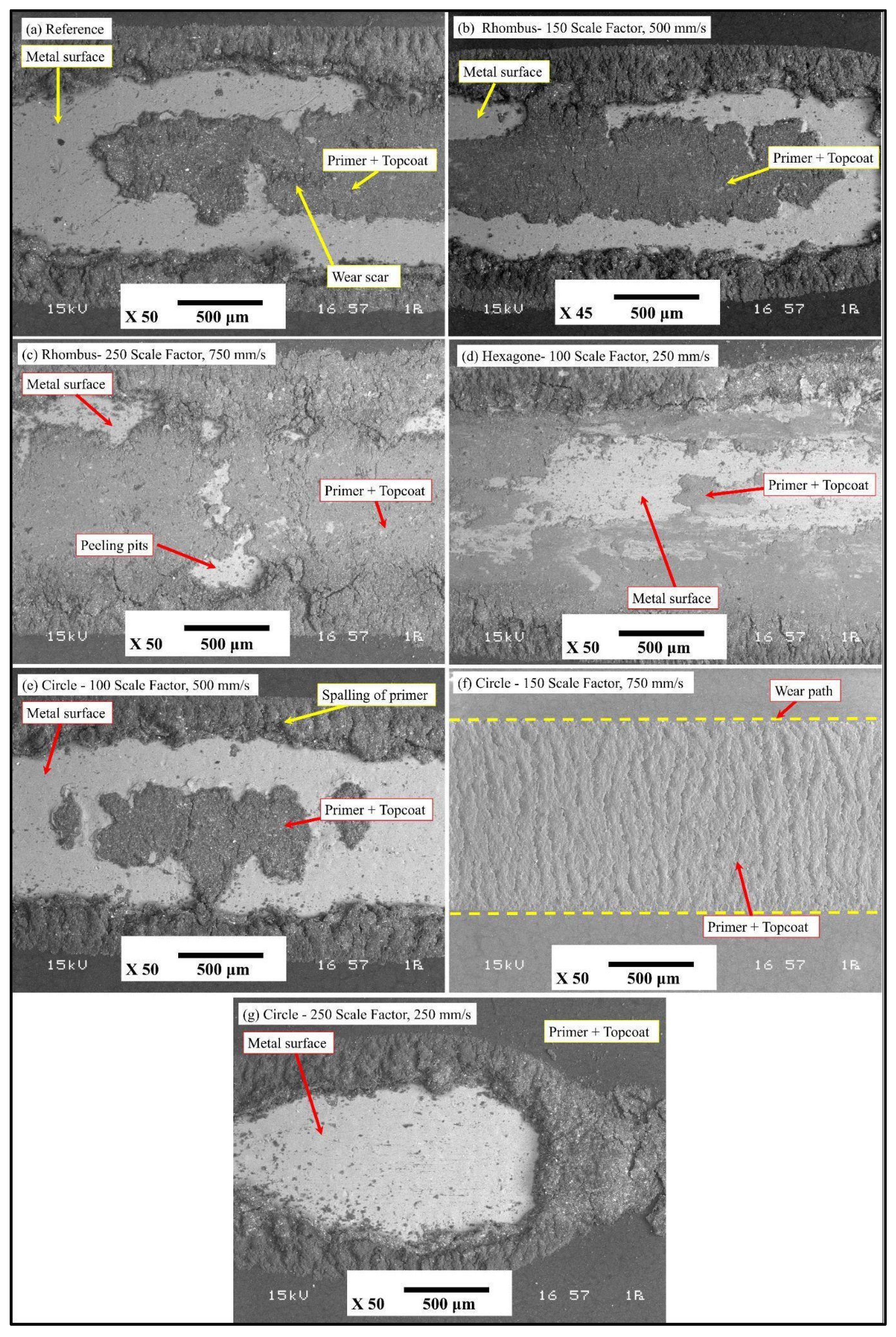
In
Figure 10a, the untextured surface shows widespread abrasive grooves and delamination, also signifying direct asperity–asperity touch and poor interfacial stickiness between epoxy primer and aluminum substrate. This kind of morphology signifies the lack of debris trap sites and poor transfer-film stability, ensuing frequent material ploughing and large-scale coating delamination. On the flip side,
Figure 10b (scale factor 150, rhombus, 500 mm s
−1) shows partial micro-ploughing with clear debris agglomerates trapped in the rhombus vertices. Polygonal edges pile up stresses and create localized coating breakage and debris embedment, in accordance with deeper scratch depths and higher COF plateaus mentioned earlier in the article’s friction data.
Figure 10c (scale factor 250, hexagon, 750 mm s
−1) illustrates moderately compacted debris with partially smoothed track edges, signifying a more stable transfer-film regime at higher pace; nevertheless, polygonal vertices again behave as preferential crack-initiation sites, and create micro-crater formation and fractured oxide layers. Also, in
Figure 10d (scale factor 100, hexagon, 250 mm s
−1), we find that the morphology of wear moves in the direction of cutting and delamination, with limited debris elimination, signifying inept film renovation in low sliding velocity and smaller feature scale, an observation in accordance with deeper main-text profilometrically measured wear valleys. In contrast,
Figure 10e–g, showing circular textures with varying scale factors and velocities (100–250; 500–750 mm s
−1), show in turn the most-polished and finest-wear tracks. Specifically,
Figure 10g (scale factor 250, circle, 250 mm s
−1) illustrates a compact tribofilm with negligible microcracking, signifying improved debris capture and load redistribution in circular dimples. These circular shapes create micro-reservoir and self-lubricant effects, reducing third-body abrasion, as well as branching cohesive-film renovation, during reciprocation. Altogether, SEM observations substantiate profilometric and COF results in the article, substantiating the fact that those circular textures give the most stable tribological performance and minimum coating delamination, and polygonal shapes remain more liable for debris-driven micro-ploughing as well as film breakage at higher velocities. The tribological results are further strengthened by establishing systematic correlations between scanning electron microscope (SEM) observations and the trend of the friction coefficient, along with wear profilometry. According to SEM images, specific geometric features of texture lead to unique modes of wear, such as abrasive plowing, adhesive debonding, and the formation of a transfer film. More specifically, the polygonal textures (hexagon and rhombus) show clear signs of micro-plow marks, debris deposition, and localized cracking, which correlate with high friction coefficients and deep wear scars identified through tribology testing. Conversely, the circular texture promotes the formation of an even transfer film that is minimally cracked, resulting in fewer debris particles, and hence less third-body abrasive action. This explains why the scratches created by the circular geometry are shallower and exhibit more stable friction plateaus.
Figure 10.
SEM images of reciprocating wear tracks. (a) Reference sample, (b) scale factor 150: rhombus, 500 mm s−1, (c) scale factor 250: hexagon, 750 mm s−1, (d) scale factor 100: hexagon, 250 mm s−1, (e) scale factor 100: circle, 500 mm s−1, (f) scale factor 150: circle, 750 mm s−1, (g) scale factor 250: circle, 250 mm s−1.
Figure 10.
SEM images of reciprocating wear tracks. (a) Reference sample, (b) scale factor 150: rhombus, 500 mm s−1, (c) scale factor 250: hexagon, 750 mm s−1, (d) scale factor 100: hexagon, 250 mm s−1, (e) scale factor 100: circle, 500 mm s−1, (f) scale factor 150: circle, 750 mm s−1, (g) scale factor 250: circle, 250 mm s−1.
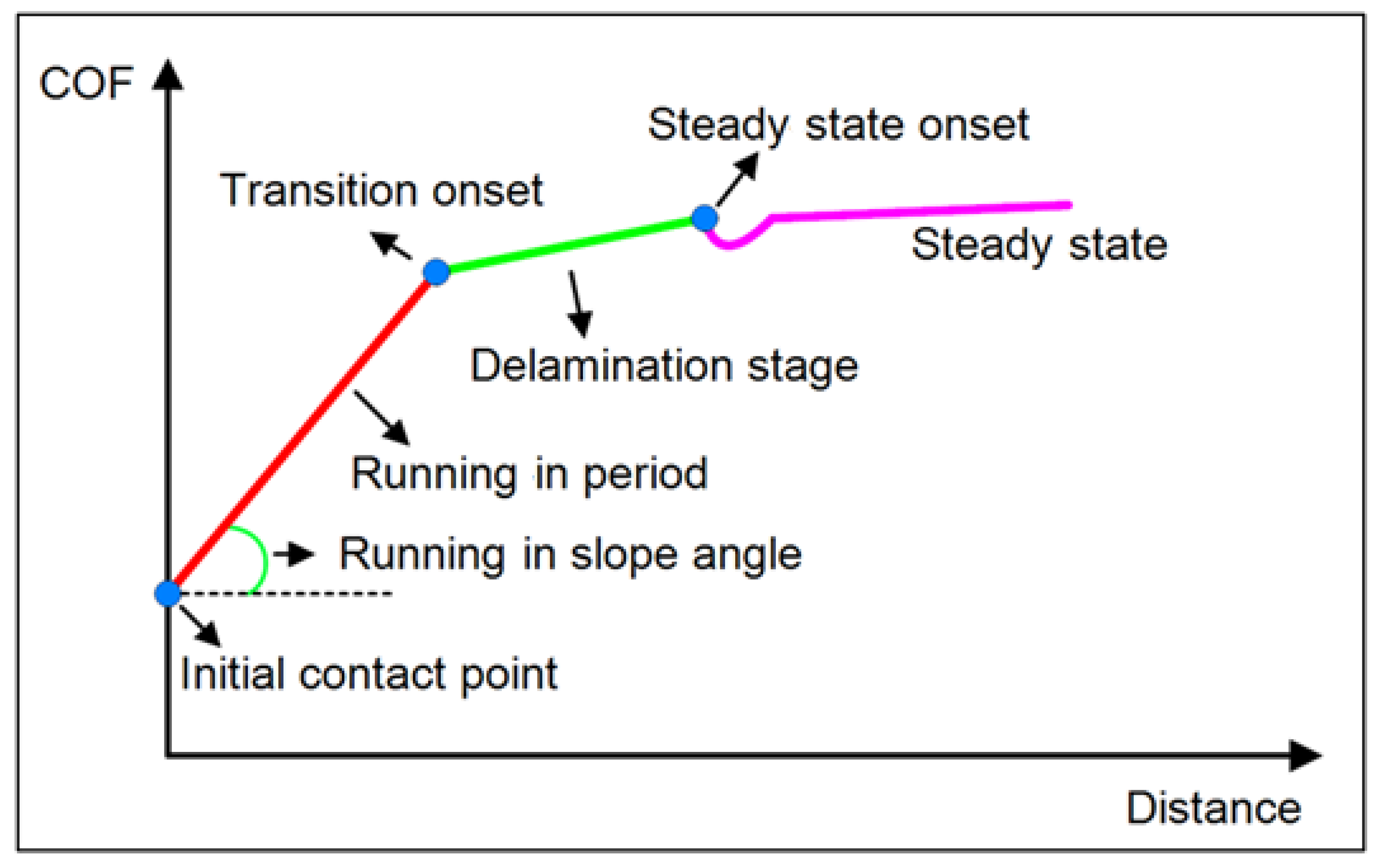
Figure 11 summarizes the evolution of friction during reciprocating sliding, and provides a mechanistic lens for interpreting our datasets in
Figure 6,
Figure 7,
Figure 8 and
Figure 9. After the initial contact point, the running-in period reflects how quickly the coating/substrate pair accommodates load and establishes a transfer film; in our experiments, this ranged from a very rapid stabilization for some rhombus conditions (250 mm s
−1) to a short but measurable window for the hexagon at 500 mm s
−1 (4–6 m), as captured by the running-in slope angle on the schematic. The “transition onset” in
Figure 11 corresponds to the first film break/rebuild events and debris engagement—observed experimentally, as transient spikes or drift (the late peak at 24–26 m for the hexagon at 250 mm s
−1, diagnostic of stick–slip and debris capture). Beyond this point, “steady-state onset” marks a regime where transfer-film shear dominates and plateaus are established; mid-scale features generally produced the most stable plateau for the rhombus/hexagon, while circle textures exhibited a speed-dependent crossover, with large pits stabilizing at lower speeds and small pits dominating at 750 mm s
−1, consistent with the balance between debris retention and film renewal highlighted in
Figure 11. The phases in
Figure 11 also align with wear morphology: conditions entering steady state clearly show shallow, smooth scars (circle textures), whereas regimes with unstable transitions (the rhombus at high speed) exhibit deeper grooves and pronounced shoulder pile-up, signatures of film fragmentation and third-body abrasion seen in our 3D and sectional profilometry. Finally,
Figure 11’s emphasis on the running-in slope and transition region is consistent with our factorial analysis: frictional evolution is governed not by any single parameter, but by strong two- and three-way interactions among texture, spacing, and speed, which jointly set the trajectory from running-in to steady state.
3.3. Factorial Analysis
Factorial experimental design is an extremely useful statistical method for engineering problems, since it enables the study of the influence of an array of variables simultaneously, both singly and with combined influence. This technique does not show interactions between process parameters (two- and three-way interactions), explaining complex relationships single-factor analyses often miss. Tribological behavior of the sort exemplified by running-in slope angle measured on the reciprocating wear test following texturing of AA2024-T3 aluminum sheets primed to a coating include the joint actions of interacting parameters such as texture on surface, spacing of texture, and laser speed. The factorial design is thus of fundamental importance for the establishment of the best surface conditions and for coating-performance improvement.
From the ANOVA output tabulated in
Table 2, it is found from the running-in model that it fits well and accounts for 99.89% of the total variance. From the main effects, the texture distance (19.36% contribution) and texture (8.61% contribution) factors are significant (
p < 0.05), and dominant contributors to the running-in slope. Laser speed indicates a smaller contribution, of 2.18%. But, of particular interest from the factorial study, are the interaction terms. Two-factor interactions account for 51.71% of the total variance, and contribute more than the main effects. From them, texture × texture distance (20.36%) and texture × laser speed (16.47%) is of special interest. This implies that surface topography changes considerably, not just with an individual parameter, but also when parameters are perturbed collectively. The three-factor interaction (texture × texture distance × laser speed) accounts for 18.04%, showing that optimization of all parameters simultaneously might be important. This sensitivity analysis gives the following engineering conclusion: the running-in angle of the slope can be realized not by adjusting a single process condition, but by adjusting texture and texture distance simultaneously. So, for deciding surfac- coating and laser-process strategy, two-way and three-way interactions should be taken account of, using factorial design; otherwise, serious deviations will occur in estimating coating wear resistance.
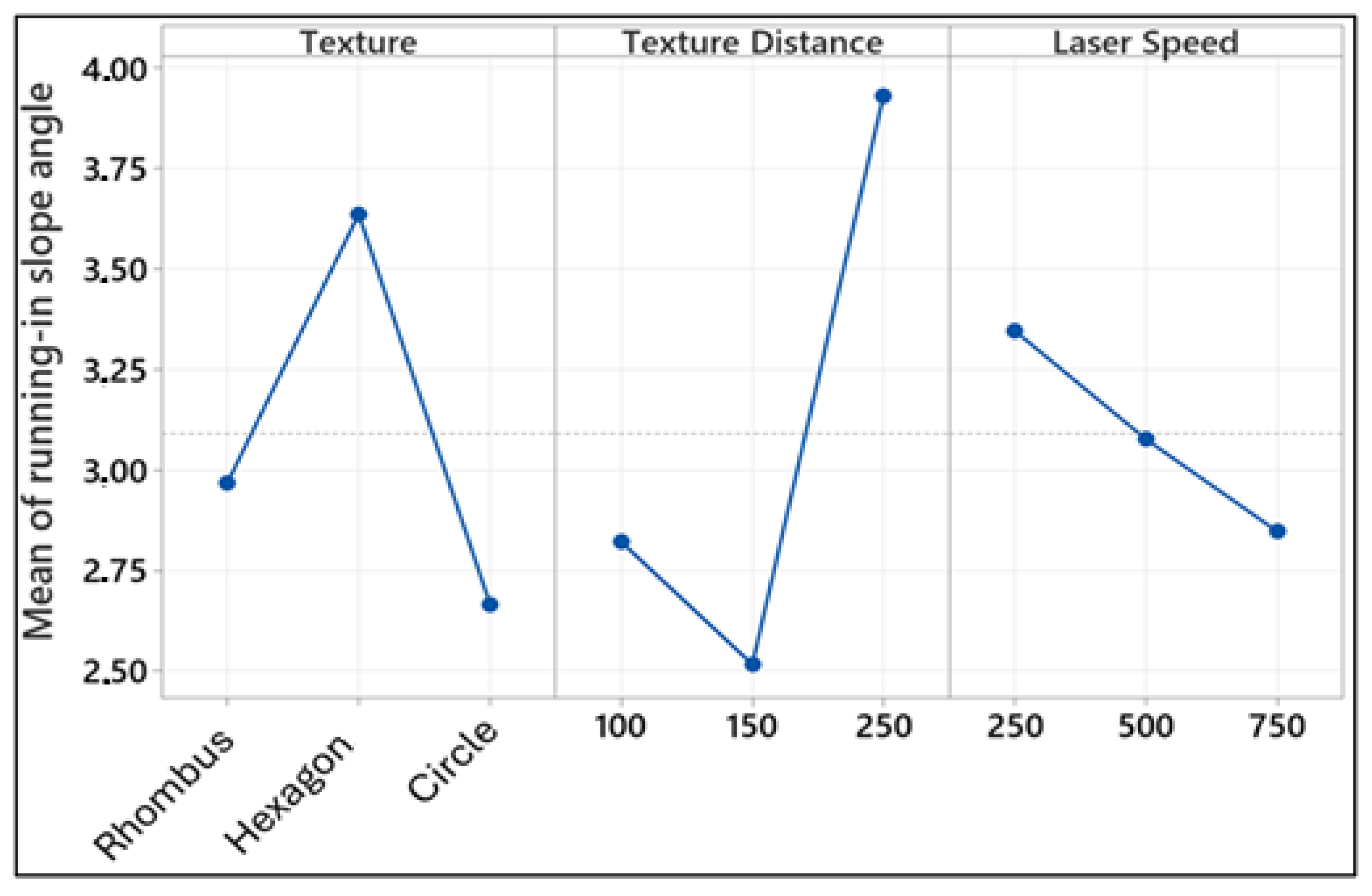
The ‘mean effect’ diagram shown in
Figure 12 depicts the average influence of three basic parameters on the running-in slope angle of primary laser-textured and coated AA2024-T3 aluminum surfaces. From an analysis of the diagram, the slope angle is roughly 3.0 for the rhombus texture, shoots up to roughly 3.6 for the hexagon texture, and reduces to the lowest value of roughly 2.7 for the circle texture. This means that the hexagon texture builds up its friction nature with a steep-shape running-in slope, whereas the circle texture represents a steadier but less forceful friction behavior, with a lesser running-in slope angle. The texture distance factor (in the range 100–250 µm) indicates a restricted but slow enlargement of the running-in slope angle; that is, at a tissue distance of 250 µm, the angle is at its greatest value, of roughly 4.0. In analyzing the laser speed parameter, the running-in slope angle indicates its greatest value, of 3.3, for a speed of 250 mm/s, whereas there is a slow fall detected for an enlargement of speed to 750 mm/s. These results show that an optimum condition can be materialized using a combination of hexagon tissue and a relatively low laser speed for a tissue distance of around 250 µm.
The factorial results shown in
Figure 12, in which the running-in slope angle is strongly influenced, not only by main effects but also by two- and three-way interactions, are consistent with published tribological studies that apply rigorous experimental designs. Ravindran et al. [
47] used factorial techniques to dissect the effects of reinforcement fraction, load, sliding speed and sliding distance on the wear of aluminum hybrid composites, and demonstrated that interaction terms frequently explain a larger portion of variability in wear responses than do main effects alone, supporting the high contribution of texture × texture-distance and texture × speed-interactions reported in the present ANOVA. Ramesh et al. [
48] further showed, in a systematic experimental and predictive modelling study, that the running-in behavior (initial wear slope) is highly sensitive to combinations of contact pressure, sliding velocity and operating duration; i.e., certain factor combinations produce abrupt changes in the initial slope, which matches our observation that particular texture × speed × scale combinations produce steep running-in slopes. Finally, Kolawole and Kolawole [
49] developed ANOVA-based statistical models for friction and wear of coated valve-tappet systems, and found that load and temperature (analogous to our speed and texture parameters, in effect) interact nonlinearly to control both early transient behavior and steady-state responses; their work therefore corroborates the conclusion that the running-in slope angle must be interpreted through the lens of interactions, rather than by main effects alone.
The ANOVA tabulated in
Table 3 reveals that the model accounts for 99.98% of the total variance, so the statistical fit is extremely robust. For the main effects, the most prominent one is the texture factor, contributing 19.57%; the second is the speed, contributing 6.71%; and the rather marginal effect of the texture distance is 0.58%. For two-way interactions accounting for a total of 66.54% of the total variance, they are far more prominent than single factors. In particular, the strongest interaction is the one of texture × texture distance with a contribution of 39.55%; the interaction of texture × speed comes second, with 12.55%, and the one of texture distance × speed is also statistically significant, with a contribution of 14.44% (
p < 0.05). In addition, the three-way interaction of texture × texture distance × speed, contributing 6.58%, highlights the fact of simultaneously controlling the three process parameters. The sensitivity analysis clearly reveals the fact that minimizing a single process parameter is not enough for controlling/reducing scratch depth. In particular, it is important to adjust the texture type simultaneously with texture distance and laser speed. From an engineering viewpoint, it is advisable to give first order to the interaction of texture × texture distance, to enlarge the lifetime of surface coating and wear-resistance improvement. Conversely, it is advisable to adjust the laser speed simultaneously with texture. In this way, there is maximum control on scratch depth, whose amount dictates coating quality.
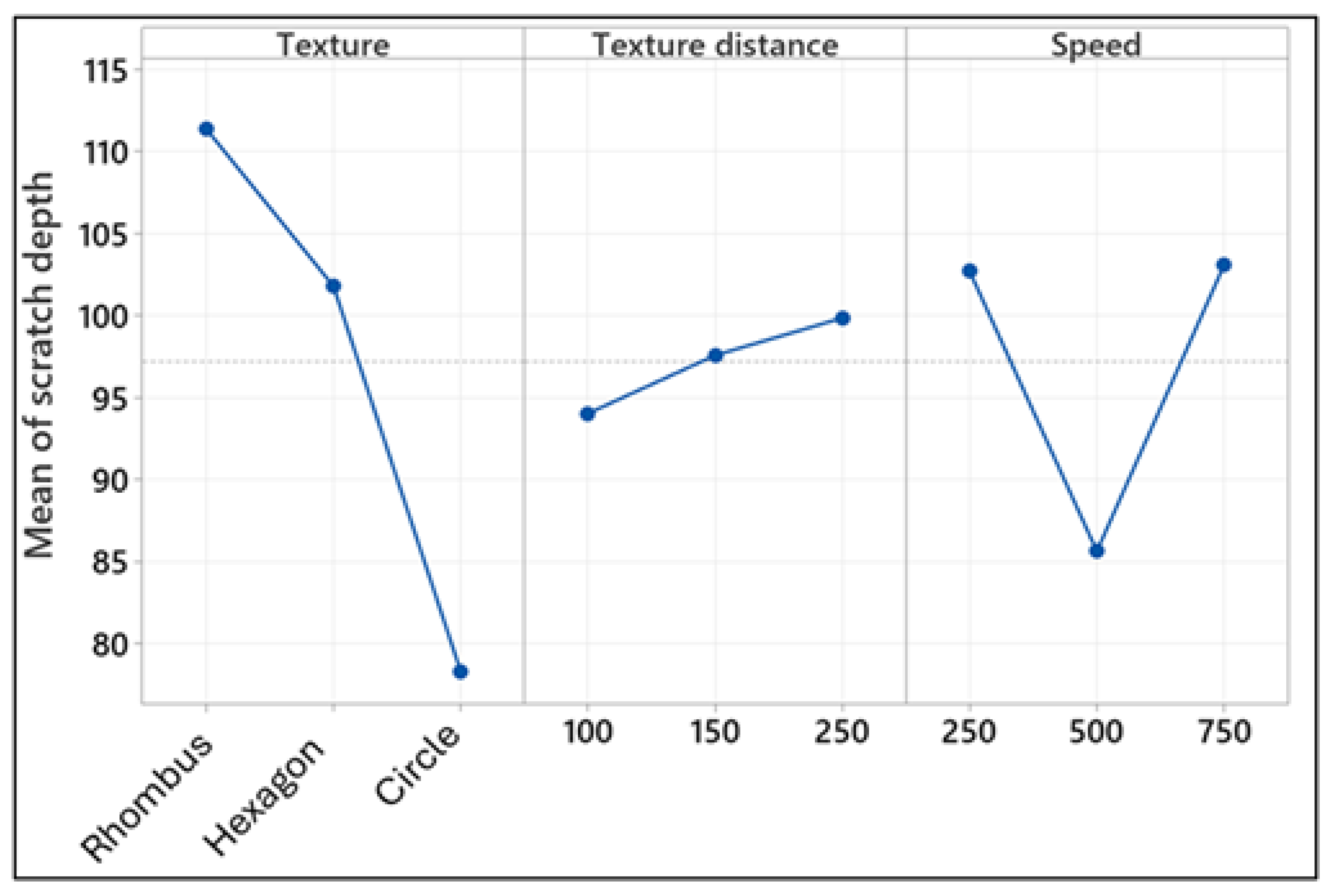
The ‘mean effect’ plot of
Figure 13 reveals the average effect of three dominant parameters on scratch depth on laser-textured and primary-coated AA2024-T3 aluminum surfaces. From a study of the plot, rhombus texture surfaces are found to have maximum scratch depth; this reduces for hexagon texture, and drastically to a minimum for circle texture. This proves that circular (circle) texture provides an escalation of wear resistance and strength to the surface, so that it becomes resistant to the creation of scratch. The texture distance factor in the range of 100–250 µm displays a negligible increasing trend of scratch depth, and a minimum influence. The speed (laser speed) factor displays a clear V-shaped trend; scratch depth is maximum at 250 mm/s, minimum at 500 mm/s, again increasing at 750 mm/s. These results show that the best laser speed is around 500 mm/s and the change from rhombus to circle texture strongly enhances surface strength. The mean-effect behavior for scratch depth is shown in
Figure 13, where several factors and their interactions both increase and decrease in scratch penetration, which is consistent with prior experimental and review literature. Saeidi et al. [
50] demonstrated that texture depth (dimple/groove depth) is one of the dominant parameters controlling material removal and progressive scar formation in reciprocating contacts, and that deeper textures or sharper features tend to increase local cutting/ploughing, and therefore produce larger scratch/wear depths under comparable loads. Zawadzki et al. [
51] reported that the laser texturization changes not only topography, but also near-surface microstructure and hardness; such laser-induced changes alter the scratch response (depth and mode) because harder, thermally-altered rims reduce plastic penetration while certain texture geometries promote third-body abrasion and deeper scratches, a mechanism that helps explain why some factor combinations in the plot produce steeper positive effects on scratch depth. Grützmacher et al. [
52] reviewed the multi-scale and multi-shape texturing, and emphasized that texture geometry, aspect ratio (depth/diameter), and area fraction interact with sliding conditions to determine whether textures act as protective debris reservoirs or as stress concentrators that increase local penetration; this interaction perspective supports the mixed positive/negative main effects and strong interaction terms visible in our mean-effect plot for scratch depth.
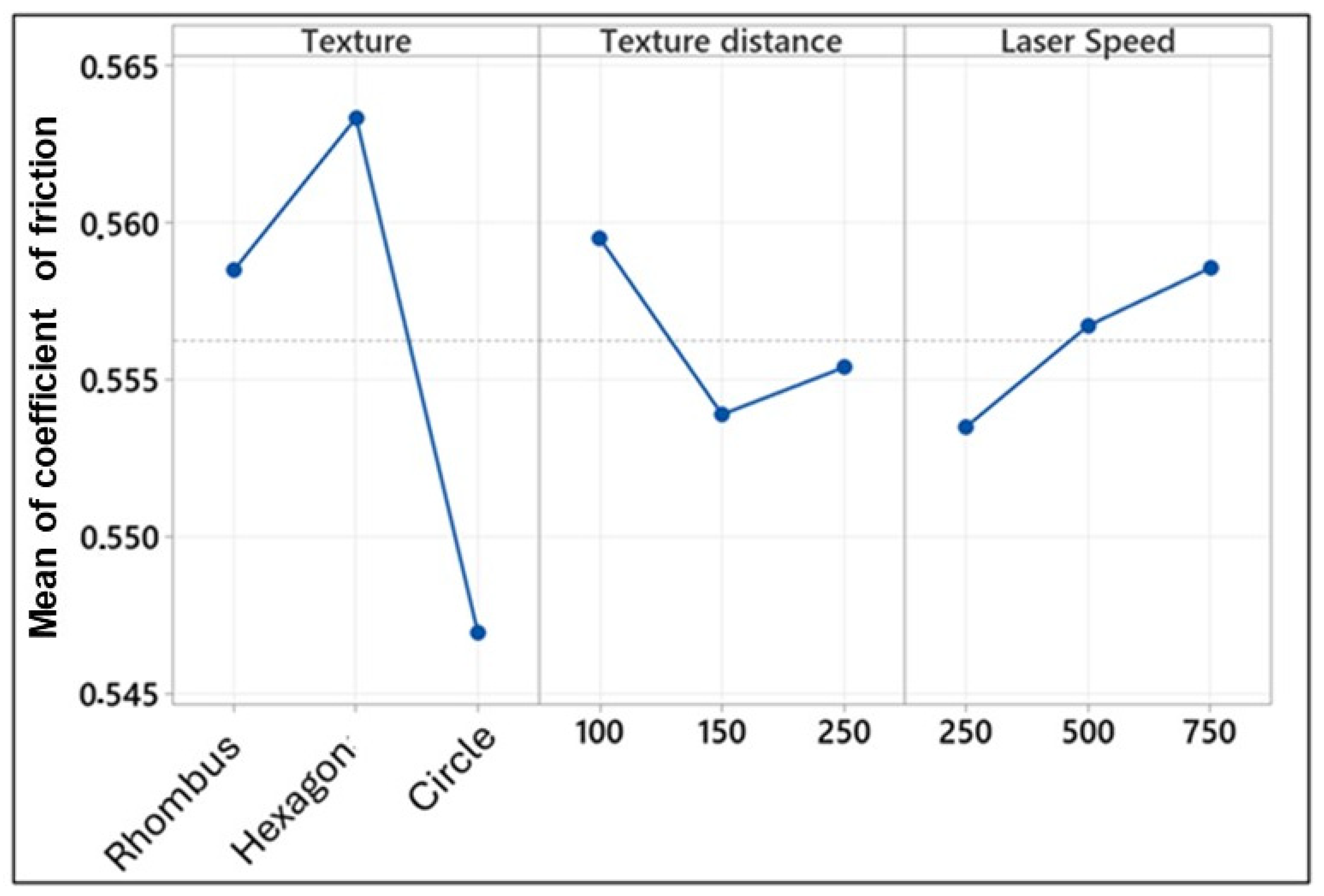
Table 4 displays the factorial ANOVA output of the mean coefficient of friction (COF) in the transition zones derived from reciprocating tests on laser-textured and primed AA2024-T3 aluminum surfaces. The model accounts for 99.45% of the total variance (F = 187.07;
p < 0.001), and is strongly statistically significant. Looking at the main effects, the texture factor represents the strongest effect, with a 16.39% contribution and a high F value of 400.75. This is followed by texture distance, with a 1.95% contribution and an F value of 47.65, and laser speed, with a 1.51% contribution and an F value of 37.02. These results uncover the fact that surface geometry (texture type) is most responsible for the average COF in the transition zone, whereas texture distance and laser speed make secondary, but important, contributions. In the interaction domain, two-way interactions account for 63.60% of the total variance. Here, it is to be highlighted again that the (texture x laser speed) interaction accounts for 25.9% (F = 313.19), whereas the (texture distance) interaction accounts for 20.92% (F = 255.84). In these results, it is visible that laser speed and texture type form a very high synergy, beyond the sum of the single factors, in the sum of the impact on the coefficient of friction. Three-way interaction is also significant, with a contribution of 16% (F = 97.79), so all factors should be assessed collectively. In general, the results present an unveiling of the fact that interactions of surface texture type, texture distance, and laser speed are dominant factors in perception of friction behavior in the transition zone, and the lowest contributor is the laser speed’s main effect. These results also academically validate the fact that process parameters should be optimized in an interaction-centric framework, rather than singly, to provide an optimal friction performance.
Figure 14 shows the correlation of the mean coefficient of friction (COF) in the transition areas with three main process parameters; the texture, texture distance, and laser speed. From viewing the picture, it becomes clear that texture type has the strongest influence. Rhombus and hexagon geometries keep the average of the coefficient of friction at rather high levels, whereas the circle texture keeps it at a considerably lower coefficient of friction. It indicates the decisive influence of the geometry’s form on surface contact situations and circular texture’s potential to reduce the transition’s friction. Looking at the texture distance, it becomes clear that the lowest level of the COF is at a distance of 150 µm, whereas at 100 µm and 250 µm it delivers higher, but similar, values. This indicates that an optimum distance of surface pattern contact is approximately 150 µm long, and lubricant film contact or contact mechanics reduce the friction to a minimum at this distance. Laser-speed parameters influence possess rather low, but constant, influence strength; the average of the coefficient of friction is lowest at 250 and highest at 750 mm/s. This means laser speed increase might partly raise the coefficient of friction to a higher value through influence on tissue morphology and surface energy. Generally, the picture proves, on an academic level, that tissue type is the strongest influencing variable; tissue spacing possesses an optimum spot, and laser speed possesses a second-order but direction-influencing effect. These results focus again on a smart choice of tissue geometry and suitable tissue spacing, and, in particular, on an optimization of tribological performance. The mean COF behavior in transient regions is shown in
Figure 14, where COF exhibits rapid rises and falls during the early stroke before reaching a quasi-steady value, which is well explained by mechanisms reported in laser-texturing and tribology studies. Vlădescu et al. [
53] demonstrated that the entrainment of individual texture pockets generates local, short-lived changes in lubricant film thickness that produce pronounced transient COF peaks and troughs as pockets enter and leave the contact; this pocket-entrainment mechanism rationalizes the oscillatory COF response and the sensitivity of mean transient COF to pocket frequency and sliding speed in the plot. Kovalchenko et al. [
54] showed that the laser surface texturing shifts lubrication-regime boundaries, and that the same texture can either reduce or increase friction, depending on whether the contact operates in boundary-, mixed-, or full-film regimes; this helps explain why some factor combinations in
Figure 14 produce lower transient COF (when textures enhance film build-up), while others produce higher transient COF (when textures disrupt film continuity). Olofinjana et al. [
55] found that laser texturing affects the dynamics and durability of tribochemical films formed from lubricant additives, and that texture-induced changes in tribofilm formation markedly alter transient friction behavior during the running-in stage, consistent with our observation that different texture geometries and scale/speed combinations produce distinct mean COF values in the transient regions. Together, these studies indicate that the transient COF response visualized in
Figure 14 arises from the combined effects of pocket entrainment frequency (film-thickness transients), lubrication-regime shifts (mixed vs. boundary vs. full) and texture-mediated tribofilm evolution.
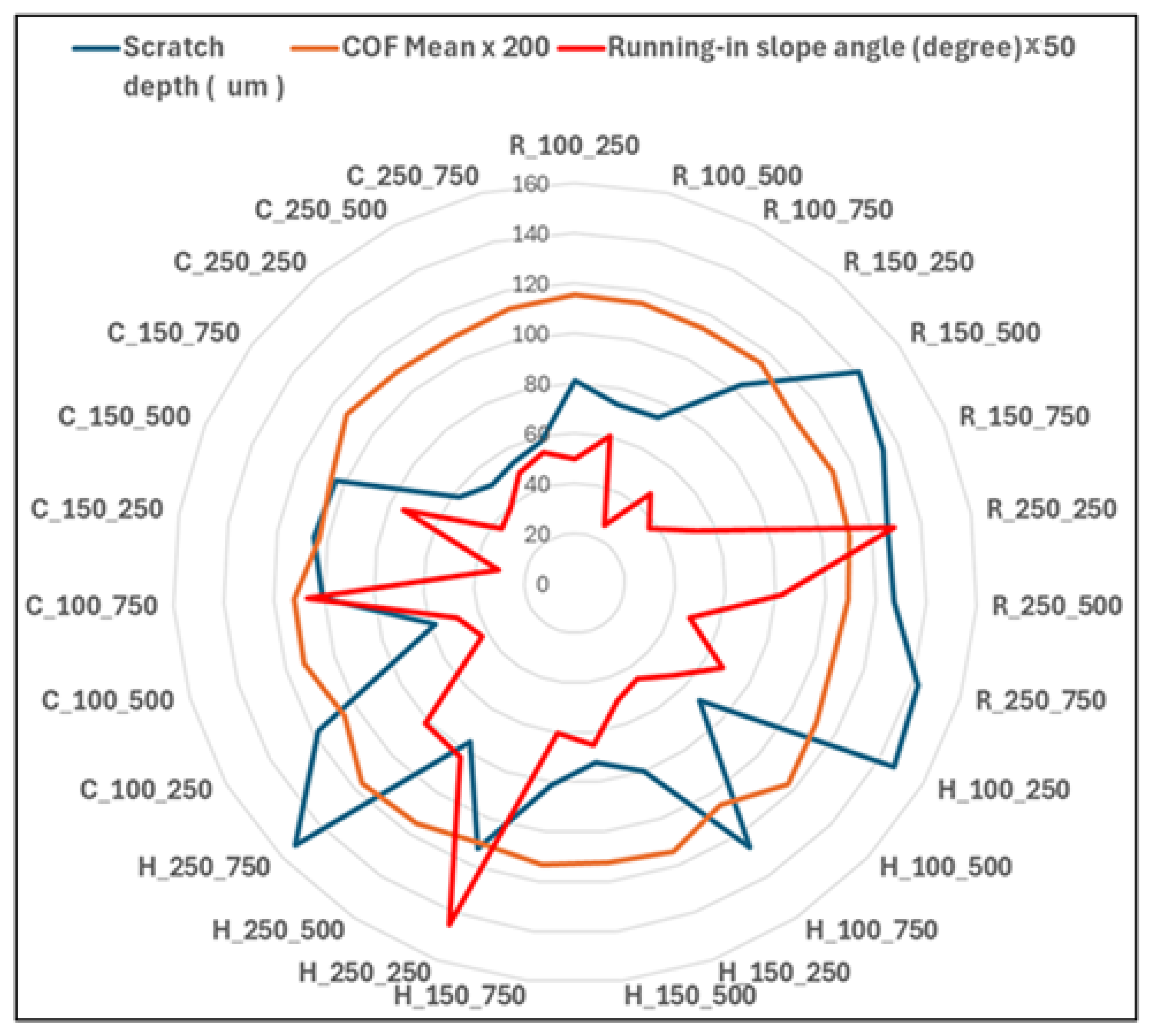
Figure 15 systematically depicts the impact of various combinations of texture geometries (C: Circle, R: Rhombus, H: Hexagon), texture spacing (first number, µm) and laser speeds (second number, mm/s) on the following three important tribological parameters: scratch depth (blue), average coefficient of friction (COF mean ×200, orange) and running-in slope angle (running-in slope angle ×50, red). Observations made on the diagram show that rhombus texture surfaces show considerably large scratch depth, especially for a texture pitch of 150 µm and laser speed of 250 mm/s, whereas values of COF are relatively well balanced. This indicates an increasing nature of wear depth of rhombus patterned structure within an augmenting microcontact area, but does not induce a sensational change within the coefficient of friction. In circle-textured specimens, for the condition 100 µm–250 mm/s and 150 µm–500 mm/s, specimens show low scratch depth, and the run-start angle is also relatively low, for the same combinations. This implies a chance for circle geometry to reduce wear depth and transition friction to an equal degree, and to contact surface areas homogeneously. In hexagonally patterned specimens, scratch depth showed a moderate rise, especially for 250 µm spacing and medium–high laser speeds, but sudden changes within running-in slope values are detected. This tendency implies an influence of a variation within the load-carrying capacity of hexagonally patterned structure, affecting tribological stability within the initial run-start condition.
In conclusion, based on the ANOVA findings and effect graphs obtained, circle geometry is considered more suitable for the surface coating process.
Circle geometry exhibited lower and more balanced values than other geometries in terms of both scratch depth and the average COF and running-in slope angle in the transition zone; this indicates that the circular texture tends to reduce local stress concentrations and aggressive wear formation under the coating by distributing the contact pressure more homogeneously. Furthermore, the radial radar graph (
Figure 15) revealed significantly lower scratch depths and relatively low running-in slopes in circle combinations; this is a practical advantage in terms of coating integrity and early-wear behavior. However, considering that the factorial analysis interactions (particularly texture × texture distance and texture × laser speed) are significant, geometry selection alone is not sufficient; texture distance and laser speed must be optimized together to maximize the effectiveness of circle geometry.
In practice, the engineering recommendation is therefore formulated as a robust operating envelope, rather than a single optimal point. Within circle geometry, the entire SF = 250 / scan-speed 250–750 mm s−1 region constitutes a statistically indistinguishable family on scratch-depth criteria (mean values 22–25 µm with overlapping ±SD bands), defining a speed-insensitive performance plateau. Within this envelope, secondary criteria resolve the preferred operating point: the SF = 250 circle at 500 mm s−1 combination is recommended when balanced transition-zone COF and running-in stability are prioritized, while the SF = 250 circle at 750 mm s−1 combination is preferred when throughput and primer-wettability considerations dominate. Smaller-scale operating points (circle at SF = 100–150) remain viable secondary choices where finer feature pitch is dictated by substrate-area or contact-geometry constraints. The broader design principle, supported by the factorial interaction terms, is that for polygonal geometries, geometry selection must be co-optimized with scale and speed because their scratch-depth response is strongly speed-sensitive, whereas for circular geometry, at the largest scale factor, the response is sufficiently speed-robust that the user retains a useful degree of process freedom in selecting the scan speed.
Finally, in the final design of the process, the proposed settings must be tested with validation runs on the target variable(s) to verify these recommendations.





 ,
,