Article

The Influence of Flow Rate on the Erosion–Corrosion Behavior of 304 Stainless Steel in Sulfur-Containing and Sand-Containing Sodium Aluminate Solutions

1
School of Chemistry and Chemical Engineer, Guizhou University, Guiyang 550025, China
2
College of Materials and Metallurgy, Guizhou University, Guiyang 550025, China
*
Author to whom correspondence should be addressed.
Coatings 2026, 16(4), 474; https://doi.org/10.3390/coatings16040474
Submission received: 4 March 2026 / Revised: 1 April 2026 / Accepted: 9 April 2026 / Published: 15 April 2026
(This article belongs to the Section Corrosion, Wear and Erosion)

Abstract

Regarding the erosion–corrosion problem of 304 stainless steel, which is commonly used in the production of alumina, in high-temperature, high-pressure, and strongly alkaline aluminum ammonium solutions, a detailed study was conducted on the erosion–corrosion behavior and damage mechanism of 304 stainless steel in a sodium aluminate solution with varying S2− concentrations at 65 °C and pH = 14 under the influence of key factors such as erosion speed. This study quantitatively revealed, for the first time, the flow rate threshold effect (critical point at 2 m/s) of 304 stainless steel during scouring corrosion in a strongly alkaline aluminum ammonium solution, identified its peak weight loss rate (1.892 × 10⁻³ g/m2·d), and innovatively elucidated the mechanism reversal phenomenon: below the threshold, passive film destruction and corrosion synergistically dominate, while above the threshold, high oxygen mass transfer promotes film regeneration. These findings provide a critical theoretical basis for precise flow rate control and equipment life prediction in alumina production processes.

1. Introduction

Sulfur content in high-sulfur bauxite significantly impacts Bayer process technology, directly hindering the industrial application of such resources and posing a serious threat to equipment safety and the process economy [1,2]. The damage mechanism during alumina dissolution in the Bayer process involves three core elements: scouring wear from high-speed particle impact, electrochemical corrosion induced by the corrosive media, and the dynamic interaction between the two [3,4,5,6,7].
In recent years, a series of studies by domestic and international scholars has provided important insights into the corrosion behavior of typical equipment steels, such as Q235, 16Mn, 20Cr, and 12Cr1MoV, in multivalent sulfur environments [8,9,10,11,12,13]. However, little research has been conducted to date on the dynamic erosion–corrosion mechanism of flowing sodium aluminate solutions. The results show that an increase in flow velocity can enhance erosion–corrosion through two mechanisms: accelerating the mass transfer and diffusion of the reaction medium and enhancing corrosion kinetics by increasing fluid shear. Xu et al. [14] found that relatively dense rust layers can cause the FAC pattern to transition from ‘flow streaks’ to pitting corrosion. The corrosion rate is little affected by flow velocity in the range of 5–8 m/s because the carbon steel surface rust layer provides some protection. However, if the flow velocity is increased continuously, the corrosion products will be removed more quickly, and the corrosion process will be aggravated. Zhao et al. [15] observed that under low flow rates, the sample surface exhibited discrete circular corrosion pits with well-defined edges. At high flow rates, the density of corrosion pits increased, and their edges became blurred. Rajahram et al. [16] demonstrated that erosion–corrosion interactions are less pronounced and damage progresses more gradually at low flow rates. However, when the flow velocity exceeds the critical threshold, the coupling of fluid kinetic energy and mechanical impact at high flow rates leads to a nonlinear surge in material loss, accelerating corrosion. This critical value is termed the scouring corrosion critical flow velocity (CFV) [3]. The mechanism of the critical phenomenon is generally divided into two categories. The first is that the surface film’s carrying capacity plays a dominant role; that is, the surface film will not be mechanically broken before the flow velocity exceeds the critical value. The second key phenomenon is the competition between the de-passivation process caused by solid particle impact and the electrochemical re-passivation process. Li et al. [3] demonstrated that solid particle kinetic energy not only governs the re-passivation rate but also determines the critical conditions for de-passivation, thereby establishing the pivotal role of de-passivation–re-passivation cycles in the microscopic-level scour–corrosion (CFV) synergistic failure mechanism.
The mechanism of erosion–corrosion damage can be decomposed into the synergistic effects of mechanical action and chemical reaction. The synergistic effect of scouring and corrosion manifests as bidirectional dynamic coupling [17,18,19], involving both the interface regulation of electrochemical processes by fluid mechanics and the feedback mechanism of material degradation sensitivity to mechanical scouring. Zheng et al. [3] demonstrated that under supercritical flow conditions, the synergistic effect of enhanced fluid shear stress and particle impact accelerates the peeling of the passivation film. For carbon steel without passivation film protection, electrochemical corrosion-induced surface softening significantly increases its susceptibility to mechanical erosion [20]. Zeng et al. [21] found that electrochemical corrosion plays a dominant role in the synergistic process of total erosion–corrosion loss in carbon steel. Luo et al. demonstrated that the anodic polarization accelerates the active dissolution, causing significant damage to carbon steel at low flow rates. In contrast, cathodic protection suppresses the corrosion component and maintains high erosion resistance even at high flow rates [3,22].
In this paper, 304 stainless steel is selected as the research object. The flow velocity of 304 stainless steel in a sodium aluminate solution containing S2− and sand particles is investigated by constructing an alumina production environment simulation system, using a self-made rotating scouring experiment device, and combining electrochemical testing with modern analysis and detection technologies.

2. Materials and Methods

2.1. Specimens and Experimental Solutions

The chemical composition of 304 stainless steel selected for this experiment is shown in Table 1.
The 304 stainless steel was processed into 12 mm × 10 mm × 2 mm cubes using wire cutting equipment. These cut specimens were fabricated into electrochemical working electrodes, with one end as the working surface and the other end soldered with a copper wire of appropriate length. All surfaces except the working surface were coated with epoxy resin. The specimens were then successively ground using 180~1500# grade waterproof sandpaper, rinsed with distilled water, wiped with alcohol, air-dried, and stored in a desiccator for subsequent use.
In the experiment, a sulfur-containing sodium aluminate solution was used as the corrosion medium, with solution parameters set at a sodium alkali concentration of 255 g/L and an Al2O3 concentration of 130 g/L. The specific preparation method was identical to that described in the literature. Sulfide ions are derived from sodium sulfide heptahydrate, with S2− concentration of 3 g/L. Fresh solutions must be prepared prior to each experiment [9].

2.2. Two-Phase Solid–Liquid Flow

The two-phase solid–liquid flow used in the study consisted of a sulfur-containing sodium aluminate solution and quartz sand. Flow velocity varied across experimental groups. There were three experimental groups: pure erosion (E0), flow corrosion (C0), and erosion–corrosion (E-C). Pure erosion tests were conducted using a two-phase flow of sodium aluminate solution and 3 wt% quartz sand. The fluid used in flow corrosion tests was a sulfur-containing sodium aluminate solution without quartz sand. Erosion–corrosion tests were conducted using a two-phase solid–liquid flow of sulfur-containing sodium aluminate solution with 3 wt% quartz sand. The flow characteristics of the slurry are turbulent. The duration for all three tests was 72 h.

2.3. Corrosion Weight Loss

The pretreatment process for weight loss specimens is divided into three stages: (1) Initial parameter determination: Use a vernier caliper (model: JS20-GTG; manufacturer: SYNTEK; resolution: 0.01 mm) to accurately measure and record the length, width, and height of the corrosion weight loss sample and calculate its effective contact area. Place the specimen in a constant temperature drying oven until constant weight is achieved, then use a high-precision balance (0.1 mg accuracy) to record the initial mass. Each sample is measured three times, and the average value is taken. (2) Corrosion product removal: After the experiment, immerse the specimen in a dedicated cleaning solution (500 mL deionized water +500 mL hydrochloric acid +10 g hexamethylenetetramine, conforming to GB/T16545-2025 standard [23]) for ultrasonic cleaning to thoroughly remove surface corrosion products. After cleaning, subject it to drying and constant weight treatment again. Each sample is also measured three times, and the average value is used to obtain post-treatment mass data. (3) Corrosion rate calculation: Based on the relationship between mass change and exposure time, calculate according to Formula (1).
V = W 1 W 0 S T
where V is the weight loss corrosion rate of the material in g/(cm2·d). W1 is the initial mass of the specimen (g). W0 is the mass of the specimen after cleaning (g). S is the effective contact area (cm2). And T is the exposure duration (d).

2.4. Experimental Apparatus and Electrochemical Methods

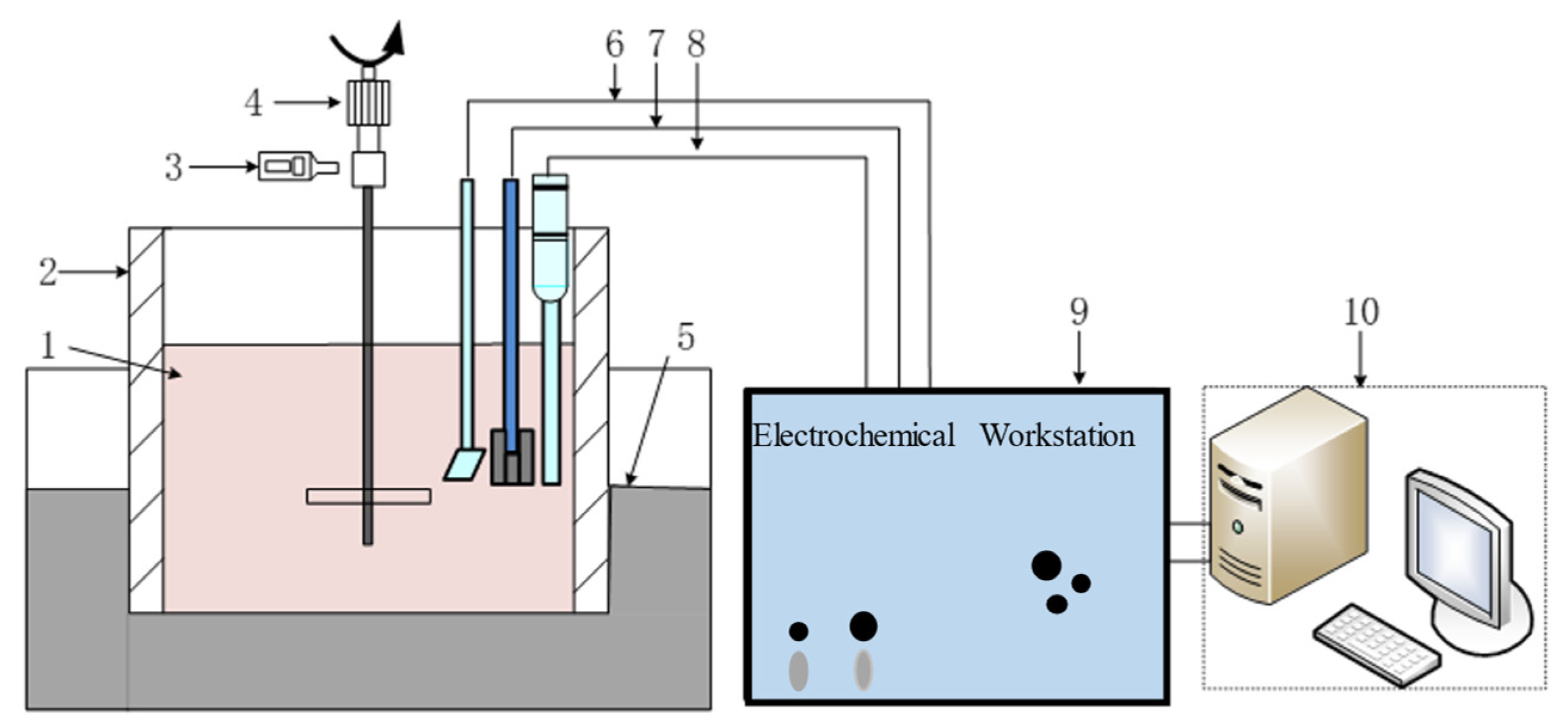
The performance tests of the 304 stainless steel specimens were conducted using a rotary stirring erosion–corrosion experimental system, as shown in Figure 1. This experimental system consists of two main components: a stirred flow cell for two-phase liquid–solid flow and an electrochemical analysis setup. First, a motor drives the stirring impeller to rotate the corrosive wear medium fluid at a certain velocity, thereby achieving erosion–corrosion on the specimen surface at a specific flow velocity. The rotational speeds were 120, 240, 360, 480, and 600 rpm, corresponding to linear velocities of 0.5, 1.0, 1.5, 2.0, and 2.5 m/s, respectively. The conversion formula is as in Equation (2).
μ = π × D × n 60
where μ denotes the flow velocity (m/s), D represents the inner wall diameter of the container (D = 0.08 m), n indicates the motor rotational speed (rpm), π is the mathematical constant, and 60 is the time conversion factor.
The specimens were vertically fixed on the inner wall of the cell, and three parallel specimens were set for each working condition. After being eroded for 3 days under each condition, the specimens were removed, the residual solution on the surface was rinsed off, and they were dried while preserving the surface condition for microscopic observation, electrochemical testing, and corrosion product analysis. The impact angle was 90°. Subsequently, a three-electrode system was assembled inside the flow cell, in which the 304 stainless steel specimen served as the working electrode (WE) vertically fixed on the inner wall. A saturated calomel electrode was used as the reference electrode (RE), and a platinum sheet electrode served as the counter electrode (CE). The electrolyte was a sand-containing sodium aluminate solution (pH = 14, temperature controlled at 65 ± 1 °C). The polarization curve scan range was set from −1.5 V to 0.5 V at a scan rate of 1 mV/s; the impedance spectrum test frequency ranged from 10 mHz to 100 kHz with a perturbation potential of 5 mV. All specimens were sealed with epoxy resin before testing to insulate the non-working surfaces. The corrosion rate was calculated using Equation (3).
V = A × I c o r r n × F × ρ × 87600
where A is the atomic mass, Icorr is the corrosion current density (A/cm2), n represents the number of electrons transferred in the electrochemical reaction (n = 2), F is Faraday constant (1 F = 26.8 A·h), and ρ is the metal density (7.85 g/cm3).

2.5. Characterization Methods

A three-dimensional confocal laser scanning microscope (CLSM, VK-X150, KEYENCE, Osaka, Japan) and a scanning electron microscope (SEM, Sigma 360, ZEISS, Germany) were used to characterize the surface morphology of the samples. X-ray photoelectron spectroscopy (XPS, ESCALAB 250Xi. Thermo Fisher Scientific, Americas, USA) was used for depth profiling, employing monochromatic AlKα radiation (1486.6 eV) as the excitation source, with a pass energy of 30 eV and a step size of 0.1 eV for fine scanning of characteristic binding energy regions.

3. Results

3.1. Effect of Flow Velocity on Weight Loss Rate

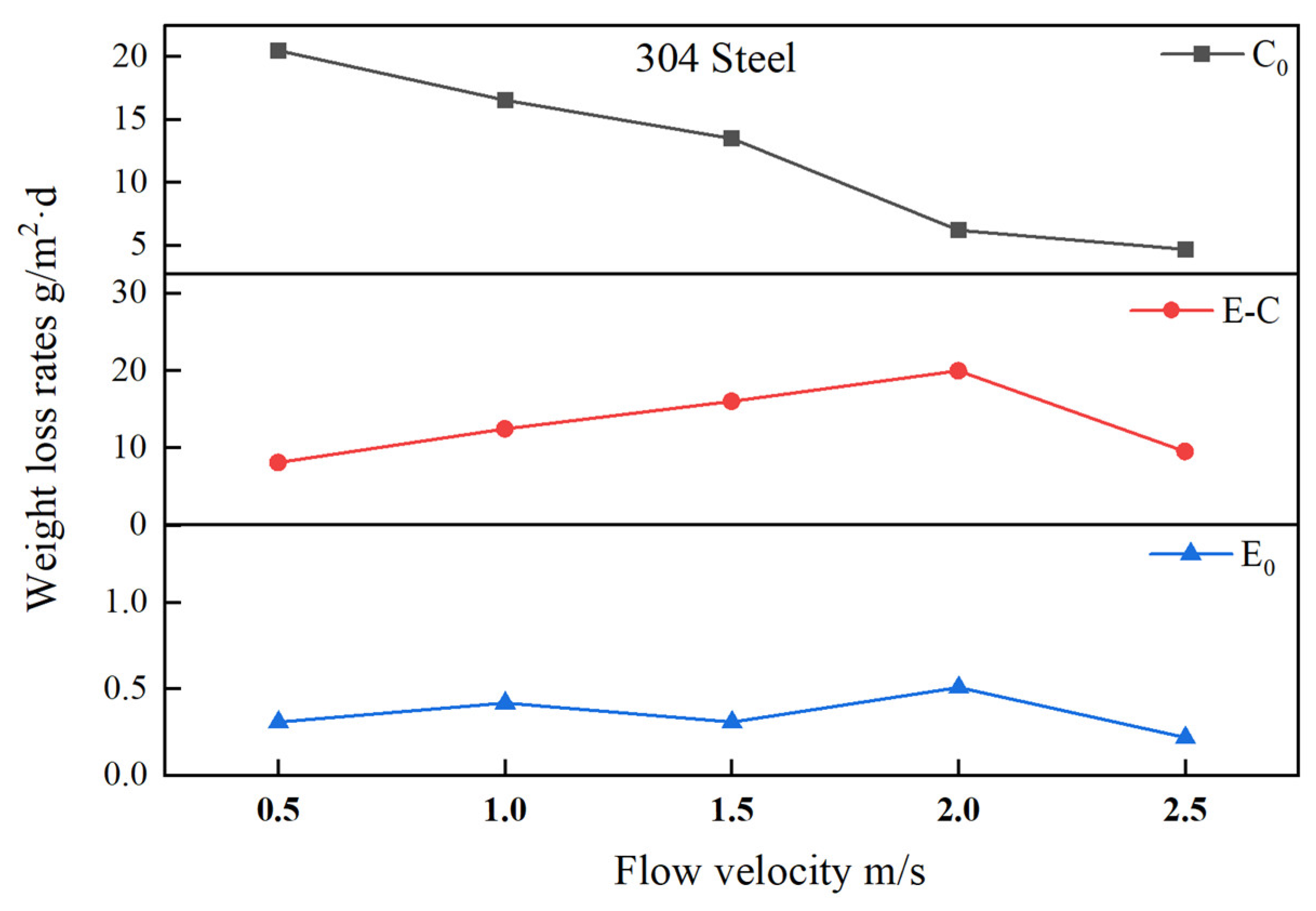
Figure 2 shows the weight loss corrosion rate curves for 304 stainless steel after 3 days under flow corrosion (C0), erosion–corrosion (E-C), and pure erosion (E0) conditions at different flow velocities. Under flow corrosion conditions, the weight loss rate of 304 stainless steel decreases with increasing solution flow velocity. At a flow velocity of 0.5 m/s, the weight loss rate reaches a maximum of 2.093 × 10⁻³ g/(cm2·d). As the flow velocity increases from 0.5 m/s to 2.5 m/s, the weight loss rate gradually decreases, indicating that flow corrosion is inhibited. Under erosion–corrosion conditions, the weight loss rate of 304 stainless steel shows an initial increase followed by a decrease with increasing flow velocity. At a critical flow velocity of 2 m/s, in the low-flow velocity range (0.5–1.5 m/s), increasing flow velocity promotes the diffusion of corrosive ions. It enhances damage to the oxide film, leading to an accelerated weight loss rate. At 2 m/s, the average weight loss rate reaches a maximum of 1.892 × 10⁻³ g/(cm2·d). At 2.5 m/s, under high flow velocity, the increased dissolved oxygen concentration promotes the formation of a denser, more stable oxide film. The shear stress is insufficient to damage the passive film, blocking the contact between the substrate and the corrosive medium, causing the erosion–corrosion rate to decrease and the synergistic effect to weaken; on the other hand, under high flow velocity conditions, the contact time between corrosive ions and the substrate is short, making it difficult to form corrosion products, and corrosion products cannot adhere well to the metal surface to further corrode the substrate, both contributing to the weakening of the weight loss rate. In contrast, the weight loss rate under pure erosion conditions shows no significant change, indicating that flow velocity has a minor effect on pure erosion [14].

3.2. Effect of Flow Velocity on Polarization Curves

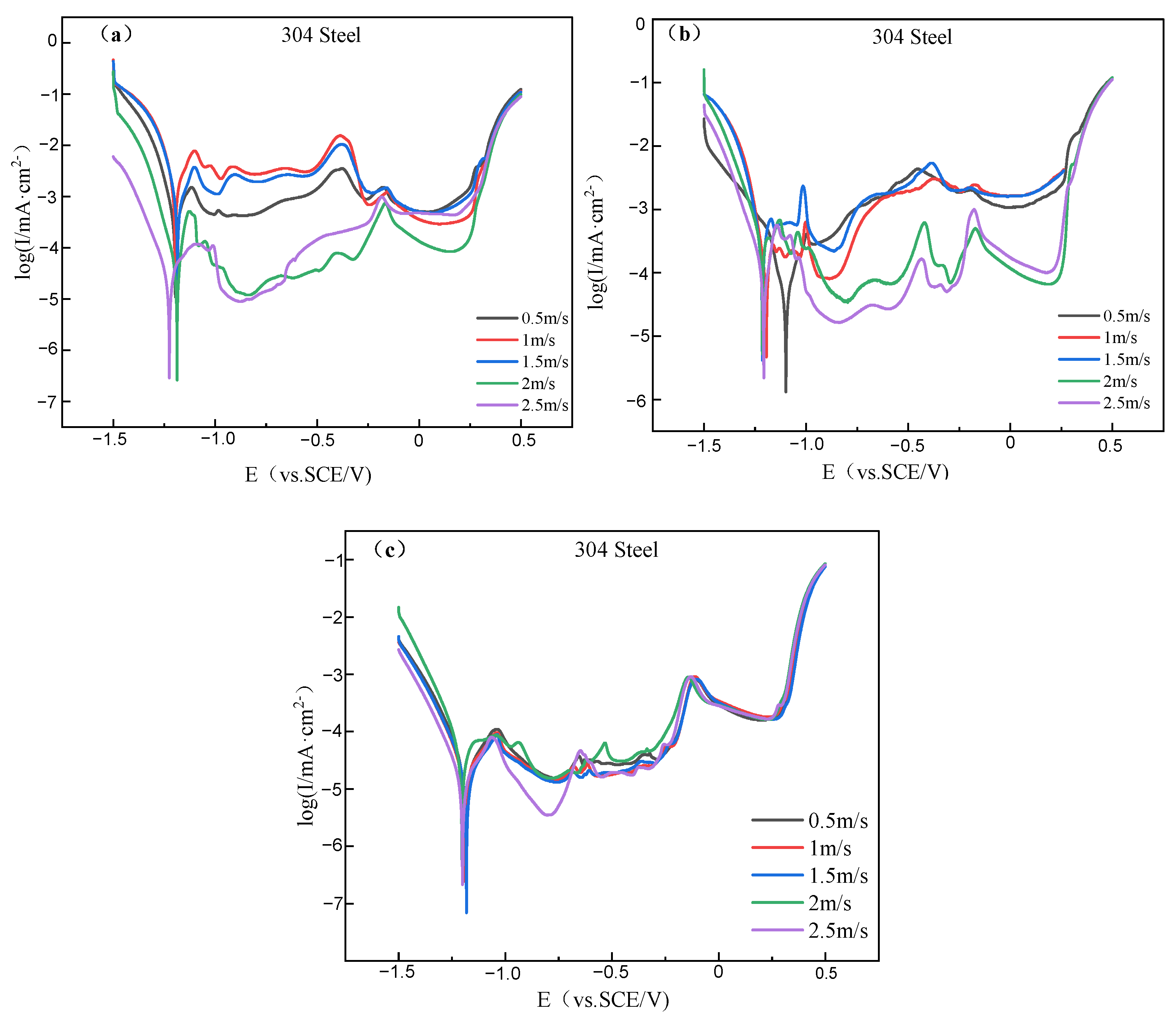
The corrosion rates of 304 stainless steel specimens during flow corrosion, erosion–corrosion, and pure erosion were determined from Tafel-fitted potentiodynamic polarization curves. The potentiodynamic polarization curves under different flow velocities for flow corrosion, erosion–corrosion, and pure erosion conditions are shown in Figure 3a–c, respectively, with Tafel fitting results presented in Table 2. As shown in Figure 3, the shapes and trends of the polarization curves are similar under the influence of the three systems, and all exhibit both passivation and over-passivation processes. The anodic polarization curves for both flow corrosion and erosion–corrosion show multiple activation peaks [13], corresponding to the dynamic process of repeated rupture and repair of the passive film.
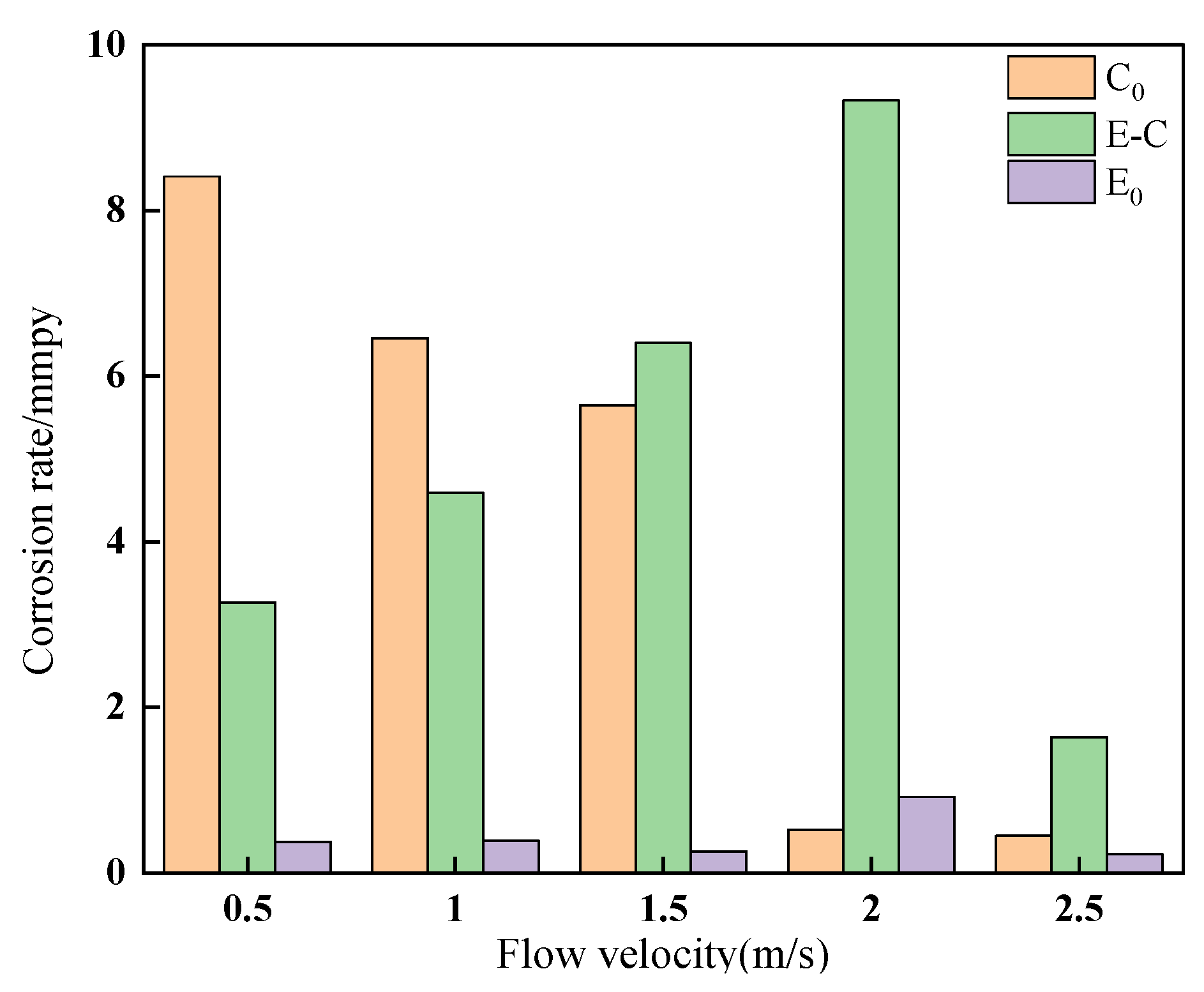
Figure 4 shows the variation in corrosion rates for 304 stainless steels under flow corrosion, erosion–corrosion, and pure erosion conditions at different flow velocities, as shown in Table 2 and Figure 4. Under flow corrosion conditions, the flow corrosion current density decreases with increasing flow velocity. At a flow velocity of 0.5 m/s, the flow corrosion current density reaches a maximum of 737.71 μA·cm−2, corresponding to the fastest corrosion rate. This may stem from the difficulty in effectively forming a protective corrosion product film under low flow velocity conditions. Reference [6] also points out that such corrosion product films usually possess certain protective properties. When the flow velocity increases to 1.0–1.5 m/s, the corrosion current density significantly decreases to 562.71 μA·cm−2, indicating a decrease in corrosion rate. Within the higher flow velocity range (2.0–2.5 m/s), the current density also decreases gradually. Combining the electrochemical test results, it is evident that higher flow velocities promote oxygen dissolution and mass transfer, thereby accelerating the formation of a protective oxide film and gradually reducing the corrosion rate. Under erosion–corrosion conditions, as the flow velocity increases, the erosion–corrosion current density gradually increases and then decreases. When the fluid flow velocity is 2 m/s, the erosion–corrosion current density reaches a maximum of 813.35 μA·cm−2. Higher erosion velocity means greater kinetic energy carried by the sand particles, leading to more severe damage to the passive film. As fluid motion accelerates, the migration efficiency of S2− in the sodium aluminate solution increases, leading to a higher probability of the protective layer on the metal surface being penetrated. This accelerating effect damages the structural integrity of the oxide layer on the stainless steel’s surface, continuously weakening its protective capability. When S2− and sand particles continuously breach the passive film, the metal substrate will face more intense chemical corrosion, and the degree of material loss will increase accordingly. However, when the fluid flow velocity increases to 2.5 m/s, the film-forming rate on the substrate exceeds the impact damage caused by sand particles, leading to a reduction in the corrosion rate. Under pure erosion conditions, the overall trend of the pure erosion–corrosion rate shows no significant change with increasing flow velocity.

3.3. Effect of Flow Velocity on Electrochemical Impedance Spectra

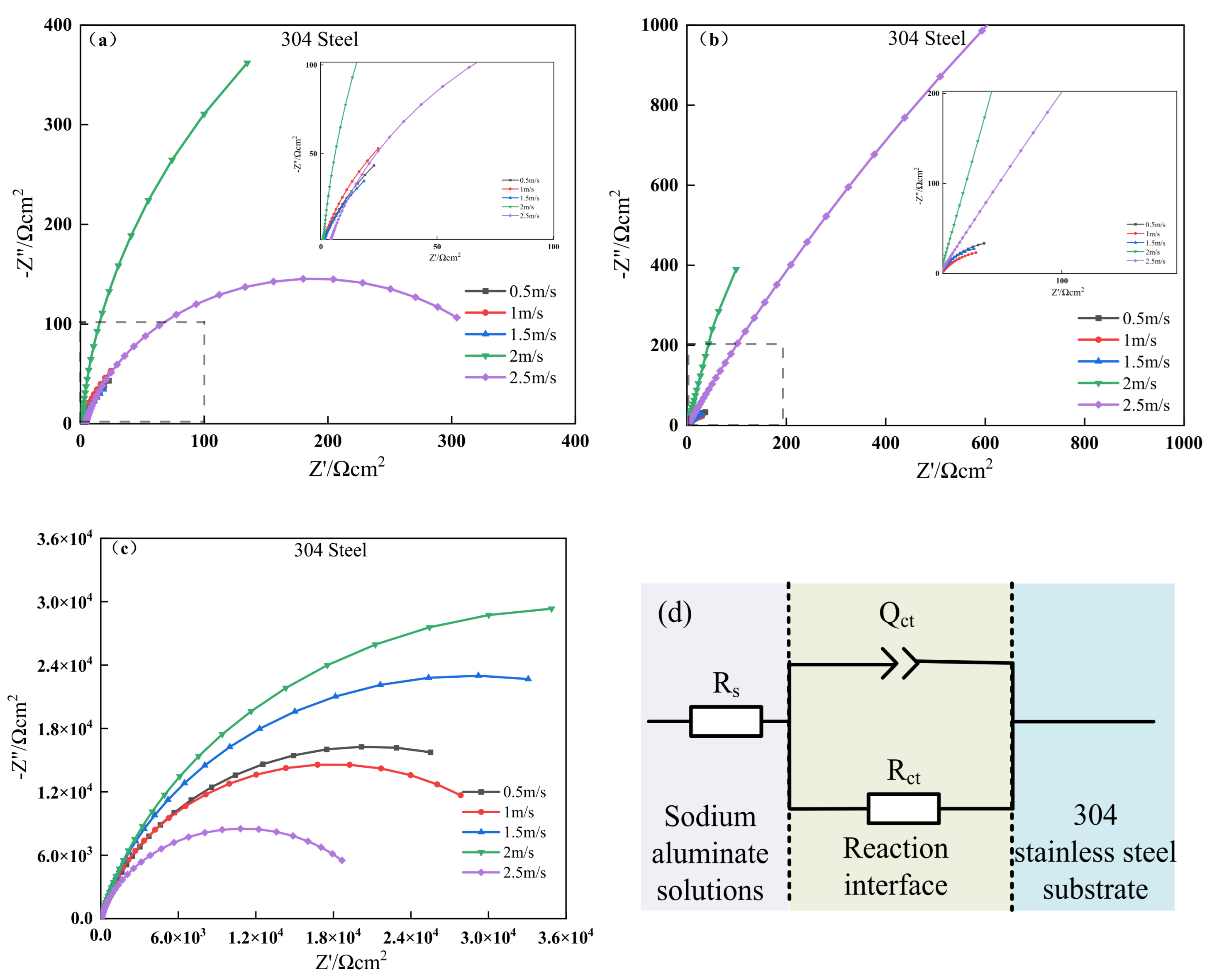
Figure 5 shows Nyquist plots of 304 stainless steel after 3 days of corrosion in the sodium aluminate solution at different flow velocities. For the Nyquist plot of flow corrosion (Figure 5a), the radius of the capacitive arc decreases with increasing flow velocity. For the Nyquist plot of erosion–corrosion (Figure 5b), the radius of the capacitive arc first decreases and then increases with increasing flow velocity. From the Nyquist plot of pure erosion (Figure 5c), it is obvious that the capacitive arc radius is larger, which indicates the strong corrosion resistance of 304 stainless steel under this condition. In dynamic, sand-containing, corrosive environments, fluid motion characteristics significantly alter the material’s erosion process. Solution flow not only enhances oxygen transport efficiency and charge transfer effectiveness but also accelerates the cathodic and anodic processes of electrochemical reactions, thereby exacerbating substrate damage. In this process, hydrodynamic forces maintain the protective layer on the metal surface in a dynamic equilibrium state: continuous dissolution in the anodic region alternates with passive layer regeneration, potentially forming a stable, dense structural layer. However, the mechanical wear effect of sand particles disrupts this balance. Hard particles carried by the flowing medium continuously strip the loosely formed oxide layer on the surface, preventing the protective layer from maintaining an adequate thickness. This continuous cycle of stripping and regeneration ultimately allows only a monolayer protective structure to be retained on the material surface [24,25,26].
With reference to the abovementioned analysis of erosion–corrosion conditions under sulfur-containing conditions, the equivalent circuit diagram shown in Figure 5d was selected. The fitting results are shown in Table 3. From the fitting results, it can be seen that the charge transfer resistance Rct of the film layer is positively correlated with flow velocity. When the solution flow velocity increases, the accelerated medium flow effectively enhances oxygen transport efficiency, promoting the formation of a denser, more stable protective layer. For erosion–corrosion, the charge transfer resistance Rct of the film layer first decreases and then increases with increasing flow velocity, reaching a minimum at 2 m/s, where corrosion is most severe. As the flow velocity increases, the significantly enhanced fluid mobility leads to a marked increase in the collision frequency between the specimen surface and sand particles. This dynamic change intensifies the mechanical erosion of sand particles at the material surface.
Based on the analysis of the data in Table 2 and Table 3, along with comparisons with the literature, the following conclusions can be drawn: Flow velocity exhibits a significant threshold effect on the erosion–corrosion behavior of 304 stainless steel, with a critical flow velocity of 2 m/s. Below this value, the corrosion rate increases with increasing flow velocity; above this value, the corrosion rate decreases due to the dominance of passive film regeneration. The polarization curve and EIS results are in good agreement, confirming that the erosion–corrosion synergistic effect is maximized at the critical flow velocity.

3.4. Effect of Flow Velocity on Surface Corrosion Morphology

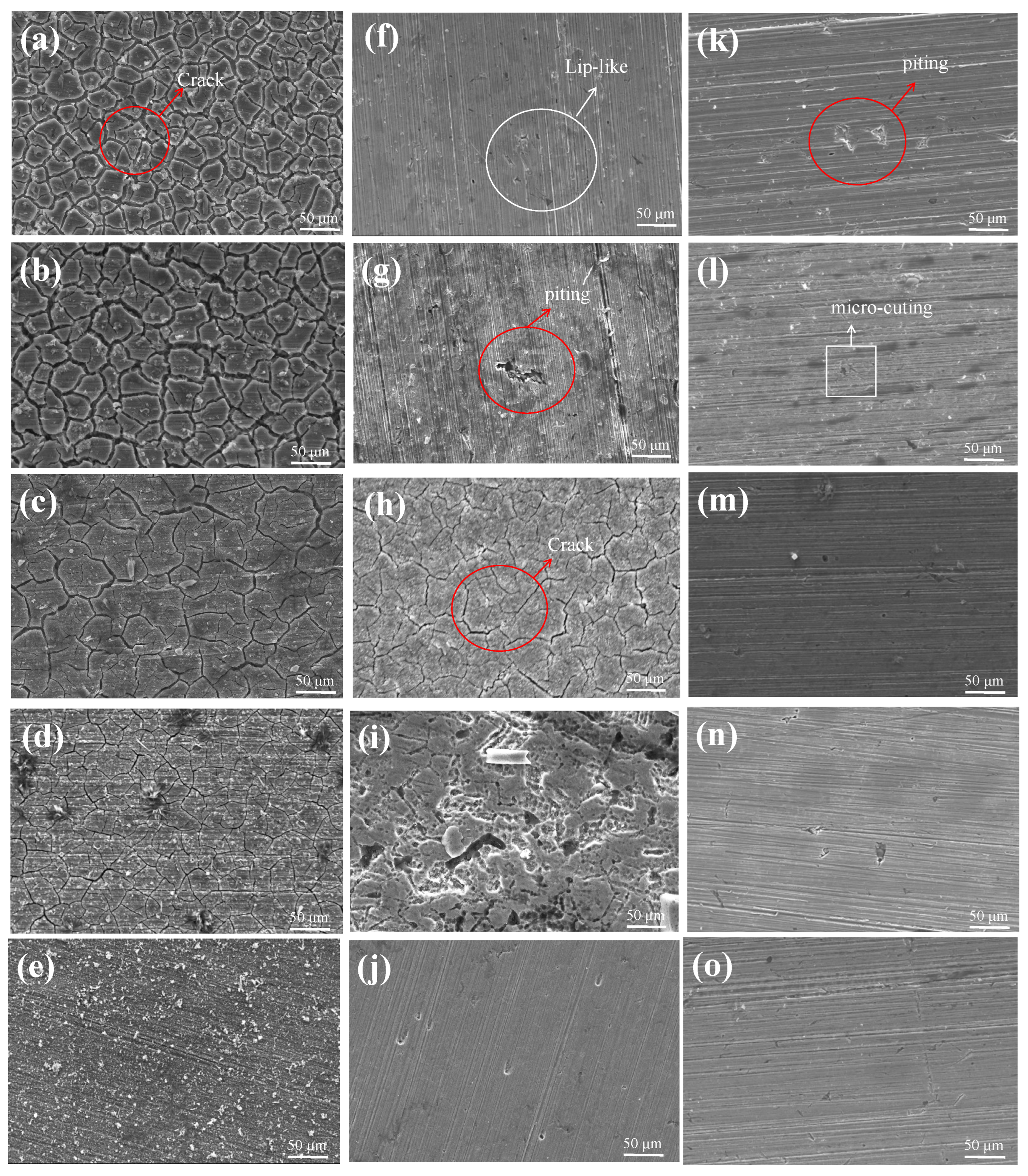
The surface corrosion morphology of 304 stainless steel after 3 days of flow corrosion in sulfur-containing sodium aluminate solution at flow velocities of 0.5–2.5 m/s is shown in Figure 6a–e. When the flow velocity is 0.5–1 m/s, stainless steel shows relatively high sensitivity to sulfide stress corrosion cracking during the corrosion process, making cracks prone to appearing in the corrosion layer. Due to the presence of cracks, the structure of the surface corrosion products becomes loose and unstable, easily detaching from the substrate surface; as the flow velocity increases from 1.5 m/s to 2.5 m/s, the cracks gradually become smaller until they disappear and are no longer visible. The results indicate that flow velocity has a relatively obvious influence on the corrosion product morphology of 304 stainless steel, and its surface morphology images are consistent with the polarization curve and weight loss test results.
The surface corrosion morphology of 304 stainless steel after 3 days of erosion–corrosion in a sand- and sulfur-containing sodium aluminate solution at flow velocities of 0.5–2.5 m/s is shown in Figure 6f–j. At the lowest flow velocity of 0.5 m/s, the material surface shows fine corrosion traces accompanied by lip-shaped grooves, indicating that the erosion–corrosion effect is relatively weak at low flow velocities; at 1–2 m/s, corrosion pits appear on the material surface. The depth and number of corrosion pits increase with increasing flow velocity; at 2 m/s, the material surface shows a more severe corrosion morphology, with pits becoming denser and deeper. The corrosion rate also reached its maximum, and numerous small corrosion pits appeared on the stainless steel surface. At 2.5 m/s, the surface becomes smooth, with a few corrosion pits.
The surface corrosion morphology of 304 stainless steel after 3 days of pure erosion in sand-containing sodium aluminate solution at flow velocities of 0.5–2.5 m/s is shown in Figure 6k–o. At a flow velocity of 0.5 m/s, corrosion pits form on the surface of the material. In a strongly alkaline environment, the material surface can also be corroded by OH; at flow velocities of 1–2.5 m/s, the surface gradually becomes smooth, showing only fine corrosion traces and micro-cutting marks from sand particles. This indicates that, with increasing flow velocity, the increased dissolved oxygen accelerates the formation of the oxide film, thereby retarding corrosion.
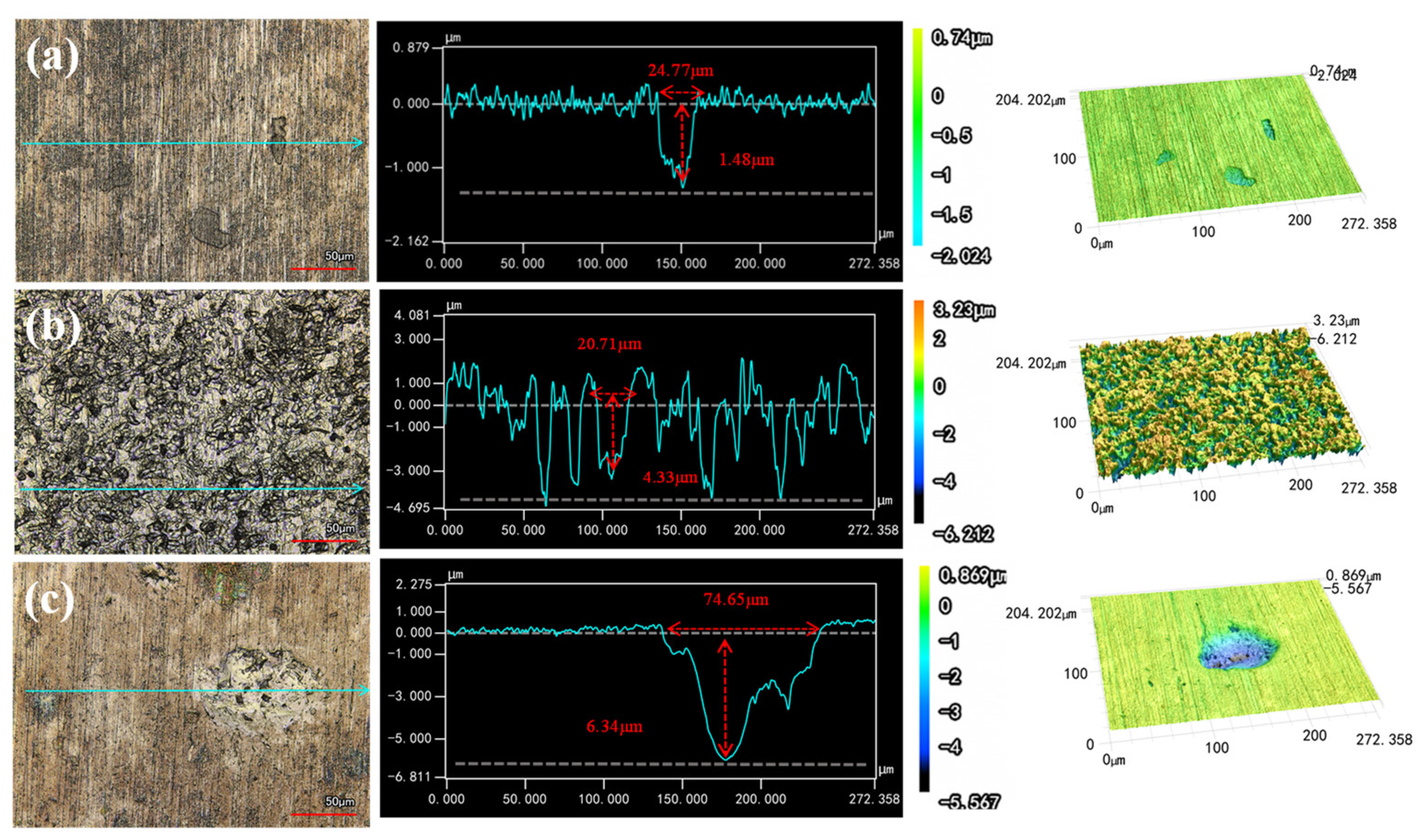
To further explore the influence of flow velocity on the erosion–corrosion behavior of the specimens, confocal microscopy was used to observe the 3D morphology and surface single-line profile curves of the steel surface after erosion–corrosion. Figure 7 shows 3D surface morphology images of 304 steel after 3 days of erosion–corrosion in sand- and sulfur-containing sodium aluminate solution at flow velocities of 0.5 m/s (a), 2 m/s (b), and 2.5 m/s (c). From the figures, it is clear that as the flow velocity increases, the corrosion pits on the surfaces of the 304 stainless steel specimens become denser and deeper. When the flow velocity reaches 2 m/s, the specimen surface is severely corroded and significantly damaged. Erosion–corrosion leads to increased depth and the number of corrosion pits, and many pits connect. Initially unconnected pits gradually become connected. Li et al. [27] also observed similar phenomena in their experiments. At 2.5 m/s, compared to the previous two flow velocities, the specimen surface appears relatively smooth, with fewer corrosion pits but wider pits.
Based on the analysis of the SEM morphology evolution in Figure 6 and the quantitative CLSM characterization in Figure 7, the following conclusions can be drawn: The critical flow velocity is 2 m/s. Below this value, damage is characterized by pit initiation and slow propagation; at the critical velocity, pit interconnection, large-scale spallation, and a peak in surface roughness occur; above the critical velocity, damage is significantly reduced due to rapid regeneration of a dense passive film. The variation in Ra values measured by CLSM is fully consistent with the weight loss rates (Figure 1) and the corrosion current densities obtained from polarization curve fitting (Table 2), confirming the reliability of CLSM as a quantitative tool for evaluating erosion–corrosion damage. Regarding the protective mechanism at a high flow velocity: at 2.5 m/s, the pit density decreases, and the specimen surface becomes smooth, directly demonstrating the triple protective effect of the high flow velocity, i.e., promoting passive film regeneration, removing loose corrosion products by fluid shear stress, and blocking corrosive media by the dense film.

3.5. Analysis of Surface Corrosion Product Composition

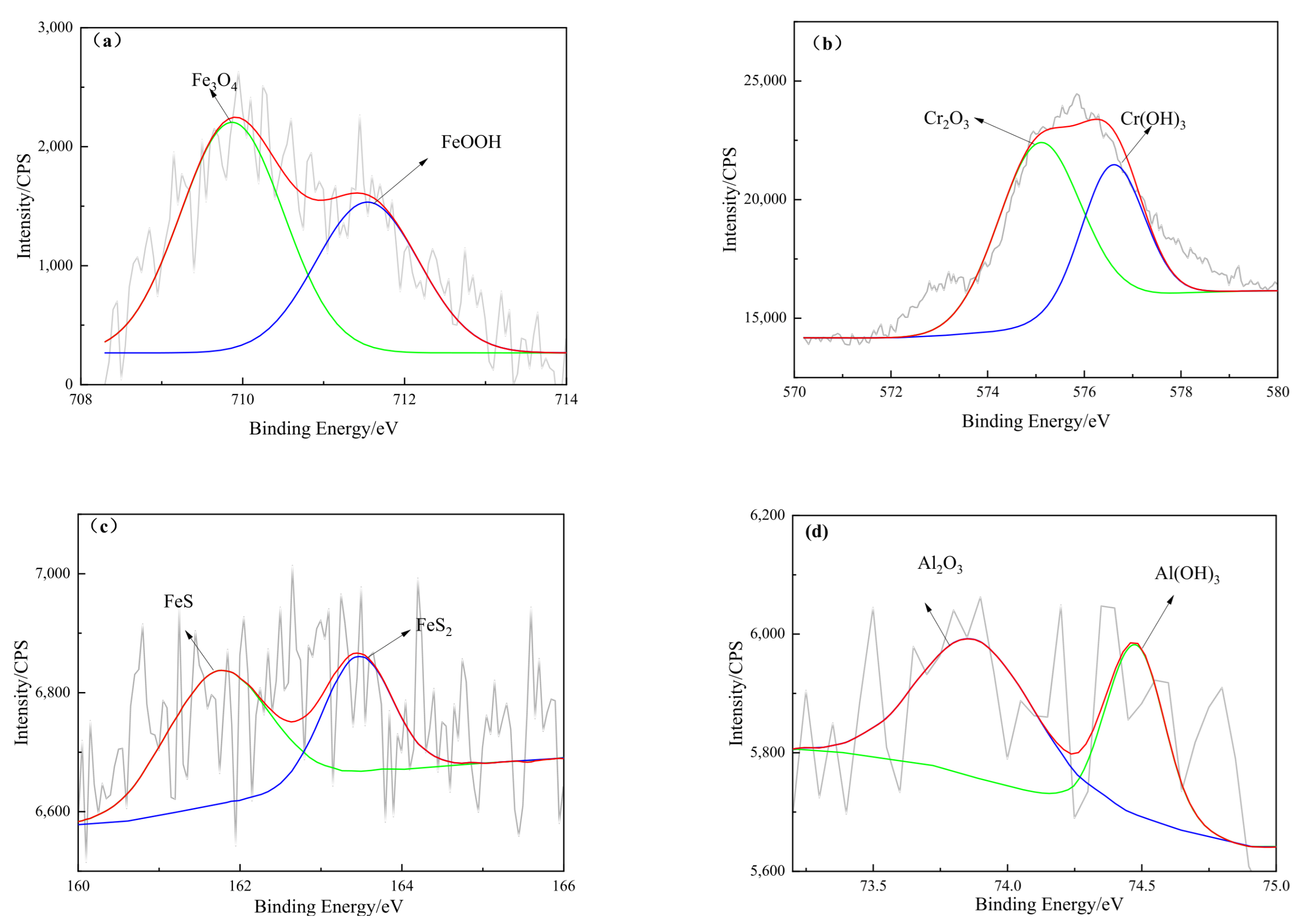
Figure 8a–d show the XPS spectra of Fe2p, Cr2p, S2p, and Al2p, respectively, for 304 stainless steel after 3 days of erosion–corrosion in a sodium aluminate solution containing S2− ions at a concentration of 3 g/L and a flow velocity of 1.5 m/s.
The Fe2p spectrum exhibits two distinct component peaks corresponding to Fe3O4 (709.3 ± 0.3 eV) and FeOOH (711.9 ± 0.3 eV) [28,29,30], indicating that iron elements on stainless steel surfaces exist in oxidized states, forming an iron oxide corrosion product layer. The Cr2p band exhibits two peaks at 575.7 ± 0.3 eV and 577.3 ± 0.3 eV [31,32], corresponding to the corrosion products Cr2O3 and Cr(OH)3. S2p exhibits two peaks at 161.84 eV ± 0.3 eV and 163.1 eV ± 0.3 eV, corresponding to FeS and FeS2, respectively. The binding energies of 74.2 eV and 73.6 eV correspond to the chemical states of Al2O3 and Al(OH)3, respectively, indicating that AlO2 ions in sodium aluminate solution participate in the reaction and form a mixed layer of aluminum oxide/hydroxide on the surface. The layer may cover the Fe/Cr oxide film, further inhibiting the penetration of corrosive media.

4. Discussion on Erosion–Corrosion Mechanism

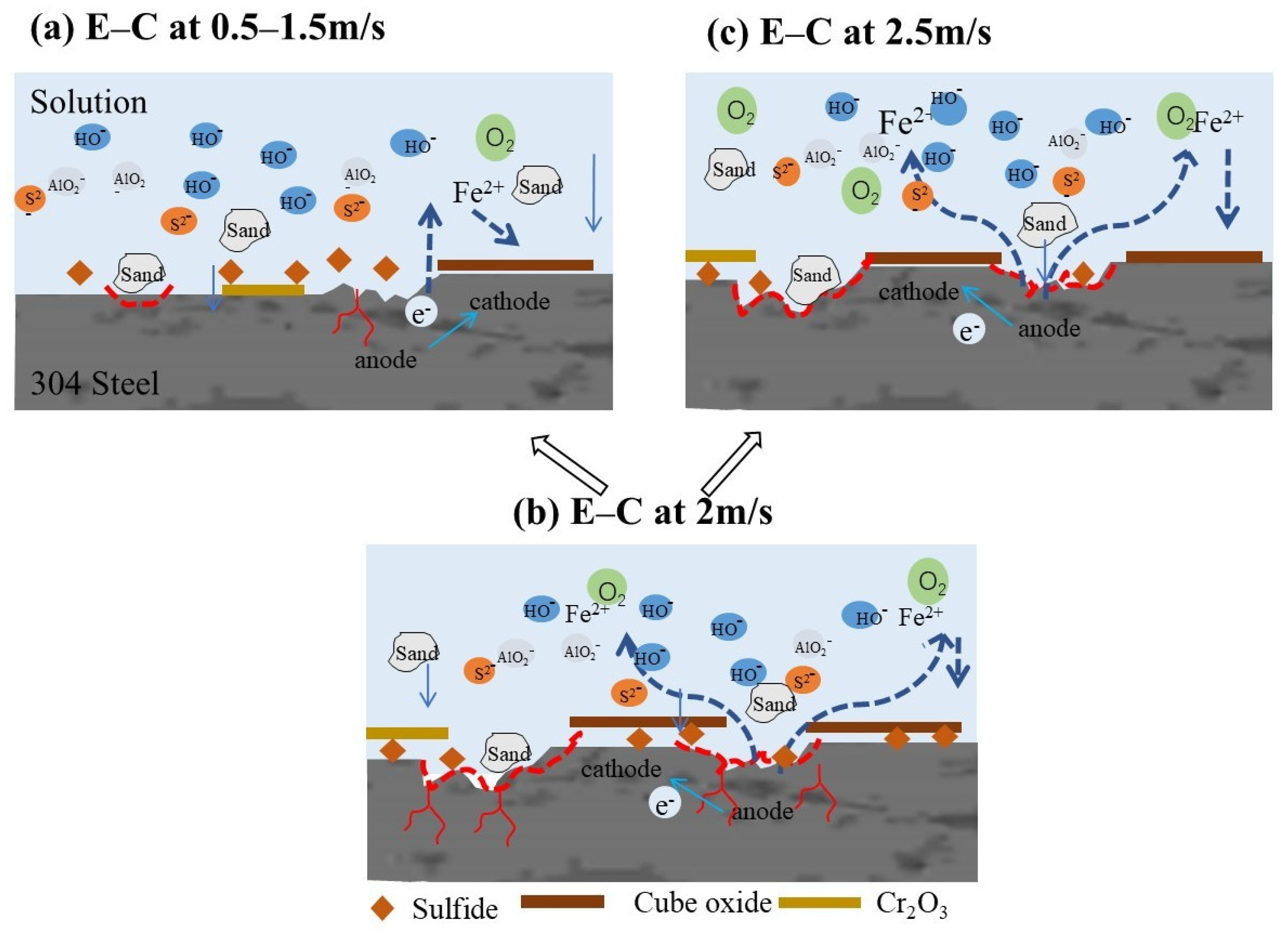
Based on the above results from weight loss curves, SEM, CLSM, and electrochemical analysis, an erosion–corrosion mechanism for 304 stainless steels in sodium aluminate solution at different flow velocities is proposed:
(1)
Low flow velocity stage (0.5–1.5 m/s): Sand particle impact and passive film destruction dominate.
Local destruction of the passive film: At low flow velocities, sand particle kinetic energy is low but can still form microcracks or local spallation on the surface through impact (Figure 6f–h), exposing the fresh metal substrate. At this point, S2− preferentially occupies active sites through adsorption, inhibiting the repair of the passive film (Cr2O3/Fe3O4). Increased flow velocity accelerates the diffusion of S2− and O2 to the surface, promoting Fe oxidation (generating FeOOH) and FeS formation. However, due to the low frequency of sand particle impact, the corrosion product film can still partially cover the surface, resulting in a slow increase in corrosion rate.
(2)
Critical flow velocity stage (2 m/s): Maximization of erosion–corrosion synergistic effect.
Imbalance in dynamic destruction–repassivation of passive film: Sand particle kinetic energy reaches a critical value (critical flow velocity), and the impact frequency and energy significantly increase, causing the passive film rupture rate to exceed the repassivation rate. Intensified active dissolution: The exposed substrate reacts with S2− to form FeS. The product is loose and easily eroded (Figure 6f–j), continuously exposing fresh surface. The corrosion current density reaches a peak (813.35 μA/cm2). Turbulence promotes local corrosion: High flow velocity induces turbulence, accelerating the enrichment of S2− at local defects, forming pitting nuclei and promoting their expansion (deep pits in Figure 6b).
(3)
High flow velocity stage (2.5 m/s): Passive film regeneration and fluid protective effect.
As the flow velocity further increases (>2 m/s), the following reactions are promoted: Fluid shear stress inhibits corrosion product accumulation: High shear stress removes loose corrosion products from the surface, leaving only a dense passive film that blocks contact between S2− and the substrate, leading to a decrease in corrosion rate. Sand particle kinetic energy reaches the threshold for destroying the passive film at the critical flow velocity (2 m/s), causing the synergistic corrosion rate to reach a maximum; beyond the threshold, although kinetic energy increases, the anti-spallation ability of the dense film improves, and corrosion shifts to being dominated by passivation protection [33]. Flow velocity exhibits a dual-effect mechanism on the corrosion behavior of metallic materials: On one hand, increased fluid velocity enhances shear stress and normal stress on the metal surface, causing plastic deformation and damaging its protective oxide film (passive film), thereby accelerating the corrosion process. On the other hand, increased flow velocity also enhances the mass transfer of corrosive media to the material surface, promoting the repair and regeneration of the oxide film, thereby inhibiting anodic dissolution reactions [34].
A schematic diagram of the specific erosion–corrosion reaction process mechanism is shown in Figure 9.

5. Conclusions

This paper investigates the erosion–corrosion behavior and mechanisms of 304 stainless steel in sodium aluminate solutions with varying sulfur content, flow velocities, and sand content. The findings are as follows:
(1)
In flow-induced corrosion, high flow velocity suppresses overall corrosion by promoting the formation of a passive film, but local turbulence increases the risk of pitting. The corrosion rate gradually decreases with increasing flow velocity.
(2)
In erosion–corrosion, the critical flow velocity is 2 m/s. Sand particle impact damages the passive film, and S2− accelerates localized corrosion.
At low flow rates (0.5–1.5 m/s), the diffusion of corrosive ions intensifies the damage to the oxide film, resulting in accelerated weight loss rates. At a velocity of 2 m/s, the average weight loss rate reached a maximum value of 1.892 × 10⁻³ g/m2·d. Beyond the critical velocity at 2.5 m/s, enhanced flow velocity promotes the regeneration of the passivation film, reduces the erosion–corrosion rate, and weakens the synergistic effect, thereby inhibiting corrosion.
(3)
In pure erosion, material loss is positively correlated with flow velocity, with mechanical wear dominating and no synergistic corrosion effect observed.
This study established a systematic experimental method for investigating the scouring corrosion behavior of 304 stainless steel in sodium sulfated aluminum sulfate solution systems, elucidating the multi-factor coupling interaction patterns and revealing the role characteristics of the de-passivation–re-passivation competition mechanism under critical flow rates in stainless steel systems. The research findings provide direct evidence for pipeline flow rate control, material selection, and sulfur content management in the Bayer process production of high-sulfur bauxite, offering significant guidance for ensuring safe equipment operation. Furthermore, this study holds significant reference value for investigating erosion–corrosion issues under similar operating conditions in petrochemical and hydrometallurgical industries. Future research could further investigate erosion–corrosion behavior under high-temperature and high-pressure conditions and establish damage prediction models through numerical simulations to provide more comprehensive technical support for engineering protection.

Author Contributions

Conceptualization, S.L., B.Q. and D.L.; methodology, B.Q. and D.L.; software, D.L.; validation, S.L., B.Q. and D.L.; formal analysis, S.L. and D.L.; investigation, S.L. and D.L.; resources, B.Q.; data curation, S.L., B.Q. and D.L.; writing—original draft preparation, S.L. and D.L.; writing—review and editing, S.L. and B.Q.; visualization, S.L.; supervision, B.Q.; project administration, B.Q.; funding acquisition, B.Q. All authors have read and agreed to the published version of the manuscript.

Funding

This research was funded by Guizhou Provincial Key Technology R&D Program (Natural Science) (No. ZD [2025]092).

Institutional Review Board Statement

Not applicable.

Informed Consent Statement

Informed consent was obtained from all subjects involved in the study.

Data Availability Statement

The original contributions presented in this study are included in the article. Further inquiries can be directed to the corresponding author.

Acknowledgments

The authors have reviewed and edited the output and take full responsibility for the content of this publication.

Conflicts of Interest

The authors declare no conflicts of interest.

References

  1. Liu, Y.S.; Liu, Y.; Zhang, T.A.; Xu, J.Z. Summary of sulfur hazards in high-sulfur bauxite and desulfurization methods. Sci. Total Environ. 2024, 948, 174631. [Google Scholar] [CrossRef]
  2. Chen, M.; Wang, L.Z.; Chen, C.Y.; Li, J.Q. The Corrosion Behavior of 12Cr1MoV and 16Mn Alloy Steel in Sulfur-Containing Sodium Aluminate Solution. J. Mater. Eng. Perform. 2025, 34, 2199–2207. [Google Scholar] [CrossRef]
  3. Li, L.L.; Wang, Z.B.; He, S.Y.; Zheng, Y.G. Correlation between depassivation and repassivation processes determined by single particle impingement: Its crucial role in the phenomenon of critical flow velocity for erosion-corrosion. J. Mater. Sci. Technol. 2021, 89, 158–166. [Google Scholar] [CrossRef]
  4. Toor, I.U.; Alashwan, Z.; Badr, H.M.; Ben-Mansour, R.; Shirazi, S.A. Effect of Jet Impingement Velocity and Angle on CO2 Erosion–Corrosion with and without Sand for API 5L-X65 Carbon Steel. Materials 2020, 13, 2198. [Google Scholar] [CrossRef]
  5. Gietzen, E.; Karimi, S.; Goel, N.; Shirazi, S.A.; Keller, M.; Otanicar, T. Experimental investigation of low velocity and high temperature solid particle impact erosion wear. Wear 2022, 506–507, 204441. [Google Scholar]
  6. Xu, Y.Z.; Zhang, Q.L.; Zhou, Q.P.; Gao, S.; Wang, B.; Wang, X.N.; Huang, Y. Flow accelerated corrosion and erosion−corrosion behavior of marine carbon steel in natural seawater. npj Mater. Degrad. 2021, 5, 56. [Google Scholar] [CrossRef]
  7. Wang, Z.B.; Zheng, Y.G.; Yi, J.Z. The role of surface film on the critical flow velocity for erosion-corrosion of pure titanium. Tribol. Int. 2019, 133, 67–72. [Google Scholar] [CrossRef]
  8. Xie, Q.; Chen, W. Corrosion behavior of 16Mn low alloy steel in sulfide-containing Bayer solutions. Corros. Sci. 2014, 86, 252–260. [Google Scholar] [CrossRef]
  9. Quan, B.L.; Li, J.Q.; Chen, C.Y. Effect of Corrosion Time on the Synergistic Corrosion of Q235 Steel in Sodium Aluminate Solutions. Metals 2021, 11, 753. [Google Scholar] [CrossRef]
  10. Quan, B.L.; Li, J.Q.; Chen, C.Y. Effect of sulfur on corrosion behavior of Q235 and 16Mn steel in sodium aluminate solutions. Mater. Res. Express 2020, 7, 035602. [Google Scholar] [CrossRef]
  11. Xie, Q.L.; Chen, W.M. Effect of S2- on corrosion behavior of low alloy steel in sodium aluminate solution. Chin. J. Nonferrous Met. 2013, 23, 3462–3469. [Google Scholar]
  12. Yuan, J.; Chen, C.; Li, J.; Quan, B.; Lan, Y.; Wang, L.; Fu, H.; Gai, J. Initial Corrosion Behavior of 12Cr1MoV Steel in Thiosulfate-Containing Sodium Aluminate Solution. Metals 2020, 10, 1283. [Google Scholar] [CrossRef]
  13. Li, D.Y.; Quan, B.L.; Li, J.Q.; Chen, C.; Xu, J.; Wang, H. Effect of sulfur on synergistic corrosion behavior of Q235 and 16Mn steel in sodium aluminate solution. Sci. Rep. 2024, 14, 22301. [Google Scholar] [CrossRef] [PubMed]
  14. Zhao, Y.L.; Ye, F.X.; Zhang, G.; Yao, J.; Liu, Y.-F.; Dong, S.-G. Investigation of erosion-corrosion behavior of Q235B steel in liquid-solid flows. Pet. Sci. 2022, 19, 2358–2373. [Google Scholar] [CrossRef]
  15. Rajahram, S.S.; Harvey, T.J.; Wood, R.J.K. Electrochemical investigation of erosion–corrosion using a slurry pot erosion tester. Tribol. Int. 2011, 44, 232–240. [Google Scholar] [CrossRef]
  16. Zheng, Z.B.; Zheng, Y.G.; Zhou, X.; He, S.; Sun, W.; Wang, J. Determination of the critical flow velocities for erosion–corrosion of passive materials under impingement by NaCl solution containing sand. Corros. Sci. 2014, 88, 187–196. [Google Scholar] [CrossRef]
  17. Xu, Y.; Zhang, Q.; Ren, W.; Wang, M.; Chen, H.; Zou, X.; Sun, X.; Huang, Y. Interaction of erosion and corrosion on high-strength steels used for marine dredging engineering. Wear 2024, 544–545, 205309. [Google Scholar] [CrossRef]
  18. Chen, M.; Gai, J.X.; Chen, C.Y.; Li, J.-Q. Corrosion evolution of 15CrMn steel in sulfur-containing sodium aluminate solution. Mater. Lett. 2022, 310, 131464. [Google Scholar] [CrossRef]
  19. Wen, D.C. Erosion–corrosion behavior of plastic mold steel in solid/aqueous slurry. J. Mater. Sci. 2009, 44, 6363–6371. [Google Scholar] [CrossRef]
  20. Rameshk, M.; Soltanieh, M.; Masoudpanah, S.M. Effects of flow velocity and impact angle on erosion-corrosion of an API-5 L X65 steel coated by plasma nitriding of hard chromium underlayer. J. Mater. Res. Technol. 2020, 9, 10054–10061. [Google Scholar] [CrossRef]
  21. Zeng, L.; Zhang, G.A.; Guo, X.P. Erosion–corrosion at different locations of X65 carbon steel elbow. Corros. Sci. 2014, 85, 318–330. [Google Scholar] [CrossRef]
  22. Guo, H.X.; Lu, B.T.; Luo, J.L. Non-Faraday material loss in flowing corrosive solution. Electrochim. Acta 2006, 51, 5341–5348. [Google Scholar] [CrossRef]
  23. GB/T16545-2025; Corrosion of Metals and Alloys—Removal of Corrosion Products from Corrosion Test Specimens. China Iron&Steel Association: Beijing, China, 2025.
  24. Xu, Y.Z.; Tan, M.Y.Y.J. Visualising the dynamic processes of flow accelerated corrosion and erosion corrosion using an electrochemically integrated electrode array. Corros. Sci. 2018, 139, 438–443. [Google Scholar] [CrossRef]
  25. Zhao, Y.T.; Li, H.H.; Chen, G.Z. EIS characteristics of Cu-based alloy in seawater. Mar. Sci. 2005, 29, 21–25. [Google Scholar]
  26. Du, J.; Wang, H.R.; Du, M.; Li, H.T. Electrochemical Corrosion Behavior of Cu-Ni Alloy in Folwing Sea Water. Corros. Sci. Prot. Technol. 2008, 20, 12–18. [Google Scholar]
  27. Li, Y.; Burstein, G.T.; Hutchings, I.M. The influence of corrosion on the erosion of aluminium by aqueous silica slurries. Wear 1995, 186–187, 515–522. [Google Scholar] [CrossRef]
  28. Cui, Z.; Wang, L.; Ni, H.; Hao, W.; Man, C.; Chen, S.; Wang, X.; Liu, Z.; Li, X. Influence of temperature on the electrochemical and passivation behavior of 2507 super duplex stainless steel in simulated desulfurized flue gas condensates. Corros. Sci. 2017, 118, 31–48. [Google Scholar] [CrossRef]
  29. Ghods, P.; Isgor, O.B.; Brown, J.R.; Bensebaa, F.; Kingston, D. XPS depth profiling study on the passive oxide film of carbon steel in saturated calcium hydroxide solution and the effect of chloride on the film properties. Appl. Surf. Sci. 2011, 257, 4669–4677. [Google Scholar] [CrossRef]
  30. Lv, M.; Du, M.; Li, X.; Yue, Y.; Chen, X. Mechanism of microbiologically influenced corrosion of X65 steel in seawater containing sulfate-reducing bacteria and iron-oxidizing bacteria. J. Mater. Res. Technol. 2019, 8, 4066–4078. [Google Scholar] [CrossRef]
  31. Bai, Y.L.; Xu, H.B.; Zhang, Y.; Li, Z.H. Application Research of FTIR and XPS in Phase Analysis of Low-Valent Cr-containing Mixtures. Spectrosc. Spectr. Anal. 2007, 04, 675–678. [Google Scholar]
  32. Kaprara, E.; Tziarou, N.; Kalaitzidou, K.; Simeonidis, K.; Balcells, L.; Pannunzio, E.V.; Zouboulis, A.; Mitrakas, M. The use of Sn (II) oxy-hydroxides for the effective removal of Cr (VI) from water: Optimization of synthesis parameters. Sci. Total Environ. 2017, 605–606, 190–198. [Google Scholar] [CrossRef] [PubMed]
  33. Xu, Y.; Zhang, Q.; Chen, H.; Zhao, Y.; Huang, Y. Experimental study on erosion-corrosion of carbon steel in flowing NaCl solution of different pH. J. Mater. Res. Technol. 2022, 20, 4432–4451. [Google Scholar] [CrossRef]
  34. Sun, H.; Ning, Z.J.; Wang, Z.W.; Li, Z.; Wang, Z.G. Experimental Research on Erosion of P110 Tubing during Perforating. Adv. Mater. Res. 2014, 1073–1076, 2244–2247. [Google Scholar]
Figure 1. Schematic diagram of the electrochemical workstation working principle. 1. Sulfur-containing sodium aluminate solution. 2. Container. 3. Laser flow velocimeter. 4. Stirrer. 5. Oil bath. 6. Reference electrode. 7. Working electrode. 8. Reference electrode. 9. Electrochemical workstation. 10. Computer.
Coatings 16 00474 g001
Figure 2. Weight loss rates of 304 stainless steel under flow corrosion, erosion–corrosion, and pure erosion.
Coatings 16 00474 g002
Figure 3. Polarization curves of 304 stainless steel after 3 days of corrosion in sodium aluminate solution at different flow velocities: (a) flow corrosion; (b) erosion–corrosion; (c) pure erosion.
Coatings 16 00474 g003
Figure 4. Corrosion rates of 304 stainless steel under flow corrosion, erosion–corrosion, and pure erosion at different flow velocities.
Coatings 16 00474 g004
Figure 5. Nyquist plots of 304 stainless steel after 3 days of corrosion in sodium aluminate solution at different flow velocities: (a) flow corrosion; (b) erosion–corrosion; (c) pure erosion; (d) equivalent circuit diagram.
Coatings 16 00474 g005
Figure 6. SEM images of 304 stainless steel after flow corrosion, erosion–corrosion, and pure erosion: (ae) flow corrosion at 0.5–2.5 m/s; (fj) erosion–corrosion at 0.5–2.5 m/s; (ko) pure erosion at 0.5–2.5 m/s.
Coatings 16 00474 g006
Figure 7. CLSM images of 304 specimens under erosion–corrosion conditions at different flow velocities: (a) 0.5 m/s; (b) 2 m/s; (c) 2.5 m/s.
Coatings 16 00474 g007
Figure 8. XPS spectra of 304 stainless steel after 3 days of erosion–corrosion in a sodium aluminate solution containing 3 g/L S2−: (a) Fe2p; (b) Cr2p; (c) S2p; (d) Al2p.
Coatings 16 00474 g008
Figure 9. Schematic diagram of the erosion–corrosion mechanism for 304 stainless steels in sand- and sulfur-containing sodium aluminate solution at different flow velocities.
Coatings 16 00474 g009
Table 1. Chemical composition of 304 stainless steel (wt%).
SampleCSiMnNiCrPSFe
304 stainless steels0.160.400.857.7016.710.0210.043Bal
Table 2. Tafel fitting results of polarization tests for 304 stainless steels under flow corrosion, erosion–corrosion, and pure erosion at different flow velocities.
Flow Velocity (m·s−1)Corrosion FormEcorr (V)Icorr (μA·cm−2)Corrosion Rate (mmpy)
0.5C0−1.19737.718.41
E-C−1.10284.843.27
E0−1.1933.750.38
1C0−1.19562.716.46
E-C−1.19399.824.59
E0−1.1934.570.39
1.5C0−1.18492.165.65
E-C−1.21557.496.4
E0−1.1823.190.26
2C0−1.1945.520.52
E-C−1.21813.359.33
E0−1.2080.820.92
2.5C0−1.2239.740.45
E-C−1.20143.541.64
E0−1.2020.450.23
Table 3. Fitting results of polarization tests for 304 stainless steels under flow corrosion, erosion–corrosion, and pure erosion at different flow velocities.
Corrosion FormFlow Velocity/(m/s)Rs/(Ω·cm−2)Qct/(Ω−1·cm−2·s−n)nRct/(Ω·cm−2)
C00.50.8260.1830.815260.1
10.8820.1710.852297.6
1.50.8840.2270.813307.2
20.9880.0350.9581356
2.53.9530.00020.8491369.7
E-C0.50.9160.1210.754108.1
12.1750.1330.68784.6
1.51.5040.1660.77090.3
20.7630.1450.82355.7
2.50.7930.00040.722120.5
E00.50.8150.00020.84641,595
10.7890.000140.87135,844
1.50.7910.000160.85957,504
20.8890.000150.85374,269
2.50.9100.000150.84121,941
Disclaimer/Publisher’s Note: The statements, opinions and data contained in all publications are solely those of the individual author(s) and contributor(s) and not of MDPI and/or the editor(s). MDPI and/or the editor(s) disclaim responsibility for any injury to people or property resulting from any ideas, methods, instructions or products referred to in the content.