1. Introduction
Submarine pipelines are an important channel to transport offshore oil and gas resources [
1]. As a new intelligent protection material, photocatalytic anti-corrosion material actively decomposes corrosion factors and microorganisms by using active substances generated by light energy, and realizes active defense compared with traditional coating passive isolation [
2]. This technology converts solar energy into other forms of energy, and is widely used in the fields of environment, energy and metal corrosion protection [
3]. When it is applied to submarine pipelines, it can provide effective protection for oil and gas pipelines and communication cables [
4]. However, corrosion is still one of the main failure modes of materials during service [
5]. Compared with onshore pipelines, the working environment of submarine pipelines is more severe [
6]. Affected by internal and external pressures, waves, ocean currents and seawater corrosion with high salinity and strong electrolyte, it is easy to fail [
7].
The failure process of pipelines is usually characterized by crack initiation and propagation, gloss change, and blistering, and the failure mechanism is complex [
8]. Corrosion leads to a decrease in pipeline strength and stress concentration, which will further aggravate corrosion, and even lead to perforation and fracture, oil and gas leakage and environmental pollution [
9]. Therefore, in addition to regular inspection of corrosion conditions, it is also necessary to evaluate the ultimate bearing capacity of pipelines with corrosion defects [
10]. There are many factors affecting the corrosion process, uncertainty in data extraction and comprehensive effect of environmental factors, which make corrosion assessment and risk management a difficult problem [
11]. Traditional monitoring methods are limited by data acquisition, so it is difficult to accurately evaluate the state of the protective layer in real time, and the residual life prediction model also has the problem of insufficient generalization ability [
12].
In recent years, the rise in deep learning algorithms has driven the development of material design and life analysis [
13]. Pipeline defects can cause local magnetic field leakage between the magnetic flux leakage detector and the pipe wall, generating measurable signals [
14]. By enhancing data and image recognition processing of leakage magnetic signals, not only can defect types be identified, but defect sizes can also be evaluated [
15]. The continuous development of intelligent algorithms has also provided convenience for predicting the ultimate bearing capacity of corroded pipelines [
16]. Numerous scholars have conducted anti-corrosion research from different perspectives. Zhang et al. [
17] constructed a wellbore material selection chart based on industry standards and predicted the life of oil casing through simulation experiments. Li et al. [
18] focused on corrosion big data and promoted corrosion information modeling and sharing through sensor fusion. Huang et al. [
19] combined scanning electron microscopy and salt spray testing to analyze the morphological changes in galvanized angle steel, and derived acceleration ratios to predict tower life. In terms of functional coatings, Zhang et al. [
20] improved the hydrophobicity of nano TiO
2 through surface modification, while Luo et al. [
21] constructed heterojunctions using electrospinning technology to enhance photocatalytic performance.
In addition, Li et al. [
22] introduced deep learning into the life prediction of organic coatings and established a dynamic evolution network. Jin [
23] and Lin [
24] reviewed the predictive maintenance and failure mechanism. Zhao et al. [
25] developed a defect detection model based on PP-YOLOE, which realized efficient identification of magnetic flux leakage data. Yu et al. [
26] verified the effectiveness of electrochemical impedance in evaluating the corrosion resistance of coatings through cathodic stripping experiments. Although the research has made progress, there are still obvious shortcomings. Most studies rely on a single data source, and it is difficult to fully characterize the complex failure mechanism under the coupling of temperature, salinity, pressure and microorganisms. Traditional life prediction models are mostly based on simplified assumptions or empirical formulas, which have limited generalization ability and are difficult to adapt to the dynamic changes in actual working conditions. Some studies that introduce deep learning are mostly limited to single-mode feature extraction, lacking the deep fusion of micro-images and macro-environment time-series data and cross-modal correlation modeling. The application of optimization algorithm is relatively basic, and the model parameters are rarely adjusted adaptively with intelligent strategy, which affects the prediction accuracy and robustness.
Aiming at the above problems, this article proposes an intelligent failure prediction method which combines multi-source environmental data and deep learning. The system first collects multi-source heterogeneous data in the service process and then constructs a mixed deep learning model. On the one hand, MMFCT, a fusion network combining convolutional neural network and Transformer, is used to automatically extract the characteristics of micro-corrosion images and model the dynamic relationship between environmental timing and performance degradation. On the other hand, the Sparrow Search Algorithm SSA is introduced to optimize the BP neural network and realize the high-precision prediction of the ultimate bearing capacity of corroded pipelines. The main innovations of this article are as follows:
(1) A new paradigm for intelligent prediction driven by multi-source environmental data is proposed to address the complex failure of photocatalytic anti-corrosion materials in multi-factor coupled marine environments, overcoming the limitations of traditional life prediction methods.
(2) A hybrid deep learning model capable of simultaneously processing microscopic images and environmental time-series data is constructed to effectively uncover the dynamic correlations between corrosion characteristics and performance degradation.
(3) SSA is applied to optimize BPNN for accurately predicting the ultimate bearing capacity of corroded pipelines, providing a high-precision quantitative tool for engineering safety assessments.
This article first analyzes the research background and systematically reviews the application of deep learning technology in modeling the failure mechanisms of submarine pipelines. The core section focuses on introducing the MMFCT model and the SSA-BPNN prediction model, demonstrating their application in the analysis of submarine pipeline failure mechanisms. To validate the effectiveness of the models, comparative experiments were conducted to ensure the high reliability of the results. Finally, the conclusion summarizes the main achievements of this study, objectively analyzes its current limitations, and identifies directions for future improvement.
2. Application of DL in Mechanism Failure Modeling of Submarine Pipelines
Pipeline corrosion big data has the characteristics of multi-source heterogeneity, dynamic evolution, and system complexity, which can effectively track the evolution trend of corrosion process, predict potential risks, and provide scientific basis for engineering decision-making. This type of data typically covers multi-dimensional information such as corrosion rate, environmental parameters, material properties, and equipment operating status. The failure behavior of pipelines exhibits significant differences in morphology at different scales: at the microscale, the microstructure of the coating, such as cracks, pores, and particle distribution, directly affects its mechanical properties and anti-corrosion effectiveness; on a macro scale, the apparent changes in coating glossiness, color difference, and blistering are closely related to the service environment and failure mode. Traditional single-scale image analysis methods often only capture features at a certain level, making it difficult to systematically reveal the degradation mechanism of pipelines under multi-scale coupling.
In recent years, DL technology has promoted the widespread application of image analysis in materials science research and gradually become a cutting-edge direction of concern in both academia and industry. This technology can automatically extract the surface morphology, composition distribution, and defect characteristics of materials, providing strong data support for cross-scale quantitative analysis of material behavior.
3. Intelligent Prediction Model for Submarine Pipeline Failure
3.1. MMFCT Model
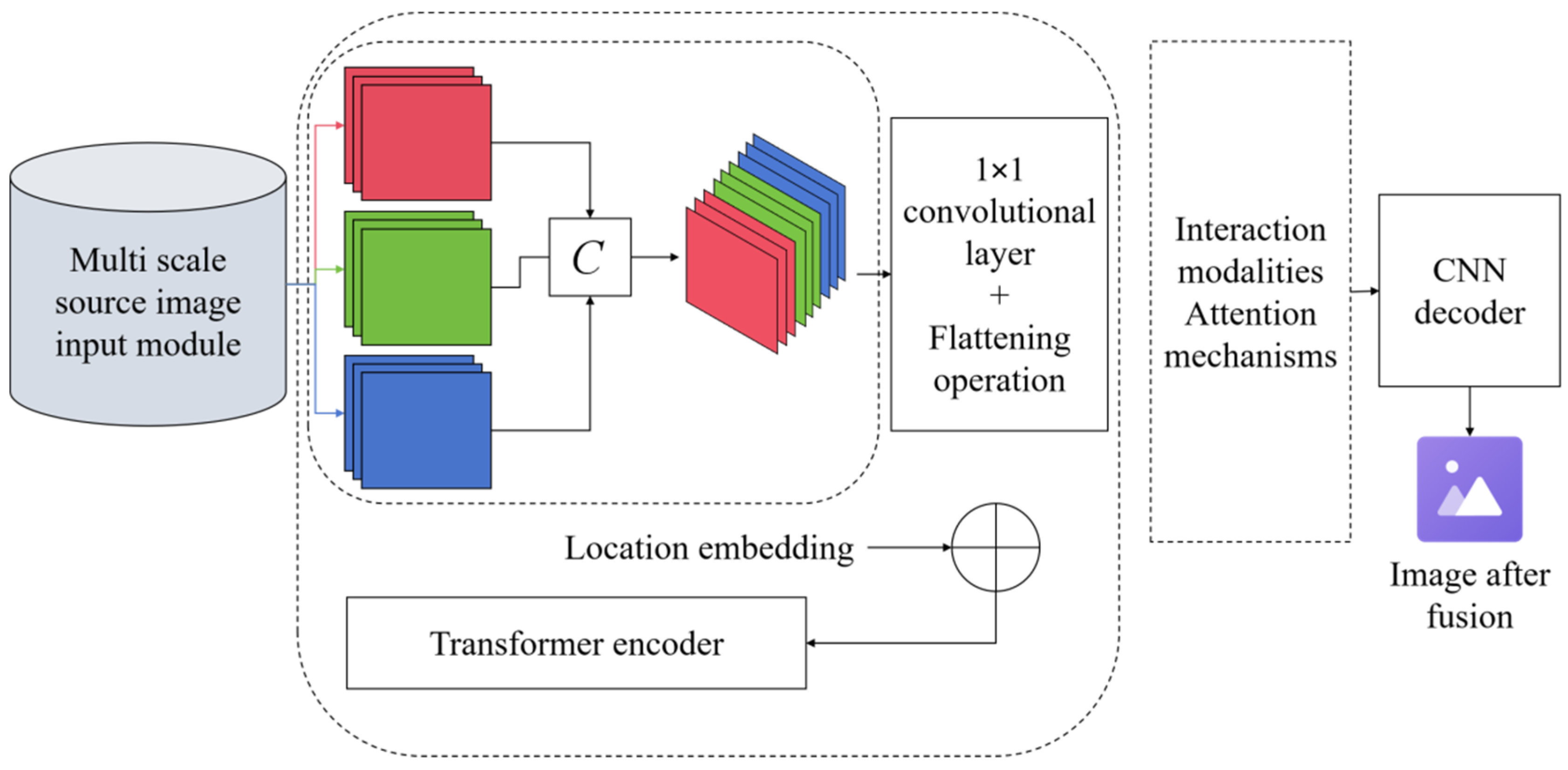
This article constructs an intelligent detection model based on MMFCT for the corrosion characteristics in pipeline microscopic images. On the one hand, multi-scale CNN is used to extract local features of samples under three imaging modes, and combined with Transformer architecture and its multi-head attention mechanism, effectively capturing the global contextual information of the image, thereby maximizing the preservation of the details and structure of the original image; on the other hand, fully considering the interactivity and complementarity between different image modalities, a multi-scale attention fusion module was designed to enhance the guidance and collaboration between modal features through an adaptive weighting mechanism, significantly improving the information fusion efficiency and representation ability of multi-source images of the coating body. The overall architecture of the MMFCT network is shown in
Figure 1, which is divided into three modules: multi-scale source image input module, multi-scale feature extraction network, and multi-scale fusion network.
After collecting images of the same coating sample at different scales, they are preprocessed by a multi-scale source image input module and input into a multi-scale feature extraction network to extract image features. Then, the feature information is input into a multi-scale fusion module, and a corresponding channel stitching strategy is adopted. Finally, the fused features are input into a CNN decoder to reconstruct and generate a single-scale fused image from the fused features. Due to the inability of the Transformer model to directly process 3D data, it is necessary to perform dimensionality reduction transformation on the input features. Specifically, the feature map output by the CNN encoder is first processed through a 1 × 1 convolutional layer to adjust the number of channels and then flattened to transform it into a one-dimensional sequence vector as input to the Transformer encoder.
3.2. SSA-BPNN Model
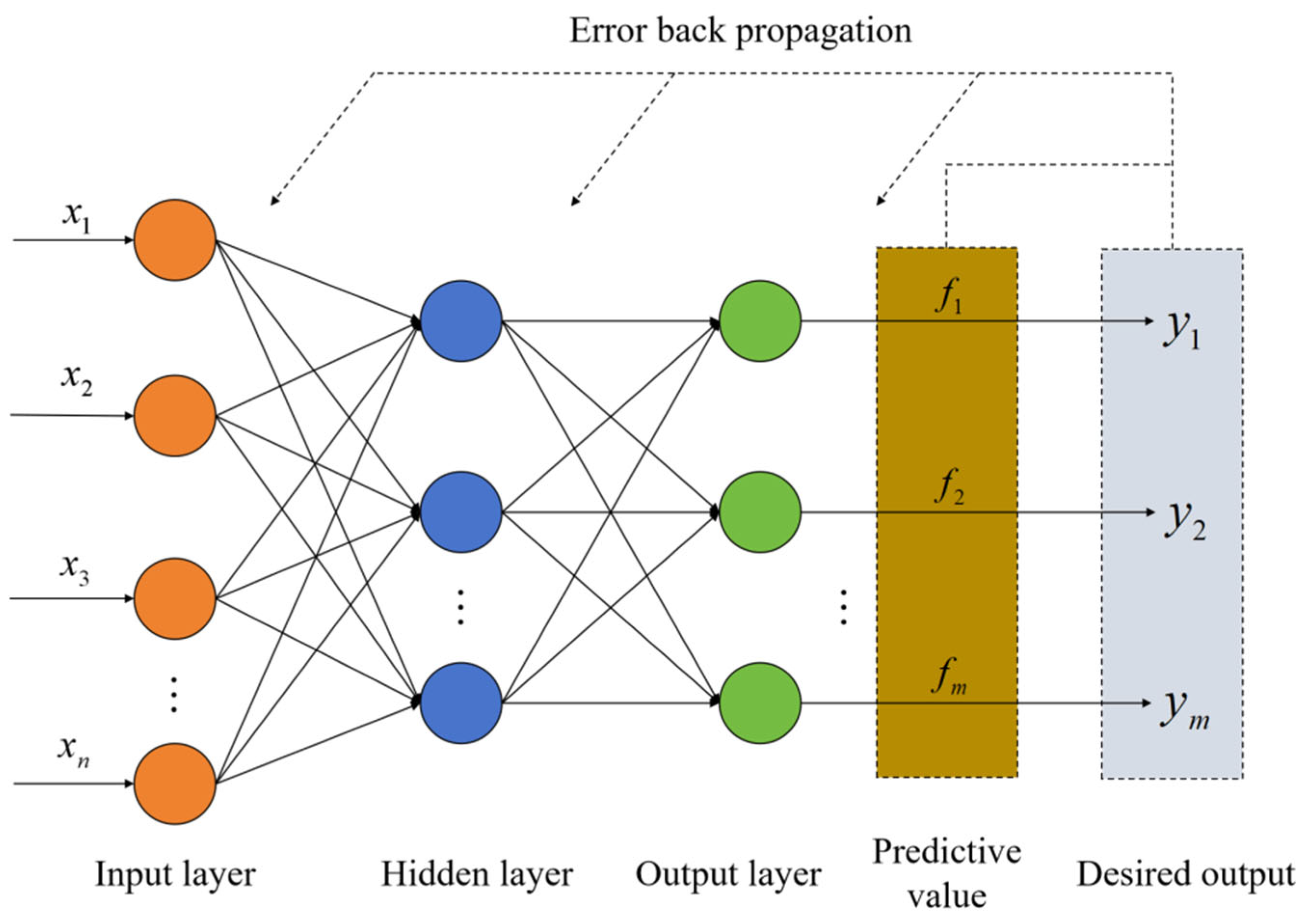
BPNN is a typical multi-layer feedforward neural network consisting of an input layer, one or more hidden layers, and an output layer. As shown in
Figure 2, the structure adopts a fully connected mode between layers, while neurons within the same layer are not connected to each other. The learning process of BPNN consists of two core stages: forward propagation of signals and backward propagation of errors. In the forward propagation stage, the input signal passes through each layer in sequence to obtain the actual output of the network; in the backpropagation stage, based on the output error, the weights and thresholds of each connection are calculated and adjusted layer by layer from the output layer to the input layer to minimize the prediction error. SSA is a novel swarm intelligence optimization algorithm inspired by sparrow foraging and anti-predation behaviors.
In SSA, individuals in the population are divided into two roles: discoverers and joiners. Discoverers have high energy reserves (represented by fitness values) and are responsible for exploring areas with high food abundance; although the energy of the joiner is low, they can quickly identify the optimal discoverer and approach the competition for resources. Two types of roles can be dynamically transformed, but the ratio of discoverers to joiners in the population remains constant. In addition, about 10% to 20% of individuals in the population are defined as vigilantes, possessing the ability to perceive predators. When a threat is detected, sparrows located at the edge of the group will quickly move towards a safe area, while the central individual will randomly move and approach neighboring sparrows to reduce the risk of being preyed upon. SSA has shown great potential in complex optimization problems due to its novel structure, strong optimization ability, fast convergence speed, and good stability. In view of this, this article introduces SSA to globally optimize the initial weights and thresholds of BPNN, and constructs an SSA-BPNN hybrid prediction model for high-precision prediction of the ultimate bearing capacity of submarine corroded pipelines.
4. Algorithm Principles
To facilitate the extraction of feature parameters from corrosion images, this article binarizes the corrosion morphology images. Due to the differences in distribution characteristics between the bubbling and non-bubbling areas on the R, G, and B color channels, their corresponding standard deviations are also different: the smaller the standard deviation, the smoother the color change in that area and the lower the image contrast. Therefore, an adaptive strategy can be designed to achieve image binarization based on the standard deviation differences in the R, G, and B color components. Assuming the original corrosion image is
, the range of values for each color component is [0, 255]:
In the formula, is the binary image of color image with as the segmentation threshold; is the segmentation threshold; is the standard deviation of different pixels in the selected area; represents the 3 component values of the selected region image; is the average value of ; is the number of selected samples.
Three different scales of images are respectively referred to as scale
, scale
, and scale
. Firstly, the feature vectors
corresponding to each scale are linearly mapped to generate their respective query
, key
, and value
matrices. Subsequently, in the feature fusion stage, a cross scale interaction mechanism is introduced: the
and
of a certain scale are exchanged with the other two scales, and scaled dot product attention calculations are performed separately with the
of the latter; Finally, the attention outputs obtained from the three scales are concatenated in the channel dimension to form a fused multi-scale feature representation. This process can be seen as a potential adaptive mechanism that enhances the representational ability of other scales by providing contextual information. Taking scale
as an example, its corresponding
definition is as follows:
Among them, are the learnable weight matrices of scale . Similarly, the learnable weight matrices for scales can be obtained.
In the actual search process, according to algorithm rules, the update of discoverer positions in the population is described by the following formula:
In the formula: is the current iteration count; is the position of the sparrow in the dimension, where ; is a random number within the interval (0, 1]; is the maximum number of iterations; is the warning value; is the safety threshold; is a random number that follows a standard normal distribution; is a 1-row vector with dimension .
is a random disturbance coefficient, which is used to simulate the uncertainty of sparrow’s exploration behavior; is the safety threshold, which determines whether the discoverer enters the alert state; is a random number that obeys the standard normal distribution, representing the influence of environmental noise; controls the range of step change in participants; and is the direction adjustment factor, which reflects the tendency of individuals to move to the optimal solution. The above parameters are calibrated by pre-experiment to ensure the balance between convergence stability and search efficiency of the algorithm.
CNN effectively extracts local features of corroded areas through multi-layer convolution operations and combines pooling layers to reduce the dimensionality of feature maps, thereby improving computational efficiency while preserving key information. The calculation of convolutional layers can be expressed as the following formula:
In the formula: is the convolutional kernel, is the input data, is the bias, is the convolution operation, is the ReLU activation function, ensuring nonlinear mapping.
In SSA, the initial position of the alert is randomly generated in the population, and its position update is described by the following formula:
In the formula: is the current optimal food source location; are the step size control parameter, where follows a standard normal distribution with a mean of 0 and variance of 1, and is a random number within the interval [−1, 1], used to characterize the direction of sparrow movement; refer to the fitness values of the current individual, the globally optimal individual, and the globally worst individual; is a minimal constant used to avoid situations where the denominator is zero.
The decoder network consists of four cascaded convolutional layers, each layer using a
convolutional kernel, supplemented by BatchNorm normalization operation and LeakyReLU nonlinear activation function. The fused features are first input into the decoder network, and after layer by layer upsampling and feature reconstruction, a fused image is generated that is consistent with the spatial dimension of the original input image. Subsequently, the fused features are mapped through a fully connected layer to obtain the final fused representation
, which is used as the input of the decoder. The specific structure is shown below.
5. Result Analysis and Discussion
The experimental data comes from a pipeline measurement dataset in a certain sea area, which includes five key characteristics such as pipeline wall thickness, corrosion depth, corrosion length, corrosion width, and ultimate tensile strength of the pipe material, used to analyze their impact on the ultimate bearing capacity of the pipeline. The image dataset used in the experiments consists of 500 micrographs of corrosion morphology, all uniformly resized to a resolution of 512 × 512 pixels. Annotation was carried out independently by three experts in the field of marine corrosion, who manually delineated corrosion regions using the LabelMe tool. Discrepancies in annotation were resolved through a majority voting mechanism to ensure the reliability of the ground truth. The time-series environmental data were sampled at a frequency of once per hour and include five key variables: temperature, salinity, and dissolved oxygen, among others. All data were normalized to eliminate the influence of dimensional units. To verify the performance of the model, 21 sets of data were randomly selected as training samples, and the remaining 4 sets were used as independent test sets. All experiments were conducted on computers equipped with NVIDIA GeForce RTX 3080 graphics processors (10 GB of video memory). This graphics card is produced by NVIDIA Corporation and located in Santa Clara, CA, USA. The experiment is implemented based on the PyTorch 2.0.0 deep learning framework. The use of GPU parallel computing significantly accelerated the model training and inference process. Given the high cost and difficulty associated with acquiring and annotating corrosion data for submarine pipelines, this study adopted multiple data augmentation strategies to enhance model generalization under limited sample conditions. These strategies include random rotation, brightness adjustment, and Gaussian noise injection, effectively expanding the training dataset to five times its original size. In addition, a transfer learning mechanism was introduced by initializing model parameters with pre-trained weights from public corrosion datasets, thereby ensuring convergence stability in small-sample scenarios. Despite the limited sample size, the test results exhibit low variance, indicating that the model does not suffer from overfitting.
The dataset of submarine pipeline surveys used in this study covers 25 sets of valid samples. The statistical description of each key feature is shown in
Table 1. In the data preprocessing, firstly, the original data are tested for missing values and outliers are eliminated, and then the features are scaled to [0, 1] by using the min–max normalization method, so as to eliminate the interference of dimensional differences on model training. The training set and the test set are randomly divided according to the ratio of 21:4, and fixed random seeds are used in the division to ensure the reproducibility of the experiment.
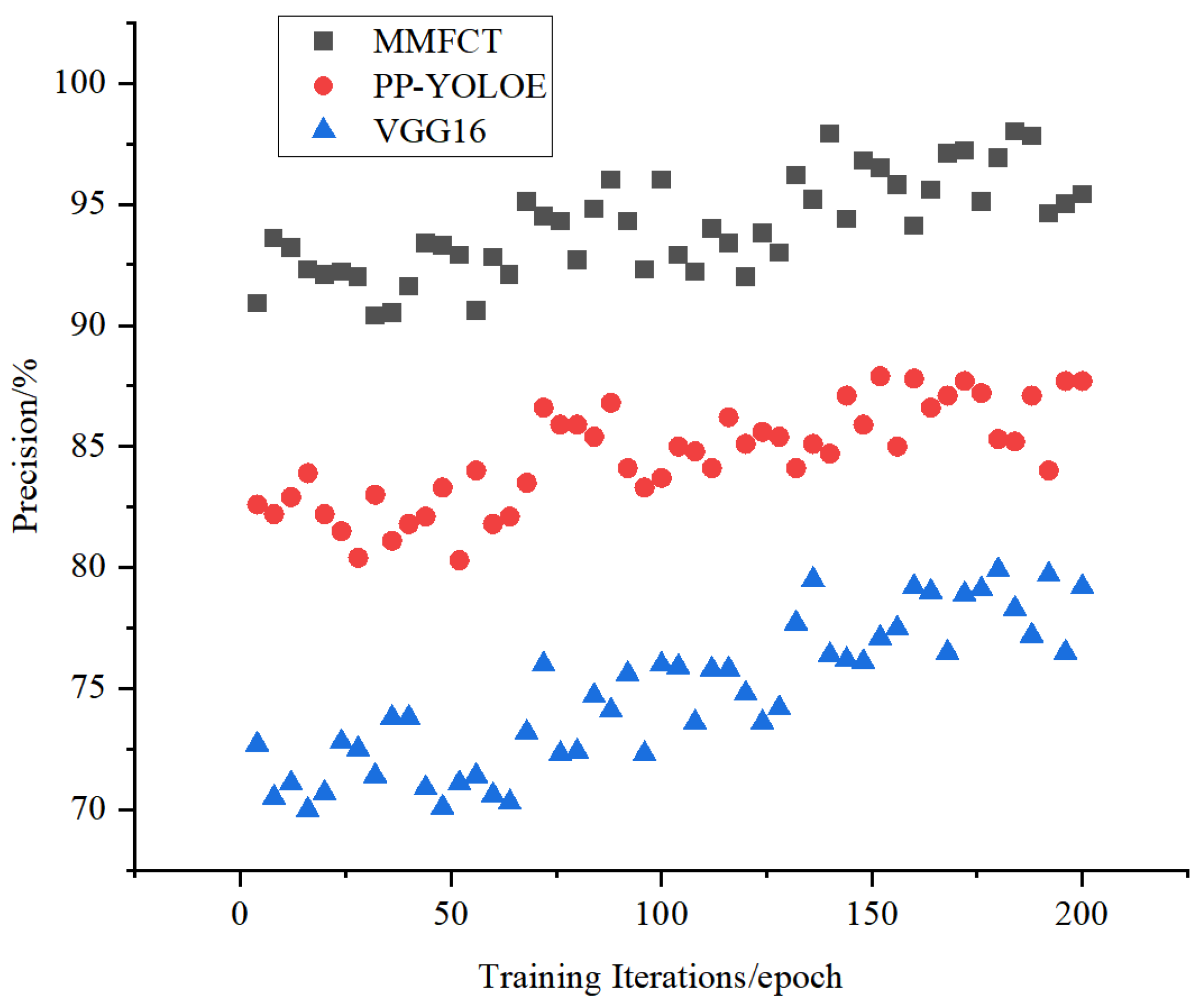
Figure 3 shows the precision comparison of the MMFCT model constructed in this article with PP-YOLOE and VGG16 in the identification task of corrosion areas in submarine pipelines. Precision is the proportion of real cases to the total number of predicted positive cases. In order to evaluate the stability of the precision index, this study adopts a 50% cross-validation method, and each group of experiments is repeated five times and the average value is taken. The accuracy of the MMFCT model tends to be stable after 150 iterations, and the fluctuation range is controlled within 0.8%. The preliminary experiment of further increasing the number of iterations to 300 times shows that the precision improvement is less than 0.3%, which indicates that the current model is close to convergence, and the marginal benefit of increasing the number of iterations is limited. The experimental results show that the MMFCT model achieved the highest recognition precision on the test set, significantly better than PP-YOLOE and VGG16. This is mainly due to the fusion of multi-scale CNN local feature extraction capability and the global modeling advantage of Transformer in MMFCT, as well as the introduction of cross-modal attention mechanism, which effectively enhances the characterization ability of complex corrosion morphology and improves the overall recognition performance.
The selection of PP-YOLOE and VGG16 as benchmark models is well justified and representative. PP-YOLOE represents a state-of-the-art, high-precision real-time detection algorithm widely adopted in industrial applications, making it suitable for rapid on-site screening in engineering scenarios. VGG16, on the other hand, serves as a classic deep learning backbone commonly used to validate feature extraction capabilities.
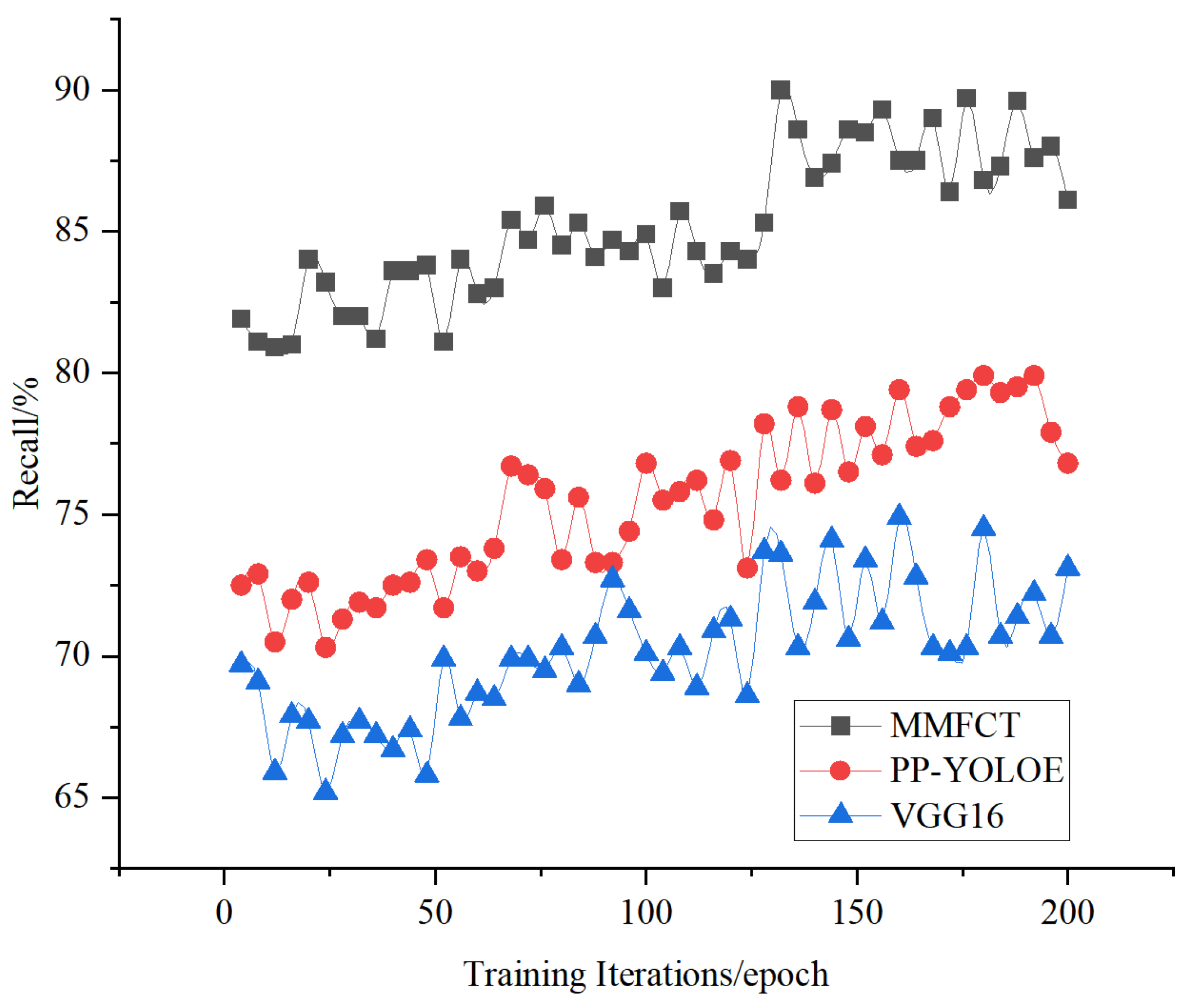
Figure 4 shows the comparison results of the recall rate of the MMFCT model constructed in this article with PP-YOLOE and VGG16 in the underwater pipeline corrosion identification task. The vertical axis represents the proportion of correctly detected actual corrosion areas, and the horizontal axis represents the number of training iterations. Due to the introduction of a cross-scale attention mechanism, MMFCT exhibits higher sensitivity even in the low-iteration stage. The experiment shows that the MMFCT model is significantly better than PP-YOLOE and VGG16 in terms of recall index, exhibiting stronger ability to detect corrosion areas. This advantage stems from MMFCT effectively capturing local corrosion details through multi-scale CNN, while modeling long-range dependencies with the global attention mechanism of Transformer and combining cross-scale feature fusion strategy to fully explore complementary information between different image modalities, thereby more comprehensively identifying various types of corrosion defects and effectively reducing missed detection rates.
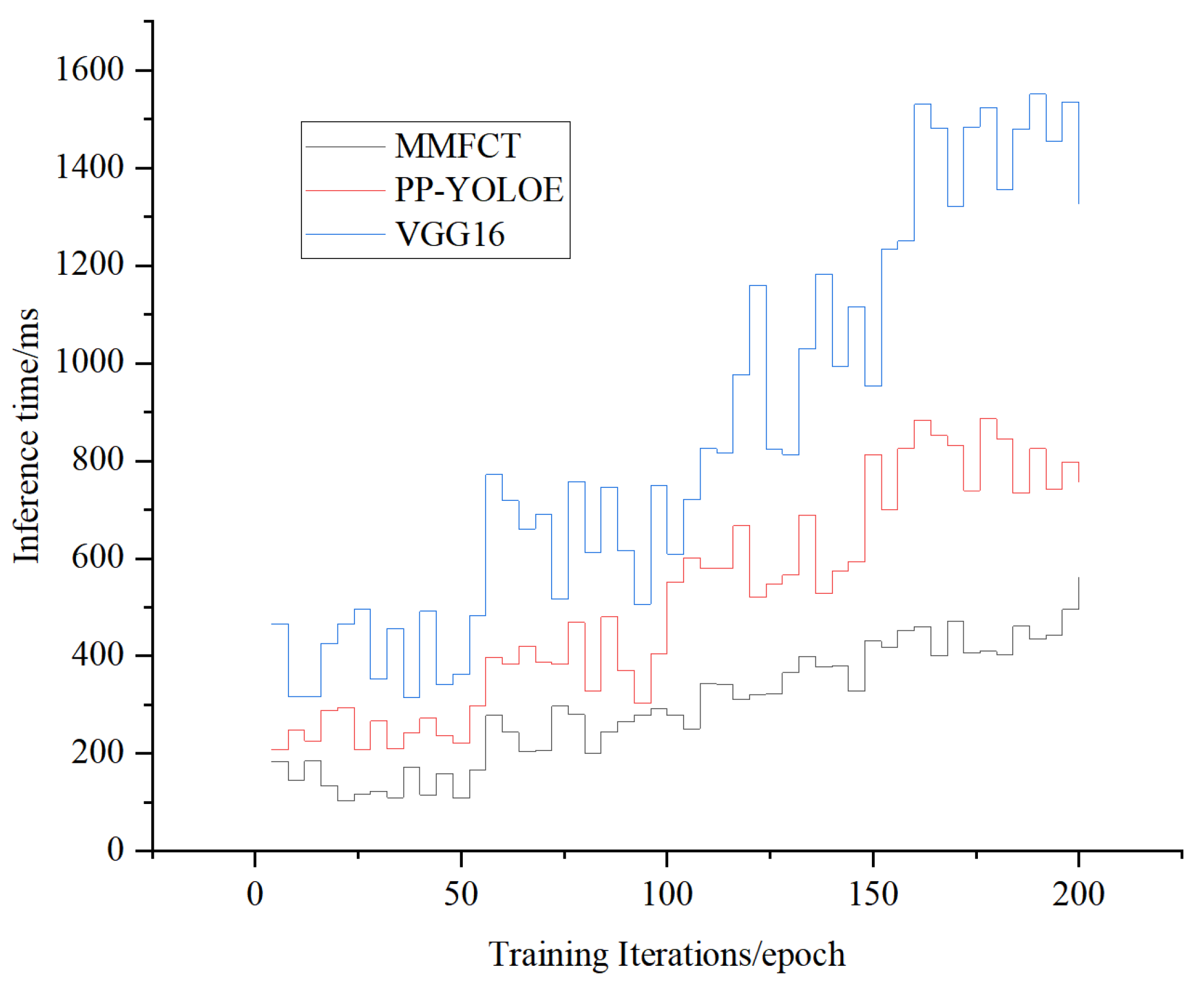
Figure 5 shows the comparison of inference time between the MMFCT model, PP-YOLOE, and VGG16 in underwater pipeline corrosion identification tasks. The test platform is an NVIDIA RTX 3080 GPU with a batch size of 1. Leveraging its lightweight Transformer module, MMFCT significantly reduces computational latency while maintaining high accuracy. The experimental results show that the MMFCT model has the shortest average processing time per sample while ensuring high precision and high recall, significantly better than PP-YOLOE and VGG16. This efficiency advantage is mainly due to the reasonable design of the model structure: on the one hand, the multi-scale CNN module effectively extracts key local features, avoiding redundant calculations; on the other hand, by lightweight Transformer and channel dimension optimization, the computational cost of global modeling has been reduced. In addition, the fusion strategy adopts an efficient attention mechanism, which improves the feature expression ability while controlling the parameter quantity and computational complexity. Therefore, MMFCT not only has excellent recognition performance, but also has stronger real-time performance, making it more suitable for engineering applications with high efficiency requirements such as underwater pipeline corrosion detection.
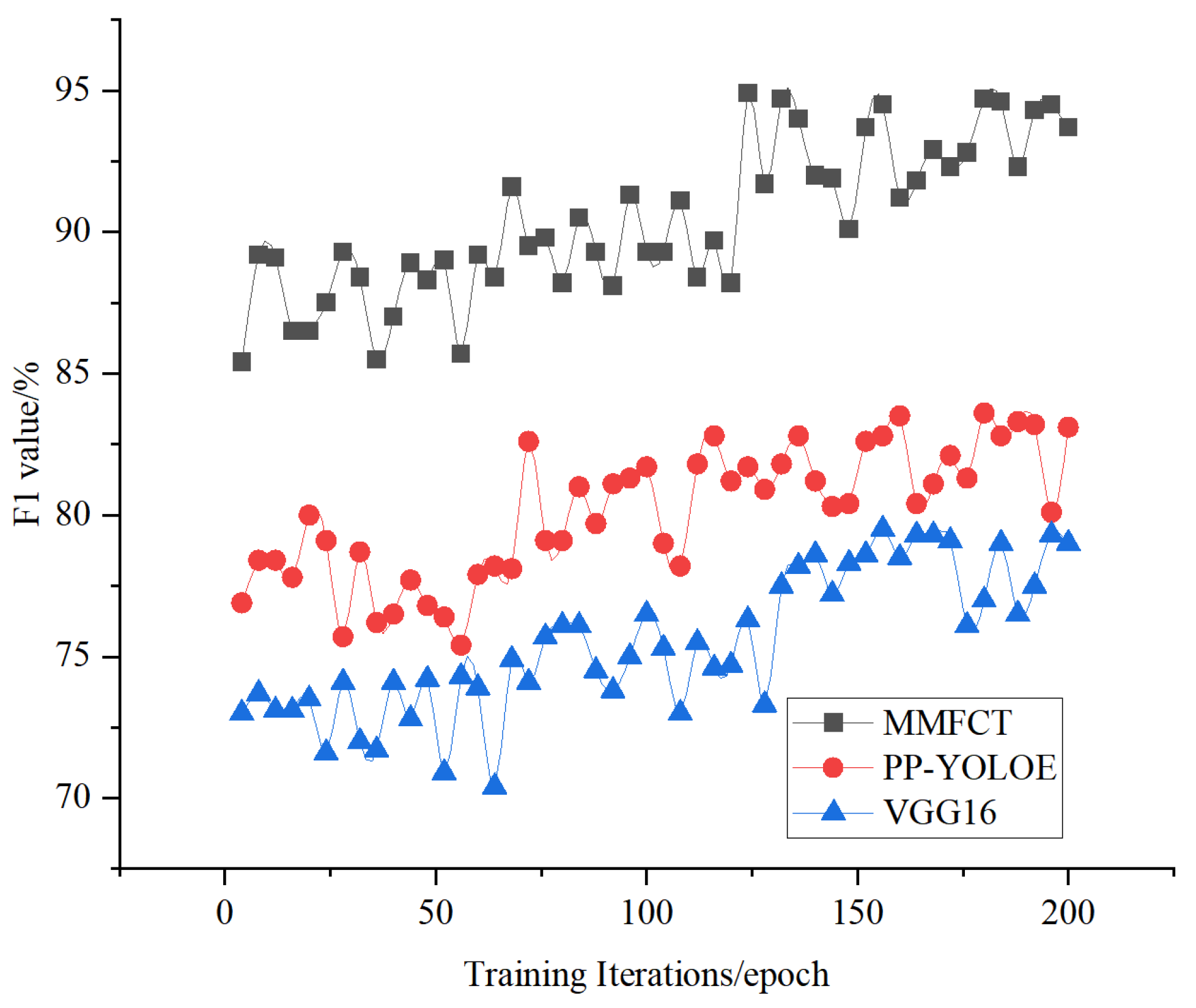
Figure 6 shows the comparison of F1 values between the MMFCT model constructed in this article with PP-YOLOE and VGG16 in the underwater pipeline corrosion identification task. This metric balances precision and recall, reflecting the overall discriminative ability of the model. MMFCT maintains a leading position throughout the entire training process, indicating its stronger robustness. Experiments have shown that MMFCT significantly outperforms PP-YOLOE and VGG16 in the F1 index, which comprehensively measures precision and recall, achieving optimal performance. This advantage stems from its unique multimodal fusion architecture, which not only enhances the ability to distinguish complex corrosion patterns, but also effectively balances the problems of false positives and false negatives, thus achieving a better compromise between precision and completeness. Therefore, the leading performance of MMFCT in F1 value validates its comprehensive advantages of high precision and high robustness in actual corrosion detection tasks.
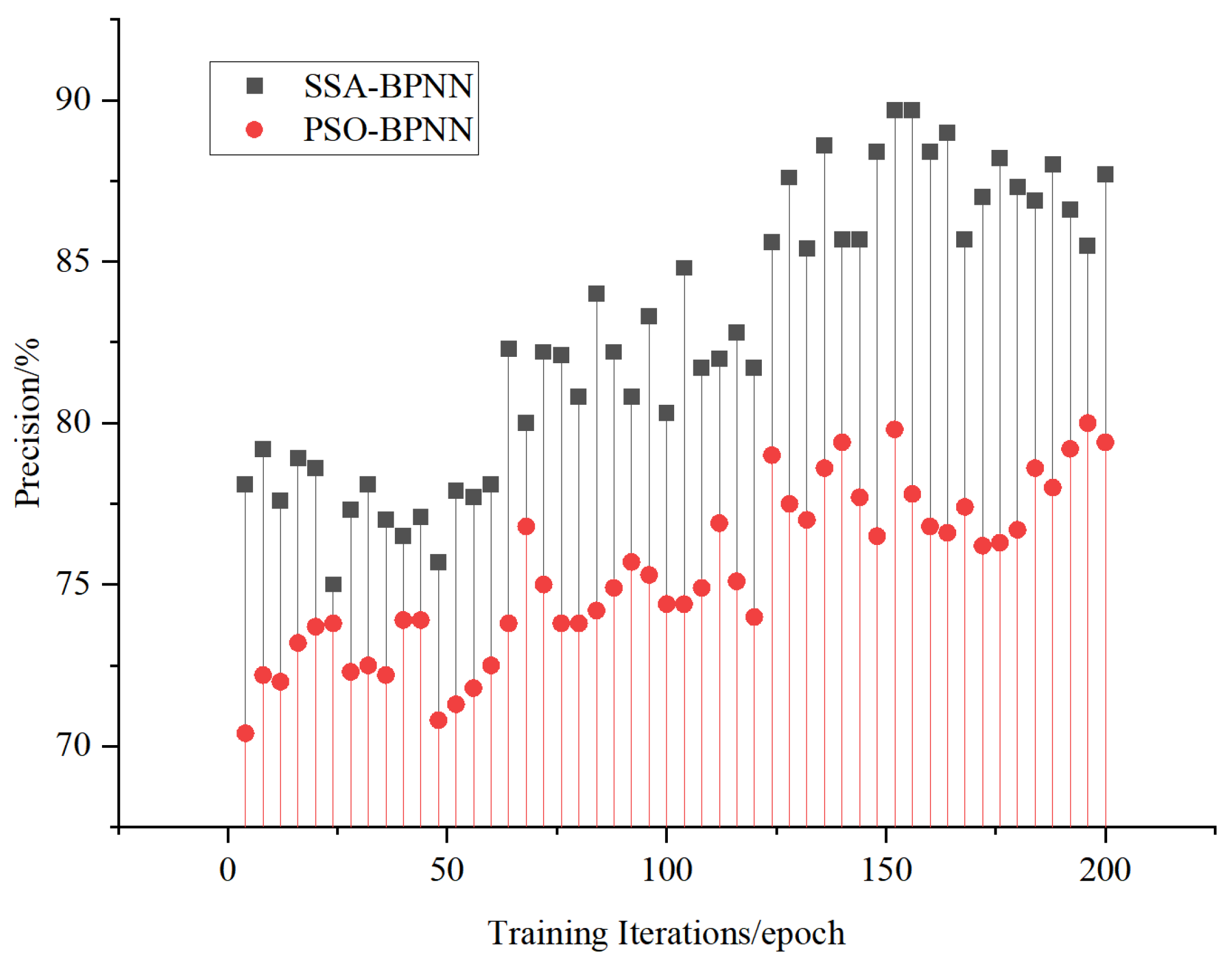
Figure 7 shows the performance comparison between the SSA-BPNN prediction model constructed in this article and the Particle Swarm Optimization (PSO) optimized BPNN model (PSO-BPNN) in predicting the ultimate bearing capacity of submarine corroded pipelines. The input features include wall thickness, corrosion depth, length, width, and material tensile strength, while the output is the remaining load capacity percentage. SSA optimization enables BPNN to avoid getting trapped in local minima. The experimental results show that the prediction precision of the SSA-BPNN model is significantly better than that of PSO-BPNN. This advantage is mainly due to SSA’s stronger global search capability and faster convergence characteristics, which can more effectively optimize the initial weights and thresholds of BPNN, thereby avoiding falling into local optima. Meanwhile, SSA introduced diverse search strategies in simulating sparrow foraging and vigilance behavior, enhancing the model’s generalization ability and robustness. Therefore, SSA-BPNN not only improves the precision of predicting ultimate bearing capacity but also provides a more reliable intelligent modeling method for the safety assessment of marine engineering structures.
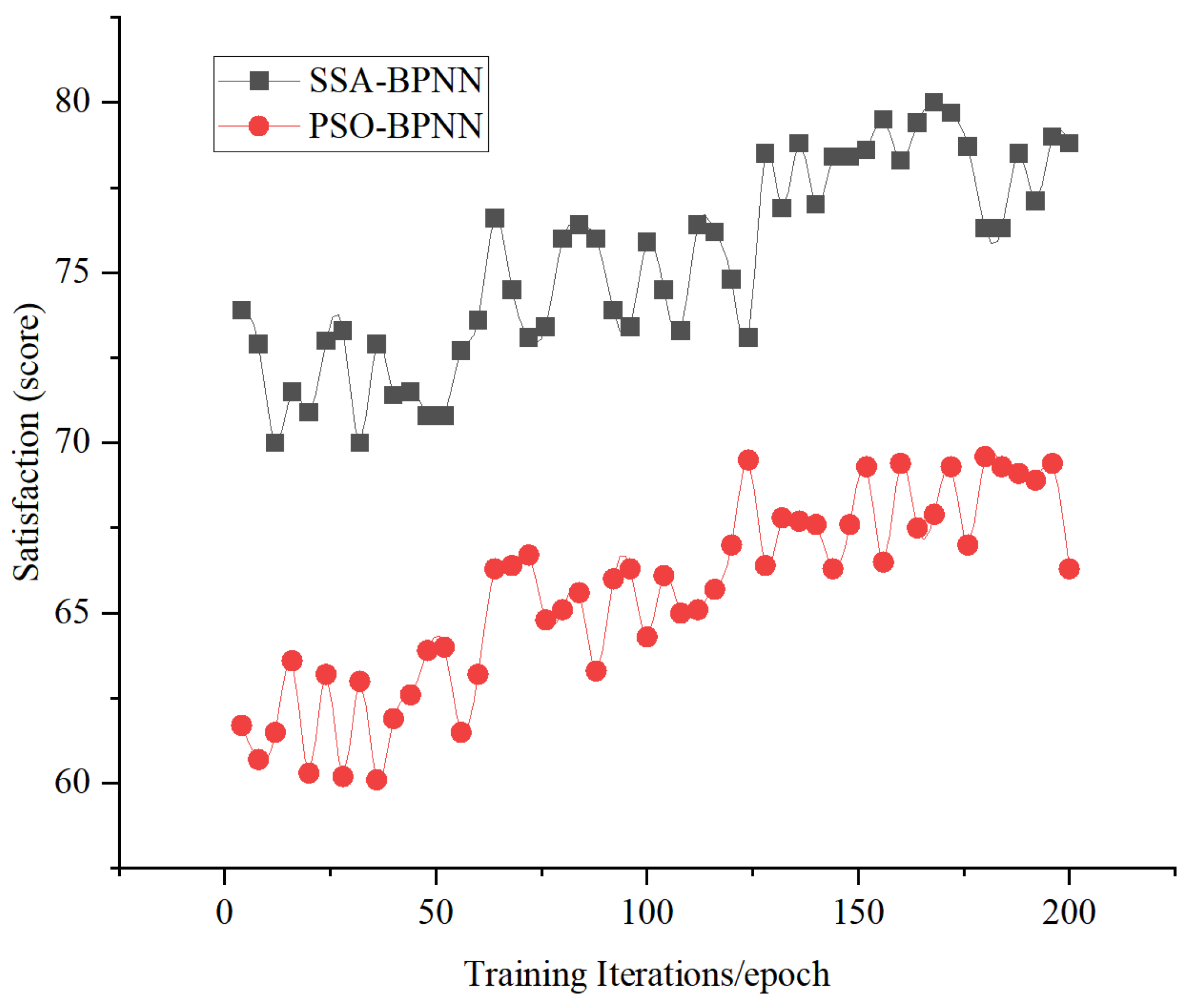
Figure 8 shows the comparison results between the SSA-BPNN prediction model constructed in this article and PSO-BPNN in terms of user satisfaction. It was scored by ten experts in the field of ocean engineering based on three dimensions: prediction accuracy, response speed, and system stability (with a full score of 100), and the average values were plotted. The user satisfaction assessment was conducted using a multi-dimensional evaluation matrix, covering four key aspects: prediction accuracy, system response time, result interpretability, and ease of operation. Each expert rated the system on these dimensions using a five-point Likert scale, with weights assigned as 0.4, 0.2, 0.2, and 0.2, respectively. The final score was calculated as a weighted average, aiming to comprehensively reflect the system’s usability and trustworthiness in practical engineering scenarios.
The experiment shows that the SSA-BPNN model achieves significantly higher user satisfaction than PSO-BPNN. This advantage stems from the comprehensive improvement of SSA-BPNN in prediction precision, stability, and response efficiency. SSA has stronger global exploration ability and faster convergence speed, which can effectively optimize the initial parameters of a BP neural network, thereby generating more accurate and reliable prediction results of ultimate bearing capacity; meanwhile, its good robustness reduces prediction fluctuations and enhances system reliability. In practical engineering applications, the high-precision and low-latency prediction capabilities directly enhance users’ trust and user experience in intelligent evaluation systems. Therefore, SSA-BPNN not only performs excellently in technical indicators but also demonstrates higher practical value in user experience.
To validate the effectiveness of individual components within the MMFCT model, we conducted ablation experiments by removing the Transformer global attention module, the multi-scale fusion module, and the cross-modal interaction unit, respectively. For the prediction module, we compared the performance of BPNN, PSO-BPNN, and SSA-BPNN. As shown in
Table 2, removing the Transformer module led to a 4.2% drop in accuracy, while the removal of multi-scale fusion resulted in a 5.9% decrease in the F1 score. Disabling cross-modal attention caused an overall performance decline of approximately 3%. In terms of prediction error, BPNN yielded 5.8%, which was reduced to 4.3% with PSO and further lowered to 3.1% with SSA optimization. The complete model maintained high accuracy while keeping inference time within a reasonable range, demonstrating a well-balanced trade-off between effectiveness and efficiency.
The introduction of multi-source environmental data enables the model to capture the failure law under complex coupling conditions. Through the input feature weight analysis, the chemical composition of seawater and the structure of biological community have a significant influence on the prediction results. In the environment of high concentration of chloride ion, the passivation film of coating will be destroyed, and the corrosion of base metal will be accelerated. The model shows that this factor is negatively correlated with the remaining life. After the biological fouling layer is formed, the ultraviolet light penetration is blocked, and the free radical generation efficiency of photocatalytic active substances is reduced, resulting in a decline in protective performance. The physical and chemical properties of the coating itself are also key variables, and the coating thickness and photocatalytic material loading are positively correlated with the ultimate bearing capacity of the pipeline. The SSA-BPNN model effectively quantifies the interaction of these factors by nonlinear mapping. The results show that the failure rate of materials is obviously accelerated in the coupled sea area with strong corrosion and high biological activity. This discovery verifies the effectiveness of the multi-source data-driven method in revealing the relationship between microscopic mechanism and macroscopic performance.
6. Conclusions
This article presents an intelligent prediction framework for the failure of photocatalytic anti-corrosion materials, driven by multi-source environmental data, and applies it to the corrosion state assessment and life prediction of submarine pipelines. A detection model named MMFCT is developed, integrating multi-scale microscopic images with time-series environmental parameters to enable automatic extraction of corrosion features and modeling of dynamic degradation correlations. Furthermore, the Sparrow Search Algorithm is introduced to optimize the Back Propagation Neural Network (SSA-BPNN), enhancing the prediction accuracy of ultimate load capacity. Experimental results show that MMFCT achieves an accuracy of 94.7% in corrosion region identification, outperforming PP-YOLOE and VGG16 by 6.2% and 8.5%, respectively. The prediction error of SSA-BPNN is below 3.1%, which is superior to the 5.8% error of PSO-BPNN. This approach overcomes the limitations of traditional single-source data models and provides a highly accurate and robust intelligent decision-support tool for the safe operation and maintenance of marine engineering structures. Future work will focus on the construction of online learning mechanisms for models, validation of generalization ability under extreme operating conditions, and research on lightweight deployment strategies at the edge.