Effect of Ni Interlayer on Microstructure and Properties of C276 Hastelloy/Q235 Steel Cladding Plates


Abstract
1. Introduction
2. Materials and Methods
2.1. Materials
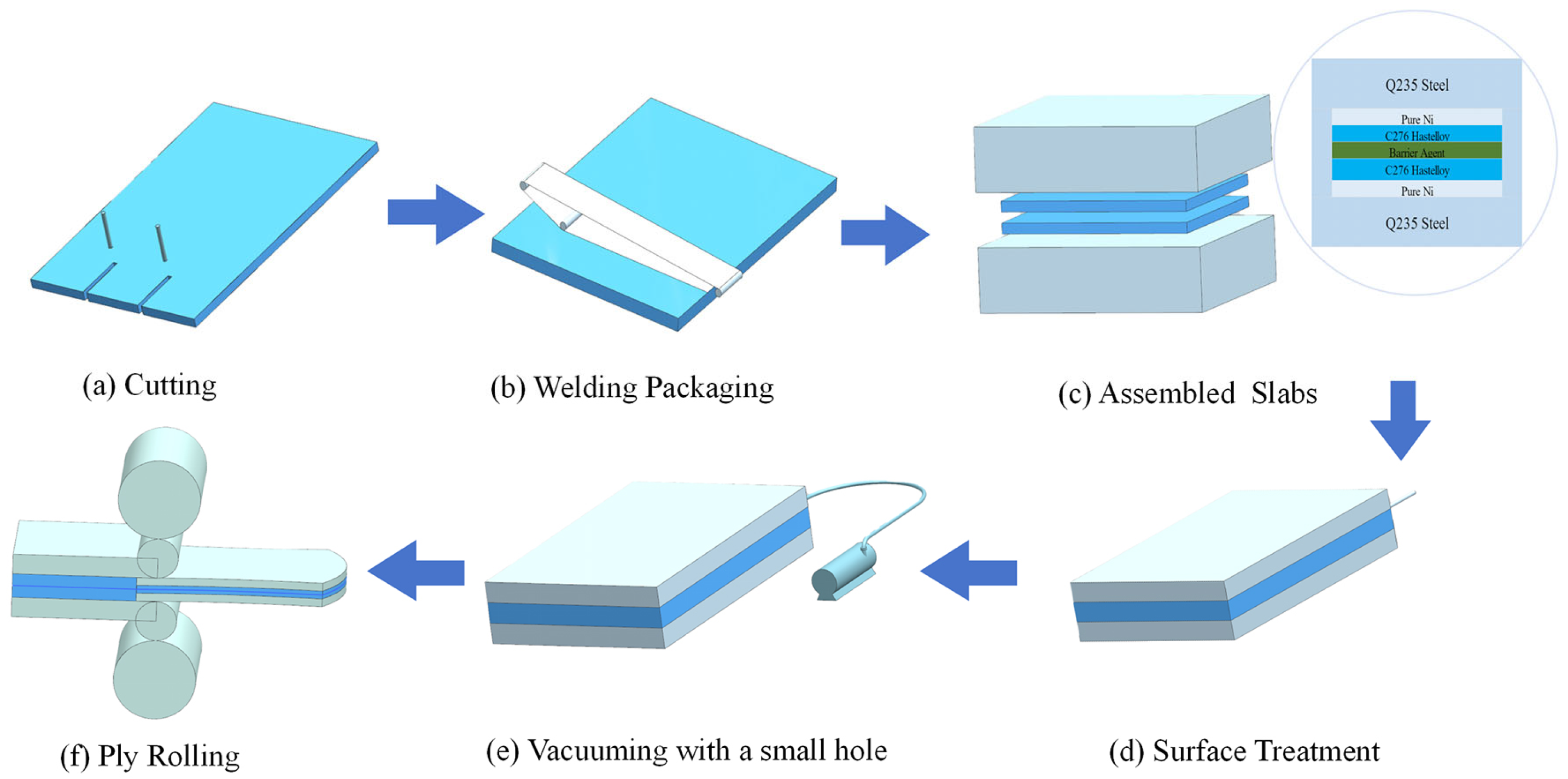
2.2. C276 Hastelloy/Q235 Steel Vacuum Rolling Process
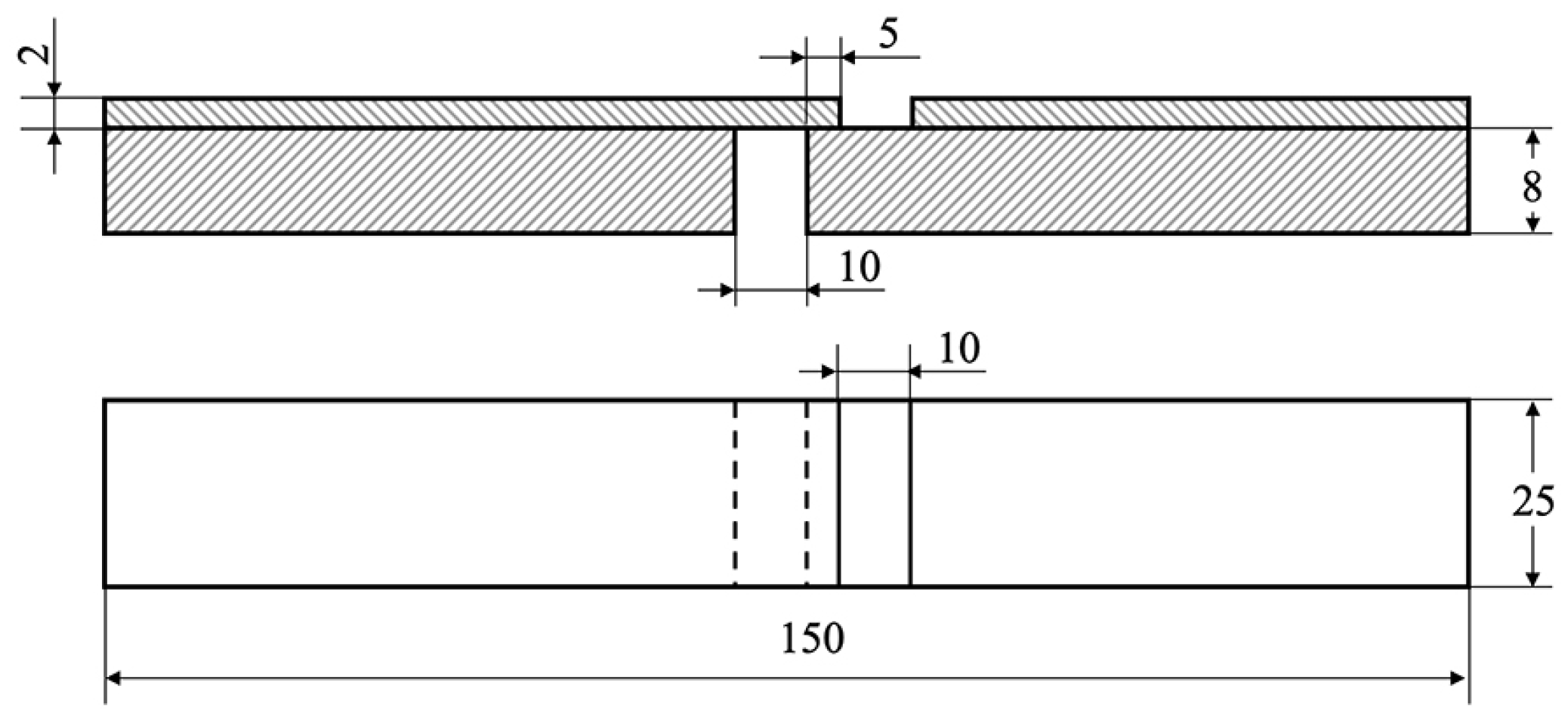
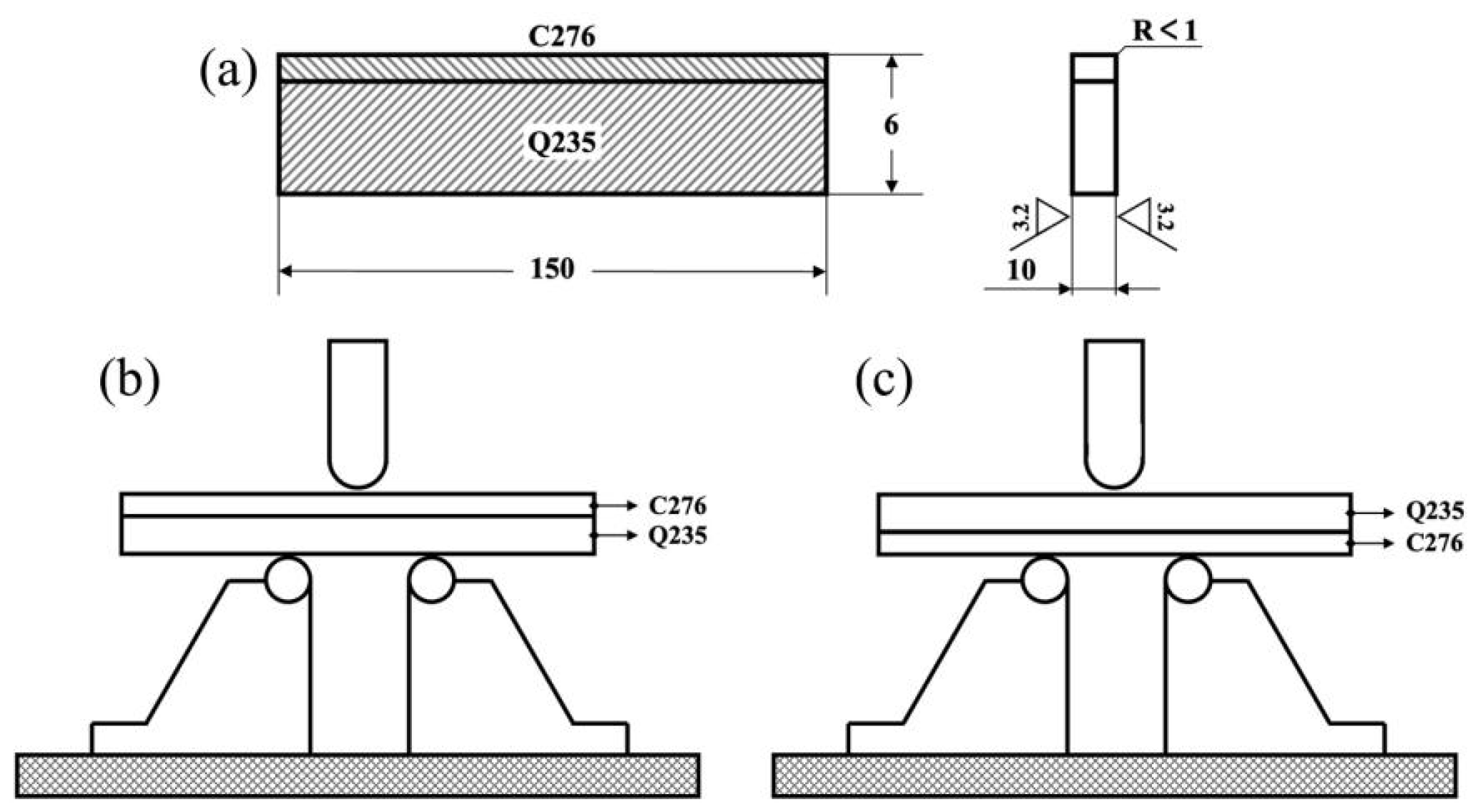
2.3. Analysis and Testing of C276 Hastelloy/Q235 Steel Cladding Plates
3. Results and Discussion
3.1. Morphology and Microstructure Analysis
3.2. Microhardness Analysis
3.3. Shear Strength Analysis
3.4. Bending Strength Analysis
3.5. Corrosion Resistance Analysis
3.5.1. Potentiodynamic Polarization Curve Analysis
3.5.2. EIS Analysis
3.5.3. XPS Analysis
4. Results
- (1)
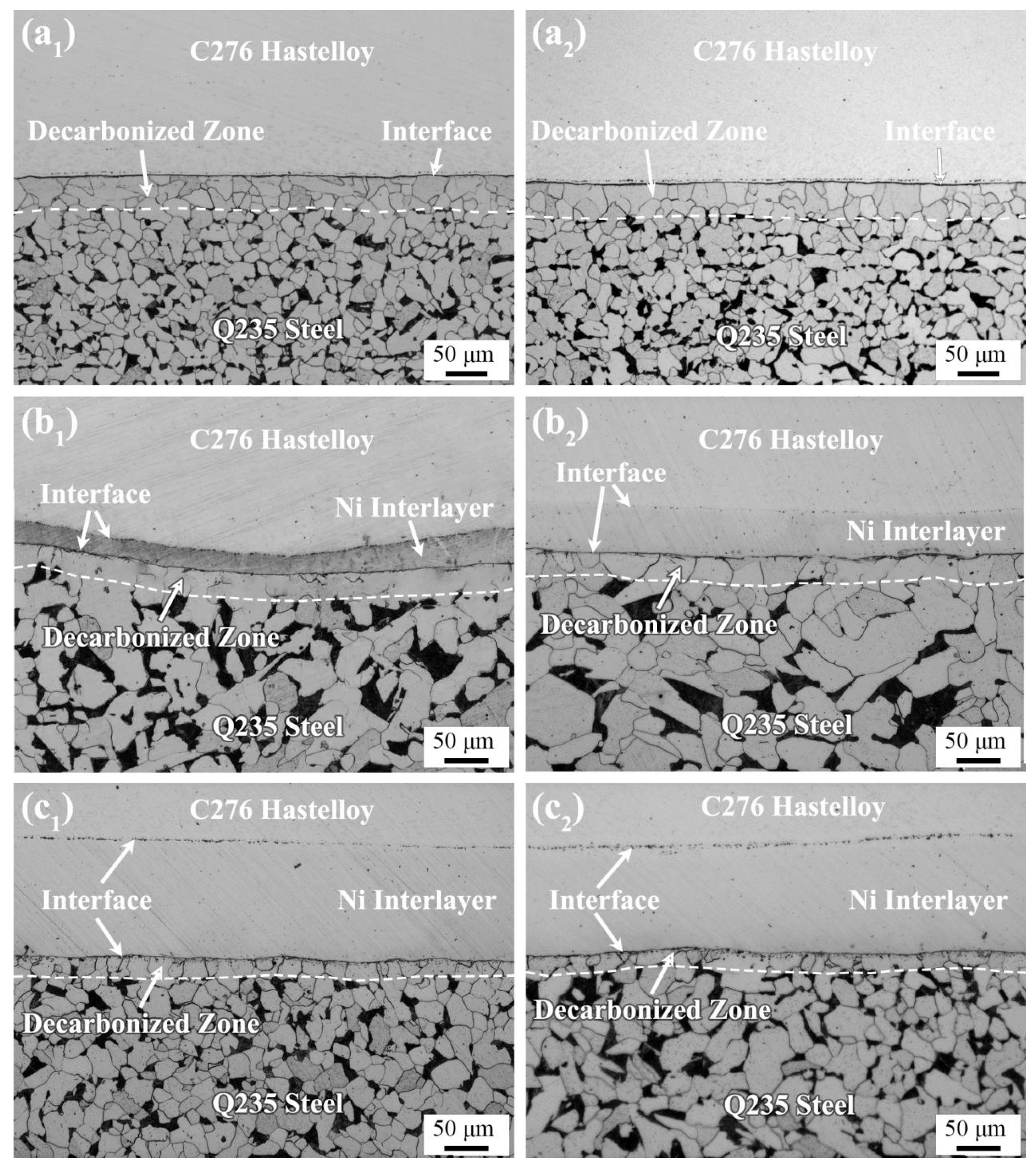
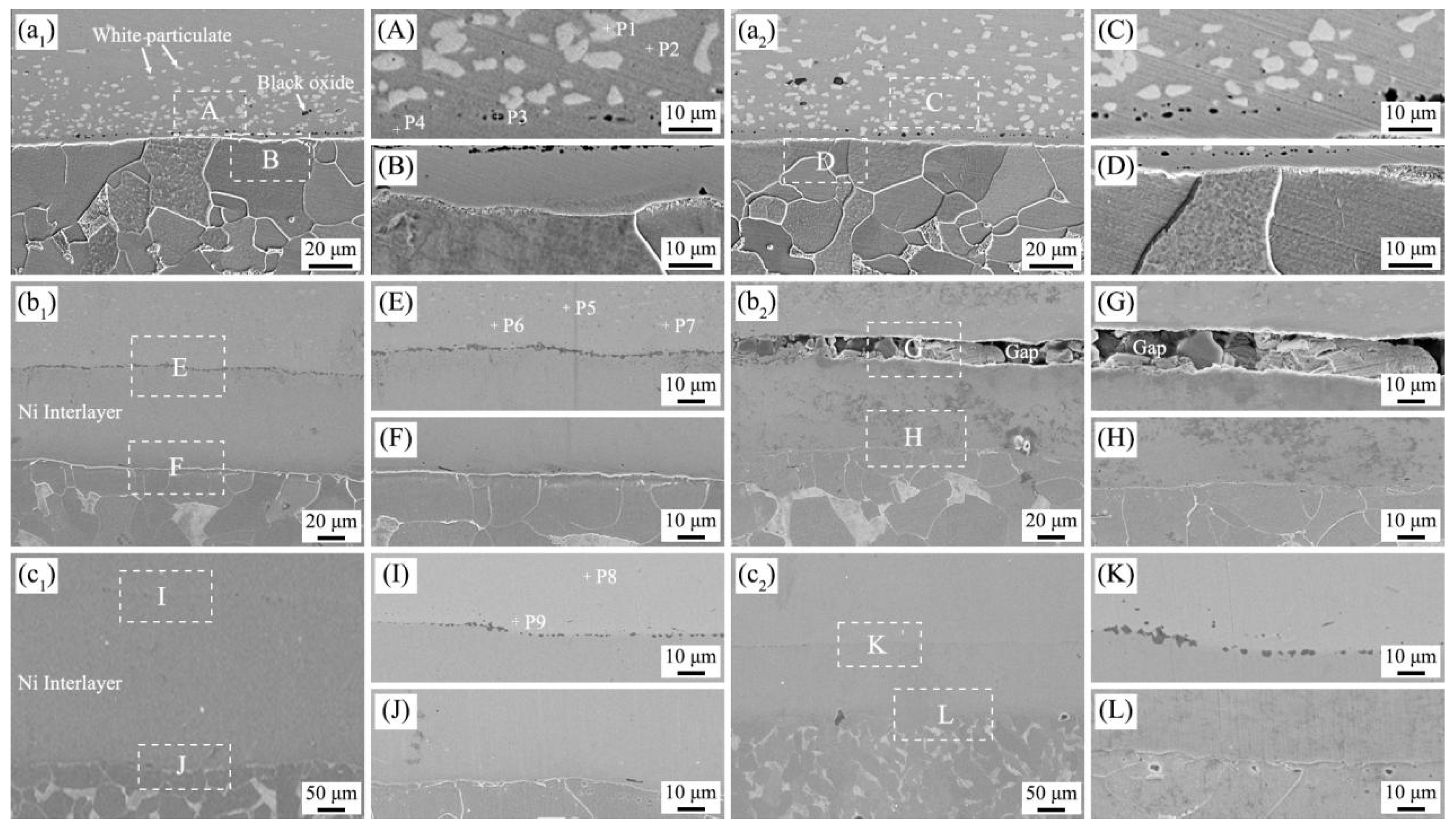
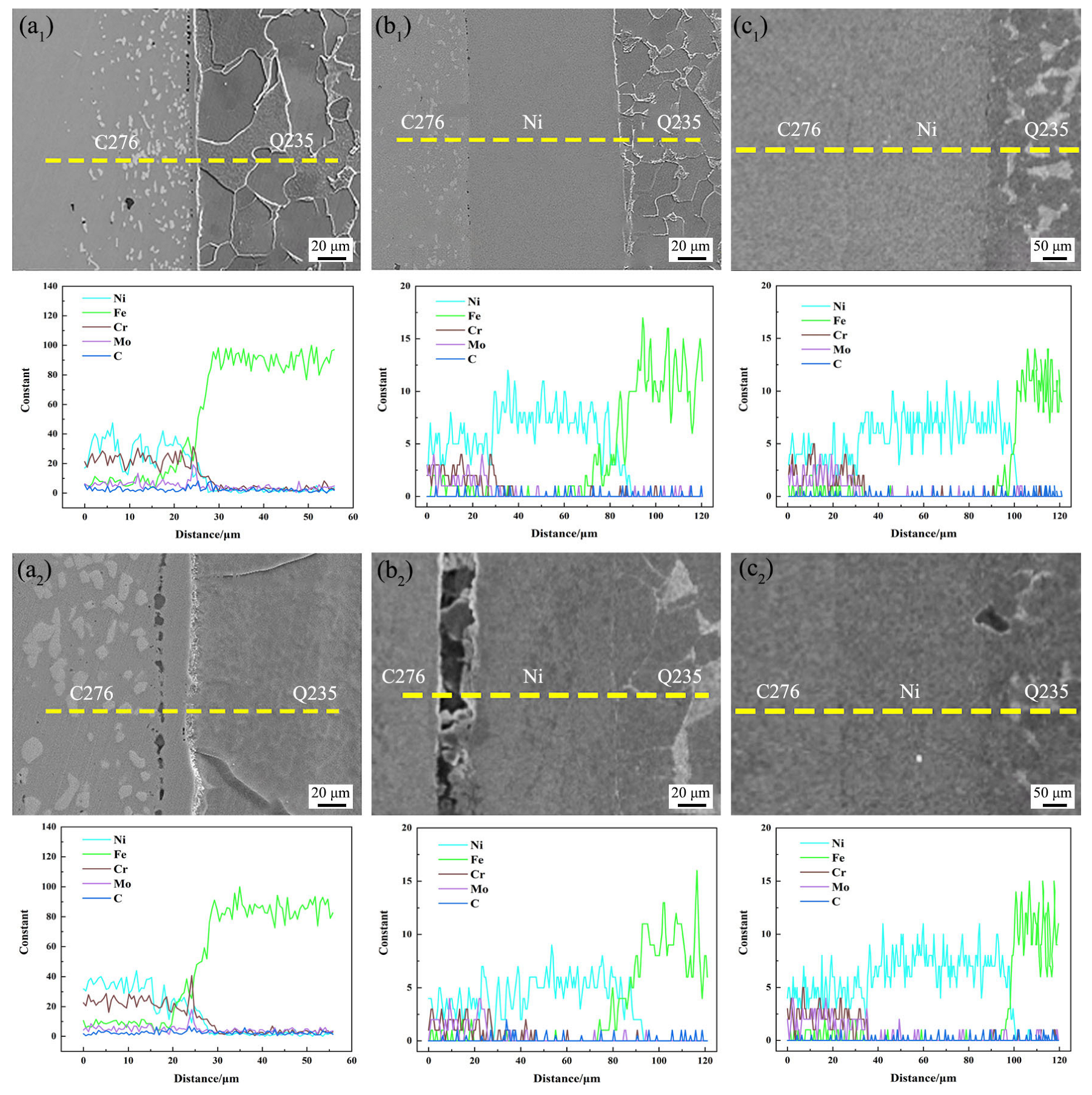
- All the microstructures of the cladding plates consisted of a C276 Hastelloy substrate, an interface layer (Ni interlayer), a decarburization layer and Q235 Steel. However, the decarburized layer decreased from 65 μm to 41 μm and 28 μm with the thickness of the Ni interlayer increasing from 0 mm to 0.1 mm and 0.5 mm, respectively.
- (2)
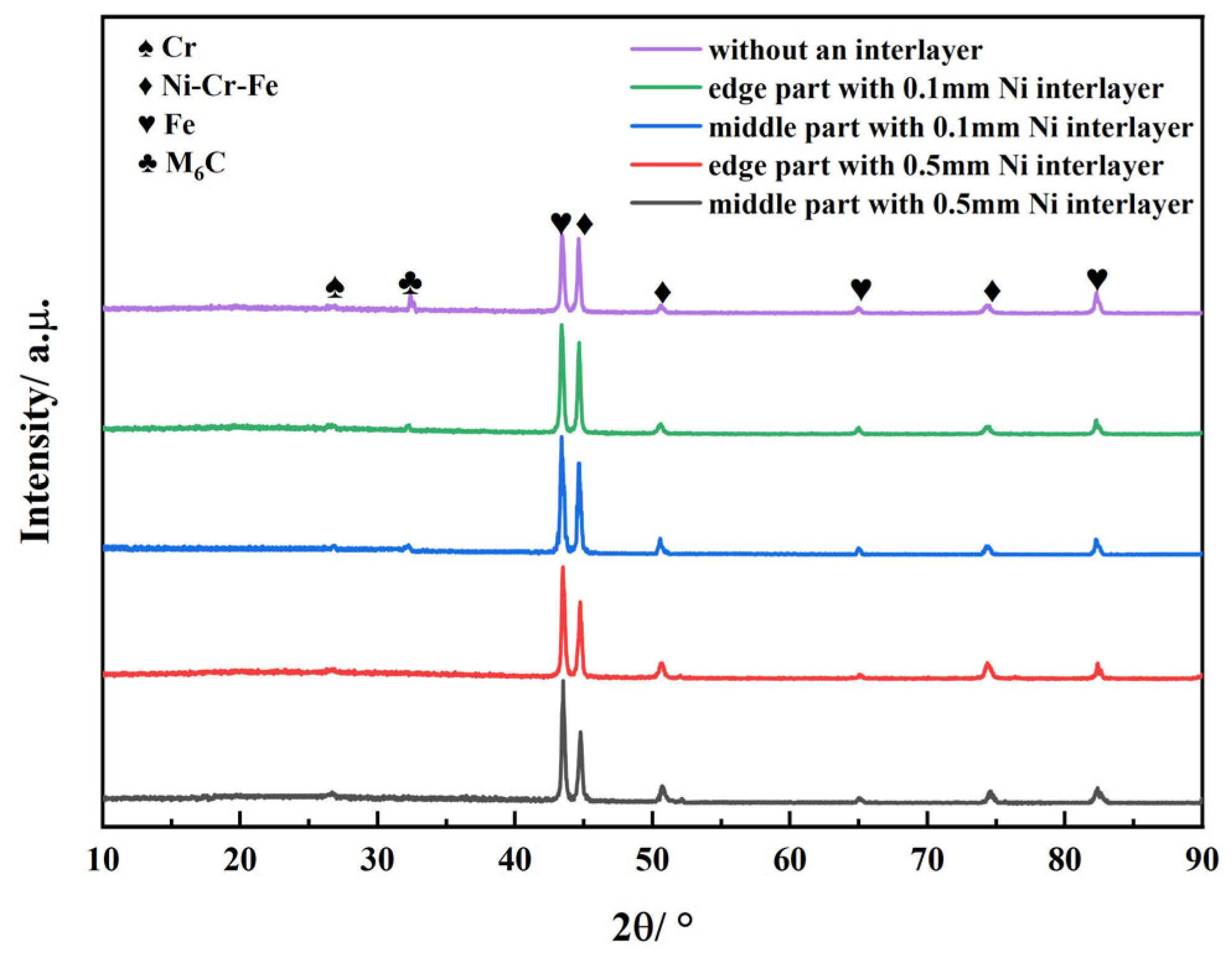
- Without an interlayer, the interface of the cladding plate near the C276 Hastelloy side was composed of a dark Ni solid solution and white M6C particles. A black layer of Mn-Cr oxides was present at the interface. An Fe-based solid solution formed adjacent to the Q235 Steel side. After adding a Ni interlayer, the quantity of white M6C particles gradually decreased with increasing Ni interlayer thickness and eventually disappeared entirely.
- (3)
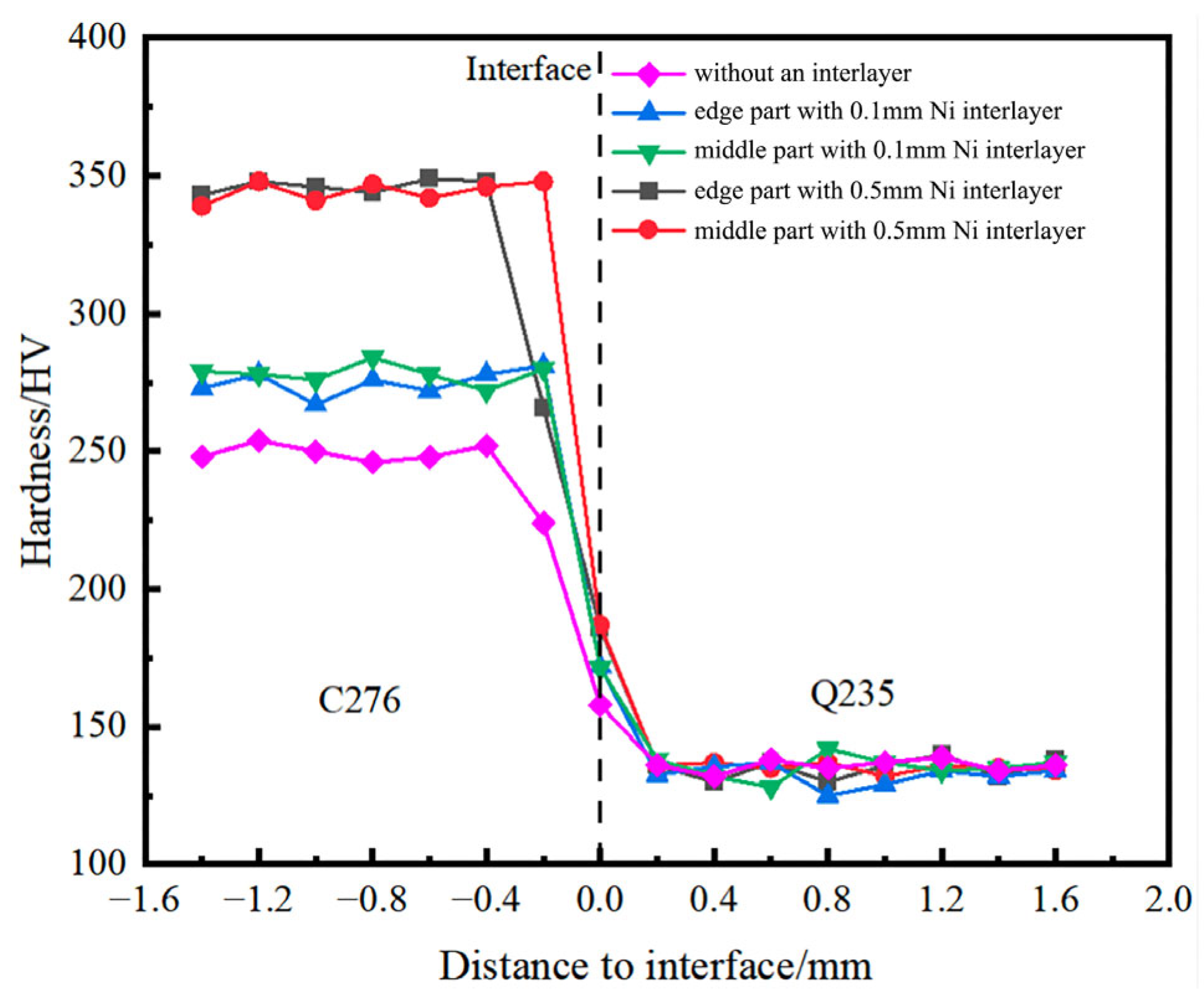
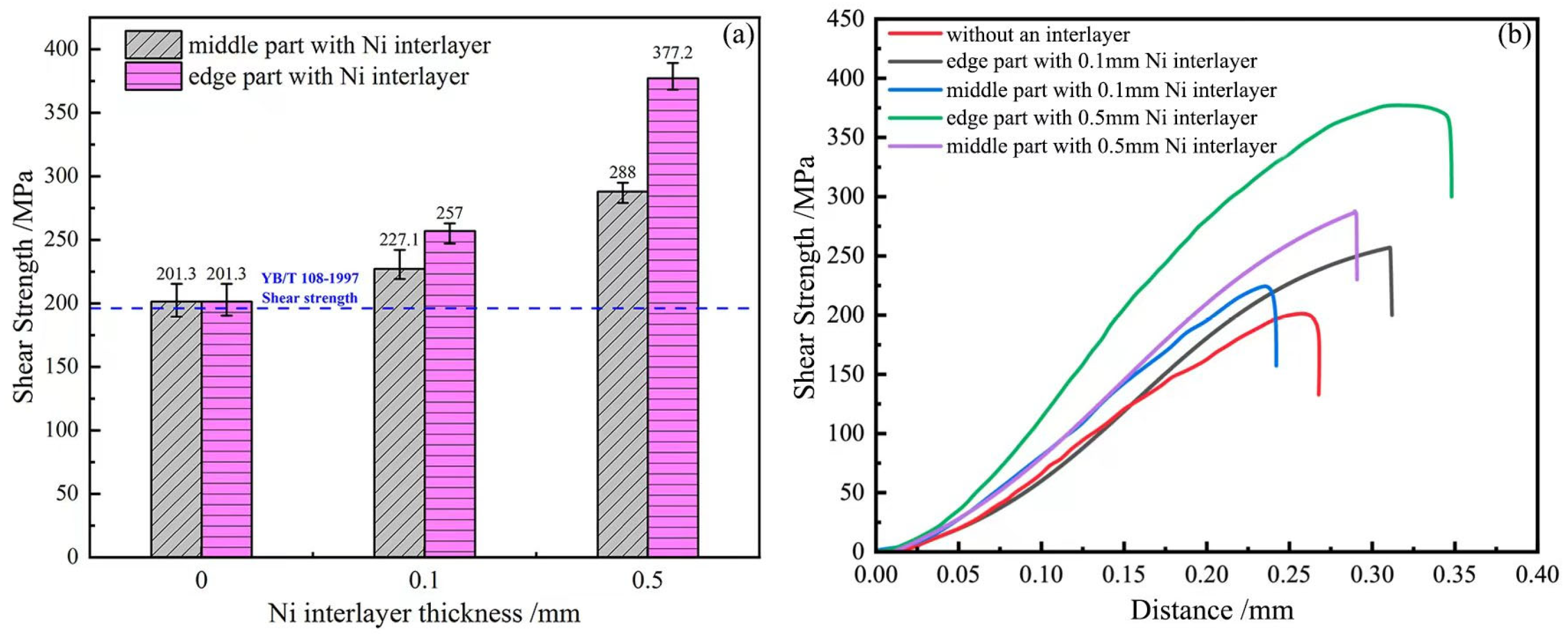
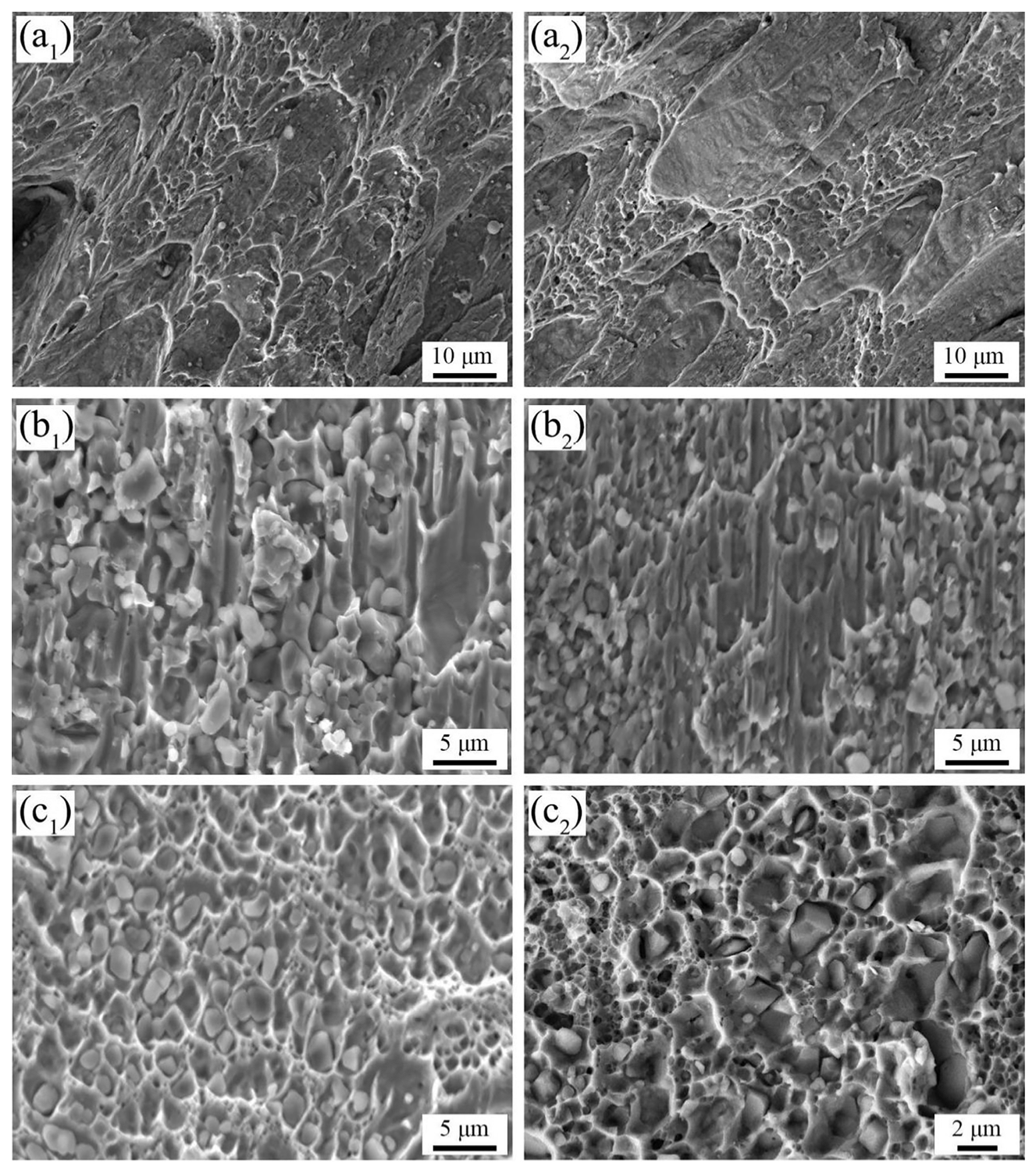
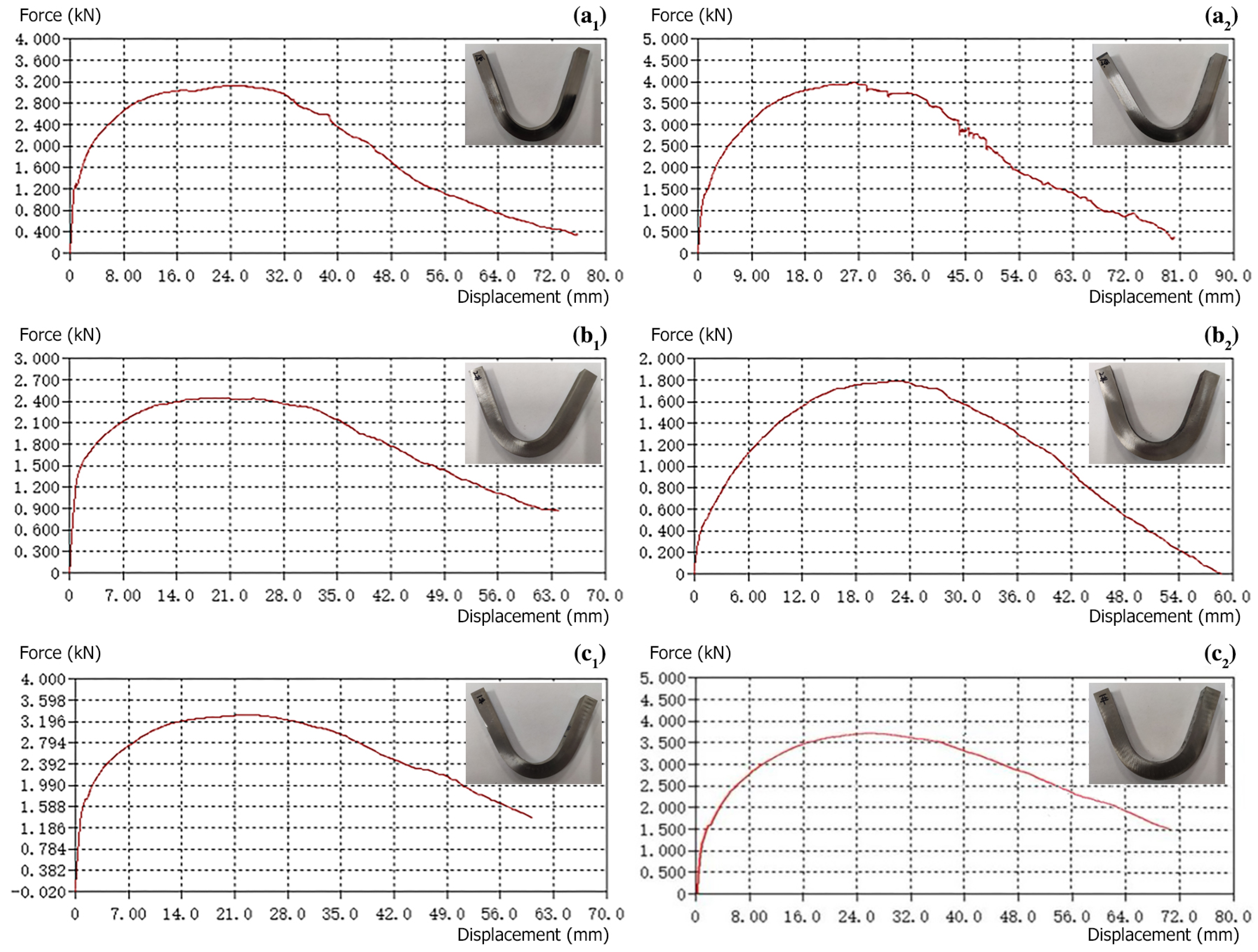
- Regardless of whether a Ni interlayer was added, the microhardness values of the cladding plate consistently followed the trend: C276 Hastelloy > interfacial zone > Q235 steel. The introduction of a Ni interlayer significantly enhanced the microhardness of both the C276 Hastelloy substrate and the C276/Q235 interface, while the microhardness of the Q235 Steel remained unchanged. When the thickness of the Ni interlayer increased from 0 mm to 0.5 mm, the shear strength of the cladding plates increased from 227.1 MPa to 377.2 MPa. Notably, the shear strength at the edge parts of the cladding plate was higher than that at the middle part. Furthermore, under all three conditions, the cladding plates could be bent without cracking.
- (4)
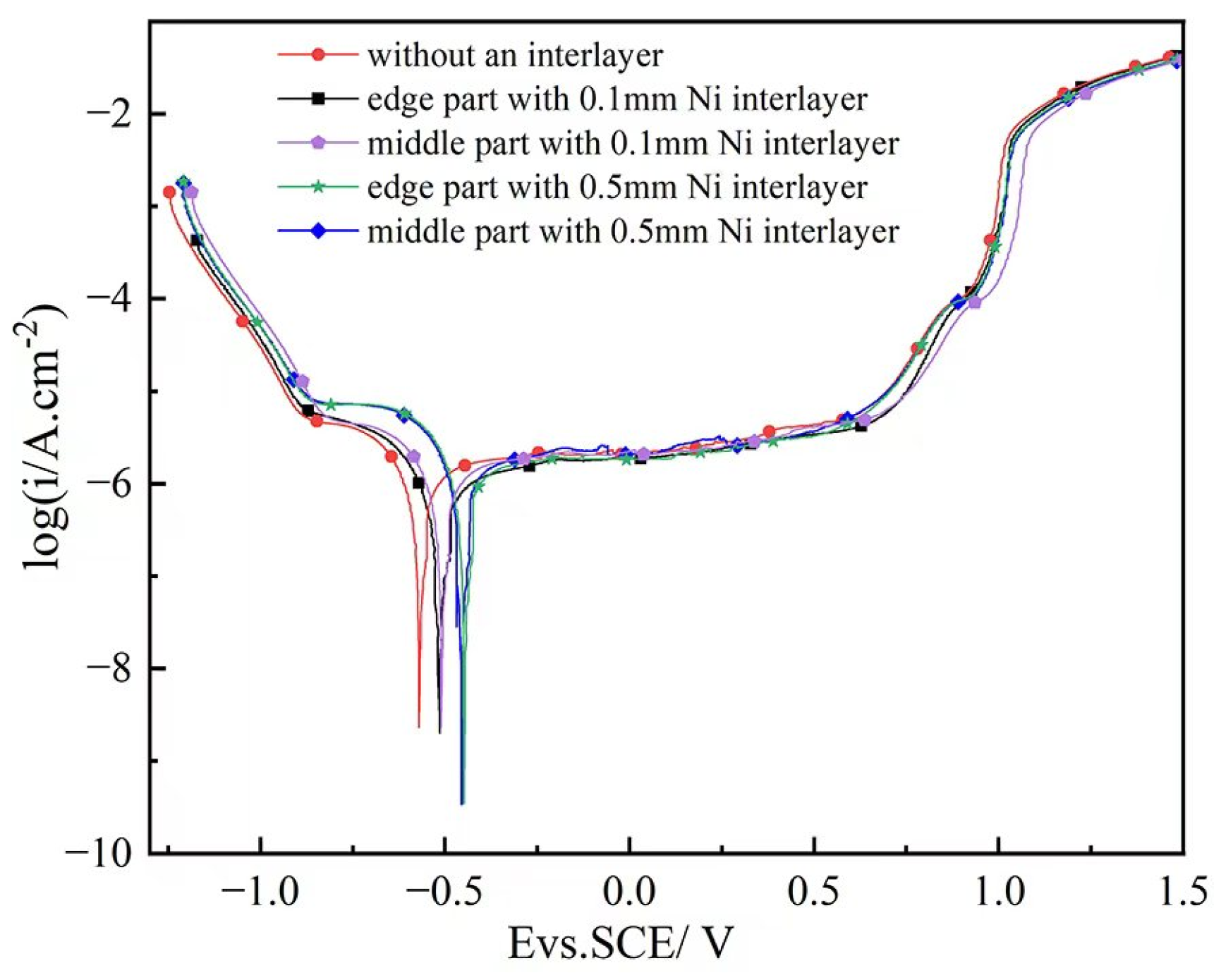
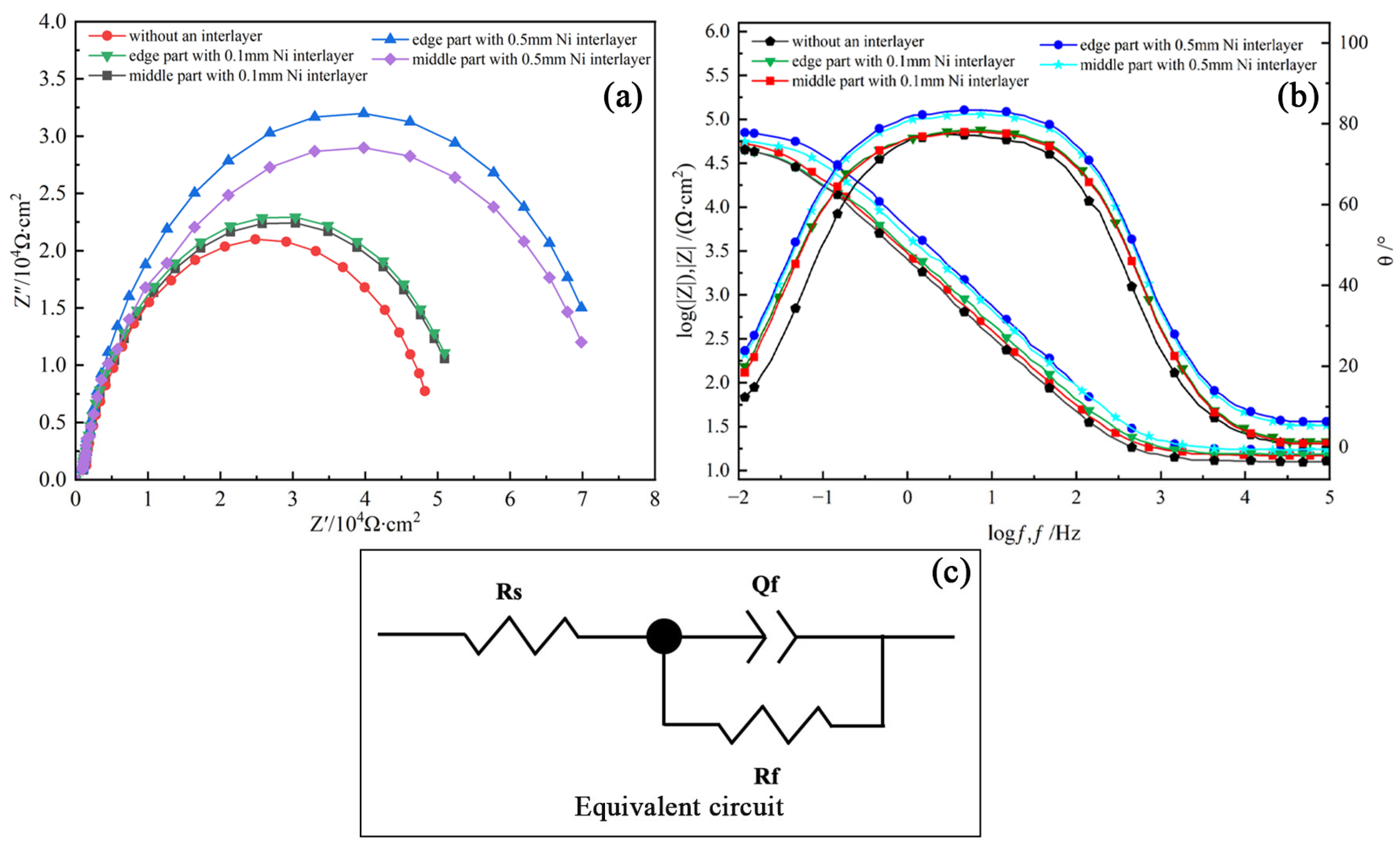
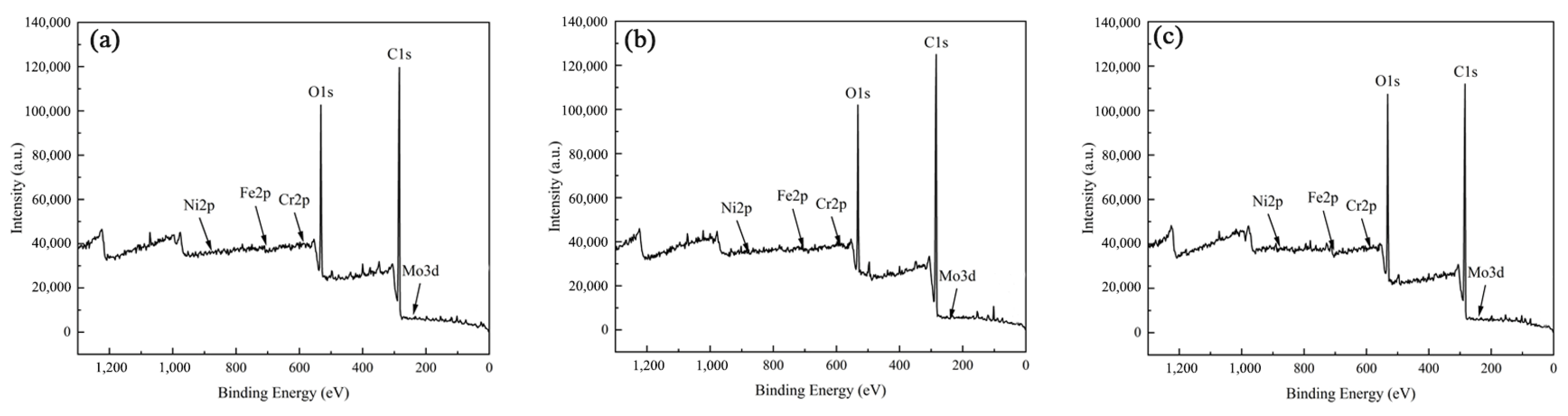
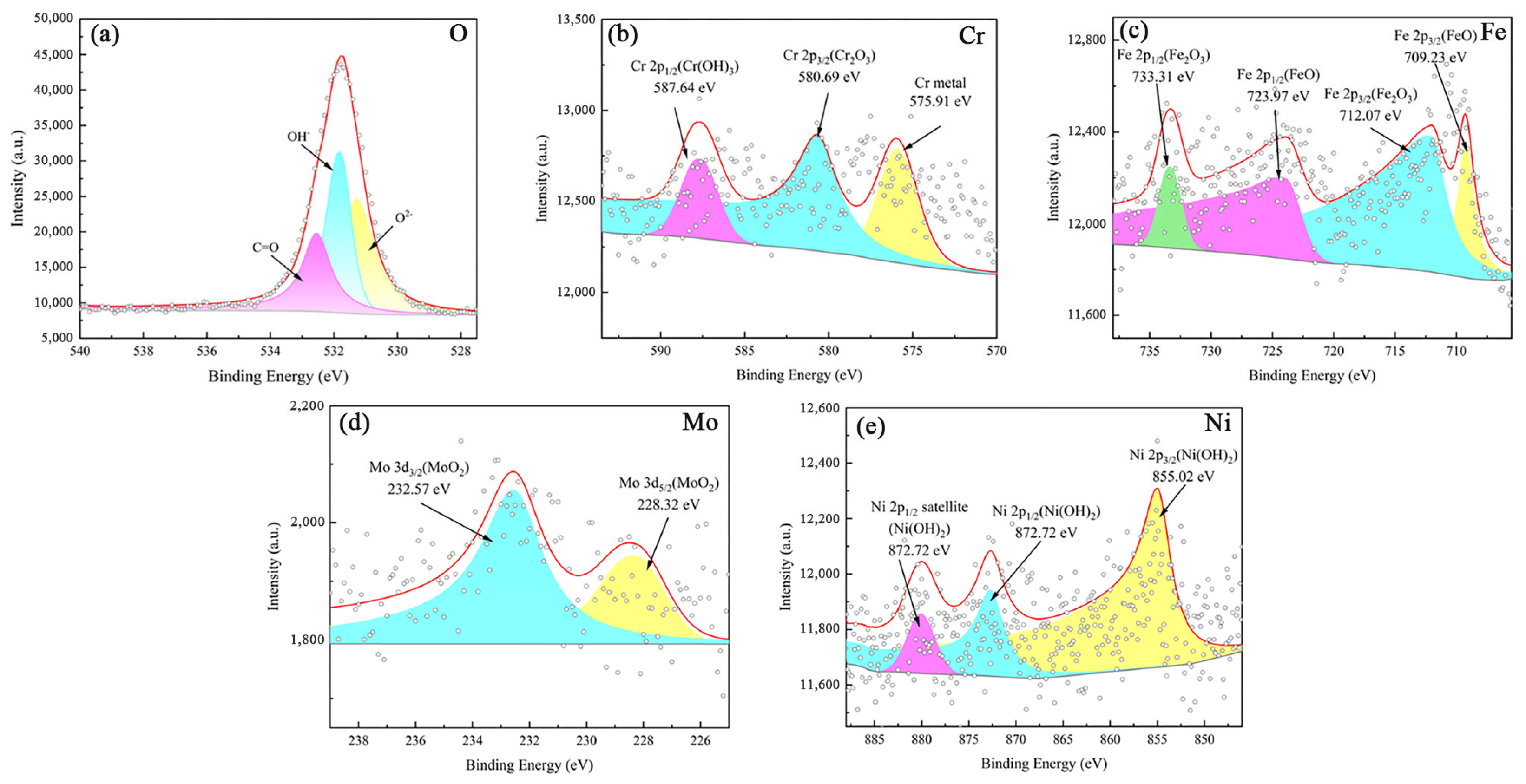
- Based on the potentiodynamic polarization curves and EIS results, the corrosion resistance of the cross-section of the C276 Hastelloy cladding plate increased with the thickness of the Ni interlayer, and it reached the optimal value with the Ni interlayer thickness of 0.5 mm. XPS analysis revealed that the formation of a large number of Cr and Mo oxides on the surface of the passive film was the primary reason for this enhanced corrosion resistance.
Author Contributions
Funding
Institutional Review Board Statement
Informed Consent Statement
Data Availability Statement
Conflicts of Interest
References
- Huang, C.; Wang, J.; Yan, J.; Liao, L. Evaluation of corrosion and wear performance of Fe-based coating and Hastelloy C276 in H2S environment on 304 stainless steel substrate. Colloids Surf. A 2023, 674, 131871. [Google Scholar]
- Zhang, C.; Zhang, L.W.; Cui, Y.; Feng, Q.Y.; Cheng, C.Q. Effects of high-temperature aging on precipitation and corrosion behavior of a Ni-Cr-Mo-based hastelloy C276 superalloy. J. Mater. Eng. Perform. 2020, 29, 2026–2034. [Google Scholar]
- Shoemaker, L.; Crum, J.; Maitra, D.; Muro, R.; Neighbor, M. Recent experience with stainless steels in FGD air pollution control service. In The NACE International Annual Conference; NACE International: Houston, TX, USA, 2011. [Google Scholar]
- Panigrahi, D.R.; Bartarya, G. Drilling performance of Nickel-based Hastelloy C276 under mono and hybrid nanofluid environments. J. Manuf. Processes. 2024, 120, 1213–1230. [Google Scholar]
- Kim, B.; Kim, K.; Kang, Y.; Kim, S.; Kim, H. Hastelloy C276/AISI SS304 dissimilar metal welding: A comparative review of the effective application of laser and Micro-GTAW. J. Mater. Res. Technol. 2024, 32, 621–633. [Google Scholar] [CrossRef]
- Ma, Y.; Wang, T.; Wang, G.; Fang, X.G.; Chu, C.S. Numerical and experimental studies of the interface characteristics and wave formation mechanism of Hastelloy/stainless steel explosive welding composite plate. Mater. Today Commun. 2023, 36, 106880. [Google Scholar] [CrossRef]
- Yang, G.F.; Wang, A.N.; Su, C.W.; Cui, J. Numerical simulation and surface morphology of laser cladding of nickel-based C276 alloy coatings on AerMet100 steel surface. J. Mater. Res. Technol. 2023, 27, 1696–1710. [Google Scholar]
- Wang, H.H.; Li, X.J.; Wang, Y.X.; Wang, J. Microstructural evolution and interfacial properties of explosively welded Nb/steel composite plate during post-heat treatment. J. Mater. Res. Technol. 2023, 25, 7376–7388. [Google Scholar]
- Lipińska, M.; Ura-Bińczyk, E.; Mróz, S.; Szulc, Z.; Stefanik, A.; Szota, P.; Lewandowska, M. Microstructure and corrosion resistance of Ni-Ti-Al multi-layer laminates manufactured by explosive welding with subsequent rolling. J. Manuf. Processes 2023, 105, 84–98. [Google Scholar] [CrossRef]
- Yi, Y.L.; Feng, K.K.; Zhang, S.; Jin, H.R. Analysis of microstructure and properties evolution of asynchronous hot rolled stainless steel clad plate with interlayer. Mater. Today Commun. 2025, 42, 111380. [Google Scholar]
- Wei, Z.X.; Huang, P.; Su, X.X.; Gao, Q.; Feng, Z.H.; Peng, L.; Li, J.; Zu, G.Y. Effect of bell annealing on the interface microstructure and mechanical properties of titanium/steel composite plates prepared by hot rolling. Mater. Sci. Eng. A 2025, 919, 147485. [Google Scholar]
- Li, Y.; Wang, G.C.; Zhang, W.B.; Yang, H.J.; Li, J.C.; Liu, C.R. Microstructure and Mechanical Propertiesof Explosively Welded Nickel/Steel Composite Plate Interface. Rare Met. Mater. Eng. 2025, 54, 1971–1979. [Google Scholar]
- Liu, Y.P.; Zhao, H.; Li, Y.; Zhu, L. Effect of Heat Treatment on the Properties of Nickel Steel-Clad Plates. J. Ordnance Equip. Eng. 2019, 40, 207–209. [Google Scholar] [CrossRef]
- Sparkowich, S.D.; Manning, P.E.; Banker, J.G. Evaluation of Explosion Clad Hybrid Nickel-Base Alloy UNS N10362. In The NACE International Annual Conference; NACE International: New Orleans, LA, USA, 2017. [Google Scholar]
- Jiang, Z.D.; Wang, S.H.; Liu, W.C.; Zhu, H.W.; Wu, G.H.; Shang, Z.P. Research progress of Cu/Al laminated composites. Chin. J. Nonferrous Met. 2023, 33, 3925–3940. [Google Scholar] [CrossRef]
- Jiang, H.T.; Yan, X.Q.; Liu, J.X.; Duan, X.G. Effect of heat treatment on microstructure andmechanical property of Ti−steel explosive-rolling clad plate. Trans. Nonferrous Met. Soc. China 2014, 24, 697–704. [Google Scholar] [CrossRef]
- Chen, W.; Chen, L.; Xiao, Y.J.; Xu, S.K.; Zhang, K.; Zhang, M.Y.; Li, J.H. Interfacial evolution and mechanical properties of Ti/Steel composite plates processed by cold rolling and annealing. J. Alloy. Comod. 2025, 1003, 185532. [Google Scholar] [CrossRef]
- Zeng, L.F.; Gao, R.; Fang, Q.F.; Wang, X.P.; Xie, Z.M.; Miao, S.; Hao, T.; Zhang, T. High strength and thermal stability of bulk Cu/Ta nanolamellar multilayers fabricated by cross-accumulative roll bonding. Acta Mater. 2016, 110, 341–351. [Google Scholar] [CrossRef]
- Wang, H.; Li, G.Y.; Li, S.; Gui, H.L.; Wang, T. Research progress on preparation process and interface control of copper/steel clad plate. Chin. J. Nonferrous Met. 2025, 35, 99–125. [Google Scholar] [CrossRef]
- Wang, T.; Qi, Y.Y.; Liu, J.L.; Han, J.C.; Ren, Z.K.; Huang, Q.X. Research progress of metal laminates roll bonding process at home and abroad. J. Harbin Inst. Technol. 2020, 52, 42–56. [Google Scholar] [CrossRef]
- Wei, Z.X.; Huang, P.; Gao, Q.; Su, X.X.; Feng, Z.H.; Peng, L.; Li, J.; Sun, Y.H.; Zu, G.Y. Influence of continuous annealing on the interfacial compound evolution and mechanical behavior of hot-rolled titanium/steel composite plates. Mater. Des. 2025, 253, 113818. [Google Scholar] [CrossRef]
- Wu, H.; Ren, Z.K.; Fu, L.; Hou, H.P.; Hu, J.X.; Liu, X.; Guo, X.W. Effect of hot rolling with a corrugated roller and warm rolling with a flat roller on the surface cracking and interfacial microstructure of the titanium side of titanium/steel clad plates. Mater. Today Commun. 2026, 51, 114598. [Google Scholar] [CrossRef]
- Luo, Z.A.; Chen, X.F.; Xie, G.M.; Wang, G.D.; Dang, J.; Wang, G.L. Microstructure and mechanical property of vacuum hot-rolled 825 alloy/X65 pipeline steel clad plate. Iron Steel 2017, 52, 64–69+81. [Google Scholar]
- Fan, J.H.; Li, P.F.; Liang, X.J.; Liang, J.P.; Xu, C.Z.; Jiang, L.; Ye, X.X.; Li, Z.J. Interface Evolution During Rolling of Ni-clad StainlessSteel Plate. Chin. J. Mater. Res. 2021, 35, 493–500. [Google Scholar]
- Sun, Y.W.; Yu, S.R.; Wang, B.Y.; Liu, L.; Liu, E.Y.; Feng, T. Interface Microstructure and Mechanical Properties of Nickel/Steel Bimetal Composite Pipe Fabricated by Explosive Welding. Metals 2024, 14, 1253. [Google Scholar] [CrossRef]
- Ma, Y.Z.; Yang, W.J.; Liu, Q.; Liu, K.J.; Chen, K. Study on Interface Microstructure and Bonding Properties of Hot-Rolled Nickel-Based Composite Plate. Adv. Mater. Sci. Eng. 2022, 2022, 3531279. [Google Scholar]
- Qin, C.; Xia, Y.; Tan, L.J.; Li, J.; Xu, X.Y. Interfacial diffusion behavior on multi-pass hot rolling for automobile310S/GH4169 steel-nickel composite plate. Forg. Stamping Technol. 2022, 47, 152–157. [Google Scholar]
- Ma, T.J.; Di, H.S.; Liang, X.J.; Xu, W.L.; Yao, L. Study on the microstructure and properties of nickel base alloy rolled clad plate. Baosteel Tech. Res. 2017, 1–5. [Google Scholar]
- Jiang, J.B.; Liu, F.F.; Liu, W.Y.; Wang, S.; Gao, H.; Jin, B.G.; Han, X. Study on Micro-structures and Mechanical Properties of Composite Interfaces of Inconel625/X65 Clad Steel Plates. Angang Technol. 2025, 5, 40–44. [Google Scholar] [CrossRef]
- Pu, J.; Chen, T.M.; Sun, Y.B.; Long, W.M.; Sun, H.W.; Chen, Y.X. Effect of Heat Treatment Temperature on the Microstructure and Properties of Titanium-Clad Steel Plate Prepared by Vacuum Hot Rolling. Coatings 2024, 14, 1096. [Google Scholar] [CrossRef]
- Posner, E.S.; Neumann, G.S. Compositional effects in the liquid Fe–Ni–C system at high pressure. Phys. Chem. Miner. 2022, 49, 43. [Google Scholar]
- Krbata, M.; Ciger, R.; Kohutiar, M.; Sozańska, M.; Eckert, M.; Barenyi, L.; Kianicova, M.; Jus, M.; Beronská, N.; Mendala, B.; et al. Effect of Supercritical Bending on the Mechanical & Tribological Properties of Inconel 625 Welded Using the Cold Metal Transfer Method on a 16Mo3 Steel Pipe. Materials 2023, 16, 5014. [Google Scholar] [CrossRef]
- Fan, Y.M.; Liu, W.; Sun, Z.T.; Chowwanonthapunya, T.; Zhao, Y.G.; Dong, B.J.; Zhang, T.Y.; Banthukul, W. Effect of chloride ion on corrosion resistance of Ni-advanced weathering steel in simulated tropical marine atmosphere. Constr. Build. Mater. 2021, 266, 120937. [Google Scholar] [CrossRef]
- Liu, H.D.; Pu, J.; Wu, M.F.; Zhang, C.; Rao, J.W.; Long, W.M.; Shen, Y.X. Research on the Microstructure and Properties of Al Alloy/Steel CMT Welding-Brazing Joints with Al-Si Flux-Cored Welding Wires. Coatings 2023, 13, 1590. [Google Scholar] [CrossRef]
- Mao, T.; Li, L.; Huang, H.B.; Yu, Z.M.; Zhong, Y.; Chen, S.L. Corrosion behaviors of TA2 and TA36 titanium alloys in a high-sulfur environment. Int. J. Electrochem. Sci. 2024, 19, 100462. [Google Scholar] [CrossRef]
- Guiñón-Pina, V.; Igual-Muñoz, A.; García-Antón, J. Influence of pH on the electrochemical behaviour of a duplex stainless steel in highly concentrated LiBr solutions. Corros. Sci. 2011, 53, 575–581. [Google Scholar] [CrossRef]
- Pu, J.; Wu, D.; Shi, X.H.; Long, F.; Sun, H.W. The Effects of CeO2 Content on the Microstructure and Property of Duplex Stainless Steel Layer Obtained by Plasma Arc Cladding Technology. Coatings 2025, 15, 590. [Google Scholar] [CrossRef]
- Jin, T.Y.; Cheng, Y.F. In situ characterization by localized electrochemical impedance spectroscopy of the electrochemical activity of microscopic inclusions in an X100 steel. Corros. Sci. 2011, 53, 850–853. [Google Scholar] [CrossRef]





| Materials | Elements (wt.%) | ||||||||||
|---|---|---|---|---|---|---|---|---|---|---|---|
| Ni | Cr | Mo | Fe | W | Si | Mn | Al | C | S | P | |
| C276 | Bal. | 15.535 | 15.85 | 5.62 | 3.52 | — | 0.305 | 0.114 | <0.005 | — | — |
| Q235 | — | — | — | Bal. | — | 0.21 | 1.3 | 0.021 | 0.148 | <0.005 | 0.016 |
| Materials | Density (g/cm3) | Thermal Conductivity (W/(m·k)) | Coefficient of Linear Expansion (10−6·K−1) | Melting Point (°C) | Tensile Strength (MPa) | Elongation (%) |
|---|---|---|---|---|---|---|
| C276 | 8.89 | 10.1 | 11.2 | 1350 | 781 | 47 |
| Q235 | 7.85 | 51.9 | 12.1 | 1510 | 412 | 26 |
| Ni interlayer | 8.9 | 70.2 | 13.3 | 1453 | 357 | 42 |
| Characteristic Points | Elements (wt.%) | Possible Phases | |||||||
|---|---|---|---|---|---|---|---|---|---|
| C | Cr | Fe | Ni | Mo | W | Mn | O | ||
| P1 | 10.87 | 12.30 | 4.73 | 19.81 | 42.86 | 9.43 | M6C | ||
| P2 | 5.81 | 12.12 | 7.23 | 58.62 | 12.53 | 3.12 | 0.57 | Ni solid solution | |
| P3 | 2.85 | 31.71 | 22.65 | 12.10 | 2.01 | / | 1.76 | 26.92 | Oxides of Mn and Cr |
| P4 | 6.52 | 5.8 | 56.75 | 26.85 | 4.08 | / | Fe solid solution | ||
| P5 | 7.68 | 12.34 | 5.09 | 22.87 | 41.67 | 10.35 | M6C | ||
| P6 | 5.61 | 14.32 | 6.31 | 57.34 | 12.05 | 3.76 | 0.61 | Ni solid solution | |
| P7 | 2.91 | 30.96 | 23.12 | 12.87 | 2.34 | / | 0.17 | 27.63 | Oxides of Mn and Cr |
| P8 | 5.87 | 13.62 | 6.97 | 58.03 | 12.34 | 2.58 | 0.59 | Ni solid solution | |
| P9 | 2.87 | 31.23 | 23.04 | 12.09 | 1.98 | / | 1.76 | 27.03 | Oxides of Mn and Cr |
| Sample | Ecorr (mV) | Icorr (A·cm2) |
|---|---|---|
| Without an interlayer | −0.589 | 4.96 × 10⁻⁹ |
| Edge part with 0.1 mm Ni interlayer | −0.515 | 2.00 × 10⁻⁹ |
| Middle part with 0.1 mm Ni interlayer | −0.550 | 2.32 × 10⁻⁹ |
| Edge part with 0.5 mm Ni interlayer | −0.449 | 3.44 × 10⁻¹⁰ |
| Middle part with 0.5 mm Ni interlayer | −0.455 | 3.37 × 10⁻¹⁰ |
| Sample | Rs/(Ω·cm2) | Qf/(10−5Ω·−1 cm2·Ω−n) | Rf/(Ω·cm2) | n |
|---|---|---|---|---|
| Without an interlayer | 11.642 | 3.586 | 46,120 | 0.88612 |
| Edge with 0.1 mm Ni interlayer | 12.473 | 3.764 | 56,455 | 0.87358 |
| Middle part with 0.1 mm Ni interlayer | 12.266 | 4.375 | 54,315 | 0.86257 |
| Edge with 0.5 mm Ni interlayer | 13.394 | 3.966 | 67,369 | 0.85974 |
| Middle part with 0.5 mm Ni interlayer | 13.458 | 5.898 | 62,883 | 0.86015 |
Disclaimer/Publisher’s Note: The statements, opinions and data contained in all publications are solely those of the individual author(s) and contributor(s) and not of MDPI and/or the editor(s). MDPI and/or the editor(s) disclaim responsibility for any injury to people or property resulting from any ideas, methods, instructions or products referred to in the content. |
© 2026 by the authors. Licensee MDPI, Basel, Switzerland. This article is an open access article distributed under the terms and conditions of the Creative Commons Attribution (CC BY) license.
Share and Cite
Lv, L.; Wu, M.; Long, F.; Zhou, M.; Pu, J. Effect of Ni Interlayer on Microstructure and Properties of C276 Hastelloy/Q235 Steel Cladding Plates. Coatings 2026, 16, 425. https://doi.org/10.3390/coatings16040425
Lv L, Wu M, Long F, Zhou M, Pu J. Effect of Ni Interlayer on Microstructure and Properties of C276 Hastelloy/Q235 Steel Cladding Plates. Coatings. 2026; 16(4):425. https://doi.org/10.3390/coatings16040425
Chicago/Turabian StyleLv, Lin, Mingfang Wu, Fei Long, Mingkuan Zhou, and Juan Pu. 2026. "Effect of Ni Interlayer on Microstructure and Properties of C276 Hastelloy/Q235 Steel Cladding Plates" Coatings 16, no. 4: 425. https://doi.org/10.3390/coatings16040425
APA StyleLv, L., Wu, M., Long, F., Zhou, M., & Pu, J. (2026). Effect of Ni Interlayer on Microstructure and Properties of C276 Hastelloy/Q235 Steel Cladding Plates. Coatings, 16(4), 425. https://doi.org/10.3390/coatings16040425