Article

Transformation of Non-Conjugated Polymers into Oxide Nanocomposites Exhibiting Photocurrent Switching in a Wide Light Spectrum Range

1
School of Environmental and Material Engineering, Center of Advanced Functional Materials, Yantai University, Yantai 264005, China
2
National Laboratory of Industrial Control Technology, Institute of Cyber-Systems and Control, Zhejiang University, Hangzhou 310027, China
*
Author to whom correspondence should be addressed.
Coatings 2026, 16(4), 396; https://doi.org/10.3390/coatings16040396
Submission received: 27 February 2026 / Revised: 16 March 2026 / Accepted: 20 March 2026 / Published: 24 March 2026

Abstract

Narrowing the bandgap of wide-bandgap oxides and controlling defects are crucial ways of enhancing the properties of functional materials. One important way to develop multifunctional hybrids is to transform non-conjugated polymers into oxide nanocomposites. To expand the broad-spectrum applications of wide-bandgap oxides, ZnO-based nanocomposites were synthesised using cross-linking non-conjugated polymers via one-pot carbonisation. As polymer-derived nanocomposites exhibit significant scattering noise, the grain boundaries of the nanocomposites were filled using additives that have an electronic effect. Optimising the grain boundaries in this way significantly decreased the scattering noise, avoided large fluctuations in baseline current and enhanced the interfacial charge transfer in broadband light spectral regions. The electronic effects of the used additives can effectively passivate defects in the polymer-derived oxide nanocomposites’ aggregation state, improving photocurrent extraction. Even after storage at room temperature for two years, the optimised nanocomposite exhibited favourable photocurrent signals when excited using typical light sources at wavelengths of 650, 808, 980 and 1064 nm. This nanocomposite has potential applications in interdisciplinary fields involving light harvesting. This study provides a simple, environmentally friendly strategy to creating multifunctional hybrids using non-conjugated polymers as precursors.

1. Introduction

Materials are primarily classified into three major categories based on their chemical composition: metals, ceramics, and polymers. There is considerable overlap between these three categories. Metals, ceramics, and polymers can serve as crucial components or matrices in the design of composites. Composites constitute a remarkably broad field, encompassing both traditional composites and contemporary nanocomposites. In the field of functional composites, bandgap width, interface and defects play crucial roles in enhancing material properties. Polymers play an indispensable role as components or matrices within materials and multidisciplinary fields. As well as their traditional application in these fields, which primarily refers to blends of polymers with metals, ceramics and other materials, polymers can be transformed into inorganic materials such as functional ceramics. Intrinsic conductive polymers contain π-conjugated units and exhibit conductivity through delocalised electron realisation. Despite their favourable electrical conductivity and optoelectronic properties, they exhibit poor processability. Non-conjugated polymers offer design versatility and favourable processing properties but lack electrical conductivity. The flexibility and intrinsic conductivity of polymers are difficult to achieve simultaneously. Although conjugated polymers share similar band structure mechanisms with inorganic semiconductor materials, the conductive mechanisms in organic materials are more complex, and the varieties of conjugated polymers are limited. From the perspective of the mechanism of generating optoelectronic signals, regardless of the material type, the presence of an appropriate bandgap and good carrier delocalisation pathways is essential for generating photoelectric signals. Carbon materials represent a rich and diverse functional material. Beyond graphene, carbon nanotubes and graphyne with high conjugated degree, numerous other carbon materials with abundant defects have also garnered significant attention. Controlling defects is necessary to meet the specified performance requirements. With the advancement of carbon materials research and development [1,2,3,4,5,6,7], polymer-derived carbon dots have received considerable attention as a type of carbon material, particularly in the field of fluorescence. It can improve its electrical conductivity and optoelectronic properties. Carbon materials made from polymers, as one typical functional nanocomposite, which have potential applications in conductive, photoelectric and photoluminescent fields [5,6,7]. Due to the abundance of defects and grain boundaries in polymer-produced carbon materials, which concentrate abundant charge carrier trap centres, and the exceedingly complex microstructural changes that occur during polymer carbonisation, controlling these defects is crucial for enhancing performance. Due to the wide range of non-conjugated polymers available, the possible structural rearrangement of polymers during polycondensation and carbonisation is infinite. Non-conjugated polymers are abundant and offer exceptional design flexibility, so the potential for developing multifunctional nanocomposites is limitless. This also paves the way for new avenues of research into non-conjugated polymers within the field of advanced functional materials.
Compared to synthetic polymers, the biocompatibility of natural polymers is currently attracting considerable attention. Natural polymers should play a significant role in environmentally friendly materials. They hold particular advantages in the environmentally friendly preparation of certain functional materials. Among the natural polymers, sodium alginate (SA) is abundant, low-cost, and has been extensively applied in biomedical fields [8,9,10], fuel cells [11], batteries [12], separation membranes [13], environmental remediation and monitoring [14,15,16], supercapacitors [17], responsive materials and actuators [18], organic/inorganic hybrids [19], etc. Meanwhile, sodium alginate contains abundant -COOH groups, which easily result in cross-linking and functionalisation. In addition to their conventional applications, preparing environmentally friendly functional nanocomposites using sodium alginate as a precursor shows considerable promise for future development. Not only is it used for synthesising new types of nanocomposites, but it is also used for modifying existing materials. The environmentally friendly preparation of nanocomposites is an important area of research in materials science. The transformation of non-conjugated polymers into functional ceramics is also a significant area of interdisciplinary research.
In wide-bandgap materials, ZnO is a typical multifunctional material due to its low cost, simple synthesis, good biocompatibility, and certain outstanding physical properties. ZnO nanocomposites have applied in photodetectors [20,21,22,23,24,25,26,27], photocatalytic degradation of organic pollutants [28], photosynthesis [29,30,31,32], gas sensor [33], nanogenerators [34], pressure sensors [35], batteries [36,37], solar cells [38], etc. ZnO is a wide-bandgap material (3.2–3.4 eV). Only the wavelength of light less than 380 nm can be effectively used. Much research is devoted to doping, co-doping, heterostructures and device applications to improve the properties and increase the efficiency of light harvesting. For example, Khan and co-workers [39] investigated the structural, electrical and optical properties of hetrostructured MoS2/ZnO. Das and co-workers [40] investigated the origin of p-type conductivity for N-doped ZnO. Ichipi and co-workers [41] studied the plasmonic effect and bandgap tailoring of Ag/Ag2S doped on ZnO nanocomposite. Bang and co-workers [42] studied vacancy clusters in ZnO. Schttner and co-workers [43] studied the effect of doping on electron transfer at organic/oxide interfaces. To modify the ZnO material, doping with metals or non-metallic elements has been widely used. Such as Al, Sn, Sr, Fe, Co, Mn, Ni, Ti, Bi doping and others [44,45,46,47,48,49]. Among the non-metallic element doping, S, C, N, B, P, F doping or co-doping is one of the common methods of ZnO-based material modification. For example, S-, N- and C-doped ZnO for solar photocatalytic applications [50], N-doped ZnO UV photo-conductive detector [51,52], F-doped ZnO UV photodetector [53], etc. Although these dopants significantly affect the properties of ZnO, there is no substantial change to the ZnO band gap. Controlling the band gap width over a wide range is extremely difficult. Covering the UV-Vis-NIR range is also challenging. Most results are still in the UV or visible range. One effective way to extend to the near infrared and exploit the UV-Vis-NIR range is to construct heterostructures with narrow bandgap semiconductors [54,55]. Wang and co-workers [55] have constructed ZnO/PbS quantum dot heterojunction for broadband photodetectors. Jaafar and co-workers [56] had studied the optoelectronic switching memory behaviour based on ZnO/polymer nanocomposite. Zhao and co-workers [57] investigated zinc oxide/poly(3-hexylthiophene) heterojunction. Li and co-workers [58] fabricated ZnO quantum dot/MXene hybrids for ultraviolet photodetectors, etc. There are many similar studies which are not listed here due to space limitations. Therefore, the regulation of wide-bandgap and materials’ properties through interface engineering holds considerable appeal.
Although good progress has been made after several decades of doping research, increasing the doping content of foreign elements is still a major challenge. So far, carbon-modified ZnO has also received considerable attention since carbon materials have controlled conductivity. The research fields involved include lithium-ion batteries [59,60], light-emitting diodes [61], UV photodetectors [62], sensors [63,64,65], supercapacitors [66], photocatalytic fields, and so on. Typical examples are summarised below: ZnO@sulfur doped carbon nanocomposites [67,68], ZnO/nitrogen doped carbon nanohybrids [69], ZnO/carbon quantum dots or doped carbon quantum dots [70,71,72,73,74,75,76,77], ZnO/graphene quantum dots [78], ZnO/carbon or doped carbon dots [79,80,81], ZnO/graphene hybrid materials [66], ZnO nanoparticles dispersed in a nitrogen-enriched carbon matrix [82], ZnO@carbon derived metal-organic frameworks [83]. Sharma et al. [84] investigated a ZnO/carbon hybrid for photocatalytic reduction of CO2. Ding et al. [85] studied the defect of carbon-doped ZnO. Zulkifli et al. [86] fabricated a transparent and flexible carbon-doped ZnO field emission display on a polymer substrate, and so on. Clearly, the modification of ZnO using various carbon materials has a wide range of applications. Therefore, the in situ preparation of wide-bandgap materials and interface optimisation show promise in substantially enhancing material performance. Oxide nanocomposites derived from non-conjugated polymers integrate oxide synthesis, doping and interfacial optimisation into a single step, allowing oxides to be modified in one step. This straightforward and efficient approach is ideal for developing functional nano-composites. It can also expand the use of wide-bandgap oxide materials in the near-infrared region.
According to relevant studies, it is found that these researches are mainly based on the morphology, size, dimension, order and disorder, doping and quantum confinement effect of carbon materials. Since polymer-produced carbon materials have abundant defects. Defects and grain boundaries harbor a large number of carrier trap centers and scattering centers, which impair charge transport and limit the realization of photoelectric performance. Passivation of these defects can significantly enhance the material’s performance. Defect engineering is a key approach to customising material properties.
Some studies [5,6,7] suggest that the degree of conjugation and cross-linking of the polymer precursor significantly affects the properties of the material. Increased crosslinking density may influence the polymer carbonization and cyclisation processes, thereby enhancing the degree of conjugation. This idea may inspire us to utilise non-conjugated polymers to develop a series of performance-enhanced inorganic functional composites. Sodium alginate contains an abundance of active chemical groups. These groups readily cross-link with metal ions to produce a gel. In addition to their conventional applications [8,9,10], polymer gels can be effectively transformed into functional inorganic composites. This provides more options for the preparation and modification of functional materials. This approach offers a straightforward way of preparing inorganic multifunctional nanocomposites. This approach involves the unconventional use of non-conjugated polymers. In our previous studies, narrow bandgap materials such as PbS/C nanocomposites were synthesised via a polymer gel approach [87]. Since the preparation of nanocomposites inevitably introduces numerous defects, and the extent of these defects varies significantly depending on the specific materials and manufacturing processes employed, the enhancement of the near-infrared properties of wide-bandgap materials presents greater challenges. A two-step approach was previously employed to enhance the properties of wide-bandgap oxides [88]. A polymer-derived C/C nanocomposite was synthesised using a green chemical approach [89]. Different material systems exhibit different defects resulting in different properties and applications. In this study, a metal oxide with a wide bandgap was produced using a non-conjugated polymer gel via one-pot carbonisation, and its photophysical properties were investigated. The great advantage of this method is its good dispersibility. Dispersion is superior to blending. Good dispersion promotes interfacial contact and facilitates interfacial charge transfer. This demonstrates the synergy between the components. Synergy between components and doping effects are more conducive to improving material performance. Optimising the grain boundaries and increasing the degree of conjugation significantly enhanced the extraction of the photocurrent. Scattered noise was considerably reduced, and the baseline current became much more stable. In the polymer field, non-conjugated polymers are a large class of materials. The aggregate structure of polymers is also exceedingly complex, resulting in carbon materials with remarkably diverse structures and defects. Therefore, this study presents excellent opportunities for diversifying functional nanocomposites and controlling defects and grain boundaries. It provides a low-cost, environmentally friendly method for developing advanced functional materials, and serves as a reference for designing and applying light-responsive, multifunctional and smart materials. This would be a simple method to develop a series of multifunctional metal oxide hybrids using abundant non-conjugated polymer resources.

2. Materials and Methods

2.1. Materials

Sodium alginate (AR), provided by Tianjin Basf Chemical Co., Ltd. (Tianjin, China). Zinc acetate (AR), provided by Tianjin Bodi Chemical Co., Ltd. (Tianjin, China).

2.2. Preparation of Polymer Solution

Preparation of polymer solution is shown in the reference [87]. The concentration of the sodium alginate solution is 5 mg/mL.

2.3. One-Pot Synthesis of Oxide Nanocomposites

50 mL the above polymer solution, 10 mL H2O and 0.5 g of zinc acetate were added, stirred for 1–3 min. The gel was produced rapidly. The synthesis conditions were the same as the reference [87].
Similarly, 50 mL polymer solution, 10 mL graphene oxide nanoribbon (the concentration of graphene oxide nanoribbon is approximately 4.3 mg/mL) (its synthesis is shown in the reference [90]), 0.5 g zinc acetate were added and stirred for 1–3 min. The gel formed rapidly. The reaction conditions were the same as in the reference [87] for comparison of increasing the content of carbon sp2 structure.

2.4. Characterization of SEM, EDS, UV-Vis, XRD and Raman Spectra

The characterisation of SEM (scanning electron microscope), UV-Vis (UV-VIS spectrophotometer) and XRD (X-ray powder diffraction) was shown in the reference [87,88]. The instruments used were Hitachi S-4800 (HITACHI, Tokyo, Japan), TU-1810 spectrophotometer (Shanghai Yuan Analysis Instrument Co., Ltd., Shanghai, China) and XRD-7000 from SHIMADZU (Shimadzu, Kyoto, Japan). Energy dispersive spectroscopy measurements were performed using a Hitachi S-4800 (HITACHI, Tokyo, Japan). The Raman spectra were characterised using a PHS-3C confocal Raman spectrometer (HORIBA, Kyoto, Japan). The wavelength and power density of the laser radiation were 532 nm and 5 mW, respectively.

2.5. Photocurrent Measurement of the Resulting Nanocomposite Using Several Light Source with Different Wavelength

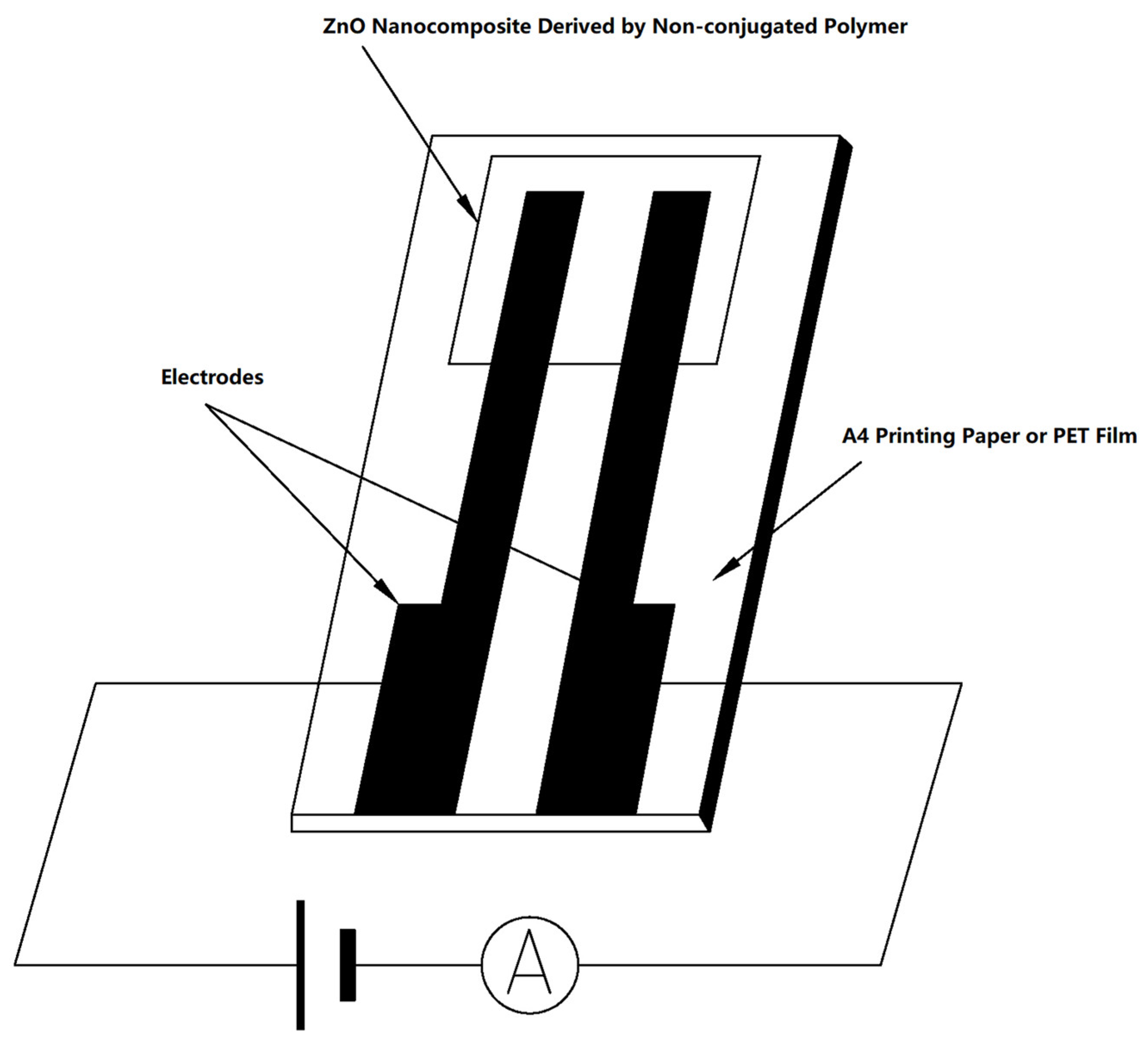
The determination of the photocurrent was same as the reference [87,88]. In this study, several electrodes were used. (1) Ag fibres were attached to the film (using conductive adhesive) using untreated A4 printing paper as a substrate. (2) the graphite electrodes with 4B pencil drawings on untreated A4 printing paper. (3) the Au gap electrodes on PET (polyethylene terephthalate) film. The structure of the electrodes is shown in Scheme 1. Some typical light sources such as 650 nm (100, 50, 5 mW) and 808, 980 and 1064 nm NIR (10, 20, 50, 100, 200 mW) was used. 0, 0.5, 1 V DC (Direct Current) bias were applied, respectively. The current of the thick film was measured by computer recording before and after irradiation of the light sources.

3. Results and Discussion

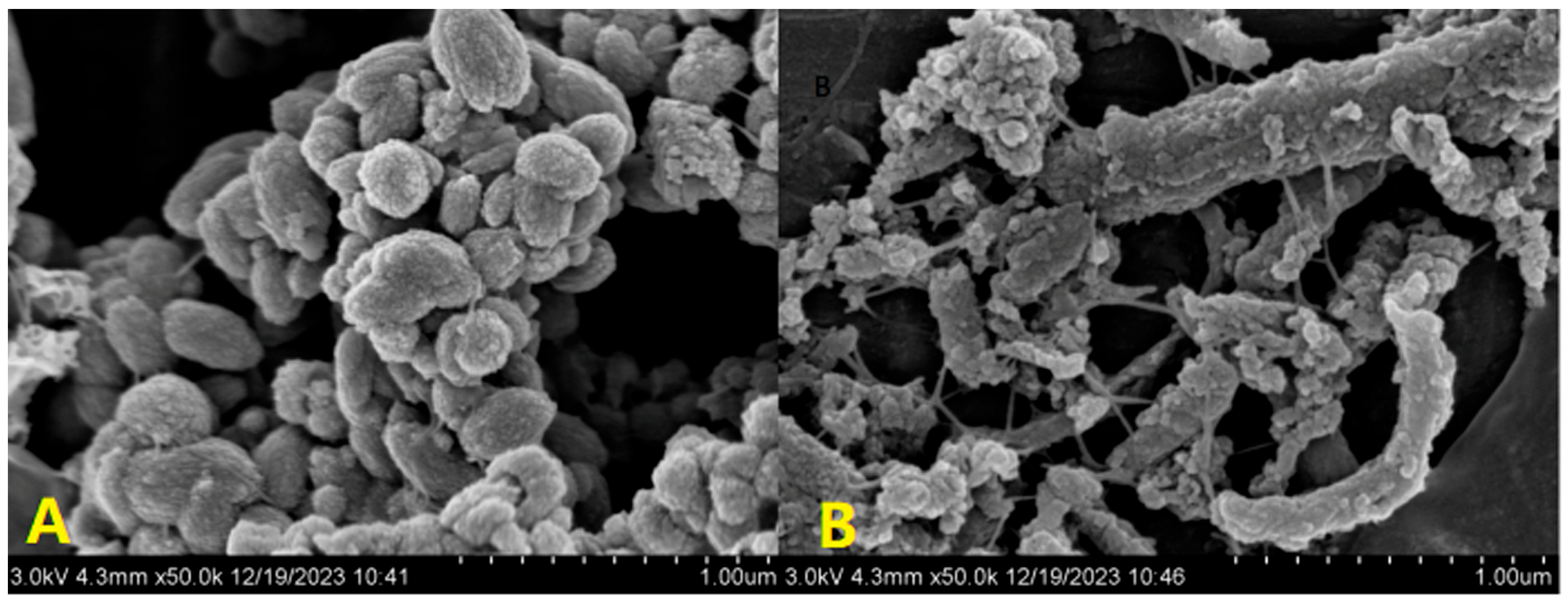
As sodium alginate is rich in -COOH groups. To synthesise the ZnO nanocomposite, zinc acetate was used as the crosslinking agent in this study. Meanwhile, to increase the degree of conjugation, a small amount of graphene oxide nanoribbon was added for comparison. As all materials used in the experiment are green chemicals, the preparation of oxide nanocomposites in this study should be classified as green chemical synthesis. A representative SEM image of the ZnO/C nanocomposite is shown in Figure 1.
As shown in Figure 1A, the resulting product exhibited a nanoparticle shape. The size of these particles was approximately in the range of 10–20 nm and was relatively uniform. These particles tend to aggregate into cluster structures of about 100 nm. Figure 1B shows nanoparticles attached to the surface of one-dimensional structures, resulting in an interconnected structure, which is the result of the addition of graphene oxide nanoribbons. Hydroxyl, carboxyl and epoxide groups were presented on the surface of graphene oxide nanoribbons, which have strong interfacial chemical interactions with ZnO/C nanoparticles. There are many defects at the grain boundary of the resulting nanocomposite. Certain defects can trap photogenerated carriers due to electronic effects and the depth of energy levels, thereby limiting the extraction of photogenerated carriers. These defects significantly affect the material’s physicochemical properties and charge transport. In the process of polymer condensation and carbonisation, zinc oxide forms simultaneously with carbon materials. One-pot synthesis offers the advantage of good dispersibility. Good dispersion indicates close interfacial contact, facilitates interfacial charge transfer and leads to synergy between the components. The resulting products come from the polymer gel networks. The arrangement of carbon atoms in the carbonisation process is irregular, resulting in a combination of crystalline carbon and amorphous carbon. The crystallised carbon facilitates charge transport, and the amorphous carbon inhibits charge transport. An appropriate thickness of amorphous carbon in the nanocomposite can transport the charge through the tunnel effect. Therefore, the process parameters of condensation and carbonisation have an important effect on the charge transport. Overall, the charge transport properties of carbon materials produced by polymer carbonisation are significantly inferior to that of graphene.
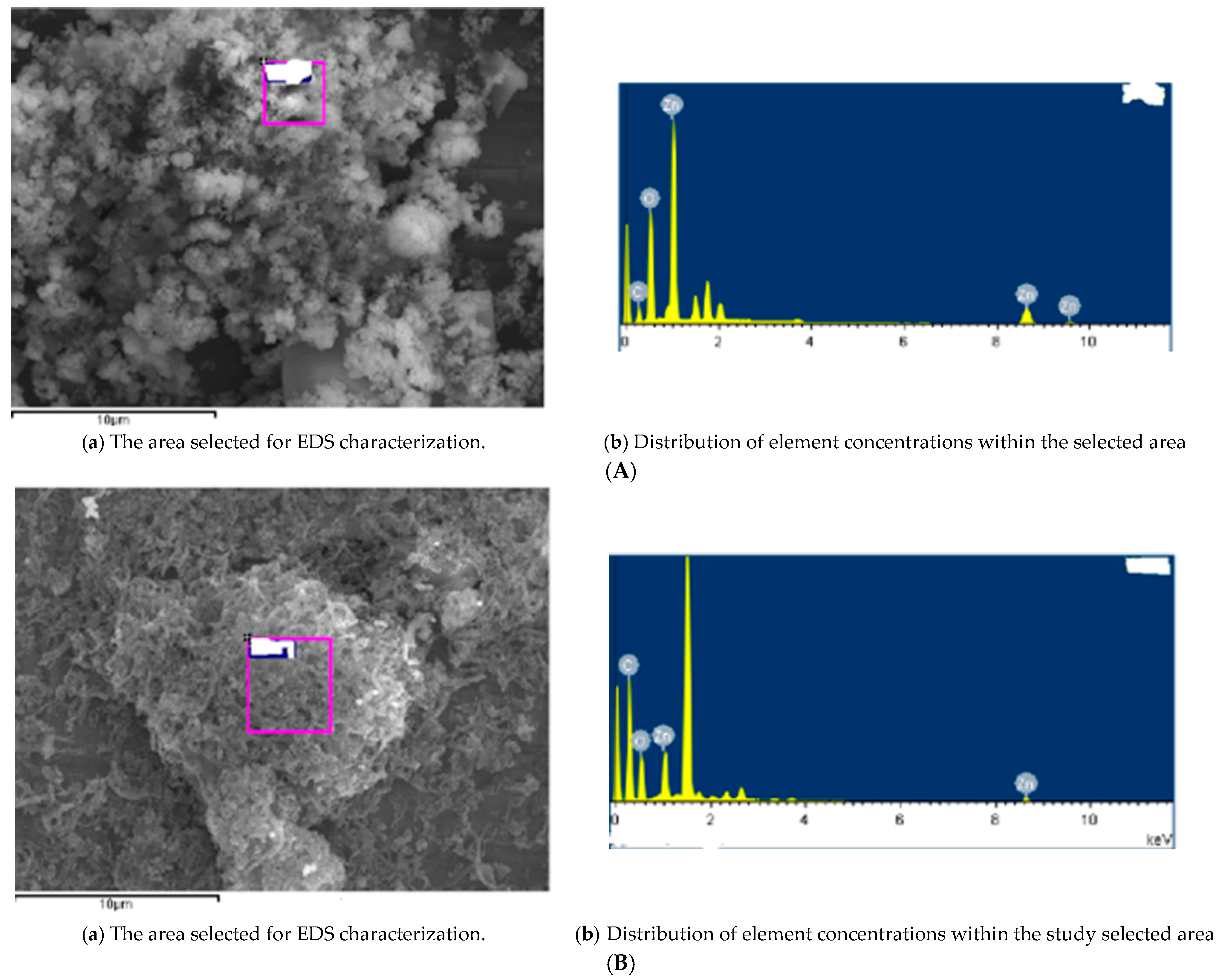
The EDS data of the resulting ZnO/C nanocomposite is shown in Table 1 and Figure 2.
Table 1 shows that the content of C element in the ZnO/C nanocomposite prepared via polymer gel was relatively high compared to the C-doped ZnO system. The high content of carbon element and a large contact area of zinc oxide facilitate interactions between interfaces. Strong charge transfer at the interface between carbon materials and zinc oxide is beneficial to improve the utilisation of light of the ZnO nanocomposite. The charge transfer is mainly due to the C sp2 structure of carbon materials. However, the conjugation degree of carbon derived from non-conjugated polymers is generally not high. It does not favour charge transfer. The ratio of orders to disorders in the resulting nanocomposites determines their interfacial charge transport. The disordered region contains numerous trap centres that readily capture photogenerated carriers, thereby restricting their directed motion and impairing the detection of photoelectric signals. The degree of cross-linking of the polymer and carbonisation degree have a great influence on the ratio of ordered and disordered structures and also affect its interfacial charge transport. To enhance the degree of conjugation of the carbon materials, a small amount of graphene oxide nanoribbon was added to the carbonisation process of the polymer gel for comparison. The EDS results showed that the C and O contents were greatly increased. The increase in C sp2 structure contributed to the photophysical properties of the resulting materials; the high content of groups containing O element is poor for charge transfer, which can easily trap the photogenerated electrons. These O elements mainly came from the absorbed O and O-containing groups of the carbon nanomaterials, including the added graphene oxide nanoribbon. Although the graphene oxide nanoribbon was heat-treated at 200 °C, it still had a large number of O-containing groups. It is difficult to completely remove oxygen from the surface of graphene oxide. Therefore, high oxygen content may impede the extraction of photogenerated charges, but this requires confirmation through subsequent experiments.
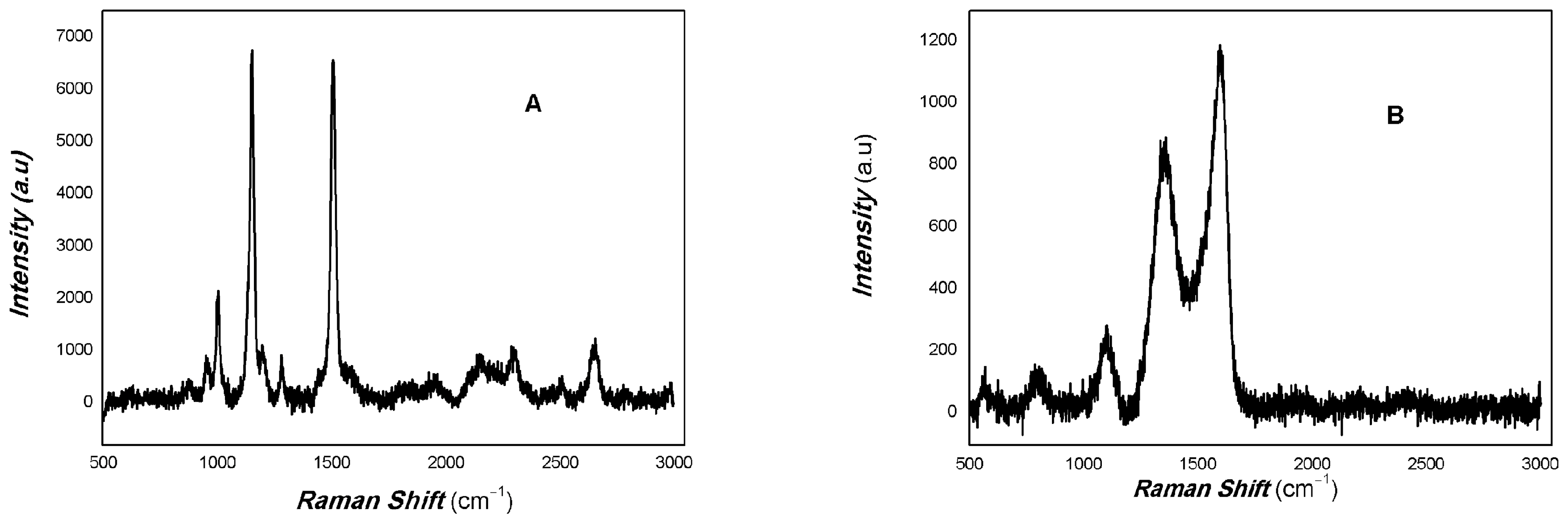
The Raman spectra of the resulting ZnO/C nanocomposite are shown in Figure 3.
As shown in Figure 3A, the bands of 1510 cm−1 and 1158 cm−1 are very strong, and the bands of 1580 cm−1 and 1350 cm−1 are very weak. The band at 1510 cm−1 may be associated with changes in the hybridisation state of multilayer graphene and the introduction of hydrogen atoms. This may be a region of carbon with a structure similar to graphene, which was generated during the polymer carbonisation process. Dehydrogenation of polymer is incomplete during carbonization. The degree of graphene structure conversion is insufficient. Bands associated with alkenes or cyclic hydrocarbons may appear in the 1158 cm−1 region. The bands at around 1580 cm−1 and 1350 cm−1 belong to the C sp2 of G peak and the D peak of defects, respectively. It indicated that polymer carbonisation may yield olefins, cyclic hydrocarbons, and hydrogen-containing multilayer graphene. The graphene structure is not particularly abundant, which is detrimental to charge transport. Therefore, the degree of graphitization of the polymer used under these experimental conditions is very low following the polycondensation and carbonisation of the polymer precursor. The carburizing parameters still need to be optimized and improved.
Compared with Figure 3A and Figure 3B, respectively, the band at around 1580 cm−1 (C sp2 of the G band) is slightly weaker in the resulting ZnO/C nanocomposite. However, the ZnO/C nanocomposite containing graphene oxide nanoribbons exhibits a much stronger band. The band around 1350 cm−1 belongs to the D band of defects. This band is also prominent in ZnO/C nanocomposites containing graphene oxide nanoribbons. The strength of G band is much higher than that of D (shown in Figure 3B). It showed that the ZnO/C nanocomposite containing graphene oxide nanoribbon had obviously graphitic C sp2 structure, and the ZnO/C nanocomposite produced by polymer did not have strong absorption band of graphitic C sp2. This indicates that the degree of graphene formation in ZnO/C nanocomposite derived by polymer gel is not particularly high. Its structure is also very complex, it is expected the combination of ordered and disordered structure. The level of C sp2 structure may be related to the extent of cross-linking, cyclisation and carbonisation in polymers. The purpose of this study is expected to result in structures that contain more than C sp2. This study showed that the resulting nanosomposite has low content of C sp2 structure. One side, the addition of graphitic C sp2 structure in the synthesis of nanocomposite can improve the interfacial charge transfer. On the other hand, the graphitic C sp2 structure also induced the crystallisation of carbon materials. A large number of defects can cause serious scattering effect. It is worth further investigation to improve the graphitic C sp2 ratio. It also exhibited the complexity of the aggregated states for the nanocomposite by polymer carbonisation.
The microstructural complexity and aggregation state stem from the polymer carbonisation and ring formation processes. Since the degree of crosslinking would affect the polymer carbonisation and ring-forming process, and result in the enhancement of the physical properties of materials. There are still great challenges in explaining the photophysical mechanism and the relationship between the aggregation state and their physical properties in detail. As observed from the Raman characterization, the degree of graphitization of the polymer used under these experimental conditions after polycondensation and carbonization is far from satisfactory. The precise control of the structure of graphene through polymer carbonisation remains challenging and requires further research and exploration.
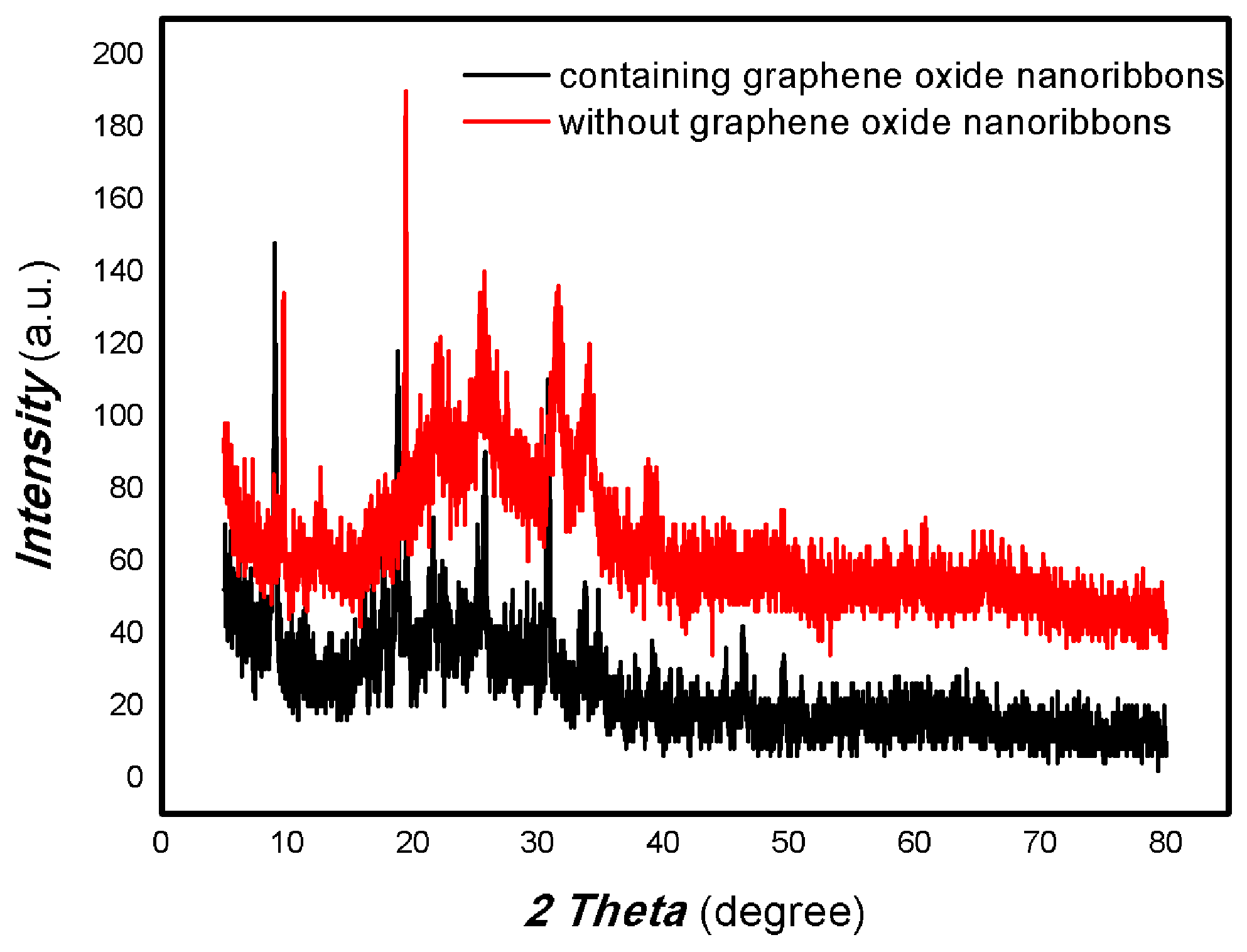
The XRD results of the resulting ZnO/C nanocomposite are shown in Figure 4.
Figure 4 shows that the clear diffraction peaks at 31.72°, 34.17°, 56.20° and 66.98° are the peaks of (100), (002), (110) and (200) planes of ZnO (PDF# 36-1451) for the polymer gel-derived ZnO/C nanocomposite, respectively. Meanwhile, the diffraction peaks at 31.27°, 34.88°, 36.76° and 47.12° are the (100), (002), (101) and (102) planes of ZnO (PDF# 36-1451) for the polymer gel containing graphene oxide nanoribbon-derived ZnO/C nanocomposite, respectively. Therefore, the polymer-derived nanocomposite contains a ZnO component. It should be ZnO/carbon nanocomposite. It is demonstrated that the preparation of oxide nanocomposites using non-conjugated polymer precursors via a one-pot process involving polycondensation and carbonization is simple and feasible. The effect of grain size on the broadening of the diffraction peak is not discussed in this study. This work only qualitatively confirms the existence of ZnO materials. As shown in Figure 4, the diffraction peak width is not large due to the size of the nanoparticles. As shown in Table 1 and Figure 2, the EDS results of the resulting ZnO/C nanocomposite also showed high contents of Zn and O elements, and the molar ratio of O/Zn is much larger than one. The high oxygen content in nanocomposites primarily originates from polymer-derived carbon materials. It is also shown that the polymer gel-derived carbon contained abundant oxygen-containing groups. These oxygen-containing groups easily trap photogenerated carriers, which hinders the extraction of photocurrent.
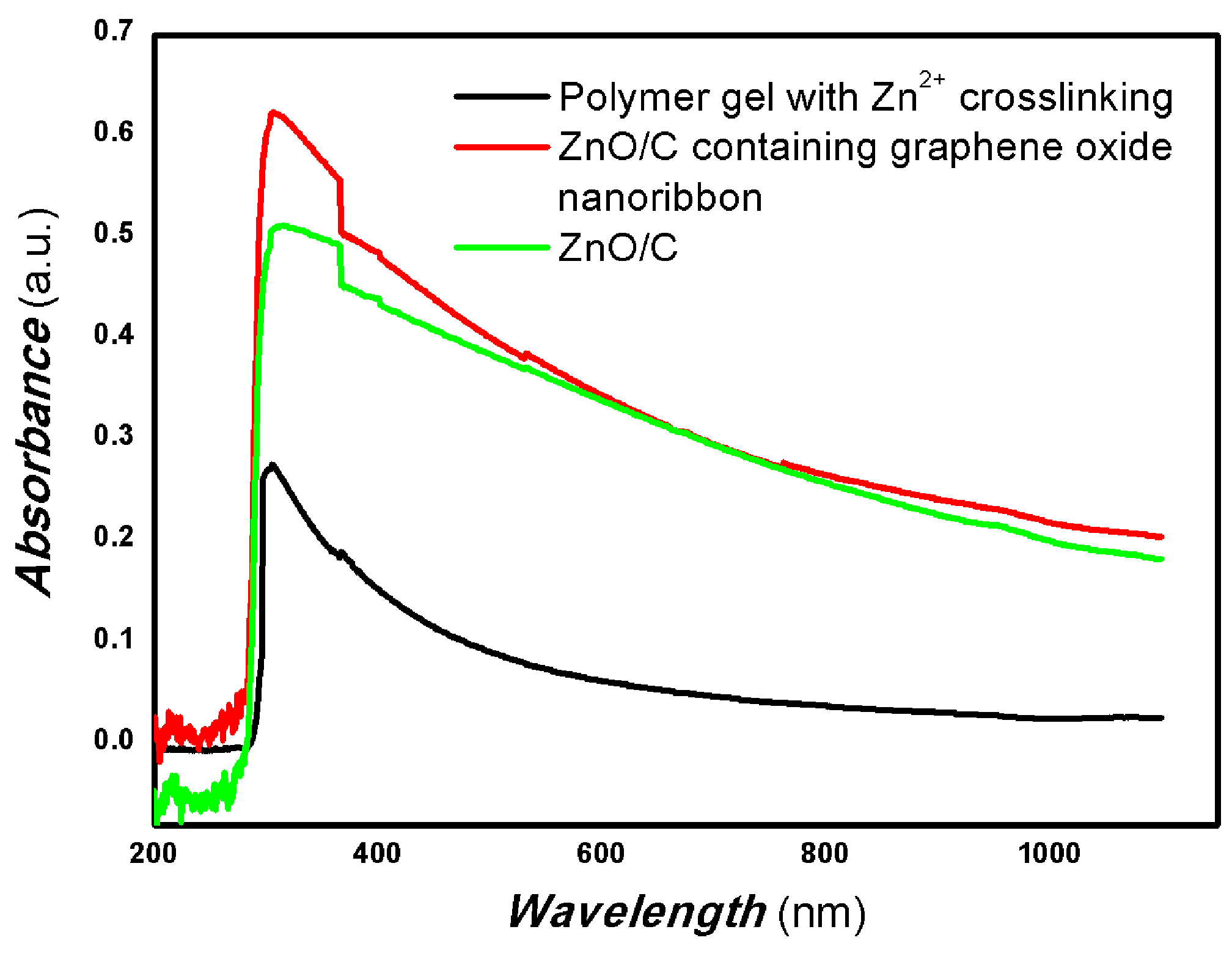
The UV-Vis curve of the resulting ZnO/C nanocomposite is shown in Figure 5.
As shown in Figure 5, it was found that the polymer gel with Zn2+ cross-linking still absorbed a little in the UV-Vis. This absorption may stem from the intrinsic absorption and scattering effect of the gel. This absorption contributes scarcely at all to the subsequent photoelectric signal. However, after carbonisation of polymer gel, the absorption of the product was obviously enhanced and there was a large red shift (it estimated to be at a red shift of 200 nm or more). The absorption edge of the ZnO/C nanocomposite produced from polymer gel was extended to the near-infrared (NIR) region. The effect of graphene oxide nanoribbons adding to the nanocomposite has a negligible impact on its optical absorbance. In fact, it can be considered negligible. Strong absorption is important for determining a photoelectric property. The interaction between light and matter involves absorption, scattering and transmission. Good absorption does not mean that you will get a good photoelectric signal. A good photoelectric signal in a particular band must indicate that there is absorption in that band. Under the premise of absorption, the separation of photo-generated excitons and the transfer or the collection of free photo-generated carriers are also required to enable the acquisition of photoelectric signals. Herein, this UV-Vis characterization is provided for reference purposes only. The crucial issue is determining the photocurrent results. Figure 5 illustrated that although the contribution of graphene oxide nanoribbon on the optical absorbance was a little, it should mainly contribute to enhance the charge transfer (C sp2 hybrid structure). The extension of the absorption spectrum into the near infrared may be due to the scattering effect of defects. The depth of the defect energy level and the concentration of defects have a significant impact on the photoelectric properties. Deep-level defects easily trap photogenerated carriers, necessitating defect passivation. These defects can be effectively passivated by certain additives with electronic effects. Controlling the properties of materials through defect passivation is a key approach to modifying them.
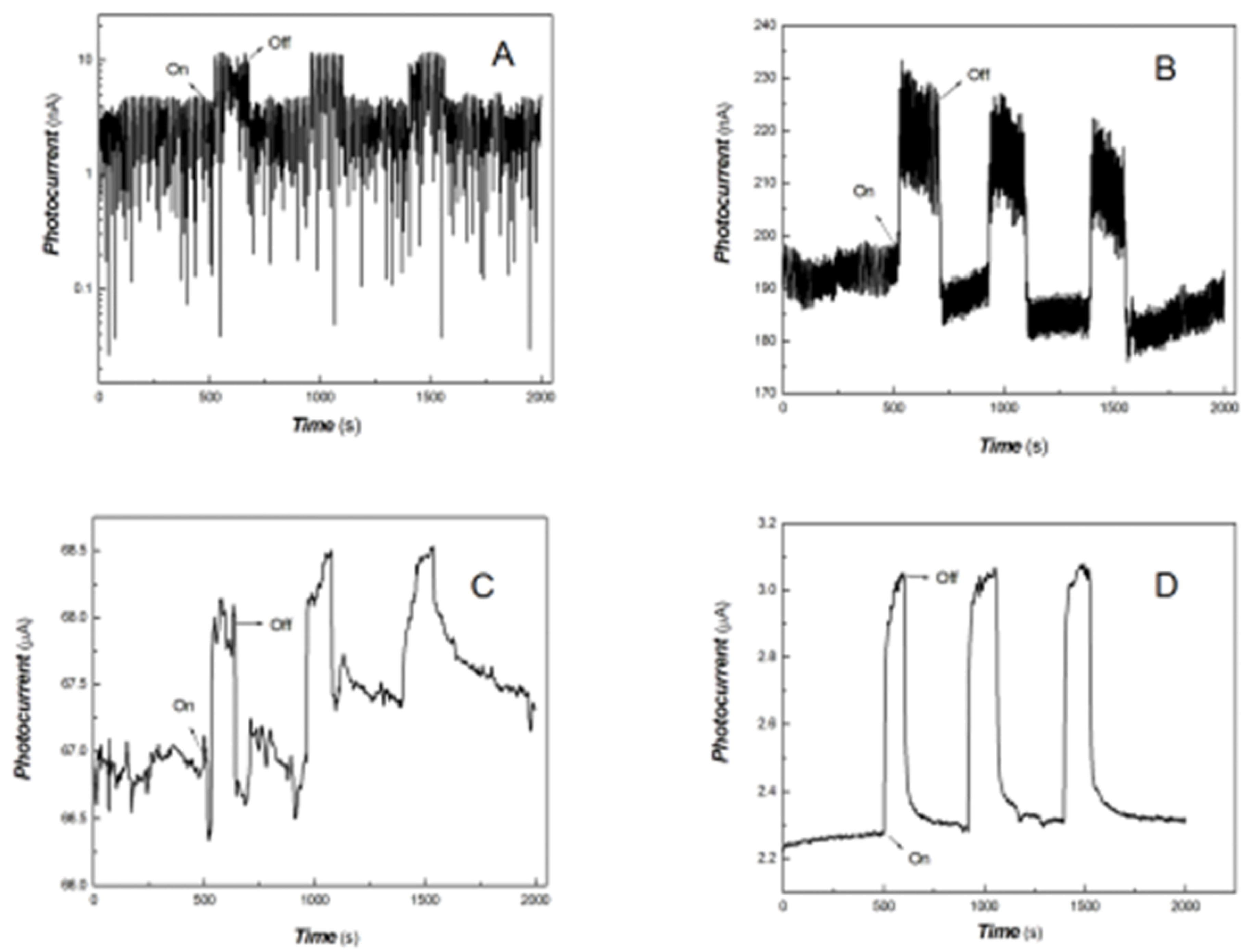
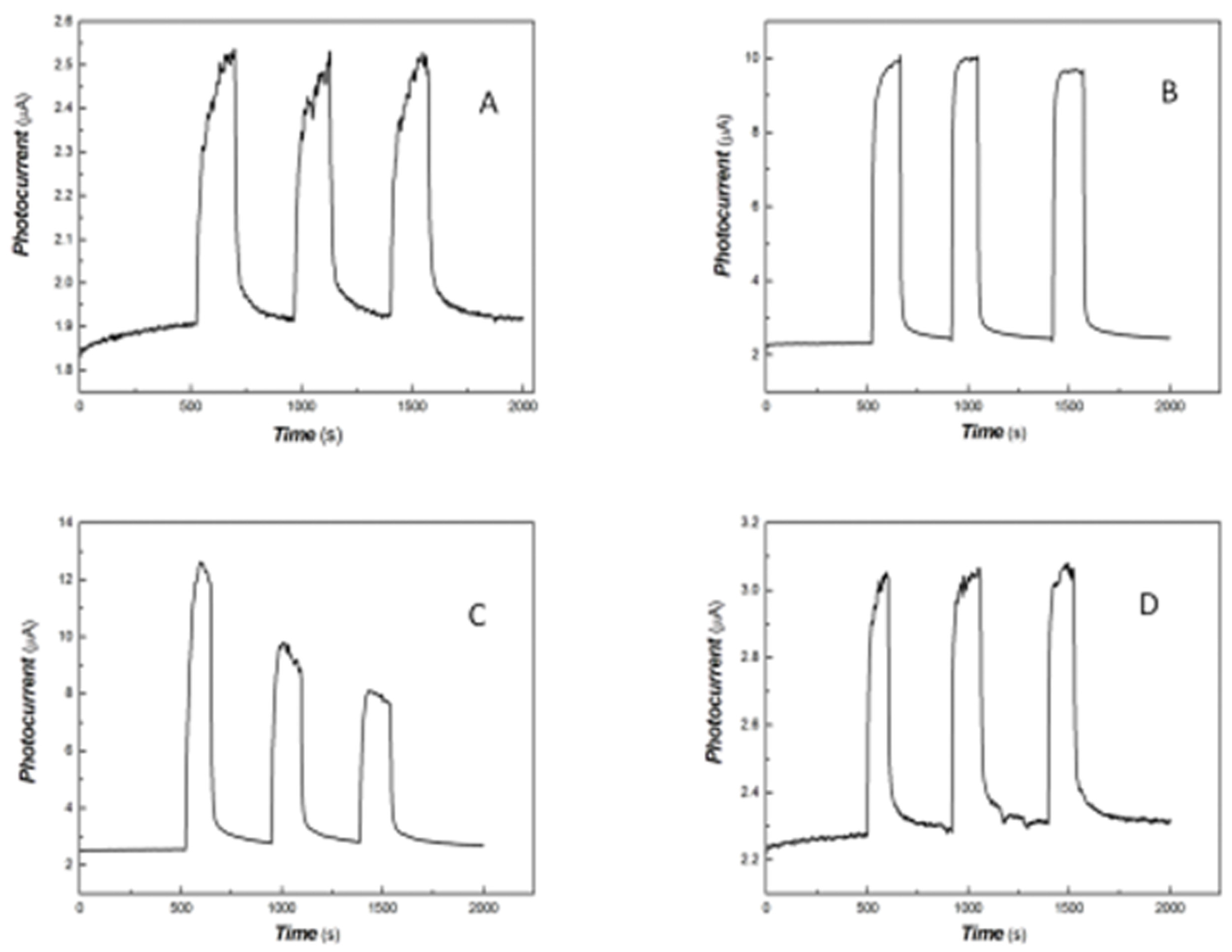
PET film is a commonly used flexible substrate. Paper is an abundant, inexpensive flexible substrate. In general, it is difficult to obtain photoelectric signals using untreated paper as a substrate. However, our research over many years has demonstrated that photoelectric signals can be measured using untreated paper in certain material systems. In this study, we investigated photoelectric signals using untreated paper and several typical light sources with wavelengths of 650, 808, 980 and 1064 nm.
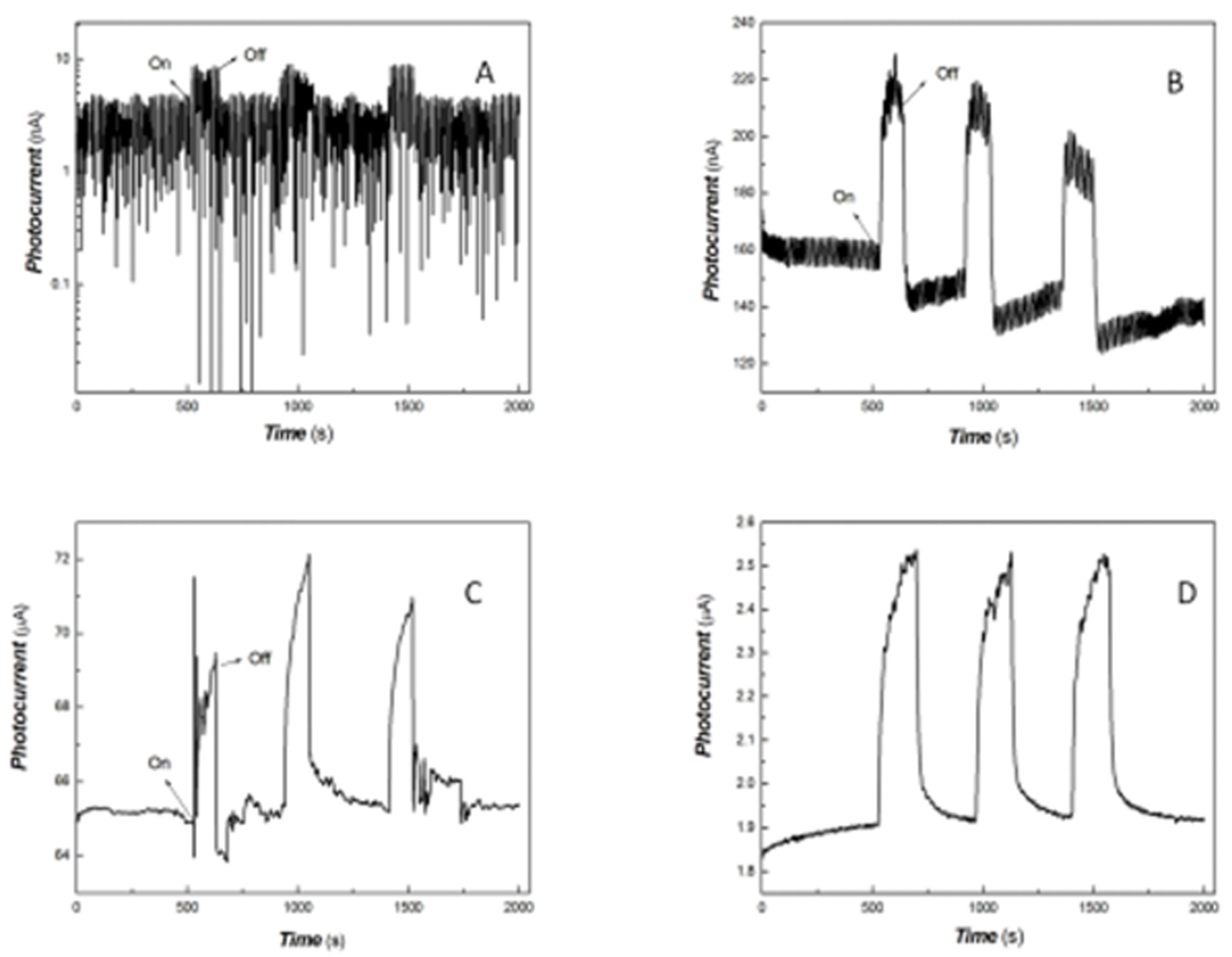
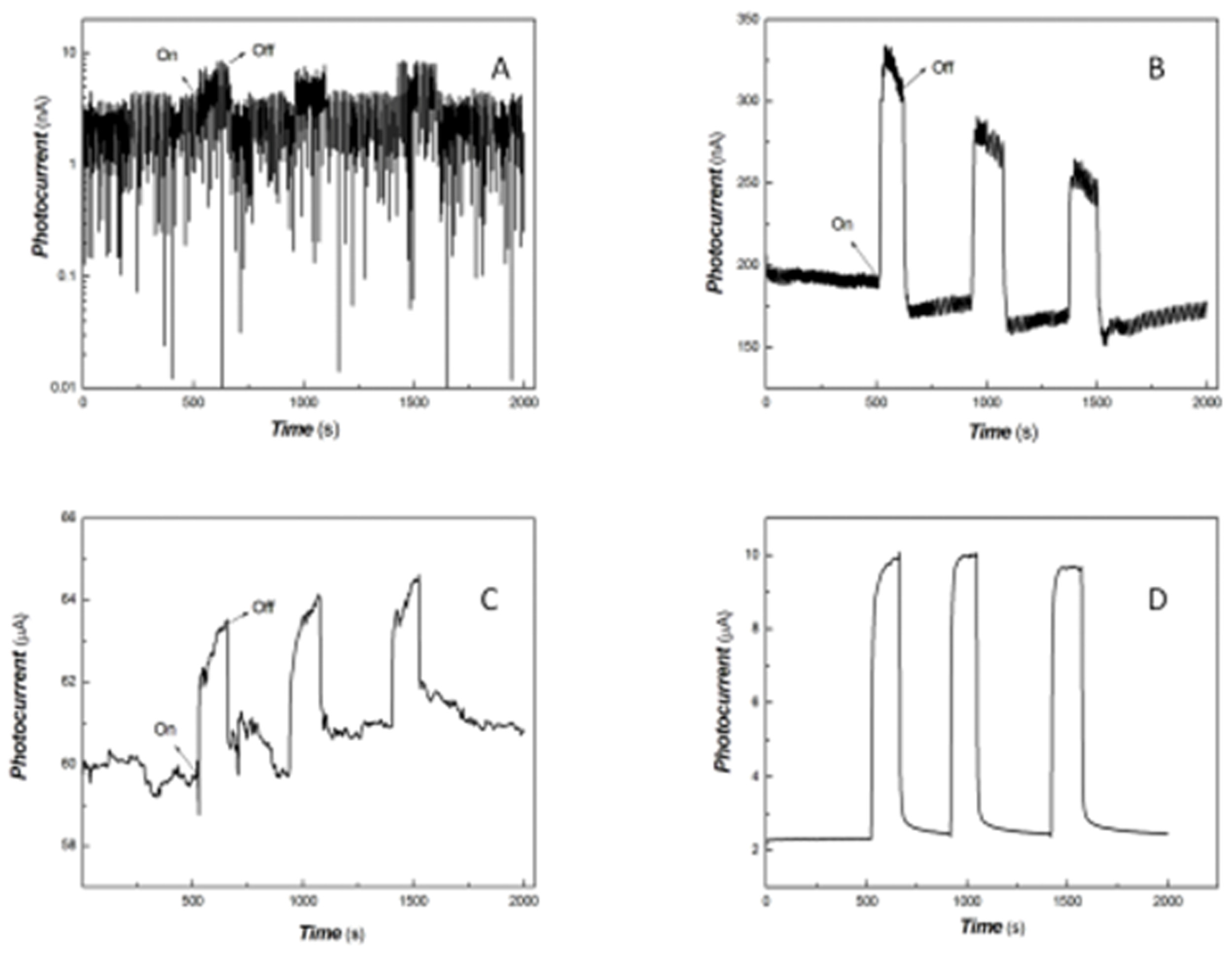
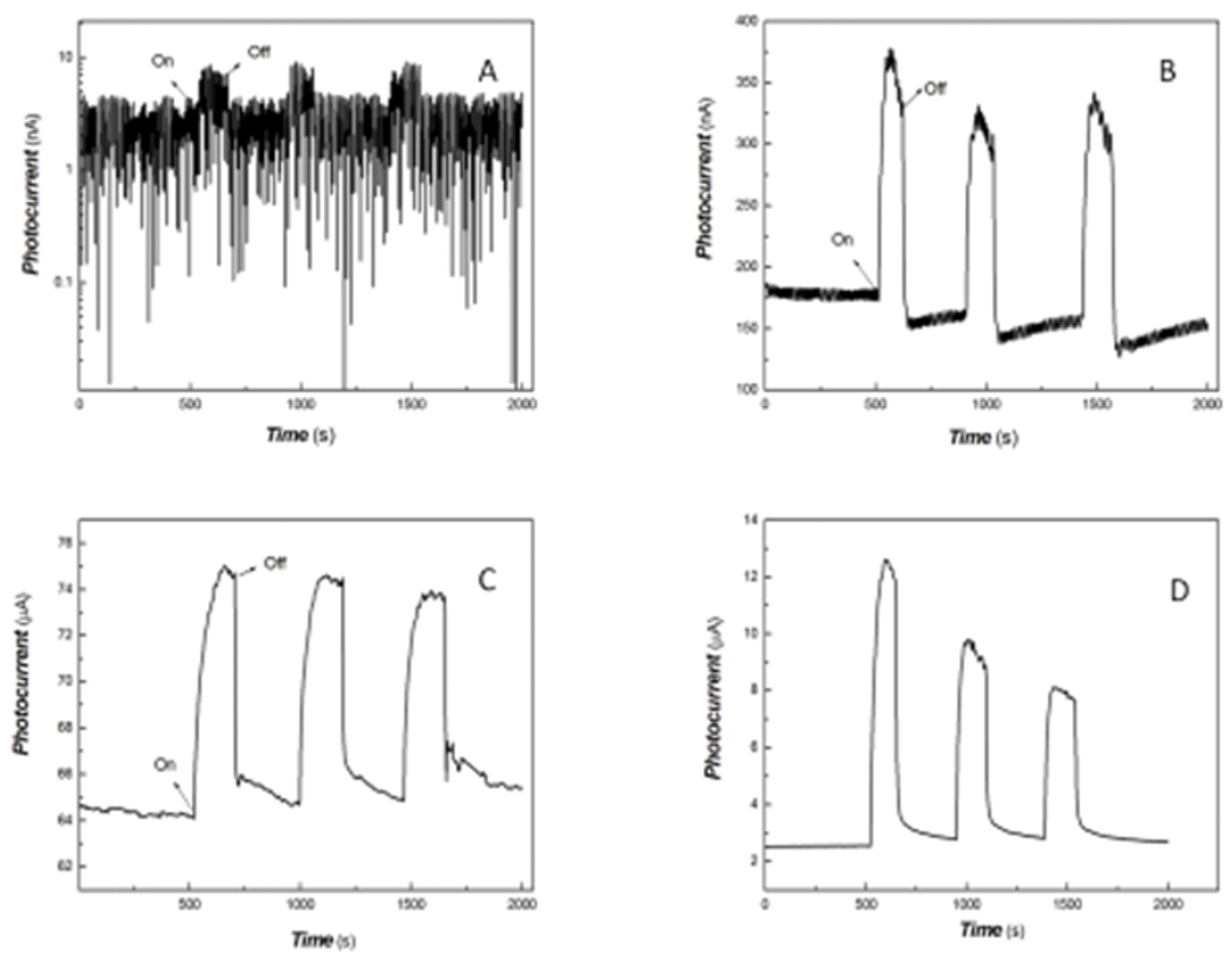
Representative results are shown in the Figure 6, Figure 7, Figure 8 and Figure 9.
The following cases are investigated in Figure 6, Figure 7, Figure 8 and Figure 9. A: The comparative photocurrent characteristics of the resulting ZnO/C nanocomposite to different typical excitation light sources were measured; B: Defect passivation of ZnO/C nanocomposite derived from polymer gel was carried out with I2 solution (the concentration is about 1% by weight) filling the grain boundary of nanoparticles. It is focused on examining the electronic effects of defects; C: The comparative photocurrent characteristics of the resulting ZnO/C nanocomposite containing graphene oxide nanoribbon with 4B pencil drawing on the A4 printing paper electrodes were carried out; D: The comparative photocurrent characteristics of the resulting ZnO/C nanocomposite containing graphene oxide nanoribbon with Ag fibre as electrodes were carried out.
Figure 6A, Figure 7A, Figure 8A and Figure 9A show that the ZnO/C nanocomposite to different light sources (100 mW 650 nm, 200 mW 808 nm, 200 mW 980 nm and 20 mW 1064 nm) showed good photocurrent signals. The on/off ratio is about one order of magnitude. However, the baseline current of the polymer gel derived ZnO/C nanocomposite is very small, and there are significant fluctuations. It is about 0.1–1 nA. The main reason for such a small current is the result of the polymer gel derived carbon materials, which is the more disordered structure. There is a high concentration of defects at the grain boundary. The amount of graphitic C sp2 structure is very low, affects charge transfer, and leads to a lower baseline current. The baseline current exhibits considerable fluctuation, spanning approximately two to three orders of magnitude. This primarily stems from its abundant defects, which generate substantial scattering noise. This is also supported by the results of the Raman spectra in Figure 3. The Figure 3A illustrates the presence of numerous defects. It is evident that optimizing the grain boundaries of nanocomposites and reducing scattering noise are key to enhancing their photoelectrical signals. To reduce scattering noise, based on defect-related electronic effects, the defects were passivated. The results are shown in Figure 6B–D, Figure 7B–D, Figure 8B–D and Figure 9B–D.
As shown in Figure 6B, Figure 7B, Figure 8B and Figure 9B, it is found that after a small amount of I2 solution filled the grain boundary of nanoparticles of ZnO/C nanocomposite derived from polymer gel, the baseline current increased by about two orders of magnitude. The baseline current has become relatively stable, primarily due to the reduction in scattered noise. The resulting nanocomposite to different light sources (100 mW 650 nm, 200 mW 808 nm, 200 mW 980 nm and 20 mW 1064 nm) still showed good photocurrent signals. The donor electron effects of I atom passivates the defects in the nanomaterials, thereby enhancing photocurrent extraction.
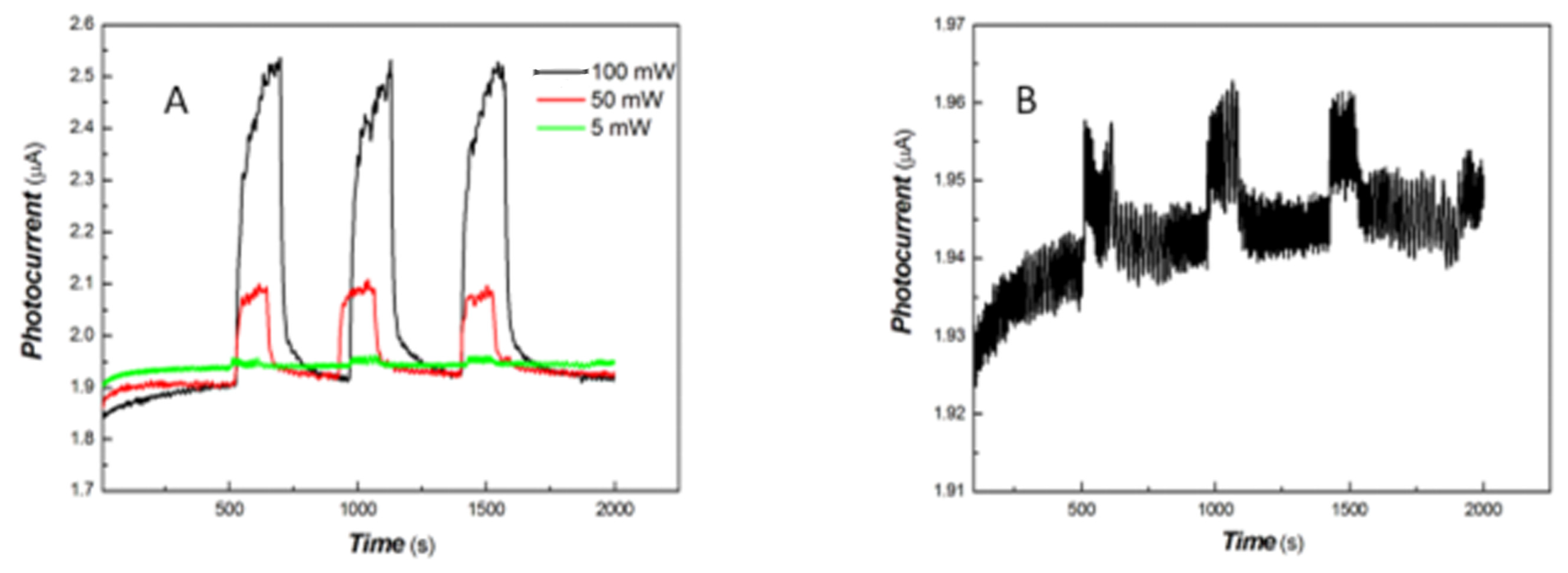
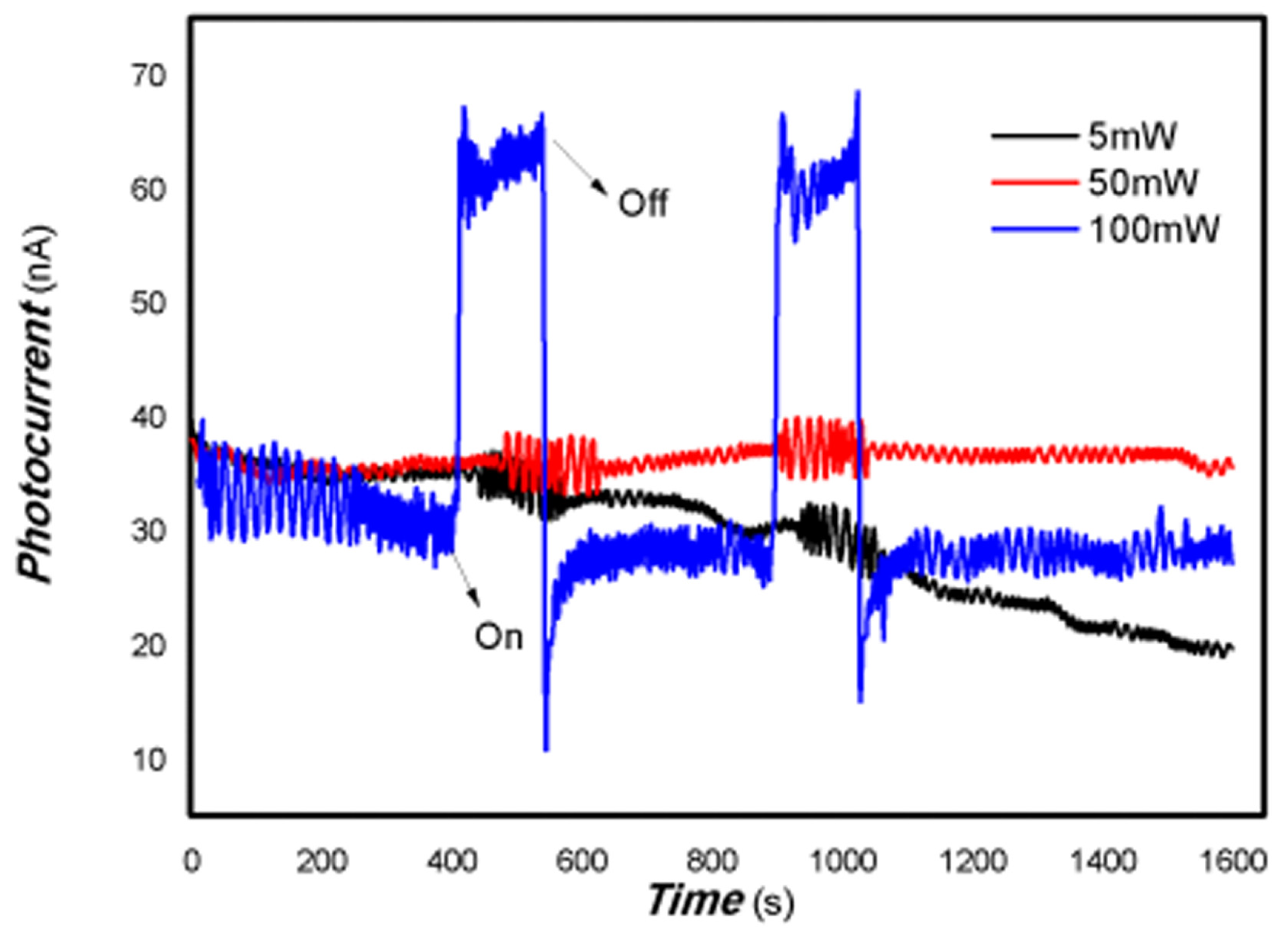
As shown in Figure 6C,D, Figure 7C,D, Figure 8C,D and Figure 9C,D, it can be seen that after adding graphene oxide nanoribbons, the baseline current increased by about three to five orders of magnitude. The resulting nanocomposite to different light sources (100 mW 650 nm, 200 mW 808 nm, 200 mW 980 nm and 20 mW 1064 nm) showed good photocurrent signals. However, the stability of the nanocomposite with the 4B pencil drawing on the A4 printing paper electrodes is relatively poor and deserves further improvement. Its baseline instability primarily stems from scattering noise caused by electrode defects (the 4B pencil drawing carbon electrodes). The ZnO/C nanocomposite derived by polymer gel containing graphene oxide nanoribbon with Ag fibre as electrodes to different light sources (100 mW 650 nm, 200 mW 808 nm, 200 mW 980 nm and 20 mW 1064 nm) showed good photocurrent signals. It was shown that the reduced graphene oxide nanoribbon played a good charge transfer channel in the nanocomposite. The length of the reduced graphene oxide nanoribbon can span multiple grain boundaries, reducing the adverse effects of grain boundary defects on charge transport. For intuitive comparison, the representative response results are shown in Figure 10. Figure 11 and Figure 12 show the dependence of the photoelectric signals of the ZnO/C nanocomposite containing graphene oxide nanoribbons and Ag fibres as electrodes on the power of typical excitation light sources.
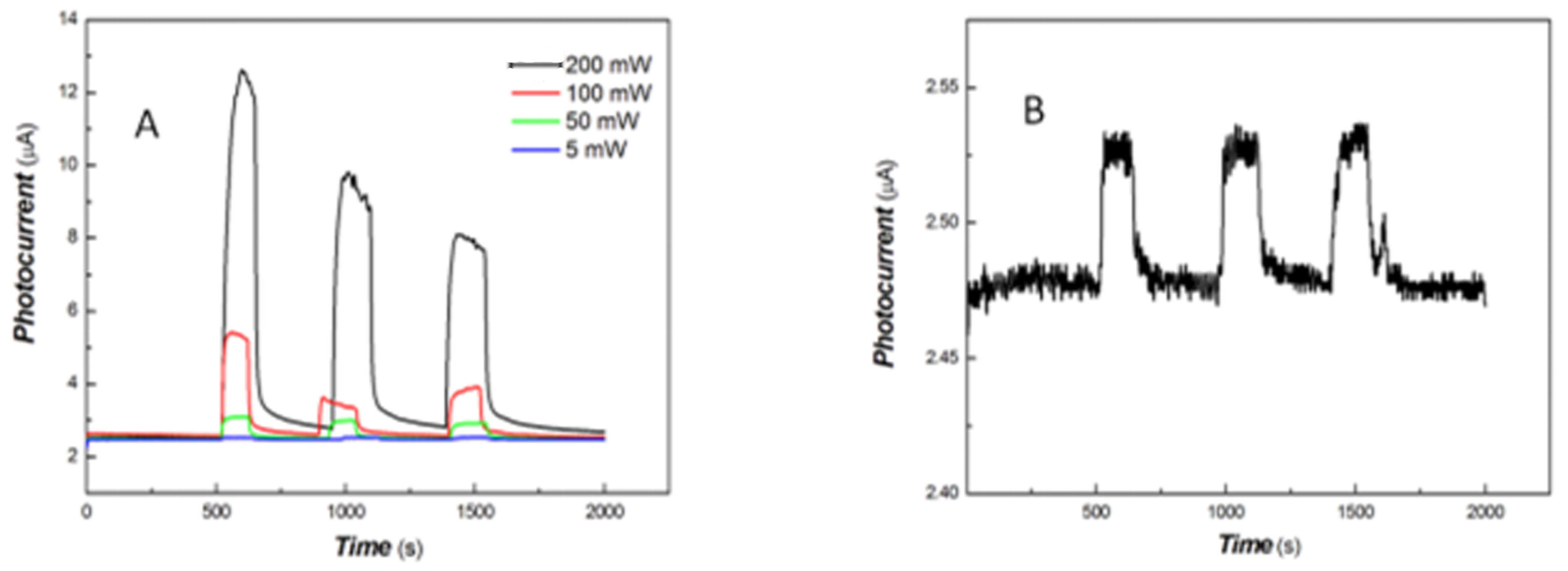
As shown in Figure 11 and Figure 12, as the incident light power decreases, the switching ratio decreases significantly. However, the ZnO/C nanocomposite containing graphene oxide nanoribbons and Ag fibres as electrodes still exhibited good photocurrent performance with 650 nm and 980 nm light sources up to 5 mW. Locally enlarged images are shown in Figure 11B and Figure 12B. As shown in Figure 11B and Figure 12B, under low-intensity light illumination, the scattered noise remains quite noticeable.
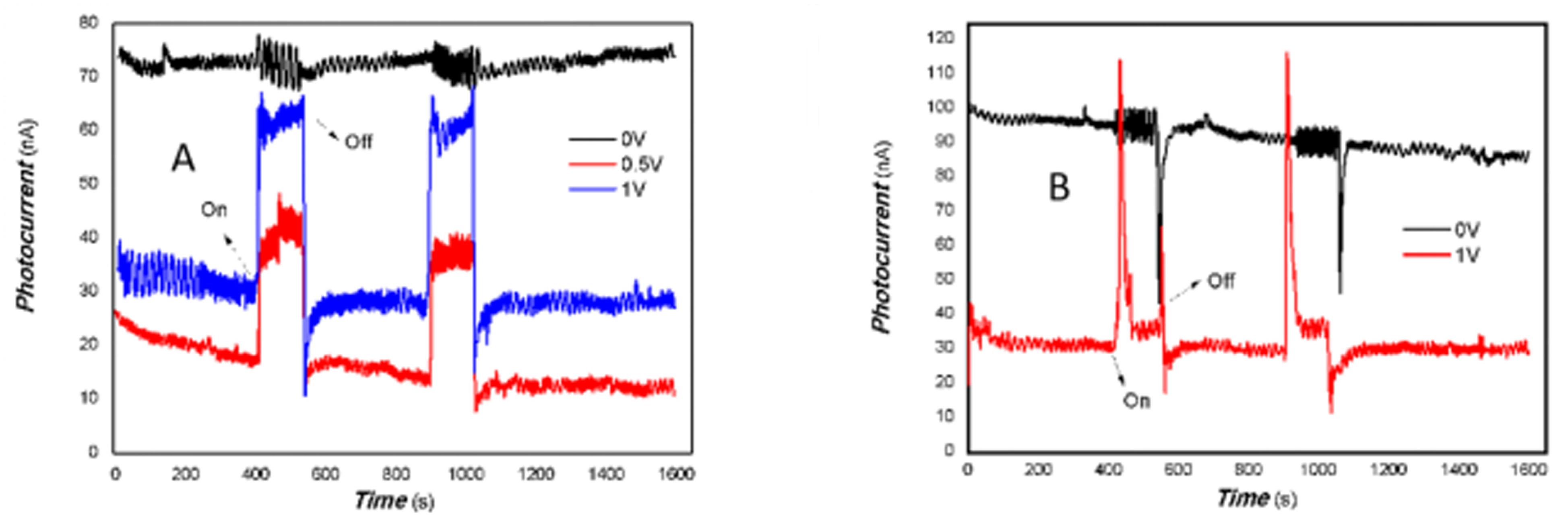
To investigate the storage stability of nanocomposites, the ZnO/C nanocomposite containing graphene oxide nanoribbons was coated on the Au gap electrodes again after storage for over 2 years at room temperature. Representative light sources were selected for examination of their photoelectric signals. The effect of different bias voltages on their photocurrent extraction performance was investigated. The results are shown in Figure 13.
As shown in Figure 13, bias voltage exerts a significant influence on photocurrent signals using 100 mW 980 nm and 20 mW 1064 nm light sources excitation, although some photoelectric signals can be obtained at zero bias. This indicates that the intrinsic electric field within the nanomaterial is insufficiently strong, necessitating the bias voltage applied to promote the separation and transport of photogenerated charge carriers. Figure 13A shows that the ZnO/C nanocomposite derived by polymer gel containing graphene oxide nanoribbon exhibited rapid response and recovery to 100 mW 980 nm light source with 1 V bias. The response and recovery times are approximately 1.26 and 1.13 s, respectively. Figure 14 shows the relationship between the photoelectric signal and the incident light power.
As shown in Figure 14, as the incident light power increases, the switching ratio improves significantly. There was a good relationship between the photoelectric signal of the ZnO/C nanocomposite containing graphene oxide nanoribbons and the incident light power. Figure 15 shows the repeatability of the photocurrent responses of a ZnO/C nanocomposite containing graphene oxide nanoribbons and Au gap electrodes, when excited by a 980 nm light source (100 mW) with a 1 V bias, after storage for 2 years.
As shown in Figure 15, the ZnO/C nanocomposite containing graphene oxide nanoribbons exhibited good repeatability in its photocurrent responses when using Au gap electrodes with a 980 nm light source (100 mW) and a 1 V bias, even after storage for over 2 years.
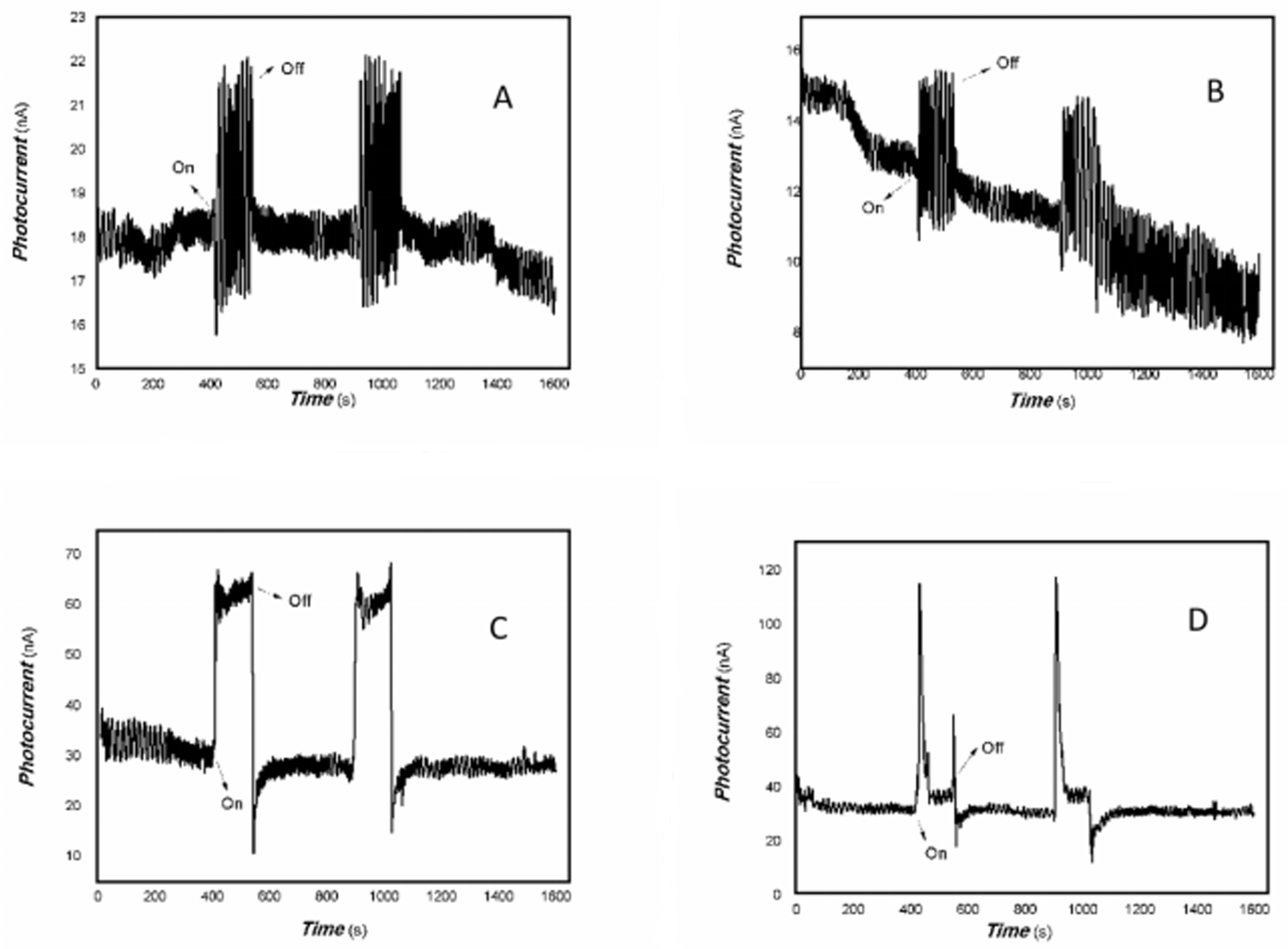
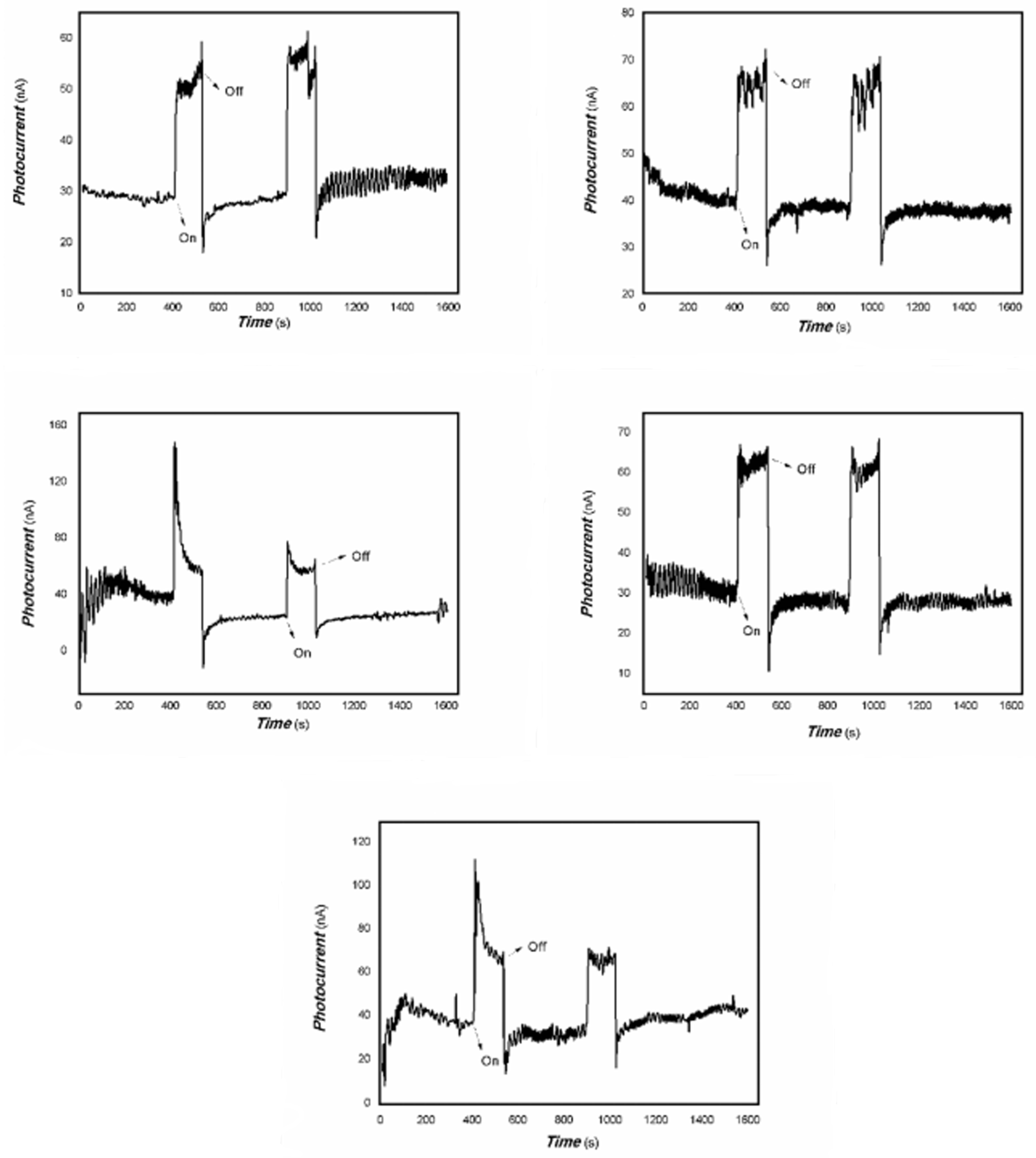
The results of the photoelectric signals obtained from different representative light sources (650, 808, 980, and 1064 nm) are shown in the Figure 16.
As shown in Figure 16, the ZnO/C nanocomposite containing graphene oxide nanoribbon using Au gap electrodes with 1 V bias after storage over 2 years still exhibited good photocurrent responses to some representative light sources (650 nm 50 mW, 808 nm 100 mW, 980 nm 100 mW and 1064 nm 20 mW). This suggests that the nanocomposite exhibits good photophysical stability.
As can be seen from the above research results, the nanocomposite produced in this study exhibited good photocurrent responses across a broad spectrum. The main mechanism can be explained as follows.
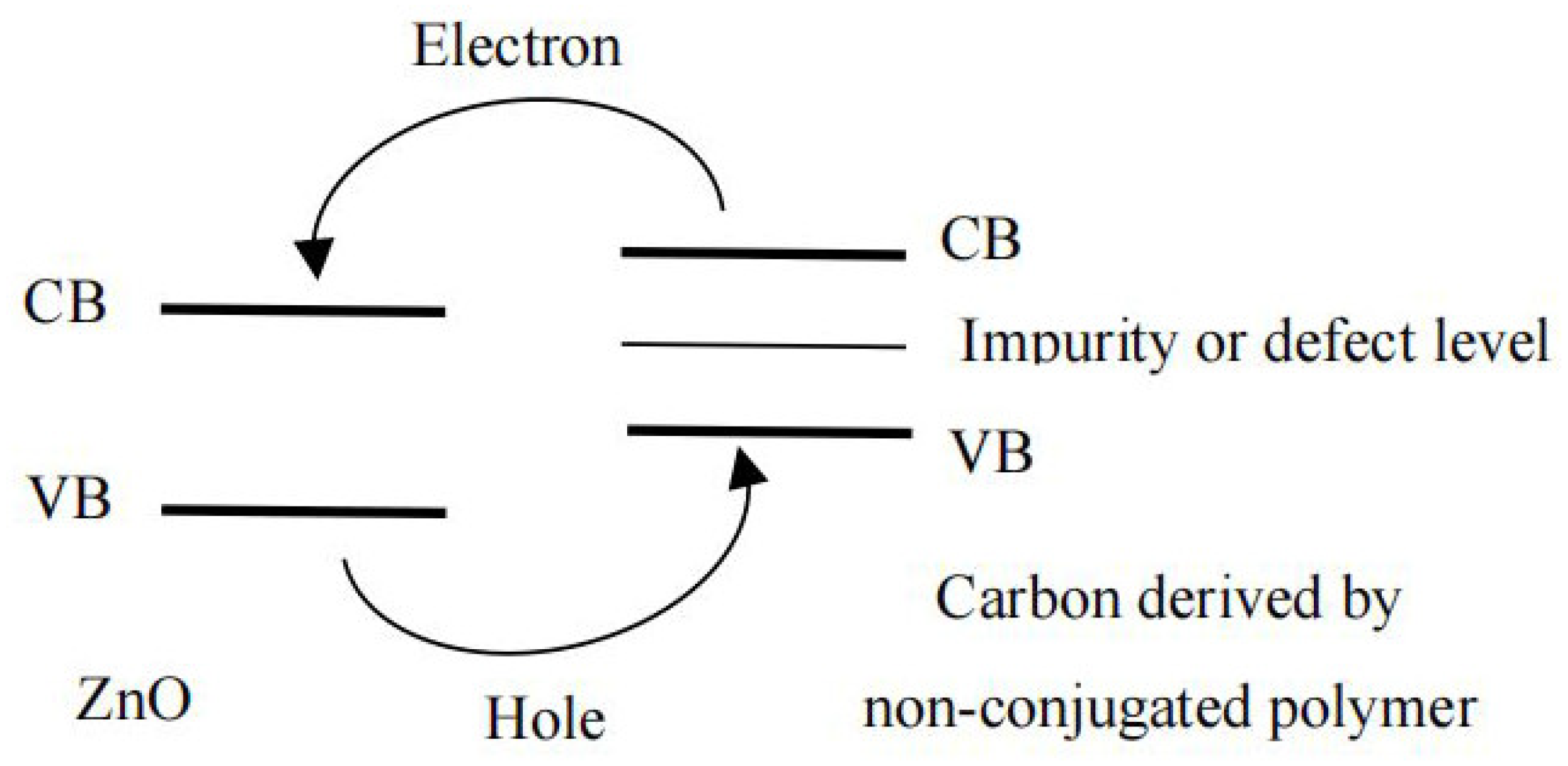
The bandgap width of ZnO (3.2–3.4 eV) determines that its photoelectric response occurs in the ultraviolet region. Its ability to cover a broad spectral range is primarily due to the contribution of polymer-derived carbon materials. Compared to high-purity semiconductor materials, oxide nanocomposites produced by polymer carbonization inevitably introduce numerous defects and impurities. The introduction of the impurity level or defect level also enables carbon materials produced from polymer gels to exhibit good photoelectric signals across a broad spectral range. The interfacial interaction of ZnO/polymer gel-derived carbon materials promoted the interfacial charge transfer. The schematic band gap of ZnO/polymer gel derived carbon materials is shown in Figure 17.
As shown in Figure 17, charge transfer between the interface of the ZnO and the carbon materials derived from the polymer gel takes place under the excitation of light. The introduction of defect level and impurity level leads to more electron transition opportunities, which exhibits the photoelectric performance in a wide spectrum. Despite the resulting nanocomposite having numerous defects, some of these can trap photogenerated carriers. However, as the concentration of photogenerated carriers far exceeds that of trapped carriers, the material exhibits positive photoconductive behaviour overall. The applied DC bias promoted the separation and transfer of photogenerated electrons resulting in the generation of a photocurrent. The filling of I2 solution at the grain boundary of nanoparticles of ZnO/C nanocomposite derived from polymer gel passivated the defects to a certain extent, and the addition of graphene oxide nanoribbon enhanced the conjugation degree, improving the charge transfer. The C sp2 content of graphene oxide nanoribbon is significantly higher than that of non-conjugated polymer-derived carbon material. As shown in Figure 1B, graphene oxide nanoribbons span numerous grain boundaries, acting as effective bridges between crystallites. Their length far exceeds the diffusion length of photogenerated electrons, playing a crucial role in charge transport.
The aggregated structure of non-conjugated polymer precursors is inherently complex, and that of the carbon materials derived from them is even more so. In the carbonisation process of non-conjugated polymers, the sp2 structure includes olefinic sp2 chains and five-, six-fold rings. The graphene-like C sp2 structure is still very low for the sodium alginate gel-derived carbon materials in this study. This suggests that forming high-content, six-membered, conjugated structures in carbonised polymers under hydrothermal conditions is extremely difficult. Many defects lead to high energy consumption. Since the photodynamic process of the competition is very complex, the photophysical mechanism is described in detail for further study and discussion. It has a reference value in improving the light-triggered charge transfer. It is effective and easy to tailor the bandgap engineering of wide-bandgap inorganic materials from the doping point of view. The modification space of materials is extended by non-conjugated polymer systems. Defect passivation at the grain boundary of nanoparticles would play an important role in improving their photophysical properties. Otherwise, responsive multifunctional materials belong to the category of smart materials. These materials can respond to the electric fields, light fields, temperature, pH and chemical or biological stimuli, etc. The near-infrared penetration ability is strong. It is expected to develop NIR remote hybrid materials with non-contact mode, which would be applied in interdisciplinary fields. On the other hand, the importance of crosslinking degree and carbonisation process parameters on the aggregate structure of non-conjugated polymer-derived carbon materials has been demonstrated. Therefore, it is evident that non-conjugated polymers hold great promise in the field of optoelectronic materials. Of course, this field is very broad. Fluorescent materials also fall within this category. Following the discovery of aggregation-induced emission, it is no longer necessary for organic fluorescent materials to contain conjugated structures. Aggregation can induce luminescence in some non-conjugated polymers, with potential applications across multiple disciplines [91]. However, this study does not cover such materials. Instead, it focuses on improving the extraction of photogenerated charges by constructing charge delocalisation pathways.
The interaction between light and matter encompasses the generation and separation of excitons, the collection of photogenerated carriers, their recombination, trapping and the production of photocurrent, as well as fluorescence and photothermal phenomena. Due to the presence of various competing physical processes within the photodynamic process, defects can have a significant impact on these photophysical processes. The focus of this study is to improve the separation and transport of free carriers photo-generated by interface engineering.
This method is also applicable to the modification of other wide-bandgap materials, such as CeO2, ZnS, etc. The results are quite noticeable. Some similar studies were also conducted using other non-conjugated polymer systems. It demonstrates the universality of this study. Due to the low cost and excellent biocompatibility of the natural polymers used in this study, the prepared nanocomposites exhibit environmentally friendly characteristics. The use of non-conjugated polymers can expand the range of multifunctional composites. The transformation of polymers into functional ceramics also represents a significant research direction within the materials field. It is hoped that non-conjugated polymers will find wider application in various functional material systems.

4. Conclusions

In conclusion, one-pot carbonisation was used to obtain ZnO-based nanocomposites with a natural polymer as a precursor. The grain boundaries of the non-conjugated polymer gel-derived ZnO/C nanocomposite were optimised using an I2 solution and reduced graphene oxide nanoribbons. Optimising the grain boundaries of the nanocomposite improved interfacial charge transfer and significantly reduced scattered noise. The electronic effects of the I2 molecule and the reduced graphene oxide nanoribbon can effectively passivate defects in the aggregation state of polymer-derived oxide nanocomposites. The nanocomposite coating resulting from this process exhibited broadband spectral photocurrent signals when applied to an untreated A4 printing paper substrate. Even after being stored at room temperature for two years, the nanocomposite still exhibited favourable photocurrent signals. This demonstrates that the optimised nanocomposite exhibits good photophysical stability. This nanocomposite would have potential applications in photodetectors and optoelectronic logic gates, as well as in interdisciplinary fields. This study provides an effective approach to expanding the broad-spectrum utilisation of wide-bandgap oxide materials. It is hoped that non-conjugated polymers will play a greater role in the development and modification of multifunctional composites.

Author Contributions

Conceptualisation, methodology, investigation, writing—original draft preparation, writing—review and editing, funding acquisition, resources, investigation, X.M.; investigation, X.Z., M.G., R.H., and Y.W.; part resources, G.L.; all authors analysed the data; all authors discussed the results of the paper. All authors have read and agreed to the published version of the manuscript.

Funding

This study was supported by the Natural Science Foundation of Shandong Province (ZR2013EMM008).

Institutional Review Board Statement

This study did not involve any ethical issues.

Informed Consent Statement

Not applicable.

Data Availability Statement

The data presented in this study are available upon request from the corresponding author. The data are not publicly available due to privacy issues.

Acknowledgments

Raman spectra was performed by Weiwei Wang at the Structural Composition Testing Center, School of Chemistry and Chemical Engineering, Shandong University. SEM and EDS were performed by Wenhai Wang, Yantai Institute of Coastal Zone Research, Chinese Academy of Sciences.

Conflicts of Interest

The authors declare no conflicts of interest.

References

  1. Bishnoi, P.; Siwal, S.S.; Singh, N.; Thakur, M.K.; Hart, P.; Thakur, V.K. Advanced Synthesis and Fabrication Strategies for 2D Mesoporous Carbon Materials in Energy Storage and Conversion. Adv. Energy Sustain. Res. 2025, 6, 2500163. [Google Scholar] [CrossRef]
  2. Li, C.; Liu, L.; Xiong, Q.; Zhang, D.; Zhang, J.; Wang, H.; Du, J.; Zheng, B.; Guo, Y. Boron/Nitrogen Codoped Porous Carbon: An Efficient Oxygen Reduction Electrocatalyst for H2O2 Production. Ind. Eng. Chem. Res. 2025, 64, 9097–9103. [Google Scholar] [CrossRef]
  3. Amoo, C.C.; Ge, Q.; Ordomsky, V.; Sun, J. Synthesizing Liquid Fuels Over Carbon-Based Catalysts Via CO2 Conversion. Adv. Sci. 2025, 12, 2410280. [Google Scholar] [CrossRef] [PubMed]
  4. Chen, G.; Koide, T.; Nakamura, J.; Ariga, K. Nanoarchitectonics for Pentagon Defects in Carbon: Properties and Catalytic Role in Oxygen Reduction Reaction. Small Methods 2025, 9, 2500069. [Google Scholar] [CrossRef]
  5. Li, J.; Zhao, F.; Nan, F.; Wang, J.; Zhang, Y.; Liang, K.; Xue, X.; Chen, T.; Kong, L.; Ge, J.; et al. Polythiophene Derivatives Carbonized Polymer Dots: Aggregation Induced Solid-State Fluorescence Emission. Chin. J. Chem. 2023, 41, 1950–1956. [Google Scholar] [CrossRef]
  6. Xue, S.; Li, P.; Sun, L.; An, L.; Qu, D.; Wang, X.; Sun, Z. The Formation Process and Mechanism of Carbon Dots Prepared from Aromatic Compounds as Precursors: A Review. Small 2023, 19, 2206180. [Google Scholar] [CrossRef]
  7. Yang, S.; Zhang, Y.; Xue, Y.; Lu, S.; Yang, H.; Yang, L.; Ding, C.; Yu, S. Cross-Linked Polyamide Chains Enhanced the Fluorescence of Polymer Carbon Dots. ACS Omega 2020, 5, 8219–8229. [Google Scholar] [CrossRef]
  8. Hu, X.; Zhang, Z.; Wu, H.; Yang, S.; Zhao, W.; Che, L.; Wang, Y.; Cao, J.; Li, K.; Qian, Z. Progress in the application of 3D-printed sodium alginate-based hydrogel scaffolds in bone tissue repair. Biomater. Adv. 2023, 152, 213501. [Google Scholar] [CrossRef]
  9. Xie, M.; Zhang, F.; Liu, L.; Zhang, Y.; Li, Y.; Li, H.; Xie, J. Surface modification of graphene oxide nanosheets by protamine sulfate/sodium alginate for anti-cancer drug delivery application. Appl. Surf. Sci. 2018, 440, 853–860. [Google Scholar] [CrossRef]
  10. Zhou, Q.; Kang, H.; Bielec, M.; Wu, X.; Cheng, Q.; Wei, W.; Dai, H. Influence of different divalent ions cross-linking sodium alginate polyacrylamide hydrogels on antibacterial properties and wound healing. Carbohydr. Polym. 2018, 197, 292–304. [Google Scholar] [CrossRef]
  11. Munavalli, B.; Torvi, A.; Kariduraganavar, M. A facile route for the preparation of proton exchange membranes using sulfonated side chain graphite oxides and crosslinked sodium alginate for fuel cell. Polymer 2018, 142, 293–309. [Google Scholar] [CrossRef]
  12. Hu, H.; Cao, L.; Xu, Z.; Zhou, L.; Li, J.; Huang, J. Carbon nanosheet frameworks derived from sodium alginate as anode materials for sodium-ion batteries. Mater. Lett. 2016, 185, 530–533. [Google Scholar] [CrossRef]
  13. Asma, R.; Khira, Z.; Karima, H.; Jellouli, E.D. Characterization and extraction of sodium alginate from Tunisian algae: Synthesizing a cross-linked ultrafiltration membrane. Iran. Polym. J. 2022, 3, 367–382. [Google Scholar] [CrossRef]
  14. Guo, H.; Qin, Q.; Chang, J.; Lee, D. Modified alginate materials for wastewater treatment: Application prospects. Bioresour. Technol. 2023, 387, 129639. [Google Scholar] [CrossRef]
  15. Kazemi, M.; Jahanshahi, M.; Peyravi, M. Chitosan-sodium alginate multilayer membrane developed by Fe0@WO3 nanoparticles: Photocatalytic removal of hexavalent chromium. Carbohydr. Polym. 2018, 198, 164–174. [Google Scholar] [CrossRef]
  16. Shao, Z.; Huang, X.; Yang, F.; Zhao, W.; Zhou, X.; Zhao, C. Engineering sodium alginate-based cross-linked beads with high removal ability of toxic metal ions and cationic dyes. Carbohydr. Polym. 2018, 187, 85–93. [Google Scholar] [CrossRef]
  17. Bai, Q.; Xiong, Q.; Li, C.; Shen, Y.; Uyama, H. Hierarchical porous carbons from a sodium alginate/bacterial cellulose composite for high-performance supercapacitor electrodes. Appl. Surf. Sci. 2018, 455, 795–807. [Google Scholar] [CrossRef]
  18. Sangwana, W.; Petcharoena, K.; Paradeea, N.; Lerdwijitjarudb, W.; Sirivata, A. Electrically responsive materials based on polycarbazole/sodium alginate hydrogel blend for soft and flexible actuator application. Carbohydr. Polym. 2016, 151, 213–222. [Google Scholar] [CrossRef]
  19. Song, Y.; Jiang, Z.; Gao, B.; Wang, H.; Wang, M.; He, Z.; Cao, X.; Pan, F. Embedding hydrophobic MoS2 nanosheets within hydrophilic sodium alginate membrane for enhanced ethanol dehydration. Chem. Eng. Sci. 2018, 185, 231–242. [Google Scholar] [CrossRef]
  20. Tang, K.; Jiang, M.; Yang, B.; Xu, T.; Liu, Z.; Wan, P.; Kan, C.; Shi, D. Enhancing UV photodetection performance of an individual ZnO microwire p–n homojunction via interfacial engineering. Nanoscale 2023, 15, 2292–2304. [Google Scholar] [CrossRef]
  21. Zhou, J.; Qiao, Q.; Tan, Y.; Wu, C.; Hu, J.; Qiu, X.; Wu, S.; Zheng, J.; Wang, R.; Zhang, C.; et al. The improvement of polymer photodetector based on 1D-ZnO nanorod arrays/0D-ZnO quantum dots composite film. Opt. Mater. 2023, 142, 114086. [Google Scholar] [CrossRef]
  22. Peng, Y.; Jiang, D.; Zhao, M.; Duan, Y.; Wei, H.; Li, H.; Liang, Q.; Wang, S. High-performance UV–visible photodetectors based on ZnO/perovskite heterostructures. J. Alloys Compd. 2023, 965, 171372. [Google Scholar] [CrossRef]
  23. Nandi, S.; Kumar, S.; Misra, A. Zinc oxide heterostructures: Advances in devices from self-powered photodetectors to self-charging supercapacitors. Mater. Adv. 2021, 2, 6768–6799. [Google Scholar] [CrossRef]
  24. Wang, H.; Wang, H.; Li, L.; Gu, Y.; Kim, B.; Huang, J. Self-Powered Broadband Photodetectors Material Based on Co3O4–ZnO Heterojunction with Bottlebrush Nanostructure. ACS Appl. Electron. Mater. 2023, 5, 3224–3231. [Google Scholar] [CrossRef]
  25. Kim, H.; Baek, S.; Lee, S. Surface Plasmon-Enhanced High-Performance ZnO/Ni/ZnO Ultraviolet Photodetectors. Phys. Status Solidi (RRL)-Rapid Res. Lett. 2020, 14, 1900685. [Google Scholar] [CrossRef]
  26. Kuang, K.; Jiang, X.; Qian, C.; He, Z.; Su, L.; Zhao, J.; Zou, B.; Du, Z. Ag-Ion Doping Enables ZnO/MoS2 Nanoarray Photoelectrochemical Photodetectors. ACS Appl. Nano Mater. 2025, 8, 13092–13102. [Google Scholar] [CrossRef]
  27. Biroju, R.K.; Paltasingh, S.N.; Sahoo, M.R.; Dhara, S.; Maity, D.; Vretenar, V.; Giri, P.K.; Narayanan, T.N.; Nayak, S.K. Graphene-ZnO Thin-Film Heterostructure-Based Efficient UV Photosensors. ACS Appl. Electron. Mater. 2025, 7, 4888–4897. [Google Scholar] [CrossRef]
  28. Khumphon, J.; Ahmed, R.; Imboon, T.; Giri, J.; Chattham, N.; Mohammad, F.; Kityakarn, S.; Gowri, V.M.; Thongmee, S. Boosting Photocatalytic Activity in Rhodamine B Degradation Using Cu-Doped ZnO Nanoflakes. ACS Omega 2025, 10, 9337–9350. [Google Scholar] [CrossRef]
  29. Chen, C.; Kosari, M.; Jiang, Z.; Xi, S.; Xia, L.; Shao, Y.; He, C.; Zeng, H.C. Boosting CO2 Hydrogenation to Methanol via Enriching the Cu─ZnO Interface on Layered Double Oxides. Small 2025, 21, 2412786. [Google Scholar] [CrossRef]
  30. Yang, Y.; Gao, B.; Fu, H.; Xiao, C.; Du, X.; Song, Z. Efficient Electrochemical Reduction of CO2 to C2H4 Over Low Work Function Cu/ZnO Film Catalysts. Small 2025, 21, 2500414. [Google Scholar] [CrossRef]
  31. Zheng, K.; Liu, S.; Zhu, J.; Dai, Z.; Liu, C.; Li, B.; Zheng, Y.; Chen, X.; Zhai, L.; Wu, Y.; et al. High-Rate CO2-to-CH4 Photoreduction by Dual-Proton Hydrogenation Pathway Over Pd-Anchored Oxygen-Deficient ZnO Nanosheets. Angew. Chem. 2025, 137, E202508259. [Google Scholar] [CrossRef]
  32. Song, D.; Cui, L.; Qin, R.; Fu, G. Influence of Oxygen Vacancy Distribution on CO2 Hydrogenation: A Case Study of ZnO and In2O3. JACS Au 2025, 5, 3156–3162. [Google Scholar] [CrossRef]
  33. Jdir, M.; El Beji, M.; Aziz, S.; Erouel, M.; Mansouri, S.; Monteduro, A.G.; Maruccio, G.; El Mir, L. Improved Performances of Room Temperature Gas Sensor by Indium Doping of P3HT/ZnO Hybrid Nanocomposites. ACS Appl. Electron. Mater. 2025, 7, 4035–4048. [Google Scholar] [CrossRef]
  34. Venkatesan, H.M.; Yoon, J.U.; Bindhu, A.; Woo, I.; Gajula, P.; Arun, A.P.; Bae, J.W. Reinforcing the Strategy: Enhanced Efficiency of Electrospun PVDF Hybrid Nanocomposites-Based Triboelectric Nanogenerators with p-NiO/n-ZnO Interfaces for Energy Harvesting. Adv. Sustain. Syst. 2025, 9, e00180. [Google Scholar] [CrossRef]
  35. Ding, J.; Zhao, P.; Chen, H. ZnO Nanostructure-Based Flexible Pressure Sensors Deposited on Filter Paper for Wearable Application. Langmuir 2025, 41, 12819–12832. [Google Scholar] [CrossRef] [PubMed]
  36. Aslfattahi, N.; Kiai, M.S.; Baydogan, N.; Samylingam, L.; Kadirgama, K.; Kok, C.K. Integration of Carbon-Doped ZnO/S Cathode and Silicon/Graphene Nanoplate Anode for Silicon−Sulfur Batteries. ACS Appl. Nano Mater. 2025, 8, 8113–8121. [Google Scholar] [CrossRef]
  37. Sun, C.; Xiao, B.; Zhao, Q.; Zong, X.; Zeng, Y.; Cao, S.; Liu, Z. In Situ Reconstructed Cu/Cu2+1O/ZnO Inverse Opals Accelerate Electrocatalytic Nitrate Reduction Kinetics for High Power Zn-NO3 Battery. Adv. Mater. 2025, 37, 2510680. [Google Scholar]
  38. Ali, U.; Qureshi, A.A.; Javed, S.; Rehman, G.; Akram, M.A. Graphene oxide incorporation in Ag-doped ZnO nanocomposite as efficient electron extraction material for planar perovskite solar cells. Results Opt. 2023, 12, 100486. [Google Scholar]
  39. Khan, M.I.; Ali, S.; Alwadai, N.; Ikram-ul-Haq; Irfan, M.; Albalawi, H.; Almuqrin, A.H.; Almoneef, M.M.; Iqbal, M. Structural, electrical and optical properties of hetrostructured MoS2/ZnO thin films for potential perovskite solar cells application. J. Mater. Res. Technol. 2022, 20, 1616–1623. [Google Scholar]
  40. Das, S.; Patra, S.; Kar, J.P.; Roy, A.; Ray, A.; Myoung, J. Origin of p-type conductivity for N-doped ZnO nanostructure synthesized by MOCVD method. Mater. Lett. 2015, 161, 701–704. [Google Scholar] [CrossRef]
  41. Ichipi, E.O.; Tichapondwa, S.M.; Chirwa, E.M.N. Plasmonic effect and bandgap tailoring of Ag/Ag2S doped on ZnO nanocomposites for enhanced visible-light photocatalysis. Adv. Powder Technol. 2022, 33, 103596. [Google Scholar] [CrossRef]
  42. Bang, J.; Kim, Y.S.; Park, C.H.; Gao, F.; Zhang, S.B. Understanding the presence of vacancy clusters in ZnO from a kinetic perspective. Appl. Phys. Lett. 2014, 104, 252101. [Google Scholar] [CrossRef]
  43. Schttner, L.; Erker, S.; Schlesinger, R.; Koch, N.; Wll, C. Doping-Induced Electron Transfer at Organic/Oxide Interfaces: Direct Evidence from IR Spectroscopy. J. Phys. Chem. C 2020, 124, 4511–4516. [Google Scholar] [CrossRef]
  44. Pon, V.D.; Joseph Wilson, K.S.; Hariprasad, K.; Ganesh, V.; Elhosiny Ali, H.; Algarni, H.; Yahia, I.S. Enhancement of optoelectronic properties of ZnO thin films by Al doping for photodetector applications. Superlattices Microstruct. 2021, 151, 106790. [Google Scholar] [CrossRef]
  45. Munna, N.; Abdur, R.; Islam, R.; Bashar, M.S.; Farhad, S.F.U.; Kamruzzaman, M.; Aziz, S.; Shaikh, M.A.A.; Hossain, M.; Jamal, M.S. Influence of Sn doping on the optoelectronic properties of ZnO nanoparticles. Nanoscale Adv. 2023, 5, 4996–5004. [Google Scholar] [CrossRef] [PubMed]
  46. Javaid, A.S.; Javaid, W.S.; Adnan, M.; Usman, M.; Akram, M.A.; Bashir, N.; Khalid, A.; Ahmad, P.; Hossin, M.M.; Liaqat, I.; et al. Synthesis and characterization of efficient Sr-doped ZnO nanostructures for optoelectronic, and photocatalytic applications. Inorg. Chem. Commun. 2024, 162, 112175. [Google Scholar] [CrossRef]
  47. Badawi, A.; Althobaiti, M.G.; Ali, E.E.; Alharthi, S.S.; Alharbi, A.N. A comparative study of the structural and optical properties of transition metals (M = Fe, Co, Mn, Ni) doped ZnO films deposited by spray-pyrolysis technique for optoelectronic applications. Opt. Mater. 2022, 124, 112055. [Google Scholar] [CrossRef]
  48. Ade, R.; Kumar, S.S.; Valanarasu, S.; Kumar, S.S.; Sasikumar, S.; Ganesh, V.; Bitla, Y.; Algarni, H.; Yahia, I.S. Enhanced optoelectronic properties of Ti-doped ZnO nanorods for photodetector applications. Ceram. Int. 2021, 47, 24031–24038. [Google Scholar] [CrossRef]
  49. Demirci, A.; Çetinkaya, H.G.; Durmuş, P.; Demirezen, S.; Altındal, Ş. Optoelectronic characterization of Bi-doped ZnO nanocomposites for Schottky interlayer applications. Phys. B Condens. Matter 2023, 670, 415338. [Google Scholar] [CrossRef]
  50. Amala, J.; Reshma, M.J.; Irfana, B.; Mangalaraja, R.V.; Anas, S. Facile tartaric acid assisted microwave synthesis of spherical clusters of S, N, and C doped ZnO for solar photocatalytic applications. Mater. Lett. 2022, 324, 132714. [Google Scholar] [CrossRef]
  51. Shinde, S.S.; Bhosale, C.H.; Rajpure, K.Y. N-doped ZnO based fast response ultraviolet photoconductive detector. Solid-State Electron. 2012, 68, 22–26. [Google Scholar] [CrossRef]
  52. Shinde, S.S.; Rajpure, K.Y. Fabrication and performance of N-doped ZnO UV photoconductive detector. J. Alloys Compd. 2012, 522, 118–122. [Google Scholar] [CrossRef]
  53. Muhammad, A.; Hassan, Z.; Mohammad, S.M.; Rajamanickam, S.; Shitu, I.G. Fabrication of ultra-violet photodetector with enhanced optoelectronic parameters using low-cost F-doped ZnO nanostructures. Sens. Actuators A Phys. 2021, 332, 113092. [Google Scholar] [CrossRef]
  54. Zhao, H.; Zhao, M.; Jiang, D. High-Photoelectric-Conversion ZnO NWs/PbS QDs Broadband Photodetector with an Innovative Interdigitated Electrode Structure. Cryst. Growth Des. 2023, 23, 6578–6588. [Google Scholar] [CrossRef]
  55. Wang, X.; Xu, K.; Yan, X.; Xiao, X.; Aruta, C.; Foglietti, V.; Ning, Z.; Yang, N. Amorphous ZnO/PbS Quantum Dots Heterojunction for Efficient Responsivity Broadband Photodetectors. ACS Appl. Mater. Interfaces 2020, 12, 8403–8410. [Google Scholar] [CrossRef]
  56. Jaafar, A.H.; Lowe, C.; Gee, A.; Kemp, N.T. Optoelectronic Switching Memory Based on ZnO Nanoparticle/Polymer Nanocomposites. ACS Appl. Polym. Mater. 2023, 5, 2367–2373. [Google Scholar] [CrossRef]
  57. Zhao, P.; Ji, R.; Lao, J.; Jiang, C.; Tian, B.; Luo, C.; Lin, H.; Peng, H.; Duan, C. Multifunctional Two-Terminal Optoelectronic Synapse Based on Zinc Oxide/Poly(3-hexylthiophene) Heterojunction for Neuromorphic Computing. ACS Appl. Polym. Mater. 2022, 4, 5688–5695. [Google Scholar] [CrossRef]
  58. Li, M.; Li, Z.; Li, H.; Liu, S.; Lu, H.; Wen, X.; Yang, Y. ZnO Quantum Dot/MXene Nanoflake Hybrids for Ultraviolet Photodetectors. ACS Appl. Nano Mater. 2021, 4, 13674–13682. [Google Scholar] [CrossRef]
  59. Bai, W.; Zhang, Z.; Zhang, J.; Guo, X.; Yang, X.; Luo, Y.; Guo, F.; Zhang, B.; Wang, L. Biomass-Derived N-Doped Dendritic 3D Carbon@ZnO Nanoparticles as High-Performance Anode Materials for Lithium-Ion Batteries. Energy Storage 2025, 7, e70150. [Google Scholar] [CrossRef]
  60. Chen, J.; Zhao, N.; Tang, C.; Li, J. Facile synthesis of ZnO@C/N−doped carbon composite with enhanced lithium storage properties in lithium ion batteries. J. Energy Storage 2025, 130, 117460. [Google Scholar] [CrossRef]
  61. Sreenan, B.; Kafil, V.; Hunt, T.; Ra Shin, S.H.; Brennan, A.A.; Thallapally, P.K.; Tal-Gan, Y.; Zhu, X. Luminescent ZnO-Carbon Hybrid Nanomaterials: Synthesis, Characterization, Emission Mechanism, and Applications. ACS Appl. Opt. Mater. 2025, 3, 698–711. [Google Scholar] [CrossRef]
  62. Zhang, Y.; Luo, Z.; Li, J.; Yu, X.; Yu, X.; Qiao, Q.; Zhang, H.; Li, Z.; Zhou, Y. Coffee grounds carbon quantum dots modified ZnO nanorods for Near-UV photodetectors. Opt. Mater. 2024, 151, 115371. [Google Scholar] [CrossRef]
  63. Zamudio-Ojeda, A.; Guevara-Martínez, S.J.; Rodríguez-Zavala, J.G.; Guirado-López, R.A. Fullerene-enhanced Raman scattering: ZnO-covered C60 as ultrasensitive CO gas sensor. Phys. Chem. Chem. Phys. 2025, 27, 14113. [Google Scholar] [CrossRef] [PubMed]
  64. Thomas, A.; Sivaperuman, K. Carbon and cobalt co-doped ZnO thin films for highly sensitive and selective ammonia detection at room temperature. Mater. Adv. 2025, 6, 629. [Google Scholar] [CrossRef]
  65. Sun, Y.; Li, Y.; Cui, Z.; Chen, C.; Wei, Z.; Deng, Z.; Xu, Y.; Huo, L.; Gao, S. Waste loofah sponge-derived graphitic carbon/ZnO tubules enabling ultrahigh response to NO2 gas at near room temperature. Sens. Actuators B. Chem. 2025, 425, 137011. [Google Scholar] [CrossRef]
  66. Gao, Q.; Han, S.; Zhao, M.; Song, Y.; Li, Z.; Kang, J.; Hong, N.; Wang, S.; Wang, S.; Yang, Z.; et al. Laser-Induced Synthesis of ZnO/Graphene Composites with a Porous Structure for Supercapacitors. ACS Appl. Nano Mater. 2025, 8, 11906–11918. [Google Scholar] [CrossRef]
  67. Levent, A.; Saka, C. Enhanced electrochemical performance of ZnO@sulphur-doped carbon particles for use in supercapacitors. J. Energy Storage 2024, 78, 110120. [Google Scholar] [CrossRef]
  68. Üstün, B.; Aydın, H.; Koç, S.N.; Kurtan, Ü. Amorphous ZnO@S-doped carbon composite nanofiber for use in asymmetric supercapacitors. Diam. Relat. Mater. 2023, 136, 110048. [Google Scholar] [CrossRef]
  69. Abdelhamid, H.N.; Al Kiey, S.A.; Sharmoukh, W. A high-performance hybrid supercapacitor electrode based on ZnO/nitrogen-doped carbon nanohybrid. Appl. Organomet. Chem. 2021, 36, e6486. [Google Scholar] [CrossRef]
  70. Tecuapa-Flores, E.D.; Palacios-Cabrera, C.B.; Santiago-Cuevas, A.J.; Hernández, J.G.; Narayanan, J.; Thangarasu, P. Simultaneous recognition of dopamine and uric acid in real samples through highly sensitive new electrode fabricated using ZnO/carbon quantum dots: Bio-imaging and theoretical studies. Analyst 2024, 149, 108–124. [Google Scholar] [CrossRef]
  71. Thyda, L.; Naresh, K.; Joseph, J.K.; Suneetha, S.; Jeyanthi, C.E.; Amaladass, P.; Selvaraju, C.; Thangaraju, K. Improved ultraviolet photodetector performances using solution-processed nitrogen-doped carbon quantum dots/ZnO hybrid thin films. Thin Solid Films 2024, 790, 140221. [Google Scholar] [CrossRef]
  72. Serkjan, N.; Liu, X.; Abdiryim, T.; Liu, F.; Zhang, H.; Kadir, A.; Liu, Y.; Tang, X.; Cheng, Q. Organic-inorganic face-to-face ZnO NRs-based self-powered UV photodetectors: Heterojunction with poly(3,4-ethylenedioxyselenophene) and enhanced responsivity by carbon quantum dots. Carbon 2023, 204, 387–397. [Google Scholar] [CrossRef]
  73. Xu, H.; Xu, L.; Ahmed, A. Carbon quantum dots-decorated ZnO heterostructure nanoflowers grown on nanofiber membranes as high-efficiency photocatalysts. Diam. Relat. Mater. 2023, 136, 109972. [Google Scholar] [CrossRef]
  74. Yashwanth, H.J.; Rondiya, S.R.; Eya, H.I.; Dzade, N.Z.; Phase, D.M.; Dhole, S.D.; Hareesh, K. Synergy between nitrogen, phosphorus co-doped carbon quantum dots and ZnO nanorods for enhanced hydrogen production. J. Alloys Compd. 2023, 937, 168397. [Google Scholar] [CrossRef]
  75. Thyda, L.; Dasi, G.; Abdul Azeez, M.S.; Naresh, K.; Suneetha, S.; Amaladass, P.; Vijayakumar, S.; Hussain, I.; Jayavel, R.; Thangaraju, K. Solution processed highly transparent nitrogen-doped carbon quantum dots/ZnO hybrid thin films: A study on structural and enhanced UV emission. Appl. Surf. Sci. Part A 2023, 611, 155664. [Google Scholar] [CrossRef]
  76. Al Ja’farawy, M.S.; Kusumandari; Purwanto, A.; Widiyandari, H. Carbon quantum dots supported zinc oxide (ZnO/CQDs) efficient photocatalyst for organic pollutant degradation—A systematic review. Environ. Nanotechnol. Monit. Manag. 2022, 18, 100681. [Google Scholar]
  77. Falaein Moridon, S.N.; Anuar, N.A.; Mohammad, N.Z.; Nordin, N.A.; Mohamed, M.A. Boosting charge transfer and photoelectrochemical activity in ZnO photoelectrodes with quantum dot carbon decorations. J. Photochem. Photobiol. A Chem. 2025, 461, 116141. [Google Scholar] [CrossRef]
  78. Shtepliuk, I.; Yakimova, R. Nature of photoexcited states in ZnO-embedded graphene quantum dots. Phys. Chem. Chem. Phys. 2023, 25, 10525. [Google Scholar] [CrossRef]
  79. de Morais, A.; de Souza Rodrigues, W.; Coutinho, D.J.; Nogueira, A.F.; de Freitas, J.N. Investigation of nitrogen-doped carbon dot/ZnO nanocomposites and their application as interlayer in solution-processed organic light emitting diodes. Mater. Sci. Eng. B 2023, 297, 116749. [Google Scholar] [CrossRef]
  80. Wang, J.; Chen, C.; Jin, M.; Zhu, Y.; Zhang, N. The carbon dots modified ZnO films photodetector with broadband and fast photoresponse. Opt. Mater. 2023, 135, 113341. [Google Scholar] [CrossRef]
  81. Hamed, R.; Sawalha, S.; Assali, M.; Shqair, R.A.; Al-Qadi, A.; Hussein, A.; Alkowni, R.; Jodeh, S. Visible light-driven ZnO nanoparticles/carbon nanodots hybrid for broad-spectrum antimicrobial activity. Surf. Interfaces 2023, 38, 102760. [Google Scholar] [CrossRef]
  82. Halder, S.; Dammalapati, R.; Bhaduri, B. ZnO nanoparticles dispersed in nitrogen-enriched carbon matrix for the efficient adsorption and photocatalytic degradation of aqueous methylene blue molecules. Inorg. Chem. Commun. 2023, 158, 111685. [Google Scholar] [CrossRef]
  83. Abd El-Lateef, H.M.; Khalaf, M.M.; El-Taib Heakal, F.; Abou Taleb, M.F.; Gouda, M. Electron transport materials based on ZnO@carbon derived metal-organic framework for high-performance perovskite solar cell. Sol. Energy 2023, 253, 453–461. [Google Scholar] [CrossRef]
  84. Sharma, A.; Hosseini-Bandegharaei, A.; Kumar, N.; Kumar, S.; Kumari, K. Insight into ZnO/carbon hybrid materials for photocatalytic reduction of CO2: An in-depth review. J. CO2 Util. 2022, 65, 102205. [Google Scholar] [CrossRef]
  85. Ding, Y.; Niu, L.; Chen, Y.; Wang, M. Study on the Defect Structure of Carbon-Doped ZnO Materials. Cryst. Res. Technol. 2023, 58, 2300015. [Google Scholar] [CrossRef]
  86. Zulkifli, Z.; Kalita, G.; Tanemura, M. Fabrication of transparent and flexible carbon-doped ZnO field emission display on plastic substrate. Phys. Status Solidi (RRL)-Rapid Res. Lett. 2015, 9, 145–148. [Google Scholar] [CrossRef]
  87. Ma, X.; Zhang, X.; Gao, M.; Wang, Y.; Li, G. Polymer-Gel-Derived PbS/C Composite Nanosheets and Their Photoelectronic Response Properties Studies in the NIR. Coatings 2024, 14, 981. [Google Scholar] [CrossRef]
  88. Ma, X.; Gao, M.; Zhang, X.; Wang, Y.; Li, G. Interface Interaction between MoO3 and Carbon Dots Derived from Chitosan Promoted the Photocurrent Extraction Ability of Carriers in a Wide Range of the Light Spectrum. Coatings 2024, 14, 171. [Google Scholar] [CrossRef]
  89. Ma, X.; Zhang, X.; Gao, M.; Wang, Y.; Li, G. Green Preparation of S, N Co-Doped Low-Dimensional C Nanoribbon/C Dot Composites and Their Optoelectronic Response Properties in the Visible and NIR Regions. Materials 2024, 17, 4167. [Google Scholar] [CrossRef]
  90. Zhang, B.; Zheng, J.; Ma, L.; Guo, B.; He, X.; Gao, M.; Bian, L.; Ma, X.; Li, G. Charge Behavior of Low-Dimensional V2O5/Graphene Nanoribbons Oxides Nanocomposites under Irradiation of Visible Light and its Application. Mater. Sci. Forum 2016, 847, 203–210. [Google Scholar] [CrossRef]
  91. Lai, W.-F. Non-conjugated polymers with intrinsic luminescence for drug delivery. J. Drug Deliv. Sci. Technol. 2020, 59, 101916. [Google Scholar] [CrossRef]
Scheme 1. The structure of the electrodes in this study [89].
Coatings 16 00396 sch001
Figure 1. The SEM image of the resulting ZnO/C nanocomposite. (A) ZnO/C nanocomposite; (B) ZnO/C nanocomposite containing some reduced graphene oxide nanoribbon.
Coatings 16 00396 g001
Figure 2. EDS of ZnO/C nanocomposite derived from polymer gel (“Pink box” refers to the area selected for EDS characterization. The results are shown in (b) and Table 1). (A) The resulting ZnO/C nanocomposite; (B) The ZnO/C nanocomposite containing graphene oxide nanoribbon.
Coatings 16 00396 g002
Figure 3. The Raman spectra of the resulting ZnO/C nanocomposite (A) ZnO/C nanocomposite derived by polymer gel; (B) ZnO/C nanocomposite derived by polymer gel containing graphene oxide nanoribbon).
Coatings 16 00396 g003
Figure 4. The XRD results of the resulting ZnO/C nanocomposite (the red line: the resulting ZnO/C nanocomposite; the black line: the ZnO/C nanocomposite containing graphene oxide nanoribbon).
Coatings 16 00396 g004
Figure 5. The UV-Vis curve of the resulting ZnO/C nanocomposite (the green line: the resulting ZnO/C nanocomposite; the red line: the ZnO/C nanocomposite containing graphene oxide nanoribbon; the black line: the polymer gel with Zn2+ crosslinking).
Coatings 16 00396 g005
Figure 6. The comparative photocurrent characteristics of the resulting ZnO/C nanocomposite with 100 mW 650 nm light source excitation (A) the resulting ZnO/C nanocomposite using Ag fiber electrodes; (B) Defect passivation of the ZnO/C nanocomposite with I2 using Ag fiber electrodes; (C) the ZnO/C nanocomposite containing graphene oxide nanoribbonn with 4B pencil electrodes; (D) the ZnO/C nanocomposite containing graphene oxide nanoribbon using Ag fiber electrodes).
Coatings 16 00396 g006
Figure 7. The comparative photocurrent characteristics of the resulting ZnO/C nanocomposite with 200 mW 808 nm light source excitation (A) the resulting ZnO/C nanocomposite using Ag fiber electrodes; (B) Defect passivation of the ZnO/C nanocomposite with I2 using Ag fiber electrodes; (C) the ZnO/C nanocomposite containing graphene oxide nanoribbonn with 4B pencil electrodes; (D) the ZnO/C nanocomposite containing graphene oxide nanoribbon using Ag fiber electrodes).
Coatings 16 00396 g007
Figure 8. The comparative photocurrent characteristics of the resulting ZnO/C nanocomposite with 200 mW 980 nm light source excitation (A) the resulting ZnO/C nanocomposite using Ag fiber electrodes; (B) Defect passivation of the ZnO/C nanocomposite with I2 using Ag fiber electrodes; (C) the ZnO/C nanocomposite containing graphene oxide nanoribbonn with 4B pencil electrodes; (D) the ZnO/C nanocomposite containing graphene oxide nanoribbon using Ag fiber electrodes).
Coatings 16 00396 g008
Figure 9. The comparative photocurrent characteristics of the resulting ZnO/C nanocomposite with 20 mW 1064 nm light source excitation (A) the resulting ZnO/C nanocomposite using Ag fiber electrodes; (B) Defect passivation of the ZnO/C nanocomposite with I2 using Ag fiber electrodes; (C) the ZnO/C nanocomposite containing graphene oxide nanoribbonn with 4B pencil electrodes; (D) the ZnO/C nanocomposite containing graphene oxide nanoribbon using Ag fiber electrodes).
Coatings 16 00396 g009
Figure 10. The photocurrent characteristics of the resulting ZnO/C nanocomposite containing graphene oxide nanoribbon with Ag fiber as electrodes (A) 100 mW 650 nm; (B) 200 mW 808 nm; (C) 200 mW 980 nm; (D) 20 mW 1064 nm.
Coatings 16 00396 g010
Figure 11. The dependence of photoelectric signal of the ZnO/C nanocomposite containing graphene oxide nanoribbon with Ag fiber as electrodes on the power of 650 nm light source (A) 100, 50, and 5 mW; (B) 5 mW.
Coatings 16 00396 g011
Figure 12. The dependence of photoelectric signal of the ZnO/C nanocomposite containing graphene oxide nanoribbon with Ag fiber as electrodes on the power of 980 nm light source (A) 100, 50, and 5 mW; (B) 5 mW.
Coatings 16 00396 g012
Figure 13. The photocurrent responses of the ZnO/C nanocomposite containing graphene oxide nanoribbon using Au gap electrodes with different bias after storage over 2 years (A) 980 nm 100 mW; (B) 1064 nm 20 mW.
Coatings 16 00396 g013
Figure 14. The dependence of photoelectric signals of the ZnO/C nanocomposite containing graphene oxide nanoribbon using Au gap electrodes on the power of excitation light source with 980 nm wavelength (100, 50, and 5 mW) with 1 V bias after storage over 2 years.
Coatings 16 00396 g014
Figure 15. The repeatability of photocurrent responses of ZnO/C nanocomposite derived from polymer gel containing graphene oxide nanoribbons using Au gap electrodes on the power of excitation of 980 nm (100 mW) with 1 V bias after storage for 2 years.
Coatings 16 00396 g015
Figure 16. The photocurrent responses of a ZnO/C nanocomposite derived from polymer gel containing graphene oxide nanoribbon using Au gap electrodes with 1 V bias after storage for 2 years: (A) 650 nm, 50 mW; (B) 808 nm, 100 mW; (C) 980 nm, 100 mW; (D) 1064 nm, 20 mW.
Coatings 16 00396 g016
Figure 17. Schematic bandgap diagram of ZnO/carbon derived from polymer gel [89].
Coatings 16 00396 g017
Table 1. EDS data on ZnO/C nanocomposites derived from polymer gel.
Sample Zn ElementO ElementC ElementMolar Ratio of O/ZnTotal
ZnO/C nanocomposite derived from polymer gelAtomic percent (%)20.3152.2227.472.57100
ZnO/C nanocomposite derived from polymer gel containing graphene oxide nanoribbonAtomic percent (%)3.7727.2368.897.22100
Sample Zn ElementO ElementC Element Total
ZnO/C nanocomposite derived from polymer gelWeight percent (%)53.2633.5113.23 100
ZnO/C nanocomposite derived from polymer gel containing graphene oxide nanoribbonWeight percent (%)16.3128.9454.75 100
Disclaimer/Publisher’s Note: The statements, opinions and data contained in all publications are solely those of the individual author(s) and contributor(s) and not of MDPI and/or the editor(s). MDPI and/or the editor(s) disclaim responsibility for any injury to people or property resulting from any ideas, methods, instructions or products referred to in the content.