Article

Particle Deformation and Energy Redistribution in Laser-Assisted Cold Spray Deposition of 6061 Aluminum Alloy

School of Metallurgical Engineering, Xi’an University of Architecture and Technology, Xi’an 710055, China
*
Authors to whom correspondence should be addressed.
Coatings 2026, 16(3), 389; https://doi.org/10.3390/coatings16030389
Submission received: 27 February 2026 / Revised: 16 March 2026 / Accepted: 20 March 2026 / Published: 22 March 2026

Highlights

What are the main findings?
  • Laser assistance enlarges the thermal softening zone in laser-assisted cold spray and enhanced jetting and interfacial spreading improve bonding area.
  • Laser heating modifies impact energy conversion behavior.
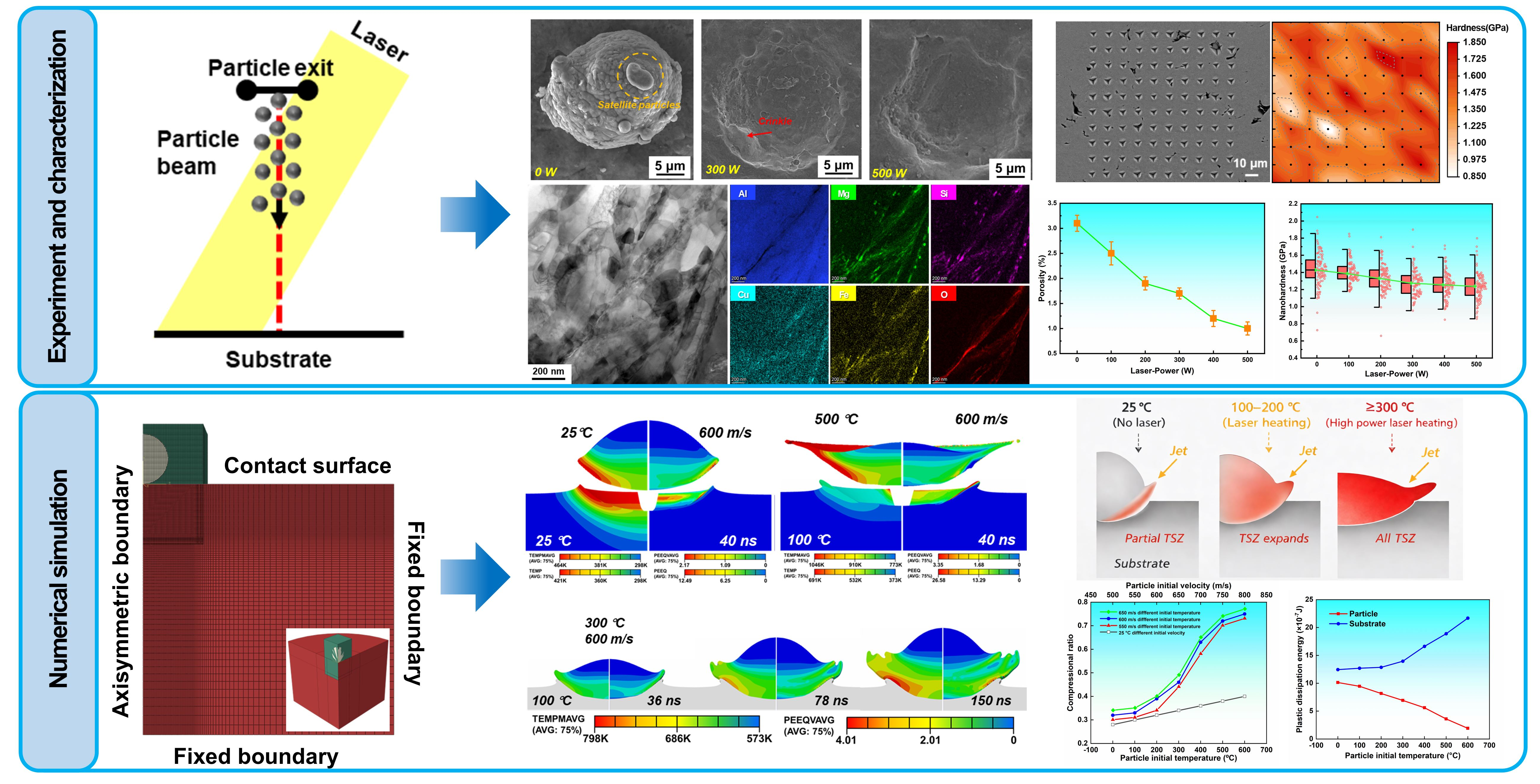
  • Porosity decreases from 3.1% to 1.0% with laser assistance.
What are the implications of the main findings?
  • Clarifies temperature-dependent deformation in laser-assisted cold spray.
  • Reveals energy redistribution between particle and substrate in laser-assisted cold spray.
  • Guides parameter optimization for 6061 Al laser-assisted cold spray.

Abstract
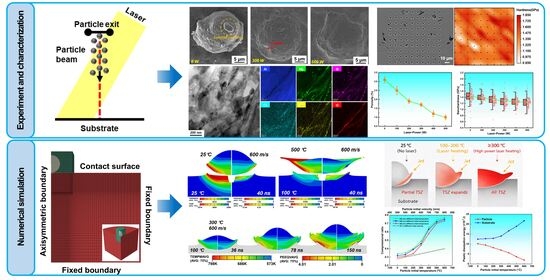
This study seeks to elucidate the precise modulation of laser-assisted cold spray (LACS) particle deposition and to provide guidance for optimizing process parameters in LACS. While LACS has been shown to improve coating quality, the underlying roles of laser-induced thermal softening in particle deformation, impact energy redistribution, and interfacial bonding of 6061 Al alloy remain unclear. Here, multiscale finite element simulations and experiments were combined to investigate single-particle impact and coating build-up under different laser powers. The results indicate that laser assistance enhances thermal softening, leading to stronger radial spreading, more pronounced jetting, and a larger bonding interface. The simulations show that laser heating expands the thermal softening zone and shifts impact energy dissipation from the particle to the substrate, thereby reducing elastic rebound and promoting stable deposition. TEM analysis confirms dynamic recrystallization at the particle interface under all conditions, while higher laser power broadens the recrystallized region from approximately 0.7 μm to about 1.5 μm and promotes grain growth without causing additional oxidation. Moreover, coating porosity decreases from 3.1% to 1.0% with increasing laser power, whereas nanohardness decreases from 1.43 GPa to 1.24 GPa due to the increased contribution of thermal softening. Overall, the study demonstrates that the beneficial effect of laser assistance originates from thermally activated interfacial localization and energy redistribution, offering a mechanistic framework for optimizing the deposition of difficult-to-deposit aluminum alloys.

Graphical Abstract

1. Introduction

6061 aluminum alloy is widely used in aerospace and transportation applications because of its favorable strength-to-weight ratio and age-hardening capability [1,2,3]. However, its wide solidification range makes it susceptible to solidification cracking during fusion-based additive manufacturing [4,5], which limits its processability by melting-driven routes [6]. Cold spray additive manufacturing (CSAM) offers an attractive alternative because deposition is achieved through high-velocity solid-state impact rather than melting, thereby avoiding the thermal defects commonly associated with fusion processing of 6061 Al alloy [7,8,9,10,11]. In this process, micron-sized particles (typically 5–70 μm in diameter) are accelerated by a compressed gas to velocities ranging from 300 to 1200 m/s. Upon high-speed impact, the particles undergo severe plastic deformation, enabling bonding and the formation of cohesive deposits [12,13].
The deposition quality in cold spray is governed primarily by the ability of the impacting particles and substrate to undergo intense localized plastic deformation [14]. For alloys with limited deformability, insufficient interfacial flow suppresses jet formation, reduces oxide disruption, and restricts effective bonding [15,16,17]. To overcome this limitation, several thermal softening strategies have been proposed. Yin et al. effectively tailored the deposition characteristics of cold-sprayed (CSed) coatings by preheating the powder particles, demonstrating that these characteristics can be controlled by adjusting the thermal-to-kinetic energy ratio of the incoming powder [18]. Similarly, Xie et al. preheated the powder by increasing the carrier gas temperature [19]. However, these approaches heat the powder before it reaches the substrate and may introduce undesirable side effects, such as powder agglomeration, unstable feeding, and nozzle clogging [20,21,22,23]. Laser-assisted cold spray (LACS) addresses this issue by delivering thermal energy immediately before impact, thus providing local and rapid heating without prolonged thermal exposure of the powder stream [24,25,26,27].
Although recent studies have shown that LACS can improve coating properties, the mechanistic understanding of how laser heating modifies particle deposition remains incomplete. Existing experimental studies on LACS have mainly focused on macroscopic outcomes such as coating microstructure, or mechanical performance under different laser powers [26,28]. These studies have demonstrated the beneficial role of laser input, but they generally do not resolve how laser-induced heating changes the coupled evolution of particle deformation, interfacial jetting, substrate accommodation, and bonding-related microstructural evolution during impact. In particular, for 6061 Al alloy, the links between transient thermal softening, impact energy redistribution, and interfacial metallurgical response remain insufficiently clarified.
The transient heating process (<10 μs) and transient deformation process (<100 ns) in LACS are difficult to quantify experimentally due to spatial and temporal limitations [29]. Therefore, numerical simulations are essential for investigating particle deposition behavior [30,31]. In recent years, various numerical methods, such as Lagrangian dynamics, Eulerian dynamics, molecular dynamics (MD) and peridynamics (PD), have been widely used to simulate the cold spray process [32,33,34,35]. Among them, the Lagrangian method is computationally efficient, but severe deformation often causes mesh distortion and leads to convergence problems [32]. The Eulerian method can accommodate large deformation, but it is difficult for this method to track particle boundaries, which may result in the loss of critical information during simulation [36]. The coupled Eulerian–Lagrangian (CEL) method integrates both formulations and has been shown to outperform pure Lagrangian or Eulerian methods in terms of numerical stability and agreement with experimental results, particularly in capturing metal jet morphology [33]. However, a comprehensive multiphysics simulation framework for LACS remains lacking. Particularly, simulating the coupled evolution of the temperature field, plastic strain distribution, and interfacial bonding mechanisms under different laser-assisted conditions is essential for uncovering the underlying strengthening mechanisms and guiding process optimization. Moreover, previous studies rarely connect such simulations with direct experimental evidence at multiple scales, such as single-particle morphology, coating densification, and interfacial TEM characterization, to verify the predicted deposition mechanisms.
Therefore, the main research gap addressed in this study is not whether laser assistance can enhance cold spray deposition, but how laser-induced thermal softening quantitatively alters the deposition mechanism of 6061 aluminum particles across multiple scales, from single-particle impact to coating build-up, and from macroscopic deformation to interfacial microstructural evolution. This distinction is important because process optimization in LACS requires more than an empirical correlation between laser power and coating quality. It requires a mechanistic framework that explains when laser heating promotes beneficial interfacial localization and jetting, how it redistributes impact energy between the particle and the substrate, and how these effects are ultimately reflected in the final bonding state. On this basis, the present study not only provides a fundamental understanding of the LACS process but also offers practical guidance for optimizing the additive manufacturing of difficult-to-deposit materials such as 6061 aluminum alloy.

2. Materials and Methods

2.1. Experimental Materials and Preparation Methods

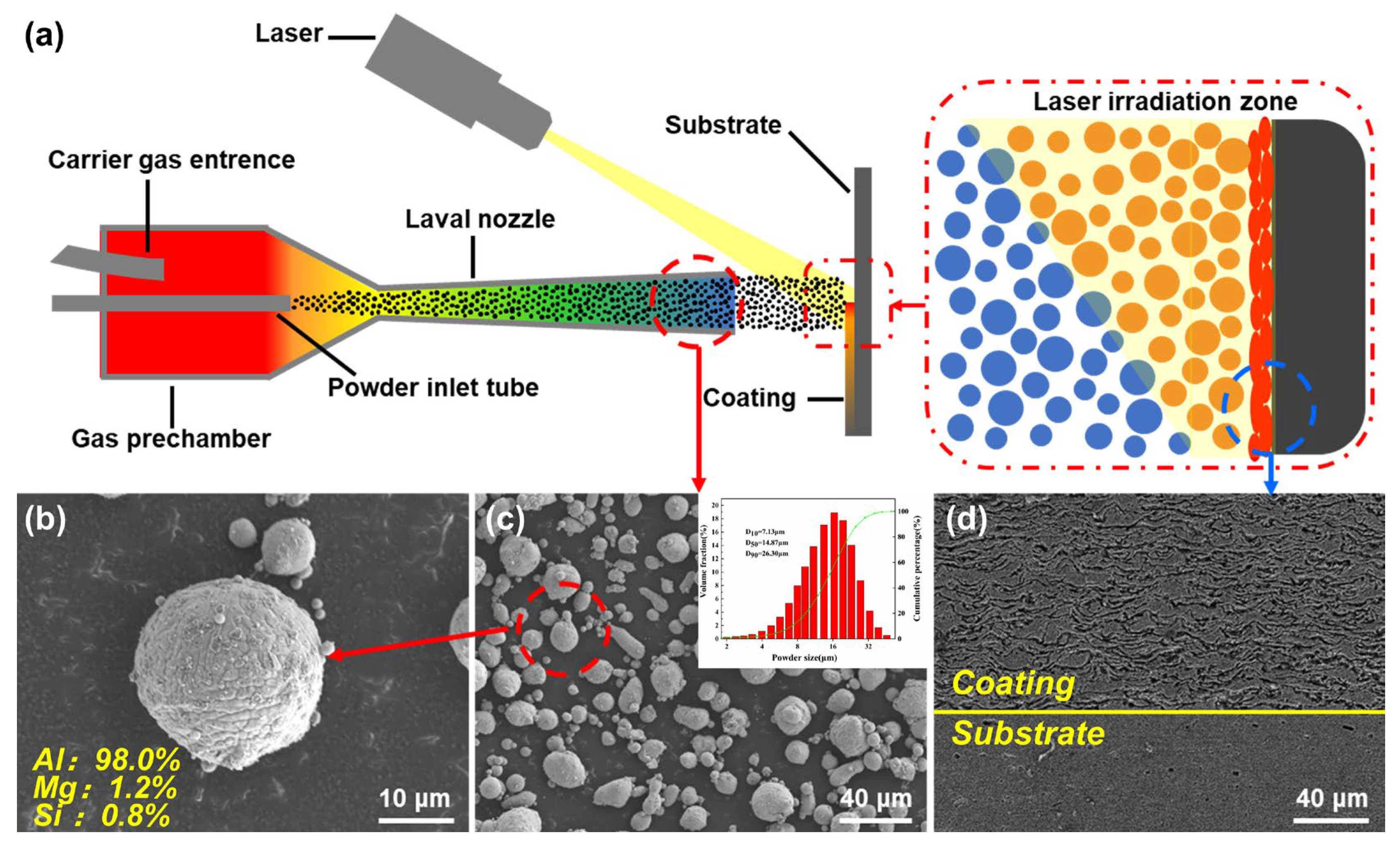
Spherical gas-atomized 6061 Al alloy powder was used as the raw material. Its chemical composition is provided in the table located at the lower left of Figure 1b. All substrates used in the experiments are cold-rolled 6061 aluminum alloy substrates. For the substrates used to prepare single-particle samples, the surface is ground with 2000, 3000, 5000, and 7000 grit sandpaper and then polished with a SiO2 suspension of 150 nm particle size to facilitate particle identification and enable clear observation of the post-deposition microstructure. After polishing, the surface roughness is approximately 0.2 μm. For the substrates used to prepare coating samples, sandblasting is applied to roughen the substrate surface. The sandblasting pressure is 0.6 MPa, the stand-off distance is 100 mm, and the blasting angle is 70–80°. After sandblasting, the surface roughness is 2.7 ± 1.2 μm.
The primary experimental setup for LACS is illustrated in Figure 1a. The fiber laser generator (RFL-A2000D, Raycus, Wuhan, China) was employed, with a wavelength of 915 ± 10 nm and a maximum output power of 2000 W. The laser head (JS-GX100-W-RFL100400-4L, JINSHUN Technology Co, Weifang, China) produced a spot size of 8 mm. A converging–diverging nozzle with a circular cross-section was used, featuring an outlet diameter of 5 mm and an expansion ratio of approximately 2. In all experiments, nitrogen was used as the carrier gas, and the inlet pressure and temperature were set to 1.40 MPa and 298 K, respectively. The standoff distance from the nozzle outlet to the substrate was maintained at 10 mm. The laser and particle beams were coupled near the substrate surface, with the laser incident at an angle of 60° relative to the substrate. To prepare single-particle samples, a robotic arm controlled the high-speed movement of the spray gun at a traverse speed of 800 mm/s over a 10 × 10 × 10 mm substrate, with a powder feed rate of 5 g/min. For coating preparation, the powder feed rate was increased to 20 g/min, and the traverse speed was reduced to 5 mm/s. Different thermal inputs were achieved by adjusting the laser output power. To avoid oxidation and melting due to the low melting point of the aluminum alloy, the particle temperature was controlled below 773 K. Based on the temperature measurement results presented in Section 3.3, six laser power levels, including 0 W, 100 W, 200 W, 300 W, 400 W and 500 W, were selected for the experiments.

2.2. Mechanical and Microstructural Characterization

After deposition, the cross-sections of the coated specimens were etched with Keller’s reagent for 15 s. The surface morphology of the as-received powder, the morphologies of the single-particle specimens, and the microstructures of the coated cross-sections were characterized using scanning electron microscope (SEM, Sigma 300, ZEISS, Oberkochen, Germany). Figure 1b,c presents the particle size distribution and initial morphology of the 6061Al powder used in this study. The particle size distribution, measured using laser particle size analyzer (Mastersizer 2000, Malvern, Worcestershire, England), ranged from 0 to 30 μm, with D10 = 7.13 μm, D50 = 14.87 μm, and D90 = 26.30 μm. Figure 1d shows the cross-sectional morphology of an etched coating specimen.
The sample preparation procedure for field emission transmission electron microscopy (TEM, Talos F200X, FEI, Hillsboro, OR, USA) is as follows. After cutting coated specimens to appropriate dimensions using spark erosion wire cutting, the specimens were thinned to 40–50 μm using 100–5000 grit fine sandpaper. A 3 mm diameter thin disc was then punched out using a punch cutter and mounted on a pitter (Gatan 656, Gatan, Pleasanton, CA, USA). The sample center was mechanically thinned to 10–20 μm using abrasive grinding. Subsequently, the thin discs were continuously etched and thinned using an electrolytic double-jet thinning apparatus (FISCHIONE 120, FISCHIONE, Export, PA, USA) until a thin zone formed, after which they were removed. Subsequently, microscopic morphological observations and high-power transmission electron microscopy were conducted in bright-field mode, with elemental analysis performed using an energy-dispersive X-ray spectrometer (EDS, Talos F200X, FEI, Hillsboro, OR, USA).
Temperature measurement during deposition was performed using a mid-wave infrared camera (FAST M200, Telops, Quebec City, QC, Canada) to monitor the thermal response of the deposition region in real time. The infrared camera was positioned at a fixed angle and distance relative to the substrate surface throughout all experiments to ensure measurement consistency. During deposition, the camera continuously recorded the surface temperature evolution of the particle impact region under identical acquisition conditions for all samples. For temperature extraction, a region of interest corresponding to the deposition zone was selected, and the average temperature within this area was used for analysis in order to reduce the influence of local thermal fluctuations at individual pixels.
Nanoindentation tests were conducted using a Nano Indenter G200 (KLA, Chandler, AZ, USA) equipped with an InForce 50 actuator (KLA, Chandler, AZ, USA) and a Berkovich diamond indenter (KLA, Chandler, AZ, USA). The indenter was continuously driven into the coating surface up to a maximum load of 10 mN, then held at peak load for 10 s before unloading. A total of 100 indentations were made on the cross-sectional plane of the coating in a 10 × 10 array pattern with 10 μm spacing between adjacent test points to ensure statistical representativeness.
Porosity analysis was performed based on SEM images of the cross-sections. The pore area fraction was measured using ImageJ 1.54b software. For each sample, eight regions were randomly selected and imaged at 100× magnification for statistical evaluation. The porosity was calculated as the areal fraction of dark pore features relative to the total analyzed area, and the final value is reported as mean ± standard deviation from the eight measurements.

3. Establishment of Finite Element Model

3.1. Material Model

Simulation of CSed 6061 Al alloy particle on the same substrate. The material is assumed to have the properties listed in Table 1 and to be isotropic. The Johnson–Cook plasticity model is employed to capture the strain rate and temperature dependence of the material behavior:
σ = A + B ε p n 1 + c ln ε ˙ p ε ˙ 0 1 T T r T m T r m ,
where σ is the flow stress, ε ˙ p is the strain rate, ε ˙ 0 is the reference strain rate, Tr is the reference temperature, Tm is the melting temperature of the material, and A, B, c, n, m are the model parameters. Here, A is the quasi-steady-state yield stress, B is the power-law pre-exponential factor, c is the strain rate pre-exponential factor, n is the strain hardening exponent, and m is the thermal softening exponent [37].
Given the relatively soft substrate of the 6061 Al alloy, material failure is incorporated in the model, which is essential for numerical accuracy in high-speed impact simulations. The Johnson–Cook damage initiation criterion, widely used in projectile penetration analyses, is adopted:
ε - D P = d 1 + d 2 exp d 3 p q 1 + d 4 ln ε ˙ P ε ˙ 0 1 + d 5 T T r T m T r ,
where ε - D P is the equivalent plastic strain at the onset of damage, p/q is the stress triaxiality, and d1d5 are empirical material parameters for the experimental material [38].

3.2. Coupled Euler-Lagrange Method

The numerical simulation of the deposition behavior of CSed particles is conducted using the Finite Element Method (FEM). After years of development, FEM has evolved from the initial Lagrangian approach to include derived techniques such as the Arbitrary Lagrangian–Eulerian (ALE) method, the Eulerian method, and the Coupled Eulerian–Lagrangian (CEL) method [39]. The Lagrangian and ALE methods may terminate prematurely due to excessive mesh distortion when simulating problems involving severe particle deformation [32]. On the other hand, although the Eulerian method can accommodate extreme deformations, the unrestricted flow of material in Eulerian space makes it difficult to track contact interfaces in the simulation results [36]. Since the simulation of LACS involves numerous cases of extreme deformation, the CEL method, which combines the advantages of both Lagrangian and Eulerian formulations, is employed in this work [33].
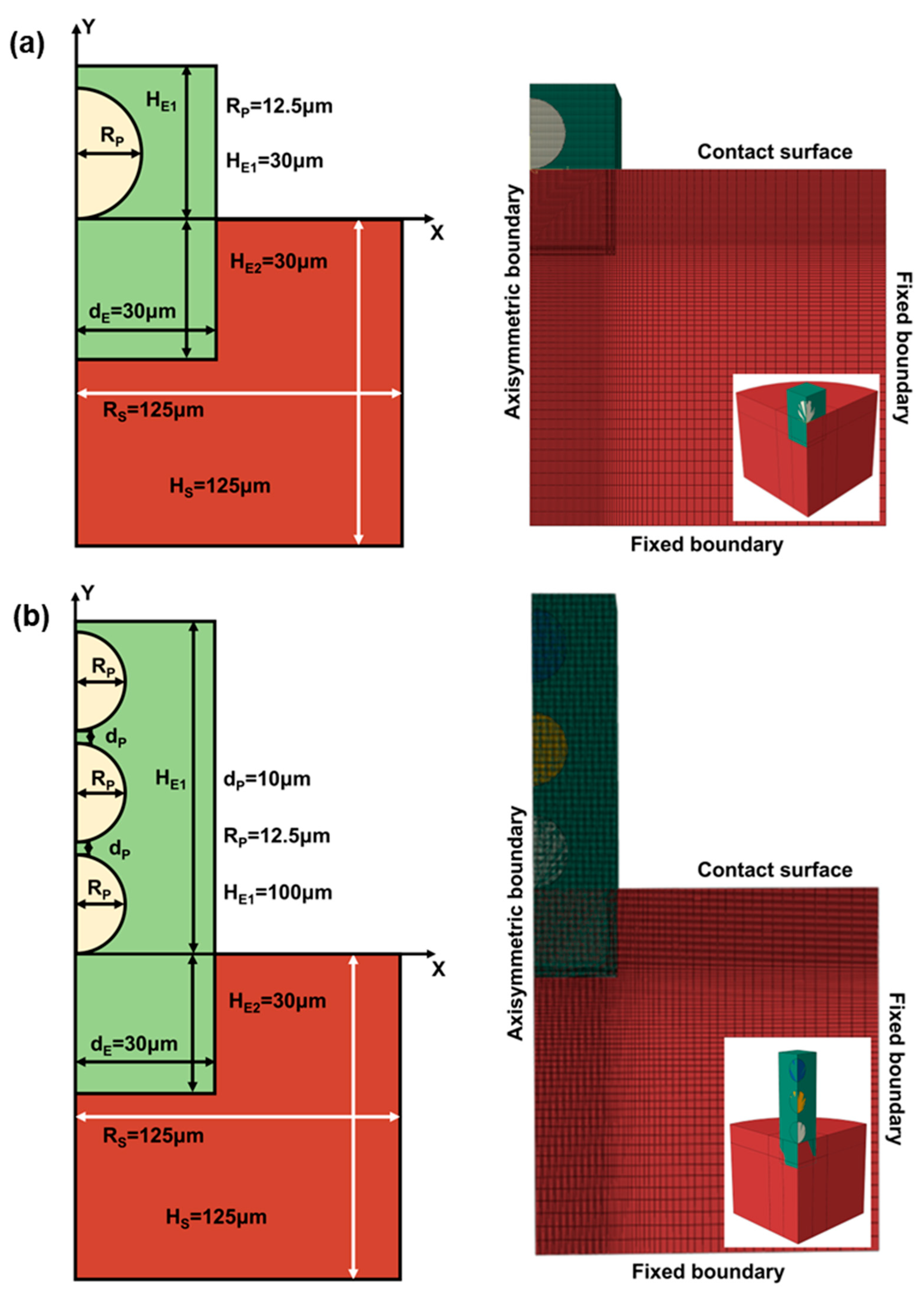
A CEL finite element model was developed and simulated numerically in this work using the commercial finite element analysis software ABAQUS/Explicit 2020. The study considered both single-particle and multi-particle impact scenarios to achieve multi-scale modeling. All impact processes were assumed to be adiabatic, and an explicit dynamic analysis was employed to simulate the adiabatic stress response [40]. The geometric model and mesh configuration are shown in Figure 2. Given the axisymmetric nature of particle impact, both the particle and the substrate were simplified to quarter-symmetry models to reduce computational cost. Specifically, the particle was modeled as a quarter-sphere and the substrate as a quarter-cylinder [41]. The particle diameter (Dp) was set to 25 μm, consistent with the size distribution of the feedstock powder. To minimize boundary effects from stress wave reflection, the height (Hs) and radius (Rs) of the substrate were defined as ten times the particle radius (Rp).
In the simulation of single-particle collisions, the Eulerian domain containing the particle was modeled as a 30 × 30 × 60 μm rectangular region that fully encloses the particle and partially penetrates into the substrate. The mesh was discretized using EC3D8RT elements, with a seed size set to 1/50 of the particle diameter (Dp). The Lagrangian substrate was meshed with C3D8RT elements. In the central region (25 × 25 × 25 μm), where severe deformation occurs, the element seed size was also set to 1/50 Dp. For the remaining regions, a graded mesh was employed with a transition distribution, where the maximum seed size did not exceed 1/5 Dp. A general contact algorithm was applied with the following properties: normal behavior was defined as “hard” contact, and tangential behavior was modeled using a penalty friction formulation with a coefficient of 0.3 [41]. Axisymmetric boundary conditions were applied to the symmetric surfaces of both the substrate and the Eulerian domain. The bottom and side surfaces of the substrate were assigned fixed boundary conditions. Additionally, to prevent material from flowing out of the Eulerian domain, all external surfaces of the Eulerian volume were constrained with zero-normal-flow boundary conditions.
The finite element model for multiple particle collisions was established under identical conditions to the single-particle model, with the exception that the Eulerian domain was modeled as a 30 × 30 × 130 μm3 rectangular region containing three particles embedded within a portion of the substrate.

3.3. Determination of Collision Speed and Temperature

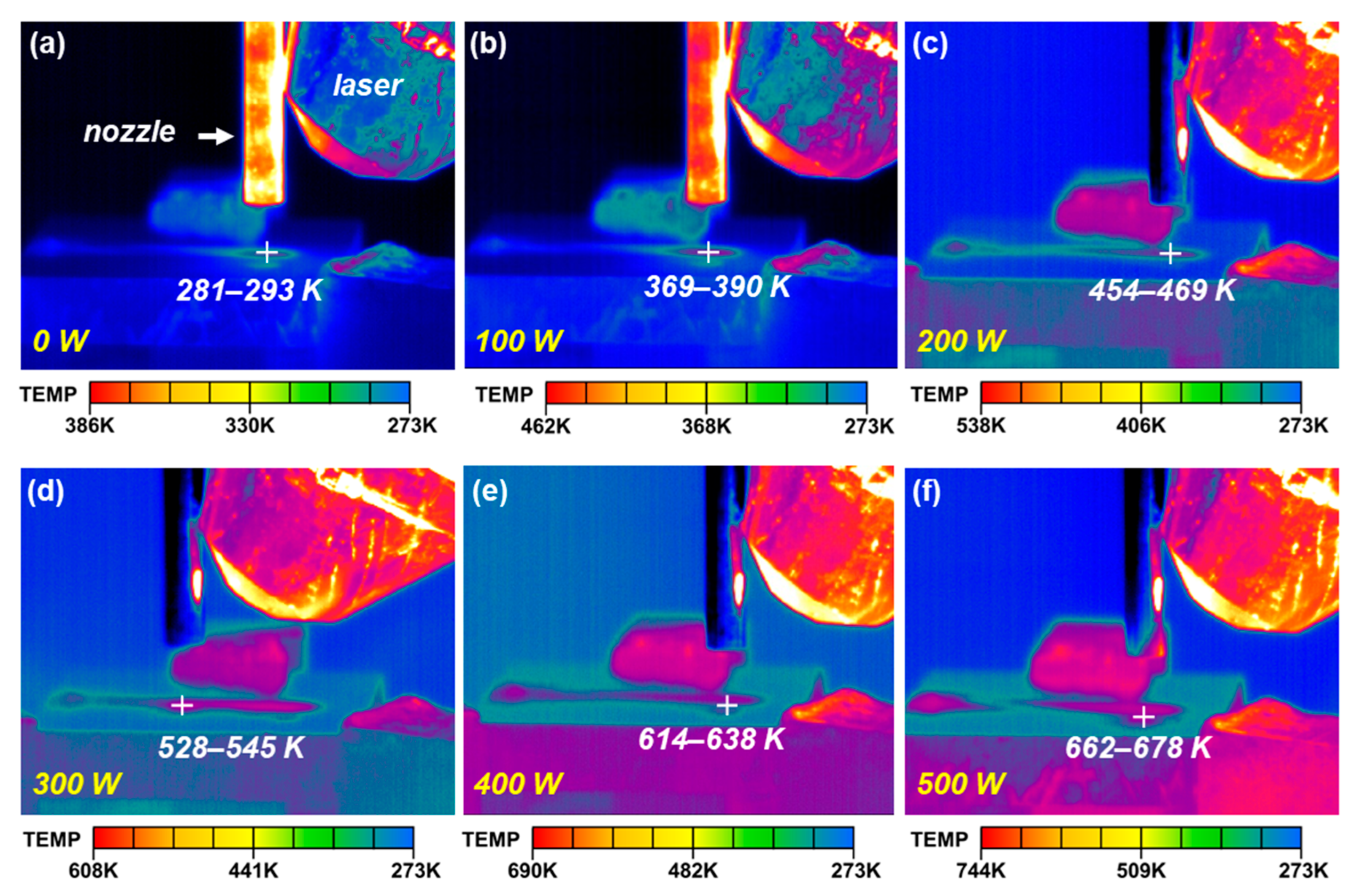
The critical deposition velocity for 6061 Al alloy particles is approximately 600 m/s [42]. To ensure the impact velocity exceeds this critical value and aligns with typical process conditions, the initial velocity of the particles was set to 600 m/s in the simulations. During experiments, the temperature near the impact zone was monitored using a mid-wavelength infrared thermal camera (FAST M200), as shown in Figure 3. The maximum recorded temperature did not exceed 773 K.
Accordingly, in the simulations, the initial temperature assigned to the 6061 Al alloy particles was also kept below 773 K. This study defined the temperature field of the material using the “Create Predefined Field” command in the “Load” module of Abaqus. For single-particle collisions, the initial particle temperatures are set to 298 K, 373 K, 473 K, 573 K, 673 K, and 773 K. For multiple-particle collisions, the initial particle temperatures are set to 298 K, 373 K, 473 K, and 573 K. In the present simulations, the substrate temperature in the laser-assisted cases was set to 373 K to reflect limited conductive heating of the substrate, since the laser was coupled near the deposition zone and was not intended to serve as a bulk substrate-heating source. Accordingly, the current model emphasizes local thermal softening during impact rather than the build-up of macroscopic thermal residual stresses.

4. Results and Discussion

4.1. Particle and Substrate Collision Deposition Behavior

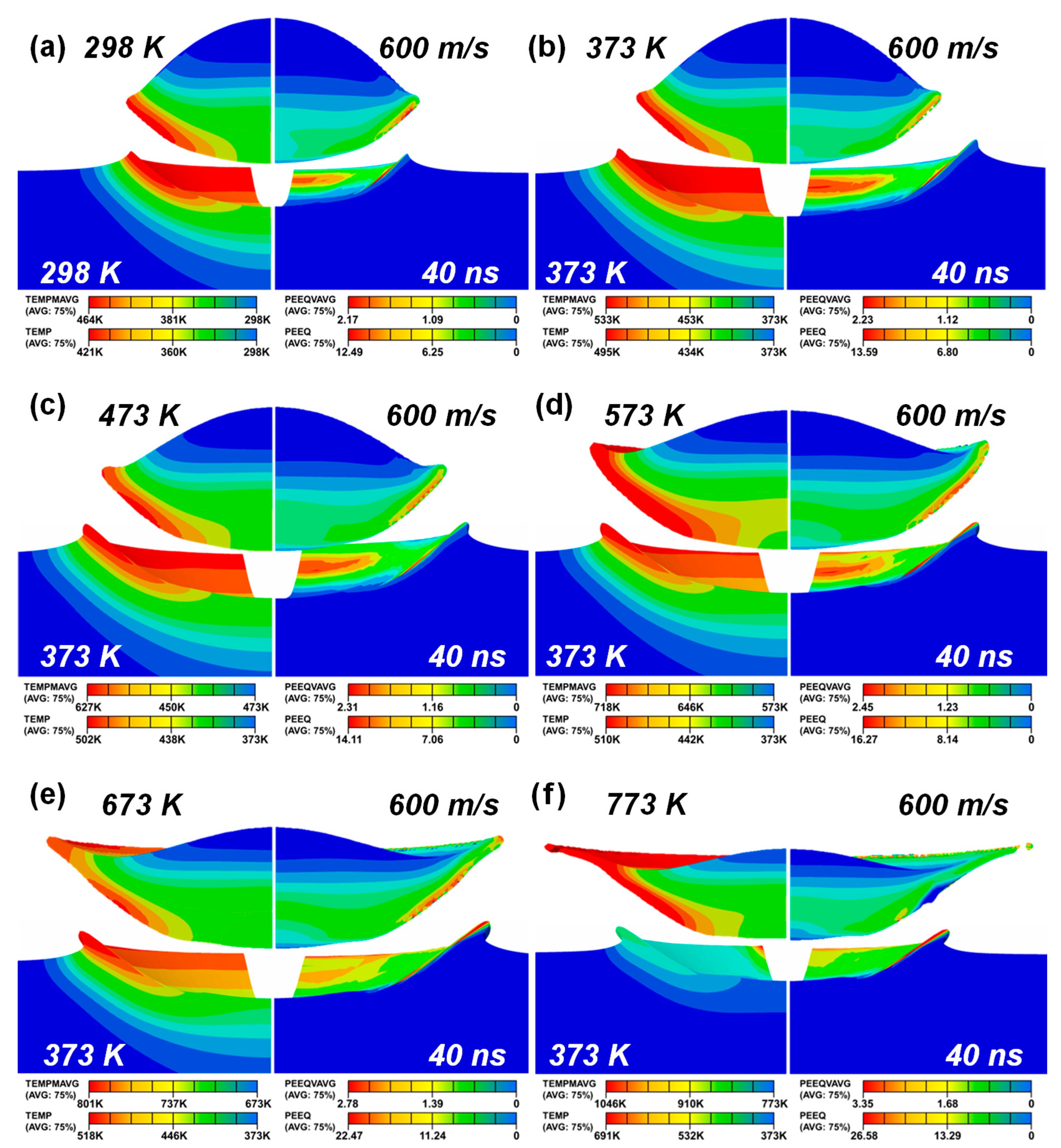
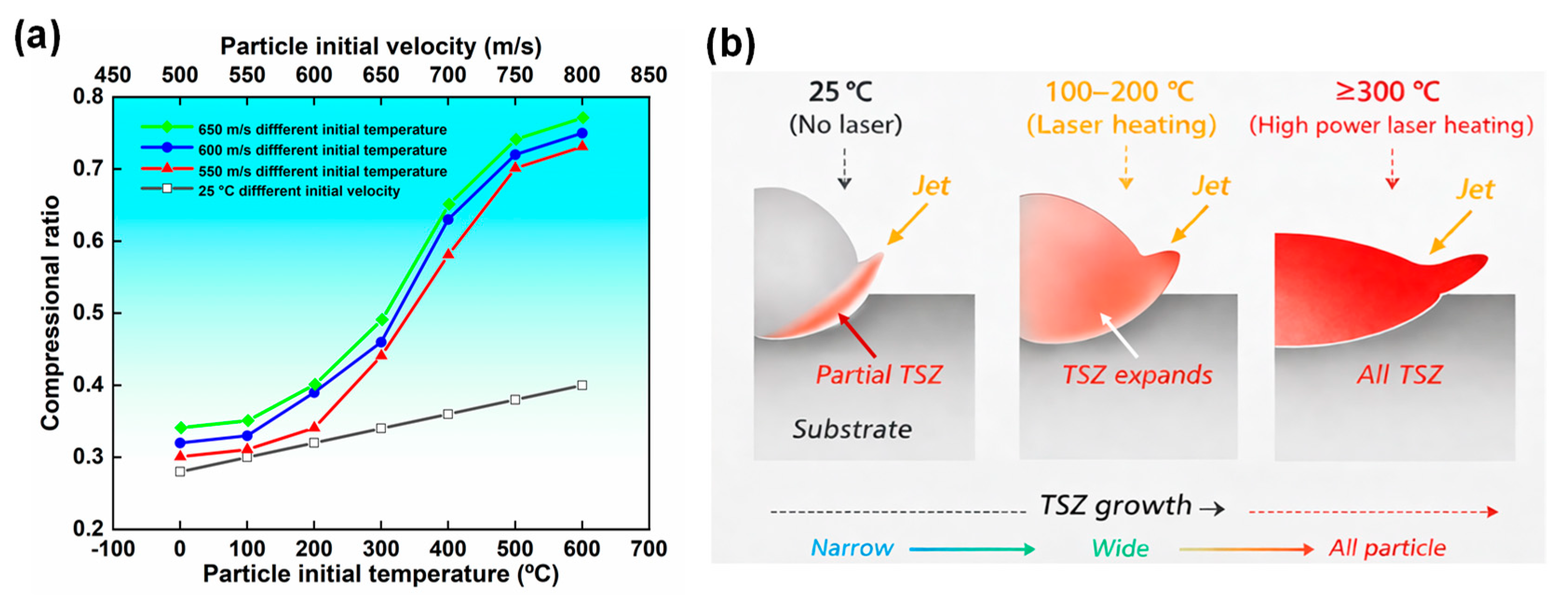
As shown in Figure 4, increasing the initial particle temperature changes the impact response from general particle flattening to strongly localized interfacial flow. With laser-assisted preheating, the maximum local temperature rises from 464 K to 1046 K, while the peak equivalent plastic strain increases from 2.17 to 3.25, accompanied by an increase in particle diameter from 30 μm to 49.5 μm. More importantly, these changes are not expressed simply as greater bulk deformation, but as a progressive concentration of high temperature and high strain at the particle-substrate interface together with increasingly pronounced radial jetting. This indicates that preheating drives the interface into a more localized deformation mode under near-adiabatic impact conditions. In mechanistic terms, the elevated initial temperature reduces the local flow resistance and shifts the constitutive balance toward thermal softening at the interface. In single-particle deposition, the particle compression ratio, defined as (DpHf)/Dp, where Hf is the final particle height and Dp is the initial particle diameter, is commonly used to quantify the extent of particle deformation [43,44]. Within this framework, Figure 5a shows that the compression ratio is much more sensitive to initial temperature than to initial velocity, and that this sensitivity becomes especially pronounced as the particle temperature approaches ~0.5 Tm, indicating that the deposition response is governed less by impact momentum than by the temperature-dependent ability of the interface to sustain severe localized plastic flow.
This trend is broadly consistent with the adiabatic shear instability framework, in which bonding becomes favorable once local thermal softening exceeds the stabilizing effects of strain and strain-rate hardening [45]. The simultaneous increase in interfacial temperature and equivalent plastic strain shown in Figure 4 supports such a transition toward instability. However, Figure 4 further shows that this transition cannot be explained by softening alone, because the most significant change with increasing temperature is not deformation magnitude per se, but the emergence and intensification of interfacial jetting. That feature is more consistent with bonding models that place jet formation at the center of interfacial bonding, since such jetting is generally associated with oxide-film rupture and fresh-metal exposure [46]. The present results therefore support a coupled interpretation: thermal softening promotes intense interfacial localization, while the concurrent reduction in flow resistance facilitates lateral material ejection triggered by transient stress-wave release near the free surface. In this sense, adiabatic instability and stress-wave-induced jetting are better understood as mechanically linked aspects of the same bonding process rather than mutually exclusive mechanisms.
The substrate-side response in Figure 4 reinforces this interpretation, as the higher local plastic energy dissipation indicates that bonding is controlled by the formation of a highly activated interfacial zone involving both particle spreading and severe substrate accommodation. This also implies that compression ratio alone, although useful for characterizing deformation, is insufficient to describe deposition quality. The highest-temperature case further defines the upper bound of the beneficial preheating effect. At an initial particle temperature of 773 K, deformation becomes most intense and the local temperature exceeds Tm, leading to incipient melting at the jet tip and droplet splashing. This indicates a transition from controlled solid-state jetting to unstable material expulsion. Laser-assisted heating therefore improves deposition only within a finite thermal window. Moderate preheating enhances localized interfacial plasticity and jetting, thereby promoting oxide disruption and metallurgical contact, whereas excessive preheating leads to over-softening and local melting that undermine interfacial stability.

4.2. Particle and Particle Collision Deposition Behavior

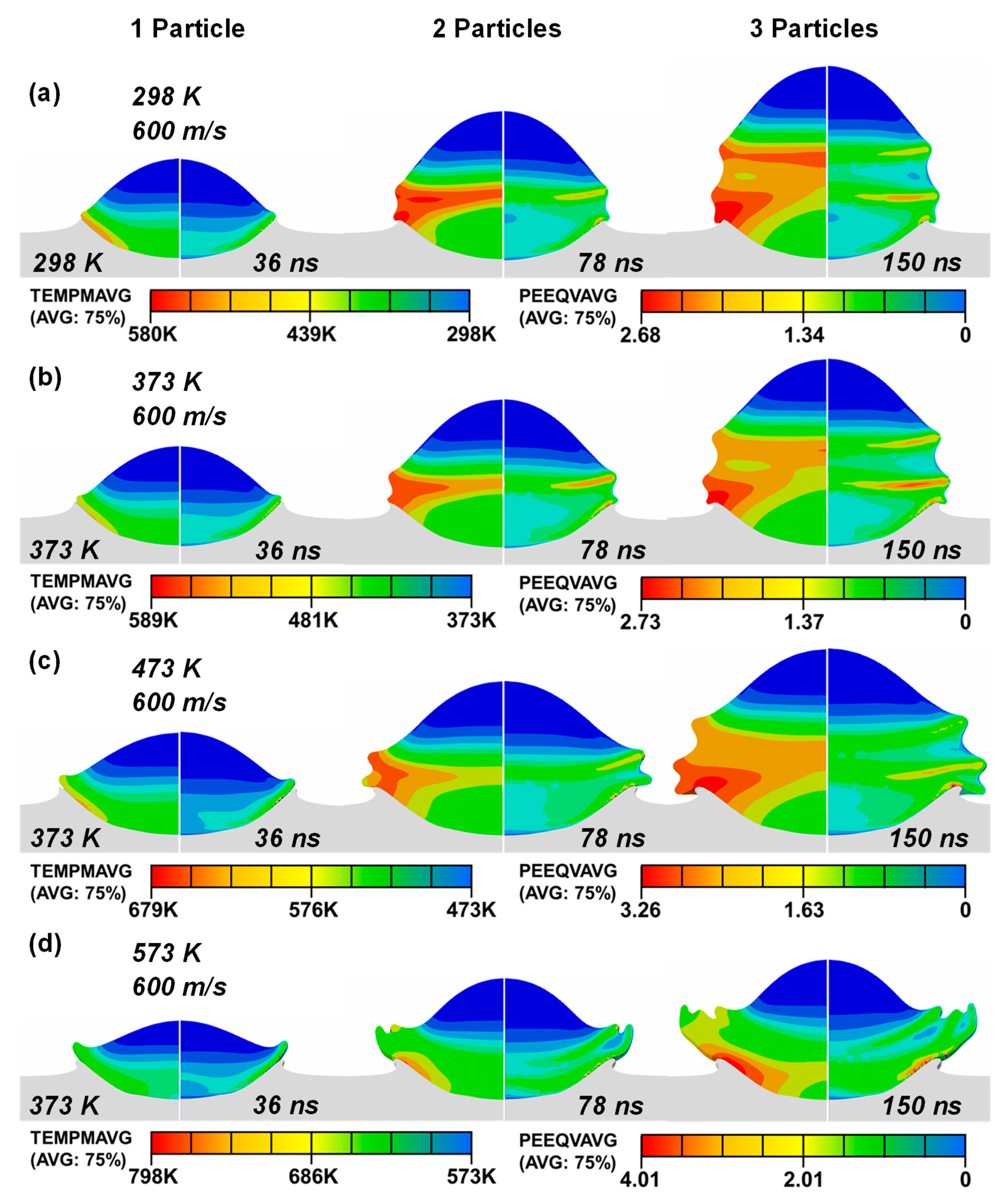
Compared with single-particle impact, the sequential overlapping deposition of three identical particles more realistically captures the bonding evolution during coating build-up, as shown in Figure 6. Because the previously deposited particles are subjected to reloading, recompaction, and remolding during subsequent impacts es [35]. As the initial particle temperature increases, the lower particles undergo markedly greater deformation, whereas the deformation of the top particle decreases slightly. This contrast indicates that the response of individual particles in multi-particle deposition is governed not only by the incident conditions, but also by their evolving local constraint state. The expansion of the thermal softening zone in the lower particles reduces the flow stress and enhances their ability to accommodate subsequent impacts through radial spreading and interfacial extrusion. As a result, the lower particles experience more extensive geometric reconstruction, while their effective support stiffness to the incoming top particle decreases, leading to slightly weaker deformation of the latter. The pronounced mechanical interlocking observed at 573 K further suggests that overlapping deposition improves particle-particle bonding not only through enhanced plastic flow, but also through morphology-assisted anchoring. At the same time, the stronger jetting induced by laser-assisted heating enlarges the effective bonding area between adjacent particles, indicating that elevated particle temperature promotes interparticle contact and stabilizes deposition.
A further characteristic of the multi-particle impact response is that the lower particles consistently exhibit higher temperatures and larger equivalent plastic strains than the top particle. This indicates that the first-deposited particles remain mechanically active after initial capture and continue to undergo secondary deformation and reheating during subsequent particle arrival. Such behavior reflects repeated compressive and shear loading, which increases plastic work dissipation and local adiabatic heating. The concentration of peak temperature and maximum equivalent plastic strain at the interface between the jet of the lower particle and the substrate suggests that this region remains the most mechanically activated zone during sequential deposition, where severe shear, fresh-surface generation, and defect closure are most likely to occur. By contrast, the more uniform temperature and strain distributions inside the lower particles imply that repeated loading promotes coordinated internal deformation and local densification. Although pronounced jetting is generally difficult to achieve at room temperature, the additional compaction and secondary shear introduced by subsequent impacts can still modify the local stress state sufficiently to induce noticeable jet formation in the lower particles [35,47]. Overall, particle-particle bonding in cold spray should therefore be understood as a cumulative process, and laser-assisted heating improves this process by enhancing re-deformation, interfacial jetting, and mechanical interlocking within the evolving deposit.

4.3. Thermal Softening Effect

Plastic deformation of metals at high temperatures—typically considered to be above 0.4–0.5 Tm [48]—is often accompanied by microstructural evolution processes such as dynamic recovery and dynamic recrystallization, which significantly influence the deformation behavior [49,50]. These mechanisms, driven by the climb of edge dislocations, cross-slip of screw dislocations, grain growth, and related phenomena, lead to a reduction in dislocation density. When the rate of dislocation generation balances the rate of annihilation, the metal ceases to exhibit work hardening—a phenomenon known as thermal softening [51]. Once thermal softening surpasses work hardening, the flow stress stabilizes and enables steady plastic flow, causing the metal to behave in a viscous manner. In cold spraying, this promotes the formation of pronounced metal jets [52,53].
In order to investigate the thermal softening effect in cold-sprayed particles, Yin et al. introduced the concept of a thermal softening zone (TSZ), defined as the region where temperature exceeds 0.5 Tm (where Tm is the melting temperature) [18]. Within the TSZ, thermal softening competes with work hardening, leading to significant plastic deformation. As shown in Figure 5b, without laser assistance, the TSZ is confined to a narrow region near the particle–substrate contact interface during deformation. As the auxiliary heating temperature increases, the TSZ expands toward the interior and the top of the particle. At 300 °C, the TSZ extends throughout the entire particle. At this temperature, the material within the particle is extruded outward, forming a distinct metal jet. With further increases in heating temperature, the overall deformation of the impacted particle becomes more pronounced, and the metal jets grow increasingly prominent. In contrast, as shown in Figure 4, even in the absence of laser assistance, the thermal softening effect from previously deposited particles can influence all subsequently deformed particles. This suggests that the interior of the coating is more susceptible to thermal softening due to the successive impact and heating from later-deposited particles.

4.4. Energy Distribution

During particle deposition, the initial kinetic energy (EU) can be transformed into four types of energy, i.e., plastic dissipative energy (EP), viscous dissipative energy (EV), frictional heat (EF), and recoverable elastic strain energy (ER), which can be expressed as follows:
E U = E P + E V + E F + E R
Bae et al. suggested that the adhesion energy primarily consists of plastic dissipation energy, viscous dissipation energy, and frictional dissipation energy [54]. Recoverable elastic strain energy is stored as rebound energy within the contact body, which tends to cause particle rebound and separation from the substrate. Compared to the energy dissipated through plastic deformation, the proportion of energy attributable to friction is negligible and thus has minimal influence on particle deposition. Therefore, this study focuses on the roles of plastic deformation dissipation energy and elastic strain energy in particle deposition behavior.
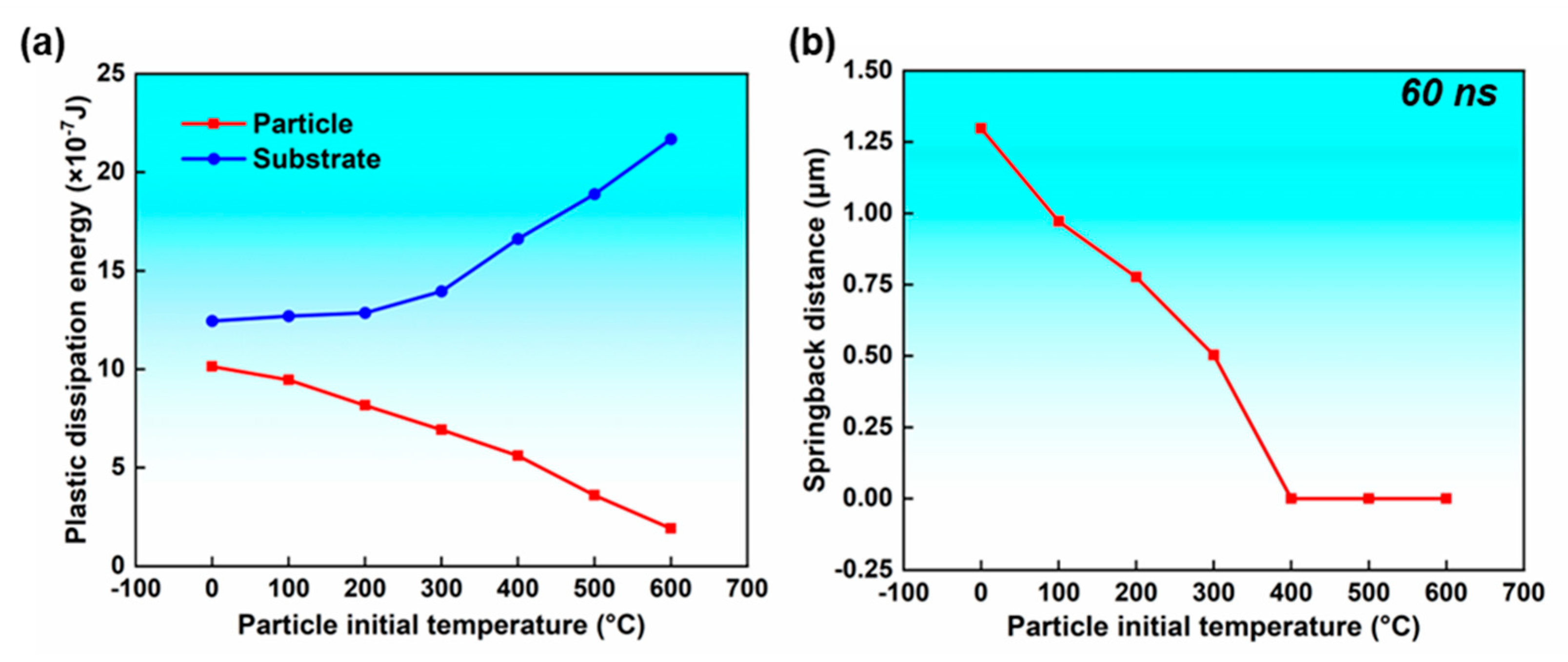
It is generally assumed that the surface and overall temperature of particles increase following laser-assisted heating, resulting in thermal softening [55]. Under these conditions, the particles become more susceptible to plastic deformation, and one might expect a significant rise in plastic dissipation energy. However, as illustrated in Figure 7a, the plastic dissipation energy within the particle actually decreases as its initial temperature increases, while the energy dissipated into the substrate exhibits the opposite trend.
This phenomenon can be explained through the following mechanisms specific to the cold spray process with laser assistance: (i) Laser heating thermally softens the particles prior to impact, lowering their yield stress and flow strength. As a result, the particles become more prone to plastic deformation and require less energy to deform upon impact, leading to a reduction in the plastic dissipation energy within the particles themselves. (ii) The reduced deformation resistance of laser-softened particles decreases the amount of impact energy absorbed by the particles. Consequently, a larger proportion of the kinetic energy is transferred to the substrate. This leads to increased stress and more extensive plastic deformation in the substrate. Moreover, as the softened particles exhibit lower hardness than the substrate, the increased hardness difference promotes planar spreading of the particles rather than penetration into the substrate, as shown in Figure 4. This results in more severe localized plastic deformation of the substrate, including pronounced material flow at the surface. Thus, the substrate undergoes deformation across a larger volume and greater depth, increasing its plastic dissipation energy. As supported by the particle rebound distances illustrated in Figure 7b, the deformation behavior of particles shifts toward greater plasticity with increasing initial temperature, accompanied by a significant reduction in recoverable elastic strain energy.

4.5. Observation of Particle and Coating Deformation Morphology

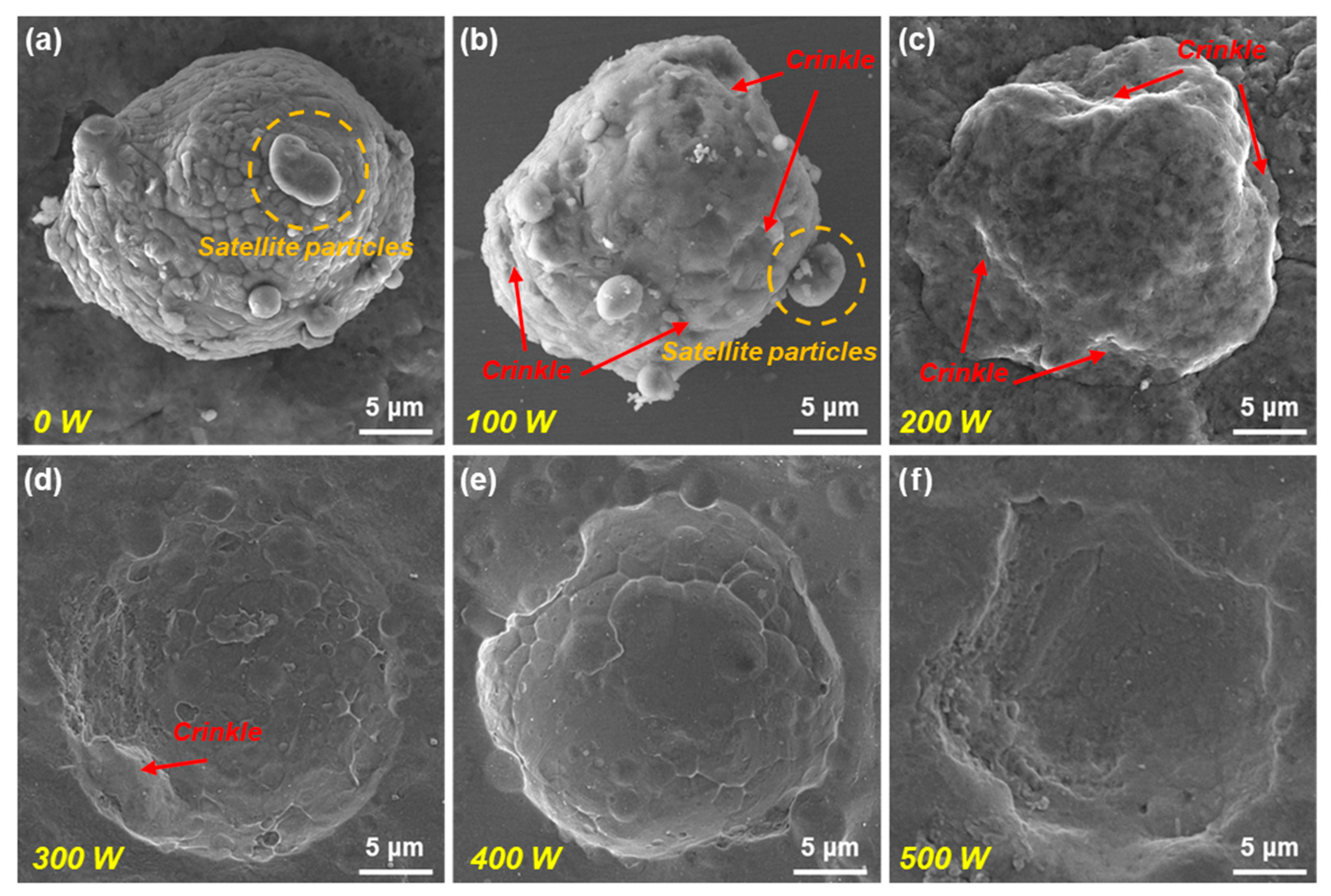
The deformation morphologies in Figure 8 provide direct experimental evidence that laser assistance modifies not only the extent of particle flattening but also the mode of interfacial material flow during deposition. Without laser assistance, the deposited 6061 Al particles largely retain a hemispherical profile, and their original surface features remain visible, indicating limited plastic flow and incomplete interfacial accommodation. At 100 W, the overall morphology remains similar, although the disappearance of the initial surface texture on the particle top surface indicates that laser heating has already begun to alter the near-surface thermal state. With further increasing laser power, the particles progressively transform from hemispherical to flattened, pancake-like morphologies, accompanied by increasingly pronounced peripheral jetting. This overall shape evolution indicates that laser-induced thermal softening shifts the deposition response from limited local deformation to extensive radial spreading and interfacial extrusion, thereby producing a morphology more favorable for bonding. At high laser power, full bonding with the substrate is achieved, suggesting that sufficient softening enables intimate interfacial contact rather than merely increasing geometrical flattening.
This overall transition is further supported by local morphological features at the particle periphery and surface. The wrinkled regions visible in Figure 8b–d are associated with material expelled during impact and subsequently solidified and therefore provide morphological evidence of jetting-assisted interfacial flow. Their gradual reduction and eventual disappearance with increasing laser power suggest that deformation is no longer confined to a limited near-interface zone but extends over a larger fraction of the particle as the thermal softening zone expands. In parallel, the disappearance of satellite particles in Figure 8a,b indicates progressive surface renewal during impact. Since these adhered features are likely related to surface contamination, loosely attached fragments, or incompletely deformed asperities, their removal implies that laser heating helps eliminate surface obstacles to effective contact.
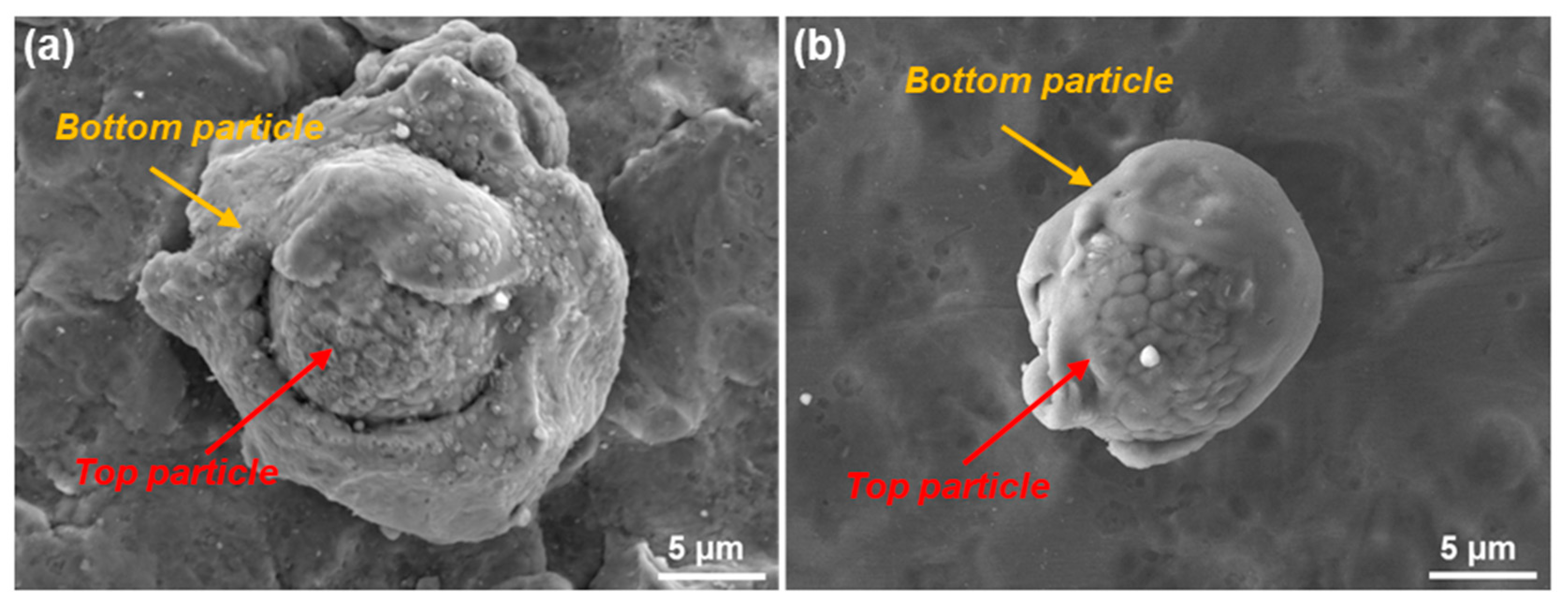
In addition to single-particle impacts, instances of consecutive multi-particle deposition were also observed. As shown in Figure 9, the bottom particle underwent severe plastic deformation accompanied by a noticeable material jet. In contrast, the top particle experienced relatively limited deformation. These observations are consistent with the simulation results presented in Section 4.2.
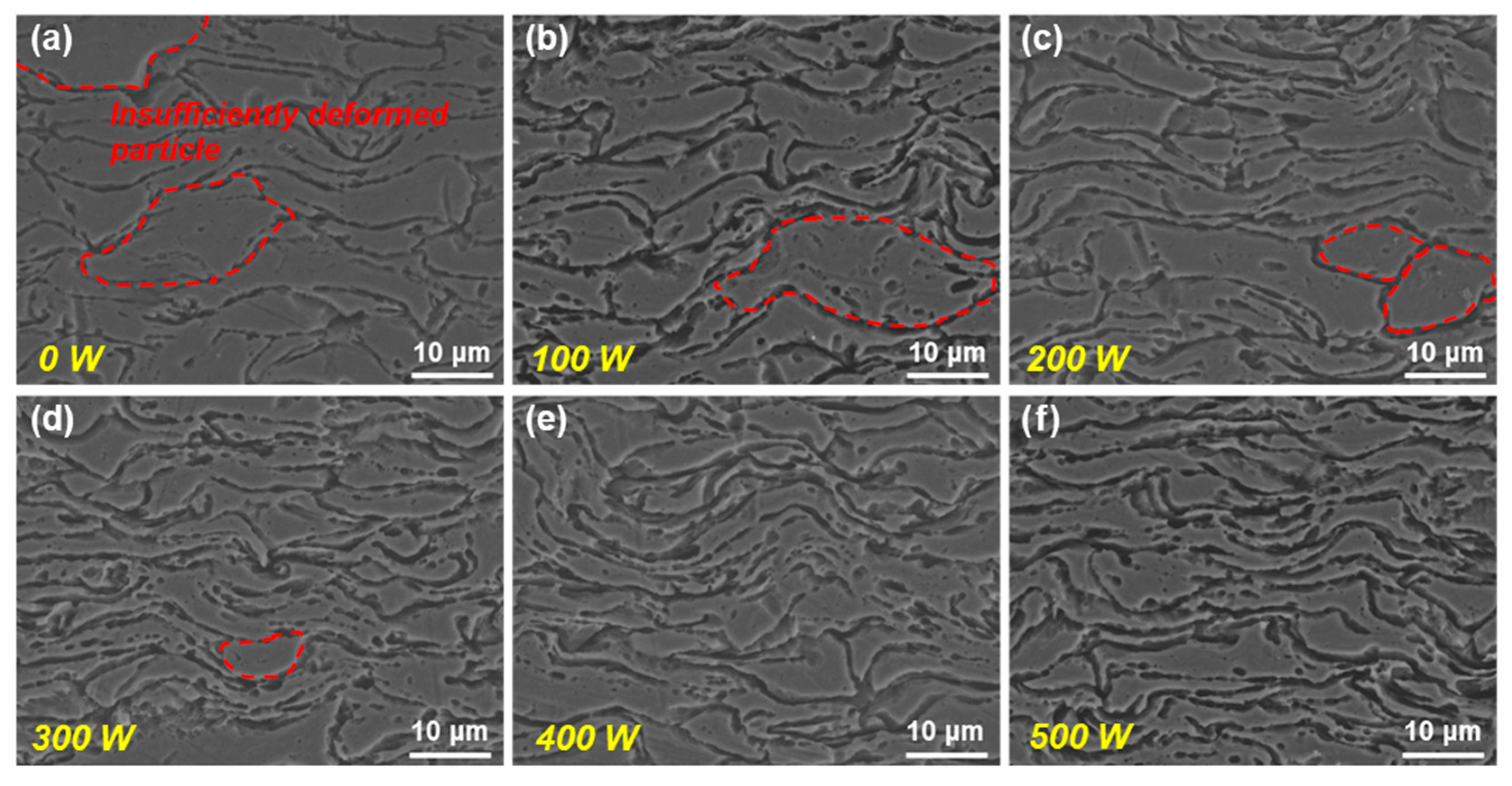
Cross-sectional analysis of the coatings after etching with Keller’s reagent, shown in Figure 10, further demonstrates that laser assistance affects not only individual particle deformation, but also the collective packing state of the deposited coating. Under no laser assistance or at a low laser power of 100 W, large particles remain only weakly deformed, while smaller particles mainly fill the inter-particle gaps. The insufficiently deformed large particles outlined by the red dashed line indicate that local accommodation is still incomplete under these conditions, so coating formation depends partly on geometric filling rather than on coordinated deformation among neighboring particles [56]. This is consistent with the limited deformation behavior observed in single-particle deposition.
With increasing laser power, this heterogeneous deformation pattern becomes progressively weaker. The size and number of inadequately deformed large particles decrease and eventually disappear, indicating that laser-assisted thermal softening promotes more uniform plastic flow throughout the coating. As a result, the coating evolves from a structure containing rigid or weakly deformed particles into one dominated by extensive particle flattening and interfacial reconstruction. Under high-power laser assistance, interfacial bonding across the coating cross-section is markedly improved, and the interlocking among flattened particles becomes much more pronounced. This morphology suggests that laser heating enhances not only particle deformability, but also the ability of adjacent particles to establish larger effective contact areas and stronger mechanical anchoring.
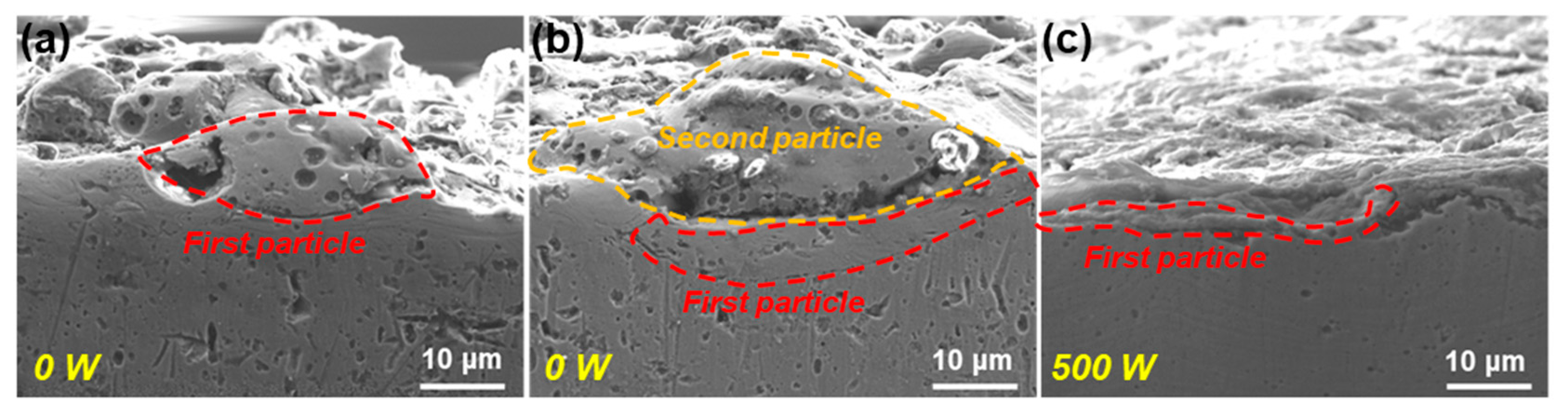
A direct comparison of impact cross-sections with and without laser assistance is presented in Figure 11. To reveal the bonding interfaces, specimens were immersion-etched for 15 s using Keller’s reagent. Under high-power laser assistance (Figure 11c), particles undergo substantially greater deformation. The lateral expansion upon impact significantly increases the bonding area with the substrate, thereby improving adhesion. Furthermore, as shown in Figure 11b, the tamping effect from a subsequent particle induces markedly greater deformation in the first particle. The distinct etched interface between the first particle and the substrate suggests that this tamping effect considerably enhances the interfacial bonding strength.
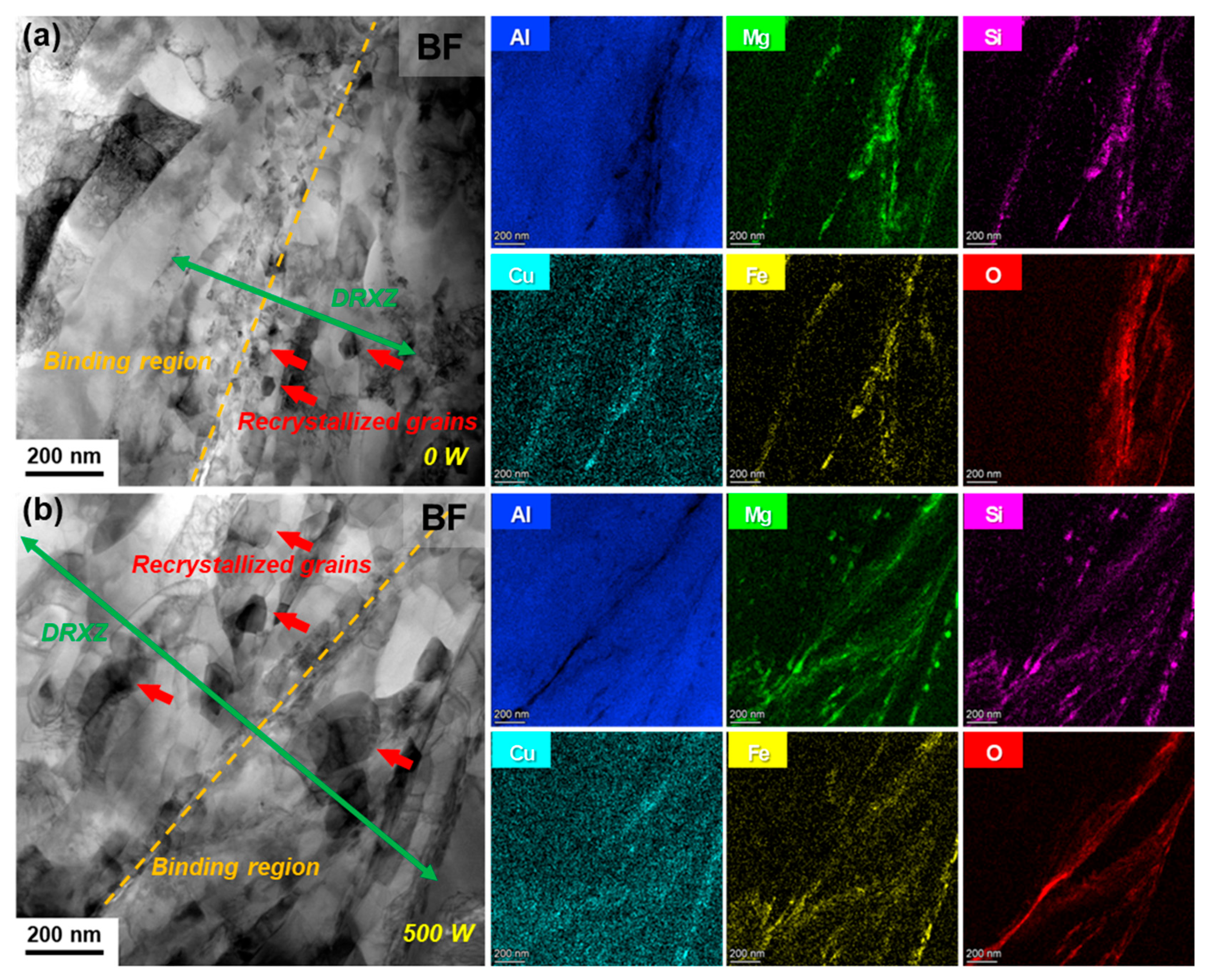
TEM bright-field images of the particle junctions in Figure 12 provide direct microstructural evidence that bonding is governed by thermomechanically driven interfacial evolution rather than by mechanical interlocking alone. Even without laser assistance, a dynamically recrystallized zone (DRXZ) is already present at the particle junction, where fine equiaxed grains form adjacent to the contact interface. Based on the scale bar and the spatial extent indicated in Figure 12a, the width of this DRXZ is approximately 0.7 μm. This indicates that the severe plastic deformation and rapid adiabatic heating generated during high-velocity impact are sufficient to trigger local dynamic recrystallization (DRX). Such a response is consistent with the simulated formation of a localized thermal-softening zone near the interface and confirms that the bonding region experiences a sufficiently high thermomechanical driving force to undergo substantial structural refinement during impact.
The effect of laser assistance is to amplify this localized response. Under 500 W laser assistance, the recrystallized region becomes markedly wider and the recrystallized grains are noticeably coarser. As roughly estimated from Figure 12b, the width of the DRXZ increases to about 1.5 μm, which is approximately twice that observed without laser assistance. This result indicates that laser heating broadens the thermal-softening zone and raises the interfacial deformation temperature to a level more favorable for dynamic recovery and recrystallization. The higher local temperature promotes dislocation climb, cross-slip, subgrain rotation, and grain-boundary migration, thereby facilitating both the expansion of the DRX region and subsequent grain growth. This trend is consistent with the simulation results, where stronger thermal softening was associated with more intense localized plastic flow and a wider bonding-affected zone. The TEM evidence therefore suggests that laser-assisted heating enhances metallurgical bonding by intensifying thermally assisted interfacial plasticity and recrystallization, rather than simply increasing particle deformation.
Additional evidence for this interpretation is provided by the interfacial elemental distribution. Owing to the intense shear deformation and transient temperature rise within the adiabatic shear zone, the native oxide film on the particle surface is stretched, fragmented, and locally displaced. The EDS maps in Figure 12 show discontinuous O distribution but continuous Al across the interface, indicating that the oxide film, with a thickness of about 50 nm, is effectively disrupted in the bonding region and that Al from adjacent particles can establish direct contact and local mechanical mixing. No additional oxygen enrichment is detected under laser assistance, suggesting that the applied laser input does not introduce detrimental oxidation during deposition. Instead, Mg-Si precipitates are observed at the particle junction under both conditions, consistent with the intrinsic precipitation behavior of 6061 Al during rapid thermomechanical cycling. Taken together, the TEM and EDS observations indicate that laser-assisted cold spray improves interfacial bonding through a coupled enhancement of thermal softening, oxide-film disruption, and dynamic recrystallization, while avoiding adverse chemical effects at the bond line.

4.6. Porosity and Nanoindentation

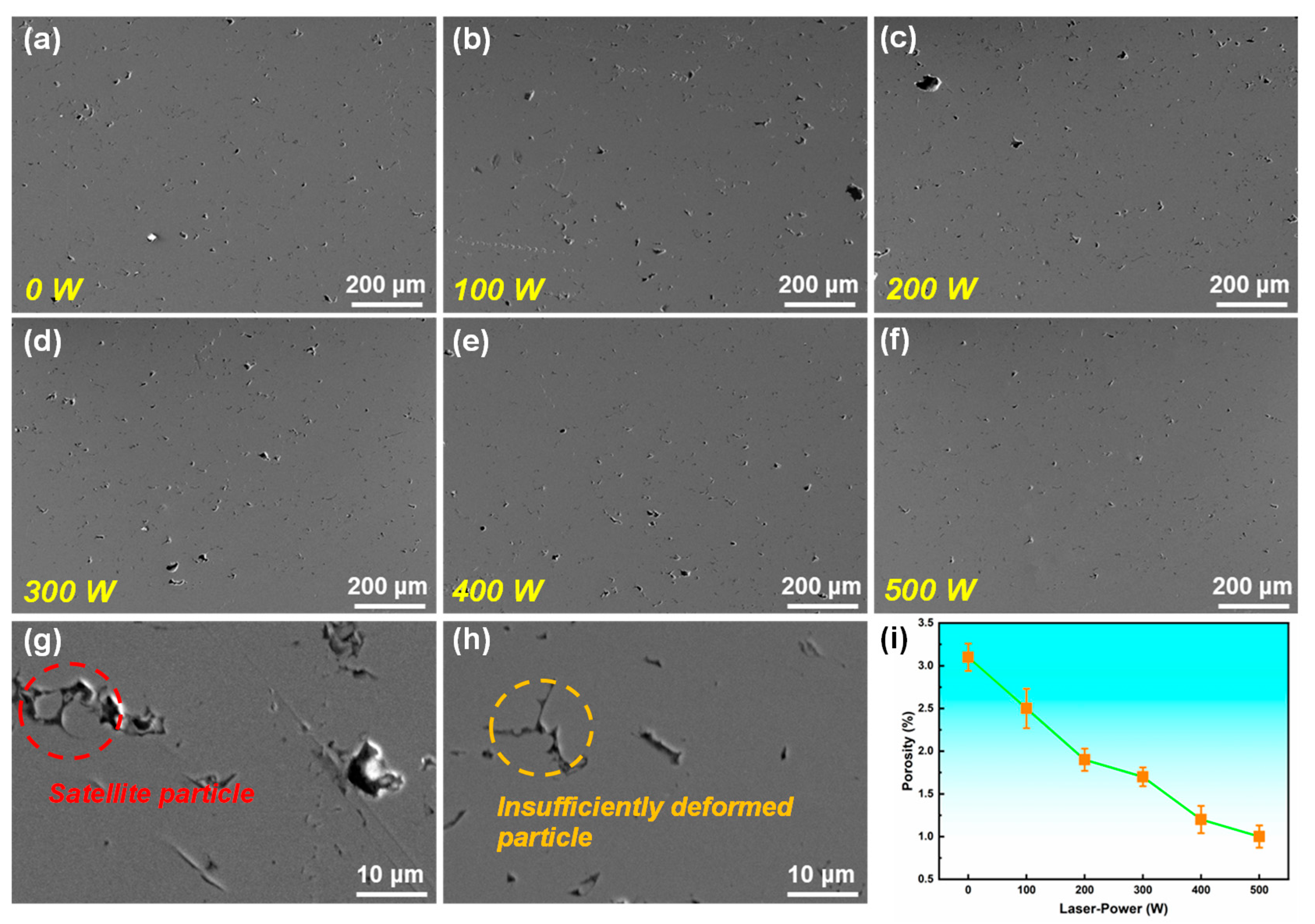
Porosity is one of the most direct indicators of coating quality in cold spray because it reflects the degree of interparticle accommodation and the effectiveness of interfacial closure during coating build-up. As shown in Figure 13, the coating porosity decreases monotonically from 3.1% to 1.0% with increasing laser power, indicating that laser assistance promotes progressive densification of the deposit. This improvement is not solely a consequence of greater particle flattening, but of a broader change in the way defects are generated and eliminated during deposition. At low or zero laser power, pore formation is closely associated with insufficient deformation of large particles and with defects introduced by satellite particles, as illustrated in Figure 13g. With increasing laser input, the disappearance of such defects suggests that laser heating improves both particle deformability and surface cleanliness, thereby reducing the persistence of geometrically unaccommodated regions in the coating.
A second contribution to porosity reduction arises from the improved closure of fine interfacial defects within the deposit. As indicated by Figure 13h and the interfacial observations discussed in Figure 12, laser-assisted heating promotes more effective bonding between previously unbound particles, which facilitates the elimination of small pores and microcracks. In mechanistic terms, this effect is consistent with the combined action of enhanced thermal softening, stronger interfacial jetting, and more extensive local metallurgical contact [56]. The reduction in porosity with laser power therefore reflects a transition from a coating structure dominated by incomplete local accommodation to one characterized by more cooperative particle deformation and improved interfacial continuity. This interpretation is also consistent with the cross-sectional observations in Figure 10, where poorly deformed particles progressively disappear as laser power increases.
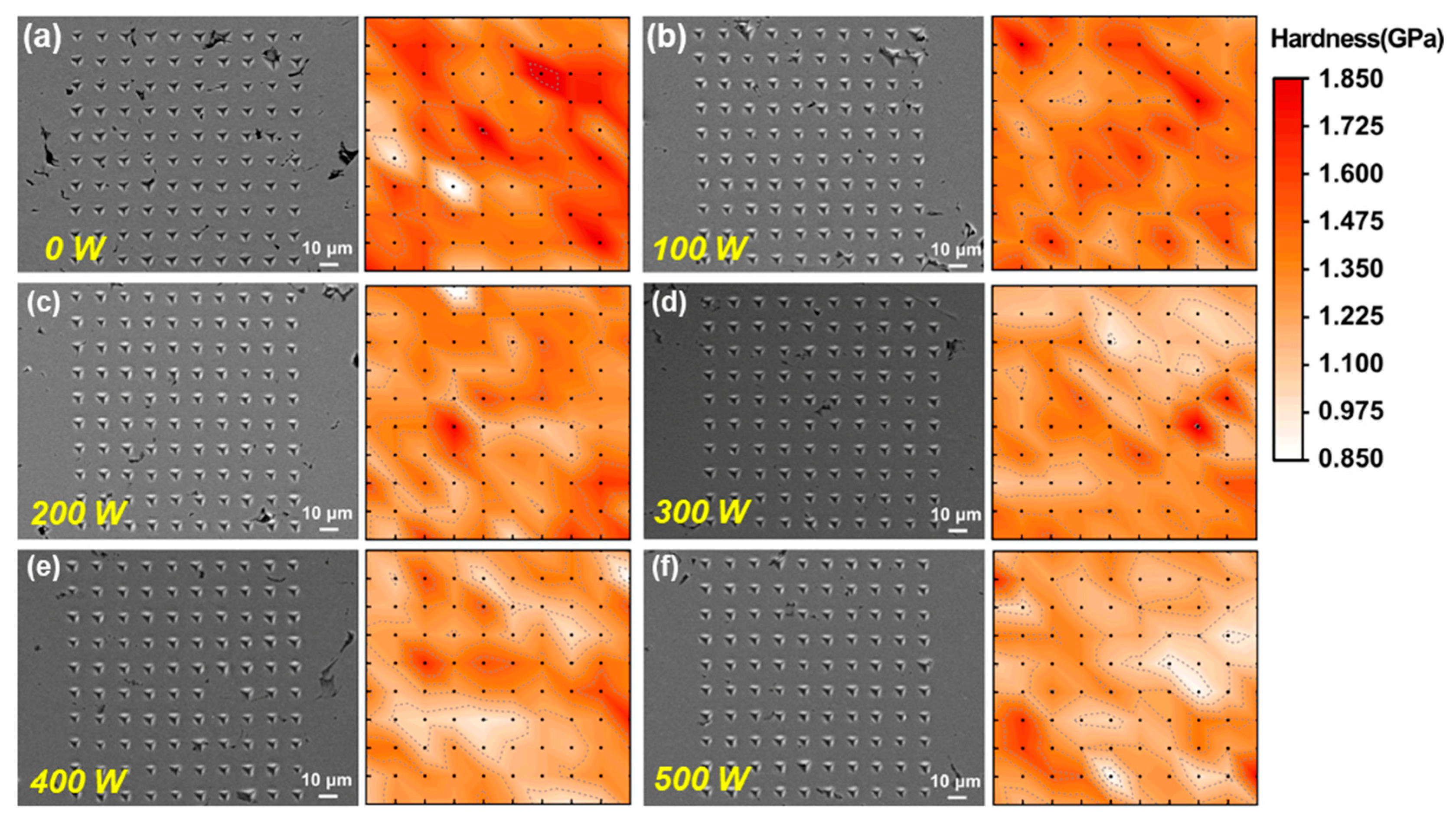
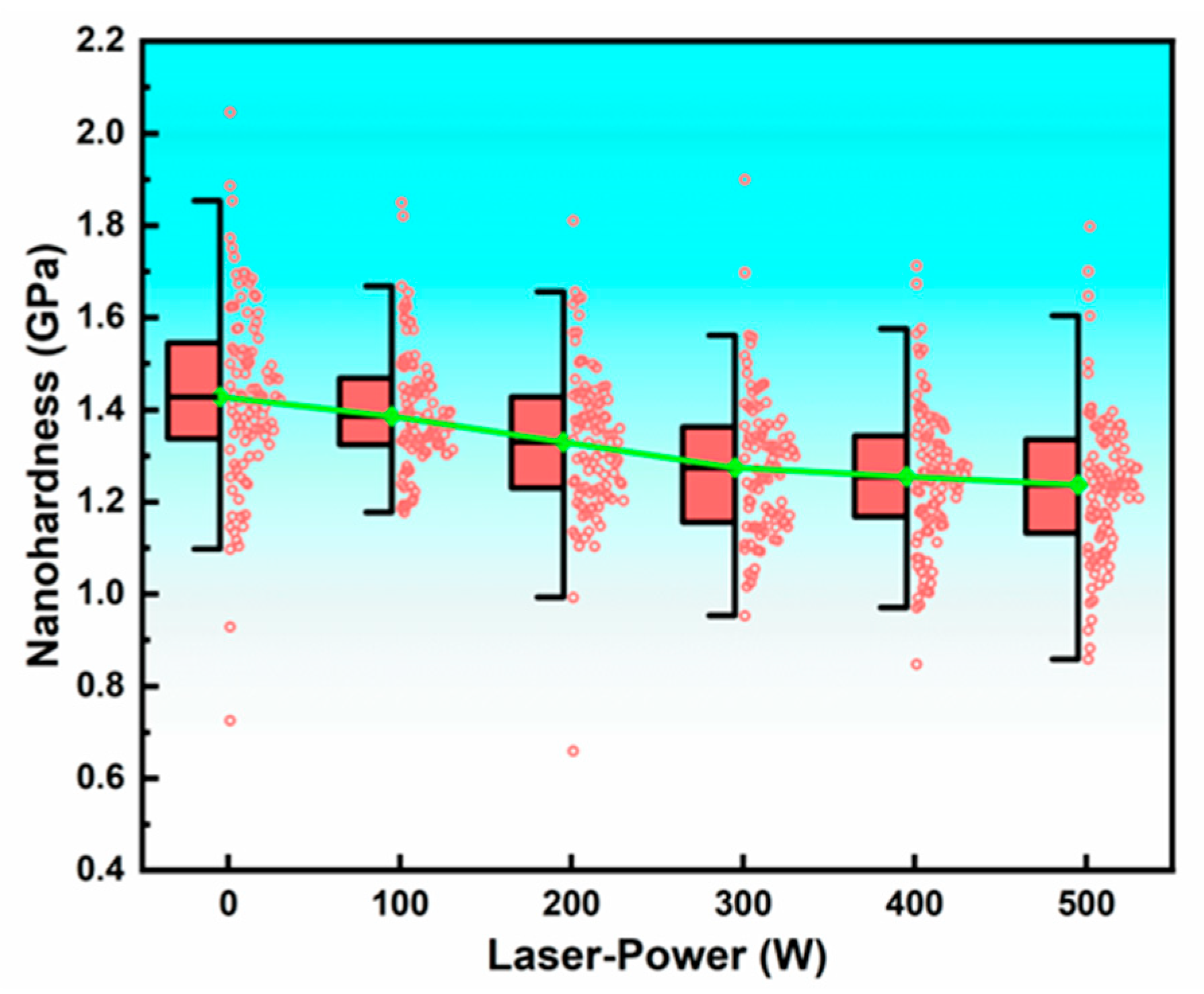
The nanoindentation results in Figure 14 and Figure 15 show that this densification is accompanied by a moderate decrease in nanohardness, from 1.43 GPa to 1.24 GPa, together with a more uniform hardness distribution in the laser-processed region. This trend indicates that the mechanical response of the coating is governed by the competition between impact-induced work hardening and laser-enhanced thermal softening. At lower laser power, the retained effect of severe impact deformation contributes to a higher local hardness but also to a more heterogeneous hardness distribution. As laser power increases, thermal softening increasingly offsets the stored deformation hardening introduced during particle impact, leading to a lower average hardness [18]. At the same time, the more homogeneous nanohardness contours suggest that laser assistance reduces local mechanical heterogeneity by promoting more uniform deformation and bonding throughout the coating. Accordingly, the role of laser assistance is not simply to soften the deposit, but to shift the coating toward a denser and mechanically more uniform state, albeit with some reduction in local hardness due to the attenuation of work-hardening effects.

5. Conclusions

This study elucidates how laser-induced thermal softening modifies the deposition mechanism of 6061 Al during laser-assisted cold spray through a combined multiscale simulation and experimental approach. The main findings can be summarized as follows.
(1) Laser assistance changes the governing deposition response from limited particle flattening to strongly localized interfacial flow. The expansion of the thermal softening zone promotes radial spreading, metal jetting, and enlargement of the effective bonding interface, indicating that the beneficial effect of laser input arises from thermally activated deformation localization rather than from geometric flattening alone.
(2) Laser heating redistributes impact energy during deposition. As particle temperature increases, plastic dissipation within the particle decreases, while substrate-side plastic dissipation increases and elastic rebound tendency is suppressed. This demonstrates that the role of laser assistance is not merely to soften the particle but to shift the energy partitioning toward a state more favorable for stable deposition and interfacial accommodation.
(3) Interfacial TEM observations confirm dynamic recrystallization under all deposition conditions. As laser power increases, the recrystallized region broadens from approximately 0.7 μm at 0 W to about 1.5 μm at 500 W, accompanied by grain growth but without additional oxidation. Therefore, the strengthening effect of laser assistance arises mainly from enhanced thermomechanical interfacial evolution and oxide disruption, rather than chemical modification of the bond line.
(4) At the coating scale, laser assistance improves densification and structural homogeneity. The porosity decreases from 3.1% to 1.0% as the laser power increases from 0 to 500 W, whereas the nanohardness decreases from 1.43 GPa to 1.24 GPa because thermal softening partly offsets impact-induced work hardening. These results reveal a trade-off between defect reduction and hardness retention that must be considered in process design.
(5) More broadly, this work provides a mechanistic framework for optimizing laser-assisted cold spray beyond empirical laser power-property correlations. It shows that the critical issue is to identify a suitable thermal window in which thermal softening is sufficient to promote jetting, interfacial localization, and coating densification, but not so excessive as to induce interfacial instability. This insight is directly relevant to the solid-state additive manufacturing and repair of difficult-to-deposit aluminum alloys.
The present study is nevertheless subject to several limitations, including the simplified thermal assumptions used in the simulations, the restricted material and process window investigated, and the lack of direct assessment of bulk structural performance. Future work should therefore incorporate more realistic transient thermal fields, extend the analysis to broader deposition conditions and alloy systems, and establish quantitative links between interfacial evolution and engineering properties such as tensile strength, fatigue resistance, and corrosion performance.

Author Contributions

Conceptualization, S.G. and Q.W.; methodology, S.G.; software, S.G.; validation, S.G., Q.W. and W.N.; formal analysis, S.G. and N.L.; investigation, N.L.; resources, W.N.; data curation, L.H. and N.G.; writing—original draft preparation, S.G.; writing—review and editing, Q.W.; visualization, S.G.; supervision, N.L. All authors have read and agreed to the published version of the manuscript.

Funding

This research was funded by Key Research and Development Projects of Shaanxi Province, grant number 2023GXLH-050.

Data Availability Statement

Data is contained within the article.

Conflicts of Interest

The authors declare no conflicts of interest.

References

  1. Jia, J.; Yang, Z.; Xu, B.; Xie, W.; Xu, Y.; Luo, J.; Wang, Q. Microstructure evolution, mechanical properties, and strengthening mechanisms of 6061 aluminum alloy processed via corrugated constrained groove pressing. Mater. Sci. Eng. A 2023, 878, 145218. [Google Scholar] [CrossRef]
  2. Dursun, T.; Soutis, C. Recent developments in advanced aircraft aluminium alloys. Mater. Des. 2014, 56, 862–871. [Google Scholar] [CrossRef]
  3. Georgantzia, E.; Gkantou, M.; Kamaris, G.S. Aluminium alloys as structural material: A review of research. Eng. Struct. 2021, 227, 111372. [Google Scholar] [CrossRef]
  4. Martin, J.H.; Yahata, B.D.; Hundley, J.M.; Mayer, J.A.; Schaedler, T.A.; Pollock, T.M. 3D printing of high-strength aluminium alloys. Nature 2017, 549, 365–369. [Google Scholar] [CrossRef]
  5. Karna, S.; Yuan, L.; Zhang, T.; Al-Aridi, R.; Gross, A.J.; Morrall, D.; Krentz, T.; Hitchcock, D. Microstructural analysis and defect characterization of additively manufactured AA6061 aluminum alloy via laser powder bed fusion. J. Mater. Sci. Technol. 2024, 219, 288–306. [Google Scholar] [CrossRef]
  6. Kouraytem, N.; Chiang, P.-J.; Jiang, R.; Kantzos, C.; Pauza, J.; Cunningham, R.; Wu, Z.; Tang, G.; Parab, N.; Zhao, C.; et al. Solidification crack propagation and morphology dependence on processing parameters in AA6061 from ultra-high-speed x-ray visualization. Addit. Manuf. 2021, 42, 101959. [Google Scholar] [CrossRef]
  7. Sinclair-Adamson, R.; Harbidge, M.; Murray, R. Sintering of Cold Spray Additively Manufactured Aluminum 6061. J. Therm. Spray Technol. 2021, 30, 1493–1511. [Google Scholar] [CrossRef]
  8. Wei, Y.-K.; Luo, X.-T.; Chu, X.; Huang, G.-S.; Li, C.-J. Solid-state additive manufacturing high performance aluminum alloy 6061 enabled by an in-situ micro-forging assisted cold spray. Mater. Sci. Eng. A 2020, 776, 139024. [Google Scholar] [CrossRef]
  9. Ge, X.; Ma, Y.E.; Zhou, L.; Li, W. Modelling the anisotropic fracture behaviour of cold spray additive manufactured 6061 aluminium alloy deposits based on the phase field method. Addit. Manuf. 2024, 79, 103932. [Google Scholar] [CrossRef]
  10. Sabard, A.; Hussain, T. Inter-particle bonding in cold spray deposition of a gas-atomised and a solution heat-treated Al 6061 powder. J. Mater. Sci. 2019, 54, 12061–12078. [Google Scholar] [CrossRef]
  11. Koivuluoto, H.; Larjo, J.; Marini, D.; Pulci, G.; Marra, F. Cold-Sprayed Al6061 Coatings: Online Spray Monitoring and Influence of Process Parameters on Coating Properties. Coatings 2020, 10, 348. [Google Scholar] [CrossRef]
  12. Champagne, V.; Helfritch, D. The unique abilities of cold spray deposition. Int. Mater. Rev. 2016, 61, 437–455. [Google Scholar] [CrossRef]
  13. Belgroune, A.; Alhussein, A.; Aissani, L.; Zaabat, M.; Obrosov, A.; Verdy, C.; Langlade, C. Effect of He and N2 gas on the mechanical and tribological assessment of SS316L coating deposited by cold spraying process. J. Mater. Sci. 2022, 57, 5258–5274. [Google Scholar] [CrossRef]
  14. Assadi, H.; Kreye, H.; Gärtner, F.; Klassen, T. Cold spraying—A materials perspective. Acta Mater. 2016, 116, 382–407. [Google Scholar] [CrossRef]
  15. Dosta, S.; Bolelli, G.; Candeli, A.; Lusvarghi, L.; Cano, I.G.; Guilemany, J.M. Plastic deformation phenomena during cold spray impact of WC-Co particles onto metal substrates. Acta Mater. 2017, 124, 173–181. [Google Scholar] [CrossRef]
  16. Özsaygılı, Ö.; Huang, H.; Ando, T. Improving the Interparticle Bonding and Ductility of Cold Sprayed Aluminum Alloys by Deformation Processing. Metall. Mater. Trans. A 2023, 54, 3358–3369. [Google Scholar] [CrossRef]
  17. Zhang, Z.; Liu, Z.; Wang, B.; Cai, Y. Effect of plastic deformation of particle and substrate on metallurgical bonding during cold spraying. Mater. Lett. 2024, 373, 137157. [Google Scholar] [CrossRef]
  18. Yin, S.; Wang, X.; Suo, X.; Liao, H.; Guo, Z.; Li, W.; Coddet, C. Deposition behavior of thermally softened copper particles in cold spraying. Acta Mater. 2013, 61, 5105–5118. [Google Scholar] [CrossRef]
  19. Xie, Y.; Planche, M.-P.; Raoelison, R.; Hervé, P.; Suo, X.; He, P.; Liao, H. Investigation on the influence of particle preheating temperature on bonding of cold-sprayed nickel coatings. Surf. Coat. Technol. 2017, 318, 99–105. [Google Scholar] [CrossRef]
  20. Wang, Z.; Cai, S.; Jin, K.; Wang, X.; Chen, W. In-flight aggregation and deposition behaviour of particles in low pressure cold spray. Surf. Coat. Technol. 2021, 409, 126875. [Google Scholar] [CrossRef]
  21. Mangalarapu, T.B.; Kumar, S.; Gandham, P.; Koppoju, S. Cold spraying of Al-aerospace alloys: Ease of coating deposition at high stagnation temperatures. Surf. Coat. Technol. 2023, 467, 129703. [Google Scholar] [CrossRef]
  22. Wang, X.; Zhang, B.; Lv, J.; Yin, S. Investigation on the Clogging Behavior and Additional Wall Cooling for the Axial-Injection Cold Spray Nozzle. J. Therm. Spray Technol. 2015, 24, 696–701. [Google Scholar] [CrossRef]
  23. Silvello, A.; Cavaliere, P.D.; Albaladejo, V.; Martos, A.; Dosta, S.; Cano, I.G. Powder Properties and Processing Conditions Affecting Cold Spray Deposition. Coatings 2020, 10, 91. [Google Scholar] [CrossRef]
  24. Brizuela-Colmenares, N.; Pérez-Andrade, L.I.; Perez, S.; Brewer, L.N.; Muñoz-Saldaña, J. Mechanical and microstructural behavior of Inconel 625 deposits by high-pressure cold spray and laser assisted cold spray. Surf. Coat. Technol. 2024, 485, 130917. [Google Scholar] [CrossRef]
  25. Qi, Z.; Li, Y.; Chu, X.; Xie, Y.; Long, Y. Effect of laser power on microstructure and properties of laser assisted cold sprayed copper coatings on steel. Surf. Coat. Technol. 2024, 477, 130308. [Google Scholar] [CrossRef]
  26. Boese, S.; Sevinsky, A.; Nourian-Avval, A.; Özdemir, O.; Müftü, S. Laser assisted cold spray of aluminum alloy 6061: Experimental results. Addit. Manuf. 2024, 95, 104548. [Google Scholar] [CrossRef]
  27. Zhang, C.; Zhang, D.; Luo, C.; Peng, W.; Zang, X. Nanosecond-Pulse Laser Assisted Cold Spraying of Al–Cu Aluminum Alloy. Coatings 2021, 11, 267. [Google Scholar] [CrossRef]
  28. Barton, D.J.; Bhattiprolu, V.S.; Thompson, G.B.; Brewer, L.N. Laser assisted cold spray of AISI 4340 steel. Surf. Coat. Technol. 2020, 400, 126218. [Google Scholar] [CrossRef]
  29. Lemiale, V.; King, P.C.; Rudman, M.; Prakash, M.; Cleary, P.W.; Jahedi, M.Z.; Gulizia, S. Temperature and strain rate effects in cold spray investigated by smoothed particle hydrodynamics. Surf. Coat. Technol. 2014, 254, 121–130. [Google Scholar] [CrossRef]
  30. Liu, Z.; Liu, J.; Li, H.; Wu, Z.; Zhong, Y.; Ramachandran, C.S.; Cheng, Y.; Wang, Q. Research Progress on Numerical Simulation of the Deposition and Deformation Behavior of Cold Spray Particles. Coatings 2024, 14, 913. [Google Scholar] [CrossRef]
  31. Vaz, R.F.; Avila, J.A.; Barriobero-Vila, P.; Muñoz, J.A.; Albaladejo, V.; Cano, I.G. Heat treatment effect on microstructural evolution of cold spray additive manufacturing Ti6Al4V. J. Mater. Sci. 2025, 60, 5558–5576. [Google Scholar] [CrossRef]
  32. Wang, Q.; Luo, X.; Tsutsumi, S.; Sasaki, T.; Li, C.; Ma, N. Measurement and analysis of cold spray residual stress using arbitrary Lagrangian–Eulerian method. Addit. Manuf. 2020, 35, 101296. [Google Scholar] [CrossRef]
  33. Song, X.; Ng, K.L.; Chea, J.M.-K.; Sun, W.; Tan, A.W.-Y.; Zhai, W.; Li, F.; Marinescu, I.; Liu, E. Coupled Eulerian-Lagrangian (CEL) simulation of multiple particle impact during Metal Cold Spray process for coating porosity prediction. Surf. Coat. Technol. 2020, 385, 125433. [Google Scholar] [CrossRef]
  34. Ren, B.; Song, J. Peridynamics simulation of microparticle impact: Deformation, jetting, and the influence of surface oxide layer. Surf. Coat. Technol. 2024, 493, 131257. [Google Scholar] [CrossRef]
  35. Gao, P.; Zhang, C.; Wang, R.; Deng, G.; Li, J.; Su, L. Tamping effect during additive manufacturing of copper coating by cold spray: A comprehensive molecular dynamics study. Addit. Manuf. 2023, 66, 103448. [Google Scholar] [CrossRef]
  36. Li, W.Y.; Yang, K.; Yin, S.; Guo, X.P. Numerical Analysis of Cold Spray Particles Impacting Behavior by the Eulerian Method: A Review. J. Therm. Spray Technol. 2016, 25, 1441–1460. [Google Scholar] [CrossRef]
  37. Shen, W.; Xue, F.; Li, C.; Liu, Y.; Mo, X.; Gao, Q. Study on constitutive relationship of 6061 aluminum alloy based on Johnson-Cook model. Mater. Today Commun. 2023, 37, 106982. [Google Scholar] [CrossRef]
  38. Rajaraman, D.; Hertelé, S.; Fauconnier, D. A novel calibration procedure of Johnson-Cook damage model parameters for simulation of scratch abrasion. Wear 2023, 528–529, 204977. [Google Scholar] [CrossRef]
  39. Rahmati, S.; Mostaghimi, J.; Coyle, T.; Dolatabadi, A. Jetting Phenomenon in Cold Spray: A Critical Review on Finite Element Simulations. J. Therm. Spray Technol. 2024, 33, 1233–1250. [Google Scholar] [CrossRef]
  40. Saleh, M.; Luzin, V.; Spencer, K. Analysis of the residual stress and bonding mechanism in the cold spray technique using experimental and numerical methods. Surf. Coat. Technol. 2014, 252, 15–28. [Google Scholar] [CrossRef]
  41. Viscusi, A.; Bruno, M.; Esposito, L.; Testa, G. An experimentalnumerical study of bonding mechanism in cold spray technology for metals. Int. J. Adv. Manuf. Technol. 2020, 110, 2787–2800. [Google Scholar] [CrossRef]
  42. Evans, W.C.; Dan, X.; Houshmand, A.; Müftü, S.; Ando, T. Microstructural Characterization of Aluminum 6061 Splats Cold Spray Deposited on Aluminum 6061-T6 Substrate. Metall. Mater. Trans. A 2019, 50, 3937–3948. [Google Scholar] [CrossRef]
  43. Liu, T.; Leazer, J.D.; Brewer, L.N. Particle deformation and microstructure evolution during cold spray of individual Al-Cu alloy powder particles. Acta Mater. 2019, 168, 13–23. [Google Scholar] [CrossRef]
  44. Li, W.-Y.; Liao, H.; Li, C.-J.; Li, G.; Coddet, C.; Wang, X. On high velocity impact of micro-sized metallic particles in cold spraying. Appl. Surf. Sci. 2006, 253, 2852–2862. [Google Scholar] [CrossRef]
  45. Assadi, H.; Gärtner, F.; Stoltenhoff, T.; Kreye, H. Bonding mechanism in cold gas spraying. Acta Mater. 2003, 51, 4379–4394. [Google Scholar] [CrossRef]
  46. Hassani-Gangaraj, M.; Veysset, D.; Champagne, V.K.; Nelson, K.A.; Schuh, C.A. Adiabatic shear instability is not necessary for adhesion in cold spray. Acta Mater. 2018, 158, 430–439. [Google Scholar] [CrossRef]
  47. Han, P.; Wang, Q.; Niu, W.; Ge, S.; Wan, M.; Li, N.; Qian, R. Bonding mechanism and fracture behavior of cold-sprayed Fe-based amorphous alloy on 6061 Al alloy. Surf. Coat. Technol. 2024, 491, 131194. [Google Scholar] [CrossRef]
  48. Xu, Y.; Zhang, J.; Bai, Y.; Meyers, M.A. Shear Localization in Dynamic Deformation: Microstructural Evolution. Metall. Mater. Trans. A 2008, 39, 811–843. [Google Scholar] [CrossRef]
  49. Sun, J.; Yamanaka, K.; Zhou, S.; Saito, H.; Ichikawa, Y.; Ogawa, K.; Chiba, A. Dynamic recrystallization of Sn coatings on carbon-fiber-reinforced plastics during cold spray additive manufacturing. Addit. Manuf. 2022, 56, 102949. [Google Scholar] [CrossRef]
  50. Ji, G.; Dong, X.-Y.; Qiu, L.-S.; Hu, X.-G.; Liu, H.; Luo, X.-T.; Li, C.-X. Influence of Friction Stir Spot Processing on Grain Structure Evolution and Nanomechanical Behavior of Cold-Sprayed Al Coating on Ti Substrate. J. Therm. Spray Technol. 2024, 33, 1827–1839. [Google Scholar] [CrossRef]
  51. Chen, C.; Xie, X.; Xie, Y.; Planche, M.-P.; Deng, S.; Ji, G.; Aubry, E.; Ren, Z.; Liao, H. Cold spraying of thermally softened Ni-coated FeSiAl composite powder: Microstructure characterization, tribological performance and magnetic property. Mater. Des. 2018, 160, 270–283. [Google Scholar] [CrossRef]
  52. Suresh, S.; Lee, S.-W.; Aindow, M.; Brody, H.D.; Champagne, V.K.; Dongare, A.M. Mesoscale modeling of jet initiation behavior and microstructural evolution during cold spray single particle impact. Acta Mater. 2020, 182, 197–206. [Google Scholar] [CrossRef]
  53. Gnanasekaran, B.; Liu, G.-R.; Fu, Y.; Wang, G.; Niu, W.; Lin, T. A Smoothed Particle Hydrodynamics (SPH) procedure for simulating cold spray process—A study using particles. Surf. Coat. Technol. 2019, 377, 124812. [Google Scholar] [CrossRef]
  54. Kumar, S.; Bae, G.; Lee, C. Influence of substrate roughness on bonding mechanism in cold spray. Surf. Coat. Technol. 2016, 304, 592–605. [Google Scholar] [CrossRef]
  55. Li, N.; Wang, Q.; Niu, W.; Ge, S.; Han, P.; Guo, N. Recover the tensile strength of hard aluminum alloy through laser assisted cold spray. Surf. Coat. Technol. 2024, 486, 130966. [Google Scholar] [CrossRef]
  56. Zhang, Z.L.; Gitardi, D.; Scarafile, M.; Valente, A.; Afrasiabi, M.; Bambach, M. Experimental and numerical investigations of pore formation mechanisms in cold spray. J. Manuf. Process. 2024, 127, 488–510. [Google Scholar] [CrossRef]
Figure 1. (a) Schematic of the LACS Process Equipment. (b) SEM Micrographs of Individual 6061 Al Alloy Particles. (c) SEM Micrographs and Particle Size Distribution of 6061 Al Alloy Powder. (d) SEM Micrograph of the Coating Cross-Section After Etching with Keller’s Reagent.
Coatings 16 00389 g001
Figure 2. (a) CEL Model, Boundary Conditions, and Mesh for Single-Particle Impact. (b) CEL Model, Boundary Conditions, and Mesh for Multiple-Particle Impact. Green region denotes the Eulerian domain occupied by the particles, red region represents the Lagrangian substrate, and the remaining colors distinguish different particles.
Coatings 16 00389 g002
Figure 3. Ambient temperature distribution in the LACS process under different laser powers, and “+” indicates the spray deposition center area. (a) 0 W. (b) 100 W. (c) 200 W. (d) 300 W. (e) 400 W. (f) 500 W.
Coatings 16 00389 g003
Figure 4. Deformation, temperature and equivalent plastic strain of a single 6061Al particle deposited on a substrate at different initial temperatures. Here, TEMP (Temperature) denotes the substrate temperature, and TEMPMAVG (Temperature mass average) denotes the average temperature of the particle. PEEQ (Plastic Equivalent Equivalent strain) denotes the equivalent plastic strain of the substrate, and PEEQVAVG (PEEQ volume average) denotes the average equivalent plastic strain of the particle. (a) 298 K. (b) 373 K. (c) 473 K. (d) 573 K. (e) 673 K. (f) 773 K.
Coatings 16 00389 g004
Figure 5. (a) Influence curve of particle temperature and velocity on compression ratio. (b) Effect of particle initial temperature on the TSZ, deformation, and jet of particles during deformation.
Coatings 16 00389 g005
Figure 6. Binding behavior, temperature, and equivalent plastic strain of three consecutive impacts on 6061 Al particles at different initial temperatures. Here, TEMP (Temperature) denotes the substrate temperature, and TEMPMAVG (Temperature mass average) denotes the average temperature of the particle. PEEQ (Plastic Equivalent Equivalent strain) denotes the equivalent plastic strain of the substrate, and PEEQVAVG (PEEQ volume average) denotes the average equivalent plastic strain of the particle. (a) 298 K. (b) 373 K. (c) 473 K. (d) 573 K.
Coatings 16 00389 g006
Figure 7. (a) Effect of particle initial temperature on plastic dissipation energy of particles and Substrate. (b) Effect of particle initial temperature on particle rebound distance.
Coatings 16 00389 g007
Figure 8. Surface morphology of individual 6061Al particles after impacting the substrate under different power laser-assisted thermal softening. (a) 0 W. (b) 100 W. (c) 200 W. (d) 300 W. (e) 400 W. (f) 500 W.
Coatings 16 00389 g008
Figure 9. SEM images of the bottom particles wrapped around top particles. (a) SEM image of the successive deposition of three particles. (b) SEM image of the successive deposition of two particles.
Coatings 16 00389 g009
Figure 10. Cross-Sectional corrosion morphology of the coating after deposition of 6061 Al particles under different conditions, and red dashed line indicates the insufficiently deformed particle. (a) 0 W. (b) 100 W. (c) 200 W. (d) 300 W. (e) 400 W. (f) 500 W.
Coatings 16 00389 g010
Figure 11. (a) Cross-sectional morphology of particle–substrate deposition without laser assistance. (b) Cross-sectional morphology of particle–particle–substrate deposition without laser assistance. (c) Cross-sectional morphology of particle–substrate deposition with 500 W laser assistance.
Coatings 16 00389 g011
Figure 12. TEM bright-field and EDS spectrum images at particle junctions (a) Without laser (b) With 500 W laser-assistance.
Coatings 16 00389 g012
Figure 13. Pores of the CS coating cross-section observed by SEM. (a) 0 W. (b) 100 W. (c) 200 W. (d) 300 W. (e) 400 W. (f) 500 W. (g) The pores caused by satellite particles. (h) Pores caused by unbound particles. (i) Porosity of CS coatings at different laser powers.
Coatings 16 00389 g013
Figure 14. SEM images of square-patterned nanoindentation arrays and nanohardness contour maps on CS coatings at different laser powers. (a) 0 W. (b) 100 W. (c) 200 W. (d) 300 W. (e) 400 W. (f) 500 W.
Coatings 16 00389 g014
Figure 15. Nanohardness of CS coatings at different laser powers.
Coatings 16 00389 g015
Table 1. Material properties for A16061 alloy [37].
PropertiesParameter (Unit)Value
GeneralDensity, ρ (kg/m3)2700
Specific heat, Cp (J/kg K)925
Thermal conductivity (W/m K)205
Melting temperature, Tm (K)925
Inelastic heat fraction, β0.9
ElasticElastic modulus(GPa)68.3
Poisson’s ratio0.33
Plastic (Johnson–Cook plastic model)A, B, n, m (MPa), c 270, 154.3, 0.239, 1.42, 0.002
Reference strain rate, ε ˙ 0 (1/s)1
Reference temperature, Tr (K)298
Johnson–Cook Damaged1, d2, d3, d4, d5−0.57, 1.45, 0.47, 0.011, 1.6
Damage EvolutionFracture Energy (J/mm2)100
Disclaimer/Publisher’s Note: The statements, opinions and data contained in all publications are solely those of the individual author(s) and contributor(s) and not of MDPI and/or the editor(s). MDPI and/or the editor(s) disclaim responsibility for any injury to people or property resulting from any ideas, methods, instructions or products referred to in the content.