Article

HMDSO-Based Plasma Coatings for Modifying Metallic Surfaces for Hydrophobic Applications

Kunststofftechnik Paderborn, Universität Paderborn, Warburger Straße 100, 33098 Paderborn, Germany
*
Author to whom correspondence should be addressed.
Coatings 2026, 16(3), 379; https://doi.org/10.3390/coatings16030379
Submission received: 19 February 2026 / Revised: 12 March 2026 / Accepted: 16 March 2026 / Published: 18 March 2026

Abstract

This study investigates the hydrophobic properties of hexamethyldisiloxane (HMDSO)-based coatings deposited by atmospheric pressure plasma-enhanced chemical vapor deposition (AP-PECVD). The objective of this procedure is to enable the extraction of molded components from the mold cavity. The test specimen geometry employed in the present investigation were made of tool steel 1.2311, a material that is frequently utilized in industrial applications. A series of experiments was conducted to assess the coating performance. Initially, surface energy measurements based on contact angle analysis were performed to determine the polar and dispersive surface components. Finally, energy-dispersive X-ray spectroscopy (EDX) and scanning electron microscope (SEM) images are used to perform an exact measurement of the elemental composition and an optical comparison of the surface. The results of the work indicate that the material composition on the surface of silicon and oxygen is of particular importance. In addition, the results indicate that the use of argon as a carrier gas has a positive effect on reducing surface energy and increasing the contact angle to water drops.

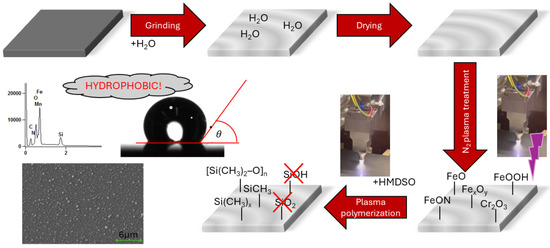
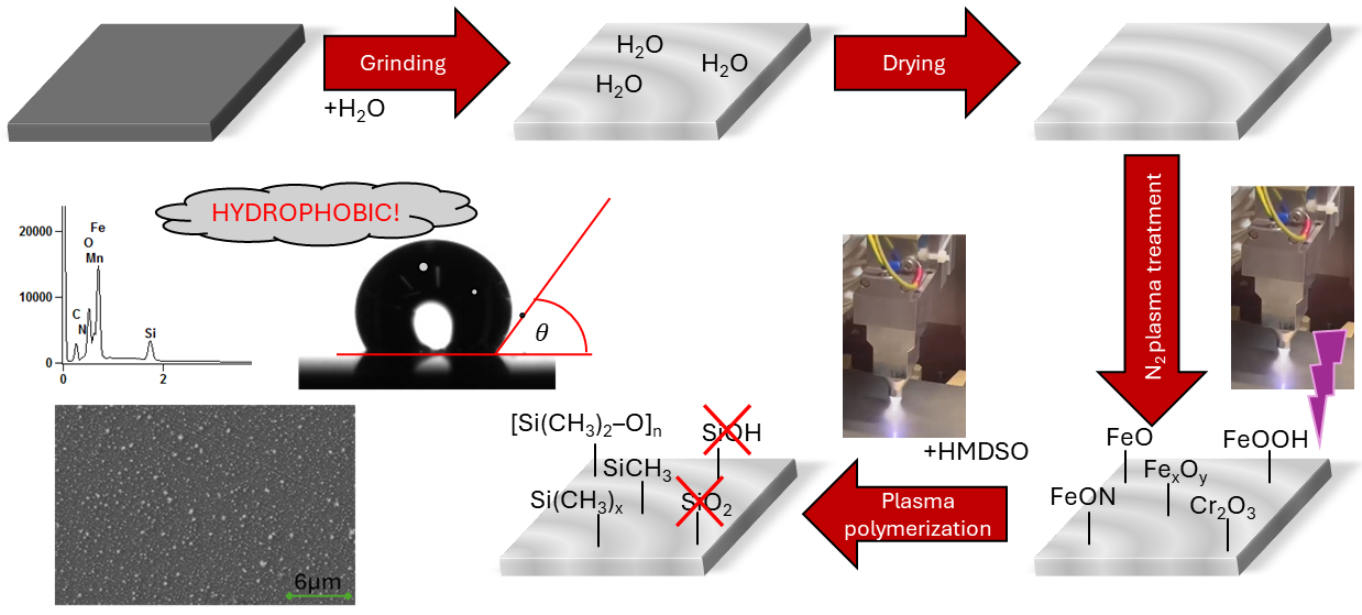
Graphical Abstract

1. Introduction

The functionalization of surfaces in the plastics industry is a promising area of application. The field of hydrophobic coatings in particular offers significant potential in many industrial manufacturing processes. Among other things, they serve to reduce adhesion and enable the demolding of injection-molded components [1].
The atmospheric pressure plasma CVD process can be used to produce such a coating [2,3]. The targeted modification of the surface properties is primarily controlled by the choice of the chemical supplied (precursor). In conventional plasma coating processes, the interaction between the substrate surface and plasma-generated reactive species typically occurs within the inter-electrode region [4,5]. However, this procedure does not create optimal environmental conditions for coating deposition [6,7]. In nitrogen or oxygen plasmas, for example,, the high breakdown voltage and short lifetime of metastable species can lead to uneven filamentary discharge. This, in turn, can lead to impaired coating properties, such as insufficient saturation, branching, or cross-linking of deposited species [8]. InMould-Plasma® technology enables the plasma treatment of plastic components directly in the mold cavity during the injection molding process [1]. This procedure reduces handling time and optimizes the manufacturing process without interfering with the actual injection molding process.
The organosilicon compound hexamethyldisiloxane (HMDSO) is one of the most commonly used precursors in many studies [3,9,10,11,12,13,14]. Organosilicon layers are composed of siloxane (Si–O) and methylsilyl (Si–CH3)x groups. The main chains are formed by the incorporation of inorganic groups (Si-O). The organic bonds occur in side groups and chain ends (CH3) [15]. In the context of hydrophobic applications, the deposition of groups bearing methyl functions on the surface has been shown to reduce surface energy [16,17,18]. The resulting coating quality strongly depends on the precise adjustment of plasma process parameters. Such modulation encompasses the travel speed of the nozzle, the nozzle distance, the primary voltage, the plasma cycle time (PCT), the volume flow of the process and carrier gas, and the mass flow of the precursor. Through meticulous regulation of these parameters, a high-quality coating can be deposited [10,19,20,21]. A major advantage of coatings with HMDSO as a precursor is that no fluorine is required to produce hydrophobic coatings. In addition to HMDSO plasma-based coatings, there are also other processes that can be used to deposit fluorine-free hydrophobic coatings [22,23,24]. However, there is a paucity of research on certain process parameters, which have either not been sufficiently investigated or have been largely neglected in the existing literature. One example is the number of consecutive deposition cycles required to achieve a specific layer stability or thickness. The majority of studies to date assume that multiple coating passes or a prolonged treatment duration merely lead to an increase in layer thickness or particle diameter without significantly affecting the surface morphology or chemistry [11,25,26,27,28].
Thin layers of HMDSO are characterized by optical transparency in the visible range of the electromagnetic spectrum and high electrical resistance. These properties make them ideal for applications in microelectronics and integrated optics [29]. Their transparency, permeability to gas/vapor, and flexibility enable a range of applications, such as the encapsulation of organic electronic components or the creation of barrier properties [28,30,31]. In addition, a coating results in low water absorption [32] and also provides corrosion protection for metal surfaces [33]. Furthermore, these coatings can exhibit hydrophobic [11,13,34,35,36] and anti-adhesive [37,38] behavior. When the thin-film coating is applied, the deposits are distributed in the form of lines with a Gaussian-like profile in the vertical cross-section. The application of large-area coatings is performed through the implementation of multiple lines maintained at a constant separation [27]. The deposited coatings have flake-like structures, which vary greatly depending on the process parameters. There are also particles that lie on the surface in a grain-like manner and have a circular cauliflower shape. The size of the particles is approximately 200 nm. Under certain conditions and structures, these particles lead to the formation of powder. Due to the scattering of the incident ambient light by the deposited particles, a white opaque coating is visually apparent [11,27].
Integrating plasma processes into injection molds is challenging because modern tooling provides only limited space for additional plasma hardware. Moreover, although plasma treatment effectively cleans and activates the cavity surface, it can simultaneously increase adhesion between the mold and the polymer, which may aggravate demolding issues. For this reason, current InMould-Plasma® concepts often rely on three-station mold designs for manufacturing two-component parts. In contrast, applying a plasma-deposited coating is expected to reduce the process to two stages, as the functional layer can be reapplied in situ after a defined number of cycles. It must also be emphasized that plasma process parameters are not universally transferable; they must be tailored to the specific geometry and material.
Against this background, the present work addresses the increased adhesion observed in the InMould-Plasma® process for TPU-based two components by coating the cavity surfaces to deliberately reduce adhesion and facilitate demolding. The coating is deposited from HMDSO using atmospheric-pressure plasma-jet PECVD (APPJ-PECVD). The coating can be renewed directly in the closed mold between production cycles, eliminating the need for disassembly. This approach aims to reduce downtime, improve overall efficiency, and lower process costs. Consequently, the objective of this study is to deposit a homogeneous, hydrophobic, polymerized layer on 1.2311 tool steel by APPJ-PECVD to reduce demolding forces.

2. Materials and Methods

This section describes the experimental setup and the methods used in this study.

2.1. Construction of Plasma Technology

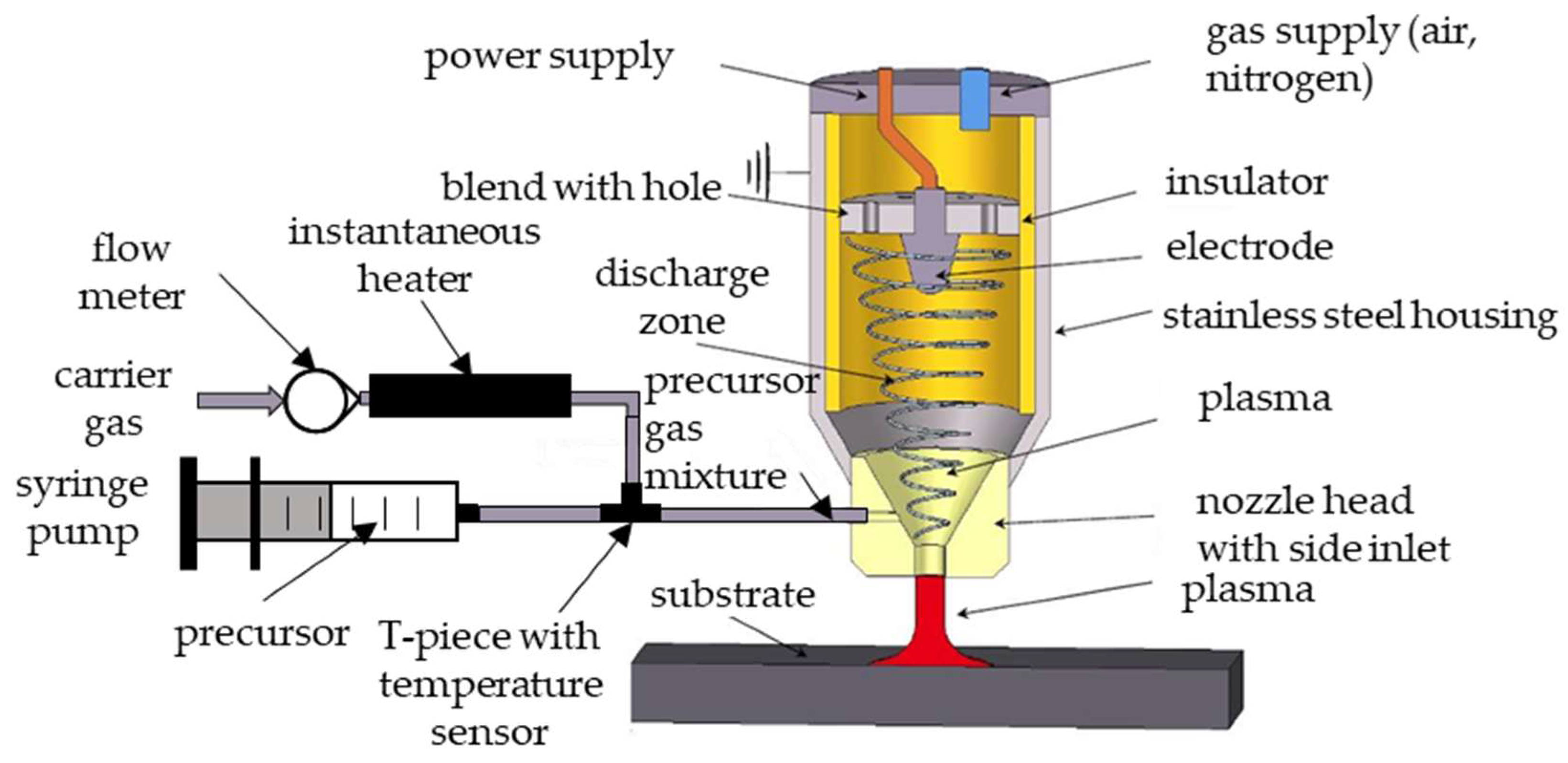
This work utilizes the PlasmaPlus® process from PlasmaTreat GmbH (Steinhagen, Germany). The plasma jet shown in Figure 1 is used as the basic component for the AP-PECVD process. To generate the plasma, a process gas is fed into the jet. When a voltage is applied to the electrode in the housing, a discharge occurs to the grounded housing, creating an electric arc. The process gas is converted into a vortex flow by the blend in the plasma jet, flows through the arc, and is converted into a plasma state by the energy supply. The plasma then flows out of the nozzle head and hits the substrate surface [1,39,40,41].
The AP-PECVD process involves chemical vapor deposition (CVD), which describes a chemical reaction of a coating material. This coating material (precursor) is transported to the nozzle head by a carrier gas through a heating element and injected into the plasma. The energy supplied in this process is intended to convert the precursor into an active state, thereby enabling a polymerized layer to be formed in the coating process. The energy supply through the plasma, instead of through heat as in the CVD process, has the decisive advantage of reducing the temperature load on the chemical and the substrate [42,43,44]. The AP-PECVD process was used in this study because the use of a plasma jet allows both the plastic component to be treated in the injection mold and a coating process to be integrated.
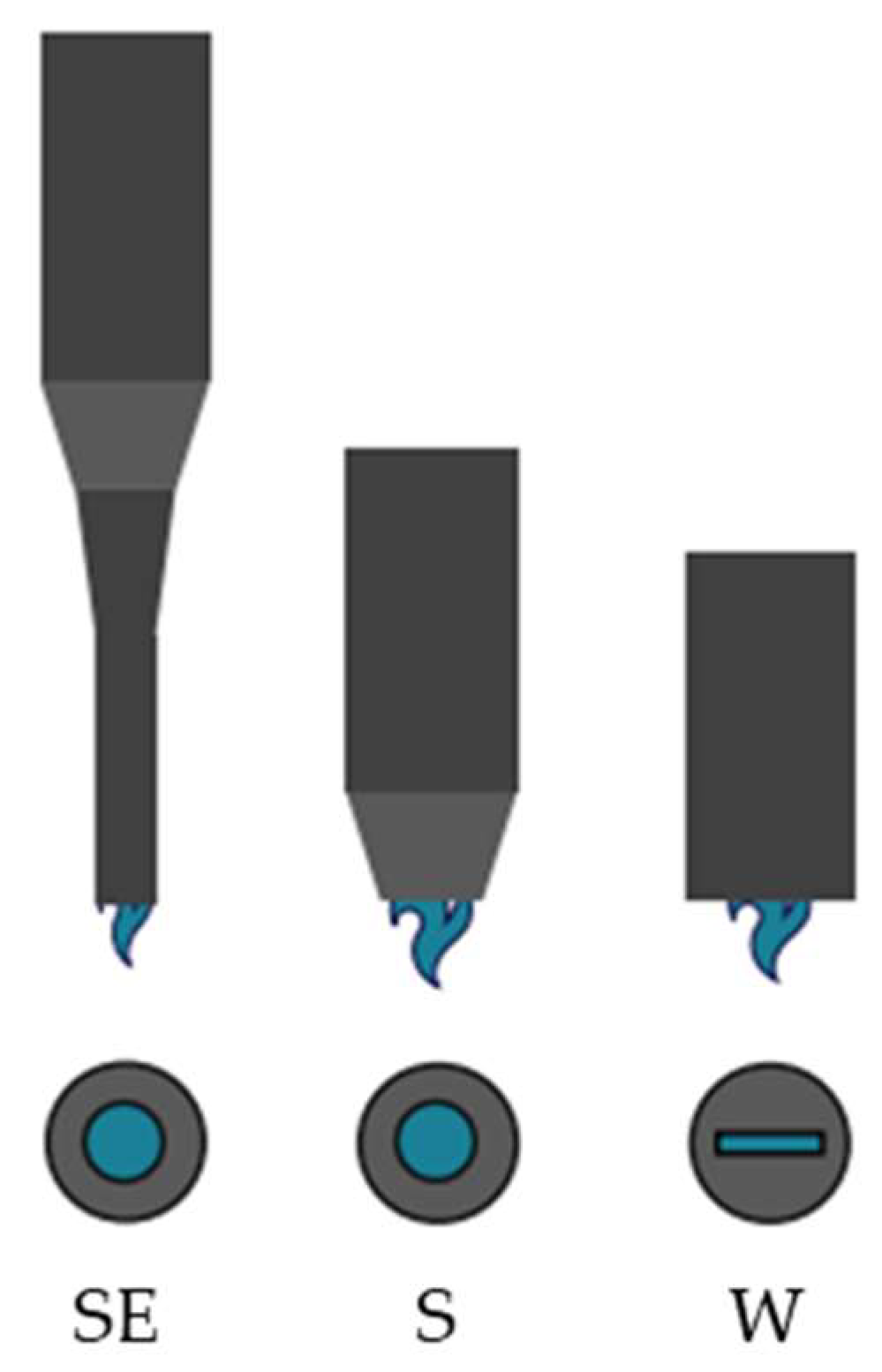
The worknvestigations are carried out using a PFW 30 nozzle base body with different nozzle head geometries. These differ in length and outlet opening. On the one hand, a round nozzle with (SE) and without (S) extension (length: 35 mm) and an outlet cross-section of 4 mm is used, and on the other hand, a wide slot nozzle (W) with an outlet cross-section of 13 mm × 1 mm is used. The different nozzle geometries are shown in Figure 2. The used electrode was a PFT11875-1 with a length of 36.8 mm. A longer electrode results in lower plasma power due to the shorter discharge distance [1].

2.2. Selection of the Test Specimen

The test specimen used is made of tool steel 1.2311. This steel grade was selected due to its increased use in injection molding. The geometry examined is circular with a diameter of 10 mm. Before treatment, the surface of the test specimen is ground with 2400-grit sandpaper and water using a Tegra System grinding machine from Struers S.A.S. (Ballerup, Denmark). As the surface roughness could not be measured directly, the resulting roughness Sa was estimated to be approximately 0.025 µm, based on [45]. Estimating the surface roughness can result in deviations from the actual roughness, which may affect the coating results. Before the plasma coating was applied, the test specimens were one time pretreated with compressed air plasma using the following process parameters: processing speed 3 m/min, nozzle distance 5 mm, nozzle diameter 5 mm, volume flow 30 slm, voltage 300 V, plasma frequency 22 khz and PCT 50%.

2.3. Contact Angle Measurement

The surface energy is tested using the OCA35 contact angle measuring device from DataPhysics Instruments GmbH (Filderstadt, Germany) with the software SCA20 (version 4.3.9) and in accordance with the static method specified in DIN EN ISO 19403-2 [46]. In the static variant, drops of the test liquids are placed on the surface without the cannula remaining in the drop, and the drops are then measured. In total, three different liquids (water, diiodomethane, and thiodiglycol) were applied to the surface and measured in this study. The Owens–Wendt–Rabel–Kaelble (WORK) method was chosen to determine the surface energy [47]. Due to the small sample size, only one drop per liquid could be measured. Further investigations should examine the reproducibility of surface energies in detail.

2.4. Energy Dispersive X-Ray Spectroscopy (EDX) and Scanning Electron Microscopy (SEM)

The SEM examinations in this publication were performed using a NEON 40 from Carl Zeiss Microscopy Deutschland GmbH (Oberkochen, Germany) with the software SmartSEM (version 6.00), and the EDX examinations were performed using an EDX system installed in the SEM with an UltraDry detector from Thermo Fisher Scientific GmbH (Dreieich, Germany) with the software NSS (version 3.0). The acceleration voltage was set to 5 keV and the angle of decline was set to 34.9 degrees. The total number of pulses recorded was >200,000.
Energy dispersive X-ray spectroscopy is a method that, alongside other methods such as wavelength dispersive X-ray spectroscopy (WDX), enables electron beam microanalysis. Based on the analysis performed, it is possible to determine elements both qualitatively and quantitatively. For the process described, a solid is bombarded with electrons, in this case with an acceleration voltage of 5 keV, which leads to the emission of characteristic X-rays. The elemental analysis is performed using electron microscopes, which are optimized for a short measurement time and yet high detection sensitivity. The fired electron, whose properties are known, is referred to as the primary electron. This process results in the removal of an electron from an energy level close to the nucleus of the sample. The resulting gap is filled by an electron from a higher level. As part of this process, X-rays are emitted at a specific energy level. A semiconductor detector records the corresponding measurements and transmits them to a readout anode. At this point, pulse amplification takes place, enabling evaluation with a multi-channel analyzer connected to a PC. The element is determined based on the difference in energy levels. According to Moseley’s law, this difference is specific to each element [48].
The scanning electron microscope (SEM) is used to analyze surface structures with high resolution. A focused electron beam consisting of primary electrons with a wavelength of less than 1 nm and an excitation energy of E0 strikes the surface of the sample. This generates secondary electrons (SE) with an energy of less than 50 eV and backscattered electrons (BSE) with an energy between 50 eV and E0. The electrons generated are detected by a secondary electron multiplier or a BSE detector. First, the electron beam is guided over the surface of the sample using the scanning coils. When the electrons come into contact with the sample, secondary electrons are emitted from the layers close to the surface. These electrons are able to provide detailed information about the topography. Backscattered electrons, on the other hand, originate from deeper layers and provide information about material contrasts and chemical composition. The examination is carried out under vacuum conditions to avoid interactions with other molecules. A freely movable sample table, whose degrees of freedom allow quantification of up to six, enables precise and flexible positioning [49].

3. Results and Discussion

The results are presented and discussed below according to the applied characterization methods. The process parameters voltage, coating speed, precursor mass flow, and plasma gas flow were varied, as summarized in Table 1. The selected process parameters are based on a previous screening and a subsequent trial-and-error series of investigations. The investigations at 37 g/h are based on Lommatsch and Ihde [50], who used a similar setup. The criteria for applying the coatings in the screening and trial-and-error process were that the coating had to be hydrophobic (not superhydrophobic), not form too much powder, and not be mechanically rubbed off by hand.
The operating points are designated according to the following scheme. The first letter stands for either R = reference, SE = standard nozzle with extension, S = standard nozzle, or W = wide slot nozzle. The second letter stands for the plasma gas used, i.e., CA = compressed air, N2 = nitrogen, and Ar = argon. The third letter indicates the carrier gas according to the same scheme. The reference represents the plasma treatment of a test specimen without coating. All coatings were applied by passing the plasma jet one time over the test specimen.

3.1. Surface Energy

The determination of surface energies is achieved through the implementation of contact angle measurements. The Owens–Wendt–Rabel–Kaelber (WORK) method is employed to calculate the polar and dispersive components of the test points. The corresponding values are summarized in Table 2. These are one-time measurements, as both the surface of the discs and the treatment path are too small for multiple test liquids. In order to reduce measurement uncertainty, care was taken to ensure that the test liquids were positioned centrally under the plasma jet on a line parallel to the treatment line and not too close to each other. Since the surface energy was measured using three liquids, a significant deviation would have been noticeable when evaluating the results.
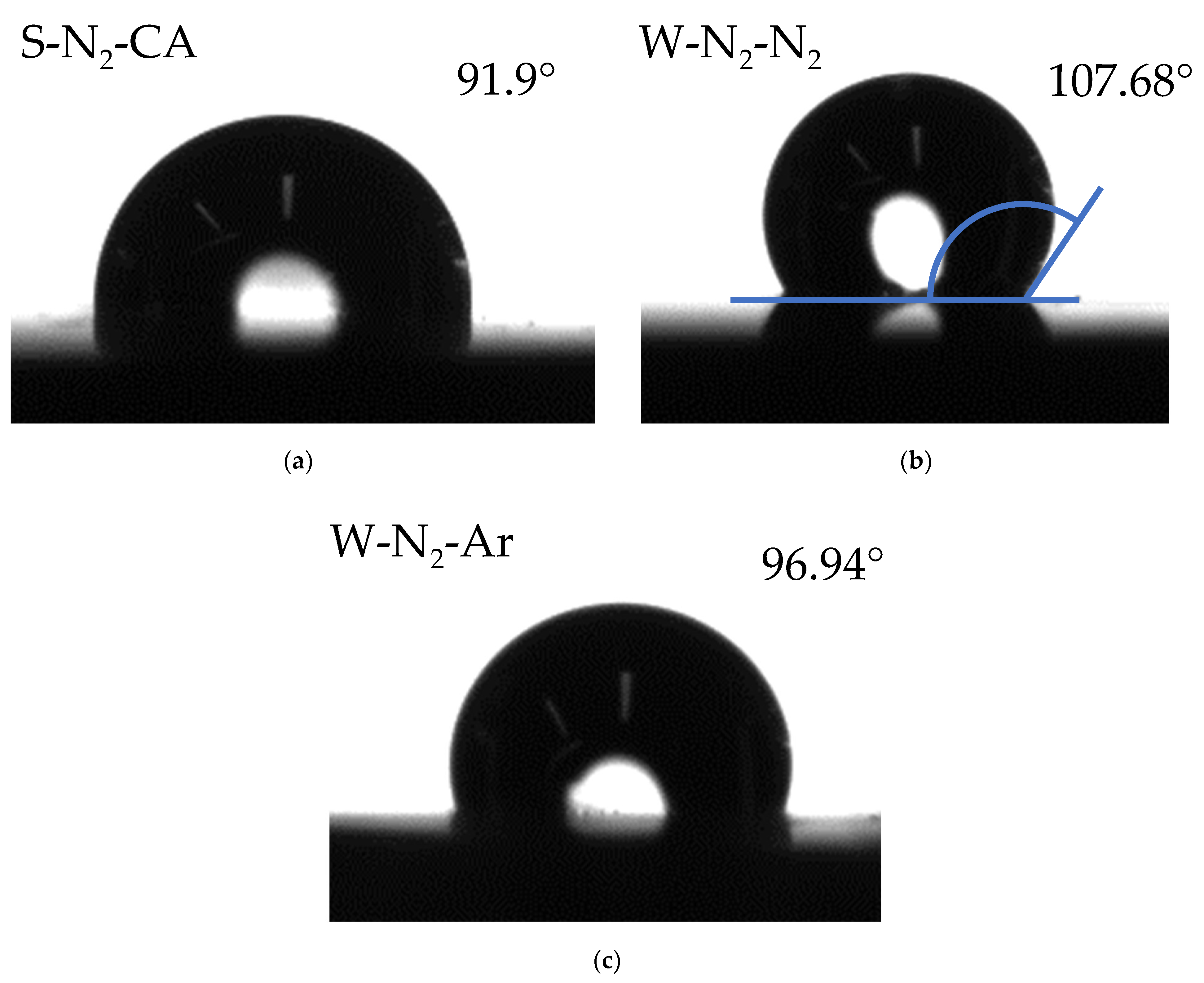
The S-N2-CA sample is particularly striking, as it has the lowest polar components and the highest dispersed components. Furthermore, the operating points W-N2-N2_2 and W-N2-Ar also have extremely low polar components with a low overall surface energy. Hydrophobic behavior is indicated by the water contact angles shown in Figure 3.
The results of the individual investigations shown above are discussed below. The surface energy measurements show that higher volume flows lead to higher polarities. Although SE-CA-N2_1 has a lower voltage and PCT value than SE-CA-N2_2, and therefore generates less power, this means that HMDSO is not fragmented as much [51,52]; this test point shows higher polar components than SE-CA-N2_2. The increased gas flow rate shortens the residence time of the reactive species on the substrate surface, which reduces the accumulation of dispersive functional groups. S-N2-CA, with nitrogen as the plasma gas and compressed air as the carrier gas, has a lower proportion of oxygen in the total volume flow than S-CA-N2, which can lead to less oxidation of HMDSO and thus the formation of Si-O compounds. With the increased voltage and precursor mass flow compared to S-CA-N2, the power density per HMDSO molecule is lower in the plasma, resulting in less fragmentation of the HMDSO [51,52]. With the high process speed, the power density on the steel surface is further reduced, resulting in a lower polar fraction of the surface energy than with S-CA-N2.
In contrast, the precursor mass flow has a significant influence on the properties of the coating. Higher flows of 50 to 100 g/h, as in B-N2-N2_1/2, result in low total surface energies. However, if the precursor excess is too high, e.g., at 100 g/h, lumpy and powdery deposits form on the surface of the substrate and no stable coating is formed. This can be explained by insufficient fragmentation of the HMDSO, which results in fewer Si-CH3 groups being formed and also prevents the formation of a siloxane network for the most part. This means that no bond can be formed with the surface and the chemical is deposited on the substrate in an unbound state. These deposits give the surface low polarity and total surface energy. Lower mass flows tend to result in higher surface energies with increased polar components. The increased energy density causes the structures of the HMDSO to break down more strongly and increases polarity. Voltage can also have a major influence on surface properties. An increase in voltage with constant process parameters also increases the energy density. In this context, this also leads to greater fragmentation of the HMDSO and thus to greater separation of the CH3 groups. However, Si-O-Si bonds can also be assumed to dominate here, as the polarity is higher. The voltage should therefore be adjusted so that fragmentation of the HMDSO takes place, but the formation of Si-CH3 bonds is not disturbed.
Overall, it is clear that energy density in particular is a decisive factor in the properties of the coating. The test results (W-N2-N2_1/2 and W-N2-Ar) show that temperature control or evaporation of HMDSO is not necessary to deposit hydrophobic coatings. This saves the user the cost of an evaporator or temperature control system.

3.2. Energy Dispersive X-Ray Spectroscopy

Elemental analysis is performed using energy dispersive X-ray spectroscopy. Based on the previously determined measurement direction, a map is first created that specifies the intervals at which the surface analysis is to take place. The results are then displayed via the measurement path. For illustrative purposes, Table 3 shows the mean value of the results in atomic % and the standard deviation. Over 200.000 net pulses were measured and processed in each measurement.
The EDX results show significant differences in surface composition between the various operating points, suggesting different reaction mechanisms and process conditions during treatment. The test points S-N2-CA, W-N2-N2_2, and W-N2-Ar are described in more detail below.
The test point S-N2-CA is notable for its very high oxygen and silicon content (O/Si ratio of 2.05), while the iron content is significantly reduced compared to the other samples. The carbon content is also low. With a C/Si ratio of 0.14, this coating has the lowest ratio. An increased oxygen content suggests enhanced surface oxidation, which may have occurred either during the process itself or during subsequent cooling and contact with the ambient air. The equally elevated silicon content indicates that silicon-containing phases or oxide layers have formed at this operating point. These can be attributed, for example, to increased surface activity or an enhanced reaction of the silicon. The combination of high O and Si content with low Fe content could be an indicator for a dense and relatively thick coating on the sample surface, but has to be measured separately with, for example, an atomic force microscope (AFM).
In contrast, samples W-N2-N2_2 and W-N2-Ar, with an O/Si ratio of 1.81 and 1.93 and a C/Si ratio of 0.46 and 0.58, show significantly lower proportions of oxygen and silicon. This observation suggests that minimal oxidation took place under the given process conditions.
In summary, the EDX data indicate that the process gas composition and the specific parameters of the respective operating points have a strong influence on the surface reactions. High proportions of O and Si therefore indicate strong oxidation or oxide formation, while a high Fe content may indicate a rather thin coating or free surface. The 5 keV acceleration voltage used allows the electron beam to penetrate deeper into the coating and into the base material. This can cause coating, interface, and substrate information to overlap. Further investigations should examine the layer thicknesses of the coatings using AFM or SEM cross-sectional images and their molecular composition using XPS. The results show the sensitivity of the surface chemistry to different treatment conditions.

3.3. Scanning Electron Microscopy

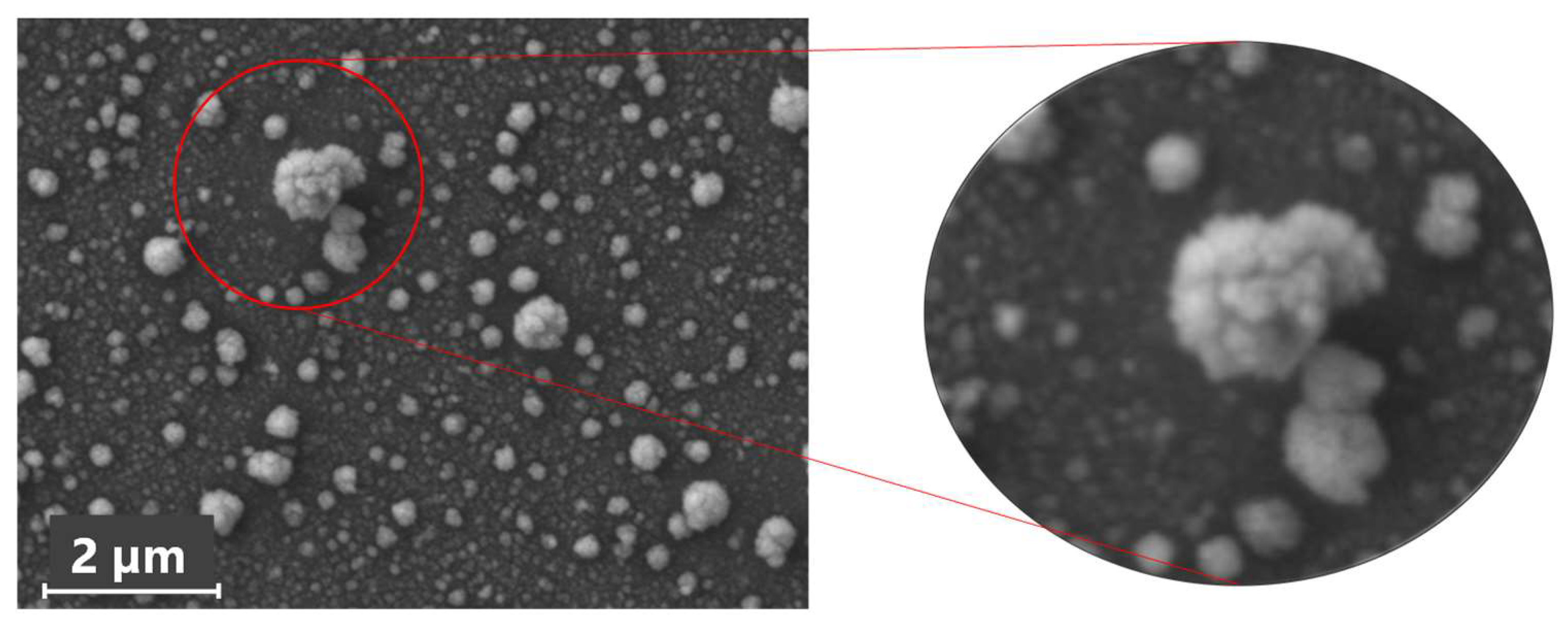
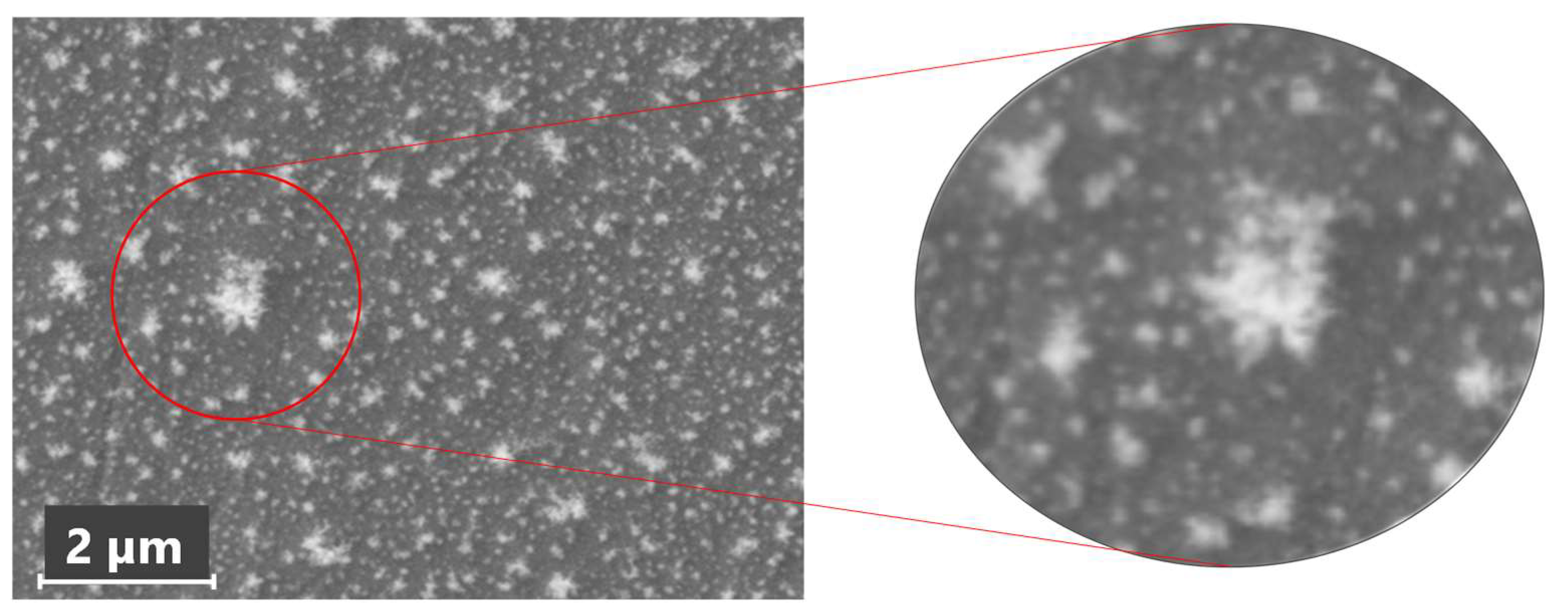
A SEM is used to examine the topography and texture of the surface. The examination points S-N2-CA, W-N2-N2_2, and W-N2-Ar are described in more detail below (Figure 4, Figure 5 and Figure 6).
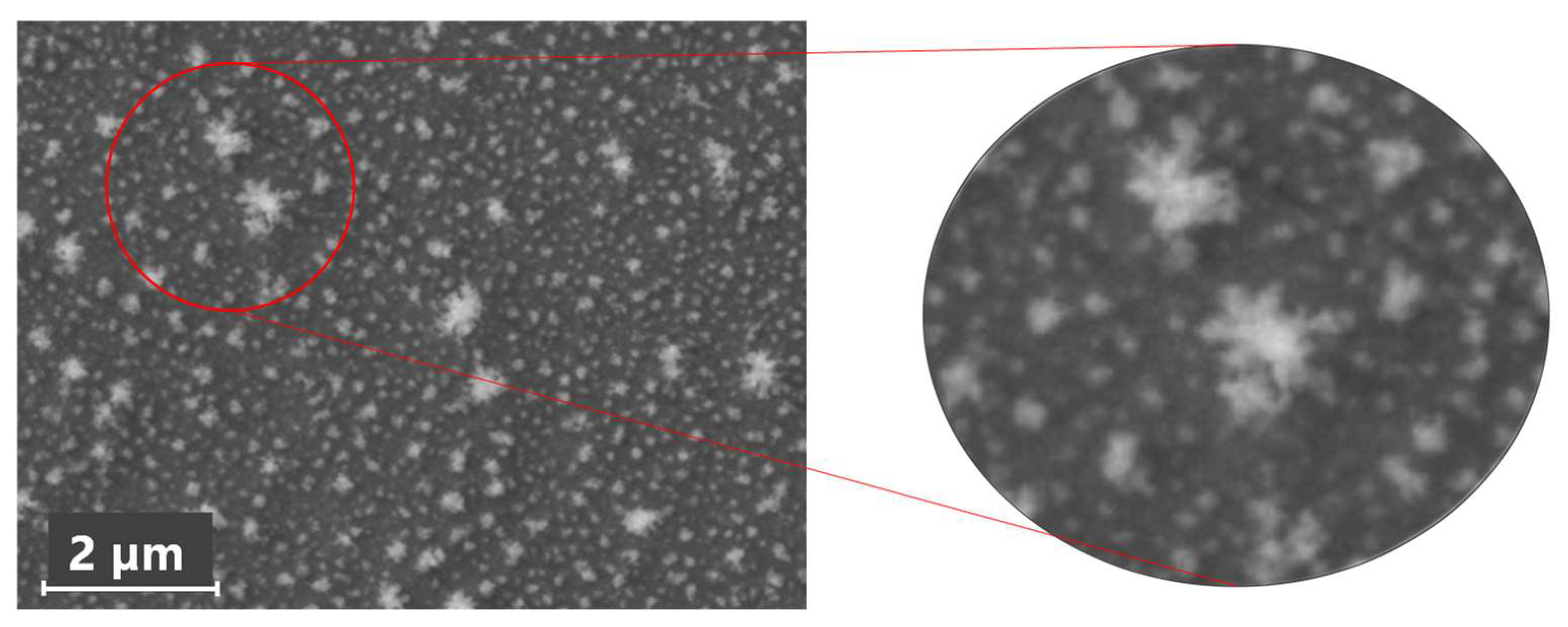
The SEM image of S-N2-CA reveals an overall heterogeneous surface morphology with numerous circular to cauliflower-like protrusions. These structures could also be observed in other publications [51,53,54]. Notably, some of these particles appear not fully integrated into the surface, but rather rest on top of the coating as clumps/agglomerates. In addition to many small particles in the range of 20–100 nm, distinctly larger features of approximately 200–500 nm are repeatedly observed visually. This hierarchical size distribution (many small particles plus fewer, much larger aggregates) is characteristic of deposition regimes in which primary particles form in the gas phase/jet and subsequently undergo collision and coagulation into secondary agglomerates before reaching the substrate, resulting in a “particle-on-particle” contribution. In such a case, coating formation is not governed solely by smooth film growth but is significantly influenced by the arrival, stacking, and partial embedding/overcoating of particles, which provides a plausible explanation for the observed cauliflower-like topography.
The EDX analysis of S-N2-CA yields high oxygen (54.89 at.%) and silicon (26.81 at.%) contents. This indicates a highly oxidic composition and thus a comparatively more “inorganic” coating chemistry, while the low carbon content (3.66 at.%) suggests a small residual organic fraction. The comparatively low iron fraction (13.59 at.%) can be discussed in the context of the pronounced lumpy topography: prominent agglomerates can alter local EDX excitation/detection conditions (e.g., effective geometry, shadowing, local coverage), thereby reducing the relative substrate contribution. Importantly, a low Fe fraction does not exclusively prove a large film thickness; in EDX, quantitative at.% values can also be affected by topography, local coverage, and measurement geometry, particularly for rough, particle-rich surfaces [55].
In contrast to S-N2-CA, W-N2-N2_2 predominantly shows planar, surface-bonded regions with flake-like dendritic features. These structures could also be observed in other publications [17,56]. They appear more like integrated, planar “flakes” than loosely deposited particles and are often observed when a more stable/compact coating forms, i.e., nuclei become overgrown and incorporated into the growing matrix. The surface is overall more homogeneous and finer: most features are <100 nm, and only a few larger particle formations (<200 nm) are present. Hence, the particle-related contribution to roughness appears less pronounced than for S-N2-CA, and the deposition approaches a more continuous film growth with local growth inhomogeneities.
The EDX results with Si (12.27 at.%) and O (22.22 at%) indicate a less oxidic coating compared to S-N2-CA. The increased carbon content (5.6 at.%) is consistent with incompletely oxidized HMDSO fragments and/or a more organo-modified SiOxCyHz network. The high Fe fraction (58.53 at.%) may—but does not necessarily—reflect a small effective coating thickness and/or locally incomplete coverage. Even at 5 keV, a substrate contribution can remain measurable for thin regions, and the area-averaged line scan will incorporate regions with enhanced substrate signal into the mean value. At the same time, Fe at.% values are not solely controlled by thickness but can also be influenced by surface roughness/topography and shadowing [55] and so on. Therefore, the Fe fraction should primarily be interpreted as an indicator of potential substrate contribution, ideally complemented by independent thickness measurements if required.
The W-N2-Ar sample exhibits flake-like dendritic structures similar to W-N2-N2_2, again consistent with the formation of a stable, surface-bonded coating. The deposit appears overall homogeneous and fine-particle, dominated by many small features (<100 nm) with only a few larger particle formations (<200 nm). Compared to W-N2-N2_2, the morphology is broadly similar, yet the particles appear slightly smaller, and the overall material build-up seems reduced.
The EDX results with Si (8.06 at.%) and O (15.55 at.%) again point to a less oxidic coating. The carbon content (4.64 at.%) supports the presence of an organo-modified network and/or residual organic moieties from HMDSO-derived fragments. Taken together, the combination of a fine and fairly homogeneous morphology with only few larger particles and a strong Fe contribution suggests that W-N2-Ar forms a coating that is similar in structure to W-N2-N2_2.

4. Conclusions

This study aimed to produce homogeneous, hydrophobic, and functionalized HMDSO-based layers on 1.2311 tool steel to evaluate their potential for anti-adhesive applications, particularly in injection molding tools. The results show that layer formation is strongly influenced by the selected process parameters and gas composition.
Analysis of the different samples shows that the chemical composition—in particular the proportion of silicon, oxygen, and carbon—has a significant effect on the resulting morphology and homogeneity of the coating. Coatings formed under more strongly oxidizing conditions like S-N2-CA exhibit a predominantly inorganic, SiOx-like structure with distinct particle formation and inhomogeneous surface topography with lower water contact angles (91.9°) and higher surface energy (34.75 mN/m) and Si/O ratio (2.05). In contrast, processes with a lower tendency to oxidize, such as those carried out in a nitrogen like W-N2-N2 or argon gas like W-N2-Ar, resulted in more homogeneous and finely structured coatings with higher water contact angles (107.68° and 96.94°), lower surface energy (19.57 mN/m and 16.31 mN/m) and lower Si/O ratio (1.81 and 1.93). These exhibit greater surface uniformity while retaining organic groups, which suggests a partially polymerized, organically modified silicon layer. To confirm this hypothesis, further investigations such as XPS and FTIR should be carried out in order to also evaluate molecular bonds.
The influence of the process gas is particularly evident: the use of argon or nitrogen led to less oxidation of the HMDSO precursor and tended to produce dendritic flake-like structures. Therefore, N2 and Ar in proved to be advantageous process gases in this series of investigations, as they were able to support the transition from the particulate to the film-forming range.
In conclusion, the results demonstrate the high flexibility and effectiveness of the APPJ-PECVD process in surface functionalization. The chemical composition and morphology of the HMDSO layers can be controlled by specifically adjusting the process gas and precursor quantity. Further investigations should examine the adhesion between the coating and the substrate. This could be examined using a cross-cut test, peel test, or scratch test. Furthermore, the correlation between surface energy and demolding forces in injection molding, particularly for TPU components on coated steel surfaces, should be investigated too. In the literature, low energy surfaces are known for their anti-adhesive properties [57,58]. This investigation could be carried out in accordance with VDI 2019 [59], a mechanical 90° peeling test between a soft and hard component. When peeling forces drop significantly, the coating can be used as a release layer in injection molds.

Author Contributions

Conceptualization, D.R.; Methodology, D.R.; Validation, D.R. and J.H.; Formal analysis, D.R. and J.H.; Investigation, D.R. and J.H.; Resources, E.M.; Data curation, D.R.; Writing—original draft, D.R. and J.H.; Writing—review & editing, E.M. and J.H.; Visualization, D.R. and J.H.; Supervision, E.M.; Project administration, D.R.; Funding acquisition, E.M. All authors have read and agreed to the published version of the manuscript.

Funding

This research was funded by the Bundesministerium für Wirtschaft und Energie grant number KK5011521TA3.

Institutional Review Board Statement

Not applicable.

Informed Consent Statement

Not applicable.

Data Availability Statement

Data are contained within the article.

Conflicts of Interest

The authors declare no conflict of interest.

Abbreviations

The following abbreviations are used in this manuscript:
AFMAtomic Force Microscopy
AP-PECVDAtmospheric Pressure Plasma Enhanced Chemical Vapor Deposition
APPJ-PECVDAtmospheric Pressure Plasmajet Plasma Enhanced Chemical Vapor Deposition
ArArgon
at.%Atomic Percentage
CACompressed Air
CVDChemical Vapor Deposition
EDXEnergy Dispersive X-Ray Spectroscopy
eVElectronvolt
FeIron
HMDSOHexamethyldisiloxane
N2Nitrogen
PlasmaPlus®Trade Name of the APPJ PECVD System used
SEMScanning Electron Microscopy
SiOxSilicon Oxide Structure with variable Oxygen Content
Si-CH3Methylsilyl Group
Si–OSiloxane Bond
µmMicrometer

References

  1. Mühlhoff, F. Ein Beitrag zur InMould-Plasma Technologie zur Oberflächenvorbehandlung im Mehrkomponentenspritzgießwerkzeug. Doctoral Dissertation, Kunststofftechnik Paderborn, Universität Paderborn, Paderborn, Germany, 2022. [Google Scholar]
  2. Tendero, C.; Tixier, C.; Tristant, P.; Desmaison, J.; Leprince, P. Atmospheric pressure plasmas: A review. Spectrochim. Acta Part B At. Spectrosc. 2006, 61, 2–30. [Google Scholar] [CrossRef]
  3. Dimitrakellis, P.; Gogolides, E. Hydrophobic and superhydrophobic surfaces fabricated using atmospheric pressure cold plasma technology: A review. Adv. Colloid Interface Sci. 2018, 254, 1–21. [Google Scholar] [CrossRef] [PubMed]
  4. Profili, J.; Levasseur, O.; Koronai, A.; Stafford, L.; Gherardi, N. Deposition of nanocomposite coatings on wood using cold discharges at atmospheric pressure. Surf. Coat. Technol. 2017, 309, 729–737. [Google Scholar] [CrossRef]
  5. Profili, J.; Dap, S.; Levasseur, O.; Naude, N.; Belinger, A.; Stafford, L.; Gherardi, N. Interaction of atomized colloid with an AC electric field in a dielectric barrier discharge reactor used for deposition of nanocomposite coatings. J. Phys. D Appl. Phys. 2017, 50, 075201. [Google Scholar] [CrossRef]
  6. Profili, J.; Levasseur, O.; Naudé, N.; Chaneac, C.; Stafford, L.; Gherardi, N. Influence of the voltage waveform during nanocomposite layer deposition by aerosol-assisted atmospheric pressure Townsend discharge. J. Appl. Phys. 2016, 120, 053302. [Google Scholar] [CrossRef]
  7. Levasseur, O.; Kumar Gangwar, R.; Profili, J.; Naudé, N.; Gherardi, N.; Stafford, L. Influence of substrate outgassing on the plasma properties during wood treatment in He dielectric barrier discharges at atmospheric pressure. Plasma Process. Polym. 2017, 14, 1600172. [Google Scholar] [CrossRef]
  8. Merche, D.; Vandencasteele, N.; Reniers, F. Atmospheric plasmas for thin film deposition: A critical review. Thin Solid Films 2012, 520, 4219–4236. [Google Scholar] [CrossRef]
  9. Babayan, S.E.; Jeong, J.Y.; Tu, V.J.; Park, J.; Selwyn, G.S.; Hicks, R.F. Deposition of silicon dioxide films with an atmospheric-pressure plasma jet. Plasma Sources Sci. Technol. 1998, 7, 286–288. [Google Scholar] [CrossRef]
  10. Sawada, Y.; Ogawa, S.; Kogoma, M. Synthesis of plasma-polymerized tetraethoxysilane and hexamethyldisiloxane films prepared by atmospheric pressure glow discharge. J. Phys. D Appl. Phys. 1995, 28, 1661–1669. [Google Scholar] [CrossRef]
  11. Asadollahi, S.; Profili, J.; Farzaneh, M.; Stafford, L. Multi-pass deposition of organosilicon-based superhydrophobic coatings in atmospheric pressure plasma jets. Thin Solid Films 2020, 714, 138369. [Google Scholar] [CrossRef]
  12. Navascués, P.; Buchtelová, M.; Zajícková, L.; Rupper, P.; Hegemann, D. Polymerization mechanisms of hexamethyldisiloxane in low-pressure plasmas involving complex geometries. Appl. Surf. Sci. 2024, 645, 158824. [Google Scholar] [CrossRef]
  13. Trinh, Q.H.; Nguyen, D.B.; Hossain, M.M.; Mok, Y.S. Deposition of superhydrophobic coatings on glass substrates from hexamethyldisiloxane using a kHz-powered plasma jet. Surf. Coat. Technol. 2019, 361, 377–385. [Google Scholar] [CrossRef]
  14. Troia, M.; Dobslaw, D.; Dobslaw, C.; Haag, M.; Delfs, P.; Holste, P.; Salem, D.B.; Glocker, B.; Gries, T.; Schulz, A.; et al. Characterization and optimization of an atmospheric plasma deposition system for in-line glass fibers treatment. Surf. Coat. Technol. 2025, 513, 132481. [Google Scholar] [CrossRef]
  15. De Freitas, A.S.M.; Maciel, C.C.; Rodrigues, J.S.; Ribeiro, R.P.; Delgado-Silva, A.O.; Rangel, E.C. Organosilicon films deposited in low-pressure plasma from hexamethyldisiloxane—A review. Vacuum 2021, 194, 110556. [Google Scholar] [CrossRef]
  16. Jafari, R.; Asadollahi, S.; Farzaneh, M. Applications of plasma technology in development of superhydrophobic surfaces. Plasma Chem. Plasma Process. 2013, 33, 177–200. [Google Scholar] [CrossRef]
  17. Stallard, C.P.; Iqbal, M.M.; Turner, M.M.; Dowling, D.P. Investigation of the formation mechanism of aligned nano-structured siloxane coatings deposited using an atmospheric plasma jet. Plasma Process. Polym. 2013, 10, 888–903. [Google Scholar] [CrossRef]
  18. Nwankire, C.E.; Favaro, G.; Duong, Q.H.; Dowling, D.P. Enhancing the mechanical properties of superhydrophobic atmospheric pressure plasma deposited siloxane coatings. Plasma Process. Polym. 2011, 8, 305–315. [Google Scholar] [CrossRef]
  19. Durocher-Jean, A.; Durán, I.R.; Asadollahi, S.; Laroche, G.; Stafford, L. Deposition of anti-fog coatings on glass substrates using the jet of an open-to-air microwave argon plasma at atmospheric pressure. Plasma Process. Polym. 2020, 17, 1900229. [Google Scholar] [CrossRef]
  20. Durán, I.R.; Durocher-Jean, A.; Profili, J.; Stafford, L.; Laroche, G. Atmospheric pressure Townsend discharges as a promising tool for the one-step deposition of antifogging coatings from N2O/TMCTS mixtures. Plasma Process. Polym. 2020, 17, 1900186. [Google Scholar] [CrossRef]
  21. Han, M.H.; Noh, J.H.; Lee, T.I.; Choi, J.H.; Park, K.W.; Hwang, H.S.; Song, K.M.; Baik, H.K. High-rate SiO2 deposition by oxygen cold arc plasma jet at atmospheric pressure, Plasma Process. Plasma Process. Polym. 2008, 5, 861–866. [Google Scholar] [CrossRef]
  22. Wang, M.; Zhou, Z.; Qiao, L.; He, Z. Constructing fluorine-free and photothermal MXene/candle soots-based superhydrophobic sponge for oil/water separation, crude oil recovery, and anti-icing. Process Saf. Environ. Prot. 2025, 202, 107738. [Google Scholar] [CrossRef]
  23. Zhou, H.; Ning, L.; Luo, W.; Liu, H. Self-Assembled Superhydrophobic Coating on the Beryllium Copper Surface with a Micro−Nano Dual-Scale Structure for Anti-icing. Langmuir 2025, 41, 4806–4816. [Google Scholar] [CrossRef]
  24. Ekunde, R.A.; Sutar, R.S.; Ingole, S.S.; Jundle, A.R.; Gaikwad, P.P.; Saji, V.S.; Liu, S.; Bhosale, A.K.; Latthe, S.S. Fluorine-free and breathable self-cleaning superhydrophobic CS/PDMS/PLA coatings on wearable cotton fabric with light-induced self-sterilization. Prog. Org. Coat. 2025, 208, 109514. [Google Scholar] [CrossRef]
  25. Ramamoorthy, A.; Rahman, M.; Mooney, D.A.; Don MacElroy, J.M.; Dowling, D.P. The influence of process parameters on chemistry, roughness and morphology of siloxane films deposited by an atmospheric plasma jet system. Plasma Process. Polym. 2009, 6, S530–S536. [Google Scholar] [CrossRef]
  26. Prégent, J.; Vandsburger, L.; Blanchard, V.; Blanchet, P.; Riedl, B.; Sarkissian, A.; Stafford, L. Modification of hardwood samples in the flowing afterglow of N2–O2 dielectric barrier discharges open to ambient air. Cellulose 2015, 22, 3397–3408. [Google Scholar] [CrossRef]
  27. Ussenov, Y.; Hansen, L.; Krueger, T.; Ramazanov, T.; Kersten, H. Particle formation during deposition of SiOx nanostructured thin films by atmospheric pressure plasma jet. Jpn. J. Appl. Phys. 2020, 59, SHHE06. [Google Scholar] [CrossRef]
  28. Jaritz, M.; Alizadeh, P.; Wilski, S.; Kleines, L.; Dahlmann, R. Comparison of HMDSO and HMDSN as precursors for high-barrier plasma-polymerized multilayer coating systems on polyethylene terephthalate films. Plasma Process. Polym. 2021, 18, 2100018. [Google Scholar] [CrossRef]
  29. Rangel, R.C.C.; Cruz, N.C.; Rangel, E.C. Role of the Plasma Activation Degree on Densification of Organosilicon Films. Materials 2020, 13, 25. [Google Scholar] [CrossRef] [PubMed]
  30. Castro-Hermosa, S.; Top, M.; Dagar, J.; Fahlteich, J.; Brown, T.M. Quantifying Performance of Permeation Barrier—Encapsulation Systems for Flexible and Glass-Based Electronics and Their Application to Perovskite Solar Cells. Adv. Electron. Mater. 2019, 5, 1800978. [Google Scholar] [CrossRef]
  31. Yu, Y. Package Structure of Flexible OLED Device and Display Device. U.S. Patent 20170352833, 12 July 2017. [Google Scholar]
  32. Vendemiatti, C.; Hosokawa, R.S.; Rangel, R.C.C.; Bortoleto, J.R.R.; Cruz, N.C.; Rangel, E.C. Wettability and surface microstructure of polyamide 6 coated with SiOXCYHZ films. Surf. Coat. Technol. 2015, 275, 32–40. [Google Scholar] [CrossRef]
  33. Cui, X.; Zhu, G.; Pan, Y.; Zhang, Y. Preparation and anticorrosion properties of Polydimethylsiloxane (PDMS). In Proceedings of the 4th Annual International Conference on Material Engineering and Application (ICMEA 2017) Advances in Engineering Research; Atlantis Press: Dordrecht, The Netherlands, 2017; pp. 93–95. [Google Scholar] [CrossRef]
  34. Hossain, M.; Trinh, Q.H.; Nguyen, D.B.; Sudhakaran, M.S.P.; Mok, Y.S. Robust hydrophobic coating on glass surface by an atmospheric-pressure plasma jet for plasma-polymerisation of hexamethyldisiloxane conjugated with (3-aminopropyl) triethoxysilane. Surf. Eng. 2019, 35, 466–475. [Google Scholar] [CrossRef]
  35. Ussenkhan, S.S.; Kyrykbay, B.A.; Yerlanuly, Y.; Zhunisbekov, A.T.; Gabdullin, M.T.; Ramazanov, T.S.; Orazbayev, S.A.; Utegenov, A.U. Fabricating durable and stable superhydrophobic coatings by the atmospheric pressure plasma polymerization of hexamethyldisiloxane. Heliyon 2024, 10, e23844. [Google Scholar] [CrossRef] [PubMed]
  36. Cui, X.; Li, Z.; Wang, Y.; Li, L.; Fang, Z. Deposition of robust superhydrophobic film with enhanced insulating performance by APTES/O2 assisted Ar/HMDSO atmospheric pressure plasma jet. Prog. Org. Coat. 2025, 206, 109363. [Google Scholar] [CrossRef]
  37. Plasmabehandlung Riesiger Windkraft-Rotoren—Effizient, Automatisch, Reproduzierbar. Available online: https://www.plasmatreat.com/de/branchenloesungen/neue-energien/windkraft (accessed on 11 February 2026).
  38. Hopmann, C.; Pauling, A.; Holz, C.; Vissing, K. Untersuchungen an einer plasmapolymeren Werkzeugbeschichtung zur trennmittelfreien PUR-Entformung. Z. Kunststofftechnik 2014, 10, 166–187. [Google Scholar]
  39. PlasmaPlus®: Selektive Plasmabeschichtung in Unterschiedlichsten Anwendungen. Available online: https://www.plasmatreat.com/de/technologie/plasmabeschichtung (accessed on 11 February 2026).
  40. Kewitz, T. Diagnostik an Atmosphärendruck-Plasmajets. Doctoral Dissertation, Mathematisch-Naturwissenschaftliche Fakultät, Christian-Albrechts-Universität zu Kiel, Kiel, Germany, 2017. [Google Scholar]
  41. Schüßler, J. (Plasmatreat GmbH, Steinhagen, North Rhine-Westphalia, Germany). Presentation in a seminar entitled: Aktivieren, Reinigen und Beschichten mit der Openair-Plasma Technologie, 2023.
  42. Kakiuchi, H.; Ohmi, H.; Yasutake, K. Atmospheric-pressure low-temperature plasma processes for thin film deposition. J. Vac. Sci. Technol. A 2014, 32, 030801. [Google Scholar] [CrossRef]
  43. Lee, J.-O.; Kang, W.S.; Hur, M.; Lee, J.-Y.; Song, Y.-H. Achieving uniform layer deposition by atmospheric-pressure plasma-enhanced chemical vapor deposition. Thin Solid Films 2015, 597, 7–13. [Google Scholar] [CrossRef]
  44. Gordillo-Vazquez, F.J. Special Issue on Low-Pressure Plasma-Enhanced CVD. Chem. Vap. Depos. 2007, 13, 265–266. [Google Scholar] [CrossRef]
  45. Charsetad, H.; Khorsandijou, S.M. Effect of Surface Roughness on Steel-Steel Dry Friction Coefficient. J. Mech. Res. Appl. 2012, 4, 45–56. [Google Scholar]
  46. DIN EN ISO 19403-2:2024; Paints and Varnishes—Wettability—Part 2: Determination of the Surface Free Energy of Solid Surfaces by Measuring the Contact Angle. DIN Deutsches Institut für Normungen e. V.: Berlin, Germany, 2024.
  47. Żenkiewicz, M. Methods for the calculation of surface free energy of solids. J. Achiev. Mater. Manuf. Eng. 2007, 24, 137–145. [Google Scholar]
  48. Garrat-Reed, A.J.; Bell, D.C. Energy-Dispersive X-Ray Analysis in the Electron Microscope; BIOS Scientific Publishers Limited: Oxford, UK, 2003. [Google Scholar]
  49. Wetzig, K. Rasterelektronenmikroskopie. In Analytiker-Taschenbuch; Günzler, H., Bahadir, A.M., Danzer, K., Engewald, W., Fresenius, W., Galensa, R., Huber, W., Linscheid, M., Schwedt, G., Tölg, G., Eds.; Springer: Berlin/Heidelberg, Germany, 2000; Volume 21, pp. 65–115. [Google Scholar]
  50. Lommatzsch, U.; Ihde, J. Plasma Polymerization of HMDSO with an Atmospheric Pressure Plasma Jet for Corrosion Protection of Aluminum and Low-Adhesion Surfaces. Plasma Process. Polym. 2009, 6, 642–648. [Google Scholar] [CrossRef]
  51. Asadollahi, S.; Profili, J.; Farzaneh, M.; Stafford, L. Development of Organosilicon-Based Superhydrophobic Coatings through Atmospheric Pressure Plasma Polymerization of HMDSO in Nitrogen Plasma. Materials 2019, 12, 219. [Google Scholar] [CrossRef] [PubMed]
  52. Gosar, Ž.; Kovač, J.; Mozetič, M.; Primc, G.; Vesel, A.; Zaplotnik, R. Deposition of SiOxCyHz Protective Coatings on Polymer Substrates in an Industrial-Scale PECVD Reactor. Coatings 2019, 9, 234. [Google Scholar] [CrossRef]
  53. Krueger, T.; Hansen, L.; Kersten, H. Deposition of SiOx thin films using hexamethyldisiloxane in atmospheric pressure plasma enhanced chemical vapor deposition. J. Phys. Conf. Ser. 2020, 1492, 012023. [Google Scholar] [CrossRef]
  54. Sun, G.; Grundmeier, G. Surface-enhanced Raman spectroscopy of the growth of ultra-thin organosilicon plasma polymers on nanoporous Ag/SiO2-bilayer films. Thin Solid Films 2006, 515, 1266–1274. [Google Scholar] [CrossRef]
  55. Goldstein, J.I.; Newbury, D.E.; Michael, J.R.; Ritchie, N.W.M.; Scott, J.H.J.; Joy, D.C. Scanning Electron Microscopy and X-Ray Microanalysis, 4th ed.; Springer: New York, NY, USA, 2018; pp. 382–411. [Google Scholar]
  56. Jafari, R.; Momen, G.; Eslami, E. Fabrication of icephobic aluminium surfaces by atmospheric plasma jet polymerization. Surf. Eng. 2018, 34, 450–455. [Google Scholar] [CrossRef]
  57. Lee, M.J.; Lee, N.Y.; Lim, J.R.; Kim, J.B.; Kim, M.; Baik, H.K.; Kim, Y.S. Antiadhesion Surface Treatments of Molds for High-Resolution Unconventional Lithography. Adv. Mater. 2006, 18, 3115–3119. [Google Scholar] [CrossRef]
  58. Tillmann, W.; Dias, N.F.L.; Stangier, D.; Gelinski, N. Tribological Performance of PVD Film Systems Against Plastic Counterparts for Adhesion-Reducing Application in Injection Molds. Coatings 2019, 9, 588. [Google Scholar] [CrossRef]
  59. VDI 2019; Testing the Adhesion of Thermoplastic Elastomers (TPE) on Substrates Injection-Moulded Substrates. Verin Deutscher Ingenieure e. V.: Düsseldorf, Germany, 2024.
Figure 1. Description of the AP-PECVD process based on PlasmaPlus® technology, based on [39].
Coatings 16 00379 g001
Figure 2. Illustration of the three different nozzle geometries.
Coatings 16 00379 g002
Figure 3. Contact angle measurement of a water drop (2 µL) of the sample (a) S-N2-CA, (b) W-N2-N2 and (c) W-N2-Ar.
Coatings 16 00379 g003
Figure 4. SEM image of the surface of S-N2-CA.
Coatings 16 00379 g004
Figure 5. SEM image of the surface of W-N2-N2_2.
Coatings 16 00379 g005
Figure 6. SEM image of the surface of W-N2-Ar.
Coatings 16 00379 g006
Table 1. Process parameter selection for the investigations.
Plasma Gas Flow [slm]Carrier Gas Flow [slm]Precursor
Mass Flow [g/h]
Voltage [V]PCT [%]Temperature [°C]Processing Speed [m/min]
R-N230--32050-1.5
SE-CA-N2_140102028050501
SE-CA-N2_23043730050605
S-N2-CA3043730050605
S-CA-N23052528050801
W-N2-N2_130510028050235
W-N2-N2_22555028050235
W-N2-Ar37125028050235
Table 2. Surface energy in relation to the process parameters of the investigations from Table 1.
Polar [mN/m]Dispersive [mN/m]Overall [mN/m]
R-N225.9220.546.41
SE-CA-N2_110.0515.4625.51
SE-CA-N2_25.7323.4629.19
S-N2-CA0.2234.5334.75
S-CA-N29.2617.9727.23
W-N2-N2_12.8414.3617.2
W-N2-N2_20.2619.3119.57
W-N2-Ar4.312.0116.31
Table 3. Results of the EDX in relation to the process parameters of the investigations from Table 1.
Atoms in at.%CNOSiFe
1.23113.95
±0.11
0.9
±0.17
12.3
±0.42
084.23
±0.69
R-N22.46
±0.19
1.32
±0.29
13.13
±0.69
083.10
±1.08
SE-CA-N28.13
±0.09
0.5
±0.017
58
±0.33
29.51
±0.14
3.86
±0.1
SE-CA-N25.1
±0.09
1.14
±0.19
26.93
±0.29
13.55
±0.12
53.29
±0.32
S-N2-CA3.66
±0.08
1.06
±0.15
54.89
±0.32
26.81
±0.14
13.59
±0.14
S-CA-N24.09
±0.09
1.21
±0.17
39.57
±0.3
18.64
±0.13
36.5
±0.26
W-N2-N2_17.03
±0.11
1.35
±0.21
23.94
±0.3
14.31
±0.13
53.36
±0.33
W-N2-N2_25.6
±0.1
1.37
±0.2
22.22
±0.3
12.27
±0.13
58.53
±0.34
W-N2-Ar4.64
±0.1
1.16
±0.21
15.55
±0.29
8.06
±0.12
69.46
±0.38
Disclaimer/Publisher’s Note: The statements, opinions and data contained in all publications are solely those of the individual author(s) and contributor(s) and not of MDPI and/or the editor(s). MDPI and/or the editor(s) disclaim responsibility for any injury to people or property resulting from any ideas, methods, instructions or products referred to in the content.