
Article

Influence of Natural Aging After T6 Heat Treatment on Mechanical Properties of Age-Hardenable Al Alloys


1
Shandong Key Laboratory of Aluminum Alloy Materials Preparation and Forming, Qilu University of Technology (Shandong Academy of Sciences), Jinan 250014, China
2
Shandong Innovation Metal Technology Co., Ltd., Binzhou 256600, China
*
Author to whom correspondence should be addressed.
Coatings 2026, 16(3), 339; https://doi.org/10.3390/coatings16030339
Submission received: 3 February 2026 / Revised: 3 March 2026 / Accepted: 7 March 2026 / Published: 9 March 2026
(This article belongs to the Special Issue Advances in Protective Coatings for Metallic Surfaces)

Highlights

  • Strength and uniform elongation of T6 heat-treated alloys were increased with long-time natural aging.
  • Brinell hardness of T6 heat-treated 2024 alloy was reduced with long-time natural aging.
  • Mechanism for increase in strength and uniform elongation of T6 heat-treated alloys with natural aging was uncovered.

Abstract

It is well known that residual stress is detrimental to mechanical properties of metal materials. This paper investigated the relief of residual stress during long-time natural aging as well as its influence on tensile properties of partial age-hardenable Al alloys. It was found that uniform elongation and ultimate tensile stress were increased after a long-time natural aging of T6 heat-treated 2024, A356, 6063 and 6061 alloys. For example, uniform elongation and ultimate tensile stress of 2024 alloy were respectively increased from 10.2% and 496.7 MPa to 11.1% and 507.5 MPa. According to fracture behavior observation for 2024 and A356 alloys, cracks or/and voids could generate from micron-sized secondary particles or particle/α-Al interface in matrix, which led to fracture of tensile samples eventually. And reduced residual stress during natural aging delayed formation of the cracks or voids based on stress distribution analysis, which led to an increase in uniform elongation and tensile stress of Al alloys.

1. Introduction

Al alloy is a typical high-strength, lightweight metal material, and it has advantages of great formability, corrosion resistance, cost effectiveness, etc. [1,2,3]. Therefore, it has been widely used in the fields of aerospace, automobile, rail transit, military, etc. With the growing global energy and environmental problems, Al alloys have been attracting more and more attention in recent years [4,5]. Among series Al alloys, age-hardenable Al alloys stand out due to their high mechanical properties [6]. Generally speaking, heat treatment of Al alloys includes solution and age processes, and formation of supersaturated solid solution by quenching is an important step for solution treatment. However, inevitable detrimental residual stress can be produced during quenching due to severe thermal gradients [7,8,9].
Residual stress affects component dimensional accuracy a lot, as the balance of residual stress in components is broken during the machining process, and the residual stress has to be redistributed, thus causing component distortion, especially for large-scale and thin-walled components with complex shapes [10,11]. Residual stress also influences mechanical properties of alloys, such as static strength, stress corrosion, fatigue resistance, etc. [12,13,14]. Thus, learning how to reduce the residual stress of alloys is highly valued. At present, there are a lot of methods for relieving residual stress, such as applying external force [15,16], heat [8,17,18], cryogenic treatment [19], electricity [20], or magnetism [21,22,23] in target alloys, so that the elastic strain energy stored in alloys can be gradually relieved through local-plastic deformation.
Among these methods, thermal stress relief is a most widely used. This can be carried out by holding alloys at a appropriate temperature for a period of time, and then cooling gradually to room temperature. Since artificial aging heat treatment (holding samples at about 100–200 °C for several to dozens of hours) of alloys has a similar technological process to thermal stress relief, artificial aging and thermal stress relief can be conducted at the same time. According to previous research, artificial aging treatment is an effective way to release residual stress. For example, aging at 175 °C for 2 h reduce circumferential residual stress of as-quenched 2219 Al-Cu alloy from about 116 MPa to 16 MPa according to the research of Song et al. [8]. In addition, Tang et al. report that aging at 160 °C for 4–9 h for selective laser-melted AlSi10Mg alloys removes 32%–43% of the residual stress [18]. Refs. [24,25] are also typical examples that report similar experimental results.
In a word, artificial aging is an efficient method to reduce residual stress, which has attracted broad attention. However, artificial aging cannot release residual stress completely. In fact, service of components at room temperature after artificial aging can be taken as a natural aging process. The evolution of residual stress and its effect on mechanical properties during the natural aging of alloys still warrant concern. To the best of our knowledge, the influence of natural aging after T6 heat treatment (solution + artificial aging) on mechanical properties of Al alloys has not been investigated to the same extent. In this study, the influence of long-time natural aging on the mechanical properties of T6 heat-treated 2024, A356, 6063 and 6061 alloys has been investigated, and relative mechanisms are discussed.

2. Materials and Methods

2.1. Preparation of Alloys

In this work, four alloys of 2024, A356, 6061 and 6063 with nominal chemical compositions listed in Table 1 have been prepared by casting (and extrusion). The raw materials include commercial pure Al (99.7%, all compositions are in wt% unless otherwise stated), pure Cu (99.9%), pure Mg (99.9%), pure Mn (99.9%), pure Si (99.9%) and Al-10Cr master alloy. Taking the 2024 alloy as an example [26], Al ingot was first melted in a clay-bonded graphite crucible to 730 ± 10 °C using an electric resistance furnace, and then certain amounts of Cu and Mn were introduced to the Al melt. Next, the melt was held at 730 °C for about 15 min followed by sufficient stirring artificially, after which they were dissolved completely. Mg was eventually added to the melt (730 °C), and then we stirred the melt artificially until Mg was dissolved. After that, 0.6% C2Cl6 was used on the melt to remove slag and degassing, and then the melt was isothermally held at 720 °C for 30 min before casting. Finally, the melt was cast in a steel mold with a size of Φ90 mm × 300 mm. The other three alloys were also prepared with similar procedures.
The as-cast 2024 and 6061 alloys were then subjected to homogenization annealing heat treatment. And then, the alloys were extruded at 450 °C with an extrusion ratio of 30:1.
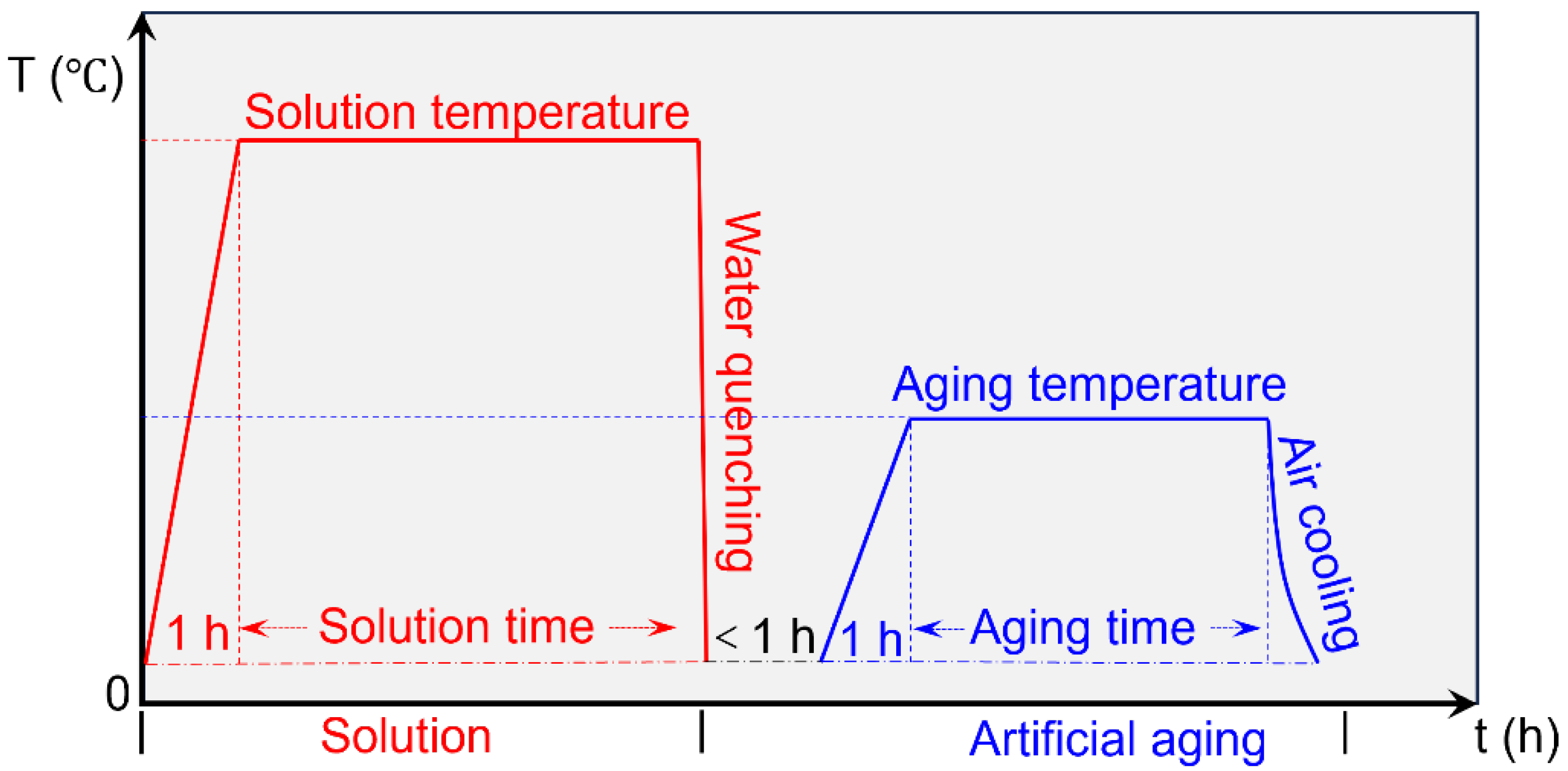
The following step was T6 heat treatment for the four alloys. The process is shown by a schematic in Figure 1: solution treated at a relatively high temperature for a certain time, water quenched; artificial aging treated at a relatively low temperature for a period of time, then cooled in air. Table 2 presents the specific heat treatment parameters for the alloys.

2.2. Characterization

The specimen for the tensile test was machined into dog-bone-shaped bars along the extrusion direction (just for extruded alloys) with a gauge size of Φ5 mm × 25 mm. The tests were conducted using a universal material test machine (MTS, WAW-300c, Shanghai, China) with a strain rate of 2 mm/min. The data for tensile tests reported below are the average values of three specimens. Brinell hardness tests for a cross-section of extruded 2024 alloy rod were conducted on polished specimens using a digital Brinell hardness tester (Laizhou Huayin Test Instrument Co., Ltd. 320HBS–3000, Yantai, China) with an indenter diameter of 5 mm, loading force of 250 kgf and dwell time of 15 s.
To observe microstructures of the T6 heat-treated 2024 and A356 alloys, metallographic specimens were taken from corresponding samples, and then were mechanically polished and burnished. Fracture surface specimens were directly taken from tensile test bars after the tensile test. After that, scanning electron microscope (SEM) characterizations were carried out, and the SEM (ZEISS, EVO MA 10, Shanghai, China) was operated at 20 kV equipped with an energy dispersive spectrometry (EDS) attachment. To identify the phase composition, X-ray diffraction (XRD, Bruker, D8 advance, Beijing, China) for the corresponding alloy was conducted, where the XRD was operated at 40 kV, 100 mA with Cu Kα radiation.

3. Results and Discussion

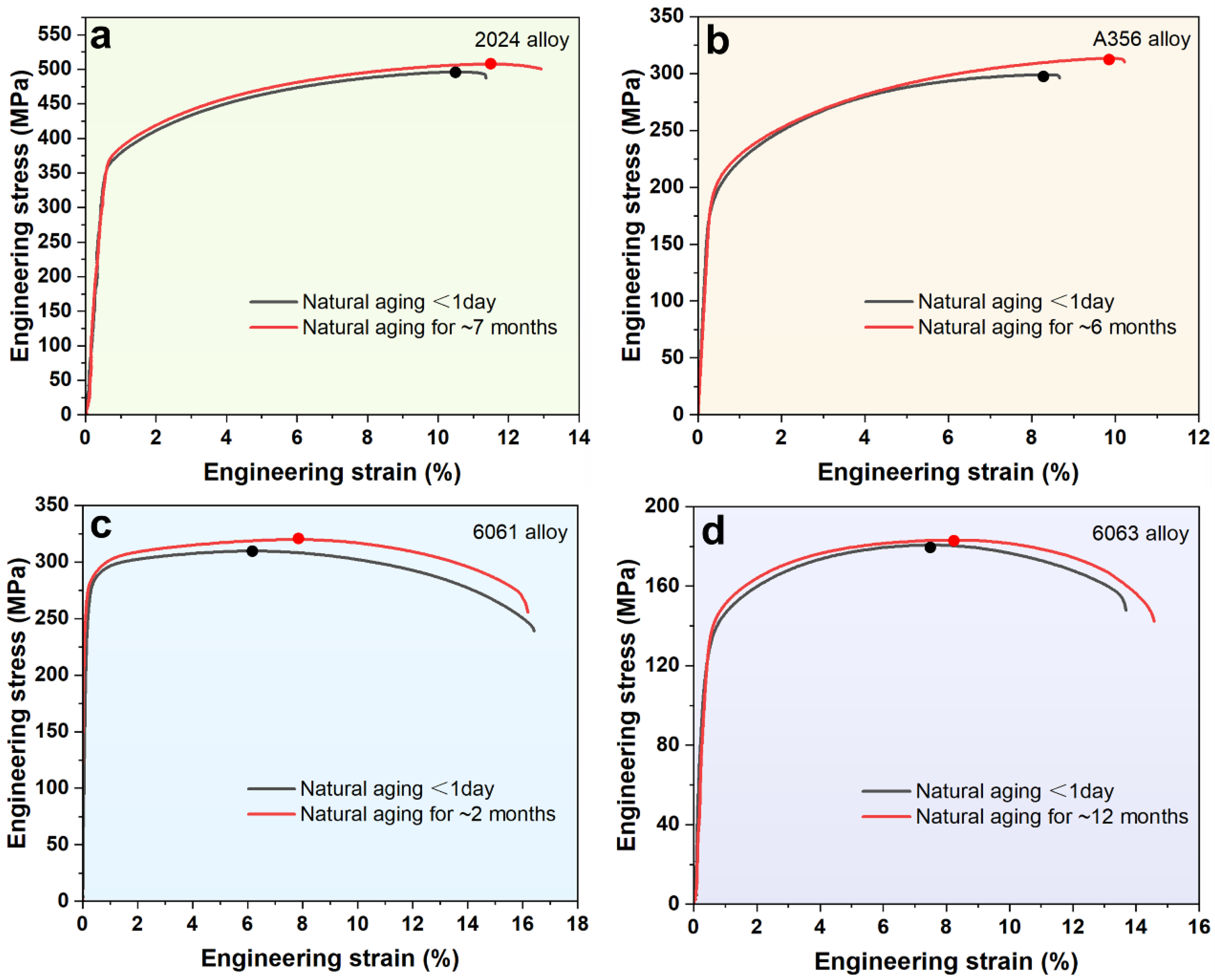
In this research, it is interesting to note that elongation and ultimate tensile stress were increased after a long-time natural aging (~7 months) for T6 heat-treated 2024 alloys. The typical engineering stress–strain curves before and after natural aging are shown in Figure 2a, which indicate that yield stresses of the two alloys are approximate to each other; however, elongation and ultimate tensile stress are both increased after natural aging. To identify the universality of this phenomenon, mechanical properties of T6 heat-treated A356, 6061 and 6063 alloys were also tested before and after a long-time natural aging. As can be seen in Figure 2b–d, elongation of A356 and 6063 alloys is increased, and it is slightly reduced for 6061 alloys after natural aging, but it is important to note that the uniform elongation (from yielding to highest point of tensile curves) of the four alloys is increased. Since uniform elongation reflects the work-hardening capability of alloys, its increase usually enhances the ultimate tensile stress [27]. However, alloys experience elastic deformation before yielding, which is not influenced by work hardening; thus, yield stress is less affected by residual stress.
Table 3 lists mechanical properties of the four T6 heat-treated alloys before and after long-time natural aging. It indicates that natural aging shows limited influence on the yield stress of the four alloys. As for ultimate tensile stress, they are all raised to some extent. What’s more, elongations of the four alloys is increased clearly, except for the 6061 alloy, but the uniform elongation of the 6061 alloy is also raised, similar to the other three alloys.
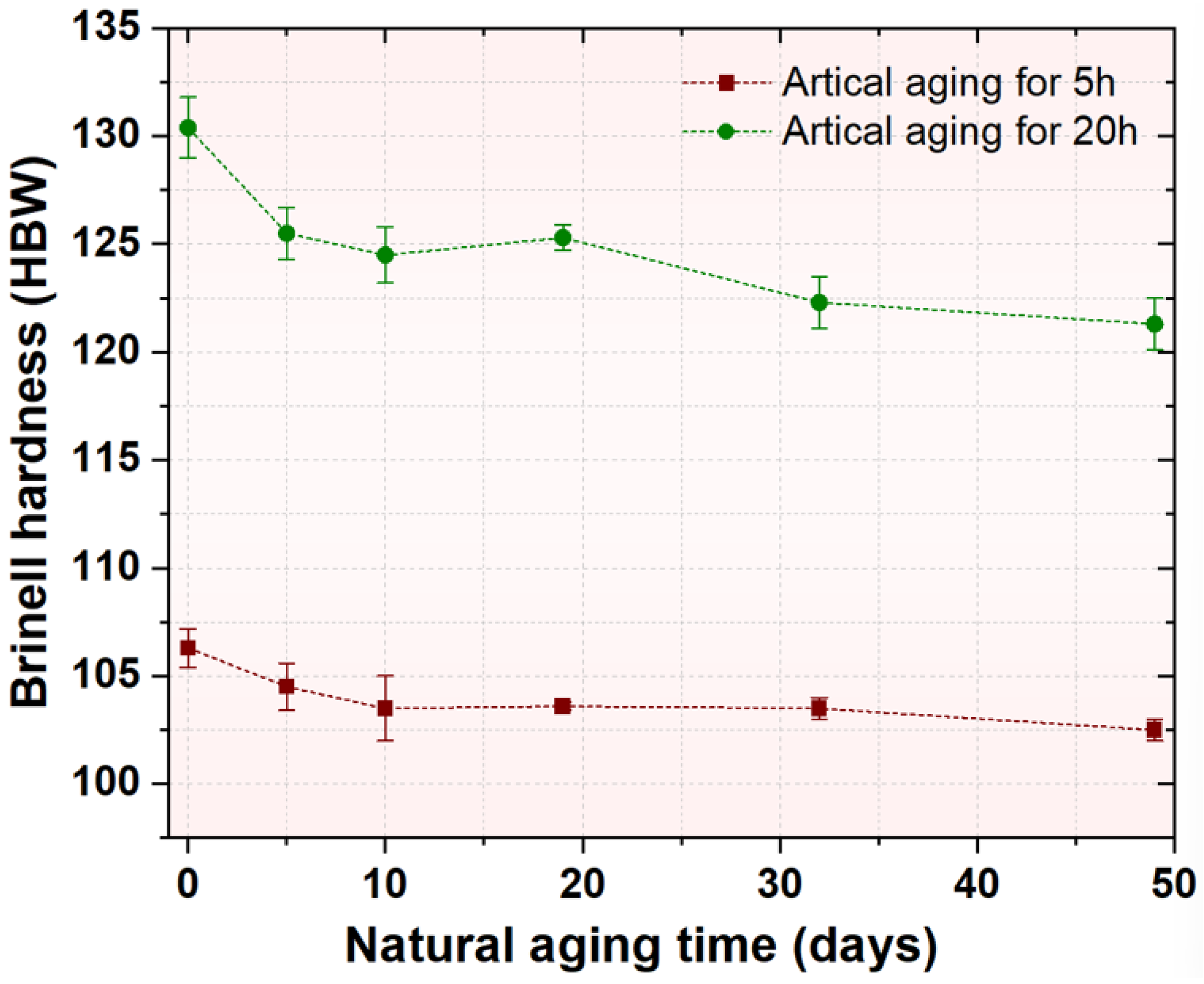
To identify evolution of mechanical properties as a function of natural aging time after T6 heat treatment in detail, the Brinell hardness of the under-aged (aging for 5 h) and peak-aged (aging for 20 h) 2024 alloys was tested, as shown in Figure 3. It can be seen that the Brinell hardness was reduced with prolonging of the natural aging time for both under- and peak-aged 2024 alloys. They decreased rapidly at the initial 10 days, and after that, they decreased slowly.
It is well known that residual stress can be generated during heat treatment. As for T6 heat treatment, the residual stress is mainly from the water quenching process [7,8]. What’s more, residual stress can be released gradually during natural aging, as elastic strain energy stored in alloys can be gradually relieved through micro- or local-plastic deformation [28]. Thus, the evolution for tensile properties and Brinell hardness mentioned above is attributed to relief of residual stress with natural aging.
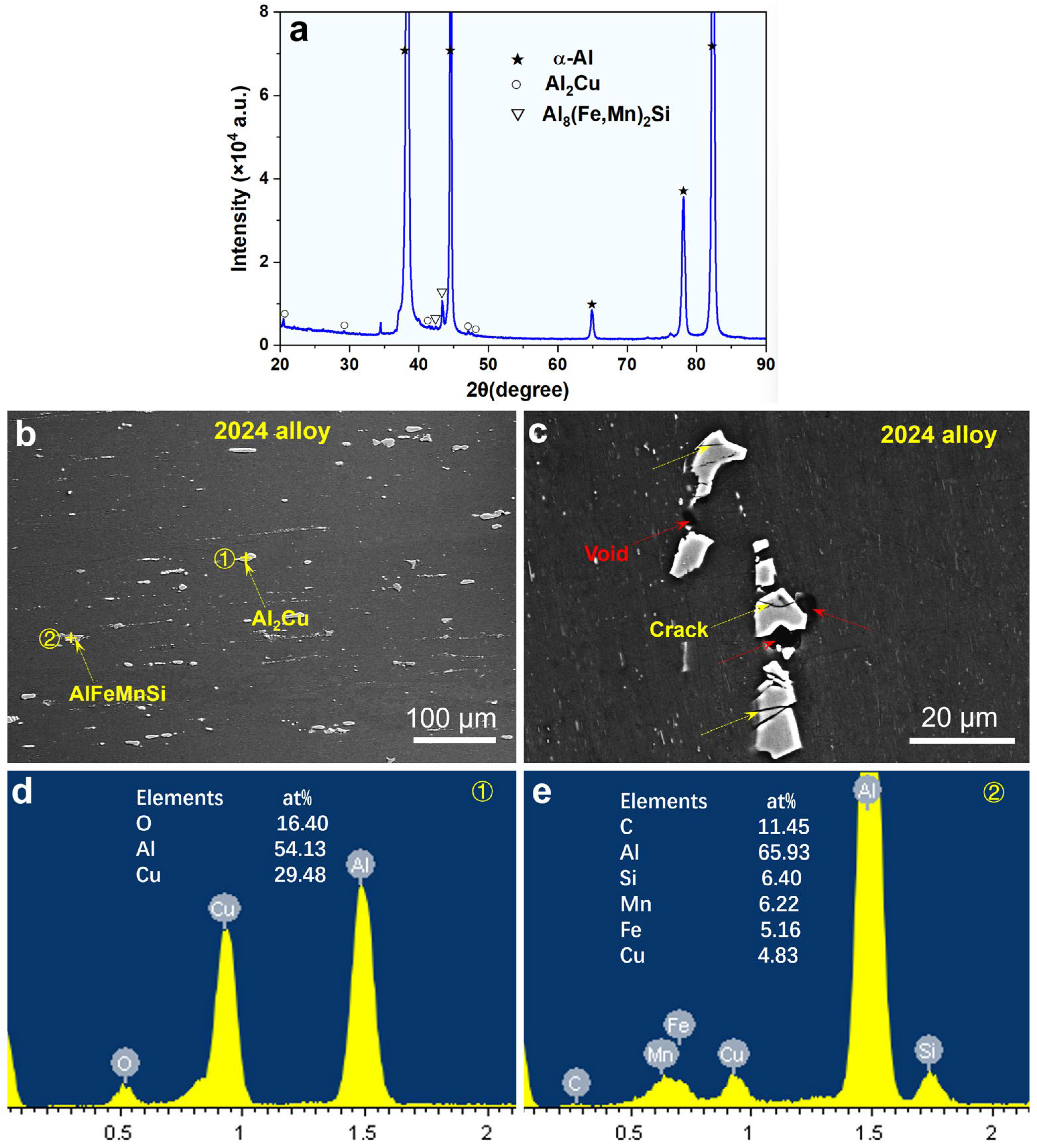
To uncover the mechanism that how the residual stress of alloys affects their mechanical properties, microstructures of 2024 alloy were observed. Figure 4a displays the XRD pattern for the T6 heat-treated 2024 alloy. When comparing the diffraction peaks with the standard PDF card (Jade 6 software 6.0), Al2Cu and Al8(Fe,Mn)2Si are detected as the main secondary phases, and previous research also reports a similar result [29]. Figure 4b presents the microstructure of T6 heat-treated 2024 alloy, showing that micron-sized particles are distributed throughout the Al matrix. According to the EDS analysis in Figure 4d, for point ①, the particle is in a Cu-rich phase, and when combining the XRD result, we surmise that the particle could be in the Al2Cu phase. Similarly, the particle at point ② could be in the Al8(Fe,Mn)2Si phase based on the EDS (Figure 4e) and XRD results. After a tensile test, partial micron-sized particles are broken, and voids appear at the particle/α-Al interface, as marked in Figure 4c. This indicates that cracks originated from particles or the particle/α-Al interface. Once cracks form, the tensile stress begins to decrease until fracture occurs of samples.
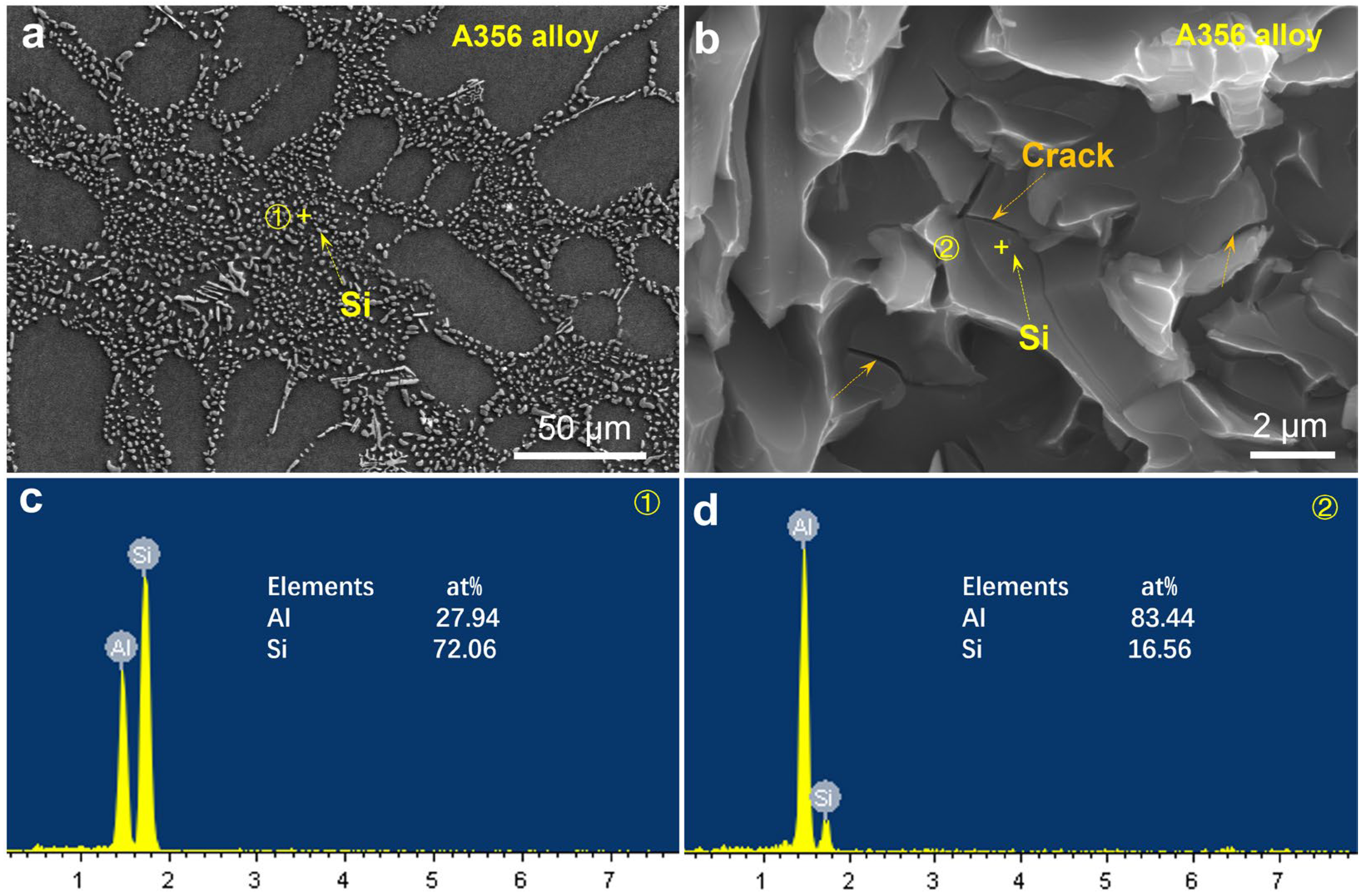
Figure 5 shows microstructure and fracture surface of T6 heat-treated A356 alloys. Similar to the 2024 alloy, there are micron-sized particles distributed in the A356 matrix (Figure 5a). According to EDS analysis (Figure 5c) and the related literature [30], the particles are in the Si phase. Fracture surface observation shows that there are cracks in or along the micron-sized particles (as marked in Figure 5b), and the particle is identified as in the Si phase based on the EDS results in Figure 5d, which indicates that the micron-sized Si particles may be the origins of cracks during tensile test. In addition, 6061 and 6063 alloys both belong to Al-Mg-Si series alloys. According to previous research, the micron-sized AlFeSi phase in Al-Mg-Si alloys can act as a crack origin during loading [31], showing a similar phenomenon to the 2024 and A356 alloys.
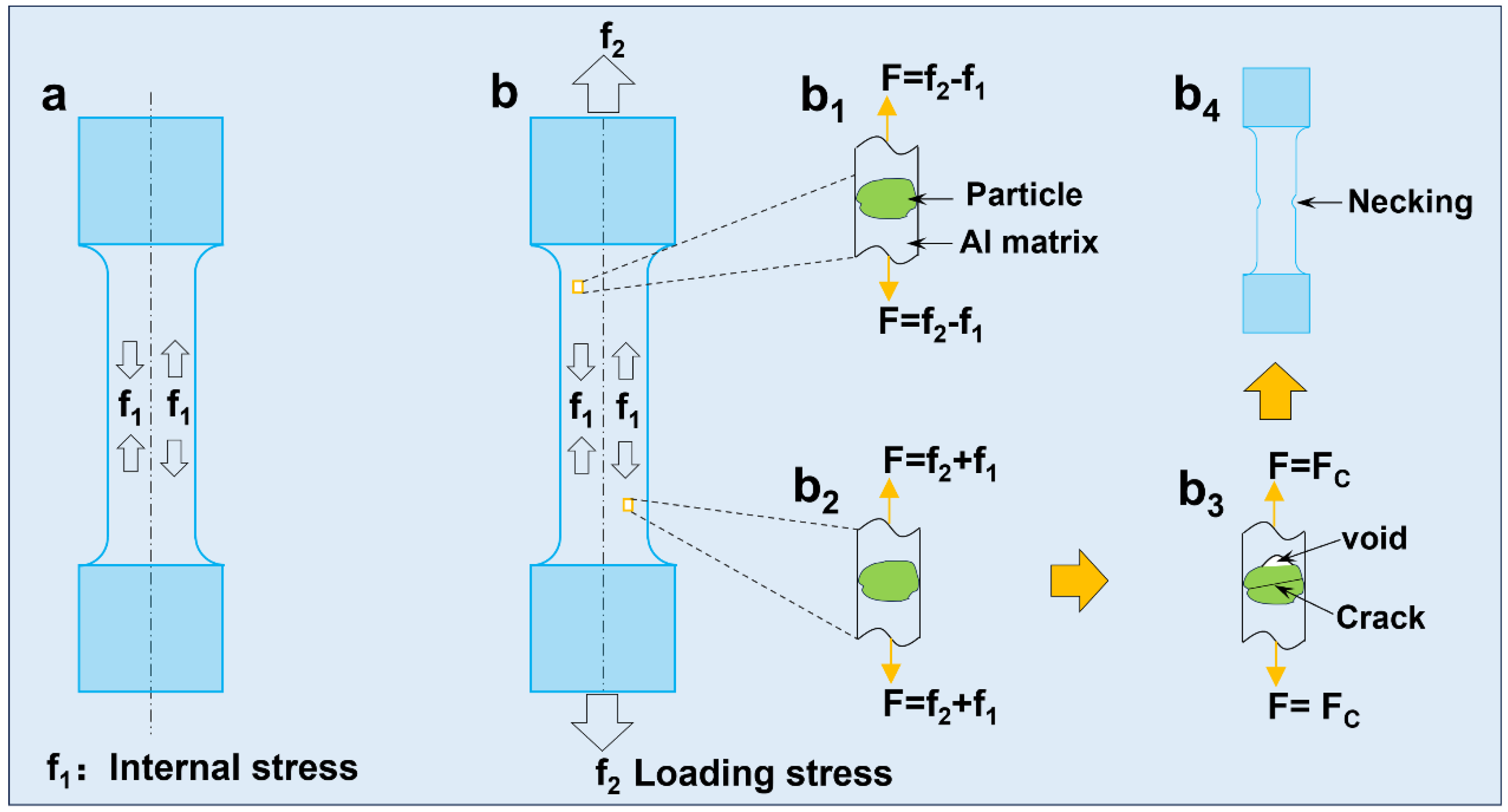
According to the above analysis, relief of residual stress during long-time natural aging of T6 heat-treated alloys leads to increase in uniform elongation. Since crack formation and propagation result in a decrease in tensile stress, the increase in uniform elongation indicates that crack formation is delayed. Thus, a stress distribution model has been built to explain the mechanism of uniform elongation increase, as diagramed in Figure 6. It can be seen in Figure 6a that there is balanced residual stress, including tensile stress and compressive stress, in the T6 heat-treated alloys. During the tensile test, the residual stress can pile up with applied stress. In the tensile residual stress zone, total stress F equals f1 + f2 (Figure 6b2). When the F reaches a critical value Fc, cracks or voids may form in micron-sized particles or the particle/α-Al interface (Figure 6b3), as analyzed in Figure 4 and Figure 5. After that, the tensile samples step into the necking stage (Figure 6b4), and tensile stress is reduced.
Since Fc can be a constant for a given Al alloy, and relief of residual stress f1 results in an increase in f2, i.e., the applied tensile stress is raised before crack and void formation. This model explains the tensile curve results in Figure 2 very well, i.e., residual stress was gradually released during natural aging after T6 heat treatment, and the reduced residual stress delayed the formation of cracks or voids, leading to an increase in the uniform elongation and tensile stress of Al alloys. This result is a piece of good news for the engineering application of Al alloys. During servicing of components, their strength and strain are both improved, enhancing the safety of application.

4. Conclusions

This paper investigated the influence of long-time natural aging on mechanical properties of T6 heat-treated 2024, A356, 6063 and 6061 alloys, and the main conclusions were drawn below:
(1)
Uniform elongation and ultimate tensile stress were increased after a long-time natural aging of T6 heat-treated 2024, A356, 6063 and 6061 Al alloys. For example, uniform elongation and ultimate tensile stress of 2024 alloy were respectively increased from 10.2% and 496.7 MPa to 11.1% and 507.5 MPa.
(2)
Brinell hardness for both under- and peak-aged 2024 alloys was reduced with prolonging of the natural aging time. For example, the hardness of peak-aged 2024 alloy reduced from 130 HBW to 121 HBW after natural aging for 49 days.
(3)
According to fracture surface observations, micro-sized secondary particles might be the origins of crack or voids during the tensile test.
(4)
It was proposed that mechanical property variation arose due to the relief of residual stress during natural aging. According to the built stress distribution model, reduced residual stress during natural aging delayed the formation of cracks or voids in the matrix, leading to an increase in uniform elongation and tensile stress of Al alloys.

Author Contributions

H.Y.: Conceptualization, Methodology, Investigation, Writing—Original Draft, Writing—Review and Editing. H.C.: Methodology, Investigation, Writing—Review and Editing. K.C. (Kai Cheng): Methodology, Investigation. Z.Q.: Methodology. X.W.: Methodology. J.W. (Jianhua Wu): Methodology. D.Z.: Investigation. X.F.: Investigation. J.W. (Jin Wang): Investigation. K.C. (Kaiming Cheng): Resources, Methodology. J.Z.: Conceptualization, Resources, Supervision, Writing—Review and Editing. All authors have read and agreed to the published version of the manuscript.

Funding

This work was supported by a grant from the Shandong Province Key Research and Development Plan (Nos. 2023CXGC010309, 2024CXPT053), the National Natural Science Foundation of China (Nos. 52501051, 52402123), the Major Innovation Project for integrating Science, Education & Industry of Qilu University of Technology (Shandong Academy of Sciences) (Nos. 2025ZDZX09, 2024GH06), and the Natural Science Foundation of Shandong Province (Nos. ZR2021QE029, ZR2024LGY001, ZR2024ME247). The authors also acknowledge the support from the Collaborative Innovation Center for Green and Low-Carbon Materials in Ecological Protection and High-Quality Development of the Yellow River Basin.

Institutional Review Board Statement

Not applicable.

Informed Consent Statement

Not applicable.

Data Availability Statement

The authors do not have permission to share the data.

Conflicts of Interest

Author Kai Cheng is employed by the Shandong Innovation Metal Technology Co., Ltd. The remaining authors declare that the research was conducted in the absence of any commercial or financial relationships that could be construed as a potential conflict of interest.

References

  1. Sun, W.W.; Zhu, Y.M.; Marceau, R.; Wang, L.Y.; Zhang, Q.; Gao, X.; Hutchinson, C.R. Precipitation strengthening of aluminum alloys by room-temperature cyclic plasticity. Science 2019, 363, 972–975. [Google Scholar] [CrossRef] [PubMed]
  2. Yang, H.B.; Qian, Z.; Chen, H.W.; Zhao, X.J.; Han, G.; Du, W.Z.; Nie, X.; Zhao, K.; Liu, G.L.; Sun, Q.Q.; et al. A new insight into heterogeneous nucleation mechanism of Al by non-stoichiometric TiCx. Acta Mater. 2022, 233, 117977. [Google Scholar] [CrossRef]
  3. Estruga, M.; Chen, L.; Choi, H.; Li, X.; Jin, S. Ultrasonic-Assisted Synthesis of Surface-Clean TiB2 Nanoparticles and Their Improved Dispersion and Capture in Al-Matrix Nanocomposites. ACS Appl. Mat. Interfaces 2013, 5, 8813–8819. [Google Scholar] [CrossRef] [PubMed]
  4. Shin, D.; Shyam, A.; Lee, S.; Haynes, J.A. Solute segregation at the Al/θ′–Al2Cu interface in Al–Cu alloys. Acta Mater. 2017, 141, 327–340. [Google Scholar] [CrossRef]
  5. Ding, L.; Jia, Z.; Nie, J.; Weng, Y.; Cao, L.; Chen, H.; Wu, X.; Liu, Q. The structural and compositional evolution of precipitates in Al–Mg–Si–Cu alloy. Acta Mater. 2018, 145, 437–450. [Google Scholar] [CrossRef]
  6. Farkoosh, A.R.; Dunand, D.C.; Seidman, D.N. Enhanced age-hardening response and creep resistance of an Al-0.5Mn-0.3Si (at.%) alloy by Sn inoculation. Acta Mater. 2022, 240, 118344. [Google Scholar] [CrossRef]
  7. Gong, H.; Sun, X.L.; Liu, Y.Q.; Wu, Y.X.; Wang, Y.N.; Sun, Y.J. Residual stress relief in 2219 aluminum alloy ring using roll-bending. Materials 2019, 13, 105. [Google Scholar] [CrossRef]
  8. Song, H.; Gao, H.; Wu, Q.; Zhang, Y. Residual stress relief mechanisms of 2219 Al–Cu alloy by thermal stress relief method. Rev. Adv. Mater. Sci. 2022, 61, 102–116. [Google Scholar] [CrossRef]
  9. Godlewski, L.A.; Su, X.; Pollock, T.M.; Allison, J.E. The Effect of Aging on the Relaxation of Residual Stress in Cast Aluminum. Metall. Mater. Trans. A 2013, 44, 4809–4818. [Google Scholar] [CrossRef]
  10. Li, B.; Wu, S.F.; Gao, X.S. Theoretical calculation of a TiO2-tased photocatalyst in the field of water splitting: A review. Nanotechnol. Rev. 2020, 9, 1080–1103. [Google Scholar] [CrossRef]
  11. Xu, Y.S.; Zhong, J.; Li, B.H.; Zhang, Z. Effects of TVSR process on the dimensional stability and residual stress of 7075 aluminum alloy parts. Rev. Adv. Mater. Sci. 2021, 60, 631–642. [Google Scholar] [CrossRef]
  12. Song, H.C.; Zhang, Y.D.; Wu, Q.; Gao, H.J. Low-stiffness spring element constraint boundary condition method for machining deformation simulation. J. Mech. Sci. Technol. 2020, 34, 4117–4128. [Google Scholar] [CrossRef]
  13. Lee, S.Y.; Hwang, J.G. Finite element nonlinear transient modelling of carbon nanotubes reinforced fiber/polymer composite spherical shells with a cutout. Nanotechnol. Rev. 2019, 8, 444–451. [Google Scholar] [CrossRef]
  14. Yu, H.; Zhang, L.; Cai, F.; Zhong, S.; Ma, J.; Bao, L.; Jiu, Y.; Hu, B.; Wei, S.; Long, W. Microstructure and mechanical properties of brazing joint of silver-based composite filler metal. Nanotechnol. Rev. 2020, 9, 1034–1043. [Google Scholar] [CrossRef]
  15. Ran, P.; Pirling, T.; Zheng, J.; Lin, J.; Davies, C.M. Quantification of thermal residual stresses relaxation in AA7xxx aluminium alloy through cold rolling. J. Mater. Process. Technol. 2018, 264, 454–468. [Google Scholar]
  16. Song, H.; Gao, Z.; Zhou, X.; Zhang, Q.; Zhang, B. Research on the evolution law and control mechanism of residual stress under vibration stress relief. Mater. Today Commun. 2024, 40, 110072. [Google Scholar] [CrossRef]
  17. Dong, Y.B.; Shao, W.Z.; Jiang, J.T.; Zhang, B.Y. Minimization of residual stress in an Al–Cu alloy forged plate by different heat treatments. J. Mater. Eng. Perform. 2015, 24, 2256–2265. [Google Scholar] [CrossRef]
  18. Tang, H.; Gao, C.; Zhang, Y.; Zhang, N.; Lei, C.; Bi, Y.; Tang, P.; Rao, J.H. Effects of direct aging treatment on microstructure, mechanical properties and residual stress of selective laser melted AlSi10Mg alloy. J. Mater.Sci. Technol. 2023, 139, 198–209. [Google Scholar] [CrossRef]
  19. Niu, X.; Chen, Z.; Jing, L.; Huang, Y.; Liu, Y. Effect of Cryogenic Treatment on Residual Stress and Microstructure of 6061 Aluminum Alloy and Optimization of Parameters. Materials 2024, 17, 4873. [Google Scholar] [CrossRef]
  20. Pan, L.; He, W.; Gu, B.P. Effects of electric current pulses on mechanical properties and microstructures of as-quenched medium carbon steel. Mater. Sci. Eng. A 2016, 662, 404–411. [Google Scholar] [CrossRef]
  21. Huang, G.; Zhang, Q.D.; Zhang, B.Y.; Li, S. Microscopic mechanism of the combined magnetic-vibration treatment for residual stress reduction. Results Phys. 2021, 29, 104659. [Google Scholar] [CrossRef]
  22. Quan, S.; Kang, J.; Xing, Z.; Wang, H.; Huang, Y.F.; Ma, G.H.; Liu, H. Effect of pulsed magnetic field treatment on the residual stress of 20Cr2Ni4A steel. J. Magn. Magn. Mater. 2019, 476, 218–224. [Google Scholar]
  23. Li, X.; Tang, X.; Li, M.; Liu, Q.; Tuo, Z.; Cao, Q.; Li, L. Relaxation of residual stress in aluminum alloy rings by pulsed high magnetic field: Relieving mechanisms and performance evaluation. J. Mater. Process. Technol. 2025, 338, 118778. [Google Scholar] [CrossRef]
  24. Zhang, M.; Gu, K.; Weng, Z.; Cui, C.; Wang, J. Residual Stress Evolution of 7050 Aluminum Alloy during Thermal Processing and Its Effects on Processing Deformation and Mechanical Properties. J. Mater. Eng. Perform. 2024, 33, 11467–11483. [Google Scholar] [CrossRef]
  25. Egidio, G.D.; Tonelli, L.; Zanni, M.; Carosi, D.; Morri, A.; Ceschini, L. Direct artificial aging of the PBF-LB AlSi10Mg alloy designed to enhance the trade-off between strength and residual stress relief. J. Alloys Metall. Syst. 2024, 5, 100063. [Google Scholar] [CrossRef]
  26. Yang, H.B.; Gao, T.; Liu, G.L.; Zhao, X.J.; Chen, H.W.; Wang, H.C.; Nie, J.F.; Liu, X.F. Simultaneously improving strength and ductility for Al–Cu–Mg alloy via threadiness array of TiC nanoparticles. Materialia 2019, 6, 100333. [Google Scholar] [CrossRef]
  27. Liu, Z.E. Materials Science, 3rd ed.; Northwestern Polytechnical University Press: Xi’an, China, 2012; pp. 212–213. [Google Scholar]
  28. Yang, J.; Dong, J.X.; Jiang, H.; Yao, Z.H. “Λ”-shaped trend of stress relaxation stability of Inconel718 superalloy with initial stress increasing. Materialia 2019, 9, 100570. [Google Scholar] [CrossRef]
  29. Yang, H.B.; Tian, S.; Gao, T.; Nie, J.F.; You, Z.S.; Liu, G.L.; Wang, H.C.; Liu, X.F. High-temperature mechanical properties of 2024 Al matrix nanocomposite reinforced by TiC network architecture. Mater. Sci. Eng. A 2019, 763, 138121. [Google Scholar] [CrossRef]
  30. Azimi, H.; Nourouzi, S.; Jamaati, R. Effects of Ti particles and T6 heat treatment on the microstructure and mechanical properties of A356 alloy fabricated by compocasting. Mater. Sci. Eng. A 2021, 818, 141443. [Google Scholar] [CrossRef]
  31. Zhao, Q.; Qian, Z.; Cui, X.; Wu, Y.; Liu, X. Influences of Fe, Si and homogenization on electrical conductivity and mechanical properties of dilute Al-Mg-Si alloy. J. Alloys Compd. 2016, 666, 50–57. [Google Scholar] [CrossRef]
Figure 1. Schematic of T6 heat treatment processes for the alloys used in this work.
Coatings 16 00339 g001
Figure 2. Engineering stress–strain curves for alloys with a period of natural aging after T6 heat treatment: (a) 2024 alloy, (b) A356 alloy, (c) 6061 alloy, (d) 6063 alloy. The dots in the figure indicate the maximum stress points of the curves.
Coatings 16 00339 g002
Figure 3. Brinell hardness vs. natural aging time for T6 heat-treated (under- and peak-aged) 2024 alloys.
Coatings 16 00339 g003
Figure 4. (a) XRD pattern for the T6 heat-treated 2024 alloy; microstructures of T6 heat-treated 2024 alloy before (b) and after (c) tensile test, (d,e) EDS analysis results for the points in (b).
Coatings 16 00339 g004
Figure 5. (a,c) Microstructure and EDS analysis for T6 heat-treated A356 alloy, (b,d) fracture surface and EDS analysis for T6 heat-treated A356 alloy after tensile test. The + marks the point for EDS analysis.
Coatings 16 00339 g005
Figure 6. Schematic diagram for effect of (a) residual stress and (b,b1b4) loading stress piling up on microstructure evolution of alloys during tensile test.
Coatings 16 00339 g006
Table 1. Nominal chemical compositions (wt%) of the alloys used in this work.
AlloysCuMgSiFeCrMnAl
20244.51.50.40.20.5Balance
A3560.37.00.15Balance
60610.2510.60.150.15Balance
60630.70.40.15Balance
Table 2. T6 heat treatment parameters of the alloys used in this work.
AlloysProcessing
Methods
T6 Heat Treatment
Solution Temperature (°C)Solution Time (h)Aging Temperature (°C)Aging Time (h)
2024Extrusion500119020
A356Casting50031808
6061Extrusion53011758
6063Casting52021758
Table 3. Mechanical properties of the T6 heat-treated alloys after natural aging.
AlloysNatural Aging TimeYield Stress (MPa)Ultimate Tensile Stress (MPa)Uniform Elongation (%)Elongation (%)
2024<1 day370.0 ± 14.7496.7 ± 9.410.2 ± 0.311.3 ± 0.4
~7 months373.1 ± 3.2507.5 ± 2.511.1 ± 0.512.3 ± 0.6
A356<1 day195.1 ± 7.6295.0 ± 7.17.9 ± 0.78.4 ± 0.7
~6 months197.3 ± 6.5313.3 ± 6.29.6 ± 0.610.1 ± 0.6
6061<1 day280.0 ± 3.6313.3 ± 4.77.0 ± 0.416.3 ± 0.5
~2 months283.3 ± 2.4325.0 ± 10.88.7 ± 0.816.0 ± 1.1
6063<1 day142.5 ± 6.2182.5 ± 5.87.2 ± 0.713.1 ± 0.9
~12 months144.7 ± 5.3186.0 ± 5.08.5 ± 0.615.2 ± 0.8
Disclaimer/Publisher’s Note: The statements, opinions and data contained in all publications are solely those of the individual author(s) and contributor(s) and not of MDPI and/or the editor(s). MDPI and/or the editor(s) disclaim responsibility for any injury to people or property resulting from any ideas, methods, instructions or products referred to in the content.