Article

Machine Learning-Based Inversion of Axial-Segment Characterization for Spent Fuel Materials

1
School of Nuclear Science and Technology, University of South China, Hengyang 421001, China
2
Key Lab of Advanced Nuclear Energy Design and Safety, Ministry of Education, Hengyang 421001, China
3
School of Safety and Management Engineering, Hunan Institute of Technology, Hengyang 421001, China
*
Author to whom correspondence should be addressed.
Coatings 2026, 16(3), 329; https://doi.org/10.3390/coatings16030329
Submission received: 22 February 2026 / Revised: 4 March 2026 / Accepted: 6 March 2026 / Published: 8 March 2026

Abstract

The burnup, initial enrichment, and cooling time of spent nuclear fuel collectively determine the activities of key gamma-emitting nuclides (e.g., 134Cs, 137Cs, 154Eu). In safeguards verification, a non-destructive assay (NDA) using radiation detectors can directly acquire the gamma-ray emission signatures associated with these characteristic nuclides. Previous studies have reported empirical relationships between the activities of nuclides such as 134Cs, 137Cs, and 154Eu and the assembly burnup. However, the non-uniform axial power distribution in fuel assemblies leads to variations in axial-segment burnup. Accordingly, this study utilizes a nuclide sample database of a typical pressurized water reactor (PWR) assembly generated by OpenMC 0.15.3 depletion calculations. The calculated results are analyzed, and a sensitivity analysis of the hydrogen-to-uranium atomic ratio (H/U) on the characteristic nuclides is presented, confirming the necessity of incorporating the H/U ratio as an input parameter to improve the cross-condition generalization of the surrogate models. Subsequently, MLP and CNN based on PyTorch 2.9.1 (CUDA 13.0 build: 2.9.1+cu130), and XGBoost 3.0.2 models are implemented to invert axial-segment burnup, initial enrichment, and the number densities of selected actinides under various discrete operating conditions based on characteristic nuclide activities. A comparative analysis of the prediction results from different feature inversion methods is provided. The results indicate that the MLP model performs best with Method A, which incorporates absolute 137Cs activity and the 154Eu/137Cs ratio, achieving a relative prediction deviation of only 5.2% for initial enrichment. Under Method C, the XGBoost model attains a relative prediction deviation of only 0.9% for axial-segment burnup (BU_zone).

1. Introduction

In the low-carbon transition path, nuclear energy, with its characteristics of relatively low greenhouse gas emissions throughout its life cycle and stable power supply, has been widely included in the optional technology portfolio for decarbonizing the power system [1]. For instance, in the UK, this is reflected in the recent Energy White Paper, which clearly defines the role of nuclear energy in achieving the UK’s “net zero” carbon emissions target by 2050 [2]. Against this backdrop, countries around the world have gradually started to build new nuclear power projects and restart existing ones. Under the dual trends of increasing installed capacity and extending the operating life of existing units, the global production of spent nuclear fuel (SNF) will continue to accumulate and evolve towards higher burnup and higher initial enrichment, thereby imposing stricter requirements on nuclear safeguards verification at the back end.
In the engineering practice of nuclear safeguards verification, burnup credit (BUC) [3] was introduced in systems such as storage racks and transportation containers. However, after the introduction of BUC, the loading curve becomes more sensitive to the requirements of burnup and cooling time; that is, if there is an error in the burnup record, it may weaken the subcritical margin. Therefore, in the majority of regulatory and engineering practices across multiple countries, burnup confirmation is regarded as an important measure for reducing the risk of misloading and ensuring BUC compliance [4]. The technical report of the U.S. Nuclear Regulatory Commission (NRC) explicitly discusses the role of burnup measurement in regulatory guidelines for proving compliance with BUC loading criteria, as well as the assessment of the consequences of misloading [5].
The burnup (BU) of SNF materials determines the total amount of major gamma emitters, thereby influencing the assembly dose rate and shielding requirements throughout the management of spent fuel. In the characterization of the nuclide composition and radiation properties of SNF, experimental measurement methods are typically divided into two categories: destructive assay (DA) [6] and non-destructive assay (NDA) [7,8]. A DA is characterized by chemical separation, high-precision mass spectrometry and radiochemical measurement. Its core advantage lies in the ability to directly and quantitatively obtain the mass fraction or number density of key nuclides (such as U/Pu isotopes, long-lived fission products and actinide nuclides) in the fuel, and provide the benchmark experimental true value with a relatively small systematic error. However, a DA often requires the sampling, cutting and dissolving of the fuel, involving thermal chamber operations, complex radiochemical processes, and strict critical safety and waste disposal requirements; therefore, in engineering practice, a DA is more commonly used for establishing and verifying databases, validating high-fidelity depletion calculations and methodologies, rather than being suitable as the main means for large-scale on-site verification and sorting disposal. In contrast, an NDA can conduct rapid and repeatable traceable measurements on spent fuel without compromising the integrity of the cladding and fuel structure. This is a key technical route in the BUC and the management scenarios for spent fuel storage and disposal. The typical methods of an NDA include passive gamma spectrometry, passive or active neutron counting, and combined gamma spectrometry and neutron measurements, such as Trellu et al. who used active neutrons, passive neutrons, and passive gamma rays for NDA analysis [9]. Among them, the passive gamma spectrometry method using HPGe detectors utilizes the measurable main parameters formed by the decay products (such as 134Cs, 137Cs, 154Eu, etc.) in spent fuel materials as they evolve with burnup and cooling time. This method can achieve rapid assessment of the overall burnup level of the assembly at a relatively low cost; Favalli, A. and Hellesen, C. et al. provided empirical function formulas for the inversion of the nuclide activity and activity ratio based on the passive gamma method [10,11].
Based on the above engineering background, in recent years, data-driven burnup inversion and nuclide concentration prediction have become an emerging research direction: by using information such as multi-nuclide activities, activity ratios, or fuel parameters as inputs, and through machine learning models to learn the nonlinear and multi-feature coupled mapping relationships, they are expected to improve the robustness and generalization ability of cross-operation and cross-batch data while maintaining the feasibility of NDA measurement at the site. Jang, J et al. conducted an analysis of the input parameters for the Unit 3 reactor of Takahama and used the interpolation method for the prediction of isotope inventory [12]; Bachmann, A.M. employed methods such as Ordinary Least Squares Regression (OLS) [13] to construct a model for estimating the initial fuel assembly parameters based on the fuel isotope concentration and radiation characteristics. Albà, A. [14] used neural networks to predict spent fuel decay heat and nuclide number density in seconds, demonstrating significant acceleration potential compared to physical models; Grape, S. et al. used a random forest method based on an NDA to predict the initial enrichment (IE), burnup (BU), and cooling time (CT) of spent fuel [15]; and Bae, J.W. et al. presented a spent fuel assembly prediction model using neural networks with initial enrichment and average burnup as inputs [16]. This provides direct support for the research route proposed in this study: a surrogate model centered on machine learning, using the large sample database generated by depletion calculation to train the surrogate model, enabling the inversion of the axial characteristics of spent fuel assemblies. The inversion of axial-segment burnup for fuel assembly currently lacks a neural network surrogate model, and the parametric effects of fuel rod pitch (via the H/U ratio) have yet to be incorporated into the inversion of assembly characteristics.
Therefore, this study is aimed at the passive gamma spectrometry burnup measurement requirements in an NDA, and uses the large sample database generated by the depletion calculation of OpenMC [17] as the training set. Based on the PyTorch 2.9.1 (CUDA 13.0) framework [18], a multi-layer perceptron (MLP) [19] neural network, a CNN neural network [20], and an XGBoost model [21] were constructed for training and comparison. This was done to achieve multi-output predictions for different axial regions of the assembly, the activity of the main gamma-emitting nuclides, the hydrogen-to-uranium atomic ratio (H/U) due to a different fuel rod pitch, and the initial enrichment, axial-segment burnup, and assembly-average burnup under various cooling times in multiple conditions. Additionally, three different feature inversion methods were provided as comparative verification. The importance of using the single activity of 137Cs and the activity ratio of 154Eu/137Cs in machine learning for the inversion of the initial enrichment (IE) and axial segment (BU) was demonstrated. The Optuna-TPE [22,23] hyperparameter optimization method was adopted to provide the best hyperparameter combinations for different surrogate models. Comparisons of the axial feature inversion accuracy of different surrogate models and different methods were given.
The remainder of this study is organized as follows. Section 2 describes the high-fidelity modeling workflow for generating an axially segmented spent fuel assembly depletion database using the OpenMC code, and explains the rationale for selecting the characteristic nuclides. Section 3 presents a detailed analysis of the OpenMC depletion results, including a comparison between axial-segment burnup and average burnup, as well as a sensitivity analysis of the hydrogen-to-uranium atomic ratio (H/U) on the characteristic nuclides. The reasoning for selecting axial-segment burnup and the H/U ratio as input parameters is also provided. Section 4 elaborates on the three surrogate models—MLP, CNN, and XGBoost—and their corresponding feature inversion methods (A/B/C). This section also describes the hyperparameter optimization process using Optuna with the TPE sampler, along with the 5-fold cross-validation procedure employed for each model. Section 5 reports the training and test set results for each model and provides an analysis of their feature inversion performance. Section 6 concludes the paper.

2. Establishment of the Sample Database and Selection of Parameters

2.1. Principles for Selecting Spent Fuel and Target Nuclides

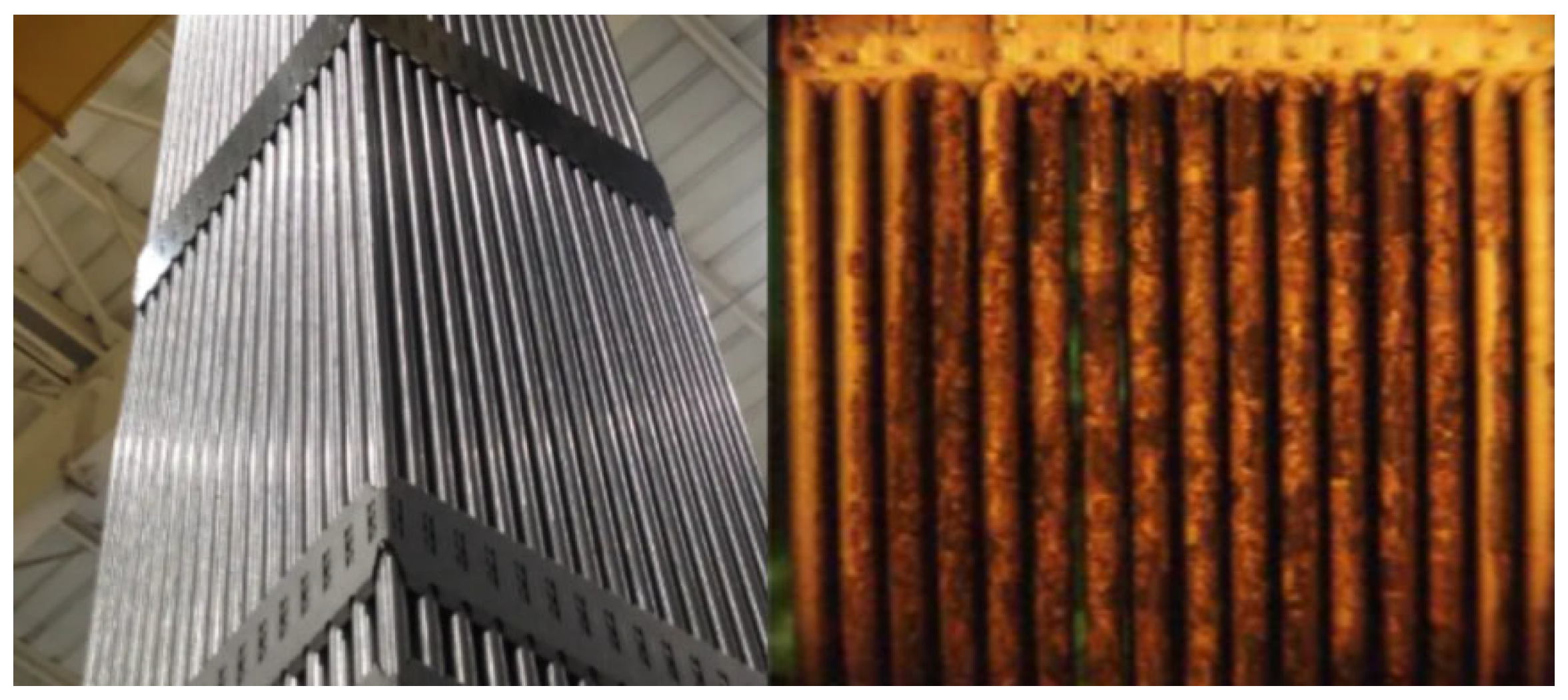
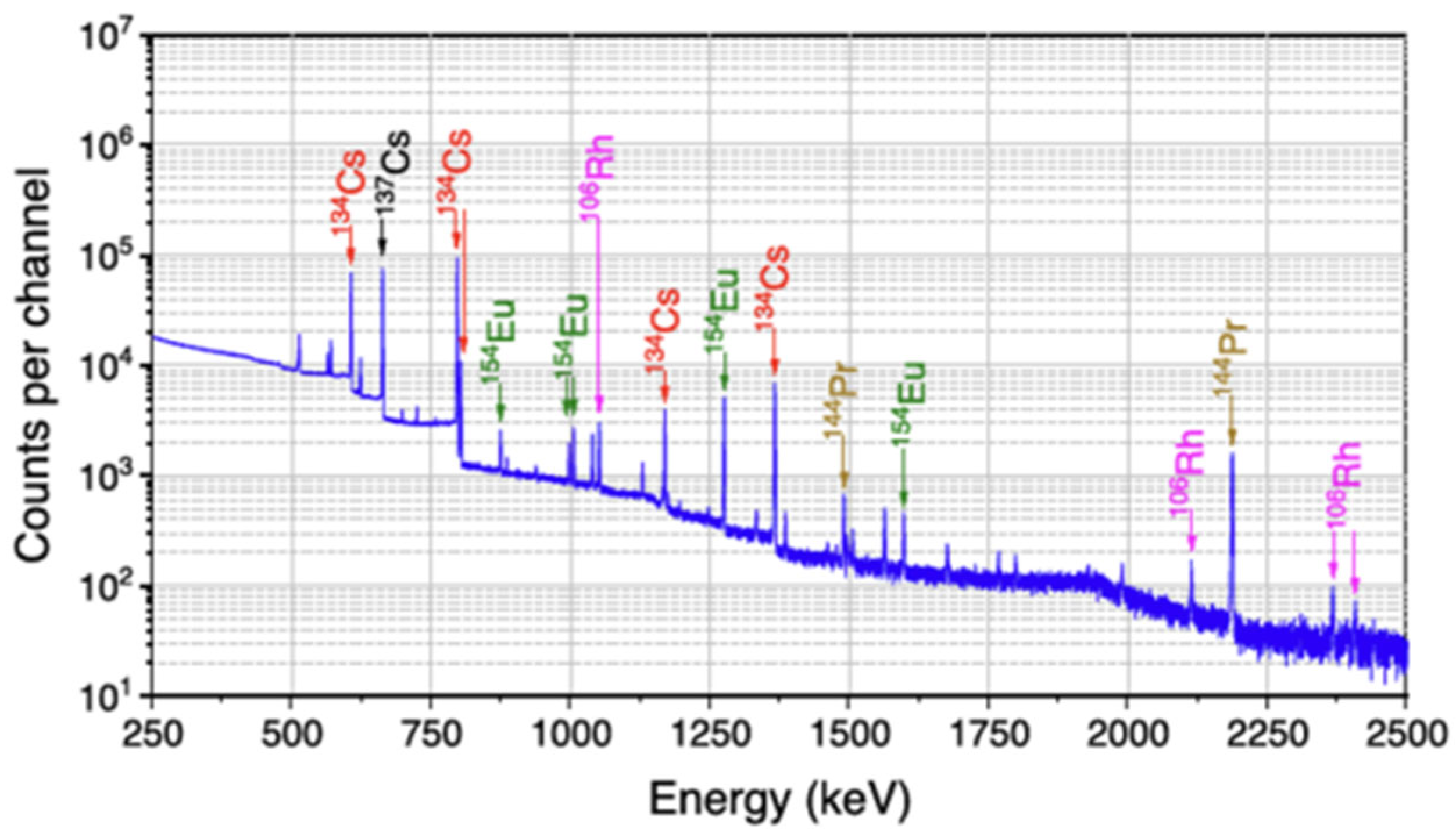
Spent nuclear fuel assembly (SNFA) refers to the complete component of a fuel assembly that is removed after one or more reactor core cycles of irradiation, as shown in Figure 1. Taking a pressurized water reactor assembly as an example, the fuel pellets are usually made of uranium dioxide (UO2) ceramics, and during the irradiation process, fission products and actinide nuclides gradually accumulate. In the passive γ spectrum analysis of spent fuel NDA, the γ source term is usually dominated by a few fission products. During medium- and long-term cooling (several years or more), 134Cs, 137Cs, and 154Eu are the main contributors. Meanwhile, for shorter cooling times or certain high-energy regions, 144Ce and 106Ru can also become significant contributing nuclides. As can be seen from the experimental literature on the passive gamma spectrum method of an NDA given by Péter [24], the method uses an HPGe detector to provide the γ energy spectrum diagrams of the above main γ-emitting nuclides, as shown in Figure 2. The depletion calculation model in this study sets the cooling time range up to a maximum of 20 years. The activities of 144Ce and 106Ru are determined by measuring the gamma characteristic peaks of their daughter nuclides 144Pr and 106Rh. Since the half-life of 144Ce is 285 days and that of 106Ru is 371 days, the shorter half-life results in an extremely low proportion of residual activity when the cooling time is 5 years. The measured energy spectrum signal is weak, so an inversion method mainly based on the activities of three nuclides 134Cs, 137Cs, and 154Eu will be adopted subsequently.
Direct application of the single-value activity method will introduce measurement uncertainties. This is mainly due to the engineering uncertainties in the passive gamma spectrometry method, including the absolute efficiency calibration error of the detector, the self-absorption effect of the fuel assembly matrix [25], and the influence of the geometric factor during detection. These factors collectively lead to additional uncertainties in the measurement results. The main gamma peak energy ranges of 137Cs and 134Cs are similar. By using the ratio method, the absolute efficiency factor, most of the assembly self-absorption factors, and the geometric factor can be eliminated, thereby reducing the uncertainty introduced in the detection process.
Therefore, in this study, the key nuclides used in the passive gamma method of the non-destructive assay (NDA) for spent fuel, namely the 137Cs, 134Cs/137Cs and 154Eu/137Cs ratios, are adopted as the main input parameters for burnup inversion. Next, a sample database obtained from high-fidelity transport burnup coupled calculations for a common pressurized water reactor assembly will be constructed, and this will serve as the unified data basis for the subsequent training of the surrogate model based on machine learning.

2.2. Depletion Calculation

In this study, the 43,400 sample sets obtained from the parallel calculation of the burnup module in OpenMC version 0.15.3 will be used. The activity “Bq” calculated by OpenMC is the total activity (s−1) in units of 106g (=1 MTIHM) of the heavy metal reference after normalizing the number density output by OpenMC to 106g. The number density of some actinide nuclides is expressed in units of atoms/cm3. The burnup material used in the calculation assumes the heavy metal mass as the benchmark, and burnup BU is defined as the heat energy released per unit of initial heavy metal mass, with the unit being GWd/tU.

2.3. Modeled Nuclear Fuel Assemblies

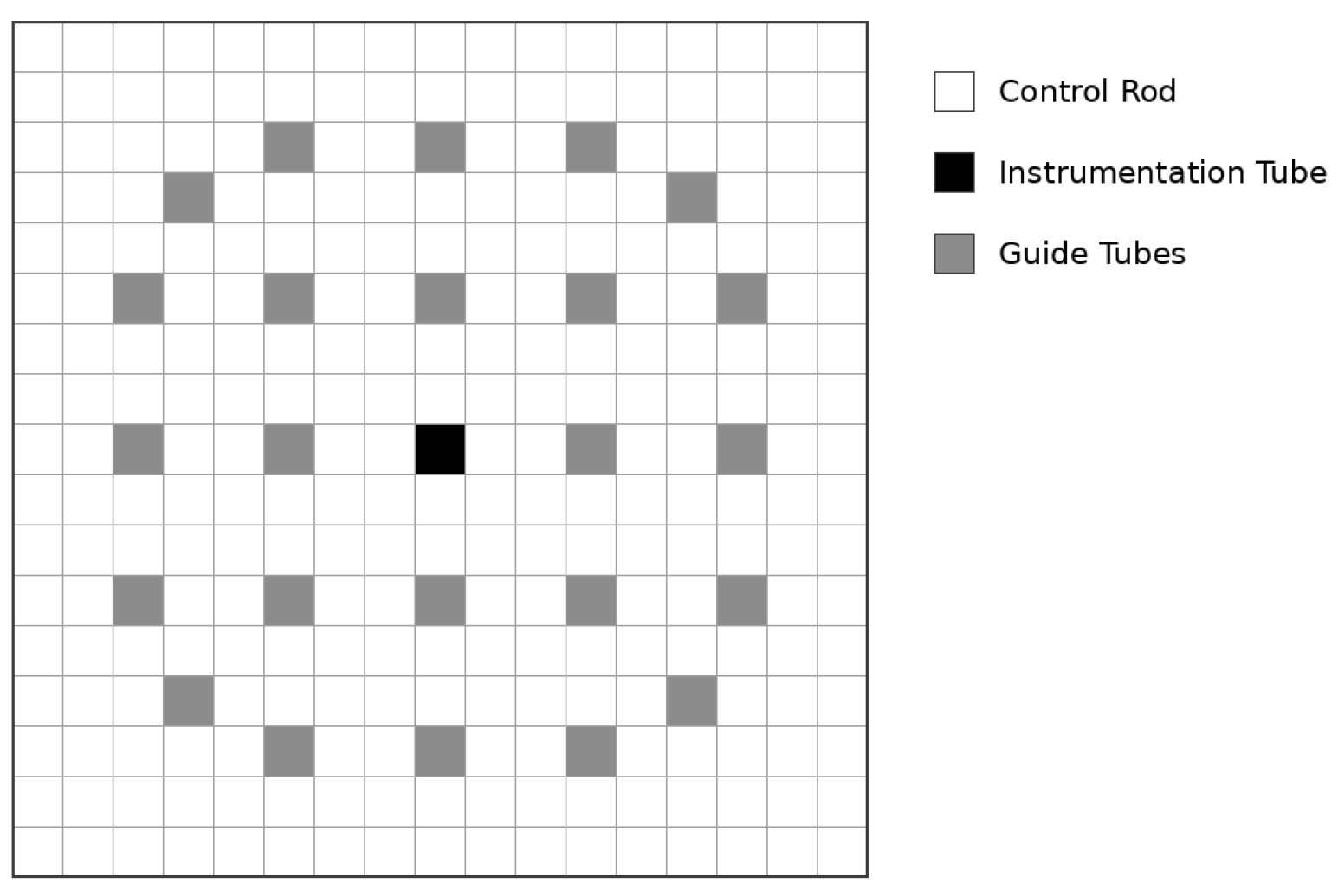
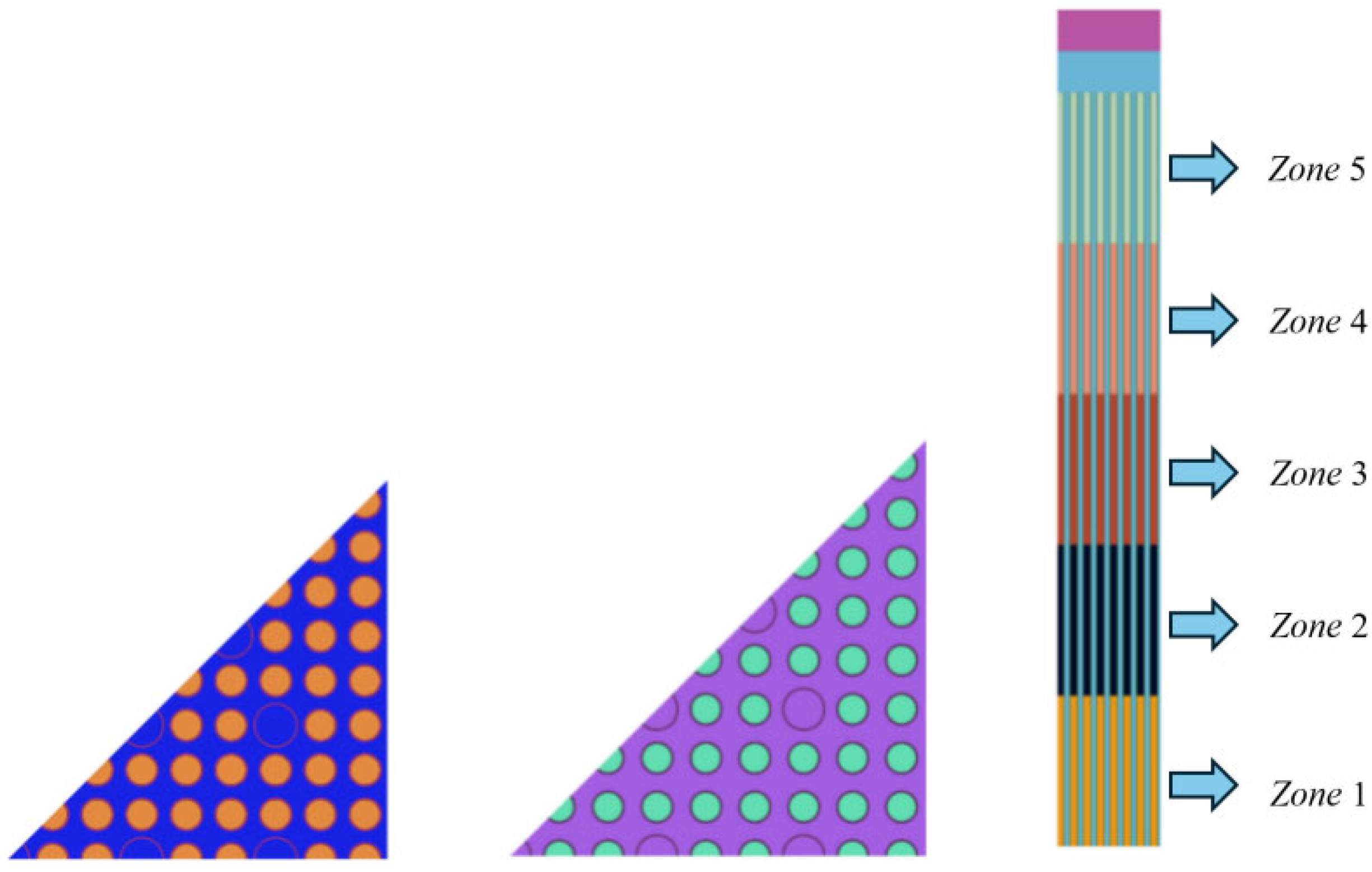
Based on the NT3G24 [26] assembly of the pressurized water reactor Takahama-3 in the sfcompo2.0 [27] benchmark database, the simplified assembly was taken as the research object for typical pressurized water reactor fuel assemblies. An initial enrichment range of 1.5% to 5.0%, with an interval of 0.5 wt%; burnup ranging from 0 to 60 GWd/tU, with an interval of 2 GWd/tU; cooling time of 0, 1, 5, 10 and 20 years; hydrogen-to-uranium atomic ratio (H/U) of 3.2, 3.3, 3.6, 3.9, 4.2, 4.5 and 4.8; and axial zoning of five zones were established for a total of 43,400 sample sets to cover most of the typical pressurized water reactor spent fuel material parameter values. The cladding material is Zircaloy-4 zirconium alloy [28], the gas gap material is helium, and the axial burnup zoning adopts a five-zone axial symmetrically uniform design. The 1/8 radial symmetry assumption and axial symmetry are adopted to reduce the computational load of the Monte Carlo transport process. Therefore, the burnup material is specified as five regions. The water layer and stainless steel (SUS) layer at the axial top are filled to reduce the simulation of particle axial end leakage to reflect the actual operating conditions [29]. In order to evaluate the impact of the different pitch values of the fuel rods in the assembly on the hydrogen-to-uranium atomic ratio (H/U) for burnup inversion, seven different fuel rod pitch simulations were conducted for seven different H/U ratios; the side boundary reflection simulation of the assembly was used to model the reactor operation, and the cross-section database file was ENDF/B-VII.1, while the burnup chain file adopted the general thermal spectrum chain for pressurized water reactors. The geometric distribution of the fuel assemblies is shown in Figure 3. The design parameters are presented in Table 1. The calculation model is depicted in Figure 4. In this model, the axial region starts from the middle symmetric reflective surface and proceeds from bottom to top as zone 1, zone 2, zone 3, zone 4, and zone 5.

3. Analysis of Depletion Calculation Results

3.1. Analysis of Assembly-Average Burnup and Axial-Segment Burnup

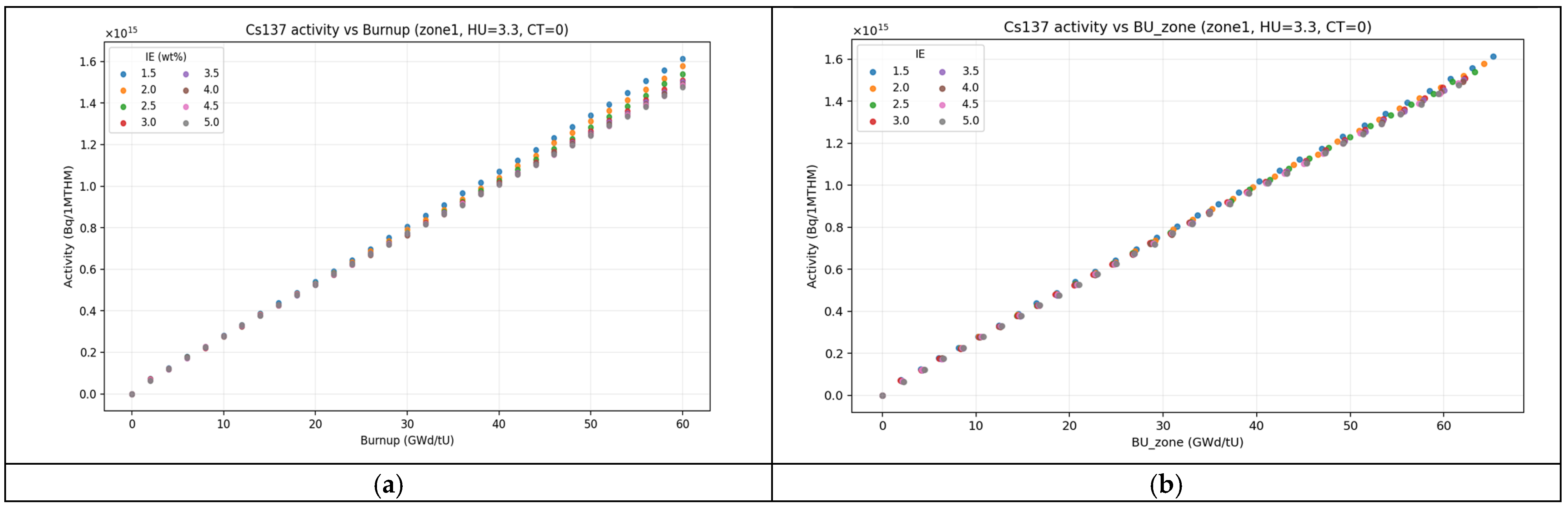
The following presents the calculation results of the initial enrichment IE at values of 1.5, 2.0, 2.5, 3.0, 3.5, 4.0, 4.5, and 5.0 (in wt%), respectively, under a burnup range of 0 to 60 GWd/tU. The activity of the 137Cs nuclide is shown in Figure 5. Here, H/U = 3.3 and CT = 0 years.
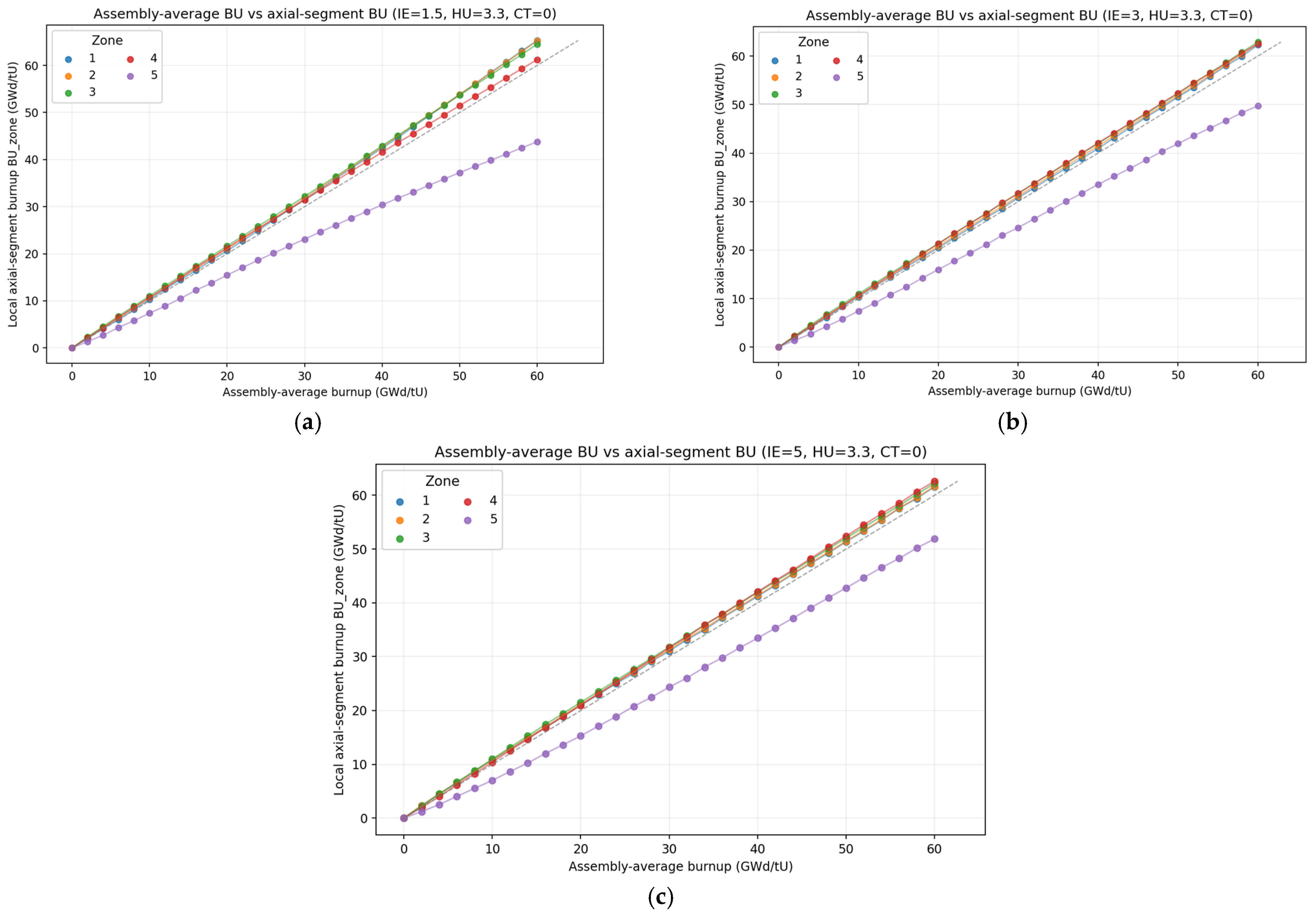
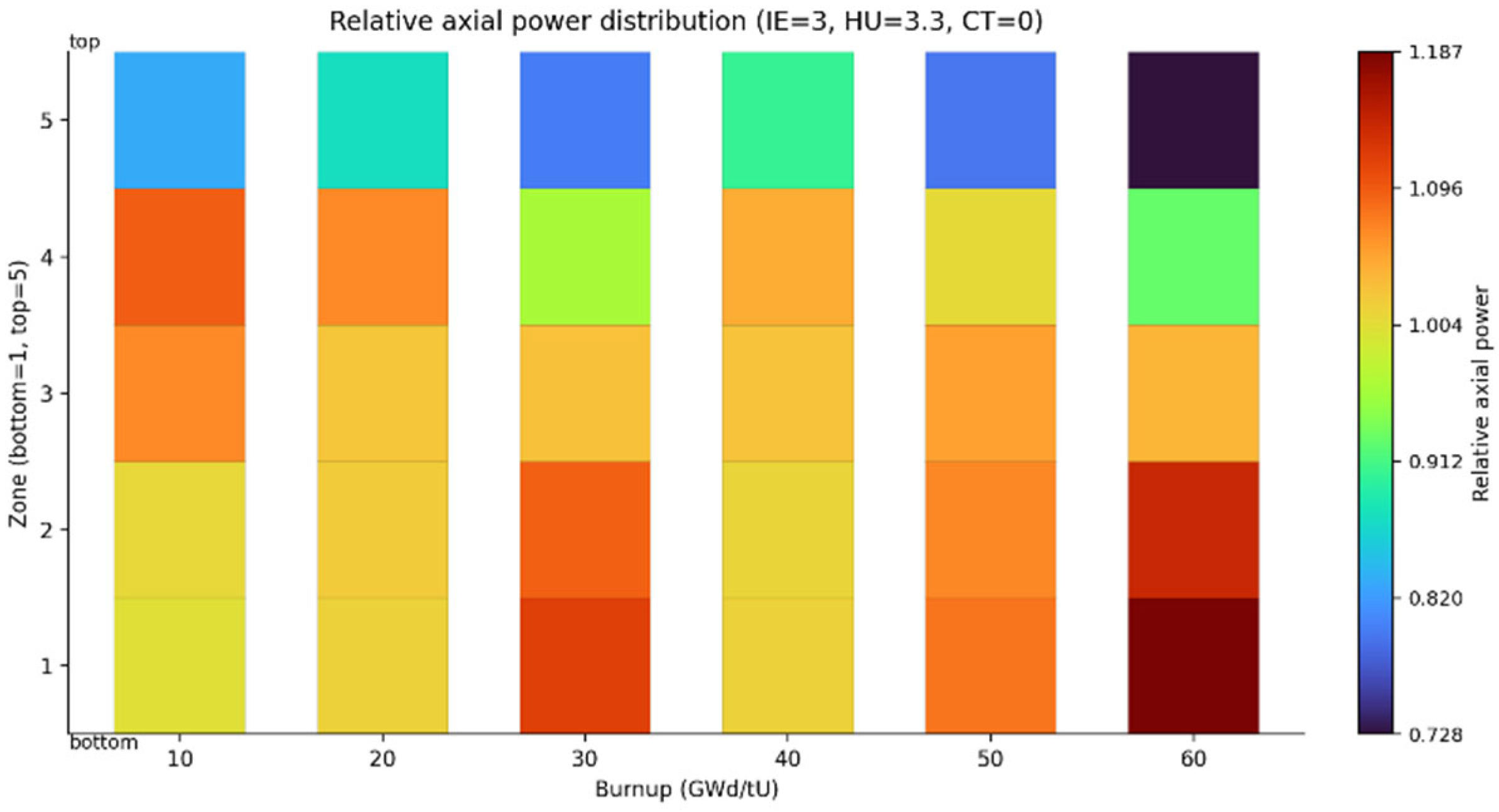
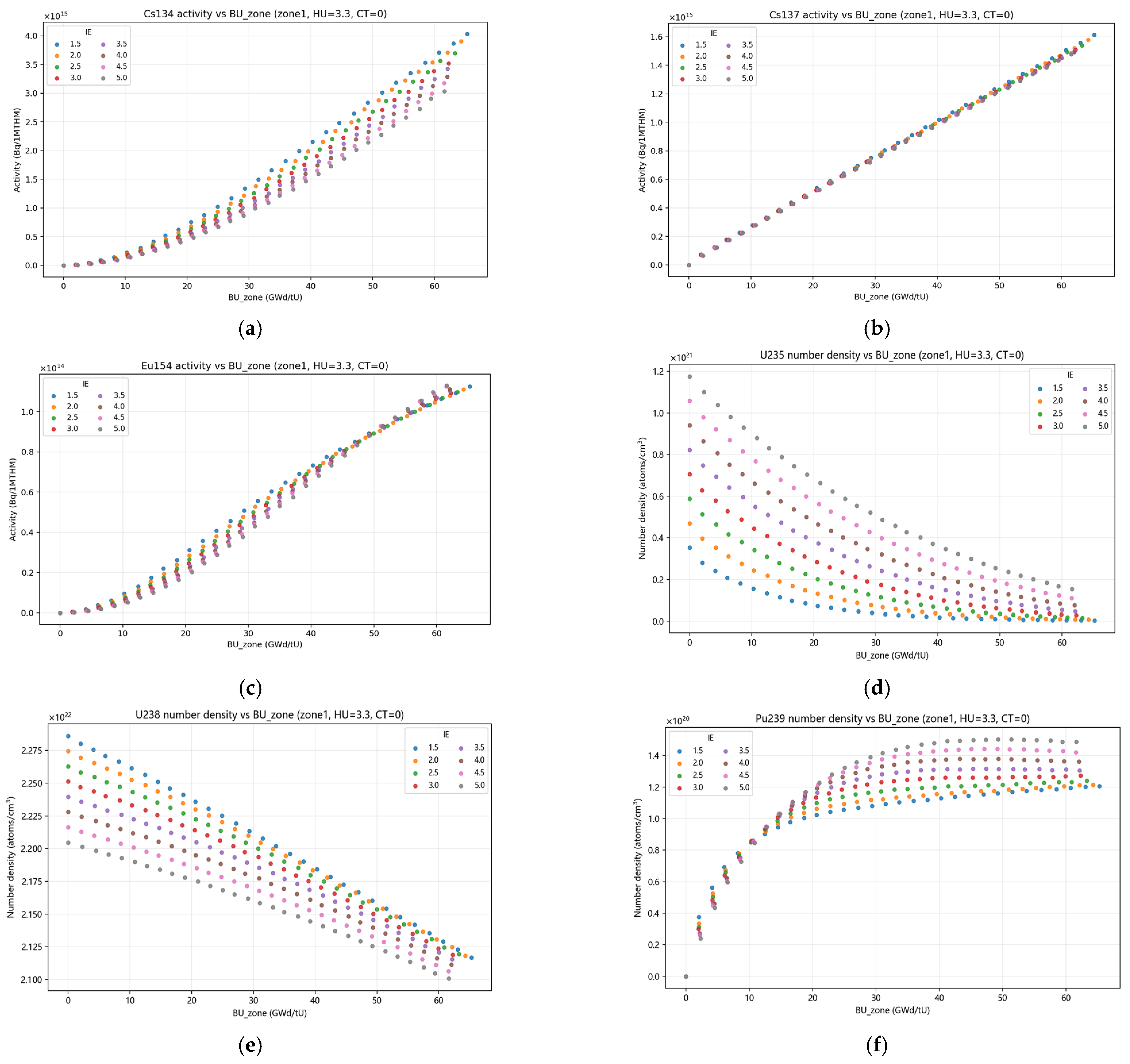
As shown in Figure 5a, the horizontal axis represents the burnup of the fuel assembly calculated based on the burnup step, while the differences in axial flux result in variations in power from zone 1 to zone 5. From Figure 6 and Figure 7, it can be seen that zone 5 is the axial end region. The normalized axial power fraction (relative power share) in zone 5 is lower due to end leakage. This directly results in a 13.4% to 34% difference in axial-segment burnup compared to the assembly-average burnup in the end zone 5 of different initial enrichment levels, under the same burnup time integral. This indirectly led to the situation where the activity value of 137Cs in Figure 5a, a nuclide that is almost insensitive to the initial enrichment IE, appeared to be related to the initial enrichment. Even in the extreme case where the average burnup was 60 GWd/tU, the difference in the activity value of 137Cs between IE of 1.5 and IE of 5 reached 8.3%. This occurs because, under different initial enrichment levels, the average burnup value in the same axial zone is identical, yet the axial-segment burnup varies—and it is the axial-segment burnup that determines the activity value of 137Cs in that region. By changing the horizontal axis scale from the assembly-average burnup through the formula 1 to the discrete summation correction of the axial-segment burnup, the nuclide characteristic map of the axial-segment burnup can be obtained. As shown in Figure 5b, at this time, the activity of 137Cs has returned to a state almost independent of IE.
f z ( i ) = P z ( i ) k = 1 5 P k ( i )   ;   B U z ( i + 1 ) = B U z ( i ) + Δ B U i f z ( i ) m z
B U a = z = 1 Z m z B U z 1 Z z = 1 Z B U z
where B U z denotes the axial-segment burnup in segment (zone) Z, i is the i-th burnup (depletion) step, and Z is the number of axial zones (here Z = 5). P z ( i ) is a segment-wise power proxy at step i, obtained by summing the OpenMC energy release tally (e.g., fission-q-recoverable [30]) over zone Z. Since only the normalized power fraction is used, f z ( i ) is computed by normalizing P z ( i ) with k = 1 5 P k ( i ) . Δ B U i is the assembly-average burnup increment from step i to i + 1. m z is the heavy metal mass fraction of zone Z. With the assumed uniform axial heavy metal distribution and five equal zones, m z is set to 0.2.
In the surrogate model workflow, the model is trained only to predict the axial-segment burnup BU_zone. The assembly-average burnup BU_avg is not learned directly; instead, it is reconstructed from BU_zone via Equation (2) and is reported together with its reconstruction error for consistency assessment. During training, the stepwise BU_avg values are used only for grouped data partitioning and serve neither as input features nor as regression targets.

3.2. Analysis of the Target Nuclide Characteristics of Spent Fuel Materials

Figure 8 shows the calculation sample points under different initial enrichment levels, with a fixed H/U ratio of 3.3 and CT = 0. The x-axis is modified to represent the axial-segment burnup value. At this time, apart from a few cases where due to the low initial enrichment level in the high burnup segment (50–60 GWd/tU), the content of 235U is low, and in order to achieve the same high burnup, more 238U undergoes neutron capture to form 239Pu. The share of the fission product 137Cs from 239Pu is slightly higher than that from 235U, resulting in a slightly higher 137Cs activity in the low-enrichment assembly compared to the high-enrichment assembly under the same high burnup conditions. The maximum difference occurs at 60 GWd/tU, where the 137Cs activity values for IE of 1.5 and IE of 5 differ by approximately 1.2%. This gap is very small, indicating that it is almost independent of IE. It can be seen that the activity of 137Cs has a strong linear relationship with the burnup. This indicator demonstrates that the nuclide activity of 137Cs can be used as a characteristic for burnup inversion.
As can be seen from Figure 8, for 239Pu, before 0–15 GWd/tU, the content of 238U in the low initial enrichment assembly was high, and the number density of 238U decreased more rapidly overall, resulting in a larger number density of 239Pu at low burnup, which means that the generation of 239Pu was faster in the early stage. However, in the 15–60 GWd/tU range, the number density of 239Pu in the high initial enrichment assembly is relatively large, indicating that for the low initial enrichment assembly, to achieve the same burnup, the consumption of 239Pu is faster.
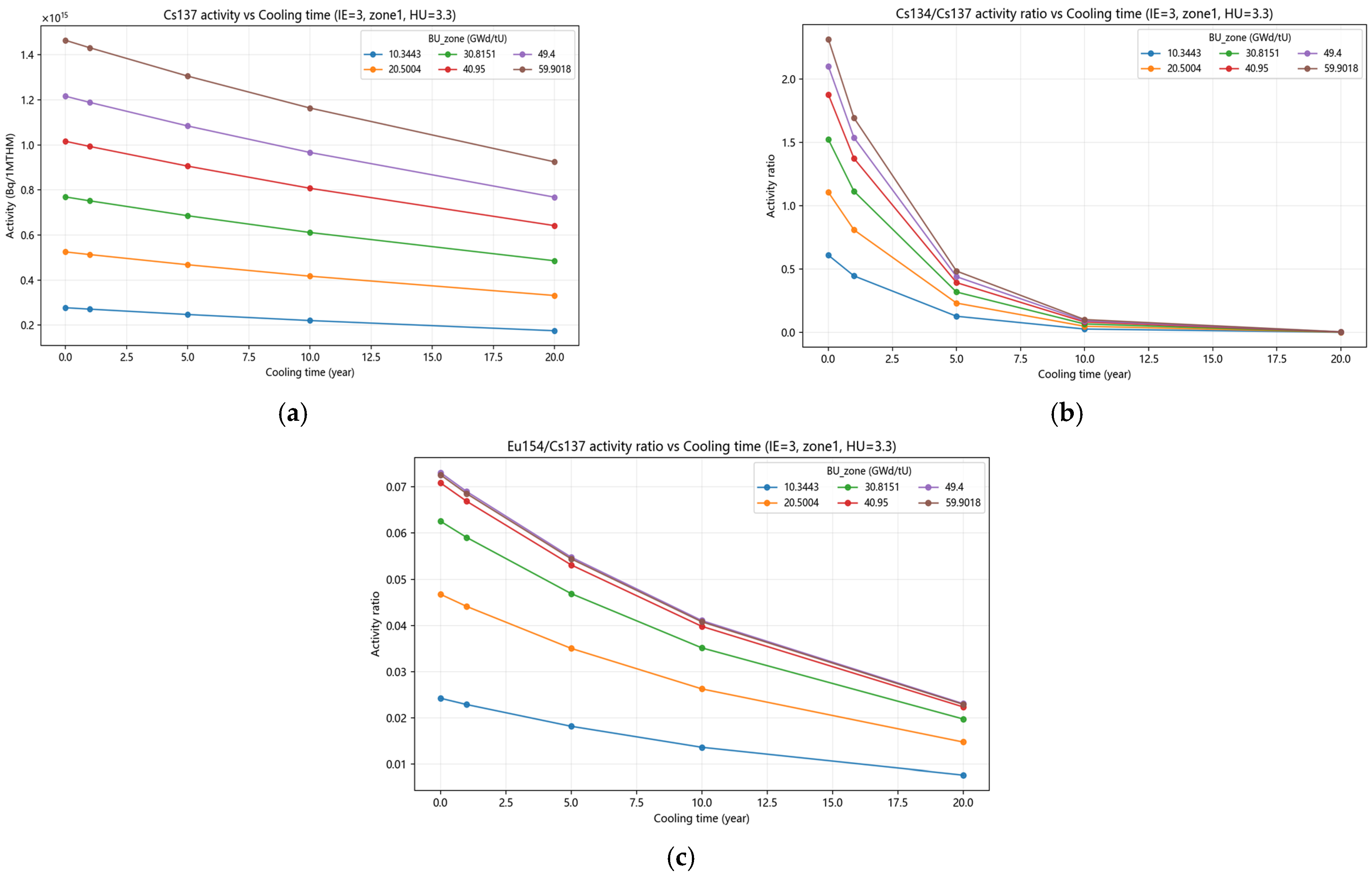
Figure 9 presents a line graph showing the cooling time and the activity ratios of the main characteristic nuclides under the initial enrichment of IE = 3.0 wt% and under the local actual fuel burnup conditions of BU = 10, 20, 30, 40, 50, and 60 GWd/tU. The ratio of 134Cs to 137Cs mitigates the problems of detector detection efficiency calibration, geometric factors, and self-absorption in the NDA burnup measurement. It can be used to depict the burnup history of the assembly without the need to obtain the absolute efficiency of the detector. Since the half-life of the 134Cs isotope is 2 years, it can be used as a characteristic nuclide to distinguish short-term changes in the cooling time in the data. However, due to its relatively short half-life compared to 20 years, in Figure 9, it can be clearly seen that after a cooling time of more than 10 years, the ratio of 134Cs to 137Cs changes slowly and tends to reach saturation. Therefore, it is not applicable for the inversion of the characteristics of spent fuel with long cooling times.
The 154Eu nuclide exhibits a slight nonlinearity due to its production mechanism and its ability to capture neutrons from fission products. It has a relatively long half-life of 8.6 years, and is more sensitive to the initial enrichment level (IE) than 137Cs. As can be seen from Figure 9, the activity ratio of 154Eu/137Cs can be used to distinguish different initial enrichment levels of assembly models when the cooling time is greater than 15 years.

3.3. Sensitivity Analysis of H/U Ratio for Characteristic Nuclides

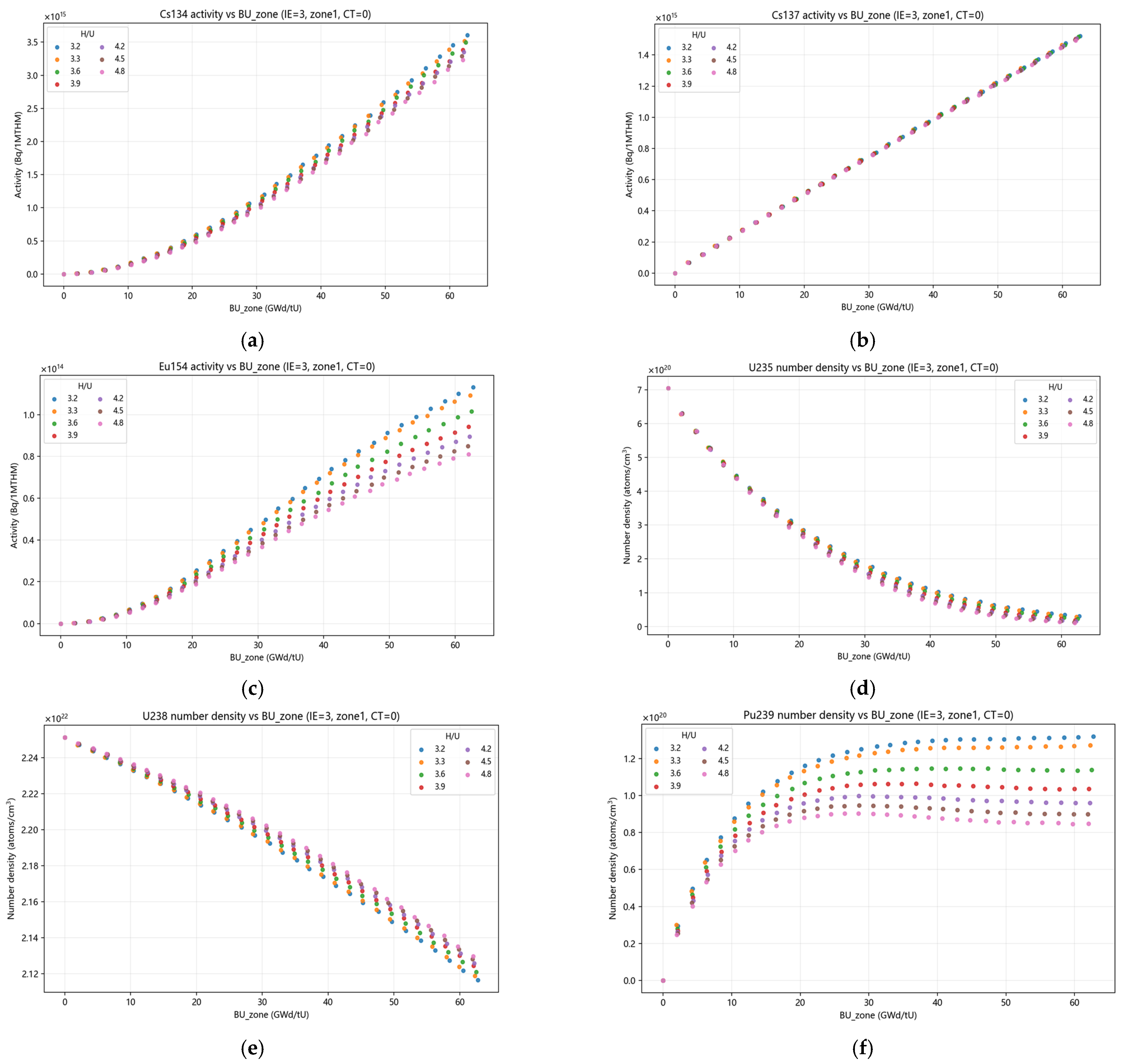
This study alters the pitch of the fuel rods to change the hydrogen-to-uranium atomic ratio H/U. Essentially, it changes the neutron moderation ratio and the hardness of the neutron energy spectrum, thereby altering the flux level and the integral of the capture reaction; Figure 10 shows the characteristic distribution of different H/U target nuclides.
In order to quantify the strength of the influence of the hydrogen-to-uranium atomic ratio (H/U) on the output quantities of 137Cs activity, 134Cs/137Cs, 154Eu/137Cs, and 239Pu after controlling other state variables IE, CT, and zone, in order to decouple the variations caused by axial-segment burnup, a conditional sensitivity analysis was carried out under the given condition group g = ( I E = e , z = j , C T = c ) . The range of axial-segment burnup BU_zone was divided into K mutually complementary and intersecting bins:
B k = [ b k , b k + 1 ) , k = 1,2 , , K
Let the set of discrete H/U values be H, with the range being 3.2, 3.3, 3.6, 3.9, 4.2, 4.5, and 4.8; within the burnup bin K, for each H/U level in the value set H, it is defined as h, and the defined conditional mean E is
m k ( g ) ( h ) = E [ y ( I E , z , C T ) = g , B U z B k , H U = h ]
Under discrete sample data, Equation (5) is estimated using the sample mean:
m ^ k ( g ) ( h ) = i = 1 N y i 1 { ( I E i , z i , C T i ) = g } 1 { B U z , i B k } 1 { H U i = h } i = 1 N 1 { ( I E i , z i , C T i ) = g } 1 { B U z , i B k } 1 { H U i = h }
In Equation (5), the denominator represents the number of samples under the condition combination. The indicator function 1 { A } indicates that if event A is true, the output is 1, otherwise it is 0; the effective H/U subset within this fuel burn bin is defined as H k ( g ) = { h H denominator   of   Equation   ( 5 ) > 0 } ; then, define the sensitivity of H/U, which is the relative amplitude of the response, and provide the mean amplitude variation across H/U within each bin:
Δ k ( g ) : = m a x h H k ( g ) m ^ k ( g ) ( h ) m i n h H k ( g ) m ^ k ( g ) ( h )
Use the mean value across H/U within each bin as the benchmark for normalization:
m ¯ k ( g ) : = 1 | H k ( g ) | h H k ( g ) m ^ k ( g ) ( h )
Then, provide the sensitivity of the conditional H/U, with the relative amplitude of the response as the vertical axis:
S k ( g ) ( % ) : = Δ k ( g ) m ¯ k ( g ) × 100 %
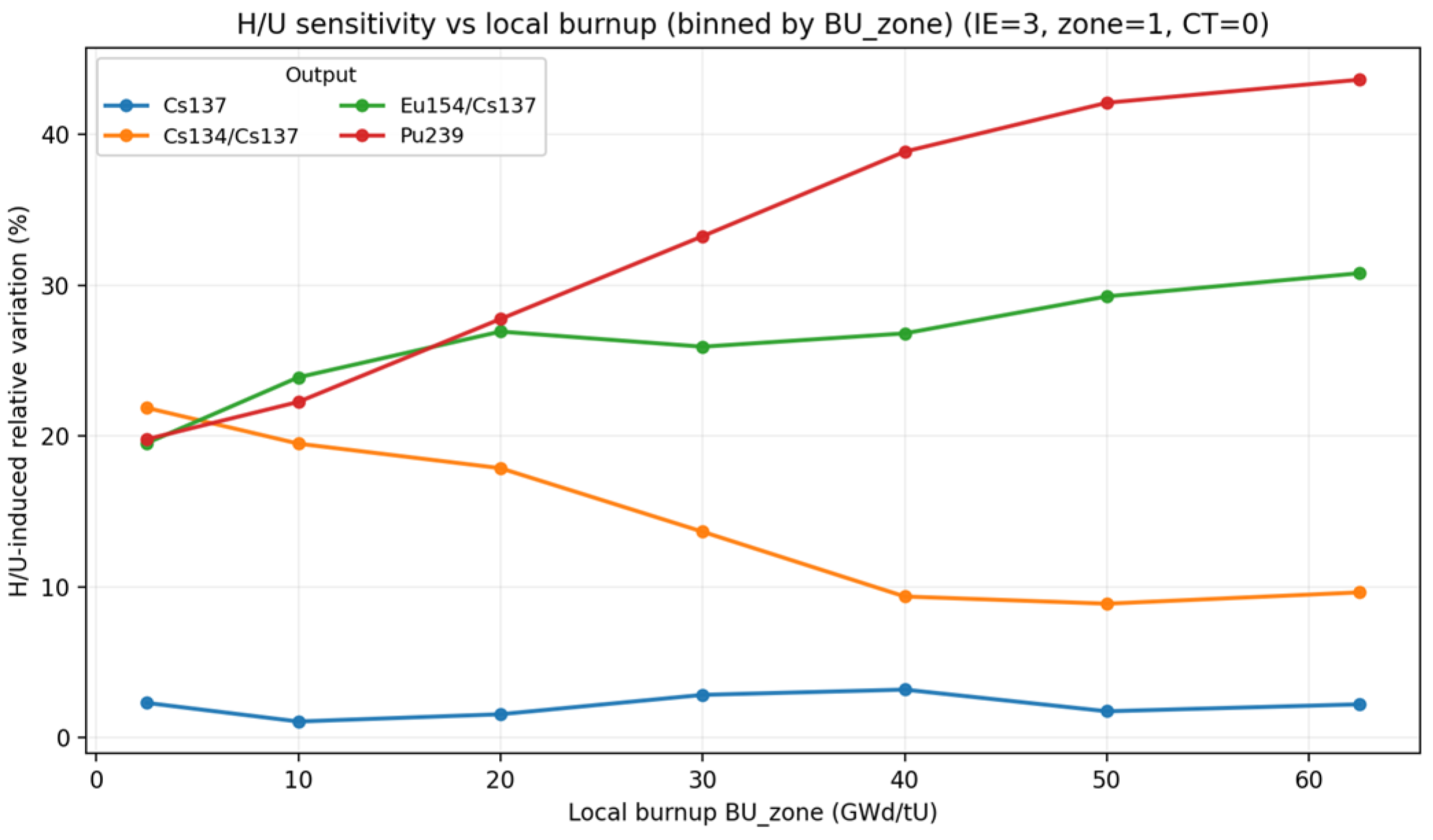
When S k ( g ) is large, it indicates that within the same axial-segment burnup sub-box B k with the same IE, CT and zone, the response means caused by different H/U values show significant differences, suggesting that this response is more sensitive to the moderator conditions and neutron spectrum changes. When S k ( g ) is small, it indicates that the response is more stable across the H/U operating conditions. The sensitivity index S k ( g ) in this study, which is the empirical conditional relative amplitude sampled under different operating conditions, is used to verify the necessity of subsequent parameter setting for inversion; and an evolution diagram with respect to axial-segment burnup is given, as shown in Figure 11 (local burnup in the figure refers to axial-segment burnup (BU_zone). It shows the relative change amplitude of the response when the fixed state variable IE = 3; zone 1, CT = 0. The specific data are presented in Table 2 and Table 3.
It can be seen from Figure 11 and Table 2 and Table 3 that the larger the H/U ratio, the softer the neutron energy spectrum. The smaller the H/U ratio, the harder the spectrum. The inventory of the direct fission product 137Cs is mainly controlled by the cumulative fission number. Compared with other nuclides, it is not sensitive to the neutron energy spectrum. Therefore, when conditioned on the same BU_zone bin (i.e., after accounting for axial-segment burnup), 137Cs shows weak sensitivity to the H/U ratio. The median and maximum H/U sensitivity of 137Cs are significantly lower than those of other characteristic nuclides. The capture-generated nuclides such as 134Cs and 154Eu are highly sensitive to the flux and neutron energy spectrum distribution. The median H/U sensitivity of 134Cs/137Cs and 154Eu/137Cs has significantly increased, and in some burnup ranges, the maximum value can reach several percentage points. This demonstrates a significant dependence on the H/U ratio.
For actinide nuclides, the H/U sensitivity of 238U is generally low, indicating that it mainly functions as a parent nuclide within this burnup range, and its number density changes relatively smoothly, while the H/U sensitivity of 239Pu and 240Pu is significantly higher. The breeding generation of 239Pu is driven by the capture chain of 238U, showing stronger neutron energy spectrum sensitivity and increasing with burnup accumulation. In contrast, the H/U sensitivity of 235U in the table may show a relatively high median or maximum value. This is because 235U decreases with fuel burnup and approaches a lower level in the high burnup range. This causes the relative amplitude of the number density of 235U to be amplified under the same absolute error. As can be seen from Figure 10, the fluctuation of 235U is very small under different H/U conditions.
Therefore, in the NDA inversion, 137Cs can be used as a reliable indicator of fuel burnup monotonicity; however, if 134Cs/137Cs and 154Eu/137Cs are used as auxiliary features, the neutron energy spectrum-related operating condition parameters such as the H/U and axial position must be explicitly considered. Otherwise, the spectral differences between different operating conditions will introduce systematic biases and lead to a significant decline in cross-condition extrapolation performance. Moreover, the difference in the H/U ratio caused by the fuel rod pitch can make the subsequent trained surrogate model more versatile.

4. Machine Learning Surrogate Models

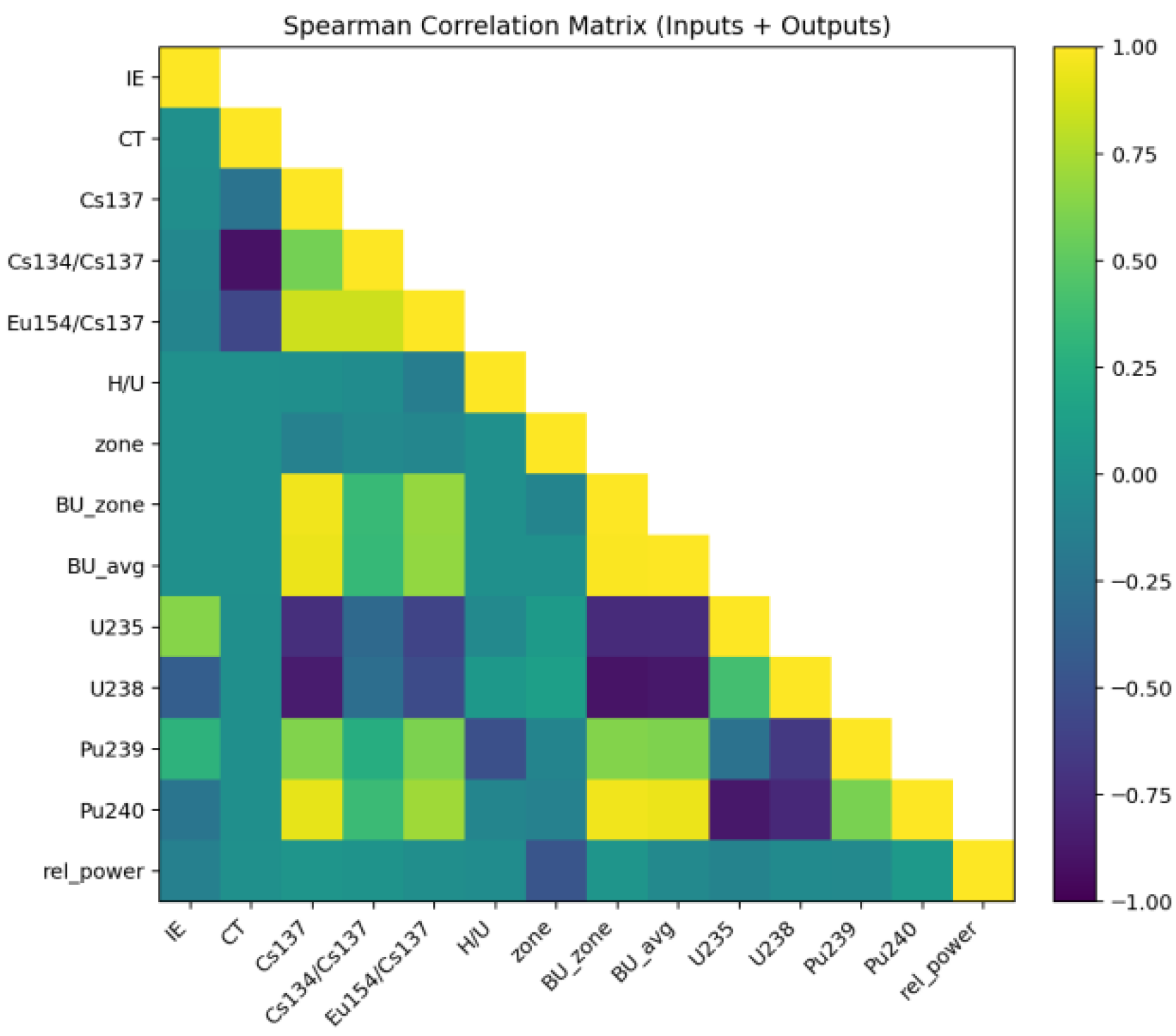
Before conducting the machine learning training, to quantitatively evaluate the monotonic correlations (allowing nonlinearity) between the candidate input features and between the input and the output (in order to assess the correlation), the Spearman correlation coefficient [31] was tested on the core features calculated by the OpenMC code, and the correlation matrix was plotted, as shown in Figure 12. The Spearman correlation coefficient is based on the ranks of variables, which can reduce the influence of outliers and capture monotonic but nonlinear dependencies. It is used to identify strong collinear features, verify physical trends, and guide the construction of subsequent feature sets (Method A/B/C).
From Figure 12, it can be observed that axial-segment burnup BU_zone is significantly positively correlated with the average burnup BU_avg of the assembly; fission products 137Cs has a strong monotonic correlation with burnup, demonstrating its robustness as a burnup indicator, while 134Cs/137Cs and 154Eu/137Cs have a stronger correlation with the cooling time CT and neutron energy spectrum-related conditions (H/U, axial section zone), and should include the condition parameters during cross-condition inversion to reduce system deviation.
Therefore, in this study, the input parameters of the three methods are selected for comparison and verification to examine the significance of 137Cs single activity and the 154Eu/137Cs activity ratio in machine learning for inferring the initial enrichment IE and axial-segment burnup BU. The output parameters selected are the initial enrichment IE, axial-segment burnup BU_zone, as well as their corresponding assembly-average burnup BU_avg and the relative power coefficient rel_P in the axial region. The number density of some actinide nuclides is also included. The specific method parameters are shown in Table 4.

4.1. MLP Surrogate Model

Multi-layer perceptron (MLP) is a type of feedforward fully connected network that can approximate continuous nonlinear functions. In this study, for each training fold of the MLP model, the input feature X and the target response Y are separately scaled and standardized on the training subset using StandardScaler, and the activation function ReLU is selected; and Batch Normalization and dropout can be used to prevent overfitting. The end of the network is a linear output layer, which realizes multi-output regression; the loss function adopts the mean squared error (MSE), and on the validation set, the predicted values are de-standardized and then the root mean square error (RMSE) in the physical space is used for early stopping; the optimizer selects AdamW, and gradient clipping (grad_clip) is provided to enhance the numerical stability.

4.2. CNN Surrogate Model

To compare the different nonlinear mapping capabilities, a 1D-CNN surrogate model was implemented under the same input and output definitions. Since the input is a finite-dimensional feature vector rather than an image grid, in this study, the feature vector is regarded as a one-dimensional sequence, and the tensor three-dimensional shape when the input feature matrix is sent to the CNN, X R B × C × L , where the meaning of the first dimension B is the mini-batch size, and the total number of samples in the dataset is Nall; each sample contains a set of input features x i (such as 137Cs, 134Cs/137Cs, 154Eu/137Cs, H/U, CT, Zone), as well as the corresponding multiple output targets y i(IE, BU_zone, BU_avg, Density, rel_P); the second dimension C is defined as the input channels, and the channel number C is 1; and the third dimension L is defined as the feature dimension. Arrange the feature vectors of each sample in a fixed order to form a one-dimensional feature axis of length L, and apply 1D convolution along this axis primarily as a structural prior for parameter sharing. Given the small L (6, 5, and 5 for Methods A/B/C, respectively), the receptive field can become quasi-global for larger kernels; thus, the 1D-CNN here serves as a controlled baseline to assess whether such inductive bias improves generalization under discrete operating conditions. Importantly, the 1D-CNN is not employed as a competitive baseline for tabular regression; instead, it acts as a control model to explicitly test whether the locality and weight-sharing inductive bias of convolutions are beneficial for the present low-dimensional feature vector.
Because a 1D-CNN is sensitive to the ordering of inputs, the feature sequence fed into the convolution is explicitly defined and kept fixed by the feature engineering pipeline (i.e., the column order returned by the feature frame construction routine). The same feature list is saved and reused at the inference time to reindex input columns, ensuring strict train–test consistency. In this work, the feature order is not treated as a tunable hyperparameter (no permutation search), since these tabular features do not possess a natural temporal/spatial topology; instead, the order is a deterministic encoding convention reflecting the physical semantics: operational condition variables first, followed by measurement-related quantities. The resulting input sequences are as follows:
Method A (L = 6):
x A = H / U , C T , z o n e , A C s 137 , A C s 134 / A C s 137 , A E u 154 / A C s 137
Method B (L = 5):
x B = H / U , C T , z o n e , A C s 134 / A C s 137 , A E u 154 / A C s 137
Method C (L = 5):
x C = H / U , C T , z o n e , A C s 137 , A C s 134 / A C s 137
where A C s 134 , A C s 137 , and A E u 154 denote the absolute activity of 137Cs, 134Cs, and 154Eu. Accordingly, the 1D convolution is applied along this feature axis as a structural prior for parameter sharing over adjacent feature positions under this deterministic encoding.
This study employs a two-layer one-dimensional convolutional network to extract the local combined patterns on the feature axis. The first layer convolution maps the single-channel input to C1 feature channels, and the second layer convolution further maps it to C2 higher-level combined feature channels. Since the input is a finite-dimensional feature sequence L, the convolution kernel size is selected to be relatively small (k1/k2 is chosen from the values {2, 3, 5}), in order to extract parameter sharing and limit the local receptive field to reduce the model complexity, thereby suppressing overfitting in discrete operating conditions sampling.
The convolutional output is transformed into channel representations through the nonlinear function ReLU. To prevent overfitting in discrete operating conditions sampling, dropout is introduced after the first layer of convolution. This method randomly inactivates features to weaken the co-adaptation between feature channels and improve the generalization robustness. Considering that convolution is performed along the feature axis, global average pooling is used to compress the length dimension L to 1. This transforms the R B × C 2 × L transformation into R B × C 2 × 1 , thereby obtaining a fixed-length representation that is independent of L and reducing the dependence on the position of the feature axis.
Global average pooling reduces R B × C 2 × L to R B × C 2 × 1 . After flattening, we obtain h∈ R B × C 2 × 1 , which is then mapped to the multi-output targets by a linear layer. This structure regularizes the interaction between features through parameter sharing and local receptive fields, serving as a structural counterpart to the MLP.
For fair comparison among the models, similar to the settings of the MLP model, the loss function adopts the mean squared error (MSE), and on the validation set, the predicted values are de-standardized and then the RMSE in the physical space is used for early stopping (for the target that has not undergone logarithmic transformation, it is the physical space RMSE; for the number density that has enabled logarithmic transformation, the target is the logarithmic space RMSE). The optimizer is selected as AdamW, and gradient clipping (grad_clip) is provided to enhance the numerical stability. The convolution in this study is performed along the feature axis, and its function is equivalent to learning low-order local interaction terms under a fixed feature order. Since features do not have a natural topological structure, this study fixes the feature order and uses 1D-CNN as a baseline with structural priors to evaluate the impact of parameter sharing and local receptive fields on generalization under discrete operating conditions.

4.3. XGBoost Surrogate Model

XGBoost (eXtreme Gradient Boosting, version 3.0.2) is based on the gradient boosting decision tree (GBDT) [32]. By iteratively adding models to fit the nonlinear mapping, it can effectively depict feature interactions and has good robustness for features of different scales. Considering that the native regression model of XGBoost is in a single-output form, this study trains a regression model for each target variable separately, and summarizes the errors of each target during the validation and testing phases to achieve a fair comparison with the MLP/CNN. In each training fold, the input features are standardized on the training subset and aligned with the MLP/CNN methods. This does not affect the sorting nature of tree splits; in each training fold, the training is performed with the goal of minimizing the MSE, by setting different hyperparameters: the learning rate, tree depth, sub-sampling, column sampling, minimum leaf node weight, and regularization term jointly control the model complexity and generalization ability; in the hyperparameter optimization stage, the mean value of the 3-fold cross-validation RMSE with group Khpo = 3 is used as the objective function; finally, the physical space error indicators are reported on the outer 5-fold OOF test set.

4.4. Data Preprocessing and Feature Transformation

The data table is derived from the sample database of depletion calculation in OpenMC. To improve numerical stability and mitigate training difficulties caused by zeros and multi-order-of-magnitude variations, a base-10 logarithmic transform was applied to selected variables. Specifically, when log transformation is enabled, the 137Cs activity and actinide number densities are mapped as follows:
x = l o g 10 m a x x , 0 + ε ,   ε = 10 30
where ε is introduced to avoid log10(0). For model evaluation, predictions of log-transformed targets are inversely mapped back to the physical domain by
x ^ = 10 x ^ ε ,   x ^ m a x x ^ , 0
All indicators were inversely transformed back to the physical space during the final evaluation and the errors were calculated.

4.5. Bayesian Hyperparameter Optimization (Optuna-TPE)

The three training models were sequentially optimized using the TPE (Tree-structured Parzen Estimator) sampler of Optuna. The Optuna objective (best value) is the mean grouped Khpo = 3 validation RMSE, computed as a uniform-averaged multi-output RMSE for MLP/CNN but as the mean of per-target RMSEs for XGBoost. For the MLP/CNN models based on neural networks, Optuna performs mid-process pruning at the fold level. When the interim result of the current trial is significantly inferior to the optimal level achieved so far, it terminates prematurely to save computational costs. For the XGBoost model, the computational cost is mainly controlled by restricting the search space and terminating failed trials prematurely. The indicators of the hyperparameters for each model are shown in Table 5, and the optimal hyperparameter results obtained after multiple trials in the Optuna-TPE framework for each model and its corresponding different methods are also provided.

5. Results

This chapter investigates three surrogate models built on a pre-computed OpenMC sample database and their corresponding feature sets (Methods A/B/C). Multi-output joint inversion and performance evaluation are conducted for initial enrichment (IE), axial-segment burnup (BU_zone), assembly-average burnup inferred from BU_zone (BU_avg), partial actinide number densities (235U /238U /239Pu /240Pu), and axial relative power (rel_P). To prevent information leakage arising from mixing samples from different axial zones under the same operating condition, grouped cross-validation is adopted. Groups are defined as G = (IE, BU_avg, H/U, CT), where BU_avg serves only as a condition label for grouping and is not used as an input feature. Both BU_zone and the BU_avg derived from BU_zone are reported for consistency checking. The workflow consists of an outer grouped cross-validation (Kcv = 5) and an inner grouped validation split. In each fold, 20% of the groups are held out for testing, while the remaining 80% form the training pool; then, 20% of the groups in the training pool are randomly selected for validation (early stopping/epoch selection), and the rest are used for training. The resulting proportions are approximately 20% (test), 16% (validation), and 64% (training).
The Optuna-TPE hyperparameter optimization stage conducts a 3-fold cross-validation within the training set, using stratified grouping. The objective function is the mean of the RMSE values of all outputs from each validation set. The optimal hyperparameter combination is selected. Then, cross-validation (out-of-fold, OOF) generalization evaluation was conducted under the outer layer Kcv = 5. The 5-fold test prediction results were concatenated to obtain a set of OOF prediction points covering all samples. The RMSE, MAE, R2, as well as the relative error indicators MAPE and RMSPE, were reported on the outer fold training set and test set.

5.1. Multiple Output Prediction

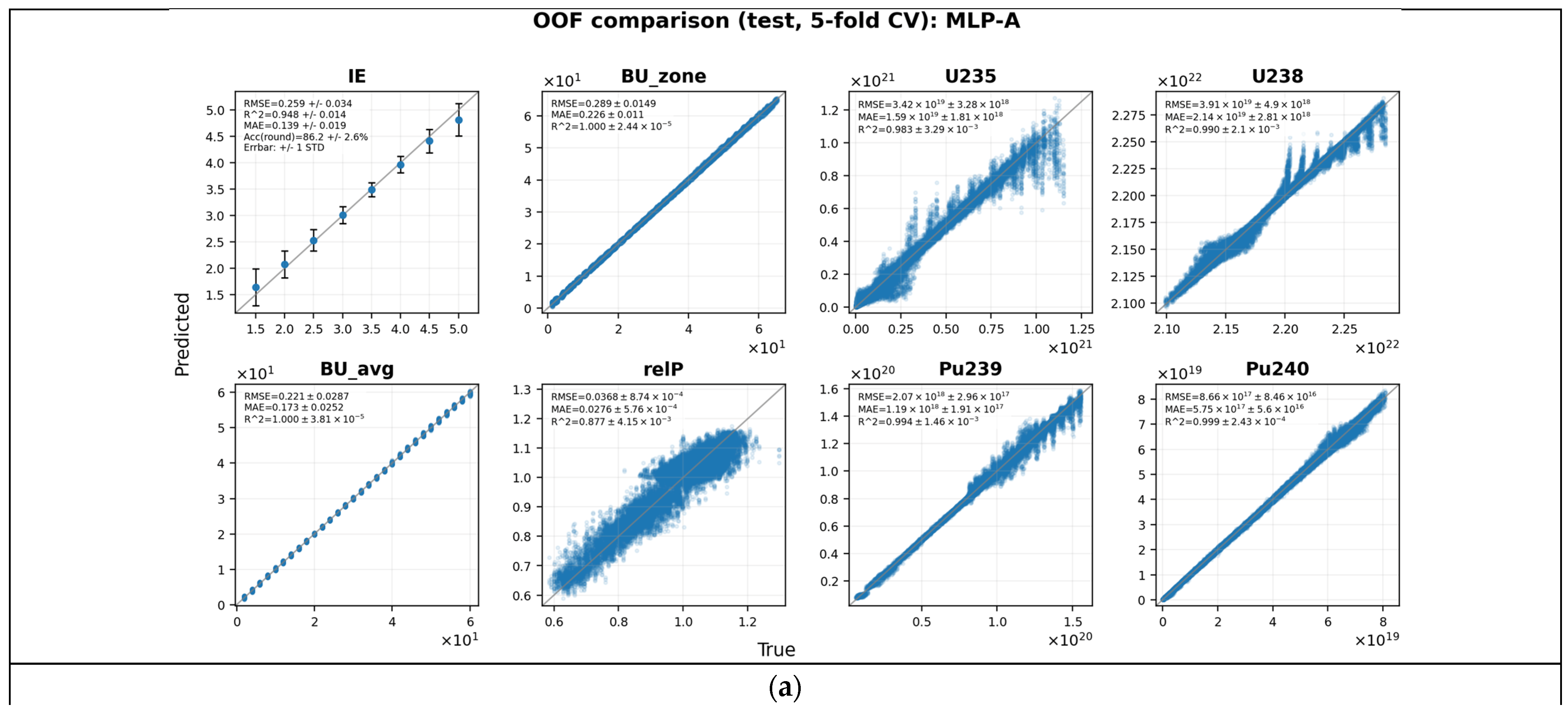
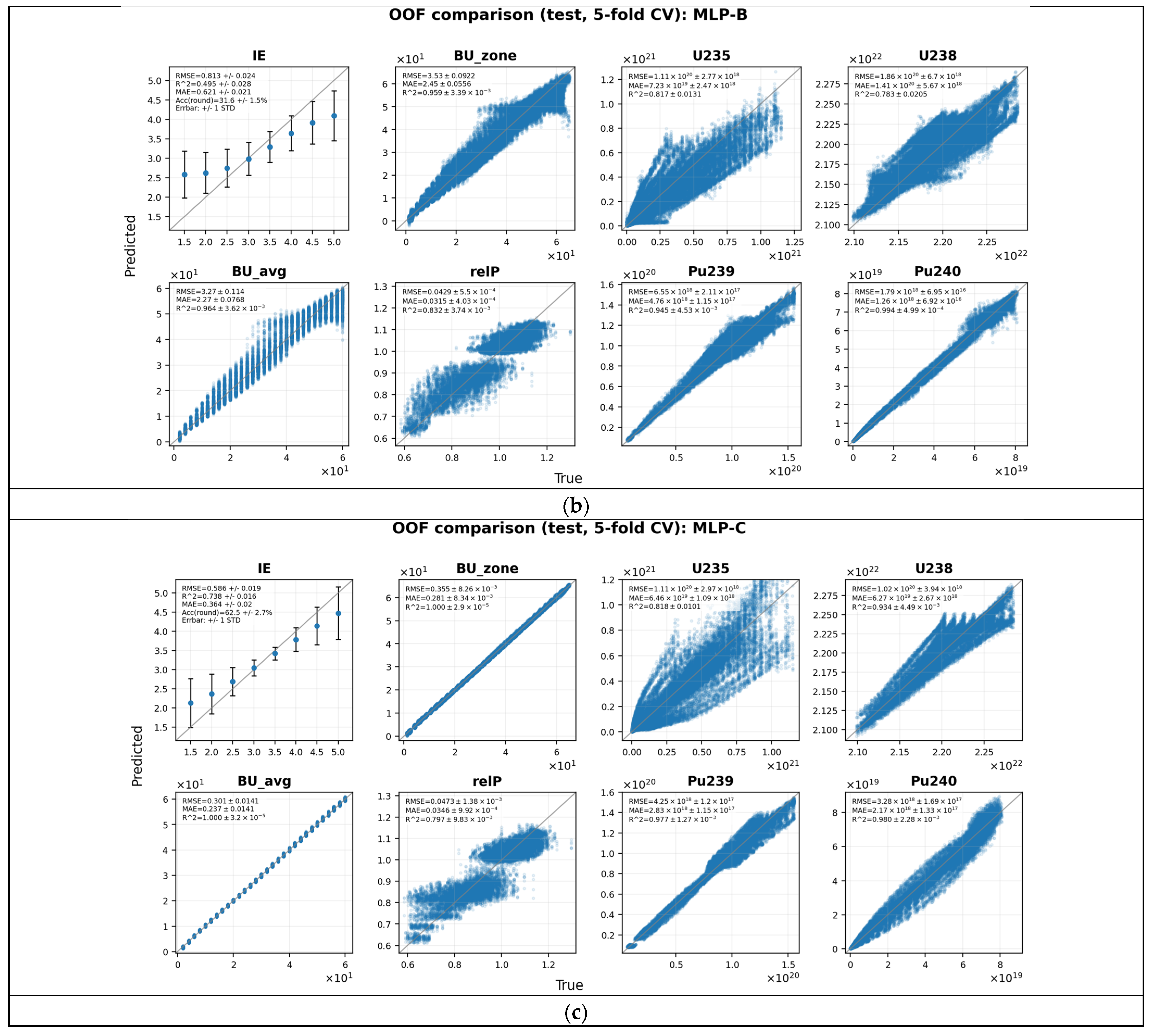
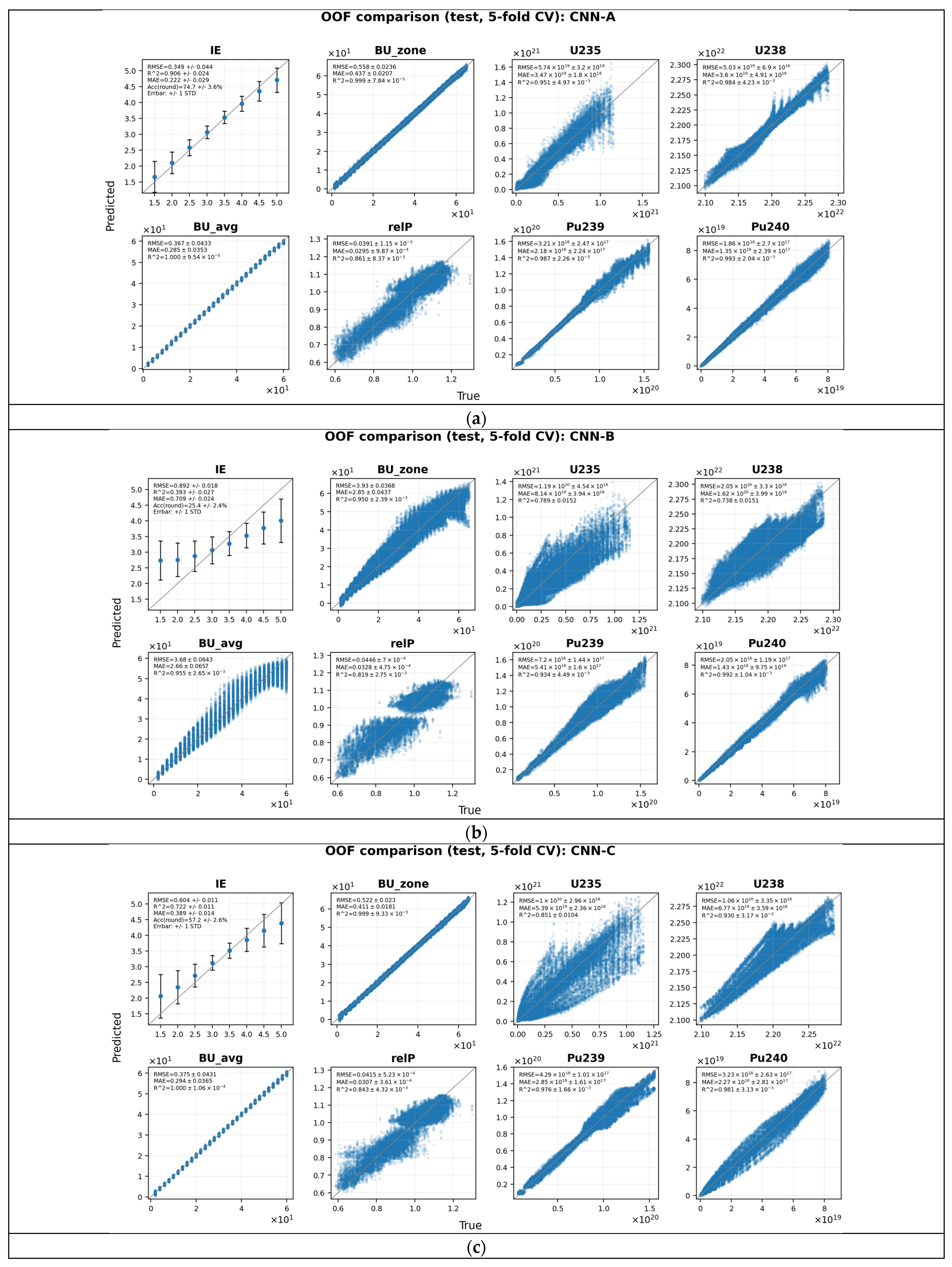
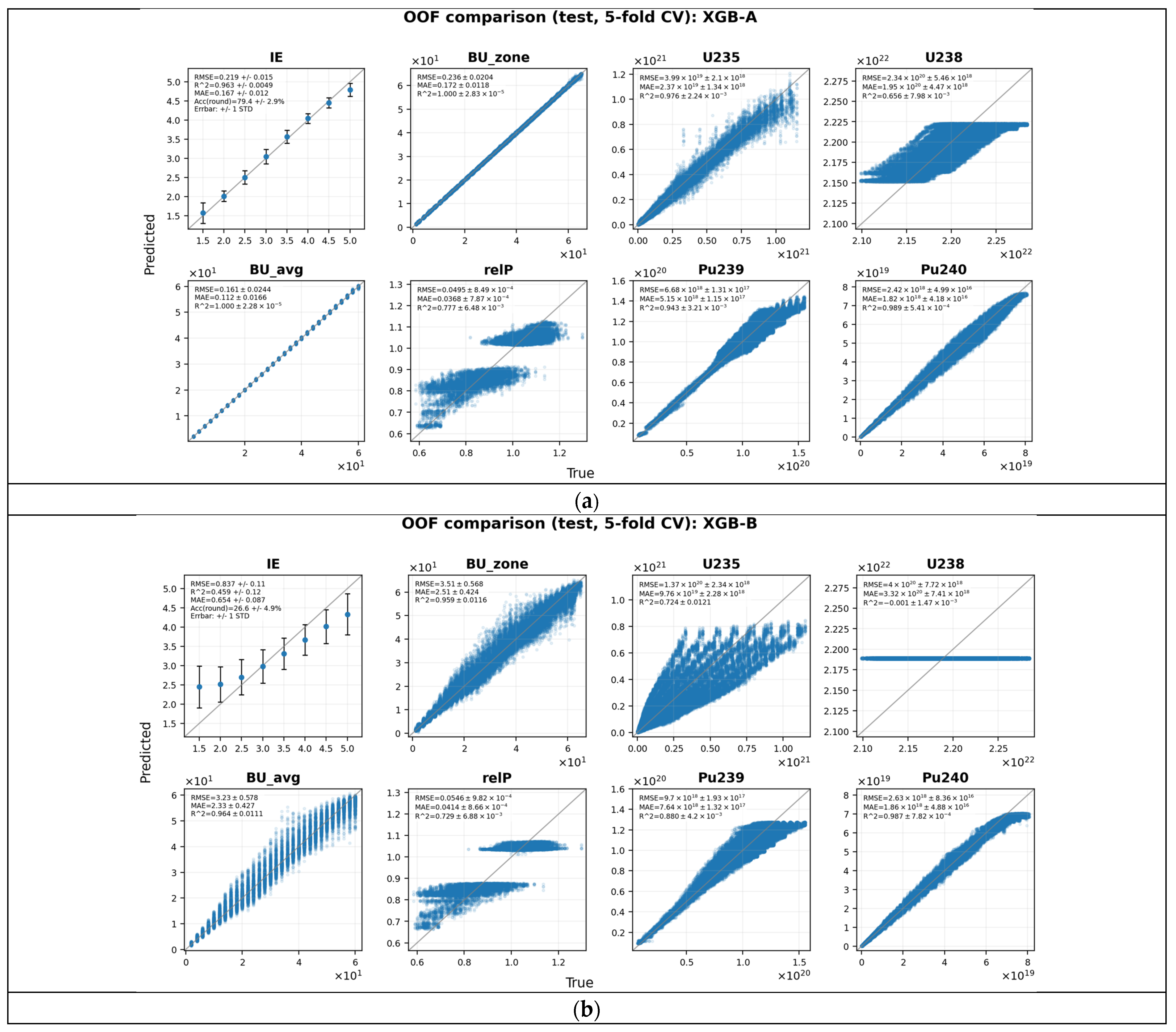
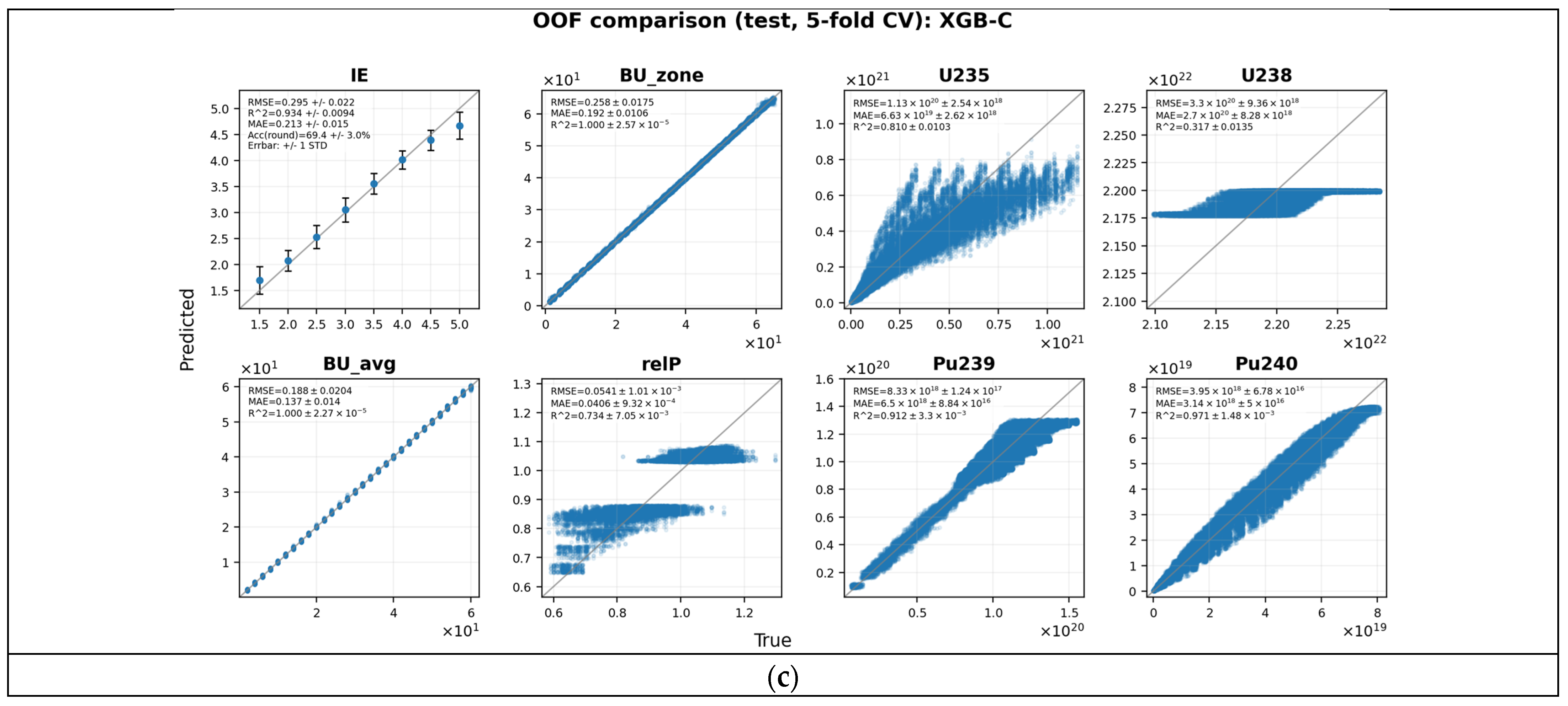
Figure 13, Figure 14 and Figure 15 summarize the test results of all models and their respective methods for the test set prediction points in the grouped 5-fold CV (OOF). The number of samples in the test set for each fold is approximately 8400. Using the ideal reference line y = x, this helps to identify the prediction errors. To avoid relying solely on a single graphical judgment in multi-output tasks, each figure simultaneously reports the evaluation metrics MAE, RMSE and R2, while the nuclide number density reports the relative error indicator MAPE separately.
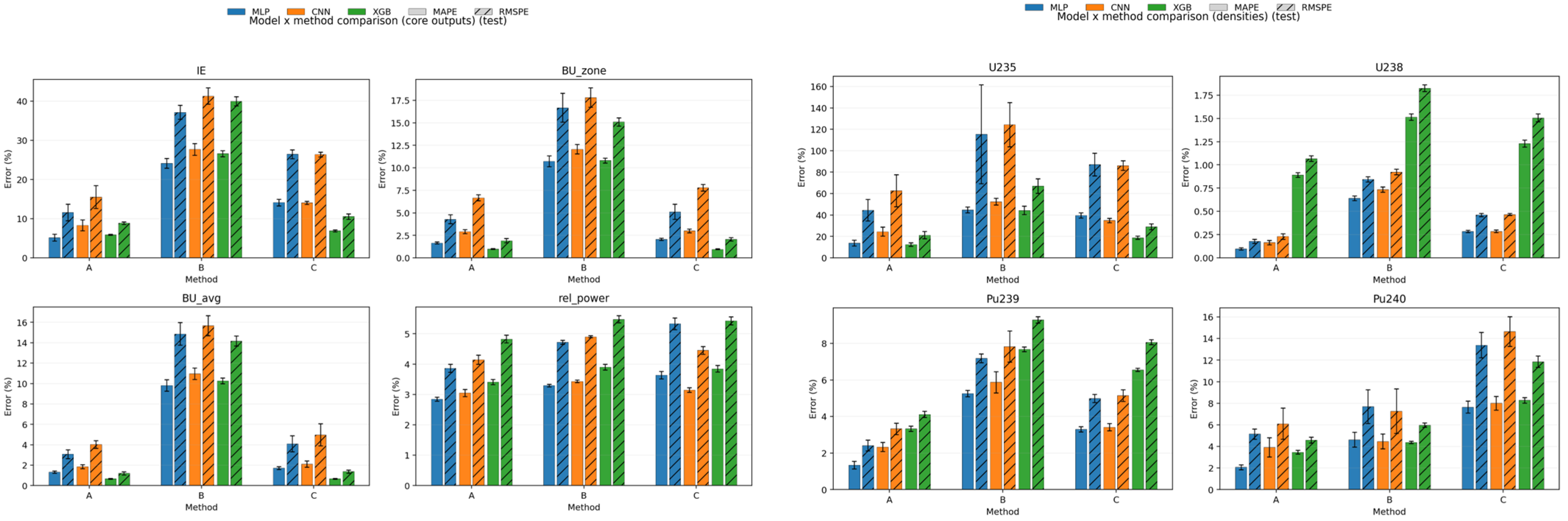
The MAE and MAPE of the training and test sets for each model and method are presented in Table 6 and Table 7. The 5-fold cross-validation error indicators of the training and test sets are basically the same, and there is basically no overfitting phenomenon. The bar charts showing the mean values and error bars (one standard deviation) of the test set MAPE and RMSPE for all models and methods are given, as shown in Figure 16.
Regarding the predicted value of the initial enrichment IE, since the true value points calculated in this study are discrete set points, 1.5, 2.0, 2.5, 3.0, 3.5, 4.0, 4.5, and 5.0 wt%, the aggregated point of the predicted value mean is used along with the error bars of the standard deviation to display the fitting accuracy and the dispersion degree of the predicted samples from the mean value, and the ACC (round) is defined: project the consecutive predicted values onto the nearest IE truth values and calculate the grade hit rate. The 25%–75% interval proportion of the IQR (Interquartile Range) is given and presented in the figure; the remaining predicted values are displayed in the form of scatter plots. The three methods of the MLP model are shown in Figure 13, the CNN model is shown in Figure 14, and XGBoost is shown in Figure 15.

5.2. Axial-Segment Burnup and Average Burnup Prediction

From the comparison of the OOF test results, it can be concluded that the three models exhibit good monotonic consistency in the output related to burnup (BU_zone and BU_avg). Among them, the prediction accuracy of the methods A and C of each model is very high. Among them, XGBoost-C and MLP-A, which have the highest prediction accuracy for BU_zone, have an MAE of only 0.1634 ± 0.016 and 0.2257 ± 0.011 in the test set, and MAPE of only 0.96% and 1.67%. The reason why XGBoost-C outperforms Method A is that Method A introduces 154Eu/137Cs, which provides a strong energy spectrum sensitive signal. However, it offers limited incremental information for BU_zone and amplifies the heteroscedasticity and clustering structure of the input–output relationship. Tree models are more prone to over-splitting for such structures, thereby reducing the generalization ability across groups.
When Method B lacks the absolute scale activity constraint of the burnup indicator nuclide 137Cs, in certain operating conditions such as a long CT, the activity ratio approaches saturation, resulting in a decrease in the amount of information and a significant decline in the identifiability of the inversion. The MAE range of the BU_zone prediction of the three models in Method B is between 2.45 and 2.85, and the MAPE is around 10%. The CNN model performed the worst. This might be because the training data table itself does not have a natural spatial structure where the adjacent features are equivalent to local correlations. Moreover, the CNN pooling layer leads to information compression, which is also one of the reasons for the reduced prediction accuracy. After the removal of 137Cs, the standard deviations of MAE and RMSE for the XGBoost model significantly increased. This was due to the fact that the tree model was more likely to fit the training set with some accidental correlated splits, resulting in high variance and unstable generalization. As a result, the differences in errors across different folds were greater, and the standard deviation reached its maximum. For the inversion of BU_avg, the optimal result was also obtained by XGBoost-C (MAE = 0.115 ± 0.017), and the fluctuations between folds were very small; the MLP-A model came second.
Overall, in the inversion task related to burnup (BU_zone and BU_avg), the XGBoost model based on tabular learning performed the most stably and optimally. The MLP model was slightly inferior. However, in Method B, due to the absence of the burn rate indicator nuclide 137Cs, the inversion accuracy of all three models significantly decreased. XGBoost-C was the best solution among them, and MLP-A had a relatively high fitting accuracy. The CNN model was the worst.

5.3. Initial Enrichment and Axial Relative Power Prediction

Based on the results of the OOF test, the optimal MAE of IE was provided by MLP-A (0.139 ± 0.019), but the RMSE was slightly larger (0.259 ± 0.034), indicating that there were a few samples with large errors, which made the quadratic error more sensitive to these errors. XGBoost-Second best MAE = (0.154 ± 0.017, RMSE = 0.199 ± 0.0227); however, from the perspective of the MAPE, MLP-A is the best, with a relative percentage deviation of only 5.2%.
The IE error of Method B significantly increased (MAE approximately 0.62–0.70, MAPE approximately 24.17%–27.69%), which is consistent with the physical mechanism; that is, when the cooling time is longer, the decay of short-lived nuclide 134Cs is significant and the activity ratio tends to saturate. The input features have a lower degree of distinction for IE, and the model is more likely to exhibit a tendency to shrink towards the middle value, thereby resulting in a small number of outliers and higher inter-point fluctuations. Overall, for the inversion of IE, Method A should be given priority (that is, maintaining the absolute scale constraint of 137Cs activity and supplemented with the spectral sensitive feature 154Eu). Among them, XGBoost-A has a greater advantage in terms of stability and RMSE.
The axial relative power (rel_P) is a dimensionless output with a relatively concentrated range of values, and its mapping relationship is closer to a multi-feature joint regression problem. The errors of the three models on rel_P are small overall and the fluctuations within the range are limited, indicating that the generalization uncertainty of this output is lower than that of the inversion of BU and IE. Based on the test set, the optimal solution is MLP-A (MAE = 0.0276 ± 0.0006, RMSE = 0.0368 ± 0.0009), followed by CNN-A (RMSE = 0.0391 ± 0.0012).
Furthermore, Method B of rel_P did not experience the significant degradation seen in BU and IE. The main information source of rel_P does not entirely rely on the absolute scale of 137Cs activity, but rather depends more on the comprehensive characterization of power and neutron energy spectrum effects through multiple input features. Therefore, in the rel_P prediction, Method A remains the most stable configuration. However, the differences in structure brought about by different models have a relatively mild impact on this output. Thus, Method B can also be used as the main method for inversion.

5.4. Prediction of Actinide Nuclide Number Density

The number density of actinide nuclides falls into the category of outputs with a wide range of magnitude and significant differences in the sensitivity of different nuclides to neutron energy spectra and burnup history. Therefore, the logarithmic error indicator MAPE is used for evaluation to avoid the misleading influence of absolute units on the perception of errors. The OOF test results indicate that among the three models, Method A has the best overall performance and stability for the four nuclides; Method B significantly amplifies the relative error and increases the inter-measurement fluctuation, reflecting that in the absence of the absolute scale constraint of 137Cs activity, it is difficult to stably depict the evolution information of the actinide nuclides solely based on the ratio characteristics.
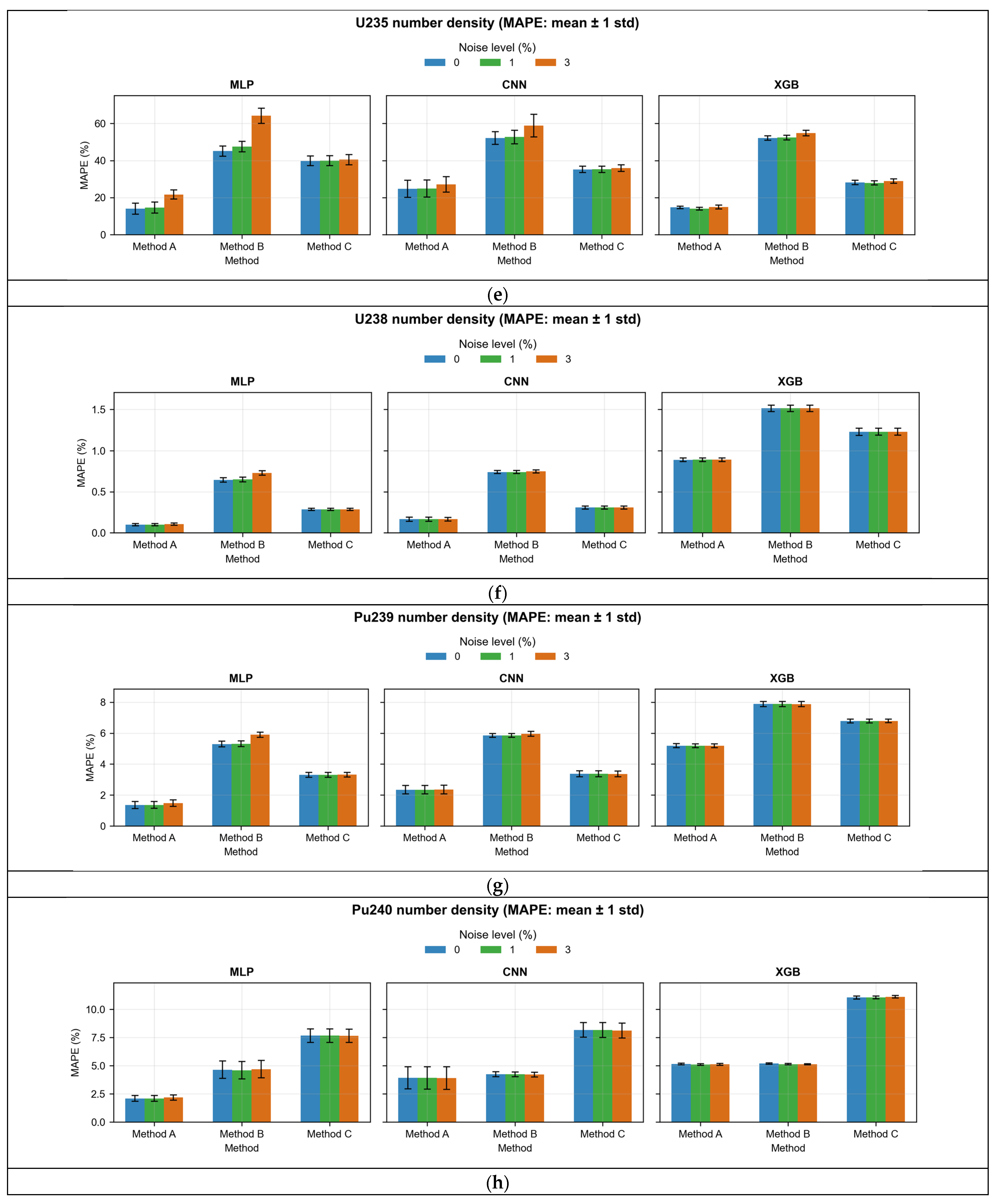
It should be noted that 235U will be significantly depleted at low initial enrichment and in the later stage of high burnup. Its density in some samples is close to a lower level. At this point, the MAPE and RMSPE in the linear space will be amplified due to the smaller denominator, leading to seemingly larger relative errors that are not entirely equivalent to model failure. To more accurately depict the deviation in the context of multiples, the MAE of the number density of 235U in the log10 space is further reported, as shown in Table 8. Based on the test set, the optimal result for 235U was obtained by XGBoost-A (MAPE = 12.49 ± 1.58%, RMSPE = 21.30 ± 3.34%), and the corresponding log10-MAE was 0.0540 ± 0.0019, indicating that the model has good consistency in the multiple scale. In contrast, Method B, which lacks the absolute scale constraint of 137Cs activity, saw its log-MAE increase to 0.1714 on the test set, indicating a significant increase in multiplicative error and a weaker degree of distinguishability; the log-MAE of the MLP-A model on the test set was 0.0506, which was better than that of XGBoost-A, but its RMSPE of 42.24 was twice that of XGBoost-A. The difference between the two can be clearly seen in Figure 16.
In contrast, the variation range of the number density of 238U is relatively gentle and the true value is not easily close to zero. Therefore, its relative error indicator is more stable. The optimal result is given by MLP-A (238U: MAPE = 0.0979 ± 0.0128%, RMSPE = 0.1778 ± 0.0219%). However, the three methods of the XGBoost model present a clearly horizontal band-like structure for the parity diagram of 238U, indicating that XGBoost compresses the dynamic range of 238U and shows a tendency towards mean reversion. The reason is that the 238U dataset itself has relatively small variations, while the main training input features are highly sensitive to fuel burnup, cooling time, and parameters related to the neutron energy spectrum. However, they provide limited identifiable information about the subtle consumption of 238U. The tree model tends to approximate with the mean values of a few leaf nodes, resulting in a horizontal band-like distribution shown in Figure 15. This leads to a poorer fitting effect compared to the CNN and MLP models, but its MAPE remains within the 1% range.
For the 239Pu and 240Pu related to proliferation, the overall model error was within the controllable range, and Method A was significantly superior to B. Among them, MLP-A was the best in terms of the MAPE (239Pu: 1.34 ± 0.20%; 240Pu: 2.07 ± 0.23%), while the RMSPE of 240Pu was best provided by XGBoost-A (4.60 ± 0.27%), indicating that the tree model has advantages in suppressing the amplification of extreme relative errors for some nuclides. Overall, the inversion of actinide nuclides should primarily adopt Method A. This method retains both the monotonic indication information of burnup and the spectral sensitivity auxiliary features, making it more stable in cross-condition grouping verification. Therefore, the model should preferentially adopt MLP.

5.5. Robustness to Gaussian Measurement Noise

To avoid data leakage and maintain consistency with the cross-validation evaluation, the noise test in this section conducts a robustness assessment on the out-of-fold (OOF) predictions of the grouped 5-fold cross-validation (CV). The OOF subsets from each fold are concatenated into a full OOF test set, serving as the benchmark for the global robustness evaluation. The noise model employs a log-domain Gaussian perturbation, and the measurement vector is denoted as follows:
z = A C s 137 , r C s 134 , r E u 154 ,   r C s 134 = A C s 134 / A C s 137 ,   r E u 154 = A E u 154 / A C s 137
Here, A C s 137 is the absolute activity of 137Cs, r C s 134 and r E u 154 are the activity ratios of 134Cs/137Cs and 154Eu/137Cs, respectively. For measurement errors, additive Gaussian noise in the log domain is adopted:
l n z = l n z + ε ,   ε N 0 , σ 2
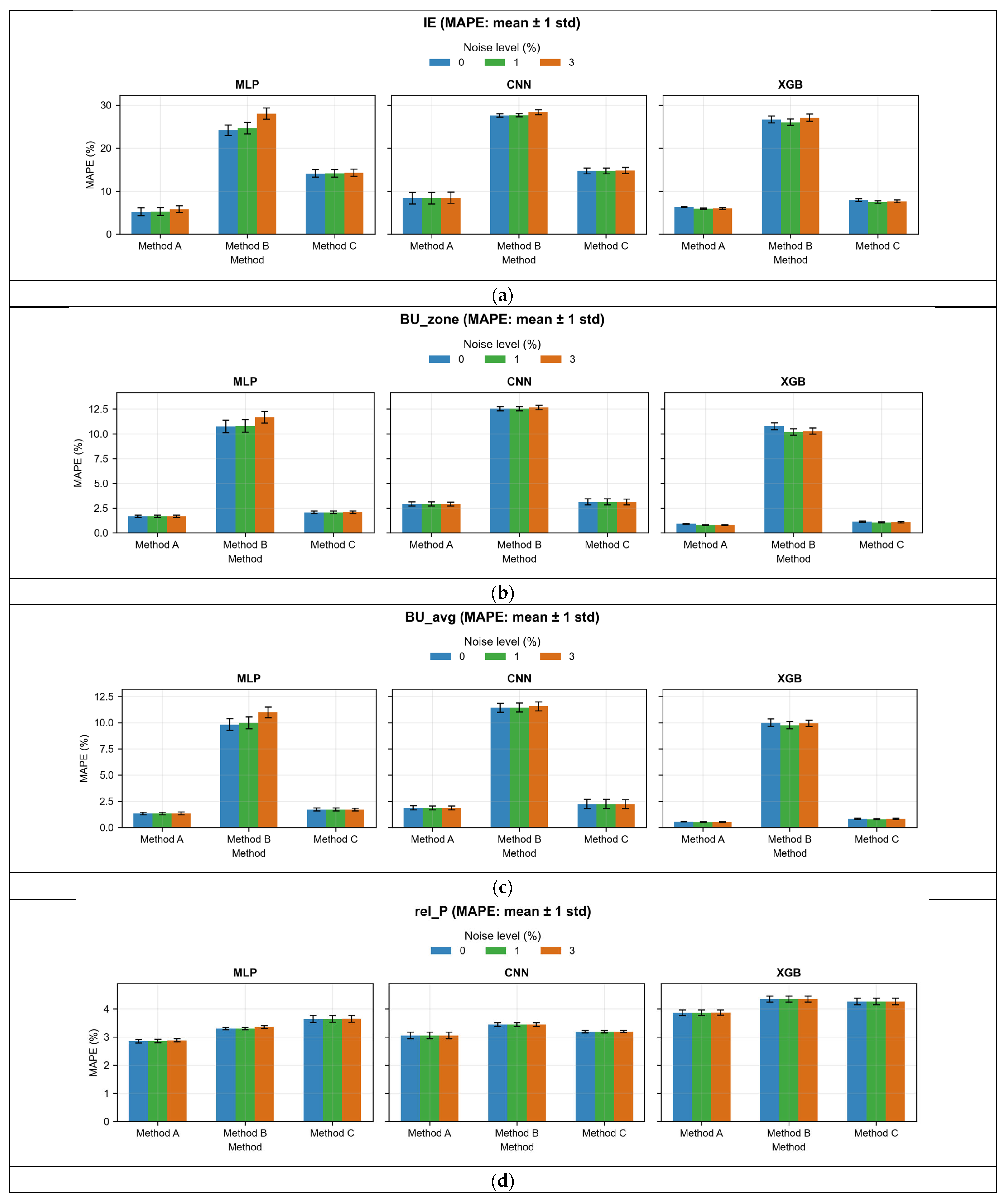
Noise levels σ of 1% and 3% were set, with a range of ±1.96   σ to cover the 95% confidence interval. The additive log-domain Gaussian noise is equivalent to a log-normal multiplicative error in the original physical domain. For each noise level, Monte Carlo sampling was performed on every out-of-fold (OOF) sample, drawing 200 noise realizations within the 95% interval. These perturbed inputs were then fed into the model to obtain predictions under noise-free (0%) and noisy (1%, 3%) conditions. The mean and standard deviation of the MAPE across the five OOF test folds were computed for each scenario, as presented in Figure 17.
Overall, under Gaussian input perturbations of 1%–3%, the degradation in global prediction accuracy for most outputs remained relatively modest. As the noise level increased from 0% to 3%, the increase in the MAPE for the three models under Method A and Method C was generally on the order of 1% to 1.5%. In contrast, Method B, which relies on feature sets lacking absolute scale information, proved more sensitive to noise, exhibiting an MAPE increase of up to 5%. For 235U number density predictions, the increase in the MAPE was somewhat larger. This is attributed to significant depletion under low initial enrichment and high burnup conditions, where number densities approach very low levels in certain samples. Nevertheless, under Method A and Method C, the MAPE increase at 3% perturbation remained within approximately 6.5%, with the corresponding MAE increase being comparable to that observed for other actinide nuclides, which is considered acceptable. In summary, the introduction of 1%–3% log-normal measurement noise did not lead to a significant degradation in the overall predictive accuracy of the surrogate models, thereby confirming their robustness.

6. Conclusions

This study focuses on the passive gamma spectrometry scenario for NDA inversion of spent fuel materials in pressurized water reactors. A typical axial characteristic sample database of a pressurized water reactor assembly was constructed using the OpenMC code. The input parameters for the calculation included the initial enrichment (IE) of the fuel assembly, cooling time (CT), hydrogen-to-uranium atomic ratio (H/U), burnup, and axial region of the assembly. In the axial partition calculation of assembly, the axial-segment burnup BU_zone is introduced to replace the average burnup BU_avg that might cause axial mismatch. This ensures the physical consistency from axial power to axial-segment burnup and ultimately to nuclide evolution.
In terms of the results of the OpenMC calculations, a sensitivity analysis of the hydrogen-to-uranium atomic ratio (H/U) for characteristic nuclides was provided, and the H/U sensitivity statistics for different burnup intervals were given in BU_zone bins. The results show that 137Cs has a significantly lower sensitivity to H/U under the same BU_zone compared to ratio-based features, making it a more stable monotonic indicator in burnup inversion, while 134Cs/137Cs and 154Eu/137Cs, which are sensitive to neutron energy spectra, are more sensitive to H/U and axial position; for some actinide nuclides, the change in H/U can be altered by the hardening and softening of the neutron energy spectrum, thereby showing stronger operating condition dependence under the same axial-segment burnup. Therefore, in the scenario where the goal is to conduct multi-nuclide joint inversion, the introduction of H/U and axial partitioning not only has physical significance but is also a necessary condition variable for enhancing the generalization stability across different operating conditions.
In terms of the training and evaluation of the surrogate model, this study aims at multi-output joint inversion. It compares the output prediction capabilities of MLP, CNN and XGBoost under different input feature schemes (Method A/B/C) for IE, BU_zone, BU_avg, as well as axial relative power rel_P and the number density of some actinide nuclides. The 5-fold cross-validation results of the training set and the test set indicate that the absolute scale constraint scheme of retaining the 137Cs activity (Method A/C) is significantly superior to Method B, which does not have this constraint; Method B has a decreased identifiable range in the interval where the activity ratio transformation has a gentle slope, resulting in a significant amplification of errors and inter-iteration fluctuations.
(1)
XGBoost is overall the best in axial-segment burnup and average burnup inversion and cross-folding stability, followed by MLP. The MAPE for burnup predictions using the XGBoost-C and MLP-A methods is less than 1.8%.
(2)
CNN’s overall performance is relatively limited due to the mismatch between the convolutional inductive bias and the tabular feature structure.
(3)
Under the condition of multiple input parameters in Method A, XGBoost is the best, followed by MLP, and CNN is the worst.
(4)
MLP-A has the best overall performance in the inversion of initial enrichment, with an MAPE of within 5.2% achieved by the MLP-A method for initial enrichment predictions; Method B’s performance in the prediction of the axial relative power coefficient is also acceptable, with an MAPE of within 3.2% for the rel_P predictions by MLP-B.
(5)
For the number density of actinides, except for the possible decrease in the true value of 235U in the later stage of high burnup leading to an amplification of the relative error, the MLP model has the highest accuracy and stability, with an MAPE of within 2.1% for actinide nuclides other than 235U by MLP-A, while that of MLP-C is within 7.7%.
(6)
MLP performs well under Method B, which is purely dominated by activity ratio input features, but has a larger deviation when the ratio information changes tend to saturate under long cooling times, and can be used as an inversion method for specific short cooling times. In general, MLP is the best overall in model performance.
Overall, this study provides a reproducible surrogate model training process and a performance baseline for the multi-output joint inversion of axial NDA signatures of spent fuel materials. This work establishes a physically interpretable foundation that provides a basis for subsequent feasibility studies in related engineering applications.

Author Contributions

Conceptualization, Q.Z. and Z.N.; methodology, Q.Z.; code development, Q.Z.; software computation, Q.Z., Z.N. and Q.H.; data curation, Q.Z. and Q.H.; formal analysis, Q.Z.; figure and table editing, Q.Z.; uncertainty quantification, Q.Z.; writing—original draft, Q.Z.; writing—review and editing, Z.N., C.Y. and Z.C.; supervision, Z.N., C.Y. and Z.C.; validation, C.Y. and Z.C.; manuscript revision, C.Y. All authors have read and agreed to the published version of the manuscript.

Funding

This research received no external funding.

Institutional Review Board Statement

Not applicable.

Informed Consent Statement

Not applicable.

Data Availability Statement

The data provided in this study can be obtained by contacting the corresponding author.

Acknowledgments

The authors extend gratitude to the editors and reviewers for their diligent work and valuable suggestions on this manuscript.

Conflicts of Interest

The authors declare no conflicts of interest.

References

  1. Darby, L.; Hansson, A.; Tisdell, C. Small-Scale Nuclear Energy: Environmental and Other Advantages and Disadvantages. Case Stud. Environ. 2020, 4, 1112327. [Google Scholar] [CrossRef]
  2. Energy White Paper: Powering our Net Zero Future; BEIS (Department for Business Energy and Industrial Strategy): London, UK, 2020.
  3. Detkina, A.; Litskevitch, D.; Peakman, A.; Merk, B. Criticality Analysis for BWR Spent Fuel Based on the Burnup Credit Evaluation from Full Core Simulations. Appl. Sci. 2021, 11, 1498. [Google Scholar] [CrossRef]
  4. Radaideh, M.I.; Price, D.; Kozlowski, T. Criticality and Uncertainty Assessment of Assembly Misloading in BWR Transportation Cask. Ann. Nucl. Energy 2018, 113, 1–14. [Google Scholar] [CrossRef]
  5. Bevard, B.B.; Wagner, J.C.; Parks, C.V.; Aissa, M. Review of Information for Spent Nuclear Fuel Burnup Confirmation; NUREG/CR-6998 (ORNL/TM-2007/229); U.S. Nuclear Regulatory Commission: Washington, DC, USA, 2009. [Google Scholar]
  6. Bevard, B.B.; Giaquinto, J.; Ilas, G.; Gauld, I. Status Update on the High Precision Isotopic Measurements on High Burnup LWR Fuel in 2020; ORNL/SPR-2020/1762; Oak Ridge National Laboratory: Oak Ridge, TN, USA, 2020. [Google Scholar] [CrossRef]
  7. Kaplan-Trahan, A.C.; Belian, A.P.; Croce, M.; Henzlova, D.C.; Jansson, P.; Long, G.; McMath, G.E.; Phillips, J.R.; Rapisarda, E.; Root, M.A.; et al. Spent Fuel Measurements. In Nondestructive Assay of Nuclear Materials for Safeguards and Security; Geist, W.H., Santi, P.A., Swinhoe, M.T., Eds.; Springer: Cham, Switzerland, 2024. [Google Scholar] [CrossRef]
  8. Bowen, D.G. Background and Overview of the ANSI/ANS-8.28 Non-Destructive Assay Standard for Nuclear Criticality Safety; Oak Ridge National Laboratory: Oak Ridge, TN, USA.
  9. Trellue, H.R.; McMath, G.E.; Trahan, A.C.; Favalli, A.; Burr, T.L.; Sjöland, A.; Backstrom, K. Integrated Characterization of Irradiated Fuel Using Active Neutron, Passive Neutron, and Passive Gamma Measurements Coupled with Machine Learning. Nucl. Instrum. Methods Phys. Res. A 2021, 988, 164937. [Google Scholar] [CrossRef]
  10. Favalli, A.; Vo, D.; Grogan, B.; Jansson, P.; Liljenfeldt, H.; Mozin, V.; Schwalbach, P.; Sjöland, A.; Tobin, S.J.; Trellue, H.R.; et al. Determining Initial Enrichment, Burnup, and Cooling Time of Pressurized-Water-Reactor Spent Fuel Assemblies by Analyzing Passive Gamma Spectra Measured at the Clab Interim-Fuel Storage Facility in Sweden. Nucl. Instrum. Methods Phys. Res. A 2016, 820, 102–111. [Google Scholar] [CrossRef]
  11. Hellesen, C.; Grape, S.; Jansson, P.; Jacobsson Svärd, S.; Åberg Lindell, M.; Andersson, P. Nuclear Spent Fuel Parameter Determination Using Multivariate Analysis of Fission Product Gamma Spectra. Ann. Nucl. Energy 2017, 110, 886–895. [Google Scholar] [CrossRef]
  12. Jang, J.; Kong, C.; Ebiwonjumi, B.E.; Jo, Y.; Lee, D. Uncertainties of PWR Spent Nuclear Fuel Isotope Inventory for Back-End Cycle Analysis with STREAM/RAST-K. Ann. Nucl. Energy 2021, 158, 108267. [Google Scholar] [CrossRef]
  13. Bachmann, A.M.; Coble, J.B.; Skutnik, S.E. Comparison and Uncertainty of Multivariate Modeling Techniques to Characterize Used Nuclear Fuel. Nucl. Instrum. Methods Phys. Res. Sect. A 2021, 991, 164994. [Google Scholar] [CrossRef]
  14. Albà, A.; Adelmann, A.; Münster, L.; Rochman, D.; Boiger, R. Fast Uncertainty Quantification of Spent Nuclear Fuel with Neural Networks. Ann. Nucl. Energy 2024, 196, 110204. [Google Scholar] [CrossRef]
  15. Grape, S.; Branger, E.; Elter, Z.; Pöder Balkeståhl, L. Determination of Spent Nuclear Fuel Parameters Using Modelled Signatures from Non-Destructive Assay and Random Forest Regression. Nucl. Instrum. Methods Phys. Res. Sect. A 2020, 969, 163979. [Google Scholar] [CrossRef]
  16. Bae, J.W.; Rykhlevskii, A.; Chee, G.; Huff, K.D. Deep Learning Approach to Nuclear Fuel Transmutation in a Fuel Cycle Simulator. Ann. Nucl. Energy 2020, 139, 107230. [Google Scholar] [CrossRef]
  17. Romano, P.K.; Forget, B. The OpenMC Monte Carlo Particle Transport Code. Ann. Nucl. Energy 2013, 51, 274–281. [Google Scholar] [CrossRef]
  18. Novac, O.-C.; Chirodea, M.C.; Novac, C.M.; Bizon, N.; Oproescu, M.; Stan, O.P.; Gordan, C.E. Analysis of the Application Efficiency of TensorFlow and PyTorch in Convolutional Neural Network. Sensors 2022, 22, 8872. [Google Scholar] [CrossRef] [PubMed]
  19. Isabona, J.; Imoize, A.L.; Ojo, S.; Karunwi, O.; Kim, Y.; Lee, C.-C.; Li, C.-T. Development of a Multilayer Perceptron Neural Network for Optimal Predictive Modeling in Urban Microcellular Radio Environments. Appl. Sci. 2022, 12, 5713. [Google Scholar] [CrossRef]
  20. Gu, J.; Wang, Z.; Kuen, J.; Ma, L.; Shahroudy, A.; Shuai, B.; Liu, T.; Wang, X.; Wang, G.; Cai, J.; et al. Recent Advances in Convolutional Neural Networks. Pattern Recognit. 2018, 77, 354–377. [Google Scholar] [CrossRef]
  21. Chen, T.; Guestrin, C. XGBoost: A Scalable Tree Boosting System. In Proceedings of the 22nd ACM SIGKDD International Conference on Knowledge Discovery and Data Mining, San Francisco, CA, USA, 13–17 August 2016; pp. 785–794. [Google Scholar] [CrossRef]
  22. Wang, L.; Zhang, C.; Wang, W.; Deng, T.; Ma, T.; Shuai, P. Slope Stability Assessment Using an Optuna-TPE-Optimized CatBoost Model. Eng 2025, 6, 185. [Google Scholar] [CrossRef]
  23. Lai, J.-P.; Lin, Y.-L.; Lin, H.-C.; Shih, C.-Y.; Wang, Y.-P.; Pai, P.-F. Tree-Based Machine Learning Models with Optuna in Predicting Microfluidic Electrical Impedance. Micromachines 2023, 14, 265. [Google Scholar] [CrossRef] [PubMed]
  24. Kirchknopf, P.; Almási, I.; Radócz, G.; Nemes, I.; Völgyesi, P.; Szalóki, I. Determining Burnup, Cooling Time and Operational History of VVER-440 Spent Fuel Assemblies Based on In-Situ Gamma Spectrometry at Paks Nuclear Power Plant. Ann. Nucl. Energy 2022, 170, 108975. [Google Scholar] [CrossRef]
  25. Tran, T.N.; Khushvaktov, J.H.; Kryachko, I.A.; Stegailov, V.I.; Tyutyunnikov, S.I.; Abduvaliev, A.A. Study of the Effect of Photon Self-Absorption on the Detection Efficiency of HPGe Detector in Measurements of an Activated Uranium Sample. Appl. Radiat. Isot. 2023, 196, 110770. [Google Scholar] [CrossRef]
  26. Ni, Z.; Chen, X.; Xie, J.; Wasaye, M.A.; Yu, T. Quantitative Analysis Study of Effects of Nuclide Concentration Uncertainties on Biases and Bias Uncertainties in Criticality Calculation Method. Energies 2023, 16, 7378. [Google Scholar] [CrossRef]
  27. Roque, B.; Marimbeau, P.; Grouiller, J.-P.; Tsilanizara, A.; Huynh, T.D. Depletion Calculation Benchmark Devoted to Fuel Cycle Issues: Specification for Phase 1 (Takahama-3 PIE); Assemblies NT3G23/NT3G24; OECD Nuclear Energy Agency: Paris, France, 2004. [Google Scholar]
  28. Khlifa, R.H.; Nikitenkov, N.N.; Kudiiarov, V.N. On the Use of Chromium Coating for Inner-Side Fuel Cladding Protection: Thickness Identification Based on Fission Fragments Implantation and Damage Profile. Coatings 2021, 11, 710. [Google Scholar] [CrossRef]
  29. Nakahara, Y.; Suyama, K.; Suzaki, T. (Eds.) Technical Development on Burn-Up Credit for Spent LWR Fuels; JAERI-Tech 2000-071; Japan Atomic Energy Research Institute (JAERI): Ibaraki, Japan, 2000. [Google Scholar]
  30. Romano, P.K.; Horelik, N.E.; Herman, B.R.; Nelson, A.G.; Forget, B.; Smith, K. OpenMC: A State-of-the-Art Monte Carlo Code for Research and Development. Ann. Nucl. Energy 2015, 82, 90–97. [Google Scholar] [CrossRef]
  31. Puth, M.-T.; Neuhäuser, M.; Ruxton, G.D. Effective Use of Spearman’s and Kendall’s Correlation Coefficients for Association between Two Measured Traits. Anim. Behav. 2015, 102, 77–84. [Google Scholar] [CrossRef]
  32. Bühlmann, P.; Yu, B. Boosting with the L2 Loss: Regression and Classification. J. Am. Stat. Assoc. 2003, 98, 324–340. [Google Scholar] [CrossRef]
Figure 1. (left): Fuel assembly; (right): SNF assembly.
Coatings 16 00329 g001
Figure 2. Gamma energy spectrum of one side of an SNFA [24].
Coatings 16 00329 g002
Figure 3. Geometric distribution of fuel assembly.
Coatings 16 00329 g003
Figure 4. (Left): the 1/16 assembly calculation model; (mid): rod pitch 1.25 and 1.41 cm; (right): axially symmetric uniform 5 zones.
Coatings 16 00329 g004
Figure 5. H/U = 3.3, CT = 0 years, zone 1, 137Cs activity vs. average fuel burnup under different IE conditions. (a) 137Cs activity vs. average fuel burnup under different IE conditions. (b) 137Cs activity vs. axial-segment burnup under different IE conditions.
Coatings 16 00329 g005
Figure 6. IE = 1.5, 3, 5; H/U = 3.3, CT = 0 axial-segment burnup vs. assembly-average burnup distribution. (a) IE = 1.5 wt%, axial-segment burnup vs. assembly-average burnup distribution. (b) IE = 3 wt%, axial-segment burnup vs. assembly-average burnup distribution. (c) IE = 5 wt%, axial-segment burnup vs. assembly-average burnup distribution.
Coatings 16 00329 g006
Figure 7. IE = 3, H/U = 3.3, and CT = 0, the axial relative power distribution under different average burnup values.
Coatings 16 00329 g007
Figure 8. H/U = 3.3, CT = 0, zone 1, different IE target nuclide characteristic values vs. axial-segment burnup. (a) H/U = 3.3, zone 1, CT = 0,134Cs activities vs. axial-segment burnup under different IE conditions. (b) H/U = 3.3, zone 1, CT = 0,137Cs activities vs. axial-segment burnup under different IE conditions. (c) H/U = 3.3, zone 1, CT = 0,154Eu activities vs. axial-segment burnup under different IE conditions. (d) H/U = 3.3, zone 1, CT = 0,235U number densities vs. axial-segment burnup under different IE conditions. (e) H/U = 3.3, zone 1, CT = 0,238U number densities vs. axial-segment burnup under different IE conditions. (f) H/U = 3.3, zone 1, CT = 0,239Pu number densities vs. axial-segment burnup under different IE conditions.
Coatings 16 00329 g008
Figure 9. H/U = 3.3, IE = 3, zone 1, 137Cs, 134Cs/137Cs, 154Eu/137Cs vs. cooling time (years) under different axial-segment BU conditions. (a) H/U = 3.3, IE = 3, zone 1,137Cs activities vs. cooling time (years) under different BU conditions. (b) H/U = 3.3, IE = 3, zone 1,134Cs/137Cs ratio vs. cooling time (years) under different BU conditions. (c) H/U = 3.3, IE = 3, zone 1,154Eu/137Cs ratio vs. cooling time (years) under different BU conditions.
Coatings 16 00329 g009
Figure 10. When IE = 3, zone 1, CT = 0, the characteristics of the target nuclide vs. axial-segment burnup under different H/U conditions. (a) IE = 3, zone 1, CT = 0,134Cs activities vs. axial-segment burnup under different H/U conditions. (b) IE = 3, zone 1, CT = 0,137Cs activities vs. axial-segment burnup under different H/U conditions. (c) IE = 3, zone 1, CT = 0,154Eu activities vs. axial-segment burnup under different H/U conditions. (d) IE = 3, zone 1, CT = 0,235U number densities vs. axial-segment burnup under different H/U conditions. (e) IE = 3, zone 1, CT = 0,238U number densities vs. axial-segment burnup under different H/U conditions. (f) IE = 3, zone 1, CT = 0,239Pu number densities vs. axial-segment burnup under different H/U conditions.
Coatings 16 00329 g010
Figure 11. Sensitivity analysis results of the response under different H/U conditions when IE = 3, zone 1, and CT = 0.
Coatings 16 00329 g011
Figure 12. The Spearman correlation coefficient matrix of all relevant quantities.
Coatings 16 00329 g012
Figure 13. Parity plots of the OOF (out-of-fold) validation test set for the three methods of the MLP model; left (IE, BU_zone, BU_avg, rel_P); right (density). (a) Parity plots of the OOF validation test predictions; MLP model; Method A; left(IE, BU_zone, BU_avg, rel_P); right(density). (b) Parity plots of the OOF validation test predictions; MLP model; Method B; left(IE, BU_zone, BU_avg, rel_P); right(density). (c) Parity plots of the OOF validation test predictions; MLP model; Method C; left(IE, BU_zone, BU_avg, rel_P); right(density).
Coatings 16 00329 g013aCoatings 16 00329 g013b
Figure 14. Parity plots of the OOF (out-of-fold) validation test set for the three methods of the CNN model; left (IE, BU_zone, BU_avg, rel_P); right (density). (a) Parity plots of the OOF validation test predictions; CNN model; Method A; left(IE, BU_zone, BU_avg, rel_P); right(density). (b) Parity plots of the OOF validation test predictions; CNN model; Method B; left(IE, BU_zone, BU_avg, rel_P); right(density). (c) Parity plots of the OOF validation test predictions; CNN model; Method C; left(IE, BU_zone, BU_avg, rel_P); right(density).
Coatings 16 00329 g014
Figure 15. Parity plots of the OOF (out-of-fold) results of the 3 methods of the XGBoost model for the 5-fold cross-validation test set; left (IE, BU_zone, BU_avg, rel_P); right (density). (a) Parity plots of the OOF validation test predictions; XGBoost model; Method A; left(IE, BU_zone, BU_avg, rel_P); right(density). (b) Parity plots of the OOF validation test predictions; XGBoost model; Method B; left(IE, BU_zone, BU_avg, rel_P); right(density). (c) Parity plots of the OOF validation test predictions; XGBoost model; Method C; left(IE, BU_zone, BU_avg, rel_P); right(density).
Coatings 16 00329 g015aCoatings 16 00329 g015b
Figure 16. MAPE and RMSPE values ± 1σ for the A/B/C methods of the three models; left (IE, BU_zone, BU_avg, rel_P); right (density).
Coatings 16 00329 g016
Figure 17. Under Gaussian noise perturbations of 0%, 1%, and 3%, the MAPE values ± 1σ on the OOF test (5 folds) set for the three models with Methods A, B, and C. (IE, BU_zone, BU_avg, rel_P, density). (a) MAPE ± 1σ for IE under Gaussian noise perturbations of 0%, 1%, and 3%, Methods A, B, C; MLP, CNN, XGBoost model. (b) MAPE ± 1σ for BU_zone under Gaussian noise perturbations of 0%, 1%, and 3%, Methods A, B, C; MLP, CNN, XGBoost model. (c) MAPE ± 1σ for BU_avg under Gaussian noise perturbations of 0%, 1%, and 3%, Methods A, B, C; MLP, CNN, XGBoost model. (d) MAPE ± 1σ for rel_P under Gaussian noise perturbations of 0%, 1%, and 3%, Methods A, B, C; MLP, CNN, XGBoost model. (e) MAPE ± 1σ for 235U under Gaussian noise perturbations of 0%, 1%, and 3%, Methods A, B, C; MLP, CNN, XGBoost model. (f) MAPE ± 1σ for 238U under Gaussian noise perturbations of 0%, 1%, and 3%, Methods A, B, C; MLP, CNN, XGBoost model. (g) MAPE ± 1σ for 239Pu under Gaussian noise perturbations of 0%, 1%, and 3%, Methods A, B, C; MLP, CNN, XGBoost model. (h) MAPE ± 1σ for 240Pu under Gaussian noise perturbations of 0%, 1%, and 3%, Methods A, B, C; MLP, CNN, XGBoost model.
Coatings 16 00329 g017aCoatings 16 00329 g017b
Table 1. Geometric and material parameters of fuel assembly.
Parameter NameParameter Value
Assembly Lattice 17 × 17
Instrumentation Tube1
Guide Tubes24
Fuel Rods264
U O 2 Pellet Radius/cm0.4095
Fuel Rod Active Height/cm364.8
Cladding Outer Radius/cm0.475
Rod Pitch/cm1.25 1.26 1.29 1.32 1.35 1.38 1.41
Assembly Pitch/cm21.2 21.4 22.0 22.5 23.0 23.5 24.0
U O 2 Pellet Density/(g/ c m 3 )10.412
Zircaloy-4 Density/(g/ c m 3 )6.5
Coolant Density/(g/ c m 3 )0.6843
U O 2 Temperature/(K)877.15
Cladding Temperature/(K)600.0
Coolant Temperature/(K)583.85
Table 2. Median H/U sensitivity (%) across axial zones (Z1–Z5).
Signature NuclidesZone 1Zone 2Zone 3Zone 4Zone 5
137Cs2.211.772.090.872.55
134Cs/137Cs13.6513.2515.7513.6514.66
154Eu/137Cs26.8026.8527.8026.7225.53
235U24.2323.4316.2018.4111.61
238U0.370.350.430.380.31
239Pu33.2433.1732.4532.4728.33
240Pu9.9710.6311.4111.5210.93
Table 3. Maximum H/U sensitivity (%) across axial zones (Z1–Z5).
Signature NuclidesZone 1Zone 2Zone 3Zone 4Zone 5
137Cs3.184.152.432.614.38
134Cs/137Cs21.8620.2419.7022.0422.46
154Eu/137Cs30.7931.0431.2830.9027.00
235U85.0686.0587.2390.3556.02
238U0.630.600.590.520.45
239Pu43.6243.6543.6643.6838.04
240Pu19.3518.5117.5919.0022.38
Table 4. Methods for input and output parameters of the surrogate model.
MethodsInput ParametersOutput Parameters
Method A 137Cs, 134Cs /137Cs, 154Eu /137Cs, H/U, CT, ZoneIE, BU_zone, BU_avg, Density, rel_P
Method B134Cs /137Cs, 154Eu /137Cs, H/U, CT, ZoneIE, BU_zone, BU_avg, Density, rel_P
Method C137Cs, 134Cs /137Cs, H/U, CT, ZoneIE, BU_zone, BU_avg, Density, rel_P
Table 5. Search space of surrogate model hyperparameters and Optuna’s optimal hyperparameters.
Surrogate ModelHyperparameterSearch Space
(Optuna)
Best setting (Optuna)
Methods [A, B, C]
MLPhidden_dim{128, 256, 384, 512, 768, 1024} A = 1024; B = 256; C = 384
n_layers[1, 5]A = 2; B = 4; C = 1
dropout[0.0, 0.35]A = 0.03122; B = 0.2028; C = 0.1521
use_bnFalse, TrueA = False; B = False; C = False
batch_size{128, 256, 512, 1024, 2048} A = 256; B = 512; C = 1024
lr[1 × 10⁻⁵, 3 × 10⁻³]A = 1.734 × 10⁻⁴; B = 4.255 × 10⁻⁴; C = 1.513 × 10⁻³
weight_decay[1 × 10⁻⁸, 1 × 10⁻²] A = 4.626 × 10⁻³; B = 9.377 × 10⁻³; C = 4.974 × 10⁻⁸
max_epochs[120, 450]A = 232; B = 350; C = 366
patience[12, 45]A = 43; B = 40; C = 39
grad_clip[0.0, 5.0]A = 3.087; B = 0.7598; C = 1.536
CNNc1{16, 32, 64, 96}A = 64; B = 96; C = 96
c2{16, 32, 64, 128}A = 128; B = 128; C = 128
k1{2, 3, 5}A = 5; B = 5; C = 5
k2{2, 3, 5}A = 3; B = 3; C = 3
dropout[0.0, 0.35] A = 0.00833; B = 0.03063; C = 0.104
batch_size{128, 256, 512, 1024, 2048} A = 128; B = 128; C = 256
lr[1 × 10⁻⁵, 3 × 10⁻³]A = 2.539 × 10⁻³; B = 2.972 × 10⁻³; C = 1.766 × 10⁻³
weight_decay[1 × 10⁻⁸, 1 × 10⁻²]A = 3.010 × 10⁻⁸; B = 1.480 × 10⁻⁸; C = 4.994 × 10⁻⁶
max_epochs[120, 450]A = 264; B = 347; C = 135
patience[12, 45]A = 35; B = 20; C = 36
grad_clip[0.0, 5.0]A = 4.438; B = 1.315; C = 1.479
XGBoostn_estimators[300, 2000]A = 1823; B = 1862; C = 1700
max_depth[3, 10]A = 4; B = 9; C = 5
learning_rate[0.01, 0.2]A = 0.06444; B = 0.02314; C = 0.04509
subsample[0.6, 1.0]A = 0.7797; B = 0.653; C = 0.6427
colsample_bytree[0.6, 1.0]A = 0.8197; B = 0.9461; C = 0.985
min_child_weight[1.0, 20.0]A = 1.977; B = 5.093; C = 4.269
reg_alpha[1 × 10⁻⁸, 1 × 10⁻²]A = 5.213 × 10⁻⁶; B = 1.137 × 10⁻⁸; C = 2.508 × 10⁻⁴
reg_lambda[1 × 10⁻³, 10.0]A = 0.01726; B = 0.3293; C = 0.3774
gamma[0.0, 1.0]A = 0.05254; B = 0.4448; C = 0.3777
Table 6. Five-fold cross-validation scores (mean ± 1 std) for (IE, BU_zone, BU_avg, rel_P) using grouped CV. Lower values indicate better performance; the best values for the test set are highlighted in bold within each row.
MAE ± 1σ stdModelMLPCNNXGBoost
TargetMethodTrain–TestTrain–TestTrain–Test
IE A 0.1331 ±
0.015
0.1392 ±
0.019
0.2153 ±
0.029
0.2222 ±
0.029
0.1198 ±
0.00085
0.154 ±
0.017
B 0.6026 ±
0.017
0.6206 ±
0.021
0.6925 ±
0.022
0.7035 ±
0.025
0.3995 ±
0.0041
0.6372 ±
0.12
C 0.3598 ±
0.017
0.3639 ±
0.02
0.3632 ±
0.013
0.3709 ±
0.012
0.1416 ±
0.00094
0.1822 ±
0.02
BU_zone A 0.2234 ±
0.0098
0.2257 ±
0.011
0.4304 ±
0.022
0.4373 ±
0.021
0.1429 ±
0.0007
0.185 ±
0.021
B 2.381 ±
0.047
2.45 ±
0.056
2.808 ±
0.052
2.844 ±
0.072
1.422 ±
0.013
2.487 ±
0.52
C 0.2817 ±
0.007
0.281 ±
0.0083
0.4082 ±
0.013
0.4093 ±
0.012
0.1307 ±
0.00047
0.1634 ±
0.016
BU_avg A 0.1331 ±
0.015
0.1392 ±
0.019
0.2153 ±
0.029
0.2222 ±
0.029
0.1198 ±
0.00085
0.154 ±
0.017
B 0.6026 ±
0.017
0.6206 ±
0.021
0.6925 ±
0.022
0.7035 ±
0.025
0.3995 ±
0.0041
0.6372 ±
0.12
C 0.3598 ±
0.017
0.3639 ±
0.02
0.3632 ±
0.013
0.3709 ±
0.012
0.1416 ±
0.00094
0.1822 ±
0.02
rel_P A 0.02692 ±
0.00058
0.02763 ±
0.00058
0.02886 ±
0.00075
0.02952 ±
0.00099
0.03186 ±
0.00072
0.03257 ±
0.0008
B 0.03111 ±
0.00015
0.03152 ±
0.0004
0.03255 ±
0.00023
0.03287 ±
0.00049
0.03694 ±
0.00016
0.03722 ±
0.00082
C 0.03446 ±
0.00029
0.03461 ±
0.00099
0.02998 ±
0.00075
0.03033 ±
0.00061
0.03653 ±
0.00013
0.03678 ±
0.00089
Table 7. Five-fold cross-validation scores (mean ± 1std) for (actinide nuclides) using grouped CV. Lower values indicate better performance; the best values for the test set are highlighted in bold within each row.
MAPE ± 1σ stdModelMLPCNNXGBoost
TargetMethodTrain–TestTrain–TestTrain–Test
235UA13.2 ±
2%
13.9 ±
2.7%
23.7 ±
3.4%
24.6 ±
4.2%
9.47 ±
0.089%
12.5 ±
1.6%
B42.7 ±
1.5%
44.7 ±
2.7%
51.6 ±
3.1%
52.5 ±
3.1%
36.8 ±
0.096%
44.4 ±
3.8%
C39 ±
1.4%
39.7 ±
2.4%
34.2 ±
0.7%
34.9 ±
2%
16 ±
0.22%
18.8 ±
1.5%
238UA0.094 ±
0.011%
0.0979
± 0.013%
0.16 ±
0.024%
0.164 ±
0.022%
0.889 ±
0.0058%
0.893 ±
0.025%
B0.623 ±
0.02%
0.641 ±
0.025%
0.724 ±
0.02%
0.734 ±
0.028%
1.51 ±
0.0095%
1.51 ±
0.034%
C0.282 ±
0.0099%
0.285 ±
0.012%
0.28 ±
0.017%
0.286 ±
0.014%
1.23 ±
0.0067%
1.23 ±
0.038%
239PuA1.29 ±
0.18%
1.34 ±
0.2%
2.28 ±
0.27%
2.33 ±
0.25%
3.12 ±
0.031%
3.33 ±
0.15%
B5.1 ±
0.21%
5.26 ±
0.18%
5.79 ±
0.47%
5.88 ±
0.58%
7.54 ±
0.032%
7.68 ±
0.13%
C3.27 ±
0.11%
3.3 ±
0.14%
3.37 ±
0.14%
3.42 ±
0.2%
6.46 ±
0.053%
6.56 ±
0.091%
240PuA1.98 ±
0.2%
2.07 ±
0.23%
3.9 ±
0.91%
3.92 ±
0.89%
3.12 ±
0.018%
3.47 ±
0.18%
B4.55 ±
0.76%
4.63 ±
0.69%
4.4 ±
0.73%
4.46 ±
0.69%
4.18 ±
0.023%
4.38 ±
0.11%
C7.56 ±
0.6%
7.65 ±
0.55%
7.89 ±
0.59%
8.01 ±
0.63%
7.87 ±
0.054%
8.28 ±
0.26%
Table 8. Five-fold cross-validation log-MAE scores (mean ± 1 std) for 235U using grouped CV. Lower values indicate better performance; the best values for the test set are highlighted in bold within each row.
log-MAE ± 1σ stdModelMLPCNNXGBoost
TargetMethodTrain–TestTrain–TestTrain–Test
235UA0.04804 ±
0.005136
0.05056 ±
0.007708
0.08636 ±
0.008924
0.08946 ±
0.01117
0.03984 ±
0.000367
0.05401 ±
0.001966
B0.1524 ±
0.00241
0.1579 ±
0.001896
0.1732 ±
0.004889
0.1761 ±
0.00463
0.1424 ±
0.00049
0.1714 ±
0.001587
C0.136 ±
0.003288
0.1381 ±
0.006407
0.1156 ±
0.002769
0.1177 ±
0.004555
0.06571 ±
0.000898
0.07849 ±
0.002033
Disclaimer/Publisher’s Note: The statements, opinions and data contained in all publications are solely those of the individual author(s) and contributor(s) and not of MDPI and/or the editor(s). MDPI and/or the editor(s) disclaim responsibility for any injury to people or property resulting from any ideas, methods, instructions or products referred to in the content.