Article

Effect of Pressure and Temperature on the Microstructure and Vickers Microhardness of the CoCrFeMnNiAl1.5 Alloy During Conventional Sintering and High-Frequency Induction Sintering


by
Leonardo Baylón García
1,
José Manuel Mendoza Duarte
1,
Ivanovich Estrada Guel
1,*,
Audel Santos Beltrán
2,
Hansel Manuel Medrano Prieto
2,
Gustavo Rodríguez Cabriales
3,
Enrique Rocha Rangel
4,
José Luis Hernández Rivera
5,6,
Roberto Martínez Sánchez
1,
Alfredo Martínez García
1 and
Carlos Gamaliel Garay Reyes
1,*
1
Departamento de Metalurgia e Integridad Estructural, Centro de Investigación en Materiales Avanzados, Chihuahua 31136, Mexico
2
Departamento de Nanotecnología, Universidad Tecnológica de Chihuahua Sur, Km. 3.5 Carr. Chihuahua a Aldama, Chihuahua 31313, Mexico
3
Departamento de Metalmecánica, Tecnológico Nacional de México-Instituto Tecnológico de Chihuahua, Chihuahua 31310, Mexico
4
Departamento de Investigación y Posgrado, Universidad Politécnica de Victoria, Ciudad Victoria 87138, Mexico
5
Instituto de Metalurgia, Universidad Autónoma de San Luis Potosí, San Luis Potosí 78210, Mexico
6
Secretaría de Ciencia, Humanidades, Tecnología e Innovación (SECIHTI), Ciudad de México 03940, Mexico
*
Authors to whom correspondence should be addressed.
Coatings 2026, 16(3), 275; https://doi.org/10.3390/coatings16030275
Submission received: 28 January 2026 / Revised: 11 February 2026 / Accepted: 20 February 2026 / Published: 26 February 2026
(This article belongs to the Special Issue High-Entropy Alloy Films and Coatings)

Highlights

What are the main findings?
  • The HFIHS + HTH route allows the attainment of a finer microstructure.
  • The pressure applied in HFIHS favors the migration of atoms toward grain boundaries.
What are the implications of the main findings?
  • Microstructural control is more critical than densification for microhardness performance.
  • The HFIHS + HTH route produces high-entropy alloys with high mechanical properties.

Abstract

This study evaluates the effects of sintering time and applied pressure on the microstructure and Vickers microhardness of the CoCrFeMnNiAl1.5 alloy during consolidation. Samples were obtained by mechanical alloying and consolidated using two routes: conventional sintering (CS) and high-frequency induction sintering followed by high-temperature heating (HFIHS + HTH). For both methods, the pressure (0.3–1.5 GPa) and holding time (1–4 h) were varied. The results show that the HFIHS + HTS route produces a finer microstructure, with notably more homogeneous Cr segregation at high pressures, resulting in higher Vickers hardness values (up to 770 HV). In addition, the pressure applied during HFIHS promotes a mechanism of forced atomic mobility. This mechanism facilitates the migration of atoms toward energetically favorable sites, such as grain boundaries. At the same time, it restricts precipitate growth and Cr-rich segregation and activates densification mechanisms without requiring sustained pressure. The optimal parameters (0.9 GPa and 1 h) produce the best microstructural and mechanical response, highlighting the potential of this alloy for use in coatings and structural components in the automotive and aerospace industries.

1. Introduction

High-entropy alloys (HEAs) have attracted interest in the scientific community due to their exceptional combination of mechanical properties, thermal stability, and corrosion and wear resistance [1]. The equiatomic CoCrFeMnNi system, known as the Cantor alloy, exhibits a face-centered cubic (FCC) structure and high ductility and toughness [2]. However, the addition of aluminum induces the formation of body-centered cubic (BCC) and B2 phases, which significantly increase hardness and wear resistance but may compromise ductility [3]. Controlling element segregation during sintering is one of the biggest challenges in HEA processing due to significant differences in atomic radii and surface energies [4,5]. This segregation can lead to the formation of undesired secondary phases and heterogeneous microstructures and the degradation of mechanical properties [6]. Recent studies have shown that segregation intensifies in slow sintering routes [7,8]. Therefore, it is essential to optimize synthesis parameters such as applied pressure and sintering time. Recently, it has been shown that high-frequency induction heat sintering (HFIHS) enables the production of denser, finer structures than conventional sintering (CS) due to faster heat transfer and the simultaneous application of pressure and temperature [9,10]. This technique has demonstrated advantages in Al alloys [11,12] and in multicomponent systems [13,14].
Furthermore, it has been reported that consolidation by methods such as HFIHS and SPS improves chemical homogeneity and reduces porosity [15,16]. In contrast, conventional methods tend to favor grain growth and the grain’s coalescence [17,18]. Finally, HEAs with excellent hardness and toughness properties show potential for application in coatings and in the aerospace, nuclear, and transportation fields [19], and have even been proposed as materials for high-radiation environments [20] and extreme tribology [21]. For this reason, the importance of complex microstructure design [22] and of processing via mechanical alloying followed by alternative sintering methods [23] has been highlighted.
Thus, this study focuses on microstructural and mechanical analyses of the CoCrFeMnNiAl1.5 alloy obtained by mechanical alloying and processed by CS and HFIHS + HTH, with variation in pressure (0.3–1.5 GPa) and sintering time (1–4 h). The evolution of Cr segregation, microstructure, precipitate behavior, and hardness response is discussed as a function of synthesis conditions. The objective is to understand the phenomena involved and identify the optimal combination of processing parameters that maximizes mechanical performance while minimizing microstructural defects.

2. Materials and Methods

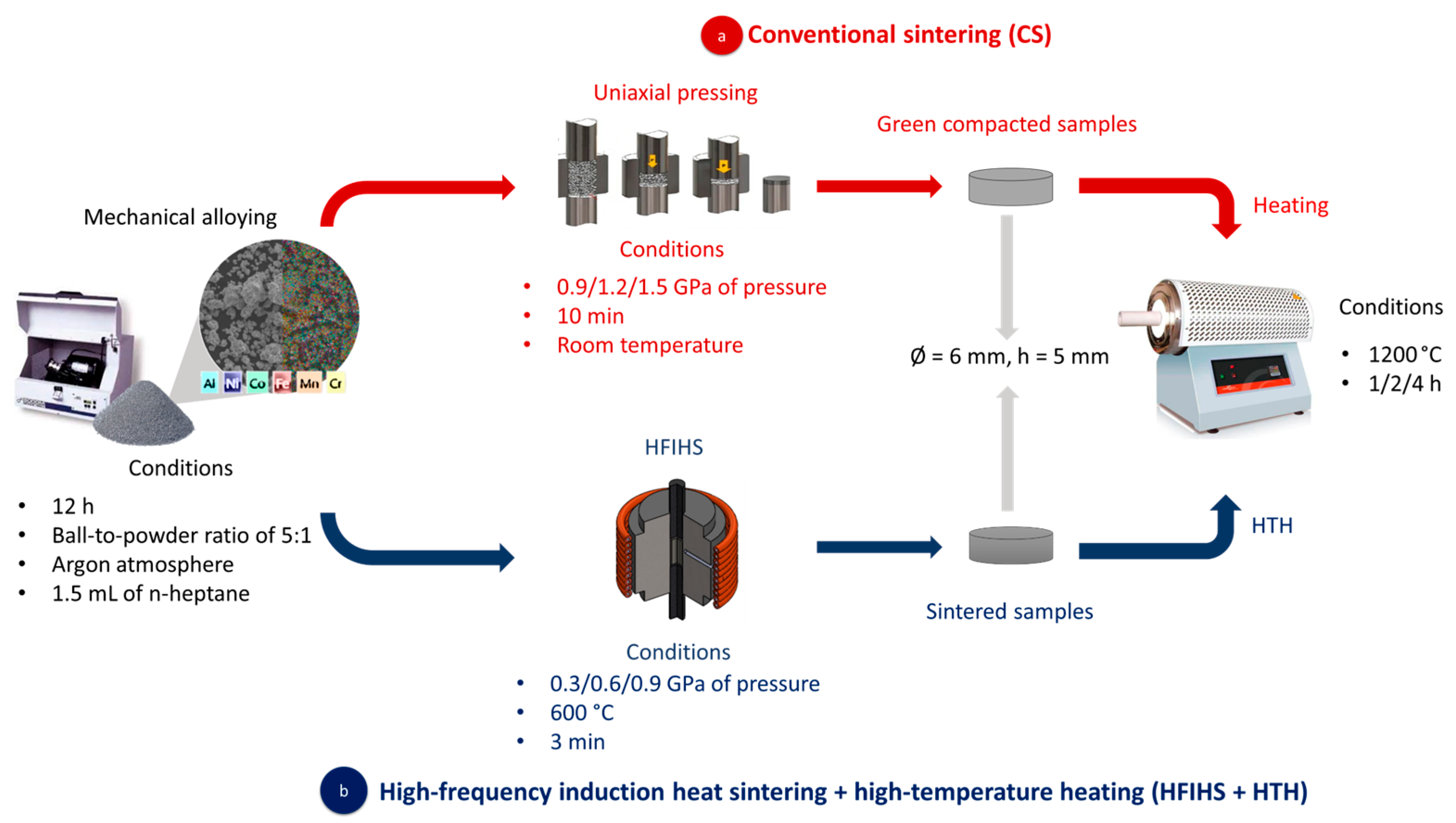
The CoCrFeMnNiAl1.5 alloy was obtained by mechanical alloying (MA) in a SPEX 8000M mill (SPEX SamplePrep, Metuchen, NJ, USA) for 12 h. Elemental powders with >99.5% purity (Sigma-Aldrich, Toluca, Mexico) were used as raw materials. A ball-to-powder ratio of 5:1, an argon atmosphere, and 1.5 mL of n-heptane as a process control agent were set as the conditions for all milling runs. Subsequently, the powders were consolidated through two routes (Figure 1):
(a)
Conventional sintering (CS): Green compaction was performed at room temperature by uniaxial pressing, using a hardened steel die for obtaining samples of Ø = 6 mm and h = 5 mm. Three different pressures—0.9, 1.2, and 1.5 GPa—were selected, with a 10 min dwell time under load to ensure the dimensional stability of the green compact. Green compacted samples were then consolidated by heating in a tube furnace. Samples were sealed in quartz tubes under vacuum and heated to 1200 °C for 1, 2, and 4 h using an STF 15/450 tube furnace from Carbolite (Sheffield, UK).
(b)
High-frequency induction heat sintering + high-temperature heating (HFIHS + HTH): Using the same hardened steel die as in the CS route, compaction was carried out by uniaxial pressure, at 0.3, 0.6, and 0.9 GPa and 600 °C for 3 min, to obtain cylindrical samples with identical dimensions (Ø = 6 mm, h = 5 mm). Next, samples were sealed in quartz tubes under vacuum and heated to 1200 °C for 1, 2, and 4 h using an STF 15/450 tube furnace from Carbolite (Sheffield, UK).
The experimental density was determined using Archimedes’ principle, as per ASTM B962–23 [24], employing distilled water and a Sartorius CP2254D high-precision electronic balance (Sartorius AG, Göttingen, Germany) (accuracy ± 0.1 mg). The microstructure was characterized using a Hitachi SU3500 scanning electron microscope (SEM) (Hitachi High-Tech Corporation, Tokyo, Japan) equipped with an energy-dispersive X-ray spectroscopy (EDS) detector. The crystalline phases were identified using X-ray diffraction (XRD) with a Panalytical X’Pert PRO diffractometer (Malvern Panalytical, Almelo, The Netherlands) (Cu Kα radiation, λ = 0.15406 nm, 40 kV, 35 mA). The Vickers microhardness was measured with a 0.1 kg load (15 s, 6 indentations) using an LM300AT Microindentation Hardness Tester (Leco, St Joseph, MI, USA). The chemical composition was verified using an inductively coupled plasma–optical emission spectrometer (ICP-OES; Thermo Scientific ICAP 6000 Series, Thermo Fisher Scientific, Waltham, MA, USA).

3. Results

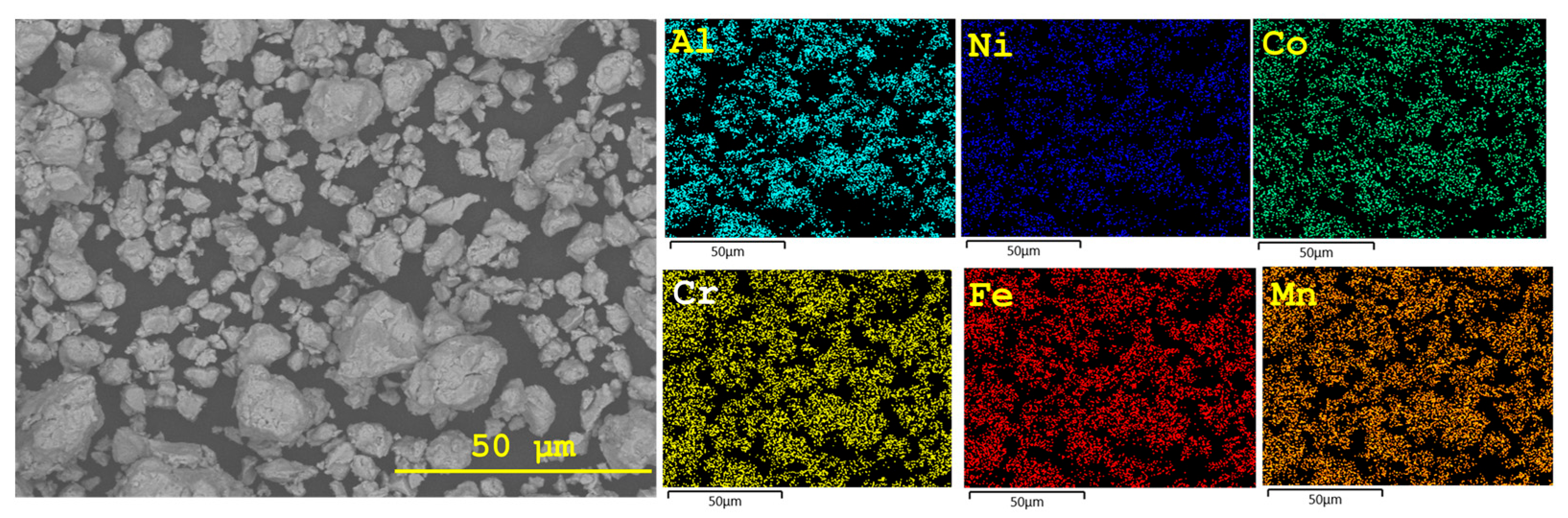
Figure 2 shows the alloyed powder after milling. This picture shows milled powders with irregular morphology and a range of sizes, all less than 25 µm. On the right, the elemental mapping shows a homogeneous distribution of all elements.
Table 1 shows the chemical composition of the milled powders determined by ICP-OES; nominal compositions are included.
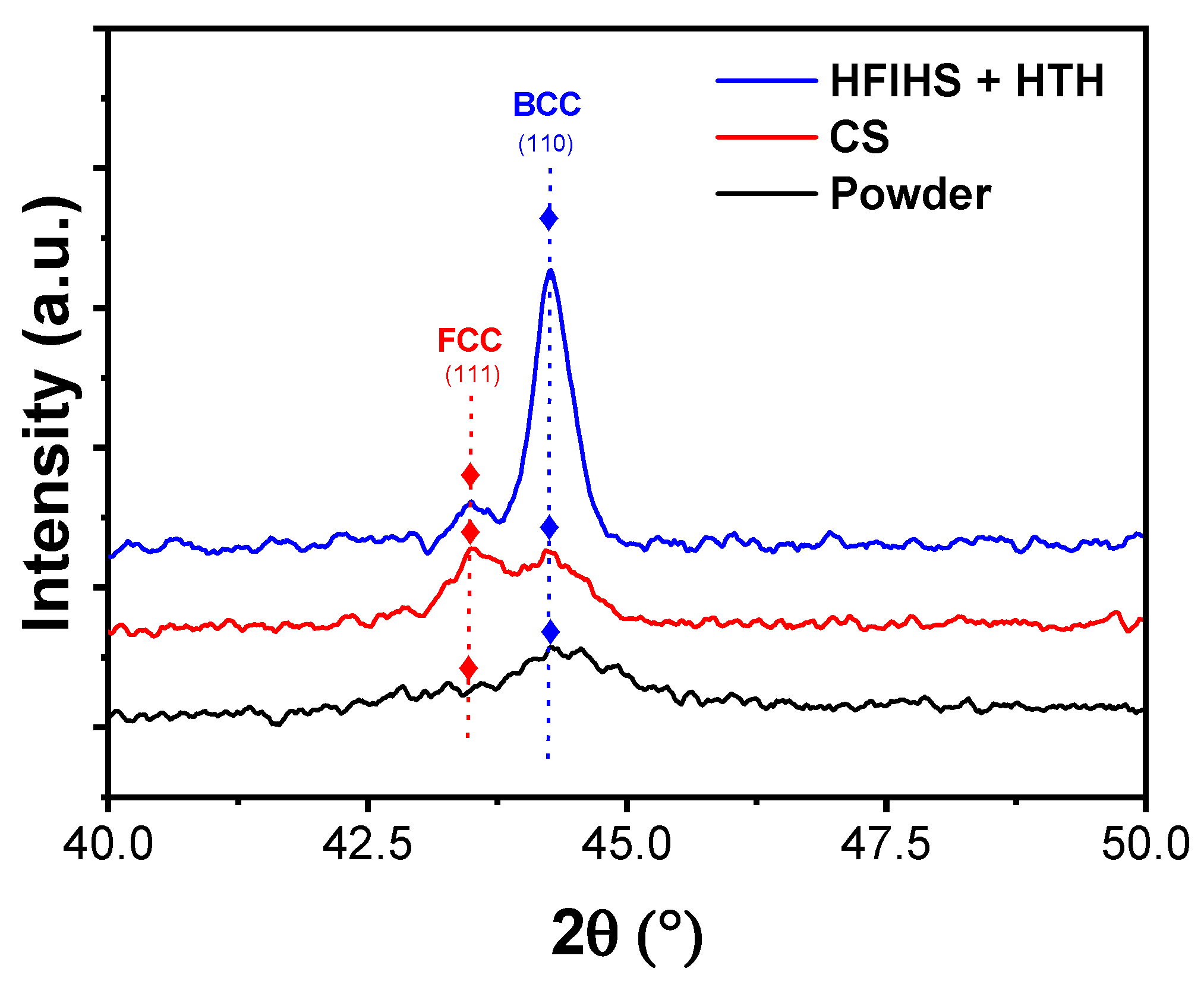
Figure 3 shows the XRD patterns obtained for the CoCrFeNiMnAl1.5 alloy powders and for the sintered samples obtained by CS at 1.2 GPa and by HFIHS + HTH at 0.6 GPa. For both methods, the heating was at 1200 °C for 2 h. Given that the VEC for this alloy is 7.62, one would expect it to have a dual FCC + BCC microstructure. However, the intensity of the BCC (111) peak increases significantly in the HFIHS + HTH-processed sample compared to the powder and conventionally sintered samples, suggesting a higher volume fraction of the BCC phase in this sintering method.
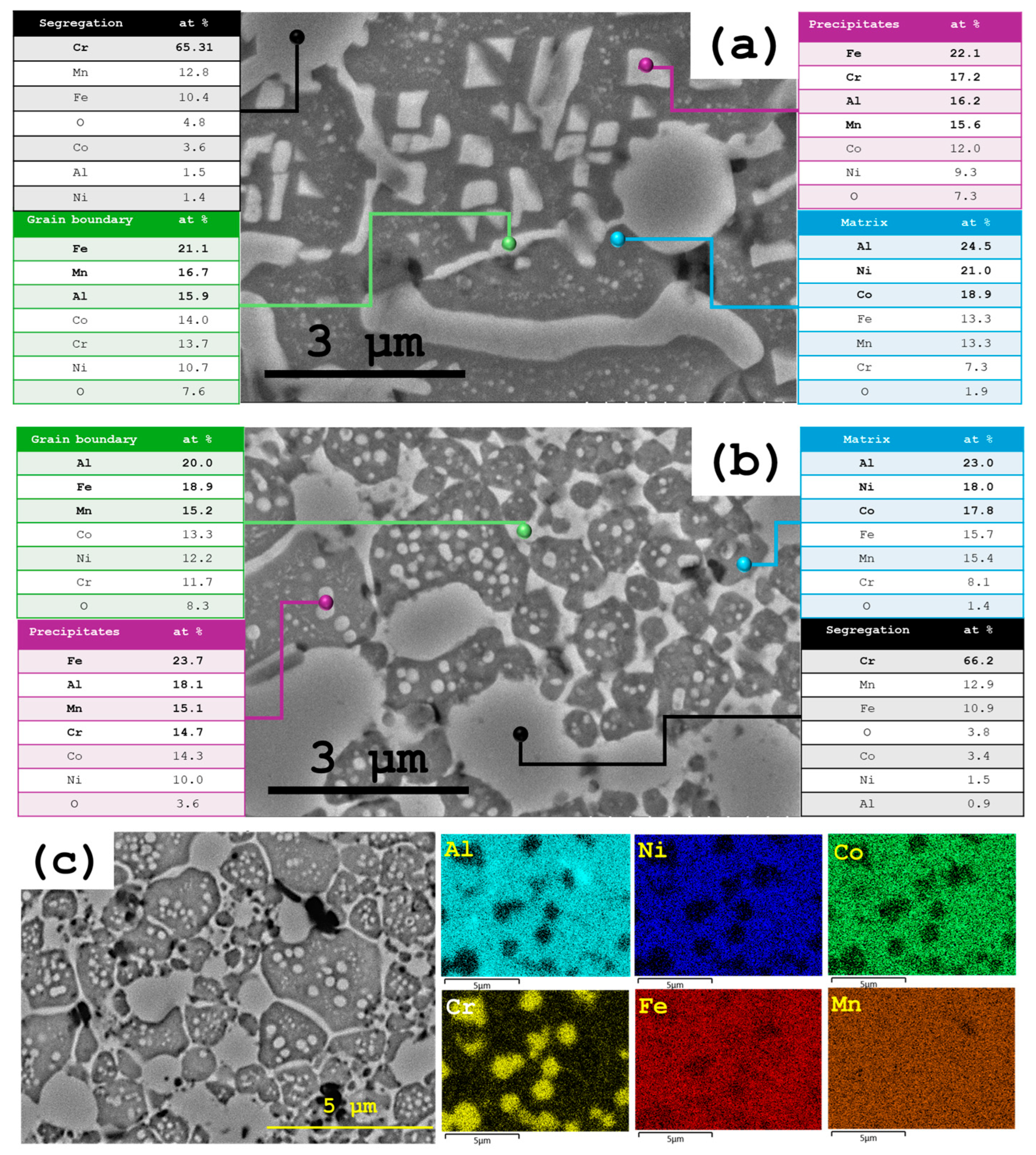
Figure 4 shows the EDS analysis for each phase in the CoCrFeNiMnAl1.5 system after sintering by the (a) CS and (b) HFIHS + HTH methods at 1.2 and 0.6 GPa, respectively. Both samples were heated at 1200 °C for 2 h. Furthermore, the elemental distribution of the CoCrFeNiMnAl1.5 system after sintering by the HFIHS + HTH method is presented. The analysis by EDS of the observed phases shows that the following phases occur in both sintering methods: (i) Al-, Ni-, and Co-rich matrix; (ii) Fe-, Mn-, Cr-, and Al-rich intergranular precipitates; (iii) Al-, Mn-, and Fe-rich grain boundary precipitates; and (iv) Cr-rich segregation. The elemental distribution confirms the Cr-rich segregation.
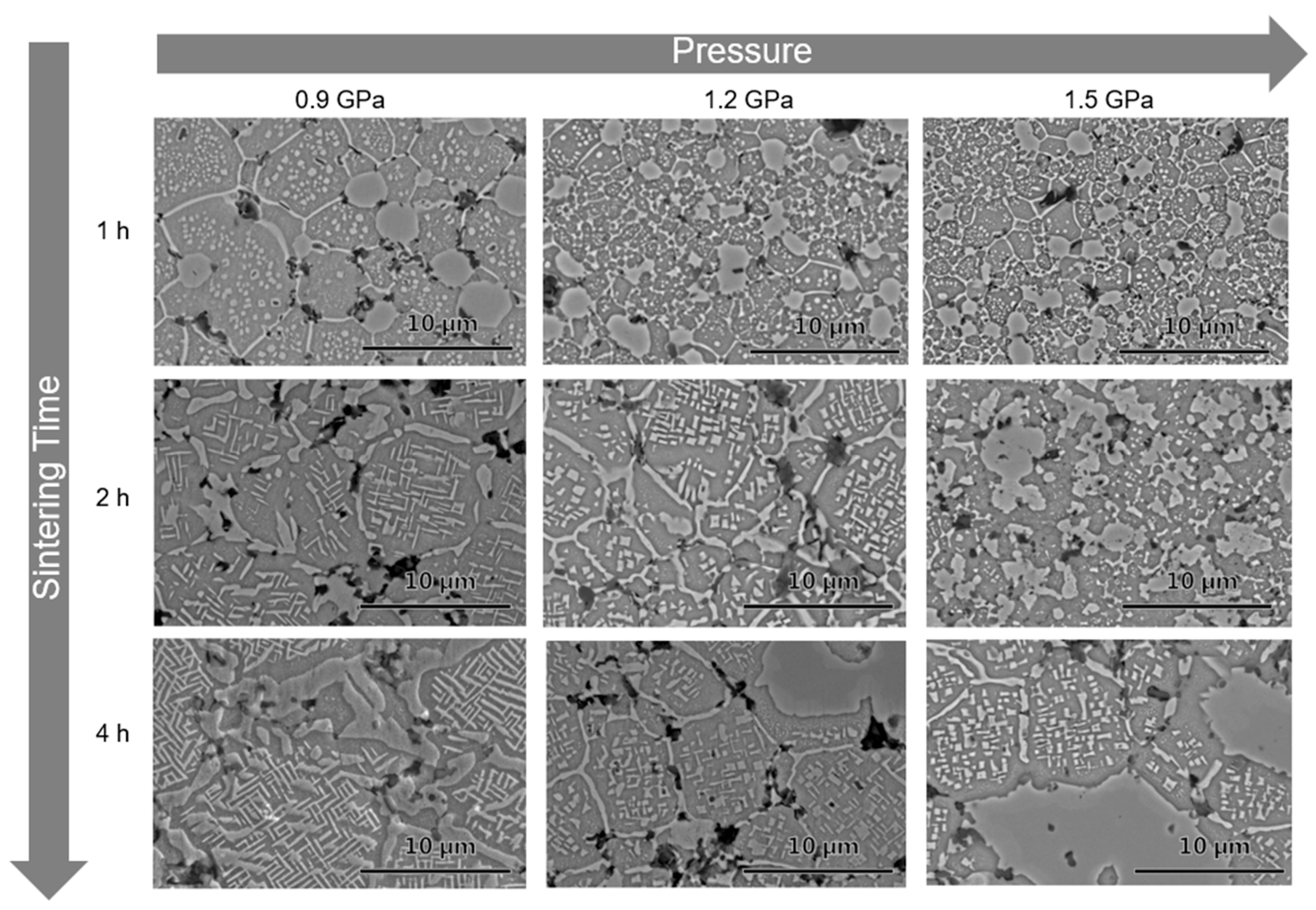
Figure 5 shows SEM micrographs of the CoCrFeNiMnAl1.5 alloy synthesized by CS under pressures of 0.9, 1.2, and 1.5 GPa and heated at 1200 °C for 1, 2, and 4 h. In all evaluated conditions, morphological changes associated with intergranular precipitates, grain boundary precipitates, and Cr-rich segregation are observed as a function of sintering time and pressure. Regarding intergranular precipitates, at lower pressure, after 1 h of sintering, the precipitates are predominantly oval. As sintering time increases, the morphology progressively adopts a cuboidal form, with interconnected parallelepiped structures of a larger size. For the other pressures, the morphological behavior of the precipitates is similar. However, the size decreases with increasing pressure. On the other hand, the grain boundary precipitates and the Cr-rich segregations exhibit behavior identical to that of the intergranular precipitates: an increase in size with longer sintering times and a decrease in size with increased pressure.
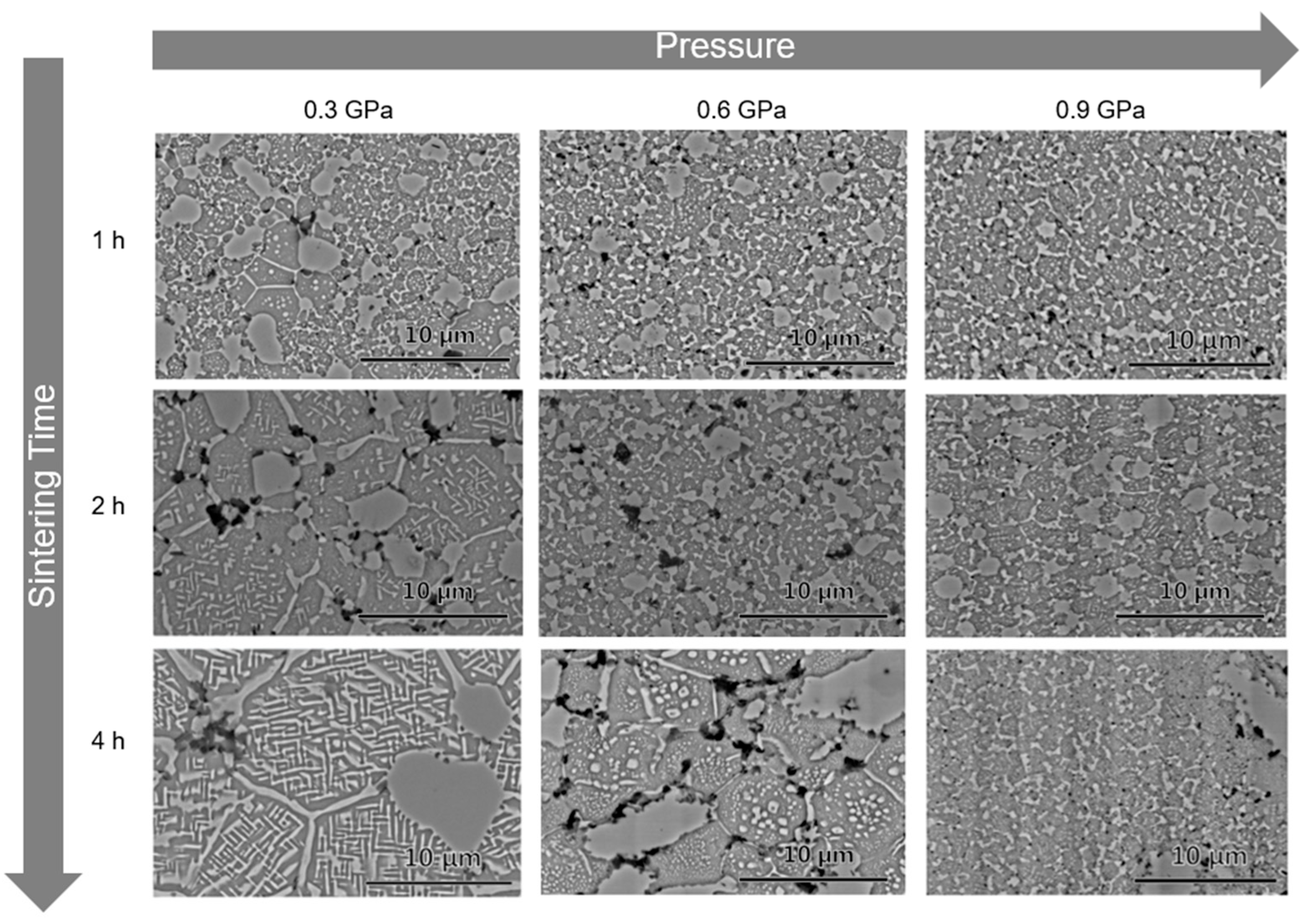
Figure 6 shows SEM micrographs of the CoCrFeNiMnAl1.5 alloy sintered by HFIHS under pressures of 0.3, 0.6, and 0.9 GPa at 600 °C for 3 min + HTH at 1200 °C for 1, 2, and 4 h. A behavior very different from that in CS is observed. In all evaluated conditions, morphological changes associated with intergranular precipitates, grain boundary precipitates, and Cr-rich segregation are observed as a function of sintering time and pressure. Regarding intergranular precipitates, at lower pressure, after 1 h of sintering, the precipitates are predominantly oval. As sintering time increases, their morphology progressively adopts a larger, interconnected parallelepiped morphology. At the other pressures, their sizes decrease with increasing pressure.
On the other hand, the grain boundary precipitates and the Cr-rich segregations also show a behavior similar to that of the intergranular precipitates: an increase in size with increasing sintering time and a decrease with increasing pressure. It is essential to note that the effect of simultaneous pressure and temperature is more significant than when applied separately, as in the CS method, i.e., simultaneous pressure and temperature exerts a greater impact on the final microstructural characteristics.
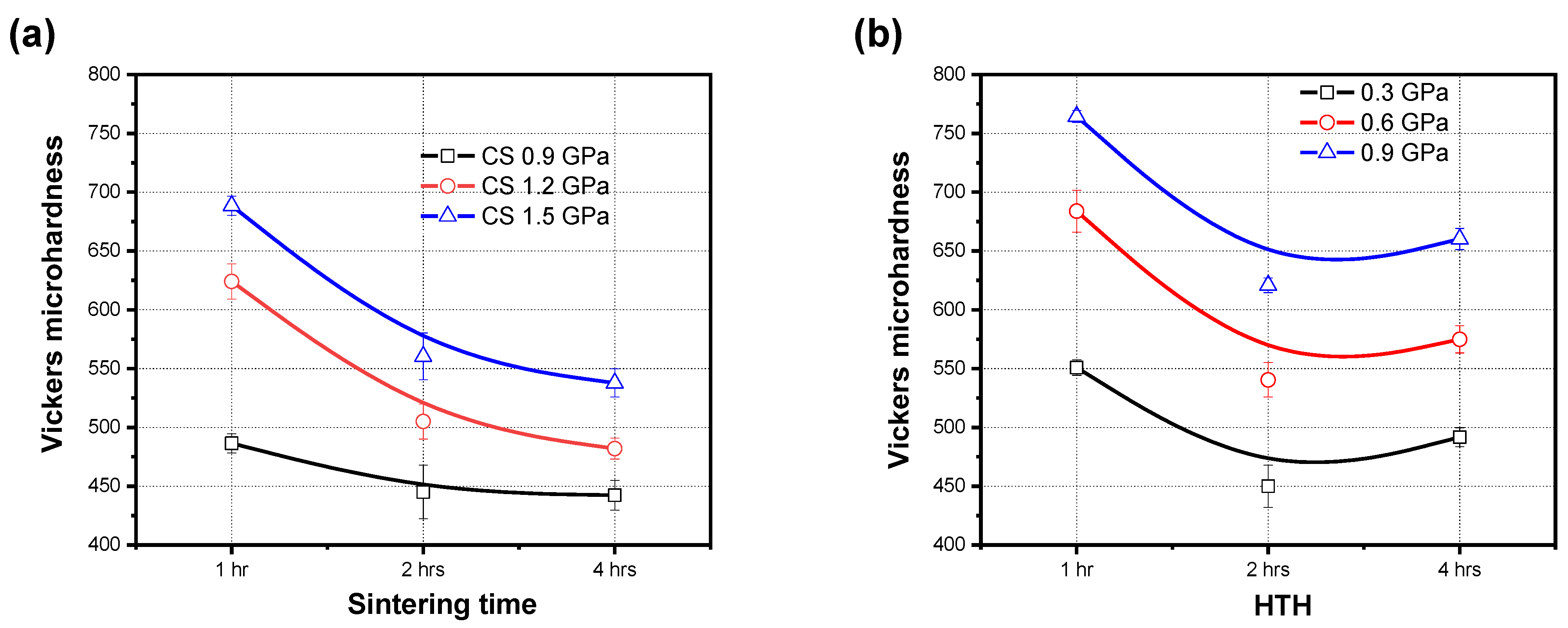
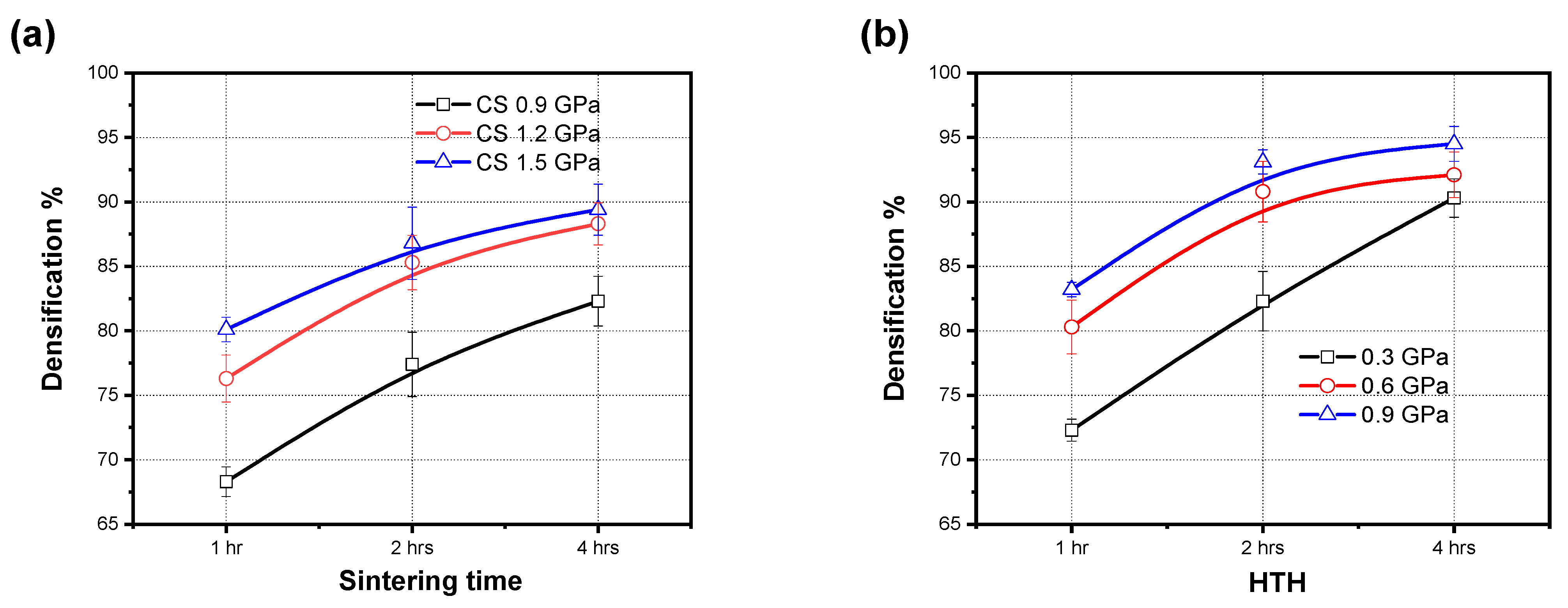
Figure 7 shows the evolution of the Vickers microhardness of the CoCrFeNiMnAl1.5 alloy under the different pressures studied for (a) CS and (b) HFIHS + HTH. In the CS route, a significant decrease is observed after the first hour, followed by a gradual decline at 4 h. On the other hand, in the HFIHS + HTH route, a significant decrease after the first hour, followed by a light increase at 4 h, is observed. This initial behavior in both routes is mainly due to the relaxation of residual stresses introduced during compaction and milling. However, the increase in hardness observed in the HFIHS + HTH route directly correlates with densification (see Figure 8). Relief of residual stresses, redistribution of solutes, and densification during thermal cycles can explain the microstructural evolution observed in both routes.

4. Discussion

The coexistence of the FCC and BCC phases is corroborated by the results obtained; however, a significant increase in the intensity of the BCC (110) peak is observed in samples processed by HFIHS + HTH compared to those consolidated by CS. This behavior demonstrates that sintering processing decisively influences the phase fraction, size, and distribution, which are critical factors for the final mechanical behavior. In this sense, the HFIHS method, by simultaneously applying temperature and pressure, modifies the diffusion behavior of the present elements and, consequently, the growth, transformed fraction, and distribution of the present phases. Thus, this combination yields a refined microstructure with fine, homogeneously distributed phases, thereby increasing Vickers microhardness.
In the conventional sintering (CS) route, after milling, the mechanically alloyed powders form a highly supersaturated solid solution with a large amount of stored deformation energy [25,26]. During the CS process (heating to 1200 °C), residual stresses are relieved, and secondary phases nucleate, including intergranular and grain boundary precipitates (BCC) and Cr-rich segregation (BCC). As sintering time increases, these precipitates grow, adopting an interconnected and parallelepiped morphology of larger size, which favors coherent or semi-coherent interfaces [27,28]. Simultaneously, the Cr-rich segregations grow, consistent with the slow diffusion kinetics characteristic of HEAs [29,30].
In contrast, in the HFIHS + HTH route, applying both pressure (0.3–0.9 GPa) and temperature (600 °C) promotes a mechanism of forced atomic mobility. This mechanism is based on pressure, which facilitates the migration of atoms toward energetically favorable sites, such as grain boundaries, and, in addition, promotes Cr-rich segregation [4,31,32,33]. Thus, this migration leads to a decrease in the formation of intergranular precipitates and an increase in the phase of the grain boundaries, as observed in Figure 6.
It should be noted that the EDS analyses shown in Figure 4a confirm that both the parallelepiped precipitates (violet) and the grain boundary phase (green) share a similar chemical composition (rich in Fe, Cr, Mn, and Al), strongly suggesting that they correspond to the same BCC phase, but with different morphologies due to local stress differences and interfacial interactions. Within the grains, elastic deformation from FCC/BCC interaction stabilizes the parallelepiped shape, whereas at the grain boundaries, growth conditions favor irregular morphologies.
Furthermore, the overall refinement of the microstructure in the samples obtained by HFIHS is due to two effects: (i) the restriction of grain boundary mobility under applied pressure, which limits grain growth [34], and (ii) the accelerated thermal cycle due to induction heating, which reduces the time available for diffusion-controlled transformations [35,36]. Consequently, even after long thermal cycles (4 h), samples obtained by HFIHS exhibit finer precipitates and more homogeneous dispersion of Cr-rich segregations than their CS counterparts (Figure 5 and Figure 6).
This microstructure means better mechanical performance. The higher fraction of finely dispersed BCC precipitates, combined with homogeneous dispersion of Cr-rich segregation and superior densification, explains the maximum hardness of 770 HV achieved at 0.9 GPa and 1 h in the HFIHS + HTH route (Figure 7). In contrast, the CS samples exhibit progressive softening due to precipitate coarsening and porosity. This behavior is consistent with recent studies showing that field-assisted sintering techniques (such as SPS and HFIHS) outperform conventional methods for HEA processing [9,14,37,38].

5. Conclusions

High-frequency induction sintering followed by high-temperature heating (HFIHS + HTH) offers significant advantages over conventional sintering (CS) for consolidating the CoCrFeMnNiAl1.5 alloy. This approach not only make it possible to obtain the dual microstructure (FCC + BCC) predicted by the valence electron concentration criterion, but also optimizes the distribution, size, and fraction of the BCC phase, thereby maximizing its contribution to material hardening. The pressure applied promotes a mechanism of forced atomic mobility. This mechanism facilitates the migration of atoms toward energetically favorable sites, such as grain boundaries. At the same time, it restricts precipitate growth and Cr-rich segregation and activates densification mechanisms without requiring sustained pressure. At 0.9 GPa and 1 h of sintering, a homogeneous microstructure is obtained, with fine precipitates resulting in a maximum microhardness of 770 HV.
Furthermore, the characteristic accelerated thermal profile of HFIHS acts as an effective microstructural control mechanism, limiting precipitate growth even after prolonged sintering cycles. In contrast, samples processed by CS exhibit progressive precipitate coarsening with Cr segregations, and continuous softening due to porosity and stress relaxation.
Overall, the HFIHS + HTH route can be considered a promising alternative for the efficient, scalable production of high-entropy alloys with superior mechanical properties, ideal for demanding applications across the aerospace and automotive sectors, and for use in high-performance coatings.

Author Contributions

Conceptualization, L.B.G., I.E.G. and C.G.G.R.; methodology, L.B.G., J.M.M.D., H.M.M.P., R.M.S., G.R.C. and A.M.G.; validation, J.L.H.R., E.R.R., I.E.G. and C.G.G.R.; formal analysis, L.B.G., I.E.G. and C.G.G.R.; investigation, L.B.G. and C.G.G.R.; data curation, L.B.G., J.M.M.D., A.S.B., R.M.S. and A.M.G.; writing—original draft, L.B.G., I.E.G. and C.G.G.R. All authors have read and agreed to the published version of the manuscript.

Funding

This research received no external funding.

Data Availability Statement

The data presented in this study are available upon request from the corresponding author.

Acknowledgments

The authors thank A. I. Gonzalez-Jacquez and K. Campos-Venegas for their valuable technical support throughout the study.

Conflicts of Interest

The authors declare no conflicts of interest.

References

  1. Poulia, A.; Karantzalis, A.E. Latest Advancements and Mechanistic Insights into High-Entropy Alloys: Design, Properties and Applications. Materials 2025, 18, 5616. [Google Scholar] [CrossRef]
  2. Ji, P.; Jia, Y.; Ma, P.; Mu, Y.; Sun, K.; Wang, G. Exceptional strength–ductility combination of CoCrFeMnNi high-entropy alloy with fully recrystallized structure by selective laser melting after post-deformation annealing. J. Mater. Res. Technol. 2023, 23, 3166–3176. [Google Scholar]
  3. Kumar, J.; Linda, A.; Sadhasivam, M.; Pradeep, K.G.; Gurao, N.P.; Biswas, K. The effect of Al addition on solid solution strengthening in CoCrFeMnNi: Experiment and modelling. Acta Mater. 2022, 238, 118208. [Google Scholar]
  4. Ye, Y.F.; Wang, Q.; Zhao, Y.L.; He, Q.F.; Lu, J.; Yang, Y. Elemental segregation in solid-solution high-entropy alloys: Experiments and modeling. J. Alloys Compd. 2016, 681, 167–174. [Google Scholar]
  5. Karlsson, D.; Marshal, A.; Johansson, F.; Schuisky, M.; Sahlberg, M.; Schneider, J.M.; Jansson, U. Elemental segregation in an AlCoCrFeNi high-entropy alloy–A comparison between selective laser melting and induction melting. J. Alloys Compd. 2019, 784, 195–203. [Google Scholar]
  6. Hasan, M.N.; Gu, J.; Jiang, S.; Wang, H.J.; Cabral, M.; Ni, S.; Liao, X.Z. Effects of elemental segregation on microstructural evolution and local mechanical properties in a dynamically deformed CrMnFeCoNi high entropy alloy. Scr. Mater. 2021, 190, 80–85. [Google Scholar]
  7. Li, N.; Wu, C.; Wu, Z.; Jiang, M.; Hou, J.; Dong, F. Effect of Sintering Temperature and Time on Microstructure and Mechanical Properties of CoCrFeNiMn High-Entropy Alloys. Metals 2025, 15, 591. [Google Scholar]
  8. Zhang, A.; Han, J.; Meng, J.; Su, B.; Li, P. Rapid preparation of AlCoCrFeNi high entropy alloy by spark plasma sintering from elemental powder mixture. Mater. Lett. 2016, 181, 82–85. [Google Scholar]
  9. Ruiz-Esparza-Rodríguez, M.A.; Garay-Reyes, C.G.; Mendoza-Duarte, J.M.; Estrada-Guel, I.; Hernández-Rivera, J.L.; Cruz-Rivera, J.J.; Martínez-Sánchez, R. Evaluation of high-frequency induction heat sintering and conventional sintering in AlxCoCrFeMnNi high-entropy alloys. J. Alloys Compd. 2022, 910, 164780. [Google Scholar]
  10. Kim, H.C.; Oh, D.Y.; Shon, I.J. Sintering of nanophase WC–15vol.% Co hard metals by rapid sintering process. Int. J. Refract. Met. Hard Mater. 2004, 22, 197–203. [Google Scholar]
  11. Baig, M.; Ammar, H.R.; Seikh, A.H. Thermo-mechanical responses of nanocrystalline Al–Fe alloy processed using mechanical alloying and high frequency heat induction sintering. Mater. Sci. Eng. A 2016, 655, 132–141. [Google Scholar] [CrossRef]
  12. Shang, F.N.; Sekiya, E.; Nakayama, Y. Application of high-frequency induction heating apparatus to heat treatment of 6061 aluminum alloy. Mater. Trans. 2011, 52, 2052–2060. [Google Scholar] [CrossRef]
  13. Baylón-García, L.; Mendoza-Duarte, J.M.; Estrada-Guel, I.; Guerrero-Seañez, P.A.; Ruiz-Esparza-Rodríguez, M.A.; Martínez-Sánchez, R.; Garay-Reyes, C.G. Study of nanohardness and scratch in a CoCrFeMnNiAl HEA consolidated by high-frequency-induction heat. Mater. Lett. 2025, 404, 139673. [Google Scholar] [CrossRef]
  14. Laguna-Zubia, L.D.; Garay-Reyes, C.G.; Guerrero-Seañez, P.A.; Ruiz-Esparza-Rodríguez, M.A.; Mendoza-Duarte, J.M.; Estrada-Guel, I.; Martínez-Sánchez, R. Influence of the sintering method on microstructure and microhardness of AlCuNiSnZn-based high-entropy brasses and bronzes obtained by powder metallurgy. Vacuum 2024, 222, 113006. [Google Scholar] [CrossRef]
  15. Shon, I.J.; Kim, B.R.; Doh, J.M.; Yoon, J.K. Consolidation of binderless nanostructured titanium carbide by high-frequency induction heated sintering. Ceram. Int. 2010, 36, 1797–1803. [Google Scholar] [CrossRef]
  16. Saheb, N.; Hayat, U.; Hassan, S.F. Recent advances and future prospects in spark plasma sintered alumina hybrid nanocomposites. Nanomaterials 2019, 9, 1607. [Google Scholar] [CrossRef]
  17. Swikker, K.R.J.; Kanagasabapathy, H.; Manickam, I.N.; Nadar, N.V.P.; Alwin, S. Effect of sintering temperature on grain growth and mechanical properties of copper/graphene nanosheet composite. Diam. Relat. Mater. 2020, 110, 108111. [Google Scholar] [CrossRef]
  18. Fang, Z.Z.; Wang, H. Sintering of ultrafine and nanosized particles. In Sintering of Advanced Materials; Woodhead Publishing: Sawston, UK, 2010; pp. 434–473. [Google Scholar]
  19. Kumar, S. Comprehensive review on high entropy alloy-based coating. Surf. Coat. Technol. 2024, 477, 130327. [Google Scholar]
  20. Mackova, A.; Havránek, V.; Mikšová, R.; Fernandes, S.; Matejicek, J.; Hadraba, H.; Lukac, F. Radiation damage evolution in High Entropy Alloys (HEAs) caused by 3–5 MeV Au and 5 MeV Cu ions in a broad range of dpa in connection to mechanical properties and internal morphology. Nucl. Mater. Energy 2023, 37, 101510. [Google Scholar]
  21. Sabarinath, S.; Raj, V.; Nair, L.V.; Thomas, V.; Ogunlakin, N.; Saji, V.S. High Entropy Alloy (HEA) Coatings for Tribological Applications-A Review. Results Eng. 2025, 27, 105695. [Google Scholar]
  22. Muhammad, A.; Minouei, H.; Park, N. Review on High Entropy Superalloys Design, Microstructure, and Properties. Mater. Chem. Phys. 2025, 351, 131962. [Google Scholar] [CrossRef]
  23. Rajendrachari, S. An overview of high-entropy alloys prepared by mechanical alloying followed by the characterization of their microstructure and various properties. Alloys 2022, 1, 116–132. [Google Scholar] [CrossRef]
  24. ASTM B962–23; Standard Test Methods for Density of Powder Metallurgy (PM) Materials. ASTM International: West Conshohocken, PA, USA, 2023.
  25. Suryanarayana, C. Mechanical alloying: A critical review. Mater. Res. Lett. 2022, 10, 619–647. [Google Scholar] [CrossRef]
  26. Suryanarayana, C. Mechanical alloying and milling. Prog. Mater. Sci. 2001, 46, 1–184. [Google Scholar] [CrossRef]
  27. Maheshwari, A.; Ardell, A.J. Morphological evolution of coherent misfitting precipitates in anisotropic elastic media. Phys. Rev. Lett. 1993, 70, 2305. [Google Scholar] [CrossRef] [PubMed]
  28. Wang, Q.; Li, Z.; Pang, S.; Li, X.; Dong, C.; Liaw, P.K. Coherent precipitation and strengthening in compositionally complex alloys: A review. Entropy 2018, 20, 878. [Google Scholar] [CrossRef]
  29. Dąbrowa, J.; Danielewski, M. State-of-the-art diffusion studies in the high entropy alloys. Metals 2020, 10, 347. [Google Scholar] [CrossRef]
  30. Pickering, E.J.; Jones, N.G. High-entropy alloys: A critical assessment of their founding principles and future prospects. Int. Mater. Rev. 2016, 61, 183–202. [Google Scholar] [CrossRef]
  31. Zhang, Z.; Deng, C. Hydrostatic pressure-induced transition in grain boundary segregation tendency in nanocrystalline metals. Scr. Mater. 2023, 234, 115576. [Google Scholar] [CrossRef]
  32. Middleburgh, S.C.; King, D.M.; Lumpkin, G.R.; Cortie, M.; Edwards, L. Segregation and migration of species in the CrCoFeNi high entropy alloy. J. Alloys Compd. 2014, 599, 179–182. [Google Scholar]
  33. Zhao, F.; Zhao, X.; Jiang, T.; Zhao, R.; Wu, F. Comprehensive study of CoCrCuNi high-entropy alloys: Effects of preparation, heat treatment, computational simulation, and alloying elements. Metals 2024, 14, 1240. [Google Scholar] [CrossRef]
  34. Zamani, M.R.; Mirzadeh, H.; Malekan, M.; Cao, S.C.; Yeh, J.W. Grain growth in high-entropy alloys (HEAs): A review. High Entropy Alloys Mater. 2023, 1, 25–59. [Google Scholar] [CrossRef]
  35. German, R.M. Rapid heating concepts in sintering. J. Powder Mater. 2013, 20, 85–99. [Google Scholar] [CrossRef]
  36. Xi, R.; Li, Y. Recent advances in the performance and mechanisms of high-entropy alloys under low-and high-temperature conditions. Coatings 2025, 15, 92. [Google Scholar] [CrossRef]
  37. Riva, S.; Brown, S.G.; Lavery, N.P.; Tudball, A.; Yusenko, K.V. Spark plasma sintering of high entropy alloys. In Spark Plasma Sintering of Materials: Advances in Processing and Applications; Springer International Publishing: Cham, Switzerland, 2019; pp. 517–538. [Google Scholar]
  38. Dewangan, S.K.; Nagarjuna, C.; Lee, H.; Rao, K.R.; Mohan, M.; Jain, R.; Ahn, B. Advances in Powder Metallurgy for High-Entropy Alloys. J. Powder Mater. 2024, 31, 480–492. [Google Scholar] [CrossRef]
Figure 1. Experimental procedure and the corresponding parameters for each route.
Coatings 16 00275 g001
Figure 2. Elemental distribution of powders of the CoCrFeNiMnAl1.5 system.
Coatings 16 00275 g002
Figure 3. XRD patterns obtained for the CoCrFeNiMnAl1.5 alloy powders and for the samples sintered by CS at 1.2 GPa, and by HFIHS + HTH at 0.6 GPa. For both methods, the heating was at 1200 °C for 2 h.
Coatings 16 00275 g003
Figure 4. SEM-EDS analysis for each phase. (a) CS and (b) HFIHS + HTH methods at 1.2 and 0.6 GPa, respectively. Both samples were heated at 1200 °C for 2 h. (c) Elemental distribution in the CoCrFeNiMnAl1.5 system after sintering by the HFIHS + HTH method at 0.6 GPa and heating at 1200 °C for 2 h.
Coatings 16 00275 g004
Figure 5. SEM micrographs of the CoCrFeNiMnAl1.5 alloy sintered by CS under pressures of 0.9, 1.2, and 1.5 GPa at 1200 °C for 1, 2, and 4 h.
Coatings 16 00275 g005
Figure 6. SEM micrographs of the CoCrFeNiMnAl1.5 alloy sintered by HFIHS under pressures of 0.3, 0.6, and 0.9 GPa at 600 °C for 3 min + HTH at 1200 °C for 1, 2, and 4 h.
Coatings 16 00275 g006
Figure 7. Vickers microhardness of the CoCrFeNiMnAl1.5 alloy under the different pressures studied for (a) CS and (b) HFIHS + HTH.
Coatings 16 00275 g007
Figure 8. Densification % of the CoCrFeNiMnAl1.5 alloy under the different pressures studied for (a) CS and (b) HFIHS + HTH.
Coatings 16 00275 g008
Table 1. Experimental and nominal chemical composition of the powders.
Sample (at. %)AlCoCrFeMnNi
CoCrFeMnNi Al1.5 (ICP-OES)22.6315.7314.9215.2815.3416.10
Nominal2315.415.415.415.415.4
Disclaimer/Publisher’s Note: The statements, opinions and data contained in all publications are solely those of the individual author(s) and contributor(s) and not of MDPI and/or the editor(s). MDPI and/or the editor(s) disclaim responsibility for any injury to people or property resulting from any ideas, methods, instructions or products referred to in the content.