The results are presented combining qualitative morphological observations and quantitative analyses. SEM images are used to qualitatively illustrate the electrodeposition behavior, while gravimetric, structural, and electrochemical measurements provide the quantitative basis for the discussion. Based on the experimental results, nickel-based materials are confirmed as highly attractive for MCFC applications due to their excellent resistance to corrosion in oxidizing and high-temperature environments, good mechanical stability under load, and outstanding chemical compatibility with the molten carbonate electrolyte [
1].
The first experimental step focused on evaluating the evolution of the electrodeposited layer as a function of the immersion time in the electrolyte bath. Keeping all electrical and thermal parameters constant, three electrodepositions were performed on nickel felt samples, with deposition times set to 5, 7.5, and 10 min. The experiments were carried out in galvanostatic mode, maintaining a constant current intensity of 3 A throughout each deposition. All nickel felt samples were prepared according to the dimensions described above, with a defined active area exposed to electrodeposition and an uncoated region reserved for clamp attachment. According to Faraday’s law, and under fixed material and current density conditions, the mass of metal deposited varies linearly with the electrodeposition time. This linear dependence makes the immersion time a key parameter for controlling the thickness and morphology of the resulting deposit.
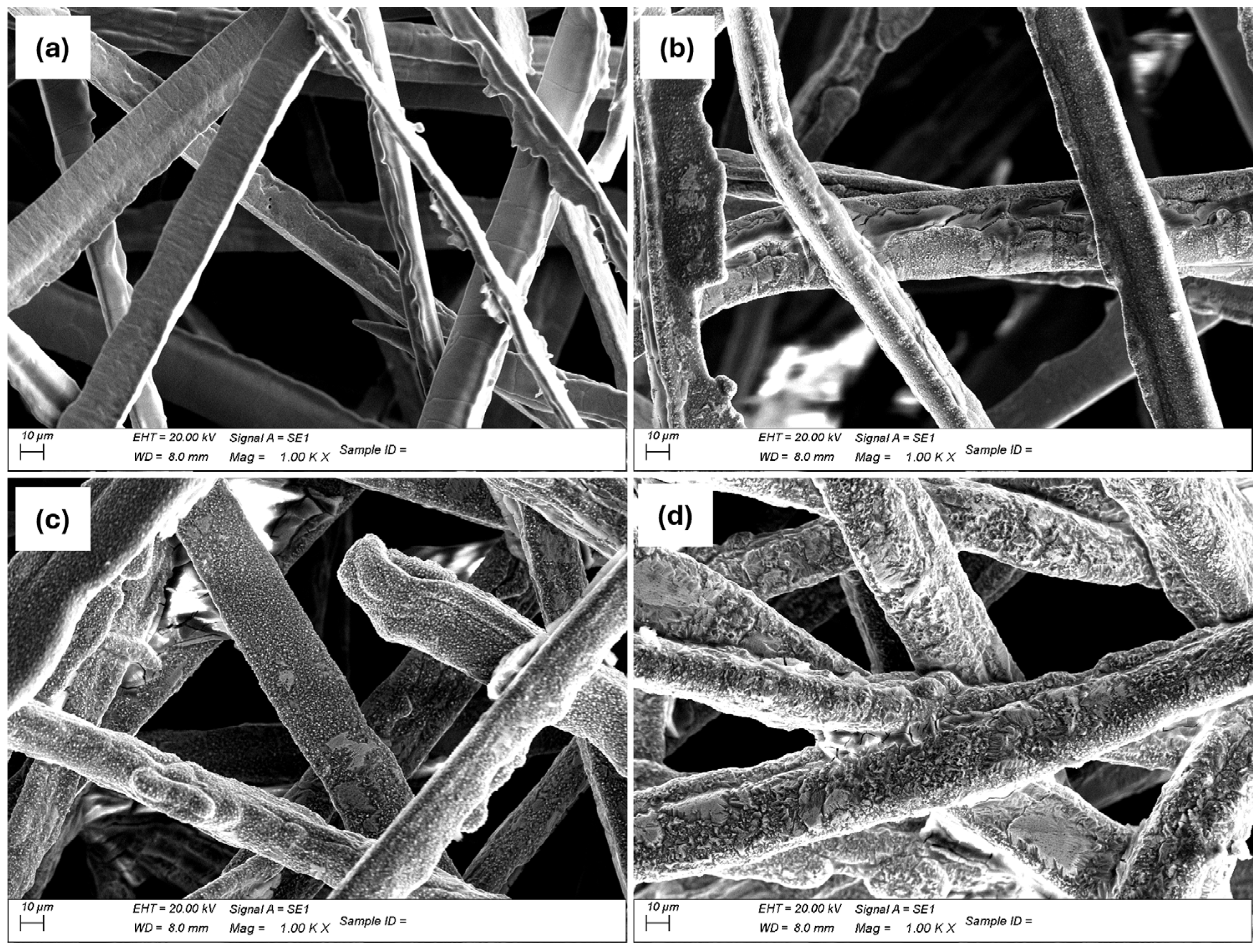
Figure 1 shows a sequence of SEM images of the nickel felt samples electrodeposited for different immersion times. The same magnification is maintained to make the progressive growth of the deposit over time more evident. SEM observations clearly highlight a progressive growth of the nickel layer with increasing immersion time, resulting in improved coating continuity while preserving the intrinsic fibrous morphology of the nickel felt. This feature is particularly relevant for MCFC electrodes, where high porosity and an interconnected pore network are essential to ensure effective gas diffusion and electrolyte retention. Overall, these results indicate that electrodeposition represents a viable and flexible technique for the fabrication of porous nickel electrodes for MCFC applications.
An additional verification of Faraday’s law was performed by selecting five different current-time pairs designed to yield the same theoretical deposited mass. Based on the ideal cathodic current density reported in
Section 2.3, a reference condition of 360 mA applied for 30 min was first defined, and the corresponding theoretical nickel mass was calculated using Faraday’s equation. The remaining current–time combinations were then determined by appropriately adjusting the applied current and deposition time in order to maintain a constant theoretical deposited mass. In this way, each experiment was expected to produce an identical amount of deposited material, ensuring full comparability among the samples and providing an internal validation of Faraday’s law. Five nickel felt samples were therefore prepared and electrodeposited according to the selected current–time pairs. For each sample, the post-deposition mass variation was measured and compared with those of the other samples. A statistical analysis was also performed to assess the reliability and accuracy of the measurements. All tests were carried out in galvanostatic mode to allow precise control of the applied current. The deposition temperature was maintained at approximately 40 °C to ensure uniform operating conditions.
Table 2 reports the selected time-current pairs and the corresponding mass variations in the samples. The experimental results showed a clear linear relationship between the deposited mass and the product of applied current and deposition time, confirming the reliability and predictability of the galvanostatic electrodeposition process when precise control of mass loading is required. This aspect is particularly important for MCFC electrodes, where even small deviations in active material loading may significantly affect electrochemical performance.
To verify the reliability of the measurements, a statistical analysis was performed on the deposited mass data. Specifically, the standard deviation was calculated for each sample with respect to the theoretically predicted deposited mass. The resulting standard deviation values were then averaged and normalized to the mean deposited mass in order to determine the coefficient of variation, defined as the ratio between the standard deviation and the arithmetic mean. The obtained coefficient of variation is 9.27%, which is below the commonly accepted threshold of 10% and can therefore be considered consistent with the validity of Faraday’s law [
13]. The good agreement between theoretical and experimental values further confirms the reproducibility of the electrodeposition process under the investigated conditions and supports its suitability for the controlled fabrication of nickel-based porous electrodes.
3.1. Measurement of the Parabolic Rate Constant of Nickel
The increase in oxide thickness therefore follows a parabolic behavior, described by Equation (1) [
14].
where
x is the sample thickness
is the parabolic rate constant
, and
t is the time
. The parabolic rate constant quantifies the oxide growth rate.
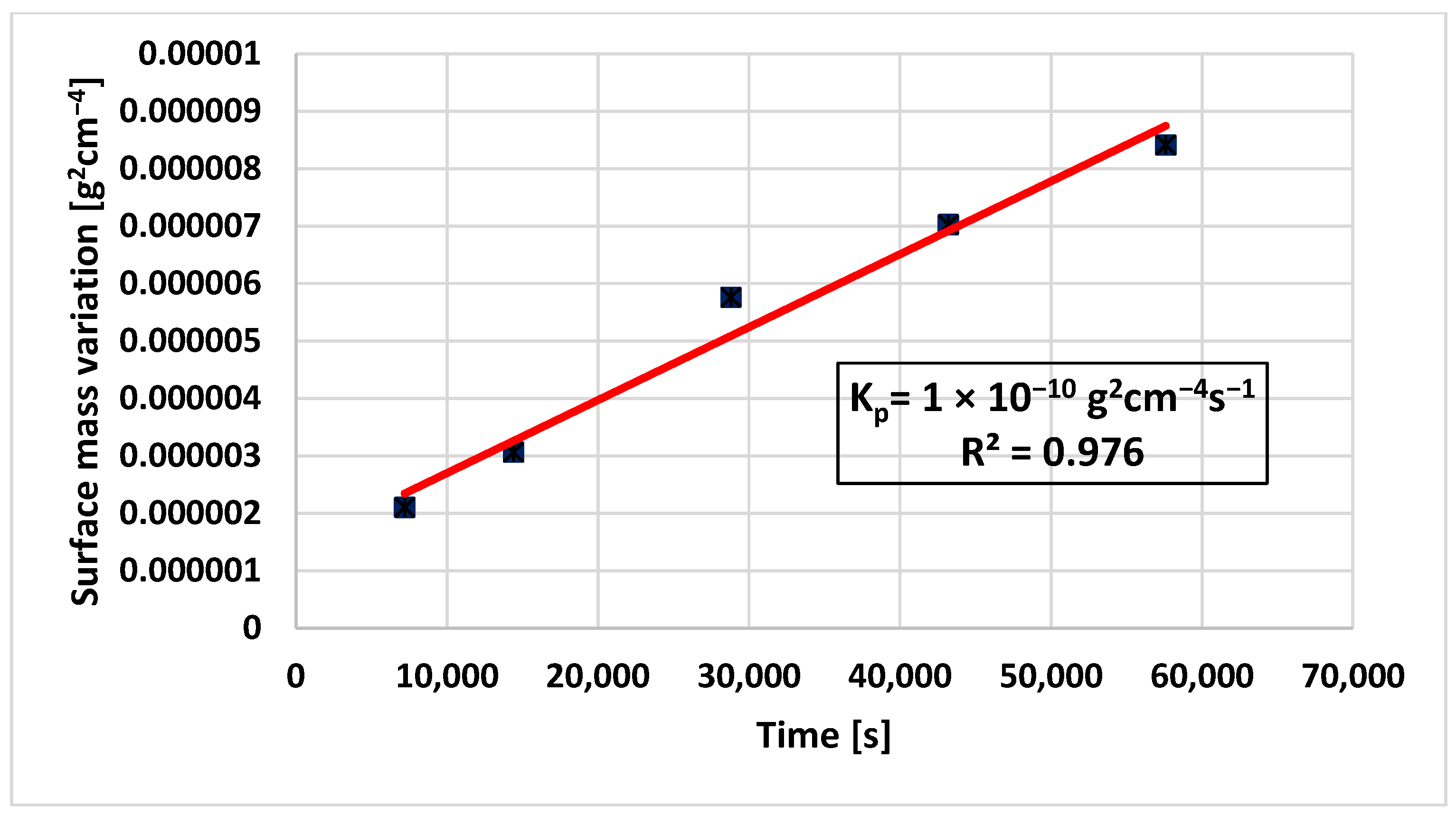
Experimentally, can be determined by measuring the mass gain of the sample exposed to an oxidizing atmosphere and normalizing it with respect to the surface area. By linearizing Equation (2), the value of the parabolic rate constant can be obtained as the slope of the resulting line, which is derived by plotting the surface mass change as a function of time Equation (2).
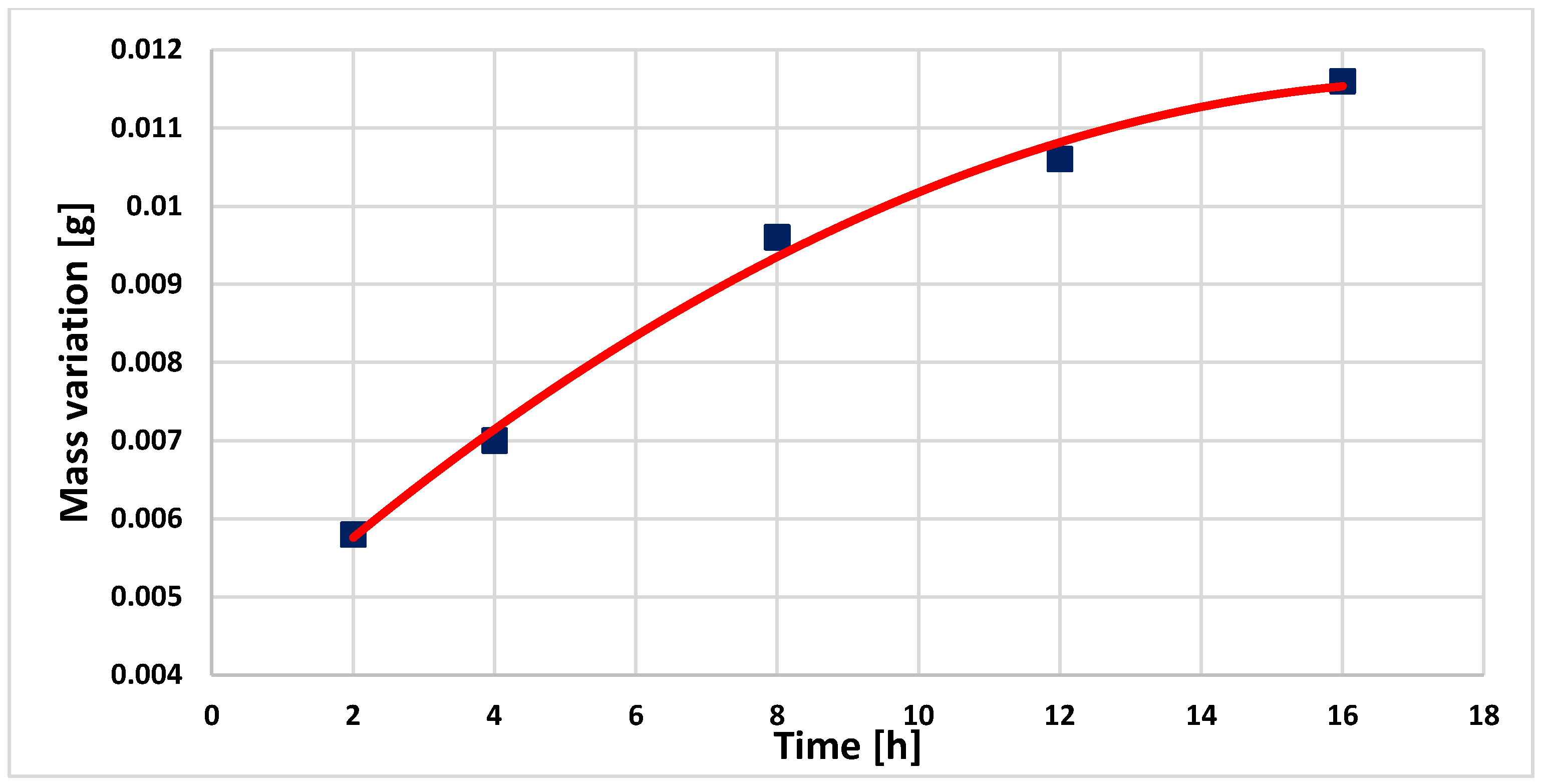
Maintaining identical operating conditions ensured the reproducibility of the measurements and the reliable determination of the parabolic rate constant. The obtained results are reported in
Figure 2 and
Figure 3. High-temperature oxidation tests provided insight into the stability of nickel under conditions representative of MCFC operation. The experimentally observed oxidation behavior follows a parabolic trend, indicating that oxide growth is governed by diffusion-controlled ionic transport through the oxide scale, in agreement with well-established oxidation models for nickel at high temperatures [
14,
15,
16].
The parabolic rate constant derived from the gravimetric measurements, on the order of 10
−10 g
2 cm
−4 s
−1, is consistent with values reported in the literature for nickel oxidation at comparable temperatures, confirming the validity of the experimental approach adopted in this study [
14]. These results demonstrate the suitability of nickel for high-temperature operation in oxidizing environments and provide quantitative insight into its oxidation kinetics under conditions representative of MCFC operation.
3.2. Measurement of Density and Void Fraction by Pycnometry
For each sample, the measured skeletal density values and the corresponding absolute standard deviation are reported as an indicator of the measurement reliability (
Table 3). For the measurement of skeletal density and degree of porosity, the samples previously prepared for the verification of Faraday’s law were used. To distinguish the different felt samples, each specimen was identified according to its immersion time in the Watts bath. Porosity is obtained from the ratio between the bulk density which includes the volume of the pores and the skeletal density measured by pycnometry, which corresponds only to the solid material Equation (3). Consequently, the bulk density must always be lower than the skeletal density.
where
is the void fraction (degree of voids) [%],
is the bulk density of the sample [kg·m
−3], and
is the skeletal density of the sample [kg·m
−3].
The bulk density values of the nickel felt samples are reported in
Table 4. The corresponding void fraction was calculated accordingly.
The void fraction of the samples is calculated in the same way, and the resulting data are reported in a corresponding table (
Table 5).
Pycnometric measurements were carried out to estimate the skeletal density of the nickel-based samples. The measured values show some dispersion, with an average value of approximately 6.3 g·cm
−3, which is lower than the intrinsic skeletal density of bulk metallic nickel (8.9 g·cm
−3). This discrepancy does not reflect a modification of the intrinsic density of nickel, but rather arises from the formation of microvoids within the electrodeposited layer and from the intrinsic limitations of water pycnometry when applied to highly porous and fibrous structures [
17]. In such materials, incomplete liquid penetration into microvoids and tortuous pore networks leads to the determination of an apparent skeletal density, which is therefore expected to be lower than the true skeletal density of massive nickel.
The high void fraction observed for all samples is therefore consistent with the intrinsic morphology of the nickel felt, which is characterized by an interconnected network of fibers and a large open porosity. Such structural features are desirable for MCFC electrode applications, as they promote effective gas transport and electrolyte retention. The dispersion observed in the calculated void fraction for nominally identical samples can be mainly ascribed to the intrinsic limitations of water pycnometry when applied to highly porous and fibrous materials. In particular, incomplete pore filling, air entrapment, and progressive liquid penetration within the open pore network may introduce variability in the measured values, affecting the repeatability of the technique and justifying the observed standard deviation.
3.3. Performance Test in Cell
The fabricated electrodes were evaluated in validated MCFC test stations to assess their performance under realistic operating conditions. A single nickel-plated cathode was chosen for cell testing, following preliminary experiments which demonstrated that the electrodeposition process significantly alters the nickel felt morphology.
The specific electrode selected for performance testing (30 min deposition at 1 A) possesses the same deposited mass as case (d) in
Figure 1 (10 min at 3 A). This condition was prioritized because, as detailed in
Table 5, lower current densities combined with longer deposition times yield a higher void fraction for a given mass. This resulting morphology optimizes porosity, facilitating efficient gas transport and superior electrolyte retention.
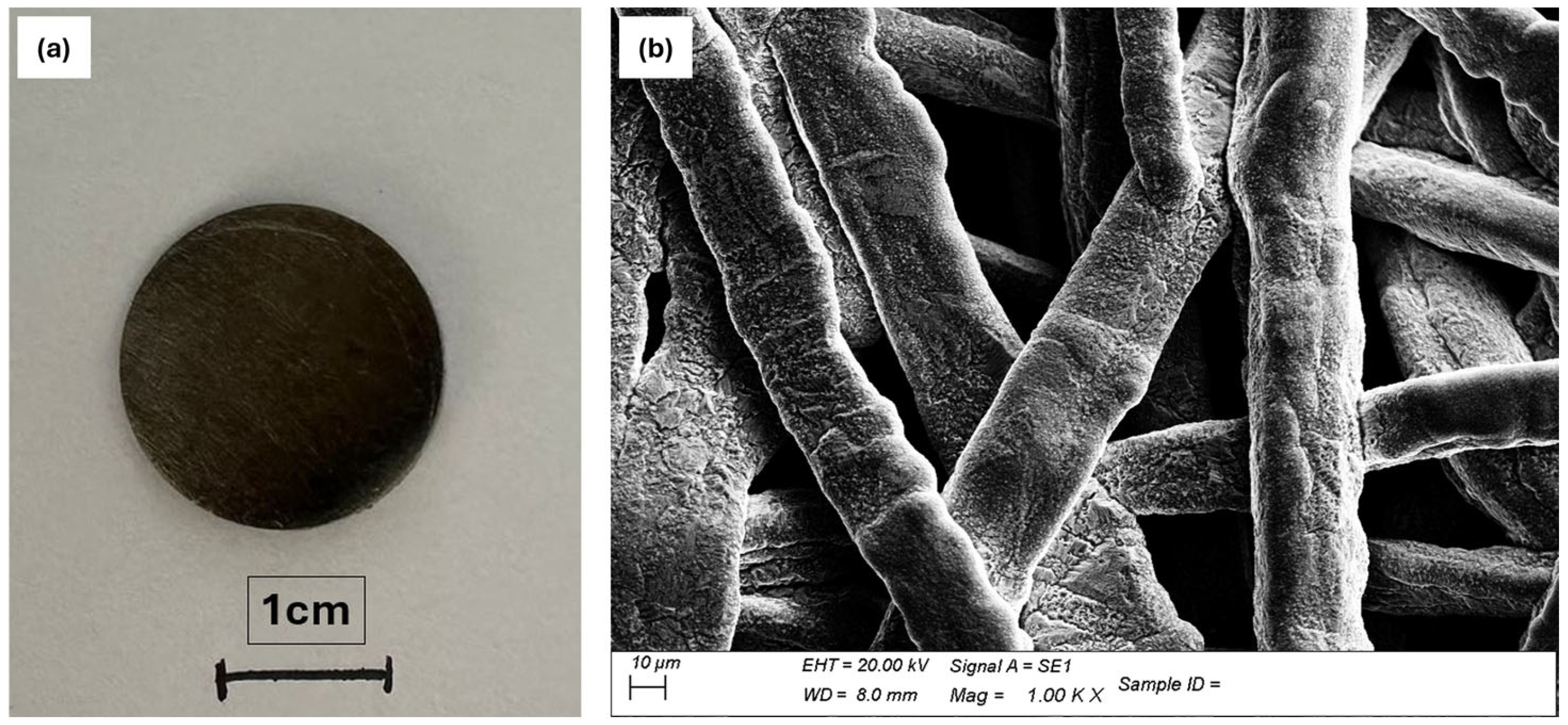
SEM analysis (
Figure 4) revealed that the treated nickel felt exhibits an inter-fiber spacing of approximately 5–30 µm, which represents the effective pore size of the electrode. Although this range is slightly broader than the standard literature targets for MCFC cathodes (7–15 µm), it marks a substantial improvement over the pristine substrate (20–50 µm) where the spacing is considerably larger and further from the desired specifications. These morphological refinements render the nickel-plated felt far more suitable for electrochemical characterization than the untreated material, providing a representative electrode configuration with an open, interconnected porous structure.
All other cell components consisted of well-established, reliable materials: the anode was Ni + 5 wt% Al (19 mm diameter); the electrolyte was a Li
2CO
3/K
2CO
3 eutectic mixture (62/38 mol%); and the matrix comprised two γ-LiAlO
2 sheets (25 mm diameter, 0.3 mm thickness) [
18].
The choice of manufacturing circular-shaped electrodes presents both advantages and limitations, particularly when small-area cells are employed. In such configurations, edge effects may arise due to non-uniform current distributions and gas flows at the electrode boundaries, becoming more pronounced as the active area decreases and failing to represent the behavior of the central region of the cell [
19]. Adopting a circular geometry, free of corners, helps mitigate these distortions and promotes a more uniform current distribution along the electrode perimeter. Regarding gas supply, the cathode is fed with a humidified mixture of air and CO
2, while the anode receives a humidified mixture of H
2 and CO
2. In
Table 6 and in
Table 7, the volumetric percentages of the gas streams supplied to the cathodic and anodic sides, respectively, are reported.
Humidification plays a crucial role by limiting the formation of solid carbon deposits at high temperatures, thus suppressing carbon deposition via the Boudouard reaction, and, on the anode side, by promoting the water–gas shift reaction.
To evaluate the electrochemical performance of the fabricated electrode under MCFC operating conditions, three complementary characterization methods were employed: the current–voltage (I–V) curve, the corresponding power density curve, and electrochemical impedance spectroscopy (EIS). Each technique provides specific and complementary information on cell behavior and performance.
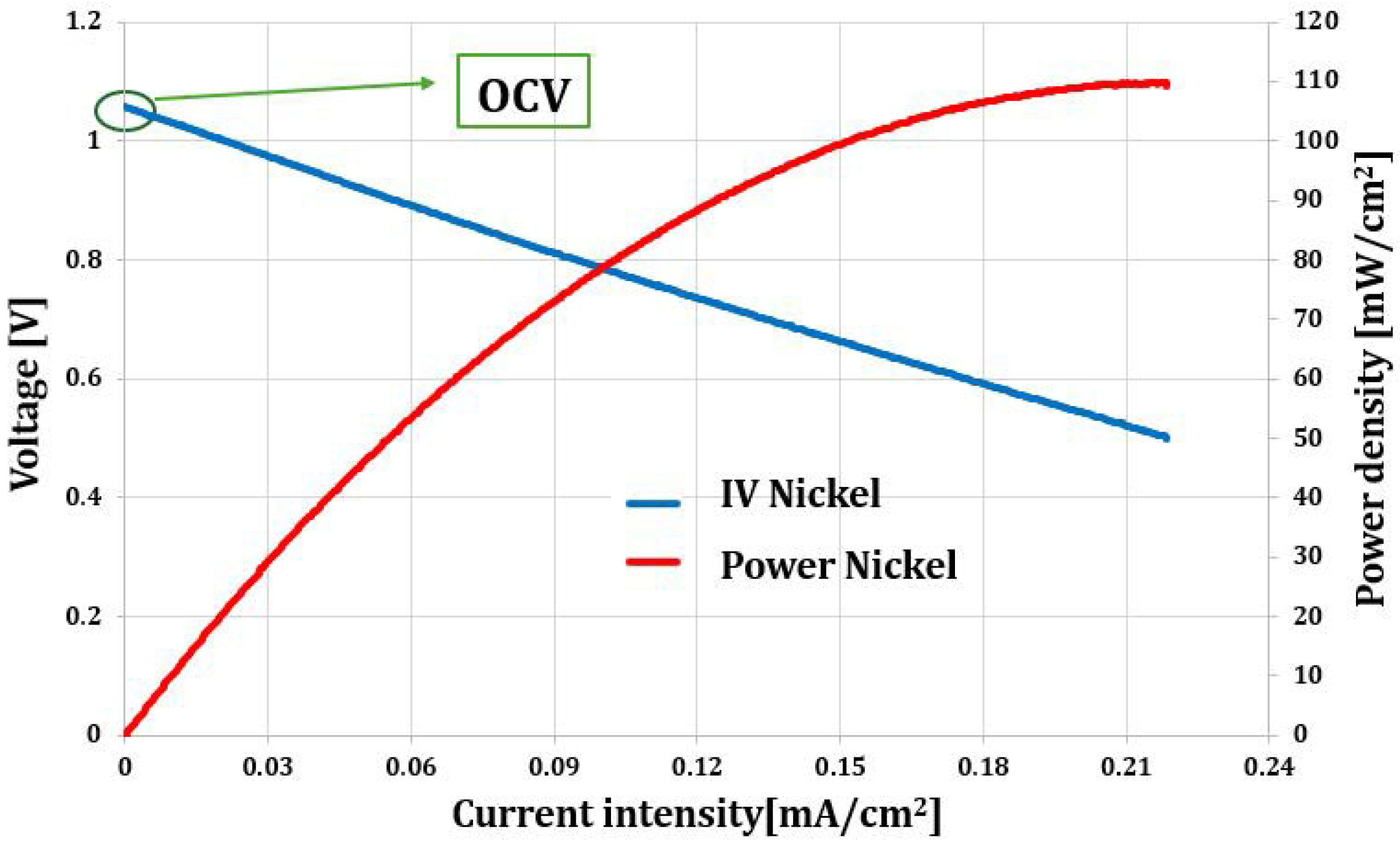
The I–V curve describes the evolution of the cell voltage as a function of the applied current density and represents a primary tool for assessing overall cell performance. From this curve, key parameters such as the open-circuit voltage (OCV), the operational voltage range, and the dominant loss mechanisms namely activation, ohmic, and concentration losses can be identified. The corresponding power density curve, obtained from the product of current density and cell voltage, provides direct insight into the maximum achievable power output and the optimal operating region of the cell. Both curves are reported in
Figure 5 for the nickel felt electrode, with the I–V curve shown in blue and the power density curve shown in red.
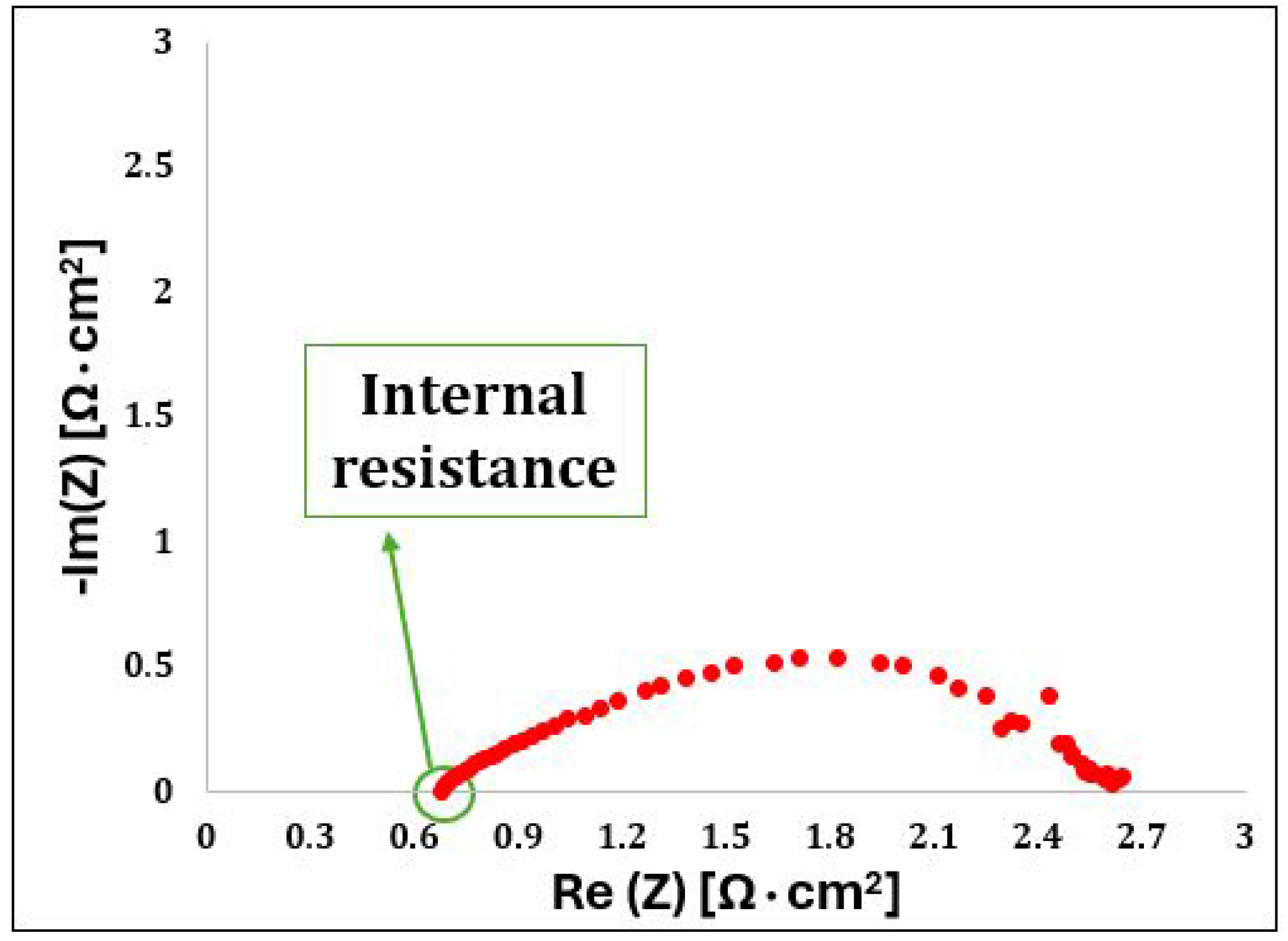
Electrochemical impedance spectroscopy (EIS) was employed to gain deeper insight into the individual resistance contributions governing cell performance. By analyzing the impedance response over a wide frequency range, it is possible to separate ohmic resistance from charge-transfer and mass-transport-related processes occurring at the electrode and at the electrode-electrolyte interface. EIS therefore allows a more detailed interpretation of the polarization behavior observed in the I–V curves and helps identify performance-limiting phenomena (
Figure 6).
The internal (ohmic) resistance was obtained from the high-frequency intercept of the EIS Nyquist plot with the real axis, while the polarization resistance was determined from the difference between the low- and high-frequency intercepts of the impedance curve
Table 8.
The results obtained from the analysis of the I-V curve show good agreement with the experimental data reported in the literature for molten carbonate fuel cells. In particular, the measured open-circuit voltage (OCV) is 1.05 V, which is in excellent accordance with typical values reported for similar systems [
19]. Likewise, the maximum power output of the cell reaches approximately 110 W, compared to a reference value of 125 W found in the literature, indicating overall performance consistent with the state of the art [
20]. Furthermore, electrochemical impedance spectroscopy analysis allowed the estimation of an internal resistance of 0.60 Ω∙cm
2, a value very close to the 0.55 Ω∙cm
2 reported in previous studies, further confirming the reliability and validity of the experimental results obtained [
21,
22].