Article

Corrosion Behavior and Degradation Mechanism of Novel Environmental Barrier Coatings (Yb1/5Y1/5Lu1/5Er1/5Ho1/5)2Si2O7 in High-Temperature Water-Oxygen Environments


1
College of Aviation Electronics and Electrical, Civil Aviation Flight University of China, Guanghan 618307, China
2
College of Safety Science and Engineering, Civil Aviation University of China, Tianjin 300300, China
*
Author to whom correspondence should be addressed.
Coatings 2026, 16(2), 223; https://doi.org/10.3390/coatings16020223

Submission received: 22 January 2026 / Revised: 3 February 2026 / Accepted: 6 February 2026 / Published: 9 February 2026
(This article belongs to the Special Issue Wear-Resistance and Corrosion-Resistance Coatings, 2nd Edition)

Abstract

To address the performance degradation of conventional rare-earth silicate environmental barrier coatings (EBCs) in high-temperature water-oxygen environments, this study developed a novel high-entropy EBC system. The coating with a composition of (Yb1/5Y1/5Lu1/5Er1/5Ho1/5)2Si2O7/Si/SiC was prepared via atmospheric plasma spraying. Thermal cycling corrosion tests were conducted at 1400 °C under a 90% H2O–10% O2 atmosphere. Results show that after heat treatment, the monosilicate phase content decreased, and the structure stabilized. The coating surface exhibited a ridge-like morphology with pits and microcracks after corrosion. A porous corrosion layer formed at the edges, and the SiO2 layer thickness increased parabolically from 2.75 μm after 100 cycles to 5.65 μm after 300 cycles. The coating demonstrated excellent corrosion resistance, with degradation initiated by surface thermochemical corrosion, leading to corrosion layer formation and SiO2 accumulation. This study provides important insights for developing long-life EBCs for aero-engine applications.

1. Introduction

As aircraft engines continue to evolve toward higher thrust-to-weight ratios, traditional high-temperature alloy materials struggle to meet increasingly stringent service performance requirements. Ceramic matrix composites (CMCs) have emerged as a leading candidate to replace high-temperature alloys due to their low density, high maximum operating temperature, and superior mechanical properties [1,2,3,4]. However, these materials are prone to corrosion in high-temperature, water vapour-containing environments, leading to rapid performance degradation and severely limiting their practical application [5,6,7]. Consequently, developing effective environmental barrier coating (EBC) systems for CMCs has become a research priority. Among these, Yb2Si2O7, a relatively mature coating material, has demonstrated promising application prospects [8,9,10].
Research indicates that Yb2Si2O7 EBCs are prone to phase-transformation-induced porosity and microcracks, leading to stress concentration and accelerating coating degradation under long-term service conditions [11,12]. To address this issue, researchers have recently adopted the multi-principal component design approach proposed by Yeh et al., introducing the concept of high-entropy alloys into ceramic systems to optimize material properties [13,14]. Sun et al. successfully synthesized (Gd1/6Tb1/6Dy1/6Tm1/6Yb1/6Lu1/6)2Si2O7 ceramics by employing a high-entropy strategy, demonstrating excellent thermal stability across the temperature range from room temperature to 1900 °C [15]. Wei et al. synthesized a fine-grained (Yb0.2Tm0.2Lu0.2Sc0.2Er0.2)2Si2O7 ceramic that maintained a low thermal conductivity of 0.686 W·m−1·K−1 at 1300 °C [16]. This material exhibits a thermal expansion coefficient matching that of SiC substrates, low thermal conductivity, and excellent corrosion resistance in high-temperature water-oxygen environments. Abrar et al. prepared high-entropy monosilicate (Dy1/5Er1/5Tm1/5Yb1/5Y1/5)2SiO5 via a solid-solution method [17]. This material exhibits a thermal expansion coefficient matching that of SiC substrates, low thermal conductivity, and excellent corrosion resistance in high-temperature water-oxygen environments. Beyond rare-earth silicate systems, other high-temperature coating materials such as refractory high-entropy alloys (where the formation of CrTaO4 in their oxidation behavior and failure mechanisms) also provide important references for coating design [18]. However, current research on high-entropy EBCs primarily focuses on powder and bulk materials. Systematic understanding remains lacking regarding their multifactorial coupled corrosion behavior within actual coating systems, particularly under the increasingly complex and demanding operating conditions anticipated for future aero-engine applications. The underlying mechanisms governing the evolution of corrosion kinetics, the multiscale accumulation of microdamage, and the degradation and failure of coating performance under these complex conditions remain unclear. This lack of understanding limits the accurate prediction and reliable design of long-term coating service life.
Considering that the similar ionic radii of rare earth elements facilitate the formation of homogeneous solid solutions and can enhance the structural stability and corrosion resistance of coatings through the high-entropy effect [19,20], this study selected five rare earth elements—Yb, Y, Lu, Er, and Ho—with well-matched ionic radii to prepare a high-entropy silicate (Yb1/5Y1/5Lu1/5Er1/5Ho1/5)2Si2O7. This work employed atmospheric plasma spraying technology to fabricate novel (Yb1/5Y1/5Lu1/5Er1/5Ho1/5)2Si2O7((5RE1/5)2Si2O7)/Si/SiC three-layer structured EBCs, investigating their corrosion behavior in a high-temperature water vapor-oxygen environment at 1400 °C. By analyzing microstructural evolution and phase transformations under thermochemical coupling, the dynamic corrosion kinetics and degradation mechanisms of the coating were elucidated. This study not only provides crucial experimental evidence for understanding the durability of high-entropy barrier coatings in extreme environments but also lays a theoretical foundation for developing next-generation, long-life, high-reliability EBC systems for aero-engines.

2. Materials and Methods

2.1. Sample Preparation

RE2O3 (RE = Yb, Y, Lu, Er, Ho) and SiO2 supplied by Ningbo Jinlei Nanomaterials Technology Co., Ltd., Ningbo, China. were selected as raw materials and mixed according to stoichiometric ratios. The mixed powder, anhydrous ethanol, and zirconia balls of varying sizes were placed in a PBM-0.4A semi-circular arc planetary ball mill (Shenzhen Jietong Technology Co., Ltd., Shenzhen, China) for ball milling at 500 rpm for 12 h. The resulting slurry was dried at 80 °C for 8 h, sieved through a 100-mesh screen, and then heat-treated at 1500 °C for 2 h to achieve solid-state sintering. This process yielded the high-entropy rare-earth silicate (5RE1/5)2Si2O7. The product was then sieved through a 200-mesh screen to obtain the final (5RE1/5)2Si2O7 powder. Finally, spray granulation was employed to produce (5RE1/5)2Si2O7 spray powder with a particle size of 15–50 μm.
A Si bonding layer and a (5RE1/5)2Si2O7 topcoat were sequentially deposited onto the SiC substrate using a Praxair 3710 atmospheric plasma spray system, following the spraying parameters detailed in Table 1. The as-sprayed samples were then heat-treated in a high-temperature box furnace at 1350 °C for 8 h.

2.2. Experimental Methods and Characterization

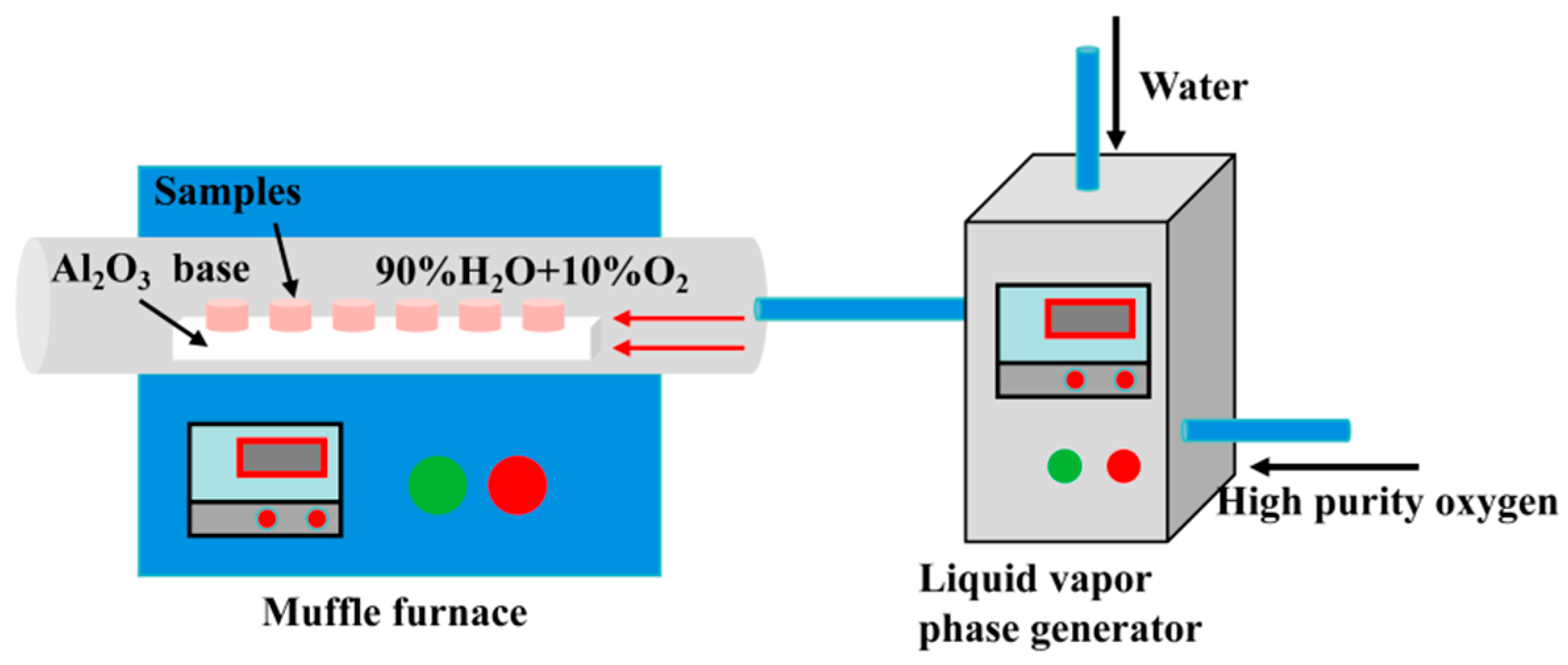
The apparatus generates steam via a high-temperature steam generator (schematic shown in Figure 1). It employs a short-pipeline design with semi-enclosed insulation using Al2O3 cylindrical tubes to effectively prevent condensation, ensuring steam remains in a gaseous state throughout the process. The thermocouple is positioned 5 mm directly below the sample, with furnace temperature uniformity maintained within ±2 °C. (5RE1/5)2Si2O7 coated specimens are placed on Al2O3 substrates and subjected to corrosion testing at 1400 °C under a 90% H2O–10% O2 atmosphere. The system operated under slow-flowing quasi-static conditions at atmospheric pressure, with an outlet gas analyzer monitoring atmosphere stability. A total of 100, 200, and 300 thermal cycles were performed, each cycle comprising 2 h of isothermal holding followed by 15 min of air cooling. Samples were characterized post-test, with three parallel specimens per condition to minimize experimental uncertainty.
Scanning electron microscopy (SEM, TESCAN MIRA LMS, Brno, Czech Republic) equipped with an energy dispersive spectrometer (EDS, acceleration voltage 15 kV, point scanning beam spot approximately 0.5 μm) was employed to examine the microstructure and analyze elemental distribution of the material before and after corrosion. Samples for cross-section observation underwent cold embedding and polishing. This process was applied solely to expose the internal layered structure and interface features of the coating, without any mechanical treatment of the original outer surface. This ensured the corrosion morphology remained intact, guaranteeing that surface observation results accurately reflected the corrosion evolution process. Cross-sections from different cycle numbers were analyzed at five selected positions each in the central and peripheral regions. The phase composition of the samples and corrosion products was determined using an X-ray diffractometer (XRD, Ultima IV, Tokyo, Japan) with a copper target and a step size of 0.02°.

3. Results and Discussion

3.1. Microstructure and Phase Composition of (Yb1/5Y1/5Lu1/5Er1/5Ho1/5)2Si2O7 Powder

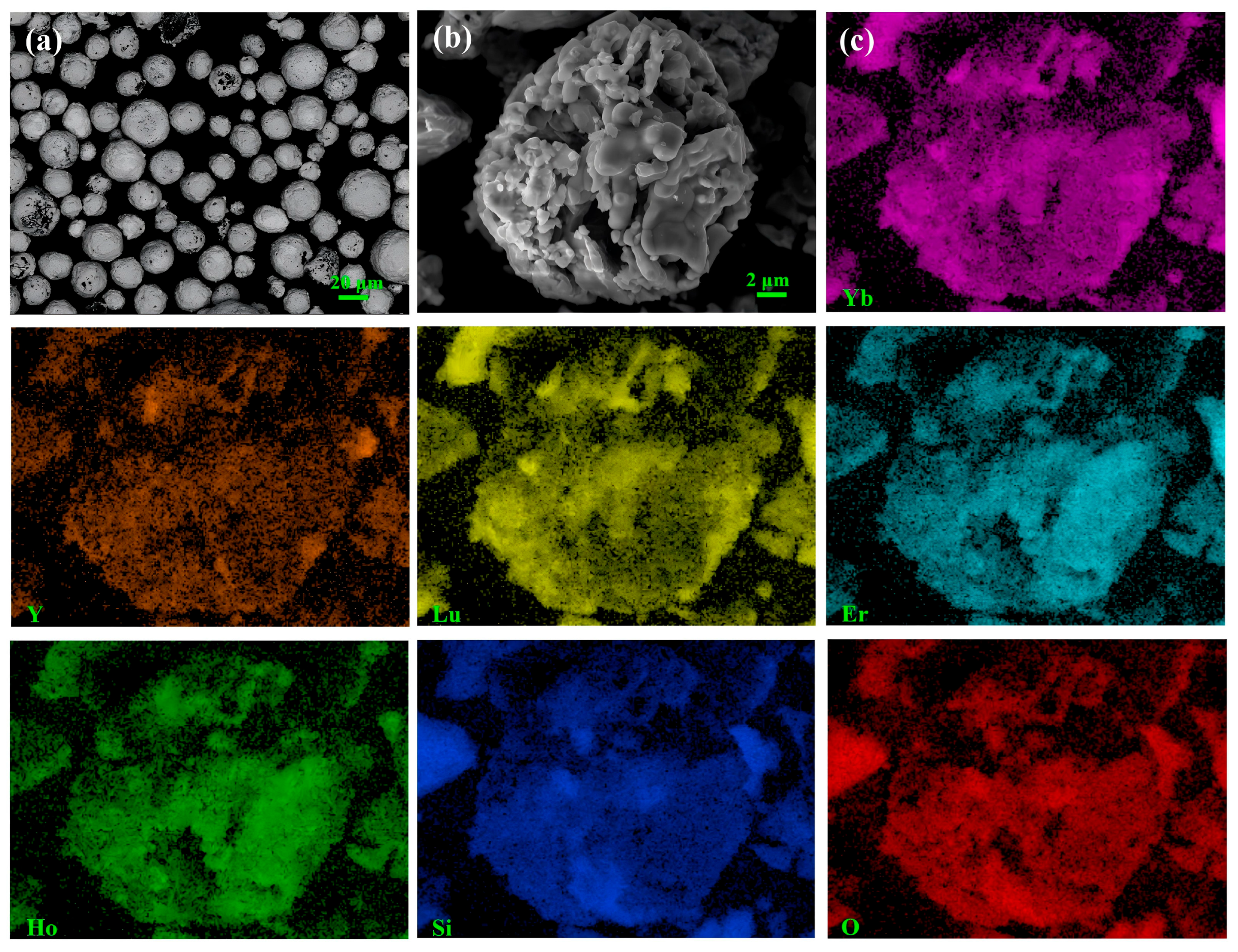
Figure 2 displays the typical microstructure of (Yb1/5Y1/5Lu1/5Er1/5Ho1/5)2Si2O7 powder and its corresponding elemental surface scanning analysis. It can be observed from Figure 2a that the particle size of the synthesized powder primarily ranges from 15 to 50 μm. Furthermore, the elemental distribution maps for Yb, Y, Lu, Er, Ho, Si, and O reveal uniform distribution of all components throughout the material, showing no significant elemental segregation. This aligns with the elemental content results for the scanned regions listed in Table 2, confirming that the actual elemental composition closely matches the theoretical stoichiometric ratio.
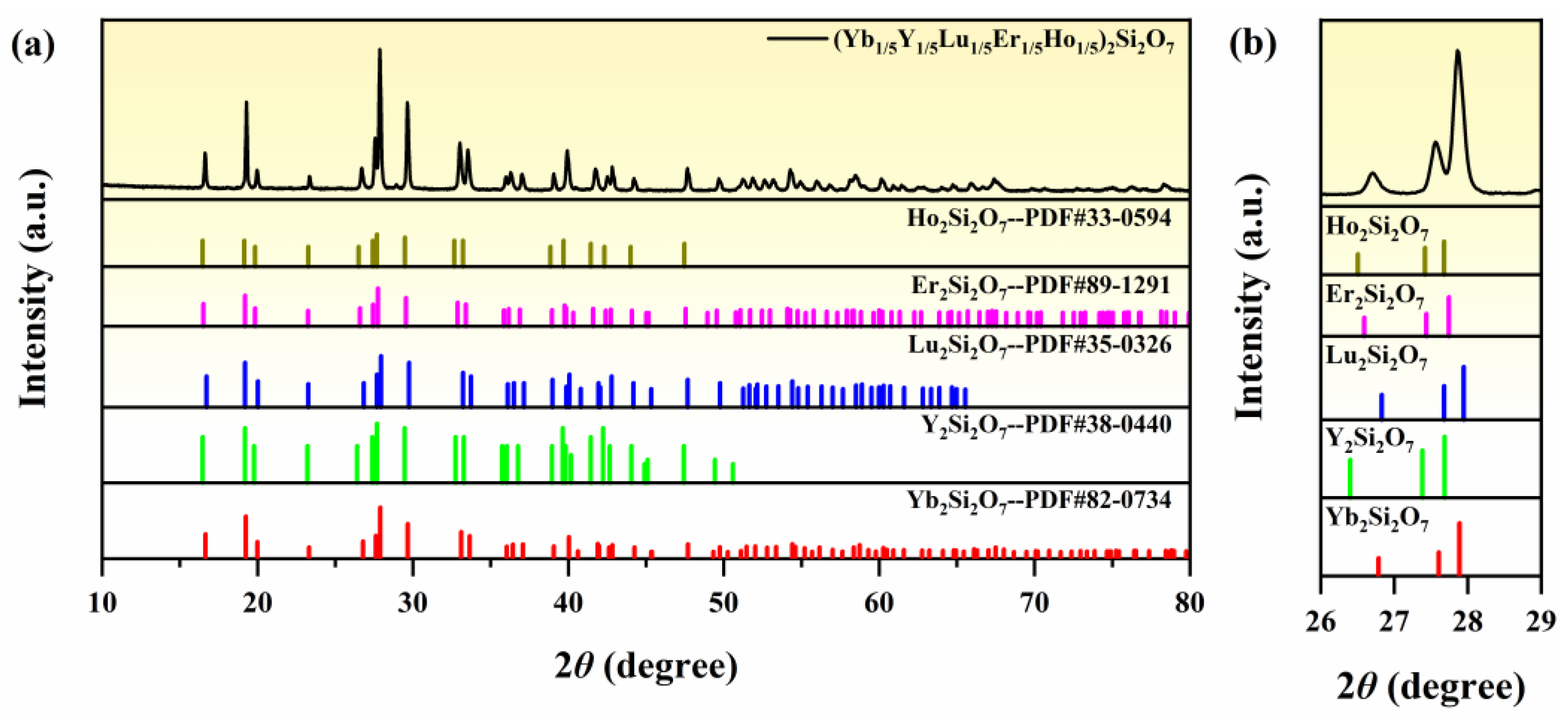
Figure 3 displays the XRD pattern of the experimentally synthesized (5RE1/5)2Si2O7 powder. Phase analysis indicates that this material exhibits a single β-phase crystalline structure at room temperature, with diffraction peak positions matching those of the standard β-Yb2Si2O7 reference pattern. No impurity phase diffraction peaks were detected in the pattern beyond the target phase, indicating high phase purity of the synthesized bulk material. Combined with prior scanning electron microscopy observations, this confirms the successful synthesis of the high-entropy EBCs material (5RE1/5)2Si2O7.

3.2. Microstructure and Phase Composition of (Yb1/5Y1/5Lu1/5Er1/5Ho1/5)2Si2O7 Coatings

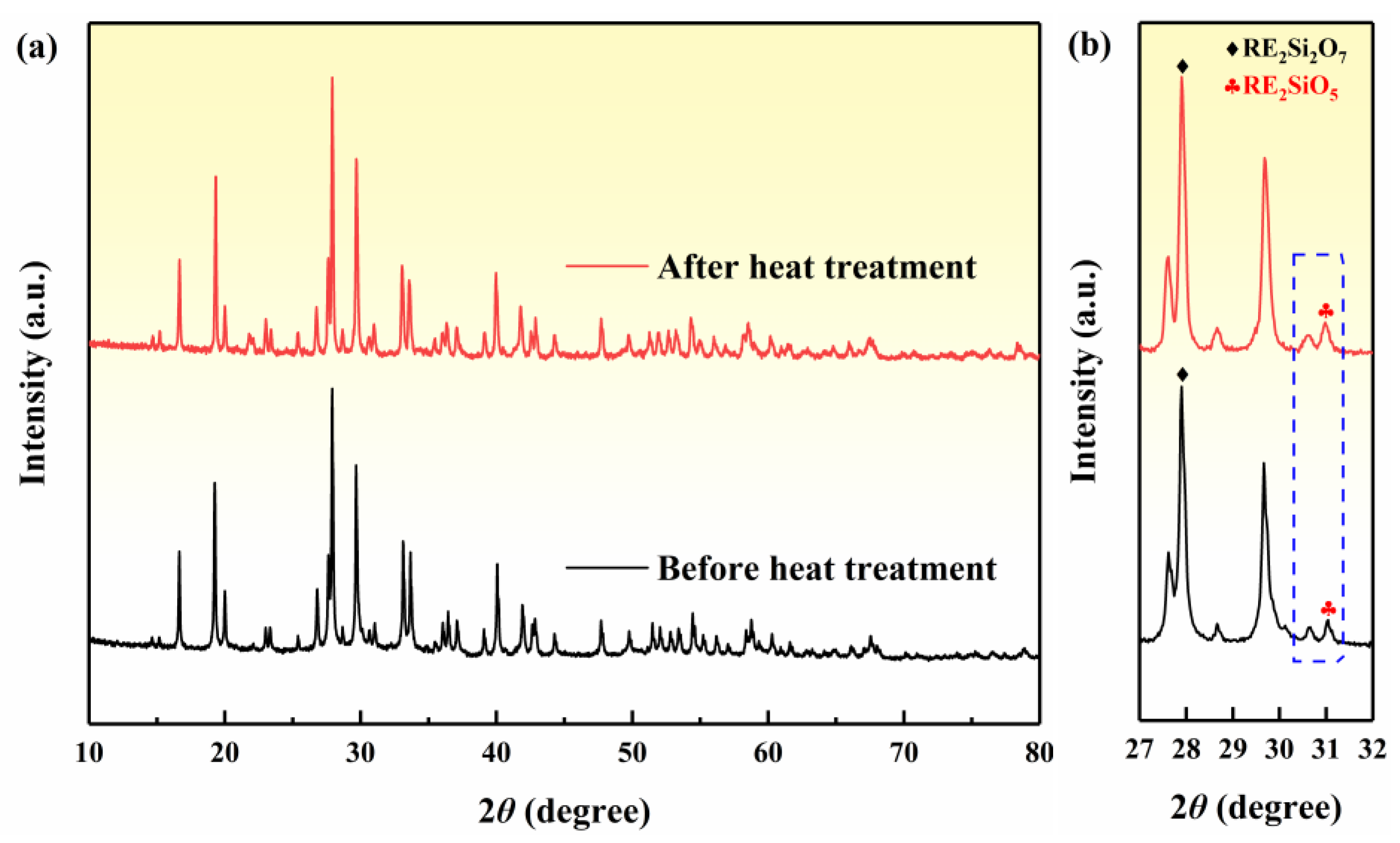
Figure 4 compares the XRD patterns of EBCs before and after heat treatment. Phase analysis indicates that in both states, the coating primarily consists of rare earth pyrosilicate (RE2Si2O7) as the main phase, with a small amount of rare earth monosilicate (RE2SiO5). This monosilicate phase mainly originates from the thermal decomposition of some pyrosilicates caused by the high-temperature flame flow during atmospheric plasma spraying. Notably, semi-quantitative analysis using the reference intensity ratio (RIR) method with MDI Jade 6.0 software (based on three repeated measurements) revealed that the relative content of the monosilicate phase in the coating before heat treatment was approximately 14.31%. This decreased to about 10.66% after heat treatment, with a relative error < 5%. Concurrently, the crystallinity also increased. This result indicates that heat treatment promotes the reversible transformation of metastable monosilicate phases formed during spraying, thereby rendering the phase composition within the coating more uniform and stable [21,22].
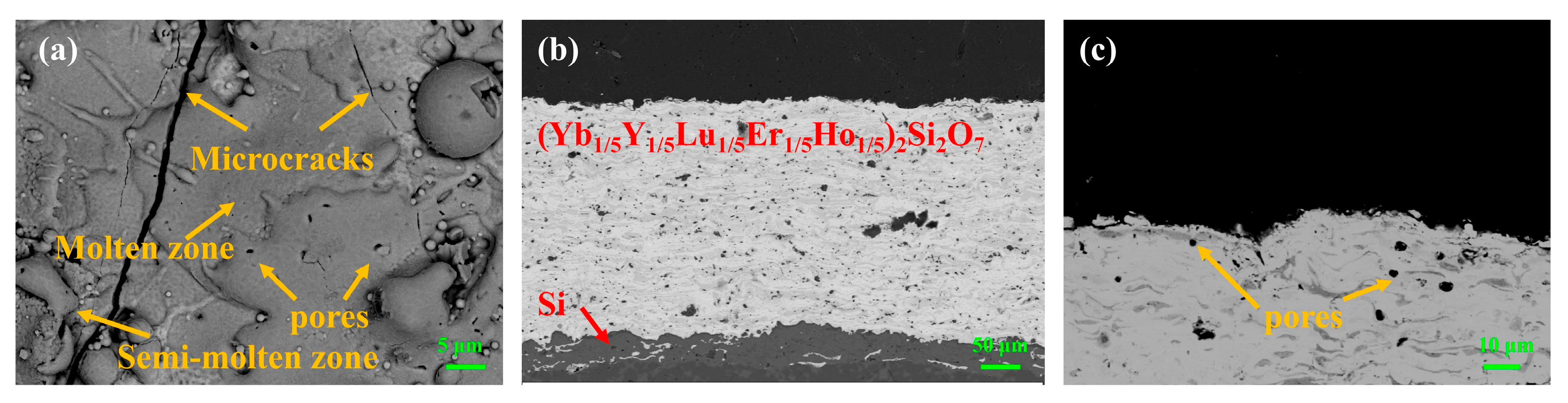
Figure 5 displays the microstructure of EBCs after heat treatment. Surface topography (Figure 5a) reveals that the coating surface comprises both fully melted flat regions and partially melted rough areas, interspersed with sparse pores and microcracks. Cross-sectional images (Figure 5b,c) indicate good interfacial bonding between coating layers, though a certain number of pores remain within the coating. The average thickness of the top coating layer was 296.14 ± 4.15 μm, while the average thickness of the Si bonding layer was 98.4 ± 3.37 μm. Combining the XRD phase analysis results in Figure 4 with the microstructural features in Figure 5 confirms the successful preparation of this novel high-entropy EBCs.

3.3. Water-Oxygen Corrosion Behavior of (Yb1/5Y1/5Lu1/5Er1/5Ho1/5)2Si2O7 Coatings

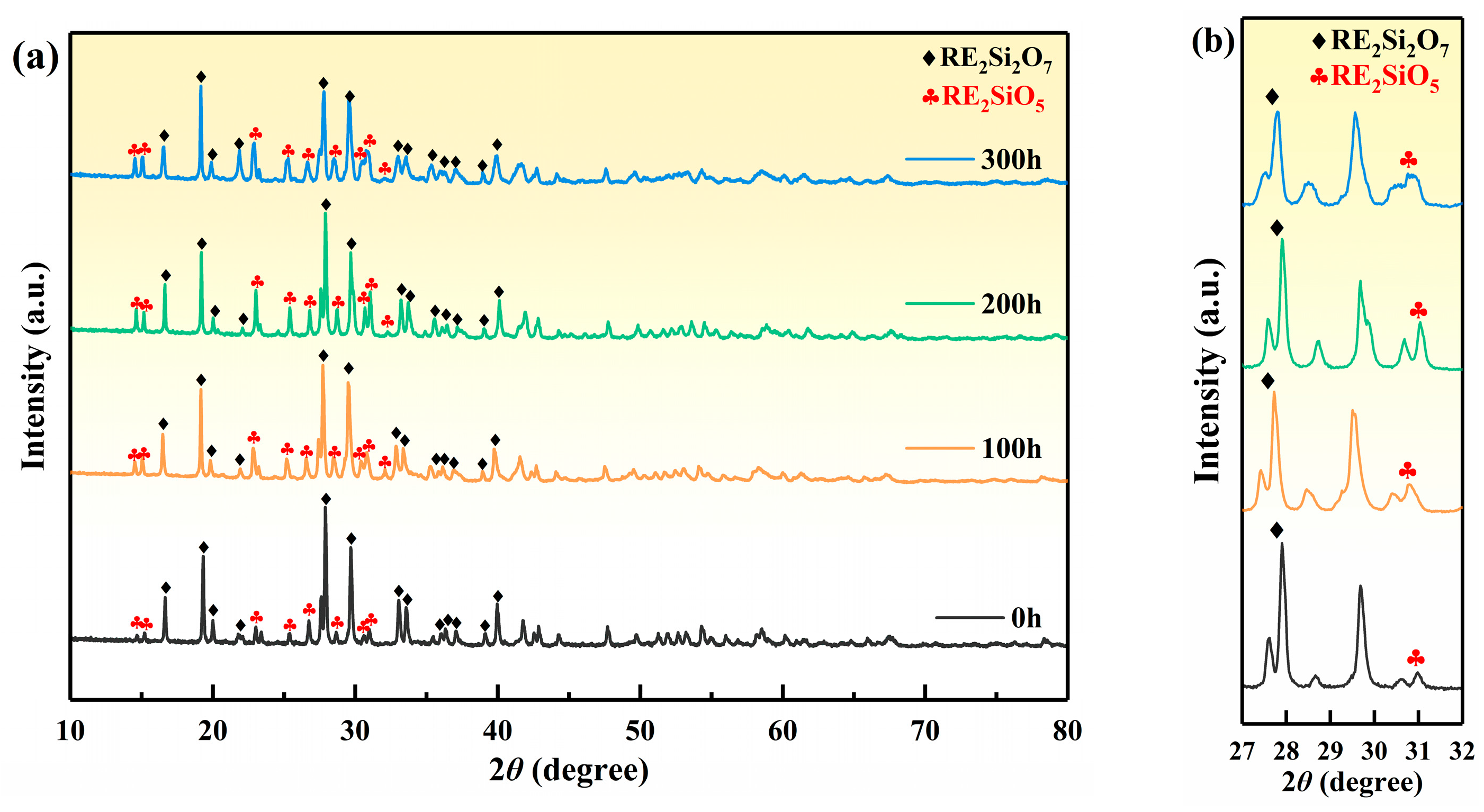
To clarify the corrosion behavior of the (5RE1/5)2Si2O7 coating in a high-temperature water-oxygen environment, XRD phase characterization was performed on specimens after 100, 200, and 300 thermal cycling corrosion cycles, and the results are presented in Figure 6. Analysis indicates that as the number of corrosion cycles increases, the coating’s primary phase consistently maintains its pyrosilicate structure without significant phase transformation. Additionally, the diffraction peaks of rare earth monosilicates (RE2SiO5) gradually intensified during the corrosion process, indicating that hydroxyl-oxygen corrosion reactions occurred on the coating surface under prolonged thermo-chemical coupling, leading to partial decomposition of the pyroxysilicate phase. The degradation of EBCs in this process primarily involves the following reactions [23,24]:
RE2Si2O7 (s) + 2H2O (g) = Si(OH)4 (g) + RE2SiO5 (s)
This reaction was consistent with the XRD results. Nevertheless, the content of the monosilicate phase remained low throughout, and the structure of the main phase remained stable. Compared with previous studies, this is attributed to the hysteretic diffusion effect and lattice distortion effect introduced by the high-entropy design. These two effects jointly suppress ion migration and phase transformation kinetics, enhancing the stability of Si-O bonds [25]. Consequently, (5RE1/5)2Si2O7 exhibits superior phase stability in high-temperature water-oxygen environments.
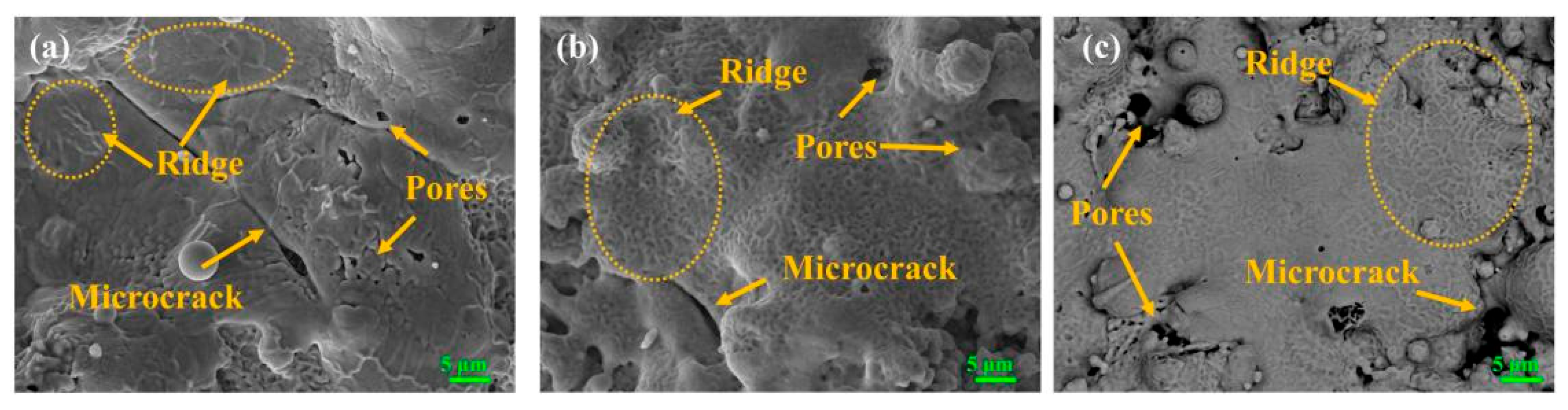
Figure 7 shows the evolution of the coating’s surface microstructure after different numbers of corrosion cycles (Magnification: 5000×). As shown in Figure 7a, after 100 cycles, the coating surface exhibited initial signs of erosion, characterized by a typical ridge-like morphology along with minor pits and microcracks. As the number of corrosion cycles increases, the quantity of surface pits grows, and their size significantly expands. This phenomenon is closely related to the phase transformations occurring during the corrosion process. The gradual conversion of pyrosilicates to monosilicates is accompanied by volume contraction. Simultaneously, the volatile Si(OH)4 generated under high-temperature, water-oxygen conditions further accelerates material loss [20,26]. These processes collectively induce localized stress concentration, which ultimately triggers the accelerated propagation of cracks and corrosion damage on the coating surface [27,28].
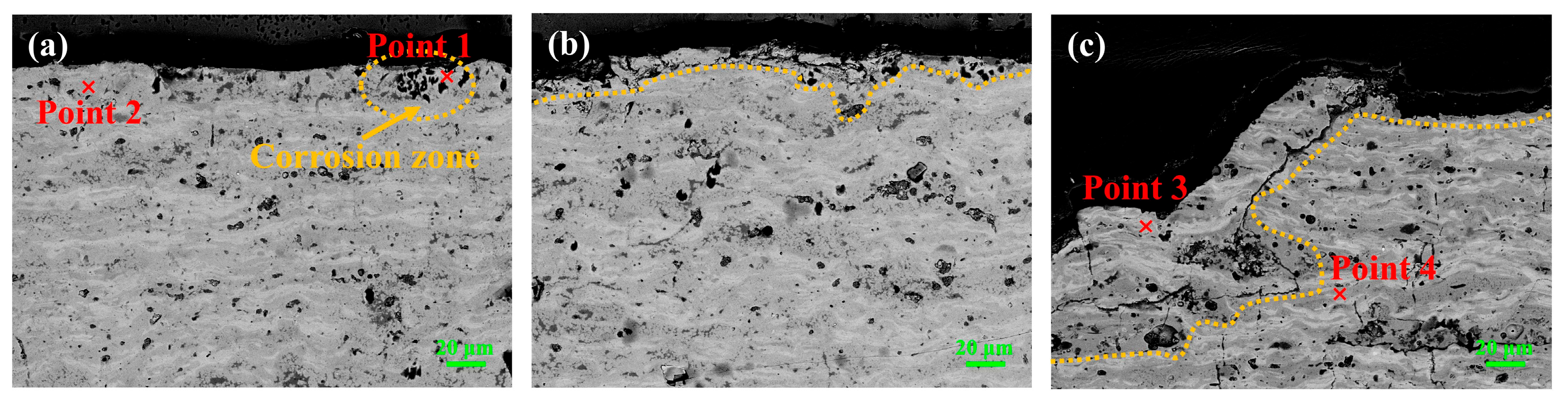
Figure 8 illustrates the evolution of the cross-sectional morphology of the coating top layer after different numbers of corrosion cycles (Magnification: 500×). As shown in Figure 8a, localized corrosion has already appeared in the edge region of the top layer’s upper surface after 100 cycles. This occurs primarily because the edge region is directly exposed to the high-temperature water-oxygen environment, allowing more thorough interaction with the corrosive medium. Consequently, the phase transformation from pyrosilicate to monosilicate occurs more readily, consistent with Equation (1). As the number of corrosion cycles increases (The dashed-line area in Figure 8b,c), corrosion at the edges intensifies, forming a porous corrosion layer. Meanwhile, a small number of longitudinal microcracks began to appear within the top layer. To accurately characterize the composition of the corrosion zone, point scanning was performed near pores and in non-porous areas to avoid interference from underlying materials. EDS point analysis (Table 3) indicates that the light gray regions (Points 1 and 3) correspond to the monosilicate phase, while the dark gray regions (Points 2 and 4) correspond to the pyrosilicate phase. Thus, Figure 8 demonstrates that the distribution of the monosilicate phase within the corrosion layer expands progressively as the number of cycles increases. This evolution in phase distribution is consistent with the XRD results shown in Figure 6, thereby further confirming the continuous progression of phase transformation during corrosion.
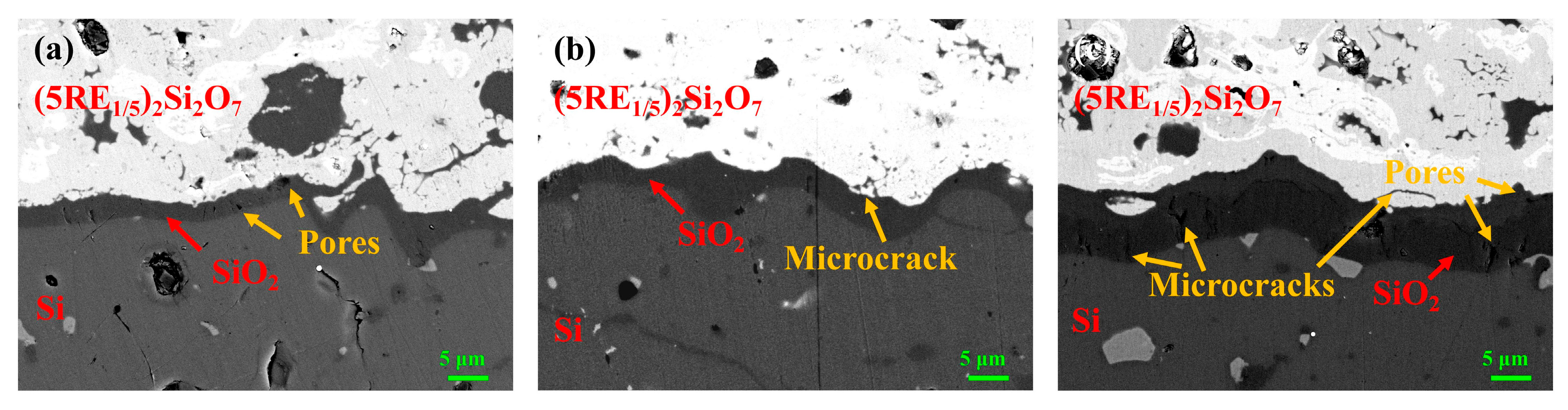
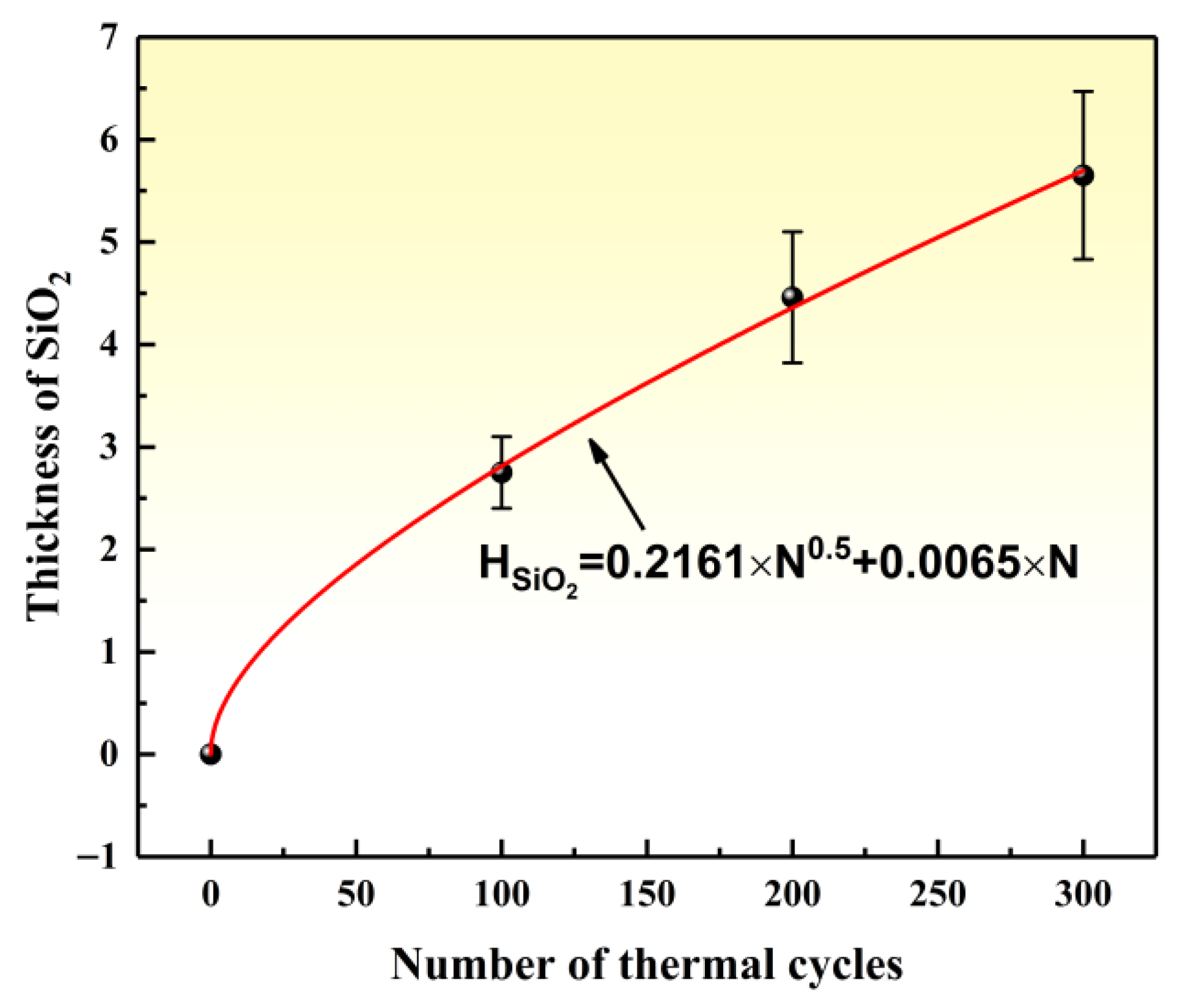
Figure 9 shows the microstructural evolution of the SiO2 layer under different numbers of corrosion cycles (Magnification: 2000×). As depicted, a SiO2 film gradually forms between the Si bonding layer and the top layer in the high-temperature water-oxygen environment. With increasing corrosion cycles, this SiO2 layer thickens progressively and exhibits significant non-uniformity. It is noteworthy that a small number of pores and microcracks become observable in the SiO2 layer after 300 cycles. This phenomenon is primarily attributed to the combined effects of localized stress concentration due to incomplete H2 release during SiO2 growth (Equation (2)) and volumetric strains associated with phase transformations [29,30]. By calculating 10 test positions for each sample at different cycle counts, the variation curve of the average SiO2 layer thickness with corrosion time was obtained, as shown in Figure 10. The figure indicates that the thickening of SiO2 follows a parabolic pattern (Equation (3)), where H S i O 2 represents the average thickness of the SiO2 layer, N denotes the number of cycles, and K, n, and a are fitting parameters. This result is consistent with previous studies [31]. The specific parameters for this parabolic fit are shown in Table 4, with a fitting accuracy R2 of 99.99%. The average SiO2 thickness was 2.75 μm after 100 cycles. This value increased to 5.65 μm after 300 cycles. No significant transverse cracking was observed at the interface between the SiO2 layer and the adjacent layers at any stage. This indicates that the coating system maintains good interfacial bonding integrity and resistance to delamination under the given high-temperature corrosion conditions. Compared to previous studies (as shown in Table 5), these high-entropy EBCs exhibit superior antioxidant capabilities, further mitigating coating interface failure [31].
Si (s) + 2 H2O (g) = SiO2 (s) +2 H2 (g)
H S i O 2 = K · N n + a · N n

3.4. Degradation Mechanism of (Yb1/5Y1/5Lu1/5Er1/5Ho1/5)2Si2O7 Coatings

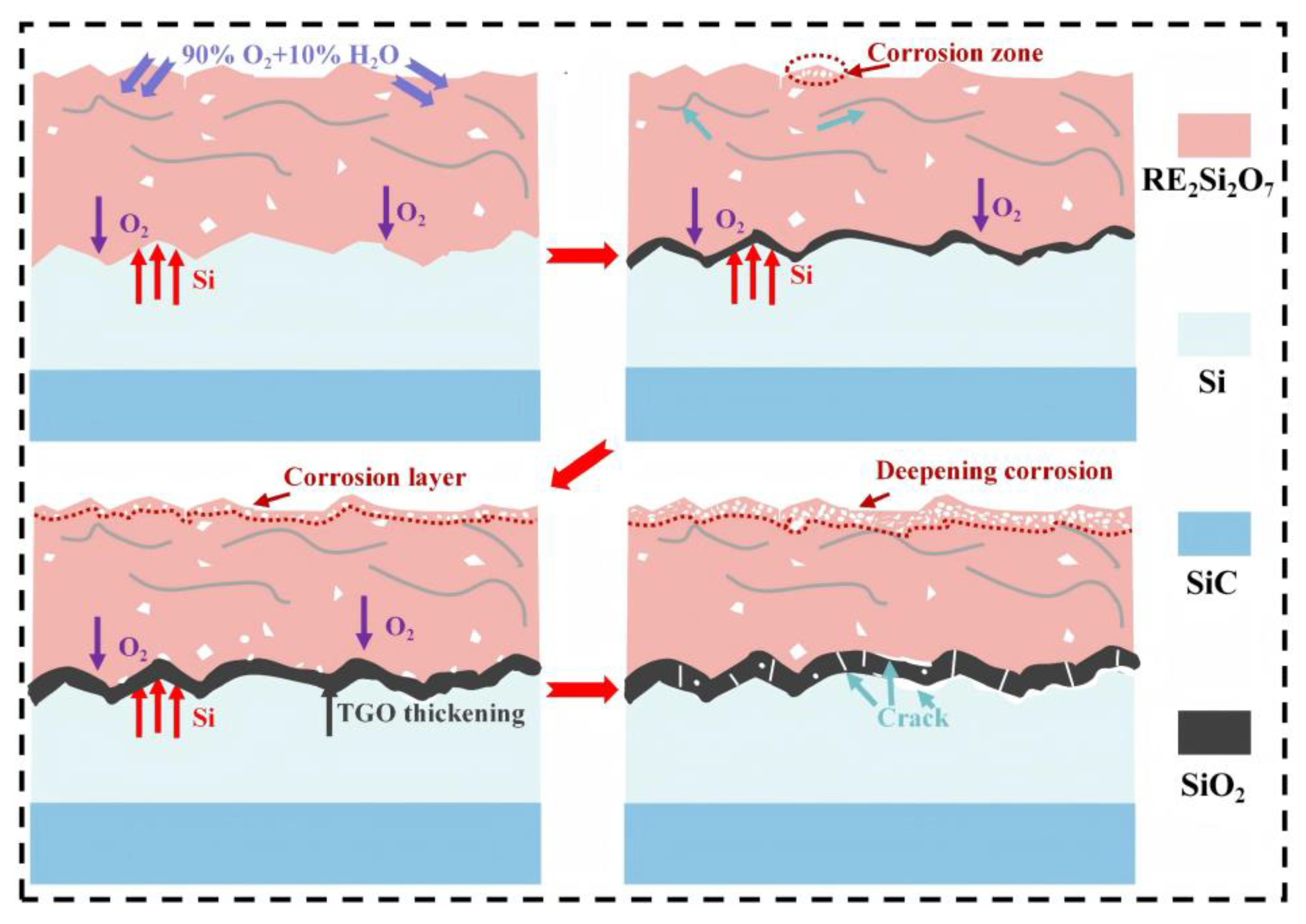
The corrosion behavior study reveals that the performance degradation of this novel EBCs follows a gradual process involving multiple synergistic mechanisms, which progresses from the surface inward. The deterioration of EBCs commences with surface corrosion driven by thermochemical coupling. The adsorption of water molecules catalyzes the decomposition of pyrosilicates, generating volatile species while simultaneously triggering phase transformations. These processes collectively lead to material loss, pitting formation, and the initiation of surface microcracks. These microcracks serve as pathways for water-oxygen media to penetrate into the coating interior, subsequently inducing cross-sectional damage. Cross-sectional damage manifests in two primary aspects. First, the top layer gradually transforms into a loose, porous corrosion layer under high water-oxygen environments. This not only directly weakens the coating’s resistance to further erosion but also increases the risk of localized delamination of the top layer. Second, the continuous thickening of the SiO2 layer at the interface, accompanied by volume expansion and growth stresses, readily induces cracks in the interfacial region, weakening interlayer bonding. The degradation mechanism of the coating is illustrated in Figure 11. The red arrow represents the evolutionary process. The entire degradation process exhibits a synergistic evolution where surface corrosion, internal damage, and crack initiation are coupled. If allowed to progress, this will significantly reduce the coating’s protective capability and service life. This mechanistic understanding indicates that enhancing the long-term durability of coatings in such extreme environments requires further optimization of both surface resistance to water vapor corrosion and interfacial crack resistance. It should be noted that the understanding of coating degradation mechanisms in this study remains limited. Key structural characteristics such as porosity and micro-defect distribution have not yet been quantified, which restricts the accurate prediction of long-term coating performance. Future work should integrate more refined microstructural characterization methods with service simulations of actual components, such as blade leading edges and areas surrounding cooling holes [32]. This will deepen our understanding of coating degradation kinetics and edge corrosion behavior, thereby providing more reliable foundations for life prediction and protective design.

4. Conclusions

This study successfully fabricated a novel high-entropy EBCs system (Yb1/5Y1/5Lu1/5Er1/5Ho1/5)2Si2O7/Si/SiC using atmospheric plasma spraying technology. The corrosion behavior and degradation mechanism of this system under high-temperature aqueous oxygen environments were investigated. The main conclusions are as follows:
(1)
The (Yb1/5Y1/5Lu1/5Er1/5Ho1/5)2Si2O7/Si/SiC coating was successfully obtained using solid-state sintering, spray granulation, and atmospheric plasma spraying. The prepared coating exhibits a typical layered structure with good interlayer bonding, maintaining overall integrity without significant macroscopic defects.
(2)
The surface of the (5RE1/5)2Si2O7 coating exhibited typical ridge-like morphology after high-temperature water-oxygen corrosion, accompanied by corrosion pores and microcracks. Cross-sectional analysis revealed that the edge regions of the coating gradually formed porous and loose corrosion layers due to preferential corrosion. As the number of corrosion cycles increases, the content of rare earth monosilicates in the coating gradually rises. This is closely related to the decomposition reaction of surface pyrosilicates under the action of high-temperature water and oxygen.
(3)
The thickness of the SiO2 layer formed by oxidation of the Si bonding layer during corrosion increases parabolically over time and exhibits non-uniform growth. The appearance of pores and microcracks in the SiO2 layer during the later stages of corrosion provides conditions for the initiation and propagation of cracks at the interface.
(4)
The degradation of the novel (5RE1/5)2Si2O7 coating initiates with surface corrosion under thermochemical coupling effects, subsequently progressing to internal damage. This primarily involves the formation and thickening of a porous corrosion layer at the top surface, coupled with stress accumulation caused by SiO2 layer growth at the interface.

Author Contributions

Conceptualization, Z.Y.; methodology, X.X.; software, X.X.; validation, M.Z., and W.W.; formal analysis, X.W.; investigation, X.X.; writing—original draft preparation, X.X., and Z.Y.; writing—review and editing, X.X., and Z.Y.; visualization, X.X.; supervision, X.W.; project administration, M.Z.; funding acquisition, Z.Y. All authors have read and agreed to the published version of the manuscript.

Funding

This research was funded by the R&D Program of CAAC Key Laboratory of Flight Techniques and Flight Safety (No. GY2025-16C).

Institutional Review Board Statement

Not applicable.

Informed Consent Statement

Not applicable.

Data Availability Statement

Data available on request due to restrictions.

Acknowledgments

The authors extend their gratitude from Scientific Compass (www.shiyanjia.com) for providing invaluable assistance with the SEM analysis.

Conflicts of Interest

The authors declare no conflicts of interest.

Abbreviations

The following abbreviations are used in this manuscript:
EBCsEnvironmental barrier coatings
(5RE1/5)2Si2O7(Yb1/5Y1/5Lu1/5Er1/5Ho1/5)2Si2O7
CMCsCeramic matrix composites
SEMScanning electron microscopy
EDSEnergy dispersive spectroscopy
XRDX-ray diffractometer

References

  1. Sciti, D.; Zoli, L.; Reimer, T.; Vinci, A.; Galizia, P. A Systematic Approach for Horizontal and Vertical Scale up of Sintered Ultra-High Temperature Ceramic Matrix Composites for Aerospace—Advances and Perspectives. Compos. Part B-Eng. 2022, 234, 109709. [Google Scholar] [CrossRef]
  2. Liu, Q.; Huang, S.; He, A. Composite Ceramics Thermal Barrier Coatings of Yttria Stabilized Zirconia for Aero-Engines. J. Mater. Sci. Technol. 2019, 35, 2814–2823. [Google Scholar] [CrossRef]
  3. Liang, C.; Gao, X.; Fu, L.; Mei, H.; Cheng, L.; Zhang, L. Pore Evolution and Mechanical Response under Locally Varying Density Defects in Ceramic Matrix Composites. Compos. Part B-Eng. 2024, 279, 111459. [Google Scholar] [CrossRef]
  4. Sciti, D.; Vinci, A.; Zoli, L.; Galizia, P.; Failla, S.; Mungiguerra, S.; Di Martino, G.D.; Cecere, A.; Savino, R. Propulsion Tests on Ultra-High-Temperature Ceramic Matrix Composites for Reusable Rocket Nozzles. J. Adv. Ceram. 2023, 12, 1345–1360. [Google Scholar] [CrossRef]
  5. Li, Y.; Chen, M.; Zhang, Q.; Gou, Y.; Xiao, P.; Chen, P.; Zhou, W.; Zhou, X. Microstructure and Corrosion Behavior of In-Situ Grown Y3Si2C2 Coated SiC Fibers Exposed to Air and Wet-Oxygen at 1400 °C. J. Eur. Ceram. Soc. 2022, 42, 3427–3436. [Google Scholar] [CrossRef]
  6. Wang, Z.; Fang, G.; Jin, X.; Wang, B.; Meng, S. Oxidation Damage and Residual Mechanical Properties Analysis for Cf/ZrB2-SiC Composites in Thermo-Oxygen Environment. Compos. Struct. 2025, 370, 119358. [Google Scholar] [CrossRef]
  7. Quemeras, L.; Fernandez, M.; Couégnat, G.; Gaget, M.; Vandellos, T.; Rebillat, F. Oxidation Damage Mechanisms of the CMC/Si/YDS System at High Temperature: Kinetic, Morphological and Mechanical Characterization. J. Eur. Ceram. Soc. 2025, 45, 117324. [Google Scholar] [CrossRef]
  8. Presby, M.J.; Stokes, J.L.; Harder, B.J. Solid Particle Erosion in Ceramic Matrix Composites and Environmental Barrier Coatings: A Perspective. J. Am. Ceram. Soc. 2024, 107, 1776–1792. [Google Scholar] [CrossRef]
  9. Qian, B.; Wang, Y.; Zu, J.; Xu, K.; Shang, Q.; Bai, Y. A Review on Multicomponent Rare Earth Silicate Environmental Barrier Coatings. J. Mater. Res. Technol. 2024, 29, 1231–1243. [Google Scholar] [CrossRef]
  10. Chen, Z.; Lin, C.; Zheng, W.; Zeng, Y.; Niu, Y. Investigation on Improving Corrosion Resistance of Rare Earth Pyrosilicates by High-Entropy Design with RE-Doping. Corros. Sci. 2022, 199, 110217. [Google Scholar] [CrossRef]
  11. Li, G.; Deng, L.; Jiang, J.; Xiong, Y.; Chen, W.; Cao, X. Water Vapor Corrosion and Cyclic Oxidation Behavior of SiCf/SiC Coated with Si/YbDS-YbMS/YbMS/LMA Coating. Mater. Charact. 2025, 222, 114821. [Google Scholar] [CrossRef]
  12. Casari, D.; Maeder, X.; Chen, D.; Widrig, B.; Ramm, J. Design, Synthesis and Characterization of Multilayer Environmental Barrier Coatings. J. Eur. Ceram. Soc. 2024, 44, 6367–6373. [Google Scholar] [CrossRef]
  13. Yeh, J.-W.; Chen, S.-K.; Lin, S.-J.; Gan, J.-Y.; Chin, T.-S.; Shun, T.-T.; Tsau, C.-H.; Chang, S.-Y. Nanostructured High-Entropy Alloys with Multiple Principal Elements: Novel Alloy Design Concepts and Outcomes. Adv. Eng. Mater. 2004, 6, 299–303. [Google Scholar] [CrossRef]
  14. Hsu, W.-L.; Tsai, C.-W.; Yeh, A.-C.; Yeh, J.-W. Clarifying the Four Core Effects of High-Entropy Materials. Nat. Rev. Chem. 2024, 8, 471–485. [Google Scholar] [CrossRef]
  15. Sun, L.; Luo, Y.; Ren, X.; Gao, Z.; Du, T.; Wu, Z.; Wang, J. A Multicomponent γ-Type (Gd1/6Tb1/6Dy1/6Tm1/6Yb1/6Lu1/6)2Si2O7 Disilicate with Outstanding Thermal Stability. Mater. Res. Lett. 2020, 8, 424–430. [Google Scholar] [CrossRef]
  16. Wei, F.; Deng, L.; Liu, Y.; Zhang, D.; Zhang, X.; Wang, Y. A Promising (Yb0.2Tm0.2Lu0.2Sc0.2Er0.2)2Si2O7 with Excellent Thermophysical Properties for Thermal Environmental Barrier Coatings Material. J. Alloys Compd. 2024, 997, 174820. [Google Scholar] [CrossRef]
  17. Abrar, S.; Nazeer, F.; Malik, A.; Cheng, Y.; Fouda, A.M. Thermal Properties and Anti-Corrosion Behavior of Multicomponent (Dy1/5Er1/5Tm1/5Yb1/5Y1/5)2SiO5 Monosilicate against Water Vapor Attack at High Temperature. Ceram. Int. 2024, 50, 46738–46749. [Google Scholar] [CrossRef]
  18. Gorr, B.; Schellert, S.; Müller, F.; Christ, H.-J.; Kauffmann, A.; Heilmaier, M. Current Status of Research on the Oxidation Behavior of Refractory High Entropy Alloys. Adv. Eng. Mater. 2021, 23, 2001047. [Google Scholar] [CrossRef]
  19. Chen, P.; Liu, Y.; He, F.; Liu, Q.; Li, J.; Song, Y.; Cao, Y.; Wang, J.; Dong, N. Preparation and Water Vapor Corrosion Behavior of High Entropy Rare Earth Disilicate (Y0.25Yb0.25Ho0.25Er0.25)2Si2O7. Ceram. Int. 2024, 50, 4238–4244. [Google Scholar] [CrossRef]
  20. Chen, G.; Zhang, Y.; Guo, X.; Fu, Y.; Kong, J.; Gai, W.; Zhang, P. Microstructure and Water Corrosion Behavior of (Lu0.2Yb0.2Er0.2Tm0.2Sc0.2)2Si2O7 High-Entropy Rare-Earth Disilicate Coating for SiC Coated C/C Composites. J. Eur. Ceram. Soc. 2023, 43, 3647–3657. [Google Scholar] [CrossRef]
  21. Fan, D.; Zhong, X.; Zhang, Z.; Huang, L.; Niu, Y.; Wang, L.; Li, Q.; Zheng, X. Microstructure and Property Evolution of High-entropy Rare-earth Silicate T/EBCs during Thermal Aging. J. Am. Ceram. Soc. 2023, 106, 2515–2528. [Google Scholar] [CrossRef]
  22. Zhang, T.; Wang, Z.; Ding, K. Evolution Features and Corrosion Behavior of (Yb0.2Y0.2Lu0.2Er0.2Sc0.2)2Si2O7 Environmental Barrier Coatings under Water Vapor Conditions at 1400 °C. Ceram. Int. 2025, 51, 13186–13196. [Google Scholar] [CrossRef]
  23. Liao, W.; Tan, Y.; Zhu, C.; Teng, Z.; Jia, P.; Zhang, H. Synthesis, Microstructures, and Corrosion Behaviors of Multi-Components Rare-Earth Silicates. Ceram. Int. 2021, 47, 32641–32647. [Google Scholar] [CrossRef]
  24. Zhang, T.; Ding, K.; Wang, Z. Effect of High Entropy on the Corrosion Resistance of Environmental Barrier Coatings: Evolution of Pore Structure, Transport Mechanisms and Corrosion Behavior. J. Eur. Ceram. Soc. 2025, 45, 117718. [Google Scholar] [CrossRef]
  25. Ridley, M.; Opila, E. Thermochemical Stability and Microstructural Evolution of Yb2Si2O7 in High-Velocity High-Temperature Water Vapor. J. Eur. Ceram. Soc. 2021, 41, 3141–3149. [Google Scholar] [CrossRef]
  26. Wang, Y.; Niu, Y.; Zhong, X.; Shi, M.; Mao, F.; Zhang, L.; Li, Q.; Zheng, X. Water Vapor Corrosion Behaviors of Plasma Sprayed Ytterbium Silicate Coatings. Ceram. Int. 2020, 46, 28237–28243. [Google Scholar] [CrossRef]
  27. Zhang, T.; Wang, Z.; Wang, Z.; Zhang, S.; Fan, J.; Ding, K.; Li, Y.; Xie, C. Water Vapor Corrosion Resistance of a Novel Environmental Barrier Coating Candidate (Yb0.2Y0.2Lu0.2Er0.2Sc0.2)2Si2O7. Surf. Coat. Technol. 2025, 500, 131907. [Google Scholar] [CrossRef]
  28. Huang, Y.-P.; Wei, Z.-Y.; Sun, J.; Cai, H.-N.; Yang, G.-J. Undulating and Porous Structure Tuned Surface Cracking Behavior of Yb2Si2O7 Environmental Barrier Coatings under Steam Cycling. J. Eur. Ceram. Soc. 2023, 43, 7644–7655. [Google Scholar] [CrossRef]
  29. Lee, K.N.; Garg, A.; Jennings, W.D. Effects of the Chemistry of Coating and Substrate on the Steam Oxidation Kinetics of Environmental Barrier Coatings for Ceramic Matrix Composites. J. Eur. Ceram. Soc. 2021, 41, 5675–5685. [Google Scholar] [CrossRef]
  30. Sehr, S.; Collier, V.; Zok, F.; Begley, M.R. Oxide Growth and Stress Evolution underneath Cracked Environmental Barrier Coatings. J. Mech. Phys. Solids 2023, 175, 105275. [Google Scholar] [CrossRef]
  31. Kane, K.; Garcia, E.; Stack, P.; Lance, M.; Parker, C.; Sampath, S.; Pint, B.A. Evaluating Steam Oxidation Kinetics of Environmental Barrier Coatings. J. Am. Ceram. Soc. 2022, 105, 590–605. [Google Scholar] [CrossRef]
  32. Klym, H.; Ingram, A.; Shpotyuk, O.; Hadzaman, I.; Solntsev, V.; Hotra, O.; Popov, A.I. Positron Annihilation Characterization of Free Volume in Micro- and Macro-Modified Cu0.4Co0.4Ni0.4Mn1.8O4 Ceramics. Low Temp. Phys. 2016, 42, 601–605. [Google Scholar] [CrossRef][Green Version]
Figure 1. Simulation device for high-temperature water-oxygen corrosion environment.
Coatings 16 00223 g001
Figure 2. Microstructure and Elemental Mapping of (Yb1/5Y1/5Lu1/5Er1/5Ho1/5)2Si2O7 Powder: (a) Macroscopic view of the powder, (b) The morphology of a single particle and (c) The elemental distribution of a single particle.
Coatings 16 00223 g002
Figure 3. XRD pattern of (5RE1/5)2Si2O7 powder: (a) 10° ≤ 2θ≤ 80° and (b) 26° ≤ 2θ≤ 29°.
Coatings 16 00223 g003
Figure 4. XRD patterns of (5RE1/5)2Si2O7 coatings before and after heat treatment: (a) 10° ≤ 2θ ≤ 80° and (b) 27° ≤ 2θ ≤ 32°.
Coatings 16 00223 g004
Figure 5. Microstructure of (5RE1/5)2Si2O7 coatings: (a) surface; (b) cross-section; and (c) top layer.
Coatings 16 00223 g005
Figure 6. XRD patterns of (5RE1/5)2Si2O7 coatings after different numbers of cycles: (a) 10° ≤ 2θ≤ 80° and (b) 27° ≤ 2θ ≤ 32°.
Coatings 16 00223 g006
Figure 7. Surface microstructure evolution of (5RE1/5)2Si2O7 coatings after different cycling numbers: (a) 100 cycles; (b) 200 cycles; and (c) 300 cycles.
Coatings 16 00223 g007
Figure 8. Cross-sectional microstructure evolution of (5RE1/5)2Si2O7 coatings after different cycling numbers: (a) 100 cycles; (b) 200 cycles; and (c) 300 cycles.
Coatings 16 00223 g008
Figure 9. Evolution of the microstructure of the SiO2 layer under different corrosion cycle numbers: (a) 100 cycles, (b) 200 cycles and (c) 300 cycles.
Coatings 16 00223 g009
Figure 10. Curve of average SiO2 layer thickness variation with corrosion cycles.
Coatings 16 00223 g010
Figure 11. Schematic Diagram of the Degradation Mechanism of (Yb1/5Y1/5Lu1/5Er1/5Ho1/5)2Si2O7 Coatings.
Coatings 16 00223 g011
Table 1. Deposition Parameters for EBC Preparation.
Spraying Process Spraying Voltage/VSpraying Current/APowder Feeding Amount/r·min−1Spraying Distance/mmSpray Gun Rate/mm·s−1Primary Gas(Ar)/kPaSecondary Gas(He)/kPa
(5RE1/5)2Si2O7 layer42.58502.080350413.7206.9
Si layer42.58000.880200413.7758.5
Table 2. Elemental composition of (5RE1/5)2Si2O7 powder.
ElementYbYLuErHoSiO
EDS/At%5.273.874.215.145.0119.4557.05
Table 3. Elemental content in different regions.
PointYbYLuErHoSiO
14.983.324.214.584.7213.8164.38
25.023.444.084.824.5621.8456.24
35.153.474.714.424.7814.2663.21
45.083.184.344.514.4222.4656.01
Table 4. Specific parameters for fitting a parabola.
Fitting ParametersK (μm2/N)na (μm)
Value0.21610.50.0065
Table 5. Oxidation changes in (5RE1/5)2Si2O7 coatings versus single rare earth silicate coatings.
SamplesTemperature (°C)Corrosion Time (h)Mean TGO Thickness (μm)Reference
(5RE1/5)2Si2O7/Si/SiC14006005.65This work
YbDS/Si/SiC12505006.64Ridley et al. [25]
YbDS/Si/SiC13505007.33Ridley et al. [25]
Disclaimer/Publisher’s Note: The statements, opinions and data contained in all publications are solely those of the individual author(s) and contributor(s) and not of MDPI and/or the editor(s). MDPI and/or the editor(s) disclaim responsibility for any injury to people or property resulting from any ideas, methods, instructions or products referred to in the content.