



Ceftriaxone-Loaded Ti-407 Nanotubular Oxide for In Vitro Inhibition of Bacteria Associated with Postoperative Infections

 ,
,  , , , ,
Highlights
- Successful growth of TiO2 nanotubes is obtained by anodization on the Ti-407 alloy.
- The nanotube diameter, length, and density can be controlled by the applied anodization voltage.
- Higher antibiotic loading capacity is achieved in TiO2 nanotubes at higher voltages.
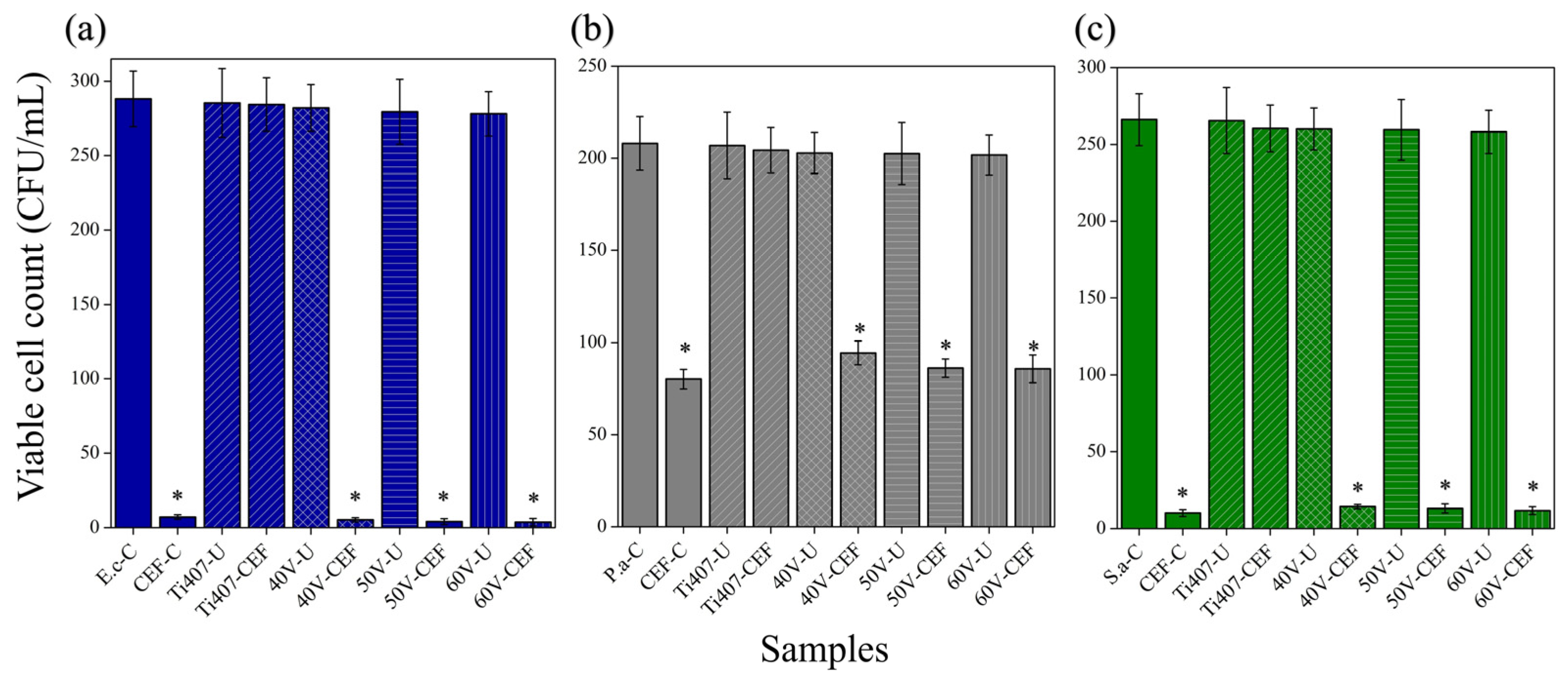
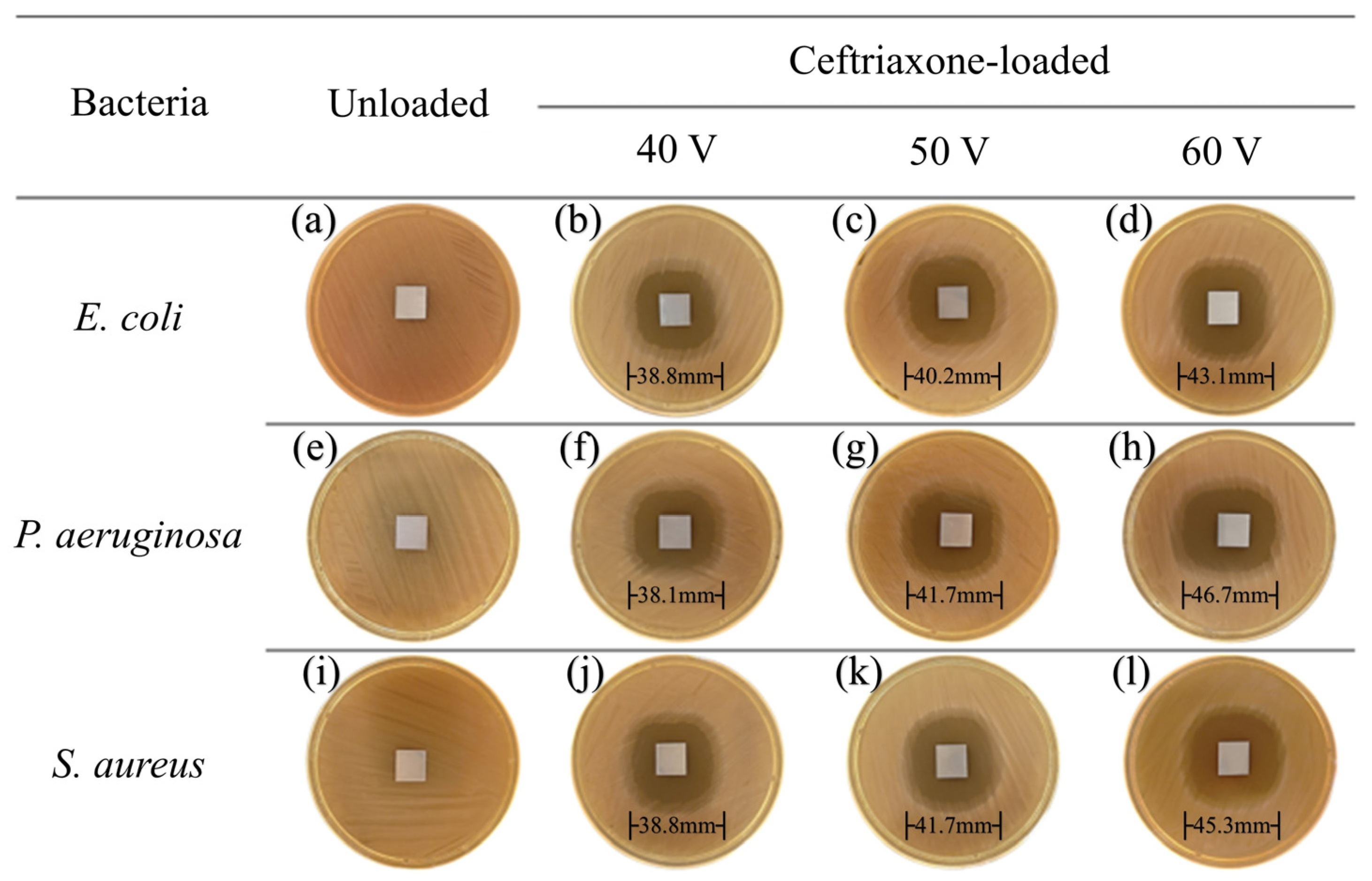
- Antibacterial activity is observed in ceftriaxone-loaded anodized Ti-407 alloy.
- A new functional surface from Ti-407 alloy is obtained by a simple anodization process.
- Nanotube geometry allows estimation of the drug-loading capacity.
- The drug quantity can be increased by increasing the anodization voltage.
- This functional surface can be used as a new platform for drug delivery.
Abstract
1. Introduction
2. Materials and Methods
2.1. Processing of Ti-407 Alloy Samples
2.2. Electrochemical Anodization
2.3. Structural and Chemical Characterization
2.4. Drug Loading and Release
2.5. Antibacterial Evaluation
2.5.1. Bacterial Activation
2.5.2. Turbidity Assay (Optical Density Measurement)
2.5.3. Colony-Forming Unit (CFU) Quantification
2.5.4. Agar Diffusion Test
2.6. Statistical Analysis
3. Results and Discussion
3.1. Formation and Electrochemical Behavior of the TiO2 Nanotubular Layer
3.2. Morphological and Dimensional Architecture of the TiO2 Nanotubular Layer
3.3. Chemical Composition and Drug Confirmation of the TiO2 Nanotubular Layer
3.3.1. X-Ray Photoelectron Spectroscopy (XPS) Analysis of the TiO2 Nanotubular Layer
3.3.2. ATR-FTIR Confirmation of Ceftriaxone Incorporation
3.4. Drug Release Profile and Mechanistic Interpretation
3.5. Antibacterial Performance of Ceftriaxone-Loaded TiO2 Nanotubular Layers
3.5.1. Bacterial Growth Inhibition Assessed by Turbidity (Optical Density)
3.5.2. Bacterial Viability Evaluation by Colony-Forming Unit (CFU) Quantification
3.5.3. Bacterial Susceptibility Assessment by Agar Diffusion Test
3.5.4. Integrated Interpretation of Antibacterial Performance and Release-Driven Mechanism
4. Conclusions
Author Contributions
Funding
Institutional Review Board Statement
Informed Consent Statement
Data Availability Statement
Acknowledgments
Conflicts of Interest
References
- Moriarty, T.F.; Kuehl, R.; Coenye, T.; Metsemakers, W.J.; Morgenstern, M.; Schwarz, E.M.; Riool, M.; Zaat, S.A.J.; Khana, N.; Kates, S.L.; et al. Orthopaedic device-related infection: Current and future interventions for improved prevention and treatment. EFORT Open Rev. 2017, 1, 89–99. [Google Scholar] [CrossRef]
- Stolz, M.; Schmetsdorf, J.; Tomsic, I.; von Lengerke, T.; Chaberny, I.F.; Krauth, C. Costs of surgical site infections in orthopaedic and trauma surgery: A systematic review. J. Hosp. Infect. 2025, 169, 42–58. [Google Scholar] [CrossRef]
- Tande, A.J.; Patel, R. Prosthetic joint infection. Clin. Microbiol. Rev. 2014, 27, 302–345. [Google Scholar] [CrossRef]
- McQuillan, T.J.; Cai, L.Z.; Corcoran-Schwartz, I.; Weiser, T.G.; Forrester, J.D. Surgical site infections after open reduction internal fixation for trauma in low and middle Human Development Index countries: A systematic review. Surg. Infect. 2018, 19, 254–263. [Google Scholar] [CrossRef]
- Whiting, P.S.; Galat, D.D.; Zirkle, L.G.; Shaw, M.K.; Galat, J.D. Risk factors for infection after intramedullary nailing of open tibial shaft fractures in low- and middle-income countries. J. Orthop. Trauma 2019, 33, e234–e239. [Google Scholar] [CrossRef]
- Kortram, K.; Bezstarosti, H.; Metsemakers, W.J.; Raschke, M.J.; Van Lieshout, E.M.M.; Verhofstad, M.H.J. Risk factors for infectious complications after open fractures; a systematic review and meta-analysis. Int. Orthop. 2017, 41, 1965–1982. [Google Scholar] [CrossRef]
- Zimmerli, W.; Trampuz, A.; Ochsner, P.E. Prosthetic-joint infections. N. Engl. J. Med. 2004, 351, 1645–1654. [Google Scholar] [CrossRef]
- Arciola, C.R.; Campoccia, D.; Montanaro, L. Implant infections: Adhesion, biofilm formation and immune evasion. Nat. Rev. Microbiol. 2018, 16, 397–409. [Google Scholar] [CrossRef]
- Costerton, J.W.; Stewart, P.S.; Greenberg, E.P. Bacterial biofilms: A common cause of persistent infections. Science 1999, 284, 1318–1322. [Google Scholar] [CrossRef]
- El-Bassyouni, G.T.; Mouneir, S.M.; El-Shamy, A.M. Advances in surface modifications of titanium and its alloys: Implications for biomedical and pharmaceutical applications. Multiscale Multidiscip. Model. Exp. Des. 2025, 8, 265. [Google Scholar] [CrossRef]
- Li, J.; Zheng, Y.; Yu, Z.; Kankala, R.K.; Lin, Q.; Shi, J.; Chen, C.; Luo, K.; Chen, A.; Zhong, Q. Surface-modified titanium and titanium-based alloys for improved osteogenesis: A critical review. Heliyon 2024, 10, e23779. [Google Scholar] [CrossRef]
- Geetha, M.; Singh, A.K.; Asokamani, R.; Gogia, A.K. Ti based biomaterials, the ultimate choice for orthopaedic implants—A review. Prog. Mater. Sci. 2009, 54, 397–425. [Google Scholar] [CrossRef]
- Willis, J.; Li, S.; Crean, S.J.; Barrak, F.N. Is titanium alloy Ti-6Al-4V cytotoxic to gingival fibroblasts—A systematic review. Clin. Exp. Dent. Res. 2021, 7, 1037–1044. [Google Scholar] [CrossRef]
- Yang, S.M.; Kang, Y.S.; Kim, D.Y.; Park, H.W. Experimental investigation of tool wear and surface integrity using a large pulsed electron beam (LPEB) irradiated end-mill cutting tool for Ti-6Al-4V. J. Manuf. Process. 2025, 139, 172–181. [Google Scholar] [CrossRef]
- TIMET. TIMETAL® 407 Datasheet. Available online: https://www.timet.com/documents/datasheets/alpha-and-beta-alloys/timetal-407.pdf (accessed on 7 December 2025).
- Sneddon, S.; Xu, Y.; Dixon, M.; Rugg, D.; Li, P.; Mulvihill, D.M. Sensitivity of material failure to surface roughness: A study on titanium alloys Ti64 and Ti407. Mater. Des. 2021, 200, 109438. [Google Scholar] [CrossRef]
- Tamayo-Jimenez, A.P.; Melendez-Anzures, F.E.; Barron-Gonzalez, M.P.; Lopez-Cuellar, E.M.; Quiñones-Gutierrez, Y.; Garza-Guajardo, J.A.; la Cruz, A.M.-D. Hierarchical Ag-doped hydroxyapatite coatings on TiO2 nanotubes formed on Ti-407 alloy: Antibacterial evaluation against Escherichia coli. Mater. Proc. 2025, 28, 4. [Google Scholar] [CrossRef]
- Gong, D.; Grimes, C.A.; Varghese, O.K.; Hu, W.; Singh, R.S.; Chen, Z.; Dickey, E.C. Titanium oxide nanotube arrays prepared by anodic oxidation. J. Mater. Res. 2001, 16, 3331–3334. [Google Scholar] [CrossRef]
- Roy, P.; Berger, S.; Schmuki, P. TiO2 nanotubes: Synthesis and applications. Angew. Chem. Int. Ed. 2011, 50, 2904–2939. [Google Scholar] [CrossRef]
- Macak, J.M.; Tsuchiya, H.; Schmuki, P. High-aspect-ratio TiO2 nanotubes by anodization of titanium. Angew. Chem. Int. Ed. 2005, 44, 2100–2102. [Google Scholar] [CrossRef]
- Zhuang, Y.; Li, P.; Qin, L.; Zhang, S.; Chen, B.; Zhu, Y.; Wang, B.; Zhu, X. Real role of fluoride ions in the growth of anodic TiO2 nanotubes. J. Phys. Chem. C 2024, 128, 5741–5748. [Google Scholar] [CrossRef]
- Regonini, D.; Bowen, C.R.; Jaroenworaluck, A.; Stevens, R. A review of growth mechanism, structure and crystallinity of anodized TiO2 nanotubes. Mater. Sci. Eng. R Rep. 2013, 74, 377–406. [Google Scholar] [CrossRef]
- Wang, J.; Lin, Z. Anodic formation of ordered TiO2 nanotube arrays: Effects of electrolyte temperature and anodization potential. J. Phys. Chem. C 2009, 113, 4026–4030. [Google Scholar] [CrossRef]
- Sul, Y.T.; Johansson, C.B.; Röser, K.; Albrektsson, T. Qualitative and quantitative observations of bone tissue reactions to anodised implants. Biomaterials 2002, 23, 1809–1817. [Google Scholar] [CrossRef] [PubMed]
- Cai, K.; Bossert, J.; Jandt, K.D. Does the nanometre scale topography of titanium influence protein adsorption and cell proliferation? Colloids Surf. B Biointerfaces 2006, 49, 136–144. [Google Scholar] [CrossRef] [PubMed]
- Melendez-Anzures, F.E.; Lopez-Cuellar, E.M.; Barron-Gonzalez, M.P.; Zarate-Triviño, D.G.; Martinez-Sanmiguel, J.J.; la Cruz, A.M.-D. Electrodeposited bioactive coating on TiO2 nanotubes for enhanced in vitro cell viability. In XLVIII Mexican Conference on Biomedical Engineering. CNIB 2025; IFMBE Proceedings; Zuñiga-Aguilar, E., Benítez-Mata, B., Reyes-Lagos, J.J., Hernandez Acosta, H.Y., Botello Arredondo, A.I., Bayareh Mancilla, R., Vázquez de la Rosa, J.F., Gutiérrez Valenzuela, C.A., Eds.; Springer: Cham, Switzerland, 2026; Volume 138. [Google Scholar] [CrossRef]
- Ionita, D.; Bajenaru-Georgescu, D.; Totea, G.; Mazare, A.; Schmuki, P.; Demetrescu, I. Activity of vancomycin release from bioinspired coatings of hydroxyapatite or TiO2 nanotubes. Int. J. Pharm. 2017, 517, 296–302. [Google Scholar] [CrossRef]
- Gulati, K.; Aw, M.S.; Losic, D. Drug-eluting Ti wires with titania nanotube arrays for bone fixation and reduced bone infection. Nanoscale Res. Lett. 2011, 6, 571. [Google Scholar] [CrossRef]
- Lopez-Pavon, L.; Dagnino-Acosta, D.; Lopez-Cuellar, E.; Melendez-Anzures, F.; Zarate-Triviño, D.; Barron-González, M.; Moreno-Cortez, I.; Kim, H.Y.; Miyazaki, S. Synthesis of nanotubular oxide on Ti–24Zr–10Nb–2Sn as a drug-releasing system to prevent the growth of Staphylococcus aureus. Chem. Pap. 2021, 75, 2441–2450. [Google Scholar] [CrossRef]
- Mei, S.; Wang, H.; Wang, W.; Tong, L.; Pan, H.; Ruan, C.; Ma, Q.; Liu, M.; Yang, H.; Zhang, L.; et al. Antibacterial effects and biocompatibility of titanium surfaces with graded silver incorporation in titania nanotubes. Biomaterials 2014, 35, 4255–4265. [Google Scholar] [CrossRef]
- Aw, M.; Gulati, K.; Losic, D. Controlling drug release from titania nanotube arrays using polymer nanocarriers and biopolymer coating. J. Biomater. Nanobiotechnol. 2011, 2, 477–484. [Google Scholar] [CrossRef]
- Hong, C.; An, S.; Son, M.; Hong, S.S.; Lee, D.H.; Lee, C. In-vitro cell tests using doxorubicin-loaded polymeric TiO2 nanotubes used for cancer photothermotherapy. Anti-Cancer Drugs 2012, 23, 553–560. [Google Scholar] [CrossRef]
- Akshaya, S.; Rowlo, P.K.; Dukle, A.; Nathanael, A.J. Antibacterial coatings for titanium implants: Recent trends and future perspectives. Antibiotics 2022, 11, 1719. [Google Scholar] [CrossRef]
- Ribeiro, B.; Offoiach, R.; Monteiro, C.; Morais, M.R.G.; Martins, M.C.L.; Pêgo, A.P.; Salatin, E.; Fedrizzi, L.; Lekka, M. Electrodeposition of Zn and Cu nanoparticles into TiO2 nanotubes on Ti6Al4V: Antimicrobial effect against S. epidermidis and cytotoxicity assessment. Micro 2024, 4, 97–116. [Google Scholar] [CrossRef]
- Zilberman, M.; Elsner, J.J. Antibiotic-eluting medical devices for various applications. J. Control. Release 2008, 130, 202–215. [Google Scholar] [CrossRef]
- Popat, K.C.; Eltgroth, M.; Latempa, T.J.; Grimes, C.A.; Desai, T.A. Decreased Staphylococcus epidermidis adhesion and increased osteoblast functionality on antibiotic-loaded titania nanotubes. Biomaterials 2007, 28, 4880–4888. [Google Scholar] [CrossRef]
- Metsemakers, W.J.; Morgenstern, M.; McNally, M.A.; Moriarty, T.F.; McFadyen, I.; Scarborough, M.; Athanasou, N.A.; Ochsner, P.E.; Kuehl, R.; Raschke, M.; et al. Fracture-related infection: A consensus on definition from an international expert group. Injury 2018, 49, 505–510. [Google Scholar] [CrossRef] [PubMed]
- Trampuz, A.; Zimmerli, W. Diagnosis and treatment of infections associated with fracture-fixation devices. Injury 2006, 37, S59–S66. [Google Scholar] [CrossRef]
- Scholar, E. Ceftriaxone. In xPharm: The Comprehensive Pharmacology Reference; Enna, S.J., Bylund, D.B., Eds.; Elsevier: New York, NY, USA, 2007; pp. 1–7. [Google Scholar] [CrossRef]
- Bratzler, D.W.; Dellinger, E.P.; Olsen, K.M.; Perl, T.M.; Auwaerter, P.G.; Bolon, M.K.; Fish, D.N.; Napolitano, L.M.; Sawyer, R.G.; Slain, D.; et al. Clinical practice guidelines for antimicrobial prophylaxis in surgery. Am. J. Health-Syst. Pharm. 2013, 70, 195–283. [Google Scholar] [CrossRef] [PubMed]
- Lew, D.P.; Waldvogel, F.A. Osteomyelitis. Lancet 2004, 364, 369–379. [Google Scholar] [CrossRef]
- Darouiche, R.O. Treatment of infections associated with surgical implants. N. Engl. J. Med. 2004, 350, 1422–1429. [Google Scholar] [CrossRef]
- Peel, T.N.; Buising, K.L.; Choong, P.F. Prosthetic joint infection: Challenges of diagnosis and treatment. ANZ J. Surg. 2011, 81, 32–39. [Google Scholar] [CrossRef]
- Melendez Anzures, F.E. Biocompatibilidad de Nanoestructuras Formadas por Anodizado en Aleaciones de Base Titanio Para Aplicaciones Biomédicas. Ph.D. Thesis, Universidad Autónoma de Nuevo León, Monterrey, Mexico, 2023. Available online: http://eprints.uanl.mx/26463/1/1080312748.pdf (accessed on 17 December 2025).
- Barboza, L.; López, E.; Guajardo, H.; Salinas, A. Effect of Initial Microstructure on the Temperature Dependence of the Flow Stress and Deformation Microstructure under Uniaxial Compression of Ti-407. Metals 2024, 14, 505. [Google Scholar] [CrossRef]
- Hudzicki, J. Kirby–Bauer disk diffusion susceptibility test protocol. Am. Soc. Microbiol. 2009, 15, 1–23. Available online: https://asm.org/getattachment/2594ce26-bd44-47f6-8287-0657aa9185ad/kirby-bauer-disk-diffusion-susceptibility-test-protocol-pdf.pdf (accessed on 20 November 2025).
- Peng, K.; Liu, L.; Zhang, J.; Ma, J.; Liu, Y. The relationship between the growth rate of anodic TiO2 nanotubes, the fluoride concentration and the electronic current. Electrochem. Commun. 2023, 148, 107457. [Google Scholar] [CrossRef]
- Fornell, J.; Oliveira, N.T.C.; Pellicer, E.; Van Steenberge, N.; Baró, M.D.; Bolfarini, C.; Sort, J. Anodic formation of self-organized Ti(Nb,Sn) oxide nanotube arrays with tuneable aspect ratio and size distribution. Electrochem. Commun. 2013, 33, 84–87. [Google Scholar] [CrossRef][Green Version]
- Regonini, D.; Satka, A.; Jaroenworaluck, A.; Allsopp, D.W.E.; Bowen, C.R.; Stevens, R. Factors influencing surface morphology of anodized TiO2 nanotubes. Electrochim. Acta 2012, 74, 244–253. [Google Scholar] [CrossRef]
- Habazaki, H.; Fushimi, K.; Shimizu, K.; Skeldon, P.; Thompson, G.E. Fast migration of fluoride ions in growing anodic titanium oxide. Electrochem. Commun. 2007, 9, 1222–1227. [Google Scholar] [CrossRef]
- Liu, G.; Wang, K.; Hoivik, N.; Jakobsen, H. Progress on free-standing and flow-through TiO2 nanotube membranes. Sol. Energy Mater. Sol. Cells 2012, 98, 24–38. [Google Scholar] [CrossRef]
- Albu, S.P.; Schmuki, P. Influence of anodization parameters on the expansion factor of TiO2 nanotubes. Electrochim. Acta 2013, 91, 90–95. [Google Scholar] [CrossRef]
- Neupane, M.P.; Park, I.S.; Bae, T.S.; Yi, H.K.; Watari, F.; Lee, M.H. Biocompatibility of TiO2 nanotubes fabricated on Ti using different surfactant additives in electrolyte. Mater. Chem. Phys. 2012, 134, 536–541. [Google Scholar] [CrossRef]
- Li, T.; Gulati, K.; Wang, N.; Zhang, Z.; Ivanovski, S. Understanding and augmenting the stability of therapeutic nanotubes on anodized titanium implants. Mater. Sci. Eng. C 2018, 88, 182–195. [Google Scholar] [CrossRef]
- Li, B.; Gao, X.; Zhang, H.C.; Yuan, C. Energy modeling of electrochemical anodization process of titanium dioxide nanotubes. ACS Sustain. Chem. Eng. 2014, 2, 404–410. [Google Scholar] [CrossRef]
- Yu, D.; Zhang, S.; Zhu, X.; Ma, H.; Han, H.; Song, Y. Simulation of anodizing current–time curves and morphology evolution of TiO2 nanotube arrays. J. Solid State Electrochem. 2014, 18, 2609–2617. [Google Scholar] [CrossRef]
- Zare, H.; Ahmadi, S.; Ghasemi, A.; Ghanbari, M.; Rabiee, N.; Bagherzadeh, M.; Karimi, M.; Webster, T.J.; Hamblin, M.R.; Mostafavi, E. Carbon nanotubes: Smart drug/gene delivery carriers. Int. J. Nanomed. 2021, 16, 1681–1706. [Google Scholar] [CrossRef] [PubMed]
- Jagusiak, A.; Chłopas, K.; Zemanek, G.; Wolski, P.; Panczyk, T. Controlled release of doxorubicin from the drug delivery formulation composed of single-walled carbon nanotubes and Congo red: A molecular dynamics study and dynamic light scattering analysis. Pharmaceutics 2020, 12, 622. [Google Scholar] [CrossRef] [PubMed]
- Li, Y.; Yang, Y.; Li, R.; Tang, X.; Guo, D.; Qing, Y.; Qin, Y. Enhanced antibacterial properties of orthopedic implants by titanium nanotube surface modification: A review of current techniques. Int. J. Nanomed. 2019, 14, 7217–7236. [Google Scholar] [CrossRef] [PubMed]
- Asadi, S.; Mortezagholi, B.; Hadizadeh, A.; Borisov, V.; Ansari, M.J.; Shaker Majdi, H.; Nishonova, A.; Adelnia, H.; Farasati Far, B.; Chaiyasut, C. Ciprofloxacin-loaded titanium nanotubes coated with chitosan: A promising formulation with sustained release and enhanced antibacterial properties. Pharmaceutics 2022, 14, 1359. [Google Scholar] [CrossRef]
- Wang, T.; Weng, Z.; Liu, X.; Yeung, K.W.K.; Pan, H.; Wu, S. Controlled release and biocompatibility of polymer/titania nanotube array system on titanium implants. Bioact. Mater. 2017, 2, 44–50. [Google Scholar] [CrossRef]
- Filova, E.; Fojt, J.; Kryslova, M.; Moravec, H.; Joska, L.; Bacakova, L. The diameter of nanotubes formed on Ti–6Al–4V alloy controls the adhesion and differentiation of Saos-2 cells. Int. J. Nanomed. 2015, 10, 7145–7163. [Google Scholar] [CrossRef]
- Allam, N.K.; Alamgir, F.; El-Sayed, M.A. Enhanced photoassisted water electrolysis using vertically oriented anodically fabricated Ti–Nb–Zr–O mixed oxide nanotube arrays. ACS Nano 2010, 4, 5819–5826. [Google Scholar] [CrossRef]
- Valota, A.; LeClere, D.J.; Hashimoto, T.; Skeldon, P.; Thompson, G.E.; Berger, S.; Kunze, J.; Schmuki, P. The efficiency of nanotube formation on titanium anodized under voltage and current control in fluoride/glycerol electrolyte. Nanotechnology 2008, 19, 355701. [Google Scholar] [CrossRef]
- Necula, M.G.; Mazare, A.; Ion, R.N.; Ozkan, S.; Park, J.; Schmuki, P.; Cimpean, A. Lateral spacing of TiO2 nanotubes modulates osteoblast behavior. Materials 2019, 12, 2956. [Google Scholar] [CrossRef] [PubMed]
- Wu, B.; Tang, Y.; Wang, K.; Zhou, X.; Xiang, L. Nanostructured titanium implant surface facilitating osseointegration from protein adsorption to osteogenesis: The example of TiO2 NTAs. Int. J. Nanomed. 2022, 17, 1865–1879. [Google Scholar] [CrossRef] [PubMed]
- Wang, Q.; Zhou, P.; Liu, S.; Attarilar, S.; Ma, R.L.-W.; Zhong, Y.; Wang, L. Multi-scale surface treatments of titanium implants for rapid osseointegration: A review. Nanomaterials 2020, 10, 1244. [Google Scholar] [CrossRef]
- Simon, A.P.; Ferreira, C.H.; Santos, V.A.Q.; Rodrigues, A.; Santos, J.S.; Trivinho-Strixino, F.; Marques, P.T.; Zorel, H.E.; Sikora, M.S. Multi-step cefazolin sodium release from bioactive TiO2 nanotubes: Surface and polymer coverage effects. J. Mater. Res. 2021, 36, 1510–1523. [Google Scholar] [CrossRef]
- Sul, Y. Electrochemical growth behavior, surface properties, and enhanced in vivo bone response of TiO2 nanotubes on microstructured surfaces of blasted, screw-shaped titanium implants. Int. J. Nanomed. 2010, 5, 87–100. [Google Scholar] [CrossRef]
- Capek, D.; Gigandet, M.P.; Masmoudi, M.; Wery, M.; Banakh, O. Long-time anodisation of titanium in sulphuric acid. Surf. Coat. Technol. 2008, 202, 1379–1384. [Google Scholar] [CrossRef]
- Kim, M.G.; Kang, J.M.; Lee, J.E.; Kim, K.S.; Kim, K.H.; Cho, M.; Lee, S.G. Effects of calcination temperature on the phase composition, photocatalytic degradation, and virucidal activities of TiO2 nanoparticles. ACS Omega 2021, 6, 10668–10678. [Google Scholar] [CrossRef]
- Nawaz, K.; Chia, I.; Huei, G. Glycerol-mediated facile synthesis of colored titania nanoparticles for visible light photodegradation of phenolic compounds. Nanomaterials 2019, 9, 1586. [Google Scholar] [CrossRef]
- Shi, H.; Magaye, R.; Castranova, V.; Zhao, J. Titanium dioxide nanoparticles: A review of current toxicological data. Part. Fibre Toxicol. 2013, 10, 15. [Google Scholar] [CrossRef]
- Ranjan, R.; Mhamane, N.B.; Kolekar, S.K.; Gopinath, C.S. Electronic structure evolution from metallic vanadium to metallic VxOy: A NAPPES study for O2 + V gas–solid interaction. J. Phys. Chem. C 2022, 126, 19136–19146. [Google Scholar] [CrossRef]
- Hryha, E.; Rutqvist, E.; Nyborg, L. Stoichiometric vanadium oxides studied by XPS. Surf. Interface Anal. 2012, 44, 1022–1025. [Google Scholar] [CrossRef]
- Chunate, H.-T.; Khamwannah, J.; Aliyu, A.A.A.; Tantavisut, S.; Puncreobutr, C.; Khamkongkaeo, A.; Tongyam, C.; Tumkhanon, K.; Phetrattanarangsi, T.; Chanamuangkon, T.; et al. Titania nanotube architectures synthesized on 3D-printed Ti–6Al–4V implant and assessing vancomycin release protocols. Materials 2021, 14, 6576. [Google Scholar] [CrossRef] [PubMed]
- Osonkie, A.; Lee, V.; Chukwunenye, P.; Cundari, T.; Kelber, J. Plasma modification of vanadium oxynitride surfaces: Characterization by in situ XPS experiments and DFT calculations. J. Chem. Phys. 2020, 153, 144709. [Google Scholar] [CrossRef]
- Silversmit, G.; Depla, D.; Poelman, H.; Marin, G.B.; De Gryse, R. Determination of the V2p XPS binding energies for different vanadium oxidation states (V5+ to V0+). J. Electron Spectrosc. Relat. Phenom. 2004, 135, 167–175. [Google Scholar] [CrossRef]
- Klomjit, P.; Buchheit, R.G. Localized corrosion inhibition of AA7075-T6 by calcium sulfate. Corrosion 2016, 72, 486–499. [Google Scholar] [CrossRef]
- Popinciuc, M.; Jonkman, H.T.; Van Wees, B.J. Energy level alignment at Co/AlOx/pentacene interfaces. J. Appl. Phys. 2007, 101, 4–9. [Google Scholar] [CrossRef]
- Hou, L.; Liang, Q.; Wang, F. Mechanisms that control the adsorption–desorption behavior of phosphate on magnetite nanoparticles: The role of particle size and surface chemistry characteristics. RSC Adv. 2020, 10, 2378–2388. [Google Scholar] [CrossRef]
- Moreno-López, J.C.; Ruano, G.; Ferrón, J.; Ayala, P.; Passeggi, M.C.G., Jr. Thermally annealed sub-monolayers of AlF3 on Cu(100): An STM and XPS study. Phys. Status Solidi B 2018, 255, 1800389. [Google Scholar] [CrossRef]
- Greczynski, G.; Hultman, L. C1s peak of adventitious carbon aligns to the vacuum level: Dire consequences for material’s bonding assignment by photoelectron spectroscopy. ChemPhysChem 2017, 18, 1507–1512. [Google Scholar] [CrossRef]
- Hanawa, T. Metal ion release from metal implants. Mater. Sci. Eng. C 2004, 24, 745–752. [Google Scholar] [CrossRef]
- Ghicov, A.; Tsuchiya, H.; Macak, J.M.; Schmuki, P. Titanium oxide nanotubes prepared in phosphate electrolytes. Electrochem. Commun. 2005, 7, 505–509. [Google Scholar] [CrossRef]
- Macak, J.M.; Tsuchiya, H.; Ghicov, A.; Yasuda, K.; Hahn, R.; Bauer, S.; Schmuki, P. TiO2 nanotubes: Self-organized electrochemical formation, properties and applications. Curr. Opin. Solid State Mater. Sci. 2007, 11, 3–18. [Google Scholar] [CrossRef]
- Meng, R.; Hou, H.; Liu, X.; Duan, J.; Liu, S. Binder-free combination of graphene nanosheets with TiO2 nanotube arrays for lithium ion battery anode. J. Porous Mater. 2016, 23, 569–575. [Google Scholar] [CrossRef]
- Manimekalai, P.; Dhanalakshmi, R.; Manavalan, R. Preparation and characterization of ceftriaxone sodium encapsulated chitosan nanoparticles. Int. J. Appl. Pharm. 2017, 9, 10–15. [Google Scholar] [CrossRef]
- Liang, Y.Q.; Cui, Z.D.; Zhu, S.L.; Yang, X.J. Characterization of self-organized TiO2 nanotubes on Ti–4Zr–22Nb–2Sn alloys and the application in drug delivery system. J. Mater. Sci. Mater. Med. 2011, 22, 461–467. [Google Scholar] [CrossRef]
- Ethiraj, R.; Thiruvengadam, E.; Sampath, V.S.; Vahid, A.; Raj, J. Development and validation of stability indicating spectroscopic method for content analysis of ceftriaxone sodium in pharmaceuticals. Int. Sch. Res. Not. 2014, 2014, 278173. [Google Scholar] [CrossRef] [PubMed]
- Wang, Q.; Huang, J.Y.; Li, H.Q.; Chen, Z.; Zhao, A.Z.J.; Wang, Y.; Zhang, K.Q.; Sun, H.T.; Al-Deyab, S.S.; Lai, Y.K. TiO2 nanotube platforms for smart drug delivery: A review. Int. J. Nanomed. 2016, 11, 4819–4834. [Google Scholar] [CrossRef]
- Yang, W.; Xi, X.; Shen, X.; Liu, P.; Hu, Y.; Cai, K. Titania nanotubes dimensions-dependent protein adsorption and its effect on the growth of osteoblasts. J. Biomed. Mater. Res. A 2014, 102, 3598–3608. [Google Scholar] [CrossRef]
- Poole, K. Pseudomonas aeruginosa: Resistance to the max. Front. Microbiol. 2011, 2, 65. [Google Scholar] [CrossRef]
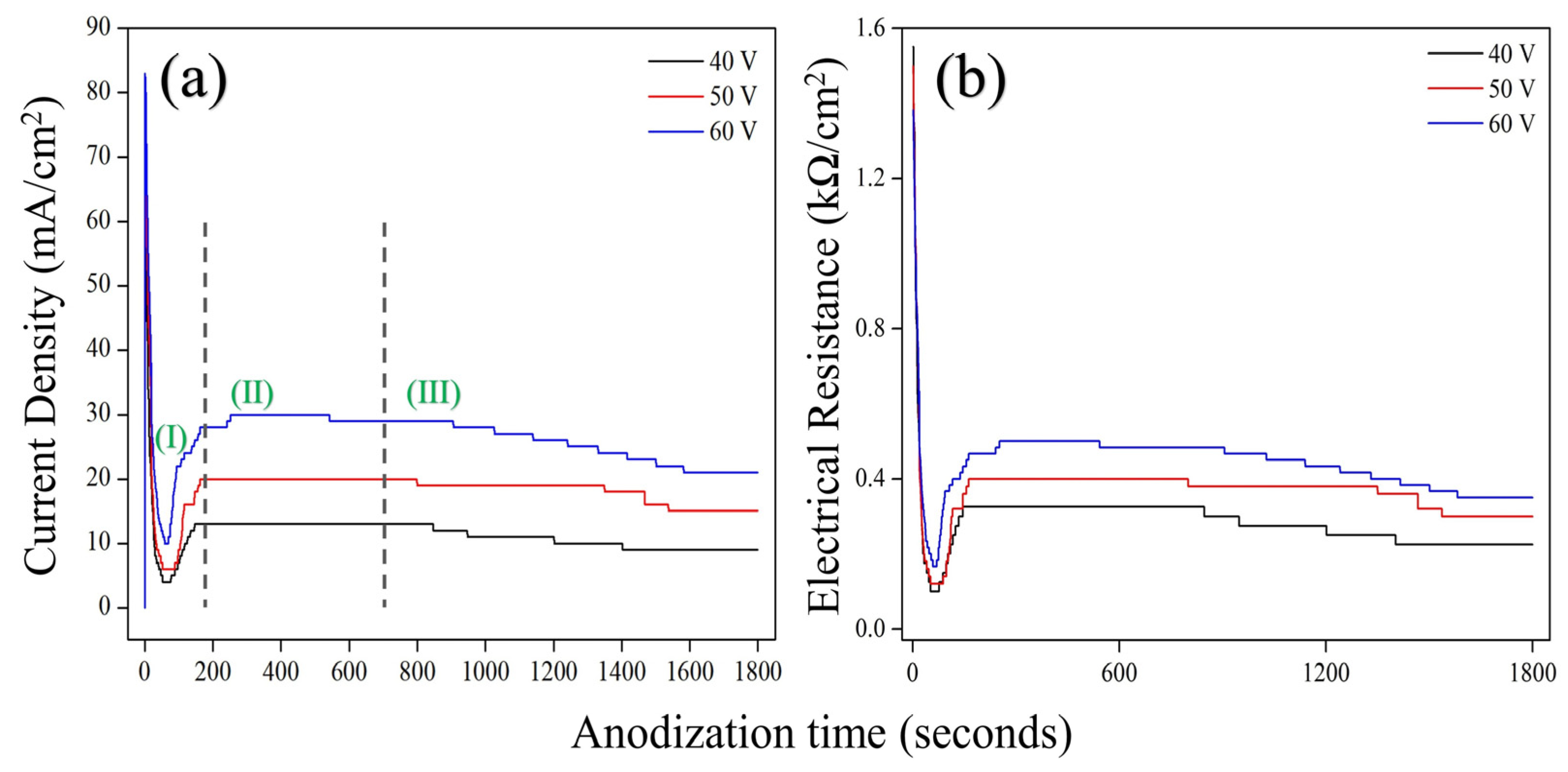
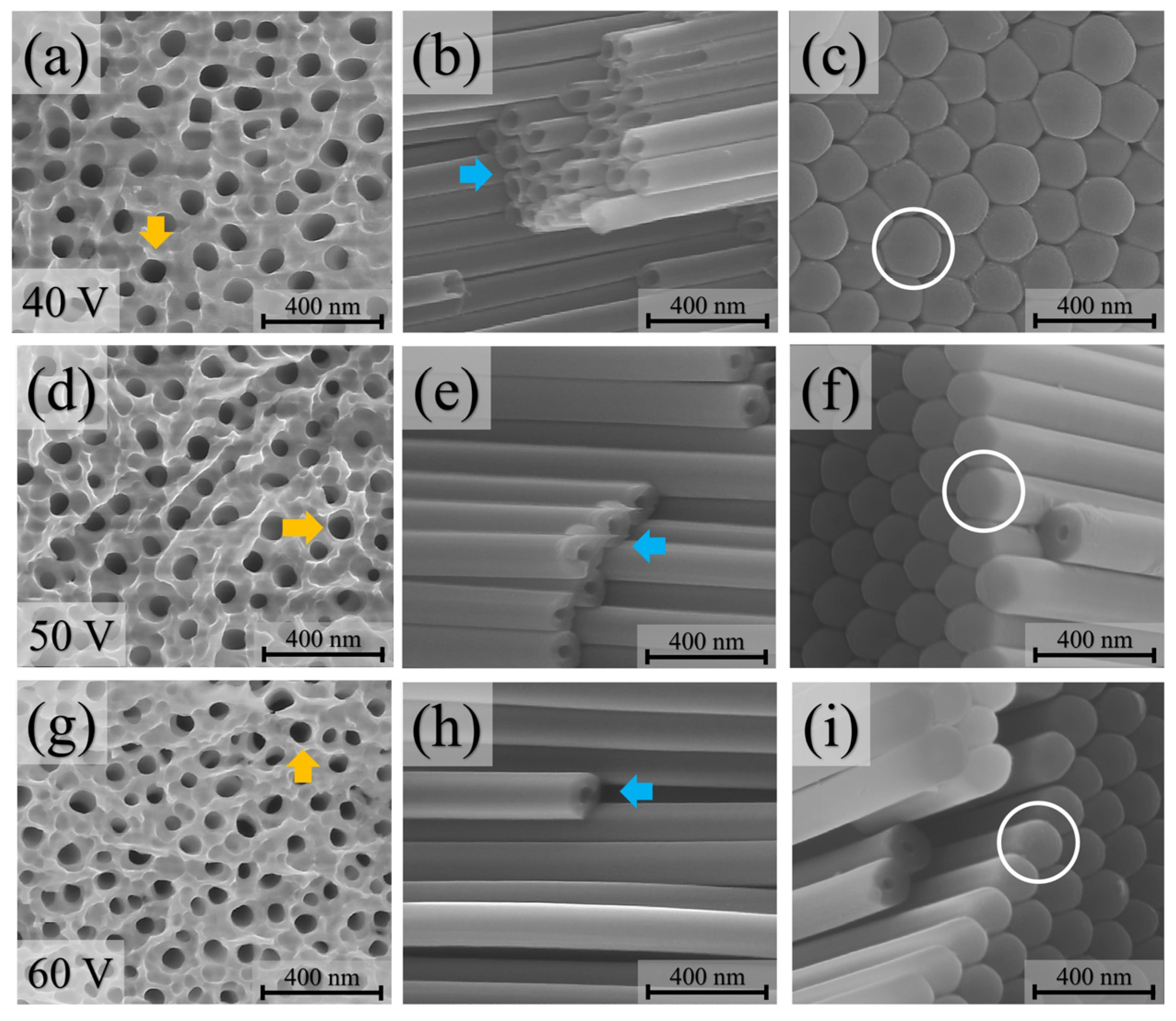
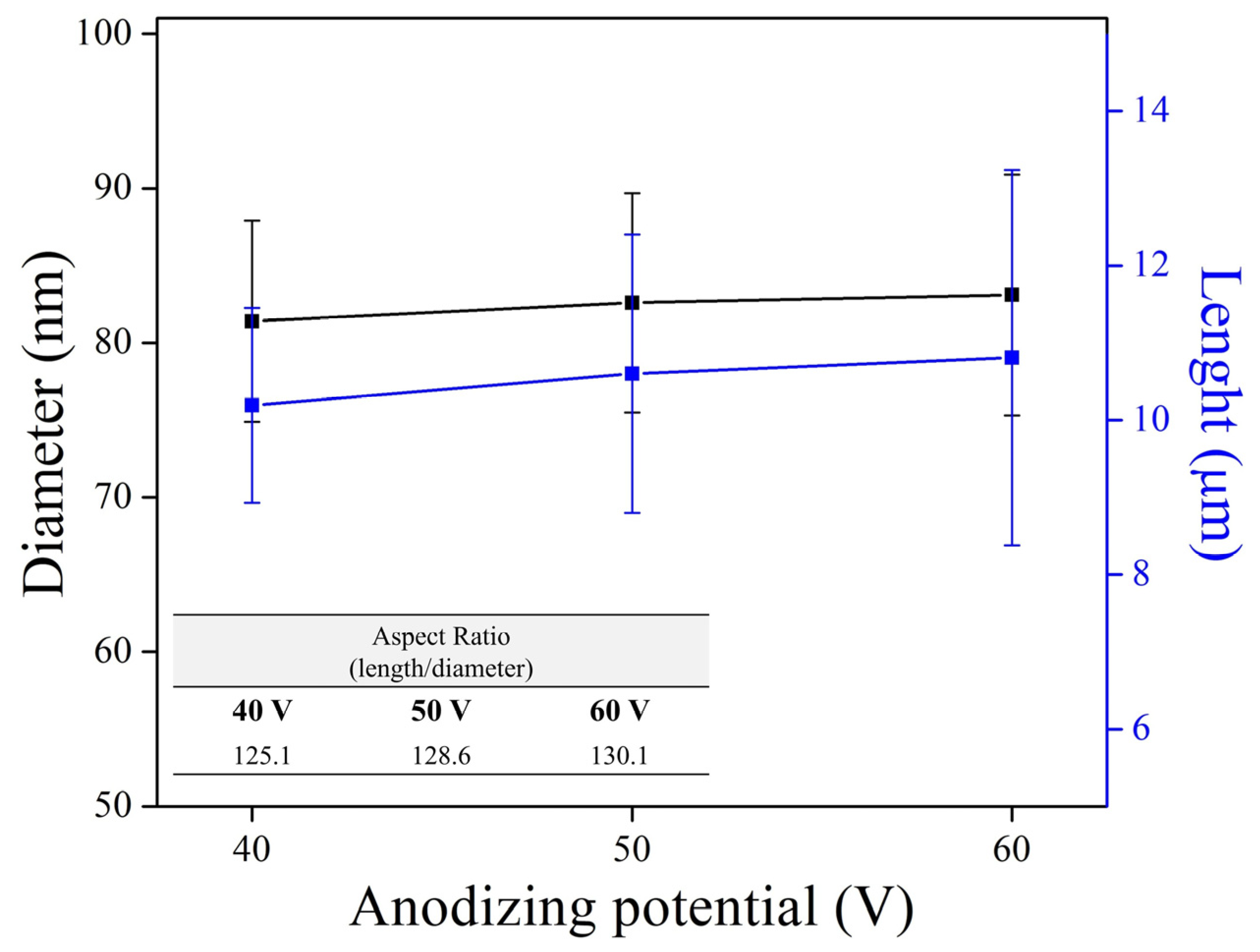
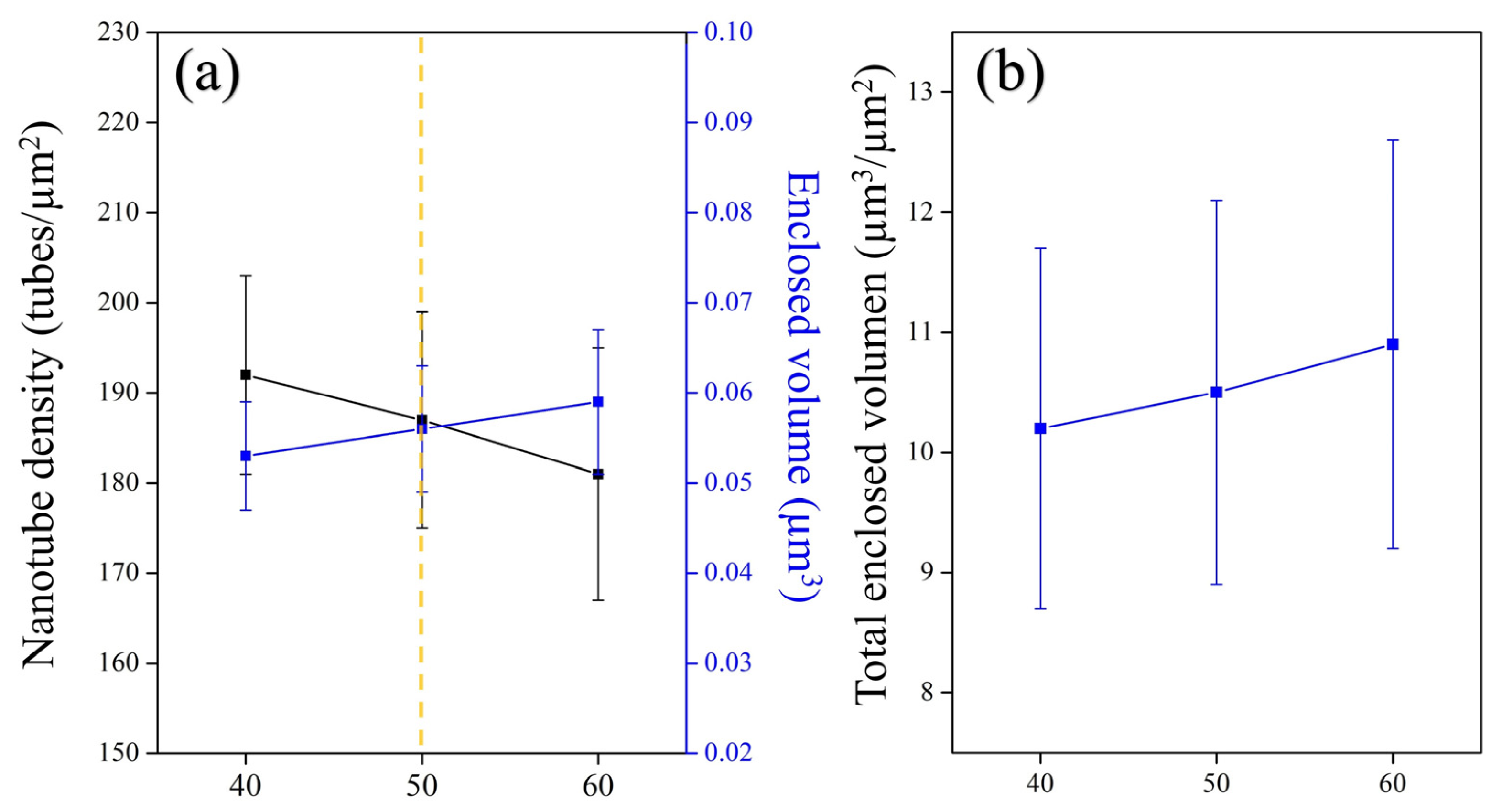
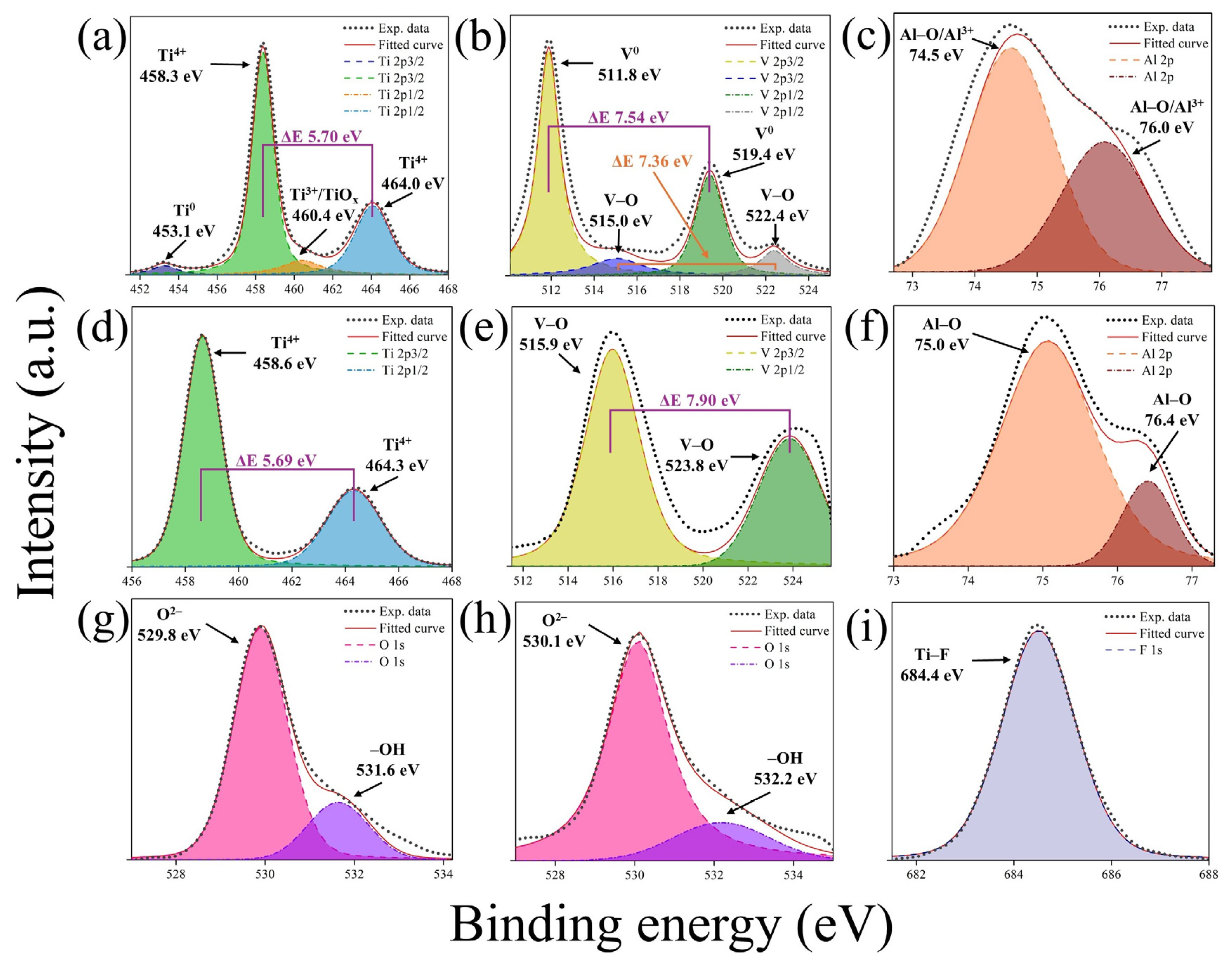
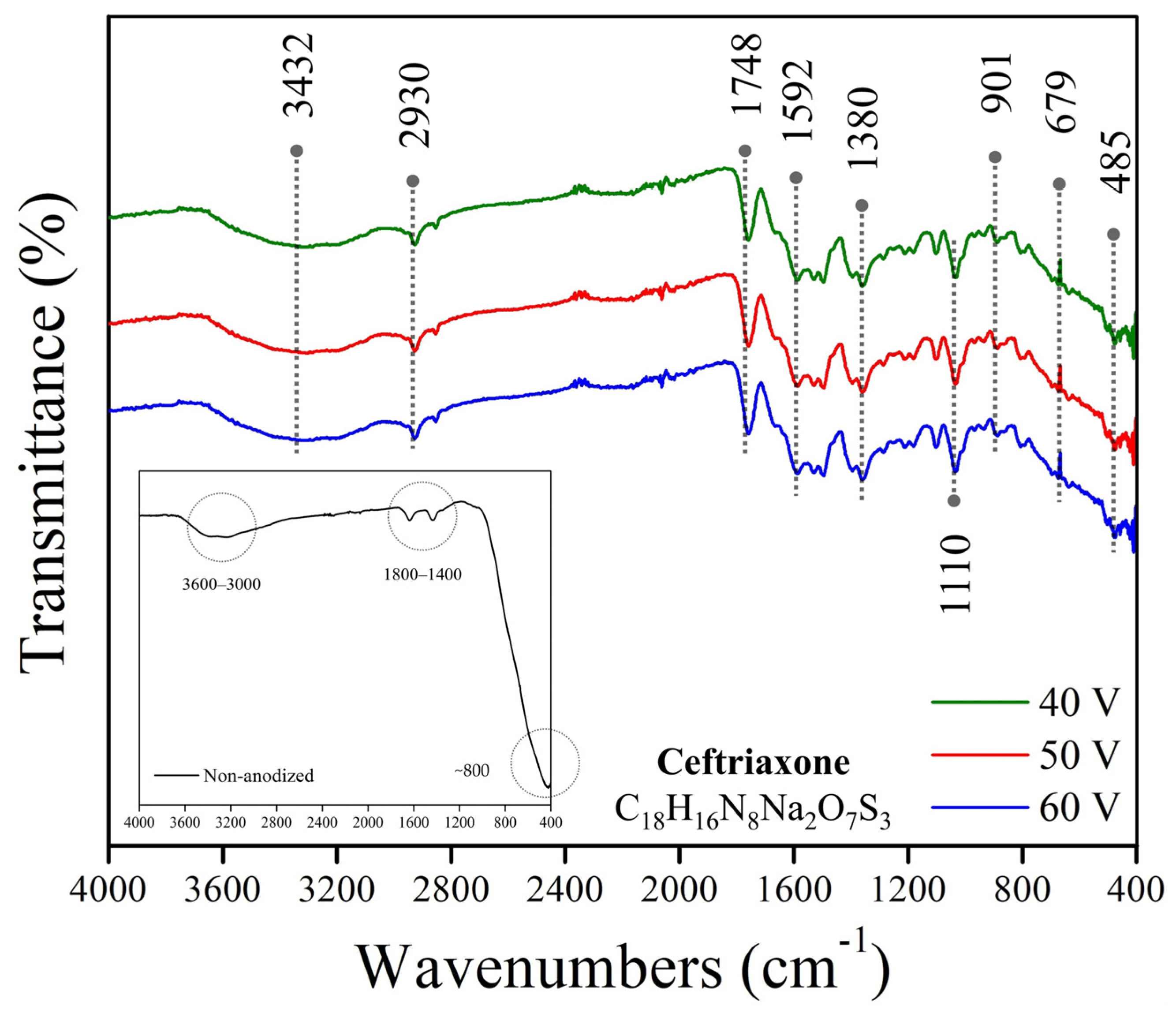

| Element | Non-Anodized Ti-407 | Anodized Ti-407 * |
|---|---|---|
| O 1s | 41.5 ± 1.5 | 36.5 ± 1.5 |
| Ti 2p | 14.0 ± 1.0 | 13.8 ± 1.2 |
| C 1s | 28.5 ± 3.5 | 30.0 ± 4.0 |
| V 2p | 10.0 ± 2.0 | 0.25 ± 0.10 |
| Al 2p | 1.2 ± 0.3 | 0.45 ± 0.15 |
| F 1s | — | 4.0 ± 1.0 |
| Parameter | 40 V | 50 V | 60 V |
|---|---|---|---|
| Length (µm) | 10.2 ± 1.3 | 10.6 ± 2.1 | 10.8 ± 2.4 |
| Diameter (nm) | 81.4 ± 6.5 | 82.6 ± 7.1 | 83.1 ± 7.8 |
| Aspect ratio (L/D) | 125 ± 18 | 129 ± 21 | 130 ± 27 |
| Nanotube density (µm−2) | 192 ± 11 | 187 ± 12 | 181 ± 14 |
| Total enclosed volume (µm3/µm2) | 10.2 ± 1.5 | 10.5 ± 1.6 | 10.9 ± 1.7 |
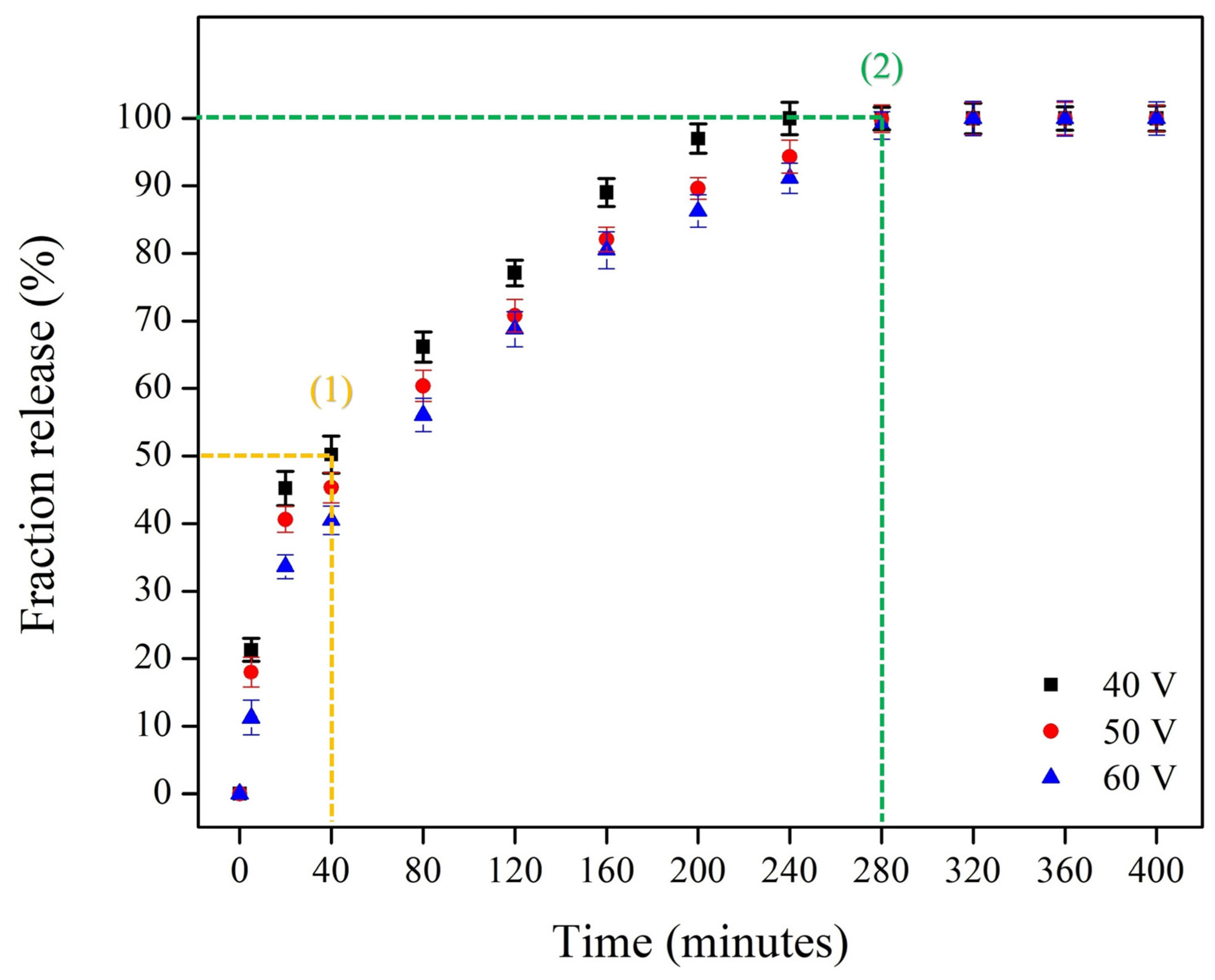
| Ceftriaxone release at 40 min (%) | 49.8 | 45.2 | 40.5 |
Disclaimer/Publisher’s Note: The statements, opinions and data contained in all publications are solely those of the individual author(s) and contributor(s) and not of MDPI and/or the editor(s). MDPI and/or the editor(s) disclaim responsibility for any injury to people or property resulting from any ideas, methods, instructions or products referred to in the content. |
© 2026 by the authors. Licensee MDPI, Basel, Switzerland. This article is an open access article distributed under the terms and conditions of the Creative Commons Attribution (CC BY) license.
Share and Cite
Melendez-Anzures, F.E.; Lopez-Cuellar, E.; López-Pavón, L.; Zárate-Triviño, D.; Barrón-González, M.P.; Martínez-de la Cruz, A.; Garza-Navarro, M.A. Ceftriaxone-Loaded Ti-407 Nanotubular Oxide for In Vitro Inhibition of Bacteria Associated with Postoperative Infections. Coatings 2026, 16, 203. https://doi.org/10.3390/coatings16020203
Melendez-Anzures FE, Lopez-Cuellar E, López-Pavón L, Zárate-Triviño D, Barrón-González MP, Martínez-de la Cruz A, Garza-Navarro MA. Ceftriaxone-Loaded Ti-407 Nanotubular Oxide for In Vitro Inhibition of Bacteria Associated with Postoperative Infections. Coatings. 2026; 16(2):203. https://doi.org/10.3390/coatings16020203
Chicago/Turabian StyleMelendez-Anzures, Frank E., Enrique Lopez-Cuellar, Luis López-Pavón, Diana Zárate-Triviño, María Porfiria Barrón-González, Azael Martínez-de la Cruz, and Marco A. Garza-Navarro. 2026. "Ceftriaxone-Loaded Ti-407 Nanotubular Oxide for In Vitro Inhibition of Bacteria Associated with Postoperative Infections" Coatings 16, no. 2: 203. https://doi.org/10.3390/coatings16020203
APA StyleMelendez-Anzures, F. E., Lopez-Cuellar, E., López-Pavón, L., Zárate-Triviño, D., Barrón-González, M. P., Martínez-de la Cruz, A., & Garza-Navarro, M. A. (2026). Ceftriaxone-Loaded Ti-407 Nanotubular Oxide for In Vitro Inhibition of Bacteria Associated with Postoperative Infections. Coatings, 16(2), 203. https://doi.org/10.3390/coatings16020203

