Article

In Vitro Osteogenic and Angiogenic Potential of 3D-Printed nHA/PCL Scaffolds Functionalized with a Photo-Crosslinked CSMA Hydrogel–Exosome Composite Coating


1
College of Stomatology, Ningxia Medical University, Yinchuan 750004, China
2
Ningxia Province Key Laboratory of Oral Diseases Research, Yinchuan 750004, China
*
Authors to whom correspondence should be addressed.
These authors contributed equally to this work.
Coatings 2026, 16(2), 201; https://doi.org/10.3390/coatings16020201 (registering DOI)
Submission received: 5 January 2026 / Revised: 28 January 2026 / Accepted: 3 February 2026 / Published: 5 February 2026
(This article belongs to the Special Issue Surface Engineering of Bone Implants)

Abstract

This study aimed to develop and characterize novel 3D-printed chitosan methacryloyl (CSMA) hydrogel-functionalized nano-hydroxyapatite/polycaprolactone (nHA/PCL) scaffolds for controlled release of bone marrow mesenchymal stem cell-exosomes (BMSC-Exos), with the objective of enhancing osteogenic and angiogenic capabilities in vitro. We fabricated a biomimetic, highly porous scaffold composed of nHA/PCL using high-temperature fused deposition modeling. An interfacial bioactive layer was formed via ultraviolet-induced crosslinking of CSMA hydrogel on the scaffold and loaded bone marrow mesenchymal stem cell-exosomes. We characterized the composite scaffold to evaluate its physicochemical properties, cytocompatibility, cell migration ability, osteogenic capacity, and angiogenic capacity. The 3D-printed 20%nHA/PCL scaffold has a porosity of approximately 75%, with its surface containing four elements: carbon, oxygen, calcium, and phosphorus. The compressive strength is (13.76 ± 1.33) MPa. The CSMA hydrogel exhibits good injectability and degrades slowly over time. Exosomes with a negative charge are released slowly within the extracellular matrix hydrogel. The contact angle of the scaffold material is below 90 degrees, and the hemolysis rate is below 5%. In vitro assays demonstrated that the nHA/PCL-CSMA-Exos composite exhibited excellent biocompatibility, markedly enhanced cell proliferation and migration, and robust pro-angiogenic and osteogenic activity. The fabricated nHA/PCL-CSMA-Exos composite scaffolds demonstrated excellent physicochemical properties, biocompatibility, and cell migration ability, promoting angiogenesis, bone tissue formation and mineralization.

1. Introduction

The maxillofacial skeleton maintains facial contour and enables mastication, speech, and aesthetic expression. Congenital disabilities (such as cleft alveolus), together with acquired trauma and tumors, often produce deformities that profoundly compromise patients’ physical and psychological well-being. Each year, approximately two million bone-graft procedures are performed worldwide, making bone the second most transplanted tissue after blood [1]. Current options for defect repair include autogenous, allogeneic, and xenogeneic grafts, with autogenous bone remaining “gold standard” [2]. In clinical practice, particulate iliac cancellous bone is routinely used to repair alveolar cleft, while computer-aided techniques are combined with free bone grafting, osteoplasty, myovascularized bone grafting, and vascularized iliac or fibular grafting to reconstruct mandibular defects [3,4]. Nevertheless, autogenous grafts are constrained by recipient-site resorption, limited volume, and donor-site morbidity [5]. Allogeneic and xenogeneic grafts further carry the risks of immune rejection and disease transmission [6]. Consequently, researchers have intensified efforts to develop alternative strategies for bone regeneration.
Advances in 3D printing and tissue engineering now permit computer-aided, layer-by-layer deposition of biomaterials to fabricate solid constructs with precisely tailored morphology and architecture [7]. This technology is increasingly leveraged across various biomedical domains, including wound repair, drug delivery, tissue engineering, and medical implants, owing to its capacity for customization and rapid fabrication [8].
Hydroxyapatite (HA) is the major inorganic component present in human hard tissues. The chemical composition and structure of HA are very similar to those of biological bones and dental enamel [9]. Nano-sized HA (nHA) closely mimics the components of bone tissue in the human body and demonstrates enhanced bioactivity, adsorption, and degradability [10]. Incorporating nHA into carrier materials as a reinforcing agent enables the entire material to be processed into 3D structures for direct use in 3D printing [11]. FDA-approved polycaprolactone (PCL) has demonstrated good mechanical strength, thermoplastic behavior, biocompatibility, and degradability, making it a suitable candidate for use as a carrier material in bone tissue engineering [12]. Furthermore, PCL scaffolds exhibit good bone regeneration capabilities, while incorporating nHA into PCL can complement the advantages of both materials and alter the processing properties of the material [13,14]. Simultaneously, it exhibits good biocompatibility, bioactivity, and antibacterial properties, which can promote cell adhesion, proliferation, and osteogenesis [15]. Existing studies have confirmed that as a bionic component of the inorganic phase of natural bone, the doping ratio of nHA exhibits a significant correlation with the properties of nHA/PCL composites: with the increase in nHA mass fraction, the surface mineralization activity, mechanical strength, as well as the adhesion and osteogenic differentiation-inducing abilities of the composite materials to osteoblasts are positively enhanced [16,17]. However, as an inorganic rigid particle, an excessively high doping ratio of nHA may remarkably increase the melt viscosity of the composite material. Our preliminary experiments demonstrated that during fused deposition modeling (FDM), the 30% nHA/PCL composite experienced frequent nozzle clogging and uneven filament extrusion due to nHA particle agglomeration, ultimately resulting in poor scaffold molding quality. In contrast, the 20% nHA/PCL composite enables the maximization of nHA doping ratio while maintaining favorable printing fluency. Therefore, the 20% nHA/PCL composite was selected as the basic scaffold material for subsequent experiments in this study.
Mesenchymal stem cells (MSCs), a key component of tissue engineering, have the potential to differentiate into various tissues, organs, and cell types [18]. Although stem cells can promote tissue repair, their potential for multidirectional differentiation makes them potentially tumorigenic, and issues such as possible immune rejection and ethical concerns have limited their clinical applications [19].
A recent study has shown that MSCs do not directly participate in tissue regeneration; rather, they exert their effects through paracrine mechanisms [20]. Exosomes (Exos), as a type of extracellular vesicle produced by paracrine secretion, can transfer biological signals among cells. The MSCs are capable of expressing functions similar to those of their parent cells, acting as nanocarriers to deliver bioactive factors or small molecules that participate in the tissue repair process [21]. Exosomes derived from different sources of MSCs contain different functional components and exhibit distinct properties [22]. Zhang et al. [23] have demonstrated that exosomes derived from BMSCs can stimulate the proliferation and osteogenic differentiation of BMSCs, thereby promoting angiogenesis, bone formation, and mineralization of the bone matrix within bone defects. Due to their low immunogenicity, exosomes cannot develop into mature cell lineages or induce tumorigenesis, thereby avoiding the potential immunogenic and tumorigenic side effects associated with cell therapy [24]. Exosomes have been shown to stimulate bone regeneration by regulating both osteogenesis and angiogenesis [25]. However, the stability, delivery efficiency, and weak targeting of exosomes significantly reduce their retention time in the body, which severely affects their therapeutic efficacy [25].
Hydrogels are hydrophilic, three-dimensional, network-structured gels that can provide a microenvironment similar to the extracellular matrix [26]. Hydrogels loaded with EXOs can enhance the stability of EXOs and facilitate their delivery to defect sites, promoting sustained in situ release [27,28]. The complex formed by hydrogels and exosomes can protect exosomes from being cleared by the body’s immune actions, slow down their release, and provide an ideal sustained-release carrier for exosomes [29].
Chitosan (CS) is a widely used natural hydrogel, valued for its biocompatibility and positively charged amine groups [30,31]. The negatively charged phospholipid membrane of EXOs [32] interacts electrostatically with CS, making CS a promising carrier for Exos delivery. Li et al. [33] demonstrated that a chitosan–Exos hydrogel improved Exos stability and retention, thereby enhancing therapeutic efficacy in wound healing.
CSMA—CS functionalized with methacrylate groups—exhibits improved water solubility and can be crosslinked under ultraviolet irradiation [34]. Because the compressive modulus of pure CSMA hydrogel is far lower than that of bone, CSMA must be combined with a rigid scaffold [35] for load-bearing applications. Coating a 3D-printed scaffold with CSMA therefore reinforces hydrogel mechanical strength while conferring additional bioactivity on the scaffold.
In this study, 20% nHA/PCL scaffolds were fabricated by 3D printing and subsequently infused with CSMA-bound Exos isolated by ultracentrifugation. Electrostatic interactions enabled the slow and sustained release of Exos, thereby prolonging their bioactivity. The resulting nHA/PCL-CSMA-Exos composite scaffolds were characterized in vitro for physicochemical properties, biocompatibility, and pro-angiogenic and osteogenic performance.

2. Materials and Methods

2.1. Preparation, Characterization, and Physicochemical Properties of Scaffolds

2.1.1. Preparation of 3D Printed 20% nHA/PCL Scaffolds

Firstly, four grams of PCL (POLYSCIENCE, Niles, IL, USA, Poly (ε-caprolactone), molecular weight 37,000) was added to 17.1 mL of dichloromethane upon complete dissolution of PCL by magnetic stirring at room temperature. Subsequently, one gram of nHA (EMPEROR NANO, Nanjing, China, Hydroxyapatite, particle size: 200 nm) was slowly added to the PCL solution in 3–4 batches, and magnetic stirring was continued for 1 h after each batch addition. After all the nHA particles were added, stirring was continued for an additional 4 h to guarantee the uniform dispersion of nHA in the PCL matrix. After that, the solution was evenly poured into a clean tray and placed in a fume hood for 24 h to allow the solvent to evaporate completely, thereby obtaining the desired composite materials. The composite material was added to the barrel of a 3D printer (Nanoprint therapeutics, Su Zhou, China), preheated for 5 min, at the set the printing parameters (Layer thickness 0.1 mm, filament diameter 1 mm, needle diameter 0.2 mm, printing speed 200 mm/s, pressure 780 KPa, print head temperature 110 °C). 3D printing was performed according to the imported printing path to obtain a 20% nHA/PCL scaffold.

2.1.2. Characterization of nHA/PCL Scaffolds

The microstructure of the scaffold was observed under a scanning electron microscope (SEM, Hitachi, Tokyo, Japan) at an accelerating voltage of 10 kV. An Energy Dispersive Spectrometer (EDS, BRUKER, Beijing, China) was used at an accelerating voltage of 20 kV to analyze the types, distribution, and content of elements on the scaffold’s surface.

2.1.3. Compression Performance of the Scaffold

The scaffold was printed to a size of 5 mm × 5 mm × 5 mm and subjected to compression testing using an electronic universal testing machine (MaiSheng, Dongguan, China), with a compression speed set at 2 mm/min [36] until the deformation reaches at 40%. Stress–strain curves were generated from the compressed data, and the modulus of elasticity was calculated from the slope of the linear portion of the curve [37].

2.1.4. Porosity of the Scaffold

After drying the 20% nHA/PCL scaffold, its initial weight W0 was recorded. Anhydrous ethanol was added to a centrifuge tube up to the mark, and the total weight (W1) of the tube and ethanol was measured. The dried nHA/PCL scaffold was immersed in anhydrous ethanol, and excess ethanol was discarded. The mixture was then shaken in a constant temperature shaker at 37 °C for 3–4 h. Ethanol was replenished to the mark, and the weight (W2) was recorded. The scaffold was removed using tweezers, and the weights (W3) of the centrifuge tube and the remaining ethanol were measured. All samples were measured three times. The porosity of the sample was calculated using the following formula [38]:
Porosity (%) = (W2 − W3 − W0)/(W1 − W3) × 100%

2.2. Exosome Extraction and Identification

2.2.1. Cell Culture

Rabbit BMSCs and human umbilical vein endothelial cells (HUVECs) were obtained from Procell (Wuhan, China) and expanded in their respective proprietary media (Procell, Wuhan, China) until the third generation for subsequent experiments.

2.2.2. Exosome Extraction

In this experiment, exosomes were extracted using ultracentrifugation. Cells from the third to fifth generation of BMSCs with good growth status were selected. Once the cells reached 70%–80% confluence, they were switched to DMEM complete medium containing 10% exosome-free serum and continued to be cultured for 48 h. The supernatant was collected and centrifuged at 2000× g for 10 min to remove cell debris. The supernatant was collected again and centrifuged at 2000× g at 4 °C for 30 min. The supernatant was collected again and centrifuged at 10,000× g for 45 min at 4 °C. The supernatant was filtered through a syringe filter (0.45 μm). The filtrate was then centrifuged at 100,000× g for 70 min at 4 °C. The supernatant was discarded, and the pellet was resuspended in PBS and filtered through a 0.22 μm filter. This was followed by another ultracentrifugation at 100,000× g for 70 min at 4 °C. The supernatant was discarded, and the pellet was resuspended in PBS [39].

2.2.3. Exosome Identification

Exosome identification was performed by observing their morphology using transmission electron microscopy (TEM, Hitachi, Tokyo, Japan), analyzing their particle size distribution range with a nanoparticle tracking analyzer (NTA, NanoFCM, Xiamen, China), and detecting the expression of surface marker proteins on exosomes via Western blot (WB). Exosome zeta potential analysis involved taking 10 μL of exosomes, diluting the sample with ultrapure water, and placing it on an NTA (NanoFCM, Xiamen, China) for potential measurement.

2.3. Characterization and Performance of CSMA Hydrogels

2.3.1. Preparation and SEM of Hydrogel

The 2% CSMA hydrogel used in this experiment (Engineering For Life, EFL-S-CSMA-100K, Suzhou, China) is a sterile product, which was filtered using a 0.22 μm sterile filter membrane. After, 0.25% lithium phenyl-2,4,6-trimethylbenzoylphosphinate (LAP) was used as the crosslinker. The 2% CSMA precursor solution was placed on the surface of a desktop curing light source (Engineering For Life, EFL-LS-1601-405, wavelength 405 nm, Suzhou, China), irradiated for 10 s at a distance of 0.5 cm from the light source to form a 2% CSMA hydrogel.
The microstructure of the CSMA hydrogel was observed using SEM (Hitachi, Tokyo, Japan).

2.3.2. Hydrogel Injectability

An aliquot of CSMA precursor solution was aspirated into a 1 mL syringe. The solution was pre-crosslinked using a light-curing lamp for 1 s, after which the plunger was slowly depressed. The appearance of the extruded material was observed to evaluate injectability.

2.3.3. Hydrogel Degradation

An aliquot of CSMA precursor solution was photo-crosslinked for 10 s, lyophilized (Beijing Sihuan freeze dryer, Beijing, China), and its initial mass recorded (W0). Samples were then incubated in phosphate-buffered saline containing lysozyme at 37 °C on a constant-temperature shaker. On days 1, 3, 5, 7, 14, 21, and 28, specimens were retrieved, lyophilized, and weighed (Wx).
The degradation rate Wv of the hydrogel at different time points was obtained using the following formula [40]:
Wv = (W0 − Wx)/W0 × 100%

2.3.4. Hydrogel Porosity

The porosity of hydrogels was determined using the drainage method. Briefly, the initial mass (W0) was calculated after the hydrogel was freeze-dried. Add anhydrous ethanol to a centrifuge tube, weigh it, and record this weight as (W1), marking the current level. Immerse the freeze-dried hydrogel in anhydrous ethanol to ensure thorough contact with the solvent. Weigh again after returning to the original mark (W2). Remove the hydrogel with tweezers and weigh the centrifuge tube and remaining ethanol (W3). Calculate the sample’s porosity using the Equation (1) [38].

2.4. Exosome Release in Hydrogels

Exosomes (20 μg) were added to 200 μL of CSMA precursor solution, mixed evenly, and then UV-cured for 10 s. The sample was subsequently soaked in 200 μL of PBS solution. The 2% CSMA without exosomes was used as the control group. All solutions were placed in a shaker at 37 °C, and the supernatant PBS was collected on days 1, 3, 5, 7, 14, 21, and 28, with replenishment of fresh PBS. The BCA kit (KeyGEN Bio TECH, Nanjing, China) was used to detect protein levels in each collected PBS sample, and the optical density (OD) values were measured at each time point using an enzyme-linked immunosorbent assay reader (Thermo, Waltham, MA, USA). The difference in protein content between the experimental group and the control group represents the released exosome content [41].

2.5. Exosome Internalization

The PKH26 dye (GEMEXO BIOTECH, Wuhan, China) was prepared according to the manufacturer’s instructions. Thirty micrograms of exosomes were added to the dye and incubated in the dark for 10 min. Use an ultracentrifuge at 120,000× g for 90 min. The supernatant was discarded, and the pellet was resuspended in PBS. The stained exosomes were added to cell slides for co-incubation for 12–24 h. An inverted fluorescence microscope (Shunyu, Ningbo, China) was used for imaging in the dark.

2.6. Preparation of Composite Scaffolds, Characterization and Their Hydrophilicity

2.6.1. Preparation of Composite Scaffolds

The nHA/PCL scaffolds were sterilized with ethylene oxide, then transferred into an ultra-clean bench and subjected to ultraviolet (UV) irradiation for 30 min for subsequent use.
After pre-crosslinking the CSMA precursor solution for 1 s, the material was injected into the pores of the nHA/PCL scaffold. Once the CSMA completely adhered to the scaffold, the construct underwent an additional 10 s photo-crosslinking step to yield the nHA/PCL–CSMA composite scaffold.
To prepare the exosome-laden variant, exosomes were mixed with the CSMA precursor at 30 μg/mL, pre-crosslinked for 1 s under a curing light, and injected into the scaffold pores. After the complete adhesion of the hydrogel–exosome mixture, the construct was photo-crosslinked for an additional 10 s, generating the nHA/PCL-CSMA-Exos composite scaffold.

2.6.2. SEM

The SEM was used to observe the microstructure of nHA/PCL-CSMA and nHA/PCL-CSMA-Exos composite scaffolds.

2.6.3. Compression Test

Use an electronic universal testing machine (MaiSheng, China) to test the compressive properties of the nHA/PCL-CSMA group scaffolds, with a compression speed set at 2 mm/min until the deformation reached at 40%. The stress–strain curves were constructed using the compression test data, and the modulus of elasticity was calculated from the slope of the linear portion of the curve.

2.6.4. Hydrophilicity of Scaffolds

A water contact angle meter (Shanghai Zhongchen, Shanghai, China) was used to measure the surface contact angle of tissue engineering artificial bones prepared using 3D printing technology with the sessile drop method. After drying, the nHA/PCL, nHA/PCL-CSMA, and nHA/PCL-CSMA-Exos scaffolds were placed on the operating table, using 5 μL of deionized water as the experimental liquid. The hydrophilicity was determined based on the size of the contact angle. For each tissue engineering artificial bone, three points were selected at different locations. If the material’s contact angle was greater than 90°, it was considered hydrophobic, while a contact angle less than 90° was considered hydrophilic [42].

2.7. Hemolysis Test

New Zealand rabbits were purchased from Ningxia Medical University, Ningxia Province, China. All experimental procedures were approved by the Ethics Committee for Medical Research of the General Hospital of Ningxia Medical University. For hemolysis experiments, blood was drawn from the marginal ear vein of the New Zealand rabbits without anesthesia. The rabbits were not euthanized after blood collection and kept for further experiments.
The cytotoxicity of materials on red blood cells was evaluated through hemolysis experiments. A 4% red blood cell suspension was prepared from rabbit blood and co-incubated with three groups of stents at 37 °C for 4 h, with PBS serving as the negative control and distilled water as the positive control. After removing the scaffold materials, the post-co-incubation solution was centrifuged, and the color of the captured material was photographed with a camera. The hemolysis rate of the materials was calculated based on the absorbance values of the supernatant at 540 nm using an enzyme-linked immunosorbent assay reader (Thermo) and the following formula [43]:
Hemolysis Rate = [(OD_sample − OD_negative control)/(OD_positive control − OD_negative control)] × 100%

2.8. Cell-Viability Assay and Cell Proliferation

Well-grown BMSCs were evenly seeded onto a plate and cultured with the three sterile scaffolds (as described in Section 2.6.1) after the cells adhered to the substrate. The scaffolds were completely submerged in culture medium throughout the incubation period. On day 3, cells were stained with a live/dead staining kit (Beyotime, Shanghai, China) in the dark, and fluorescence images were acquired using an inverted fluorescence microscope (Shunyu, China).
The cell-proliferation capacity of each scaffold group was evaluated with the CCK-8 assay (HuCheng, Guangzhou, China). Third-generation BMSCs in good condition were co-cultured with the three sterile scaffolds. At 12 h, 24 h, 48 h, and 72 h, absorbance was measured at 450 nm using an ELISA reader (Thermo, Beijing, China) according to the CCK-8 kit protocol.

2.9. Cell Scratch Assay

BMSCs were evenly seeded into wells of a plate. When cell confluence reached approximately 90%, scratches perpendicular to the culture surface were created using sterile pipette tips and imaged with a microscope (Shunyu, Ningbo, China). Sterile scaffolds from the three groups were then added, and the medium was replaced with serum-free culture medium. Migration into the wound area was photographed at 12 h and 24 h.

2.10. Tube Formation Assay

HUVECs were co-cultured with three groups of scaffolds for 48 h. Matrigel was added to 96-well plates, and after the matrigel had solidified, the cells were evenly spread on it and cultured with serum-free medium. The angiogenesis of each scaffold material group was observed under the microscope at 2, 4, 6, and 8 h.

2.11. Alkaline Phosphatase (ALP) Staining

When BMSCs reached 60%–70% confluence, scaffolds from the nHA/PCL, nHA/PCL-CSMA, and nHA/PCL-CSMA-Exos groups were introduced, and the culture medium was replaced with osteogenic induction medium. After seven days of induction, cells were stained with an alkaline-phosphatase staining kit (Beyotime, Shanghai, China), and ALP activity was examined microscopically (Shunyu, Ningbo, China). Quantitative ALP analysis was performed using an alkaline phosphatase detection kit (Beyotime, Shanghai, China).

2.12. Alizarin Red S (ARS) Staining

BMSCs were evenly seeded in 6-well plates. When cultures reached 70% confluence, sterile scaffolds from each experimental group were added; the blank control received no scaffold. Osteogenic-induction medium was refreshed every 3–4 days. After 21 days of induction, mineralized nodules were visualized with an Alizarin Red S staining kit (Solarbio, Beijing, China) and imaged microscopically. Calcium deposition was quantified with an Alizarin Red S quantification kit (Solarbio, Beijing, China).

2.13. Immunofluorescence

Three groups of scaffolds were co-cultured with HUVECs for 48 h. A permeabilization working solution was added, and the mixture was incubated at room temperature for 20 min. It was then blocked with 10% H2O2 for 10 min and with goat serum for 60 min. A mixture of CD31 and vascular endothelial growth factor (VEGF) antibodies (Servicebio, Wuhan, China) was added to the HUVECs and incubated overnight at 4 °C. The secondary antibody was added and incubated for 60 min. After washing with PBS, DAPI solution was added and incubated at room temperature in the dark for 10 min. The slides were mounted with an anti-fade reagent and observed and photographed under an upright fluorescence microscope. The average fluorescence intensity of the vascular endothelial markers CD31 and VEGF was analyzed using Image J.

2.14. qRT-PCR

The relative expression levels of osteogenesis-related genes ALP, RUNX2, Col1a1, and angiogenesis-related gene VEGF were detected using qRT-PCR. BMSCs and HUVECs were co-cultured with three groups of scaffolds, respectively, with BMSCs being cultured in osteogenic induction medium. When the scaffolds were co-cultured with BMSCs for 14 days and with HUVECs for 2 days, total RNA was extracted. The extracted RNA was reverse transcribed, and the relative expression levels of the genes were detected using quantitative real-time PCR (Analytikjena, Jena, Germany).

2.15. Statistical Analysis

GraphPad was used to perform statistical analyses of all detection indicators. Each experiment was repeated at least three times in parallel. One-way analysis of variance (ANOVA) and Tukey’s post hoc test was applied, and differences among groups were considered significant when p < 0.05.

3. Results and Discussion

This study successfully constructed and characterized a biomimetic, highly porous, composite bioactive scaffold comprising 20% nHA/PCL and CSMA hydrogel loaded with BMSC-derived exosomes. The scaffold exhibited excellent biocompatibility, significantly enhanced cell proliferation, and demonstrated strong pro-angiogenic and bone-regenerative potential.

3.1. Characterization and Properties of nHA/PCL Scaffold

An nHA/PCL scaffold was fabricated by 3D printing. The scaffold exhibited a regular shape with dimensions of 10 mm × 10 mm × 5 mm and a white, porous architecture containing uniform, regularly arranged internal pores (Figure 1A). SEM observations revealed a smooth, flat surface with micropores of varying sizes interspersed throughout. Cross-sectional images revealed white, granular nHA distributed throughout the scaffold (Figure 1B). EDS detected four elements—O, C, Ca, and P—on the scaffold surface.
The Ca and P elements originate from nHA, while the C and O elements can come from both nHA and PCL (Figure 1C,D). Table 1 presents the quantitative analysis of the four elements on the nHA/PCL scaffold surface. A universal testing machine was used to perform a compression test on the nHA/PCL scaffold, which had dimensions of 5 × 5 × 5 mm3. The results showed that the compressive strength of the 20% nHA/PCL scaffold was 13.76 ± 1.33 MPa. This is highly matched with the mechanical strength of human cancellous bone (2–12 MPa) [44]. Additionally, the scaffold achieved an elastic modulus of 92.39 ± 3.67 MPa, effectively overcoming the inherent mechanical insufficiency of traditional PCL scaffolds [17,45].
The stress–strain curve indicated that the scaffold exhibited rapid deformation initially, followed by slower deformation as the stress increased (Figure 1E).
The porosity of the nHA/PCL scaffold was determined to be 74.6% ± 1.43 by the water displacement method. The ideal shape and structure of tissue-engineered bone should have three-dimensional porous characteristics, with appropriate pore size and porosity, which is conducive to cell adhesion and growth on the tissue-engineered artificial bone [46]. However, an increase in porosity can lead to a decrease in mechanical properties [47]. The scaffold surface was smooth and had a porosity of 75%, which is conducive to cell infiltration and nutrient exchange. From a clinical perspective, nHA is known for its excellent biocompatibility, osteoconductivity, and remineralization properties, and is therefore used for various applications, such as implant coatings, bone grafts, the prevention of dental caries, and bone regeneration [48]. The small amount of nHA particles observed in the cross-section promotes bioactivity and osteoinduction through the sustained release of calcium and phosphate ions [49]. However, standalone applications of nHA are challenging due to specific issues, such as high brittleness and rapid degradation [50]. Therefore, in this study, the composite design of nHA with PCL enhances the polymer matrix, preserving the biological activity of nHA while enabling precise structural control through 3D printing technology, offering a new strategy for clinical bone repair.

3.2. Exosome Identification and Characterization

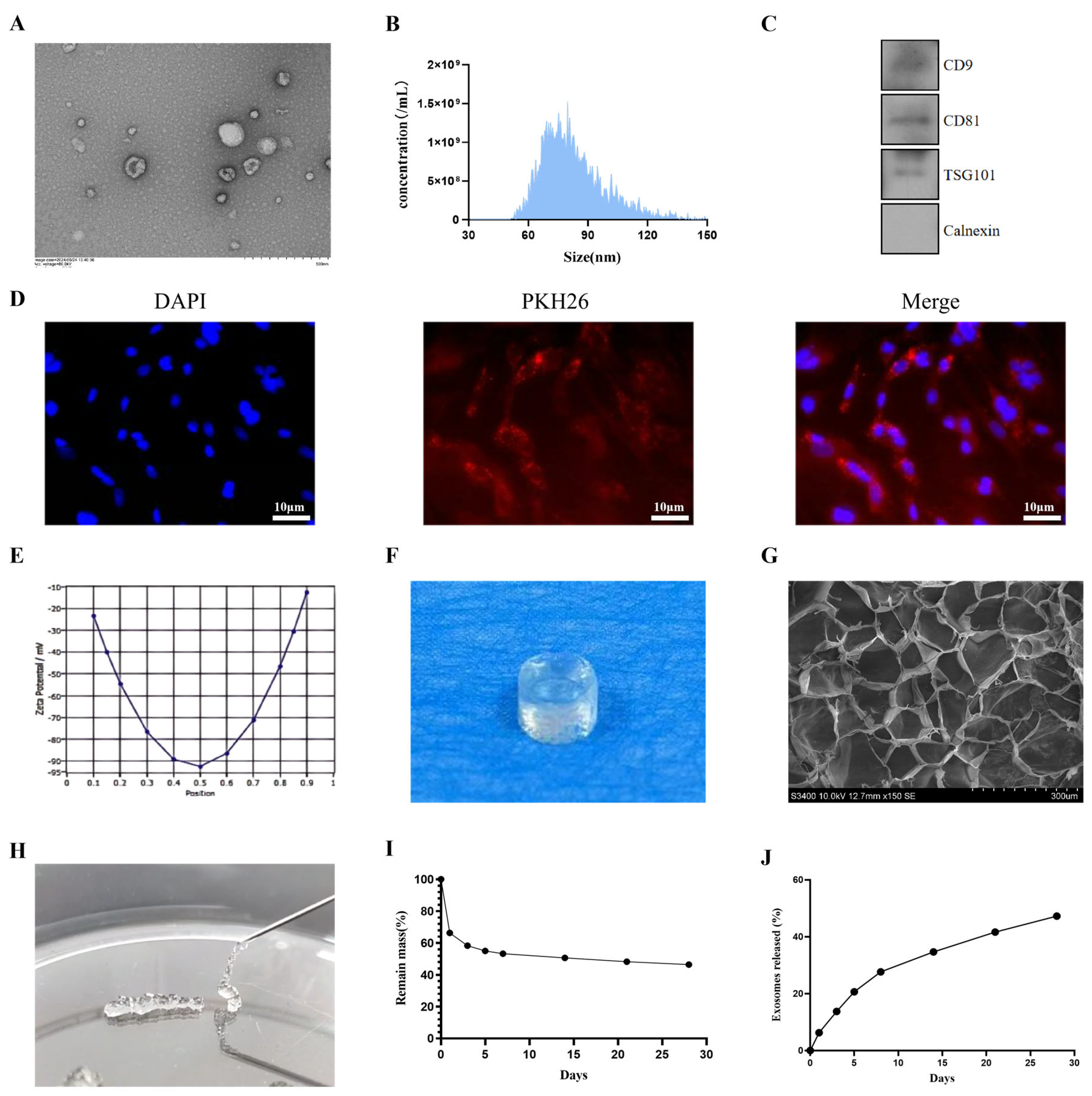
The present study used ultracentrifugation to extract BMSCs exosomes. TEM analysis (Figure 2A) revealed that the extracted exosomes had a typical cup-shaped appearance with intact, double-layered membrane structures. NTA (Figure 2B) analysis of the exosome size distribution showed a range of 30–150 nm, with an average diameter of 82.9 nm. Finally, WB detection of surface marker proteins on the exosomes indicated positive expression of CD9, CD81, and TSG101 proteins (Figure 2C), while the Calnexin protein was negative. These results align with the characteristic features of exosome detection [51]. Exosomes are natural secretory vesicles with a lipid bilayer (40~150 nm), encapsulating proteins, lipids, genetic information, and metabolites, facilitating intercellular communication. They are one of the most promising osteoinductive factors in regenerative medicine [52], which may address the limitations of the poor osteogenic activity of conventional scaffolds. Exosome internalization demonstrates that exosomes contain a lipid bilayer membrane, and lipophilic dyes such as PKH26 and PKH67, which can stably bind to exosomes, resulting in good staining effects and wide applications [51]. In the present study, the red fluorescent-labeled exosomes were distributed around the blue fluorescent-labeled cell nuclei, demonstrating that after 24 h of co-culture, exosomes can be taken up by target cells and distributed within the cytoplasm, thereby further affecting the cells (Figure 2D).
The negative charge of exosomes reduces their aggregation through electrostatic repulsion, enhancing stability, which also promotes their binding to positively charged cell membranes, increasing internalization efficiency. Additionally, it can influence the distribution of exosomes within tissues through charge complementarity [53,54]. This study employed zeta potential analysis to determine the surface charge of exosomes (Figure 2E). The zeta potential analysis revealed that the potential distribution of the extracted exosomes ranged from −13 to −92 mV, with an average potential of −35.87 mV. This confirms that the extracted exosomes carried a negative charge.

3.3. Characterization of Hydrogels and Release of Exosomes

Characterization: After photocrosslinking, the CSMA hydrogel formed a regular, smooth-surfaced, colorless, transparent jelly-like material (Figure 2F). Scanning electron micrographs revealed a three-dimensional porous network containing nu-merous pores of varying diameters (Figure 2G). Gentle extrusion of the pre-crosslinked hydrogel through a syringe produced a uniform filament that retained its shape after deposition, confirming good injectability and molding ability (Figure 2H).
Degradation Rate: The degradation profile of CSMA is presented in Figure 2I. Approximately 34% of the hydrogel mass was lost on day 1. From day 3 onward, the degradation rate stabilized, and approximately 46% of the hydrogel remained intact at day 28.
Porosity: Larger pores facilitate the loading of exosomes into the hydrogel but lead to a cascade release of EVs, which often fails to effectively prolong the retention time of EVs [55]. The porosity of the hydrogel was measured by the drainage method at 64.67 ± 2.21%.
Exosome release: Approximately 27% is released within the first 7 days. By day 28, about 48% of the exosomes remain retained in the hydrogel. (Figure 2J), confirming sustained release of exosomes for more than 4 weeks. After the rapid release of exosomes from the hydrogel surface, the release enters a ‘plateau phase’, during which exosome release is driven synergistically by internal diffusion dynamics and hydrogel degradation [56]. The faster exosome release rate in the first 7 days may be due to rapid diffusion from the hydrogel surface into the surrounding medium. Once the diffusion of exosomes from the hydrogel surface is complete, the release of exosomes is dominated by hydrogel degradation. During hydrogel degradation, disruption of its three-dimensional network may trap some exosomes, slowing their release until the hydrogel is fully degraded. However, we only detected the release of exosomes using the BCA method, although the histone content of the CSMA hydrogel group has been subtracted.

3.4. Characterization and Properties of Composite Scaffolds

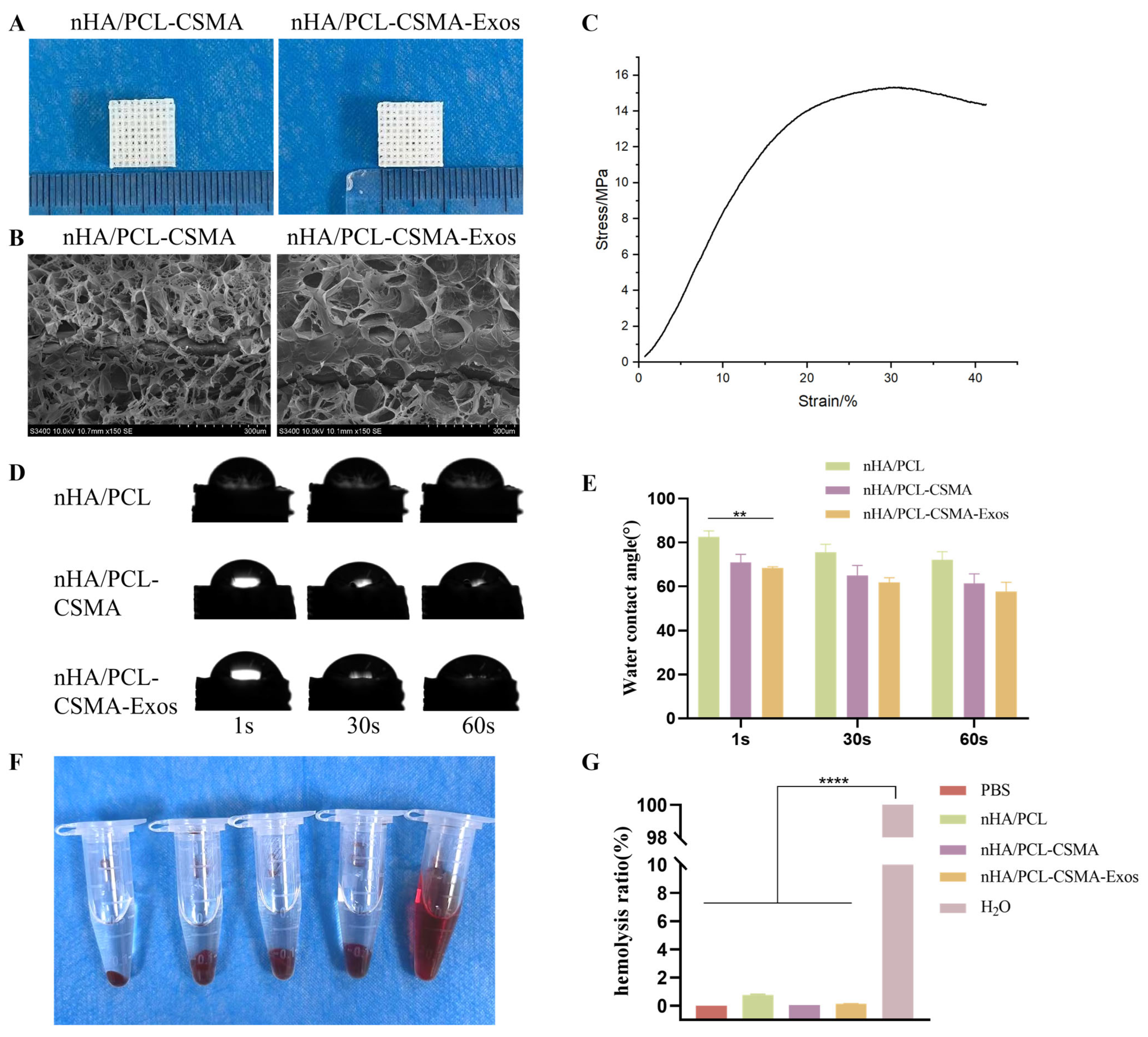
After photocrosslinking, transparent CSMA hydrogel uniformly filled the macropores of both the nHA/PCL-CSMA and nHA/PCL-CSMA-Exos scaffolds (Figure 3A). Scanning electron microscopy was used to observe the microstructure of the nHA/PCL-CSMA group scaffolds and the nHA/PCL-CSMA-Exos group scaffolds. CSMA in both groups of scaffolds could closely adhere to the surface of the scaffolds and fill the pores within them (Figure 3B). Compression performance tests were conducted on the nHA/PCL-CSMA composite scaffolds (5 mm × 5 mm × 5 mm) using an electronic universal testing machine. The results demonstrated that the scaffold exhibited a compressive strength of up to 15.19 ± 1.83 MPa and an elastic modulus of 84.45 ± 3.14 MPa (Figure 3C). We found that adding the CSMA hydrogel coating did not increase the elastic modulus of the nHA/PCL material. The hydrophilicity of the three groups was evaluated by contact angle analysis (Figure 3D,E). The results showed that the contact angles of all three groups were less than 90°, indicating good hydrophilicity. Among them, the contact angles of the nHA/PCL-CSMA group and the nHA/PCL-CSMA-Exos group were smaller than those of the nHA/PCL group.

3.5. Hemolysis Test

The in vitro blood compatibility of the materials was assessed by hemolysis test (Figure 3F,G). The hemolysis rate of the three groups of scaffolds was calculated to be less than 5%, indicating that all three groups of materials exhibit good blood cell compatibility [57].

3.6. Cell Proliferation, Viability, and Cytotoxicity

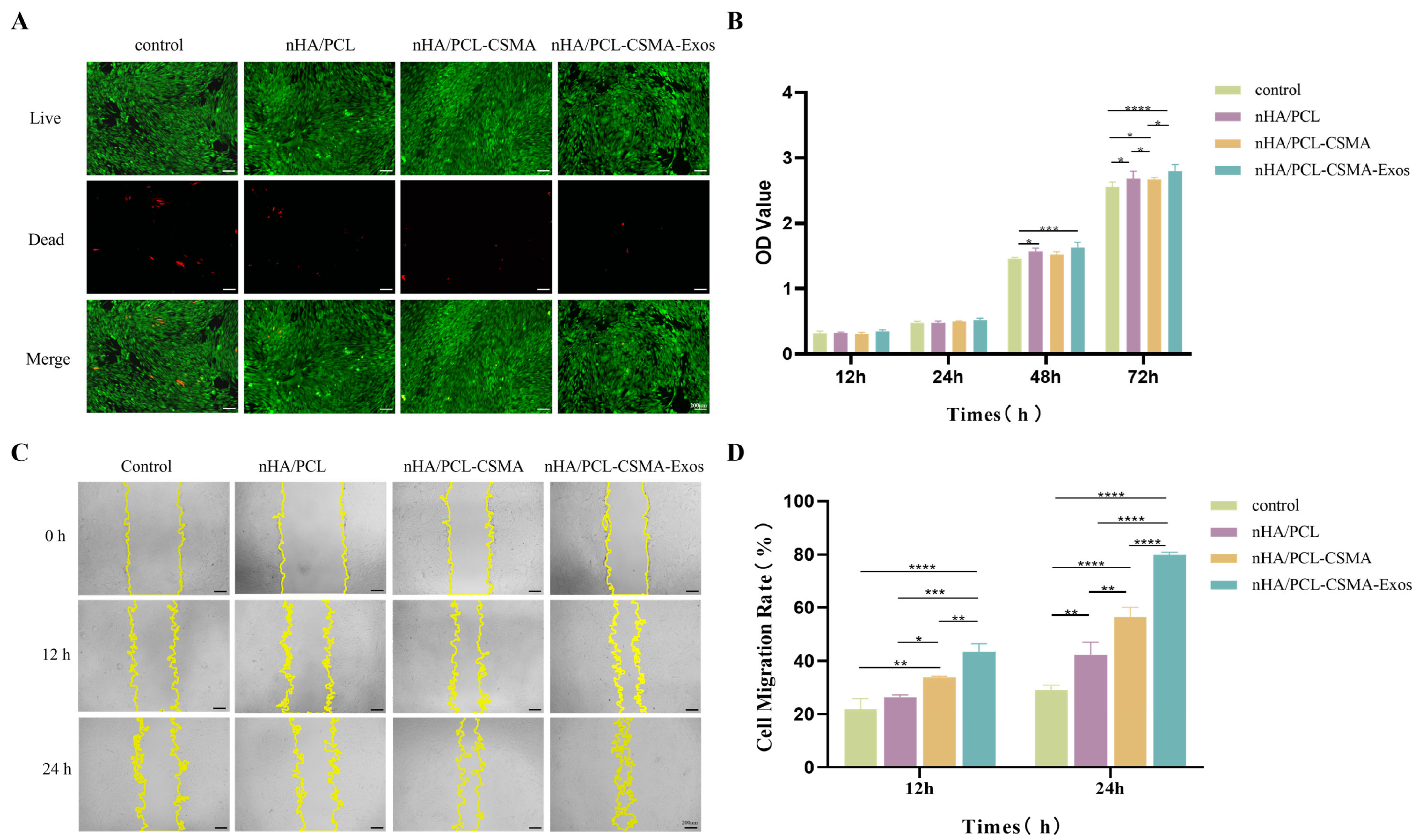
Live/dead staining confirmed high cytocompatibility: the vast majority of BMSCs fluoresced green (viable), whereas only a few nuclei were stained red (non-viable) (Figure 4A). The OD readings increased over time for each scaffold, demonstrating progressive BMSC proliferation across all constructs (Figure 4B). The nHA/PCL–CSMA–Exos scaffold supported the most pronounced cell-number expansion.

3.7. Cell Scratch Assay

The cell scratch assay evaluated the cell migration capability of each scaffold group. The scratch gap area of all groups narrowed at different time points (Figure 4C). According to the bar chart of cell migration rate at different time points for each group of materials, the nHA/PCL–CSMA–Exos group had a higher cell migration rate at 12 h and 24 h compared to the other groups (Figure 4D). The results indicate that all three composite materials promote cell migration to some extent, with the nHA/PCL–CSMA–Exos group showing the most significant cell migration capability.

3.8. Tube Formation Assay

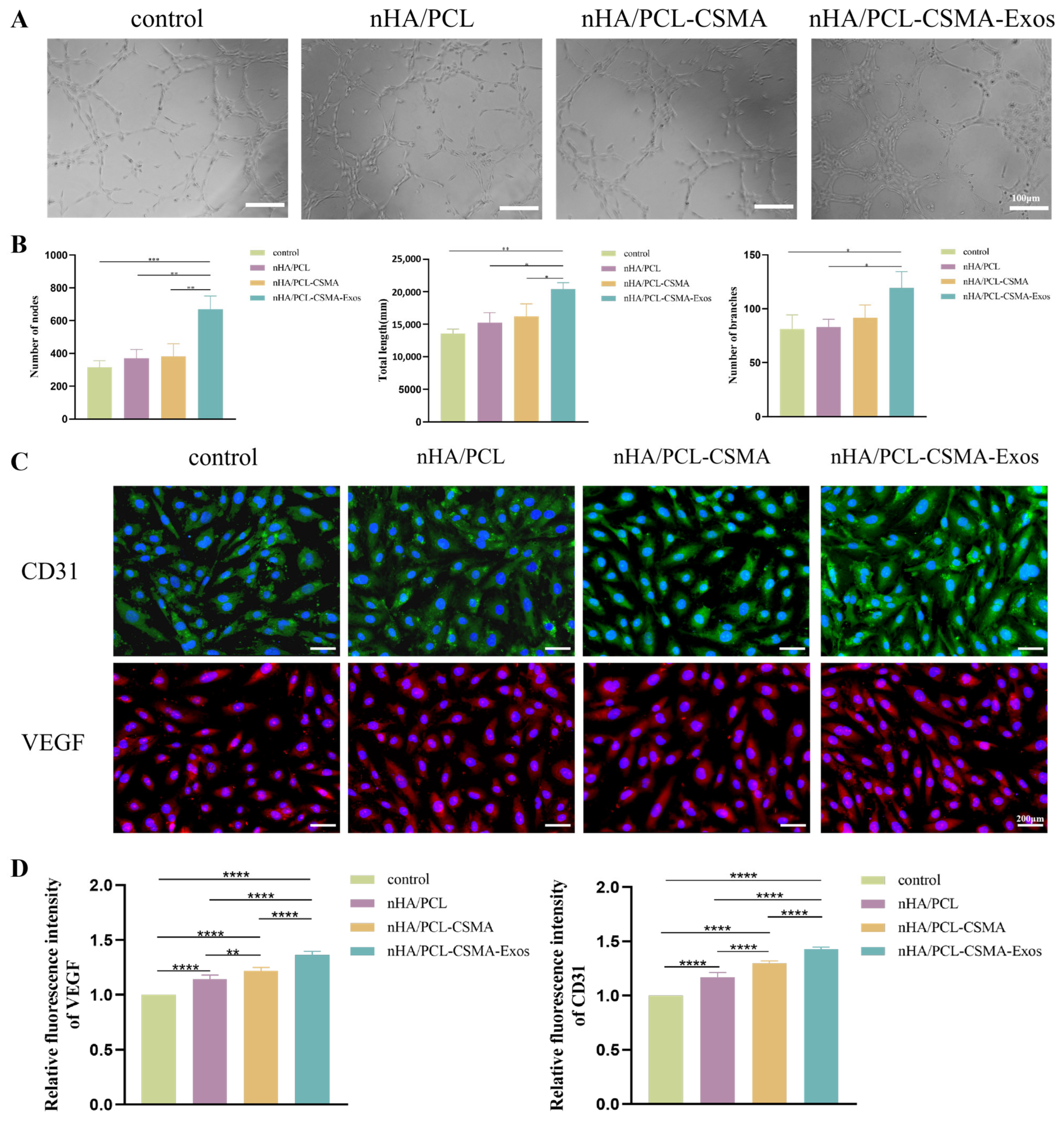
HUVECs were seeded on conditioned media collected from each scaffold to compare angiogenic capacity. The nHA/PCL–CSMA–Exos construct generated a markedly greater number of complete, closed capillary-like loops than the remaining groups (Figure 5A). In contrast, the blank control, nHA/PCL, and nHA/PCL-CSMA scaffolds produced noticeably fewer closed tubular structures. Quantitative analysis confirmed that the nHA/PCL–CSMA–Exos scaffold yielded significantly higher values for branch count, total node number, and cumulative tube length than the other three groups (Figure 5B).

3.9. Immunofluorescence

Endothelial markers CD31 and VEGF were detected in all scaffold groups, highlighting their inherent angiogenic potential (Figure 5C). The average fluorescence signal of every scaffold group exceeded that of the untreated control, with the nHA/PCL–CSMA–Exos construct exhibiting the strongest intensity (Figure 5D).
These findings suggest that the nHA/PCL–CSMA–Exos scaffold has a superior angiogenic capacity compared to the other three groups.

3.10. Alcian Blue and ARS Staining

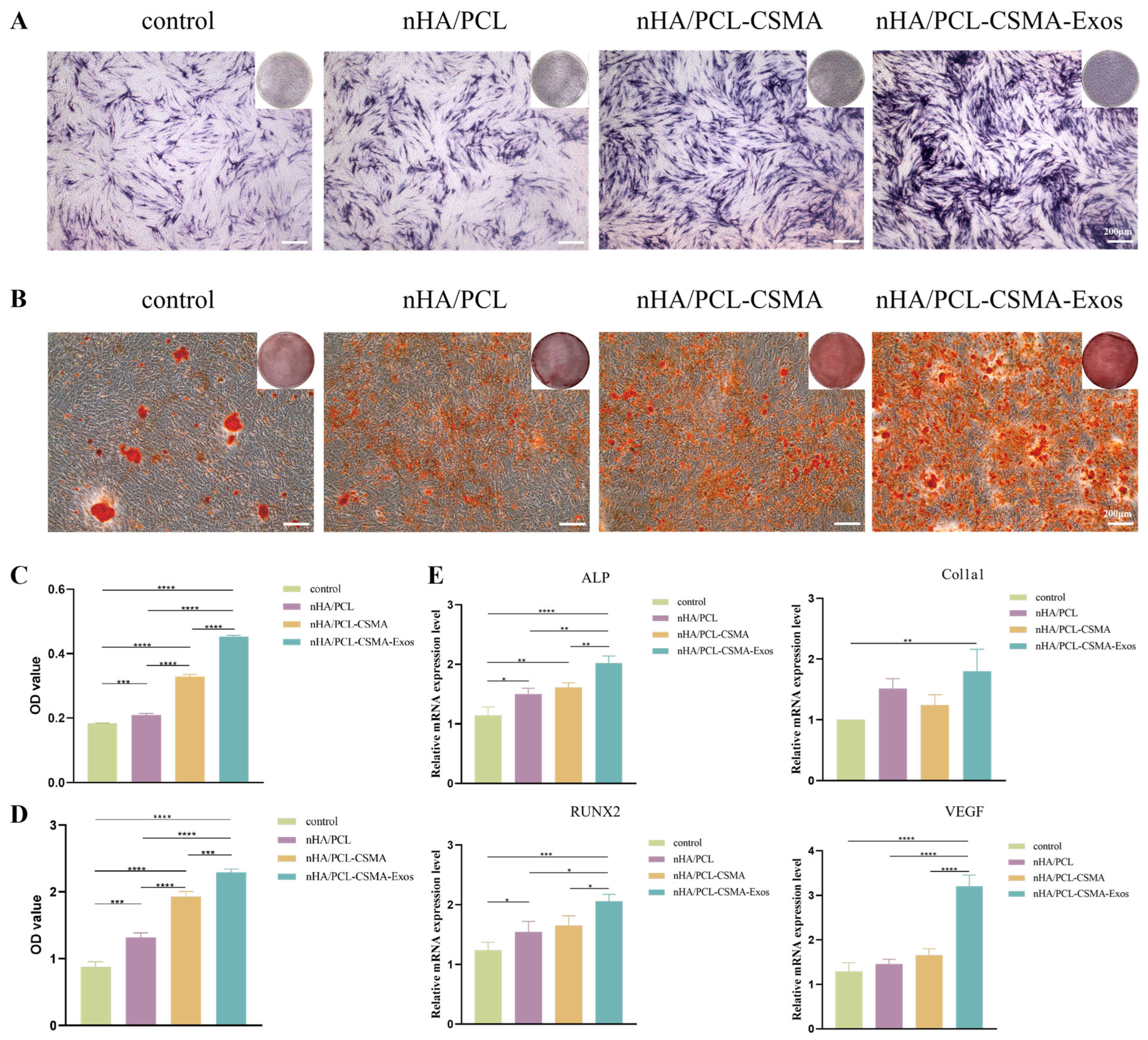
Using alkaline phosphatase staining, observe the early osteogenic effects of each group’s scaffolds. Cells induced by each group’s scaffolds can be stained purple by the alkaline phosphatase solution, with the nHA/PCL–CSMA–Exos group showing the most significant staining effects (Figure 6A).
Using Alizarin Red staining, observe the formation of calcium nodules in each group of cells to evaluate the late osteogenic effects of the scaffold materials. All groups demonstrated the presence of orange-red stained calcium nodules, indicating that all groups possess osteogenic capacity, with the nHA/PCL–CSMA–Exos group exhibiting the highest number of calcium nodules (Figure 6B). Quantitative analysis reveals that after 7 days of induction, the nHA/PCL–CSMA–Exos group has the highest alkaline phosphatase content (Figure 6C). The results indicate that the composite material of the nHA/PCL–CSMA–Exos group exhibits higher alkaline phosphatase activity during the early stages of osteogenesis, demonstrating a stronger early osteogenic effect. For ARS staining, quantitative analysis reveals that the nHA/PCL–CSMA–Exos group has the highest number of calcium nodules, indicating that its late osteogenic effect is superior to that of the other three groups (Figure 6D). This indicates that the addition of exosomes can promote osteogenesis.

3.11. qRT-PCR

ALP is an important biomarker of osteoblast differentiation and maturation, with its expression levels reflecting the activity of osteoblasts and the degree of bone mineralization. RUNX2 regulates the expression of various osteogenesis-related genes by promoting the transcription and expression of target genes, thereby driving osteoblast differentiation and the formation of the bone matrix [58]. Col1a1 is a major component of bone matrix. By regulating the expression of Col1a1, it can promote the formation and mineralization of bone tissue [59]. VEGF is a crucial angiogenic growth factor that plays a vital role in both osteogenesis and angiogenesis. The mRNA expression levels of ALP, RUNX2, Col1a1, and VEGF were measured using qRT-PCR.A higher mRNA expression was detected in the nHA/PCL–CSMA–Exos group (Figure 6E). This result is consistent with alkaline phosphatase staining, Alizarin Red staining, tube formation assays, and immunofluorescence staining results, indicating that the addition of exosomes significantly enhances the osteogenic and angiogenic capabilities of the scaffold.
Current clinical methods for repairing oral and maxillofacial bone defects still face significant limitations. For instance, autografts (the gold standard) have issues, such as donor site complications (occurring in ~8%–20%), and limited bone availability. Similarly, allografts may cause immune rejection (with an incidence rate of 3%–5%) and the risk of pathogen transmission [60,61]. Synthetic bone substitutes (such as β-TCP or HA blocks) are associated with poor vascularization and mismatched mechanical properties compared to host bone.
The present study fabricated a novel composite scaffold with a dual “rigid-scaffold–flexible-hydrogel” architecture that merges the structural precision of 3D printing with the dynamic biofunctionality of hydrogels. CSMA hydrogel imparted injectability and enabled sustained exosome release through stable electrostatic binding mediated by ζ-potential, thereby overcoming the critical limitation of the short in vivo half-life of free exosomes.
Future research should validate the osteogenic–vascular synergism of this scaffold in animal Jaw bone defect models, focusing on optimizing degradation kinetics. Specifically, nHA/PCL persists for over 12 months, whereas CSMA hydrogel reaches a quasi-steady-state degradation phase after 3 days in PBS; this temporal mismatch may influence the bone-regeneration microenvironment and warrants further investigation.
In summary, the multiscale design that combines nHA-reinforced printed scaffolds with a smart hydrogel delivery platform offers a promising route to personalized, functional oral and maxillofacial bone grafts. Additionally, grading the nHA content allows for tailoring of the construct’s mechanical behavior to more closely approximate that of native cortical and trabecular bone.

4. Conclusions

This study employed photocrosslinked CSMA hydrogel to modify nHA/PCL scaffolds, generating a bioactive coating with a three-dimensional network that enhances hydrophilicity. Efficient loading and controlled release of exosomes were achieved through electrostatic interactions between amino groups in CSMA molecular chains and the phospholipid bilayer on the surface of the exosomes. Characterization and in vitro assays demonstrated that the nHA/PCL–CSMA–Exos composite scaffold exhibits excellent physicochemical properties, biocompatibility, and cell migration capacity, thereby promoting angiogenesis and bone tissue formation and mineralization. Consequently, this composite scaffold shows strong potential for clinical treatment of bone defects. At present, our research team has initiated relevant in vivo animal experiments. The experimental rabbits will be euthanized at 1 and 3 months post-scaffold implantation, respectively. Techniques including micro-CT scanning, angiography, hematoxylin-eosin (H&E) staining and immunohistochemistry will be adopted to evaluate the osteogenic differentiation and angiogenesis capacities of the scaffolds in each group. Meanwhile, mechanical property tests will be conducted on the implanted scaffolds to assess changes in their mechanical properties under in vivo conditions. Given the limitations of the BCA assay for detecting exosome release, we will label exosomes with DiR fluorescent dye and conduct in vivo animal imaging to dynamically track the release and distribution of exosomes in vivo.
In summary, this study aims to clarify the osteogenic activity and regulatory mechanism of the nHA/PCL-CSMA-Exos scaffold by combining in vitro and in vivo animal experiments, thereby providing solid theoretical support and experimental evidence for the subsequent clinical translation of this scaffold material.

Author Contributions

Y.L.: Writing—original draft; Conceptualization; Data curation, W.D.: Methodology; Writing—review and editing; Formal analysis, C.H.: Software, L.Y.: Validation, D.Y.: Investigation, W.F.: Visualization, Y.H.: Resources; Funding acquisition, J.M.: Project administration; Supervision. All authors have read and agreed to the published version of the manuscript.

Funding

This study was supported by the Key Research and Development Program of Ningxia province (2025AAC020089, 2022BEG03159) and the Medical Engineering Special Project of the Ningxia Medical University General Hospital (NYZYYG-004).

Institutional Review Board Statement

Ethics approval and consent to participate: All animals come from Ningxia Medical University. This study was approved by the ethical committee of medical research—General Hospital of Ningxia Medical University (KYLL-2022-1299).

Data Availability Statement

All data that support the findings of this study are included within the article.

Conflicts of Interest

The authors declare no conflicts of interest.

References

  1. Gillman, C.E.; Jayasuriya, A.C. FDA-approved bone grafts and bone graft substitute devices in bone regeneration. Mater. Sci. Eng. C Mater. Biol. Appl. 2021, 130, 112466. [Google Scholar] [CrossRef] [PubMed]
  2. Schmidt, A.H. Autologous bone graft: Is it still the gold standard? Injury 2021, 52, S18–S22. [Google Scholar] [CrossRef]
  3. Dzhorov, A.; Romansky, R.; Yanev, N.; Nikolov, V.; Slavkov, S. One-stage (primary) reconstructions of resection mandibular defects by means of autogene vascularised iliac and fibular transplant. Khirurgiia 2015, 81, 16–25. [Google Scholar]
  4. Ciocca, L.; Marchetti, C.; Mazzoni, S.; Baldissara, P.; Gatto, M.R.; Cipriani, R.; Scotti, R.; Tarsitano, A. Accuracy of fibular sectioning and insertion into a rapid-prototyped bone plate, for mandibular reconstruction using CAD-CAM technology. J. Craniomaxillofac. Surg. 2015, 43, 28–33. [Google Scholar] [CrossRef]
  5. Battafarano, G.; Rossi, M.; De Martino, V.; Marampon, F.; Borro, L.; Secinaro, A.; Del Fattore, A. Strategies for Bone Regeneration: From Graft to Tissue Engineering. Int. J. Mol. Sci. 2021, 22, 1128. [Google Scholar] [CrossRef]
  6. Fernandez de Grado, G.; Keller, L.; Idoux-Gillet, Y.; Wagner, Q.; Musset, A.M.; Benkirane-Jessel, N.; Bornert, F.; Offner, D. Bone substitutes: A review of their characteristics, clinical use, and perspectives for large bone defects management. J. Tissue Eng. 2018, 9, 2041731418776819. [Google Scholar] [CrossRef]
  7. Vaz, V.M.; Kumar, L. 3D Printing as a Promising Tool in Personalized Medi-cine. AAPS PharmSciTech 2021, 22, 49. [Google Scholar] [CrossRef]
  8. Arif, Z.U.; Khalid, M.Y.; Noroozi, R.; Hossain, M.; Shi, H.H.; Tariq, A.; Ra-makrishna, S.; Umer, R. Additive manufacturing of sustainable biomaterials for biomedical applications. Asian J. Pharm. Sci. 2023, 18, 100812. [Google Scholar] [CrossRef]
  9. Tang, S.; Shen, Y.; Jiang, L.; Zhang, Y. Surface Modification of Nano-Hydroxyapatite/Polymer Composite for Bone Tissue Repair Applica-tions: A Review. Polymers 2024, 16, 1263. [Google Scholar] [CrossRef] [PubMed]
  10. Mohd Zaffarin, A.S.; Ng, S.F.; Ng, M.H.; Hassan, H.; Alias, E. Nano-Hydroxyapatite as a Delivery System for Promoting Bone Regeneration In Vivo: A Systematic Review. Nanomaterials 2021, 11, 2569. [Google Scholar] [CrossRef] [PubMed]
  11. Doyle, S.E.; Henry, L.; McGennisken, E.; Onofrillo, C.; Bella, C.D.; Duchi, S.; O’Connell, C.D.; Pirogova, E. Characterization of Polycaprolactone Nanohy-droxyapatite Composites with Tunable Degradability Suitable for Indirect Printing. Polymers 2021, 13, 295. [Google Scholar] [CrossRef]
  12. Backes, E.H.; Harb, S.V.; Beatrice, C.A.G.; Shimomura, K.M.B.; Passador, F.R.; Costa, L.C.; Pessan, L.A. Polycaprolactone usage in additive manufac-turing strategies for tissue engineering applications: A review. J. Biomed. Mater. Res. Part B Appl. Biomater. 2022, 110, 1479–1503. [Google Scholar] [CrossRef]
  13. Mendes Soares, I.P.; Anselmi, C.; Kitagawa, F.A.; Ribeiro, R.A.O.; Leite, M.L.; de Souza Costa, C.A.; Hebling, J. Nano-hydroxyapatite-incorporated polycaprolactone nanofibrous scaffold as a dentin tissue engineering-based strategy for vital pulp therapy. Dent. Mater. 2022, 38, 960–977. [Google Scholar] [CrossRef]
  14. Ebrahimi, Z.; Irani, S.; Ardeshirylajimi, A.; Seyedjafari, E. Enhanced osteo-genic differentiation of stem cells by 3D printed PCL scaffolds coated with collagen and hydroxyapatite. Sci. Rep. 2022, 12, 12359. [Google Scholar] [CrossRef]
  15. Juan, P.K.; Fan, F.Y.; Lin, W.C.; Liao, P.B.; Huang, C.F.; Shen, Y.K.; Ruslin, M.; Lee, C.H. Bioactivity and Bone Cell Formation with Poly-ε-Caprolactone/Bioceramic 3D Porous Scaffolds. Polymers 2021, 13, 2718. [Google Scholar] [CrossRef]
  16. Huang, B.; Caetano, G.; Vyas, C.; Blaker, J.J.; Diver, C.; Bártolo, P. Poly-mer-Ceramic Composite Scaffolds: The Effect of Hydroxyapatite and β-tri-Calcium Phosphate. Materials 2018, 11, 129. [Google Scholar] [CrossRef]
  17. Rezania, N.; Asadi-Eydivand, M.; Abolfathi, N.; Bonakdar, S.; Mehrjoo, M.; Solati-Hashjin, M. Three-dimensional printing of polycaprolactone/hydroxyapatite bone tissue engineering scaffolds mechanical properties and biological behavior. J. Mater. Sci. Mater. Med. 2022, 33, 31. [Google Scholar] [CrossRef]
  18. Wang, Y.; Fang, J.; Liu, B.; Shao, C.; Shi, Y. Reciprocal regulation of mesen-chymal stem cells and immune responses. Cell Stem Cell 2022, 29, 1515–1530. [Google Scholar] [CrossRef]
  19. Zhou, T.; Yuan, Z.; Weng, J.; Pei, D.; Du, X.; He, C.; Lai, P. Challenges and advances in clinical applications of mesenchymal stromal cells. J. Hematol. Oncol. 2021, 14, 24. [Google Scholar] [CrossRef]
  20. Cho, E.; Nam, G.H.; Hong, Y.; Kim, Y.K.; Kim, D.H.; Yang, Y.; Kim, I.S. Comparison of exosomes and ferritin protein nanocages for the delivery of membrane protein therapeutics. J. Control. Release 2018, 279, 326–335. [Google Scholar] [CrossRef]
  21. Rashidi, M.; Bijari, S.; Khazaei, A.H.; Shojaei-Ghahrizjani, F.; Rezakhani, L. The role of milk-derived exosomes in the treatment of diseases. Front. Genet. 2022, 13, 1009338. [Google Scholar] [CrossRef]
  22. Hassanzadeh, A.; Rahman, H.S.; Markov, A.; Endjun, J.J.; Zekiy, A.O.; Char-trand, M.S.; Beheshtkhoo, N.; Kouhbanani, M.A.J.; Marofi, F.; Nikoo, M.; et al. Mesenchymal stem/stromal cell-derived exosomes in regenerative medi-cine and cancer; overview of development, challenges, and opportunities. Stem Cell Res. Ther. 2021, 12, 297. [Google Scholar] [CrossRef]
  23. Zhang, S.; Wong, K.L.; Ren, X.; Teo, K.Y.W.; Afizah, H.; Choo, A.B.H.; Lai, R.C.; Lim, S.K.; Hui, J.H.P.; Toh, W.S. Mesenchymal Stem Cell Exosomes Promote Functional Osteochondral Repair in a Clinically Relevant Porcine Model. Am. J. Sports Med. 2022, 50, 788–800. [Google Scholar] [CrossRef]
  24. Lukomska, B.; Stanaszek, L.; Zuba-Surma, E.; Legosz, P.; Sarzynska, S.; Drela, K. Challenges and Controversies in Human Mesenchymal Stem Cell Therapy. Stem Cells Int. 2019, 2019, 9628536. [Google Scholar] [CrossRef] [PubMed]
  25. Riau, A.K.; Ong, H.S.; Yam, G.H.F.; Mehta, J.S. Sustained Delivery System for Stem Cell-Derived Exosomes. Front. Pharmacol. 2019, 10, 1368. [Google Scholar] [CrossRef]
  26. Annabi, N.; Tamayol, A.; Uquillas, J.A.; Akbari, M.; Bertassoni, L.E.; Cha, C.; Camci-Unal, G.; Dokmeci, M.R.; Peppas, N.A.; Khademhosseini, A. 25th an-niversary article: Rational design and applications of hydrogels in regenera-tive medicine. Adv. Mater. 2014, 26, 85–123. [Google Scholar] [CrossRef]
  27. Xie, Y.; Guan, Q.; Guo, J.; Chen, Y.; Yin, Y.; Han, X. Hydrogels for Exosome Delivery in Biomedical Applications. Gels 2022, 8, 328. [Google Scholar] [CrossRef]
  28. Wang, J.; Zhu, M.; Hu, Y.; Chen, R.; Hao, Z.; Wang, Y.; Li, J. Exo-some-Hydrogel System in Bone Tissue Engineering: A Promising Therapeu-tic Strategy. Macromol. Biosci. 2023, 23, e2200496. [Google Scholar] [CrossRef]
  29. Brennan, M.; Layrolle, P.; Mooney, D.J. Biomaterials functionalized with MSC secreted extracellular vesicles and soluble factors for tissue regenera-tion. Adv. Funct. Mater. 2020, 30, 1909125. [Google Scholar] [CrossRef]
  30. Do, N.H.N.; Truong, Q.T.; Le, P.K.; Ha, A.C. Recent developments in chi-tosan hydrogels carrying natural bioactive compounds. Carbohydr. Polym. 2022, 294, 119726. [Google Scholar] [CrossRef]
  31. Tang, W.; Wang, J.; Hou, H.; Li, Y.; Wang, J.; Fu, J.; Lu, L.; Gao, D.; Liu, Z.; Zhao, F.; et al. Review: Application of chitosan and its derivatives in medical materials. Int. J. Biol. Macromol. 2023, 240, 124398. [Google Scholar] [CrossRef]
  32. Safari, B.; Aghazadeh, M.; Davaran, S.; Roshangar, L. Exosome-loaded hy-drogels: A new cell-free therapeutic approach for skin regeneration. Eur. J. Pharm. Biopharm. 2022, 171, 50–59. [Google Scholar] [CrossRef]
  33. Li, J.; Du, C.; Yang, X.; Yao, Y.; Qin, D.; Meng, F.; Yang, S.; Tan, Y.; Chen, X.; Jiang, W.; et al. Instantaneous Self-Healing Chitosan Hydrogels with En-hanced Drug Leakage Resistance for Infected Stretchable Wounds Healing. Small 2025, 121, 2409641. [Google Scholar] [CrossRef]
  34. Osi, A.R.; Zhang, H.; Chen, J.; Zhou, Y.; Wang, R.; Fu, J.; Müller-Buschbaum, P.; Zhong, Q. Three-Dimensional-Printable Thermo/Photo-Cross-Linked Methacrylated Chitosan-Gelatin Hydrogel Composites for Tissue Engineer-ing. ACS Appl. Mater. Interfaces 2021, 13, 22902–22913. [Google Scholar] [CrossRef]
  35. Zhang, Y.; Li, Z.; Wang, Z.; Yan, B.; Shi, A.; Xu, J.; Guan, J.; Zhang, L.; Zhou, P.; Mao, Y. Mechanically enhanced composite hydrogel scaffold for in situ bone repairs. Biomater. Adv. 2022, 134, 112700. [Google Scholar] [CrossRef]
  36. Shen, S.; Shu, B.; Xu, Y.; Zhao, H.; Li, Y.; Li, Y.; Zhuo, C.; Zhuo, N. Charac-terization and Biocompatibility Assessment of 3D-Printed HA/PCL Porous Bionic Bone Scaffold: In Vitro and in Vivo Evaluation. J. Musculoskelet. Neuronal Interact. 2025, 25, 119–132. [Google Scholar] [CrossRef]
  37. Sistani, S.; Asgharzade, S.; Arab, S.; Bahraminasab, M.; Soltani-Fard, E. Fabrication and evaluation of a host-guest polylactic acid/gelatin-hydroxyapatite-blueberry scaffold for bone regeneration. J. Orthop. Surg. Res. 2025, 20, 788. [Google Scholar] [CrossRef]
  38. Kang, Y.; Xu, J.; Meng, L.a.; Su, Y.; Fang, H.; Liu, J.; Cheng, Y.Y.; Jiang, D.; Nie, Y.; Song, K. 3D bioprinting of dECM/Gel/QCS/nHAp hybrid scaffolds laden with mesenchymal stem cell-derived exosomes to improve angiogene-sis and osteogenesis. Biofabrication 2023, 15, 024103. [Google Scholar] [CrossRef]
  39. Kang, Y.; Xu, C.; Meng, L.; Dong, X.; Qi, M.; Jiang, D. Exo-some-functionalized magnesium-organic framework-based scaffolds with osteogenic, angiogenic and anti-inflammatory properties for accelerated bone regeneration. Bioact. Mater. 2022, 18, 26–41. [Google Scholar] [CrossRef]
  40. Buyuksungur, S.; Hasirci, V.; Hasirci, N. 3D printed hybrid bone constructs of PCL and dental pulp stem cells loaded GelMA. J. Biomed. Mater. Res. Part A 2021, 109, 2425–2437. [Google Scholar] [CrossRef]
  41. Guan, P.; Liu, C.; Xie, D.; Mao, S.; Ji, Y.; Lin, Y.; Chen, Z.; Wang, Q.; Fan, L.; Sun, Y. Exosome-loaded extracellular matrix-mimic hydrogel with an-ti-inflammatory property Facilitates/promotes growth plate injury repair. Bioact. Mater. 2022, 10, 145–158. [Google Scholar] [CrossRef] [PubMed]
  42. Zhao, T.; Jiang, L. Contact angle measurement of natural materials. Colloids Surf. B. Biointerfaces 2018, 161, 324–330. [Google Scholar] [CrossRef]
  43. Dong, R.; Kang, M.; Qu, Y.; Hou, T.; Zhao, J.; Cheng, X. Incorporating Hy-drogel (with Low Polymeric Content) into 3D-Printed PLGA Scaffolds for Local and Sustained Release of BMP2 in Repairing Large Segmental Bone Defects. Adv. Healthc. Mater. 2024, 14, 2403613. [Google Scholar] [CrossRef]
  44. Almela, T.; Brook, I.M.; Khoshroo, K.; Rasoulianboroujeni, M.; Fahimipour, F.; Tahriri, M.; Dashtimoghadam, E.; El-Awa, A.; Tayebi, L.; Moharamzadeh, K. Simulation of cortico-cancellous bone structure by 3D printing of bilayer calcium phosphate-based scaffolds. Bioprinting 2017, 6, 1–7. [Google Scholar]
  45. Liang, H.-Y.; Lee, W.-K.; Hsu, J.-T.; Shih, J.-Y.; Ma, T.-L.; Vo, T.T.T.; Lee, C.-W.; Cheng, M.-T.; Lee, I.-T. Polycaprolactone in Bone Tissue Engineering: A Comprehensive Review of Innovations in Scaffold Fabrication and Surface Modifications. J. Funct. Biomater. 2024, 15, 243. [Google Scholar] [CrossRef]
  46. Martínez Rodríguez, J.; Renou, S.J.; Guglielmotti, M.B.; Olmedo, D.G. Tis-sue response to porous high density polyethylene as a three-dimensional scaffold for bone tissue engineering: An experimental study. J. Biomater. Sci. Polym. Ed. 2019, 30, 486–499. [Google Scholar] [CrossRef]
  47. Wu, S.; Liu, X.; Yeung, K.W.K.; Liu, C.; Yang, X. Biomimetic porous scaf-folds for bone tissue engineering. Mater. Sci. Eng. R Rep. 2014, 80, 1–36. [Google Scholar]
  48. Pushpalatha, C.; Gayathri, V.S.; Sowmya, S.V.; Augustine, D.; Alamoudi, A.; Zidane, B.; Hassan Mohammad Albar, N.; Bhandi, S. Nanohydroxyapatite in dentistry: A comprehensive review. Saudi Dent. J. 2023, 35, 741–752. [Google Scholar] [CrossRef] [PubMed]
  49. Zhao, R.; Meng, X.; Pan, Z.; Li, Y.; Qian, H.; Zhu, X.; Yang, X.; Zhang, X. Advancements in nanohydroxyapatite: Synthesis, biomedical applications and composite developments. Regen. Biomater. 2025, 12, rbae129. [Google Scholar] [CrossRef] [PubMed]
  50. Abere, D.V.; Ojo, S.; Oyatogun, G.M.; Paredes-Epinosa, M.B.; Niluxsshun, M.C.D.; Hakami, A. Mechanical and morphological characterization of nano-hydroxyapatite (nHA) for bone regeneration: A mini review. Biomed. Eng. Adv. 2022, 4, 100056. [Google Scholar]
  51. Théry, C.; Witwer, K.W.; Aikawa, E.; Alcaraz, M.J.; Anderson, J.D.; Andri-antsitohaina, R.; Antoniou, A.; Arab, T.; Archer, F.; Atkin-Smith, G.K.; et al. Minimal information for studies of extracellular vesicles 2018 (MISEV2018): A position statement of the International Society for Extracellular Vesicles and update of the MISEV2014 guidelines. J. Extracell. Vesicles 2018, 7, 1535750. [Google Scholar] [CrossRef]
  52. Wang, W.; Zhu, N.; Yan, T.; Shi, Y.N.; Chen, J.; Zhang, C.J.; Xie, X.J.; Liao, D.F.; Qin, L. The crosstalk: Exosomes and lipid metabolism. Cell Commun. Signal. CCS 2020, 18, 119. [Google Scholar] [CrossRef]
  53. Kibria, G.; Ramos, E.K.; Lee, K.E.; Bedoyan, S.; Huang, S.; Samaeekia, R.; Athman, J.J.; Harding, C.V.; Lötvall, J.; Harris, L.; et al. A rapid, automated surface protein profiling of single circulating exosomes in human blood. Sci. Rep. 2016, 6, 36502. [Google Scholar] [CrossRef]
  54. Welsh, J.A.; Goberdhan, D.C.I.; O’Driscoll, L.; Buzas, E.I.; Blenkiron, C.; Bussolati, B.; Cai, H.; Di Vizio, D.; Driedonks, T.A.P.; Erdbrügger, U.; et al. Minimal information for studies of extracellular vesicles (MISEV2023): From basic to advanced approaches. J. Extracell. Vesicles 2024, 13, e12404. [Google Scholar] [CrossRef]
  55. Mardpour, S.; Ghanian, M.H.; Sadeghi-Abandansari, H.; Mardpour, S.; Naz-ari, A.; Shekari, F.; Baharvand, H. Hydrogel-Mediated Sustained Systemic Delivery of Mesenchymal Stem Cell-Derived Extracellular Vesicles Im-proves Hepatic Regeneration in Chronic Liver Failure. ACS Appl. Mater. Interfaces 2019, 11, 37421–37433. [Google Scholar] [CrossRef]
  56. Fan, M.H.; Pi, J.K.; Zou, C.Y.; Jiang, Y.L.; Li, Q.J.; Zhang, X.Z.; Xing, F.; Xie, R.; Han, C.; Xie, H.Q. Hydrogel-exosome system in tissue engineering: A promising therapeutic strategy. Bioact. Mater. 2024, 38, 1–30. [Google Scholar] [CrossRef]
  57. Shakya, K.R.; Chatterjee, N.; Misra, S.K.; Verma, V. A bacterial cellu-lose-polydopamine based injectable hydrogel for enhanced hemostasis in acute wounds. Biomater. Sci. 2025, 13, 3307–3324. [Google Scholar] [CrossRef]
  58. Logsdon, E.A.; Finley, S.D.; Popel, A.S.; Mac Gabhann, F. A systems biology view of blood vessel growth and remodelling. J. Cell. Mol. Med. 2014, 18, 1491–1508. [Google Scholar] [CrossRef]
  59. Ferguson, F.M.; Gray, N.S. Kinase inhibitors: The road ahead. Nat. Rev. Drug Discov. 2018, 17, 353–377. [Google Scholar] [CrossRef]
  60. Dissaux, C.; Ruffenach, L.; Bruant-Rodier, C.; George, D.; Bodin, F.; Rémond, Y. Cleft Alveolar Bone Graft Materials: Literature Review. Cleft Palate Craniofac. J. 2022, 59, 336–346. [Google Scholar] [CrossRef]
  61. Park, J.J.; Rochlin, D.H.; Parsaei, Y.; Shetye, P.R.; Witek, L.; Leucht, P.; Rabbani, P.S.; Flores, R.L. Bone Tissue Engineering Strategies for Alveolar Cleft: Review of Preclinical Results and Guidelines for Future Studies. Cleft Palate Craniofac. J. 2023, 60, 1450–1461. [Google Scholar] [CrossRef] [PubMed]
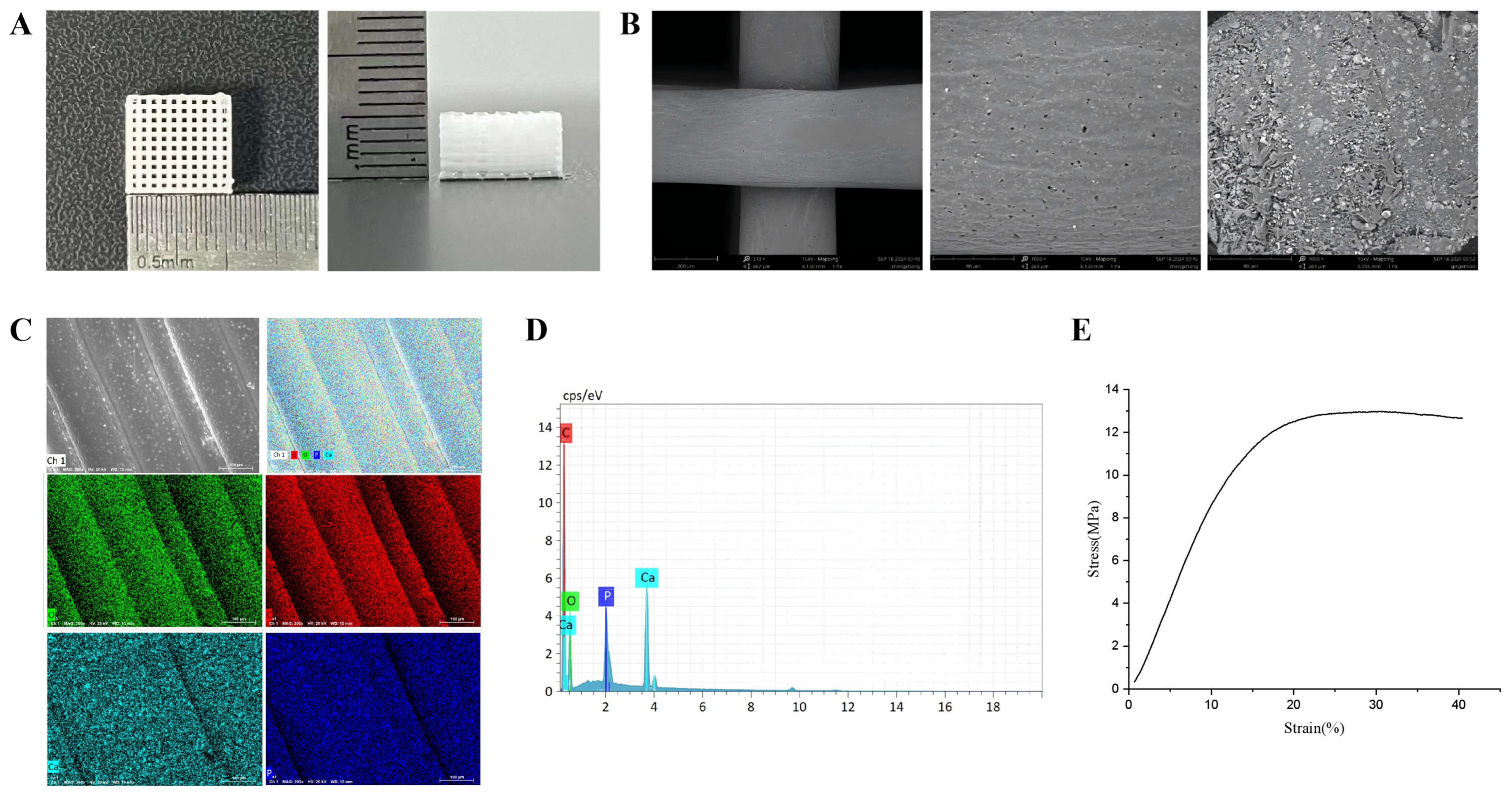
Figure 1. Characterization of nHA/PCL scaffolds (A) Macroscopic morphology of nHA/PCL scaffold (B) SEM images of nHA/PCL scaffolds (C,D) Surface elemental distribution images and EDS spectral analysis of nHA/PCL scaffolds (E) Stress–strain curve of nHA/PCL scaffolds.
Coatings 16 00201 g001
Figure 2. Exosome identification, exosome internalization, hydrogel characterization, and exosome release from hydrogels (A) Exosome TEM; (B) Exosome NTA particle size; (C) Exosome WB; (D) Exosome internalization; (E) Exosome zeta potential; (F) Hydrogel gross morphology; (G) Hydrogel SEM; (H) Hydrogel injectability; (I) Hydrogel degradation rate line graph; (J) Exosome release rate line graph from hydrogels.
Coatings 16 00201 g002
Figure 3. Characterization of composite scaffolds and hemolysis test: (A) Macrostructure of nHA/PCL-CSMA group and nHA/PCL-CSMA-exo group; (B) SEM of nHA/PCL-CSMA group and nHA/PCL-CSMA-exo group; (C) Stress–strain curve of nHA/PCL scaffolds (D) Contact angle photographs of the three groups of scaffolds; (E) Bar chart of contact angles of the three groups of scaffolds; (F) Hemolysis test photographs (From left to right: PBS, nHA/PCL, nHA/PCL-CSMA, nHA-CSMA-Exos, H2O); (G) Bar chart of hemolysis rate. (** p ≤ 0.01, **** p ≤ 0.0001).
Coatings 16 00201 g003
Figure 4. Live-dead cell staining, CCK-8 assay, and cell scratch test (A) Microscopic images of live-dead cell staining on day 3; (B) Bar chart of cell proliferation OD values at 12, 24, 48, and 72 h; (C) Microscopic images of cell scratch test at 12 and 24 h; (D) Bar chart of cell migration rates at 12 and 24 h. (* p ≤ 0.05, ** p ≤ 0.01, *** p ≤ 0.001, **** p ≤ 0.0001).
Coatings 16 00201 g004
Figure 5. Tube formation assay and immunofluorescence (A) Microscopic view of HUVECs tube formation assay; (B) Bar graph of angiogenesis quantification indicators; (C) Immunofluorescence staining images of CD31 and VEGF; (D) Bar graph of average fluorescence intensity of CD31 and VEGF. (* p ≤ 0.05, ** p ≤ 0.01, *** p ≤ 0.001, **** p ≤ 0.0001).
Coatings 16 00201 g005
Figure 6. ALP staining, ARS staining, quantification, and qRT-PCR experiments (A) Microscopic view of ALP staining; (B) Microscopic view of ARS staining; (C) Bar graph of ALP staining quantification; (D) Bar graph of ARS staining quantification; (E) Bar graph of mRNA expression levels of ALP, Col1a1, RUNX2, and VEGF. (* p ≤ 0.05, ** p ≤ 0.01, *** p ≤ 0.001, **** p ≤ 0.0001).
Coatings 16 00201 g006
Table 1. Quantitative analysis of surface elements on nHA/PCL scaffolds.
ElementAtomic NumberNormalized Quality (%)Atom (%)
C654.3064.93
O833.9930.51
Ca208.322.98
P153.401.58
Disclaimer/Publisher’s Note: The statements, opinions and data contained in all publications are solely those of the individual author(s) and contributor(s) and not of MDPI and/or the editor(s). MDPI and/or the editor(s) disclaim responsibility for any injury to people or property resulting from any ideas, methods, instructions or products referred to in the content.