Article

ATP-Responsive ZIF-90 Nanocontainers Encapsulating Natural Antifoulants for Intelligent Marine Coatings

1
Key Laboratory of Advanced Marine Materials, Key Laboratory of Marine Environmental Corrosion and Bio-Fouling, Institute of Oceanology, Chinese Academy of Sciences, Qingdao 266071, China
2
University of Chinese Academy of Sciences, Beijing 100049, China
3
Laboratory of Experimental Marine Biology, Institute of Oceanology, Chinese Academy of Sciences, Laboratory for Marine Biology and Biotechnology, Qingdao Marine Science and Technology Center, Qingdao 266071, China
*
Authors to whom correspondence should be addressed.
These authors contributed equally to this work.
Coatings 2026, 16(1), 7; https://doi.org/10.3390/coatings16010007
Submission received: 4 December 2025 / Revised: 16 December 2025 / Accepted: 17 December 2025 / Published: 19 December 2025
(This article belongs to the Section Functional Polymer Coatings and Films)

Abstract

Marine biofouling presents a persistent challenge for maritime industries, necessitating the development of eco-friendly and intelligent antifouling strategies. In this work, an ATP-responsive nanocontainer was developed by encapsulating a natural organic compound (CS106-10), isolated from Talaromyces trachyspermus in cold seep sediments, together with D-phenylalanine (D-Phe) into ZIF-90 nanoparticles (D-Phe/CS106-10@ZIF-90). These nanoparticles were incorporated into zinc acrylate resin to fabricate a novel self-polishing antifouling coating. CS106-10, as a natural antifoulant, provided efficient and environmentally sustainable bactericidal activity, while D-Phe acted as a synergistic adjuvant to inhibit and disrupt biofilm formation. More importantly, the ATP-responsive ZIF-90 framework enabled controlled, on-demand release of antifouling agents in response to local metabolic signals associated with biofilm growth. Laboratory and real-sea evaluations confirmed that the composite coating effectively suppressed biofilm formation and significantly reduced the required dosage of conventional toxic antifoulants. This study integrates a natural antifoulant with an ATP-responsive metal–organic framework, providing new insight for developing antifouling coatings.

1. Introduction

Biofouling, a natural phenomenon, refers to the accumulation, settlement, and rapid colonization of fouling organisms, such as microorganisms, algae, and mollusks, on submerged surfaces [1,2]. These surfaces include ship hulls [3], pipelines [4], offshore oil platforms [4,5], and marine sensors in oceanic environments [6,7]. Biofouling increases hydrodynamic drag on vessels, leading to higher fuel consumption and exacerbating global warming [8]. It also causes surface corrosion, posing safety risks, and adversely affects marine ecosystems by facilitating the invasion of non-native species. To mitigate the impacts of biofouling, antifouling coatings are widely applied to protect surfaces such as ships, pipelines, and oil platforms. Traditional antifouling coatings relied on chemically active compounds, such as tributyltin (TBT), which exhibited broad-spectrum biocidal activity and long-term efficacy. However, the high toxicity of TBT to both fouling and non-target marine organisms, including its potential to cause genetic mutations, disrupt algal photosynthesis, and severely damage marine ecosystems, led to its global ban in 2008 [9,10]. Subsequent alternatives, such as organic biocides, offer effective antifouling performance but tend to bioaccumulate, posing risks to food chains and the environment, and are thus being phased out [11].Current research focuses on low-toxicity or non-toxic, eco-friendly natural compound antifoulants [12]. These compounds are derived from four primary sources: marine invertebrates (e.g., sponges, corals, and crustaceans) [13], marine algae (e.g., red, green, and brown algae) [14], marine microorganisms (e.g., bacteria, fungi, and protozoa) [15], and terrestrial natural products (e.g., capsaicinoids, indoles, and tannins) [16]. Many bioactive compounds isolated from these sources exhibit antifouling properties, effectively inhibiting biofouling [12]. Compared to conventional antifoulants, these natural compounds are generally non-toxic or low-toxicity, have short half-lives, and are biocompatible, aligning with environmental sustainability requirements. Unlike traditional biocides, which often face challenges with bacterial resistance that diminishes their efficacy, most natural compound antifoulants do not exhibit this issue [17]. However, the extraction processes for these natural compounds are complex and yield low quantities. Traditional release methods, which rely on dissolution and diffusion, lack targeting specificity, leading to significant wastage of antifoulants and reduced efficacy. Consequently, the development of controlled-release technologies for antifoulants, enabling stable and targeted release, has emerged as a critical research direction in marine antifouling. Such advancements aim to achieve long-lasting, environmentally friendly antifouling solutions.
Metal–organic frameworks (MOFs) are a rapidly evolving class of crystalline coordination materials that enable efficient encapsulation and protection of bioactive molecules within their porous structures through mild self-assembly processes [18,19,20]. Composed of metal nodes and organic linkers, MOFs offer tunable spatial topologies, high surface areas, abundant active sites, and favorable pore environments. These properties facilitate selective interactions between bioactive components and microorganisms, making MOFs highly promising for applications in antifouling coatings, drug delivery, controlled pesticide release, and water treatment [21,22]. Zeolitic imidazolate framework-90 (ZIF-90), a representative MOF, is formed by the coordination of Zn2+ ions with imidazole-2-carboxaldehyde (2-ICA) ligands. Its stable, permanent porous structure makes it an excellent carrier material for the efficient loading of fluorescent probe molecules and antibacterial agents [23,24,25]. Notably, ZIF-90 exhibits remarkable responsiveness to adenosine triphosphate (ATP). ATP molecules can competitively coordinate with Zn2+, triggering controlled dissociation of the framework structure and enabling targeted release of encapsulated guest molecules [26]. As a central energy carrier in cellular metabolism, ATP plays an indispensable role in regulating various physiological processes [27], including the adhesion, proliferation, and quorum sensing behaviors of fouling organisms, which are heavily ATP-dependent. By leveraging the ATP-responsive properties of ZIF-90 in combination with controlled-release strategies for antifouling agents, it is possible to develop intelligent antifouling systems with high targeting specificity, sustained release, and environmental adaptability. This approach offers a novel pathway for designing efficient and precise antifouling materials.
Herein, we designed an ATP-responsive nanocontainer for encapsulating the natural organic compound CS106-10 and D-phenylalanine (D-Phe) to synthesize D-Phe/CS106-10@ZIF-90 nanoparticles. These nanoparticles were incorporated into zinc acrylate resin via physical blending to develop a novel, smart, and eco-friendly antifouling coating with ATP-responsive properties, as shown in Scheme 1. The natural compound CS106-10 was derived from the fungus Talaromyces trachyspermus isolated from cold seep sediments through multiple steps of separation and purification. Exogenous D-amino acids, such as D-Phe, can inhibit biofilm formation and even disrupt existing biofilms by modulating bacterial plasticity and structure, interfering with protein synthesis, and affecting other metabolic processes involving L-amino acid conversion [28]. D-Phe, as a natural synergist, enhances antifouling agent efficacy, reducing required dosages [29]. This antifouling coating integrates multiple strategies, combining efficient antibacterial and antialgal properties, smart responsiveness, and self-polishing characteristics. The incorporation of D-Phe/CS106-10@ZIF-90 enables targeted and sustained release of antifouling agents, significantly enhancing the antifouling performance of the zinc acrylate resin itself. Furthermore, it substantially reduces the reliance on conventional antifouling agents, such as cuprous oxide, thereby mitigating the long-term environmental risks associated with antifouling coatings in marine ecosystems. From an environmental protection perspective, this smart, responsive, and eco-friendly self-polishing coating provides a new perspective for the development of long-lasting, environmentally sustainable antifouling coatings.

2. Materials and Methods

2.1. Materials

Zinc acrylate resin was purchased from Wuxi Yaodex in Chemical Products Co., Ltd. (Wuxi, Jiangsu, China). Xylene, zinc acetate dihydrate, bovine serum albumin (BSA), fluorescein isothiocyanate (FITC), adenosine 5’-triphosphate (ATP), and N, N-dimethylformamide (DMF) were obtained from Shanghai Aladdin Biochemical Technology Co., Ltd. (Shanghai, China). Imidazole-2-carboxaldehyde (2-ICA) and D-phenylalanine were purchased from Shanghai Macklin Biochemical Technology Co., Ltd. (Shanghai, China).

2.2. Extraction, Isolation, and Purification of Natural Organic Compounds

2.2.1. Separation and Purification of Compounds CS106-1 and CS106-10

Chemical investigation of the cold-seep-sediment-derived fungus Talaromyces trachyspermus CS-106 resulted in the isolation of glauconic acid (CS106-1) [30] and spiculisporic acid D (CS106-10) [31]. The fresh mycelia of Talaromyces trachyspermus CS-106 were cultured on PDA medium at 28 °C for 6 days and then inoculated on the rice solid medium in 65 × 1 L conical flasks (each flask contained 100 g rice, 0.3 g corn flour, 0.45 g peptone, 0.9 g betaine and 150 mL natural seawater) for 30 days at room temperature. The whole fermented cultures were repeatedly soaked and extracted for four times with EtOAc, which was evaporated and concentrated under vacuum to obtain a crude extract (85.0 g). The extract was fractionated by silica gel vacuum liquid chromatography (VLC) using different solvents of increasing polarity from petroleum ether (PE)/EtOAc to CH2Cl2/MeOH to yield 10 fractions (Frs. 1–10). Compound 1 (CS106-1, 1.0 g) was obtained by recrystallization in Fr. 3 (18.0 g). Fr. 5 (15.0 g) was further fractioned by reversed-phase column chromatography (CC) over Lobar LiChroprep RP-18 with a MeOH-H2O gradient to yield 10 subfractions (Frs. 5.1–5.10). Fr. 5.4 (300.0 mg) was further purified by CC on Sephadex LH-20 (MeOH) and then by prep. TLC (plate: 20 × 20 cm, developing solvents: CHCl3/MeOH, 30:1) to obtain compound 10 (CS106-10, 81.2 mg).

2.2.2. Separation and Purification of Compound CO231-3

The fermented cocultures of marine mangrove endophytic fungus Penicillium brocae MA-231 [32] and phytopathogen Curvularia. spicifera QA-26 [33] were exhaustively extracted with EtOAc. The combined EtOAc solution was concentrated under reduced pressure to yield an extract. This extract was subsequently subjected to VLC on silica gel, utilizing a gradient of solvents that increased in polarity from PE to methanol (MeOH) to yield ten fractions (Frs. 1–10) based on the TLC and HPLC analysis. Fr.5, eluted with PE/EtOAc (2:1), was further purified by reversed-phase CC over Lobar LiChroprep RP-18 with a MeOH/H2O gradient (from 10:90 to 90:10) and yielded nine subfractions (Fractions 5.1–5.9). Fraction 5.3 was purified by CC over silica gel with a CH2Cl2/MeOH gradient (from 100:1 to 10:1) and then purified by preparative TLC (plate: 20 × 20 cm, developing solvents: CH2Cl2/MeOH 30:1) and CC over Sephadex LH-20 (MeOH) to obtain compound curvularin (CO231-3) [34].

2.2.3. Separation and Purification of Compound AS242m-d/m

The fungal strain Talaromyces scorteus AS-242 was isolated from the inner fresh tissue of the sea anemone Cerianthus sp., collected at the Magellan seamounts (depth 1304 m) [35]. The fresh mycelia of T. scorteus AS-242 were inoculated on PDA medium at 28 °C for four days and then cultured for 30 days at room temperature in 1 L conical flasks (100 flasks) with solid rice medium (each flask contained 70 g rice, 0.2 g corn syrup, 0.3 g peptone, 0.5 g yeast extracts, 0.6 g sodium glutamate, and 100 mL naturally sourced and filtered seawater that was obtained from the Huiquan Gulf of the Yellow Sea near the campus of IOCAS, pH 6.5–7.0). The whole fermented cultures were thoroughly extracted three times with EtOAc, which was evaporated under reduced pressure to afford an organic extract. The extract was fractionated by silica gel VLC using different solvents of increasing polarity from PE to MeOH to afford ten fractions. Fraction AS242m-d/m = 1/1 was further screened for antifouling activities.

2.3. Preparation of D-Phe/CS106-10@ZIF-90 Nanoparticles

D-Phe/CS106-10@ZIF-90 nanoparticles were synthesized via a facile one-pot method. Specifically, 48.05 mg of 2-ICA (0.05 M), 1.65 mg of CS106-10 (1 mM), and 3.32 mg of D-Phe (1 mM) were dissolved in 10.0 mL of DMF and stirred for 15 min to ensure dispersion. Subsequently, 5.0 mL of DMF containing 0.05 M Zn (CH3COO)2 was slowly added to the mixture, followed by an additional 15 min of stirring. The resulting dispersion was sequentially washed by centrifugation (10,000 rpm, 5 min) with DMF, ultrapure water, and ethanol. Finally, the product was redispersed in ultrapure water to obtain a stock solution (100 mg mL−1).

2.4. Preparation of Intelligent Self-Polishing Antifouling Coating

Nanoparticles of D-Phe/CS106-10@ZIF-90, with mass fractions of 0%, 1%, 2%, and 3%, were dispersed in ethanol and subjected to ultrasonication for 15 min to prevent aggregation of the nanocontainers. Subsequently, the dispersions were incorporated into 17 g of zinc acrylate resin, preheated to 40–60 °C, and stirred uniformly for 15 min to ensure homogeneous distribution. The resulting coating mixture was centrifuged at 3000 rpm for 5 min to remove air bubbles from the system. The coating was then uniformly applied to clean substrate surfaces using either a spray gun or brush coating technique. The coated substrates were dried and cured to yield self-polishing coatings with smart ATP-responsive antifouling properties. For laboratory experiments, blank glass slides were used as controls, while blank PVC panels were employed as controls for real-sea testing.

2.5. Bacterial Adhesion Inhibition of Antifouling Coating

Escherichia coli (E. coli) and Staphylococcus aureus (S. aureus) were selected as test strains. Antibacterial tests were conducted on samples prepared on glass slides (25.4 × 76.21 × 1–1.2 mm) for durations of 24 h and 7 days. Samples with varying gradients were fully immersed in 300 mL of bacterial suspension (1 mL, 106 cfu mL−1) and incubated at 37 °C for 24 h and 7 days. For the 7-day long-term experiment, 150 mL of fresh liquid LB medium was replaced midway to ensure bacterial viability. The samples were then rinsed with PBS to remove planktonic bacteria. Subsequently, the LIVE/DEAD BacLight™ Bacterial Viability Kit (Thermo Fisher Scientific, Waltham, MA, USA) was used to stain the bacteria on the sample surface for 10 min, followed by two additional PBS rinses. Finally, the cell distribution on the coating surface was imaged and recorded using a fluorescence microscope (Olympus IX83, Shinjuku City, Japan).

2.6. Antialgal Activity Evaluation of Antifouling Coating

Chlorella vulgaris (C. vulgaris) and Nitzschia closterium (N. closterium) were selected as test algal species to assess the antifouling performance of the coating. C. vulgaris and N. closterium were cultured in F/2 medium under 2000 lx light intensity at 25 °C for one week, with the culture medium gently shaken three times daily. The coating was applied onto glass slides and dried in a ventilated area for 48 h, followed by further drying in a blast drying oven at 40 °C for 24 h. The dried coating samples were immersed in the prepared algal suspension and incubated in a multifunctional environmental laboratory under 2000 lx light intensity, a temperature of 25 °C, and a 14:10 h light–dark cycle for 7 days. During this period, the absorbance of the algal suspension and changes in cell counts were continuously monitored using a microplate reader. Finally, the coated samples were repeatedly rinsed with sterile seawater to obtain the algal cells adhered to the coating surface. The adhesion of algal species on the coating surface was observed using the fluorescence imaging function of the microplate reader.

2.7. Antifouling Experiment in Marine Environment

To accurately evaluate the antifouling performance of zinc acrylate resin containing D-Phe/CS106-10@ZIF-90 in a real marine environment, the samples were tested in situ. The antifouling coatings were subjected to a shallow-sea test following the GB 5370-2007 standard [36]. PVC panels (200 mm × 100 mm × 3 mm) were sanded with 80-grit sandpaper to increase surface roughness, cleaned with ethanol to remove debris, and labeled. The resin samples were applied to the PVC panels and dried in a ventilated area for at least 3 days. The sample panels were then suspended 1 m below the sea surface at the Xuejiadao Wharf in Qingdao. At regular intervals, the panels were photographed. The panels were retrieved from the seawater, rinsed with seawater, and photographed again to record the number of fouling organisms on the sample surfaces.

3. Results

3.1. Screening of Natural Antifouling Agents

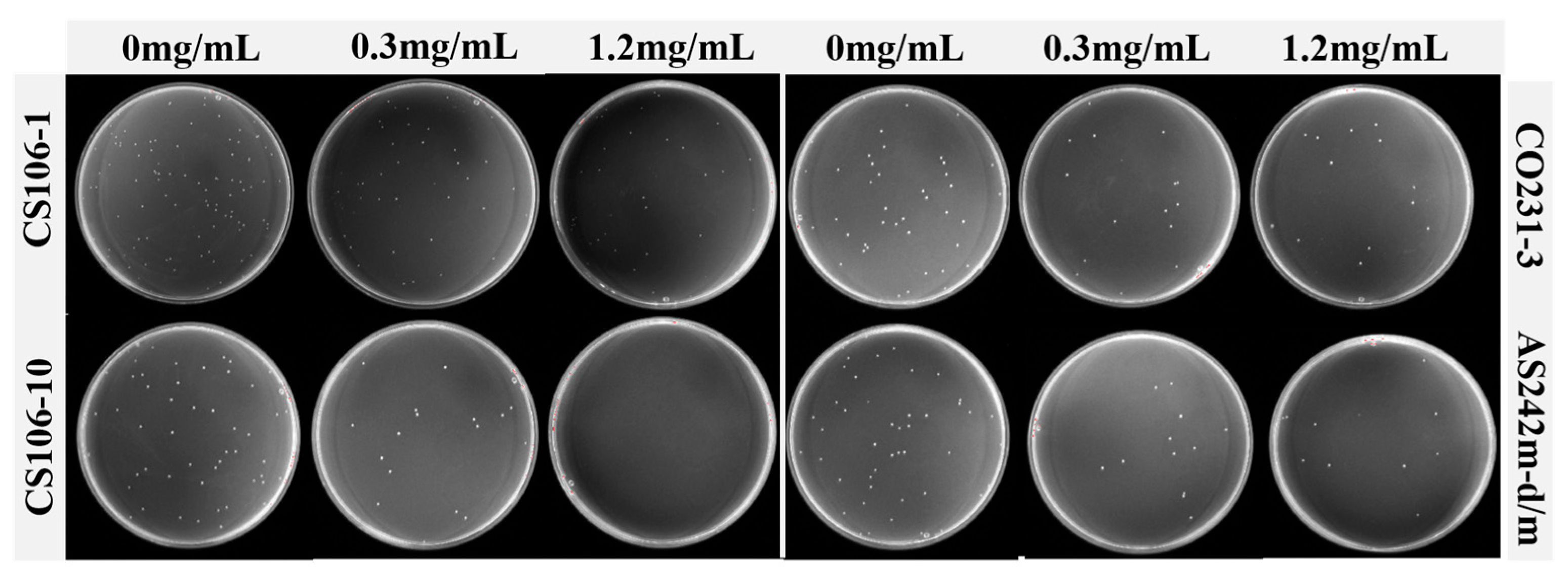
The antibacterial activity of four natural organic compounds (CS106-1, CS106-10, CO231-3, and AS242m-d/m) was evaluated against the Gram-negative bacterium E. coli. As shown in Figure 1, the antibacterial activity of the four natural compounds exhibited a dose-dependent trend with increasing concentrations of the four compounds. Notably, CS106-10, at a concentration of 1.2 mg mL−1, demonstrated the highest antibacterial efficacy, achieving a 100% killing ratio against E. coli. Consequently, CS106-10 was selected as the natural antifouling agent for subsequent experiments in this study.
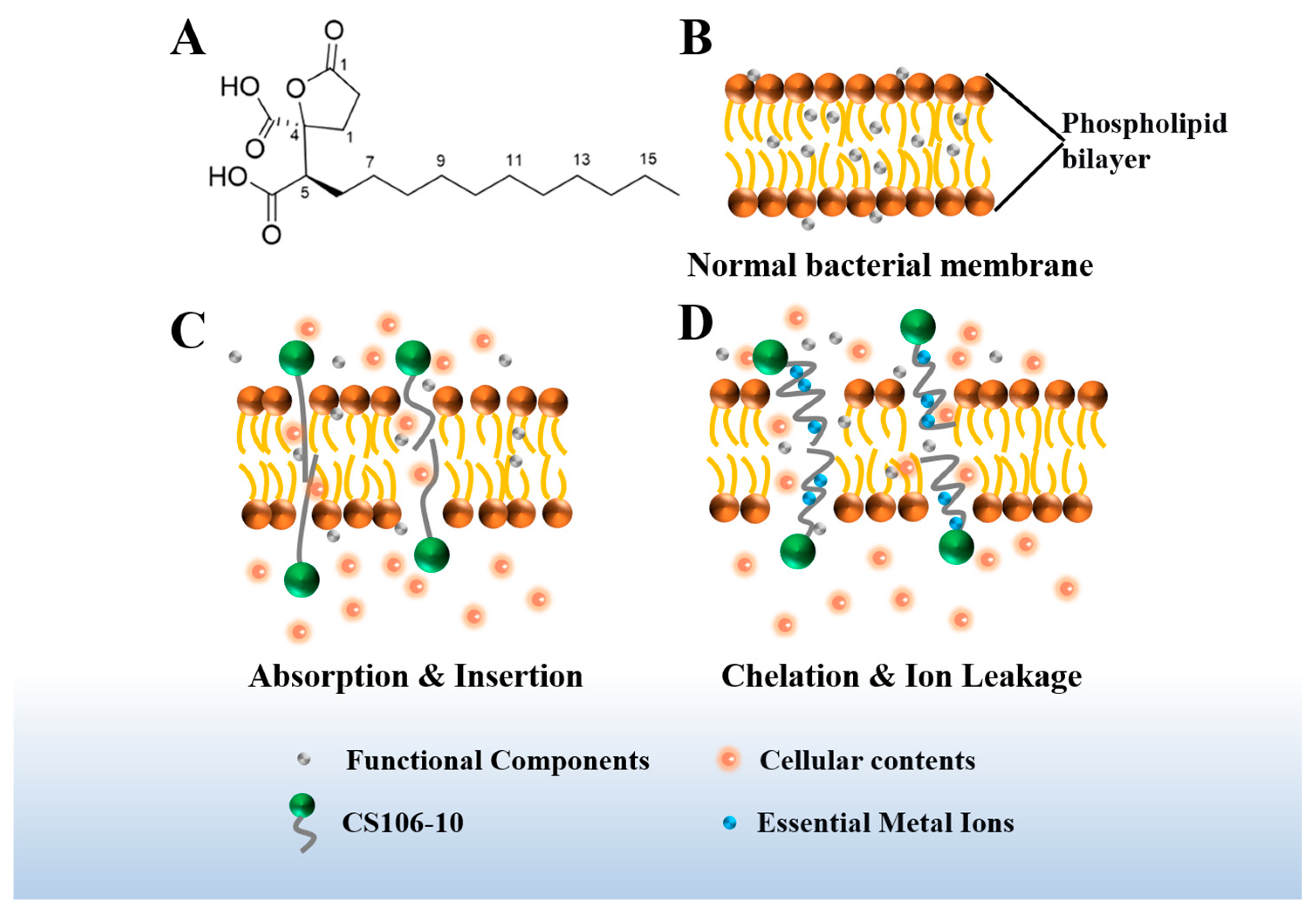
The molecular formula of compound CS106-10, isolated as a white solid, was determined to be C18H30O6 (with four degrees of unsaturation) based on high-resolution electrospray ionization mass spectrometry (HR-ESI-MS) data ([M+Na]+ at m/z 365.1940) in combination with 1H- and 13C-NMR spectroscopic data (Table S1, Figures S1 and S2). The 13C-NMR spectrum displayed signals corresponding to three carbonyl carbons (δC 176.4, 172.4, and 173.5), oxygenated quaternary carbon (δC 86.7), one methine carbon (δC 51.3), and thirteen aliphatic carbons in the upfield region (δC 31.7–14.4). The 1H-NMR spectrum exhibited signals for 28 aliphatic protons. These spectroscopic features indicate the presence of three carbonyl groups, accounting for three of the four degrees of unsaturation required by the molecular formula. The remaining degree of unsaturation suggests the presence of one ring system in the structure of CS106-10. Detailed analysis of NMR data suggested that CS106-10 was characteristic of a γ-butenolide-based derivative, structurally same as that of spiculisporic acid D [31], which is shown in Figure 2A.
Previous studies have reported that spiculisporic acid, a metabolic adduct isolated from the fermentation broth of Penicillium spiculisporum, can serve as a controlled-release carrier for active chemical molecules [37] and as a biosurfactant in metal decontamination processes, particularly for the removal of large-sized metal cations from water [38]. Based on structural similarities and functional group characteristics, it is reasonable to hypothesize that CS106-10, which shares structural similarities and functional group characteristics with spiculisporic acid, may exert its antibacterial activity through similar mechanisms. Microbial cell membranes, which are composed of a phospholipid bilayer that maintains cellular integrity, are depicted in Figure 2B. The amphiphilic nature of CS106-10 allows it to interact with this phospholipid bilayer, disrupting membrane integrity and leading to leakage of cellular contents and subsequent cell death (Figure 2C). Additionally, functional groups such as carboxyl groups in the molecule exhibit strong metal ion chelating capabilities, potentially depriving microorganisms of essential metal ions, thereby interfering with enzyme activity and metabolic processes (Figure 2D).

3.2. Characterization of D-Phe/CS106-10@ZIF-90 (B) Nanoparticles

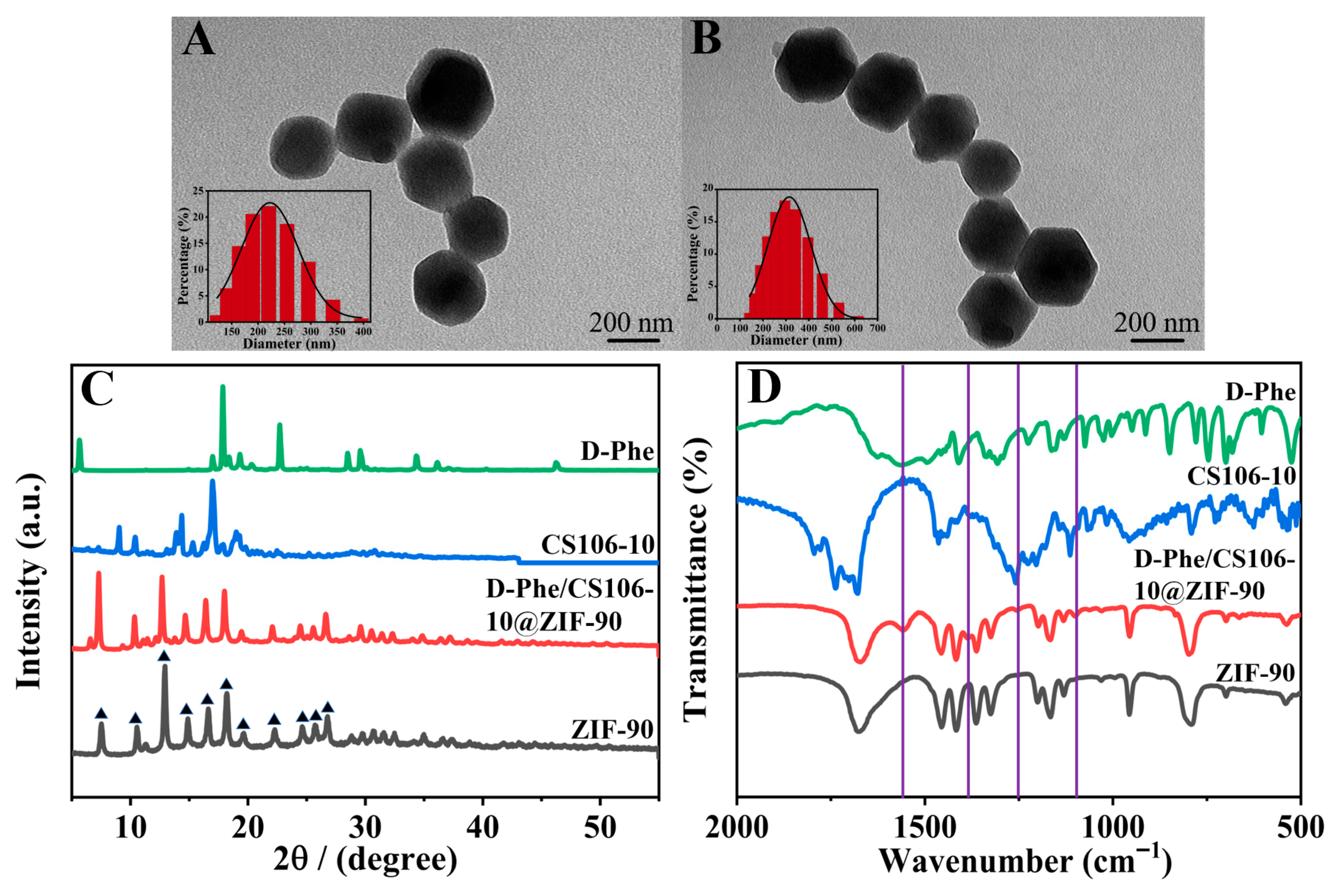
The morphology of ZIF-90 and D-Phe/CS106-10@ZIF-90 nanoparticles was characterized using transmission electron microscopy (TEM). Both types of nanoparticles exhibited uniform dispersion and a regular hexagonal shape, with particle sizes ranging from approximately 190 to 540 nm. The loading of D-Phe and CS106-10 had no significant effect on the particle size or morphology (Figure 3A,B). ATP-responsive nanocontainers were prepared by loading D-Phe and CS106-10 onto ZIF-90. To confirm the successful synthesis of these nanocontainers, phase purity was evaluated using X-ray diffraction (XRD). The XRD pattern of ZIF-90 revealed characteristic diffraction peaks at 2θ values of 7.28°, 10.32°, 12.66°, 14.65°, 16.39°, 18.01°, 22.09°, 24.49°, 26.63°, and 29.63°, corresponding to the (011), (200), (112), (022), (013), and (222) crystal planes [39,40], respectively. In the XRD pattern of D-Phe/CS106-10@ZIF-90, no distinct peaks associated with D-Phe or CS106-10 were observed, indicating that D-Phe and CS106-10 were encapsulated within the ZIF-90 nanoparticles rather than electrostatically adsorbed on their surface (Figure 3C). Fourier-transform infrared (FTIR) spectroscopy was further employed to characterize the synthesis process of the nanoparticles. Compared to ZIF-90, the FTIR spectrum of D-Phe/CS106-10@ZIF-90 displayed new absorption bands at 1062, 1254, 1385, and 1558 cm−1, which are attributed to the successful incorporation of D-Phe and CS106-10 (Figure 3D). these results confirmed the successful synthesis of D-Phe/CS106-10@ZIF-90 nanoparticles.
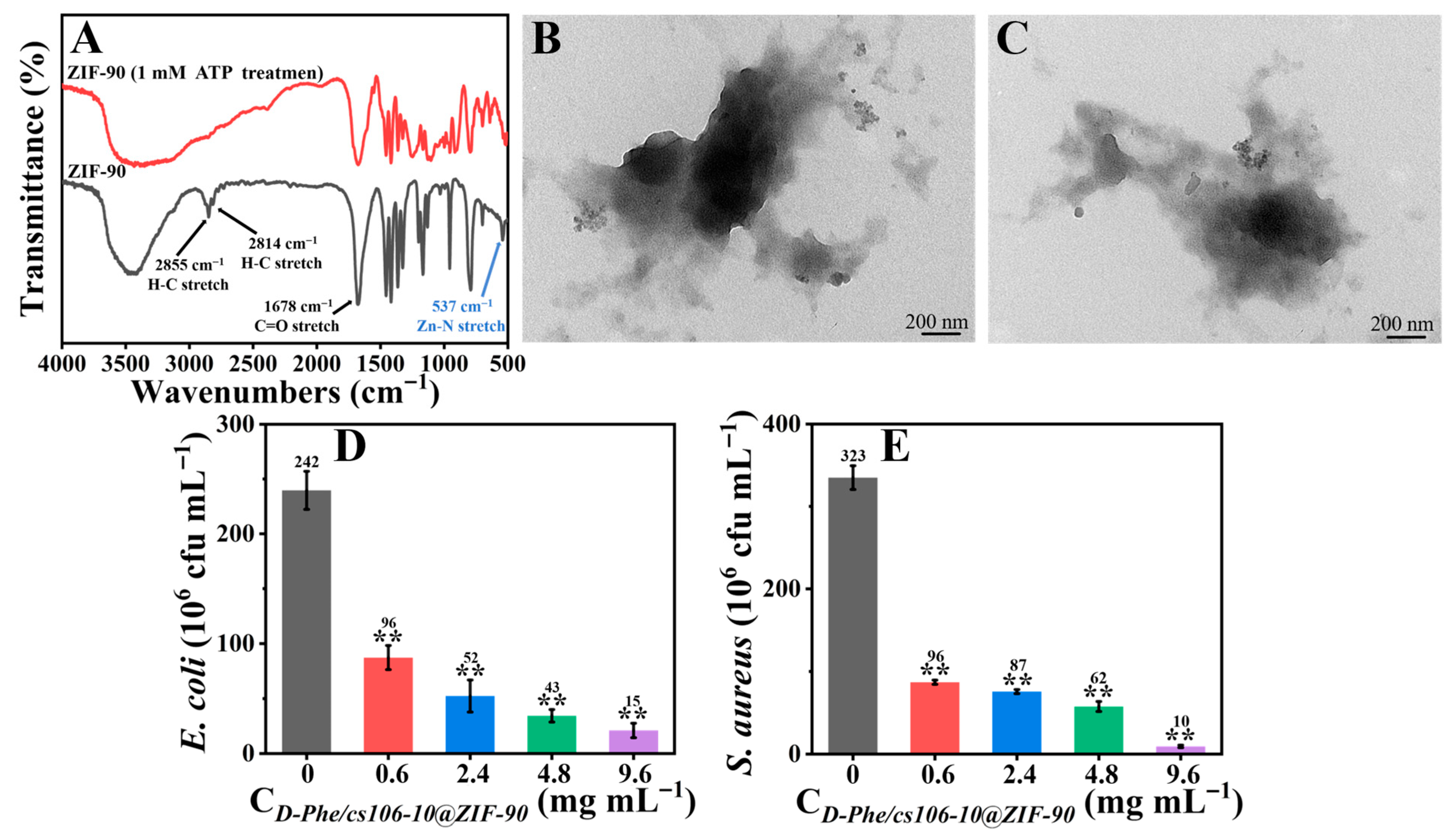
ZIF-90, a type of metal–organic framework, is reported to respond to adenosine triphosphate (ATP) through a competitive coordination mechanism [41]. ATP binds to the Zn2+ nodes in ZIF-90, leading to the disassembly or degradation of the framework [42]. The ATP-responsive ability of ZIF-90 is well-established, facilitating targeted and precise drug and protein delivery, particularly in cancer cells with elevated ATP levels, while also enabling the development of highly sensitive biosensors and imaging tools for detecting ATP in live cells and tissues, and allowing for dual or multiple responsiveness systems that enhance the specificity of drug release and biofilm eradication [43]. In this work, the decomposition process of ZIF-90 nanoparticles was characterized using Fourier-transform infrared (FTIR) spectroscopy and transmission electron microscopy (TEM). As shown in Figure 4A, the FTIR spectrum of ZIF-90 exhibited an absorption band at 537 cm−1, attributed to the vibrational stretching of Zn-N bonds, confirming the successful synthesis of ZIF-90. Absorption bands at 2814 and 2855 cm−1 corresponded to C-H stretching vibrations, while the band at 1678 cm−1 verified the presence of aldehyde groups. Upon reaction with 1 mM ATP, strong coordination between ATP and Zn2+ ions in the ZIF-90 framework competitively disrupted the original Zn-N (imidazole) coordination bonds, leading to the dissociation of the ZIF-90 structure and the disappearance of the 537 cm−1 absorption band [26]. Furthermore, TEM images (Figure 4B,C) revealed that, after ATP exposure, the crystal structures of both ZIF-90 and D-Phe/CS106-10@ZIF-90 became blurred and irregular, confirming ATP-responsive degradation behavior in both pristine ZIF-90 and ZIF-90 loaded with D-Phe and CS106-10. The ATP-responsive degradation of ZIF-90 nanoparticles provides a unique opportunity to develop intelligent self-polishing antifouling coatings. These coatings can be designed to release antifouling agents in response to the presence of ATP, which is often elevated in biofilms.
The ATP-responsive disassembly mechanism of ZIF-90 involves competitive coordination, in which the phosphate groups of ATP bind preferentially to the Zn2+ nodes, thereby displacing the imidazole-2-carboxaldehyde (2-ICA) linkers and disrupting the coordination bonds that maintain framework integrity [26,41,42]. This process leads to rapid structural degradation, as evidenced by the disappearance of the Zn-N stretching band in FTIR spectra and the morphological changes observed in TEM images following ATP exposure. Based on this mechanism, the release kinetics of the encapsulated antifoulants (CS106-10 and D-Phe) are expected to follow a biphasic profile. In the initial phase, typically within the first 1–2 h of exposure to physiologically relevant ATP concentrations (e.g., 1–5 mM, as encountered in bacterial biofilms), a burst release is anticipated, potentially liberating 40%–70% of the payload due to swift erosion of the outer nanoparticle layers [42,43]. This rapid phase may be further accelerated by local microenvironmental factors, such as the mildly acidic pH (5–6) commonly found in biofilms, which promotes Zn2+ dissociation. Similar ZIF-90 systems in targeted drug delivery have shown near-complete framework collapse within 2–4 h under comparable conditions [19,26]. A subsequent slower sustained release phase is expected over 4–24 h, driven by gradual ATP diffusion into the nanoparticle core and progressive inner erosion. In the context of marine antifouling, this biphasic, ATP-triggered profile is particularly advantageous, as elevated extracellular ATP associated with microbial quorum sensing and energy metabolism in nascent biofilms would initiate localized on-demand release, thereby enhancing efficacy while minimizing uncontrolled dispersion into seawater [27,43]. This adaptive behavior could optimize antifoulant dosage in response to actual fouling pressure and reduce environmental impact. Quantitative release studies under simulated marine conditions will be essential in future work to validate and refine these kinetic expectations.
The antibacterial activity of D-Phe/CS106-10@ZIF-90 nanocontainers was evaluated against Gram-negative E. coli and Gram-positive S. aureus. As shown in Figure 4D,E and Figure S3, the antibacterial activity of D-Phe/CS106-10@ZIF-90 exhibited a dose-dependent behavior with increasing concentrations, effectively inhibiting bacterial colony growth in a dose dependent manner, demonstrating strong antibacterial activity against both Gram-negative (E. coli) and Gram-positive (S. aureus) bacteria, with mortality rates of 94% and 95%, respectively, at 9.6 mg mL−1. This remarkable efficacy can be attributed to the ATP-responsive degradation of D-Phe/CS106-10@ZIF-90 nanocontainers. Bacteria, particularly those in biofilms, often exhibit elevated levels of ATP. When D-Phe/CS106-10@ZIF-90 nanocontainers come into contact with bacterial surfaces, the ATP released by the bacteria competitively binds to the Zn2+ nodes in the ZIF-90 framework, disrupting the original Zn-N coordination bonds and leading to the disassembly of the ZIF-90 structure. This process results in the controlled release of the encapsulated bioactive compounds, D-Phe and CS106-10, which then cause disruption of bacterial cell membranes and interfere with essential metabolic processes. This targeted release mechanism ensures that the antibacterial agents are delivered precisely where they are needed, maximizing their efficacy while minimizing potential side effects and environmental impact.
Additionally, the ZIF-90 framework exhibits moderate stability in pure seawater, with limited hydrolysis under neutral-to-alkaline conditions and high ionic strength typical of marine environments, as inferred from analogous ZIF systems and the sustained performance observed in our five-month real-sea tests. This baseline stability ensures minimal unintended release in ATP-poor open seawater, while allowing targeted disassembly in response to elevated local ATP from biofilm formation.

3.3. Performance of the Intelligent, Self-Polishing Antifouling Coating

Upon immersion of materials in seawater, macromolecules in the seawater adsorb to the material surface through reversible intermolecular forces, providing initial conditions for subsequent fouling formation [44]. This adsorption layer serves as a substrate for the attachment of microorganisms and other fouling organisms. Therefore, inhibiting protein accumulation is a key requirement for an effective antifouling coating. Figure S4 illustrates the fluorescence adsorption images of BSA on the surface of zinc acrylate resin coatings containing varying amounts of D-Phe/CS106-10@ZIF-90 (0 wt%, 1 wt%, 2 wt%, and 3 wt%), with a blank glass slide serving as the control. The results demonstrate that coatings with different D-Phe/CS106-10@ZIF-90 contents exhibit varying anti-protein adsorption properties, with these differences becoming more pronounced over time. The blank glass slide showed significant BSA adsorption, indicating a high propensity for protein accumulation. In contrast, the coating with 3 wt% D-Phe/CS106-10@ZIF-90 exhibited negligible BSA adsorption, suggesting a highly effective inhibition of protein accumulation. Coatings with 1 wt% and 2 wt% D-Phe/CS106-10@ZIF-90 displayed significantly lower BSA adsorption compared to the 0 wt% coating and the blank control, although the difference between the 1 wt% and 2 wt% coatings was relatively minor. This indicates that even a low concentration of D-Phe/CS106-10@ZIF-90 can significantly reduce protein adsorption, thereby enhancing the antifouling performance of the coating.
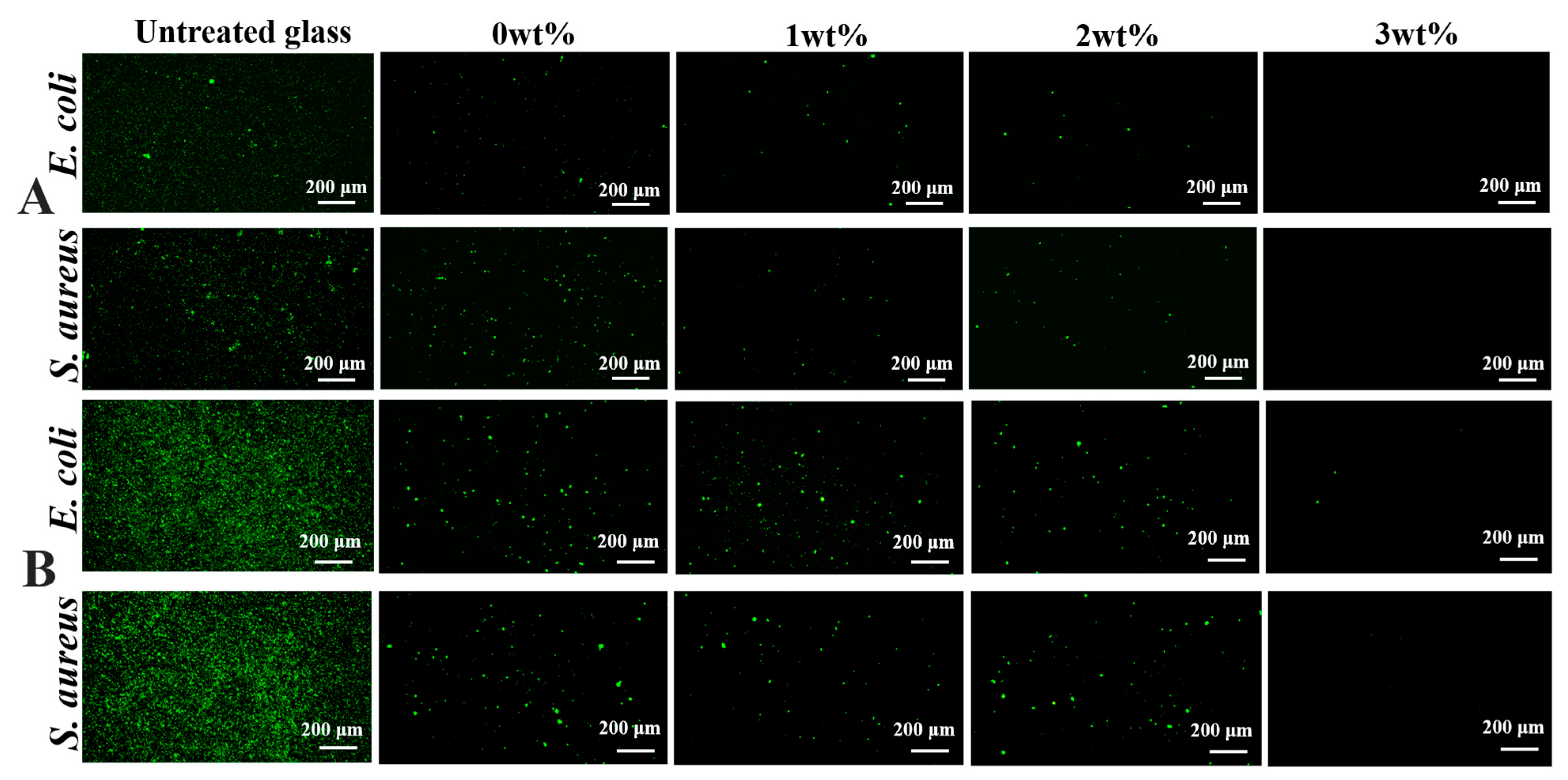
The adhesion of bacteria to the surface of new materials is a critical initial step that leads to biofouling [45]. Therefore, the ability to inhibit bacterial adhesion is also an important indicator for evaluating the antifouling performance of materials. To assess the antibacterial adhesion properties of the coating, fluorescence imaging measurements were conducted (Figure 5). The results demonstrate that increasing the content of D-Phe/CS106-10@ZIF-90 significantly reduces bacterial adhesion on the coating surface. When the content reaches 3 wt%, bacterial adhesion is completely inhibited within 24 h. Even after extended immersion for 7 days, only minimal bacterial attachment was observed. Although the amount of bacterial adhesion shows an increasing trend over time, no biofilm formation is detected. This can be attributed to the biofilm-inhibiting and disruptive effects of D-Phe, which interfere with bacterial communication and adhesion mechanisms [46]. The thicker, porous peptidoglycan layer of Gram-positive bacteria facilitates the penetration and effectiveness of the antibacterial component CS106-10. In contrast, the dense outer membrane of Gram-negative bacteria acts as an additional barrier against molecular penetration, making it harder for CS106-10 to disrupt their cell walls, thereby resulting in slightly reduced anti-adhesion efficacy. Furthermore, as summarized in Table S2, the antibacterial efficacy of our intelligent coating is comparable to that of established commercial and historical systems, while offering a more sustainable profile [47,48,49].
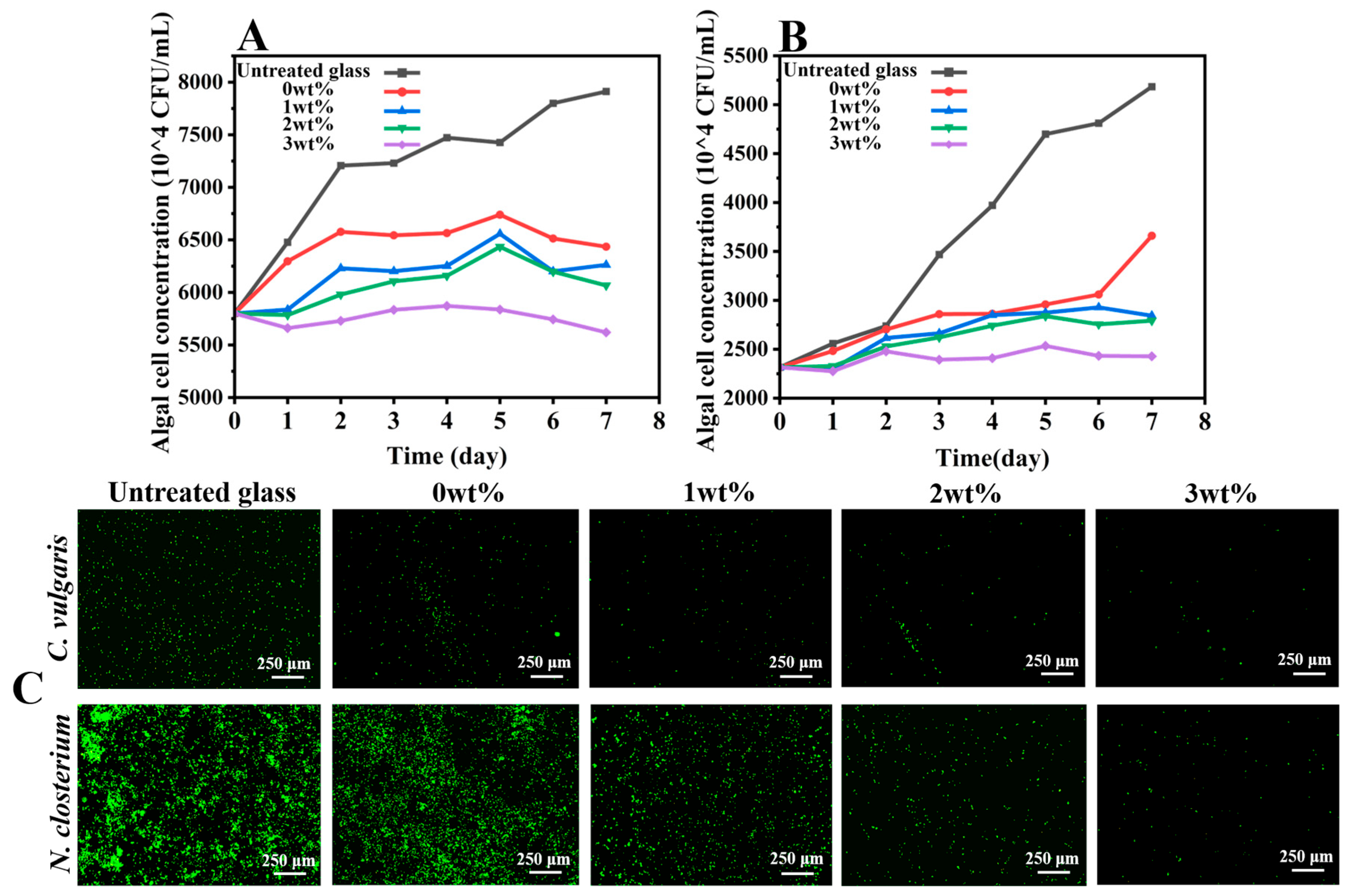
Algae constitute a significant proportion of fouling organisms, with the spores of certain algal species playing a critical role in the initial formation of biofouling. To evaluate the anti-algal adhesion properties of the prepared coatings, C. vulgaris (a green alga) and N. closterium (a diatom) were selected for anti-algal adhesion testing (Figure 6). Experimental results indicated that as the content of D-Phe/CS106-10@ZIF-90 increased in the coating, both algal growth inhibition and suppression of algal adhesion showed a positive correlation, enhancing the coating antifouling efficacy. Fluorescence imaging revealed that the coating exhibited greater resistance to C. vulgaris compared to N. closterium. This difference may be attributed to the distinct cellular characteristics of the two species: C. vulgaris is a green alga with a cell wall primarily composed of cellulose and proteins, whereas N. closterium, a diatom, possesses a cell wall predominantly composed of biomineralized silica (SiO2) [50]. The highly ordered nanoscale porous structure of the diatom frustule increases the contact surface area with substrates, thereby enhancing physical adhesion.
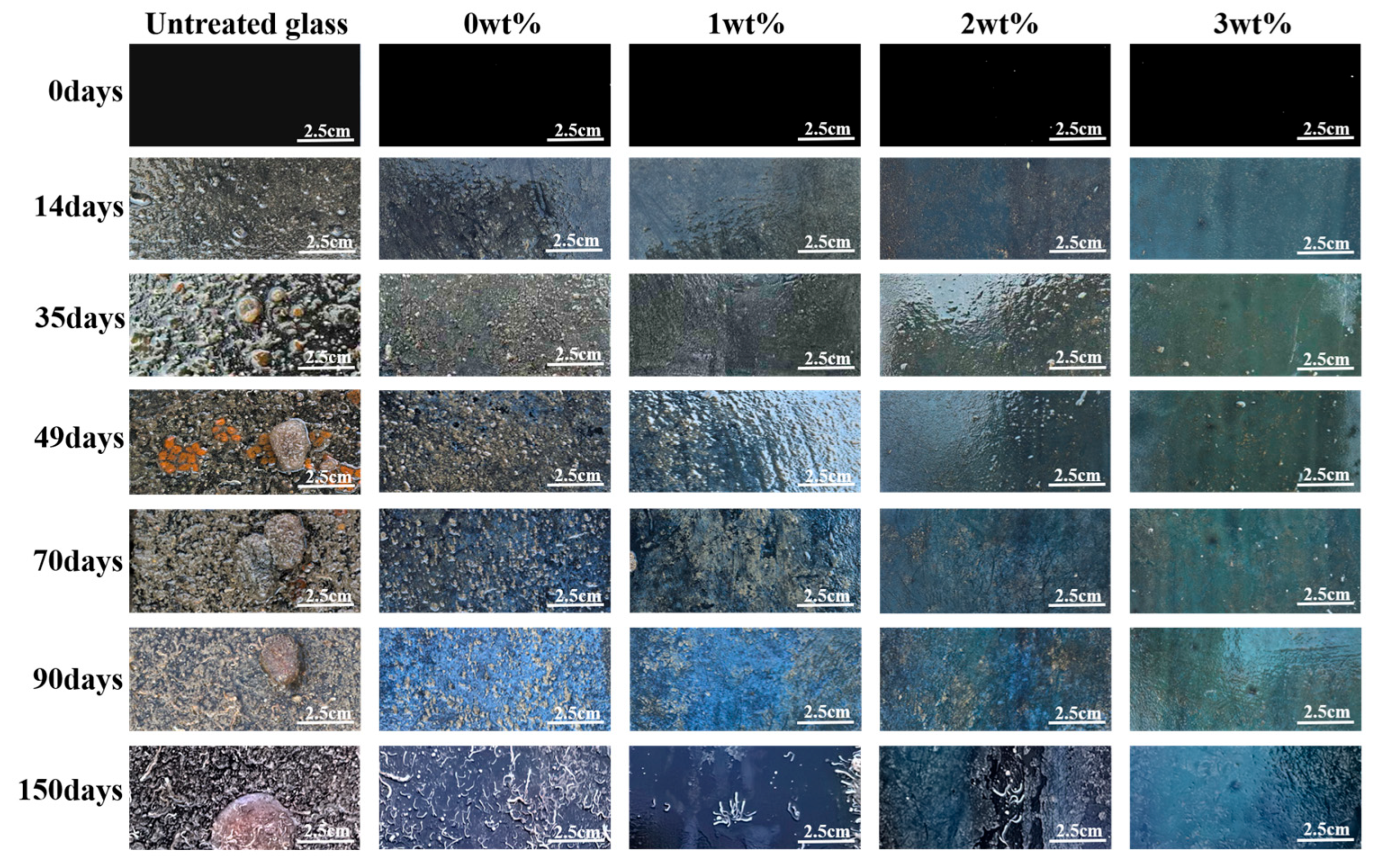
D-Phe/CS106-10@ZIF-90 modified zinc acrylate resin coatings have demonstrated remarkable antibacterial and anti-algal capabilities under controlled laboratory conditions and excellent stability in marine environments. A five-month field test was conducted in the Yellow Sea (coastal waters of Qingdao, Shandong Province, China; coordinates: 36.1° N, 120.3° E) during the peak season for fouling organism growth. The test results revealed significant differences in the antifouling performance between the modified and unmodified coatings. The zinc acrylate resin coating without D-Phe/CS106-10@ZIF-90 initially exhibited limited fouling-release effects due to its long-chain alkyl groups. However, after 150 days of exposure, this coating suffered from extensive colonization by fouling organisms, including algae and various marine bacteria, leading to a significant loss of antifouling performance. In contrast, the zinc acrylate coating incorporated with D-Phe/CS106-10@ZIF-90 maintained its antifouling efficacy throughout the test period. This coating not only resisted seawater erosion but also effectively prevented the adhesion of fouling organisms, as evidenced by the minimal biofilm formation and the absence of significant microbial colonization. The results, as shown in Figure 7, highlight the superior antifouling properties of the D-Phe/CS106-10@ZIF-90 modified coating, demonstrating its potential for long-term protection of marine facilities. This work presents a novel strategy that integrates the advantages of natural antifoulants and stimulus-responsive nanomaterials. The application of CS106-10 addresses the toxicity problem associated with conventional antifoulants, while the ATP-responsive ZIF-90 system provides a self-adaptive release mechanism triggered by biological activity. This dual innovation represents a significant step toward the development of high-performance, environmentally benign antifouling coatings.

4. Discussion

To address the challenges of biofouling while adhering to environmental sustainability principles, an intelligent, self-polishing antifouling coating with ATP-responsive characteristics was designed by incorporating D-Phe/CS106-10@ZIF-90 nanoparticles into a zinc acrylate resin matrix. This design strategy endows the coating with stimuli-responsive capabilities toward ATP, enabling controlled and sustained release of antifouling active components. The incorporation of the natural organic compound CS106-10 significantly enhances the bactericidal efficacy of the coating, thereby reducing reliance on traditional toxic antifouling agents and embodying the concept of green antifouling. Additionally, D-Phe, as an antifouling adjuvant, effectively inhibits biofilm formation and disrupts pre-existing biofilm structures, further reducing the required amount of primary antifouling agents. The release and surface exposure processes of D-Phe/CS106-10@ZIF-90 nanoparticles are regulated by the self-polishing rate of the zinc acrylate resin, while the degradation products and their interfacial interactions provide feedback to modulate the self-polishing behavior. This synergistic mechanism enhances the overall antifouling performance and surface renewal efficiency of the coating, offering a sustainable solution to biofouling challenges.

5. Conclusions

In summary, this study successfully developed an intelligent, self-polishing antifouling coating with ATP-responsive characteristics by incorporating D-Phe/CS106-10@ZIF-90 nanoparticles into a zinc acrylate resin matrix. The natural compound CS106-10, derived from cold seep fungal sources, offered effective and sustainable antifouling activity, while D-Phe enhanced efficacy by inhibiting and disrupting biofilms. Crucially, the ATP-responsive behavior of ZIF-90 conferred the coating with on-demand release capacity, enabling targeted and adaptive antifouling performance. Both laboratory and real-sea tests demonstrated that this dual strategy not only suppressed biofilm formation but also reduced the reliance on traditional toxic antifoulants. Overall, this work introduces a novel antifouling concept that combines natural antifoulants with an intelligent ATP-responsive delivery system. By merging environmental sustainability with stimulus-responsive functionality, the proposed design provides a new insight for the development of durable, eco-friendly, and high-performance antifouling coatings.

Supplementary Materials

The following supporting information can be downloaded at: https://www.mdpi.com/article/10.3390/coatings16010007/s1, Table S1: 1H (400 MHz) and 13C (100 MHz) NMR Spectroscopic Data for Compound CS106-10; Figure S1: 1H NMR (400 MHz, DMSO-d6) spectrum of compound CS106-10; Figure S2: 13C NMR (100 MHz, DMSO-d6) spectrum of compound CS106-10; Figure S3: Images of bacterial colonies on solid media after incubation with different concentrations of D-Phe/CS106-10@ZIF-90; Figure S4: Fluorescence micrographs of untreated control and zinc acrylate resin coatings containing D-Phe/CS106-10@ZIF-90 after incubation with BSA solution for 4 h, 8 h, and 24 h; Table S2. Comparative antibacterial and antifouling performance of the present ATP-responsive ZIF-90 nanocontainer coating encapsulating natural antifoulants versus benchmark commercial copper-based, silver nanoparticle-enhanced, and historical TBT-based marine antifouling coatings. Inhibition rates are approximate values derived from recent peer-reviewed literature against common marine fouling organisms.

Author Contributions

Conceptualization, Y.C. and P.Q.; methodology, Y.C. and P.Q.; software, Y.C.; validation, Y.C.; formal analysis, Y.C.; investigation, Y.C.; resources, P.Q., B.W., L.M. and P.W.; data curation, Y.C.; writing—original draft preparation, Y.C. and X.F.; writing—review and editing, Y.C. and P.Q.; visualization, Y.C.; supervision, P.Q.; project administration, P.Q. and Y.Z.; funding acquisition, P.Q. All authors have read and agreed to the published version of the manuscript.

Funding

This work is financially supported by the National Key R&D Program of China (Grant No. 2024YFB4207000), National Natural Science Foundation of China (Grant No. U22A20112) and Science & Technology Program of Nantong (Grant No. JC2023083).

Institutional Review Board Statement

Not applicable.

Informed Consent Statement

Not applicable.

Data Availability Statement

The data presented in this study are available in the Supplementary Materials.

Acknowledgments

The authors thank the Analysis and Testing Center of Institute of Oceanology, Chinese Academy of Sciences for technical support.

Conflicts of Interest

The authors declare no conflicts of interest. The funders had no role in the design of the study; in the collection, analyses, or interpretation of data; in the writing of the manuscript; or in the decision to publish the results.

References

  1. Qian, P.-Y.; Cheng, A.; Wang, R.; Zhang, R. Marine biofilms: Diversity, interactions and biofouling. Nat. Rev. Microbiol. 2022, 20, 671–684. [Google Scholar] [CrossRef]
  2. Qiu, H.; Feng, K.; Gapeeva, A.; Meurisch, K.; Kaps, S.; Li, X.; Yu, L.; Mishra, Y.K.; Adelung, R.; Baum, M. Functional polymer materials for modern marine biofouling control. Prog. Polym. Sci. 2022, 127, 101516. [Google Scholar] [CrossRef]
  3. Eskhan, A.; Johnson, D. Microscale characterization of abiotic surfaces and prediction of their biofouling/anti-biofouling potential using the AFM colloidal probe technique. Adv. Colloid Interface Sci. 2022, 310, 102796. [Google Scholar] [CrossRef]
  4. Feng, Y.; Cheng, Y.F. An intelligent coating doped with inhibitor-encapsulated nanocontainers for corrosion protection of pipeline steel. Chem. Eng. J. 2017, 315, 537–551. [Google Scholar] [CrossRef]
  5. Wang, X.; Jiang, Q.; Han, D.; Chen, Y.; Liu, W.; Pei, Y.; Duan, J.; Hou, B. Progress in anti-biofouling materials and coatings for the marine environment. J. Environ. Sci. 2026, 161, 494–510. [Google Scholar] [CrossRef]
  6. Deng, Z.; Wang, Y.; Zhang, D.; Chen, C. 3D printing technology meets marine biofouling: A study on antifouling resin for protecting marine sensors. Addit. Manuf. 2023, 73, 103697. [Google Scholar] [CrossRef]
  7. Kaidarova, A.; Geraldi, N.R.; Wilson, R.P.; Kosel, J.; Meekan, M.G.; Eguíluz, V.M.; Hussain, M.M.; Shamim, A.; Liao, H.; Srivastava, M.; et al. Wearable sensors for monitoring marine environments and their inhabitants. Nat. Biotechnol. 2023, 41, 1208–1220. [Google Scholar] [CrossRef] [PubMed]
  8. Song, S.; Demirel, Y.K.; Atlar, M. An investigation into the effect of biofouling on the ship hydrodynamic characteristics using CFD. Ocean Eng. 2019, 175, 122–137. [Google Scholar] [CrossRef]
  9. Simões, L.A.R.; Vogt, É.L.; da Costa, C.S.; de Amaral, M.; Hoff, M.L.M.; Graceli, J.B.; Vinagre, A.S. Effects of tributyltin (TBT) on the intermediate metabolism of the crab Callinectes sapidus. Mar. Pollut. Bull. 2022, 182, 114004. [Google Scholar] [CrossRef]
  10. Vanavermaete, D.; Hostens, K.; Everaert, G.; Parmentier, K.; Janssen, C.; De Witte, B. Assessing the risk of booster biocides for the marine environment: A case study at the Belgian part of the North Sea. Mar. Pollut. Bull. 2023, 197, 115774. [Google Scholar] [CrossRef]
  11. de Campos, B.G.; do Prado e Silva, M.B.M.; Avelelas, F.; Maia, F.; Loureiro, S.; Perina, F.; Abessa, D.M.S.; Martins, R. Toxicity of innovative antifouling additives on an early life stage of the oyster Crassostrea gigas: Short- and long-term exposure effects. Environ. Sci. Pollut. Res. 2022, 29, 27534–27547. [Google Scholar] [CrossRef]
  12. Qiu, Q.; Gu, Y.; Ren, Y.; Ding, H.; Hu, C.; Wu, D.; Mou, J.; Wu, Z.; Dai, D. Research progress on eco-friendly natural antifouling agents and their antifouling mechanisms. Chem. Eng. J. 2024, 495, 153638. [Google Scholar] [CrossRef]
  13. Ghattavi, S.; Homaei, A.; Fernandes, P. Marine natural products for biofouling elimination in marine environments. Biocatal. Agric. Biotechnol. 2024, 61, 103385. [Google Scholar] [CrossRef]
  14. Xu, X.; Guo, S.; Vancso, G.J. Perceiving and countering marine biofouling: Structure, forces, and processes at surfaces in sea water across the length scales. Langmuir 2025, 41, 7996–8018. [Google Scholar] [CrossRef]
  15. de Carvalho, C.C.C.R. Marine biofilms: A successful microbial strategy with economic implications. Front. Mar. Sci. 2018, 5, 126. [Google Scholar] [CrossRef]
  16. Romano, G.; Almeida, M.; Coelho, A.V.; Cutignano, A.; Gonçalves, L.G.; Hansen, E.; Khnykin, D.; Mass, T.; Ramšak, A.; Rocha, M.S.; et al. Biomaterials and bioactive natural products from marine invertebrates: From basic research to innovative applications. Mar. Drugs 2022, 20, 219. [Google Scholar] [CrossRef] [PubMed]
  17. O’Reilly, P.; Loiselle, G.; Darragh, R.; Slipski, C.; Bay, D.C. Reviewing the complexities of bacterial biocide susceptibility and in vitro biocide adaptation methodologies. npj Antimicrob. Resist. 2025, 3, 39. [Google Scholar] [CrossRef] [PubMed]
  18. Liang, K.; Ricco, R.; Doherty, C.M.; Styles, M.J.; Bell, S.; Kirby, N.; Mudie, S.; Haylock, D.; Hill, A.J.; Doonan, C.J.; et al. Biomimetic mineralization of metal-organic frameworks as protective coatings for biomacromolecules. Nat. Commun. 2015, 6, 7240. [Google Scholar] [CrossRef]
  19. Wu, X.; Yue, H.; Zhang, Y.; Gao, X.; Li, X.; Wang, L.; Cao, Y.; Hou, M.; An, H.; Zhang, L.; et al. Packaging and delivering enzymes by amorphous metal-organic frameworks. Nat. Commun. 2019, 10, 5165. [Google Scholar] [CrossRef]
  20. Kong, Y.; Li, H.; Li, B.; Li, D.; Guo, J.; Zhou, Q.; Wang, Z.; Ma, W.; Yuan, J. Narrow bandgap non-fused polymers enable efficient organic/quantum dot hybrid solar cells. J. Energy Chem. 2025, 109, 1–7. [Google Scholar] [CrossRef]
  21. Canossa, S.; Ji, Z.; Gropp, C.; Rong, Z.; Ploetz, E.; Wuttke, S.; Yaghi, O.M. System of sequences in multivariate reticular structures. Nat. Rev. Mater. 2023, 8, 331–340. [Google Scholar] [CrossRef]
  22. Han, D.; Liu, X.; Wu, S. Metal organic framework-based antibacterial agents and their underlying mechanisms. Chem. Soc. Rev. 2022, 51, 7138–7169. [Google Scholar] [CrossRef]
  23. Li, J.; Fang, Z.; Chen, H.; Liu, K.; Pan, Y.; Li, X.; Lin, D.; Wang, N.; Guo, C.; Han, C.; et al. Synergistic construction of in situ self-polymerized interface and localized pH buffer zone for high-performance aqueous zinc–iodine batteries. Angew. Chem. Int. Ed. 2025, 64, e202511490. [Google Scholar] [CrossRef]
  24. Falcaro, P.; Okada, K.; Hara, T.; Ikigaki, K.; Tokudome, Y.; Thornton, A.W.; Hill, A.J.; Williams, T.; Doonan, C.; Takahashi, M. Centimetre-scale micropore alignment in oriented polycrystalline metal–organic framework films via heteroepitaxial growth. Nat. Mater. 2017, 16, 342–348. [Google Scholar] [CrossRef] [PubMed]
  25. Ejima, H.; Richardson, J.J.; Liang, K.; Best, J.P.; van Koeverden, M.P.; Such, G.K.; Cui, J.; Caruso, F. One-step assembly of coordination complexes for versatile film and particle engineering. Science 2013, 341, 154–157. [Google Scholar] [CrossRef]
  26. Hou, M.J.; Chen, J.T.; Jiang, W.L.; Liu, X.; Zhang, Y.; Yu, L.; Wang, Y.; Fu, Y. ATP fluorescent nanoprobe based on ZIF-90 and near-infrared dyes for imaging in tumor mice. Sens. Actuators B Chem. 2022, 369, 132286. [Google Scholar] [CrossRef]
  27. Dong, J.; Zhao, M. In-vivo fluorescence imaging of adenosine 5′-triphosphate. Trends Anal. Chem. 2016, 80, 190–203. [Google Scholar] [CrossRef]
  28. Rubino, F.A.; Mollo, A.; Kumar, S.; Shaffer, C.L.; Herbert, S.; Hopkins, O.; Romero, J.; Walker, S. Detection of transport intermediates in the peptidoglycan flippase MurJ identifies residues essential for conformational cycling. J. Am. Chem. Soc. 2020, 142, 5482–5486. [Google Scholar] [CrossRef]
  29. Borisova, B.; Nocheva, H.; Iliev, I.; Laronze-Cochard, M.; Gérard, S.; Petrin, S.; Danalev, D. Synthesis and analgesic activity of new analogs of FELL tetrapeptide containing D-phe in the first position. Curr. Res. Biotechnol. 2024, 8, 100249. [Google Scholar] [CrossRef]
  30. Yuill, J.L. The acids produced from sugar by a penicillium parasitic upon Aspergillus niger. Biochem. J. 1934, 28, 222–227. [Google Scholar] [CrossRef] [PubMed]
  31. Wang, R.; Liu, T.-M.; Shen, M.-H.; Yang, M.-Q.; Feng, Q.-Y.; Tang, X.-M.; Li, X.-M. Spiculisporic acids B-D, three new γ-butenolide derivatives from a sea urchin-derived fungus Aspergillus sp. HDf2. Molecules 2012, 17, 13175–13182. [Google Scholar] [CrossRef]
  32. Meng, L.; Awakawa, T.; Li, X.; Zhang, Y.; Zhang, J.; Wang, J.; Abe, I. Discovery of (±)-penindolenes reveals an unusual indole ring cleavage pathway catalyzed by P450 monooxygenase. Angew. Chem. Int. Ed. 2024, 63, e202403963. [Google Scholar] [CrossRef]
  33. Cui, W.; Lu, X.; Bian, J.; Chen, Y.; Wang, Y.; Li, Z.; Zhang, Z. Curvularia spicifera and curvularia muehlenbeckiae causing leaf blight on Cunninghamia lanceolata. Plant Pathol. 2020, 69, 1139–1147. [Google Scholar] [CrossRef]
  34. Zhang, A.; Shi, X.; Wang, B.; Meng, L.; Pineda, L.M.; Li, Y.; Wang, J.; Abe, I.; Liu, Y.; Zhang, C. New curvularin and norlignanolide derivatives from cocultures of marine mangrove endophytic fungus Penicillium brocae MA-231 and phytopathogen Curvularia spicifera QA-26. Chem. Biodivers. 2025, 22, e202500761. [Google Scholar] [CrossRef] [PubMed]
  35. Wang, Y.; Li, X.-M.; Song, N.; Meng, L.-H.; Li, X.; Wang, B.-G. Secondary metabolites with fungicide potentials from the deep-sea seamount-derived fungus talaromyces scorteus AS-242. Bioorg. Chem. 2024, 147, 107417. [Google Scholar] [CrossRef] [PubMed]
  36. GB 5370-2007; Test Method for Shallow Sea Immersion of Antifouling Paint Panels. General Administration of Quality Supervision, Inspection and Quarantine. Standardization Administration: Beijing, China, 2007.
  37. Brown, S.P.; Goodwin, N.C.; MacMillan, D.W.C. The first enantioselective organocatalytic mukaiyama−michael reaction: A direct method for the synthesis of enantioenriched γ-butenolide architecture. J. Am. Chem. Soc. 2003, 125, 1192–1194. [Google Scholar] [CrossRef]
  38. Yu, F.; Du, Y.; Guo, M.; Chen, X.; Liu, H.; Zhang, Y. Application of biosurfactant surfactin for the removal of heavy metals from contaminated water and soil via a micellar-enhanced ultrafiltration process. Sep. Purif. Technol. 2023, 327, 124947. [Google Scholar] [CrossRef]
  39. Li, X.; Yan, B.; Huang, W.; Zhang, Y.; Liu, Y.; Wang, J. Room-temperature synthesis of hydrophobic/oleophilic ZIF-90-CF3/melamine foam composite for the efficient removal of organic compounds from wastewater. Chem. Eng. J. 2022, 428, 132501. [Google Scholar] [CrossRef]
  40. Mei, D.C.; Li, H.; Liu, L.J.; Jiang, L.C.; Zhang, C.H.; Wu, X.R.; Dong, H.X.; Ma, F.Q. Efficient uranium adsorbent with antimicrobial function: Oxime functionalized ZIF-90. Chem. Eng. J. 2021, 425, 130468. [Google Scholar] [CrossRef]
  41. Chen, S.; Pang, H.; Sun, J.; Li, K. Research advances and applications of ZIF-90 metal–organic framework nanoparticles in the biomedical field. Mater. Chem. Front. 2024, 8, 1195–1211. [Google Scholar] [CrossRef]
  42. Yang, X.; Tang, Q.; Jiang, Y.; Zhang, M.; Wang, M.; Mao, L. Nanoscale ATP-responsive zeolitic imidazole framework-90 as a general platform for cytosolic protein delivery and genome editing. J. Am. Chem. Soc. 2019, 141, 3782–3786. [Google Scholar] [CrossRef] [PubMed]
  43. Jiang, Z.; Wang, Y.; Sun, L.; Yuan, B.; Tian, Y.; Xiang, L.; Li, Y.; Li, Y.; Li, J.; Wu, A. Dual ATP and pH responsive ZIF-90 nanosystem with favorable biocompatibility and facile post-modification improves therapeutic outcomes of triple negative breast cancer in vivo. Biomaterials 2019, 197, 41–50. [Google Scholar] [CrossRef] [PubMed]
  44. Vuong, P.; McKinley, A.; Kaur, P. Understanding biofouling and contaminant accretion on submerged marine structures. npj Mater. Degrad. 2023, 7, 50. [Google Scholar] [CrossRef]
  45. Alam, F.; Kumar, S.; Varadarajan, K.M. Quantification of adhesion force of bacteria on the surface of biomaterials: Techniques and assays. ACS Biomater. Sci. Eng. 2019, 5, 2093–2110. [Google Scholar] [CrossRef]
  46. Mendes, C.R.; Dilarri, G.; Forsan, C.F.; Sapata, V.M.R.; Lopes, P.R.M.; Moraes, P.B.; Montagnolli, R.N.; Ferreira, H.; Bidoia, E.D. Antibacterial action and target mechanisms of zinc oxide nanoparticles against bacterial pathogens. Sci. Rep. 2022, 12, 2658. [Google Scholar] [CrossRef]
  47. Shi, X.L.; Liang, H.; Li, Y.Z. Review of Progress in Marine Anti-Fouling Coatings: Manufacturing Techniques and Copper- and Silver-Doped Antifouling Coatings. Coatings 2024, 14, 1454. [Google Scholar] [CrossRef]
  48. Li, L.; Hong, H.; Cao, J.; Yang, Y. Progress in Marine Antifouling Coatings: Current Status and Prospects. Coatings 2023, 13, 1893. [Google Scholar] [CrossRef]
  49. Yan, H.; Wu, Q.; Yu, C.; Zhao, T.; Liu, M. Recent Progress of Biomimetic Antifouling Surfaces in Marine. Adv. Mater. Interfaces 2020, 7, 2000966. [Google Scholar] [CrossRef]
  50. Ferreira, A.S.; Ferreira, S.S.; Correia, A.; Vilanova, M.; Silva, T.H.; Coimbra, M.A.; Nunes, C. Reserve, structural and extracellular polysaccharides of Chlorella vulgaris: A holistic approach. Algal Res. 2020, 45, 101757. [Google Scholar] [CrossRef]
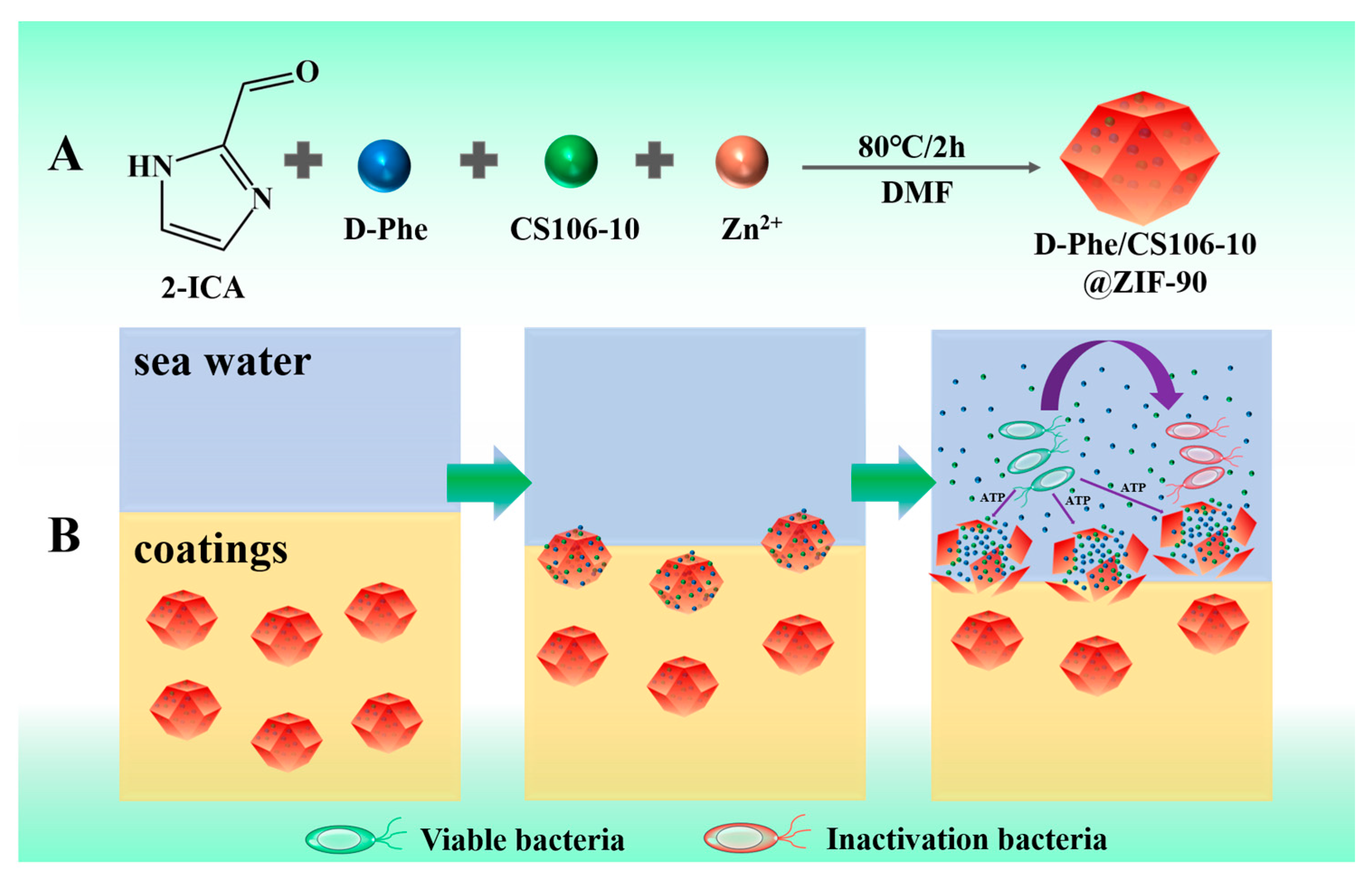
Scheme 1. (A) Schematic illustration of the fabrication of the ATP-responsive nanocontainer D-Phe/CS106-10@ZIF-90. (B) Mechanism of bacterial-targeted precise localization and simultaneous eradication via an ATP-responsive unlocking process.
Coatings 16 00007 sch001
Figure 1. Colony formation of E. coli on solid culture medium after incubation with different concentrations of natural compounds.
Coatings 16 00007 g001
Figure 2. Chemical structure of compound CS106-10 (A). Schematic illustration of the antibacterial mechanism of CS106-10 (BD).
Coatings 16 00007 g002
Figure 3. TEM images and particle size distribution histograms of ZIF-90 (A) and D-Phe/CS106-10@ZIF-90 (B) nanoparticles. XRD (C) and FTIR (D) patterns of D-Phe/CS106-10@ZIF-90.
Coatings 16 00007 g003
Figure 4. FTIR spectra of ZIF-90 before and after ATP treatment (A). TEM images of ZIF-90 (B) and D-Phe/CS106-10@ZIF-90 (C) after ATP treatment. Quantitative histograms of bacterial colonies on solid media for E. coli (D) and S. aureus (E) incubated with varying concentrations of D-Phe/CS106-10@ZIF-90. Statistical significance is indicated as follows: ** p < 0.01.
Coatings 16 00007 g004
Figure 5. Fluorescence micrographs of unmodified control and D-Phe/CS106-10@ZIF-90 modified zinc acrylate resin coatings after immersion in bacterial solutions for 1 day (A) and 7 days (B).
Coatings 16 00007 g005
Figure 6. Growth inhibition curves of C. vulgaris (A) and N. closterium (B) for untreated control and zinc acrylate resin coatings containing D-Phe/CS106-10@ZIF-90. Fluorescence micrographs comparing anti-algal adhesion on the untreated control and the zinc acrylate resin coating containing D-Phe/CS106-10@ZIF-90 (C).
Coatings 16 00007 g006
Figure 7. Antifouling performance evaluation of unmodified control and D-Phe/CS106-10@ZIF-90 modified zinc acrylate resin coatings in marine field tests conducted in the Yellow Sea (Qingdao, China).
Coatings 16 00007 g007
Disclaimer/Publisher’s Note: The statements, opinions and data contained in all publications are solely those of the individual author(s) and contributor(s) and not of MDPI and/or the editor(s). MDPI and/or the editor(s) disclaim responsibility for any injury to people or property resulting from any ideas, methods, instructions or products referred to in the content.