Article

Study on Mechanical Performance and Enhancement Effect of Steel-Polypropylene Hybrid Fiber-Reinforced Concrete


1
School of Intelligent Construction, Wuchang University of Technology, Wuhan 430223, China
2
School of Civil Engineering, Henan Polytechnic University, Jiaozuo 454003, China
3
School of Municipal and Environmental Engineering, Henan University of Urban Construction, Pingdingshan 467000, China
4
Jinyuan Weiye Construction Engineering Group Company Limited, Xinxiang 410783, China
*
Author to whom correspondence should be addressed.
Coatings 2026, 16(1), 46; https://doi.org/10.3390/coatings16010046 (registering DOI)
Submission received: 28 November 2025 / Revised: 24 December 2025 / Accepted: 26 December 2025 / Published: 2 January 2026
(This article belongs to the Section Environmental Aspects in Colloid and Interface Science)

Abstract

As research on fiber-reinforced concrete progresses, investigating the enhancement effect of hybrid fiber-reinforced concrete becomes increasingly crucial. In the present research, the contents of steel fiber (SF) and polypropylene fiber (PP) were set as variable parameters to study the mechanical performance of steel-polypropylene hybrid fiber-reinforced concrete (SPFRC). Mechanical performance tests were undertaken on 16 groups of standard specimens. The failure modes were observed, the strength variation patterns were analyzed, and both a strength prediction equation and a complete stress–strain curve equation were established. Research results indicated that the specimen containing 1.5% SF and 0.25% PP exhibited the maximum strength enhancement compared with plain concrete: cube compressive strength improved by 27.78%, and splitting tensile strength surged by 41.18%. When the SF content was 1.5% and that of PP was 0.5%, the specimen’s elastic modulus experienced the greatest enhancement, reaching 58.59%. Hybrid fibers significantly enhanced the mechanical performance of SPFRC, simultaneously exerting strengthening, crack-resistance, and toughening effects. The research findings offer both experimental evidence and theoretical support for promoting research and engineering applications of SPFRC.

1. Introduction

Building structures are becoming increasingly complex, and the requirements for the strength, toughness, and crack resistance of materials are also rising. This is evident in applications such as super high-rise buildings, large-span spaces, and industrial plant floors [1,2,3]. Although plain concrete shows excellent compressive strength, its tensile strength usually accounts for only 10% of the compressive strength. Moreover, it is characterized by high brittleness [4,5], low toughness [6,7], and poor crack resistance [8,9]. Consequently, improving the strength, toughness, and crack resistance of plain concrete has become a crucial factor in expanding its engineering applications [10,11]. Scholars around the world have shown substantial research interest in fiber reinforcement as a means of improving the mechanical performance of plain concrete. Numerous researchers have studied various fiber reinforcements for modifying concrete, such as carbon fibers [12,13], glass fibers [14,15], basalt fibers [16,17], and other types of fibers. Adding fibers to concrete is crucial during the stress stage. It enhances the tensile strength, inhibits crack propagation, and increases the toughness, thus effectively enhancing the mechanical performance of concrete [18,19].
To thoroughly explore the effect through which steel fiber (SF) affects concrete performance, researchers have carried out multi-faceted studies [20,21,22]. Research regarding fiber geometry indicates that an optimal SF content with a suitable aspect ratio significantly enhances ductility, although excessive fiber content may compromise compressive strength [23,24]. Regarding volume fraction, studies on ultra-high-performance concrete revealed that increasing SF volume fraction improves fracture behavior and flexural–compressive ratios, despite potential reductions in compressive strength [25]. Furthermore, the shape of the fiber plays a critical role; for instance, hooked-end SFs have been shown to increase tensile and flexural strengths by 46% and 36%, respectively, compared to straight fibers, although workability tends to decrease proportionally with content [26]. Similar enhancements in tensile and flexural properties have also been observed in self-compacting concrete [27]. In conclusion, multiple factors such as the aspect ratio, length, dosage, and shape of SF significantly improve the mechanical performance of concrete. Existing research indicates that the addition of an appropriate amount of SF effectively enhances strength, ductility, and crack resistance, whereas excessive incorporation leads to a reduction in strength.
Polypropylene fiber (PP), characterized by its low elastic modulus, has attracted considerable attention in concrete reinforcement applications because of its excellent dispersibility, crack resistance, and cost-effectiveness [28,29,30]. Comparative studies indicate that PP demonstrates a more effective reinforcing influence on concrete compared to glass fibers [31]. Unlike rigid fibers, investigations into PP content and aspect ratios suggest that while PP has a negligible or minimal impact on compressive strength and fluidity, it substantially enhances the toughness index, splitting tensile strength, and crack resistance [32,33]. Specifically, increasing the fiber length has been found to significantly decrease crack widths [34], and the integration of PP can transform the brittle failure of roller-compacted concrete into distinct plastic failure characteristics [35]. In conclusion, although PP minimally impacts compressive strength, the material exhibits a substantial enhancement in splitting tensile strength, toughness, and crack resistance. Notably, it performs exceptionally well in controlling crack widths and transforming the failure modes, and the content of PP significantly influences the toughening and crack-arresting effects.
Hybrid fiber-reinforced concrete, as an advanced composite material, has attracted substantial research interest due to its synergistic enhancement of mechanical performance and its multifunctional applications in modern construction. Acknowledging the performance advantages of fiber hybridization, scholars have systematically investigated the synergistic effects of binary fiber systems in concrete [36,37,38]. Studies on various concrete types, including high-strength and self-compacting concrete, consistently demonstrate that combining SF and PP yields superior performance compared to single-fiber systems [39,40,41,42]. For instance, specific combinations, such as 0.85% SF with 0.15% PP, have been identified to offer optimal overall performance [39], and hybrid fibers have proven more effective in improving compressive toughness and flexural properties than mono-fiber reinforcement [40,41]. Moreover, failure mode analysis reveals that adequate hybrid fiber content significantly improves splitting performance and reduces the risk of brittle failure [43]. In summary, the extensive literature has confirmed the positive synergistic effect between SF and PP. The former enhances toughness and arrests cracks at the macro level, while the latter inhibits crack initiation at the micro level. This multi-scale complementary mechanism not only significantly improves the mechanical performance of concrete but also effectively reduces the risk of brittle failure.
However, most existing studies focus on the isolated impacts of hybrid fibers on specific concrete properties, lacking a systematic and comprehensive evaluation of their combined strengthening, toughening, and crack-arresting mechanisms. To deeply reveal the influence of steel fibers and polypropylene fibers (SPFs) on mechanical performance and clarify the synergistic mechanisms between different fiber types, this study employs a combination of experimental testing and theoretical analysis to investigate the evolution of mechanical performance under various content combinations. Furthermore, fiber characteristic parameters are introduced to quantitatively analyze the roles of SF and PP in strengthening, crack resistance, and toughening. The findings of this study provide a theoretical basis and technical reference for the application of steel-polypropylene hybrid fiber-reinforced concrete (SPFRC) in engineering fields such as rigid pavements and bridge decks.

2. Materials and Methods

2.1. Test Raw Materials

The coarse aggregate employed in the experiment was natural crushed stone with a good gradation spanning from 5 to 10 mm, as depicted in Figure 1a. Its apparent density was 2798 kg/m3, the water content was 0.7%, and the water absorption was 0.1%. Natural river sand was employed as the fine aggregate. Its apparent density was 2631 kg/m3, the bulk density was 1532 kg/m3, and the fineness modulus was 2.73.
P•O 42.5 grade cement produced by Jiaozuo Qianye Cement Plant was used as the cementitious material. In accordance with the “Common Portland Cement” (GB175-2023), the initial and final setting times of the cement were 155 and 225 min, respectively. The fineness exhibited a value of 1.3%, while the loss on ignition showed 4.27%. The compressive and flexural properties at 3 days were 31.1 MPa and 6.4 MPa, respectively, and the cement complied with the quality specifications of the standard. The fly ash was produced by Gongyi Longze Water Purification Material Co., Ltd., Gongyi, China. Fly ash was tested in accordance with the “Fly Ash Used for Cement and Concrete” (GB/T 1596-2017), and it met the standard of Class F Grade I fly ash. The fly ash had a fineness of 10.3% and a density of 2.3 g/cm3, with water content, ignition loss, and content measured at 0.08%, 3.03%, and 20% of the cement content, respectively.
The test utilized copper-plated SF and PP manufactured by Hebei Construction Engineering Material Factory (Hengshui, China), as illustrated in Figure 1b,c. The fundamental characteristics of the fibers, which were measured in accordance with the “Steel Fiber for Concrete” (GB/T 39147-2020), are presented in Table 1. Tap water from Henan Polytechnic University was uniformly applied to prevent errors in the test findings arising from the testing water. Naphthalene superplasticizer, obtained from Gongyi Longze Water Purification Material Co., Ltd. (Gongyi, China), was employed. Its water reduction rate ranged from 15% to 25%, and its content was 0.5% of the cementitious material.

2.2. Mixing Ratio

In accordance with the “Specification for Mix Proportion Design of Ordinary Concrete” (JGJ 55-2011), the mix proportion of SPFRC with a strength grade of C40 was determined. SF and PP were added to the concrete using the volume-content method. The range of fiber content was selected based on previous studies [42,44]. The content of SF was 0%, 0.5%, 1.0%, and 1.5%, respectively, while that of PP was 0%, 0.1%, 0.25%, and 0.5%, respectively. The mix proportions of SPFRC are presented in Table 2. The mix proportions in Table 2 were determined based on the volume fraction method. The mass of fibers per cubic meter was calculated using the formula M f = V f × ρ f , where Mf is the mass of the fiber, Vf is the target volume percentage (0.5%, 1.0%, 1.5%), and ρf is the density of the respective fiber. Taking the specimen named S0P0.1 as an example, “S” represents SF, “0” indicates an SF content of 0%, “P” represents PP, and “0.1” represents a PP content of 0.1%. The naming methods of other specimens follow the same rule.

2.3. Specimen Design and Production

To comprehensively evaluate the impacts of SPF content on the mechanical performance of concrete, an experimental matrix comprising 16 test groups with varying fiber volume fractions was designed. The test parameters were established as follows: the content of SF was 0%, 0.5%, 1%, 1.5%, and the content of PP was 0%, 0.1%, 0.25%, 0.5%. A total of forty-eight 150 mm cube specimens were prepared and cured to conduct compressive and splitting tensile strength tests. A total of 48 standard prism specimens with dimensions of 150 mm × 150 mm × 300 mm were tested to obtain their axial compressive strength, elastic modulus, Poisson’s ratio, and stress–strain curves.
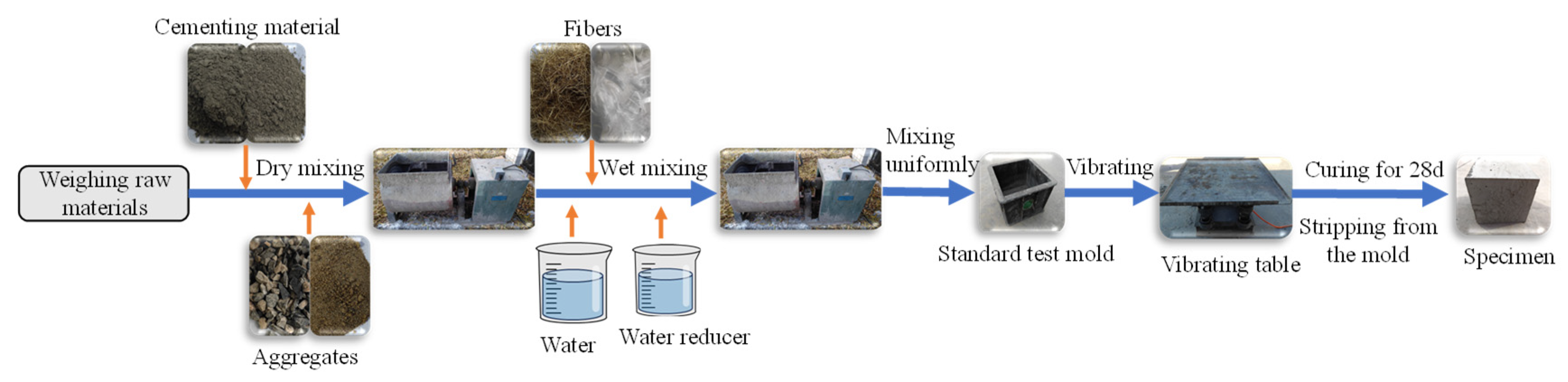
The preparation process of the specimens is illustrated in Figure 2. In compliance with the “Standard for Test Method of Performance on Ordinary Fresh Concrete” (GB/T50080-2016) and the test mix ratio, the cementitious materials, aggregates, water, fibers, water-reducing agents, and other materials were weighed. To ensure uniform fiber dispersion and prevent agglomeration, a specific mixing procedure was adopted. First, the coarse and fine aggregates were dry-mixed for 1 min. Then, the fibers were gradually added into the mixer and dry-mixed for 2 min to untangle fiber bundles. Finally, water and superplasticizer were added, followed by mixing for 3 min. No significant fiber agglomeration or ‘balling’ phenomenon was observed during this process. Following immediate pouring of the concrete and its compaction on a vibrating table, the concrete’s top surface was screeded and sealed using a plastic sheet to inhibit water evaporation. After the specimens had been left standing for 24 h, a demolding air gun was used to strip from the molds. In accordance with standard procedures, the samples were maintained in a curing chamber at 20 ± 2 °C with ≥95% relative humidity. They were cured for 28 d. In this process, standard molds were used to fabricate the specimens, and three parallel specimens were prepared for every test group to minimize the error resulting from the discreteness of the concrete.

2.4. Test Methods

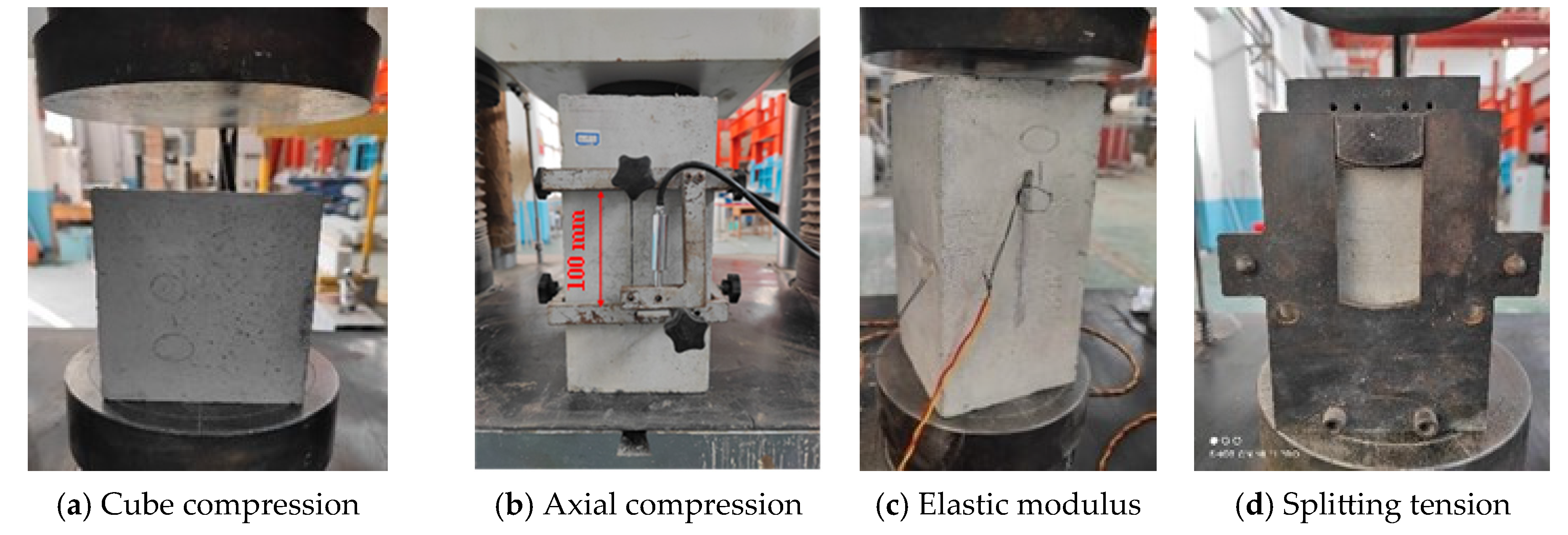
Mechanical testing was performed using a WAW-2000 electro-hydraulic servo universal tester (Shanghai Suns Machinery Manufacturing Co., Ltd., Shanghai, China). The loading devices for different specimens are illustrated in Figure 3. To standardize the testing procedure, the testing apparatus was calibrated in accordance with the “Standard for Test Methods of Concrete Physical and Mechanical Properties” (GB/T 50081-2019). The cube compressive strength and axial compressive strength tests of SPFRC were conducted at a constant stress rate of 0.5 MPa/s, during which the strengths of the specimens were measured. The splitting tensile strength tests of SPFRC specimens were performed at a controlled loading rate of 0.06 MPa/s. The displacement loading mode with a rate of 0.005 mm/s was selected to measure the stress–strain full-process curve, and the stability and integrity of the curve were ensured by using a special test fixture. For the determination of elastic modulus and Poisson’s ratio, a loading rate of 0.5 MPa/s was adopted, with transverse and longitudinal strain gauges bonded to the lateral surfaces of the prismatic specimen.

3. Results

3.1. Failure Process and Failure Mode

3.1.1. Compression

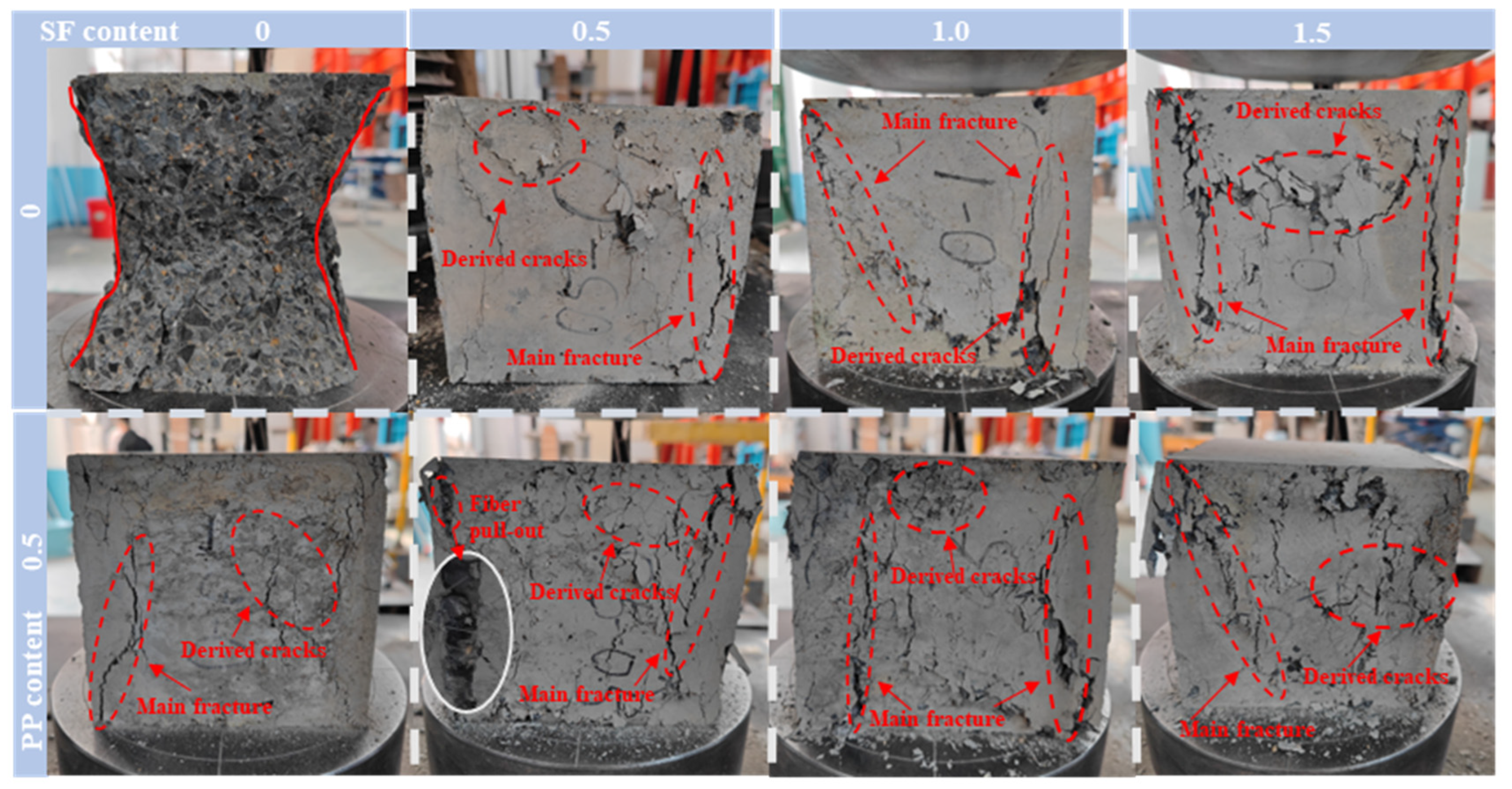
The compressive failure behavior of the cube specimens is illustrated in Figure 4. At the initial loading stage, no obvious deformation was detected in undoped concrete cube specimen (S0P0). As the load increased, the specimen emitted audible micro-fracturing sounds. Meanwhile, multiple vertical and inclined cracks gradually formed at the interface between the specimen and the bearing plate, indicating the onset of internal damage. With the load being slowly increased, the rate of crack propagation accelerated. The existing cracks broadened and propagated toward the specimen’s corners. Upon reaching the ultimate load, the specimen formed interconnected cracks that created a continuous failure surface. This was accompanied by the spalling of the central concrete, ultimately leading to an inverted pyramidal failure mode. Throughout the entire loading procedure, the specimen displayed typical brittle fracture behavior.
Regardless of the fiber configuration (SF, PP, or hybrid), the failure modes of the fiber-reinforced concrete cube specimens were similar to those of the plain concrete specimen (S0P0). However, the incorporation of fibers notably maintained the specimens’ integrity at failure. At the onset of loading, no significant changes were observed due to the low stress level. With increasing load, the initiation of micro-cracking was delayed in fiber-reinforced concrete specimens compared to plain concrete, a finding consistent with Zhou et al. [37]. This delay may be attributed to the high modulus of SF, which formed a strong interfacial bond with the matrix and likely played a primary role in stress transfer during this early stage, whereas the contribution of the lower-modulus PP fibers was likely limited. As the load increased further, surface micro-cracks propagated and multiplied. Upon reaching the ultimate load, a main penetrating crack formed from the top down, accompanied by audible fiber pull-out sounds as the SF gradually debonded from the matrix. During this post-peak phase, it is inferred that the PP fibers—having greater elongation capacity—began to fully mobilize their bridging effect, thereby providing increasing resistance and playing a key role in crack arrest. Higher contents of both SF and PP led to distributed secondary cracking around the primary fractures. This phenomenon implies that fiber bridging effects successfully alleviated stress concentrations within the matrix. Ultimately, the specimens exhibited a ‘cracked but not broken’ failure mode, demonstrating that the hybrid fibers endowed the concrete with significant plastic failure characteristics, aligning with the findings of Wang et al. [38].
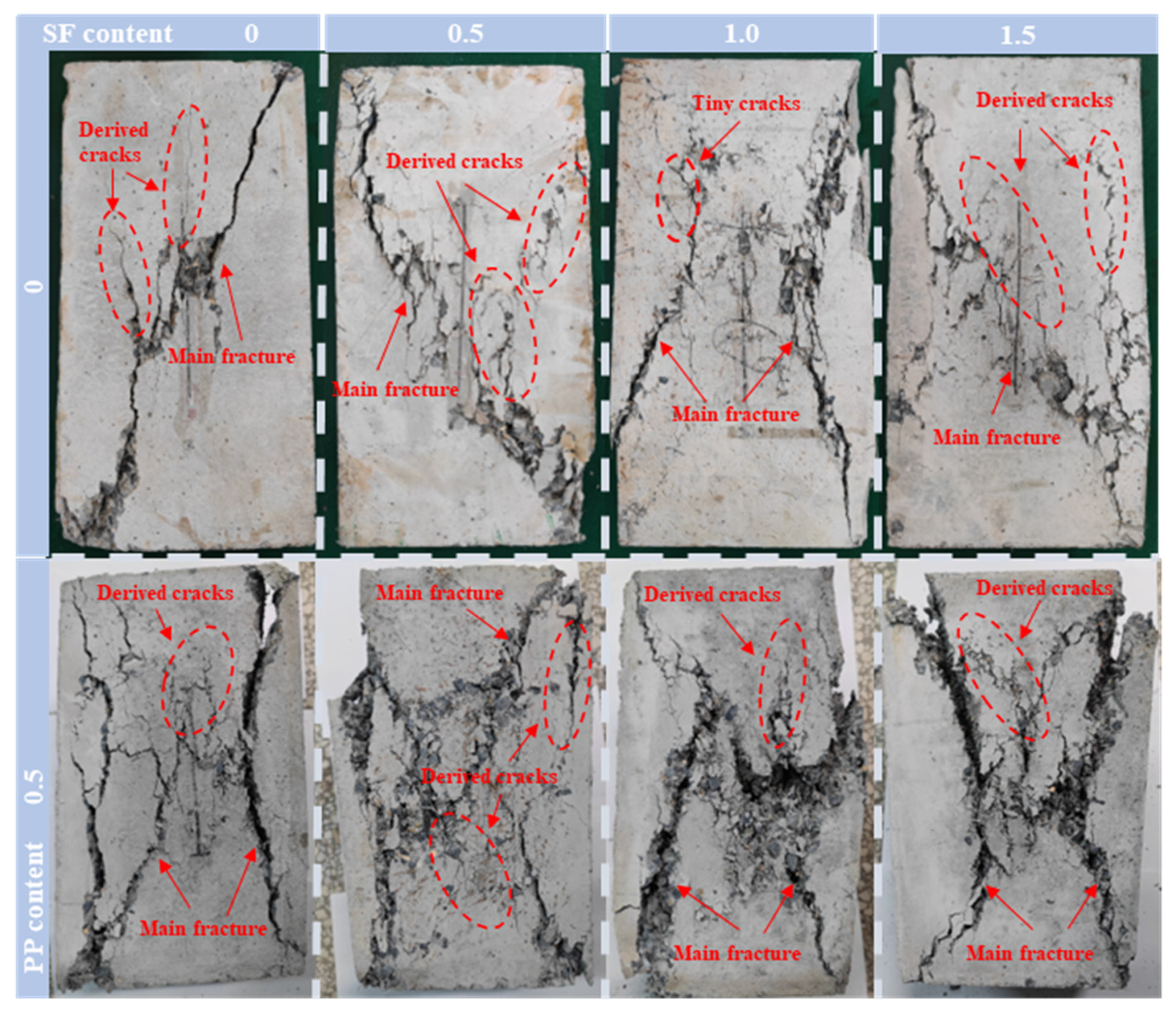
The axial compressive failure mode of the prism specimens is depicted in Figure 5. For the plain concrete specimen (S0P0), no obvious change was observed in the sample during the early loading phase because the applied load was minimal. As the applied load approached 60%–70% of the peak load, multiple micro-cracks initiated at the midsection of the specimen. With continuous loading, the cracks gradually propagated towards the corners of the specimen. At the peak load, diagonal through-cracks formed, leading to a sudden brittle fracture, which was characterized by a rapid loss of load-carrying capacity.
Fiber-reinforced concrete specimens retained their structural integrity during the initial loading stage, and in most cases, no cracks were observed to form. As the load was progressively increased, micro-cracks initiated to form in the central part of the specimen. However, their formation was delayed compared to that of plain concrete control specimen (S0P0). At the peak load, most of the specimens developed top-down arcuate through-cracks on both sides, whereas a small number of them exhibited diagonal through-cracks similar to those in plain concrete specimens. The fiber-reinforced specimens retained their structural integrity throughout the testing process, thereby demonstrating the enhanced crack resistance and load-bearing capacity that are characteristic of SPFRC.

3.1.2. Splitting Tension

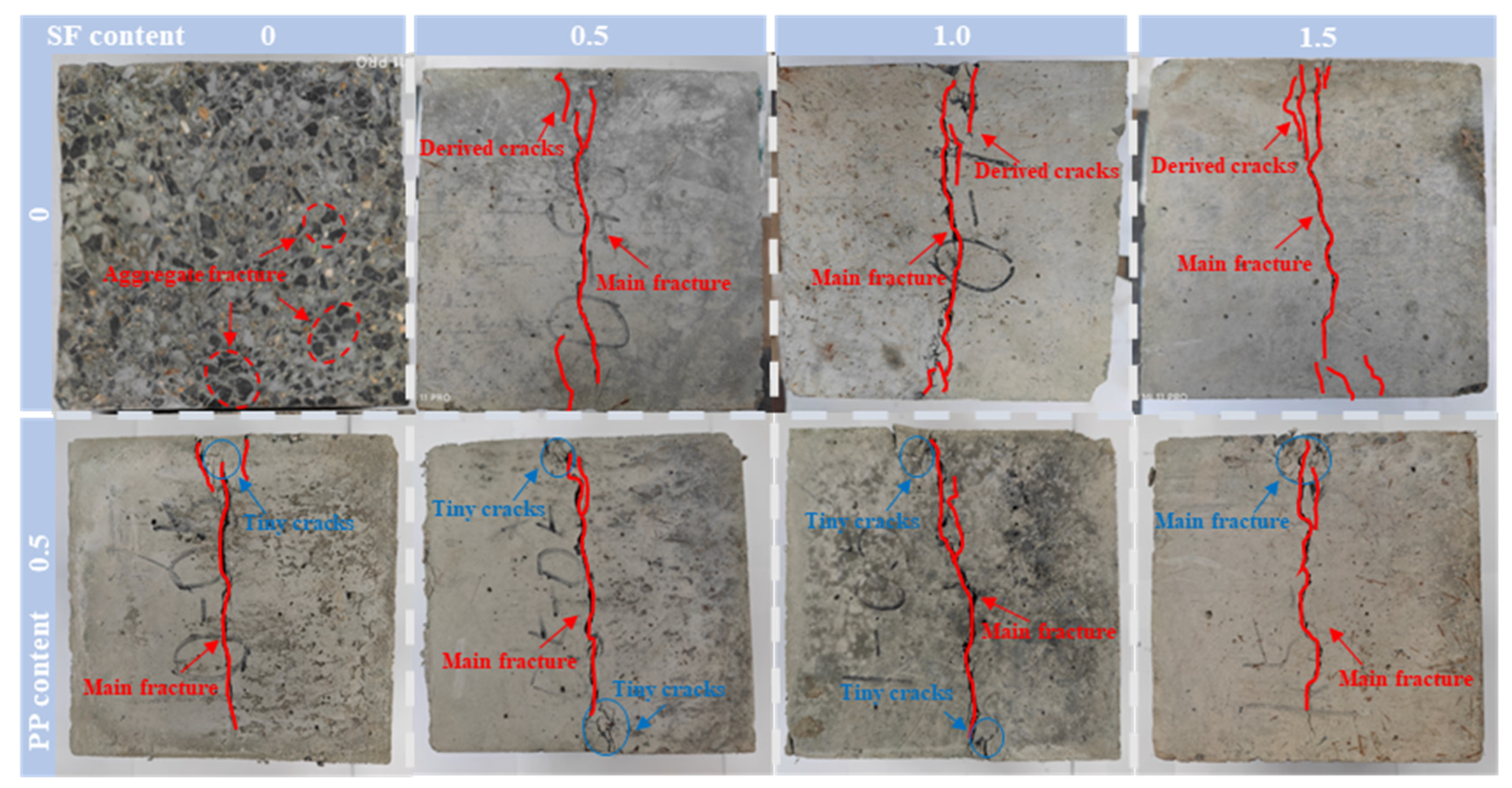
The splitting tensile failure mode of the specimens is depicted in Figure 6. During the initial loading stage, both the plain concrete and fiber-reinforced concrete specimens showed no obvious changes. As the load increased, the cracks in the plain concrete specimens propagated rapidly and penetrated through, exhibiting typical brittle failure. For the fiber-reinforced specimens, when the load reached the ultimate load, a dominant vertical through-crack appeared in all specimens, where SF and PP pulled out from the concrete matrix were clearly visible. Since the fibers inhibited crack propagation, the time required to reach the ultimate strain was delayed, which agreed with the findings reported by Singh et al. [42].

3.2. Analysis of Compressive Strength and Influencing Factors

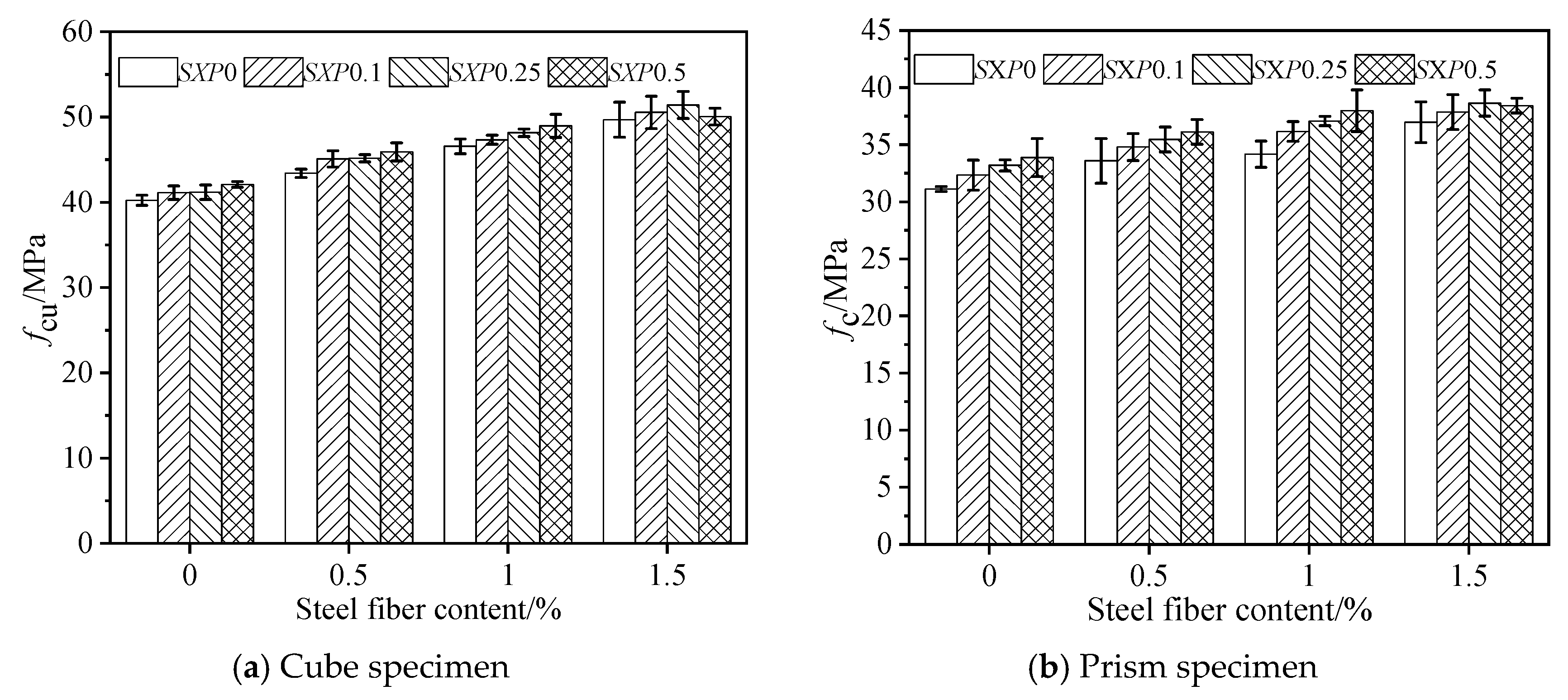
The variations in cube and axial compressive strengths are shown in Figure 7. For the nomenclature, taking SXP0 as an example, S stands for SF and X represents its varying content, while P stands for PP. The S0PX series follows the same convention, with X representing the varying content of PP. The non-linear evolution of cube and axial compressive strengths revealed the synergistic reinforcement and competitive mechanisms of fibers at different scales during the matrix damage process. For specimens with SF content as the sole variable, as the SF content gradually increased from 0% to 0.5%, 1%, and 1.5%, the compressive strength of the specimens showed an upward trend. At a PP content of 0%, the cube compressive strength increased by 8.95%, 6.20%, and 6.72%, and the axial compressive strength increased by 7.94%, 4.70%, and 5.09%, respectively. This result confirmed the previous hypothesis that SF, by virtue of their high modulus of elasticity, played a dominant bridging role during the macro-crack propagation stage, significantly enhancing the load-bearing capacity of the matrix, with the most notable enhancement observed at the 0.5% content level. When the PP content increased successively from 0%, 0.1%, 0.25%, to 0.5%, the increase in compressive strength of the specimens was not significant. When the SF content was 0%, the increase in cube compressive strength ranged from 2.02% to 2.21%, and the increase in axial compressive strength ranged from 2.05% to 3.92%. The coefficients of variation (CV) for the majority of the groups were found to be less than 5%, indicating that the data dispersion is low and the observed fluctuations are within the expected range of experimental variability. This result also verified the previous hypothesis that low-modulus PP fibers made a limited direct contribution to the compressive strength.
Figure 7 illustrated that for SPFRC, specimens (S0.5P0.1, S1P0.5, S1.5P0.25) showed a significant enhancement in compressive strength with growing fiber content. This observation confirmed the advantages in the mechanical performance of this composite material and validated the findings reported by Zhou et al. [37]. Research results indicated that the specimen containing 1.5% SF and 0.25% PP (S1.5P0.25) exhibited the maximum strength enhancement. Its average cube compressive strength reached 51.42 ± 1.58 MPa, representing a 27.78% increase compared to the plain concrete (S0P0, 40.24 ± 0.60 MPa). Similarly, the axial compressive strength improved by 24.16%, reaching 38.64 ± 1.15 MPa. The low CV (3%) for these optimal groups indicates that differences are within expected experimental variability, suggesting that the hybrid fibers were uniformly dispersed and provided consistent reinforcement despite the high content. This was attributed to the intertwining of the two fibers within the concrete matrix, a phenomenon that markedly improved the interfacial bond strength between fibers and the matrix. This result aligns with the research outcomes of He et al. [45]. However, with the continuous increase in fiber content, the compressive strength of specimen (S1.5P0.5) did not exhibit an increasing trend compared to that of specimen (S1.5P0.25). This is attributed to the excessive fiber content, which reduced the uniformity of fiber distribution within the matrix and led to localized agglomeration. Once the fiber content exceeded the critical threshold, the fluidity of the concrete decreased gradually, exerting a negative influence on the matrix compactness and causing an increase in internal defects, which was consistent with the findings reported by Alwesabi et al. [46].

3.3. Analysis of Splitting Tensile Strength and Its Influencing Factors

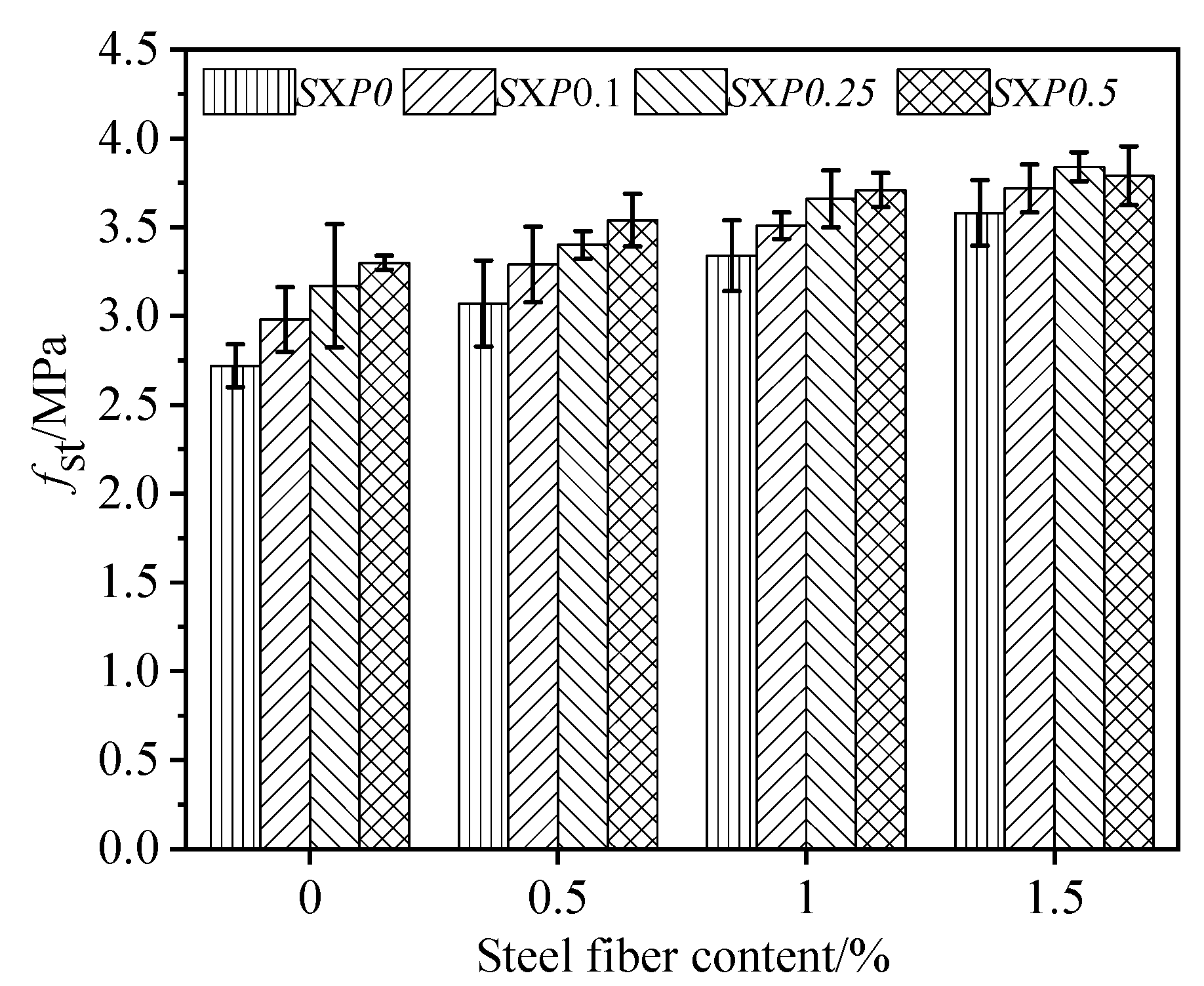
The range of variation in the splitting tensile strength of the specimens is depicted in Figure 8. It could be observed that with SF content as the single variable, as the SF content rose sequentially from 0%, 0.5%, 1%, and 1.5%, the splitting tensile strength of the specimens increased gradually. With PP content at 0%, the splitting tensile strength increased by 12.87%, 8.79%, and 7.19%, respectively. It is evident that at the SF content of 0.5%, the splitting tensile strength of the specimens increased most significantly. For specimens with a single-parameter change in PP content, as the PP content went up successively from 0%, 0.1%, 0.25%, and 0.5%, the splitting tensile strength of the specimens gradually increased. With SF content at 0%, the splitting tensile strength went up by 9.56%, 6.38%, and 4.10%. It is evident that as the PP content increased from 0% to 0.1%, the specimens’ splitting tensile strength showed the most significant increase. Only one group (S0P0.25) exhibited a CV of approximately 11%, which is still below the 15% rejection threshold. All other groups performed well with CVs under 8%, indicating that the experimental operations and specimen preparation were consistent and stable.
As shown in Figure 8, in hybrid fiber-reinforced concrete, the splitting tensile strength of specimens (S0.5P0.1, S1P0.5, S1.5P0.25) exhibited a significant increase with rising fiber content, in line with the findings reported by Aslani et al. [47]. Regarding splitting tensile strength, the specimen containing 1.5% SF and 0.25% PP (S1.5P0.25) achieved the peak value. Its strength reached 3.84 ± 0.08 MPa, showing a substantial increase of 41.18% compared to the plain concrete (S0P0, 2.72 ± 0.12 MPa). Notably, this group exhibited a very low CV (2.13%), confirming that differences are within expected experimental variability. This suggests that the synergistic effect of SF and PP effectively stabilized the tensile failure process. With an increase in fiber content, the mechanical enhancement of the specimen (S1.5P0.5) was statistically insignificant, compared with that of the specimen (S1.5P0.25). The reasons are as follows. Under the tensile loading, the crack propagation process in the concrete matrix underwent three distinct stages: crack onset, stable crack development, and unstable crack spread. The incorporation of SF and PP significantly modified the features of crack development in all three stages. SF and PP exhibit a distinct sequential synergistic mechanism within the concrete matrix. During the initial stage of micro-crack initiation, the high-modulus SFs rapidly respond to minute strains, dominating stress transfer and inhibiting crack propagation. This significantly enhances both the first-crack and peak loads of the matrix. As cracks propagate into the macro-scale and SFs undergo gradual debonding and pull-out, the low-modulus yet highly ductile PP fibers are activated. These fibers carry residual stresses through sustained bridging at large deformations, thereby transforming the brittle fracture characteristics of the concrete, a finding consistent with the results of Wang et al. [38]. However, this synergistic enhancement has a threshold; the strength regression observed at high hybrid dosages (S1.5P0.5) suggests that potential fiber agglomeration and the loss of concrete slump caused by excessive fiber volume have reduced the splitting tensile strength of the matrix.

3.4. Elastic Modulus

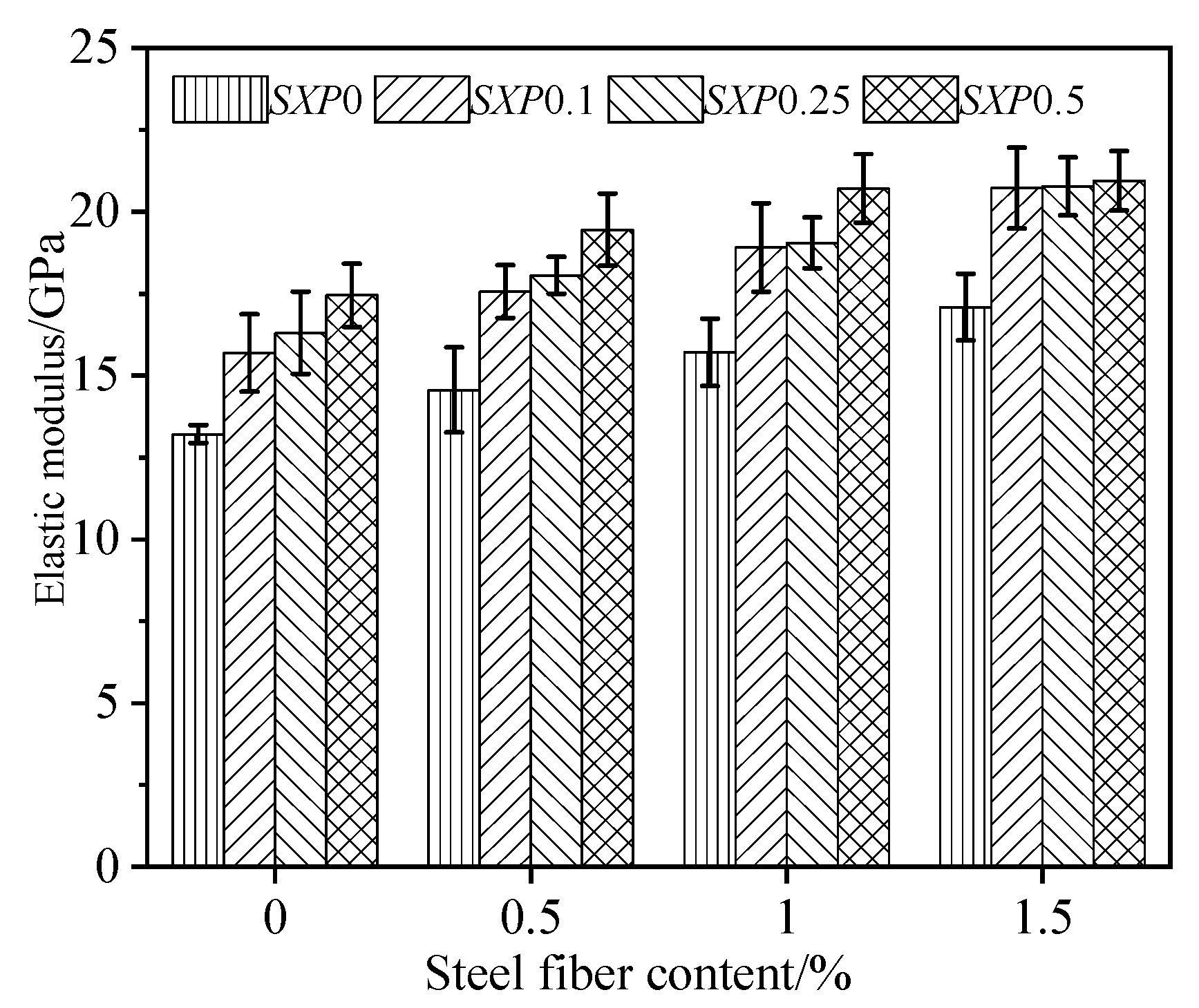
The range of variation in the elastic modulus of the specimens is depicted in Figure 9. When the SF content increased successively from 0%, 0.5%, 1%, and 1.5%, the elastic modulus of the specimens gradually increased. When the PP content was 0.1%, the elastic modulus increased by a range of 7.69% to 11.92%. It is evident that as the SF content rose from 0% to 0.5%, the elastic modulus of the specimens increased most significantly at a PP content of 0.1%, which was in line with the findings of Liang et al. [48]. When the PP content increased successively from 0%, 0.1%, 0.25%, and 0.5%, the increment in the elastic modulus exhibited a certain regular pattern. With SF content at 1.5%, the elastic modulus went up by a range of 21.24% to 22.59%. Among these cases, when the PP content was 0.5%, the elastic modulus of the specimens exhibited the most significant increase, which was in line with the findings of Suksawang et al. [49]. The CVs for the elastic modulus across all groups were consistently below 10%, demonstrating the high reliability of the experimental results.
As shown in Figure 9, for specimens with hybrid fibers, the elastic modulus of specimens (S0.5P0.1, S1P0.25, S1.5P0.5) increased significantly as the fiber content increased. In terms of elastic modulus, the specimen containing 1.5% SF and 0.5% PP (S1.5P 0.5) experienced the greatest enhancement. Its modulus reached 20.95 ± 0.90 GPa, a 58.59% increase over the plain concrete (S0P0, 13.21 ± 0.27 GPa). Although the variability slightly increased at this high fiber content (4.31%), it remained within an acceptable range for fiber-reinforced composites. This was attributed to the uniform and non-directionally distributed hybrid fibers throughout the concrete matrix, where the formed fiber-reinforced network could significantly enhance the material’s stiffness, which was in line with the findings reported by Zheng et al. [50]. However, as the fiber content increased, the growth in elastic modulus of specimens (S1.5P0.1) and (S1.5P0.25) was similar, and the growth in elastic modulus of specimen (S1P0.5) was also not significant. This is attributed to the excessive fiber content, which led to fiber agglomeration within the concrete and a decline in workability, thereby hindering the increase in the elastic modulus.

3.5. Poisson’s Ratio

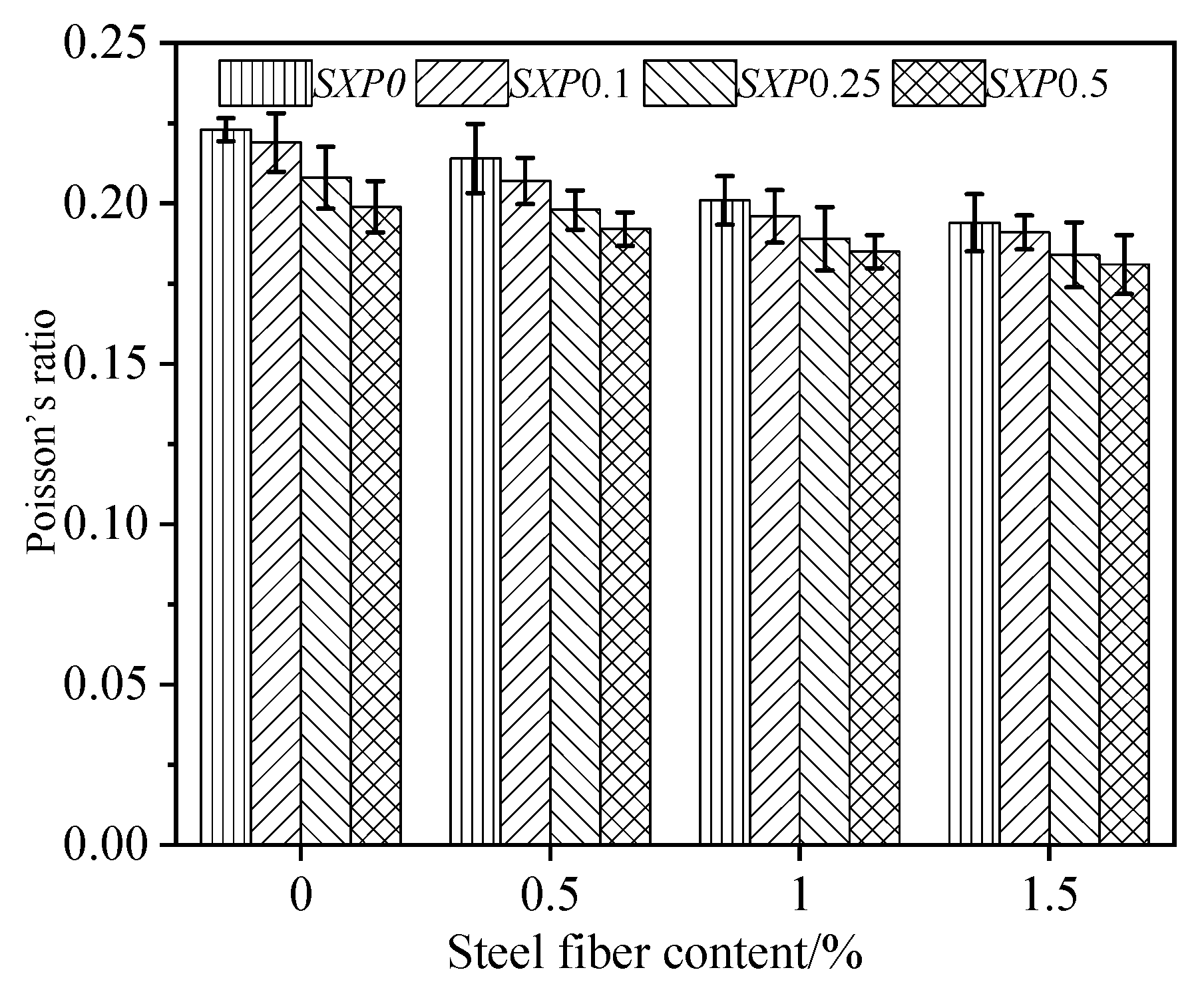
The variation in the Poisson’s ratio of the specimens is depicted in Figure 10. Notably, with the PP content held constant, the Poisson’s ratio of the specimens gradually decreased with increasing SF content. When the PP content was 0%, the Poisson’s ratio of the specimens was reduced by a range of 3.48% to 6.51%. For specimens with a single-parameter change in PP content, when the SF content was 0%, the Poisson’s ratio of the specimens decreased by a range of 1.79% to 5.02%. For the majority of the groups, the CVs for Poisson’s ratio were controlled below 5%, which suggests that the experimental results are highly reliable. As the fiber content increased, the Poisson’s ratio of the specimens was significantly diminished. With the gradual increase in hybrid fiber content, the Poisson’s ratio of specimens (S0.5P0.1), (S1P0.25), and (S1.5P0.5) decreased significantly. For Poisson’s ratio, the specimen containing 1.5% SF and 0.5% PP (S1.5P0.5) exhibited the lowest value. It decreased to 0.181 ± 0.009, representing a maximum reduction of 18.83% compared to the plain concrete (S0P0, 0.223 ± 0.004). The calculated CV for all groups remained below 6%, demonstrating the high reliability of the deformation measurements. This is because the SPFs formed an interlaced fiber network structure that restrained the lateral deformation of the concrete specimens, thereby gradually lowering the Poisson’s ratio.

3.6. Stress–Strain Curve of the Whole Process

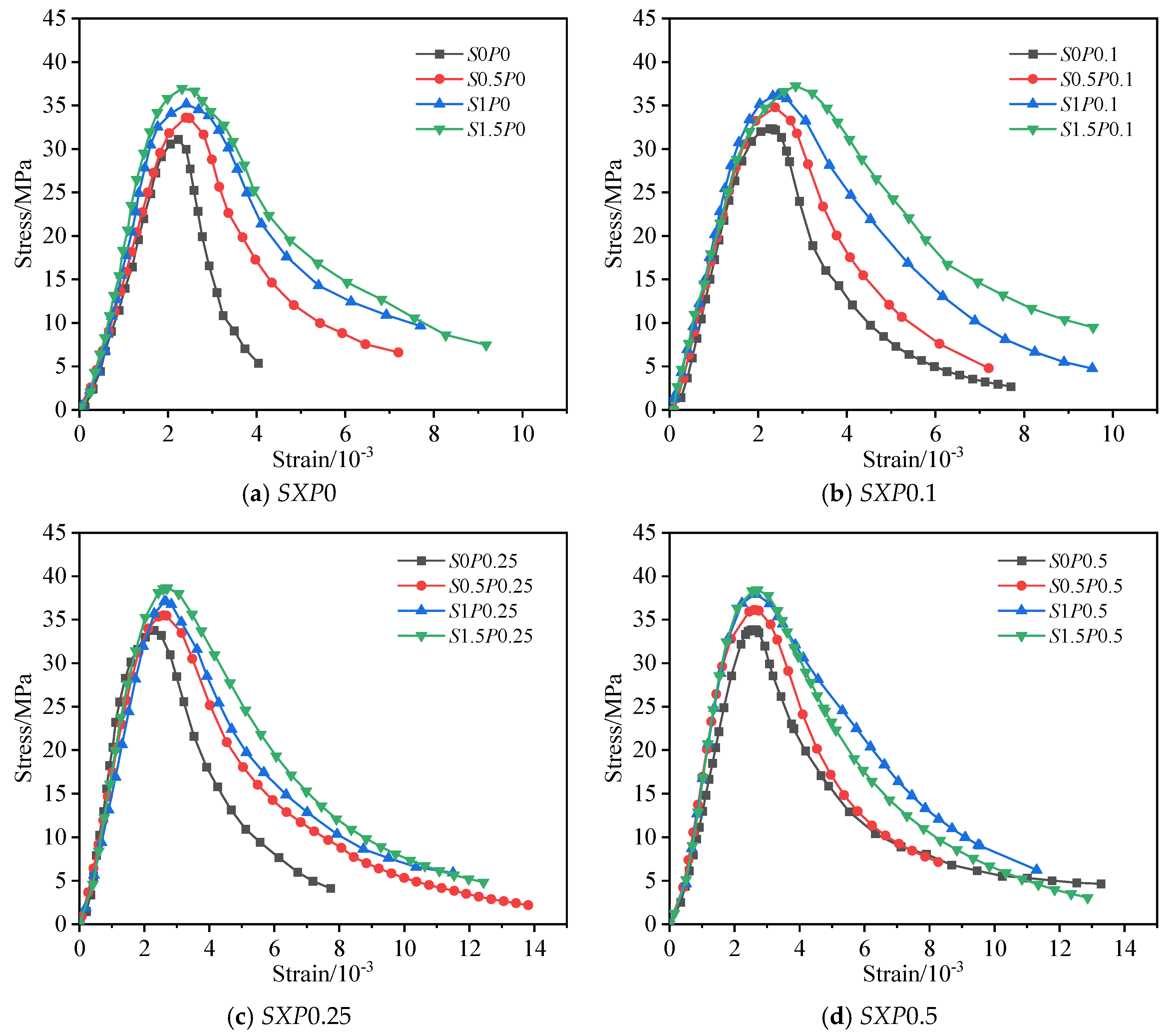
Figure 11 depicts the stress–strain curves of the whole process under different variable parameters. The calculation methods for the stress and strain of the specimen are presented in Equations (1) and (2), respectively.
σ = N A
ε = Δ l l
where N represents the perpendicular load, A is the cross-sectional dimension of the specimen, Δl denotes the axial compression displacement of the specimen, and l stands for the height of the specimen.
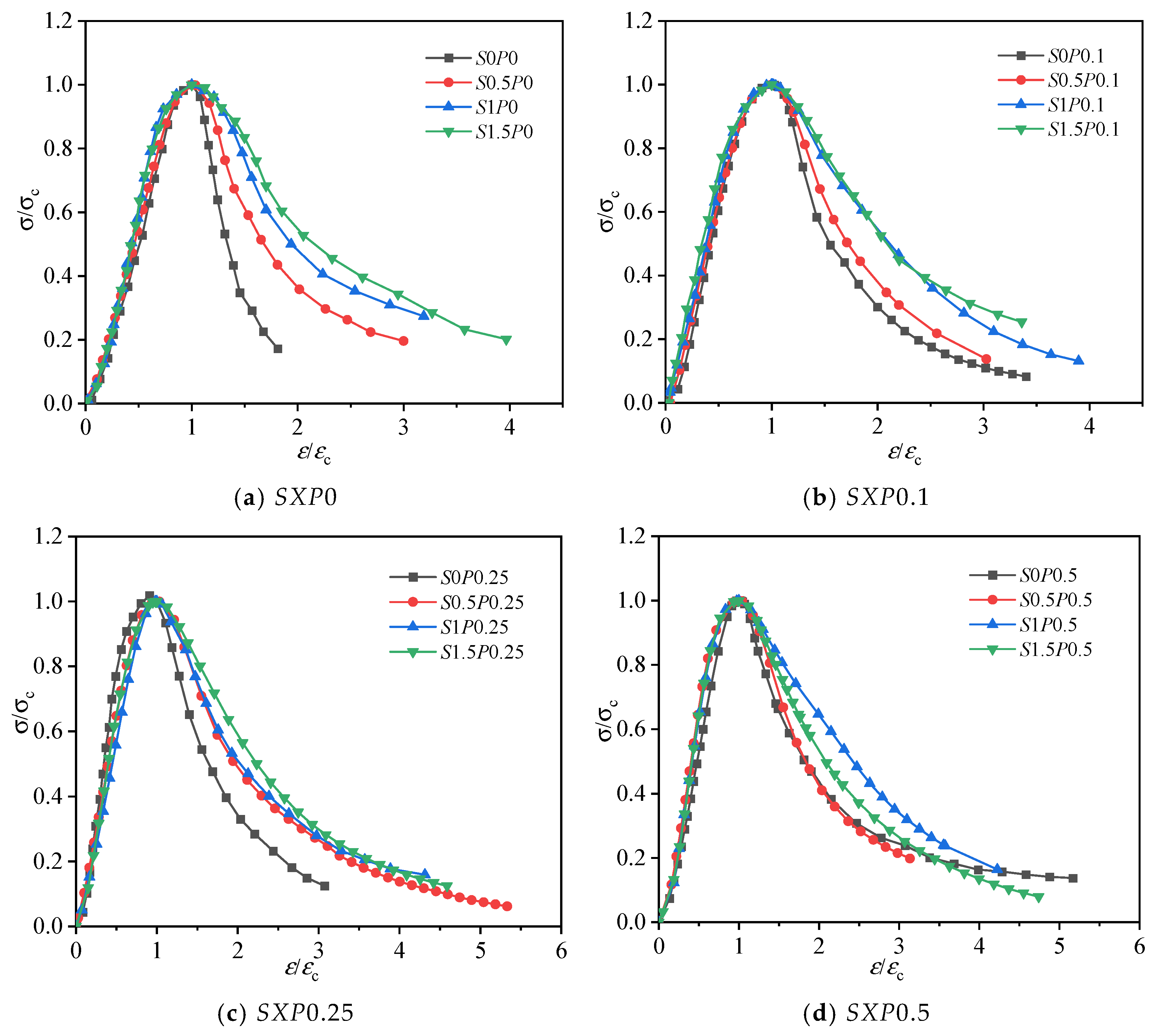
The stress–strain response curves under diverse SF and PP dosages showed similar trends in shape. As revealed in Figure 11a, for concrete specimens with only SF, the gradient of the ascending region of the stress–strain curve gradually enhanced with an increase in fiber content. Moreover, the curve of such specimens in the descending section was gentler than that of plain concrete specimen (S0P0), consistent with the results of Nematzadeh et al. [51]. The rise in the steepness of the pre-peak curve segment was due to the interfacial bonding force in the SF concrete matrix interface under single SF addition. This bonding force enhanced the specimen’s elastic capacity, causing the gradient of the ascending segment of the curve to increase progressively with increasing fiber content. The gentle slope of the descending section of the curve resulted from the bridging impact of SF between cracks. This effect could significantly impede the crack propagation, making the falling segment of the curve gentler than that of plain concrete specimen.
As depicted in Figure 11b–d, for hybrid fiber-reinforced concrete specimens, the ascending portions of their stress–strain curves exhibited basically identical slopes. Notably, PP exerted minimal influence on the gradient of the rising segment of the curves, and this aligned with the research results reported by Deng et al. [52]. When the curves entered the descending phase, due to the addition of PP, the post-peak portion of the stress–strain curves of SPFRC was gentler, and the curves exhibited a longer flow amplitude. Moreover, the envelope area of the curves increased with higher hybrid fiber content. This phenomenon can be attributed to the “fiber interlocking” effect between SF and PP during mixing. The mechanical bite force generated by these two fibers made the fibers’ extraction from the concrete matrix more challenging, thus significantly enhancing the concrete’s strength and toughness. Therefore, the stress–strain curves of hybrid fiber-reinforced concrete were more complete, and the descending section of the curve was gentler.

4. Discussion

4.1. The Dependency of Compressive Strength on Fiber Content

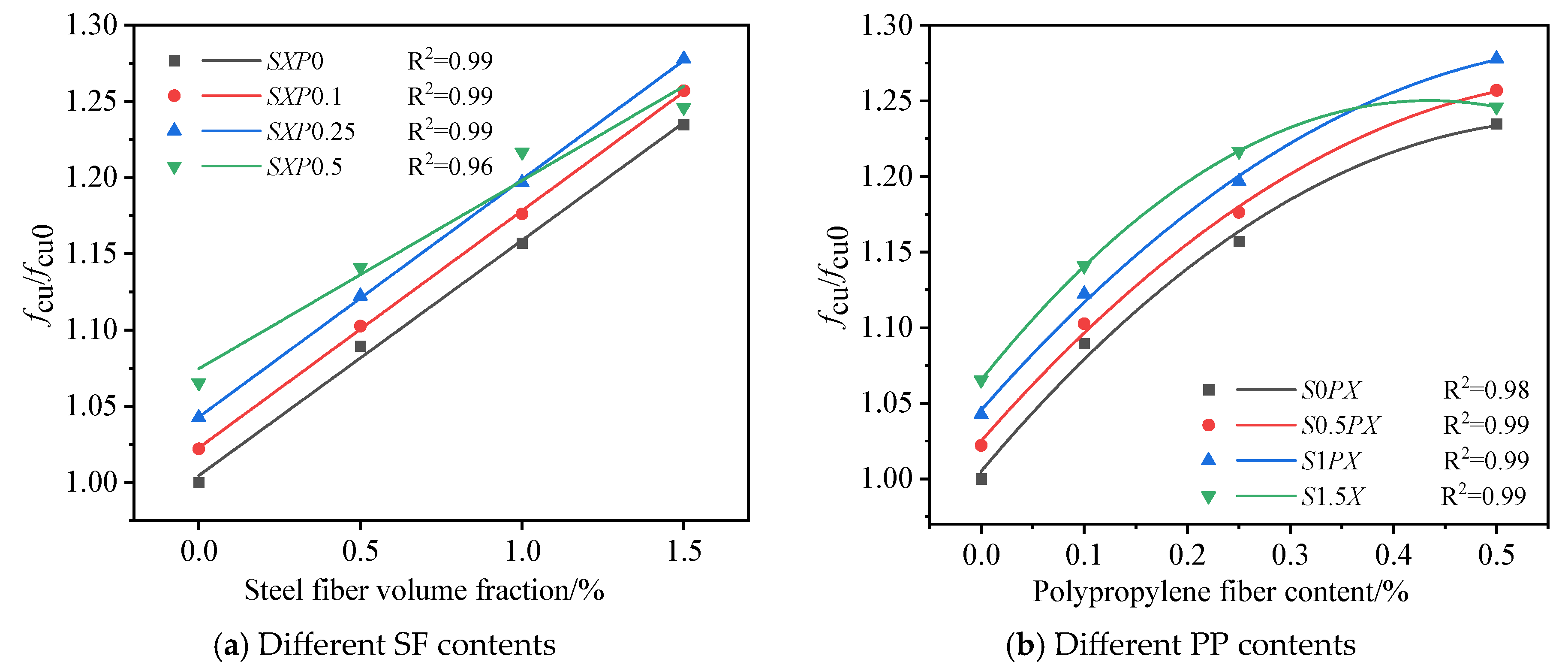
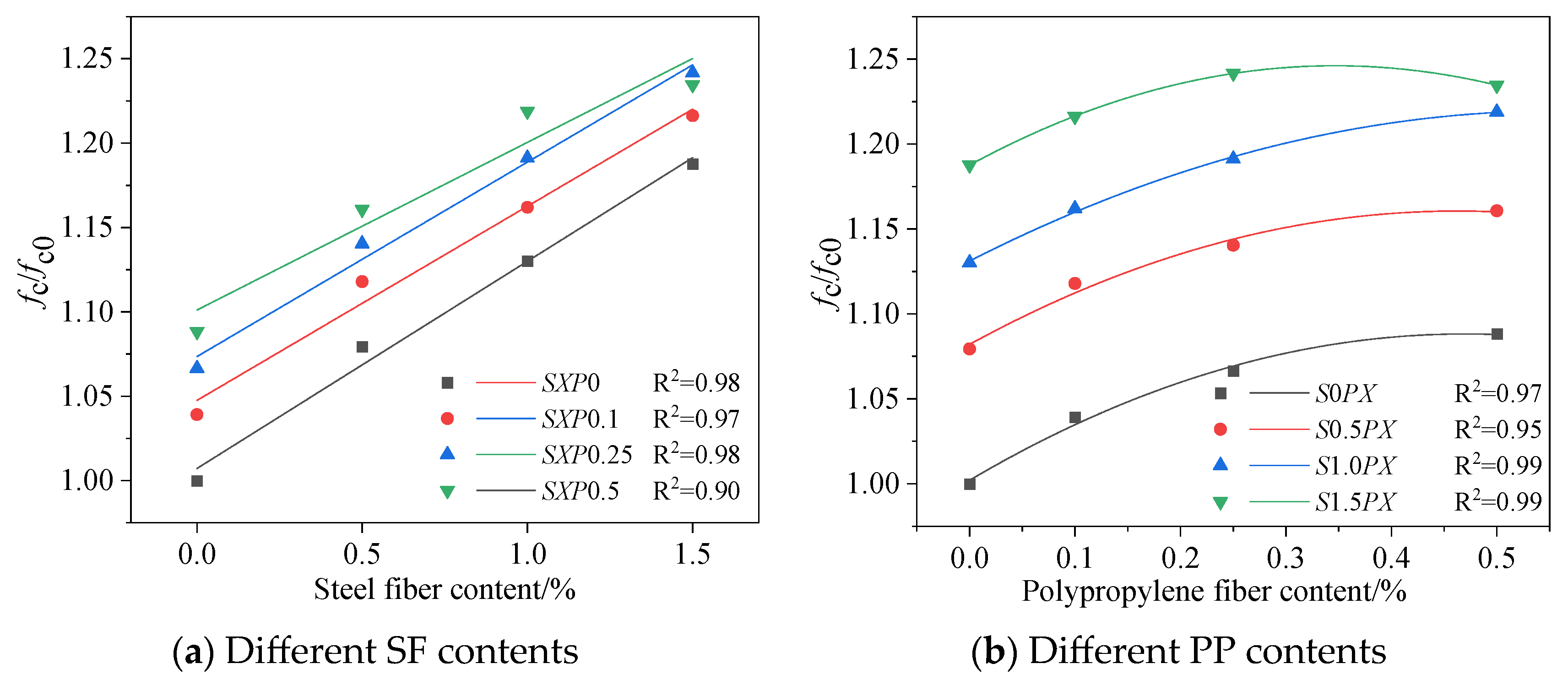
Derived from the measured values of the cube compressive strength depicted in Figure 7a, the cube compressive strength fcu of the cube specimen was normalized and fitted relative to the cube compressive strength fcu0 of plain concrete, as illustrated in Figure 12.
From the measured data, the fitted results for the two types of fibers with varying contents could be derived from Figure 12. As the content of fibers increased, the compressive strength of the specimens significantly improved. For hybrid fiber-reinforced concrete, when SF content exceeded 1.0% or PP content exceeded 0.25%, the improvement in concrete’s compressive capacity attributed to fiber content became more evident. As fiber content continued to increase, when SF content reached 1.5% or PP content reached 0.5%, the rate of growth in specimen compressive strength decelerated. As revealed in Figure 12, an appropriate fiber content significantly elevated the compressive strength of SPFRC cube specimens. To investigate the distinct impacts of SF and PP on strength, the SF content factor and PP content factor were introduced, and a functional correlation between cube compressive strength, SF content, and PP content was proposed, as shown in Equation (3).
f cu / f cu 0 = 0.15 V s + 0.09 V p + 1.02 R 2 = 0.95 RMSE = 0.0043
where Vs represents the content of SF, Vp represents the content of PP, and 0% ≤ Vs ≤ 1.5%, 0% ≤ Vp ≤ 0.5%.
Using the experimental measurements of axial compressive strength from prism specimens in Figure 7b, fitting curves are plotted in Figure 13. With reference to the axial compressive strength fc0 of the plain concrete specimen, fc of the specimen was normalized and fitted.
Considering the impacts of SF and PP on the samples’ axial compressive capacity, the influencing factors of their contents were discussed separately. The functional connection between the axial compressive capacity of the test samples and the contents of SF and PP was established, as shown in Equation (4).
f c / f c 0 = 0.11 V s + 0.14 V p + 1.027 R 2 = 0.95 RMSE = 0.0024

4.2. The Correlation Between Fiber Content and Splitting Tensile Strength

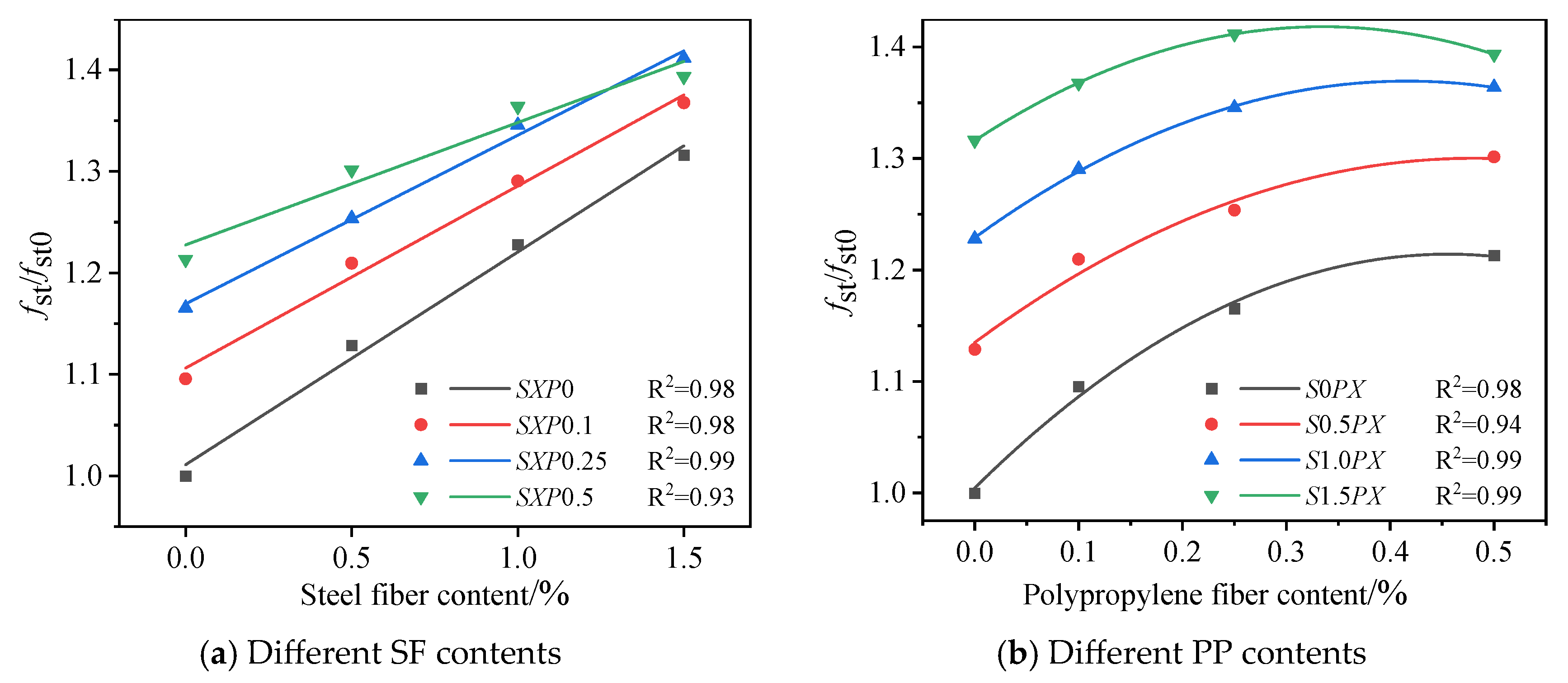
Based on the obtained splitting specimen tensile strengths depicted in Figure 8, the fitting curve is illustrated in Figure 14. Based on the splitting tensile strength fst0 of plain concrete specimen, the splitting tensile strength fst of the SPFRC specimens was normalized and fitted.
To address the influences of the SPF on the splitting tensile resistance of the specimens, the influencing factors related to the contents of SF and PP were introduced. The relationship between the splitting tensile strength and the fiber content is presented in Equation (5).
f st / f st 0 = 0.1689 V s + 0.2793 V p + 1.0692 R 2 = 0.91 RMSE = 0.0107

4.3. Conversion Relationship of Strength Indices

In general, the prism axial compressive strength of ordinary concrete is 0.76 times that of its cube compressive strength [53]. Moreover, the addition of fibers showed a certain enhancing influence on the mechanical performance of the concrete. Therefore, the influencing factors related to the dosage of SF and PP were separately introduced, and the transformation relationship linking axial and cube compressive strengths of the specimens was derived, as shown in Equation (6).
f c / f cu = 0.0226 V s + 0.0353 V p + 0.7805 R 2 = 0.88 RMSE = 0.0049
The tension-compression ratio was a critical indicator for assessing concrete strength. From experimental investigations presented in this research, the influencing factors related to SF and PP contents were separately introduced. Consequently, the calculation equation for the tension-compression ratio was derived, as presented in Equation (7).
f st / f cu = 0.0005 V s + 0.011 V p + 0.07 R 2 = 0.85 RMSE = 0.0014

4.4. The Calculation Equation of Elastic Modulus of SPFRC

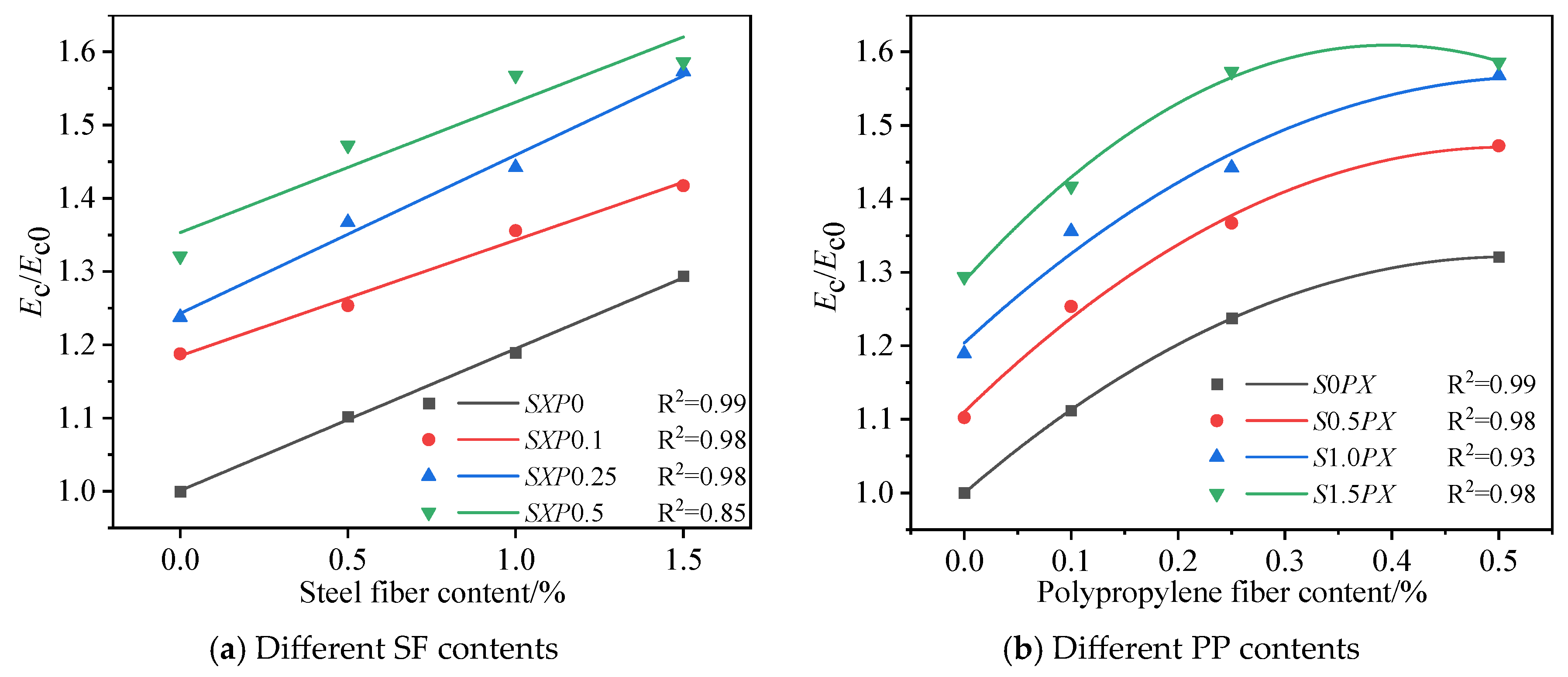
Using the measured elastic modulus values of the specimens revealed in Figure 9, the fitting curve is depicted in Figure 15. Based on the elastic modulus Ec0 of plain concrete, the elastic modulus Ec of the SPFRC specimens was made dimensionless.
To consider the impacts of SF and PP contents on specimen elastic modulus, the influencing factors associated with these two fibers’ contents were introduced. The calculation equation for the association of the elastic modulus with the fiber content is presented in Equation (8).
E c / E c 0 = 0.1978 V s + 0.6486 V p + 1.044 R 2 = 0.91 RMSE = 0.0184
Based on Reference [54], through regression analysis, the calculation method between elastic modulus and compressive strength for the SPFRC cube specimens was derived, as presented in Equation (9).
E c = 10 5 2.2 + 34.7 f cu ( 0.0604 V s + 0.2427 V p + 0.4217 ) R 2 = 0.91 RMSE = 0.01068

4.5. Constitutive Relation Establishment and Universality Verification

The stress–strain curves of SPFRC after dimensionless treatment are presented in Figure 16a–d. It was evident from the data that the stress–strain curves of the fiber-reinforced concrete specimens and the ordinary concrete exhibited similar geometric characteristics. To further investigate the effects of SF and PP on the full-process stress–strain curve of concrete, the full-process stress–strain curve equations of the SPFRC specimens were established by referring to the Guo Zhenhai model [55], as presented in Equation (10).
σ = [ α ( ε ε c ) + 3 2 α ( ε ε c ) 2 + α 2 ( ε ε c ) 3 ] σ c , 0 ε ε c 1 σ = σ c ( ε ε c ) / [ β ( ( ε ε c ) 1 ) 2 + ( ε ε c ) ] , ε ε c > 1
where the parameters α and β are the parameters characterizing the ascending and descending segments of the curve, respectively. Meanwhile, εc and σc denote the peak strain and the peak stress, respectively.
The magnitudes of parameters α and β significantly affected the slope of the ascending segment and the smoothness of the descending segment of the stress–strain curve. Therefore, it was of particular importance to determine the correlation of the parameters α, β with the contents of SF, PP. The relationships between parameters α, β and the contents of fibers were fitted, as presented in Equations (11) and (12).
α = 0.544 δ + 0.06678 λ + 0.2541
β = 0.7039 δ 0.9681 λ + 3.4238
where δ represents the content of SF, λ represents the content of PP, and 0% ≤ δ ≤ 1.5%, 0% ≤ λ ≤ 0.5%.
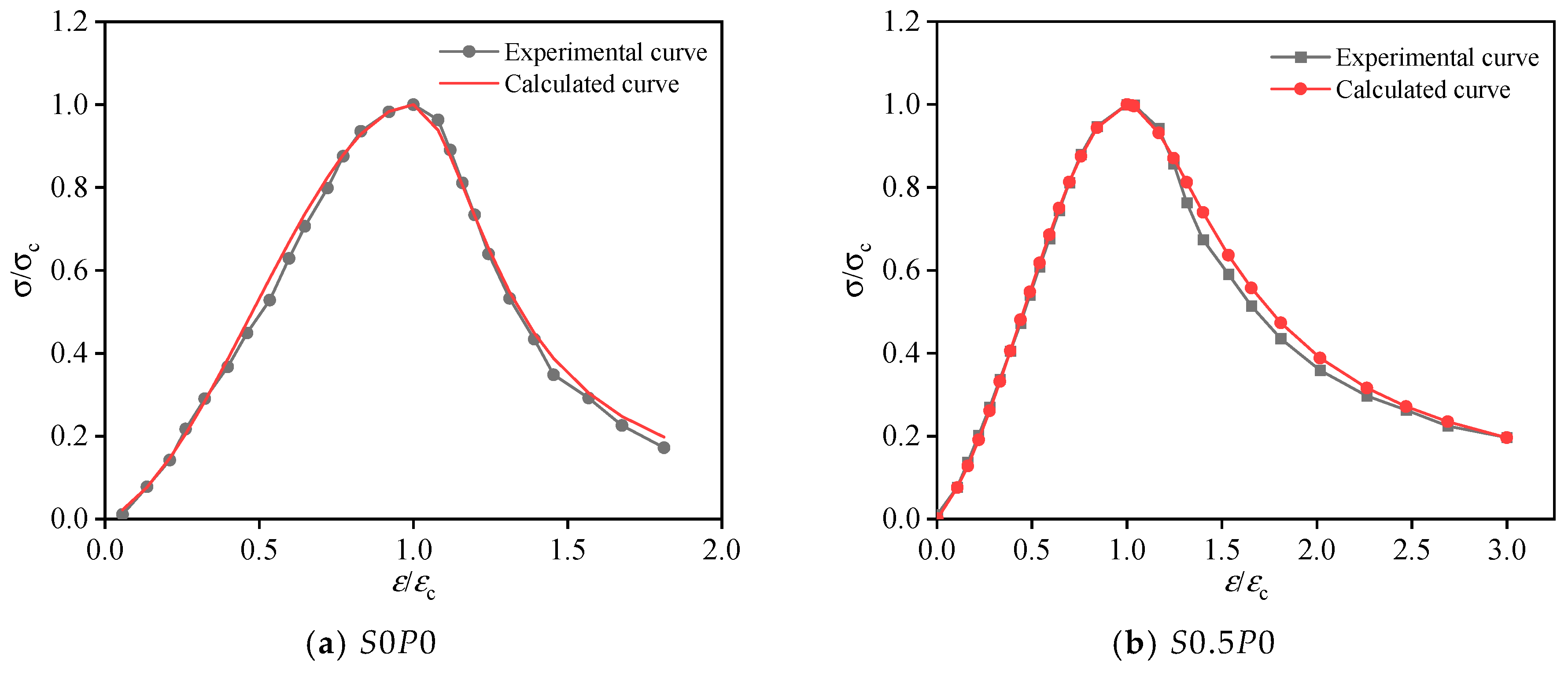
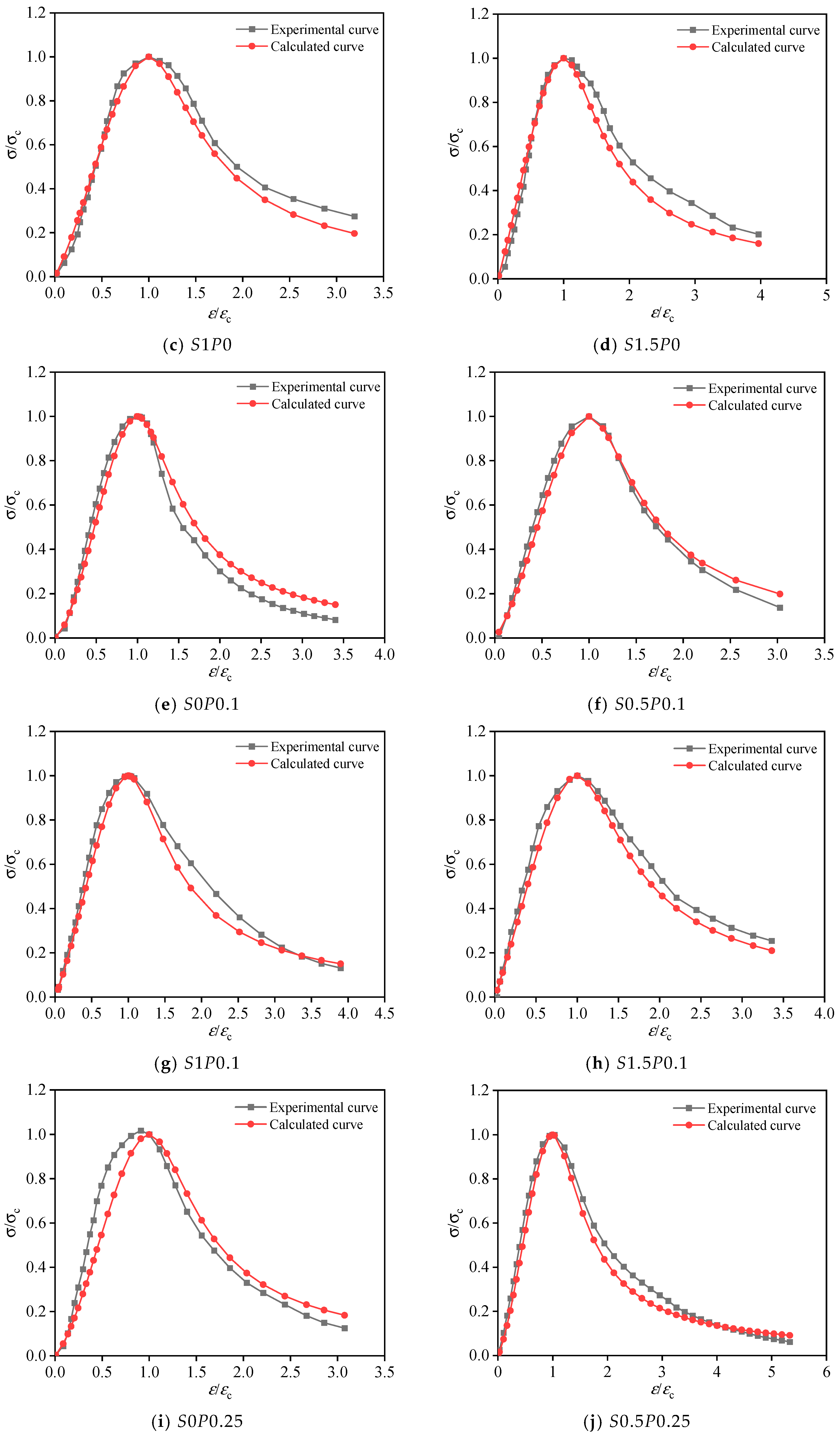
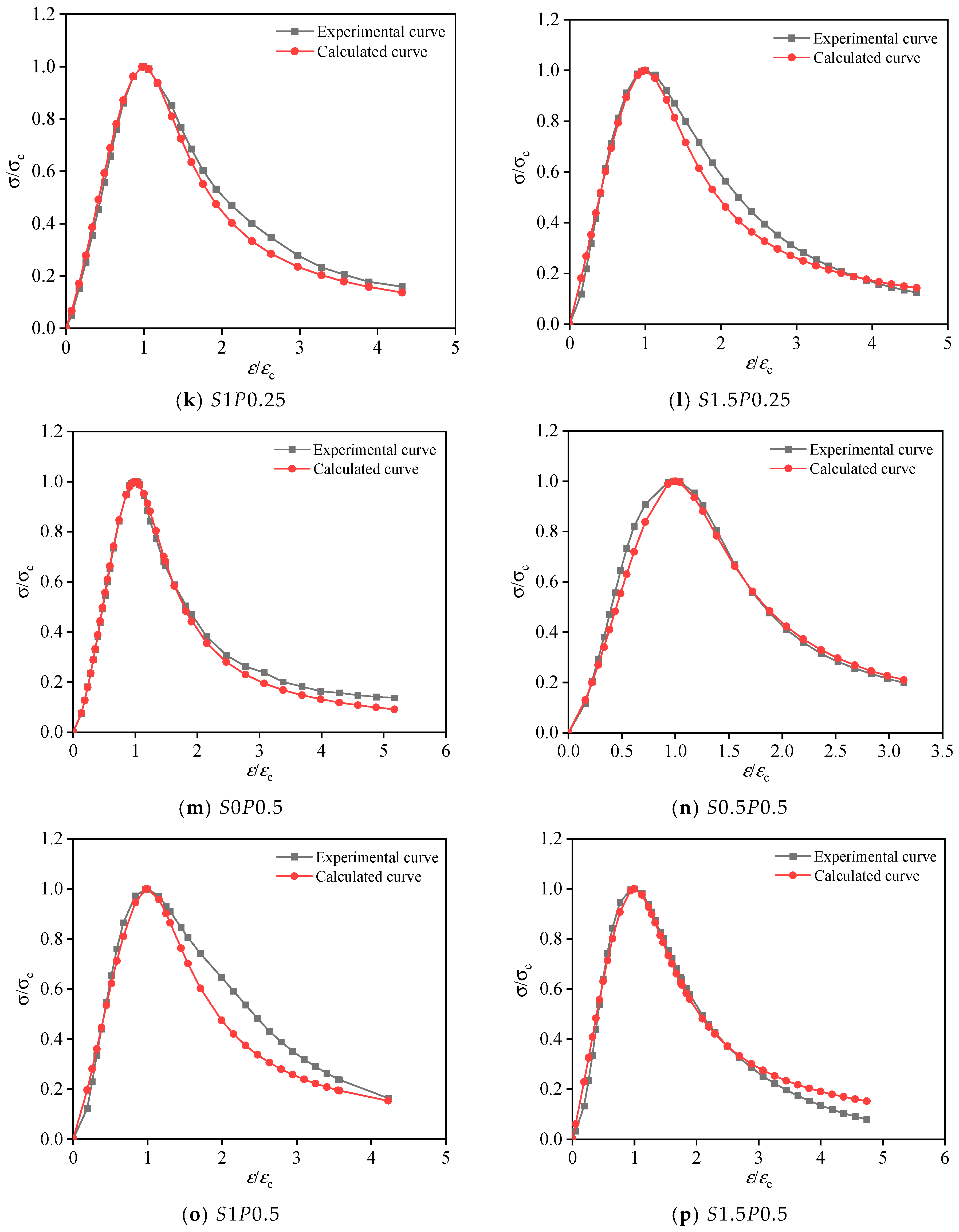
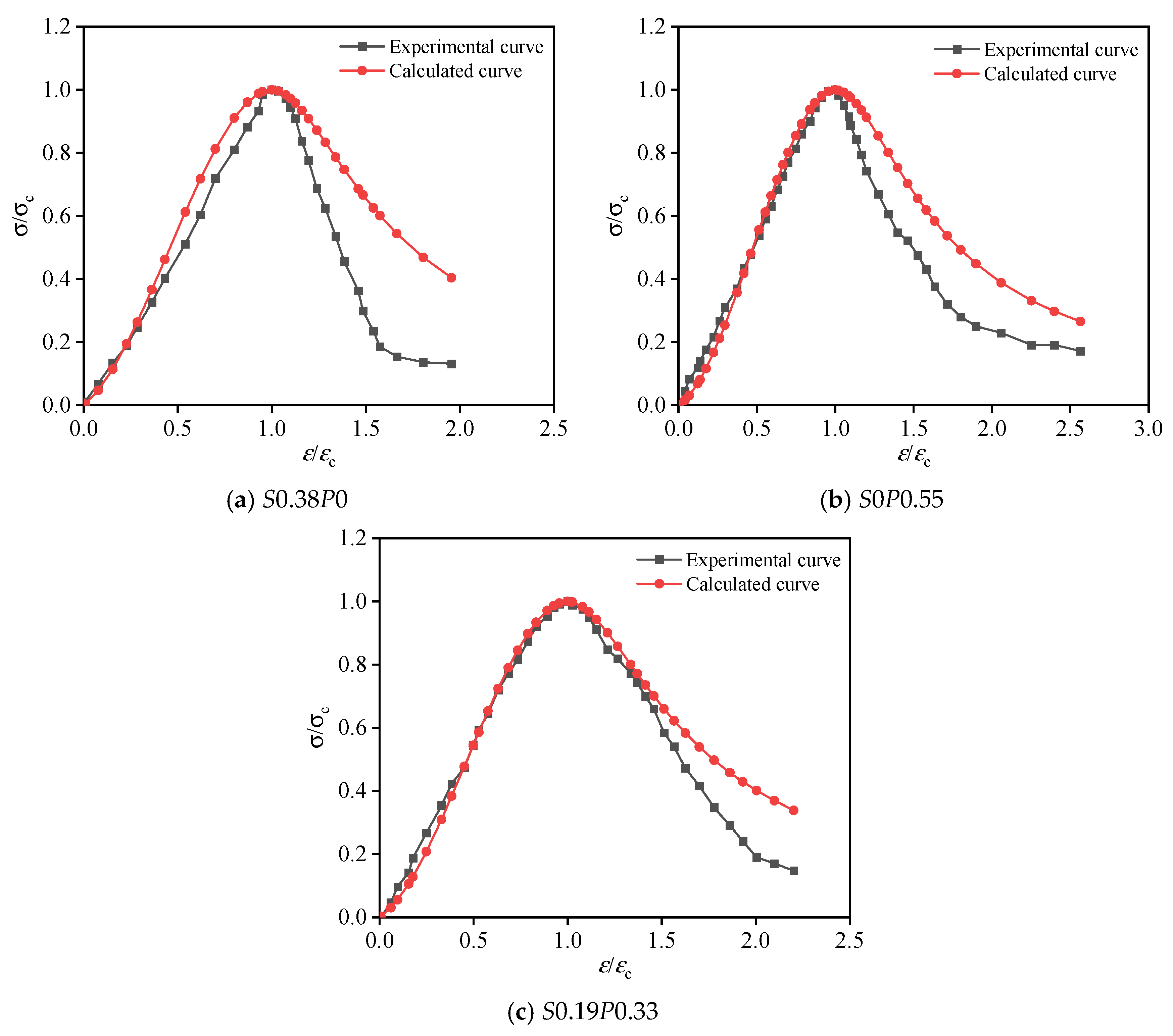
Experimental results and the calculated outcomes of the stress–strain curve of SPFRC for different variable factors are illustrated in Figure 17. It was evident from the results that the calculated curve corresponds well with the test curve.
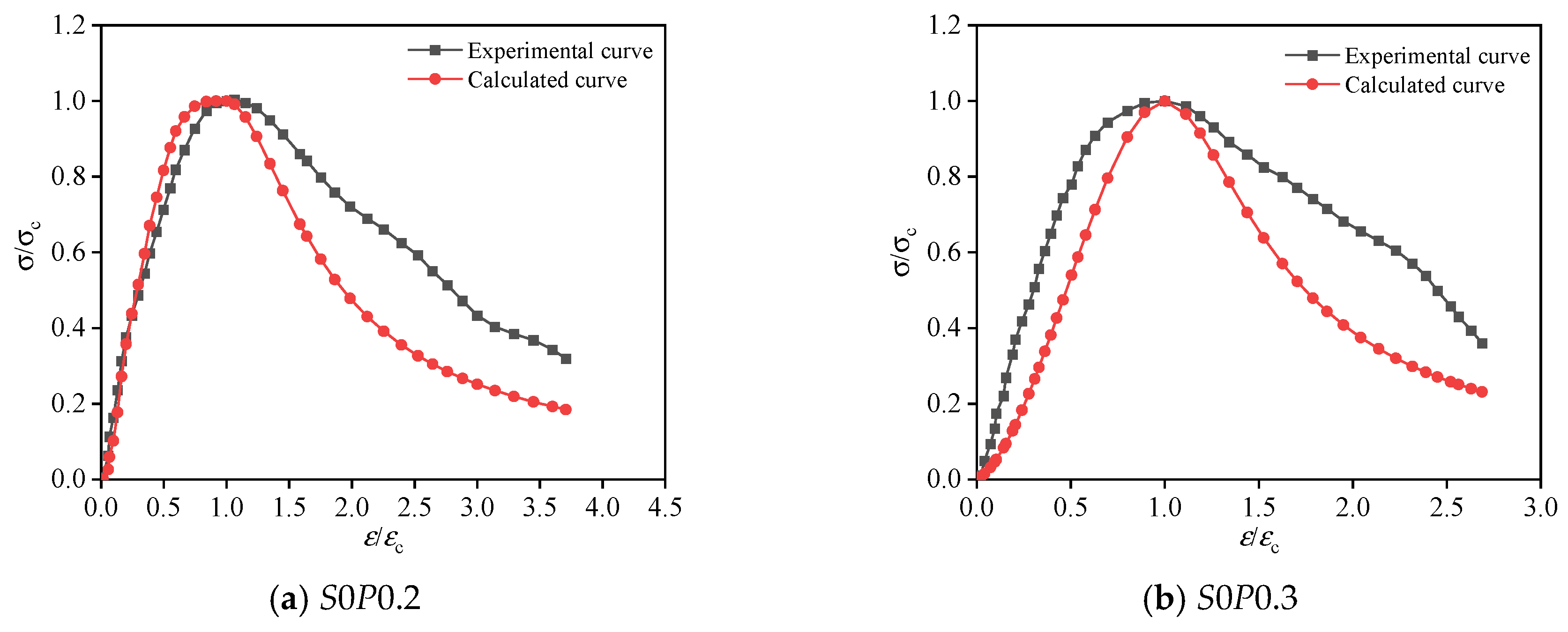
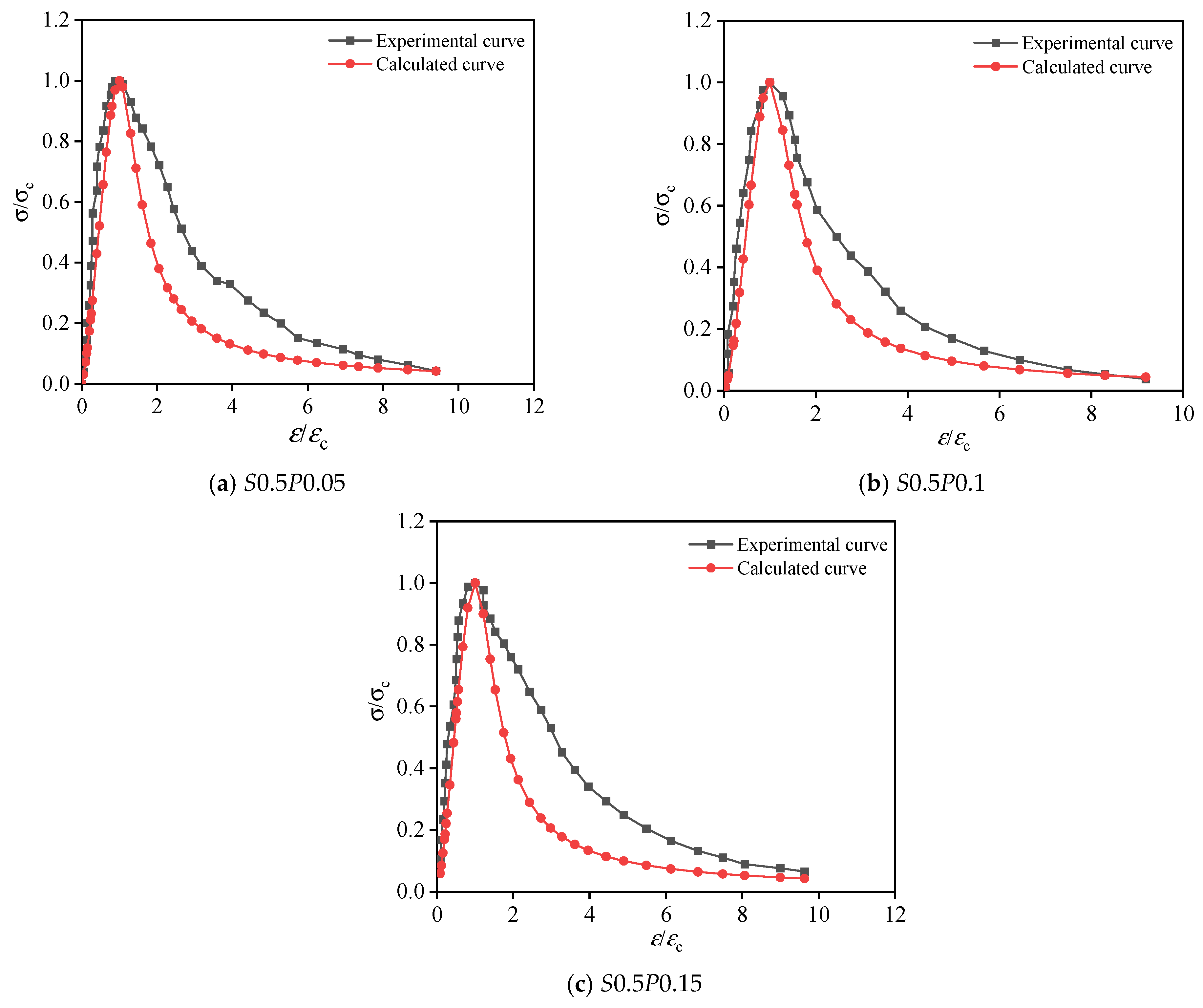
To verify the universality of the stress–strain constitutive model developed in this study, the experimental data from the existing literature were substituted into the proposed model. Figure 18, Figure 19 and Figure 20 illustrated the comparison of the calculated curve versus the test curve. Results showed that the developed stress–strain full-process curve equation exhibited good universality, with the curve showing good consistency with the test curves of other scholars. This indicated that Formula (10) developed in this research could serve to compute the stress–strain curves of SPFRC with varying fiber contents.

4.6. The Enhancement Effect of SPF

4.6.1. The Reinforcing Effect of SPF

Based on the aforementioned research data regarding the mechanical performance of SPFRC, the enhancing impacts of SF and PP on the compressive strength of SPFRC were investigated. Define the fiber enhancement factor Kc, as presented in Equation (13).
K c = f cu f cu 0 1
where fcu represents the cube compressive strength of SPFRC, and fcu0 represents the compressive strength of plain concrete.
To examine in a quantitative manner the strengthening effects of the two fiber varieties with respect to compressive strength of SPFRC, the characteristic parameters of SF and PP were included. Denote them as Vsls/ds and Vplp/dp, as presented in Equation (14), where vs. and Vp are the volume percentages of SF and PP, respectively. By combining Equations (13) and (14), Equation (15) was obtained.
K c + 1 = a V s l s d s + b V p l p d p
( a 65 V s + b 400 V p ) f cu 0 = f cu
Based on the compressive capacity data of the cube specimens depicted in Figure 7, the parameters a and b were fitted combined with Equation (15). The results were a = 0.22675, b = 0.02258.
Therefore, by combining Equation (14) with the fitted parameters, Equation (16) could be derived.
K c + 1 = 0.22675 V s l s d s + 0.02258 V p l p d p

4.6.2. Crack Resistance of SPF

Existing research indicated that studies regarding the crack resistance effect of fibers predominantly focused on the optimization of fiber spacing in relation to the mechanical performance of concrete [58,59]. However, such research still exhibited evident limitations in terms of the establishment of the theoretical system and the consideration of influencing factors. Nonetheless, these research findings offered a crucial theoretical foundation for the in-depth investigation of the crack resistance effect of fiber-reinforced concrete. Building on this foundation, the present study systematically explored the impact effect of hybrid fibers on the crack resistance of concrete by introducing the pivotal parameter of the crack resistance factor and comprehensively taking into account the characteristic parameters of SF and PP.
Using the aforementioned mechanical performance data of SPFRC, the beneficial effects of fibers on peak stress and peak strain of the concrete were revealed. By analyzing the experimental data, the crack resistance factor β is defined, and the computational method is presented in Equation (17).
β = ε h ε 0 1
where εh represents the peak strain of SPFRC, and ε0 represents the peak strain of plain concrete.
The peak strains of the specimens under different varying parameters are presented in Table 3. To quantitatively analyze the crack resistance contributed by the two types of fibers to SPFRC, the key parameters of SF and PP were incorporated into the evaluation framework. The key parameters of SF and PP are combined with the crack resistance factor, and the results are presented in Equation (18).
β + 1 = x V s l s d s + y V p l p d p
Using the data presented in Table 3, parameters c and d were fitted, and as a result, Equation (19) was obtained.
β + 1 = 0.2431 V s l s / d s + 0.1514 V p l p / d p

4.6.3. Toughening Effect of SPF

The enclosed area of the stress–strain curve of SPFRC under compressive load was calculated through a mathematical integration method, and the area of the full-process stress–strain curve was obtained. This area reflected the toughening influence of fibers on the concrete. Prior to the external load attaining the peak load, the cracks in the specimen were in a state of stable development. When the applied load attained the peak load, the cracks in the specimen expanded rapidly, and a large through-crack formed, ultimately causing the failure of the specimen. Drawing on the experimental results and observations, the peak point was taken as the characteristic point, and the pre-peak energy absorption capacity R1 and the post-peak energy absorption capacity R2 were, respectively, defined.
The toughening factor of SPFRC is defined, as presented in Equation (20).
η R = R i ( V h ) R i ( V 0 ) 1
where Ri(Vh) and Ri(V0) denote the toughness of fiber-reinforced concrete and normal concrete, for each case, where i = 1, 2, representing the pre-peak toughness and the post-peak toughness, for each case. Table 4 presents the pre-peak toughness R1, post-peak toughness R2, and toughening factors ηR1, ηR2 of SPFRC under compressive load.
As can be observed from Table 4, an appropriate amount of SF and PP showed a remarkable impact on the concrete’s toughness. The addition of hybrid fibers could notably improve the deformation capacity of the concrete, enabling the concrete to transition from brittle to plastic failure. Particularly after the peak point, owing to the crack bridging by hybrid fibers, crack propagation and the failure process of the concrete were retarded.
Through the introduction of SF and PP characteristic parameters, the relationship between the toughening factor of SPFRC and fibers’ characteristic parameters was derived, as presented in Equations (21) and (22).
η R 1 = m 1 V s l s / d s + n 1 V p l p / d p
η R 2 = m 2 V s l s / d s + n 2 V p l p / d p
where m and n denote the influence factors of the content of SF and PP on SPFRC toughening, respectively. The parameters m and n are fitted using Origin 2021 (OriginLab Corporation, Northampton, MA, USA) software, and the fitted values of m and n are obtained, as presented in Equations (23) and (24).
η R 1 = 0.4742 V s l s / d s + 0.1275 V p l p / d p
η R 2 = 2.6357 V s l s / d s + 1.0399 V p l p / d p

5. Conclusions

Based on experimental studies on the mechanical performance of SPFRC, this paper systematically analyzes the strengthening, crack resistance, and toughening mechanisms of the hybrid fibers. Additionally, corresponding calculation methods are established. The research findings provide theoretical support and technical guidance for the application of this material in engineering fields with high requirements for crack control, such as rigid pavements and bridge deck pavements. The main conclusions are as follows:
(1)
Both single-doped (SF or PP) and hybrid fiber reinforcement significantly alter the failure mode of concrete. Concrete without fiber addition shows typical brittle failure, accompanied by severe specimen damage. In contrast, fiber-reinforced specimens display pronounced plastic deformation behavior and retain structural integrity after failure.
(2)
For specimens under single-parameter variation in SF, an SF content of 0.5% leads to the greatest enhancement in concrete’s mechanical performance. For specimens under single-parameter variation in PP, a PP content of 0.1% results in the most pronounced improvement in concrete’s mechanical performance. Moreover, single-doped fiber significantly enhances the elastic modulus of the specimens and concurrently reduces their Poisson’s ratio.
(3)
Appropriate hybrid fiber can notably improve the mechanical performance of concrete. When the SF content is 1.5% and the PP content is 0.25%, cube compressive strength, axial compressive strength, and split tensile strength achieve their peak values. When the SF content is 1.5% and the PP content is 0.5%, the elastic modulus experiences the most significant increase, and the Poisson’s ratio shows the most substantial decrease.
(4)
For concrete specimens with single-type SF, as the fiber content increases, the gradient of the ascending branch of the stress–strain curve progressively rises. Moreover, the downward section of this curve is gentler than that of plain concrete specimen (S0P0). For concrete specimens with hybrid fiber, PP shows little impact on the slope of the ascending segment, yet it can make the curve’s descending segment more gradual.
(5)
By considering the influencing factors of SF and PP, the stress–strain curve equation for SPFRC is developed. Validation shows that the calculated curve agrees well with the experimentally measured curve.
(6)
Through the analysis of the effects by which SPFs improve the strengthening, crack-resistance, and toughening of concrete under static loads, the calculation methods for the strengthening, crack-resistance, and toughening effects of SF and PP on concrete specimens are developed.
Constrained by experimental conditions, this study focused solely on the macro-mechanical properties of SPFRC with a C40 strength grade, analyzing its mechanisms of strengthening, crack resistance, and toughening. Future work could extend to investigating concrete matrices of different strength grades. Furthermore, it is recommended to employ advanced microstructural characterization techniques and analytical methods, such as the Hybrid Synergistic Index and Analysis of Variance, to deeply explore the interfacial interaction mechanisms between fibers and the concrete matrix at the microscopic level.

Author Contributions

Conceptualization, J.W., J.N. and S.Z.; Methodology, X.Z. (Xianggang Zhang); Validation, J.H., X.Z. (Xuanxuan Zhang), Q.Z. and L.S.; Formal analysis, J.H.; Investigation, J.H.; Data curation, X.Z. (Xianggang Zhang); Writing—original draft, X.Z. (Xianggang Zhang); Writing—review & editing, J.W.; Visualization, X.Z. (Xuanxuan Zhang), J.N. and Q.Z.; Supervision, X.Z. (Xuanxuan Zhang), J.W., S.Z. and L.S. All authors have read and agreed to the published version of the manuscript.

Funding

This work was supported by the National Natural Science Foundation of China (52478250), Henan Provincial Science and Technology Research Project (252102320305), Henan Province University-Industry Collaborative Innovation Project (26AXQXT034), and National College Students’ Innovation and Entrepreneurship Training Program Supported Project (202410460075).

Institutional Review Board Statement

Not applicable.

Informed Consent Statement

Not applicable.

Data Availability Statement

The original contributions presented in this study are included in the article. Further inquiries can be directed to the corresponding author.

Conflicts of Interest

Author Shengli Zhang was employed by the company Jinyuan Weiye Construction Engineering Group Company Limited. The remaining authors declare that the research was conducted in the absence of any commercial or financial relationships that could be construed as a potential conflict of interest.

References

  1. Cheng, S.T.; He, H.X.; Cheng, Y.; Sun, H. Flexural behavior of RC beams enhanced with carbon textile and fiber reinforced concrete. J. Build. Eng. 2023, 70, 106454. [Google Scholar] [CrossRef]
  2. Shen, W.L.; Chen, Z.Q.; Wang, M.; Bai, J.; Qin, Z.; Xiao, T.; Meng, N.; Liu, J.; Gai, Y.; Nan, H. Fracture characteristics and fracture interface buckling mechanism of cantilever rock mass under non-uniformly distributed load. Int. J. Min. Sci. Technol. 2025, in press. [Google Scholar] [CrossRef]
  3. Shen, W.L.; Ren, W.S.; Chen, Z.Q.; Wang, M.; Bai, J.; Meng, N.; Qin, Z.; Liu, J.; Yao, T.; Gai, Y. Pressure Reduction Effectiveness Evaluation of Entry Under Longwall Mining Disturbance: A Case Study. Rock Mech. Rock Eng. 2025; in press. [Google Scholar] [CrossRef]
  4. Alberti, G.M.; Enfedaque, A.; Gálvez, C.J.; Álvarez, C. Using Polyolefin Fibers with Moderate-Strength Concrete Matrix to Improve Ductility. J. Mater. Civ. Eng. 2019, 31, 04019170. [Google Scholar] [CrossRef]
  5. Yi, F.Y.; Kazmi, S.M.S.; Hu, B.; Wu, Y.-F. Mitigating the brittle behavior of compression cast concrete using polypropylene fibers. Constr. Build. Mater. 2024, 440, 137435. [Google Scholar] [CrossRef]
  6. Zhu, H.; Li, C.; Wu, M.; Yan, M.; Jiang, Z. Persistence of Strength/Toughness in Modified-Olefin-Fiber- and Hybrid-Fiber-Reinforced Concrete. J. Test. Eval. 2017, 45, 2071–2082. [Google Scholar] [CrossRef]
  7. Aslani, F.; Liu, Y.; Wang, Y. Flexural and toughness properties of NiTi shape memory alloy, polypropylene and steel fibers in self-compacting concrete. J. Intell. Mater. Syst. Struct. 2020, 31, 3–16. [Google Scholar] [CrossRef]
  8. Cao, Q.; Zheng, H.B.; Ju, H.; Lin, Z.; Zhou, C.; Jia, J. Early-Age Cracking Resistance of Multiscale Fiber-Reinforced Concrete with Steel Fiber, Sisal Fiber, and Nanofibrillated Cellulose. J. Mater. Civ. Eng. 2023, 35, 04023065. [Google Scholar] [CrossRef]
  9. Zhang, X.; Wang, C.; Wang, J.; Liu, X.; Huang, Y.; Wang, L.; Ding, Y. Experimental study on the compressive fatigue performance of nano-silica modified recycled aggregate concrete. Constr. Build. Mater. 2024, 447, 138161. [Google Scholar] [CrossRef]
  10. Zhang, Y.; Zhou, G.F.; Zheng, Y.X. Effect of fiber type on the mechanical properties and durability of hardened concrete. J. Mater. Sci. 2023, 58, 16063–16088. [Google Scholar] [CrossRef]
  11. Chen, S.T.; He, H.X.; Lan, B.J. Uniaxial Compression Test and Performance Analysis of Multiscale Modified Concrete. J. Mater. Civ. Eng. 2024, 36, 13688. [Google Scholar] [CrossRef]
  12. Muthukumarana, T.; Arachchi, M.; Somarathna, H.; Raman, S. A review on the variation of mechanical properties of carbon fiber-reinforced concrete. Constr. Build. Mater. 2023, 366, 130173. [Google Scholar] [CrossRef]
  13. Ibrahim, S.K.; Rad, M.M. Limited optimal plastic behavior of RC beams strengthened by carbon fiber polymers using reliability-based design. Polymers 2023, 15, 569. [Google Scholar] [CrossRef]
  14. Zhang, F.; Lu, Z.; Wang, D. Working and mechanical properties of waste glass fiber reinforced self-compacting recycled concrete. Constr. Build. Mater. 2024, 439, 137172. [Google Scholar] [CrossRef]
  15. Tassew, S.T.; Lubell, A.S. Mechanical properties of glass fiber reinforced ceramic concrete. Constr. Build. Mater. 2014, 51, 215–224. [Google Scholar] [CrossRef]
  16. Zhang, X.G.; Niu, J.X.; Xu, P.; Deng, D.; Fan, Y. Investigation on eccentric compression performance of basalt fiber-reinforced recycled aggregate concrete-filled square steel tubular columns. Dev. Built Environ. 2024, 18, 100411. [Google Scholar] [CrossRef]
  17. Zhang, X.G.; Shen, Y.C.; Fan, Y.H.; Gao, X. Experimental study on the triaxial compression mechanical performance of basalt fiber-reinforced recycled aggregate concrete after exposure to high temperature. Case Stud. Constr. Mater. 2024, 20, e03026. [Google Scholar] [CrossRef]
  18. Zhang, Y.L.; Zheng, S.; Huang, L.Z.; Yang, C.; Du, X. Experimental study on the properties of internal cured concrete reinforced with steel fiber. Constr. Build. Mater. 2023, 393, 132046. [Google Scholar] [CrossRef]
  19. Zhang, X.G.; Zhu, Y.N.; Shen, Y.C.; Wang, J.; Fan, Y.; Gao, X.; Huang, Y. Compressive mechanical performance and microscopic mechanism of basalt fiber-reinforced recycled aggregate concrete after elevated temperature exposure. J. Build. Eng. 2024, 96, 110647. [Google Scholar] [CrossRef]
  20. Zhang, X.G.; Zhu, Y.N.; Fan, Y.H.; Zhou, G.; Huang, Y.; Li, M.; Shen, W. Experimental study on impact resistance and dynamic constitutive relation of steel fiber reinforced recycled aggregate concrete. Constr. Build. Mater. 2024, 449, 138396. [Google Scholar] [CrossRef]
  21. Lee, H.J.; Yang, K.H. Compressive and flexural toughness indices of lightweight aggregate concrete reinforced with micro-steel fibers. Constr. Build. Mater. 2023, 401, 132965. [Google Scholar] [CrossRef]
  22. Zhang, X.G.; Zhu, Y.N.; Wang, J.B.; Zhou, G.; Huang, Y. Analysis of impact crushing characteristics of steel fiber reinforced recycled aggregate concrete based on fractal theory. Fractal Fract. 2024, 8, 505. [Google Scholar] [CrossRef]
  23. Wang, Z.L.; Wu, J.; Wang, J.G. Experimental and numerical analysis on effect of fiber aspect ratio on mechanical properties of SRFC. Constr. Build. Mater. 2009, 24, 559–565. [Google Scholar] [CrossRef]
  24. Abbas, S.; Soliman, M.A.; Nehdi, L.M. Exploring mechanical and durability properties of ultra-high performance concrete incorporating various steel fiber lengths and contents. Constr. Build. Mater. 2015, 75, 429–441. [Google Scholar] [CrossRef]
  25. Liu, J.X.; Zang, S.J.; Yang, F. Synergism of steel fibers and polyvinyl alcohol fibers on the fracture and mechanical properties of ultra-high performance concrete. Mag. Concr. Res. 2024, 76, 755–768. [Google Scholar] [CrossRef]
  26. Iqbal, S.; Ali, I.; Room, S.; Khan, S.A.; Ali, A. Enhanced mechanical properties of fiber reinforced concrete using closed steel fibers. Mater. Struct. 2019, 52, 56. [Google Scholar] [CrossRef]
  27. Yehia, S.; Douba, A.; Abdullahi, O.; Farrag, S. Mechanical and durability evaluation of fiber-reinforced self-compacting concrete. Constr. Build. Mater. 2016, 121, 120–127. [Google Scholar] [CrossRef]
  28. Liang, N.H.; Hu, G.W.; Zhou, K.; Liu, X.; Zhou, X. Study on early-age cracking resistance of multi-scale polypropylene fiber reinforced concrete in restrained ring tests. J. Sustain. Cem. Based Mater. 2024, 13, 1050–1062. [Google Scholar] [CrossRef]
  29. Liang, N.H.; You, X.F.; Cao, G.J.; Liu, X.; Zhong, Z. Effect of multi-scale polypropylene fiber hybridization on mechanical properties and microstructure of concrete at elevated temperatures. Adv. Struct. Eng. 2021, 24, 1985–1996. [Google Scholar] [CrossRef]
  30. Akid, A.S.M.; Hossain, S.; Munshi, M.I.U.; Elahi, M.M.A.; Sobuz, M.H.R.; Tam, V.W.; Islam, M.S. Assessing the influence of fly ash and polypropylene fiber on fresh, mechanical and durability properties of concrete. J. King Saud Univ. Eng. Sci. 2023, 35, 474–484. [Google Scholar] [CrossRef]
  31. Liu, J.L.; Jia, Y.M.; Wang, J. Experimental study on mechanical and durability properties of glass and polypropylene fiber reinforced concrete. Fibers Polym. 2019, 20, 1900–1908. [Google Scholar] [CrossRef]
  32. Latifi, M.R.; Biricik, O.; Aghabaglou, A.M. Effect of the addition of polypropylene fiber on concrete properties. J. Adhes. Sci. Technol. 2021, 36, 345–369. [Google Scholar] [CrossRef]
  33. Daneti, S.B.; Wee, T.H.; Thangayah, S.T. Effect of polypropylene fibers on the shrinkage cracking behaviour of lightweight concrete. Mag. Concr. Res. 2011, 63, 871–881. [Google Scholar] [CrossRef]
  34. Bagherzadeh, R.; Sadeghi, A.; Latifi, M. Utilizing polypropylene fibers to improve physical and mechanical properties of concrete. Text. Res. J. 2012, 82, 88–96. [Google Scholar] [CrossRef]
  35. Liang, N.H.; You, X.F.; Yan, R.; Miao, Q.; Liu, X. Experimental investigation on the mechanical properties of polypropylene hybrid fiber-reinforced roller-compacted concrete pavements. Int. J. Concr. Struct. Mater. 2022, 16, 97–110. [Google Scholar] [CrossRef]
  36. Ibrahim, S.K.; Hadi, N.A.; Rad, M.M. Experimental and numerical analysis of ssteel-polypropylene hybrid fibre reinforced concrete deep beams. Polymers 2023, 15, 2340. [Google Scholar] [CrossRef] [PubMed]
  37. Zhou, M.; He, X.; Wang, H.; Wu, C.; He, J.; Wei, B. Mechanical properties and microstructure of ITZs in steel and polypropylene hybrid fiber-reinforced concrete. Constr. Build. Mater. 2024, 415, 135119. [Google Scholar] [CrossRef]
  38. Wang, F.M.; Xie, W.; Wan, J.; Jiang, Y.; Yu, C.; Luo, X. Experimental investigation on mechanical properties of steel-polypropylene hybrid fiber engineered cementitious composites. Constr. Build. Mater. 2024, 426, 136122. [Google Scholar] [CrossRef]
  39. Afroughsabet, V.; Ozbakkaloglu, T. Mechanical and durability properties of high-strength concrete containing steel and polypropylene fibers. Constr. Build. Mater. 2015, 94, 73–82. [Google Scholar] [CrossRef]
  40. Alwesabi, E.A.H.; Abu Bakar, B.H.; Alshaikh, I.M.H.; Abadel, A.A.; Alghamdi, H.; Wasim, M. An experimental study of compressive toughness of steel-polypropylene hybrid fiber-reinforced concrete. Structures 2022, 37, 379–388. [Google Scholar] [CrossRef]
  41. Tabatabaeian, M.; Khaloo, A.; Joshaghani, A.; Hajibandeh, E. Experimental investigation on effects of hybrid fibers on rheological, mechanical, and durability properties of high-strength SCC. Constr. Build. Mater. 2017, 147, 497–509. [Google Scholar] [CrossRef]
  42. Singh, N.K.; Rai, B. Assessment of synergetic effect on microscopic and mechanical properties of steel-polypropylene hybrid fiber reinforced concrete. Struct. Concr. 2021, 22, 516–534. [Google Scholar] [CrossRef]
  43. Guo, H.; Tao, J.L.; Chen, Y.; Li, D.; Jia, B.; Zhai, Y. Effect of steel and polypropylene fibers on the quasi-static and dynamic splitting tensile properties of high-strength concrete. Constr. Build. Mater. 2019, 224, 504–514. [Google Scholar] [CrossRef]
  44. Li, B.; Chi, Y.; Xu, L.H.; Shi, Y.; Li, C. Experimental investigation on the flexural behavior of steel-polypropylene hybrid fiber reinforced concrete. Constr. Build. Mater. 2018, 191, 80–94. [Google Scholar] [CrossRef]
  45. He, W.C.; Kong, X.Q.; Fu, Y.; Zhou, C.; Zheng, Z. Experimental investigation on the mechanical properties and microstructure of hybrid fiber reinforced recycled aggregate concrete. Constr. Build. Mater. 2020, 261, 120488. [Google Scholar] [CrossRef]
  46. Alwesabi, E.A.H.; Abu Bakar, B.H.; Alshaikh, I.M.H.; Akil, H.M. Experimental investigation on mechanical properties of plain and rubberised concretes with steel-polypropylene hybrid fiber. Constr. Build. Mater. 2020, 233, 117194. [Google Scholar] [CrossRef]
  47. Aslani, F.; Nejadi, S. Self-compacting concrete incorporating steel and polypropylene fibers: Compressive and tensile strengths, moduli of elasticity and rupture, compressive stress-strain curve, and energy dissipated under compression. Compos. Part B Eng. 2013, 53, 121–133. [Google Scholar] [CrossRef]
  48. Liang, S.M.; Du, H.; Liu, Y.H.; Chen, Y.; Liu, J.; Wei, Y. Experimental study and mesoscale finite element modeling of elastic modulus and flexural creep of steel fiber-reinforced mortar. Constr. Build. Mater. 2023, 363, 129875. [Google Scholar] [CrossRef]
  49. Suksawang, N.; Wtaife, S.; Alsabbagh, A. Evaluation of Elastic Modulus of Fiber-Reinforced Concrete. Aci Mater. J. 2018, 115, 239–249. [Google Scholar]
  50. Zheng, Y.X.; Lv, X.M.; Hu, S.W.; Zhuo, J.; Wan, C.; Liu, J. Mechanical properties and durability of steel fiber reinforced concrete: A review. J. Build. Eng. 2024, 82, 108025. [Google Scholar] [CrossRef]
  51. Nematzadeh, M.; Hasan-Nattaj, F. Compressive stress-strain model for high-strength concrete reinforced with forta-ferro and steel fibers. J. Mater. Civ. Eng. 2017, 29, 04017152. [Google Scholar] [CrossRef]
  52. Deng, Z.Y.; Liu, X.R.; Yang, X.; Liang, N.; Yan, R.; Chen, P.; Miao, Q.; Xu, Y. A study of tensile and compressive properties of hybrid basalt-polypropylene fiber-reinforced concrete under uniaxial loads. Struct. Concr. 2021, 22, 396–409. [Google Scholar] [CrossRef]
  53. Wang, C. Reinforced Concrete Structure Theory; Construction Industry Press: Beijing, China, 1985. [Google Scholar]
  54. Cao, J. Dynamic Constitutive Model and Finite Element Method of Steel Fiber Reinforced Concrete. Doctoral Dissertation, Southwest Jiaotong University, Chengdu, China, 2011. [Google Scholar]
  55. Guo, Z. Strength and Deformation of Concrete [Experimental Basis and Constitutive Relation]; Tsinghua University Press: Beijing, China, 1997. [Google Scholar]
  56. Alhozaimy, A.M.; Soroushian, P.; Mirza, F. Mechanical properties of polypropylene fiber reinforced concrete and the effects of Pozzolanic materials. Cem. Concr. Compos. 1996, 18, 85–92. [Google Scholar] [CrossRef]
  57. Chi, Y.; Xu, L.; Zhang, Y. Experimental study on hybrid fiber-reinforce concrete subjected to uniaxial compression. J. Mater. Civ. Eng. 2014, 26, 211–218. [Google Scholar] [CrossRef]
  58. Romualdi, J.P.; Batson, G.B. The mechanics of crack arrest in concrete. Proc. Am. Soc. Civ. Eng. 1963, 89, 147–168. [Google Scholar] [CrossRef]
  59. Fiber-Reinforced Concrete; Zou, C., Translator; Railway Publishing House: Beijing, China, 1985. [Google Scholar]
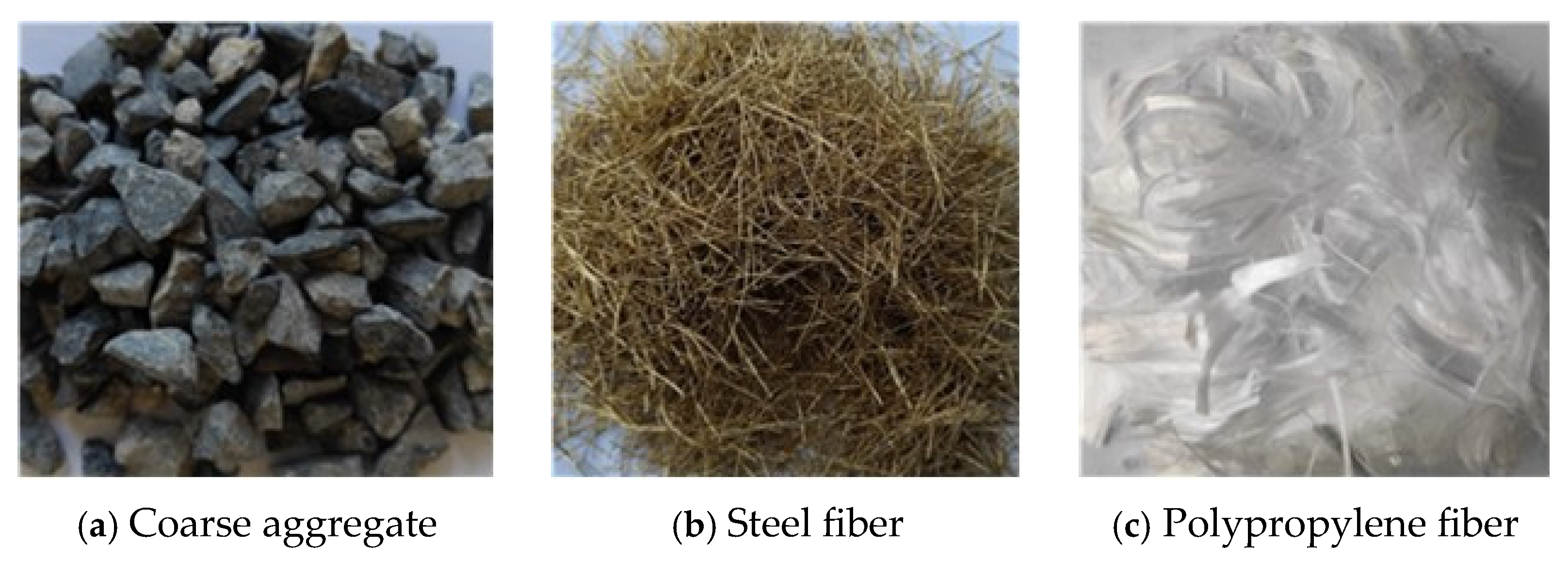
Figure 1. CA and fibers.
Coatings 16 00046 g001
Figure 2. Specimen preparation process.
Coatings 16 00046 g002
Figure 3. Schematic diagram of loading devices.
Coatings 16 00046 g003
Figure 4. Failure mode of cube specimens.
Coatings 16 00046 g004
Figure 5. Failure mode of prism specimens.
Coatings 16 00046 g005
Figure 6. Splitting tensile failure mode of specimens.
Coatings 16 00046 g006
Figure 7. The variation range of compressive strength with fiber content.
Coatings 16 00046 g007
Figure 8. The variation range of splitting tensile strength with fiber content.
Coatings 16 00046 g008
Figure 9. The variation range of elastic modulus with fiber content.
Coatings 16 00046 g009
Figure 10. The variation range of Poisson’s ratio with fiber content.
Coatings 16 00046 g010
Figure 11. Stress–strain curves of SPFRC.
Coatings 16 00046 g011
Figure 12. Fitting curve of cube compressive strength under different changing parameters.
Coatings 16 00046 g012
Figure 13. Fitting curves of axial compressive strength under different changing parameters.
Coatings 16 00046 g013
Figure 14. Fitting curves of splitting tensile strength under different parameters.
Coatings 16 00046 g014
Figure 15. Fitting curves of elastic modulus of specimen under different changing parameters.
Coatings 16 00046 g015
Figure 16. Non-dimensional stress–strain curves of SPFRC.
Coatings 16 00046 g016
Figure 17. Comparison between the experimental curve and the calculated curve of SPFRC under different parameters.
Coatings 16 00046 g017aCoatings 16 00046 g017bCoatings 16 00046 g017c
Figure 18. Comparison of the calculated curve of the model with the experimental curve of the literature [56].
Coatings 16 00046 g018
Figure 19. Comparison of the calculated curve of the model with the experimental curve of reference [57].
Coatings 16 00046 g019
Figure 20. The comparison between the calculated curve of the model and the experimental curve of the literature [54].
Coatings 16 00046 g020
Table 1. Basic properties of fibers.
Fiber TypeDensity (g/cm3)Length
(mm)
Diameter (mm)Breaking Elongation (%)Tensile Strength (MPa)Elastic Modulus (GPa)Poisson’s Ratio
SF7.85130.22965552.1
PP0.9112255605.18
Table 2. Mix proportion of SPFRC (kg/m3).
Specimen NumberW/BSand Ratio/%WaterCementFly AshCoarse AggregateFine AggregateSteel FiberPolypropylene FiberWater ReducerSlump/mm
S0P00.4732200355711206.3567.7002.13167
S0P0.10.4732200355711206.3567.700.912.13151
S0P0.250.4732200355711206.3567.702.282.13136
S0P0.50.4732200355711206.3567.704.552.13121
S0.5P00.4732200355711206.3567.73902.13154
S0.5P0.10.4732200355711206.3567.7390.912.13137
S0.5P0.250.4732200355711206.3567.7392.282.13121
S0.5P0.50.4732200355711206.3567.7394.552.13106
S1P00.4732200355711206.3567.77802.13141
S1P0.10.4732200355711206.3567.7780.912.13120
S1P0.250.4732200355711206.3567.7782.282.13102
S1P0.50.4732200355711206.3567.7784.552.1387
S1.5P00.4732200355711206.3567.711702.13132
S1.5P0.10.4732200355711206.3567.71170.912.13109
S1.5P0.250.4732200355711206.3567.71172.282.1391
S1.5P0.50.4732200355711206.3567.71174.552.1376
Table 3. Peak strain of SPFRC.
Specimen Number ε Specimen Number ε Specimen Number ε Specimen Number ε
S0P02.23S0.5P02.26S1P02.31S1.5P02.57
S0P0.12.4S0.5P0.12.42S1P0.12.59S1.5P0.12.64
S0P0.252.41S0.5P0.252.45S1P0.252.62S1.5P0.252.67
S0P0.52.64S0.5P0.52.67S1P0.52.71S1.5P0.52.71
Table 4. Toughness and toughening factor of SPFRC.
Specimen NumberR1R2 η R 1 η R 2
S0P035.2728.090.000.00
S0P0.141.1060.550.171.16
S0P0.2546.4779.670.321.84
S0P0.545.36119.870.293.27
S0.5P043.7173.820.241.63
S0.5P0.148.8977.390.391.76
S0.5P0.2554.48109.950.542.91
S0.5P0.555.80126.930.583.52
S1P048.09100.370.362.57
S1P0.150.88116.300.443.14
S1P0.2553.27136.600.513.86
S1P0.557.93149.260.644.31
S1.5P056.84118.060.613.20
S1.5P0.158.18138.270.653.92
S1.5P0.2561.08151.930.734.41
S1.5P0.562.14162.520.764.79
Disclaimer/Publisher’s Note: The statements, opinions and data contained in all publications are solely those of the individual author(s) and contributor(s) and not of MDPI and/or the editor(s). MDPI and/or the editor(s) disclaim responsibility for any injury to people or property resulting from any ideas, methods, instructions or products referred to in the content.