Article

Sol–Gel CaCO3/SiO2 Boost Anti-Flashover Silicones

1
School of Materials Science and Engineering, Xihua University, Chengdu 610039, China
2
The Laboratory of Advanced Energetic Materials and Devices, Xihua University, Chengdu 610039, China
3
Dongfang Electric Corporation Dongfang Electric Machinery Co., Ltd., Deyang 618000, China
*
Authors to whom correspondence should be addressed.
Coatings 2026, 16(1), 105; https://doi.org/10.3390/coatings16010105
Submission received: 26 September 2025 / Revised: 31 December 2025 / Accepted: 9 January 2026 / Published: 13 January 2026
(This article belongs to the Special Issue Advanced Anti-Fouling and Anti-Corrosion Coatings)

Abstract

This study developed high-performance anti-flashover silicone coatings using sol–gel-synthesized CaCO3/SiO2 hierarchical fillers optimized via L16(45) orthogonal design. The optimal filler (Sample 5) was prepared under 70 vol% ethanol, with nTEOS:nCaCO3 = 1:1 and 0.2 mol/L NH3·H2O, at 45 °C, for 18 h, featuring covalent Si-O-Ca bonding, a dual-scale microstructure (2–4 μm CaCO3 cores + 20–40 nm SiO2 nodules), a 14.44 m2/g specific surface area, and bimodal porosity (8–80 nm). Composite C7 (30 wt% filler, 3 wt% KH-570, 1:2 resin-to-filler ratio) achieved superhydrophobicity (a 153° contact angle via Cassie-Baxter stabilization), ultrahigh electrical insulation (3.20 × 10¹⁴ Ω·cm volume resistivity, 1.60 × 10¹³ Ω surface resistivity), and robust mechanical properties (Shore 3H hardness, 5B adhesion). Standardized IEC 60507:2020 tests showed that C7’s flashover voltages (14.8 kV for KMnO4, 14.3 kV for NaCl/KMnO4, 13 kV for NaCl) exceeded that of neat silicone resin (NSR) and conventional CaCO3-filled composite (SR-CC) by >135%. Additionally, C7 retained superhydrophobicity after 500 h UV aging and maintained a 124° contact angle after 12 months of outdoor exposure. The superior performance stems from synergistic hierarchical topology, tortuous discharge paths, and interfacial passivation. This work establishes a microstructure-driven design paradigm for grid protection materials in harsh environments.

1. Introduction

High-voltage electrical insulators are critically vulnerable to pollution flashover (PF), a catastrophic failure mode triggered by the conductive leakage currents that form across insulator surfaces under contaminated, humid conditions [1,2,3]. This phenomenon jeopardizes grid stability worldwide, especially in coastal [4], industrial [5], or arid regions prone to airborne salt/dust deposition [6]. Silicone rubber SR coatings [7,8], prized for their intrinsic hydrophobicity and hydrophobicity transfer capability, have become the frontline defense against PF. However, conventional SR formulations are loaded with micron-sized mineral fillers [9,10]. Furthermore, aluminum trihydrateand silica exhibit inherent limitations: insufficient hydrophobicity retention under severe wet pollution stress, moderate electrical insulation, and inadequate mechanical robustness—particularly when high filler loadings compromise interfacial adhesion [11] and introduce defect pathways for discharge initiation [12].
The pivotal role of extreme hydrophobicity in suppressing leakage currents is well-established [13,14]. Surface wettability fundamentally dictates the formation of continuous conductive water films: hydrophobic surfaces induce discontinuous water droplet formation via high contact angles, i.e., CAs > 120, significantly suppressing leakage currents [15]. Critically, the Cassie-Baxter C−B [16,17] wetting state, where air pockets are stably trapped within microscale and nanoscale surface asperities, creates an energy barrier that prevents droplet spreading and minimizes the solid–liquid contact area [18,19]. Achieving and sustaining this metastable non-wetting state necessitates precisely engineered hierarchical micro-nano topographies integrated with intrinsically hydrophobic chemistry. This demands filler architectures far beyond conventional particulate morphologies.
Sol–gel synthesis [20] offers unparalleled potential for constructing such advanced functional fillers. This technique enables atomic-level control over hybrid inorganic–inorganic interfaces through sequential hydrolysis–condensation reactions, thereby facilitating the formation of covalent bonds between dissimilar phases such as SiO2 and CaCO3. By adjusting precursor ratios, catalysts, solvents, temperature, and reaction duration, one can rationally design multi-scale architectures encompassing nanoporous structures [21], core–shell motifs [22], and controlled surface roughness [23,24]. For anti-flashover applications, sol–gel-derived hybrid fillers thus represent a promising frontier, potentially outperforming conventional fillers via the following: (1) synergistic surface engineering, i.e., integrating micro-scale CaCO3 cores with nano-scale SiO2 features to create dual-scale roughness optimal for C-B state stabilization [25]; (2) covalent interface construction, which entails generating robust Si–O–Ca bonds via dehydration condensation, replacing physically adsorbed interfaces prone to hydrolysis and delamination [26]; (3) tailored porosity architecture, which involves creating bimodal meso-/macro-pores to disrupt electrical discharge paths [27] and enhance contaminant shedding [28]; (4) multi-functionality, i.e., simultaneously enhancing electrical insulation, mechanical reinforcement, and hydrophobic durability within a single composite particle.
However, integrating such engineered fillers into SR matrices poses significant challenges: Filler microstructure, surface chemistry, polymer-filler coupling, and loading fraction profoundly yet non-linearly influence bulk coating properties. Traditional trial-and-error approaches struggle to navigate the vast multi-parameter design space necessary for maximal PF suppression. Furthermore, comprehensive correlation studies linking hierarchical filler synthesis parameters directly to electrical and pollution performance under standardized test conditions are scarce.
This work establishes a pioneering materials design paradigm where hierarchical micro-nano architectures, precisely controlled via orthogonal–optimized sol–gel synthesis and functionalized silane coupling, unlock unprecedented levels of hydrophobicity, electrical insulation, and mechanical durability in silicone composites—a critical advancement for protecting critical power infrastructure against the persistent threat of environmental pollution-induced flashover.

2. Experimental

2.1. Materials

All chemicals were used as received. Industrial-grade calcium carbonate (CaCO3) was purchased from Anhui Jiangdong Technology Powder Co., Ltd. (Xuancheng, China); the absolute ethanol we used was obtained from Chengdu Kelong Chemical Co., Ltd. (Chengdu, China) with ≥99.7% purity; the tetraethyl orthosilicate, TEOS, was from Chengdu Kelong Chemical Co., Ltd. with ≥98% purity; the ammonia hydroxide, NH3⋅H2O, was from Chengdu Kelong Chemical Co., Ltd., with a 25–28 wt% concentration; the γ-Methacryloxypropyltrimethoxysilane (KH-570) was from Chengdu Kelong Chemical Co., Ltd., with ≥98% purity; methyl silicone resin (SH−3021), a low-molecular-weight solvent-borne silicone resin, was purchased from Hubei Longsheng Sihai New Materials Co., Ltd. (Zaoyang, China)

2.2. Synthesis of CaCO3/SiO2 Composite Particles

CaCO3/SiO2 particles were synthesized via the sol–gel method. TEOS hydrolysis/condensation, catalyzed by NH3·H2O, generated SiO2. Dehydration condensation between SiO2 silanol groups, i.e., Si–OH, and CaCO3 surface hydroxyls formed covalent –Si–O–Ca– bonds. For the orthogonal experimental design of L16(45), five factors at four levels were optimized, as shown in Table 1.

2.3. Preparation of Anti-Flashover Coatings

KH-570 was selected as the optimized coupling agent. The KH-570 coupling agent was pre-hydrolyzed in an ethanol/water solution at pH = 4.5 and at 50 °C for 1 h. This modified agent was then incorporated with CaCO3/SiO2 particles and methylphenylsilicone resin, and the mixture was homogenized by ball-milling at 400 rpm for 2 h. After degassing, the suspension was blade-coated onto glass substrates and subjected to a two-stage thermal cure: initial preheating at 80 °C for 1 h followed by main curing at 120 °C for 2 h. Final coatings exhibited a uniform thickness of 0.30 ± 0.02 mm, as verified by ISO 2808 standards. As for the orthogonal experimental design of L9(33), three factors at three levels were studied, as shown in Table 2.

2.4. Characterization Techniques

Characterization techniques were conducted following standardized protocols and instrumentation. For morphology, Scanning Electron Microscopy (SEM) with JEOL JSM-IT800 (Tokyo, Japan) was used; for surface analysis, Contact Angle Measurement with JCY-2 Contact Angle Meter from Shanghai Fangrui Instrument Co., Ltd., China, was employed, and Specific Surface Area (BET) was measured using BSD-PS Surface Area Analyzer from BSD Instruments (Guangdong, China); for crystal structure analysis, X-ray Diffraction (XRD) was performed with the DX-2700BH X-ray Diffractometer from Dandong Haoyuan Instrument Co., Ltd., (Dandong, China). The test conditions were as follows: Cu Kα radiation (λ = 1.5406 Å); tube voltage, 40 kV; tube current, 30 mA; 2θ scanning range, 10°~80°; scanning speed, 5°/min; step size, 0.02°. For UV aging resistance, the Xenon Lamp Aging Test Chamber was used, following the ASTM G155 standard; for electrical properties, Volume/Surface Resistivity was tested in accordance with IEC 62631-3 [29], and AC Flashover Voltage was measured in accordance with IEC 60507:2020 [30]; for mechanical properties, shore hardness was tested using ASTM D3364-20 [31], and cross-cut adhesion was tested using ASTM D3359-23 [32]; for chemical analysis, Fourier Transform Infrared Spectroscopy (FTIR) was carried out with the Bruker Vector-22 FTIR Spectrometer from Bruker Corporation, Germany; for particle analysis, Dynamic Light Scattering (DLS) was performed with Zetasizer Nano ZS from Malvern Panalytical, (Worcestershire, UK) (Model: ZTS1240). All tests adhered to the referenced standards to ensure data reliability. The test conditions were as follows: irradiance, 1.2 kW·m−2; wavelength range, 290~800 nm; relative humidity, 50%; temperature, 50 °C; aging duration, 500 h [33]. For outdoor exposure performance, the outdoor natural exposure test was conducted under ambient weather conditions, with an exposure period from September 2024 to September 2025.

3. Result and Discussion

3.1. Microstructural Evolution and Chemical Bonding Validation of CaCO3/SiO2 Hybrid Fillers

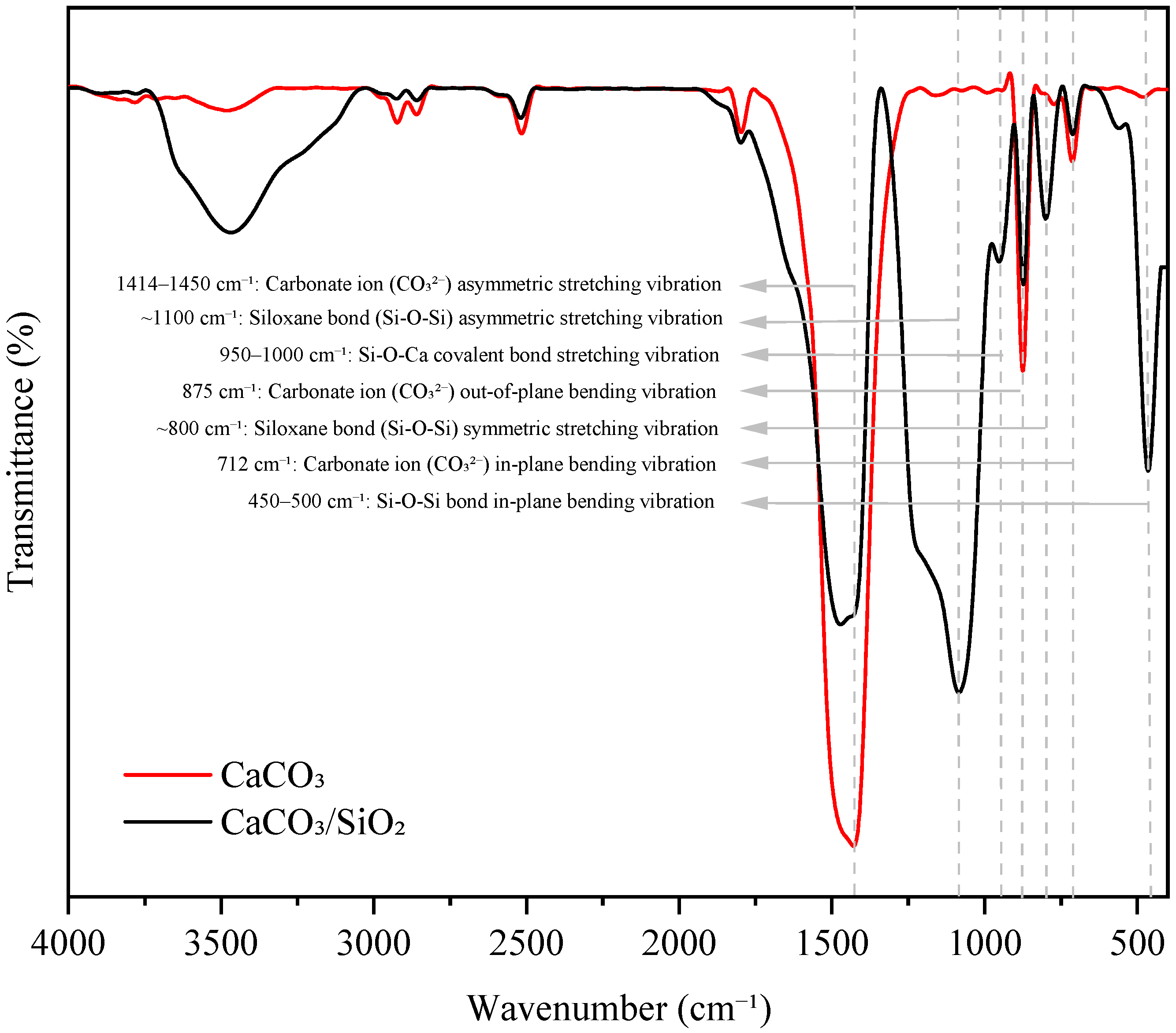
FTIR was employed to elucidate the chemical bonding and structural characteristics of the sol–gel-synthesized CaCO3/SiO2 hybrid composites. For pristine CaCO3, the FTIR spectrum exhibited characteristic peaks of CO32−, including asymmetric stretching at 1410–1450 cm−1, out-of-plane bending at 875 cm−1, and in-plane bending at 712 cm−1 [34]. In contrast, for SiO2 derived from TEOS hydrolysis, the spectra showed characteristic Si-O-Si asymmetric stretching at ~1100 cm−1, symmetric Si-O-Si stretching at ~800 cm−1, and in-plane bending at 450–500 cm−1 [35]. Crucially, for the CaCO3/SiO2 hybrid composites, a distinct peak in the 950–1000 cm−1 range was observed, which was absent in the spectra of pristine CaCO3 or pure SiO2. This peak confirms the formation of covalent Si-O-Ca bonds, arising from the dehydration condensation between the surface hydroxyl groups of CaCO3 and the silanol groups from SiO2 oligomers. Additionally, the intensity of the CO32− peaks in the hybrid particles was reduced compared to that of pristine CaCO3, and a broadened Si-O-Si band at ~1100 cm−1 was observed, indicating the effective encapsulation of CaCO3 microparticles by the SiO2 matrix. The FTIR spectra corresponding to the above structural and bonding analyses are shown in Figure 1.
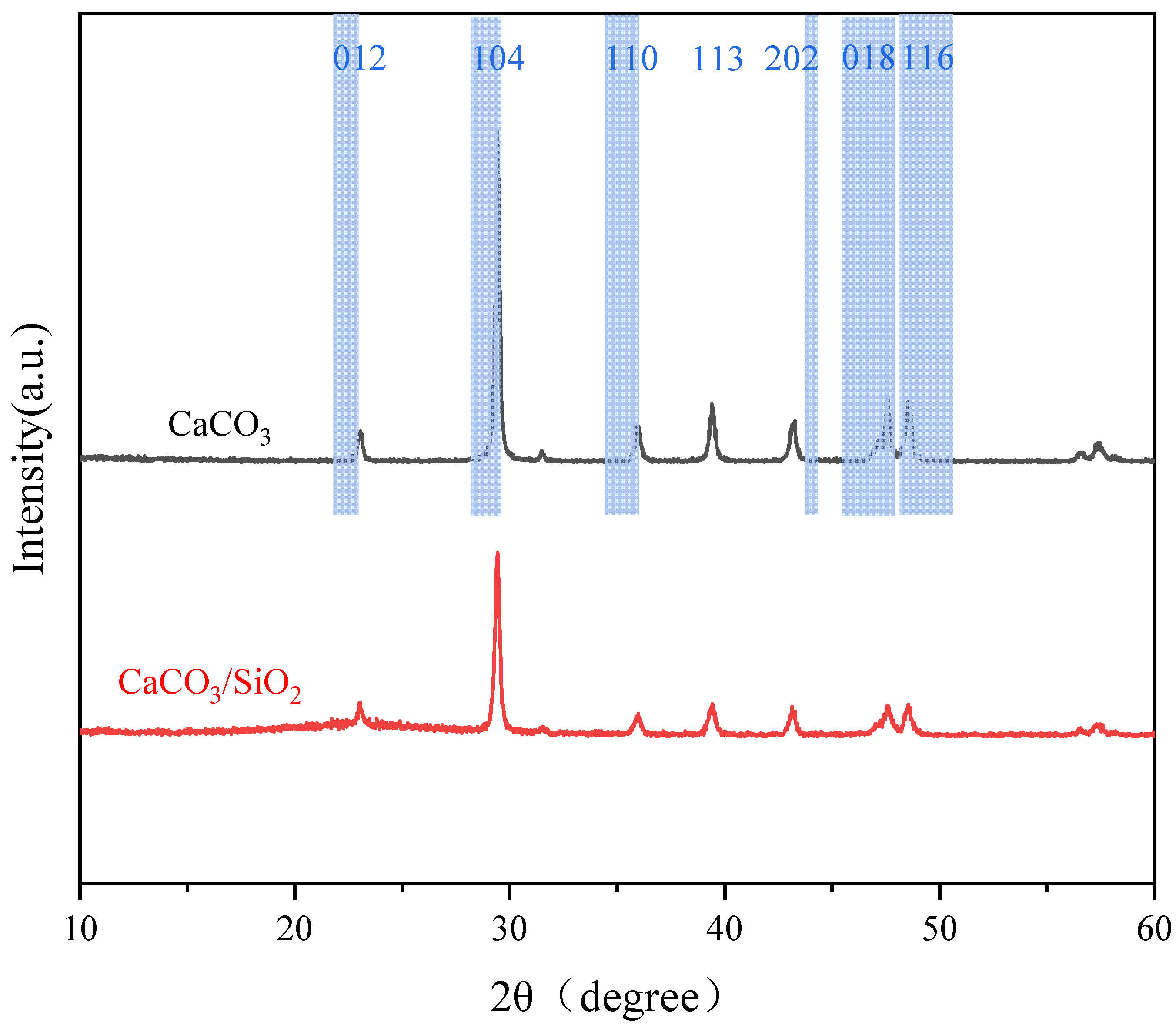
Figure 2 presents the comparative XRD patterns of pristine CaCO3 and CaCO3/SiO2 composite particles, which were utilized to verify the crystal phase structure and interfacial interaction between the two components. For pristine CaCO3, distinct and sharp diffraction peaks can be observed at 2θ values of 29.4°, 36.0°, 39.4°, 43.2°, and 48.5°, which are characteristic of calcite-type CaCO3 (JCPDS No.05-0586) and correspond to the (104), (110), (113), (202), and (116) crystal planes, respectively. Notably, the XRD pattern of the CaCO3/SiO2 composite particles retains all the characteristic diffraction peaks of calcite-type CaCO3 without the emergence of new diffraction peaks, indicating that the introduction of SiO2 via sol–gel synthesis does not alter the crystal structure of CaCO3. Meanwhile, a slight reduction in the intensity of the diffraction peaks of the composite particles is observed compared to that of pristine CaCO3, which can be attributed to the uniform coating of amorphous SiO2 on the surface of CaCO3 microparticles. Amorphous SiO2 exhibits no distinct diffraction peaks, only a broadened “hump” around 2θ ≈ 22°, which is not obvious here due to the low content and uniform dispersion, and its insulating layer weakens the diffraction signal of the underlying CaCO3 crystals. This result is consistent with that of the FTIR analysis (confirming Si-O-Ca covalent bonding) and SEM0 observations (revealing the core–shell microstructure), collectively verifying the successful synthesis of CaCO3/SiO2 hybrid particles where amorphous SiO2 is tightly combined with CaCO3 without causing phase transformation.
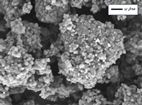
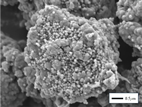
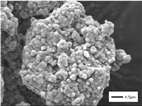
The orthogonal experimental design (L16(45)) effectively revealed the synergistic control of sol–gel parameters on filler morphology. As shown in Table 3, all composites exhibited hierarchical micro-nano architectures featuring micron-scale agglomerates (D50 = 2.34–4.89 μm) decorated with nano-features, consistent with sol–gel self-assembly mechanisms. BET analysis demonstrated significant specific surface area (SSA) variations (1.64–14.44 m2/g), with distinct microstructure categories emerging: a high-SSA group (>10 m2/g, e.g., S5/S9/S13), where there were loose nanoparticle assemblies or porous nanofiber networks with well-developed pore channels; a medium-SSA group (5–10 m2/g, e.g., S1/S2/S4/S15), with rough-surfaced nanosphere aggregates or stacked lamellae; a low-SSA group (<5 m2/g, e.g., S3/S6/S7), with densified monolithic structures where surface nanostructures vanished due to sintering.
The orthogonal design revealed synergistic control of sol–gel parameters on filler architecture, where ethanol concentration (65–80 vol%) inversely regulated polycondensation kinetics—high alcohol content (e.g., 70 vol% in S5) retarded gelation to favor loose networks with uniformly dispersed SiO2 nanoparticles. Notably, Sample 13 (80 vol% ethanol), despite belonging to the high-SSA group (11.90 m2/g), exhibited obvious SiO2 agglomeration as observed by SEM: instead of anchoring uniformly on CaCO3 cores as discrete 20–40 nm nodules (like S5), its SiO2 nanoparticles aggregated into large clusters (>200 nm), leading to uneven surface topology and compromised structural homogeneity. This confirms that excessive ethanol (80 vol%) disrupts the balanced hydrolysis–condensation process, inducing unwanted particle agglomeration. Conversely, elevated NH3·H2O concentration (0.4 mol/L in S7) accelerated coagulation-induced densification, while the nTEOS: nCaCO3 ratio critically modulated pore distribution, with a 1:1 stoichiometry maximizing meso-/macroporosity synergy. This parametric interplay culminated in Sample 5 (70 vol% EtOH, nTEOS: nCaCO3 = 1:1, 0.2 mol/L NH3·H2O, 45 °C, 18 h) exhibiting an ideal hierarchical structure: 20–40 nm SiO2 nanoparticles uniformly anchored on 2–4 μm CaCO3 clusters—free of agglomeration and with optimal dual-scale roughness. The resultant structure facilitated Cassie–Baxter state formation, while interconnected bimodal pores (8–25 nm mesopores + 20–80 nm macropores) suppressed discharge channels through elongated electron tunneling paths—collectively enhancing hydrophobicity and delivering >28% higher flashover voltage versus controls (Section 3.5). In contrast, the agglomerated structure of Sample 13 failed to achieve such performance synergy, further validating the optimality of Sample 5’s synthesis parameters. Given these superior properties, Sample 5 was exclusively selected as the functional filler for all subsequent silicone resin composites (C1-C9), with variations limited to resin/filler/KH570 ratios.

3.2. Hierarchical Filler-Induced Hydrophobicity Leap in Silicone Composites

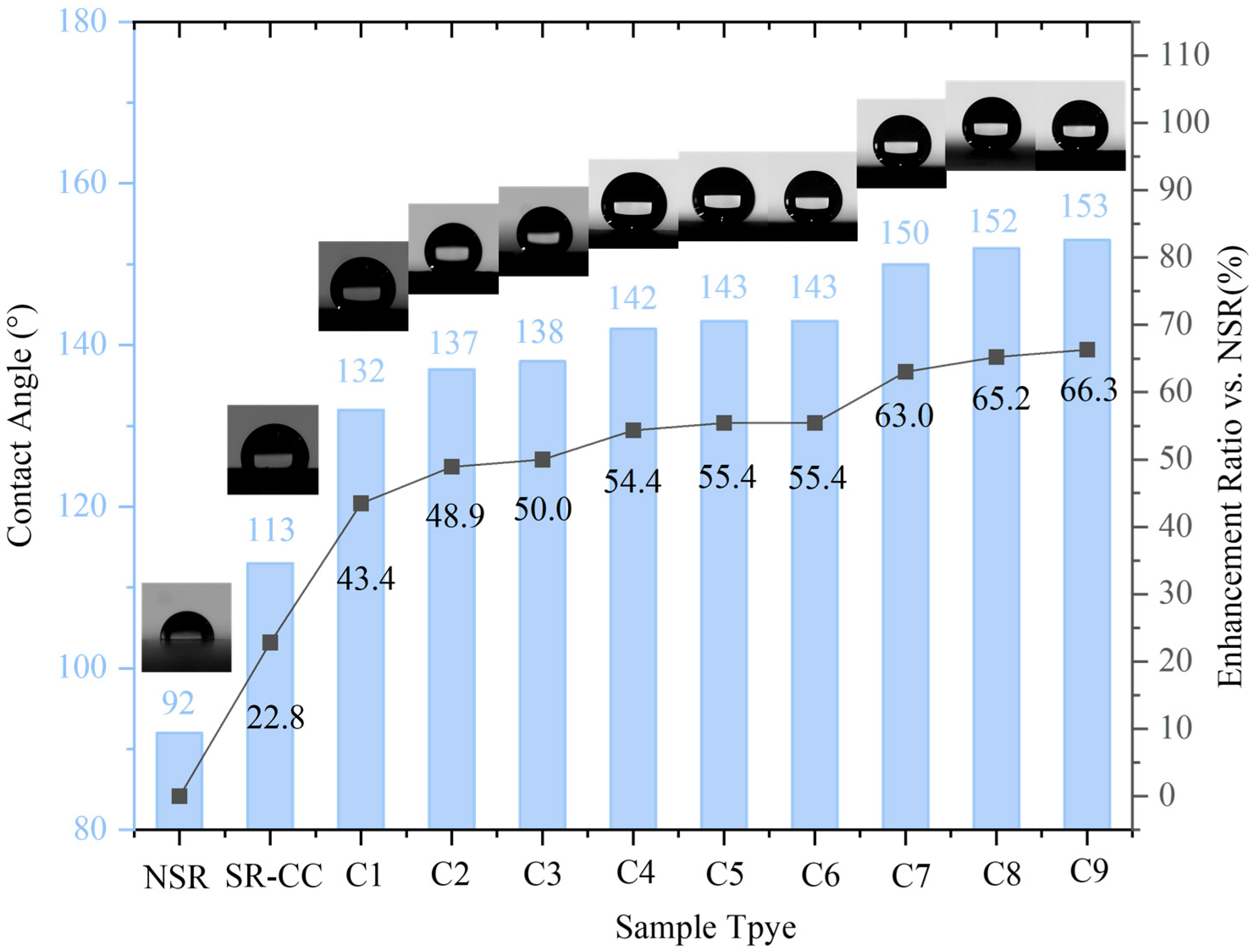
The contact angle (CA) results in Figure 3 confirm C9 as the optimal composite with the highest hydrophobicity: the neat silicone resin (NSR) showed a baseline CA of 92°, the conventional 30 wt% CaCO3-filled composite (SR-CC) reached ~113°, while C9 achieved a peak CA of 153°—surpassing NSR by 61° and SR-CC by 40°. This superior hydrophobicity originates from the CaCO3/SiO2 hierarchical filler’s dual-scale roughness (micron clusters decorated with nano-nodules) in C9, which stabilizes the Cassie–Baxter wetting state by trapping air pockets at the surface. This effectively reduces the solid–liquid contact area, inhibiting water droplet spreading and enhancing hydrophobicity—critical for mitigating pollution flashover on high-voltage insulators.

3.3. Dual Resistivity Analysis

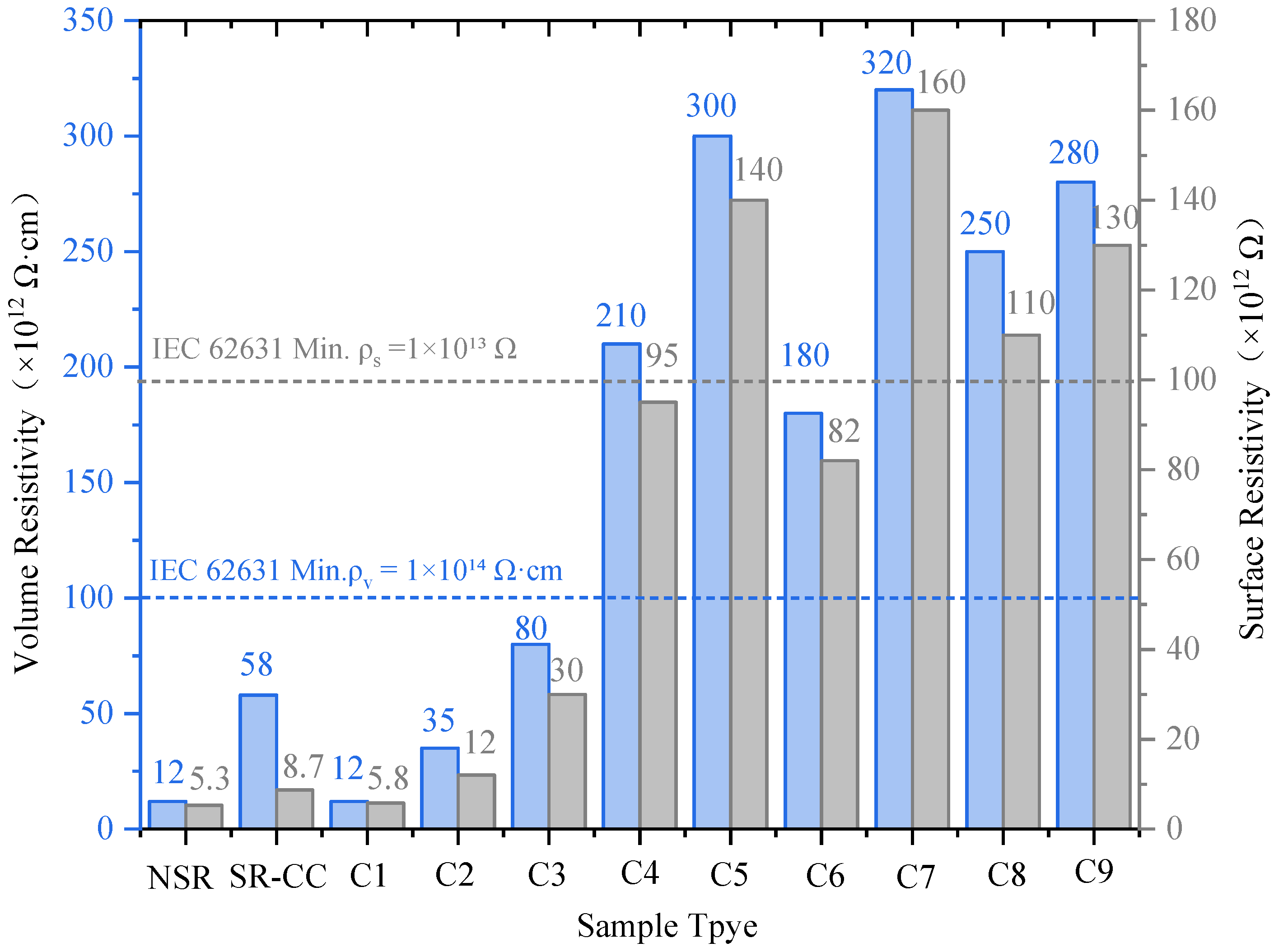
Figure 4 quantifies the exceptional electrical insulation performance of the optimized composite, C7, with its volume resistivity reaching 3.20 × 10¹⁴ Ω·cm and surface resistivity at 1.60 × 10¹³ Ω—values that far surpass that of the neat silicone resin (NSR, ~1013 Ω·cm volume resistivity, ~1012 Ω surface resistivity) and conventional CaCO3-filled composite (SR-CC, similar order to NSR) and fully meet the stringent requirements of the IEC 62631-3 standard. This remarkable enhancement stems from the synergistic effects of the CaCO3/SiO2 hierarchical filler’s unique structure and interfacial design: the amorphous SiO2 shell encapsulated on CaCO3 cores acts as a robust insulating barrier, inherently impeding electron tunneling and ionic conduction; the filler’s bimodal porosity (8–80 nm) physically elongates charge migration paths within the silicone matrix, disrupting continuous conductive pathways; meanwhile, covalent Si–O–Ca bonding and KH-570-mediated interfacial cross-linking minimize micro-voids and defect sites, further suppressing leakage current formation.

3.4. Mechanical Interlocking and Stress Dissipation Mechanisms in Hierarchical Composite Coatings

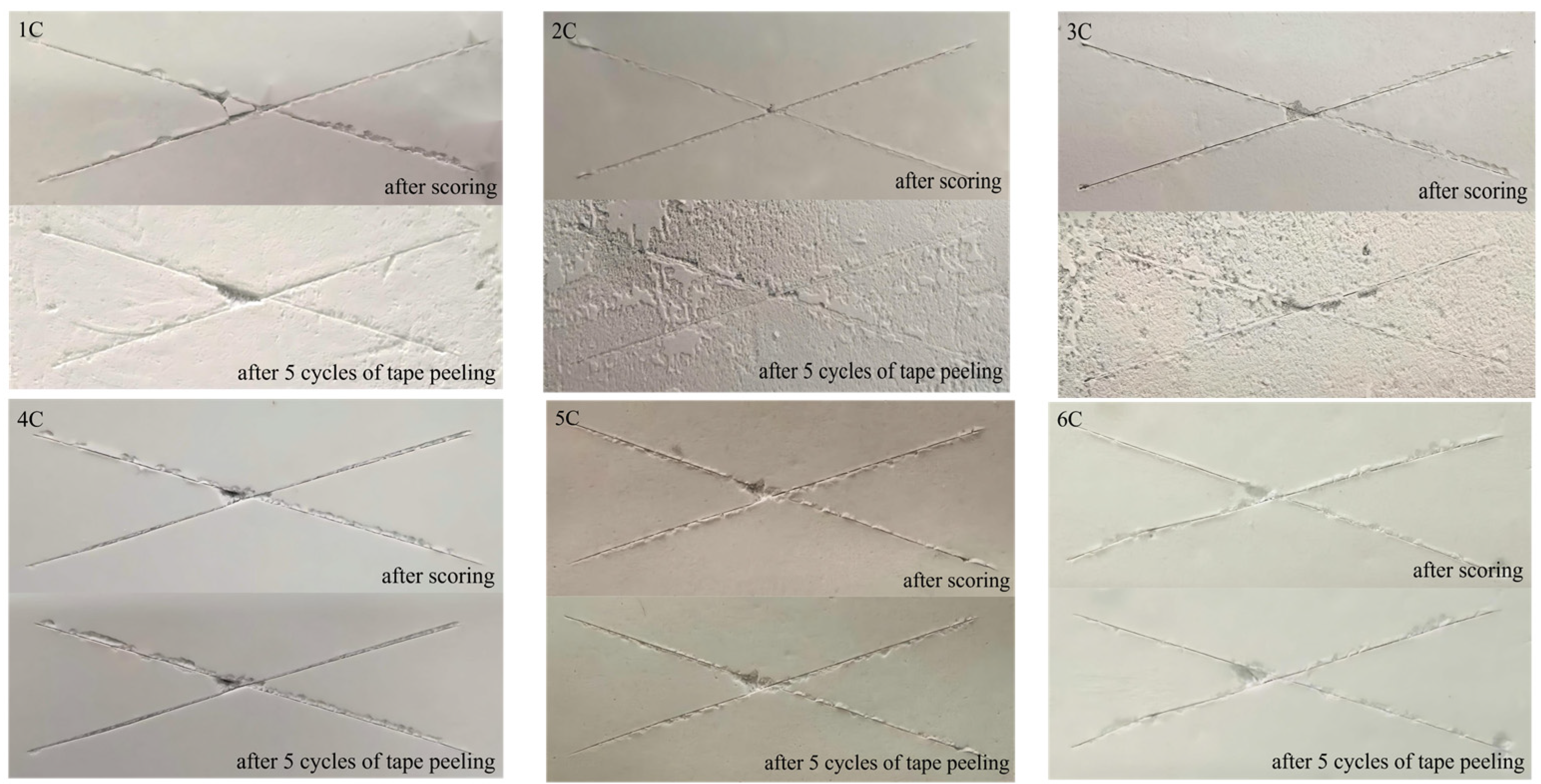
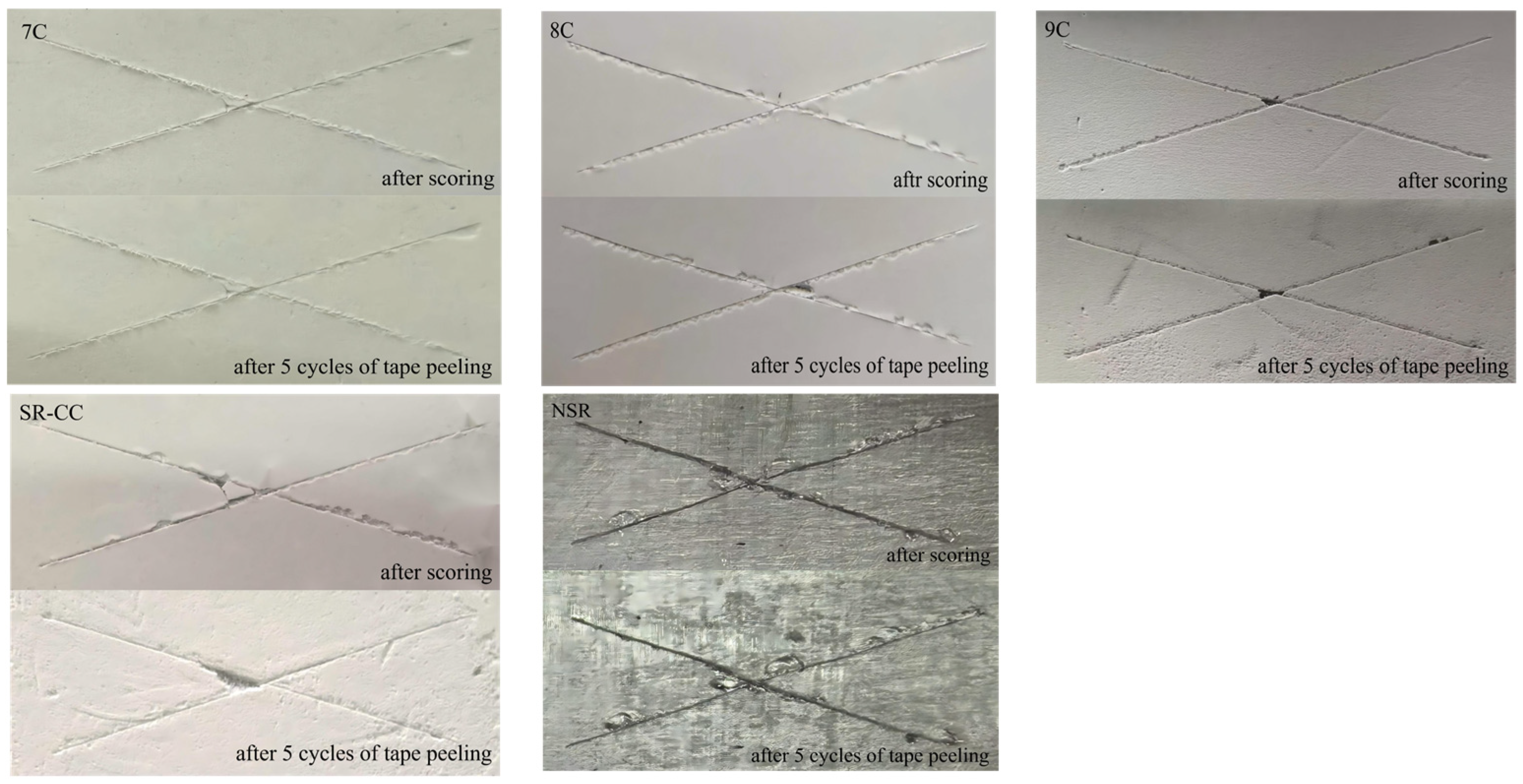
Table 4 and Figure 5 collectively confirm the robust mechanical performance of C7, as evaluated via standardized tests. C7 achieves a Shore 3H hardness and 5B cross-cut adhesion, significantly outperforming that of the neat silicone resin (NSR, 3B hardness) and conventional CaCO3-filled composite (SR-CC, HB hardness). The mechanical reinforcement originates from the hierarchical filler’s dual-scale architecture and enhanced interfacial interaction: micron-sized CaCO3 cores provide bulk structural rigidity, while nano-scale SiO2 nodules augment the interfacial contact area, enabling strong mechanical interlocking with the silicone matrix. Additionally, the KH-570 coupling agent covalently bridges the inorganic filler and organic resin, relieving interfacial stress concentrations and preventing filler detachment under external forces—ensuring the coating maintains structural integrity against environmental abrasion and thermal fluctuations.

3.5. Flashover Resistance Optimization via Hierarchical Filler Design

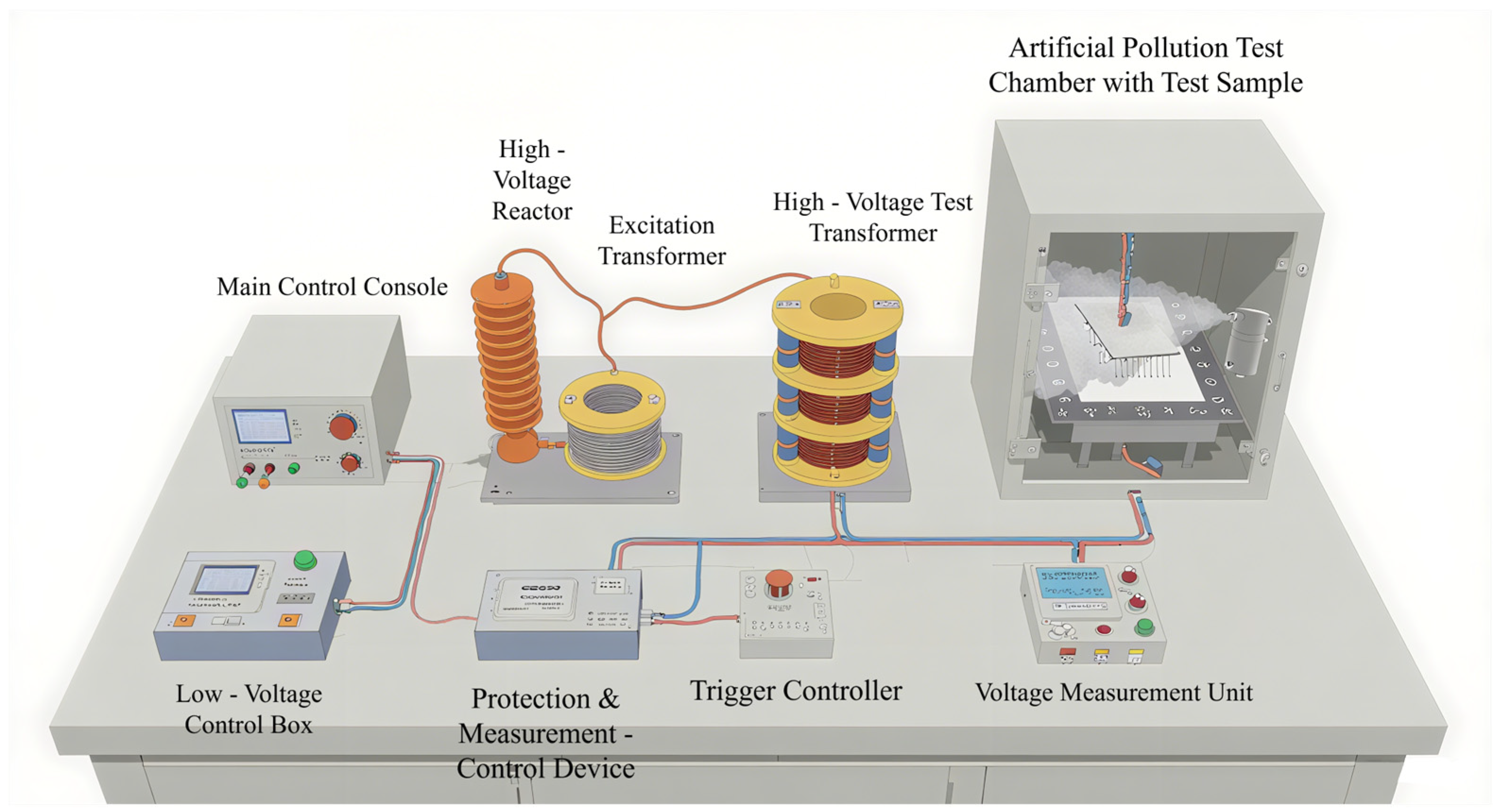
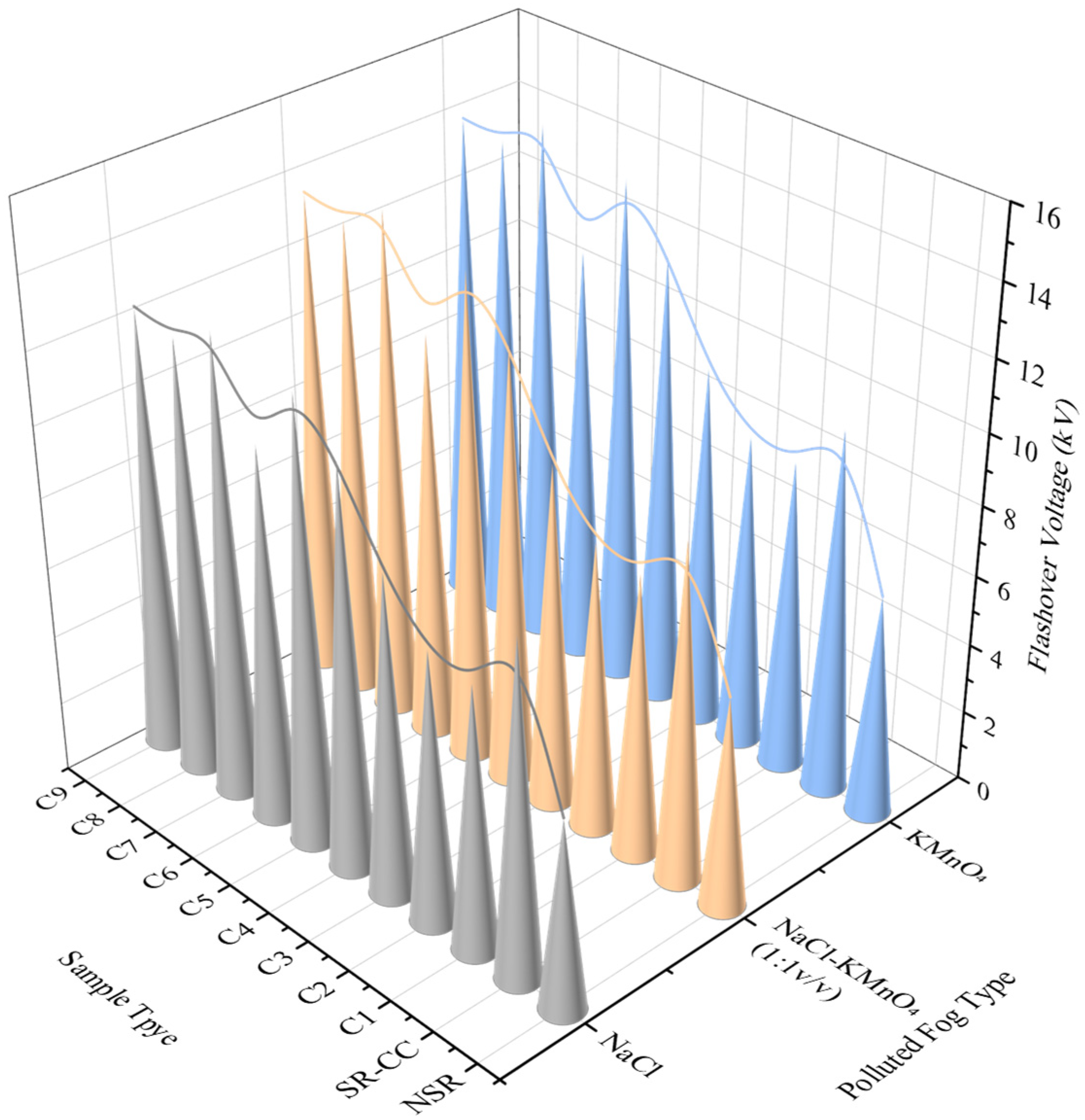
Figure 6 illustrates the standardized pollution flashover test platform compliant with IEC 60507:2020, featuring a needle–plane electrode configuration (1.5 cm air gap) and controlled environmental conditions (80% relative humidity, contaminant solutions with 200 μS/cm conductivity), while Figure 7 quantifies C7’s exceptional anti-flashover capability. Under three representative pollution scenarios (NaCl for coastal salt fog, NaCl/KMnO4 mixture for industrial acid rain, KMnO4 for oxidative pollutants), C7 exhibits peak flashover voltages of 14.8 kV (KMnO4), 14.3 kV (NaCl/KMnO4), and 13 kV (NaCl)—surpassing that of the NSR and SR-CC by >135%. This superiority arises from three synergistic mechanisms: the filler’s hierarchical micro-nano topology promotes contaminant shedding and stabilizes the Cassie–Baxter wetting state, reducing electrolyte film formation; the bimodal porosity and tortuous surface structure elongate discharge paths, dissipating arc energy; and the chemically passivated interface (Si–O–Ca bonds + KH-570 modification) resists oxidative degradation and ionic corrosion, preserving insulation performance under harsh pollution conditions.

3.6. UV Aging and Outdoor Exposure Durability of C7 Coating

Table 5 presents the contact angle (CA) values and surface morphology changes in the NSR, SR-CC, and C7 coatings before and after 500 h of UV irradiation (per ASTM G155-23 standard). The data clearly demonstrate the superior UV aging resistance of the C7 coating compared to that of the control groups. For the neat silicone resin (NSR), the initial CA of 92° decreased by 15.2% to 78° after UV exposure, indicating significant degradation of surface hydrophobicity. This is attributed to the cleavage of Si-O-C bonds and oxidation of hydrophobic methyl (-CH3) groups in the silicone resin under UV radiation, which increases surface energy and promotes water droplet spreading. The conventional CaCO3-filled composite (SR-CC) showed a relatively milder CA reduction (from 113° to 105°, a decrease of 7.1%), as the physical dispersion of CaCO3 particles provided limited shielding against UV penetration. However, the weak interfacial adhesion between CaCO3 and the silicone matrix led to partial particle detachment during aging, resulting in reduced hydrophobicity retention.
In stark contrast, the C7 coating maintained an unchanged CA of 150° even after 500 h of UV irradiation, retaining its superhydrophobic property. This exceptional stability stems from three synergistic protective effects: (1) the amorphous SiO2 shell encapsulated on the CaCO3 core acts as a physical barrier, effectively blocking UV radiation from reaching the silicone resin matrix and inhibiting chemical bond cleavage; (2) the covalent Si-O-Ca bonds between the CaCO3 core and SiO2 shell enhance interfacial stability, preventing filler detachment and preserving the hierarchical micro-nano surface structure; (3) the dual-scale roughness (2–4 μm CaCO3 clusters decorated with 20–40 nm SiO2 nodules) stabilizes the Cassie–Baxter wetting state, minimizing the impact of minor surface oxidation on overall hydrophobicity.
Table 6 illustrates the evolution of CA and the surface morphology of the three coatings over 12 months of outdoor natural exposure. Consistent with the UV aging results, the C7 coating exhibited remarkable long-term hydrophobicity retention, outperforming NSR and SR-CC under complex natural weathering conditions (including UV radiation, rainfall erosion, temperature fluctuations, and atmospheric dust deposition).
The NSR coating showed the most severe hydrophobicity degradation, with the CA decreasing continuously from 92° to 63° over 12 months (a total reduction of 31.5%). This is due to the combined effects of prolonged UV oxidation and physical erosion, which compromise the surface integrity of the resin and eliminate residual hydrophobicity. The SR-CC coating displayed moderate durability, with the CA decreasing from 113° to 76° (a 32.7% reduction), as the lack of effective interfacial bonding and UV shielding led to gradual filler detachment and resin degradation. In comparison, the C7 coating maintained a high CA of 124° after 12 months of exposure, with only a 17.3% reduction from the initial 150°. The hierarchical micro-nano structure of C7 facilitates contaminant shedding and water droplet rolling, while the SiO2 encapsulation layer resists UV oxidation and moisture penetration. Additionally, the covalent cross-linking between the filler and resin matrix (enhanced by KH-570) suppresses interfacial defects, ensuring structural integrity under long-term environmental stress.

4. Conclusions

This study successfully developed high-performance anti-flashover silicone coatings via sol–gel-engineered CaCO3/SiO2 hierarchical fillers, addressing conventional coatings’ limitations. Orthogonal optimization yielded Sample 5 with a dual-scale core–shell structure, covalent Si-O-Ca bonding, and bimodal porosity—key to multifunctional enhancement. Composite C7 achieved superhydrophobicity (a 153° contact angle), ultrahigh insulation (3.20 × 10¹⁴ Ω·cm volume resistivity, 1.60 × 10¹³ Ω surface resistivity), robust mechanics (shore 3H hardness, 5B adhesion), and >135% higher flashover voltage compared to the controls. It also exhibited exceptional durability, retaining superhydrophobicity after 500 h UV aging and maintaining a 124° contact angle post-12-month outdoor exposure. These improvements stem from synergistic hierarchical topology, tortuous discharge paths, and interfacial passivation. This work validates microstructure–property synergy via sol–gel synthesis and orthogonal optimization, providing a viable pathway for next-generation grid protection materials in harsh environments.

Author Contributions

Conceptualization, R.L. and Y.Z.; Methodology, R.L.; Software, R.L.; Validation, R.L. and Y.Z.; Formal analysis, R.L.; Investigation, R.L.; Resources, R.L. and Y.Z.; Data curation, R.L.; Writing—original draft, R.L.; Writing—review & editing, S.M. and Y.Z.; Visualization, R.L.; Supervision, S.M. and Y.Z.; Project administration, Y.L.; Funding acquisition, Y.L. All authors have read and agreed to the published version of the manuscript.

Funding

This work was funded by the Laboratory of Advanced Energetic Materials and Devices.

Institutional Review Board Statement

Not applicable.

Informed Consent Statement

Not applicable.

Data Availability Statement

The original contributions presented in this study are included in the article. Further inquiries can be directed to the corresponding authors.

Conflicts of Interest

Yan Liu and Yue Zhang were employed by the company Dongfang Electric Corporation Dongfang Electric Machinery Co., Ltd. The remaining authors declare that the research was conducted in the absence of any commercial or financial relationships that could be construed as a potential conflict of interest.

References

  1. Maraaba, L.; Al-Soufi, K.; Ssennoga, T.; Memon, A.M.; Worku, M.Y.; Alhems, L.M. Contamination level monitoring techniques for high-voltage insulators: A review. Energies 2022, 15, 7656. [Google Scholar] [CrossRef]
  2. Salem, A.A.; Lau, K.Y.; Rahiman, W.; Abdul-Malek, Z.; Al-Gailani, S.A.; Mohammed, N.; Rahman, R.A.; Al-Ameri, S.M. Pollution flashover voltage of transmission line insulators: Systematic review of experimental works. IEEE Access 2022, 10, 10416–10444. [Google Scholar] [CrossRef]
  3. Salem, A.A.; Abd-Rahman, R.; Rahiman, W.; Al-Gailani, S.A.; Al-Ameri, S.M.; Ishak, M.T.; Sheikh, U.U. Pollution flashover under different contamination profiles on high voltage insulator: Numerical and experiment investigation. IEEE Access 2021, 9, 37800–37812. [Google Scholar] [CrossRef]
  4. Su, H.; Jia, Z.; Guan, Z.; Li, L. Mechanism of contaminant accumulation and flashover of insulator in heavily polluted coastal area. IEEE Trans. Dielectr. Electr. Insul. 2010, 17, 1635–1641. [Google Scholar] [CrossRef]
  5. Dahham, I.A. Effect of the Combined Pollution of Brick Industry and Sandstorms on the Performance of High Voltage Insulators and Flashover Phenomenon. Tikrit J. Eng. Sci. 2018, 25, 69–73. [Google Scholar] [CrossRef]
  6. Pang, M.-S.; Kim, W.-J.; Kim, Y.-S.; Kim, S.-H. Corona Discharge Characteristics of Transformer Bushing Model with Contaminnations in Air. J. Korean Inst. Illum. Electr. Install. Eng. 2012, 26, 91–96. [Google Scholar] [CrossRef]
  7. Liu, S.; Zhou, Y.; Zuo, Z.; Liu, S.; Wang, Q.; Chen, Z.; Liang, X. Inhibiting liquid permeation into silicone rubber by superhydrophobic coating for prolonged service life. High Volt. 2023, 8, 986–996. [Google Scholar] [CrossRef]
  8. Yang, X.; Qin, L.; He, D. Preparation and heat resistance of hollow glass microbead/silicone rubber composite coating. J. Appl. Polym. Sci. 2024, 141, e54895. [Google Scholar] [CrossRef]
  9. Vinod, P.; Babu, M.S.; Sarathi, R.; Kornhuber, S. Impact of Salt Fog Aging on Space Charge and Charge Trap-Controlled Mobility Characteristics of Silicone Rubber Micro-nanocomposites. J. Electron. Mater. 2021, 50, 5881–5890. [Google Scholar] [CrossRef]
  10. Kumar, V.; Alam, N.; Manikkavel, A.; Song, M.; Lee, D.-J.; Park, S.-S. Polymers Silicone Rubber Composites Reinforced by Carbon Nanofillers and Their Hybrids for Various Applications: A Review. Polymers 2021, 13, 2322. [Google Scholar] [CrossRef] [PubMed]
  11. Bokobza, L. Elastomer Nanocomposites: Effect of Filler–Matrix and Filler–Filler Interactions. Polymers 2023, 15, 2900. [Google Scholar] [CrossRef] [PubMed]
  12. Kurnianto, R.; Murakami, Y.; Nagao, M.; Hozumi, N. Investigation of filler effect on treeing phenomenon in epoxy resin under ac voltage. IEEE Trans. Dielectr. Electr. Insul. 2008, 15, 1112–1119. [Google Scholar] [CrossRef]
  13. Jiang, X.; Zhao, S.; Zhang, Z. Impacts of Contamination and Hydrophobicity Level on the Leakage Currents of Composite Insulators. Gaodianya Jishu/High Volt. Eng. 2013, 39, 2573–2580. [Google Scholar] [CrossRef]
  14. Lhan, S.; Aslan, Z. Investigation on leakage current, erosion, and hydrophobic performance of high-voltage insulator coatings of different thicknesses. Turk. J. Electr. Eng. Comput. Sci. 2020, 28, 1197–1207. [Google Scholar] [CrossRef]
  15. Kim, T.; Yi, J. Application of hydrophobic coating to reduce leakage current through surface energy control of high voltage insulator. Appl. Surf. Sci. 2022, 578, 151820. [Google Scholar] [CrossRef]
  16. Choi, W.; Tuteja, A.; Mabry, J.M.; Cohen, R.E.; McKinley, G.H. A modified Cassie–Baxter relationship to explain contact angle hysteresis and anisotropy on non-wetting textured surfaces. J. Colloid. Interface Sci. 2009, 339, 208–216. [Google Scholar] [CrossRef]
  17. Erbil, H.Y.; Cansoy, C.E. Range of applicability of the Wenzel and Cassie-Baxter equations for superhydrophobic surfaces. Langmuir 2009, 25, 14135–14145. [Google Scholar] [CrossRef]
  18. Elbourne, A.; Dupont, M.F.; Collett, S.; Truong, V.K.; Xu, X.; Vrancken, N.; Baulin, V.; Ivanova, E.P.; Crawford, R.J. Imaging the air-water interface: Characterising biomimetic and natural hydrophobic surfaces using in situ atomic force microscopy. J. Colloid Interface Sci. 2018, 536, 363–371. [Google Scholar] [CrossRef]
  19. Vandadi, A.; Zhao, L.; Cheng, J.T. Energy analysis of condensate growth on superhydrophobic surfaces with hierarchical roughness. In Proceedings of the 13th International Conference on Heat Transfer, Fluid Mechanics and Thermodynamics 2017, Portoroz, Slovenia, 17–19 July 2017. [Google Scholar]
  20. Min, H.; Wu, Y.; Wen, J.; Guo, J.; Jiang, S.; Cheng, J. Sol-gel synthesized TiO2-chitosan nanocomposite as antibacterial coating for orthopedic implants: Investigation of properties and antimicrobial mechanisms. Alex. Eng. J. 2025, 129, 572–581. [Google Scholar] [CrossRef]
  21. Zhu, X.-Y.; Hu, P.; Xing, H.-R.; Yang, F.; Wang, X.-Y.; Ge, S.-W.; Hua, X.-J.; He, C.-J.; Zhang, X.-Y.; Wang, K.-S. Preparation of nanoporous flake molybdenum powder by sol-gel reduction method. Mater. Charact. 2022, 187, 111879. [Google Scholar] [CrossRef]
  22. Yeh, M.Y.; Yang, T.Y.; Wu, T.C.; Lee, S.Y.; Chang, S.H. Visible-light photocatalytic activity of Fe@TiO2 core-shell composite synthesized by sol-gel method. Int. J. Mod. Phys. B 2020, 34, 2040127. [Google Scholar] [CrossRef]
  23. Ranella, A.; Barberoglou, M.; Bakogianni, S.; Fotakis, C.; Stratakis, E. Tuning cell adhesion by controlling the roughness and wettability of 3D micro/nano silicon structures. Acta Biomater. 2010, 6, 2711–2720. [Google Scholar] [CrossRef] [PubMed]
  24. Kim, J.; Kumar, U.P.; Lee, S.-J.; Kim, C.-L.; Lee, J.-W. Implementation of endurable superhydrophobic surfaces through dilution rate control of the PDMS coating on micro-nano surface structures. Polymer 2023, 275, 125929. [Google Scholar] [CrossRef]
  25. Hemmati, K.; Saievar-Iranizad, E.; Hosseinzadeh, A. Investigating the Effect of Hierarchical Carbon Micro/Nano Spheres on the Surface Wettability: Experimental and Theoretical Study. J. Optoelectron. Nanostruct. 2021, 5, 33–48. [Google Scholar]
  26. Hou, L.; Zheng, Y.; Wang, Y.; Hu, Y.; Shi, J.; Liu, Q.; Zhang, H.; Zhang, Z. Self-Regulated Carboxyphenylboronic Acid-Modified Mesoporous Silica Nanoparticles with “Touch Switch” Releasing Property for Insulin Delivery. ACS Appl. Mater. Interfaces 2018, 10, 21927–21938. [Google Scholar] [CrossRef]
  27. Chen, J.; Zhuang, J.Y.; Hong, Y.L.; Huang, J.T. Effect of Pore Size on Partial Discharge in Ultra-High Voltage Ceramic Capacitors. Key Eng. Mater. 2017, 726, 235–239. [Google Scholar] [CrossRef]
  28. Fink, D.; Kueppers, U.; Rojas-Chapana, J.; Tributsch, H. Flexible, Breathable Polymer Film and Method for Production Therof. WO2004064478A2, 8 August 2006. [Google Scholar]
  29. IEC 62631-3-1:2016; Dielectric and Resistive Properties of Solid Insulating Materials—Part 3-1: Determination of Resistive Properties (DC Methods)—Volume Resistance and Volume Resistivity—General Method. International Electrotechnical Commission: Geneva, Switzerland, 2016.
  30. IEC 60507:2020; Artificial Pollution Tests on High-Voltage Ceramic and Glass Insulators to be Used on a.c. Systems. International Electrotechnical Commission: Geneva, Switzerland, 2020.
  31. ASTM D3364-20; Standard Test Method for Flow Rates for Poly (Vinyl Chloride) with Molecular Structural Implications. ASTM International: West Conshohocken, PA, USA, 2020.
  32. ASTM D3359-23; Standard Test Methods for Rating Adhesion by Tape Test. ASTM International: West Conshohocken, PA, USA, 2023.
  33. ASTM G155-23; Standard Practice for Operating Xenon Arc Light Apparatus for Exposure of Nonmetallic Materials. ASTM International: West Conshohocken, PA, USA, 2023.
  34. Hollett, M.J. The Spectroscopic Analysis of Vaterite and Other Forms of Calcium Carbonate. Ph.D. Theses, University of Newfoundland, St. John’s, NL, Canada, 2000. [Google Scholar]
  35. Shokri, B.; Firouzjah, M.A.; Hosseini, S.I. FTIR analysis of silicon dioxide thin film deposited by Metal organic-based PECVD. In Proceedings of the 19th International Symposium on Plasma Chemistry Society, Bochum, Germany, 26–31 July 2009. [Google Scholar]
Figure 1. Comparative FTIR spectra of pristine CaCO3 and composite particles.
Coatings 16 00105 g001
Figure 2. Comparative XRD patterns of pristine CaCO3 and composite particles.
Coatings 16 00105 g002
Figure 3. Contact angle and enhancement ratio of silicone resin composites with hierarchical CaCO3/SiO2 fillers. Note: Sample codes: NSR: Neat Silicone Resin Control; SR-CC: silicone resin/30% CaCO3 composite; C1-C9: CaCO3-SiO2 hybrid composites with orthogonal formulations. See Table 2 for orthogonal formulations.
Coatings 16 00105 g003
Figure 4. Volume and surface resistivity of NSR, SR-CC, and C1–C9 composites.
Coatings 16 00105 g004
Figure 5. Adhesion: NSR vs. C1–C9 (ASTM D3359).
Coatings 16 00105 g005aCoatings 16 00105 g005b
Figure 6. Schematic of flashover voltage test platform for anti-pollution evaluation with artificial pollution chamber.
Coatings 16 00105 g006
Figure 7. Three-dimensional flashover voltage: NSR/SR-CC/C1–C9 under varied environments.
Coatings 16 00105 g007
Table 1. Orthogonal array (L16(45)) for the synthesis of CaCO3/SiO2 composite particles.
SampleEthanol (vol)nCaCO3: nTEOSNH3·H2O (mol/L)Temp. (°C)Time (h)
1651:0.50.2359
2651:10.34012
3651:1.50.44515
4651:20.55018
5701:10.24518
6701:0.50.35015
7701:20.43512
8701:1.50.5409
9751:1.50.25012
10751:20.3459
11751:0.50.44018
12751:10.53515
13801:20.24015
14801:1.50.33518
15801:10.4509
16801:0.50.54512
Table 2. Orthogonal array (L9(33)) for coating formulation.
SampleFiller Loading (wt)Resin-Filler Mass RatioKH-570 (wt)
C1102:10
C2101:11
C3101:23
C4202:11
C5201:13
C6201:20
C7302:13
C8301:10
C9301:21
Table 3. Orthogonal experimental samples: SEM Particle Size-BET SSA Correlation.
SampleSpecific Surface Area
(m2/g)
SEM Image LocationSampleSpecific Surface Area
(m2/g)
SEM Image Location
Median Particle Size (μm)Median Particle Size (μm)
CaCO3SSA: 21.35
D50: 0.2
Coatings 16 00105 i0019SSA: 11.32
D50: 4.5
Coatings 16 00105 i002
1SSA: 5.97
D50: 2.53
Coatings 16 00105 i00310SSA: 3.07
D50: 2.98
Coatings 16 00105 i004
2SSA: 6.63
D50: 4.21
Coatings 16 00105 i00511SSA: 1.64
D50: 2.34
Coatings 16 00105 i006
3SSA: 2.54
D50: 2.83
Coatings 16 00105 i00712SSA: 2.97
D50: 2.84
Coatings 16 00105 i008
4SSA: 5.85
D50: 4.45
Coatings 16 00105 i00913SSA: 11.90
D50: 4.25
Coatings 16 00105 i010
5SSA: 14.44
D50: 4.22
Coatings 16 00105 i01114SSA: 3.77
D50: 4.18
Coatings 16 00105 i012
6SSA: 2.51
D50: 2.97
Coatings 16 00105 i01315SSA: 6.91
D50: 4.89
Coatings 16 00105 i014
7SSA: 4.18
D50: 3.5
Coatings 16 00105 i01516SSA: 3.90
D50: 2.83
Coatings 16 00105 i016
8SSA: 3.22
D50: 3.63
Coatings 16 00105 i017
Table 4. Shore hardness: NSR, SR-CC, C1–C9.
SampleNSRSR-CCC1C2C3C4C5C6C7C8C9
Hardness Value3BHBHBHBHB2HHH3H2H2H
Table 5. Contact angle (CA) and surface morphology changes in different coatings after 500 h UV irradiation.
SampleNot Subjected to UV IrradiationAfter 500 h of UV Irradiation
NSRCoatings 16 00105 i018
CA: 92°
Coatings 16 00105 i019
CA: 78°
SR-CCCoatings 16 00105 i020
CA: 113°
Coatings 16 00105 i021
CA: 105°
C7Coatings 16 00105 i022
CA: 150°
Coatings 16 00105 i023
CA: 150°
Table 6. Evolution of contact angle (CA) and surface morphology of different coatings during long-term outdoor exposure.
SampleNot Subjected to Outdoor Exposure3 Months of Outdoor Exposure6 Months of Outdoor Exposure9 Months of Outdoor Exposure12 Months of Outdoor Exposure
NSRCoatings 16 00105 i024
CA:92°
Coatings 16 00105 i025
CA:81°
Coatings 16 00105 i026
CA:73°
Coatings 16 00105 i027
CA:67°
Coatings 16 00105 i028
CA:63°
SR-CCCoatings 16 00105 i029
CA:113°
Coatings 16 00105 i030
CA:104°
Coatings 16 00105 i031
CA:92°
Coatings 16 00105 i032
CA:84°
Coatings 16 00105 i033
CA:76°
C7Coatings 16 00105 i034
CA:150°
Coatings 16 00105 i035
CA:143°
Coatings 16 00105 i036
CA:135°
Coatings 16 00105 i037
CA:129°
Coatings 16 00105 i038
CA:124°
Disclaimer/Publisher’s Note: The statements, opinions and data contained in all publications are solely those of the individual author(s) and contributor(s) and not of MDPI and/or the editor(s). MDPI and/or the editor(s) disclaim responsibility for any injury to people or property resulting from any ideas, methods, instructions or products referred to in the content.