Article

Sr2+ and Eu3+ Co-Doped Whitlockite Phosphates Ca8−xSrxZnEu(PO4)7: Bioactivity, Antibacterial Potential, and Luminescence Properties for Biomedical Applications


1
Department of Chemistry, Lomonosov Moscow State University, 119991 Moscow, Russia
2
Laboratory of Arctic Mineralogy and Material Sciences, Kola Science Centre, Russian Academy of Science, 184209 Apatity, Russia
3
Vinogradov Institute of Geochemistry, Siberian Branch of the Russian Academy of Sciences, 664033 Irkutsk, Russia
4
Istituto Zooprofilattico Sperimentale Lazio e Toscana “M. Aleandri”, Via Appia Nuova 14111, 00178 Rome, Italy
5
Geological Institute, FRC Kola Science Centre RAS, 184209 Apatity, Russia
6
Istituto di Struttura della Materia, Consiglio Nazionale delle Ricerche (ISM-CNR), Via del Fosso del Cavaliere 100, 00133 Rome, Italy
7
Department of Analytical, Physical and Colloid Chemistry, Institute of Pharmacy, Sechenov First Moscow State Medical University, 119048 Moscow, Russia
*
Author to whom correspondence should be addressed.
Coatings 2025, 15(12), 1453; https://doi.org/10.3390/coatings15121453
Submission received: 21 October 2025 / Revised: 20 November 2025 / Accepted: 26 November 2025 / Published: 9 December 2025
(This article belongs to the Special Issue Advanced Coatings and Materials for Biomedical Applications)

Abstract

Calcium phosphates are one of the main materials used in biomedicine for bone regeneration purposes. To improve the properties of biocompatible β-Ca3(PO4)2, doping by bioactive, antibacterial is actively used, as well as luminescent ions. Co-doped phosphates Ca8−xSrxZnEu(PO4)7 with a β-Ca3(PO4)2 (β-TCP)-type structure were synthesized through solid-state synthesis. The β-TCP-type structure was confirmed using X-ray powder diffraction and FTIR spectroscopy. Photoluminescence data, including excitation and emission spectra, decay curves, lifetime values and quantum yields, were collected for all samples. Ca8−xSrxZnEu(PO4)7 phosphates exhibit strong red-emission due to 4f-4f transitions of Eu3+ ions in disordered oxygen surrounding, with quantum yields reaching 54%. The phosphates demonstrated biocompatibility through MTT assay, with successful differentiation of aMSCs into the osteogenic lineage. Antibacterial activity was tested against four bacteria (E. coli, S. aureus, P. aeruginosa, and E. faecalis) and a fungus (C. albicans). It was found that the samples demonstrated antibacterial properties. The growth of E. coli and E. faecalis is significant inhibited by Ca8−xSrxZnEu(PO4)7 samples with 0 ≤ x ≤ 6.0. Analysis of mixed salt solubility using Eu3+ ions as a fluorescent probe showed that increasing Sr2+ concentration in Ca8−xSrxZnEu(PO4)7 delays both β-TCP phase resorption and HAP phase precipitation. These results demonstrate the potential of Ca8−xSrxZnEu(PO4)7 phosphates for bioimaging and bone healing control.

1. Introduction

Calcium phosphate materials in regenerative medicine remain the most suitable for the treatment of pathologies and damaged areas of bone tissue [1,2]. First of all, such attractiveness lies in their biocompatibility. Due to the similarity with native bone tissue, calcium phosphates, being in the body, allow you to launch a number of markers and genes, including Runx2, BMP-2, and β-catenin [3], which actively affect the formation of the osteoblast line and ultimately leads to complete or partial restoration of bone tissue. Phosphate bone materials can be made in various forms: in the form of powders [4], sintered ceramics (tablets, beams), granulated samples [5,6], cements [7], thin coatings [8,9] on elements of alloys and musculoskeletal structures, composites from ceramics and biopolymers [10], and scaffolds [11].
One of the most proven and reliable compounds for bone tissue regeneration is the low-temperature modification of tricalcium phosphate—β-Ca3(PO4)2 (β-TCP). The β-TCP is structurally similar to natural mineral whitlockite (cerite supergroup [12]). The crystallographic diversity of positions allows various cations to be included in the β-TCP structure. Previously, the β-TCP structure was refined by the Rietveld method [13,14]. Doping has a direct effect on the phase transition temperature in the tricalcium phosphate structure, formation of the center of symmetry [15,16], luminescent properties, etc. The doped cations control the bioresorbable, osteoconductive, osteoinductive, and bioavailable properties. It has been shown that substituted β-TCPs are able to influence not only the bone tissue environment, but also other important components of the human body, causing a synergistic effect, including a positive effect on vascular growth factors (angiogenesis), skin healing, and antibacterial effects. The latter remains relevant. The development of bacteria is a threat and there is still a risk of death. Previously, it was shown that pure β-TCP shows better results compared to autograft bone [17]. The substitution in β-TCP by Cu2+ [18], Zn2+ [19], Mg2+ [20], Co2+ [21], Ni2+ [22], and Sr2+ [23] ions allows for increasing the antibacterial effect without losing biocompatible properties in vitro. It is noted that rare earth element (REE) ions can contribute to the improvement of not only luminescent properties [24], but also the antimicrobial effect [25]. REE ions are typically doped into calcium phosphate hosts to achieve strong emission. Under UV excitation, REE ions show electronic transitions within the 4f shell (intracenter) or intercenter transitions from the 5d shell for Ce3+ or Eu2+, for instance. When an REE ion absorbs a photon, its electronic state jumps from a lower 4f energy level (ground state) to a higher 4f energy level (excited state). During the relaxation process, the REE ion emits a photon with different energy, exhibiting photoluminescent properties. Due to the shielding of their 4f electron level, these ions produce narrow, intense emission lines when excited by UV–visible light [16]. Incorporation of trivalent lanthanides such as Eu3+, Tb3+, and Gd3+ into phosphate lattice enables 4f–4f transitions with long lifetimes and high photostability. Co-doping strategies (for example Eu3+ with Gd3+) can boost emission through energy transfer and help tailor emission color and intensity without compromising the CaP host’s biocompatibility [26]. Eu3+ doping into β-TCP has advantages due to its strong red emission, which is less absorbed by natural bone tissue [27].
There are a number of works devoted to Zn-doping in the β-TCP host, accompanied by bioactive properties studies. The improving of the mechanical properties and thermal stability [28] was shown according to the stabilization of the host by Zn2+ ions [29]. Also Zn doping improves osteogenic activity [30] and shows antibacterial potential in the calcium phosphate ceramics. Eu3+ ions were inserted in the structure in appropriate concentration to avoid any toxic effects [31]. Thus, this research focused on phase formation, crystal structure investigation, and bioactive properties study on Sr concentration in the Zn,Eu co-doped β-TCP host. Sr incretion in the bone substitutes accelerates the integration of the implant with the natural bone [32], stimulating the formation of new bone tissue and suppress bone resorption [33]. Combining Sr with bioactive Zn2+ and luminescent Eu3+ ions opens up prospects for creating multifunctional materials for bone substitutes with an expanded range of properties. Strontium doping improves the bioactive properties of materials and actively stimulates bone regeneration, which is particularly beneficial in complex cases such as osteoporosis. The multifunctionality achieved through co-doping and the possibilities of additive manufacturing pave the way for the creation of next-generation implants for personalized regenerative medicine.
Based on the above, a series of co-doped phosphates Ca8−xSrxZnEu(PO4)7 with the β-TCP-type were synthesized. The structures were investigated using X-ray diffraction and infrared (FTIR) spectroscopy. Features of the photoluminescent (PL) properties, including decay curves and quantum yields, were studied in detail. Bioactive properties were tested on mesenchymal stromal cells, while antimicrobial potential was demonstrated against five different microorganisms. Solubility of ceramic pellets made from phosphates were investigated with a complex of X-ray diffraction and photoluminescence spectroscopy. Eu3+ ions were used as a label for biomineralization monitoring. These promising characteristics make these substrates candidates for future use in tissue engineering.

2. Materials and Methods

2.1. Synthesis

To obtain a series of solid solutions Ca8−xSrxZnEu(PO4)7 with x = 0, 1.5, 3, 4.5, 6, 7.5, 8 (will be abbreviated hereinafter as CZE for x = 0, SZE for x = 8, and xSCZE for 1.5 ≤ x ≤ 7.5) with the β-TCP-type structure, a multistage solid-phase synthesis was used (Figure 1). To synthesize the final product of a given structure and composition, the following starting materials were used from Sigma Aldrich: CaCO3 (99.99%), SrCO3 (99.99), ZnO (99.99), Eu2O3 (99.99), and NH4H2PO4 (99.99). The required amounts of starting materials were calculated according to the reaction stoichiometry and weighed on an analytical balance (SartoGosm, Saint Petersburg, Russia). The general reaction equation can be presented as follows:
(16 − 2x)CaCO3 + 2xSrCO3 + 14NH4H2PO4 + 2ZnO + Eu2O3 = 2Ca8−xSrxZnEu(PO4)7 + 16 CO2↑ + 21 H2O↑ + 14NH3
Detailed reaction equations for each of the samples is shown in Table S1. The data on amounts of raw materials is given in Table S2 of the Supporting Information. Corundum crucibles and a muffle furnace (SNOL, Moscow, Russia) were used to anneal the weighed mixtures. At the first stage, the mixtures were kept at 500 °C for 12 h for preliminary calcination of the product. The second stage required higher temperatures to achieve high-quality annealing and was carried out at 900 °C for 18 h. The final stage was carried out at the highest temperatures, which varied from 1050 °C to 1150 °C. The choice of temperature depended on the strontium content in the structure. Samples with a low strontium concentration were calcinated at 1050 °C, while compounds with a high content were obtained at 1150 °C. The choice of the final heat treatment was based on the PXRD analysis of the reaction products. The stage was carried out for 24 h. Between each stage, the samples were ground in an agate mortar in the presence of acetone at room temperature.

2.2. Methods of Investigation

2.2.1. Powder X-Ray Diffraction (PXRD) Study

Powder X-ray diffraction (PXRD) was performed using diffractometer Rigaku SmartLab SE: 3 kW powder diffractometer sealed X-ray tube, D/teX Ultra 250 silicon strip detector, vertical type θ-2θ geometry, HyPix-400 (2D HPAD) detector (Rigaku, Tokyo, Japan). Before conducting the diffraction analysis, the tube was adjusted to a voltage of 40 kV and a current of 15 mA. PXRD data were collected at room temperature in the 2θ range between 5° and 80° with a step interval of 0.02° and cuvette rotation speed of 30 rpm.
PXRD phase analysis for the synthesized phases was performed using the Crystallographica Search-March program (version 2.0.3.1) and the Profile Diffraction Data PDF-2 and Cambridge Crystallographic Data Centre (CCDC) databases for phase identification. For quantitative PXRD phase analysis, the Rietveld method was applied using the JANA2006 software (version 20/02/2023). Initial parameters were based on crystallographic data—including space group (SG), unit cell parameters, and atomic coordinates from β-Ca3(PO4)2 (PDF-2 No 70-2065), Sr8ZnEu(PO4)7 (CCDC No 2424984 [34]), and Sr3Eu(PO4)3 (PDF-2 No 48–410). Background refinement was performed using a fifteen-order polynomial. Peak profiles were fitted using a modified Pseudo-Voigt function. While the unit cell parameters underwent refinement, the atomic coordinates (x, y, z) were taken without refinement. After the last refinement procedure, a good agreement was found between the experimental and calculated patterns. For the quantitative PXRD phase analysis of the soaked samples crystallographic data for β-Ca3(PO4)2, (PDF-2 No 70-2065) and Ca10(PO4)6(OH)2 (PDF-2 No 73-1731) were used.

2.2.2. SEM Study

The microstructure and local chemical composition of the Ca8−xSrxZnEu(PO4)7 solid solutions were studied using scanning electron microscopy (SEM) on a Tescan VEGA3 microscope with a tungsten cathode at an accelerating voltage of 20 kV on powder samples. A secondary electron detector was used. Quantitative elemental study by energy-dispersive X-ray spectroscopy (SEM EDX) was carried out using an INCAx-act attachment (Oxford Instruments, High Wycombe, UK). The SEM EDX results were based on the Zn K-, Ca K-, Sr K-, P K-, and Eu L edge lines. The oxygen content was not quantified by the method. The measurements were performed in 7 points on each sample.

2.2.3. FTIR-Spectroscopy

The FTIR spectra of the samples were recorded on an FT-801 Fourier spectrometer (Simex Research and Production Company 2022, Novosibirsk, Russia) in the wavenumber region of 4000–400 cm−1, with 1 cm−1 spectral resolution. The standard KBr disk method was applied to obtain the spectra.

2.2.4. Photoluminescence Study

The photoluminescence (PL) spectra were recorded using an SDL1 monochromator (LOMO, Saint-Petersburg, Russia) equipped with a 600 lines per mm diffraction grating and a Hamamatsu H10720-01 photomodule (Hamamatsu, Sendai, Japan). The photoluminescence excitation (PLE) spectra were obtained using an MDR2 grating monochromator with a 1200 lines per mm grating. The excitation source was a high-pressure 150 W xenon lamp. Excitation spectra in the 120–300 nm spectral region were recorded using a Hamamatsu D2 lamp (Hamamatsu, Sendai, Japan) with a MgF2 window and an evacuated VMR2 monochromator (LOMO, Saint-Petersburg, Russia). Luminescence decay curves were measured with an LS-55 spectrofluorometer (Perkin Elmer, Santa Clara, CA, USA). The quantum yield was determined using an integrating sphere with a TSL237 photodetector (OSRAM, Munich, Germany).

2.2.5. Mesenchymal Stromal Cell Isolation

Mesenchymal stromal cells were isolated from slaughtered 6-month-old lamb fat (AMSC). The tissue was cut with sterile scissors and forceps and resuspended in DMEM culture growth medium (Life Technologies, Paisley, UK) supplemented with 10% FBS (fetal bovine serum, Life Technologies, Paisley, UK) and distributed into culture flasks and maintained at 37 °C with 5% CO2.

2.2.6. MTT Assay Study

The MTT assay was used to evaluate the growth of aMSCs in the presence of xSCZE powders. The assay measures the conversion of the yellow dye MTT (3-(4,5-dimethylthiazol-2-yl)-2,5-diphenyltetrazolium bromide) into purple formazan by the mitochondria of live and viable cells. The amount of formazan was determined by measuring the absorbance at 600 nm. In detail, second-passage aMSCs were plated at 40,000 cells/mL in 24-well plates and incubated at 37 °C at 5% CO2. After 24 h, the medium was replaced with new growth medium containing 1 mg/mL of the different substrates separately. All substrates were autoclaved before use. For the positive control, only the growth medium was used. Each condition was repeated in triplicate. After 24 h, the medium was replaced with 0.5 mg/mL MTT solution (Sigma-Aldrich, St. Louis, MO, USA) in DMEM and incubated for another 3 h at 37 °C at 5% CO2. The MTT solution was then replaced with isopropanol (Sigma-Aldrich, St. Louis, MO, USA) and left for 30 min at room temperature. The optical density of formazan dissolved in isopropanol was measured at 600 nm using a BioPhotometer (Eppendorf, Hamburg, Germany).

2.2.7. Osteogenic Differentiation Study

For osteogenic differentiation, second passage AMSCs were seeded at a density of 50,000 cells/mL in 6-well plates and incubated at 37 °C with 5% CO2. After 1 day, the cells were refreshed with osteogenic differentiation medium (growth medium supplemented with 50 µg/mL ascorbic acid, 10 mM β-glycerophosphate, and 107 M dexamethasone, all from Merck, Darmstadt, Germany) containing 1 mg/mL of the different substrates separately for the different tests. The negative control consisted of aMSCs cultured in normal growth medium, while the positive control consisted of aMSCs cultured in osteogenic differentiation medium. Each experimental setup was replicated three times. Cultures were maintained at 37 °C with 5% CO2, with specific medium refreshed every 48–72 h for a period of 21 days. Cells undergoing osteogenic differentiation were stained with Alizarin Red S (Merck, Darmstadt, Germany), which highlights calcium deposits in red. AMSCs were fixed with 4% paraformaldehyde for 30 min at room temperature, rinsed, and then stained with 3% Alizarin Red S solution for half an hour. After four washes, red calcium deposits were visible. Images were taken using an inverted light microscope (Nikon, Eclipse TE 2000-U, Tokyo, Japan). To quantify extracellular matrix mineralization, Alizarin Red S dye was dissolved in 5% sodium dodecyl sulfate in 0.5N HCl (Sigma-Aldrich, St. Louis, MO, USA) for 30 min. A 1 mL sample of each test was analyzed for optical density at 490 nm using a biophotometer, following the method described by Pang [35].
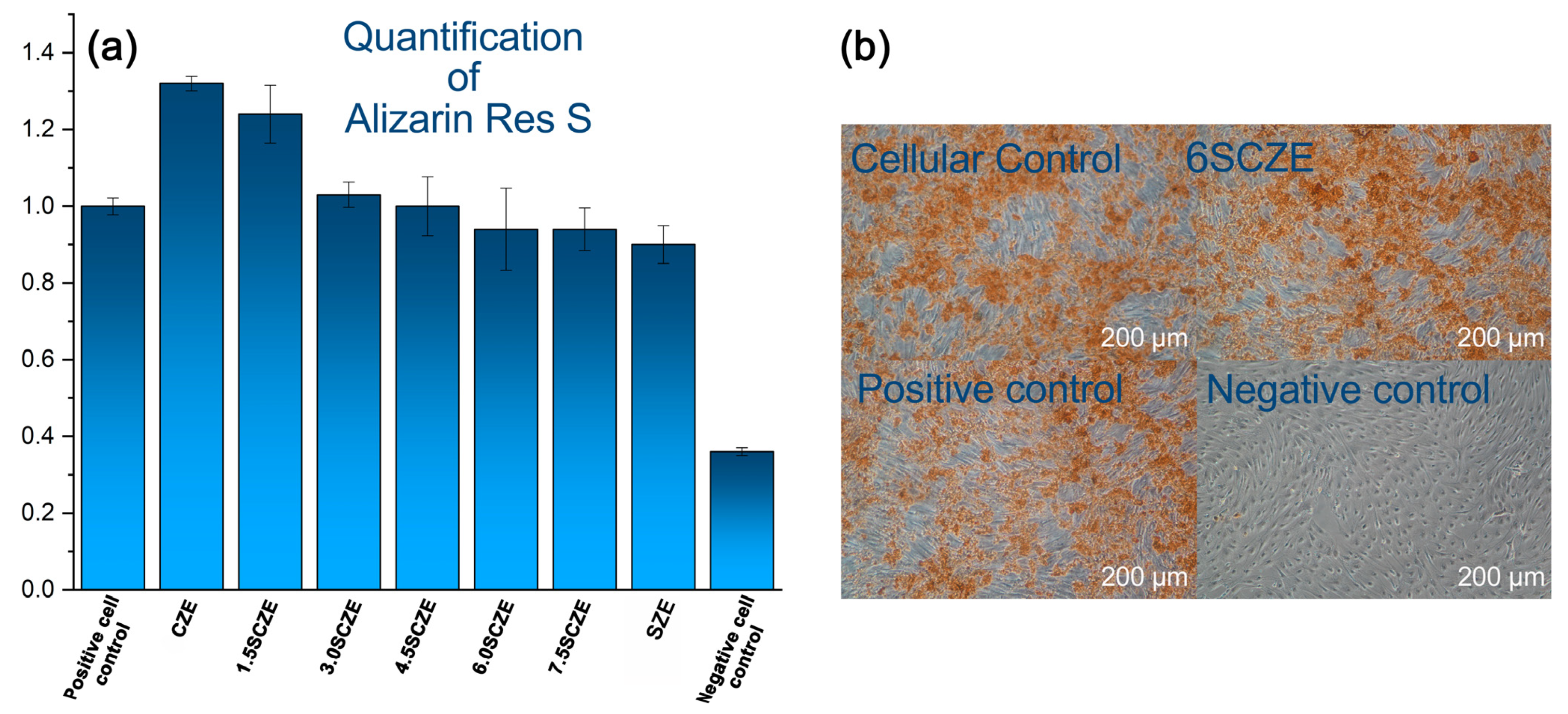
Negative controls are undifferentiated aMSCs, but stained with Alizarin Red S. The reported values were obtained from three independent experiments and expressed as mean percentage values ± S.D. The positive control values correspond to 1. p values (Dunnett’s test): p < 0.05 * and ≤0.001 *** compared to the positive cell control. Alizarin Red S staining of aMSCs differentiated into the osteogenic lineage for cellular control (AMSCs differentiated in the absence of substrate). aMSCs differentiated in the presence of xSCZE (statistically significant increase in calcium deposition in the extracellular matrix). An example of aMSCs differentiated in the presence of substrate with extracellular matrix production was compared to both the positive control and negative control (aMSCs that were not differentiated).

2.2.8. Antimicrobial Activity

An investigation of the antimicrobial properties of the substrates xSCZE were conducted using four bacterial species (E. coli, S. aureus, P. aeruginosa, and E. faecalis) and one fungal species (C. albicans). Prior to testing, all substrates were autoclaved at 121 °C for 20 min. Microorganisms were then grown in Brain Heart Infusion (BHI, DIFCO, Sparks, NV, USA) with 1 mg/mL of the different substrates for 24 h. Bacterial cultures were maintained at 37 °C, while the fungal culture was maintained at 28 °C. Control groups were established by culturing each microorganism only in BHI medium. All experiments were performed in triplicate. Microbial proliferation was quantified by measuring the optical density at 600 nm using a BioFhotometer (Eppendorf, Hamburg, Germany).

2.2.9. Statistical Analysis

All tests were replicated three times. MTT assay values, Alizarin Red s quantification, and microbial growth rates were expressed as mean ± standard deviation (SD) and subjected to statistical analysis using the non-parametric Dunnett test for multiple comparisons (using the software Sas Jmp Statistical Discovery v14 pro, Milan, Italy). p values of ≤0.05 *, ≤0.01 **, and ≤0.001 *** were considered to indicate statistical significance, as indicated in the figure captions.

2.2.10. Dissolution Behavior

To simulate the behavior of xSCZE ceramic materials in the body environment, the samples were soaked in a model Tris-HCl buffer (pH = 7.6) or physiological solution (0.9% NaCl, pH = 6.5). These isotonic solutions are commonly use in in vitro experiments to simulate the dissolution processes occurring in human body. The powder samples were pressed into pellets (d = 0.4 cm, m ~ 0.2 g) using a hydraulic oil press. The pellets were kept in flasks for 7, 14, and 33 days. After soaking, the surface of the pellets was studied via the PXRD method and the PL spectroscopy to analyze the apatite phase formation.

3. Results and Discussion

3.1. PXRD Study

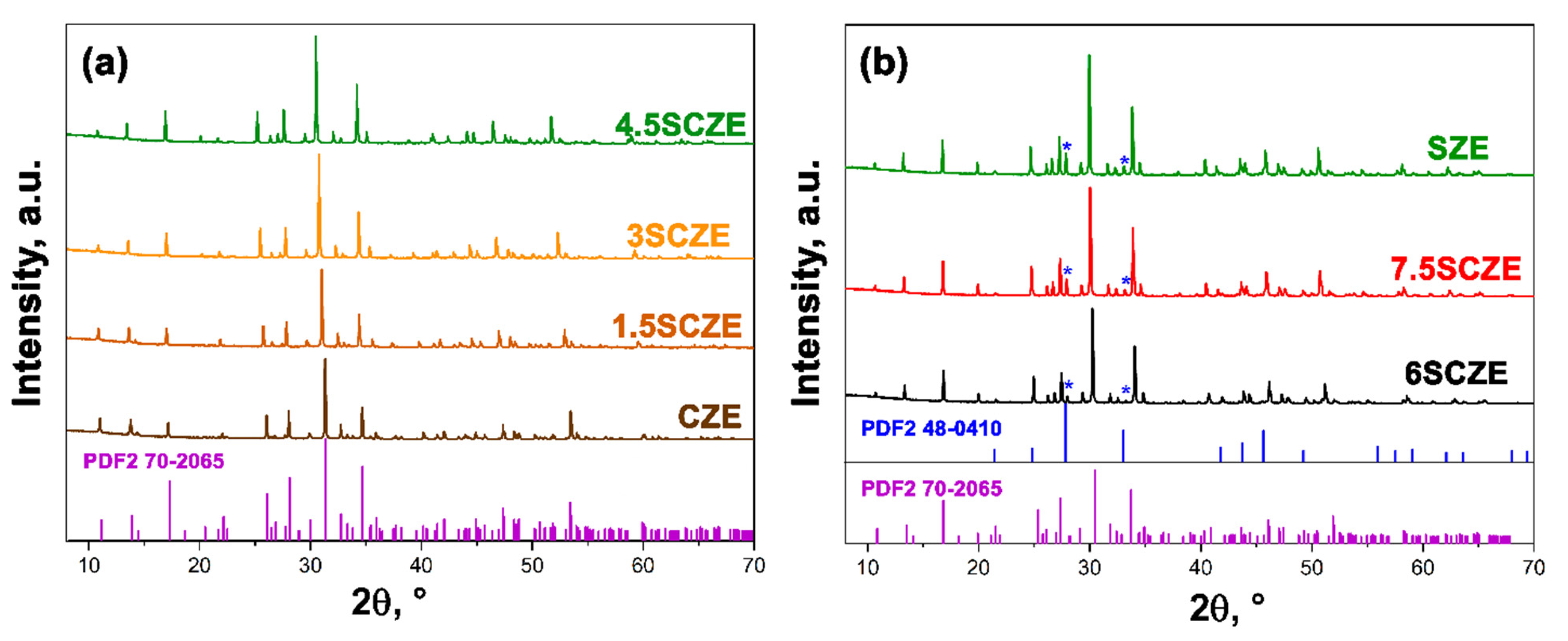
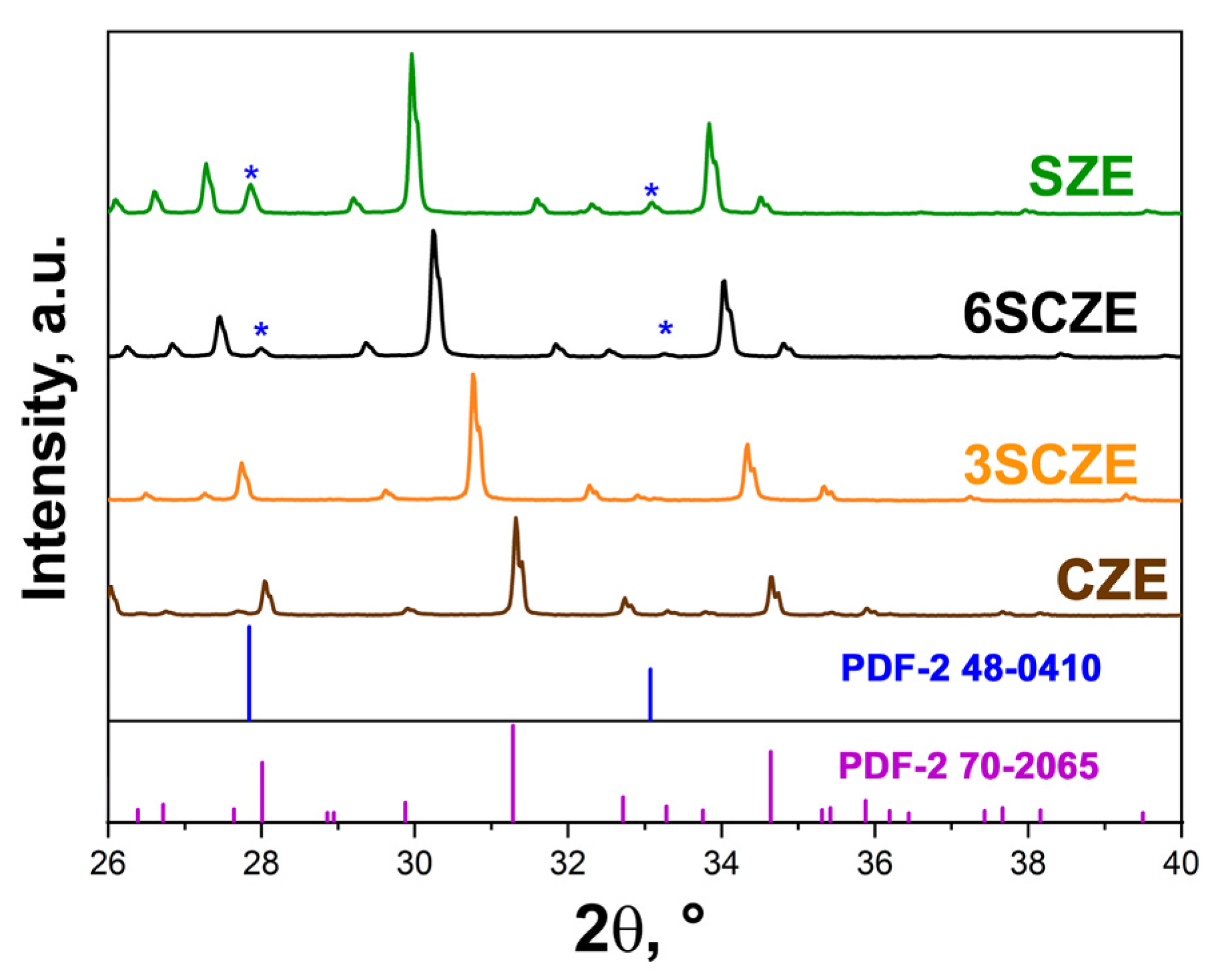
Figure 2 and Figure 3 show the reflection positions obtained from the PXRD data. Qualitative analysis revealed that all samples from the Ca8−xSrxZnEu(PO4)7 series belong to the β-TCP structural type and are compatible with PDF-2 cards No. 70-2065 (pure β-Ca3(PO4)2). However, at a Sr2+ concentration x = 6 in the structure, reflections of an impurity compound corresponding to the eulytite-type phase Sr3Eu(PO4)3 (PDF-2 No. 48-410) were recorded (Figure 3). The quantitative PXRD analysis shows that % amount of the Sr3Eu(PO4)3 impurity in the samples are 2% in 6.0SCZE, 4% in 7.5SCZE, and 6% in 8.0SCZE. As strontium content increases, the impurity phase reflections become more intense (Figure 2b and Figure 3), consistent with the increasing concentration of the eulytite-type impurity.
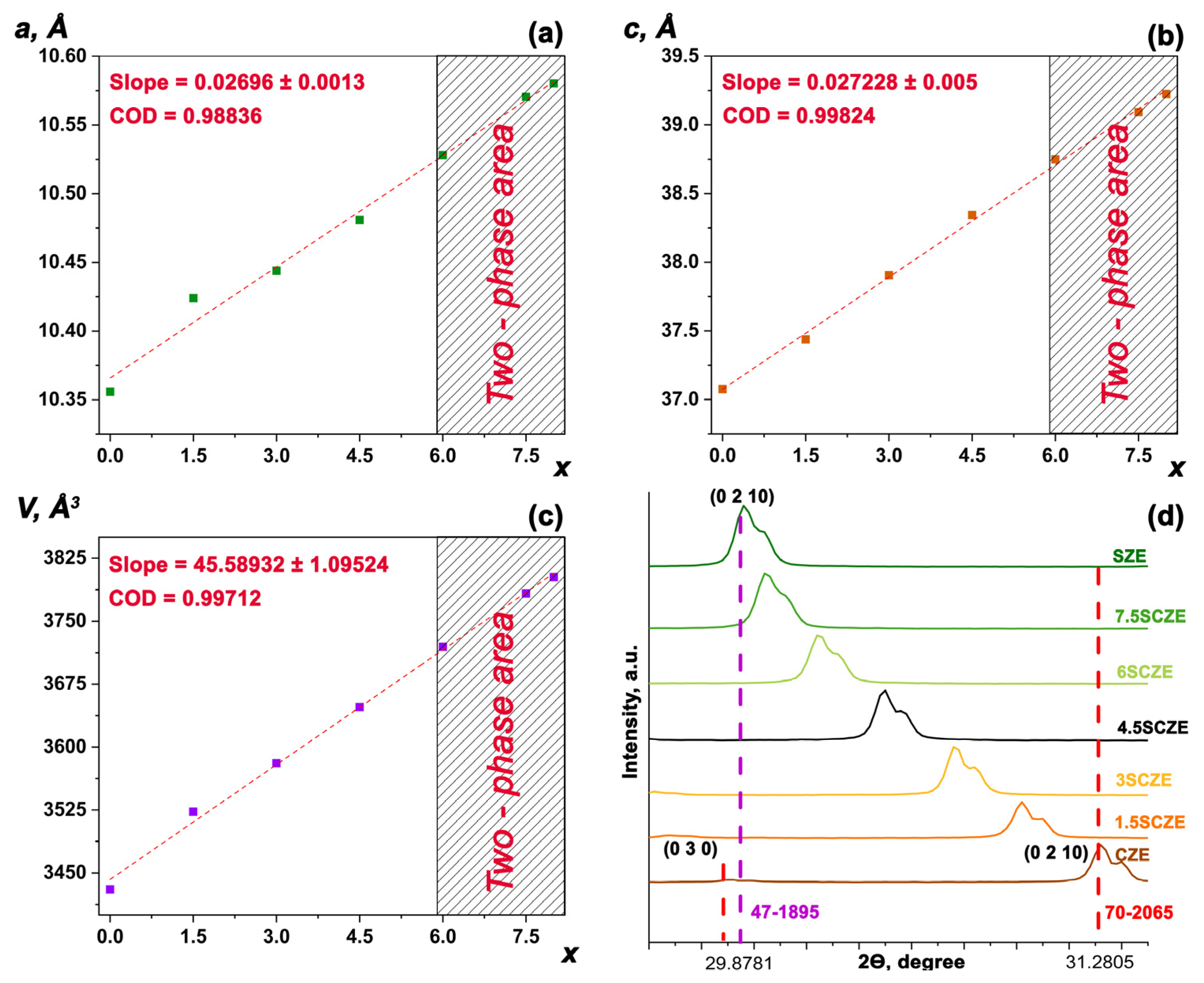
Using the obtained PXRD data, the unit cell parameters a (Figure 4a) and c (Figure 4b) and volume V (Figure 4c) for xSCZE samples were calculated with WinXPoW software (version 2.24). The calculations revealed a linear increase in parameter values with rising of Sr2+ concentration. The determination coefficient close to 1.00 allows to conclude that the dependence obeys Vegard’s law, and all samples form a continuous series of solid solutions. An increase is also observed in the two-phase region for 6SCZE, 7.5SCZE, and SZE samples (Figure 4a–c). This is attributed to the low concentration of the impurity phase relative to the main β-TCP phase.
The increase in parameters also agrees well with the shift in reflections toward smaller angles (Figure 4d). The shift in the initial and final samples along the 2θ angle is 1.4069°. According to Bragg’s formula [36], the interplanar spacing change is about 1.19. This fact is consistent with the substitution by larger Sr2+ ions. It should be noted that Eu substitute Ca sites without destroying phase purity at 10 mol.%.

3.2. SEM Results

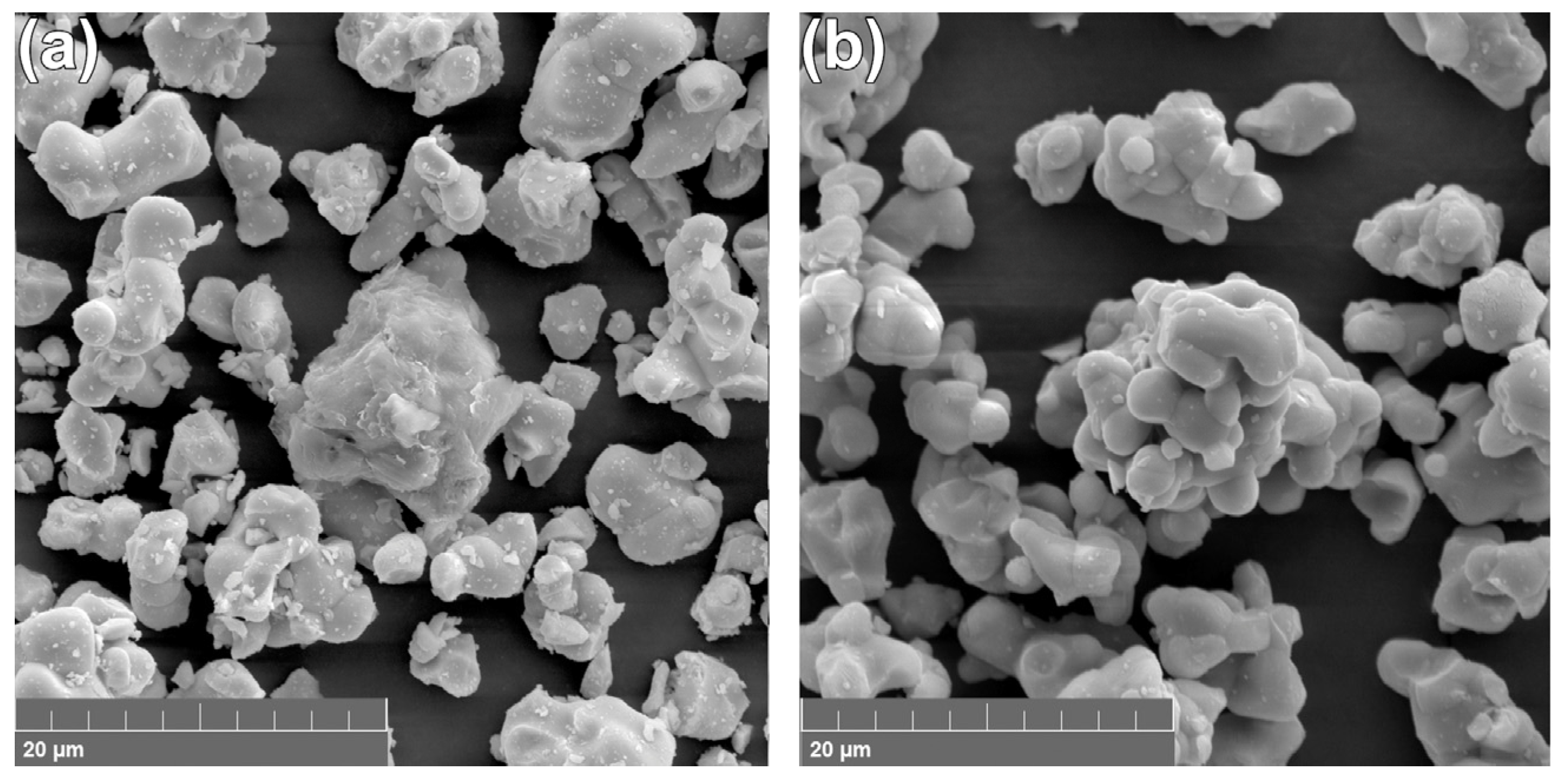
SEM images of xSCZE samples with x = 0 and 4.5 are shown in Figure 5. All samples are well crystallized. The powders mostly consist of particles’ agglomerates with the approximately size of 5–10 μm (Figure 5). The variation in the Sr2+ concentration in xSCZE solid solutions does not show significant contribution on the shape of the particles. EDX analysis of these samples confirms the expected composition. The measured data for Zn/Ca/Sr/Eu ratios were found to be 1.0:8.02 ± 0.02:0.95 ± 0.07 (10.03 ± 0.45 atom % Zn, 80.44 ± 0.13 atom % Ca, and 9.53 ± 0.02 atom % Eu) for Ca8ZnEu(PO4)7, and 1.0:3.42 ± 0.06:4.63 ± 0.04:0.91 ± 0.01 (10.04 ± 0.3 atom %Zn, 34.34 ± 0.1 atom % Ca, 46.48 ± 0.3 atom % Sr, and 9.14 ± 0.15 atom % Eu) Ca3.5Sr4.5ZnEu(PO4)7 did not significantly differ from the expected bulk composition. Thus, the calculated formulas are close to the expected.

3.3. FTIR Spectroscopy

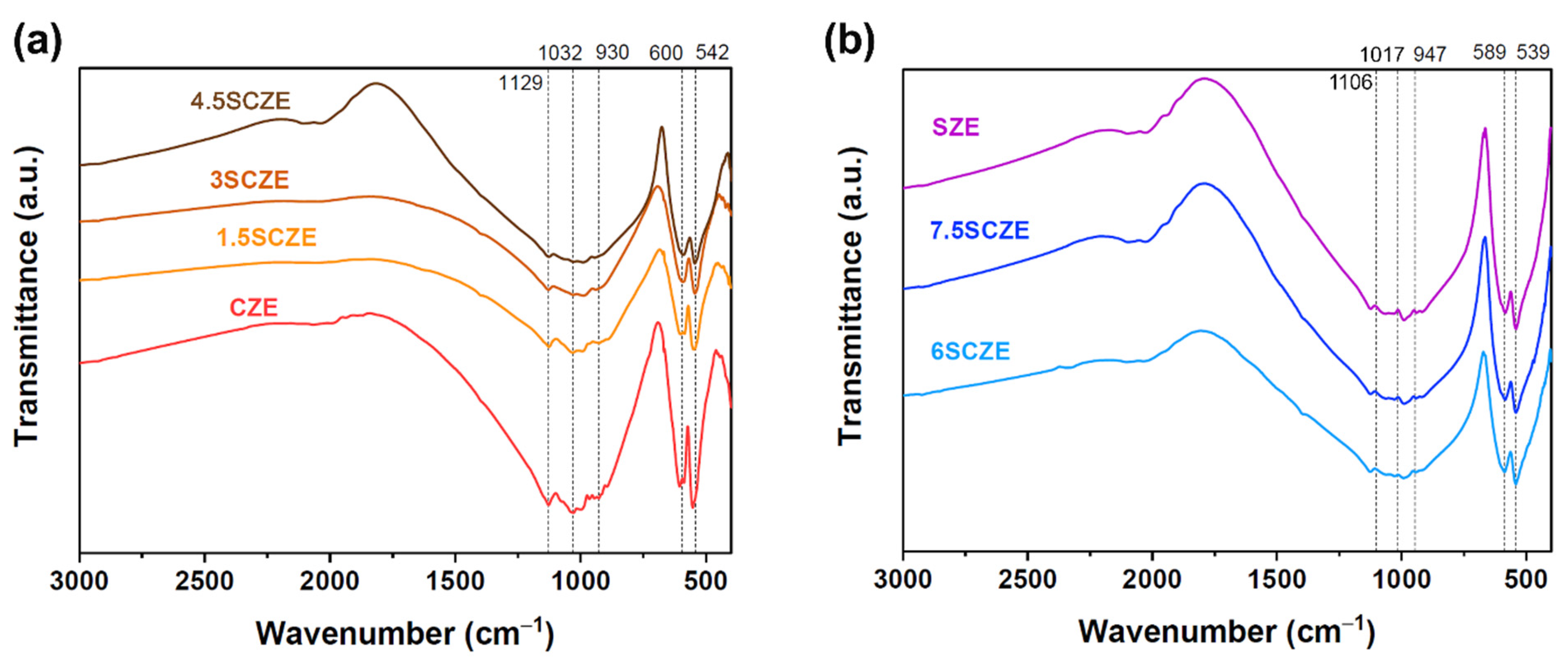
On the FTIR spectra of xSCZE solid solutions the bands at 300–500 cm−1 and 900–1200 cm−1 can be observed (Figure 6). FTIR spectroscopy data confirm the absence of hydroxyl (OH) and pyrophosphate groups (P2O74−) according to the PXRD data. The spectra for limit solid solutions CZE and SZE are remarkably similar (Figure 6). All spectra displayed absorption bands characteristic for PO43− groups, with bands at 1128–428 cm−1 attributed to stretching vibration modes of PO43− groups (Table 1) [37].
The bands at 930 cm−1 can be attributed to symmetrical valence vibrations ν1 of P–O bands. The characteristic band of vibrations for PO43− groups shift to lower frequency with increasing of strontium content. This shift mainly corresponds to the crystal structure transformations changing contribution, which leads to distortion of the PO4 tetrahedra and variations in bond lengths.
The transition from “free” PO43− to the tricalcium phosphate structure results in the splitting of phosphate ion modes, as detailed in [38]. This phenomenon is explained by the presence of several bands that relate to the vibrations ν3 (1128, 1074, 1031, 995 cm−1), ν1 (964, 945, 922 cm−1), and ν4 (605, 584 cm−1). The splitting character clearly confirms the formation of solid solutions with the β-TCP structure, and not α-TCP.

3.4. Photoluminescence Spectroscopy

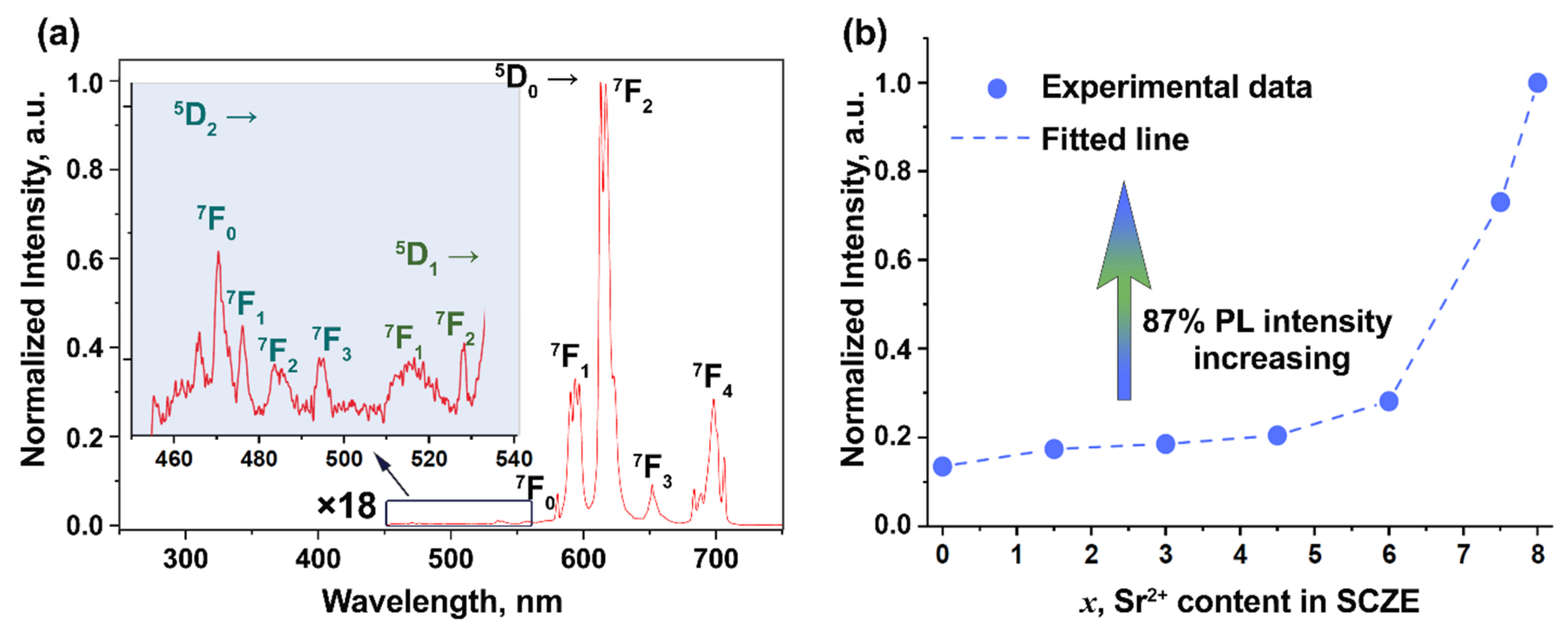
The survey PL spectra for xSCZE series are shown in Figure S1 of the Supporting Information. The detailed PL spectra for CZE, 3SCZE, and SZE samples excited in the 7F05L6 4f–4f band of Eu3+ are shown in Figure 7a and Figure S2, respectively. The observed luminescence bands centered at 580, 593, 616, 650, and 695 nm are attributed to the 5D07FJ (J = 0–4) transitions in the 4f shell of the Eu3+ ions. Additionally, transitions from 5D1 and 5D2 levels are registered for all samples (Figure 7a and Figure S2) The series of lines centered at 470, 483, 495, and 517 correspond to 5D27FJ (J = 0–3) transitions, respectively, while the lines centered at 527 and 537 correspond to 5D17FJ (J = 0–1) transitions according to [39]. The intensity of the low-wavelength transition is significantly lower than that corresponding to the 5D07FJ (J = 0–4) transitions. However, the ratio of the intensity of 5D07FJ to 5D1,27FJ depends on the Sr2+ concentration. As the Sr2+ amount increases to x = 8 (Figure S2), the intensity of 5D1,27FJ transitions decreases by 100-fold, which is clearly seen in the coefficient of zoom (from 18 (Figure 7) for x = 0 to 183 for x = 8 (Figure S2)). Such behavior can be attributed to the increasing disordering of the oxygen surrounding of the Eu3+ ion in the cell. This is also confirmed by the R/O ratio for the observed series. The R/O ratio decreases with increasing concentration of Sr2+ in the host, from 3.14 (CZE sample) to 3.04 (SCE sample), indicating disordering of polyhedral Eu3+.
Figure 7b shows the normalized PL integral intensity of Eu3+ emission for xSCZE samples under 395 nm excitation. The intensity increases monotonically from x = 0 to 6, followed by rapid growth at x = 8, resulting in a total PL intensity increase of 87%.
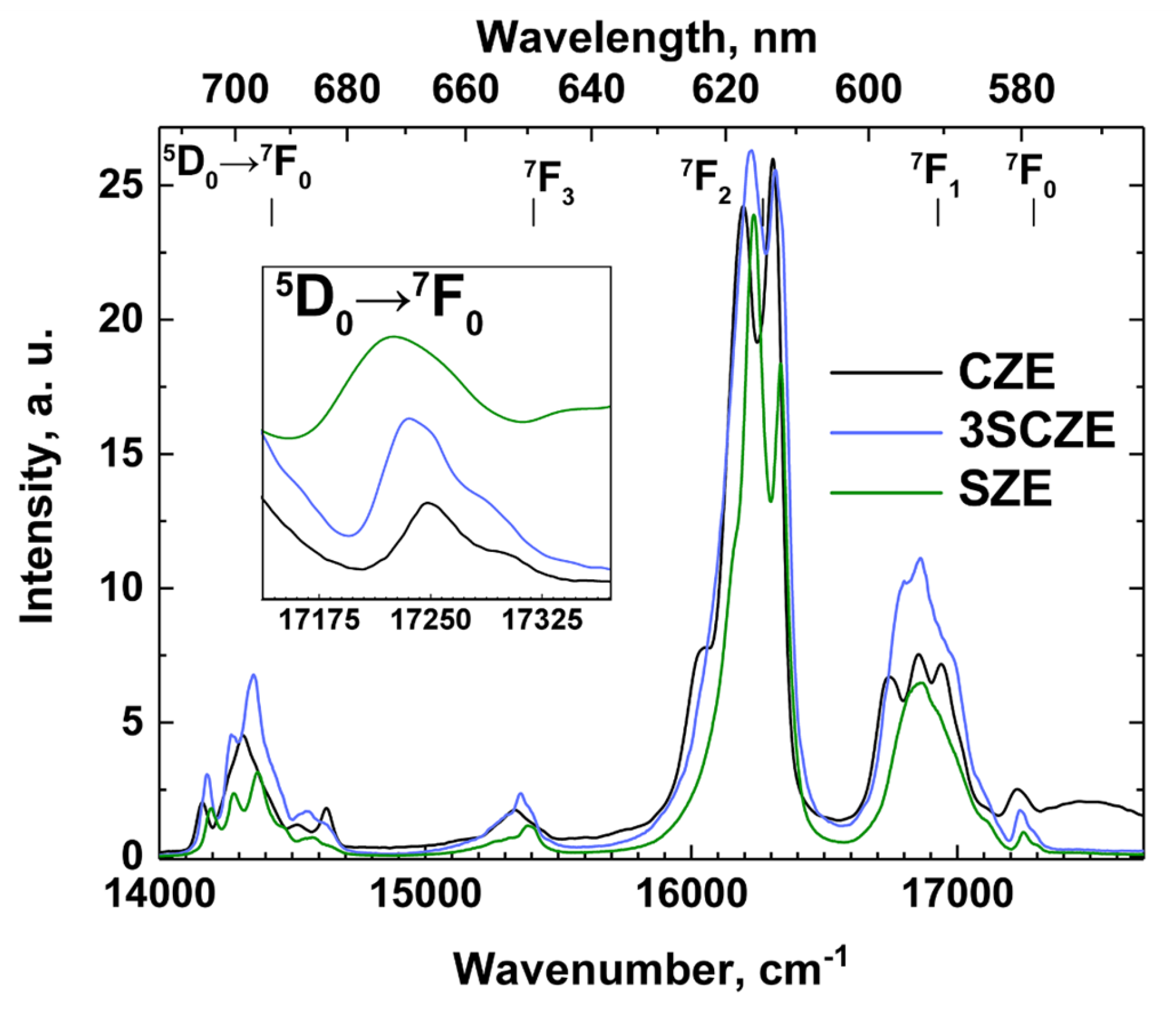
The high-resolution PL spectra reveal that, except for distortion of the Eu3+ surrounding, the polyhedral becomes different (Figure 8). Thus, the magnetic-dipole (MD) 5D07F1 transition shows three components in the CZE’s PL spectrum, while in the Sr-rich compound, this transition becomes more symmetrical with only one component. The hypersensitive transition 5D07F0, which indicates the number of non-equivalent photoluminescent centers, is described by a single Gaussian component for CZE, centered at 1.723 × 104 cm−1 (Figure S3). In contrast, samples 3SCZE and SZE exhibit two Gaussian components (Figure 8 inset and Figure S3 of the Supporting Information). One component is narrow and positioned at the lowest wavenumber, with centers at 1.724 and 1.725 × 104 cm−1, respectively. The wavenumber shift correlates with increasing Sr2+ content, which extends the Eu–O bond length in the polyhedra due to the larger ionic radius of Sr2+ compared to Ca2+. The second Gaussian component corresponds to an increased number of “spectroscopic” centers in Sr-rich compounds.
The PLE spectra monitored at the 616 nm 5D07F2 band are shown in Figure S4. The sharp lines in the 300–550 nm range correspond to the 4f-4f transitions of Eu3+ ions. A broad band peaking at 240 nm in CZE sample is attributed to charge transfer Eu–O transitions [16,40,41]. This band shifts to longer wavelengths as Sr concentration increases, with its maximum located at 265 nm in 7.5SCZE. The excitation band at about 7.25 eV corresponds charge transfer within the PO4 tetrahedra [16]. Their position does not depend on Ca/Sr ratio. The intensity of this band also increases with higher Sr concentrations, indicating that energy transfer from the PO4 host to Eu3+ becomes more efficient in samples with higher Sr content compared to those with Ca. The band gap (Eg) of the studied samples is approximately 6.8 eV in accordance with previous data [16].
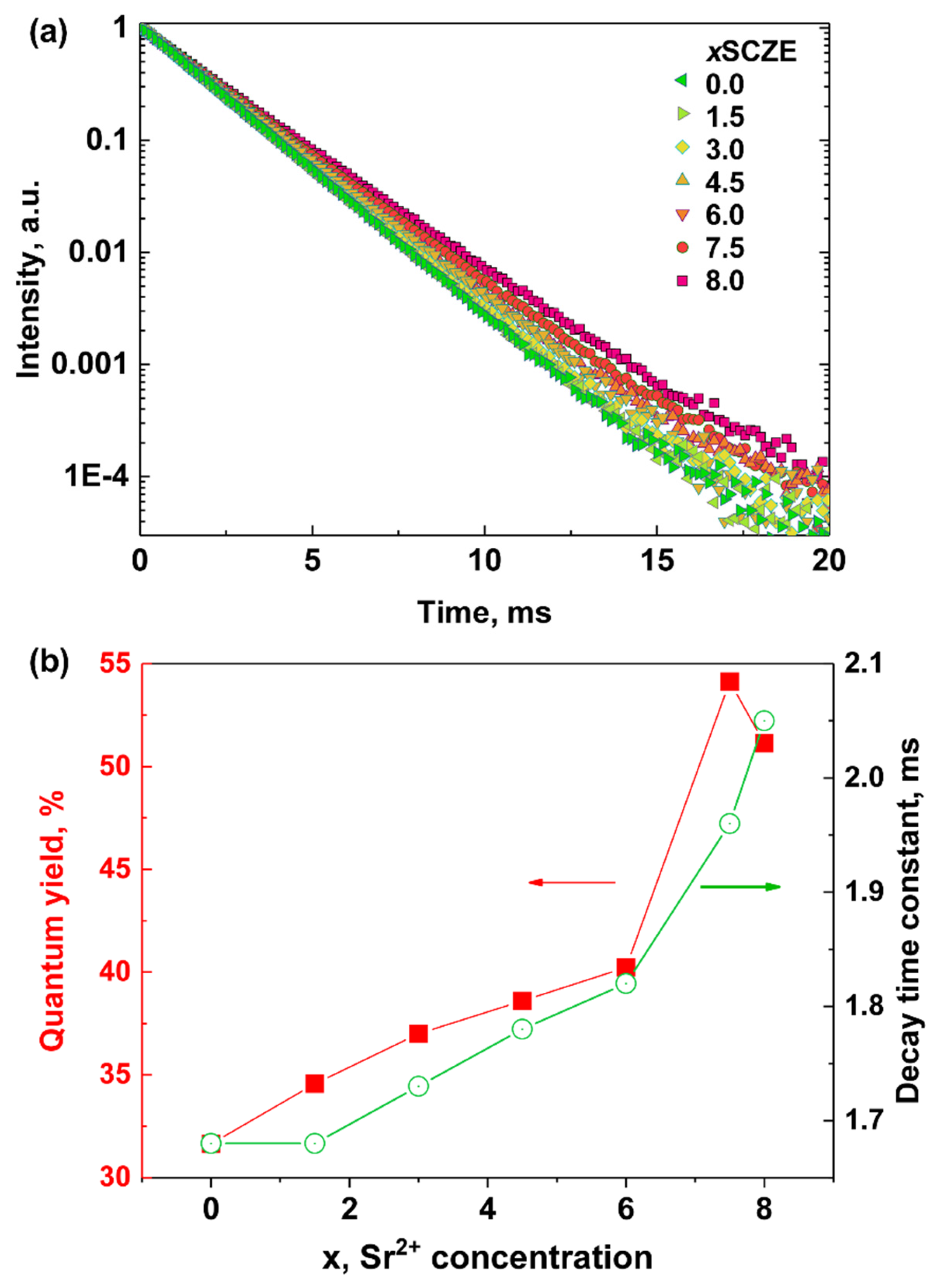
The photoluminescence decay time curves for xSCZE samples are shown in Figure 8. All curves exhibit a single exponential decay profile; however, the decay time constants decrease with increasing Sr concentration. In the Ca-free sample (SZE or x = 8), the decay time is 2.05 ms, while in CZE sample, it decreases to 1.68 ms. The concentration dependence of decay times in xSCZE is illustrated in Figure 9b.
The quantum yields under 404 nm excitation are also depicted in Figure 9b. Samples SZE and 7.5SCZE exhibit the highest quantum yields, at 54% and 51% values, respectively. Conversely, samples with higher Ca content showing lower quantum yields and CZE sample having the lowest QY at 32%. The results are in close agreement with the ones given in Figure 7. Thus, low self-absorption and intense emission are favorable for in vivo monitoring.

3.5. MTT Assay

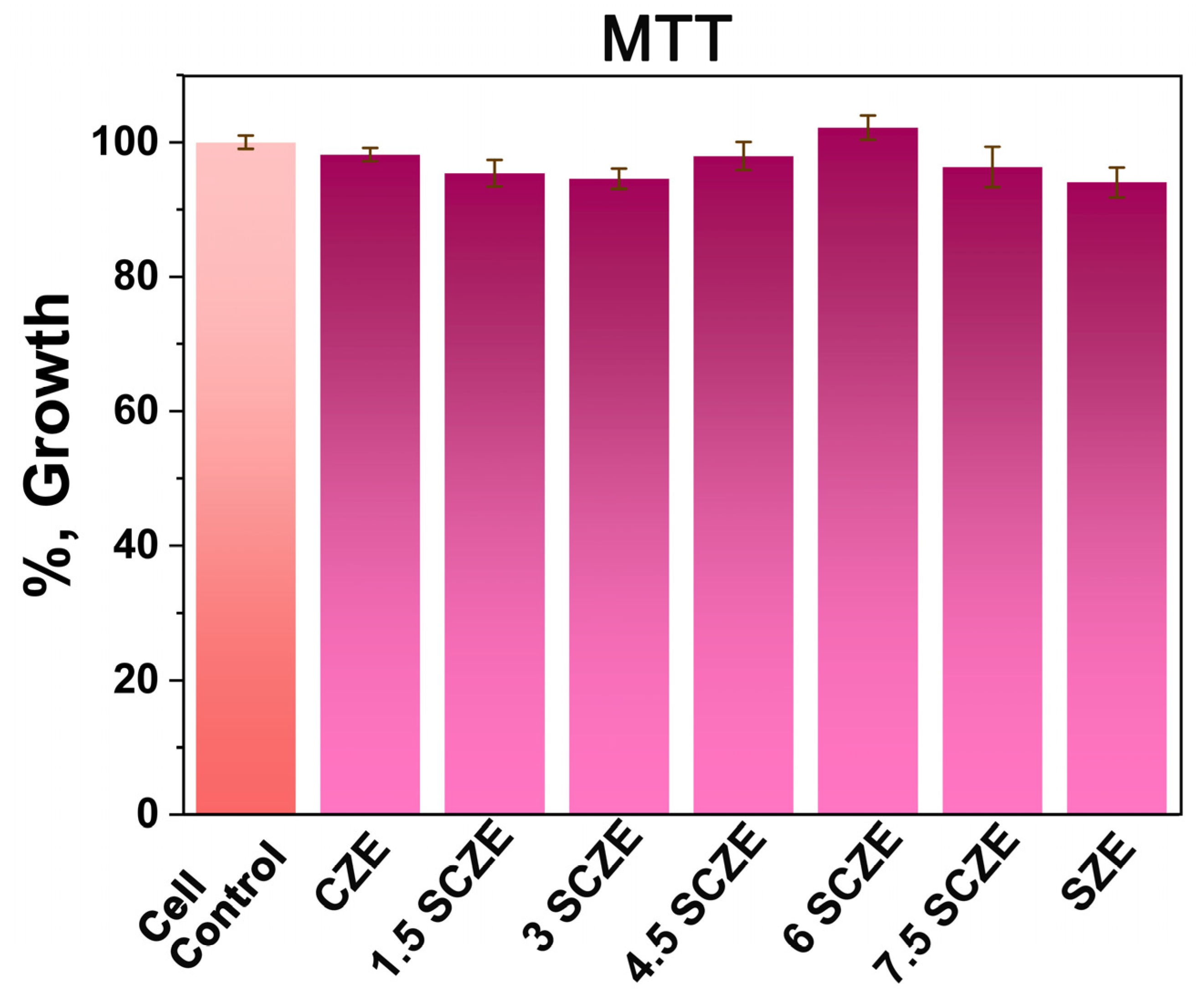
The MTT assay was used to evaluate the toxicity of the xSCZE substrates on aMSCs in the second passage. Figure 10 shows the percentage cell growth value obtained from three independent experiments, expressed as the percentage value of the mean ± S.D. The control cell value corresponds to 100% of aMSC growth without the different substrates.
In particular, the growth rate of aMSC is 98.17% in the presence of CZE, 95.38% in the presence of 1.5SCZE, 94.57% in the presence of 3SCZE, 97.95% in the presence of 4.5SCZE, 102.20% in the presence of 6SCZE, 96.32% in the presence of 7.5SCZE, and 94.03% in the presence of SZE compared to aMSCs grown in the absence of the substrates. The difference in growth percentage in all experimental conditions compared to the control are not statistically significant. Thus, the highest growth rate was observed in the experiment with the 6SCZE sample.
As demonstrated in [42], exposure to Eu3+ and Sm3+ ions induces toxic effects in zebrafish, including reduced heart rate, growth inhibition, and morphological deformities. These effects were concentration-dependent and clearly observed at REE salt concentrations of 15 mg/L. In the present study, the concentration of Eu3+ in the phosphate host matrix is 10 mol.%. However, our previous work [40] showed that the release of REE ions from the phosphate host into solution does not exceed 0.2 mg/L. Consequently, no toxic effects from Eu3+ were observed in the studied samples, as confirmed by the results in Figure 10. The low concentration of released REE ions is attributed to the incorporation of these ions into the newly formed bone apatite phase.

3.6. Osteogenic Differentiation

Calcium deposits in the extracellular matrix, characteristic of osteogenic differentiation, were stained red using Alizarin Red S. As shown in the images, aMSCs differentiated in the presence of all xSCZE substrates in the osteogenic lineage (Figure 11). The quantification of the Alizarin Red S dye is proportional to the production of deposited calcium-containing extracellular matrix. As shown in Figure 11a, aMSCs differentiated in the presence of the xSCZE substrates showed a statistically comparable amount of Alizarin Red S compared to the positive control (aMSC in the absence of substrates). While aMSC differentiated in the presence of the CZE sample produced deposits of calcium in the extracellular matrix is 1.32 times higher than in the positive cell control resulting statistically significant p < 0.05 (Figure 11a). The images in Figure 11b depict the osteogenic differentiation of AMSCs under different experimental conditions, after staining with Alizarin Red S.

3.7. Antibacterial Activity

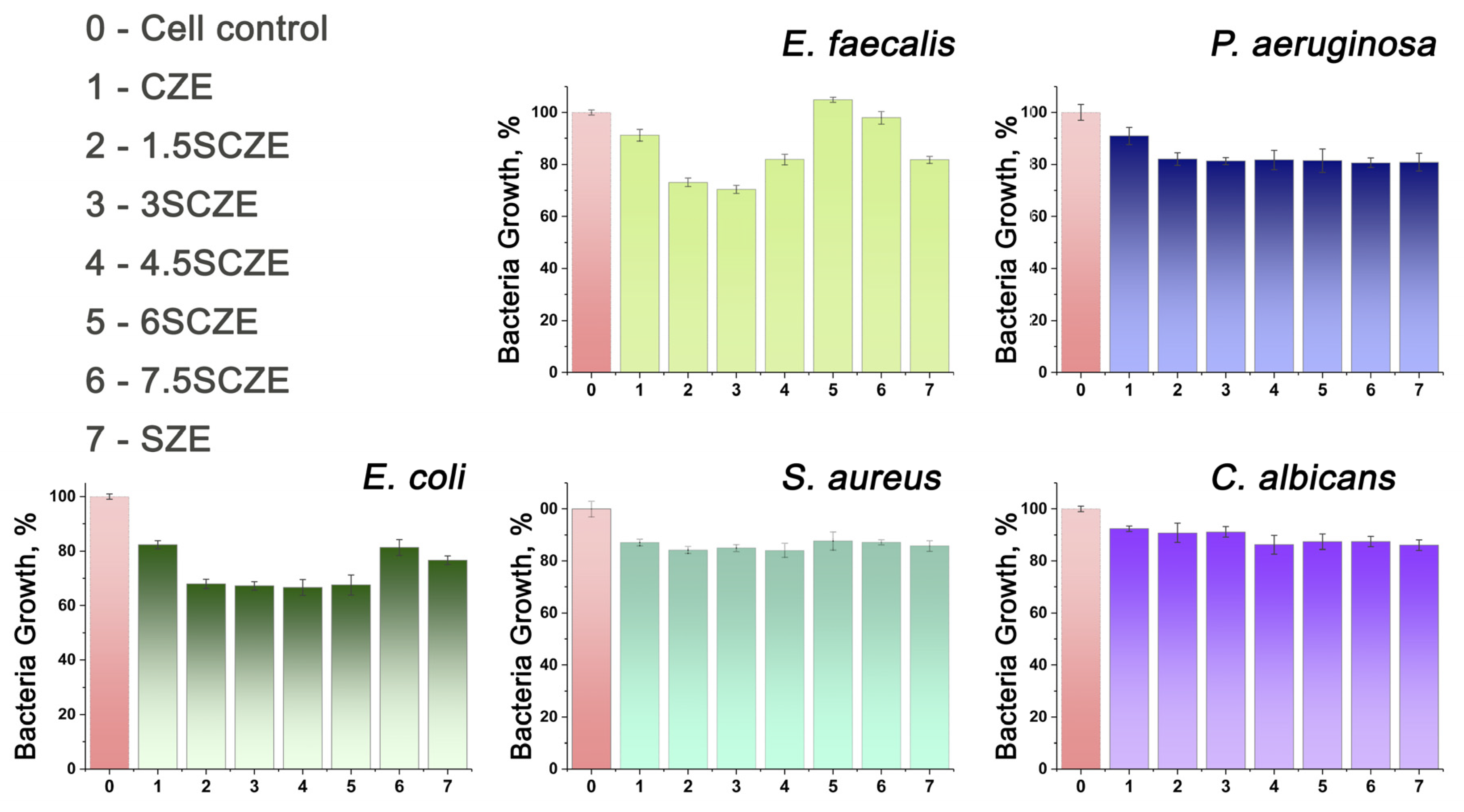
The results of the growth of microorganisms (E. coli, S. aureus, P. aeruginosa, E. faecalis, and C. albicans) in the absence and presence of xSCZE are shown in Figure 12. The positive control is represented by microorganisms grown in the absence of substrates. The growth of each microorganism was evaluated after 24 h of incubation at the optimal growth temperature. The percentage of growth and the standard deviation (SD) are obtained from the mean of three independent experiments.
As reported in the graphs of Figure 12, the differences in the growth percentage of S. aureus, P. aeruginosa, and C. albicans in the presence of xSCZE compared to the control are not statistically significant. The inhibition of E. coli growth in the presence of CZE, 1.5SCZE, 3SCZE, 4.5SCZE, 6SCZE, 7.5SCZE, and SZE is always statistically significant compared to the control growth. In particular, in the presence of CZE the growth is 82.31%, in the presence of 1.5SCZE the growth is 67.93%, in the presence of 3SCZE the growth is 67.23%, in the presence of 4.5SCZE the growth is 66.62%, in the presence of 6SCZE the growth is 67.54%, in the presence of 7.5SCZE the growth is 81.29%, and in the presence of 8SZE the growth is 76.62%.
The inhibition of E. faecalis growth in the presence of CZE and 6SCZE is not statistically significant compared to the control growth. While the growth in the presence of 1.5SCZE is 73.16%, in the presence of 3SCZE it is 70.44%, in the presence of 4.5SCZE it is 81.93%, in the presence of 7.5SCZE it is 97.99%, and in the presence of SZE it is 81.81% statistically different from the control growth.

3.8. Dissolution Behavior

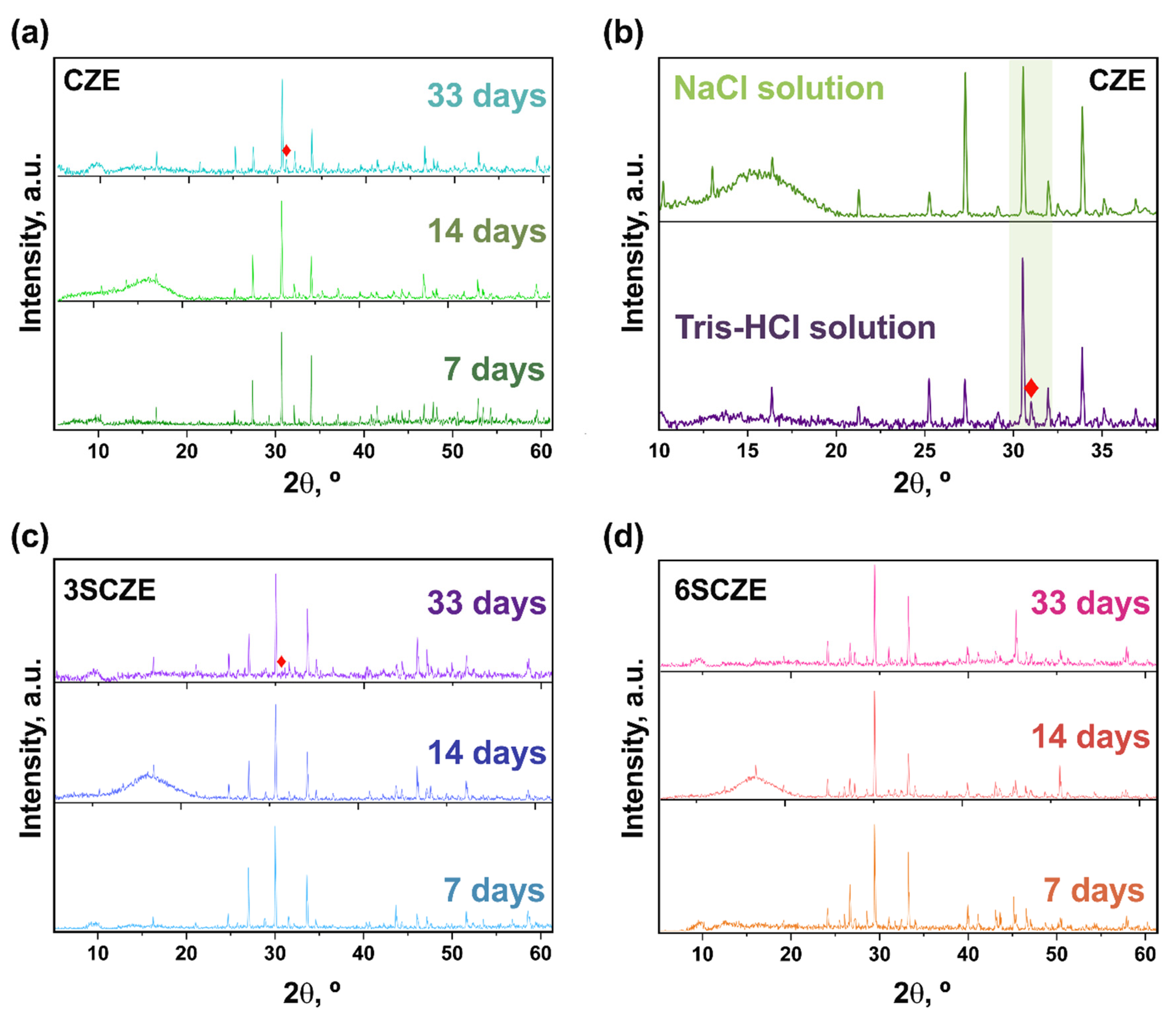
The PXRD data of the CZE, 3SCZE, and 6SCZE pellets after soaking for 7, 14, and 33 days in Tris-HCl buffer solution are shown in Figure 13a,c,d. The pellets were not grinded between the measurements. Figure 13b shows a comparison of dissolution behavior of the CZE sample in NaCl and Tris-HCl buffer solutions. It can be concluded that the dissolution rate in Tris-HCl buffer solutions is rather faster than in NaCl after 33 days of soaking (Figure 13b). The quantitative phase analysis reveals the formation of the hydroxyapatite-type (HAP) phase at 10 mas.% in Tris-HCl buffer solution (Figure 13b) in the Sr-free CZE sample. In NaCl solution only the formation of the amorphous layer can be observed after 33 days of soaking (Figure 11b). The pH of the solution is one of the factors influencing solubility. The HAP phases are likely to form in basic solutions, while the β-TCP phases require a neutral or slight acid pH. Tris-HCl buffer has pH = 7.6, while physiological solutions have pH = 6.5 [7]. So, this is one of the reasons why HAP is formed more in Tris-HCl buffer solution.
It is a well-known that the β-TCP phase (pKsp = 28–29 for pure β-TCP) shows better solubility than the HAP phase (pKsp = 58–116, depending on pH [7] and temperature [43]). Additionally, it is known that the β-TCP converts to HAP, as a HAP is more thermodynamically stable phase [44,45]. This process occurs better in Tris-HCl buffer solutions. To form HAP, a Ca/P ratio of approximately 1.67 is required, while in pure β-TCP, this ratio is 1.5. Thus, Tris-HCl buffer solutions can provide the necessary ratio, which is well seen for sample CZE. By increasing the concentration of calcium ions through the Tris-HCl solution, the equilibrium towards the formation of HAP seems to shift on the surface of the pellet.
Sr-rich compounds should also show good solubility. In [40] it was shown that for similar compounds doped with Sm3+ ions, Sr8ZnSm(PO4)7, dissolution and formation of strontium hydroxyapatite (Sr-HAP) were observed. However, Ca-Sr mixed samples (3SCZE (Figure 13c) and 6SCZE (Figure 13d)) doped with Eu3+ do not form neither Sr-HAP nor HAP even after 33 days of exposure to Tris-HCl buffer solutions. According to [46], the pKsp of α-Sr3(PO4)2 is 27.8. Based on the calcium phosphates behavior, β-Sr3(PO4)2 (strontiowhitlockite (Sr-WHT) phase) should demonstrate a similar pKsp value. However, due to stabilization only under high temperatures, the exact pKsp value of Sr-WHT cannot be determined, while pKsp of Sr-HAP takes a value 115–117 [47,48]. Thus, as for calcium phosphates, strontium phosphates have similar patterns in solubility, and it can be expected that HAP or Sr-HAP formation will be observed in mixed salts as well as in pure CZE or SZE. However, Sr2+ ions block the hydrolysis α-TCP to convert into HAP [49], probably in Sr-WHT compounds, namely 3SCZE and 6SCZE, Sr2+ ions also block β-TCP hydrolysis. So, Sr2+ ions in mixed salts slow down the dissolution process by blocking hydrolysis. This, apparently, is the reason for the weak antibacterial properties.

3.9. Photoluminescence Control of Dissolution

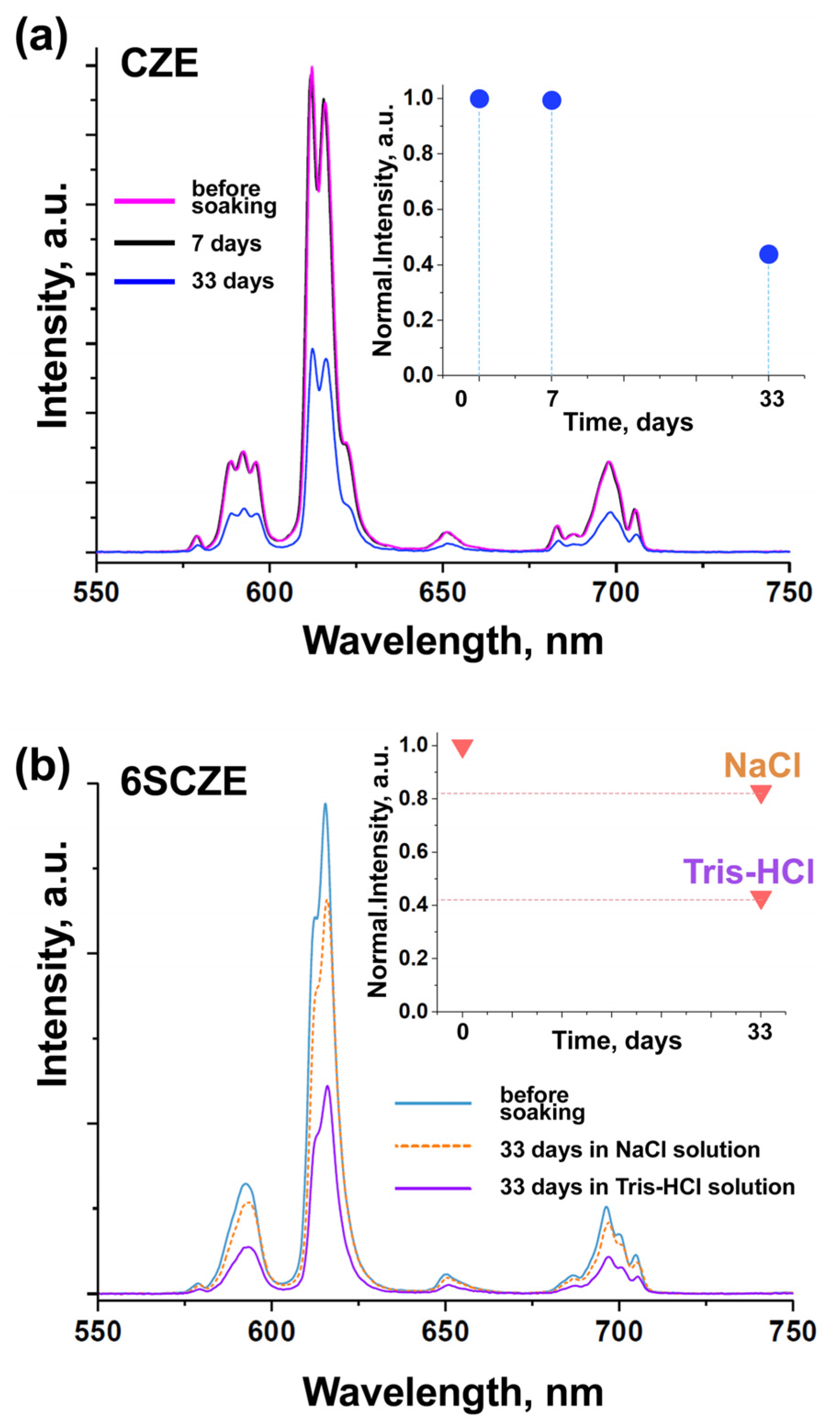
PL spectra of Eu3+ doped HAP hosts contain the same transitions as those Eu3+ doped WHT or Sr-WHT [50,51] corresponding to 5D07FJ interconfigural transitions of Eu3+ ion. However, due to different space symmetry and oxygen surrounding, the intensity and profile of the lines are different. The SG for HAP-type phase is P63/m, and both cationic sites M1 and M2 in the structure have 7-fold coordination; the surrounding of Eu3+ ions in the structure duffers significantly from those in β-TCP or WHT. So, 5D07F1 and 5D07F4 become close to 5D07F2 by the intensity in Eu3+-doped HAP structures. Figure 14a shows the comparison of CZE pellet’s PL spectra before and after soaking for 7 and 33 days. Figure S5 of the Supporting Information shows changing of the PL spectra for the 3SCZE and 6SCZE samples. The decreasing PL intensity can be observed (Figure 14a inset), which can be attributed to the change in surface area during soaking and dissolution of the Eu3+-doped β-TCP phase. The PL intensity decreases more in Ca-rich samples than in Sr-rich samples, which correlates with the higher dissolution rate of Ca-WHT compared to Sr-WHT.
Figure 14b shows the comparison of 6SCZE sample’s PL spectra after 33 days of soaking in NaCl and Tris-HCl buffer solutions. The pellet soaked in Tris-HCl buffer solution shows two times lower intensity compared to NaCl solution, which confirms better dissolution in Tris-HCl buffer according to PXRD data (Figure 13b).

4. Conclusions

Eu3+-doped β-TCP solid solutions with formula Ca8−xSrxZnEu(PO4)7 (xSCZE) were prepared. The biocompatibility characteristics of Ca8−xSrxZnEu(PO4)7 were studied by MTT assay and differentiation of aMSCs into the osteogenic lineage. The ability to inhibit the growth of four bacteria (E. coli, S. aureus, P. aeruginosa, and E. faecalis) and one fungus (C. albicans) was also studied. The MTT assay demonstrated that xSCZE samples are not toxic for aMSC growth since in all tests the growth is comparable to the control cells. A key argument in favor of safety is the fact that toxic REE ions are strongly bound in the crystal host, and their release is at levels well below established toxicity thresholds. All samples from the xSCZE solid solution did not inhibit the normal differentiation in the osteogenic lineage compared to the positive control. In particular, the differentiation of aMSC in the presence of Ca8ZnEu(PO4)7 stimulated a greater production of extracellular matrix by 1.32 times compared to aMSC differentiated in the absence of the powder. Both tests show that the studied xSCZE samples do not have negative characteristics on the viability and differentiation in the osteogenic lineage of aMSCs. Furthermore, the growth of E. coli and E. faecalis is inhibited by xSCZE samples with 0 ≤ x ≤ 6.0. These promising characteristics make these substrates candidates for future use in tissue engineering. Photoluminescence study shows high PL intensity increased by Sr-substitution. All samples exhibit stable red-emission in range 580–750 nm. Samples with the highest Sr2+ concentration, SZE and 7.5SCZE, exhibit the highest quantum yields, reaching 54% and 51%, respectively. The photoluminescent properties of Eu3+ were used as bio-labels for in vitro imaging and dissolution study. The dissolution behavior of the samples was studied, and the formation of the HAP-type phase was shown. Eu3+ ions were used as a fluorescent probe in the synthesized samples. The PL study confirms the dissolution of the β-TCP-type phase and slow rate of HAP formation. The increasing of Sr2+ ions concentration delays the resorption of the samples during soaking, which can be used for inhibition of bone resorption and improvement of bone healing therapy.

Supplementary Materials

The following supporting information can be downloaded at https://www.mdpi.com/article/10.3390/coatings15121453/s1; Figure S1: PL spectra of Ca8−xSrxZnEu(PO4)7 under 395 nm excitation with different Ca/Sr content. All measurement were performed at T = 293 K. Figure S2: PL spectra of Ca8−xSrxZnEu(PO4)7 (xSCZE) samples x = 3 (a) and 8 (b) under 395 nm excitation measured at room temperature. Figure S3: Gauss decomposition of the 5D07F0 transition for CZE, 3SCZE, and SZE samples under 395 nm excitation at room temperature. Figure S4: PLE spectra of sample Ca8−xSrxZnEu(PO4)7 (xSCZE) samples monitored at λem = 616 nm. Figure S5: PL spectra of sample 3SCZE (a) and 6SCZE (b) samples after soaking for different durations were monitored at λex = 395 nm. Table S1: The number of required components calculated according to stoichiometry for the synthesis of the Ca8−xSrxZnEu(PO4)7. Table S2: The number of required components calculated according to stoichiometry for the synthesis of the Ca8−xSrxZnEu(PO4)7. The calculations were based on 3 grams of the final product.

Author Contributions

Conceptualization, D.V.D., I.V.N., J.V.R. and B.I.L.; methodology, R.Y.S.; software, V.N.L.; validation, V.N.L.; formal analysis, V.V.T., K.B., M.F. and D.C.; investigation, K.B., D.C., S.M.A. and I.V.N.; resources, D.V.D. and S.M.A.; data curation, M.F.; writing—original draft preparation, D.V.D., I.V.N., B.I.L. and V.V.T.; writing—review and editing, J.V.R. and D.C.; visualization, V.N.L.; supervision, I.V.N.; project administration, B.I.L.; funding acquisition, D.V.D. and S.M.A. All authors have read and agreed to the published version of the manuscript.

Funding

This research was funded by the Russian Science Foundation (Project 23-73-10007, https://www.rscf.ru/project/23-73-10007/, accessed on 20 October 2025).

Institutional Review Board Statement

Not applicable.

Informed Consent Statement

Not applicable.

Data Availability Statement

Data is contained within the article or Supplementary Material.

Conflicts of Interest

The authors declare no conflicts of interest.

References

  1. Dorozhkin, S.V. Functionalized Calcium Orthophosphates (CaPO4) and Their Biomedical Applications. J. Mater. Chem. B 2019, 7, 7471–7489. [Google Scholar] [CrossRef] [PubMed]
  2. Wang, W.; Yeung, K.W.K. Bone Grafts and Biomaterials Substitutes for Bone Defect Repair: A Review. Bioact. Mater. 2017, 2, 224–247. [Google Scholar] [CrossRef]
  3. Komori, T. Regulation of Osteoblast Differentiation by Transcription Factors. J. Cell. Biochem. 2006, 99, 1233–1239. [Google Scholar] [CrossRef]
  4. Bulina, N.V.; Khvostov, M.V.; Borodulina, I.A.; Makarova, S.V.; Zhukova, N.A.; Tolstikova, T.G. Substituted Hydroxyapatite and β-Tricalcium Phosphate as Osteogenesis Enhancers. Ceram. Int. 2024, 50, 33258–33269. [Google Scholar] [CrossRef]
  5. Cardemil, C.; Elgali, I.; Xia, W.; Emanuelsson, L.; Norlindh, B.; Omar, O.; Thomsen, P. Strontium-Doped Calcium Phosphate and Hydroxyapatite Granules Promote Different Inflammatory and Bone Remodelling Responses in Normal and Ovariectomised Rats. PLoS ONE 2013, 8, e84932. [Google Scholar] [CrossRef] [PubMed]
  6. Trzaskowska, M.; Vivcharenko, V.; Benko, A.; Franus, W.; Goryczka, T.; Barylski, A.; Palka, K.; Przekora, A. Biocompatible Nanocomposite Hydroxyapatite-Based Granules with Increased Specific Surface Area and Bioresorbability for Bone Regenerative Medicine Applications. Sci. Rep. 2024, 14, 28137. [Google Scholar] [CrossRef] [PubMed]
  7. Schumacher, M.; Gelinsky, M. Strontium Modified Calcium Phosphate CementsApproaches towards Targeted Stimulation of Bone Turnover. J. Mater. Chem. B 2015, 3, 4626–4640. [Google Scholar] [CrossRef]
  8. Drevet, R.; Fauré, J.; Benhayoune, H. Bioactive Calcium Phosphate Coatings for Bone Implant Applications: A Review. Coatings 2023, 13, 1091. [Google Scholar] [CrossRef]
  9. Ren, Y.; Jung, O.; Batinic, M.; Burckhardt, K.; Görke, O.; Alkildani, S.; Köwitsch, A.; Najman, S.; Stojanovic, S.; Liu, L.; et al. Biphasic Bone Substitutes Coated with PLGA Incorporating Therapeutic Ions Sr2+ and Mg2+: Cytotoxicity Cascade and In Vivo Response of Immune and Bone Regeneration. Front. Bioeng. Biotechnol. 2024, 12, 1408702. [Google Scholar] [CrossRef]
  10. Hong, M.-H.; Lee, J.H.; Jung, H.S.; Shin, H.; Shin, H. Biomineralization of Bone Tissue: Calcium Phosphate-Based Inorganics in Collagen Fibrillar Organic Matrices. Biomater. Res. 2022, 26, 42. [Google Scholar] [CrossRef]
  11. Schönegg, D.; Essig, H.; Al-Haj Husain, A.; Weber, F.E.; Valdec, S. Patient-Specific Beta-Tricalcium Phosphate Scaffold for Customized Alveolar Ridge Augmentation: A Case Report. Int. J. Implant Dent. 2024, 10, 21. [Google Scholar] [CrossRef] [PubMed]
  12. Atencio, D.; Azzi, A.D.A. Cerite: A new supergroup of minerals and cerite-(La) renamed ferricerite-(La). Mineral. Mag. 2020, 6, 928–931. [Google Scholar] [CrossRef]
  13. Sblendorio, G.A.; Le Gars Santoni, B.; Alexander, D.T.L.; Bowen, P.; Bohner, M.; Döbelin, N. Towards an Improved Understanding of the β-TCP Crystal Structure by Means of “Checkerboard” Atomistic Simulations. J. Eur. Ceram. Soc. 2023, 43, 4130–4140. [Google Scholar] [CrossRef]
  14. Yashima, M.; Sakai, A.; Kamiyama, T.; Hoshikawa, A. Crystal Structure Analysis of β-Tricalcium Phosphate Ca3(PO4)2 by Neutron Powder Diffraction. J. Solid State Chem. 2003, 175, 272–277. [Google Scholar] [CrossRef]
  15. Belik, A.A.; Morozov, V.A.; Deyneko, D.V.; Savon, A.E.; Baryshnikova, O.V.; Zhukovskaya, E.S.; Dorbakov, N.G.; Katsuya, Y.; Tanaka, M.; Stefanovich, S.Y.; et al. Antiferroelectric Properties and Site Occupations of R3+ Cations in Ca8MgR(PO4)7 Luminescent Host Materials. J. Alloys Compd. 2017, 699, 928–937. [Google Scholar] [CrossRef]
  16. Dikhtyar, Y.Y.; Spassky, D.A.; Morozov, V.A.; Deyneko, D.V.; Belik, A.A.; Baryshnikova, O.V.; Nikiforov, I.V.; Lazoryak, B.I. Site Occupancy, Luminescence and Dielectric Properties of β-Ca3(PO4)2-Type Ca8ZnLn(PO4)7 Host Materials. J. Alloys Compd. 2022, 908, 164521. [Google Scholar] [CrossRef]
  17. Sasaki, G.; Watanabe, Y.; Yasui, Y.; Matsui, K.; Kawano, H.; Miyamoto, W. Induced Membrane Technique Using an Equal Portion of Autologous Cancellous Bone and β-Tricalcium Phosphate Provided a Successful Outcome for Osteomyelitis in Large Part of the Femoral Diaphysis—Case Report. Trauma Case Rep. 2021, 36, 100545. [Google Scholar] [CrossRef]
  18. Deyneko, D.V.; Zheng, Y.; Barbaro, K.; Lebedev, V.N.; Aksenov, S.M.; Borovikova, E.Y.; Gafurov, M.R.; Fadeeva, I.V.; Lazoryak, B.I.; Di Giacomo, G.; et al. Dependence of Antimicrobial Properties on Site-Selective Arrangement and Concentration of Bioactive Cu2+ Ions in Tricalcium Phosphate. Ceram. Int. 2023, 49, 21308–21323. [Google Scholar] [CrossRef]
  19. Mangaraj, S.; Priyadarshini, I.; Swain, S.; Rautray, T.R. ZnO-Doped β-TCP Ceramic-Based Scaffold Promotes Osteogenic and Antibacterial Activity. Bioinspired Biomim. Nanobiomater. 2024, 13, 37–44. [Google Scholar] [CrossRef]
  20. Almeida, Y.B.A.; de Moura Júnior, D.; Farias, J.R.d.S.; Sales, V.R.A.; Costa, S.L.O.; Carvalho, G.K.G.; Sobrinho, N.d.O.; dos Santos, V.B.; Simões, V.d.N.; Braga, A.d.N.S. The Effect of the Incorporation of Mg in Beta Tricalcium Phosphate: A Brief Review. In Developments in Its Application in Science and Knowledge; Seven Editora: Ponta Grossa, Brazil, 2023. [Google Scholar] [CrossRef]
  21. Begam, H.; Dasgupta, S.; Bodhak, S.; Barui, A. Cobalt Doped Biphasic Calcium Phosphate Ceramics for Bone Regeneration Applications: Assessment of In Vitro Antibacterial Activity, Biocompatibility, Osteogenic and Angiogenic Properties. Ceram. Int. 2024, 50, 13276–13285. [Google Scholar] [CrossRef]
  22. Deyneko, D.V.; Lebedev, V.N.; Barbaro, K.; Titkov, V.V.; Lazoryak, B.I.; Fadeeva, I.V.; Gosteva, A.N.; Udyanskaya, I.L.; Aksenov, S.M.; Rau, J.V. Antimicrobial and Cell-Friendly Properties of Cobalt and Nickel-Doped Tricalcium Phosphate Ceramics. Biomimetics 2023, 9, 14. [Google Scholar] [CrossRef]
  23. Lakrat, M.; Jodati, H.; Mejdoubi, E.M.; Evis, Z. Synthesis and Characterization of Pure and Mg, Cu, Ag, and Sr Doped Calcium-Deficient Hydroxyapatite from Brushite as Precursor Using the Dissolution-Precipitation Method. Powder Technol. 2023, 413, 118026. [Google Scholar] [CrossRef]
  24. Sidorov, I.D.; Oleynikova, E.I.; Pudovkin, M.S.; Nizamutdinov, A.S.; Semashko, V.V.; Gafurov, M.R.; Pavlov, I.S.; Zobkova, Y.O.; Petrakova, N.V.; Sirotinkin, V.P.; et al. Spectral and Kinetic Characteristics of Precipitated and Heat-Treated Hydroxyapatite and Tricalcium Phosphate Doped with Europium. Opt. Mater. 2025, 159, 116609. [Google Scholar] [CrossRef]
  25. Kamphof, R.; Lima, R.N.O.; Schoones, J.W.; Arts, J.J.; Nelissen, R.G.H.H.; Cama, G.; Pijls, B.G.C.W. Antimicrobial Activity of Ion-Substituted Calcium Phosphates: A Systematic Review. Heliyon 2023, 9, e16568. [Google Scholar] [CrossRef]
  26. Ding, Z.-Y.; Xing, Q.-G.; Fan, Y.-R.; Song, Q.-F.; Song, C.-H.; Han, Y. Polyacrylic acid complexes to mineralize ultrasmall europium-doped calcium phosphate nanodots for fluorescent bioimaging. Mater. Des. 2022, 221, 111008. [Google Scholar] [CrossRef]
  27. Ash, C.; Dubec, M.; Donne, K.; Bashford, T. Effect of Wavelength and Beam Width on Penetration in Light-Tissue Interaction Using Computational Methods. Lasers Med. Sci. 2017, 32, 1909–1918. [Google Scholar] [CrossRef] [PubMed]
  28. Kumar, P.N.; Ponnilavan, V.; Lee, W.; Yoon, J. Zinc additions in calcium phosphate system. Phase behavior, microstructural and mechanical compatibility during sequential heat treatments. J. Alloys Compd. 2022, 929, 167173. [Google Scholar] [CrossRef]
  29. Sinusaite, L.; Kareiva, A.; Zarkov, A. Thermally Induced Crystallization and Phase Evolution of Amorphous Calcium Phosphate Substituted with Divalent Cations Having Different Sizes. Cryst. Growth Des. 2021, 2, 1242–1248. [Google Scholar] [CrossRef]
  30. Fielding, G.A.; Bandyopadhyay, A.; Bose, S. Effects of silica and zinc oxide doping on mechanical and biological properties of 3D printed tricalcium phosphate tissue engineering scaffolds. Dent. Mater. 2012, 2, 113–122. [Google Scholar] [CrossRef]
  31. Chen, F.; Zhu, Y.-J.; Zhang, K.-H.; Wu, J.; Wang, K.-W.; Tang, Q.-L.; Mo, X.-M. Europium-doped amorphous calcium phosphate porous nanospheres: Preparation and application as luminescent drug carriers. Nanoscale Res. Lett. 2011, 1, 67. [Google Scholar] [CrossRef] [PubMed]
  32. Ungureanu, E.; Vladescu, A.; Parau, A.C.; Mitran, V.; Cimpean, A.; Tarcolea, M.; Vranceanu, D.M.; Cotrut, C.M. In Vitro Evaluation of Ag- and Sr-Doped Hydroxyapatite Coatings for Medical Applications. Materials 2023, 15, 5428. [Google Scholar] [CrossRef] [PubMed]
  33. Gentleman, E.; Fredholm, Y.C.; Jell, G.; Lotfibakhshaiesh, N.; O’Donnell, M.D.; Hill, R.G.; Stevens, M.M. The effects of strontium-substituted bioactive glasses on osteoblasts and osteoclasts in vitro. Biomaterials 2010, 14, 3949–3956. [Google Scholar] [CrossRef] [PubMed]
  34. Nikiforov, I.V.; Zhukovskaya, E.S.; Aksenov, S.M.; Shendrik, R.Y.; Pankrushina, E.A.; Deyneko, D.V. Structural Refinement and Optical Properties of Strontiowhitlockite-Based Mixed Phosphate-Vanadates. Inorg. Chem. 2025, 64, 13669–13683. [Google Scholar] [CrossRef] [PubMed]
  35. Pang, Y.; Yuan, X.; Guo, J.; Wang, X.; Yang, M.; Zhu, J.; Wang, J. The Effect of Liraglutide on the Proliferation, Migration, and Osteogenic Differentiation of Human Periodontal Ligament Cells. J. Periodontal Res. 2019, 54, 106–114. [Google Scholar] [CrossRef]
  36. Bragg, W.H.; Bragg, W.L. The Reflection of X-Rays by Crystals. Proc. R. Soc. Lond. Ser. A 1913, 88, 428–438. [Google Scholar] [CrossRef]
  37. Alqap, A.S.F.; Sopyan, I. Low Temperature Hydrothermal Synthesis of Calcium Phosphate Ceramics: Effect of Excess Ca Precursor on Phase Behavior. Indian J. Chem. Sect. A 2009, 48, 1492–1500. [Google Scholar]
  38. Jillavenkatesa, A.; Condrate, R.A. The Infrared and Raman Spectra of β-and α-Tricalcium Phosphate (Ca3(PO4)2). Spectrosc. Lett. 1998, 31, 1619–1634. [Google Scholar] [CrossRef]
  39. Binnemans, K. Interpretation of Europium(III) Spectra. Coord. Chem. Rev. 2015, 295, 1–45. [Google Scholar] [CrossRef]
  40. Deyneko, D.V.; Lebedev, V.N.; Aksenov, S.M.; Shendrik, R.Y.; Pankratov, V.; Lazoryak, B.I.; Gosteva, A.N.; Barbaro, K.; Rau, J.V. Zn2+, Sr2+, and Sm3+ Tri-Doped Whitlockites: Luminescent Materials with Improved Bioactive and Antibacterial Properties. Ceram. Int. 2025, 51, 21117–21134. [Google Scholar] [CrossRef]
  41. Lazoryak, B.I.; Stefanovich, S.Y.; Titkov, V.V.; Mosunov, A.V.; Nikiforov, I.V.; Kharovskaya, M.I.; Pankrushina, E.A.; Kubrin, S.P.; Deyneko, D.V. Polymorphism of Whitlockite-Type Phosphors Ca9–1.5xZnMeEux(PO4)7 and Enhancement of Eu3+ Luminescence with Me = Li, Na. Mater. Res. Bull. 2025, 188, 113396. [Google Scholar] [CrossRef]
  42. Yang, B.; Sun, L.; Peng, Z.; Zhang, Q.; Lin, M.; Peng, Z.; Yang, J.; Zheng, L. Toxicity of rare earth elements europium and samarium on zebrafish development and locomotor performance. J. Hazard. Mater. 2025, 487, 137213. [Google Scholar] [CrossRef]
  43. McDowell, H.; Gregory, T.M.; Brown, W.E. Solubility of Ca5(PO4)3OH in the System Ca(OH)2-H3PO4-H2O at 5, 15, 25, and 37 °C. J. Res. Natl. Bur. Stand. Sect. A Phys. Chem. 1977, 81, 273. [Google Scholar] [CrossRef]
  44. Hunter, L.; Torii, R.; Burriesci, G.; Bertazzo, S. Whitlockite Can Be a Substrate for Apatite Growth in Simulated Body Fluid. Materialia 2025, 40, 102409. [Google Scholar] [CrossRef]
  45. Magalhães, M.C.F.; Costa, M.O.G. On the Solubility of Whitlockite, Ca9Mg(HPO4)(PO4)6, in Aqueous Solution at 298.15 K. Monatshefte Chem. 2018, 149, 253–260. [Google Scholar] [CrossRef]
  46. Holt, L.E.; Pierce, J.A.; Kajdi, C.N. The Solubility of the Phosphates of Strontium, Barium, and Magnesium and Their Relation to the Problem of Calcification. J. Colloid Sci. 1954, 9, 409–426. [Google Scholar] [CrossRef]
  47. Christoffersen, J.; Christoffersen, M.R.; Kolthoff, N.; Bärenholdt, O. Effects of Strontium Ions on Growth and Dissolution of Hydroxyapatite and on Bone Mineral Detection. Bone 1997, 20, 47–54. [Google Scholar] [CrossRef] [PubMed]
  48. Pan, H.B.; Li, Z.Y.; Lam, W.M.; Wong, J.C.; Darvell, B.W.; Luk, K.D.K.; Lu, W.W. Solubility of Strontium-Substituted Apatite by Solid Titration. Acta Biomater. 2009, 5, 1678–1685. [Google Scholar] [CrossRef] [PubMed]
  49. Gbureck, U.; Barralet, J.E.; Spatz, K.; Grover, L.M.; Thull, R. Ionic Modification of Calcium Phosphate Cement Viscosity. Part I: Hypodermic Injection and Strength Improvement of Apatite Cement. Biomaterials 2004, 25, 2187–2195. [Google Scholar] [CrossRef] [PubMed]
  50. Oesterle, A.; Boehm, A.V.; Müller, F.A. Photoluminescent Eu3+-Doped Calcium Phosphate Bone Cement and Its Mechanical Properties. Materials 2018, 11, 1610. [Google Scholar] [CrossRef]
  51. Silva, F.R.O.; Lima, N.B.; Guilhen, S.N.; Courrol, L.C.; Bressiani, A.H.A. Evaluation of Europium-Doped HA/β-TCP Ratio Fluorescence in Biphasic Calcium Phosphate Nanocomposites Controlled by the pH Value during the Synthesis. J. Lumin. 2016, 180, 177–182. [Google Scholar] [CrossRef]
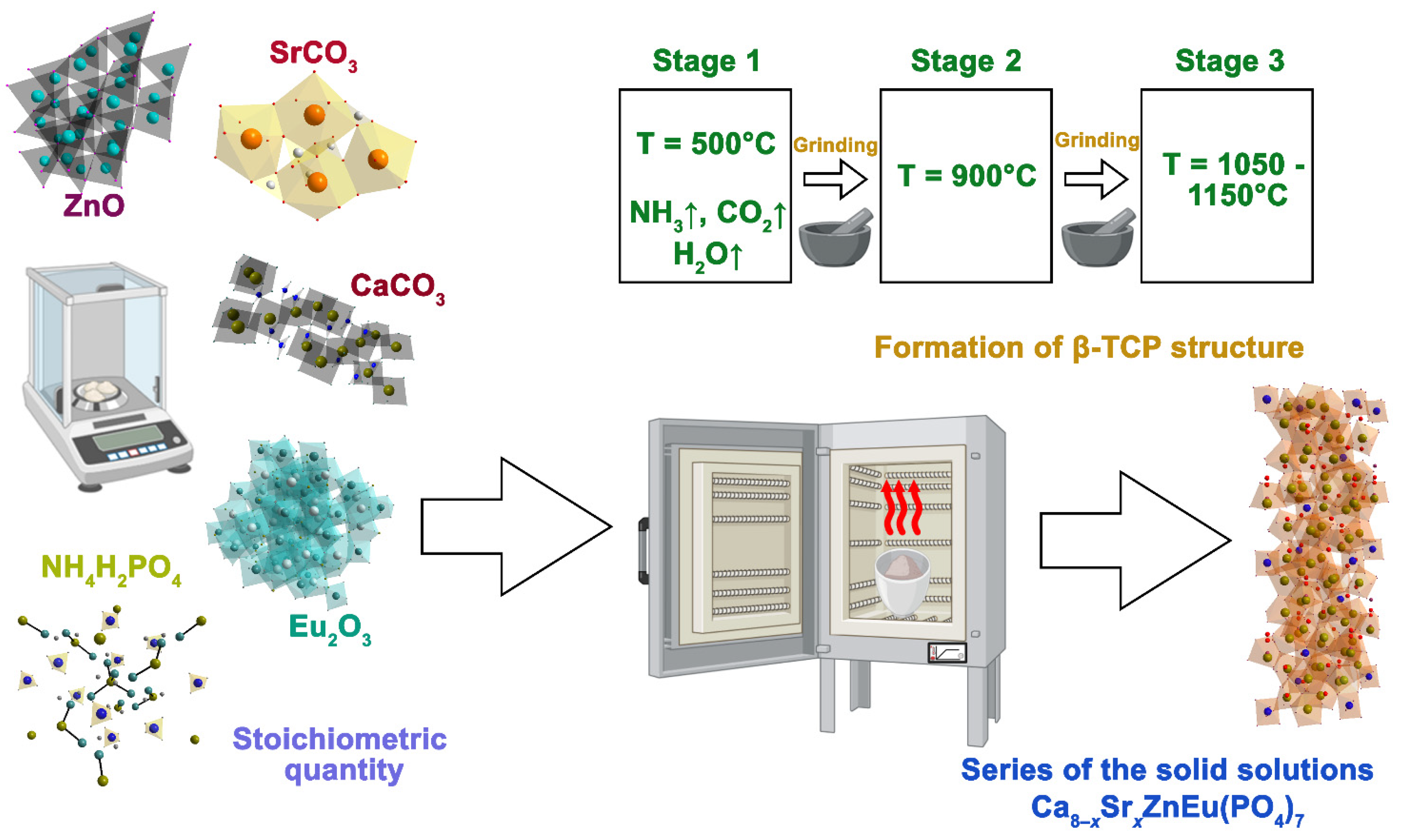
Figure 1. The scheme of Ca8−xSrxZnEu(PO4)7 solid solutions synthesis.
Coatings 15 01453 g001
Figure 2. PXRD patterns for Ca8−xSrxZnEu(PO4)7 series: x = 0 (CZE), 1.5 (1.5SCZE), 3.0 (3SCZE), 4.5 (4.5SCZE) (a), and x = 6.0 (6SCZE), 7.5 (7.5SCZE), 8.0 (SZE) (b). The Bragg reflections for β-Ca3(PO4)2 (PDF-2 No. 70-2065) and Sr3Eu(PO4)3 phase (PDF-2 No. 48-410, marked by asterisks) are shown at the bottom of the figures.
Coatings 15 01453 g002
Figure 3. PXRD reflection shifts for Ca8−xSrxZnEu(PO4)7 series: x = 0 (CZE), 3.0 (3SCZE), x = 6.0 (6SCZE), 8.0 (SZE). Asterisks indicate impurity reflections from the Sr3Eu(PO4)3 phase. Bragg reflections for β-Ca3(PO4)2 (PDF-2 No. 70-2065) and Sr3Eu(PO4)3 phases (PDF-2 No. 48-410) are shown at the bottom of the figure.
Coatings 15 01453 g003
Figure 4. The concentration dependencies of the unit cells parameters a (a), c (b), and volume V (c) and the shift at the main reflection (0 2 10) compared to β-Ca3(PO4)2 (PDF-2 No. 70-2065) and (Sr0.86Mg0.14)3(PO4)2 (PDF-2 No. 47-1895) (d) for Ca8−xSrxZnEu(PO4)7 (xSCZE).
Coatings 15 01453 g004
Figure 5. SEM images of the Ca8−xSrxZnEu(PO4)7 solid solutions: x = 0 (a) and 4.5 (b).
Coatings 15 01453 g005
Figure 6. The FTIR spectra for Ca8−xSrxZnEu(PO4)7 series: x = 0 (CZE), 1.5 (1.5SCZE), 3.0 (3SCZE), 4.5 (4.5SCZE) (a), and x = 6.0 (6SCZE), 7.5 (7.5SCZE), 8.0 (SZE) (b).
Coatings 15 01453 g006
Figure 7. The PL spectra for CZE sample measured at room temperature, λex = 395 nm (a). Normalized integral intensity for Ca8−xSrxZnEu(PO4)7 series (b).
Coatings 15 01453 g007
Figure 8. The high-resolution PL spectra for Ca8−xSrxZnEu(PO4)7 with x = 0 (CZE), 3 (3SCZE), 8 (SZE), measured at room temperature, λex = 395 nm, the insert shows 5D07F0 transition.
Coatings 15 01453 g008
Figure 9. Decay time curves for Ca8−xSrxZnEu(PO4)7 (xSCZE) samples monitored at 616 nm under 390 nm excitation (a). Comparison of the decay time constants and quantum yields for Ca8−xSrxZnEu(PO4)7 (xSCZE) samples (b).
Coatings 15 01453 g009
Figure 10. MTT test: growth percentage of aMSC cultured for 24 h in the absence (cell control) and in the presence of Ca8−xSrxZnEu(PO4)7: x = 0 (CZE), 1.5 (1.5SCZE), 3.0 (3SCZE), 4.5 (4.5SCZE), x = 6.0 (6SCZE), 7.5 (7.5SCZE), 8.0 (SZE). Values are obtained from three independent experiments and expressed as mean percentage values ± S.D. Cell control values correspond to 100% growth.
Coatings 15 01453 g010
Figure 11. Quantification of Alizarin Red S on aMSCs differentiated in the osteogenic lineage in the absence (positive control) and presence of Ca8−xSrxZnEu(PO4)7: x = 0 (CZE), 1.5 (1.5SCZE), 3.0 (3SCZE), 4.5 (4.5SCZE), x = 6.0 (6SCZE), 7.5 (7.5SCZE), 8.0 (SZE) (a). Images were captured using an inverted microscope at 10× magnification for cellular, positive and negative control, and 6SCZE sample (b).
Coatings 15 01453 g011
Figure 12. Growth rate and standard deviation of bacterial strains of E. coli, E. faecalis, S. aureus, P. aeruginosa, and the fungus C. albicans grown in the presence of the xSCZE samples. The reported values were obtained from three independent experiments and expressed as mean percentage values ± S.D., compared to the values of the positive control corresponding to 100%.
Coatings 15 01453 g012
Figure 13. PXRD patters of the CZE (a,b), 3SCZE (c), and 6SCZE (d) pellets after soaking for 7, 14, and 33 days in Tris-HCl buffer solution. The comparison of the PXRD patters for CZE pellets after 33 days of soaking in NaCl and Tris-HCl buffer solutions (b). The HAP-type Ca10(PO4)6(OH)2 phase (PDF-2 No. 86-740) is marked with a red rhombus.
Coatings 15 01453 g013
Figure 14. PL spectra of CZE pellets after soaking (a) for different duration. Comparison of the PL spectra of the 6SCZE sample after 33 days of soaking in NaCl and Tris-HCl buffer solutions (b). The insets show changing in the normalized PL intensity of samples.
Coatings 15 01453 g014
Table 1. Vibration modes in the FTIR spectra of Ca8−xSrxZnEu(PO4)7 solid solutions.
Assignment in PO43−IR Peaks, cm−1
x in Ca8−xSrxZnEu(PO4)7
01.534.567.58
ν3 [P–O]1128 s1125 s1128 s1127 s1123 s1123 s1123 s
ν3 [P–O]1074 s 1058 s1054 s1069 s1069 s
ν3 [P–O]1031 s1031 s1031 s1031 s1027 s1050–1032 s1046 s
ν3 [P–O]995 s992 s992 s993 s992 s992 s992 s
νs1 [P–O]964 s964 s
νs1 [P–O]945 s930945945 s939 s942 s942 s
ν4 [O–P–O]605 s602 s594 s591 s587 s587 s585 s
ν4 [O–P–O]584 s584 s547 s545 s544 s543 s543 s
ν2 [O–P–O]444 w438 w428 w463 w
Note: s—strong, w—weak.
Disclaimer/Publisher’s Note: The statements, opinions and data contained in all publications are solely those of the individual author(s) and contributor(s) and not of MDPI and/or the editor(s). MDPI and/or the editor(s) disclaim responsibility for any injury to people or property resulting from any ideas, methods, instructions or products referred to in the content.