3.1. Bulk Structure and Mechanical Properties
To validate the reliability of the computational models employed in this study, structural optimizations were performed for pure Fe and three representative Fe–Al intermetallic compounds: FeAl, Fe
3Al, and Fe
2Al
5 The optimized model is reasonably consistent with previously reported theoretical and experimental values, as shown in
Table 1, confirming the reliability of the calculated parameters, which are therefore used in the subsequent calculations [
16,
17,
18,
19].
Based on the generalized Hooke’s law, the elastic constants of the Fe–Al binary intermetallic compounds were determined via the stress–strain method. A series of distinct strain modes were applied to the optimized crystal structures, and the corresponding Cauchy stress tensors were evaluated for each deformation configuration. The relevant elastic constants were subsequently extracted based on the linear stress–strain relationships defined by the applied strain modes [
20].
Here,
represents the normal stress,
denotes the shear stress,
are the elastic constants, while
and
correspond to the normal and shear strains, respectively. The total number of independent elastic constants is dictated by the symmetry of the crystal. For high-symmetry systems, the number of distinct strain modes required to compute the full set of
can be significantly reduced, as shown in
Table 2.
By comparing the stiffness matrix parameters of Fe, FeAl, Fe3Al, and Fe2Al5, significant differences in mechanical properties among these materials can be observed. Fe exhibits the highest stiffness, particularly in the tensile and compressive directions (C11, C22, C33), while its shear stiffness components (C44, C55, C66) are relatively lower. FeAl shows a slightly reduced overall stiffness compared to Fe, but demonstrates a notable enhancement in shear stiffness, indicating improved shear resistance, making it suitable for applications requiring high shear strength. The mechanical properties of Fe3Al lie between those of Fe and FeAl, exhibiting a well-balanced performance in both tensile/compressive and shear stiffness, which suggests its advantage in applications demanding moderate impact resistance and wear protection, such as functional coatings. In contrast, Fe2Al5 shows significantly lower values in both tensile/compressive and shear stiffness, indicating its suitability for low-load coating environments. Notably, the stiffness coefficients of Fe2Al5 (e.g., C11, C12, C13, C44, C66) reveal pronounced anisotropy. The low symmetry of its crystal structure leads to substantial directional variations in mechanical response, in stark contrast to the more uniform stiffness distributions observed in Fe, FeAl, and Fe3Al. This reflects the inhomogeneous nature of interatomic interactions in Fe2Al5.
The observed differences in stiffness can be fundamentally attributed to variations in interatomic interactions, electronic structure, and crystal symmetry. The high stiffness of pure Fe primarily stems from the strong metallic bonding inherent in its body-centered cubic (BCC) crystal structure. These dense interatomic interactions endow Fe with high elastic stiffness coefficients and excellent resistance to deformation. With the incorporation of Al, the presence of Al atoms in FeAl alloys weakens the metallic bonding strength within the lattice, resulting in a decrease in overall stiffness. Concurrently, the addition of Al alters the shear deformation mechanisms, significantly enhancing the material’s resistance to shear—an effect particularly pronounced in FeAl and Fe
3Al. As the Al content increases further in Fe
3Al and Fe
2Al
5, the crystal symmetry is reduced, and the interatomic interactions become increasingly directional, leading to marked anisotropy in the stiffness coefficients. This effect is especially evident in Fe
2Al
5, where the complex atomic arrangement and low symmetry give rise to substantial directional variations in mechanical response, further diminishing the overall stiffness. These observations highlight the critical role of Al content and crystal structure in tailoring the mechanical properties of Fe–Al intermetallic compound (see
Table 3).
The mechanical properties obtained from the Voigt model show that Al content has a pronounced effect on the Fe–Al intermetallics. With increasing Al concentration, both Young’s modulus and shear modulus increase from Fe to Fe3Al and FeAl, while the bulk modulus decreases and Poisson’s ratio decreases monotonically. This indicates that Al addition enhances stiffness and shear resistance but reduces compressibility and ductility. Among the investigated phases, FeAl exhibits the highest Young’s and shear moduli, consistent with its B2 ordering and strong directional Fe–Al bonding. Fe3Al ranks second in stiffness, reflecting the strengthening effect of DO3 chemical ordering on a BCC-like lattice, whereas pure Fe, despite its high symmetry, shows slightly lower moduli due to the absence of such ordering. Fe2Al5, in contrast, has the lowest bulk, shear and Young’s moduli, which is attributed to its low-symmetry orthorhombic (Cmcm) structure and complex atomic arrangement that weaken the overall bonding stiffness.
The elastic anisotropy of the cubic phases was quantified by the Zener factor [
21].
The values
for Fe and
for FeAl indicate moderate elastic anisotropy, while Fe3Al exhibits a much larger Zener factor of
, revealing a strongly anisotropic elastic response associated with DO3 ordering. For the orthorhombic Fe2Al5 phase, a cubic-type Zener ratio is not defined; here its mechanical behavior is therefore discussed primarily in terms of the reduced moduli and low Poisson’s ratio, which together suggest a comparatively brittle response.
3.2. Slab Structure and Surface Energy of Fe–Al Compounds
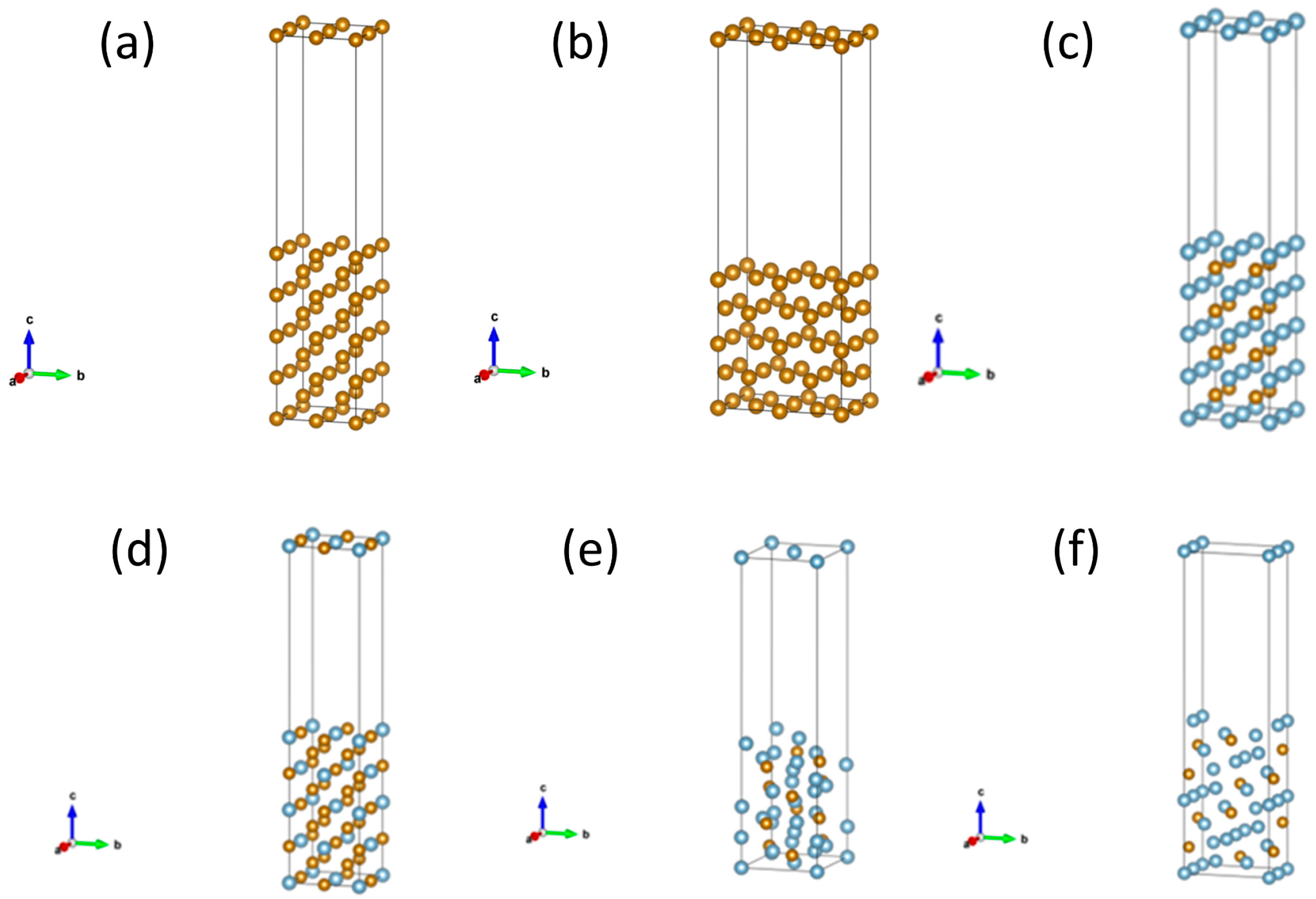
To investigate the interfacial structures formed between various Fe–Al intermetallic compounds and suitably oriented Fe surfaces, supercell and surface models were constructed for the (001) surface of FeAl, the (001) surface of Fe
3Al, the (001) and (0
0) surfaces of Fe
2Al
5, as well as the (001) and (110) surfaces of Fe as shown in
Figure 1. In this work, we restrict our analysis to low-index surfaces that are thermodynamically favorable and frequently reported in Fe/Fe–Al coating systems. For bcc Fe, the (110) and (001) surfaces are widely used reference orientations due to their relatively low surface energies and simple atomic arrangements. For B2-FeAl and DO
3-Fe
3Al, the (001) terminations provide highly symmetric surfaces that can form nearly coherent interfaces with Fe(001). For orthorhombic Fe
2Al
5, we focus on the (001) and (0
0) facets, which are consistent with experimentally reported Fe
2Al
5(0
0)/Fe(110) orientation relationships and enable construction of interfaces with small lattice mismatch [
15]. Structural optimizations were performed for the supercell and surface models, and the corresponding surface energies were subsequently calculated [
22].
The
represents the total energy of the surface structure,
denotes the total energy per atom or molecule in the bulk phase, n is the number of atoms or molecules contained in the surface structure, and A is the area of the corresponding surface. Therefore, γ provides a direct measure of the average energy cost per broken bond at the surface, including the extent to which this energy can be partially recovered by surface relaxation.
As shown in
Table 4, the surface energies of different Fe–Al intermetallic compounds exhibit clear phase- and orientation-dependent trends. This behavior can be rationalized from three aspects. First, according to Equation (3), γ is the excess energy associated with breaking Fe–Fe and Fe–Al bonds and partially recovering this energy by surface relaxation. The relatively high surface energies of Fe(001), FeAl(001) and Fe
3Al(001) indicate a larger average penalty per broken bond, which is consistent with strong metallic bonding in these phases. Second, the ordered B2-FeAl and DO
3-Fe
3Al structures provide relatively dense and highly coordinated (001) terminations, whereas the orthorhombic Fe
2Al
5 (Cmcm) exposes more open, Al-rich, low-coordination sites along the (001)/(0
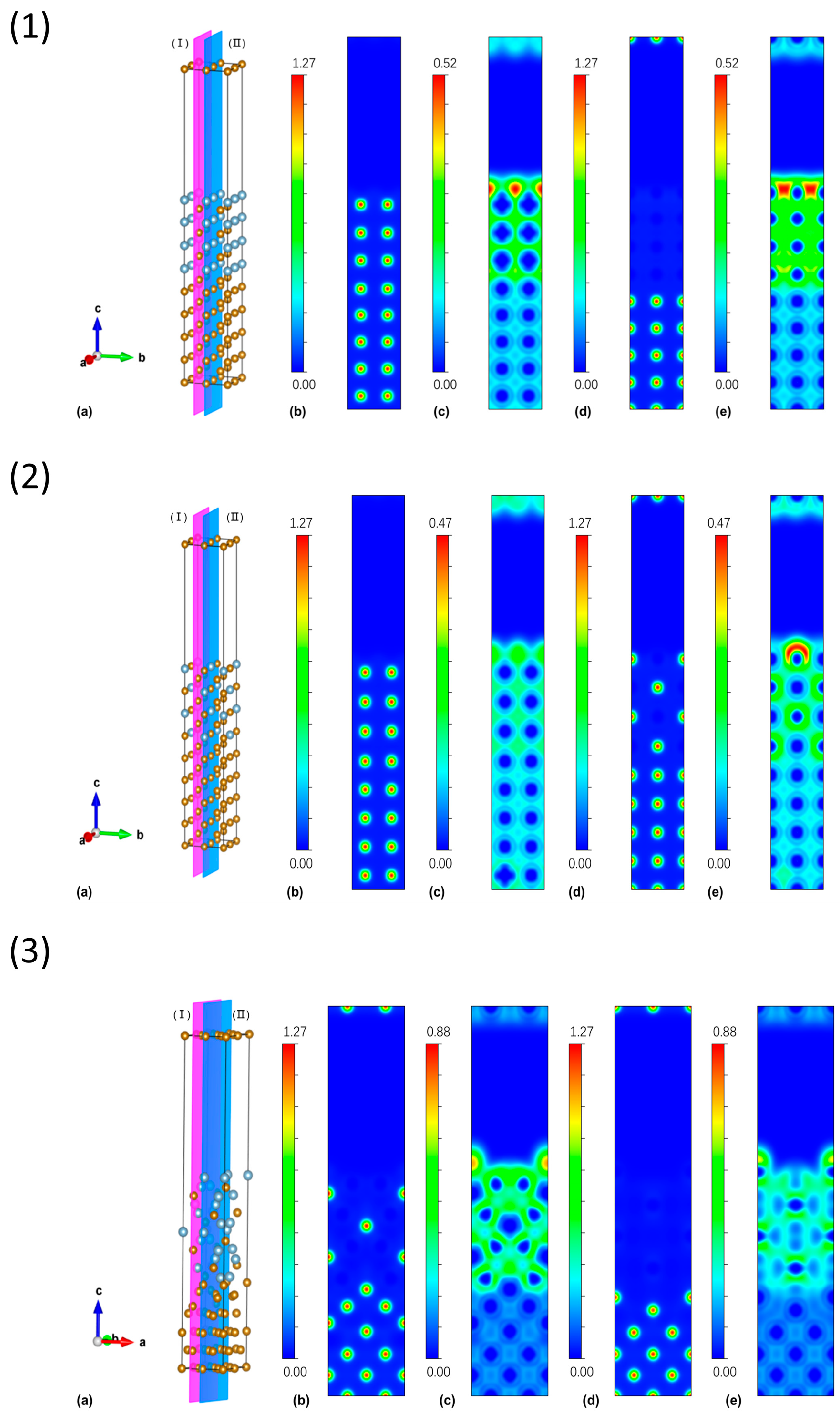
0) facets that can undergo pronounced relaxation and rebonding, thereby lowering γ. Third, as will be discussed in
Section 3.3, Bader charge density and ELF analyses reveal stronger electron localization and bonding heterogeneity at Fe
2Al
5 surfaces and interfaces, which further facilitates such relaxation and is consistent with their comparatively low surface energies.
For the FeAl/Fe and Fe3Al/Fe interfaces, FeAl(001)/Fe(001) and Fe3Al(001)/Fe(001) configurations were selected as the research objects due to their high symmetry, well-ordered atomic arrangements, and minimal lattice mismatch resulting from the close similarity in lattice parameters of the two materials. These characteristics facilitate the construction of well-defined interface models and effectively reduce boundary effects.
In addition, the selection of the Fe
2Al
5/Fe interface was based on experimental observations indicating that the orientation relationship between Fe
2Al
5 and Fe is not unique. To simplify the computational process and more accurately reflect practical conditions, low-index or close-packed planes are typically chosen for modeling. Previous work has shown that the Fe
2Al
5(0
0)/Fe(110) interface contains relatively few atoms and has a small lattice mismatch, so this configuration was adopted here. The lattice mismatch of each interface model was then calculated using Equation (4) [
23].
where
and
represent the interplanar spacings along the (hkl) crystallographic directions on either side of the interface, while K and L are integer coefficients used to describe the lattice matching relationship at the interface.Based on this approach, the calculated lattice mismatches for the FeAl(001)/Fe(001), Fe
3Al(001)/Fe(001), and Fe
2Al
5(0
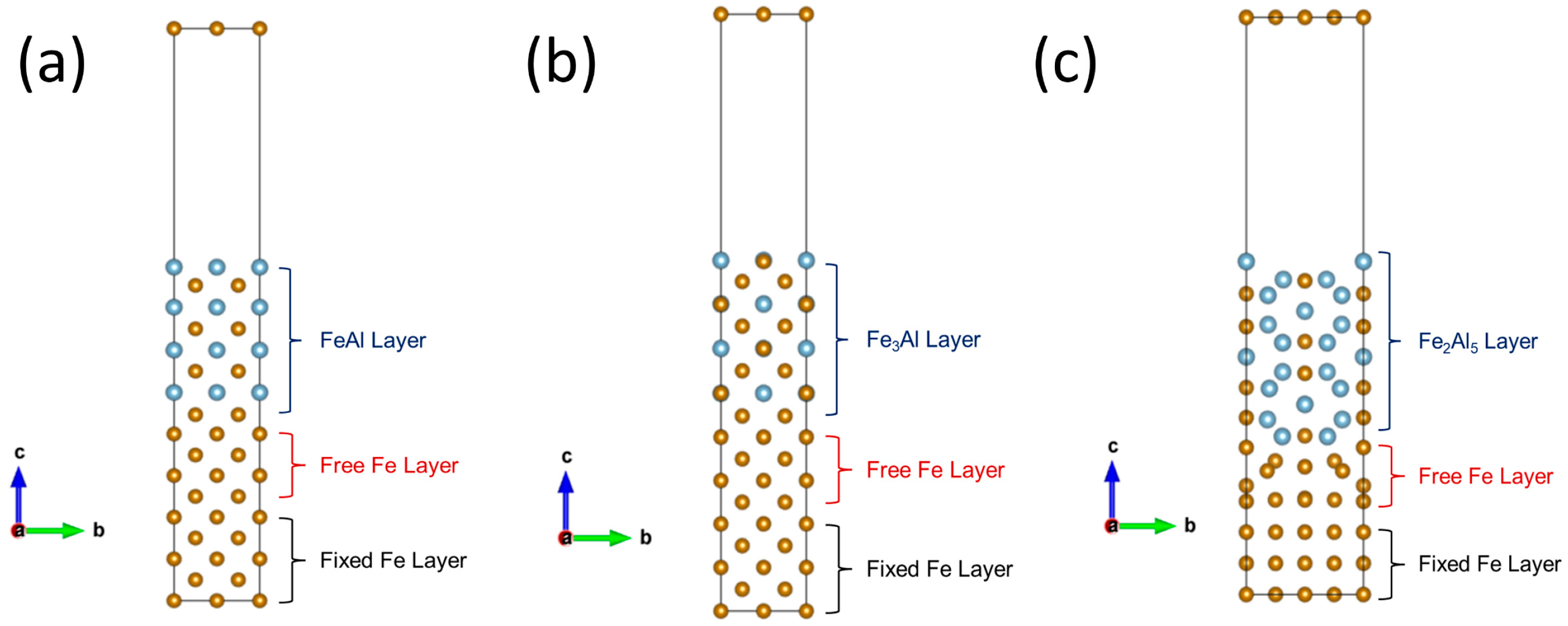
0)/Fe(110) interfaces are 1.413%, 1.41%, and 1.85%, respectively. The optimized interface structures are illustrated in
Figure 2:
The work of adhesion (
) is a critical physical quantity used to characterize the interfacial bonding strength between two materials. It is defined as the energy required to separate the two materials at the interface into two free surfaces. The value of
can be expressed by Equation (5) [
15]:
where
denotes the work of adhesion;
and
denote the surface energies of materials α and β, respectively;
is the total energy of the α/β interface system; and S is the interfacial area.
In the present study, full atomic relaxation and self-consistent field (SCF) calculations were performed to obtain the total interfacial energies and the surface energies of the individual free surfaces. Based on these results and Equation (4),
of different Fe–Al compound/Fe interfaces was quantitatively evaluated, providing insight into the interfacial bonding strength. All calculations were conducted using consistent computational parameters to ensure the reliability and comparability of the results.
These results indicate that both interfaces exhibit strong interfacial bonding and comparable interfacial stability. Such behavior is consistent with the crystallographic characteristics of FeAl and Fe3Al, where the directional Fe–Al bonding in FeAl contributes to strong adhesion, while the synergistic interaction of Fe–Fe and Fe–Al bonds in Fe3Al further enhances the interfacial bonding strength. The similar cross-sectional areas of both models suggest consistency in model construction and high comparability of the computational results.
In contrast, the calculated work of adhesion for the Fe2Al5(0
0)/Fe(110) interface is 1.119 J/m2, with an interfacial distance of approximately 1.989 Å. Although this interface structure converged upon structural optimization, the result deviates from previous findings reported in the literature. This discrepancy may arise from differences in the construction of the Fe2Al5(0
0) surface model compared to that in the reference, and more significantly, from the relatively large initial separation between the two surface slabs, which likely led to a larger optimized interfacial distance. The latter factor generally has a more pronounced impact.
Interfacial energy (
) is a key parameter characterizing the thermodynamic stability of material interfaces. It quantifies the excess energy associated with atomic rearrangements or chemical bond reconstructions in the interfacial region. The interfacial energy is typically defined as the difference between the total energy of the interface system and the sum of the energies of the two isolated surfaces and the chemical potentials of the constituent elements, normalized by the interfacial area [
15]. The corresponding expression is generally given as:
Here,
represents the total energy of the interface system, while
and
denote the number of atoms and the chemical potential of component
i, respectively.
S is the interfacial area. The interfacial energy is commonly used to evaluate the thermodynamic stability of an interface: a lower value indicates a more stable interface. If the interfacial energy is negative, the interface is thermodynamically stable and may form spontaneously. The result is shown in
Table 5.
Previous studies have demonstrated a relationship between the work of adhesion and interfacial energy [
15], as described in Equation (7):
Equation (7) indicates that a lower interfacial energy leads to a higher work of adhesion. In this study, the FeAl(001)/Fe(001) interface exhibits the lowest interfacial energy and thus the highest work of adhesion, which is consistent with the trend predicted by the equation.
The interfacial fracture resistance describes the ability of an interface to resist crack initiation and propagation and is commonly characterized by the critical energy release rate
or by the work of adhesion
. Within the Griffith framework, the energetically preferred crack path is the one that requires the lowest fracture energy: if the energy needed to create new surfaces along the interface (proportional to
) is lower than that for bulk fracture, cracks tend to propagate along the interface; otherwise, they are more likely to penetrate through the bulk. In this sense,
provides an energetic measure of the resistance to interfacial separation and is governed by the interfacial bonding strength and the crystallographic characteristics of the adjoining phases.
For the FeAl(001)/Fe(001) and Fe3Al(001)/Fe(001) interfaces, the calculated works of adhesion are 5.25 J m−2 and 5.19 J m−2, respectively, indicating strong and essentially comparable interfacial bonding and structural stability. The slightly higher
of the FeAl/Fe interface may be related to the larger fraction of directional Fe–Al bonds in B2-structured FeAl, whereas DO3-structured Fe3Al contains a relatively higher proportion of Fe–Fe bonds with weaker directionality due to reduced orbital overlap. In both cases, the large
values imply that a substantial amount of energy is required to separate the interface, suggesting good resistance to interfacial crack initiation and growth. By contrast, the Fe2Al5(0
0)/Fe(110) interface exhibits a much lower work of adhesion of only 1.119 J m−2, which is markedly smaller than the values obtained for the FeAl/Fe and Fe3Al/Fe interfaces. This indicates a more fracture-prone and mechanically fragile interface, where crack propagation along the interface is energetically easier. The weak interfacial bonding can be attributed to the complex, low-symmetry crystal structure of Fe2Al5 and the relatively large interfacial separation, which together reduce the effectiveness and density of bonds across the interface.
Overall, considering both interfacial bonding strength and crystal-structure effects, the FeAl(001)/Fe(001) interface, with its slightly higher but generally large work of adhesion, offers the best interfacial fracture resistance and is well suited for the design of high-strength, high-stability interfacial materials. The Fe3Al(001)/Fe(001) interface, with similarly robust
and favorable overall performance, is appropriate for applications with moderate-to-high strength requirements. In contrast, the Fe2Al5(0
0)/Fe(110) interface, owing to its much lower
, is more prone to interfacial fracture and would benefit from further structural optimization to enhance its interfacial bonding strength and stability under high-stress conditions.