Article

Corrosion Behavior of Cu-Mg Alloy Contact Wire in Controlled Humid Heat Environments

1
Standards & Metrology Research Institute, China Academy of Railway Sciences Corporation Limited, Beijing 100081, China
2
School of Materials Science and Engineering, Central South University, Changsha 410083, China
*
Authors to whom correspondence should be addressed.
Coatings 2025, 15(12), 1435; https://doi.org/10.3390/coatings15121435 (registering DOI)
Submission received: 5 October 2025 / Revised: 26 November 2025 / Accepted: 1 December 2025 / Published: 5 December 2025
(This article belongs to the Section Corrosion, Wear and Erosion)

Abstract

This study investigated the corrosion behavior of cold-drawn Cu-0.43 wt% Mg alloy wires, which were intended for high-speed railway contact lines, under varying temperature (30–50 °C) and relative humidity (85% and 93%) conditions in controlled humid heat environments. The corrosion resistance of the alloy wires after 48 h of humid heat testing was evaluated using electrochemical methods such as polarization curves and electrochemical impedance spectroscopy. The morphology and composition of the corrosion products were characterized using scanning electron microscopy/energy-dispersive spectroscopy (SEM/EDS), X-ray diffraction (XRD), and X-ray photoelectron spectroscopy (XPS). The results demonstrated superior corrosion resistance for specimens exposed to higher temperature and lower humidity (50 °C, 85% RH), as evidenced by lower corrosion current densities and higher film/charge transfer resistances compared to lower temperature and higher humidity conditions (30 °C, 93% RH). This enhanced resistance correlated with the formation of denser, more continuous protective corrosion films observed under high-temperature and low-humidity conditions. Surface analyses confirmed that the corrosion films consisted primarily of copper oxides (Cu2O and CuO), with only trace amounts of magnesium oxides detected, suggesting Mg played a minor role in the composition of the mature passive film under these conditions. These findings provide crucial data on the environmental degradation behavior of Cu-Mg contact wires, which is particularly relevant for applications in coastal or humid regions.

1. Introduction

Copper and its alloys are indispensable materials across diverse sectors, including electronics, transportation, aerospace, and biomedical engineering, owing to their favorable combination of strength, electrical and thermal conductivity, and processability [1]. Within this class, dilute copper–magnesium (Cu-Mg) alloys have emerged as leading candidates for high-speed railway contact wires, offering superior strength and conductivity compared to conventional solid solution-strengthened alloys like Cu-Sn, Cu-Zn, or Cu-Al [2]. The addition of minor amounts of magnesium (<1 wt%) significantly enhances the strength and high-temperature performance of copper with minimal detriment to its electrical conductivity, making these alloys particularly suitable for demanding catenary applications [3].
Research efforts concerning Cu-Mg alloys have predominantly focused on optimizing their composition, processing routes, and resultant mechanical and electrical properties [1]. Alloying strategies involving elements such as Ca [2], Ce [4,5], Y [6], and Fe [5] have been explored to further enhance performance. Advanced processing techniques, including internal oxidation [7], equal-channel angular pressing (ECAP) [8], and continuous casting followed by multi-pass drawing [9], have successfully yielded high-strength, high-conductivity materials. However, despite their intended use in outdoor infrastructure that are often exposed to challenging environmental conditions, the corrosion resistance of these high-performance Cu-Mg alloys has received comparatively little attention.
The degradation of structural components in humid heat environments poses a significant engineering challenge, potentially leading to premature failure. For instance, high-strength steels in coastal structures experience accelerated corrosion under cyclic wet/dry conditions, compromising structural integrity [10]. Similarly, Cu-Ni alloy pipes used in seawater can suffer compact corrosion in humid heat, causing failure [11]. In heat exchangers, a humid and hot environment can cause copper alloy components to oxidize and flake off, forming deposits that increase energy consumption and maintenance costs [12]. The corrosion of Ni-Fe components in relays can lead to failure, necessitating stringent damp-heat testing for safety-critical devices like ground fault interrupters [13]. Therefore, understanding and quantifying corrosion resistance is critical for ensuring the long-term reliability and safety of materials used in such environments.
Given the potential deployment of Cu-Mg contact wires in diverse climates, including coastal regions characterized by high humidity and temperature fluctuations, a thorough understanding of their corrosion behavior under relevant conditions is imperative. It should be noted that in addition to environmental corrosion, the overhead contact line continuously endures complex loads such as mechanical friction, vibration, and impact, which may couple with the environment, making the corrosion behavior more complex. This study systematically investigates the corrosion performance of a commercial cold-drawn Cu-0.43 wt% Mg alloy wire under controlled humid heat conditions, encompassing three temperature levels (30 °C, 40 °C, 50 °C) and two relative humidity levels (85%, 93%). The research focuses on comparing corrosion resistance across these environments using electrochemical techniques and characterizing the morphology and composition of the resulting corrosion films. This article studies the effects of temperature and humidity on the corrosion resistance and film formation process of Cu-0.43 wt% Mg alloys, and establishes relevant connections for protection against and the prediction of damage in harsh environments.

2. Experimental

2.1. Material and Sample Preparation

The material investigated was a commercial Cu-Mg alloy wire (Φ2.8 mm) intended for high-speed rail contact lines, supplied by the China Academy of Railway Science (Beijing, China). The wire was produced by multi-pass cold drawing. Its chemical composition, determined by inductively coupled plasma–optical emission spectroscopy (ICP-OES), was Cu-0.43 wt% Mg.
Wire segments were sectioned into 15 mm lengths for damp-heat testing. These tests were conducted in an MHP-225-CA constant-temperature and -humidity chamber following the GB/T 2423.3-2016 standard (Environmental testing—Part 2–3: Tests—Test Cab: humid heat, steady state). Samples were exposed for 48 h under six different conditions, combining three temperatures (30 ± 2 °C, 40 ± 2 °C, 50 ± 2 °C) and two relative humidity (RH) levels (85 ± 3%, 93 ± 3%), as detailed in Table 1. These parameter ranges were designed based on the equivalent international standard IEC 60068-2-78:2012 and the Chinese standard GB/T 2423.3-2016. Temperatures of 30, 40, and 50 °C, and humidity levels of 85% and 93%, are typical test condition combinations in this standard, simulating the environment of summer or high-humidity industrial scenarios in South China. We sequentially immersed the samples in acetone, deionized water, 10% dilute hydrochloric acid, deionized water, and ultrasonic cleaning to remove oil and oxides from the sample surface. Then, we progressively polished the samples using diamond polishing paste at concentrations of 40, 20, 10, 5, and 1 μm until a mirror-like finish was achieved. After polishing, the sample surface was rinsed with deionized water.

2.2. Electrochemical Measurements

Electrochemical specimens were prepared by embedding wire segments in epoxy resin, exposing only the circular cross-sectional surface (area ≈ 0.0616 cm2) as the working electrode. The exposed surface was mechanically ground using SiC papers up to 2000 grit, followed by polishing with diamond paste (e.g., 1 µm) to achieve a mirror finish, and finally ultrasonically cleaned in ethanol and dried before the damp-heat testing.
Electrochemical measurements were performed after the 48 h damp-heat testing using an M204 multi-channel AUTOLAB workstation (Houston, TX, USA) in a conventional three-electrode cell. The working electrode was the exposed cross-section of the Cu-Mg wire specimen, a saturated calomel electrode (SCE) served as the reference electrode, and a platinum sheet acted as the counter electrode. The electrolyte was a 3.5 wt% NaCl aqueous solution, prepared using analytical grade NaCl and deionized water, open to air at room temperature (approx. 25 °C). Measurements commenced after the open-circuit potential (OCP) stabilized (Figure S1).
Electrochemical impedance spectroscopy (EIS) was conducted at the OCP, scanning from 100 kHz down to 0.01 Hz with a sinusoidal perturbation amplitude of 10 mV (rms). Data were collected at 10 points per frequency. The measured impedance spectra were analyzed and fitted using ZSimpWin software version 3.60. Potentiodynamic polarization curves were recorded by scanning the potential from −500 mV vs. OCP to +500 mV vs. OCP at a scan rate of 1 mV/s. Corrosion potential (Ecorr) and corrosion current density (icorr) were determined from the polarization curves using the Tafel extrapolation method applied to regions typically ±50–100 mV around Ecorr.

2.3. Surface Characterization

The surface morphology of the corrosion films formed after damp-heat testing was examined using a Tescan (Brno, Czech Republic) MIRA4 field emission scanning electron microscope (SEM) at an accelerating voltage of 10 kV. Elemental composition analysis was performed using energy-dispersive X-ray spectroscopy (EDS) integrated with the SEM.
The crystal structure of the corrosion products was characterized using X-ray diffraction (XRD) on a D/Max 2550VB diffractometer (Rigaku Inc., Japan) with Cu Kα radiation. XRD scans were performed over a 2θ range from 20° to 100° at a scan rate of 5°/min. Phase identification was carried out using Jade9 software by comparing diffraction patterns with the International Centre for Diffraction Data (ICDD) PDF4-2009 database.
X-ray photoelectron spectroscopy (XPS) was employed to investigate the chemical states of elements within the surface films using a Thermo Scientific (Waltham, MA, USA) ESCALAB 250Xi instrument equipped with a monochromatic Al Kα X-ray source (1486.6 eV). Analyses were conducted under ultra-high-vacuum conditions (base pressure < 10−9 mbar). Survey spectra (0–1400 eV binding energy) were acquired with a pass energy of 100 eV and a step size of 1 eV. High-resolution spectra for the Cu 2p, O 1s, and Mg 1s regions were collected with a pass energy of 20 eV and a step size of 0.1 eV. The analysis spot size was approximately 400 μm. Charge correction was performed by calibrating the adventitious C 1s peak to 284.8 eV. XPS data processing and quantification were performed using Avantage software Version 6, referencing its internal database and the NIST XPS database.

3. Results

3.1. Electrochemical Properties

Potentiodynamic polarization curves for the Cu-Mg alloy specimens before and after 48 h exposure to different humid heat conditions are presented in Figure S2 and Figure 1. All curves exhibit qualitatively similar features, characteristic of materials that passivate in the chloride-containing electrolyte. The potentiodynamic polarization curve displays distinct regions: (I) cathodic region, dominated by hydrogen evolution at highly negative potentials; (II) oxygen reduction region, showing near-linear behavior limited by oxygen diffusion; (III) mixed activation control zone around the corrosion potential (Ecorr); (IV) active dissolution region, where Cu likely dissolves as Cu+/Cu2+; (V) passivation region, characterized by a significant drop in current density, indicating the formation of a protective film (passivation onset potential near Point A, fully passive potential near Point B); (VI) transpassive region, where film breakdown (pitting) or further oxidation occurs, leading to increased current; and (VII) potentially a repassivation or secondary passivation region at higher potentials. A small current plateau is observed in the anodic branch of the third polarization curve. This is because the corrosion potential Ecorr is near the dynamic equilibrium point, and the cathodic and anodic reactions are coupled, forming a transition region, resulting in a temporary slowdown in the growth of the net anodic current.
Electrochemical parameters derived from Tafel extrapolation of the polarization curves are summarized in Table 2. These include the anodic (ba) and cathodic (bc) Tafel slopes, corrosion potential (Ecorr), and corrosion current density (icorr). The corrosion current density (icorr) provides a measure of the instantaneous corrosion rate under the test conditions. The Ecorr tends to shift towards a positive potential with increasing temperature, while icorr also decreases with increasing temperature. This indicates that the higher the temperature, the thicker the protective oxide film formed on the alloy surface, which can slow down alloy corrosion and improve the service life of components. High ambient temperature can promote the formation of a dense oxide film on the alloy surface, and high humidity will make the oxide film on the alloy surface thicker. In this experiment, the bc/ba ratio of sample V was 1.58, indicating that the corrosion process of sample V was cathodic-controlled. This shows that the cathodic reaction on this surface is difficult to carry out, inhibiting the corrosion process of the alloy. More importantly, sample V had the most positive Ecorr and the lowest Icorr, proving that under the operating conditions of 50 °C and 85%RH, the alloy has the most stable and superior corrosion resistance in terms of both kinetics and thermodynamics.
Combined with the SEM images in Figure S3e, it can be seen that a dense oxide film formed on the surface of sample V, hindering further oxidation failure of the alloy. Samples I and II showed the largest Icorr, indicating the worst corrosion resistance (Table 2 and Figure S3a). The bc/ba ratios of samples II and III were 0.61 and 0.63, respectively, indicating anodic control. The high ba values suggest that the anodic dissolution process is inherently difficult. However, due to the low temperature, the surface oxide film is not dense and is uneven, resulting in a still relatively high overall corrosion rate (Figure S3b,c). The bc/ba ratios of samples IV and VI were 1.09 and 1.11, respectively, with relatively low Icorr, indicating that the corrosion process of the alloy under these two conditions is mixed-controlled, and corrosion is inhibited (Table 2 and Figure S3d). However, sample VI had a more negative Ecorr, indicating that the corrosion of the alloy is unstable under high-temperature and high-humidity conditions. This is due to its thick but not dense oxide layer (Figure S3f).
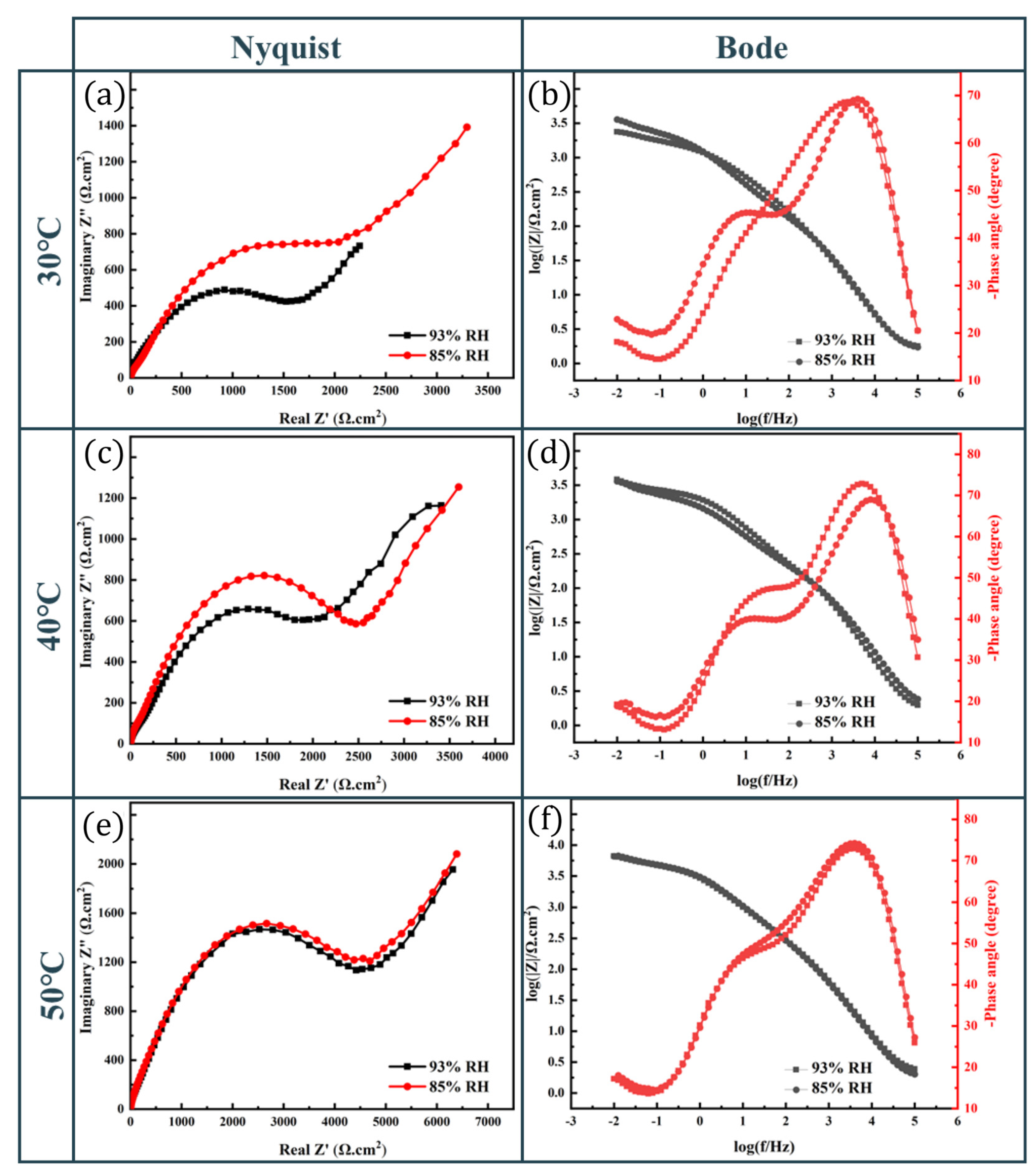
Electrochemical impedance spectra (EIS) were measured to further probe the properties of the surface films. Nyquist plots (Figure 2a,c,e) typically show a depressed semicircular arc at high-to-medium frequencies and often a linear feature (Warburg impedance) at low frequencies. The semicircle diameter relates to the charge transfer resistance (Rct) and film resistance (Rf). Consistent with the polarization data, the semicircle diameter generally increases (indicating higher resistance) with increasing exposure temperature at constant humidity, and decreases with increasing humidity at constant temperature. The low-frequency linear segment suggests that diffusion processes (e.g., oxygen diffusion to the interface or corrosion product diffusion away) play a role in the overall corrosion mechanism [14].
Bode plots (Figure 2b,d,f) provide complementary information. The magnitude plot (log|Z| vs. logf) shows higher impedance values at low frequencies for samples exposed to higher temperatures and lower humidity, again indicating better corrosion resistance. The phase angle plots often exhibit two time constants (two peaks or shoulders), one at higher frequencies typically associated with the properties of the corrosion product film (film capacitance Qf and resistance Rf), and another at lower frequencies related to the electrochemical double layer at the film/electrolyte or metal/film interface (double-layer capacitance Qdl and charge transfer resistance Rct) [15].
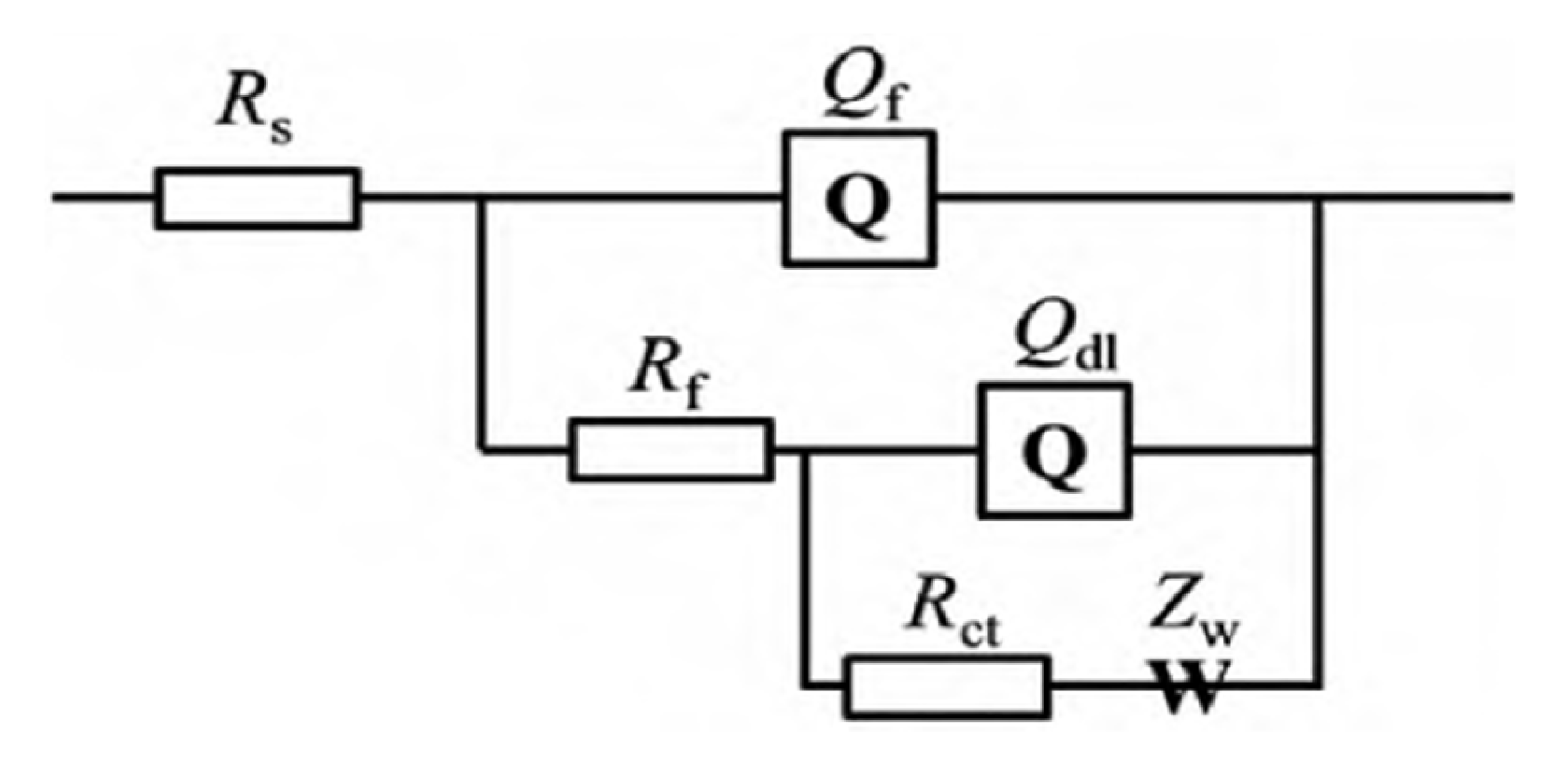
The EIS data were fitted using the equivalent electrical circuit (EEC) shown in Figure 3. This circuit includes the solution resistance (Rs), a constant phase element (Qf) and resistance (Rf) representing the corrosion film, another constant phase element (Qdl) and resistance (Rct) for the double layer and charge transfer process, and a Warburg element (ZW) for diffusion. Constant phase elements (CPEs, denoted Q) were used instead of pure capacitors to account for surface heterogeneity and non-ideal capacitive behavior, with impedance defined by Equation (1) [16]. The fitting quality was assessed using the chi-squared (χ2) value (Equation (2)) [17], with values typically below 10−3, indicating excellent agreement between the model and experimental data.
1 Z = Q 0 ( j w ) n
χ 2 = i = 1 N [ Z i Z ω i ] 2 + [ Z i Z ( ω i ) ] 2 σ 2
The fitted parameters are listed in Table 3. Key parameters reflecting corrosion resistance are the film resistance (Rf) and charge transfer resistance (Rct). Both Rf and Rct generally increase significantly with increasing exposure temperature at constant humidity and decrease with increasing humidity at constant temperature. This trend strongly corroborates the polarization results: higher temperatures and lower humidity during the damp-heat testing promote the formation of more resistive, protective surface films, thereby enhancing the corrosion resistance in the subsequent electrochemical test. The n values for Qf and Qdl are typically between 0.8 and 0.9, indicating behavior close to capacitive but with some deviation due to surface non-idealities. As shown in Table S1, the polarization resistance (Rp) increases with increasing temperature, while the corrosion rate (vcorr) decreases. These results are consistent with the conclusions of the potentiodynamic polarization test mentioned earlier, both indicating that the sample under high-temperature and low-humidity conditions has superior corrosion resistance.

3.2. Corrosion Film Characterization

SEM micrographs revealing the surface morphology before and after damp-heat testing are shown in Figure S4 and Figure 4. Significant differences are observed depending on the exposure conditions. At 30 °C (Figure 4a,b), the corrosion products appear scattered and island-like, failing to form a continuous protective layer. At 30 °C and 93% RH (Figure 4b), the film exhibits noticeable cracking, potentially due to internal stresses exceeding the film strength, suggesting a less dense or poorly adherent structure. At 40 °C (Figure 4c,d), a more continuous, thin film appears to form, particularly at 85% RH (Figure 4c). However, at 93% RH (Figure 4d), localized peeling or detachment of the film is evident, which would compromise its protective ability. At 50 °C (Figure 4e,f), the surface appears to be covered by a more substantial corrosion product layer. This layer seems denser and more uniform at 85% RH (Figure 4e) compared to 93% RH (Figure 4f), where a more porous or granular outer layer might be present, overlying a denser inner layer. These morphological observations correlate well with the electrochemical findings: conditions favoring denser, more continuous films (higher T, lower RH) correspond to higher measured corrosion resistance.
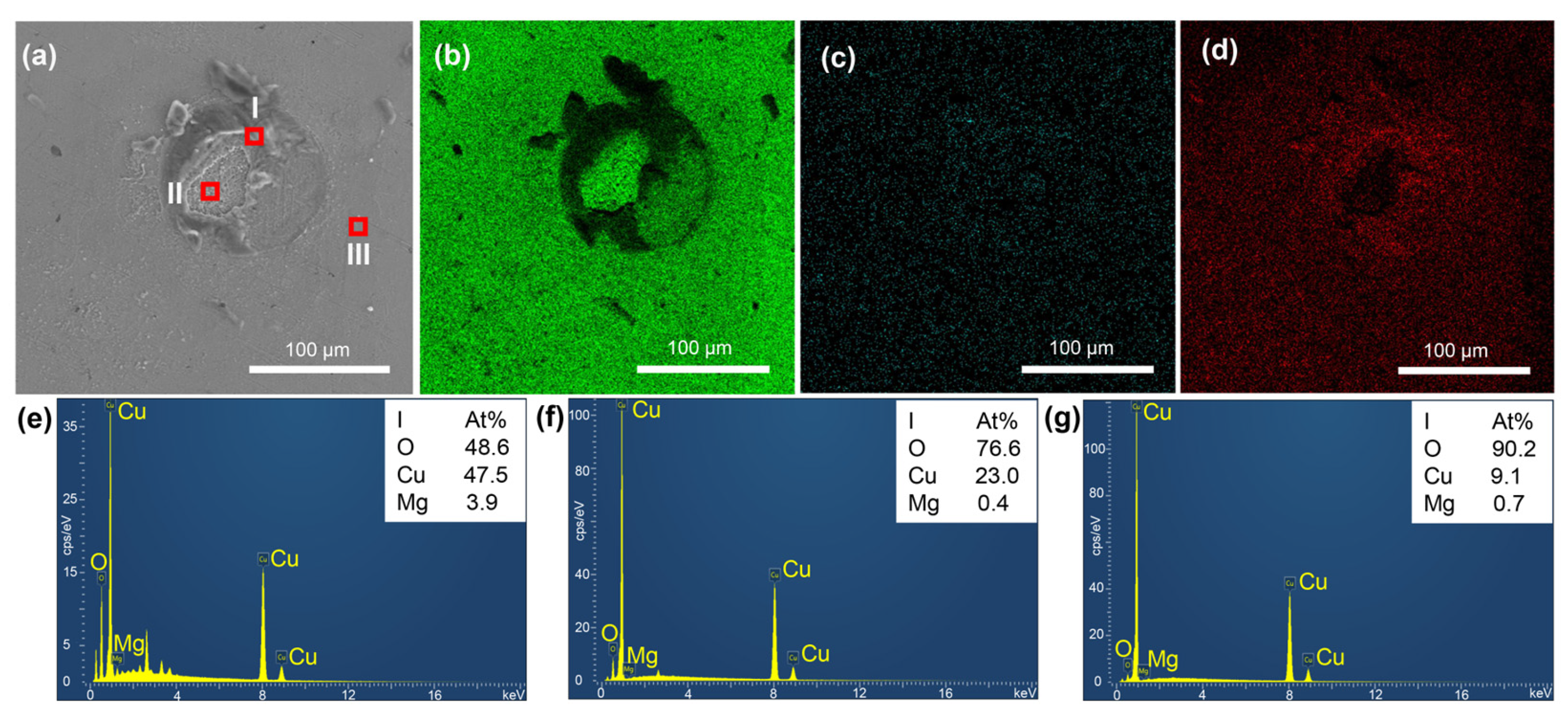
EDS analysis was performed to investigate the elemental composition of the corrosion films. Figure 5 shows an EDS mapping of a Cu-0.43%Mg alloy sample that was exposed to humid and heated conditions. The maps indicate enrichment of oxygen (O) across the surface, confirming oxide formation. Copper (Cu) is the main metallic element. Magnesium (Mg) is detected, but its signal appears relatively weak and somewhat localized, although point analysis (Figure 5e, Point I—outer layer) suggests a higher Mg content (3.9 at.%) than the bulk alloy (approx. 0.43 wt% ≈ 1 at.%). This suggests some preferential incorporation or enrichment of Mg in the outermost corrosion products under these specific conditions. Analysis of the underlying layer (Point II) shows Cu and O ratios that suggest a mix of oxide and underlying metal (due to electron beam penetration), with Mg content closer to the bulk level.
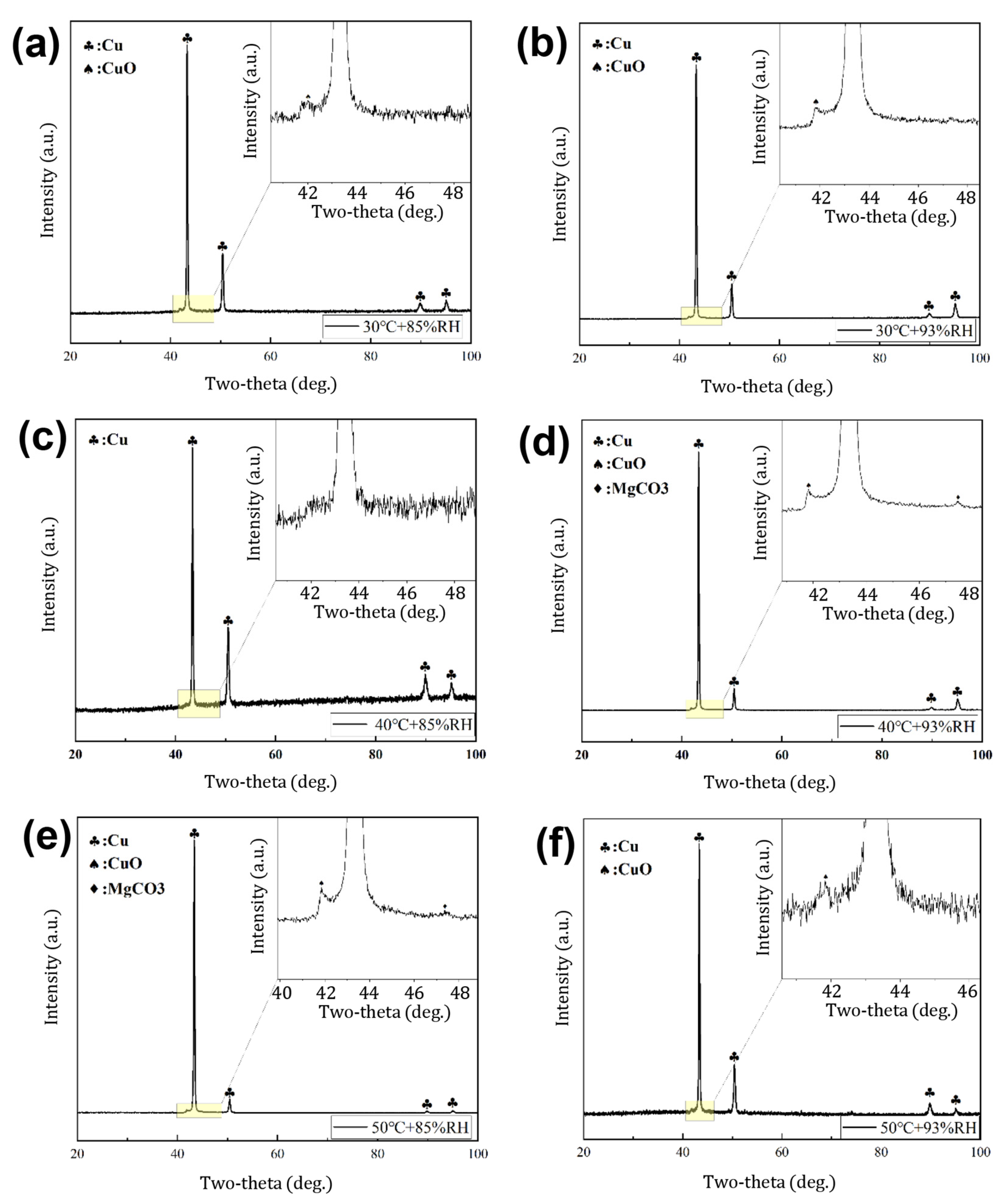
XRD patterns obtained from the samples after damp-heat testing are shown in Figure 6. All patterns are dominated by strong diffraction peaks corresponding to the face-centered cubic (FCC) copper matrix. In addition, weaker peaks attributable to copper oxides are observed. Peaks matching CuO (e.g., tenorite) are clearly identifiable. Some patterns might also contain peaks consistent with Cu2O (cuprite), although these are often broad or overlap with Cu peaks. A peak labeled “(Cu, Mg)O2” is mentioned in the original text, but its identification needs careful verification based on standard patterns; it might correspond to a mixed oxide or potentially Mg incorporated into the CuO lattice, consistent with EDS. Comparing patterns, the intensity of the oxide peaks appears to be generally stronger for samples exposed to higher humidity (e.g., II vs. I, IV vs. III, VI vs. V) and higher temperatures (e.g., I vs. III vs. V, II vs. IV vs. VI), suggesting a greater amount of crystalline corrosion product is formed under these conditions.
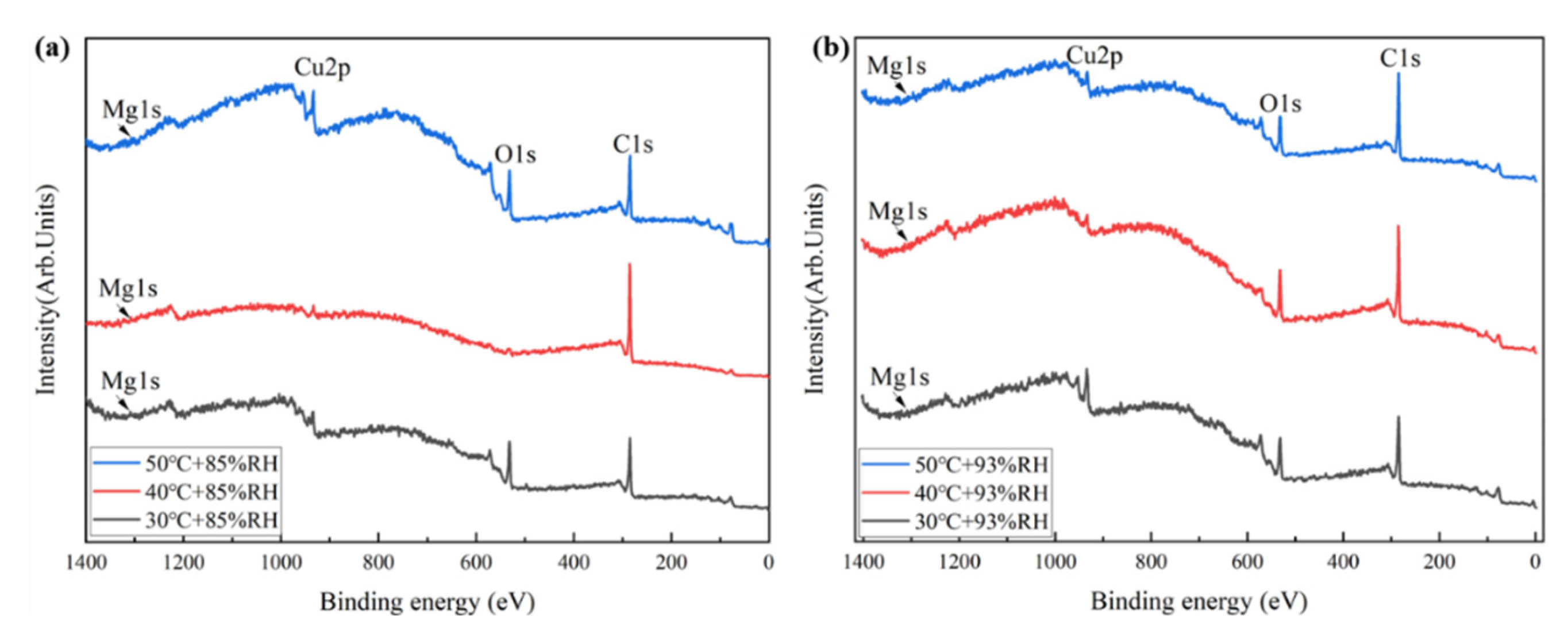
XPS analysis provided detailed information on the surface chemistry and oxidation states. Survey spectra (Figure 7) confirmed that the primary elements detected on the surface were Cu, O, and C (adventitious carbon used for calibration), with only very weak signals for Mg. Semi-quantitative analysis (Table 4) shows that the relative atomic concentration of O increases, and Cu decreases, with increasing exposure temperature, consistent with thicker oxide film formation. The Mg concentration remains low (<1 at.%) across all conditions, with likely fluctuations within the measurement uncertainty.
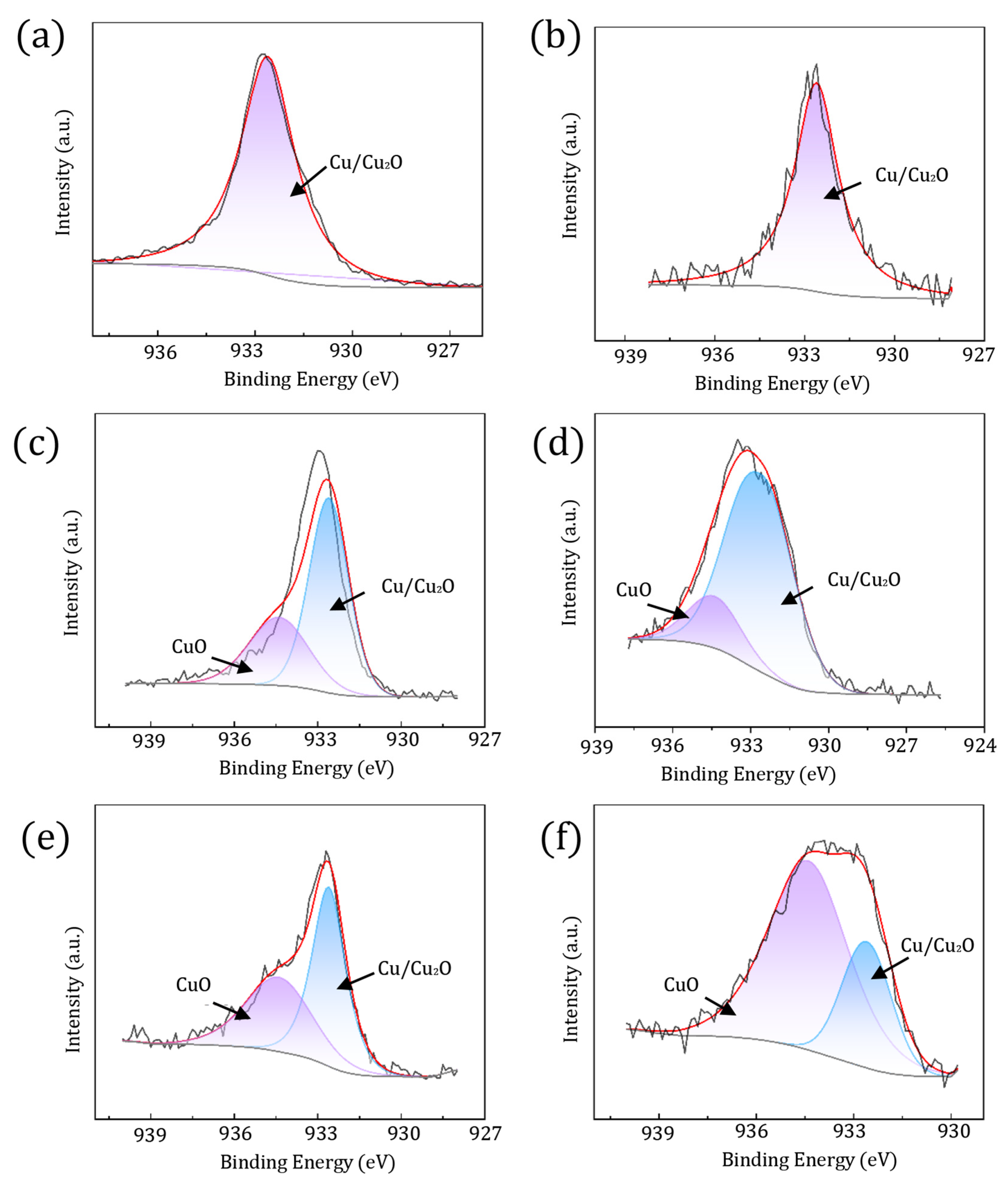
High-resolution XPS spectra were analyzed to identify chemical states. The Cu 2p3/2 spectra (Figure 8, Table 5) show contributions from Cu(0)/Cu(I) (metallic Cu and/or Cu2O, binding energy ~932.6 eV) and Cu(II) (CuO, binding energy ~934.4 eV, accompanied by characteristic shake-up satellites that are not shown but typically present). At 30 °C, the surface is dominated by Cu/Cu2O. With increasing temperature, the contribution from CuO becomes significant, reaching over 70% for sample VI (50 °C, 93% RH). This indicates that the initial Cu2O layer transforms or is overgrown by the more thermodynamically stable CuO under more aggressive (higher-temperature) conditions. The effect of humidity at a given temperature on the Cu(II)/Cu(I) ratio appears less pronounced compared to the effect of temperature.
The Mg 1s spectra (Figure 9, Table 6) exhibit very low intensity, making reliable deconvolution challenging. The binding energy of Mg 1s was approximately 1303.2 eV, which is 0.3 eV lower than the standard value. This suggests that Mg may have been incorporated into the CuO lattice. MgO (~1303.9 eV) was present in the original fitting results, but the signal was very weak. Furthermore, the peak position of O 1s at 530.7 eV also confirms the incorporation of Mg into the CuO lattice due to the typical O 1s spectra of CuO at 530.4 eV. The overall low Mg signal confirms its lower presence in the outermost surface layer detected by XPS (~5–10 nm depth).
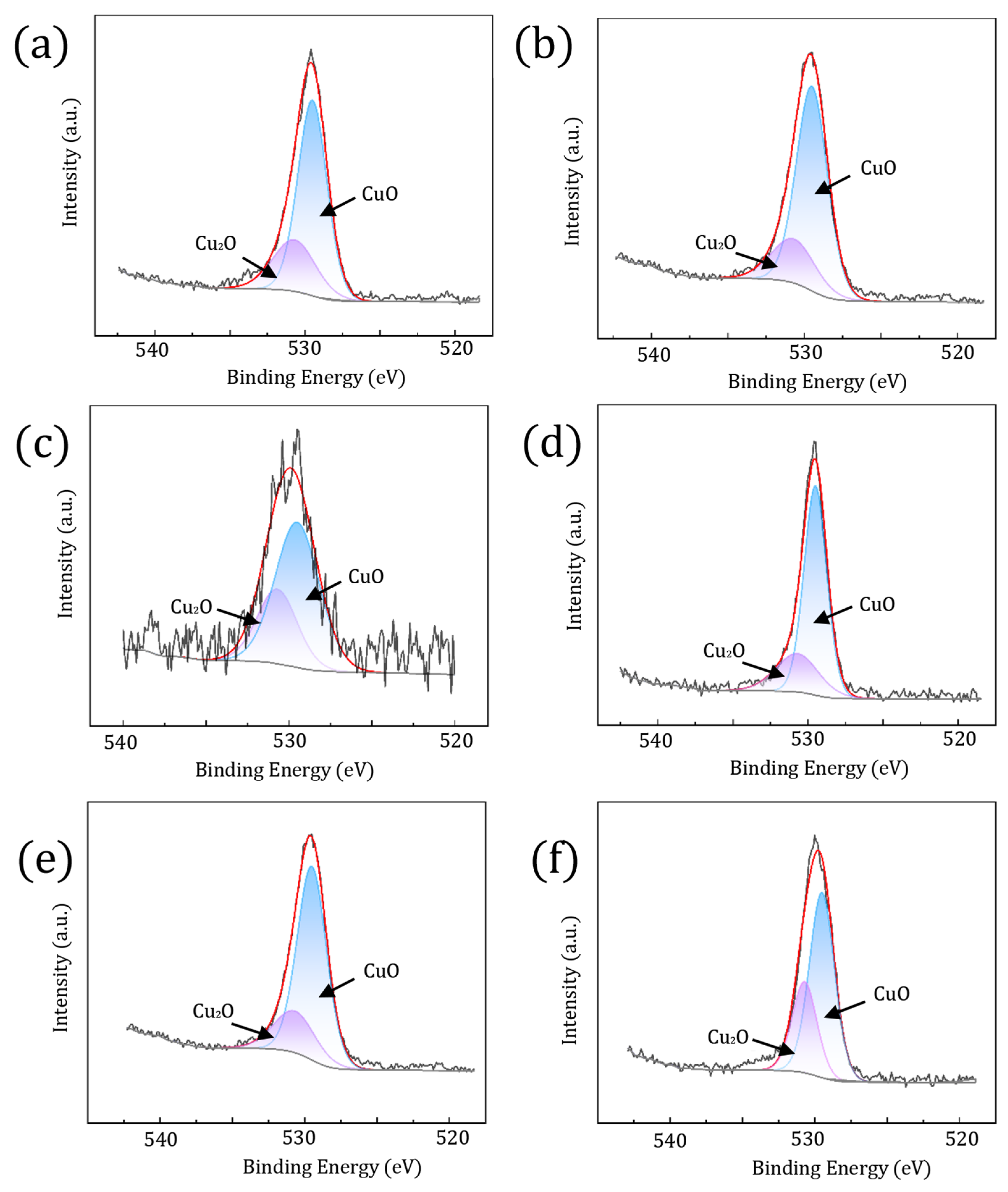
The O 1s spectra (Figure 10, Table 7) can be deconvoluted into components representing different oxygen species. Typically, lattice oxygen in metal oxides (O2−) appears at lower binding energies, while hydroxides (OH) or adsorbed water appear at higher energies. The fitting here proposes peaks at ~529.5 eV (assigned to CuO) and ~530.7 eV (assigned to Cu2O). The relative proportions of these components generally track the trends observed in the Cu 2p spectra, confirming the presence of both Cu2O and CuO, with CuO becoming more dominant at higher temperatures. Contributions from MgO would likely overlap with Cu2O or CuO peaks and are difficult to resolve given the low Mg concentration.

4. Discussion

This study reveals distinct effects of temperature and relative humidity on the corrosion behavior of cold-drawn Cu-0.43 wt% Mg alloy wires during damp-heat testing. The central finding is that exposure to higher temperatures (up to 50 °C) combined with lower relative humidity (85% RH) results in significantly enhanced corrosion resistance compared to lower temperatures (30 °C) and higher humidity (93% RH), as evidenced by both electrochemical measurements (lower icorr, higher Rf and Rct) and surface morphology (denser, more continuous films).
The interaction of metallic surfaces with humid air involves several processes, including the adsorption of water molecules, potential condensation if the surface temperature falls below the dew point, absorption into the material, and diffusion [18]. In the context of steady-state damp-heat testing, where sample temperature equilibrates with the environment, condensation is typically avoided. Therefore, the formation of an adsorbed water layer on the surface is a critical first step enabling electrochemical corrosion processes. The thickness and continuity of this adsorbed layer are governed by the relative humidity and surface properties.
Effect of Humidity: At higher relative humidity (93% RH), a more substantial adsorbed water layer forms on the alloy surface. This layer acts as an electrolyte, facilitating electrochemical reactions (the dissolution of Cu/Mg, reduction in oxygen) and leading to faster corrosion product formation compared to lower humidity (85% RH). This is reflected in the generally higher icorr values (Table 2) and lower film/charge transfer resistances (Table 3) observed for samples exposed to 93% RH at a given temperature. Furthermore, the SEM images (Figure 4) suggest that high humidity promotes more voluminous but potentially less compact or adherent corrosion products (e.g., cracking in Figure 4b, peeling in Figure 4d, porous outer layer in Figure 4f). The random nature of initial adsorption sites might lead to the observed island-like growth at lower temperatures (Figure 4a,b). While high humidity accelerates the quantity of corrosion product formation, it appears detrimental to the formation of a high-quality, protective film.
Effect of Temperature: Temperature primarily influences corrosion kinetics by accelerating both the electrochemical reaction rates and solid-state diffusion processes involved in film growth and transformation. The Arrhenius dependence of reaction rates means that higher temperatures lead to faster oxidation of Cu and Mg, and faster transformation of initial products (like Cu2O) to more stable forms (like CuO), as confirmed by XPS (Figure 8, Table 5). This increased reaction rate results in thicker corrosion films being formed within the 48 h exposure period at higher temperatures, consistent with the lower relative Cu content detected by XPS (Table 4). Crucially, higher temperatures also enhance ionic diffusion within the growing oxide film. This enhanced mobility likely allows for better atomic arrangement, defect annihilation, and stress relaxation, facilitating the formation of a denser, more coherent, and more protective passive film. This is supported by the SEM observations showing more continuous and seemingly denser films at 40 °C and 50 °C (Figure 4c,e) compared to 30 °C, and by the significantly higher Rf and Rct values measured for samples exposed to higher temperatures (Table 3).
The combined effect and film composition: The interaction of humidity and temperature determines the final state of the surface film and its protective performance. High humidity provides an electrolyte for rapid initial corrosion, while high temperature accelerates film growth and promotes densification. Within the testing range, the optimal conditions for protective film formation are high temperature (50 °C) and low humidity (85% RH—sample V), at which the corrosion current density (icorr) is lowest and the Ecorr potential is most positive. As mentioned earlier, a high-temperature, low-humidity environment can form a dense oxide film to protect the sample and inhibit corrosion. Excessive humidity will lead to uneven oxide film formation on the alloy surface, easily causing pitting corrosion and device failure.
Regarding film composition, all analyses (EDS, XRD, XPS) consistently point to copper oxides (Cu2O and CuO) as the main constituents of the corrosion film. While Mg is thermodynamically more reactive than Cu and likely participates in the very initial oxidation stages, its presence in the mature film (after 48 h) is minimal, especially as detected by surface-sensitive XPS. This suggests that either MgO is overgrown by copper oxides, preferentially dissolves, or simply has a very small contribution due to the low bulk concentration. The primary protective barrier is therefore formed by the copper oxide layer(s).
In summary, the corrosion resistance of Cu-Mg alloy in humid heat environments is strongly dependent on the properties of the surface oxide film formed. High temperatures accelerate film formation and promote densification, leading to improved protection, while high humidity accelerates corrosion but can lead to less protective film morphologies. The dominant protective components are Cu2O and CuO.

5. Conclusions

(1)
Cu-Mg alloys exhibit significantly better corrosion resistance after exposure to higher-temperature (50 °C) and lower-relative humidity (85% RH) conditions compared to lower temperature (30 °C) and higher humidity (93% RH). This is demonstrated by lower corrosion current densities, as well as the higher corrosion film and charge transfer resistances.
(2)
Temperature and humidity exert distinct influences on corrosion film formation. Elevated temperatures accelerate the kinetics of film growth and promote the formation of denser, more continuous, and adherent protective layers. High relative humidity accelerates the overall corrosion rate by providing a more substantial electrolyte layer but tends to result in less compact, potentially cracked or discontinuous films, especially at lower temperatures.
(3)
The corrosion films formed on the Cu-Mg alloy under the tested humid heat conditions are primarily composed of copper oxides, specifically Cu2O and CuO. The proportion of CuO increases significantly with increasing exposure temperature. Despite Mg’s presence in the alloy, its contribution to the composition of the mature surface film is minimal, with only trace amounts of Mg-containing species detected.
These findings highlight the importance of environmental parameters in determining the service life of Cu-Mg contact wires and provide valuable data for predicting their performance, particularly in coastal or industrially humid environments.

Supplementary Materials

The following supporting information can be downloaded at: https://www.mdpi.com/article/10.3390/coatings15121435/s1.

Author Contributions

Conceptualization, Y.Y., L.P., Z.W. and Z.X.; Methodology, Y.Y., X.J., L.P., Y.P., Z.W. and Z.X.; Validation, L.P.; Formal analysis, Y.Y., X.J., L.P. and Y.P.; Investigation, Y.Y., X.J. and Y.P.; Resources, X.J. and Y.P.; Data curation, Y.Y., X.J., L.P. and Y.P.; Writing—original draft, Y.Y. and X.J.; Writing—review & editing, L.P., Z.W. and Z.X.; Supervision, L.P., Z.W. and Z.X.; Project administration, Z.W. and Z.X.; Funding acquisition, L.P. and Z.X. All authors have read and agreed to the published version of the manuscript.

Funding

This research work was supported by the Research Project of China State Railway Group Co., Ltd. (No. N2024G018) and the Research Project of China Academy of Railway Sciences Co., Ltd. (No. 2024YJ289).

Institutional Review Board Statement

Not applicable.

Informed Consent Statement

Not applicable.

Data Availability Statement

The original contributions presented in this study are included in the article/Supplementary Materials. Further inquiries can be directed to the corresponding author.

Conflicts of Interest

Authors Yuan Yuan and Like Pan were employed by the company China Academy of Railway Sciences Corporation Limited. The remaining authors declare that the research was conducted in the absence of any commercial or financial relationships that could be construed as a potential conflict of interest.

References

  1. Kalhor, A.; Rodak, K.; Tkocz, M.; Myalska-Głowacka, H.; Schindler, I.; Poloczek, Ł.; Radwański, K.; Mirzadeh, H.; Grzenik, M.; Kubiczek, K.; et al. Tailoring the microstructure, mechanical properties, and electrical conductivity of Cu–0.7Mg alloy via Ca addition, heat treatment, and severe plastic deformation. Arch. Civ. Mech. Eng. 2024, 24, 71. [Google Scholar] [CrossRef]
  2. Ma, M.; Li, Z.; Qiu, W.; Xiao, Z.; Zhao, Z.; Jiang, Y. Microstructure and properties of Cu–Mg-Ca alloy processed by equal channel angular pressing. J. Alloys Compd. 2019, 788, 50–60. [Google Scholar] [CrossRef]
  3. Chen, L.; Han, J.-N.; Zhou, B.-W.; Xue, Y.-Y.; Jia, F.; Zhang, X.-G. Effects of rolling and annealing on microstructures and properties of Cu–Mg–Te–Y alloy. Trans. Nonferrous Met. Soc. China 2014, 24, 1046–1052. [Google Scholar] [CrossRef]
  4. An, J.; Wang, B.; Zhang, Y.; Tian, B.; Volinsky, A.A.; Liu, Y.; Wang, G. Mechanical and electrical properties and phase analysis of aged Cu-Mg-Ce alloy. J. Mater. Eng. Perform. 2020, 29, 1–9. [Google Scholar] [CrossRef]
  5. Wang, B.; Zhang, Y.; Tian, B.; An, J.; Volinsky, A.A.; Sun, H.; Liu, Y.; Song, K. Effects of Ce addition on the Cu-Mg-Fe alloy hot deformation behavior. Vacuum 2018, 155, 594–603. [Google Scholar] [CrossRef]
  6. Wang, B.; Zhang, Y.; Tian, B.; Yakubov, V.; An, J.; Volinsky, A.A.; Liu, Y.; Song, K.; Li, L.; Fu, M. Effects of Ce and Y addition on microstructure evolution and precipitation of Cu-Mg alloy hot deformation. J. Alloys Compd. 2019, 781, 118–130. [Google Scholar] [CrossRef]
  7. Guo, X.; Zhou, Y.; Song, K.; Wang, X.; Liang, S. Microstructure and properties of Cu–Mg alloy treated by internal oxidation. Mater. Sci. Technol. 2018, 34, 648–653. [Google Scholar] [CrossRef]
  8. Ma, A.; Zhu, C.; Chen, J.; Jiang, J.; Song, D.; Ni, S.; He, Q. Grain refinement and high-performance of equal-channel angular pressed Cu-Mg alloy for electrical contact wire. Metals 2014, 4, 586–596. [Google Scholar] [CrossRef]
  9. Ru, Y.; Gao, Z.; Zhang, L.; Tang, Z.; Zuo, T.; Xue, J.; Xiao, L.; Li, X. Microstructure and properties of high strength and high conductivity Cu-0.4Mg alloy processed by upward continuous casting and multi-pass drawing. J. Mater. Eng. Perform. 2024, 33, 5041–5048. [Google Scholar] [CrossRef]
  10. Guo, H.; Wei, H.; Kou, J.; Liu, Y.; Yang, D. Mechanical properties test of butt welds of corroded Q690 high strength steel under the coupling of damp-heat cycle dipping. Appl. Ocean Res. 2021, 111, 102677. [Google Scholar] [CrossRef]
  11. Wang, K.; Tian, X.; Liu, X.; Wang, G.; Deng, J. Study on the erosion-corrosion behavior of copper-nickel alloys in high temperature and high humidity marine environment. J. Phys. Conf. Ser. 2025, 2951, 012103. [Google Scholar] [CrossRef]
  12. Benzarti, Z.; Arrousse, N.; Serra, R.; Cruz, S.; Bastos, A.; Tedim, J.; Salgueiro, R.; Cavaleiro, A.; Carvalho, S. Copper corrosion mechanisms, influencing factors, and mitigation strategies for water circuits of heat exchangers: Critical review and current advances. Corros. Rev. 2025, 43, 429–455. [Google Scholar] [CrossRef]
  13. Hattendorf, H. A 48% Ni–Fe alloy of low coercivity and improved corrosion resistance in a cyclic damp heat test. J. Magn. Magn. Mater. 2001, 231, 29–32. [Google Scholar] [CrossRef]
  14. Yuan, S.J.; Pehkonen, S.O. Surface characterization and corrosion behavior of 70/30 Cu–Ni alloy in pristine and sulfide-containing simulated seawater. Corros. Sci. 2007, 49, 1276–1304. [Google Scholar] [CrossRef]
  15. Li, G.; Xing, H.; Du, M.; Sun, M.; Ma, L. Accelerated corrosion of 70/30 copper-nickel alloys in sulfide-polluted seawater environment by sulfide. J. Mater. Res. Technol. 2024, 30, 8620–8634. [Google Scholar] [CrossRef]
  16. Su, Y.; Li, L.; Yin, W.; Chu, G.; Guan, Y. Investigation of corrosion behavior and film formation on 90Cu-10Ni alloys immersed in simulated seawater. Int. J. Electrochem. Sci. 2023, 18, 100244. [Google Scholar] [CrossRef]
  17. Xiao, Z.; Li, Z.; Zhu, A.; Zhao, Y.; Chen, J.; Zhu, Y. Surface characterization and corrosion behavior of a novel gold-imitation copper alloy with high tarnish resistance in salt spray environment. Corros. Sci. 2013, 76, 42–51. [Google Scholar] [CrossRef]
  18. Wang, H.; Yao, J.; Xu, M. Corrosion analysis for the effect on products in alternating salt fog test and damp heat test. In Proceedings of the 2011 9th International Conference on Reliability, Maintainability and Safety, Guiyang, China, 12–15 June 2011; pp. 1116–1120. [Google Scholar]
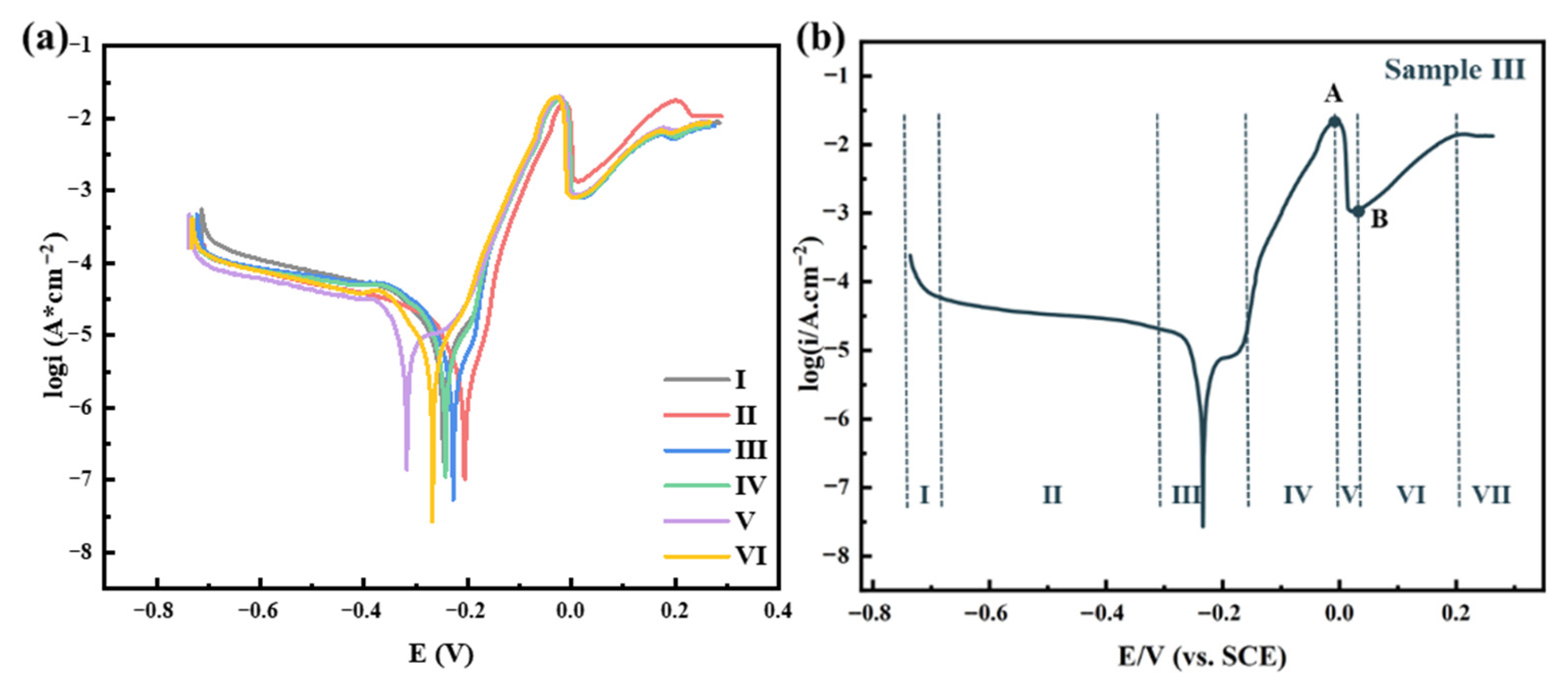
Figure 1. (a) Polarization curve of the samples after the damp-heat testing in different environments. (b) The corrosion of the samples exhibits different iv curve characteristics under different electromotive force regions, namely, (I) the cathodic region, (II) the oxygen reduction region, (III) the mixed activation control region near the corrosion potential (Ecorr), (IV) the active dissolution region, (V) the passivation region, (VI) the over-passivation region, and (VII) the re-passivation region. (Point A is the passivation initiation potential and point B is the complete passivation potential).
Coatings 15 01435 g001
Figure 2. (af) Impedance spectrum of the samples after damp-heat testing in different environments.
Coatings 15 01435 g002
Figure 3. Equivalent circuit for fitting impedance spectrum.
Coatings 15 01435 g003
Figure 4. (af) The surface morphology of the samples after damp-heat testing in different environments.
Coatings 15 01435 g004
Figure 5. (ag) EDS Mapping of the VI sample after damp-heat testing with 50 °C and 93% RH.
Coatings 15 01435 g005
Figure 6. (af) XRD pattern of the samples after damp-heat testing in different environments.
Coatings 15 01435 g006
Figure 7. (a,b) Wide XPS spectra of the samples after damp-heat testing in different environments.
Coatings 15 01435 g007
Figure 8. Cu2p3 XPS high-resolution spectra of the samples after damp-heat testing in various conditions of (a) 30 °C and 85% RH, (b) 30 °C and 93% RH, (c) 40 °C and 85% RH, (d) 40 °C and 93% RH, (e) 50 °C and 85% RH, (f) 50 °C and 93% RH.
Coatings 15 01435 g008
Figure 9. Mg1s XPS high-resolution spectra of the samples after damp-heat testing in various conditions of (a) 30 °C and 85% RH, (b) 30 °C and 93% RH, (c) 40 °C and 85% RH, (d) 40 °C and 93% RH, (e) 50 °C and 85% RH, (f) 50 °C and 93% RH.
Coatings 15 01435 g009
Figure 10. O1s XPS high-resolution spectra of the samples after damp-heating test in various conditions of (a) 30 °C and 85% RH, (b) 30 °C and 93% RH, (c) 40 °C and 85% RH, (d) 40 °C and 93% RH, (e) 50 °C and 85% RH, (f) 50 °C and 93% RH.
Coatings 15 01435 g010
Table 1. The parameters of the damp heat testing.
Sample No.Temperature (°C)Relative Humidity (RH%)
I30 ± 285 ± 3
II30 ± 293 ± 3
III40 ± 285 ± 3
IV40 ± 293 ± 3
V50 ± 285 ± 3
VI50 ± 293 ± 3
Table 2. Characteristic parameters obtained from the polarization curves of the alloys after damp-heat testing in different environments.
Sample No.ba (mV/Dec)bc (mV/Dec)Ec (V)ic (μA/cm2)
I54−71−0.2643.55
II66−40−0.3133.74
III52−33−0.2442.43
IV51−56−0.222.30
V36−58−0.2052.01
VI34−38−0.2442.24
Table 3. Elements of the equivalent circuit fitting results for the impedance spectrum.
No.Rs
(Ω cm−2)
105 × Qf
(Scm−2sn)
n1Rf
(Ω cm−2)
105 × Qdl
(Scm−2sn)
n2Rct
(Ω cm−2)
103 × (Scm−2s0.5) χ 2 × 10 4
I1.51.270.881315.00.542563.82.69
II1.40.840.919.418.40.611672.83.35
III1.50.430.921637.240.6525163.12.03
IV1.60.440.891291.390.5923242.56.19
V1.60.440.922406.80.6150502.12.46
VI2.00.550.922236.30.6348932.02.48
Table 4. Relative quantity of major elements of the samples after damp-heat testing in different environments.
Sample No.CuMgO
I82.40.417.2
II80.70.718.6
III74.50.724.8
IV74.50.525.0
V53.70.545.8
VI60.11.038.9
Table 5. Fitting parameters of Cu2p3 spectra and relative content of chemical components.
Valence StateSampleProposed CompoundsBinding
Energy (eV)
FWHM
(eV)
Relative Quantity (%)
Cu2p3ICu/Cu2O932.62.0100
IICu/Cu2O932.61.7100
IIICu/Cu2O932.61.765.3
CuO934.42.634.7
IVCu/Cu2O932.62.882.2
CuO934.42.517.8
VCu/Cu2O932.61.555.0
CuO934.42.945.0
VICu/Cu2O932.61.827.8
CuO934.43.072.2
Table 6. Fitting parameters of Mg1s spectra and relative content of chemical components.
Valence StateSampleProposed CompoundsBinding Energy (eV)FWHM
(eV)
Relative Quantity (%)
Mg1sIMg1303.20.532.1
MgO1303.90.667.9
IIMg1303.21.380.5
MgO1303.90.719.5
IIIMg1303.20.648.6
MgO1303.90.751.4
IVMg1303.21.068.3
MgO1303.90.531.7
VMg1303.20.583.7
MgO1303.90.516.3
VIMg1303.21.749.7
MgO1303.91.350.3
Table 7. Fitting parameters of O1s spectra and relative content of chemical components.
Valence StateSampleProposed CompoundsBinding Energy (eV)FWHM
(eV)
Relative Quantity (%)
O1sICuO529.52.472.0
Cu2O530.73.528.0
IICuO529.52.376.1
Cu2O530.73.323.9
IIICuO529.53.268.2
Cu2O530.73.031.8
IVCuO529.51.874.3
Cu2O530.73.525.7
VCuO529.52.576.7
Cu2O530.73.523.3
VICuO529.52.167.5
Cu2O530.72.132.5
Disclaimer/Publisher’s Note: The statements, opinions and data contained in all publications are solely those of the individual author(s) and contributor(s) and not of MDPI and/or the editor(s). MDPI and/or the editor(s) disclaim responsibility for any injury to people or property resulting from any ideas, methods, instructions or products referred to in the content.