Article

The Influence of Modifiers on the Performance of Recycled Asphalt Mixtures

1
School of Intelligent Manufacturing, Zijin College, Nanjing University of Science and Technology, Nanjing 210023, China
2
School of Civil Engineering and Geographic Environment, Ningbo University, Ningbo 315000, China
3
Nanjing Municipal Design and Research Institute Co., Ltd., Nanjing 210012, China
4
School of Civil Engineering, Harbin Institute of Technology, Harbin 150001, China
*
Authors to whom correspondence should be addressed.
Coatings 2025, 15(12), 1432; https://doi.org/10.3390/coatings15121432
Submission received: 31 October 2025 / Revised: 1 December 2025 / Accepted: 3 December 2025 / Published: 5 December 2025

Abstract

To enhance the performance of reclaimed asphalt pavement and evaluate its suitability under severe environmental conditions, this study systematically assessed the reinforcing effects of two modifiers: styrene–butadiene rubber (SBR) and polyurethane (PU). The stability and mechanical properties of mixtures with varying recycled asphalt contents were tested, with a focus on the effects of water immersion and high-temperature (150 °C) aging. The underlying mechanisms were elucidated using scanning electron microscopy with energy-dispersive X-ray spectroscopy (SEM-EDS). Results indicate that recycled asphalt incorporation significantly degraded the mixture’s performance; stability and mechanical strengths decreased with recycled asphalt content following a cubic function, with maximum deterioration rates of 37.3%, 67.2%, 73.6%, and 72.1%. Water and thermal aging further accelerated performance decay, with deterioration rates reaching up to 61.2% and 63.9%, respectively. Modifiers effectively counteracted this trend: SBR and PU enhanced the aforementioned properties by up to 102.6%, 50%, 60.3%, and 56.9% and 139.5%, 81.4%, 113.2%, and 120.3%, respectively. Microstructural analysis revealed that RAP led to decreased C and O contents, increased Si and Fe presence, and a more porous structure. In contrast, the modifiers increased binder content and interfacial density. This research provides a theoretical foundation and technical pathway for the engineering application of high-performance recycled asphalt mixtures in complex environments.

1. Introduction

The growing demand for transportation infrastructure has made asphalt pavement one of the most widely used road surfaces worldwide [1,2,3]. This pavement has the advantages of convenient construction and comfortable use. However, the exploitation of natural aggregates is limited, and the material cost of asphalt is relatively high [4,5]. The use of recycled asphalt pavement materials to prepare recycled asphalt mixtures has become a current research hotspot [6,7,8]. In order to provide affordable and sustainable materials for road construction, research and application of recycled asphalt have been carried out [9].
Asphalt recycling is the process of mixing a waste asphalt mixture with new asphalt and reusing it for road paving. The recycled asphalt is coated with asphalt binder, mineral filler, and fine aggregate on the surface and is composed of multiple particles of different thicknesses bonded together [10]. When preparing recycled mixtures, the asphalt film on the recycled asphalt surface softens with increasing temperature, yet it remains difficult to completely separate the old aggregates from the aged binder during hot-mix construction. This difficulty results in significant differences in the performance characteristics between recycled and fresh asphalt mixtures. For these reasons, the performance of a recycled asphalt mixture is worse than that of a conventional asphalt mixture [11,12,13]. Prior research has pointed out that a 30% content of recycled asphalt can reduce the water resistance coefficient by up to 37.1% [14,15]. Meanwhile, the incorporation of recycled asphalt adversely affects the temperature stability of the mixture. In addition, the compressive, splitting tensile, and flexural strengths are decreased by up to 43.1%, 45.2%, and 44.7%, respectively, with the addition of recycled asphalt [16,17]. Although some research on the performance of recycled asphalt mixtures has been reported, no systematic investigation of methods for improving recycled asphalt mixtures under various aging factors has been conducted.
Amino formate ester modifier and solid powder styrene–butadiene rubber modifier are frequently used as asphalt modifiers [18,19,20]. These asphalt modifiers can improve the bonding ability of asphalt binders. Additionally, the asphalt modifiers can increase the asphalt mixture’s water stability, temperature stability, and mechanical strengths. The amino formate ester modifier can improve high-temperature dynamic stability of an asphalt mixture by 80%–150% [21,22]. Moreover, the splitting tensile strength, compressive strength, and flexural strength of the asphalt mixture modified by amino formate ester are improved by up to 80%, 45%, and 61% [23,24]. Meanwhile, the recycled asphalt mixture using the amino formate ester modifier shows excellent high-temperature stability, maintaining structural rigidity below 180 °C. The solid powder styrene–butadiene rubber modifier can increase the high-temperature dynamic stability, splitting tensile strength, compressive strength, and flexural strength of the asphalt mixture it modifies by up to 100%, 65%, 33.1%, and 52.3% [25]. However, little attention has been paid to comparing different modifiers in recycled asphalt mixtures under aging conditions. The novelty of this study is the investigation of recycled asphalt mixtures with modifiers under environmental conditions of water and high-temperature activity.
This paper aims to investigate the influence of recycled asphalt binder on the stability, splitting tensile strength, flexural strength, and compressive strength of asphalt mixtures. Asphalt modifiers, namely, amino formate ester and solid powder styrene–butadiene rubber, are employed to enhance the performance of asphalt mixtures. Some specimens are immersed in water for 48 h, while other samples are dried in an oven at 150 °C for 4 h. Scanning electron microscopy–energy-dispersive spectroscopy (SEM-EDS) is conducted to reveal the mechanism underlying the performance changes. This study will offer a novel approach for the utilization of recycled asphalt mixtures in road paving.

2. Experimental Section

2.1. Raw Materials

Maoming Petrochemical Donghai Brand No. 70A road petroleum asphalt, supplied by Maoming Zhengcheng Petrochemical Co., Ltd., Maoming city, China, was used in this study as the new asphalt. Waste asphalt recovered from the milled recycled asphalt mixture on Guanghui Expressway in Guangzhou, China, was used to manufacture a recycled asphalt mixture. The technical performance of the new asphalt was obtained from the manufacturer in accordance with the Chinese standard JTG E20-2011 [26]. The key properties include a penetration of 70.3 mm, a softening point of 49.1 °C, a rotational viscosity of 481 mPa·s, and a ductility of 11.7 cm. Butadiene–styrene rubber, provided by Shandong Gaoshi Technology Industry and Trade Co., Ltd., Zibo, China, was used as a modifier. The butadiene–styrene rubber was in the form of white powder, and the particle size distribution ranged from 0.3175 mm to 0.423 mm. The acrylonitrile mass ratio of butadiene–styrene rubber was 33.1%. Thermoplastic polyurethane, provided by the Hongtai Machinery Factory (Wenzhou, China) in the form of white powder with a particle size of 0.56 mm and a density of 1.11 g/cm3, was employed as another asphalt modifier. In the experiment, the recycled asphalt was prepared in the lab by blending the waste asphalt. The detailed preparation procedure began by heating the waste asphalt to 165 °C and maintaining it at this temperature for 45 min until fully fluid. Subsequently, the rejuvenator was incorporated at a dosage of 6% by mass of the aged asphalt, followed by the addition of the No. 70A road petroleum asphalt, with continuous stirring at the same temperature for 20 min. The rejuvenator was a brown transparent liquid with a dynamic viscosity of 65 mm2/s at 60 °C and a density of 0.95 g/cm3. The recycled asphalt exhibited a penetration of 1.33 mm, a softening point of 78.6 °C, and a ductility of 13 cm. The coarse and fine aggregates used in this study were sourced from Zijin Linjiang Jianhua Furong Stone Field in Heyuan, China. Mineral powder from Boluo County Xiongmao Building Materials Co., Ltd., Huizhou, China, was applied in this research. Table 1 and Table 2 present the chemical compositions of the new asphalt and aggregates, respectively. In Table 1, x represents the values 30 and 35, and y represents 44 and 46. Table 3 shows the cumulative passing rate of the recycled asphalt mixture.

2.2. Preparation of Asphalt Mixture

The asphalt modifiers were weighed on an electronic scale. After that, the asphalt modifiers were added to the base asphalt, including different types of recycled asphalt. The samples were dried at a temperature of 150 °C and at a speed of 1000 r/min for 10 min. After this stirring, the samples were mixed at a temperature of 160 °C and at a speed of 4000 r/min for another 60 min. When the stirring was finished, the samples were poured into molds to form specimens with sizes of Φ101.6 mm × 63.5 mm, 30 mm × 35 mm × 250 mm, and Φ100 mm × 100 mm. Six replicate specimens were prepared for each group. A Marshall compaction instrument purchased from Wuxi Huanan Experimental Instrument Co., Ltd., Wuxi, China, with a standard compaction hammer mass of 4.5 kg and a drop distance of 457 mm, was used to compact the asphalt mixture. The compaction speed is 60 times per minute, and the motor specifications are 370 W, 380 V, and 50 Hz. The mixing proportions of the recycled asphalt mixture are shown in Table 4. Figure 1 shows the recycled asphalt mixture. The modifier dosage (butadiene–styrene rubber or polyurethane) remained at 5% by mass of the asphalt mixture in this study, referring to prior research [27,28,29]. The mass ratios of recycled asphalt by the total mass of asphalt were 5%~95%.

2.3. Measuring Process

2.3.1. The Measurement of Stability

The stability was measured by the following process. Specimens with a size of Φ101.6 mm × 63.5 mm were incubated in a 60 °C constant-temperature water bath for 30 min. Then, specimens of size Φ101.6 mm × 63.5 mm were loaded into the Marshall testing machine at a rate of 50 mm/min until failure. The maximum force value during the loading process is a measure of the stability of the asphalt mixture.

2.3.2. The Measurement of Mechanical Strengths

A loading testing machine with a temperature control box (provided by Jinan Touching Group, Jinan, China), whose temperature ranges from −40 °C to 900 °C, was used to measure the mechanical strengths. The temperature accuracy, loading range, and loading rate are 0.5 °C, 0 kN~100 kN, and 0.1 mm/min~500 mm/min, respectively. Before the measurement of mechanical strengths, specimens were cooled to room temperature and then cured in the standard environment (20.5 °C and 96.4% relative humidity) for 28 days. Specimens with a size of Φ101.6 mm × 63.5 mm were used for the measurement of splitting tensile strength. The loading rate and measuring temperature were 50 mm/min and 15 °C. Specimens with sizes of 30 mm × 35 mm × 250 mm and Φ100 mm × 100 mm were used for the measurement of flexural and compressive strengths. The loading rate was 50 mm/min, and the measuring temperature was 15 °C.
In order to study the effects of water and high temperature on the performance of asphalt mixtures, some specimens were immersed in water for 48 h. Some other specimens were subjected to a short-term oven-aging protocol at 150 °C for 4 h in a high-temperature chamber, provided by Shanghai Hanyu Technology Co., Ltd., Shanghai, China. This aging temperature was selected to effectively simulate the short-term thermal aging of the recycled asphalt mixture during construction stages (mixing, transportation, and paving), thereby enabling a more rigorous evaluation of its anti-aging capabilities and thermal stability [30,31,32]. After these treatments, the specimens were used for the measurement of mechanical strengths. The preparation process and macroscopic performance experiment of the recycled asphalt mixture are shown in Figure 2.

2.3.3. The Measurement of Microscopic Properties

Ellipsoid samples with a diameter not exceeding 3 mm were used for the scanning electron microscopy–energy spectrum (SEM-EDS) analysis. The Hitachi S-4800 model scanning electron microscope, produced by Hitachi Corporation, Tokyo, Japan, was used for the measurement of SEM-EDS. Samples with gold-plated surfaces were placed at the top of the Hitachi S-4800 sample holder for cold field emission scanning electron microscopy. The acceleration voltage and the emission current of the SEM-EDS instrument are 15.0 kV and 10 μA.

3. Results and Discussion

3.1. The Stability of Asphalt Mixtures

The stability of asphalt mixtures containing different dosages of recycled asphalt is shown in Figure 3a. As observed in Figure 3a, the stability decreases in a cubic-function manner as a function of the mass ratio of the recycled asphalt mixture. This is attributed to the fact that the discarded asphalt has aged, and the performance of various parts has also deteriorated [33]. Therefore, the bonding strength between fresh asphalt and recycled asphalt mixtures decreases, leading to a decrease in stability. However, the asphalt modifier shows an improving effect on the stability of the asphalt mixture. The asphalt mixture with the modifier made of polyurethane exhibits higher stability than the asphalt mixture with the modifier made of butadiene–styrene rubber. When the recycled asphalt mixture is not treated with modifiers, the stability decreases at a rate of up to 37.3%. Meanwhile, when the polyurethane and butadiene–styrene rubber modifiers are added, the stability decreases at rates of up to 32.9% and 29.9%. The butadiene–styrene rubber and polyurethane modifiers can increase the stability at rates of 5.2%~11.8% and 9.1%~21.9%. This can be explained by the fact that the modifiers improve the bonding performance and compactness of asphalt [34]. Therefore, the modifiers exhibit an increasing effect on the stability of the asphalt mixture.
Figure 3b shows the stability of the asphalt mixtures after being immersed in water for 48 h. As depicted in Figure 3b, the stability declines in a cubic-function manner with the mass ratios of recycled asphalt. As shown in this figure, the added modifiers can reduce the attenuation of stability. After being immersed in water for 4 h, the stability of the untreated asphalt mixture, butadiene–styrene rubber-modified asphalt mixture, and polyurethane-modified asphalt mixture decreases at rates of 20.9%~51.9%, 7.9%~21.8%, and 1.2%~11.1% after the untreated asphalt mixture, the butadiene–styrene rubber-modified asphalt mixture, and polyurethane-modified asphalt mixture are immersed in water for 48 h. After 4 h’ immersion, the stability decreases at rates of up to 61.2%, 38.5%, and 32.5% when adding 95% untreated asphalt, butadiene–styrene rubber-modified asphalt mixture, and polyurethane-modified asphalt mixture. After the asphalt mixture is immersed in water for 4 h, water invades the interior of the asphalt mixture through pores, gradually squeezes open the asphalt film, and occupies the surface of the aggregate, causing the asphalt to peel off from the aggregate. The asphalt film on the surface of the aggregate falls off, and the aggregate becomes loose [35]. The addition of butadiene–styrene rubber-modified asphalt mixture and polyurethane-modified asphalt mixture can increase the stability at rates of up to 87.2% and 121.3%, respectively. Asphalt modifiers can enhance the compactness of asphalt mixtures, and at the same time, asphalt modifiers can increase the adhesion between asphalt and aggregates, thus improving the water stability of asphalt mixtures [36].
The stability of asphalt mixtures after drying in an oven at a temperature of 150 °C for 4 h is shown in Figure 3c. As shown in Figure 3c, the relationship between the stability and the mass ratio of the recycled asphalt was fitted with a cubic function. In this figure, the stability decreases at rates of up to 63.9%, 39.7%, and 38.1% for the untreated asphalt mixture, butadiene–styrene rubber-modified asphalt mixture, and polyurethane-modified asphalt mixture. The high-temperature action reduces the stability at rates of up to 59.8%, 27.7%, and 22.2% for the untreated asphalt mixture, butadiene–styrene rubber-modified asphalt mixture, and polyurethane-modified asphalt mixture. High temperature can cause asphalt to soften and lose rigidity, thus decreasing the adhesion between asphalt and aggregate, as well as the compactness of the mixture [37]. In addition, high temperature can accelerate the oxidation of asphalt, causing changes in asphalt components, with an increase in asphaltene and a decrease in resin, which results in harder and more brittle asphalt [38]. Hence, the stability is decreased by high temperature. The stability of the modified asphalt mixtures with butadiene–styrene rubber and polyurethane can increase at rates of up to 102.6% and 142.9%, respectively. This can be attributed to the fact that the butadiene–styrene rubber and polyurethane can improve the compaction of and adhesion to asphalt [39], thus increasing the high-temperature stability of the asphalt mixture. In summary, short-term high-temperature exposure induces a thermal softening effect on asphalt, reducing the adhesion and cohesion of the asphalt binder [40]. The addition of modifiers can counteract these detrimental effects through their specific polymer structures, forming elastic networks or cross-linking points within the asphalt. Then, the thermal–oxidative aging pathways are effectively hindered. Therefore, the asphalt mixture’s resistance to deformation at elevated temperatures is improved by the modifiers. Compared with prior research, the stability of the recycled asphalt mixture with polyurethane is 95.3% that of the ordinary asphalt mixture [41].

3.2. The Mechanical Strengths of Asphalt Mixtures

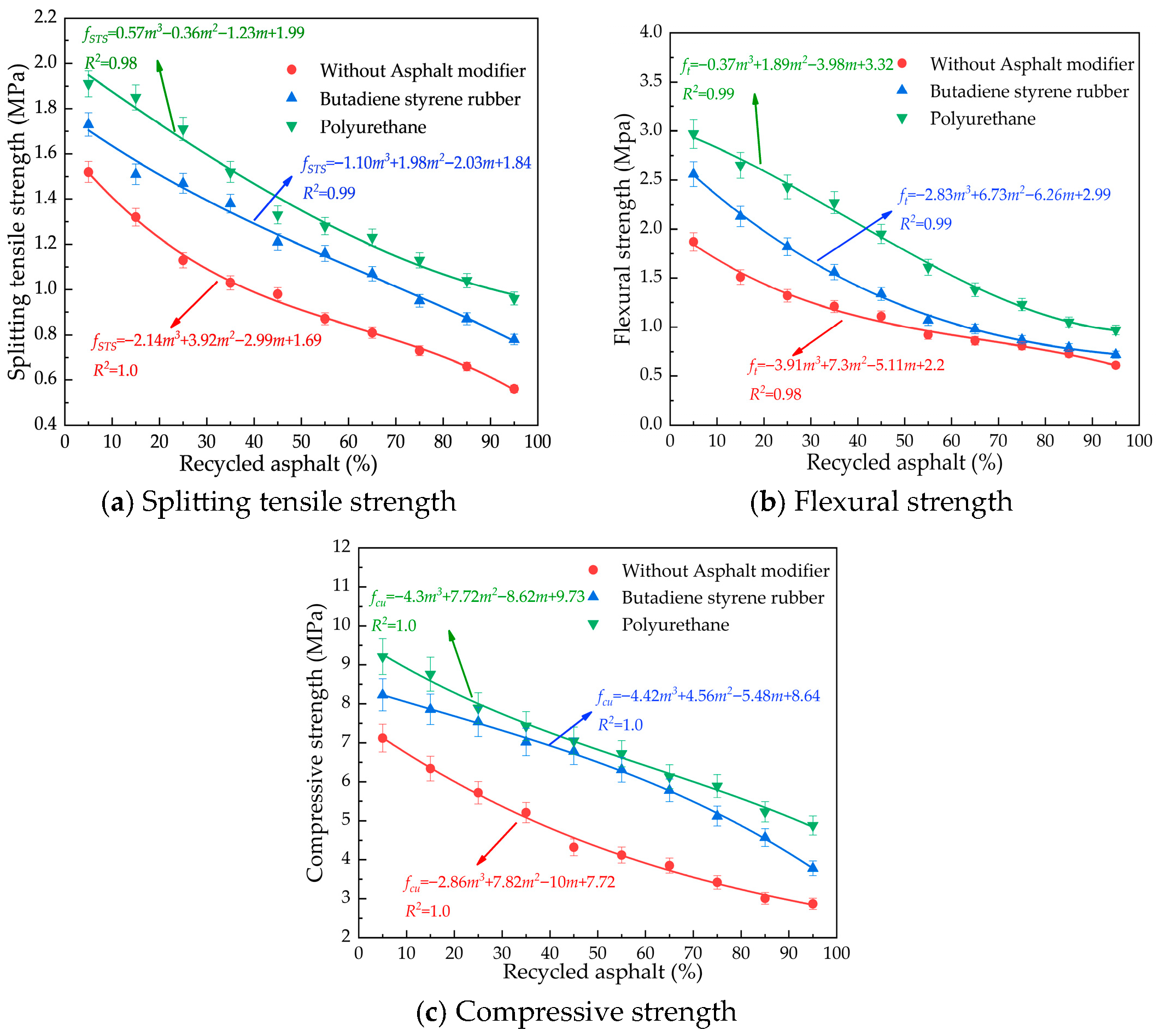
Figure 4a presents the splitting tensile strength of the recycled asphalt mixtures. As depicted in Figure 4a, the relationship between the splitting tensile strength and the mass ratio of the recycled asphalt mixture adheres to a cubic function. The increasing dosages of the recycled asphalt mixture decrease the splitting tensile strength at rates of up to 67.2%, 58.5%, and 51.3% for the recycled asphalt mixture without an asphalt modifier, the recycled asphalt mixture modified by butadiene–styrene rubber, and the recycled asphalt mixture treated with polyurethane. This phenomenon occurs because the aged asphalt experiences diminished adhesion and structural density over time, which consequently reduces its splitting tensile strength [40]. The asphalt modifiers butadiene–styrene rubber and polyurethane can increase the splitting tensile strength of the recycled asphalt mixture at rates of 9.9%~39.3% and 15.2%~71.4%. This is ascribed to the improved compactness and bonding performance, leading to increased splitting tensile strength [42].
Figure 4b,c illustrate the flexural and compressive strengths of the recycled asphalt mixtures. As depicted in Figure 4b,c, the flexural and compressive strengths vary in the form of cubic functions with the mass ratio of recycled asphalt. With the increase in the recycled asphalt’s mass ratio, the flexural strength decreases at rates of up to 73.6%, 72.8%, and 72.1%. The corresponding compressive strength decreases at rates of up to 63.3%, 56.8%, and 50.1%. This can be attributed to the fact that the aging recycled asphalt reduces the bonding performance between asphalt and aggregate, leading to decreased flexural and compressive strengths [43]. The addition of the asphalt modifiers butadiene–styrene rubber and polyurethane increases the flexural strength at rates of up to 41.1% and 87.6%. With the addition of asphalt modifiers, the corresponding compressive strength is increased at rates of up to 56.9% and 73.8%. This can be explained by the improved bonding properties and compactness with the addition of the asphalt modifier, resulting in increased flexural and compressive strengths. When the mechanical strengths of the recycled asphalt mixture are compared with those of the ordinary asphalt mixture, the recycled asphalt mixture shows splitting tensile strength, flexural strength, and compressive strength that are 93.4%, 95.1%, and 90.3% those of the ordinary asphalt mixture [44,45].
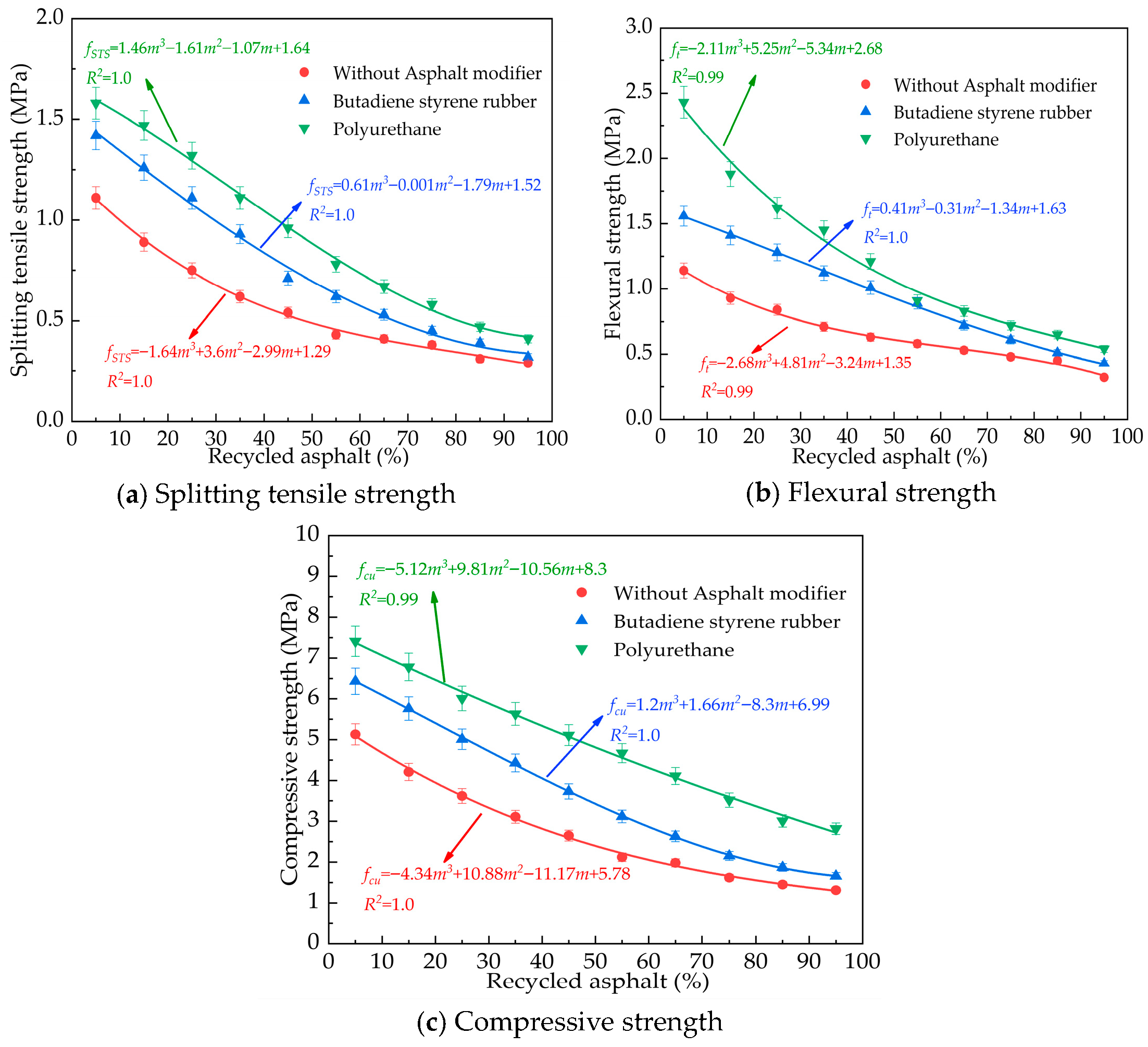
Figure 5a shows the splitting tensile strength of asphalt mixtures after immersion in water for 48 h. As shown in Figure 5a, the splitting tensile strength of the recycled asphalt mixture decreases with the mass ratio of recycled asphalt. The relationship between the splitting tensile strength and the mass ratio follows a cubic-function pattern. With the increasing mass ratio of recycled asphalt, the splitting tensile strength decreases at rates ranging from 66.3% to 78.6%. This can be attributed to the softening effect of water on asphalt, which results in a decrease in the splitting tensile strength [46]. The added asphalt modifiers butadiene–styrene rubber and polyurethane increase the splitting tensile strength at rates of up to 39.2% and 86.9%. Water action can decrease the splitting tensile strength at rates ranging from 2.3% to 42.3%. This is ascribed to the modifier’s role in improving the structural integrity and internal cohesion of the mixture [47].
Figure 5b,c exhibit the flexural and compressive strengths of recycled asphalt mixtures after water action. The relationships between the flexural and compressive strengths follow cubic functions. The flexural and compressive strengths decrease at rates of up to 72.1% and 77% as the mass ratio of the added recycled asphalt increases. The flexural strength decreases at rates of 3.3%~35.1% after 48 h immersion in water. Meanwhile, the corresponding compressive strength decreases at rates of 3.8%~46.3% after 48 h immersion in water. The water action reduces the adhesion between the asphalt and aggregate interface, leading to a decrease in flexural and compressive strengths of the recycled asphalt mixture. The asphalt modifiers butadiene–styrene rubber and polyurethane increase the flexural strength at rates of 1.5%~40.7% and 16.2%~81.6%. The compressive strength increases at rates of 21.2%~69.5% and 40.2%~81.8%. This can be ascribed to the improved adhesive performance and higher compactness caused by the asphalt modifiers, thus increasing the flexural and compressive strengths [48].
The splitting tensile strength of recycled asphalt mixtures is demonstrated in Figure 6a. The specimens were exposed to a temperature of 150 °C for 4 h. The splitting tensile strength follows a cubic function with the mass ratio of recycled asphalt. There are three types of recycled asphalt mixtures: the recycled asphalt mixture without surface modification, the recycled asphalt mixture modified by butadiene–styrene rubber, and the recycled asphalt mixture treated with polyurethane. The splitting tensile strength decreases at rates of up to 78.1%, 76.1%, and 74.8% for these three mixtures, respectively. This is because high temperature softens the asphalt, thereby reducing the splitting tensile strength [49]. High temperature reduces the splitting tensile strength at rates of 16.6%~59.1%. The asphalt modifiers butadiene–styrene rubber and polyurethane can increase the splitting tensile strength of recycled asphalt mixture at rates of up to 50% and 81.4%. This can be explained by the fact that modifiers improve the high-temperature resistance of asphalt mixtures [50]. Therefore, the attenuation effect on splitting tensile strength after high-temperature exposure is delayed.
The flexural and compressive strengths of recycled asphalt mixtures after being exposed to 150 °C temperature for 4 h are illustrated in Figure 6b,c. The flexural and compressive strengths decrease in the form of cubic functions with the mass ratio of the recycled asphalt mixture. The flexural strength decreases at rates of up to 77.8%, 76.7%, and 66.9% with the addition of the untreated asphalt mixture, butadiene–styrene rubber-modified asphalt mixture, and polyurethane-modified asphalt mixture. The corresponding compressive strength is reduced at rates of up to 77.3%, 73.6%, and 70.1%. When the recycled asphalt mixture is exposed to a high-temperature environment, the softening of the asphalt and component aging are accelerated. Then, the structural hardening and interfacial bonding deteriorate. Consequently, the mechanical strengths are decreased by high temperature [51]. The asphalt modifiers butadiene–styrene rubber and polyurethane can increase flexural strength by up to 60.3% and 113.2%, respectively. The corresponding compressive strength increases at rates of up to 47.2% and 120.3%. High temperature decreases the flexural and compressive strengths at rates of 12.8%~60.3% and 16.8%~47.6%. This can be ascribed to the fact that the modifiers can improve the recycled asphalt mixture’s thermal stability and aging resistance [52]. Consequently, the flexural and compressive strengths are increased by the asphalt modifiers after exposure to 150 °C for 4 h. It can be concluded from this study that the mechanical properties of the recycled asphalt mixture and recycled asphalt satisfy cubic functions. The mechanical properties include the cohesive force of asphalt emulsion, the adhesion force at the asphalt–aggregate interface, and the interlocking friction between aggregate particles, which follow the shear strength theory of viscoelastic materials and the Mohr–Coulomb criterion [53]. Therefore, the mechanical properties roughly follow a cubic-function relationship. Moreover, the cubic-function fitting yields a higher value than the quadratic, linear, and other functions tested. Hence, cubic-function fitting is selected.

3.3. Microscopic Results

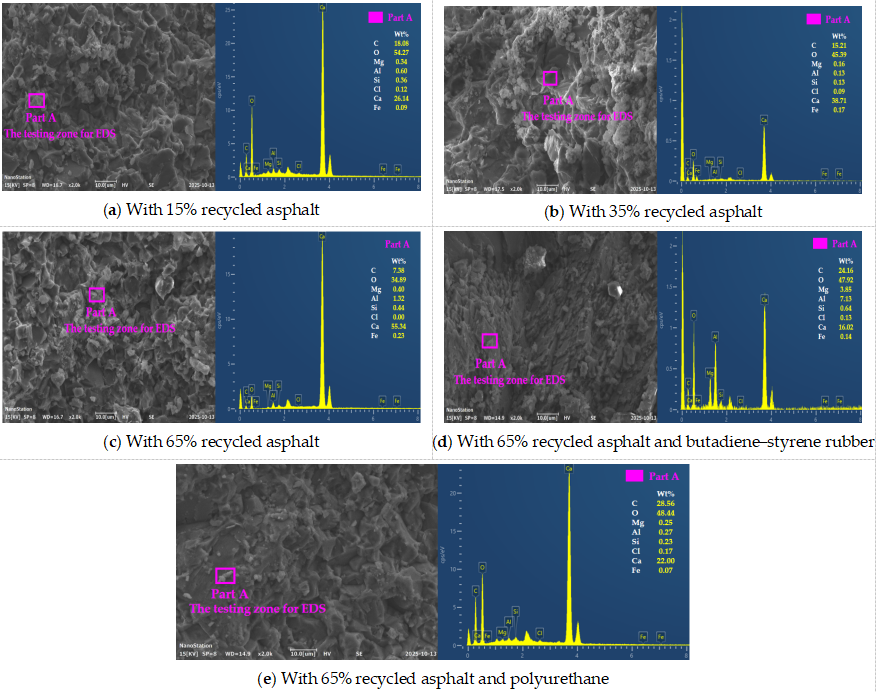
The scanning electron microscope–energy-dispersive spectroscopy (SEM-EDS) photos are shown in Figure 7. As illustrated in Figure 7, the elements C, O, Mg, Al, Si, Cl, Ca, and Fe are found. As can be observed in Figure 7, the added recycled asphalt leads to a decrease in the compactness of the microstructures and the contents of C and O. The elements Si and Fe are increased by the addition of the recycled asphalt mixture. When the asphalt modifiers butadiene–styrene rubber and polyurethane are added, the contents of C and O increase. Meanwhile, the asphalt modifiers reduce the looseness of the structures. The microstructure becomes denser due to the addition of modifiers. The microstructures of recycled asphalt mixtures with the polyurethane asphalt modifiers show higher compactness than the recycled asphalt mixture with the butadiene–styrene rubber asphalt modifier.
The SEM-EDS results elucidate the origins of the macroscopic behavior. The decline in C and O signifies the aging and degradation of the binder in the recycled asphalt mixture, compromising its adhesive and cohesive properties [54]. Concurrently, the increase in Si and Fe indicates a more pronounced contribution from the mineral aggregates. This signal enhancement is attributed to the thinning and discontinuity of the aged asphalt binder film, which reduces its masking effect and thereby enhances the detection of aggregate-characteristic elements [55]. These compositional changes collectively degrade the interface between the aged asphalt binder and the aggregates, thereby reducing microstructural compactness. This microstructural degradation directly accounts for the inferior stability and mechanical strengths of the unmodified recycled asphalt mixture. In contrast, the modifiers improve the properties of the aged binder. The butadiene–styrene rubber and polyurethane modifiers enhance the cohesion and adhesion of the binder, as evidenced by the restored C and O contents and the significantly denser microstructure [56,57]. This microstructural enhancement, facilitated by the improved binder, is the fundamental reason for the superior performance recovery of the modified recycled asphalt mixtures.

4. Conclusions

This study systematically evaluated the performance evolution of recycled asphalt mixtures under varying incorporation ratios and aging conditions. It revealed the mechanisms and microstructural basis of enhancement provided by styrene–butadiene rubber and polyurethane modifiers. The principal conclusions are as follows:
(1)
The incorporation of recycled asphalt significantly impairs the stability and mechanical properties of asphalt mixtures, with the degree of deterioration increasing as a cubic function of the recycled asphalt content. Both water immersion and high-temperature (150 °C) aging substantially exacerbated this performance degradation, highlighting the poor moisture and thermal stability of unmodified recycled asphalt mixtures.
(2)
Modifiers effectively enhanced the overall performance of recycled asphalt mixtures. Both styrene–butadiene rubber and polyurethane significantly improved the stability and mechanical strengths. Polyurethane demonstrated superior performance in enhancing high-temperature stability and resistance to water damage, confirming its potential for application in demanding environments.
(3)
Microstructural analysis indicated that the addition of recycled asphalt reduced the contents of C and O, increased the relative concentrations of mineral elements such as Si and Fe, and led to a more porous structure, uncovering the intrinsic reason for the macroscopic performance decline. The introduction of modifiers effectively restored the continuity of the binder, strengthened the interfacial bonding, and improved the compactness and integrity of the material.
In summary, employing suitable modifiers, particularly polyurethane, can significantly enhance the road performance and environmental durability of high-RAP-content mixtures. This work provides crucial technical support for the resource-efficient and high-value utilization of waste asphalt pavement materials.

Author Contributions

Conceptualization, X.W. and H.Z.; methodology, C.G. and H.W.; validation, F.S. and H.W.; formal analysis, S.L. and Q.X.; investigation, C.G., J.Y. and S.L.; resources, J.Y.; data curation, Q.X. and H.Z.; writing—original draft preparation, X.W. and C.G.; writing—review and editing, X.W., H.Z., C.G., Q.X., J.Y., F.S., S.L. and H.W.; visualization, F.S.; supervision, H.W.; project administration, X.W. and J.Y.; funding acquisition, X.W. and H.Z. All authors have read and agreed to the published version of the manuscript.

Funding

This work is sponsored by the Basic Science (Natural Science) General Research Project of Jiangsu Higher Education Institutions [No. 24KJDS80003]. Research Project: Study on Mix Proportion Design of Hot In-Place Recycling for Asphalt Mixtures in Different Traffic Lanes.

Institutional Review Board Statement

Not applicable.

Informed Consent Statement

Not applicable.

Data Availability Statement

The data used to support the findings of this study are available from the corresponding authors upon request.

Conflicts of Interest

Author Qi Xue was employed by the company Nanjing Municipal Design and Research Institute Co., Ltd. The remaining authors declare that the research was conducted in the absence of any commercial or financial relationships that could be construed as a potential conflict of interest.

References

  1. Russo, N.; Filippi, A.; Carsana, M.; Lollini, F.; Redaelli, E. Recycling of RAP (Reclaimed Asphalt Pavement) as Aggregate for Structural Concrete: Experimental Study on Physical and Mechanical Properties. Discov. Civ. Eng. 2024, 1, 99. [Google Scholar] [CrossRef]
  2. Mariyappan, R.; Palammal, J.; Balu, S. Sustainable use of reclaimed asphalt pavement (RAP) in pavement applications—A review. Environ. Sci. Pollut. Res. 2023, 30, 45587–45606. [Google Scholar] [CrossRef]
  3. Su, Y.; Luo, B.; Luo, Z.; Xu, F.; Huang, H.; Long, Z.; Shen, C. Mechanical characteristics and solidification mechanism of slag/fly ash-based geopolymer and cement solidified organic clay: A comparative study. J. Build. Eng. 2023, 71, 106459. [Google Scholar] [CrossRef]
  4. Yao, L.; Leng, Z.; Lan, J.; Chen, R.; Jiang, J. Environmental and economic assessment of collective recycling waste plastic and reclaimed asphalt pavement into pavement construction: A case study in Hong Kong. J. Clean. Prod. 2022, 336, 130405. [Google Scholar] [CrossRef]
  5. Da Costa, L.F.; Mendes, L.P.T.; de Medeiros Melo Neto, O.; de Figueiredo Lopes Lucena, L.C.; de Figueiredo Lopes Lucena, L. Economic and environmental benefits of recycled asphalt mixtures: Impact of reclaimed asphalt pavement and additives throughout the life cycle. Environ. Sci. Pollut. Res. 2025, 32, 11269–11291. [Google Scholar] [CrossRef]
  6. Tarsi, G.; Tataranni, P.; Sangiorgi, C. The challenges of using reclaimed asphalt pavement for new asphalt mixtures: A review. Materials 2020, 13, 4052. [Google Scholar] [CrossRef] [PubMed]
  7. Azadgoleh, M.A.; Mohammadi, M.M.; Ghodrati, A.; Sharifi, S.S.; Palizban, S.M.M.; Ahmadi, A.; Vahidi, E.; Ayar, P. Characterization of contaminant leaching from asphalt pavements: A critical review of measurement methods, reclaimed asphalt pavement, porous asphalt, and waste-modified asphalt mixtures. Water Res. 2022, 219, 118584. [Google Scholar] [CrossRef] [PubMed]
  8. Min, Y.; Zhang, Y.; Qian, Z.; Zhang, H.; Hu, B.; Xie, Y.; Zhang, X. Performance evaluation and feasibility study on reuse of reclaimed epoxy asphalt pavement (REAP). Constr. Build. Mater. 2024, 450, 138653. [Google Scholar] [CrossRef]
  9. Shams, H.; Ullah, H.; Qiu, Y.; Abdrhman, H.; Fu, J.; Yang, E. Investigating the Performance of Asphalt Pavements Modified with Reclaimed Asphalt and Crumb Rubber. Sci. Rep. 2025, 15, 32194. [Google Scholar] [CrossRef]
  10. Cai, Y.; Cao, L.; Guo, J.; Tan, Z. Restoring Road Performance of Recycled Asphalt Mastic through Filler Asphalt Ratio Adjustment. Sci. Rep. 2025, 15, 17775. [Google Scholar] [CrossRef]
  11. Gholami, M.; Khodaii, A.; Hajikarimi, P. A Multifaceted Purpose-Oriented Approach to Evaluate Material Circularity Index for Rejuvenated Recycled Asphalt Mixtures. Sci. Rep. 2025, 15, 12213. [Google Scholar] [CrossRef]
  12. Nascimento, F.A.C.; Guimarães, A.C.R.; Castro, C.D. Comparative study on permanent deformation in asphalt mixtures from indirect tensile strength testing and laboratory wheel tracking. Constr. Build. Mater. 2021, 305, 124736. [Google Scholar] [CrossRef]
  13. Costa, J.; Borges, P.; Santos, F.; Bezerra, A.; Van, W.; Blom, J. Cementitious binders and reclaimed asphalt aggregates for sustainable pavement base layers: Potential, challenges and research needs. Constr. Build. Mater. 2020, 265, 120325. [Google Scholar] [CrossRef]
  14. Yi, X.; Chen, H.; Wang, H.; Shi, C.; Yang, J. The feasibility of using epoxy asphalt to recycle a mixture containing 100% reclaimed asphalt pavement (RAP). Constr. Build. Mater. 2022, 319, 126122. [Google Scholar] [CrossRef]
  15. Pasandín, A.R.; Pérez, I.; Gómez-Meijide, B. Performance of High RAP Half-Warm Mix Asphalt. Sustainability 2020, 12, 10240. [Google Scholar] [CrossRef]
  16. Pradhan, S.K.; Das, U.; Patra, A.R. Utilization of Reclaimed Asphalt Pavement (RAP) Materials in HMA Mixtures for Flexible Pavement Construction. Mater. Today Proc. 2023. [Google Scholar] [CrossRef]
  17. Prosperi, E.; Bocci, E.; Marchegiani, G. The Influence of Bitumen Nature and Production Conditions on the Mechanical and Chemical Properties of Asphalt Mixtures Containing Reclaimed Asphalt Pavement. Materials 2025, 18, 3713. [Google Scholar] [CrossRef] [PubMed]
  18. Sun, J.; Cheng, Y.; Zou, G.; Wang, W. Study on the Water Stability and Safety Mechanism of Warm Mixed Recycled SBS Modified Asphalt Mixture. Sci. Rep. 2025, 15, 31188. [Google Scholar] [CrossRef] [PubMed]
  19. Yu, D.; Luo, J.; Lang, H.; Hua, F.; Yang, Y.; Xie, M. Study on the Micro-Surfacing Properties of SBR Modified Asphalt Emulsion with Reclaimed Asphalt Pavement. Mater 2025, 18, 802. [Google Scholar] [CrossRef] [PubMed]
  20. Fang, Y.; Zhang, Z.; Zhang, K.; Li, Z. Rheological property evaluation and microreaction mechanism of rubber asphalt, desulfurized rubber asphalt, and their composites. J. Mater. Civ. Eng. 2021, 33, 04021100. [Google Scholar] [CrossRef]
  21. Zhang, Z.; Wang, Z.; Zhang, S.; Liu, H.; Guo, Y.; Liu, X.; Tian, P.; Yang, Y.; Xia, J. Experimental Studies and Molecular Dynamics Simulation of the Compatibility between Thermoplastic Polyurethane Elastomer (TPU) and Asphalt. Constr. Build. Mater. 2024, 411, 134316. [Google Scholar] [CrossRef]
  22. Gong, M.; Jiao, B.Z. Thermodynamic properties analysis of warm-mix recycled a sphalt binders using molecular dynamics simulation. Road Mater. Pavement Des. 2023, 25, 239–258. [Google Scholar] [CrossRef]
  23. Zhang, Z.; Sun, J.; Jia, M.; Ban, X.; Wang, L.; Chen, L.; Huang, T.; Liu, H. Effects of Polyurethane Thermoplastic Elastomer on Properties of Asphalt Binder and Asphalt Mixture. J. Mater. Civ. Eng. 2021, 33, 04020477. [Google Scholar] [CrossRef]
  24. Zeng, Z.; Sudarsanan, N.; Underwood, B.S.; Kim, Y.R.; Guddati, M. Reflective Cracking Performance Evaluations of Highly Polymer-Modified Asphalt Mixture. J. Transp. Eng. Part B Pavements 2024, 150, 04024039. [Google Scholar] [CrossRef]
  25. Jin, X.; Sun, S.; Guo, N.; Huang, S.; You, Z.; Tan, Y. Influence on Polyurethane Synthesis Parameters Upon the Performance of Base Asphalt. Front. Mater. 2021, 8, 2296. [Google Scholar] [CrossRef]
  26. Liu, Y.; Dong, J.; Yuan, S.; Yu, J.; Guan, Z.; Chai, H.K.; Wang, Q. Impact resistance and enhancing mechanism of a novel mortar integrated with shear thickening fluid. Constr. Build. Mater. 2025, 498, 144036. [Google Scholar] [CrossRef]
  27. Zhang, Y.; Jiang, C.; Li, M.; Qi, Z.; Yang, X.; Lin, Y.; Cao, S. A review on curve edge based architectures under lateral loads. Thin. Wall. Struct. 2025, 217, 113849. [Google Scholar] [CrossRef]
  28. Sun, J.S.; Liao, T.; Ji, Y.X.; Li, H.; Qu, Y.Z.; Huang, X.B.; Li, J. Biomimetic inspired superhydrophobic nanofluids: Enhancing wellbore stability and reservoir protection in shale drilling. Pet. Sci. 2025, in press. [CrossRef]
  29. Li, J.; Ji, Y.X.; Ni, X.X.; Lv, K.H.; Huang, X.B.; Sun, J.S. A micro-crosslinked amphoteric hydrophobic association copolymer as high temperature-and salt-resistance fluid loss reducer for water-based drilling fluids. Pet. Sci. 2024, 21, 1980–1991. [Google Scholar] [CrossRef]
  30. Li, J.; Fan, J.; Sun, J.; Wang, Z.; Lv, K.; Qu, Y.; Ma, W. A Hyperbranched Copolymer as High-Temperature and Salt-Resistance Fluid Loss Reducer for Water-Based Drilling Fluids: Preparation, Evaluation, and Mechanism Study. SPE J. 2025, 1–17. [Google Scholar] [CrossRef]
  31. Wang, G.; Hao, J.; Wang, B.; Han, W. Comparative study on thermal and mechanical performances of liquid lead thermocline heat storage tank with different solid filling material layouts. Case. Stud. Therm. Eng. 2025, 73, 106754. [Google Scholar] [CrossRef]
  32. Zong, Y.; Xiong, R.; Tian, Y.; Chang, M.; Wang, X.; Yu, J.; Zhang, Y.; Feng, B.; Wang, H.; Li, C. Preparation and Temperature Susceptibility Evaluation of Crumb Rubber Modified Asphalt Applied in Alpine Regions. Coatings 2022, 12, 496. [Google Scholar] [CrossRef]
  33. JTG E20-2011; Standard Test Methods of Bitumen and Bituminous Mixtures for Highway Engineering. MOT: Beijing, China, 2011.
  34. Agarwal, B.; Behl, A.; Kumar, R.; Dhamaniva, A. Fatigue Failure Assessment of Asphalt Mixtures Containing 40% Reclaimed Asphalt Pavement (RAP) Under Short-Term Aging Conditions. J. Fail. Anal. Preven. 2025, 25, 1831–1849. [Google Scholar] [CrossRef]
  35. Hong, Z.; Yan, K.; Wang, M.; Yuan, J.; Ge, D.; Liu, J. The Laboratory Performance of Asphalt Mixture with Thermoplastic Polyurethane (TPU) and Amorphous Poly Alpha Olefin (APAO) Compound Modified Asphalt Binder. Constr. Build. Mater. 2022, 349, 128742. [Google Scholar] [CrossRef]
  36. Wang, Y.; Zhang, W.; Wei, J.; Xiong, Y.; Qiao, Y.; Wang, X. Quantifying Moisture Susceptibility in Asphalt Mixtures Using Dynamic Mechanical Analysis. Coatings 2025, 15, 1109. [Google Scholar] [CrossRef]
  37. Guo, T.; Li, Z.; Chen, Y.; Xu, Q.; Wang, J.; Jin, L. Study on the Performance and Mechanism of Graphene Oxide/Polyurethane Composite Modified Asphalt. Sci. Rep. 2025, 15, 2482. [Google Scholar] [CrossRef] [PubMed]
  38. Chen, C.; Wu, H.; Zhang, W.; Mao, Y.; Zhang, C. Investigation of High Temperature Performance and Viscosity Characteristics of Modified and Unmodified Color Asphalt. Exp. Tech. 2022, 46, 317–333. [Google Scholar] [CrossRef]
  39. Liu, B.; Zhang, K.; Fan, X.; Tu, C. Performance Evaluation of Desulfurized Rubber Powder and Styrene-Butadiene-Styrene Composite-Modified Asphalt. Coatings 2025, 15, 607. [Google Scholar] [CrossRef]
  40. Gulzar, S.; Fried, A.; Preciado, J.; Castorena, C.; Underwood, S.; Habbouche, J.; Boz, I. Towards sustainable roads: A State-of-the-art review on the use of recycling agents in recycled asphalt mixtures. J. Cleaner. Prod. 2023, 406, 136994. [Google Scholar] [CrossRef]
  41. Hu, J.; Qian, Z.; Huang, Q.; Liu, P. Investigation on high-temperature stability of recycled aggregate asphalt mixture based on microstructural characteristics. Constr. Build. Mater. 2022, 341, 127909. [Google Scholar] [CrossRef]
  42. Hu, Y.; Cheng, X.; Sreeram, A.; Si, W.; Li, B.; Pipintakos, G.; Airey, D. Enhancing Fatigue Resistance and Low-Temperature Performance of Asphalt Pavements Using Antioxidant Additives. Mater. Struct. 2025, 58, 46. [Google Scholar] [CrossRef]
  43. Qian, C.; Fan, W. Evaluation and characterization of properties of crumb rubber/SBS modified asphalt. Mater. Chem. Phys. 2020, 253, 123319. [Google Scholar] [CrossRef]
  44. Al-Saffar, Z.H.; Yaacob, H.; Katman, H.Y.; Mohd Satar, M.K.I.; Bilema, M.; Putra Jaya, R.; Radeef, H. A review on the durability of recycled asphalt mixtures embraced with rejuvenators. Sustainability. 2021, 13, 8970. [Google Scholar] [CrossRef]
  45. Yu, J.; Lin, Z.; Zou, G.; Yu, H.; Leng, Z.; Zhang, Y. Long-term performance of recycled asphalt mixtures containing high RAP and RAS. J. Road. Eng. 2024, 4, 36–53. [Google Scholar] [CrossRef]
  46. Wang, M.; Li, J.; Chen, L.; Shi, C.; Ge, J. Research on Aging Characteristics and Interfacial Adhesion Performance of Polyurethane-Modified Asphalt. Coatings 2025, 15, 1194. [Google Scholar] [CrossRef]
  47. Hamedi, G.H.; Dehnad, M.H. Effects of Dodecyl Amide, Nano Calcium Carbonate, and Dry Resin on Asphalt Concrete Cohesion and Adhesion Failures in Moisture Conditions. Sci. Rep. 2025, 15, 14451. [Google Scholar] [CrossRef]
  48. Luan, Y.; Ma, T.; Wang, S.; Ma, Y.; Xu, G.; Wu, M. Investigating Mechanical Performance and Interface Characteristics of Cold Recycled Mixture: Promoting Sustainable Utilization of Reclaimed Asphalt Pavement. J. Clean. Prod. 2022, 369, 133366. [Google Scholar] [CrossRef]
  49. Khan, A.M.; Elahi, A.; Waqas, R.M.; Kirgiz, M.S.; Nagaprasad, N.; Ramaswamy, K. Influence of Bentonite, Silica Fume, and Polypropylene Fibers on Green Concrete for Pavement and Structural Durability. Sci. Rep. 2025, 15, 29567. [Google Scholar] [CrossRef] [PubMed]
  50. Ghaleh, M.; Asadi, P.; Eftekhar, M.R. Life Cycle Assessment Based Method for the Environmental and Mechanical Evaluation of Waste Tire Rubber Concretes. Sci. Rep. 2025, 15, 10687. [Google Scholar] [CrossRef] [PubMed]
  51. Xie, S.; Cheng, Z.; Zhou, Y.; Cao, Y.; Wang, T.; Zhang, Z.; Dai, Y.; Zhang, W. Performance of Asphalt Mixtures Modified with Desulfurized Rubber and Rock Asphalt Composites. Buildings 2024, 14, 3026. [Google Scholar] [CrossRef]
  52. Yang, M.; Chang, H.; Li, W.; Wang, H.; Lin, J.; Tong, Z.; Zhang, W. High-Temperature Deformation and Skid Resistance of Steel Slag Asphalt Mixture Under Heavy Traffic Conditions. Buildings 2024, 14, 3990. [Google Scholar] [CrossRef]
  53. Orosa, P.; Pérez, I.; Pasandín, A.R. Evaluation of the shear and permanent deformation properties of cold in-place recycled mixtures with bitumen emulsion using triaxial tests. Constr. Build. Mater. 2022, 328, 127054. [Google Scholar] [CrossRef]
  54. Li, Y.; Zhao, C.; Li, R.; Zhang, H.; He, Y.; Pei, J.; Lyu, L. Dry-Process Reusing the Waste Tire Rubber and Plastic in Asphalt: Modification Mechanism and Mechanical Properties. Constr. Build. Mater. 2025, 458, 139759. [Google Scholar] [CrossRef]
  55. Ma, X.; Wang, D.; Liu, S.; Jiang, J.; Kan, J.; Tu, M. Analysis of asphalt microscopic and force curves under water-temperature coupling with AFM. Case. Stud. Constr. Mat. 2024, 20, e03071. [Google Scholar] [CrossRef]
  56. Zhang, E.; Shan, L.; Tan, Y. Utilization of atomic force microscopy (AFM) in characterizing microscopic properties of asphalt binders: A review. J. Test. Eval. 2024, 52, 754–775. [Google Scholar] [CrossRef]
  57. Zhao, S.; Zhang, H.; Gao, M.; Zhang, Q.; Sun, Q.; Dong, Q. Nano-microscopic analysis on the interaction of new and old asphalt mortar in recycled asphalt mixture. Chem. Phys. Lett. 2023, 825, 140593. [Google Scholar] [CrossRef]
Figure 1. Asphalt mixture used for extracting recycled asphalt.
Coatings 15 01432 g001
Figure 2. The preparation process and performance measurement of the recycled asphalt mixture.
Coatings 15 01432 g002
Figure 3. The stability of recycled asphalt mixtures.
Coatings 15 01432 g003
Figure 4. The mechanical strengths of recycled asphalt mixtures.
Coatings 15 01432 g004
Figure 5. The splitting tensile, flexural, and compressive strengths of asphalt mixtures with different dosages of recycled asphalt after water action.
Coatings 15 01432 g005
Figure 6. The splitting tensile, flexural, and compressive strengths of asphalt mixtures with different dosages of recycled asphalt after high-temperature action.
Coatings 15 01432 g006
Figure 7. SEM-EDS results of specimens with recycled asphalt and modifier.
Coatings 15 01432 g007
Table 1. Chemical composition of new asphalt (%).
TypeChemical Composition/%
SaturatesAromaticsAsphaltenesCycloalkyl
Aromatics
CxH62C36H57NC29H50OC40H59NC40H60SC18H10SC66H81NC51H62SC42H56OC35Hy
New asphalt11.135.637.035.625.6521.14.482.984.4831.90
Table 2. Chemical compositions of aggregates (%).
TypeChemical Compositions/%
SiO2Al2O3Fe2O3CaOMgONa2OK2O
Coarse aggregate621756532
Fine aggregate62.815.56.24.44.93.32.9
Mineral Filler34435620.60.4
Table 3. Cumulative passing rate of the recycled asphalt mixture (%).
TypesParticle Size/mm
26.519.016.013.29.54.752.361.180.60.30.150.075
Recycled asphalt10010010098.298.895.476.765.045.431.623.913.1
Coarse aggregate10010010094.019.70.00.00.00.00.00.00.0
Fine aggregate10010010010010099.987.871.142.225.414.90.0
Mineral Filler10010010010010010010010010010098.884.5
Table 4. The mixing proportions of the recycled asphalt mixtures (kg/m3).
Recycled Asphalt Coarse AggregateFine AggregateNew AsphaltButadiene–Styrene RubberPolyurethaneMineral FillerRecycled Asphalt Mass Ratio (%)
103.5264.5126.51564120.06120.06695
308.2236.9112.71400.7120.06120.066915
515.2209.398.91235.1120.06120.066925
719.9181.785.11071.8120.06120.066935
926.9154.171.3906.2120.06120.066945
1131.6126.559.8740.6120.06120.066955
1338.698.946575120.06120.066965
1543.371.332.2411.7120.06120.066975
1750.341.420.7246.1120.06120.066985
195513.86.982.8120.06120.066995
Disclaimer/Publisher’s Note: The statements, opinions and data contained in all publications are solely those of the individual author(s) and contributor(s) and not of MDPI and/or the editor(s). MDPI and/or the editor(s) disclaim responsibility for any injury to people or property resulting from any ideas, methods, instructions or products referred to in the content.