

Review

Overview of Blockage Mechanism and Unblocking Technology in Wellbore and Reservoir near Wellbore Zone

1
School of New Energy, Xi’an Shiyou University, Xi’an 710065, China
2
No. 9 Oil Production Plant of PetroChina Changqing Oilfield Company, Yinchuan 750006, China
3
CNPC Baoji Petroleum Pipe Industry Co., Ltd., Baoji 721008, China
4
Chinese National Engineering Research Center for Petroleum and Natural Gas Tubular Goods Co., Ltd., Xi’an 710018, China
5
State Key Laboratory of Materials Low-Carbon Recycling, Beijing Building Materials Academy of Sciences Research, Beijing 100041, China
6
School of Material Science and Engineering, Xi’an Shiyou University, Xi’an 710065, China
*
Author to whom correspondence should be addressed.
Coatings 2025, 15(11), 1293; https://doi.org/10.3390/coatings15111293
Submission received: 29 September 2025 / Revised: 20 October 2025 / Accepted: 4 November 2025 / Published: 5 November 2025

Abstract

During the development of oil and gas fields, the plugging problem in the wellbore and near-wellbore area is a key factor affecting oil recovery efficiency and economic benefits. This paper systematically reviews the research progress on the formation mechanisms, influencing factors, and plugging removal technologies of four common types of plugging, namely wax plugging, scaling, sand plugging, and hydrate plugging. Studies show that plugging is the result of the coupling of multiple physicochemical processes, and is jointly affected by multiple factors such as fluid properties, temperature and pressure conditions, flow rate, and surface properties. Currently, the plugging removal technology has formed a synergistic system of multiple methods including chemical, physical, mechanical, and thermodynamic approaches; however, it still faces challenges such as limited treatment depth, high cost, and risk of secondary damage. In the future, efforts should be made to strengthen research on multi-scale plugging mechanisms and develop environmentally friendly and high efficiency plugging removal agents as well as intelligent monitoring technologies, so as to improve the reliability and economy of complex oil and gas resource development. This paper aims to provide theoretical support and technical directions for researchers and engineers, and promote the innovation and development of efficient oil and gas field development and flow assurance technologies.

1. Introduction

In the development of oil and gas fields, maintaining efficient seepage in the wellbore and reservoir near the wellbore is the core to ensure economic production. However, the physical, chemical, and biological composite blockage problems caused during production and operation continue to constrain oil and gas recovery. This type of blockage leads to a sharp decrease in reservoir permeability, significant damage to production capacity, and even causes wellbore abandonment [1,2]. Especially in the context of global energy transition, the development of unconventional oil and gas resources (such as tight oil and shale gas) and high water cut old oil fields is becoming increasingly important. However, their low permeability and ultra deep and complex chemical environment characteristics are more likely to exacerbate the risk of blockage. According to research, reservoir damage can lead to an average recovery loss of 10% to 20%, with global economic losses reaching billions of dollars annually. The complexity of blockage mechanisms and the adaptability of blockage technologies have become the focus of attention in both academia and industry. A systematic review of this topic has urgent academic value and engineering significance for promoting technological progress in oil and gas development, optimizing development costs, and ensuring energy security.
At present, effective measures for wellbore blockage mainly include chemical blockage removal, physical blockage removal, and mechanical blockage removal. Chemical unblocking can simultaneously remove organic–inorganic composite blockages in the wellbore and near wellbore zone by injecting acid, composite solvents, and surfactants. With its strong selectivity of agents and mature supporting processes, it is currently the most widely used unblocking method. Physical unblocking includes processes such as ultrasonic oscillation, high-pressure water jet, hot washing, and dehydration, which can strip and carry out blockages without chemical additives, resulting in zero pollution to the formation; however, equipment investment and energy consumption are high, and cost is a major challenge. The feasibility of large-scale promotion still needs to be verified economically; the mechanical unblocking method uses mechanical tools to cut or scrape off the blocked parts of the wellbore, which is intuitive and controllable. However, due to the fact that a single drill can only handle point blockages, which can easily cause secondary damage to the wellbore, and cannot solve the pollution problem in nearby areas, it is often used as an auxiliary means of chemical or hydraulic unblocking on site and is limited in use.
This review focuses on the issue of blockage in the wellbore and reservoir near the wellbore zone. It systematically reviews the formation mechanisms and removal techniques of four types of blockages: wax blockage, scaling, sand blockage, and hydrate blockage. The literature selection covers a time span of classical theory and cutting-edge research in recent years (up to 2025), covering multidimensional perspectives such as experimental analysis, numerical simulation, and field applications. The focus is on the multi-physics–chemistry coupling mechanism, key influencing factors, and multi-technology collaborative unblocking strategies such as chemistry, physics, mechanics, and thermodynamics. The selected literature mainly consists of authoritative journals, important conferences, and representative achievements, taking into account both theoretical depth and engineering practicality, aiming to clarify the research boundary and provide a clear framework for subsequent mechanism exploration and technical optimization.

2. Wax Blockage

Wax blockage is a physical and chemical phenomenon in the transportation system of high wax crude oil and deepwater condensate gas, mainly composed of long-chain n-alkanes such as C18–C75. Due to changes in temperature and pressure conditions, the solubility of the paraffin component decreases, it precipitates and crystallizes from the fluid, and co-deposits with colloids, asphaltene, and impurities, blocking reservoir pores, wellbore, or pipelines [3,4]. Asphalt is the component with the highest molecular weight, strongest polarity, and most complex structure in crude oil. It is composed of polycyclic aromatic hydrocarbons and contains heteroatoms (S, N, O) and metals (V, Ni). Its precipitation is mainly influenced by pressure and compositional changes. When the system pressure drops below the bubble point pressure, light components (such as methane and ethane) evaporate, leading to increased polarity of the crude oil and instability of the asphaltene colloid system, resulting in sedimentation. This issue can lead to a decrease in permeability, reduced pump efficiency, decreased throughput, and even shutdown, increasing equipment damage and maintenance costs [5,6]. Clarifying the formation essence and identification methods of wax plugs is the starting point for the subsequent development of efficient plug removal technologies, and has irreplaceable engineering value for ensuring the economic development of oil and gas fields.

2.1. Thermodynamic Mechanism of Wax Blockage Formation

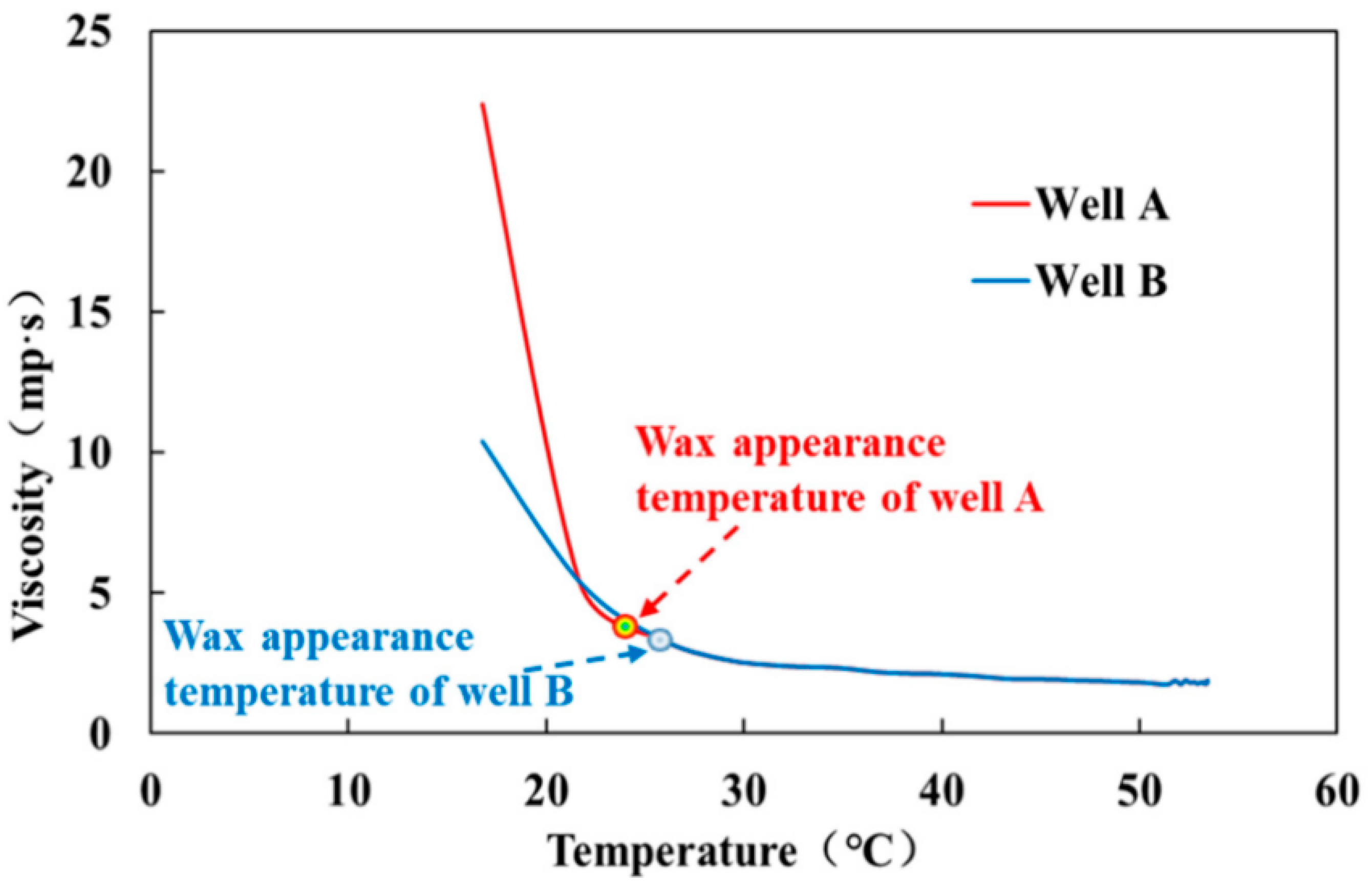
The dissolution equilibrium of paraffin in crude oil strictly depends on the temperature and pressure conditions of the system, and its solubility decays nonlinearly with decreasing temperature or pressure [3]. When the temperature drops to the wax appearance temperature (WAT), paraffin breaks through the thermodynamic equilibrium threshold from the supersaturated fluid, transforming from a thermodynamic “dissolved state” to a “supersaturated state”, and precipitates in the form of nanoscale small crystal nuclei. This process is accompanied by a significant decrease in the system’s free energy [7]. In the entire process of oil and gas transportation from reservoirs to the surface, multiple factors jointly exacerbate thermodynamic imbalances: the temperature gradient from the reservoir to the wellbore decreases (3–5 °C per kilometer of wellbore temperature), the strong heat exchange between deepwater pipelines and low-temperature seawater (pipe wall temperature can be as low as 4 °C), and the volatilization of light hydrocarbons caused by pressure drops (especially below the bubble point pressure), which directly increases the relative concentration of paraffin and increases the degree of supersaturation of the system by 20%–30%, providing the core thermodynamic driving force for wax crystal precipitation [8]. For example, in deepwater condensate gas pipelines, the low-temperature environment of seawater can create a temperature gradient of 10–15 °C between the pipe wall and the fluid, accelerating the nucleation rate of wax crystals in the area below WAT [4], as shown in Figure 1.
Figure 1. Viscosity temperature curve of condensate oil [9].
Coatings 15 01293 g001
Wax blockage is most likely to occur in surface gathering pipelines and the upper part of the wellbore. In ground pipelines, the ambient temperature is low and the heat dissipation area is large, making it easy for the crude oil temperature to drop below the wax precipitation temperature (WAT). In the wellbore, due to the geothermal gradient (a decrease of 3–5 °C per kilometer) and fluid heat dissipation, the temperature in the upper section of the well is lower, and wax deposition is also prone to occur. In contrast, in the near wellbore zone of the reservoir, although a decrease in pressure may lead to the volatilization of light components and an increase in the relative concentration of paraffin, the formation temperature is usually higher, generally higher than WAT, so simple wax precipitation is less common. However, if there are asphaltene deposits or clay particles in the near wellbore area, they can provide nucleation sites for wax crystals and form composite organic scales together with asphaltene, exacerbating permeability damage [10].

2.2. Kinetic Process of Wax Blockage Formation

Wax molecules diffuse towards the low-temperature wall under the drive of the concentration gradient, form initial crystal nuclei (about 50–100 nm) after adsorption, and grow into micrometer sized crystals with decreasing temperature [4]. Subsequently, wax crystals co-deposit with resin, asphaltene, and impurities to form a dense sedimentary layer, which gradually ages and hardens due to the enrichment of high carbon components [11,12,13]. It should be noted that fluid shear significantly affects sedimentation: high flow rates (>1.5 m/s) can suppress wax crystal aggregation or peel off some sedimentary layers, while low flow rates (<0.5 m/s) weaken erosion and accelerate sedimentation [5].

2.3. Key Factors Affecting Wax Blockage

In terms of crude oil properties, Li Chuanxian [12] and others found that the higher the wax content (>25%), the faster the deposition rate, and the easier it is to to form gel structure; paraffin wax with a carbon number of C20 or higher has a higher WAT and is prone to eutectic with resin, enhancing adhesion strength. When the content of gum and asphaltene is less than 5%, nucleation is promoted, while when it is greater than 10%, crystal growth is inhibited through steric hindrance. For every 10% increase in the content of light hydrocarbons, the solubility of paraffin increases by 15%–20%, which can delay the precipitation. In addition, Ali et al. [14] found that for every 10% increase in the content of light hydrocarbons (C1–C10) in crude oil, the solubility of paraffin can be enhanced by 15%–20%, significantly reducing WAT and delaying wax precipitation.
In terms of production conditions, Li Hongfu et al. [5] found that for every 5 °C increase in oil wall temperature difference, the sedimentation rate increases by 15%–20%; the low-temperature environment accelerates the aging of sedimentary layers. The effect of flow velocity is nonlinear: when the flow velocity increases from 0.5 m/s to 1.5 m/s, the sedimentation thickness can be reduced by 30%–40%, but high gas velocity in gas–liquid two-phase flow may cause local sedimentation. Reducing surface roughness or enhancing hydrophilicity can reduce wax crystal adhesion. Gan Lei et al. [15] found that when the surface roughness decreases from 10 μ m to 1 μ m, the deposition rate decreases by 15%–20%.
The model proposed by Burger et al. (1981) was the foundational work for pipeline paraffin deposition, considering the balance between temperature gradient-driven molecular diffusion and shear delamination [16]. At present, a series of mathematical models based on thermodynamics and fluid mechanics have been developed to predict the location, rate, and quantity of sediment formation.
The paraffin deposition model is mainly based on thermodynamic phase equilibrium and mass and heat transfer coupling principles. The model first calculates the wax precipitation temperature (WAT) and solid–liquid equilibrium (SLE) of crude oil, and then combines the temperature field and flow velocity field of the fluid to predict the deposition rate of paraffin on the pipe wall. For example, the multi-solid phase flash evaporation model treats each carbon group as an independent solid phase, establishes a gas–liquid multi-solid phase material equilibrium, and calculates the deposition amount using the equation of state + solid phase activity coefficient. The prediction error in the condensate oil system is less than 5% [17].

2.4. Blockage Removal Technology

Laboratory evaluation is a key step in screening and optimizing wax plugging solutions. Cold finger experiments or loop devices are often used to simulate the temperature gradient and fluid flow inside the wellbore or pipeline, and to evaluate the tendency of wax deposition by measuring the wax deposition rate, deposition layer thickness, and adhesion strength under different operating conditions [18]. For chemical unblocking agents (such as solvents and surfactants), their efficiency can be evaluated by injecting the agent into the experimental apparatus that has already formed wax deposits, monitoring the sediment removal rate, and the time required for unblocking [19]. The verification of thermodynamic unblocking schemes (such as hot washing and electric heating) requires precise temperature control and measurement of the minimum effective temperature and required heat to completely melt the wax. In addition, differential scanning calorimetry can accurately determine the wax precipitation temperature and solid–liquid phase envelope of crude oil, providing core parameters for thermodynamic plug removal design [20].
Various wax removal and plugging technologies have been developed to address the issue of wax deposition, mainly including physical, chemical, and thermodynamic methods.

2.4.1. Physical Wax Removal Technology

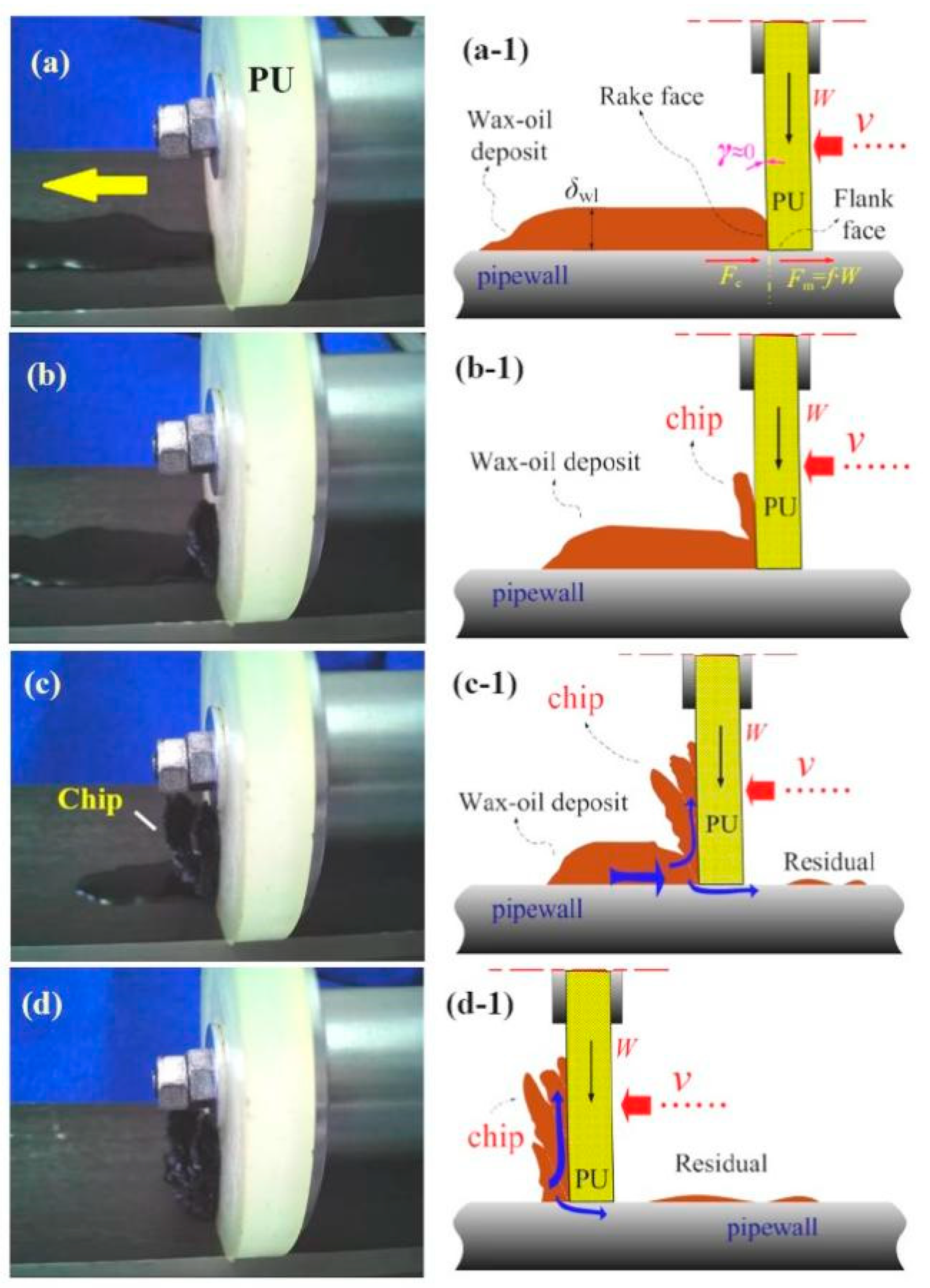
(1) Mechanical cleaning: Mechanical pipe cleaning (PIG) is one of the most commonly used wax removal methods in oil and gas pipelines. The pipe cleaner flows inside the pipeline and removes wax deposits on the inner wall of the pipeline through scraping and shearing. Although this technology is widely used, its effectiveness largely depends on experience, and the understanding of wax scale properties and removal mechanisms is not yet complete [21]. Now, there is a new pipeline robot that combines rubber sealing disk technology to remove wax scale by scraping wax oil gel, which is suitable for the production of high paraffin oil [22], as shown in Figure 2.
(2) Ultrasonic technology: Ultrasonic waves can be applied to wax removal in oil and gas pipelines and equipment. Through ultrasonic vibration, the wax crystal structure can be effectively destroyed, reducing the adhesion of wax and achieving wax removal effect [23].
(3) Microwave technology: Microwave technology uses high-frequency electromagnetic waves to generate heat, separating wax from the inner wall of the pipeline.
Figure 2. Schematic diagram of mechanical cleaning process [22]. (ad) the gel-breaking chips evolution between rubber disc and pipe. (a-1d-1) the friction force and gelbreaking force are given. And, (c-1d-1) The arrow (in blue) indicates the complex flow of waxy oil gel chips during the scraping process. The solid wax content of gel deposition may also cause a different loading dependence.
Coatings 15 01293 g002

2.4.2. Chemical Wax Removal Technology

(1) Surfactant: Surfactants disperse wax crystals and inhibit wax aggregation and deposition by altering the properties of the oil–water interface [24].
(2) Paraffin inhibitors/pour point depressants: These chemicals are usually injected before wax deposition occurs, by changing the shape of wax crystals and preventing them from connecting to form large deposits [25]. These substances can prevent the aggregation of wax, thereby promoting the dispersion of wax [24]. Water-based wax inhibitors are an environmentally friendly alternative that can solve the low ignition point and toxicity problems of oil-based wax inhibitors [26].
(3) Solvent technology: Dissolve paraffin wax in organic solvents, such as toluene and xylene, and remove the formed wax plugs through extrusion or circulation. Mixed solvents such as toluene diesel can reduce costs and improve permeability [27].

2.4.3. Thermodynamic Wax Removal Technology

(1) Thermochemical fluid treatment: Injection of chemical fluids that can undergo exothermic reactions, using the heat and chemical reactions generated by the reactions to remove wax deposits [28]. This method is more effective than traditional hot oil or water treatment, but due to the lack of sufficient theory or experience to guide its safe and effective application, it has not yet been widely popularized
(2) Electric heating: By applying a current inside or outside the pipeline, the resistance heating effect is used to heat the pipeline and melt the wax.
(3) Active heating: In underwater streamlines, active heating is an economically effective wax prevention strategy. Research has shown that the setting of heating temperature is crucial for the effectiveness of removing deposited wax. When the heating temperature is lower than the wax precipitation temperature (WAT), the wax crystals cannot be completely melted, and the unblocking effect significantly decreases [29].

3. Scaling Blockage

Inorganic scale deposition is a typical flow assurance problem in oil and gas field development. Its essence is the physical and chemical process in which dissolved ions in the formation or injected water are released and fixed at the wellbore and near wellbore formation interface due to thermodynamic equilibrium disruption. Common types of scale include calcium carbonate (CaCO3), barium sulfate (BaSOx), etc. Among them, barium sulfate is particularly harmful due to its extremely low solubility and difficulty in removal [30]. Scaling can lead to a reduction in the effective flow channel cross-sectional area, a sharp decrease in permeability, and equipment damage, and, in severe cases, can cause a production capacity decline of over 30% [31]. Especially in environments where high salinity formation water (such as Cl concentration up to 25,000 mg/L) coexists with CO2, the corrosion scaling coupling effect will further exacerbate the degradation of wellbore integrity [32].

3.1. Scale Formation Mechanism Under Multiphase Coupling

The scaling process is controlled by multiple mechanisms including thermodynamics, dynamics, and fluid dynamics. The thermodynamic driving force comes from ion supersaturation caused by changes in environmental parameters: a decrease in pressure leads to the escape of CO2 and an increase in pH value, promoting the precipitation of calcium carbonate [33,34]; incompatible fluid mixing (such as injection of water rich in SO42− and formation of water rich in Ba2+) directly triggers sulfate scale deposition [30].
The dynamic process involves the formation of crystal nuclei, crystal growth, and surface adhesion. Zhou Hao et al. [35] found that the presence of polymers or colloids can promote the spheroidization of scale crystals and accelerate pore blockage. It is worth noting that Wang Wei et al. [36] found that in the near wellbore area of the oil well, due to the severe pressure drop, a large amount of CO2 dissolved in the formation fluid escapes, and some of the originally dissolved Ca (HCO3) 2 minerals are easily decomposed to form insoluble precipitates, blocking the near wellbore area and wellbore of the oil well.
Scaling can occur in all regions, but its dominant types and causes have significant regional differences. In the near wellbore zone of the reservoir, scaling is most likely to occur, mainly due to the pressure drop causing CO2 degassing (leading to CaCO3 precipitation) and incompatible fluid mixing (such as BaSO4/SrSO4 precipitation caused by the mixing of formation water and injection water in water injection development), which directly leads to a decrease in formation permeability and is a serious reservoir damage. In the wellbore, the perforation hole or pipe coupling is a key area for fluid mixing and flow rate changes, and scaling is also prone to occur.

3.2. Multiple Factors Affecting Scaling

The tendency of scaling is jointly regulated by fluid chemistry, thermodynamic conditions, and rock–fluid interactions. The water quality characteristics are the decisive internal factors: high mineralization (such as 46,000 mg/L) and high concentration of calcium and barium ions directly increase the risk of scaling [32]. In environmental parameters, an increase in temperature promotes the formation of calcium carbonate scale while inhibiting barium sulfate scale; pressure changes affect ion balance by altering gas solubility and pH value [37,38]. Engineering factors such as fluid mixing in water injection development, CO2 displacement, or acidification operations may introduce scaling trigger points [39]. The wettability and roughness of rock surfaces also provide nucleation sites for the attachment of scale crystals [40].

3.3. Innovative Directions for Predictive Diagnosis and Prevention Strategies

Modern scaling management has gradually formed a comprehensive management system that integrates prediction, monitoring, and control strategies. In practical applications, thermodynamic simulation tools (such as OLI Scale Chem) are often used in combination with kinetic equations to quantitatively evaluate the scaling tendency under the combined action of multiple factors, such as temperature, pressure, and ion concentration [38]. In terms of diagnosis, common technical methods include XRD/XRF composition analysis of scale samples, intuitive observation using downhole video systems, and inversion inference based on production dynamic data.
The prevention and control measures should follow the principle of “prevention is more important than treatment” using chemical scale inhibitors (such as Diethylene Triamine Penta(Methylene Phosphonic Acid)DTPMPA, Maleic Anhydride—Sodium 3-allyloxy-2-hydroxy-1-propanesulfonate(MASE)). The efficiency of inhibiting sedimentation through lattice distortion and threshold effect is modulated by concentration, pH, and mineralization degree [40,41,42]; process optimization includes the avoidance of incompatible fluid mixing, control of production pressure difference, and adoption of extrusion-based long-term anti-scaling technology proposed by Zuo Jingluan [43]. Squeeze injection technology is a mature on-site application process, which refers to the high-pressure pumping of high-concentration scale inhibitor solution into the formation near the wellbore, causing it to be adsorbed or retained in the rock pores. In the subsequent production process, the scale inhibitor is slowly released from the formation, continuously inhibiting scaling and achieving long-term protection for months or even years. This technology is particularly suitable for scenarios with high operating costs, such as offshore platforms, and can significantly reduce maintenance frequency. It has been widely adopted by many oil and gas fields around the world. Regarding insoluble scales such as barium sulfate, Hu Teng et al. [44] believe that it is necessary to develop a synergistic solution of chelating unblocking agents or physical cleaning (such as continuous tubing jet).

3.4. Blockage Removal Technology

Laboratory evaluation is crucial for scientifically selecting scaling and unblocking solutions. Static bottle testing can quickly evaluate the scaling trend and amount of different water quality mixtures, and be used to screen for efficient scale inhibitors. For chemical unblocking methods, such as acid or chelating agents, core displacement experiments are the core evaluation method. By performing unblocking treatments on rock cores containing simulated scale substances (such as calcium carbonate), the permeability of the rock cores before and after treatment can be accurately measured. The permeability recovery rate is the most direct indicator for evaluating the unblocking effect and potential formation damage (such as secondary precipitation and clay swelling). At the same time, it is necessary to analyze the composition of the backflow fluid to evaluate the dissolution efficiency and environmental impact of the plugging agent. These experimental data provide a reliable basis for optimizing on-site drug formulations and injection parameters [45].

3.4.1. Chemical Removal Methods

The chemical descaling method is a widely used and mature descaling method, usually using acid pickling descaling agents to remove scale. Different acid systems need to be used for different types of scale. For example, calcium carbonate scale can usually be effectively removed with hydrochloric acid or EDTA (Ethylenediaminetetraacetic acid), which has achieved good results in practical scenarios such as Ansai Oilfield. For more difficult to handle barium sulfate scale, chelating agents such as DTPA (Diethylenetriaminepentaacetic acid) or EDTA are often needed to form stable complexes with metal ions to achieve scale removal [46].
In the actual operation process, the inhibitor solution is continuously injected into the wellbore through the casing annulus or specialized chemical injection pipeline, flowing with the produced fluid to protect the wellbore and near wellbore area, or the inhibitor is accurately transported to the deep part of the wellbore or blockage point using continuous tubing to achieve targeted treatment. During this process it is necessary to closely monitor the changes in system pressure and dissolution rate—especially under high temperature conditions, reaction acceleration may lead to a sharp rise in temperature in a short period of time, causing thermal damage to the wellbore and equipment. Serious blockages in gas wells require greater caution, as rapid dissolution can lead to gas flash or fluid shock, posing a threat to operational safety.
Currently, chemical descaling technology is still constantly developing. Polymer scale inhibitors such as polyacrylic acid (PAA) and ternary copolymers (such as APES/AA/AMPS) also exhibit excellent performance in high hardness water environments, with a scale inhibition rate of over 90% [47]. In addition, the nanomaterials invented by Karaly et al., such as phosphorylated polyetheramine-coated superparamagnetic iron oxide nanoparticles, not only have high scale inhibition efficiency, but also have recyclability, providing a new solution for the descaling needs in harsh environments such as high temperature and high salt [48].

3.4.2. Physical and Mechanical Removal Methods

The commonly used technique is high-pressure water jet: this technology uses a high-pressure pump to inject high-pressure water, which is converted from high-pressure low flow rate water to low-pressure high flow rate water through high-frequency electronic pulses. The penetration force generated by this high flow rate water will not damage the protective layer on the inner wall of the wellbore, and can also clean up the blockages attached to the wall, making the pipeline smooth [49].
There is also a method of removing scale from the surface of the wellbore and pipeline through mechanical scraping, which uses a mechanical drill bit to rotate at high speed to remove scale inside the wellbore.

4. Sand Blockage

Sand plugging is a typical solid particle plugging phenomenon in loose sandstone reservoirs and hydraulic fracturing operations. Its essence is the mechanical process of the migration of formation skeleton particles or proppants under fluid drag and changes in formation stress field, and the formation of bridge plugging in restricted flow areas [50]. This process leads to a sharp decrease in the cross-sectional area of pore throats or effective flow channels inside the wellbore, resulting in a significant decline in productivity and accompanied by equipment erosion risk [51]. Especially in high displacement fracturing or abnormally high-pressure gas well production, sand plugging often causes severe water hammer effects, leading to a surge in wellhead pressure oscillation [52], which seriously restricts the economic and efficient development of unconventional resources.

4.1. Particle Transport and Bridge Blocking Mechanism

The formation of sand blockage is jointly controlled by fluid dynamics, rock mechanics, and particle transport mechanisms. The starting conditions depend on the critical equilibrium between fluid drag force and interparticle cohesion (bonding strength, capillary force) [53]. Once the balance is broken, particles move by jumping, rolling, or suspending [54]. The formation of bridge blockage is a key step in blockage: when the diameter of sand particles approaches 1/3 to 2/3 of the pore throat size, the particles will form a dense accumulation in narrow areas driven by the flow pressure difference. The transported particles undergo mechanical filtration at the micro pore throat, or settle and accumulate in the macroscopic flow transition zone (such as perforation holes and crack ends) due to a sudden drop in flow velocity [55].
The core areas of sand plugging are the near wellbore zone of the reservoir and the wellbore. In the near wellbore zone, formation particles migrate under the action of production pressure difference, and mechanical trapping or bridging occurs at the pore throats, directly blocking the seepage channels and causing a sudden drop in permeability. In the wellbore, especially in the perforation section, pipe diameter changes or bends and sudden changes in flow velocity can easily lead to sand settling and accumulation, forming a “bridge blockage”, which can completely block the fluid in severe cases.
In contrast, sand blockage is relatively rare in surface pipelines, unless there is severe corrosion in the system or large-scale sand production in the formation. The sand in the pipeline is more manifested as erosion wear rather than complete blockage. Therefore, the key to preventing sand blockage lies in stabilizing the formation and optimizing the completion process in the near wellbore area.

4.2. Influence of Geological and Engineering Factors

The sensitivity of sand plugging is influenced by a combination of multiple scale parameters. The geological conditions of the reservoir are the inherent dominant factors: weakly cemented sandstones, due to their low bonding strength, are prone to skeleton sand migration, thereby exacerbating the risk of sand blockage [50]; coal reservoirs typically have the characteristics of low elastic modulus and high Poisson’s ratio, which can suppress the effective propagation of hydraulic fractures [56,57]; in areas near faults or natural fracture development zones, the difficulty of controlling filtration increases, often leading to the premature sand removal of sand carrying fluids [51]. In addition, engineering management loopholes such as borehole abrasion, column sealing failure, or construction parameter misoperation may significantly increase the probability of serious sand blockage accidents [58].

4.3. Monitoring, Early Warning, and Precise Intervention

The modern prevention and control of sand blockage increasingly rely on a comprehensive approach that combines real-time monitoring, prediction, and intervention. He Le et al. [59] applied Distributed Acoustic Sensing (DAS) technology, which can capture the real-time inflow and fracture dynamics of each cluster during hydraulic fracturing operations, and even identify abnormal signs such as borehole wear or inter-segment interference in advance through sound signals. On the other hand, the prediction model of the water hammer effect integrates multiple factors, such as multiphase flow state, proppant characteristics, and wellbore mechanics, and can accurately simulate the severe pressure fluctuations caused by sand blockage, providing a theoretical basis for adjusting construction parameters.
In practical prevention and control, emphasis is placed on matching geological conditions, optimizing processes, and accurately resolving blockages. For example, optimizing the pre-liquid system, using multi-stage plugging technology to reduce filtration, and implementing progressive sand addition can all help improve construction safety. Once sand blockage occurs, the application of unblocking methods should be based on different situations of blockage: continuous tubing flushing is suitable for pure sand blockage, while mud pollution often requires acid unblocking. When facing complex mixed blockage, a combined process is often required. It is worth mentioning that in shale gas wells, the rapid release of large nozzles as an economical and efficient method has shown good results in practice [50,55].

4.4. Blockage Removal Technology

The effectiveness of sand plugging and unblocking technology needs to be verified through targeted laboratory testing. For chemical unblocking, the focus is on evaluating the dissolution rate and ability of acid solutions (such as soil acid) to target cementitious materials (such as silicates and carbonates), usually simulated in high-pressure reactors [60]. The key to physical and mechanical unblocking is to evaluate the sand carrying capacity of the fluid. The settling velocity of sand particles in the flushing fluid can be measured through settling experiments, or the critical sand carrying flow rate can be determined in the annular device to optimize the flushing fluid formula and pump injection rate. The efficiency of mechanical methods such as continuous tubing sand flushing can be quantified by conducting sand flushing experiments in simulated wellbores to determine the amount of sand removed per unit time, providing parameter guidance for on-site operations [61].

4.4.1. Mechanical Cleaning Technology

(1) Continuous oil pipe operation: The principle of removing sand blockages in continuous oil pipe operation is mainly based on a combination of various technologies, such as fluid flushing, mechanical stirring, and negative pressure sand suction, supplemented by specific tools and fluids to improve efficiency [62]. Pelucchi et al. [63] successfully implemented the world’s first application of underwater plastic continuous tubing, effectively removing sand blockages in underwater pipelines. This innovative method provides an economically efficient alternative to pipeline replacement that originally required high costs.
(2) Negative pressure sand washing technology: For the temporary plugging agent of foam sand washing technology for severe negative pressure wells, the combination of oil soluble temporary plugging agent BPA and high-performance foam CYF-2 effectively solves the sand plugging problem, and has the advantages of its simple process, low cost, effective reservoir protection, and extended oil well production cycle [64].

4.4.2. Chemical Unblocking Technology

The essence of sand blockage is often not pure sand, but a dense blockage formed by sand particles being bonded together by substances such as asphalt, gum, heavy hydrocarbons, inorganic salt scales (such as calcium carbonate), or clay minerals.
(1) Acid treatment: The most common method is to use hydrochloric acid (HCl) or earth acid (HF HCl mixed acid). HF can effectively dissolve silicate substances (such as clay minerals) and some carbonate binders, thereby breaking down the bonds between sand particles, dispersing them, and facilitating subsequent backflow.
(2) Surfactant: Injecting a surfactant solution can change the wettability of the rock surface (from hydrophilic to oleophilic or neutral), significantly reduce capillary forces, release bound sand particles and oil and gas, improve their fluidity, and facilitate the carrying of fine sand particles out of the wellbore [65].
(3) Clay stabilizer: Use cationic polymers such as KCl, NH4Cl, or polyquaternary ammonium salts. They can inhibit the hydration expansion and dispersion migration of clay minerals, thereby stabilizing the geological structure and reducing sand blockage caused by clay problems from the source.
Chemical unblocking technology has a relatively large radius of action and can handle deep areas near the well, making construction simpler than mechanical methods. Acid solution may cause secondary precipitation with formation minerals; polymers may adsorb onto pore surfaces, causing damage. Therefore, formula design and subsequent flowback are crucial. Moreover, the cost of chemicals is relatively high, and the requirements for the safety and environmental protection of pharmaceuticals are becoming increasingly strict.

5. Hydrate Blockage

Hydrate blockage is a key fluid security issue faced in deepwater oil and gas extraction and natural gas transportation processes. It refers to the phenomenon where hydrocarbon gases (such as methane) in natural gas combine with water molecules under low temperature and high-pressure conditions to form ice-like crystalline solids–natural gas hydrates, which accumulate in pipelines or equipment and cause fluid channels to be partially blocked or even completely blocked.

5.1. Formation Principle and Process of Hydrates

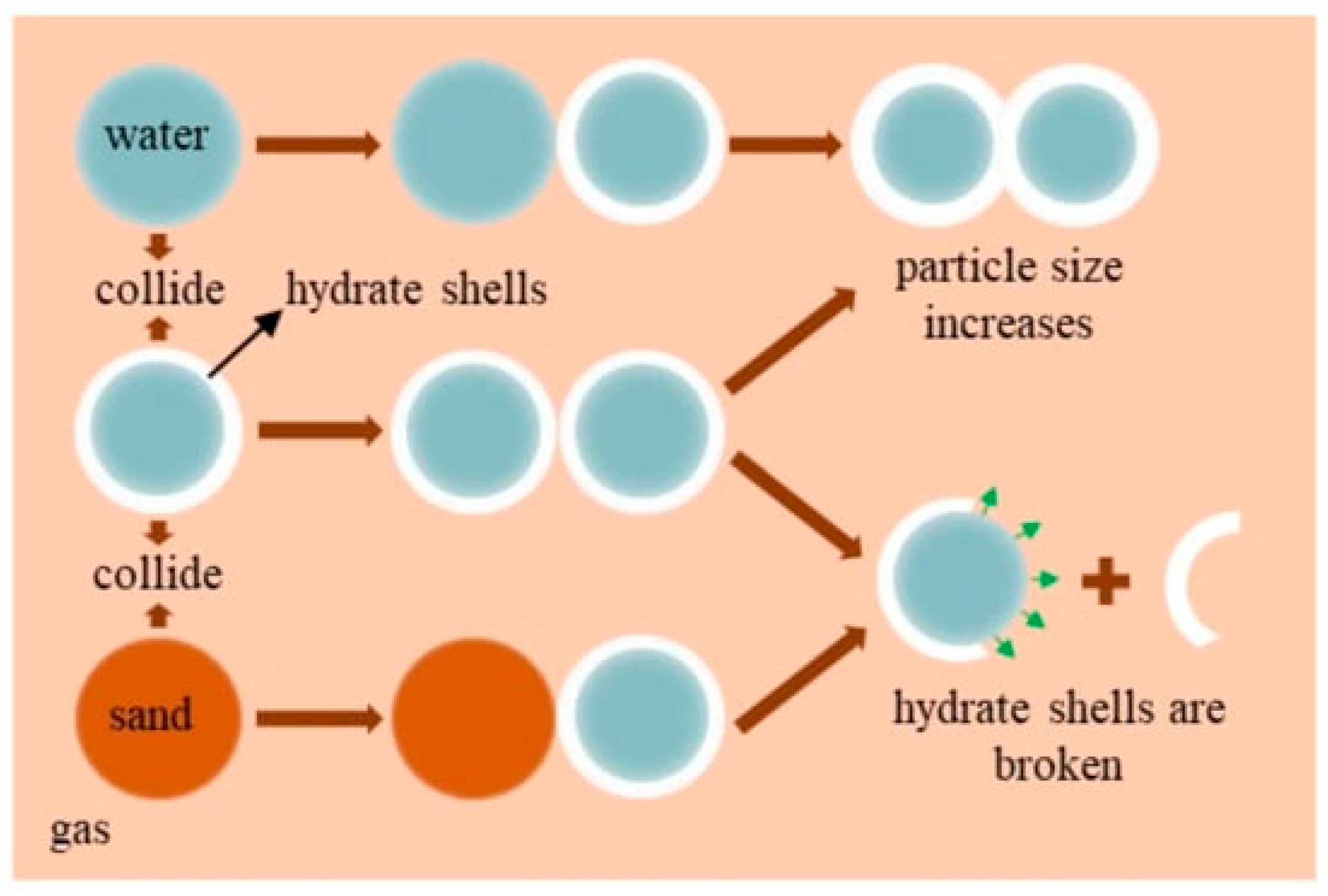
The formation of hydrates is essentially a phase transition process in which gas water molecules construct cage-shaped crystal structures through hydrogen bonding in high-pressure and low-temperature environments [66,67,68]. This process does not occur instantaneously, but rather first the nucleates continuously grow, then slowly aggregate together over time, and finally settle down. The formation of hydrates begins with the formation of crystal nuclei at the gas–water–solid three-phase interface. A hydrate film is formed at the interface between water, gas, and sand, and continues to grow through gas diffusion.
Once hydrate nuclei are formed, they will absorb more guest molecules and water molecules from the surrounding fluid and continue to grow. In systems with solid particles such as sand and rock debris, hydrates will form hydrate shells on the surface of the particles. These particles wrapped in hydrate shells can agglomerate through collision, resulting in an increase in particle size. When particles containing hydrates collide with solid particles such as sand, the hydrate shell may rupture, as shown in Figure 3.
Figure 3. Schematic diagram of formation, growth, and shell rupture mechanism of hydrate particles [69].
Coatings 15 01293 g003
Hydrate blockage almost entirely occurs in surface gathering and transportation pipelines, especially in deepwater subsea pipelines and surface pipelines in cold regions. These areas have both low temperatures (4 °C in deepwater environments or low surface temperatures in winter) and high pressures (long-distance transportation or deepwater hydrostatic pressure), making them the optimal conditions for hydrate formation. In the wellbore, although there is also high pressure, the fluid temperature inside the wellbore is usually high (affected by ground temperature), and the production flow rate is fast, making it difficult to meet the conditions for the stable existence of hydrates. Therefore, the risk of hydrate blockage in the wellbore is low. In the near wellbore zone of the reservoir, the formation temperature and pressure are usually outside the stable zone of hydrates, and there is a lack of continuous free water supply, so hydrate blockage is unlikely to occur.

5.2. Factors Affecting the Formation of Hydrates

(1) Thermodynamics driven: Low temperature and high pressure are necessary conditions for hydrate formation, but the cooling rate has a more significant impact than absolute temperature. Kong Qingwen et al. [70] demonstrated that increasing the cooling rate can shorten the macroscopic induction time and accelerate the blockage process. The instantaneous changes in temperature, such as pipeline shutdown or restart, can also significantly alter the thermodynamic conditions inside the pipeline, increasing the risk of hydrate blockage [71].
An increase in pressure promotes the formation of hydrates, as it facilitates the capture of gas molecules by the cage-like structure formed by water molecules. At a certain temperature, the higher the pressure, the easier it is for hydrates to form and exist stably [72].
(2) Fluid composition: The presence of free water is a prerequisite, while gas components (such as CO2, C2H6) affect blockage sensitivity by altering the phase equilibrium curve [73]. Ma Chuanhua et al. [74] found that surface active substances (such as cocoamide DEA) can inhibit particle aggregation, reducing cohesion by 51%–53% and adhesion by 60%–82%. The higher the salt content in water, the lower the formation temperature of hydrates, as salt ions can interfere with the formation of cage-like structures in water molecules [72].
(3) Other influencing factors: Lower flow rates can easily lead to the deposition of hydrate particles, resulting in blockage. The higher flow velocity brings about higher shear forces, which help hydrate particles maintain a dispersed state and reduce the tendency of agglomeration and deposition [75]. The physical structure and internal surface characteristics of pipelines also have a direct impact on the deposition and blockage of hydrates. Due to the complex flow field, hydrates are more likely to form and accumulate in variable diameter pipelines, increasing the risk of blockage [76]. The roughness of the inner wall of the pipeline provides more nucleation sites for the attachment and growth of hydrates, promoting their deposition [77].

5.3. Blockage Removal Technology

The screening of hydrate unblocking technology highly relies on laboratory simulations under high pressure and low-temperature environments. By using high-pressure reaction vessels or microreactors, the temperature and pressure conditions of deepwater pipelines can be simulated, and the risk of blockage can be evaluated by measuring macroscopic induction time, hydrate formation rate, and final conversion rate. For thermodynamic inhibitors (such as methanol), the laboratory mainly measures their degree of inhibition on the equilibrium curve of hydrates (i.e., the decrease in formation temperature). For kinetic inhibitors and anti-aggregation agents, their delayed effects on hydrate nucleation and growth need to be evaluated [78].

5.3.1. Physical Unblocking Technology

The physical unblocking method starts from the principle of hydrate formation, with increasing temperature and reducing pressure as the main means.
(1) Pyrolysis plugging method: Pyrolysis plugging method decomposes hydrates by increasing the pipeline temperature. This can be achieved by injecting hot water or steam, or using electric heating, etc. [79]. For example, in response to the characteristics of natural gas hydrate blockage in a certain oil field in western China, researchers conducted simulation calculations and experimental studies on the process using self-generated pyrolysis plugging agents to remove blockages. A mathematical model for the comprehensive decomposition rate and heat transfer of hydrates was established, and based on this model, the blockage removal process was simulated. Key parameters such as hydrate decomposition rate, plugging agent and hydrate temperature, heat transfer efficiency, plugging time, and plugging agent dosage were analyzed [80].
(2) Pressure reduction and unblocking: The pressure reduction and unblocking method is one of the most commonly used methods for unblocking, which decomposes hydrates by reducing pipeline pressure. This method can usually perform decompression operations from one or both sides of the blockage point [79].

5.3.2. Chemical Unblocking Technology

(1) Thermodynamic inhibitors, such as methanol (MEG) and ethylene glycol (MeOH), inhibit the formation of hydrates by changing the thermodynamic conditions for their formation. Although injecting MEG/MeOH mixture into vertical pipelines can effectively remove hydrate blockages, injecting a large amount of inhibitors (such as methanol) is not only costly, but may also have an impact on the environment [81,82].
(2) Dynamics inhibitor: This mainly prevents blockages by inhibiting the growth and aggregation of hydrate crystals.
It can be seen that ions (such as NaE) can disrupt the orientation of water molecules, thereby affecting the formation of hydrates, and kinetic inhibitors encapsulate hydrate particles and inhibit their growth.
In summary, various unblocking techniques have been developed for wax blockage, scaling, sand blockage, and hydrate blockage in the vicinity of the wellbore and reservoir, including chemical, physical, mechanical, and thermodynamic methods. These methods differ significantly in their mechanisms of action, applicable conditions, and engineering effects. To compare the key performance indicators of the system, this article summarizes the processing parameters and capacity recovery effects of typical unblocking techniques based on research in the literature and field application data, as shown in Table 1.

6. Conclusions

This article systematically reviews the formation mechanisms, influencing factors, and plug removal techniques of four common types of blockages (wax blockage, scaling, sand blockage, and hydrate blockage) in wellbore and near wellbore areas during oil and gas field development. Research has shown that blockage is the result of coupling multiple physical and chemical processes, and is influenced by multiple factors, such as fluid properties, temperature and pressure conditions, flow velocity, and surface characteristics. The current unblocking technology has formed a collaborative system of multiple methods, such as chemistry, physics, mechanics, and thermodynamics, but there are still problems such as limited processing depth, high cost, and secondary injury risk. In the future, research on multi-scale blockage mechanisms should be strengthened, and environmentally friendly and efficient unblocking agent technologies should be developed to enhance the reliability and economy of complex oil and gas resource development, as shown in Table 2.
Table 2. Comparison of blockage types and unblocking techniques between wellbore and reservoir near wellbore zones.
Type of BlockageMethods for UnblockingRepresenting TechnologyAdvantageShortcoming
Wax blockagePhysical methodsMechanical cleaning, ultrasonic cleaningNo chemical pollution, mature technologyShallow processing depth and high equipment cost
Chemical methodsSurfactant, wax inhibitorStrong prevention and mature technologyContinuous refueling has high costs and environmental pressures
Thermodynamic methodsHot washing, electric heatingThoroughly resolving blockages and achieving quick resultsHuge energy consumption and risk of thermal damage
ScalingChemical methodsAcid washing, chelating agent, scale inhibitorLarge operating radius and mature technologyCorrosion risk, secondary precipitation, high cost
Physical/mechanical methodsHigh-pressure water jet, mechanical scrapingNo chemical damage, intuitive homeworkLimited to the wellbore, unable to handle deep formations
Sand blockageMechanical methodsContinuous tubing sand flushing and negative pressure sand washingHigh efficiency and strong targetingUnable to handle deep sand migration in geological formations
Chemical methodsSoil acid, surfactantProcessing cemented sand, with a deeper effectSensitive geological risks and high chemical costs
Hydrate blockagePhysical methodsPressure reduction and thermal stimulationLow-cost pressure reduction method and thorough heat shock methodLowering pressure poses safety risks and consumes a large amount of heat shock energy
Chemical methodsMethanol/ethylene glycol, kinetic inhibitorsReliable anti-blocking effectThe cost of inhibitors is high, and methanol is toxic
The effectiveness of the current unblocking technology system is often limited by the inherent contradiction between the depth of action, economic cost, and technical side effects when dealing with different blockage problems. Although chemical methods can be applied to deep areas near the well, their strong invasiveness comes with significant risks: acid may cause secondary precipitation, surfactants may alter reservoir wettability, and expensive chelating agents and inhibitors bring sustained economic burdens. In contrast, although physical and mechanical methods avoid chemical pollution and have intuitive and controllable operations, their scope of action is mostly fixed in the wellbore itself, and they are powerless against deep reservoir problems. They also rely on expensive special equipment and require high initial investment. The laws of thermodynamics are constrained by enormous energy consumption, and their operating costs in deep wells or long pipelines sharply increase due to maintaining high temperatures, often resulting in poor economic viability. All types of technologies are constrained by the impossible triangle of “depth, security, and cost”.
Looking towards the future, in order to enhance the reliability and economy of complex oil and gas resource development, the development of plug removal technology should focus on the following key directions:
1. Develop efficient and environmentally friendly unblocking agents: Focus on developing low toxicity and easily degradable green chemicals, such as bio-based surfactants [24] and biodegradable polymer inhibitors [83], to replace traditional toxic agents (such as methanol) and reduce environmental pollution.
2. Develop intelligent monitoring and early warning technology: Promote intelligent systems based on distributed optical fiber sensing (DAS/DTS) and digital twin technology [84], achieve the transformation from “passive unblocking” to “active early warning and precise intervention”, and prevent problems before they occur.
3. Promote multi-technology collaborative optimization: Through big data and machine learning algorithms, achieve precise, efficient, and low damage operation modes.

Funding

This research received no external funding.

Institutional Review Board Statement

Not applicable.

Informed Consent Statement

Not applicable.

Data Availability Statement

Data are contained within the article.

Conflicts of Interest

Author Pengcheng Wang was employed by the company PetroChina Changqing Oilfield Company. Author Xiaojiang Huang was employed by the company CNPC Baoji Petroleum Pipe Industry Co., Ltd. and Petroleum and Natural Gas Tubular Goods Co., Ltd. The remaining authors declare that the research was conducted in the absence of any commercial or financial relationships that could be construed as a potential conflict of interest.

References

  1. Li, S.J.; He, H.X.; Wang, Z.K.; Xue, B.; Gao, T.F.; Wang, S. Analysis of Reasons for Wellbore Blockage in Gas Wells and Research Progress in Blockage Removal Technology. J. Xi’an Shiyou Univ. (Nat. Sci. Ed.) 2024, 39, 56–65. [Google Scholar]
  2. Lai, G.L.; Meng, S.J.; Feng, Y.; Li, W.W. Study on the Blockage Mechanism in the Wellbore of HB Jia-2 Gas Well. China Pet. Chem. Stand. Qual. 2022, 42, 112–114. [Google Scholar]
  3. El-Dalatony, M.M.; Jeon, B.H.; Salama, E.S.; Eraky, M.; Kim, W.B.; Wang, J.; Ahn, T. Occurrence and Characterization of Paraffin Wax Formed in Developing Wells and Pipelines. Energies 2019, 12, 967. [Google Scholar] [CrossRef]
  4. Ragunathan, T.; Husin, H.; Wood, C.D. Wax Formation Mechanisms, Wax Chemical Inhibitors and Factors Affecting Chemical Inhibition. Appl. Sci. 2020, 10, 479. [Google Scholar] [CrossRef]
  5. Li, H.F.; Li, M.Y.; Li, Y.Y.; Xiong, X.Q.; Xue, R.B.; Liu, T.; Liu, X. Factors Influencing Wax Deposition in SK Pipeline and Its Inhibition Measures. Process Equip. Pip. 2024, 61, 87–94. [Google Scholar]
  6. Vandergeest, C.; Melchuna, A.; Bizarre, L.; Bannwart, A.C.; Guersoni, V.C.B. Critical review on wax deposition in single-phase flow. Fuel 2021, 293, 120358. [Google Scholar] [CrossRef]
  7. Li, W.Z. Study on W/O Type of Waxy Crude Oil Emulsion Wax Deposit Characteristics of Pipeline Transporting. 2018. [Google Scholar]
  8. Huang, T.; Li, D.; Xie, Z.Q.; Yao, H.Y.; Fu, Q.; Li, Y.; Yang, B.; Qin, R. Research progress on plugging and unplugging of coupled hydrate and wax deposition in condensate gas pipelines. Chem. Ind. Eng. Prog. 1–11. Available online: https://kns.cnki.net/kcms2/article/abstract?v=vfP_nAZksBJFw-WtgRrvSozJtQL61omv2nyLlMKpnDznI36nu2J7CD4WN3B7pE0GrF78tBn-JwLQ7JyzGyIXc_EdMoQxRcAHH79wC93_dtMBtYmElkGGxlbG_2fochJtJcE8i0-PkMyaozT3sj1GmjiOo74Yq4z_2SQ0Qokcm7SZKrJuut_hBw==&uniplatform=NZKPT&language=CHS (accessed on 3 November 2025).
  9. Cao, L.; Sun, J.; Liu, J.; Liu, J. Experiment and Application of Wax Deposition in Dabei Deep Condensate Gas Wells with High Pressure. Energies 2022, 15, 6200. [Google Scholar] [CrossRef]
  10. Adeyanju, O.A.; Oyekunle, L.O. Experimental study of water-in-oil emulsion flow on wax deposition in subsea pipelines. J. Pet. Sci. Eng. 2019, 182, 106294. [Google Scholar] [CrossRef]
  11. Quan, Q.; Wang, W.; Wang, P.Y.; Gao, G.; Han, Y.C.; Zhu, M.; Gong, J. Wax deposition and aging of waxy crude oil with high pour point and high viscosity. Oil Gas Storage Transp. 2016, 35, 259–262. [Google Scholar]
  12. Li, C.X.; Bai, F.; Wang, Y. Influence of crude oil composition on wax deposition on tubing wall. CIESC J. 2014, 65, 4571–4578. [Google Scholar]
  13. Tong, S.; Ren, Y.; Yan, K.; Jin, Y.; Li, P.; Zhang, J.; Wang, Z. Investigation on coupling deposition and plugging of hydrate and wax in gas–liquid annular flow: Experiments and mechanism. Fuel 2024, 369, 131723. [Google Scholar] [CrossRef]
  14. Ali, S.I.; Lalji, S.M.; Haneef, J.; Khan, M.A.; Yousufi, M.; Yousaf, N.; Saboor, A. Phenomena, factors of wax deposition and its management strategies. Arab. J. Geosci. 2022, 15, 133. [Google Scholar] [CrossRef]
  15. Gan, L.; Lin, T.J.; Li, J.; Zhang, K.; Yang, H.; Nigore, J. Microscopic mechanism and prediction model of wax deposition of waxy crude oil in Jinlong 2 well area. Petrochem. Technol. 2024, 53, 1444–1450. [Google Scholar]
  16. Burger, E.D.; Perkins, T.K.; Striegler, J.H. Studies of Wax Deposition in the Trans Alaska Pipeline. J. Pet. Technol. 1981, 33, 1075–1086. [Google Scholar] [CrossRef]
  17. Li, D.X. Thermodynamic Model for Prediction of Wax Precipitation in Gas Condensate Mixtures. Xinjiang Pet. Geol. 2006, 27, 79–81. [Google Scholar]
  18. Gheriany, I.A.E.; Hassan, I.F. A Flow Loop to Study Wax Deposition in Pipelines. In Proceedings of the 2020 2nd Novel Intelligent and Leading Emerging Sciences Conference (NILES), Giza, Egypt, 24–26 October 2020. [Google Scholar]
  19. Li, W.; Li, H.; Da, H.; Hu, K.; Zhang, Y.; Teng, L. Influence of pour point depressants (PPDs) on wax deposition: A study on wax deposit characteristics and pipeline pigging. Fuel Process. Technol. 2021, 217, 106817. [Google Scholar] [CrossRef]
  20. Kouhi, M.M.; Shafiei, A.; Bekkuzhina, T.; Abutalip, M. New intelligent models for predicting wax appearance temperature using experimental data—Flow assurance implications. Fuel 2025, 380, 133146. [Google Scholar] [CrossRef]
  21. Li, W.; Huang, Q.; Dong, X.; Gao, X.; Hou, L. Experimental Study on Wax Removal With Real Wax Deposits. In Proceedings of the 2018 12th International Pipeline Conference, Calgary, AB, Canada, 24–28 September 2018; p. V003T04A042. [Google Scholar]
  22. Tan, G.; Luo, Z.; Ji, Y.; Huang, X. Friction Performance of Rubber Sealing Disc Inside Pipe Robots for the Production of High-Paraffin Oil. Lubricants 2024, 12, 102. [Google Scholar] [CrossRef]
  23. Akbari, A.; Kazemzadeh, Y.; Martyushev, D.A.; Cortes, F. Using ultrasonic and microwave to prevent and reduce wax deposition in oil production. Petroleum 2024, 10, 584–593. [Google Scholar] [CrossRef]
  24. Gabayan, R.C.M.; Sulaimon, A.A.; Jufar, S.R. Application of Bio-Derived Alternatives for the Assured Flow of Waxy Crude Oil: A Review. Energies 2023, 16, 3652. [Google Scholar] [CrossRef]
  25. Carpenter, C. Thermodynamic Modeling Approach Assists Mitigation of Wax Deposition. J. Pet. Technol. 2023, 75, 91–93. [Google Scholar] [CrossRef]
  26. Liao, L.; Han, W.; Cao, Q. Development of a SGJ-1 of Water-Based Anti-Wax Agent. Open J. Yangtze Oil Gas 2021, 6, 72–83. [Google Scholar] [CrossRef]
  27. Li, B.; Guo, Z.; Zheng, L.; Shi, E.; Qi, B. A comprehensive review of wax deposition in crude oil systems: Mechanisms, influencing factors, prediction and inhibition techniques. Fuel 2024, 357, 129676. [Google Scholar] [CrossRef]
  28. Hassan, A.; Alade, O.; Mahmoud, M.; Al-Majed, A. A Novel Technique for Removing Wax Deposition in the Production System Using Thermochemical Fluids. In Proceedings of the Abu Dhabi International Petroleum Exhibition & Conference, Abu Dhabi, United Arab Emirates, 11–14 November 2019. [Google Scholar]
  29. Bell, E.; Lu, Y.; Daraboina, N.; Sarica, C. Experimental Investigation of active heating in removal of wax deposits. J. Pet. Sci. Eng. 2021, 200, 108346. [Google Scholar] [CrossRef]
  30. Zhao, X.W. Failure Analysis Of Elbow Piercing Leakage In Gas Gathering System And Research On Anti-erosion Coating. 2023. Available online: https://kns.cnki.net/kcms2/article/abstract?v=vfP_nAZksBLZwuezGwVolYfp_H5F0OPe2-DMwd-U6-gu2_2B1C4L1YiDYr4gVoIZpnPboZs71rhCGH3C461bYQIcTbBJtulT_mFvn0Z0fvxIe6yhZ0Hl6T7AUrG5CoBl-M3zU_8nVjt28QF0rVjK-i3qJBoXAD8LrdeHG6Mjr35uPwewDbEPwqUCH7Jv47Lz&uniplatform=NZKPT&language=CHS (accessed on 3 November 2025).
  31. Wang, W.; Hu, D.W.; Zhang, C.H.; Dou, H.Y.; Yang, X.; Jin, F. Study on Scale Formation Mechanism in Oil Wells of Huaqing Oilfield during Medium-High Water Cut Period. In Proceedings of the 2024 International Petroleum and Petrochemical Technology Conference, Beijing, China, 25–27 March 2024; 16p. [Google Scholar]
  32. Jin, X.X.; Wang, C.; Liu, T.; Zhou, W.Q.; Shang, X.T. Study on Wellbore Corrosion and Scaling Mechanisms in the Wu 243 Block of Nanliang Oilfield. China Pet. Chem. Stand. Qual. 2024, 44, 119–121. [Google Scholar]
  33. Wanner, C.; Eichinger, F.; Jahrfeld, T.; Diamond, L.W. Unraveling the Formation of Large Amounts of Calcite Scaling in Geothermal Wells in the Bavarian Molasse Basin: A Reactive Transport Modeling Approach. Procedia Earth Planet. Sci. 2017, 17, 344–347. [Google Scholar] [CrossRef][Green Version]
  34. Orozco, R.A.L.; Okuno, R.; Lake, L.W. Analytical solutions for the injection of wettability modifiers in carbonate reservoirs based on a reduced surface complexation model. Geoenergy Sci. Eng. 2023, 227, 211825. [Google Scholar] [CrossRef]
  35. Zhou, H.; Gong, X.G.; Tang, H.J.; Liu, H.; Shi, F.; Zhang, J.; Yang, L.L. Study on the Scale Composition and Scaling Mechanism of Wellbore in Mahu Oilfield. J. Petrochem. Univ. 2024, 37, 18–24. [Google Scholar]
  36. Wang, W.; Zhao, Y.P.; Jiang, S.J.; Wang, W.B.; Liu, K.; Zhao, Y. Corrosion and Scaling of CO2 Flooding in Yanchang Ultra-low Permeability Reservoirs. Oilfield Chem. 2018, 35, 91–108. [Google Scholar]
  37. Gebauer, D.; Völkel, A.; Cölfen, H. Stable Prenucleation Calcium Carbonate Clusters. Science 2008, 322, 1819–1822. [Google Scholar] [CrossRef]
  38. Zhao, H.Y. Investigation on Scaling Mechanism in Production Wells of Zhenyuan Oilfield and Development and Application of a Composite High-Performance Scale Inhibitor. 2023. Available online: https://kns.cnki.net/kcms2/article/abstract?v=vfP_nAZksBLMyjhe928z0bphVV1lm_e3u6L4WoSgURK3pV_dRKb5Cj5dk9Rwv1Q-_eq9Y7t4zYKVpmomF2js0zji_50ZZADW29QdHy7X0P93ho0XHAqRvwBu63piH3iuVN9jZUCPjlxiq_jomdVUut_42t_I3ou_iMYqQAkkMK-yLR9X3zhDII0k4ZMY7N0q&uniplatform=NZKPT&language=CHS (accessed on 3 November 2025).
  39. Chen, J.; Xiang, B.L.; Liang, B.X.; Dai, X.; Zhou, B.; Li, E.T.; Liu, M.; Lei, H.Y.; Qi, J.; Liu, J. Study on Scaling Mechanism and Prevention & Control Countermeasures in Key Blocks of Junggar Basin. Available online: https://kns.cnki.net/kcms2/article/abstract?v=vfP_nAZksBLFSuatMZsyvdo0QA82BkgTFm_JMhDZwZ14tlvhIf6s1_po6H_MN8ycPodPa0WFR5-wYqylgenJvF4yHNkZovgVYXy5f-G8FEu1jd6F7oPNhIDWFYR12puQ8T4pxw-rYDYvWCFFrbfNtP3I1f1HbOEt6gU3DD2O229w52AYoryqkA==&uniplatform=NZKPT&language=CHS (accessed on 3 November 2025).
  40. Wang, M.M. Study on Scaling Mechanism and Scale Prevention Measures in Water Injection Wells of JD Oilfield. 2019. Available online: https://kns.cnki.net/kcms2/article/abstract?v=vfP_nAZksBKLcdHc18s-zPIJbulktYPVkBa33xtNuwiSyGUceHJQIQEmc6o5NSHtxNzt1vPI0wT0oQkQqWyg5oqNhKAnR26pAaZxXfqoL0n0AmRP3vyGsDzLyhkzs9WFOQJX5wEra1i5PwyfXvL5x6h6G9WHxyLQapmgaxDQl91y35HVPdmElzWr3YVLuFz-&uniplatform=NZKPT&language=CHS (accessed on 3 November 2025).
  41. Bürgmayr, S.; Tanner, J.; Batchelor, W.; Hoadley, A.F.A. CaCO3 solubility in the process water of recycled containerboard mills. Nord. Pulp Amp. Pap. Res. J. 2022, 38, 181–195. [Google Scholar] [CrossRef]
  42. Zhang, H.C. Study on Scaling Mechanism of Water Injection Reservoir and Chemical Scale Inhibition Experiments in QX Oilfield. 2019. Available online: https://kns.cnki.net/kcms2/article/abstract?v=vfP_nAZksBIsv0_3f-FC21xM6iytT4hk_TzBlh--M0rqSX0V05-zqqsJzLOSTCtohHeMHMbl0lDEyZVcDzo1eU3fRCCHUiec0a_In_1TGsP3ZVa08ygOyTP4yGp_SkMe9Ns_kVYgzlwiEVM5w7uTGTqTf19VS4OFlpsOQJ1YQQJjl5t8xtay5VoSC0x3tNFb&uniplatform=NZKPT&language=CHS (accessed on 3 November 2025).
  43. Zuo, J.L.; Fan, Z.X.; Ren, S.R.; Yan, F.P.; Ding, G.; Xu, L.; Hu, K.M.; Wang, X.Q. Squeeze treatment technology of scale inhibitor in Fan 41 Block of Chunliang Oilfield. Acta Pet. Sin. 2008, 29, 615–624. [Google Scholar]
  44. Hu, T.; Lu, G.L.; Yu, C.; Tang, Y.; Hu, Z.Q. Scaling Mechanism and Treatment Technology of Production Strings in Gas Wells in Xujiahe Formation in Western Sichuan. Sino-Glob. Energy 2023, 28, 46–52. [Google Scholar]
  45. Khormali, A.; Petrakov, D.G.; Moein, M.J.A. Experimental analysis of calcium carbonate scale formation and inhibition in waterflooding of carbonate reservoirs. J. Pet. Sci. Eng. 2016, 147, 843–850. [Google Scholar] [CrossRef]
  46. Karaly, A.; Kelland, M.; Mady, M. Phosphonated Polyetheramine-Coated Superparamagnetic Iron Oxide Nanoparticles: Study on the Harsh Scale Inhibition Performance of Calcium Carbonate and Barium Sulfate. ACS Omega 2024, 9, 42027–42036. [Google Scholar] [CrossRef]
  47. Liu, Y.; Zhou, Y.; Yao, Q.; Wang, H.; Wu, Z.; Chen, Y.; Liu, L.; Yang, C.; Wu, W.; Sun, W. Preparation of a Multifunctional Terpolymer Inhibitor for CaCO3 and BaSO4 in Oil Fields. Tenside Surfactants Deterg. 2016, 53, 148–156. [Google Scholar] [CrossRef]
  48. Zhao, Y.; Chen, J.; Liao, L.; Feng, D.Q.; Ou, B.M.; Huang, Y.B.; Mao, Y.K. Analysis of blockage and study on blockage removing agent in high temperature deep well of Jianbei gas field. Chem. Eng. Oil Gas 2023, 52, 81–86. [Google Scholar]
  49. Wang, Z.Y. High-Pressure Water Jet Cleaning Technology and Its Application Analysis in Pipeline Scale Removal. Petrochem. Ind. Technol. 2019, 26, 336–337. [Google Scholar]
  50. Nie, Y.B.; Wang, H.F.; Wang, S.J.; Zhu, S.B.; Wang, Y.M.; Yang, X.Y. Management of Abnormal Wellbore Plugging in Abnormal-High Pressure Gas Wells, Keshen Gas Field. Xinjiang Pet. Geol. 2019, 40, 84–90. [Google Scholar]
  51. Xi, X.D. Analysis and Countermeasures of Fracturing and Sand Plugging in North HUBEI Working Area. Inn. Mong. Petrochem. Ind. 2024, 50, 104–107. [Google Scholar]
  52. Ding, L.L.; Wang, K.; Chen, L.L.; Zhang, Q.; Chen, W.K. Water hammer characteristics and prediction application based on fracturing sand plugging. J. Vib. Shock 2023, 42, 254–261+300. [Google Scholar]
  53. Zhao, J.Z.; Peng, Y.; Li, Y.M.; Wang, L.; Zhang, Y.; Mi, Q.B. Abnormal sand plug phenomenon at a high injection rate and relevant solutions. Nat. Gas Ind. 2013, 33, 56–60. [Google Scholar]
  54. Qi, S.J.; He, H.L.; Guang, H.; Wang, X.Q.; Sheng, C.; Lei, F.Y.; Feng, Z.Y. Cause analysis and countermeasures of fracturing sand plugging in tight sandstone gas reservoir. Petrochem. Ind. Appl. 2023, 42, 14–19. [Google Scholar]
  55. Zhai, H.L. Reason Analysis and Countermeasure of Sand Plug in Shale Gas Fracturing. Well Test. 2015, 24, 62–78. [Google Scholar]
  56. Guo, J.; Cui, Y.; Xu, W.; Yin, Y.; Li, Y.; Jin, W. Numerical investigation of the landslide-debris flow transformation process considering topographic and entrainment effects: A case study. Landslides 2022, 19, 773–788. [Google Scholar] [CrossRef]
  57. Liu, S.Q.; Sang, S.X.; Li, Y.M.; Li, M.X.; Liu, H.H.; Zhang, J.G. Analysis on Fracturing Failure Cause of Coal Bed Methane Well in South Part of Qinshui Basin. Coal Sci. Technol. 2012, 40, 108–112. [Google Scholar]
  58. Li, Y.M.; Li, C.X.; Guo, J.C.; Zhao, J.Z. Cause Analysis On Sand Plug In Fracturing Treatment Of Gas Reservoir. Drill. Prod. Technol. 2008, 31, 55–65. [Google Scholar]
  59. He, L.; Zhu, J.H.; Liang, X.; Zhao, Z.Y.; Guan, B.; An, S.J. Evaluation of Multi-Cluster Fracturing Effects in Horizontal Shale Gas Wells Basedon Optic Fiber Monitoring Outside Casing. Pet. Drill. Tech. 2024, 52, 110–117. [Google Scholar]
  60. Leong, V.H.; Mahmud, H.B.; Law, M.C.; Foo, H.C.Y.; Tan, I.S. A comparison and assessment of the modelling and simulation of the sandstone matrix acidizing process: A critical methodology study. J. Nat. Gas Sci. Eng. 2018, 57, 52–67. [Google Scholar] [CrossRef]
  61. Leporini, M.; Marchetti, B.; Corvaro, F.; Giovine, G.; Polonara, F.; Terenzi, A. Sand transport in multiphase flow mixtures in a horizontal pipeline: An experimental investigation. Petroleum 2019, 5, 161–170. [Google Scholar] [CrossRef]
  62. Ye, Z.; Zhao, Y.; Pang, Y.; Hu, Y.; Jiang, Q. Mechanisms and Experimental Research on Sand Transport and Settlement of a New Sand Cleaning System. Arab. J. Sci. Eng. 2023, 48, 16543–16555. [Google Scholar] [CrossRef]
  63. Pelucchi, M.; Mantica, D.B.; Piemontese, M.; Restuccia, G.; Mackenzie, H. Successful Sand Blockage Removal from Sealine Using an Innovative Plastic Coiled Tubing. In Proceedings of the SPE Annual Technical Conference and Exhibition, San Antonio, TX, USA, 9–11 October 2017; p. D011S003R005. [Google Scholar]
  64. Zhang, B.; Zhu, Z. Research and Application of Temporary Plugging Foam Sand Washing Technology. Adv. Fine Petrochem. 2010, 11, 47–49. [Google Scholar] [CrossRef]
  65. Han, F. Experimental Study on the Interaction Mechanism of Surfactant with Shale Oil Rock and Fluid. Offshore Oil 2020, 40, 47–52. [Google Scholar]
  66. Meng, Y.; Han, B.; Wang, J.; Chu, J.; Yao, H.; Zhao, J.; Zhang, L.; Li, Q.; Song, Y. Hydrate Blockage in Subsea Oil/Gas Pipelines: Characterization, Detection, and Engineering Solutions. Engineering 2025, 46, 363–382. [Google Scholar] [CrossRef]
  67. Englezos, P.; Kalogerakis, N.; Dholabhai, P.D.; Bishnoi, P.R. Kinetics of formation of methane and ethane gas hydrates. Chem. Eng. Sci. 1987, 42, 2647–2658. [Google Scholar] [CrossRef]
  68. Xiao, C.-W.; Li, X.-S.; Li, G.; Yu, Y.; Weng, Y.; Lv, Q.; Yu, J. Key factors controlling the kinetics of secondary hydrate formation in the porous media. Gas Sci. Eng. 2023, 110, 204911. [Google Scholar] [CrossRef]
  69. Qi, Y.; Gao, Y.; Zhang, L.; Su, X.; Guo, Y. Study of the Formation of Hydrates with NaCl, Methanol Additive, and Quartz Sand Particles. J. Mar. Sci. Eng. 2024, 12, 364. [Google Scholar] [CrossRef]
  70. Kong, Q.W.; Mou, J.; Ji, P.; Pang, Z.L.; Zhang, J.B.; Wang, Z.Y. Characteristics of Hydrate Nucleation, Formation and Plugging in Gas-Liquid Two-phase Flow with High Water-cut. Shipbuild. China 2024, 65, 151–163. [Google Scholar]
  71. Zhang, S.; Yang, S.; Gao, Y.; Yin, F.; Yuan, H.; Zhao, X. Research progress on hydrate blockage of deep-sea pipelines under shut-in and restart conditions. Chem. Eng. Sci. 2026, 320, 122416. [Google Scholar] [CrossRef]
  72. Song, L.; Li, Y.; Chen, Y.; Wang, W. The Sensitivity Analysis of the Factors Influencing on the Hydrate Formation. Sci. Technol. Eng. 2011, 11, 5075–5079. [Google Scholar] [CrossRef]
  73. Li, X.H.; Liu, Y.; Mo, J.; Wang, C.X.; Yang, Y.Z.; Shu, F.C. Chemical Prevention Technology of Natural Gas Hydrates in Pubei Oilfield. Chem. Bioeng. 2024, 41, 60–68. [Google Scholar]
  74. Ma, C.H.; Wu, Y.H.; Kang, Y.J.; Dai, R.; Liu, K. Experimental Study of a Dual-Action Inhibitor Impeding Hydrate Aggregation and Adhesion to Borehole Wall. Pet. Drill. Tech. 2025, 53, 122–128. [Google Scholar]
  75. Tang, C.; Zhao, X.; Li, D.; He, Y.; Shen, X.; Liang, D. Investigation of the Flow Characteristics of Methane Hydrate Slurries with Low Flow Rates. Energies 2017, 10, 145. [Google Scholar] [CrossRef]
  76. Song, K.; Tian, M.; Yao, M.; Geng, X.; Xu, Y.; Li, Y.; Wang, W. Experimental study on the evolution process of hydrate deposition, blockage and decomposition in reducing pipeline. J. Taiwan Inst. Chem. Eng. 2024, 157, 105414. [Google Scholar] [CrossRef]
  77. Akkutlu, I.Y.; Arslan, E.; Khan, F.I. Hydrate Formation with the Memory Effect Using Classical Nucleation Theory. Crystals 2024, 14, 243. [Google Scholar] [CrossRef]
  78. Cai, J.; Tang, H.; Zhang, T.; Xiao, P.; Wu, Y.; Qin, H.; Chen, G.; Sun, C.; Wang, X. Phase equilibria of gas hydrates: A review of experiments, modeling, and potential trends. Renew. Sustain. Energy Rev. 2025, 215, 115612. [Google Scholar] [CrossRef]
  79. Aminnaji, M.; Tohidi, B.; Burgass, R.; Atilhan, M. Gas hydrate blockage removal using chemical injection in vertical pipes. J. Nat. Gas Sci. Eng. 2017, 40, 17–23. [Google Scholar] [CrossRef]
  80. Li, H.; Wei, N.; Cao, H.; Jiang, L.; Zhang, W.; Cui, Z.; Zhao, J.; Xiong, Y.; Feng, Y.; Xu, H.; et al. Numerical Simulation of Plugging Removal by Hydrate Authigenic Pyrolysis Plugging Agent in Gas Well Production; Springer Nature: Singapore, 2020. [Google Scholar]
  81. Wang, Z.; Zhao, Y.; Zhang, J.; Pan, S.; Yu, J.; Sun, B. Flow Assurance During Deepwater Gas Well Testing: When and Where Hydrate Blockage Would Occur. In Proceedings of the SPE Annual Technical Conference and Exhibition, Dubai, United Arab Emirates, 26–28 September 2016. [Google Scholar]
  82. Wang, J.; Liao, B.; Liu, L.; Chen, L.; Huang, Y.; Zhao, K.; Sun, X.; Lv, K.; Zheng, Y.; Sun, J. The effect of multi-component Inhibitor systems on hydrate formation. Gas Sci. Eng. 2024, 122, 205214. [Google Scholar] [CrossRef]
  83. Cheng, L.; Cui, J.; Li, J.; Zhu, R.; Liu, B.; Ban, S.; Chen, G. High efficient development of green kinetic hydrate inhibitors via combined molecular dynamic simulation and experimental test approach. Green Chem. Eng. 2022, 3, 34–43. [Google Scholar] [CrossRef]
  84. Chen, F.; Wei, H.; Tang, J.; Sun, W.; Zhao, X.; Li, Y.; Dong, S.; Zhang, H.; Liu, G. Digital twin based predictive diagnosis approach for submarine suspended pipelines. Int. J. Press. Vessel. Pip. 2025, 214, 105451. [Google Scholar] [CrossRef]
Table 1. Summary of key parameters and performance of typical block removal technologies.
Unblocking TechnologyProcessing Temperature (°C)Processing TimeApplicable Blockage TypesCapacity Recovery Rate (%)Feature
Hot wash60–10030–120 minWax blockage, hydrate blockage60–85High energy consumption, risk of thermal damage
Chemical solvents (methanol/MEG)20–401–24 hHydrate blockage70–90The cost of inhibitors is high, methanol is toxic
Acidizing and unblocking (hydrochloric acid)25–601–4 hCalcium carbonate scaling50–80Corrosion risk, secondary precipitation
Chelating agent (EDTA/DTPA)25–802–6 hBarium sulfate, composite scale40–70Expensive drugs, difficult degradation
Continuous oil pipe sand flushing1–6 hSand blockage80–95High equipment cost, limited to wellbore only
Ultrasonic unblocking20–5030–90 minWax blockage, mild scaling40–70High initial investment, limited penetration power
High-pressure water jet1–3 hScaling and wax blockage65–80Water treatment cost, limited to wellbore only
Electric heating80–1201–4 hWax blockage, hydrate blockage75–90Extremely high energy consumption, limited to shallow wells
Kinetic inhibitor (PVP/VCap)20–50Continuous injectionHydrate blockage (prevention)Medium cost, good environmental friendliness
Disclaimer/Publisher’s Note: The statements, opinions and data contained in all publications are solely those of the individual author(s) and contributor(s) and not of MDPI and/or the editor(s). MDPI and/or the editor(s) disclaim responsibility for any injury to people or property resulting from any ideas, methods, instructions or products referred to in the content.