Article

Preparation and Properties of Composite Coatings Fabricated from Carved Lacquer Waste and Waterborne Acrylic Resin


1
Co-Innovation Center of Efficient Processing and Utilization of Forest Resources, Nanjing Forestry University, Nanjing 210037, China
2
College of Furnishings and Industrial Design, Nanjing Forestry University, Nanjing 210037, China
3
Tubao Decorative New Materials Co., Ltd., Huzhou 313200, China
4
College of Furniture Design and Wood Engineering, Transilvania University of Brașov, 500036 Brasov, Romania
*
Author to whom correspondence should be addressed.
Coatings 2025, 15(10), 1230; https://doi.org/10.3390/coatings15101230
Submission received: 14 September 2025 / Revised: 2 October 2025 / Accepted: 14 October 2025 / Published: 21 October 2025
(This article belongs to the Section Functional Polymer Coatings and Films)

Abstract

This study developed a waterborne UV-curable acrylic composite coating incorporated with carved lacquer powder and systematically investigated the effects of powder and deionized water content on its properties. The results showed that the carved lacquer powder content significantly influenced the optical, mechanical, and curing behaviors of the coating, while the water content had negligible impact. Specifically, increasing the powder content reduced lightness, enhanced red hue, and decreased gloss. An optimal comprehensive performance was achieved at 20% powder content, with adhesion reaching grade 5, flexibility of 10 mm, and impact resistance of 6 kg·cm. FTIR analysis confirmed that high powder content (≥20%) led to incomplete curing due to UV shielding. The coatings showed moderate resistance to water, acid, and saline environments but poor alkaline resistance due to the chemical instability of cinnabar. SEM revealed increased surface roughness at high powder loading (30%). More importantly, this work presents a sustainable approach to recycle carved lacquer waste and demonstrates a viable strategy for incorporating traditional cultural heritage materials into advanced functional coatings. The study demonstrates that carved lacquer powder can be effectively integrated into UV-curable coatings to achieve unique decorative effects, and a content of approximately 20% is recommended to achieve balanced properties.

1. Introduction

Carved lacquer, an important traditional Chinese lacquering technique, represents a significant intangible cultural heritage, with natural lacquer as its primary raw material. Natural lacquer, often regarded as an eco-friendly biopolymer, possesses outstanding comprehensive properties, including durability, water resistance, antibacterial activity, and corrosion resistance [1,2,3,4]. Despite these advantages, waste generated during the production and processing of carved lacquer is difficult to recycle and is often discarded directly. Such practices not only lead to severe resource waste but also pose potential environmental hazards. Addressing this challenge is therefore not only a matter of sustainable materials development but also of preserving and revitalizing a traditional art form in a contemporary context.
Over the past decades, research interest in natural lacquer films has steadily increased. Historically, lacquer has been used as a protective coating and adhesive for thousands of years, demonstrating exceptional solvent and corrosion resistance. To date, no solvent has been found capable of effectively dissolving or hydrolyzing cured lacquer films [5,6,7]. Studies of ancient lacquerware have confirmed that lacquer films are highly crosslinked polymers formed via enzymatic polymerization, which results in an insoluble and infusible three-dimensional network. For instance, Wei [8] analyzed lacquer films from excavated artifacts and highlighted their stable polymeric structure, while Xia [9] confirmed their high degree of curing and resistance to various solvents even after prolonged immersion. Niimura and Miyakoshi [7] further demonstrated that even at 800 °C, lacquer films remain incompletely decomposed, albeit with significant degradation of gloss and color. These findings underscore the chemical stability of cured lacquer, which, while valuable for preservation, complicates the recycling of carved lacquer waste.
One promising approach involves grinding carved lacquer waste into fine powders and incorporating them into modern coating systems as functional fillers. Among potential binders, waterborne acrylic resins have attracted significant attention owing to their environmental friendliness, strong adhesion, high transparency, and compatibility with a variety of substrates, including wood, plastics, and paper [10,11,12]. Moreover, the development of photocurable (UV-curable) technologies has revolutionized the coatings industry. UV-curable coatings offer remarkable advantages such as low energy consumption, solvent-free processing, rapid curing, and high-quality film formation with superior chemical and thermal stability [13,14,15]. Given these merits, waterborne UV-curable acrylic resins are regarded as one of the most promising platforms for fabricating multifunctional and sustainable composite coatings.
Recent studies have explored hybrid systems to expand the functional performance of waterborne acrylic coatings. For example, Meng et al. [16] prepared waterborne acrylic/polytetrafluoroethylene (PTFE) composite coatings, achieving excellent hydrophobicity and anticorrosion performance. Yan et al. [17] incorporated flake aluminum into waterborne acrylics, creating low infrared emissivity coatings with potential stealth applications. Similarly, Huang et al. [18] developed core–shell nano-acrylic resin/SiO2 composites to enhance pore-plugging efficiency in water-based drilling fluids. These works collectively demonstrate the versatility and wide-ranging potential of waterborne acrylic resin composites. However, despite extensive advances, few studies have investigated the integration of carved lacquer waste into such modern coating systems, leaving a critical gap at the intersection of sustainable materials design and cultural heritage valorization.
Based on this context, the present study employs waterborne UV-curable acrylic resin as a binder and diluent for carved lacquer waste powder to fabricate composite coatings. The research aims not only to (i) provide an effective recycling pathway for carved lacquer waste but also to (ii) enhance the functional properties of acrylic coatings through hybridization and (iii) explore a novel avenue for bridging cultural heritage preservation with advanced sustainable materials. The fundamental properties of the developed coatings are systematically evaluated, offering new insights into the sustainable utilization of traditional lacquer materials.

2. Materials and Methods

2.1. Materials

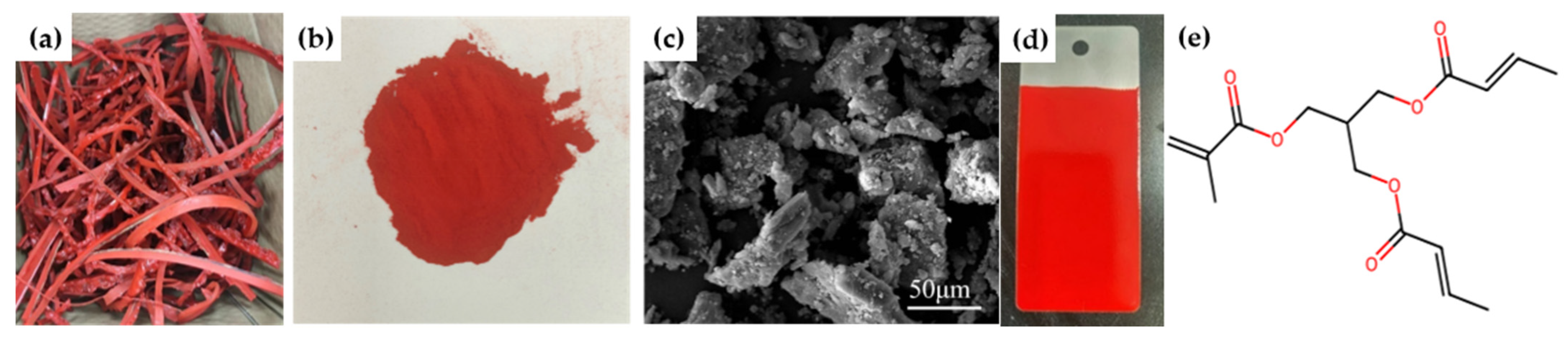
Carved lacquer waste in the form of red lacquer strips containing cinnabar mineral pigment was supplied by Yangzhou Lacquerware Factory (Yangzhou, China). Thermogravimetric and differential scanning calorimetry (TG-DSC, NETZSCH-Gerätebau GmbH, Selb, Germany) analyses confirmed its excellent thermal stability, with major decomposition occurring between 200 and 500 °C and over 50% residual mass retained at 800 °C (see Supplementary Materials), demonstrating its suitability as a thermally stable filler for coating applications. The waterborne UV-curable acrylic resin (type XQSZ-18) was purchased from Nanjing Xilang New Materials Co., Ltd. (Nanjing, China). Photoinitiator 184 (1-hydroxycyclohexyl phenyl ketone, white crystalline powder) was provided by Shanghai Yinchang New Materials Co., Ltd. (Shanghai, China). Deionized water was prepared in the laboratory. Representative images of the carved lacquer waste, its powdered macroscopic state, powder microstructure, and the final cured coatings are presented in Figure 1. Specifically, the microstructural image in Figure 1c reveals irregular crystalline particles with heterogeneous sizes ranging from a few micrometers to several tens of micrometers, indicating a rough surface texture that is expected to enhance interfacial interactions when dispersed within the resin matrix. Furthermore, Figure 1d shows photographs of the final UV-cured composite coatings with different lacquer powder contents, highlighting their surface appearance. In addition, the molecular structure of the UV-curable acrylic resin (XQSZ-18), which consists of acrylic ester functional groups enabling rapid photo-initiated crosslinking, is illustrated in Figure 1e. This structural representation provides insights into the reactive sites responsible for curing behavior and subsequent network formation in the composite coatings.

2.2. Preparation of Composite Coatings

The carved lacquer waste was first coarsely ground using a high-speed crusher and subsequently pulverized with a multi-sample tissue grinder (ZHTE-48, Nanjing Zhuohang Instrument Co., Ltd., Nanjing, China). The powder was sieved through a 200-mesh stainless steel sieve to ensure uniform particle size. Tinplate substrates were selected for coating applications. Prior to coating, the substrates were abraded unidirectionally with 500-grit sandpaper to enhance surface roughness, followed by thorough cleaning with anhydrous ethanol and drying at room temperature.
The coating formulation was prepared by mixing the acrylic resin with deionized water in ratios of 20:2, 20:3, and 20:4 (by weight). Carved lacquer powder was added as a filler at three different loading levels (10 wt%, 20 wt%, and 30 wt% relative to resin mass), while photoinitiator 184 was added at 2 wt% of the resin weight. The mixture was manually stirred with a glass rod until homogeneous, followed by ultrasonic dispersion (60 min, 25 °C) to improve particle distribution. The coating slurry was applied to tinplate substrates using a 150 μm wire-wound applicator to obtain uniform films. The coated substrates were cured under a UV curing machine (ZB-1300, Changzhou Zibo Optoelectronics Technology Co., Ltd., Changzhou, China) with a curing time of 60 s. The detailed formulations of the prepared coatings are summarized in Table 1.

2.3. Testing and Characterization

2.3.1. Color Measurement

Colorimetric properties were evaluated according to GB/T 3181-2008 [19] using a spectrophotometer (TS 8510, Guangzhou Zhuoxie Instrument Co., Ltd., Guangzhou, China). Parameters L* (lightness), a* (red–green), and b* (yellow–blue) were recorded under a D65 standard light source, with d/0 geometry, 10° field of view, and an aperture of 8 mm. Each measurement was repeated at three different regions, and the mean values were reported.

2.3.2. Gloss Measurement

Gloss was determined in accordance with GB/T 1743-1979 [20] using a 60° gloss meter (Shanghai Jieying Instrument Co., Ltd., Shanghai, China). Three parallel measurements were carried out, and the average values were calculated.

2.3.3. Mechanical Properties

The tinplate substrates were prepared according to GB/T 9271-2008 [21], and the mechanical properties of the coatings were subsequently evaluated. Adhesion was tested in compliance with GB/T 1720-2020 [22] using an automatic adhesion tester (BGD 501, Biuged Laboratory Instruments, Guangzhou, China) operated at a rotation speed of 80 r/min. Flexibility was determined according to GB/T 1731-2020 [23] with a mandrel bending tester (QTX, Shanghai Xiandai Environmental Engineering Co., Ltd., Shanghai, China). Impact resistance was assessed following GB/T 1732-2020 [24] using an impact tester (BGD 304, Biuged Laboratory Instruments, Guangzhou, China), with the initial drop height set at 5 cm.

2.3.4. Fourier Transform Infrared (FTIR) Spectroscopy

Chemical structures of the composite coatings were analyzed using a FTIR spectrometer (ALPHA II, Bruker Optics, Ettlingen, Germany). Measurements were carried out in the range of 500–4000 cm−1 with a resolution of 4 cm−1.

2.3.5. Chemical Resistance

The chemical resistance of the coatings was evaluated by immersing the samples in deionized water, 10 wt% HCl, 10 wt% NaOH, and 10 wt% NaCl solutions for 48 h at room temperature. Surface changes such as gloss loss, discoloration, wrinkling, or blistering were observed and recorded.

2.3.6. Morphological Analysis

Surface and cross-sectional morphologies were examined using scanning electron microscopy (SEM, Quanta 200, FEI, Hillsboro, OR, USA). Prior to observation, samples (3 × 3 mm2) were sputter-coated with a thin gold layer to improve conductivity.

3. Results

3.1. Colorimetric and Gloss Characteristics of Composite Coatings

The analysis of variance (ANOVA) results for the color and gloss of the composite coatings are summarized in Table 2. The p-values for the main effect of carved lacquer powder on color parameters (L*, a*, and b*) were all below 0.05, indicating a statistically significant influence. In contrast, the main effect of deionized water was not significant (p > 0.05) for any of the color parameters. Similarly, carved lacquer powder exhibited a significant influence on gloss (p < 0.05), while deionized water had no significant effect. These results indicate that the optical appearance of the coatings is mainly governed by the content of carved lacquer powder, whereas the dilution effect of deionized water is negligible.
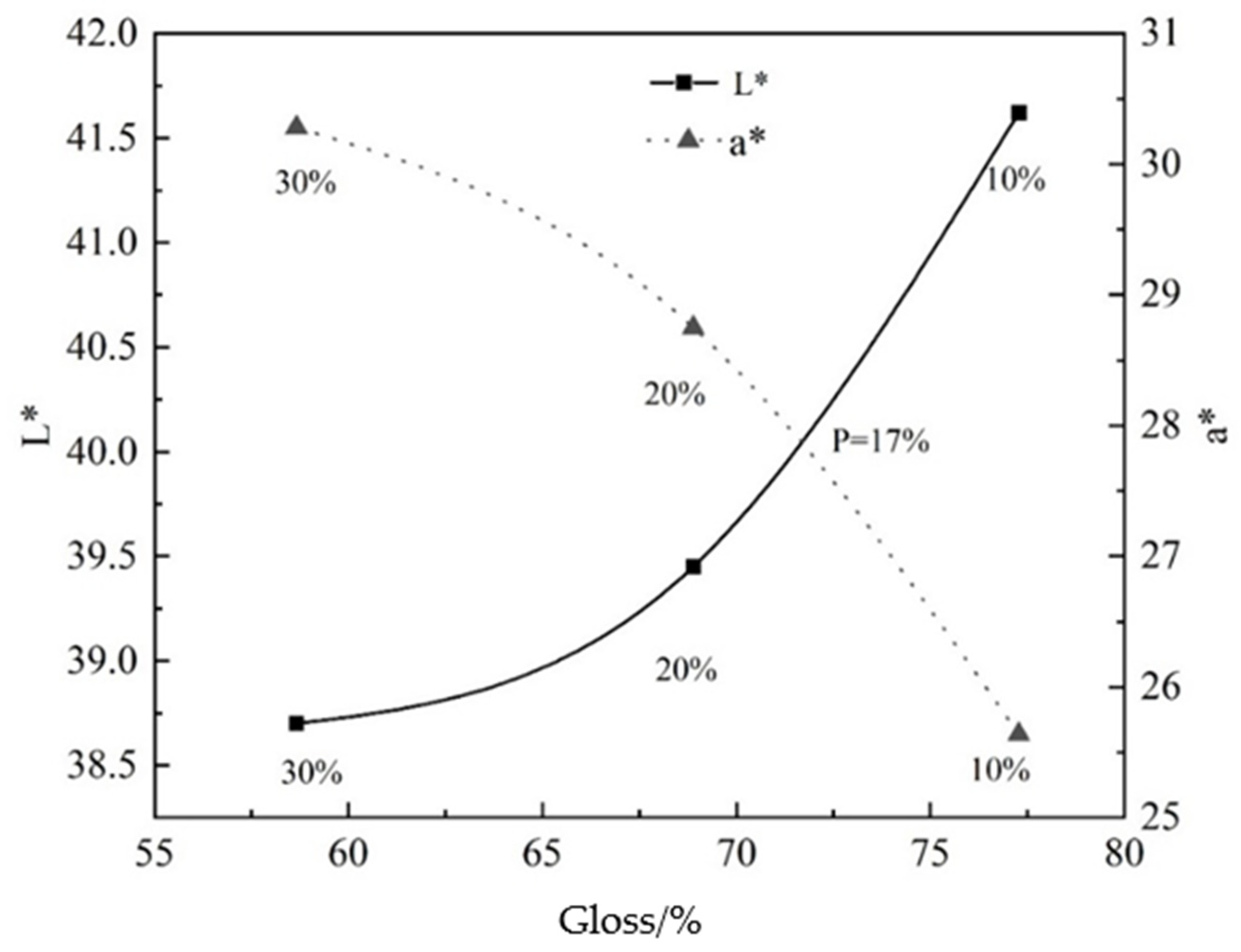
The correlation between gloss, L*, and a* under different carved lacquer powder contents is illustrated in Figure 2. As the powder content increased, L* values gradually decreased and a* values increased, corresponding to a darker tone and enhanced red hue. This trend can be attributed to the higher cinnabar pigment concentration in carved lacquer powder, which reduces brightness while intensifying redness. At the same time, gloss decreased progressively with increasing powder content due to the reduced resin fraction, which limited leveling during curing and increased surface roughness.
Importantly, before presenting the detailed characterization results, it is worth noting that the expected outcome of adding lacquer powder was a darker appearance with stronger red tones and reduced gloss, owing to its pigment-rich nature and reduced resin leveling ability. The experimental results confirmed these expectations.
Interestingly, the intersection of the L* and a* curves (point P in Figure 2) indicate an optimal balance at approximately 17% powder addition. At this point, the values were close to those of the 20% formulation, with L* = 39.4, a* = 28.75, and gloss = 68.89%. This composition produced a rosy hue with relatively high gloss, suggesting that moderate carved lacquer powder loading can enhance decorative performance without compromising gloss—an outcome desirable for both protective and aesthetic applications.

3.2. Mechanical Performance of Composite Coatings

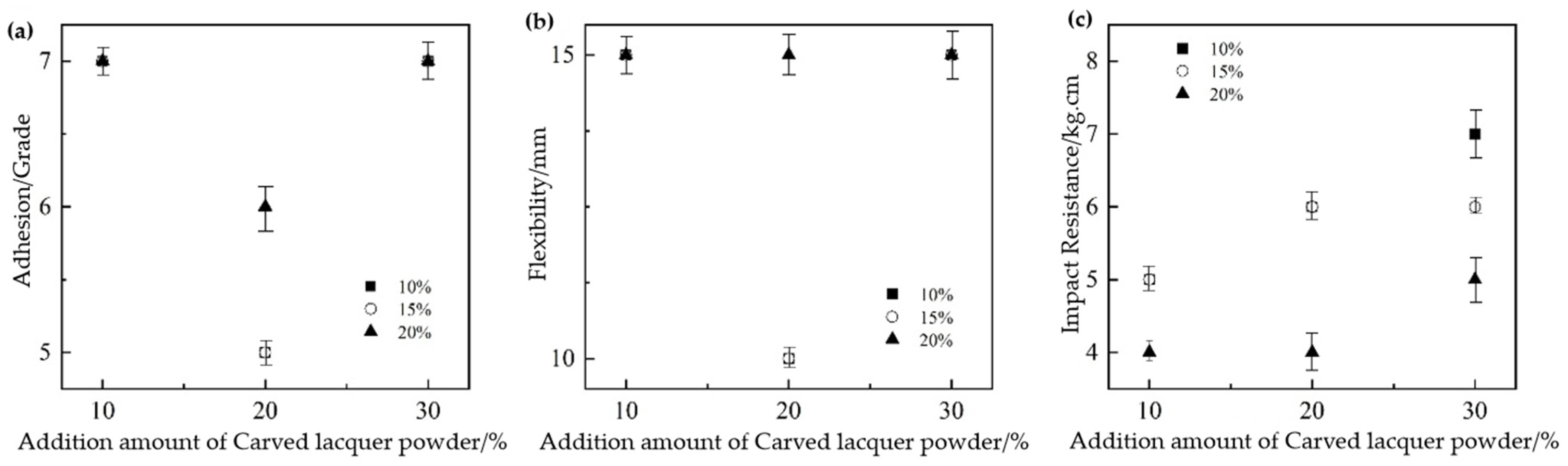
From a mechanical perspective, it was anticipated that moderate amounts of carved lacquer powder would improve toughness and balance adhesion, flexibility, and impact resistance, while excessive loading could hinder curing efficiency and reduce adhesion. In contrast, higher deionized water content was expected to weaken the mechanical properties by increasing porosity after evaporation. The mechanical properties of the coatings are presented in Figure 3a–c. When the carved lacquer powder content was 20% and the deionized water content ranged between 10% and 15%, the coatings exhibited the best overall performance, with adhesion reaching grade 5 and flexibility up to 10 mm. Under this formulation, the impact resistance was 6 kg·cm. In contrast, when the powder content was 10% or 30%, adhesion and flexibility declined noticeably. At 10% powder content, extended curing resulted in excessively high crosslinking density, which reduced flexibility. At 30% powder content, incomplete curing led to similarly poor adhesion.
The relatively weak adhesion of UV-cured acrylic coatings on metallic substrates is generally attributed to the high crosslinking density, rapid curing rate, and significant curing shrinkage of acrylic polymers [25]. Interestingly, impact resistance improved with increasing carved lacquer powder content, reaching 7 kg·cm at 30%. This enhancement may result from partially uncured regions within the film caused by excessive pigment loading, which increased elasticity and enhanced the coating’s ability to absorb impact energy [26].
In contrast, when the deionized water content reached 20%, impact resistance decreased sharply. This phenomenon can be explained by the dual role of water: initially, water acts as a temporary plasticizer that facilitates mixing and film formation. However, during UV curing, rapid evaporation of excess water leaves behind microvoids and defects in the resin matrix. These voids disrupt the continuity of the crosslinked polymer network, increase internal stress concentration, and ultimately make the cured resin more brittle. The combination of higher brittleness and network discontinuity accounts for the observed decline in impact resistance at high water content.

3.3. FTIR-Based Evaluation of Composite Coating Curing

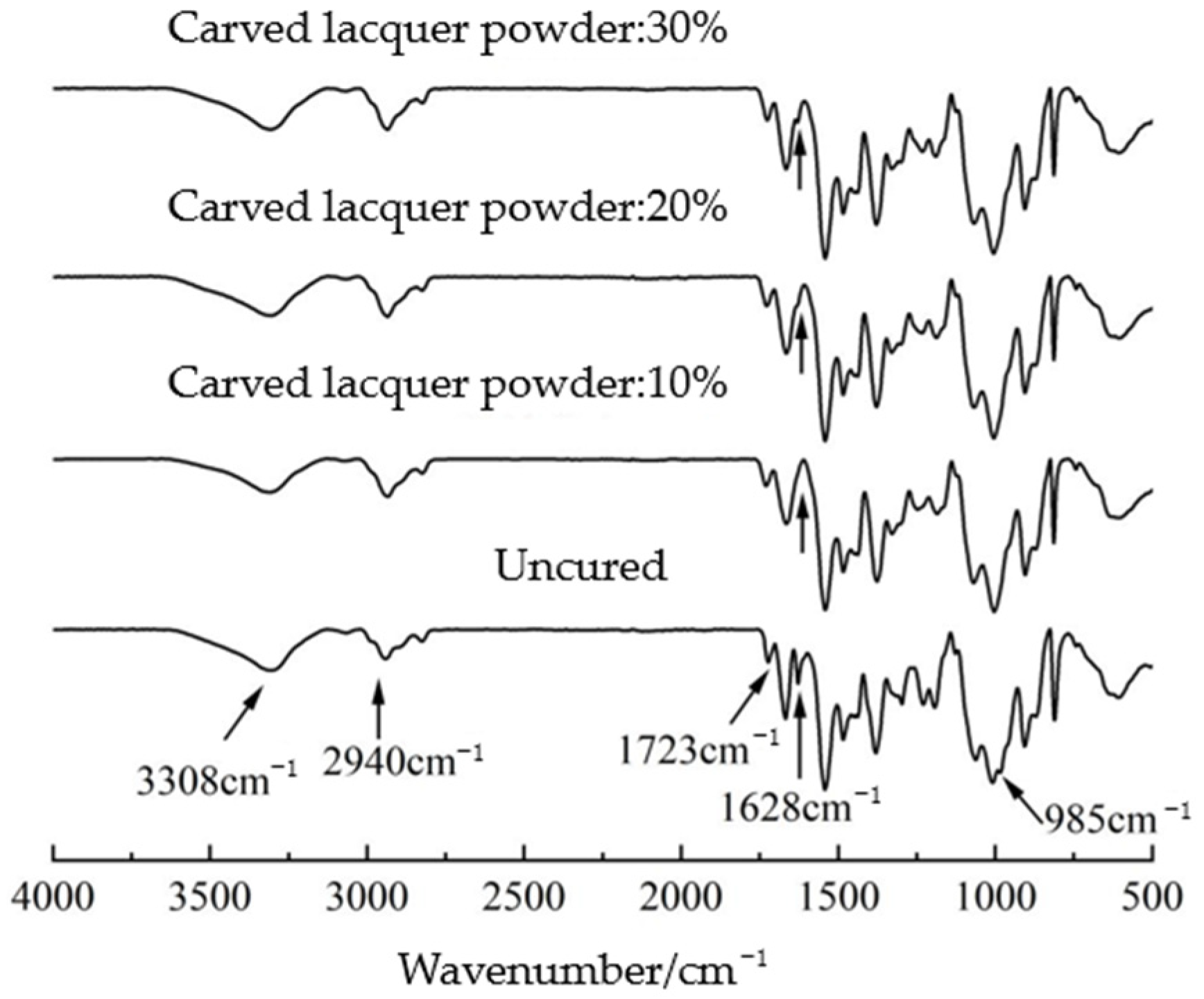
Prior to FTIR testing, it was expected that low powder contents would allow complete UV curing with full disappearance of the C=C bond signals, while high powder contents might hinder UV penetration, resulting in residual unsaturated groups and incomplete curing. The FTIR spectra of composite coatings with different carved lacquer powder contents are shown in Figure 4. A broad absorption peak at 3308 cm−1 corresponds to the O–H stretching vibration, while the peak at 2940 cm−1 is assigned to the asymmetric and symmetric stretching vibrations of –CH3 and –CH2 groups in the waterborne acrylic resin [27]. The characteristic peak at 1723 cm−1 is attributed to the C=O stretching vibration in the acrylic resin. In addition, a weak absorption band around 3008 cm−1, corresponding to the =C–H stretching vibration of the vinyl groups, was observed in the uncured resin. After UV curing, this band disappeared in the final coatings, confirming the successful consumption of C=C double bonds during polymerization. As illustrated in Figure 1e, the acrylic resin structure contains acrylate ester groups, which are the reactive sites for UV-induced polymerization. Before curing, a C=C stretching vibration peak appears at 1628 cm−1. When the powder content was 10%, this peak disappeared after UV curing, confirming the polymerization of the double bonds [28,29]. However, at powder contents of 20% and 30%, residual C=C absorption was observed, indicating incomplete curing. At 30% powder content, the peak intensity was slightly stronger than at 20%, suggesting that excessive pigment loading blocked UV penetration, thereby reducing the photoinitiator’s activation and lowering the curing efficiency.
Additionally, the disappearance of the absorption band at 985 cm−1 further supports the occurrence of crosslinking, as it corresponds to the C–H bending vibration of the C=C double bonds. During UV curing, these double bonds reacted to form a dense crosslinked polymer network, resulting in the diminished signal intensity.

3.4. Chemical Resistance Behavior of Composite Coatings

In terms of chemical resistance, the coatings were expected to perform relatively well in neutral water and saline solutions, while harsher acidic or alkaline environments could induce degradation due to pigment instability and resin swelling. In particular, alkaline conditions were anticipated to be the most damaging, given the known susceptibility of cinnabar to decomposition in strong bases. The chemical resistance of the coatings is summarized in Table 3. All coatings exhibited some degree of peeling, largely due to the weak adhesion between waterborne UV-curable acrylic resin and metal substrates. Because the resin lacks hydrogen bonding sites, it cannot form strong interfacial interactions with metal surfaces. In 10% NaOH solution, severe degradation occurred, including peeling, swelling, curling, gloss loss, and discoloration. It should be noted that the amount of Hg2+ released under such extreme alkaline conditions is very limited and does not significantly impair the performance in neutral or slightly acidic environments, which are more relevant to practical applications. Alkaline media also promoted water absorption by the resin, and repeated ingress–egress of moisture induced swelling and curling.
In 10% HCl solution, only slight discoloration of the solution was observed, attributed to trace release of Hg2+. At 30% powder content, uncured regions within the coating exacerbated curling and wrinkling, which were also visible in water and NaCl solutions. Overall, the coatings demonstrated moderate chemical resistance in aqueous and saline environments. However, due to the inherently weak adhesion of UV-cured acrylic systems to metals, peeling remained a consistent failure mode.

3.5. Morphology

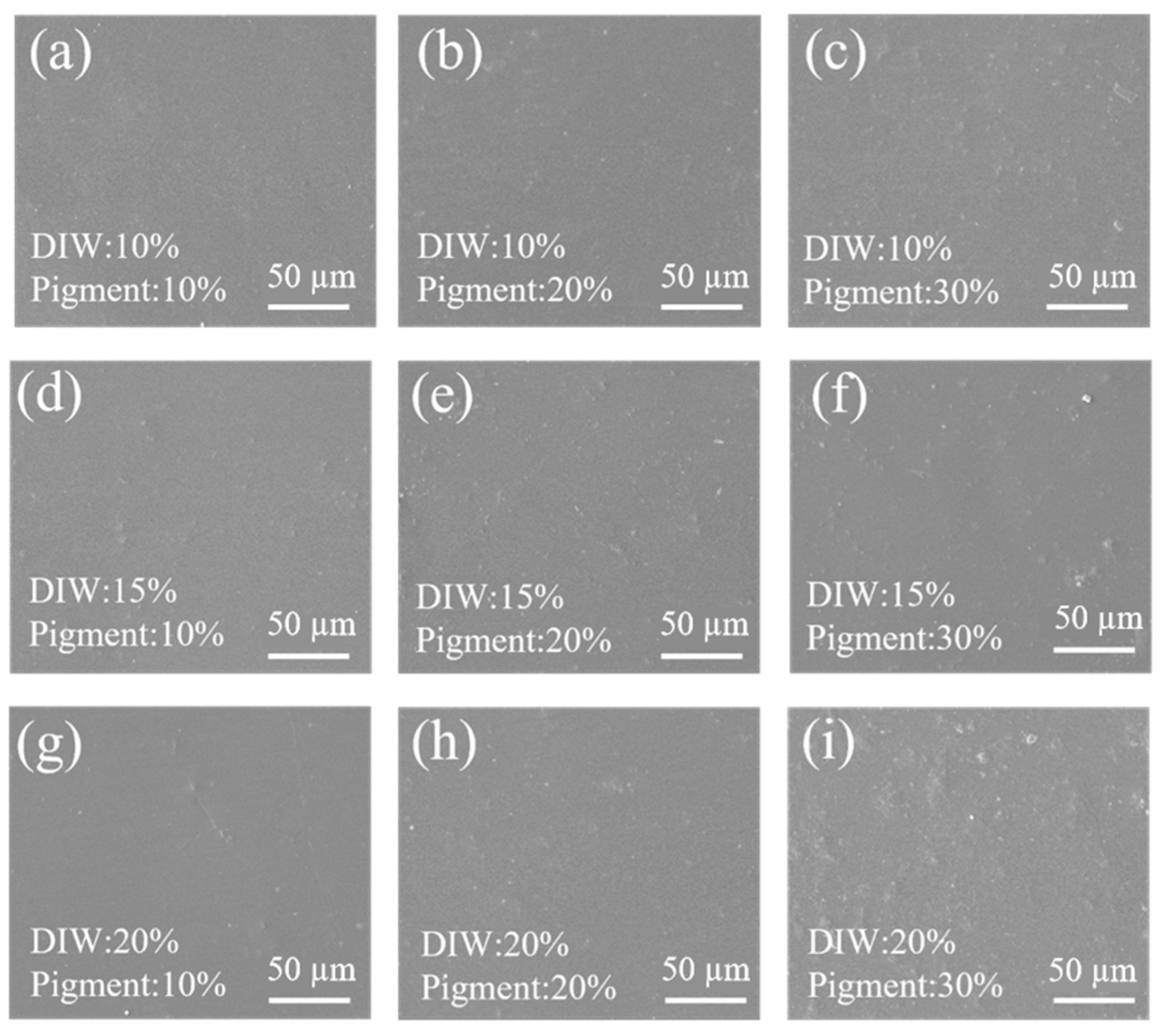
From a morphological standpoint, it was anticipated that low to moderate powder contents would result in relatively smooth surfaces due to sufficient resin coverage, while high powder loading would increase roughness and particle aggregation. The effect of deionized water was expected to be less pronounced, mainly influencing dispersion rather than microstructure. The micromorphological features of the coatings are presented in Figure 5. At 10% and 20% carved lacquer powder contents (Figure 5a,d,g and Figure 5b,e,h), the surface morphologies were relatively smooth and uniform, with no significant differences observed. However, at 30% powder content (Figure 5c,f,i), the surfaces exhibited pronounced granularity and roughness. This was attributed to the reduced resin fraction at high powder loading, which hindered film leveling and increased surface irregularities.
By comparison, variations in deionized water content (10%, 15%, and 20%) produced no substantial differences in micromorphology under constant powder levels. This suggests that, within the studied range, the water fraction had only a minor effect on surface structure.

4. Discussion

The present study systematically investigated the influence of carved lacquer powder and deionized water content on the properties of waterborne UV-curable acrylic composite coatings. The results demonstrate that carved lacquer powder is the dominant factor governing the optical, mechanical, and curing characteristics, while deionized water content has a negligible effect within the studied range. The significant influence of carved lacquer powder on color parameters and gloss is attributed to its high cinnabar (HgS) pigment content [30]. The observed decrease in lightness (L*) and increase in redness (a*) with increasing powder content align with the intrinsic dark red hue of cinnabar, while the concurrent gloss reduction stems from increased surface roughness and a decreased resin matrix proportion responsible for light reflection [31]. The intersection point of the L* and a* curves suggests an optimal powder content (~17%) that balances color depth and gloss retention.
The mechanical performance reveals a complex relationship between powder content, curing efficiency, and final properties. The superior adhesion and flexibility at 20% powder are indicative of an optimal formulation for crosslinking density and film formation. The improved impact resistance at higher powder content is rationalized by the presence of uncured, more elastic regions within the coating that absorb impact energy [32,33,34], whereas the decline at high water content underscores the plasticizing effect of excess water, which initially facilitates dispersion but upon evaporation leaves voids and microdefects, ultimately increasing brittleness [35].
The FTIR analysis provides direct evidence for curing inhibition at high powder content, as the persistence of the C=C peak confirms that UV light penetration is hindered, reducing photoinitiator efficiency—a well-known "filtering effect" in highly pigmented coatings [36,37]. Moreover, the disappearance of the =C–H stretching band at ~3008 cm−1 further confirms the consumption of vinyl groups during curing. Future work could explore optimized photoinitiator systems to mitigate this issue [38,39].
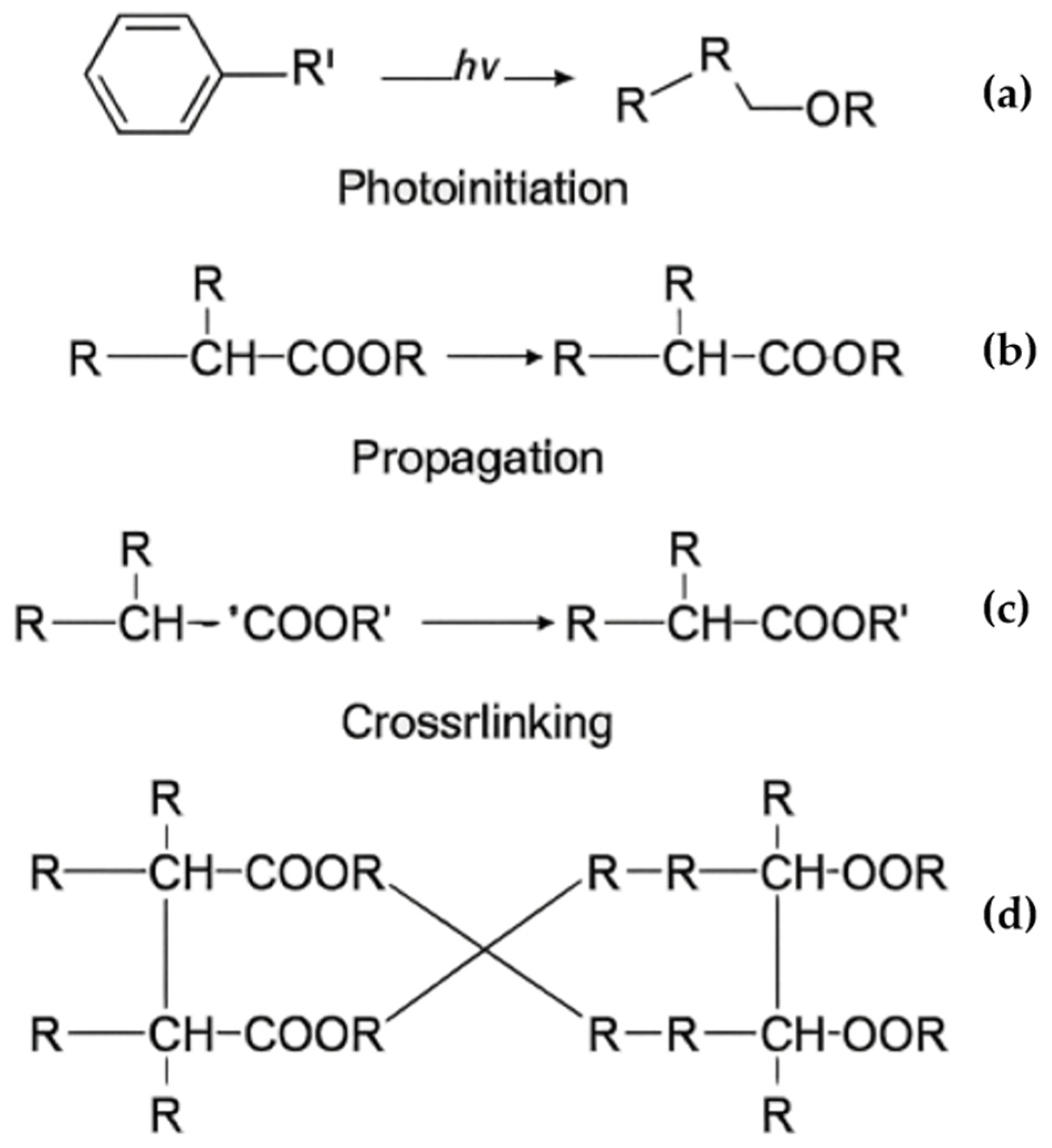
To further clarify the curing process, a description of the monomer-level reactions has been added. Under UV irradiation, photoinitiator 184 decomposes into free radicals, which attack the acrylate double bonds of the XQSZ-18 resin. This initiates a chain growth polymerization, followed by crosslinking that produces an insoluble three-dimensional polymer network. The overall mechanism is illustrated in the newly added Figure 6, which outlines the four major steps: (a) photoinitiator decomposition, (b) radical initiation of acrylate double bonds, (c) propagation and crosslinking, and (d) termination. This scheme complements the FTIR discussion and helps visualize the curing pathway [40].
The chemical resistance tests uniformly showed peeling failure, highlighting a fundamental limitation of the acrylic resin–metal substrate adhesion [8]. To address this issue in future research, potential strategies include the application of adhesion promoters or surface primers. These approaches can enhance the interfacial bonding between the coating and the metallic substrate, thereby mitigating peeling failure and improving the overall durability of the system. The severe degradation in NaOH is a direct consequence of the chemical instability of cinnabar, which decomposes in alkaline media. However, the release of Hg2+ is very limited and occurs mainly under strong alkaline conditions, while the coatings remain stable in neutral and mildly acidic environments, which are more relevant for practical applications. The worsened wrinkling at 30% powder content is linked to its higher content of uncured, hydrophilic resin segments that facilitate water uptake [41]. Finally, the SEM morphology visually corroborates these findings, with the pronounced granularity at 30% powder content resulting from particle agglomeration and insufficient resin, consistent with exceeding the critical pigment volume concentration. In conclusion, an addition of approximately 17%–20% carved lacquer powder achieves a desirable balance of properties, with the primary challenges being inherent weak adhesion to the metal substrate and curing inhibition at high pigment loadings. Addressing these challenges in future work—such as incorporating adhesion promoters, optimizing photoinitiators, and expanding thermal and hardness testing—will be key to improving practical performance.

5. Conclusions

This study successfully developed a waterborne UV-curable acrylic composite coating incorporating traditional carved lacquer powder and systematically evaluated the effects of its content on the coating’s properties. The key finding is that the powder content serves as the primary factor influencing the coating’s characteristics, while the amount of deionized water has minimal impact. Specifically, increasing the powder content resulted in a darker coating appearance, enhanced red coloration, and reduced gloss, with an optimal aesthetic balance achieved at 17%–20% powder loading. Regarding mechanical performance, the best adhesion and flexibility were obtained at 20% powder content, whereas impact resistance improved even up to 30% due to the presence of elastic, incompletely cured regions. FTIR analysis confirmed curing inhibition at high powder loadings (>20%), attributed to the UV-shielding effect which impeded full polymerization. This inferior crosslinking also contributed to the observed reduction in chemical resistance. Moreover, all coatings exhibited consistent peeling failure during chemical tests, highlighting a fundamental limitation in adhesion to metallic substrates. In summary, a carved lacquer powder content of 20% is recommended to balance decorative appeal and mechanical performance. Future studies should focus on strategies to enhance substrate adhesion, such as the use of adhesion promoters or surface primers, and explore optimized photoinitiator systems to mitigate UV curing inhibition in highly filled systems.

Supplementary Materials

The following supporting information can be downloaded at: https://www.mdpi.com/article/10.3390/coatings15101230/s1, Figure S1: Thermogravimetric (TG) curve of carved lacquer waste. Figure S2: Differential Scanning Calorimetry (DSC) curve of carved lacquer waste.

Author Contributions

Conceptualization, X.D. and X.L.; methodology, X.D. and Y.F.; software, Y.C.; validation, X.D., Y.C. and A.O.; formal analysis, X.L. and A.O.; investigation, X.D. and Y.F.; resources, Y.F. and Y.C.; data curation, X.D. and Y.C.; writing—original draft preparation, X.D.; writing—review and editing, X.L., A.O. and Y.C.; visualization, Y.C.; supervision, X.L. and Y.C.; project administration, X.L.; funding acquisition, X.L. All authors have read and agreed to the published version of the manuscript.

Funding

This research was supported by the Scientific Research Contract (No. 11295) from Transilvania University of Brasov, dated 12 August 2025.

Institutional Review Board Statement

Not applicable.

Informed Consent Statement

Not applicable.

Data Availability Statement

Data are contained within the article.

Conflicts of Interest

Author Yuemin Feng was employed by the company Tubao Decorative New Materials Co. Ltd. The remaining authors declare that the research was conducted in the absence of any commercial or financial relationships that could be construed as potential conflicts of interest.

References

  1. Lee, H.; Han, H.; Kim, D.; Lee, B.; Cho, J.H.; Lee, Y.; Lee, S.; Lim, J.A. Mixed urushiol and laccol compositions in natural lacquers: Convenient evaluation method and its effect on the physicochemical properties of lacquer coatings. Prog. Org. Coat. 2021, 154, 106195. [Google Scholar] [CrossRef]
  2. Wu, M.; Zhang, B.; Jiang, L.; Wu, J.; Sun, G. Natural lacquer was used as a coating and an adhesive 8000 years ago, by early humans at Kuahuqiao, determined by ELISA. J. Archaeol. Sci. 2018, 100, 80–87. [Google Scholar] [CrossRef]
  3. Lu, R.; Yoshida, T.; Miyakoshi, T. Oriental Lacquer: A Natural Polymer. Polym. Rev. 2013, 53, 153–191. [Google Scholar] [CrossRef]
  4. Yang, J.; Deng, J.; Zhu, J.; Liu, W.; Zhou, M.; Li, D. Thermal polymerization of lacquer sap and its effects on the properties of lacquer film. Prog. Org. Coat. 2016, 94, 41–48. [Google Scholar] [CrossRef]
  5. Wang, N.; Zhang, T.; Min, J.; Li, G.; Ding, Y.; Liu, J.; Gu, A.; Kang, B.; Li, Y.; Lei, Y. Analytical investigation into materials and technique: Carved lacquer decorated panel from Fuwangge in the Forbidden City of Qianlong Period, Qing Dynasty. J. Archaeol. Sci. Rep. 2018, 17, 529–537. [Google Scholar] [CrossRef]
  6. Li, X.; Wu, X.; Zhao, Y.; Wen, Q.; Xie, Z.; Yuan, Y.; Tong, T.; Shen, X.; Tong, H. Composition/structure and lacquering craft analysis of Wenzhou Song dynasty lacquerware. Anal. Methods 2016, 8, 6529–6536. [Google Scholar] [CrossRef]
  7. Niimura, N.; Miyakoshi, T. Structural study of oriental lacquer films during the hardening process. Talanta 2006, 70, 146–152. [Google Scholar] [CrossRef]
  8. Wei, S.; Pintus, V.; Pitthard, V.; Schreiner, M.; Song, G. Analytical characterization of lacquer objects excavated from a Chu tomb in China. J. Archaeol. Sci. 2011, 38, 2667–2674. [Google Scholar] [CrossRef]
  9. Xia, J.-R. Study on UV-Curing Natural Raw Lacquer and Its Composite Systems. Ph.D. Thesis, Fujian Normal University, Fuzhou, China, 2012; pp. 53–54. [Google Scholar]
  10. Schwalm, R.; Häußling, L.; Reich, W.; Beck, E.; Enenkel, P.; Menzel, K. Tuning the Mechanical Properties of UV Coatings towards Hard and Flexible Systems. Prog. Org. Coat. 1997, 32, 191–196. [Google Scholar] [CrossRef]
  11. Hwang, H.D.; Park, C.H.; Moon, J.I.; Kim, H.J.; Masubuchi, T. UV-curing behavior and physical properties of waterborne UV-curable polycarbonate-based polyurethane dispersion. Prog. Org. Coat. 2011, 72, 663–675. [Google Scholar] [CrossRef]
  12. Decker, C.; Masson, F.; Schwalm, R. How to speed up the UV curing of water-based acrylic coatings. J. Coat. Technol. Res. 2004, 1, 127–136. [Google Scholar] [CrossRef]
  13. Kim, H.J.; Czech, Z.; Bartkowiak, M.; Shim, G.S.; Kabatc, J.; Licbarski, A. Study of UV-initiated polymerization and UV crosslinking of acrylic monomers mixture for the production of solvent-free pressure-sensitive adhesive films. Polym. Test. 2022, 105, 107424. [Google Scholar] [CrossRef]
  14. Yan, R.; Yang, D.; Zhang, N.; Zhao, Q.; Liu, B.; Xiang, W.; Sun, Z.; Xu, R.; Zhang, M.; Hu, W. Performance of UV curable lignin based epoxy acrylate coatings. Prog. Org. Coat. 2018, 116, 83–89. [Google Scholar] [CrossRef]
  15. Huang, J.; Xiong, Y.; Zhou, X.; Yang, Z.; Yuan, T. A novel polyfunctional polyurethane acrylate prepolymer derived from bio-based polyols for UV-curable coatings applications. Polym. Test. 2022, 106, 107439. [Google Scholar] [CrossRef]
  16. Meng, Y.; Gao, Y.; Li, J.; Liu, J.; Wang, X.; Yu, F.; Wang, T.; Gao, K.; Zhang, Z. Preparation and characterization of cross-linked waterborne acrylic/PTFE composite coating with good hydrophobicity and anticorrosion properties. Colloids Surf. A 2022, 653, 129872. [Google Scholar] [CrossRef]
  17. Yan, X.; Wang, L.; Qian, X. Preparation and Characterization of Low Infrared Emissive Aluminum/Waterborne Acrylic Coatings. Coatings 2020, 10, 35. [Google Scholar] [CrossRef]
  18. Huang, X.; Sun, J.; Lv, K.; Liu, J.; Shen, H.; Zhang, F. Application of core-shell structural acrylic resin/nano-SiO2 composite in water based drilling fluid to plug shale pores. J. Nat. Gas Sci. Eng. 2018, 55, 418–425. [Google Scholar] [CrossRef]
  19. GB/T 3181-2008; The Colour of Paint Films*. China Standard Press: Beijing, China, 2008.
  20. GB/T 1743-1979; Determination of Gloss of Paint Films*. China Standard Press: Beijing, China, 1979.
  21. GB/T 9271-2008; Standard Panels for Testing*. China Standard Press: Beijing, China, 2008.
  22. GB/T 1720-2020; Determination of Adhesion of Paint Films*. China Standard Press: Beijing, China, 2020.
  23. GB/T 1731-2020; Determination of Flexibility of Paint Films*. China Standard Press: Beijing, China, 2020.
  24. GB/T 1732-2020; Determination of Impact Resistance of Paint Film*. China Standard Press: Beijing, China, 2020.
  25. Zhang, Q.; Huang, C.; Wang, H.; Hu, M.; Li, H.; Liu, X. UV-curable coating crosslinked by a novel hyperbranched polyurethane acrylate with excellent mechanical properties and hardness. RSC Adv. 2016, 6, 107942–107950. [Google Scholar] [CrossRef]
  26. Dong, F.; Maganty, S.; Meschter, S.J.; Cho, J. Effects of curing conditions on structural evolution and mechanical properties of UV-curable polyurethane acrylate coatings. Prog. Org. Coat. 2018, 114, 58–67. [Google Scholar] [CrossRef]
  27. Xu, J.; Jiang, Y.; Zhang, T.; Dai, Y.; Yang, D.; Qiu, F.; Yang, P. Synthesis of UV-curing waterborne polyurethane-acrylate coating and its photopolymerization kinetics using FT-IR and photo-DSC methods. Prog. Org. Coat. 2018, 122, 10–18. [Google Scholar] [CrossRef]
  28. Xu, H.; Qiu, F.; Wang, Y.; Wu, W.; Yang, D.; Guo, Q. UV-curable waterborne polyurethane-acrylate: Preparation, characterization and properties. Prog. Org. Coat. 2012, 73, 47–53. [Google Scholar] [CrossRef]
  29. Nguyen, N.L.; Dang, T.M.L.; Nguyen, T.A.; Ha, H.T.; Nguyen, T.V. Study on microstructure and properties of the UV curing acrylic epoxy/SiO2 nanocomposite coating. J. Nanomater. 2021, 2021, 8493201. [Google Scholar]
  30. Kardar, P.; Ebrahimi, M.; Bastani, S. Curing behaviour and mechanical properties of pigmented UV-curable epoxy acrylate coatings. Pigment Resin Technol. 2014, 43, 177–184. [Google Scholar] [CrossRef]
  31. Jančovičová, V.; Mikula, M.; Havlinova, B.; Jakubíková, Z. Influence of UV-curing conditions on polymerization kinetics and gloss of urethane acrylate coatings. Prog. Org. Coat. 2013, 76, 432–438. [Google Scholar] [CrossRef]
  32. Fu, J.; Yu, H.; Wang, L.; Lin, L.; Khan, R.U. Preparation and properties of UV-curable hyperbranched polyurethane acrylate hard coatings. Prog. Org. Coat. 2020, 144, 105635. [Google Scholar] [CrossRef]
  33. Kiran, M.D.; Govindaraju, H.K.; Jayaraju, T.; Kumar, N. Effect of fillers on mechanical properties of polymer matrix composites. Mater. Today Proc. 2018, 5, 22421–22424. [Google Scholar] [CrossRef]
  34. Kundie, F.; Azhari, C.H.; Muchtar, A.; Ahmad, Z.A. Effects of filler size on the mechanical properties of polymer-filled dental composites: A review of recent developments. J. Phys. Sci. 2018, 29, 141–165. [Google Scholar] [CrossRef]
  35. Zhang, T.; Wu, W.; Wang, X.; Mu, Y. Effect of average functionality on properties of UV-curable waterborne polyurethane-acrylate. Prog. Org. Coat. 2010, 68, 201–207. [Google Scholar] [CrossRef]
  36. Decker, C. Kinetic study and new applications of UV radiation curing. Macromol. Rapid Commun. 2002, 23, 1067–1093. [Google Scholar] [CrossRef]
  37. Chun, J.H.; Cheon, J.M.; Jeong, B.Y.; Jo, N.J. Preparation and characterization of UV cured optical films containing a fluorene compound. Mol. Cryst. Liq. Cryst. 2015, 622, 6–13. [Google Scholar] [CrossRef]
  38. Li, C.; Xiao, H.; Wang, X.; Zhao, T. Development of green waterborne UV-curable vegetable oil-based urethane acrylate pigment prints adhesive: Preparation and application. J. Clean. Prod. 2018, 180, 272–279. [Google Scholar] [CrossRef]
  39. Yagci, Y.; Jockusch, S.; Turro, N.J. Photoinitiated polymerization: Advances, challenges, and opportunities. Macromolecules 2010, 43, 6245–6260. [Google Scholar] [CrossRef]
  40. Wu, Y.; Wu, Y.; Zhang, S.; Wei, S.; Jin, C.; Zhang, Y.; Dong, H.; Song, Y.; Qu, Z.; Wu, C. Preparation and properties of UV-curable silicone materials bridged by trifluoropropyl (methyl) siloxyl groups. Prog. Org. Coat. 2025, 201, 109129. [Google Scholar] [CrossRef]
  41. Li, X.; Liu, Z.; Hong, P.; Chen, L.; Liu, X. Synthesis of organic and inorganic hybrid nanoparticles as multifunctional photoinitiator and its application in UV-curable epoxy acrylate-based coating systems. Prog. Org. Coat. 2020, 141, 105565. [Google Scholar] [CrossRef]
Figure 1. Carved lacquer waste and composite materials: (a) raw carved lacquer strips, (b) powdered macroscopic state, (c) powder microstructure showing irregular crystalline particles, (d) photographs of the final UV-cured composite coatings demonstrating surface appearance and transparency, and (e) molecular structure of the UV-curable acrylic resin (XQSZ-18).
Coatings 15 01230 g001
Figure 2. Relationship between gloss and color parameters (L* and a*) of composite coatings with different carved lacquer powder contents.
Coatings 15 01230 g002
Figure 3. Mechanical properties of the composite coatings: (a) Adhesion; (b) Flexibility; (c) Impact Resistance.
Coatings 15 01230 g003
Figure 4. FTIR spectra of composite coatings with different carved lacquer powder contents.
Coatings 15 01230 g004
Figure 5. (ai) Micromorphology of the composite coatings (DIW: Deionized water, Pigment: Carved lacquer powder).
Coatings 15 01230 g005
Figure 6. Schematic illustration of the UV-induced curing mechanism for XQSZ-18 resin, involving (a) photoinitiator decomposition, (b) radical initiation, (c) propagation and crosslinking, and (d) termination.
Coatings 15 01230 g006
Table 1. Formulations of the carved lacquer waste/waterborne acrylic resin composite coatings.
Sample No.Deionized Water (wt%)Carved Lacquer Powder (wt%)Resin (Fixed, 20 g)
1101020
2102020
3103020
4151020
5152020
6153020
7201020
8202020
9203020
Table 2. ANOVA results for the main effects of carved lacquer powder and deionized water on coating color and gloss.
SourceParameterType III Sum of SquaresMean SquareF-Valuep-ValueSignificance
Carved lacquer powderL*41.56920.78421.007<0.01Significant
a*100.40050.200745.419<0.01
b*8.0014.000878.845<0.01
Gloss1542.216771.108287.013<0.01
Deionized waterL*3.4301.7151.7330.205Not significant
a*0.2690.1341.9950.165
b*0.0250.0122.7400.091
Gloss7.2963.6481.3580.282
Table 3. Chemical resistance of the composite coatings.
SampleH2O (48 h)10% NaOH (1 h)10% HCl (48 h)10% NaCl (48 h)
10% lacquer powderPeelingPeeling, swelling/curling, gloss loss/discolorationPeeling, solution slightly discoloredPeeling
20% lacquer powderPeelingPeeling, swelling/curling, gloss loss/discolorationPeeling, solution slightly discoloredPeeling
30% lacquer powderPeeling, curling, wrinklingPeeling, swelling/curling, gloss loss/discoloration, wrinklingPeeling, curling, solution slightly discolored, wrinklingPeeling, curling, wrinkling
Disclaimer/Publisher’s Note: The statements, opinions and data contained in all publications are solely those of the individual author(s) and contributor(s) and not of MDPI and/or the editor(s). MDPI and/or the editor(s) disclaim responsibility for any injury to people or property resulting from any ideas, methods, instructions or products referred to in the content.