Article

Polyacetylene Prepared by Chemical Dehydration of Poly(Vinyl Alcohol)

by
Gianfranco Carotenuto
1,* and
Luigi Nicolais
2
1
Institute for Polymers, Composites and Biomaterials (IPCB-CNR), National Research Council, Piazzale E. Fermi 1, 80055 Portici, Italy
2
Engineering Faculty, University of Naples “Federico II”, Corso Nicolangelo Protopisani 50, 80146 Naples, Italy
*
Author to whom correspondence should be addressed.
Coatings 2024, 14(9), 1216; https://doi.org/10.3390/coatings14091216

Submission received: 16 July 2024 / Revised: 7 September 2024 / Accepted: 19 September 2024 / Published: 20 September 2024

Abstract

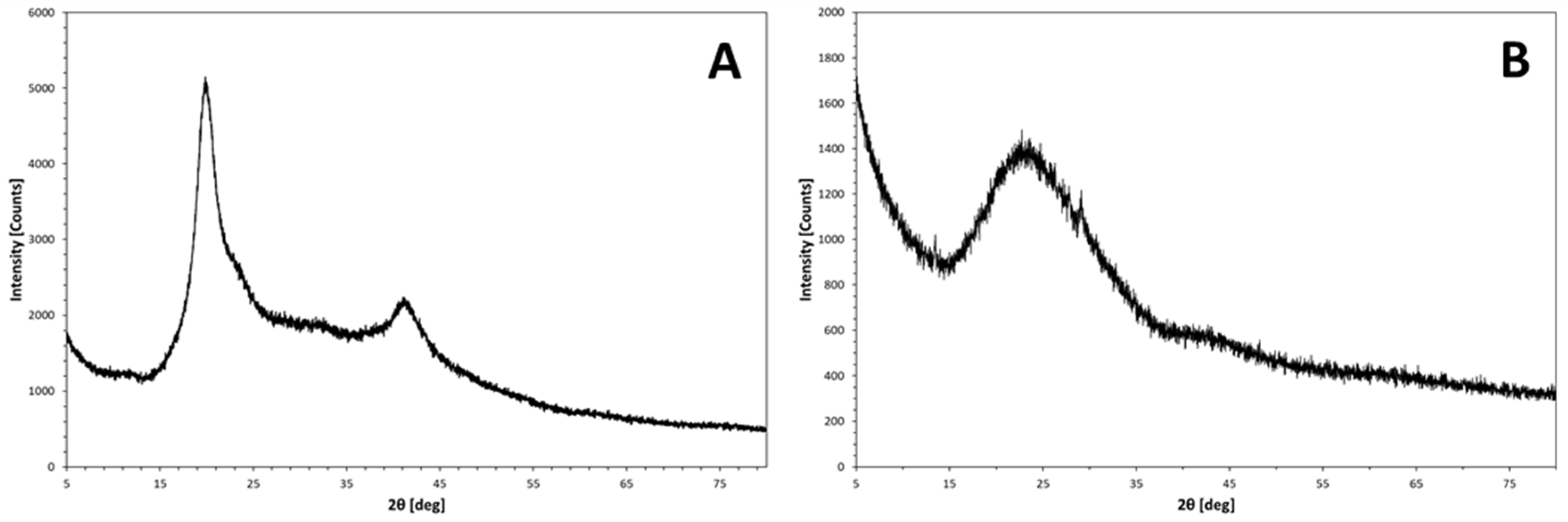
Recently, polyacetylene (PA) has been receiving renewed scientific attention due to its electrical properties, potentially useful for energy applications (e.g., fabrication of electrodes for rechargeable batteries and supercapacitors), and unique functional characteristics (e.g., gas trap, oxygen scavenger, EMI shielding, etc.). This chemical compound can be obtained in the form of polyacetylene–PVOH copolymers simply through the chemical dehydration of poly(vinyl alcohol) (PVOH), which is a very common type of polymer, widely used in packaging and other technological areas. This very inexpensive chemical reaction for the large-scale synthesis of PA/polyvinylenes is investigated by reacting PVOH with sulfuric acid at room temperature. In this process, PVOH, shaped in the form of a film, is dipped in sulfuric acid (i.e., H2SO4 at 95%–97%) and, after complete chemical dehydration, it is mechanically removed from the liquid phase by using a nylon sieve. The reduction process leads to a substantial PVOH film conversion into PA, as demonstrated by infrared spectroscopy (ATR mode). Indeed, the ATR spectrum of the reaction product includes all the characteristic absorption bands of PA. The reaction product is also characterized through the use of UV–Vis spectroscopy in order to evidence the presence in the structure of conjugated carbon–carbon double bonds of various lengths. Differential scanning calorimetry (DSC) and thermogravimetric analysis are used to investigate the PA solid-state cis–trans isomerization and thermal stability in air and nitrogen, respectively. XRD is used to verify the polymer amorphous nature.
Keywords: polyacetylene; polyenes; polyvinylenes; polyvinylalcohol; chemical dehydration; sulfuric acid; infrared spectroscopy; optical spectroscopy; isomerization; thermal analysis (DSC; TGA); XRD polyacetylene; polyenes; polyvinylenes; polyvinylalcohol; chemical dehydration; sulfuric acid; infrared spectroscopy; optical spectroscopy; isomerization; thermal analysis (DSC; TGA); XRD