An Experimental Study on Adhesion Strength of Offshore Atmospheric Icing on a Wind Turbine Blade Airfoil



Abstract
1. Introduction
2. Experiment and Methods
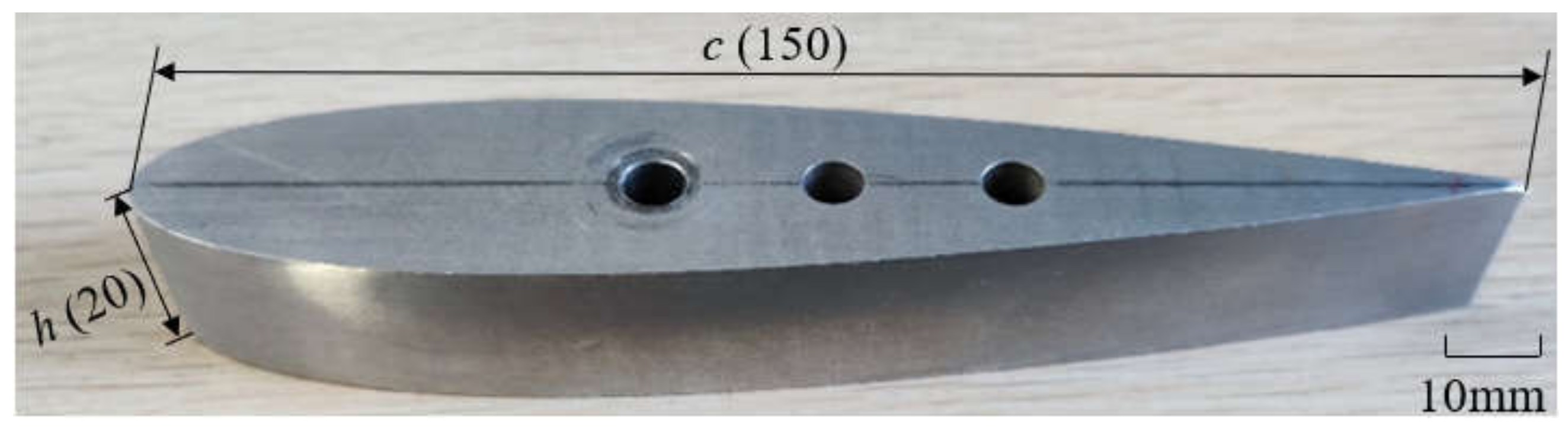
2.1. Test Blade Segment
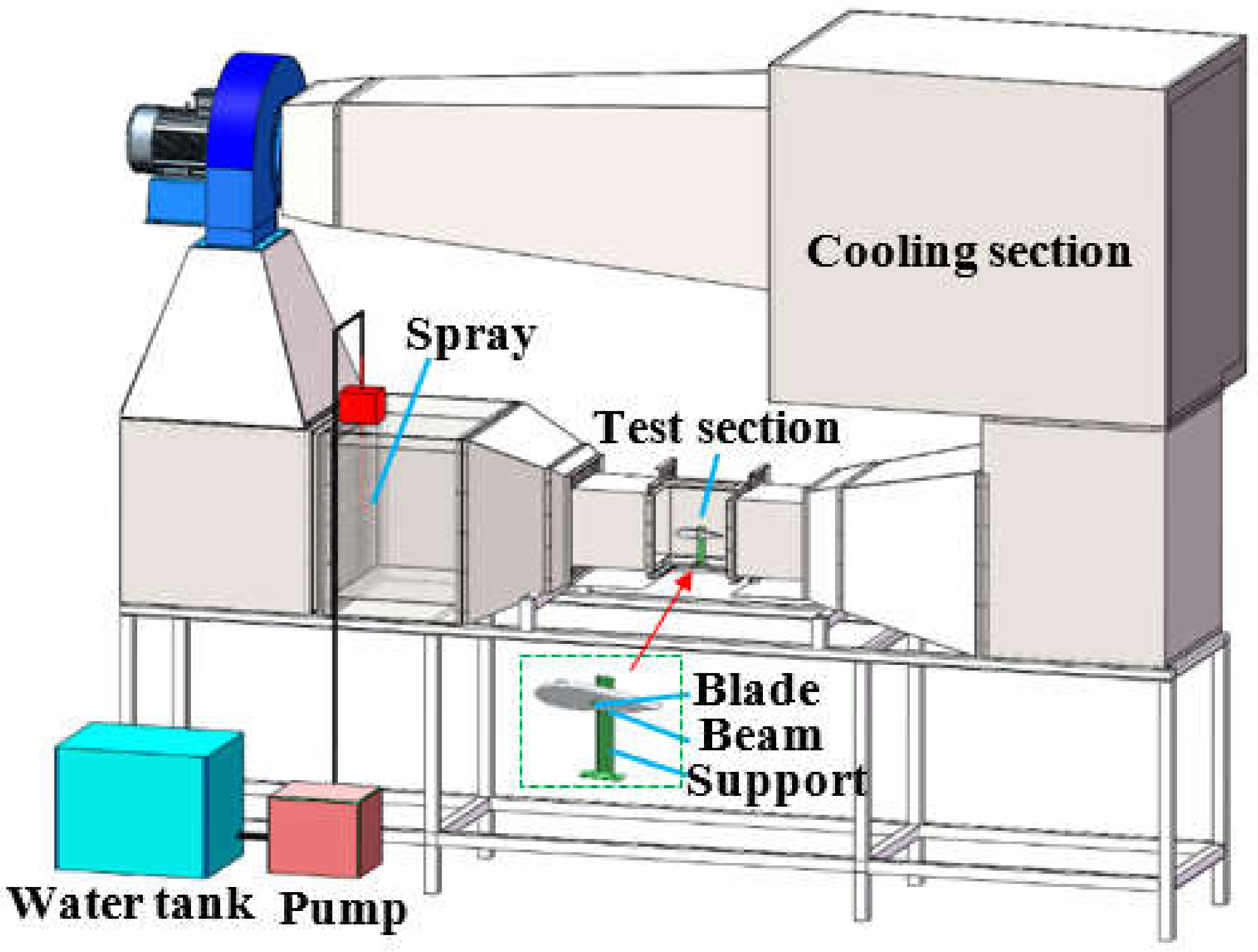
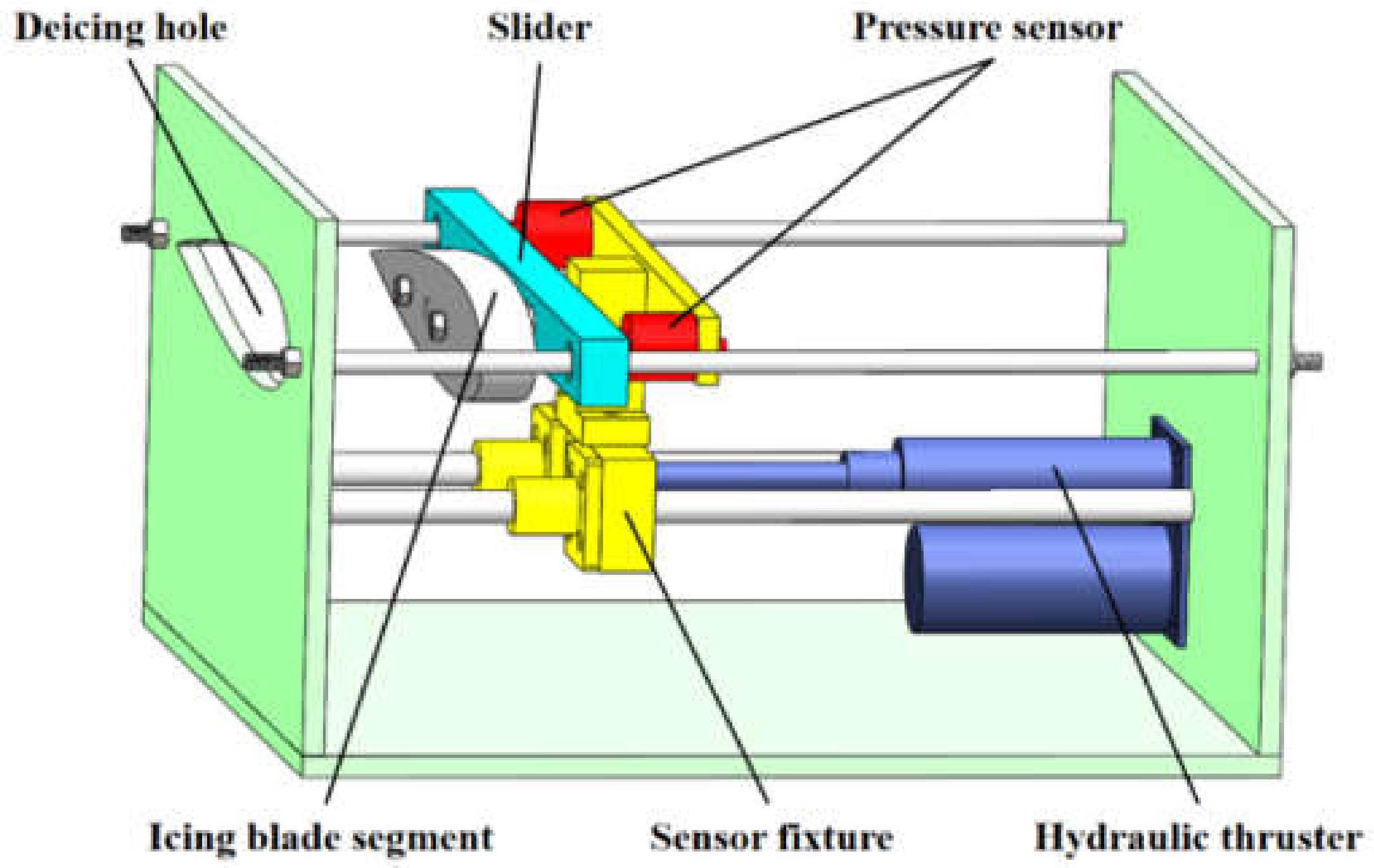
2.2. Experiment System
2.3. Experiment Condition
3. Results and Discussion
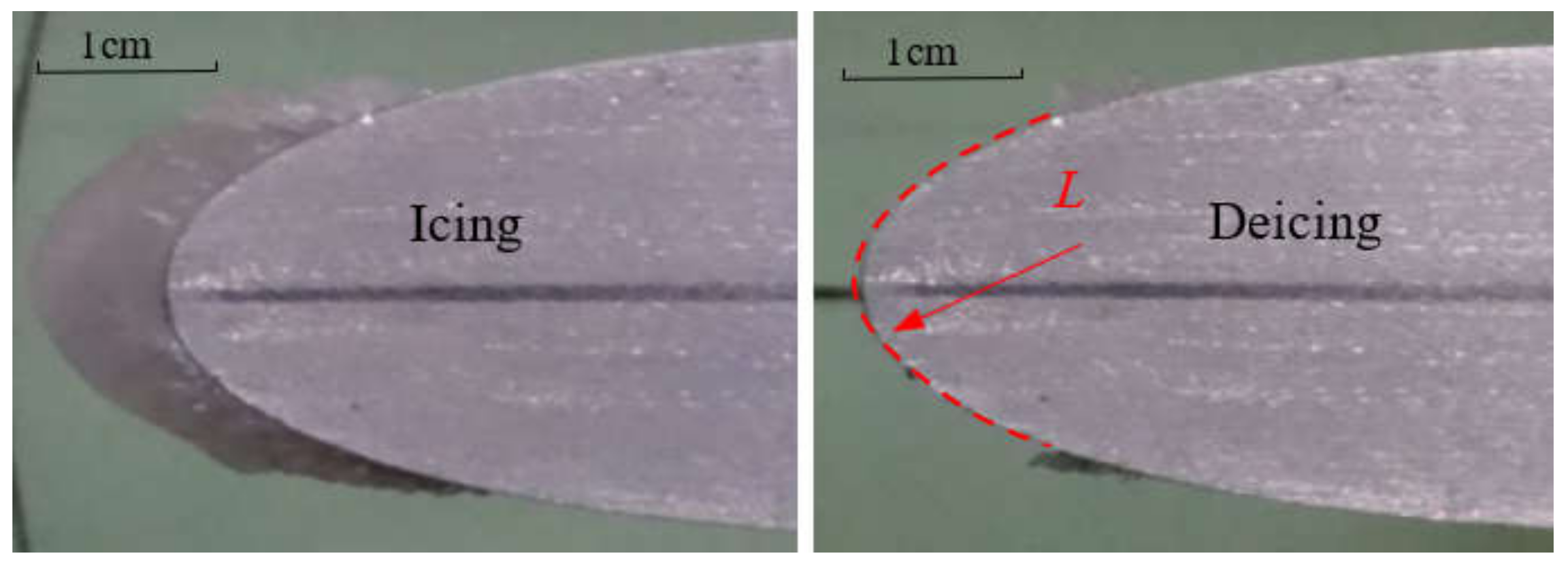
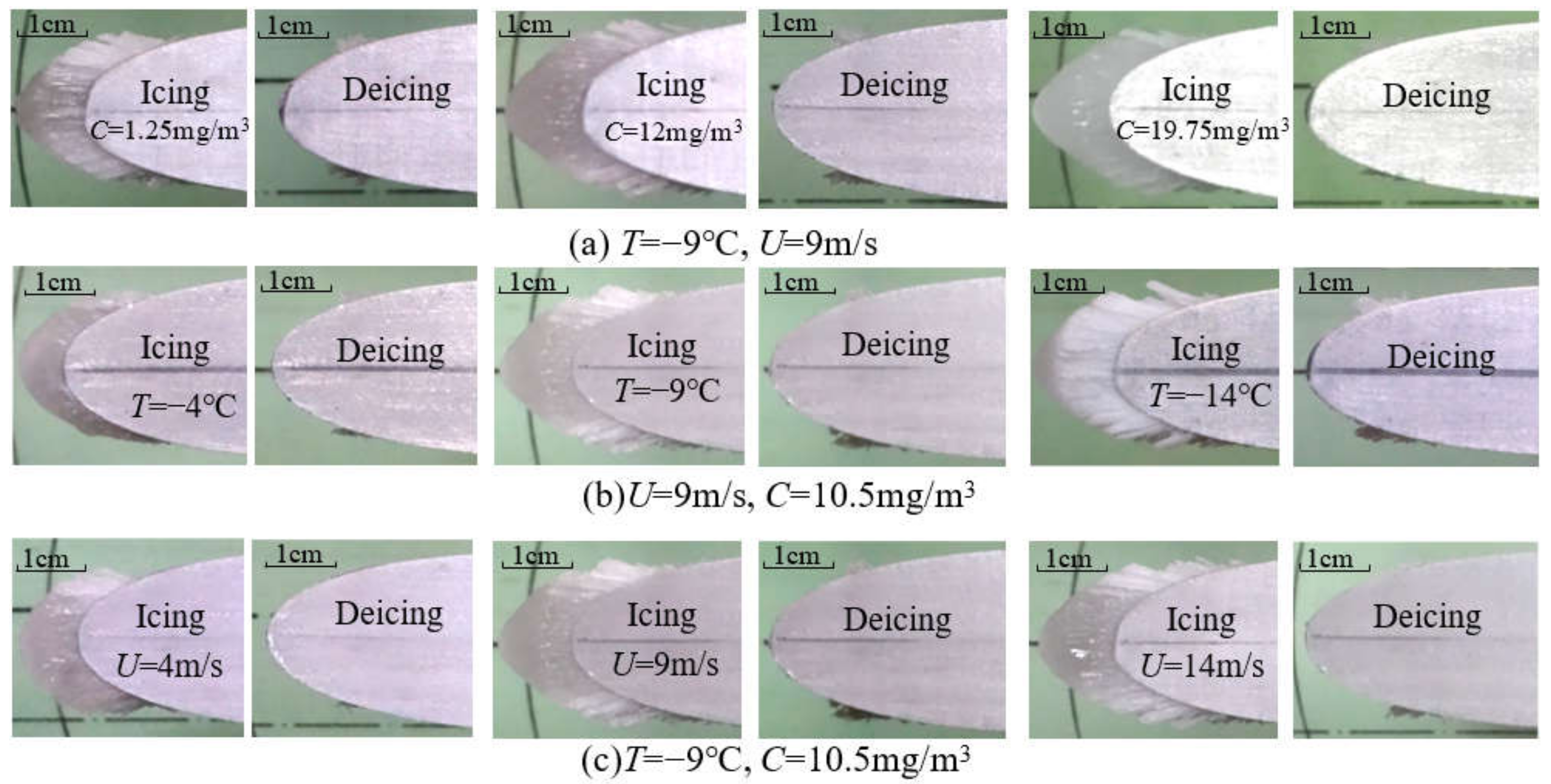
3.1. Icing Shape
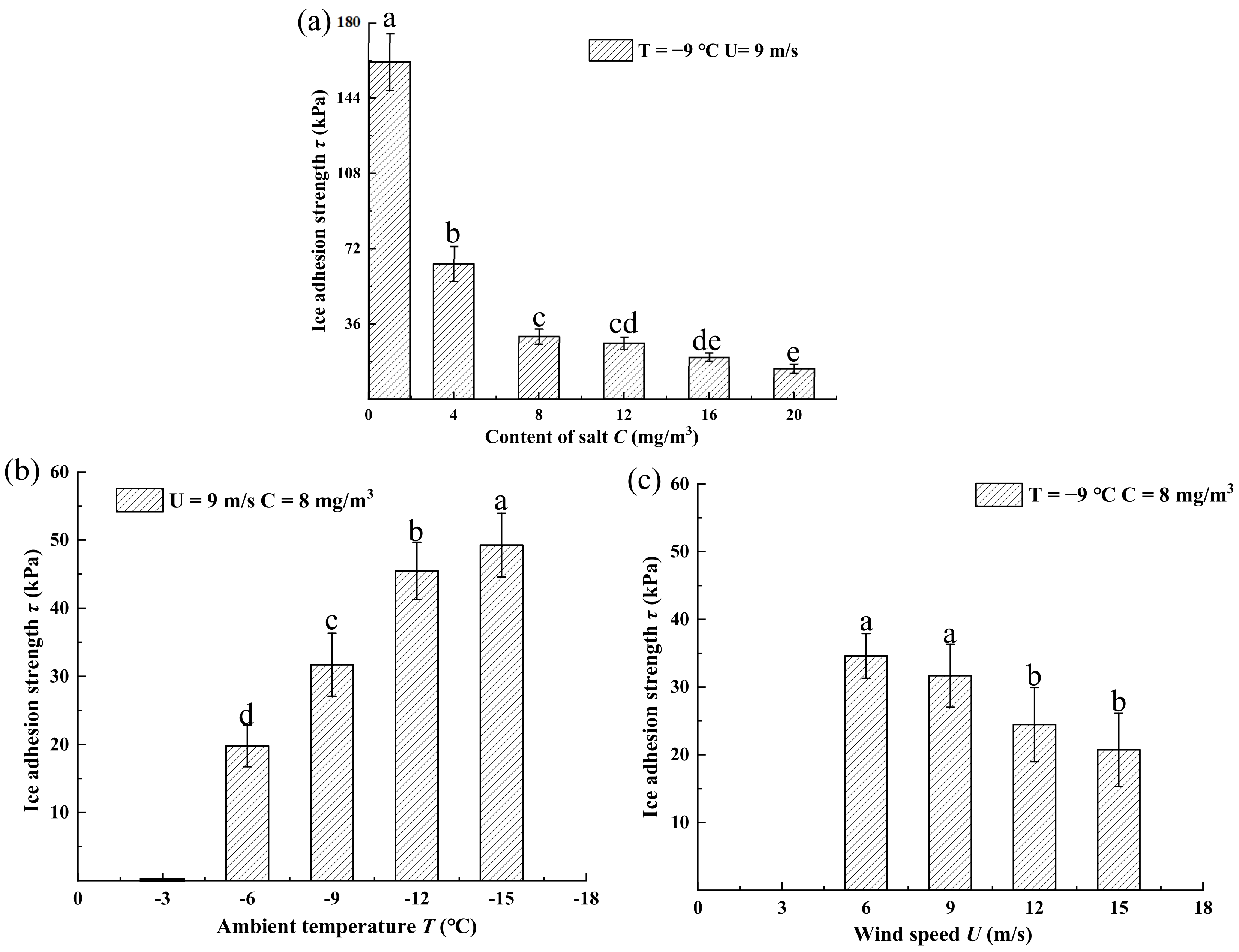
3.2. Effect of Individual Variables on Ice Adhesion Strength
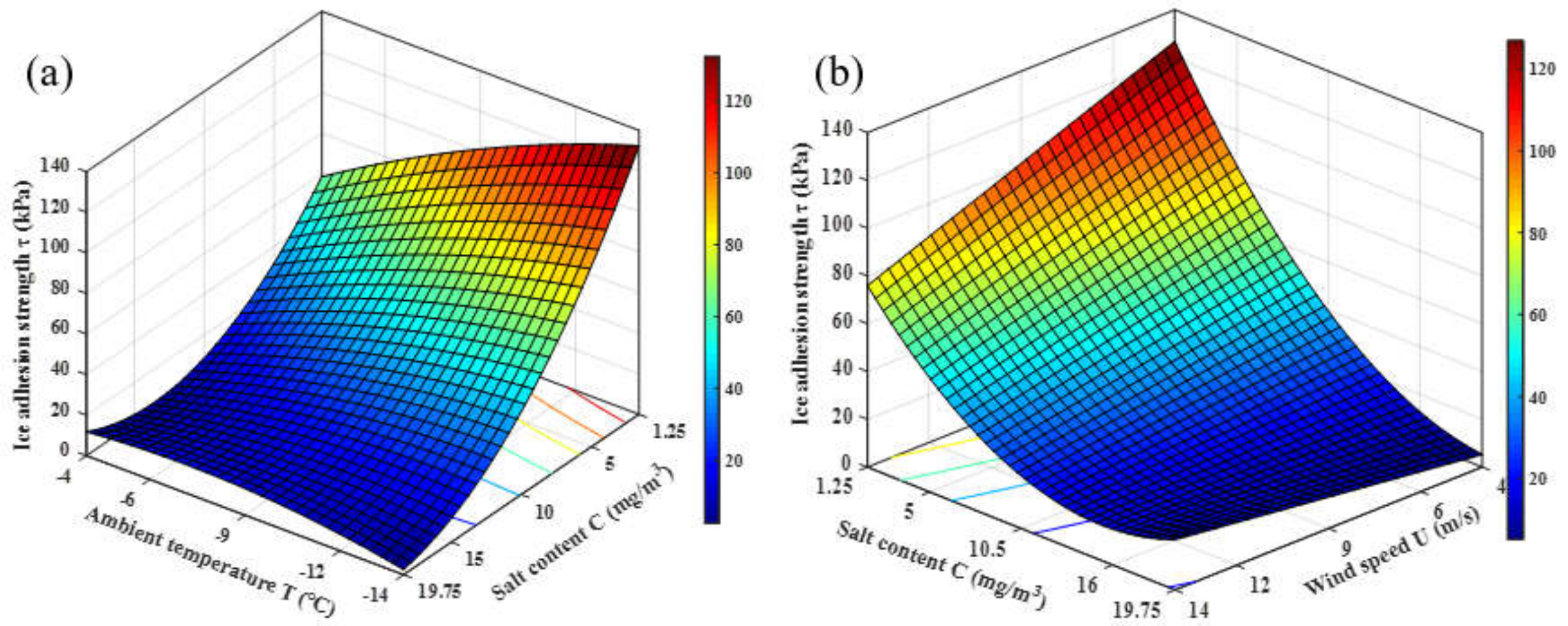
3.3. Interactive Effect of Variables on Ice Adhesion Strength
4. Conclusions
- (1)
- Under the test conditions in this study, the icing occurs on the surface of the test blade. Compared with the wind speed, salt content and ambient temperature have significant effects on the icing type. With the increase in salt content, the type of ice changed from mixed ice to glaze ice. While with the decrease in temperature, the type of ice changed from glaze ice to mixed ice and then rime ice.
- (2)
- Salt content is the most important factor that affects the ice adhesion strength, followed by ambient temperature and wind speed. Salt content directly affected the amount of brine expelled out, resulting in the variation in the effective solid–solid contact area at the ice–airfoil interface, thus affecting the adhesion strength. The regression characteristics of the three factors on the ice adhesion strength are obtained.
- (3)
- The maximum ice adhesion strength is about 150 kPa according to the results of test and regression analysis when there is a certain salt concentration in the offshore wind, which can provide an experimental reference for the research and the development of icing protection technology for offshore wind turbines. Except for the adhesion characteristic, the effect of ice accretion on the aerodynamic performance of wind turbines under offshore conditions is deserved to be considered in the future.
Author Contributions
Funding
Institutional Review Board Statement
Informed Consent Statement
Data Availability Statement
Conflicts of Interest
Nomenclature
| C | Salt content (mg/m3) |
| c | Blade airfoil chord (mm) |
| F | External shear force acting upon the unit model (N) |
| h | Thickness of the blade airfoil (mm) |
| L | Arc length of the adhesion ice removed from the airfoil (mm) |
| LWC | Liquid water content (g/m3) |
| MVD | Medium volume diameter (µm) |
| S | De-icing area of ice on the blade (m2) |
| T | Ambient temperature (°C) |
| t | Ice adhesion strength (kPa) |
| U | Wind speed (m/s) |
References
- García Márquez, F.P.; Peco Chacón, A.M. A review of non-destructive testing on wind turbines blades. Renew. Energy 2020, 161, 998–1010. [Google Scholar] [CrossRef] [Scilit]
- Tong, G.; Li, Y.; Tagawa, K.; Feng, F. Effects of blade airfoil chord length and rotor diameter on aerodynamic performance of straight-bladed vertical axis wind turbines by numerical simulation. Energy 2023, 265, 126325. [Google Scholar] [CrossRef] [Scilit]
- Gao, L.; Tao, T.; Liu, Y.; Hu, H. A field study of ice accretion and its effects on the power production of utility-scale wind turbines. Renew. Energy 2021, 167, 917–928. [Google Scholar] [CrossRef] [Scilit]
- Shu, L.; Liang, J.; Hu, Q. Study on small wind turbine icing and its performance. Cold Reg. Sci. Technol. 2017, 134, 11–19. [Google Scholar] [CrossRef] [Scilit]
- Dalili, N.; Edrisy, A.; Carriveau, R. A review of surface engineering issues critical to wind turbine performance. Renew. Sustain. Energy Rev. 2009, 13, 428–438. [Google Scholar] [CrossRef] [Scilit]
- Chuang, Z.; Li, C.; Liu, S.; Li, X.; Li, Z.; Zhou, L. Numerical analysis of blade icing influence on the dynamic response of an integrated offshore wind turbine. Ocean. Eng. 2022, 257, 111593. [Google Scholar] [CrossRef] [Scilit]
- Parent, O.; Ilinca, A. Anti-icing and de-icing techniques for wind turbines: Critical review. Cold Reg. Sci. Technol. 2011, 65, 88–96. [Google Scholar] [CrossRef] [Scilit]
- Guo, W.; Shen, H.; Li, Y.; Feng, F.; Tagawa, K. Wind tunnel tests of the rime icing characteristics of a straight-bladed vertical axis wind turbine. Renew. Energy 2021, 179, 116–132. [Google Scholar] [CrossRef] [Scilit]
- He, Z.; Zhuo, Y.; Zhang, Z.; He, J. Design of icephobic surfaces by lowering ice adhesion strength: A mini review. Coatings 2021, 11, 1343. [Google Scholar] [CrossRef] [Scilit]
- He, Z.; Jamil, M.I.; Li, T.; Zhang, Q. Enhanced surface icephobicity on an elastic substrate. Langmuir 2022, 38, 18–35. [Google Scholar] [CrossRef] [Scilit]
- Esmeryan, K.D.; Bressler, A.H.; Castano, C.E.; Fergusson, C.P.; Mohammadi, R. Rational strategy for the atmospheric icing prevention based on chemically functionalized carbon soot coatings. Appl. Surf. Sci. 2016, 390, 452–460. [Google Scholar] [CrossRef] [Scilit]
- Ryzhkin, I.A.; Petrenko, V.F. Physical Mechanisms Responsible for Ice Adhesion. J. Phys. Chem. B 1997, 101, 6267–6270. [Google Scholar] [CrossRef] [Scilit]
- Guerin, F.; Laforte, C.; Farinas, M.I.; Perron, J. Analytical model based on experimental data of centrifuge ice adhesion tests with different substrates. Cold Reg. Sci. Technol. 2016, 121, 93–99. [Google Scholar] [CrossRef] [Scilit]
- Fortin, G.; Perron, J. Ice Adhesion Models to Predict Shear Stress at Shedding. J. Adhes. Sci. Technol. 2012, 26, 523–553. [Google Scholar] [CrossRef] [Scilit]
- Kulinich, S.A.; Farzaneh, M. Ice adhesion on super-hydrophobic surfaces. Applied Surface. Science 2009, 255, 8153–8157. [Google Scholar]
- Gao, L.; Liu, Y.; Zhou, W.; Hu, H. An Experimental Study on the Aerodynamic Performance Degradation of a Wind Turbine Blade Model Induced by Ice Accretion Process. Renew. Energy 2019, 133, 663–675. [Google Scholar] [CrossRef] [Scilit]
- Li, Y.; Shen, H.; Guo, W. Effect of Ultrasonic Vibration on the Surface Adhesive Characteristic of Iced Aluminum Alloy Plate. Appl. Sci. 2022, 12, 2357. [Google Scholar] [CrossRef] [Scilit]
- Shi, L.; Feng, F.; Guo, W.; Li, Y. Research and Development of a Small-Scale Icing Wind Tunnel Test System for Blade Airfoil Icing Characteristics. Int. J. Rotating Mach. 2021, 2021, 5598859. [Google Scholar] [CrossRef] [Scilit]
- Song, W. The analysis of the structure of T-S and the current characteristics in Baohai Sea During Winter and Summer. Ocean. Univ. China 2009. [Google Scholar]
- Zhu, W.; Zhang, Z. Analysis of ice conditions and preliminary study on ice prevention measures in the Bohai Sea in winter from 2009 to 2010. Pet. Eng. Constr. 2011, 37, 61–64. [Google Scholar]
- Xu, G. The content and distribution of salt fog in the coastal atmosphere of China. Environ. Technol. 1994, 3, 1–7. [Google Scholar]
- Esmeryan, K.D. From extremelywater-repellent coatings to passive icing protection-principles, limitations and innovative application aspects. Coatings 2020, 10, 66. [Google Scholar] [CrossRef] [Scilit]
- Tarquini, S.; Antonini, C.; Amirfazli, A.; Marengo, M.; Palacios, J. Investigation of ice shedding properties of superhydrophobic coatings on helicopter blades. Cold Reg. Sci. Technol. 2014, 100, 50–58. [Google Scholar] [CrossRef] [Scilit]
- Rønneberg, S.; Laforte, C.; Volat, C.; He, J.; Zhang, Z. The effect of ice type on ice adhesion. AIP Adv. 2019, 9, 055304. [Google Scholar] [CrossRef] [Scilit]
- Makkonen, L. Ice adhesion—Theory, measurements and countermeasures. J. Adhes. Sci. Technol. 2012, 26, 413–445. [Google Scholar] [CrossRef] [Scilit]
- McBain, J.; Hopkins, D. On adhesives and adhesive action. J. Phys. Chem. 2002, 29, 188–204. [Google Scholar] [CrossRef] [Scilit]
- Vu, T.V.; Pham, B.D.; Ho, N.X.; Vu, H.V. Solidification of a hollow sessile droplet under forced convection. Phys. Fluids 2022, 34, 033302. [Google Scholar] [CrossRef] [Scilit]
- Gorbounov, M.; Taylor, J.; Petrovic, B.; Masoudi Soltani, S. To DoE or not to DoE? A Technical Review on & Roadmap for Optimisation of Carbonaceous Adsorbents and Adsorption Processes. South Afr. J. Chem. Eng. 2022, 41, 111–128. [Google Scholar]


| Wind Speed U (m/s) | Temperature T (°C) | Salt Content C (mg/m3) |
|---|---|---|
| 9 | −9 | 1 |
| 4 | ||
| 8 | ||
| 12 | ||
| 16 | ||
| 20 |
| Wind Speed U (m/s) | Temperature T (°C) | Salt Content C (mg/m3) |
|---|---|---|
| 9 | −3 | 8 |
| −6 | ||
| −9 | ||
| −12 | ||
| −15 |
| Wind Speed U (m/s) | Temperature T (°C) | Salt Content C (mg/m3) |
|---|---|---|
| 6 | −9 | 8 |
| 9 | ||
| 12 | ||
| 15 |
| Level | Variable | ||
|---|---|---|---|
| Wind Speed U x1 (m/s) | Ambient Temperature T x2 (°C) | Salt Content C x3 (mg/m3) | |
| 1.682 | 14 | −4 | 19.75 |
| +1 | 12 | −6 | 16 |
| 0 | 9 | −9 | 10.5 |
| −1 | 6 | −12 | 5 |
| −1.682 | 4 | −14 | 1.25 |
| Wind Speed U x1/(m/s) | Ambient Temperature T x2/(°C) | Salt Content C x3/(mg/m3) | Ice Adhesion Strength τ/kPa | |
|---|---|---|---|---|
| 1 | 4 | −9 | 10.5 | 41 |
| 2 | 9 | −9 | 10.5 | 37 |
| 3 | 9 | −9 | 1.25 | 107.1 |
| 4 | 12 | −6 | 5 | 33 |
| 5 | 6 | −6 | 16 | 8.1 |
| 6 | 9 | −9 | 10.5 | 29.1 |
| 7 | 12 | −6 | 16 | 14.9 |
| 8 | 9 | −9 | 10.5 | 36.3 |
| 9 | 9 | −9 | 10.5 | 32.6 |
| 10 | 9 | −4 | 10.5 | 11.6 |
| 11 | 6 | −12 | 16 | 16 |
| 12 | 6 | −12 | 5 | 87.5 |
| 13 | 12 | −12 | 5 | 71.6 |
| 14 | 9 | −14 | 10.5 | 45.1 |
| 15 | 9 | −9 | 10.5 | 35.1 |
| 16 | 14 | −9 | 10.5 | 17.5 |
| 17 | 12 | −12 | 16 | 17.8 |
| 18 | 9 | −9 | 19.75 | 15.5 |
| 19 | 9 | −9 | 10.5 | 34.2 |
| 20 | 6 | −6 | 5 | 56.4 |
| 21 | 9 | −9 | 10.5 | 29.6 |
| 22 | 9 | −9 | 10.5 | 31.6 |
| 23 | 9 | −9 | 10.5 | 34.6 |
| Origin of Variance | Sum of Squares | Df | Mean Squares | F Value | p Value |
|---|---|---|---|---|---|
| x1 | 361.07 | 1 | 361.07 | 28.98 | <0.0001 ** |
| x2 | 1371.12 | 1 | 1371.12 | 110.06 | <0.0001 ** |
| x3 | 8753.45 | 1 | 8753.45 | 702.63 | <0.0001 ** |
| x1x2 | 0.78 | 1 | 0.78 | 0.063 | 0.8062 |
| x1x3 | 286.80 | 1 | 286.80 | 23.02 | 0.0003 ** |
| x2x3 | 433.28 | 1 | 433.65 | 34.81 | <0.0001 ** |
| x12 | 53.31 | 1 | 53.31 | 4.28 | 0.0591 |
| x22 | 73.44 | 1 | 73.44 | 5.90 | 0.0304 * |
| x32 | 1433.92 | 1 | 1433.92 | 115.10 | <0.0001 ** |
| Model | 12775.10 | 9 | 1419.46 | 113.94 | <0.0001 ** |
| Residual | 161.96 | 13 | 12.46 | ||
| Lack of fit | 98.83 | 5 | 19.77 | 2.51 | 0.1193 |
| Pure error | 63.12 | 8 | 7.89 | ||
| All terms | 12937.05 | 22 |
| Maximum Icing Condition | Predicted Value | Measured Value |
|---|---|---|
| Wind speed U = 4 m/s | 150 kPa | 148 ± 7.8 kPa |
| Salt content C = 1.4 mg/m3 | ||
| Ambient temperature T = −14 °C |
Disclaimer/Publisher’s Note: The statements, opinions and data contained in all publications are solely those of the individual author(s) and contributor(s) and not of MDPI and/or the editor(s). MDPI and/or the editor(s) disclaim responsibility for any injury to people or property resulting from any ideas, methods, instructions or products referred to in the content. |
© 2023 by the authors. Licensee MDPI, Basel, Switzerland. This article is an open access article distributed under the terms and conditions of the Creative Commons Attribution (CC BY) license (https://creativecommons.org/licenses/by/4.0/).
Share and Cite
Mu, Z.; Li, Y.; Guo, W.; Shen, H.; Tagawa, K. An Experimental Study on Adhesion Strength of Offshore Atmospheric Icing on a Wind Turbine Blade Airfoil. Coatings 2023, 13, 164. https://doi.org/10.3390/coatings13010164
Mu Z, Li Y, Guo W, Shen H, Tagawa K. An Experimental Study on Adhesion Strength of Offshore Atmospheric Icing on a Wind Turbine Blade Airfoil. Coatings. 2023; 13(1):164. https://doi.org/10.3390/coatings13010164
Chicago/Turabian StyleMu, Zhongqiu, Yan Li, Wenfeng Guo, He Shen, and Kotaro Tagawa. 2023. "An Experimental Study on Adhesion Strength of Offshore Atmospheric Icing on a Wind Turbine Blade Airfoil" Coatings 13, no. 1: 164. https://doi.org/10.3390/coatings13010164
APA StyleMu, Z., Li, Y., Guo, W., Shen, H., & Tagawa, K. (2023). An Experimental Study on Adhesion Strength of Offshore Atmospheric Icing on a Wind Turbine Blade Airfoil. Coatings, 13(1), 164. https://doi.org/10.3390/coatings13010164