Progress in Gas/Solid Interface Charging Phenomena




Abstract
:1. Introduction
2. Surface Charge Measurement
3. Charge Transport and Models
- The experimental configuration is complicated, as different field strengths appear on various parts of the configuration. It would be better to adopt simpler configurations where the electric field is precisely defined, such as axisymmetric post-type spacers placed between parallel-plate electrodes.
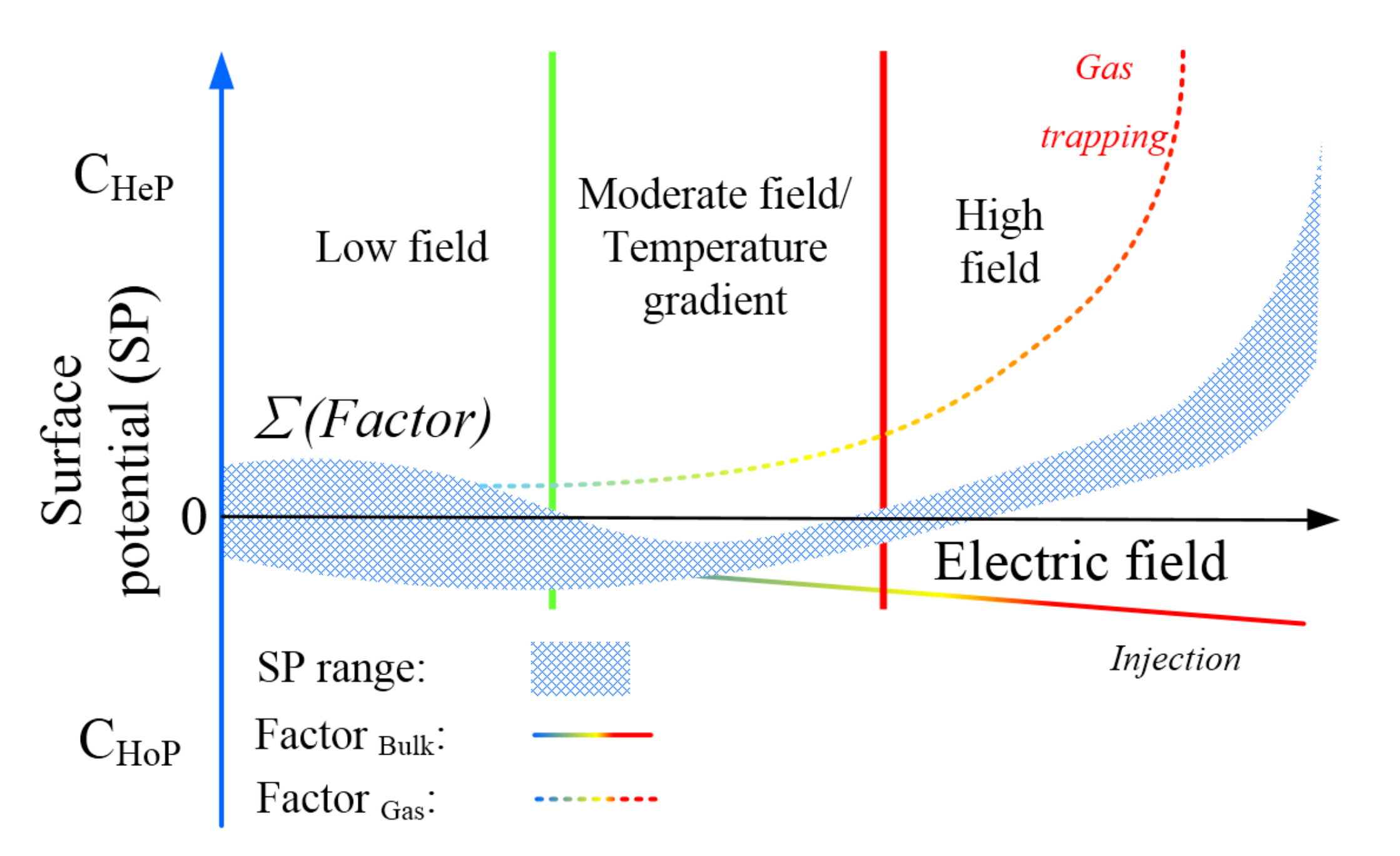
- Due to the lack of calibration of local roughness, the effects of relative humidity and temperature gradient, the division in low-mid-high fields cannot be characterized quantitatively.
- The dimensions of this model need to be further filled and expanded, under the premise of considering the first two suggestions.
4. Charge Triggered DC Surface Flashover
5. Charge Tailoring Methods
6. Problems and Outlooks
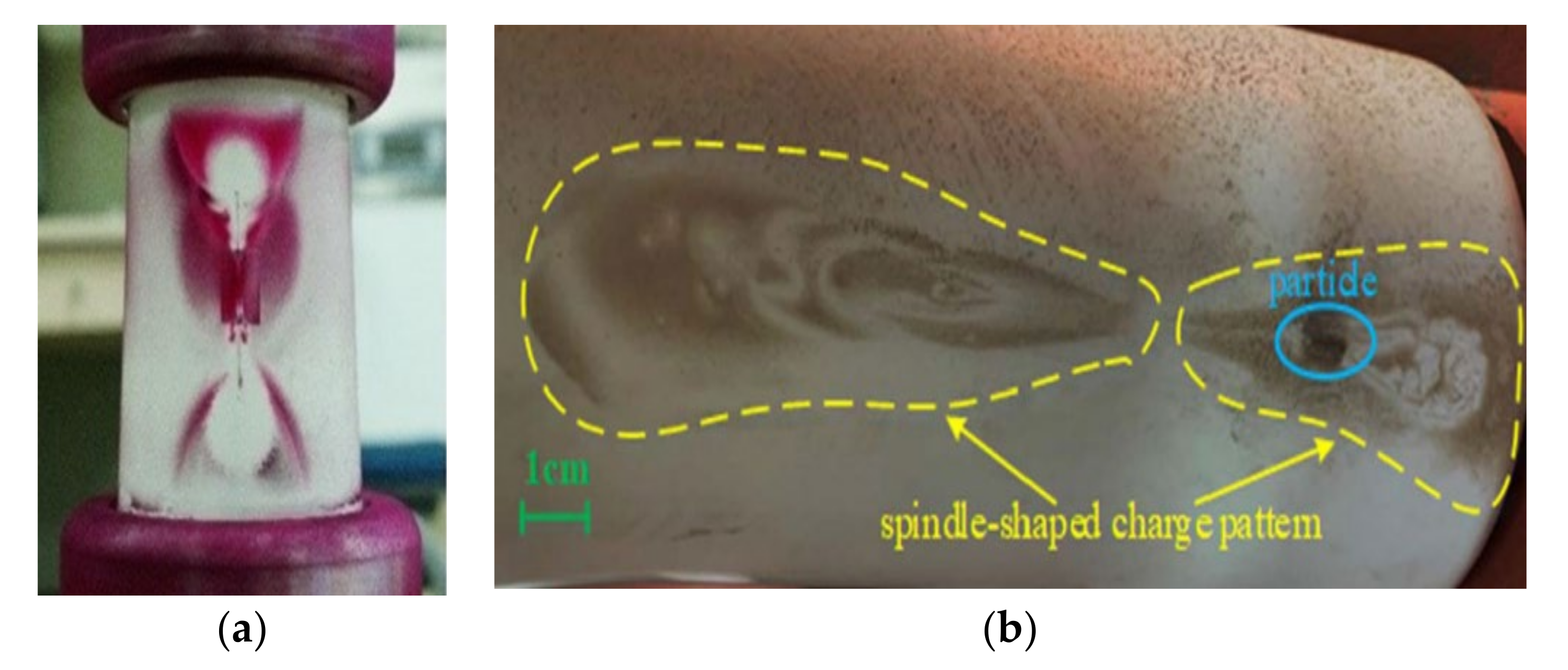
- The physical process for the formation of dust figure still needs to be studied. Currently, it is still difficult to clarify the relation between the self-assembled dust patterns and surface potential/charge/electric field distribution. More basic research needs to be performed. Meanwhile, the study of online surface charge measurement techniques is more favored by engineers and researchers, which are still under research.
- Since the local roughness of conductors directly influence the surface charge origins, while the relative humidity can significantly increase the ionization process, the synergy effect of the relation between relative humidity and surface roughness of conductors should be further studied as the basis of the design of DC GIL.
- Some flashover models at DC voltage have been put forward; however, still there is no direct evidence on how charge transports before triggering surface flashover. Meanwhile, there is still a lack of research into the charge transport property in novel insulating gases.
- Most of the surface charge decay solution can decay charges. However, the anti-aging property of these methods should be evaluated. Additionally, trying the techniques using large sized spacers in SF6 other than insulation films in air is suggested.
7. Conclusions
Author Contributions
Funding
Conflicts of Interest
References
- Hermann, K. Gas-Insulated Transmission Lines (GIL); John Wiley & Sons, Ltd.: Hoboken, NJ, USA; IEEE Press: Piscataway, NJ, USA, 2012. [Google Scholar]
- Li, C.; Hu, J.; Lin, C.; Zhang, B.; Zhang, G.; He, J. Surface charge migration and DC surface flashover of surface-modified epoxy-based insulators. J. Phys. D Appl. Phys. 2017, 50, 065301. [Google Scholar] [CrossRef]
- Du, B.; Liang, H.; Li, J.; Zhang, C. Temperature dependent surface potential decay and flashover characteristics of epoxy/SiC composites. IEEE Trans. Dielectr. Electr. Insul. 2018, 25, 631–638. [Google Scholar] [CrossRef]
- Xue, J.-Y.; Chen, J.-H.; Dong, J.-H.; Wang, H.; Li, W.-D.; Deng, J.-B.; Zhang, G.-J. The regulation mechanism of SiC/epoxy coatings on surface charge behavior and flashover performance of epoxy/alumina spacers. J. Phys. D Appl. Phys. 2019, 52, 405502. [Google Scholar] [CrossRef]
- Qi, B.; Gao, C.; Li, C.; Xiong, J. The influence of surface charge accumulation on flashover voltage of GIS/GIL basin insulator under various voltage stresses. Int. J. Electr. Power Energy Syst. 2019, 105, 514–520. [Google Scholar] [CrossRef]
- Zhang, Z.; Wang, Z.; Teyssedre, G.; Shahsavarian, T.; Baferani, M.A.; Chen, G.; Lin, C.; Zhang, B.; Riechert, U.; Lei, Z.; et al. Gas-solid interface charge tailoring techniques: What we grasped and where to go. Nanotechnology 2020. [Google Scholar] [CrossRef]
- Zhang, L.; Lin, C.; Li, C.; Suraci, S.V.; Chen, G.; Riechert, U.; Shahsavarian, T.; Hikita, M.; Tu, Y.; Zhang, Z.; et al. Gas–solid interface charge characterisation techniques for HVDC GIS/GIL insulators. High Volt. 2020, 5, 95–109. [Google Scholar] [CrossRef]
- Ghaffarinejad, A.; Hasani, J.Y. Modeling of triboelectric charge accumulation dynamics at the metal–insulator interface for variable capacitive structures: Application to triboelectric Nano generators. Appl. Phys. A 2019, 125, 259. [Google Scholar] [CrossRef]
- Khatua, S.; Preetha, P. Effect of Surface Charge Accumulation on Electric Field Computation in CO2 filled GIS. In Proceedings of the 2019 IEEE Region 10 Symposium (TENSYMP), Kolkata, India, 7–9 June 2019; pp. 282–286. [Google Scholar]
- Li, C.; He, J.; Hu, J. Surface morphology and electrical characteristics of direct fluorinated epoxy-resin/alumina composite. IEEE Trans. Dielectr. Electr. Insul. 2016, 23, 3071–3077. [Google Scholar] [CrossRef]
- Fujinami, H.; Takuma, T.; Yashima, M.; Kawamoto, T. Mechanism and effect of DC charge accumulation on SF6 gas insulated spacers. IEEE Trans. Power Deliv. 1989, 4, 1765–1772. [Google Scholar] [CrossRef]
- Fabiani, D.; Li, C.; Zhang, G.; Mazzanti, G.; Teyssedre, G.; He, J. Interface charging phenomena for dielectric materials. High Volt. 2020, 5, 93–94. [Google Scholar]
- Li, C.; Cao, Y.; Li, Q.; Riechert, U.; Fabiani, D. Gas-solid interface charging physics. Nanotechnology. 2020. Available online: https://iopscience.iop.org/journal/0957-4484/page/Focus-on-Gas-Solid-Interface-Charging-Physics (accessed on 3 December 2020).
- Li, C.; He, J. Advanced dielectrics for gas-insulated transmission lines. IEEE Trans. Dielectr. Electr. Insul. 2018, 25, 1151. [Google Scholar] [CrossRef]
- Tu, Y.; Chen, G.; Li, C.; Wang, C.; Ma, G.; Zhou, H.; Ai, X.; Cheng, Y. ±100-kV HVDC SF 6/N 2 Gas-insulated transmission line. IEEE Trans. Power Deliv. 2019, 35, 735–744. [Google Scholar] [CrossRef]
- Li, C.; Lin, C.; Zhang, B.; Li, Q.; Liu, W.; Hu, J.; He, J. Understanding surface charge accumulation and surface flashover on spacers in compressed gas insulation. IEEE Trans. Dielectr. Electr. Insul. 2018, 25, 1152–1166. [Google Scholar] [CrossRef]
- Xue, J.-Y.; Chen, J.-H.; Dong, J.-H.; Deng, J.-B.; Zhang, G. Enhancing flashover performance of alumina/epoxy spacers by adaptive surface charge regulation using graded conductivity coating. Nanotechnology 2020, 31, 364002. [Google Scholar] [CrossRef]
- Li, C.; Hu, J.; Lin, C.; Zhang, B.; Zhang, G.; He, J. Fluorine gas treatment improves surface degradation inhibiting property of alumina-filled epoxy composite. AIP Adv. 2016, 6, 025017. [Google Scholar] [CrossRef]
- Li, C.; Xu, Y.; Lin, C.; Chen, G.; Tu, Y.; Zhou, Y.; Lei, Z.; Han, T.; Suraci, S.V.; Wang, J.; et al. Surface charging phenomena on HVDC spacers for compressed SF 6 insulation and charge tailoring strategies. CSEE J. Power Energy Syst. 2019, 6, 83–99. [Google Scholar]
- Wang, J.; Hu, Q.; Chang, Y.; Wang, J.; Liang, R.; Tu, Y.; Li, C.; Li, Q. Research progress on metal particle contamination in GIS/GIL. CSEE J. Power Energy Syst. 2019. [Google Scholar] [CrossRef]
- Xu, Y.; Liu, W.; Gao, W. Research on the influence factor of the dust figure used for the measurement of the surface charge and electric field distribution of GIS insulator under AC voltage. Insul. Surge Arresters 2020, 3, 205–212. (In Chinese) [Google Scholar]
- Xing, L.; Weidong, L.; Yuan, X.; Weijiang, C.; Jiangang, B.; Li, X.; Liu, W.; Xu, Y.; Chen, W. Surface charge accumulation and pre-flashover characteristics induced by metal particles on the insulator surfaces of 1100 kV GILs under AC voltage. High Volt. 2020, 5, 134–142. [Google Scholar] [CrossRef]
- Li, C.; Zhu, Y.; Hu, J.; Li, P.D.Q.; Zhang, P.B.; He, P.D.J. Charge cluster triggers unpredictable insulation surface flashover in pressurized SF6. J. Phys. D Appl. Phys. 2020, 54, 015308. [Google Scholar] [CrossRef]
- Lin, C.J.; Li, C.Y.; He, J.L.; Hu, J.; Zhang, B. Surface charge inversion algorithm based on bilateral surface potential measurements of cone-type spacer. IEEE Trans. Dielectr. Electr. Insul. 2017, 24, 1905–1912. [Google Scholar] [CrossRef]
- Kumada, A.; Okabe, S. Measurement of surface charge on opposite sides of a planar insulator using an electrostatic probe. IEEE Trans. Dielectr. Electr. Insul. 2004, 11, 919–928. [Google Scholar] [CrossRef]
- Kumada, A.; Okabe, S.; Hidaka, K. Influences of probe geometry and experimental errors on spatial resolution of surface charge measurement with electrostatic probe. IEEE Trans. Dielectr. Electr. Insul. 2005, 12, 1172–1181. [Google Scholar] [CrossRef]
- Cooke, C.M. Charging of insulator surfaces by ionization and transport in gases. IEEE Trans. Dielectr. Electr. Insul. 1982, 2, 172–178. [Google Scholar] [CrossRef]
- Ma, G.-M.; Zhou, H.-Y.; Liu, S.-P.; Wang, Y.; Zhao, S.-J.; Lu, S.-J.; Li, C.-R.; Tu, Y.-P. Measurement and simulation of charge accumulation on a disc spacer with electro-thermal stress in SF6 gas. IEEE Trans. Dielectr. Electr. Insul. 2018, 25, 1221–1229. [Google Scholar]
- Kindersberger, J.; Lederle, C. Surface charge decay on spacers in air and sulfurhexafluorid—Part II: Measurement. IEEE Trans. Dielectr. Electr. Insul. 2008, 15, 949–957. [Google Scholar] [CrossRef]
- Tschentscher, M.; Franck, C.M. Conduction processes in gas-insulated HVDC equipment: From saturated ion currents to micro-discharges. IEEE Trans. Dielectr. Electr. Insul. 2018, 25, 1167–1176. [Google Scholar] [CrossRef]
- Li, C.Y.; Lin, C.J.; Chen, G.; Tu, Y.P.; Zhou, Y.; Li, Q.; Zhang, B.; He, J.L. Field-dependent charging phenomenon of HVDC spacers based on dominant charge behaviors. Appl. Phys. Lett. 2019, 114, 202904. [Google Scholar] [CrossRef]
- Wang, C. Physical model for surface charge supported flashover. In Gaseous Dielectrics VII; Springer: Boston, MA, USA, 1994; pp. 519–525. [Google Scholar]
- Winter, A.; Kindersberger, J. Surface charge accumulation on insulating plates in SF6 and the effect on DC and AC breakdown voltage of electrode arrangements. In Proceedings of the Annual Report Conference on Electrical Insulation and Dielectric Phenomena, Cancun, Mexico, 20–24 October 2002; pp. 757–761. [Google Scholar]
- Kumara, S.; Alam, S.; Hoque, I.R.; Serdyuk, Y.V.; Gubanski, S.M. DC flashover characteristics of a polymeric insulator in presence of surface charges. IEEE Trans. Dielectr. Electr. Insul. 2012, 19, 1084–1090. [Google Scholar] [CrossRef]
- Li, C.Y.; Hu, J.C.; Lin, J.; He, J.L. The neglected culprit of DC surface flashover-electron migration under temperature gradients. Sci. Rep. 2017, 7, 1–11. [Google Scholar] [CrossRef]
- Chu, P.; Zhang, H.; Zhao, J.; Gao, F.; Guo, Y.; Dang, B.; Zhang, Z. On the volume resistivity of silica nanoparticle filled epoxy with different surface modifications. Compos. Part A Appl. Sci. Manuf. 2017, 99, 139–148. [Google Scholar] [CrossRef]
- Li, C.Y.; Hu, J.; Lin, C.J.; He, J. The control mechanism of surface traps on surface charge behavior in alumina-filled epoxy composites. J. Phys. D Appl. Phys. 2016, 49, 445304. [Google Scholar] [CrossRef]
- Akram, S.; Wu, G.N.; Gao, G.Q.; Liu, Y. Effect of surface discharge on nano filled polyimide film under square voltage. IEEE Electr. Insul. Conf. (EIC) 2015, 226–229. [Google Scholar] [CrossRef]
- Akram, S.; Yang, Y.; Zhong, X.; Bhutta, S.; Wu, G.; Castellon, J.; Zhou, K. Influence of nano layer structure of polyimide film on space charge behavior and trap levels. IEEE Trans. Dielectr. Electr. Insul. 2018, 25, 1461–1469. [Google Scholar] [CrossRef]
- Akram, S.; Castellon, J.; Meng, P.F.; Castellon, J.; Agnel, S.; Wang, P.; Nazir, M.T.; Chen, Y.D.; Hussain, H. Charge transport and trapping of surface modified stator coil insulation of motors. IEEE Trans. Dielectr. Electr. Insul. 2020, in press. [Google Scholar]
- Li, J.; Liang, H.C.; Du, B.X.; Wang, Z.H. Surface functional graded spacer for compact HVDC gaseous insulated system. IEEE Trans. Dielectr. Electr. Insul. 2019, 26, 664–667. [Google Scholar] [CrossRef]
- Li, C.Y.; Lin, C.J.; Hu, J.; Liu, W.D.; Li, Q.; Zhang, B.; He, S.; Yang, Y.; Liu, F.; He, J.L. Novel HVDC spacers by adaptively controlling surface charges—Part I: Charge transport and control strategy. IEEE Trans. Dielectr. Electr. Insul. 2018, 25, 1238–1247. [Google Scholar]
- Li, C.Y.; Lin, C.J.; Yang, Y.; Zhang, B.; Liu, W.D.; Li, Q.; Hu, J.; He, S.; Liu, X.L.; He, J.L. Novel HVDC spacers by adaptively controlling surface charges—Part II: Experiment. IEEE Trans. Dielectr. Electr. Insul. 2018, 25, 1248–1258. [Google Scholar]


| Methods | Advantages | Disadvantages |
|---|---|---|
| Lichtenberg dust figure | Measurement result is not restricted by surface potential value and is not influenced by charge decay process during measurement. | Cannot quantitatively characterize charge density (or electric field strength); dust adsorbed may have a certain impact on local electric field. |
| Kelvin probe | Surface potential value can be quantitatively characterized with a high sensitivity. | Low spatial resolution and relative low voltage range; measurement takes longer. |
| Categories | Methods | Characteristics |
|---|---|---|
| Suppressing charge trapping | SiO2 doping [36] | Restraining volume leakage current by decreasing bulk conductivity. |
| Cr2O3 coatings [37] | Restraining volume injection by introducing deep traps between electrode and dielectrics. | |
| Increasing charge | Fluorination [38] | Controlling surface conductivity by means of modulating fluorination temperature and time duration. |
| Plasma [39] | Increasing surface conductivity by means of changing the surface nanostructure and decreasing the depth of energy levels. | |
| Surface roughness treatment [40] | A rougher surface increases surface conductivity and introduces deep traps, which results in a declination of surface charges. | |
| Optimizing local electric field | Nonlinear conductive coating [41] | Uniforming the electric field distribution and accelerating transient process thanks to the nonlinear property of the coating. |
| Other | Charge adaptively control spacer (CACS) [42,43] | Controlling charging position using a bowl shape structure and decreasing charge amount thanks to the nonlinear property of the charge adaptively controlling region. |
Publisher’s Note: MDPI stays neutral with regard to jurisdictional claims in published maps and institutional affiliations. |
© 2020 by the authors. Licensee MDPI, Basel, Switzerland. This article is an open access article distributed under the terms and conditions of the Creative Commons Attribution (CC BY) license (http://creativecommons.org/licenses/by/4.0/).
Share and Cite
Akram, S.; Castellon, J.; Agnel, S. Progress in Gas/Solid Interface Charging Phenomena. Coatings 2020, 10, 1184. https://doi.org/10.3390/coatings10121184
Akram S, Castellon J, Agnel S. Progress in Gas/Solid Interface Charging Phenomena. Coatings. 2020; 10(12):1184. https://doi.org/10.3390/coatings10121184
Chicago/Turabian StyleAkram, Shakeel, Jérôme Castellon, and Serge Agnel. 2020. "Progress in Gas/Solid Interface Charging Phenomena" Coatings 10, no. 12: 1184. https://doi.org/10.3390/coatings10121184
APA StyleAkram, S., Castellon, J., & Agnel, S. (2020). Progress in Gas/Solid Interface Charging Phenomena. Coatings, 10(12), 1184. https://doi.org/10.3390/coatings10121184