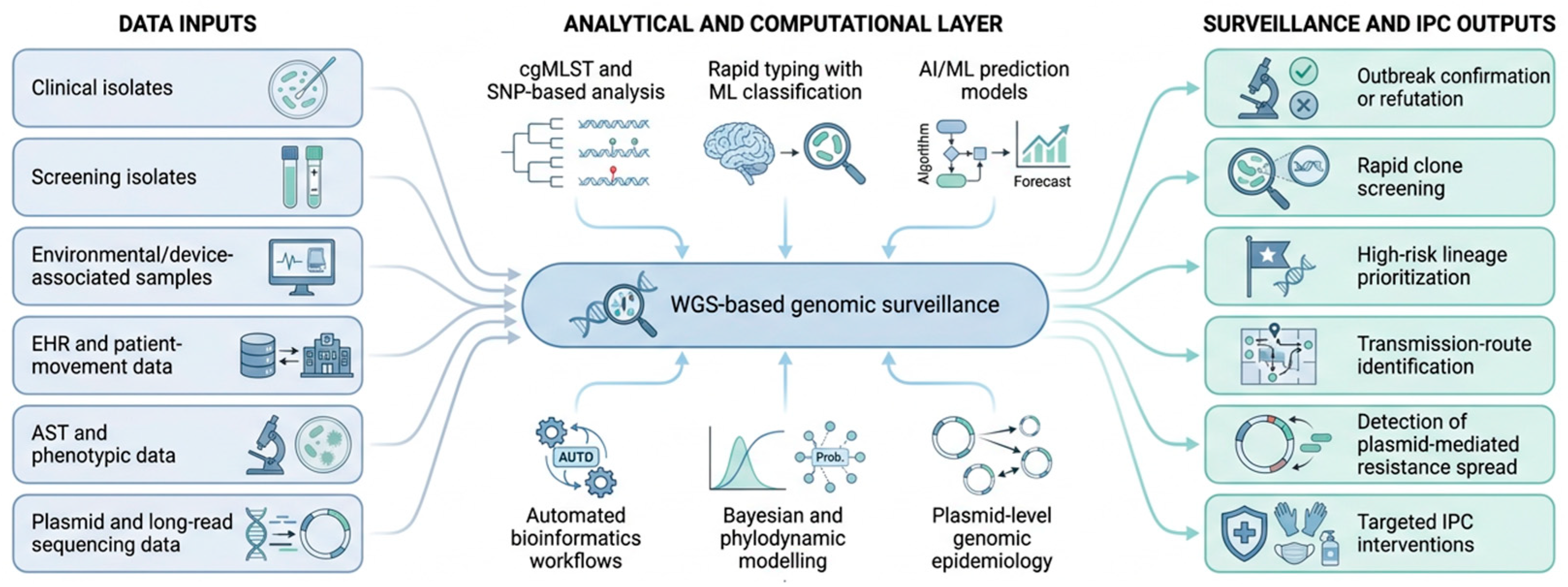
Can Artificial Intelligence Transform Early Warning for Antimicrobial-Resistant Outbreak Clones? Approaches, Gaps, and Opportunities: A Scoping Review

 , ,
, ,  ,
,  , and
, and
Abstract
1. Introduction
2. Materials and Methods
2.1. Study Design
2.2. Search Strategy
2.3. Inclusion and Exclusion Criteria
2.4. Study Selection and Data Extraction
2.5. Synthesis of Results
3. Results
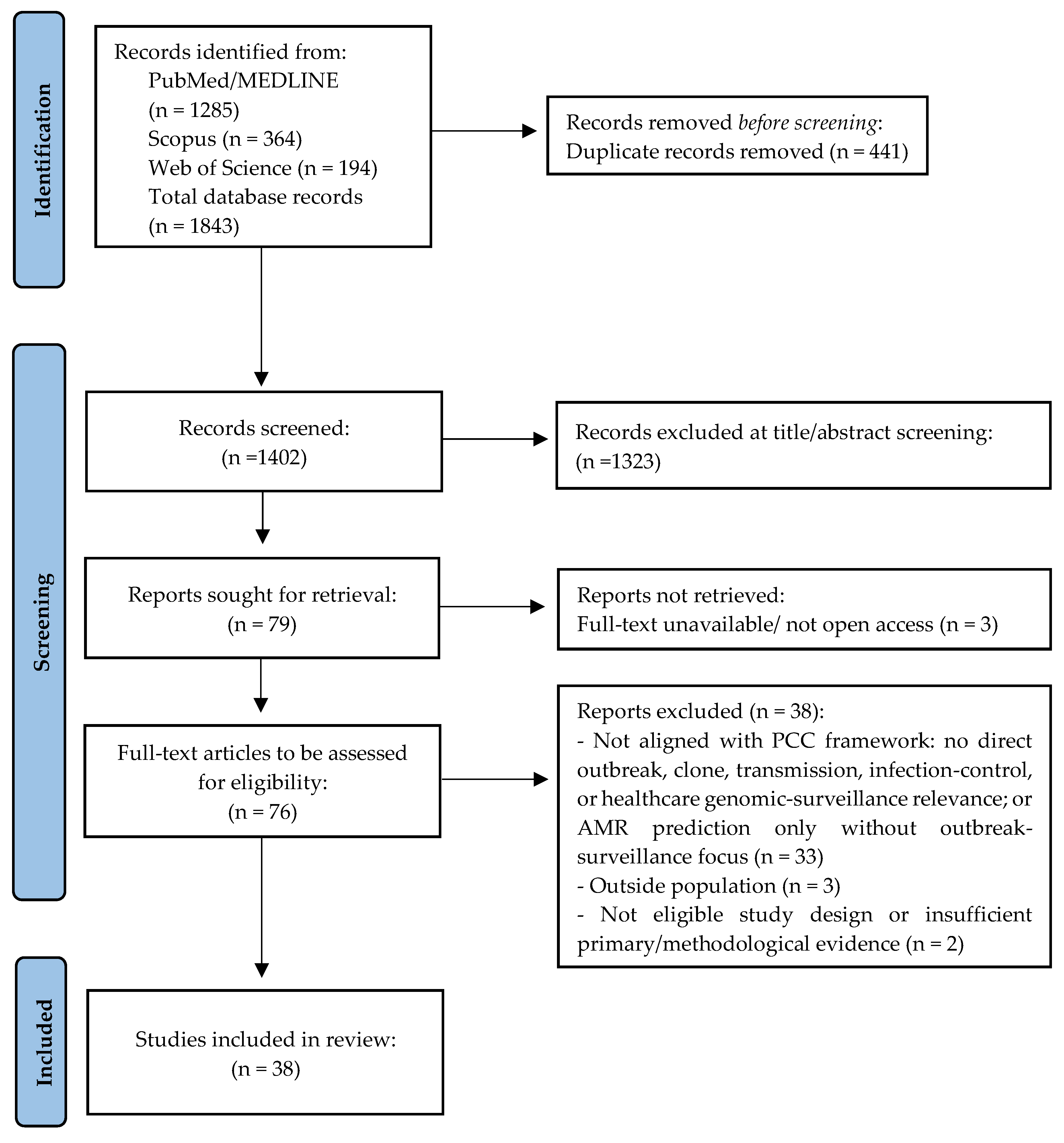
3.1. Study Selection
3.2. General Characteristics of Included Studies
3.3. Evidence Domains
3.3.1. Genomic Surveillance for Outbreak Detection and Investigation
3.3.2. Rapid Typing and Clone Screening
3.3.3. Prediction of Resistance, Risk Factors, and High-Risk Lineages
3.3.4. Transmission Reconstruction and Outbreak Dynamics
3.3.5. IPC-Oriented Integrated Genomic Epidemiology
4. Discussion
5. Limitations and Future Directions
6. Conclusions
Supplementary Materials
Author Contributions
Funding
Institutional Review Board Statement
Informed Consent Statement
Data Availability Statement
Acknowledgments
Conflicts of Interest
References
- Naghavi, M.; Vollset, S.E.; Ikuta, K.S.; Swetschinski, L.R.; Gray, A.P.; Wool, E.E.; Robles Aguilar, G.; Mestrovic, T.; Smith, G.; Han, C.; et al. Global Burden of Bacterial Antimicrobial Resistance 1990–2021: A Systematic Analysis with Forecasts to 2050. Lancet 2024, 404, 1199–1226. [Google Scholar] [CrossRef]
- Sati, H.; Carrara, E.; Savoldi, A.; Hansen, P.; Garlasco, J.; Campagnaro, E.; Boccia, S.; Castillo-Polo, J.A.; Magrini, E.; Garcia-Vello, P.; et al. The WHO Bacterial Priority Pathogens List 2024: A Prioritisation Study to Guide Research, Development, and Public Health Strategies against Antimicrobial Resistance. Lancet Infect. Dis. 2025, 25, 1033–1043. [Google Scholar] [CrossRef] [PubMed]
- De Oliveira, D.M.P.; Forde, B.M.; Kidd, T.J.; Harris, P.N.A.; Schembri, M.A.; Beatson, S.A.; Paterson, D.L.; Walker, M.J. Antimicrobial Resistance in ESKAPE Pathogens. Clin. Microbiol. Rev. 2020, 33, e00181-19. [Google Scholar] [CrossRef] [PubMed]
- Woodford, N.; Turton, J.F.; Livermore, D.M. Multiresistant Gram-Negative Bacteria: The Role of High-Risk Clones in the Dissemination of Antibiotic Resistance. FEMS Microbiol. Rev. 2011, 35, 736–755. [Google Scholar] [CrossRef]
- Mathers, A.J.; Peirano, G.; Pitout, J.D.D. The Role of Epidemic Resistance Plasmids and International High-Risk Clones in the Spread of Multidrug-Resistant Enterobacteriaceae. Clin. Microbiol. Rev. 2015, 28, 565–591. [Google Scholar] [CrossRef]
- Da Cruz Campos, A.; Da Silva Andrade, N.L. The Emergence of New E. Coli High-Risk Clones and Antibiotic Resistance: An Unstoppable Problem or Our Last Chance to Do Better? Immunol. Microbiol. 2024. preprint. [Google Scholar] [CrossRef]
- Lee, C.-R.; Lee, J.H.; Park, K.S.; Kim, Y.B.; Jeong, B.C.; Lee, S.H. Global Dissemination of Carbapenemase-Producing Klebsiella pneumoniae: Epidemiology, Genetic Context, Treatment Options, and Detection Methods. Front. Microbiol. 2016, 7, 895. [Google Scholar] [CrossRef]
- Armstrong, G.L.; MacCannell, D.R.; Taylor, J.; Carleton, H.A.; Neuhaus, E.B.; Bradbury, R.S.; Posey, J.E.; Gwinn, M. Pathogen Genomics in Public Health. N. Engl. J. Med. 2019, 381, 2569–2580. [Google Scholar] [CrossRef] [PubMed]
- Doll, M.; Bryson, A.L.; Palmore, T.N. Whole Genome Sequencing Applications in Hospital Epidemiology and Infection Prevention. Curr. Infect. Dis. Rep. 2024, 26, 115–121. [Google Scholar] [CrossRef]
- Snitkin, E.S.; Zelazny, A.M.; Thomas, P.J.; Stock, F.; NISC Comparative Sequencing Program; Henderson, D.K.; Palmore, T.N.; Segre, J.A. Tracking a Hospital Outbreak of Carbapenem-Resistant Klebsiella pneumoniae with Whole-Genome Sequencing. Sci. Transl. Med. 2012, 4, eaaf2968. [Google Scholar] [CrossRef]
- Harris, S.R.; Cartwright, E.J.; Török, M.E.; Holden, M.T.; Brown, N.M.; Ogilvy-Stuart, A.L.; Ellington, M.J.; Quail, M.A.; Bentley, S.D.; Parkhill, J.; et al. Whole-Genome Sequencing for Analysis of an Outbreak of Meticillin-Resistant Staphylococcus aureus: A Descriptive Study. Lancet Infect. Dis. 2013, 13, 130–136. [Google Scholar] [CrossRef]
- Aanensen, D.M.; Feil, E.J.; Holden, M.T.G.; Dordel, J.; Yeats, C.A.; Fedosejev, A.; Goater, R.; Castillo-Ramírez, S.; Corander, J.; Colijn, C.; et al. Whole-Genome Sequencing for Routine Pathogen Surveillance in Public Health: A Population Snapshot of Invasive Staphylococcus aureus in Europe. mBio 2016, 7, e00444-16. [Google Scholar] [CrossRef] [PubMed]
- Kim, J.I.; Maguire, F.; Tsang, K.K.; Gouliouris, T.; Peacock, S.J.; McAllister, T.A.; McArthur, A.G.; Beiko, R.G. Machine Learning for Antimicrobial Resistance Prediction: Current Practice, Limitations, and Clinical Perspective. Clin. Microbiol. Rev. 2022, 35, e00179-21. [Google Scholar] [CrossRef]
- Chines, E.; Tempesta, A.A.; Boscarelli, L.; Parisi, M.F.; Marcoccia, L.; Capillo, A.; Mezzatesta, M.L.; Ledda, C.; Chessari, M.; Cafiso, V. Next-Generation Target Discovery in ESKAPE Pathogens: An AI-Driven Framework from Omics-Based to Systems-Level Modeling and Clinical Translation. Antibiotics 2026, 15, 469. [Google Scholar] [CrossRef]
- Scaglione, G.; Mastroianni, N.; Rizzo, A.; Palomba, E.; Carcione, D.; Rimoldi, S.G.; Brigante, G.; Principe, L.; Colaneri, M.; Gori, A.; et al. Integrating Artificial Intelligence with Genome Sequencing against Antimicrobial Resistance: A Narrative Review. Front. Public Health 2026, 14, 1757161. [Google Scholar] [CrossRef]
- Tricco, A.C.; Lillie, E.; Zarin, W.; O’Brien, K.K.; Colquhoun, H.; Levac, D.; Moher, D.; Peters, M.D.J.; Horsley, T.; Weeks, L.; et al. PRISMA Extension for Scoping Reviews (PRISMA-ScR): Checklist and Explanation. Ann. Intern. Med. 2018, 169, 467–473. [Google Scholar] [CrossRef]
- Sundermann, A.J.; Chen, J.; Miller, J.K.; Saul, M.I.; Shutt, K.A.; Griffith, M.P.; Mustapha, M.M.; Ezeonwuka, C.; Waggle, K.; Srinivasa, V.; et al. Outbreak of Pseudomonas aeruginosa Infections from a Contaminated Gastroscope Detected by Whole Genome Sequencing Surveillance. Clin. Infect. Dis. 2021, 73, e638–e642. [Google Scholar] [CrossRef]
- Sundermann, A.J.; Chen, J.; Kumar, P.; Ayres, A.M.; Cho, S.T.; Ezeonwuka, C.; Griffith, M.P.; Miller, J.K.; Mustapha, M.M.; Pasculle, A.W.; et al. Whole-Genome Sequencing Surveillance and Machine Learning of the Electronic Health Record for Enhanced Healthcare Outbreak Detection. Clin. Infect. Dis. 2022, 75, 476–482. [Google Scholar] [CrossRef]
- Sundermann, A.; Chen, J.; Saul, M.; Shutt, K.; Griffith, M.; Snyder, G.; Pless, L.L.; Dubrawski, A.; Harrison, L. Artificial Intelligence Enhances Genomic Surveillance in Healthcare Outbreak Investigations. Infect. Control Hosp. Epidemiol. 2026, 47, 170–174. [Google Scholar] [CrossRef]
- Sundermann, A.J.; Kumar, P.; Griffith, M.P.; Waggle, K.D.; Rangachar Srinivasa, V.; Raabe, N.; Mills, E.G.; Coyle, H.; Ereifej, D.; Creager, H.M.; et al. Real-Time Genomic Surveillance for Enhanced Healthcare Outbreak Detection and Control: Clinical and Economic Impact. Clin. Infect. Dis. 2026, 82, 134–141. [Google Scholar] [CrossRef] [PubMed]
- Raven, K.E.; Bragin, E.; Blane, B.; Leek, D.; Kumar, N.; Rhodes, P.A.; Enoch, D.A.; Thaxter, R.; Brown, N.M.; Parkhill, J.; et al. Large-Scale Evaluation of a Rapid Fully Automated Analysis Platform to Detect and Refute Outbreaks Based on MRSA Genome Comparisons. mSphere 2022, 7, e00283-22. [Google Scholar] [CrossRef] [PubMed]
- Böhne, C.; Baier, C.; Erdmann, J.; Ebadi, E.; Zirkler, C.; Lindenberg, M.; Schlüter, D.; Pirr, S.; Peter, C.; Bohnhorst, B.; et al. Prospective Genomic and Epidemiologic Surveillance of Klebsiella Pneumoniae in a Tertiary NICU. Antimicrob. Resist. Infect. Control 2026, 15, 64. [Google Scholar] [CrossRef] [PubMed]
- Price, V.; Dunn, S.J.; Moran, R.A.; Swindells, J.; McNally, A. Whole-Genome Sequencing Enhances Existing Pathogen and Antimicrobial-Resistance Surveillance Schemes within a Neonatal Unit. Microb. Genom. 2022, 8, 000841. [Google Scholar] [CrossRef]
- Ross, T.A.; Pöntinen, A.K.; Holsbø, E.; Samuelsen, Ø.; Hegstad, K.; Kampffmeyer, M.; Corander, J.; Gladstone, R.A. Machine Learning-Based Lineage Prediction from Antimicrobial Susceptibility Testing Phenotypes for Escherichia coli Sequence Type 131 Clade C Surveillance across Infection Types. Microb. Genom. 2026, 12, 001608. [Google Scholar] [CrossRef] [PubMed]
- Candela, A.; Rodríguez-Temporal, D.; Lumbreras, P.; Guijarro-Sánchez, P.; Arroyo, M.J.; Vázquez, F.; Beceiro, A.; Bou, G.; Muñoz, P.; Oviaño, M.; et al. Multicenter Evaluation of Fourier Transform Infrared (FTIR) Spectroscopy as a First-Line Typing Tool for Carbapenemase-Producing Klebsiella pneumoniae in Clinical Settings. J. Clin. Microbiol. 2025, 63, e01122-24. [Google Scholar] [CrossRef]
- Vogt, S.; Löffler, K.; Dinkelacker, A.G.; Bader, B.; Autenrieth, I.B.; Peter, S.; Liese, J. Fourier-Transform Infrared (FTIR) Spectroscopy for Typing of Clinical Enterobacter cloacae complex Isolates. Front. Microbiol. 2019, 10, 2582. [Google Scholar] [CrossRef]
- Novais, Â.; Gonçalves, A.B.; Ribeiro, T.G.; Freitas, A.R.; Méndez, G.; Mancera, L.; Read, A.; Alves, V.; López-Cerero, L.; Rodríguez-Baño, J.; et al. Development and Validation of a Quick, Automated, and Reproducible ATR FT-IR Spectroscopy Machine-Learning Model for Klebsiella pneumoniae Typing. J. Clin. Microbiol. 2024, 62, e01211-23. [Google Scholar] [CrossRef]
- Cai, C.; Zou, M.; Chen, M.; Yuan, P.; Fang, Z.; Zhong, L.; Chen, D.; Zhou, H.; Zeng, N. Interpretable Machine Learning of Clinical MALDI-TOF Spectra Discriminates Carbapenem-Resistant Klebsiella pneumoniae While Revealing Phylogenetic Heterogeneity That Limits Model Generalizability. J. Mass. Spectrom. Adv. Clin. Lab 2025, 38, 71–80. [Google Scholar] [CrossRef]
- Lafolie, J.; Sauget, M.; Cabrolier, N.; Hocquet, D.; Bertrand, X. Detection of Escherichia coli Sequence Type 131 by Matrix-Assisted Laser Desorption Ionization Time-of-Flight Mass Spectrometry: Implications for Infection Control Policies? J. Hosp. Infect. 2015, 90, 208–212. [Google Scholar] [CrossRef]
- Zhang, L.-Y.; Tian, B.; Huang, Y.-H.; Gu, B.; Ju, P.; Luo, Y.; Tang, J.; Wang, L. Classification and Prediction of Klebsiella pneumoniae Strains with Different MLST Allelic Profiles via SERS Spectral Analysis. PeerJ 2023, 11, e16161. [Google Scholar] [CrossRef] [PubMed]
- Candela, A.; Arroyo, M.J.; Sánchez-Cueto, M.; Marín, M.; Cercenado, E.; Méndez, G.; Muñoz, P.; Mancera, L.; Rodríguez-Temporal, D.; Rodríguez-Sánchez, B. Rapid Discrimination of Pseudomonas aeruginosa ST175 Isolates Involved in a Nosocomial Outbreak Using MALDI-TOF Mass Spectrometry and FTIR Spectroscopy Coupled with Machine Learning. Transbound. Emerg. Dis. 2023, 2023, 8649429. [Google Scholar] [CrossRef] [PubMed]
- Villa, A.; Danjean, M.; Sakr, C.; Cizeau, F.; Ducellier, D.; N’Debi, M.; Mekontso-Dessap, A.; Razazi, K.; Decousser, J.-W. Assessing Cross-Transmission of Gram-Negative Bacteria in the Intensive Care Unit: A Prospective Comparison of IR-Biotyper and Core-Genome Multi-Locus Sequence Typing. J. Hosp. Infect. 2026, 170, 92–99. [Google Scholar] [CrossRef]
- Gonçalves, A.B.; Alves, V.; Neves, I.; Read, A.; Pinheiro, N.; Henius, A.E.; Hasman, H.; Peixe, L.; Novais, Â. Real-Time FT-IR Typing of Klebsiella pneumoniae: A Flexible and Rapid Approach for Outbreak Detection and Infection Control. J. Antimicrob. Chemother. 2025, 80, 2025–2031. [Google Scholar] [CrossRef]
- Liu, X.; Jiang, M.; Zhang, J.; Li, H.; Liu, Y.; Zhang, J.; Chen, X.; Bu, J.; Xie, S.; Zhang, M.; et al. Machine Learning-Based Evaluation of Risk Factors for Carbapenem-Resistant Klebsiella pneumoniae Dissemination in Neonatal Units. mSystems 2025, 10, e00909-25. [Google Scholar] [CrossRef] [PubMed]
- Sawhney, S.S.; Ransom, E.M.; Wallace, M.A.; Reich, P.J.; Dantas, G.; Burnham, C.-A.D. Comparative Genomics of Borderline Oxacillin-Resistant Staphylococcus aureus Detected during a Pseudo-Outbreak of Methicillin-Resistant S. aureus in a Neonatal Intensive Care Unit. mBio 2022, 13, e03196-21. [Google Scholar] [CrossRef]
- Wang, W.; Baker, M.; Hu, Y.; Xu, J.; Yang, D.; Maciel-Guerra, A.; Xue, N.; Li, H.; Yan, S.; Li, M.; et al. Whole-Genome Sequencing and Machine Learning Analysis of Staphylococcus aureus from Multiple Heterogeneous Sources in China Reveals Common Genetic Traits of Antimicrobial Resistance. mSystems 2021, 6, e01185-20. [Google Scholar] [CrossRef]
- Wang, S.; Zhao, C.; Yin, Y.; Chen, F.; Chen, H.; Wang, H. A Practical Approach for Predicting Antimicrobial Phenotype Resistance in Staphylococcus aureus Through Machine Learning Analysis of Genome Data. Front. Microbiol. 2022, 13, 841289. [Google Scholar] [CrossRef] [PubMed]
- Zhuang, H.; Zhu, F.; Lan, P.; Ji, S.; Sun, L.; Chen, Y.; Wang, Z.; Jiang, S.; Zhang, L.; Zhu, Y.; et al. A Random Forest Model Based on Core Genome Allelic Profiles of MRSA for Penicillin plus Potassium Clavulanate Susceptibility Prediction. Microb. Genom. 2021, 7, 000610. [Google Scholar] [CrossRef]
- Chaki, S.S.G.; Midhin, B.K.; Alshkarchy, S.S.; Kalantar-Neyestanaki, M.; Albaz, R.Y.; Abosaoda, M.K.; Kareem, A.K.; Sharma, R.; Sholeh, M.; Beig, M. Comprehensive in Silico Genomic Surveillance of β-Lactam and Methicillin Resistance in Staphylococcus aureus: Machine Learning–Based Analysis of Lineage Dynamics and Global Evolution. Infect. Genet. Evol. 2026, 137, 105862. [Google Scholar] [CrossRef] [PubMed]
- Mauffrey, F.; Bertelli, C.; Greub, G.; Senn, L.; Blanc, D.S. Genomic Evolution of ST228 SCCmec-I MRSA 10 Years after a Major Nosocomial Outbreak. J. Clin. Microbiol. 2024, 62, e00203-24. [Google Scholar] [CrossRef]
- Fujikura, Y.; Hamamoto, T.; Kanayama, A.; Kaku, K.; Yamagishi, J.; Kawana, A. Bayesian Reconstruction of a Vancomycin-Resistant Enterococcus Transmission Route Using Epidemiologic Data and Genomic Variants from Whole Genome Sequencing. J. Hosp. Infect. 2019, 103, 395–403. [Google Scholar] [CrossRef]
- Shimizu, A.; Kurushima, J.; Tanimoto, K.; Tomie, N.; Hashimoto, Y.; Nomura, T.; Ota, N.; Hirakawa, H.; Tomita, H. Genomic Dissection of Nosocomial Multiclonal-Outbreak by Carbapenem-Resistant Pseudomonas aeruginosa Strains in a Tertiary Children’s Hospital in Japan. J. Glob. Antimicrob. Resist. 2025, 44, 89–94. [Google Scholar] [CrossRef]
- Silvotti, M.G.; Scaltriti, E.; Bolzoni, L.; Zerbi, B.; Tocci, G.; Zappavigna, A.; Lamberti, G.; Donati, F.; Federici, F.; Pongolini, S.; et al. Outbreak of Carbapenem Resistant Klebsiella pneumoniae in a Neurorehabilitation Unit: Genomic Epidemiology Reveals Complex Transmission Pattern in a Tertiary Care Hospital. J. Glob. Antimicrob. Resist. 2025, 41, 195–201. [Google Scholar] [CrossRef] [PubMed]
- Steinig, E.; Duchêne, S.; Aglua, I.; Greenhill, A.; Ford, R.; Yoannes, M.; Jaworski, J.; Drekore, J.; Urakoko, B.; Poka, H.; et al. Phylodynamic Inference of Bacterial Outbreak Parameters Using Nanopore Sequencing. Mol. Biol. Evol. 2022, 39, msac040. [Google Scholar] [CrossRef] [PubMed]
- Chung The, H.; Karkey, A.; Pham Thanh, D.; Boinett, C.J.; Cain, A.K.; Ellington, M.; Baker, K.S.; Dongol, S.; Thompson, C.; Harris, S.R.; et al. A High-resolution Genomic Analysis of Multidrug-resistant Hospital Outbreaks of Kleb. pneumoniae. EMBO Mol. Med. 2015, 7, 227–239. [Google Scholar] [CrossRef]
- Morgado, S.M.; Fonseca, É.L.; Freitas, F.S.; Bighi, N.S.; Oliveira, P.P.C.; Monteiro, P.M.; Lima, L.S.; Santos, B.P.; Sousa, M.A.R.; Assumpção, A.O.; et al. Outbreak of High-Risk XDR CRAB of International Clone 2 (IC2) in Rio Janeiro, Brazil. J. Glob. Antimicrob. Resist. 2023, 34, 91–98. [Google Scholar] [CrossRef]
- Ding, H.; Miao, Y.; Sun, L.; Chen, Z.; Wang, C.; Shi, C.; Zou, M.; Peng, W.; Gong, L.; Xu, C.; et al. From High-Touch Surfaces to Air: A Prospective Genomic Analysis Unveils an Underestimated Transmission Route of Carbapenem-Resistant Acinetobacter baumannii in the ICU. Int. J. Infect. Dis. 2026, 168, 108718. [Google Scholar] [CrossRef] [PubMed]
- Guo, Y.; Zhuo, C.; Zhang, T.; Wu, K.; Shi, Z.; Zhu, Y.; Huang, J.; Zhuo, C.; Qi, N. Genomic Insights Into a Hospital-Acquired High-Risk Vancomycin-Resistant Enterococcus faecium Outbreak in Guangdong, China. MicrobiologyOpen 2026, 15, e70288. [Google Scholar] [CrossRef]
- Song, X.; Sun, Z.; Ding, B.; Jin, M.; Xu, J.; Yang, B. Investigation and Control of a Suspected Outbreak of Carbapenem-Resistant Acinetobacter baumannii Nosocomial Infections in the Cardiovascular Surgical ICU Based on Whole-Genome Sequencing. Front. Public Health 2026, 13, 1730647. [Google Scholar] [CrossRef]
- Cissé, A.; Morin-Le Bihan, A.; Pagenault, M.; Cattoir, V.; Reissier, S.; Ménard, G. Silent Transmission of Clonal Pseudomonas aeruginosa via Duodenoscopes: Microbiological and Genomic Investigation of a Prolonged Episode. J. Hosp. Infect. 2026, 169, 15–23. [Google Scholar] [CrossRef]
- Jalal, D.; Lotfi, M.; Ziad, G.A.; Mahfouz, S.; Madney, Y.; Bayoumi, A.; Hassanain, O.; Tolba, M.; Hashem, M.; Elanany, M.; et al. Dual Transmission Dynamics of Carbapenem Resistance in Pediatric Oncology: Plasmid-Mediated and Clonal Spread of blaNDM-5 Enterobacterales. Infect. Dis. Ther. 2026, 15, 245–263. [Google Scholar] [CrossRef]
- Leder, N.H.; Cristofolini, M.; Ehrenberg, S.; Lohde, M.; Brandt, C.; Pletz, M.W.; Kipp, F.; Stein, C. Beyond Patient Contact: Combined Short- and Long Read Sequencing Reveals Continuous Occurrence of Genomically Related Carbapenemase-Producing Enterobacterales and Plasmid Mobility in a Hospital, Germany, 2018 to 2021. Eurosurveillance 2025, 30, 2400590. [Google Scholar] [CrossRef]
- García-González, N.; Beamud, B.; Sevilla-Fortuny, J.; Sánchez-Hellín, V.; Vidal, I.; Rodríguez, J.C.; Fuster, B.; Tormo, N.; Salvador, C.; Gimeno, C.; et al. Genomic Surveillance Reveals Different Transmission Patterns between Third-Generation Cephalosporin and Carbapenem Resistance in Klebsiella pneumoniae in the Comunidad Valenciana (Spain), 2018–2020. Antimicrob. Resist. Infect. Control 2025, 14, 44. [Google Scholar] [CrossRef]
- Landman, F.; Jamin, C.; De Haan, A.; Witteveen, S.; Bos, J.; Van Der Heide, H.G.J.; Schouls, L.M.; Hendrickx, A.P.A.; Dutch CPE/MRSA Surveillance Study Group. Genomic Surveillance of Multidrug-Resistant Organisms Based on Long-Read Sequencing. Genome Med. 2024, 16, 137. [Google Scholar] [CrossRef]
- Shaik, S.; Singh, A.; Suresh, A.; Ahmed, N. Genome Informatics and Machine Learning-Based Identification of Antimicrobial Resistance-Encoding Features and Virulence Attributes in Escherichia coli Genomes Representing Globally Prevalent Lineages, Including High-Risk Clonal Complexes. mBio 2022, 13, e03796-21. [Google Scholar] [CrossRef] [PubMed]
- Sun, Z.; Yang, F.; Ji, J.; Cao, W.; Liu, C.; Ding, B.; Xu, X. Dissecting the Genotypic Features of a Fluoroquinolone-Resistant Pseudomonas aeruginosa ST316 Sublineage Causing Ear Infections in Shanghai, China. Microb. Genom. 2023, 9, 000989. [Google Scholar] [CrossRef]
- Alteri, C.; Teri, A.; Liporace, M.F.; Muscatello, A.; Terranova, L.; Schianca, M.C.; Salari, F.; Orena, B.S.; Silverj, F.G.; Bernazzani, M.; et al. Transmission Cluster of Cefiderocol-Non-Susceptible Carbapenem-Resistant Acinetobacter baumannii in Cefiderocol-Naïve Individuals. Ann. Clin. Microbiol. Antimicrob. 2024, 23, 104. [Google Scholar] [CrossRef] [PubMed]
- Valik, J.K.; Giske, C.G.; Hasan, B.; Gozalo-Margüello, M.; Martínez-Martínez, L.; Premru, M.M.; Martinčič, Ž.; Beović, B.; Maraki, S.; Zacharioudaki, M.; et al. Genomic Virulence Markers Are Associated with Severe Outcomes in Patients with Pseudomonas aeruginosa Bloodstream Infection. Commun. Med. 2024, 4, 264. [Google Scholar] [CrossRef]
- Lesho, E.; Clifford, R.; Onmus-Leone, F.; Appalla, L.; Snesrud, E.; Kwak, Y.; Ong, A.; Maybank, R.; Waterman, P.; Rohrbeck, P.; et al. The Challenges of Implementing Next Generation Sequencing Across a Large Healthcare System, and the Molecular Epidemiology and Antibiotic Susceptibilities of Carbapenemase-Producing Bacteria in the Healthcare System of the U.S. Department of Defense. PLoS ONE 2016, 11, e0155770. [Google Scholar] [CrossRef] [PubMed]
- Nijhuis, R.H.T.; Weersink, A.J.L.; Stegeman-Heining, F.; Smilde, A.E.; Melles, D.C. Analysis of a Persistent Outbreak with Vancomycin-Resistant Enterococcus faecium Revealed the Need for an Adapted Diagnostic Algorithm. J. Hosp. Infect. 2025, 155, 192–197. [Google Scholar] [CrossRef]
- Lasch, P.; Fleige, C.; Stämmler, M.; Layer, F.; Nübel, U.; Witte, W.; Werner, G. Insufficient Discriminatory Power of MALDI-TOF Mass Spectrometry for Typing of Enterococcus faecium and Staphylococcus aureus Isolates. J. Microbiol. Methods 2014, 100, 58–69. [Google Scholar] [CrossRef]
- Coipan, C.E.; Dallman, T.J.; Brown, D.; Hartman, H.; Van Der Voort, M.; Van Den Berg, R.R.; Palm, D.; Kotila, S.; Van Wijk, T.; Franz, E. Concordance of SNP- and Allele-Based Typing Workflows in the Context of a Large-Scale International Salmonella enteritidis Outbreak Investigation. Microb. Genom. 2020, 6, e000318. [Google Scholar] [CrossRef]
- Scrascia, M.; Tempesta, A.A.; Cafiso, V.; Pazzani, C.; Mezzatesta, M.L. Bloodstream Infections Due to Carbapenemase-Producing Escherichia coli: A Comprehensive Review. Antibiotics 2026, 15, 176. [Google Scholar] [CrossRef] [PubMed]
- Hu, X.; Zhao, Y.; Han, P.; Liu, S.; Liu, W.; Mai, C.; Deng, Q.; Ren, J.; Luo, J.; Chen, F.; et al. Novel Clinical mNGS-Based Machine Learning Model for Rapid Antimicrobial Susceptibility Testing of Acinetobacter baumannii. J. Clin. Microbiol. 2023, 61, e01805-22. [Google Scholar] [CrossRef] [PubMed]
- Xiang, Z.; Guan, J.; Wang, H.; Wu, W.; Chen, S.; Wang, S.; Jiang, Z.; Hu, Y.; Xiang, M.; Huang, T.; et al. A Metatranscriptome-Based Approach to Predict Multidrug Resistance Phenotypes in Klebsiella pneumoniae without Culturing. J. Glob. Antimicrob. Resist. 2026, 49, 80–88. [Google Scholar] [CrossRef] [PubMed]


| PCC Component | Operational Definition |
|---|---|
| Population | Bacterial antimicrobial-resistant pathogens relevant to healthcare-associated transmission, with emphasis on WHO-prioritized bacterial pathogens, multidrug-resistant organisms, high-risk clones, epidemic lineages, and outbreak-associated strains. |
| Concept | AI/ML methods and advanced computational or statistical approaches integrated with WGS/genomic surveillance, rapid typing, or epidemiological and/or clinical data to support early detection, characterization, transmission reconstruction, or investigation of AMR outbreak clones. |
| Context | Healthcare settings and public health genomic surveillance with direct relevance to healthcare-associated transmission, infection prevention and control, outbreak investigation, transmission reconstruction, or early detection of resistant bacterial clones. |
| Ref. | First Author; Year | Pathogen/ Resistance Profile | Setting | Study Material/ Sample Size | Genomic/ Typing Method | AI/ML or Computational Method | Surveillance/ IPC Relevance |
|---|---|---|---|---|---|---|---|
| [17] | Sundermann et al., 2021 | P. aeruginosa | USA; adult tertiary hospital; gastroscope-associated outbreak | 882 isolates; 6 outbreak cases; 1 contaminated gastroscope isolate | WGS; SNP-based clustering | EHR-based ML route analysis | Detected hidden outbreak and implicated gastroscope source |
| [18] | Sundermann et al., 2022 | Multiple healthcare-associated pathogens | USA; adult tertiary hospital; hospital-wide surveillance | 3165 isolates; 2752 patient isolates; 99 clusters | WGS; cgSNP clustering | EDS-HAT; EHR-linked ML | Detected outbreaks missed by traditional IPC and inferred transmission routes |
| [19] | Sundermann et al., 2026 | Multiple healthcare-associated pathogens | USA; adult tertiary hospital; WGS-detected outbreaks | 172 outbreaks; 476 case patients; EHR data from 48,723 patients | WGS; SNP-based outbreak detection | AI algorithm using EHR-derived exposures | Identified transmission routes missed by manual review |
| [20] | Sundermann et al., 2026 | Multiple healthcare-associated pathogens | USA; adult tertiary hospital; real-time genomic surveillance | 4723 isolates; 3921 patient isolates; 172 outbreaks | Weekly WGS; SNP-based outbreak detection | Real-time computational surveillance and impact modelling | Supported real-time IPC actions and estimated infections avoided |
| [21] | Raven et al., 2022 | S. aureus/MRSA | UK; clinical microbiology/public health laboratory | 781 MRSA genomes from 777 patients | WGS; ST, mec detection; SNP relatedness | Fully automated bioinformatics platform | Automated confirmation or refutation of MRSA clusters |
| [22] | Böhne et al., 2026 | K. pneumoniae complex; mostly wild type; selected ESBL clusters | Germany; tertiary NICU/intermediate care unit | 936 patients; 83 isolates; 10 genomic clusters | WGS; MLST; cgMLST; SKA/SNP analysis | Regression; XGBoost; random forest; SHAP | Identified high-risk VLBW infants and supported risk-adapted IPC |
| [23] | Price et al., 2022 | Gram-negative organisms; AMR genes including blaCTX-M variants | UK; neonatal unit; routine screening programme | 155 isolates from 44 neonates | WGS; MLST; phylogeny; SNP relatedness, AMR genes | Computational genomic epidemiology | Revealed occult transmission and possible AMR gene transfer |
| [24] | Ross et al., 2026 | E. coli; ST131 clade C; MDR/ESBL-associated lineage | Norway; national AMR surveillance | 2790 genomic BSI isolates; 24,866 BSI and 22,942 UTI AST isolates | WGS-based clade assignment for training/ validation | Random forest and XGBoost using AST phenotypes | Extended surveillance of high-risk lineage where universal WGS was not feasible |
| [25] | Candela et al., 2025 | K. pneumoniae; carbapenemase-producing | Spain; multicenter tertiary-hospital clinical collections | 365 isolates; 289 included in FTIR-WGS clustering analysis | FTIR spectroscopy; WGS; cgMLST and ST reference typing | PCA; ANN; SVM and random forest spectral classification | First-line typing to support rapid clone screening and prioritize isolates for WGS confirmation |
| [26] | Vogt et al., 2019 | E. cloacae complex | Germany; NICU; routine surveillance and suspected outbreak | 239 isolates from 24 patients; 53 sequenced isolates; 14 outbreak-period isolates | FTIR spectroscopy; WGS/SNP and MLST reference typing | UPGMA/PCA clustering and ANN-based spectrum classification | Supported rapid typing for NICU surveillance and outbreak triage |
| [27] | Novais et al., 2024 | K. pneumoniae; MDR lineages | Portugal and Spain; clinical and surveillance isolate collections | 573 isolates; 293 training isolates and 280 validation isolates | ATR FT-IR; KL typing by wzi sequencing and WGS reference | Random forest KL-type classifier; PLS-DA submodels for related KL/O types | Same-day automated lineage typing to support outbreak control and public health surveillance |
| [28] | Cai et al., 2025 | K. pneumoniae; CRKP; KPC- and NDM-producing | China; multicenter clinical isolate collections | 1532 clinical isolates from four institutions | MALDI-TOF MS; qPCR; MLST; KL typing and phylogenetic analysis | Random forest classifiers; SHAP interpretability | Rapid resistance-mechanism screening, with regional model-update requirements |
| [29] | Lafolie et al., 2015 | E. coli; ST131; ESBL/MDR-associated high-risk lineage | France; clinical and environmental isolate collection | 109 isolates, including 50 ST131 isolates | MALDI-TOF MS spectral typing; MLST reference typing | Quick Classifier and SVM biomarker models | Rapid ST131 screening to support targeted IPC measures |
| [30] | Zhang et al., 2023 | K. pneumoniae; different MLST profiles | China; clinical isolate collection | 16 strains; 45 SERS spectra per strain | WGS-based MLST and core-genome phylogeny; SERS spectral typing | OPLS-DA and supervised ML classifiers; best performance with SVM | Proof-of-concept for rapid ST screening to support transmission tracing |
| [31] | Candela et al., 2023 | P. aeruginosa; MDR ST175 outbreak clone | Spain; tertiary hospital; hematology ward outbreak | 67 isolates; 35 WGS-characterized; 32 ASO-PCR validation isolates | PFGE and WGS reference typing; MALDI-TOF MS and FTIR-S spectral typing | ML classifiers applied to MALDI-TOF MS and FTIR-S spectra | Rapid discrimination of outbreak-related isolates and support for real-time clone screening |
| [32] | Villa et al., 2026 | Gram-negative bacteria including P. aeruginosa, K. pneumoniae, E. coli, E. cloacae complex and Stenotrophomonas maltophilia | France; ICU; prospective transmission surveillance | 283 isolates from 135 ICU patients | IR-Biotyper FTIR; cgMLST reference typing | Species-specific spectral clustering thresholds | Rapid exclusion of unrelated isolates and prioritization for genomic confirmation |
| [33] | Gonçalves et al., 2025 | K. pneumoniae; carbapenemase-producing | Portugal; district hospital; real-time surveillance | 136 CP-K. pneumoniae infection isolates | ATR FT-IR; wzi sequencing, MLST; PFGE and selected WGS confirmation | Random forest FTIR classification models with model updating | Real-time sublineage typing supporting outbreak detection and IPC actions |
| [34] | Liu et al., 2025 | CRKP; mainly ST14 and ST433 carrying blaNDM-1 | China; pediatric hospital; neonatal units and NICU | 64 CRKP isolates from 58 neonates over 8 years | WGS; selected long-read sequencing; cgSNP phylogeny and plasmid analysis | Random forest regression/classification; permutation importance; computational phylogenetic and plasmid analysis | Identified clonal; healthcare-group and plasmid drivers of CRKP persistence and outbreaks |
| [35] | Sawhney et al., 2022 | S. aureus/BORSA; MSSA and MRSA | USA; NICU MRSA pseudo-outbreak and comparator isolates | 102 S. aureus isolates; 101 high-quality WGS assemblies | WGS; core-genome SNP; MLST, spa, accessory genome and AMR gene analysis | Random forest classifier using PBP/GdpP features and beta-lactamase phenotype | Refuted clonal MRSA outbreak and improved interpretation of MRSA surveillance results |
| [36] | Wang et al., 2021 | S. aureus/MRSA; MDR lineages | China; multisource surveillance | 673 isolates from food and human sources | WGS; MLST; spa; SCCmec; phylogeny and Bayesian divergence analysis | Supervised ML using genome-derived k-mers; best performance with RBF-SVM | Identified AMR-associated genomic traits and high-risk MRSA lineages for WGS-based surveillance |
| [37] | Wang et al., 2022 | S. aureus/MRSA and MSSA with resistance to multiple antimicrobials | China; multicenter clinical isolate collection | 466 isolates from bloodstream infection; hospital-acquired pneumonia and intra-abdominal infection studies | WGS; MLST and SCCmec typing; genome-derived k-mers | Random forest; SVM and XGBoost for MIC and resistance-category prediction | Supported WGS-based AMR phenotype prediction and rapid MRSA/resistance surveillance |
| [38] | Zhuang et al., 2021 | S. aureus/MRSA with penicillin plus potassium clavulanate susceptibility | China and UK; teaching hospital and external MRSA validation datasets | 284 hospital MRSA isolates; 471 Chinese national MRSA isolates; 287 UK MRSA isolates | WGS; mecA genotyping; cgMLST allelic profiles | Random forest susceptibility prediction model | Supported cgMLST-based prediction of MRSA susceptibility and lineage-aware AMR surveillance |
| [39] | Chaki et al., 2026 | S. aureus/MRSA with β-lactam and methicillin resistance | Global; public genomic surveillance dataset | 111,350 public S. aureus genomes; linked MIC data where available | WGS assemblies; AMRFinderPlus; MLST; resistance-gene and gene-pattern analysis | Random forest; XGBoost; Elastic Net and PLS for MIC prediction; temporal and lineage analysis | Mapped global β-lactam and mecA -mediated resistance dynamics and supported large-scale WGS-based AMR surveillance |
| [40] | Mauffrey et al., 2024 | S. aureus/MRSA; ST228 SCCmec-I | Switzerland; tertiary hospital; post-outbreak MRSA surveillance | 421 ST228 MRSA isolates; 218 Lausanne outbreak/post-outbreak isolates analyzed for epidemicity | WGS; SNP phylogeny; pan-genome and accessory-genome analysis | Time-scaled haplotypic density, GWAS and random forest models | Identified genomic markers associated with declining epidemicity after a major nosocomial outbreak |
| [41] | Fujikura et al., 2019 | E. faecium/VRE; ST17 with vanA and vanB genotypes | Japan; tertiary hospital; VRE outbreak | 23 VRE isolates from patients and environmental surfaces | WGS; MLST; SNP/SNV and INDEL variant analysis | Bayesian transmission reconstruction integrating genomic variants and epidemiological data | Reconstructed transmission routes; identified spreaders and environmental transmission, and supported IPC measures |
| [42] | Shimizu et al., 2025 | P. aeruginosa/CRPA; multiple sequence types | Japan; tertiary children’s hospital; suspected CRPA outbreak | 25 CRPA isolates from 10 patients and two environmental sites | Hybrid WGS; MLST; ANI/PFGE comparison; AMR gene and variant analysis | Bayesian transmission inference using JUNIPER; comparative lineage and resistance-mechanism analysis | Ruled out monoclonal outbreak; identified multiclonal CRPA emergence and assessed possible local environmental transmission |
| [43] | Silvotti et al., 2025 | K. pneumoniae; KPC-producing; ST307 and ST716 | Italy; tertiary hospital; neurorehabilitation unit outbreak | 19 KPC-K. pneumoniae isolates from colonized or infected patients | WGS; ST assignment; SNP phylogeny; AMR and virulence gene profiling | Bayesian discrete-time stochastic transmission models using Outbreaker2 | Revealed seven independent introductions, secondary transmission chains and IPC gaps in admission screening and staff training |
| [44] | Steinig et al., 2022 | S. aureus; community-associated MRSA ST93-MRSA-IV | Australia and Papua New Guinea; remote community and hospital-linked surveillance | 181 S. aureus isolates; 159 with matched Illumina reference data | Low-coverage nanopore sequencing; Illumina reference WGS; SNP-based phylogeny | Random forest SNP polishing; Bayesian phylodynamic birth–death skyline models | Enabled low-cost bacterial outbreak reconstruction and estimation of transmission dynamics in settings with limited sequencing infrastructure |
| [45] | The et al., 2015 | K. pneumoniae; MDR; ST15; NDM-1 lineage and ST1559 lineage | Nepal; tertiary hospital; high-dependency pediatric wards | 90 selected K. pneumoniae isolates; 89 sequenced; 412 additional isolates screened by lineage-specific PCR | WGS; MLST, core-genome SNP phylogeny; resistome and comparative genomics | Bayesian phylogenetic analysis; comparative genomic outbreak reconstruction; lineage-specific PCR screening | Resolved two distinct outbreak lineages; revealed pre-outbreak circulation and supported real-time genetic characterization for IPC |
| [46] | Morgado et al., 2023 | A. baumannii/CRAB; XDR IC2/ST2 | Brazil; tertiary hospital; nosocomial outbreak | 16 clinical A. baumannii isolates | WGS; ST assignment; core-genome phylogeny; resistome; virulome and capsule typing | Comparative genomic epidemiology using local and public genomes | Identified high-risk IC2/ST2 outbreak sub-lineages and supported regional genomic surveillance of XDR CRAB |
| [47] | Ding et al., 2026 | A. baumannii/CRAB; predominantly ST2 | China; tertiary hospital; ICU environmental surveillance | 43 CRAB-positive patients; 3390 environmental samples; 178 isolates sequenced | WGS; MLST; cgMLST; core-SNP phylogeny and resistance-gene analysis | Prospective genomic epidemiology with spatiotemporal transmission reconstruction | Identified near-patient environmental contamination; airborne isolate diversity and possible inter-ICU transmission events |
| [48] | Guo et al., 2026 | E. faecium/VRE; predominantly ST80 | China; two hospitals in Guangdong; hospital-acquired outbreak | 101 VR-E. faecium isolates from 101 patients | WGS; MLST; cgMLST; SNP analysis; resistome and virulence analysis | Comparative genomic epidemiology; PCA/UMAP; MST; time-dated phylogeny; transmission-cluster analysis; PCR marker development | Characterized a high-risk ST80 VR-E. faecium outbreak and supported molecular screening for early detection and surveillance |
| [49] | Song et al., 2026 | A. baumannii/CRAB; ST2 carrying blaOXA-23 and blaOXA-66 | China; tertiary hospital; cardiovascular surgical ICU suspected outbreak | 6 infected patients; 146 environmental and hand samples; 27 CRAB isolates analyzed | WGS; MLST; core-genome SNP phylogeny; resistance-gene and mobile-element analysis | Genomic epidemiology with SNP-based relatedness and environmental-source assessment | Refuted a single nosocomial outbreak; identified environmental transmission risk points and guided IPC interventions |
| [50] | Cissé et al., 2026 | P. aeruginosa; Ceftazidime and meropenem-resistant; ST1320 | France; tertiary hospital; duodenoscope-associated transmission | 8 patient cases; 23 P. aeruginosa isolates from patients and duodenoscopes | Antibiogram, FTIR, WGS; SNP-based relatedness and ST assignment | Integrated microbiological and genomic investigation of device-associated transmission | Confirmed prolonged silent clonal transmission via duodenoscopes and supported enhanced endoscope surveillance and device-focused IPC |
| [51] | Jalal et al., 2026 | E. coli and K. pneumoniae/CRE BSI isolates; mainly carrying blaNDM-5 | Egypt; pediatric oncology hospital | 189 CRE bloodstream isolates from pediatric oncology patients | WGS; MLST; cgMLST; plasmid reconstruction; resistome; virulome and plasmid phylogeny | Integrated genomic and plasmid-level epidemiology with patient-movement analysis | Distinguished clonal spread from plasmid-mediated dissemination and supported plasmid-level surveillance in high-risk oncology settings |
| [52] | Leder et al., 2025 | Enterobacterales species/VIM-producing CPE | Germany; tertiary hospital; longitudinal hospital surveillance | 43 inpatient episodes with VIM-CPE; 27 hospital-acquired isolates | Short- and long-read WGS; cgMLST; cgSNP and plasmid analysis | Integrated core-genome and plasmid-level genomic epidemiology with patient-movement analysis | Revealed temporally separated transmission events and plasmid-mediated carbapenemase spread, supporting broader IPC investigations beyond direct patient contact |
| [53] | García-González et al., 2025 | K. pneumoniae; 3GC- and carbapenem-resistant | Spain; regional genomic surveillance across eight hospitals | 1768 local K. pneumoniae isolates; 11,967 contextual genomes | WGS; cgMLST; high-resolution SNP analysis; AMR gene and plasmid-context analysis | Regional genomic surveillance with transmission-group analysis and global phylogenetic contextualization | Mapped intra- and inter-hospital transmission patterns and identified ST307 carrying blaCTX-M-15 as a major regional transmission driver |
| [54] | Landman et al., 2024 | MDRO including CPE; CPPA; CRAB and MRSA | Netherlands; national MDRO surveillance/reference-laboratory setting | 356 MDRO isolates, including 69 MRSA isolates; 24 from an outbreak | Nanopore long-read WGS compared with Illumina short-read WGS; MLST; wgMLST; wgSNP; iMLVA; AMR gene and plasmid-replicon detection | Long-read sequencing workflow evaluation with assembler/ basecaller comparison and outbreak-analysis validation | Supported long-read WGS as a feasible approach for MDRO genomic surveillance; resistance-gene detection and outbreak analysis |
Disclaimer/Publisher’s Note: The statements, opinions and data contained in all publications are solely those of the individual author(s) and contributor(s) and not of MDPI and/or the editor(s). MDPI and/or the editor(s) disclaim responsibility for any injury to people or property resulting from any ideas, methods, instructions or products referred to in the content. |
© 2026 by the authors. Licensee MDPI, Basel, Switzerland. This article is an open access article distributed under the terms and conditions of the Creative Commons Attribution (CC BY) license.
Share and Cite
Tempesta, A.A.; Chines, E.; Boscarelli, L.; Parisi, M.F.; Marcoccia, L.; Capillo, A.; Mezzatesta, M.L.; Ledda, C.; Chessari, M.; Cafiso, V. Can Artificial Intelligence Transform Early Warning for Antimicrobial-Resistant Outbreak Clones? Approaches, Gaps, and Opportunities: A Scoping Review. Antibiotics 2026, 15, 599. https://doi.org/10.3390/antibiotics15060599
Tempesta AA, Chines E, Boscarelli L, Parisi MF, Marcoccia L, Capillo A, Mezzatesta ML, Ledda C, Chessari M, Cafiso V. Can Artificial Intelligence Transform Early Warning for Antimicrobial-Resistant Outbreak Clones? Approaches, Gaps, and Opportunities: A Scoping Review. Antibiotics. 2026; 15(6):599. https://doi.org/10.3390/antibiotics15060599
Chicago/Turabian StyleTempesta, Adriana Antonina, Eleonora Chines, Ludovica Boscarelli, Matteo Francesco Parisi, Lorenzo Marcoccia, Antonino Capillo, Maria Lina Mezzatesta, Caterina Ledda, Marco Chessari, and Viviana Cafiso. 2026. "Can Artificial Intelligence Transform Early Warning for Antimicrobial-Resistant Outbreak Clones? Approaches, Gaps, and Opportunities: A Scoping Review" Antibiotics 15, no. 6: 599. https://doi.org/10.3390/antibiotics15060599
APA StyleTempesta, A. A., Chines, E., Boscarelli, L., Parisi, M. F., Marcoccia, L., Capillo, A., Mezzatesta, M. L., Ledda, C., Chessari, M., & Cafiso, V. (2026). Can Artificial Intelligence Transform Early Warning for Antimicrobial-Resistant Outbreak Clones? Approaches, Gaps, and Opportunities: A Scoping Review. Antibiotics, 15(6), 599. https://doi.org/10.3390/antibiotics15060599