Dosing Regimen Optimization of Aztreonam/Avibactam According to Renal Function Stratification: A Population Pharmacokinetic-Guided Simulation Study

Abstract
1. Introduction
2. Results
2.1. Reconstruction of the Population Pharmacokinetic Models
2.2. External Validation of the Models
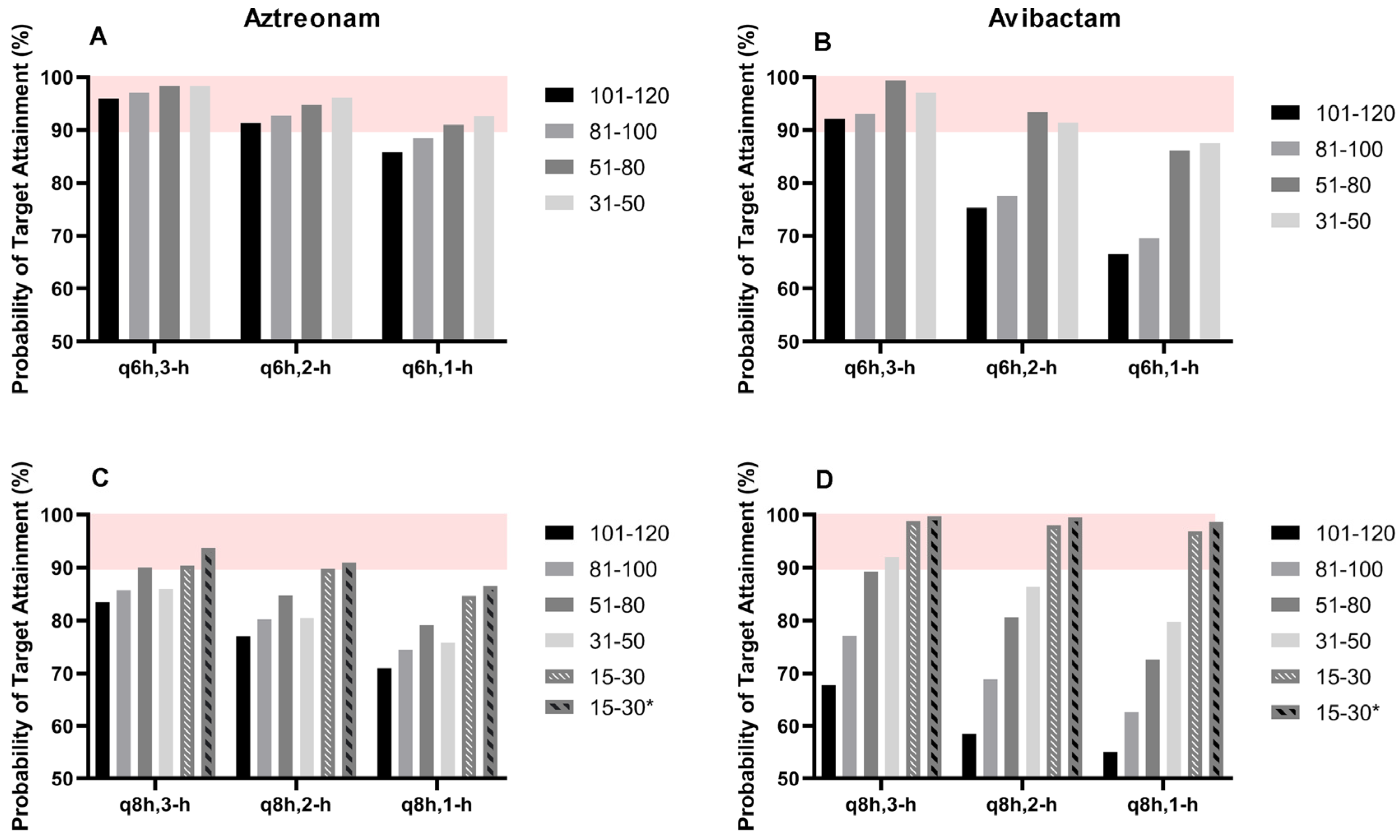
2.3. Regimen Performance Across Renal Function Strata
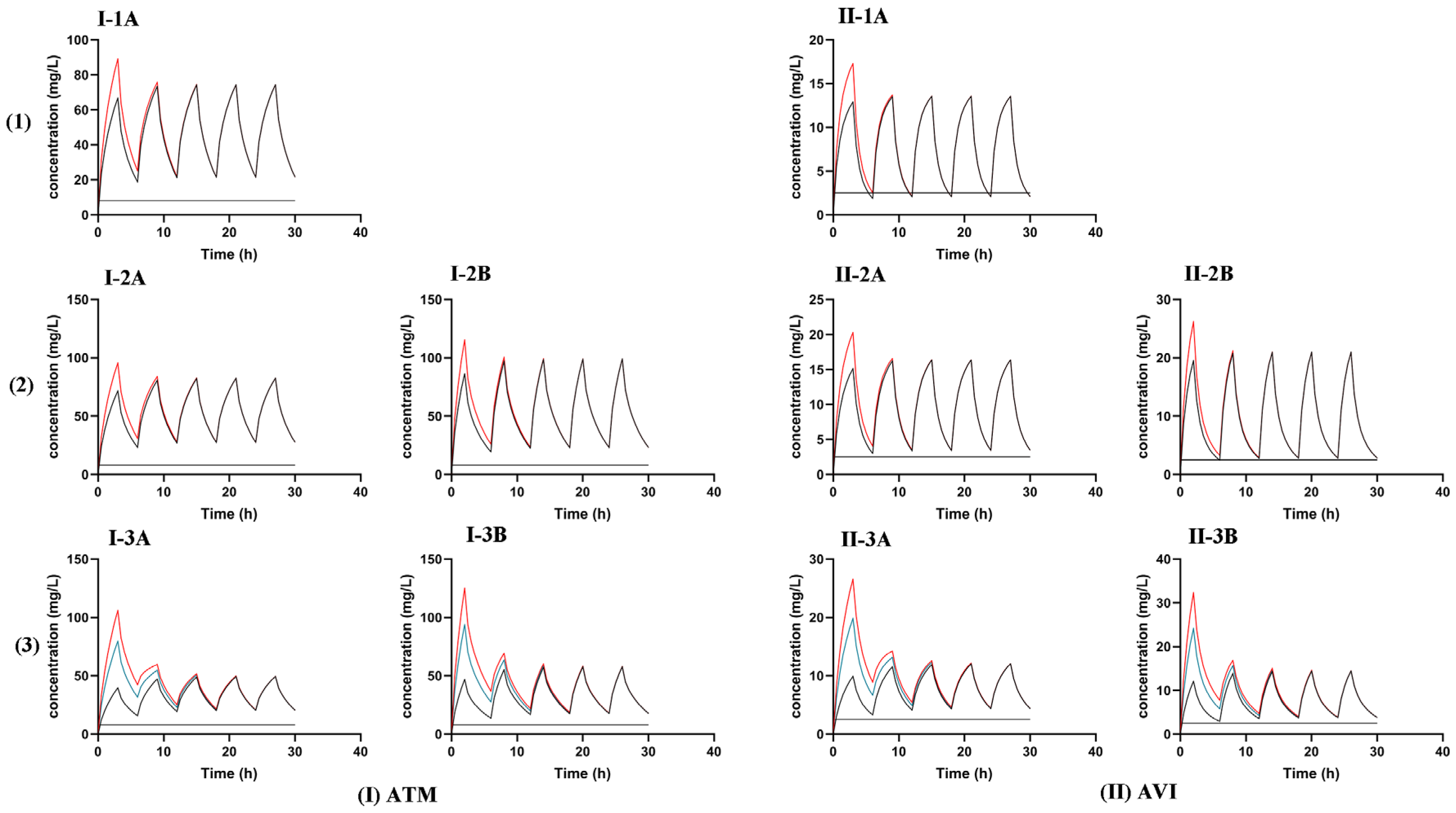
2.4. Loading Dose Evaluation
3. Discussion
4. Materials and Methods
4.1. Reconstruction of the PopPK Models
4.2. External Validation of the PopPK Models
4.3. Monte Carlo Simulation
4.4. PK/PD Target Definition
5. Conclusions
Supplementary Materials
Author Contributions
Funding
Institutional Review Board Statement
Informed Consent Statement
Data Availability Statement
Conflicts of Interest
Abbreviations
| Abbreviation | Full term |
| ATM | aztreonam |
| AVI | avibactam |
| AUC | area under the concentration-time curve |
| CL | clearance |
| CrCL | creatinine clearance |
| CRE | carbapenem-resistant Enterobacterales |
| CT | pharmacodynamic threshold concentration |
| F20/F30 | Proportions of predicted concentrations within 20%/30% of observed values. |
| FDA | U.S. Food and Drug Administration |
| fT > MIC | percentage of dosing interval that free drug concentration remains above the minimum inhibitory concentration |
| fT > CT | percentage of dosing interval that free drug concentration remains above the critical threshold concentration |
| MBL | metallo-β-lactamase |
| MBL-CRE | metallo-β-lactamase-producing carbapenem-resistant Enterobacterales |
| MIC | minimum inhibitory concentration |
| MCS | Monte Carlo simulation |
| MAPE% | mean absolute prediction error percentage |
| MPE% | mean prediction error percentage |
| PK/PD | pharmacokinetic/pharmacodynamic |
| PopPK | population pharmacokinetic |
| PTA | probability of target attainment |
| Q | intercompartmental clearance |
| V | central volume of distribution |
| Vp | peripheral volume of distribution |
| WT | body weight |
References
- Hidalgo-Tenorio, C.; Bou, G.; Oliver, A.; Rodríguez-Aguirregabiria, M.; Salavert, M.; Martínez-Martínez, L. The Challenge of Treating Infections Caused by Metallo-β-Lactamase-Producing Gram-Negative Bacteria: A Narrative Review. Drugs 2024, 84, 1519–1539. [Google Scholar] [CrossRef] [PubMed]
- Fresán, D.; Gracia-Arnillas, M.P.; Iriarte Zugasti, A.; Raich Gual, C.; Comajuán Mendoza, C.; Acer, M.; Muñoz-Bermudez, R.; Montero, M.M.; Sorlí, L.; Luque, S. Pharmacokinetics of aztreonam/avibactam in a critically ill patient with a class B metallo-β-lactamase producing Enterobacteriaceae and receiving continuous renal replacement therapy. J. Antimicrob. Chemother. 2025, 80, 3469–3471. [Google Scholar] [CrossRef]
- Shirley, M. Aztreonam-Avibactam: A Review in the Treatment of Serious Bacterial Infections Caused by Aerobic Gram-Negative Organisms. Drugs 2026, 86, 79–91. [Google Scholar] [CrossRef]
- Yahav, D.; Giske, C.G.; Grāmatniece, A.; Abodakpi, H.; Tam, V.H.; Leibovici, L. New β-Lactam-β-Lactamase Inhibitor Combinations. Clin. Microbiol. Rev. 2021, 34, e115–e121, Erratum in Clin. Microbiol. Rev. 2021, 34, e00115-20. [Google Scholar] [CrossRef]
- Al Musawa, M.; Bleick, C.R.; Herbin, S.R.; Caniff, K.E.; Van Helden, S.R.; Rybak, M.J. Aztreonam–avibactam: The dynamic duo against multidrug-resistant gram-negative pathogens. Pharmacother. J. Hum. Pharmacol. Drug Ther. 2024, 44, 927–938. [Google Scholar] [CrossRef] [PubMed]
- Pai Mangalore, R.; Peel, T.N.; Udy, A.A.; Peleg, A.Y. The clinical application of beta-lactam antibiotic therapeutic drug monitoring in the critical care setting. J. Antimicrob. Chemother. 2023, 78, 2395–2405. [Google Scholar] [CrossRef]
- Pfizer Inc. Aztreonam and Avibactam for Injection; Package Insert; Pfizer Inc.: New York, NY, USA, 2025. [Google Scholar]
- Sangiorgio, G.; Calvo, M.; Stefani, S. Aztreonam and avibactam combination therapy for metallo-β-lactamase-producing gram-negative bacteria: A Narrative Review. Clin. Microbiol. Infect. 2025, 31, 971–978. [Google Scholar] [CrossRef]
- Trang, M.; Dudley, M.N.; Bhavnani, S.M. Use of Monte Carlo simulation and considerations for PK-PD targets to support antibacterial dose selection. Curr. Opin. Pharmacol. 2017, 36, 107–113. [Google Scholar] [CrossRef] [PubMed]
- Fromage, Y.; Sayadi, H.; Labriffe, M.; Monchaud, C.; Codde, C.; Woillard, J. Reducing aztreonam/avibactam waste: Insights from Monte Carlo simulations. J. Antimicrob. Chemother. 2026, 81, f421. [Google Scholar] [CrossRef]
- Xie, R.; Rogers, H.; Chow, J.W.; Soto, E.; Raber, S.R.; Leggett, J.E. Population pharmacokinetic/pharmacodynamic modeling to optimize aztreonam-avibactam dose regimens for adult patients. Antimicrob. Agents Chemother. 2025, 69, e195024. [Google Scholar] [CrossRef]
- Cornely, O.A.; Cisneros, J.M.; Torre-Cisneros, J.; Rodríguez-Hernández, M.J.; Tallón-Aguilar, L.; Calbo, E.; Horcajada, J.P.; Queckenberg, C.; Zettelmeyer, U.; Arenz, D.; et al. Pharmacokinetics and safety of aztreonam/avibactam for the treatment of complicated intra-abdominal infections in hospitalized adults: Results from the REJUVENATE study. J. Antimicrob. Chemother. 2020, 75, 618–627. [Google Scholar] [CrossRef]
- Sisson, T.L.; Jungbluth, G.L.; Hopkins, N.K. A pharmacokinetic evaluation of concomitant administration of linezolid and aztreonam. J. Clin. Pharmacol. 1999, 39, 1277–1282. [Google Scholar] [CrossRef]
- Das, S.; Riccobene, T.; Carrothers, T.J.; Wright, J.G.; MacPherson, M.; Cristinacce, A.; McFadyen, L.; Xie, R.; Luckey, A.; Raber, S. Dose selection for aztreonam-avibactam, including adjustments for renal impairment, for Phase IIa and Phase III evaluation. Eur. J. Clin. Pharmacol. 2024, 80, 529–543. [Google Scholar] [CrossRef] [PubMed]
- Nichols, W.W.; Newell, P.; Critchley, I.A.; Riccobene, T.; Das, S. Avibactam Pharmacokinetic/Pharmacodynamic Targets. Antimicrob. Agents Chemother. 2018, 62, e2417–e2446. [Google Scholar] [CrossRef] [PubMed]
- Greppmair, S.; Brinkmann, A.; Roehr, A.; Frey, O.; Hagel, S.; Dorn, C.; Marsot, A.; El-Haffaf, I.; Zoller, M.; Saller, T.; et al. Towards model-informed precision dosing of piperacillin: Multicenter systematic external evaluation of pharmacokinetic models in critically ill adults with a focus on Bayesian forecasting. Intensiv. Care Med. 2023, 49, 966–976. [Google Scholar] [CrossRef]
- McCann, S.; Helfer, V.E.; Balevic, S.J.; Hornik, C.D.; Goldstein, S.L.; Autmizguine, J.; Meyer, M.; Al-Uzri, A.; Anderson, S.G.; Payne, E.H.; et al. Using Real-World Data to Externally Evaluate Population Pharmacokinetic Models of Dexmedetomidine in Children and Infants. J. Clin. Pharmacol. 2024, 64, 963–974. [Google Scholar] [CrossRef]
- Yang, N.; Wang, J.; Xie, Y.; Ding, J.; Wu, C.; Liu, J.; Pei, Q. External Evaluation of Population Pharmacokinetic Models to Inform Precision Dosing of Meropenem in Critically Ill Patients. Front. Pharmacol. 2022, 13, 838205. [Google Scholar] [CrossRef]
- Trozzi, I.; Giorgi, B.; De Paola, R.; Gatti, M.; Pea, F. Accurate and Sensitive UHPLC-Tandem Mass Spectrometry Sequential Methods for Therapeutic Drug Monitoring of Aztreonam/Avibactam in Human Plasma. Pharmaceutics 2026, 18, 377. [Google Scholar] [CrossRef] [PubMed]
- Barrasa, H.; Morán, M.A.; Fernández-Ciriza, L.; Isla, A.; Solinís, M.Á.; Canut-Blasco, A.; Rodríguez-Gascón, A. Optimizing Antibiotic Therapy for Stenotrophomonas maltophilia Infections in Critically Ill Patients: A Pharmacokinetic/Pharmacodynamic Approach. Antibiotics 2024, 13, 553. [Google Scholar] [CrossRef]
- European Medicines Agency. Assessment Report: Emblaveo (Aztreonam/Avibactam); EMA: Amsterdam, The Netherlands, 2024. [Google Scholar]
- Principe, L.; Lupia, T.; Andriani, L.; Campanile, F.; Carcione, D.; Corcione, S.; De Rosa, F.G.; Luzzati, R.; Stroffolini, G.; Steyde, M.; et al. Microbiological, Clinical, and PK/PD Features of the New Anti-Gram-Negative Antibiotics: β-Lactam/β-Lactamase Inhibitors in Combination and Cefiderocol-An All-Inclusive Guide for Clinicians. Pharmaceuticals 2022, 15, 463. [Google Scholar] [CrossRef]
- Singh, R.; Kim, A.; Tanudra, M.A.; Harris, J.J.; McLaughlin, R.E.; Patey, S.; O’Donnell, J.P.; Bradford, P.A.; Eakin, A.E. Pharmacokinetics/pharmacodynamics of a β-lactam and β-lactamase inhibitor combination: A novel approach for aztreonam/avibactam. J. Antimicrob. Chemother. 2015, 70, 2618–2626. [Google Scholar] [CrossRef]



| Drug | CrCL > 80 mL/min | CrCL ≤ 80 mL/min |
|---|---|---|
| Aztreonam | V = tvV · (WT/70) · exp(ηV) Vp = tvVp · (WT/70) CL = tvCL · (WT/70)0.75 · [1 + (CrCL − 80) · Slope(CrCL on CL)] · exp(ηCL) Q = tvQ · (WT/70)0.75 | V = tvV · (WT/70) · exp(ηV) Vp = tvVp · (WT/70) CL = tvCL · (WT/70)0.75 · (CrCL/80)(CrCL on CL) · exp(ηCL) Q = tvQ · (WT/70)0.75 |
| Avibactam | V = tvV · (WT/70) · exp(ηV) Vp = tvVp · (WT/70) · exp(ηVp) CL = tvCL · (WT/70)0.75 × [1 + (CrCL − 80) × Slope(CrCL on CL)] · exp(ηCL) Q = tvQ · (WT/70)0.75 · exp(ηQ) | V = tvV · (WT/70) · exp(ηV) Vp = tvVp · (WT/70) · exp(ηVp) CL = tvCL · (WT/70)0.75 · (CrCL/80)(CrCL on CL) · exp(ηCL) Q = tvQ · (WT/70)0.75 · exp(ηQ) |
| Reference | Drug | Dosing Regimen | Study Population (Weight, Renal Function) | Number of Data Points and Sampling Schedule | External Validation Results |
|---|---|---|---|---|---|
| #1 [12] | Aztreonam/avibactam | loading dose, 500/167 mg (30 min IV infusion) maintenance dose, 1500/500 mg (3 h IV infusion, q6h) | 18 patients Weight (kg): 79.0 (55.0–100.0) CrCL (mL/min): 110.1 (40.2–182.4) | n = 6 (Aztreonam) n = 6 (Avibactam) Sampling time points: 1, 2, 3, 4, 5, and 6 h after multi-dose administration | MPE% = 16.8%; −18.8% MAPE% = 18.4%; 16.6% F20 = 50%; 66.7% F30 = 100%; 66.7% |
| #2 [13] | Aztreonam | 1000 mg (100 mL), concomitantly infused over 30 min | 13 healthy subjects Weight (kg): 70 CrCL (mL/min): 90 | n = 11 (Aztreonam) Sampling time points: 0.4, 0.75, 1, 1.5, 2, 3, 4, 6, 8, 10, and 12 h after single-dose administration | MPE% = 13.9% MAPE% = 21.8% F20 = 63.6% F30 = 100% |
| Renal Subgroup | Analyte | Maintenance Regimen | Loading Strategy | Dose 1 PTA (%) | Dose 2 PTA (%) | Steady State PTA (%) | Acceptable? | Interpretation |
|---|---|---|---|---|---|---|---|---|
| CrCL 81–100 mL/min | Aztreonam | q6h, 3 h | 2.0/0.67 g loading | 98.02 | 96.66 | 97.08 | Yes | PTA remained >90%. |
| Avibactam | 95.80 | 89.44 | 93.12 | Second-dose PTA at the borderline | ||||
| Aztreonam | q6h, 3 h | No loading | 96.86 | 97.08 | 97.08 | Yes | PTA remained >90%. | |
| Avibactam | 91.99 | 89.11 | 93.12 | Second-dose PTA at the borderline | ||||
| CrCL 51–80 mL/min | Aztreonam | q6h, 3 h | 2.0/0.67 g loading | 99.11 | 98.39 | 98.36 | Yes | PTA remained >90%. |
| Avibactam | 99.80 | 98.29 | 99.44 | |||||
| Aztreonam | q6h, 3 h | No loading | 98.30 | 98.36 | 98.36 | Yes | Loading omission had little impact. | |
| Avibactam | 99.30 | 98.21 | 99.44 | |||||
| Aztreonam | q6h, 2 h | 2.0/0.67 g loading | 95.77 | 94.80 | 94.76 | Yes | Shortened infusion remained acceptable. | |
| Avibactam | 95.09 | 91.67 | 93.41 | |||||
| Aztreonam | q6h, 2 h | No loading | 94.60 | 94.76 | 94.76 | Yes | Shortened infusion remained acceptable. | |
| Avibactam | 91.71 | 91.13 | 93.41 | Selective omission of loading supported | ||||
| CrCL 31–50 mL/min | Aztreonam | q6h, 3 h | 2.0/0.67 g loading | 99.30 | 99.14 | 98.34 | Yes | Labeled loading clearly acceptable. |
| Avibactam | 99.94 | 97.42 | 97.12 | |||||
| Aztreonam | q6h, 3 h | 1.5/0.5 g loading | 99.24 | 99.06 | 98.34 | Yes | Packaging-matched loading acceptable. | |
| Avibactam | 99.74 | 96.60 | 97.12 | |||||
| Aztreonam | q6h, 3 h | No loading | 97.90 | 98.38 | 98.34 | Yes | No loading acceptable under q6h/3 h. | |
| Avibactam | 94.02 | 96.07 | 97.12 | |||||
| Aztreonam | q6h, 2 h | 2.0/0.67 g loading | 99.70 | 96.64 | 96.16 | Yes | Shortened infusion acceptable | |
| Avibactam | 98.26 | 91.92 | 91.44 | |||||
| Aztreonam | q6h, 2 h | 1.5/0.5 g loading | 99.28 | 96.52 | 96.16 | Yes | Packaging-matched loading acceptable. Improved dose 1 exposure, but second-dose PTA at the borderline. | |
| Avibactam | 96.46 | 89.94 | 91.44 | |||||
| Aztreonam | q6h, 2 h | No loading | 95.14 | 96.10 | 96.16 | No | The joint PTA of the first and second dose < 90% | |
| Avibactam | 86.39 | 89.43 | 91.44 |
Disclaimer/Publisher’s Note: The statements, opinions and data contained in all publications are solely those of the individual author(s) and contributor(s) and not of MDPI and/or the editor(s). MDPI and/or the editor(s) disclaim responsibility for any injury to people or property resulting from any ideas, methods, instructions or products referred to in the content. |
© 2026 by the authors. Licensee MDPI, Basel, Switzerland. This article is an open access article distributed under the terms and conditions of the Creative Commons Attribution (CC BY) license.
Share and Cite
Yang, P.; Zhang, X.; Chen, Y.; Zhou, C.; Zhai, S. Dosing Regimen Optimization of Aztreonam/Avibactam According to Renal Function Stratification: A Population Pharmacokinetic-Guided Simulation Study. Antibiotics 2026, 15, 576. https://doi.org/10.3390/antibiotics15060576
Yang P, Zhang X, Chen Y, Zhou C, Zhai S. Dosing Regimen Optimization of Aztreonam/Avibactam According to Renal Function Stratification: A Population Pharmacokinetic-Guided Simulation Study. Antibiotics. 2026; 15(6):576. https://doi.org/10.3390/antibiotics15060576
Chicago/Turabian StyleYang, Ping, Xianhua Zhang, Yufei Chen, Congya Zhou, and Suodi Zhai. 2026. "Dosing Regimen Optimization of Aztreonam/Avibactam According to Renal Function Stratification: A Population Pharmacokinetic-Guided Simulation Study" Antibiotics 15, no. 6: 576. https://doi.org/10.3390/antibiotics15060576
APA StyleYang, P., Zhang, X., Chen, Y., Zhou, C., & Zhai, S. (2026). Dosing Regimen Optimization of Aztreonam/Avibactam According to Renal Function Stratification: A Population Pharmacokinetic-Guided Simulation Study. Antibiotics, 15(6), 576. https://doi.org/10.3390/antibiotics15060576