From Environmental Organism to Nosocomial Threat: Serratia spp. in the Era of Antimicrobial Resistance and Therapeutic Innovation

Abstract
1. Introduction
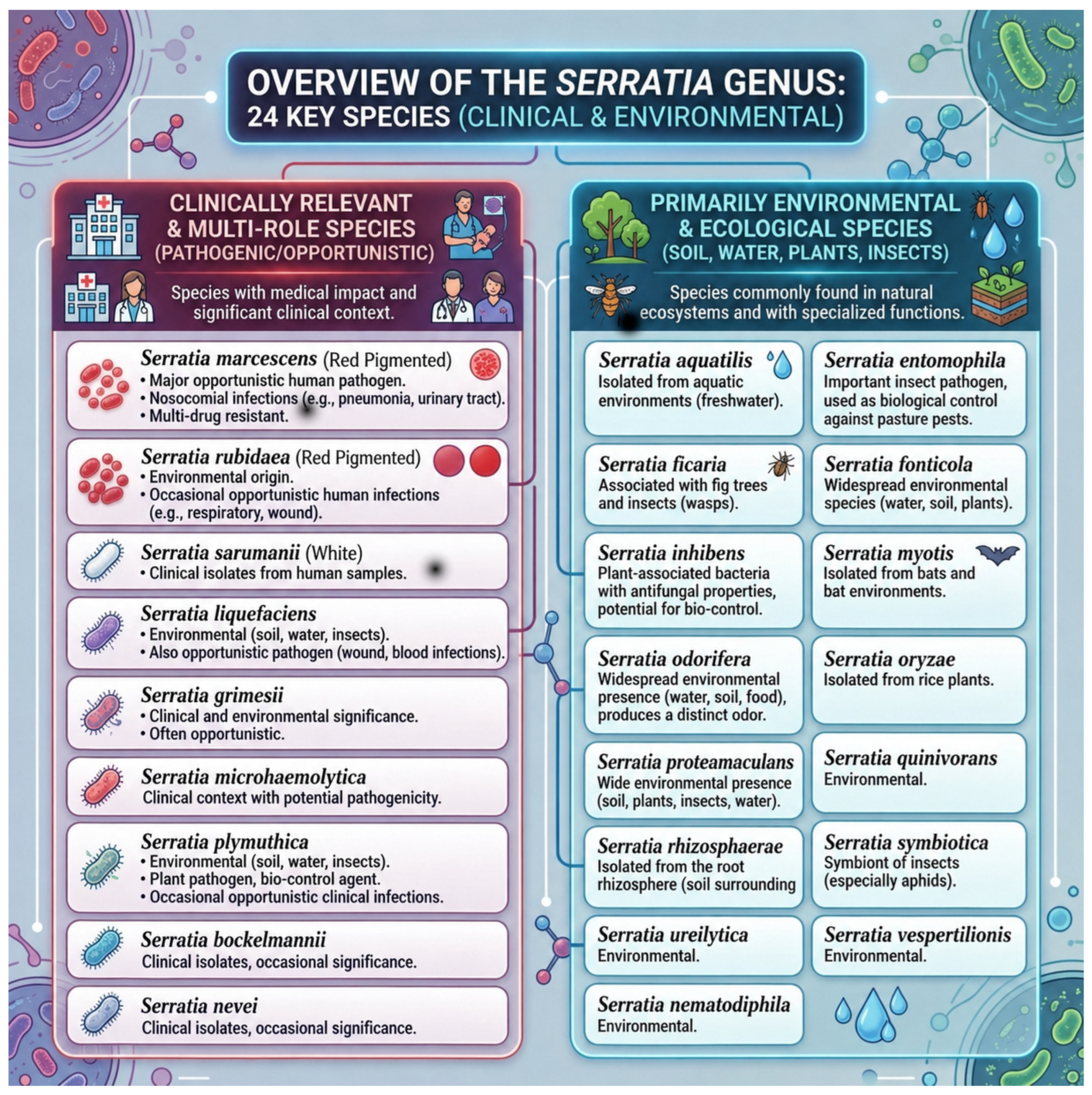
2. Taxonomy, Phenotypic Characteristics, and Ecology of Serratia spp.
2.1. Taxonomic Classification
2.2. Phenotypic Characteristics and Virulence Factors of Serratia spp.
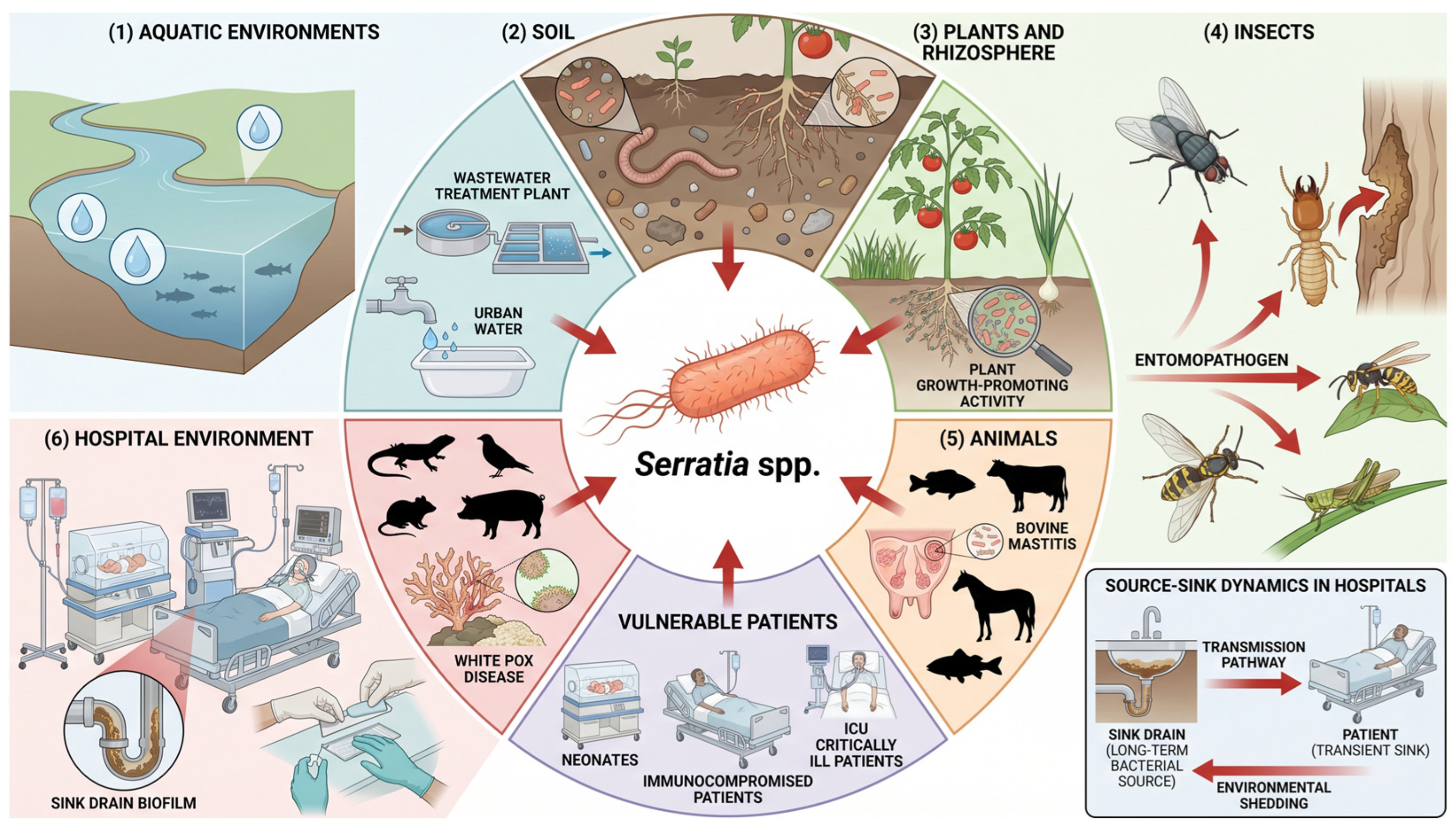
2.3. Environmental, Animal, and Healthcare-Associated Reservoirs of Serratia spp.
3. Clinical Significance of Serratia spp.
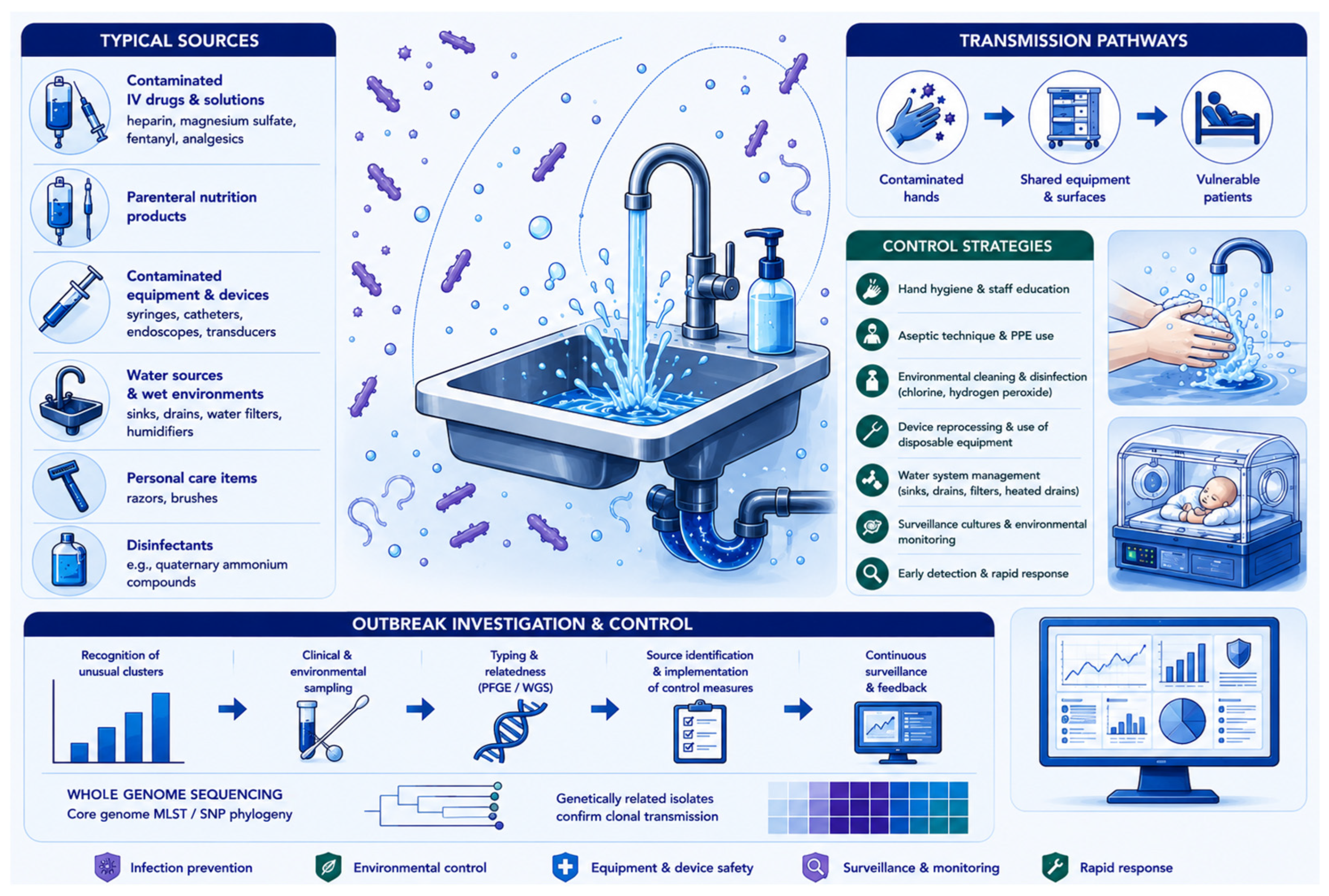
4. Hospital Outbreaks and Infection Control
5. Intrinsic Resistance
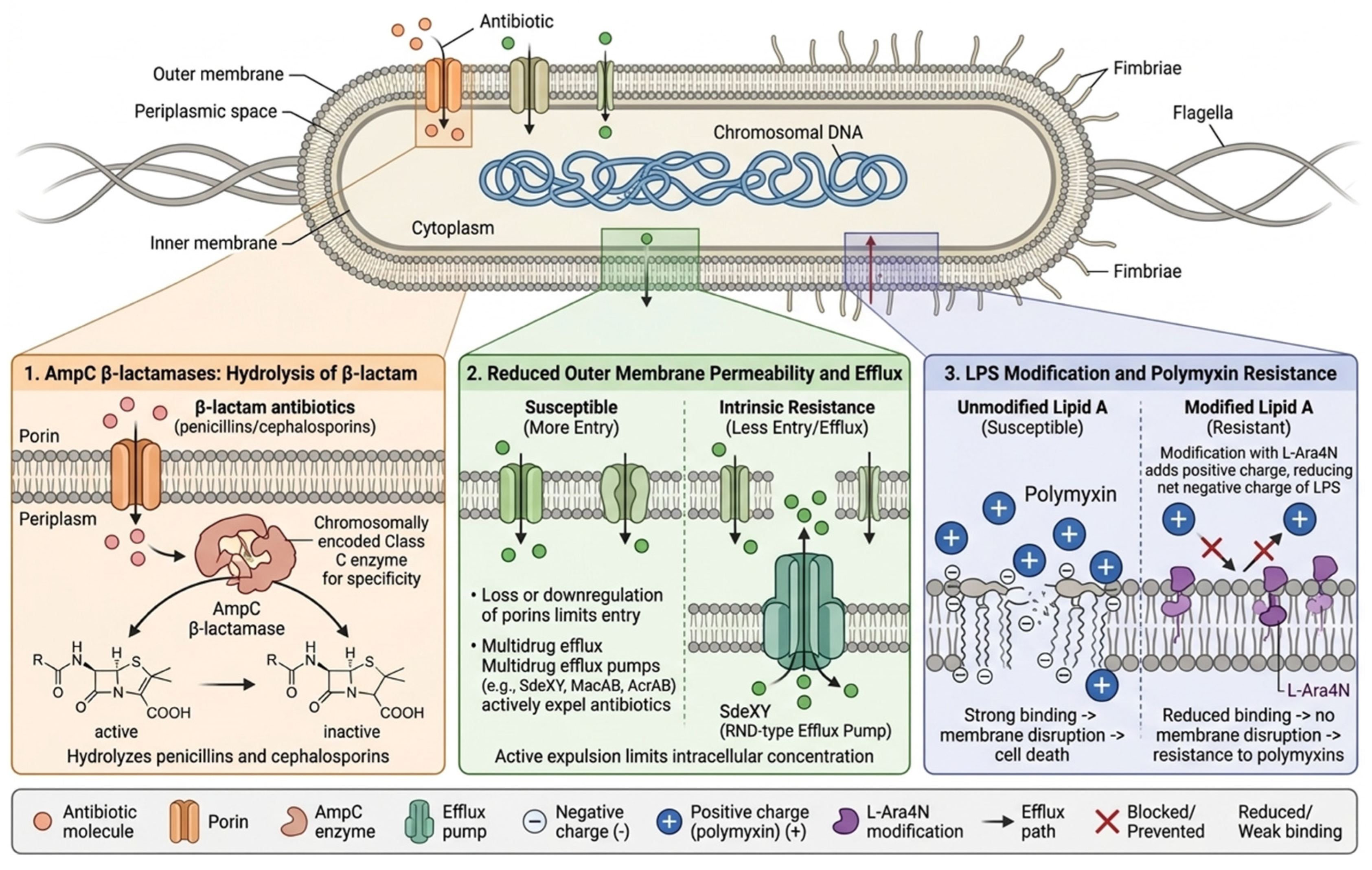
5.1. AmpC β-Lactamases
5.2. Reduced Permeability and Efflux Pumps
5.3. LPS Modification (Polymyxin Resistance)
6. Acquired Resistance Mechanisms
6.1. Extended-Spectrum β-Lactamases
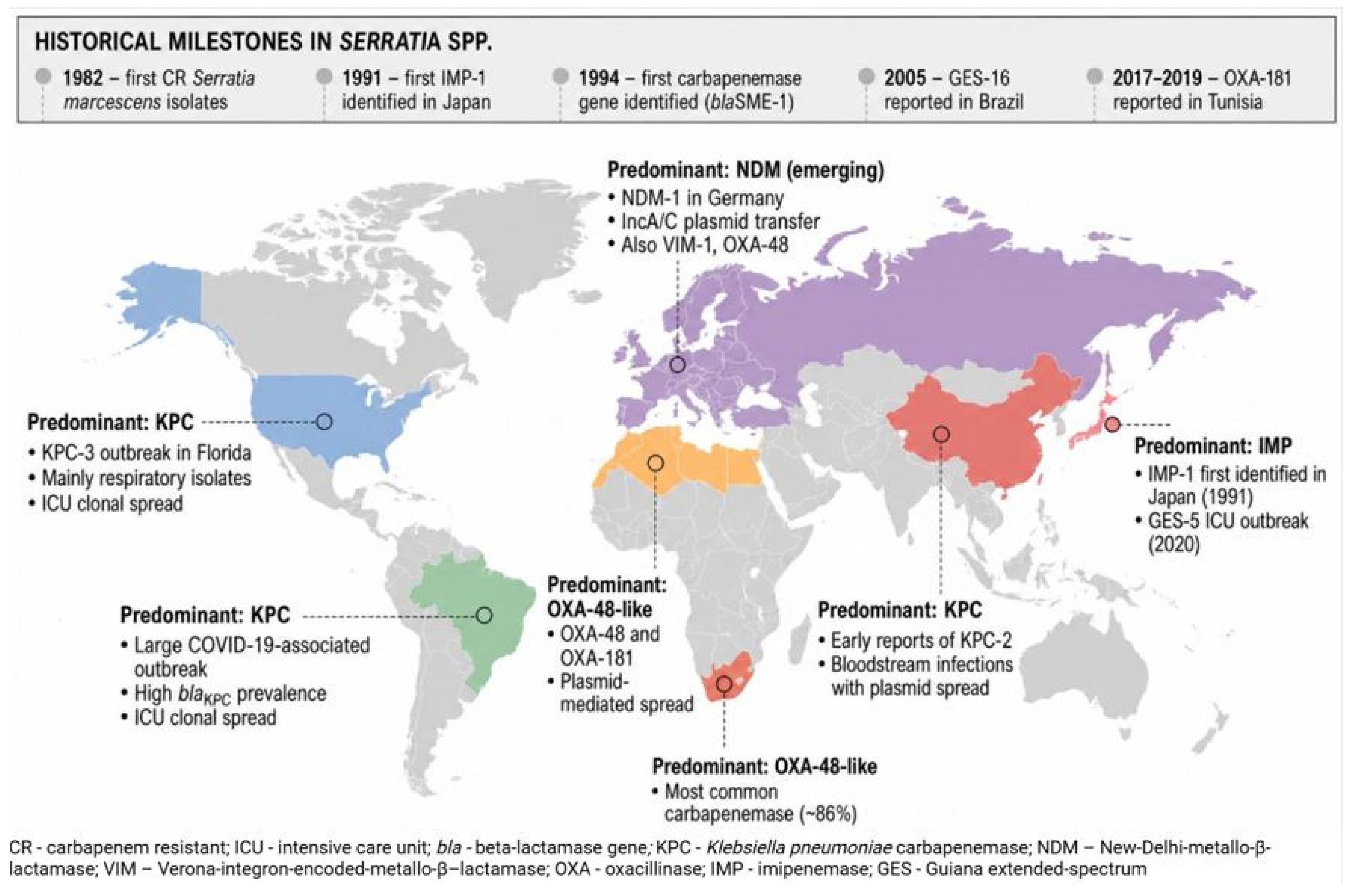
6.2. Carbapenemases
6.3. Non-Carbapenemase-Mediated Carbapenem Resistance
6.4. Other Resistance Mechanisms (Aminoglycosides, Fluoroquinolones)
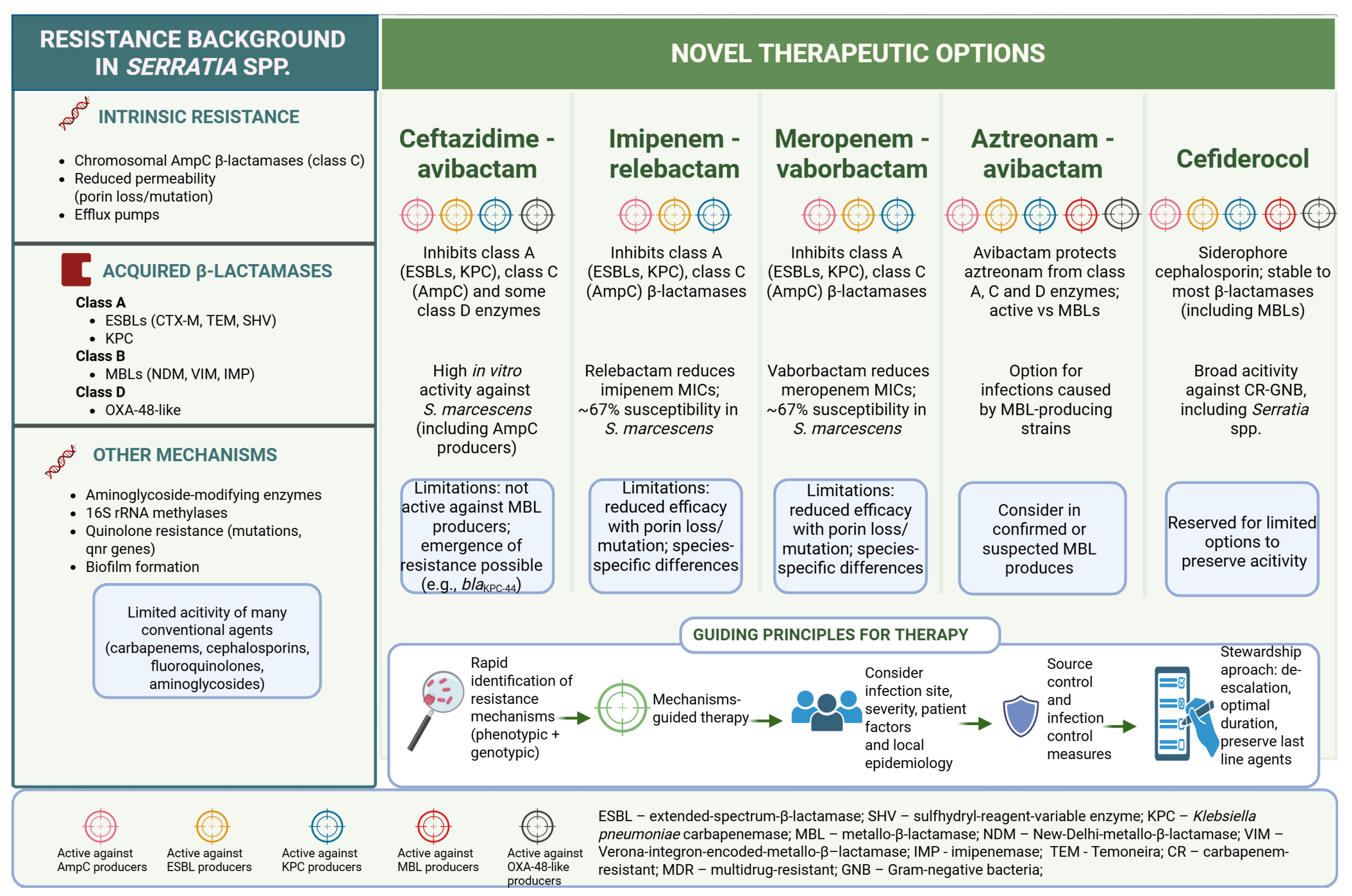
7. Novel Therapeutic Options and Challenges in the Treatment of Serratia spp. Infections
8. Alternative Therapeutic Options
9. Novel and Adjunctive Therapeutic Strategies
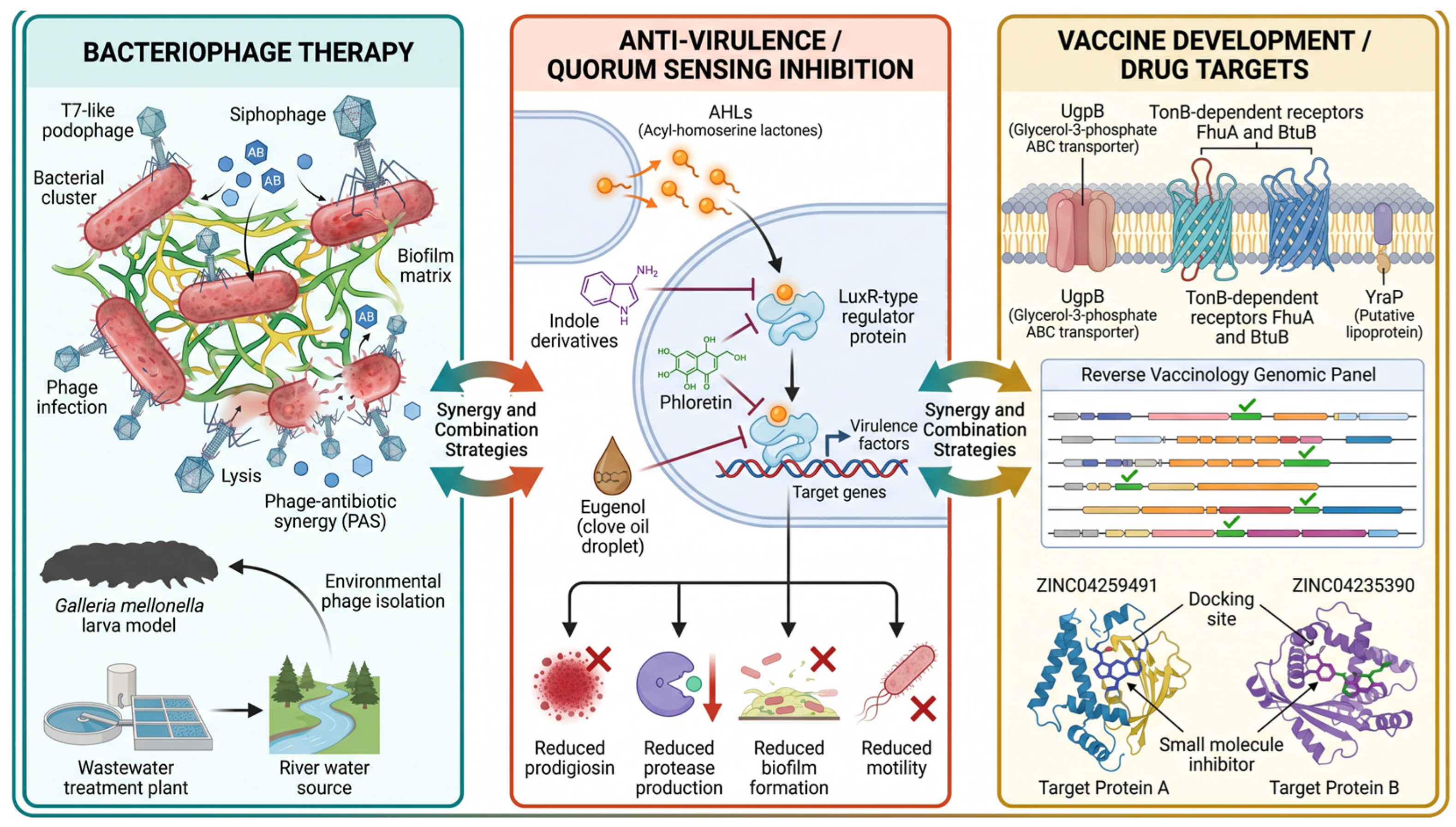
9.1. Bacteriophage Therapy and Phage–Antibiotic Synergy
9.2. Quorum-Sensing Inhibition and Antivirulence Strategies
9.3. Vaccine Development and Novel Drug Targets
10. Future Directions and Research Gaps
11. Conclusions
Author Contributions
Funding
Institutional Review Board Statement
Informed Consent Statement
Data Availability Statement
Acknowledgments
Conflicts of Interest
Abbreviations
| ABC | ATP-binding cassette |
| AHL | Acyl-homoserine lactone |
| AME | Aminoglycoside-modifying enzymes |
| AMR | Antimicrobial resistance |
| BLIC | β-lactamase inhibitor combination |
| BSI | Bloodstream infection |
| CLSI | Clinical and Laboratory Standards Institute |
| CNS | Central nervous system |
| CR | Carbapenem-resistant |
| CU | Chaperone–usher |
| ECDC | European Centre for Disease Prevention and Control |
| EPS | Extracellular polymeric substance |
| ESBL | Extended-spectrum β-lactamase |
| ESCMID | European Society of Clinical Microbiology and Infectious Diseases |
| EUCAST | European Committee on Antimicrobial Susceptibility Testing |
| FDA | Food and Drug Administration |
| HAI | Healthcare-associated infection |
| ICU | Intensive care unit |
| LPS | Lipopolysaccharide |
| MALDI-TOF MS | Matrix-assisted laser desorption/ionization time-of-flight mass spectrometry |
| MATE | Multidrug and toxic compound extrusion |
| MBL | Metallo-β-lactamase |
| MDR | Multidrug resistant |
| MFS | Major facilitator superfamily |
| MIC | Minimum inhibitory concentration |
| MLST | Multilocus sequence typing |
| NICU | Neonatal intensive care units |
| OMP | Outer membrane protein |
| PAS | Phage–antibiotic synergy |
| PDR | Pan-drug-resistant |
| PFGE | Pulsed-field gel electrophoresis |
| PK/PD | Pharmacokinetic/pharmacodynamic |
| QRDR | Quinolone resistance-determining region |
| QS | Quorum sensing |
| RND | Resistance–nodulation–division |
| SMR | Small multidrug resistance |
| SNP | Single-nucleotide polymorphism |
| SSI | Surgical site infections |
| T10SS | The type X secretion system |
| T1SS | The type I secretion system |
| T2SS | The type II secretion system |
| T3SS | The type III secretion system |
| T5SS | The type V secretion system |
| T6SS | The type VI secretion system |
| T8SS | The type VIII secretion system |
| US | United States |
| UTI | Urinary tract infection |
| WGS | Whole-genome sequencing |
| XDR | Extensively drug resistant |
References
- Tavares-Carreon, F.; De Anda-Mora, K.; Rojas-Barrera, I.C.; Andrade, A. Serratia marcescens Antibiotic Resistance Mechanisms of an Opportunistic Pathogen: A Literature Review. PeerJ 2023, 11, e14399. [Google Scholar] [CrossRef] [PubMed]
- Mahlen, S.D. Serratia Infections: From Military Experiments to Current Practice. Clin. Microbiol. Rev. 2011, 24, 755–791. [Google Scholar] [CrossRef] [PubMed]
- Nazzaro, G.; Veraldi, S. Serratia marcescens: An Italian Story. Int. J. Dermatol. 2017, 56, 795–796. [Google Scholar] [CrossRef] [PubMed]
- Khanna, A.; Khanna, M.; Aggarwal, A. Serratia marcescens—A Rare Opportunistic Nosocomial Pathogen and Measures to Limit Its Spread in Hospitalized Patients. J. Clin. Diagn. Res. 2013, 7, 243–246. [Google Scholar] [CrossRef]
- Zivkovic Zaric, R.; Zaric, M.; Sekulic, M.; Zornic, N.; Nesic, J.; Rosic, V.; Vulovic, T.; Spasic, M.; Vuleta, M.; Jovanovic, J.; et al. Antimicrobial Treatment of Serratia marcescens Invasive Infections: Systematic Review. Antibiotics 2023, 12, 367. [Google Scholar] [CrossRef]
- Cosimato, I.; Santella, B.; Rufolo, S.; Sabatini, P.; Galdiero, M.; Capunzo, M.; Boccia, G.; Folliero, V.; Franci, G. Current Epidemiological Status and Antibiotic Resistance Profile of Serratia marcescens. Antibiotics 2024, 13, 323. [Google Scholar] [CrossRef]
- Karampatakis, T.; Tsergouli, K.; Behzadi, P. Carbapenem-Resistant Acinetobacter Baumannii: Virulence Factors, Molecular Epidemiology, and Latest Updates in Treatment Options. Microorganisms 2025, 13, 1983. [Google Scholar] [CrossRef]
- Adeolu, M.; Alnajar, S.; Naushad, S.; Gupta, R.S. Genome-Based Phylogeny and Taxonomy of the “Enterobacteriales”: Proposal for Enterobacterales ord. nov. Divided into the Families Enterobacteriaceae, Erwiniaceae fam. nov., Pectobacteriaceae fam. nov., Yersiniaceae fam. nov., Hafniaceae fam. nov., Morganellaceae fam. nov., and Budviciaceae fam. nov. Int. J. Syst. Evol. Microbiol. 2016, 66, 5575–5599. [Google Scholar] [CrossRef]
- Williams, D.J.; Grimont, P.A.D.; Cazares, A.; Grimont, F.; Ageron, E.; Pettigrew, K.A.; Cazares, D.; Njamkepo, E.; Weill, F.-X.; Heinz, E.; et al. The Genus Serratia Revisited by Genomics. Nat. Commun. 2022, 13, 5195. [Google Scholar] [CrossRef]
- de Araújo, H.W.C.; Fukushima, K.; Takaki, G.M.C. Prodigiosin Production by Serratia marcescens UCP 1549 Using Renewable-Resources as a Low Cost Substrate. Molecules 2010, 15, 6931–6940. [Google Scholar] [CrossRef]
- Ioannou, P.; Alexakis, K.; Spentzouri, D.; Kofteridis, D.P. Infective Endocarditis by Serratia Species: A Systematic Review. J. Chemother. 2022, 34, 347–359. [Google Scholar] [CrossRef]
- Klages, L.J.; Kaup, O.; Busche, T.; Kalinowski, J.; Rückert-Reed, C. Classification of a Novel Serratia Species, Isolated from a Wound Swab in North Rhine-Westphalia: Proposal of Serratia sarumanii sp. nov. Syst. Appl. Microbiol. 2024, 47, 126527. [Google Scholar] [CrossRef]
- Cho, G.-S.; Stein, M.; Brinks, E.; Rathje, J.; Lee, W.; Suh, S.H.; Franz, C.M.A.P. Serratia nevei sp. nov. and Serratia bockelmannii sp. nov., Isolated from Fresh Produce in Germany and Reclassification of Serratia marcescens subsp. sakuensis Ajithkumar et al. 2003 as a Later Heterotypic Synonym of Serratia marcescens subsp. marcescens. Syst. Appl. Microbiol. 2020, 43, 126055. [Google Scholar] [CrossRef] [PubMed]
- Zhang, C.-X.; Yang, S.-Y.; Xu, M.-X.; Sun, J.; Liu, H.; Liu, J.-R.; Liu, H.; Kan, F.; Sun, J.; Lai, R.; et al. Serratia nematodiphila sp. nov., Associated Symbiotically with the Entomopathogenic Nematode Heterorhabditidoides chongmingensis (Rhabditida: Rhabditidae). Int. J. Syst. Evol. Microbiol. 2009, 59, 1603–1608. [Google Scholar] [CrossRef]
- Grimont, P.A.D.; Grimont, F.; Dulong, H.L.C.; Rosnay, D.; Sneath, P.H.A. Taxonomy of the Genus Serratia. J. Gen. Microbiol. 1977, 98, 39–66. [Google Scholar] [CrossRef]
- Boldeanu, L.; Boldeanu, M.V.; Novac, M.B.; Assani, M.-Z.; Radu, L. Serratia marcescens: A Versatile Opportunistic Pathogen with Emerging Clinical and Biotechnological Significance. Int. J. Mol. Sci. 2025, 26, 11479. [Google Scholar] [CrossRef]
- Ballaben, A.S.; de Almeida, O.G.G.; Ferreira, J.C.; de Oliveira Garcia, D.; Doi, Y.; Ernst, R.K.; von Zeska Kress, M.R.; da Costa Darini, A.L. Phenotypic and In Silico Characterization of Carbapenem-Resistant Serratia marcescens Clinical Strains. J. Glob. Antimicrob. Resist. 2025, 42, 105–112. [Google Scholar] [CrossRef]
- De Anda-Mora, K.L.; Tavares-Carreón, F.; Alvarez, C.; Barahona, S.; Becerril-García, M.A.; Treviño-Rangel, R.J.; García-Contreras, R.; Andrade, A. Increased Proteolytic Activity of Serratia marcescens Clinical Isolate HU1848 Is Associated with Higher eepR Expression. Pol. J. Microbiol. 2024, 73, 11–20. [Google Scholar] [CrossRef]
- Pandey, P.; Vavilala, S.L. Deciphering the Mechanisms of Antibacterial and Antibiofilm Potential of Phenolic Compounds against Serratia marcescens. Bioresour. Bioprocess. 2025, 12, 147. [Google Scholar] [CrossRef] [PubMed]
- Ono, T.; Taniguchi, I.; Nakamura, K.; Nagano, D.S.; Nishida, R.; Gotoh, Y.; Ogura, Y.; Sato, M.P.; Iguchi, A.; Murase, K.; et al. Global Population Structure of the Serratia marcescens Complex and Identification of Hospital-Adapted Lineages in the Complex. Microb. Genom. 2022, 8, 793. [Google Scholar] [CrossRef] [PubMed]
- Zhang, Y.; Cao, T.; Zheng, J.; Meng, L.; Gao, S.; Shen, H.; Zhou, W.; Cao, X. Emergence of High-Risk ST595 and ST640 Clones of Carbapenem-Resistant Serratia marcescens: Insights from Genomic and Virulence Profiling during a Nosocomial Epidemic. Front. Microbiol. 2025, 16, 1681911. [Google Scholar] [CrossRef]
- Salim Hamzah, A.; Sami Awayid, H. Analysis of Virulence Genes Sequencing of Serratia marcescens in Iraqi Hospitals. Cell. Mol. Biol. 2023, 69, 162–166. [Google Scholar] [CrossRef] [PubMed]
- Cruz, T.P.; Azevedo, F.K.; Pepato, M.A.; Rizzo, P.S.; Souto, F.J.; Brenig, B.; Góes-Neto, A.; Soares, S.C.; Ramos, R.T.; Azevedo, V.A.; et al. Whole-Genome Sequencing Analysis of Multidrug-Resistant Serratia marcescens Isolates in an Intensive Care Unit in Brazil. J. Infect. Dev. Ctries. 2024, 18, 726–731. [Google Scholar] [CrossRef] [PubMed]
- Behzadi, P. Classical Chaperone-Usher (CU) Adhesive Fimbriome: Uropathogenic Escherichia coli (UPEC) and Urinary Tract Infections (UTIs). Folia Microbiol. 2020, 65, 45–65. [Google Scholar] [CrossRef] [PubMed]
- Bhoite, S.; van Gerven, N.; Chapman, M.R.; Remaut, H. Curli Biogenesis: Bacterial Amyloid Assembly by the Type VIII Secretion Pathway. EcoSal Plus 2019, 8, 37. [Google Scholar] [CrossRef]
- González-Montalvo, M.A.; Tavares-Carreón, F.; González, G.M.; Villanueva-Lozano, H.; García-Romero, I.; Zomosa-Signoret, V.C.; Valvano, M.A.; Andrade, A. Defining Chaperone-Usher Fimbriae Repertoire in Serratia marcescens. Microb. Pathog. 2021, 154, 104857. [Google Scholar] [CrossRef]
- Labbate, M.; Zhu, H.; Thung, L.; Bandara, R.; Larsen, M.R.; Willcox, M.D.P.; Givskov, M.; Rice, S.A.; Kjelleberg, S. Quorum-Sensing Regulation of Adhesion in Serratia marcescens MG1 Is Surface Dependent. J. Bacteriol. 2007, 189, 2702–2711. [Google Scholar] [CrossRef]
- Shanks, R.M.Q.; Stella, N.A.; Kalivoda, E.J.; Doe, M.R.; O’Dee, D.M.; Lathrop, K.L.; Guo, F.L.; Nau, G.J. A Serratia marcescens OxyR Homolog Mediates Surface Attachment and Biofilm Formation. J. Bacteriol. 2007, 189, 7262–7272. [Google Scholar] [CrossRef]
- Kalivoda, E.J.; Stella, N.A.; O’Dee, D.M.; Nau, G.J.; Shanks, R.M.Q. The Cyclic AMP-Dependent Catabolite Repression System of Serratia marcescens Mediates Biofilm Formation through Regulation of Type 1 Fimbriae. Appl. Environ. Microbiol. 2008, 74, 3461–3470. [Google Scholar] [CrossRef]
- Liu, C.; Sun, D.; Zhu, J.; Liu, J.; Liu, W. The Regulation of Bacterial Biofilm Formation by cAMP-CRP: A Mini-Review. Front. Microbiol. 2020, 11, 802. [Google Scholar] [CrossRef]
- Whitfield, C. Biosynthesis and Assembly of Capsular Polysaccharides in Escherichia coli. Annu. Rev. Biochem. 2006, 75, 39–68. [Google Scholar] [CrossRef] [PubMed]
- Anderson, M.T.; Mitchell, L.A.; Zhao, L.; Mobley, H.L.T. Capsule Production and Glucose Metabolism Dictate Fitness during Serratia marcescens Bacteremia. mBio 2017, 8, e00740-17. [Google Scholar] [CrossRef]
- Aucken, H.M.; Wilkinson, S.G.; Pitt, T.L. Re-Evaluation of the Serotypes of Serratia marcescens and Separation into Two Schemes Based on Lipopolysaccharide (O) and Capsular Polysaccharide (K) Antigens. Microbiology 1998, 144, 639–653. [Google Scholar] [CrossRef][Green Version]
- Aucken, H.M.; Wilkinson, S.G.; Pitt, T.L. Identification of Capsular Antigens in Serratia marcescens. J. Clin. Microbiol. 1997, 35, 59–63. [Google Scholar] [CrossRef]
- Weakland, D.R.; Smith, S.N.; Bell, B.; Tripathi, A.; Mobley, H.L.T. The Serratia marcescens Siderophore Serratiochelin Is Necessary for Full Virulence during Bloodstream Infection. Infect. Immun. 2020, 88, e00117-20. [Google Scholar] [CrossRef]
- Vergalli, J.; Bodrenko, I.V.; Masi, M.; Moynié, L.; Acosta-Gutiérrez, S.; Naismith, J.H.; Davin-Regli, A.; Ceccarelli, M.; van den Berg, B.; Winterhalter, M.; et al. Porins and Small-Molecule Translocation across the Outer Membrane of Gram-Negative Bacteria. Nat. Rev. Microbiol. 2020, 18, 164–176. [Google Scholar] [CrossRef]
- Darby, E.M.; Trampari, E.; Siasat, P.; Gaya, M.S.; Alav, I.; Webber, M.A.; Blair, J.M.A. Molecular Mechanisms of Antibiotic Resistance Revisited. Nat. Rev. Microbiol. 2023, 21, 280–295. [Google Scholar] [CrossRef]
- Ferrand, A.; Vergalli, J.; Pagès, J.-M.; Davin-Regli, A. An Intertwined Network of Regulation Controls Membrane Permeability Including Drug Influx and Efflux in Enterobacteriaceae. Microorganisms 2020, 8, 833. [Google Scholar] [CrossRef] [PubMed]
- Chekabab, S.M.; Harel, J.; Dozois, C.M. Interplay between Genetic Regulation of Phosphate Homeostasis and Bacterial Virulence. Virulence 2014, 5, 786–793. [Google Scholar] [CrossRef] [PubMed]
- Begic, S.; Worobec, E.A. Regulation of Serratia marcescens ompF and ompC Porin Genes in Response to Osmotic Stress, Salicylate, Temperature and pH. Microbiology 2006, 152, 485–491. [Google Scholar] [CrossRef]
- Davin-Regli, A.; Pagès, J.-M.; Vergalli, J. The Contribution of Porins to Enterobacterial Drug Resistance. J. Antimicrob. Chemother. 2024, 79, 2460–2470. [Google Scholar] [CrossRef] [PubMed]
- Manrique, P.D.; López, C.A.; Gnanakaran, S.; Rybenkov, V.V.; Zgurskaya, H.I. New Understanding of Multidrug Efflux and Permeation in Antibiotic Resistance, Persistence, and Heteroresistance. Ann. N. Y. Acad. Sci. 2023, 1519, 46–62. [Google Scholar] [CrossRef] [PubMed]
- Acosta-Gutiérrez, S.; Ferrara, L.; Pathania, M.; Masi, M.; Wang, J.; Bodrenko, I.; Zahn, M.; Winterhalter, M.; Stavenger, R.A.; Pagès, J.-M.; et al. Getting Drugs into Gram-Negative Bacteria: Rational Rules for Permeation through General Porins. ACS Infect. Dis. 2018, 4, 1487–1498. [Google Scholar] [CrossRef]
- Choi, U.; Lee, C.-R. Antimicrobial Agents That Inhibit the Outer Membrane Assembly Machines of Gram-Negative Bacteria. J. Microbiol. Biotechnol. 2019, 29, 1–10. [Google Scholar] [CrossRef]
- Delcour, A.H. Outer Membrane Permeability and Antibiotic Resistance. Biochim. Biophys. Acta (BBA)-Proteins Proteom. 2009, 1794, 808–816. [Google Scholar] [CrossRef]
- Nikaido, H.; Rosenberg, E.Y.; Foulds, J. Porin Channels in Escherichia coli: Studies with Beta-Lactams in Intact Cells. J. Bacteriol. 1983, 153, 232–240. [Google Scholar] [CrossRef]
- Lou, H.; Chen, M.; Black, S.S.; Bushell, S.R.; Ceccarelli, M.; Mach, T.; Beis, K.; Low, A.S.; Bamford, V.A.; Booth, I.R.; et al. Altered Antibiotic Transport in OmpC Mutants Isolated from a Series of Clinical Strains of Multi-Drug Resistant E. Coli. PLoS ONE 2011, 6, e25825. [Google Scholar] [CrossRef]
- Kojima, S.; Nikaido, H. High Salt Concentrations Increase Permeability through OmpC Channels of Escherichia coli. J. Biol. Chem. 2014, 289, 26464–26473. [Google Scholar] [CrossRef]
- Sato, M.; Machida, K.; Arikado, E.; Saito, H.; Kakegawa, T.; Kobayashi, H. Expression of Outer Membrane Proteins in Escherichia coli Growing at Acid pH. Appl. Environ. Microbiol. 2000, 66, 943–947. [Google Scholar] [CrossRef]
- Li, X.-Z.; Plésiat, P.; Nikaido, H. The Challenge of Efflux-Mediated Antibiotic Resistance in Gram-Negative Bacteria. Clin. Microbiol. Rev. 2015, 28, 337–418. [Google Scholar] [CrossRef] [PubMed]
- Samsudin, F.; Ortiz-Suarez, M.L.; Piggot, T.J.; Bond, P.J.; Khalid, S. OmpA: A Flexible Clamp for Bacterial Cell Wall Attachment. Structure 2016, 24, 2227–2235. [Google Scholar] [CrossRef] [PubMed]
- Kaeriyama, M.; Machida, K.; Kitakaze, A.; Wang, H.; Lao, Q.; Fukamachi, T.; Saito, H.; Kobayashi, H. OmpC and OmpF Are Required for Growth under Hyperosmotic Stress above pH 8 in Escherichia coli. Lett. Appl. Microbiol. 2006, 42, 195–201. [Google Scholar] [CrossRef]
- Wang, Y.; Wang, L.; Sun, Y.; Chen, Y.; Zhu, L.; Guo, L.; Luo, B.; Wang, H. Disrupted ompC Causes Osmosis Sensitivity of Escherichia coli in Alkaline Medium. J. Genet. Genom. 2007, 34, 1131–1138. [Google Scholar] [CrossRef] [PubMed]
- Sutterlin, H.A.; Shi, H.; May, K.L.; Miguel, A.; Khare, S.; Huang, K.C.; Silhavy, T.J. Disruption of Lipid Homeostasis in the Gram-Negative Cell Envelope Activates a Novel Cell Death Pathway. Proc. Natl. Acad. Sci. USA 2016, 113, E1565–E1574. [Google Scholar] [CrossRef]
- Zhou, G.; Wang, Q.; Wang, Y.; Wen, X.; Peng, H.; Peng, R.; Shi, Q.; Xie, X.; Li, L. Outer Membrane Porins Contribute to Antimicrobial Resistance in Gram-Negative Bacteria. Microorganisms 2023, 11, 1690. [Google Scholar] [CrossRef]
- Hong, H.; Patel, D.R.; Tamm, L.K.; van den Berg, B. The Outer Membrane Protein OmpW Forms an Eight-Stranded Beta-Barrel with a Hydrophobic Channel. J. Biol. Chem. 2006, 281, 7568–7577. [Google Scholar] [CrossRef]
- Albrecht, R.; Zeth, K.; Söding, J.; Lupas, A.; Linke, D. Expression, Crystallization and Preliminary X-Ray Crystallographic Studies of the Outer Membrane Protein OmpW from Escherichia coli. Acta Cryst. F 2006, 62, 415–418. [Google Scholar] [CrossRef] [PubMed]
- McClean, S. Eight Stranded β -Barrel and Related Outer Membrane Proteins: Role in Bacterial Pathogenesis. Protein Pept. Lett. 2012, 19, 1013–1025. [Google Scholar] [CrossRef]
- Singh, R.; Shasany, A.K.; Aggarwal, A.; Sinha, S.; Sisodia, B.S.; Khanuja, S.P.S.; Misra, R. Low Molecular Weight Proteins of Outer Membrane of Salmonella typhimurium Are Immunogenic in Salmonella Induced Reactive Arthritis Revealed by Proteomics. Clin. Exp. Immunol. 2007, 148, 486–493. [Google Scholar] [CrossRef]
- Nandi, B.; Nandy, R.K.; Sarkar, A.; Ghose, A.C. Structural Features, Properties and Regulation of the Outer-Membrane Protein W (OmpW) of Vibrio cholerae. Microbiology 2005, 151, 2975–2986. [Google Scholar] [CrossRef]
- Touw, D.S.; Patel, D.R.; van den Berg, B. The Crystal Structure of OprG from Pseudomonas aeruginosa, a Potential Channel for Transport of Hydrophobic Molecules across the Outer Membrane. PLoS ONE 2010, 5, e15016. [Google Scholar] [CrossRef]
- Ashorn, S.; Raukola, H.; Välineva, T.; Ashorn, M.; Wei, B.; Braun, J.; Rantala, I.; Kaukinen, K.; Luukkaala, T.; Collin, P.; et al. Elevated Serum Anti-Saccharomyces cerevisiae, Anti-I2 and Anti-OmpW Antibody Levels in Patients with Suspicion of Celiac Disease. J. Clin. Immunol. 2008, 28, 486–494. [Google Scholar] [CrossRef] [PubMed]
- Ashorn, S.; Välineva, T.; Kaukinen, K.; Ashorn, M.; Braun, J.; Raukola, H.; Rantala, I.; Collin, P.; Mäki, M.; Luukkaala, T.; et al. Serological Responses to Microbial Antigens in Celiac Disease Patients During a Gluten-Free Diet. J. Clin. Immunol. 2009, 29, 190–195. [Google Scholar] [CrossRef] [PubMed]
- Iltanen, S.; Tervo, L.; Halttunen, T.; Wei, B.; Braun, J.; Rantala, I.; Honkanen, T.; Kronenberg, M.; Cheroutre, H.; Turovskaya, O.; et al. Elevated Serum Anti-I2 and Anti-OmpW Antibody Levels in Children with IBD. Inflamm. Bowel Dis. 2006, 12, 389–394. [Google Scholar] [CrossRef] [PubMed]
- Wei, B.; Dalwadi, H.; Gordon, L.K.; Landers, C.; Bruckner, D.; Targan, S.R.; Braun, J. Molecular Cloning of a Bacteroides caccaeTonB-Linked Outer Membrane Protein Identified by an Inflammatory Bowel Disease Marker Antibody. Infect. Immun. 2001, 69, 6044–6054. [Google Scholar] [CrossRef]
- Behzadi, P.; Behzadi, E.; Ranjbar, R. The Incidence and Prevalence of Crohn’s Disease in Global Scale. SOJ Immunol. 2015, 3, 1–6. [Google Scholar] [CrossRef]
- Dodero, V.I.; Morré, S.A.; Behzadi, P. Editorial: Gut Microbiota and Immunity in Health and Disease: Dysbiosis and Eubiosis’s Effects on the Human Body. Front. Immunol. 2024, 15, 1536258. [Google Scholar] [CrossRef]
- Behzadi, P.; Dodero, V.I.; Golubnitschaja, O. Systemic Inflammation as the Health-Related Communication Tool Between the Human Host and Gut Microbiota in the Framework of Predictive, Preventive, and Personalized Medicine. In All Around Suboptimal Health; Wang, W., Ed.; Advances in Predictive, Preventive and Personalised Medicine; Springer Natur: Cham, Switzerland, 2024; Volume 18, pp. 203–241. ISBN 978-3-031-46890-2. [Google Scholar]
- Behzadi, P.; García-Perdomo, H.A.; Karpiński, T.M. Toll-Like Receptors: General Molecular and Structural Biology. J. Immunol. Res. 2021, 2021, 9914854. [Google Scholar] [CrossRef]
- Mukherjee, S.; Patra, R.; Behzadi, P.; Masotti, A.; Paolini, A.; Sarshar, M. Toll-like Receptor-Guided Therapeutic Intervention of Human Cancers: Molecular and Immunological Perspectives. Front. Immunol. 2023, 14, 1244345. [Google Scholar] [CrossRef]
- Behzadi, P.; Behzadi, E.; Ranjbar, R. IL-12 Family Cytokines: General Characteristics, Pathogenic Microorganisms, Receptors, and Signalling Pathways. Acta Microbiol. Et Immunol. Hung. 2016, 63, 1–25. [Google Scholar] [CrossRef]
- Behzadi, P.; Sameer, A.S.; Nissar, S.; Banday, M.Z.; Gajdács, M.; García-Perdomo, H.A.; Akhtar, K.; Pinheiro, M.; Magnusson, P.; Sarshar, M.; et al. The Interleukin-1 (IL-1) Superfamily Cytokines and Their Single Nucleotide Polymorphisms (SNPs). J. Immunol. Res. 2022, 2022, 2054431. [Google Scholar] [CrossRef] [PubMed]
- Chen, L.; Zhang, L.; Hua, H.; Liu, L.; Mao, Y.; Wang, R. Interactions between Toll-like Receptors Signaling Pathway and Gut Microbiota in Host Homeostasis. Immun. Inflam. Dis. 2024, 12, e1356. [Google Scholar] [CrossRef]
- Behzadi, P.; Chandran, D.; Chakraborty, C.; Bhattacharya, M.; Saikumar, G.; Dhama, K.; Chakraborty, A.; Mukherjee, S.; Sarshar, M. The Dual Role of Toll-like Receptors in COVID-19: Balancing Protective Immunity and Immunopathogenesis. Int. J. Biol. Macromol. 2025, 284, 137836. [Google Scholar] [CrossRef]
- Tursi, A.; Elisei, W.; Picchio, M. Incidence and Prevalence of Inflammatory Bowel Diseases in Gastroenterology Primary Care Setting. Eur. J. Intern. Med. 2013, 24, 852–856. [Google Scholar] [CrossRef] [PubMed]
- Xiao, M.; Lai, Y.; Sun, J.; Chen, G.; Yan, A. Transcriptional Regulation of the Outer Membrane Porin Gene ompW Reveals Its Physiological Role during the Transition from the Aerobic to the Anaerobic Lifestyle of Escherichia coli. Front. Microbiol. 2016, 7, 799. [Google Scholar] [CrossRef]
- Silk, E.; Harding, K.; Mahler, M.; Fineran, P.C.; Meaden, S. Abiotic Environmental Conditions Determine Phage Resistance Outcomes in a Salt-Marsh Bacterium. Philos. Trans. R. Soc. Lond. B Biol. Sci. 2025, 380, 20240071. [Google Scholar] [CrossRef] [PubMed]
- González, G.M.; Andrade, A.; Villanueva-Lozano, H.; Campos-Cortés, C.L.; Becerril-García, M.A.; Montoya, A.M.; Sánchez-González, A.; Bonifaz, A.; Franco-Cendejas, R.; López-Jácome, L.E.; et al. Comparative Analysis of Virulence Profiles of Serratia marcescens Isolated from Diverse Clinical Origins in Mexican Patients. Surg. Infect. 2020, 21, 608–612. [Google Scholar] [CrossRef]
- Khaitlina, S.; Bozhokina, E.; Tsaplina, O.; Efremova, T. Bacterial Actin-Specific Endoproteases Grimelysin and Protealysin as Virulence Factors Contributing to the Invasive Activities of Serratia. Int. J. Mol. Sci. 2020, 21, 4025. [Google Scholar] [CrossRef]
- Tanikawa, T.; Nakagawa, Y.; Matsuyama, T. Transcriptional Downregulator hexS Controlling Prodigiosin and Serrawettin W1 Biosynthesis in Serratia marcescens. Microbiol. Immunol. 2006, 50, 587–596. [Google Scholar] [CrossRef]
- Yaikhan, T.; Suwannasin, S.; Singkhamanan, K.; Chusri, S.; Pomwised, R.; Wonglapsuwan, M.; Surachat, K. Genomic Characterization of Multidrug-Resistant Enterobacteriaceae Clinical Isolates from Southern Thailand Hospitals: Unraveling Antimicrobial Resistance and Virulence Mechanisms. Antibiotics 2024, 13, 531. [Google Scholar] [CrossRef]
- Karampatakis, T.; Tsergouli, K.; Behzadi, P. Carbapenem-Resistant Serratia marcescens: Genomic Plasticity, Virulence Architecture, and the Expanding Threat of Multidrug Resistance. Antibiotics 2026, 15, 359. [Google Scholar] [CrossRef]
- Costa, T.R.D.; Felisberto-Rodrigues, C.; Meir, A.; Prevost, M.S.; Redzej, A.; Trokter, M.; Waksman, G. Secretion Systems in Gram-Negative Bacteria: Structural and Mechanistic Insights. Nat. Rev. Microbiol. 2015, 13, 343–359. [Google Scholar] [CrossRef]
- Kanonenberg, K.; Schwarz, C.K.W.; Schmitt, L. Type I Secretion Systems—A Story of Appendices. Res. Microbiol. 2013, 164, 596–604. [Google Scholar] [CrossRef] [PubMed]
- Piddock, L.J.V. Multidrug-Resistance Efflux Pumps ? Not Just for Resistance. Nat. Rev. Microbiol. 2006, 4, 629–636. [Google Scholar] [CrossRef] [PubMed]
- Kadaba, N.S.; Kaiser, J.T.; Johnson, E.; Lee, A.; Rees, D.C. The High-Affinity E. Coli Methionine ABC Transporter: Structure and Allosteric Regulation. Science 2008, 321, 250–253. [Google Scholar] [CrossRef]
- Shintre, C.A.; Pike, A.C.W.; Li, Q.; Kim, J.-I.; Barr, A.J.; Goubin, S.; Shrestha, L.; Yang, J.; Berridge, G.; Ross, J.; et al. Structures of ABCB10, a Human ATP-Binding Cassette Transporter in Apo- and Nucleotide-Bound States. Proc. Natl. Acad. Sci. USA 2013, 110, 9710–9715. [Google Scholar] [CrossRef]
- Maphosa, S.; Moleleki, L.N.; Motaung, T.E. Bacterial Secretion System Functions: Evidence of Interactions and Downstream Implications. Microbiology 2023, 169, 1326. [Google Scholar] [CrossRef] [PubMed]
- Green, E.R.; Mecsas, J. Bacterial Secretion Systems: An Overview. Microbiol. Spectr. 2016, 4, 1. [Google Scholar] [CrossRef]
- Korotkov, K.V.; Sandkvist, M.; Hol, W.G.J. The Type II Secretion System: Biogenesis, Molecular Architecture and Mechanism. Nat. Rev. Microbiol. 2012, 10, 336–351. [Google Scholar] [CrossRef]
- Voulhoux, R. Involvement of the Twin-Arginine Translocation System in Protein Secretion via the Type II Pathway. EMBO J. 2001, 20, 6735–6741. [Google Scholar] [CrossRef]
- Sauvonnet, N.; Vignon, G.; Pugsley, A.P.; Gounon, P. Pilus Formation and Protein Secretion by the Same Machinery in Escherichia coli. EMBO J. 2000, 19, 2221–2228. [Google Scholar] [CrossRef]
- Sandkvist, M. Type II Secretion and Pathogenesis. Infect. Immun. 2001, 69, 3523–3535. [Google Scholar] [CrossRef]
- Büttner, D. Protein Export According to Schedule: Architecture, Assembly, and Regulation of Type III Secretion Systems from Plant- and Animal-Pathogenic Bacteria. Microbiol. Mol. Biol. Rev. 2012, 76, 262–310. [Google Scholar] [CrossRef]
- Young, B.M.; Young, G.M. YplA Is Exported by the Ysc, Ysa, and Flagellar Type III Secretion Systems of Yersinia enterocolitica. J. Bacteriol. 2002, 184, 1324–1334. [Google Scholar] [CrossRef]
- Young, G.M.; Schmiel, D.H.; Miller, V.L. A New Pathway for the Secretion of Virulence Factors by Bacteria: The Flagellar Export Apparatus Functions as a Protein-Secretion System. Proc. Natl. Acad. Sci. USA 1999, 96, 6456–6461. [Google Scholar] [CrossRef]
- Jiang, L.; Yi, W.; Zhao, Y.; Zhu, N.; Zhao, D.; Peng, Z.; Song, L.; Dong, T.; Jiang, X.; Liu, D.; et al. Comprehensive Genomic Analysis of Type VI Secretion System Diversity and Associated Proteins in Serratia. Microb. Genom. 2025, 11, 1424. [Google Scholar] [CrossRef]
- Reglinski, M.; Hurst, Q.W.; Williams, D.J.; Gierlinski, M.; Şahin, A.T.; Mathers, K.; Ostrowski, A.; Bergkessel, M.; Zachariae, U.; Pitt, S.J.; et al. A Widely-Occurring Family of Pore-Forming Effectors Broadens the Impact of the Serratia Type VI Secretion System. EMBO J. 2025, 44, 6892–6918. [Google Scholar] [CrossRef] [PubMed]
- Golpasand, T.; Keshvari, M.; Behzadi, P. Distribution of Chaperone-Usher Fimbriae and Curli Fimbriae among Uropathogenic Escherichia coli. BMC Microbiol. 2024, 24, 344. [Google Scholar] [CrossRef] [PubMed]
- Behzadi, P.; Behzadi, E. Uropathogenic Escherichia coli: An Ideal Resource for DNA Microarray Probe Designing. In Bioinformatics and Biomedical Engineering; Rojas, I., Ortuño, F., Eds.; Lecture Notes in Computer Science; Springer International Publishing: Cham, Switzerland, 2017; Volume 10209, pp. 12–19. ISBN 978-3-319-56153-0. [Google Scholar]
- Chowdhury, M.; Stansfeld, P.J.; Sargent, F. A Lysis Less Ordinary: The Bacterial Type 10 Secretion System. In Advances in Microbial Physiology; Elsevier: Amsterdam, The Netherlands, 2025; Volume 86, pp. 175–198. ISBN 978-0-443-34383-4. [Google Scholar]
- Hamilton, J.J.; Marlow, V.L.; Owen, R.A.; Costa, M.D.A.A.; Guo, M.; Buchanan, G.; Chandra, G.; Trost, M.; Coulthurst, S.J.; Palmer, T.; et al. A Holin and an Endopeptidase Are Essential for Chitinolytic Protein Secretion in Serratia marcescens. J. Cell Biol. 2014, 207, 615–626. [Google Scholar] [CrossRef] [PubMed]
- Geiger, T.; Lara-Tejero, M.; Xiong, Y.; Galán, J.E. Mechanisms of Substrate Recognition by a Typhoid Toxin Secretion-Associated Muramidase. eLife 2020, 9, e53473. [Google Scholar] [CrossRef]
- Van Houdt, R.; Moons, P.; Aertsen, A.; Jansen, A.; Vanoirbeek, K.; Daykin, M.; Williams, P.; Michiels, C.W. Characterization of a luxI/luxR-Type Quorum Sensing System and N-Acyl-Homoserine Lactone-Dependent Regulation of Exo-Enzyme and Antibacterial Component Production in Serratia Plymuthica RVH1. Res. Microbiol. 2007, 158, 150–158. [Google Scholar] [CrossRef]
- Hejazi, A.; Falkiner, F.R. Serratia marcescens. J. Med. Microbiol. 1997, 46, 903–912. [Google Scholar] [CrossRef]
- Grimont, P.A.; Grimont, F. The Genus Serratia. Annu. Rev. Microbiol. 1978, 32, 221–248. [Google Scholar] [CrossRef]
- Iguchi, A.; Nagaya, Y.; Pradel, E.; Ooka, T.; Ogura, Y.; Katsura, K.; Kurokawa, K.; Oshima, K.; Hattori, M.; Parkhill, J.; et al. Genome Evolution and Plasticity of Serratia marcescens, an Important Multidrug-Resistant Nosocomial Pathogen. Genome Biol. Evol. 2014, 6, 2096–2110. [Google Scholar] [CrossRef]
- Ajithkumar, B.; Ajithkumar, V.P.; Iriye, R.; Doi, Y.; Sakai, T. Spore-Forming Serratia marcescens subsp. Sakuensis subsp. nov., Isolated from a Domestic Wastewater Treatment Tank. Int. J. Syst. Evol. Microbiol. 2003, 53, 253–258. [Google Scholar] [CrossRef]
- Gargallo-Viola, D. Enzyme Polymorphism, Prodigiosin Production, and Plasmid Fingerprints in Clinical and Naturally Occurring Isolates of Serratia marcescens. J. Clin. Microbiol. 1989, 27, 860–868. [Google Scholar] [CrossRef]
- Ashelford, K.E.; Fry, J.C.; Bailey, M.J.; Day, M.J. Characterization of Serratia Isolates from Soil, Ecological Implications and Transfer of Serratia proteamaculans subsp. Quinovora Grimont et al. 1983 to Serratia Quinivorans Corrig., sp. nov. Int. J. Syst. Evol. Microbiol. 2002, 52, 2281–2289. [Google Scholar] [CrossRef]
- Berg, G. Plant–Microbe Interactions Promoting Plant Growth and Health: Perspectives for Controlled Use of Microorganisms in Agriculture. Appl. Microbiol. Biotechnol. 2009, 84, 11–18. [Google Scholar] [CrossRef] [PubMed]
- Sutherland, K.P.; Porter, J.W.; Turner, J.W.; Thomas, B.J.; Looney, E.E.; Luna, T.P.; Meyers, M.K.; Futch, J.C.; Lipp, E.K. Human Sewage Identified as Likely Source of White Pox Disease of the Threatened Caribbean Elkhorn Coral, Acropora Palmata. Environ. Microbiol. 2010, 12, 1122–1131. [Google Scholar] [CrossRef] [PubMed]
- Vygovska, L.; Ushkalov, A.; Zelena, L.; Ushkalov, V.; Sîrbu, C.; Vishovan, Y. Biological Properties of Serratia Liquefaciens 1/2024, Isolated from Chicken. One Health Risk Manag. 2026, 7, 22–38. [Google Scholar] [CrossRef]
- Glare, T.R.; Corbett, G.E.; Sadler, T.J. Association of a Large Plasmid with Amber Disease of the New Zealand Grass Grub, Costelytra Zealandica, Caused by Serratia Entomophila and Serratia Proteamaculans. J. Invertebr. Pathol. 1993, 62, 165–170. [Google Scholar] [CrossRef]
- Kanamori, H.; Weber, D.J.; Rutala, W.A. Healthcare Outbreaks Associated With a Water Reservoir and Infection Prevention Strategies. Clin. Infect. Dis. 2016, 62, 1423–1435. [Google Scholar] [CrossRef]
- Aracil-Gisbert, S.; Fernández-De-Bobadilla, M.D.; Guerra-Pinto, N.; Serrano-Calleja, S.; Pérez-Cobas, A.E.; Soriano, C.; de Pablo, R.; Lanza, V.F.; Pérez-Viso, B.; Reuters, S.; et al. The ICU Environment Contributes to the Endemicity of the “Serratia marcescens Complex” in the Hospital Setting. mBio 2024, 15, e0305423. [Google Scholar] [CrossRef]
- Bourdin, T.; Benoit, M.-È.; Monnier, A.; Bédard, E.; Prévost, M.; Charron, D.; Audy, N.; Gravel, S.; Sicard, M.; Quach, C.; et al. Serratia marcescens Colonization in a Neonatal Intensive Care Unit Has Multiple Sources, with Sink Drains as a Major Reservoir. Appl. Environ. Microbiol. 2023, 89, e0010523. [Google Scholar] [CrossRef]
- Ferguson, D.; Ryder, R.; Lunsford, R.; Dash, A.; Kamali, A.; Kimura, A.; Crandall, J.; Mukhopadhyay, R.; Dowless, H.; Ortiz, N.; et al. Serratia marcescens Outbreak at a Correctional Facility: Environmental Sampling, Laboratory Analyses and Genomic Characterization to Assess Sources and Persistence. Int. J. Environ. Res. Public Health 2023, 20, 6709. [Google Scholar] [CrossRef]
- Monardo, R.; Park, L.P.; Ruffin, F.; Cox, P.; Dinh, A.Q.; Korn, R.E.; Farahani, P.; Ripa, M.; Castagna, A.; Hanson, B.M.; et al. Clinical and Genomic Characterization of Serratia Bloodstream Infections. CMI Commun. 2025, 2, 105128. [Google Scholar] [CrossRef]
- Healthcare-Associated Infections Acquired in Intensive Care Units—Annual Epidemiological Report for 2021. Available online: https://www.ecdc.europa.eu/en/publications-data/healthcare-associated-infections-acquired-intensive-care-units-annual-0 (accessed on 26 March 2026).
- Healthcare-Associated Infections: Surgical Site Infections Annual Epidemiological Report for 2021–2022. Available online: https://www.ecdc.europa.eu/en/publications-data/healthcare-associated-infections-surgical-site-infections-annual-2 (accessed on 25 March 2026).
- Zhu, W.; Chen, X.; Shen, H.; Wei, M.; Yang, C.; Gu, L. Genomic Diversity, Antimicrobial Resistance and Dissemination of Serratia marcescens Complex in Patients Admitted to ICUs. Front. Cell Infect. Microbiol. 2025, 15, 1672468. [Google Scholar] [CrossRef]
- Verhamme, K.M.C.; De Coster, W.; De Roo, L.; De Beenhouwer, H.; Nollet, G.; Verbeke, J.; Demeyer, I.; Jordens, P. Pathogens in Early-Onset and Late-Onset Intensive Care Unit–Acquired Pneumonia. Infect. Control Hosp. Epidemiol. 2007, 28, 389–397. [Google Scholar] [CrossRef]
- Moreno, C.E.L.; Velandia, O.M.M.; Sánchez, C.A.B.; Diaz, J.S.M.; Herazo, J.R.G. Impact of Urinary Catheter on Resistance Patterns and Clinical Outcomes on Complicated Urinary Tract Infection. Int. Urogynecol. J. 2023, 34, 1195–1201. [Google Scholar] [CrossRef]
- Clark, R.B.; Janda, J.M. Isolation of Serratia Plymuthica from a Human Burn Site. J. Clin. Microbiol. 1985, 21, 656–657. [Google Scholar] [CrossRef]
- Posluszny, J.A.; Conrad, P.; Halerz, M.; Shankar, R.; Gamelli, R.L. Surgical Burn Wound Infections and Their Clinical Implications. J. Burn. Care Res. 2011, 32, 324–333. [Google Scholar] [CrossRef]
- Sakkab, R.; MacRae, T.; Nguyen, Q.G.; Ballon-Landa, G. Serratia marcescens Necrotizing Fasciitis of the Ankle: A Case Report. J. Am. Podiatr. Med. Assoc. 2023, 113, 22–113. [Google Scholar] [CrossRef]
- Turgut, H.; Tanrıverdi, E.S.; Karadoğan, E.; Özdemir, R. Healthcare-Associated Conjunctivitis in the NICU: Microbiological Spectrum, Antimicrobial Resistance and Treatment Patterns. Pathogens 2026, 15, 209. [Google Scholar] [CrossRef]
- Wu, Y.-M.; Hsu, P.-C.; Yang, C.-C.; Chang, H.-J.; Ye, J.-J.; Huang, C.-T.; Lee, M.-H. Serratia marcescens Meningitis: Epidemiology, Prognostic Factors and Treatment Outcomes. J. Microbiol. Immunol. Infect. 2013, 46, 259–265. [Google Scholar] [CrossRef]
- Lona-Reyes, J.C.; Miramontes-Buiza, L.; Frías-Flores, L.F.; Regla-Nava, J.A.; González-Carmona, J.; Gallegos-Marín, J.A.; Chávez-Rodríguez, M. Risk Factors Associated with Neonatal Sepsis Due to Serratia marcescens in a Public Hospital in Mexico: A Case-Control Study. Rev. Argent. Microbiol. 2025, 58, 170–174. [Google Scholar] [CrossRef]
- Hu, Y.-Q.; Xue, S.-F.; Yang, R.-Z.; Bao, Y.-W.; Zhang, H.; Hu, J.; Wang, X.; Sun, Y.-Q. Risk Factors for Healthcare-Associated Infection and Colonization of Serratia marcescens in Neonates: A Systematic Review and Meta-Analysis. Antimicrob. Resist. Infect. Control 2025, 15, 4. [Google Scholar] [CrossRef]
- Blossom, D.; Noble-Wang, J.; Su, J.; Pur, S.; Chemaly, R.; Shams, A.; Jensen, B.; Pascoe, N.; Gullion, J.; Casey, E.; et al. Multistate Outbreak of Serratia marcescens Bloodstream Infections Caused by Contamination of Prefilled Heparin and Isotonic Sodium Chloride Solution Syringes. Arch. Intern. Med. 2009, 169, 1705–1711. [Google Scholar] [CrossRef]
- Liu, D.; Zhang, L.-P.; Huang, S.-F.; Wang, Z.; Chen, P.; Wang, H.; Cheng, Y. Outbreak of Serratia marcescens Infection Due to Contamination of Multiple-Dose Vial of Heparin-Saline Solution Used to Flush Deep Venous Catheters or Peripheral Trocars. J. Hosp. Infect. 2011, 77, 175–176. [Google Scholar] [CrossRef]
- Papagianni, M.; Mylona, E.; Kostourou, S.; Kolokotroni, C.; Kounatidis, D.; Vallianou, N.G.; Papastamopoulos, V. An Outbreak of Serratia marcescens in a Cardiothoracic Surgery Unit Associated with an Infected Solution of Pre-Prepared Syringes. Antibiotics 2025, 14, 319. [Google Scholar] [CrossRef]
- Chiang, P.-C.; Wu, T.-L.; Kuo, A.-J.; Huang, Y.-C.; Chung, T.-Y.; Lin, C.-S.; Leu, H.-S.; Su, L.-H. Outbreak of Serratia marcescens Postsurgical Bloodstream Infection Due to Contaminated Intravenous Pain Control Fluids. Int. J. Infect. Dis. 2013, 17, e718–e722. [Google Scholar] [CrossRef]
- Gupta, N.; Hocevar, S.N.; Moulton-Meissner, H.A.; Stevens, K.M.; McIntyre, M.G.; Jensen, B.; Kuhar, D.T.; Noble-Wang, J.A.; Schnatz, R.G.; Becker, S.C.; et al. Outbreak of Serratia marcescens Bloodstream Infections in Patients Receiving Parenteral Nutrition Prepared by a Compounding Pharmacy. Clin. Infect. Dis. 2014, 59, 1–8. [Google Scholar] [CrossRef]
- Hanczvikkel, A.; Tóth, Á.; Kopcsóné Németh, I.A.; Bazsó, O.; Závorszky, L.; Buzgó, L.; Lesinszki, V.; Göbhardter, D.; Ungvári, E.; Damjanova, I.; et al. Nosocomial Outbreak Caused by Disinfectant-Resistant Serratia marcescens in an Adult Intensive Care Unit, Hungary, February to March 2022. Eurosurveillance 2024, 29, 2300492. [Google Scholar] [CrossRef]
- Kim, E.J.; Park, W.B.; Yoon, J.-K.; Cho, W.-S.; Kim, S.J.; Oh, Y.R.; Jun, K.I.; Kang, C.K.; Choe, P.G.; Kim, J.-I.; et al. Outbreak Investigation of Serratia marcescens Neurosurgical Site Infections Associated with a Contaminated Shaving Razors. Antimicrob. Resist. Infect. Control 2020, 9, 64. [Google Scholar] [CrossRef]
- Kakoullis, L.; Economidou, S.; Mehrotra, P.; Panos, G.; Karampitsakos, T.; Stratakos, G.; Tzouvelekis, A.; Sampsonas, F. Bronchoscopy-Related Outbreaks and Pseudo-Outbreaks: A Systematic Review. Infect. Control Hosp. Epidemiol. 2024, 45, 509–519. [Google Scholar] [CrossRef]
- Serruys-Schoutens, E.; Rost, F.; Depré, G. A Nosocomial Epidemic of Serratia Liquefaciens Urinary Tract Infection after Cystometry. Eur. J. Clin. Microbiol. 1984, 3, 316–317. [Google Scholar] [CrossRef]
- Taxt, A.M.; Eldholm, V.; Kols, N.I.; Haugan, M.S.; Raffelsberger, N.; Asfeldt, A.M.; Ingebretsen, A.; Blomfeldt, A.; Kilhus, K.S.; Lindemann, P.C.; et al. A National Outbreak of Serratia marcescens Complex: Investigation Reveals Genomic Population Structure but No Source, Norway, June 2021 to February 2023. Eurosurveillance 2025, 30, 2400291. [Google Scholar] [CrossRef]
- Van Goethem, S.; Xavier, B.B.; Glupczynski, Y.; Berkell, M.; Willems, P.; Van Herendael, B.; Hoet, K.; Plaskie, K.; Van Brusselen, D.; Goossens, H.; et al. Genomic Epidemiological Analysis of a Single-Centre Polyclonal Outbreak of Serratia marcescens, Belgium, 2022 to 2023. Eurosurveillance 2024, 29, 2400144. [Google Scholar] [CrossRef]
- Montagnani, C.; Cocchi, P.; Lega, L.; Campana, S.; Biermann, K.P.; Braggion, C.; Pecile, P.; Chiappini, E.; de Martino, M.; Galli, L. Serratia marcescens Outbreak in a Neonatal Intensive Care Unit: Crucial Role of Implementing Hand Hygiene among External Consultants. BMC Infect. Dis. 2015, 15, 11. [Google Scholar] [CrossRef]
- Guel-Gomez, M.; Angulo-Zamudio, U.A.; Leon-Sicairos, N.; Flores-Villaseñor, H.; Mendívil-Zavala, E.; Plata-Guzmán, A.; Martinez-Garcia, J.J.; Angulo-Rocha, J.; Ochoa-Espinoza, R.; Crespo-Palazuelos, P.; et al. Outbreak of Serratia marcescens in the Neonatal Intensive Care Unit of a Tertiary Care Hospital in Mexico. Adv. Med. 2023, 2023, 3281910. [Google Scholar] [CrossRef]
- Bechmann, L.; Böttger, R.; Baier, C.; Tersteegen, A.; Bauer, K.; Kaasch, A.J.; Geginat, G. Serratia marcescens Outbreak in a Neonatal Intensive Care Unit Associated with Contaminated Donor Milk. Infect. Control Hosp. Epidemiol. 2023, 44, 891–897. [Google Scholar] [CrossRef]
- Maltezou, H.C.; Tryfinopoulou, K.; Katerelos, P.; Ftika, L.; Pappa, O.; Tseroni, M.; Kostis, E.; Kostalos, C.; Prifti, H.; Tzanetou, K.; et al. Consecutive Serratia marcescens Multiclone Outbreaks in a Neonatal Intensive Care Unit. Am. J. Infect. Control 2012, 40, 637–642. [Google Scholar] [CrossRef]
- Karkey, A.; Joshi, N.; Chalise, S.; Joshi, S.; Shrestha, S.; Thi Nguyen, T.N.; Dongol, S.; Basnyat, B.; Baker, S.; Boinett, C.J. Outbreaks of Serratia marcescens and Serratia Rubidaea Bacteremia in a Central Kathmandu Hospital Following the 2015 Earthquakes. Trans. R. Soc. Trop. Med. Hyg. 2018, 112, 467–472. [Google Scholar] [CrossRef]
- Caggiano, G.; Triggiano, F.; Diella, G.; Apollonio, F.; Lopuzzo, M.; Mosca, A.; Stolfa, S.; Pazzani, C.; Oliva, M.; Calia, C.; et al. A Possible Outbreak by Serratia marcescens: Genetic Relatedness between Clinical and Environmental Strains. Int. J. Environ. Res. Public Health 2021, 18, 9814. [Google Scholar] [CrossRef]
- Guo, Q.; Zhao, X.; Ma, J.; Zhou, Y.; Gao, F.; Huang, W.; Sun, L.; Zhu, S.; Li, L.; Sun, H.; et al. Serratia marcescens Outbreak in a Neonatal Intensive Care Unit Associated with Contaminated Handwashing Sinks. Indian J. Med. Microbiol. 2024, 52, 100741. [Google Scholar] [CrossRef]
- Ulrich, N.; Gastmeier, P.; Vonberg, R.-P. Effectiveness of Healthcare Worker Screening in Hospital Outbreaks with Gram-Negative Pathogens: A Systematic Review. Antimicrob. Resist. Infect. Control 2018, 7, 36. [Google Scholar] [CrossRef]
- Jacoby, G.A. AmpC Beta-Lactamases. Clin. Microbiol. Rev. 2009, 22, 161–182. [Google Scholar] [CrossRef]
- Hanson, N.D.; Sanders, C.C. Regulation of Inducible AmpC Beta-Lactamase Expression among Enterobacteriaceae. Curr. Pharm. Des. 1999, 5, 881–894. [Google Scholar]
- Schmidtke, A.J.; Hanson, N.D. Model System to Evaluate the Effect of ampD Mutations on AmpC-Mediated Beta-Lactam Resistance. Antimicrob. Agents Chemother. 2006, 50, 2030–2037. [Google Scholar] [CrossRef]
- Vadlamani, G.; Thomas, M.D.; Patel, T.R.; Donald, L.J.; Reeve, T.M.; Stetefeld, J.; Standing, K.G.; Vocadlo, D.J.; Mark, B.L. The β-Lactamase Gene Regulator AmpR Is a Tetramer That Recognizes and Binds the D-Ala-D-Ala Motif of Its Repressor UDP-N-Acetylmuramic Acid (MurNAc)-Pentapeptide. J. Biol. Chem. 2015, 290, 2630–2643. [Google Scholar] [CrossRef]
- Nikaido, H. Molecular Basis of Bacterial Outer Membrane Permeability Revisited. Microbiol. Mol. Biol. Rev. 2003, 67, 593–656. [Google Scholar] [CrossRef]
- Sánchez, L.; Ruiz, N.; Leranoz, S.; Viñas, M.; Puig, M. The Role of Outer Membrane in Serratia marcescens Intrinsic Resistance to Antibiotics. Microbiologia 1997, 13, 315–320. [Google Scholar]
- Suh, B.; Bae, I.K.; Kim, J.; Jeong, S.H.; Yong, D.; Lee, K. Outbreak of Meropenem-Resistant Serratia marcescens Comediated by Chromosomal AmpC Beta-Lactamase Overproduction and Outer Membrane Protein Loss. Antimicrob. Agents Chemother. 2010, 54, 5057–5061. [Google Scholar] [CrossRef]
- Poirel, L.; Jayol, A.; Nordmann, P. Polymyxins: Antibacterial Activity, Susceptibility Testing, and Resistance Mechanisms Encoded by Plasmids or Chromosomes. Clin. Microbiol. Rev. 2017, 30, 557–596. [Google Scholar] [CrossRef]
- Olaitan, A.O.; Diene, S.M.; Kempf, M.; Berrazeg, M.; Bakour, S.; Gupta, S.K.; Thongmalayvong, B.; Akkhavong, K.; Somphavong, S.; Paboriboune, P.; et al. Worldwide Emergence of Colistin Resistance in Klebsiella Pneumoniae from Healthy Humans and Patients in Lao PDR, Thailand, Israel, Nigeria and France Owing to Inactivation of the PhoP/PhoQ Regulator mgrB: An Epidemiological and Molecular Study. Int. J. Antimicrob. Agents 2014, 44, 500–507. [Google Scholar] [CrossRef]
- Raetz, C.R.H.; Whitfield, C. Lipopolysaccharide Endotoxins. Annu. Rev. Biochem. 2002, 71, 635–700. [Google Scholar] [CrossRef]
- Gunn, J.S. The Salmonella PmrAB Regulon: Lipopolysaccharide Modifications, Antimicrobial Peptide Resistance and More. Trends Microbiol. 2008, 16, 284–290. [Google Scholar] [CrossRef]
- Cannatelli, A.; Giani, T.; D’Andrea, M.M.; Di Pilato, V.; Arena, F.; Conte, V.; Tryfinopoulou, K.; Vatopoulos, A.; Rossolini, G.M.; COLGRIT Study Group. MgrB Inactivation Is a Common Mechanism of Colistin Resistance in KPC-Producing Klebsiella Pneumoniae of Clinical Origin. Antimicrob. Agents Chemother. 2014, 58, 5696–5703. [Google Scholar] [CrossRef]
- Paterson, D.L.; Bonomo, R.A. Extended-Spectrum Beta-Lactamases: A Clinical Update. Clin. Microbiol. Rev. 2005, 18, 657–686. [Google Scholar] [CrossRef]
- Moon, S.H.; Udaondo, Z.; Abram, K.Z.; Li, X.; Yang, X.; DiCaprio, E.L.; Jun, S.-R.; Huang, E. Isolation of AmpC- and Extended Spectrum β-Lactamase-Producing Enterobacterales from Fresh Vegetables in the United States. Food Control 2022, 132, 108559. [Google Scholar] [CrossRef]
- Crivaro, V.; Bagattini, M.; Salza, M.F.; Raimondi, F.; Rossano, F.; Triassi, M.; Zarrilli, R. Risk Factors for Extended-Spectrum Beta-Lactamase-Producing Serratia marcescens and Klebsiella Pneumoniae Acquisition in a Neonatal Intensive Care Unit. J. Hosp. Infect. 2007, 67, 135–141. [Google Scholar] [CrossRef]
- Ivanova, D.; Markovska, R.; Hadjieva, N.; Schneider, I.; Mitov, I.; Bauernfeind, A. Extended-Spectrum Beta-Lactamase-Producing Serratia marcescens Outbreak in a Bulgarian Hospital. J. Hosp. Infect. 2008, 70, 60–65. [Google Scholar] [CrossRef]
- Nagy, E.; Pragai, Z.; Kóczián, Z.; Hajdú, E.; Fodor, E. Investigation of the Presence of Different Broad-Spectrum Beta-Lactamases among Clinical Isolates of Enterobacteriacae. Acta Microbiol. Immunol. Hung. 1998, 45, 433–446. [Google Scholar]
- Naumiuk, L.; Baraniak, A.; Gniadkowski, M.; Krawczyk, B.; Rybak, B.; Sadowy, E.; Samet, A.; Kur, J. Molecular Epidemiology of Serratia marcescens in Two Hospitals in Gdańsk, Poland, over a 5-Year Period. J. Clin. Microbiol. 2004, 42, 3108–3116. [Google Scholar] [CrossRef]
- Pałucha, A.; Mikiewicz, B.; Hryniewicz, W.; Gniadkowski, M. Concurrent Outbreaks of Extended-Spectrum Beta-Lactamase-Producing Organisms of the Family Enterobacteriaceae in a Warsaw Hospital. J. Antimicrob. Chemother. 1999, 44, 489–499. [Google Scholar] [CrossRef][Green Version]
- Bonnet, R.; Sampaio, J.L.; Chanal, C.; Sirot, D.; De Champs, C.; Viallard, J.L.; Labia, R.; Sirot, J. A Novel Class A Extended-Spectrum Beta-Lactamase (BES-1) in Serratia marcescens Isolated in Brazil. Antimicrob. Agents Chemother. 2000, 44, 3061–3068. [Google Scholar] [CrossRef]
- El Aila, N.A.; Al Laham, N.A.; Ayesh, B.M. Prevalence of Extended Spectrum Beta Lactamase and Molecular Detection of blaTEM, blaSHV and blaCTX-M Genotypes among Gram Negative Bacilli Isolates from Pediatric Patient Population in Gaza Strip. BMC Infect. Dis. 2023, 23, 99. [Google Scholar] [CrossRef]
- Cheng, K.-C.; Chuang, Y.-C.; Wu, L.-T.; Huang, G.-C.; Yu, W.-L. Clinical Experiences of the Infections Caused by Extended-Spectrum Beta-Lactamase-Producing Serratia marcescens at a Medical Center in Taiwan. Jpn. J. Infect. Dis. 2006, 59, 147–152. [Google Scholar] [CrossRef]
- Jean, S.-S.; Hsueh, P.-R.; Lee, W.-S.; Chang, H.-T.; Chou, M.-Y.; Chen, I.-S.; Wang, J.-H.; Lin, C.-F.; Shyr, J.-M.; Ko, W.-C.; et al. Nationwide Surveillance of Antimicrobial Resistance among Enterobacteriaceae in Intensive Care Units in Taiwan. Eur. J. Clin. Microbiol. Infect. Dis. 2009, 28, 215–220. [Google Scholar] [CrossRef]
- Choi, S.-H.; Lee, J.E.; Park, S.J.; Kim, M.-N.; Choo, E.J.; Kwak, Y.G.; Jeong, J.-Y.; Woo, J.H.; Kim, N.J.; Kim, Y.S. Prevalence, Microbiology, and Clinical Characteristics of Extended-Spectrum Beta-Lactamase-Producing Enterobacter spp., Serratia marcescens, Citrobacter Freundii, and Morganella Morganii in Korea. Eur. J. Clin. Microbiol. Infect. Dis. 2007, 26, 557–561. [Google Scholar] [CrossRef]
- Kim, S.-Y.; Park, Y.-J.; Yu, J.K.; Kim, Y.S.; Han, K. Prevalence and Characteristics of Aac(6′)-Ib-Cr in AmpC-Producing Enterobacter Cloacae, Citrobacter Freundii, and Serratia marcescens: A Multicenter Study from Korea. Diagn. Microbiol. Infect. Dis. 2009, 63, 314–318. [Google Scholar] [CrossRef]
- Kiratisin, P.; Henprasert, A. Resistance Phenotype-Genotype Correlation and Molecular Epidemiology of Citrobacter, Enterobacter, Proteus, Providencia, Salmonella and Serratia That Carry Extended-Spectrum β-Lactamases with or without Plasmid-Mediated AmpC β-Lactamase Genes in Thailand. Trans. R. Soc. Trop. Med. Hyg. 2011, 105, 46–51. [Google Scholar] [CrossRef] [PubMed]
- Rizvi, M.; Fatima, N.; Rashid, M.; Shukla, I.; Malik, A.; Usman, A.; Siddiqui, S. Extended Spectrum AmpC and Metallo-Beta-Lactamases in Serratia and Citrobacter spp. in a Disc Approximation Assay. J. Infect. Dev. Ctries. 2009, 3, 285–294. [Google Scholar] [CrossRef]
- Empel, J.; Baraniak, A.; Literacka, E.; Mrówka, A.; Fiett, J.; Sadowy, E.; Hryniewicz, W.; Gniadkowski, M.; Beta-PL Study Group. Molecular Survey of Beta-Lactamases Conferring Resistance to Newer Beta-Lactams in Enterobacteriaceae Isolates from Polish Hospitals. Antimicrob. Agents Chemother. 2008, 52, 2449–2454. [Google Scholar] [CrossRef]
- Młynarczyk, A.; Młynarczyk, G.; Pupek, J.; Bilewska, A.; Kawecki, D.; Łuczak, M.; Gozdowska, J.; Durlik, M.; Paczek, L.; Chmura, A.; et al. Serratia marcescens Isolated in 2005 from Clinical Specimens from Patients with Diminished Immunity. Transpl. Proc. 2007, 39, 2879–2882. [Google Scholar] [CrossRef]
- Cantón, R.; Coque, T.M. The CTX-M β-Lactamase Pandemic. Curr. Opin. Microbiol. 2006, 9, 466–475. [Google Scholar] [CrossRef]
- Yang, Y.J.; Wu, P.J.; Livermore, D.M. Biochemical Characterization of a Beta-Lactamase That Hydrolyzes Penems and Carbapenems from Two Serratia marcescens Isolates. Antimicrob. Agents Chemother. 1990, 34, 755–758. [Google Scholar] [CrossRef] [PubMed]
- Naas, T.; Vandel, L.; Sougakoff, W.; Livermore, D.M.; Nordmann, P. Cloning and Sequence Analysis of the Gene for a Carbapenem-Hydrolyzing Class A Beta-Lactamase, Sme-1, from Serratia marcescens S6. Antimicrob. Agents Chemother. 1994, 38, 1262–1270. [Google Scholar] [CrossRef]
- Gruber, T.M.; Göttig, S.; Mark, L.; Christ, S.; Kempf, V.A.J.; Wichelhaus, T.A.; Hamprecht, A. Pathogenicity of Pan-Drug-Resistant Serratia marcescens Harbouring blaNDM-1. J. Antimicrob. Chemother. 2015, 70, 1026–1030. [Google Scholar] [CrossRef] [PubMed]
- Lepuschitz, S.; Sorschag, S.; Springer, B.; Allerberger, F.; Ruppitsch, W. Draft Genome Sequence of Carbapenemase-Producing Serratia marcescens Isolated from a Patient with Chronic Obstructive Pulmonary Disease. Genome Announc. 2017, 5, e01288-17. [Google Scholar] [CrossRef]
- Jimenez, A.; Abbo, L.M.; Martinez, O.; Shukla, B.; Sposato, K.; Iovleva, A.; Fowler, E.L.; McElheny, C.L.; Doi, Y. KPC-3-Producing Serratia marcescens Outbreak between Acute and Long-Term Care Facilities, Florida, USA. Emerg. Infect. Dis. 2020, 26, 2746–2750. [Google Scholar] [CrossRef]
- Pérez-Viso, B.; Hernández-García, M.; Ponce-Alonso, M.; Morosini, M.I.; Ruiz-Garbajosa, P.; Del Campo, R.; Cantón, R. Characterization of Carbapenemase-Producing Serratia marcescens and Whole-Genome Sequencing for Plasmid Typing in a Hospital in Madrid, Spain (2016–18). J. Antimicrob. Chemother. 2021, 76, 110–116. [Google Scholar] [CrossRef] [PubMed]
- Jia, J.; Huang, L.; Zhang, L.; Sheng, Y.; Chu, W.; Xu, H.; Xu, A. Genomic Characterization of Two Carbapenem-Resistant Serratia marcescens Isolates Causing Bacteremia: Emergence of KPC-2-Encoding IncR Plasmids. Front. Cell Infect. Microbiol. 2023, 13, 1075255. [Google Scholar] [CrossRef]
- Khalifa, H.O.; Kayama, S.; Elbediwi, M.; Yu, L.; Hayashi, W.; Sugawara, Y.; Mohamed, M.-Y.I.; Ramadan, H.; Habib, I.; Matsumoto, T.; et al. Genetic Basis of Carbapenem-Resistant Clinical Serratia marcescens in Japan. J. Glob. Antimicrob. Resist. 2025, 42, 28–36. [Google Scholar] [CrossRef]
- da Rocha, L.F.; Rodrigues, G.M.; de Oliveira, G.S.; Echevarria, A.D.; Wink, P.; Volpato, F.; Berdichevski, M.; Lutz, L.; Pereira, D.C.; Barth, A.L.; et al. Molecular Epidemiology of a Carbapenem-Resistant Serratia marcescens Outbreak during the COVID-19 Pandemic. Front. Microbiol. 2025, 16, 1525543. [Google Scholar] [CrossRef] [PubMed]
- do Prado, G.V.B.; Mendes, E.T.; Martins, R.C.R.; Perdigão-Neto, L.V.; Freire, M.P.; Spadão, F.; de Castro Lima, V.A.C.; Rossi, F.; Guimarães, T.; Levin, A.S.; et al. Carbapenem-Resistant Serratia marcescens Bloodstream Infection in Hematopoietic Stem Cell Transplantation Patients: Will It Be the next Challenge? Transpl. Infect. Dis. 2021, 23, e13630. [Google Scholar] [CrossRef] [PubMed]
- Nieto-Rosado, M.; Sands, K.; Portal, E.A.R.; Thomson, K.M.; Carvalho, M.J.; Mathias, J.; Milton, R.; Dyer, C.; Akpulu, C.; Boostrom, I.; et al. Colonisation of Hospital Surfaces from Low- and Middle-Income Countries by Extended Spectrum β-Lactamase- and Carbapenemase-Producing Bacteria. Nat. Commun. 2024, 15, 2758. [Google Scholar] [CrossRef]
- Overmeyer, A.J.; Prentice, E.; Brink, A.; Lennard, K.; Moodley, C. The Genomic Characterization of Carbapenem-Resistant Serratia marcescens at a Tertiary Hospital in South Africa. JAC Antimicrob. Resist. 2023, 5, dlad089. [Google Scholar] [CrossRef]
- Messaoudi, A.; Mansour, W.; Tilouche, L.; Châtre, P.; Drapeau, A.; Chaouch, C.; Azaiez, S.; Bouallègue, O.; Madec, J.-Y.; Haenni, M. First Report of Carbapenemase OXA-181-Producing Serratia marcescens. J. Glob. Antimicrob. Resist. 2021, 26, 205–206. [Google Scholar] [CrossRef]
- Nakanishi, N.; Komatsu, S.; Iwamoto, T.; Nomoto, R. Characterization of a Novel Plasmid in Serratia marcescens Harbouring blaGES-5 Isolated from a Nosocomial Outbreak in Japan. J. Hosp. Infect. 2022, 121, 128–131. [Google Scholar] [CrossRef]
- Streling, A.P.; Barbosa, P.P.; Marcondes, M.F.; Nicoletti, A.G.; Picão, R.C.; Pinto, E.C.; Marques, E.A.; Oliveira, V.; Gales, A.C. Genetic and Biochemical Characterization of GES-16, a New GES-Type β-Lactamase with Carbapenemase Activity in Serratia marcescens. Diagn. Microbiol. Infect. Dis. 2018, 92, 147–151. [Google Scholar] [CrossRef]
- Park, Y.-J.; Park, S.Y.; Oh, E.-J.; Park, J.-J.; Lee, K.-Y.; Woo, G.-J.; Lee, K. Occurrence of Extended-Spectrum Beta-Lactamases among Chromosomal AmpC-Producing Enterobacter Cloacae, Citrobacter Freundii, and Serratia marcescens in Korea and Investigation of Screening Criteria. Diagn. Microbiol. Infect. Dis. 2005, 51, 265–269. [Google Scholar] [CrossRef]
- Ghotaslou, R.; Sadeghi, M.R.; Akhi, M.T.; Hasani, A.; Asgharzadeh, M. Prevalence and Antimicrobial Susceptibility Patterns of ESBL, AmpC and Carbapenemase-Producing Enterobactericeae Isolated from Hospitalized Patients in Azerbaijan, Iran. Iran. J. Pharm. Res. 2018, 17, 79–88. [Google Scholar]
- Ramirez, M.S.; Tolmasky, M.E. Aminoglycoside Modifying Enzymes. Drug Resist. Updat. 2010, 13, 151–171. [Google Scholar] [CrossRef] [PubMed]
- Wright, G.D. Aminoglycoside-Modifying Enzymes. Curr. Opin. Microbiol. 1999, 2, 499–503. [Google Scholar] [CrossRef]
- Partridge, S.R.; Kwong, S.M.; Firth, N.; Jensen, S.O. Mobile Genetic Elements Associated with Antimicrobial Resistance. Clin. Microbiol. Rev. 2018, 31, e00088-17. [Google Scholar] [CrossRef]
- Stock, I.; Grueger, T.; Wiedemann, B. Natural Antibiotic Susceptibility of Strains of Serratia marcescens and the S. Liquefaciens Complex: S. Liquefaciens Sensu Stricto, S. Proteamaculans and S. Grimesii. Int. J. Antimicrob. Agents 2003, 22, 35–47. [Google Scholar] [CrossRef]
- Wachino, J.-I.; Doi, Y.; Arakawa, Y. Aminoglycoside Resistance: Updates with a Focus on Acquired 16S Ribosomal RNA Methyltransferases. Infect. Dis. Clin. N. Am. 2020, 34, 887–902. [Google Scholar] [CrossRef]
- Yang, W.; Hu, F. Research Updates of Plasmid-Mediated Aminoglycoside Resistance 16S rRNA Methyltransferase. Antibiotics 2022, 11, 906. [Google Scholar] [CrossRef] [PubMed]
- Shimizu, K.; Kumada, T.; Hsieh, W.C.; Chung, H.Y.; Chong, Y.; Hare, R.S.; Miller, G.H.; Sabatelli, F.J.; Howard, J. Comparison of Aminoglycoside Resistance Patterns in Japan, Formosa, and Korea, Chile, and the United States. Antimicrob. Agents Chemother. 1985, 28, 282–288. [Google Scholar] [CrossRef]
- Lockhart, S.R.; Abramson, M.A.; Beekmann, S.E.; Gallagher, G.; Riedel, S.; Diekema, D.J.; Quinn, J.P.; Doern, G.V. Antimicrobial Resistance among Gram-Negative Bacilli Causing Infections in Intensive Care Unit Patients in the United States between 1993 and 2004. J. Clin. Microbiol. 2007, 45, 3352–3359. [Google Scholar] [CrossRef] [PubMed]
- Kang, H.Y.; Kim, K.Y.; Kim, J.; Lee, J.C.; Lee, Y.C.; Cho, D.T.; Seol, S.Y. Distribution of Conjugative-Plasmid-Mediated 16S rRNA Methylase Genes among Amikacin-Resistant Enterobacteriaceae Isolates Collected in 1995 to 1998 and 2001 to 2006 at a University Hospital in South Korea and Identification of Conjugative Plasmids Mediating Dissemination of 16S rRNA Methylase. J. Clin. Microbiol. 2008, 46, 700–706. [Google Scholar] [CrossRef]
- Mendes, R.E.; Castanheira, M.; Garcia, P.; Guzman, M.; Toleman, M.A.; Walsh, T.R.; Jones, R.N. SENTRY Antimicrobial Surveillance Program First Isolation of Bla(VIM-2) in Latin America: Report from the SENTRY Antimicrobial Surveillance Program. Antimicrob. Agents Chemother. 2004, 48, 1433–1434. [Google Scholar] [CrossRef] [PubMed][Green Version]
- Sader, H.S.; Streit, J.M.; Carvalhaes, C.G.; Huband, M.D.; Shortridge, D.; Mendes, R.E.; Castanheira, M. Frequency of Occurrence and Antimicrobial Susceptibility of Bacteria Isolated from Respiratory Samples of Patients Hospitalized with Pneumonia in Western Europe, Eastern Europe and the USA: Results from the SENTRY Antimicrobial Surveillance Program (2016–19). JAC-Antimicrob. Resist. 2021, 3, dlab117. [Google Scholar] [CrossRef] [PubMed]
- Rodríguez-Martínez, J.M.; Cano, M.E.; Velasco, C.; Martínez-Martínez, L.; Pascual, A. Plasmid-Mediated Quinolone Resistance: An Update. J. Infect. Chemother. 2011, 17, 149–182. [Google Scholar] [CrossRef]
- Stock, I.; Burak, S.; Sherwood, K.J.; Gruger, T.; Wiedemann, B. Natural Antimicrobial Susceptibilities of Strains of “unusual” Serratia Species: S. Ficaria, S. Fonticola, S. Odorifera, S. Plymuthica and S. Rubidaea. J. Antimicrob. Chemother. 2003, 51, 865–885. [Google Scholar] [CrossRef]
- Sheng, W.-H.; Chen, Y.-C.; Wang, J.-T.; Chang, S.-C.; Luh, K.-T.; Hsieh, W.-C. Emerging Fluoroquinolone-Resistance for Common Clinically Important Gram-Negative Bacteria in Taiwan. Diagn. Microbiol. Infect. Dis. 2002, 43, 141–147. [Google Scholar] [CrossRef] [PubMed]
- Dalhoff, A. Global Fluoroquinolone Resistance Epidemiology and Implictions for Clinical Use. Interdiscip. Perspect. Infect. Dis. 2012, 2012, 976273. [Google Scholar] [CrossRef]
- Weigel, L.M.; Steward, C.D.; Tenover, F.C. gyrA Mutations Associated with Fluoroquinolone Resistance in Eight Species of Enterobacteriaceae. Antimicrob. Agents Chemother. 1998, 42, 2661–2667. [Google Scholar] [CrossRef]
- Kim, J.H.; Cho, E.H.; Kim, K.S.; Kim, H.Y.; Kim, Y.M. Cloning and Nucleotide Sequence of the DNA Gyrase gyrA Gene from Serratia marcescens and Characterization of Mutations in gyrA of Quinolone-Resistant Clinical Isolates. Antimicrob. Agents Chemother. 1998, 42, 190–193. [Google Scholar] [CrossRef]
- Masecar, B.L.; Robillard, N.J. Spontaneous Quinolone Resistance in Serratia marcescens Due to a Mutation in gyrA. Antimicrob. Agents Chemother. 1991, 35, 898–902. [Google Scholar] [CrossRef]
- Ruiz, N.; Montero, T.; Hernandez-Borrell, J.; Viñas, M. The Role of Serratia marcescens Porins in Antibiotic Resistance. Microb. Drug Resist. 2003, 9, 257–264. [Google Scholar] [CrossRef]
- Sanders, C.C.; Watanakunakorn, C. Emergence of Resistance to Beta-Lactams, Aminoglycosides, and Quinolones during Combination Therapy for Infection Due to Serratia marcescens. J. Infect. Dis. 1986, 153, 617–619. [Google Scholar] [CrossRef] [PubMed]
- Begic, S.; Worobec, E.A. The Role of the Serratia marcescens SdeAB Multidrug Efflux Pump and TolC Homologue in Fluoroquinolone Resistance Studied via Gene-Knockout Mutagenesis. Microbiology 2008, 154, 454–461. [Google Scholar] [CrossRef]
- Kumar, A.; Worobec, E.A. Cloning, Sequencing, and Characterization of the SdeAB Multidrug Efflux Pump of Serratia marcescens. Antimicrob. Agents Chemother. 2005, 49, 1495–1501. [Google Scholar] [CrossRef]
- Matsuo, T.; Chen, J.; Minato, Y.; Ogawa, W.; Mizushima, T.; Kuroda, T.; Tsuchiya, T. SmdAB, a Heterodimeric ABC-Type Multidrug Efflux Pump, in Serratia marcescens. J. Bacteriol. 2008, 190, 648–654. [Google Scholar] [CrossRef] [PubMed]
- Maseda, H.; Hashida, Y.; Konaka, R.; Shirai, A.; Kourai, H. Mutational Upregulation of a Resistance-Nodulation-Cell Division-Type Multidrug Efflux Pump, SdeAB, upon Exposure to a Biocide, Cetylpyridinium Chloride, and Antibiotic Resistance in Serratia marcescens. Antimicrob. Agents Chemother. 2009, 53, 5230–5235. [Google Scholar] [CrossRef]
- Martínez-Martínez, L.; Pascual, A.; Jacoby, G.A. Quinolone Resistance from a Transferable Plasmid. Lancet 1998, 351, 797–799. [Google Scholar] [CrossRef] [PubMed]
- Velasco, C.; Rodríguez-Martínez, J.M.; Briales, A.; Díaz de Alba, P.; Calvo, J.; Pascual, A. Smaqnr, a New Chromosome-Encoded Quinolone Resistance Determinant in Serratia marcescens. J. Antimicrob. Chemother. 2010, 65, 239–242. [Google Scholar] [CrossRef]
- Robicsek, A.; Strahilevitz, J.; Jacoby, G.A.; Macielag, M.; Abbanat, D.; Park, C.H.; Bush, K.; Hooper, D.C. Fluoroquinolone-Modifying Enzyme: A New Adaptation of a Common Aminoglycoside Acetyltransferase. Nat. Med. 2006, 12, 83–88. [Google Scholar] [CrossRef]
- Jia, P.; Zhu, Y.; Zhang, H.; Cheng, B.; Guo, P.; Xu, Y.; Yang, Q. In Vitro Activity of Ceftaroline, Ceftazidime-Avibactam, and Comparators against Gram-Positive and -Negative Organisms in China: The 2018 Results from the ATLAS Program. BMC Microbiol. 2022, 22, 234. [Google Scholar] [CrossRef]
- Sader, H.S.; Mendes, R.E.; Carvalhaes, C.G.; Kimbrough, J.H.; Castanheira, M. Changing Epidemiology of Carbapenemases Among Carbapenem-Resistant Enterobacterales From United States Hospitals and the Activity of Aztreonam-Avibactam Against Contemporary Enterobacterales (2019–2021). Open Forum Infect. Dis. 2023, 10, ofad046. [Google Scholar] [CrossRef]
- Sader, H.S.; Castanheira, M.; Farrell, D.J.; Flamm, R.K.; Jones, R.N. Ceftazidime-Avibactam Activity When Tested against Ceftazidime-Nonsusceptible Citrobacter spp., Enterobacter spp., Serratia marcescens, and Pseudomonas aeruginosa from Unites States Medical Centers (2011–2014). Diagn. Microbiol. Infect. Dis. 2015, 83, 389–394. [Google Scholar] [CrossRef] [PubMed]
- Tootla, H.D.; Copelyn, J.; Botha, A.; Brink, A.J.; Eley, B. Using Ceftazidime-Avibactam for Persistent Carbapenem-Resistant Serratia marcescens Infection Highlights Antimicrobial Stewardship Challenges with New Beta-Lactam-Inhibitor Combination Antibiotics. S. Afr. Med. J. 2021, 111, 729–731. [Google Scholar] [CrossRef]
- Tilanus, A.; Rincon, F.M.; Rivera, A.M. Native Mitral Valve Endocarditis Associated with KPC Producing Serratia marcescens Bacteremia Successfully Treated with Mitral Valve Replacement and Ceftazidime-Avibactam. IDCases 2021, 24, e01137. [Google Scholar] [CrossRef]
- Bailey, D.C.; Castañeda-Barba, S.; Barry, K.E.; Treerat, P.; Crawford, M.A.; Hughes, M.A.; Mathers, A.J. In Vivo Evolution of Resistance to Contemporary β-Lactam/β-Lactamase Inhibitor Combinations during Treatment of a KPC-Producing Serratia marcescens Infection. Antimicrob. Agents Chemother. 2026, 70, e0165125. [Google Scholar] [CrossRef]
- Ball, A.P.; Mcghie, D.; Geddes, A.M. Serratia marcescens in a General Hospital. QJM 1977, 46, 63–71. [Google Scholar] [CrossRef]
- Gomez-Simmonds, A.; Stump, S.; Giddins, M.J.; Annavajhala, M.K.; Uhlemann, A.-C. Clonal Background, Resistance Gene Profile, and Porin Gene Mutations Modulate In Vitro Susceptibility to Imipenem-Relebactam in Diverse Enterobacteriaceae. Antimicrob. Agents Chemother. 2018, 62, e00573-18. [Google Scholar] [CrossRef]
- Jorgensen, S.C.J.; McDonald, P.; Mynatt, R.P.; Pogue, J.M.; Lerner, S.A.; Dhar, S.; Salimnia, H.; Rybak, M.J. Averting the Post-Antibiotic Era: Successful Use of Meropenem/Vaborbactam for Carbapenem-Resistant Serratia marcescens and Enterobacter Aerogenes Bacteraemia in a Haemodialysis Patient. J. Antimicrob. Chemother. 2018, 73, 3529–3531. [Google Scholar] [CrossRef]
- Biagi, M.; Shajee, A.; Vialichka, A.; Jurkovic, M.; Tan, X.; Wenzler, E. Activity of Imipenem-Relebactam and Meropenem-Vaborbactam against Carbapenem-Resistant, SME-Producing Serratia marcescens. Antimicrob. Agents Chemother. 2020, 64, e02255-19. [Google Scholar] [CrossRef] [PubMed]
- Sader, H.S.; Mendes, R.E.; Ryan Arends, S.J.; Doyle, T.B.; Castanheira, M. Activity of Aztreonam-Avibactam and Other β-Lactamase Inhibitor Combinations against Gram-Negative Bacteria Isolated from Patients Hospitalized with Pneumonia in United States Medical Centers (2020–2022). BMC Pulm. Med. 2025, 25, 38. [Google Scholar] [CrossRef] [PubMed]
- Kohira, N.; West, J.; Ito, A.; Ito-Horiyama, T.; Nakamura, R.; Sato, T.; Rittenhouse, S.; Tsuji, M.; Yamano, Y. In Vitro Antimicrobial Activity of a Siderophore Cephalosporin, S-649266, against Enterobacteriaceae Clinical Isolates, Including Carbapenem-Resistant Strains. Antimicrob. Agents Chemother. 2016, 60, 729–734. [Google Scholar] [CrossRef]
- Erler, T.; Carlsen, L.; Dengler, J.; Hammerl, J.A.; Stroehlein, A.J.; Hoffmann, M.; Knobloch, J.K.; Lübbert, C.; Papan, C.; Schwanz, T.; et al. Cefiderocol-Resistant Pathogens in German Hospital Wastewater: A Reservoir for Multidrug Resistance. Sci. Rep. 2025, 15, 31622. [Google Scholar] [CrossRef]
- Wang, X.; Li, Y.; Yu, J. Whole-Genome Sequencing of Two Multidrug-Resistant Carbapenemase-Producing Serratia marcescens Strains. New Microbiol. 2025, 48, 190–196. [Google Scholar]
- Rodríguez-Baño, J.; Cisneros, J.M.; Gudiol, C.; Martínez, J.A. Treatment of Infections Caused by Carbapenemase-Producing Enterobacteriaceae. Enferm. Infecc. Microbiol. Clin. 2014, 32, 49–55. [Google Scholar] [CrossRef] [PubMed]
- Perdigão Neto, L.V.; Oliveira, M.S.; Orsi, T.D.; do Prado, G.V.B.; Martins, R.C.R.; Leite, G.C.; Marchi, A.P.; de Lira, E.S.; Côrtes, M.F.; Espinoza, E.P.S.; et al. Alternative Drugs against Multiresistant Gram-Negative Bacteria. J. Glob. Antimicrob. Resist. 2020, 23, 33–37. [Google Scholar] [CrossRef]
- Sannathimmappa, M.B.; Nambiar, V.; Al Siyabi, K.H.S.H.; Hussain, A.S.; Shah, Y.A.; Marimuthu, Y.; Al-Maqbali, S.; Annamanedi, M.; Al-Risi, E.S.; Aravindakshan, R. Antimicrobial Resistance Pattern, Predisposing Factors, and Outcome of Serratia Infection in Patients Treated at a Secondary-Care Hospital in Oman: A 5-Year Retrospective Study. Adv. Biomed. Res. 2024, 13, 101. [Google Scholar]
- Clinical Breakpoint Tables. Available online: https://www.eucast.org/bacteria/clinical-breakpoints-and-interpretation/clinical-breakpoint-tables/ (accessed on 15 April 2026).
- Tamma, P.D.; Heil, E.L.; Justo, J.A.; Mathers, A.J.; Satlin, M.J.; Bonomo, R.A. Infectious Diseases Society of America 2024 Guidance on the Treatment of Antimicrobial-Resistant Gram-Negative Infections. Clin. Infect. Dis. 2024, ciae403. [Google Scholar] [CrossRef]
- Papst, L.; Beović, B.; Pulcini, C.; Durante-Mangoni, E.; Rodríguez-Baño, J.; Kaye, K.S.; Daikos, G.L.; Raka, L.; Paul, M.; ESGAP, ESGBIS, ESGIE and the CRGNB Treatment Survey Study Group. Antibiotic Treatment of Infections Caused by Carbapenem-Resistant Gram-Negative Bacilli: An International ESCMID Cross-Sectional Survey among Infectious Diseases Specialists Practicing in Large Hospitals. Clin. Microbiol. Infect. 2018, 24, 1070–1076. [Google Scholar] [CrossRef]
- Expert Rules. Available online: https://www.eucast.org/bacteria/important-additional-information/expert-rules/ (accessed on 15 April 2026).
- Fernández-Canigia, L.; Dowzicky, M.J. Susceptibility of Important Gram-Negative Pathogens to Tigecycline and Other Antibiotics in Latin America between 2004 and 2010. Ann. Clin. Microbiol. Antimicrob. 2012, 11, 29. [Google Scholar] [CrossRef] [PubMed]
- Fritsche, T.R.; Sader, H.S.; Stilwell, M.G.; Dowzicky, M.J.; Jones, R.N. Antimicrobial Activity of Tigecycline Tested against Organisms Causing Community-Acquired Respiratory Tract Infection and Nosocomial Pneumonia. Diagn. Microbiol. Infect. Dis. 2005, 52, 187–193. [Google Scholar] [CrossRef] [PubMed]
- Hoban, D.J.; Reinert, R.R.; Bouchillon, S.K.; Dowzicky, M.J. Global in Vitro Activity of Tigecycline and Comparator Agents: Tigecycline Evaluation and Surveillance Trial 2004–2013. Ann. Clin. Microbiol. Antimicrob. 2015, 14, 27. [Google Scholar] [CrossRef] [PubMed]
- Sader, H.S.; Jones, R.N.; Dowzicky, M.J.; Fritsche, T.R. Antimicrobial Activity of Tigecycline Tested against Nosocomial Bacterial Pathogens from Patients Hospitalized in the Intensive Care Unit. Diagn. Microbiol. Infect. Dis. 2005, 52, 203–208. [Google Scholar] [CrossRef]
- Xia, F.; Zhang, X.; Chen, S.; Zeng, D.; Tao, Z.; Gan, W.; Pan, Y. Exploring the Association of Antimicrobial Use with Serratia marcescens Resistance Rates via Multiple Linear Regression. Infect. Drug Resist. 2025, 18, 4039–4051. [Google Scholar] [CrossRef]
- FDA Registration—FDA Certificate—FDA Agent. Available online: https://www.fdahelp.us/?gad_source=1&gad_campaignid=242011954&gbraid=0AAAAAD0Zv8KkMGZwYtWMYueVzsvtVQntX&gclid=CjwKCAjw7vzOBhBxEiwAc7WNryrElN7cfujkFU5ggfYlAium3mfL6yNGKRCRlxtSMhn4HMo4B7fhYxoCcmkQAvD_BwE (accessed on 15 April 2026).
- Kelesidis, T.; Karageorgopoulos, D.E.; Kelesidis, I.; Falagas, M.E. Tigecycline for the Treatment of Multidrug-Resistant Enterobacteriaceae: A Systematic Review of the Evidence from Microbiological and Clinical Studies. J. Antimicrob. Chemother. 2008, 62, 895–904. [Google Scholar] [CrossRef]
- Sari, M.; Genceli, M.; Akcan, O.; Sumen, E.; Gulbay, S.; Doğan, M.; Altunhan, H.; Tarakci, N.; Khaled, N.; Erdogan, A. Bloodstream Infections Associated with Serratia marcescens in Children. Sudan. J. Paed 2025, 25, 112–117. [Google Scholar] [CrossRef]
- Guidance Documents. Available online: https://www.eucast.org/bacteria/guidance-documents/ (accessed on 15 April 2026).
- Sancak, E.; Kukul, M.G.; Gocmen, R.; Ozsurekci, Y. Intraventricular Tigecycline Treatment for Pediatric Serratia marcescens Meningitis. Turk. Arch. Pediatr. 2025, 61, 456–459. [Google Scholar] [CrossRef] [PubMed]
- Avcu, G.; Arslan, S.Y.; Arslan, A.; Karadas, N.; Celtik, U.; Barut, D.; Turanli, E.; Cilli, F.; Kurugol, Z.; Sahbudak Bal, Z. Tigecycline Therapy for Multidrug-Resistant Bacteria: Is It the Right Choice for Pediatric Patients. J. Infect. Dev. Ctries. 2025, 19, 1046–1054. [Google Scholar] [CrossRef]
- Neonakis, I.; Messaritakis, H.; Stafylaki, D.; Maraki, S. First Detection of a Metallo-β-Lactamase Producing Serratia marcescens in a European University Hospital. Indian J. Med. Microbiol. 2014, 32, 352–353. [Google Scholar] [CrossRef]
- Falagas, M.E.; Vouloumanou, E.K.; Samonis, G.; Vardakas, K.Z. Fosfomycin. Clin. Microbiol. Rev. 2016, 29, 321–347. [Google Scholar] [CrossRef]
- Traub, W.H. Antibiotic Susceptibility of Serratia marcescens and Serratia Liquefaciens. Chemotherapy 2000, 46, 315–321. [Google Scholar] [CrossRef] [PubMed]
- Ruiz Ramos, J.; Salavert Lletí, M. Fosfomycin in Infections Caused by Multidrug-Resistant Gram-Negative Pathogens. Rev. Esp. Quim. 2019, 32, 45–54. [Google Scholar]
- Falagas, M.E.; Kontogiannis, D.S.; Romanos, L.T.; Ragias, D.; Agoranou, M.E.; Kakoullis, S.A. Intravenous Fosfomycin for Gram-Negative and Gram-Positive Bacterial Infections: A Systematic Review of the Clinical Evidence. Antibiotics 2025, 14, 1193. [Google Scholar] [CrossRef]
- Docobo-Pérez, F.; Drusano, G.L.; Johnson, A.; Goodwin, J.; Whalley, S.; Ramos-Martín, V.; Ballestero-Tellez, M.; Rodriguez-Martinez, J.M.; Conejo, M.C.; van Guilder, M.; et al. Pharmacodynamics of Fosfomycin: Insights into Clinical Use for Antimicrobial Resistance. Antimicrob. Agents Chemother. 2015, 59, 5602–5610. [Google Scholar] [CrossRef]
- Zhanel, G.G.; Zhanel, M.A.; Karlowsky, J.A. Intravenous Fosfomycin: An Assessment of Its Potential for Use in the Treatment of Systemic Infections in Canada. Can. J. Infect. Dis. Med. Microbiol. 2018, 2018, 8912039. [Google Scholar] [CrossRef]
- Udayan, D.; Khan, S.; Pullanhi, U.; Kumar, A. Fosfomycin as a Promising Alternative to Treat Urinary Tract Infection Due to Multidrug Resistant Uropathogens. Turk. J. Urol. 2018, 44, 515. [Google Scholar] [CrossRef]
- Demir, T.; Buyukguclu, T. Evaluation of the in Vitro Activity of Fosfomycin Tromethamine against Gram-Negative Bacterial Strains Recovered from Community- and Hospital-Acquired Urinary Tract Infections in Turkey. Int. J. Infect. Dis. 2013, 17, e966–e970. [Google Scholar] [CrossRef]
- Baquero, F.; Hortelano, J.G.; Navarro, M.; Scarpellini, A.; Jara, P.; Cañedo, T.; Rodríguez, A. Antibiotherapy of Serratia marcescens Septicemia in Children. Chemotherapy 1977, 23, 416–422. [Google Scholar] [CrossRef] [PubMed]
- Perdigão Neto, L.V.; Oliveira, M.S.; Martins, R.C.R.; Marchi, A.P.; Gaudereto, J.J.; da Costa, L.A.T.J.; de Lima, L.F.A.; Takeda, C.F.V.; Costa, S.F.; Levin, A.S. Fosfomycin in Severe Infections Due to Genetically Distinct Pan-Drug-Resistant Gram-Negative Microorganisms: Synergy with Meropenem. J. Antimicrob. Chemother. 2019, 74, 177–181. [Google Scholar] [CrossRef]
- Rodríguez, C.; Brengi, S.; Cáceres, M.A.; Mochi, S.; Viñas, M.R.; Rizza, C.A.; Merletti, G.; Bru, E.; Assa, J.D.; Raya, R.R.; et al. Successful Management with Fosfomycin + ceftazidime of an Infection Caused by Multiple Highly-Related Subtypes of Multidrug-Resistant and Extensively Drug-Resistant KPC-Producing Serratia marcescens. Int. J. Antimicrob. Agents 2018, 52, 737–739. [Google Scholar] [CrossRef] [PubMed]
- Frossard, M.; Joukhadar, C.; Erovic, B.M.; Dittrich, P.; Mrass, P.E.; Van Houte, M.; Burgmann, H.; Georgopoulos, A.; Müller, M. Distribution and Antimicrobial Activity of Fosfomycin in the Interstitial Fluid of Human Soft Tissues. Antimicrob. Agents Chemother. 2000, 44, 2728–2732. [Google Scholar] [CrossRef] [PubMed]
- Duan, X.; Liu, W.; Xiao, Y.; Rao, M.; Ji, L.; Wan, X.; Han, S.; Lin, Z.; Liu, H.; Chen, P.; et al. Exploration of the Feasibility of Clinical Application of Phage Treatment for Multidrug-Resistant Serratia marcescens-Induced Pulmonary Infection. Emerg. Microbes Infect. 2025, 14, 2451048. [Google Scholar] [CrossRef] [PubMed]
- Weber, L.; Jansen, M.; Krüttgen, A.; Buhl, E.M.; Horz, H.-P. Tackling Intrinsic Antibiotic Resistance in Serratia marcescens with A Combination of Ampicillin/Sulbactam and Phage SALSA. Antibiotics 2020, 9, 371. [Google Scholar] [CrossRef] [PubMed]
- Horton, M.; Malik, Y.; Wildsmith, C.; Eladawy, M.; Hoyles, L.; Negus, D. Characterization of Two Novel Bacteriophages Infecting Clinical Isolates of Serratia spp. and Therapeutic Efficacy in a Galleria Mellonella Model of Infection. J. Appl. Microbiol. 2026, 137, lxag011. [Google Scholar] [CrossRef] [PubMed]
- AL-Balawy, Z.F.S.; Mattar, E.H.; Al-maaqar, S.M.; Aly, M.M. Targeting Biofilm-Forming Serratia marcescens by Bacteriophages and Disrupting Biofilm and Exopolysaccharide Production. J. Contemp. Med. Sci. 2025, 11, 1783. [Google Scholar] [CrossRef]
- Supina, B.S.I.; Dennis, J.J. The Current Landscape of Phage-Antibiotic Synergistic (PAS) Interactions. Antibiotics 2025, 14, 545. [Google Scholar] [CrossRef]
- Fekrirad, Z.; Gattali, B.; Kashef, N. Quorum Sensing-Regulated Functions of Serratia marcescens Are Reduced by Eugenol. Iran. J. Microbiol. 2020, 12, 451–459. [Google Scholar] [CrossRef]
- Khadar, S.M.; Shunmugiah, K.P.; Arumugam, V.R. Inhibition of Quorum-Sensing-Dependent Phenotypic Expression in Serratia marcescens by Marine sediment Bacillus spp. SS4. Ann. Microbiol. 2012, 62, 443–447. [Google Scholar] [CrossRef]
- Devi, K.R.; Srinivasan, S.; Ravi, A.V. Inhibition of Quorum Sensing-Mediated Virulence in Serratia marcescens by Bacillus Subtilis R-18. Microb. Pathog. 2018, 120, 166–175. [Google Scholar] [CrossRef]
- Sethupathy, S.; Sathiyamoorthi, E.; Kim, Y.-G.; Lee, J.-H.; Lee, J. Antibiofilm and Antivirulence Properties of Indoles Against Serratia marcescens. Front. Microbiol. 2020, 11, 584812. [Google Scholar] [CrossRef]
- Qi, Y.; Ji, P.; Yin, K.; Zheng, Y.; Niu, J.; Jia, A.; Zhou, J.; Li, J. Phloretin Inhibits Quorum Sensing and Biofilm Formation in Serratia marcescens. Molecules 2023, 28, 8067. [Google Scholar] [CrossRef]
- LaSarre, B.; Federle, M.J. Exploiting Quorum Sensing to Confuse Bacterial Pathogens. Microbiol. Mol. Biol. Rev. 2013, 77, 73–111. [Google Scholar] [CrossRef] [PubMed]
- Prado, L.C.D.S.; Giacchetto Felice, A.; Rodrigues, T.C.V.; Tiwari, S.; Andrade, B.S.; Kato, R.B.; Oliveira, C.J.F.; Silva, M.V.; Barh, D.; Azevedo, V.A.D.C.; et al. New Putative Therapeutic Targets against Serratia marcescens Using Reverse Vaccinology and Subtractive Genomics. J. Biomol. Struct. Dyn. 2022, 40, 10106–10121. [Google Scholar] [CrossRef] [PubMed]





| Virulence Factor/ System | Main Components or Examples in Serratia spp. | Biological Role | Contribution to Antimicrobial Resistance and Persistence | References |
|---|---|---|---|---|
| Flagella and motility | Flagellin, swarming-associated genes | Surface colonization and dissemination | Promotes biofilm maturation and persistence on medical devices | [2,16,21,22,23] |
| Fimbriae and adhesins | Type 1 fimbriae, curli-like fimbriae, pili-like adhesins | Adhesion to epithelial and abiotic surfaces | Facilitates stable colonization and biofilm initiation | [24,25,26,27,28,29,30] |
| Capsule | Acidic polysaccharides | Protection from environmental stress and host immunity | Increase tolerance to the host immune mechanisms | [31,32,33,34] |
| Outer membrane proteins (OMPs) | OmpA-, OmpC-, OmpF-like proteins | Membrane integrity, adhesion, and host interaction | Reduced permeability contributes to multidrug resistance | [35,36,37,38,39,40,41,42,43,44,45,46,47,48,49,50,51,52,53,54,55,56,57,58,59,60,61,62,63,64,65,66,67,68,69,70,71,72,73,74,75,76,77] |
| Porin regulation and loss | Downregulation or mutation of porins | Decreased uptake of antimicrobial agents | Associated with β-lactam and carbapenem resistance | [36,37,38,39,40,41,42,43,44,45,46,47,48,49,50,51,52,53,54] |
| Extracellular enzymes | Proteases, lipases, nucleases, hemolysins | Tissue invasion and nutrient acquisition | Enhances dissemination and pathogenicity | [16,17,20,21,22,23,77,78,79,80] |
| Siderophore | Enterobactin-like systems | Iron scavenging in iron-limited environments | Supports survival during infection | [16,21,23,81] |
| Type I secretion system (T1SS) | RTX-associated exporters | Secretion of toxins and proteases | Promotes host tissue damage and adaptation | [82,83,84,85,86,87,88] |
| Type II secretion system (T2SS) | Extracellular enzyme secretion machinery | Export of proteases and lipases | Enhances invasion and environmental persistence | [89,90,91,92,93] |
| Type III secretion system (T3SS) | Needle-like injectisome | Injection of effector proteins into host cells | Immune modulation and intracellular survival | [16,83,89,94,95,96] |
| Type V secretion system (T5SS) | Autotransporters | Adhesion and host interaction | Contributes to colonization and persistence | [82] |
| Type VI secretion system (T6SS) | Contractile secretion apparatus | Interbacterial competition and virulence | Supports niche establishment and survival in polymicrobial environments | [97,98] |
| Type VIII secretion system (T8SS) | Secretion-associated pathways | Curli-fiber assembly | Promotes adhesion and biofilm formation | [24,25,99,100] |
| Type X secretion system (T10SS) | Extracellular secretion of large proteins | Controlled cell lysis | Contributes to environmental survival and host interaction | [101,102,103] |
| Biofilm formation | EPS matrix, extracellular DNA | Protection from environmental stress and host immunity | Increases tolerance to antibiotics and disinfectants | [16,19,21,22,23] |
| Quorum-sensing systems | LuxIR/SmaIR homologous systems | Regulation of virulence gene expression | Coordinates biofilm formation and stress adaptation | [2,16,19,104] |
| Resistance Mechanism | Type | Major Genes/ Mechanisms | Affected Antibiotic Classes | Clinical Implications |
|---|---|---|---|---|
| AmpC β-lactamase | Intrinsic | ampC, AmpR regulatory system | Aminopenicillins, first- and second-generation cephalosporins, cephamycins | Major intrinsic resistance mechanism; may lead to treatment failure during cephalosporin therapy |
| Reduced outer membrane permeability | Intrinsic/ acquired | Porin loss or downregulation (OmpF, OmpC-like proteins) | β-lactams, carbapenems | Reduced antibiotic influx; enhances multidrug resistance when combined with β-lactamases |
| Efflux pump overexpression | Intrinsic/ acquired | RND a-family pumps, MFS b, ABC c transporters | Fluoroquinolones, tetracyclines, chloramphenicol, β-lactams, aminoglycosides | Contributes to MDR d phenotype and decreased intracellular drug accumulation |
| LPS e modifications | Intrinsic | Constitutive modification of lipid A | Colistin, polymyxins | Intrinsic reduced susceptibility limits the use of colistin |
| ESBL f production | Acquired | blaCTX-M, blaTEM, blaSHV | Extended-spectrum cephalosporins, monobactams | Limits use of third-generation cephalosporins; often associated with plasmid-mediated MDR |
| Class A serine carbapenemase | Acquired | blaSME, blaKPC | Penicillins, cephalosporins, carbapenems | Associated with severe healthcare-associated outbreaks and limited therapeutic options |
| Class B metallo-β-lactamase | Acquired | blaNDM, blaVIM, blaIMP | Almost all β-lactams except aztreonam | Frequently associated with XDR g/PDR h phenotypes and high mortality |
| Class D OXA i-carbapenemase | Acquired | blaOXA-48-like | Penicillins and carbapenems | May produce low-level carbapenem resistance that complicates laboratory detection |
| Aminoglycoside-modifying enzymes (AMEs) | Acquired | aac, aph, ant | Aminoglycosides | Reduces the effectiveness of aminoglycosides combination therapy |
| 16S rRNA methylases | Acquired | armA, rmt | Aminoglycosides | Confers high-level aminoglycoside resistance |
| Fluoroquinolone target mutations | Acquired | gyrA, gyrB, parC, parE | Fluoroquinolones | Reduced fluoroquinolone susceptibility and therapeutic failure |
| Plasmid-mediated quinolone resistance | Acquired | qnr genes, aac(6′)-Ib-cr | Fluoroquinolones | Facilitates the emergence of high-level quinolone resistance |
Disclaimer/Publisher’s Note: The statements, opinions and data contained in all publications are solely those of the individual author(s) and contributor(s) and not of MDPI and/or the editor(s). MDPI and/or the editor(s) disclaim responsibility for any injury to people or property resulting from any ideas, methods, instructions or products referred to in the content. |
© 2026 by the authors. Licensee MDPI, Basel, Switzerland. This article is an open access article distributed under the terms and conditions of the Creative Commons Attribution (CC BY) license.
Share and Cite
Cirkovic, I.; Krca, N.; Brkic, S. From Environmental Organism to Nosocomial Threat: Serratia spp. in the Era of Antimicrobial Resistance and Therapeutic Innovation. Antibiotics 2026, 15, 575. https://doi.org/10.3390/antibiotics15060575
Cirkovic I, Krca N, Brkic S. From Environmental Organism to Nosocomial Threat: Serratia spp. in the Era of Antimicrobial Resistance and Therapeutic Innovation. Antibiotics. 2026; 15(6):575. https://doi.org/10.3390/antibiotics15060575
Chicago/Turabian StyleCirkovic, Ivana, Natalija Krca, and Snezana Brkic. 2026. "From Environmental Organism to Nosocomial Threat: Serratia spp. in the Era of Antimicrobial Resistance and Therapeutic Innovation" Antibiotics 15, no. 6: 575. https://doi.org/10.3390/antibiotics15060575
APA StyleCirkovic, I., Krca, N., & Brkic, S. (2026). From Environmental Organism to Nosocomial Threat: Serratia spp. in the Era of Antimicrobial Resistance and Therapeutic Innovation. Antibiotics, 15(6), 575. https://doi.org/10.3390/antibiotics15060575