Review

From Environmental Organism to Nosocomial Threat: Serratia spp. in the Era of Antimicrobial Resistance and Therapeutic Innovation

1
Institute of Microbiology and Immunology, Faculty of Medicine, University of Belgrade, 11000 Belgrade, Serbia
2
Department of Medical Microbiology, University Clinical Center of Serbia, 11000 Belgrade, Serbia
*
Author to whom correspondence should be addressed.
Antibiotics 2026, 15(6), 575; https://doi.org/10.3390/antibiotics15060575
Submission received: 7 May 2026 / Revised: 31 May 2026 / Accepted: 1 June 2026 / Published: 4 June 2026

Abstract

Serratia spp., particularly Serratia marcescens, have emerged as clinically important opportunistic pathogens and are increasingly recognized as causes of healthcare-associated infections, especially among critically ill and immunocompromised patients. Their remarkable ecological adaptability, persistence in hospital environments, and capacity to acquire multiple antimicrobial resistance determinants have contributed to the global emergence of multidrug-resistant strains and complicated therapeutic management. This review aims to comprehensively analyze the epidemiology, virulence mechanisms, antimicrobial resistance patterns, and current and emerging therapeutic strategies associated with Serratia spp. The manuscript is based on a critical review and analysis of previously published literature retrieved from electronic scientific databases focusing on clinically relevant Serratia spp. infections and resistance trends. The reviewed literature demonstrates that Serratia spp. combine intrinsic resistance mechanisms, particularly inducible chromosomal AmpC β-lactamases, with acquired resistance determinants including extended-spectrum β-lactamases, carbapenemases, aminoglycoside-modifying enzymes, and plasmid-mediated quinolone resistance. Horizontal gene transfer and biofilm formation further enhance bacterial persistence, dissemination, and adaptation within healthcare settings. Clinically, these pathogens are associated with device-related infections, bloodstream infections, pneumonia, urinary tract infections, and hospital outbreaks, where increasing multidrug and carbapenem resistance significantly limits therapeutic options. Novel β-lactam/β-lactamase inhibitor combinations and cefiderocol represent promising therapeutic approaches, although treatment success remains highly dependent on accurate identification of underlying resistance mechanisms. This review highlights the growing public health importance of Serratia spp. and underscores the need for improved surveillance, molecular diagnostics, antimicrobial stewardship, and the development of innovative therapeutic strategies in the context of the evolving antimicrobial resistance crisis.

1. Introduction

Despite being historically overlooked and long regarded as a harmless environmental microorganism, the genus Serratia, particularly Serratia marcescens, has emerged as a clinically relevant opportunistic pathogen in the modern antimicrobial era [1,2]. S. marcescens was first described in 1819 by the Italian pharmacist Bartolomeo Bizio following the observation of a characteristic red pigmentation on food substrates such as polenta and rice [3]. Owing to this distinctive appearance, the organism was initially misclassified as a fungus, which contributed to a prolonged underestimation of its clinical significance [3,4]. This early misinterpretation, further reinforced by its association with so-called “bleeding” food phenomena, shaped its perception as a biologically insignificant organism for decades.
This underappreciation persisted well into the 20th century, when S. marcescens was utilized in environmental and military dispersion experiments, reflecting a prevailing belief in its biological innocuity [4]. However, subsequent clinical observations demonstrated its capacity to cause a wide spectrum of infections, including bloodstream infections (BSIs), pneumonia, urinary tract infections (UTIs), and endocarditis, particularly in hospitalized and immunocompromised individuals [2,5]. These findings prompted a critical reassessment of its role in human disease and marked its transition from a presumed saprophyte to a clinically important pathogen. In this context, S. marcescens exemplifies how environmental microorganisms can emerge as significant opportunistic pathogens in settings characterized by intensive medical interventions and increased host susceptibility.
The genus Serratia comprises a group of ubiquitous microorganisms widely distributed across diverse environmental niches, including water, soil, plants, animals, and hospital environments [1]. Among the recognized species, S. marcescens represents the most clinically significant and frequently isolated member and is therefore considered the primary representative of the genus in human pathology [1,2]. Its remarkable ecological versatility—together with its ability to persist on abiotic surfaces, tolerate adverse environmental conditions, and form biofilms on medical devices—facilitates long-term survival in healthcare settings and promotes both colonization and transmission [1,4]. These characteristics are particularly relevant in modern hospital environments, where invasive procedures and medical devices create favorable conditions for opportunistic pathogens.
From an epidemiological perspective, Serratia spp. have emerged as important contributors to healthcare-associated infections (HAIs), particularly in high-risk settings such as intensive care units (ICUs) and neonatal intensive care units (NICUs), where vulnerable populations, including preterm neonates and critically ill patients, are especially susceptible [4,6]. Surveillance data indicate that Serratia spp. rank among the frequently isolated Gram-negative pathogens in ICU settings, particularly in cases of pneumonia, BSIs and UTIs [4]. In clinical practice, Serratia spp. are most commonly isolated from respiratory tract specimens and blood cultures, reflecting their strong association with pneumonia and sepsis [6]. Longitudinal hospital-based studies report that respiratory samples account for approximately one-third of isolates, followed by BSIs (21.5%), further underscoring the role of Serratia spp. in severe invasive disease [6]. Moreover, the organism’s ability to persist under adverse conditions, combined with its capacity for clonal dissemination, further contributes to its epidemiological success and complicates infection control measures. Numerous outbreaks have been documented worldwide, frequently associated with contaminated medical equipment, environmental reservoirs, invasive devices, and transmission through the hands of healthcare workers [1,6].
In the context of escalating antimicrobial resistance (AMR), Serratia spp. pose an additional and increasingly significant challenge. Serratia spp. exhibit intrinsic resistance to multiple antibiotic classes while also possessing the capacity to acquire and disseminate diverse resistance mechanisms through horizontal gene transfer [1,5]. The presence of chromosomally encoded AmpC β-lactamases, along with the emergence of extended-spectrum β-lactamases (ESBLs) and carbapenemases, significantly limits therapeutic options and complicates clinical management. The group “ESCPM”, which contains S. marcescens, Enterobacter spp., Citrobacter freundii, Providencia spp., and Morganella morganii, exhibits elevated levels of AmpC expression, which contributes to an extensive resistance profile that includes various β-lactam antibiotics [1,4,7]. Furthermore, the continuous evolution of resistance profiles and the increasing prevalence of multidrug-resistant (MDR) strains underscore the urgent need for improved antimicrobial stewardship and the development of targeted therapeutic strategies.
The rationale for this review is therefore rooted in the need to re-evaluate the clinical importance of Serratia spp. in light of their increasing relevance in HAIs and AMR. Despite their significance, these organisms remain relatively underrepresented in the broader discourse on AMR compared to other Gram-negative pathogens, further highlighting the importance of focused investigation.
Accordingly, this review provides a comprehensive and integrative global overview of Serratia spp., with particular emphasis on S. marcescens, while also addressing region-specific epidemiological patterns, resistance mechanisms, and clinical challenges associated with these infections worldwide.

2. Taxonomy, Phenotypic Characteristics, and Ecology of Serratia spp.

2.1. Taxonomic Classification

The genus Serratia comprises a well-defined group of Gram-negative bacteria classified within the order Enterobacterales and the family Yersiniaceae. This taxonomic placement is supported by genome-based phylogenetic analyses that reorganized the former Enterobacteriaceae into several distinct families, including Yersiniaceae [8]. Subsequent whole-genome sequencing (WGS) studies, multilocus sequence typing (MLST) analysis, average nucleotide identity, and digital DNA–DNA hybridization have confirmed that Serratia spp. represent a coherent and phylogenetically distinct lineage within this family [9].
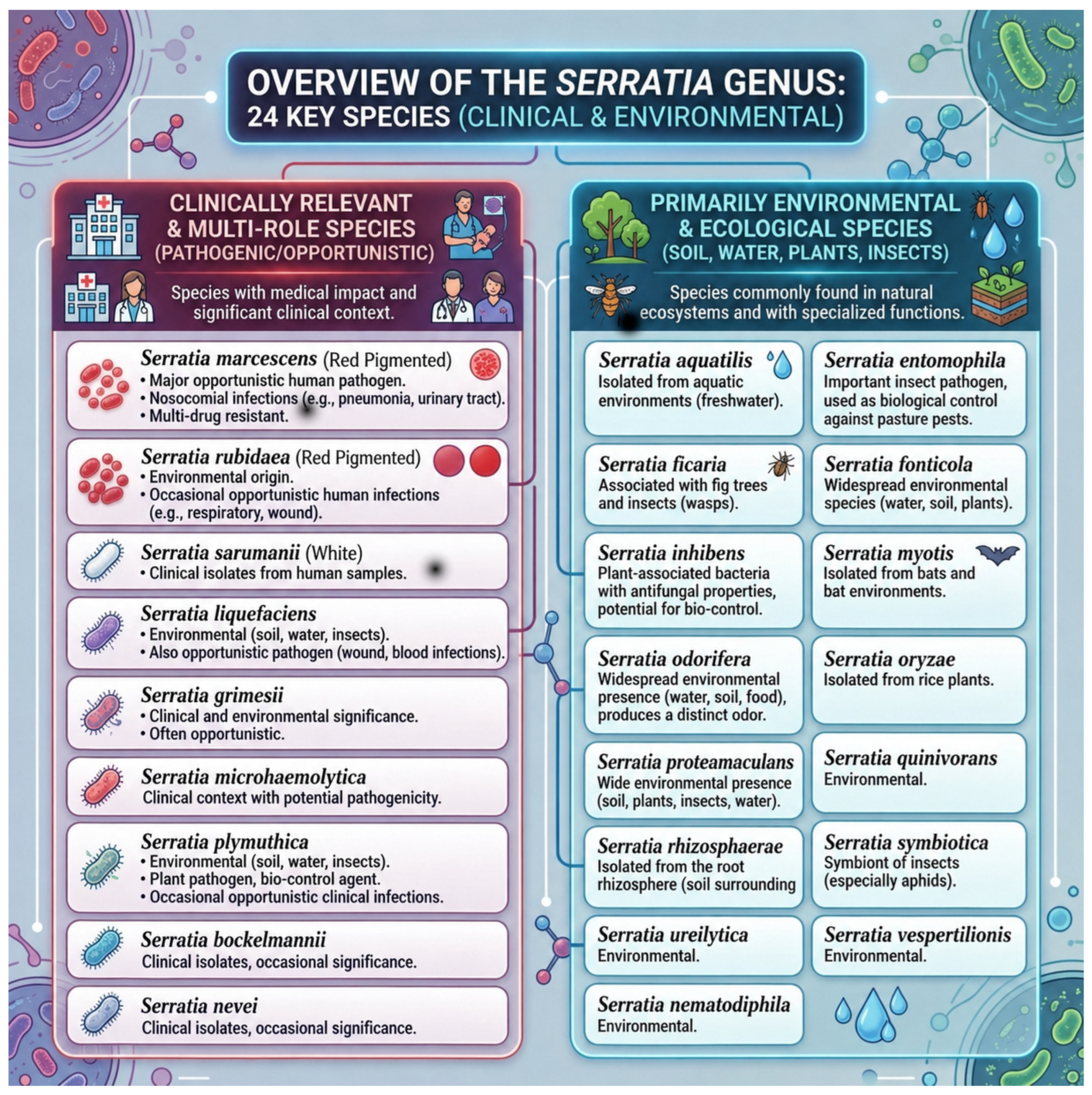
The genus Serratia currently consists of 24 validly published species worldwide, reflecting ongoing refinement of species boundaries through genome-resolved taxonomy [8,10,11,12]. These species have been isolated from a wide range of ecological niches, including soil, freshwater environments, plants, insects, animals, and clinical specimens, reflecting the ecological diversity and adaptability of the genus [8,9,10,11,12].
The genus was established with S. marcescens designated as the type species. S. marcescens is the most extensively studied representative of the genus due to its characteristic pigmentation and its importance as an opportunistic human pathogen. It has been frequently linked to HAIs, which have contributed significantly to its relevance in clinical microbiology and bacterial systematics [2]. Additionally, S. marcescens has been described as closely related to Serratia nematodiphila, Serratia bockelmannii, and Serratia nevei [13,14].
In addition to S. marcescens, several species are considered key representatives of the genus. Serratia liquefaciens is primarily associated with environmental habitats such as water and food products, although it has occasionally been isolated from clinical material. Serratia rubidaea is another pigment-producing species that has been recovered from both environmental and human sources, but it is reported far less frequently than S. marcescens.
Other recognized species within the genus include Serratia aquatilis, Serratia entomophila, Serratia ficaria, Serratia fonticola, Serratia grimesii, Serratia inhibens, Serratia microhaemolytica, Serratia myotis, Serratia odorifera, Serratia oryzae, Serratia plymuthica, Serratia proteamaculans, Serratia quinivorans, Serratia rhizosphaerae, Serratia sarumanii, Serratia symbiotica, Serratia ureilytica and Serratia vespertilionis (Figure 1) [15]. The most recently described member of the genus, S. sarumanii, was formally proposed in 2024 based on comprehensive phenotypic and genomic characterization of clinical isolates and is distinguished by its white-pigmented phenotype, in contrast to the red-pigmented S. marcescens [12].
Accurate taxonomic classification of Serratia spp. is essential for reliable identification in clinical diagnostics, for epidemiological surveillance, and for understanding the ecological and biotechnological significance of this genus. Continuous advances in genome-based taxonomy are expected to further refine species boundaries and phylogenetic relationships within Serratia spp.

2.2. Phenotypic Characteristics and Virulence Factors of Serratia spp.

Members of the genus Serratia are Gram-negative, facultatively anaerobic bacilli [16]. Cells typically measure 0.5–0.8 μm in width and 0.9–2.0 μm in length and are motile by means of peritrichous flagella [2]. They are oxidase-negative, catalase-positive, capable of fermenting glucose, and reduce nitrate to nitrite. They grow readily on routine laboratory media, including blood agar, chocolate agar, and MacConkey agar, forming relatively large colonies after overnight incubation. Optimal growth generally occurs between 30 and 37 °C [2,16].
Differentiation of Serratia spp. may involve additional biochemical testing, including ornithine decarboxylase activity and carbohydrate fermentation profiles (e.g., arabinose, raffinose), as described in classical identification schemes [2]. S. marcescens is typically characterized by the frequent production of DNase, lipase, and gelatinase, a combination that distinguishes it from many other enterobacterial species in clinical microbiology [2]. However, due to phenotypic variability, modern clinical laboratories increasingly rely on matrix-assisted laser desorption/ionization time-of-flight mass spectrometry (MALDI-TOF MS) or molecular methods for precise species-level identification [2,17].
A hallmark phenotypic feature of several Serratia spp., particularly S. marcescens and S. rubidaea, is the production of the red tripyrrole pigment prodigiosin [2,16]. Pigment production is thermoregulated, with maximal expression between 25 and 30 °C and frequent suppression at 37 °C, which explains why many clinical isolates are non-pigmented [2,16,18]. Prodigiosin biosynthesis is under quorum-sensing (QS) control and has been associated with antimicrobial, immunomodulatory, and cytotoxic properties, although it is not essential for virulence in human infections [2,16,18,19,20].
The pathogenicity of Serratia spp. is mediated by a coordinated network of virulence determinants that promote colonization, persistence, immune evasion, and survival in both environmental and clinical settings. These mechanisms include adhesion factors, biofilm formation, secretion systems, extracellular enzymes, outer membrane proteins, and QS pathways. Importantly, several virulence-associated traits are closely interconnected with antimicrobial resistance and contribute to the persistence of multidrug-resistant strains in healthcare environments. The major virulence determinants of Serratia spp. are summarized in Table 1.

2.3. Environmental, Animal, and Healthcare-Associated Reservoirs of Serratia spp.

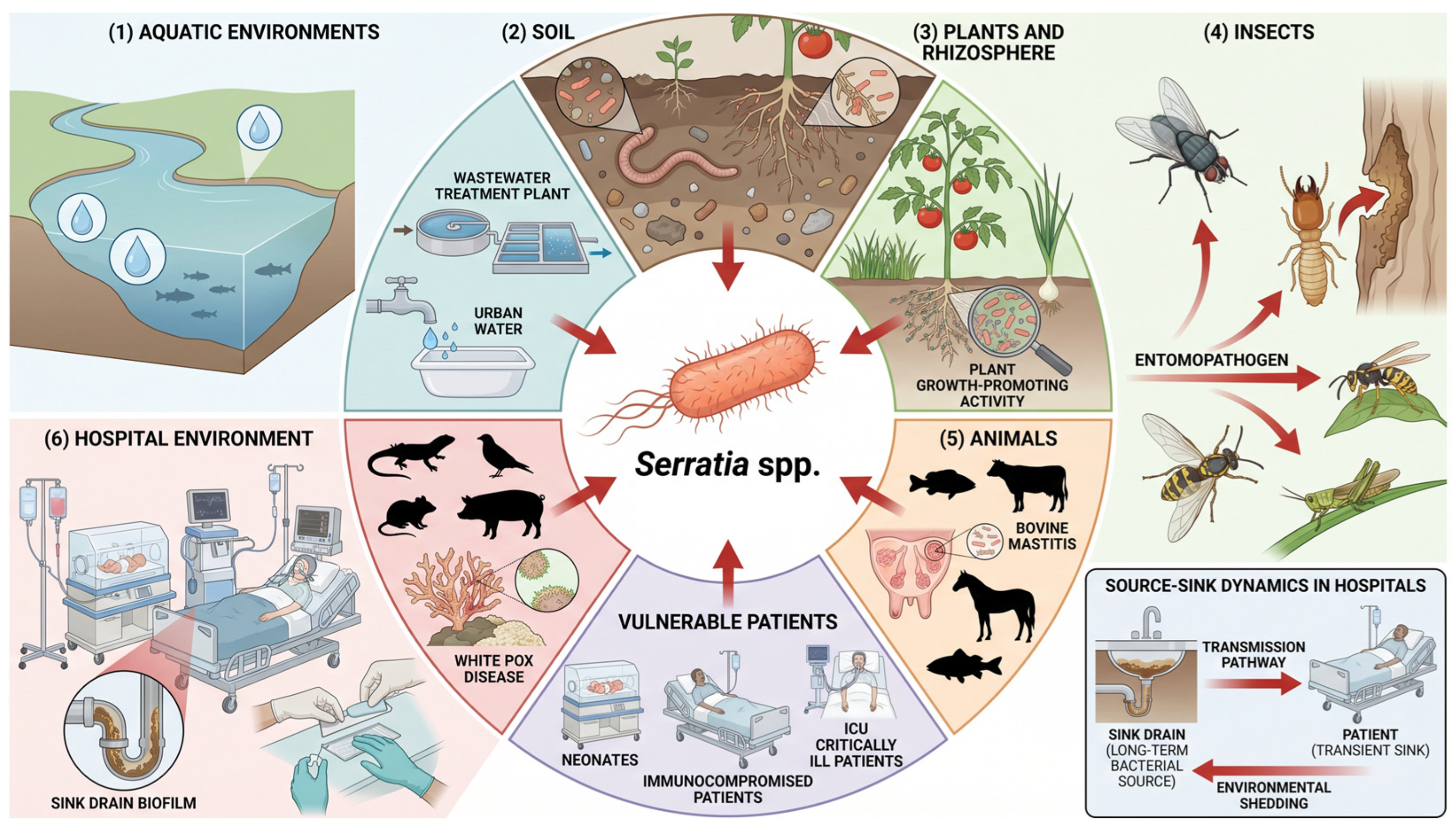
Members of the genus Serratia are widely distributed in nature and occupy diverse ecological niches [2,105,106,107].
Aquatic environments represent one of the primary natural habitats for Serratia spp. Several species, including S. marcescens, S. fonticola, S. grimesii, S. liquefaciens, S. plymuthica, S. rubidaea, and S. ureilytica, have been isolated from freshwater systems such as rivers and reservoirs, as well as from wastewater treatment systems [2,108]. In environmental surveys, S. marcescens and S. liquefaciens frequently predominate among Serratia spp. isolates recovered from river water [106]. These findings indicate that aquatic environments serve as important reservoirs that facilitate environmental persistence and potential dissemination.
Soil is another significant ecological niche for Serratia spp. Environmental isolates of S. marcescens, S. grimesii, S. liquefaciens, and S. quinivorans have been detected in various soil types, highlighting the adaptability of these bacteria to terrestrial ecosystems [109,110]. Because soil microbes are often dispersed through environmental disturbances, soil may represent an important source of contamination of food products, plants, and other environmental surfaces.
Many Serratia spp. are closely associated with plants and the plant rhizosphere. S. marcescens and S. liquefaciens have been isolated from a wide variety of plant species, including grasses, tomatoes, and green onions [110]. Some species exhibit plant-beneficial properties, as S. plymuthica has been shown to promote plant growth and suppress soilborne plant pathogens, supporting its classification as a plant growth-promoting rhizobacterium [2,111]. Similarly, S. liquefaciens, S. plymuthica, and S. rubidaea have been identified in the rhizosphere of oilseed rape and have demonstrated antifungal activity against plant pathogens [110]. In rare cases, however, members of the genus may also act as phytopathogens, as observed for S. proteamaculans, which causes leaf spot disease in Protea cynaroides [106].
Associations between Serratia spp. and animals have also been widely documented. S. marcescens has been isolated from numerous animal hosts, including reptiles, birds, rodents, pigs, goats, horses, and fish [2]. In poultry, S. marcescens may colonize the digestive tract of hens, leading to contamination of eggs and, in some cases, embryonic mortality, while S. liquefaciens has been detected on contaminated chicken carcasses [106]. In cattle and cows, Serratia spp. are associated with chronic mastitis, contributing to bacterial contamination of milk and dairy products, occasionally manifested as red discoloration caused by pigmented strains [106]. S. marcescens has also been implicated in coral disease, including white pox disease affecting the Caribbean elkhorn coral (Acropora palmata) [112].
Numerous investigations have demonstrated the presence of Serratia spp. isolates resistant to extended-spectrum cephalosporins in dogs and cats, as well as multidrug-resistant strains in farm animals and poultry [113]. These findings suggest that domestic animals may contribute to the maintenance, amplification, and potential dissemination of antimicrobial-resistant Serratia spp. strains within veterinary, agricultural, and possibly human-associated environments.
Insects also represent important ecological hosts for Serratia spp. Several species, including S. marcescens, S. plymuthica, S. liquefaciens, and S. ficaria, have been isolated from the natural microbiota of insects such as flies, termites, wasps, and grasshoppers [106]. Some Serratia spp. exhibit entomopathogenic activity; for instance, S. entomophila and S. proteamaculans cause amber disease in grass grubs, while S. marcescens has been reported to infect more than 70 insect species [114]. These interactions suggest that insects may act both as reservoirs and vectors, facilitating environmental dissemination.
Although Serratia spp. are naturally environmental organisms, they are also well adapted to survive in anthropogenic environments, particularly hospital settings. Hospital environments provide numerous ecological niches that support the persistence of S. marcescens, particularly in areas with frequent water exposure or inadequate disinfection practices. Water systems, sinks, faucets, and other moist surfaces are recognized as important reservoirs for opportunistic Gram-negative bacteria in healthcare facilities [115].
Recent studies have identified ICU environments, particularly sinks and drainage systems, as reservoirs of Serratia spp., where persistent clones can remain for over a year and are often genetically related to clinical isolates. These findings support a “source–sink” model, in which hospital plumbing serves as a long-term source of bacteria, while patients act as transient sinks for colonization and infection [116,117].
Transmission pathways in healthcare settings are often complex, involving multiple environmental and human reservoirs, including contaminated medical devices, colonized patients, inadequately disinfected or intrinsically contaminated solutions, and the hands of healthcare workers, that together can sustain bacterial survival and facilitate intra-facility spread [118].
These environmental reservoirs promote bacterial colonization and enable prolonged persistence within hospital infrastructure. The survival of Serratia spp. in such settings is supported by several virulence and adaptation mechanisms, including adhesion factors and flagella-mediated motility that enable attachment to abiotic surfaces and water systems. In addition, the capacity to form biofilms enhances resistance to disinfectants and environmental stress, thereby promoting persistence in moist hospital niches and increasing the likelihood of bacterial dissemination within healthcare environments [115,118].
Overall, the ecological versatility of Serratia spp. allows them to persist in a wide range of natural and artificial reservoirs (Figure 2). This environmental ubiquity, combined with intrinsic resistance traits and virulence factors, enables certain species, particularly S. marcescens, to act as opportunistic pathogens and emerge as important agents of HAIs.

3. Clinical Significance of Serratia spp.

From a clinical perspective, S. marcescens represents the most frequently isolated species within the genus and is responsible for the majority of Serratia-associated infections in healthcare settings, playing a central role in hospital outbreaks. In addition to S. marcescens, several other species, including S. liquefaciens, S. ficaria, S. fonticola, S. grimesii, S. rubidaea, and S. plymuthica, have increasingly been recognized as clinically relevant pathogens implicated in a variety of human infections [2,119].
Serratia spp. are associated with a wide range of infections, including pneumonia, UTIs, sepsis, wound and device-associated infections, meningitis, and ocular infections, among others [2]. According to the European Centre for Disease Prevention and Control (ECDC), Serratia spp. account for approximately 6.4% of pneumonia cases in the ICU, 3.9% of ICU-acquired BSIs, 1.4% of UTIs in the ICU, and 1.2% of surgical site infections (SSIs) in Europe [120,121].
The earliest probable report of human infection with S. marcescens dates to 1913, when a red-pigmented organism, then termed Bacterium prodigiosum, was isolated from the sputum of a patient with chronic cough [2]. In addition to S. marcescens, other species, including S. liquefaciens, S. ficaria, S. rubidaea, and the recently described S. sarumanii, have also been implicated in respiratory infections [2,122]. Due to their relatively low virulence, Serratia spp. rarely cause respiratory infections in healthy individuals. However, they represent an important cause of hospital-acquired and ventilator-associated pneumonia, particularly in ICU patients. These infections are commonly associated with mechanical ventilation, prolonged hospitalization, and prior exposure to antibiotics [123]. Antibiotic pressure, whether prophylactic or therapeutic, facilitates colonization by Serratia spp., reflecting their substantial repertoire of AMR determinants, including intrinsic mechanisms (e.g., AmpC-type β-lactamases) and acquired genes such as blaCTX-M or carbapenemases [122,123].
BSIs caused by Serratia spp. are strongly associated with intravascular devices and invasive procedures. Virulence factors, such as a structurally variable polysaccharide capsule, impair immune clearance, enabling bloodstream survival, device colonization, and persistent bacteremia [119]. Although S. marcescens remains the predominant species, non-marcescens isolates, particularly S. liquefaciens and S. odorifera, are being reported with increasing frequency in cases of nosocomial bacteremia [2,119]. Besides cardiac and endovascular devices, SSIs, chronic wounds, and contaminated percutaneous devices are documented sources of nosocomial Serratia spp. bacteremia, especially in patients in the ICU [119]. Beyond critically ill patients, intravenous drug users also represent a high-risk group due to non-sterile injection practices, use of tap or environmental water for drug dilution, and frequent healthcare exposure [119].
Serratia spp. are recognized causes of healthcare-associated UTIs, predominantly linked to urinary catheterization and prior antimicrobial exposure. While S. marcescens is the principal pathogen, S. liquefaciens and S. fonticola have been reported in complicated UTIs, particularly in immunocompromised or critically ill patients [2]. The study of Moreno et al. demonstrated a significantly higher prevalence of S. marcescens-complicated UTIs in catheterized vs. non-catheterized patients [124]. Catheterization was also linked to higher rates of recurrent UTIs, recent antibiotic use (within the past three months), and 30-day unplanned hospital readmissions, contributing to increased AMR in Serratia spp. isolates and further limiting treatment options [124].
Serratia spp. represent important etiological agents of wound- and device-associated infections, particularly due to their propensity to colonize moist niches in burn wounds and to form biofilms on medical devices. SSIs, catheter-related infections, and infections involving implanted devices have been reported not only for S. marcescens but also for S. liquefaciens and S. plymuthica, often resulting in persistent or recurrent clinical courses [2,125]. Posluszny et al. documented that S. marcescens accounted for 11% of burn-related SSIs, with significant associations with autografting, regrafting procedures, and prolonged hospitalization [126]. Furthermore, S. marcescens has been implicated in necrotizing fasciitis, a severe and rapidly progressive soft-tissue infection associated with mortality rates of 24% or higher [127].
S. marcescens is an opportunistic pathogen responsible for a wide range of ocular infections, including conjunctivitis, keratitis, keratoconjunctivitis, corneal ulcers, and endophthalmitis, in both previously healthy and injured eyes, particularly in hospital settings and among contact lens users. Its environmental ubiquity supports ocular colonization. Other Serratia spp. such as S. liquefaciens, S. plymuthica, S. ficaria, and S. rubidaea have also been associated with contaminated contact lenses, corneal abscesses, and post-traumatic or burn-related eye infections [2]. In NICUs, S. marcescens is a notable cause of bacterial conjunctivitis associated with prolonged hospitalization and supportive care, where purulent discharge may indicate late-onset sepsis, occasionally involving S. marcescens in systemic infections [128].
Among the earliest documented clinical infections of Serratia spp. was a report from 1942, describing meningitis in a United States (US) Army soldier in whom red-pigmented Gram-negative bacteria identified as S. marcescens were isolated from cerebrospinal fluid [2]. Central nervous system (CNS) infections caused by Serratia spp. are rare but severe, occurring mainly in neonates or profoundly immunocompromised patients. In adults, a history of head trauma, neurosurgical procedures, mastoiditis or chronic sinusitis is associated with CNS infections [129]. Neonatal meningitis and ventriculitis are predominantly attributed to S. marcescens, although sporadic cases involving other species have been reported [2].
Serratia spp. are opportunistic nosocomial pathogens with low inherent virulence, but they have a substantial clinical impact in vulnerable hosts. The highest risk is observed in immunocompromised patients (malignancy, transplantation, neutropenia, and immunosuppressive therapy) and critically ill ICU patients exposed to mechanical ventilation, central venous catheters, broad-spectrum antibiotics, and prolonged hospitalization [2,119,122,123]. Preterm and very-low-birth-weight neonates represent a high-risk group. Serratia spp., especially S. marcescens, are well-recognized causes of late-onset sepsis and outbreaks in NICUs, often linked to environmental reservoirs or contaminated equipment [2,128,130,131]. Additional risk is conferred by indwelling devices (central lines, urinary catheters, and endotracheal tubes) due to biofilm formation [2,122,123,124,130,131]. Disruption of skin barriers, extensive tissue damage, and prolonged ICU care predispose burn and trauma patients to opportunistic infections caused by Serratia spp., including wound infections and secondary bacteremia [125,126,127].
Disease severity of Serratia spp. infections depends largely on the infection site, with BSIs associated with substantial morbidity and mortality, with mortality reaching ~30% or higher in high-risk populations with extensive comorbidities or drug resistance. Device-associated bacteremia increases the likelihood of persistent infection and poor outcomes [119]. Neonatal S. marcescens sepsis carries high case fatality (~32–58%), particularly with invasive support or concomitant meningitis [2,128,130,131], although mortality in S. marcescens meningitis may be lower than in other Gram-negative etiologies [129]. Prior antibiotic exposure and the emergence of MDR or carbapenem-resistant (CR) strains further complicate therapy, contributing to prolonged hospitalization and increased mortality [123,124,129,130,131].

4. Hospital Outbreaks and Infection Control

Documented outbreaks of Serratia spp. illustrate a consistent pattern of opportunistic, healthcare-associated transmission, often linked to moist environmental niches and contaminated solutions or devices, facilitated by lapses in aseptic technique and hand hygiene.
Nosocomial outbreaks of S. marcescens have been extensively documented in adult populations since the late 1960s, affecting a wide range of hospital settings, including ICUs, surgical wards, transplant units, and outpatient facilities, with some outbreaks spanning multiple wards, hospitals, or even regions [2]. Notable multistate outbreaks include BSIs linked to contaminated intravenous magnesium sulfate in 2005 and prefilled heparin syringes in 2007–2008, the latter causing 162 infections and four deaths across nine US states, with 84% of S. marcescens isolates being genetically related [2,132]. Additional cases were associated with contaminated multidose heparin vials in China, where the same strain of S. marcescens, confirmed by pulsed-field gel electrophoresis (PFGE) profile, was isolated from blood samples of nine patients [133].
Recent reports extend this pattern. A cardiothoracic surgery ward outbreak was traced to contaminated pre-prepared heparin-flushing syringes, with 23 of 47 postoperative patients developing positive blood cultures for S. marcescens [134]. Furthermore, a large postsurgical bacteremia cluster was linked to fentanyl-containing intravenous pain-control fluids. In this outbreak, the same S. marcescens pulsotype was identified in 82.7% of positive blood cultures [135]. Non-sterile parenteral nutrition products have also been implicated as sources of outbreaks. Gupta et al. described an outbreak across six healthcare facilities in the US involving 19 patients with S. marcescens BSIs [136]. Another outbreak of severe S. marcescens bacteremia (eight cases, five deaths) was linked to strains resistant or tolerant to a quaternary ammonium disinfectant used in the ICU, enabling environmental persistence [118,137].
Contaminated equipment is a significant source of outbreak-associated bacteria, ranging from endoscopes to razors and brushes. The latter was linked to clusters of craniotomy site infections in neurosurgery [138]. In the review by Kakoullis et al., S. marcescens was one of the main bacteria reported in bronchoscopy-related events. True outbreaks were uncommon, whereas pseudo-outbreaks predominated, with S. marcescens, often in mixed clusters alongside organisms like Pseudomonas aeruginosa, isolated from samples of patients who underwent bronchoscopy with contaminated instruments but did not develop pneumonia [139].
Other Serratia spp. are less frequently implicated in outbreaks compared to S. marcescens. S. liquefaciens has been linked to several hospital-acquired outbreaks, including infections among infants in an Australian neonatal unit (1976–1982) and neurosurgery patients in France (2005), where it was isolated from various clinical samples [2]. A nosocomial outbreak of S. liquefaciens UTIs was reported in patients undergoing cystometry, with 10 of 44 patients developing infection. The organism was traced to fluid within the dome connected to the pressure transducer used for pressure monitoring during the procedure [140]. The most notable incident occurred in 1999 at a Colorado hemodialysis center, where contaminated epoetin alfa led to multiple BSIs and pyrogenic reactions that ceased once contamination sources were removed [2]. In the national investigation in Norway, S. ureilytica (S. marcescens complex type 755) was identified across 33 hospitals (June 2021–February 2023), revealing a large, opportunistic, community-associated outbreak with no clear epidemiological links or confirmed common source, though a widely distributed product (possibly food) was suspected [141].
In neonates and pediatric patients, outbreaks have been reported since the 1950s, often with severe outcomes such as sepsis and high mortality in premature infants and linked to sources such as contaminated intravenous solutions, breast milk, medical equipment, and hospital environments, with conjunctivitis being particularly common in this population [2,128]. S. marcescens was responsible for a substantial number of neonatal outbreaks. A prolonged 18-month Belgian NICU outbreak affected 61 neonates (10 infections, including one fatal sepsis), with repeated “peaks” driven by different clonal clusters despite successive control rounds [142]. In Italy, a six-month outbreak involved 18 colonized or infected infants, mainly with ocular and rectal colonization [143], and in Mexico, a NICU cluster of 15 septic neonates occurred over two months, with one death but substantial morbidity and resource use [144]. Bechman et al. reported a NICU outbreak linked to donor breast milk contaminated with S. marcescens [145]. Maltezou et al. described three consecutive, rapidly spreading, and prolonged NICU outbreaks over a three-year period, during which 9 of 20 neonates with invasive S. marcescens infection died. Although the outbreak strains were genetically distinct, they were linked to a common environmental source—the milk-kitchen sink [146]. An outbreak of S. marcescens and S. rubidaea bacteremia occurred in the NICU of a Kathmandu hospital involving three severely ill, low-birth-weight premature neonates, one of whom died. The six blood culture isolates from these infants were genetically identical, suggesting a single-source outbreak likely linked to post-earthquake disruptions and lapses in infection control, although the exact source was not identified [147].
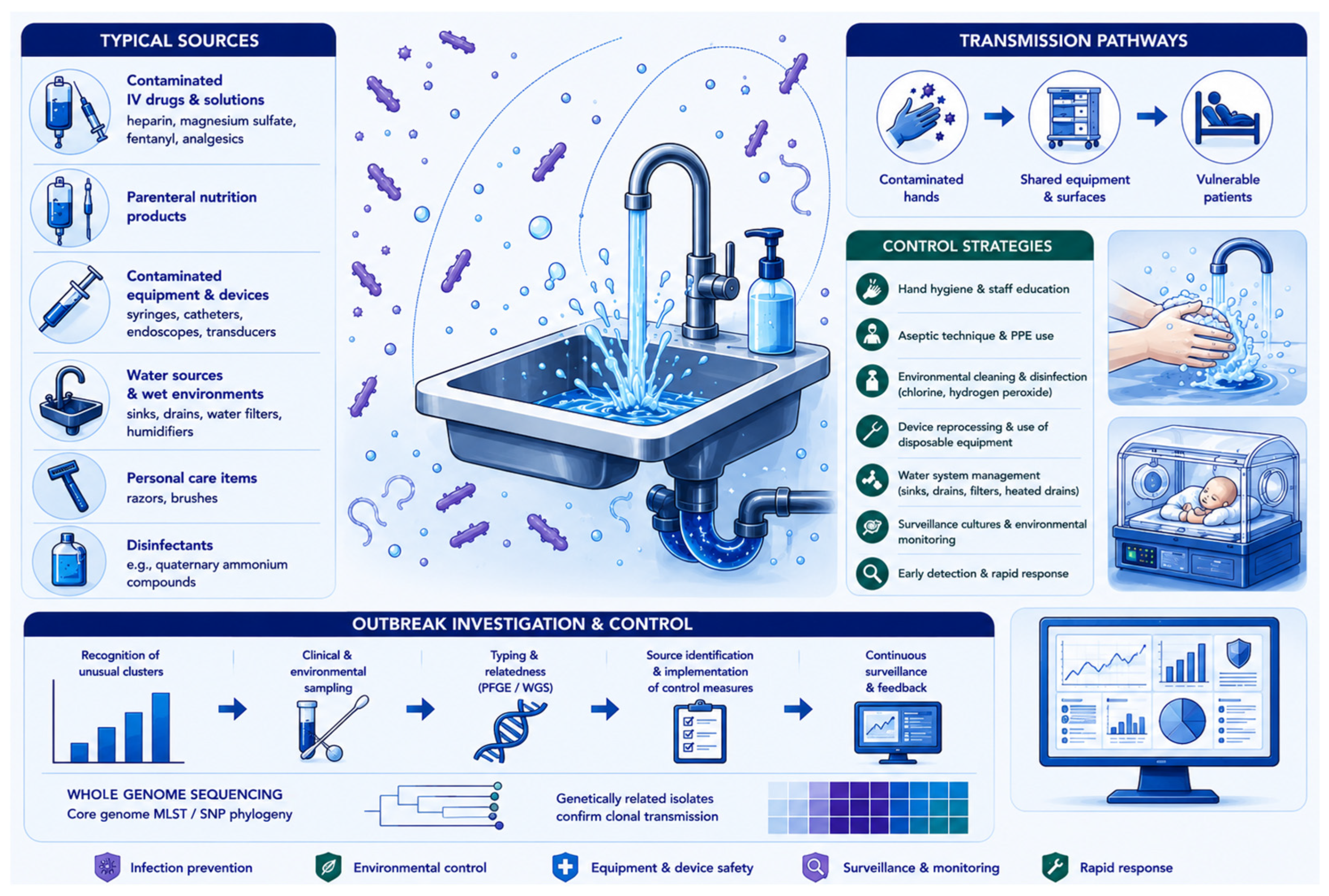
Across these reports, typical sources include contaminated intravenous drugs, flushing solutions (heparin–saline, fentanyl, and other analgesics), and parenteral nutrition products [2,132,133,134,135,136]; contaminated equipment (syringes, endoscopes, and catheters) [134,139,140]; contaminated water systems, water filters, sinks, and washbasin drains [139,142,146]; shaving equipment [138]; and occasionally disinfectants themselves [118,137]. S. marcescens is highly persistent in the environment, and its ability to form biofilms, including in disinfectant systems such as those using quaternary ammonium compounds, enables it to survive routine cleaning and generate “disinfectant-resistant” strains that can repeatedly reseed the wards [2,117,118,137,148]. Even incubator humidification water could sustain Serratia spp. despite regular disinfection, enabling reseeding over weeks to months [149].
In many S. marcescens nosocomial outbreaks, transmission pathways remain poorly defined, but person-to-person spread is repeatedly implicated, especially where workload is high, hand hygiene is imperfect, there are lapses in aseptic technique, or shared items (trolleys, razors, and multidose vials) are used across multiple patients or rooms [117,134,141,143,144,146,150]. Even handwashing sinks and drains and plain or liquid soap used at sinks could be contaminated via infected or colonized patients, consequently leading to colonization of medical equipment or the beds adjacent to the sink through splashing [117,149]. Infection prevention strategies in the outbreak reports consistently emphasize reinforced hand hygiene, targeted education of staff on the issues of hand hygiene and use of personal protective equipment, and direct observation with feedback in affected units [137,144,145,146,148,149].
Environmental cleaning should be intensified with higher-frequency surface disinfection, replacement of ineffective disinfectants, and, when indicated, use of chlorine solutions or hydrogen peroxide nebulization to decontaminate rooms and devices [134,137,139,142,146,148]. Device-specific instructions should be consistently followed, with staff regularly trained and provided access to clear cleaning and disinfection protocols [139,145]. Using disposable equipment whenever possible is strongly recommended as a key preventive strategy [138]. Control of water systems and wet reservoirs is crucial, including systematic sampling of sinks and drains; removal or redesign of washbasins, especially in NICU rooms; installation (and, if ineffective, removal) of heated drains; and strict separation of handwashing sinks from fluid preparation and device-storage areas [117,137,142,146,149].
Routine and outbreak-driven surveillance cultures (rectal and pharyngeal screening, conjunctival swabs, and targeted environmental sampling) are used to detect silent carriage, guide cohorting, and track the effect of interventions, with several authors recommending continuous NICU-specific surveillance and drain monitoring even outside recognized outbreaks [135,142,149]. As WGS analyses repeatedly demonstrate close genetic relatedness between isolates from colonized infants and those from sinks or donor milk, ongoing surveillance could allow early detection of silent ward transmission and help predict the outbreak potential of a genetically well-characterized pathogen [142,149]. A cautious approach is required when considering rectal screening of healthcare workers without signs of infection, as it offers low sensitivity, is costly, and causes discomfort. Instead, greater emphasis should be placed on examining their hands for unusual features (such as artificial nails, rings, or onychomycotic lesions) before initiating any broad screening of otherwise healthy staff [150].
Across these reports, outbreak detection was based on promptly recognizing unusual infection clusters, performing systematic clinical and environmental sampling, and, increasingly, applying whole-genome typing to confirm relatedness and optimize control strategies. To distinguish clonal outbreaks from unrelated sporadic cases, a range of methods, including serotyping and multiple molecular typing approaches (e.g., PFGE), has traditionally been used to demonstrate relatedness and trace sources such as contaminated drugs, devices, or disinfectants [2]. More recent studies have adopted WGS with core-genome MLST or single-nucleotide polymorphism-based phylogenies to delineate clusters, follow persistence, and separate multiple co-circulating clones [117,118,141,142,145,149].
A schematic overview of the principal sources, transmission pathways, outbreak investigation approaches, and infection control interventions described in Serratia spp. outbreaks is presented in Figure 3.
Ultimately, effective control depends on rapid recognition of abnormal clustering, identification of a strong epidemiologic implication of a source, removal or replacement of contaminated materials, and consistent reinforcement of aseptic practices in high-risk procedures. In parallel, modern computer-assisted surveillance platforms that automatically merge microbiologic, administrative, and pharmacy data allow real-time or high-frequency detection of hospital-acquired outbreaks and subtle shifts in prevalence, thereby strengthening the early-warning function of microbiology laboratories and their close collaboration with infection control teams and markedly enhancing timely outbreak recognition and response [134].

5. Intrinsic Resistance

Serratia spp., particularly S. marcescens, are opportunistic Gram-negative pathogens characterized by a well-defined intrinsic resistance profile that significantly limits available therapeutic options. This intrinsic resistance is a fundamental property of the genus and reflects a combination of structural, biochemical, and regulatory mechanisms that reduce susceptibility to multiple classes of antimicrobial agents [2,105,106]. As members of the Enterobacterales, Serratia spp. possess a complex outer membrane that acts as a permeability barrier, as well as chromosomally encoded resistance determinants that contribute to their baseline antimicrobial phenotype.
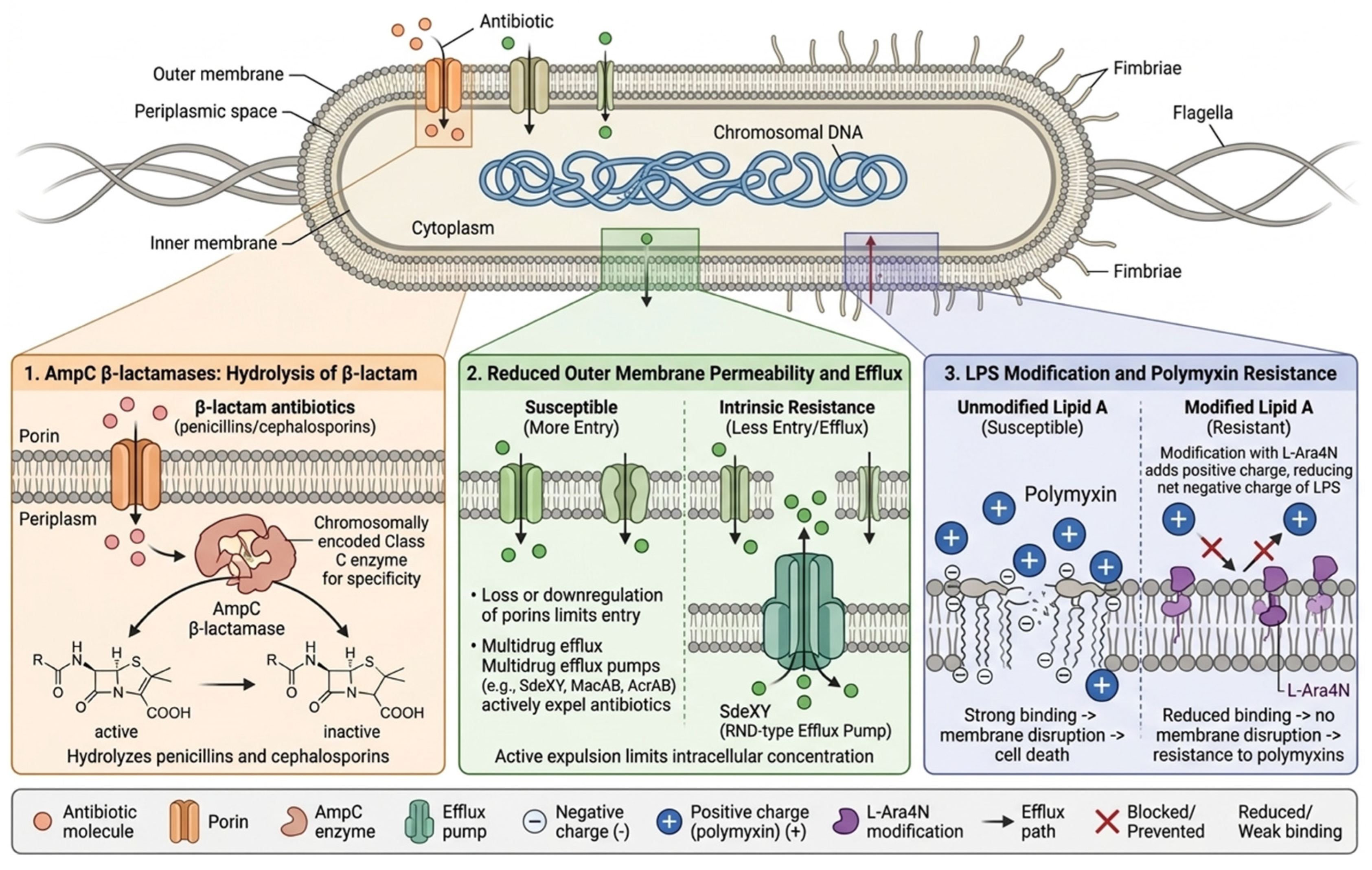
Intrinsically, Serratia spp. are resistant to numerous antibiotics, including penicillin G, macrolides, clindamycin, linezolid, glycopeptides, quinupristin–dalfopristin, and rifampin [2,105,106]. In addition, most species within the genus exhibit natural resistance to aminopenicillins, β-lactam/β-lactamase inhibitor combinations, first- and second-generation cephalosporins, cephamycins, cefuroxime, nitrofurantoin, and polymyxins [2,151]. This broad intrinsic resistance profile is largely driven by the combined action of chromosomally encoded AmpC β-lactamases, reduced outer membrane permeability, active efflux systems, and lipid A modifications within LPS (Figure 4) [1,106,151].
These mechanisms do not act independently but rather synergistically, resulting in reduced intracellular accumulation of antibiotics and decreased target binding. The intrinsic resistome of Serratia spp. is therefore a key determinant of their survival in both environmental and clinical settings and provides a foundation upon which additional acquired resistance mechanisms may develop. Understanding these intrinsic factors is essential for appropriate antimicrobial selection and for predicting resistance evolution during therapy.

5.1. AmpC β-Lactamases

A central component of intrinsic resistance in S. marcescens is the expression of a chromosomally encoded AmpC β-lactamase, an Ambler class C cephalosporinase that contributes significantly to resistance against β-lactam antibiotics [151]. AmpC enzymes preferentially hydrolyze cephalosporins, including cephamycins, while also exhibiting activity against penicillins and monobactams such as aztreonam [151,152]. This enzymatic activity reduces susceptibility to a broad range of β-lactam agents and represents a defining feature of the intrinsic resistance phenotype in Serratia spp.
The ampC gene in S. marcescens is typically inducible and regulated through a conserved genetic network involving ampR, ampD, ampG, and ampE, which are functionally linked to peptidoglycan recycling pathways [152,153]. Under basal conditions, AmpC expression is relatively low; however, exposure to β-lactam antibiotics leads to the accumulation of cell wall degradation products in the cytoplasm. These muropeptides interact with the transcriptional regulator AmpR, converting it from a repressor into an activator of ampC transcription, thereby increasing β-lactamase production [152,153,154].
A distinctive feature of S. marcescens AmpC regulation is the presence of an extended 5′-untranslated region (~126 nucleotides) in the ampC transcript, which forms a stable stem–loop structure that enhances mRNA stability and may contribute to sustained enzyme expression [2]. This post-transcriptional regulatory mechanism differentiates Serratia spp. from other Enterobacterales and may influence the magnitude and duration of AmpC-mediated resistance.
Although AmpC production is inducible, mutations in regulatory genes, particularly ampD, can result in derepressed mutants characterized by constitutive high-level expression of AmpC β-lactamase [152,153]. These derepressed strains exhibit significantly increased minimum inhibitory concentrations (MICs) to multiple β-lactam antibiotics and are associated with clinical treatment failure, especially during therapy with third-generation cephalosporins [151,152].
Importantly, S. marcescens appears less prone to derepression compared with other AmpC-producing Enterobacterales, such as Enterobacter cloacae or C. freundii, with lower mutation frequencies reported in both experimental and clinical settings [1]. Nevertheless, the risk of selecting derepressed mutants during antimicrobial therapy remains clinically relevant, particularly when β-lactams that act as weak inducers but are susceptible to AmpC hydrolysis are used.
In addition to regulatory changes, structural mutations within the AmpC enzyme may expand its substrate spectrum. Amino acid substitutions in critical regions, such as the omega loop, can increase catalytic efficiency and confer resistance to extended-spectrum cephalosporins, including ceftazidime [151]. Similarly, alterations affecting structural elements of the enzyme have been associated with reduced susceptibility to fourth-generation cephalosporins such as cefepime [151]. Although such variants are relatively uncommon, they represent an important mechanism of adaptive resistance. Furthermore, AmpC-mediated resistance may be potentiated by additional mechanisms, including reduced outer membrane permeability [1].
Beyond S. marcescens, chromosomal AmpC β-lactamases are widely distributed among other Serratia spp., including S. liquefaciens, S. plymuthica, and S. odorifera, although differences exist in inducibility and expression levels [151]. This variability reflects evolutionary diversification within the genus and may influence species-specific resistance patterns.

5.2. Reduced Permeability and Efflux Pumps

Reduced outer membrane permeability and the activity of multidrug efflux pumps represent key complementary mechanisms of intrinsic resistance in S. marcescens. As a Gram-negative bacterium, S. marcescens possesses an outer membrane that acts as a selective permeability barrier, limiting the penetration of antimicrobial agents into the periplasmic space [155,156]. This barrier is largely mediated by LPS organization and porin composition, which together reduce passive diffusion of antibiotics into the periplasmic space.
Alterations in outer membrane permeability may further enhance resistance. For example, reduced expression or loss of porins, such as OmpF homologs, has been associated with decreased susceptibility to β-lactams and carbapenems, particularly when combined with AmpC overproduction [157]. This synergistic interaction highlights the importance of permeability defects as resistance amplifiers rather than standalone mechanisms.
In parallel, S. marcescens encodes a wide array of efflux systems that actively extrude toxic compounds, including antibiotics, from the bacterial cell. Genomic analyses have identified more than 70 efflux-associated genes distributed across clinical and environmental isolates, suggesting that these systems are an inherent part of the species’ resistome [1]. Efflux pumps contribute significantly to intrinsic resistance by lowering intracellular antibiotic concentrations below effective levels.
Multiple efflux pump families have been described in S. marcescens, including the resistance–nodulation–division (RND), major facilitator superfamily (MFS), small multidrug resistance (SMR), multidrug and toxic compound extrusion (MATE), and ATP-binding cassette (ABC) transporters [1]. Among these, RND-type efflux pumps are considered the most clinically relevant due to their broad substrate specificity and high transport capacity.
The SdeXY efflux system is one of the best-characterized RND pumps in S. marcescens and plays a central role in intrinsic multidrug resistance. Inactivation of sdeXY leads to increased susceptibility to multiple antibiotics, including tigecycline, fluoroquinolones, and certain β-lactams, indicating its major contribution to baseline resistance [1]. Similarly, the SdeAB efflux pump has been implicated in resistance to fluoroquinolones, chloramphenicol, and various biocides, although its activity appears to be strain-dependent [1].
Other RND systems, such as SdeCDE, SdeGH, and SdePQ-OmsA, contribute to resistance against specific substrates, including detergents, disinfectants, and bile salts, reflecting the ecological versatility of S. marcescens [1]. These pumps often function as tripartite complexes spanning the inner membrane, periplasm, and outer membrane, enabling direct extrusion of substrates into the external environment.
In addition to RND pumps, MFS transporters such as SmfY and TetA contribute to resistance against fluoroquinolones, tetracyclines, and cationic compounds, while SMR pumps like SsmE are involved in the extrusion of antiseptics and dyes [1]. Although individually these systems may confer modest resistance, their combined activity results in a robust MDR phenotype.
ABC-type efflux systems, including MacAB, also play a role in resistance, particularly against aminoglycosides and cationic antimicrobial peptides, and have been linked to additional physiological functions such as oxidative stress tolerance and biofilm formation [1]. This functional overlap suggests that efflux systems contribute not only to antibiotic resistance but also to bacterial survival and persistence in hostile environments.

5.3. LPS Modification (Polymyxin Resistance)

A major determinant of intrinsic resistance in S. marcescens is its inherent resistance to polymyxins, including colistin, which is mediated by structural modifications of LPS. Polymyxins exert their antibacterial effect by binding to the negatively charged phosphate groups of lipid A, disrupting the outer membrane, and leading to cell death [155,158]. However, S. marcescens is intrinsically resistant to these agents due to constitutive modification of lipid A, which reduces its net negative charge and consequently decreases the binding affinity of polymyxins [1,159].
The primary mechanism underlying this resistance is the addition of 4-amino-4-deoxy-L-arabinose (L-Ara4N) to lipid A and, in some cases, to the core oligosaccharide. This modification neutralizes the negative charge of LPS and significantly impairs electrostatic interactions with cationic antimicrobial peptides [1,159]. The process is mediated by the arnBCADTEF operon (also referred to as the pmrHFIJKLM operon), which encodes enzymes responsible for the biosynthesis and transfer of L-Ara4N to lipid A [1,159,160].
Regulation of LPS modification in S. marcescens is primarily controlled by the PhoP/PhoQ two-component regulatory system. Environmental signals such as low Mg2+ concentrations, acidic pH, or the presence of antimicrobial peptides activate the sensor kinase PhoQ, leading to phosphorylation of the response regulator PhoP, which in turn induces expression of the arn operon [159,161]. In addition, the PmrA/PmrB system can further enhance LPS modification through cross-regulation mediated by the connector protein PmrD, forming a coordinated regulatory network that modulates resistance [159,162].
Unlike many other Enterobacterales, in which polymyxin resistance is typically acquired, S. marcescens exhibits constitutive expression of LPS-modifying pathways, making polymyxin resistance an intrinsic trait of the species [1,159]. Experimental disruption of genes within the arn operon results in a marked increase in polymyxin susceptibility, confirming the essential role of this pathway in resistance [159]. Furthermore, regulatory elements such as MgrB may influence PhoP/PhoQ signaling and thereby modulate the extent of LPS modification [162].
In addition to L-Ara4N modification, other structural adaptations of LPS, including changes in acylation patterns of lipid A, may further contribute to reduced membrane permeability and resistance to host-derived antimicrobial peptides [158,161]. These changes not only impart antibiotic resistance but also improve bacterial survival under adverse conditions, including within the host during infection.

6. Acquired Resistance Mechanisms

6.1. Extended-Spectrum β-Lactamases

ESBLs represent an important mechanism of acquired resistance among Enterobacterales, including Serratia spp. These enzymes emerged following the introduction of broad-spectrum cephalosporins in the early 1980s, which were initially effective against organisms producing classical β-lactamases such as TEM and SHV [163]. ESBLs are typically plasmid-mediated enzymes capable of hydrolyzing penicillins; narrow-, expanded-, and broad-spectrum cephalosporins; and aztreonam [163]. The major ESBL families include TEM, SHV, OXA, and CTX-M enzymes, with CTX-M types now recognized as the most widespread globally. Indeed, CTX-M enzymes have largely replaced TEM and SHV variants in many regions and are currently the dominant ESBL type worldwide [164].
Although S. marcescens is not traditionally considered a primary ESBL producer compared to Klebsiella pneumoniae or E. coli, multiple studies have documented ESBL-producing strains, including those responsible for nosocomial outbreaks [165,166,167,168,169]. Among these, CTX-M-type enzymes predominate in S. marcescens isolates, although SHV and TEM variants have also been reported [2]. Additionally, rare ESBLs such as BES-1 have been described [170], highlighting the genetic diversity of resistance mechanisms in this species.
Beyond S. marcescens, other Serratia spp. may also act as reservoirs of ESBL genes. For example, ESBL-producing S. fonticola isolates carrying FONA-type β-lactamases (e.g., FONA-5) have been identified in environmental sources such as fresh vegetables, demonstrating the presence of less common ESBL variants within the genus [171]. These findings suggest that Serratia spp. may contribute to the environmental resistome and serve as a potential source of transferable resistance determinants.
The prevalence of ESBL-producing S. marcescens varies significantly across geographic regions. In Taiwan, studies conducted between 2001 and 2005 reported ESBL prevalence rates ranging from 12.2% to 16%, with CTX-M-3 identified as the dominant enzyme and associated with high mortality rates [172,173]. In South Korea, prevalence rates ranged from 12.4% to 30.6% [174,175], while in Thailand, 24.1% of isolates produced ESBLs, often harboring a combination of CTX-M, SHV, and TEM enzymes [176]. Similarly, studies from Mexico reported ESBL production in 20.5% of isolates, predominantly SHV-type enzymes (143), whereas in India, ESBL prevalence among Serratia spp. reached 33%, although species-level differentiation and molecular characterization were limited [177].
European data also demonstrate substantial variability. In Poland, ESBL production among S. marcescens isolates ranged from 19% in earlier hospital-based studies [168] to alarmingly high levels of 70.8% in a nationwide survey [178]. In this study, CTX-M enzymes accounted for the majority (80.1%) of ESBLs, with the remainder being SHV-type enzymes [178]. Furthermore, a study from a transplantation unit reported ESBL prevalence as high as 77.8%, compared to 26.3% in other hospital wards [179], emphasizing the impact of hospital setting and patient population on resistance rates.
Recent data also confirm that ESBL-producing Gram-negative bacilli remain a major global health problem, with high prevalence reported in certain settings. For example, a study in pediatric hospitals in Gaza reported an overall ESBL prevalence of 51.6% among Gram-negative isolates, although S. marcescens represented only a small proportion of isolates, indicating that while Serratia spp. are less frequent ESBL producers, they still contribute to the broader resistance landscape [164].
More recent data indicate that CTX-M enzymes continue to dominate globally among ESBL-producing Enterobacterales, including Serratia spp., driven by the spread of mobile genetic elements such as plasmids and transposons [180]. Surveillance data from Europe show increasing ESBL prevalence, particularly in Southern and Eastern regions, although Serratia spp. remain less frequently reported compared to E. coli and K. pneumoniae. Nevertheless, outbreaks involving ESBL-producing S. marcescens continue to be described, especially in ICUs and neonatal settings.

6.2. Carbapenemases

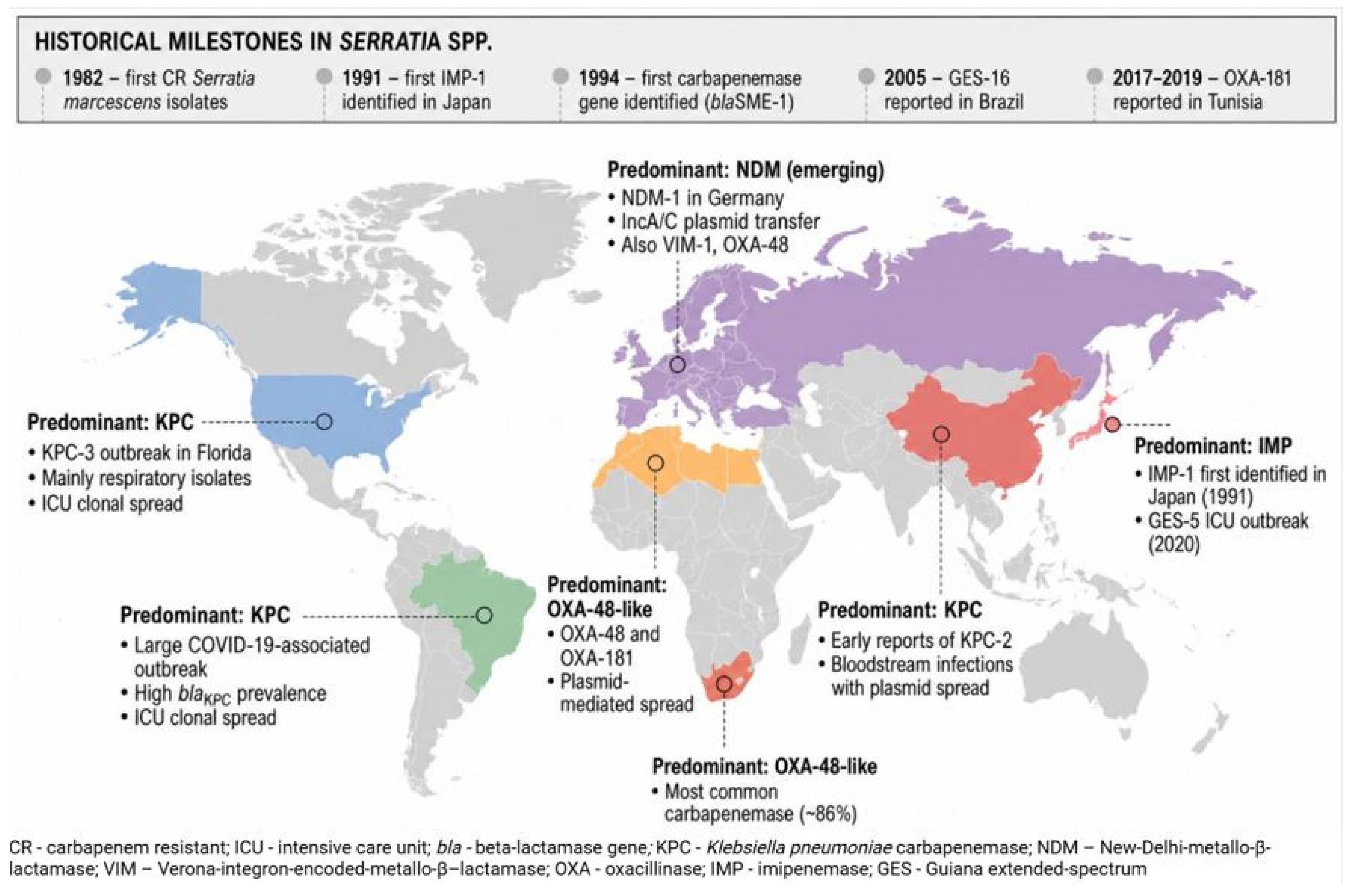
Carbapenem resistance in Serratia spp., particularly in S. marcescens, has evolved from a relatively uncommon phenomenon into a clinically relevant global problem driven largely by the acquisition and dissemination of carbapenemase genes. Historically, the earliest CR S. marcescens isolates were described in 1982, whereas the first carbapenemase gene sequenced from this species was blaSME-1 in 1994, establishing Serratia spp. as one of the earliest Enterobacterales in which a carbapenemase was molecularly characterized [181,182].
Since then, the carbapenemase repertoire of S. marcescens has expanded substantially and now includes chromosomal SME enzymes as well as a broad range of acquired plasmid-associated carbapenemases, including KPC, NDM, VIM, IMP, OXA-48-like, and GES variants [2]. Recent genomic studies indicate that these enzymes show a certain degree of geographic clustering: KPC predominates in reports from China, Brazil, and the US; IMP remains especially important in Japan and East Asia; VIM-1 and OXA-48 have played a major role in Spain; OXA-48-like enzymes are prominent in South Africa and North Africa; and NDM has emerged in both Europe and outbreak settings associated with extremely limited therapeutic options [23,183,184,185,186,187,188,189].
The first carbapenemase linked to S. marcescens was SME-1, a chromosomal Ambler class A enzyme [182]. Early reports showed that SME-producing isolates displayed resistance to imipenem with reduced susceptibility to meropenem while often retaining susceptibility to broad-spectrum cephalosporins, a phenotype that remains historically distinctive [181,182]. Although SME enzymes have not become globally dominant, they are important because they demonstrate that S. marcescens is not merely a passive recipient of mobile carbapenemase genes but also a species in which carbapenemase evolution has occurred endogenously [2,182].
Among acquired carbapenemases, KPC enzymes are the most prominent globally in S. marcescens. Earlier reports identified plasmid-mediated KPC-2 in S. marcescens in China during 2006–2007, with evidence of clonal dissemination among hospital isolates [2]. More recently, Jia et al. described two bloodstream isolates from a 36-year-old woman and a 49-year-old man in China, both with bacteremia caused by KPC-2-producing S. marcescens [187]. Both isolates carried blaKPC-2 on IncR plasmids, together with additional resistance determinants; one also harbored blaCTX-M-14, qnrS1, and aac(6′)-Ic, illustrating the growing complexity of the Serratia spp. resistome [187]. Phenotypically, these isolates were resistant to multiple β-lactams, including carbapenems, while amikacin and tobramycin remained active [187].
In Brazil, KPC appears to be deeply established in nosocomial S. marcescens. A large outbreak study conducted during the COVID-19 period in southern Brazil analyzed 170 meropenem-non-susceptible isolates, of which 92.2% carried blaKPC, whereas blaNDM-1 was detected in only 3.6% [189]. The outbreak-associated isolates clustered in a single major phylogenetic clade, and blaKPC was located on an IncP6 plasmid, consistent with clonal expansion combined with plasmid-mediated dissemination [189]. In the same broad epidemiologic context, an ICU outbreak study from Brazil also confirmed clonal spread of MDR carbapenemase-producing S. marcescens and reinforced the role of KPC in national hospital outbreaks [23].
KPC-producing S. marcescens has also been described in the US. In Florida, a KPC-3-producing outbreak involved 14 patients across acute-care hospitals and a long-term care facility [185]. All patients were linked epidemiologically to the same neighboring long-term care facility, indicating inter-facility transmission rather than isolated sporadic emergence [185]. Clinical specimens were predominantly respiratory, although BSIs were also documented. Most isolates were highly resistant to carbapenems and cephalosporins, but amikacin and ceftazidime–avibactam retained activity in many cases [185].
In highly vulnerable populations, KPC-producing S. marcescens may be particularly devastating. In a Brazilian case series of 11 hematopoietic stem cell transplantation patients colonized or infected with CR S. marcescens, KPC was the most prevalent carbapenemase, detected in 8 of 11 patients, and mortality reached 64% [190]. These findings emphasize the clinical burden of KPC-positive Serratia spp. in profoundly immunocompromised hosts.
NDM-1 is especially concerning in S. marcescens because this species is intrinsically resistant to polymyxins, thereby further narrowing therapeutic options. Gruber et al. described a pan-drug-resistant (PDR) clinical isolate carrying blaNDM-1 on a 140 kb IncA/C plasmid transferable by conjugation to E. coli and K. pneumoniae [183]. The isolate was recovered in Germany in a hospital setting and was linked to nosocomial transmission: one strain was detected on rectal screening, and a clonally related isolate was later recovered from the urine of another patient who developed a UTI after occupying the same room [183]. The isolate was non-susceptible to all tested agents, with only intermediate activity of minocycline, illustrating the extreme therapeutic limitations imposed by NDM in Serratia spp. [183].
Later surveillance and outbreak studies suggest that NDM has continued to spread, although usually at a lower frequency than KPC in some settings. In the Brazilian COVID-19-era outbreak, blaNDM-1 accounted for 3.6% of meropenem-non-susceptible isolates, confirming its presence within the same institutional ecosystem dominated by KPC [189]. Environmental genomic work from low- and middle-income countries neonatal wards also identified NDM-1-carrying S. marcescens on hospital surfaces, particularly in Bangladesh, where isolates carried blaNDM-1 on IncF or IncL/M plasmids, underscoring the role of hospital environments as silent reservoirs of carbapenemase-positive Serratia spp. [191].
In East Asia, and particularly in Japan, IMP enzymes appear to represent a longstanding carbapenemase lineage in S. marcescens. A nationwide Japanese study evaluated 5135 clinical isolates collected between 1994 and 2016 and found that 27 isolates (0.53%) exhibited resistance to ertapenem and/or meropenem, 10 were phenotypically confirmed as carbapenemase producers [188]. WGS identified blaIMP in eight isolates, including seven blaIMP-1 and one blaIMP-11, the latter representing the first report of IMP-11 in S. marcescens [188]. These isolates were MDR, showing broad resistance to β-lactams, fluoroquinolones, tigecycline, minocycline, and trimethoprim–sulfamethoxazole [188].
This Japanese study also provides important historical context, noting that IMP-1 was first identified in 1991 in Japan in a clinical S. marcescens isolate, embedded in a class 1 integron [188]. Phylogenomic comparison with international genomes suggested genetic relatedness between Japanese isolates and strains from abroad, raising the possibility of cross-border dissemination, although firm conclusions about imported cases were limited by the lack of travel history data [188]. Thus, IMP-producing S. marcescens in Japan appears to reflect both long-term endemic circulation and potential international linkage.
VIM enzymes, particularly VIM-1, have played a major role in European CR S. marcescens. In Madrid, Spain, Pérez-Viso et al. analyzed 35 patient-level carbapenemase-producing isolates recovered between 2016 and 2018, of which 29 produced VIM-1 and six produced OXA-48 [186]. These isolates were recovered from both ICU and non-ICU settings, with rectal and respiratory samples being the most common sources [186]. Molecular analysis showed that almost all isolates carried a shared IncL plasmid backbone; in the VIM-producing strains, this plasmid harbored a class 1 integron containing blaVIM-1 together with aacA4, dfrB1, aadA1, catB2, qacEΔ1, and sul1, demonstrating how integrons and plasmids jointly drive dissemination of multidrug resistance [186].
Austria provides an example of severe infection caused by VIM-positive S. marcescens. Lepuschitz et al. reported an MDR carbapenemase-producing isolate recovered from bronchoalveolar lavage of a 68-year-old man with chronic obstructive pulmonary disease and multiple severe comorbidities [184]. WGS analysis identified blaVIM-1 together with blaACC-1, blaSRT-2, and additional genes conferring resistance to aminoglycosides, quinolones, tetracyclines, and sulfonamides. IncHI2 and IncHI2A plasmids were also present [184]. The isolate was resistant to nearly all tested β-lactams and fluoroquinolones, whereas amikacin and gentamicin remained susceptible [184].
OXA-48-like enzymes are increasingly recognized in S. marcescens. In the Madrid hospital cohort, six isolates produced OXA-48, and their plasmids were closely related to the globally disseminated IncL-pOXA-48a-like backbone, supporting the view that S. marcescens participates in the same epidemic plasmid networks previously associated mainly with K. pneumoniae and E. coli [186].
In South Africa, OXA-48-like carbapenemases appear particularly important. Overmeyer et al. studied CR S. marcescens from a tertiary hospital over 2015–2020 and found that blaOXA-48-like was the most common carbapenemase, present in 86% (18/21) of sequenced CR isolates [192]. Although several phylogenetic clusters were observed, no single dominant clone accounted for all cases, suggesting that both clonal spread and plasmid dissemination contributed to the local epidemiology [192].
North Africa has also emerged as an important region for OXA-48-like Serratia spp. In Tunisia, the first OXA-181-producing S. marcescens was reported between 2017 and 2019 [193]. Four temocillin-resistant isolates were recovered, mostly from young patients in cardiology and orthopedic wards; two produced OXA-48, and two produced OXA-181 [193]. The OXA-181-producing isolates showed reduced susceptibility rather than high-level resistance, with low carbapenem MICs, illustrating how OXA-48-like enzymes may be difficult to infer from phenotype alone [193]. Importantly, blaOXA-181 was located together with qnrS1 on an IncX3/ColKP3 plasmid highly similar to a plasmid previously described in the United Arab Emirates, providing strong evidence for international plasmid circulation and probable cross-border dissemination [193].
Although less frequent than KPC, NDM, IMP, VIM, or OXA-48-like enzymes, GES variants with carbapenemase activity are clearly part of the S. marcescens carbapenemase landscape. In Japan, Nakanishi et al. described an ICU outbreak caused by GES-5-producing S. marcescens involving six CR strains isolated from three ICU patients between May and October 2020 [194]. All isolates were resistant to imipenem, meropenem, and ceftazidime. PCR screening for blaIMP, blaNDM, blaKPC, and blaOXA-48-like was negative, but blaGES was detected, and WGS identified a novel plasmid carrying blaGES-5 [194]. One related isolate lacking blaGES-5 showed significantly lower MICs, strongly supporting a direct contribution of GES-5 to carbapenem resistance in this outbreak lineage [194].
Brazil has also contributed to the diversification of GES-producing Serratia spp. Streling et al. described a new GES-type carbapenemase, GES-16, in two CR clinical isolates recovered in Rio de Janeiro in 2005, one from blood and one from the lower respiratory tract, both from ICU patients [195]. The isolates were clonally related and carried blaGES-16 together with blaOXA-10. The blaGES-16 gene was located in a defective class 1 integron on a 30 kb non-conjugative plasmid, followed by dfr22, aac(6′)-IIc, and aadA1 [195]. Biochemical analysis demonstrated carbapenemase activity, with imipenem being the carbapenem most efficiently hydrolyzed [195]. These findings highlight the ongoing evolution of GES-type enzymes in S. marcescens.
Across carbapenemase classes, several patterns recur. First, the intrinsic resistance of S. marcescens to polymyxins renders carbapenemase acquisition particularly dangerous because it eliminates one of the agents often reserved for treatment of CR Gram-negative infections [2,183]. Second, KPC-producing isolates may retain susceptibility to ceftazidime–avibactam and meropenem–vaborbactam, whereas metallo-β-lactamase producers such as NDM, VIM, and IMP are associated with more restricted β-lactam treatment options [183,185,189]. Third, carbapenemase-positive S. marcescens may not always display uniformly high carbapenem MICs, especially with OXA-48-like enzymes, making molecular detection essential for accurate identification [186,193].
Overall, the epidemiology of carbapenemase-producing S. marcescens reflects a combination of clonal expansion, plasmid dissemination, integron-mediated gene capture, and inter-facility as well as cross-border transmission (Figure 5). At the patient level, these organisms are repeatedly associated with ICUs, long-term care facilities, hematology/transplant units, and severely ill or device-dependent patients, and they are recovered from a wide range of specimens, including blood, respiratory samples, urine, rectal surveillance swabs, and bronchoalveolar lavage [23,183,184,185,186,187,188,189,190,192,193,194,195]. The recurring detection of plasmid types such as IncR, IncP6, IncA/C, IncL, IncX3/ColKP3, IncHI2, and IncHI2A underscores the central role of mobile genetic elements in shaping the global carbapenemase ecology of Serratia spp. [183,184,186,187,188,189,193].

6.3. Non-Carbapenemase-Mediated Carbapenem Resistance

Carbapenem resistance in S. marcescens is not exclusively mediated by carbapenemase production. An alternative and clinically relevant mechanism involves the combination of reduced outer membrane permeability due to porin loss and the co-expression of β-lactamases, most commonly AmpC or ESBLs. In this setting, decreased influx of carbapenems into the periplasmic space enhances the relative impact of enzymes that, on their own, generally have limited hydrolytic activity against carbapenems. As a result, clinically relevant carbapenem non-susceptibility or resistance may emerge even in the absence of a bona fide carbapenemase [157,192].
S. marcescens intrinsically produces a chromosomally encoded AmpC β-lactamase, which, when overexpressed or derepressed, contributes significantly to β-lactam resistance [151]. However, AmpC activity alone is generally insufficient to confer high-level resistance to carbapenems. A critical additional factor is the reduction or loss of OMPs, which limits antibiotic penetration into the bacterial cell. Under these conditions, even β-lactamases with limited activity against carbapenems may contribute to clinically relevant resistance.
Several studies have documented this mechanism in clinical isolates of S. marcescens, particularly in nosocomial settings. CR isolates lacking carbapenemase genes were frequently found to exhibit a combination of ESBL or AmpC production together with alterations in OMPs [166,168,196]. Loss or modification of major porins, analogous to OmpF and OmpC in other Enterobacterales, reduces intracellular antibiotic concentrations and enhances the impact of β-lactamase activity.
The strongest experimental evidence for this mechanism in S. marcescens comes from a nosocomial outbreak study in which meropenem resistance was shown to be comediated by chromosomal AmpC β-lactamase overproduction and OMP loss [157]. This study clearly demonstrated that carbapenem resistance can arise in the absence of carbapenemase genes when permeability defects are combined with increased β-lactamase expression.
More recent genomic data further support this mechanism. In a study from South Africa, CR S. marcescens isolates lacking identifiable carbapenemase genes were found to harbor combinations of β-lactamases such as blaSRT-1, blaOXA-1, and blaCTX-M, together with phenotypic carbapenem resistance, suggesting a role for ESBL/AmpC activity combined with reduced permeability [192]. These findings highlight that carbapenem resistance may occur even when molecular carbapenemase testing is negative.
This mechanism is consistent with broader observations in Enterobacterales, where ESBL or AmpC hyperproduction combined with decreased outer membrane permeability represents a recognized pathway to carbapenem resistance [197]. Although less common than carbapenemase-mediated resistance, this mechanism remains clinically relevant, particularly in environments with high antibiotic selective pressure.
Recent reviews confirm that the combination of porin loss and β-lactamase overexpression continues to play an important role in S. marcescens, even in the era of widespread carbapenemases [1,82]. In particular, reduced expression of OmpF-like porins together with AmpC overproduction has been shown to contribute to decreased carbapenem susceptibility.
From a clinical perspective, recognition of this mechanism is essential. These isolates often display borderline or variable carbapenem MICs and may not be detected by routine carbapenemase-focused diagnostics. Therefore, carbapenem-non-susceptible but carbapenemase-negative isolates should prompt consideration of combined AmpC/ESBL activity and reduced permeability. This mechanism may also represent an intermediate evolutionary step toward more stable high-level resistance under sustained antibiotic pressure.

6.4. Other Resistance Mechanisms (Aminoglycosides, Fluoroquinolones)

Resistance to aminoglycosides in S. marcescens is mediated by multiple mechanisms, among which aminoglycoside-modifying enzymes (AMEs) represent the most prevalent. These enzymes inactivate aminoglycosides through acetylation (AAC), phosphorylation (APH), or adenylation (ANT), thereby reducing their affinity for the bacterial 30S ribosomal subunit and impairing antimicrobial activity [198,199]. Genes encoding AMEs are frequently located on mobile genetic elements, including plasmids, transposons, and integrons, which facilitate horizontal gene transfer and contribute to the rapid dissemination of resistance determinants [200].
In S. marcescens, commonly identified AMEs include AAC(6′)-I, ANT(2″), and APH variants, often coexisting within the same isolate and conferring resistance to multiple clinically relevant aminoglycosides such as gentamicin, tobramycin, and amikacin [105,201]. Additionally, S. marcescens harbors a chromosomally encoded AAC(6′)-Ic enzyme, which is typically expressed at low levels and does not confer intrinsic resistance. However, exposure to aminoglycosides may select for hyperproducing mutants, leading to clinically significant resistance [105].
A particularly concerning mechanism is target modification via 16S rRNA methylation, which results in high-level resistance to nearly all clinically relevant aminoglycosides. Plasmid-mediated methyltransferases such as ArmA, RmtA, RmtB, and RmtC have been increasingly reported in Enterobacterales, including S. marcescens, and are frequently associated with MDR phenotypes and co-carriage of other resistance genes [202,203]. Additional mechanisms, including reduced outer membrane permeability and efflux pump activity, may contribute to resistance but generally play a secondary role compared to enzymatic modification [50].
Epidemiological data indicate that aminoglycoside resistance in S. marcescens is heterogeneous and strongly influenced by local epidemiology. Early surveillance studies demonstrated that 19.2% of aminoglycoside-resistant Gram-negative isolates in the US were Serratia spp., with a high prevalence of AMEs such as AAC(6′) and ANT(2″). Similarly, data from Asia reported that 42.7% of aminoglycoside-resistant Gram-negative isolates were Serratia spp., often harboring multiple resistance determinants [204].
More recent surveillance studies suggest that resistance rates remain moderate but clinically relevant. In a multicenter study from US hospitals (2002–2004), 7.1% of S. marcescens isolates were resistant to tobramycin and 0.8% to amikacin, with additional isolates showing intermediate susceptibility [205]. Comparable findings from South Korea demonstrated 7.5% resistance to amikacin, with resistant strains frequently carrying ArmA methylase and AAC(6′)-Ib enzymes, highlighting the importance of plasmid-mediated resistance [206].
Global surveillance programs provide further insight into prevalence trends. Data from the SENTRY Antimicrobial Surveillance Program indicate that aminoglycosides, particularly amikacin, retain relatively good activity against S. marcescens, although resistance rates typically range between 5% and 15% depending on geographic region and study period [207,208]. Nevertheless, the emergence of 16S rRNA methylases has significantly impacted resistance epidemiology, as these enzymes confer high-level resistance to all aminoglycosides and are increasingly detected in MDR and carbapenemase-producing strains [202].
Importantly, resistance rates may be substantially higher in hospital outbreak settings. Numerous nosocomial outbreaks involving aminoglycoside-resistant S. marcescens have been reported, particularly in ICUs and immunocompromised patients, where clonal dissemination and horizontal gene transfer contribute to elevated local prevalence [2,105].
Fluoroquinolones exert their antibacterial activity by targeting DNA gyrase and topoisomerase IV, enzymes essential for DNA replication and transcription. DNA gyrase, encoded by the gyrA and gyrB genes, is the primary target in Gram-negative bacteria, including Serratia spp. [209]. Historically, S. marcescens has been considered highly susceptible to fluoroquinolones, with early studies reporting near-universal susceptibility among clinical isolates [201,210].
However, temporal trends indicate a gradual decline in susceptibility. Surveillance data from Taiwan demonstrated a decrease in ciprofloxacin susceptibility from 99% in 1985–1986 to 80% in 1996–1997 among S. marcescens isolates [211]. Global surveillance programs indicate that fluoroquinolone resistance in S. marcescens generally remains below 10–20%, although significant regional variation exists, and higher rates may occur in nosocomial settings [207,212].
Resistance to fluoroquinolones in S. marcescens arises through multiple mechanisms, often acting in combination. The most important mechanism involves mutations in the quinolone resistance-determining region (QRDR) of the gyrA gene. Single amino acid substitutions in GyrA significantly reduce fluoroquinolone binding and have been consistently associated with resistance in clinical isolates [213,214]. Experimental studies have shown that spontaneous ciprofloxacin-resistant mutants can emerge rapidly under selective pressure due to gyrA mutations [215].
Alterations in outer membrane permeability also contribute to resistance. The Omp1 porin has been identified as a major entry pathway for ciprofloxacin in S. marcescens, and loss or reduced expression of this porin leads to increased MICs not only for fluoroquinolones but also for β-lactams and aminoglycosides [216,217].
Efflux pumps play a critical role, particularly those belonging to the RND family. Among these, SdeAB is the primary efflux system mediating resistance to fluoroquinolones such as ciprofloxacin, norfloxacin, and ofloxacin [218,219]. Additional efflux systems, including SdeXY and SdeCDE, exhibit substrate specificity, while the SmdAB pump, a member of the ABC family, has also been shown to increase MICs for multiple quinolones [220]. Notably, environmental exposure to disinfectants such as cetylpyridinium chloride may select for mutations that upregulate efflux activity and confer cross-resistance to antibiotics [221].
Plasmid-mediated resistance mechanisms further contribute to the spread of fluoroquinolone resistance. The qnr gene family (qnrA, qnrB, qnrS, qnrC, qnrD) encodes pentapeptide repeat proteins that protect DNA gyrase and topoisomerase IV from quinolone inhibition, typically conferring low-level resistance [222]. Although the prevalence of qnr genes in S. marcescens appears relatively low, they have been detected in 2.4% of clinical isolates in one study from South Korea [196]. Importantly, the presence of qnr genes facilitates the selection of higher-level resistance through additional chromosomal mutations.
A chromosomally encoded qnr-like determinant, Smaqnr, has also been described in S. marcescens, showing approximately 80% homology to qnrB1 and contributing to reduced susceptibility to ciprofloxacin [223]. This determinant has been identified in multiple clinical isolates, suggesting it may be more widespread than initially recognized.
Another plasmid-mediated mechanism involves the AAC(6′)-Ib-cr enzyme, a variant of an AME capable of acetylating certain fluoroquinolones, including ciprofloxacin, thereby conferring low-level resistance [224]. This mechanism often coexists with qnr genes and has been shown to have an additive effect on resistance levels [175].
An overview of the principal determinants contributing to antimicrobial resistance in Serratia spp. is provided in Table 2.

7. Novel Therapeutic Options and Challenges in the Treatment of Serratia spp. Infections

The emergence and global dissemination of MDR and CR Serratia spp. have significantly limited available therapeutic options, necessitating the development of novel antimicrobial strategies. Among these, β-lactam/β-lactamase inhibitor combinations (BLICs) and innovative cephalosporins represent a cornerstone in the modern management of infections caused by resistant Enterobacterales, including Serratia spp. The efficacy of these agents is closely linked to the underlying resistance mechanisms, particularly the production of AmpC β-lactamases and acquired carbapenemases such as KPC, OXA-48, and metallo-β-lactamases (MBLs) [225,226].
Ceftazidime–avibactam is one of the most extensively studied BLICs in the context of Serratia spp. infections. Avibactam, a diazabicyclooctane inhibitor, effectively inhibits Ambler class A and class C β-lactamases, including chromosomal AmpC enzymes that are intrinsic to Serratia spp., as well as selected class D carbapenemases [225,227]. Large-scale surveillance data support the promising in vitro activity of ceftazidime–avibactam against S. marcescens. In the ATLAS program, this combination demonstrated high susceptibility rates (97.5%) among clinical S. marcescens isolates, with low MIC50/90 values (0.12/4 and 1/4 mg/L), indicating strong intrinsic activity across diverse infection sources [225]. Similarly, multicenter studies from the US reported susceptibility rates exceeding 99% among AmpC-producing Enterobacterales, including Serratia spp., even among ceftazidime-non-susceptible isolates [227]. These findings confirm that avibactam effectively restores ceftazidime activity against AmpC-hyperproducing strains, a key resistance mechanism in Serratia spp. Real-world clinical experience further highlights both the therapeutic potential and practical challenges associated with the use of ceftazidime–avibactam in S. marcescens infections. A reported case of persistent CR S. marcescens bacteremia in a critically ill pediatric patient demonstrated successful clinical and microbiological resolution following initiation of ceftazidime–avibactam after failure of multiple conventional and combination antimicrobial regimens. The isolate harbored an OXA-48 carbapenemase and exhibited high-level resistance to carbapenems, with persistent bacteremia despite prolonged therapy with meropenem, aminoglycosides, tigecycline, and other agents. Following confirmation of susceptibility, ceftazidime–avibactam-based therapy resulted in clearance of bloodstream infection and sustained clinical recovery [228]. Further, a case of KPC-producing S. marcescens endocarditis was successfully treated with ceftazidime–avibactam combined with surgical intervention, resulting in sustained microbiological clearance and a favorable outcome. Despite the severity of infection, prolonged therapy was well tolerated, with no relapse observed [229]. This case supports the role of ceftazidime–avibactam as a viable option for severe MDR Serratia spp. infections and highlights the importance of combined medical and surgical management. However, the activity of ceftazidime–avibactam is significantly compromised in CR isolates producing MBLs. In such cases, susceptibility may decrease dramatically, as illustrated by low activity in imipenem-resistant isolates [225]. This limitation reflects the inability of avibactam to inhibit MBL enzymes, highlighting the critical importance of resistance mechanism-guided therapy. Moreover, while ceftazidime–avibactam demonstrates high in vitro activity against S. marcescens, emerging evidence highlights the risk of treatment-emergent resistance. A recent study reported the rapid development of resistance during therapy in a KPC-2-producing strain, driven by a 45-nucleotide duplication in the blaKPC-2 gene, resulting in the blaKPC-44 variant. This mutation conferred resistance not only to ceftazidime–avibactam but also to other BLICs, including meropenem–vaborbactam and imipenem–relebactam, while susceptibility to cefiderocol was preserved. These findings emphasize the adaptive potential of S. marcescens under antibiotic pressure and the need for mechanism-guided therapeutic strategies [230].
Imipenem–relebactam represents another important BLIC targeting class A and class C β-lactamases. Relebactam enhances imipenem activity by inhibiting KPC and AmpC enzymes, mechanisms frequently implicated in Serratia spp. resistance [231]. In vitro studies demonstrate that the addition of relebactam significantly reduces imipenem MIC values in CR Enterobacterales, restoring susceptibility in approximately 88% of isolates [232]. However, species-specific differences are notable. S. marcescens exhibits higher MIC values and lower susceptibility rates compared to other Enterobacterales, with only approximately 67% of isolates achieving susceptibility thresholds. Importantly, reduced susceptibility has been associated with chromosomal factors such as porin loss or mutation, even in the absence of acquired carbapenemases [232]. This highlights the complex interplay between enzymatic resistance and membrane permeability in Serratia spp., which may limit the effectiveness of this combination.
Meropenem–vaborbactam is a carbapenem combined with a boronic acid β-lactamase inhibitor with potent activity against KPC-producing Enterobacterales. Although data specific to Serratia spp. are limited, clinical evidence suggests its efficacy in severe infections caused by CR strains. In a reported case of CR S. marcescens bacteremia in a critically ill patient, initial therapy with ceftazidime–avibactam, despite in vitro susceptibility, failed to achieve microbiological clearance, with persistent bacteremia observed during treatment. Following a switch to meropenem–vaborbactam, combined with appropriate source control, rapid clinical improvement was achieved, including resolution of fever, clearance of BSIs, and sustained clinical recovery without recurrence [233]. These findings highlight several important considerations: first, that in vitro susceptibility does not always predict clinical success; second, that treatment failure with ceftazidime–avibactam may occur even in susceptible isolates; and third, that meropenem–vaborbactam may represent a valuable salvage therapy in such cases. However, similar to other novel BLICs, its activity is largely restricted to serine carbapenemase producers and is ineffective against MBL-producing strains [226].
Additional limitations of novel BLICs are evident in infections caused by SME-producing S. marcescens, a rare but clinically significant carbapenemase-producing phenotype. In vitro data demonstrate that isolates harboring SME enzymes exhibit resistance to carbapenems, including imipenem and meropenem, and notably, the addition of relebactam does not restore imipenem activity or achieve bactericidal effects. In contrast, meropenem–vaborbactam shows significantly enhanced activity, with marked reductions in MIC values and consistent bactericidal and synergistic effects across tested isolates [234]. These findings suggest that vaborbactam possesses superior inhibitory activity against SME enzymes compared to relebactam, likely due to stronger binding affinity and prolonged enzyme interaction. Importantly, despite baseline susceptibility to extended-spectrum cephalosporins such as ceftazidime, resistance development during therapy has been reported in SME- and AmpC-producing strains, raising concerns regarding therapeutic durability [234]. Collectively, these data highlight the heterogeneity of resistance mechanisms in S. marcescens and demonstrate that not all novel BLICs are equally effective, underscoring the need for precise, mechanism-guided antimicrobial selection in clinical practice.
Aztreonam–avibactam is an emerging combination specifically designed to overcome MBL-mediated resistance. Aztreonam is inherently stable against MBLs, while avibactam inhibits co-produced serine β-lactamases (ESBLs, AmpC, KPC, OXA-48), thereby restoring aztreonam activity [226,235]. Recent large-scale surveillance studies demonstrate near-complete activity of aztreonam–avibactam against Enterobacterales, including CR isolates, with >99.9% susceptibility rates [226]. Importantly, this combination retains activity against isolates resistant to both ceftazidime–avibactam and meropenem–vaborbactam [235]. Given the increasing global prevalence of MBL-producing strains, aztreonam–avibactam is expected to play a critical role in the future management of difficult-to-treat Serratia spp. infections.
Cefiderocol, a siderophore cephalosporin, represents a novel class of antibiotics utilizing iron transport systems to facilitate active bacterial uptake. This “Trojan horse” mechanism enables efficient penetration through the outer membrane of Gram-negative bacteria, overcoming permeability-related resistance mechanisms [236]. In vitro studies have demonstrated potent activity of cefiderocol (S-649266) against Enterobacterales, including carbapenemase-producing strains such as KPC and NDM producers, with MIC90 values ≤ 1 mg/L across multiple species, including S. marcescens [236]. Notably, cefiderocol retains activity against both serine and MBL producers, distinguishing it from most novel BLICs. However, combination studies suggest that synergy may vary depending on the organism, with cefiderocol-based combinations showing limited synergistic effects against S. marcescens compared to other pathogens.
Recent environmental surveillance studies further emphasize the growing complexity of AMR in Serratia spp. and related Enterobacterales, particularly in the context of last-line agents such as cefiderocol. Analysis of hospital wastewater isolates revealed a high prevalence of cefiderocol-resistant strains, including S. marcescens, many of which exhibited MDR, extensively drug-resistant, or even PDR phenotypes. Notably, these isolates frequently harbored multiple β-lactamase and carbapenemase genes, often in combination (e.g., KPC, VIM, OXA-type enzymes), contributing to elevated MIC values and reduced susceptibility to multiple antibiotic classes. Despite this extensive resistance, susceptibility to newer agents such as aztreonam–avibactam was consistently preserved, while lower resistance rates were observed for meropenem–vaborbactam and imipenem–relebactam [237]. These findings highlight the remarkable genetic plasticity and adaptive capacity of S. marcescens, driven by plasmid-mediated gene transfer and environmental selective pressures. Importantly, the study underscores the role of hospital wastewater as a reservoir and dissemination pathway for highly resistant Serratia spp. strains, reinforcing the need for integrated surveillance strategies and the continued development of effective therapeutic options.
WGS studies provide critical insights into the molecular basis of resistance in S. marcescens. MDR strains frequently harbor multiple resistance genes, including blaKPC-2, blaSRT-1, and blaCTX-M-3, conferring resistance to a wide range of antimicrobial classes [238]. These resistance determinants are often located on mobile genetic elements, including IncX and IncL/M plasmids, facilitating horizontal gene transfer and rapid dissemination across bacterial populations. Phylogenetic analyses reveal close genetic relationships between clinical isolates and globally distributed strains, suggesting both nosocomial transmission and international spread.
Finally, the expanding arsenal of novel antimicrobials has significantly improved treatment options for MDR Serratia spp. Nevertheless, therapeutic success remains highly dependent on accurate identification of resistance mechanisms. Ceftazidime–avibactam, imipenem–relebactam, and meropenem–vaborbactam are highly effective against AmpC-, KPC- and OXA-48-producing strains, which are common in Serratia spp. In contrast, infections caused by MBL-producing strains require alternative strategies, with aztreonam–avibactam and cefiderocol representing the most promising options. The increasing complexity of resistance mechanisms, including porin mutations and combined enzymatic pathways, further underscores the need for molecular diagnostics and individualized therapy. Consequently, the selection of appropriate antimicrobial therapy for Serratia spp. infections should be guided by both phenotypic susceptibility testing and genotypic characterization of resistance determinants.
The relationship between resistance mechanisms and currently available mechanism-guided therapeutic options for MDR and CR Serratia spp. is summarized in Figure 6.
From an antimicrobial stewardship perspective, the management of MDR and CR Serratia spp. infections should rely on early optimization of therapy rather than empirical escalation alone. Given the heterogeneity of resistance mechanisms in this genus, treatment decisions should integrate infection severity, infection source, local epidemiology, phenotypic antimicrobial susceptibility testing, and, whenever available, molecular detection of β-lactamases and carbapenemases. Rapid identification of resistance determinants may help distinguish isolates likely to respond to newer BLICs from those requiring alternative approaches, such as aztreonam–avibactam or cefiderocol in the setting of MBL production. In addition, appropriate source control, avoidance of unnecessary broad-spectrum exposure, and de-escalation based on microbiological results remain essential components of therapy. Therefore, stewardship-guided management of Serratia spp. infections should combine timely, effective treatment with preservation of last-line agents and prevention of further resistance emergence.

8. Alternative Therapeutic Options

When conventional and carbapenem-based regimens fail, the selection of a last-line therapy for MDR Serratia spp. infections becomes critically constrained, as few antimicrobial classes retain reliable activity against this pathogen. Fosfomycin and tigecycline have emerged as the most frequently considered alternative agents, yet their utility differs substantially. Fosfomycin remains active against a significant proportion of MDR isolates, including strains resistant to carbapenems, while tigecycline activity against Serratia spp. is subject to important limitations that must be considered before its use [239,240,241,242].
Tigecycline is licensed for complicated intra-abdominal infections and complicated skin and soft-tissue infections and may be considered for these indications when optimal dosing is used, but it is not recommended for UTIs, BSIs, or hospital-acquired pneumonia [2,243,244]. According to the European Committee on Antimicrobial Susceptibility Testing (EUCAST), tigecycline has insufficient activity against Serratia spp., and susceptibility test results should be reported as resistant, irrespective of the actual MIC obtained [242,245]. Despite this, some in vitro surveillance data suggest a more variable picture. Datasets from ICU and pneumonia cohorts have reported that a majority of Serratia spp. isolates are inhibited at concentrations ≤ 2–4 mg/L [246,247,248,249,250]. However, an important methodological limitation should be noted: most of these studies were conducted over a decade ago and interpreted MIC values according to Clinical and Laboratory Standards Institute (CLSI) criteria, although CLSI does not define clinical breakpoints for tigecycline and instead refers users to those approved by the US Food and Drug Administration (FDA) [251]. The FDA breakpoints, unlike EUCAST, do not carry species-specific restrictions for Serratia spp., which may have led to an overestimation of susceptibility rates. In a systematic review, Kelesidis et al. found susceptibility rates exceeding 90% only in studies that included non-MDR isolates, whereas among six studies focusing specifically on MDR Serratia spp., susceptibility fell to approximately 78%. Critically, the authors emphasized that small sample sizes preclude any definitive conclusions about the reliability of tigecycline for treating Serratia spp. infections [252]. Sari et al. similarly reported low tigecycline resistance (9%) among S. marcescens isolates from a pediatric BSI cohort, but no tigecycline-based treatment courses or clinical outcomes were described, limiting the interpretability of this finding [253]. With the aforementioned limitation in mind, the clinical relevance of these observations remains uncertain. Nonetheless, where no alternative agents remain, higher non-licensed dosing regimens (100 mg every 12 h with or without a 200 mg loading dose) may be considered in seriously ill patients, as pharmacokinetic/pharmacodynamic (PK/PD) modeling predicts target attainment against strains with MICs of up to 1 mg/L, although evidence for this approach remains limited and potentially biased [254].
Clinical evidence for tigecycline in confirmed S. marcescens infections is confined to case reports, small case series, and heterogeneous observational cohorts, yet these data point to a possible role in selected scenarios. In a case series of hematopoietic stem cell transplant patients with CR S. marcescens, tigecycline combined with gentamicin was among the main therapies employed. Overall mortality was 64%, largely attributable to the severity of the underlying condition and the scarcity of available treatment options [190]. More encouraging results have been reported at the individual patient level, when successful treatment of S. marcescens ventriculitis (isolate MIC 2 mg/L) was achieved in a pediatric patient. Combined intravenous and intraventricular tigecycline, administered after failure of standard therapy, resulted in clinical recovery and cerebrospinal fluid sterilization [255]. Avcu et al. reported clinical response and microbiological eradication each in 80% of pediatric MDR Serratia spp. cases treated with tigecycline-based combination regimens, despite MICs ranging up to 12 mg/L [256]. A favorable outcome was similarly described in peritonitis caused by an extensively resistant MBL-producing S. marcescens isolate treated with tigecycline plus moxifloxacin [257].
Analyses focusing specifically on S. marcescens infections indicate that tigecycline is used relatively infrequently and primarily as a last-line or combination agent, reflecting both the intrinsic reduction in susceptibility characterized by EUCAST, uncertainty in its efficacy, and concerns related to pharmacokinetic limitations.
Unlike tigecycline, fosfomycin carries no EUCAST intrinsic resistance classification for Serratia spp., and demonstrates favorable in vitro activity and potential clinical utility, representing a valuable option against MDR Serratia spp. [258]. Across studies, Serratia spp. are consistently listed among Enterobacterales that are usually susceptible to fosfomycin in vitro, typically with MIC in the range of 0.25–16 mg/L, often falling at the upper end of the Enterobacterales MIC distribution [240,258,259,260,261,262,263]. Ramos et al. highlight that, in clinical practice, high-dose intravenous fosfomycin (typically 16–24 g/day) is primarily employed in combination regimens for MDR Gram-negative infections, including urinary, soft tissue, and intra-abdominal infections [260].
There is a notable lack of Serratia-specific clinical studies evaluating fosfomycin for UTIs, so current recommendations rely largely on extrapolation from broader Enterobacterales UTI data rather than direct evidence. The European Society of Clinical Microbiology and Infectious Diseases (ESCMID) survey shows that, in real-world practice, intravenous fosfomycin is occasionally combined with other agents for CR Enterobacterales infections, including complicated UTIs, yet without organism-specific outcome data or strong evidence to guide its use for Serratia spp. UTIs [244]. A study by Udayan et al. found that all Serratia spp. urinary isolates, including MDR strains, were 100% susceptible to fosfomycin in vitro, supporting fosfomycin as a promising oral option for treating Serratia-associated UTIs, although no Serratia-specific clinical outcome data were reported [264]. In a large Turkish cohort, all six Serratia spp. urinary isolates recovered from community- and hospital-acquired UTI (including any ESBL producers) were 100% susceptible to fosfomycin in vitro, leading the authors to conclude that fosfomycin is a valuable option for UTIs caused by Serratia spp. [265].
Available data suggest that fosfomycin has, at best, a narrow and largely urinary role against MDR Enterobacterales, but no robust evidence supports its use for systemic Serratia spp. infections, especially outside combination regimens [243,244]. Baquero et al. reported a case series of 24 hospitalized children with S. marcescens septicemia who were successfully treated with combination regimens including fosfomycin plus carbenicillin or gentamicin, with the latter achieving an 89% cure rate [266]. In a compassionate-use series of 13 severe infections due to PDR Gram-negative bacilli, three S. marcescens cases (mostly bloodstream or deep infections) were treated with high-dose intravenous fosfomycin, usually combined with meropenem, contributing to an overall 62% clinical cure rate and frequent in vitro synergy with meropenem, though Serratia-specific outcomes were too few for firm conclusions [267]. Rodriguez et al. reported successful treatment of a patient from whom nine MDR, blaKPC-2 positive S. marcescens isolates were recovered from sequential bone and soft-tissue samples, all susceptible in vitro to ceftazidime and fosfomycin, which were administered in combination [268]. In the soft-tissue PK/PD study by Frossard et al., intravenous fosfomycin achieved high interstitial-fluid concentrations in muscle and adipose tissue, and simulated exposure corresponding to a single 4–8 g dose produced complete killing of S. marcescens isolates with MICs ≤ 16 mg/L within one dosing interval, suggesting that adequate dosing can eradicate susceptible Serratia spp. at the tissue site [269].
Consequently, the successful use of tigecycline and fosfomycin for Serratia spp. infections appears to depend on careful patient and infection-site selection, confirmation of in vitro susceptibility, and, in many reported cases, their incorporation into combination regimens rather than use as monotherapy.

9. Novel and Adjunctive Therapeutic Strategies

Emerging therapeutic strategies for Serratia spp., particularly S. marcescens, are increasingly oriented toward adjunctive approaches that target bacterial persistence and virulence rather than viability alone. As a versatile opportunistic pathogen, S. marcescens exhibits substantial intrinsic and acquired resistance mechanisms (AmpC, ESBL, carbapenemases, efflux pumps, porin loss), combined with a pronounced capacity for biofilm formation, all of which complicate treatment and highlight the need for adjunctive options (Figure 7) [16].

9.1. Bacteriophage Therapy and Phage–Antibiotic Synergy

Serratia-specific lytic bacteriophages have demonstrated the ability to disrupt biofilms, while phage–antibiotic synergy (PAS) is emerging as a promising strategy. Duan et al. reported the successful treatment of a 59-year-old man with MDR S. marcescens pulmonary infection using a personalized lytic bacteriophage Spe5P4, in combination with amikacin and meropenem after prolonged antibiotic failure. Treatment was associated with significant clinical and radiological improvement, accompanied by a progressive decline and eventual eradication of S. marcescens from pleural fluid, while phage titers remained sustained. No treatment-related adverse effects or organ dysfunction were observed, and inflammatory markers decreased during follow-up. Notably, no phage-resistant strains emerged in vivo, nor was there evidence of increased virulence or biofilm formation. Instead, some isolates exhibited increased antibiotic susceptibility [270].
Weber et al. described SALSA (vB_SmaP-SALSA), a strictly lytic T7-like podophage active against selected clinical S. marcescens isolates, with a genome lacking virulence, integrase, and lysogeny-associated genes. Although SALSA alone produced rapid initial bacterial killing, regrowth occurred due to phage resistance, and antibiotics such as ampicillin-sulbactam or meropenem alone achieved only transient reductions. In contrast, combining SALSA with either antibiotic, including ampicillin-sulbactam despite intrinsic resistance, resulted in sustained suppression and complete bacterial eradication, even at low phage and antibiotic concentrations. This synergy, dependent on productive phage infection, is likely mediated by phage-induced outer membrane changes that enhance antibiotic uptake, supporting phage–antibiotic combinations as a more effective approach than phage monotherapy for Serratia spp. infections [271].
Horton et al. isolated two novel lytic bacteriophages, Sm10b_1 and Sm12, from river water using a bloodstream S. marcescens isolate as the host. Both phages demonstrated relatively broad activity by infecting at least 40% of tested clinical and environmental Serratia spp. strains. Genomic analysis confirmed that Sm10b_1, a podophage, and Sm12, a siphophage, represent new taxa and lack integrases, virulence factors, and antibiotic resistance genes, supporting their safety for therapeutic consideration [272]. In a Galleria mellonella infection model, phage treatment significantly improved survival, with a single dose of Sm10b_1 rescuing a substantial proportion of larvae from otherwise lethal S. marcescens infection, and similarly enhancing survival in infections caused by S. odorifera. These findings demonstrate that environmentally sourced, broad-host-range lytic phages can provide effective in vivo protection against Serratia spp. infections [272].
Another study demonstrated that bacteriophages isolated from wastewater and soil can effectively kill an antibiotic-resistant, biofilm-forming S. marcescens strain, supporting their potential therapeutic use. In broth, the wastewater phage (S.wph) rapidly and durably suppressed bacterial growth, clearly outperforming ampicillin, while a combination of ampicillin with the soil phage (S.So.ph) produced additional inhibition, suggesting useful PAS. Both phages, especially when combined, significantly reduced biofilm biomass and exopolysaccharide production, key factors in chronic and device-associated Serratia spp. infections, indicating that such phage preparations could improve treatment outcomes where conventional antibiotics alone are insufficient [273].
These findings support bacteriophage therapy, ideally in rational combination with antibiotics, as a feasible and increasingly evidence-based approach for treating challenging Serratia spp. infections, while highlighting the need for individualized phage selection, rigorous genomic characterization, and systematic evaluation of PAS. Because phage–antibiotic interactions are highly pair-specific and may be either synergistic or antagonistic, empirical testing of each combination is essential [274].

9.2. Quorum-Sensing Inhibition and Antivirulence Strategies

In parallel, antivirulence strategies, especially QS inhibition, represent a promising avenue. Serratia spp. use acyl-homoserine lactone (AHL) QS systems (e.g., smaI/smaR, swrI/swrR) to regulate biofilm formation and production of virulence factors such as prodigiosin, proteases, lipases, nucleases, hemolysins, and motility. Targeting these systems can attenuate pathogenicity without directly killing bacteria, theoretically reducing selection for resistance. Several works showed that blocking AHL-mediated QS strongly attenuates S. marcescens virulence and enhances antibiotic susceptibility without inhibiting growth [16,275].
Marine Bacillus spp. SS4 produces a non-bactericidal metabolite that markedly reduces prodigiosin (up to ~87%), protease (~60%), and biofilm thickness while increasing susceptibility to erythromycin and chloramphenicol. It does not degrade AHLs but likely interferes with LuxR-type regulators [276]. A rhizosphere Bacillus subtilis R-18 secretes QS-inhibitory compounds whose petroleum ether extract decreases prodigiosin by up to 98%, reduces biofilm biomass 34–68%, and strongly inhibits protease, lipase, hemolysin and biofilm in an MDR urinary isolate, with conserved downregulation of multiple virulence and QS-related genes [277]. Screening 51 indole derivatives identified several (e.g., indole, 6-fluoroindole, and 7-methylindole) that dose-dependently suppress prodigiosin, biofilm, motility, protease and lipase; reduce fimbria-mediated yeast agglutination; deplete extracellular polymeric substance (EPS); and downregulate key QS/biofilm genes (bsmA, fimA, pigA/pigC, smaI, and rpoS), again at concentrations below MIC [278].
Natural small molecules from plants also emerge as promising adjuncts. Phloretin, a phenol from apple peel, disrupts QS in S. marcescens NJ01 by markedly lowering C4-HSL and C6-HSL levels; reduces biofilms by ~20–28% alone and by ~50–63% in combination with amikacin, netilmicin, or imipenem; and strongly inhibits multiple virulence traits (protease, prodigiosin, EPS, and motility) [279]. Mechanistically, phloretin induces oxidative stress, alters membrane composition and permeability, causes broad metabolic disturbances, and downregulates genes for adhesins, EPS, protease, pigment and antioxidant defenses, which together increase the susceptibility of biofilm cells to antibiotics [279]. Eugenol, a major clove oil component, shows a similar antivirulence profile in two S. marcescens strains. At sub-MIC levels, it reduces biofilms by ~60–75%; disrupts biofilm structure, decreases prodigiosin, hemolysin and protease; impairs swarming and EPS production; and downregulates flhD, fimC, bsmA/bsmB and the QS regulator swrR [275].
These anti-QS/antivirulence strategies, from indoles and flavonoids to essential-oil components, are framed as adjuvants that weaken biofilms and virulence, making standard antibiotics and host defenses more effective rather than replacing antibiotics. They can be combined with conventional antibiotics to improve the eradication of Serratia spp. biofilms and curb MDR infections. Such combination regimens, standard antibiotics plus non-toxic QS inhibitors that reduce virulence and biofilm tolerance, are the most promising therapeutic direction for Serratia spp. infections [190,280].

9.3. Vaccine Development and Novel Drug Targets

Given the rising incidence of MDR S. marcescens infections, vaccines are emerging as a promising therapeutic strategy to prevent disease and reduce reliance on failing antibiotics. Prado et al. in their study used reverse vaccinology and subtractive genomics on 59 S. marcescens genomes to identify conserved, non-human-homologous proteins as potential therapeutic targets. The authors predict seven vaccine candidates (including UgpB, TonB-dependent receptors FhuA and BtuB, YraP, two murein/peptidoglycan transglycosylases, and a DUF481 protein) and two drug targets (N(4)-acetylcytidine amidohydrolase and a DUF1428 protein), then use molecular docking and dynamics to propose two small molecules (ZINC04259491 and ZINC04235390) with favorable binding to the drug targets, supporting future vaccine and drug development against MDR S. marcescens [281].

10. Future Directions and Research Gaps

Despite increasing recognition of Serratia spp. as a clinically relevant opportunistic pathogen, significant gaps remain in understanding its epidemiology, resistance, and pathogenic potential. One of the most critical challenges lies in the lack of coordinated and comprehensive surveillance systems. Although local studies have documented rising resistance rates, including a concerning increase in carbapenem resistance, these data are rarely integrated into global frameworks, limiting the ability to track dissemination and anticipate emerging high-risk clones. The underrepresentation of Serratia spp. in large-scale surveillance programs further contributes to this gap and underscores the need for genome-based monitoring approaches.
At the same time, therapeutic options remain constrained by the intrinsic and acquired resistance mechanisms of Serratia spp., including AmpC β-lactamases and carbapenemases. The gradual loss of efficacy of last-line antibiotics highlights the urgent need for innovative treatment strategies that extend beyond conventional bactericidal approaches. Emerging concepts such as antivirulence therapies, biofilm-targeting agents, and adjunctive compounds show promise, particularly in addressing persistent and device-associated infections, although their clinical relevance remains to be fully established.
Advances in diagnostics represent another key area for improvement. While current technologies enable rapid species identification, the timely detection of resistance mechanisms is still limited, often delaying appropriate therapy. The integration of rapid molecular diagnostics, genomics, and data-driven predictive models may significantly enhance clinical decision-making and infection control, particularly if extended to environmental monitoring in healthcare settings.
Finally, a deeper understanding of Serratia spp. virulence and host–pathogen interactions remains essential. Although multiple virulence factors have been described, their regulation and contribution to disease are highly context-dependent and not fully elucidated. The dynamic interplay between bacterial adaptability and host immune response represents a major unresolved aspect of Serratia spp. pathogenesis, requiring integrative, multi-omics approaches to clarify mechanisms of persistence, immune evasion, and disease severity.
Taken together, these gaps highlight the need for a multidisciplinary and systems-level approach to Serratia spp. research, integrating surveillance, molecular biology, and clinical data to better address the challenges posed by this increasingly important pathogen in the AMR era.

11. Conclusions

Serratia spp. have emerged as clinically significant opportunistic Gram-negative pathogens with increasing relevance in both community and HAIs. While S. marcescens remains the predominant species implicated in human disease, other members of the genus contribute to infection, particularly in immunocompromised and critically ill patients. Their clinical success reflects a high degree of ecological adaptability, underpinned by intrinsic resistance mechanisms, acquisition of mobile genetic elements, and a diverse repertoire of virulence factors that facilitate persistence, transmission, and biofilm formation.
Within healthcare environments, Serratia spp. are closely associated with device-related and nosocomial infections, where their ability to survive under adverse conditions and disseminate clonally presents ongoing challenges for infection control. The increasing prevalence of MDR and CR isolates further complicates therapeutic management and highlights the limitations of current antimicrobial strategies.
In parallel, growing research efforts aimed at characterizing the molecular epidemiology and resistance determinants of Serratia spp. have revealed considerable heterogeneity among reported findings. However, some inconsistencies among studies remain regarding the prevalence of specific resistance genes, virulence profiles, and susceptibility to certain last-line agents such as tigecycline and cefiderocol. These discrepancies likely reflect geographic variability, differences in surveillance strategies, methodological heterogeneity, and evolving interpretative susceptibility criteria.
The present review provides a comprehensive synthesis of current knowledge regarding the epidemiology, virulence, antimicrobial resistance, and therapeutic strategies associated with Serratia spp. By integrating microbiological, molecular, and clinical perspectives, this study highlights the growing public health importance of these pathogens and underscores the urgent need for improved surveillance systems, rapid molecular diagnostics, targeted antimicrobial stewardship, and continued development of innovative therapeutic approaches.
Future progress in the control of resistant Serratia spp. will depend heavily on the implementation of coordinated genomic surveillance strategies and the broader application of whole-genome sequencing technologies. WGS-based approaches may substantially improve outbreak detection, tracking of transmission pathways, identification of emerging high-risk clones, and characterization of resistance and virulence determinants across clinical and environmental reservoirs. Importantly, the increasing recognition of hospital wastewater, medical devices, and environmental niches as potential reservoirs of resistant Serratia spp. strains highlights the need for integrated surveillance beyond conventional clinical settings.
In this context, adopting a One Health framework is essential for understanding and controlling the dissemination of antimicrobial-resistant Serratia spp. The integration of human, environmental, and microbiological data may improve early detection of emerging threats and support more effective prevention and containment strategies. Ultimately, a multidisciplinary and globally coordinated approach combining molecular epidemiology, environmental monitoring, infection control, and antimicrobial stewardship will be critical to reducing the clinical and public health impact of Serratia spp. in the era of escalating AMR.

Author Contributions

Conceptualization, I.C.; electronic database search, article screening, data abstraction, and analysis, S.B. and N.K.; data curation, S.B. and N.K.; writing—original draft preparation, I.C. and S.B.; figure design, N.K.; writing—review and editing, I.C. and S.B.; supervision, I.C.; funding acquisition, I.C. All authors have read and agreed to the published version of the manuscript.

Funding

This research was funded by the Ministry of Science, Technological Development and Innovation, the Republic of Serbia, grant number 451-03-34/2026-03/200110.

Institutional Review Board Statement

Not applicable.

Informed Consent Statement

Not applicable.

Data Availability Statement

No new data were created or analyzed in this study. Data sharing is not applicable to this article.

Acknowledgments

Figures were generated using Image Creator (Microsoft Designer; DALL·E 3; Microsoft Corporation, Redmond, WA, USA; accessed 1 April 2026) and BioRender (BioRender.com, Toronto, ON, Canada; accessed 1 May 2026). During the preparation of this manuscript, the authors used ChatGPT (version 5.3, OpenAI, San Francisco, CA, USA) for the purpose of revising selected sentences to improve expression, conciseness, and clarity. Prompts were developed by the authors, and all generated images were manually reviewed and edited to ensure scientific accuracy. The authors take full responsibility for the content of this publication.

Conflicts of Interest

The authors declare no conflicts of interest. The funding sponsors had no role in the design of the study; the collection, analyses, or interpretation of data; the writing of the manuscript; or the decision to publish the results.

Abbreviations

The following abbreviations are used in this manuscript:
ABCATP-binding cassette
AHLAcyl-homoserine lactone
AMEAminoglycoside-modifying enzymes
AMRAntimicrobial resistance
BLICβ-lactamase inhibitor combination
BSIBloodstream infection
CLSIClinical and Laboratory Standards Institute
CNSCentral nervous system
CRCarbapenem-resistant
CUChaperone–usher
ECDCEuropean Centre for Disease Prevention and Control
EPSExtracellular polymeric substance
ESBLExtended-spectrum β-lactamase
ESCMIDEuropean Society of Clinical Microbiology and Infectious Diseases
EUCASTEuropean Committee on Antimicrobial Susceptibility Testing
FDAFood and Drug Administration
HAIHealthcare-associated infection
ICUIntensive care unit
LPSLipopolysaccharide
MALDI-TOF MSMatrix-assisted laser desorption/ionization time-of-flight mass spectrometry
MATEMultidrug and toxic compound extrusion
MBLMetallo-β-lactamase
MDRMultidrug resistant
MFSMajor facilitator superfamily
MICMinimum inhibitory concentration
MLSTMultilocus sequence typing
NICUNeonatal intensive care units
OMPOuter membrane protein
PASPhage–antibiotic synergy
PDRPan-drug-resistant
PFGEPulsed-field gel electrophoresis
PK/PDPharmacokinetic/pharmacodynamic
QRDRQuinolone resistance-determining region
QSQuorum sensing
RNDResistance–nodulation–division
SMRSmall multidrug resistance
SNPSingle-nucleotide polymorphism
SSISurgical site infections
T10SSThe type X secretion system
T1SSThe type I secretion system
T2SSThe type II secretion system
T3SSThe type III secretion system
T5SSThe type V secretion system
T6SSThe type VI secretion system
T8SSThe type VIII secretion system
USUnited States
UTIUrinary tract infection
WGSWhole-genome sequencing
XDRExtensively drug resistant

References

  1. Tavares-Carreon, F.; De Anda-Mora, K.; Rojas-Barrera, I.C.; Andrade, A. Serratia marcescens Antibiotic Resistance Mechanisms of an Opportunistic Pathogen: A Literature Review. PeerJ 2023, 11, e14399. [Google Scholar] [CrossRef] [PubMed]
  2. Mahlen, S.D. Serratia Infections: From Military Experiments to Current Practice. Clin. Microbiol. Rev. 2011, 24, 755–791. [Google Scholar] [CrossRef] [PubMed]
  3. Nazzaro, G.; Veraldi, S. Serratia marcescens: An Italian Story. Int. J. Dermatol. 2017, 56, 795–796. [Google Scholar] [CrossRef] [PubMed]
  4. Khanna, A.; Khanna, M.; Aggarwal, A. Serratia marcescens—A Rare Opportunistic Nosocomial Pathogen and Measures to Limit Its Spread in Hospitalized Patients. J. Clin. Diagn. Res. 2013, 7, 243–246. [Google Scholar] [CrossRef]
  5. Zivkovic Zaric, R.; Zaric, M.; Sekulic, M.; Zornic, N.; Nesic, J.; Rosic, V.; Vulovic, T.; Spasic, M.; Vuleta, M.; Jovanovic, J.; et al. Antimicrobial Treatment of Serratia marcescens Invasive Infections: Systematic Review. Antibiotics 2023, 12, 367. [Google Scholar] [CrossRef]
  6. Cosimato, I.; Santella, B.; Rufolo, S.; Sabatini, P.; Galdiero, M.; Capunzo, M.; Boccia, G.; Folliero, V.; Franci, G. Current Epidemiological Status and Antibiotic Resistance Profile of Serratia marcescens. Antibiotics 2024, 13, 323. [Google Scholar] [CrossRef]
  7. Karampatakis, T.; Tsergouli, K.; Behzadi, P. Carbapenem-Resistant Acinetobacter Baumannii: Virulence Factors, Molecular Epidemiology, and Latest Updates in Treatment Options. Microorganisms 2025, 13, 1983. [Google Scholar] [CrossRef]
  8. Adeolu, M.; Alnajar, S.; Naushad, S.; Gupta, R.S. Genome-Based Phylogeny and Taxonomy of the “Enterobacteriales”: Proposal for Enterobacterales ord. nov. Divided into the Families Enterobacteriaceae, Erwiniaceae fam. nov., Pectobacteriaceae fam. nov., Yersiniaceae fam. nov., Hafniaceae fam. nov., Morganellaceae fam. nov., and Budviciaceae fam. nov. Int. J. Syst. Evol. Microbiol. 2016, 66, 5575–5599. [Google Scholar] [CrossRef]
  9. Williams, D.J.; Grimont, P.A.D.; Cazares, A.; Grimont, F.; Ageron, E.; Pettigrew, K.A.; Cazares, D.; Njamkepo, E.; Weill, F.-X.; Heinz, E.; et al. The Genus Serratia Revisited by Genomics. Nat. Commun. 2022, 13, 5195. [Google Scholar] [CrossRef]
  10. de Araújo, H.W.C.; Fukushima, K.; Takaki, G.M.C. Prodigiosin Production by Serratia marcescens UCP 1549 Using Renewable-Resources as a Low Cost Substrate. Molecules 2010, 15, 6931–6940. [Google Scholar] [CrossRef]
  11. Ioannou, P.; Alexakis, K.; Spentzouri, D.; Kofteridis, D.P. Infective Endocarditis by Serratia Species: A Systematic Review. J. Chemother. 2022, 34, 347–359. [Google Scholar] [CrossRef]
  12. Klages, L.J.; Kaup, O.; Busche, T.; Kalinowski, J.; Rückert-Reed, C. Classification of a Novel Serratia Species, Isolated from a Wound Swab in North Rhine-Westphalia: Proposal of Serratia sarumanii sp. nov. Syst. Appl. Microbiol. 2024, 47, 126527. [Google Scholar] [CrossRef]
  13. Cho, G.-S.; Stein, M.; Brinks, E.; Rathje, J.; Lee, W.; Suh, S.H.; Franz, C.M.A.P. Serratia nevei sp. nov. and Serratia bockelmannii sp. nov., Isolated from Fresh Produce in Germany and Reclassification of Serratia marcescens subsp. sakuensis Ajithkumar et al. 2003 as a Later Heterotypic Synonym of Serratia marcescens subsp. marcescens. Syst. Appl. Microbiol. 2020, 43, 126055. [Google Scholar] [CrossRef] [PubMed]
  14. Zhang, C.-X.; Yang, S.-Y.; Xu, M.-X.; Sun, J.; Liu, H.; Liu, J.-R.; Liu, H.; Kan, F.; Sun, J.; Lai, R.; et al. Serratia nematodiphila sp. nov., Associated Symbiotically with the Entomopathogenic Nematode Heterorhabditidoides chongmingensis (Rhabditida: Rhabditidae). Int. J. Syst. Evol. Microbiol. 2009, 59, 1603–1608. [Google Scholar] [CrossRef]
  15. Grimont, P.A.D.; Grimont, F.; Dulong, H.L.C.; Rosnay, D.; Sneath, P.H.A. Taxonomy of the Genus Serratia. J. Gen. Microbiol. 1977, 98, 39–66. [Google Scholar] [CrossRef]
  16. Boldeanu, L.; Boldeanu, M.V.; Novac, M.B.; Assani, M.-Z.; Radu, L. Serratia marcescens: A Versatile Opportunistic Pathogen with Emerging Clinical and Biotechnological Significance. Int. J. Mol. Sci. 2025, 26, 11479. [Google Scholar] [CrossRef]
  17. Ballaben, A.S.; de Almeida, O.G.G.; Ferreira, J.C.; de Oliveira Garcia, D.; Doi, Y.; Ernst, R.K.; von Zeska Kress, M.R.; da Costa Darini, A.L. Phenotypic and In Silico Characterization of Carbapenem-Resistant Serratia marcescens Clinical Strains. J. Glob. Antimicrob. Resist. 2025, 42, 105–112. [Google Scholar] [CrossRef]
  18. De Anda-Mora, K.L.; Tavares-Carreón, F.; Alvarez, C.; Barahona, S.; Becerril-García, M.A.; Treviño-Rangel, R.J.; García-Contreras, R.; Andrade, A. Increased Proteolytic Activity of Serratia marcescens Clinical Isolate HU1848 Is Associated with Higher eepR Expression. Pol. J. Microbiol. 2024, 73, 11–20. [Google Scholar] [CrossRef]
  19. Pandey, P.; Vavilala, S.L. Deciphering the Mechanisms of Antibacterial and Antibiofilm Potential of Phenolic Compounds against Serratia marcescens. Bioresour. Bioprocess. 2025, 12, 147. [Google Scholar] [CrossRef] [PubMed]
  20. Ono, T.; Taniguchi, I.; Nakamura, K.; Nagano, D.S.; Nishida, R.; Gotoh, Y.; Ogura, Y.; Sato, M.P.; Iguchi, A.; Murase, K.; et al. Global Population Structure of the Serratia marcescens Complex and Identification of Hospital-Adapted Lineages in the Complex. Microb. Genom. 2022, 8, 793. [Google Scholar] [CrossRef] [PubMed]
  21. Zhang, Y.; Cao, T.; Zheng, J.; Meng, L.; Gao, S.; Shen, H.; Zhou, W.; Cao, X. Emergence of High-Risk ST595 and ST640 Clones of Carbapenem-Resistant Serratia marcescens: Insights from Genomic and Virulence Profiling during a Nosocomial Epidemic. Front. Microbiol. 2025, 16, 1681911. [Google Scholar] [CrossRef]
  22. Salim Hamzah, A.; Sami Awayid, H. Analysis of Virulence Genes Sequencing of Serratia marcescens in Iraqi Hospitals. Cell. Mol. Biol. 2023, 69, 162–166. [Google Scholar] [CrossRef] [PubMed]
  23. Cruz, T.P.; Azevedo, F.K.; Pepato, M.A.; Rizzo, P.S.; Souto, F.J.; Brenig, B.; Góes-Neto, A.; Soares, S.C.; Ramos, R.T.; Azevedo, V.A.; et al. Whole-Genome Sequencing Analysis of Multidrug-Resistant Serratia marcescens Isolates in an Intensive Care Unit in Brazil. J. Infect. Dev. Ctries. 2024, 18, 726–731. [Google Scholar] [CrossRef] [PubMed]
  24. Behzadi, P. Classical Chaperone-Usher (CU) Adhesive Fimbriome: Uropathogenic Escherichia coli (UPEC) and Urinary Tract Infections (UTIs). Folia Microbiol. 2020, 65, 45–65. [Google Scholar] [CrossRef] [PubMed]
  25. Bhoite, S.; van Gerven, N.; Chapman, M.R.; Remaut, H. Curli Biogenesis: Bacterial Amyloid Assembly by the Type VIII Secretion Pathway. EcoSal Plus 2019, 8, 37. [Google Scholar] [CrossRef]
  26. González-Montalvo, M.A.; Tavares-Carreón, F.; González, G.M.; Villanueva-Lozano, H.; García-Romero, I.; Zomosa-Signoret, V.C.; Valvano, M.A.; Andrade, A. Defining Chaperone-Usher Fimbriae Repertoire in Serratia marcescens. Microb. Pathog. 2021, 154, 104857. [Google Scholar] [CrossRef]
  27. Labbate, M.; Zhu, H.; Thung, L.; Bandara, R.; Larsen, M.R.; Willcox, M.D.P.; Givskov, M.; Rice, S.A.; Kjelleberg, S. Quorum-Sensing Regulation of Adhesion in Serratia marcescens MG1 Is Surface Dependent. J. Bacteriol. 2007, 189, 2702–2711. [Google Scholar] [CrossRef]
  28. Shanks, R.M.Q.; Stella, N.A.; Kalivoda, E.J.; Doe, M.R.; O’Dee, D.M.; Lathrop, K.L.; Guo, F.L.; Nau, G.J. A Serratia marcescens OxyR Homolog Mediates Surface Attachment and Biofilm Formation. J. Bacteriol. 2007, 189, 7262–7272. [Google Scholar] [CrossRef]
  29. Kalivoda, E.J.; Stella, N.A.; O’Dee, D.M.; Nau, G.J.; Shanks, R.M.Q. The Cyclic AMP-Dependent Catabolite Repression System of Serratia marcescens Mediates Biofilm Formation through Regulation of Type 1 Fimbriae. Appl. Environ. Microbiol. 2008, 74, 3461–3470. [Google Scholar] [CrossRef]
  30. Liu, C.; Sun, D.; Zhu, J.; Liu, J.; Liu, W. The Regulation of Bacterial Biofilm Formation by cAMP-CRP: A Mini-Review. Front. Microbiol. 2020, 11, 802. [Google Scholar] [CrossRef]
  31. Whitfield, C. Biosynthesis and Assembly of Capsular Polysaccharides in Escherichia coli. Annu. Rev. Biochem. 2006, 75, 39–68. [Google Scholar] [CrossRef] [PubMed]
  32. Anderson, M.T.; Mitchell, L.A.; Zhao, L.; Mobley, H.L.T. Capsule Production and Glucose Metabolism Dictate Fitness during Serratia marcescens Bacteremia. mBio 2017, 8, e00740-17. [Google Scholar] [CrossRef]
  33. Aucken, H.M.; Wilkinson, S.G.; Pitt, T.L. Re-Evaluation of the Serotypes of Serratia marcescens and Separation into Two Schemes Based on Lipopolysaccharide (O) and Capsular Polysaccharide (K) Antigens. Microbiology 1998, 144, 639–653. [Google Scholar] [CrossRef][Green Version]
  34. Aucken, H.M.; Wilkinson, S.G.; Pitt, T.L. Identification of Capsular Antigens in Serratia marcescens. J. Clin. Microbiol. 1997, 35, 59–63. [Google Scholar] [CrossRef]
  35. Weakland, D.R.; Smith, S.N.; Bell, B.; Tripathi, A.; Mobley, H.L.T. The Serratia marcescens Siderophore Serratiochelin Is Necessary for Full Virulence during Bloodstream Infection. Infect. Immun. 2020, 88, e00117-20. [Google Scholar] [CrossRef]
  36. Vergalli, J.; Bodrenko, I.V.; Masi, M.; Moynié, L.; Acosta-Gutiérrez, S.; Naismith, J.H.; Davin-Regli, A.; Ceccarelli, M.; van den Berg, B.; Winterhalter, M.; et al. Porins and Small-Molecule Translocation across the Outer Membrane of Gram-Negative Bacteria. Nat. Rev. Microbiol. 2020, 18, 164–176. [Google Scholar] [CrossRef]
  37. Darby, E.M.; Trampari, E.; Siasat, P.; Gaya, M.S.; Alav, I.; Webber, M.A.; Blair, J.M.A. Molecular Mechanisms of Antibiotic Resistance Revisited. Nat. Rev. Microbiol. 2023, 21, 280–295. [Google Scholar] [CrossRef]
  38. Ferrand, A.; Vergalli, J.; Pagès, J.-M.; Davin-Regli, A. An Intertwined Network of Regulation Controls Membrane Permeability Including Drug Influx and Efflux in Enterobacteriaceae. Microorganisms 2020, 8, 833. [Google Scholar] [CrossRef] [PubMed]
  39. Chekabab, S.M.; Harel, J.; Dozois, C.M. Interplay between Genetic Regulation of Phosphate Homeostasis and Bacterial Virulence. Virulence 2014, 5, 786–793. [Google Scholar] [CrossRef] [PubMed]
  40. Begic, S.; Worobec, E.A. Regulation of Serratia marcescens ompF and ompC Porin Genes in Response to Osmotic Stress, Salicylate, Temperature and pH. Microbiology 2006, 152, 485–491. [Google Scholar] [CrossRef]
  41. Davin-Regli, A.; Pagès, J.-M.; Vergalli, J. The Contribution of Porins to Enterobacterial Drug Resistance. J. Antimicrob. Chemother. 2024, 79, 2460–2470. [Google Scholar] [CrossRef] [PubMed]
  42. Manrique, P.D.; López, C.A.; Gnanakaran, S.; Rybenkov, V.V.; Zgurskaya, H.I. New Understanding of Multidrug Efflux and Permeation in Antibiotic Resistance, Persistence, and Heteroresistance. Ann. N. Y. Acad. Sci. 2023, 1519, 46–62. [Google Scholar] [CrossRef] [PubMed]
  43. Acosta-Gutiérrez, S.; Ferrara, L.; Pathania, M.; Masi, M.; Wang, J.; Bodrenko, I.; Zahn, M.; Winterhalter, M.; Stavenger, R.A.; Pagès, J.-M.; et al. Getting Drugs into Gram-Negative Bacteria: Rational Rules for Permeation through General Porins. ACS Infect. Dis. 2018, 4, 1487–1498. [Google Scholar] [CrossRef]
  44. Choi, U.; Lee, C.-R. Antimicrobial Agents That Inhibit the Outer Membrane Assembly Machines of Gram-Negative Bacteria. J. Microbiol. Biotechnol. 2019, 29, 1–10. [Google Scholar] [CrossRef]
  45. Delcour, A.H. Outer Membrane Permeability and Antibiotic Resistance. Biochim. Biophys. Acta (BBA)-Proteins Proteom. 2009, 1794, 808–816. [Google Scholar] [CrossRef]
  46. Nikaido, H.; Rosenberg, E.Y.; Foulds, J. Porin Channels in Escherichia coli: Studies with Beta-Lactams in Intact Cells. J. Bacteriol. 1983, 153, 232–240. [Google Scholar] [CrossRef]
  47. Lou, H.; Chen, M.; Black, S.S.; Bushell, S.R.; Ceccarelli, M.; Mach, T.; Beis, K.; Low, A.S.; Bamford, V.A.; Booth, I.R.; et al. Altered Antibiotic Transport in OmpC Mutants Isolated from a Series of Clinical Strains of Multi-Drug Resistant E. Coli. PLoS ONE 2011, 6, e25825. [Google Scholar] [CrossRef]
  48. Kojima, S.; Nikaido, H. High Salt Concentrations Increase Permeability through OmpC Channels of Escherichia coli. J. Biol. Chem. 2014, 289, 26464–26473. [Google Scholar] [CrossRef]
  49. Sato, M.; Machida, K.; Arikado, E.; Saito, H.; Kakegawa, T.; Kobayashi, H. Expression of Outer Membrane Proteins in Escherichia coli Growing at Acid pH. Appl. Environ. Microbiol. 2000, 66, 943–947. [Google Scholar] [CrossRef]
  50. Li, X.-Z.; Plésiat, P.; Nikaido, H. The Challenge of Efflux-Mediated Antibiotic Resistance in Gram-Negative Bacteria. Clin. Microbiol. Rev. 2015, 28, 337–418. [Google Scholar] [CrossRef] [PubMed]
  51. Samsudin, F.; Ortiz-Suarez, M.L.; Piggot, T.J.; Bond, P.J.; Khalid, S. OmpA: A Flexible Clamp for Bacterial Cell Wall Attachment. Structure 2016, 24, 2227–2235. [Google Scholar] [CrossRef] [PubMed]
  52. Kaeriyama, M.; Machida, K.; Kitakaze, A.; Wang, H.; Lao, Q.; Fukamachi, T.; Saito, H.; Kobayashi, H. OmpC and OmpF Are Required for Growth under Hyperosmotic Stress above pH 8 in Escherichia coli. Lett. Appl. Microbiol. 2006, 42, 195–201. [Google Scholar] [CrossRef]
  53. Wang, Y.; Wang, L.; Sun, Y.; Chen, Y.; Zhu, L.; Guo, L.; Luo, B.; Wang, H. Disrupted ompC Causes Osmosis Sensitivity of Escherichia coli in Alkaline Medium. J. Genet. Genom. 2007, 34, 1131–1138. [Google Scholar] [CrossRef] [PubMed]
  54. Sutterlin, H.A.; Shi, H.; May, K.L.; Miguel, A.; Khare, S.; Huang, K.C.; Silhavy, T.J. Disruption of Lipid Homeostasis in the Gram-Negative Cell Envelope Activates a Novel Cell Death Pathway. Proc. Natl. Acad. Sci. USA 2016, 113, E1565–E1574. [Google Scholar] [CrossRef]
  55. Zhou, G.; Wang, Q.; Wang, Y.; Wen, X.; Peng, H.; Peng, R.; Shi, Q.; Xie, X.; Li, L. Outer Membrane Porins Contribute to Antimicrobial Resistance in Gram-Negative Bacteria. Microorganisms 2023, 11, 1690. [Google Scholar] [CrossRef]
  56. Hong, H.; Patel, D.R.; Tamm, L.K.; van den Berg, B. The Outer Membrane Protein OmpW Forms an Eight-Stranded Beta-Barrel with a Hydrophobic Channel. J. Biol. Chem. 2006, 281, 7568–7577. [Google Scholar] [CrossRef]
  57. Albrecht, R.; Zeth, K.; Söding, J.; Lupas, A.; Linke, D. Expression, Crystallization and Preliminary X-Ray Crystallographic Studies of the Outer Membrane Protein OmpW from Escherichia coli. Acta Cryst. F 2006, 62, 415–418. [Google Scholar] [CrossRef] [PubMed]
  58. McClean, S. Eight Stranded β -Barrel and Related Outer Membrane Proteins: Role in Bacterial Pathogenesis. Protein Pept. Lett. 2012, 19, 1013–1025. [Google Scholar] [CrossRef]
  59. Singh, R.; Shasany, A.K.; Aggarwal, A.; Sinha, S.; Sisodia, B.S.; Khanuja, S.P.S.; Misra, R. Low Molecular Weight Proteins of Outer Membrane of Salmonella typhimurium Are Immunogenic in Salmonella Induced Reactive Arthritis Revealed by Proteomics. Clin. Exp. Immunol. 2007, 148, 486–493. [Google Scholar] [CrossRef]
  60. Nandi, B.; Nandy, R.K.; Sarkar, A.; Ghose, A.C. Structural Features, Properties and Regulation of the Outer-Membrane Protein W (OmpW) of Vibrio cholerae. Microbiology 2005, 151, 2975–2986. [Google Scholar] [CrossRef]
  61. Touw, D.S.; Patel, D.R.; van den Berg, B. The Crystal Structure of OprG from Pseudomonas aeruginosa, a Potential Channel for Transport of Hydrophobic Molecules across the Outer Membrane. PLoS ONE 2010, 5, e15016. [Google Scholar] [CrossRef]
  62. Ashorn, S.; Raukola, H.; Välineva, T.; Ashorn, M.; Wei, B.; Braun, J.; Rantala, I.; Kaukinen, K.; Luukkaala, T.; Collin, P.; et al. Elevated Serum Anti-Saccharomyces cerevisiae, Anti-I2 and Anti-OmpW Antibody Levels in Patients with Suspicion of Celiac Disease. J. Clin. Immunol. 2008, 28, 486–494. [Google Scholar] [CrossRef] [PubMed]
  63. Ashorn, S.; Välineva, T.; Kaukinen, K.; Ashorn, M.; Braun, J.; Raukola, H.; Rantala, I.; Collin, P.; Mäki, M.; Luukkaala, T.; et al. Serological Responses to Microbial Antigens in Celiac Disease Patients During a Gluten-Free Diet. J. Clin. Immunol. 2009, 29, 190–195. [Google Scholar] [CrossRef] [PubMed]
  64. Iltanen, S.; Tervo, L.; Halttunen, T.; Wei, B.; Braun, J.; Rantala, I.; Honkanen, T.; Kronenberg, M.; Cheroutre, H.; Turovskaya, O.; et al. Elevated Serum Anti-I2 and Anti-OmpW Antibody Levels in Children with IBD. Inflamm. Bowel Dis. 2006, 12, 389–394. [Google Scholar] [CrossRef] [PubMed]
  65. Wei, B.; Dalwadi, H.; Gordon, L.K.; Landers, C.; Bruckner, D.; Targan, S.R.; Braun, J. Molecular Cloning of a Bacteroides caccaeTonB-Linked Outer Membrane Protein Identified by an Inflammatory Bowel Disease Marker Antibody. Infect. Immun. 2001, 69, 6044–6054. [Google Scholar] [CrossRef]
  66. Behzadi, P.; Behzadi, E.; Ranjbar, R. The Incidence and Prevalence of Crohn’s Disease in Global Scale. SOJ Immunol. 2015, 3, 1–6. [Google Scholar] [CrossRef]
  67. Dodero, V.I.; Morré, S.A.; Behzadi, P. Editorial: Gut Microbiota and Immunity in Health and Disease: Dysbiosis and Eubiosis’s Effects on the Human Body. Front. Immunol. 2024, 15, 1536258. [Google Scholar] [CrossRef]
  68. Behzadi, P.; Dodero, V.I.; Golubnitschaja, O. Systemic Inflammation as the Health-Related Communication Tool Between the Human Host and Gut Microbiota in the Framework of Predictive, Preventive, and Personalized Medicine. In All Around Suboptimal Health; Wang, W., Ed.; Advances in Predictive, Preventive and Personalised Medicine; Springer Natur: Cham, Switzerland, 2024; Volume 18, pp. 203–241. ISBN 978-3-031-46890-2. [Google Scholar]
  69. Behzadi, P.; García-Perdomo, H.A.; Karpiński, T.M. Toll-Like Receptors: General Molecular and Structural Biology. J. Immunol. Res. 2021, 2021, 9914854. [Google Scholar] [CrossRef]
  70. Mukherjee, S.; Patra, R.; Behzadi, P.; Masotti, A.; Paolini, A.; Sarshar, M. Toll-like Receptor-Guided Therapeutic Intervention of Human Cancers: Molecular and Immunological Perspectives. Front. Immunol. 2023, 14, 1244345. [Google Scholar] [CrossRef]
  71. Behzadi, P.; Behzadi, E.; Ranjbar, R. IL-12 Family Cytokines: General Characteristics, Pathogenic Microorganisms, Receptors, and Signalling Pathways. Acta Microbiol. Et Immunol. Hung. 2016, 63, 1–25. [Google Scholar] [CrossRef]
  72. Behzadi, P.; Sameer, A.S.; Nissar, S.; Banday, M.Z.; Gajdács, M.; García-Perdomo, H.A.; Akhtar, K.; Pinheiro, M.; Magnusson, P.; Sarshar, M.; et al. The Interleukin-1 (IL-1) Superfamily Cytokines and Their Single Nucleotide Polymorphisms (SNPs). J. Immunol. Res. 2022, 2022, 2054431. [Google Scholar] [CrossRef] [PubMed]
  73. Chen, L.; Zhang, L.; Hua, H.; Liu, L.; Mao, Y.; Wang, R. Interactions between Toll-like Receptors Signaling Pathway and Gut Microbiota in Host Homeostasis. Immun. Inflam. Dis. 2024, 12, e1356. [Google Scholar] [CrossRef]
  74. Behzadi, P.; Chandran, D.; Chakraborty, C.; Bhattacharya, M.; Saikumar, G.; Dhama, K.; Chakraborty, A.; Mukherjee, S.; Sarshar, M. The Dual Role of Toll-like Receptors in COVID-19: Balancing Protective Immunity and Immunopathogenesis. Int. J. Biol. Macromol. 2025, 284, 137836. [Google Scholar] [CrossRef]
  75. Tursi, A.; Elisei, W.; Picchio, M. Incidence and Prevalence of Inflammatory Bowel Diseases in Gastroenterology Primary Care Setting. Eur. J. Intern. Med. 2013, 24, 852–856. [Google Scholar] [CrossRef] [PubMed]
  76. Xiao, M.; Lai, Y.; Sun, J.; Chen, G.; Yan, A. Transcriptional Regulation of the Outer Membrane Porin Gene ompW Reveals Its Physiological Role during the Transition from the Aerobic to the Anaerobic Lifestyle of Escherichia coli. Front. Microbiol. 2016, 7, 799. [Google Scholar] [CrossRef]
  77. Silk, E.; Harding, K.; Mahler, M.; Fineran, P.C.; Meaden, S. Abiotic Environmental Conditions Determine Phage Resistance Outcomes in a Salt-Marsh Bacterium. Philos. Trans. R. Soc. Lond. B Biol. Sci. 2025, 380, 20240071. [Google Scholar] [CrossRef] [PubMed]
  78. González, G.M.; Andrade, A.; Villanueva-Lozano, H.; Campos-Cortés, C.L.; Becerril-García, M.A.; Montoya, A.M.; Sánchez-González, A.; Bonifaz, A.; Franco-Cendejas, R.; López-Jácome, L.E.; et al. Comparative Analysis of Virulence Profiles of Serratia marcescens Isolated from Diverse Clinical Origins in Mexican Patients. Surg. Infect. 2020, 21, 608–612. [Google Scholar] [CrossRef]
  79. Khaitlina, S.; Bozhokina, E.; Tsaplina, O.; Efremova, T. Bacterial Actin-Specific Endoproteases Grimelysin and Protealysin as Virulence Factors Contributing to the Invasive Activities of Serratia. Int. J. Mol. Sci. 2020, 21, 4025. [Google Scholar] [CrossRef]
  80. Tanikawa, T.; Nakagawa, Y.; Matsuyama, T. Transcriptional Downregulator hexS Controlling Prodigiosin and Serrawettin W1 Biosynthesis in Serratia marcescens. Microbiol. Immunol. 2006, 50, 587–596. [Google Scholar] [CrossRef]
  81. Yaikhan, T.; Suwannasin, S.; Singkhamanan, K.; Chusri, S.; Pomwised, R.; Wonglapsuwan, M.; Surachat, K. Genomic Characterization of Multidrug-Resistant Enterobacteriaceae Clinical Isolates from Southern Thailand Hospitals: Unraveling Antimicrobial Resistance and Virulence Mechanisms. Antibiotics 2024, 13, 531. [Google Scholar] [CrossRef]
  82. Karampatakis, T.; Tsergouli, K.; Behzadi, P. Carbapenem-Resistant Serratia marcescens: Genomic Plasticity, Virulence Architecture, and the Expanding Threat of Multidrug Resistance. Antibiotics 2026, 15, 359. [Google Scholar] [CrossRef]
  83. Costa, T.R.D.; Felisberto-Rodrigues, C.; Meir, A.; Prevost, M.S.; Redzej, A.; Trokter, M.; Waksman, G. Secretion Systems in Gram-Negative Bacteria: Structural and Mechanistic Insights. Nat. Rev. Microbiol. 2015, 13, 343–359. [Google Scholar] [CrossRef]
  84. Kanonenberg, K.; Schwarz, C.K.W.; Schmitt, L. Type I Secretion Systems—A Story of Appendices. Res. Microbiol. 2013, 164, 596–604. [Google Scholar] [CrossRef] [PubMed]
  85. Piddock, L.J.V. Multidrug-Resistance Efflux Pumps ? Not Just for Resistance. Nat. Rev. Microbiol. 2006, 4, 629–636. [Google Scholar] [CrossRef] [PubMed]
  86. Kadaba, N.S.; Kaiser, J.T.; Johnson, E.; Lee, A.; Rees, D.C. The High-Affinity E. Coli Methionine ABC Transporter: Structure and Allosteric Regulation. Science 2008, 321, 250–253. [Google Scholar] [CrossRef]
  87. Shintre, C.A.; Pike, A.C.W.; Li, Q.; Kim, J.-I.; Barr, A.J.; Goubin, S.; Shrestha, L.; Yang, J.; Berridge, G.; Ross, J.; et al. Structures of ABCB10, a Human ATP-Binding Cassette Transporter in Apo- and Nucleotide-Bound States. Proc. Natl. Acad. Sci. USA 2013, 110, 9710–9715. [Google Scholar] [CrossRef]
  88. Maphosa, S.; Moleleki, L.N.; Motaung, T.E. Bacterial Secretion System Functions: Evidence of Interactions and Downstream Implications. Microbiology 2023, 169, 1326. [Google Scholar] [CrossRef] [PubMed]
  89. Green, E.R.; Mecsas, J. Bacterial Secretion Systems: An Overview. Microbiol. Spectr. 2016, 4, 1. [Google Scholar] [CrossRef]
  90. Korotkov, K.V.; Sandkvist, M.; Hol, W.G.J. The Type II Secretion System: Biogenesis, Molecular Architecture and Mechanism. Nat. Rev. Microbiol. 2012, 10, 336–351. [Google Scholar] [CrossRef]
  91. Voulhoux, R. Involvement of the Twin-Arginine Translocation System in Protein Secretion via the Type II Pathway. EMBO J. 2001, 20, 6735–6741. [Google Scholar] [CrossRef]
  92. Sauvonnet, N.; Vignon, G.; Pugsley, A.P.; Gounon, P. Pilus Formation and Protein Secretion by the Same Machinery in Escherichia coli. EMBO J. 2000, 19, 2221–2228. [Google Scholar] [CrossRef]
  93. Sandkvist, M. Type II Secretion and Pathogenesis. Infect. Immun. 2001, 69, 3523–3535. [Google Scholar] [CrossRef]
  94. Büttner, D. Protein Export According to Schedule: Architecture, Assembly, and Regulation of Type III Secretion Systems from Plant- and Animal-Pathogenic Bacteria. Microbiol. Mol. Biol. Rev. 2012, 76, 262–310. [Google Scholar] [CrossRef]
  95. Young, B.M.; Young, G.M. YplA Is Exported by the Ysc, Ysa, and Flagellar Type III Secretion Systems of Yersinia enterocolitica. J. Bacteriol. 2002, 184, 1324–1334. [Google Scholar] [CrossRef]
  96. Young, G.M.; Schmiel, D.H.; Miller, V.L. A New Pathway for the Secretion of Virulence Factors by Bacteria: The Flagellar Export Apparatus Functions as a Protein-Secretion System. Proc. Natl. Acad. Sci. USA 1999, 96, 6456–6461. [Google Scholar] [CrossRef]
  97. Jiang, L.; Yi, W.; Zhao, Y.; Zhu, N.; Zhao, D.; Peng, Z.; Song, L.; Dong, T.; Jiang, X.; Liu, D.; et al. Comprehensive Genomic Analysis of Type VI Secretion System Diversity and Associated Proteins in Serratia. Microb. Genom. 2025, 11, 1424. [Google Scholar] [CrossRef]
  98. Reglinski, M.; Hurst, Q.W.; Williams, D.J.; Gierlinski, M.; Şahin, A.T.; Mathers, K.; Ostrowski, A.; Bergkessel, M.; Zachariae, U.; Pitt, S.J.; et al. A Widely-Occurring Family of Pore-Forming Effectors Broadens the Impact of the Serratia Type VI Secretion System. EMBO J. 2025, 44, 6892–6918. [Google Scholar] [CrossRef] [PubMed]
  99. Golpasand, T.; Keshvari, M.; Behzadi, P. Distribution of Chaperone-Usher Fimbriae and Curli Fimbriae among Uropathogenic Escherichia coli. BMC Microbiol. 2024, 24, 344. [Google Scholar] [CrossRef] [PubMed]
  100. Behzadi, P.; Behzadi, E. Uropathogenic Escherichia coli: An Ideal Resource for DNA Microarray Probe Designing. In Bioinformatics and Biomedical Engineering; Rojas, I., Ortuño, F., Eds.; Lecture Notes in Computer Science; Springer International Publishing: Cham, Switzerland, 2017; Volume 10209, pp. 12–19. ISBN 978-3-319-56153-0. [Google Scholar]
  101. Chowdhury, M.; Stansfeld, P.J.; Sargent, F. A Lysis Less Ordinary: The Bacterial Type 10 Secretion System. In Advances in Microbial Physiology; Elsevier: Amsterdam, The Netherlands, 2025; Volume 86, pp. 175–198. ISBN 978-0-443-34383-4. [Google Scholar]
  102. Hamilton, J.J.; Marlow, V.L.; Owen, R.A.; Costa, M.D.A.A.; Guo, M.; Buchanan, G.; Chandra, G.; Trost, M.; Coulthurst, S.J.; Palmer, T.; et al. A Holin and an Endopeptidase Are Essential for Chitinolytic Protein Secretion in Serratia marcescens. J. Cell Biol. 2014, 207, 615–626. [Google Scholar] [CrossRef] [PubMed]
  103. Geiger, T.; Lara-Tejero, M.; Xiong, Y.; Galán, J.E. Mechanisms of Substrate Recognition by a Typhoid Toxin Secretion-Associated Muramidase. eLife 2020, 9, e53473. [Google Scholar] [CrossRef]
  104. Van Houdt, R.; Moons, P.; Aertsen, A.; Jansen, A.; Vanoirbeek, K.; Daykin, M.; Williams, P.; Michiels, C.W. Characterization of a luxI/luxR-Type Quorum Sensing System and N-Acyl-Homoserine Lactone-Dependent Regulation of Exo-Enzyme and Antibacterial Component Production in Serratia Plymuthica RVH1. Res. Microbiol. 2007, 158, 150–158. [Google Scholar] [CrossRef]
  105. Hejazi, A.; Falkiner, F.R. Serratia marcescens. J. Med. Microbiol. 1997, 46, 903–912. [Google Scholar] [CrossRef]
  106. Grimont, P.A.; Grimont, F. The Genus Serratia. Annu. Rev. Microbiol. 1978, 32, 221–248. [Google Scholar] [CrossRef]
  107. Iguchi, A.; Nagaya, Y.; Pradel, E.; Ooka, T.; Ogura, Y.; Katsura, K.; Kurokawa, K.; Oshima, K.; Hattori, M.; Parkhill, J.; et al. Genome Evolution and Plasticity of Serratia marcescens, an Important Multidrug-Resistant Nosocomial Pathogen. Genome Biol. Evol. 2014, 6, 2096–2110. [Google Scholar] [CrossRef]
  108. Ajithkumar, B.; Ajithkumar, V.P.; Iriye, R.; Doi, Y.; Sakai, T. Spore-Forming Serratia marcescens subsp. Sakuensis subsp. nov., Isolated from a Domestic Wastewater Treatment Tank. Int. J. Syst. Evol. Microbiol. 2003, 53, 253–258. [Google Scholar] [CrossRef]
  109. Gargallo-Viola, D. Enzyme Polymorphism, Prodigiosin Production, and Plasmid Fingerprints in Clinical and Naturally Occurring Isolates of Serratia marcescens. J. Clin. Microbiol. 1989, 27, 860–868. [Google Scholar] [CrossRef]
  110. Ashelford, K.E.; Fry, J.C.; Bailey, M.J.; Day, M.J. Characterization of Serratia Isolates from Soil, Ecological Implications and Transfer of Serratia proteamaculans subsp. Quinovora Grimont et al. 1983 to Serratia Quinivorans Corrig., sp. nov. Int. J. Syst. Evol. Microbiol. 2002, 52, 2281–2289. [Google Scholar] [CrossRef]
  111. Berg, G. Plant–Microbe Interactions Promoting Plant Growth and Health: Perspectives for Controlled Use of Microorganisms in Agriculture. Appl. Microbiol. Biotechnol. 2009, 84, 11–18. [Google Scholar] [CrossRef] [PubMed]
  112. Sutherland, K.P.; Porter, J.W.; Turner, J.W.; Thomas, B.J.; Looney, E.E.; Luna, T.P.; Meyers, M.K.; Futch, J.C.; Lipp, E.K. Human Sewage Identified as Likely Source of White Pox Disease of the Threatened Caribbean Elkhorn Coral, Acropora Palmata. Environ. Microbiol. 2010, 12, 1122–1131. [Google Scholar] [CrossRef] [PubMed]
  113. Vygovska, L.; Ushkalov, A.; Zelena, L.; Ushkalov, V.; Sîrbu, C.; Vishovan, Y. Biological Properties of Serratia Liquefaciens 1/2024, Isolated from Chicken. One Health Risk Manag. 2026, 7, 22–38. [Google Scholar] [CrossRef]
  114. Glare, T.R.; Corbett, G.E.; Sadler, T.J. Association of a Large Plasmid with Amber Disease of the New Zealand Grass Grub, Costelytra Zealandica, Caused by Serratia Entomophila and Serratia Proteamaculans. J. Invertebr. Pathol. 1993, 62, 165–170. [Google Scholar] [CrossRef]
  115. Kanamori, H.; Weber, D.J.; Rutala, W.A. Healthcare Outbreaks Associated With a Water Reservoir and Infection Prevention Strategies. Clin. Infect. Dis. 2016, 62, 1423–1435. [Google Scholar] [CrossRef]
  116. Aracil-Gisbert, S.; Fernández-De-Bobadilla, M.D.; Guerra-Pinto, N.; Serrano-Calleja, S.; Pérez-Cobas, A.E.; Soriano, C.; de Pablo, R.; Lanza, V.F.; Pérez-Viso, B.; Reuters, S.; et al. The ICU Environment Contributes to the Endemicity of the “Serratia marcescens Complex” in the Hospital Setting. mBio 2024, 15, e0305423. [Google Scholar] [CrossRef]
  117. Bourdin, T.; Benoit, M.-È.; Monnier, A.; Bédard, E.; Prévost, M.; Charron, D.; Audy, N.; Gravel, S.; Sicard, M.; Quach, C.; et al. Serratia marcescens Colonization in a Neonatal Intensive Care Unit Has Multiple Sources, with Sink Drains as a Major Reservoir. Appl. Environ. Microbiol. 2023, 89, e0010523. [Google Scholar] [CrossRef]
  118. Ferguson, D.; Ryder, R.; Lunsford, R.; Dash, A.; Kamali, A.; Kimura, A.; Crandall, J.; Mukhopadhyay, R.; Dowless, H.; Ortiz, N.; et al. Serratia marcescens Outbreak at a Correctional Facility: Environmental Sampling, Laboratory Analyses and Genomic Characterization to Assess Sources and Persistence. Int. J. Environ. Res. Public Health 2023, 20, 6709. [Google Scholar] [CrossRef]
  119. Monardo, R.; Park, L.P.; Ruffin, F.; Cox, P.; Dinh, A.Q.; Korn, R.E.; Farahani, P.; Ripa, M.; Castagna, A.; Hanson, B.M.; et al. Clinical and Genomic Characterization of Serratia Bloodstream Infections. CMI Commun. 2025, 2, 105128. [Google Scholar] [CrossRef]
  120. Healthcare-Associated Infections Acquired in Intensive Care Units—Annual Epidemiological Report for 2021. Available online: https://www.ecdc.europa.eu/en/publications-data/healthcare-associated-infections-acquired-intensive-care-units-annual-0 (accessed on 26 March 2026).
  121. Healthcare-Associated Infections: Surgical Site Infections Annual Epidemiological Report for 2021–2022. Available online: https://www.ecdc.europa.eu/en/publications-data/healthcare-associated-infections-surgical-site-infections-annual-2 (accessed on 25 March 2026).
  122. Zhu, W.; Chen, X.; Shen, H.; Wei, M.; Yang, C.; Gu, L. Genomic Diversity, Antimicrobial Resistance and Dissemination of Serratia marcescens Complex in Patients Admitted to ICUs. Front. Cell Infect. Microbiol. 2025, 15, 1672468. [Google Scholar] [CrossRef]
  123. Verhamme, K.M.C.; De Coster, W.; De Roo, L.; De Beenhouwer, H.; Nollet, G.; Verbeke, J.; Demeyer, I.; Jordens, P. Pathogens in Early-Onset and Late-Onset Intensive Care Unit–Acquired Pneumonia. Infect. Control Hosp. Epidemiol. 2007, 28, 389–397. [Google Scholar] [CrossRef]
  124. Moreno, C.E.L.; Velandia, O.M.M.; Sánchez, C.A.B.; Diaz, J.S.M.; Herazo, J.R.G. Impact of Urinary Catheter on Resistance Patterns and Clinical Outcomes on Complicated Urinary Tract Infection. Int. Urogynecol. J. 2023, 34, 1195–1201. [Google Scholar] [CrossRef]
  125. Clark, R.B.; Janda, J.M. Isolation of Serratia Plymuthica from a Human Burn Site. J. Clin. Microbiol. 1985, 21, 656–657. [Google Scholar] [CrossRef]
  126. Posluszny, J.A.; Conrad, P.; Halerz, M.; Shankar, R.; Gamelli, R.L. Surgical Burn Wound Infections and Their Clinical Implications. J. Burn. Care Res. 2011, 32, 324–333. [Google Scholar] [CrossRef]
  127. Sakkab, R.; MacRae, T.; Nguyen, Q.G.; Ballon-Landa, G. Serratia marcescens Necrotizing Fasciitis of the Ankle: A Case Report. J. Am. Podiatr. Med. Assoc. 2023, 113, 22–113. [Google Scholar] [CrossRef]
  128. Turgut, H.; Tanrıverdi, E.S.; Karadoğan, E.; Özdemir, R. Healthcare-Associated Conjunctivitis in the NICU: Microbiological Spectrum, Antimicrobial Resistance and Treatment Patterns. Pathogens 2026, 15, 209. [Google Scholar] [CrossRef]
  129. Wu, Y.-M.; Hsu, P.-C.; Yang, C.-C.; Chang, H.-J.; Ye, J.-J.; Huang, C.-T.; Lee, M.-H. Serratia marcescens Meningitis: Epidemiology, Prognostic Factors and Treatment Outcomes. J. Microbiol. Immunol. Infect. 2013, 46, 259–265. [Google Scholar] [CrossRef]
  130. Lona-Reyes, J.C.; Miramontes-Buiza, L.; Frías-Flores, L.F.; Regla-Nava, J.A.; González-Carmona, J.; Gallegos-Marín, J.A.; Chávez-Rodríguez, M. Risk Factors Associated with Neonatal Sepsis Due to Serratia marcescens in a Public Hospital in Mexico: A Case-Control Study. Rev. Argent. Microbiol. 2025, 58, 170–174. [Google Scholar] [CrossRef]
  131. Hu, Y.-Q.; Xue, S.-F.; Yang, R.-Z.; Bao, Y.-W.; Zhang, H.; Hu, J.; Wang, X.; Sun, Y.-Q. Risk Factors for Healthcare-Associated Infection and Colonization of Serratia marcescens in Neonates: A Systematic Review and Meta-Analysis. Antimicrob. Resist. Infect. Control 2025, 15, 4. [Google Scholar] [CrossRef]
  132. Blossom, D.; Noble-Wang, J.; Su, J.; Pur, S.; Chemaly, R.; Shams, A.; Jensen, B.; Pascoe, N.; Gullion, J.; Casey, E.; et al. Multistate Outbreak of Serratia marcescens Bloodstream Infections Caused by Contamination of Prefilled Heparin and Isotonic Sodium Chloride Solution Syringes. Arch. Intern. Med. 2009, 169, 1705–1711. [Google Scholar] [CrossRef]
  133. Liu, D.; Zhang, L.-P.; Huang, S.-F.; Wang, Z.; Chen, P.; Wang, H.; Cheng, Y. Outbreak of Serratia marcescens Infection Due to Contamination of Multiple-Dose Vial of Heparin-Saline Solution Used to Flush Deep Venous Catheters or Peripheral Trocars. J. Hosp. Infect. 2011, 77, 175–176. [Google Scholar] [CrossRef]
  134. Papagianni, M.; Mylona, E.; Kostourou, S.; Kolokotroni, C.; Kounatidis, D.; Vallianou, N.G.; Papastamopoulos, V. An Outbreak of Serratia marcescens in a Cardiothoracic Surgery Unit Associated with an Infected Solution of Pre-Prepared Syringes. Antibiotics 2025, 14, 319. [Google Scholar] [CrossRef]
  135. Chiang, P.-C.; Wu, T.-L.; Kuo, A.-J.; Huang, Y.-C.; Chung, T.-Y.; Lin, C.-S.; Leu, H.-S.; Su, L.-H. Outbreak of Serratia marcescens Postsurgical Bloodstream Infection Due to Contaminated Intravenous Pain Control Fluids. Int. J. Infect. Dis. 2013, 17, e718–e722. [Google Scholar] [CrossRef]
  136. Gupta, N.; Hocevar, S.N.; Moulton-Meissner, H.A.; Stevens, K.M.; McIntyre, M.G.; Jensen, B.; Kuhar, D.T.; Noble-Wang, J.A.; Schnatz, R.G.; Becker, S.C.; et al. Outbreak of Serratia marcescens Bloodstream Infections in Patients Receiving Parenteral Nutrition Prepared by a Compounding Pharmacy. Clin. Infect. Dis. 2014, 59, 1–8. [Google Scholar] [CrossRef]
  137. Hanczvikkel, A.; Tóth, Á.; Kopcsóné Németh, I.A.; Bazsó, O.; Závorszky, L.; Buzgó, L.; Lesinszki, V.; Göbhardter, D.; Ungvári, E.; Damjanova, I.; et al. Nosocomial Outbreak Caused by Disinfectant-Resistant Serratia marcescens in an Adult Intensive Care Unit, Hungary, February to March 2022. Eurosurveillance 2024, 29, 2300492. [Google Scholar] [CrossRef]
  138. Kim, E.J.; Park, W.B.; Yoon, J.-K.; Cho, W.-S.; Kim, S.J.; Oh, Y.R.; Jun, K.I.; Kang, C.K.; Choe, P.G.; Kim, J.-I.; et al. Outbreak Investigation of Serratia marcescens Neurosurgical Site Infections Associated with a Contaminated Shaving Razors. Antimicrob. Resist. Infect. Control 2020, 9, 64. [Google Scholar] [CrossRef]
  139. Kakoullis, L.; Economidou, S.; Mehrotra, P.; Panos, G.; Karampitsakos, T.; Stratakos, G.; Tzouvelekis, A.; Sampsonas, F. Bronchoscopy-Related Outbreaks and Pseudo-Outbreaks: A Systematic Review. Infect. Control Hosp. Epidemiol. 2024, 45, 509–519. [Google Scholar] [CrossRef]
  140. Serruys-Schoutens, E.; Rost, F.; Depré, G. A Nosocomial Epidemic of Serratia Liquefaciens Urinary Tract Infection after Cystometry. Eur. J. Clin. Microbiol. 1984, 3, 316–317. [Google Scholar] [CrossRef]
  141. Taxt, A.M.; Eldholm, V.; Kols, N.I.; Haugan, M.S.; Raffelsberger, N.; Asfeldt, A.M.; Ingebretsen, A.; Blomfeldt, A.; Kilhus, K.S.; Lindemann, P.C.; et al. A National Outbreak of Serratia marcescens Complex: Investigation Reveals Genomic Population Structure but No Source, Norway, June 2021 to February 2023. Eurosurveillance 2025, 30, 2400291. [Google Scholar] [CrossRef]
  142. Van Goethem, S.; Xavier, B.B.; Glupczynski, Y.; Berkell, M.; Willems, P.; Van Herendael, B.; Hoet, K.; Plaskie, K.; Van Brusselen, D.; Goossens, H.; et al. Genomic Epidemiological Analysis of a Single-Centre Polyclonal Outbreak of Serratia marcescens, Belgium, 2022 to 2023. Eurosurveillance 2024, 29, 2400144. [Google Scholar] [CrossRef]
  143. Montagnani, C.; Cocchi, P.; Lega, L.; Campana, S.; Biermann, K.P.; Braggion, C.; Pecile, P.; Chiappini, E.; de Martino, M.; Galli, L. Serratia marcescens Outbreak in a Neonatal Intensive Care Unit: Crucial Role of Implementing Hand Hygiene among External Consultants. BMC Infect. Dis. 2015, 15, 11. [Google Scholar] [CrossRef]
  144. Guel-Gomez, M.; Angulo-Zamudio, U.A.; Leon-Sicairos, N.; Flores-Villaseñor, H.; Mendívil-Zavala, E.; Plata-Guzmán, A.; Martinez-Garcia, J.J.; Angulo-Rocha, J.; Ochoa-Espinoza, R.; Crespo-Palazuelos, P.; et al. Outbreak of Serratia marcescens in the Neonatal Intensive Care Unit of a Tertiary Care Hospital in Mexico. Adv. Med. 2023, 2023, 3281910. [Google Scholar] [CrossRef]
  145. Bechmann, L.; Böttger, R.; Baier, C.; Tersteegen, A.; Bauer, K.; Kaasch, A.J.; Geginat, G. Serratia marcescens Outbreak in a Neonatal Intensive Care Unit Associated with Contaminated Donor Milk. Infect. Control Hosp. Epidemiol. 2023, 44, 891–897. [Google Scholar] [CrossRef]
  146. Maltezou, H.C.; Tryfinopoulou, K.; Katerelos, P.; Ftika, L.; Pappa, O.; Tseroni, M.; Kostis, E.; Kostalos, C.; Prifti, H.; Tzanetou, K.; et al. Consecutive Serratia marcescens Multiclone Outbreaks in a Neonatal Intensive Care Unit. Am. J. Infect. Control 2012, 40, 637–642. [Google Scholar] [CrossRef]
  147. Karkey, A.; Joshi, N.; Chalise, S.; Joshi, S.; Shrestha, S.; Thi Nguyen, T.N.; Dongol, S.; Basnyat, B.; Baker, S.; Boinett, C.J. Outbreaks of Serratia marcescens and Serratia Rubidaea Bacteremia in a Central Kathmandu Hospital Following the 2015 Earthquakes. Trans. R. Soc. Trop. Med. Hyg. 2018, 112, 467–472. [Google Scholar] [CrossRef]
  148. Caggiano, G.; Triggiano, F.; Diella, G.; Apollonio, F.; Lopuzzo, M.; Mosca, A.; Stolfa, S.; Pazzani, C.; Oliva, M.; Calia, C.; et al. A Possible Outbreak by Serratia marcescens: Genetic Relatedness between Clinical and Environmental Strains. Int. J. Environ. Res. Public Health 2021, 18, 9814. [Google Scholar] [CrossRef]
  149. Guo, Q.; Zhao, X.; Ma, J.; Zhou, Y.; Gao, F.; Huang, W.; Sun, L.; Zhu, S.; Li, L.; Sun, H.; et al. Serratia marcescens Outbreak in a Neonatal Intensive Care Unit Associated with Contaminated Handwashing Sinks. Indian J. Med. Microbiol. 2024, 52, 100741. [Google Scholar] [CrossRef]
  150. Ulrich, N.; Gastmeier, P.; Vonberg, R.-P. Effectiveness of Healthcare Worker Screening in Hospital Outbreaks with Gram-Negative Pathogens: A Systematic Review. Antimicrob. Resist. Infect. Control 2018, 7, 36. [Google Scholar] [CrossRef]
  151. Jacoby, G.A. AmpC Beta-Lactamases. Clin. Microbiol. Rev. 2009, 22, 161–182. [Google Scholar] [CrossRef]
  152. Hanson, N.D.; Sanders, C.C. Regulation of Inducible AmpC Beta-Lactamase Expression among Enterobacteriaceae. Curr. Pharm. Des. 1999, 5, 881–894. [Google Scholar]
  153. Schmidtke, A.J.; Hanson, N.D. Model System to Evaluate the Effect of ampD Mutations on AmpC-Mediated Beta-Lactam Resistance. Antimicrob. Agents Chemother. 2006, 50, 2030–2037. [Google Scholar] [CrossRef]
  154. Vadlamani, G.; Thomas, M.D.; Patel, T.R.; Donald, L.J.; Reeve, T.M.; Stetefeld, J.; Standing, K.G.; Vocadlo, D.J.; Mark, B.L. The β-Lactamase Gene Regulator AmpR Is a Tetramer That Recognizes and Binds the D-Ala-D-Ala Motif of Its Repressor UDP-N-Acetylmuramic Acid (MurNAc)-Pentapeptide. J. Biol. Chem. 2015, 290, 2630–2643. [Google Scholar] [CrossRef]
  155. Nikaido, H. Molecular Basis of Bacterial Outer Membrane Permeability Revisited. Microbiol. Mol. Biol. Rev. 2003, 67, 593–656. [Google Scholar] [CrossRef]
  156. Sánchez, L.; Ruiz, N.; Leranoz, S.; Viñas, M.; Puig, M. The Role of Outer Membrane in Serratia marcescens Intrinsic Resistance to Antibiotics. Microbiologia 1997, 13, 315–320. [Google Scholar]
  157. Suh, B.; Bae, I.K.; Kim, J.; Jeong, S.H.; Yong, D.; Lee, K. Outbreak of Meropenem-Resistant Serratia marcescens Comediated by Chromosomal AmpC Beta-Lactamase Overproduction and Outer Membrane Protein Loss. Antimicrob. Agents Chemother. 2010, 54, 5057–5061. [Google Scholar] [CrossRef]
  158. Poirel, L.; Jayol, A.; Nordmann, P. Polymyxins: Antibacterial Activity, Susceptibility Testing, and Resistance Mechanisms Encoded by Plasmids or Chromosomes. Clin. Microbiol. Rev. 2017, 30, 557–596. [Google Scholar] [CrossRef]
  159. Olaitan, A.O.; Diene, S.M.; Kempf, M.; Berrazeg, M.; Bakour, S.; Gupta, S.K.; Thongmalayvong, B.; Akkhavong, K.; Somphavong, S.; Paboriboune, P.; et al. Worldwide Emergence of Colistin Resistance in Klebsiella Pneumoniae from Healthy Humans and Patients in Lao PDR, Thailand, Israel, Nigeria and France Owing to Inactivation of the PhoP/PhoQ Regulator mgrB: An Epidemiological and Molecular Study. Int. J. Antimicrob. Agents 2014, 44, 500–507. [Google Scholar] [CrossRef]
  160. Raetz, C.R.H.; Whitfield, C. Lipopolysaccharide Endotoxins. Annu. Rev. Biochem. 2002, 71, 635–700. [Google Scholar] [CrossRef]
  161. Gunn, J.S. The Salmonella PmrAB Regulon: Lipopolysaccharide Modifications, Antimicrobial Peptide Resistance and More. Trends Microbiol. 2008, 16, 284–290. [Google Scholar] [CrossRef]
  162. Cannatelli, A.; Giani, T.; D’Andrea, M.M.; Di Pilato, V.; Arena, F.; Conte, V.; Tryfinopoulou, K.; Vatopoulos, A.; Rossolini, G.M.; COLGRIT Study Group. MgrB Inactivation Is a Common Mechanism of Colistin Resistance in KPC-Producing Klebsiella Pneumoniae of Clinical Origin. Antimicrob. Agents Chemother. 2014, 58, 5696–5703. [Google Scholar] [CrossRef]
  163. Paterson, D.L.; Bonomo, R.A. Extended-Spectrum Beta-Lactamases: A Clinical Update. Clin. Microbiol. Rev. 2005, 18, 657–686. [Google Scholar] [CrossRef]
  164. Moon, S.H.; Udaondo, Z.; Abram, K.Z.; Li, X.; Yang, X.; DiCaprio, E.L.; Jun, S.-R.; Huang, E. Isolation of AmpC- and Extended Spectrum β-Lactamase-Producing Enterobacterales from Fresh Vegetables in the United States. Food Control 2022, 132, 108559. [Google Scholar] [CrossRef]
  165. Crivaro, V.; Bagattini, M.; Salza, M.F.; Raimondi, F.; Rossano, F.; Triassi, M.; Zarrilli, R. Risk Factors for Extended-Spectrum Beta-Lactamase-Producing Serratia marcescens and Klebsiella Pneumoniae Acquisition in a Neonatal Intensive Care Unit. J. Hosp. Infect. 2007, 67, 135–141. [Google Scholar] [CrossRef]
  166. Ivanova, D.; Markovska, R.; Hadjieva, N.; Schneider, I.; Mitov, I.; Bauernfeind, A. Extended-Spectrum Beta-Lactamase-Producing Serratia marcescens Outbreak in a Bulgarian Hospital. J. Hosp. Infect. 2008, 70, 60–65. [Google Scholar] [CrossRef]
  167. Nagy, E.; Pragai, Z.; Kóczián, Z.; Hajdú, E.; Fodor, E. Investigation of the Presence of Different Broad-Spectrum Beta-Lactamases among Clinical Isolates of Enterobacteriacae. Acta Microbiol. Immunol. Hung. 1998, 45, 433–446. [Google Scholar]
  168. Naumiuk, L.; Baraniak, A.; Gniadkowski, M.; Krawczyk, B.; Rybak, B.; Sadowy, E.; Samet, A.; Kur, J. Molecular Epidemiology of Serratia marcescens in Two Hospitals in Gdańsk, Poland, over a 5-Year Period. J. Clin. Microbiol. 2004, 42, 3108–3116. [Google Scholar] [CrossRef]
  169. Pałucha, A.; Mikiewicz, B.; Hryniewicz, W.; Gniadkowski, M. Concurrent Outbreaks of Extended-Spectrum Beta-Lactamase-Producing Organisms of the Family Enterobacteriaceae in a Warsaw Hospital. J. Antimicrob. Chemother. 1999, 44, 489–499. [Google Scholar] [CrossRef][Green Version]
  170. Bonnet, R.; Sampaio, J.L.; Chanal, C.; Sirot, D.; De Champs, C.; Viallard, J.L.; Labia, R.; Sirot, J. A Novel Class A Extended-Spectrum Beta-Lactamase (BES-1) in Serratia marcescens Isolated in Brazil. Antimicrob. Agents Chemother. 2000, 44, 3061–3068. [Google Scholar] [CrossRef]
  171. El Aila, N.A.; Al Laham, N.A.; Ayesh, B.M. Prevalence of Extended Spectrum Beta Lactamase and Molecular Detection of blaTEM, blaSHV and blaCTX-M Genotypes among Gram Negative Bacilli Isolates from Pediatric Patient Population in Gaza Strip. BMC Infect. Dis. 2023, 23, 99. [Google Scholar] [CrossRef]
  172. Cheng, K.-C.; Chuang, Y.-C.; Wu, L.-T.; Huang, G.-C.; Yu, W.-L. Clinical Experiences of the Infections Caused by Extended-Spectrum Beta-Lactamase-Producing Serratia marcescens at a Medical Center in Taiwan. Jpn. J. Infect. Dis. 2006, 59, 147–152. [Google Scholar] [CrossRef]
  173. Jean, S.-S.; Hsueh, P.-R.; Lee, W.-S.; Chang, H.-T.; Chou, M.-Y.; Chen, I.-S.; Wang, J.-H.; Lin, C.-F.; Shyr, J.-M.; Ko, W.-C.; et al. Nationwide Surveillance of Antimicrobial Resistance among Enterobacteriaceae in Intensive Care Units in Taiwan. Eur. J. Clin. Microbiol. Infect. Dis. 2009, 28, 215–220. [Google Scholar] [CrossRef]
  174. Choi, S.-H.; Lee, J.E.; Park, S.J.; Kim, M.-N.; Choo, E.J.; Kwak, Y.G.; Jeong, J.-Y.; Woo, J.H.; Kim, N.J.; Kim, Y.S. Prevalence, Microbiology, and Clinical Characteristics of Extended-Spectrum Beta-Lactamase-Producing Enterobacter spp., Serratia marcescens, Citrobacter Freundii, and Morganella Morganii in Korea. Eur. J. Clin. Microbiol. Infect. Dis. 2007, 26, 557–561. [Google Scholar] [CrossRef]
  175. Kim, S.-Y.; Park, Y.-J.; Yu, J.K.; Kim, Y.S.; Han, K. Prevalence and Characteristics of Aac(6′)-Ib-Cr in AmpC-Producing Enterobacter Cloacae, Citrobacter Freundii, and Serratia marcescens: A Multicenter Study from Korea. Diagn. Microbiol. Infect. Dis. 2009, 63, 314–318. [Google Scholar] [CrossRef]
  176. Kiratisin, P.; Henprasert, A. Resistance Phenotype-Genotype Correlation and Molecular Epidemiology of Citrobacter, Enterobacter, Proteus, Providencia, Salmonella and Serratia That Carry Extended-Spectrum β-Lactamases with or without Plasmid-Mediated AmpC β-Lactamase Genes in Thailand. Trans. R. Soc. Trop. Med. Hyg. 2011, 105, 46–51. [Google Scholar] [CrossRef] [PubMed]
  177. Rizvi, M.; Fatima, N.; Rashid, M.; Shukla, I.; Malik, A.; Usman, A.; Siddiqui, S. Extended Spectrum AmpC and Metallo-Beta-Lactamases in Serratia and Citrobacter spp. in a Disc Approximation Assay. J. Infect. Dev. Ctries. 2009, 3, 285–294. [Google Scholar] [CrossRef]
  178. Empel, J.; Baraniak, A.; Literacka, E.; Mrówka, A.; Fiett, J.; Sadowy, E.; Hryniewicz, W.; Gniadkowski, M.; Beta-PL Study Group. Molecular Survey of Beta-Lactamases Conferring Resistance to Newer Beta-Lactams in Enterobacteriaceae Isolates from Polish Hospitals. Antimicrob. Agents Chemother. 2008, 52, 2449–2454. [Google Scholar] [CrossRef]
  179. Młynarczyk, A.; Młynarczyk, G.; Pupek, J.; Bilewska, A.; Kawecki, D.; Łuczak, M.; Gozdowska, J.; Durlik, M.; Paczek, L.; Chmura, A.; et al. Serratia marcescens Isolated in 2005 from Clinical Specimens from Patients with Diminished Immunity. Transpl. Proc. 2007, 39, 2879–2882. [Google Scholar] [CrossRef]
  180. Cantón, R.; Coque, T.M. The CTX-M β-Lactamase Pandemic. Curr. Opin. Microbiol. 2006, 9, 466–475. [Google Scholar] [CrossRef]
  181. Yang, Y.J.; Wu, P.J.; Livermore, D.M. Biochemical Characterization of a Beta-Lactamase That Hydrolyzes Penems and Carbapenems from Two Serratia marcescens Isolates. Antimicrob. Agents Chemother. 1990, 34, 755–758. [Google Scholar] [CrossRef] [PubMed]
  182. Naas, T.; Vandel, L.; Sougakoff, W.; Livermore, D.M.; Nordmann, P. Cloning and Sequence Analysis of the Gene for a Carbapenem-Hydrolyzing Class A Beta-Lactamase, Sme-1, from Serratia marcescens S6. Antimicrob. Agents Chemother. 1994, 38, 1262–1270. [Google Scholar] [CrossRef]
  183. Gruber, T.M.; Göttig, S.; Mark, L.; Christ, S.; Kempf, V.A.J.; Wichelhaus, T.A.; Hamprecht, A. Pathogenicity of Pan-Drug-Resistant Serratia marcescens Harbouring blaNDM-1. J. Antimicrob. Chemother. 2015, 70, 1026–1030. [Google Scholar] [CrossRef] [PubMed]
  184. Lepuschitz, S.; Sorschag, S.; Springer, B.; Allerberger, F.; Ruppitsch, W. Draft Genome Sequence of Carbapenemase-Producing Serratia marcescens Isolated from a Patient with Chronic Obstructive Pulmonary Disease. Genome Announc. 2017, 5, e01288-17. [Google Scholar] [CrossRef]
  185. Jimenez, A.; Abbo, L.M.; Martinez, O.; Shukla, B.; Sposato, K.; Iovleva, A.; Fowler, E.L.; McElheny, C.L.; Doi, Y. KPC-3-Producing Serratia marcescens Outbreak between Acute and Long-Term Care Facilities, Florida, USA. Emerg. Infect. Dis. 2020, 26, 2746–2750. [Google Scholar] [CrossRef]
  186. Pérez-Viso, B.; Hernández-García, M.; Ponce-Alonso, M.; Morosini, M.I.; Ruiz-Garbajosa, P.; Del Campo, R.; Cantón, R. Characterization of Carbapenemase-Producing Serratia marcescens and Whole-Genome Sequencing for Plasmid Typing in a Hospital in Madrid, Spain (2016–18). J. Antimicrob. Chemother. 2021, 76, 110–116. [Google Scholar] [CrossRef] [PubMed]
  187. Jia, J.; Huang, L.; Zhang, L.; Sheng, Y.; Chu, W.; Xu, H.; Xu, A. Genomic Characterization of Two Carbapenem-Resistant Serratia marcescens Isolates Causing Bacteremia: Emergence of KPC-2-Encoding IncR Plasmids. Front. Cell Infect. Microbiol. 2023, 13, 1075255. [Google Scholar] [CrossRef]
  188. Khalifa, H.O.; Kayama, S.; Elbediwi, M.; Yu, L.; Hayashi, W.; Sugawara, Y.; Mohamed, M.-Y.I.; Ramadan, H.; Habib, I.; Matsumoto, T.; et al. Genetic Basis of Carbapenem-Resistant Clinical Serratia marcescens in Japan. J. Glob. Antimicrob. Resist. 2025, 42, 28–36. [Google Scholar] [CrossRef]
  189. da Rocha, L.F.; Rodrigues, G.M.; de Oliveira, G.S.; Echevarria, A.D.; Wink, P.; Volpato, F.; Berdichevski, M.; Lutz, L.; Pereira, D.C.; Barth, A.L.; et al. Molecular Epidemiology of a Carbapenem-Resistant Serratia marcescens Outbreak during the COVID-19 Pandemic. Front. Microbiol. 2025, 16, 1525543. [Google Scholar] [CrossRef] [PubMed]
  190. do Prado, G.V.B.; Mendes, E.T.; Martins, R.C.R.; Perdigão-Neto, L.V.; Freire, M.P.; Spadão, F.; de Castro Lima, V.A.C.; Rossi, F.; Guimarães, T.; Levin, A.S.; et al. Carbapenem-Resistant Serratia marcescens Bloodstream Infection in Hematopoietic Stem Cell Transplantation Patients: Will It Be the next Challenge? Transpl. Infect. Dis. 2021, 23, e13630. [Google Scholar] [CrossRef] [PubMed]
  191. Nieto-Rosado, M.; Sands, K.; Portal, E.A.R.; Thomson, K.M.; Carvalho, M.J.; Mathias, J.; Milton, R.; Dyer, C.; Akpulu, C.; Boostrom, I.; et al. Colonisation of Hospital Surfaces from Low- and Middle-Income Countries by Extended Spectrum β-Lactamase- and Carbapenemase-Producing Bacteria. Nat. Commun. 2024, 15, 2758. [Google Scholar] [CrossRef]
  192. Overmeyer, A.J.; Prentice, E.; Brink, A.; Lennard, K.; Moodley, C. The Genomic Characterization of Carbapenem-Resistant Serratia marcescens at a Tertiary Hospital in South Africa. JAC Antimicrob. Resist. 2023, 5, dlad089. [Google Scholar] [CrossRef]
  193. Messaoudi, A.; Mansour, W.; Tilouche, L.; Châtre, P.; Drapeau, A.; Chaouch, C.; Azaiez, S.; Bouallègue, O.; Madec, J.-Y.; Haenni, M. First Report of Carbapenemase OXA-181-Producing Serratia marcescens. J. Glob. Antimicrob. Resist. 2021, 26, 205–206. [Google Scholar] [CrossRef]
  194. Nakanishi, N.; Komatsu, S.; Iwamoto, T.; Nomoto, R. Characterization of a Novel Plasmid in Serratia marcescens Harbouring blaGES-5 Isolated from a Nosocomial Outbreak in Japan. J. Hosp. Infect. 2022, 121, 128–131. [Google Scholar] [CrossRef]
  195. Streling, A.P.; Barbosa, P.P.; Marcondes, M.F.; Nicoletti, A.G.; Picão, R.C.; Pinto, E.C.; Marques, E.A.; Oliveira, V.; Gales, A.C. Genetic and Biochemical Characterization of GES-16, a New GES-Type β-Lactamase with Carbapenemase Activity in Serratia marcescens. Diagn. Microbiol. Infect. Dis. 2018, 92, 147–151. [Google Scholar] [CrossRef]
  196. Park, Y.-J.; Park, S.Y.; Oh, E.-J.; Park, J.-J.; Lee, K.-Y.; Woo, G.-J.; Lee, K. Occurrence of Extended-Spectrum Beta-Lactamases among Chromosomal AmpC-Producing Enterobacter Cloacae, Citrobacter Freundii, and Serratia marcescens in Korea and Investigation of Screening Criteria. Diagn. Microbiol. Infect. Dis. 2005, 51, 265–269. [Google Scholar] [CrossRef]
  197. Ghotaslou, R.; Sadeghi, M.R.; Akhi, M.T.; Hasani, A.; Asgharzadeh, M. Prevalence and Antimicrobial Susceptibility Patterns of ESBL, AmpC and Carbapenemase-Producing Enterobactericeae Isolated from Hospitalized Patients in Azerbaijan, Iran. Iran. J. Pharm. Res. 2018, 17, 79–88. [Google Scholar]
  198. Ramirez, M.S.; Tolmasky, M.E. Aminoglycoside Modifying Enzymes. Drug Resist. Updat. 2010, 13, 151–171. [Google Scholar] [CrossRef] [PubMed]
  199. Wright, G.D. Aminoglycoside-Modifying Enzymes. Curr. Opin. Microbiol. 1999, 2, 499–503. [Google Scholar] [CrossRef]
  200. Partridge, S.R.; Kwong, S.M.; Firth, N.; Jensen, S.O. Mobile Genetic Elements Associated with Antimicrobial Resistance. Clin. Microbiol. Rev. 2018, 31, e00088-17. [Google Scholar] [CrossRef]
  201. Stock, I.; Grueger, T.; Wiedemann, B. Natural Antibiotic Susceptibility of Strains of Serratia marcescens and the S. Liquefaciens Complex: S. Liquefaciens Sensu Stricto, S. Proteamaculans and S. Grimesii. Int. J. Antimicrob. Agents 2003, 22, 35–47. [Google Scholar] [CrossRef]
  202. Wachino, J.-I.; Doi, Y.; Arakawa, Y. Aminoglycoside Resistance: Updates with a Focus on Acquired 16S Ribosomal RNA Methyltransferases. Infect. Dis. Clin. N. Am. 2020, 34, 887–902. [Google Scholar] [CrossRef]
  203. Yang, W.; Hu, F. Research Updates of Plasmid-Mediated Aminoglycoside Resistance 16S rRNA Methyltransferase. Antibiotics 2022, 11, 906. [Google Scholar] [CrossRef] [PubMed]
  204. Shimizu, K.; Kumada, T.; Hsieh, W.C.; Chung, H.Y.; Chong, Y.; Hare, R.S.; Miller, G.H.; Sabatelli, F.J.; Howard, J. Comparison of Aminoglycoside Resistance Patterns in Japan, Formosa, and Korea, Chile, and the United States. Antimicrob. Agents Chemother. 1985, 28, 282–288. [Google Scholar] [CrossRef]
  205. Lockhart, S.R.; Abramson, M.A.; Beekmann, S.E.; Gallagher, G.; Riedel, S.; Diekema, D.J.; Quinn, J.P.; Doern, G.V. Antimicrobial Resistance among Gram-Negative Bacilli Causing Infections in Intensive Care Unit Patients in the United States between 1993 and 2004. J. Clin. Microbiol. 2007, 45, 3352–3359. [Google Scholar] [CrossRef] [PubMed]
  206. Kang, H.Y.; Kim, K.Y.; Kim, J.; Lee, J.C.; Lee, Y.C.; Cho, D.T.; Seol, S.Y. Distribution of Conjugative-Plasmid-Mediated 16S rRNA Methylase Genes among Amikacin-Resistant Enterobacteriaceae Isolates Collected in 1995 to 1998 and 2001 to 2006 at a University Hospital in South Korea and Identification of Conjugative Plasmids Mediating Dissemination of 16S rRNA Methylase. J. Clin. Microbiol. 2008, 46, 700–706. [Google Scholar] [CrossRef]
  207. Mendes, R.E.; Castanheira, M.; Garcia, P.; Guzman, M.; Toleman, M.A.; Walsh, T.R.; Jones, R.N. SENTRY Antimicrobial Surveillance Program First Isolation of Bla(VIM-2) in Latin America: Report from the SENTRY Antimicrobial Surveillance Program. Antimicrob. Agents Chemother. 2004, 48, 1433–1434. [Google Scholar] [CrossRef] [PubMed][Green Version]
  208. Sader, H.S.; Streit, J.M.; Carvalhaes, C.G.; Huband, M.D.; Shortridge, D.; Mendes, R.E.; Castanheira, M. Frequency of Occurrence and Antimicrobial Susceptibility of Bacteria Isolated from Respiratory Samples of Patients Hospitalized with Pneumonia in Western Europe, Eastern Europe and the USA: Results from the SENTRY Antimicrobial Surveillance Program (2016–19). JAC-Antimicrob. Resist. 2021, 3, dlab117. [Google Scholar] [CrossRef] [PubMed]
  209. Rodríguez-Martínez, J.M.; Cano, M.E.; Velasco, C.; Martínez-Martínez, L.; Pascual, A. Plasmid-Mediated Quinolone Resistance: An Update. J. Infect. Chemother. 2011, 17, 149–182. [Google Scholar] [CrossRef]
  210. Stock, I.; Burak, S.; Sherwood, K.J.; Gruger, T.; Wiedemann, B. Natural Antimicrobial Susceptibilities of Strains of “unusual” Serratia Species: S. Ficaria, S. Fonticola, S. Odorifera, S. Plymuthica and S. Rubidaea. J. Antimicrob. Chemother. 2003, 51, 865–885. [Google Scholar] [CrossRef]
  211. Sheng, W.-H.; Chen, Y.-C.; Wang, J.-T.; Chang, S.-C.; Luh, K.-T.; Hsieh, W.-C. Emerging Fluoroquinolone-Resistance for Common Clinically Important Gram-Negative Bacteria in Taiwan. Diagn. Microbiol. Infect. Dis. 2002, 43, 141–147. [Google Scholar] [CrossRef] [PubMed]
  212. Dalhoff, A. Global Fluoroquinolone Resistance Epidemiology and Implictions for Clinical Use. Interdiscip. Perspect. Infect. Dis. 2012, 2012, 976273. [Google Scholar] [CrossRef]
  213. Weigel, L.M.; Steward, C.D.; Tenover, F.C. gyrA Mutations Associated with Fluoroquinolone Resistance in Eight Species of Enterobacteriaceae. Antimicrob. Agents Chemother. 1998, 42, 2661–2667. [Google Scholar] [CrossRef]
  214. Kim, J.H.; Cho, E.H.; Kim, K.S.; Kim, H.Y.; Kim, Y.M. Cloning and Nucleotide Sequence of the DNA Gyrase gyrA Gene from Serratia marcescens and Characterization of Mutations in gyrA of Quinolone-Resistant Clinical Isolates. Antimicrob. Agents Chemother. 1998, 42, 190–193. [Google Scholar] [CrossRef]
  215. Masecar, B.L.; Robillard, N.J. Spontaneous Quinolone Resistance in Serratia marcescens Due to a Mutation in gyrA. Antimicrob. Agents Chemother. 1991, 35, 898–902. [Google Scholar] [CrossRef]
  216. Ruiz, N.; Montero, T.; Hernandez-Borrell, J.; Viñas, M. The Role of Serratia marcescens Porins in Antibiotic Resistance. Microb. Drug Resist. 2003, 9, 257–264. [Google Scholar] [CrossRef]
  217. Sanders, C.C.; Watanakunakorn, C. Emergence of Resistance to Beta-Lactams, Aminoglycosides, and Quinolones during Combination Therapy for Infection Due to Serratia marcescens. J. Infect. Dis. 1986, 153, 617–619. [Google Scholar] [CrossRef] [PubMed]
  218. Begic, S.; Worobec, E.A. The Role of the Serratia marcescens SdeAB Multidrug Efflux Pump and TolC Homologue in Fluoroquinolone Resistance Studied via Gene-Knockout Mutagenesis. Microbiology 2008, 154, 454–461. [Google Scholar] [CrossRef]
  219. Kumar, A.; Worobec, E.A. Cloning, Sequencing, and Characterization of the SdeAB Multidrug Efflux Pump of Serratia marcescens. Antimicrob. Agents Chemother. 2005, 49, 1495–1501. [Google Scholar] [CrossRef]
  220. Matsuo, T.; Chen, J.; Minato, Y.; Ogawa, W.; Mizushima, T.; Kuroda, T.; Tsuchiya, T. SmdAB, a Heterodimeric ABC-Type Multidrug Efflux Pump, in Serratia marcescens. J. Bacteriol. 2008, 190, 648–654. [Google Scholar] [CrossRef] [PubMed]
  221. Maseda, H.; Hashida, Y.; Konaka, R.; Shirai, A.; Kourai, H. Mutational Upregulation of a Resistance-Nodulation-Cell Division-Type Multidrug Efflux Pump, SdeAB, upon Exposure to a Biocide, Cetylpyridinium Chloride, and Antibiotic Resistance in Serratia marcescens. Antimicrob. Agents Chemother. 2009, 53, 5230–5235. [Google Scholar] [CrossRef]
  222. Martínez-Martínez, L.; Pascual, A.; Jacoby, G.A. Quinolone Resistance from a Transferable Plasmid. Lancet 1998, 351, 797–799. [Google Scholar] [CrossRef] [PubMed]
  223. Velasco, C.; Rodríguez-Martínez, J.M.; Briales, A.; Díaz de Alba, P.; Calvo, J.; Pascual, A. Smaqnr, a New Chromosome-Encoded Quinolone Resistance Determinant in Serratia marcescens. J. Antimicrob. Chemother. 2010, 65, 239–242. [Google Scholar] [CrossRef]
  224. Robicsek, A.; Strahilevitz, J.; Jacoby, G.A.; Macielag, M.; Abbanat, D.; Park, C.H.; Bush, K.; Hooper, D.C. Fluoroquinolone-Modifying Enzyme: A New Adaptation of a Common Aminoglycoside Acetyltransferase. Nat. Med. 2006, 12, 83–88. [Google Scholar] [CrossRef]
  225. Jia, P.; Zhu, Y.; Zhang, H.; Cheng, B.; Guo, P.; Xu, Y.; Yang, Q. In Vitro Activity of Ceftaroline, Ceftazidime-Avibactam, and Comparators against Gram-Positive and -Negative Organisms in China: The 2018 Results from the ATLAS Program. BMC Microbiol. 2022, 22, 234. [Google Scholar] [CrossRef]
  226. Sader, H.S.; Mendes, R.E.; Carvalhaes, C.G.; Kimbrough, J.H.; Castanheira, M. Changing Epidemiology of Carbapenemases Among Carbapenem-Resistant Enterobacterales From United States Hospitals and the Activity of Aztreonam-Avibactam Against Contemporary Enterobacterales (2019–2021). Open Forum Infect. Dis. 2023, 10, ofad046. [Google Scholar] [CrossRef]
  227. Sader, H.S.; Castanheira, M.; Farrell, D.J.; Flamm, R.K.; Jones, R.N. Ceftazidime-Avibactam Activity When Tested against Ceftazidime-Nonsusceptible Citrobacter spp., Enterobacter spp., Serratia marcescens, and Pseudomonas aeruginosa from Unites States Medical Centers (2011–2014). Diagn. Microbiol. Infect. Dis. 2015, 83, 389–394. [Google Scholar] [CrossRef] [PubMed]
  228. Tootla, H.D.; Copelyn, J.; Botha, A.; Brink, A.J.; Eley, B. Using Ceftazidime-Avibactam for Persistent Carbapenem-Resistant Serratia marcescens Infection Highlights Antimicrobial Stewardship Challenges with New Beta-Lactam-Inhibitor Combination Antibiotics. S. Afr. Med. J. 2021, 111, 729–731. [Google Scholar] [CrossRef]
  229. Tilanus, A.; Rincon, F.M.; Rivera, A.M. Native Mitral Valve Endocarditis Associated with KPC Producing Serratia marcescens Bacteremia Successfully Treated with Mitral Valve Replacement and Ceftazidime-Avibactam. IDCases 2021, 24, e01137. [Google Scholar] [CrossRef]
  230. Bailey, D.C.; Castañeda-Barba, S.; Barry, K.E.; Treerat, P.; Crawford, M.A.; Hughes, M.A.; Mathers, A.J. In Vivo Evolution of Resistance to Contemporary β-Lactam/β-Lactamase Inhibitor Combinations during Treatment of a KPC-Producing Serratia marcescens Infection. Antimicrob. Agents Chemother. 2026, 70, e0165125. [Google Scholar] [CrossRef]
  231. Ball, A.P.; Mcghie, D.; Geddes, A.M. Serratia marcescens in a General Hospital. QJM 1977, 46, 63–71. [Google Scholar] [CrossRef]
  232. Gomez-Simmonds, A.; Stump, S.; Giddins, M.J.; Annavajhala, M.K.; Uhlemann, A.-C. Clonal Background, Resistance Gene Profile, and Porin Gene Mutations Modulate In Vitro Susceptibility to Imipenem-Relebactam in Diverse Enterobacteriaceae. Antimicrob. Agents Chemother. 2018, 62, e00573-18. [Google Scholar] [CrossRef]
  233. Jorgensen, S.C.J.; McDonald, P.; Mynatt, R.P.; Pogue, J.M.; Lerner, S.A.; Dhar, S.; Salimnia, H.; Rybak, M.J. Averting the Post-Antibiotic Era: Successful Use of Meropenem/Vaborbactam for Carbapenem-Resistant Serratia marcescens and Enterobacter Aerogenes Bacteraemia in a Haemodialysis Patient. J. Antimicrob. Chemother. 2018, 73, 3529–3531. [Google Scholar] [CrossRef]
  234. Biagi, M.; Shajee, A.; Vialichka, A.; Jurkovic, M.; Tan, X.; Wenzler, E. Activity of Imipenem-Relebactam and Meropenem-Vaborbactam against Carbapenem-Resistant, SME-Producing Serratia marcescens. Antimicrob. Agents Chemother. 2020, 64, e02255-19. [Google Scholar] [CrossRef] [PubMed]
  235. Sader, H.S.; Mendes, R.E.; Ryan Arends, S.J.; Doyle, T.B.; Castanheira, M. Activity of Aztreonam-Avibactam and Other β-Lactamase Inhibitor Combinations against Gram-Negative Bacteria Isolated from Patients Hospitalized with Pneumonia in United States Medical Centers (2020–2022). BMC Pulm. Med. 2025, 25, 38. [Google Scholar] [CrossRef] [PubMed]
  236. Kohira, N.; West, J.; Ito, A.; Ito-Horiyama, T.; Nakamura, R.; Sato, T.; Rittenhouse, S.; Tsuji, M.; Yamano, Y. In Vitro Antimicrobial Activity of a Siderophore Cephalosporin, S-649266, against Enterobacteriaceae Clinical Isolates, Including Carbapenem-Resistant Strains. Antimicrob. Agents Chemother. 2016, 60, 729–734. [Google Scholar] [CrossRef]
  237. Erler, T.; Carlsen, L.; Dengler, J.; Hammerl, J.A.; Stroehlein, A.J.; Hoffmann, M.; Knobloch, J.K.; Lübbert, C.; Papan, C.; Schwanz, T.; et al. Cefiderocol-Resistant Pathogens in German Hospital Wastewater: A Reservoir for Multidrug Resistance. Sci. Rep. 2025, 15, 31622. [Google Scholar] [CrossRef]
  238. Wang, X.; Li, Y.; Yu, J. Whole-Genome Sequencing of Two Multidrug-Resistant Carbapenemase-Producing Serratia marcescens Strains. New Microbiol. 2025, 48, 190–196. [Google Scholar]
  239. Rodríguez-Baño, J.; Cisneros, J.M.; Gudiol, C.; Martínez, J.A. Treatment of Infections Caused by Carbapenemase-Producing Enterobacteriaceae. Enferm. Infecc. Microbiol. Clin. 2014, 32, 49–55. [Google Scholar] [CrossRef] [PubMed]
  240. Perdigão Neto, L.V.; Oliveira, M.S.; Orsi, T.D.; do Prado, G.V.B.; Martins, R.C.R.; Leite, G.C.; Marchi, A.P.; de Lira, E.S.; Côrtes, M.F.; Espinoza, E.P.S.; et al. Alternative Drugs against Multiresistant Gram-Negative Bacteria. J. Glob. Antimicrob. Resist. 2020, 23, 33–37. [Google Scholar] [CrossRef]
  241. Sannathimmappa, M.B.; Nambiar, V.; Al Siyabi, K.H.S.H.; Hussain, A.S.; Shah, Y.A.; Marimuthu, Y.; Al-Maqbali, S.; Annamanedi, M.; Al-Risi, E.S.; Aravindakshan, R. Antimicrobial Resistance Pattern, Predisposing Factors, and Outcome of Serratia Infection in Patients Treated at a Secondary-Care Hospital in Oman: A 5-Year Retrospective Study. Adv. Biomed. Res. 2024, 13, 101. [Google Scholar]
  242. Clinical Breakpoint Tables. Available online: https://www.eucast.org/bacteria/clinical-breakpoints-and-interpretation/clinical-breakpoint-tables/ (accessed on 15 April 2026).
  243. Tamma, P.D.; Heil, E.L.; Justo, J.A.; Mathers, A.J.; Satlin, M.J.; Bonomo, R.A. Infectious Diseases Society of America 2024 Guidance on the Treatment of Antimicrobial-Resistant Gram-Negative Infections. Clin. Infect. Dis. 2024, ciae403. [Google Scholar] [CrossRef]
  244. Papst, L.; Beović, B.; Pulcini, C.; Durante-Mangoni, E.; Rodríguez-Baño, J.; Kaye, K.S.; Daikos, G.L.; Raka, L.; Paul, M.; ESGAP, ESGBIS, ESGIE and the CRGNB Treatment Survey Study Group. Antibiotic Treatment of Infections Caused by Carbapenem-Resistant Gram-Negative Bacilli: An International ESCMID Cross-Sectional Survey among Infectious Diseases Specialists Practicing in Large Hospitals. Clin. Microbiol. Infect. 2018, 24, 1070–1076. [Google Scholar] [CrossRef]
  245. Expert Rules. Available online: https://www.eucast.org/bacteria/important-additional-information/expert-rules/ (accessed on 15 April 2026).
  246. Fernández-Canigia, L.; Dowzicky, M.J. Susceptibility of Important Gram-Negative Pathogens to Tigecycline and Other Antibiotics in Latin America between 2004 and 2010. Ann. Clin. Microbiol. Antimicrob. 2012, 11, 29. [Google Scholar] [CrossRef] [PubMed]
  247. Fritsche, T.R.; Sader, H.S.; Stilwell, M.G.; Dowzicky, M.J.; Jones, R.N. Antimicrobial Activity of Tigecycline Tested against Organisms Causing Community-Acquired Respiratory Tract Infection and Nosocomial Pneumonia. Diagn. Microbiol. Infect. Dis. 2005, 52, 187–193. [Google Scholar] [CrossRef] [PubMed]
  248. Hoban, D.J.; Reinert, R.R.; Bouchillon, S.K.; Dowzicky, M.J. Global in Vitro Activity of Tigecycline and Comparator Agents: Tigecycline Evaluation and Surveillance Trial 2004–2013. Ann. Clin. Microbiol. Antimicrob. 2015, 14, 27. [Google Scholar] [CrossRef] [PubMed]
  249. Sader, H.S.; Jones, R.N.; Dowzicky, M.J.; Fritsche, T.R. Antimicrobial Activity of Tigecycline Tested against Nosocomial Bacterial Pathogens from Patients Hospitalized in the Intensive Care Unit. Diagn. Microbiol. Infect. Dis. 2005, 52, 203–208. [Google Scholar] [CrossRef]
  250. Xia, F.; Zhang, X.; Chen, S.; Zeng, D.; Tao, Z.; Gan, W.; Pan, Y. Exploring the Association of Antimicrobial Use with Serratia marcescens Resistance Rates via Multiple Linear Regression. Infect. Drug Resist. 2025, 18, 4039–4051. [Google Scholar] [CrossRef]
  251. FDA Registration—FDA Certificate—FDA Agent. Available online: https://www.fdahelp.us/?gad_source=1&gad_campaignid=242011954&gbraid=0AAAAAD0Zv8KkMGZwYtWMYueVzsvtVQntX&gclid=CjwKCAjw7vzOBhBxEiwAc7WNryrElN7cfujkFU5ggfYlAium3mfL6yNGKRCRlxtSMhn4HMo4B7fhYxoCcmkQAvD_BwE (accessed on 15 April 2026).
  252. Kelesidis, T.; Karageorgopoulos, D.E.; Kelesidis, I.; Falagas, M.E. Tigecycline for the Treatment of Multidrug-Resistant Enterobacteriaceae: A Systematic Review of the Evidence from Microbiological and Clinical Studies. J. Antimicrob. Chemother. 2008, 62, 895–904. [Google Scholar] [CrossRef]
  253. Sari, M.; Genceli, M.; Akcan, O.; Sumen, E.; Gulbay, S.; Doğan, M.; Altunhan, H.; Tarakci, N.; Khaled, N.; Erdogan, A. Bloodstream Infections Associated with Serratia marcescens in Children. Sudan. J. Paed 2025, 25, 112–117. [Google Scholar] [CrossRef]
  254. Guidance Documents. Available online: https://www.eucast.org/bacteria/guidance-documents/ (accessed on 15 April 2026).
  255. Sancak, E.; Kukul, M.G.; Gocmen, R.; Ozsurekci, Y. Intraventricular Tigecycline Treatment for Pediatric Serratia marcescens Meningitis. Turk. Arch. Pediatr. 2025, 61, 456–459. [Google Scholar] [CrossRef] [PubMed]
  256. Avcu, G.; Arslan, S.Y.; Arslan, A.; Karadas, N.; Celtik, U.; Barut, D.; Turanli, E.; Cilli, F.; Kurugol, Z.; Sahbudak Bal, Z. Tigecycline Therapy for Multidrug-Resistant Bacteria: Is It the Right Choice for Pediatric Patients. J. Infect. Dev. Ctries. 2025, 19, 1046–1054. [Google Scholar] [CrossRef]
  257. Neonakis, I.; Messaritakis, H.; Stafylaki, D.; Maraki, S. First Detection of a Metallo-β-Lactamase Producing Serratia marcescens in a European University Hospital. Indian J. Med. Microbiol. 2014, 32, 352–353. [Google Scholar] [CrossRef]
  258. Falagas, M.E.; Vouloumanou, E.K.; Samonis, G.; Vardakas, K.Z. Fosfomycin. Clin. Microbiol. Rev. 2016, 29, 321–347. [Google Scholar] [CrossRef]
  259. Traub, W.H. Antibiotic Susceptibility of Serratia marcescens and Serratia Liquefaciens. Chemotherapy 2000, 46, 315–321. [Google Scholar] [CrossRef] [PubMed]
  260. Ruiz Ramos, J.; Salavert Lletí, M. Fosfomycin in Infections Caused by Multidrug-Resistant Gram-Negative Pathogens. Rev. Esp. Quim. 2019, 32, 45–54. [Google Scholar]
  261. Falagas, M.E.; Kontogiannis, D.S.; Romanos, L.T.; Ragias, D.; Agoranou, M.E.; Kakoullis, S.A. Intravenous Fosfomycin for Gram-Negative and Gram-Positive Bacterial Infections: A Systematic Review of the Clinical Evidence. Antibiotics 2025, 14, 1193. [Google Scholar] [CrossRef]
  262. Docobo-Pérez, F.; Drusano, G.L.; Johnson, A.; Goodwin, J.; Whalley, S.; Ramos-Martín, V.; Ballestero-Tellez, M.; Rodriguez-Martinez, J.M.; Conejo, M.C.; van Guilder, M.; et al. Pharmacodynamics of Fosfomycin: Insights into Clinical Use for Antimicrobial Resistance. Antimicrob. Agents Chemother. 2015, 59, 5602–5610. [Google Scholar] [CrossRef]
  263. Zhanel, G.G.; Zhanel, M.A.; Karlowsky, J.A. Intravenous Fosfomycin: An Assessment of Its Potential for Use in the Treatment of Systemic Infections in Canada. Can. J. Infect. Dis. Med. Microbiol. 2018, 2018, 8912039. [Google Scholar] [CrossRef]
  264. Udayan, D.; Khan, S.; Pullanhi, U.; Kumar, A. Fosfomycin as a Promising Alternative to Treat Urinary Tract Infection Due to Multidrug Resistant Uropathogens. Turk. J. Urol. 2018, 44, 515. [Google Scholar] [CrossRef]
  265. Demir, T.; Buyukguclu, T. Evaluation of the in Vitro Activity of Fosfomycin Tromethamine against Gram-Negative Bacterial Strains Recovered from Community- and Hospital-Acquired Urinary Tract Infections in Turkey. Int. J. Infect. Dis. 2013, 17, e966–e970. [Google Scholar] [CrossRef]
  266. Baquero, F.; Hortelano, J.G.; Navarro, M.; Scarpellini, A.; Jara, P.; Cañedo, T.; Rodríguez, A. Antibiotherapy of Serratia marcescens Septicemia in Children. Chemotherapy 1977, 23, 416–422. [Google Scholar] [CrossRef] [PubMed]
  267. Perdigão Neto, L.V.; Oliveira, M.S.; Martins, R.C.R.; Marchi, A.P.; Gaudereto, J.J.; da Costa, L.A.T.J.; de Lima, L.F.A.; Takeda, C.F.V.; Costa, S.F.; Levin, A.S. Fosfomycin in Severe Infections Due to Genetically Distinct Pan-Drug-Resistant Gram-Negative Microorganisms: Synergy with Meropenem. J. Antimicrob. Chemother. 2019, 74, 177–181. [Google Scholar] [CrossRef]
  268. Rodríguez, C.; Brengi, S.; Cáceres, M.A.; Mochi, S.; Viñas, M.R.; Rizza, C.A.; Merletti, G.; Bru, E.; Assa, J.D.; Raya, R.R.; et al. Successful Management with Fosfomycin + ceftazidime of an Infection Caused by Multiple Highly-Related Subtypes of Multidrug-Resistant and Extensively Drug-Resistant KPC-Producing Serratia marcescens. Int. J. Antimicrob. Agents 2018, 52, 737–739. [Google Scholar] [CrossRef] [PubMed]
  269. Frossard, M.; Joukhadar, C.; Erovic, B.M.; Dittrich, P.; Mrass, P.E.; Van Houte, M.; Burgmann, H.; Georgopoulos, A.; Müller, M. Distribution and Antimicrobial Activity of Fosfomycin in the Interstitial Fluid of Human Soft Tissues. Antimicrob. Agents Chemother. 2000, 44, 2728–2732. [Google Scholar] [CrossRef] [PubMed]
  270. Duan, X.; Liu, W.; Xiao, Y.; Rao, M.; Ji, L.; Wan, X.; Han, S.; Lin, Z.; Liu, H.; Chen, P.; et al. Exploration of the Feasibility of Clinical Application of Phage Treatment for Multidrug-Resistant Serratia marcescens-Induced Pulmonary Infection. Emerg. Microbes Infect. 2025, 14, 2451048. [Google Scholar] [CrossRef] [PubMed]
  271. Weber, L.; Jansen, M.; Krüttgen, A.; Buhl, E.M.; Horz, H.-P. Tackling Intrinsic Antibiotic Resistance in Serratia marcescens with A Combination of Ampicillin/Sulbactam and Phage SALSA. Antibiotics 2020, 9, 371. [Google Scholar] [CrossRef] [PubMed]
  272. Horton, M.; Malik, Y.; Wildsmith, C.; Eladawy, M.; Hoyles, L.; Negus, D. Characterization of Two Novel Bacteriophages Infecting Clinical Isolates of Serratia spp. and Therapeutic Efficacy in a Galleria Mellonella Model of Infection. J. Appl. Microbiol. 2026, 137, lxag011. [Google Scholar] [CrossRef] [PubMed]
  273. AL-Balawy, Z.F.S.; Mattar, E.H.; Al-maaqar, S.M.; Aly, M.M. Targeting Biofilm-Forming Serratia marcescens by Bacteriophages and Disrupting Biofilm and Exopolysaccharide Production. J. Contemp. Med. Sci. 2025, 11, 1783. [Google Scholar] [CrossRef]
  274. Supina, B.S.I.; Dennis, J.J. The Current Landscape of Phage-Antibiotic Synergistic (PAS) Interactions. Antibiotics 2025, 14, 545. [Google Scholar] [CrossRef]
  275. Fekrirad, Z.; Gattali, B.; Kashef, N. Quorum Sensing-Regulated Functions of Serratia marcescens Are Reduced by Eugenol. Iran. J. Microbiol. 2020, 12, 451–459. [Google Scholar] [CrossRef]
  276. Khadar, S.M.; Shunmugiah, K.P.; Arumugam, V.R. Inhibition of Quorum-Sensing-Dependent Phenotypic Expression in Serratia marcescens by Marine sediment Bacillus spp. SS4. Ann. Microbiol. 2012, 62, 443–447. [Google Scholar] [CrossRef]
  277. Devi, K.R.; Srinivasan, S.; Ravi, A.V. Inhibition of Quorum Sensing-Mediated Virulence in Serratia marcescens by Bacillus Subtilis R-18. Microb. Pathog. 2018, 120, 166–175. [Google Scholar] [CrossRef]
  278. Sethupathy, S.; Sathiyamoorthi, E.; Kim, Y.-G.; Lee, J.-H.; Lee, J. Antibiofilm and Antivirulence Properties of Indoles Against Serratia marcescens. Front. Microbiol. 2020, 11, 584812. [Google Scholar] [CrossRef]
  279. Qi, Y.; Ji, P.; Yin, K.; Zheng, Y.; Niu, J.; Jia, A.; Zhou, J.; Li, J. Phloretin Inhibits Quorum Sensing and Biofilm Formation in Serratia marcescens. Molecules 2023, 28, 8067. [Google Scholar] [CrossRef]
  280. LaSarre, B.; Federle, M.J. Exploiting Quorum Sensing to Confuse Bacterial Pathogens. Microbiol. Mol. Biol. Rev. 2013, 77, 73–111. [Google Scholar] [CrossRef] [PubMed]
  281. Prado, L.C.D.S.; Giacchetto Felice, A.; Rodrigues, T.C.V.; Tiwari, S.; Andrade, B.S.; Kato, R.B.; Oliveira, C.J.F.; Silva, M.V.; Barh, D.; Azevedo, V.A.D.C.; et al. New Putative Therapeutic Targets against Serratia marcescens Using Reverse Vaccinology and Subtractive Genomics. J. Biomol. Struct. Dyn. 2022, 40, 10106–10121. [Google Scholar] [CrossRef] [PubMed]
Figure 1. Diversity and key representative species of the genus Serratia. (Figure created in https://imgcreatorai.io/, accessed on 3 April 2026).
Antibiotics 15 00575 g001
Figure 2. Ecological reservoirs and environmental distribution of Serratia spp. across natural and healthcare settings. (Figure created in https://imgcreatorai.io/, accessed on 27 April 2026).
Antibiotics 15 00575 g002
Figure 3. Sources, transmission pathways, outbreak investigation, and control measures in healthcare-associated Serratia spp. outbreaks. (Figure created in https://imgcreatorai.io/, accessed on 1 May 2026).
Antibiotics 15 00575 g003
Figure 4. Intrinsic resistome and core AMR mechanisms in Serratia spp. (Figure created in https://imgcreatorai.io/, accessed on 1 May 2026).
Antibiotics 15 00575 g004
Figure 5. Global epidemiology and geographic distribution of carbapenemases in Serratia spp. (Figure created in https://imgcreatorai.io/, accessed on 1 May 2026).
Antibiotics 15 00575 g005
Figure 6. Mechanism-guided therapeutic approach to multidrug-resistant and carbapenem-resistant Serratia spp. infections. (Figure created in https://BioRender.com, accessed on 1 May 2026).
Antibiotics 15 00575 g006
Figure 7. Emerging therapeutic strategies against S. marcescens: phage therapy, antivirulence approaches, and vaccines. (Figure created in https://imgcreatorai.io/, accessed on 1 May 2026).
Antibiotics 15 00575 g007
Table 1. Major virulence determinants of Serratia spp. and their clinical significance.
Virulence Factor/
System
Main Components or
Examples in Serratia spp.
Biological RoleContribution to Antimicrobial
Resistance and Persistence
References
Flagella and motilityFlagellin,
swarming-associated genes
Surface colonization and
dissemination
Promotes biofilm maturation and
persistence on medical devices
[2,16,21,22,23]
Fimbriae and
adhesins
Type 1 fimbriae, curli-like
fimbriae, pili-like adhesins
Adhesion to epithelial and
abiotic surfaces
Facilitates stable colonization and
biofilm initiation
[24,25,26,27,28,29,30]
CapsuleAcidic polysaccharidesProtection from environmental stress and host immunityIncrease tolerance to the host
immune mechanisms
[31,32,33,34]
Outer membrane
proteins (OMPs)
OmpA-, OmpC-,
OmpF-like proteins
Membrane integrity, adhesion, and host interactionReduced permeability contributes to multidrug resistance[35,36,37,38,39,40,41,42,43,44,45,46,47,48,49,50,51,52,53,54,55,56,57,58,59,60,61,62,63,64,65,66,67,68,69,70,71,72,73,74,75,76,77]
Porin regulation and lossDownregulation or mutation of porinsDecreased uptake of
antimicrobial agents
Associated with β-lactam and
carbapenem resistance
[36,37,38,39,40,41,42,43,44,45,46,47,48,49,50,51,52,53,54]
Extracellular
enzymes
Proteases, lipases, nucleases,
hemolysins
Tissue invasion and nutrient acquisitionEnhances dissemination and
pathogenicity
[16,17,20,21,22,23,77,78,79,80]
SiderophoreEnterobactin-like systemsIron scavenging in
iron-limited environments
Supports survival during infection[16,21,23,81]
Type I secretion
system (T1SS)
RTX-associated exportersSecretion of toxins and
proteases
Promotes host tissue damage and
adaptation
[82,83,84,85,86,87,88]
Type II secretion
system (T2SS)
Extracellular enzyme secretion machineryExport of proteases and
lipases
Enhances invasion and environmental persistence[89,90,91,92,93]
Type III secretion
system (T3SS)
Needle-like injectisomeInjection of effector proteins into host cellsImmune modulation and intracellular survival[16,83,89,94,95,96]
Type V secretion
system (T5SS)
AutotransportersAdhesion and host interactionContributes to colonization and
persistence
[82]
Type VI secretion
system (T6SS)
Contractile secretion apparatusInterbacterial competition and virulenceSupports niche establishment and survival in polymicrobial environments[97,98]
Type VIII secretion system (T8SS)Secretion-associated pathwaysCurli-fiber assemblyPromotes adhesion and biofilm
formation
[24,25,99,100]
Type X secretion
system (T10SS)
Extracellular secretion of large proteinsControlled cell lysisContributes to environmental survival and host interaction[101,102,103]
Biofilm formationEPS matrix, extracellular DNAProtection from environmental stress and host immunityIncreases tolerance to antibiotics and disinfectants[16,19,21,22,23]
Quorum-sensing
systems
LuxIR/SmaIR homologous
systems
Regulation of virulence gene expressionCoordinates biofilm formation and stress adaptation[2,16,19,104]
Table 2. Major intrinsic and acquired resistance mechanisms in Serratia spp.
Resistance
Mechanism
TypeMajor Genes/
Mechanisms
Affected Antibiotic ClassesClinical Implications
AmpC β-lactamaseIntrinsicampC, AmpR
regulatory system
Aminopenicillins, first- and second-generation cephalosporins, cephamycinsMajor intrinsic resistance mechanism;
may lead to treatment failure during
cephalosporin therapy
Reduced outer membrane permeabilityIntrinsic/
acquired
Porin loss or downregulation (OmpF, OmpC-like proteins)β-lactams, carbapenemsReduced antibiotic influx;
enhances multidrug resistance
when combined with β-lactamases
Efflux pump
overexpression
Intrinsic/
acquired
RND a-family pumps, MFS b, ABC c transportersFluoroquinolones, tetracyclines, chloramphenicol, β-lactams,
aminoglycosides
Contributes to MDR d phenotype and
decreased intracellular drug accumulation
LPS e modificationsIntrinsicConstitutive
modification of
lipid A
Colistin, polymyxins Intrinsic reduced susceptibility
limits the use of colistin
ESBL f productionAcquiredblaCTX-M, blaTEM, blaSHVExtended-spectrum cephalosporins, monobactamsLimits use of third-generation cephalosporins;
often associated with
plasmid-mediated MDR
Class A
serine carbapenemase
AcquiredblaSME, blaKPCPenicillins, cephalosporins,
carbapenems
Associated with severe
healthcare-associated outbreaks
and limited therapeutic options
Class B
metallo-β-lactamase
AcquiredblaNDM, blaVIM, blaIMPAlmost all β-lactams
except aztreonam
Frequently associated with XDR g/PDR h
phenotypes and high mortality
Class D
OXA i-carbapenemase
AcquiredblaOXA-48-likePenicillins and carbapenemsMay produce low-level
carbapenem resistance that complicates
laboratory detection
Aminoglycoside-modifying enzymes (AMEs)Acquiredaac, aph, antAminoglycosidesReduces the effectiveness of aminoglycosides
combination therapy
16S rRNA methylasesAcquiredarmA, rmtAminoglycosidesConfers high-level aminoglycoside
resistance
Fluoroquinolone target
mutations
AcquiredgyrA, gyrB, parC, parEFluoroquinolonesReduced fluoroquinolone susceptibility and
therapeutic failure
Plasmid-mediated
quinolone resistance
Acquiredqnr genes, aac(6′)-Ib-crFluoroquinolonesFacilitates the emergence of high-level
quinolone resistance
a RND-resistance–nodulation–division; b MFS-major facilitator superfamily; c ABC-ATP-binding cassette; d MDR-multidrug resistant; e LPS-lipopolysaccharide; f ESBL-extended-spectrum β-lactamases; g XDR-extensively drug-resistant; h PDR-pandrug-resistant; i OXA-oxacillinase.
Disclaimer/Publisher’s Note: The statements, opinions and data contained in all publications are solely those of the individual author(s) and contributor(s) and not of MDPI and/or the editor(s). MDPI and/or the editor(s) disclaim responsibility for any injury to people or property resulting from any ideas, methods, instructions or products referred to in the content.