Epigenetic Reprogramming by Mycobacterium tuberculosis Secretory Proteins: Implications for Pathogenesis and Therapy

 , ,
, ,
Abstract
1. Introduction
2. Secretion Systems of Mtb and Delivery of Effector Proteins
3. Mycobacterial Secretory Proteins as Nucleomodulins: Targeting Host Histone Modifications
3.1. Nuclear Targeting and Epigenetic Manipulation by Mtb Secretory Proteins
3.2. Histone Acetylation and Transcriptional Reprogramming
3.3. Consequences for Immune Gene Expression and Host Defense
4. Epigenetic Reprogramming of Macrophages During Mtb Infection
5. Therapeutic Targeting of Mtb-Induced Epigenetic Modifications
6. Challenges and Future Perspectives
Author Contributions
Funding
Institutional Review Board Statement
Informed Consent Statement
Data Availability Statement
Acknowledgments
Conflicts of Interest
References
- Jellal, C.; Kabila, B.; Mesbah, O.; Beqqali, B.; Badri, B.; Reguig, N.; Khmou, M.; Aharmim, M.; Bourkadi, J.E.; El Khannoussi, B.; et al. Pelvic-peritoneal pseudotumoral tuberculosis with elevated CA 125 mimicking ovarian cancer: A case report. Radiol. Case Rep. 2025, 20, 182–186. [Google Scholar] [CrossRef] [Scilit] [PubMed]
- Alsayed, S.S.R.; Gunosewoyo, H. Tuberculosis: Pathogenesis, Current Treatment Regimens and New Drug Targets. Int. J. Mol. Sci. 2023, 24, 5202. [Google Scholar] [CrossRef] [Scilit]
- Shaktay, N.; Abilbayeva, A.; Tarabayeva, A.; Yerbolat, D. Epigenetic Regulatory Landscape of Innate Immune Cells in Tuberculosis (Review). J. Clin. Med. Kazakhstan 2025, 22, 69–76. [Google Scholar] [CrossRef] [Scilit]
- Khadela, A.; Chavda, V.P.; Postwala, H.; Shah, Y.; Mistry, P.; Apostolopoulos, V. Epigenetics in Tuberculosis: Immunomodulation of Host Immune Response. Vaccines 2022, 10, 1740. [Google Scholar] [CrossRef] [Scilit]
- Mamabolo, K.; Wadee, R.; Perner, Y.; Magangane, P.; Duze, S.T.; Marimani, M. Differential Epigenetic Regulation in Uninfected and Tuberculosis–Human Immunodeficiency Virus Co-Infected Patients. Microorganisms 2024, 12, 1001. [Google Scholar] [CrossRef] [Scilit]
- Pal, R.; Bisht, M.K.; Mukhopadhyay, S. Secretory proteins of Mycobacterium tuberculosis and their roles in modulation of host immune responses: Focus on therapeutic targets. FEBS J. 2022, 289, 4146–4171. [Google Scholar] [CrossRef] [Scilit]
- Block, A.M.; Nair, R.R.; Meikle, V.; Wiegert, P.C.; White, D.W.; Zhang, L.; Niederweis, M.; Tischler, A.D. The Mycobacterium tuberculosis ESX-5 secretion system enables carbon source utilization and growth in mice. mBio 2026, 17, e0350025. [Google Scholar] [CrossRef] [Scilit] [PubMed]
- Sun, M.-R.; Xing, J.-Y.; Li, X.-T.; Fang, R.; Zhang, Y.; Li, Z.-L.; Song, N.-N. Recent advances in research on Mycobacterium tuberculosis virulence factors and their role in pathogenesis. J. Microbiol. Immunol. Infect. 2025, 58, 497–507. [Google Scholar] [CrossRef] [Scilit]
- Mohammadnabi, N.; Shamseddin, J.; Emadi, M.; Bodaghi, A.B.; Varseh, M.; Shariati, A.; Rezaei, M.; Dastranj, M.; Farahani, A. Mycobacterium tuberculosis: The Mechanism of Pathogenicity, Immune Responses, and Diagnostic Challenges. J. Clin. Lab. Anal. 2024, 38, e25122. [Google Scholar] [CrossRef] [Scilit]
- Valizadeh, A.; Fooladi, A.A.I.; Sedighian, H.; Mahboobi, M.; Parizad, E.G.; Behzadi, E.; Khosravi, A. Evaluating the Performance of PPE44, HSPX, ESAT-6 and CFP-10 Factors in Tuberculosis Subunit Vaccines. Curr. Microbiol. 2022, 79, 260. [Google Scholar] [CrossRef] [Scilit] [PubMed]
- Sankey, N.; Merrick, H.; Singh, P.; Rogers, J.; Reddi, A.; Hartson, S.D.; Mitra, A. Role of the Mycobacterium tuberculosis ESX-4 Secretion System in Heme Iron Utilization and Pore Formation by PPE Proteins. mSphere 2023, 8, e0057322. [Google Scholar] [CrossRef] [Scilit]
- Segafreddo, G.; Sorze, D.; Manganelli, R.; Provvedi, R. Advances and Perspectives on Mycobacterial Secretion Systems. eMicrobe 2026, 2, 3. [Google Scholar] [CrossRef] [Scilit]
- Miller, B.K.; Zulauf, K.E.; Braunstein, M. The Sec Pathways and Exportomes of Mycobacterium tuberculosis. Microbiol. Spectr. 2017, 5, 607–625. [Google Scholar] [CrossRef] [Scilit]
- Houben, E.N.G.; Korotkov, K.V.; Bitter, W. Take five—Type VII secretion systems of Mycobacteria. Biochim. Biophys. Acta (BBA)-Mol. Cell Res. 2014, 1843, 1707–1716. [Google Scholar] [CrossRef] [Scilit]
- Awuh, J.A.; Flo, T.H. Molecular basis of mycobacterial survival in macrophages. Cell. Mol. Life Sci. 2017, 74, 1625–1648. [Google Scholar] [CrossRef] [Scilit]
- Jiang, Z.; Zhen, J.; Abulikena, Y.; Gao, C.; Huang, L.; Huang, T.; Xie, J. Mycobacterium tuberculosis VII secretion system effector molecule Rv2347c blocks the maturation of phagosomes and activates the STING/TBK1 signaling pathway to inhibit cell autophagy. Microbiol. Spectr. 2024, 12, e0118824. [Google Scholar] [CrossRef] [Scilit]
- Stanley, S.A.; Raghavan, S.; Hwang, W.W.; Cox, J.S. Acute infection and macrophage subversion by Mycobacterium tuberculosis require a specialized secretion system. Proc. Natl. Acad. Sci. USA 2003, 100, 13001–13006. [Google Scholar] [CrossRef] [Scilit] [PubMed]
- McLaughlin, B.; Chon, J.S.; A MacGurn, J.; Carlsson, F.; Cheng, T.L.; Cox, J.S.; Brown, E.J. A Mycobacterium ESX-1–Secreted Virulence Factor with Unique Requirements for Export. PLoS Pathog. 2007, 3, e105. [Google Scholar] [CrossRef] [Scilit] [PubMed]
- Pallen, M.J. The ESAT-6/WXG100 superfamily and a new Gram-positive secretion system? Trends Microbiol. 2002, 10, 209–212. [Google Scholar] [CrossRef] [Scilit]
- Tekaia, F.; Gordon, S.V.; Garnier, T.; Brosch, R.; Barrell, B.G.; Cole, S.T. Analysis of the proteome of Mycobacterium tuberculosis in silico. Tuber. Lung Dis. 1999, 79, 329–342. [Google Scholar] [CrossRef] [Scilit] [PubMed]
- Dumas, E.; Boritsch, E.C.; Vandenbogaert, M.; de la Vega, R.C.R.; Thiberge, J.-M.; Caro, V.; Gaillard, J.-L.; Heym, B.; Girard-Misguich, F.; Brosch, R.; et al. Mycobacterial Pan-Genome Analysis Suggests Important Role of Plasmids in the Radiation of Type VII Secretion Systems. Genome Biol. Evol. 2016, 8, 387–402. [Google Scholar] [CrossRef] [Scilit]
- Van Pittius, N.C.G.; Gamieldien, J.; Hide, W.; Brown, G.D.; Siezen, R.J.; Beyers, A.D. The ESAT-6 gene cluster of Mycobacterium tuberculosis and other high G + C Gram-positive bacteria. Genome Biol. 2001, 2, research0044.1. [Google Scholar] [CrossRef] [Scilit]
- Roy, S.; Ghatak, D.; Das, P.; BoseDasgupta, S. ESX secretion system: The gatekeepers of mycobacterial survivability and pathogenesis. Eur. J. Microbiol. Immunol. 2020, 10, 202–209. [Google Scholar] [CrossRef] [Scilit]
- Los, F.C.; Randis, T.M.; Aroian, R.V.; Ratner, A.J. Role of Pore-Forming Toxins in Bacterial Infectious Diseases. Microbiol. Mol. Biol. Rev. 2013, 77, 173–207. [Google Scholar] [CrossRef] [Scilit]
- Collins, A.C.; Cai, H.; Li, T.; Franco, L.H.; Li, X.-D.; Nair, V.R.; Scharn, C.R.; Stamm, C.E.; Levine, B.; Chen, Z.J.; et al. Cyclic GMP-AMP Synthase Is an Innate Immune DNA Sensor for Mycobacterium tuberculosis. Cell Host Microbe 2015, 17, 820–828. [Google Scholar] [CrossRef] [Scilit] [PubMed]
- Wassermann, R.; Gulen, M.F.; Sala, C.; Perin, S.G.; Lou, Y.; Rybniker, J.; Schmid-Burgk, J.L.; Schmidt, T.; Hornung, V.; Cole, S.T.; et al. Mycobacterium tuberculosis Differentially Activates cGAS- and Inflammasome-Dependent Intracellular Immune Responses through ESX-1. Cell Host Microbe 2015, 17, 799–810. [Google Scholar] [CrossRef] [Scilit] [PubMed]
- van Pittius, N.C.G.; Sampson, S.L.; Lee, H.; Kim, Y.; van Helden, P.D.; Warren, R.M. Evolution and expansion of the Mycobacterium tuberculosis PE and PPE multigene families and their association with the duplication of the ESAT-6 (esx) gene cluster regions. BMC Evol. Biol. 2006, 6, 95. [Google Scholar] [CrossRef] [Scilit] [PubMed]
- Ates, L.S.; van der Woude, A.D.; Bestebroer, J.; van Stempvoort, G.; Musters, R.J.P.; Garcia-Vallejo, J.J.; Picavet, D.I.; van de Weerd, R.; Maletta, M.; Kuijl, C.P.; et al. The ESX-5 System of Pathogenic Mycobacteria is Involved in Capsule Integrity and Virulence through its Substrate PPE10. PLoS Pathog. 2016, 12, e1005696. [Google Scholar] [CrossRef] [Scilit]
- Gan, H.; Lee, J.; Ren, F.; Chen, M.; Kornfeld, H.; Remold, H.G. Mycobacterium tuberculosis blocks crosslinking of annexin-1 and apoptotic envelope formation on infected macrophages to maintain virulence. Nat. Immunol. 2008, 9, 1189–1197. [Google Scholar] [CrossRef] [Scilit]
- Chen, Q.; Wu, H.; Fives-Taylor, P.M. Investigating the role of secA2 in secretion and glycosylation of a fimbrial adhesin in Streptococcus parasanguis FW213. Mol. Microbiol. 2004, 53, 843–856. [Google Scholar] [CrossRef] [Scilit]
- Rigel, N.W.; Gibbons, H.S.; McCann, J.R.; McDonough, J.A.; Kurtz, S.; Braunstein, M. The Accessory SecA2 System of Mycobacteria Requires ATP Binding and the Canonical SecA1. J. Biol. Chem. 2009, 284, 9927–9936. [Google Scholar] [CrossRef] [Scilit] [PubMed]
- Rigel, N.W.; Braunstein, M. A new twist on an old pathway–Accessory secretion systems. Mol. Microbiol. 2008, 69, 291–302. [Google Scholar] [CrossRef] [Scilit] [PubMed]
- Kurtz, S.; McKinnon, K.P.; Runge, M.S.; Ting, J.P.-Y.; Braunstein, M. The SecA2 Secretion Factor of Mycobacterium tuberculosis Promotes Growth in Macrophages and Inhibits the Host Immune Response. Infect. Immun. 2006, 74, 6855–6864. [Google Scholar] [CrossRef] [Scilit]
- Bhat, K.H.; Mukhopadhyay, S. Macrophage Takeover and the Host–bacilli interplay During Tuberculosis. Future Microbiol. 2015, 10, 853–872. [Google Scholar] [CrossRef] [Scilit]
- Hanford, H.E.; von Dwingelo, J.; Kwaik, Y.A. Bacterial nucleomodulins: A coevolutionary adaptation to the eukaryotic command center. PLoS Pathog. 2021, 17, e1009184. [Google Scholar] [CrossRef] [Scilit]
- Bierne, H.; Cossart, P. When bacteria target the nucleus: The emerging family of nucleomodulins. Cell. Microbiol. 2012, 14, 622–633. [Google Scholar] [CrossRef] [Scilit]
- Lu, J.; Wu, T.; Zhang, B.; Liu, S.; Song, W.; Qiao, J.; Ruan, H. Types of nuclear localization signals and mechanisms of protein import into the nucleus. Cell Commun. Signal. 2021, 19, 60. [Google Scholar] [CrossRef] [Scilit]
- Machado, F.C.; Moretti, N.S. The Epigenetic Battleground: Host Chromatin at the Core of Infection. Epigenomes 2026, 10, 13. [Google Scholar] [CrossRef] [Scilit]
- Abbasnia, S.; Asnaashari, A.M.H.; Sharebiani, H.; Soleimanpour, S.; Mosavat, A.; Rezaee, S.A. Mycobacterium tuberculosis and host interactions in the manifestation of tuberculosis. J. Clin. Tuberc. Other Mycobact. Dis. 2024, 36, 100458. [Google Scholar] [CrossRef] [Scilit]
- Yaseen, I.; Kaur, P.; Nandicoori, V.K.; Khosla, S. Mycobacteria modulate host epigenetic machinery by Rv1988 methylation of a non-tail arginine of histone H3. Nat. Commun. 2015, 6, 8922. [Google Scholar] [CrossRef] [Scilit] [PubMed]
- Sharma, G.; Upadhyay, S.; Srilalitha, M.; Nandicoori, V.K.; Khosla, S. The interaction of mycobacterial protein Rv2966c with host chromatin is mediated through non-CpG methylation and histone H3/H4 binding. Nucleic Acids Res. 2015, 43, 3922–3937. [Google Scholar] [CrossRef] [Scilit]
- Bhat, K.H.; Srivastava, S.; Kotturu, S.K.; Ghosh, S.; Mukhopadhyay, S. The PPE2 protein of Mycobacterium tuberculosis translocates to host nucleus and inhibits nitric oxide production. Sci. Rep. 2017, 7, 39706. [Google Scholar] [CrossRef] [Scilit]
- Khosla, S.; Sharma, G.; Yaseen, I. Learning epigenetic regulation from mycobacteria. Microb. Cell 2016, 3, 92. [Google Scholar] [CrossRef] [Scilit]
- Sharma, G.; Sowpati, D.T.; Singh, P.; Khan, M.Z.; Ganji, R.; Upadhyay, S.; Banerjee, S.; Nandicoori, V.K.; Khosla, S. Genome-wide non-CpG methylation of the host genome during Mycobacterium tuberculosis infection. Sci. Rep. 2016, 6, 25006. [Google Scholar] [CrossRef] [Scilit] [PubMed]
- Jose, L.; Ramachandran, R.; Bhagavat, R.; Gomez, R.L.; Chandran, A.; Raghunandanan, S.; Omkumar, R.V.; Chandra, N.; Mundayoor, S.; Kumar, R.A. Hypothetical protein Rv3423.1 of Mycobacterium tuberculosis is a histone acetyltransferase. FEBS J. 2016, 283, 265–281. [Google Scholar] [CrossRef] [Scilit]
- Kumar, P.; Agarwal, R.; Siddiqui, I.; Vora, H.; Das, G.; Sharma, P. ESAT6 differentially inhibits IFN-γ-inducible class II transactivator isoforms in both a TLR2-dependent and -independent manner. Immunol. Cell Biol. 2012, 90, 411–420. [Google Scholar] [CrossRef] [Scilit] [PubMed]
- Zhang, Z.; Dong, L.; Li, X.; Deng, T.; Wang, Q. The PE/PPE family proteins of Mycobacterium tuberculosis: Evolution, function, and prospects for tuberculosis control. Front. Immunol. 2025, 16, 1606311. [Google Scholar] [CrossRef] [Scilit] [PubMed]
- Kumar, D.; Nath, L.; Kamal, A.; Varshney, A.; Jain, A.; Singh, S.; Rao, K.V. Genome-wide Analysis of the Host Intracellular Network that Regulates Survival of Mycobacterium tuberculosis. Cell 2010, 140, 731–743. [Google Scholar] [CrossRef] [Scilit]
- Liu, T.; Yang, Z.; Tong, J.; Gao, M.; Pang, Y. Glucose Metabolic Reprogramming of Macrophages Against Mycobacterium tuberculosis Infection. ImmunoTargets Ther. 2025, 14, 1209–1221. [Google Scholar] [CrossRef] [Scilit]
- Micheli, C.; Oliveira, A.R.; Millán, B.; Cardoso, M.; Araújo, M.; Duarte-Oliveira, C.; Mendes-Frias, A.; Silvestre, R.; Cunha, C.; Carvalho, A.; et al. Alveolar macrophages shape tuberculosis susceptibility by delaying protective immunity. Mucosal Immunol. 2026; in press.
- Bekkering, S.; Quintin, J.; Joosten, L.A.B.; Van Der Meer, J.W.M.; Netea, M.G.; Riksen, N.P. Oxidized low-density lipoprotein induces long-term proinflammatory cytokine production and foam cell formation via epigenetic reprogramming of monocytes. Arter. Thromb. Vasc. Biol. 2014, 34, 1731–1738. [Google Scholar] [CrossRef] [Scilit]
- Maheshwari, A.; Singh, S. Epigenetic Regulation of Macrophage Polarization. Newborn 2025, 4, 36–48. [Google Scholar] [CrossRef] [Scilit]
- Fatima, S.; Kumari, A.; Agarwal, M.; Pahuja, I.; Yadav, V.; Dwivedi, V.P.; Bhaskar, A. Epigenetic code during mycobacterial infections: Therapeutic implications for tuberculosis. FEBS J. 2022, 289, 4172–4191. [Google Scholar] [CrossRef] [Scilit]
- Sengupta, S.; Pattanaik, K.P.; Mishra, S.; Sonawane, A. Epigenetic orchestration of host immune defences by Mycobacterium tuberculosis. Microbiol. Res. 2023, 273, 127400. [Google Scholar] [CrossRef] [Scilit]
- Zhang, K.; Sowers, M.L.; Cherryhomes, E.I.; Singh, V.K.; Mishra, A.; Restrepo, B.I.; Khan, A.; Jagannath, C. Sirtuin-dependent metabolic and epigenetic regulation of macrophages during tuberculosis. Front. Immunol. 2023, 14, 1121495. [Google Scholar] [CrossRef] [Scilit]
- Daskalaki, M.G.; Lapi, I.; Hurst, A.E.; Al-Qahtani, A.; Vergadi, E.; Tsatsanis, C. Epigenetic and metabolic regulation of macrophage responsiveness and memory. J. Immunol. 2025, 214, 2812–2821. [Google Scholar] [CrossRef] [Scilit]
- Zhang, K.; Mishra, A.; Jagannath, C. New insight into arginine and tryptophan metabolism in macrophage activation during tuberculosis. Front. Immunol. 2024, 15, 1363938. [Google Scholar] [CrossRef] [Scilit] [PubMed]
- Chávez-Domínguez, R.L.; Torres, M.; Acevedo-Domínguez, A.A.; Ibarra-Inocente, J.A.; Carranza, C. Reprogramming the host: Mycobacterium tuberculosis as a silent architect of the immuno-tumoral. Front. Cell. Infect. Microbiol. 2025, 15, 1697874. [Google Scholar] [CrossRef] [Scilit]
- Nasiri, M.J.; Venketaraman, V. Advances in Host–Pathogen Interactions in Tuberculosis: Emerging Strategies for Therapeutic Intervention. Int. J. Mol. Sci. 2025, 26, 1621. [Google Scholar] [CrossRef] [Scilit]
- Ge, P.; Lei, Z.; Yu, Y.; Lu, Z.; Qiang, L.; Chai, Q.; Zhang, Y.; Zhao, D.; Li, B.; Pang, Y.; et al. Mycobacterium tuberculosis PknG manipulates host autophagy flux to promote pathogen intracellular survival. Autophagy 2022, 18, 576–594. [Google Scholar] [CrossRef] [Scilit]
- Lei, H.; Lan, J.; Chen, Y.; Liu, J.; Yao, Y.; Zhou, N.; Ding, X.; Jiang, Y. Autophagy and Mycobacterium tuberculosis: The role of autophagy in antimicrobial immunity and therapy. Front. Cell. Infect. Microbiol. 2026, 16, 1748677. [Google Scholar] [CrossRef] [Scilit] [PubMed]
- Strong, E.J.; Smith, K.L.J.; Saini, N.K.; Ng, T.W.; Porcelli, S.A.; Lee, S. Identification of autophagy-inhibiting factors of Mycobacterium tuberculosis by high-throughput loss-of-function screening. Infect. Immun. 2020, 88, 10–1128. [Google Scholar] [CrossRef] [Scilit] [PubMed]
- Bao, C.; Zhang, Y.; Feng, J.; Hong, X.; Gao, N.; Feng, G. Deciphering tuberculosis: Lysosome-centric insights into pathogenesis and therapies. Front. Cell. Infect. Microbiol. 2025, 15, 1582037. [Google Scholar] [CrossRef] [Scilit]
- Sengupta, S.; Nayak, B.; Meuli, M.; Sander, P.; Mishra, S.; Sonawane, A. Mycobacterium tuberculosis Phosphoribosyltransferase Promotes Bacterial Survival in Macrophages by Inducing Histone Hypermethylation in Autophagy-Related Genes. Front. Cell. Infect. Microbiol. 2021, 11, 676456. [Google Scholar] [CrossRef] [Scilit]
- Madden, K.; Liang, Y.C.; Rajabalee, N.; Alvarez, G.G.; Sun, J. Surveying the Epigenetic Landscape of Tuberculosis in Alveolar Macrophages. Infect. Immun. 2022, 90, e0052221. [Google Scholar] [CrossRef] [Scilit]
- Das, S.; Banerjee, S.; Majumder, S.; Chowdhury, B.P.; Goswami, A.; Halder, K.; Chakraborty, U.; Pal, N.K.; Majumdar, S. Immune subversion by Mycobacterium tuberculosis through CCR5 mediated signaling: Involvement of IL-10. PLoS ONE 2014, 9, e92477. [Google Scholar] [CrossRef] [Scilit]
- Singh, V.; Prakhar, P.; Rajmani, R.S.; Mahadik, K.; Borbora, S.M.; Balaji, K.N. Histone methyltransferase SET8 epigenetically reprograms host immune responses to assist mycobacterial survival. J. Infect. Dis. 2017, 216, 477–488. [Google Scholar] [CrossRef] [Scilit]
- Etna, M.P.; Sinigaglia, A.; Grassi, A.; Giacomini, E.; Romagnoli, A.; Pardini, M.; Severa, M.; Cruciani, M.; Rizzo, F.; Anastasiadou, E.; et al. Mycobacterium tuberculosis-induced miR-155 subverts autophagy by targeting ATG3 in human dendritic cells. PLoS Pathog. 2018, 14, e1006790. [Google Scholar] [CrossRef] [Scilit] [PubMed]
- Looney, M.; Lorenc, R.; Halushka, M.K.; Karakousis, P.C. Key Macrophage Responses to Infection with Mycobacterium tuberculosis Are Co-Regulated by microRNAs and DNA Methylation. Front. Immunol. 2021, 12, 685237. [Google Scholar] [CrossRef] [Scilit] [PubMed]
- Bird, A. Perceptions of epigenetics. Nature 2007, 447, 396–398. [Google Scholar] [CrossRef] [Scilit]
- Bhavsar, A.P.; Guttman, J.A.; Finlay, B.B. Manipulation of host-cell pathways by bacterial pathogens. Nature 2007, 449, 827–834. [Google Scholar] [CrossRef] [Scilit]
- Tobin, D.M. Host-directed therapies for tuberculosis. Cold Spring Harb. Perspect. Med. 2015, 5, a021196. [Google Scholar] [CrossRef] [Scilit]
- Rodríguez-Carlos, A.; Jacobo-Delgado, Y.; Santos-Mena, A.O.; García-Hernández, M.H.; De Jesus-Gonzalez, L.A.; E Lara-Ramirez, E.; Rivas-Santiago, B. Histone deacetylase (HDAC) inhibitors-based drugs are effective to control Mycobacterium tuberculosis infection and promote the sensibility for rifampicin in MDR strain. Mem. Inst. Oswaldo Cruz 2023, 118, e230143. [Google Scholar] [CrossRef] [Scilit]
- Pandurangan, G.; Joseph, N.M.; Subramaniyan, M. Expression Analysis of DNA Methyltransferases among Children Infected with Mycobacterium tuberculosis. Int. J. Curr. Microbiol. Appl. Sci. 2020, 9, 256–265. [Google Scholar] [CrossRef] [Scilit]
- Shah, N.S.; Wright, A.; Bai, G.-H.; Barrera, L.; Boulahbal, F.; Martín-Casabona, N.; Drobniewski, F.; Gilpin, C.; Havelková, M.; Lepe, R.; et al. Worldwide Emergence of Extensively Drug-resistant Tuberculosis. Emerg. Infect. Dis. 2007, 13, 380–387. [Google Scholar] [CrossRef] [Scilit]
- Chandran, A.; Antony, C.; Jose, L.; Mundayoor, S.; Natarajan, K.; Kumar, R.A. Mycobacterium tuberculosis infection induces HDAC1-mediated suppression of IL-12B gene expression in macrophages. Front. Cell. Infect. Microbiol. 2015, 5, 90. [Google Scholar] [CrossRef] [Scilit] [PubMed]
- Madhavan, A.; Arun, K.B.; Pushparajan, A.R.; Balaji, M.; Kumar, R.A. Transcription Repressor Protein ZBTB25 Associates with HDAC1-Sin3a Complex in Mycobacterium tuberculosis-Infected Macrophages, and Its Inhibition Clears Pathogen by Autophagy. mSphere 2021, 6, e00036-21. [Google Scholar] [CrossRef] [Scilit] [PubMed]
- Zhu, C.; Cai, Y.; Zhu, J.; Zhang, L.; Xing, A.; Pan, L.; Jia, H.; Mo, S.; Feng, C.G.; Shen, H.; et al. Histone deacetylase inhibitors impair the host immune response against Mycobacterium tuberculosis infection. Tuberculosis 2019, 118, 101861. [Google Scholar] [CrossRef] [Scilit]
- Coussens, A.K.; Wilkinson, R.J.; Martineau, A.R. Phenylbutyrate Is Bacteriostatic against Mycobacterium tuberculosis and Regulates the Macrophage Response to Infection, Synergistically with 25-Hydroxy-Vitamin D3. PLoS Pathog. 2015, 11, e1005007. [Google Scholar] [CrossRef] [Scilit]
- Grover, S.; Gupta, P.; Kahlon, P.S.; Goyal, S.; Grover, A.; Dalal, K.; Sabeeha, S.; Ehtesham, N.Z.; E Hasnain, S. Analyses of methyltransferases across the pathogenicity spectrum of different mycobacterial species point to an extremophile connection. Mol. Biosyst. 2016, 12, 1615–1625. [Google Scholar] [CrossRef] [Scilit] [PubMed]
- Nazim, T.; Kumar, V.; Ahmed, F.; Ehtesham, N.Z.; Hasnain, S.E.; Sundar, D.; Grover, S. Computational analysis of RNA methyltransferase Rv3366 as a potential drug target for combating drug-resistant Mycobacterium tuberculosis. Front. Mol. Biosci. 2023, 10, 1348337. [Google Scholar] [CrossRef] [Scilit]
- Singh, P.R.; Dadireddy, V.; Udupa, S.; Kalladi, S.M.; Shee, S.; Khosla, S.; Rajmani, R.S.; Singh, A.; Ramakumar, S.; Nagaraja, V. The Mycobacterium tuberculosis methyltransferase Rv2067c manipulates host epigenetic programming to promote its own survival. Nat. Commun. 2023, 14, 8497. [Google Scholar] [CrossRef] [Scilit]
- Zhang, W.; Lu, Q.; Dong, Y.; Yue, Y.; Xiong, S. Rv3033, as an emerging anti-apoptosis factor, facilitates mycobacteria survival via inhibiting macrophage intrinsic apoptosis. Front. Immunol. 2018, 9, 2136. [Google Scholar] [CrossRef] [Scilit]
- Torfs, E.; Piller, T.; Cos, P.; Cappoen, D. Opportunities for overcoming Mycobacterium tuberculosis drug resistance: Emerging mycobacterial targets and host-directed therapy. Int. J. Mol. Sci. 2019, 20, 2868. [Google Scholar] [CrossRef] [Scilit]
- Warner, D.F.; Barczak, A.K.; Gutierrez, M.G.; Mizrahi, V. Mycobacterium tuberculosis biology, pathogenicity and interaction with the host. Nat. Res. 2025, 23, 788–804. [Google Scholar] [CrossRef] [Scilit] [PubMed]
- Pozzoli, U.; Forni, D.; Arrigoni, F.; Cagliani, R.; De Gioia, L.; Sironi, M. Mycobacterium tuberculosis uses intrinsically disordered, fast evolving proteins to interact with conserved host factors. Genome Biol. 2025, 26, 387. [Google Scholar] [CrossRef] [Scilit] [PubMed]
- Bosch, B.; DeJesus, M.A.; Poulton, N.C.; Zhang, W.; Engelhart, C.A.; Zaveri, A.; Lavalette, S.; Ruecker, N.; Trujillo, C.; Wallach, J.B.; et al. Genome-wide gene expression tuning reveals diverse vulnerabilities of M. tuberculosis. Cell 2021, 184, 4579–4592.e24. [Google Scholar] [CrossRef] [Scilit] [PubMed]
- Liu, W.; Wang, Y.; Zhao, J.; Zhang, X.; Li, Z.; Jia, H.; Zhu, C.; Zhang, L.; Pan, L.; Zhang, Z. Identification of Mycobacterium tuberculosis intracellular survival-related virulence factors via CRISPR-based eukaryotic-like secretory protein mutant library screen. Microbiol. Spectr. 2025, 13, e0076725. [Google Scholar] [CrossRef] [Scilit]
- Qin, W.; Cho, K.F.; Cavanagh, P.E.; Ting, A.Y. Deciphering molecular interactions by proximity labeling. Nat. Methods 2021, 18, 133–143. [Google Scholar] [CrossRef] [Scilit]
- Sahu, S.; Baid, N.; Aggarwal, D.; Sharma, A.; Gun, M.; Molla, S.; Sinha, A.; Dwivedi, A.P.; Tuli, A.; Sharma, M.; et al. Fundamental role of spatial positioning of Mycobacterium tuberculosis in mycobacterial survival in macrophages. Nat. Commun. 2025, 16, 9368. [Google Scholar] [CrossRef] [Scilit]
- Ding, T.; Du, Y.; Yang, B.; Tian, W.; Li, J.; Xie, J. Comprehensive review of macrophage models: Primary cells and immortalized lines across species. Front. Immunol. 2025, 16, 1640935. [Google Scholar] [CrossRef] [Scilit]
- Franco, C.; Rezzani, R. Methods and Models for Studying Mycobacterium tuberculosis in Respiratory Infections. Int. J. Mol. Sci. 2024, 26, 18. [Google Scholar] [CrossRef] [Scilit] [PubMed]
- Altaf, M.; Miller, C.H.; Bellows, D.S.; O’Toole, R. Evaluation of the Mycobacterium smegmatis and BCG models for the discovery of Mycobacterium tuberculosis inhibitors. Tuberculosis 2010, 90, 333–337. [Google Scholar] [CrossRef] [Scilit]
- Rahlwes, K.C.; Dias, B.R.S.; Campos, P.C.; Alvarez-Arguedas, S.; Shiloh, M.U. Pathogenicity and virulence of Mycobacterium tuberculosis. Virulence 2023, 14, 2150449. [Google Scholar] [CrossRef] [Scilit] [PubMed]
- Wang, C.; Peyron, P.; Mestre, O.; Kaplan, G.; Van Soolingen, D.; Gao, Q.; Gicquel, B.; Neyrolles, O. Innate immune response to Mycobacterium tuberculosis Beijing and other genotypes. PLoS ONE 2010, 5, e13594. [Google Scholar] [CrossRef] [Scilit]
- Madden, K.; El Hamra, R.; Berton, S.; Felker, J.; Alvarez, G.G.; Blais, A.; Sun, J. Mycobacterium tuberculosis infection triggers epigenetic changes that are enriched in a type i IFN signature. MicroLife 2023, 4, uqad006. [Google Scholar] [CrossRef] [Scilit]
- Smith, C.M.; E Baker, R.; Proulx, M.K.; Mishra, B.B.; E Long, J.; Park, S.W.; Lee, H.-N.; Kiritsy, M.C.; Bellerose, M.M.; Olive, A.J.; et al. Host-pathogen genetic interactions underlie tuberculosis susceptibility in genetically diverse mice. eLife 2022, 11, e74419. [Google Scholar] [CrossRef] [Scilit]
- Ssekamatte, P.; Sande, O.J.; van Crevel, R.; Biraro, I.A. Immunologic, metabolic and genetic impact of diabetes on tuberculosis susceptibility. Front. Immunol. 2023, 14, 1122255. [Google Scholar] [CrossRef] [Scilit]
- Araujo-Pereira, M.; Vinhaes, C.L.; Barreto-Duarte, B.; Villalva-Serra, K.; Queiroz, A.T.L.; Andrade, B.B. Intersecting epidemics: Deciphering the complexities of tuberculosis-diabetes comorbidity. Front. Tuberc. 2024, 2, 1487793. [Google Scholar] [CrossRef] [Scilit]
- Scriba, T.J.; Maseeme, M.; Young, C.; Taylor, L.; Leslie, A.J. Immunopathology in human tuberculosis. Sci. Immunol. 2024, 9, eado5951. [Google Scholar] [CrossRef] [Scilit] [PubMed]
- McCaffrey, E.F.; Donato, M.; Keren, L.; Chen, Z.; Delmastro, A.; Fitzpatrick, M.B.; Gupta, S.; Greenwald, N.F.; Baranski, A.; Graf, W.; et al. The immunoregulatory landscape of human tuberculosis granulomas. Nat. Immunol. 2022, 23, 318–329. [Google Scholar] [CrossRef] [Scilit]
- Jumper, J.; Evans, R.; Pritzel, A.; Green, T.; Figurnov, M.; Ronneberger, O.; Tunyasuvunakool, K.; Bates, R.; Žídek, A.; Potapenko, A.; et al. Highly accurate protein structure prediction with AlphaFold. Nature 2021, 596, 583–589. [Google Scholar] [CrossRef] [Scilit]
- Branon, T.C.; Bosch, J.A.; Sanchez, A.D.; Udeshi, N.D.; Svinkina, T.; Carr, S.A.; Feldman, J.L.; Perrimon, N.; Ting, A.Y. Efficient proximity labeling in living cells and organisms with TurboID. Nat. Biotechnol. 2018, 36, 880–887. [Google Scholar] [CrossRef] [Scilit]
- Shanmugam, G.; Rakshit, S.; Sarka, K.R. HDAC inhibitors: Targets for tumor therapy, immunmodulation and lung diseases. Transl. Oncol. 2022, 16, 101312. [Google Scholar] [CrossRef] [Scilit]
- Chen, S.; Saeed, A.F.; Liu, Q.; Jiang, Q.; Xu, H.; Xiao, G.G.; Rao, L.; Duo, Y. Macrophages in immunoregulation and therapeutics. Signal Transduct. Target. Ther. 2023, 8, 207. [Google Scholar] [CrossRef] [Scilit] [PubMed]
- Verlander, Z.; Cummings, A.; Brown, H.M.; Sen, R. Advances in understanding epigenetic impacts on dendritic cell regulation and function. Clin. Transl. Discov. 2022, 2, e53. [Google Scholar] [CrossRef] [Scilit]
- Liu, Y.; Wang, J.; Yang, J.; Xia, J.; Yu, J.; Chen, D.; Huang, Y.; Yang, F.; Ruan, Y.; Xu, J.-F.; et al. Nanomaterial-mediated host directed therapy of tuberculosis by manipulating macrophage autophagy. J. Nanobiotechnol. 2024, 22, 608. [Google Scholar] [CrossRef] [Scilit] [PubMed]
- Tian, N.; Chu, H.; Li, Q.; Sun, H.; Zhang, J.; Chu, N.; Sun, Z. Host-directed therapy for tuberculosis. Eur. J. Med. Res. 2025, 30, 267. [Google Scholar] [CrossRef] [Scilit]
- Thu, V.T.A.; Da Dat, L.; Jayanti, R.P.; Trinh, H.K.T.; Hung, T.M.; Cho, Y.-S.; Long, N.P.; Shin, J.-G. Advancing personalized medicine for tuberculosis through the application of immune profiling. Front. Cell. Infect. Microbiol. 2023, 13, 1108155. [Google Scholar] [CrossRef] [Scilit]
- Guha, P.; Dutta, S.; Murti, K.; Charan, J.K.; Pandey, K.; Ravichandiran, V.; Dhingra, S. The integration of omics: A promising approach to personalized tuberculosis treatment. Med. Omics 2024, 12, 100033. [Google Scholar] [CrossRef] [Scilit]
- Netea, M.G.; Domínguez-Andrés, J.; Barreiro, L.B.; Chavakis, T.; Divangahi, M.; Fuchs, E.; Joosten, L.A.B.; van der Meer, J.W.M.; Mhlanga, M.M.; Mulder, W.J.M.; et al. Defining trained immunity and its role in health and disease. Nat. Rev. Immunol. 2020, 20, 375–388. [Google Scholar] [CrossRef] [Scilit]
- Fanucchi, S.; Domínguez-Andrés, J.; Joosten, L.A.B.; Netea, M.G.; Mhlanga, M.M. The Intersection of Epigenetics and Metabolism in Trained Immunity. Immunity 2021, 54, 32–43. [Google Scholar] [CrossRef] [Scilit] [PubMed]
- Kleinnijenhuis, J.; van Crevel, R.; Netea, M.G. Trained immunity: Consequences for the heterologous effects of BCG vaccination. Trans. R. Soc. Trop. Med. Hyg. 2015, 109, 29–35. [Google Scholar] [CrossRef] [Scilit]
- Bannister, S.; Messina, N.L.; Novakovic, B.; Curtis, N. The emerging role of epigenetics in the immune response to vaccination and infection: A systematic review. Epigenetics 2020, 15, 555–593. [Google Scholar] [CrossRef] [Scilit] [PubMed]
- Lee, A.; Wimmers, F.; Pulendran, B. Epigenetic adjuvants: Durable reprogramming of the innate immune system with adjuvants. Curr. Opin. Immunol. 2022, 77, 102189. [Google Scholar] [CrossRef] [Scilit]
- Khan, N.; Downey, J.; Sanz, J.; Kaufmann, E.; Blankenhaus, B.; Pacis, A.; Pernet, E.; Ahmed, E.; Cardoso, S.; Nijnik, A.; et al. M. tuberculosis Reprograms Hematopoietic Stem Cells to Limit Myelopoiesis and Impair Trained Immunity. Cell 2020, 183, 752–770.e22. [Google Scholar] [CrossRef] [Scilit] [PubMed]
- Kaufmann, E.; Sanz, J.; Dunn, J.L.; Khan, N.; Mendonça, L.E.; Pacis, A.; Tzelepis, F.; Pernet, E.; Dumaine, A.; Grenier, J.-C.; et al. BCG Educates Hematopoietic Stem Cells to Generate Protective Innate Immunity against Tuberculosis. Cell 2018, 172, 176–190.e19. [Google Scholar] [CrossRef] [Scilit]



| Secretion System | Key Substrates | Functions | References |
|---|---|---|---|
| ESX-1 | ESAT-6 | Membrane pore formation, phagosomal rupture, cytosolic access and interferon release | [24] |
| CFP-10 | [25] | ||
| ESX-5 | PE | Maintains capsule integrity, immune modulation | [28] |
| PPE | |||
| SecA2 | SodA | Oxidative stress resistance, catalase peroxidase activity, serine-threonine kinase activity | [13] |
| KatG | |||
| PknG |
| Protein | Type of Enzymatic Activity | Host Target | Epigenetic Modification | Mechanism of Action | Functional Outcome in Host | Reference |
|---|---|---|---|---|---|---|
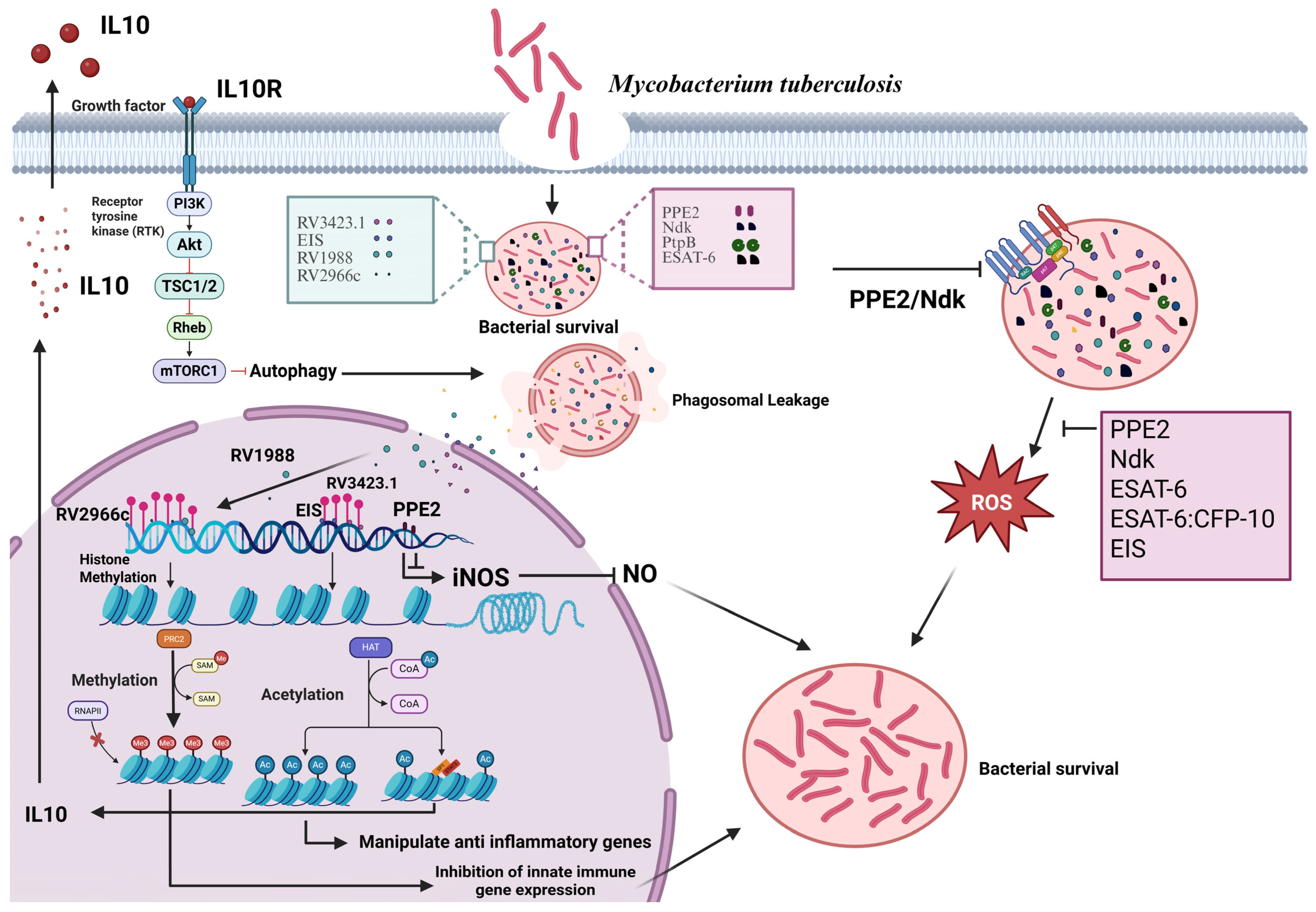
| Rv1988 | Histone methyltransferase | Histone H3 | Methylation of H3R42 | Binds histone H3 and catalyzes non-canonical methylation at nucleosomal core region | Suppression of innate immune genes (NOX1, NOX4, NOS2) | [1] |
| Rv2966c | DNA methyltransferase | Host genomic DNA | Non-CpG cytosine methylation | Binds host DNA and methylates cytosine residues outside CpG islands | Alters transcription factor binding and regulates inflammatory genes | [2,3] |
| Rv3423.1 | Histone acetyltransferase-like protein | Histone H3 | Acetylation at H3K9/H3K14 | Modifies chromatin-associated histone lysine residues | Promotes transcription of anti-inflammatory genes | [4] |
| Rv0256c (PPE2) | DNA-binding nucleomodulin | iNOS promoter | Transcriptional repression | Binds promoter region of iNOS gene | Decreased nitric oxide production and antimicrobial response | [5,6] |
| EIS | Acetyltransferase | Histone H3 | Histone H3 acetylation | Increases histone acetylation and induces IL-10 expression | Suppresses inflammatory responses and autophagy | [7,8] |
| ESAT-6 | ESX-1 secretory effector | CIITA- associated chromatin | Indirect histone acetylation modulation | Alters transcriptional regulation of antigen presentation genes | Reduced MHC-II expression and impaired T-cell activation | [9,10] |
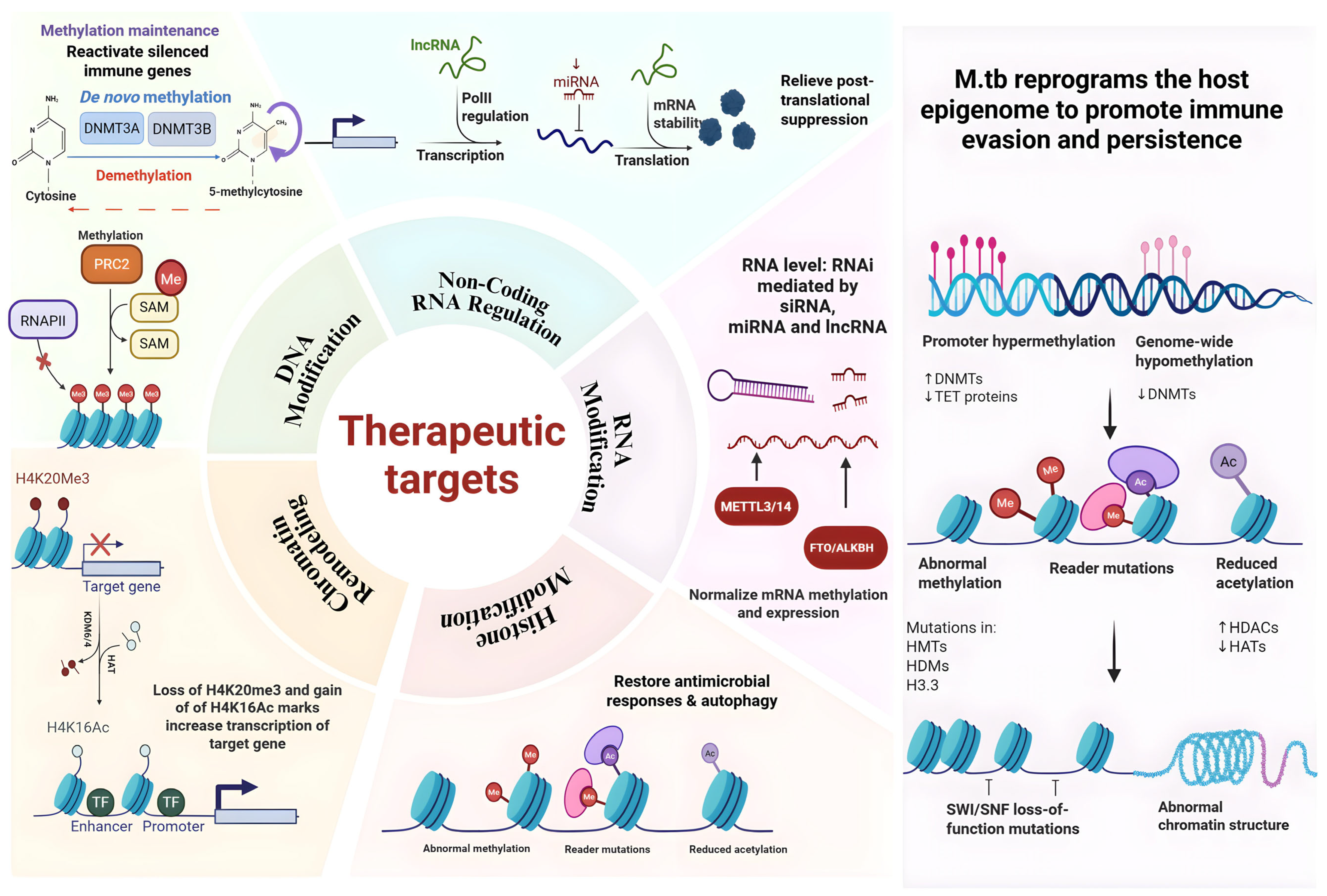
| Immune Evasion Mechanism | Epigenetic Modification | Target/Mechanism | Reference |
|---|---|---|---|
| Autophagy inhibition | Histone methylation | Phosphoribosyltransferase of Mtb inhibits autophagy in an mTOR-dependent manner by the hypermethylation of H3 lysine 9 and lysine 27 at the promoter of Atg 5 and Atg 7 genes inhibition. | [64] |
| Macrophage polarization | Histone methylation | Increased H3K4me3-induced expression of AKT and ARG2 promotes M2 polarization | [65] |
| Antigen presentation | Histone phosphorylation and acetylation | Suppression of MHC II expression on Mtb infected macrophages by CCR5-mediated histone phosphorylation and acetylation. | [66] |
| Apoptosis | Histone methylation | H4K20 monomethylation by histone methyl transferase 8, SET 8, affects apoptosis by enhancing M2 polarization. | [67] |
| Cytokine production | DNA methylation | Hypermethylation of host NF kB and suppression of cytokine production | [68] |
| RNA modification | Inhibition of TLR2/MyD88 signaling by miR-27b | [69] |
| Category | Epigenetic Modifiers | Mechanism | Examples | Reference |
|---|---|---|---|---|
| Histone Modification Inhibitors | HDACs (including non-selective) | Modulates host immunity by suppression of either autophagy, Ros generation or enhancing Vitamin D-dependent antimicrobial killing while regulating inflammation | Trichostatin A(TSA), suberoylanilide hydroxamic acid (SAHA), phenylbutyrate. | [78,79,81] |
| Methyltransferase (MTase) inhibitors | Methyltransferases (DNA, RNA) | Disrupts pathogenic methylation by inhibiting host DNMTs to reactive silenced immune genes and blocking bacterial Rv3366 to prevent essential RNA modifications | Levodopa, droxidopa | [81] |
Disclaimer/Publisher’s Note: The statements, opinions and data contained in all publications are solely those of the individual author(s) and contributor(s) and not of MDPI and/or the editor(s). MDPI and/or the editor(s) disclaim responsibility for any injury to people or property resulting from any ideas, methods, instructions or products referred to in the content. |
© 2026 by the authors. Licensee MDPI, Basel, Switzerland. This article is an open access article distributed under the terms and conditions of the Creative Commons Attribution (CC BY) license.
Share and Cite
RV, K.; Asif, N.; Sethunath, A.N.; Thekkumkara, D.T.; Binu, D.; Krishna, G.; Sureshkumar, A.A.; Menon, A.M.; Thomas, S.S.; Abhinand, K.; et al. Epigenetic Reprogramming by Mycobacterium tuberculosis Secretory Proteins: Implications for Pathogenesis and Therapy. Antibiotics 2026, 15, 557. https://doi.org/10.3390/antibiotics15060557
RV K, Asif N, Sethunath AN, Thekkumkara DT, Binu D, Krishna G, Sureshkumar AA, Menon AM, Thomas SS, Abhinand K, et al. Epigenetic Reprogramming by Mycobacterium tuberculosis Secretory Proteins: Implications for Pathogenesis and Therapy. Antibiotics. 2026; 15(6):557. https://doi.org/10.3390/antibiotics15060557
Chicago/Turabian StyleRV, Krishna, Nafsiya Asif, Akash N. Sethunath, Deepak T. Thekkumkara, Devanandana Binu, Gowri Krishna, Aarsha A. Sureshkumar, Arjun M. Menon, Shwetha Susan Thomas, Kuniyil Abhinand, and et al. 2026. "Epigenetic Reprogramming by Mycobacterium tuberculosis Secretory Proteins: Implications for Pathogenesis and Therapy" Antibiotics 15, no. 6: 557. https://doi.org/10.3390/antibiotics15060557
APA StyleRV, K., Asif, N., Sethunath, A. N., Thekkumkara, D. T., Binu, D., Krishna, G., Sureshkumar, A. A., Menon, A. M., Thomas, S. S., Abhinand, K., Sasikumar, A., Padmakumar, S., Paniker, A., Babu, P., Kumar, G. B., Nair, B. G., & Madhavan, A. (2026). Epigenetic Reprogramming by Mycobacterium tuberculosis Secretory Proteins: Implications for Pathogenesis and Therapy. Antibiotics, 15(6), 557. https://doi.org/10.3390/antibiotics15060557