This is an early access version, the complete PDF, HTML, and XML versions will be available soon.
Article

α-Mangostin Competing the Menaquinone-Binding Sites of NDH-2 to Block the Electron Transfer at the Quinone Pool of Staphylococcus aureus

1
Biotechnological Engineering Center for Pharmaceutical Research and Development, Jiangxi Agricultural University, Nanchang 330045, China
2
Laboratory of Natural Medicine and Microbiological Drug, College of Bioscience and Bioengineering, Jiangxi Agricultural University, Nanchang 330045, China
*
Author to whom correspondence should be addressed.
Antibiotics 2026, 15(5), 509; https://doi.org/10.3390/antibiotics15050509

Submission received: 5 March 2026 / Revised: 7 May 2026 / Accepted: 15 May 2026 / Published: 18 May 2026

Abstract

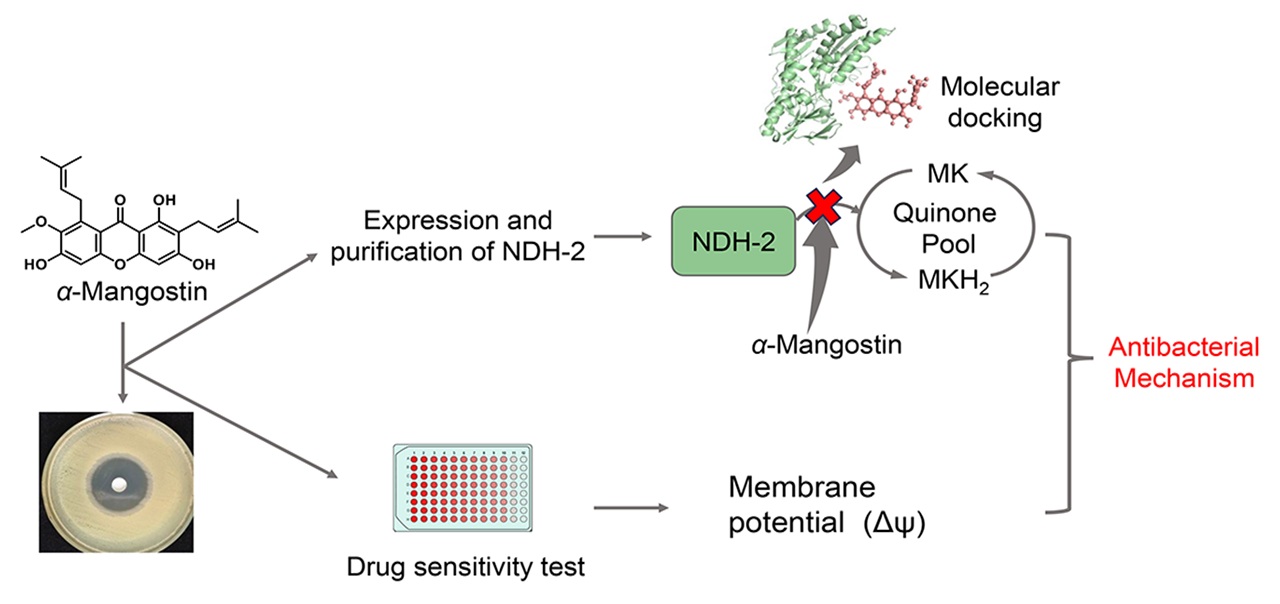
Background/Objectives:α-Mangostin, a natural product from Garcinia mangostana L, presents very strong antibacterial activity in plant flavonoids against Staphylococcus aureus. Recently, it was reported that the quinone pool is a key target of α-mangostin against Gram-positive bacteria. Here, the detail centering this action mechanism of α-mangostin killing S. aureus was further explored. Methods: The interactions between α-mangostin and type II NADH:quinone oxidoreductase (NDH-2), a key enzyme in the respiratory chain, were explored through the enzyme kinetic experiments, fluorescence analyses, and molecular simulation. Simultaneously, the effect of α-mangostin on membrane potential was also investigated as a possible non-enzymatic mechanism. Results: it was found that α-mangostin mainly competes the menaquinone-binding sites of NDH-2 with menaquinone, and the half-maximal inhibitory concentration (IC50) of α-mangostin on NDH-2 is 4.95 μM. Fluorescence analyses indicated that α-mangostin can spontaneously bind to NDH-2 to form an α-mangostin–NDH-2 complex. Subsequently, molecular simulation further showed that α-mangostin can dock to the menaquinone-binding sites of NDH-2. In addition, non-enzymatic mechanism showed that α-mangostin can cause membrane potential depolarization and disrupt the proton motive force balance, thereby promoting the cell-membrane destruction of S. aureus. Conclusions: α-Mangostin can mainly interact with the amino acid residues at the menaquinone-binding pocket of NDH-2 to block the electron transfer at the quinone pool in the respiratory chain of S. aureus, which will hinder the energy supply and act synergistically with cell membrane damage, ultimately leading to the death of S. aureus. Simultaneously, it once again proves that the quinone pool is a key target of plant flavonoids against Gram-positive bacteria.
Keywords: α-mangostin; NDH-2; respiratory chain; menaquinone; mechanism; flavonoid α-mangostin; NDH-2; respiratory chain; menaquinone; mechanism; flavonoid
Graphical Abstract