
Carbapenem-Resistant Serratia marcescens: Genomic Plasticity, Virulence Architecture, and the Expanding Threat of Multidrug Resistance




Abstract
1. Introduction
1.1. Taxonomy
1.2. Carbapenem-Resistant Serratia marcescens (CRSM)
2. Genomic Pool, Pangenome and Genomic Plasticity of Serratia marcescens
3. Virulence Factors and Strategies
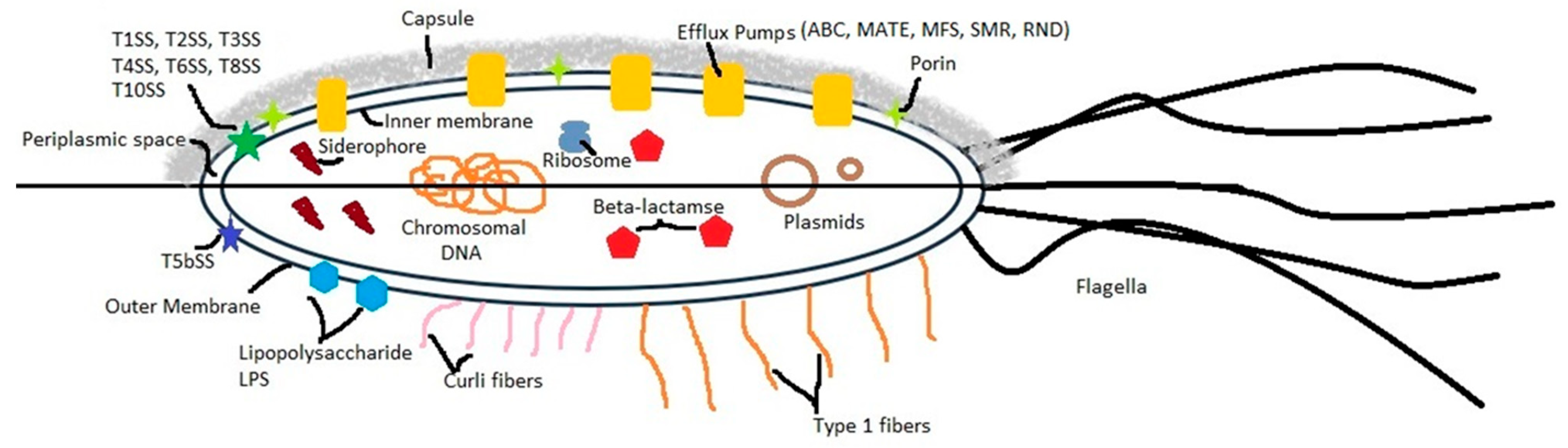
- Curli-like fibers: Research on S. marcescens pili and fimbriae remains limited. Campos et al. [99] reported thin fibrillar surface structures, and Boldeanu et al. [20] proposed an adhesive role, though mechanisms were not defined. In contrast, curli fimbriae (amyloid fibres produced via a dedicated assembly pathway) are well characterised in Enterobacteriaceae (e.g., E. coli) and are known to mediate surface adhesion and promote robust biofilm formation [42,100]. Indeed, curli fibres are produced via a nucleation–precipitation pathway, which is classified as the Type VIII secretion system (T8SS) [101].
- Type 1 fibers: Chaperone–Usher (CU) fimbriae, key adhesion and biofilm mediators in Enterobacteriaceae, are poorly characterised in S. marcescens [42,98,100,102,103,104,105,106,107,108]. Readily metabolised carbon sources activate cAMP–CRP-dependent catabolite repression, which suppresses Type 1 fimbrial expression in S. marcescens and Vibrio cholerae, thereby reducing biofilm formation. In contrast, the same regulatory system can enhance biofilm development in other species, including E. coli and P. aeruginosa [109,110]. Gonzalez-Montalvo et al. [98] identified 421 fimbrial usher proteins (FUPs) across 39 S. marcescens genomes, defining 20 CU operons, six forming the core fimbriome (Fgov, Fgfo, Fgft, Fpo, Fps, and Fso; detected among ≥94% of the S. marcescens strains). Three core operons (fgov, fpo, fps) are primarily expressed and act as major adhesins, with Fgov (former Fim) mediating yeast agglutination, human corneal epithelial (HCE) cell adhesion, and biofilm formation [98,111,112]. Core fimbriae provide general adhesion (known as housekeeping adhesins), while the strain-specific repertoire drives niche adaptation, phenotypic diversity, and genomic plasticity [74,77,79,98].
- Capsule: Capsule production is a conserved virulence trait among Enterobacteriaceae, providing effective protection against host immune clearance. In S. marcescens, the capsule is composed of acidic polysaccharides, with its chemical composition varying across clinical isolates. Notably, capsule expression is considered essential for the establishment of bloodstream infections. Thus, the polysaccharide capsule is known as a virulence factor in S. marcescens [113,114,115,116,117].
- Outer membrane (OM): The OM is central to Gram-negative biology, supporting adhesion, environmental sensing, host interaction, and cell-to-cell communication [69,100,121,122,123,124,125,126,127,128,129,130,131]. Its defining feature, however, is its permeability barrier, which excludes large or hydrophobic antibiotics and underlies the intrinsic drug resistance of Gram-negative pathogens, an obstacle that continues to impede antibiotic development and drive MDR [41,47,121,127,132,133,134,135].
- Extracellular enzymes: S. marcescens employs a broad spectrum of exoenzymes [e.g., proteases, phospholipases, lipases, and nucleases (such as DNases)] to breach host barriers and establish infection. Pathogenic bacteria, including S. marcescens, secrete non-cytotoxic extracellular nucleases that play multifaceted roles in disease progression. These enzymes contribute to nutrient acquisition, facilitate immune evasion, modulate biofilm architecture, and enhance HGT [195]. Indeed, nucleases are multifunctional enzymes present across bacterial pathogens like S. marcescens, contributing to nutrient acquisition, DNA uptake, and biofilm remodelling. They also promote host invasion through tissue damage, degrade the DNA backbone of neutrophil extracellular traps (NETs) to evade immune clearance, and modulate host immune responses [196].
- Secretion systems (SSs): The Sec and Tat pathways are the primary conserved routes for protein export across the bacterial cytoplasmic membrane, operating via distinct mechanisms [224,225,226,227]. The Sec pathway transports unfolded proteins through the SecYEG translocase, often with accessory factors in Gram-positive bacteria, and is responsible for secreting many virulence factors [224,226]. In contrast, the Tat pathway exports folded, frequently cofactor-containing proteins via the TatA–TatB–TatC complex (with TatA/B fused in some Gram-positive species). In Gram-positive bacteria, substrates are released extracellularly, whereas in Gram-negative species they remain in the periplasm or are further exported via the type II secretion system (T2SS). The Tat pathway is critical for virulence in several pathogens, including phospholipase C–producing bacteria [227,228,229,230,231,232].
- Type I secretion system (T1SS) and RND pumps are tripartite, double-membrane systems. T1SS secrete key virulence and nutrient-acquisition factors, including toxins, adhesins, bacteriocins, and enzymes that support bacterial survival and pathogenicity, while RND pumps export small molecules, including antibiotics. Both use a one-step mechanism, with T1SS relying on an ABC transporter in the inner membrane [233,237,238,239,240,241,242]. Previous studies indicate that S. marcescens secretes the hemophore HasA through a T1SS-dependent pathway [224,243]. The Swr QS system in S. liquefaciens MG1/S. marcescens MG1 regulates both swarming motility and the Lip T1SS, which secretes lipases, metalloproteases, and S-layer proteins [244,245,246].
- Type II secretion systems (T2SSs) in Gram-negative bacteria export folded proteins from the periplasm, receiving substrates delivered by Sec or Tat. They secrete diverse enzymes, e.g., proteases, phospholipases, and toxins, many linked to virulence, and their pseudopilus is evolutionarily related to type IV pili and competence systems [224,247,248,249,250]. The T2SS is widely distributed among Gammaproteobacteria and has been documented in at least 15 genera, including Serratia, Klebsiella, Yersinia, Acinetobacter, etc. [20,251].
- Type III secretion (T3SS) systems are multi-component nanomachines that deliver effectors to host cells via a pilus-like structure and a translocon. T3S structural components are encoded in pathogenicity islands (PAIs) within chromosomal or plasmid gene clusters likely acquired through HGT [224,233,252,253,254]. The term also includes flagellar T3SSs, which mainly export structural proteins but can additionally secrete virulence factors. Many bacteria, including Serratia, possess multiple T3S systems, including flagellar and translocation-associated types, which function at distinct infection stages [20,224,233,252,253,254]. Translocation-associated systems, while mainly pathogenic, can also support symbiosis and feature appendages—pili in plant pathogens or needles in animal pathogens for protein delivery [224,233,252,255]. Thus, effector proteins are delivered into host cells via the T3SS [20].
- Type IV secretion systems (T4SSs) are the only secretion systems that transfer both DNA and proteins, underpinning plasmid conjugation and contributing to pathogen–host interactions [224,233,256,257]. Widespread “minimised” T4SSs, streamlined derivatives of ancestral conjugative modules, occur across Gram-positive and select Gram-negative bacteria, often linked to MGEs and surface-associated virulence traits [256,257,258,259,260]. Tn916-like Integrative and conjugative elements (ICEs), including Tn6009 identified in Klebsiella, Pseudomonas, and Serratia encode a reduced VirB/VirD4 set yet retain broad host-range mobility. Despite structural variation, most Gram-negative T4SSs conserve a VirB/VirD4 core that mediates conjugation, DNA exchange, and effector translocation [256,257,259,260,261,262]. All in all, T4SS mediates HGT, driving the spread of resistance genes across bacterial populations. It also performs effector delivery and interbacterial antagonism. T4SS has key roles in bacterial pathogenesis and host–pathogen interactions [20,241,263,264].
- Type V secretion systems [(Va–Ve); Va (classical Autotransporters (ATs); Vb (two-partner Secretion); Vc (trimeric AT Adhesins); Vd (a hybrid form of types Va and Vb systems); Ve (inverse ATs)] share a hallmark design in which a single polypeptide encodes both the β-barrel pore and its passenger [265,266,267,268]. This minimalist architecture underlies their self-contained export mechanism, giving rise to the term “autotransporters,” especially for Va, Vc, and Ve [265,266,267,268]. Type Vf represents a recently defined AT subclass restricted to Helicobacter pylori, with BapA as its prototypical member [257,268,269,270].
- Type VI secretion system (T6SS) is a widespread contractile apparatus in Gram-negative bacteria that underpins interbacterial antagonism, host interactions, and environmental adaptation [278,279]. In Serratia, it is key to competitive fitness. Jiang et al. further demonstrated that its broad protein diversity and frequent HGT confer strong evolutionary adaptability [278,279]. Beyond their standard roles, T3SS and T6SS broadly modulate microbial ecology: T3SS can influence microbiota composition, whereas T6SS mediates antifungal activity, metal scavenging, and DNase-dependent interactions in biofilms [280,281,282,283,284,285].
- The Type VII secretion system (T7SS), first characterised in Bacillus spp., has since been identified in several Pseudomonas strains. Unlike typical Gram-negative systems, T7SS (T7SSa/b) in Actinobacteria and Firmicutes mediates virulence, modulates membrane permeability, nutrient (e.g., iron) acquisition, competition, development and niche colonisation [287,288,289,290].
- Type VIII secretion system (T8SS) is known as a Gram-negative bacterial two-step transporter [241]. As aforementioned in the curli-like fibres section, constitution, assembling, and secretion of curli fibres occur via a nucleation–precipitation pathway, recognised as T8SS [42,100,101,108,291,292,293]. As curli-like fibres have been detected in Serratia species like S. marcescens [20], it seems that T8SSs are detectable in their bacterial cell [101]. In other words, curli biogenesis, classified as the T8SS, is governed by two divergently transcribed operons, csgBAC and csgDEFG [101].
- Type IX secretion system (T9SS) is unique to Bacteroidetes. T9SS exports virulence factors, degradative enzymes, and motility adhesins—supporting pathogenesis in Porphyromonas gingivalis and gliding in Flavobacterium johnsoniae. Recent structural studies have clarified its translocon and motor machinery [294,295,296].
- The Type X secretion system (T10SS), originally identified in Gram-negative bacteria, is homologous to phage lysis cassettes and consists of a minimal holin–hydrolase module that mediates controlled protein release [297,298,299,300]. In S. marcescens DB10, it enables chitinase export through a pathway distinct from the T2SS. T10SS function requires coordinated holin–hydrolase activity and proceeds through at least two stages, with a possible third step yet to be defined [297,298,299,300].
- The Type XI secretion system (T11SS) is a conserved proteobacterial pathway (e.g., E. coli, A. baumannii), which functions as a transport channel that moves soluble proteins and lipoproteins across the outer membrane via a dedicated protein complex [301,302,303,304]. The specific molecules it exports are determined by the system’s genetic makeup; known effectors include proteins that interact with transferrin, lactoferrin, factor H, and heme [301,302,303,304].
- Iron acquisition systems: For pathogenicity and survival, bacteria require iron acquisition. S. marcescens utilises two distinct mechanisms to retrieve iron from heme: the Hem system, which directly extracts the metal, and the Has system, which relies on a hemophore protein to aid in the extraction and transport processes [117,305,306,307].
- Quorum sensing (QS) and regulation: In contrast to eukaryotes, which rely on hormone-mediated signalling, prokaryotic communication is largely governed by QS mechanisms [322]. Bacteria display coordinated social behaviours via QS, a cell-to-cell communication mechanism. QS relies on autoinducers (AIs) (chemical signals produced by pathogens) that trigger collective procedures once a threshold concentration is reached, enabling bacteria to perform tasks unattainable by individual cells [323,324]. AHLs/AIs constitute the principal QS signals in Gram-negative bacteria, regulating density-dependent gene expression and collective behaviours, including biofilm formation [20,323,324,325,326]. Although primarily involved in intra-species communication, they can also facilitate interspecies signalling. The best-characterised framework for AHL-dependent QS is the Vibrio cholerae, V. harveyi, V. fischeri and Myxococcus xanthus LuxI/LuxR system. LuxI produces the autoinducer, which binds to the cytoplasmic receptor LuxR. This interaction induces a conformational change in LuxR, allowing it to bind DNA and regulate target gene expression [20,323,327].
4. Antimicrobial Resistance (AMR) Mechanisms in CRSM
5. CRSM and the Impact of Transposable Elements (TEs)
6. Conclusions
Author Contributions
Funding
Institutional Review Board Statement
Informed Consent Statement
Data Availability Statement
Acknowledgments
Conflicts of Interest
References
- Matteoli, F.P.; Pedrosa-Silva, F.; Dutra-Silva, L.; Giachini, A.J. The global population structure and beta-lactamase repertoire of the opportunistic pathogen Serratia marcescens. Genomics 2021, 113, 3523–3532. [Google Scholar] [CrossRef] [Scilit]
- Williams, D.J.; Grimont, P.A.; Cazares, A.; Grimont, F.; Ageron, E.; Pettigrew, K.A.; Cazares, D.; Njamkepo, E.; Weill, F.-X.; Heinz, E. The genus Serratia revisited by genomics. Nat. Commun. 2022, 13, 5195. [Google Scholar] [CrossRef] [Scilit]
- Gillen, A.L.; Gibbs, R. Serratia marcescens: The miracle bacillus. Fac. Publ. Present. 2012, 138. [Google Scholar]
- Ball, A.; McGhie, D.; Geddes, A. Serratia marcescens in a general hospital. QJM Int. J. Med. 1977, 46, 63–71. [Google Scholar]
- Virgolini, I.; Zelger, B.; Zelger, B.; Kenner, L. Reality or fiction of the “real presence” of Jesus Christ in the holy eucharist. Ann. Clin. Med. Case Rep. 2023, 11, 1–10. [Google Scholar]
- Grzybowski, T.; Wrzosek, M.; Wołyniec, W.; Hałoń, A.; Chmielik, E.; Gorzkiewicz, M.; Woźniak, M.; Mikucka, A.; Lebioda, A.; Jonkisz, A. Methodology for the analysis of biological impurities associated with peri-eucharistic phenomena. Appl. Microbiol. Biotechnol. 2025, 109, 58. [Google Scholar] [CrossRef] [Scilit]
- Göker, M.; Christensen, H.; Fingerle, V.; Kostovski, M.; Margos, G.; Moore, E.R.; Oren, A.; Patrick, S.; Reischl, U.; Vázquez-Boland, J.A. List of Recommended Names for bacteria of medical importance: Report of the Ad Hoc Committee on Mitigating Changes in Prokaryotic Nomenclature. Int. J. Syst. Evol. Microbiol. 2025, 75, 006943. [Google Scholar] [CrossRef] [Scilit] [PubMed]
- Adeolu, M.; Alnajar, S.; Naushad, S.; Gupta, R.S. Genome-based phylogeny and taxonomy of the ‘Enterobacteriales’: Proposal for Enterobacterales ord. nov. divided into the families Enterobacteriaceae, Erwiniaceae fam. nov., Pectobacteriaceae fam. nov., Yersiniaceae fam. nov., Hafniaceae fam. nov., Morganellaceae fam. nov., and Budviciaceae fam. nov. Int. J. Syst. Evol. Microbiol. 2016, 66, 5575–5599. [Google Scholar] [CrossRef] [Scilit] [PubMed]
- Janda, J.M.; Abbott, S.L. The changing face of the family Enterobacteriaceae (Order:“Enterobacterales”): New members, taxonomic issues, geographic expansion, and new diseases and disease syndromes. Clin. Microbiol. Rev. 2021, 34, e00174-20. [Google Scholar] [CrossRef] [Scilit]
- Chuvochina, M.; Mussig, A.J.; Chaumeil, P.-A.; Skarshewski, A.; Rinke, C.; Parks, D.H.; Hugenholtz, P. Proposal of names for 329 higher rank taxa defined in the Genome Taxonomy Database under two prokaryotic codes. FEMS Microbiol. Lett. 2023, 370, fnad071. [Google Scholar] [CrossRef] [Scilit]
- Martins, P.A.; Pacheco, T.F.; de Camargo, B.R.; De Marco, J.L.; Salum, T.F.C. Solid-state fermentation production and characterization of an alkaline lipase from a newly isolated Burkholderia gladioli strain. Prep. Biochem. Biotechnol. 2022, 52, 70–79. [Google Scholar] [CrossRef] [Scilit]
- Rout, R.K.; Maity, S.P.; Daya Sagar, B.S.; Hassan, S.S. Fractal and mathematical morphology in intricate comparison between tertiary protein structures. Comput. Methods Biomech. Biomed. Eng. Imaging Vis. 2018, 6, 192–203. [Google Scholar] [CrossRef] [Scilit]
- Behzadi, P.; Ranjbar, R. DNA microarray technology and bioinformatic web services. Acta Microbiol. Immunol. Hung. 2019, 66, 19–30. [Google Scholar] [CrossRef] [Scilit]
- Behzadi, P.; Gajdács, M. Writing a strong scientific paper in medicine and the biomedical sciences: A checklist and recommendations for early career researchers. Biol. Futur. 2021, 72, 395–407. [Google Scholar] [CrossRef] [Scilit]
- Ranjbar, R.; Behzadi, P.; Najafi, A.; Roudi, R. DNA microarray for rapid detection and identification of food and water borne bacteria: From dry to wet lab. Open Microbiol. J. 2017, 11, 330–338. [Google Scholar] [CrossRef] [Scilit] [PubMed]
- Behzadi, P.; Najafi, A.; Behzadi, E.; Ranjbar, R. Microarray long oligo probe designing for Escherichia coli: An in-silico DNA marker extraction. Cent. Eur. J. Urol. 2016, 69, 105–111. [Google Scholar]
- Behzadi, P.; Ranjbar, R.; Alavian, S.M. Nucleic acid-based approaches for detection of viral hepatitis. Jundishapur. J. Microbiol. 2014, 8, e17449. [Google Scholar] [CrossRef] [Scilit] [PubMed]
- Behzadi, P.; Gajdács, M. Worldwide Protein Data Bank (wwPDB): A virtual treasure for research in biotechnology. Eur. J. Microbiol. Immunol. 2022, 11, 77–86. [Google Scholar] [CrossRef] [Scilit] [PubMed]
- Ranjbar, R.; Behzadi, P.; Mammina, C. Respiratory tularemia: Francisella tularensis and microarray probe designing. Open Microbiol. J. 2016, 10, 176–182. [Google Scholar] [CrossRef] [Scilit]
- Boldeanu, L.; Boldeanu, M.V.; Novac, M.B.; Assani, M.-Z.; Radu, L. Serratia marcescens: A Versatile Opportunistic Pathogen with Emerging Clinical and Biotechnological Significance. Int. J. Mol. Sci. 2025, 26, 11479. [Google Scholar] [CrossRef] [Scilit]
- Li, X.; Zhuang, X.; Dong, H.; Qin, R.; Ran, T.; Xu, D.; Wang, W. The NtrB/C two-component system positively regulates the motility in Serratia marcescens FS14. Int. J. Biol. Macromol. 2025, 328, 147689. [Google Scholar] [CrossRef] [Scilit] [PubMed]
- Miller, J.; Murray, P.J. Space and time on the membrane: Modelling Type VI secretion system dynamics as a state-dependent random walk. R. Soc. Open Sci. 2023, 10, 230284. [Google Scholar] [CrossRef] [Scilit] [PubMed]
- Cosimato, I.; Santella, B.; Rufolo, S.; Sabatini, P.; Galdiero, M.; Capunzo, M.; Boccia, G.; Folliero, V.; Franci, G. Current epidemiological status and antibiotic resistance profile of Serratia marcescens. Antibiotics 2024, 13, 323. [Google Scholar] [CrossRef] [Scilit]
- Zhu, H.; Li, F.; Cao, X.; Zhang, Y.; Liu, C.; Chen, Y.; Shen, H. Epidemiology, resistance profiles, and risk factors of multidrug-and carbapenem-resistant Serratia marcescens infections: A retrospective study of 242 cases. BMC Infect. Dis. 2025, 25, 1105. [Google Scholar] [CrossRef] [Scilit]
- Akhtar, M.R.; Younas, M.; Xia, X. Pathogenicity of Serratia marcescens strains as biological control agent: Implications for sustainable pest management. Insect Sci. 2025, 33, 13–32. [Google Scholar] [CrossRef] [Scilit]
- Tavares-Carreon, F.; De Anda-Mora, K.; Rojas-Barrera, I.C.; Andrade, A. Serratia marcescens antibiotic resistance mechanisms of an opportunistic pathogen: A literature review. PeerJ 2023, 11, e14399. [Google Scholar] [CrossRef] [Scilit]
- Vollset, S.E.; Ababneh, H.S.; Abate, Y.H.; Abbafati, C.; Abbasgholizadeh, R.; Abbasian, M.; Abbastabar, H.; Abd Al Magied, A.H.; Abd ElHafeez, S.; Abdelkader, A. Burden of disease scenarios for 204 countries and territories, 2022–2050: A forecasting analysis for the Global Burden of Disease Study 2021. Lancet 2024, 403, 2204–2256. [Google Scholar] [CrossRef] [Scilit]
- Oh, J.; Kim, S.; Kim, M.S.; Abate, Y.H.; Abd ElHafeez, S.; Abdelkader, A.; Abdi, P.; Abdulah, D.M.; Aboagye, R.G.; Abolhassani, H. Global, regional, and national burden of asthma and atopic dermatitis, 1990–2021, and projections to 2050: A systematic analysis of the Global Burden of Disease Study 2021. Lancet Respir. Med. 2025, 13, 425–446. [Google Scholar] [CrossRef] [Scilit]
- Schumacher, A.E.; Zheng, P.; Barber, R.M.; Aalipour, M.A.; Aalruz, H.; Ababneh, H.S.; Abaraogu, U.O.; Abbafati, C.; Abbas, N.; Abbasifard, M. Global age-sex-specific all-cause mortality and life expectancy estimates for 204 countries and territories and 660 subnational locations, 1950–2023: A demographic analysis for the Global Burden of Disease Study 2023. Lancet 2025, 406, 1731–1810. [Google Scholar] [CrossRef] [Scilit] [PubMed]
- Monardo, R.; Park, L.P.; Ruffin, F.; Cox, P.; Dinh, A.Q.; Korn, R.E.; Farahani, P.; Ripa, M.; Castagna, A.; Hanson, B.M.; et al. Clinical and Genomic Characterization of Serratia Bloodstream Infections. CMI Commun. 2025, 2, 105128. [Google Scholar] [CrossRef] [Scilit]
- Ono, T.; Taniguchi, I.; Nakamura, K.; Nagano, D.S.; Nishida, R.; Gotoh, Y.; Ogura, Y.; Sato, M.P.; Iguchi, A.; Murase, K. Global population structure of the Serratia marcescens complex and identification of hospital-adapted lineages in the complex. Microb. Genom. 2022, 8, 000793. [Google Scholar] [CrossRef] [Scilit] [PubMed]
- Aracil-Gisbert, S.; Fernández-De-Bobadilla, M.D.; Guerra-Pinto, N.; Serrano-Calleja, S.; Pérez-Cobas, A.E.; Soriano, C.; de Pablo, R.; Lanza, V.F.; Pérez-Viso, B.; Reuters, S. The ICU environment contributes to the endemicity of the “Serratia marcescens complex” in the hospital setting. Mbio 2024, 15, e03054-23. [Google Scholar] [CrossRef] [Scilit]
- Jacoby, G.A. AmpC β-lactamases. Clin. Microbiol. Rev. 2009, 22, 161–182. [Google Scholar] [CrossRef] [Scilit]
- Tamma, P.D.; Aitken, S.L.; Bonomo, R.A.; Mathers, A.J.; Van Duin, D.; Clancy, C.J. Infectious Diseases Society of America guidance on the treatment of AmpC β-lactamase–producing Enterobacterales, carbapenem-resistant Acinetobacter baumannii, and Stenotrophomonas maltophilia infections. Clin. Infect. Dis. 2022, 74, 2089–2114. [Google Scholar] [CrossRef] [Scilit]
- Husna, A.; Rahman, M.M.; Badruzzaman, A.; Sikder, M.H.; Islam, M.R.; Rahman, M.T.; Alam, J.; Ashour, H.M. Extended-spectrum β-lactamases (ESBL): Challenges and opportunities. Biomedicines 2023, 11, 2937. [Google Scholar] [CrossRef] [Scilit]
- Behzadi, P.; García-Perdomo, H.A.; Karpiński, T.M.; Issakhanian, L. Metallo-ß-lactamases: A review. Mol. Biol. Rep. 2020, 47, 6281–6294. [Google Scholar] [CrossRef] [Scilit]
- Ahmadi, S.; Foroohi, F.; Shirzadian, M.; Vosoughi, A.F.; Golpasand, T.; Behzadi, P. Distribution of acquired carbapenemase genes among uropathogenic Escherichia coli. Naunyn-Schmiedeberg's Arch. Pharmacol. 2025, 399, 3477–3494. [Google Scholar] [CrossRef] [Scilit]
- Moradigaravand, D.; Boinett, C.J.; Martin, V.; Peacock, S.J.; Parkhill, J. Recent independent emergence of multiple multidrug-resistant Serratia marcescens clones within the United Kingdom and Ireland. Genome Res. 2016, 26, 1101–1109. [Google Scholar] [CrossRef] [Scilit]
- Magiorakos, A.-P.; Srinivasan, A.; Carey, R.B.; Carmeli, Y.; Falagas, M.; Giske, C.; Harbarth, S.; Hindler, J.; Kahlmeter, G.; Olsson-Liljequist, B. Multidrug-resistant, extensively drug-resistant and pandrug-resistant bacteria: An international expert proposal for interim standard definitions for acquired resistance. Clin. Microbiol. Infect. 2012, 18, 268–281. [Google Scholar] [CrossRef] [Scilit]
- Karampatakis, T.; Tsergouli, K.; Behzadi, P. Carbapenem-Resistant Acinetobacter baumannii: Virulence factors, molecular epidemiology, and latest updates in treatment options. Microorganisms 2025, 13, 1983. [Google Scholar] [CrossRef] [Scilit] [PubMed]
- Kebriaee, A.N.; Behzadi, P.; Mohammadian, T.; Imani Fooladi, A.A.; Hosseini, M.S. Distribution of antimicrobial resistance genes and virulence genes in different genotypes of Acinetobacter baumannii. BMC Infect. Dis. 2025, 25, 1230. [Google Scholar] [CrossRef] [Scilit]
- Golpasand, T.; Keshvari, M.; Behzadi, P. Distribution of chaperone-usher fimbriae and curli fimbriae among uropathogenic Escherichia coli. BMC Microbiol. 2024, 24, 344. [Google Scholar] [CrossRef] [Scilit]
- Karampatakis, T.; Tsergouli, K.; Behzadi, P. Carbapenem-resistant Pseudomonas aeruginosa’s resistome: Pan-genomic plasticity, the impact of transposable elements and jumping genes. Antibiotics 2025, 14, 353. [Google Scholar] [CrossRef] [Scilit]
- Karampatakis, T.; Tsergouli, K.; Behzadi, P. Pan-genome plasticity and virulence factors: A natural treasure trove for Acinetobacter baumannii. Antibiotics 2024, 13, 257. [Google Scholar] [CrossRef] [Scilit]
- Algammal, A.; Hetta, H.F.; Mabrok, M.; Behzadi, P. Emerging multidrug-resistant bacterial pathogens “superbugs”: A rising public health threat. Front. Microbiol. 2023, 14, 1135614. [Google Scholar] [CrossRef] [Scilit]
- Algammal, A.M.; Behzadi, P. Antimicrobial resistance: A global public health concern that needs perspective combating strategies and new talented antibiotics. Discov. Med. 2024, 36, 1911–1913. [Google Scholar] [CrossRef] [Scilit] [PubMed]
- Behzadi, P.; Gajdács, M.; Pallós, P.; Ónodi, B.; Stájer, A.; Matusovits, D.; Kárpáti, K.; Burián, K.; Battah, B.; Ferrari, M. Relationship between biofilm-formation, phenotypic virulence factors and antibiotic resistance in environmental Pseudomonas aeruginosa. Pathogens 2022, 11, 1015. [Google Scholar] [CrossRef] [Scilit] [PubMed]
- Chauhan, S.M.; Ardalani, O.; Hyun, J.C.; Monk, J.M.; Phaneuf, P.V.; Palsson, B.O. Decomposition of the pangenome matrix reveals a structure in gene distribution in the Escherichia coli species. mSphere 2025, 10, e00532-24. [Google Scholar] [CrossRef] [Scilit] [PubMed]
- Hyun, J.C.; Monk, J.M.; Palsson, B.O. Comparative pangenomics: Analysis of 12 microbial pathogen pangenomes reveals conserved global structures of genetic and functional diversity. BMC Genom. 2022, 23, 7. [Google Scholar] [CrossRef] [Scilit]
- Karampatakis, T.; Tsergouli, K.; Behzadi, P. Carbapenem-resistant Klebsiella pneumoniae: Virulence factors, molecular epidemiology and latest updates in treatment options. Antibiotics 2023, 12, 234. [Google Scholar] [CrossRef] [Scilit]
- Mitra, S.; Naha, S.; Chakraborty, J.; De, S.; Kaur, H.; Majumdar, T.; Basu, S. Diversity of mobile genetic elements in carbapenem-resistant Enterobacterales isolated from the intensive care units of a tertiary care hospital in Northeast India. Front. Microbiol. 2025, 16, 1543427. [Google Scholar] [CrossRef] [Scilit]
- Fang, L.; Chen, R.; Li, C.; Sun, J.; Liu, R.; Shen, Y.; Guo, X. The association between the genetic structures of commonly incompatible plasmids in Gram-negative bacteria, their distribution and the resistance genes. Front. Cell. Infect. Microbiol. 2024, 14, 1472876. [Google Scholar] [CrossRef] [Scilit] [PubMed]
- Wachino, J.I. Horizontal Gene Transfer Systems for Spread of Antibiotic Resistance in Gram-Negative Bacteria. Microbiol. Immunol. 2025, 69, 367–376. [Google Scholar] [CrossRef] [Scilit]
- Godeux, A.-S.; Svedholm, E.; Barreto, S.; Potron, A.; Venner, S.; Charpentier, X.; Laaberki, M.-H. Interbacterial transfer of carbapenem resistance and large antibiotic resistance islands by natural transformation in pathogenic Acinetobacter. MBio 2022, 13, e02631-21. [Google Scholar] [CrossRef] [Scilit]
- Chiang, Y.N.; Penadés, J.R.; Chen, J. Genetic transduction by phages and chromosomal islands: The new and noncanonical. PLoS Pathog. 2019, 15, e1007878. [Google Scholar] [CrossRef] [Scilit]
- Borodovich, T.; Shkoporov, A.N.; Ross, R.P.; Hill, C. Phage-mediated horizontal gene transfer and its implications for the human gut microbiome. Gastroenterol. Rep. 2022, 10, goac012. [Google Scholar] [CrossRef] [Scilit]
- Wachino, J.-I.; Jin, W.; Kimura, K.; Arakawa, Y. Intercellular transfer of chromosomal antimicrobial resistance genes between Acinetobacter baumannii strains mediated by prophages. Antimicrob. Agents Chemother. 2019, 63, e00334-19. [Google Scholar] [CrossRef] [Scilit] [PubMed]
- Ahmadi, Z.; Noormohammadi, Z.; Behzadi, P.; Ranjbar, R. Molecular detection of gyrA mutation in clinical strains of Klebsiella pneumoniae. Iran. J. Public Health 2022, 51, 2334. [Google Scholar] [CrossRef] [Scilit]
- Gunathilaka, G.U.; Tahlan, V.; Mafiz, A.I.; Polur, M.; Zhang, Y. Phages in urban wastewater have the potential to disseminate antibiotic resistance. Int. J. Antimicrob. Agents 2017, 50, 678–683. [Google Scholar] [CrossRef] [Scilit]
- Pires, J.; Santos, R.; Monteiro, S. Antibiotic resistance genes in bacteriophages from wastewater treatment plant and hospital wastewaters. Sci. Total Environ. 2023, 892, 164708. [Google Scholar] [CrossRef] [Scilit] [PubMed]
- Quirós, P.; Colomer-Lluch, M.; Martínez-Castillo, A.; Miró, E.; Argente, M.; Jofre, J.; Navarro, F.; Muniesa, M. Antibiotic resistance genes in the bacteriophage DNA fraction of human fecal samples. Antimicrob. Agents Chemother. 2014, 58, 606–609. [Google Scholar] [CrossRef] [Scilit]
- Rima, M.; Dakramanji, M.; El Hayek, E.; El Khoury, T.; Fajloun, Z.; Rima, M. Unveiling the wonders of bacteria-derived extracellular vesicles: From fundamental functions to beneficial applications. Heliyon 2025, 11, e42509. [Google Scholar] [CrossRef] [Scilit]
- Chen, L.-J.; Jing, X.-P.; Meng, D.-L.; Wu, T.-T.; Zhou, H.; Sun, R.-L.; Min, X.-C.; Liu, R.; Zeng, J. Newly Detected Transmission of bla KPC-2 by Outer Membrane Vesicles in Klebsiella Pneumoniae. Curr. Med. Sci. 2023, 43, 80–85. [Google Scholar] [CrossRef] [Scilit]
- Tang, B.; Yang, A.; Liu, P.; Wang, Z.; Jian, Z.; Chen, X.; Yan, Q.; Liang, X.; Liu, W. Outer membrane vesicles transmitting bla NDM-1 mediate the emergence of carbapenem-resistant hypervirulent Klebsiella pneumoniae. Antimicrob. Agents Chemother. 2023, 67, e01444-22. [Google Scholar] [CrossRef] [Scilit]
- Zhu, S.; Yang, B.; Wang, Z.; Liu, Y. Augmented dissemination of antibiotic resistance elicited by non-antibiotic factors. Ecotoxicol. Environ. Saf. 2023, 262, 115124. [Google Scholar] [CrossRef] [Scilit] [PubMed]
- Barathan, M.; Ng, S.-L.; Lokanathan, Y.; Ng, M.H.; Law, J.X. Unseen weapons: Bacterial extracellular vesicles and the spread of antibiotic resistance in aquatic environments. Int. J. Mol. Sci. 2024, 25, 3080. [Google Scholar] [CrossRef] [Scilit] [PubMed]
- Briaud, P.; Carroll, R.K. Extracellular vesicle biogenesis and functions in gram-positive bacteria. Infect. Immun. 2020, 88, e00433-20. [Google Scholar] [CrossRef] [Scilit] [PubMed]
- Fan, F.; Chen, G.; Deng, S.; Wei, L. Proteomic analysis of meropenem-induced outer membrane vesicles released by carbapenem-resistant Klebsiella pneumoniae. Microbiol. Spectr. 2024, 12, e02917–e02923. [Google Scholar] [CrossRef] [Scilit] [PubMed]
- Sarshar, M.; Scribano, D.; Behzadi, P.; Masotti, A.; Ambrosi, C. Outer membrane vesicles are the powerful cell-to-cell communication vehicles that allow bacteria to monitor extracellular milieu. ExRNA 2022, 4, 25. [Google Scholar] [CrossRef] [Scilit]
- Ahmadi, Z.; Noormohammadi, Z.; Ranjbar, R.; Behzadi, P. Prevalence of tetracycline resistance genes tet (A, B, C, 39) in Klebsiella pneumoniae isolated from Tehran, Iran. Iran. J. Med. Microbiol. 2022, 16, 141–147. [Google Scholar] [CrossRef] [Scilit]
- Tian, D.; Zhao, M.; Zheng, S.; Jiang, X.; Zhang, B. Involvement of Tn3 transposon in formation and transmission of hypervirulent and carbapenem-resistant Klebsiella pneumoniae. Microbiol. Spectr. 2023, 11, e03038-23. [Google Scholar] [CrossRef] [Scilit]
- Talat, A.; Khan, F.; Khan, A.U. Genome analyses of colistin-resistant high-risk bla NDM-5 producing Klebsiella pneumoniae ST147 and Pseudomonas aeruginosa ST235 and ST357 in clinical settings. BMC Microbiol. 2024, 24, 174. [Google Scholar] [CrossRef] [Scilit] [PubMed]
- Anderson, M.T.; Himpsl, S.D.; Kingsley, L.G.; Smith, S.N.; Bachman, M.A.; Mobley, H.L. Infection characteristics among Serratia marcescens capsule lineages. Mbio 2025, 16, e00559-25. [Google Scholar] [CrossRef] [Scilit] [PubMed]
- Abreo, E.; Altier, N. Pangenome of Serratia marcescens strains from nosocomial and environmental origins reveals different populations and the links between them. Sci. Rep. 2019, 9, 46. [Google Scholar] [CrossRef] [Scilit]
- Nuncio-García, L.A.; Sánchez-Pérez, M.; Andrade, A.; Dávila-Barboza, J.A.; Tavares-Carreón, F. Complete genome sequence of Serratia marcescens strain CH31 isolated from a Periplaneta americana associated with a tertiary hospital setting. Microbiol. Resour. Announc. 2025, 14, e00611-25. [Google Scholar] [CrossRef] [Scilit]
- Iguchi, A.; Nagaya, Y.; Pradel, E.; Ooka, T.; Ogura, Y.; Katsura, K.; Kurokawa, K.; Oshima, K.; Hattori, M.; Parkhill, J. Genome evolution and plasticity of Serratia marcescens, an important multidrug-resistant nosocomial pathogen. Genome Biol. Evol. 2014, 6, 2096–2110. [Google Scholar] [CrossRef] [Scilit]
- Ramdass, A.C.; Rampersad, S.N. Genome-resolved analysis of Serratia marcescens strain SMTT infers niche specialization as a hydrocarbon-degrader. DNA Res. 2025, 32, dsaf001. [Google Scholar] [CrossRef] [Scilit]
- Zhu, W.; Chen, X.; Shen, H.; Wei, M.; Yang, C.; Gu, L. Genomic diversity, antimicrobial resistance and dissemination of Serratia marcescens complex in patients admitted to ICUs. Front. Cell. Infect. Microbiol. 2025, 15, 1672468. [Google Scholar] [CrossRef] [Scilit]
- Dewar, A.E.; Hao, C.; Belcher, L.J.; Ghoul, M.; West, S.A. Bacterial lifestyle shapes pangenomes. Proc. Natl. Acad. Sci. USA 2024, 121, e2320170121. [Google Scholar] [CrossRef] [Scilit]
- Komorowski, A.S.; Surette, M.G.; Rossi, L.; Tertigas, D.; Gaskin, M.; Shekarriz, S.; McArthur, A.G.; Smieja, M.; Mertz, D. Molecular Epidemiology of Clinical Infections Caused by Serratia marcescens Complex in a Tertiary Care Hospital System: Insights From Whole-Genome Sequencing. J. Infect. Dis. 2025, 232, e589–e600. [Google Scholar] [CrossRef] [Scilit]
- Singh, P.; Pandey, A. Community-acquired lower respiratory tract infection due to Serratia rubidaea: A rare and opportunistic pathogen. MRIMS J. Health Sci. 2025, 13, 35–38. [Google Scholar] [CrossRef] [Scilit]
- Hurst, M.R.; O’Callaghan, M.; Glare, T.R.; Jackson, T.A. Serratia spp. bacteria evolved in Aotearoa-New Zealand for infection of endemic scarab beetles. N. Z. J. Zool. 2025, 52, 121–143. [Google Scholar] [CrossRef] [Scilit]
- Lucchi, G.; Gibiino, G.; Binda, C.; Sbrancia, M.; Coluccio, C.; Gatti, G.; Taddei, F.; Sambri, V.; Fabbri, C.; Cricca, M. First Italian case of Serratia ficaria infection in a woman with obstructive pancreatitis and review of the literature. Access Microbiol. 2024. [Google Scholar] [CrossRef]
- Dalamaga, M.; Pantelaki, M.; Karmaniolas, K.; Matekovits, A.; Daskalopoulou, K. Cutaneous abscess and bacteremia due to Serratia ficaria. J. Eur. Acad. Dermatol. Venereol. 2008, 22, 1388–1389. [Google Scholar] [CrossRef] [Scilit]
- Badenoch, P.R.; Thom, A.L.; Coster, D.J. Serratia ficaria endophthalmitis. J. Clin. Microbiol. 2002, 40, 1563–1564. [Google Scholar] [CrossRef] [Scilit] [PubMed]
- Hashemi, L. A case of subhepatic abscess with Serratia ficaria after emergent laparoscopic cholecystectomy. Proc. UCLA Health 2016, 20. [Google Scholar]
- Sánchez-Pérez, M.; Andrade, A.; Flores-Maldonado, O.; de Anda-Mora, K.; García-Contreras, R.; Maeda, T.; Becerril-García, M.A.; Tavares-Carreón, F. Genomic insights into pigmented Serratia marcescens strains isolated from patients in northeast Mexico. Microb. Pathog. 2025, 203, 107456. [Google Scholar] [CrossRef] [Scilit] [PubMed]
- Van Houdt, R.; Givskov, M.; Michiels, C.W. Quorum sensing in Serratia. FEMS Microbiol. Rev. 2007, 31, 407–424. [Google Scholar] [CrossRef] [Scilit]
- Pang, Y.; Liu, X.; Ma, Y.; Chernin, L.; Berg, G.; Gao, K. Induction of systemic resistance, root colonisation and biocontrol activities of the rhizospheric strain of Serratia plymuthica are dependent on N-acyl homoserine lactones. Eur. J. Plant Pathol. 2009, 124, 261–268. [Google Scholar] [CrossRef] [Scilit]
- Sharma, J.; Sundar, D.; Srivastava, P. Biosurfactants: Potential agents for controlling cellular communication, motility, and antagonism. Front. Mol. Biosci. 2021, 8, 727070. [Google Scholar] [CrossRef] [Scilit]
- Sandner-Miranda, L.; Vinuesa, P.; Cravioto, A.; Morales-Espinosa, R. The genomic basis of intrinsic and acquired antibiotic resistance in the genus Serratia. Front. Microbiol. 2018, 9, 828. [Google Scholar] [CrossRef] [Scilit]
- Mahlen, S.D. Serratia infections: From military experiments to current practice. Clin. Microbiol. Rev. 2011, 24, 755–791. [Google Scholar] [CrossRef] [Scilit] [PubMed]
- Bertrand, X.; Dowzicky, M.J. Antimicrobial susceptibility among gram-negative isolates collected from intensive care units in North America, Europe, the Asia-Pacific Rim, Latin America, the Middle East, and Africa between 2004 and 2009 as part of the Tigecycline Evaluation and Surveillance Trial. Clin. Ther. 2012, 34, 124–137. [Google Scholar] [PubMed]
- Morillo, Á.; González, V.; Aguayo, J.; Carreño, C.; Torres, M.J.; Jarana, D.; Artacho, M.J.; Jiménez, F.; Conde, M.; Aznar, J. A six-month Serratia marcescens outbreak in a neonatal intensive care unit. Enfermedades Infecc. Microbiol. Clin. 2016, 34, 645–651. [Google Scholar] [CrossRef] [Scilit]
- Dawczynski, K.; Proquitté, H.; Roedel, J.; Edel, B.; Pfeifer, Y.; Hoyer, H.; Dobermann, H.; Hagel, S.; Pletz, M.W. Intensified colonisation screening according to the recommendations of the German Commission for Hospital Hygiene and Infectious Diseases Prevention (KRINKO): Identification and containment of a Serratia marcescens outbreak in the neonatal intensive care unit, Jena, Germany, 2013–2014. Infection 2016, 44, 739–746. [Google Scholar] [CrossRef] [Scilit]
- Merkier, A.K.; Rodríguez, M.C.; Togneri, A.; Brengi, S.; Osuna, C.; Pichel, M.; Cassini, M.H.; Group, S.M.A.C.; Centrón, D. Outbreak of a cluster with epidemic behavior due to Serratia marcescens after colistin administration in a hospital setting. J. Clin. Microbiol. 2013, 51, 2295–2302. [Google Scholar] [CrossRef] [Scilit] [PubMed]
- Hervé, B.; Chomali, M.; Gutiérrez, C.; Luna, M.; Rivas, J.; Blamey, R.; Espinoza, R.; Cabezas, C.; Alvarez, C.; de la Fuente, S. Brote de infección nosocomial por Serratia marcescens asociado a contaminación intrínseca de clorhexidina acuosa. Rev. Chil. Infectol. 2015, 32, 517–522. [Google Scholar] [CrossRef] [Scilit]
- Gonzalez-Montalvo, M.A.; Tavares-Carreon, F.; González, G.M.; Villanueva-Lozano, H.; Garcia-Romero, I.; Zomosa-Signoret, V.C.; Valvano, M.A.; Andrade, A. Defining chaperone-usher fimbriae repertoire in Serratia marcescens. Microb. Pathog. 2021, 154, 104857. [Google Scholar] [CrossRef] [Scilit]
- Campos, V.; Moraga, R.; Fernández, Í.; Yáñez, F.; Valenzuela, A.; Mondaca, M.-A. Reducción de cromo hexavalente, por Serratia marcecens inmobilizada en carbon activado y su potencial uso en biorremediacion. Gayana (Concepción) 2013, 77, 61–63. [Google Scholar] [CrossRef] [Scilit]
- Behzadi, P. Classical chaperone-usher (CU) adhesive fimbriome: Uropathogenic Escherichia coli (UPEC) and urinary tract infections (UTIs). Folia Microbiol. 2020, 65, 45–65. [Google Scholar] [CrossRef] [Scilit]
- Bhoite, S.; Van Gerven, N.; Chapman, M.R.; Remaut, H. Curli biogenesis: Bacterial amyloid assembly by the type VIII secretion pathway. EcoSal Plus 2019, 8, 10.1128/ecosalplus.ESP-0037-2018. [Google Scholar] [CrossRef] [Scilit] [PubMed]
- Behzadi, P.; Behzadi, E. The microbial agents of urinary tract infections at central laboratory of Dr. Shariati Hospital, Tehran, Iran. Turk. Klin. Tip. Bilim. 2008, 28, 445. [Google Scholar]
- Sarshar, M.; Behzadi, P.; Ambrosi, C.; Zagaglia, C.; Palamara, A.T.; Scribano, D. FimH and anti-adhesive therapeutics: A disarming strategy against uropathogens. Antibiotics 2020, 9, 397. [Google Scholar] [CrossRef] [Scilit] [PubMed]
- Khonsari, M.S.; Behzadi, P.; Foroohi, F. The prevalence of type 3 fimbriae in Uropathogenic Escherichia coli isolated from clinical urine samples. Meta Gene 2021, 28, 100881. [Google Scholar] [CrossRef] [Scilit]
- Behzadi, P.; García-Perdomo, H.A.; Autrán Gómez, A.M.; Pinheiro, M.; Sarshar, M. Uropathogens, urinary tract infections, the host-pathogen interactions and treatment. Front. Microbiol. 2023, 14, 1183236. [Google Scholar] [CrossRef] [Scilit] [PubMed]
- Jahandeh, N.; Ranjbar, R.; Behzadi, P.; Behzadi, E. Uropathogenic Escherichia coli virulence genes: Invaluable approaches for designing DNA microarray probes. Cent. Eur. J. Urol. 2015, 68, 452. [Google Scholar]
- Behzadi, P.; Urbán, E.; Matuz, M.; Benkő, R.; Gajdács, M. The role of gram-negative bacteria in urinary tract infections: Current concepts and therapeutic options. Adv. Microbiol. Infect. Dis. Public Health 2020, 15, 35–69. [Google Scholar]
- Behzadi, P.; Behzadi, E. Uropathogenic Escherichia coli: An ideal resource for DNA microarray probe designing. In Proceedings of the International Conference on Bioinformatics and Biomedical Engineering, Granada, Spain, 26–28 April 2017; pp. 12–19. [Google Scholar]
- Kalivoda, E.J.; Stella, N.A.; O'Dee, D.M.; Nau, G.J.; Shanks, R.M. The cyclic AMP-dependent catabolite repression system of Serratia marcescens mediates biofilm formation through regulation of type 1 fimbriae. Appl. Environ. Microbiol. 2008, 74, 3461–3470. [Google Scholar] [CrossRef] [Scilit]
- Liu, C.; Sun, D.; Zhu, J.; Liu, J.; Liu, W. The regulation of bacterial biofilm formation by cAMP-CRP: A mini-review. Front. Microbiol. 2020, 11, 802. [Google Scholar] [CrossRef] [Scilit]
- Labbate, M.; Zhu, H.; Thung, L.; Bandara, R.; Larsen, M.R.; Willcox, M.D.; Givskov, M.; Rice, S.A.; Kjelleberg, S. Quorum-sensing regulation of adhesion in Serratia marcescens MG1 is surface dependent. J. Bacteriol. 2007, 189, 2702–2711. [Google Scholar] [CrossRef] [Scilit]
- Shanks, R.M.; Stella, N.A.; Kalivoda, E.J.; Doe, M.R.; O'Dee, D.M.; Lathrop, K.L.; Guo, F.L.; Nau, G.J. A Serratia marcescens OxyR homolog mediates surface attachment and biofilm formation. J. Bacteriol. 2007, 189, 7262–7272. [Google Scholar] [CrossRef] [Scilit] [PubMed]
- Whitfield, C. Biosynthesis and assembly of capsular polysaccharides in Escherichia coli. Annu. Rev. Biochem. 2006, 75, 39–68. [Google Scholar] [CrossRef] [Scilit]
- Anderson, M.T.; Mitchell, L.A.; Zhao, L.; Mobley, H.L. Capsule production and glucose metabolism dictate fitness during Serratia marcescens bacteremia. MBio 2017, 8, e00740-17. [Google Scholar] [CrossRef] [Scilit] [PubMed]
- Aucken, H.M.; Wilkinson, S.G.; Pitt, T.L. Re-evaluation of the serotypes of Serratia marcescens and separation into two schemes based on lipopolysaccharide (O) and capsular polysaccharide (K) antigens. Microbiology 1998, 144, 639–653. [Google Scholar] [CrossRef] [Scilit] [PubMed]
- Aucken, H.M.; Wilkinson, S.G.; Pitt, T.L. Identification of capsular antigens in Serratia marcescens. J. Clin. Microbiol. 1997, 35, 59–63. [Google Scholar] [CrossRef] [Scilit]
- Weakland, D.R.; Smith, S.N.; Bell, B.; Tripathi, A.; Mobley, H.L. The Serratia marcescens siderophore serratiochelin is necessary for full virulence during bloodstream infection. Infect. Immun. 2020, 88, e00117-20. [Google Scholar] [CrossRef] [Scilit]
- Rahn, A.; Beis, K.; Naismith, J.H.; Whitfield, C. A novel outer membrane protein, Wzi, is involved in surface assembly of the Escherichia coli K30 group 1 capsule. J. Bacteriol. 2003, 185, 5882–5890. [Google Scholar] [CrossRef] [Scilit]
- Bushell, S.R.; Mainprize, I.L.; Wear, M.A.; Lou, H.; Whitfield, C.; Naismith, J.H. Wzi is an outer membrane lectin that underpins group 1 capsule assembly in Escherichia coli. Structure 2013, 21, 844–853. [Google Scholar] [CrossRef] [Scilit]
- Anderson, M.T.; Himpsl, S.D.; Mitchell, L.A.; Kingsley, L.G.; Snider, E.P.; Mobley, H.L. Identification of distinct capsule types associated with Serratia marcescens infection isolates. PLoS Pathog. 2022, 18, e1010423. [Google Scholar] [CrossRef] [Scilit]
- Sun, J.; Rutherford, S.T.; Silhavy, T.J.; Huang, K.C. Physical properties of the bacterial outer membrane. Nat. Rev. Microbiol. 2022, 20, 236–248. [Google Scholar] [CrossRef] [Scilit]
- Silhavy, T.J.; Kahne, D.; Walker, S. The bacterial cell envelope. Cold Spring Harb. Perspect. Biol. 2010, 2, a000414. [Google Scholar] [CrossRef] [Scilit]
- Cho, S.H.; Szewczyk, J.; Pesavento, C.; Zietek, M.; Banzhaf, M.; Roszczenko, P.; Asmar, A.; Laloux, G.; Hov, A.K.; Leverrier, P.; et al. Detecting envelope stress by monitoring β-barrel assembly. Cell 2014, 159, 1652–1664. [Google Scholar] [CrossRef] [Scilit]
- Konovalova, A.; Perlman, D.H.; Cowles, C.E.; Silhavy, T.J. Transmembrane domain of surface-exposed outer membrane lipoprotein RcsF is threaded through the lumen of β-barrel proteins. Proc. Natl. Acad. Sci. USA 2014, 111, E4350–E4358. [Google Scholar] [CrossRef] [Scilit]
- Belas, R. Biofilms, flagella, and mechanosensing of surfaces by bacteria. Trends Microbiol. 2014, 22, 517–527. [Google Scholar] [CrossRef] [Scilit]
- Konovalova, A.; Mitchell, A.M.; Silhavy, T.J. A lipoprotein/β-barrel complex monitors lipopolysaccharide integrity transducing information across the outer membrane. elife 2016, 5, e15276. [Google Scholar] [CrossRef] [Scilit] [PubMed]
- Kaparakis-Liaskos, M.; Ferrero, R.L. Immune modulation by bacterial outer membrane vesicles. Nat. Rev. Immunol. 2015, 15, 375–387. [Google Scholar] [CrossRef] [Scilit]
- Kuehn, M.J.; Kesty, N.C. Bacterial outer membrane vesicles and the host–pathogen interaction. Genes. Dev. 2005, 19, 2645–2655. [Google Scholar] [CrossRef] [Scilit] [PubMed]
- Rana, D.S.; Sharma, V.; Sheerswal, A. Understanding host-pathogen interactions in urinary tract infections and advancements in diagnostic methods. Urol. Sci. 2025, 36, 61–75. [Google Scholar] [CrossRef] [Scilit]
- Behzadi, P.; Kim, C.-H.; Pawlak, E.A.; Algammal, A. The innate and adaptive immune system in human urinary system. Front. Immunol. 2023, 14, 1294869. [Google Scholar] [CrossRef] [Scilit]
- Sarshar, M.; Behzadi, P.; Scribano, D.; Palamara, A.T.; Ambrosi, C. Acinetobacter baumannii: An ancient commensal with weapons of a pathogen. Pathogens 2021, 10, 387. [Google Scholar] [CrossRef] [Scilit]
- Giordano, N.P.; Cian, M.B.; Dalebroux, Z.D. Outer membrane lipid secretion and the innate immune response to gram-negative bacteria. Infect. Immun. 2020, 88, e00920-19. [Google Scholar] [CrossRef] [Scilit]
- Nudleman, E.; Wall, D.; Kaiser, D. Cell-to-cell transfer of bacterial outer membrane lipoproteins. Science 2005, 309, 125–127. [Google Scholar] [CrossRef] [Scilit]
- Kulp, A.; Kuehn, M.J. Biological functions and biogenesis of secreted bacterial outer membrane vesicles. Annu. Rev. Microbiol. 2010, 64, 163–184. [Google Scholar] [CrossRef] [Scilit]
- Behzadi, P.; Ambrosi, C.; Scribano, D.; Zanetti, S.; Sarshar, M.; Gajdács, M.; Donadu, M.G. Current perspectives on Pseudomonas aeruginosa: Epidemiology, virulence and contemporary strategies to combat multidrug-resistant (MDR) pathogens. Front. Microbiol. 2022, 13, 975616. [Google Scholar] [CrossRef] [Scilit]
- Zhou, G.; Wang, Q.; Wang, Y.; Wen, X.; Peng, H.; Peng, R.; Shi, Q.; Xie, X.; Li, L. Outer membrane porins contribute to antimicrobial resistance in gram-negative bacteria. Microorganisms 2023, 11, 1690. [Google Scholar] [CrossRef] [Scilit] [PubMed]
- Henderson, J.C.; Zimmerman, S.M.; Crofts, A.A.; Boll, J.M.; Kuhns, L.G.; Herrera, C.M.; Trent, M.S. The power of asymmetry: Architecture and assembly of the Gram-negative outer membrane lipid bilayer. Annu. Rev. Microbiol. 2016, 701, 255–278. [Google Scholar] [CrossRef] [Scilit] [PubMed]
- Rollauer, S.E.; Sooreshjani, M.A.; Noinaj, N.; Buchanan, S.K. Outer membrane protein biogenesis in Gram-negative bacteria. Philos. Trans. R. Soc. B Biol. Sci. 2015, 370, 20150023. [Google Scholar] [CrossRef] [Scilit] [PubMed]
- Davin-Regli, A.; Pagès, J.M.; Vergalli, J. The contribution of porins to enterobacterial drug resistance. J. Antimicrob. Chemother. 2024, 79, 2460–2470. [Google Scholar] [CrossRef] [Scilit]
- Choi, U.; Lee, C.R. Distinct roles of outer membrane porins in antibiotic resistance and membrane integrity in Escherichia coli. Front. Microbiol. 2019, 10, 953. [Google Scholar] [CrossRef] [Scilit]
- O’Shea, R.; Moser, H.E. Physicochemical properties of antibacterial compounds: Implications for drug discovery. J. Med. Chem. 2008, 51, 2871–2878. [Google Scholar] [CrossRef] [Scilit]
- Rodrigues, I.C.; Rodrigues, S.C.; Duarte, F.V.; Costa, P.M.; Costa, P.M. The role of outer membrane proteins in UPEC antimicrobial resistance: A systematic review. Membranes 2022, 12, 981. [Google Scholar] [CrossRef] [Scilit]
- Hutsul, J.-A.; Worobec, E. Molecular characterization of a 40 kDa OmpC-like porin from Serratia marcescens. Microbiology 1994, 140, 379–387. [Google Scholar] [CrossRef] [Scilit]
- Diamandas, A. Serratia marcescens: Outer Membrane Porins and Comparative Genomics; The University of Manitoba: Winnipeg, MB, Canada, 2019. [Google Scholar]
- Vergalli, J.; Bodrenko, I.V.; Masi, M.; Moynié, L.; Acosta-Gutiérrez, S.; Naismith, J.H.; Davin-Regli, A.; Ceccarelli, M.; van Den Berg, B.; Winterhalter, M.; et al. Porins and small-molecule translocation across the outer membrane of Gram-negative bacteria. Nat. Rev. Microbiol. 2020, 18, 164–176. [Google Scholar] [CrossRef] [Scilit]
- Darby, E.M.; Trampari, E.; Siasat, P.; Gaya, M.S.; Alav, I.; Webber, M.A.; Blair, J.M. Molecular mechanisms of antibiotic resistance revisited. Nat. Rev. Microbiol. 2023, 21, 280–295. [Google Scholar] [CrossRef] [Scilit]
- Ferrand, A.; Vergalli, J.; Pagès, J.M.; Davin-Regli, A. An intertwined network of regulation controls membrane permeability including drug influx and efflux in Enterobacteriaceae. Microorganisms 2020, 8, 833. [Google Scholar] [CrossRef] [Scilit] [PubMed]
- Chekabab, S.M.; Harel, J.; Dozois, C.M. Interplay between genetic regulation of phosphate homeostasis and bacterial virulence. Virulence 2014, 5, 786–793. [Google Scholar] [CrossRef] [Scilit] [PubMed]
- Begic, S.; Worobec, E.A. Regulation of Serratia marcescens ompF and ompC porin genes in response to osmotic stress, salicylate, temperature and pH. Microbiology 2006, 152, 485–491. [Google Scholar] [CrossRef] [Scilit] [PubMed]
- Benz, R.; Schmid, A.; Hancock, R. Ion selectivity of gram-negative bacterial porins. J. Bacteriol. 1985, 162, 722–727. [Google Scholar] [CrossRef] [Scilit]
- Hagge, S.O.; De Cock, H.; Gutsmann, T.; Beckers, F.; Seydel, U.; Wiese, A. Pore formation and function of phosphoporin PhoE of Escherichia coli are determined by the core sugar moiety of lipopolysaccharide. J. Biol. Chem. 2002, 277, 34247–34253. [Google Scholar] [CrossRef] [Scilit]
- van den Berg, B. Structural basis for outer membrane sugar uptake in pseudomonads. J. Biol. Chem. 2012, 287, 41044–41052. [Google Scholar] [CrossRef] [Scilit]
- Van Gelder, P.; Dumas, F.; Bartoldus, I.; Saint, N.; Prilipov, A.; Winterhalter, M.; Wang, Y.; Philippsen, A.; Rosenbusch, J.R.P.; Schirmer, T. Sugar transport through maltoporin of Escherichia coli: Role of the greasy slide. J. Bacteriol. 2002, 184, 2994–2999. [Google Scholar] [CrossRef] [Scilit]
- Manrique, P.D.; López, C.A.; Gnanakaran, S.; Rybenkov, V.V.; Zgurskaya, H.I. New understanding of multidrug efflux and permeation in antibiotic resistance, persistence, and heteroresistance. Ann. N. Y. Acad. Sci. 2023, 1519, 46–62. [Google Scholar] [CrossRef] [Scilit]
- Acosta-Gutiérrez, S.; Ferrara, L.; Pathania, M.; Masi, M.; Wang, J.; Bodrenko, I.; Zahn, M.; Winterhalter, M.; Stavenger, R.A.; Pagès, J.M.; et al. Getting drugs into Gram-negative bacteria: Rational rules for permeation through general porins. ACS Infect. Dis. 2018, 4, 1487–1498. [Google Scholar] [CrossRef] [Scilit]
- Delcour, A.H. Outer membrane permeability and antibiotic resistance. Biochim. Biophys. Acta (BBA)—Proteins Proteom. 2009, 1794, 808–816. [Google Scholar] [CrossRef] [Scilit]
- Nikaido, H.; Rosenberg, E.; Foulds, J. Porin channels in Escherichia coli: Studies with beta-lactams in intact cells. J. Bacteriol. 1983, 153, 232–240. [Google Scholar] [CrossRef] [Scilit] [PubMed]
- Lou, H.; Chen, M.; Black, S.S.; Bushell, S.R.; Ceccarelli, M.; Mach, T.; Beis, K.; Low, A.S.; Bamford, V.A.; Booth, I.R. Altered antibiotic transport in OmpC mutants isolated from a series of clinical strains of multi-drug resistant E. coli. PLoS ONE 2011, 6, e25825. [Google Scholar] [CrossRef] [Scilit]
- Kojima, S.; Nikaido, H. High salt concentrations increase permeability through OmpC channels of Escherichia coli. J. Biol. Chem. 2014, 289, 26464–26473. [Google Scholar] [CrossRef] [Scilit]
- Sato, M.; Machida, K.; Arikado, E.; Saito, H.; Kakegawa, T.; Kobayashi, H. Expression of outer membrane proteins in Escherichia coli growing at acid pH. Appl. Environ. Microbiol. 2000, 66, 943–947. [Google Scholar] [CrossRef] [Scilit]
- Li, X.-Z.; Plésiat, P.; Nikaido, H. The challenge of efflux-mediated antibiotic resistance in Gram-negative bacteria. Clin. Microbiol. Rev. 2015, 28, 337–418. [Google Scholar] [CrossRef] [Scilit] [PubMed]
- Samsudin, F.; Ortiz-Suarez, M.L.; Piggot, T.J.; Bond, P.J.; Khalid, S. OmpA: A flexible clamp for bacterial cell wall attachment. Structure 2016, 24, 2227–2235. [Google Scholar] [CrossRef] [Scilit] [PubMed]
- Pratt, L.A.; Hsing, W.; Gibson, K.E.; Silhavy, T.J. From acids to osmZ: Multiple factors influence synthesis of the OmpF and OmpC porins in Escherichia coli. Mol. Microbiol. 1996, 20, 911–917. [Google Scholar] [CrossRef] [Scilit]
- Kaeriyama, M.; Machida, K.; Kitakaze, A.; Wang, H.; Lao, Q.; Fukamachi, T.; Saito, H.; Kobayashi, H. OmpC and OmpF are required for growth under hyperosmotic stress above pH 8 in Escherichia coli. Lett. Appl. Microbiol. 2006, 42, 195–201. [Google Scholar] [CrossRef] [Scilit]
- Wang, Y.; Wang, L.; Sun, Y.; Chen, Y.; Zhu, L.; Guo, L.; Luo, B.; Wang, H. Disrupted OmpC causes osmosis sensitivity of Escherichia coli in alkaline medium. J. Genet. Genom. 2007, 34, 1131–1138. [Google Scholar] [CrossRef] [Scilit]
- Chong, Z.S.; Woo, W.F.; Chng, S.S. Osmoporin OmpC forms a complex with MlaA to maintain outer membrane lipid asymmetry in Escherichia coli. Mol. Microbiol. 2015, 98, 1133–1146. [Google Scholar] [CrossRef] [Scilit]
- Choi, U.; Lee, C.-R. Antimicrobial agents that inhibit the outer membrane assembly machines of gram-negative bacteria. J. Microbiol. Biotechnol. 2019, 29, 1–10. [Google Scholar] [CrossRef] [Scilit]
- Sutterlin, H.A.; Shi, H.; May, K.L.; Miguel, A.; Khare, S.; Huang, K.C.; Silhavy, T.J. Disruption of lipid homeostasis in the Gram-negative cell envelope activates a novel cell death pathway. Proc. Natl. Acad. Sci. USA 2016, 113, E1565–E1574. [Google Scholar] [CrossRef] [Scilit]
- Mecsas, J.; Welch, R.; Erickson, J.W.; Gross, C.A. Identification and characterization of an outer membrane protein, OmpX, in Escherichia coli that is homologous to a family of outer membrane proteins including Ail of Yersinia enterocolitica. J. Bacteriol. 1995, 177, 799–804. [Google Scholar] [CrossRef] [Scilit] [PubMed]
- Tuttobene, M.R.; Bruna, R.E.; Molino, M.V.; García Véscovi, E. PrtA-mediated flagellar turnover is essential for robust biofilm development in Serratia marcescens. Appl. Environ. Microbiol. 2025, 91, e01261-25. [Google Scholar] [CrossRef] [Scilit] [PubMed]
- Guasch, J.F.; Ferrer, S.; Enfedaque, J.; Viejo, M.B.; Regue, M. A 17 kDa outer-membrane protein (Omp4) from Serratia marcescens confers partial resistance to bacteriocin 28b when expressed in Escherichia coli. Microbiology 1995, 141, 2535–2542. [Google Scholar] [CrossRef] [Scilit] [PubMed]
- Hong, H.; Patel, D.R.; Tamm, L.K.; van den Berg, B. The outer membrane protein OmpW forms an eight-stranded β-barrel with a hydrophobic channel. J. Biol. Chem. 2006, 281, 7568–7577. [Google Scholar] [CrossRef] [Scilit]
- Albrecht, R.; Zeth, K.; Söding, J.; Lupas, A.; Linke, D. Expression, crystallization and preliminary X-ray crystallographic studies of the outer membrane protein OmpW from Escherichia coli. Struct. Biol. Cryst. Commun. 2006, 62, 415–418. [Google Scholar] [CrossRef] [Scilit]
- McClean, S. Eight stranded β-barrel and related outer membrane proteins: Role in bacterial pathogenesis. Protein Pept. Lett. 2012, 19, 1013–1025. [Google Scholar] [CrossRef] [Scilit]
- Singh, R.; Shasany, A.; Aggarwal, A.; Sinha, S.; Sisodia, B.; Khanuja, S.; Misra, R. Low molecular weight proteins of outer membrane of Salmonella typhimurium are immunogenic in Salmonella induced reactive arthritis revealed by proteomics. Clin. Exp. Immunol. 2007, 148, 486–493. [Google Scholar] [CrossRef] [Scilit]
- Nandi, B.; Nandy, R.K.; Sarkar, A.; Ghose, A.C. Structural features, properties and regulation of the outer-membrane protein W (OmpW) of Vibrio cholerae. Microbiology 2005, 151, 2975–2986. [Google Scholar] [CrossRef] [Scilit] [PubMed]
- Touw, D.S.; Patel, D.R.; van den Berg, B. The crystal structure of OprG from Pseudomonas aeruginosa, a potential channel for transport of hydrophobic molecules across the outer membrane. PLoS ONE 2010, 5, e15016. [Google Scholar] [CrossRef] [Scilit] [PubMed]
- Ashorn, S.; Raukola, H.; Välineva, T.; Ashorn, M.; Wei, B.; Braun, J.; Rantala, I.; Kaukinen, K.; Luukkaala, T.; Collin, P. Elevated serum anti-Saccharomyces cerevisiae, anti-I2 and anti-OmpW antibody levels in patients with suspicion of celiac disease. J. Clin. Immunol. 2008, 28, 486–494. [Google Scholar] [CrossRef] [Scilit]
- Ashorn, S.; Välineva, T.; Kaukinen, K.; Ashorn, M.; Braun, J.; Raukola, H.; Rantala, I.; Collin, P.; Mäki, M.; Luukkaala, T. Serological responses to microbial antigens in celiac disease patients during a gluten-free diet. J. Clin. Immunol. 2009, 29, 190–195. [Google Scholar] [CrossRef] [Scilit]
- Iltanen, S.; Tervo, L.; Halttunen, T.; Wei, B.; Braun, J.; Rantala, I.; Honkanen, T.; Kronenberg, M.; Cheroutre, H.; Turovskaya, O. Elevated serum anti-I2 and anti-OmpW antibody levels in children with IBD. Inflamm. Bowel Dis. 2006, 12, 389–394. [Google Scholar] [CrossRef] [Scilit] [PubMed]
- Wei, B.; Dalwadi, H.; Gordon, L.K.; Landers, C.; Bruckner, D.; Targan, S.R.; Braun, J. Molecular cloning of a Bacteroides caccae TonB-linked outer membrane protein identified by an inflammatory bowel disease marker antibody. Infect. Immun. 2001, 69, 6044–6054. [Google Scholar] [CrossRef] [Scilit]
- Behzadi, P.; Behzadi, E.; Ranjbar, R. The incidence and prevalence of Crohn’s disease in global scale. SOJ Immunol. 2015, 3, 1–6. [Google Scholar] [CrossRef] [Scilit]
- Dodero, V.I.; Morré, S.A.; Behzadi, P. Gut microbiota and immunity in health and disease: Dysbiosis and eubiosis’s effects on the human body. Front. Immunol. 2024, 15, 1536258. [Google Scholar] [CrossRef] [Scilit]
- Behzadi, P.; Dodero, V.I.; Golubnitschaja, O. Systemic inflammation as the health-related communication tool between the human host and gut microbiota in the framework of predictive, preventive, and personalized medicine. In All Around Suboptimal Health: Advanced Approaches by Predictive, Preventive and Personalised Medicine for Healthy Populations; Springer: Berlin/Heidelberg, Germany, 2024; pp. 203–241. [Google Scholar]
- Behzadi, P.; García-Perdomo, H.A.; Karpiński, T.M. Toll-like receptors: General molecular and structural biology. J. Immunol. Res. 2021, 2021, 9914854. [Google Scholar] [CrossRef] [Scilit]
- Mukherjee, S.; Patra, R.; Behzadi, P.; Masotti, A.; Paolini, A.; Sarshar, M. Toll-like receptor-guided therapeutic intervention of human cancers: Molecular and immunological perspectives. Front. Immunol. 2023, 14, 1244345. [Google Scholar] [CrossRef] [Scilit]
- Behzadi, P.; Behzadi, E.; Ranjbar, R. IL-12 family cytokines: General characteristics, pathogenic microorganisms, receptors, and signalling pathways. Acta Microbiol. Immunol. Hung. 2016, 63, 1–25. [Google Scholar] [CrossRef] [Scilit]
- Behzadi, P.; Sameer, A.S.; Nissar, S.; Banday, M.Z.; Gajdács, M.; García-Perdomo, H.A.; Akhtar, K.; Pinheiro, M.; Magnusson, P.; Sarshar, M. The Interleukin-1 (IL-1) superfamily cytokines and their single nucleotide polymorphisms (SNPs). J. Immunol. Res. 2022, 2022, 2054431. [Google Scholar] [CrossRef] [Scilit]
- Chen, L.; Zhang, L.; Hua, H.; Liu, L.; Mao, Y.; Wang, R. Interactions between toll-like receptors signaling pathway and gut microbiota in host homeostasis. Immun. Inflamm. Dis. 2024, 12, e1356. [Google Scholar] [CrossRef] [Scilit]
- Behzadi, P.; Chandran, D.; Chakraborty, C.; Bhattacharya, M.; Saikumar, G.; Dhama, K.; Chakraborty, A.; Mukherjee, S.; Sarshar, M. The dual role of toll-like receptors in COVID-19: Balancing protective immunity and Immunopathogenesis. Int. J. Biol. Macromol. 2024, 284, 137836. [Google Scholar] [CrossRef] [Scilit] [PubMed]
- Tursi, A.; Elisei, W.; Picchio, M. Incidence and prevalence of inflammatory bowel diseases in gastroenterology primary care setting. Eur. J. Intern. Med. 2013, 24, 852–856. [Google Scholar] [CrossRef] [Scilit] [PubMed]
- Xiao, M.; Lai, Y.; Sun, J.; Chen, G.; Yan, A. Transcriptional regulation of the outer membrane porin gene ompW reveals its physiological role during the transition from the aerobic to the anaerobic lifestyle of Escherichia coli. Front. Microbiol. 2016, 7, 799. [Google Scholar] [CrossRef] [Scilit]
- Silk, E.; Harding, K.; Mahler, M.; Fineran, P.C.; Meaden, S. Abiotic environmental conditions determine phage resistance outcomes in a salt-marsh bacterium. Philos. Trans. R. Soc. B Biol. Sci. 2025, 380, 20240071. [Google Scholar] [CrossRef] [Scilit] [PubMed]
- Mahler, M.; Malone, L.M.; van den Berg, D.F.; Smith, L.M.; Brouns, S.J.; Fineran, P.C. An OmpW-dependent T4-like phage infects Serratia sp. ATCC 39006. Microb. Genom. 2023, 9, 000968. [Google Scholar] [CrossRef] [Scilit] [PubMed]
- Garcia Gonzalez, J.; Hernandez, F.J. Nuclease activity: An exploitable biomarker in bacterial infections. Expert Rev. Mol. Diagn. 2022, 22, 265–294. [Google Scholar] [CrossRef] [Scilit]
- Sharma, P.; Garg, N.; Sharma, A.; Capalash, N.; Singh, R. Nucleases of bacterial pathogens as virulence factors, therapeutic targets and diagnostic markers. Int. J. Med. Microbiol. 2019, 309, 151354. [Google Scholar] [CrossRef] [Scilit]
- González, G.M.; Andrade, A.; Villanueva-Lozano, H.; Campos-Cortés, C.L.; Becerril-García, M.A.; Montoya, A.M.; Sánchez-González, A.; Bonifaz, A.; Franco-Cendejas, R.; López-Jácome, L.E. Comparative analysis of virulence profiles of Serratia marcescens isolated from diverse clinical origins in Mexican patients. Surg. Infect. 2020, 21, 608–612. [Google Scholar] [CrossRef] [Scilit] [PubMed]
- Marty, K.B.; Williams, C.L.; Guynn, L.J.; Benedik, M.J.; Blanke, S.R. Characterization of a cytotoxic factor in culture filtrates of Serratia marcescens. Infect. Immun. 2002, 70, 1121–1128. [Google Scholar] [CrossRef] [Scilit]
- Matsumoto, K. Role of bacterial proteases in pseudomonal and serratial keratitis. Biol. Chem. 2004, 385, 1007. [Google Scholar] [CrossRef] [Scilit]
- Kida, Y.; Inoue, H.; Shimizu, T.; Kuwano, K. Serratia marcescens serralysin induces inflammatory responses through protease-activated receptor 2. Infect. Immun. 2007, 75, 164–174. [Google Scholar] [CrossRef] [Scilit]
- Hertle, R. The family of Serratia type pore forming toxins. Curr. Protein Pept. Sci. 2005, 6, 313–325. [Google Scholar] [CrossRef] [Scilit] [PubMed]
- Hertle, R.; Schwarz, H. Serratia marcescens internalization and replication in human bladder epithelial cells. BMC Infect. Dis. 2004, 4, 16. [Google Scholar] [CrossRef] [Scilit]
- Lin, C.-S.; Horng, J.-T.; Yang, C.-H.; Tsai, Y.-H.; Su, L.-H.; Wei, C.-F.; Chen, C.-C.; Hsieh, S.-C.; Lu, C.-C.; Lai, H.-C. RssAB-FlhDC-ShlBA as a major pathogenesis pathway in Serratia marcescens. Infect. Immun. 2010, 78, 4870–4881. [Google Scholar] [CrossRef] [Scilit]
- González-Juarbe, N.; Mares, C.A.; Hinojosa, C.A.; Medina, J.L.; Cantwell, A.; Dube, P.H.; Orihuela, C.J.; Bergman, M.A. Requirement for Serratia marcescens cytolysin in a murine model of hemorrhagic pneumonia. Infect. Immun. 2015, 83, 614–624. [Google Scholar] [CrossRef] [Scilit]
- Lin, J.; Yu, Y.; Zhao, K.; Zhao, J.; Rensing, C.; Chen, J.; Jia, X. PtrA regulates prodigiosin synthesis and biological functions in Serratia marcescens FZSF02. Front. Microbiol. 2023, 14, 1240102. [Google Scholar] [CrossRef] [Scilit]
- Pramanik, A.; Könninger, U.; Selvam, A.; Braun, V. Secretion and activation of the Serratia marcescens hemolysin by structurally defined ShlB mutants. Int. J. Med. Microbiol. 2014, 304, 351–359. [Google Scholar] [CrossRef] [Scilit]
- Koyun, M.T.; Sirin, S.; Aslim, B.; Taner, G.; Dolanbay, S.N. Characterization of prodigiosin pigment by Serratia marcescens and the evaluation of its bioactivities. Toxicol. In Vitro 2022, 82, 105368. [Google Scholar] [CrossRef] [Scilit]
- Yip, C.-H.; Yarkoni, O.; Ajioka, J.; Wan, K.-L.; Nathan, S. Recent advancements in high-level synthesis of the promising clinical drug, prodigiosin. Appl. Microbiol. Biotechnol. 2019, 103, 1667–1680. [Google Scholar] [CrossRef] [Scilit] [PubMed]
- Darshan, N.; Manonmani, H. Prodigiosin and its potential applications. J. Food Sci. Technol. 2015, 52, 5393–5407. [Google Scholar] [CrossRef] [Scilit]
- Islan, G.A.; Rodenak-Kladniew, B.; Noacco, N.; Duran, N.; Castro, G.R. Prodigiosin: A promising biomolecule with many potential biomedical applications. Bioengineered 2022, 13, 14227–14258. [Google Scholar] [CrossRef] [Scilit] [PubMed]
- Balasubramaniam, B.; Alexpandi, R.; Darjily, D.R. Exploration of the optimized parameters for bioactive prodigiosin mass production and its biomedical applications in vitro as well as in silico. Biocatal. Agric. Biotechnol. 2019, 22, 101385. [Google Scholar] [CrossRef] [Scilit]
- Jia, X.; Liu, F.; Zhao, K.; Lin, J.; Fang, Y.; Cai, S.; Lin, C.; Zhang, H.; Chen, L.; Chen, J. Identification of essential genes associated with prodigiosin production in Serratia marcescens FZSF02. Front. Microbiol. 2021, 12, 705853. [Google Scholar] [CrossRef] [Scilit]
- Williamson, N.R.; Fineran, P.C.; Leeper, F.J.; Salmond, G.P. The biosynthesis and regulation of bacterial prodiginines. Nat. Rev. Microbiol. 2006, 4, 887–899. [Google Scholar] [CrossRef] [Scilit] [PubMed]
- Horng, Y.T.; Deng, S.C.; Daykin, M.; Soo, P.C.; Wei, J.R.; Luh, K.T.; Ho, S.W.; Swift, S.; Lai, H.C.; Williams, P. The LuxR family protein SpnR functions as a negative regulator of N-acylhomoserine lactone-dependent quorum sensing in Serratia marcescens. Mol. Microbiol. 2002, 45, 1655–1671. [Google Scholar] [CrossRef] [Scilit]
- Stella, N.A.; Lahr, R.M.; Brothers, K.M.; Kalivoda, E.J.; Hunt, K.M.; Kwak, D.H.; Liu, X.; Shanks, R.M. Serratia marcescens cyclic AMP receptor protein controls transcription of EepR, a novel regulator of antimicrobial secondary metabolites. J. Bacteriol. 2015, 197, 2468–2478. [Google Scholar] [CrossRef] [Scilit]
- Fineran, P.C.; Slater, H.; Everson, L.; Hughes, K.; Salmond, G.P. Biosynthesis of tripyrrole and β-lactam secondary metabolites in Serratia: Integration of quorum sensing with multiple new regulatory components in the control of prodigiosin and carbapenem antibiotic production. Mol. Microbiol. 2005, 56, 1495–1517. [Google Scholar] [CrossRef] [Scilit]
- Gristwood, T.; Fineran, P.C.; Everson, L.; Williamson, N.R.; Salmond, G.P. The PhoBR two-component system regulates antibiotic biosynthesis in Serratia in response to phosphate. BMC Microbiol. 2009, 9, 112. [Google Scholar] [CrossRef] [Scilit] [PubMed]
- Fineran, P.C.; Everson, L.; Slater, H.; Salmond, G.P. A GntR family transcriptional regulator (PigT) controls gluconate-mediated repression and defines a new, independent pathway for regulation of the tripyrrole antibiotic, prodigiosin, in Serratia. Microbiology 2005, 151, 3833–3845. [Google Scholar] [CrossRef] [Scilit]
- Gristwood, T.; McNeil, M.B.; Clulow, J.S.; Salmond, G.P.; Fineran, P.C. PigS and PigP regulate prodigiosin biosynthesis in Serratia via differential control of divergent operons, which include predicted transporters of sulfur-containing molecules. J. Bacteriol. 2011, 193, 1076–1085. [Google Scholar] [CrossRef] [Scilit] [PubMed]
- Fineran, P.C.; Williamson, N.R.; Lilley, K.S.; Salmond, G.P. Virulence and prodigiosin antibiotic biosynthesis in Serratia are regulated pleiotropically by the GGDEF/EAL domain protein, PigX. J. Bacteriol. 2007, 189, 7653–7662. [Google Scholar] [CrossRef] [Scilit]
- Tanikawa, T.; Nakagawa, Y.; Matsuyama, T. Transcriptional downregulator hexS controlling prodigiosin and serrawettin W1 biosynthesis in Serratia marcescens. Microbiol. Immunol. 2006, 50, 587–596. [Google Scholar] [CrossRef] [Scilit] [PubMed]
- Xu, Z.; Wang, Y.; Chater, K.F.; Ou, H.-Y.; Xu, H.H.; Deng, Z.; Tao, M. Large-scale transposition mutagenesis of Streptomyces coelicolor identifies hundreds of genes influencing antibiotic biosynthesis. Appl. Environ. Microbiol. 2017, 83, e02889-16. [Google Scholar] [CrossRef] [Scilit]
- Sun, Y.; Wang, L.; Pan, X.; Osire, T.; Fang, H.; Zhang, H.; Yang, S.-T.; Yang, T.; Rao, Z. Improved prodigiosin production by relieving CpxR temperature-sensitive inhibition. Front. Bioeng. Biotechnol. 2020, 8, 344. [Google Scholar] [CrossRef] [Scilit]
- Green, E.R.; Mecsas, J. Bacterial secretion systems: An overview. Microbiol. Spectr. 2016, 4, VMBF-0012-2015. [Google Scholar] [CrossRef] [Scilit] [PubMed]
- Natale, P.; Brüser, T.; Driessen, A.J. Sec-and Tat-mediated protein secretion across the bacterial cytoplasmic membrane—Distinct translocases and mechanisms. Biochim. Biophys. Acta (BBA)—Biomembr. 2008, 1778, 1735–1756. [Google Scholar] [CrossRef] [Scilit]
- Papanikou, E.; Karamanou, S.; Economou, A. Bacterial protein secretion through the translocase nanomachine. Nat. Rev. Microbiol. 2007, 5, 839–851. [Google Scholar] [CrossRef] [Scilit]
- Robinson, C.; Bolhuis, A. Tat-dependent protein targeting in prokaryotes and chloroplasts. Biochim. Biophys. Acta (BBA)—Mol. Cell Res. 2004, 1694, 135–147. [Google Scholar] [CrossRef] [Scilit]
- Berks, B.C.; Palmer, T.; Sargent, F. Protein targeting by the bacterial twin-arginine translocation (Tat) pathway. Curr. Opin. Microbiol. 2005, 8, 174–181. [Google Scholar] [CrossRef] [Scilit]
- Sargent, F.; Stanley, N.R.; Berks, B.C.; Palmer, T. Sec-independent protein translocation in Escherichia coli: A distinct and pivotal role for the TatB protein. J. Biol. Chem. 1999, 274, 36073–36082. [Google Scholar] [CrossRef] [Scilit] [PubMed]
- Pop, O.; Martin, U.; Abel, C.; Müller, J.P. The twin-arginine signal peptide of PhoD and the TatAd/Cd proteins of Bacillus subtilis form an autonomous Tat translocation system. J. Biol. Chem. 2002, 277, 3268–3273. [Google Scholar] [CrossRef] [Scilit] [PubMed]
- Müller, M. Twin-arginine-specific protein export in Escherichia coli. Res. Microbiol. 2005, 156, 131–136. [Google Scholar] [CrossRef] [Scilit]
- Palmer, T.; Berks, B.C. The twin-arginine translocation (Tat) protein export pathway. Nat. Rev. Microbiol. 2012, 10, 483–496. [Google Scholar] [CrossRef] [Scilit]
- Costa, T.R.; Felisberto-Rodrigues, C.; Meir, A.; Prevost, M.S.; Redzej, A.; Trokter, M.; Waksman, G. Secretion systems in Gram-negative bacteria: Structural and mechanistic insights. Nat. Rev. Microbiol. 2015, 13, 343–359. [Google Scholar] [CrossRef] [Scilit]
- Gerlach, R.G.; Hensel, M. Protein secretion systems and adhesins: The molecular armory of Gram-negative pathogens. Int. J. Med. Microbiol. 2007, 297, 401–415. [Google Scholar] [CrossRef] [Scilit]
- Lycklama a Nijeholt, J.A.; Driessen, A.J. The bacterial Sec-translocase: Structure and mechanism. Philos. Trans. R. Soc. B Biol. Sci. 2012, 367, 1016–1028. [Google Scholar] [CrossRef] [Scilit] [PubMed]
- Rego, A.T.; Chandran, V.; Waksman, G. Two-step and one-step secretion mechanisms in Gram-negative bacteria: Contrasting the type IV secretion system and the chaperone-usher pathway of pilus biogenesis. Biochem. J. 2010, 425, 475–488. [Google Scholar] [CrossRef] [Scilit] [PubMed]
- Kanonenberg, K.; Schwarz, C.K.; Schmitt, L. Type I secretion systems—A story of appendices. Res. Microbiol. 2013, 164, 596–604. [Google Scholar] [CrossRef] [Scilit]
- Piddock, L.J. Multidrug-resistance efflux pumps? not just for resistance. Nat. Rev. Microbiol. 2006, 4, 629–636. [Google Scholar] [CrossRef] [Scilit]
- Kadaba, N.S.; Kaiser, J.T.; Johnson, E.; Lee, A.; Rees, D.C. The high-affinity E. coli methionine ABC transporter: Structure and allosteric regulation. Science 2008, 321, 250–253. [Google Scholar] [CrossRef] [Scilit] [PubMed]
- Shintre, C.A.; Pike, A.C.; Li, Q.; Kim, J.-I.; Barr, A.J.; Goubin, S.; Shrestha, L.; Yang, J.; Berridge, G.; Ross, J. Structures of ABCB10, a human ATP-binding cassette transporter in apo-and nucleotide-bound states. Proc. Natl. Acad. Sci. USA 2013, 110, 9710–9715. [Google Scholar] [CrossRef] [Scilit]
- Maphosa, S.; Moleleki, L.N.; Motaung, T.E. Bacterial secretion system functions: Evidence of interactions and downstream implications. Microbiology 2023, 169, 001326. [Google Scholar] [CrossRef] [Scilit]
- Kanonenberg, K.; Spitz, O.; Erenburg, I.N.; Beer, T.; Schmitt, L. Type I secretion system—It takes three and a substrate. FEMS Microbiol. Lett. 2018, 365, fny094. [Google Scholar] [CrossRef] [Scilit]
- Letoffe, S.; Delepelaire, P.; Wandersman, C. Protein secretion in gram-negative bacteria: Assembly of the three components of ABC protein-mediated exporters is ordered and promoted by substrate binding. EMBO J. 1996, 15, 5804–5811. [Google Scholar] [CrossRef] [Scilit]
- Riedel, K.; Ohnesorg, T.; Krogfelt, K.A.; Hansen, T.S.; Omori, K.; Givskov, M.; Eberl, L. N-acyl-L-homoserine lactone-mediated regulation of the lip secretion system in Serratia liquefaciens MG1. J. Bacteriol. 2001, 183, 1805–1809. [Google Scholar] [CrossRef] [Scilit]
- Pena, R.T.; Blasco, L.; Ambroa, A.; González-Pedrajo, B.; Fernández-García, L.; López, M.; Bleriot, I.; Bou, G.; García-Contreras, R.; Wood, T.K. Relationship between quorum sensing and secretion systems. Front. Microbiol. 2019, 10, 1100. [Google Scholar] [CrossRef] [Scilit] [PubMed]
- Rice, S.; Koh, K.; Queck, S.; Labbate, M.; Lam, K.; Kjelleberg, S. Biofilm formation and sloughing in Serratia marcescens are controlled by quorum sensing and nutrient cues. J. Bacteriol. 2005, 187, 3477–3485. [Google Scholar] [CrossRef] [Scilit] [PubMed]
- Korotkov, K.V.; Sandkvist, M.; Hol, W.G. The type II secretion system: Biogenesis, molecular architecture and mechanism. Nat. Rev. Microbiol. 2012, 10, 336–351. [Google Scholar] [CrossRef] [Scilit]
- Voulhoux, R.; Ball, G.; Ize, B.; Vasil, M.L.; Lazdunski, A.; Wu, L.F.; Filloux, A. Involvement of the twin-arginine translocation system in protein secretion via the type II pathway. EMBO J. 2001, 20, 6735–6741. [Google Scholar] [CrossRef] [Scilit] [PubMed]
- Sauvonnet, N.; Vignon, G.; Pugsley, A.P.; Gounon, P. Pilus formation and protein secretion by the same machinery in Escherichia coli. EMBO J. 2000, 19, 2221–2228. [Google Scholar] [CrossRef] [Scilit]
- Sandkvist, M. Type II secretion and pathogenesis. Infect. Immun. 2001, 69, 3523–3535. [Google Scholar] [CrossRef] [Scilit]
- Cianciotto, N.P. Type II secretion: A protein secretion system for all seasons. Trends Microbiol. 2005, 13, 581–588. [Google Scholar] [CrossRef] [Scilit]
- Büttner, D. Protein export according to schedule: Architecture, assembly, and regulation of type III secretion systems from plant-and animal-pathogenic bacteria. Microbiol. Mol. Biol. Rev. 2012, 76, 262–310. [Google Scholar] [CrossRef] [Scilit]
- Young, B.M.; Young, G.M. YplA is exported by the Ysc, Ysa, and flagellar type III secretion systems of Yersinia enterocolitica. J. Bacteriol. 2002, 184, 1324–1334. [Google Scholar] [CrossRef] [Scilit]
- Young, G.M.; Schmiel, D.H.; Miller, V.L. A new pathway for the secretion of virulence factors by bacteria: The flagellar export apparatus functions as a protein-secretion system. Proc. Natl. Acad. Sci. USA 1999, 96, 6456–6461. [Google Scholar] [CrossRef] [Scilit]
- Jin, Q.; He, S.-Y. Role of the Hrp pilus in type III protein secretion in Pseudomonas syringae. Science 2001, 294, 2556–2558. [Google Scholar] [CrossRef] [Scilit]
- Bhatty, M.; Gomez, J.A.L.; Christie, P.J. The expanding bacterial type IV secretion lexicon. Res. Microbiol. 2013, 164, 620–639. [Google Scholar] [CrossRef] [Scilit] [PubMed]
- Ranjbar, R.; Behzadi, P.; Farshad, S. Advances in diagnosis and treatment of Helicobacter pylori infection. Acta Microbiol. Immunol. Hung. 2017, 64, 273–292. [Google Scholar] [CrossRef] [Scilit]
- Zhang, W.; Rong, C.; Chen, C.; Gao, G.F. Type-IVC secretion system: A novel subclass of type IV secretion system (T4SS) common existing in gram-positive genus Streptococcus. PLoS ONE 2012, 7, e46390. [Google Scholar] [CrossRef] [Scilit] [PubMed]
- Roberts, A.P.; Mullany, P. A modular master on the move: The Tn916 family of mobile genetic elements. Trends Microbiol. 2009, 17, 251–258. [Google Scholar] [CrossRef] [Scilit]
- Clewell, D.B.; Flannagan, S.E.; Jaworski, D.D. Unconstrained bacterial promiscuity: The Tn916–Tn1545 family of conjugative transposons. Trends Microbiol. 1995, 3, 229–236. [Google Scholar] [CrossRef] [Scilit]
- Soge, O.O.; Beck, N.K.; White, T.M.; No, D.B.; Roberts, M.C. A novel transposon, Tn 6009, composed of a Tn 916 element linked with a Staphylococcus aureus mer operon. J. Antimicrob. Chemother. 2008, 62, 674–680. [Google Scholar] [CrossRef] [Scilit]
- Roberts, A.P.; Mullany, P. Tn 916-like genetic elements: A diverse group of modular mobile elements conferring antibiotic resistance. FEMS Microbiol. Rev. 2011, 35, 856–871. [Google Scholar] [CrossRef] [Scilit] [PubMed]
- Purtschert-Montenegro, G.; Cárcamo-Oyarce, G.; Pinto-Carbó, M.; Agnoli, K.; Bailly, A.; Eberl, L. Pseudomonas putida mediates bacterial killing, biofilm invasion and biocontrol with a type IVB secretion system. Nat. Microbiol. 2022, 7, 1547–1557. [Google Scholar] [CrossRef] [Scilit]
- Sheedlo, M.J.; Ohi, M.D.; Lacy, D.B.; Cover, T.L. Molecular architecture of bacterial type IV secretion systems. PLoS Pathog. 2022, 18, e1010720. [Google Scholar] [CrossRef] [Scilit] [PubMed]
- Leo, J.C.; Grin, I.; Linke, D. Type V secretion: Mechanism (s) of autotransport through the bacterial outer membrane. Philos. Trans. R. Soc. B Biol. Sci. 2012, 367, 1088–1101. [Google Scholar] [CrossRef] [Scilit] [PubMed]
- Jose, J.; Jähnig, F.; Meyer, T.F. Common structural features of IgA1 protease-like outer membrane protein autotransporters. Mol. Microbiol. 1995, 18, 378–380. [Google Scholar] [CrossRef] [Scilit]
- Fan, E.; Chauhan, N.; Udatha, D.G.; Leo, J.C.; Linke, D. Type V secretion systems in bacteria. Virulence Mech. Bact. Pathog. 2016, 4, 305–335. [Google Scholar]
- Meuskens, I.; Saragliadis, A.; Leo, J.C.; Linke, D. Type V secretion systems: An overview of passenger domain functions. Front. Microbiol. 2019, 10, 1163. [Google Scholar] [CrossRef] [Scilit]
- Grijpstra, J.; Arenas, J.; Rutten, L.; Tommassen, J. Autotransporter secretion: Varying on a theme. Res. Microbiol. 2013, 164, 562–582. [Google Scholar] [CrossRef] [Scilit]
- Coppens, F.; Castaldo, G.; Debraekeleer, A.; Subedi, S.; Moonens, K.; Lo, A.; Remaut, H. Hop-family Helicobacter outer membrane adhesins form a novel class of Type 5-like secretion proteins with an interrupted β-barrel domain. Mol. Microbiol. 2018, 110, 33–46. [Google Scholar] [CrossRef] [Scilit]
- Yen, Y.T.; Kostakioti, M.; Henderson, I.R.; Stathopoulos, C. Common themes and variations in serine protease autotransporters. Trends Microbiol. 2008, 16, 370–379. [Google Scholar] [CrossRef] [Scilit] [PubMed]
- Ruiz-Perez, F.; Nataro, J.P. Bacterial serine proteases secreted by the autotransporter pathway: Classification, specificity, and role in virulence. Cell. Mol. Life Sci. 2014, 71, 745–770. [Google Scholar] [CrossRef] [Scilit]
- Braun, V.; Ondraczek, R.; Hobbie, S. Activation and secretion of Serratia hemolysin. Zentralblatt Bakteriol. 1993, 278, 306–315. [Google Scholar] [CrossRef] [Scilit]
- St Geme, J., 3rd. The HMW1 adhesin of nontypeable Haemophilus influenzae recognizes sialylated glycoprotein receptors on cultured human epithelial cells. Infect. Immun. 1994, 62, 3881–3889. [Google Scholar] [CrossRef] [Scilit] [PubMed]
- Ohnishi, Y.; Beppu, T.; Horinouchi, S. Two genes encoding serine protease homologues in Serratia marcescens and characterization of their products in Escherichia coli. J. Biochem. 1997, 121, 902–913. [Google Scholar] [CrossRef] [Scilit] [PubMed]
- Kida, Y.; Higashimoto, Y.; Inoue, H.; Shimizu, T.; Kuwano, K. A novel secreted protease from Pseudomonas aeruginosa activates NF-κB through protease-activated receptors. Cell. Microbiol. 2008, 10, 1491–1504. [Google Scholar] [CrossRef] [Scilit]
- Riedel, K.; Talker-Huiber, D.; Givskov, M.; Schwab, H.; Eberl, L. Identification and characterization of a GDSL esterase gene located proximal to the swr quorum-sensing system of Serratia liquefaciens MG1. Appl. Environ. Microbiol. 2003, 69, 3901–3910. [Google Scholar] [CrossRef] [Scilit]
- Jiang, L.; Yi, W.; Zhao, Y.; Zhu, N.; Zhao, D.; Peng, Z.; Song, L.; Dong, T.; Jiang, X.; Liu, D. Comprehensive genomic analysis of type VI secretion system diversity and associated proteins in Serratia. Microb. Genom. 2025, 11, 001424. [Google Scholar] [CrossRef] [Scilit]
- Reglinski, M.; Hurst, Q.W.; Williams, D.J.; Gierlinski, M.; Şahin, A.T.; Mathers, K.; Ostrowski, A.; Bergkessel, M.; Zachariae, U.; Pitt, S.J. A widely-occurring family of pore-forming effectors broadens the impact of the Serratia Type VI secretion system. EMBO J. 2025, 44, 6892. [Google Scholar] [CrossRef] [Scilit]
- Smith, W.P.; Vettiger, A.; Winter, J.; Ryser, T.; Comstock, L.E.; Basler, M.; Foster, K.R. The evolution of the type VI secretion system as a disintegration weapon. PLoS Biol. 2020, 18, e3000720. [Google Scholar] [CrossRef] [Scilit]
- Buttner, D.; He, S.Y. Type III protein secretion in plant pathogenic bacteria. Plant Physiol. 2009, 150, 1656–1664. [Google Scholar] [CrossRef] [Scilit]
- Coulthurst, S. The Type VI secretion system: A versatile bacterial weapon. Microbiology 2019, 165, 503–515. [Google Scholar] [CrossRef] [Scilit]
- Lien, Y.-W.; Lai, E.-M. Type VI secretion effectors: Methodologies and biology. Front. Cell. Infect. Microbiol. 2017, 7, 254. [Google Scholar] [CrossRef] [Scilit] [PubMed]
- Teschler, J.K.; Jiménez-Siebert, E.; Jeckel, H.; Singh, P.K.; Park, J.H.; Pukatzki, S.; Nadell, C.D.; Drescher, K.; Yildiz, F.H. VxrB influences antagonism within biofilms by controlling competition through extracellular matrix production and type 6 secretion. MBio 2022, 13, e01885-22. [Google Scholar] [CrossRef] [Scilit]
- Luo, J.; Chu, X.; Jie, J.; Sun, Y.; Guan, Q.; Li, D.; Luo, Z.-Q.; Song, L. Acinetobacter baumannii kills fungi via a type VI DNase effector. MBio 2023, 14, e03420-22. [Google Scholar] [CrossRef] [Scilit] [PubMed]
- Cummins, T.; Songra, S.; Garrett, S.R.; Blower, T.R.; Mariano, G. Multi-conflict islands are a widespread trend within Serratia spp. Cell Rep. 2024, 43, 115055. [Google Scholar] [CrossRef] [Scilit]
- Gupta, G.; Chauhan, P.S.; Jha, P.N.; Verma, R.K.; Singh, S.; Yadav, V.K.; Sahoo, D.K.; Patel, A. Secretory molecules from secretion systems fine-tune the host-beneficial bacteria (PGPRs) interaction. Front. Microbiol. 2024, 15, 1355750. [Google Scholar] [CrossRef] [Scilit]
- Liu, Y.; Shu, X.; Chen, L.; Zhang, H.; Feng, H.; Sun, X.; Xiong, Q.; Li, G.; Xun, W.; Xu, Z. Plant commensal type VII secretion system causes iron leakage from roots to promote colonization. Nat. Microbiol. 2023, 8, 1434–1449. [Google Scholar] [CrossRef] [Scilit]
- Spencer, B.L.; Doran, K.S. Evolving understanding of the type VII secretion system in Gram-positive bacteria. PLoS Pathog. 2022, 18, e1010680. [Google Scholar] [CrossRef] [Scilit]
- Unnikrishnan, M.; Constantinidou, C.; Palmer, T.; Pallen, M.J. The enigmatic Esx proteins: Looking beyond mycobacteria. Trends Microbiol. 2017, 25, 192–204. [Google Scholar] [CrossRef] [Scilit]
- Barnhart, M.M.; Chapman, M.R. Curli biogenesis and function. Annu. Rev. Microbiol. 2006, 60, 131–147. [Google Scholar] [CrossRef] [Scilit]
- Hammar, M.; Arnqvist, A.; Bian, Z.; Olsén, A.; Normark, S. Expression of two csg operons is required for production of fibronectin-and congo red-binding curli polymers in Escherichia coli K-12. Mol. Microbiol. 1995, 18, 661–670. [Google Scholar] [CrossRef] [Scilit] [PubMed]
- Van Gerven, N.; Klein, R.D.; Hultgren, S.J.; Remaut, H. Bacterial amyloid formation: Structural insights into curli biogensis. Trends Microbiol. 2015, 23, 693–706. [Google Scholar] [CrossRef] [Scilit] [PubMed]
- Lasica, A.M.; Ksiazek, M.; Madej, M.; Potempa, J. The type IX secretion system (T9SS): Highlights and recent insights into its structure and function. Front. Cell. Infect. Microbiol. 2017, 7, 215. [Google Scholar] [CrossRef] [Scilit]
- Gorasia, D.G.; Veith, P.D.; Reynolds, E.C. The type IX secretion system: Advances in structure, function and organisation. Microorganisms 2020, 8, 1173. [Google Scholar] [CrossRef] [Scilit]
- Veith, P.D.; Glew, M.D.; Gorasia, D.G.; Reynolds, E.C. Type IX secretion: The generation of bacterial cell surface coatings involved in virulence, gliding motility and the degradation of complex biopolymers. Mol. Microbiol. 2017, 106, 35–53. [Google Scholar] [CrossRef] [Scilit]
- Chowdhury, M.; Stansfeld, P.J.; Sargent, F. A lysis less ordinary: The bacterial Type 10 Secretion System. Adv. Microb. Physiol. 2025, 86, 175–198. [Google Scholar]
- Hamilton, J.J.; Marlow, V.L.; Owen, R.A.; Costa, M.d.A.A.; Guo, M.; Buchanan, G.; Chandra, G.; Trost, M.; Coulthurst, S.J.; Palmer, T. A holin and an endopeptidase are essential for chitinolytic protein secretion in Serratia marcescens. J. Cell Biol. 2014, 207, 615–626. [Google Scholar] [CrossRef] [Scilit] [PubMed]
- Palmer, T.; Finney, A.J.; Saha, C.K.; Atkinson, G.C.; Sargent, F. A holin/peptidoglycan hydrolase-dependent protein secretion system. Mol. Microbiol. 2021, 115, 345–355. [Google Scholar] [CrossRef] [Scilit]
- Geiger, T.; Lara-Tejero, M.; Xiong, Y.; Galan, J.E. Mechanisms of substrate recognition by a typhoid toxin secretion-associated muramidase. Elife 2020, 9, e53473. [Google Scholar] [CrossRef] [Scilit] [PubMed]
- Grossman, A.S.; Escobar, C.A.; Mans, E.J.; Mucci, N.C.; Mauer, T.J.; Jones, K.A.; Moore, C.C.; Abraham, P.E.; Hettich, R.L.; Schneider, L. A surface exposed, two-domain lipoprotein cargo of a type XI secretion system promotes colonization of host intestinal epithelia expressing glycans. Front. Microbiol. 2022, 13, 800366. [Google Scholar] [CrossRef] [Scilit]
- Grossman, A.S.; Mauer, T.J.; Forest, K.T.; Goodrich-Blair, H. A widespread bacterial secretion system with diverse substrates. MBio 2021, 12, e01956-21. [Google Scholar] [CrossRef] [Scilit]
- Hooda, Y.; Lai, C.C.; Moraes, T.F. Identification of a large family of Slam-dependent surface lipoproteins in Gram-negative bacteria. Front. Cell. Infect. Microbiol. 2017, 7, 207. [Google Scholar] [CrossRef] [Scilit] [PubMed]
- Bhasin, A.; Chaston, J.M.; Goodrich-Blair, H. Mutational analyses reveal overall topology and functional regions of NilB, a bacterial outer membrane protein required for host association in a model of animal-microbe mutualism. J. Bacteriol. 2012, 194, 1763–1776. [Google Scholar] [CrossRef] [Scilit]
- Wandersman, C.; Stojiljkovic, I. Bacterial heme sources: The role of heme, hemoprotein receptors and hemophores. Curr. Opin. Microbiol. 2000, 3, 215–220. [Google Scholar] [CrossRef] [Scilit]
- Page, M.G. The role of iron and siderophores in infection, and the development of siderophore antibiotics. Clin. Infect. Dis. 2019, 69, S529–S537. [Google Scholar] [CrossRef] [Scilit]
- Benevides-Matos, N.; Biville, F. The Hem and Has haem uptake systems in Serratia marcescens. Microbiology 2010, 156, 1749–1757. [Google Scholar] [CrossRef] [Scilit] [PubMed]
- Richard, K.L.; Kelley, B.R.; Johnson, J.G. Heme uptake and utilization by gram-negative bacterial pathogens. Front. Cell. Infect. Microbiol. 2019, 9, 81. [Google Scholar] [CrossRef] [Scilit]
- Yukl, E.T.; Jepkorir, G.; Alontaga, A.Y.; Pautsch, L.; Rodriguez, J.C.; Rivera, M.; Moënne-Loccoz, P. Kinetic and spectroscopic studies of hemin acquisition in the hemophore HasAp from Pseudomonas aeruginosa. Biochemistry 2010, 49, 6646–6654. [Google Scholar] [CrossRef] [Scilit]
- Kumar, R.; Qi, Y.; Matsumura, H.; Lovell, S.; Yao, H.; Battaile, K.P.; Im, W.; Moënne-Loccoz, P.; Rivera, M. Replacing arginine 33 for alanine in the hemophore HasA from Pseudomonas aeruginosa causes closure of the H32 loop in the apo-protein. Biochemistry 2016, 55, 2622–2631. [Google Scholar] [CrossRef] [Scilit] [PubMed]
- Dent, A.T.; Mouriño, S.; Huang, W.; Wilks, A. Post-transcriptional regulation of the Pseudomonas aeruginosa heme assimilation system (Has) fine-tunes extracellular heme sensing. J. Biol. Chem. 2019, 294, 2771–5555. [Google Scholar] [CrossRef] [Scilit]
- Izadi, N.; Henry, Y.; Haladjian, J.; Goldberg, M.E.; Wandersman, C.; Delepierre, M.; Lecroisey, A. Purification and characterization of an extracellular heme-binding protein, HasA, involved in heme iron acquisition. Biochemistry 1997, 36, 7050–7057. [Google Scholar] [CrossRef] [Scilit] [PubMed]
- Izadi-Pruneyre, N.; Huché, F.; Lukat-Rodgers, G.S.; Lecroisey, A.; Gilli, R.; Rodgers, K.R.; Wandersman, C.; Delepelaire, P. The heme transfer from the soluble HasA hemophore to its membrane-bound receptor HasR is driven by protein-protein interaction from a high to a lower affinity binding site. J. Biol. Chem. 2006, 281, 25541–25550. [Google Scholar] [CrossRef] [Scilit]
- Paquelin, A.; Ghigo, J.M.; Bertin, S.; Wandersman, C. Characterization of HasB, a Serratia marcescens TonB-like protein specifically involved in the haemophore-dependent haem acquisition system. Mol. Microbiol. 2001, 42, 995–1005. [Google Scholar] [CrossRef] [Scilit]
- Amorim, G.C.d.; Prochnicka-Chalufour, A.; Delepelaire, P.; Lefevre, J.; Simenel, C.; Wandersman, C.; Delepierre, M.; Izadi-Pruneyre, N. The structure of HasB reveals a new class of TonB protein fold. PLoS ONE 2013, 8, e58964. [Google Scholar] [CrossRef] [Scilit] [PubMed]
- Benevides-Matos, N.; Wandersman, C.; Biville, F. HasB, the Serratia marcescens TonB paralog, is specific to HasR. J. Bacteriol. 2008, 190, 21–27. [Google Scholar] [CrossRef] [Scilit]
- Biou, V.; Adaixo, R.J.D.; Chami, M.; Coureux, P.-D.; Laurent, B.; Enguéné, V.Y.N.; de Amorim, G.C.; Izadi-Pruneyre, N.; Malosse, C.; Chamot-Rooke, J. Structural and molecular determinants for the interaction of ExbB from Serratia marcescens and HasB, a TonB paralog. Commun. Biol. 2022, 5, 355. [Google Scholar] [CrossRef] [Scilit] [PubMed]
- Seyedsayamdost, M.R.; Cleto, S.; Carr, G.; Vlamakis, H.; João Vieira, M.; Kolter, R.; Clardy, J. Mixing and matching siderophore clusters: Structure and biosynthesis of serratiochelins from Serratia sp. V4. J. Am. Chem. Soc. 2012, 134, 13550–13553. [Google Scholar] [CrossRef] [Scilit] [PubMed]
- Zhang, G.; Wang, X.; Zhang, X.; Ye, L.; Ke, L.; Fan, S.; Hong, X.; Li, G.; Yang, B.; Luo, L. Catechol Siderophores from a Mangrove-Derived Bacteria Serratia marcescens F2-2 and Their Cytotoxic Activity. Mar. Drugs 2025, 23, 241. [Google Scholar] [CrossRef] [Scilit]
- Eze, P.M.; Simons, V.E.; Frank, M.; van Geelen, L.; Abba, C.C.; Ebada, S.S.; Esimone, C.O.; Okoye, F.B.; Proksch, P.; Kalscheuer, R. Serratiochelin D, a new siderophore from Serratia marcescens. Phytochem. Lett. 2023, 57, 22–25. [Google Scholar] [CrossRef] [Scilit]
- Ehlert, G.; Taraz, K.; Budzikiewicz, H. Serratiochelin, a new catecholate siderophore from Serratia marcescens. Z. Naturforschung C 1994, 49, 11–17. [Google Scholar] [CrossRef] [Scilit]
- Pacheco, A.R.; Sperandio, V. Inter-kingdom signaling: Chemical language between bacteria and host. Curr. Opin. Microbiol. 2009, 12, 192–198. [Google Scholar] [CrossRef] [Scilit]
- Kumaravel, A.; Sathyamoorthi, S. Quorum sensing and quorum quenching: A brief review. In Harnessing Quorum Quenching for Disease Management; Academic Press: Cambridge, MA, USA, 2026; pp. 3–19. [Google Scholar] [CrossRef] [Scilit]
- Fan, Q.; Zuo, J.; Wang, H.; Grenier, D.; Yi, L.; Wang, Y. Contribution of quorum sensing to virulence and antibiotic resistance in zoonotic bacteria. Biotechnol. Adv. 2022, 59, 107965. [Google Scholar] [CrossRef] [Scilit]
- Juszczuk-Kubiak, E. Molecular aspects of the functioning of pathogenic bacteria biofilm based on quorum sensing (QS) signal-response system and innovative non-antibiotic strategies for their elimination. Int. J. Mol. Sci. 2024, 25, 2655. [Google Scholar] [CrossRef] [Scilit]
- Sharma, A.; Singh, P.; Sarmah, B.K.; Nandi, S.P. Quorum sensing: Its role in microbial social networking. Res. Microbiol. 2020, 171, 159–164. [Google Scholar] [CrossRef] [Scilit]
- Breijyeh, Z.; Jubeh, B.; Karaman, R. Resistance of gram-negative bacteria to current antibacterial agents and approaches to resolve it. Molecules 2020, 25, 1340. [Google Scholar] [CrossRef] [Scilit]
- Wei, J.-R.; Tsai, Y.-H.; Horng, Y.-T.; Soo, P.-C.; Hsieh, S.-C.; Hsueh, P.-R.; Horng, J.-T.; Williams, P.; Lai, H.-C. A mobile quorum-sensing system in Serratia marcescens. J. Bacteriol. 2006, 188, 1518–1525. [Google Scholar] [CrossRef] [Scilit]
- Eberl, L.; Winson, M.K.; Sternberg, C.; Stewart, G.S.; Christiansen, G.; Chhabra, S.R.; Bycroft, B.; Williams, P.; Molin, S.; Givskov, M. Involvement of N-acyl-l-homoserine lactone autoinducers in controlling the multicellular behaviour of Serratia liquefaciens. Mol. Microbiol. 1996, 20, 127–136. [Google Scholar] [CrossRef] [Scilit] [PubMed]
- Thomson, N.; Crow, M.; McGowan, S.; Cox, A.; Salmond, G. Biosynthesis of carbapenem antibiotic and prodigiosin pigment in Serratia is under quorum sensing control. Mol. Microbiol. 2000, 36, 539–556. [Google Scholar] [CrossRef] [Scilit]
- Christensen, A.B.; Riedel, K.; Eberl, L.; Flodgaard, L.R.; Molin, S.; Gram, L.; Givskov, M. Quorum-sensing-directed protein expression in Serratia proteamaculans B5a. Microbiology 2003, 149, 471–483. [Google Scholar] [CrossRef] [Scilit]
- Liu, F.; Zhao, Q.; Jia, Z.; Zhang, S.; Wang, J.; Song, S.; Jia, Y. N-3-oxo-octanoyl homoserine lactone primes plant resistance against necrotrophic pathogen Pectobacterium carotovorum by coordinating jasmonic acid and auxin-signaling pathways. Front. Plant Sci. 2022, 13, 886268. [Google Scholar] [CrossRef] [Scilit]
- Coulthurst, S.J.; Williamson, N.R.; Harris, A.K.; Spring, D.R.; Salmond, G.P. Metabolic and regulatory engineering of Serratia marcescens: Mimicking phage-mediated horizontal acquisition of antibiotic biosynthesis and quorum-sensing capacities. Microbiology 2006, 152, 1899–1911. [Google Scholar] [CrossRef] [Scilit] [PubMed]
- Zhou, J.-W.; Ruan, L.-Y.; Chen, H.-J.; Luo, H.-Z.; Jiang, H.; Wang, J.-S.; Jia, A.-Q. Inhibition of quorum sensing and virulence in Serratia marcescens by hordenine. J. Agric. Food Chem. 2019, 67, 784–795. [Google Scholar] [CrossRef] [Scilit] [PubMed]
- Qi, Y.; Ji, P.; Yin, K.; Zheng, Y.; Niu, J.; Jia, A.; Zhou, J.; Li, J. Phloretin inhibits quorum sensing and biofilm formation in Serratia marcescens. Molecules 2023, 28, 8067. [Google Scholar] [CrossRef] [Scilit]
- Khanna, A.; Khanna, M.; Aggarwal, A. Serratia marcescens—A rare opportunistic nosocomial pathogen and measures to limit its spread in hospitalized patients. J. Clin. Diagn. Res. JCDR 2012, 7, 243. [Google Scholar] [PubMed]
- Shrestha, L.; Fan, H.-M.; Tao, H.-R.; Huang, J.-D. Recent strategies to combat biofilms using antimicrobial agents and therapeutic approaches. Pathogens 2022, 11, 292. [Google Scholar] [CrossRef] [Scilit]
- Pandey, P.; Rao, L.; Shekhar, B.R.; Das, D.K.; Vavilala, S.L. Molecular insights into flavone-mediated quorum sensing interference: A novel strategy against Serratia marcescens biofilm-induced antibiotic resistance. Chem. Biol. Interact. 2024, 396, 111027. [Google Scholar] [CrossRef] [Scilit]
- Petakh, P.; Behzadi, P.; Oksenych, V.; Kamyshnyi, O. Current treatment options for leptospirosis: A mini-review. Front. Microbiol. 2024, 15, 1403765. [Google Scholar] [CrossRef] [Scilit] [PubMed]
- Petakh, P.; Duve, K.; Oksenych, V.; Behzadi, P.; Kamyshnyi, O. Molecular mechanisms and therapeutic possibilities of short-chain fatty acids in posttraumatic stress disorder patients: A mini-review. Front. Neurosci. 2024, 18, 1394953. [Google Scholar] [CrossRef] [Scilit]
- Ceresa, C.; Fracchia, L.; Sansotera, A.C.; De Rienzo, M.A.D.; Banat, I.M. Harnessing the potential of biosurfactants for biomedical and pharmaceutical applications. Pharmaceutics 2023, 15, 2156. [Google Scholar] [CrossRef] [Scilit] [PubMed]
- Kumar, R.; Das, A.J. Quorum sensing: Its role in Rhamnolipid production. In Rhamnolipid Biosurfactant: Recent Trends in Production and Application; Springer: Berlin/Heidelberg, Germany, 2018; pp. 125–135. [Google Scholar]
- Abisado, R.G.; Benomar, S.; Klaus, J.R.; Dandekar, A.A.; Chandler, J.R. Bacterial quorum sensing and microbial community interactions. MBio 2018, 9, e02331-17. [Google Scholar] [CrossRef] [Scilit]
- Mangwani, N.; Kumari, S.; Das, S. Bacterial biofilms and quorum sensing: Fidelity in bioremediation technology. Biotechnol. Genet. Eng. Rev. 2016, 32, 43–73. [Google Scholar] [CrossRef] [Scilit]
- Desai, V.; Sahana, M.; Mayegowda, S.B.; Gadilingappa, M.N.; Nagshetty, K. Harnessing quorum sensing for disease management. In Harnessing Quorum Quenching for Disease Management; Elsevier: Amsterdam, The Netherlands, 2026; pp. 137–151. [Google Scholar]
- Jiang, Q.; Chen, J.; Yang, C.; Yin, Y.; Yao, K. Quorum sensing: A prospective therapeutic target for bacterial diseases. BioMed Res. Int. 2019, 2019, 2015978. [Google Scholar] [CrossRef] [Scilit]
- Zhao, X.; Yu, Z.; Ding, T. Quorum-sensing regulation of antimicrobial resistance in bacteria. Microorganisms 2020, 8, 425. [Google Scholar] [CrossRef] [Scilit] [PubMed]
- Kumavath, R.; Gupta, P.; Tatta, E.R.; Mohan, M.S.; Salim, S.A.; Busi, S. Unraveling the role of mobile genetic elements in antibiotic resistance transmission and defense strategies in bacteria. Front. Syst. Biol. 2025, 5, 1557413. [Google Scholar] [CrossRef] [Scilit]
- Haudiquet, M.; de Sousa, J.M.; Touchon, M.; Rocha, E.P. Selfish, promiscuous and sometimes useful: How mobile genetic elements drive horizontal gene transfer in microbial populations. Philos. Trans. R. Soc. B 2022, 377, 20210234. [Google Scholar] [CrossRef] [Scilit]
- Smillie, C.; Garcillán-Barcia, M.P.; Francia, M.V.; Rocha, E.P.; de la Cruz, F. Mobility of plasmids. Microbiol. Mol. Biol. Rev. 2010, 74, 434–452. [Google Scholar] [CrossRef] [Scilit]
- Rodríguez-Rubio, L.; Serna, C.; Ares-Arroyo, M.; Matamoros, B.R.; Delgado-Blas, J.F.; Montero, N.; Bernabe-Balas, C.; Wedel, E.F.; Mendez, I.S.; Muniesa, M. Extensive antimicrobial resistance mobilization via multicopy plasmid encapsidation mediated by temperate phages. J. Antimicrob. Chemother. 2020, 75, 3173–3180. [Google Scholar] [CrossRef] [Scilit]
- Ramsay, J.P.; Firth, N. Diverse mobilization strategies facilitate transfer of non-conjugative mobile genetic elements. Curr. Opin. Microbiol. 2017, 38, 1–9. [Google Scholar] [CrossRef] [Scilit]
- Oliveira, P.H.; Touchon, M.; Cury, J.; Rocha, E.P. The chromosomal organization of horizontal gene transfer in bacteria. Nat. Commun. 2017, 8, 841. [Google Scholar] [CrossRef] [Scilit]
- Brown-Jaque, M.; Calero-Cáceres, W.; Muniesa, M. Transfer of antibiotic-resistance genes via phage-related mobile elements. Plasmid 2015, 79, 1–7. [Google Scholar] [CrossRef] [Scilit] [PubMed]
- Liu, G.; Thomsen, L.E.; Olsen, J.E. Antimicrobial-induced horizontal transfer of antimicrobial resistance genes in bacteria: A mini-review. J. Antimicrob. Chemother. 2022, 77, 556–567. [Google Scholar] [CrossRef] [Scilit]
- Velazquez-Meza, M.E.; Galarde-López, M.; Carrillo-Quiróz, B.; Alpuche-Aranda, C.M. Antimicrobial resistance: One health approach. Vet. World 2022, 15, 743. [Google Scholar] [CrossRef] [Scilit] [PubMed]
- Endale, H.; Mathewos, M.; Abdeta, D. Potential causes of spread of antimicrobial resistance and preventive measures in one health perspective—A review. Infect. Drug Resist. 2023, 16, 7515–7545. [Google Scholar] [CrossRef] [Scilit]
- Andersson, D.I.; Hughes, D. Antibiotic resistance and its cost: Is it possible to reverse resistance? Nat. Rev. Microbiol. 2010, 8, 260–271. [Google Scholar] [CrossRef] [Scilit] [PubMed]
- McArthur, A.G.; Wright, G.D. Bioinformatics of antimicrobial resistance in the age of molecular epidemiology. Curr. Opin. Microbiol. 2015, 27, 45–50. [Google Scholar] [CrossRef] [Scilit] [PubMed]
- Wyrsch, E.R.; Roy Chowdhury, P.; Chapman, T.A.; Charles, I.G.; Hammond, J.M.; Djordjevic, S.P. Genomic microbial epidemiology is needed to comprehend the global problem of antibiotic resistance and to improve pathogen diagnosis. Front. Microbiol. 2016, 7, 843. [Google Scholar] [CrossRef] [Scilit]
- Bertelli, C.; Greub, G. Rapid bacterial genome sequencing: Methods and applications in clinical microbiology. Clin. Microbiol. Infect. 2013, 19, 803–813. [Google Scholar] [CrossRef] [Scilit]
- Marquez, B. Bacterial efflux systems and efflux pumps inhibitors. Biochimie 2005, 87, 1137–1147. [Google Scholar] [CrossRef] [Scilit] [PubMed]
- Blair, J.M.; Bavro, V.N.; Ricci, V.; Modi, N.; Cacciotto, P.; Kleinekathöfer, U.; Ruggerone, P.; Vargiu, A.V.; Baylay, A.J.; Smith, H.E. AcrB drug-binding pocket substitution confers clinically relevant resistance and altered substrate specificity. Proc. Natl. Acad. Sci. USA 2015, 112, 3511–3516. [Google Scholar] [CrossRef] [Scilit]
- Blanco, P.; Hernando-Amado, S.; Reales-Calderon, J.A.; Corona, F.; Lira, F.; Alcalde-Rico, M.; Bernardini, A.; Sanchez, M.B.; Martinez, J.L. Bacterial multidrug efflux pumps: Much more than antibiotic resistance determinants. Microorganisms 2016, 4, 14. [Google Scholar] [CrossRef] [Scilit]
- Hernando-Amado, S.; Blanco, P.; Alcalde-Rico, M.; Corona, F.; Reales-Calderon, J.A.; Sanchez, M.B.; Martinez, J.L. Multidrug efflux pumps as main players in intrinsic and acquired resistance to antimicrobials. Drug Resist. Updates 2016, 28, 13–27. [Google Scholar] [CrossRef] [Scilit]
- Gaurav, A.; Bakht, P.; Saini, M.; Pandey, S.; Pathania, R. Role of bacterial efflux pumps in antibiotic resistance, virulence, and strategies to discover novel efflux pump inhibitors. Microbiology 2023, 169, 001333. [Google Scholar] [CrossRef] [Scilit]
- Shirshikova, T.V.; Sierra-Bakhshi, C.G.; Kamaletdinova, L.K.; Matrosova, L.E.; Khabipova, N.N.; Evtugyn, V.G.; Khilyas, I.V.; Danilova, I.V.; Mardanova, A.M.; Sharipova, M.R. The ABC-type efflux pump MacAB is involved in protection of Serratia marcescens against aminoglycoside antibiotics, polymyxins, and oxidative stress. Msphere 2021, 6, e00033-21. [Google Scholar] [CrossRef] [Scilit]
- Ruiz, C.; Levy, S.B. Regulation of acrAB expression by cellular metabolites in Escherichia coli. J. Antimicrob. Chemother. 2014, 69, 390–399. [Google Scholar] [CrossRef] [Scilit]
- Alav, I.; Sutton, J.M.; Rahman, K.M. Role of bacterial efflux pumps in biofilm formation. J. Antimicrob. Chemother. 2018, 73, 2003–2020. [Google Scholar] [CrossRef] [Scilit]
- Seukep, A.J.; Mbuntcha, H.G.; Kuete, V.; Chu, Y.; Fan, E.; Guo, M.-Q. What approaches to thwart bacterial efflux pumps-mediated resistance? Antibiotics 2022, 11, 1287. [Google Scholar] [CrossRef] [Scilit]
- Henderson, P.J.; Maher, C.; Elbourne, L.D.; Eijkelkamp, B.A.; Paulsen, I.T.; Hassan, K.A. Physiological functions of bacterial “multidrug” efflux pumps. Chem. Rev. 2021, 121, 5417–5478. [Google Scholar] [CrossRef] [Scilit]
- Jack, D.L.; Yang, N.M.; Saier, M.H. The drug/metabolite transporter superfamily. Eur. J. Biochem. 2001, 268, 3620–3639. [Google Scholar] [CrossRef] [Scilit] [PubMed]
- Paulsen, I.T.; Skurray, R.A.; Tam, R.; Saier, M.H.; Turner, R.J.; Weiner, J.H.; Goldberg, E.B.; Grinius, L.L. The SMR family: A novel family of multidrug efflux proteins involved with the efflux of lipophilic drugs. Mol. Microbiol. 1996, 19, 1167–1175. [Google Scholar] [CrossRef] [Scilit] [PubMed]
- Bay, D.C.; Rommens, K.L.; Turner, R.J. Small multidrug resistance proteins: A multidrug transporter family that continues to grow. Biochim. Biophys. Acta (BBA)—Biomembr. 2008, 1778, 1814–1838. [Google Scholar] [CrossRef] [Scilit]
- Winstone, T.L.; Duncalf, K.A.; Turner, R.J. Optimization of expression and the purification by organic extraction of the integral membrane protein EmrE. Protein Expr. Purif. 2002, 26, 111–121. [Google Scholar] [CrossRef] [Scilit] [PubMed]
- Elbourne, L.D.; Tetu, S.G.; Hassan, K.A.; Paulsen, I.T. TransportDB 2.0: A database for exploring membrane transporters in sequenced genomes from all domains of life. Nucleic Acids Res. 2017, 45, D320–D324. [Google Scholar] [CrossRef] [Scilit]
- Ren, Q.; Chen, K.; Paulsen, I.T. TransportDB: A comprehensive database resource for cytoplasmic membrane transport systems and outer membrane channels. Nucleic Acids Res. 2007, 35, D274–D279. [Google Scholar] [CrossRef] [Scilit]
- Saier, M.H.; Reddy, V.S.; Tsu, B.V.; Ahmed, M.S.; Li, C.; Moreno-Hagelsieb, G. The transporter classification database (TCDB): Recent advances. Nucleic Acids Res. 2016, 44, D372–D379. [Google Scholar] [CrossRef] [Scilit] [PubMed]
- Matsuo, T.; Chen, J.; Minato, Y.; Ogawa, W.; Mizushima, T.; Kuroda, T.; Tsuchiya, T. SmdAB, a heterodimeric ABC-type multidrug efflux pump, in Serratia marcescens. J. Bacteriol. 2008, 190, 648–654. [Google Scholar] [CrossRef] [Scilit]
- Chen, J.; Kuroda, T.; Huda, M.N.; Mizushima, T.; Tsuchiya, T. An RND-type multidrug efflux pump SdeXY from Serratia marcescens. J. Antimicrob. Chemother. 2003, 52, 176–179. [Google Scholar] [CrossRef] [Scilit] [PubMed]
- Kumar, A.; Worobec, E.A. Cloning, sequencing, and characterization of the SdeAB multidrug efflux pump of Serratia marcescens. Antimicrob. Agents Chemother. 2005, 49, 1495–1501. [Google Scholar] [CrossRef] [Scilit]
- Hornsey, M.; Ellington, M.J.; Doumith, M.; Hudson, S.; Livermore, D.M.; Woodford, N. Tigecycline resistance in Serratia marcescens associated with up-regulation of the SdeXY-HasF efflux system also active against ciprofloxacin and cefpirome. J. Antimicrob. Chemother. 2010, 65, 479–482. [Google Scholar] [CrossRef] [Scilit]
- Begic, S.; Worobec, E.A. The role of the Serratia marcescens SdeAB multidrug efflux pump and TolC homologue in fluoroquinolone resistance studied via gene-knockout mutagenesis. Microbiology 2008, 154, 454–461. [Google Scholar] [CrossRef] [Scilit]
- Toba, S.; Minato, Y.; Kondo, Y.; Hoshikawa, K.; Minagawa, S.; Komaki, S.; Kumagai, T.; Matoba, Y.; Morita, D.; Ogawa, W. Comprehensive analysis of resistance-nodulation-cell division superfamily (RND) efflux pumps from Serratia marcescens, Db10. Sci. Rep. 2019, 9, 4854. [Google Scholar] [CrossRef] [Scilit]
- Minato, Y.; Shahcheraghi, F.; Ogawa, W.; Kuroda, T.; Tsuchiya, T. Functional gene cloning and characterization of the SsmE multidrug efflux pump from Serratia marcescens. Biol. Pharm. Bull. 2008, 31, 516–519. [Google Scholar] [CrossRef] [Scilit]
- Tal, N.; Schuldiner, S. A coordinated network of transporters with overlapping specificities provides a robust survival strategy. Proc. Natl. Acad. Sci. USA 2009, 106, 9051–9056. [Google Scholar] [CrossRef] [Scilit] [PubMed]
- Gadea, R.; Fuentes, M.Á.F.; Pulido, R.P.; Gálvez, A.; Ortega, E. Effects of exposure to quaternary-ammonium-based biocides on antimicrobial susceptibility and tolerance to physical stresses in bacteria from organic foods. Food Microbiol. 2017, 63, 58–71. [Google Scholar] [CrossRef] [Scilit] [PubMed]
- Shahcheraghi, F.; Minato, Y.; Chen, J.; Mizushima, T.; Ogawa, W.; Kuroda, T.; Tsuchiya, T. Molecular cloning and characterization of a multidrug efflux pump, SmfY, from Serratia marcescens. Biol. Pharm. Bull. 2007, 30, 798–800. [Google Scholar] [CrossRef] [Scilit]
- Thompson, S.A.; Maani, E.V.; Lindell, A.H.; King, C.J.; McArthur, J.V. Novel tetracycline resistance determinant isolated from an environmental strain of Serratia marcescens. Appl. Environ. Microbiol. 2007, 73, 2199–2206. [Google Scholar] [CrossRef] [Scilit]
- Neuberger, A.; Du, D.; Luisi, B.F. Structure and mechanism of bacterial tripartite efflux pumps. Res. Microbiol. 2018, 169, 401–413. [Google Scholar] [CrossRef] [Scilit]
- Wand, M.E.; Jamshidi, S.; Bock, L.J.; Rahman, K.M.; Sutton, J.M. SmvA is an important efflux pump for cationic biocides in Klebsiella pneumoniae and other Enterobacteriaceae. Sci. Rep. 2019, 9, 1344. [Google Scholar] [CrossRef] [Scilit]
- Srinivasan, V.B.; Rajamohan, G. Genome analysis of urease positive Serratia marcescens, co-producing SRT-2 and AAC (6′)-Ic with multidrug efflux pumps for antimicrobial resistance. Genomics 2019, 111, 653–660. [Google Scholar] [CrossRef] [Scilit]
- Lazarus, J.E.; Warr, A.R.; Westervelt, K.A.; Hooper, D.C.; Waldor, M.K. A genome-scale antibiotic screen in Serratia marcescens identifies YdgH as a conserved modifier of cephalosporin and detergent susceptibility. Antimicrob. Agents Chemother. 2021, 65, e0078621. [Google Scholar] [CrossRef] [Scilit]
- Naas, T.; Oueslati, S.; Bonnin, R.A.; Dabos, M.L.; Zavala, A.; Dortet, L.; Retailleau, P.; Iorga, B.I. Beta-lactamase database (BLDB)–structure and function. J. Enzym. Inhib. Med. Chem. 2017, 32, 917–919. [Google Scholar] [CrossRef] [Scilit]
- Overmeyer, A.J.; Prentice, E.; Brink, A.; Lennard, K.; Moodley, C. The genomic characterization of carbapenem-resistant Serratia marcescens at a tertiary hospital in South Africa. JAC-Antimicrob. Resist. 2023, 5, dlad089. [Google Scholar] [CrossRef] [Scilit] [PubMed]
- Naas, T.; Vandel, L.; Sougakoff, W.; Livermore, D.M.; Nordmann, P. Cloning and sequence analysis of the gene for a carbapenem-hydrolyzing class A beta-lactamase, Sme-1, from Serratia marcescens S6. Antimicrob. Agents Chemother. 1994, 38, 1262–1270. [Google Scholar] [CrossRef] [Scilit] [PubMed]
- Ramirez, M.S.; Tolmasky, M.E. Aminoglycoside modifying enzymes. Drug Resist. Updates 2010, 13, 151–171. [Google Scholar] [CrossRef] [Scilit]
- Kohlmann, R.; Bähr, T.; Gatermann, S.G. Species-specific mutation rates for ampC derepression in Enterobacterales with chromosomally encoded inducible AmpC β-lactamase. J. Antimicrob. Chemother. 2018, 73, 1530–1536. [Google Scholar] [CrossRef] [Scilit]
- Suh, B.; Bae, I.K.; Kim, J.; Jeong, S.H.; Yong, D.; Lee, K. Outbreak of meropenem-resistant Serratia marcescens comediated by chromosomal AmpC β-lactamase overproduction and outer membrane protein loss. Antimicrob. Agents Chemother. 2010, 54, 5057–5061. [Google Scholar] [CrossRef] [Scilit]
- Tamma, P.D.; Girdwood, S.C.; Gopaul, R.; Tekle, T.; Roberts, A.A.; Harris, A.D.; Cosgrove, S.E.; Carroll, K.C. The use of cefepime for treating AmpC β-lactamase–producing Enterobacteriaceae. Clin. Infect. Dis. 2013, 57, 781–788. [Google Scholar] [CrossRef] [Scilit]
- Ferreira, R.L.; Rezende, G.S.; Damas, M.S.; Oliveira-Silva, M.; Pitondo-Silva, A.; Brito, M.C.; Leonardecz, E.; Góes, F.R.; Campanini, E.B.; Malavazi, I.; et al. Characterization of KPC-producing Serratia marcescens in an intensive care unit of a Brazilian tertiary hospital. Front. Microbiol. 2020, 11, 956. [Google Scholar] [CrossRef] [Scilit]
- Hooper, D.C.; Jacoby, G.A. Topoisomerase Inhibitors: Fluoroquinolone Mechanisms of Action and Resistance. Cold. Spring Harb. Perspect. Med. 2016, 6, a025320. [Google Scholar] [CrossRef] [Scilit] [PubMed]
- Kim, E.S.; Jeong, J.Y.; Jun, J.B.; Choi, S.H.; Lee, S.O.; Kim, M.N.; Woo, J.H.; Kim, Y.S. Prevalence of aac (6′)-Ib-cr encoding a ciprofloxacin-modifying enzyme among Enterobacteriaceae blood isolates in Korea. Antimicrob. Agents Chemother. 2009, 53, 2643–2645. [Google Scholar] [CrossRef] [Scilit] [PubMed]
- Velkov, T.; Roberts, K.D.; Thompson, P.E.; Li, J. Polymyxins: A new hope in combating Gram-negative superbugs? Future Med. Chem. 2016, 8, 1017–1025. [Google Scholar] [CrossRef] [Scilit]
- Lin, Q.Y.; Tsai, Y.-L.; Liu, M.-C.; Lin, W.-C.; Hsueh, P.-R.; Liaw, S.-J. Serratia marcescens arn, a PhoP-regulated locus necessary for polymyxin B resistance. Antimicrob. Agents Chemother. 2014, 58, 5181–5190. [Google Scholar] [CrossRef] [Scilit]
- Olaitan, A.O.; Morand, S.; Rolain, J.-M. Mechanisms of polymyxin resistance: Acquired and intrinsic resistance in bacteria. Front. Microbiol. 2014, 5, 643. [Google Scholar] [CrossRef] [Scilit] [PubMed]
- Gunn, J.S.; Lim, K.B.; Krueger, J.; Kim, K.; Guo, L.; Hackett, M.; Miller, S.I. PmrA–PmrB-regulated genes necessary for 4-aminoarabinose lipid A modification and polymyxin resistance. Mol. Microbiol. 1998, 27, 1171–1182. [Google Scholar] [CrossRef] [Scilit] [PubMed]
- Potrykus, J.; Wegrzyn, G. Chloramphenicol-sensitive Escherichia coli strain expressing the chloramphenicol acetyltransferase (cat) gene. Antimicrob. Agents Chemother. 2001, 45, 3610–3612. [Google Scholar] [CrossRef] [Scilit]
- Schwarz, S.; Kehrenberg, C.; Doublet, B.; Cloeckaert, A. Molecular basis of bacterial resistance to chloramphenicol and florfenicol. FEMS Microbiol. Rev. 2004, 28, 519–542. [Google Scholar] [CrossRef] [Scilit]
- Yang, Y.J.; Wu, P.J.; Livermore, D.M. Biochemical characterization of a beta-lactamase that hydrolyzes penems and carbapenems from two Serratia marcescens isolates. Antimicrob. Agents Chemother. 1990, 34, 755–758. [Google Scholar] [CrossRef] [Scilit]
- Şimşek, M. Determination of the antibiotic resistance rates of Serratia marcescens isolates obtained from various clinical specimens. Niger. J. Clin. Pract. 2019, 22, 125–130. [Google Scholar] [CrossRef] [Scilit]
- Dabos, L.; Patino-Navarrete, R.; Nastro, M.; Famiglietti, A.; Glaser, P.; Rodriguez, C.H.; Naas, T. SME-4-producing Serratia marcescens from Argentina belonging to clade 2 of the S. marcescens phylogeny. J. Antimicrob. Chemother. 2019, 74, 1836–1841. [Google Scholar] [CrossRef] [Scilit]
- Hernández-García, M.; Pérez-Viso, B.; Navarro-San Francisco, C.; Baquero, F.; Morosini, M.I.; Ruiz-Garbajosa, P.; Cantón, R. Intestinal co-colonization with different carbapenemase-producing Enterobacterales isolates is not a rare event in an OXA-48 endemic area. EClinicalMedicine 2019, 15, 72–79. [Google Scholar] [CrossRef] [Scilit] [PubMed]
- Arana, D.M.; Saez, D.; García-Hierro, P.; Bautista, V.; Fernández-Romero, S.; De La Cal, M.A.; Alós, J.I.; Oteo, J. Concurrent interspecies and clonal dissemination of OXA-48 carbapenemase. Clin. Microbiol. Infect. 2015, 21, 148.e1–148.e4. [Google Scholar] [CrossRef] [Scilit]
- Bolourchi, N.; Goodarzi, N.N.; Giske, C.G.; Nematzadeh, S.; Jouriani, F.H.; Solgi, H.; Badmasti, F. Comprehensive pan-genomic, resistome and virulome analysis of clinical OXA-48 producing carbapenem-resistant Serratia marcescens strains. Gene 2022, 822, 146355. [Google Scholar] [CrossRef] [Scilit]
- Iovene, M.R.; Pota, V.; Galdiero, M.; Corvino, G.; Di Lella, F.M.; Stelitano, D.; Passavanti, M.B.; Pace, M.C.; Alfieri, A.; Di Franco, S. First Italian outbreak of VIM-producing Serratia marcescens in an adult polyvalent intensive care unit, August–October 2018: A case report and literature review. World J. Clin. Cases 2019, 7, 3535. [Google Scholar] [CrossRef] [Scilit] [PubMed]
- Firmo, E.F.; Beltrão, E.M.B.; da Silva, F.R.F.; Alves, L.C.; Brayner, F.A.; Veras, D.L.; Lopes, A.C.S. Association of blaNDM-1 with blaKPC-2 and aminoglycoside-modifying enzyme genes among Klebsiella pneumoniae, Proteus mirabilis and Serratia marcescens clinical isolates in Brazil. J. Glob. Antimicrob. Resist. 2020, 21, 255–261. [Google Scholar] [CrossRef] [Scilit]
- Douka, E.; Perivolioti, E.; Kraniotaki, E.; Fountoulis, K.; Economidou, F.; Tsakris, A.; Skoutelis, A.; Routsi, C. Emergence of a pandrug-resistant VIM-1-producing Providencia stuartii clonal strain causing an outbreak in a Greek intensive care unit. Int. J. Antimicrob. Agents 2015, 45, 533–536. [Google Scholar] [CrossRef] [Scilit] [PubMed]
- Sabtcheva, S.; Stoikov, I.; Ivanov, I.N.; Donchev, D.; Lesseva, M.; Georgieva, S.; Teneva, D.; Dobreva, E.; Christova, I. Genomic characterization of carbapenemase-producing Enterobacter hormaechei, Serratia marcescens, Citrobacter freundii, Providencia stuartii, and Morganella morganii clinical isolates from Bulgaria. Antibiotics 2024, 13, 455. [Google Scholar] [CrossRef] [Scilit] [PubMed]
- Gajdács, M.; Urbán, E. Resistance trends and epidemiology of citrobacter-enterobacter-serratia in urinary tract infections of inpatients and outpatients (RECESUTI): A 10-year survey. Medicina 2019, 55, 285. [Google Scholar] [CrossRef] [Scilit]
- Choi, S.H.; Kim, Y.S.; Chung, J.W.; Kim, T.H.; Choo, E.J.; Kim, M.N.; Kim, B.N.; Kim, N.J.; Woo, J.H.; Ryu, J. Serratia bacteremia in a large university hospital: Trends in antibiotic resistance during 10 years and implications for antibiotic use. Infect. Control Hosp. Epidemiol. 2002, 23, 740–747. [Google Scholar] [CrossRef] [Scilit]
- Laupland, K.B.; Parkins, M.D.; Gregson, D.B.; Church, D.L.; Ross, T.; Pitout, J.D. Population-based laboratory surveillance for Serratia species isolates in a large Canadian health region. Eur. J. Clin. Microbiol. Infect. Dis. 2008, 27, 89–95. [Google Scholar] [CrossRef] [Scilit]
- Barabás, E.; Maier, A.; Maier, I.; Cighir, T.; Mártha, O. Multidrug-resistant Serratia marcescens strain isolated in a urology unit-case report. Acta Microbiol. Immunol. Hung. 2015, 62, 5–6. [Google Scholar]
- Gupta, N.H.S.; Moulton-Meissner, H.A.; Stevens, K.M.; McIntyre, M.G.; Jensen, B.; Kuhar, D.T.; Noble-Wang, J.A.; Schnatz, R.G.; Becker, S.C.; Kastango, E.S. Outbreak of Serratia marcescens bloodstream infections in patients receiving parenteral nutrition prepared by a compounding pharmacy. Clin. Infect. Dis. 2014, 59, 1–8. [Google Scholar] [CrossRef] [Scilit] [PubMed]
- Rodríguez-Baño, J.G.-G.B.; Machuca, I.; Pascual, A. Treatment of infections caused by extended-spectrum-beta-lactamase-, AmpC-, and carbapenemase-producing Enterobacteriaceae. Clin. Microbiol. Rev. 2018, 31, 10–128. [Google Scholar] [CrossRef] [Scilit]
- Moy, S.; Sharma, R. Treatment Outcomes in Infections Caused by “SPICE” (Serratia, Pseudomonas, Indole-positive Proteus, Citrobacter, and Enterobacter) Organisms: Carbapenem versus Noncarbapenem Regimens. Clin. Ther. 2017, 39, 170–176. [Google Scholar] [CrossRef] [Scilit]
- Codjoe, F.S.; Donkor, E.S. Carbapenem resistance: A review. Med. Sci. 2018, 6, 1. [Google Scholar] [CrossRef] [Scilit]
- Abraham, O. Appropriate therapy for carbapenem-resistant Enterobacteriaceae (CRE). Int. J. Infect. Dis. 2016, 45, 5. [Google Scholar] [CrossRef] [Scilit]
- Gajdács, M. The concept of an ideal antibiotic: Implications for drug design. Molecules 2019, 24, 892. [Google Scholar] [CrossRef] [Scilit]
- Al-Zarouni, M.; Senok, A.; Al-Zarooni, N.; Al-Nassay, F.; Panigrahi, D. Extended-spectrum β-lactamase-producing Enterobacteriaceae: In vitro susceptibility to fosfomycin, nitrofurantoin and tigecycline. Med. Princ. Pract. 2012, 21, 543–547. [Google Scholar] [CrossRef] [Scilit]
- Miao, M.; Wen, H.; Xu, P.; Niu, S.; Lv, J.; Xie, X.; Mediavilla, J.R.; Tang, Y.-W.; Kreiswirth, B.N.; Zhang, X. Genetic diversity of carbapenem-resistant Enterobacteriaceae (CRE) clinical isolates from a tertiary hospital in Eastern China. Front. Microbiol. 2019, 9, 3341. [Google Scholar] [CrossRef] [Scilit] [PubMed]
- Nordmann, P.; Poirel, L. The difficult-to-control spread of carbapenemase producers among Enterobacteriaceae worldwide. Clin. Microbiol. Infect. 2014, 20, 821–830. [Google Scholar] [CrossRef] [Scilit] [PubMed]
- Bush, K.; Jacoby, G.A. Updated functional classification of β-lactamases. Antimicrob. Agents Chemother. 2010, 54, 969–976. [Google Scholar] [CrossRef] [Scilit] [PubMed]
- Bush, K.; Fisher, J.F. Epidemiological expansion, structural studies, and clinical challenges of new β-lactamases from gram-negative bacteria. Annu. Rev. Microbiol. 2011, 65, 455–478. [Google Scholar] [CrossRef] [Scilit]
- Logan, L.K.; Weinstein, R.A. The epidemiology of carbapenem-resistant Enterobacteriaceae: The impact and evolution of a global menace. J. Infect. Dis. 2017, 215, S28–S36. [Google Scholar] [CrossRef] [Scilit]
- Sheinman, M.; Arkhipova, K.; Arndt, P.F.; Dutilh, B.E.; Hermsen, R.; Massip, F. Identical sequences found in distant genomes reveal frequent horizontal transfer across the bacterial domain. Elife 2021, 10, e62719. [Google Scholar] [CrossRef] [Scilit]
- Zhu, W.; Chen, X.; Shen, H.; Wei, M.; Gu, L.; Liu, Q. Genomic evolution, antimicrobial resistance, and dissemination of global Serratia spp. unveil increasing species diversity and carbapenemae-resistance: A retrospective and genomic epidemiology study. Curr. Res. Microb. Sci. 2025, 9, 100456. [Google Scholar] [CrossRef] [Scilit]
- Li, Y.; Sun, X.; Dong, N.; Wang, Z.; Li, R. Global distribution and genomic characteristics of carbapenemase-producing Escherichia coli among humans, 2005–2023. Drug Resist. Updates 2024, 72, 101031. [Google Scholar] [CrossRef] [Scilit]
- Nordmann, P.; Naas, T.; Poirel, L. Global spread of carbapenemase-producing Enterobacteriaceae. Emerg. Infect. Dis. 2011, 17, 1791. [Google Scholar] [CrossRef] [Scilit]
- Prado, G.; Mendes, E.T.; Martins, R.C.; Perdigao-Neto, L.V.; Freire, M.P.; Marchi, A.P.; Cortes, M.F.; de Castro Lima, V.A.; Rossi, F.; Guimarães, T.; et al. Phenotypic and genotypic characteristics of a carbapenem-resistant Serratia marcescens cohort and outbreak: Describing an opportunistic pathogen. Int. J. Antimicrob. Agents 2022, 59, 106463. [Google Scholar] [CrossRef] [Scilit]
- Cai, J.C.; Zhou, H.W.; Zhang, R.; Chen, G.X. Emergence of Serratia marcescens, Klebsiella pneumoniae, and Escherichia coli isolates possessing the plasmid-mediated carbapenem-hydrolyzing β-lactamase KPC-2 in intensive care units of a Chinese hospital. Antimicrob. Agents Chemother. 2008, 52, 2014–2018. [Google Scholar] [CrossRef] [Scilit]
- Xu, Q.; Fu, Y.; Zhao, F.; Jiang, Y.; Yu, Y. Molecular characterization of carbapenem-resistant Serratia marcescens clinical isolates in a tertiary hospital in Hangzhou, China. Infect. Drug Resist. 2020, 13, 999–1008. [Google Scholar] [CrossRef] [Scilit] [PubMed]
- Tsakris, A.; Voulgari, E.; Poulou, A.; Kimouli, M.; Pournaras, S.; Ranellou, K.; Kosmopoulou, O.; Petropoulou, D. In vivo acquisition of a plasmid-mediated bla KPC-2 gene among clonal isolates of Serratia marcescens. J. Clin. Microbiol. 2010, 48, 2546–2549. [Google Scholar] [CrossRef] [Scilit]
- Gona, F.; Caio, C.; Iannolo, G.; Monaco, F.; Di Mento, G.; Cuscino, N.; Fontana, I.; Panarello, G.; Maugeri, G.; Mezzatesta, M.L.; et al. Detection of the IncX3 plasmid carrying bla KPC-3 in a Serratia marcescens strain isolated from a kidney–liver transplanted patient. J. Med. Microbiol. 2017, 66, 1454–1456. [Google Scholar] [CrossRef] [Scilit] [PubMed]
- Jimenez, A.; Abbo, L.M.; Martinez, O.; Shukla, B.; Sposato, K.; Iovleva, A.; Fowler, E.L.; McElheny, C.L.; Doi, Y. KPC-3–Producing Serratia marcescens Outbreak between acute and long-term care facilities, Florida, USA. Emerg. Infect. Dis. 2020, 26, 2746–2750. [Google Scholar] [CrossRef] [Scilit] [PubMed]
- Chen, L.; Ai, W.; Zhou, Y.; Wu, C.; Guo, Y.; Wu, X.; Wang, B.; Rao, L.; Xu, Y.; Zhang, J.; et al. Outbreak of IncX8 plasmid-Mediated KPC-3-Producing Enterobacterales infection, China. Emerg. Infect. Dis. 2022, 28, 1421–1430. [Google Scholar] [CrossRef] [Scilit]
- Wang, X.X.W.; Li, L.; Jing, M.; Sun, M.; Chang, Y.; Qu, Y.; Jiang, Y.; Xu, Q. Analysis of the molecular characteristics of a blaKPC-2-harbouring untypeable plasmid in Serratia marcescens. Int. Microbiol. 2022, 25, 237–244. [Google Scholar] [CrossRef] [Scilit] [PubMed]
- Pérez-Viso, B.; Hernández-García, M.; Ponce-Alonso, M.; Morosini, M.I.; Ruiz-Garbajosa, P.; Del Campo, R.; Cantón, R. Characterization of carbapenemase-producing Serratia marcescens and whole-genome sequencing for plasmid typing in a hospital in Madrid, Spain (2016–18). J. Antimicrob. Chemother. 2021, 76, 110–116. [Google Scholar] [CrossRef] [Scilit]
- Nastro, M.; Monge, R.; Zintgraff, J.; Vaulet, L.; Boutureira, M.; Famiglietti, A.; Rodriguez, C. First nosocomial outbreak of VIM-16-producing Serratia marcescens in Argentina. Clin. Microbiol. Infect. 2013, 19, 617–619. [Google Scholar] [CrossRef] [Scilit]
- Tóth, Á.; Makai, A.; Jánvári, L.; Damjanova, I.; Gajdács, M.; Urbán, E. Characterization of a rare blaVIM-4 metallo-β-lactamase-producing Serratia marcescens clinical isolate in Hungary. Heliyon 2020, 6, e04231. [Google Scholar] [CrossRef] [Scilit]
- Osano, E.; Arakawa, Y.; Wacharotayankun, R.; Ohta, M.; Horii, T.; Ito, H.; Yoshimura, F.; Kato, N. Molecular characterization of an enterobacterial metallo beta-lactamase found in a clinical isolate of Serratia marcescens that shows imipenem resistance. Antimicrob. Agents Chemother. 1994, 38, 71–78. [Google Scholar] [CrossRef] [Scilit]
- Watanabe, M.; Iyobe, S.; Inoue, M.; Mitsuhashi, S. Transferable imipenem resistance in Pseudomonas aeruginosa. Antimicrob. Agents Chemother. 1991, 35, 147–151. [Google Scholar] [CrossRef] [Scilit]
- Lauretti, L.; Riccio, M.L.; Mazzariol, A.; Cornaglia, G.; Amicosante, G.; Fontana, R.; Rossolini, G.M. Cloning and characterization of bla VIM, a new integron-borne metallo-β-lactamase gene from a Pseudomonas aeruginosa clinical isolate. Antimicrob. Agents Chemother. 1999, 43, 1584–1590. [Google Scholar] [CrossRef] [Scilit]
- Zhong, Y.; Liu, W.; Yuan, P.; Yang, L.; Xu, Z.; Chen, D. Occurrence of Serratia marcescens Carrying bla IMP-26 and mcr-9 in Southern China: New Insights in the Evolution of Megaplasmid IMP-26. Antibiotics 2022, 11, 869. [Google Scholar] [CrossRef] [Scilit]
- Wang, S.; Zhou, K.; Xiao, S.; Xie, L.; Gu, F.; Li, X.; Ni, Y.; Sun, J.; Han, L. A Multidrug Resistance Plasmid pIMP26, Carrying bla IMP-26, fosA5, bla DHA-1, and qnrB 4 in Enterobacter cloacae. Sci. Rep. 2019, 9, 10212. [Google Scholar] [CrossRef] [Scilit] [PubMed]
- Gou, J.-J.; Liu, N.; Guo, L.-H.; Xu, H.; Lv, T.; Yu, X.; Chen, Y.-B.; Guo, X.-B.; Rao, Y.-T.; Zheng, B.-W. Carbapenem-resistant Enterobacter hormaechei ST1103 with IMP-26 carbapenemase and ESBL gene blaSHV-178. Infect. Drug Resist. 2020, 13, 597–605. [Google Scholar] [CrossRef] [Scilit] [PubMed]
- Harmer, C.J.; Hall, R.M. IS 26 and the IS 26 family: Versatile resistance gene movers and genome reorganizers. Microbiol. Mol. Biol. Rev. 2024, 88, e00119-22. [Google Scholar] [CrossRef] [Scilit]
- Furlan, J.P.R.; Zarrilli, R.; Daoud, Z.; He, F.; Ruan, Z. Global dissemination and evolution of epidemic multidrug-resistant Gram-negative bacterial pathogens: Surveillance, diagnosis and treatment, volume III. Front. Microbiol. 2025, 16, 1583112. [Google Scholar] [CrossRef] [Scilit]
- Huang, X.; Shen, S.; Shi, Q.; Ding, L.; Wu, S.; Han, R.; Zhou, X.; Yu, H.; Hu, F. First Report of bla IMP–4 and bla SRT–2 Coproducing Serratia marcescens Clinical Isolate in China. Front. Microbiol. 2021, 12, 743312. [Google Scholar]
- Ghaith, D.M.; Mahmoud Zafer, M.; Ismail, D.K.; Al-Agamy, M.H.; Bohol, M.F.F.; Al-Qahtani, A.; Al-Ahdal, M.N.; Elnagdy, S.M.; Mostafa, I.Y. First reported nosocomial outbreak of Serratia marcescens harboring blaIMP-4 and blaVIM-2 in a neonatal intensive care unit in Cairo, Egypt. Infect. Drug Resist. 2018, 11, 2211–2217. [Google Scholar] [CrossRef] [Scilit]
- Roberts, L.W.; Catchpoole, E.; Jennison, A.V.; Bergh, H.; Hume, A.; Heney, C.; George, N.; Paterson, D.L.; Schembri, M.A.; Beatson, S.A. Genomic analysis of carbapenemase-producing Enterobacteriaceae in Queensland reveals widespread transmission of bla IMP-4 on an IncHI2 plasmid. Microb. Genom. 2020, 6, e000321. [Google Scholar] [CrossRef] [Scilit]
- Albiger, B.; Glasner, C.; Struelens, M.; Grundmann, H.; Monnet, D. European Survey of Carbapenemase-Producing Enterobacteriaceae (EuSCAPE) working group. Carbapenemase-producing Enterobacteriaceae in Europe: Assessment by national experts from 38 countries, May 2015. Euro Surveill. 2015, 20, 30062. [Google Scholar] [CrossRef] [Scilit]
- Mathers, A.J.; Peirano, G.; Pitout, J.D. The role of epidemic resistance plasmids and international high-risk clones in the spread of multidrug-resistant Enterobacteriaceae. Clin. Microbiol. Rev. 2015, 28, 565–591. [Google Scholar] [CrossRef] [Scilit]
- Poirel, L.; Dortet, L.; Bernabeu, S.; Nordmann, P. Genetic features of bla NDM-1-positive Enterobacteriaceae. Antimicrob. Agents Chemother. 2011, 55, 5403–5407. [Google Scholar] [CrossRef] [Scilit]
- Carattoli, A. Resistance plasmid families in Enterobacteriaceae. Antimicrob. Agents Chemother. 2009, 53, 2227–2238. [Google Scholar] [CrossRef] [Scilit]
- Kopotsa, K.; Osei Sekyere, J.; Mbelle, N.M. Plasmid evolution in carbapenemase-producing Enterobacteriaceae: A review. Ann. N. Y. Acad. Sci. 2019, 1457, 61–91. [Google Scholar] [CrossRef] [Scilit]
- Carattoli, A.; Seiffert, S.N.; Schwendener, S.; Perreten, V.; Endimiani, A. Differentiation of IncL and IncM plasmids associated with the spread of clinically relevant antimicrobial resistance. PLoS ONE 2015, 10, e0123063. [Google Scholar] [CrossRef] [Scilit]
- Blackwell, G.A.; Doughty, E.L.; Moran, R.A. Evolution and dissemination of L and M plasmid lineages carrying antibiotic resistance genes in diverse Gram-negative bacteria. Plasmid 2021, 113, 102528. [Google Scholar] [CrossRef] [Scilit]
- Wein, T.; Dagan, T. Plasmid evolution. Curr. Biol. 2020, 30, R1158–R1163. [Google Scholar] [CrossRef] [Scilit]
- Porse, A.; Schønning, K.; Munck, C.; Sommer, M.O. Survival and evolution of a large multidrug resistance plasmid in new clinical bacterial hosts. Mol. Biol. Evol. 2016, 33, 2860–2873. [Google Scholar] [CrossRef] [Scilit]
- Mauffrey, F.; Bertelli, C.; Greub, G.; Grandbastien, B.; Senn, L.; Blanc, D.S. Plasmid diversity of Serratia marcescens and Klebsiella pneumoniae isolates involved in two carbapenem-resistant Enterobacteriaceae outbreaks in a Swiss hospital. Microbiol. Spectr. 2025, 13, e03284-24. [Google Scholar] [CrossRef] [Scilit]
- El Khoury, M.; Salloum, T.; Al Kodsi, I.; Jisr, T.; El Chaar, M.; Tokajian, S.; in Lebanon, C.G.D. Whole-genome sequence analysis of carbapenem-resistant Enterobacteriaceae recovered from hospitalized patients. J. Glob. Antimicrob. Resist. 2023, 34, 150–160. [Google Scholar] [CrossRef] [Scilit]
- Xu, T.; Song, J.; Liu, J.; Huang, L.; Li, Z.; Zhou, K. First report of multidrug-resistant carbapenemase-producing Aeromonas caviae co-harboring mcr-3.43 and mcr-7.2. Microbiol. Spectr. 2024, 12, e03685-23. [Google Scholar] [CrossRef] [Scilit]
- Liu, X.; Liu, Z.; Yu, K.; Huang, Z.; Gao, H.; Bai, X.; Sun, Z.; Wei, Q.; Wang, D. Global genomic epidemiology and plasmid-mediated dissemination of blaKPC and blaNDM in the Serratia marcescens complex. Curr. Res. Microb. Sci. 2025, 9, 100436. [Google Scholar] [CrossRef] [Scilit]
- Xu, Q.; Zheng, B.; Li, K.; Shen, P.; Xiao, Y. A preliminary exploration on the mechanism of the carbapenem-resistance transformation of Serratia marcescens in vivo. BMC Genom. 2024, 25, 2. [Google Scholar] [CrossRef] [Scilit]
- Zheng, Y.; Jing, Y.; Zhang, Y.; Zhang, J.; Ye, J.; Chen, H.; Jin, Y.; He, J.; Zhang, Y.; Luo, X. Evolutionary genomics of KPC-2-producing Serratia marcescens and characterization of a novel blaKPC− 2-harboring plasmid. BMC Microbiol. 2025, 26, 80. [Google Scholar] [CrossRef] [Scilit]
- Wang, Y.; Zhang, H.; Liu, Y.; Wang, Y. Genomic Insights into Plasmid Mediated Dissemination of bla KPC-2 and bla CTX-M-14 in a Fecal ST595 Serratia Marcescens Isolate. Infect. Drug Resist. 2025, 18, 5523–5527. [Google Scholar] [CrossRef] [Scilit] [PubMed]

Disclaimer/Publisher’s Note: The statements, opinions and data contained in all publications are solely those of the individual author(s) and contributor(s) and not of MDPI and/or the editor(s). MDPI and/or the editor(s) disclaim responsibility for any injury to people or property resulting from any ideas, methods, instructions or products referred to in the content. |
© 2026 by the authors. Licensee MDPI, Basel, Switzerland. This article is an open access article distributed under the terms and conditions of the Creative Commons Attribution (CC BY) license.
Share and Cite
Karampatakis, T.; Tsergouli, K.; Behzadi, P. Carbapenem-Resistant Serratia marcescens: Genomic Plasticity, Virulence Architecture, and the Expanding Threat of Multidrug Resistance. Antibiotics 2026, 15, 359. https://doi.org/10.3390/antibiotics15040359
Karampatakis T, Tsergouli K, Behzadi P. Carbapenem-Resistant Serratia marcescens: Genomic Plasticity, Virulence Architecture, and the Expanding Threat of Multidrug Resistance. Antibiotics. 2026; 15(4):359. https://doi.org/10.3390/antibiotics15040359
Chicago/Turabian StyleKarampatakis, Theodoros, Katerina Tsergouli, and Payam Behzadi. 2026. "Carbapenem-Resistant Serratia marcescens: Genomic Plasticity, Virulence Architecture, and the Expanding Threat of Multidrug Resistance" Antibiotics 15, no. 4: 359. https://doi.org/10.3390/antibiotics15040359
APA StyleKarampatakis, T., Tsergouli, K., & Behzadi, P. (2026). Carbapenem-Resistant Serratia marcescens: Genomic Plasticity, Virulence Architecture, and the Expanding Threat of Multidrug Resistance. Antibiotics, 15(4), 359. https://doi.org/10.3390/antibiotics15040359